
7 May, 2024
For the next two weeks we are gradually heading back to the UK before we sell the car and fly on to our last leg of this 2-year tour of Europe. During this penultimate section we will stay in Nancy, France for 5 days then back to the Champagne region to meet up with our American friends, Becky and Jerry, for a week.
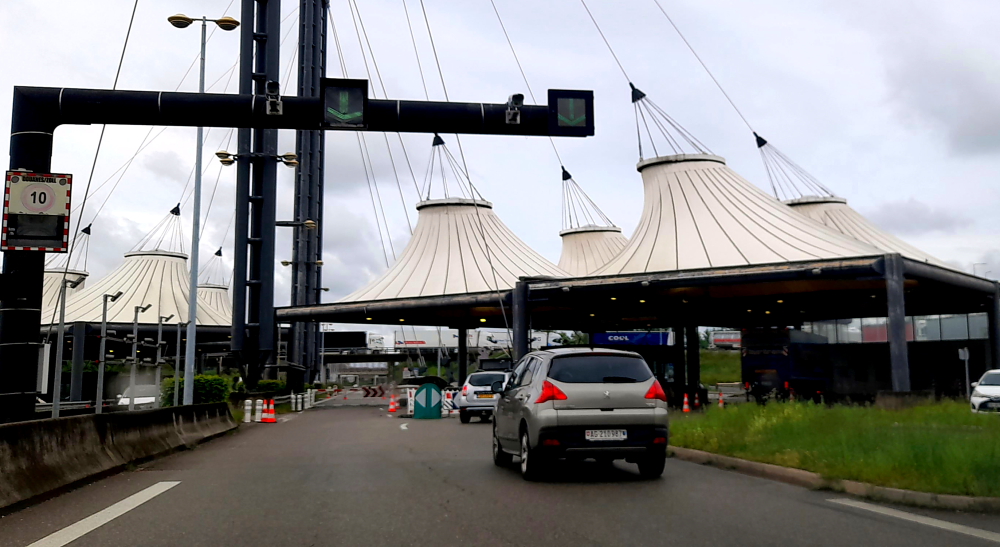
We drive through some verdant countryside and lovely villages that make up part of the Moselle valley and arrived in Nancy about 4 hours after leaving Bern.
We’re staying at a Mercure in the city centre and although it has seen better days its staff have been amazingly friendly and very welcoming.
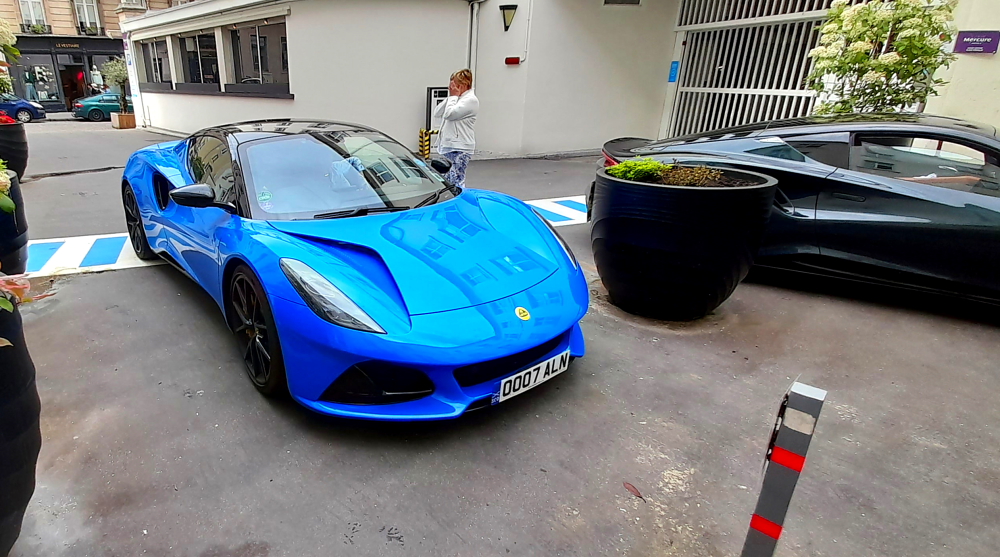
While we are having our welcome drinks at the bench that is the Bar-cum-Reception, 2 guys and their wives check in from the UK. They are taking their respective Lotuses for a spin having driven from Rotterdam this morning, overnighting Nancy, then heading onto Sorrento.
We decide to go out for a quick recce of the ‘hood’. Stanislav Square is a 2-minute walk away – and we are stunned by the opulence before us.
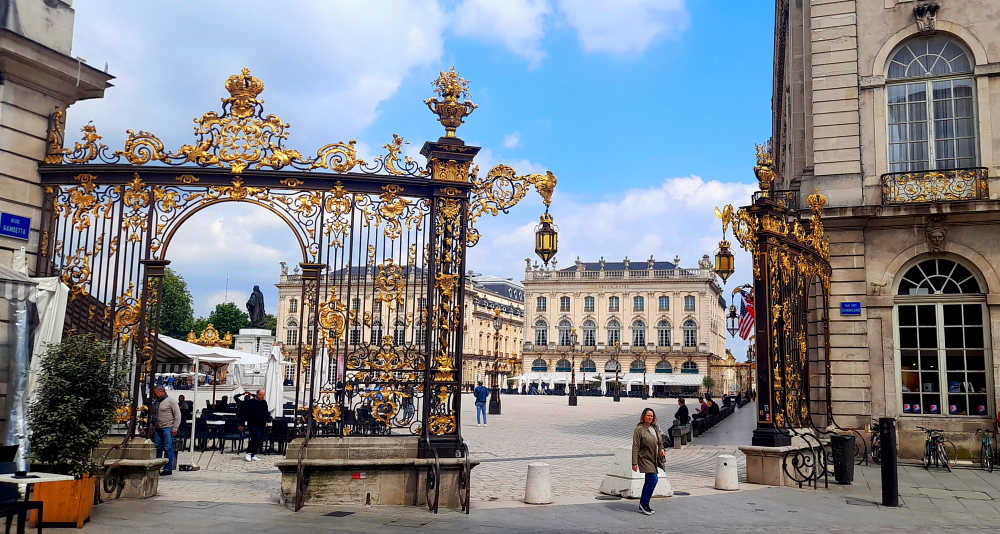
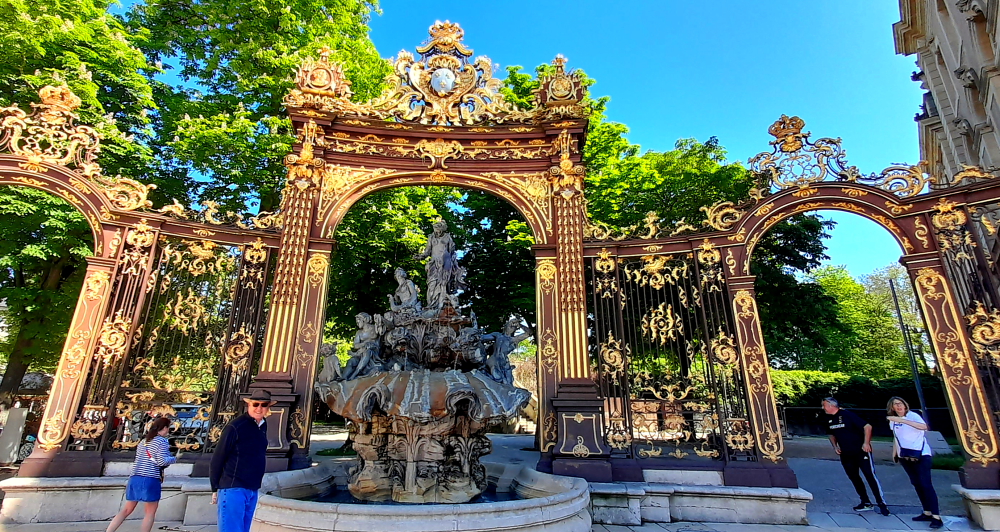
Everything is trimmed in sparkling gold – entrance ways, lamps, street lamps, building features … No wonder this 18th century royal square has been UNESCO listed since 1983.
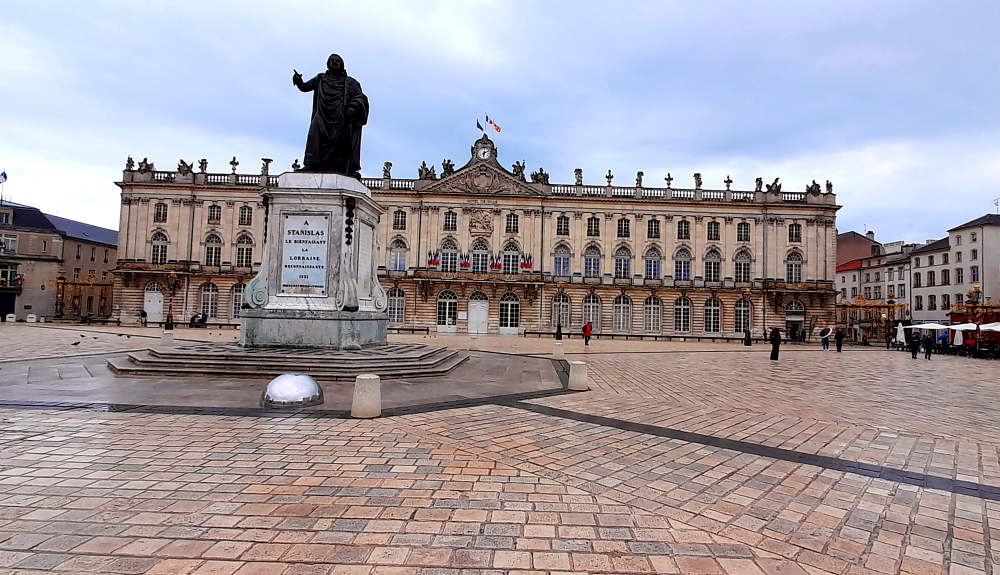
The fountains flowed with wine in 1755 when Stanislaw Leszczynski inaugurated one of the finest squares in the world. Ever since, Nancy has been known as ‘the city with the golden gates’.
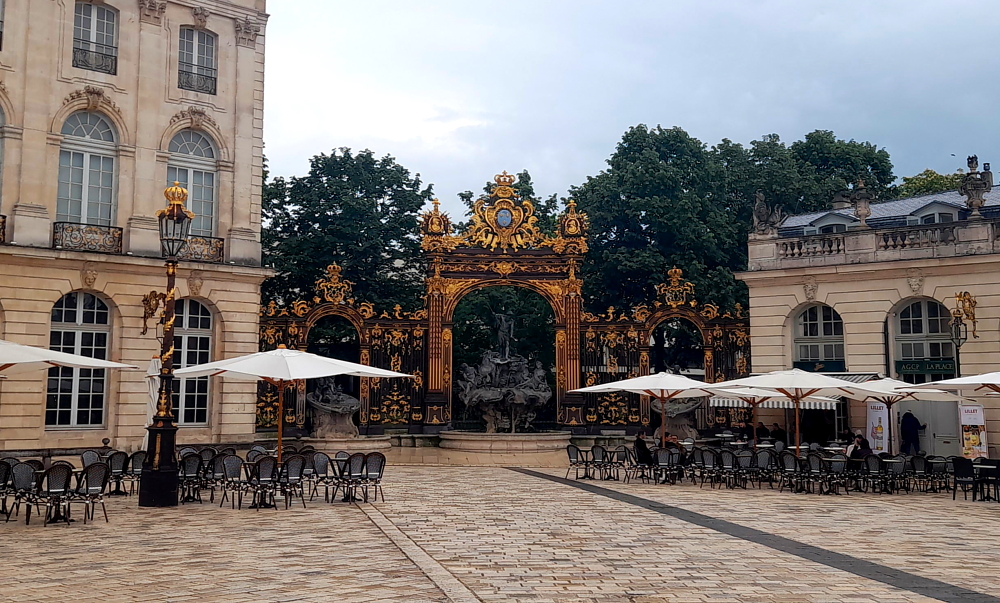
The aim of the major urban development programme carried out by Stanislaw, the last duke of Lorraine, was to link Nancy’s old (Ville Vieille) and new (Ville Neuve) towns [nancy-tourisme.fr].
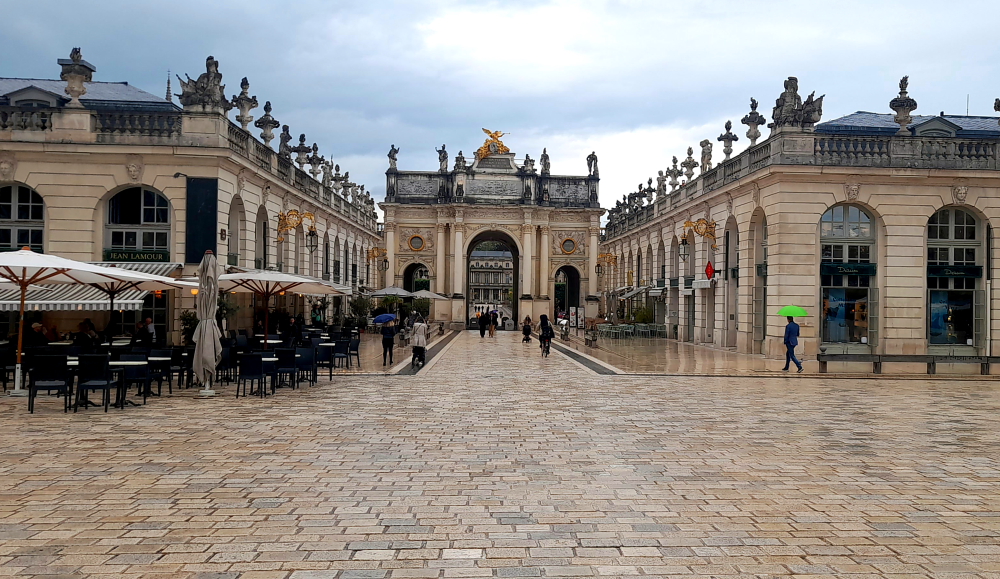
That’s enough sightseeing for today. As we are close to the Square there are lots of cafes, bars and restaurants nearby. But, as we are in France, most won’t open until 7:00 pm. Fortunately, we come across “Nagoya”, a Japanese restaurant, that is open and have a great meal there.
Tomorrow we’ll follow one of the 3 trails marked on the city map – the Historic Centre Trail.
8 May, 2024
Today is a national holiday in France – VE Day, Victory in Europe Day – its 79th anniversary. It celebrates the formal acceptance by the Allies of WWII of Germany’s unconditional surrender of its armed forces on Tuesday, 8 May 1945 and it marked the official end of WWII in Europe in the Eastern Front.
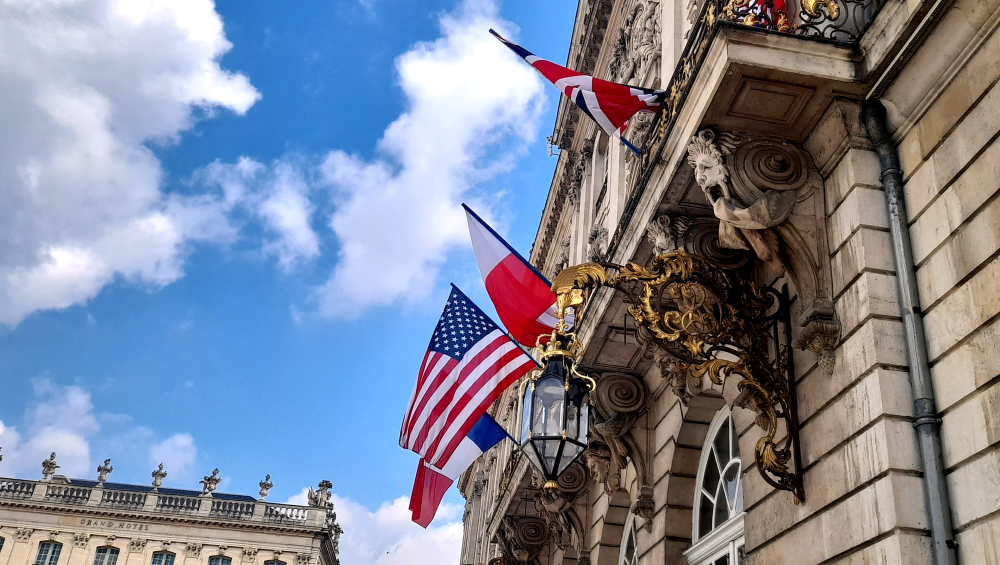
Apparently there are no formal celebrations today, just a day off. All that we see are 4 flags flying over the entrance to the Town Hall – one each for France, USA, Poland and Britain.
Our Historic Centre Trail starts at Place Stanislas. Stanislaw had this square built in honour of Louis XV, his son-in-law, and it’s still the jewel in Nancy’s crown. The square measures 106 by 124 metres.
Crafted by Jean Lamour, the skilled locksmith in Stanisław Leszczyński’s court, the six gilded wrought-iron gates adorning the square’s entrances have bestowed upon Nancy the endearing epithet of the Golden Doors City or La Ville aux Portes d’Or [travelfranceonline.com].
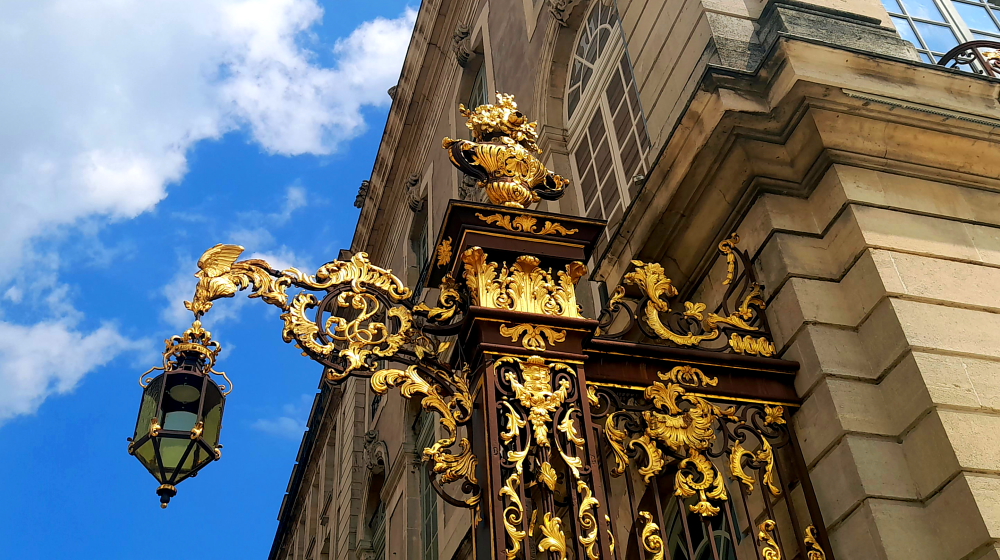
The City Hall occupies the whole of the south side of the square. The Lorraine Opera and the Grand Hôtel de la Reine are on the east side, opposite the Fine Arts Museum. To the north are two single-story buildings known as the Basses Faces. The classical architecture of the square is set off by the gilded wrought-iron gates created by Jean Lamour, and the ornate fountains [nancy-tourisme. fr].
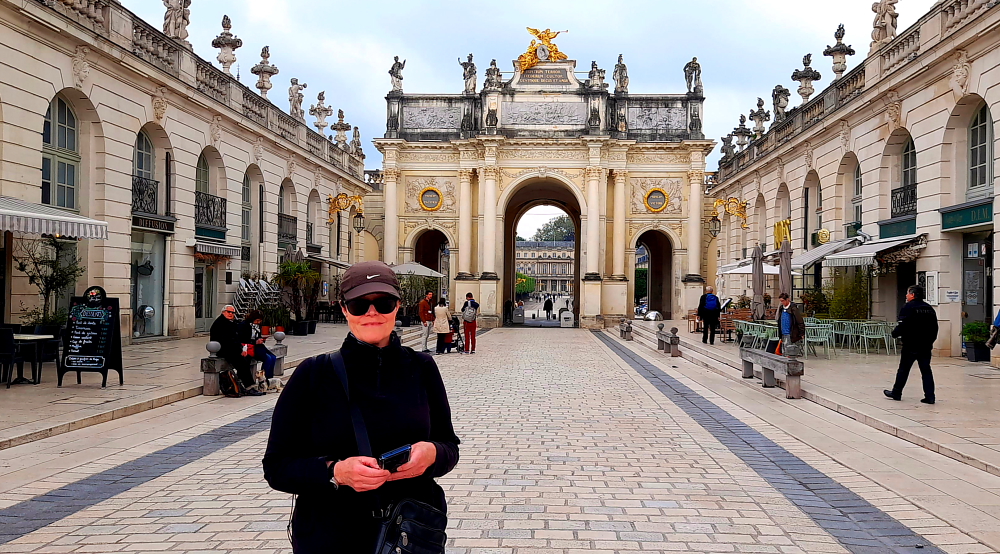
From the statue in the square’s centre we walk down Rue Here to the rather impressive Porte Here. Inspired by that of Septimius Severus of Rome, the triumphal arch glorifies the King of France Louis XV represented in portrait on a medallion at the top of the building. Called today “Arc Héré”, its name recalls the architect Stanislas to whom we owe this monument which was to form the link between the Place Royale (current Place Stanislas) and the Place de la Carrière.
An extension of Place Stanislas, the Place de la Carrière is, in fact, a medieval square, located in the old town and was used for horse training and tournaments. In the 18th century the Palais du Gouvernement was built for the intendant, or representative of the French Government.
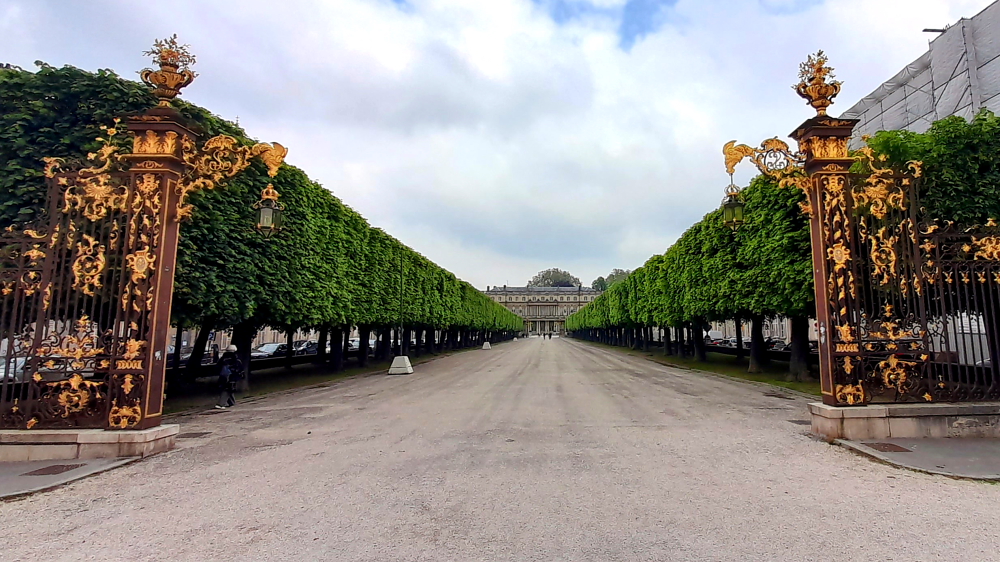
Forming a semi-circle, it closes off the far end of the square, completing the view from the City Hall. Stanislaw’s architect, Emmanuel Héré, remodeled all the façades of the square and built town houses in the corners. Four rows of trees run the whole length of the square, which is also decorated with small fountains featuring cherubs.
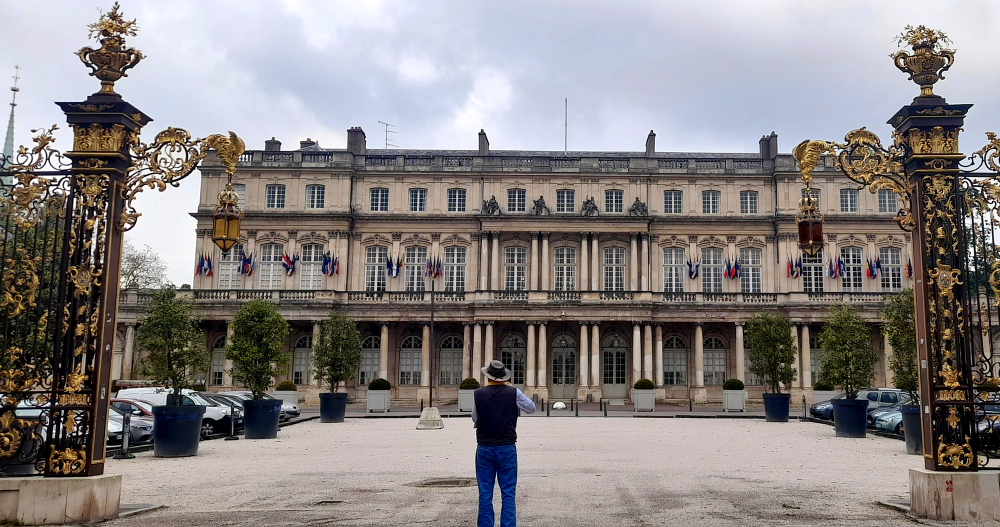
Place de la Carrière marks the passage to the old town, and leads to the Palace of the Dukes of Lorraine [nancy-tourisme.fr].
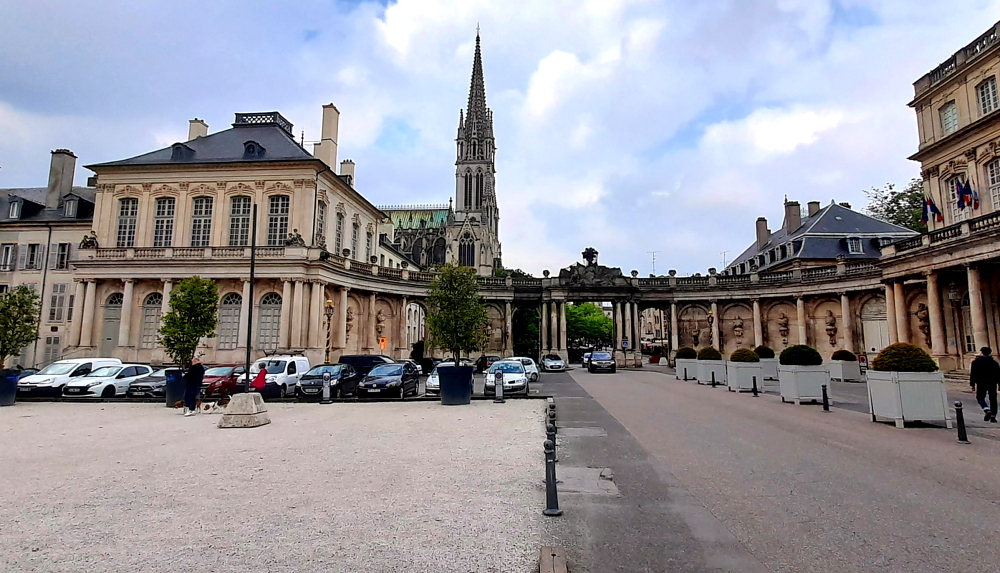
But first we walk past the Basilica Saint-Epvre, but unfortunately it’s closed today. The Saint Epvre basilica was built in the 19th century by Prosper Morey, Prix de Rome architect, in the neo-Gothic style. The work was carried out between 1864 and 1871 by numerous European workshops: glass roofs in Austria and Metz, woodwork in Bavaria, and bells cast in Budapest in particular [nancy-tourisme.fr].
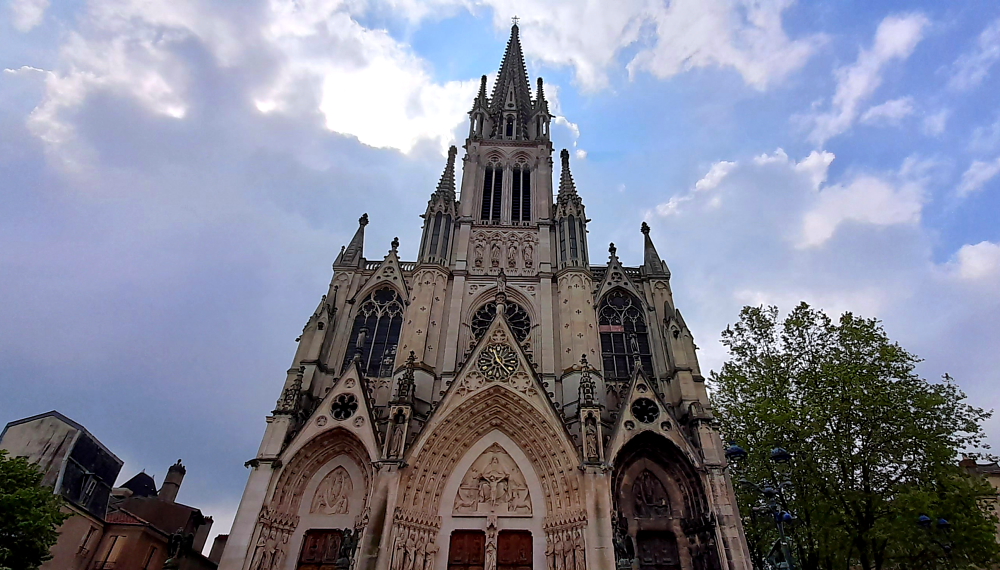
Also closed is the Palace of the Dukes of Lorraine (Palais Ducal), aka the Museum of Lorraine on Grande Rue, due to renovations.
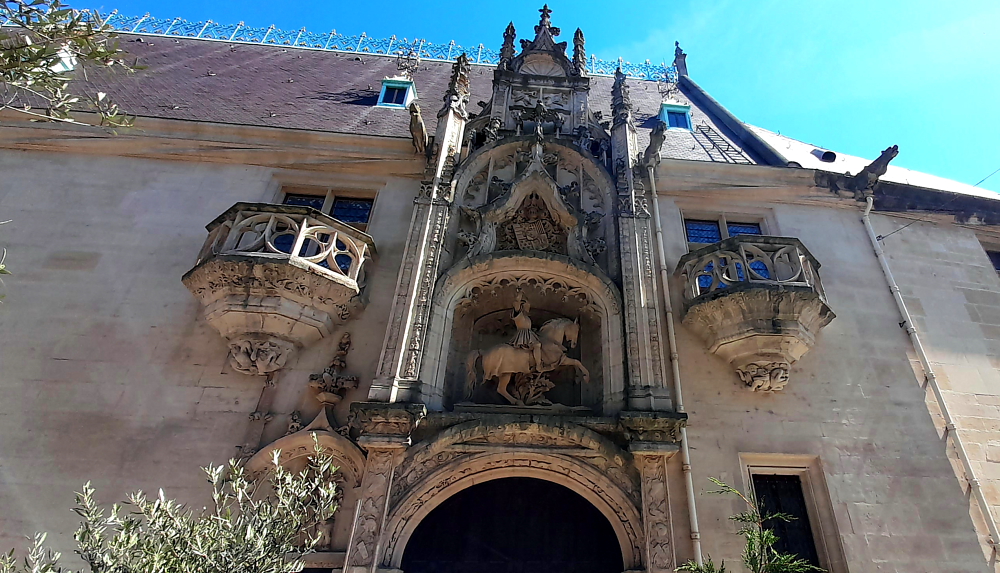
But, the nearby Church and Convent of the Cordeliers and its Funerary Chapel of the Dukes of Lorraine, is open. Today it is more a museum than a church.
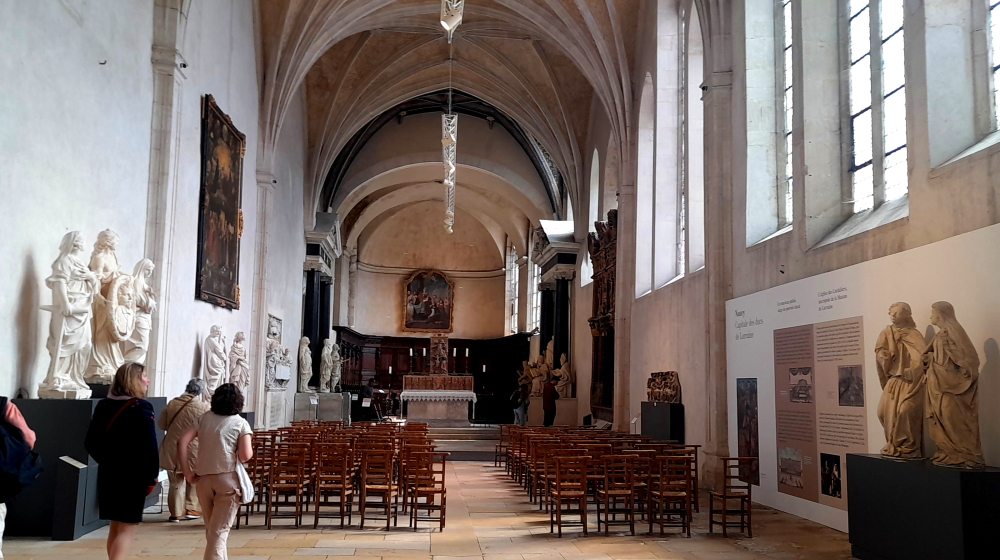
Eglise de Cordeliers is named after the Franciscan Order whose members wore a cord around their waist. It was built in the 15th century by order of Duke René II, following the Battle of Nancy of 1477. Lorraine’s Saint-Denis (burial place of some of France’s famous kings), in spite of incurring damage through the ages, it still has some remarkable tombs. The chapel, inspired by that of the Medici’s in Florence, is outstanding and belongs to the Lorraine museum [nancy-tourisme.fr].
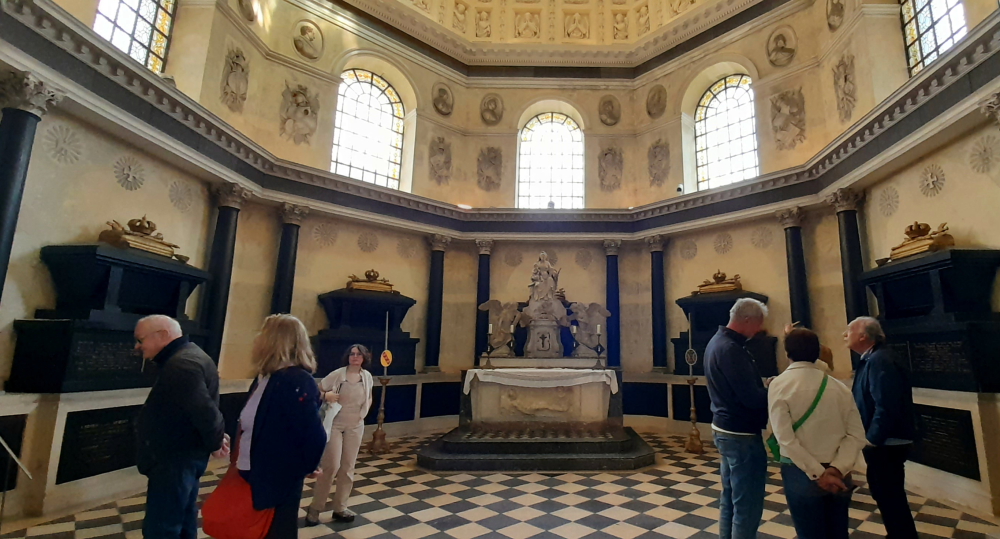
Unlike the Danish Royal Family who had individually-designed sarcophagi, each of these 5 is exactly the same.
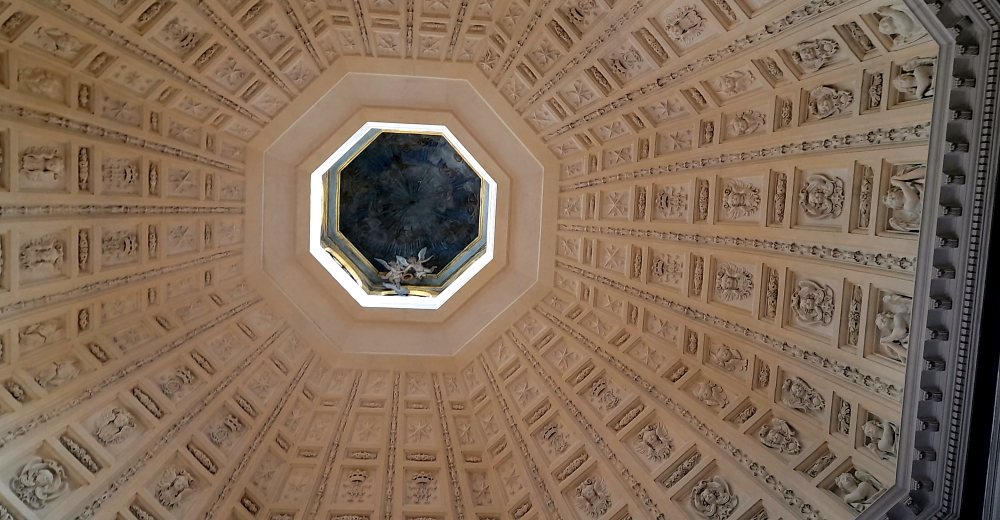
From here we continue down Grande Rue until we come to the superb Porte de la Craffe.
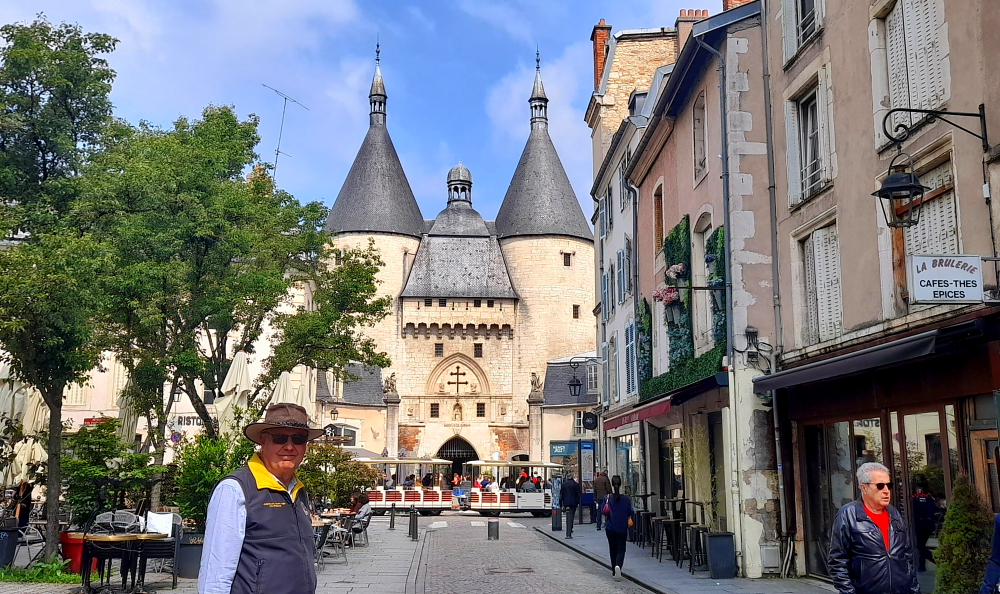
It is the oldest monument in the historic center of Nancy and the only vestige of the medieval fortifications. A symbol today of the Old Town district, it was built in the 14th and 15th centuries and its towers served as a prison until the 19th century. Its extensive brick and stone vault was restored in 2013 [nancy-tourisme. fr].
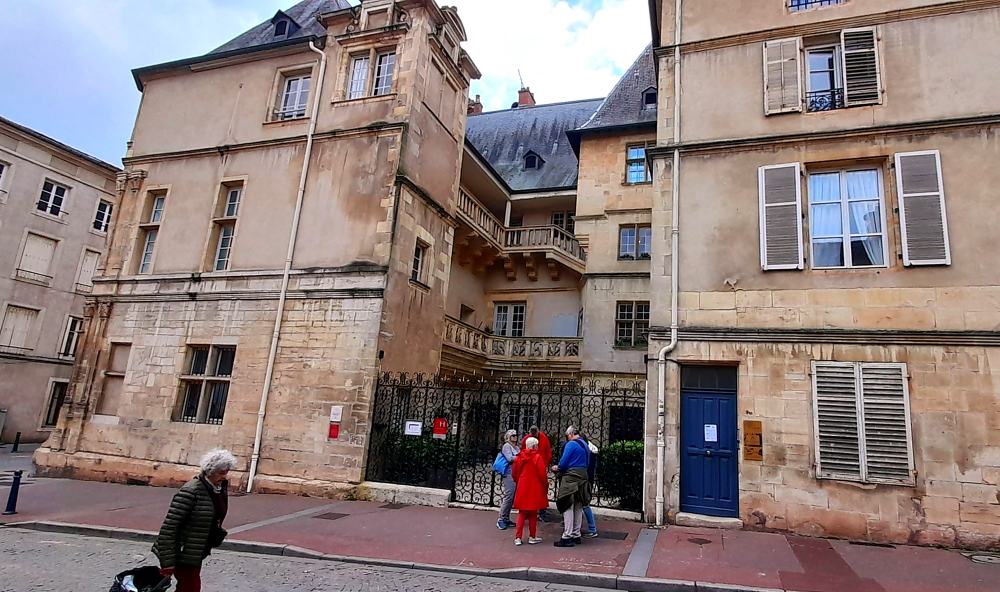
We partly retrace our steps until we come to the Hotel D’Haussonville. It was built between 1528 and 1543 by Jean d’Haussonville, Seneschal of Lorraine. A courtyard opens onto rue Monseigneur-Trouillet and has several ornate galleries, one of Gothic inspiration, the second Renaissance. This private mansion is one of the finest Renaissance examples in Nancy, along with the Palace of the Dukes of Lorraine and the Hôtel de Lillebonne. It was transformed into a 4-star hotel by Laurence and Jean-Claude Capelli in 2003 offering 3 rooms and 4 suites.
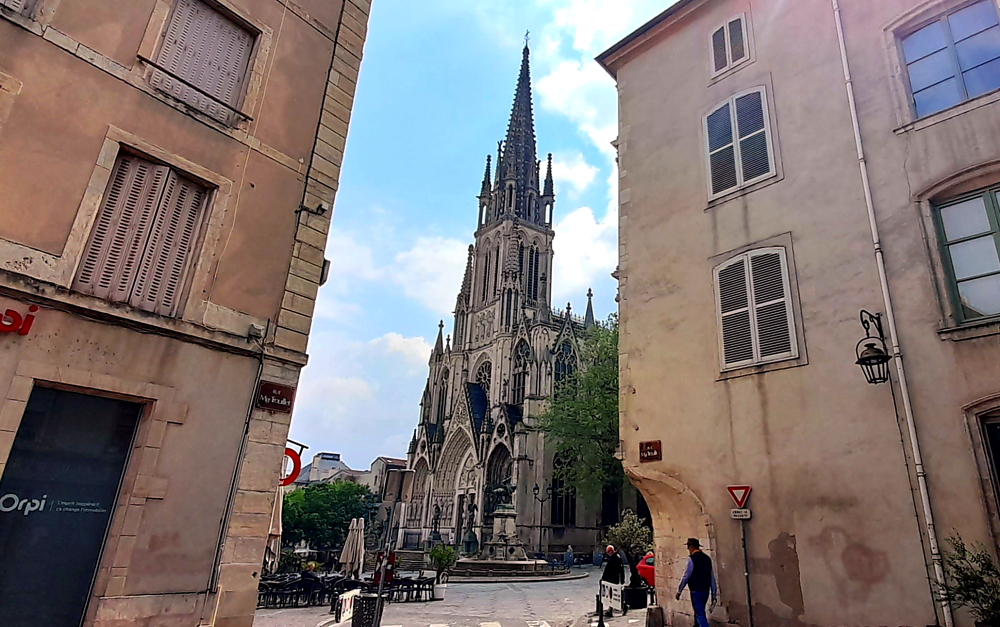
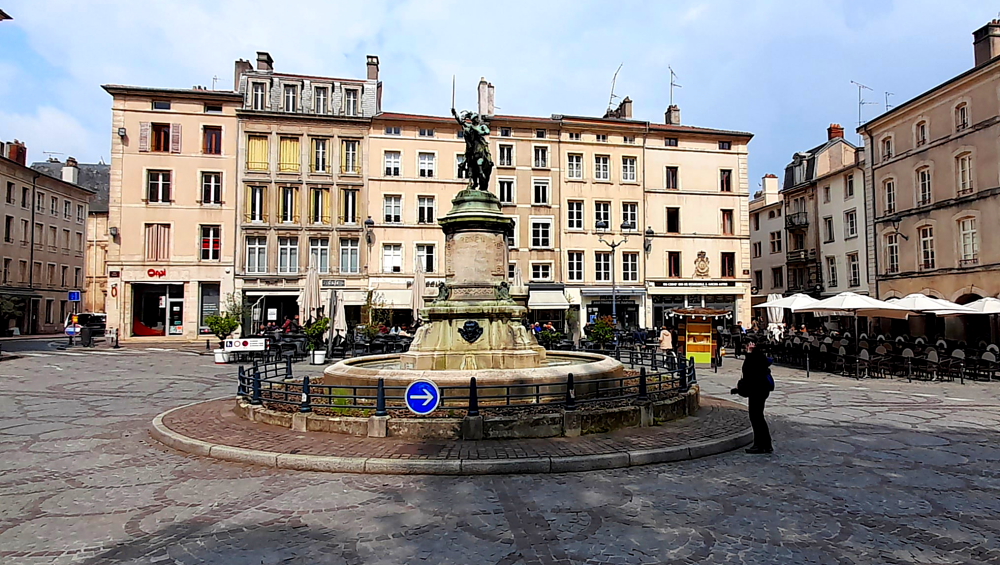
Continuing along Rue Monseigneur-Trouillet brings us to Place Saint-Epvre. A former market square, it is the main square of the Old Town district, known for its terraces and which owes its name to the basilica which borders it. At its centre is the statue of Duke René II, victorious during the Battle of Nancy.
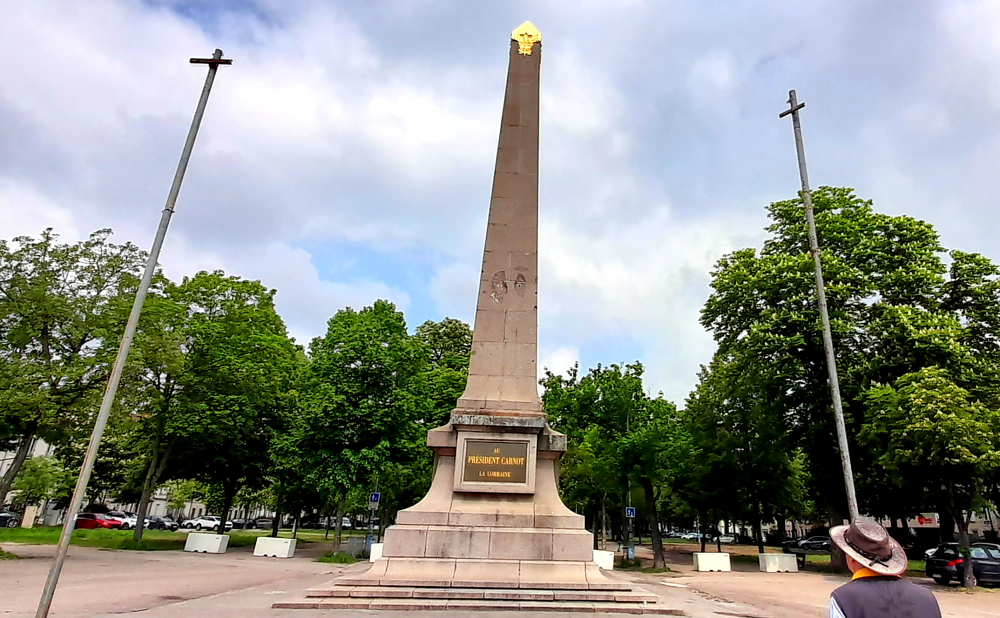
Walking SW we come to the Esplanade du Souvenir Francais (Esplanade of French Remembrance) and the gold-tipped Obelisque de Nancy at its southern end at Place Carnot. Also known as the Carnot monument, it was inaugurated in 1896, paying tribute to Sadi Carnot, President of the French Republic who was assassinated 2 years earlier by the anarchist Caserio.
Its construction was financed by public subscription – 28,000 people, as well as 865 municipalities of Lorraine, no less. Its ornaments were removed and melted down during WWII, as part of the mobilization of non-ferrous metals. In 2016, new enameled lava plaques were inaugurated. Like the originals, they are dedicated to President Carnot, Grand Duke Constantine of Russia, the city of Nancy and the three Lorraine departments of the time.
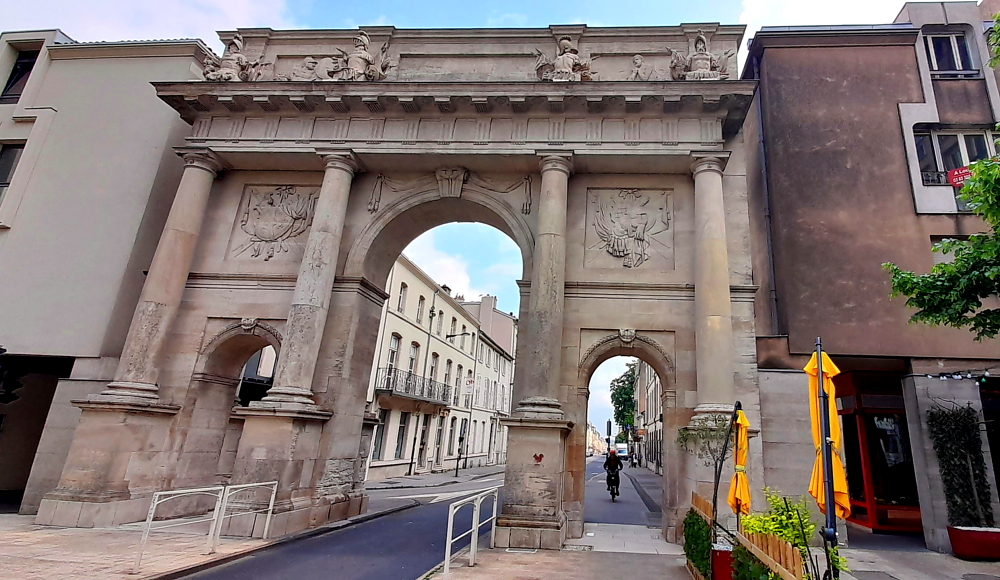
Next stop is another gate, Porte Stanislas. This gate, as well as the Sainte-Catherine gate, is part of Stanislas’s urban plan. It was built in Doric style by the architect Richard Mique in 1761 to replace an arch initially created by Emmanuel Héré [nancy-focus.com].
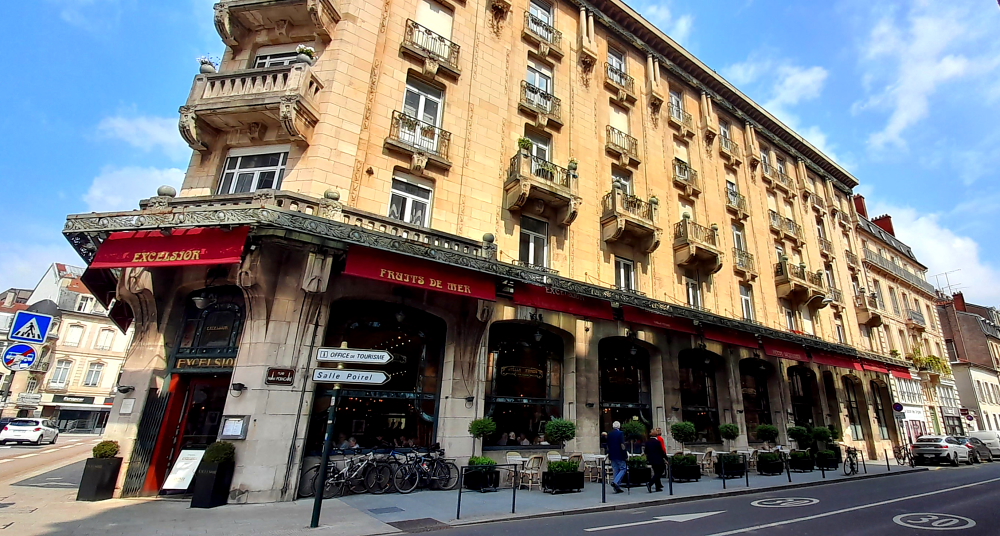
Just down the road on Rue Mazagran is the Brasserie L’Excelsior, one of the most famous examples of Art Nouveau in Nancy. The Art Deco extension and Jean Prouvé bannister combine very well with the décor of the main room which was inaugurated in 1911. The Excelsior was founded by Louis Moreau in order to create a luxury showcase for the beer of his brewery, the Brasserie de Vézelise [nancy-tourisme.fr].
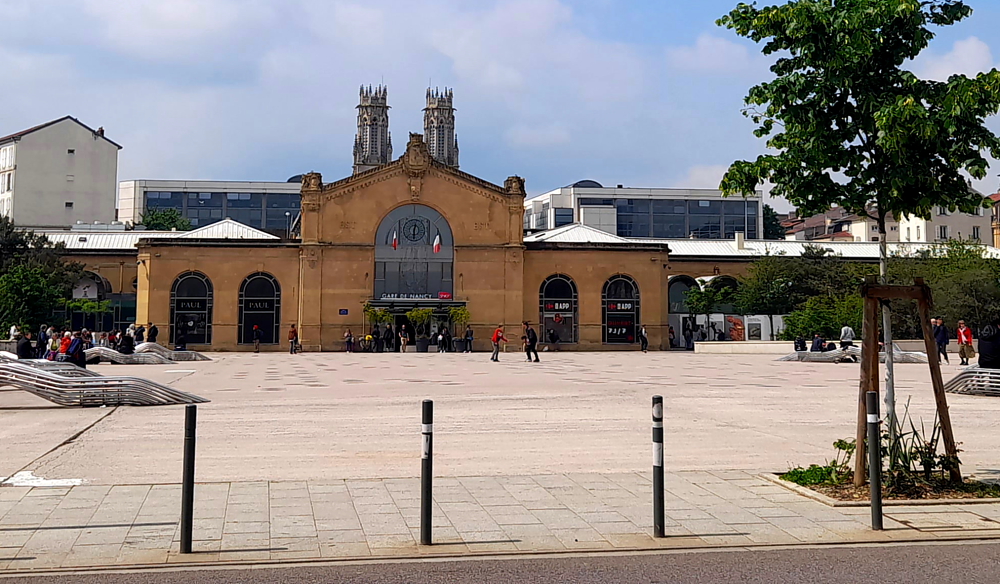
Across the road is the Nancy Train Station and behind it, the Église Saint-Léon de Nancy towers.
From here we return to the hotel. Not long after, Lynn decides to go out to see a number of other locations, the 1st of which is another gate, the Memorial Desilles, that is at the other end of Place Carot, where the obelisk is located.
Built between 1782 and 1785 at the request of Marshal de Stainville, commander of the province, in order to create an opening in the city’s granting wall in the direction of Metz, the Porte Désilles, then called Porte Saint-Louis, or Stainville , originally celebrated the engagement of King Louis XVI in the American War of Independence (1775-1783), as well as the economic and maritime prosperity that resulted from this alliance. It was the birth, on 22 October, 1781, of the Dauphin Louis Joseph of France, son of Louis XVI and descendant of the last Duke of Lorraine, who presided over the decision to build this monument.
A few years after its construction, in 1790, the Porte Saint-Louis was the scene of an event known as the Nancy Affair. The regiments then garrisoned in Nancy mutinied, because they no longer received their pay, and their revolt was severely repressed by the troops of the Marquis de Bouillé. During this fight, André Désilles, a 23-year-old lieutenant of Saint-Malo, intervened between the units and was seriously injured. He died the following October 17, his wounds having become infected. It was only in 1867 that the Saint-Louis gate took the name of Désilles, whose sacrifice became a symbol of union and devotion.
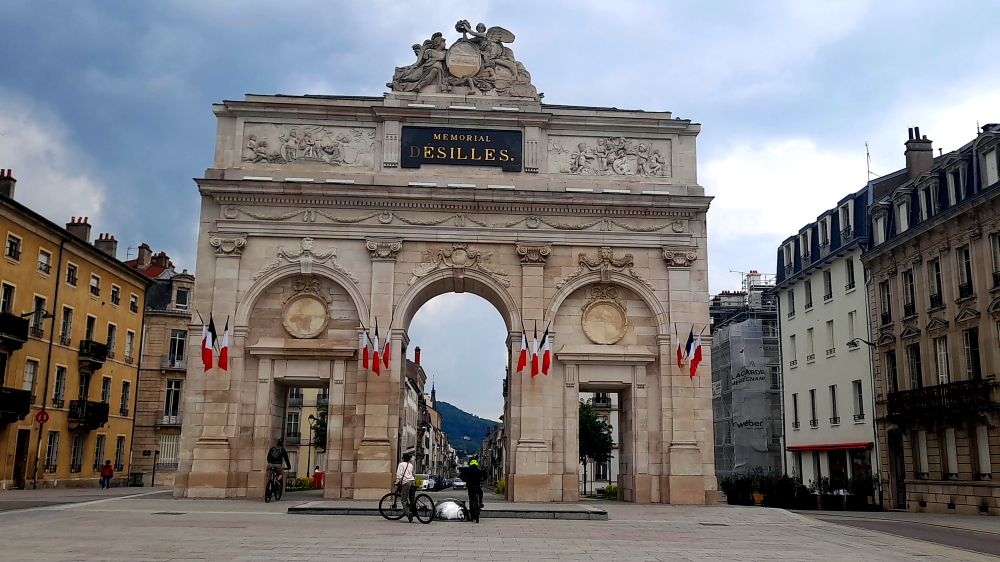
In 1976 the building became the Monument of Remembrance. The gate then became the city’s main place of commemoration and was consecrated as such by a ceremony which took place on the following November 25, in the presence of President Valéry Giscard d’Estaing.
Next on her list is the nearby Parc de la Pepiniere (Nursery Park). Located in the heart of the historic centre, the Park offers a haven of greenery with its 21 hectares of wooded areas and its rose garden.
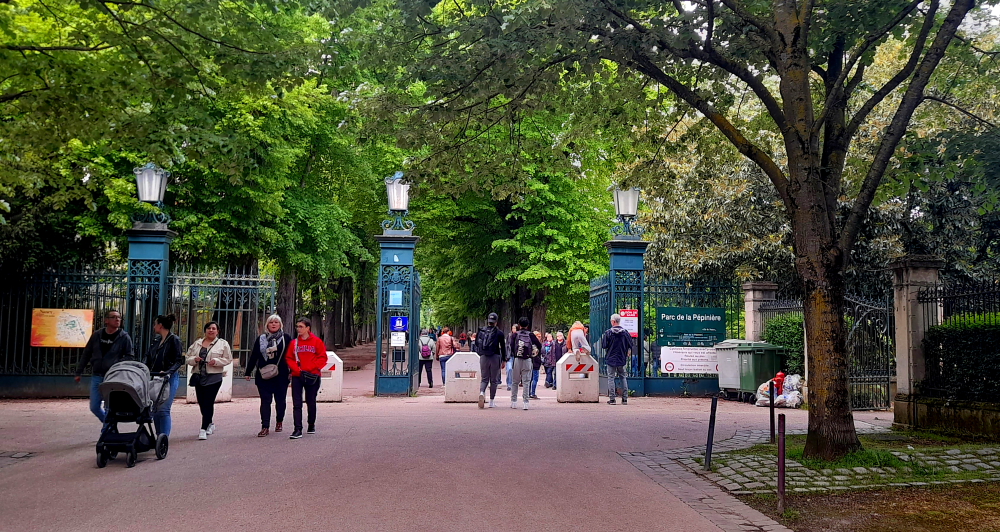
A former royal nursery founded by Stanislas on the site of the former ducal gardens and bastions of the Old Town, it was transformed into a public park in 1835 while retaining its initial layout. The park offers numerous leisure activities: an animal area, a mini golf course, a playground, a puppet theater, several restaurants, children’s rides, as well as numerous sports fields (football, basketball, pétanque, etc.)
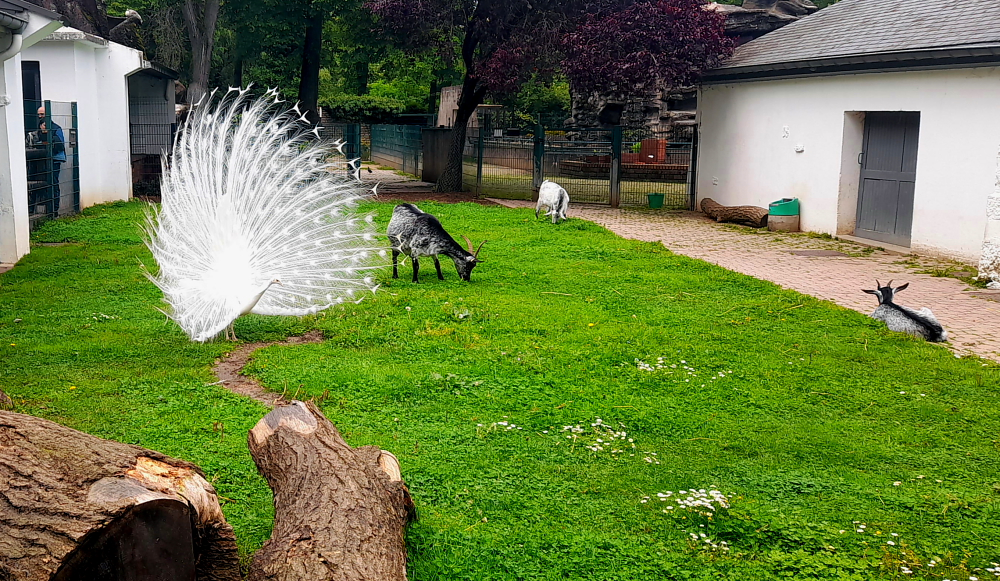
People who have been living in Nancy for decades remember the time when the animal enclosure used to be home to bears, lions, monkeys and kangaroos. Children loved giving dry bread to the deers and throwing peanuts to the bears. Exotic animals are no longer kept in the Pépinière, however many peacocks, ducks, white storks, swans, as well as donkeys and goats still wander around the park [frenchmoments.eu].
On the home stretch she calls by the statue of Jean d’Arc, located in the old town, Place La Fayette, an extension of Rue des Maréchaux. The most famous statue of Joan of Arc in Paris at Place des Pyramides is, in fact, a copy of that of Nancy installed in 1889.
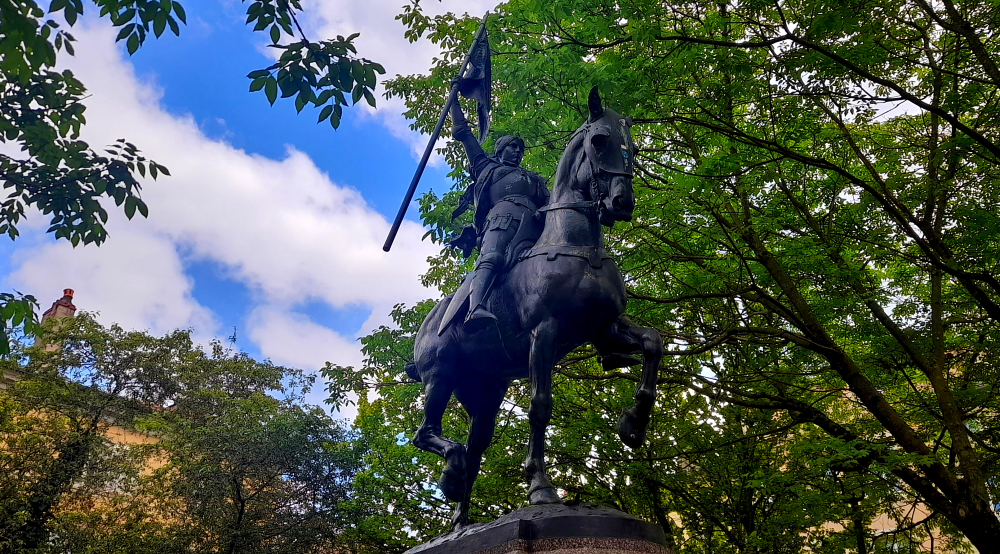
Another statue from the same mold flew the same year to Philadelphia and other replicas reached Lille, Compiègne, Saint-Etienne, Melbourne, Portland, New Orleans…In 1898, the sculptor Fremiet substituted his new statue, a replica of that of Nancy, for the old, discredited one at the Place des Pyramides in Paris.
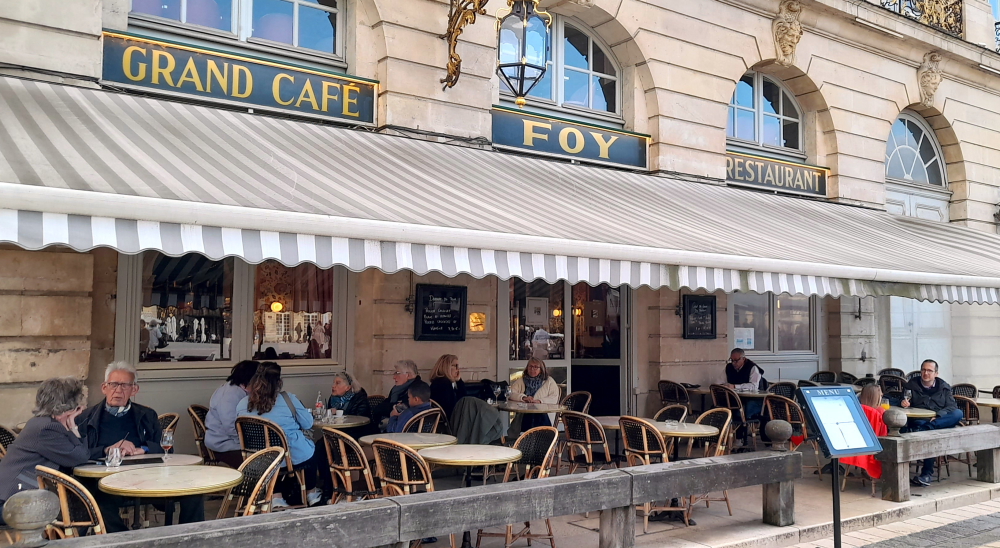
This evening Yoanna, one of the hotel receptionists, has booked us a table at the Grand Cafe Foy on the Place Stanislas. I have lamb shank and Lynn orders Quiche Lorraine (when in Rome…).
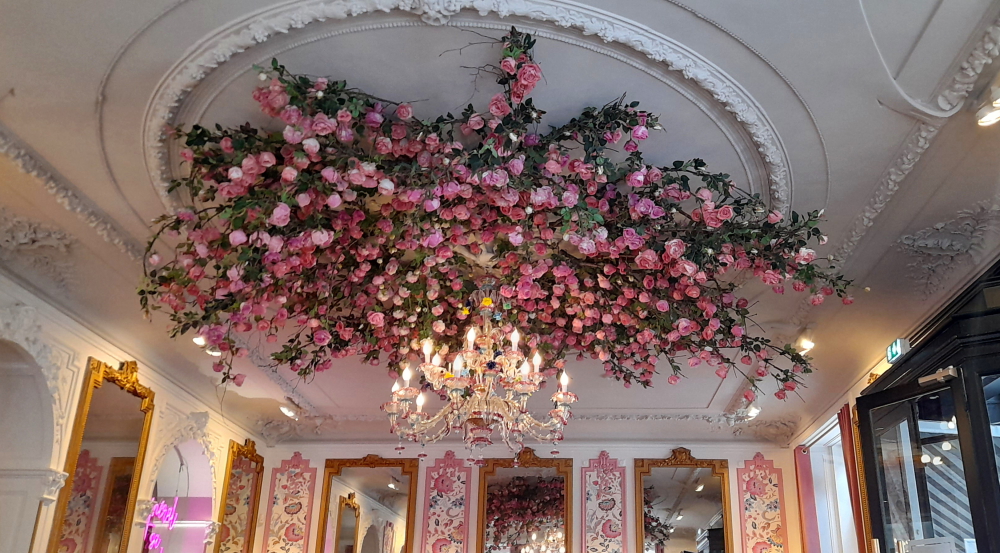
Plus we are very ably looked after by our waiter Eddy, well known by the staff at the Mercure. Delicious food and excellent, personalised service. It’s who you know!
9 May, 2024
Yesterday we walked the ‘orange’ Historic Centre trail. With today being another sunny day we plan to walk the ‘green’ Art Nouveau trail which is the longest of the 3.
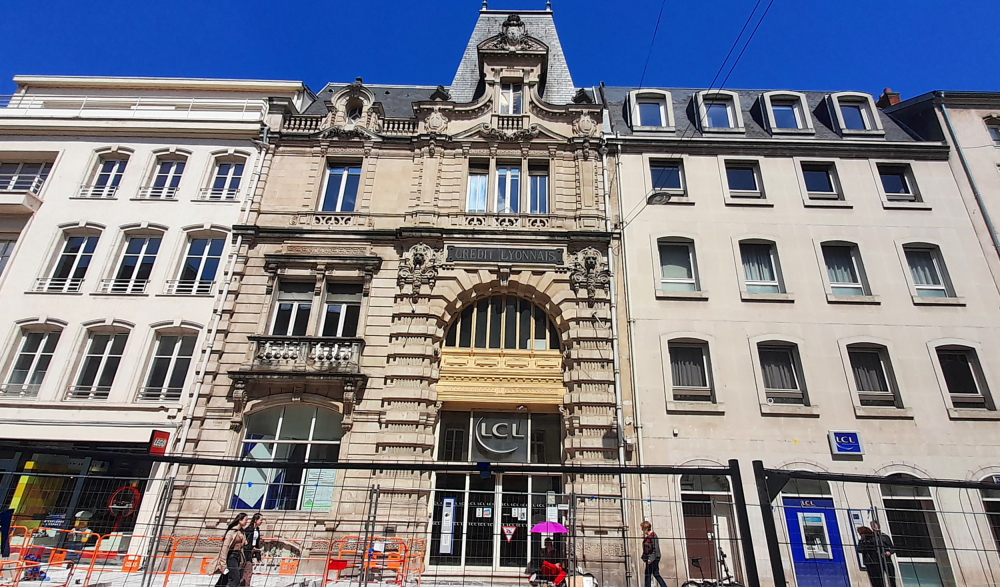
We start out in front of the Credit Lyonnais on Rue Saint-Jean. The feature of this building is its monumental glass roof covering 250 square metres. One of the masterpieces of the Nancy School painter and glassmaker, Jacques Gruber, it lets light into the foyer of the bank.
Clematis wind around the imitation metal structure reproduced on the glass. The ‘CL’ monogram appears at its centre, in reference to the bank’s name. Sadly, the bank is closed today as it is another holiday, Ascension Day, so we only get to see the building’s exterior.
At the far end of the street, opposite Place Andre Maginot, is BNP Paribas. Actually it’s the building of the Banque Charles Renauld that is remarkable, built between 1908 and 1910. Since 1985, it has been a BNP Paribas agency.
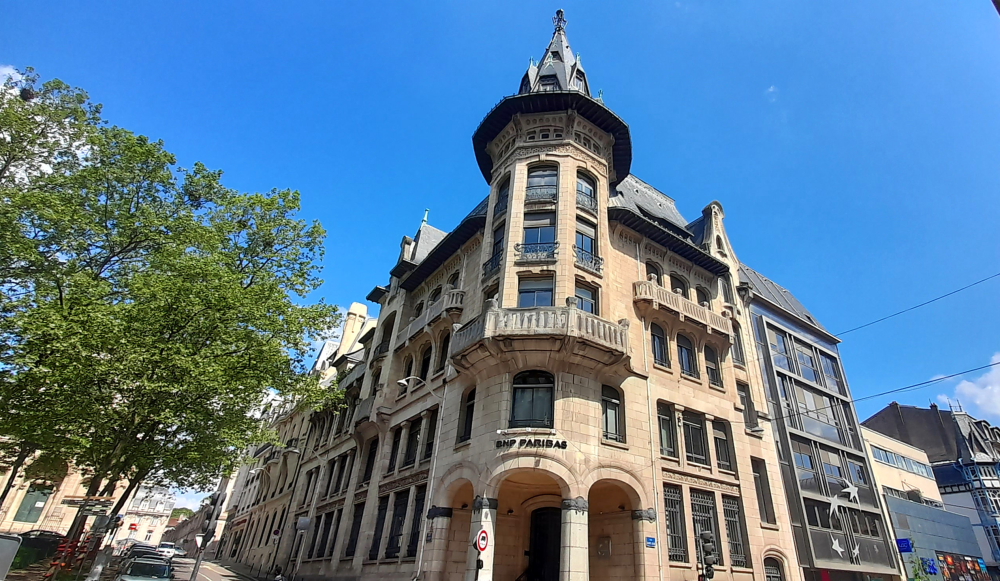
Charles Renauld, a financier originally from Rambervillers, and brother-in-law of Antonin Daum, became in 1881 co-owner of a bank founded in 1871. In July 1907, he decided to abandon his premises at 21 rue Saint-Dizier for an entirely new building, built in the Art Nouveau style.
Its architects are Émile André and Paul Charbonnier. The ironwork and furniture were made by Louis Majorelle, and the glass roofs by Jacques Grüber.
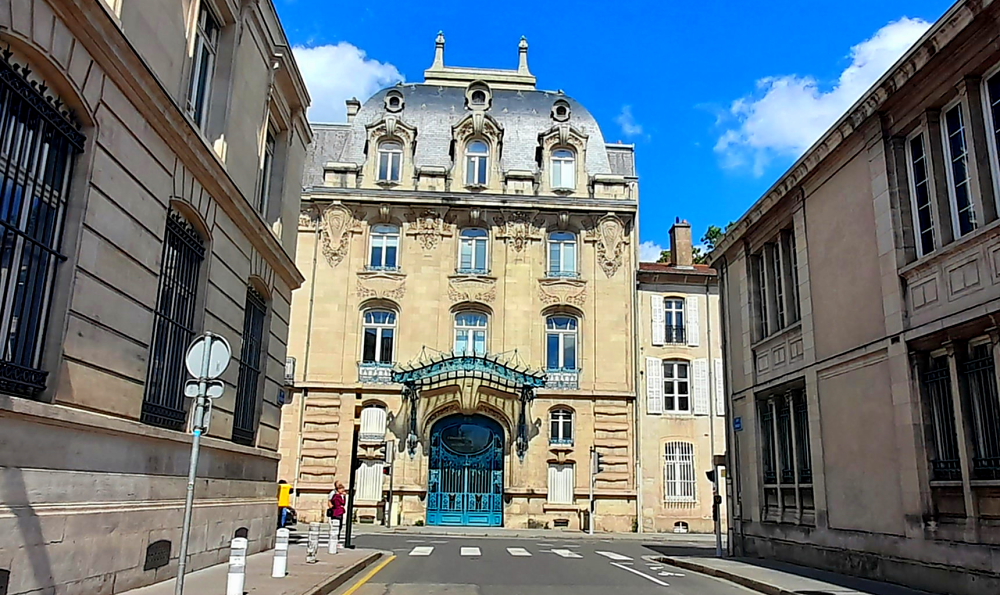
250m away up Rue Chanzy is the Chambre de Commerce et d’Industrie Grand Nancy Metropole Meurthe-et-Moselle (!) building.
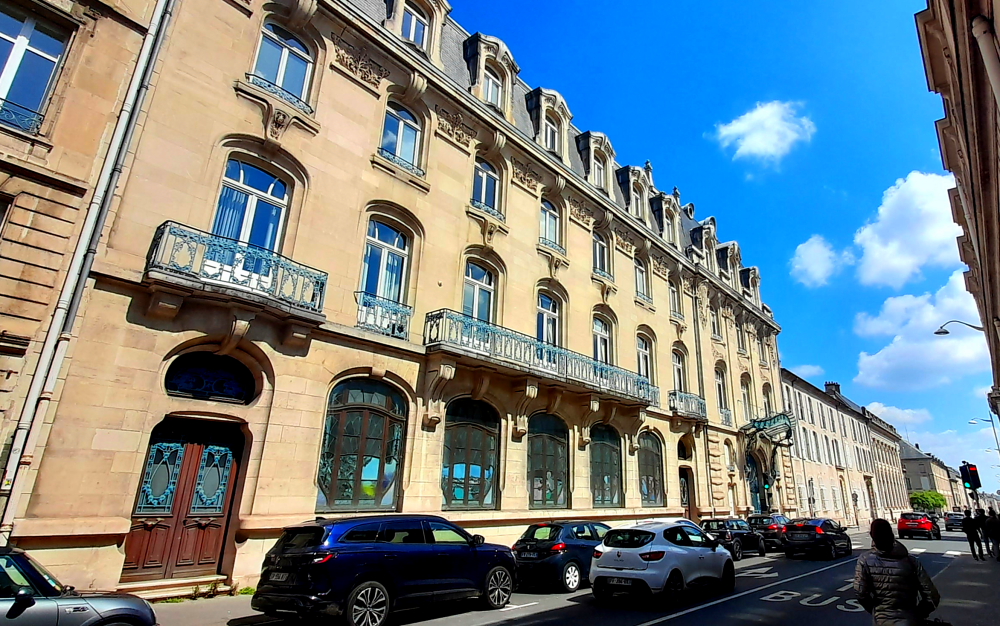
One end of the building is visible from Rue Chanzy but once in Rue Stanislas, the full extent of the building is revealed, including the stained glass in the enormous ground-floor windows.
The next 2 sites, Brasserie L’Excelsior and the Cours Leopold/Place Carnot (obelisk) we’ve already seen so we give these a miss. But, by this time I’m getting bored so we abandon the other 5 Art Nouveau buildings and instead strike out across town towards the canal and walk part of the ‘blue’ trail, the Banks of the Meurthe River.
Walking in a westerly direction we arrive at Notre-Dame de l’Annonciation (Our Lady of the Annunciation) on Rue Saint-Georges, part of Nancy’s 18th century heritage.
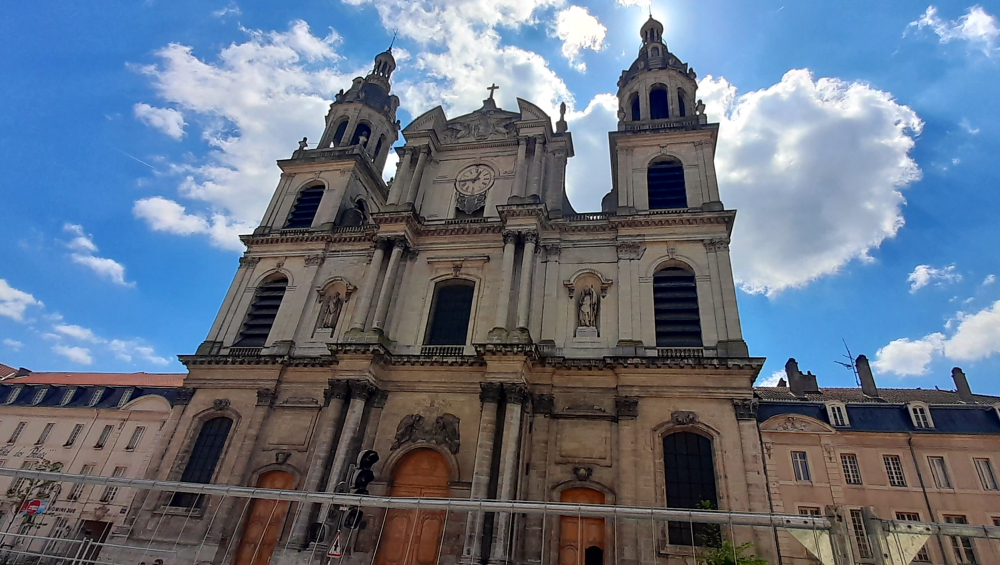
The work of architects Giovanni Betto, Jules Hardouin-Mansart and Germain Boffrand, it was built at the beginning of the 18th century, during the reigns of Dukes Léopold and Stanislas. It has a dome painted by Claude Jacquard, paintings from the Lorraine School of the 17th and 18th centuries, and a listed organ. First primatial, then cathedral, since the creation of a bishopric in Nancy in 1777.
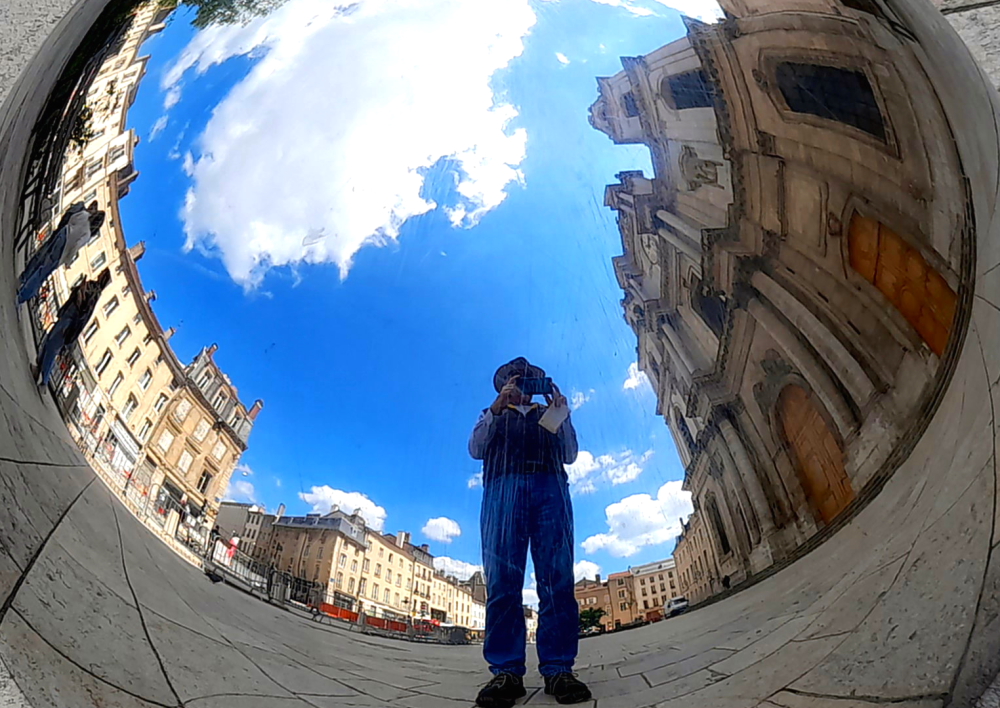
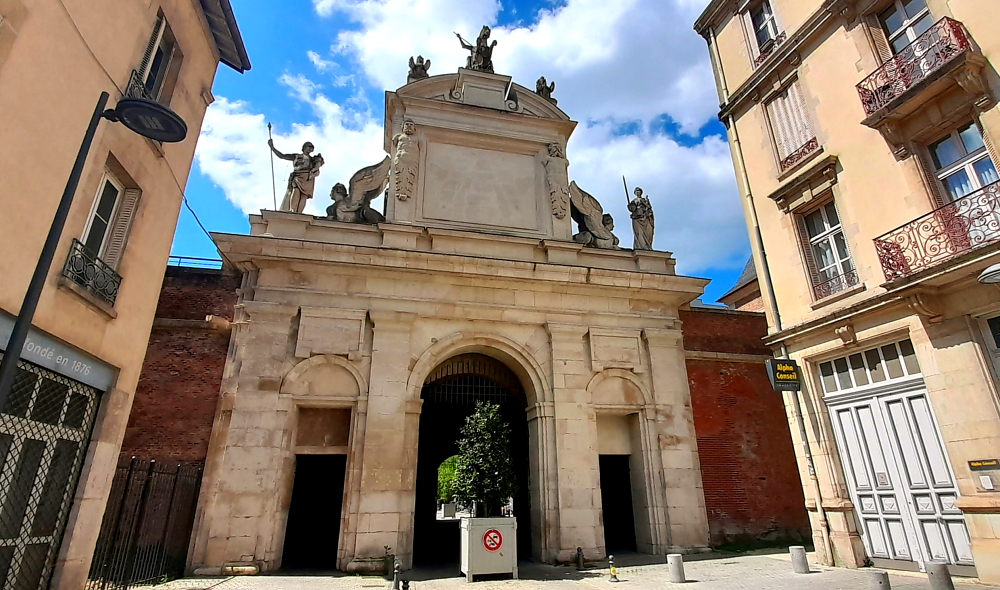
From here we continue down Rue Saint-Georges, onto Place Colonel Driant and at the beginning of Avenue de XX Corps is the understated facade of the Porte Saint-Georges. Its name pays homage to the protector of the city.
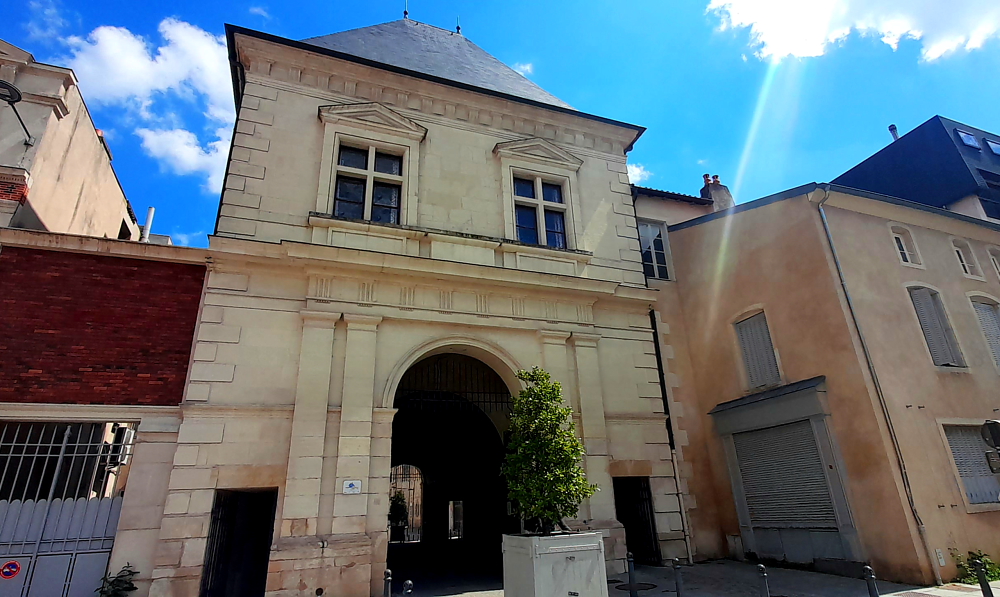
At the entrance a plaque reads: The Saint-Georges Gate was saved from demolition in 1878 thanks to the intervention of Victor Hugo. “All the cities of France would be proud of such a monument, I ask for its conservation.” Victor Hugo.
Unlike its facade, the inside vault is another matter with striking black diamond patterns in the red brickwork.
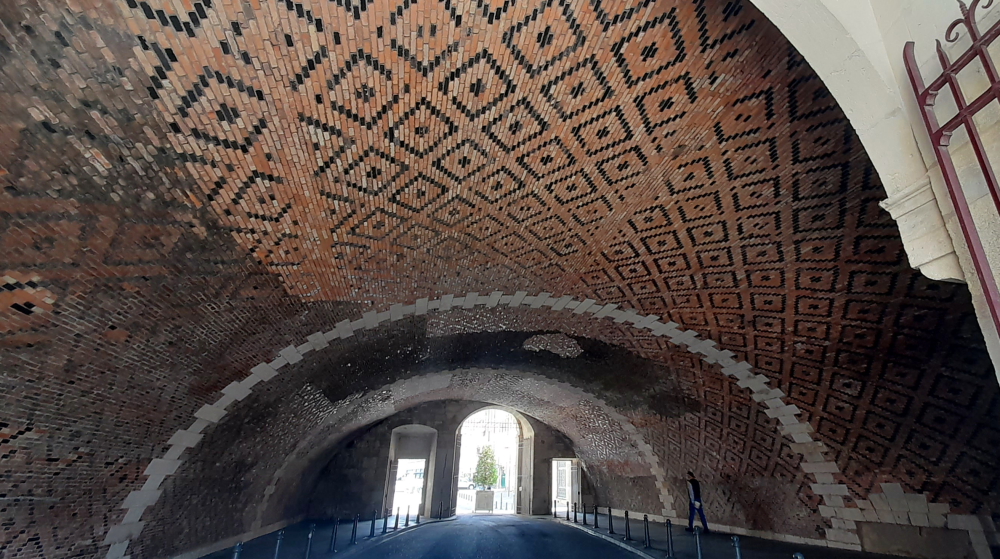
And unlike its city facade, the ‘country’ facade has Saint-Georges represented on this side. Jean Richier and Simon Drouin are the two sculptors who worked on the remarkable decor of the building. Linked to the construction of the New Town, it was built between 1606 and 1619 in the Renaissance style. Its remarkable restoration dates from 2013 [nancy–tourisme-fr].
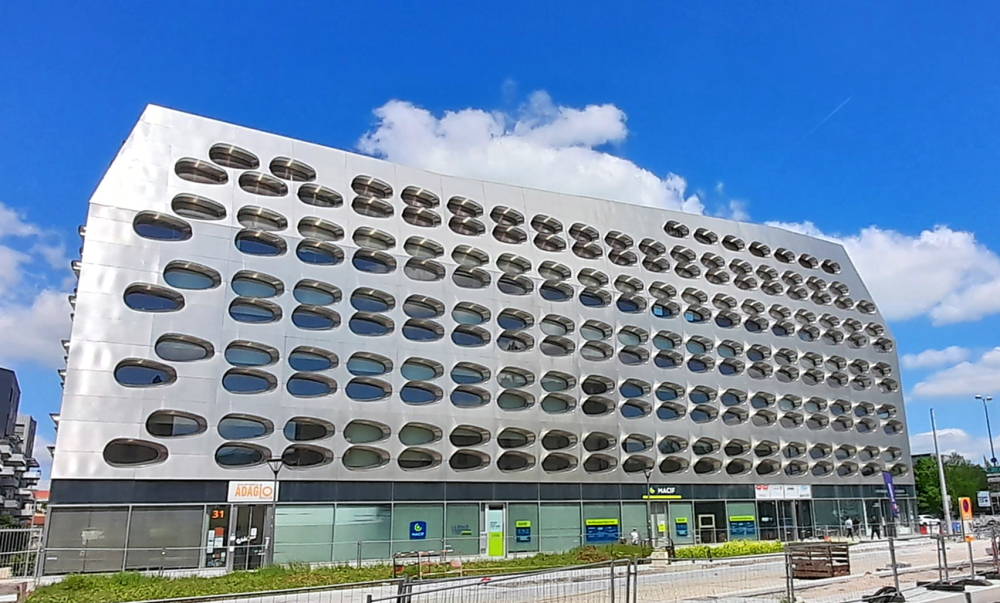
In complete contrast, at the Avenue de XX Corps cross road with Quai Sainte-Catherine, just before the Canal, is a very modern building – an aparthotel constructed from scratch in September 2012 and operating in 2015.
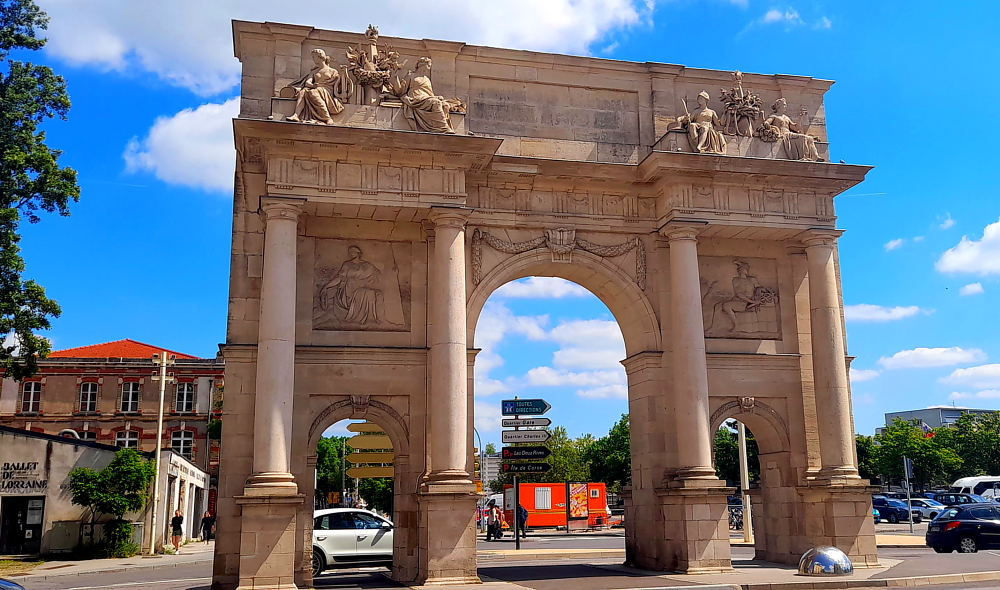
At the junction of Quai Saint-Catherine and Rue Saint-Catherine is the Porte Saint-Catherine. This gate, as well as the Stanislas Gate, is part of the urban plan envisaged by Stanislas Leszczyński. Initially the gate was much closer to Place Stanislas. In 1768, it was moved 300 metres beyond the Sainte-Catherine barracks when it was completed in order to include it in the city wall.
It was built in 1761, Doric style, by the architect Richard Mique who also built the Sainte-Catherine barracks nearby. The door is dedicated to Stanislas’ wife: Catherine Opalinska, mother of the Queen of France Marie Leszczyńska.
We spend part of the afternoon downsizing, reducing the 5, large open bags that have been floating around in the car boot to 1, repacking most into our suitcases from whence the contents came.
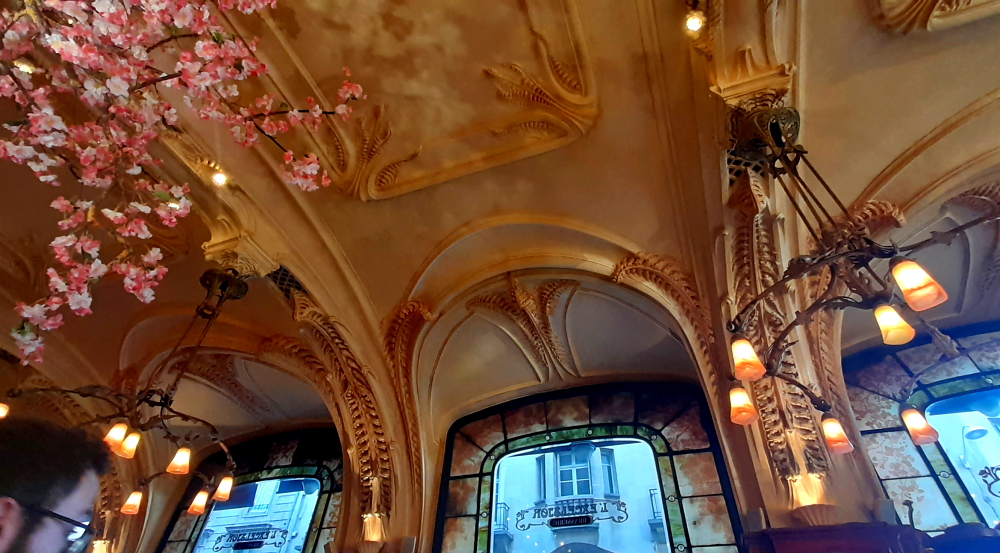
At 7:00 pm precisely we front up at the Brasserie L’Excelsior. Lucy, one of the hotel receptionists, kindly offered to book restaurants for us for the next 3 nights. We are enchanted by its beautiful Art Nouveau interior of elegant plaster work moldings inspired by ferns …
… and impressed by the excellent service provided by the army of waiters decked out in white shirts, black ties, vests and trousers, covered by long, white pinnies.
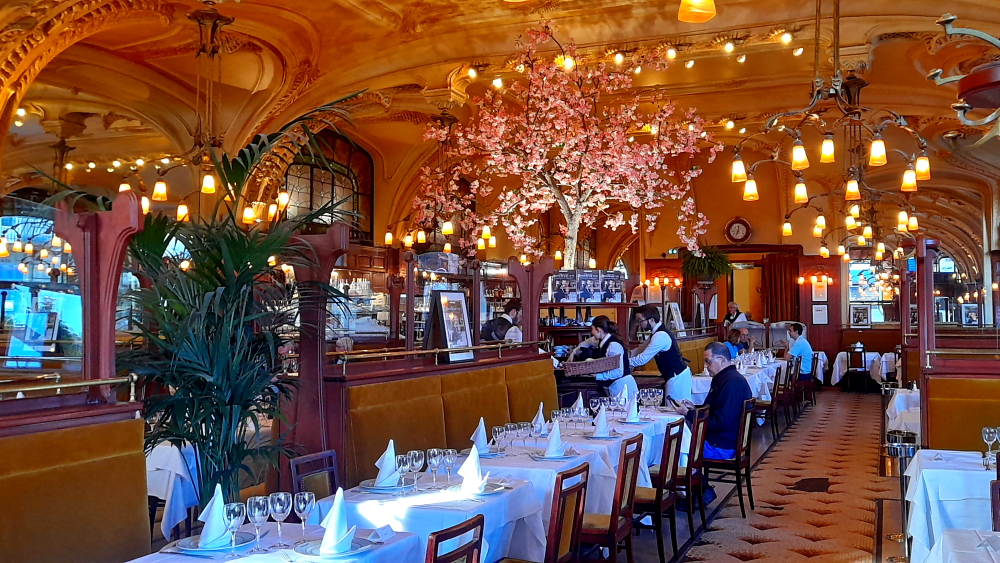
I order an entree of pate de foie gras and beef with bearnaise sauce and potatoes for mains – all delicious. Lynn orders salmon tagliatelle. We had been told by one of the Mercure staff about the Crepes Suzette here so Lynn orders some and we are treated to the waiter warming the crepes over a flame and dramatically setting them alight.
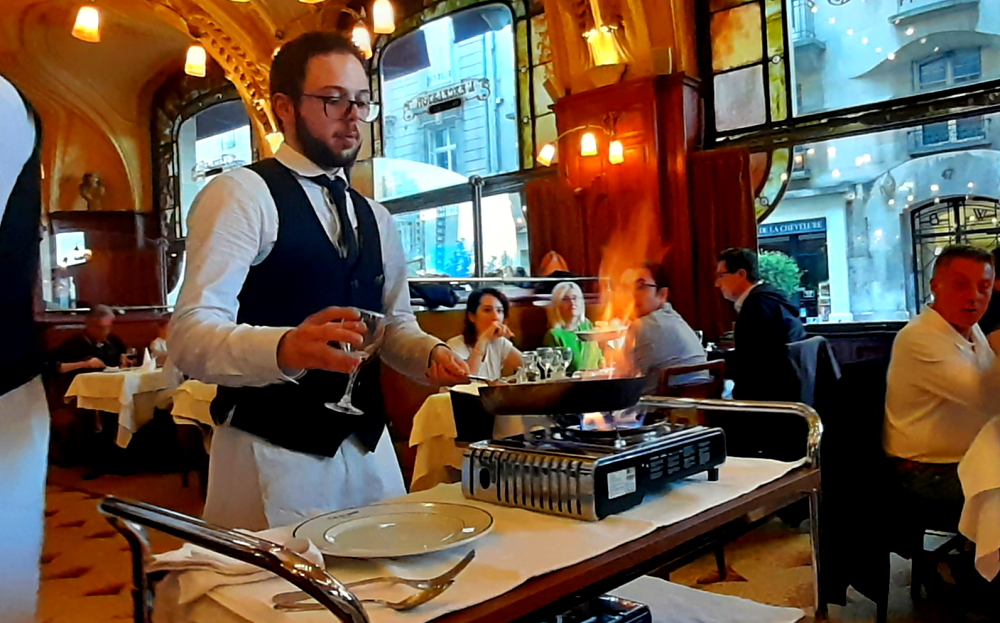
Over the years various famous people have dined at the Brasserie, such as David Bowie. Lynn is sitting at a seat with the name “Arlette Gruss” who it turns out was a French circus artist and founder of the Arlette Gruss circus.
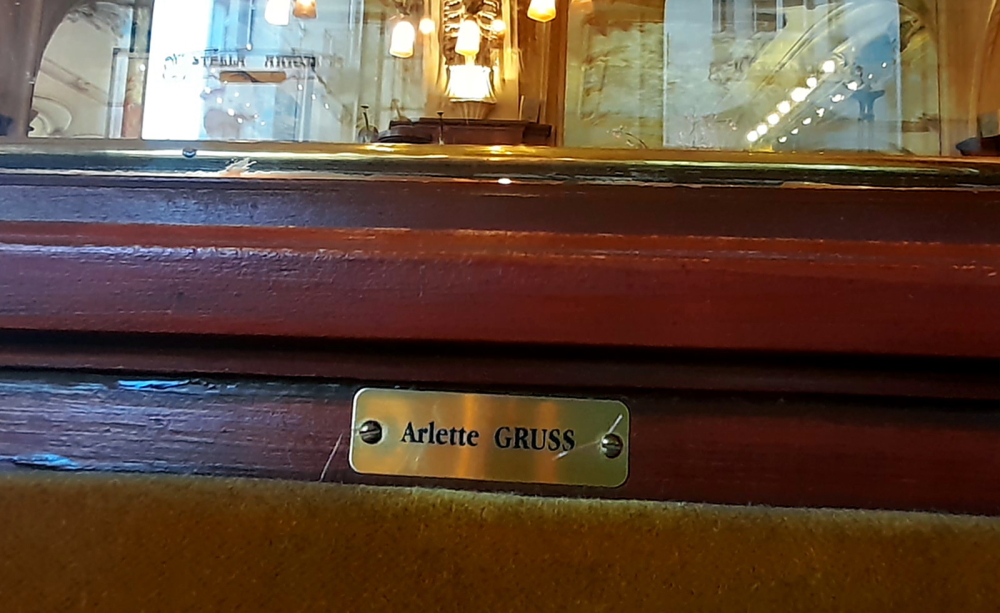
Having dabbled in all circus disciplines (trapeze and rope in particular), Arlette Gruss was best known for her panther tamer act. After the death of her father in 1985, she decided to create her own establishment, the Cirque Arlette Gruss. In 1995, she received the National Circus Grand Prix. She was also a knight of the Legion of Honor and a knight of Arts and Letters .
Featuring chandeliers designed by Majorelle and Daum, furniture by Majorelle and stained glass by Gruber, (i.e the usual Art Nouveau suspects) this is a brasserie like no other![nancy-tourisme.fr].
10 May, 2024
A brilliant sunny day with a top of 23 Deg. C. so around 11:00 am we head out and cross Place Stanislas to Parc de la Pepiniere via Place Nelson Mandela.
Our first stop is at the 1875 Mozart bandstand (Kiosque Mozart) in the Park. This circular structure, set in the English garden part of the Pépinière, was designed to accommodate musical bands performing outdoor concerts. It is still – but occasionally – in use today.
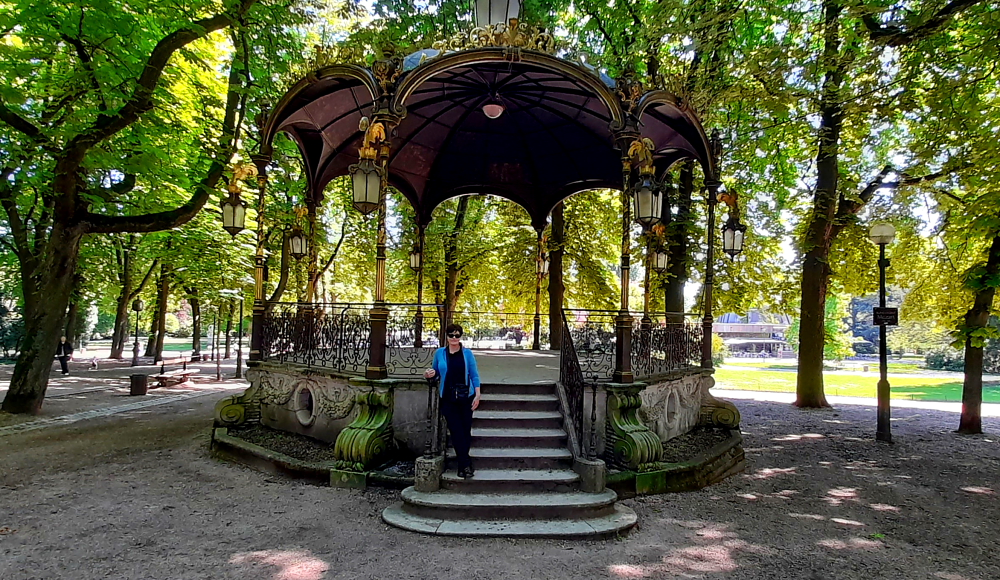
The bandstand singularly recalls some of the features of Place Stanislas’ railings, with its gold leaves and served as a model for other French towns’ bandstands [frenchmoments.eu].
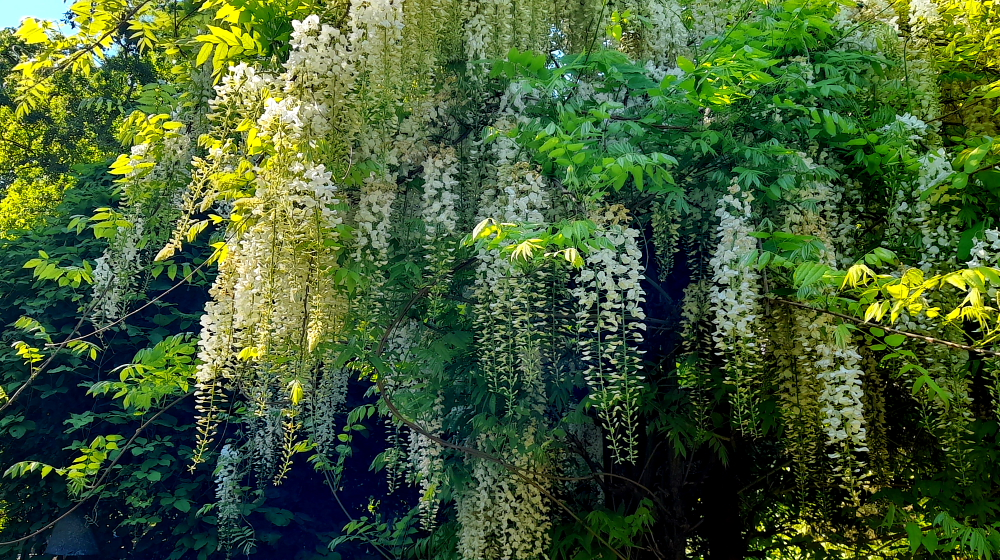
Nearby is the Park’s Rose Garden (Roseraie) which covers 2,000 m2 and was created in 1927 on the former site of the municipal greenhouses. Here there are 197 different varieties and 2,000 rose bushes [frenchmoments.eu].
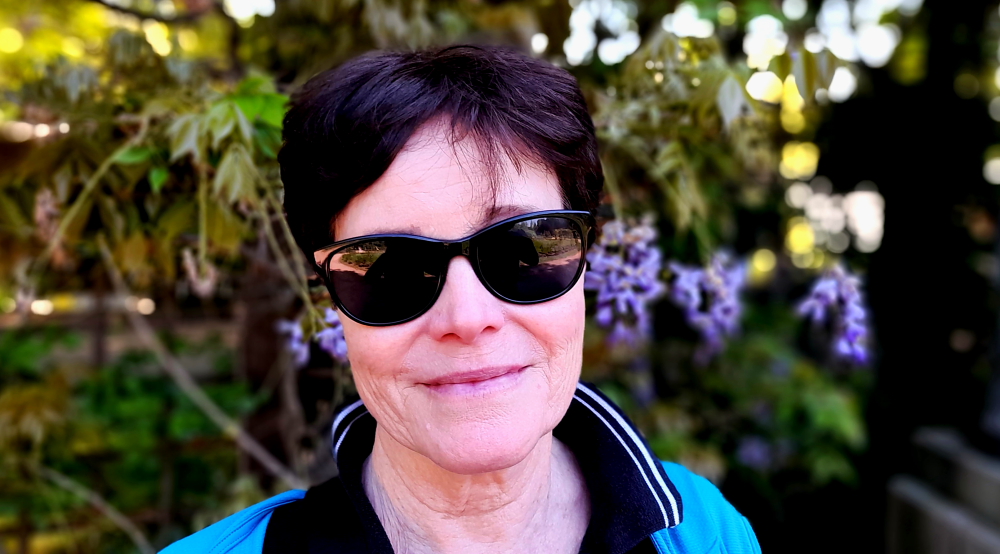
Next to the Parc is the Jardin du Palais du Gouvernement. Just like the park we’ve just been walking through, this one needs some serious maintenance – unmown lawns, weeds, a large, circular fountain totally devoid of water. Such a contrast to the pristine Place Stanislas.
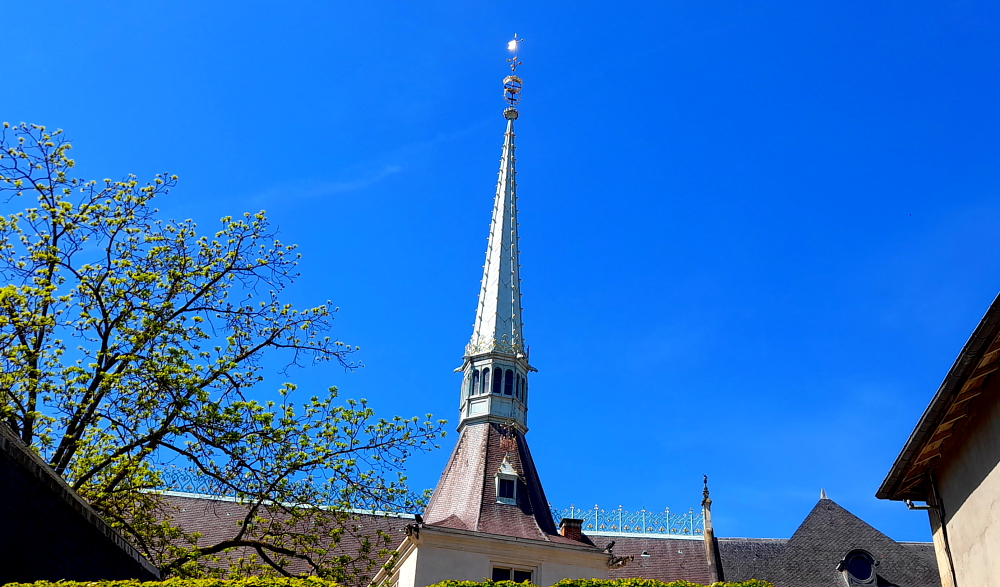
What is also pristine are the spire and roof of the Musee Lorrain – tipped with gilt.
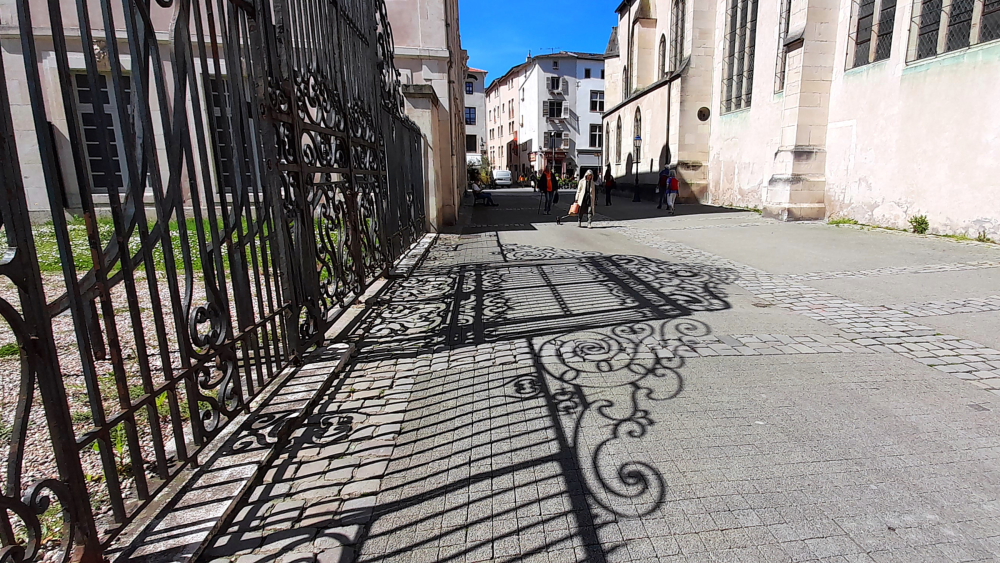
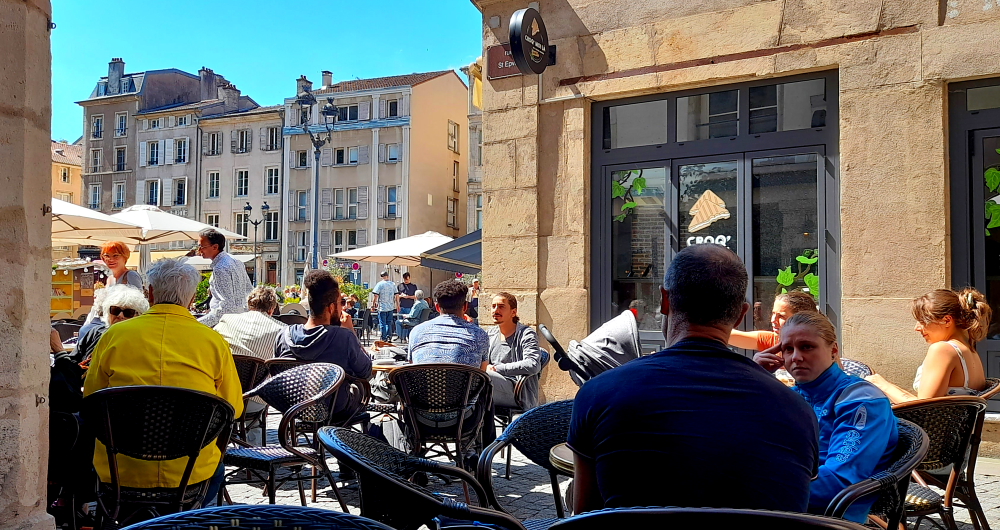
Time for a cool beverage so we end up in Le Gavroche cafe on Rue Saint-Epvre where we both order cafes glaces (iced coffees).
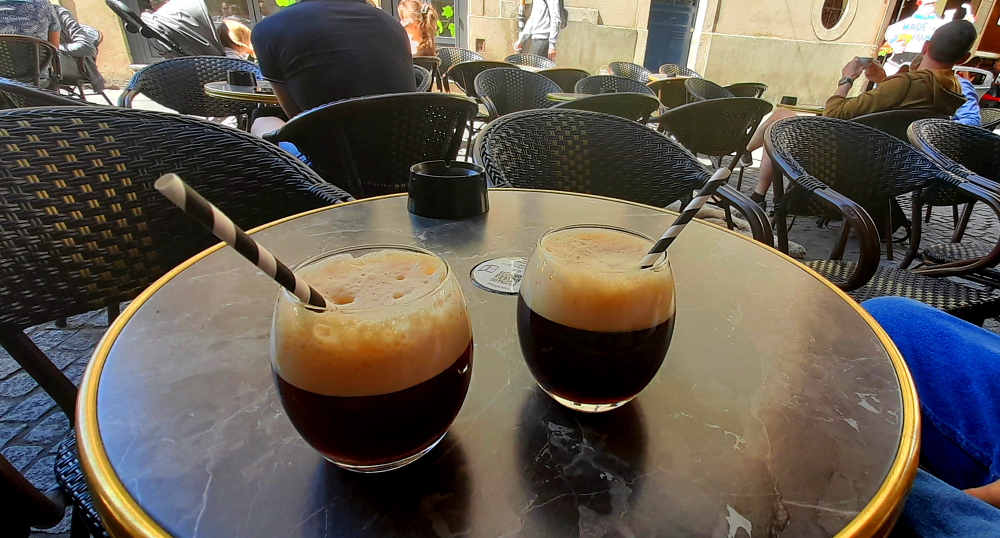
Hmm – espresso on ice heavily sugared and topped by a foam of indeterminate origin. Pass!
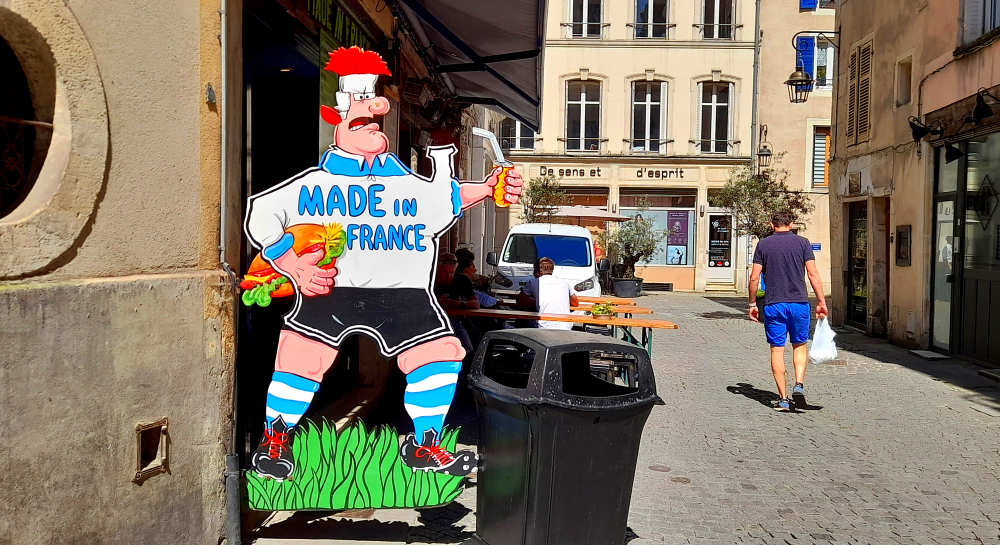
Next door is a restaurant called “Made in France”. Seems that at least some Frenchmen have a sense of humour!
Tonight, Lucy has booked us into Le Bouche a Oreille (Word of Mouth), 2 minutes’ walk away from the hotel.
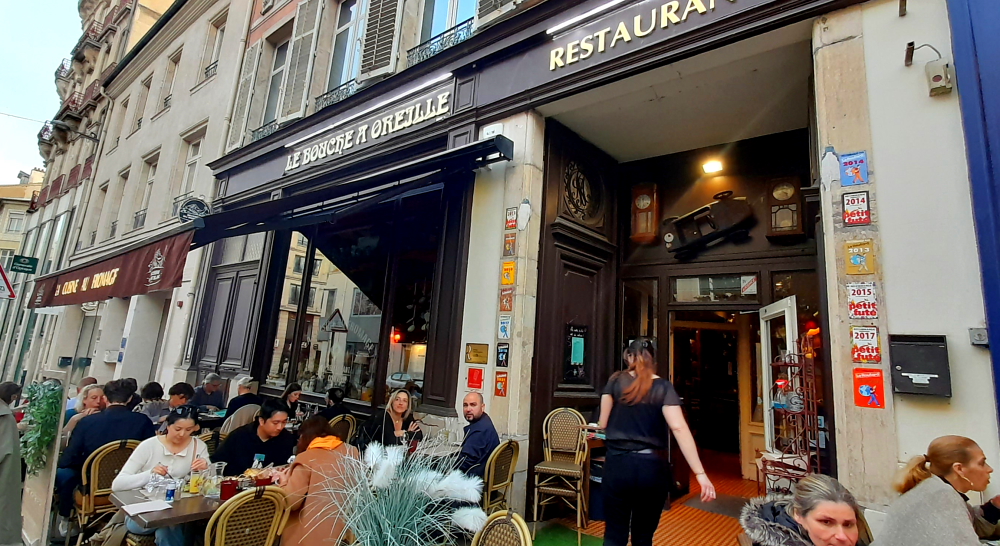
It’s a quirky place and known for its famous egg casserole to tartiflette and fondues.
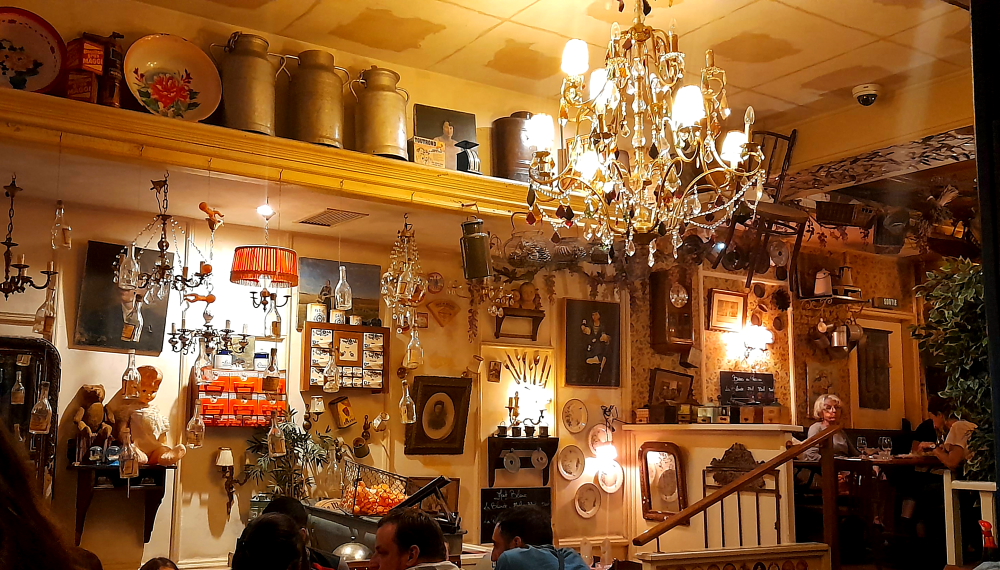
We didn’t see one, single fondue on offer in Switzerland so we’ll have to revisit this popular dish from 1970s and 80s Australian cuisine.
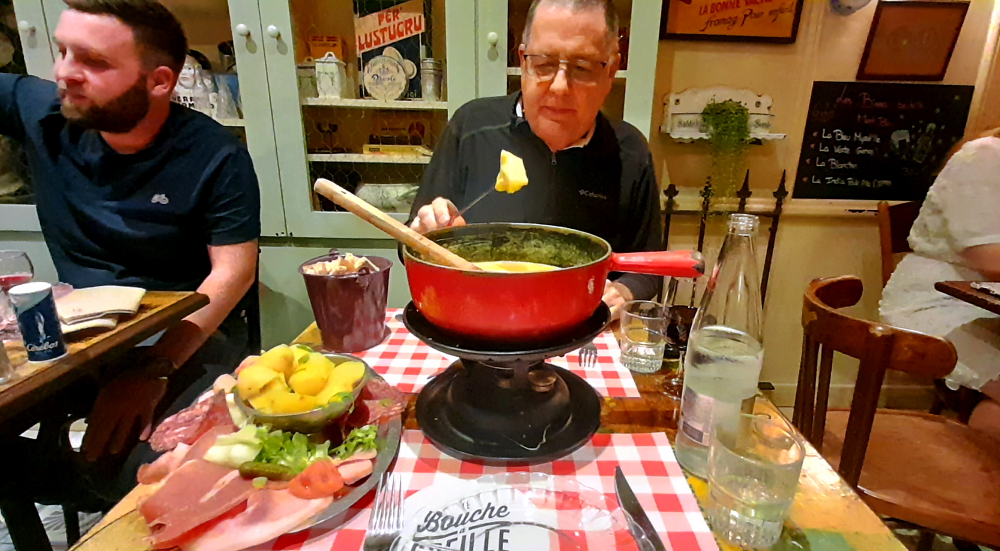
And we do! Interestingly, on the menu it says that the fondue is for 2 people but the price is Eu23/person. Why not just say, Eu46??
So, a large pot of searing hot cheese arrives and is placed on a gas warmer. Accompanying this pot is a small bucket of brown bread cubes together with a large platter of charcuterie, some weeds, and a small bowl of boiled potatoes. We really struggle to get even half way through all this. And probably not a good choice as the cheese is very salty and no doubt cholesterol laden – not a good combo for the Missus. No wonder we haven’t been tempted to eat one of these for over 40 years and we won’t be for at least another 40!
11 May, 2024
Today is our last day in Nancy so we decide to walk to “Ville Vieux” to make sure that we have seen all that there is to see, double back to the Central Market, repack, and finally dine at “Suzette et Gino” tonight.
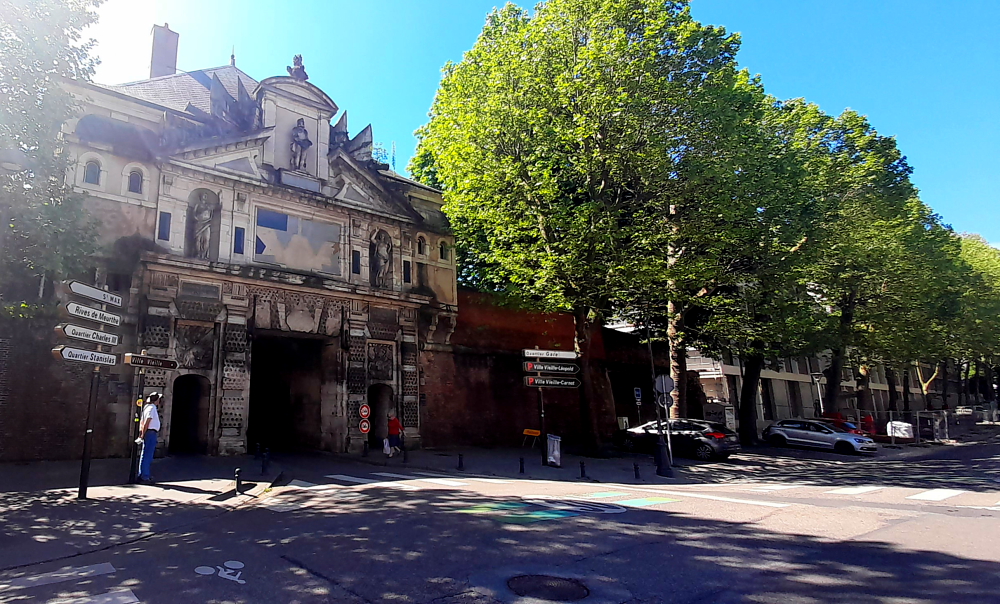
Beyond the magnificent Porte de la Craffe is the Porte de la Citadelle. Unlike all the other ‘portes’ in town, although this one is imposing from the outside, it hasn’t been refurbished so it’s looking a little sad and neglected.
As we walk past the Basilica of Saint Epvre, we notice it’s open today so Lynn pops in, as she does.
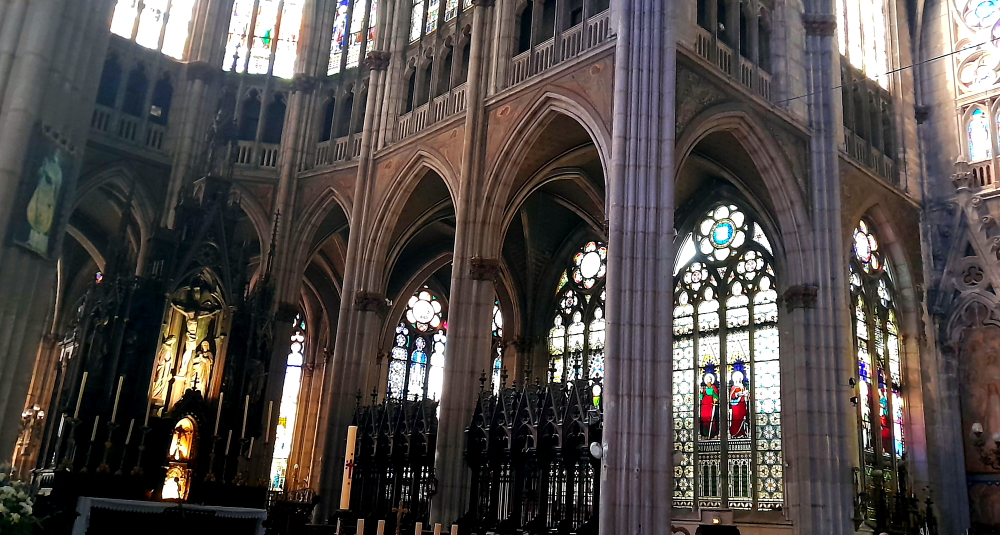
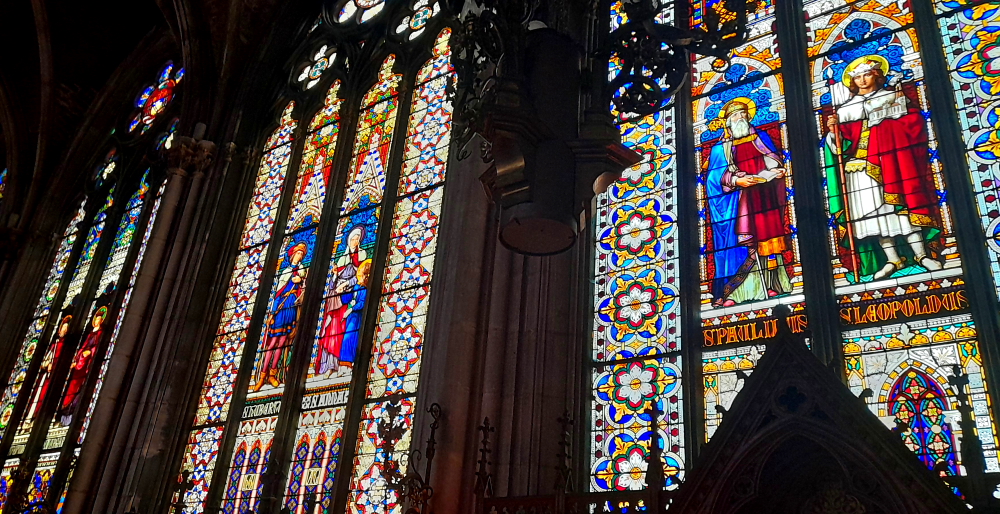
What she finds is a stunning vista of tall, colourful, stained-glass windows both at floor level and the galleries above which surround the entire internal space.
Arriving at the Central Market on Rue Saint-Dizier we find a typical metal building with glass windows along a raised roof and just about all the stands inside are operating and are busy with customers.
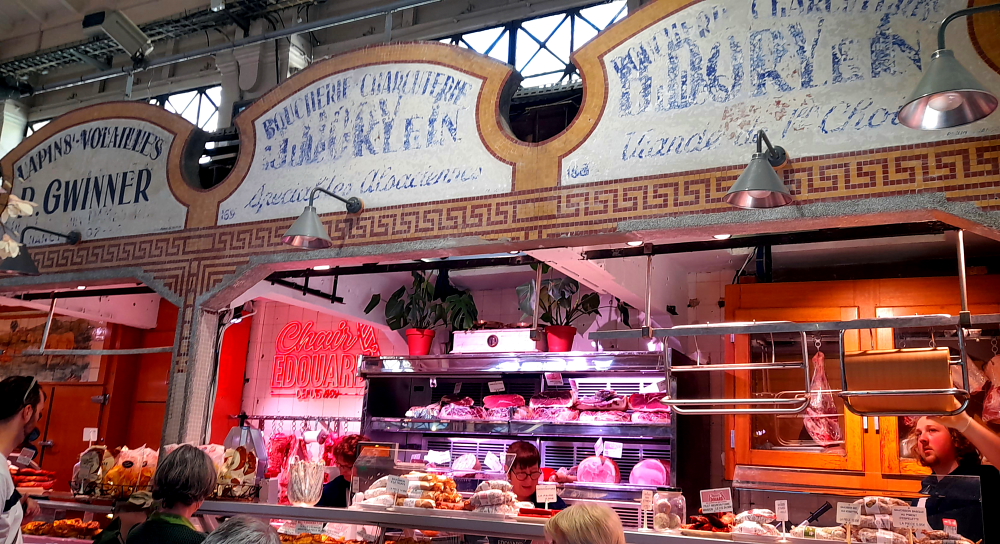
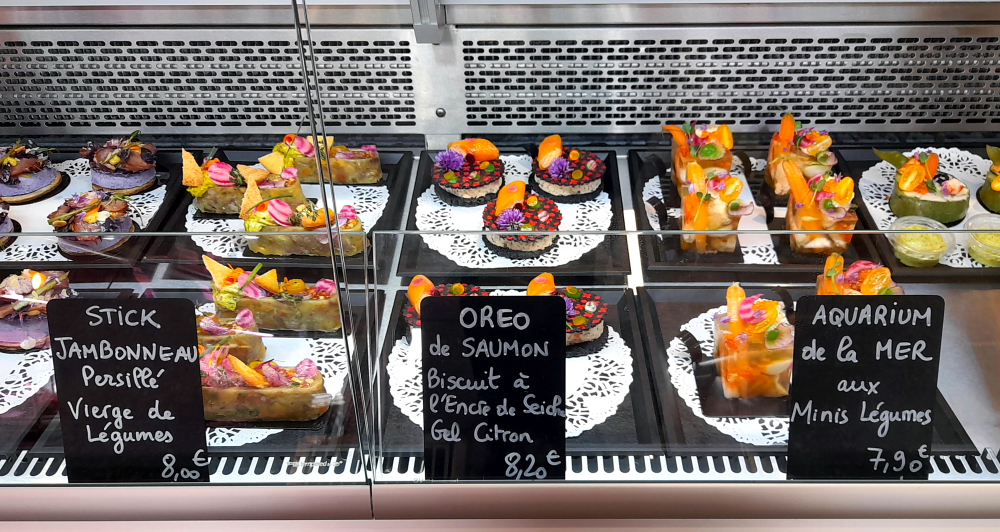
Nancy Central Market has some 65 stalls offering quality produce: fruit, vegetables, meat, fish, fine foods, local specialities, exotic goods, flowers, bookshops and more. It is an attractive U-shaped building dating from the 19th century. The central area (which locals call the central hall) has been covered with a glass roof [nancy-tourisme.fr].
Following a break back at the hotel, we walk across Place Stanislas to Rue Here where we find “Suzette et Gino” billed as a traditional Italian restaurant, another of Lucy’s bookings for us.
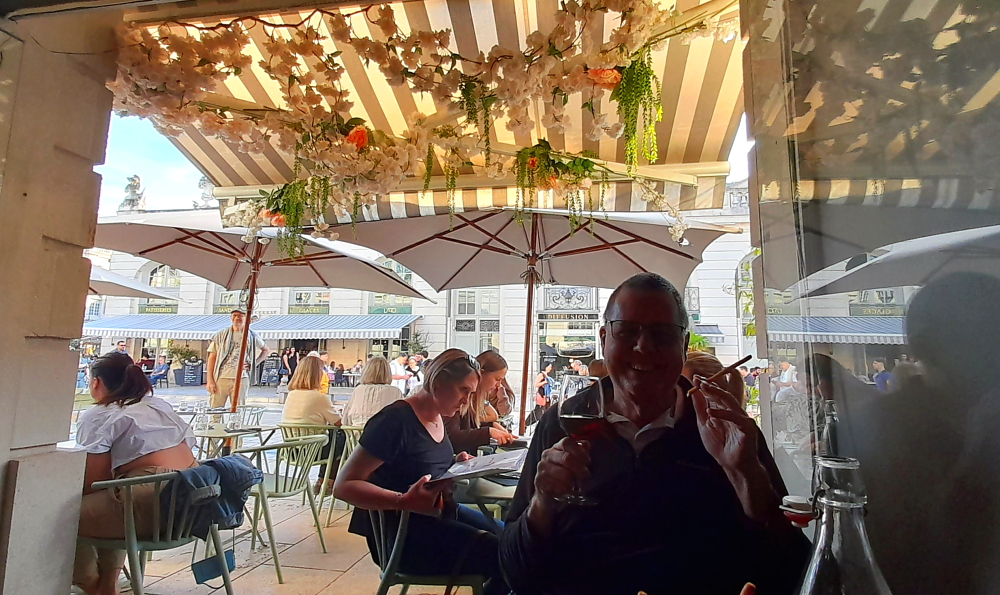
When we arrive at the restaurant just before 7:00 pm when it opens the Rue Here is already heaving with al fresco diners at all the restaurants that line the street.
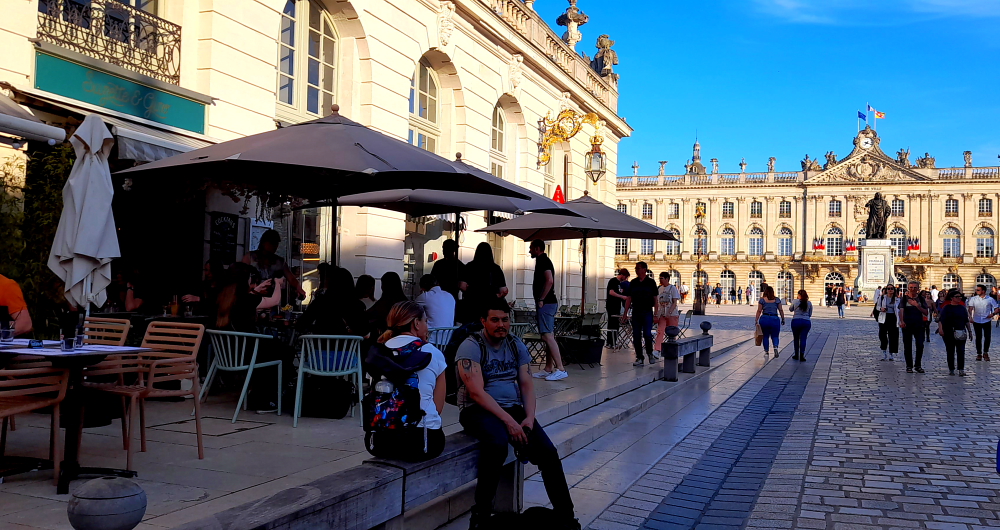
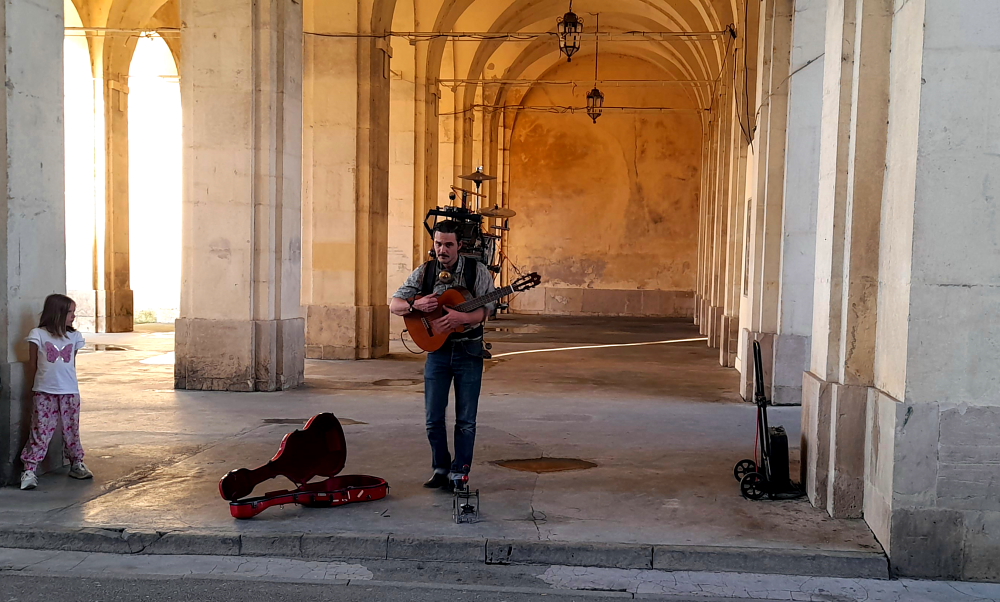
While Lynn’s out taking photos she hears a bit of a racket and ventures a few metres to Arc Here where a “one-man-band” is playing a tune.
After a delicious meal we cross back Place Stanislas to find a crowd of people milling about in front of a grand building – the Opera House. They’re attending a performance of “Where are you going like that?”
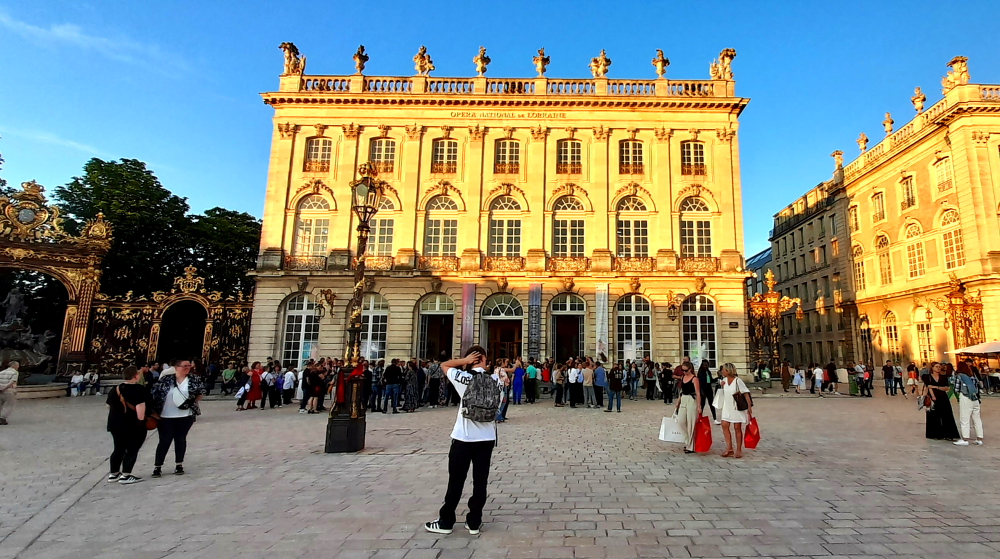
According to the Opera’s website the performance “combines the form of documentary theatre, the force of a symphony orchestra and free choreography. But in principle, it’s a rendezvous with all the question marks that dance within us. Because there are certain answers that await a question all their lives.” [opera-national-lorraine.fr]
12 May, 2024
At 11:15 am when we depart it’s already 23 Deg. C. The 205km trip to Reims will take us about 2 hours 15 minutes. Thank goodness for the air conditioner!
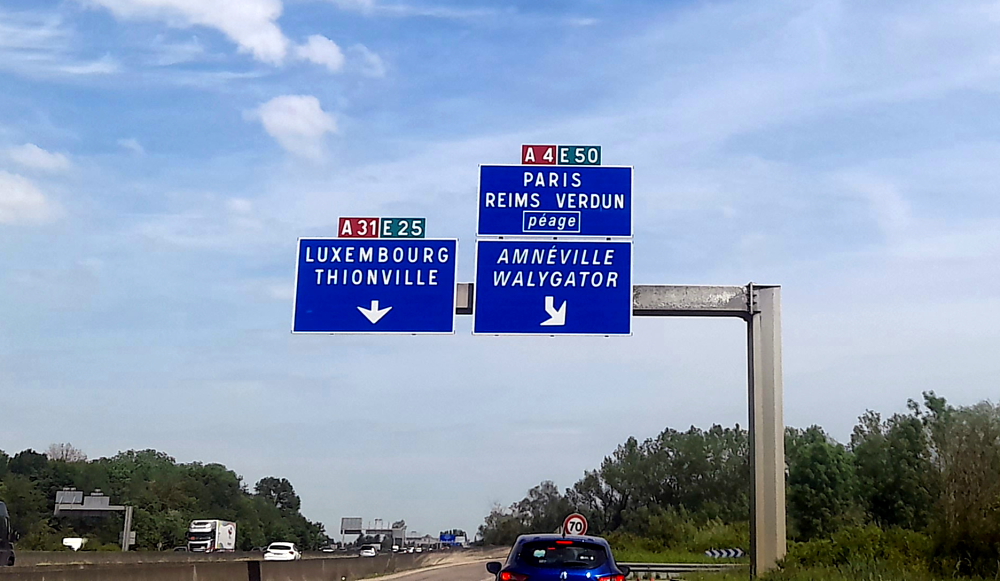
Initially, my trusty GPS takes us via the A31 towards Metz (we are heading north instead of west!), but just before Metz we turn west along the A4 to Reims.
We arrive at our AirBnB apartment on Rue Libergier, which is a block from the Cathedrale Notre-Dame de Reims, around 1:45 pm. We park across the road and are met by Paolo who manages the apartment and he shows us the ropes after we drop our luggage inside.
Quickly we drive to the train station as Becky and Jerry, our Philly friends, have arrived from Paris and are waiting for us to collect them from in front of the station.
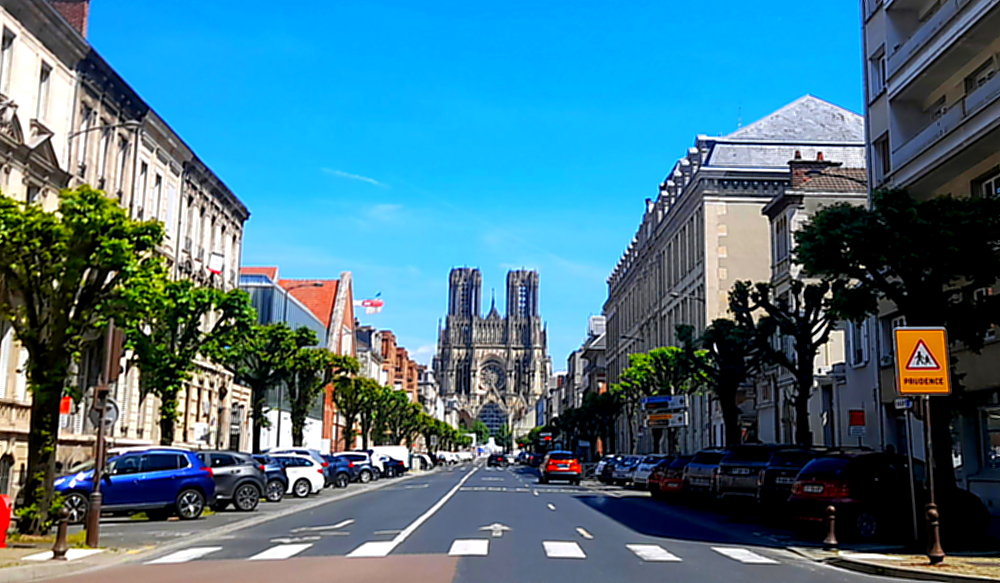
Returning, we park around the corner in an underground car park and walk the short distance to the apartment where we all get settled in.
One of the “ropes” that Paolo showed us is a chilled bottle of champers, a Brut Blanc de Blancs, that his boss, the owner of the apartment, has kindly given to us from his vineyard – the Olivier Coutant champagne house. It seems that everyone in the Champagne region is a vintner!
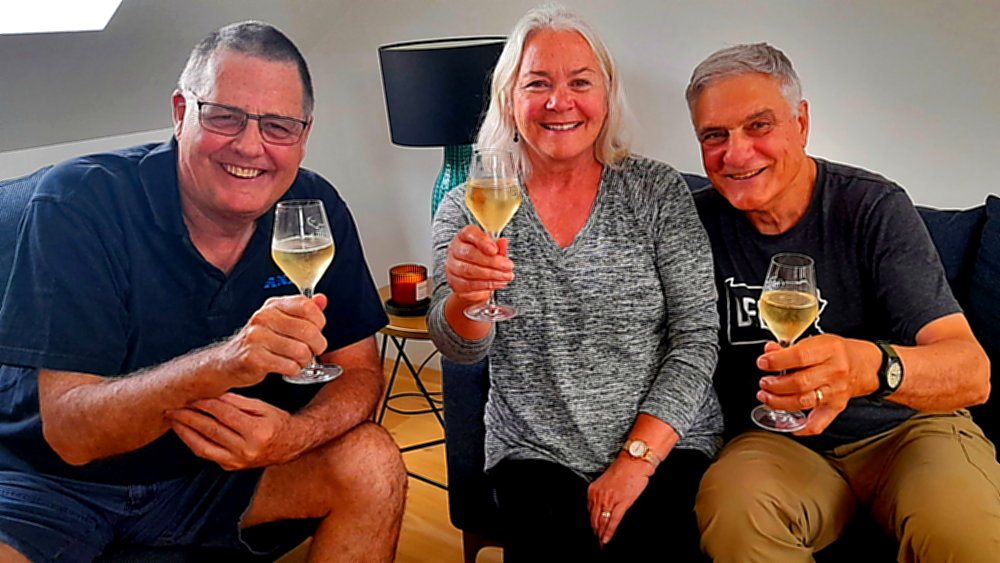
It’s great to see Becky and Jerry once again. We first met them in Lecce, Italy in an Irish Pub on St Patrick’s Day – as you do – in 2015. We stayed with them in Newtown Square, Pennsylvania in 2019 and they were our saviours in March 2020 when they let us leave our Malibu car on their condo driveway in San Diego when we had to abandon our USA travels thanks to COVID.
10 months ago after a Skype call together we made this AirBnB booking, and here we are!
13 May, 2024
At 7:30 am Lynn is out the door to visit the convenience store and boulangerie to buy a few breakfast items as the supermarket was closed yesterday, being a Sunday.
Some months ago she had re-connected with our GuruWalk guide, Rehman, and asked if he could lead another walk for us today for the 4 of us. So we catch the 9:40 tram from Opera-Cathedrale and ride the 5 minutes to Scheiter where we alight.
As we are some minutes early to meet him we walk over to La Porte de Mars which was under scaffolding and plastic when we were here 3 months ago.
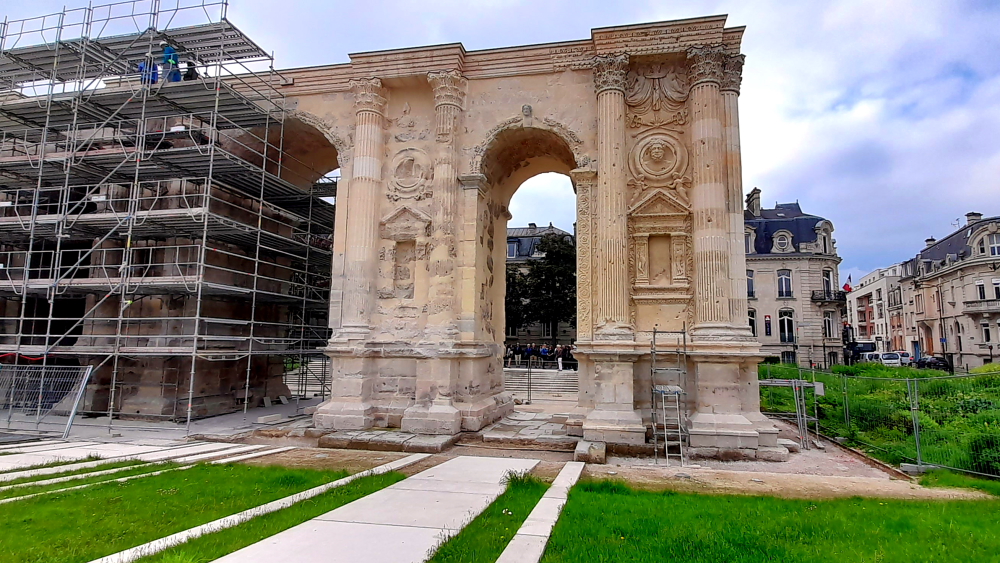
The Porte Mars is an ancient Roman arch dating from the early 3rd century AD, is the largest arch of the Roman world and one of the most impressive Roman monuments north of the Alps. Its name derives from a nearby temple dedicated to the god of war, Mars. At the time of its construction, the Porte Mars would have been one of four monumental arches erected as entrances to the Gallo-Roman settlement of Durocortorum (“round fortress”).
The Arch, relatively well preserved, stands 32 metres long and 13 metres high, but its height must have been equally impressive with its attic and the statue group on top which are no longer there.
The Porte Mars was included in the fortification wall of the late Roman Empire and, in 1228, in the wall of the castle of the Archbishops and served as a city gate until 1544. In 1854 the buildings around the arch were removed, bringing the arch into full view [followinghadrianphotography.com].
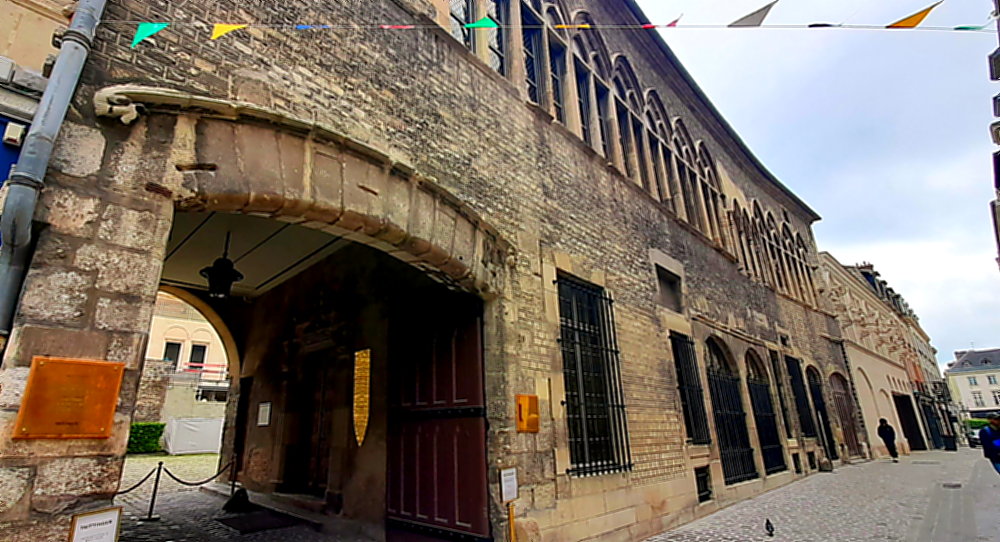
After meeting up with Rehman we walk down Rue de Tambour where we come to No. 25, the Demeure des Comtes de Champagne (Comtes de Champagne residence), the oldest civilian building in Reims (13th century) and although it has been remodelled several times, it retains all the features of a wealthy medieval building, with its ground floor arches and gallery on the first floor.
Today it’s the historic jewel of the Taittinger heritage, offering tastings and a shop!
Legend has it that it was the urban residence of the Comtes de Champagne, who used it in particular as a dwelling during royal coronations, at which time the cream of French nobility would gather across the city. During the Coronations, it was convenient for the great lords of the Court to lodge in the city. Only a very small few could stay at the Palace of Tau (Bishop’s Palace). So, these guests could spend a few weeks in private homes like this, the homes of the rich bourgeoisie.
This is supported by research in the city archives which revealed a document dated 1328 from during the Coronation of Philippe VI. It’s a register of the size of the ‘Sacres’ – a tax levied on the wealthiest inhabitants of Reims to finance the reception of the Court – and features this house, which at the time was owned by Pierre Le Châtelain who belonged to one of the great families of the Reims bourgeoisie, and whose fortune had been made through contact with the Archbishops of Reims [theinstantwhen.taittinger.fr].
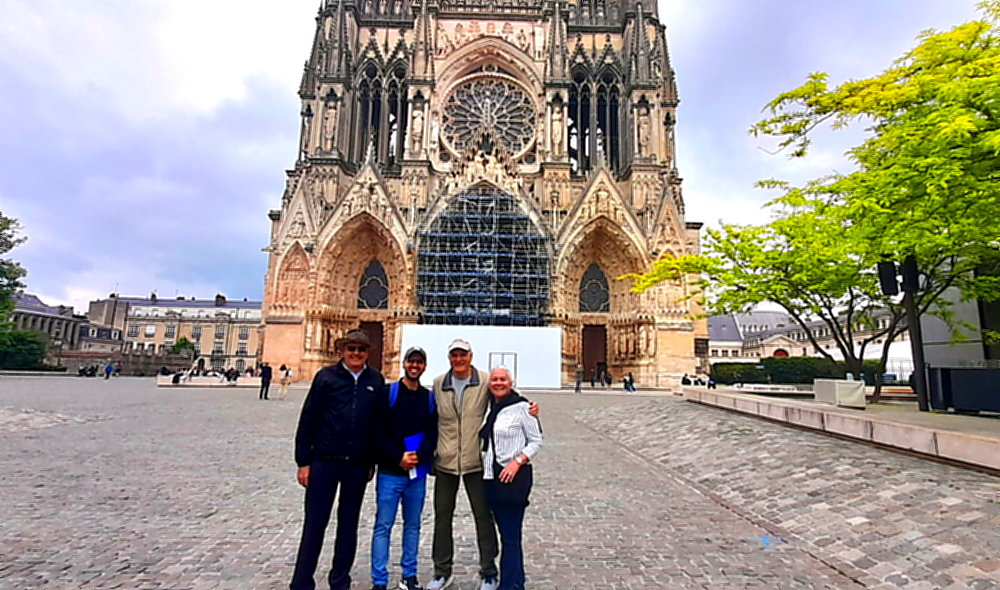
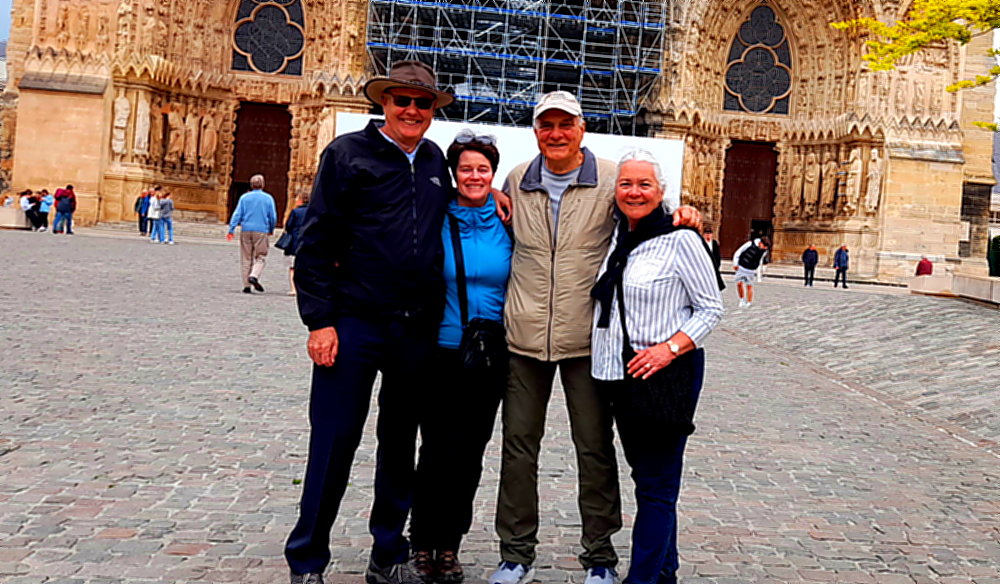
After visiting all the sites we saw on our tour on 4 February we arrive at the 13th century Cathedrale de Notre-Dame de Reims which today has scaffolding concealing its main entrance. Here we are reminded of the baptism of Clovis by Bishop Remi in 498 in front of a previous church which had been subsumed by this Cathedral.
Before we return home we scurry about trying to find a shop that hasn’t closed for the usual 2-hour lunch break that sells champers (and a bottle of Bouzy red wine) and the famous Reims Rose Biscuits solely made for dunking in champagne. Success!
After lunch and a nanna nap we head out again at 3:30 pm to walk 20 minutes SE to the Basilica of Saint-Remi, named after the Bishop who baptised Clovis.
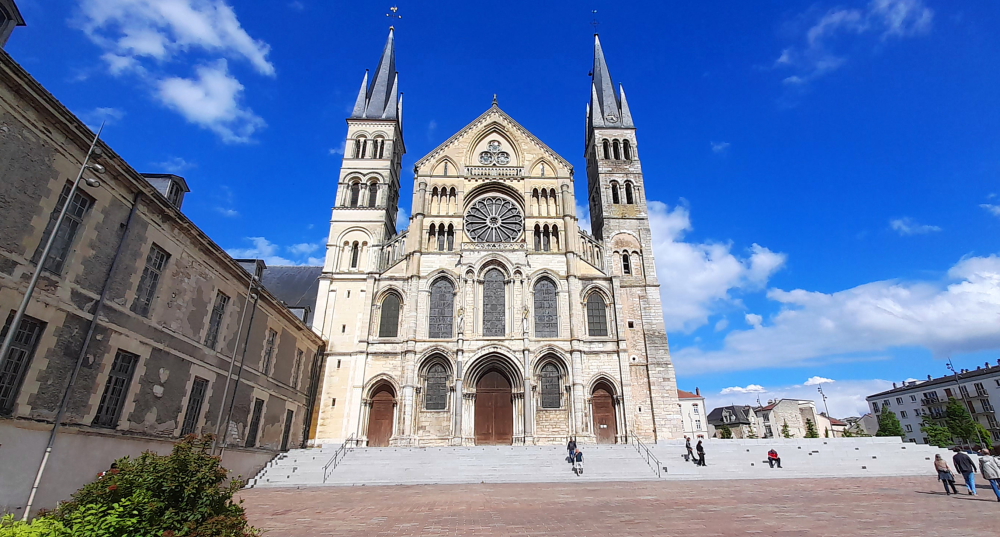
In Romanesque-Gothic style, it is one of the most remarkable achievements of Romanesque art in the North of France. 126 m long, it impresses with its depth and its feeling of intimacy.
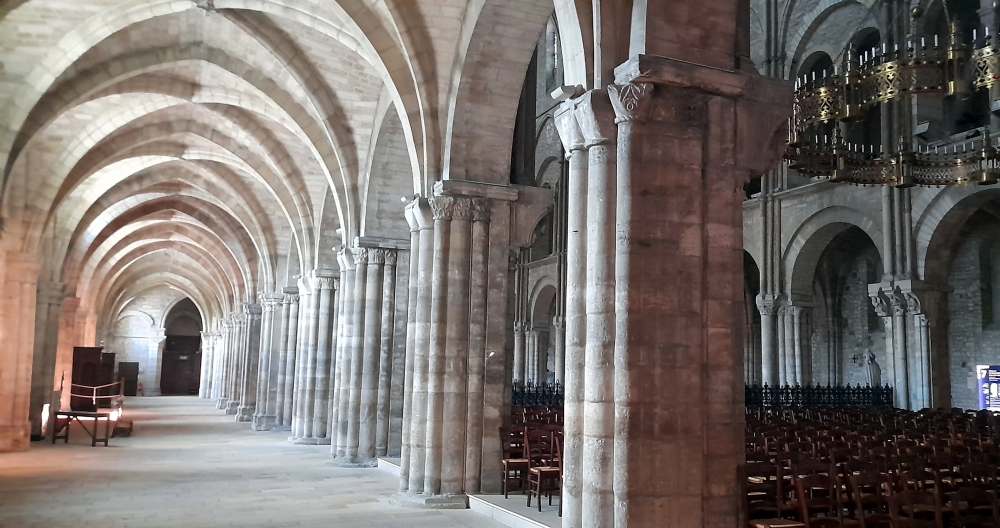
The sober Romanesque nave and the 4-story Gothic choir (end of the 12th century) make for an impressive ensemble of lightness and harmony. The facade was built at the same time as the choir.
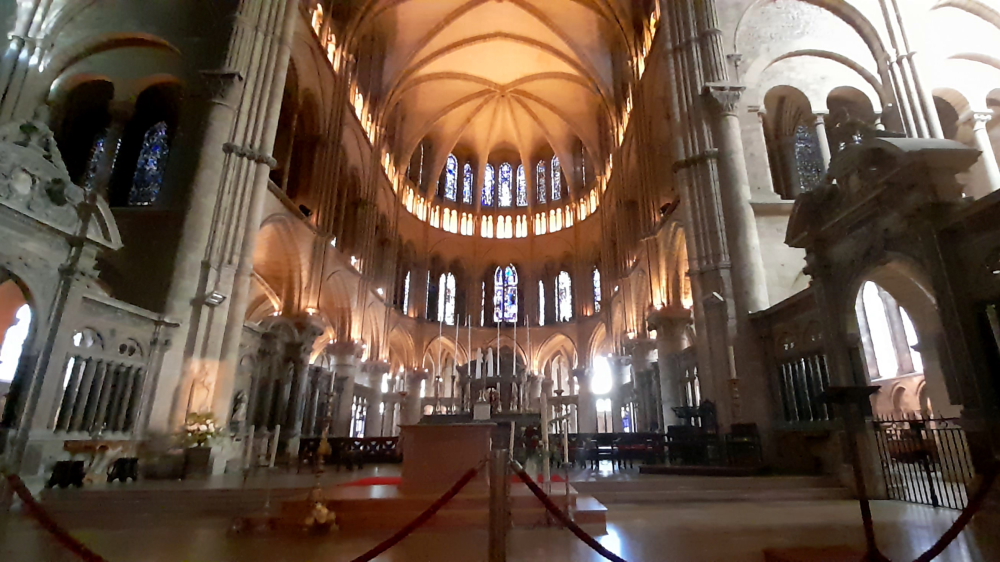
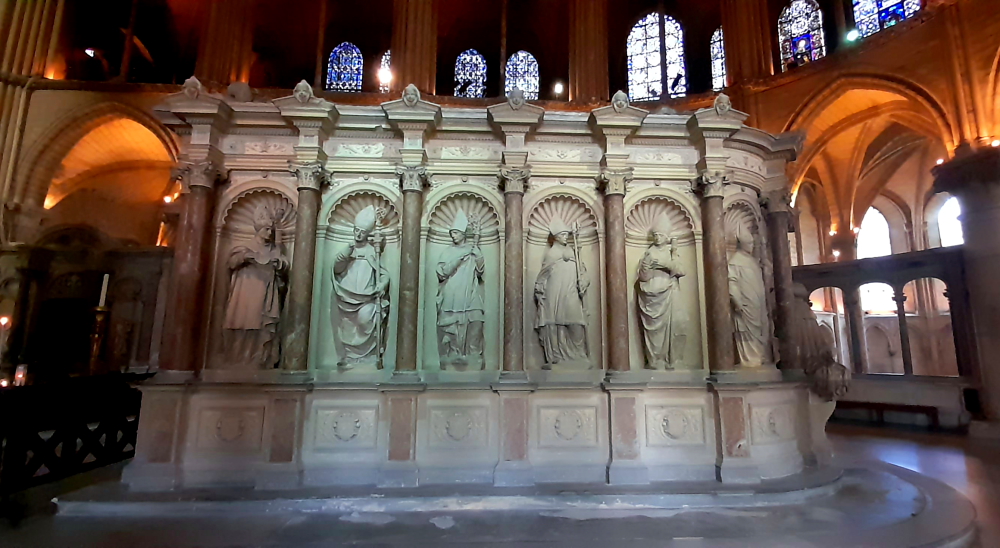
Built in the 11th century, the Basilica houses the relics of Saint-Remi. His tomb (1847) occupies the center of the choir [www-reims-fr].
Earlier, Becky mentioned that last night their bed didn’t have a bottom sheet on it, only a mattress protector, so after letting Paolo know this he drops by at 7:00 pm to rectify the situation. Not only does he insist he makes the bed but he also offers us a superior bottle of champers from the Coutant vineyard in recompense for this “mistake”. We jokingly said that we’d try to find more “mistakes”!
Feeling knackered after all our walking today (11.3 km) we call into the bistro that is next door to our apartment, “Bistro des Anges”. What a find! Excellent food, wine and cocktails and a very genial owner/host – an angel indeed.
14 May, 2024
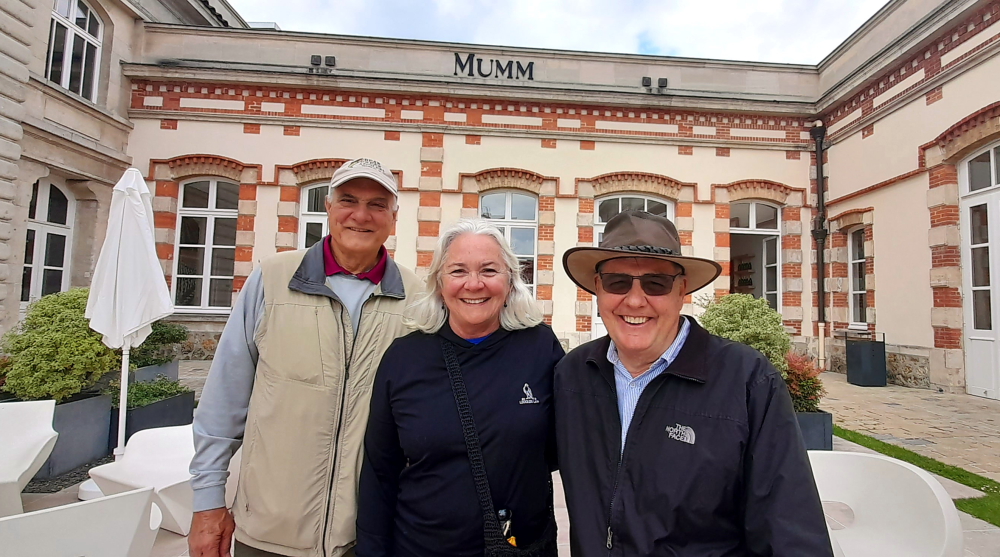
Some months ago I had booked a tour and tasting at Maison Mumm for the 4 of us. Once again we catch the tram to Schneiter then walk up the Rue du Champs de Mars to arrive for our 11:00 am tour.
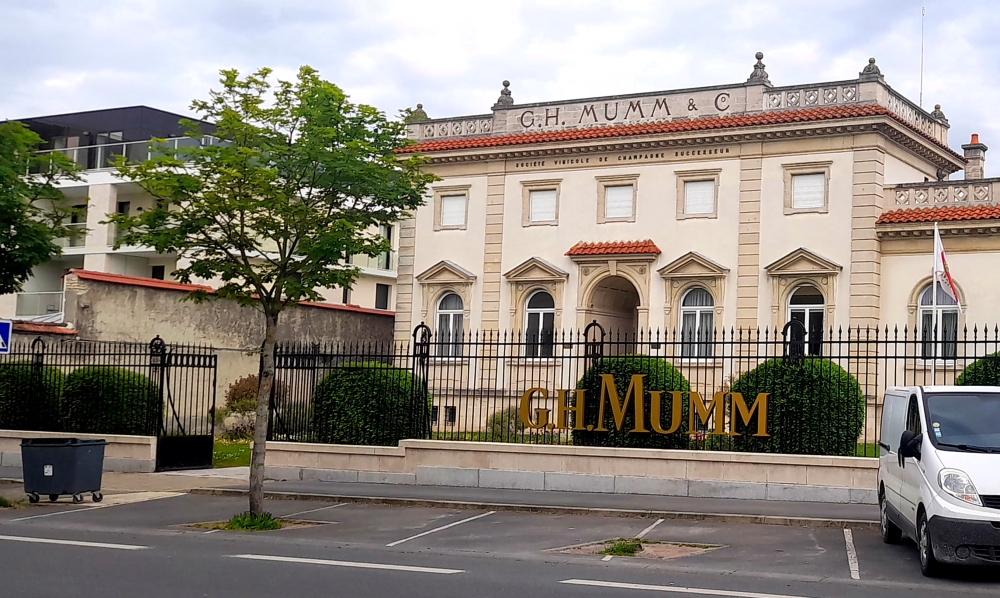
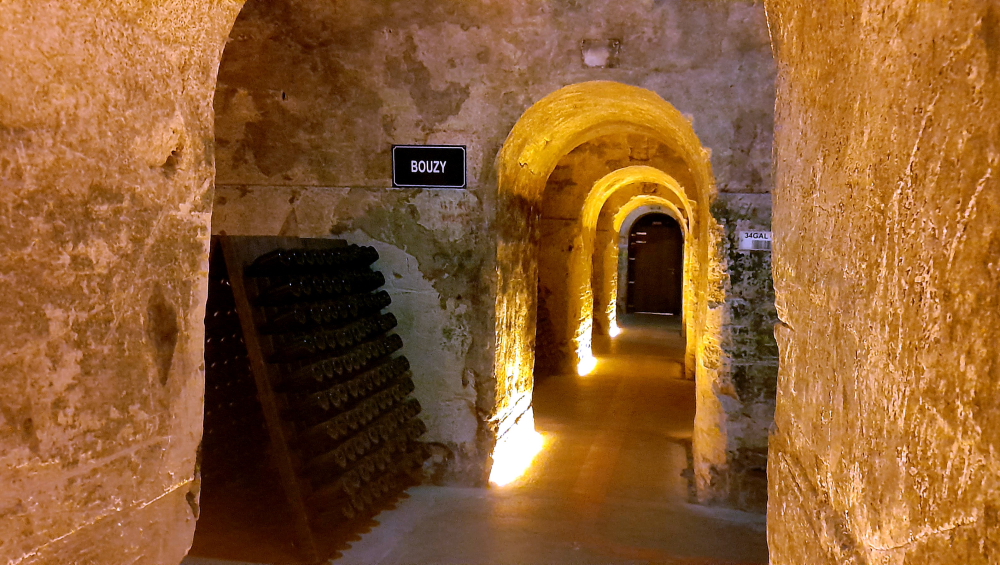
The Mumm estate is quite large, occupying both sides of the road with several classical buildings and extensive caves and galleries of bottled champagne below ground.
Spread across almost 25 km in the heart of the city the galleries of the Mumm cellars, built 14m underground and excavated over 70 years, are home to almost 200 years of history and expertise and house 25 million bottles.
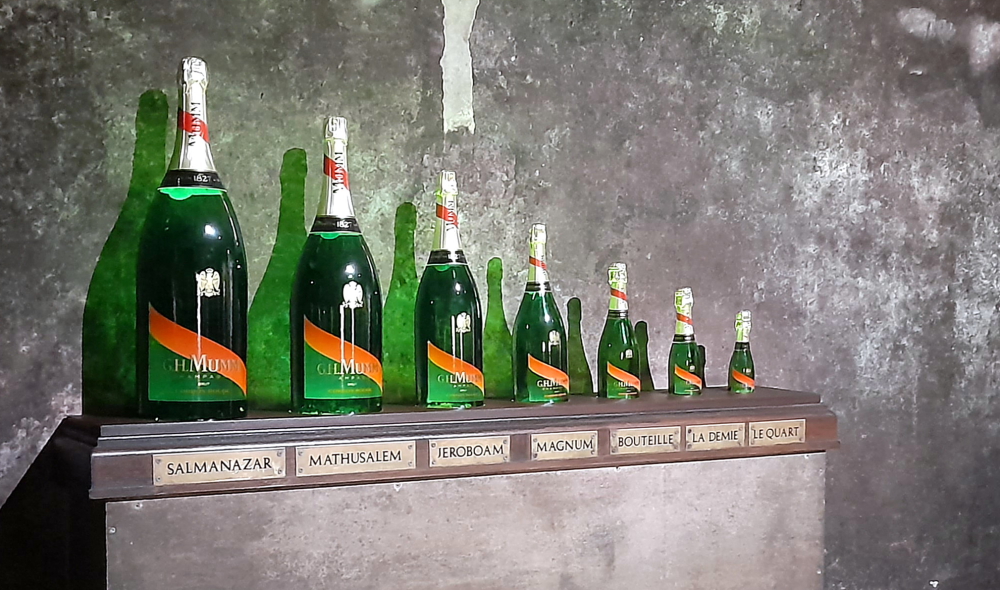
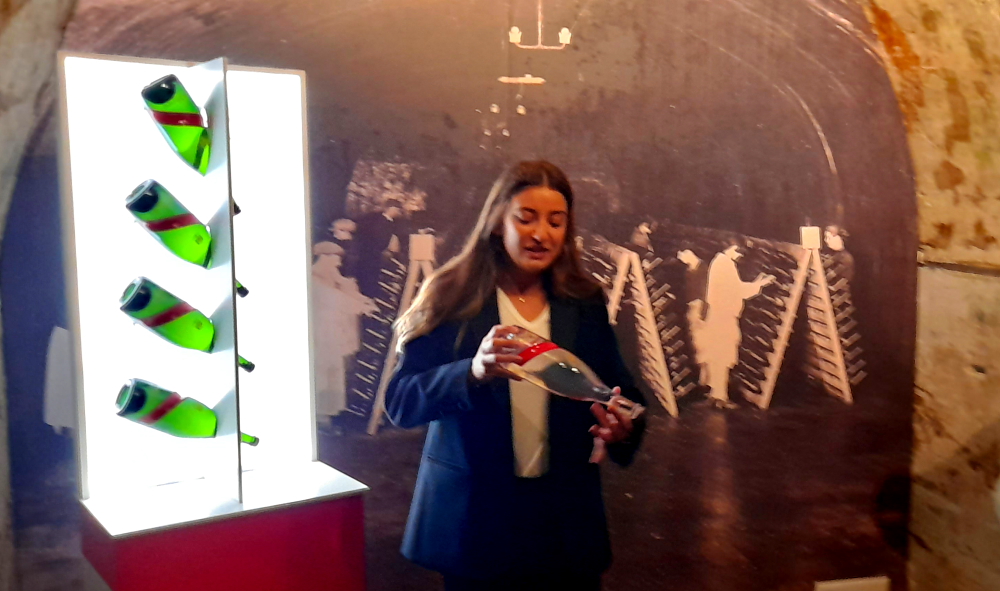
Eva, our guide, takes us down and through the various galleries explaining how champagne is made. Once they are filled, the champagne bottles are stored on their sides in Mumm’s cellars ready for aging.
Champagne must be aged for a minimum of 15 months but Mumm prefers to age champagne for much longer.
According to champagne specifications, a vintage champagne must be aged for a minimum of 3 years. At Mumm, aging lasts at least 5 years and can go up to 10-12 years for certain prestigious cuvees.
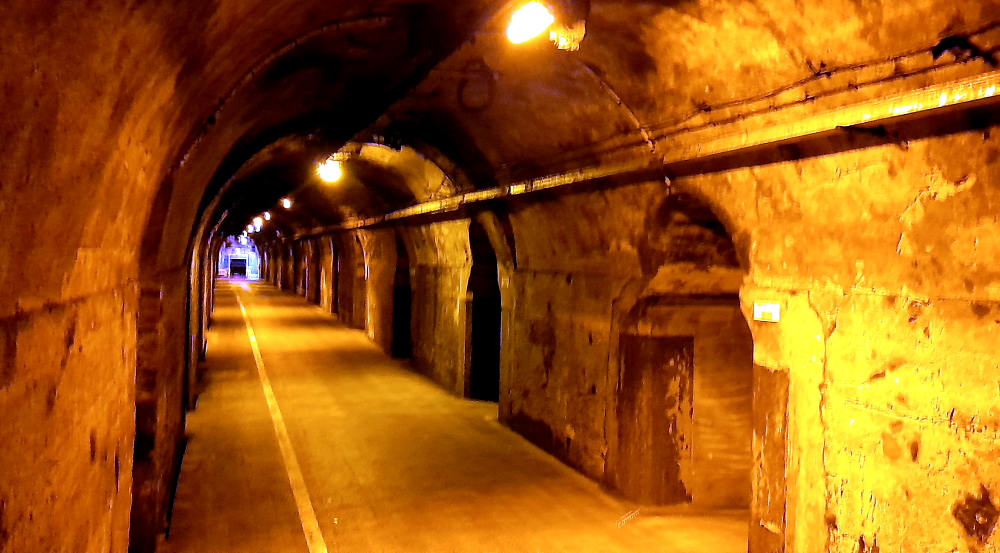
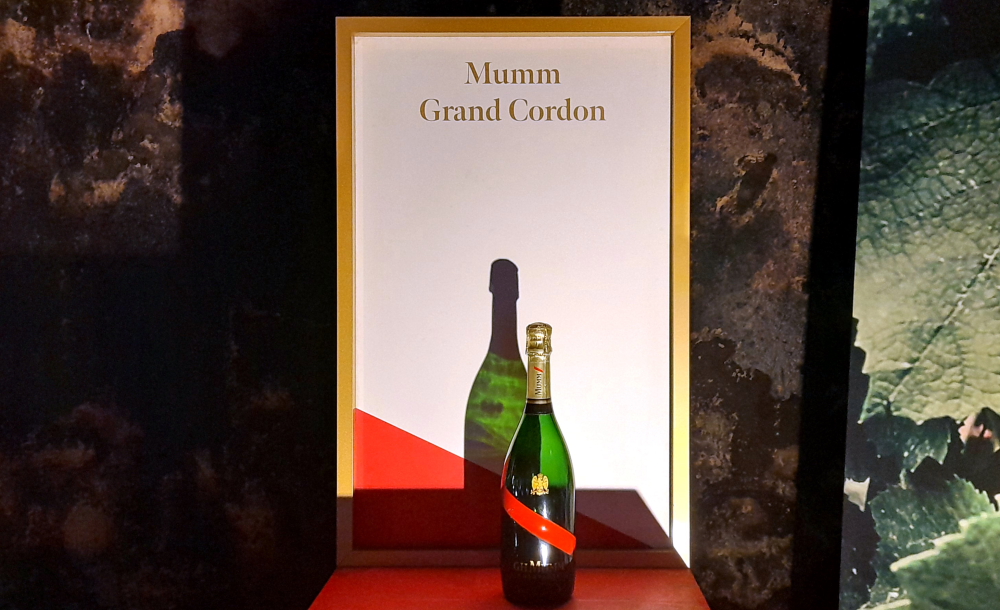
Once aging has finished each champagne bottle is signed with the emblematic Mumm Red Sash on its paper label.
Except, created by English designer, Ross Lovegrove to mark 140 years of Mumm Cordon Rouge, the bottle is a technical feat that redesigns the champagne codes – a slimmer neck and understated lines emphasised by the indentation of the famous red sash directly in the glass – i.e. no paper label [mumm.com].
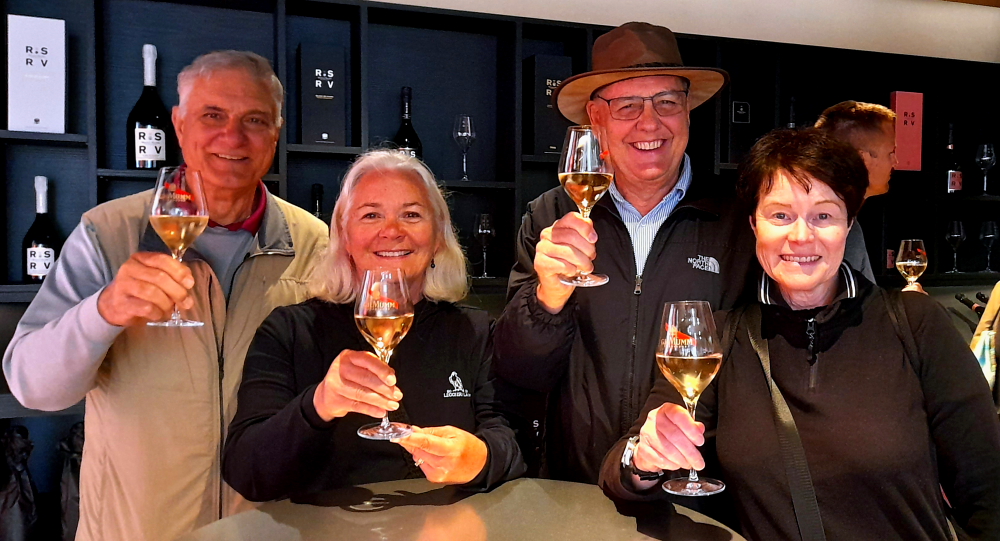
After an hour of walking the caves we emerge topside for a tasting of Mumm’s regular champers. Recommended to be served between 8°-10°C (46°-50°F) to help bring out the champagne’s full range of aromas and in a tulip-shaped white wine glass, with its wide girth tapering towards a narrow opening, that is best suited to champagne. This type of wine glass encourages the formation of bubbles and the release of aromas, concentrating them on the nose before tasting.
Opening a bottle involves holding the bottle at a 45 deg. angle, untwisting the wire, holding the cork and slowly rotating the base until the cork is released with, as Jerry noted, a “sigh” – never a pop!
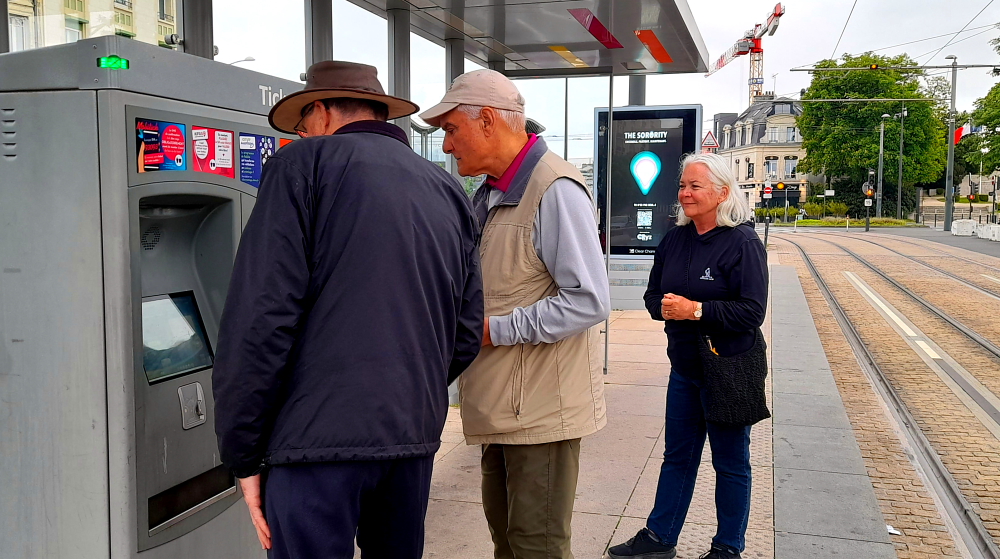
We catch the tram back to the Opera-Cathedrale stop then walk to the City Library which is located in front of the Cathedral.
Here our guide had told us that we could view the Cathedral from an elevated perspective.
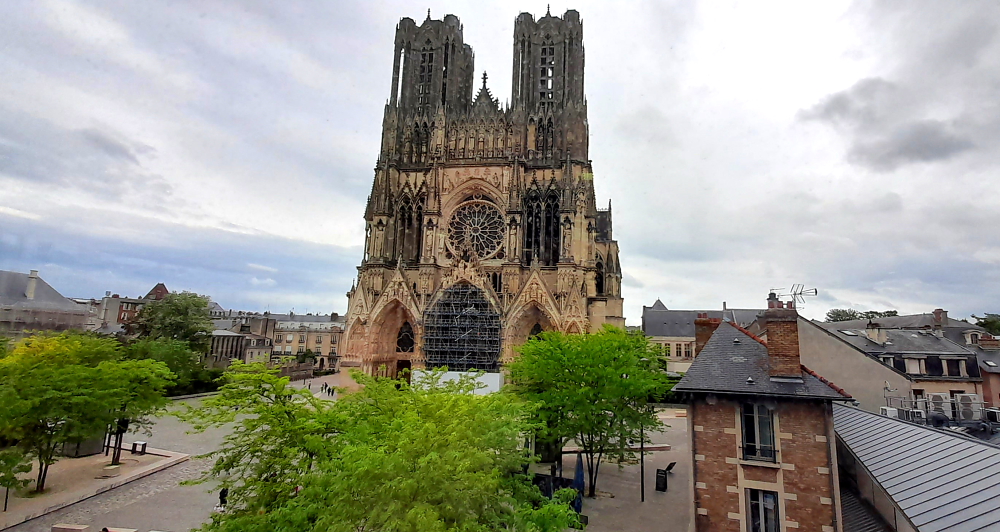
Later in the afternoon we revisit one of the tour’s sites, the Carnegie Library, a public library, which is open today.
Andrew Carnegie, a generous American benefactor, gave Rheims an Art Deco library via USD200,000 of funding. It was built in the period 1921-1927, under the direction of Rheims architect Max Sainsaulieu (1870-1953), and formally opened on 10 June 1928 in the presence of French president Gaston Doumergue and US ambassador Myron T Herrick.
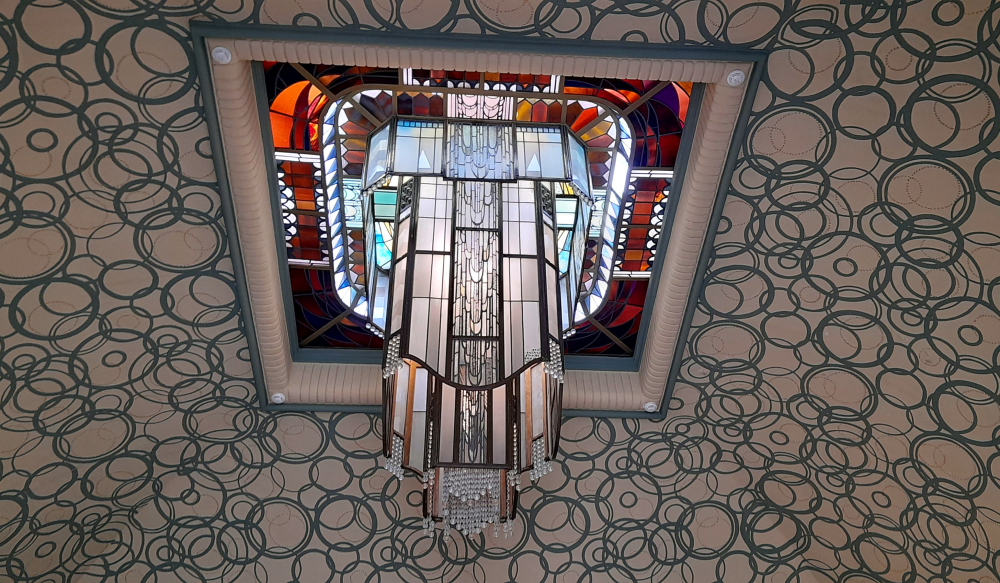
This library was remarkable for the quality of its materials, the richness of its ornamentation, and a very practical approach to the layout of its spaces, something rare in France at that time – a strict distinction between public space, storage space and staff working space.
The architect called on the period’s great names in decorative arts such as Schwartz-Haumont (gold medallist at the 1925 Arts Déco Exhibition) for the wrought iron gates; Jacques Gruber to design the glazing and the bays in the reading room, and stained glass artist Jacques Simon (1890-1974) for the entrance hall’s exquisite chandelier.
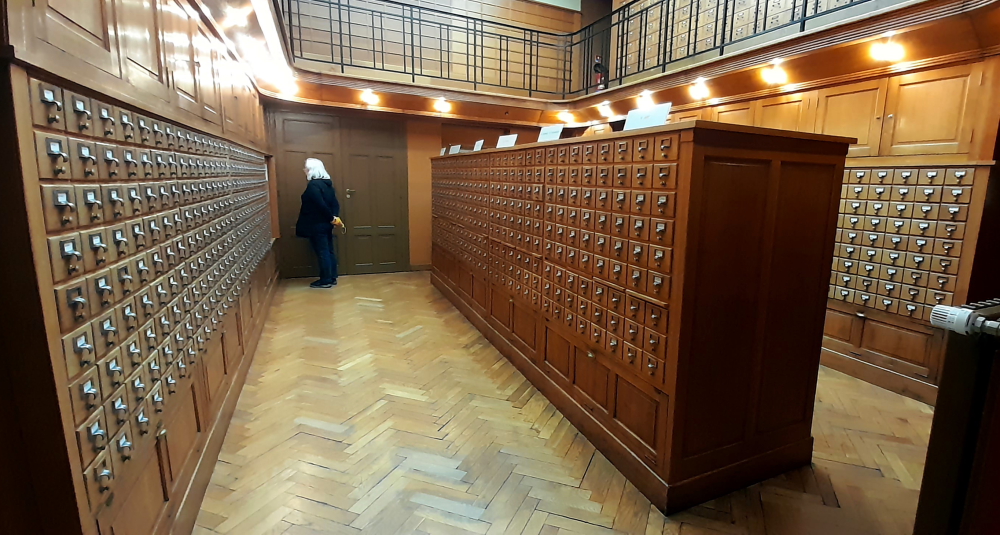
Spread across 5 levels, the collections’ storerooms have space for up to 9 linear kilometres of documents. Today, the Library is home to 400,000 documents, with 45 workspaces and reading rooms plus an exhibition hall, a 42-seat conference hall and a 30-seat lecture theatre [maisons-champagne.com…the-carnegie-library].
Our final night in Reims is celebrated once again in the excellent Bistro des Anges.
15 May, 2024
In his professional life Jerry was a high school history teacher. This interest has driven us – figuratively and literally – to the French city of Verdun, 128 km east of Reims on the A4.
Specifically, we visit the museum known as the Memorial de Verdun Champ de Bataille, with immersive and interactive exhibits depicting the Battle of Verdun (302 days from February-December 1916).
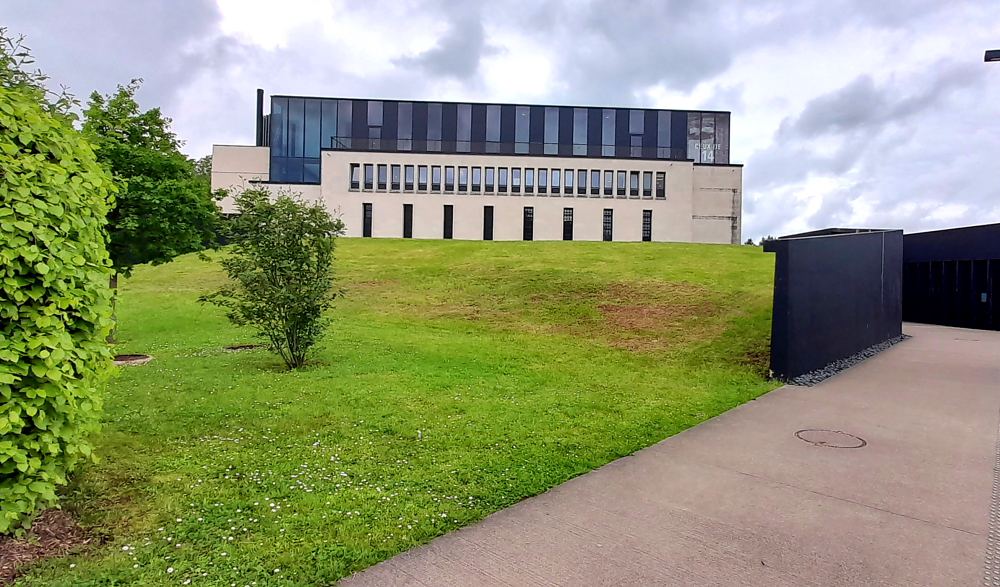
The Battle began on 21 February 1916 at 7.15 am when the German army began bombarding the forts and trenches with artillery fire for 10 hours. 1,200 guns smashed the French positions. Erich Von Falkenhayn, Commander-in-Chief of the German army, wanted to put an end to the trench warfare that had begun in the autumn of 1914 and get his troops moving again.
During the first few days, the Germans breached the French front lines and captured Fort Douaumont without a fight on 25 February 1916. The French High Command was anxious to retake the fort because of its dominant position high above the battlefield. Despite heavy shelling, the French infantrymen (known as “Poilus”) clung on to their positions and the Germans were unable to advance any further. General Pétain then took command of the troops. He was ordered to defend Verdun.
He increased the volume of traffic along the Bar-le-Duc to Verdun road, later known as the “Sacred Way”, the only route taking men and munitions up to the battlefield. In all, some 4,000 trucks, 2,000 cars, 800 ambulances, 200 buses and numerous vans passed along it.
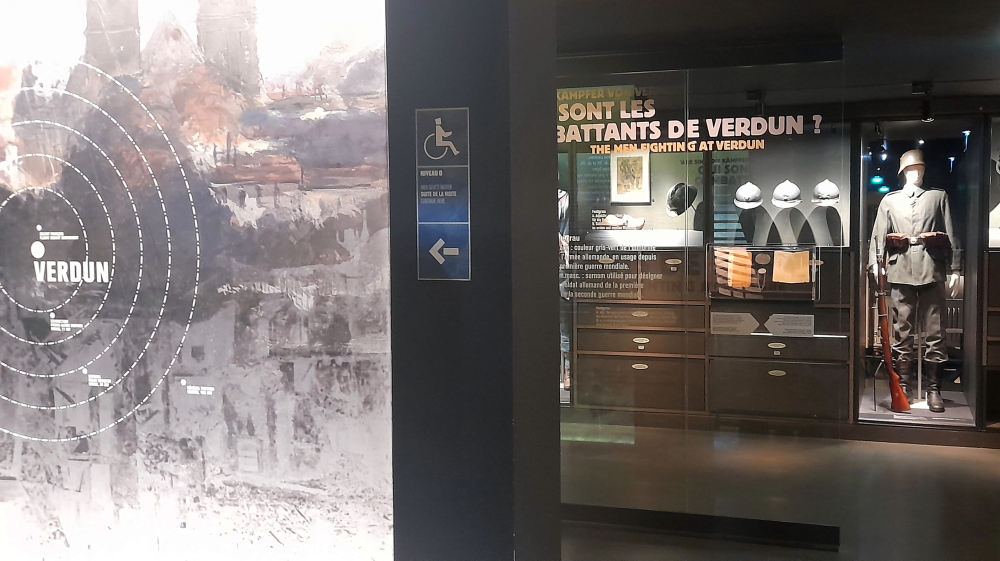
From 6 March 1916, the Germans also attacked on the left bank of the River Meuse yet despite furious fighting on Le Mort-Homme in March and April they were unable to breach the French front line. At the end of June, having taken Fort Vaux, they launched a massive attack which failed – but only just.
On 1 July, the British and French launched a major offensive on the Somme, relieving some of the pressure being put on the French troops by the Germans in Verdun. The Germans tried to capture the town one last time, on 11 and 12 July, but they failed again.
In the autumn of 1916, the French counter-attacked. On 24 October 1916, they recaptured Fort Douaumont and, a few days later, they entered Fort Vaux. It was empty – the Germans had already left. From 15 to 18 December, the French attacked again, retaking almost all the land they had lost since 21 February.
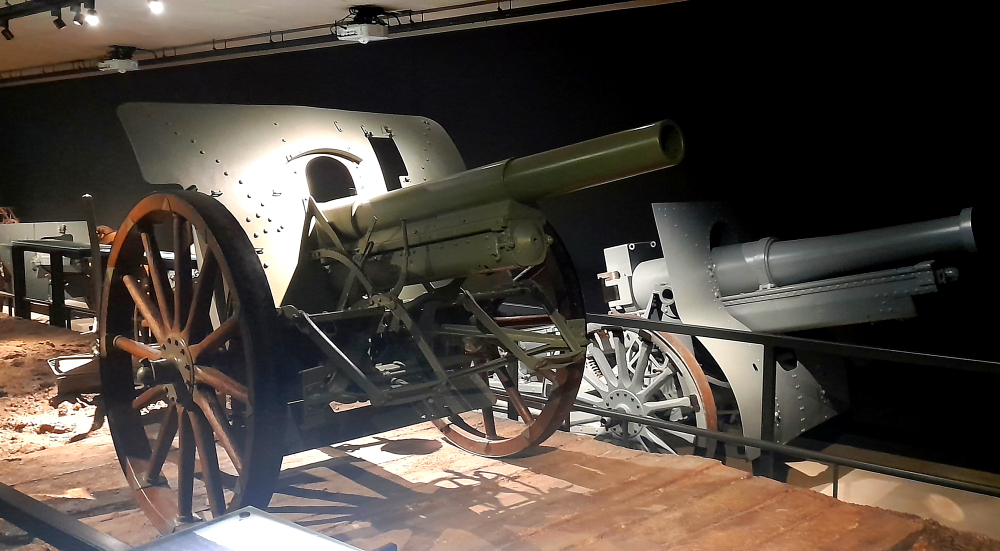
The 1916 battle ended after ten months of bitter fighting on 18 December. There were more than 700,000 victims – 305,000 killed and missing and approx. 400,000 wounded, at an average of 70,000 per month, with almost identical losses on both sides. Yet fighting continued around Verdun until 1918.
Almost three-quarters of the French army fought at Verdun in 1916. It was a Franco-German battle but it also involved colonial forces. The sheer scope and violence of the fighting here made it one of the major battles of WWI.
The United States did not declare its participation in the Great War until 1917, however some unofficial assistance from it was already being provided for the Allies by the start of Verdun. American volunteers played a significant role in the front line of the battle, performing as ambulance drivers, fighter pilots, soldiers and other duties [news.va.gov].
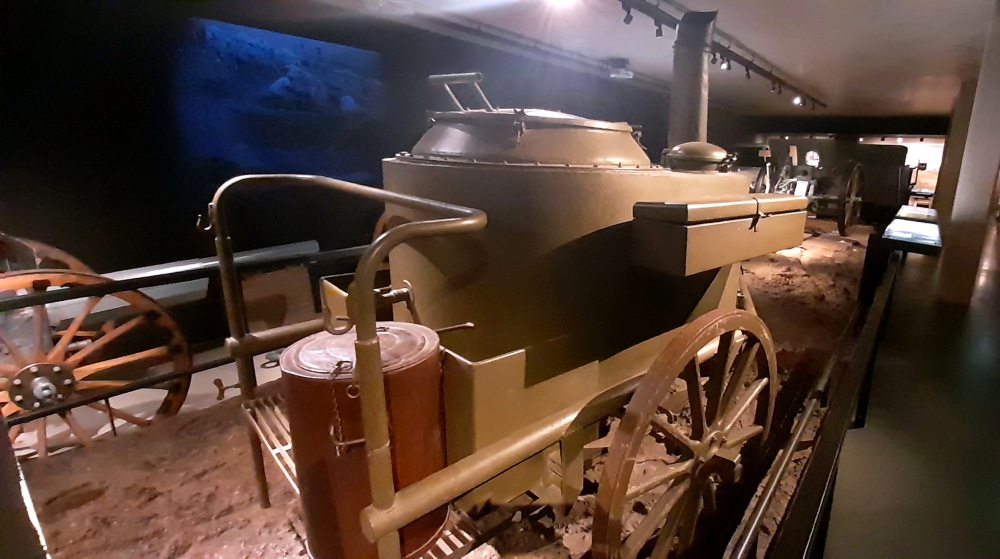
In fact, the Battle came to symbolise the Great War, a culmination of battlefield brutality. It summed up every aspect of the Great War and turned Verdun into the most iconic of all places of remembrance [memorial-verdun.fr].
Exiting the Museum we walk to the nearby village – its remains, that is – of Fleury-Devant-Douaumont – village détruit. In the forests around the town of Verdun there are 8 other villages with this “village destroyed” categorisation.
There are remnants of some structures – a few stones in the ground & markers – but otherwise there is nothing, except a rebuilt chapel, with the statue of Our Lady of Europe draped in a blue flag with gold stars.
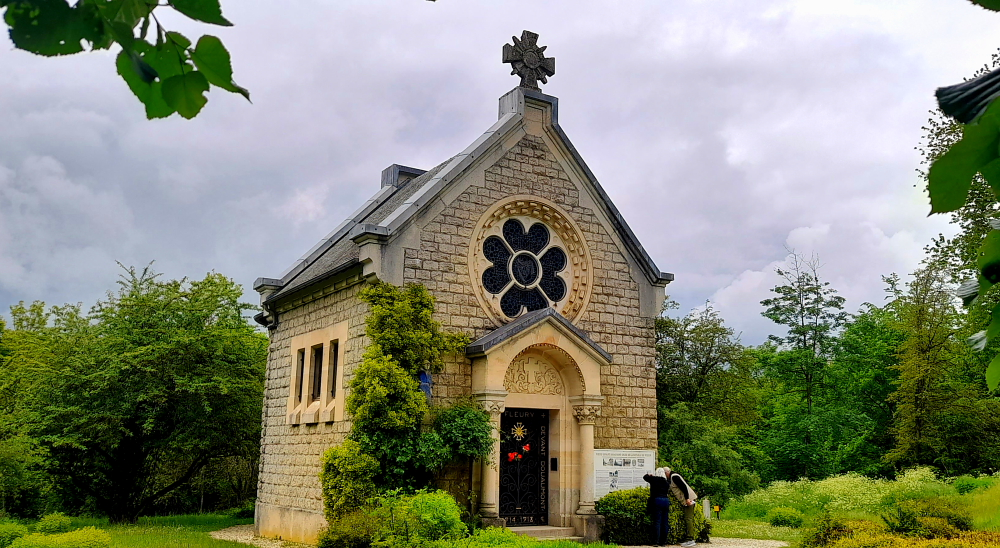
Before WWI Fleury-devant-Douaumont was home to just over 400 inhabitants, who worked the land and forests or in the village itself.
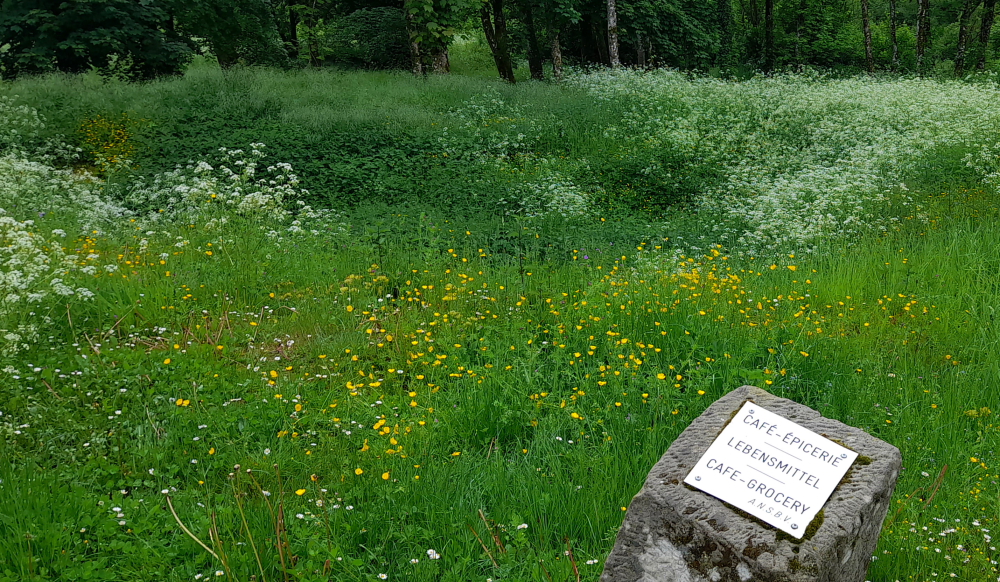
As the Germans advanced, Fleury-devant-Douaumont was evacuated. Altogether, what remained of the village exchanged hands 16 times over the course of the battle. When it finally ended, the village was no more. It was in the Zone Rouge, declared a village that had ‘died for France.’ Nothing was left, but in honour of its sacrifice, it kept its legal status. The red-framed white signs still stand at the entrance and exit of Fleury-devant-Douaumont. It still has a mayor [www.elsewhere-journal.com].
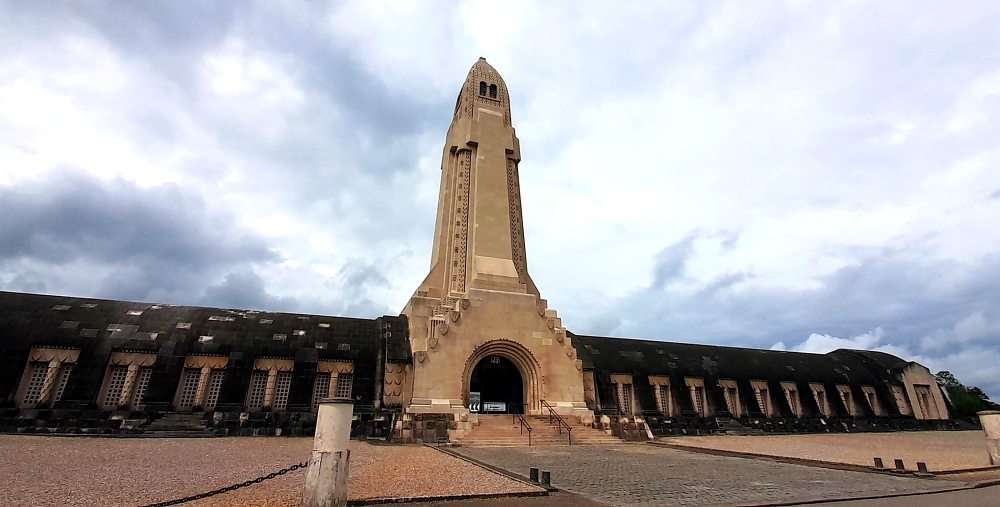
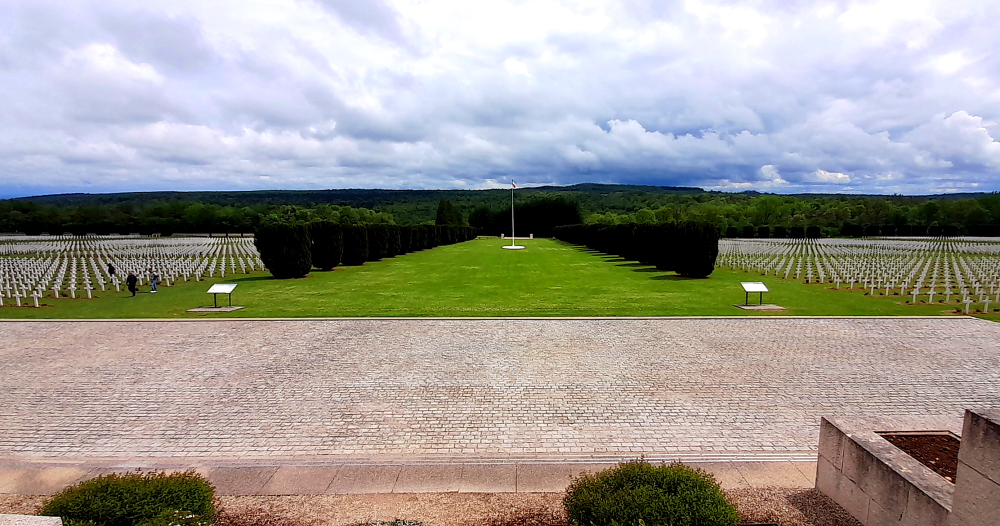
Nearby is the Douaumont Ossuary, a memorial containing the skeletal remains of at least 130,000 unidentified combatants of France and Germany. In front of the monument lies the largest single French military cemetery of WWI with 16,142 graves. It was inaugurated in 1923 by Verdun veteran André Maginot, who would later approve work on the Maginot Line. The ossuary was officially inaugurated on 7 August 1932 by French President Albert Lebrun.
Close by is Fort Douaumont, a relic of WWI. It’s one of the most powerful works and symbols of the Battle of Verdun.
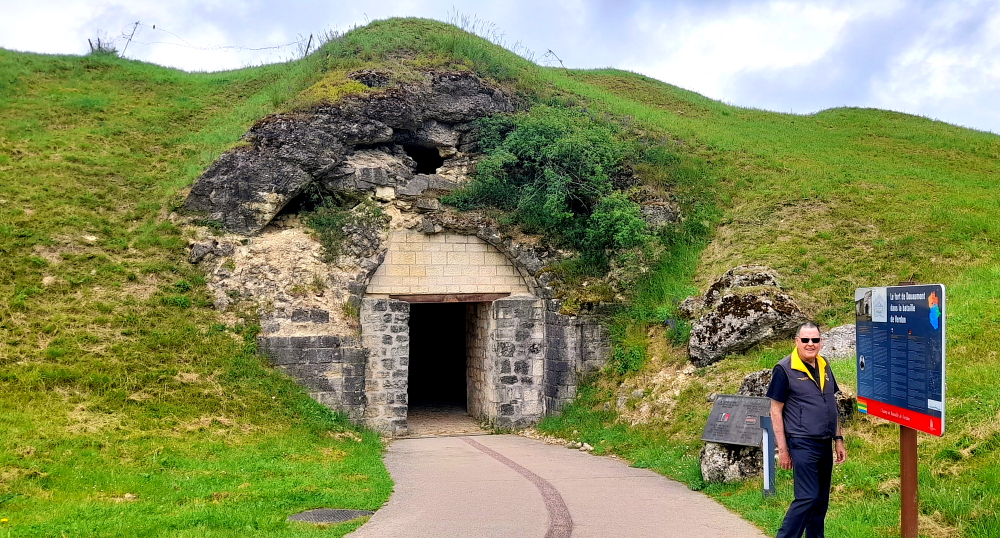
Built between 1884 and 1886, Fort Douaumont was a strategic location of the Battle of Verdun in 1916. Moreover, it is to this battle that it owes its fame.
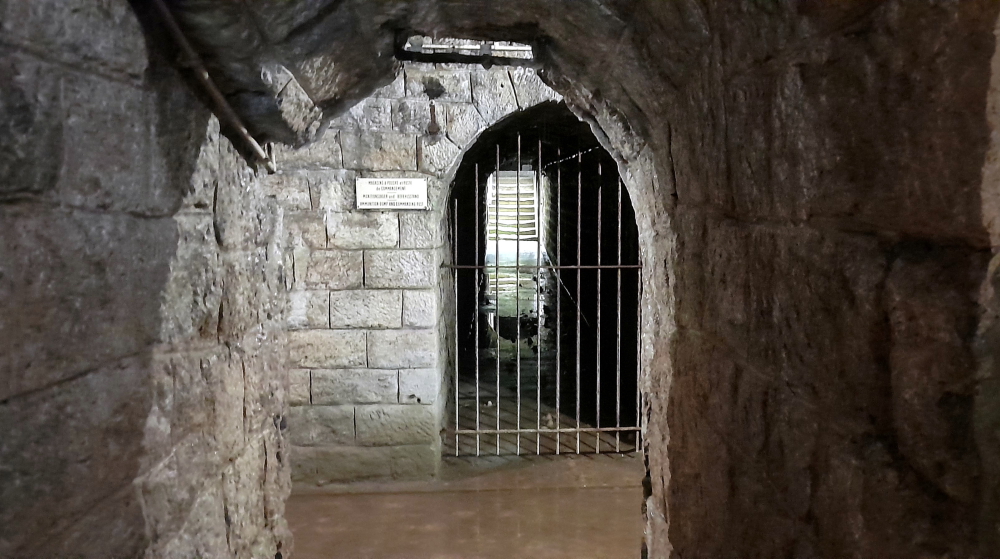
Overlooking the valley SW of Douaumont at an altitude of 400 metres, the fort has been classified as a historical monument since 1970.
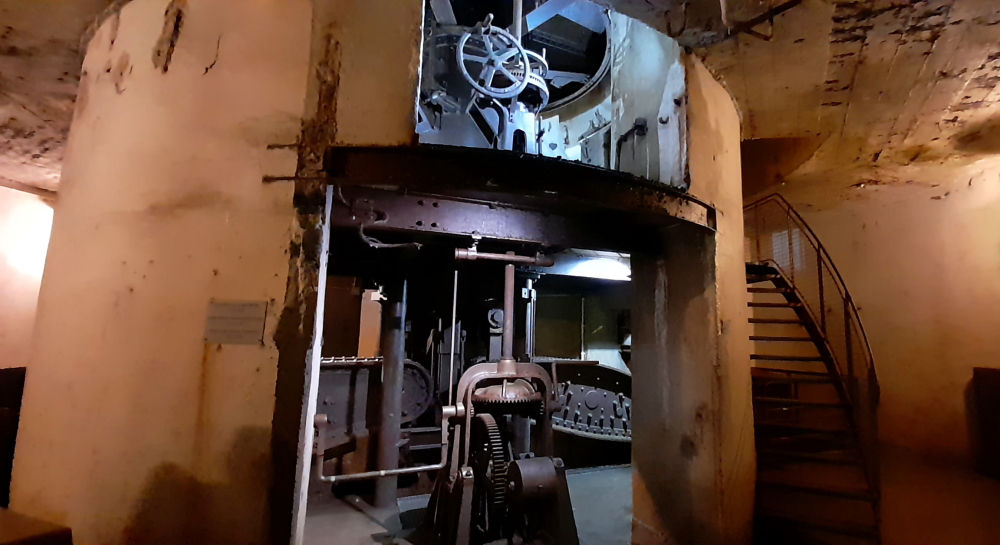
Its masonry construction was almost immediately obsolete because at that time new shells had the capacity to destroy masonry structures.
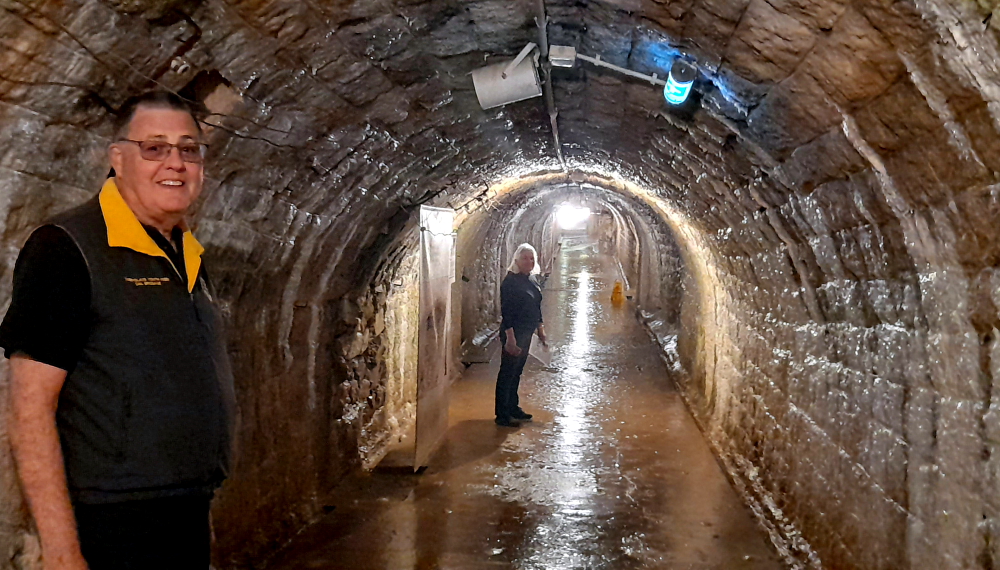
That is why Fort Douaumont was covered with a thick layer of concrete in the most exposed and sensitive areas. Its efficiency and the resistance of its armament made it one of the most sturdy buildings in the entrenched camp of Verdun.
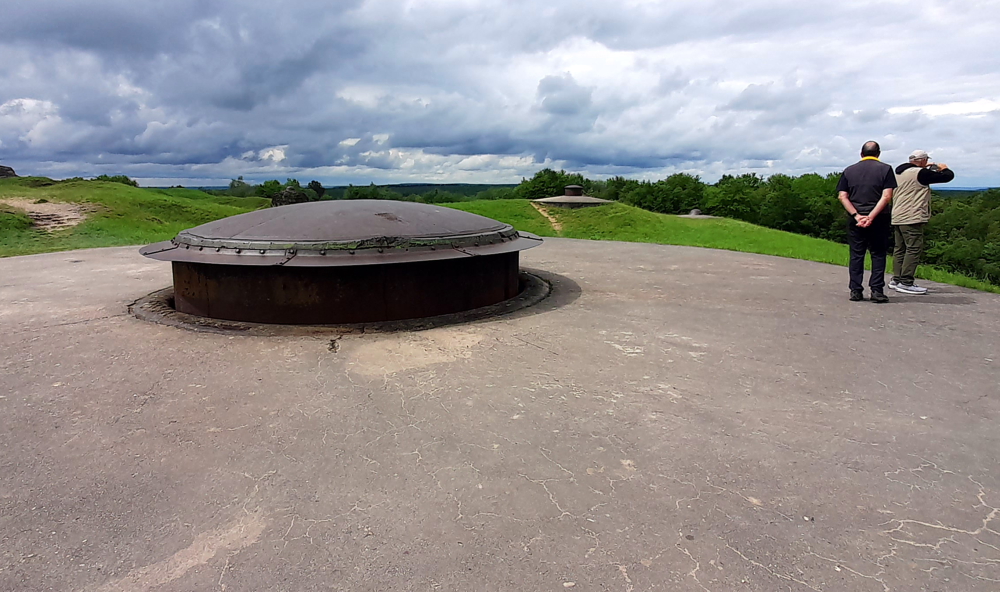
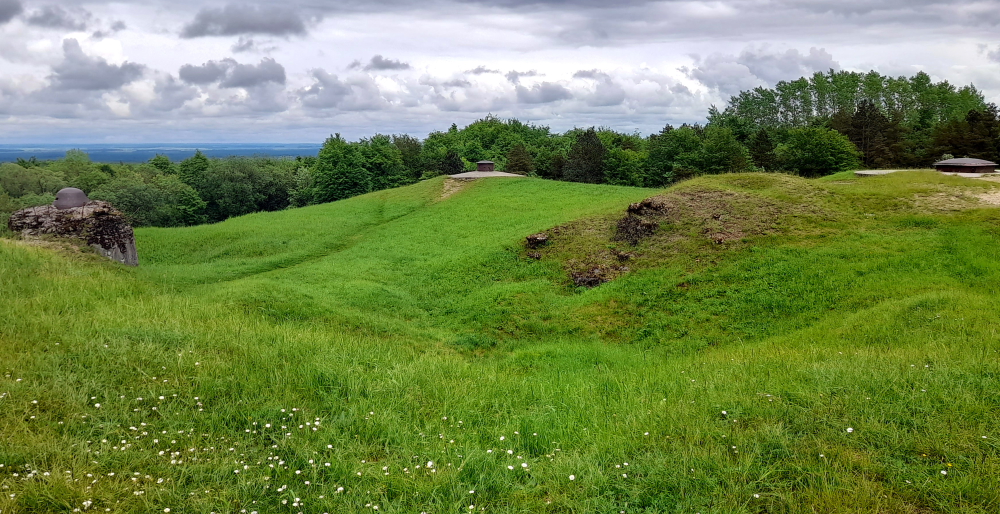
On 21 February 1916, the Germans attacked Verdun. Fort Douaumont was a prime target: it received about 800 shells in 2 days. In a few days, the front line came dangerously close to the fort. 4 days after the beginning of the battle, it was in the hands of the German army. However, the French army fought to recapture the fort for 8 months by showering it with shells.
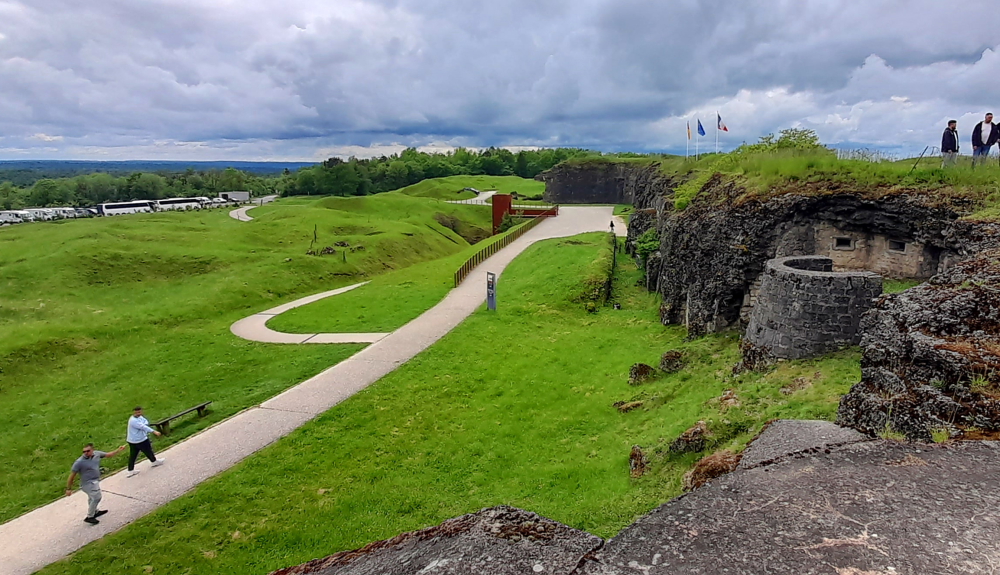
Finally, in October 1916, after 6 days of preparation and a particularly dense artillery deployment, an umpteenth attack succeeded in retaking the fort [landofmemory.eu].
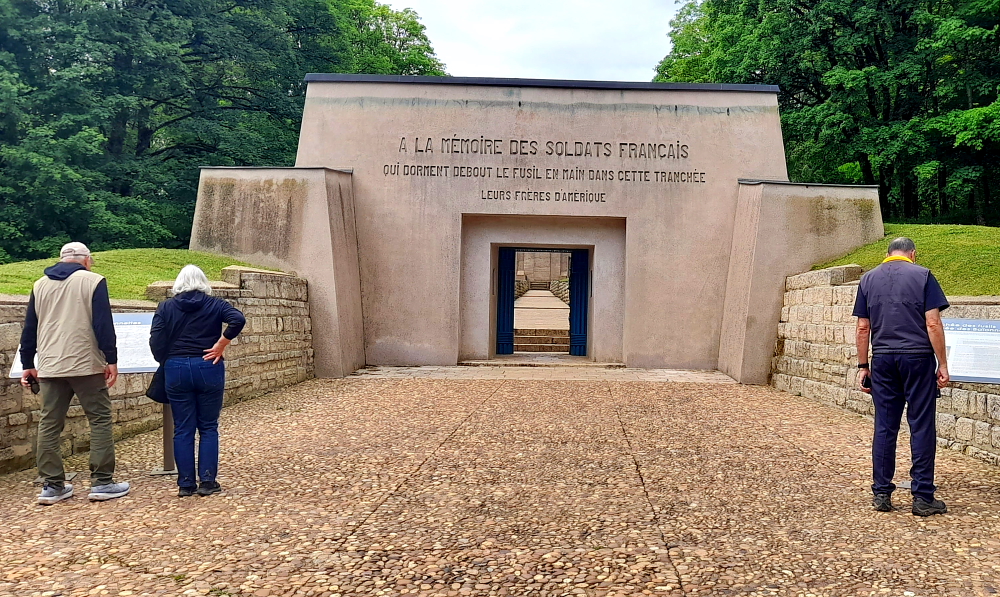
Also nearby is the “Trench of Bayonets”. “To the memory of the French soldiers who sleep standing with rifle in hand in this trench – from their brothers in America.” This is the inscription in front of the Memorial.
The monument was financed by a wealthy American banker, George T. Rand, who was moved by the famous legend that the place inhabits. French soldiers were said to have died and were then buried, standing with weapons in hand, killed by enemy shells. The Bayonet Trench is one of the myths of WWI. It was classified as a historical monument in 1922 and considered a national memorial site in 2014 [landofmemory.eu].
In June 1916, this entrenched position was a part of Fort Douaumont, which the Germans desperately wanted to take. On June 12, Germans unleashed a hailstorm of iron and lead upon French positions. The attack caught the French by surprise.
The 137th Regiment of French infantry was annihilated almost to the last man. Years after the war, French teams exploring the battlefield uncovered the first clues of the horrific fate of this regiment. One of the trenches was discovered completely filled in, with only a neat line of bayonets sticking out of the ground. The bayonets were still fixed to their rifles. A body was found next to each one. Under relentless bombardment, the soldiers had been effectively buried standing up, perhaps even while they were still alive. Or so the story goes … [atlasobscura.com].
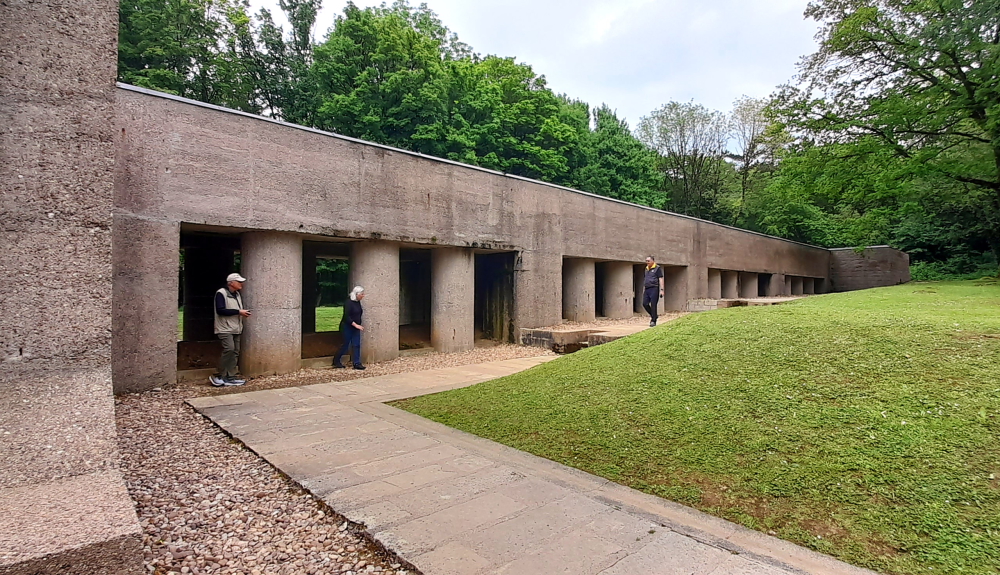
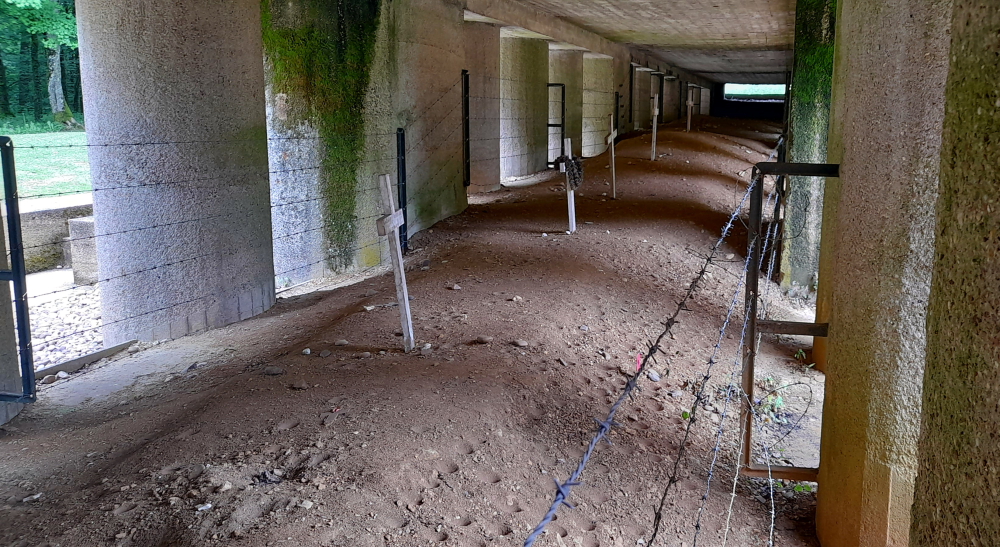
After the war, excavations led to the discovery of 21 bodies of French soldiers. 14 were identified and buried in the Fleury Cemetery before being moved to the Douaumont Ossuary. The other 7 bodies, which remain unknown, were reburied in the “Bayonet Trench.” [landofmemory.eu].
Around 4:00 pm we leave this part of France and head 1.5 hours SW to the Leclerc supermarket in Pierry, a suburb of Epernay, then drive the 30 minutes south to our next AirBnB accommodation in Baye (back into the Champagne region) which Becky and Jerry had booked, where we arrive around 7:00 pm.
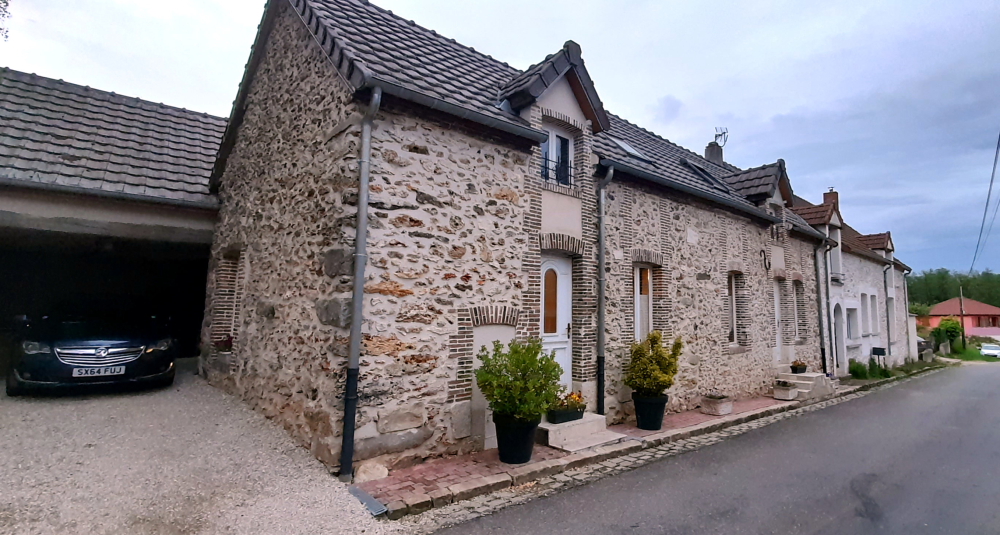
Louis, the owner, meets us at the gite and while he shows Becky and Jerry around and explains the history of the family home (2 houses merged), we unload the car.
After a lasagne and salad supper, in front of a lovely fire lit by Louis, we hit the sack.
16 May, 2024
Another glorious day. This morning we are meeting up with Tony and Florence, friends of Becky and Jerry’s, who live in Provence. 10 weeks ago Becky introduced us to them via a Skype video call so we are looking forward to meeting them today. Flo has kindly organised a tour and wine tasting this morning, a restaurant lunch, an inspection of their vines and a river cruise this afternoon.
Tony is English and Florence is French, having been born and raised in Cumieres (Marne) which is where we are meeting them at 10:30 am at the Vadin-Plateau (VP) champagne house that buys the grapes from their 12 rows of vines that grow a couple of blocks away.
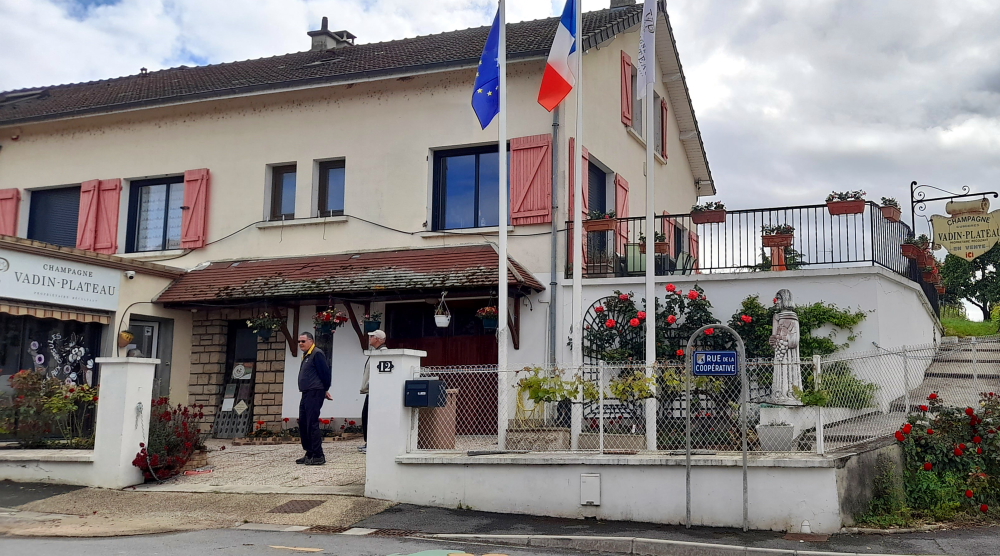
According to the Paris Wine Company website, Vadin-Plateau was founded in 1785 amongst the terroirs of 5 neighboring villages: Ay, Damery, Champillon, Hautvillers, and the home of the winery, Cumières. Since 2012, the 7-hectare estate, with vineyards spread over 100 different parcels in the fine Premier Cru of Cumières to the north of Epernay, has been committed to organic viticulture and has abstained from using herbicides for over two decades.
The wines produced at this domaine are not only typical of the region, but also highly personal, as each cuvée possesses a unique identity of its own. The Renaissance, its flagship 100% Pinot Meunier, is an embodiment of the Cumières’ grape. Along with the non-vintage cuvées, Renaissance and Intuition, Vadin-Plateau also produces an impressive selection of single-vintage, single-vineyard wines that reflect the distinct terroirs of the Cumières and Hautvillers parts of the estate, first released in 2018 [pariswinecompany.com/producer/vadin-plateau/].
This estate’s terroir (environmental factors, farming practices, habitat) is described as a Continental climate with Oceanic influence. Silty-sand, clay-limestone and limestone soils over a chalk bedrock. Mostly southern facing gentle slopes. 100-170m altitude. Its winegrowing/viticulture (cultivation and harvesting of grapes) is certified organic (Ecocert) and certified biodynamic – respecting the ecology, culture and tradition of a place.
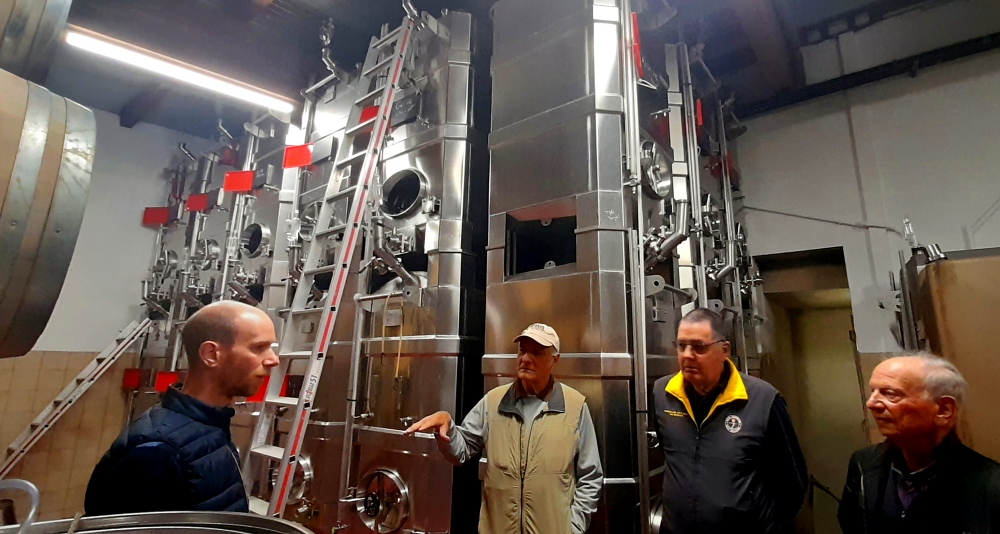
The vigneron is the Vadin family with Muriel, and her daughter, Aurélie, running the estate since 2022. Bartholomew, who has been with them for about a year as their wine master, takes us on a tour with Flo taking on the role of occasional interpreter.
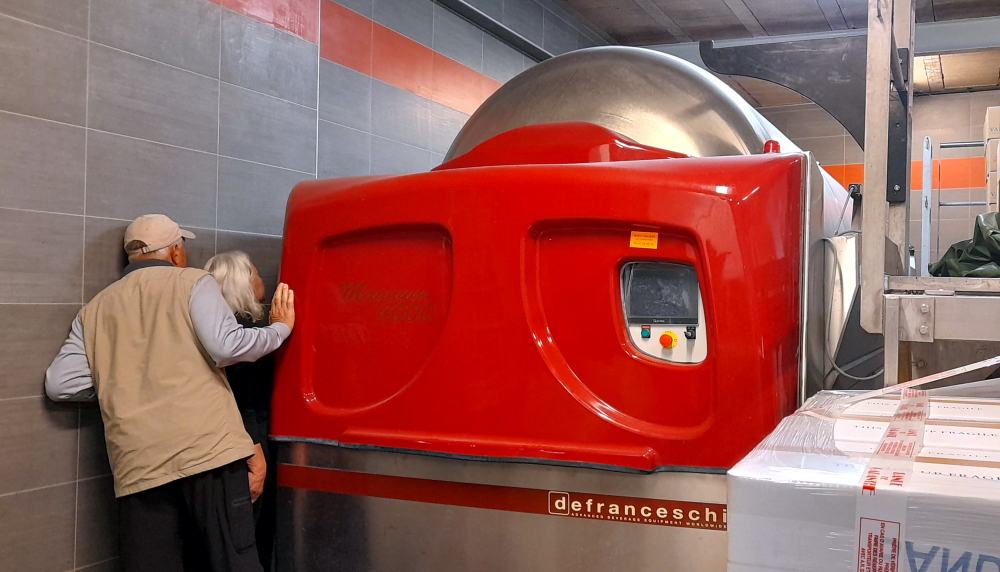
Considering it’s such a small estate, there has been a massive investment in technology and equipment.
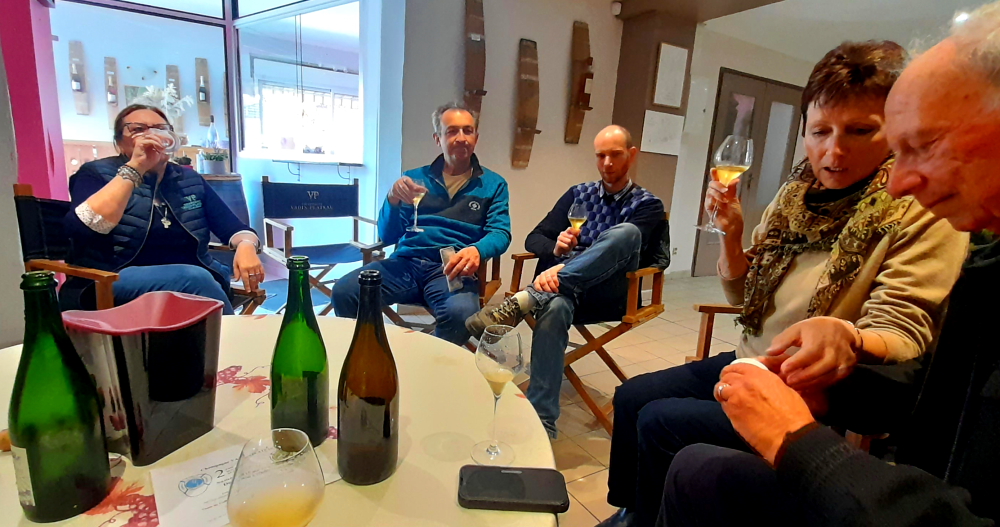
Working organically has helped to produce wines with purity, depth and resonance – champagnes that represent exceptional value for money which we can endorse, having purchased 2 bottles of their excellent Grande Reserve at Eu19.40 each.
At 12:25 pm we sprint out the door as we have a 12:30 pm booking at Chez Max – a Restaurant traditionnel Français depuis 1946 passed down from father to son – in nearby Magenta, 10 minutes’ drive away.
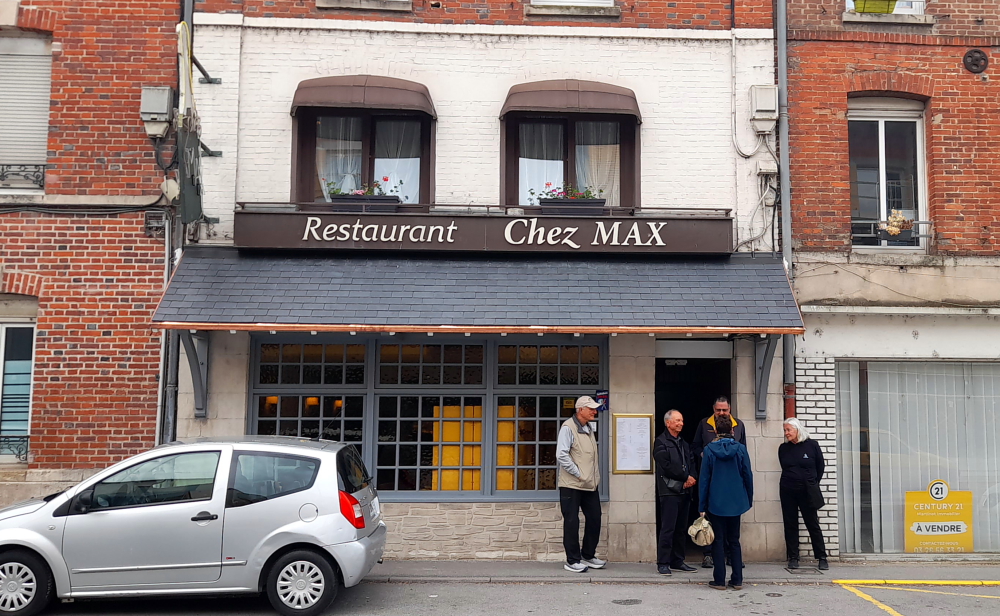
On arrival we are greeted warmly by the current “Max”, Monsieur Besnard. We all opt for the 3-course set menu at Eu26 which has at least 2 options each for entree, main and dessert, accompanied by a bottle of the restaurant’s own wine, an exquisite Geoffroy Cumieres Rouge – délicieux all round.
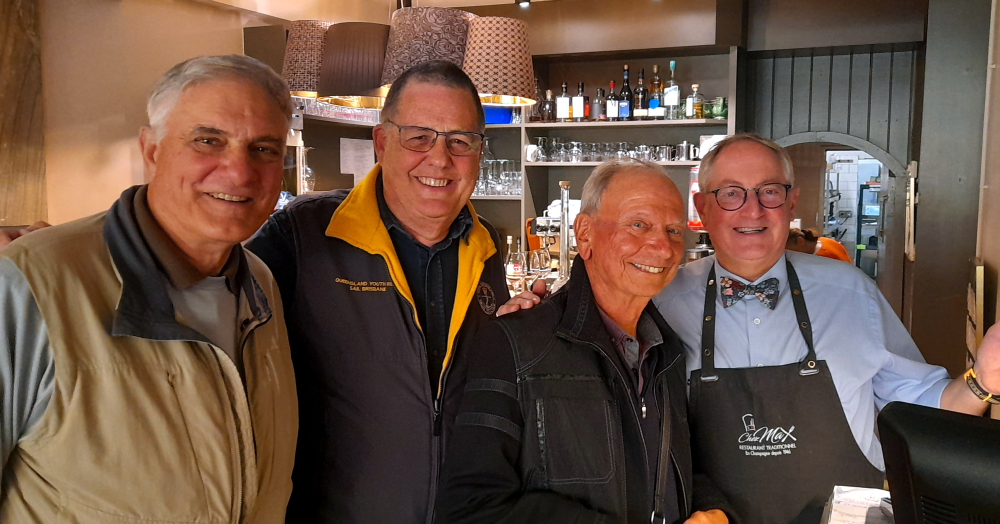
Turns out Monsieur Besnard has a daughter who lives in Newcastle, NSW, so I have a bit of a lively chat with him, in English thank goodness, about his travels through Oz over the years.
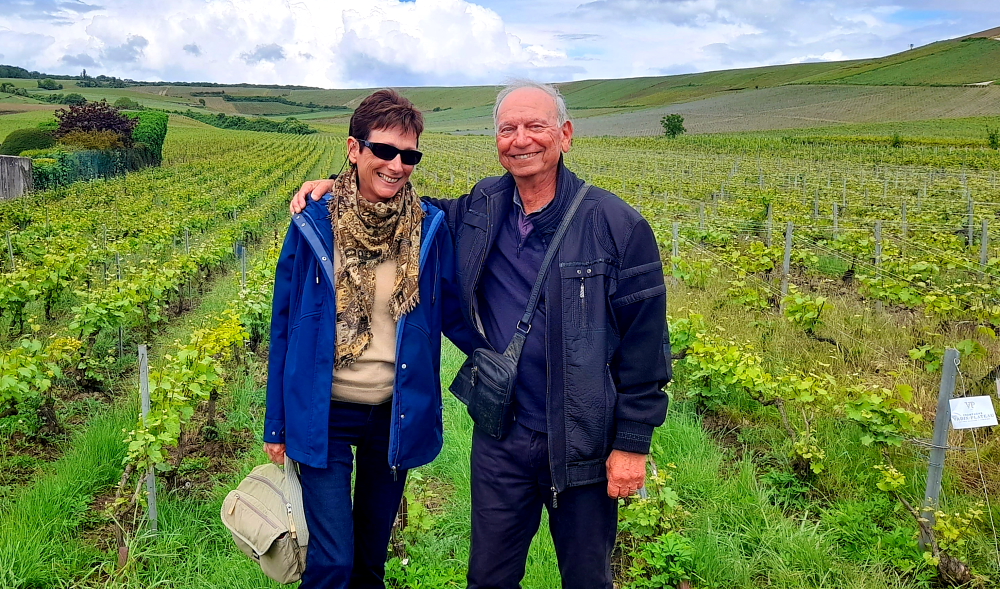
Several hours later we leave and drive by Florence and Tony’s 12 rows of vines on Avenue du General Leclerc in Ay on our way to the boat cruise.
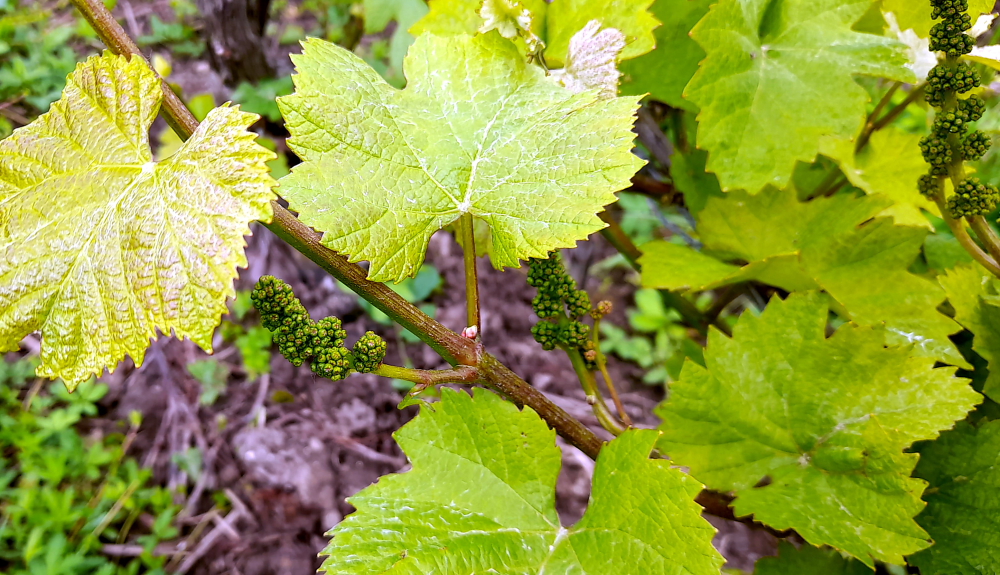
That’s the thing about owning vines in the Champagne region, they are usually inherited and rarely, if ever, for sale.
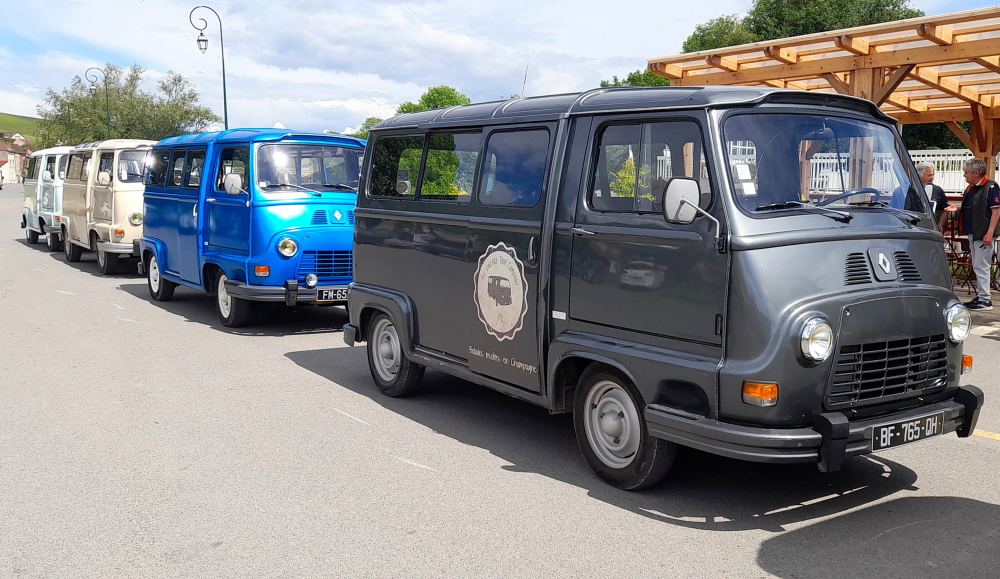
With 15 minutes to spare we arrive at the quai where the Champagne Vallee Bateau berths to find a small convoy of retro Citroen vans already parked.
Once on board we discover that a large group of tipsy Poles has taken over the main, inside deck and are happily serenading each other. As there is no room for us, we go topside which is drenched in rather hot sunshine.
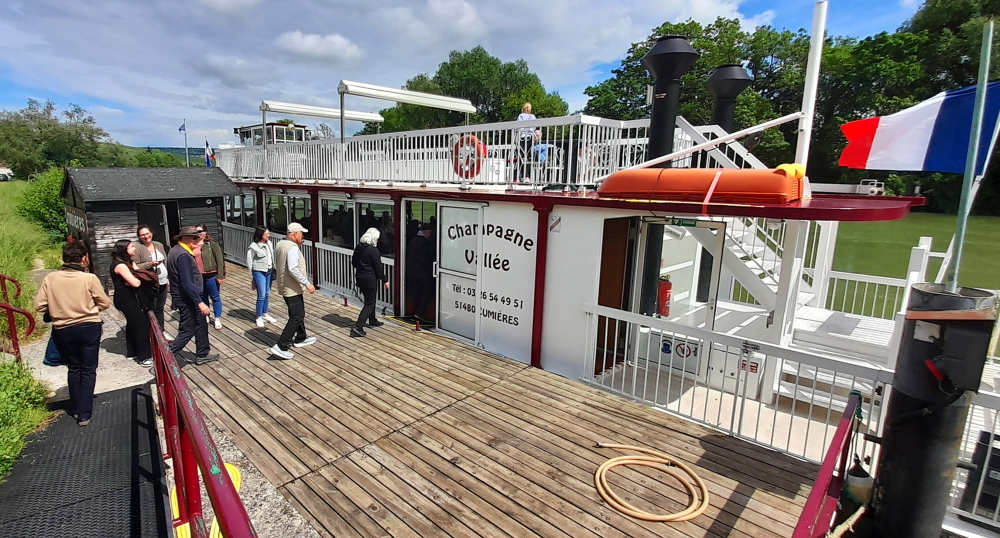
We grab some chairs, strip off unnecessary jackets and sunbathe while we wait for the cruise to commence.
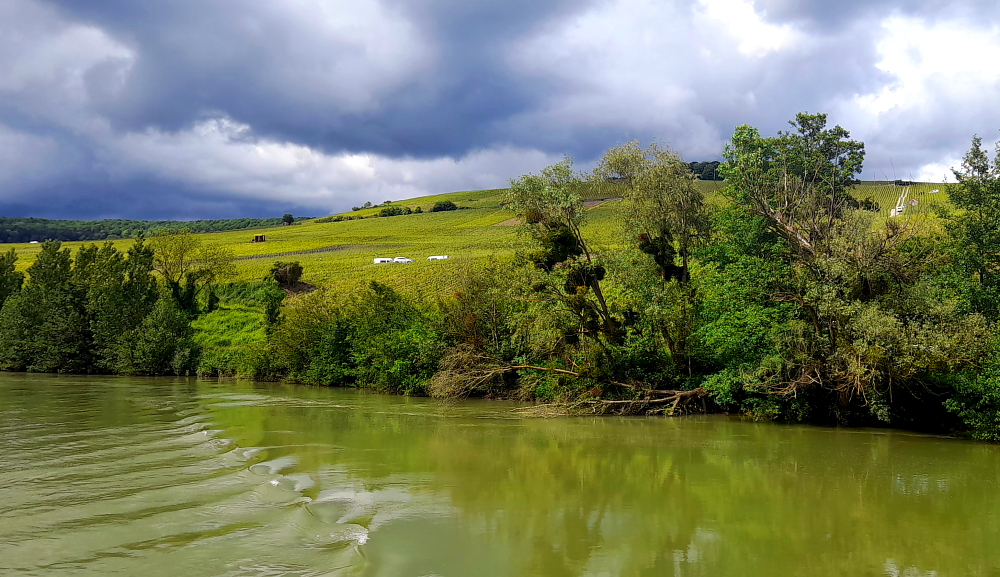
Soon we have a guide who gives us a commentary in English, that is until the Poles decide they, too, want some sunshine, pour onto the top deck and begin singing once again, drowning out the commentator.
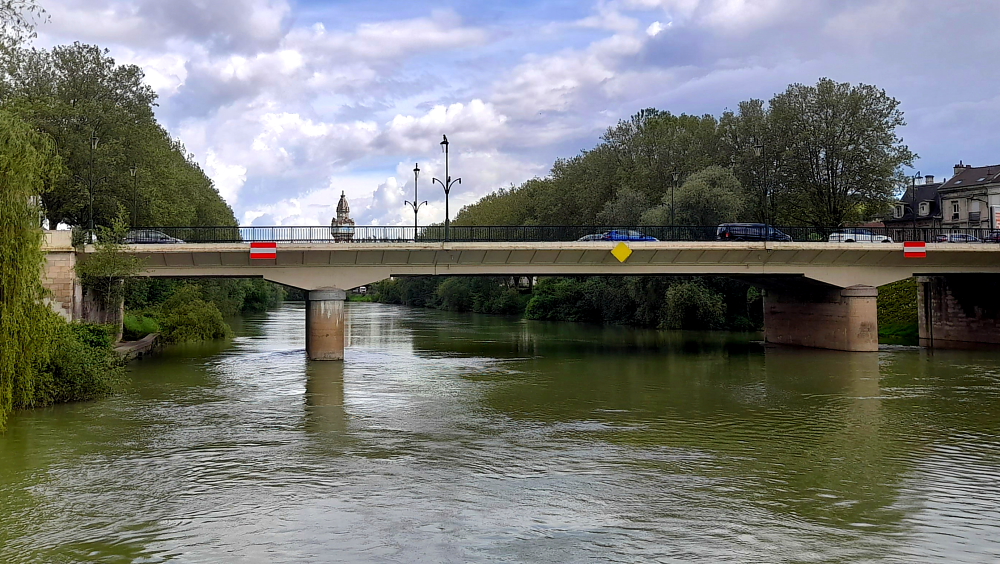
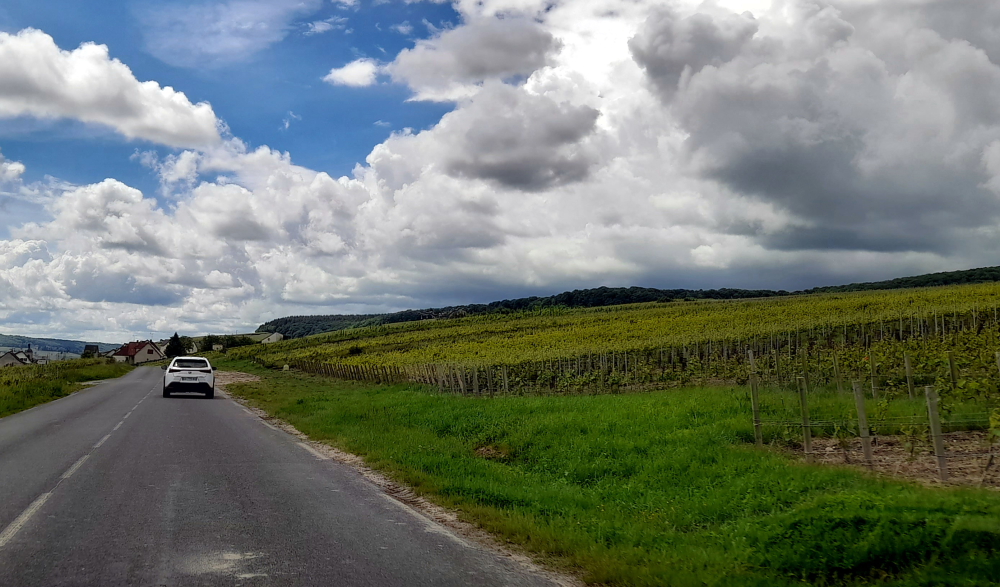
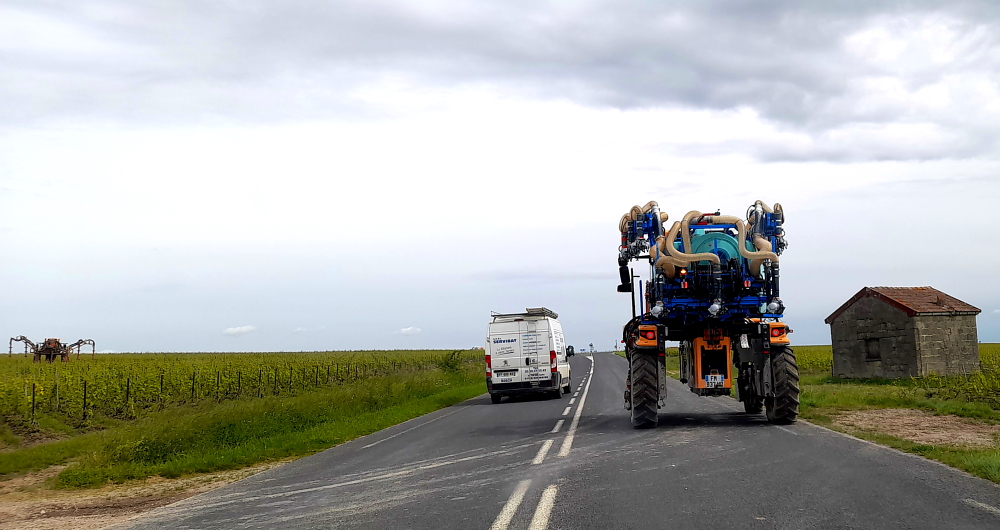
She soon tells them to “shush” and we get to enjoy a quiet cruise taking in the surrounding undulating green countryside which is dotted with what look like toy white vans while vineyard workers tie, weed, rake and spray.
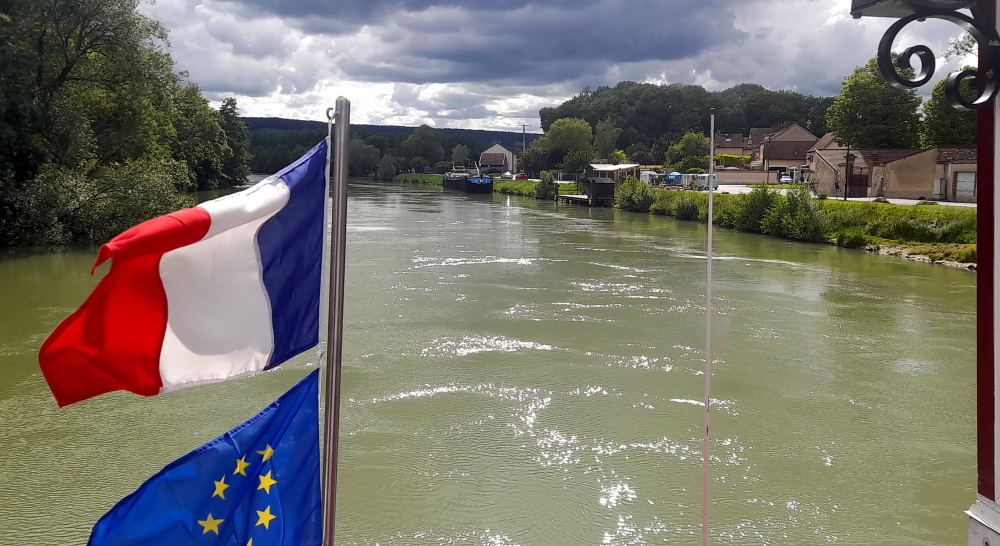
Apparently there are 18 locks on the 518 km Marne River, one of which, No. 15, we pass by as we cruise upstream until we reach the Epernay Bridge where we turn around.
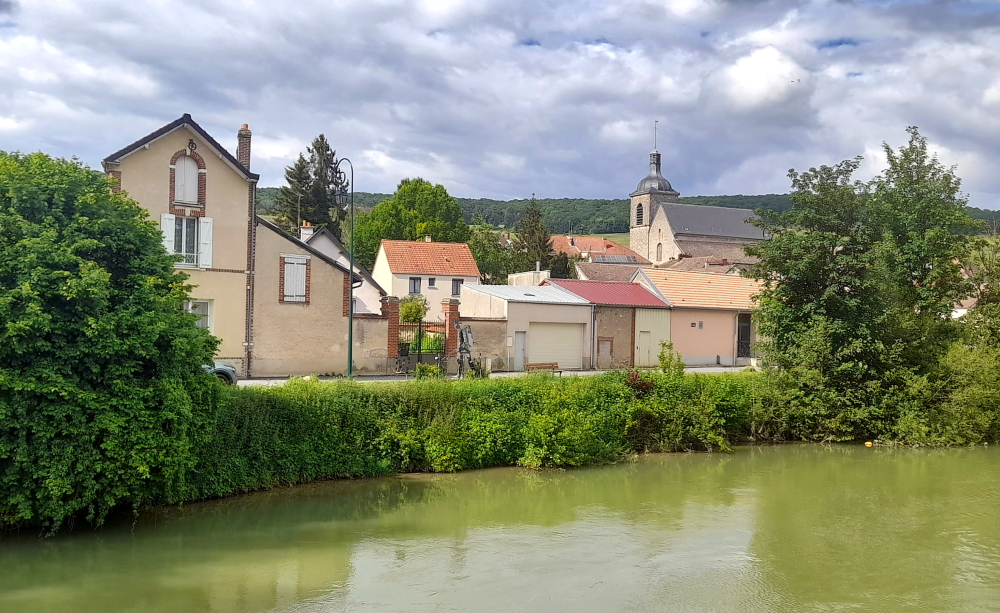
The sun is blazing hot, then it clouds over and a cool breeze springs up. Constantly there is the threat that we’ll be drenched by a thunder storm but the only drenching we get is an internal one when Flo and Tony produce yet another bottle of chilled champagne and 6 flutes. Cheers!
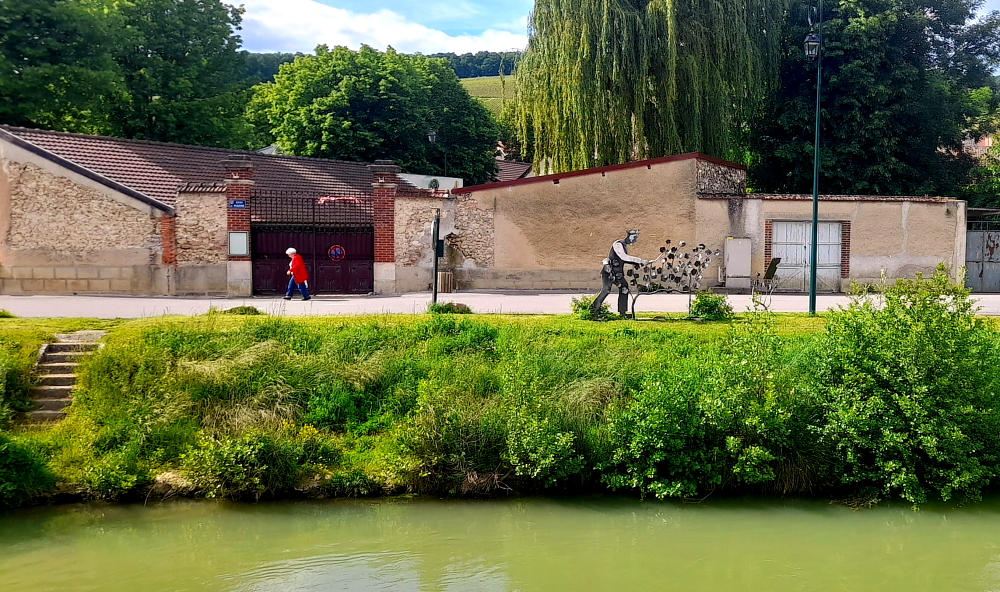
1.5 hours later we dock at the quai then drive back to Vardin-Plateau where we sample yet another bottle of bubbles before we collect our wine orders from Muriel – 6 boxes of champers for Tony and Flo and 1 small box of 2 bottles for us – and say our farewells to Muriel. Their boxes we place in our cavernous car boot as their small one is full of suitcases.
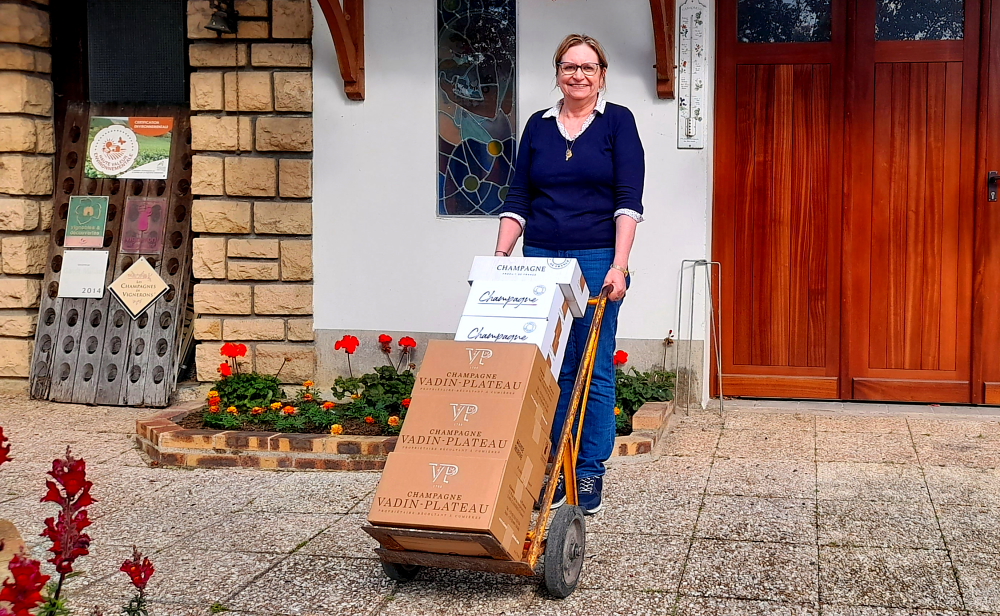
En route to Baye we all stop at the Leclerc supermarket at Dizy for tonight’s dinner supplies then, with Tony following us, we drive back to the gite at Baye where they will stay overnight.
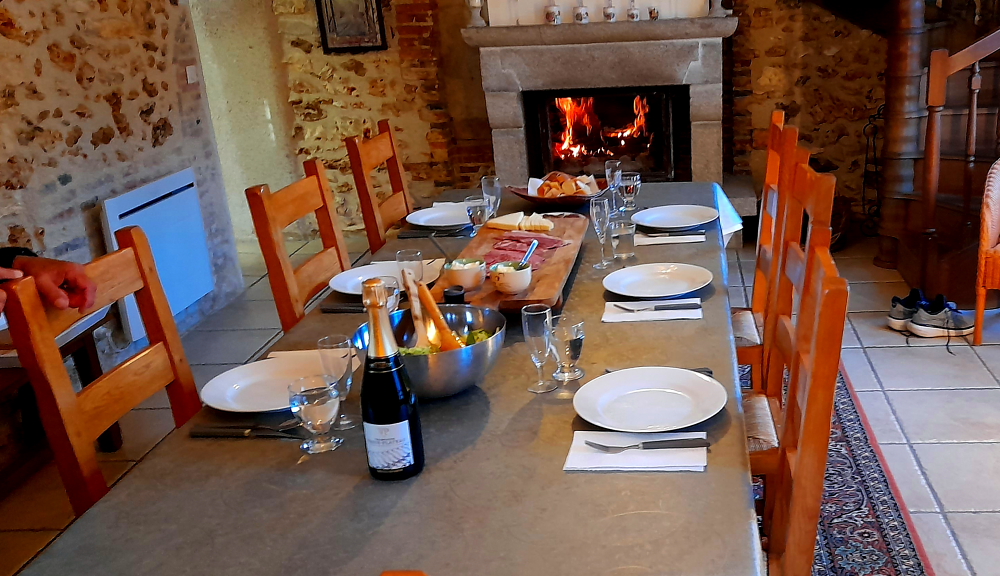
Simple fare is soon laid out on the dining table: cold cuts, cheese, salad and baguette followed by abricot tartin in front of a comforting fire laid by our resident pyromaniac, Jerry. Did I mention yet another bottle of champagne?
After such a hectic but fabulous day full of bubbles, food and laughter it’s an early night for all.
17 May, 2024
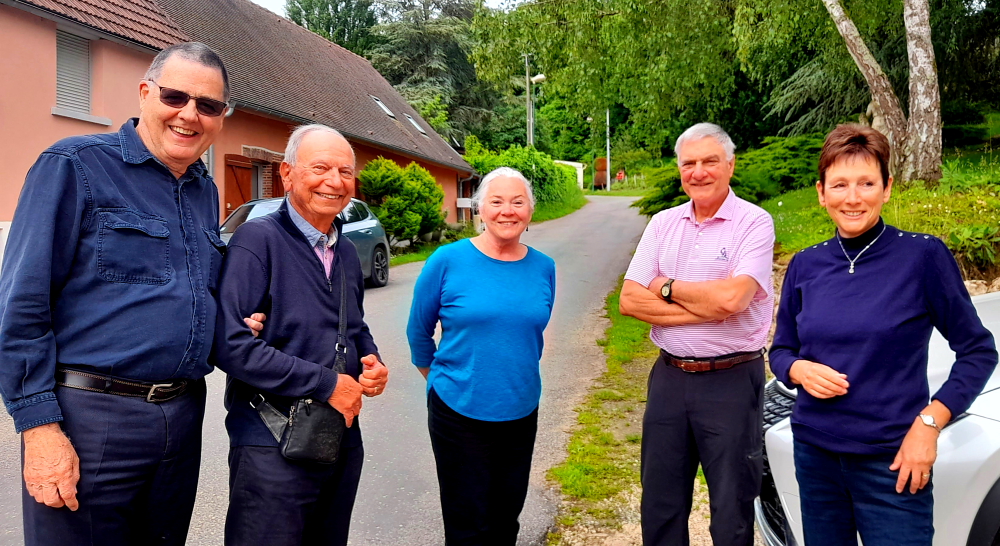
Sadly, Flo and Tony need to leave us around 10:00 am on their way to visit family. After reorganising their car boot we transfer all their boxed champagne to theirs and off they go with a cheery wave.
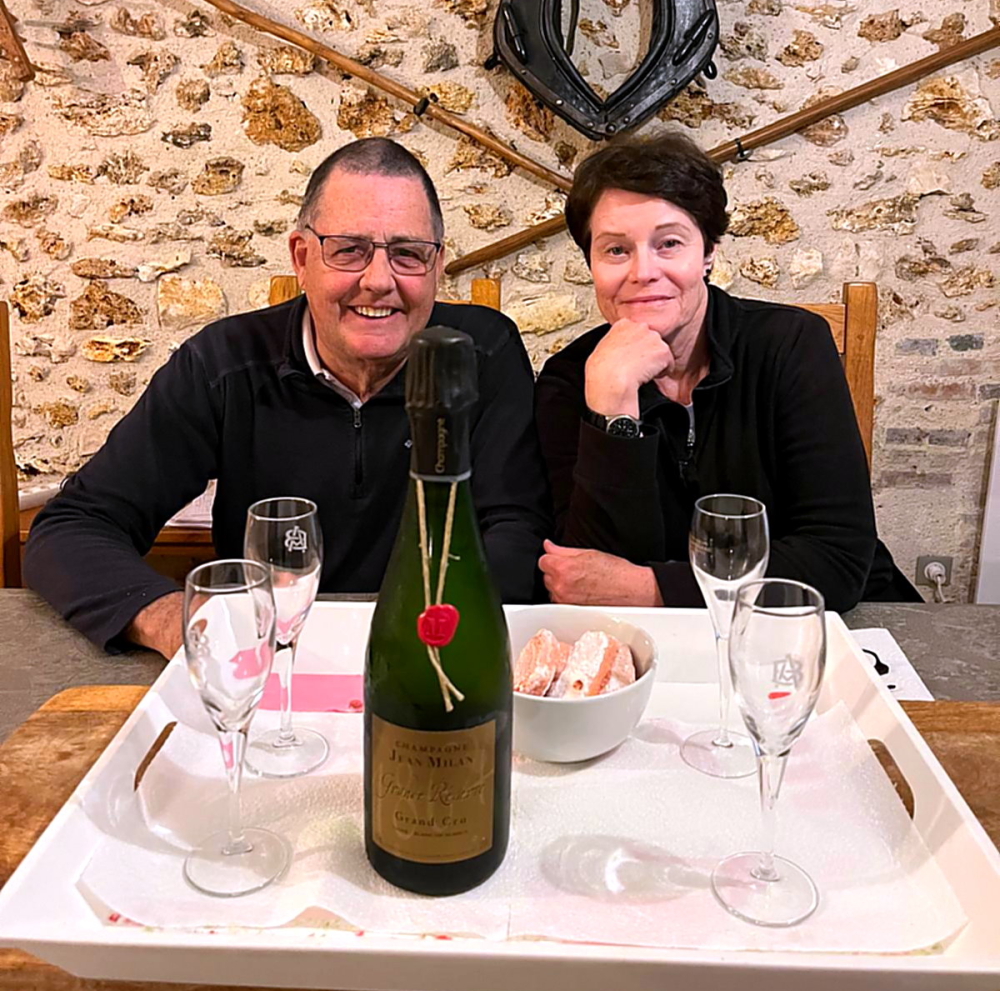
At this point we had a vague plan for the rest of the day. I want to buy another bottle of Grande Reserve champagne from Jean Milan in Oger, with its traditional string and wax seal, to share with Becky and Jerry. When we check the cellar door’s opening times it’s 11:30 am. It closes at noon for the mandatory 2-hour lunch break so we grab our kit and jump in the car for the 25-minute drive to Oger.
With 5 minutes to spare I make my purchase. From here we drive the rest of the Orange Champagne Trail via Cuis to Morangis then to the Saint Martin Church perched on the hill at the northern end of Chavot Courcourt.
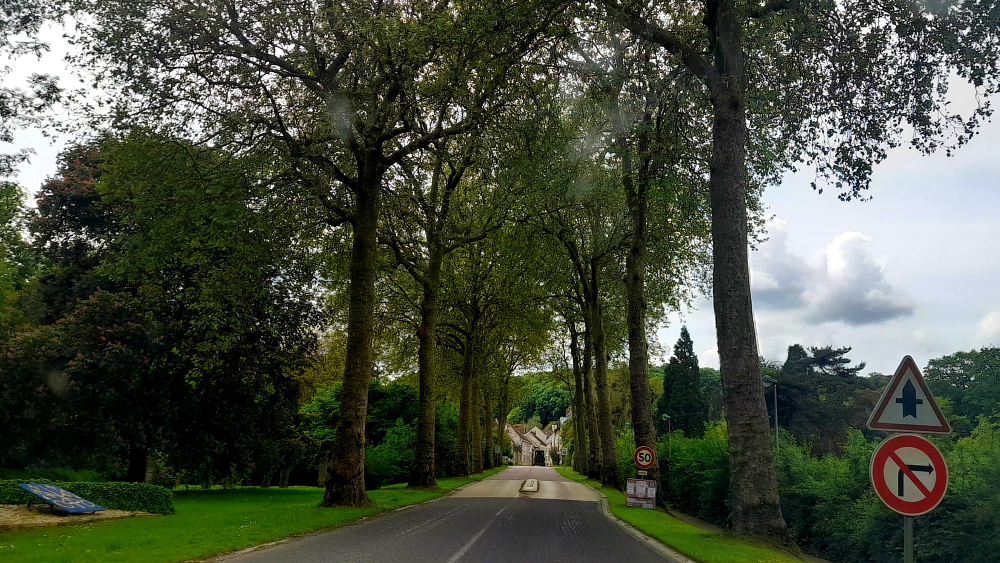
To vary our return to Baye we see that Abbatiale Saint-Pierre d’Orbais has been highlighted as an attraction on the map so after calling in at Leclerc at nearby Pierry for sandwiches we take the D11 to the picturesque village of Orbais-l’Abbaye.
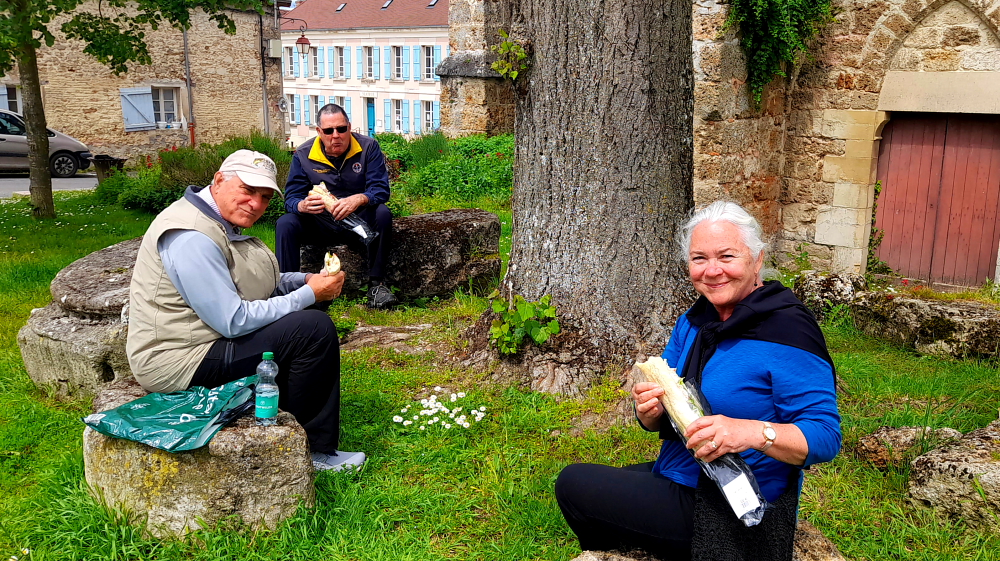
We park in the square in front of the Abbey and find some discarded stone slabs at one side beneath a tree and tuck into our al fresco lunch.
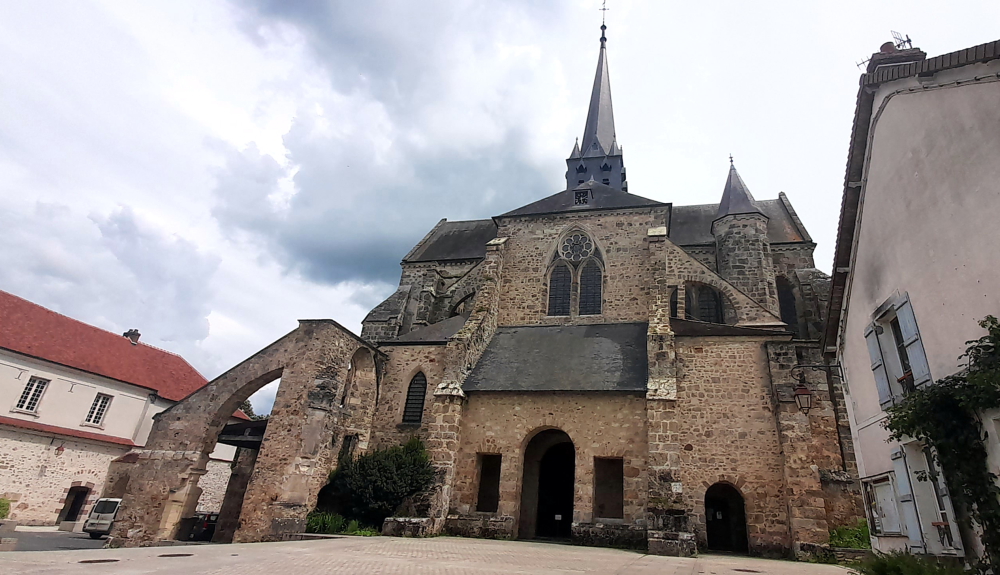
The Benedictine abbey at Orbais was founded at the end of the 7th century by Saint Réol. The St. Pierre-St. Paul church was built at the end of the 12th century and early 13th century by Jean d’Orbais, one of the architects of the Cathedral of Reims.
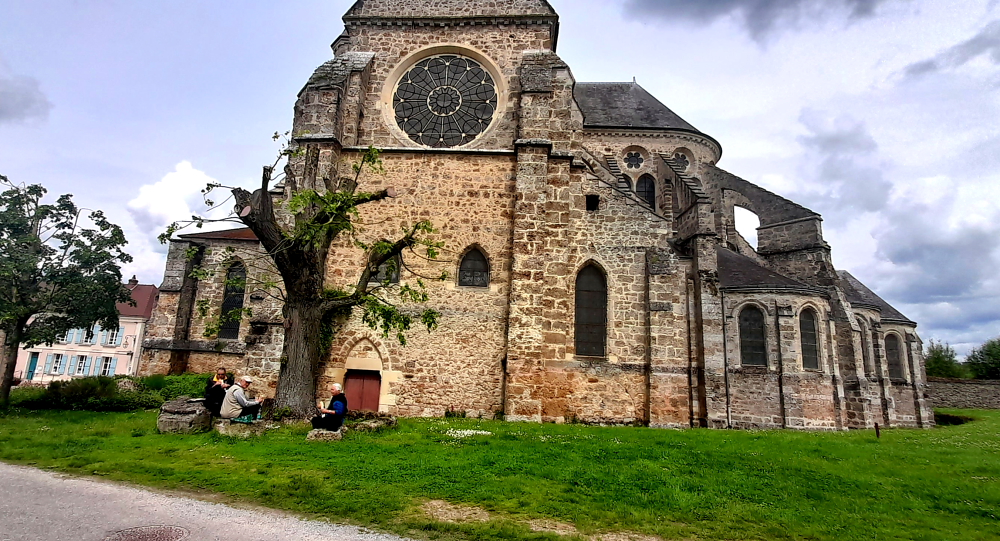
The abbey church had a length of 78 m with 8 bays of nave, 2 of which remain today.
The façade has 2 towers similar to those of the Basilica Saint-Rémi de Reims and the choir an ambulatory with 5 radiating chapels.
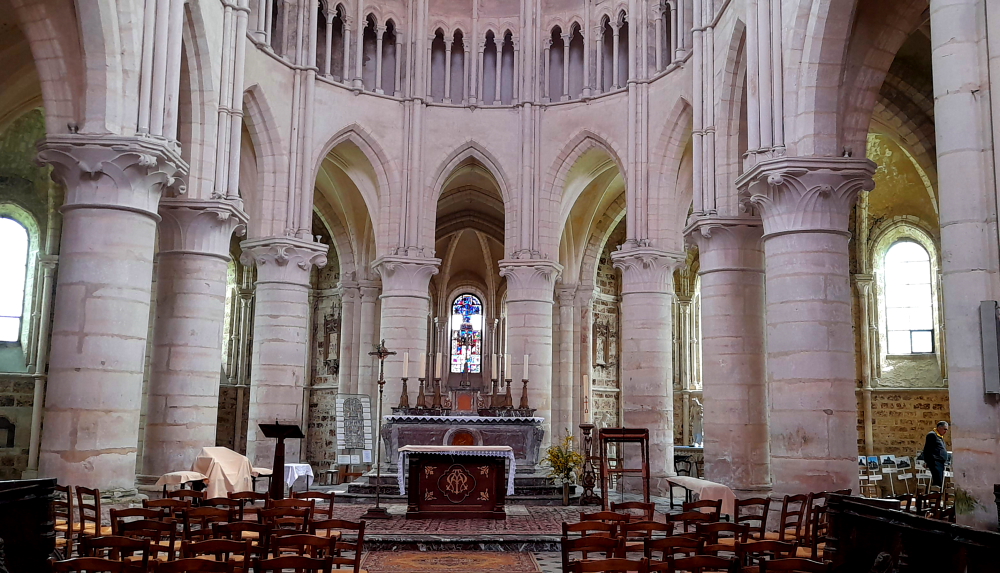
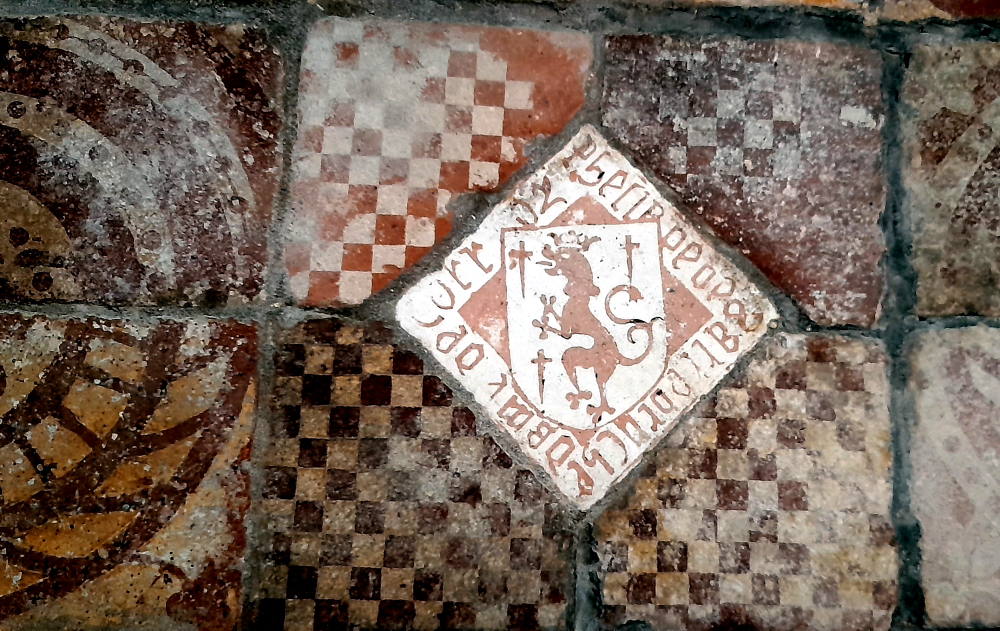
There is also stained glass windows of the 12 century, funerary slabs from the 14th and 15th centuries, a baptismal font from the 16th century, glazed tiles from the 15th century and impressive choir stalls with decorated misericords.
Whenever we drive north from Baye we always drive through the cross roads at the hamlet of Champaubert. This time we stop to discover the purpose of the commemorative column here, the Battle of Champaubert, one of Napoleon’s counter-offensive victories over the allied armies (the Army of Silesia led by Blucher) on 10 February 1814 during the Campaign of France.
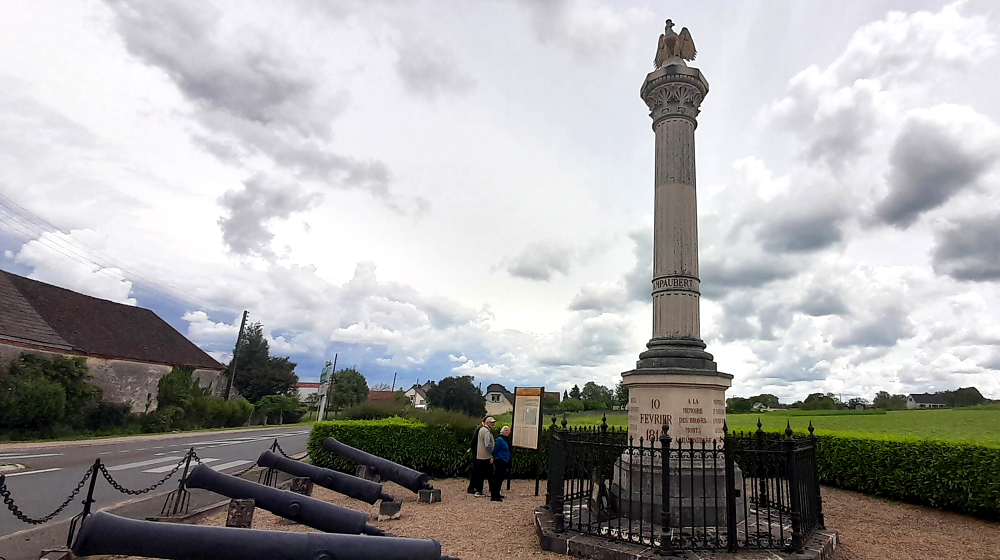
Although a fund was started in 1839, the column was not actually built until 1865-67 according to the design of architects Louis Visconti (responsible for the Emperor’s tomb at the Invalides in Paris) and de Bigault de Granrut. 9 January 1867 it was topped with the imperial eagle and in June Emperor Napoleon III made a gift of the 8 cannon that now surround it.
We arrive back at Baye mid-afternoon where Becky purchases another bottle of champers, a Cuvee Traditional Reserve for Eu18.30, from the local vintner, Champagne Yves Jacques.
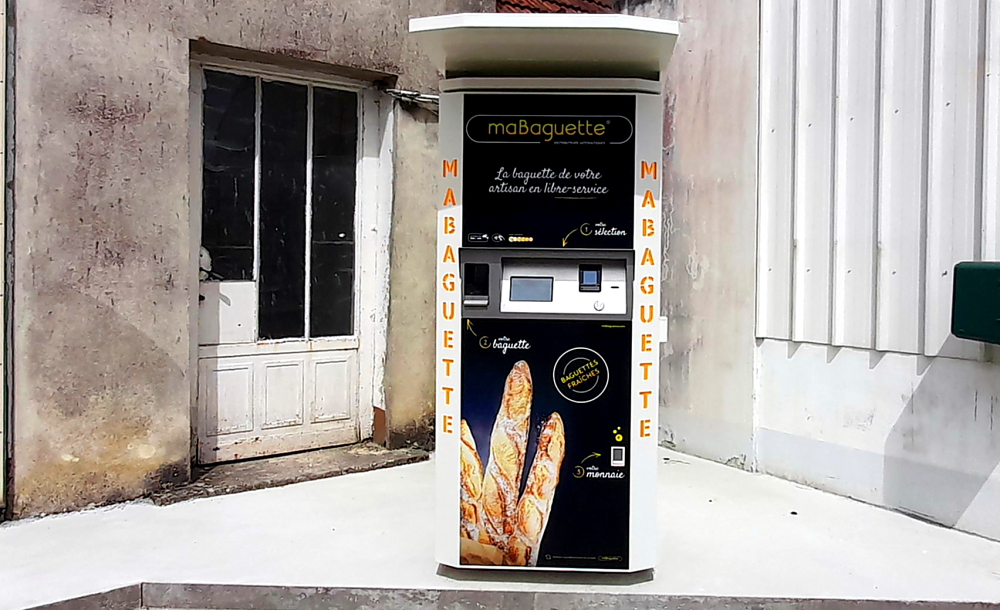
Opposite the 1 and only boulangerie in town (open 7:30 am-1:00 pm and 4:00-7:30 pm) is an interesting vending machine – for baguettes. Obviously a stop-gap for when the boulangerie is closed. We had seen something similar in Reims for 3-minute pizzas but it looks like the baguettes are already baked and ready to go. Don’t stand between a Frenchman and his daily, fresh baguettes!
While we 3 rest, Lynn heads out to walk into Baye. She goes via La Gare which features a disused railway station building with no sign of a railway track anywhere near it.
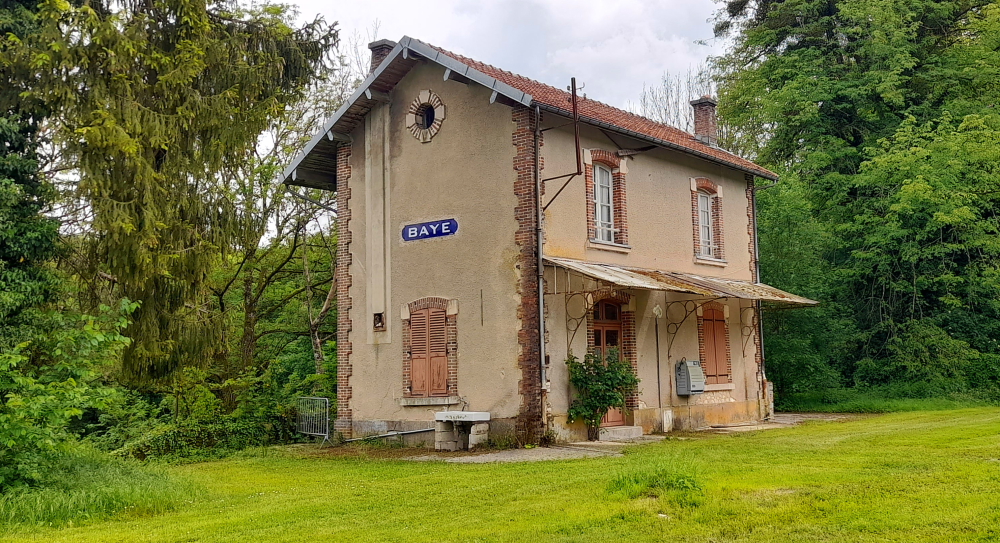
Walking up La Cote de Saint-Roch which is bordered both sides by woods she is taken by the amount of loud and varied birdsong, something she sorely misses in the concrete “wood” that is the Brisbane CBD.
This road brings her to the eastern view of Le Foyer de Charité de Baye (Baye Charity Home), a religious retreat for followers of the Catholic faith.
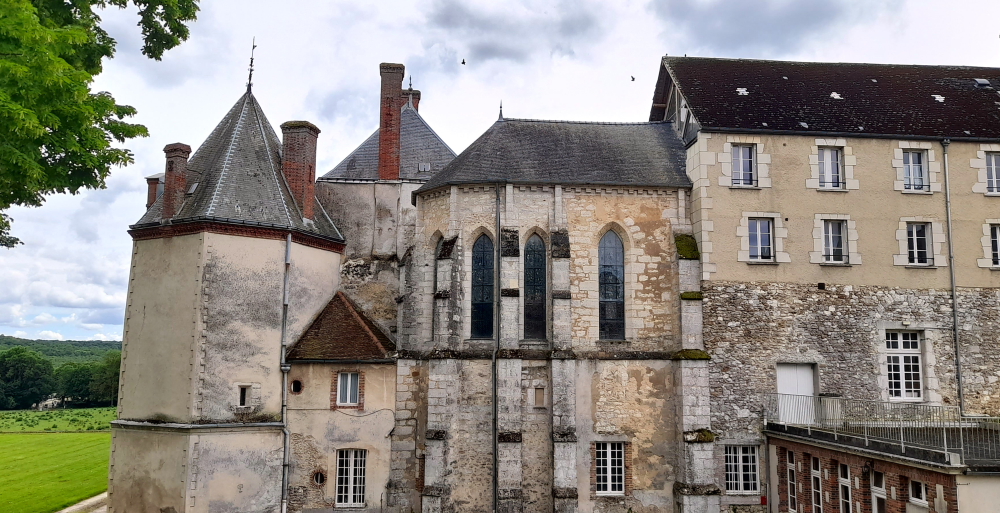
Previously, it was the Chateau de Baye. Tradition has it that Saint Alpin was born here in the 5th century. Lords of Baye are known from the 11th century but there are no documents to trace the establishment of this castle. However, there must have been a castle on this location because, at that time, Baye was one of the large baronies of the County of Champagne.
Rather, its history commences at the beginning of the 13th century as shown by the chapel, probably built between 1205 and 1220, by Simon I of Châteauvillain. The chapel is mentioned in the will of Alix de Luzy, his wife, written in 1270. This chapel is known for its stained glass windows dating from the 13th century.
Over the centuries the castle’s ownership was inherited via marriages and family transfers and the sale of the barony of Baye.
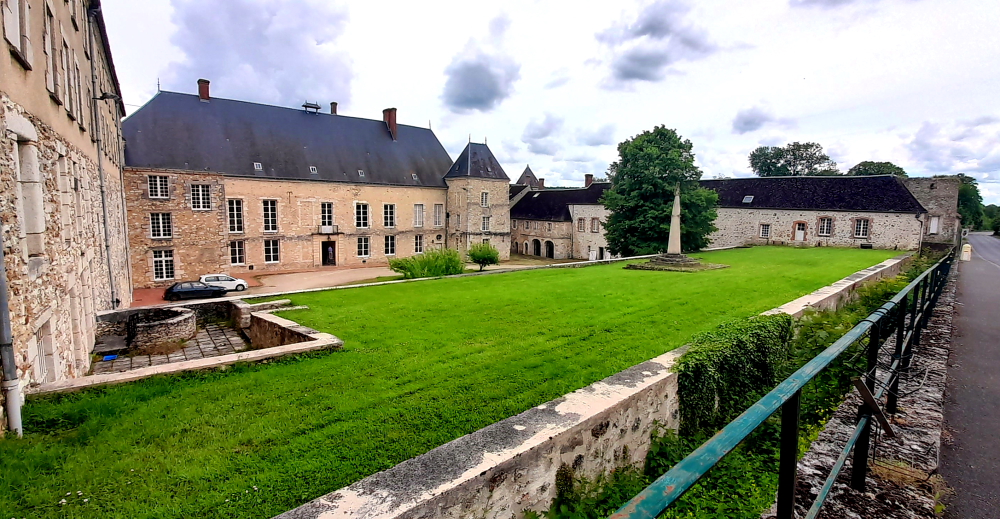
In the 19th century, the Berthelot de Baye family became particularly interested in the administration of the estate. Around 1859, the castle farm was rebuilt by the Parisian architect Claude Parent. In 1950, the dilapidated castle became practically uninhabitable. It was donated by Miss Yolande Berthelot de Baye to the Foyers de charité and has since been repaired and transformed. The Saint-Alpin chapel of the castle is the only element that has remained intact for 800 years and was classified as an historic monument since 1923.
In September 1914 the chateau was the general HQ of General Otto von Emmich, commanding the 10th German Corps.
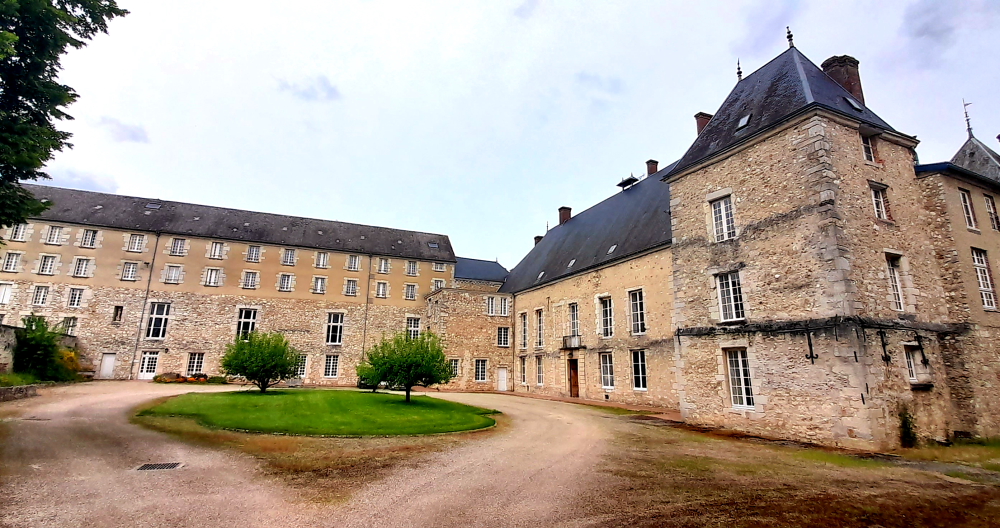
Walking north along Grande Rue there is an intriguing street sign: “Rue de la Font Poisson” and sure enough, half way up that road is a large water trough that probably had fish in it, back in the day.
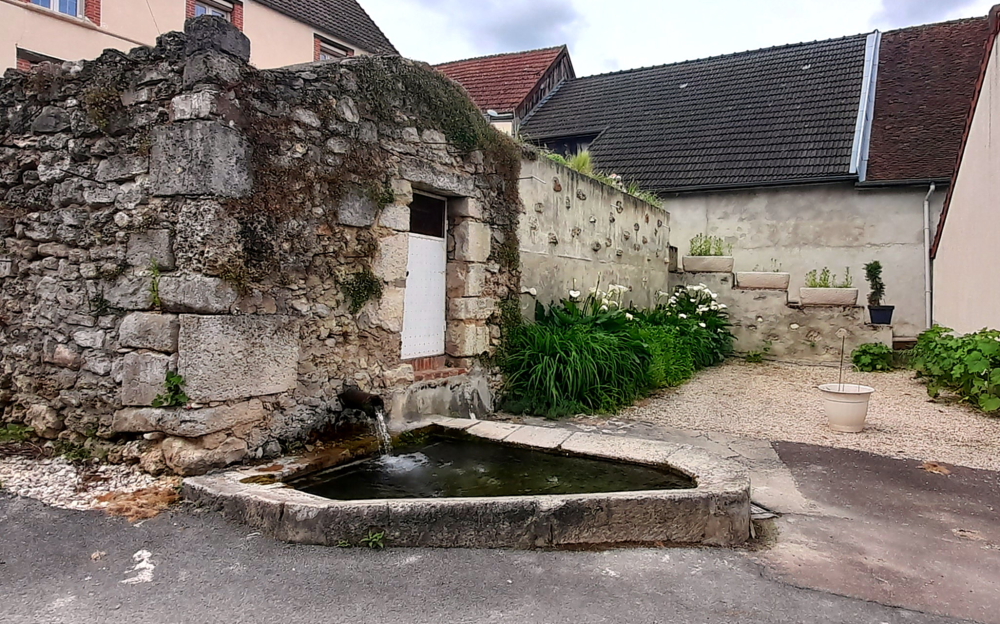
Each time we drive through Baye we are struck by the lack of people about – the place seems to be totally deserted.
A major building is the Catholic Church of Saint-Pierre-et-Saint-Paul de Baye, with an imposing porch gallery. The church has been closed since 1999 after storms damaged the roof. Renovation commenced in 2018.
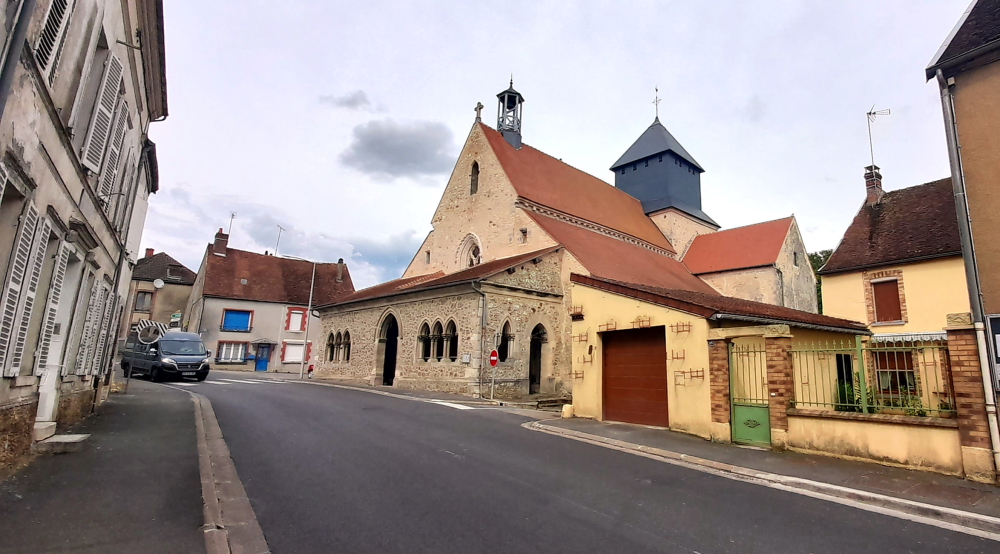
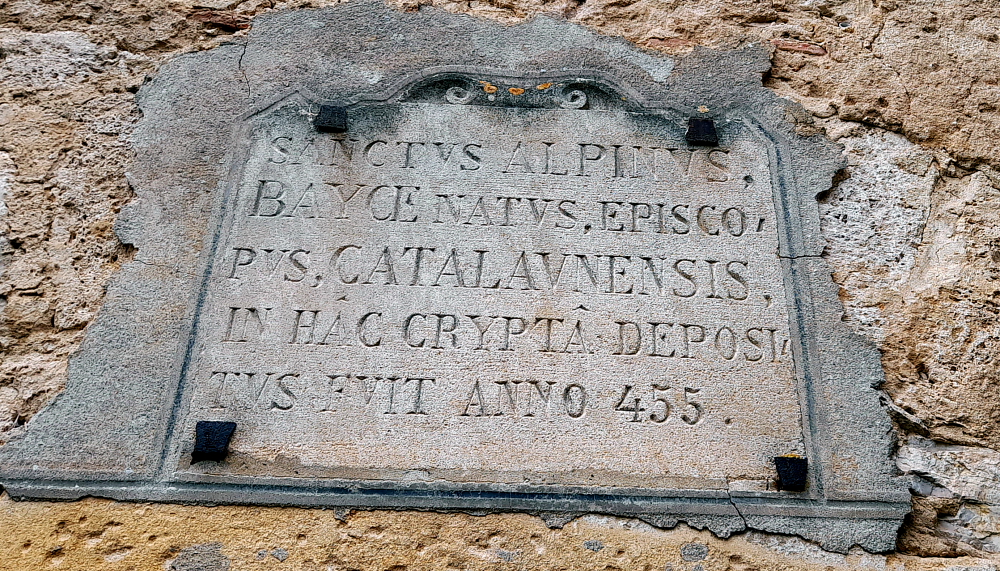
Walking around to the opposite side of the church is a small door. Above it, inscribed in stone, is a plaque in Latin: The Holy Alpinus Baye, Bishop of Catalonia, was buried in this crypt in the year 455.” So, born in the chapel in the Chateau de Baye and buried in the crypt of another church just up the road.
At the corner of the church is Rue des Ecoles where Lynn walks towards its intersection with La Cote de Saint-Roch. She passes by a derelict-looking buiding whose door is open.
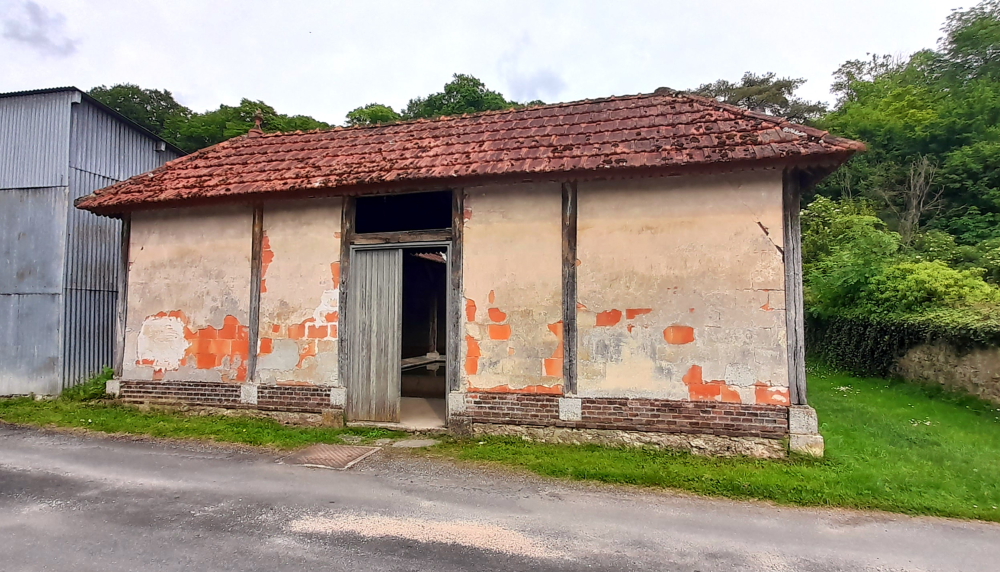
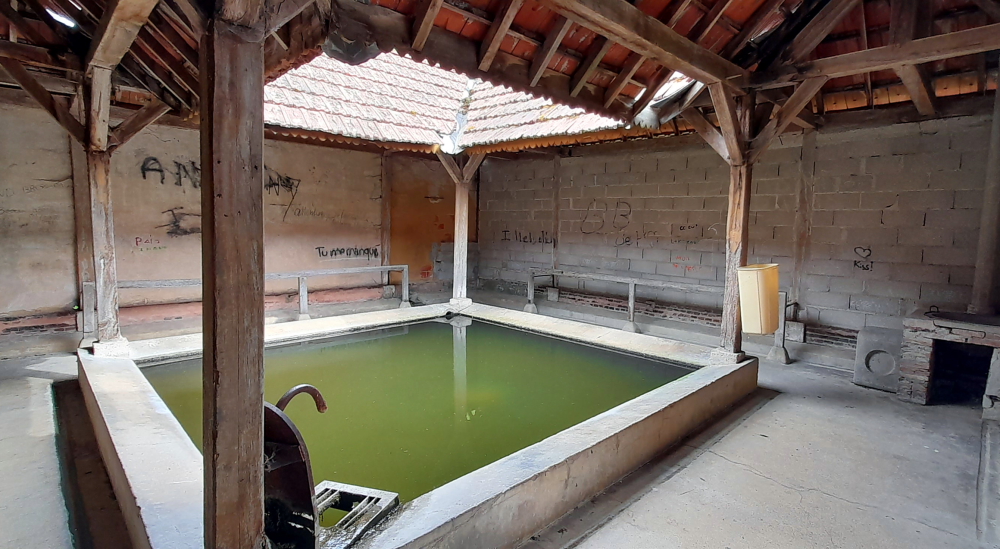
Inside looks like a disused wash house with a copper in the corner and slime green, still water in the trough.
After a supper of cold roast chicken, tricolore salad and fruit flan Lynn suggests we have a couple of games of dominoes.
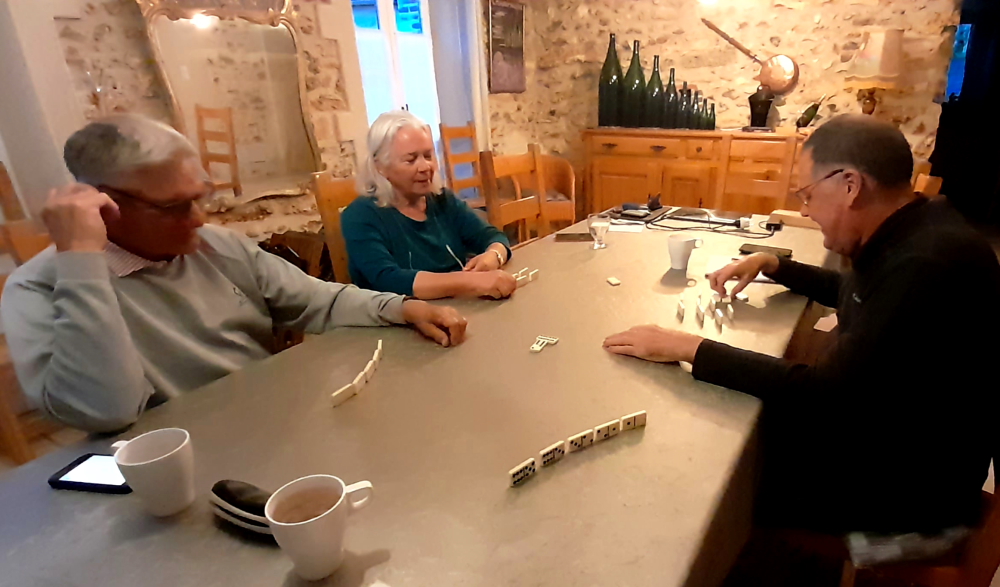
The 1st game is won by Becky with yours truly last, but I get my revenge by winning the 2nd game.
18 May, 2024
For our last full day in the Champagne region we’ve elected to drive to Hautvillers, north of Epernay, then to drive part of the Maroon Champagne Trail through Venteuil, Cuchery and Reuil to Vandieres, then cross the Marne to visit the Memorial des Batailles de la Marne in Dormans.
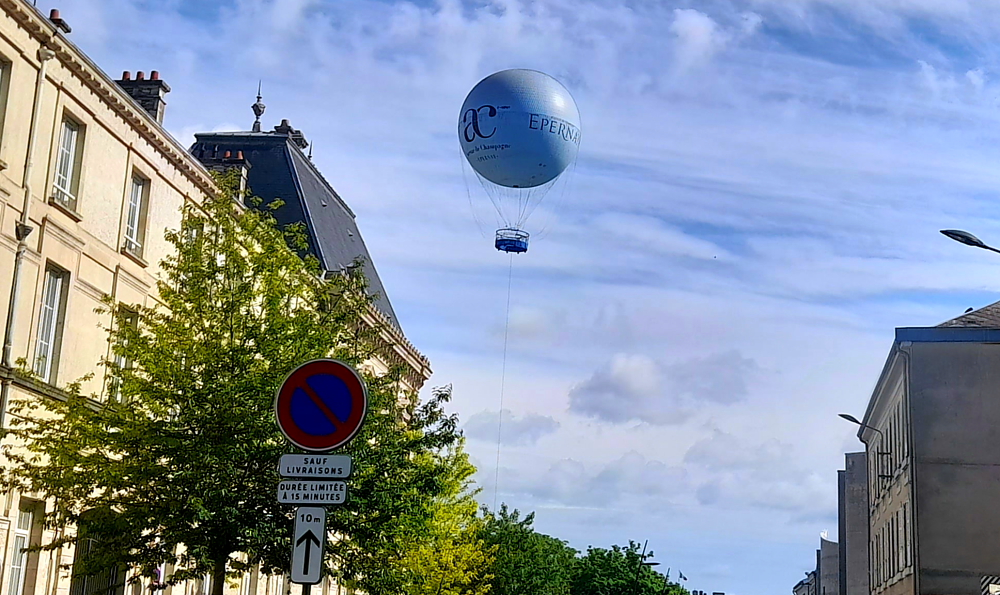
As we approach Epernay we see that its tethered giant helium-filled balloon, located at the town end of the Avenue de Champagne, is in operation today. It flies up to 150 metres from the ground where views over the town and the surrounding UNESCO World Heritage vineyards can be seen.
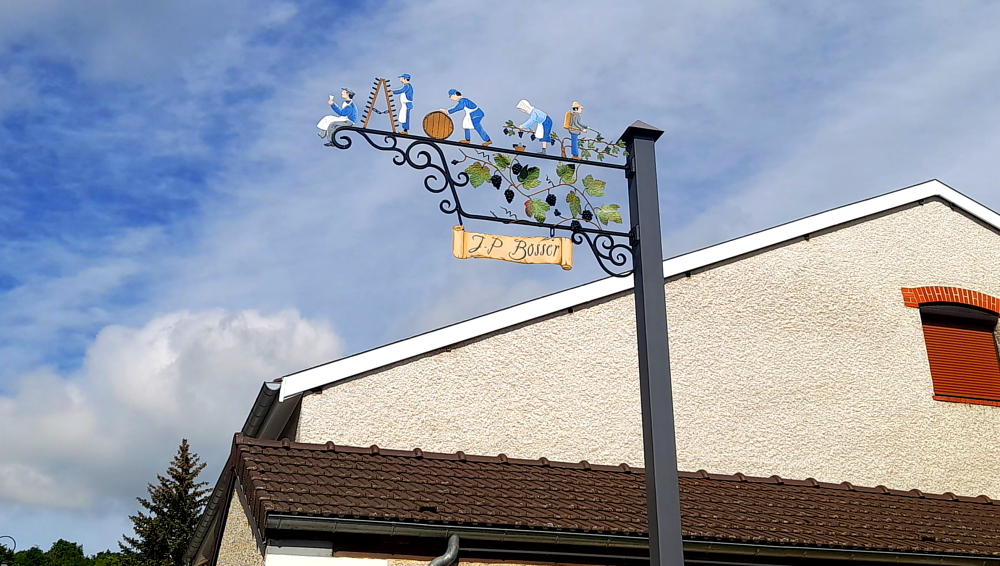
The reason for our trip to Hautvillers is to show Jerry and Becky the tomb of Dom Perignon which is in the Abbey Church of Saint-Sindulphe, next door to the former Benedictine Saint-Pierre Abbey of Hautvillers (now the private property of Moet & Chandon) and to walk through the village on this gorgeous, sunny day to see the different ironwork signs that are on display outside numerous buildings.
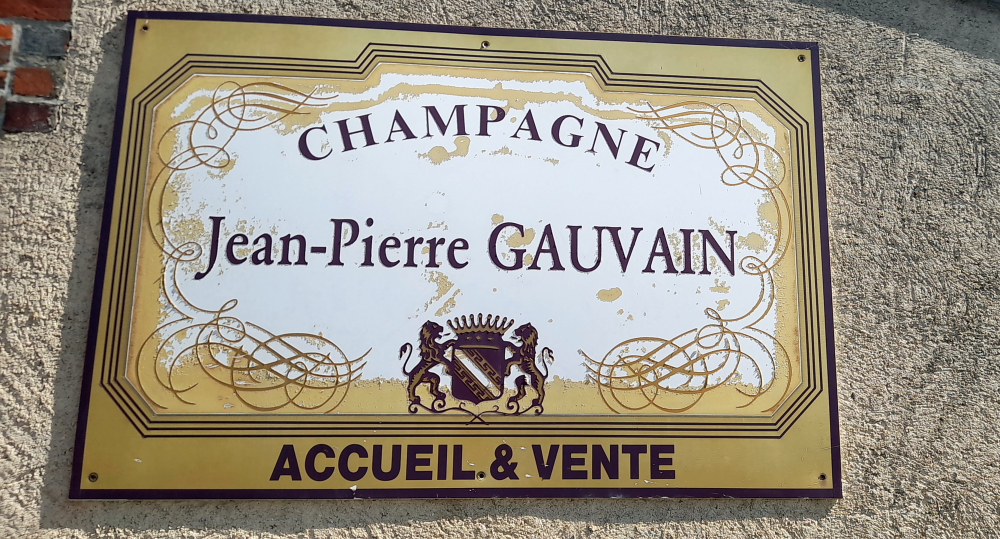
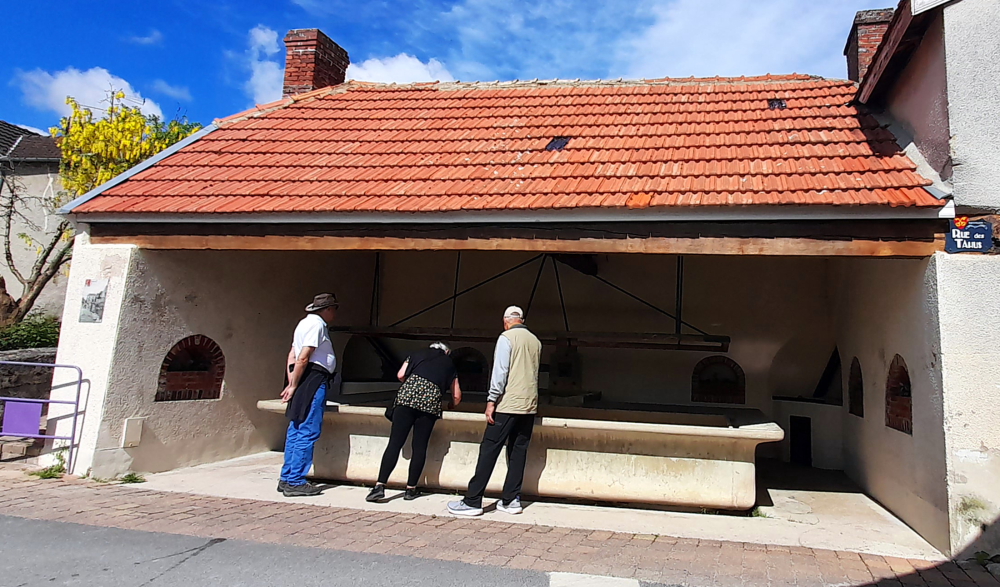
Around the corner from Gauvain’s is Place de la Fontaine where we find just that, a public wash house for communal laundry with a copper in each back corner and a rectangle of wooden drying rails above the large trough.
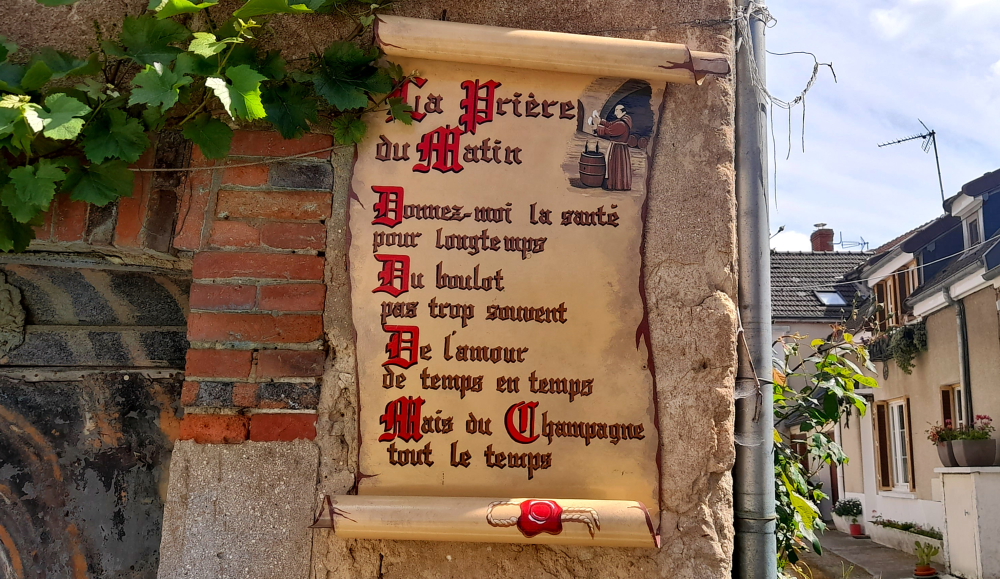
Displayed on a nearby wall is a morning prayer, seemingly endorsed by the monks of yore: “Give me health for a long time. Work not too often. Love from time to time. But Champagne all the time.” We’ll drink to that!
The display of ironwork signs is a tradition that dates back to the Middle Ages when more than 80% of the popuation could not read.
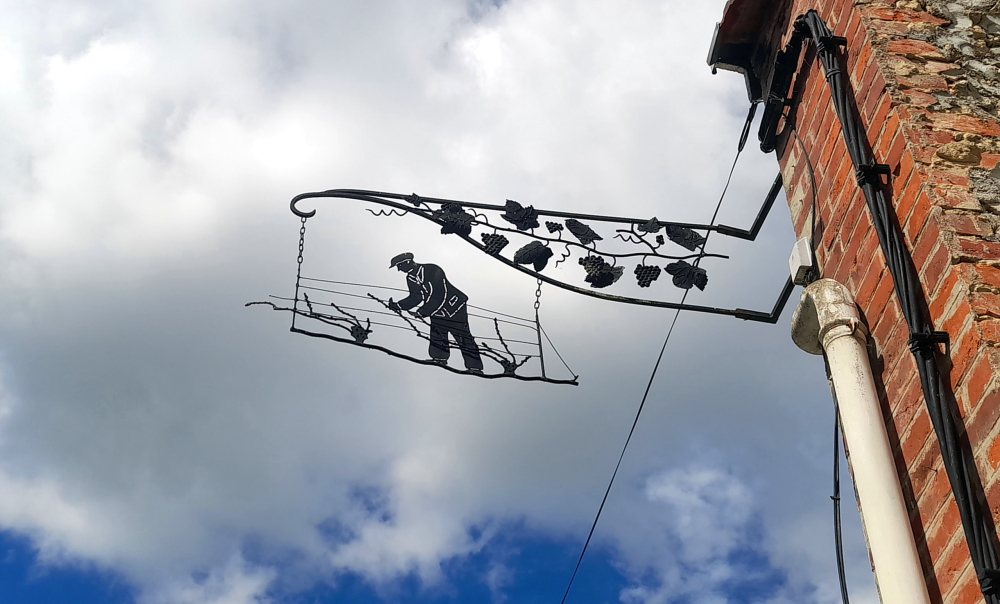
The shopkeepers of the time had devised this simple means of communication to inform their customers of their trade.
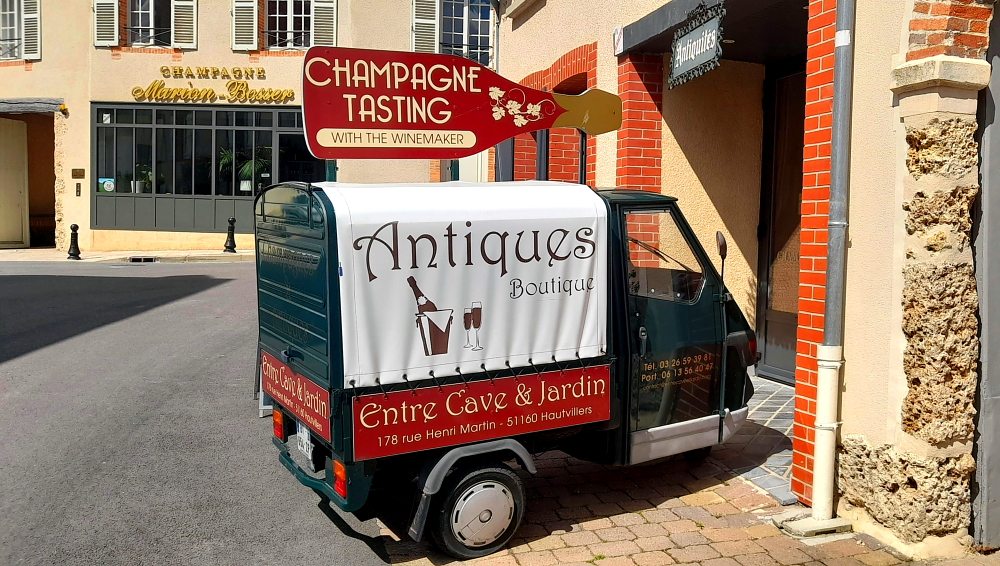
In 1962 the mayor of Hautvillers wanted to revive this tradition. Today, the village has more than 140 signs representing not only the trade, but also the passion or the origin of its inhabitants.
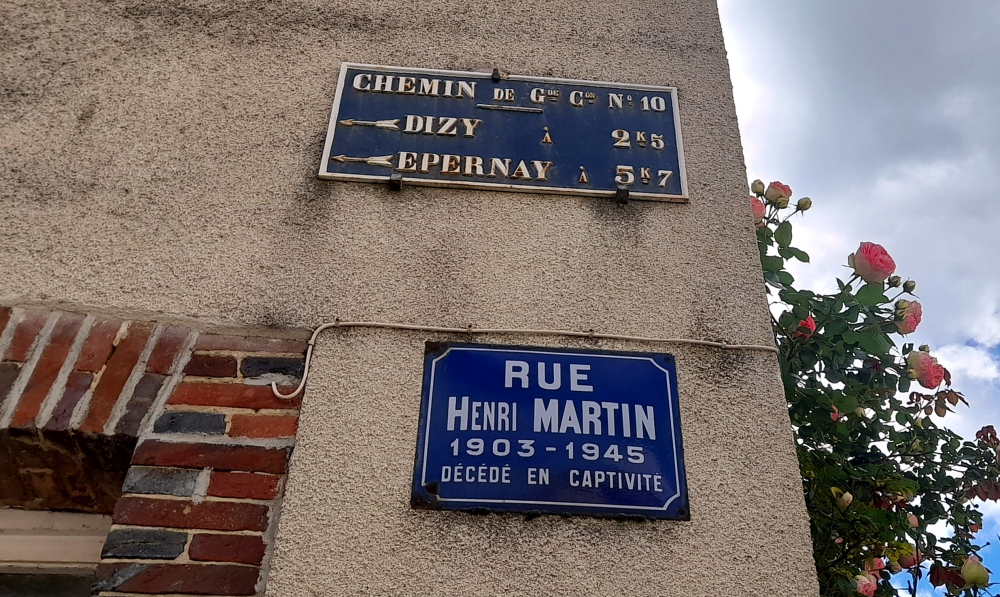
The village has also retained its now vintage street signs: some to honour a person (such as Henri Martin); others are old directional and distance signs such as Dizy a 2 k 5 (2.5 km).
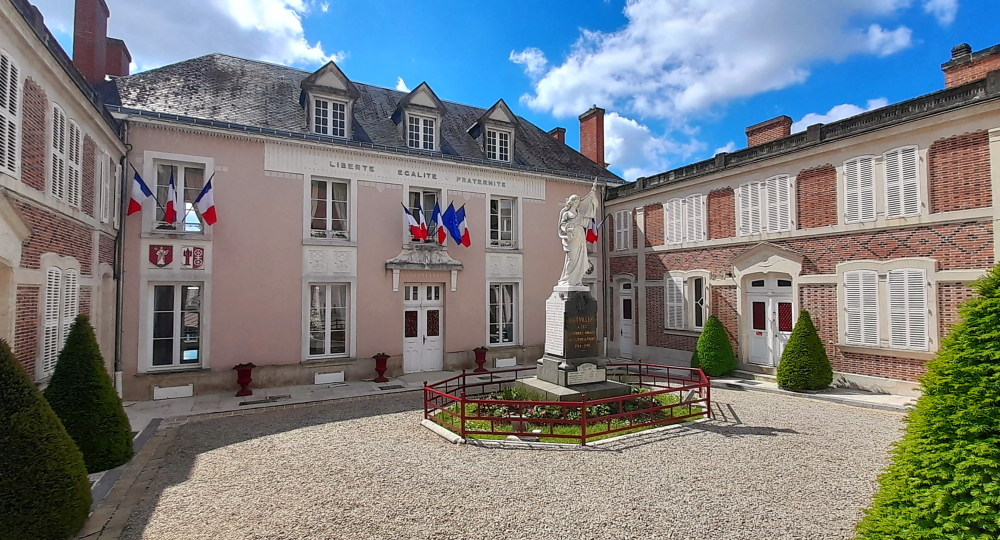
Hautvillers is also a very pretty hillside village with beautiful and impressive buildngs that accommodate champagne houses, restaurants, cafes, bars, boutiques and its public buildings.
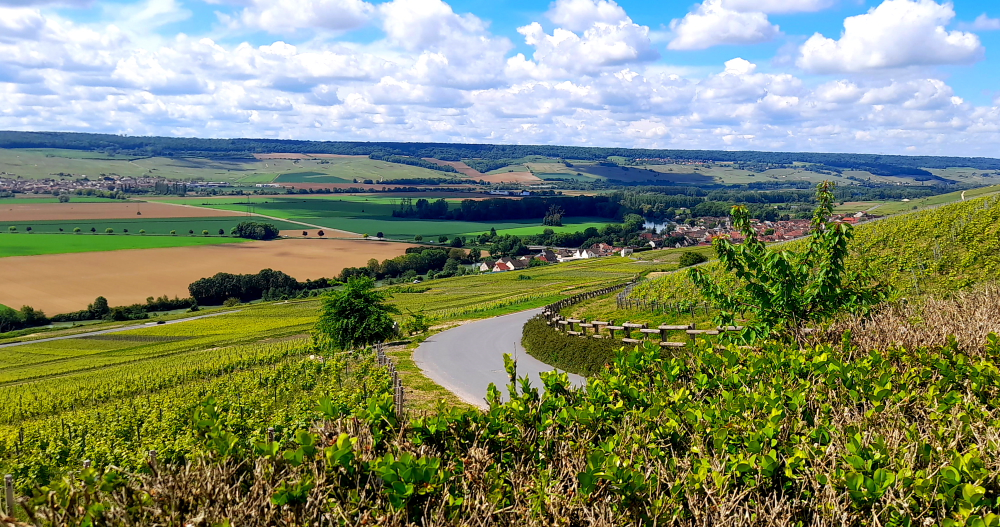
Being a hillside town also affords perfect panoramic views.
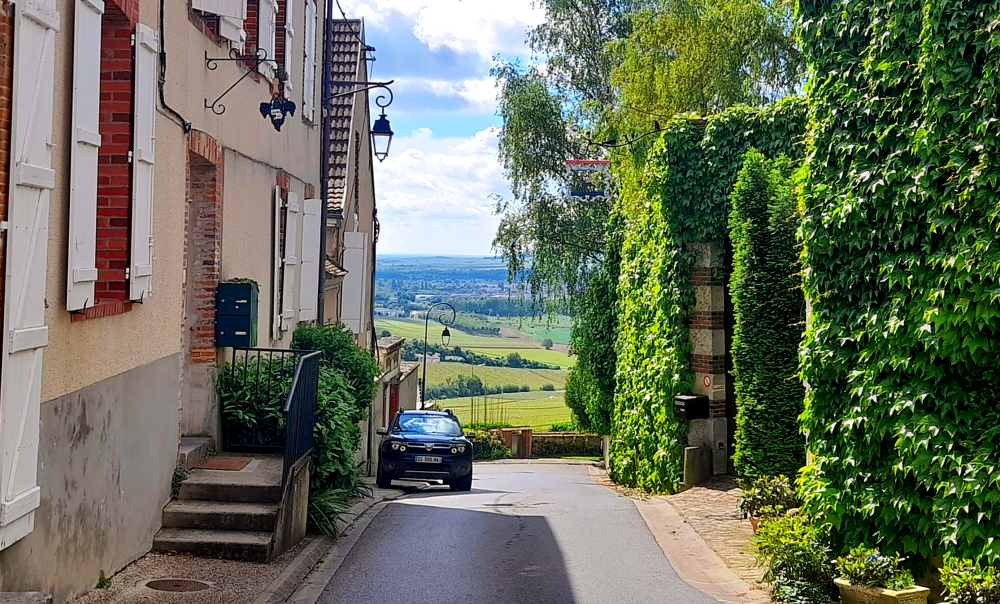
Such as an informal one at the end of Rue de la Font Gillet, or more formal ones from the Belvedere Dom Perignon that include the historic hillsides of Champagne, the Marne Valley and Epernay.
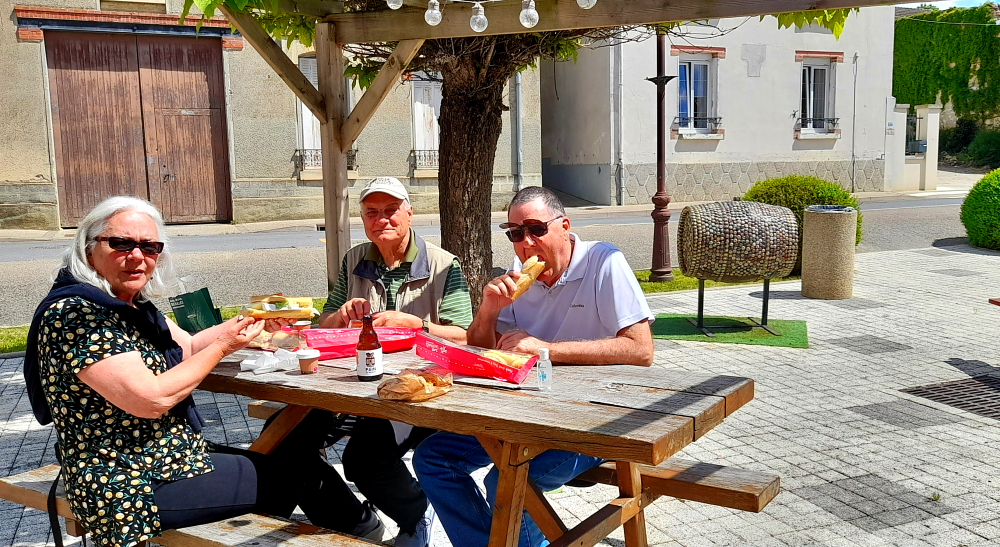
As we wend our way along the Champagne Trail we catch a tiny boulangerie/patisserie just before it shuts at 1:00 pm where the Leggieris buy filled baguettes, savoury pastries, espressos and a small bottle of local beer called “Pain de Minuit” that has been brewed from stale, leftover bread. It’s catch phrase printed on the cap is: “No Pain (de Minuit), No Beer”.
A few steps away is a square on Rue du Chateau with a large picnic bench where we tuck in while admiring the ingenuity of the various winery-related sculptures that dot the square, all made out of the metal caps that sit between a champagne cork and its metal cage.
By 2:00 pm we arrive at the Battles of the Marne Memorial in Dormans, a fitting conclusion to our visit to the Verdun Memorial/Museum a couple of days ago. Built between 1921 and 1931 to a design by architects Marcel and Closson, the Dormans Memorial commemorates the victories won in the Marne between 1914 and 1918 and is located on a hill behind the Chateau de Dormans.
When the plan to erect a large monument to remember all of the battles in Marne was confirmed, this site was chosen by Marshal Foch as a place that represented both battles. The building was made possible thanks to an association founded by Madame de la Rochefoucauld in 1919, overseen by the Cardinal of Reims and the Bishop of Châlons.
A vast park with a chateau was purchased, and the first brick laid on 18 July 1920. The construction was funded by numerous donations, in particular those collected by ‘national subscription’ in 1929 dubbed “four monuments day”.
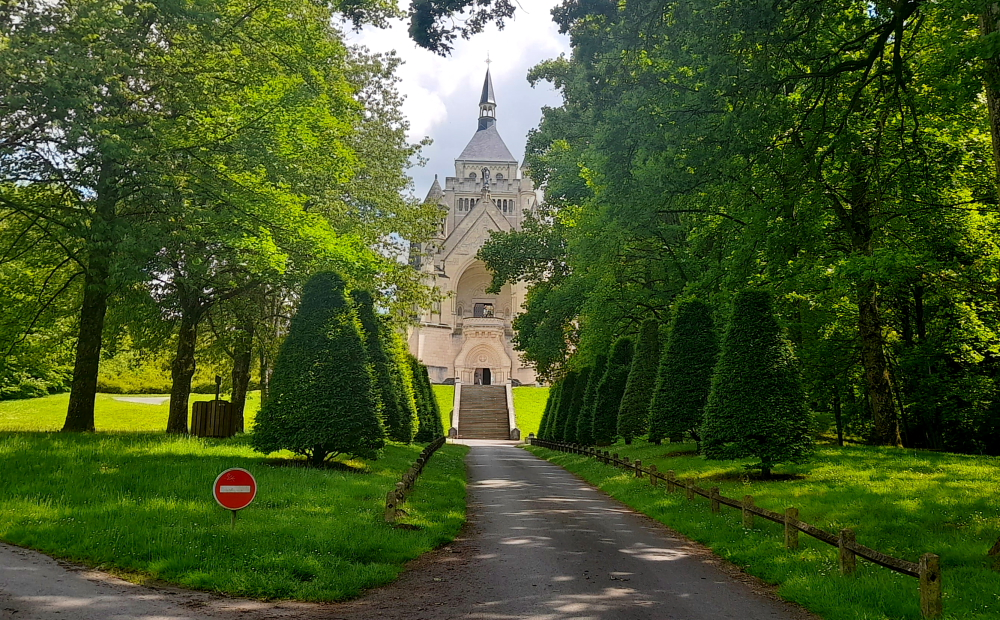
A monumental staircase leads to a large square with a sundial and a viewpoint indicator that shows the names of the Marne Valley villages where the Battle of 1918 was fought.
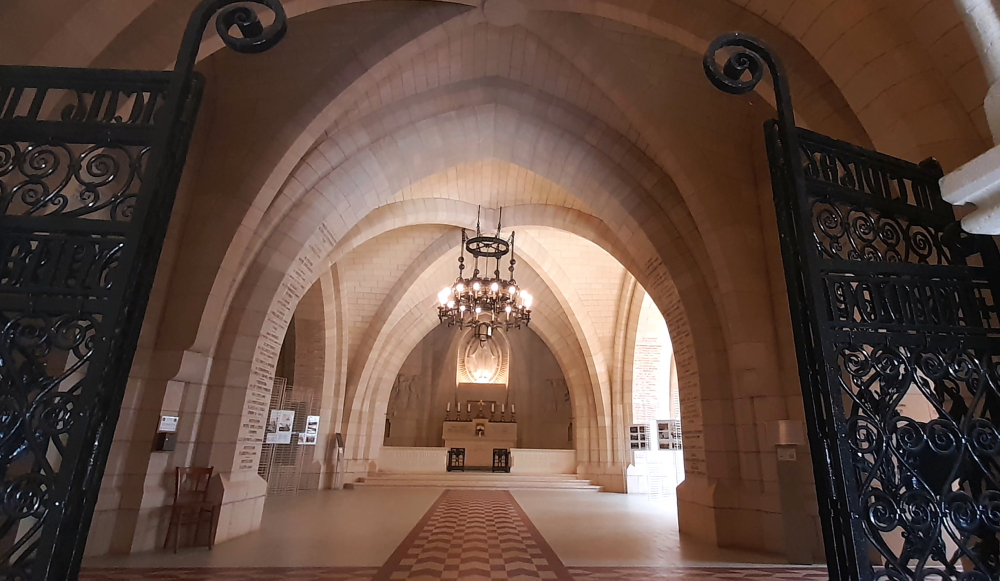
The square leads to a crypt that is overlooked by the church that has a bell tower and 2 towers.
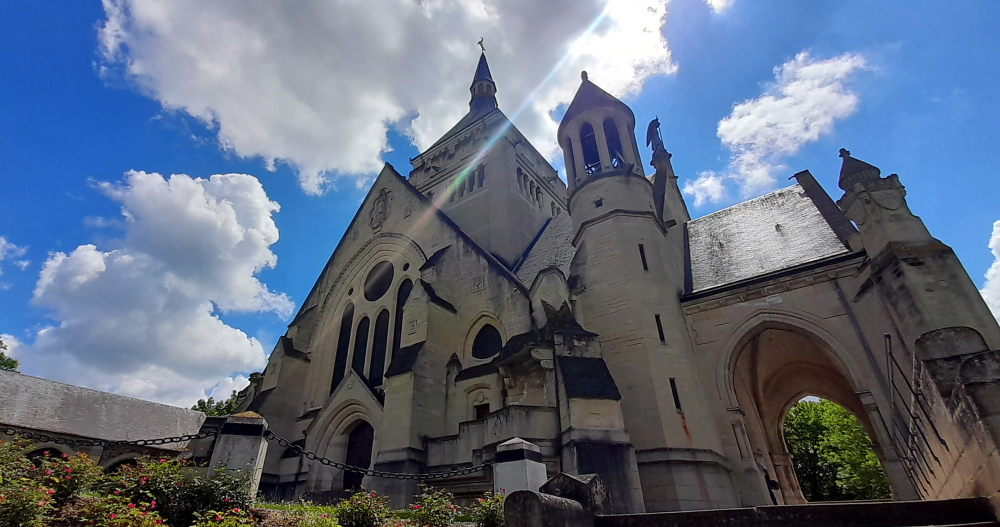
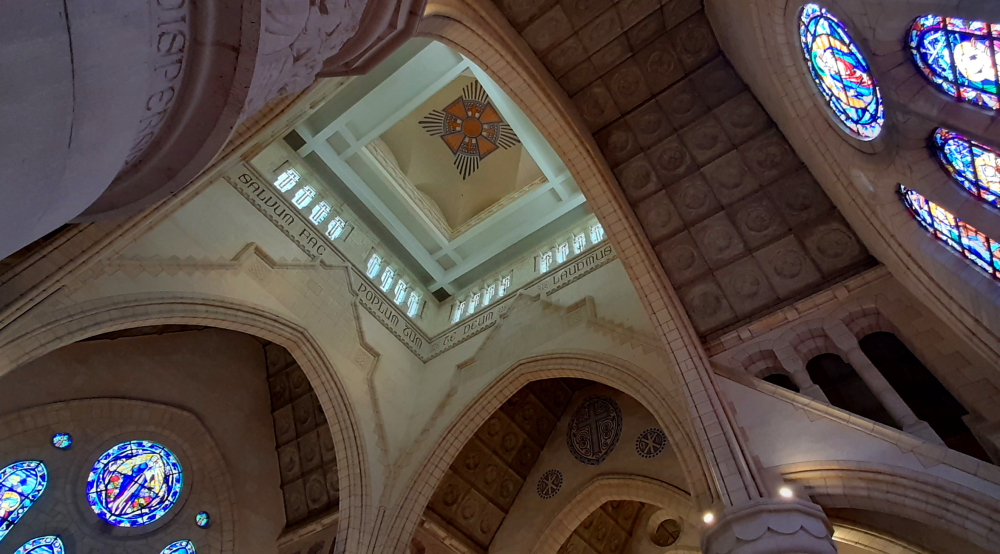
The inside of the chapel is entirely dedicated to the glory of the “soldiers, the army and the fatherland”.
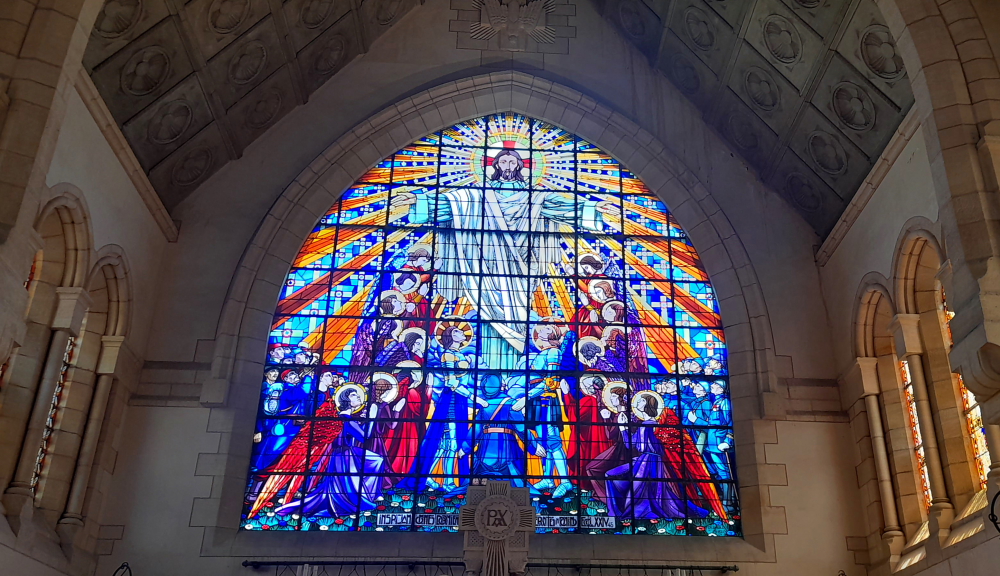
The stained-glass window in the choir represents Christ welcoming a soldier to symbolise all those who died during the Great War, presented to him by Joan of Arc and St Michael. On each side, angels intercede in his favour.
The four columns standing on the crypt’s vaulted bases are decorated with sculptures depicting the 4 great invasions of France by the Huns, the Arabs, the English and the Germans, which were all contained (the Catalunian Plains in 451, Poitiers in 732, Orleans in 1429 and Dormans 1914-1918).
The 52-metre tower houses several bells, the largest weighing 304 kg. Beside the chapel is a cloister attached to the ossuary. A medallion features the effigies of marshals Foch and Joffree, the 2 victors of the battles of the Marne, while the names of all the soldiers who fought in the battles are engraved in the wall plaques.
Inside the ossuary, the remains of 1,332 French soldiers who fell between 1914 and 1918 are held in 130 coffins; only 11 of these men were identified. Every year since 1993, during the Armistice commemorations, an official ceremony is held in the ossuary where a wreath given by the French President is laid by a delegate from the Elysée Palace [www-cheminsdememoire-gouv-fr].
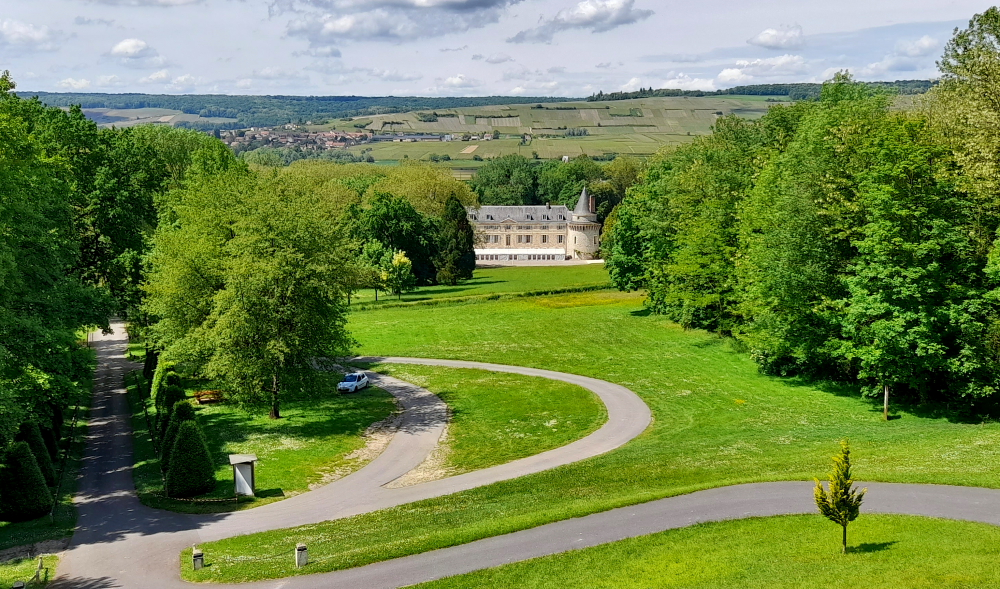
Right! Time to drive home. We’re all looking forward to a chilled drink and a rest before we head out to dinner. Just as I do a hill start and turn onto a road to exit the town, we hear a brief grating sound. Lynn and I say in unison, “That didn’t sound good!” A short distance later I pull over and open the bonnet. Revving the engine produces a horrid, grating metallic sound.
That bloody car air conditioner compressor clutch has failed – AGAIN! It lasted a total of 3 weeks and 4 days since it was replaced. Well, we’ll just have to resort to car air conditioning that our parents used – turn the fan on high and open all the windows!
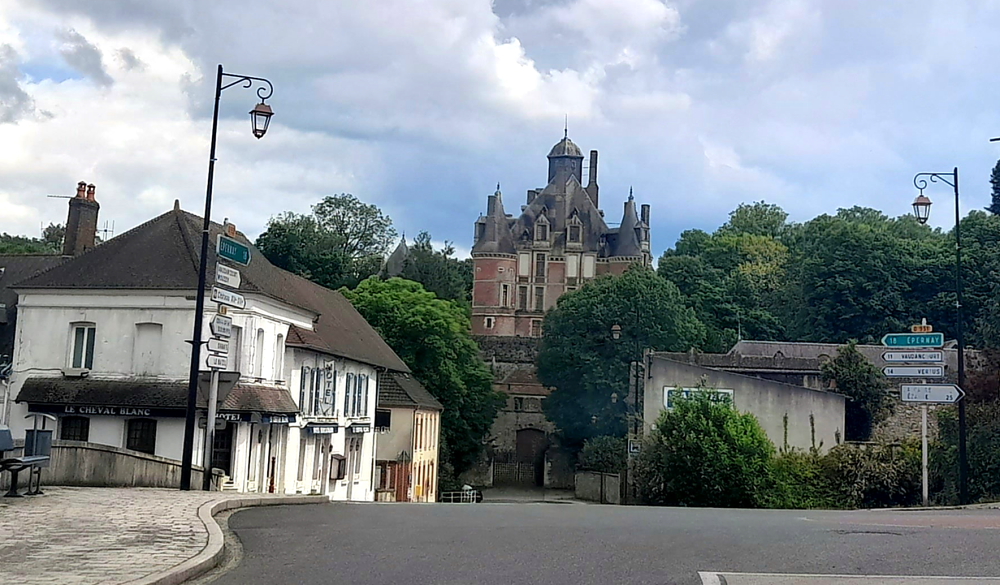
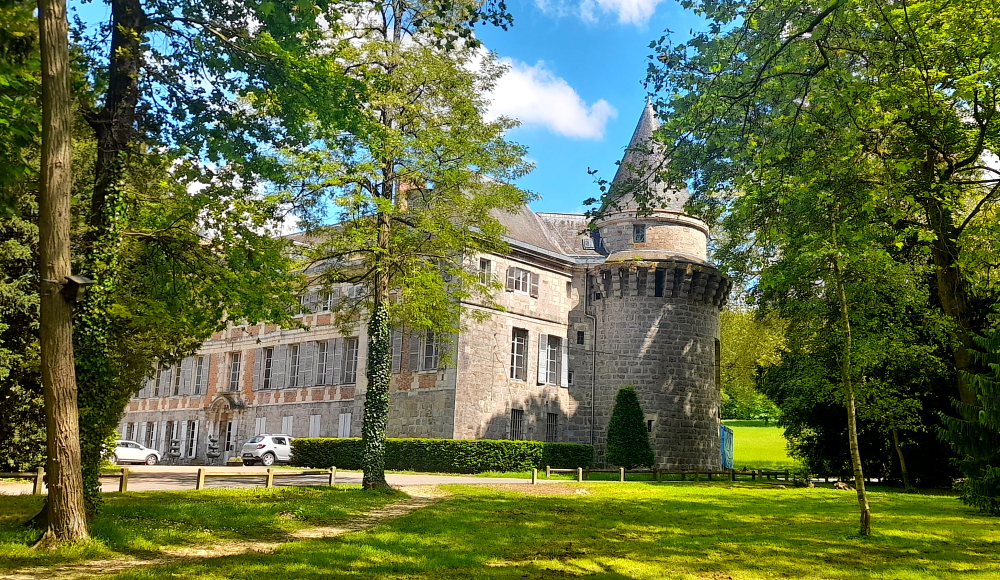
On the drive home we pass through Montmort-Lucy once again. This time we remember to take a photo of its impressive chateau that dominates the village.
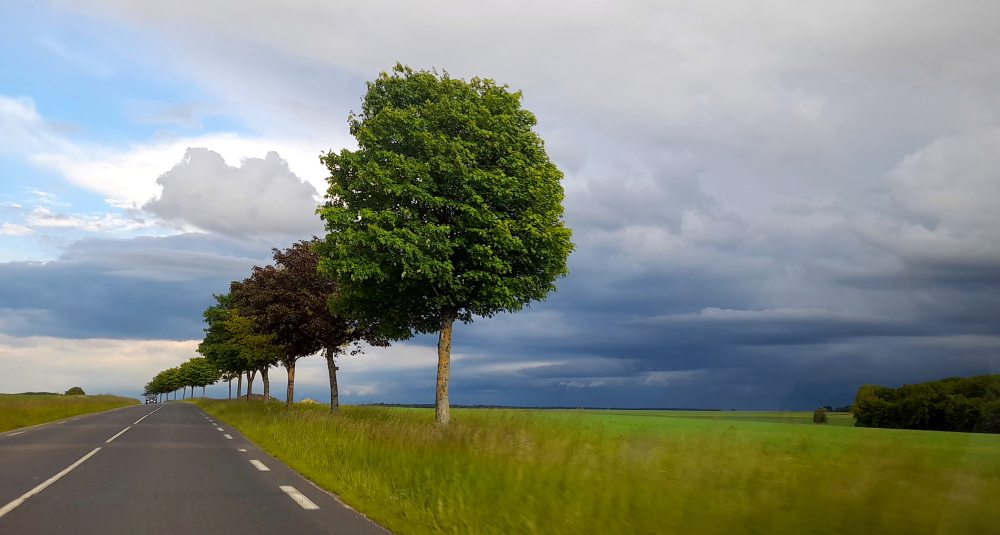
At 5:45 pm we drive to the village of Etoges which is 10 km away. Thunderstorms are threatening at the end of the day.
Etoges also has its own chateau, now a boutique hotel, which is next door to L’Atelier d’Etoges Brasserie, one of our host’s restaurant recommendations.
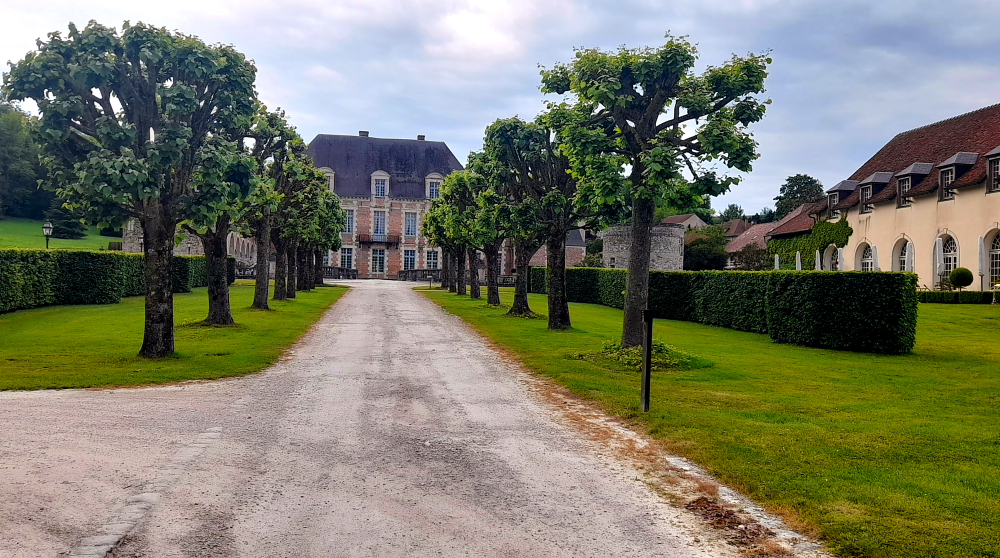
When we arrive at 6:00 pm only us and another car are parked. 30 minutes later the place is packed.
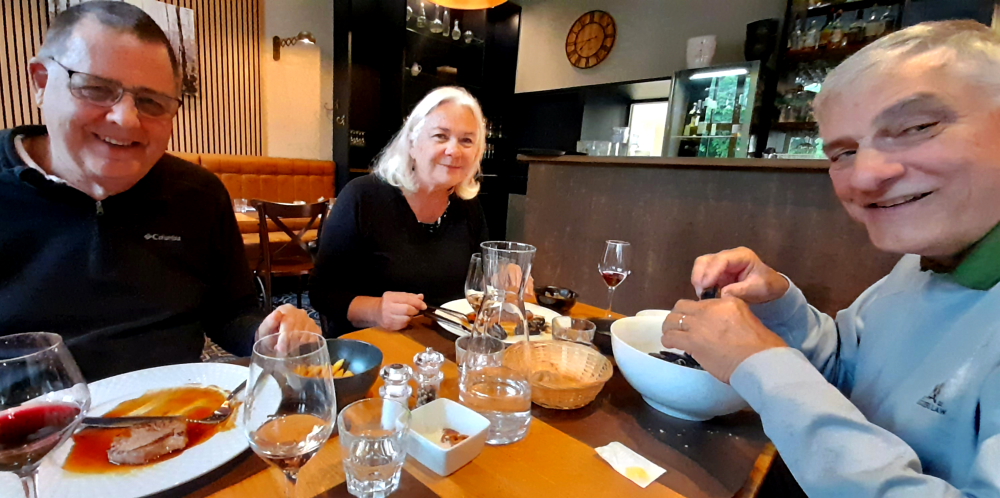
When we get home we open our final bottle of champers, the Jean Milan Grand Cru, to toast the great week of Champagne experiences that we’ve shared and especially to toast our enduring friendship with the Leggieris.
It has been a wonderful week catching up with friends and meeting new ones. We have definitely drunk more champagne this week than ever before in a single week. Next week we are on the wagon before we head to Estonia, Latvia & Lithuania which will be our last leg of this two year Grande Tour of Europe.
19 May, 2024
We’re all packed and out the door of the gite by 9:40 am. It’s 16 Deg. C and raining. I refuel at Pierry then take the A4 from the outskirts of Reims towards Paris, turning off to follow signs to Paris Charles de Gaulle Airport which is NE of Paris.
This airport is a nightmare with roads going in every direction to service a multitude of terminals. We’re a bit startled when we see a plane taxiing along an elevated roadway right in front of us. Anyway, we need Terminal 2C where the Sheraton Hotel is located, hoving into view like a ship in the middle of the roadway.
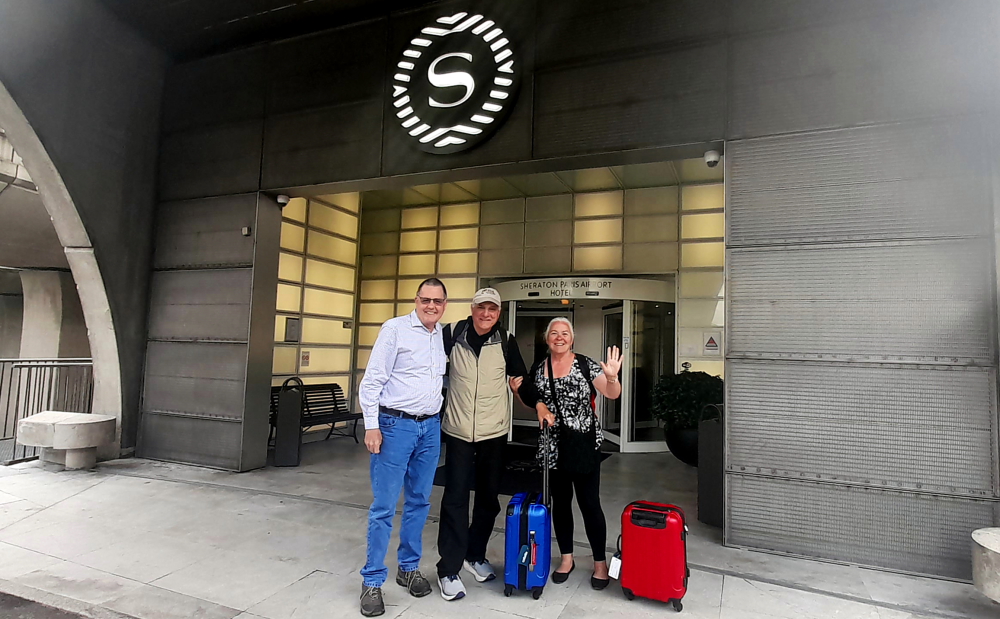
More by good luck than design we choose the correct entrance to the Sheraton parking from a number of other parking entrances side by side and drop off our Philly friends at the hotel’s entrance.
Long hugs and au revoirs with hopes of catching up again when we hit California to finish off our COVID-ravaged USA trip of southern national parks, we skidaddle as we only get 10 minutes’ free parking.
It’s now 11:50 am and by taking the A1/A26 we should arrive in Calais around 2:30 pm. At 12:30 pm we cross over the Somme, it’s finally sunny and 20 degrees.
Bang on 2:30 pm we pull into the car park of an Ibis Hotel. It’s very basic but more than adequate for our overnight stay and offers surprisingly good snacks via its bistro service. Just as well as there ain’t any restaurants nearby!
20 May, 2024
Hoping to get an earlier LeShuttle train than our booked one at 12:18, we leave at 9:55 am (13 Deg. C) and drive to Coquelles, refuel, then proceed to check in. Compared to the past couple of times that we’ve used LeShuttle we’re in a queue of cars. Summer must be fast approaching.
Although our rearview mirror hangar says the 11:18 train we’re loaded onto the 10:48. Unlike previoulsy, we’re directed to park on the ground-floor level of the train carriage and end up being the only car in that carriage. Which is all very well until we’re into the journey when we feel the car rocking violently side to side.
This is worse than a ferry crossing! Getting out of the car we find that the train carriage itself is not rocking as much as the car which is going crazy. Inside the car it was just like riding the bucking bronco machine in a Rockhampton pub. Must be those new springs I had fitted to the car before its MOT last October!
35 minutes later we detrain, driving into sunshine and 16 degrees. On both the M25 and M3 we’re delayed by non-existant road works. We’d forgotten about these. Welcome back to England! But the splash of purple rhododendrons on both sides of the A322 is stunning.
Just before 3:00 pm we pull up in front of the Premier Inn, take most items out of the car, check in and after a very confusing conversation with the receptionist as to how to pay for parking we drop off all our luggage in the room and hurry back to the car as we are parked on a double yellow. Around the corner is the multistorey where we park and pay at the ground-floor kiosk.
There is a hotel restaurant so at 6:00 pm we present ourselves to find that there is a different receptionist on duty. We finally have a lucid and informed conversation with her, organise a free ticket for overnight parking and extend tomorrow’s until 10:00 am – all via an identical kiosk in reception.
Surprisingly for a Premier Inn, the food is excellent, then we crash out for a good night’s sleep.
 THE CONTINUING TRAVELS OF YOGI & BOO BOO