
12 April, 2023
It is sunny and warm this morning when we went down to breakfast but the wind is picking up and the clouds are building on the horizon. After breakfast Lynn wants to complete the things to visit and see for our upcoming Scandinavian trip so she settles in at the downstairs cafe while I head down the road to see if I can organise a hire car for three days this week.
I had found a few hire cars out at the airport online but it would mean getting out there and back. The airport isn’t far away but a taxi is Eu25 each way.
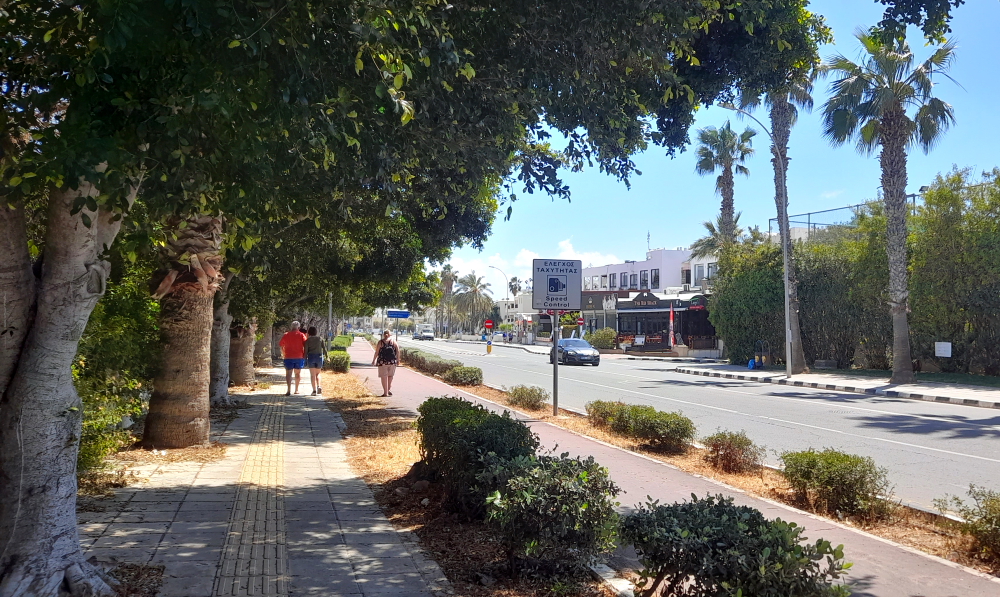
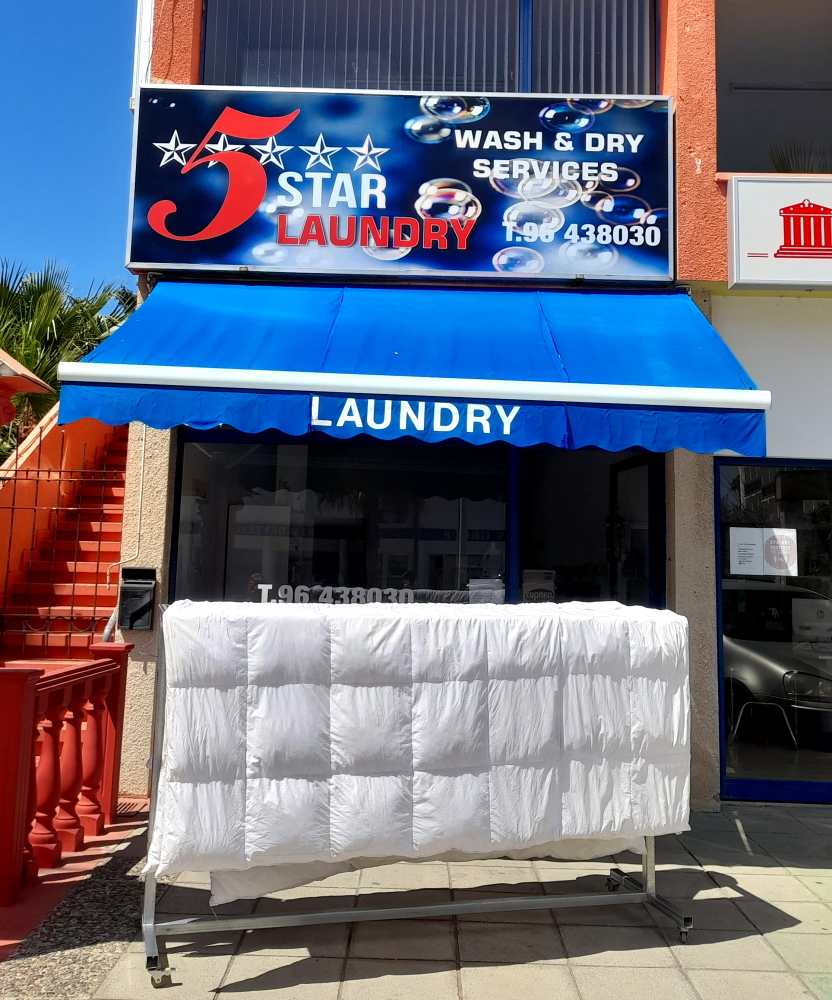
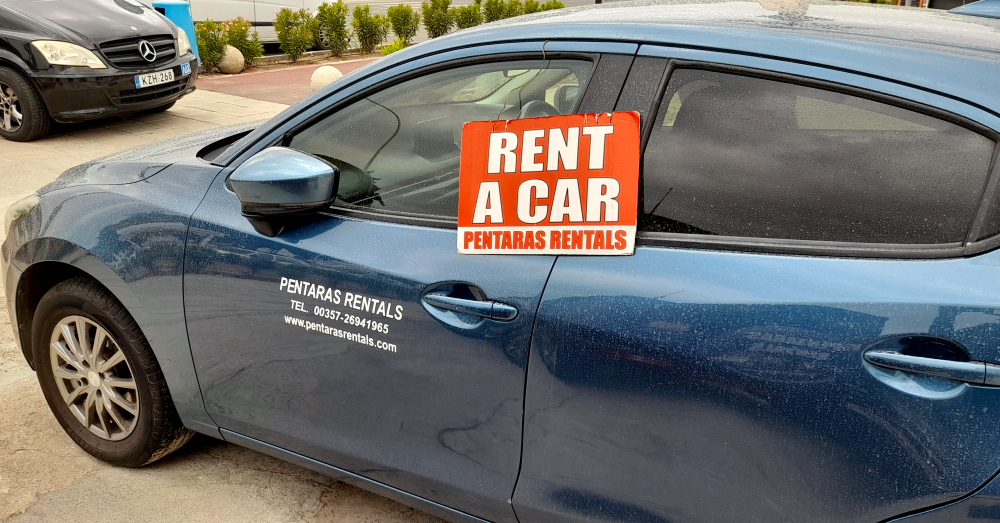
Rental car companies are plentiful on the main road but so far the operators aren’t as keen to do business as you would normally expect in a tourist town. However, when I stopped at the one near the laundry the English woman attendant was very helpful and keen to do business. Within a couple of minutes I had booked a VW Up for three days for Eu100. We can pick it up after 9:00am Saturday and just leave the keys at our Hotel Reception and they will collect the car at 9:00 am on Tuesday. Too easy.
I strolled back to the hotel to let Lynn know that we had local transport over the Orthodox Easter here in Cyprus. She is still working on the places to see and things to do in the Scandies so I grab my towel and cozzie from the room and head to the beachside to soak up some sun.
I wasn’t on the sun lounge more than about half an hour when the clouds started to build up and thunder approached. I made it as far as the outside cafe awning when it started to rain and soon after started to hail. The temperature dropped very quickly to about 11 Deg C so I scampered inside to dry out and change into some warmer clothing. Sun bathing for the day is clearly done.
13 April, 2023
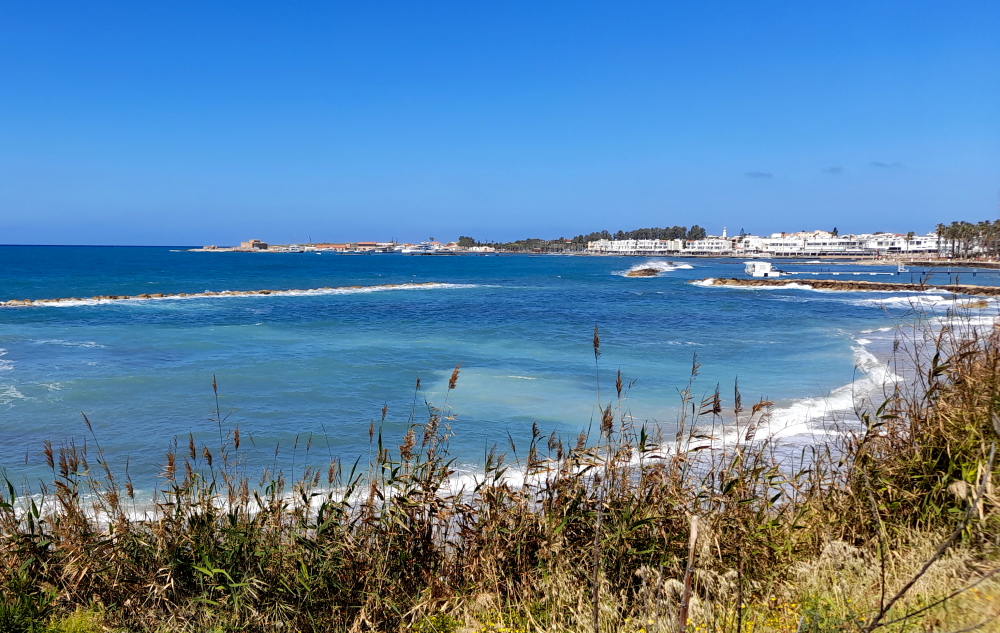
Lynn again wants to finish off the Scandie to do list this morning. Even though we had a night of thunder storms and strong winds last night the sun is shining this morning so I head back to the beach. The strong winds last night have created some large waves on the normally benign Mediterranean Sea and there are a couple of surfers out this morning. The water is crystal clear and sounds like a normal Ozzie beach.
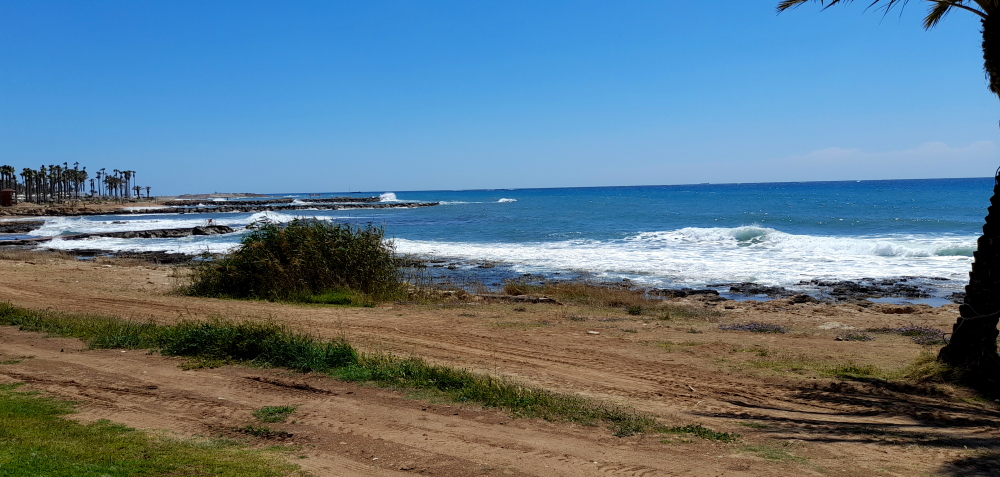
The water temperature is still too cold for a swim but the sun is more than capable of providing severe sunburn.
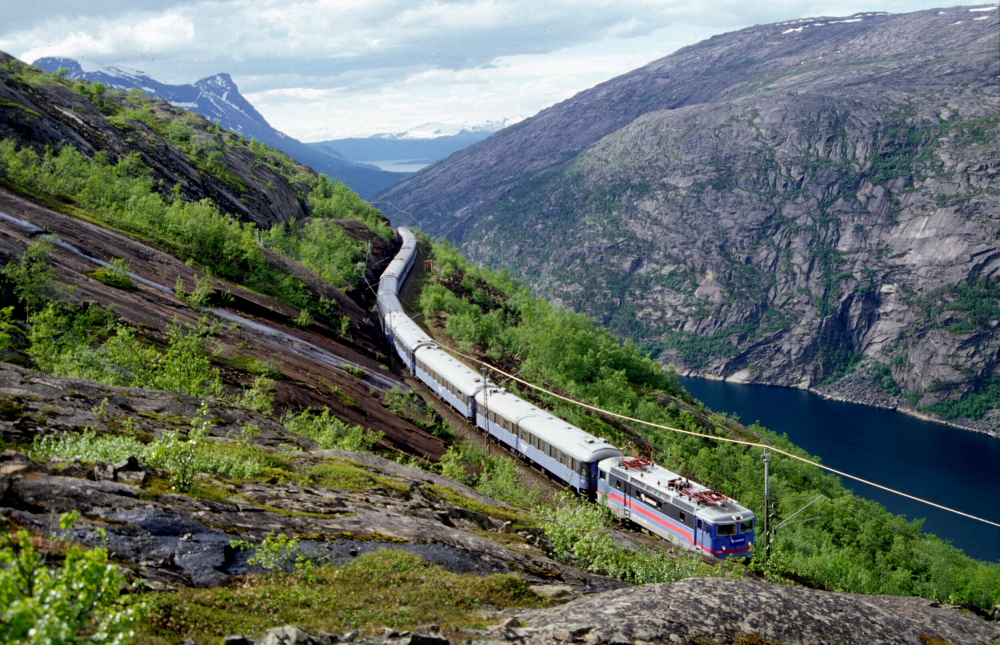
Before I get too burnt I head back to check on Lynn and she insists that we book seats on the Narvik, Norway Arctic Train for June as it is very popular in summer and can book out early. Done. We now have two return tickets on the Arctic Train for the middle of summer. Apparently this 2-and-a-half hour return trip offers fantastic views from the mountains above the Narvik Harbour and Norwegian fjords from the Norway/Sweden border. Hopefully we get good weather as it looks fantastic.
14 April, 2023
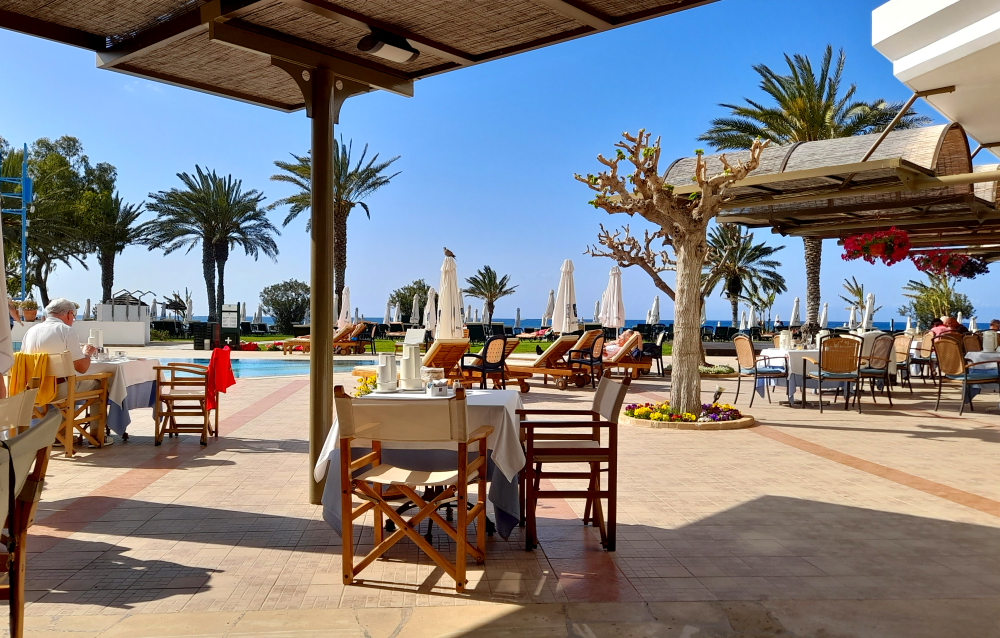
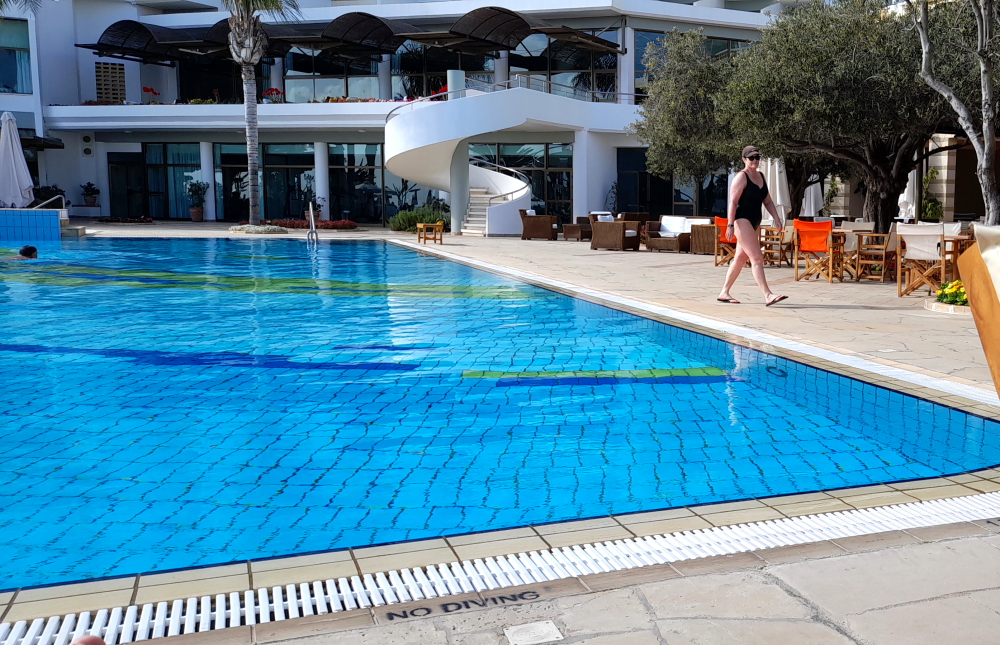
Today has to be the best weather so far in Paphos. It is a beautiful 20 Deg C out today so after yet another al fresco breakfast in the sunshine we head down to lay by the pool. Lynn even ventures in for a very short swim. The pool water is still way too cold for me.
By lunchtime Lynn heads back to the room to work out our itinerary for the next 3 days with the hire car and a couple of hours later I also head up to catch up on the blog and some emails. Any longer in the sun and we would both be lobsters.
15 April, 2023
Another sunny day here in Paphos with an expected top of 21 Deg C. First job after breakfast is to pick up the VW Up! at about 9:30 am. We did the usual video of the car condition then headed back to the hotel to set up the GPS and add the usual necessities to the car.
The plan is to head up into the Troodos Mountains and its National Forest Park today to visit the Kykkos Monastery; then a waterfall, another archaeological park and a mythical rock.
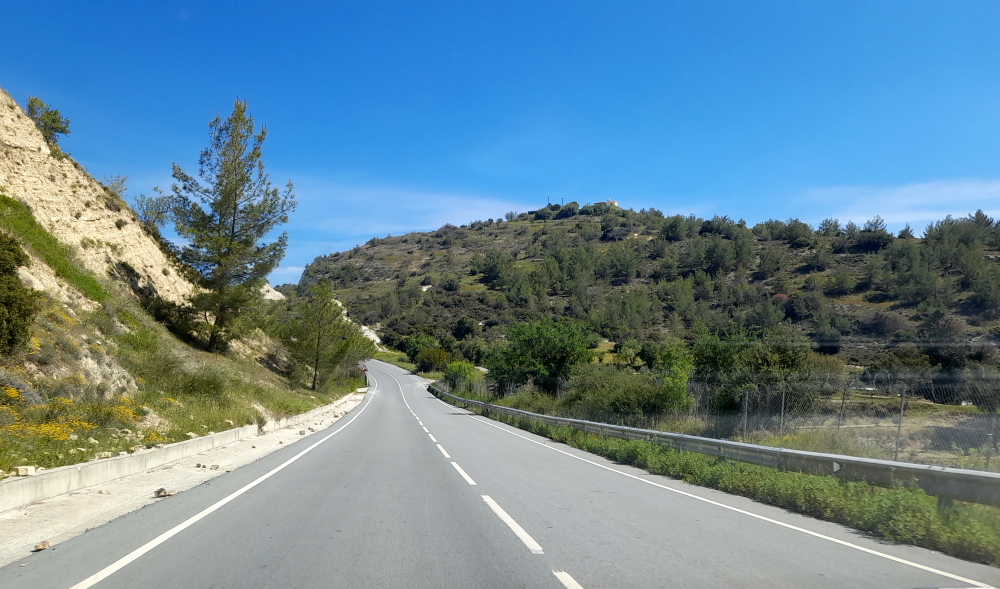
There is very little traffic about and the roads are in great condition. Despite the VW having a miniature 1.0 litre engine it handles the hills quite well. The car is just a “shopping trolley” but it will do for a few short tours of the Cyprus countryside. I have owned and ridden bigger motorcycles than this buzz box but it will do for three days of touring around. Having said that Lynn has us doing about 650 kms over the next three days as we cross the Republic of Cyprus – the southern part of the island of Cyprus.
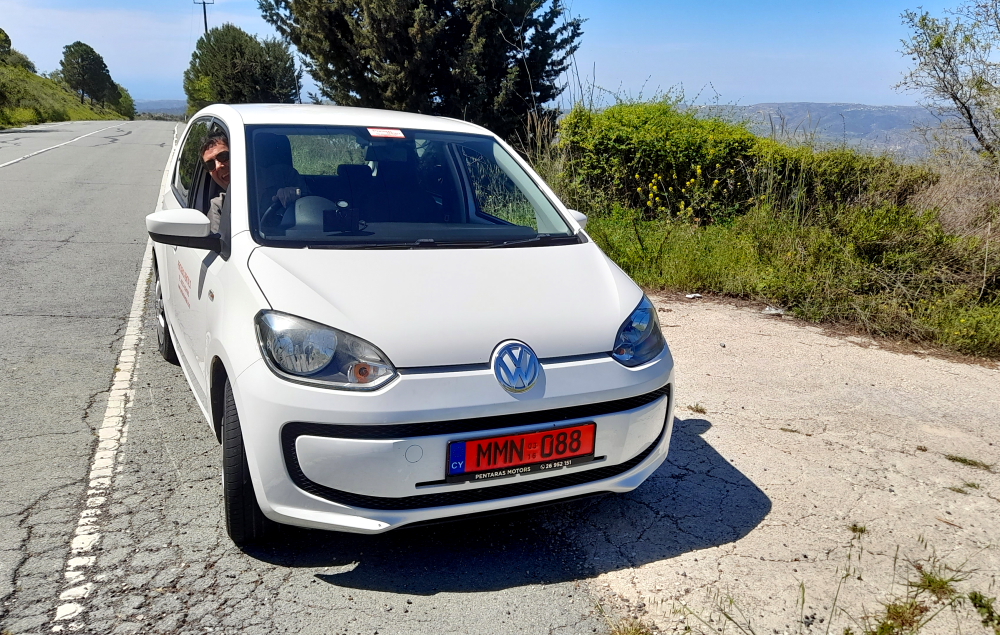
It is not hot enough outside to warrant air conditioning in the car so we just drive with the windows open. Climbing up the steep hills to the pine forests is easy so far. I just wonder how the car will go if I turn on the A/C.
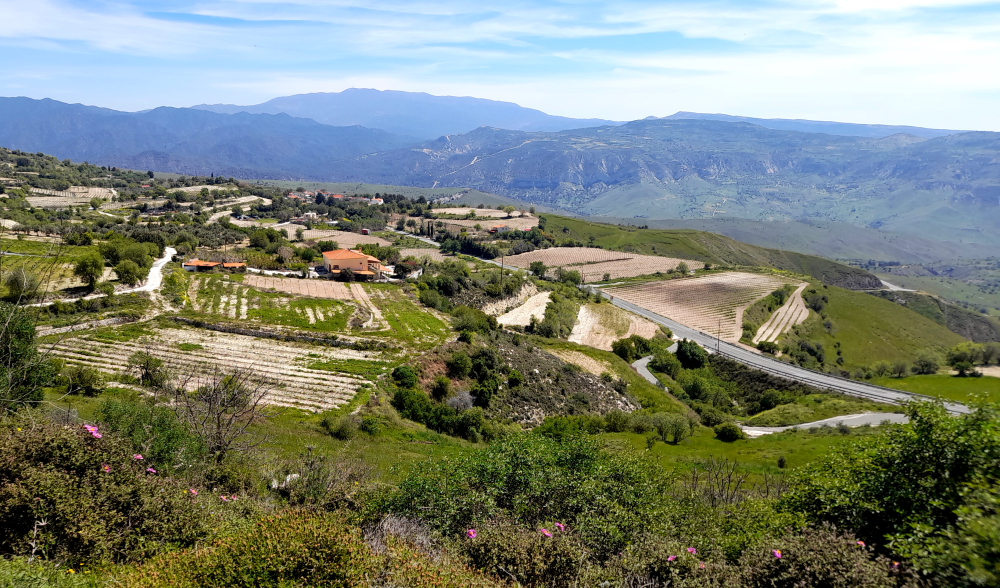
The air is cool and clear as we ascend the hills and there are some great views from up here. Since there is little traffic we stop regularly to take a few photos.
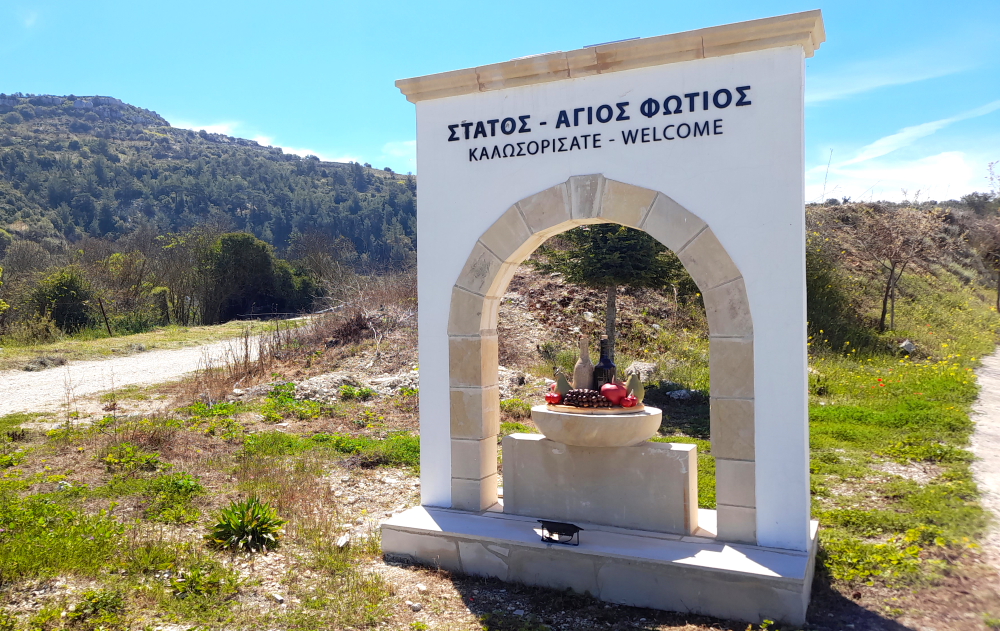
Each little town that we pass through has a “Welcome” sign and a “Bon Voyage” sign to mark the start and end of each village. In the towns the speed limit is 30 kph and marked by some serious speed bumps. The poor little VW almost gets stuck on the top of each bump.
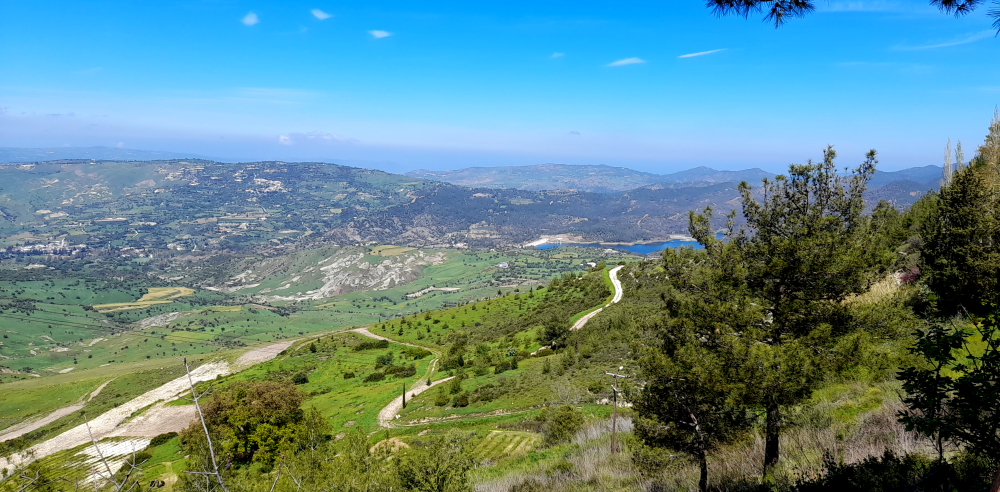
Everything is looking green in the hills after a cool and wet winter. I bet it browns off fast once the temperatures regularly hit the mid 30s in a few weeks.
We happen upon the Chrysoroyiatissa Monastery en route where we stop briefly. This Monastery also has a winery attached and some excellent views of the valley below.
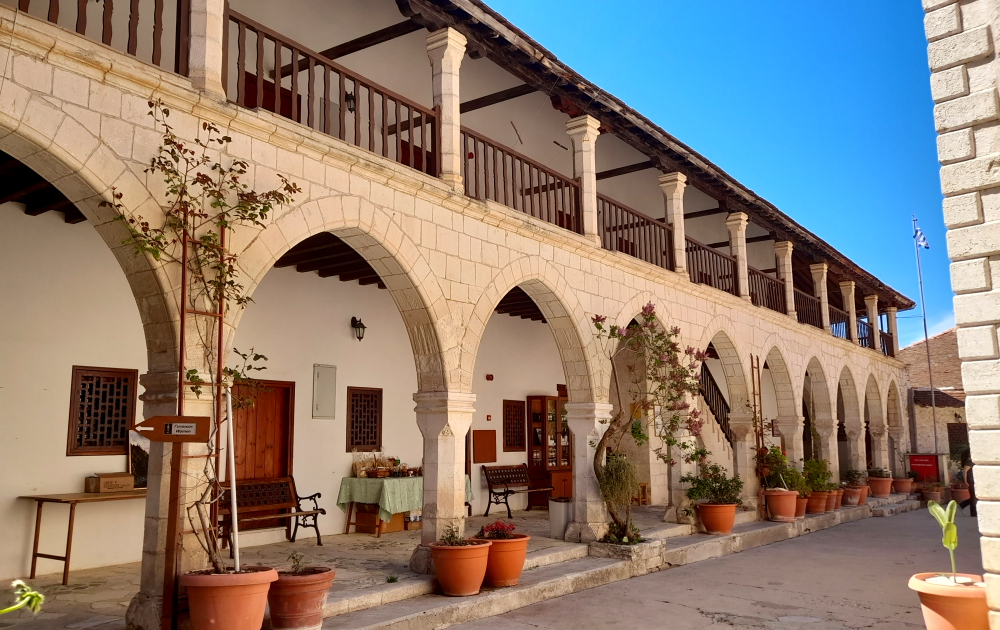
This high-elevation monastery was built in 1770 housing religious icons, a winery and a cafe with valley views.
Our next stop is at the village of Pano Panagia which is the birth place of Archbishop Markarios III.
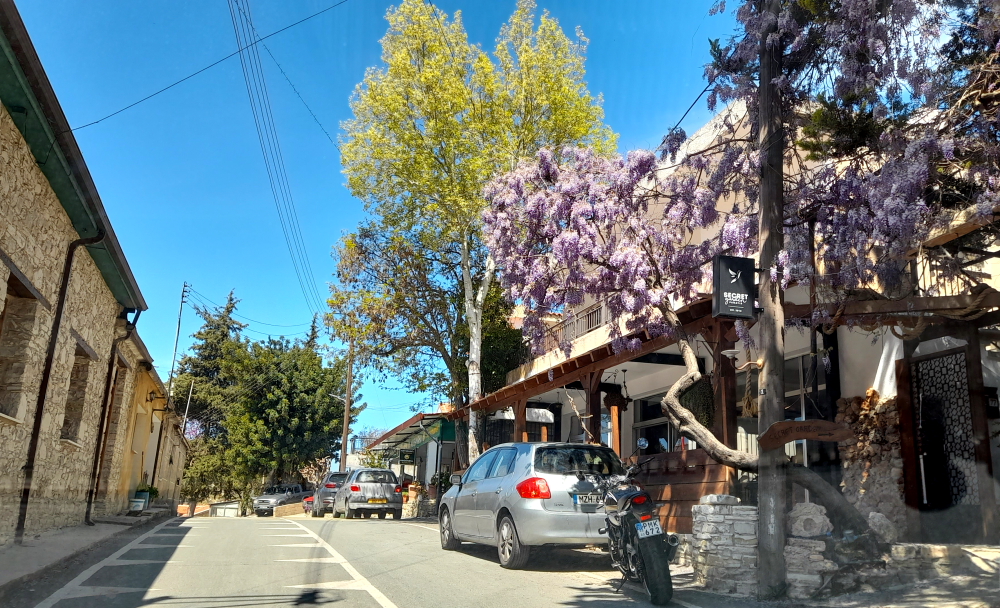
Makarios III – born Michael Christodoulou Mouskos (13 August 1913 – 3 August 1977 – was a Greek Cypriot politician, archbishop and primate who served as the first president of Cyprus and in which is widely regarded as the Father of the Nation or “Ethnarch”. He was also the leader of the autocephalous Church of Cyprus (1950–1977).
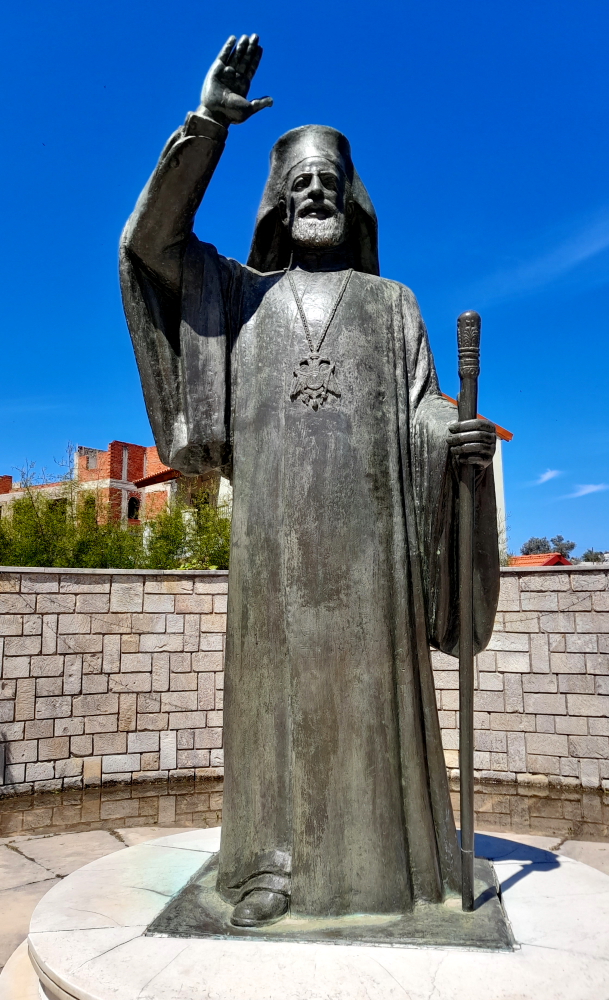
My reading of the history of Cyprus would indicate that a lot of the issues in the 1960s and 1970s in Cyprus were caused by this guy not willing to separate church from state and insisting Cyprus be linked to Greece after independence from the UK rather than forming an independent state. Will it ever be re united?
We continue on to the forested area where we end up driving through Cedar Valley to Kykkos.
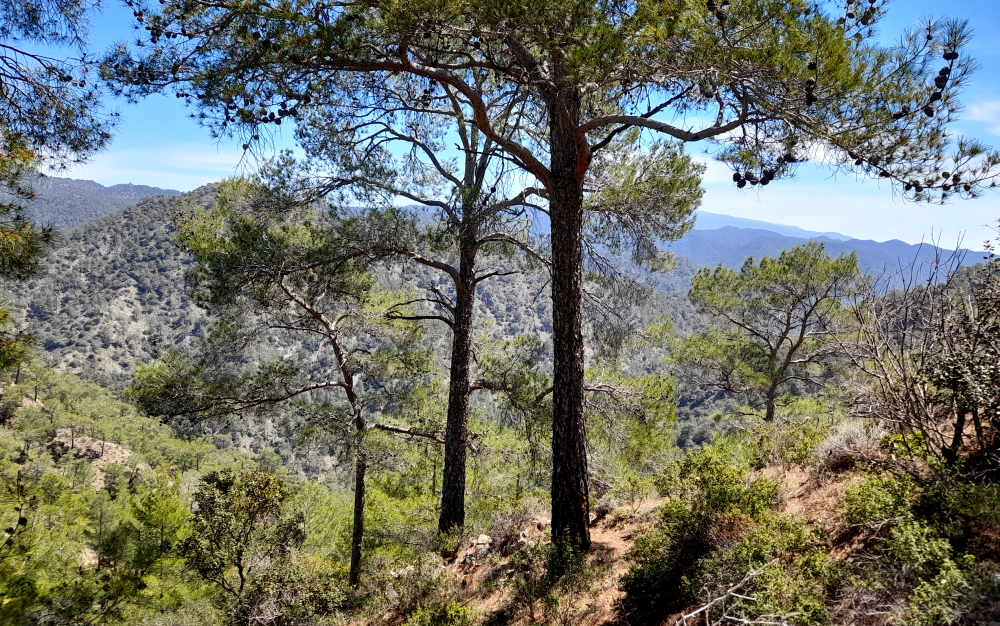
The air is clean up here but the pine forest would be a serious bush fire risk in a dry, hot summer.
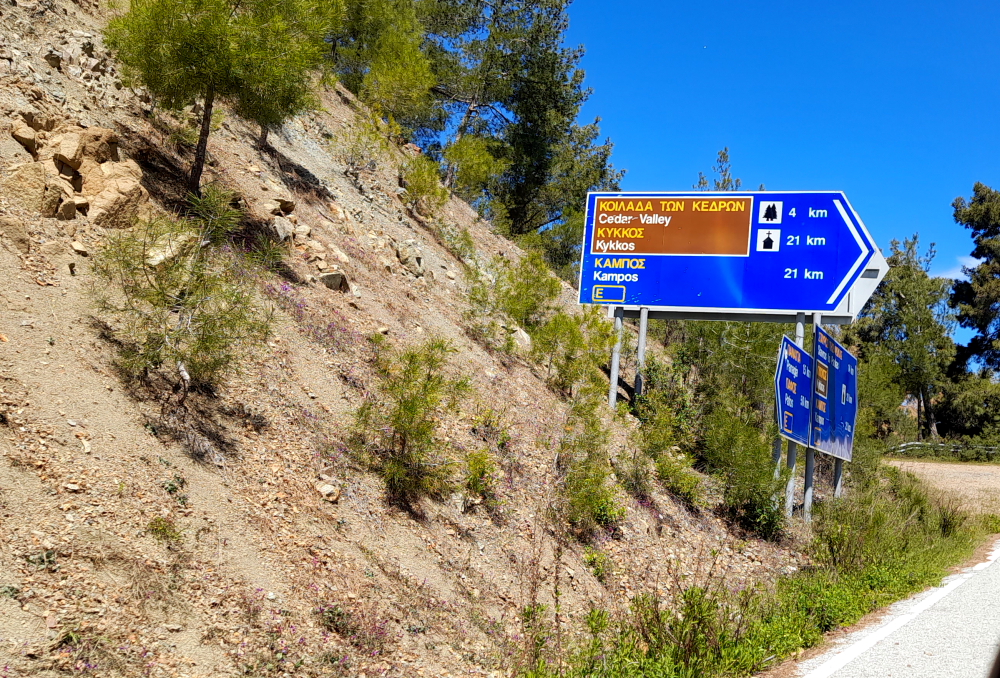
When we turn off the main road towards Cedar Valley the road becomes much narrower but we don’t come across any other cars. The roads are in great condition however, there is a lot of evidence that the mountains are crumbling and the roads are regularly covered in fallen rock scree so we have to drive up the middle of the road to avoid the very sharp rocks. Although we have a spare tyre I am not sure that it is adequately inflated. I don’t want to risk a flat tyre.
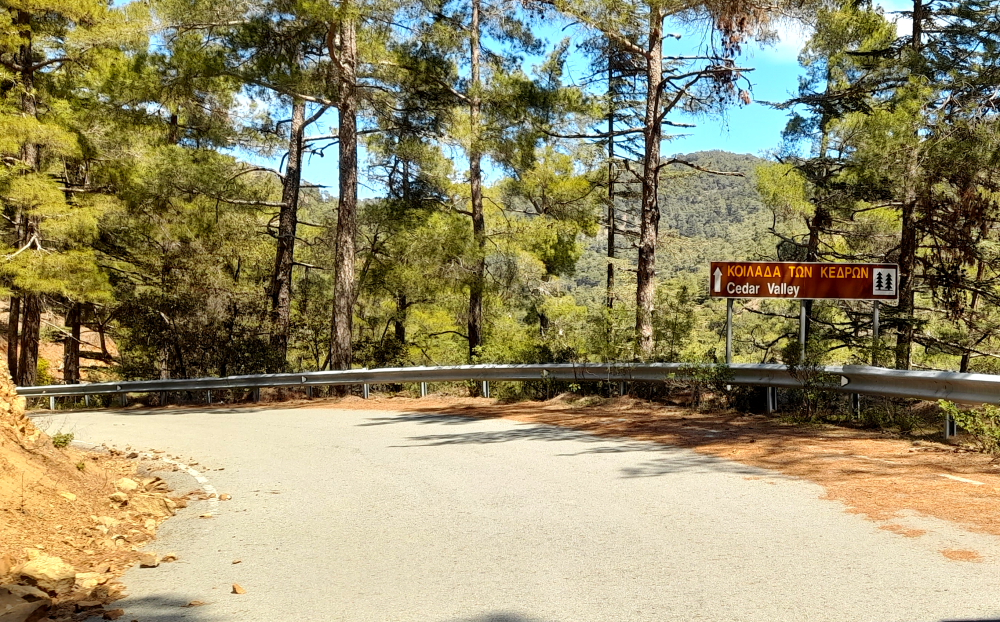
It is a very pleasant drive through the cedar trees and still we don’t see a single other car until we reach the bottom of the valley. Even then the only cars here are parked while the occupants hike along the many trails through the forest.
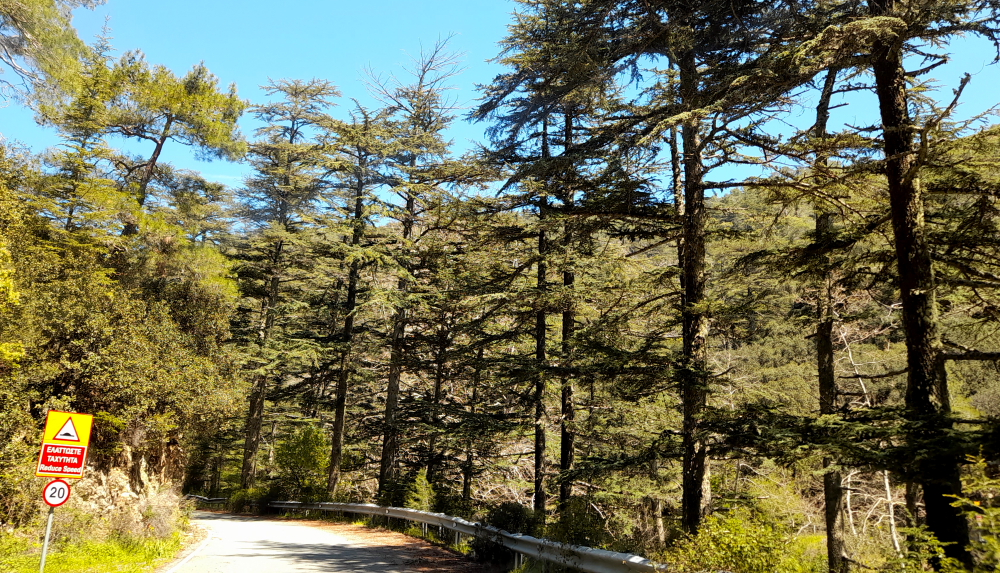
Continuing on we start the steep climb through the Troodos Mountains. The trees are thinning now and the forest looks more like scrub and the soil is very dry.
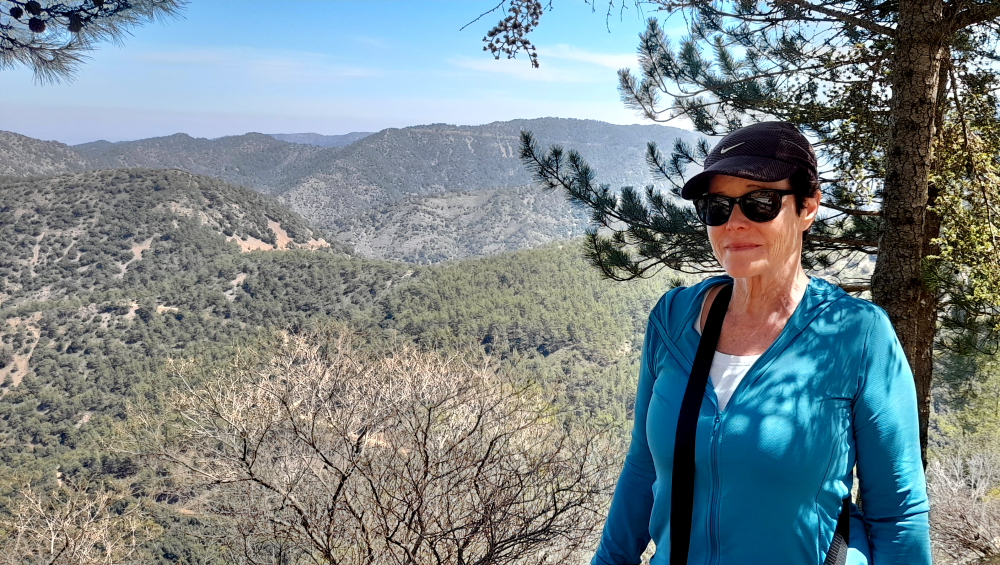
In the Troodos Mountains we arrive at Kykkos where Lynn wants to visit the Kykkos Monastery. The Monastery is a very well built and extensive stone building. There are plenty of tourists around including a tour bus.
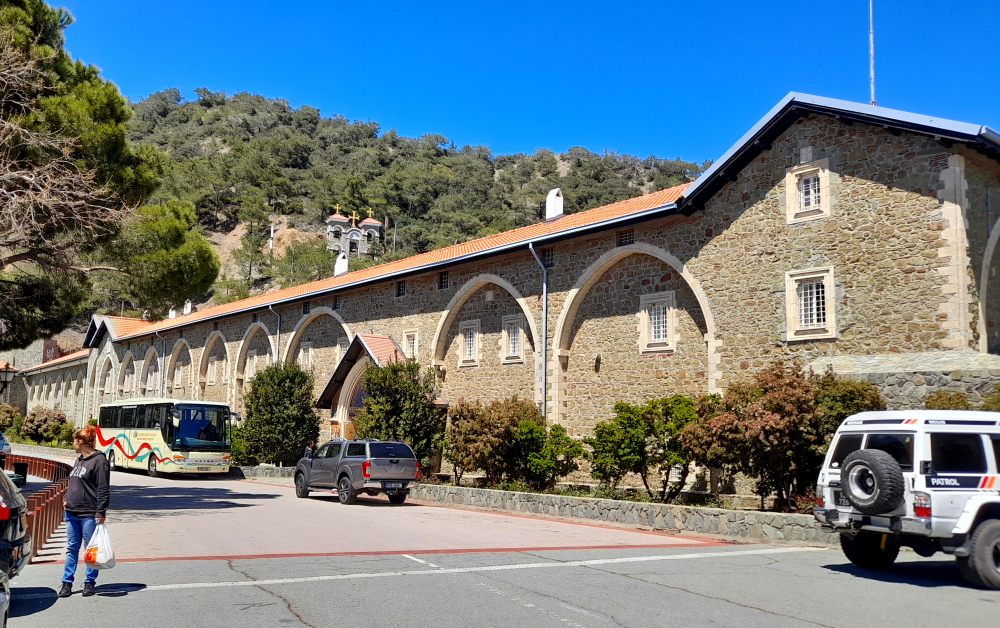
The first thing that you notice is the impressive mosaic entry. The gold mosaics shine in the afternoon sun.
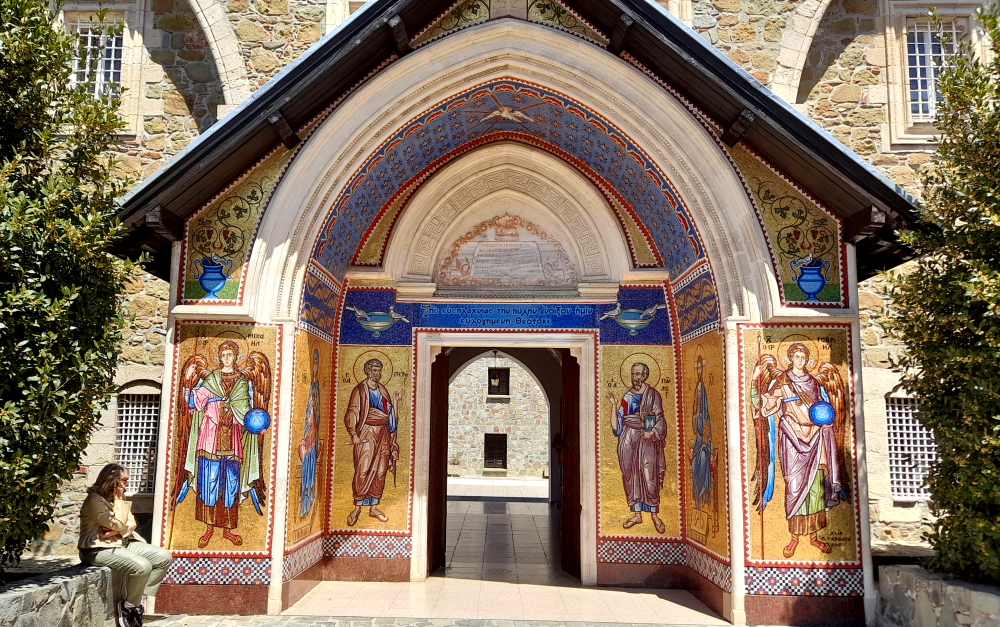
Lynn comments that she could quite easily live in a monastery to spend her days in meditation. Perhaps that is why she can turn a task into a career by contemplating her navel instead of getting the job done quickly???
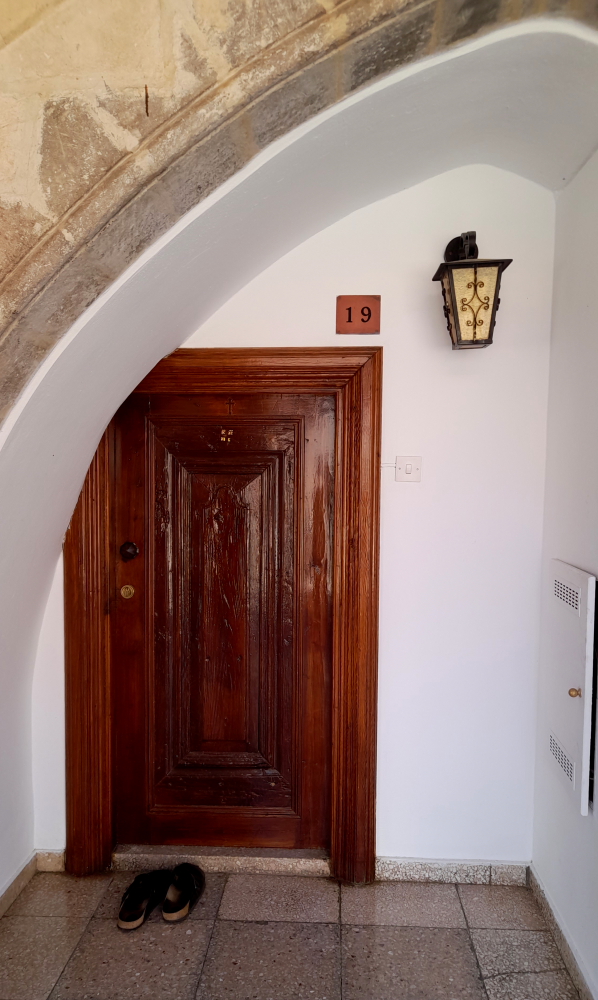
Lynn takes some good photos of the monastery and spots a pair of shoes at one of the cell doors.
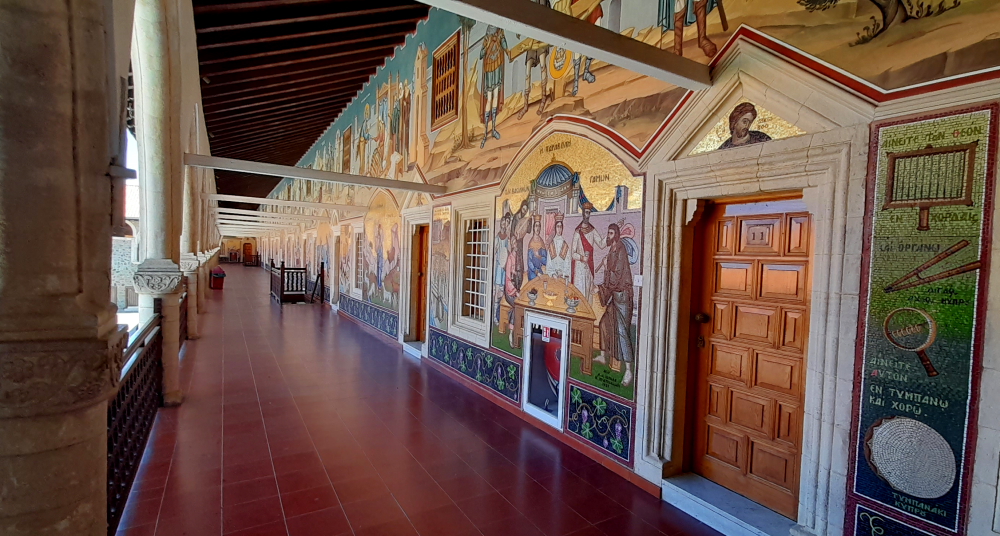
The workmanship in this place is extraordinary and the details of the mosaics are worth the visit.
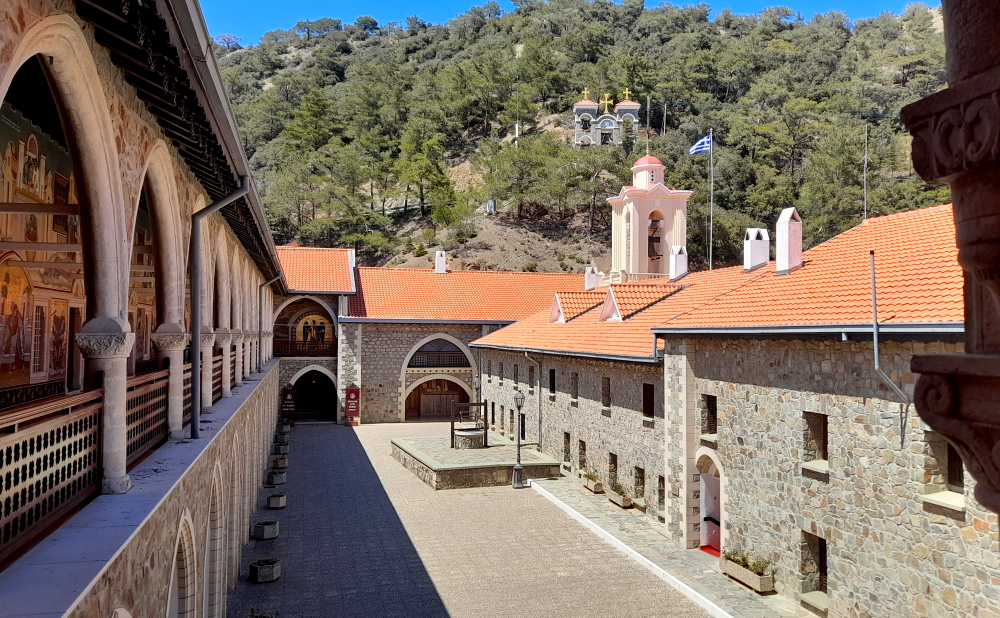
Despite a large number of visitors the place is really quiet. There are no Chinese visitors here today, thank God!
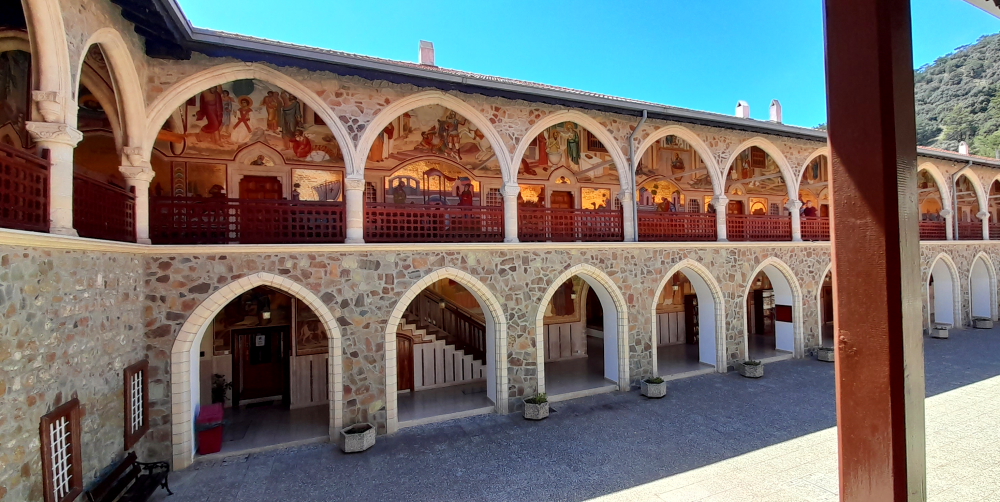
Although it is not really all that hot here today, it is certainly dry. There is a cafe next door to the Monastery so we check it out for a possible coffee stop. The coffee is just machine coffee so we settle for an ice cream.
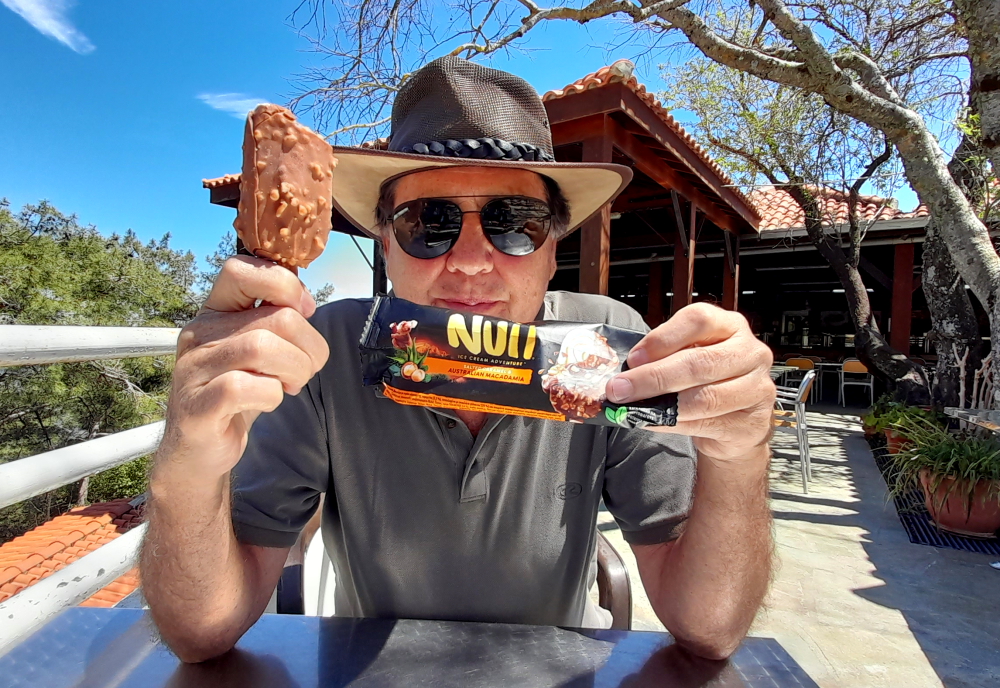
The ice cream is very nice and is coated in Australian macadamia nuts – a taste of home.
Heading to our next stop Lynn notices on the map that we are about to drive past Mount Olympus and suggests we make a quick detour. As we climb ever upwards the temperature outside drops to a cool 14.5 Deg C. Lynn reckons that she can see some patches of snow on the mountain. I scoff. How can there be snow in Cyprus? Especially at this time of year?
As we approach Mount Olympus we come across the Cyprus Ski Club hut. WTF?? Yes, apparently this area gets good snow coverage in winter and there is a ski lift. There is still significant snow in the trees and the road has large ice boulders on the roadside. There are even snow poles marking the edge of the road for the winter snow ploughs.
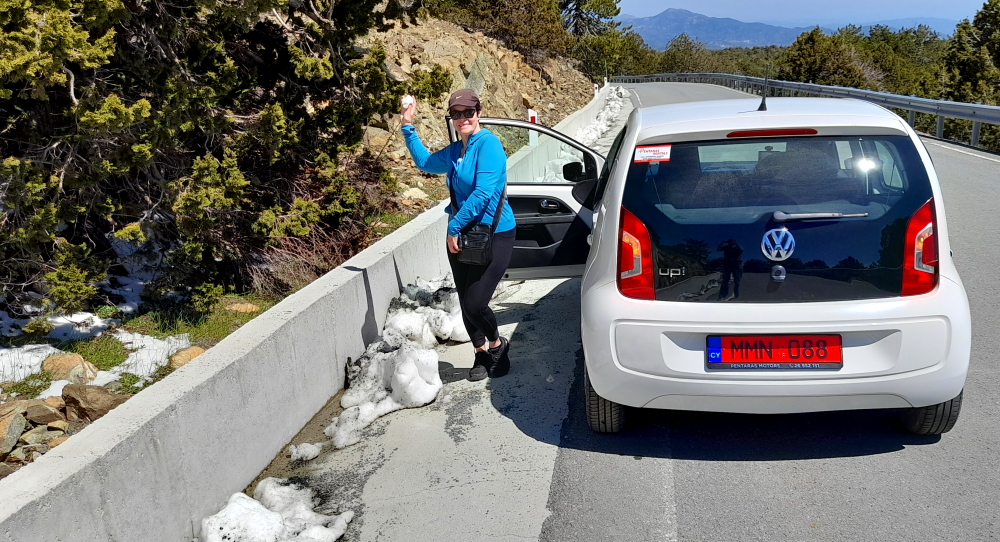
We drive to the top of Mount Olympus, something that you can’t do on mainland Greece but at the top of this Mount Olympus is a Cypric Military base so we couldn’t take any photos at the summit.
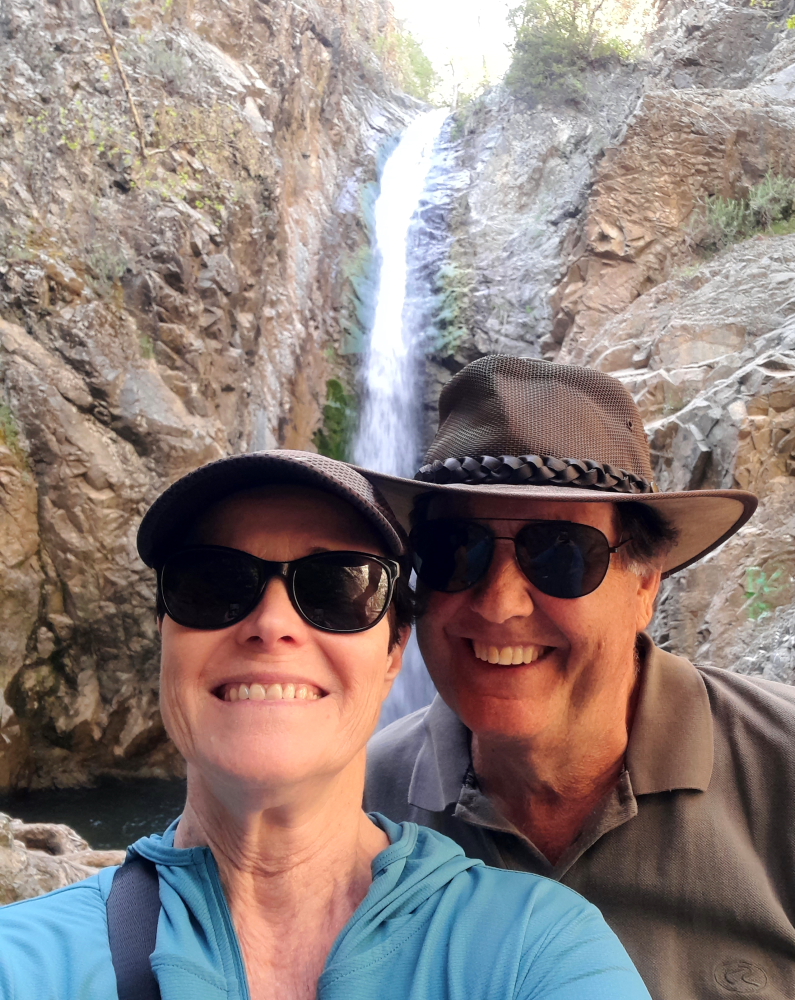
Our next stop on the way down from the mountains is at the Millomeri Waterfall. The road to the falls is a narrow, one-lane road but we manage to park quite close by and only have a short walk to the falls.
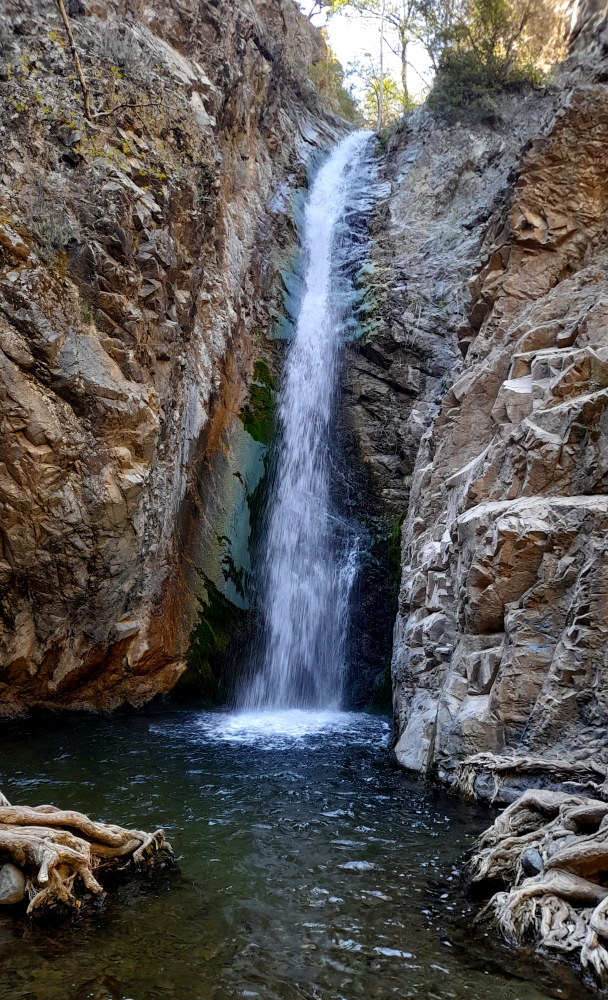
The water in the pool is cool and clear but drinking is not recommended. We had planned to take a selfie at the waterfall but again we forget to bring the selfie stick. I am starting to regret buying the thing as we always seem to forget to take it with us.
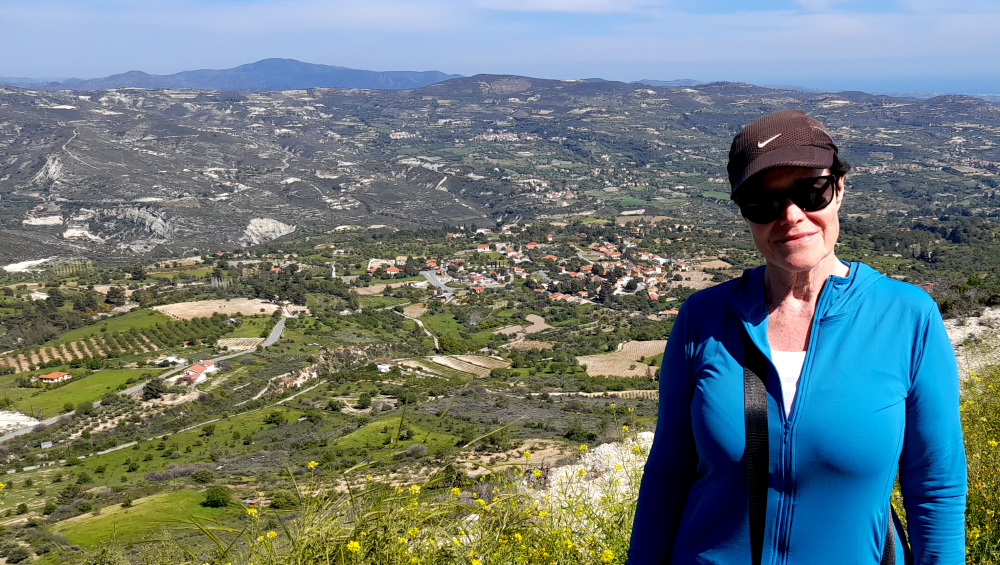
We continue on towards the narrow cobble-streets of the hill-top village of Lofou and get some great views of the valleys from the hill tops. Unfortunately we don’t get to drive through the village as a car is parked in the narrow, one-way street so we make a U-turn and continue on our way.
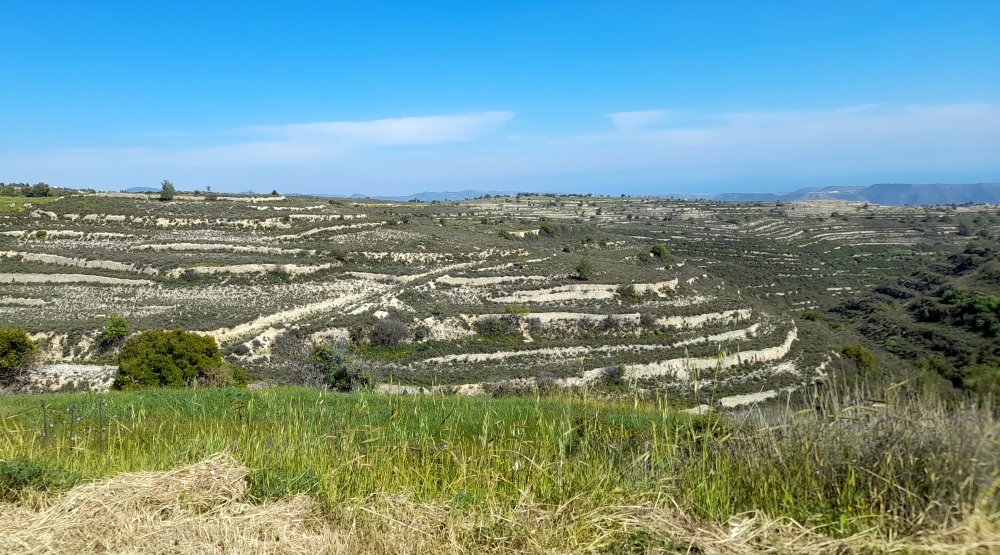
We notice that most of the hills have been terraced but are no longer in use for agriculture. Perhaps they have been abandoned or perhaps are only used as grazing fields for goats. If this were Greece, Spain or Italy the terraces would be covered in olive trees. Perhaps the presence of the Old Olive Mill in the village is indicative of previous extensive olive orchards.
We are heading towards the coast near Limassol and the little VW has to work hard on the very good freeway as we head back towards Paphos. Our next stop is at Kourion to see the ancient amphitheater and house.
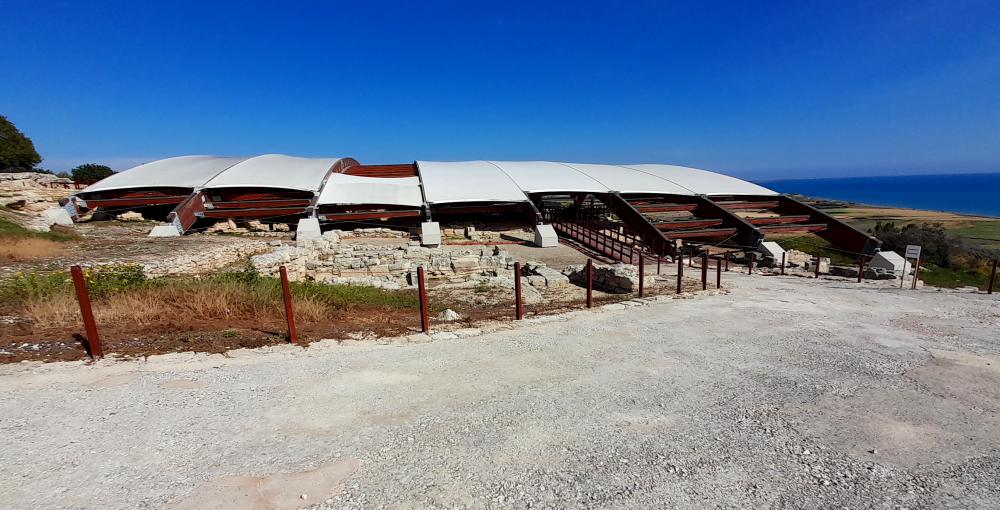
It is starting to get late and Lynn thinks that the site closes at 4:00 pm. We arrive just before 4:00 pm and are told that it closes at 5:00 pm so we have some time to check out the site. The good news is that since we are over 65 years of age that we can get in for free. Bonus!
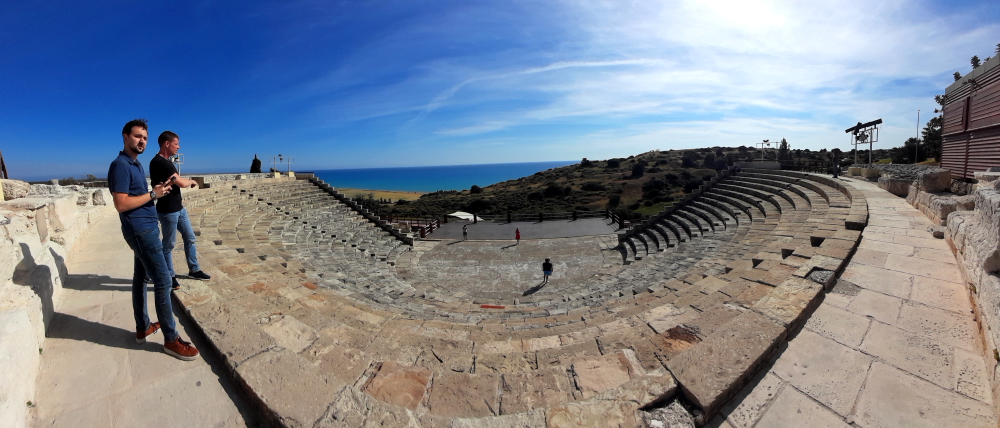
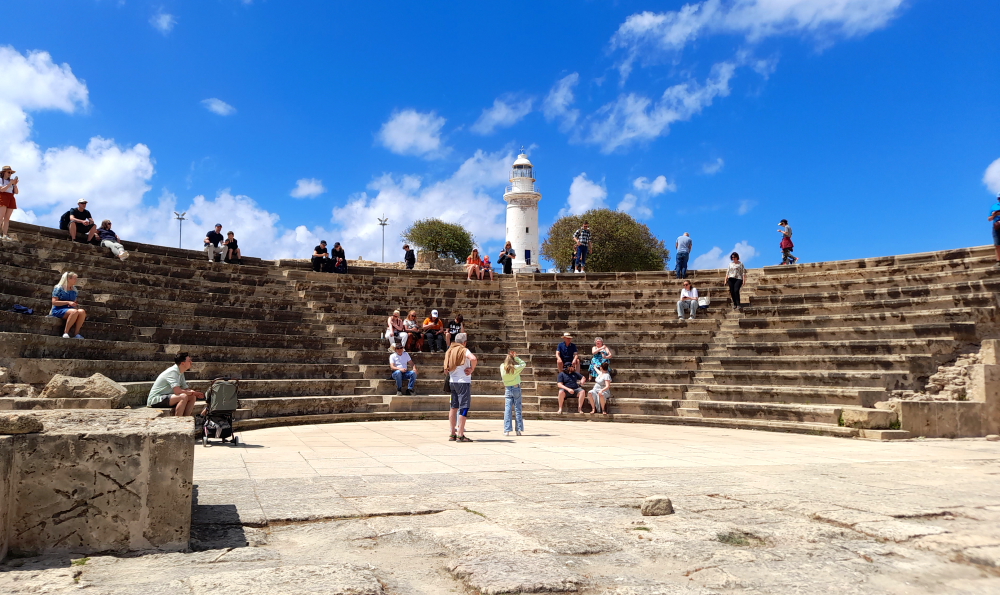
We probably won’t have time to cover the entire site but we head for the excellent, well-preserved amphitheater which has a magnificent view over the sea. The theater is in great shape and is still used for theater performances.
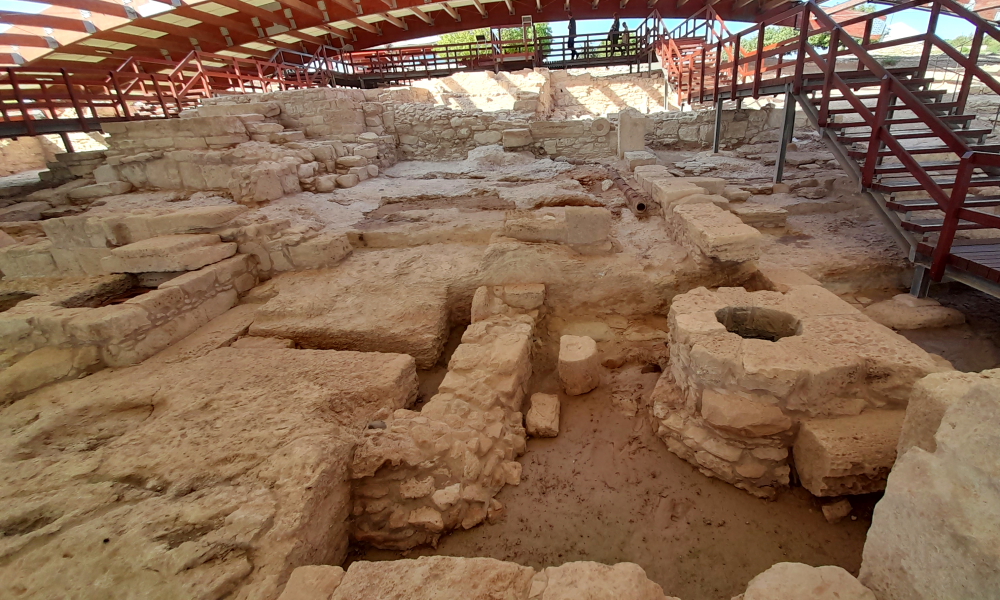
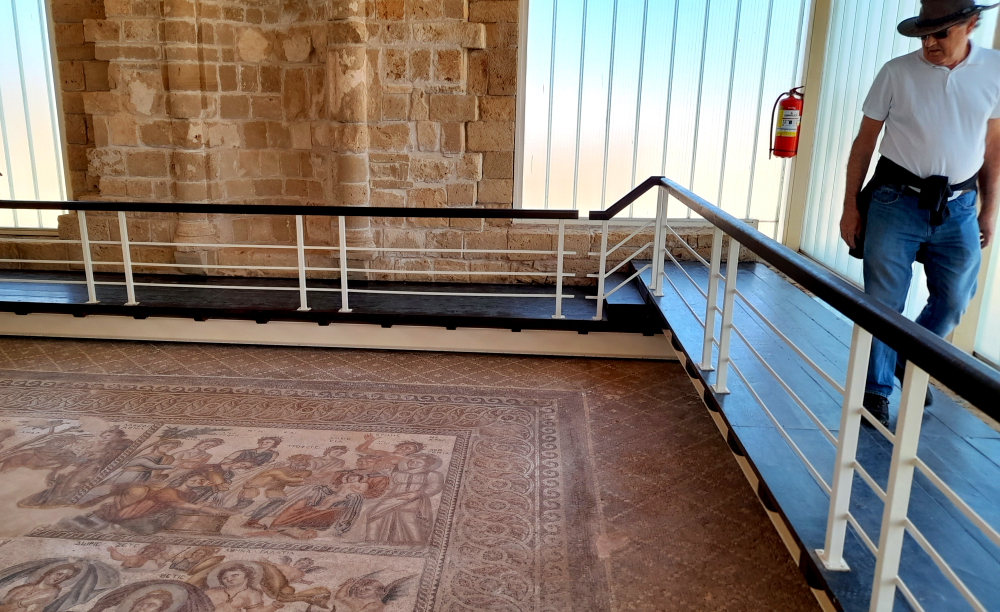
Next we head for the covered dig site where the foundations of a very large house have been uncovered. There are some excellent mosaics and even a couple of wells.
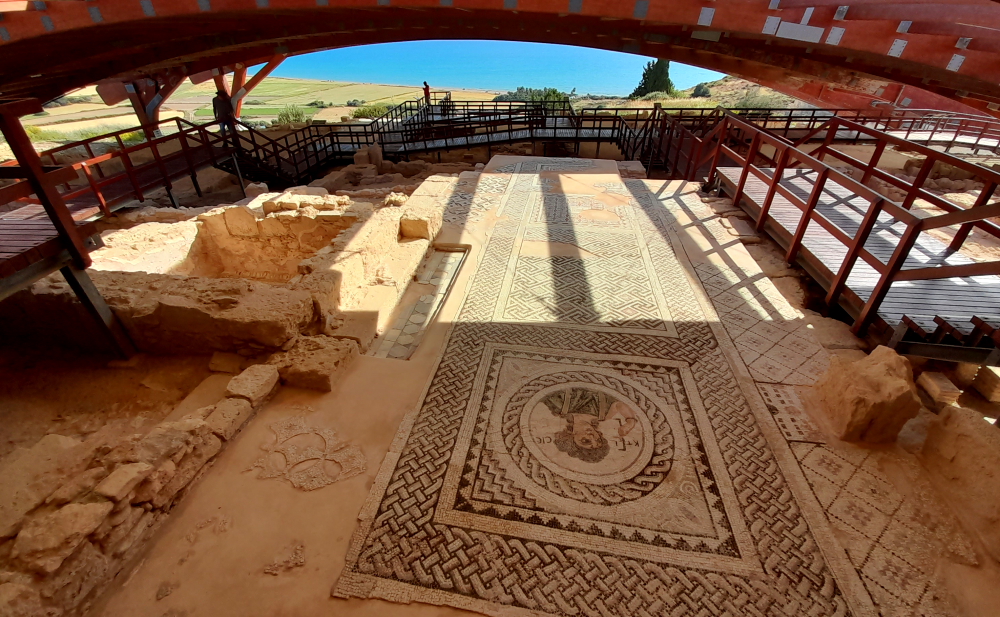
The most impressive thing about this dig is the magnificent view that the original house would have had in its day.
Back on the road we stay off the main freeway and head along the coast road. There is a view point at Petra Tou Romiou so we stop for a couple of photos. Impressive.
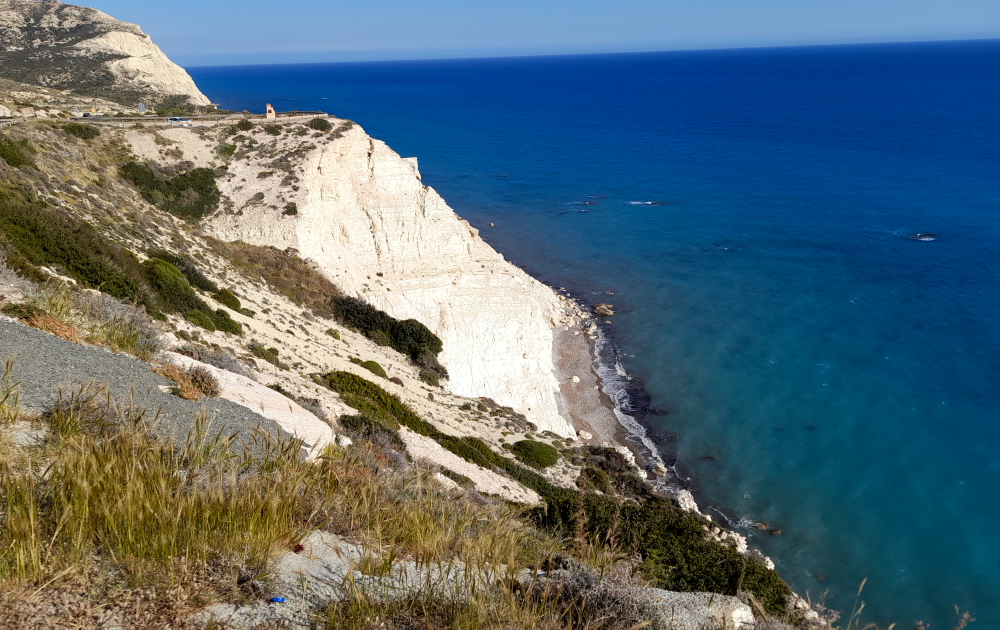
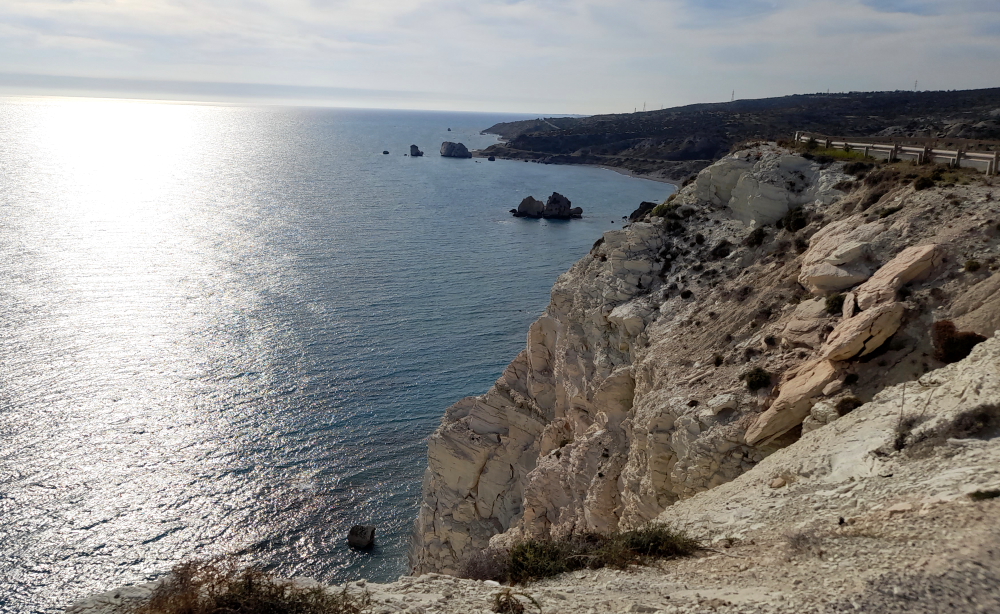
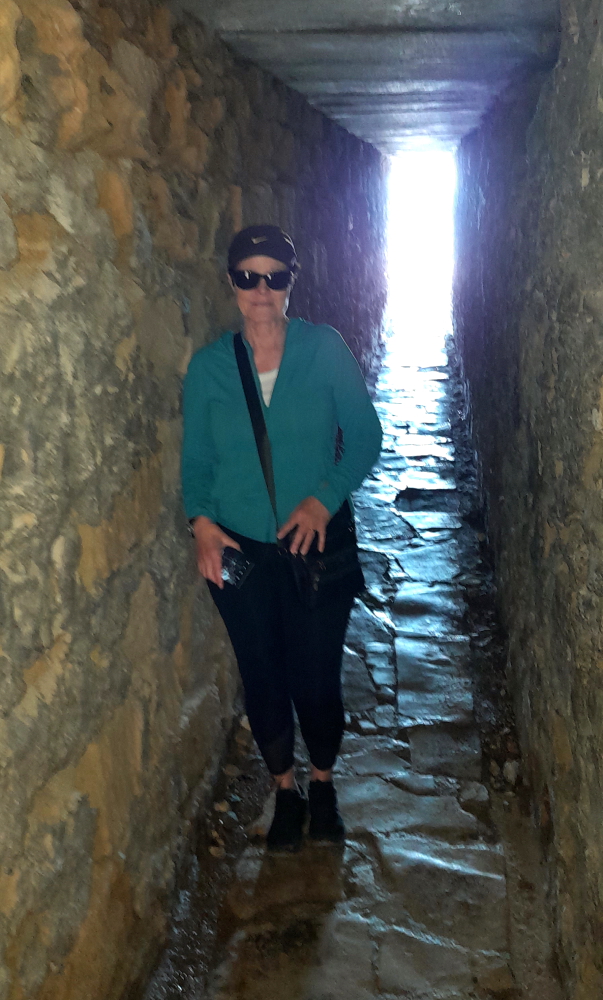
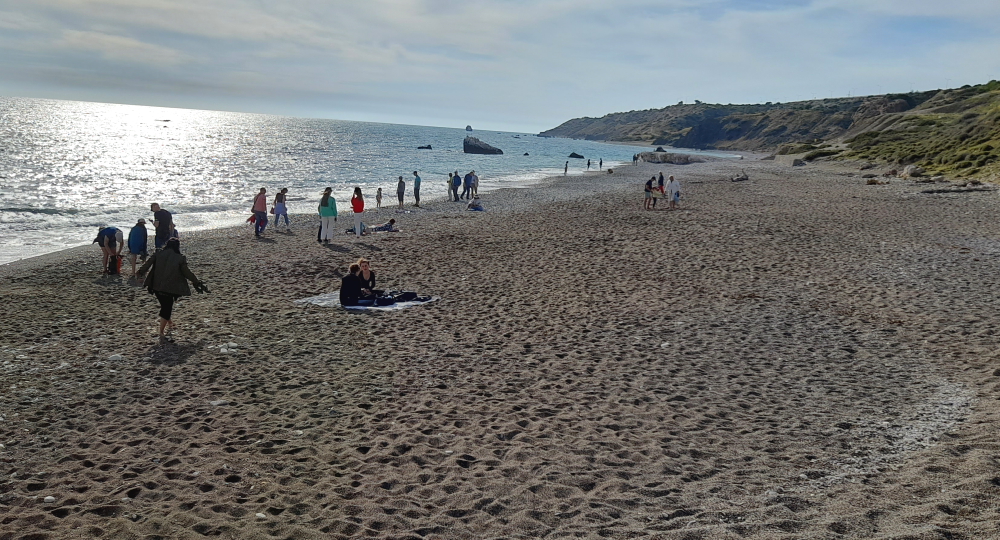
Our last stop for the day is at Aphrodite’s Rock. The parking area is on the land side of the main road and you walk through an underpass beneath the highway. The underpass is a narrow walkway that opens up directly at the beach.
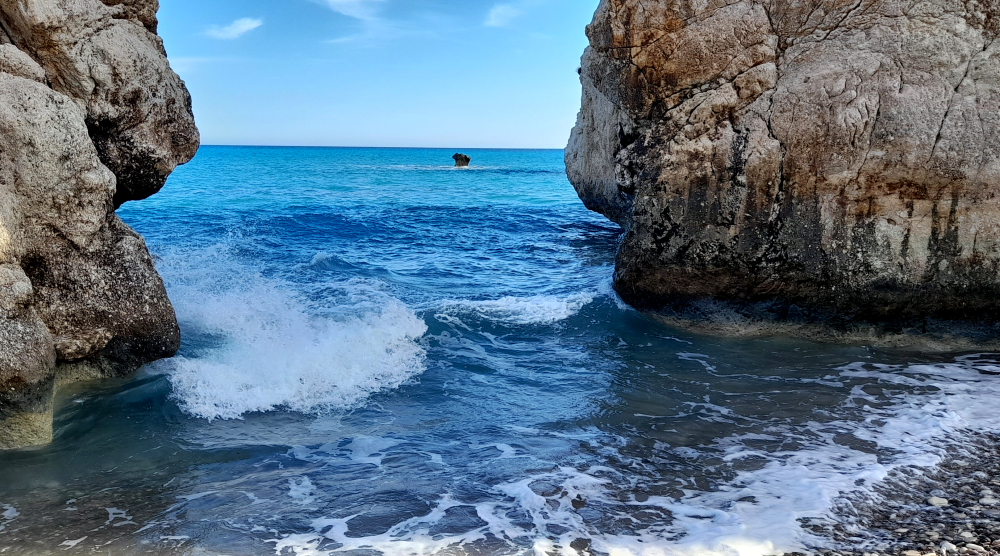
Petra tou Romiou (“Rock of the “Roman”) (that is East Roman or Byzantine as Byzantines referred to themselves as either Greeks or Romans until the 1920s), also known as Aphrodite’s Rock, is a sea stack near Paphos. It is located off the shore along the main road from Limassol to Paphos. The combination of the beauty of the area and its status in mythology as the birthplace of Aphrodite makes it a popular tourist location.
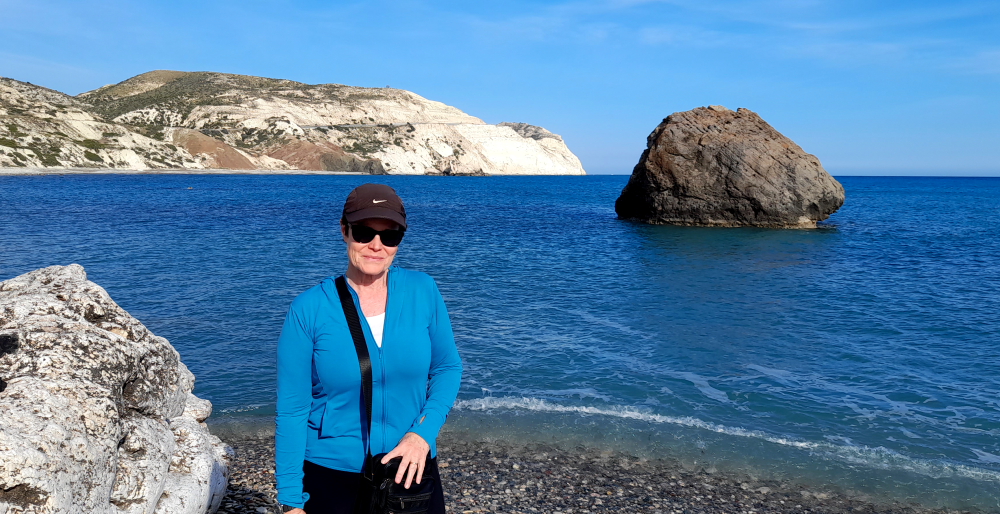
According to one legend, this rock is the site of the birth of the goddess Aphrodite, perhaps owing to the foaming waters around the rock fragments, and for this reason it is known as Aphrodite’s Rock. Gaia (Mother Earth) asked one of her sons, Cronus, to mutilate his father, Uranus (Sky). Cronus cut off Uranus’ testicles and threw them into the sea.
Similarly, the local version indicates that Aphrodite’s Rock is a part of the lower body of Uranus. This legend says that Cronus ambushed his father and cut him below the waist with a scythe. Uranus, as he tried to escape flying, lost parts of his truncated body and testicles into the sea. A white foam appeared from which a maiden arose, the waves first taking her to Kythera and then bringing her to Cyprus. The maiden, named Aphrodite, went to the assembly of gods from Cyprus. The Romans widely referred to her as Venus. Aphrodite attracted a large cult following in Paphos, which was eventually crushed by the Romans. This is evident from the Sanctuary of Aphrodite in Old Paphos, Kouklia. A local myth is that any person who swims around the Aphrodite Rock will be blessed with eternal beauty.
Another legend associates the name Achni with the nearby beach, and attributes this to it being a site where the Achaeans came ashore on their return from Troy.
The present name Petra tou Romiou associates the place with the exploits of the hero Basil as told in the Digenes Akritas. Basil was half-Byzantine (East Roman or Romios) and half-Arabic, hence the name Digenes (two-blood). Legend tells that the Christian Basil hurled a huge rock from the Troodos Mountains to keep off the invading Saracens. A nearby rock is similarly known as the Saracen Rock.
Since it is Easter Saturday here in Cyprus Lynn wants to attend the midnight Mass at a local Greek Orthodox Church. The hotel has arranged a tour bus to take participants to the church at about 11:30 pm tonight. I will be in bed by that stage.
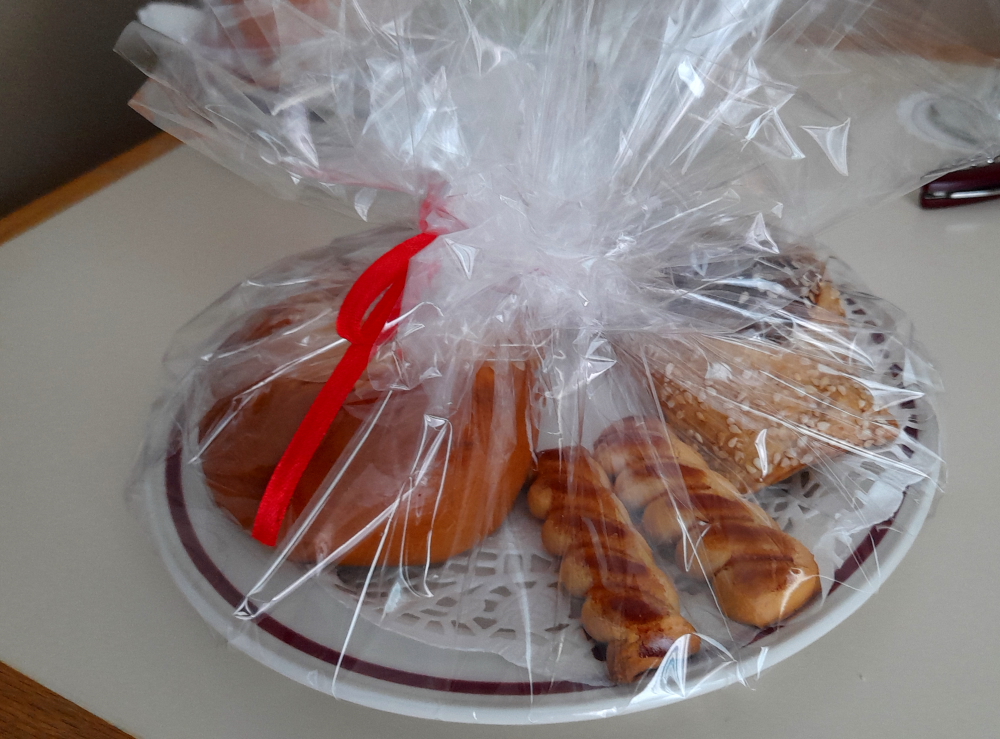
We arrive back at the hotel after a very long day touring the hills. We managed to cover about 300 kms today so I won’t be long out of bed. The hotel has left us an Easter basket in our room. A nice touch.
After dinner we are back in our room and we are soon in bed. Lynn is taking a nap before she ventures out for the midnight Mass. I just hope she hears her alarm. Within minutes of hitting the pillow she is snoring loudly. She manages to wake up in plenty of time to head downstairs to catch the bus but I get a call from the front desk just before 11:00 pm asking where she is. I am not happy that I have been woken up but concerned that Lynn has fallen asleep in the lobby. I tell them that she is indeed attending and that she should be somewhere in the hotel lobby. Not my problem as I just want to get back to sleep. Midnight Mass, really? What’s wrong with a civilised time of day for all this pageantry? Does the priest have a day at the beach planned for tomorrow?
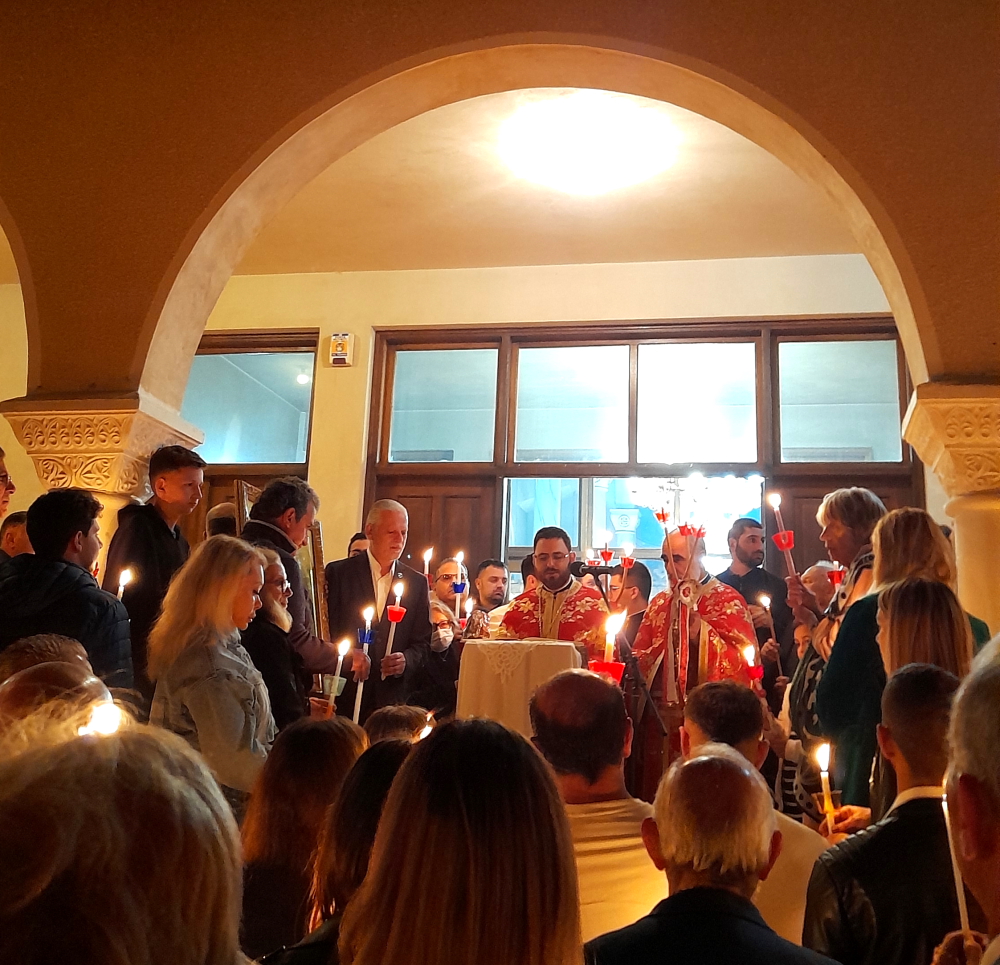
Although it was Easter last week, the Greek Orthodox Church celebrates it a week later, hence midnight Mass tonight. It’s part of an ancient ritual called the Holy Fire ceremony. In the Church of the Holy Sepulcher in Jerusalem, the priest enters the tomb of Christ and emerges with a candle that has been lit by the ‘holy fire’ which is then quickly passed to every candle in the congregation at which time, when the bells toll, it is proclaimed that “Christ is risen!” to which the congregation responds, “He is risen indeed!” The devout believe the origin of the flame is a miracle and is shrouded in mystery.
Throughout the Orthodox community this ceremony is replicated. I can only think that the ‘fire’ is an eternal flame that originated in Jerusalem and was dispersed across the globe, just like the Olympic flame. What is it about the Greeks and flames??
Today in the news it was reported that tensions were high in Jerusalem as Israel had limited the number of Christian worshippers to 1,800 to enter the church.
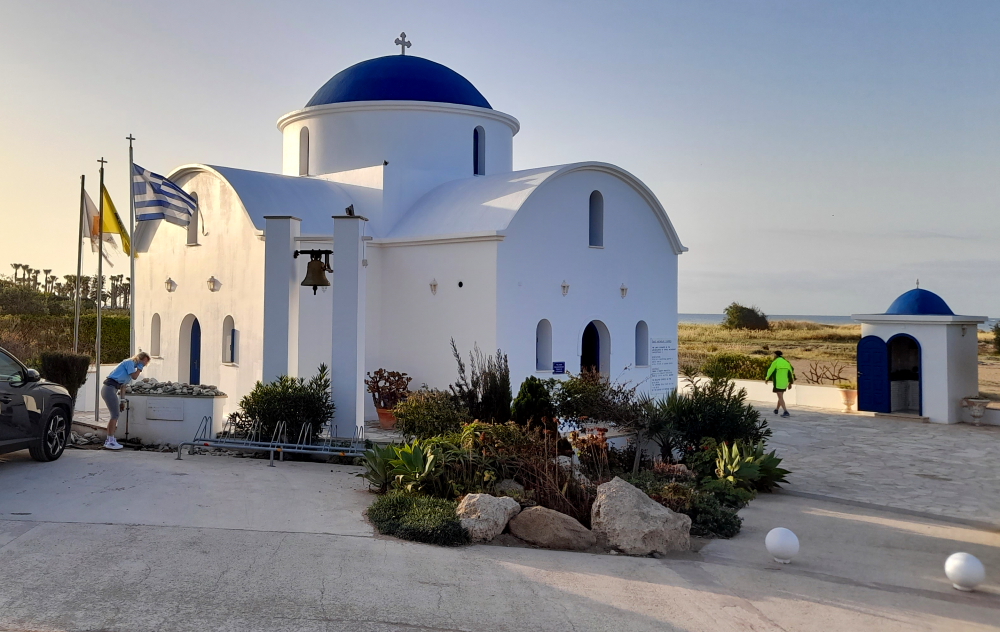
Apparently it even applied here in Paphos at the Agios Spyridonas Church. The church was crowded so Lynn and those from the hotel had to stand in the car park to listen to the service but it meant she was in a front row ‘seat’ when the priests came out of the church and stood at a portable lectern on the front steps for the proclamation.
16 April, 2023
Day 2 of our car hire sees us head off to Nicosia.
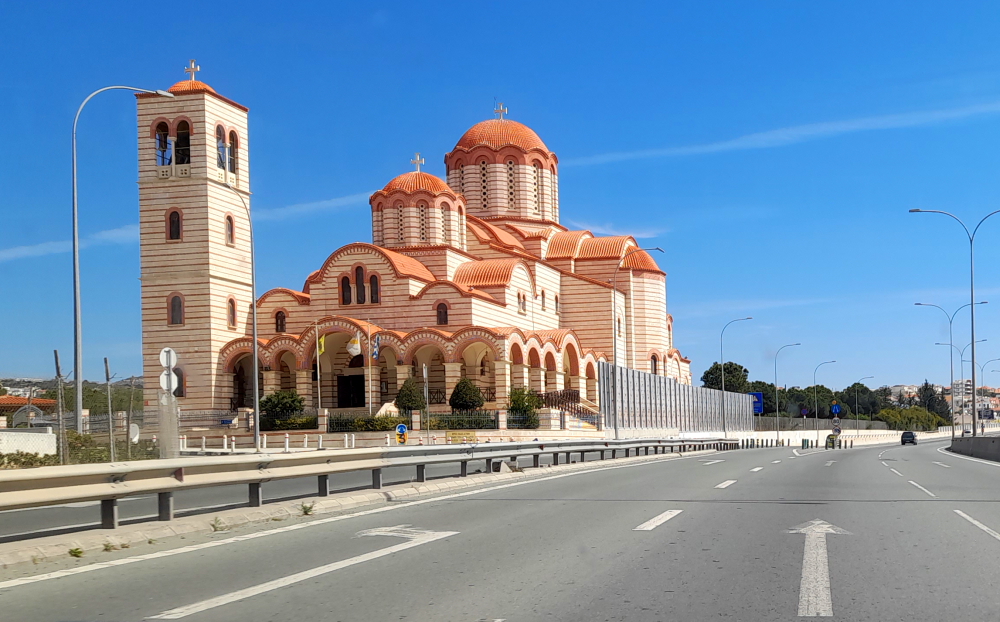
Churches, ancient and modern, feature regularly in the Cyprus landscape.
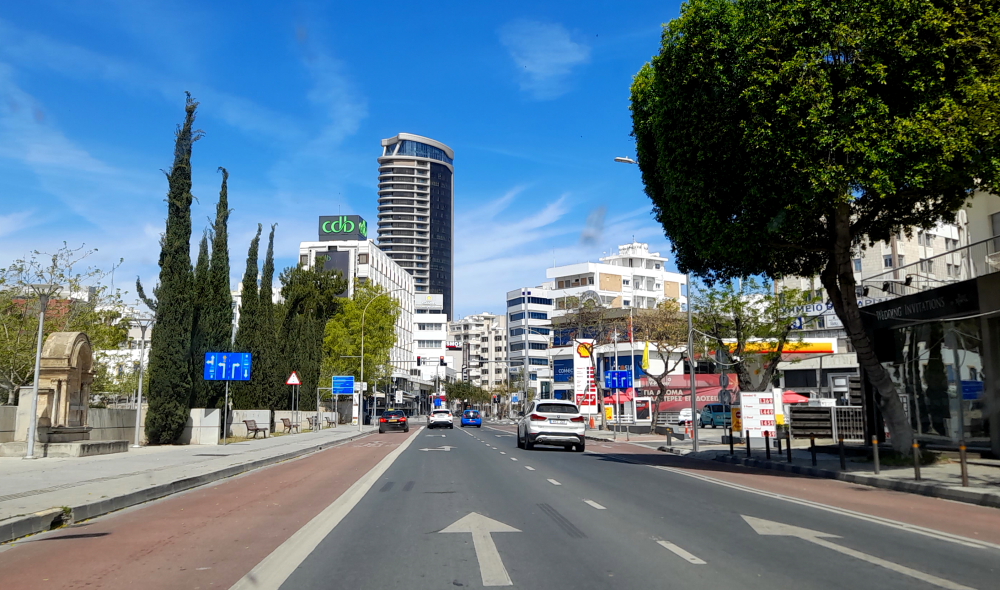
Our route is via the A5 then the A1 to Nicosia which takes about 1:45 minutes. On approach we can see a huge Turkish flag has been painted one of the hills that backdrop the town.
The outskirts feature quite modern buildings. We park a couple of blocks west of the Ledra Street Checkpoint on a scrappy piece of dirt which costs us Euro3 for 2 hours.
After a pit stop at the local Starbucks we venture up the pedestrian mall to the Checkpoint which is a quite low-key affair but where multiple signs prohibiting taking photos are displayed. Only foot traffic is allowed through here and we can see people walking through a street market on the other side.
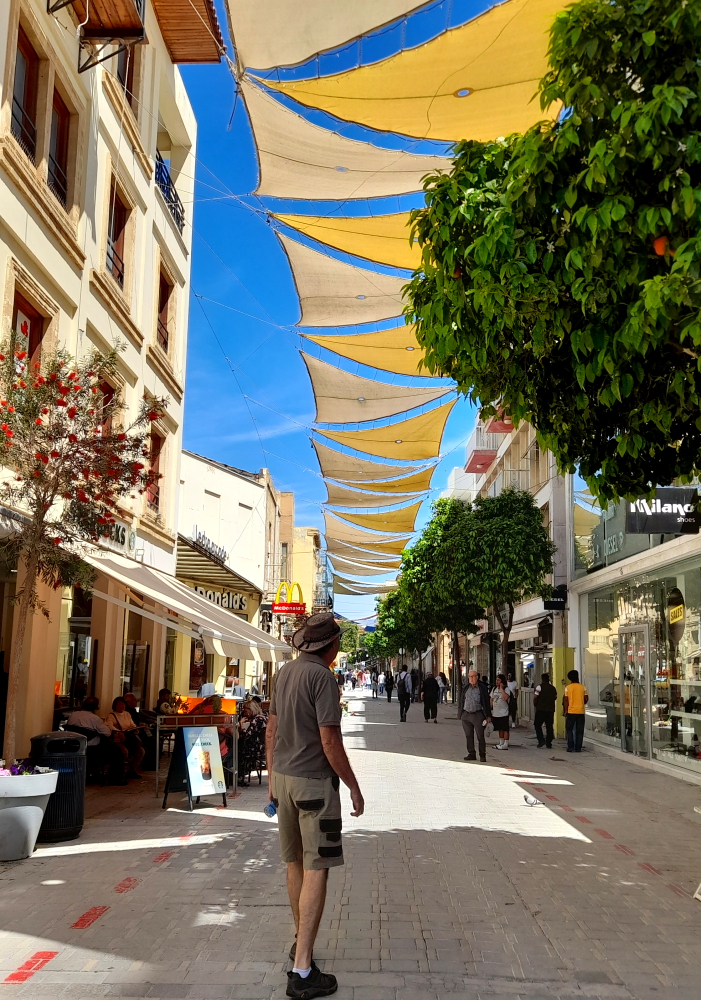
In contrast to the town’s outskirts, the old town has some lovely stone buildings, reminiscent of Valletta in Malta.
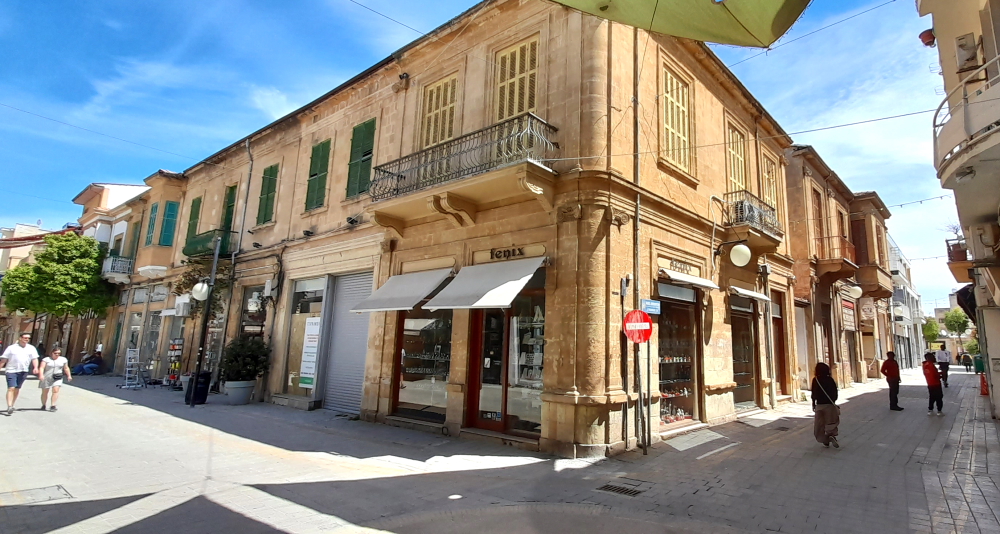
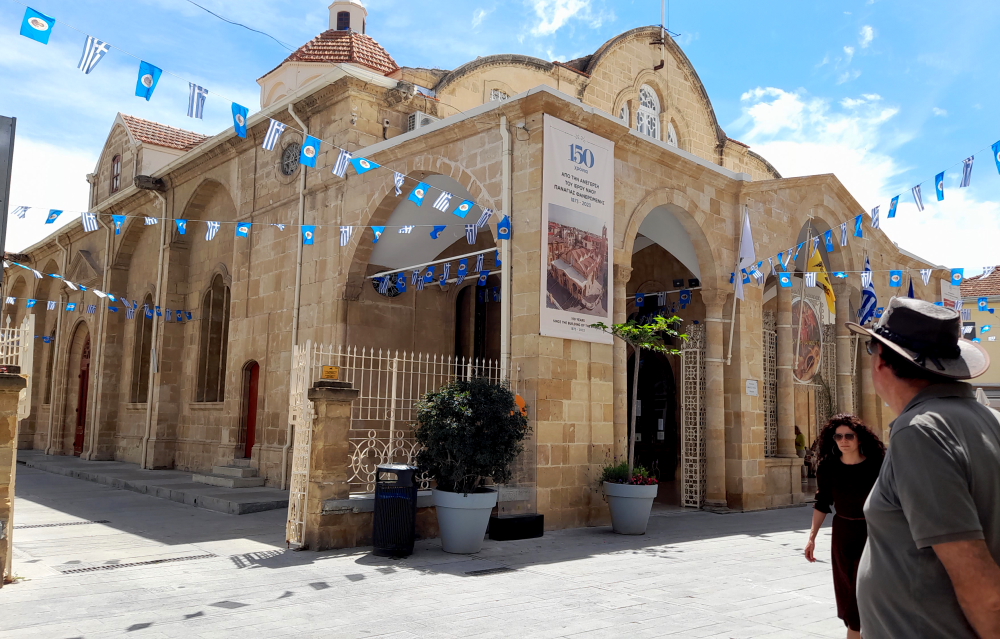
Walking east we come across the Panagia Phaneromeni Church which is located in the historical center of Nicosia and is the largest orthodox temple in the Venetian walls of the town. It dates back to 1872-73. At the site where today’s church is built, there was a monastery that was probably destroyed in 1571 when Nicosia was occupied by the Turks. it’s Easter Sunday today, so naturally the church is closed.
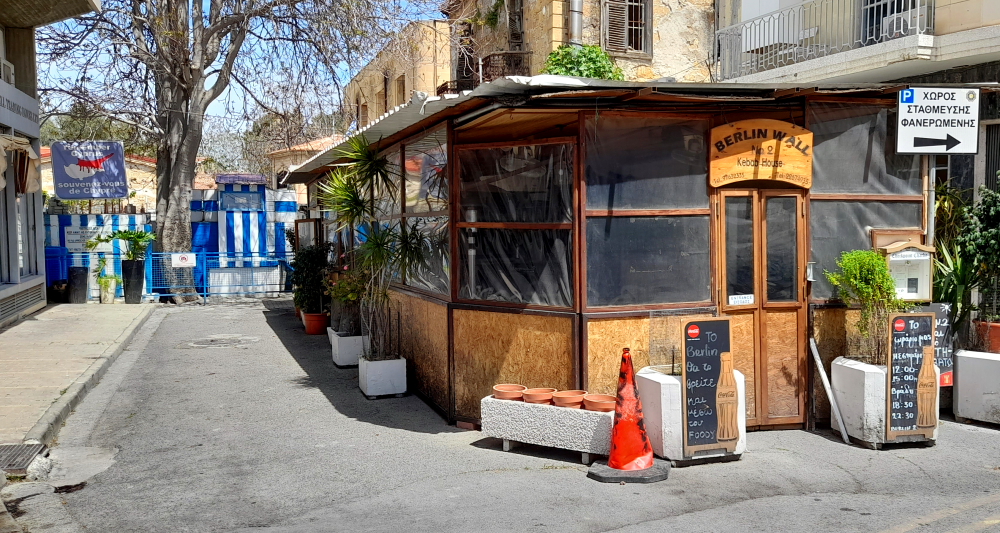
Along Dionysou Street more ‘ad hoc’ hoardings mark the border with Turkiye.
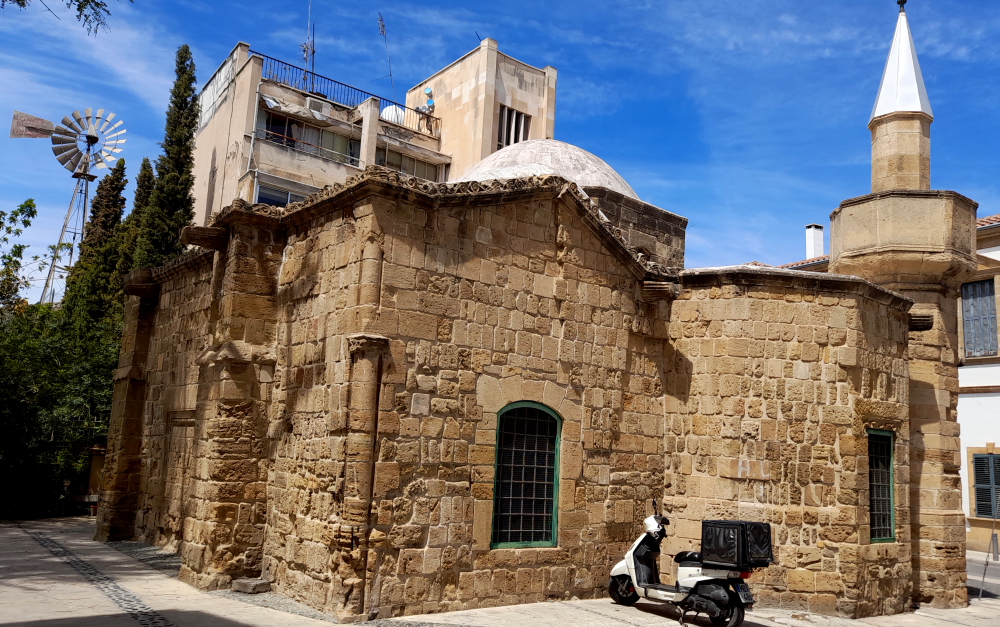
Lynn decides that, while we’re here, we’ll walk east to visit the Old City Hall Market and the Archbishop’s Palace. Along the way we stumble across a remnant of the C16Turkish occupation – a tiny stone mosque this side of the border.
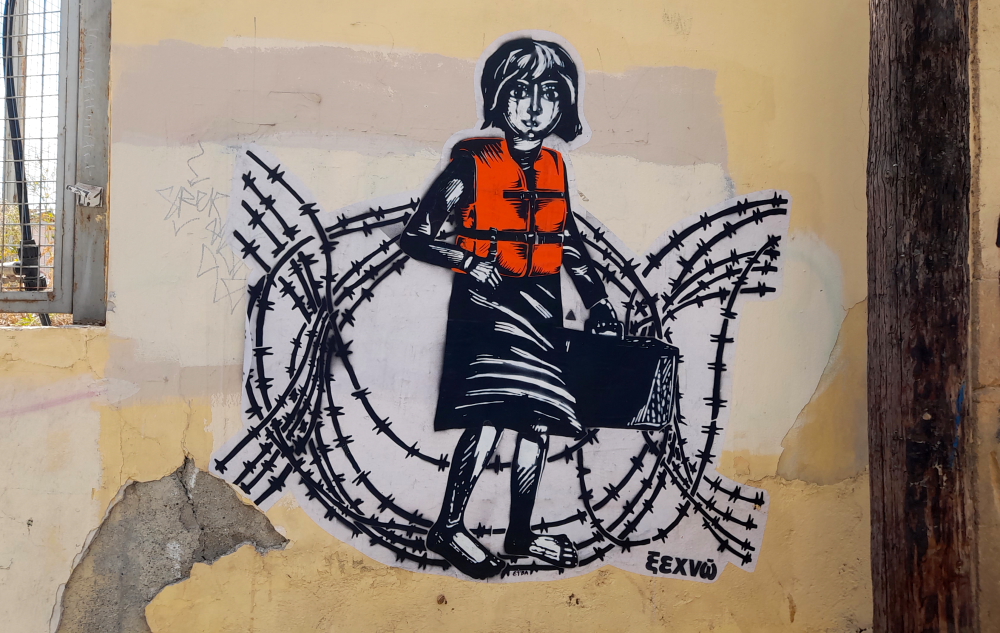
Nearby, some ‘Banksy’ style graffiti.
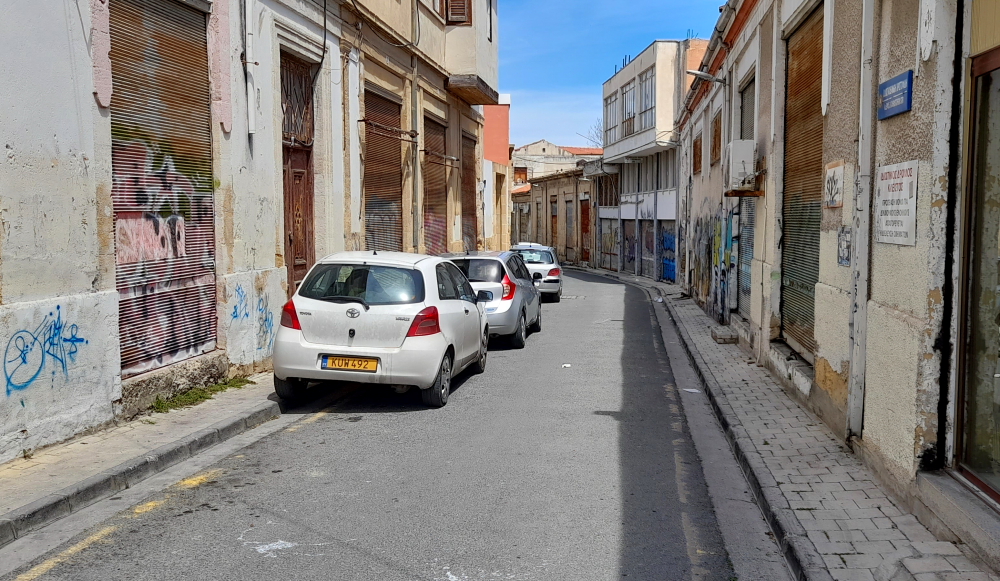
As we continue east in the now hot sun we realise that this section of town has become a re-construction zone – lots of abandoned buildings, construction sites and dust – so we also abandon the area and walk back to the car.
Next stop, the late 9th Century Church of St Lazarus in Larnaca which is a 47 km drive SE along the A1/A2.
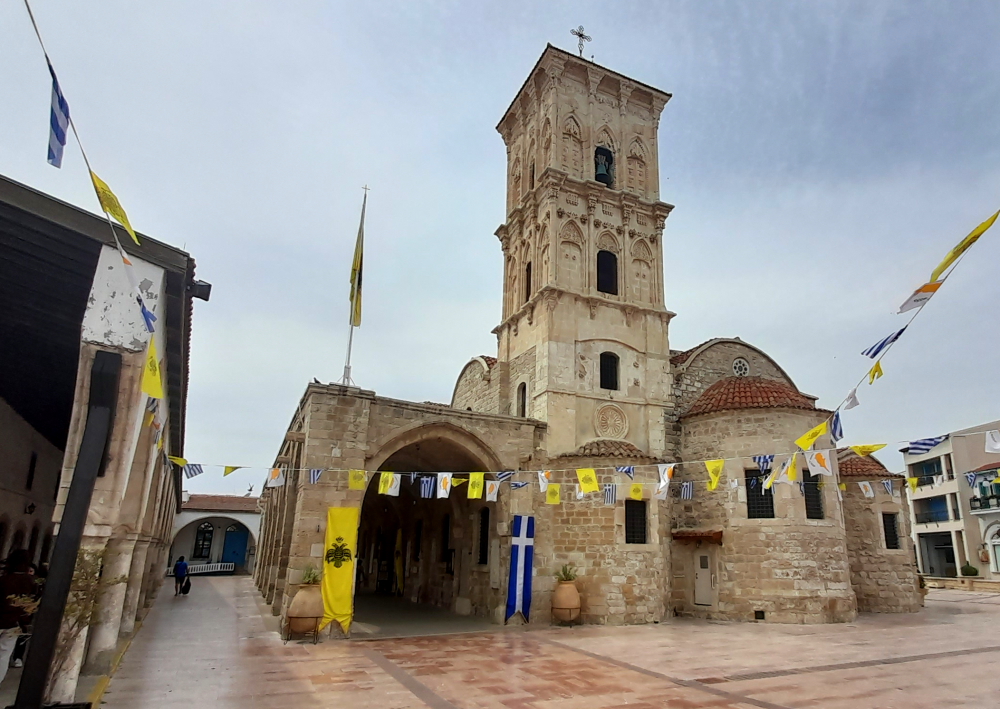
It’s named for the New Testament figure of Lazarus of Bethany, the subject of a miracle recounted in the Gospel of St John in which Jesus raises him from the dead. According to Eastern Orthodox tradition, sometime after the resurrection of Jesus, Lazarus was forced to flee Judea because of rumoured plots on his life and came to Cyprus. There he was appointed by Paul the Apostle and Barnabas as the first Bishop of Kition (now Larnaca). He is said to have lived for thirty more years and on his death was buried there for the second, and last, time. The Church of Agios Lazaros was built over the reputed (second) tomb of Lazarus.
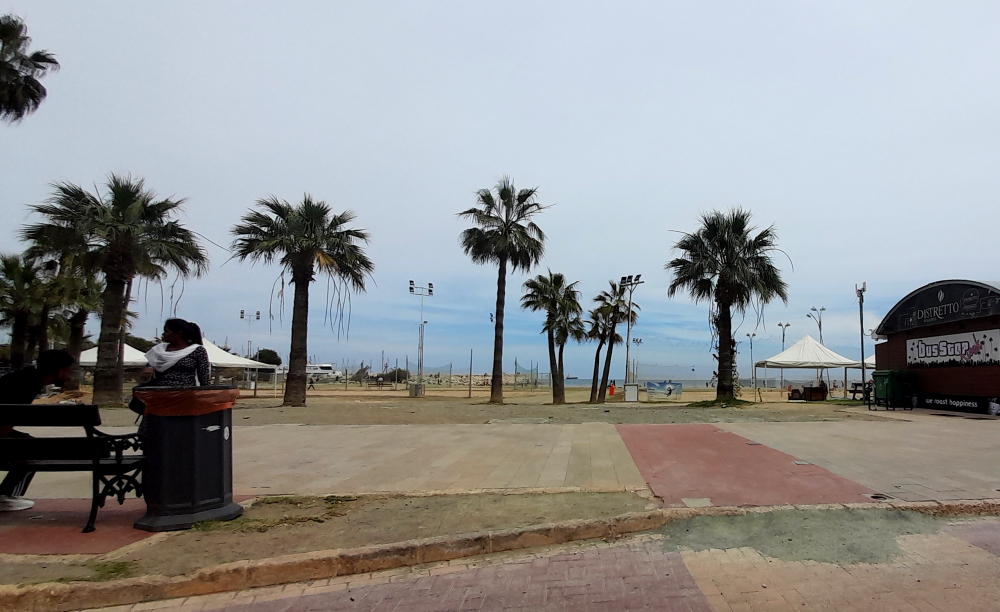
Driving along the promenade at Larnaca we both say, “Luckily we didn’t book here in Larnaca!” To the left the beach is dirty grey sand with rows of sunbeds and umbrellas, and the water is flat. To the right is a strip of hotels and crowded restaurants and cafes. And that’s about it.
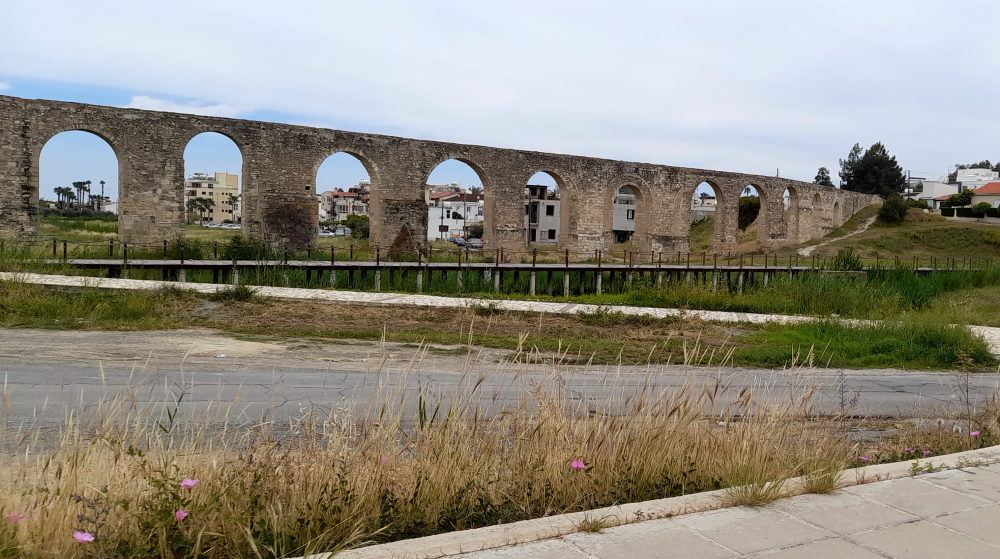
As we take the road out of town towards Limassol we come across an unexpected sight – the Kamares Aqueduct.
Entering Limassol on the A5 we are confronted with an ugly high-rise construction – totally out of character with the low-rise hotels opposite that line the beach.
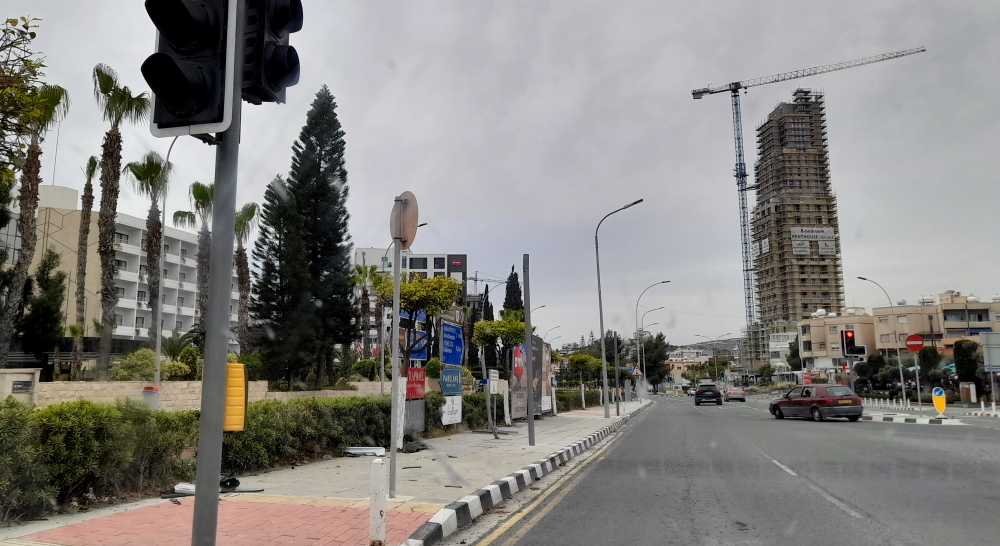
After inspecting the local beach and amenities again we say, “Luckily we didn’t book here in Limassol!”. There is very limited access to any of the beaches so if your hotel isn’t beach front then you need to have a pool. What’s the point of having a coastal holiday if you can’t access the beach?
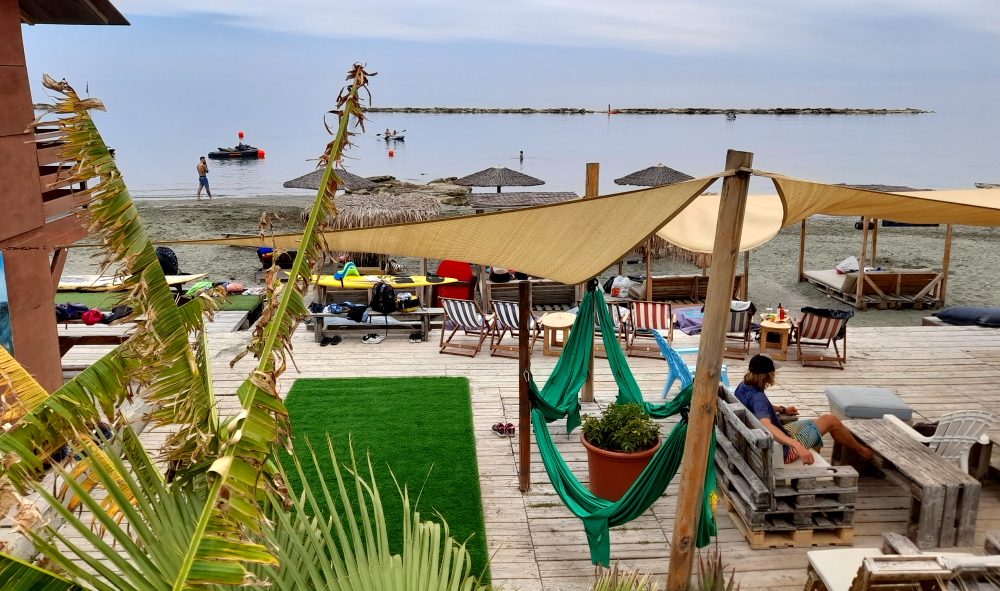
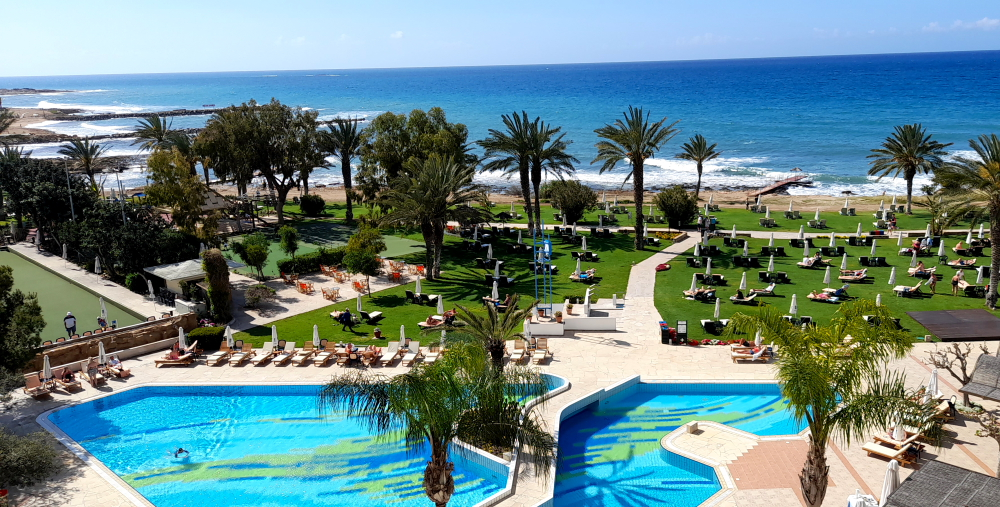
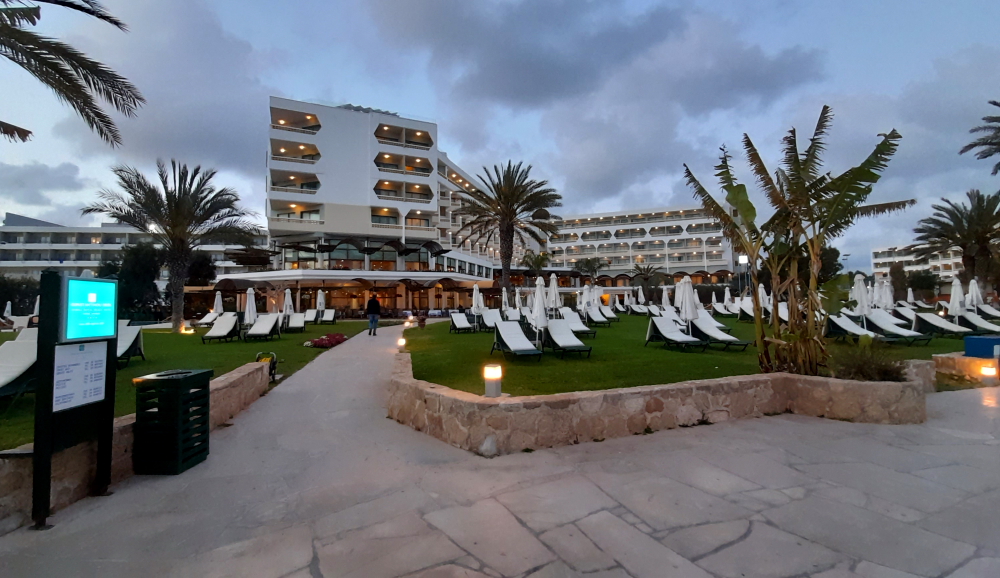
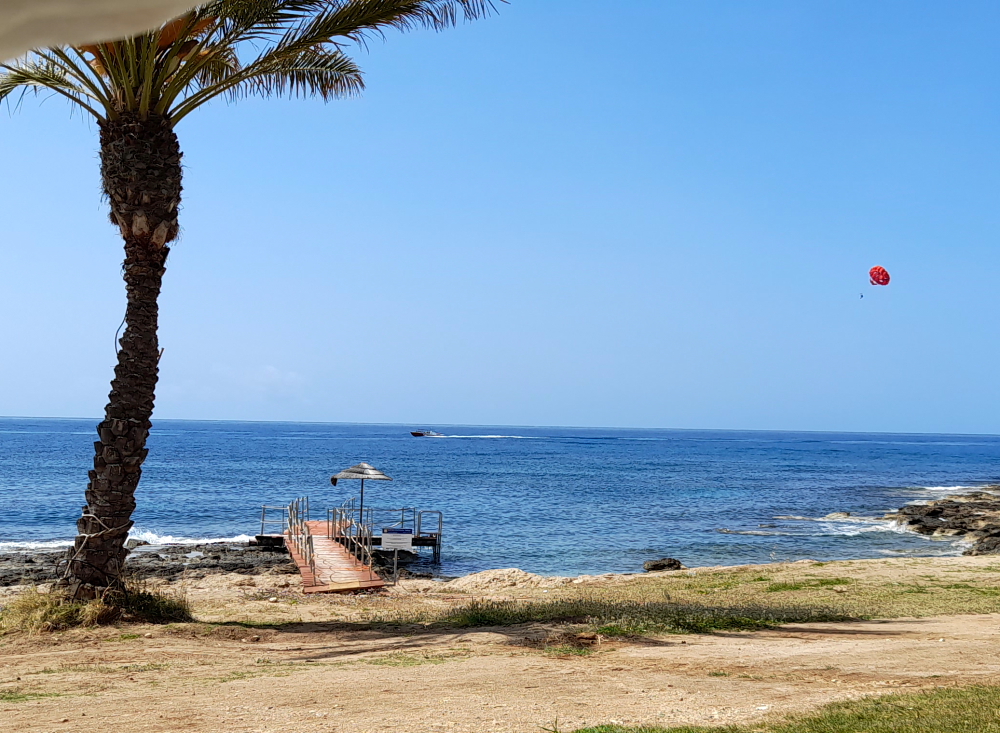
We have so much more available in Paphos in a far more picturesque setting and our hotel has direct access to a small beach and pier and the Med. We managed another 250 km driving today but a lot of it was on the freeway escaping Limassol.
17 April, 2023
For our final day of car hire we are going to investigate the western and northern coasts of the Republic of Cyprus. First stop is the Tomb of the Kings Archaeological Park. Once again we are charged the Retirees’ entrance fee – Euro0! Great value.
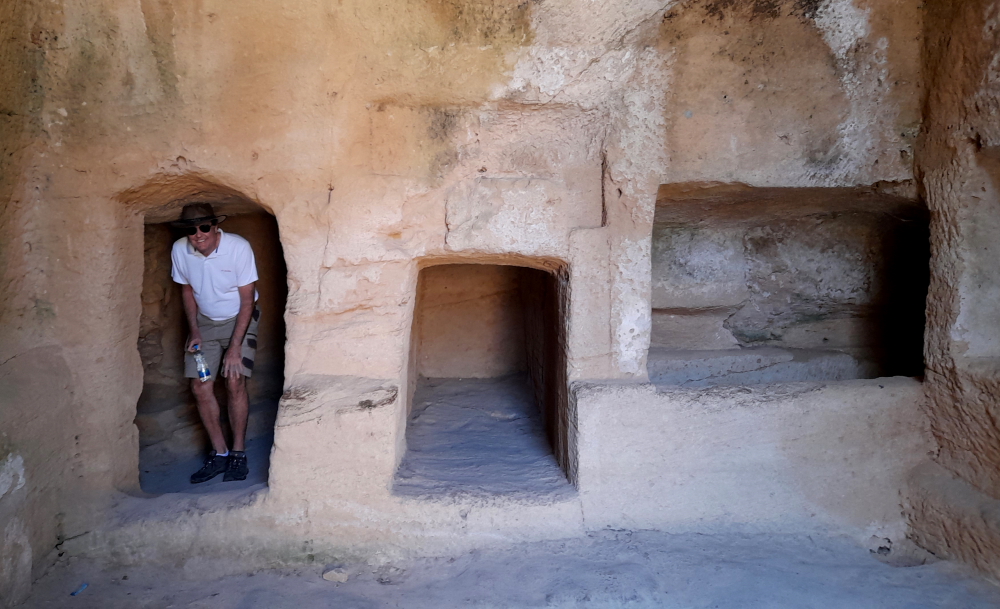
The site is a large necropolis lying about 2 kms north of Paphos Harbour. In 1980, it was designated a UNESCO World Heritage Site along with Paphos and Kouklia.
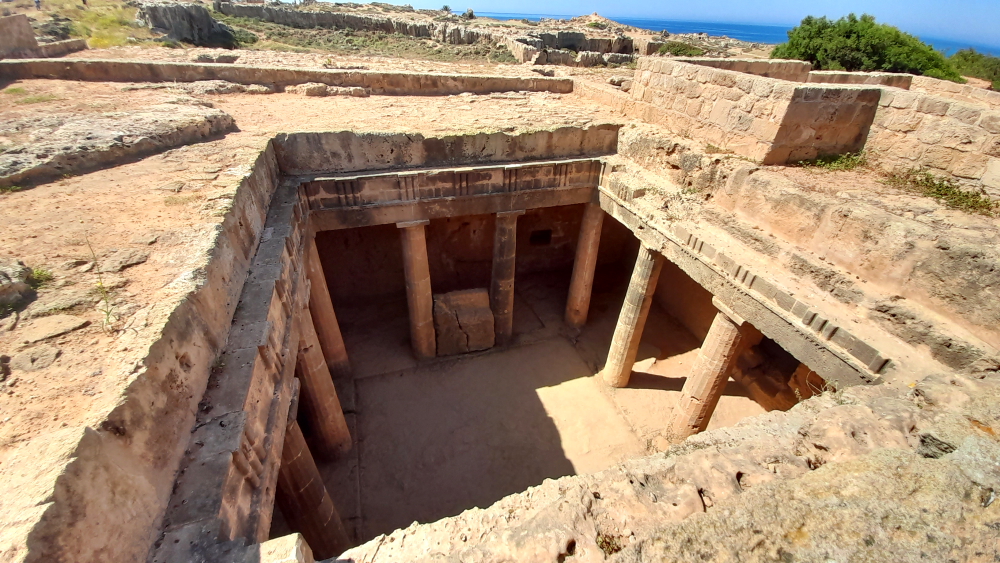
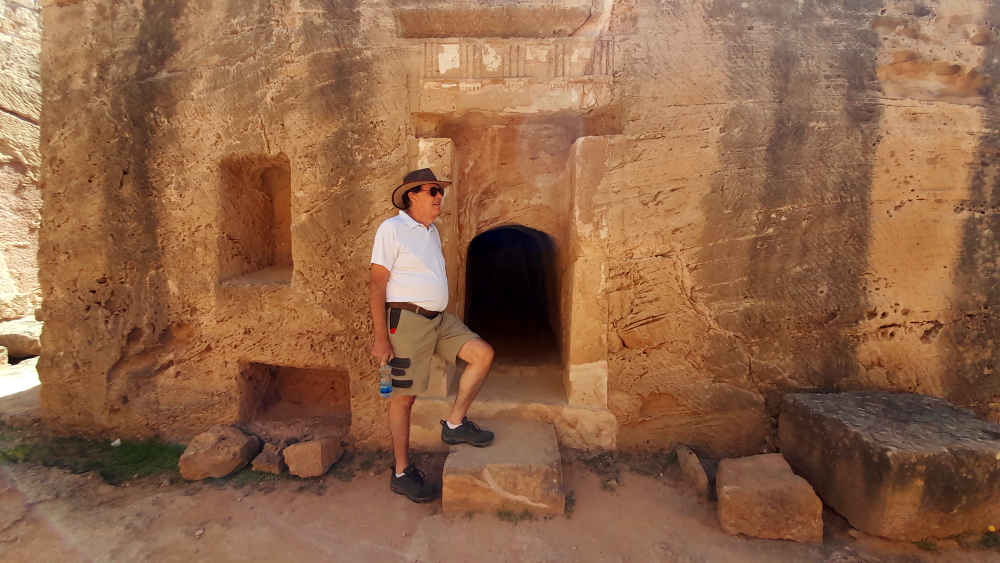
Some of the tombs feature Doric columns and frescoed walls. The tombs are cut into the rock and at times imitate the houses of the living.
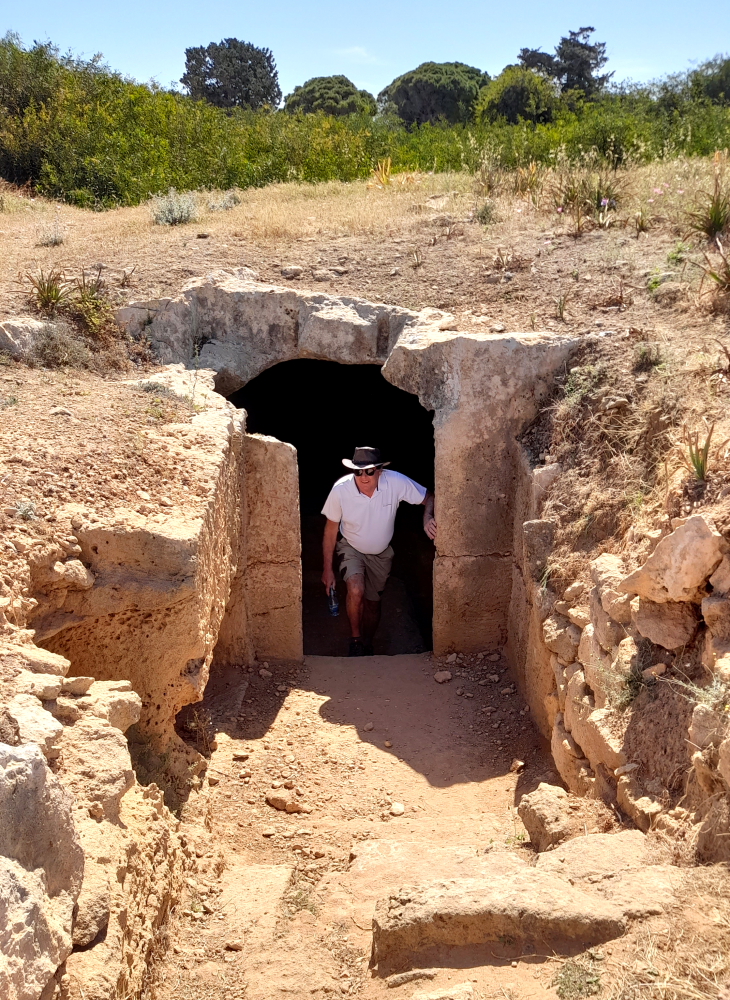
The subterranean tombs, many of which date back to the 4th Century BC are thought to have been the burial sites of Paphitic aristocrats and high officials up to the third century AD. The name comes from the magnificence of the tombs as no kings were in fact buried here.
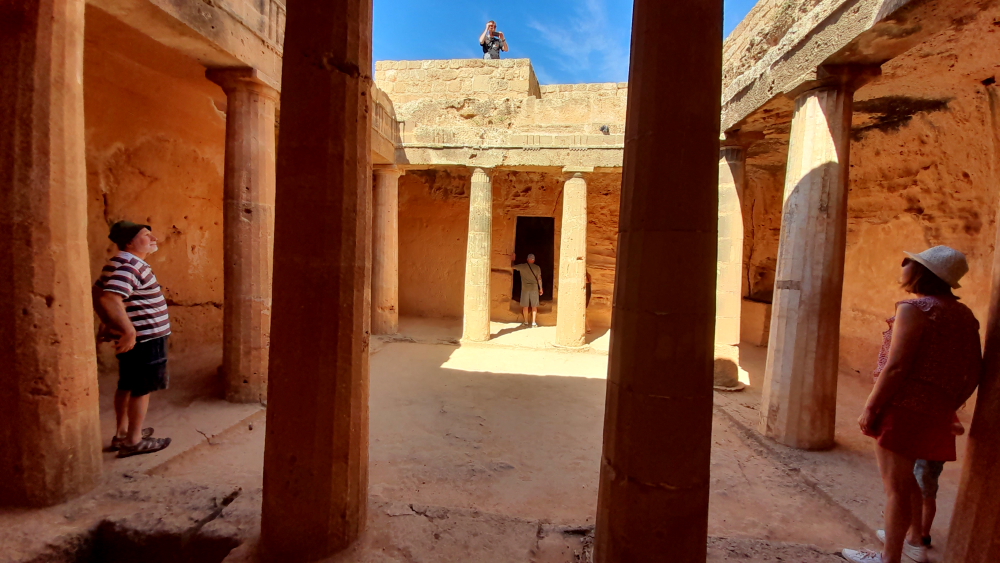
Part of the importance of the tombs lies in the Paphian habit of including Rhodian amphorae among the offerings in a burial. Through the manufacturing stamps placed on the handles of these amphorae, it is possible to give them a date and, through them, the other material from the same burial.
This put to rest my cynical and ongoing commentary that it was a disused quarry where the quarry workers lived underground in the cool but I don’t think so. A some time it is obvious by the stone cutting marks that large numbers of stone blocks were excavated from this site with tools and methods similar to the Egyptian processes that we saw in Egypt. At some stage or stages in this area’s history this was a quarry site.
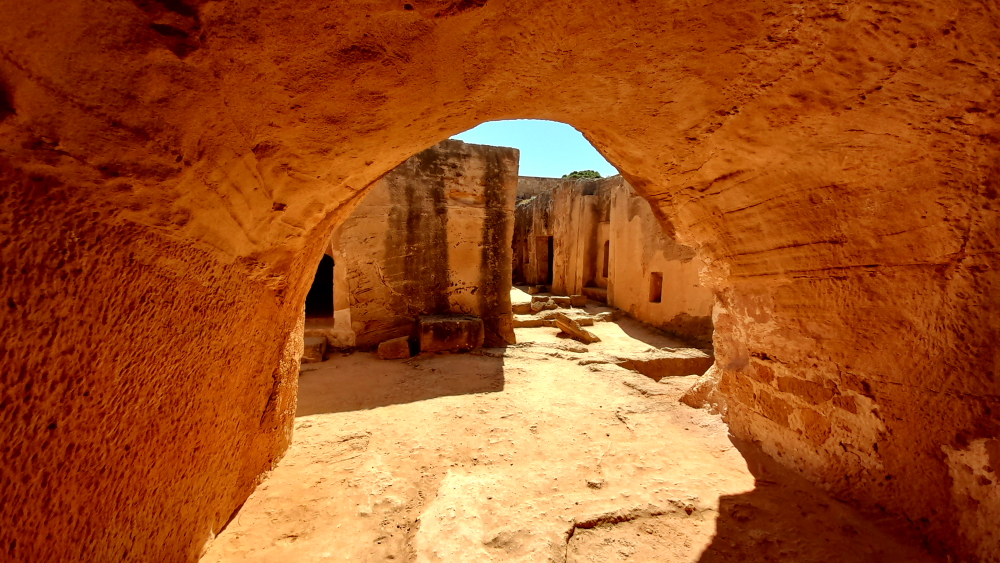
Interestingly, the Australian Archaeological mission to Paphos is assisting with a publication about the finds.
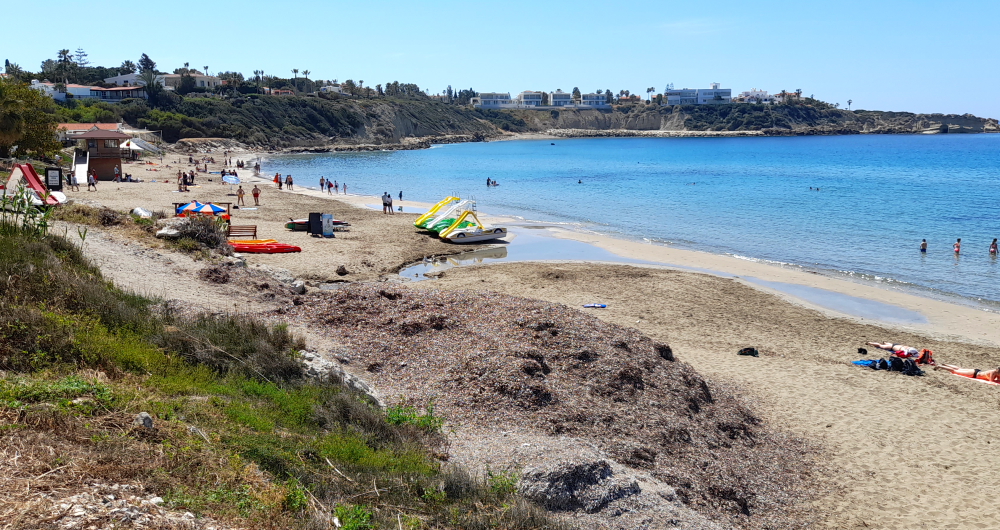
Driving 11 kms north we arrive at Coral Bay – with lots of British-style cafes, pubs and restaurants – and its beach, surrounded by some very nice houses and villas but for most visitors you would need to drive here to utilise the beach.
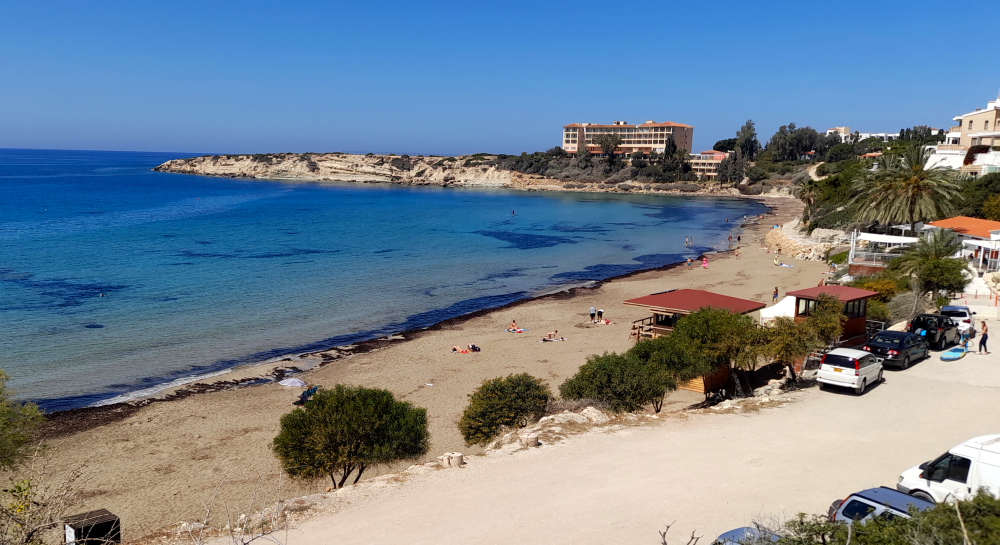
Quite a nice bay and beach today but it would be heaving and baking at the height of summer with a limited capacity car park.
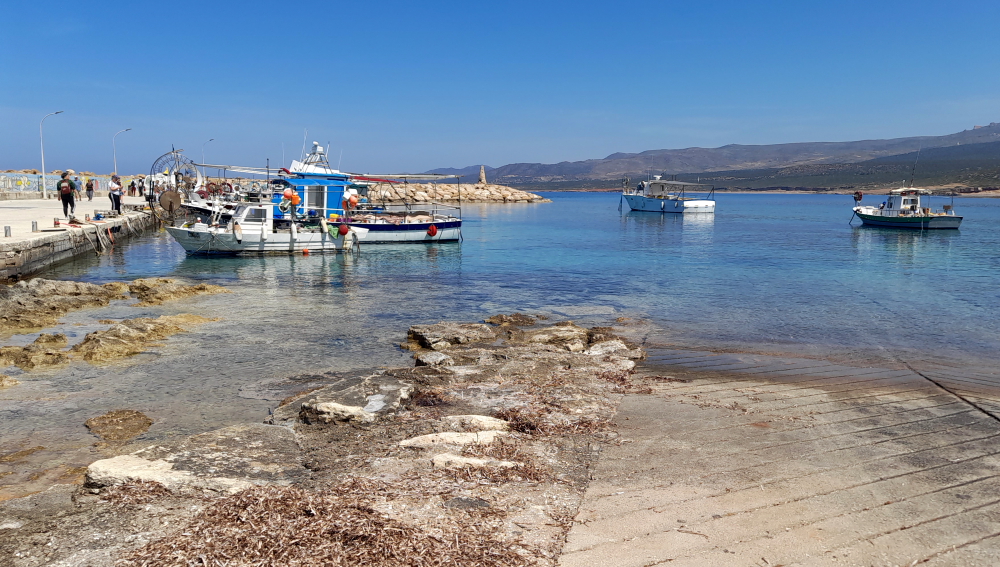
11 minutes’ drive further north we arrive at the marina and mill-pond sea at Agiou Georgiou Pegeias.
We wanted to drive further north to investigate the Avakas Gorge in the Pegia State Forest but Google Earth showed that we’d have to drive on dirt roads to get there, the avoidance of which is part of our car rental agreement.
Retracing part of our route so far we drive east, then north, to the Baths of Aphrodite situated on the NE coast of the Akamas Peninsula.
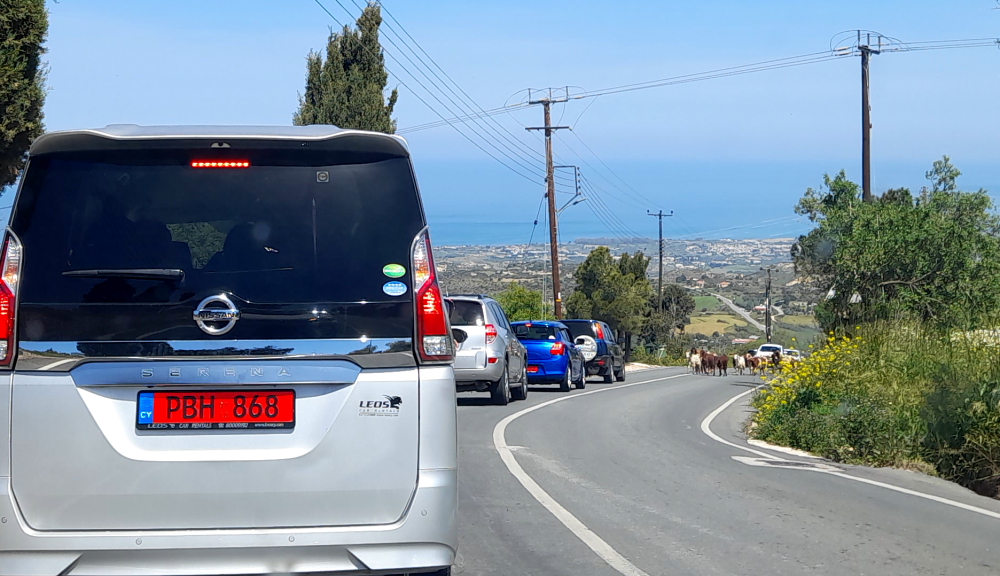
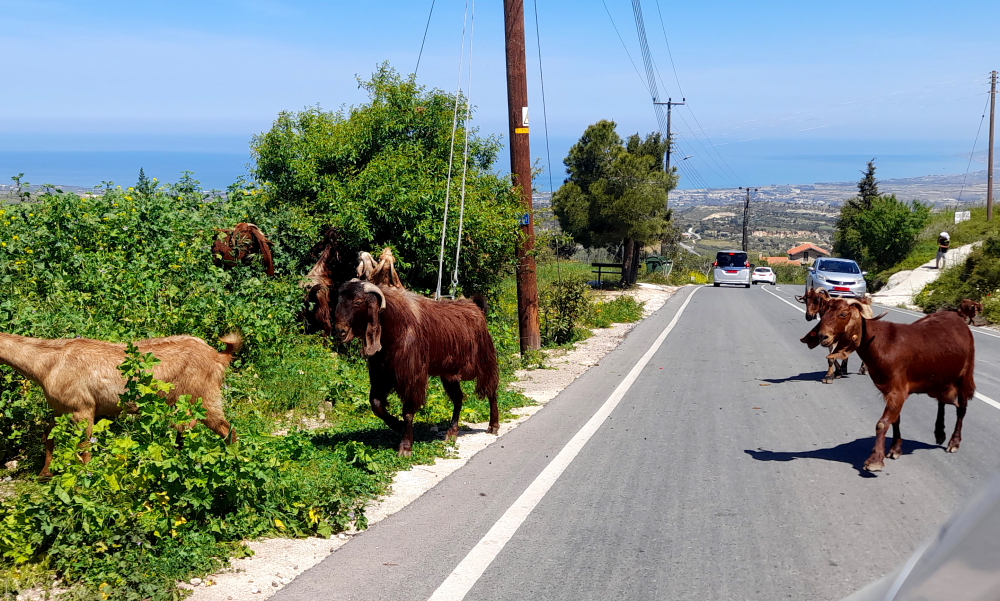
Just as we summit the hills and get a view of the sea and the town of Prodromi in the distance we hit a traffic jam. Seriously??!! It’s only when we inch around the bend that we see the cause of the jam – a seemingly never-ending herd of goats crossing the road.
50 minutes after we left our last stop we arrive at the crowded car park for the Baths. Luckily we get the last car parking spot and follow the path through a small botanical garden, complete with a stand of gum trees, to the Baths which is packed with the public holiday crowd of tourists.
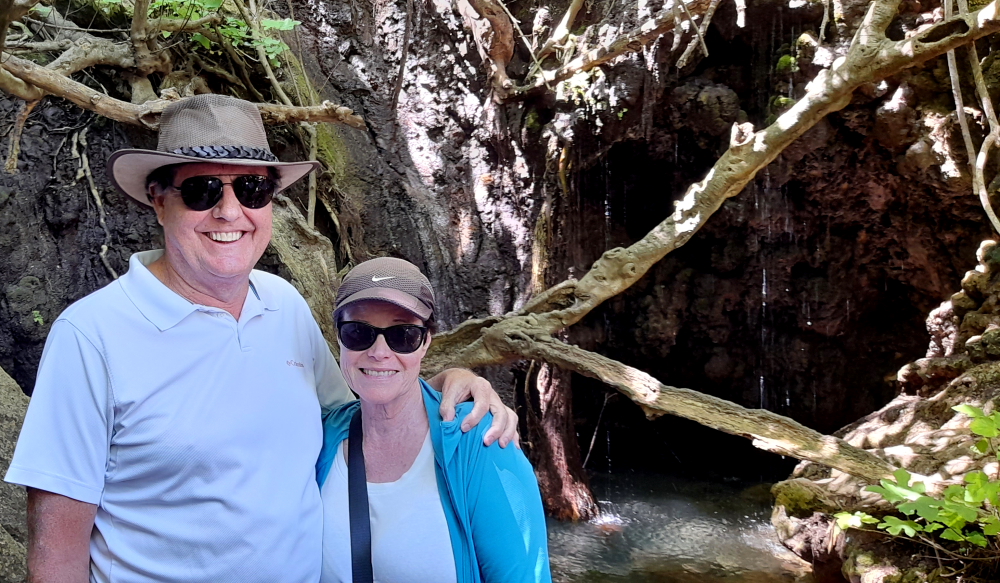
Underneath an old fig tree, shaded from the warm Cyprus sun, is a small natural grotto. Water flows down a wall of rock and forms a pool amongst the moss. It is here that legend says Aphrodite would come to bathe. According to Greek mythology, she met her lover Adonis at the pool when he stopped for a drink while hunting.
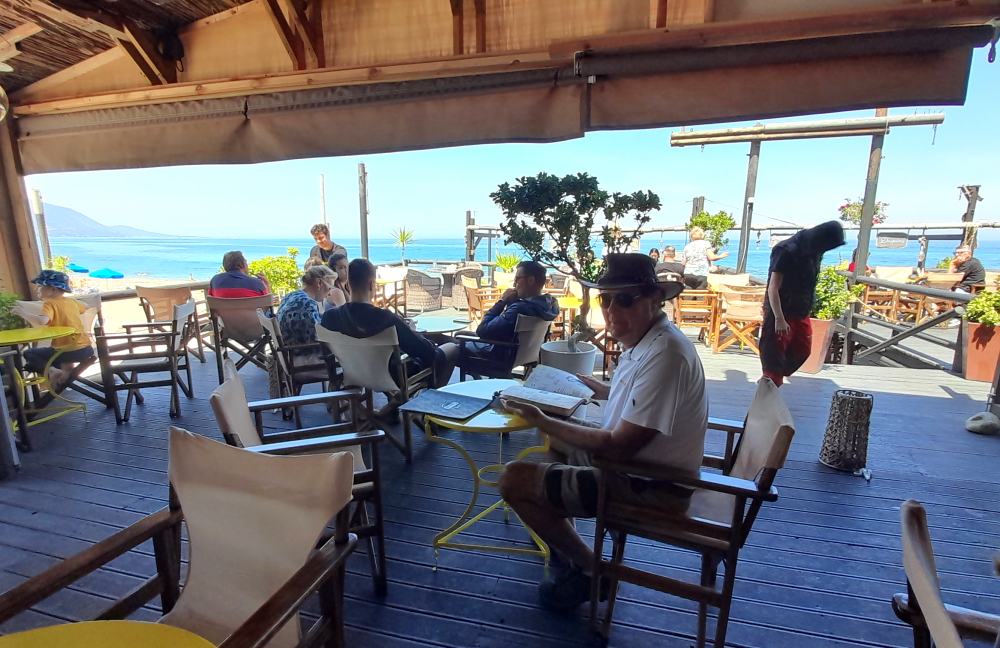
Time for a pit stop so we drive back and park near a beach bar at Latchi. We were quite taken by the small village of Latchi with its beach, marina, bars and restaurants and quality-looking houses and villas as we drove through on our way to the Baths.
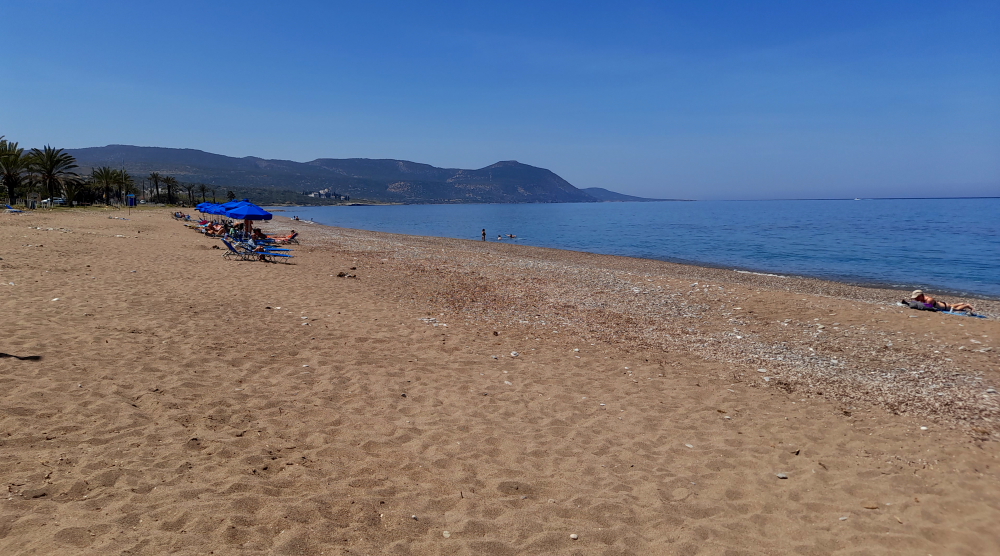
We arrive and order just in time as a crowd of people arrive just after us. A pint of Heineken and a chocolate milkshake later we’re ready for the hour drive to our penultimate stop – the monastery of Agios Neophytos on a wooded hill area above the village of Tala and 15 kms west of Paphos.
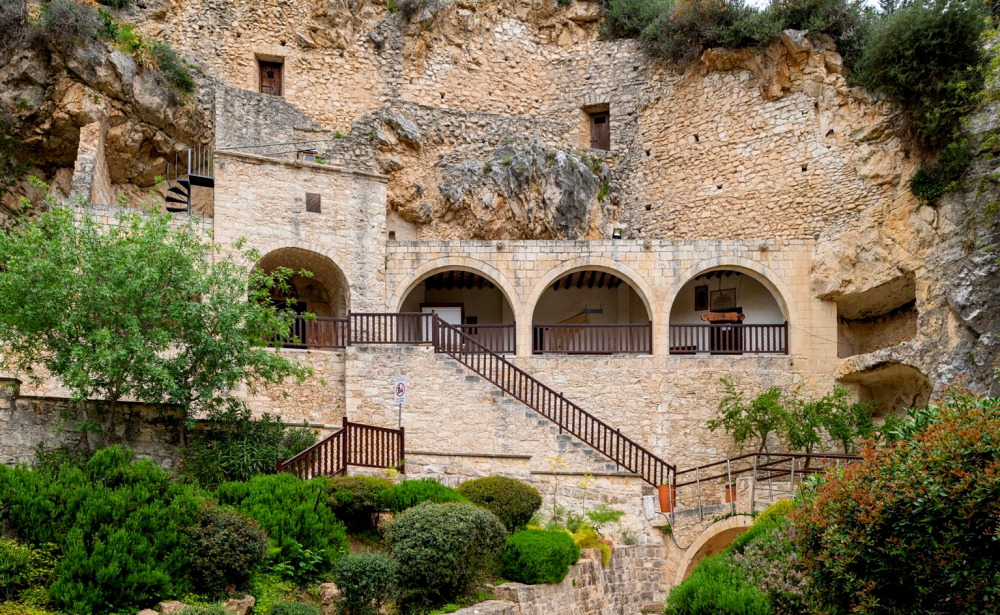
It was founded by the monk and recluse Neophytos in 1159. The property is currently a museum consisting of the Engleistra (Place of Seclusion, built in a natural cave, with a small chapel) and the Monastery.
The majority of the wall paintings completed in the original Engleistra portion of the monastery during Neophytos’ life were done by Theodore Apsuedes in 1183, decorated in the traditional Byzantine style.
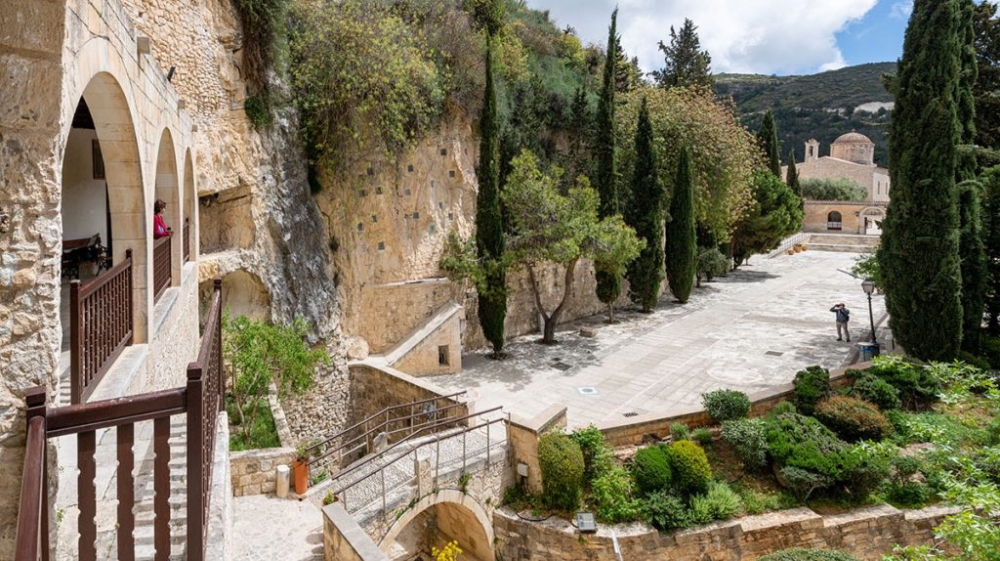
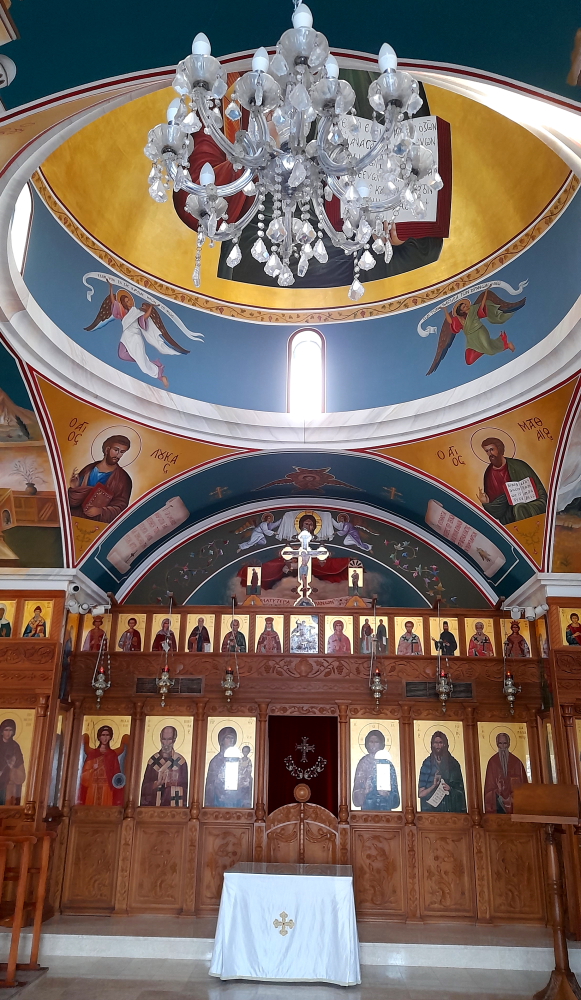
Outside of the Engleistra sits the main church of the monastery, the katholikon. It is a large Venetian-inspired basilica probably built during the early 16th century. It is very atmospheric with lots of pictures of saints covering the walls and the domed ceiling supports three large chandeliers. Unfortunately, no photos are allowed.
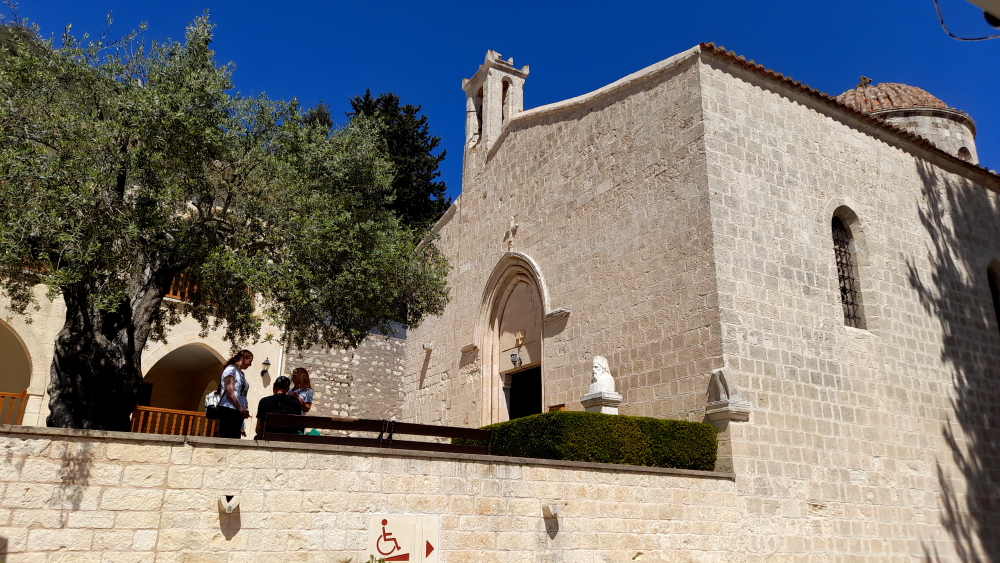
The Monastery has always had a small community. The monks today promote the publication of historical manuscripts written within their walls in order to preserve their history.
Tonight the hire car company will collect the car from our hotel so we don’t have to do anything but leave the car keys with reception. We have managed to drive over 680 km in the past 3 days. A least we have seen a lot of the Republic of Cyprus.
18 April, 2023
Today has to be the warmest day so far in Cyprus so the plan is to relax by the pool all day but first we have to take this week’s washing back to Kristia at the laundry. Our next available laundry is over a week away in Copenhagen.
At least we will have some form of sun tan from our two weeks in Cyprus. In hindsight we probably needed to come here a week later in the year and stay for three weeks instead of two. Our first week was a little spoiled due to our colds and the chilly, cloudy weather. Our second week was much nicer and we are now very relaxed before we have three months of full-on travel.
19 April, 2023
We don’t have to check out until midday today and our transport to the airport doesn’t collect us until about 3:00 pm so I plan to do some blog catch up since I have been a bit slack and haven’t done a bloody thing since we collected the hire car last Saturday.
Lynn is still up early (therefore she makes sure that I am also awake). She plans to do a last-minute trip to the pharmacy to get a few more packets of blood pressure meds.
After a leisurely breakfast we pack our suitcases and I get stuck into doing the blog. After we check out at midday we find a nice place on the ground-floor lobby with a power point and a desk away from the other checked-out guests.
By 3:15 pm we are on the transfer bus and headed to the airport. 5 hours on a very basic plane with rock hard seats and without an entertainment system seems an eternity.
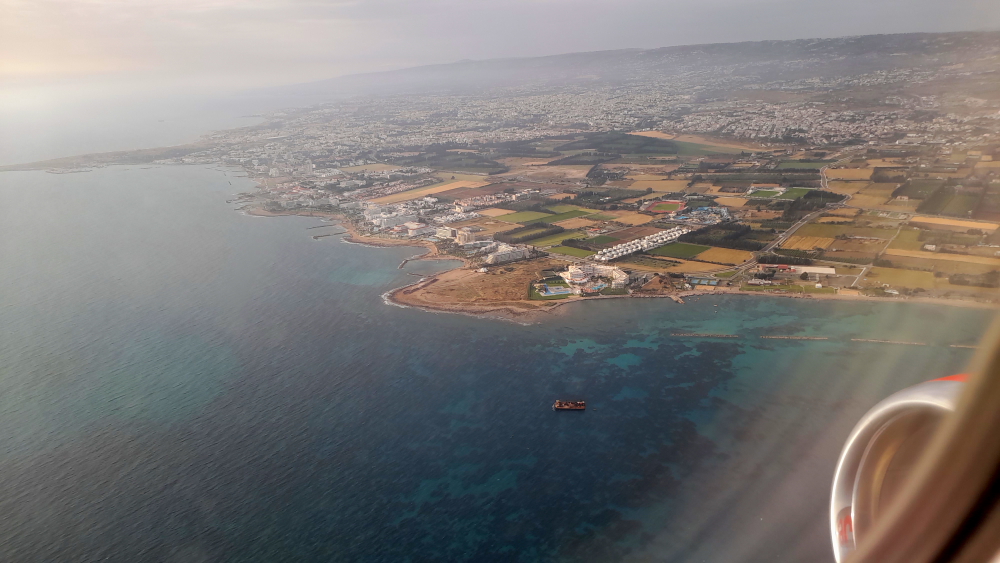
Since we won’t be getting in to Belfast until 11:00 pm Cyprus time we ordered a meal on the plane. We won’t do that again. It was the epitome of very bad airplane food.
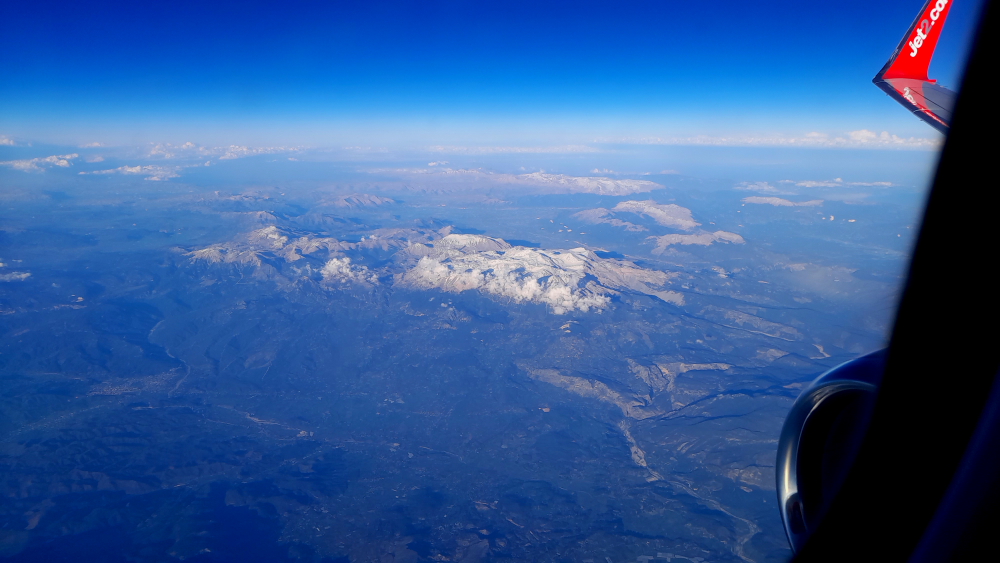
After a long day it is nice to just be able to walk 50 meters to the hotel after we collected our luggage at Belfast International Airport.
20 April, 2023
We wake up later than we planned this morning thanks to a failure of Lynn’s phone alarm failure. However it worked out for the best as we were told that the breakfast room would be very busy this morning so we had planned to eat by 7:00 am. We rolled up for breakfast at 8:00 am and the place was almost empty.
After a reasonable breakfast we took our time to repack and checked out at 10:30 am and headed across the road to the bus terminal where we boarded the 705X Aircoach to Dublin airport.
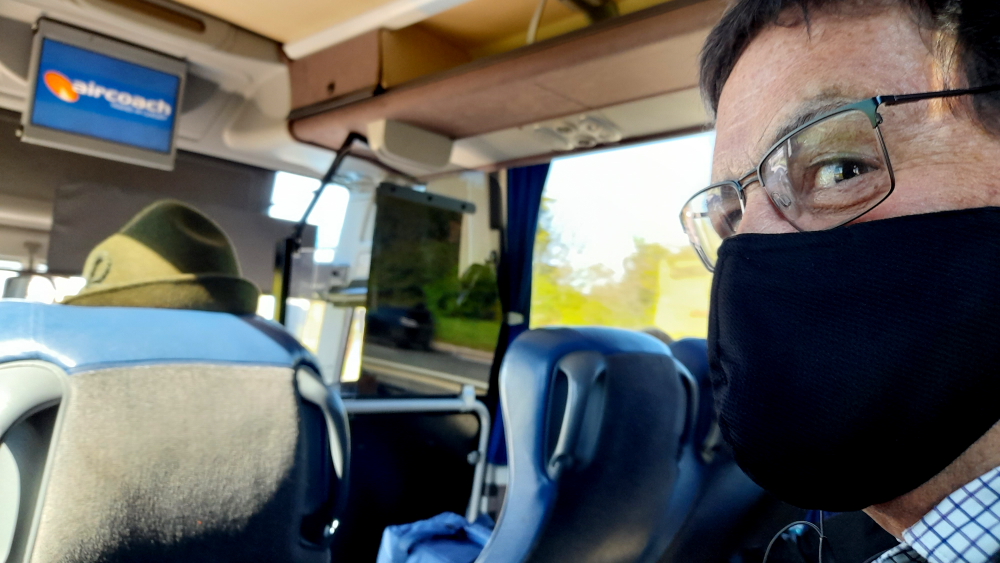
We are staying at the Radisson Blu Hotel at Dublin airport tonight in preparation for our 1:15 pm flight tomorrow to Copenhagen.
We checked in to the Radisson at about 2:00 pm and were given an upgraded room on the top level. The hotel is being repainted so there is a strong paint smell but the room is very nice and we will have dinner at their very nice restaurant this evening.
Lynn is fascinated by the hotel’s wall clock in the lobby. This should keep her entertained for a while.
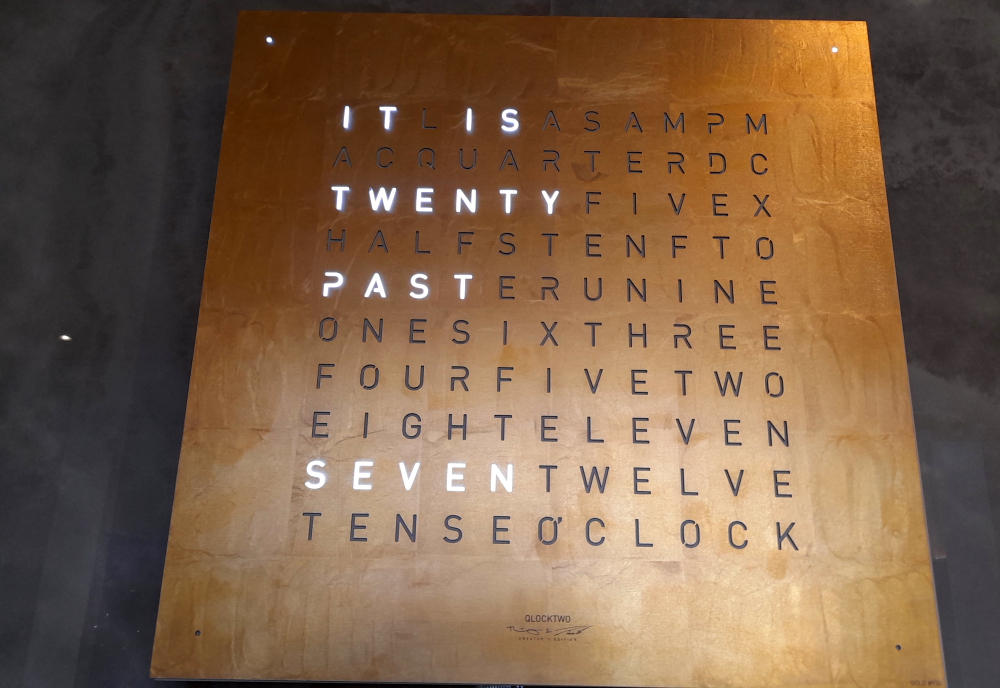
Lynn has some ironing to do tonight then it will be an early night and hopefully her alarm will go off in the morning.
I will start a new blog page tomorrow to mark the first leg of our three month Scandinavian road trip.
 THE CONTINUING TRAVELS OF YOGI & BOO BOO