
27 March 2024
As it’s Easter break we decide to depart at 10:30 am to arrive at LeShuttle terminal early. We’re booked on the 2:20 pm train so don’t need to be there until 1:20 pm for check-in, but we have a flexible ticket so may be able to board an earlier train.
I put the terminal co-ordinates into the car GPS, selecting ‘avoid toll roads’ only for it to tell me that the route we are to take, via the M25, that the tolls are unavoidable.
Thank goodness Lynn does the same with her MapsMe offline maps and informs me that we can, in fact, get there toll free, following the A20/M20 to the 11A exit from the M20 straight to LeShuttle check-in booths where we arrive at 11:45 am.
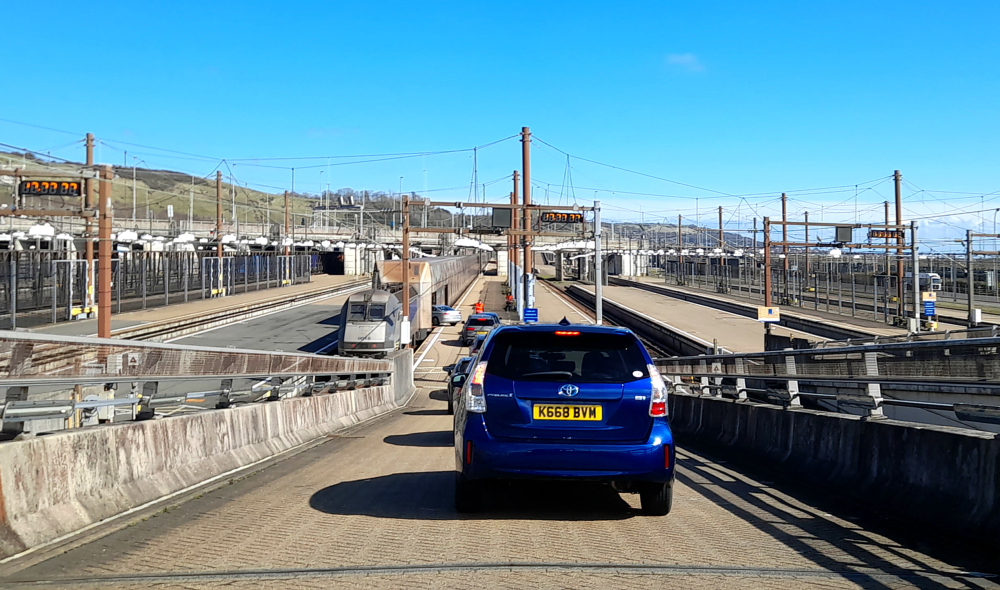
Unlike the last 2 times we’ve used LeShuttle we don’t get to drive straight onto the train, thanks to the crowds. Rather we park and wait in the terminal over a coffee for 55 minutes until we get the call at 12:45 pm to proceed through both passport controls and drive onto the train.
Promptly the train departs at 1:15 pm and we arrive at Calais some 35 minutes later.
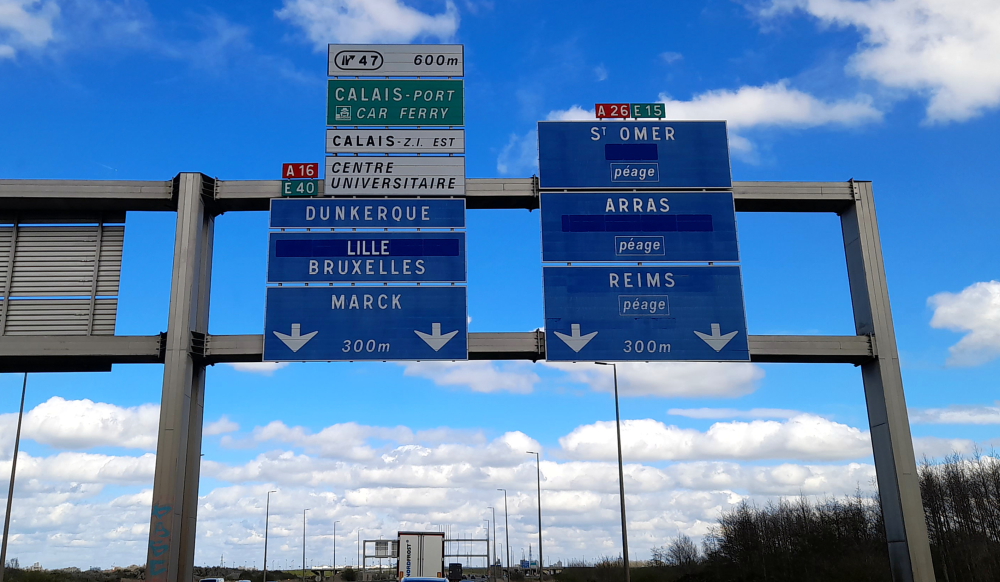
In Dunkirk, our apartment is a block back from the beach, east of Malo-Les-Bains.
We follow our usual drill: unpack then drive to our nearest supermarket (Leclerc) for provisions. As today is Wednesday and Friday is Good Friday when all the shops and presumably restaurants will be closed, we plan to eat in tonight and Friday night. We drive to Luxembourg on Easter Saturday.
Fortunately, we find some English-speaking movies on YouTube and watch the hilarious 1976 ‘The Cheap Detective’ starring Peter Falk (of Columbo fame) and this movie’s send-up of ‘Casablanca’ and ‘The Maltese Falcon’.
28 March, 2024
One thing we do love about France is the use of window shutters for blocking out light and noise. When we wake we discover we’ve slept for 11.5 hours!
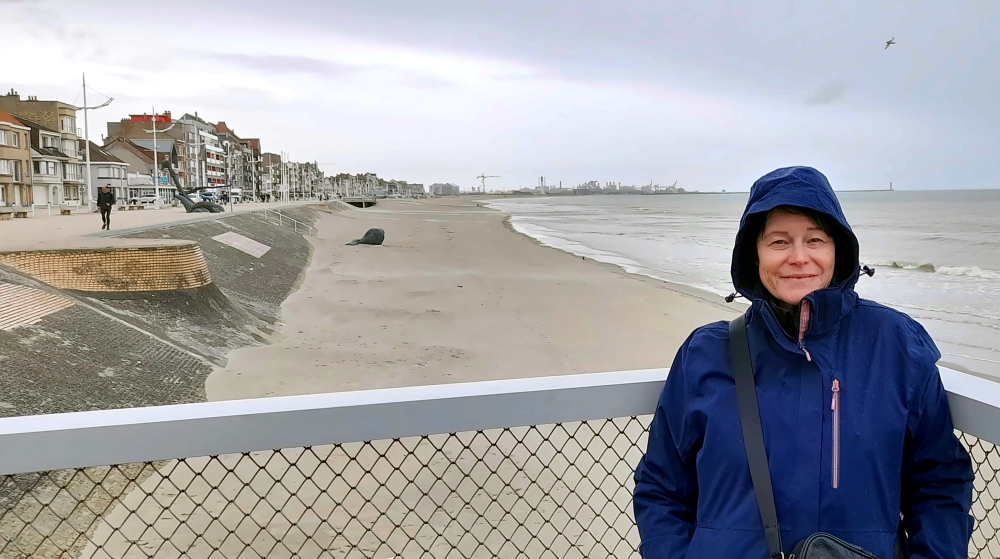
Although it’s raining lightly and quite windy, we still venture outdoors to view the famous beach.
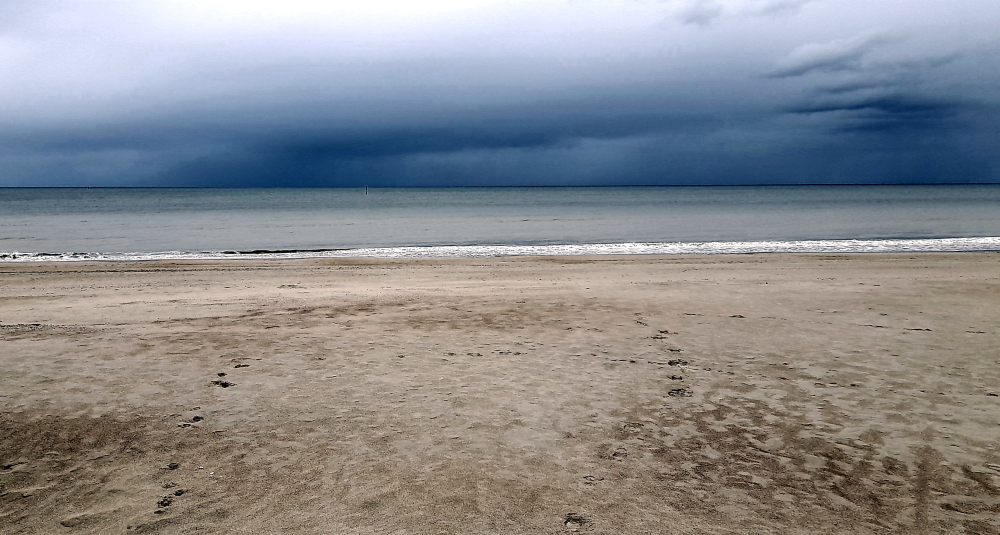
In May and June of 1940, Dunkirk was the scene of a major turning point in history. During the Second World War, the famous Operation Dynamo succeeded in evacuating more than 338,000 soldiers to England, in only nine days.
The relative calm of the “Phoney War” period that followed the 1939 declaration of war between Britain and Germany suddenly ended on 10th May 1940, when Germany launched an attack on Holland, Belgium and Luxembourg. In the space of just a few days, the German army had pushed through and the allies were retreating towards the North.
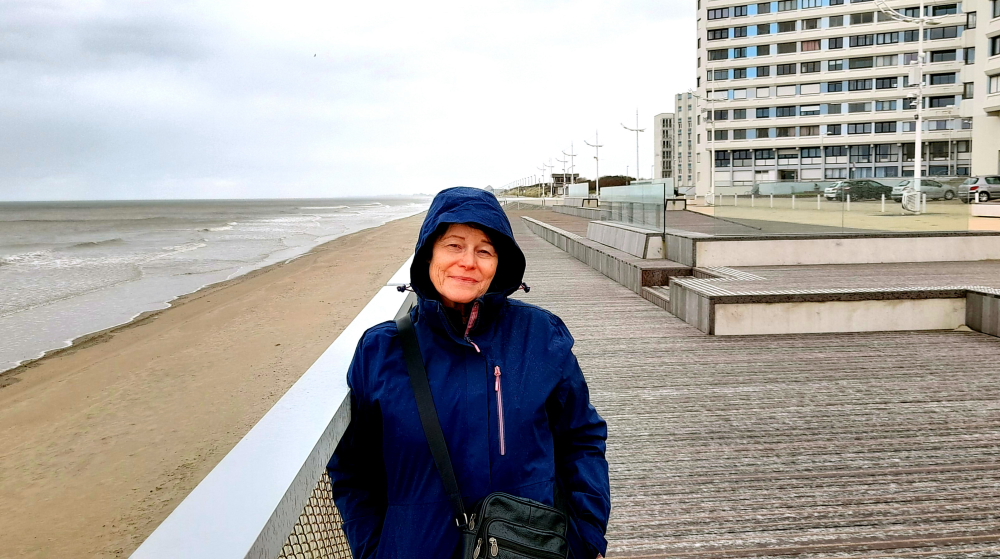
Fearing that its troops would be trapped, and judging the battle to be lost, Britain decided to evacuate the troops retreating on Dunkirk by sea. Admiral Ramsay led the evacuation, which the British called ‘Operation Dynamo’.
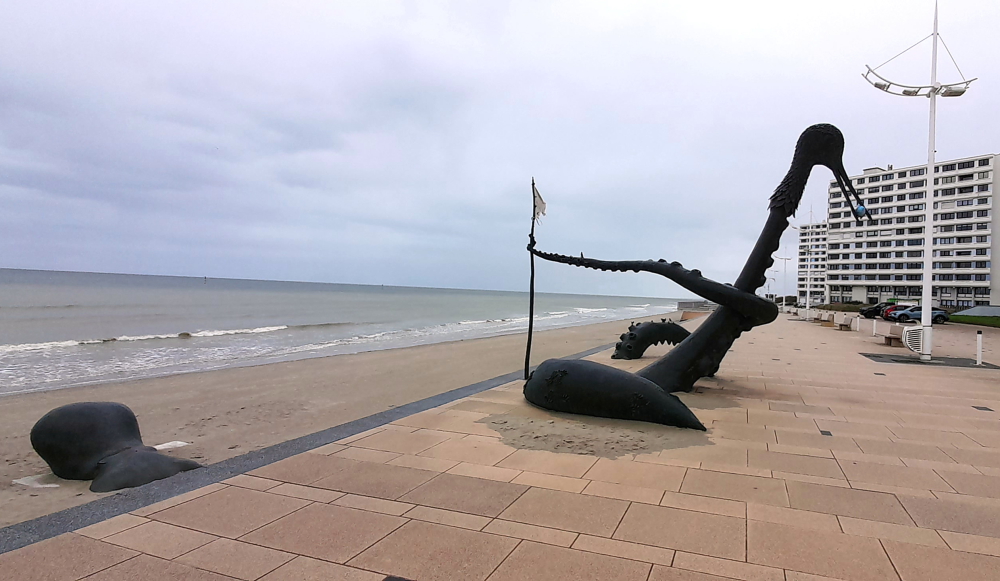
England sent over everything and anything that could float: warships, commercial vessels, fishing boats, sailing boats, barges and “little ships” that had never before been more than a few miles off the coast. Under continual aerial attack, more than 330,000 allied soldiers, including 120,000 French and a few thousand Belgian soldiers were evacuated through Dunkirk, and about a third of the soldiers left from the beaches. 40,000 soldiers were left behind and taken prisoner. Most of them belonged to the divisions in charge of slowing down Germany’s advance, a crucial element in the operation’s success.
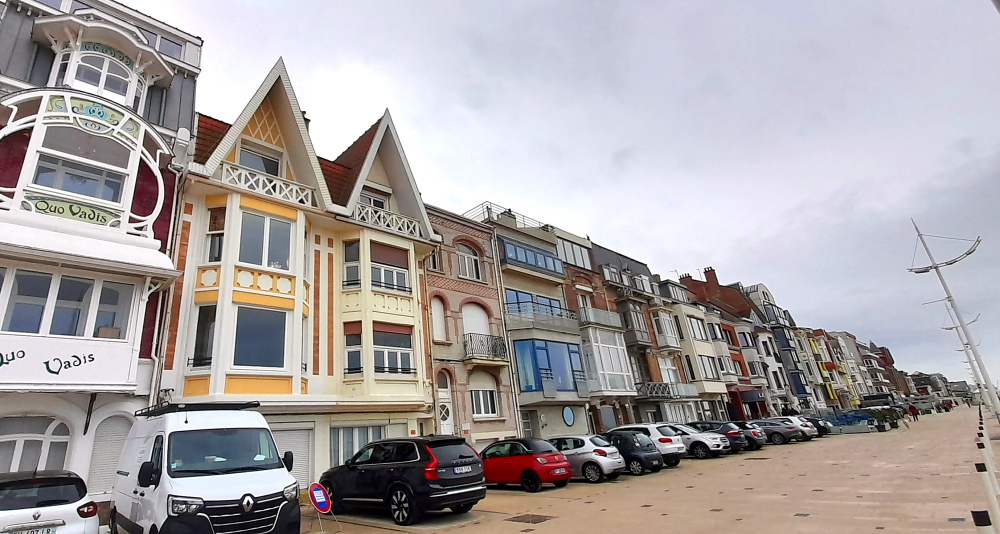
Today there is a road that runs parallel to the beach, Digue de Mer (sea wall), upon which there is a variety of buildings – both ‘new’ high-rise and the more traditional houses, often with cafes, bars or restaurants on the ground floor.
And the usual beach-side sights: a building for emergency services …
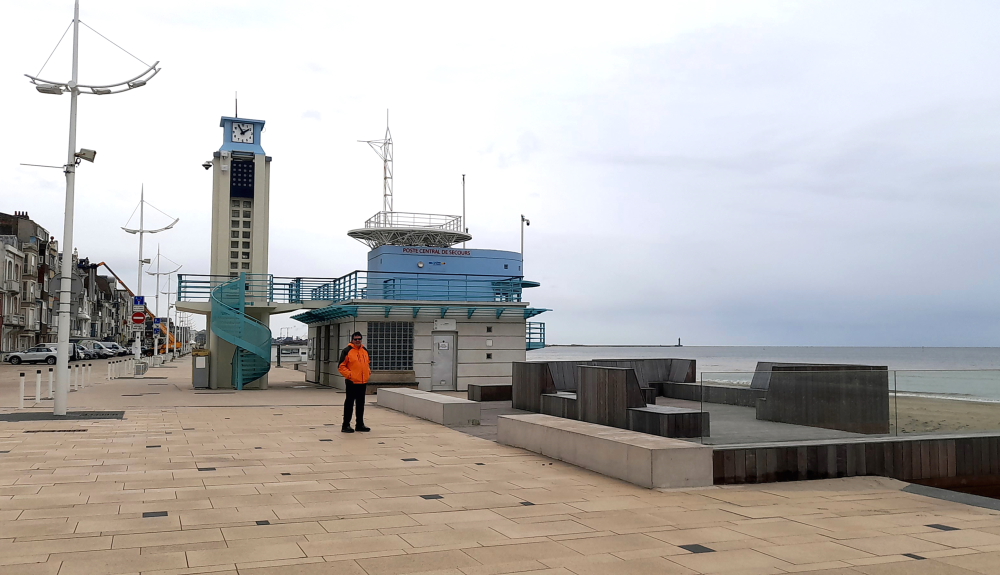
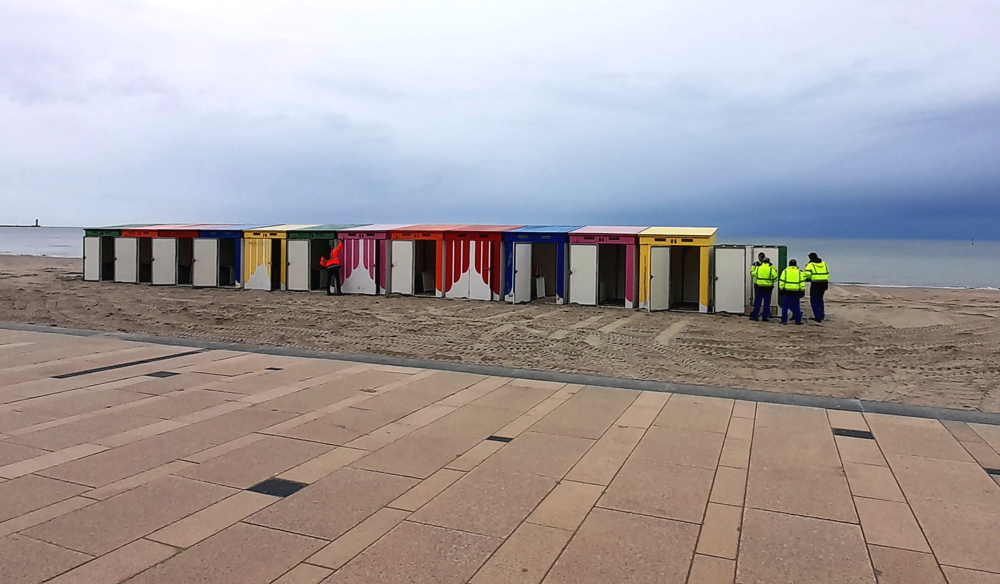
… and colourful beach huts. Thank heavens that Australia has maintained that the sea and river fronts are common property and nobody can “own” or build on the shores or rent out space on ugly sun beds, etc.
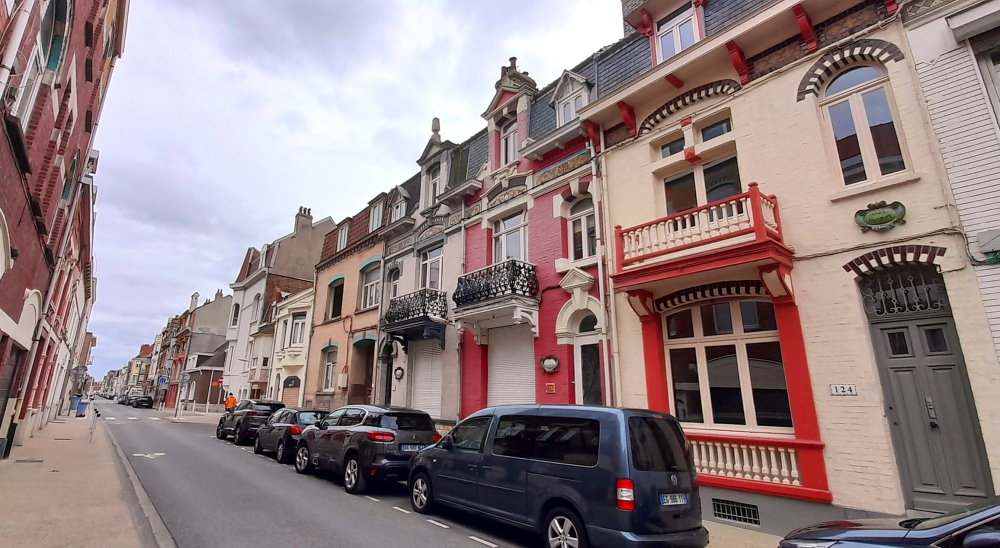
Surprisingly, given the war, most of the houses in the side streets still retain their French-ness, the rest are ‘modern’ brick monstrosities.
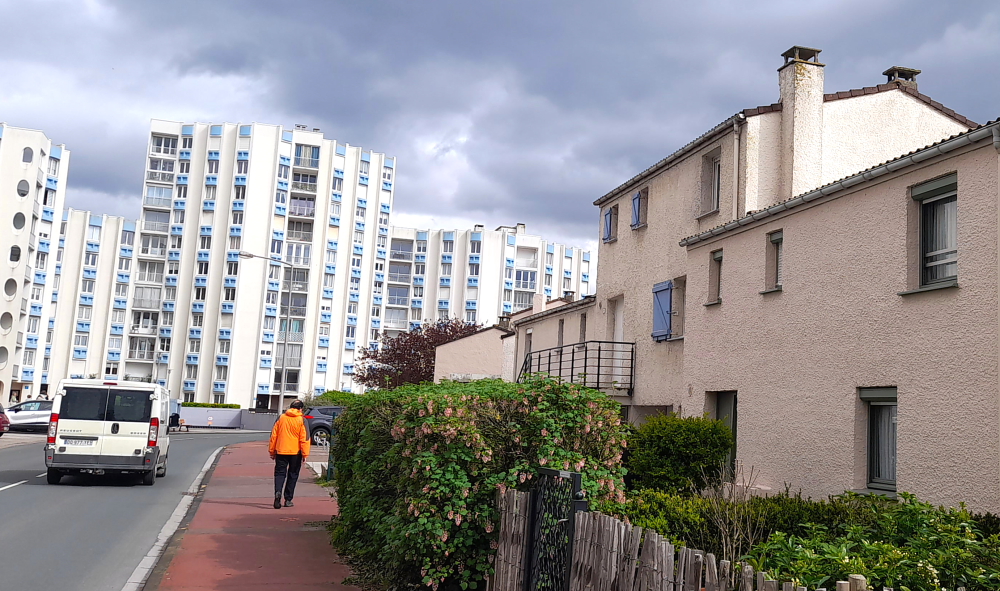
We return to our apartment which is a 3-story building amongst 2-story dwellings that have that rural village cottages look. Unlike its rustic exterior, the apartment has been renovated inside creating quite a spacious apartment with an outdoor terrace.
Given our coastal location, we’re going to forego the usual ‘moules’ and try the local sushi house for dinner this evening instead.
29 March, 2024
As we have about a 3.75-hour drive to cover the 396 km to our next destination in Luxembourg we depart at 10:05 am in 10 Deg. C and rain. We should arrive around 1:50 pm.
Our route will take us past Bruges, Ghent, around Brussels and Luxembourg to the Mercure Kikuoka Golf & Spa about 25 minutes’ drive SE from Luxembourg City – essentially we will drive the length of both Belgium and Luxembourg finishing 10 minutes’ drive from the German border at Remich.
12 minutes after departing we cross the border into Belgium. Soon after I get an error message on the dashboard console: “Air con has been stopped due to engine high temperature.” WTF??
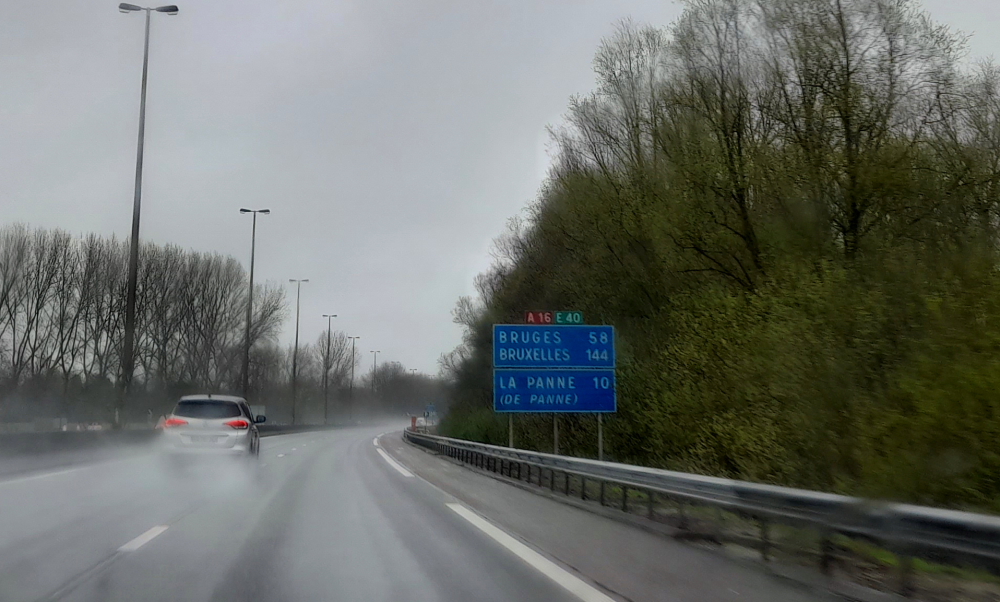
It’s then I notice that the Engine Temperature gauge is not registering at all. It’s still at its starting point, not half way around where it should be after driving the car for half an hour. Terrific! Why couldn’t this have happened while we were in the UK in an English-speaking country with RAC breakdown service and not on Easter Saturday!
Fortunately, a service station is up ahead so we pull in so that I can check under the hood. Nothing seems amiss – no hoses blown, no leaking coolant, even the engine isn’t that hot to touch. Logic tells me that it’s the console gauge that has had a brain fart so I decide it’s safe to continue, even though the error message persists.
Discussing the issue we decide to pull into the next lay-by – where it turns out there are a couple of police cars with flashing blue lights. It seems that they have intercepted a lorry with a load of African illegal immigrants in the back. Away from the fracas I retrieve the OBD2 (On-Board Diagnostics computer) gizmo from the boot, the one that I bought when I had the issue with the faulty radiator sensor back in October 2022. I put it through its paces, turn on the ignition, the engine temperature gauge springs into life and the error message disappears. Thank goodness for that! Probably a faulty cheap Chinese computer chip in the car or is it the fact that the poor car has had to endure the constant wet weather in the UK and Europe.
A good outcome for us but not so the gaggle of Africans that a bevy of police are interrogating plus the police officer who is photographing the contents of the back of a lorry in the lay-by. Time to hit the road or we might be next!
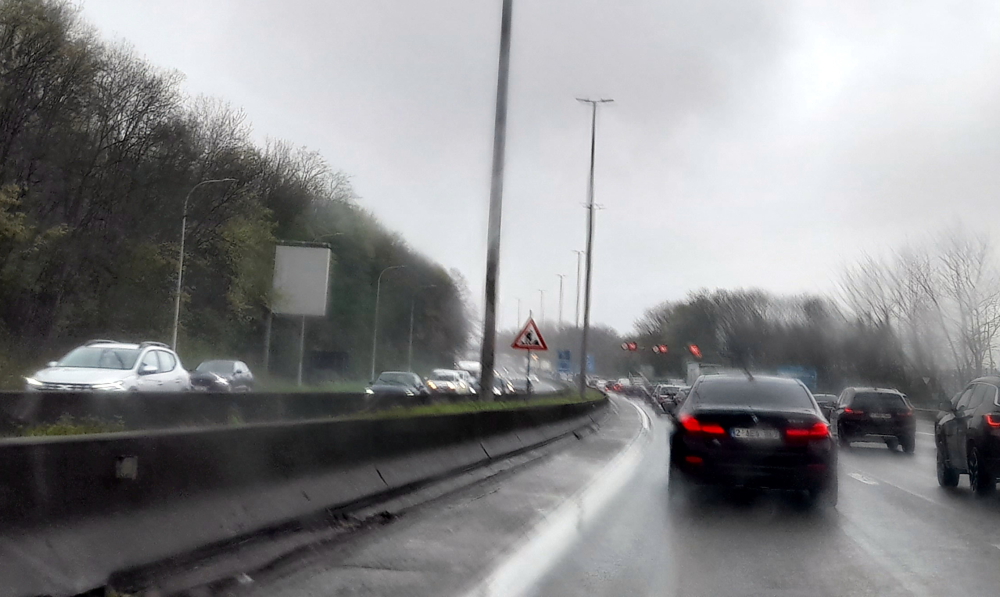
Now that that drama is over we have to contend with the usual Belgian roadworks and interminable tail backs and traffic jams, especially on the northern E19 RO ring road around Brussels. Since we left Dunkirk it’s been unbelievable the amount of traffic on the roads on an Easter Saturday.
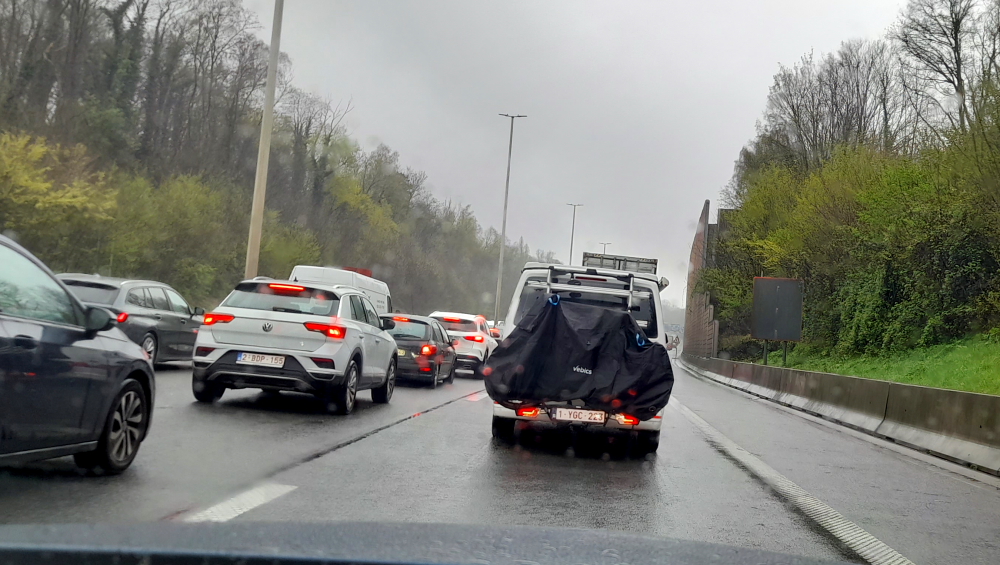
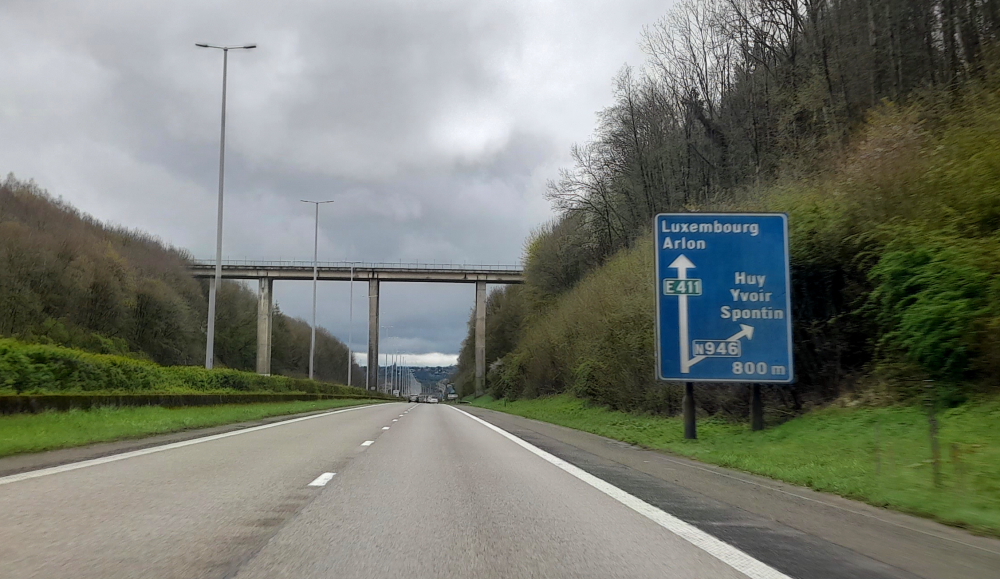
We finally break free of that madness when we hit the E411 on the other side of Brussels and drive the length of Belgium.
At the 90 km mark on the E411, near Lavaux-Sainte-Anne, is apparently the largest sculpture in the world. A monumental work by French internationally-renown artist, Bernar Venet, the steel, “L’Arc Majeur” weighs 200 tonnes, measures 60 meters high and was installed in 2019. It was in response to then French President, Mitterand, asking that works of art be installed along highways – presumably French highways, that is, not Belgian ones??
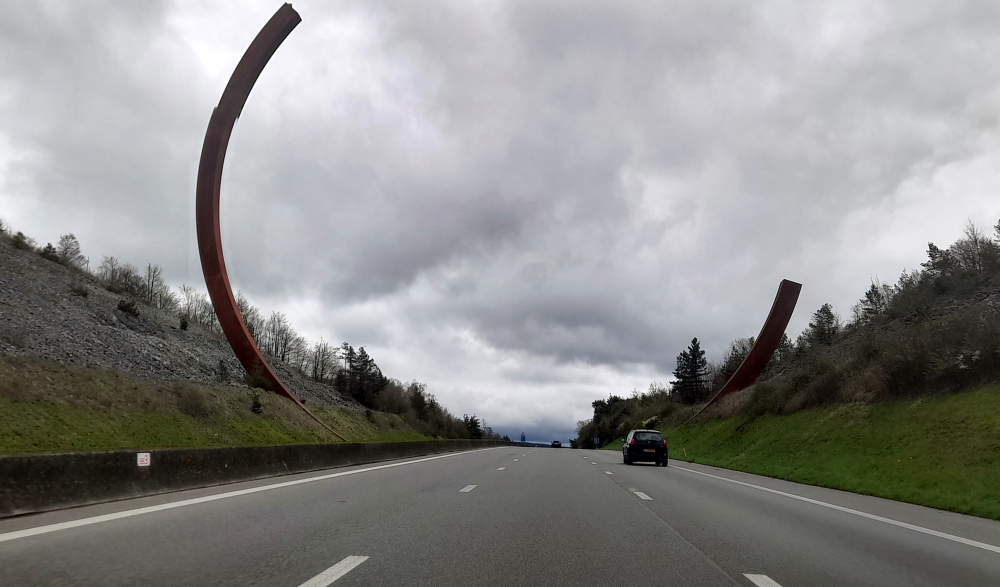
But, 34 years later, to celebrate the 200th anniversary of John Cockerill arriving at Seraing, the Cockerill CMI Welding Expertise Center in Seraing produced it, a showcase of Walloon Region know-how in the field of construction.
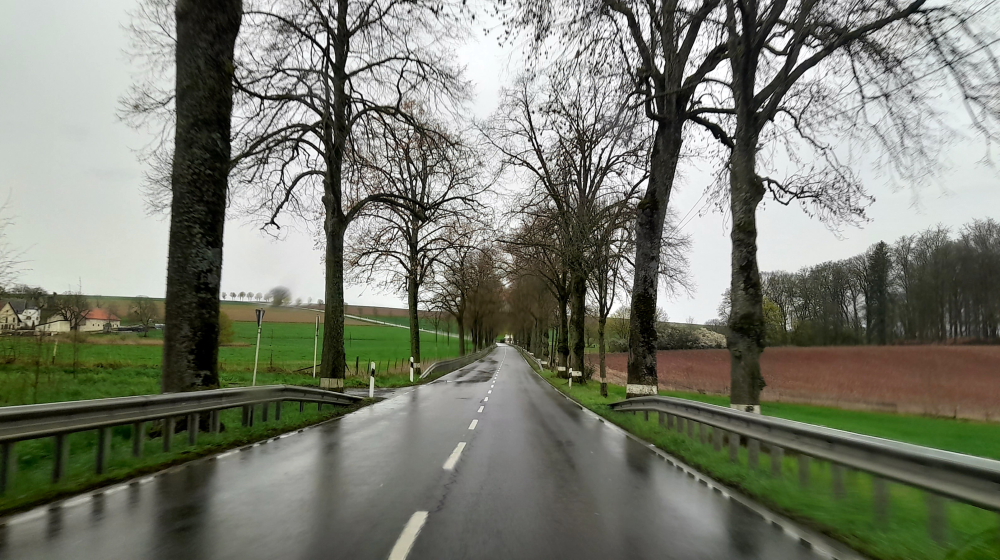
Instead of daffodils planted along footpaths, the local villages have planted tulips. The nearer we get to Scheierhaff, where the Golf Resort is located, the more remote, rural, picturesque and serene becomes the landscape.
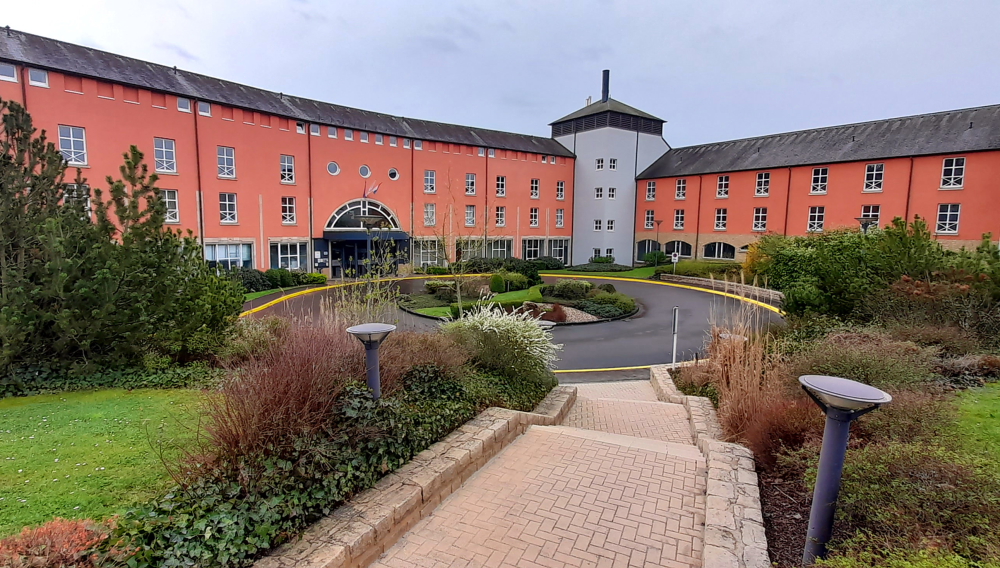
We finally stagger into reception at 3:05 pm – a 75-minute delay – and quickly unpack so we can unwind with a glass of red and an excellent meal in the hotel restaurant after our “3 countries, 3 traffic jams, 3 pee stops and a check engine warning sign” day.
Our desire for an early night is scuppered by having to turn the clock forward an hour for tomorrow’s commencement of Central European Summer Time.
31 March, 2024
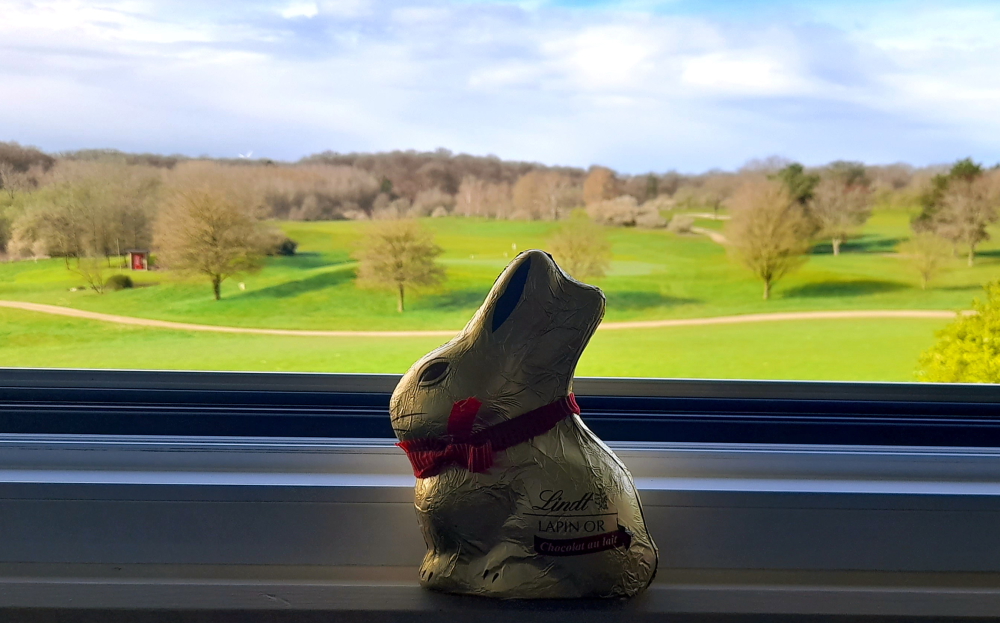
Happy Easter! Although the weather forecast for our entire 5-day stay in Luxembourg is for rain we wake to a bright, sunny day.
After breakfast we decide to enjoy the sunshine with a walk in the Luxembourg bush.
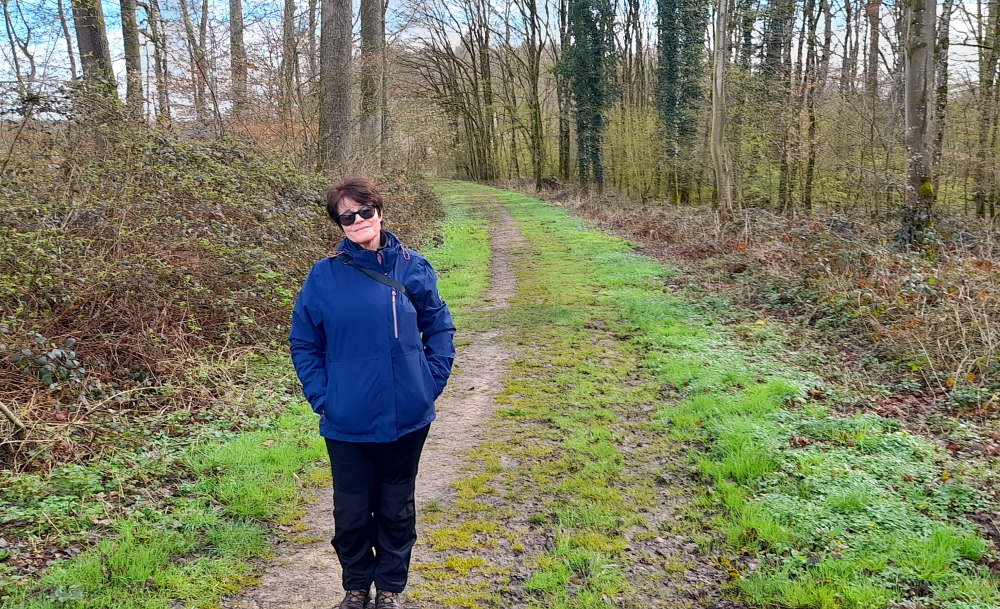
The trail turns out to be too boggy to be enjoyable so we walk around the golf resort instead.
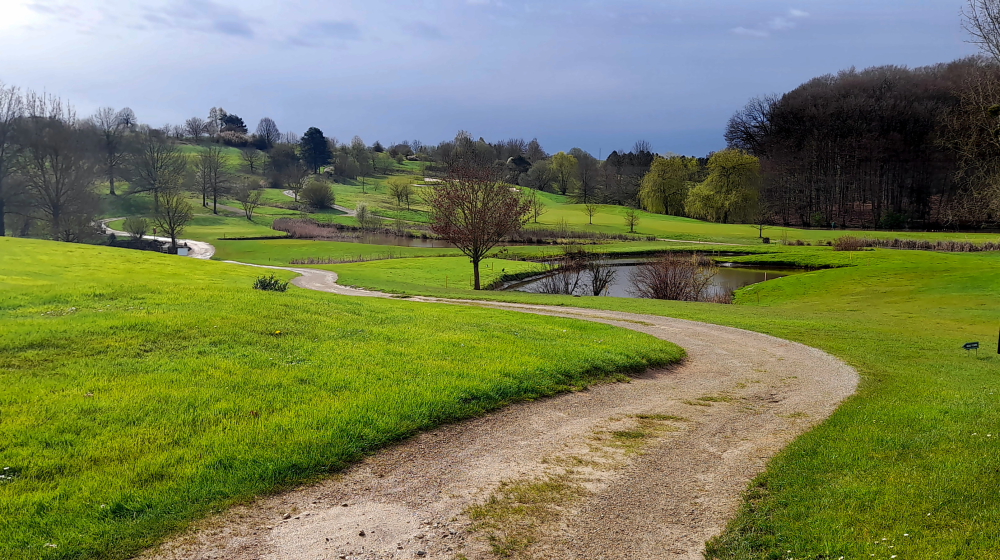
The path around the back of the hotel looks over the back 9 as well as the restaurant, bar and wellness areas of the hotel.
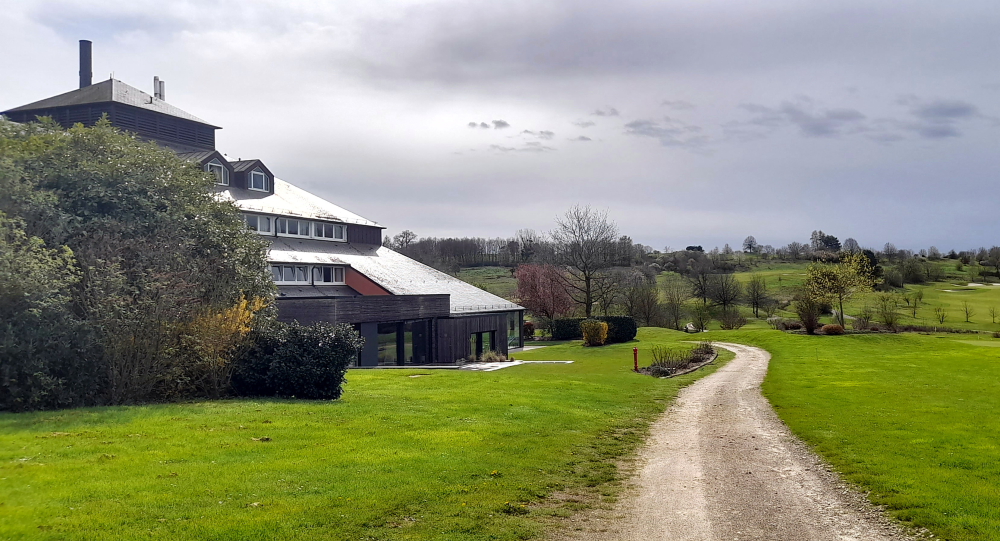
A lazy day in watching golfers progress around the course with a meal in the hotel bistro tonight.
1 April, 2024
Happy April Fool’s Day! Even though it’s raining we’re going to drive the 18 minutes into Luxembourg city for a quick squizz at the Old Town. In the past we have both been to Luxembourg for work but the banks’ offices were in the new town. So, we park in the Knuedler car park which is under the Place Guillaume II in the Old Town and surface by his statue.
Since the middle of the 13th century, this square, named after William II, King of the Netherlands and Grand Duke of Luxembourg, has accommodated the church and the monastery of the order of Saint Francis. In common parlance the square is also called Knuedler – derived from the Luxembourgish word “Knued” denoting the knot in the belt of the Franciscan friars.
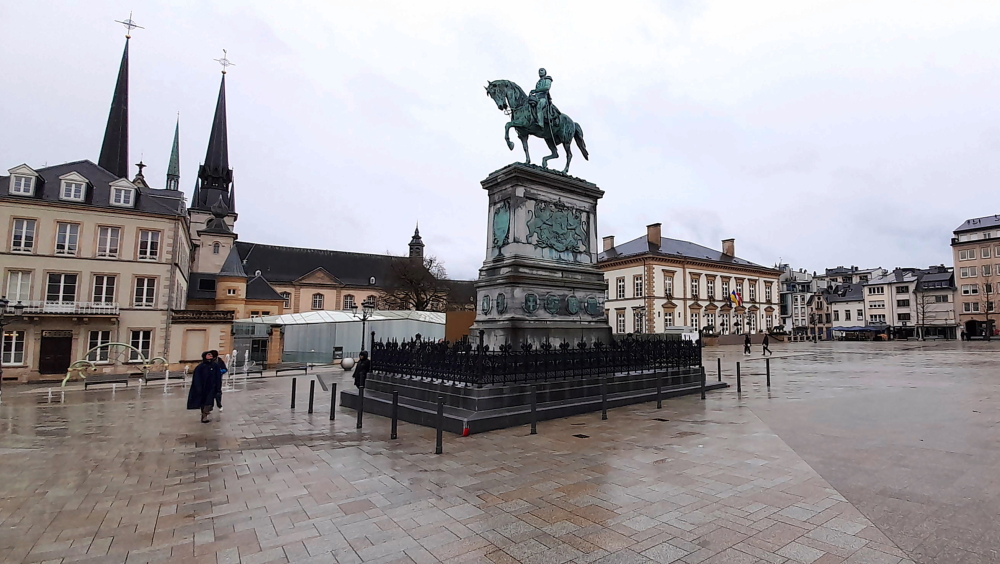
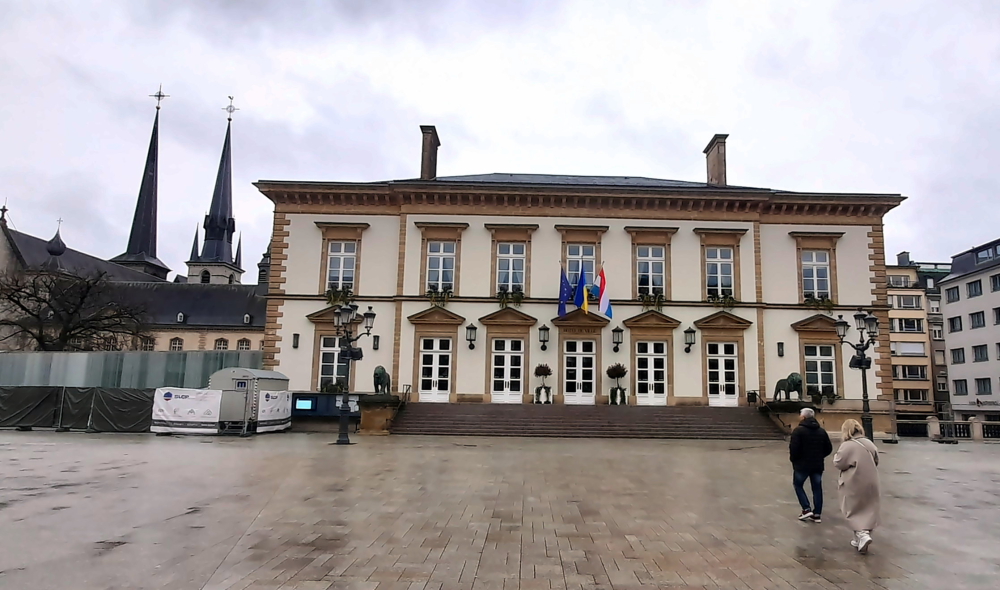
In 1797 the French seized the monastery with all its grounds and disposed of it part by part. In the following centuries the whole cluster of edifices was pulled down and the square redesigned. Today, the William Square hosts not only the Town Hall and the Luxembourg City Tourist Office, but also plenty of markets, open air concerts and feasts [Luxembourg ma ville].
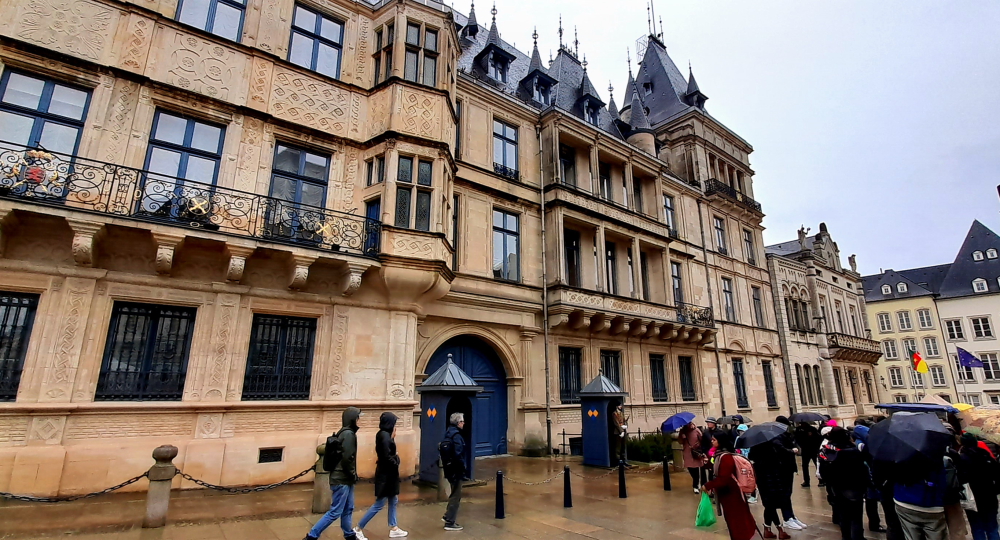
A short walk from the square, along Rue de la Reine we come to the Grand Ducal Palace which has only 1 guard standing on duty.
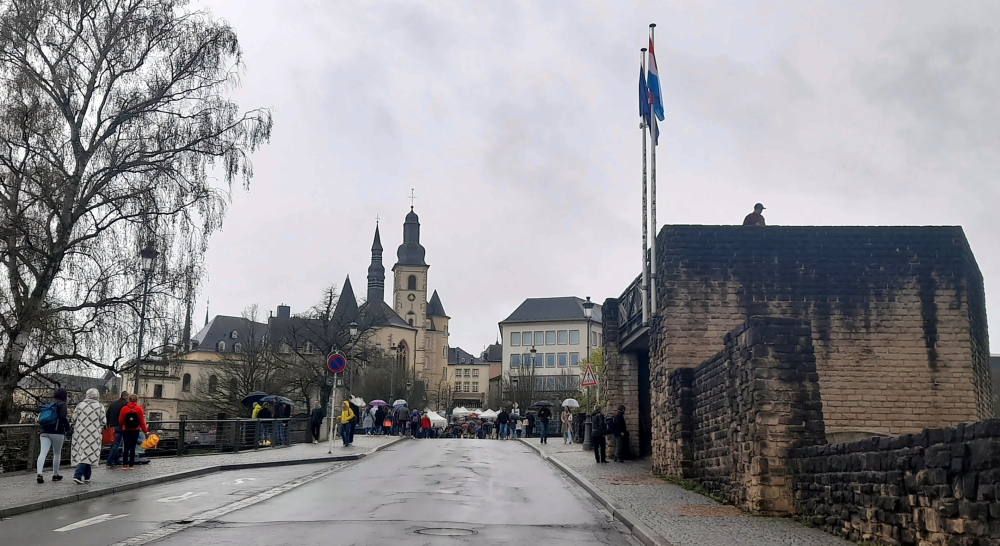
From here we walk along Rue de la Boucherie, past a host of small marquee tents that are part of a street market, alongside Saint-Michel’s Church and onto the Bock Casemates, also the N1 road.
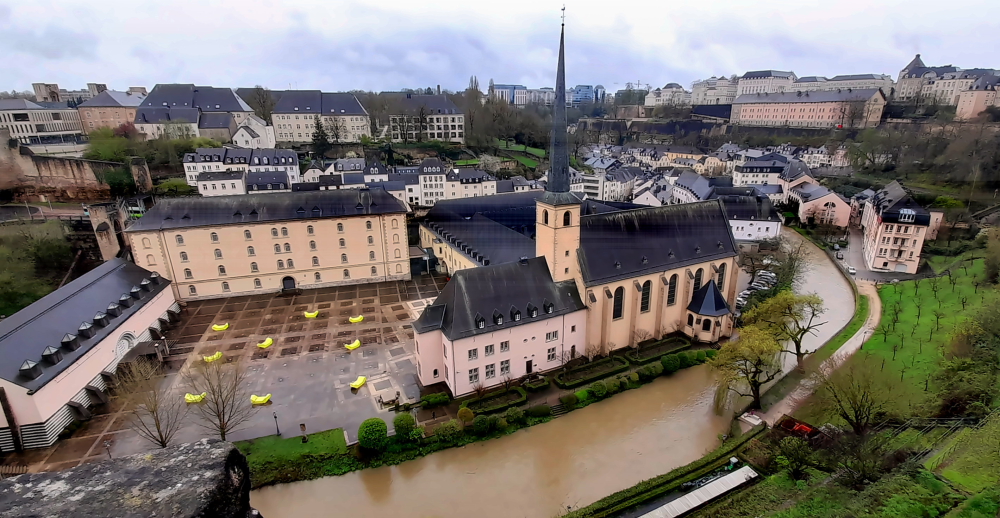
The Bock (Luxembourgish: Bockfiels) is a promontory in the north-eastern corner of Luxembourg City’s old historical district.
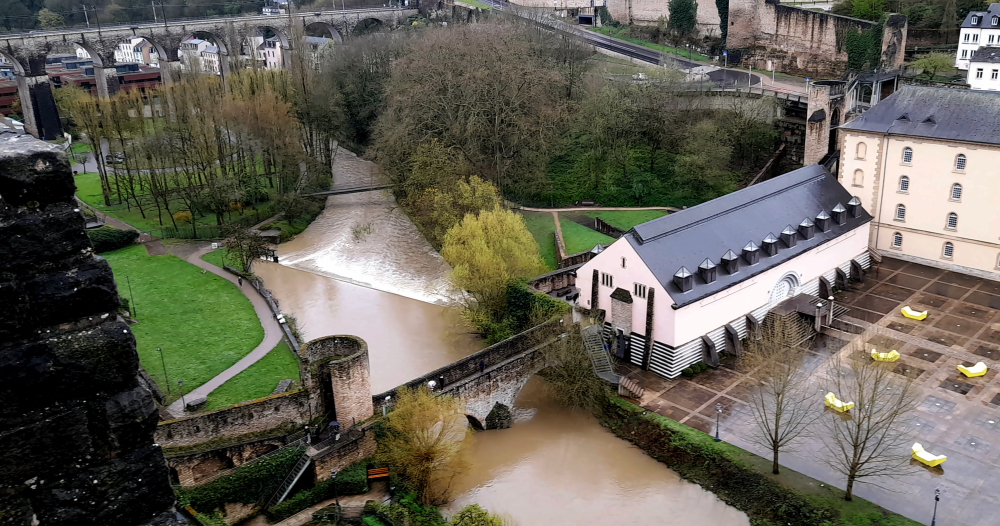
Offering a natural fortification, its rocky cliffs tower above the River Alzette, which surrounds it on three sides.
It was here that Count Siegfried built his Castle of Lucilinburhuc in 963, providing a basis for the development of the town that became Luxembourg.
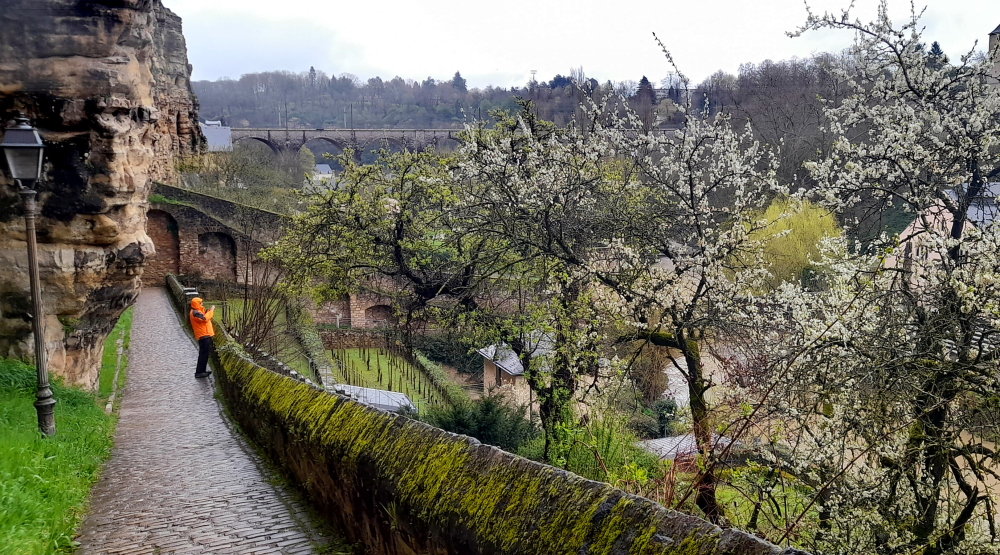
Over the centuries, the Bock and the surrounding defenses were reinforced, attacked, and rebuilt time and time again as the armies of the Burgundians, Habsburgs, Spaniards, Prussians, and French vied for victory over one of Europe’s most strategic strongholds, the Fortress of Luxembourg.
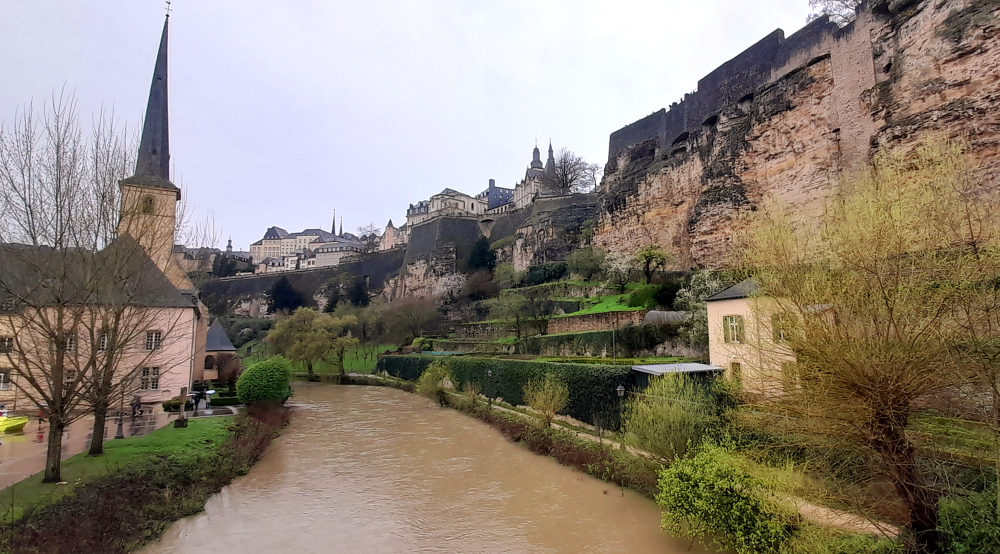
Warring did not stop until the Treaty of London was signed in 1867, calling for the demolition of the fortifications. Ruins of the old castle and the vast underground system of passages and galleries known as the casemates continue to be a major tourist attraction.
On account of these impressive fortifications, Luxembourg was even given the epithet of the “Gibraltar of the North”. In 1994, the casements were inscribed on the UNESCO World Heritage List.
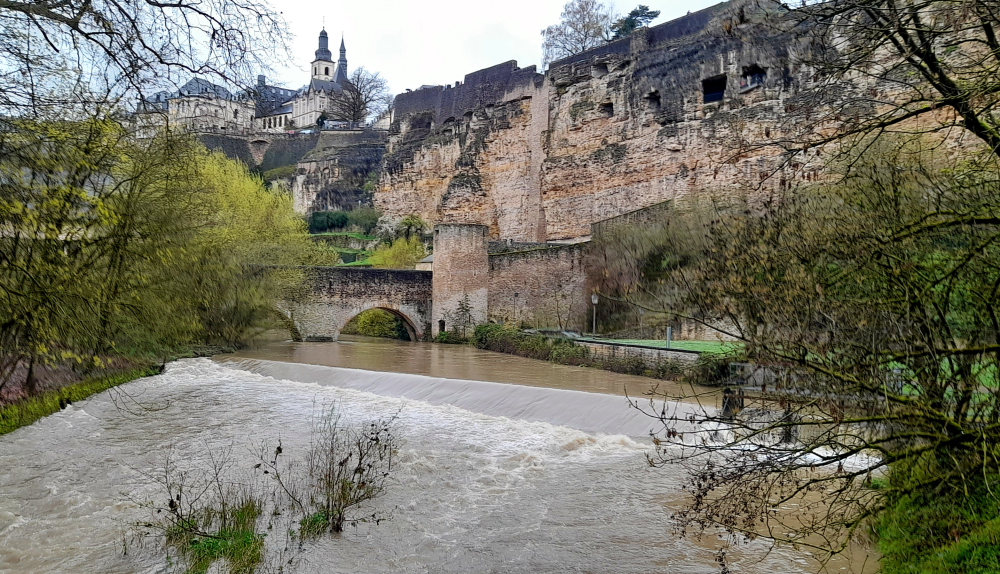
After crossing over the pedestrian bridge we walk upstream along the river bank where we come across a bright purple sculpture of a mermaid.
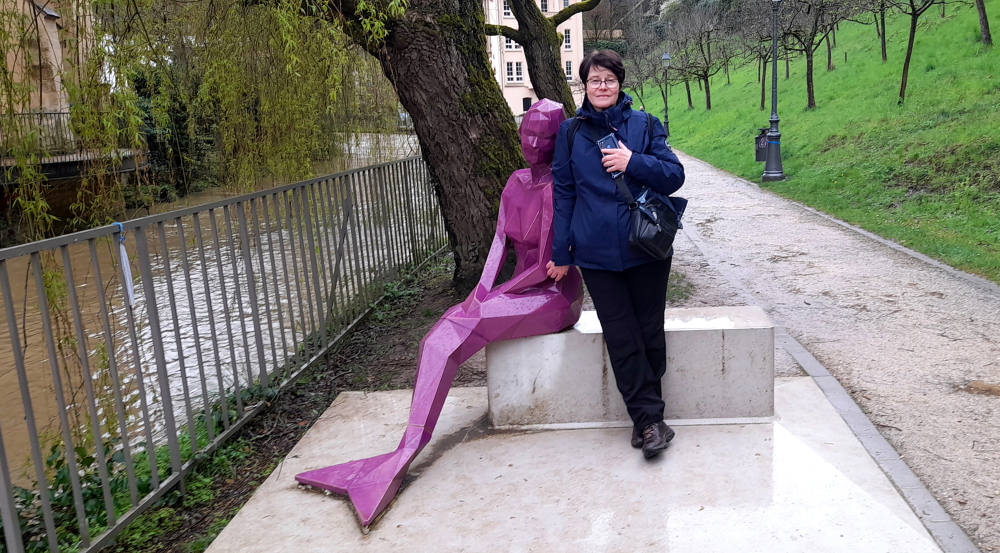
According to legend, Melusina was the wife of Sigfried, 1st count of Luxembourg, living in his castle on the rocky Bock promontory. On their marriage, Melusina required her husband never to see her during a particular day and night of the week.
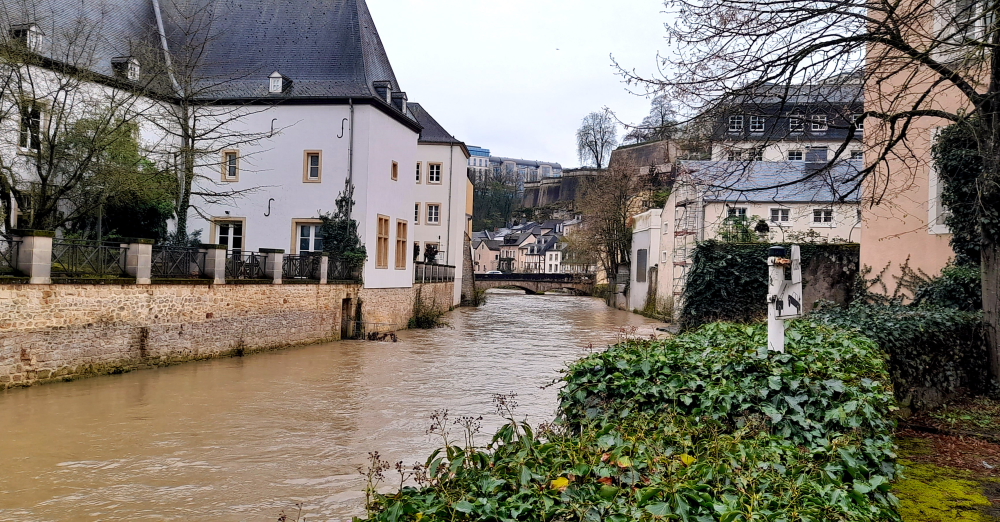
One fine day, unable to resist his curiosity, Sigfried spied her in her bath through the keyhole of her room’s door and discovered her fish’s tail. Melusina, noting that her husband was watching her, then vanished forever into the torrents of the Alzette river.
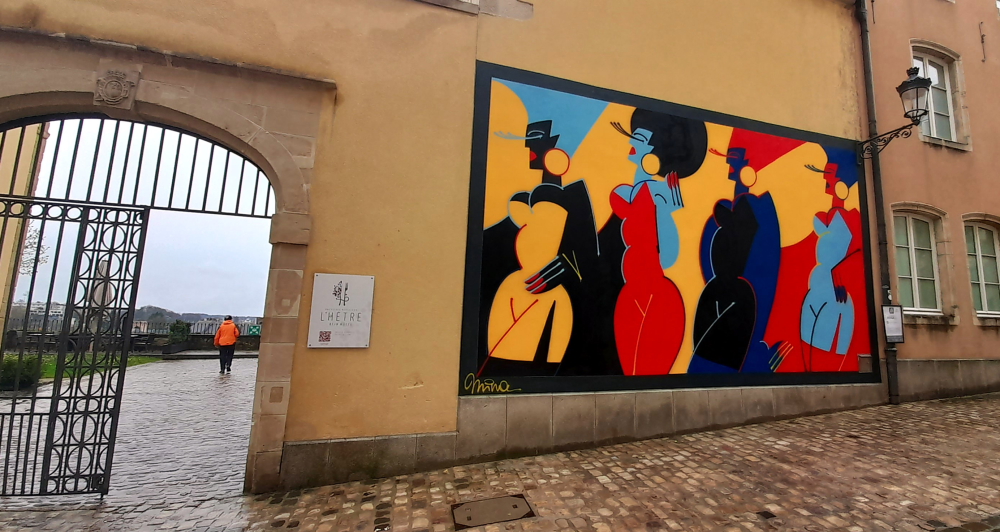
Walking up some switchback roads we arrive outside the Notre-Dame Cathedral.
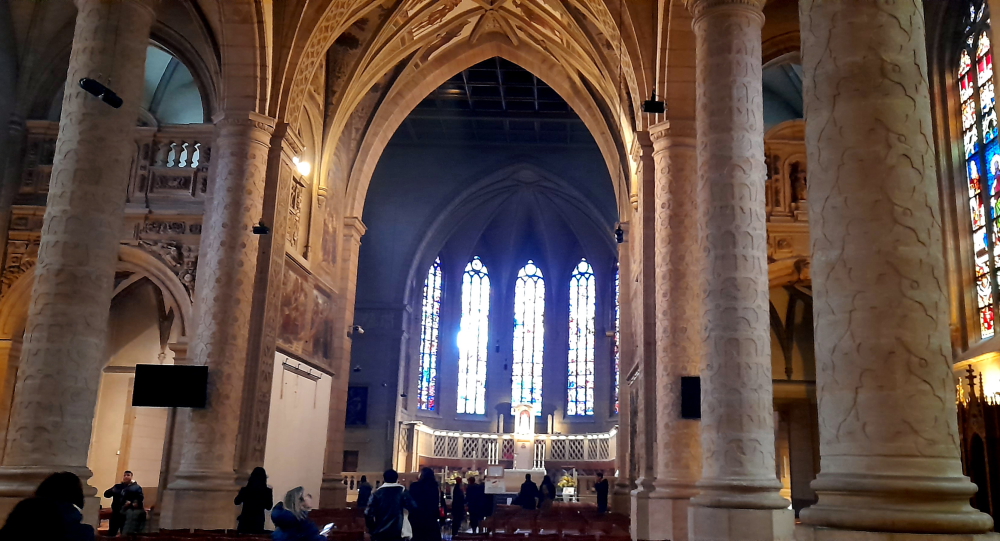
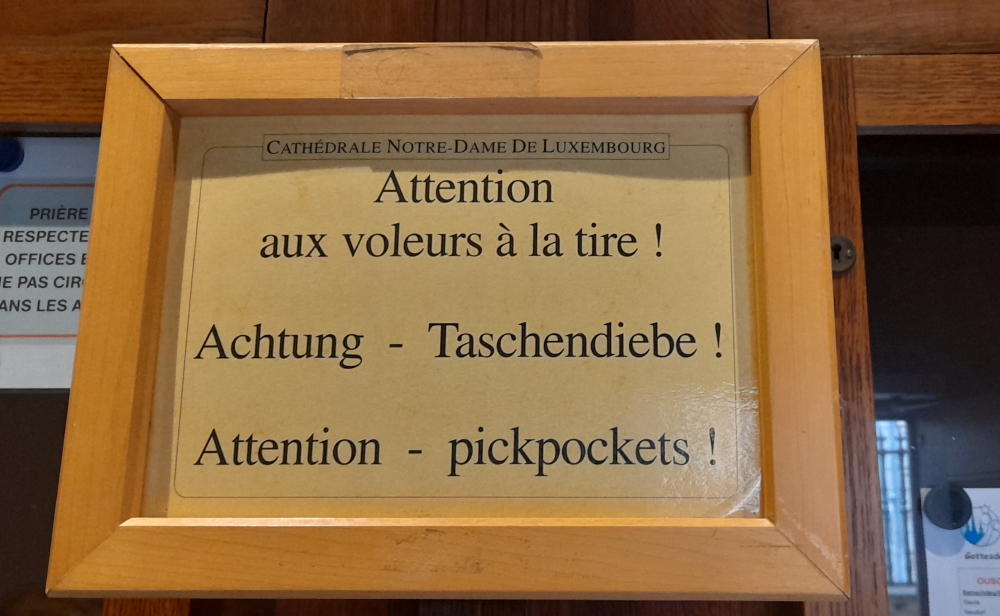
Where Lynn is a little taken aback by a prominent sign in the cathedral’s vestibule warning against pickpockets!
In all we spend about 1.5 hours wandering about the Old Town. After refueling (at Eu1.63/litre cheaper than France and Belgium) we drive back to the Resort where, over the course of the afternoon, the course is inundated with periods of alternating torrential rain and sunshine.
2 April, 2024
As today is supposed to be the least wet day of our stay, we plan to drive 51 km north to Chateau de Vianden, also close to the German border. But first, what makes Luxembourg, Luxembourg?
The Grand Duchy of Luxembourg is a small landlocked country in Western Europe bordered by Belgium, Germany and France. It is a representative democracy headed by a constitutional monarch, Grand Duke Henri, making it the world’s only remaining sovereign grand duchy.
Its capital, Luxembourg, is 1 of 4 institutional seats of the EU (together with Brussels, Frankfurt, and Strasbourg) and the seat of several EU institutions, notably the Court of Justice of the European Union. It is also a founding member of the EU, OECD, the UN, NATO, and Benelux. While Luxembourgish is the only national language of the Grand Duchy and its people, French is the only language for legislation, and all three – Luxembourgish, French and German – are used for country’s administrative matters.
With an area of 2,586 square kilometers (998 sq mi), Luxembourg is Europe’s 7th-smallest country. In 2023, it had a population of 660,809, which makes it 1 of the least-populated countries in Europe, albeit with the highest population growth rate with foreigners accounting for nearly half the population.
Back to Castle Vianden – “one of the 21 most beautiful castles in the world” (CNN).
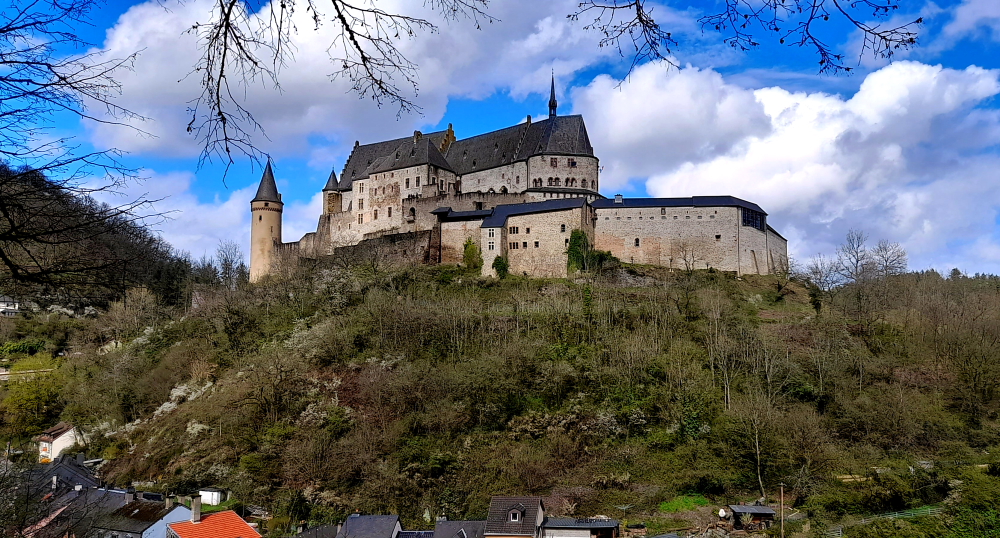
Vianden Castle was constructed between the 11th and 14th centuries on the foundations of a Roman ‘castellum’.
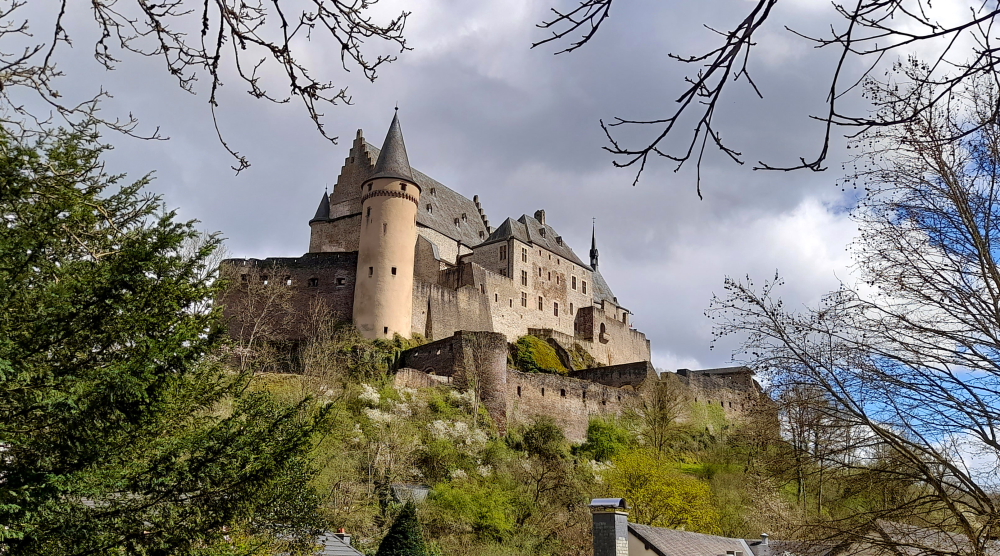
It is one of the largest and most beautiful feudal residences of the romanesque and gothic periods in Europe.
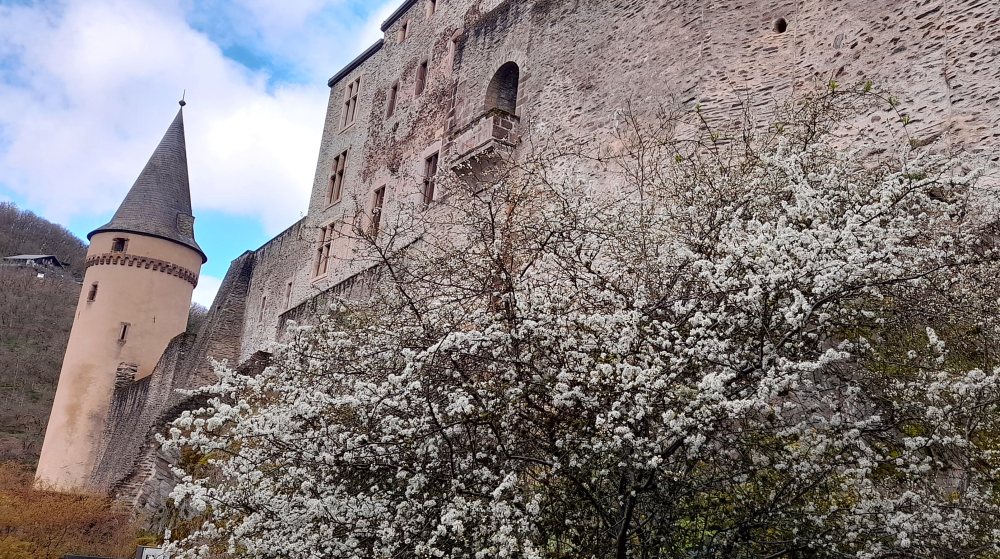
Until the beginning of the 15th century it was the seat of the influential counts of Vianden who could boast their close connections to the Royal Family of France and the German imperial court.
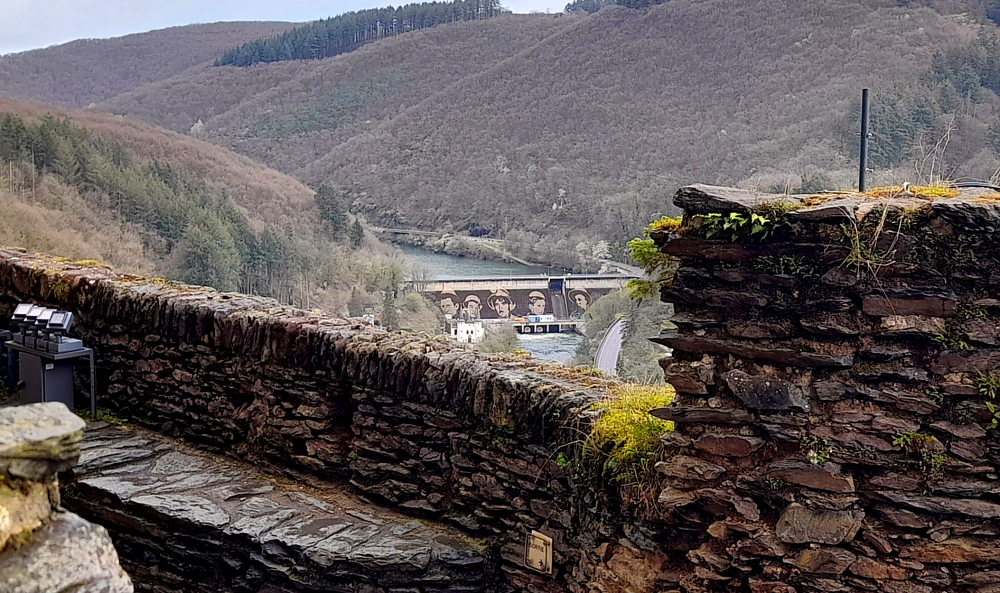
Henry I of Vianden (1220-1250) is known as ‘the Sun Count’ for it is during his tenure that the holdings, lifestyle and influence of the House of Vianden reached its zenith.
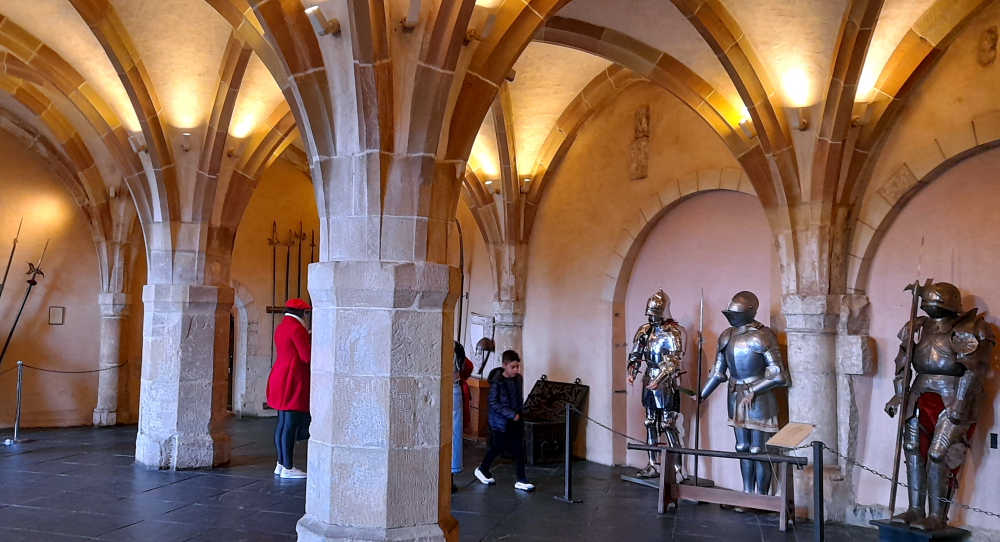
His ancestors were influential in the Ardennes, Eifel and Luxembourg regions for hundreds of years.
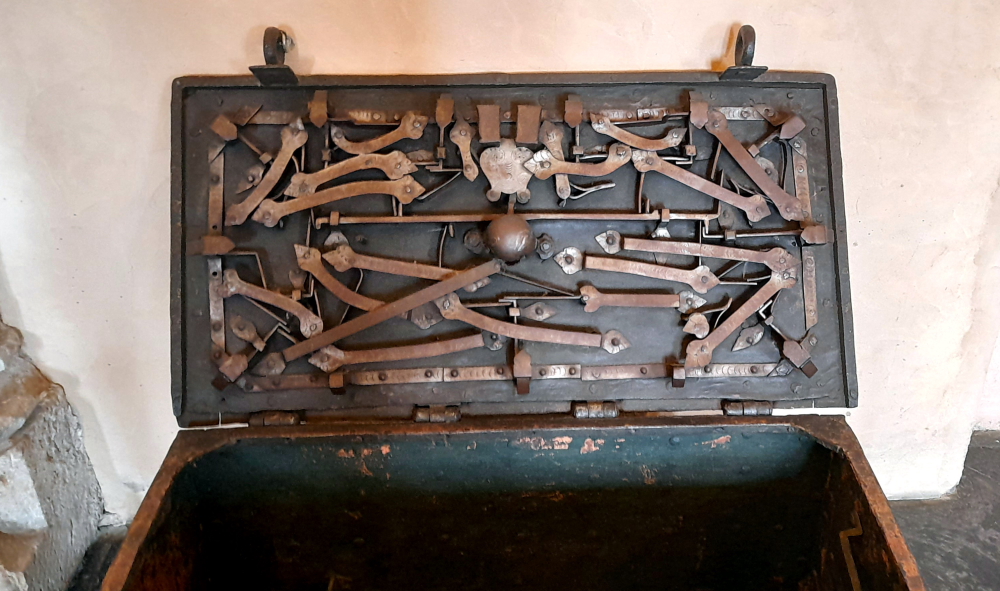
His wife, Margarete of Courtenay, was of the French Royal Family, daughter of the Latin Emperor of Constantinople, sister-in-law to the King of Hungary and cousin to King Philip-Augustus.
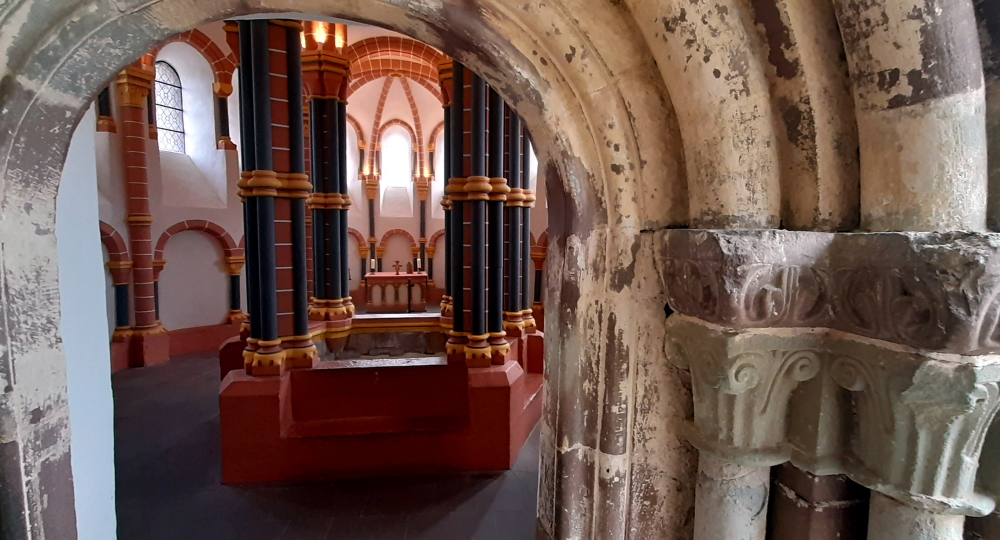
Margarete’s ancestors, included the Crusaders from the Houses of Flanders and Hainault, Henry’s and Margarete’s son, Frederic had served in the Fifth Crusade.
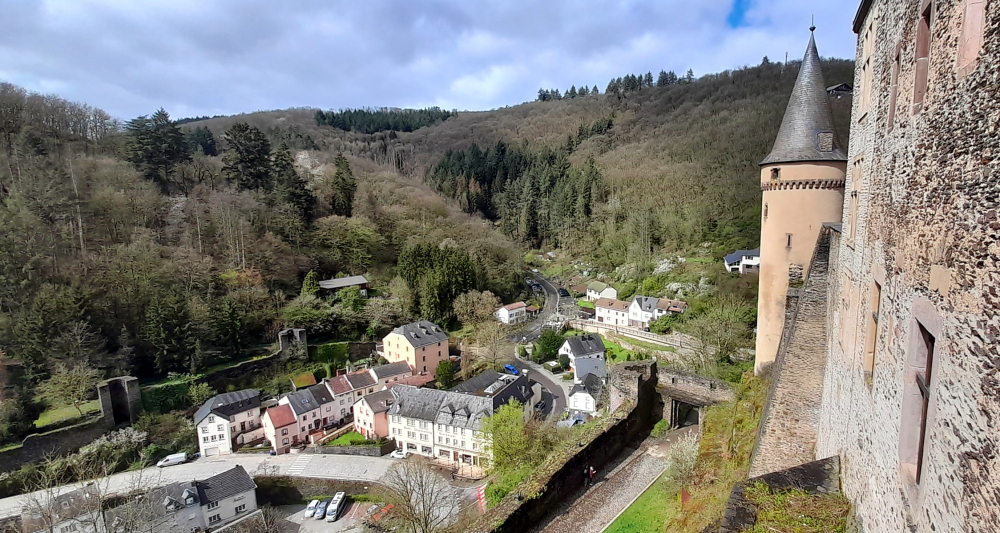
In 1417, the dominion passed by inheritance to the House of Nassau, which, in 1530 collected the principality of Orange as well.
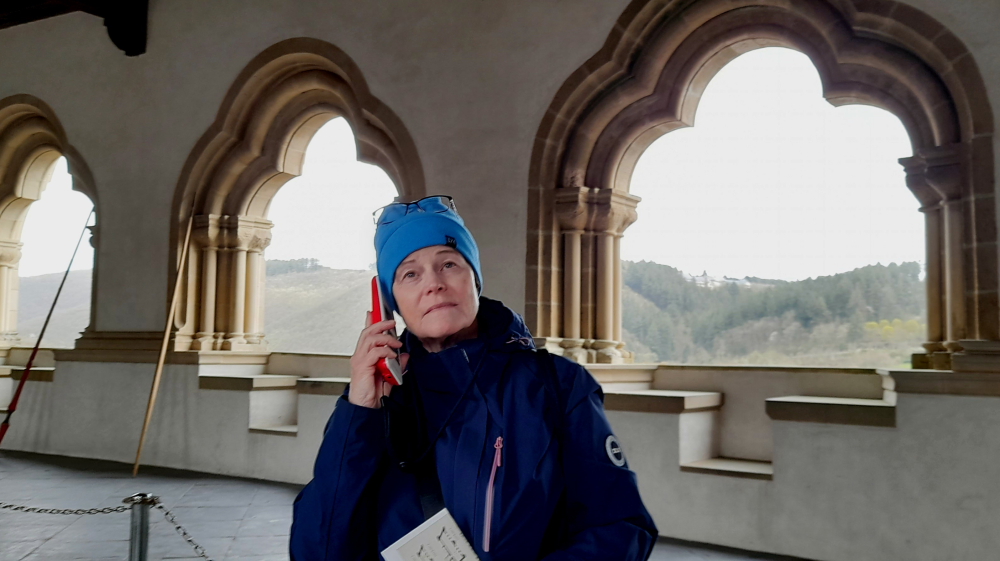
From then on, the castle was no longer the official residence of the counts.
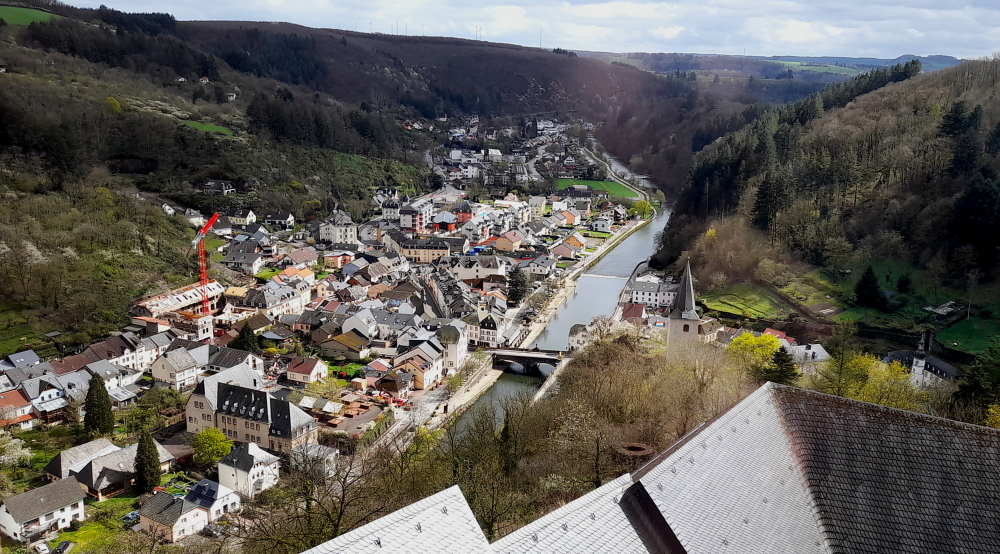
The rich architecture the House of Nassau inherited can still be seen today, as no further modifications were made.
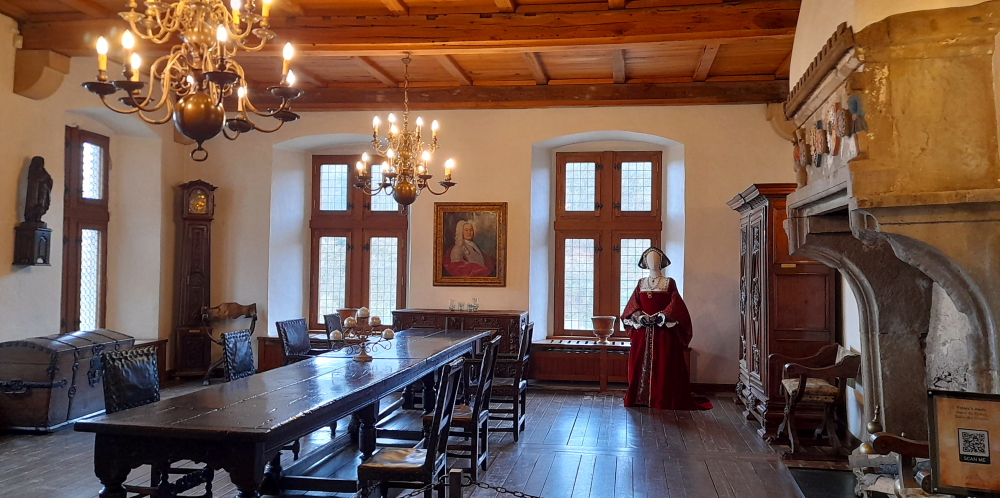
The main construction parts of the castle which are preserved today, in particular the chapel and the small and large palaces, originate from the end of the 12th and the first half of the 13th century.
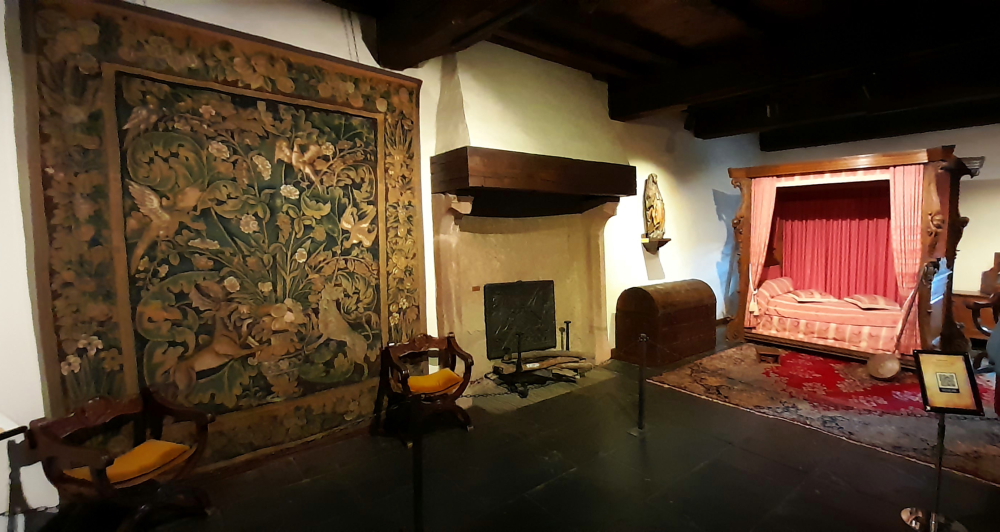
The ‘Quartier de Juliers’ on the western side of the large palace (no longer existing today), originates from the beginning of the 14th century. The House of Nassau was only constructed at the beginning of the 17th century.
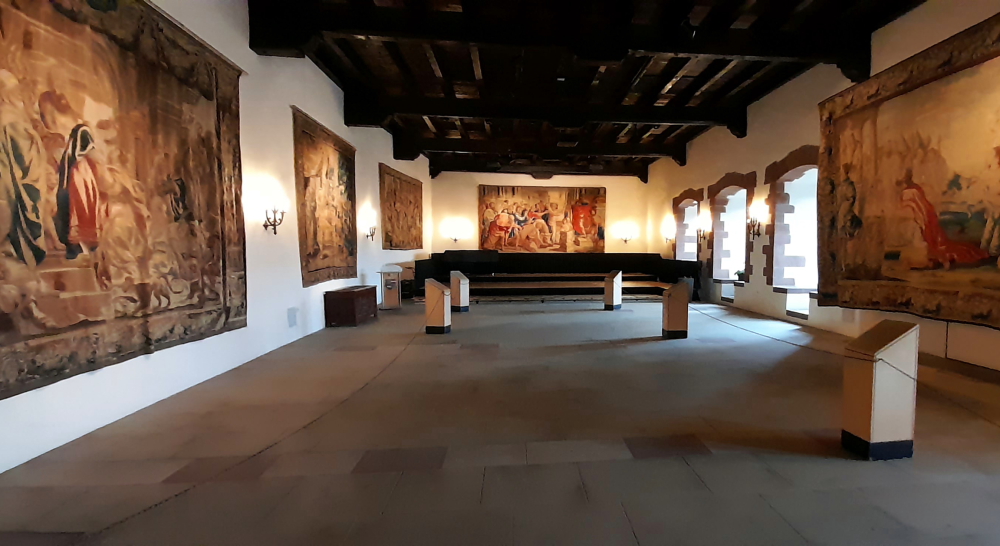
In 1820, under the reign of King William I of Holland, the castle was sold piece by piece, and as a result, it fell into a state of ruin.
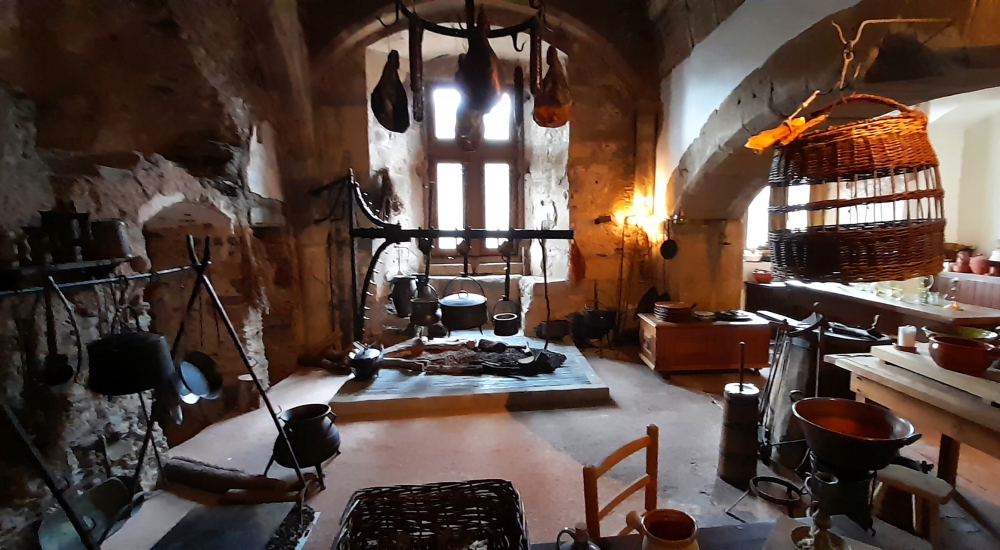
It was a pile of rubble until the family of the Grand Duke of Luxembourg transferred it to State ownership in 1977.
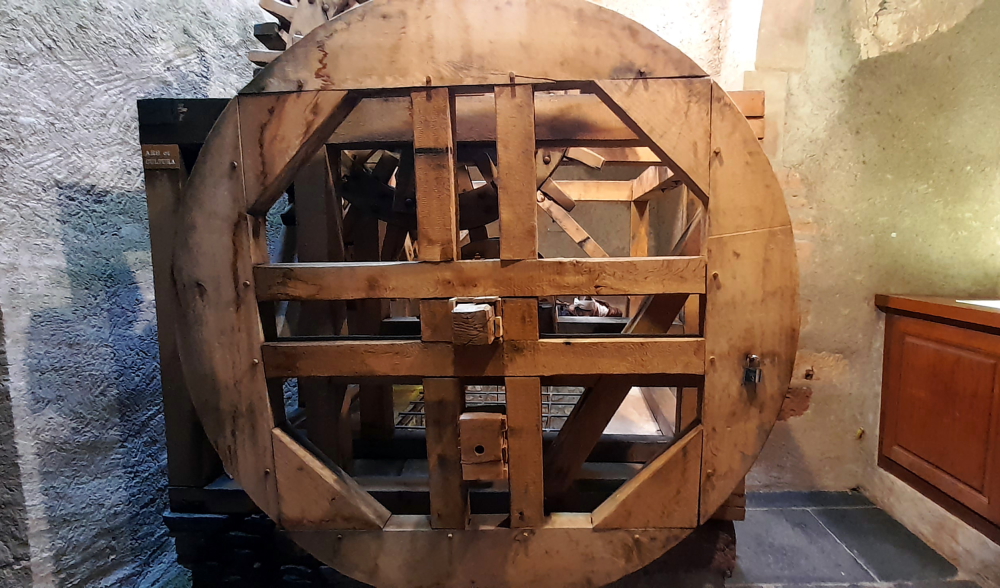
Since restored to its former glory, the castle now ranks as a monument of not only regional, but European importance [castle-vianden.lu].
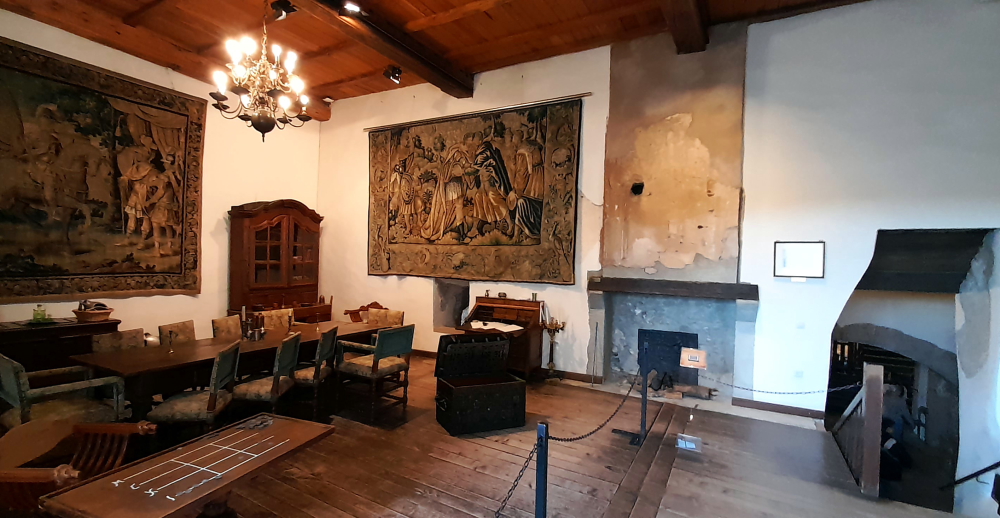
Several halls are dedicated to those responsible for the castle’s restoration, in particular: Charles Arendt and Jemmy Koltz.
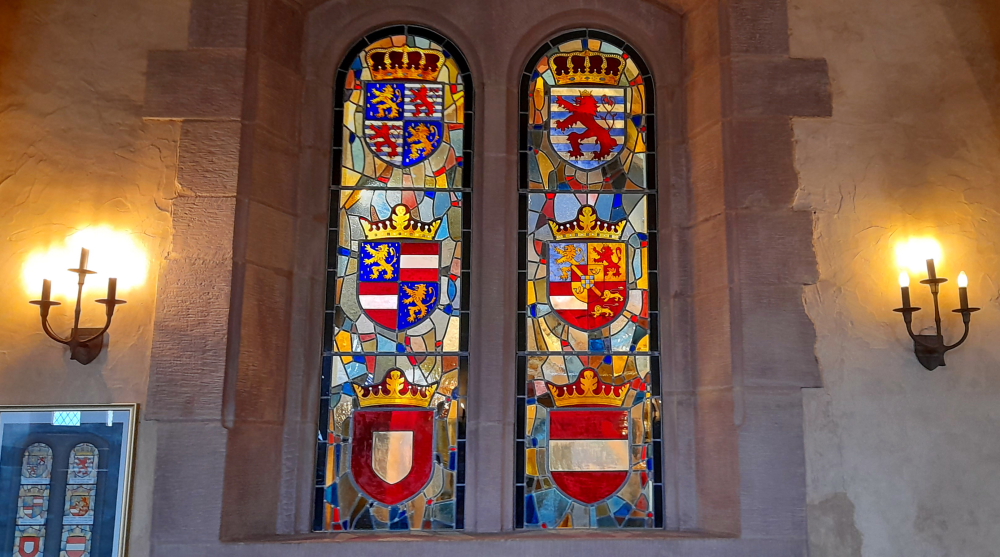
Jean Charles Wenzeslas Arendt (1825-1910) was state architect for Luxembourg and author of over 130 publications, mainly on architectural and art historical topics. He carried out extensive restorations of historical buildings, including the ruins of the Vianden Castle.
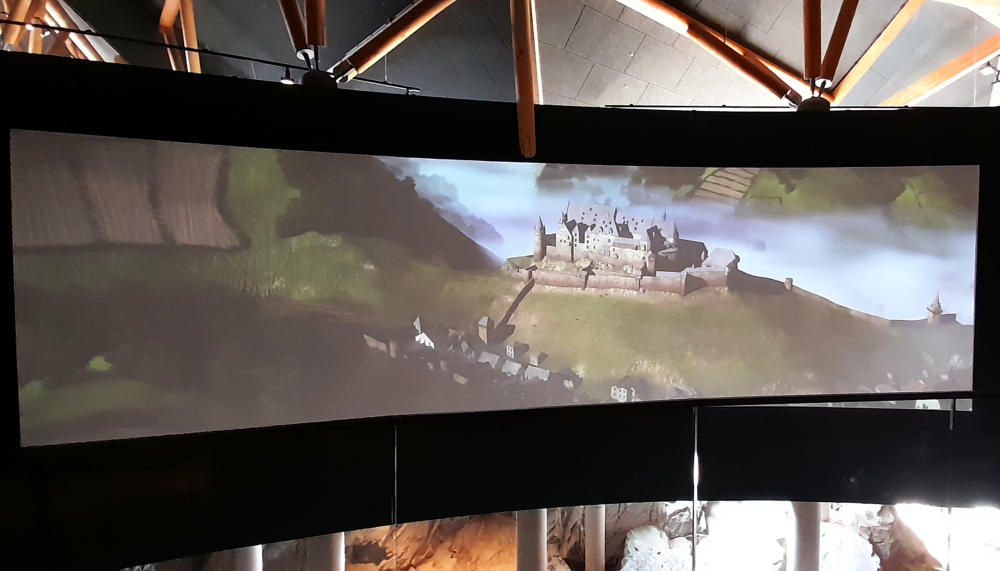
Jean-Pierre (“Jemmy”) Koltz (1909-1989) was a Luxembourgish engineer, technician and historian. His main research topic and his passion was the building history of the Luxembourg fortress. He was also president of the Syndicat d’Initiative of the City of Luxembourg and of the Commission des sites et monuments nationaux where he was involved the restoration of various castles, especially the reconstruction of Vianden Castle.
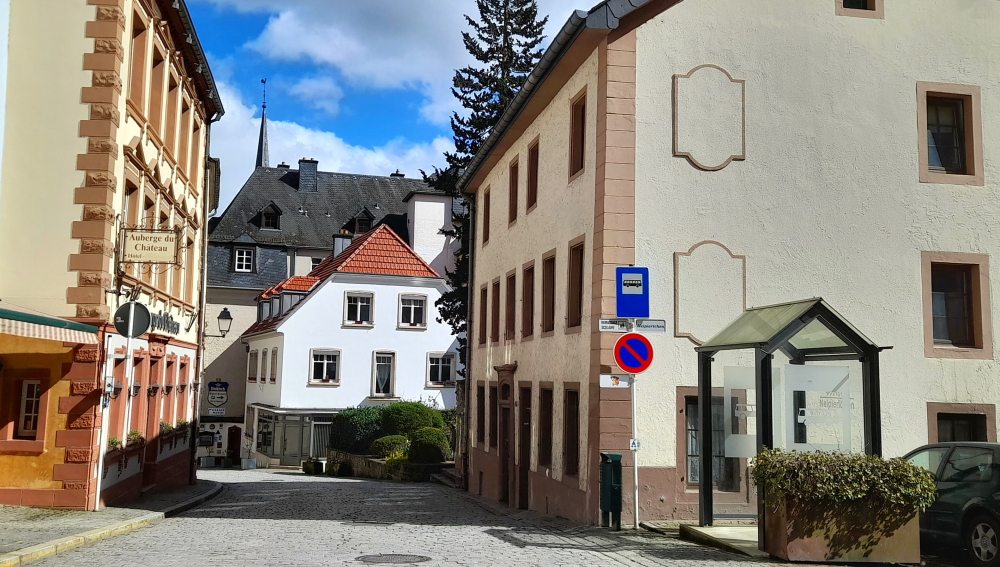
Below the castle is the picturesque, medieval walled town of Vianden. Within its walls is the Gothic Trinitarian Church which has a 13th-century cloister and the Victor Hugo Literary Museum is in a house that hosted the writer in 1871 during his political exile from France.
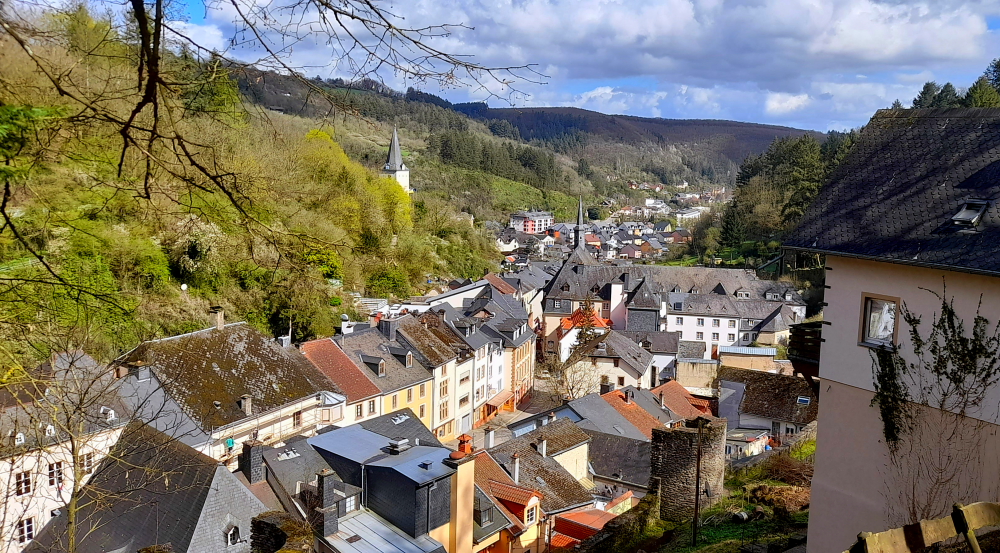
In total we spend 3 hours wandering through the castle and enjoy the hour’s drive in sunshine back to the hotel.
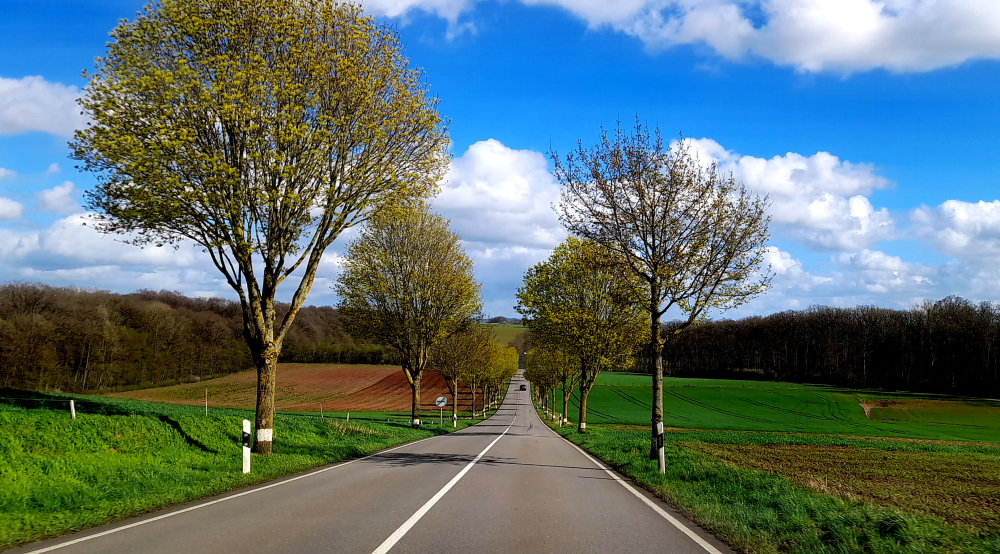
Tonight we drive 10 minutes to a small, family restaurant in the town of Remich on the banks of the Moselle River. The food is pretty good but the meal is so large that we could have shared it.
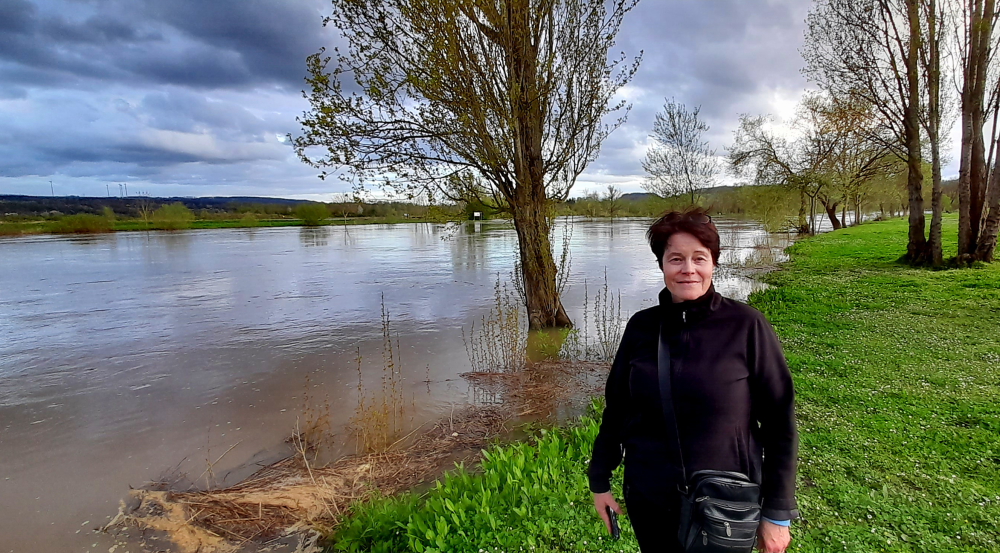
3 April, 2024
It has rained hard all day but we have no plans to be outside. Lynn has a massage booked this afternoon and I plan to spend that time in the indoor heated pool and jacuzzi.
We are heading to Heidelberg tomorrow but since it is only a few hours’ drive we plan to check out at noon and do our packing in the morning.
4 April, 2024
After breakfast this morning we have a WhatApp video call with my grandson for his 3rd birthday. As you would expect he is more interested in spending time playing with his birthday presents than talking to his grandfather. Still, we have an interesting call with Vanessa to catch up on their lives and get to see the ‘new’ addition to their family, Zara.
At 11:00 am we check out of the hotel and load up the car in the heavy rain and head across the Moselle River into Germany.
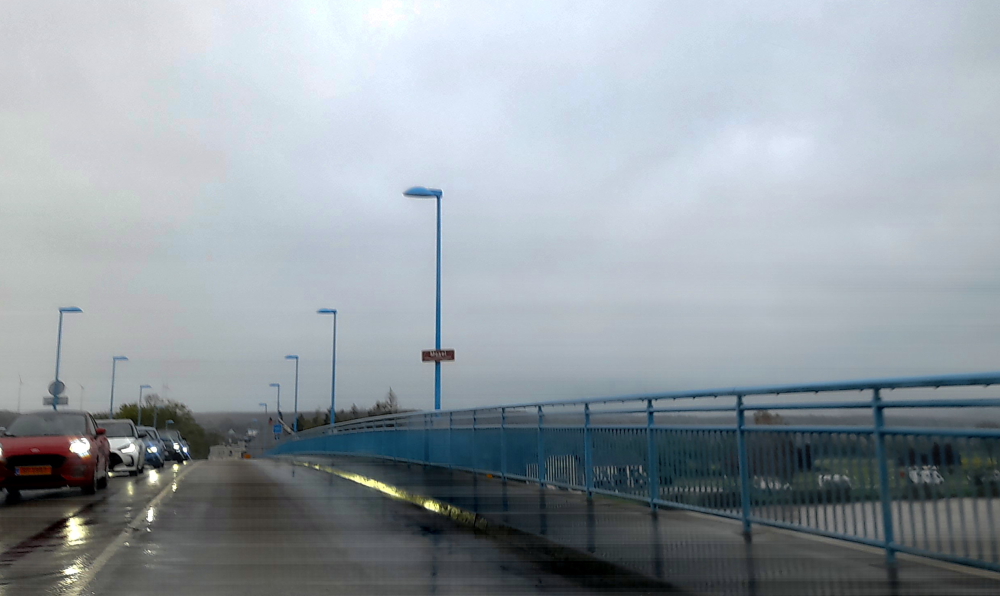
It rains heavily all the way to Heidelberg and, as usual, we encounter a heavy traffic jam near Mannheim where the freeway comes to a complete standstill. We manage to find a detour on smaller back roads direct to a supermarket just south of Heidelberg where we do our usual grocery shopping before checking in to our Aparthotel for the next 4 nights.
We have a suite at the Staycity Aparthotel just out of the centre of Heidelberg. The suite is modern and very comfortable.
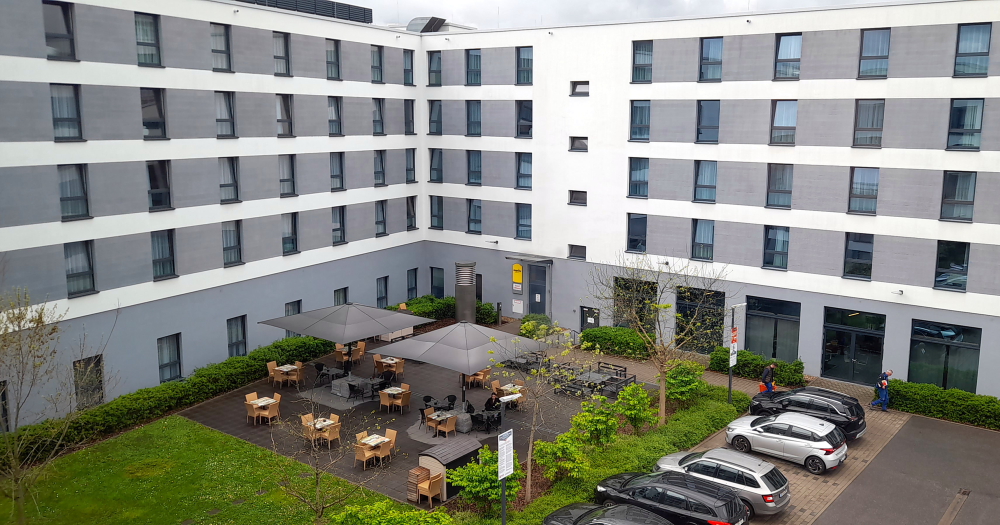
Tomorrow we are heading in to the old town for a walking tour but this afternoon we are just relaxing and doing our laundry in the hotel laundromat.
 THE CONTINUING TRAVELS OF YOGI & BOO BOO