
23 June, 2024
About 11:00am we checked out of the very comfortable Radisson Blu Hotel in Riga. It’s a cool 17 degrees and a cloudy morning as we cross over the Vansu Bridge on our way to Ventspils on the Latvian Baltic Coast. The A10 will take us all the way there.
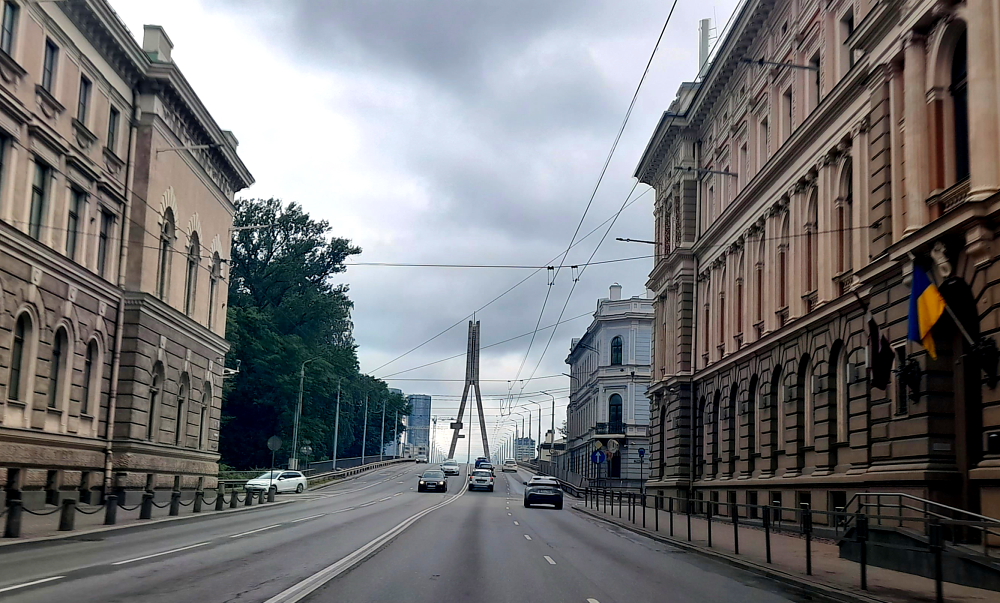
The Vanšu Bridge in Riga.
Originally we were going to call into the nearby resort town of Jurmala on the Gulf of Riga known for wooden, art nouveau seaside villas, Soviet-era sanatoriums and the long, sandy Jūrmala Beach. But, unlike anywhere else in Latvia, one has to pay a toll, called an entrance fee, to access this town.
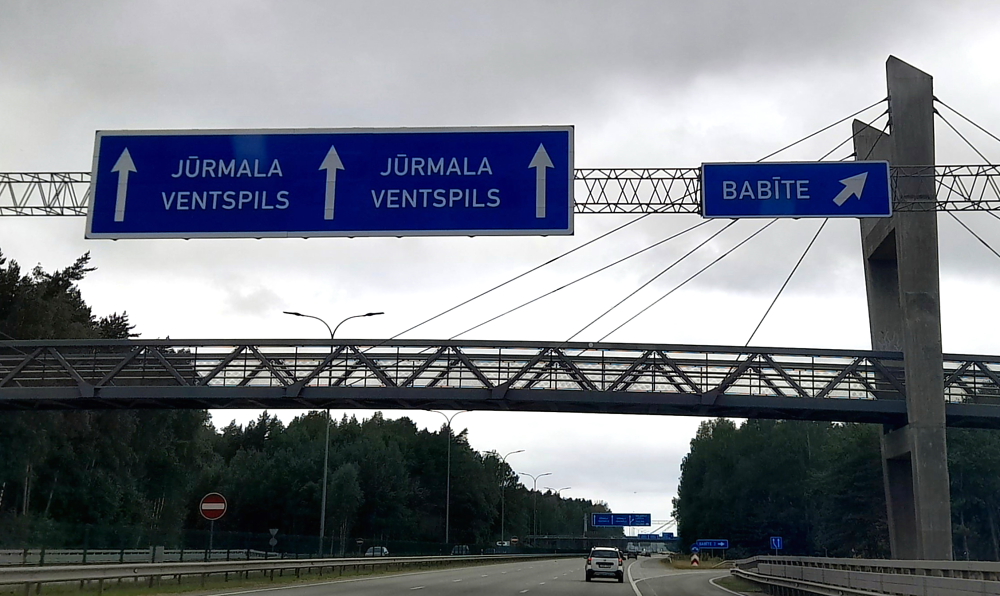
Heading to our next stop at Ventspils, Latvia.
In fact the A10 is diverted into a huge roundabout affair for those of us who want to bypass Jurmala. Just before the Rigas iela road crosses the Lielupe River to Jurmala there is a layby set up with a series of parking metre-type machines in a row where you pay the fee before you rejoin the road to Jurmala. Around 12:30 it starts to spit rain.
Same, same…
We continue to drive past undulating green meadows, extensive silver birch and pine forests, farm houses and more elevated stork nests. Today and tomorrow are public holidays to celebrate Midsummer so a new feature of the landscape today is pop-up stalls (i.e. out of a car boot, on wooden tables or racks or just someone standing on the side of the road with a headdress and wreaths hanging off both arms) selling swatches of greenery, headdresses made out of greenery and/or flowers as well as selling punnets strawberries.
On one stretch of road there are multiple cars pulled over selling their verdant and floral wares – talk about stiff competition!
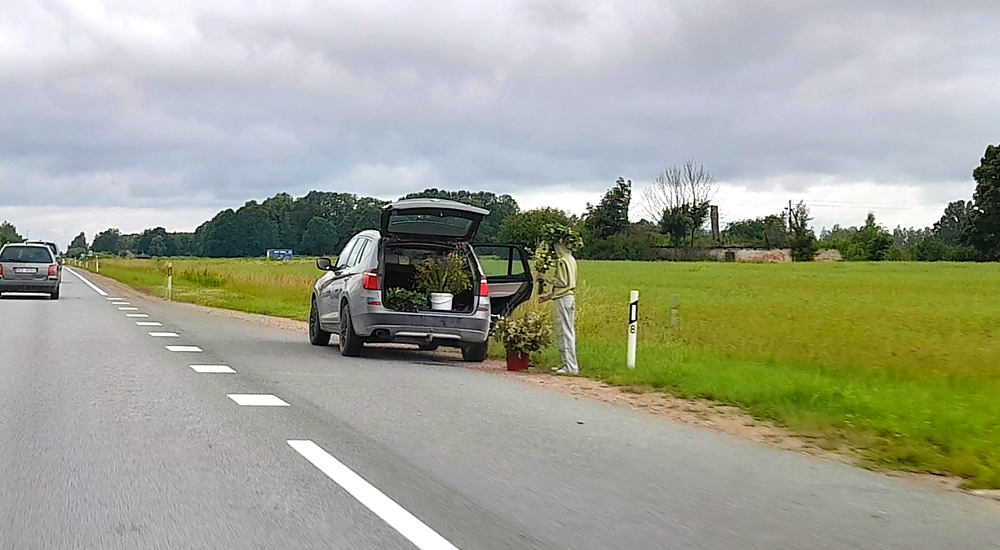
… but different.
As we are about 30 minutes early to check in we stop at a local shopping centre which has a Rimi supermarket for supplies. Earlier, Lynn had discovered that the stand on the back of her phone case has ‘ceased to be’ so we also call into a phone shop to buy a new case. A bargain at Eu9.
Like several women shoppers in the supermarket, the phone shop sales assistant is also sporting a simple but gorgeous Midsummer wreath – hers made from maidenhead fern studded with blue flowers.
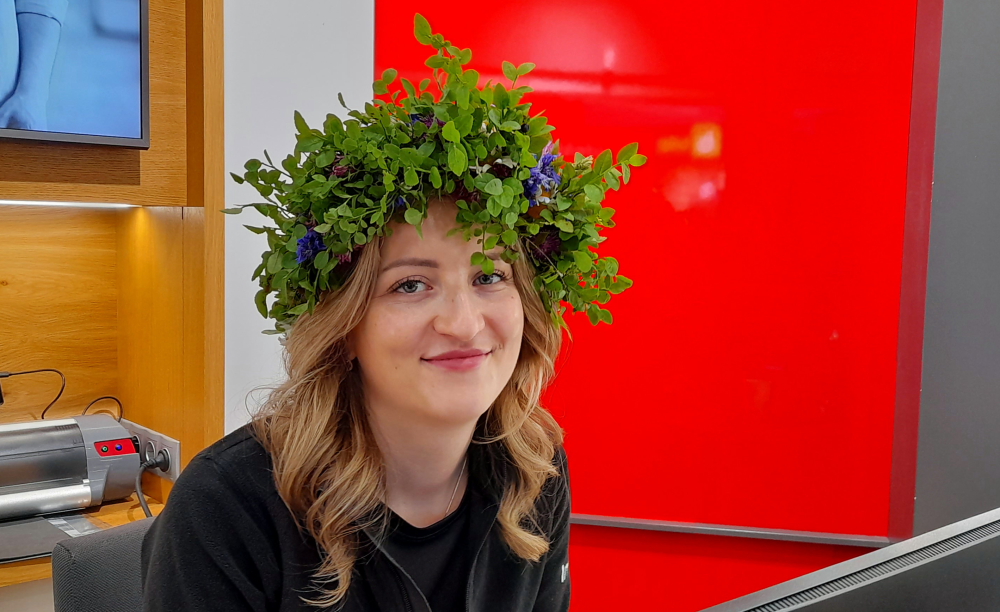
Midsummer chic.
Around 2:15 pm we arrive at our apartment to be met by Viktor, our host, who is sitting outside in the car park under a large sun umbrella. He, and his Thai wife, show us around the apartment but it takes him a while to find the English language option on the TV for us. Better him than me as his English is better than my Russian!
Unpacked and several loads of washing later we venture around the corner and find that the Grill Pub is open and doing a roaring trade so we pop in for dinner. Lamb kebab, salad and a beer for me and potato pancakes with salmon, sour cream, salad and a campari and orange for the Missus.
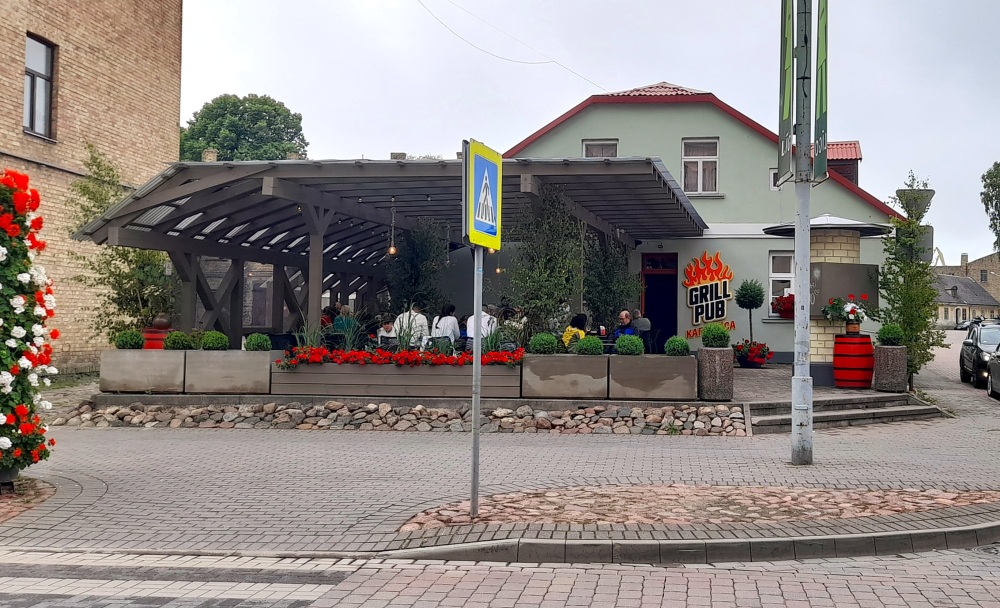
Grill Pub – perfect name.
After watching a bit of telly back home we hit the sack around 11 pm, but the locals will probably go to a park after midnight to celebrate Midsummer. Priecīgus Jāņus! Happy Midsummer!
24 June, 2024
Unlike yesterday’s gloom, today promises to be bright, sunny and 21 degrees.
After breakfast we go for a stroll to check out part of the town. Driving into town yesterday we could see that it is a Latvian port city on the Baltic Sea, thanks to its large rail terminal and the number of huge cranes on the Venta River that dominate the skyline.
We walk up Leila iela, past the Grill Pub, straight to the junction with Ostras iela (Ports Street) that runs parallel to the river.
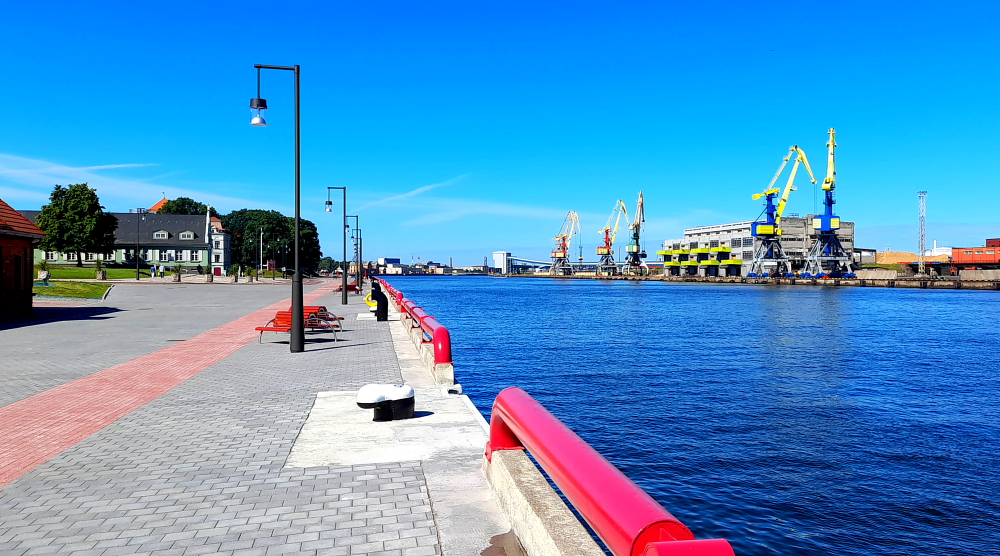
Cranes on the Venta River that bisects Ventspils, Latvia.
At that junction is a fountain named the “Shipwatcher” – probably one of the ugliest fountains we’ve ever seen.
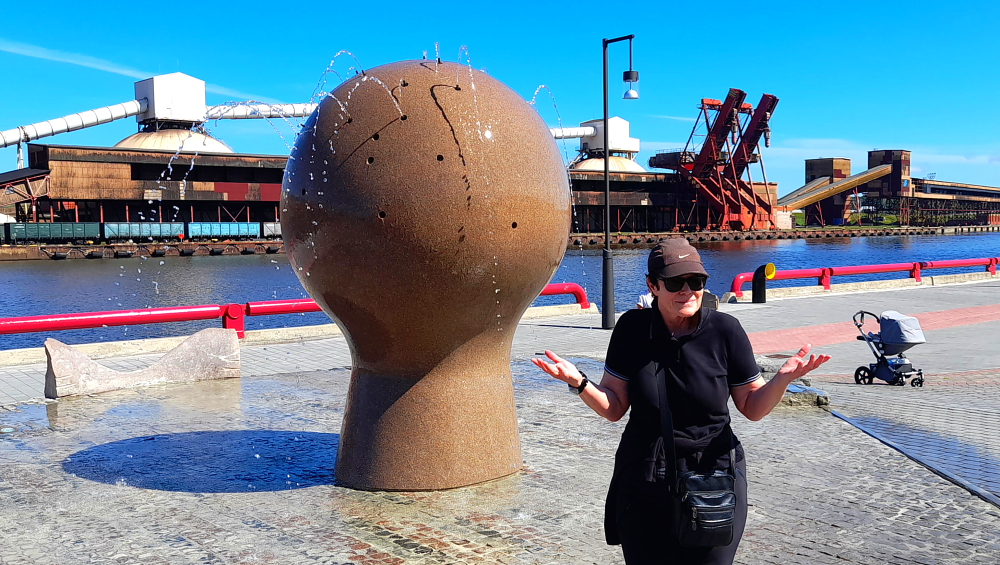
What’s the point of this?
This part of the Old Town is odd – historic buildings either renovated, or not; the odd derelict wooden building surrounded by an unkempt yard; old military buildings cheek-by-jowl with modern art installations …
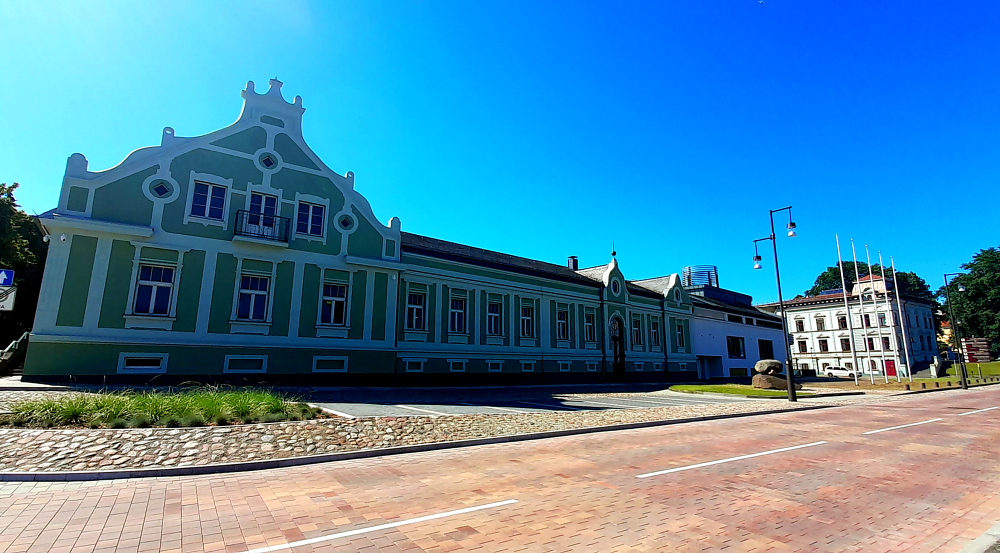
Restored Freeport administration building, Ostras iela, Ventspils, Latvia.
Half way along our route we come to the sculpture, “The Monument to Krisjanis Valdemars” (1825-1891) – the founder of the Young Latvian movement, publicist and politician, as well as the founder of the first Latvian maritime school.
The bronze sculpture “observes” the operation of Ventspils port, as well as every ship that enters Ventspils port through the sea gate. It is life-size and concrete, placed on a cast-iron bench in the old town of Ventspils on the river bank next to the Freeport administration building overlooking the sea [visitventspils-com].
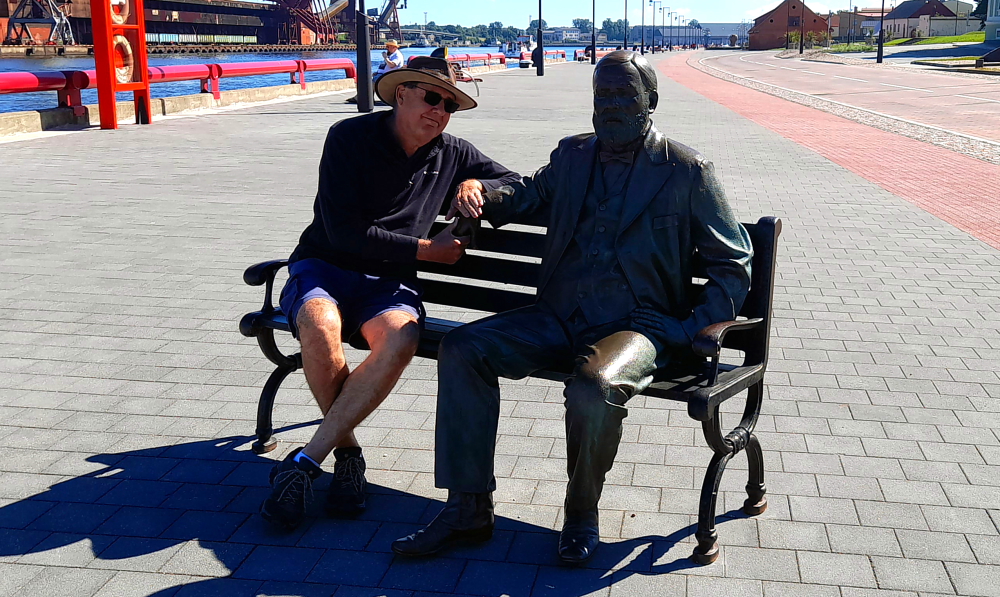
“The Monument to Krisjanis Valdemars”, Ventspils, Latvia.
Ventspils is also known as “Cow Town”. Here we see come our 1st cow – Sea Cow – complete with fins on its hooves. It’s like visiting Rockhampton with its statues of bulls!
Cow Parade is an international public art exhibition that has been shown in major cities around the world. It began in Zurich in 1998 and the idea has been adopted by other cities that have chosen animals for public art projects with painted fibreglass sculptures.
The fibreglass cow sculptures were created by local national artists, expressing their vision, message and story to society through the image of the cow. The painted cows were placed in public places in city centres and after the exhibition, which can last several months, the cow statues are auctioned with the proceeds donated to charity. Ventpils hosted the Cow Parade 2002, which is considered as the largest and most successful public art event in the world.
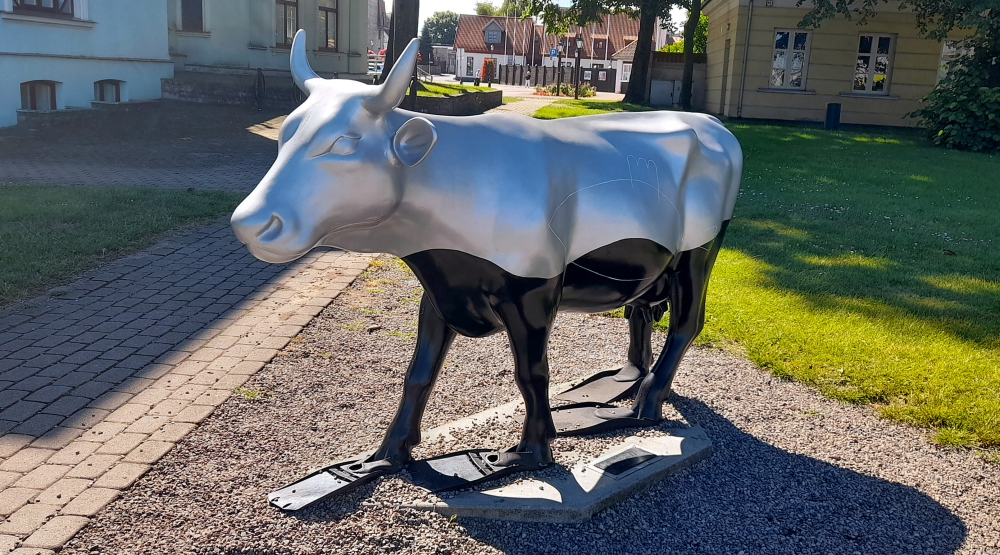
Sea Cow
There have been 2 Cow Parades in Ventspils. Today, cow sculptures of various sizes and colours, created by famous Latvian and foreign artists, can be seen here. There are 25 life-size and 3 large cows in the city – the Sailor Cow, the Flower Cow and the Travelling Cow – 4m high and 7m wide.
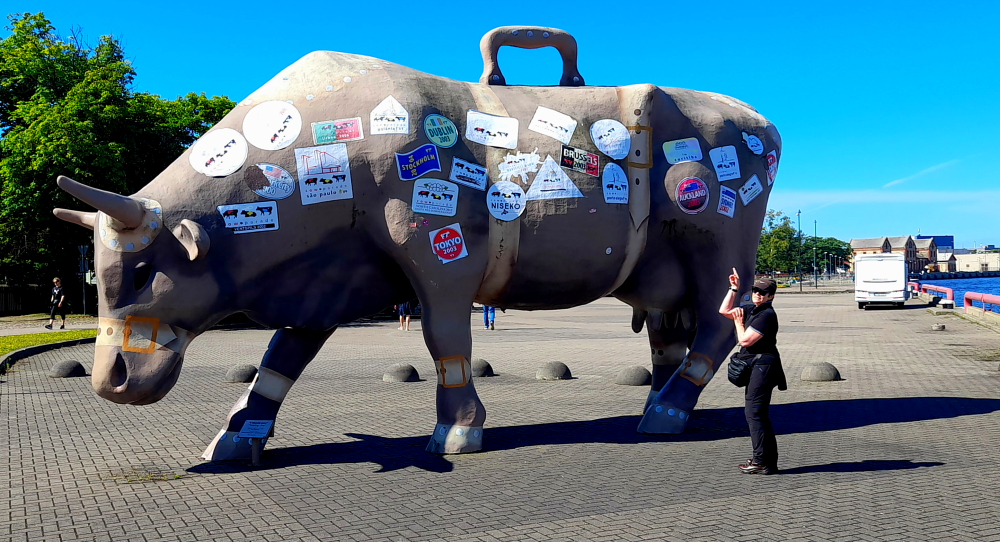
“Travelling Cow” – both of them!
The Travelling Cow created by Pauls Spridzāns symbolises the journey of the Cow Parade project around the world to the cities where these art parades have taken place; the cow is created as an old suitcase covered with stickers (just like ours!). 3 of the stickers are Sydney 2002, Auckland 2003 and Margaret River 2010.
Retracing our steps we walk past the 13th-century Castle of the Livonian Order which now houses Ventspils Museum and into the Old Town.
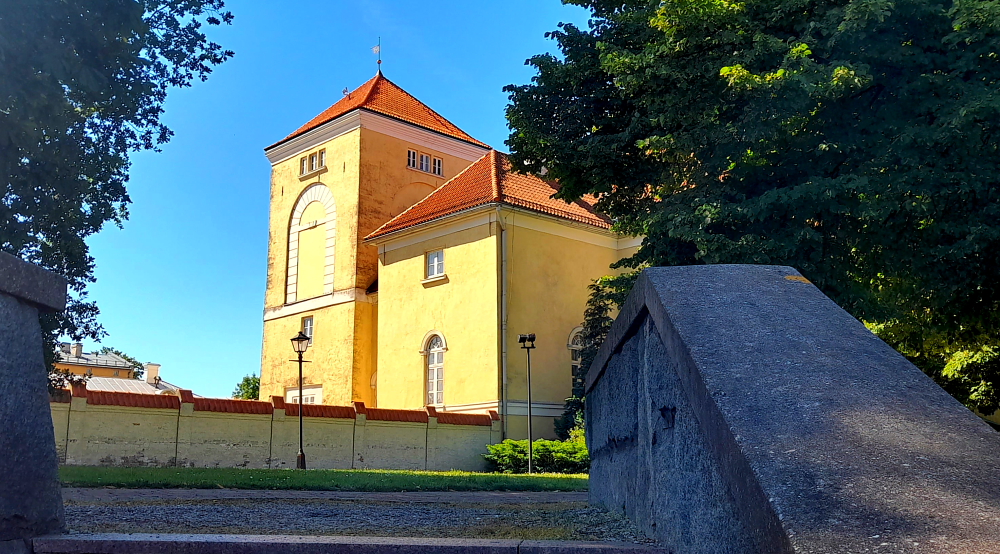
13th Century Castle of the Livonian Order, Ventspils, Latvia.
With cobblestone streets and 17th-century storehouses, the Old Town is centred on Town Hall Square and Market Square.
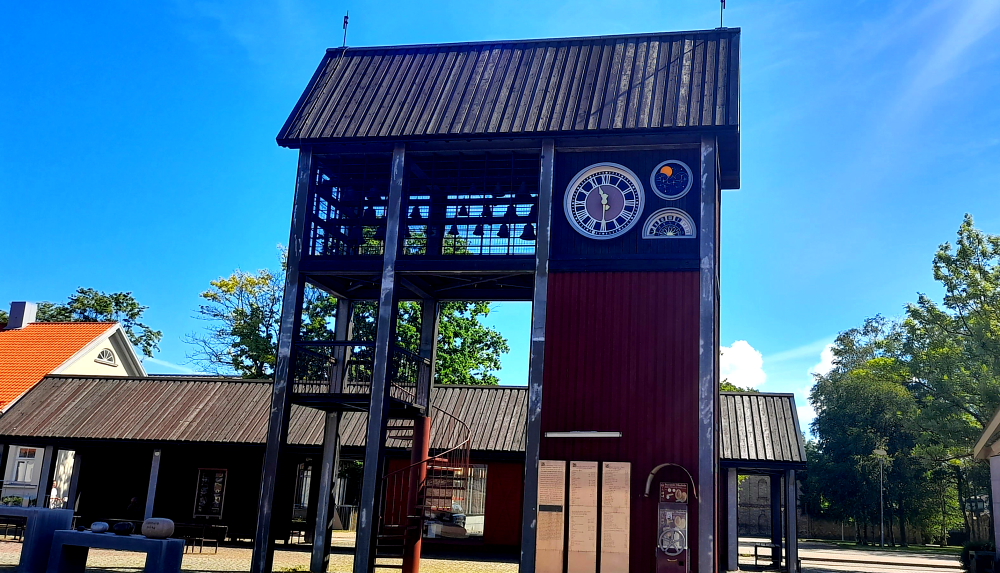
Pulksteņa tornis (Clock Tower), Skarnu iela, Ventspils, Latvia.
Only a block away from the Market Square are quiet cobbled streets with wooden houses.
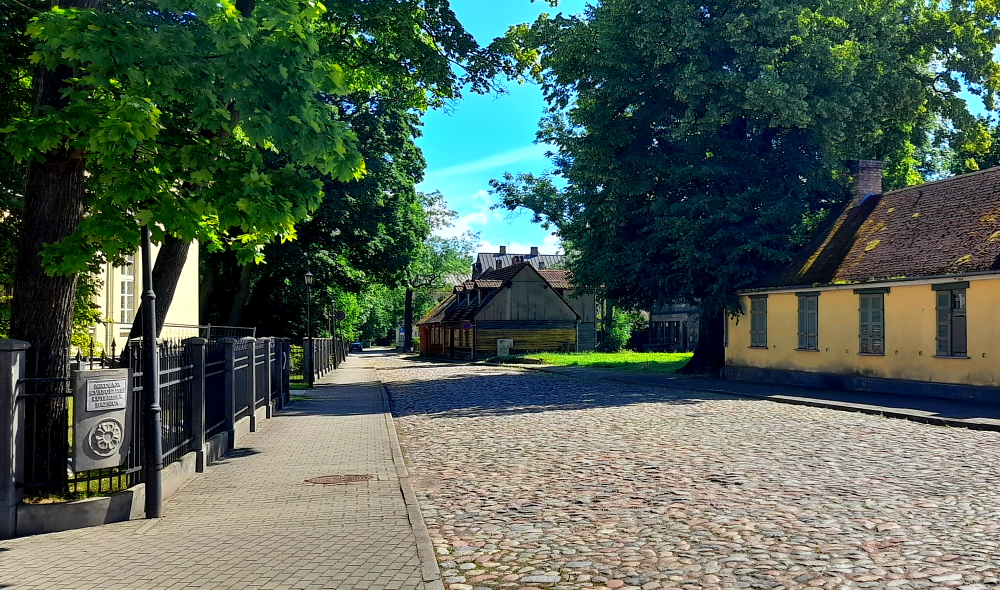
Baznīcas iela, Ventspils, Latvia.
On Tirgus iela is the Evangelical Lutheran Church of St. Nicholas. Named after Nicholas I following a donation from the Emperor to build the church between 1834 and 1835. The church remained intact during the two World Wars, and was restored at the beginning of the 21st century.
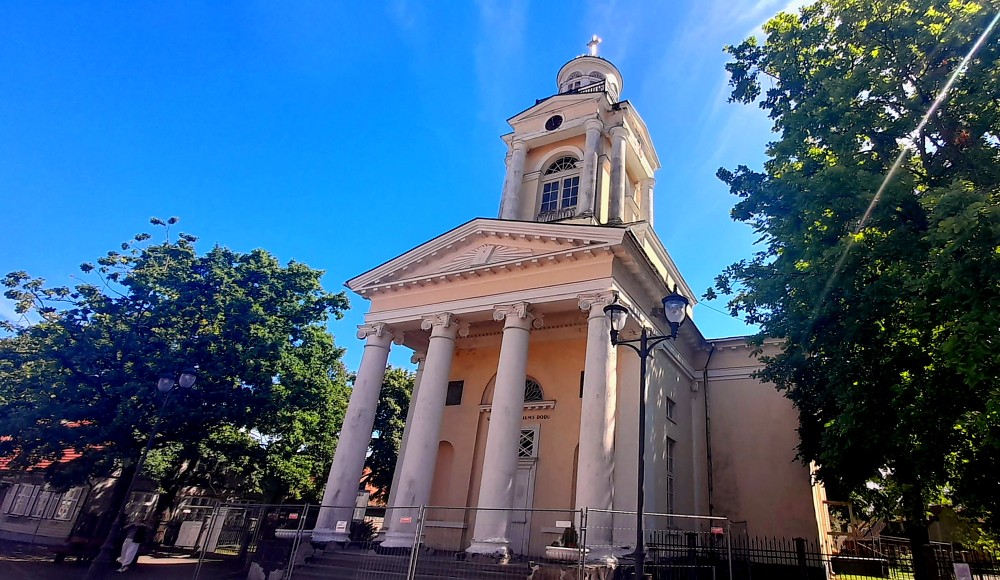
Evangeliski luteriska draudze (Evangelical Lutheran Church), Ventspils, Latvia.
Today, on Town Hall Square, there is a structure that seems to be a combination of a May Pole and a brazier. Will it be burned tonight at the last celebration of Midsummer?
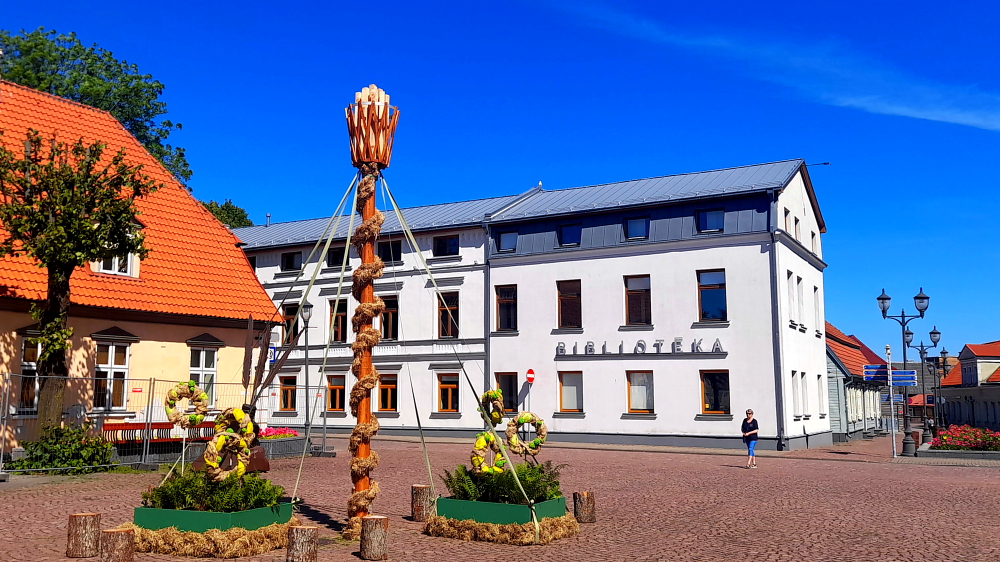
Rātslaukums (Town Hall Square), Ventspils, Latvia.
As we wander around town this morning it becomes obvious that just about everywhere is closed today for the public holiday. But, we find that the Grill Pub has its doors open for lunch so we book a table for dinner tonight. Just as well, otherwise we’d be eating Cornflakes for dinner!
25 June, 2024
Another sunny day with a top of 22 degrees. We’re going to venture farther afield by car to check out the other ‘must see’ sights that Ventspils has to offer.
First up is its beach on the Baltic Sea side of the harbour, a popular spot for both tourists and locals. The beach spans over a kilometer and boasts clean, white sand, earning it the Blue Flag award for its pristine condition. The peak season for Latvian beaches is in late July and August, so it’s still a month before the crowds appear [beachatlas.com].
It’s hard to believe that behind the concrete wall that supports the sand dunes and across the river is the Baltic Coal Terminal in all its rusty, industrial glory.
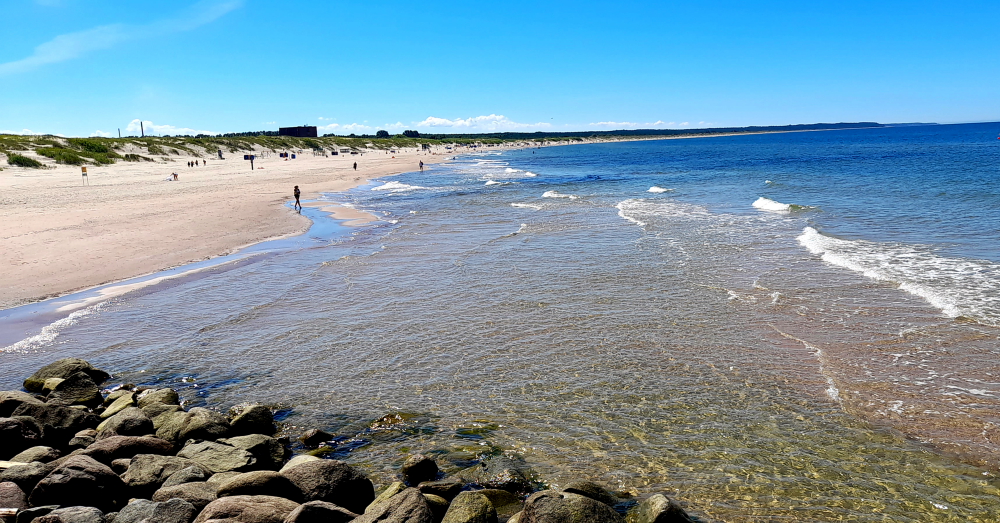
Ventspils Beach, Latvia.
Further along the breakwater is another of Ventspils cows – Sailor Cow, located on South Pier – the idea being that it can greet visitors who come to Ventspils from the sea.
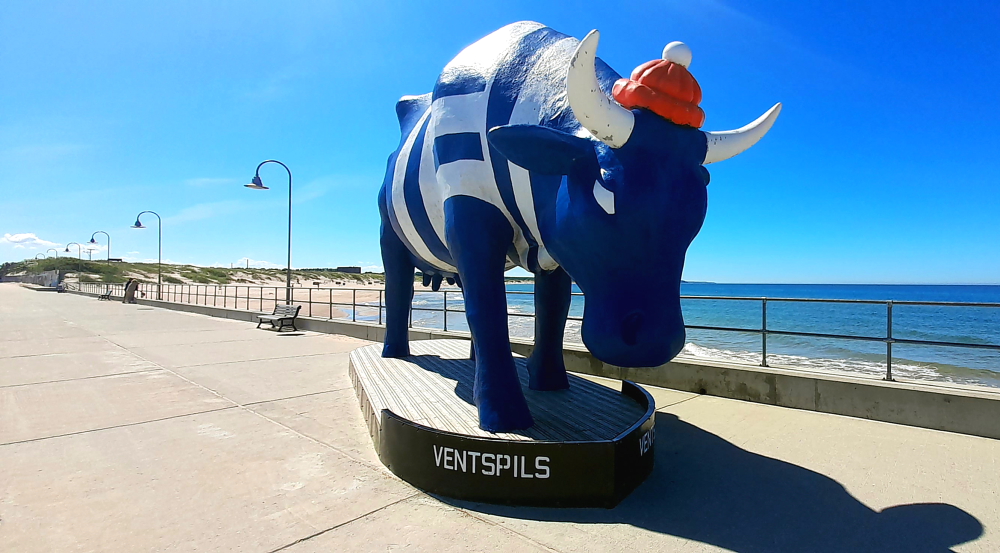
“Hello Sailor” – Sailor Cow, South Pier, Ventspils, Latvia.
Just where the river joins the harbour is the Ostas Street Promenade with a wide view of the Venta River, the sea gate, the old workshops of the Port and an impressive artistic collection of buoys.
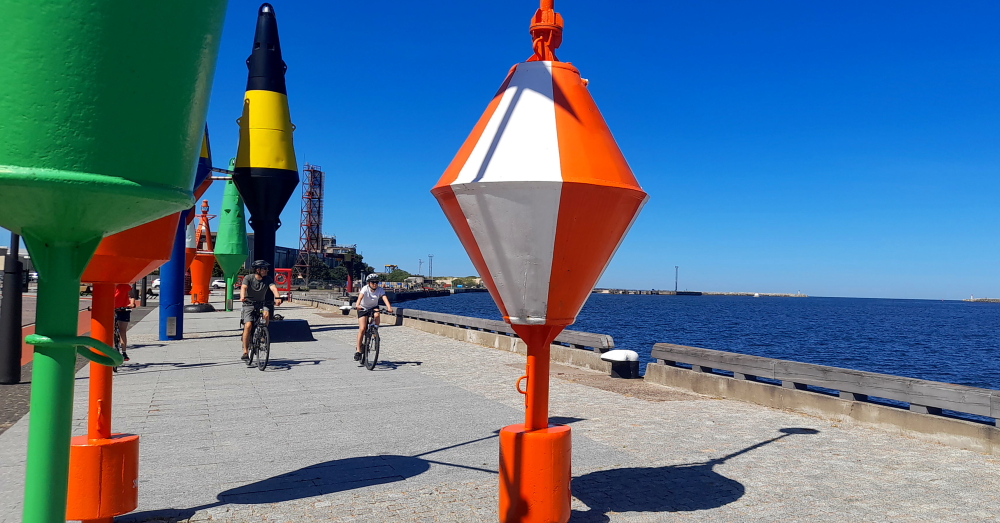
Buoys, Ostas Street Promenade, Ventspils.
Nearby is the Beach Waterpark where one of the town’s many floral sculptures is located – “Underwater World”.
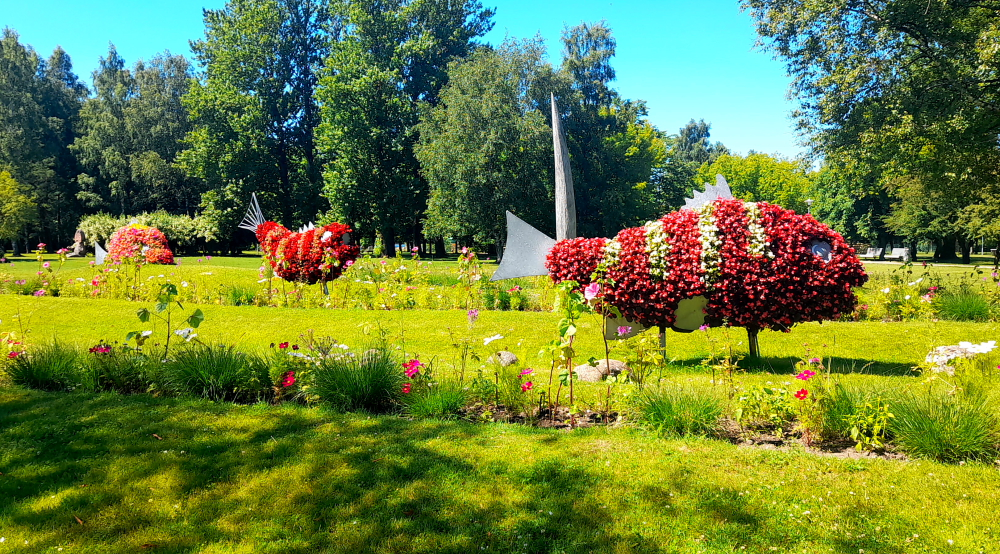
“Underwater World” floral sculpture, Beach Waterpark, Ventspils, Latvia.
Driving to our next location we pass by an estate of ugly, patched concrete high-rise flats, in stark contrast to the single-story, wooden houses nearby.
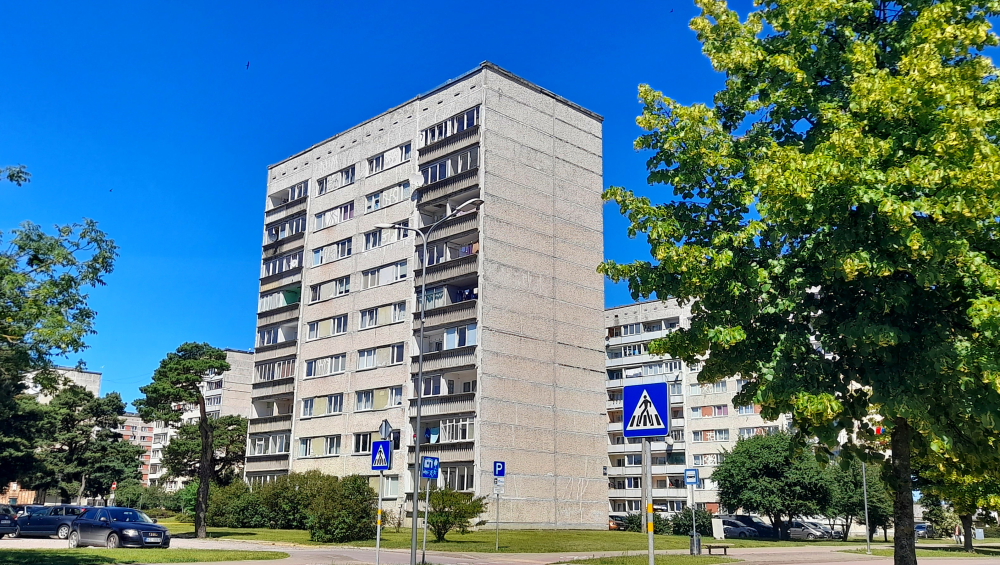
Ugly, patched concrete high-rise flats, Ventspils, Latvia.
Closer to the centre of town, at the junction of Lielais Prospekts and Kuldigas iela, at the edge of Jaunpilset Square garden is another floral sculpture – “Bobsleigh Team” – with the sled of Latvian athlete S. Prusis.
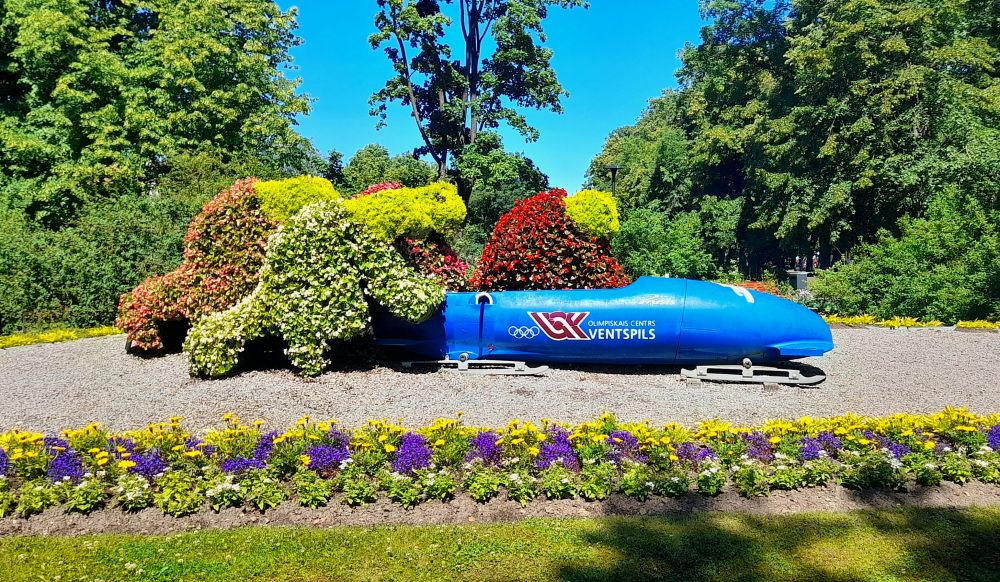
“Bobsleigh Team” floral sculpture, Ventspils, Latvia.
Across the road in Lielais laukums (Big Square), in front of the Latvia Concert Hall is one of the numerous town fountains, “Whalefish” established in 2016. The construction of the 3-masted frigate Wallfisch (Whalefish) in January 1644 is the source of inspiration for this fountain. Owned by Duke Jacob (1610-1682) of the Duch of Kurland and Semigallia, records show that in 1651 the ship sailed to The Gambia in West Africa, a colony of the Duchy at the time which is interesting as Lynn worked in The Gambia a number of times in the early 1990s.
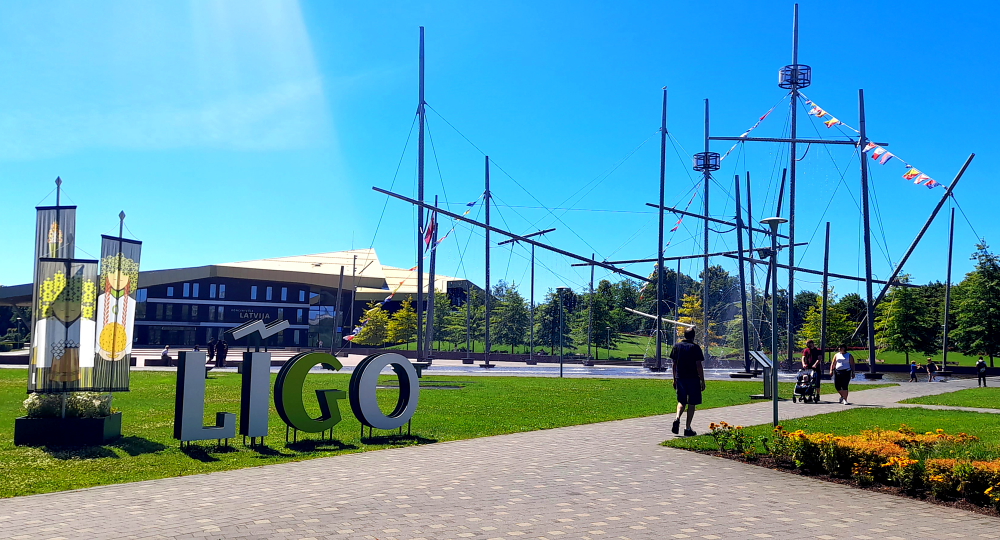
“Whalefish” fountain in front of the Latvian Concert Hall, Ventspils, Latvia.
The concert hall has a unique stave organ and the world’s tallest upright piano “47i”, created by Dāvids Kļaviņas [latvia-travel.
Further up Kuldigas Iela is another park with the fountain “Umbrella” which has ‘rain’ falling from the inside the brolly – totally contrary to the purpose of an umbrella.
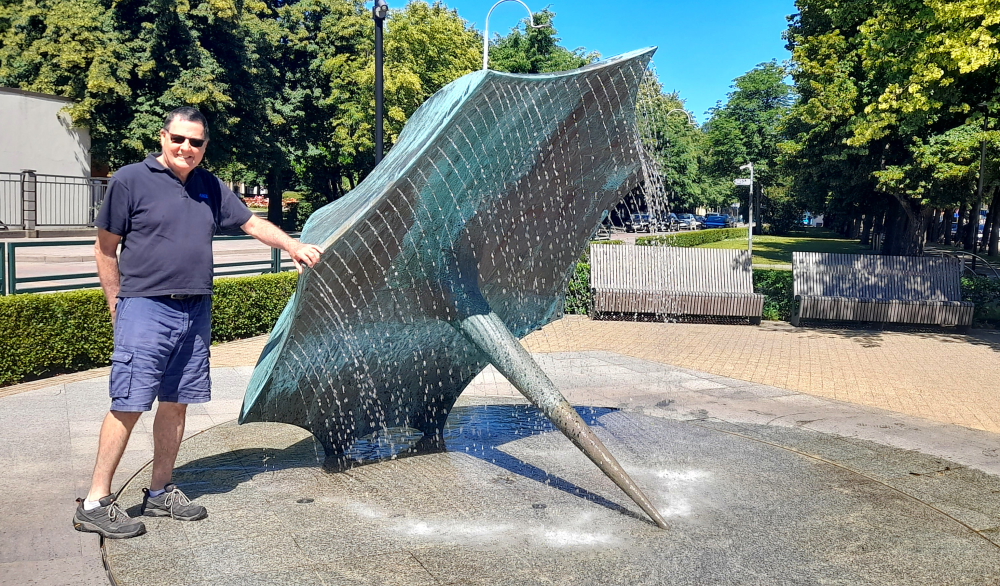
“Umbrella” fountain, Ventspils, Latvia.
From here we drive up to the riverside again to the Stena Line building on Darzu iela where both the “At the Mirror Cow” and the “Storm Cow” are located.
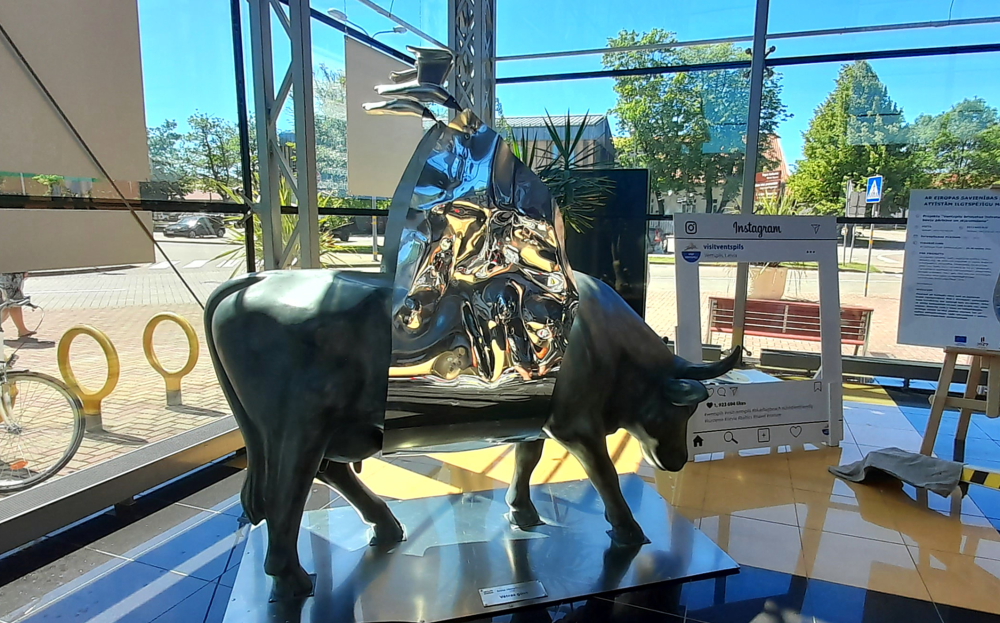
“Storm Cow”, Ventspils, Latvia.
Flying seagulls carrying a Storm Cow across the Baltic Sea towards the windy shores of Ventspils, a 2012 entrant [visitventspils.com].
Driving along the river we arrive at the VIZIUM (Vision) Science Centre where more than 80 interactive exhibits, science shows, laboratories, conference rooms, classrooms and technical creative workshops are available to visitors, introducing physics, chemistry and other natural sciences [latvia-travel].
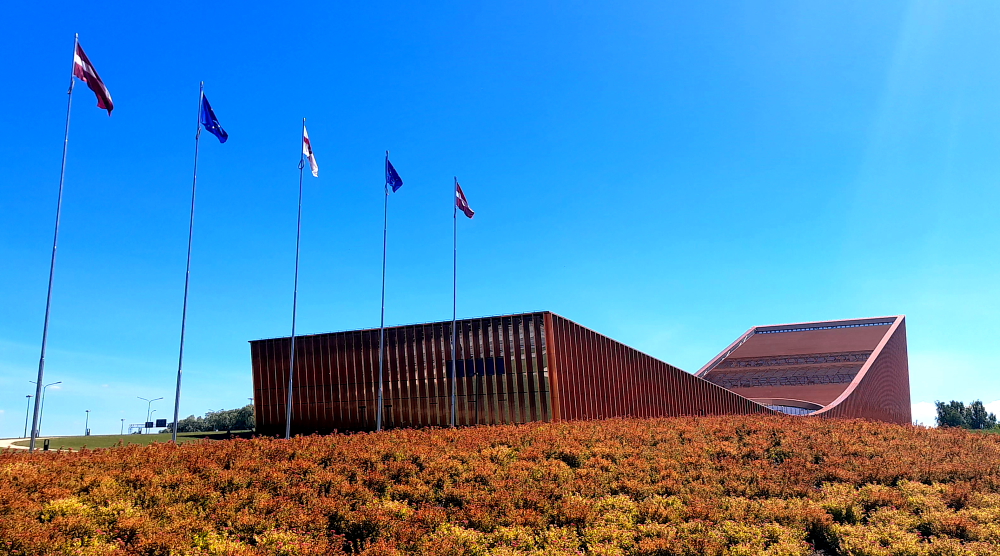
Vizium Science Centre, Ventspils, Latvia.
And across the road in another park, Sarkanmuizas Meadow, is the massive “Flower Cow”, opened in 2012 in preparation for the 10-year celebrations of the Ventspils Cow Parade. It’s also the 1st thing you see when you cross over the river and drive into town – just like Rocky (Rockhampton)!
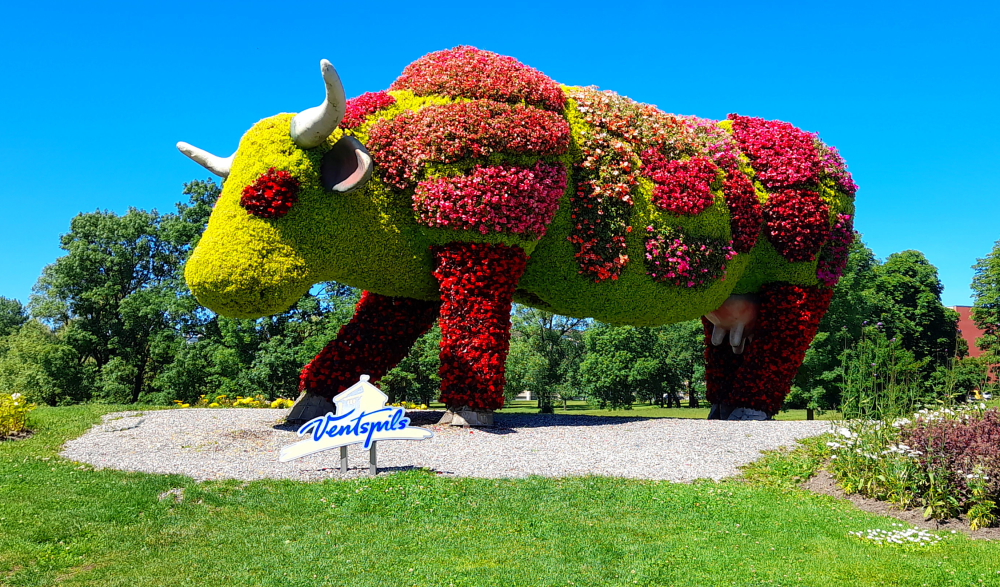
“Flower Cow”, Ventspils, Latvia.
All this driving is thirsty work so when we get home Lynn opens a can of Rose Lemonade (exactly what it says on the tin) and a packet of Riekstini – biscuits that look like walnuts with a caramelised milk filling – which we 1st discovered in Cesis.
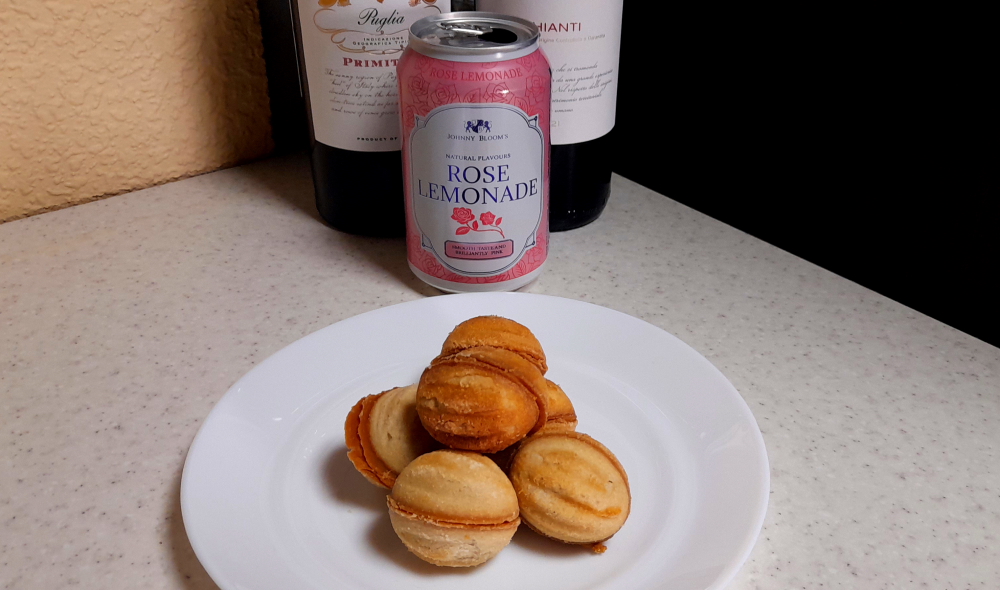
Rose lemonade & Riekstini biscuits.
Tomorrow we drive to the 5* Promenade Hotel in Liepaja, about 120km due south. Liepaja is another port town located on the west coast of Latvia between the Baltic Sea and Lake Liepāja which is connected to the sea by the Trade Channel.
The city has grown from the fishing village of Liva, an ancient settlement by the outlet of Lake Liepāja to the sea [wikipedia]. And it seems like everywhere else we’ve been in the Baltic states, in 1263, the fortress of the Knights of the Teutonic Order was built here.
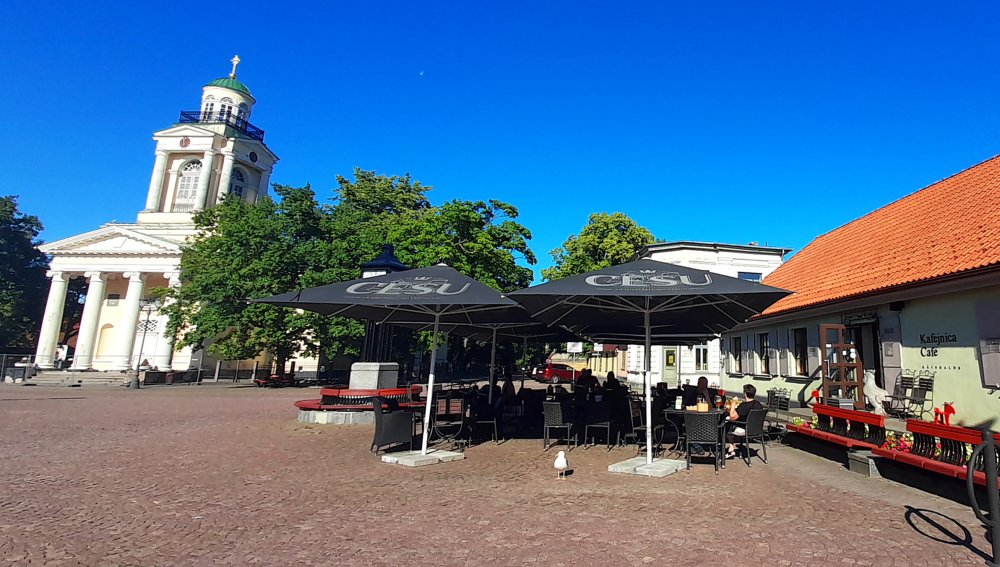
Al fresco dining at the Ratsgalds Cafe, Town Hall Square, Ventspils, Latvia.
In the meantime we dine at the cafe in Town Hall Square that our hostess had recommended to us when we arrived – the Ratsgalds Cafe.
26 June, 2024
It’s sunny and 21 degrees when we exit the apartment’s car park at 11:25am. First up we’ll visit Pavilosta along the way. En route we see more storks’ nests with fledglings, extensive meadows with white, blue, yellow and orange wildflowers and red poppies.
70km and an hour’s drive south later we arrive in Pavilosta (population 901). In 1879, the German baron Otto Friedrich von Lilienfeld founded a harbour and town here which was called in the name of his brother – Governor of Kurzeme Paul von Lilienfeld – Pāvilosta (Paulshafen). Pāvilosta was used to call Āķagals.
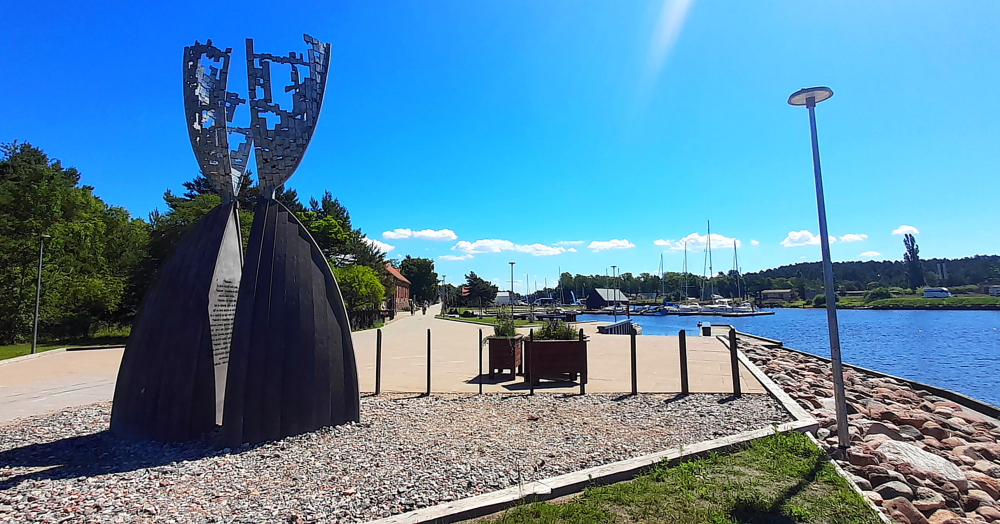
Boat sculpture, Pāvilosta, Latvia.
At the end of the 19th century 15 sailing ships were built voyaging as far as France and Spain. Pāvilosta’s fleet of sailing vessels and motor boats was badly destroyed during WWI. Around 1935, a fisherman’s cooperative was formed and in 1947 they established a fisherman collective farm “Dzintarjūra”. The town prospered and developed as a significant fishing harbour with a fleet of 17 vessels.
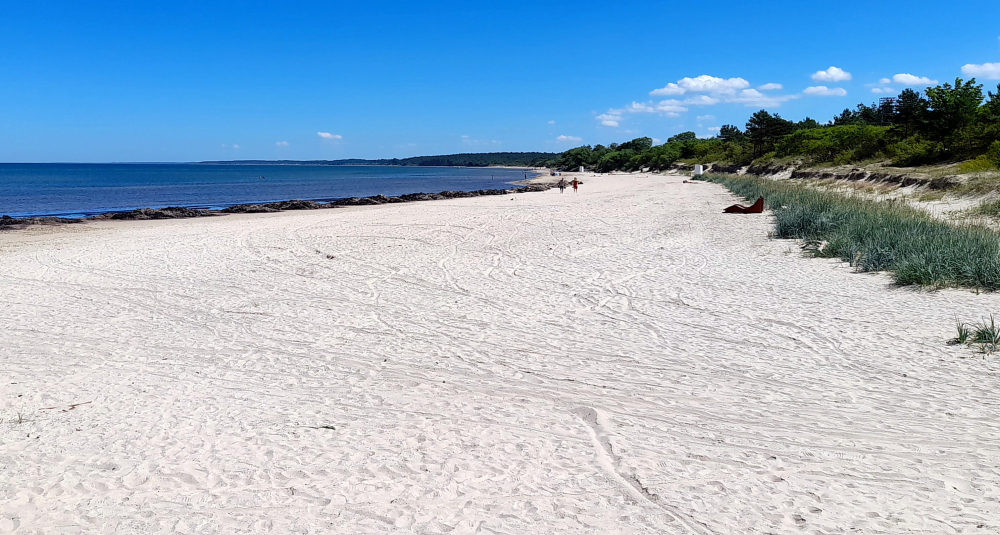
Pāvilosta Beach, Latvia.
In 1974 “Dzintarjūra” became a division of the Liepāja fishermen’s collective farm “Boļševiks” according to state policy but ended in bankruptcy as a result of mismanagement. However, the local fishermen started coastal fishing, forbidden during Soviet times, and renewed the motorboat fleet by purchasing them from Gotland [pavilosta.lv].
Today, the town seems to be a summer slow-tourist destination with some hotels, camping facilities, a couple of cafes, restaurants and bars. Visitors are attracted by its white-sand beach, the Saka River, and hiking, cycling, swimming, sunbathing and sailing activities.
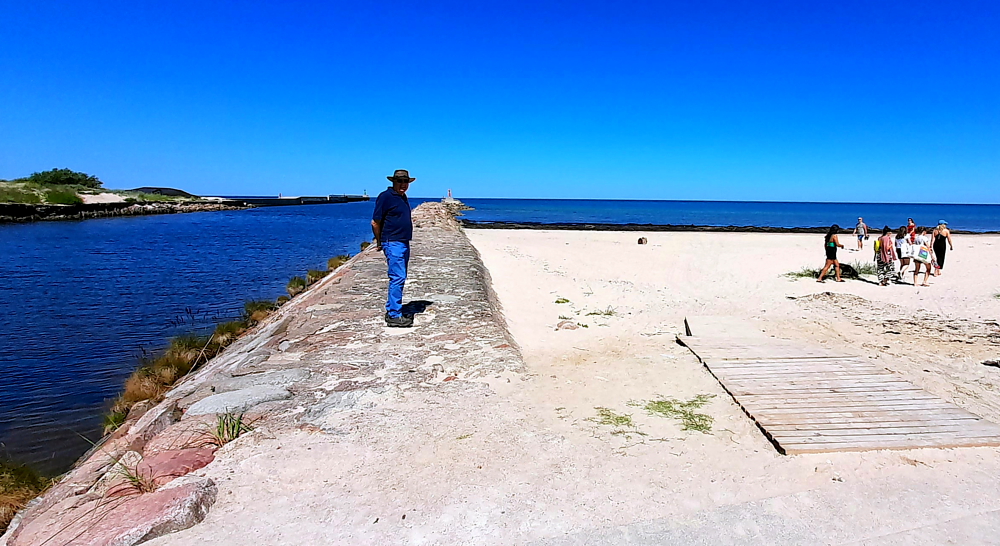
Saka River joining the Baltic Sea with the beach separated from the river by a long, stone breakwater.
Musical vibes from Das Crocodill Bar lures us in to imbibe in a chilled Original for me and a proper iced coffee for Lynn.
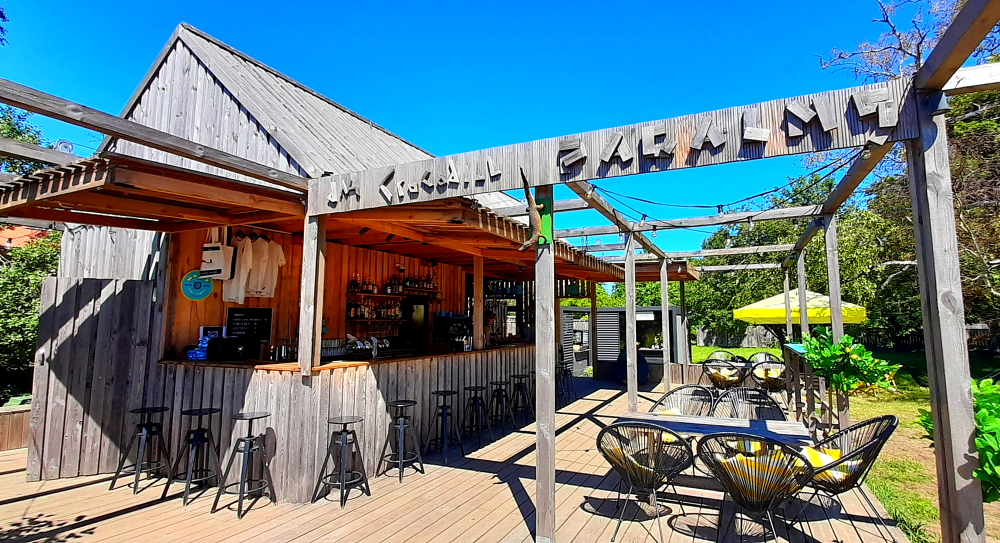
Das Crocodill Bar, Pāvilosta, Latvia.
The young barman, who normally lives in Riga, tells us that the town only operates during the summer months from June to end of August then it totally closes down.
He also tries to entice us to sample their oysters but Lynn’s not a fan thanks to a dodgy oyster years ago and at Eu5 a piece, nor am I.
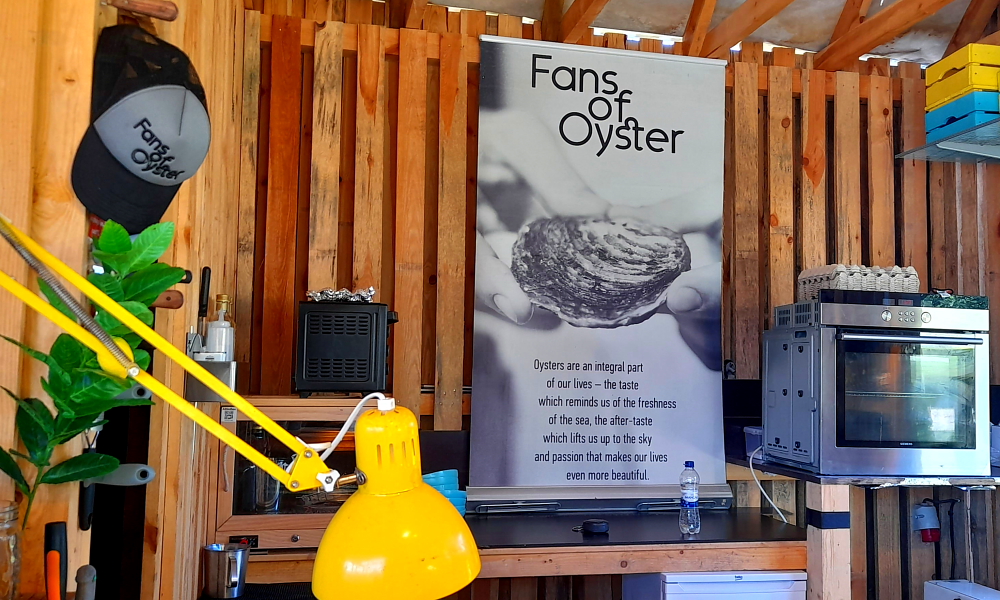
Eu5 a piece, so a bargain at Eu25 for 6!
50 minutes later at 1:55 pm we pull into the car park at the rear of the Promenade Hotel in Liepaja (pronounced Leeaparya) which overlooks the Tirdzniecibas kanals (Trade Channel) – our home for the next 4 days.
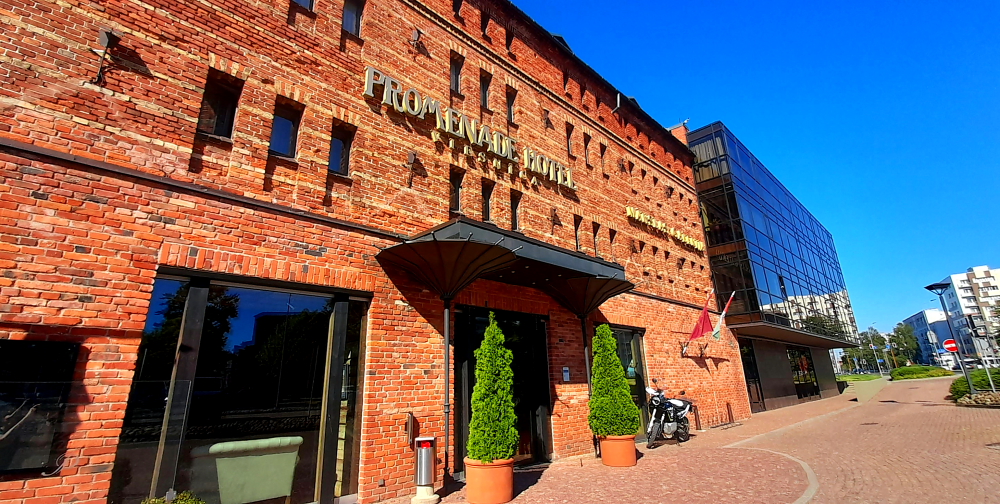
Front entrance of the Promenade Hotel, Liepaja, Latvia.
The “Promenade Hotel” is a part of the history of this city of maritime fishermen, sailors and travellers. The history of the port’s vicinity starts at the beginning of the 18th century when 2 wealthy German traders – Lorenz Joachim Huecke and Anton Witte – organised extensive ship traffic.
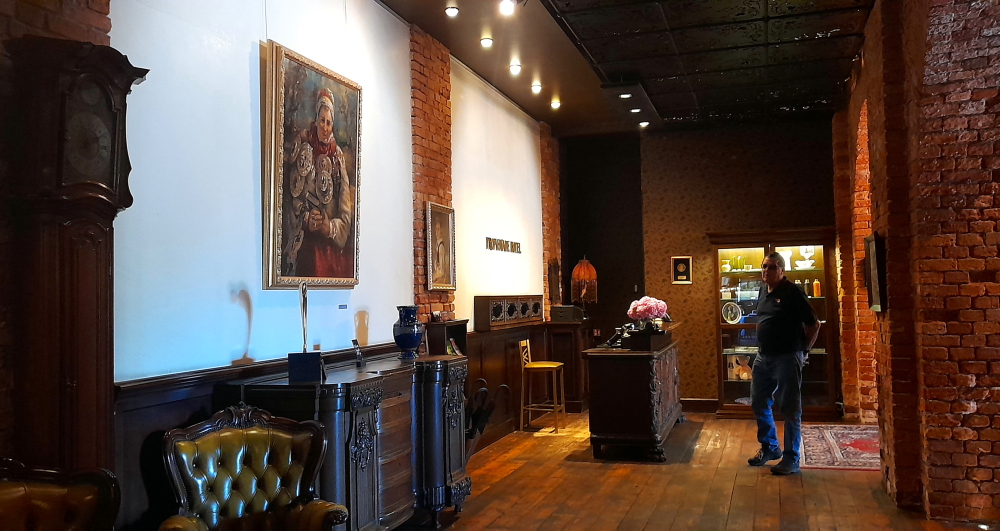
Reception area in the restored warehouse/hotel.
In 2007, the old spīķeris neighbourhood experienced its rebirth and the port warehouse was turned into the Promenade Hotel with a modern design, an elegant restaurant and an art gallery. In fact, the entire hotel is an art gallery with oil paintings and old photographs gracing all the walls.
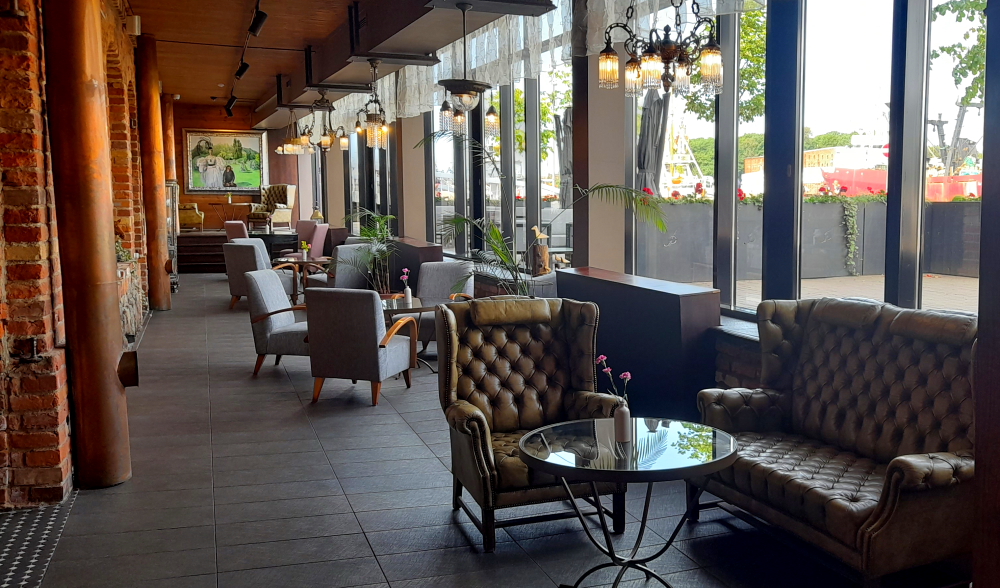
Lounge area between the restaurant & outdoor terrace, Promenade Hotel, Liepaja, Latvia.
The goods received – fabric, cereal and salt – were stored by the German traders in the large port spīķeris warehouse built from the dark red brick which has now become “Promenade Hotel”. These gentlemen were also benefactors and philanthropists who supported the development of the seaside city.
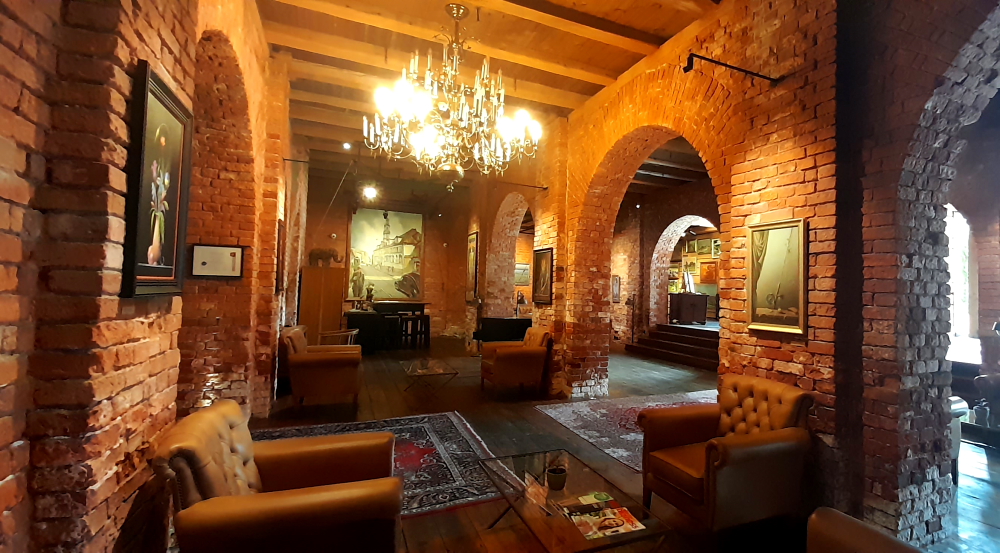
Main lounge area with art gallery back right, Promenade Hotel, Liepaja, Latvia.
Looking through the hotel windows, the ships at the waterfront of the port continue the old story about world travel which will always end with a journey home [promenadehotel.lv].
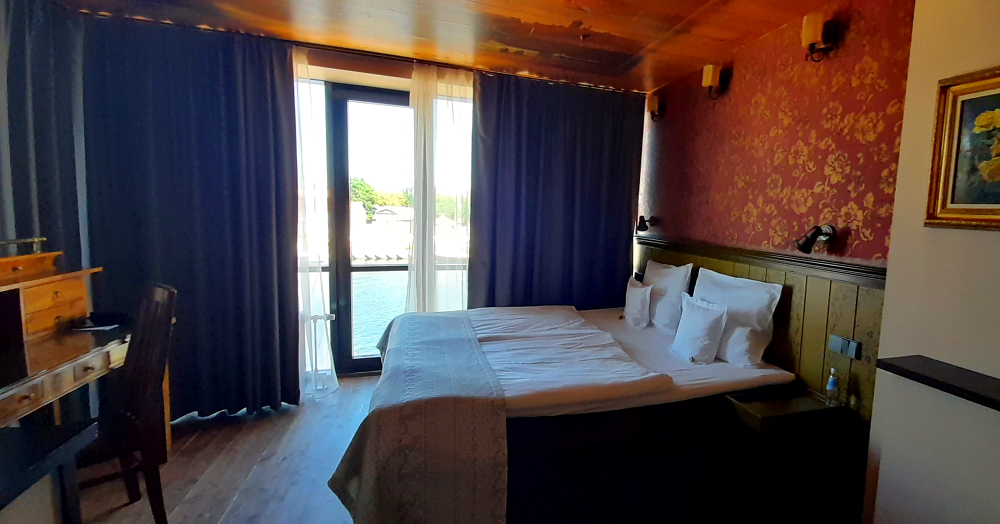
Wooden floors, ceiling, beams & old-style desk, Promenade Hotel, Liepaja, Latvia.
Unpacked, we take a stroll along the canal’s edge in the direction of the sea.
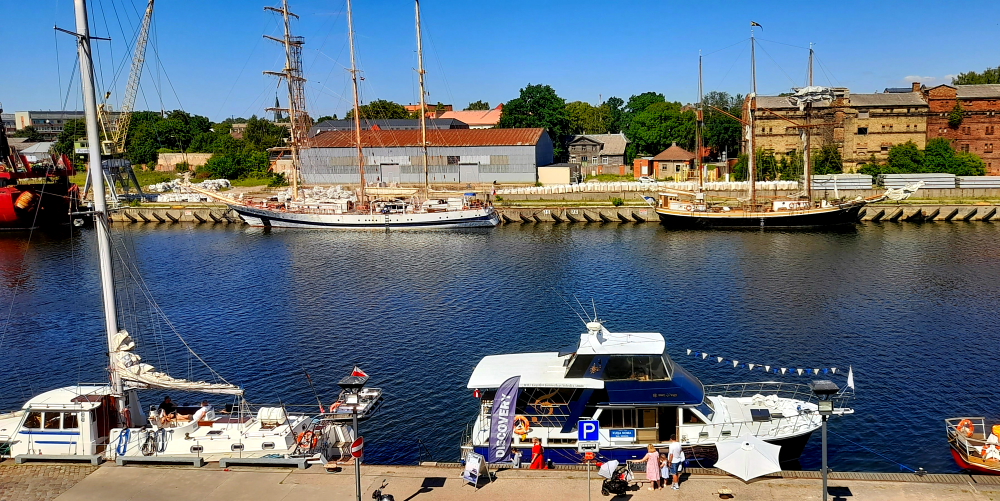
View of the Trade Channel & sailing ships from our 4th-floor room, Promenade Hotel, Liepaja, Latvia.
Here we come across a well-patched, grey naval boat and a row of 7 fishing boats, all the same, all bar one with their sterns abutting the dock. 4 no longer have a net wound onto their large drums, rather sporting a growth of weeds from wooden decks.
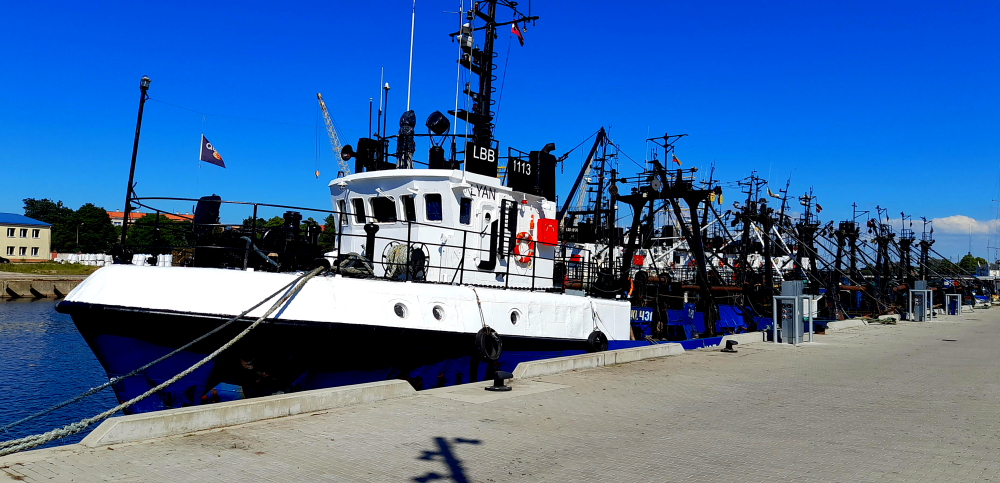
Impressive fleet of fishing boats until you see over half aren’t operational.
Unfortunately we can’t go much further as we’re prevented by a high wire fence which protects a fleet of grey naval vessels, so we walk over to Graudu iela where the Art Nouveau heritage of the town spans almost the length of Graudu Street and also Lielā Street.
The 1st Art Nouveau buildings were built in Liepāja at the beginning of the 20th century, a time when the city began to build many great buildings as a result of the economic upswing. Art Nouveau was the chosen style for rental properties and buildings of public interest, such as the theatre, schools, cinemas, and office buildings. Today there remain around 70 Art Nouveau buildings, most of them being built in a modest and simple manner, making them fit in harmoniously with the rest of the city’s buildings [liepaja.travel].
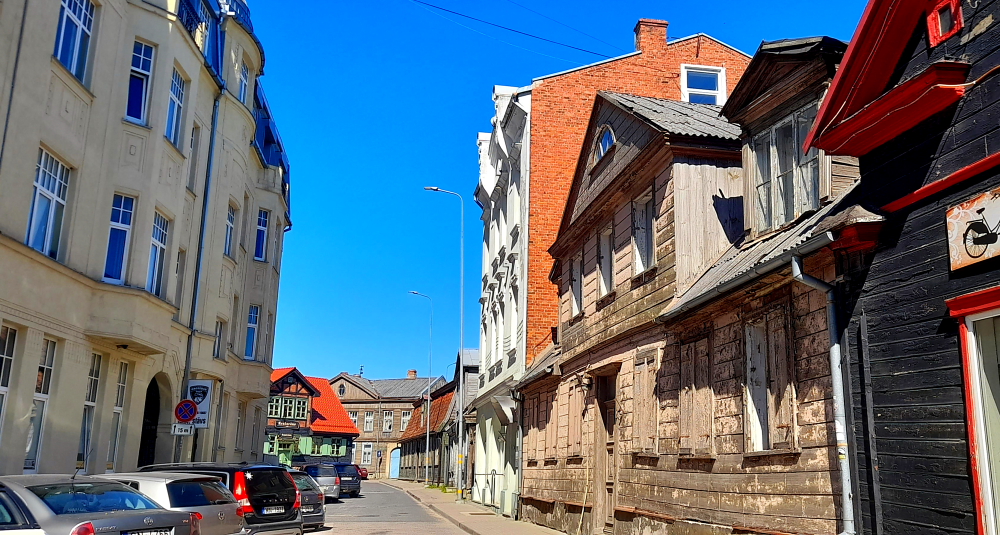
Dika iela, Liepaja, Latvia.
Dika iela, one of the streets off Graudu iela has a couple of 3- and 4-storied brick and rendered buildings interspersed between a neighbourhood of original, old wooden buildings.
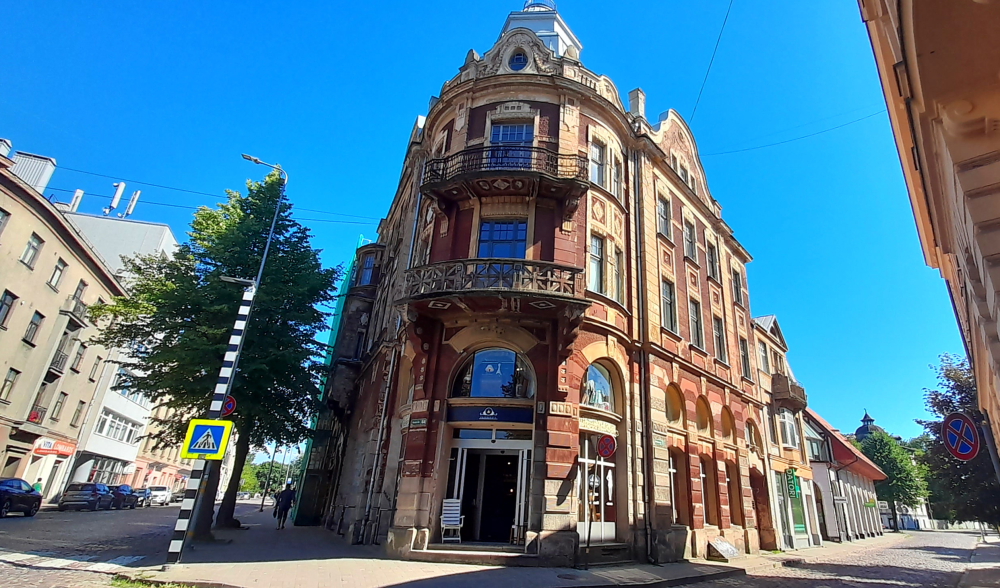
Art Nouveau residential building with shops, Graudu iela 44, Liepaja, Latvia.
In contrast, Graudu iela has principally 4-storied buildings of which 7 are Art Nouveau.
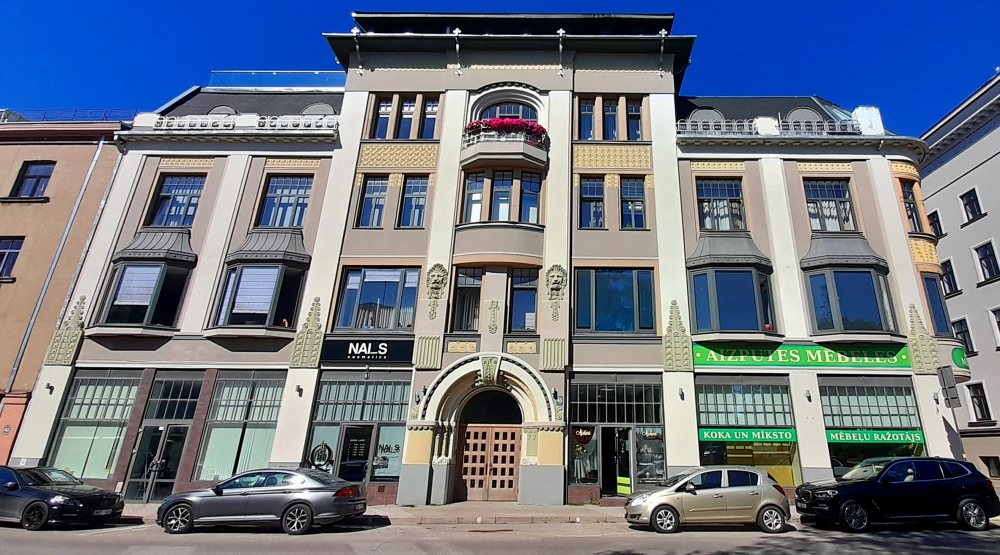
Multifunctional building, Graudu iela 45, Liepaja, Latvia.
Crossing over the tram lines that run down Liela iela, we walk past Rose Square and under the arch of the Art Hotel Roma into the 19th century Romas Darzs (Roman Garden) courtyard and shopping arcade.
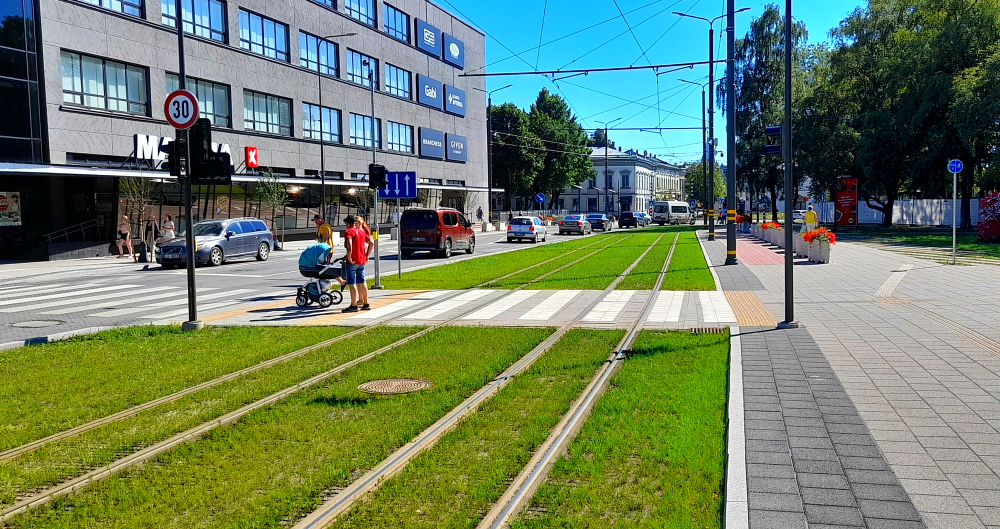
Tramline, Liela iela, Liepaja, Latvia.
Romas Darzs was built in the 19th century as a shopping arcade with a wide and romantic courtyard which were popular in all European capitals at that time, but later it turned into an hotel.
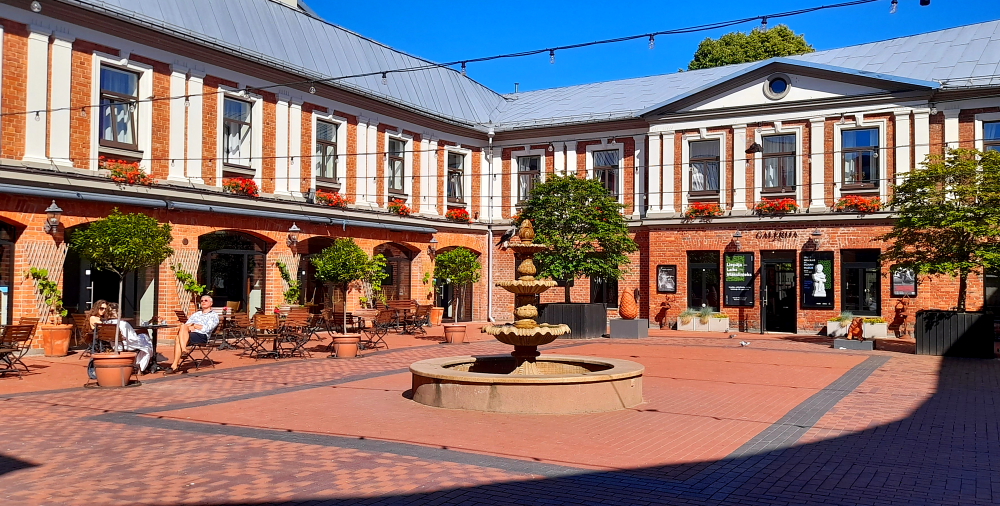
Romas Darzs 19th century courtyard & shopping arcade, Liepaja, Latvia.
Currently, the building houses the Art Hotel Roma, a bakery, offices and shops, while an art gallery with a shop, a doll art and design museum and a conference room are located in the underground tunnels of the building [liepaja-travel].
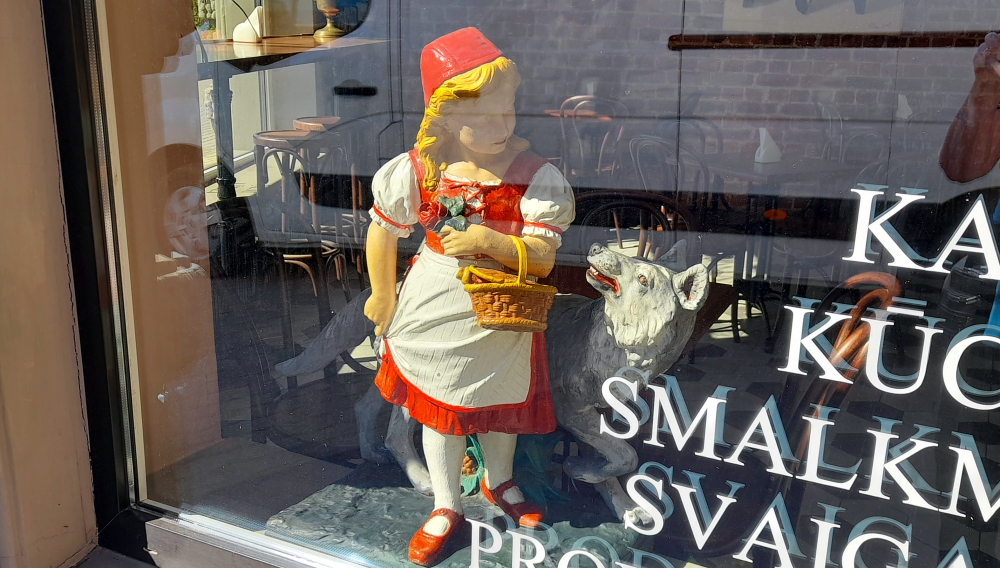
Bakery, Romas Darzs, Liepaja, Latvia.
Across the road is Rozu Laukums (Rose Square), the heart of the city and a meeting place. True to its name, its constant value is the roses that have been planted here for more than a hundred years.
Historically, this place housed the New Market. This is still evidenced by the buildings with two towers next to the square, which used to be the market’s meat stall. In 1910, after the market moved to Kuršu Street, where it is still located today, the city authorities decided to create an open garden with roses. It is designed strictly following the geometric composition of the square with a rose bed in the center and symmetrically arranged paths. Rose Square got its current name in 1911 [liepaja-travel].
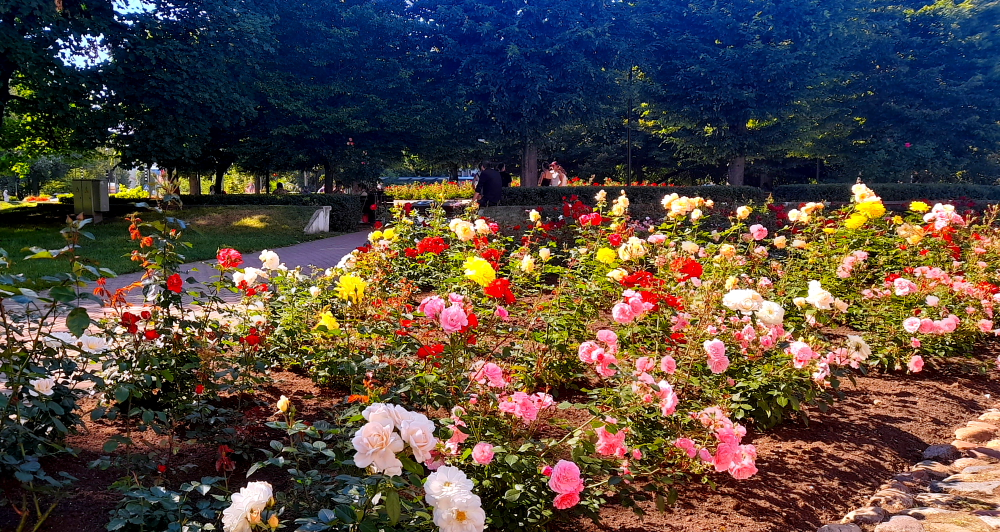
Rose Square, Liepaja, Latvia.
Walking up Liela iela towards the canal, is located the Holy Trinity Cathedral where, from the top of the church’s 55m high tower, the panorama of Liepaja can be seen.
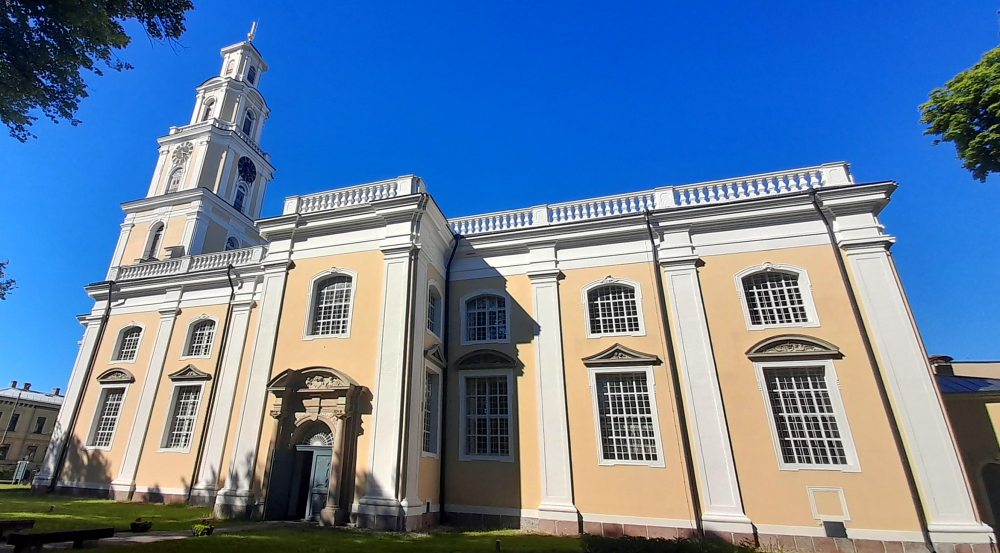
Holy Trinity Cathedral, Liepaja, Latvia.
The cathedral was constructed between 1742 and 1758 in Baroque-style decorative brilliance with Classicism features.
A unique treasure of the church is the oldest unreconstructed mechanical organ in the world. It was built by Heinrich Andreas Contius who was one of Europe’s greatest craftsmen. The organ has 131 stops, 4 manuals and over 7,000 pipes. It is played during church services, but every September International Organ music festival takes place. Lynn even gets to enjoy a small impromptu concert while visiting.
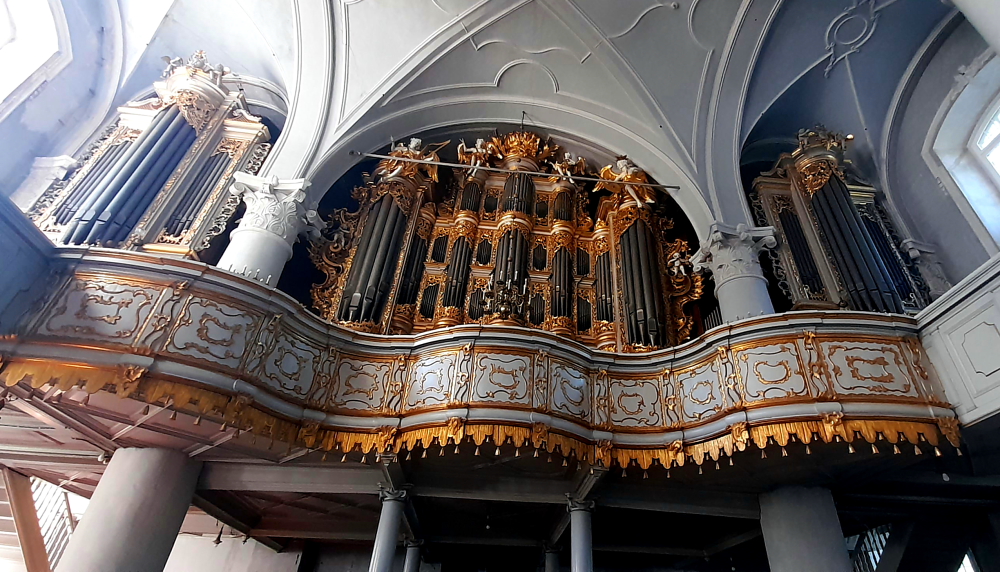
World’s oldest unreconstructed mechanical organ, Holy Trinity Cathedral, Liepaja, Latvia.
The cathedral’s interior is characterized by its Roccoco features and luxurious furnishings with wood carvings and gold plating. The Trinity Cathedral once housed the congregation of the local German Lutheran community. The Duke or Courland’s (the dukes of Kurzeme) private box stands to this day on the second floor of the church [latvia.travel].
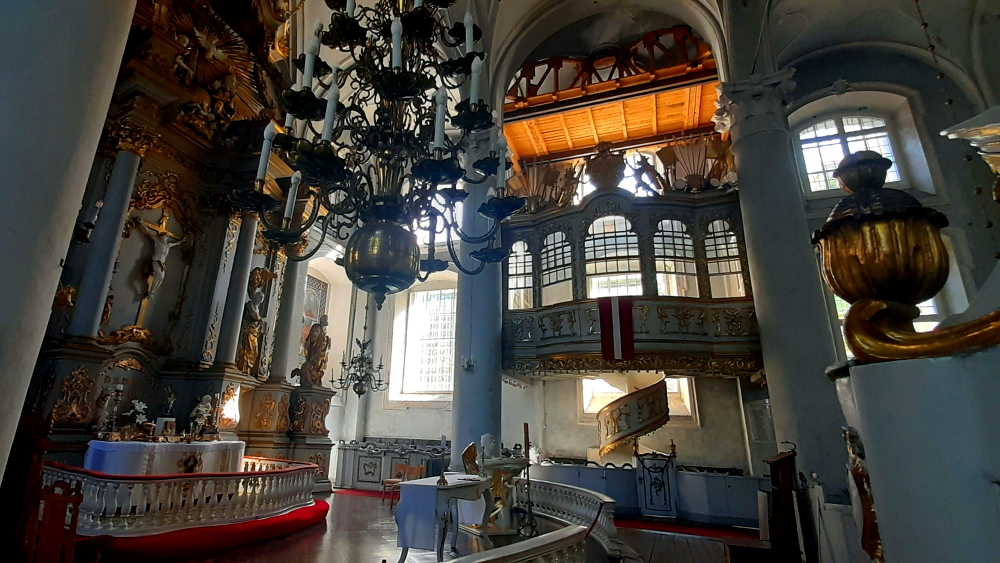
Roccoco interior & the Duke or Courland’s private box, Holy Trinity Cathedral, Liepaja, Latvia.
The cathedral was witness to an important event in Finland’s fight for independence. This fact is evidenced by a plaque commemorating Finnish Jägers who swore allegiance to their newly-formed country in 1918, while serving in the military of the German Empire [liepaja.travel].
While Coffs Harbour has its ‘Big Banana’, Liepaja has its ‘Big Amber’ – its concert hall – which is opposite our hotel and took more than a century to come into being.
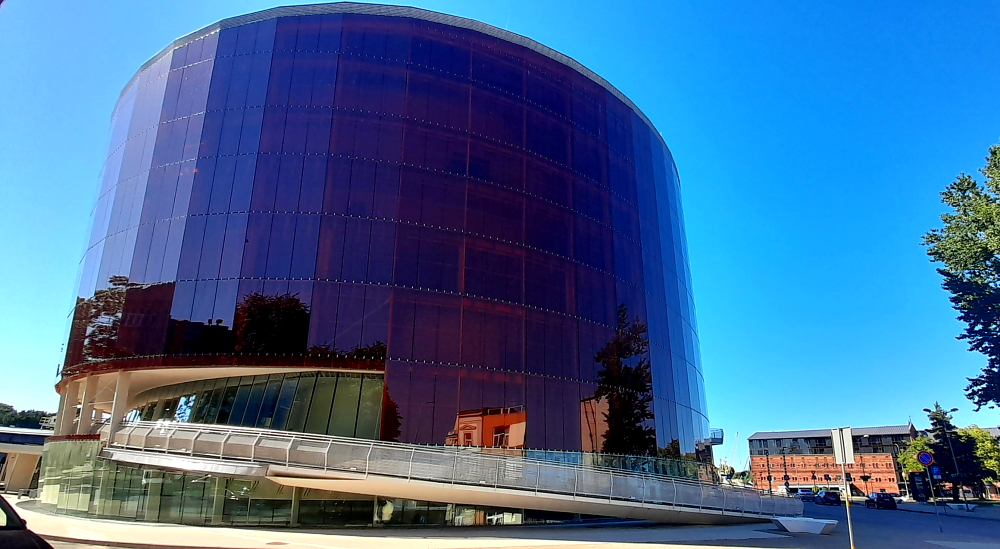
Lielais Dzintars (the Big Amber) Concert Hall, Liepaja, Latvia.
In 2015 the concert hall was opened. The excellent acoustics, contemporary building architecture and multi-functionality have earned the building various awards. The modern premises are suitable not only for high artistic cultural events and exhibitions, but also for conferences and corporate events.
The concert hall’s architectural concept was created by Austrian architect Professor Folkers Gīnke and is based on the symbol of Latvia and the Baltic Sea coast – amber. Its home to the Liepāja Symphony Orchestra and the Liepaja Music, Art and Design High School.
From an architectural and engineering viewpoint, the building is unique – there are no right angles in it. The eggshell principle was used in its design, meaning that the shape of the building itself guarantees the strength of the structures. 8 stories high, its total area is more than 14,600 square metres made from reinforced concrete, metal and glass.
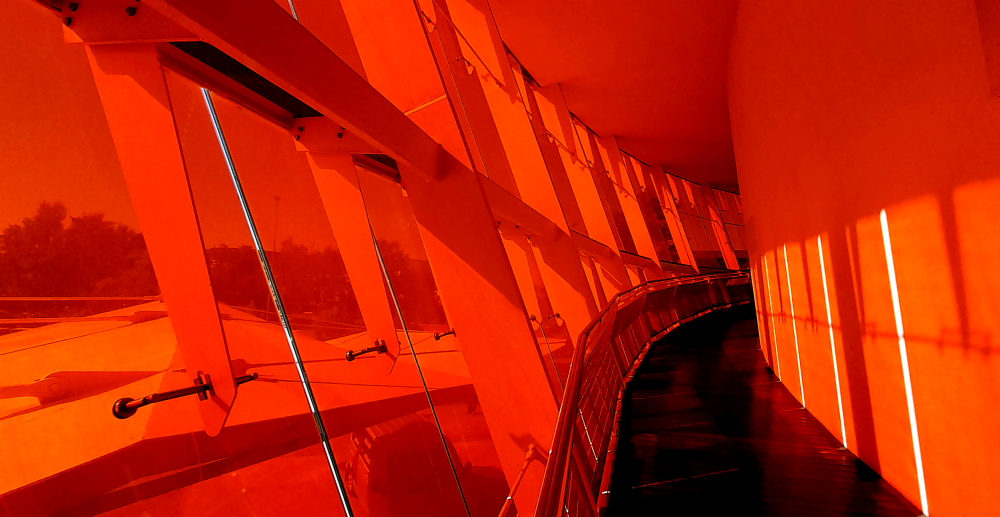
The Concert Hall’s amber facade & interior ramp, Liepaja, Latvia.
The sunny tone of the hall’s facade creates visual associations with amber which is often washed up by the Baltic Sea on Liepāja’s beach after a storm.
“Dragon Sushi” is around the corner from the hotel so we walk there for an excellent share plate of fresh sushi for dinner.
27 June, 2024
It’s 28 degrees out today so after breakfast we opt to sit out on the shady terrace overlooking the canal. As we saw all the sights in the Old Town yesterday, today’s a catch-up day so we can enjoy the 5* facilities.
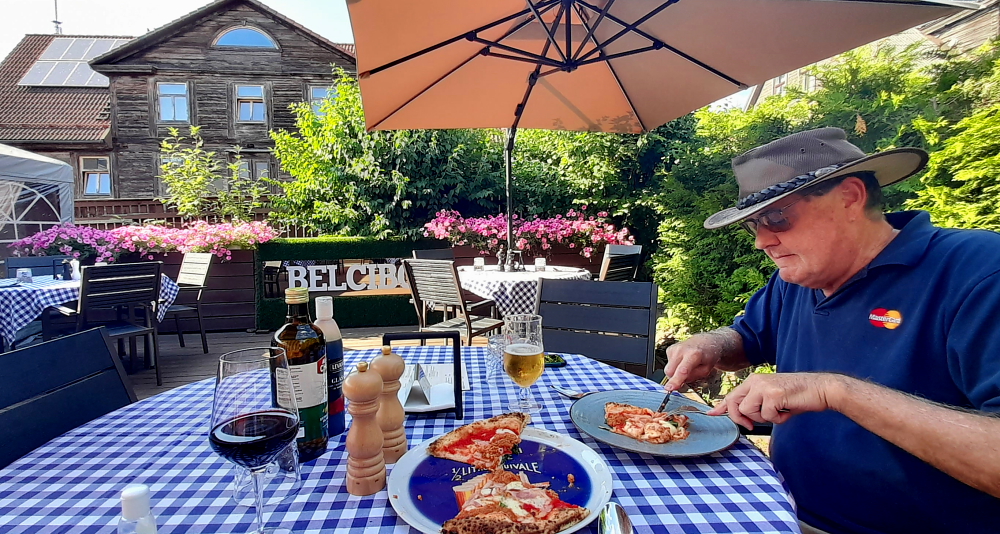
Bel Cibo Italian restaurant, Liepaja, Latvia.
It must be time to take advantage of this warm weather so we head to Bel Cibo’s al fresco courtyard where we share a pizza.
28 June, 2024
Today we’re going to check out the other attractions that Liepaja has to offer – the ones out of the Old Town.
First off, we drive 11km north to see the remains of the Ziemelu forti (Northern Forts). To protect the Liepaja Navy Base in the event of a possible enemy attack in the 19th and 20th centuries, Tsarist Russia constructed fortifications that encircled the whole city.
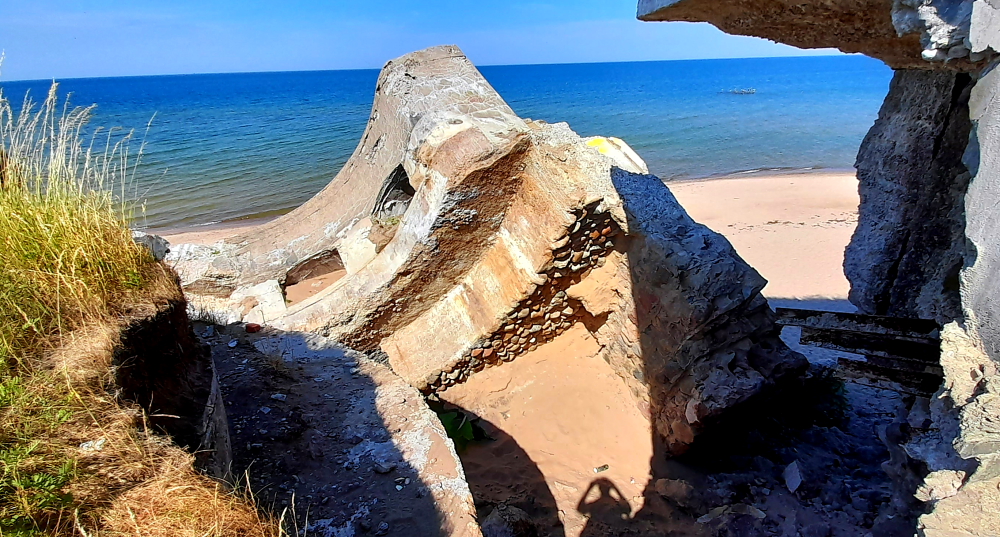
Blasted ruins of the northern fortification, Liepaja, Latvia.
The northern fortifications, now known as the Northern Forts, included coastal battery No 1, landline ramparts and stationary artillery battery positions.
In November 1908 as a result of a change to the Russian Empire’s national defence plan, the Liepaja fortress’s status was downgraded. During WWI the fortifications were blasted to avoid them falling into the German Army’s possession [information board].
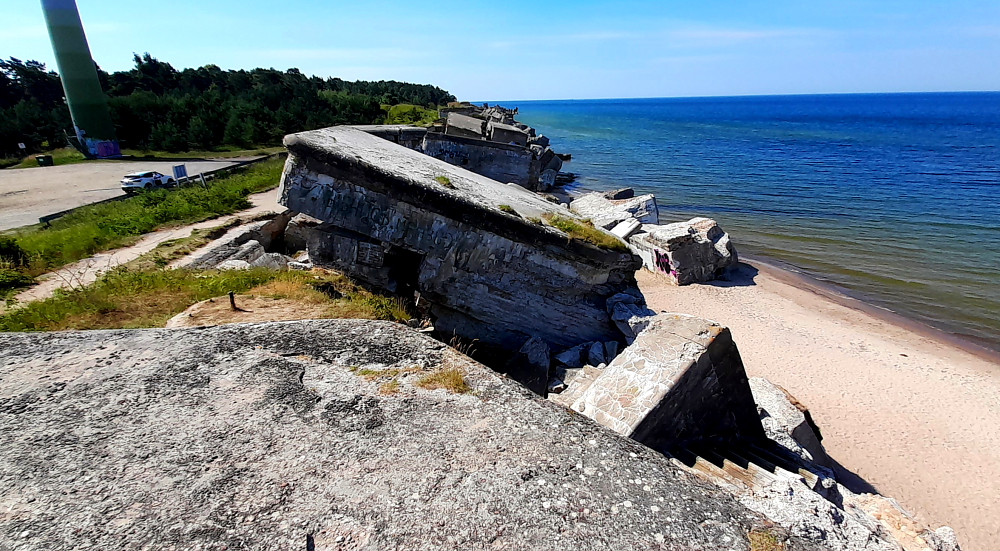
Northern fortification ramparts blasted during WWI, Liepaja, Latvia.
From here we drive a short distance inland to the historic fort of Redans, almost encircled by a moat. Today it houses the Karostas and War of Independence Museum.
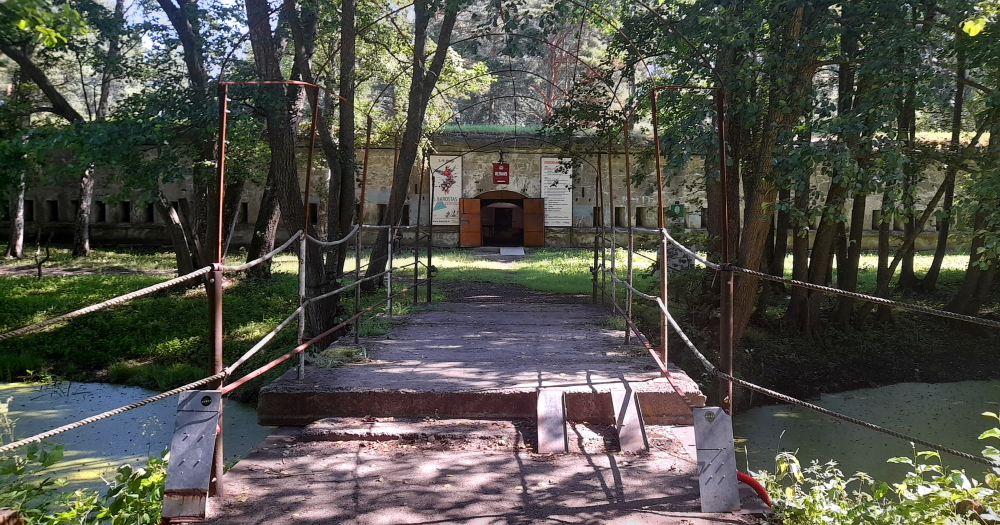
Bridge across the moat to the entrance to the Redans Historic Fort, Liepaja, Latvia.
The Redan is a part of the late 19th century Liepāja Sea Fortress, where battles important to Latvia have taken place. Despite the fortifications around Karosta being acknowledged as strategic mistakes and being mostly blown up, the Redan has remained almost completely intact. It is also the only part of the fortifications where actual battles have been fought.
On 14 November 1919 several battles in the War of Latvian Independence were fought here when defending Liepāja against Bermondt’s forces. In the morning of 14 November, Bermondt’s troops crossed the frozen Lake Tosmare and took the Redan. However, in only a few hours the local forces mounted a fierce counterattack and the Germans were forced to retreat.
The remains of the fort houses a museum outlining a timeline from the mid 19th Century to present day with various artifacts on display. The museum highlights how Latvia has been occupied by the Tsarist Russians, the Germans in WW1, the Bermondt’s German forces in 1919 then the Germans again in 1939 and finally the Soviets from 1941 to 1991. Latvian Independence seems a fragile and fleeting dream.
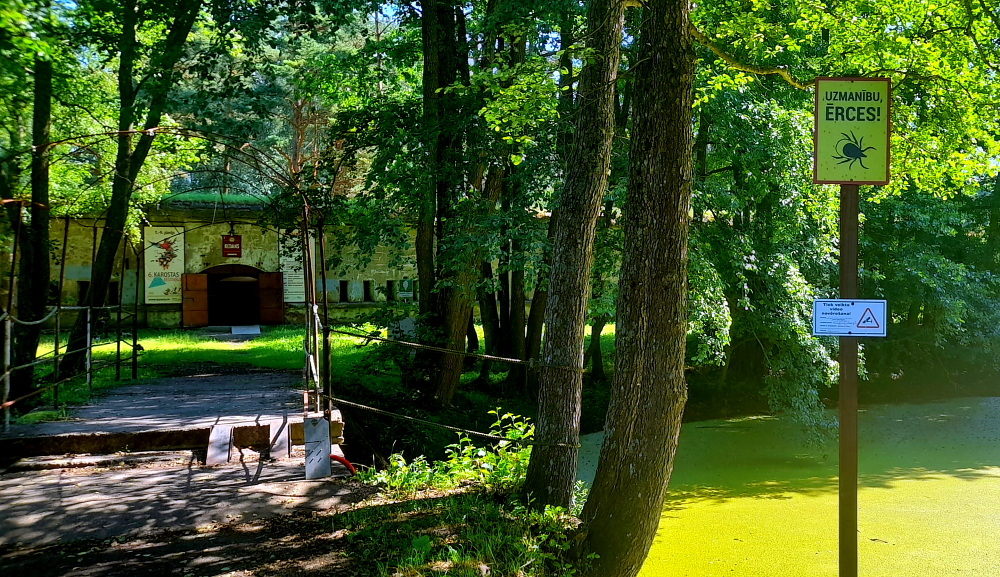
First sign we’ve come across declaring a tick-infested area, Latvia.
A 7-minute drive SW from here we arrive at the local beach near Karosta.
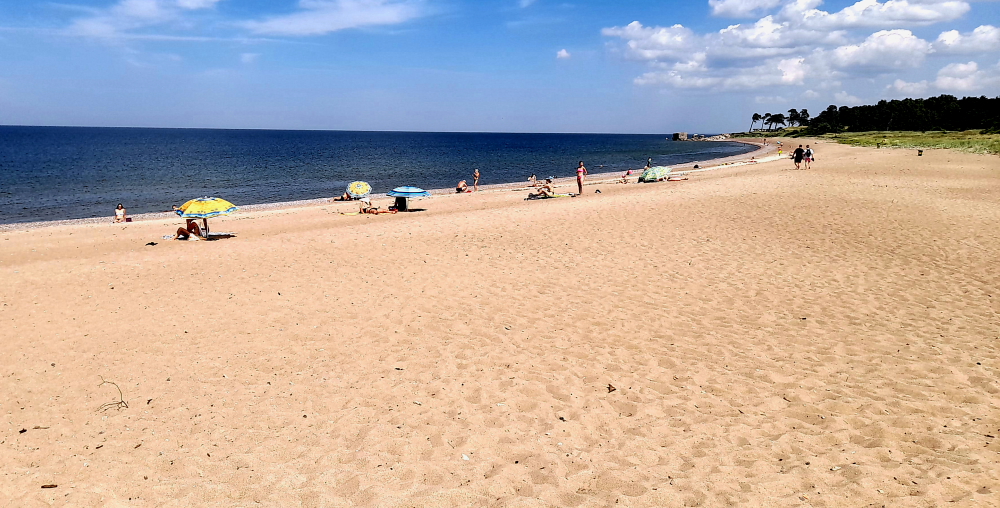
Local beach, near Karosta, Latvia.
At the southern end of the beach is the Northern Breakwater. The longest breakwater in Latvia it was built at the end of the 19th century as a crucial part of Liepāja’s fortress and military port.
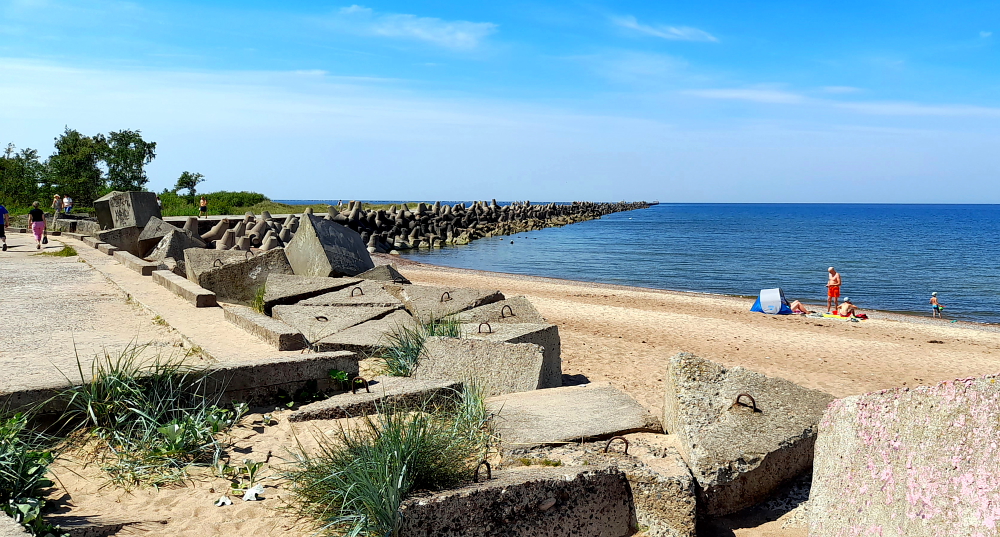
Northern Breakwater, near Karosta, Latvia.
The breakwater is 1800m long and 7.35m wide. It is a favourite spot for locals to watch sunsets, stormy seas and to go fishing in the sea [liepaja.travel].
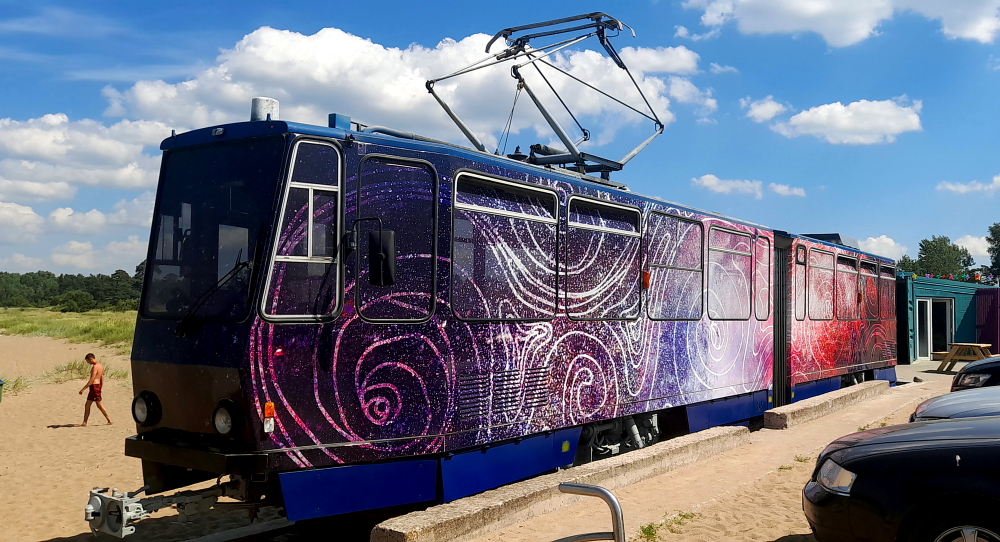
Good use of an old tram – a beach bar!
Across the main road from here, 2 minutes’ drive away inland, is Karosta, the largest historical military territory in the Baltics. The massive construction of a Russian imperial military base with fortifications and a military camp was begun in 1890. It was named after its founder – Port of Emperor Alexander III and designed as a fully-autonomous, populated area with its own infrastructure, electricity power plant, water supply, schools and church.
Only at the time of the 1st Latvian independence it was more often referred to as Kara osta (War Port), later – Karosta.
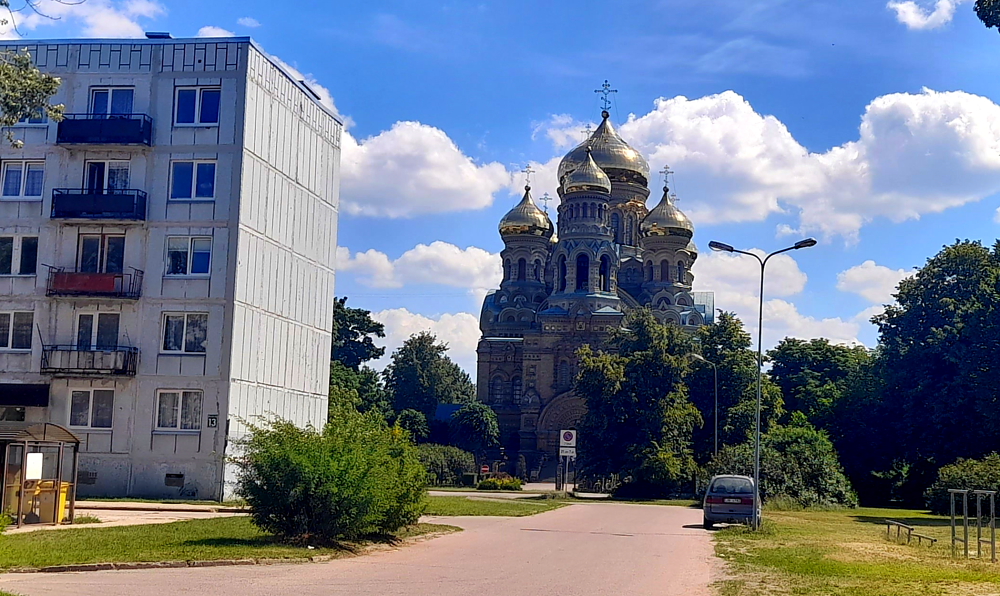
Splendor of St Nicholas Russian Orthodox Naval Cathedral in stark contrast with Soviet-era housing, Karosta, Latvia.
The St. Nicholas Russian Orthodox Naval Cathedral is the dominant visual and spiritual feature of Karosta sharply contrasting with the surrounding panel apartment blocks.
Russian Tsar Nikolai II and family participated in the ground-breaking ceremony when construction began in 1901. The church was built according to the principle of the 17th century Russian Orthodox churches – one central dome and four domes on the sides.
At the beginning of WWI many of the cathedral’s objects, such as bells and icons, were taken to Russia. The rest was looted by soldiers of the occupying German army.
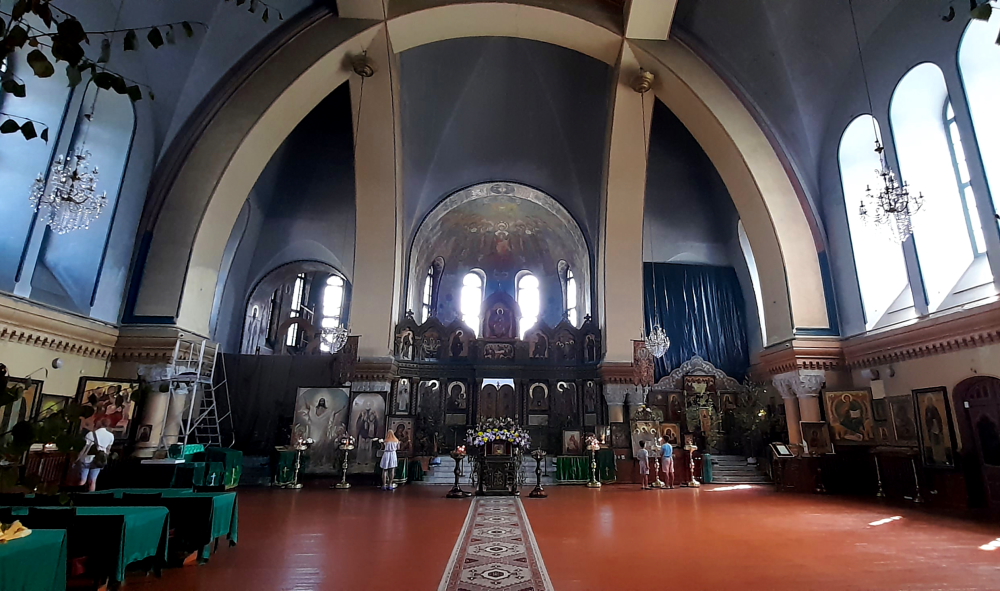
Interior, St Nicholas Russian Orthodox Naval Cathedral
After WWII the USSR occupying army opened a gym, cinema and entertainment centre for sailors and soldiers. The central dome was sealed with concrete in order to stop the fantastic acoustics from interfering with the sounds of the films being watched. The military left the cathedral in September of 1991 and the first church service was held there in December [liepaja.travel].
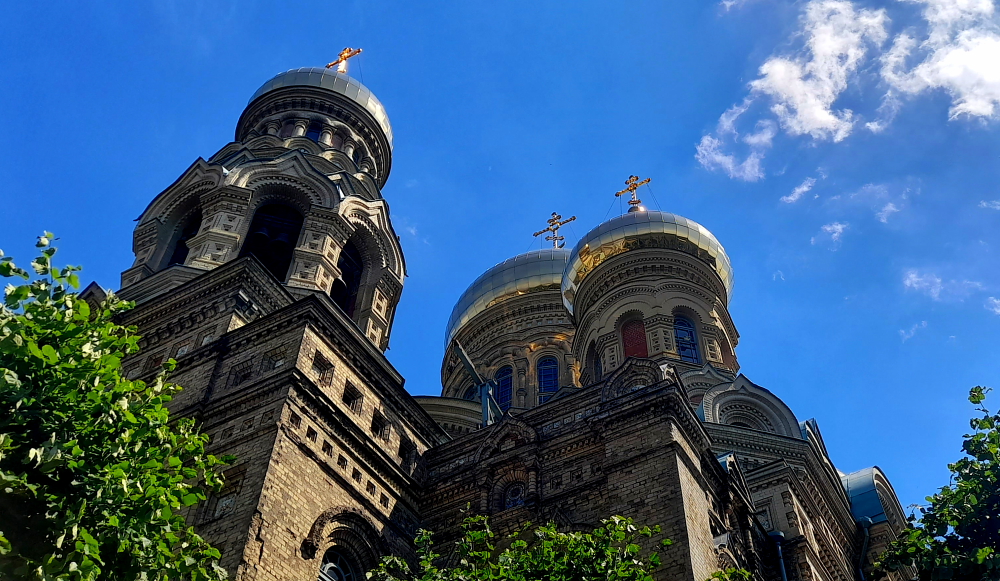
Golden domes of the Cathedral dazzling in the bright sunlight.
During the Soviet era, Karosta was a closed and covert zone inaccessible even for the civilian citizens of Liepaja. Today, the central part of Karosta is occupied by public and residential housing. The minor port is occupied by the National Armed Forces of the Republic of Latvia.
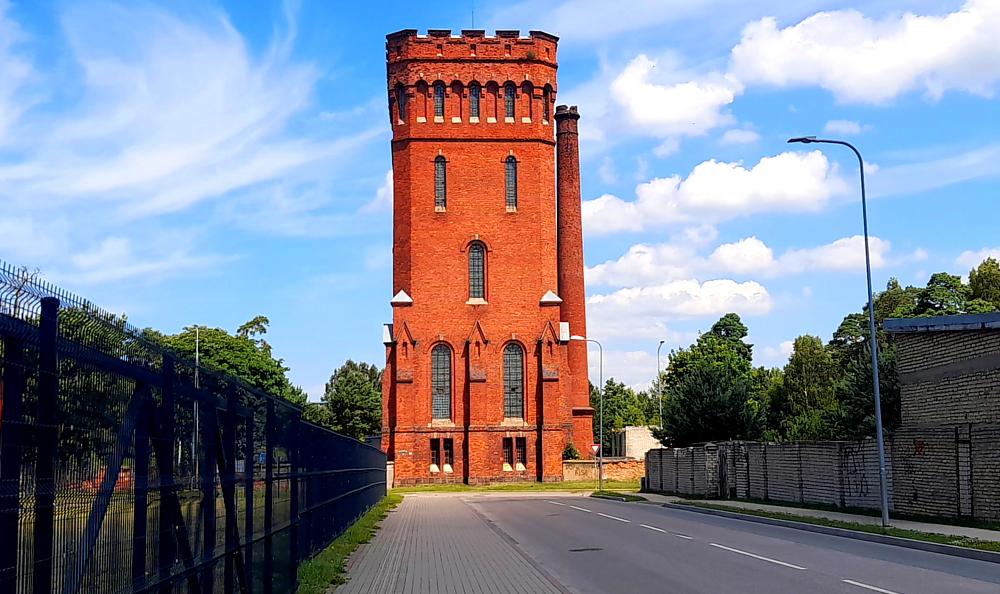
Water Tower, Karosta, Latvia.
Nearby is the water tower on Ģenerāļa Baloža Street – an architectural monument of national importance built in 1905. At that time, water was pumped into the attics of surrounding houses 3 times a day for certain hours, using steam-powered water pumps. Then people could fill their baths, buckets and other containers with water. In Soviet times steam pumps were replaced by electric ones.
The water tower had a significant role in the Latvian War of Independence in November 1919. While the Latvian Army repelled the attacks of the Bermont-Avalov battle group, Allied-British warship artillery fire was adjusted over the telephone from the water tower. It played a crucial role in the defense battles [karosta.lv].
Around the corner is the garrison prison of Liepāja’s Karosta, built at the beginning of the 20th century and since then it has been used as a short-term disciplinary penalty place for navy sailors and non–commissioned officers by both the Soviet and Latvian Navy. Garrison sailors, who participated in the events of the revolution in 1905, served their sentence here. The last of the convicts scratched calendars, drawings, slogans, catchwords and messages on the walls of the cells just a short time ago, in 1997.
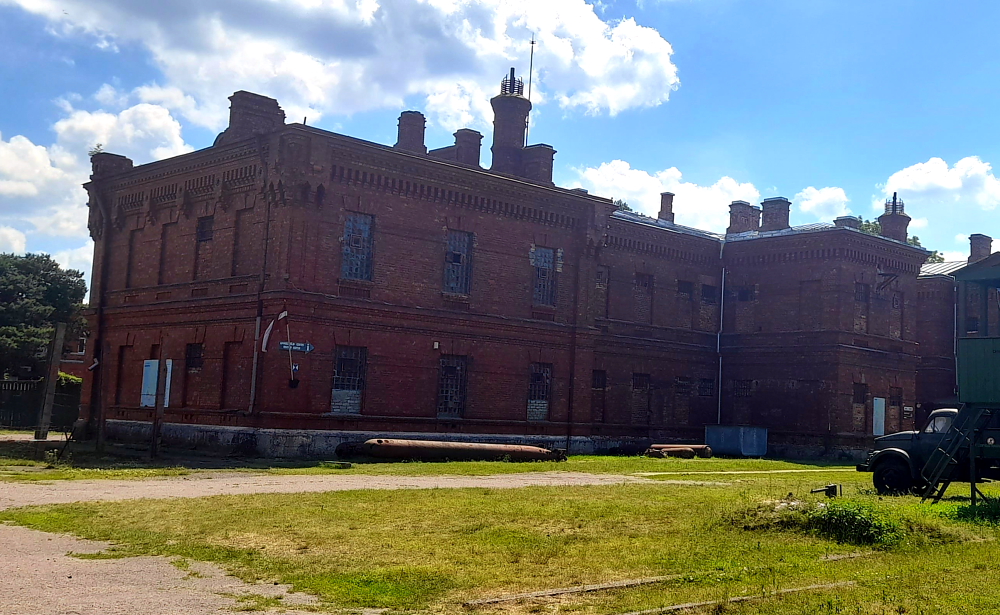
Prison, Karosta, Latvia.
It’s the only military prison open to tourists. No-one has ever escaped from here. It’s been named as the most surprising and most unusual hotel in the world [karosta.lv]. You can even book a room here on Booking.com – currently a budget double room with queen bed, free cancellation only Eu60/night. “Couples in particular like the location – they rated it 8.3 for a two-person trip.” [Booking.com].
We cross back over the Karostas kanals on the Oskars Kalpaks bridge, a swing bridge built in 1906, and is one of the oldest metal bridges in Latvia. It has 2 identical sides that both pivot, each in its own direction over the Karosta Canal. Even though the bridge is built from metal, the surface is covered with wooden planks.
During the lifespan of the bridge, it has been seriously damaged several times including being hit by ships. After its reconstruction in 2006, the Oskars Kalpaks Bridge connects Karosta to the rest of the city. As the Canal is an active shipping route, 4 times a day it’s open for shipping traffic [liepaja.travel].
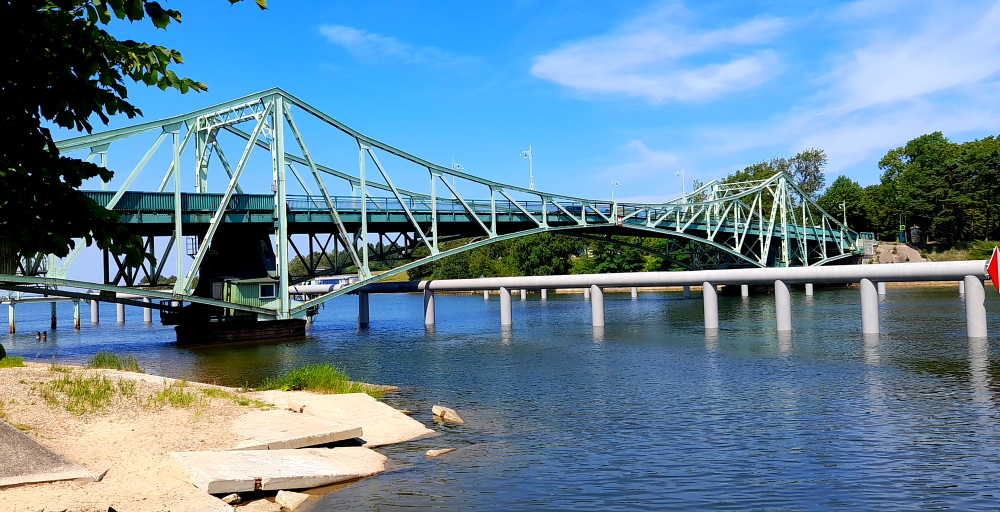
Oskars Kalpaks Bridge with pipes to guide ships (?), Liepaja, Latvia.
Our drive to the southern end of town, skirting the ferry port, brings us to Jurmalas Parks also known as the Seaside Park. The 3km-long park occupies a territory of 50 ha – currently one of the largest planted parks in Latvia. It was 1st created at the end of the 19th century in order to beautify the area planned as a spa resort, as well as from a purely practical perspective to stop sand from being blown into the city.
Just as then, it’s a favourite spot to rest and relax with a children’s playground, cafés, football pitches, a basketball court and tennis courts and a boardwalk right onto the sands of Liepaja Beach. Luxurious 19th and 20th century villas can be seen along Dzintaru and Liepu Streets at the east side of the park [liepaja.travel].
Walking through the park we pass by a beautifully-restored pavilion. At the beginning of the 20th century, during the reign of Russian Tsar Nicholas II, the wooden pavilion was built in the Jurmala Park to the design of the German-Baltic architect Paul Demme (1857-1919) to welcome the Russian Tsar on his visit to Liepãja.
After the pavilion had served its original purpose, it was opened as a café for all Liepãja residents and guests, a favourite place during the summer season. 3 years later it burnt down in 1906.
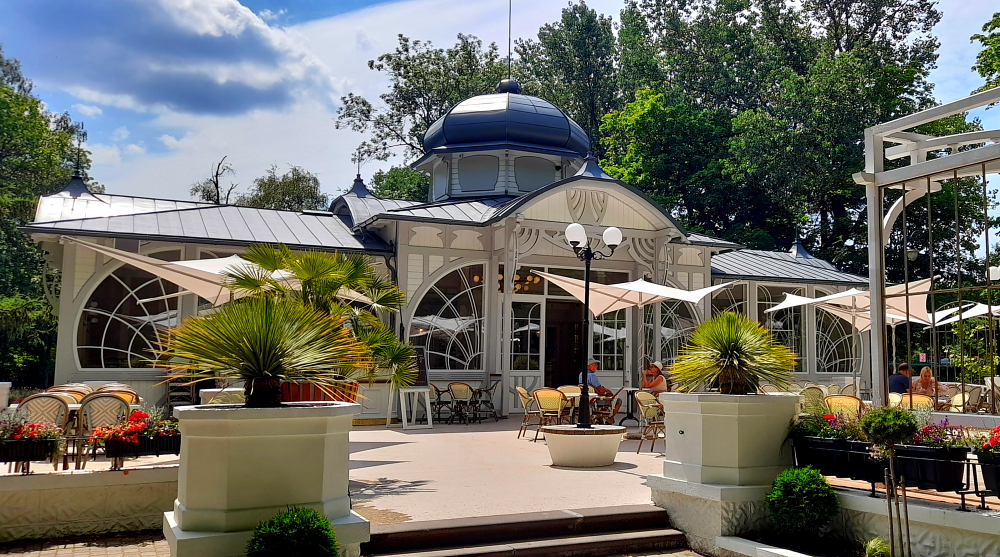
Park Pavilion, Jurmalas Parks, Liepaja, Latvia.
It was given a 2nd life and reconstructed 2 years later. In the 1950s, the building housed the “Dzintars” café, and finally from 1960, the “Banga” restaurant. Tragically, the building caught fire in 1977 and burnt down again.
The building was abandoned to its fate until the Kirhners family gave it a 3rd chance: In 2020, the Kirhners began rebuilding the Emperor’s Pavilion and it was finally completed in August 2022 [rheinzink.com].
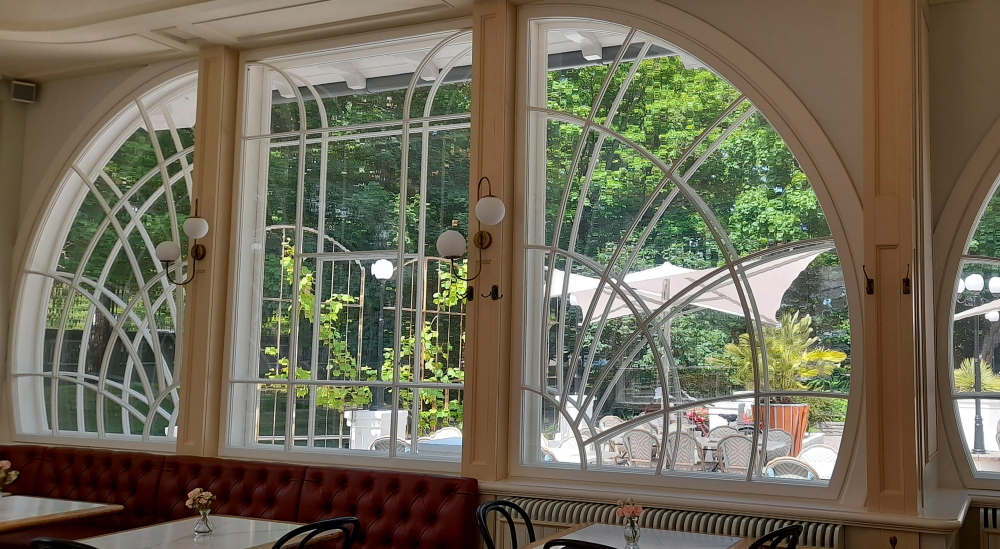
Garden view from inside the Park Pavilion, Jurmalas Parks, Liepaja, Latvia.
5-minutes later we are walking to the edge of the boardwalk and onto the sands of Liepaja Beach. By now it’s 29 degrees.
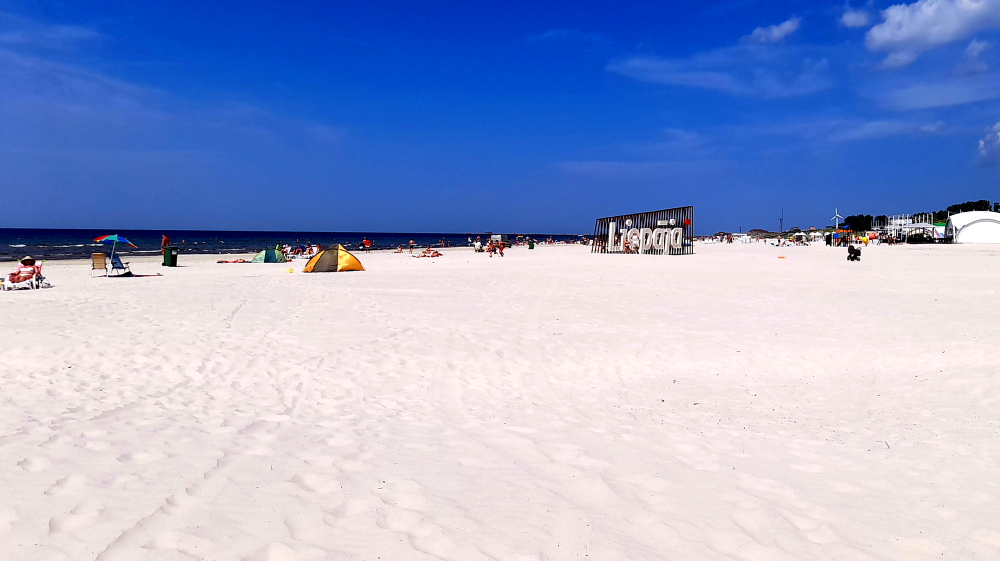
Liepaja Beach, Latvia.
Our last stop today is another 4.5km drive south to the ruins of the Dienvidu Forts (South Fort) of Liepaja Fortress.
A fort was planned to protect the port of Emperor Alexander III from the south, 2km from the southern border of the city. It was to be located between Liepāja Lake and the sea, supplementing the reinforced concrete fortifications with a moat. Although the fortifications were almost completely finished, the armaments had not been deployed.
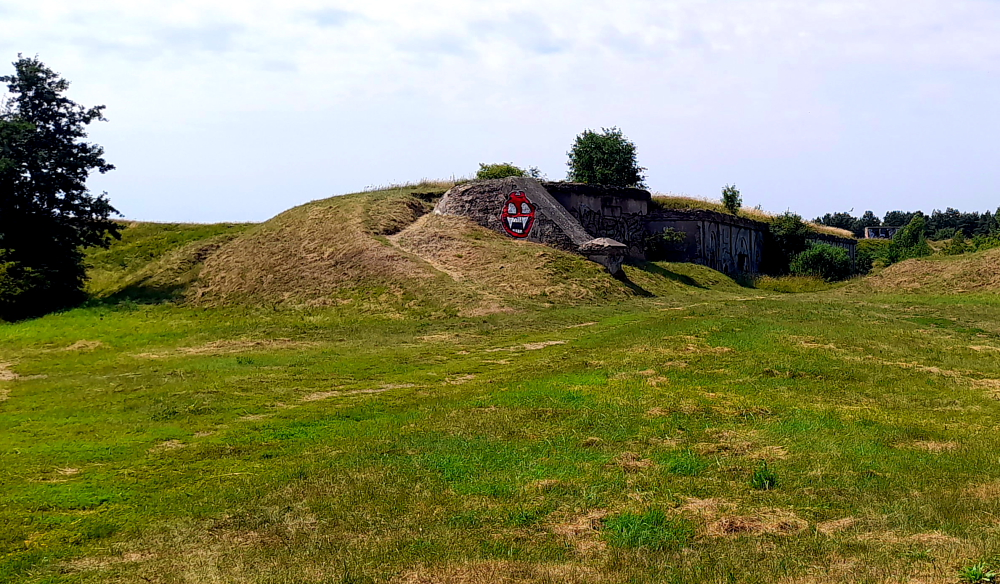
Graffitied ruins, Dienvidu Fort (South Fort), Liepaja, Latvia.
The constructed cellars were used as storage facilities during both world wars. However, this fort never took part in war because in all the wars the invaders besieged the eastern shore of Lake Liepāja and tried to invade Liepāja between Lakes Tosmare and Liepāja [militaryheritagetourism.info].
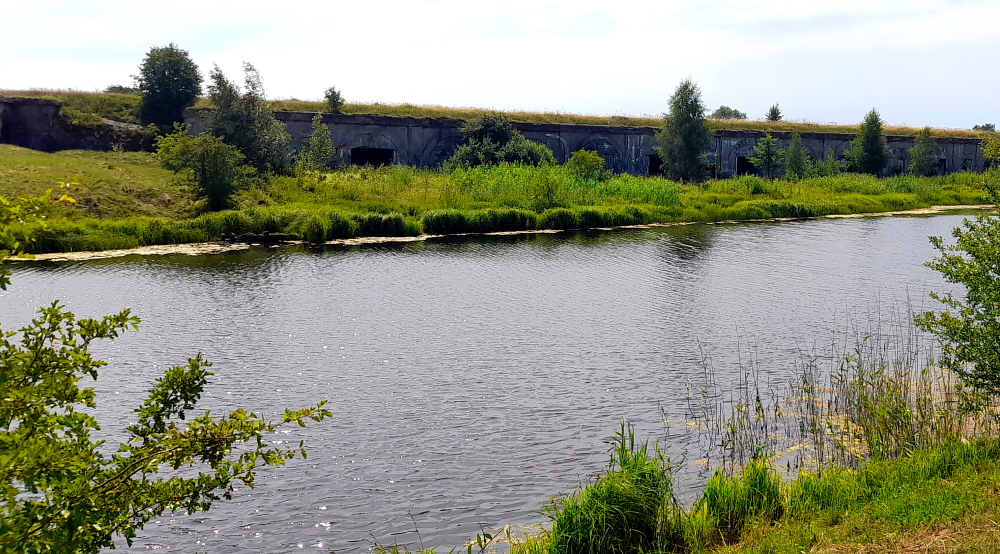
Moat, Dienvidu Fort, Liepaja, Latvia.
After a WhatsApp video call with our Philly friends and Champagne region travel companions, Becky and Jerry, we opt for the hotel’s Piano Restaurant for dinner. True to its name, we are entertained by the resident pianist who seems to be an Abba fan!
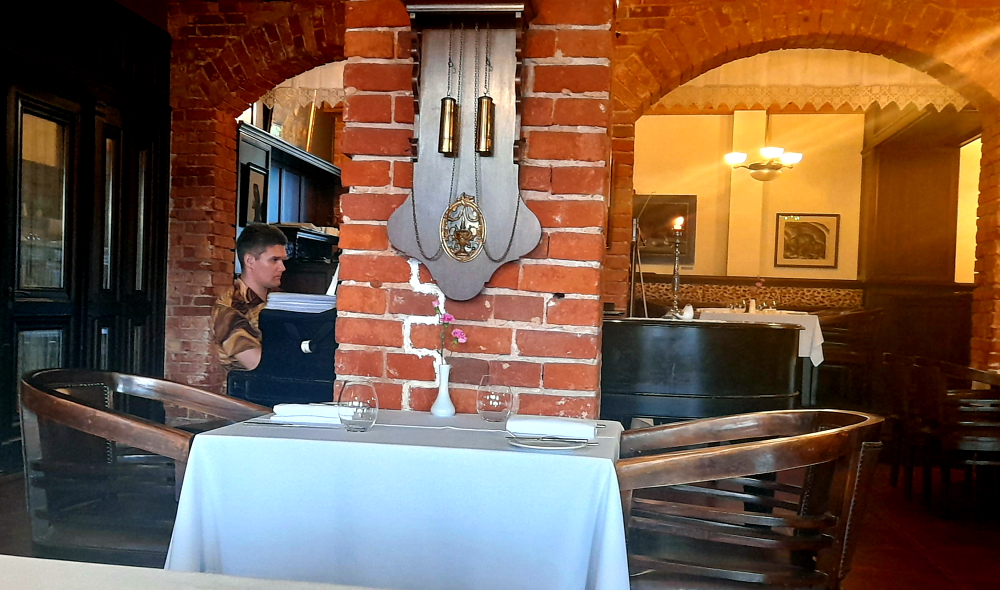
Piano Man, Pavilion Hotel, Liepaja, Latvia.
And true to the weather forecast, around 9pm we have thunder, lightning and torrential rain.
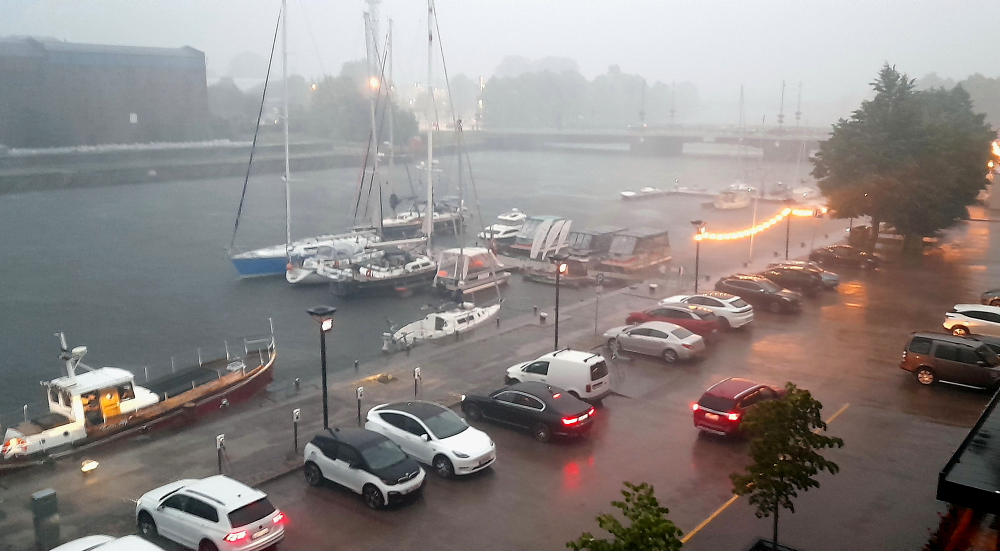
Thunder, lightning & torrential rain, Liepaja, Latvia.
Which is why the forecast for tomorrow suggests a 9 degree temperature drop to a max. of 20.
29 June, 2024
Several days ago the Tourist Office told us that a cultural festival is to be celebrated today in town with a parade ending at the Rose Square followed by a concert.
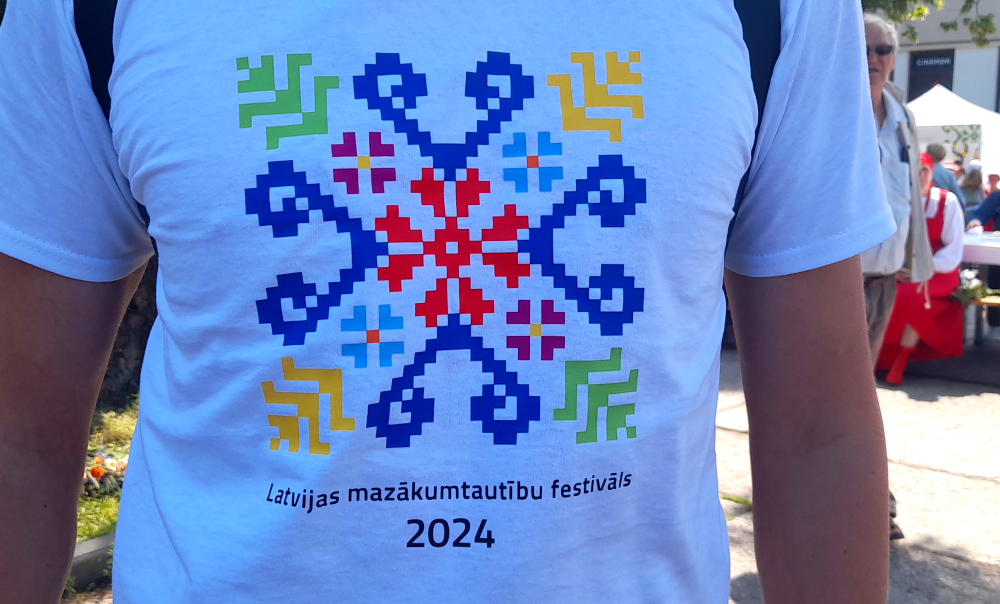
Latvian Minorities Festival 2024, Liepaja, Latvia.
What they didn’t tell us is that there is also a summer half marathon being run today, the start/finish line next door to the hotel and across the road from the Concert Hall. There’s also a stage so no doubt we can expect a noisy concert tonight!
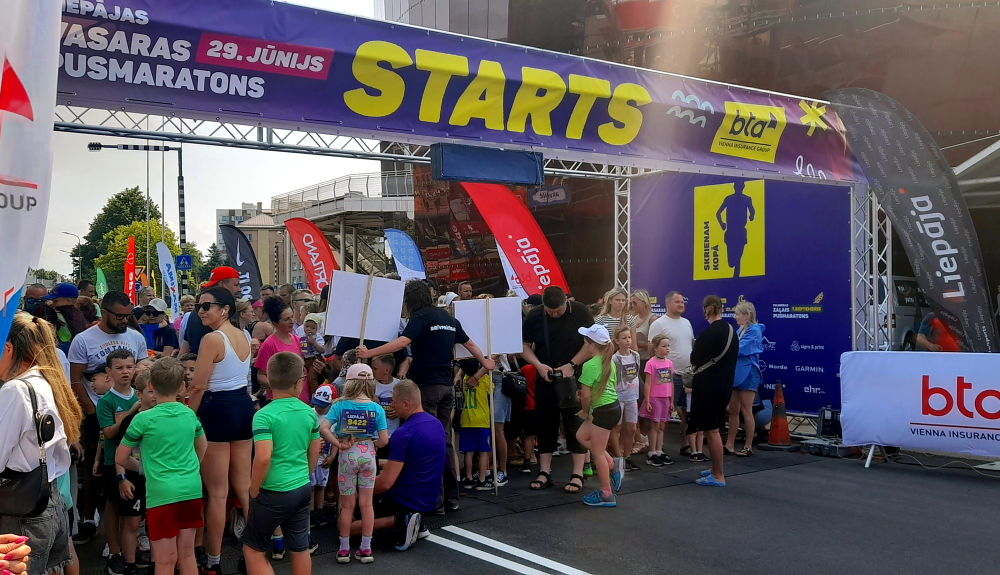
Liepajas vasaras pusmaratons (summer half marathon), today.
But, it looks like the race is not just confined to the half marathon for adults as a gaggle of kids, accompanied by their parents, are toe-ing the starting line at 11:15 am. Later we see a 2-year old in nappies sporting a huge medal hung from his neck!
We leave them to it and walk to the Rose Square where the first few groups of the Minorities Festival parade are arriving.
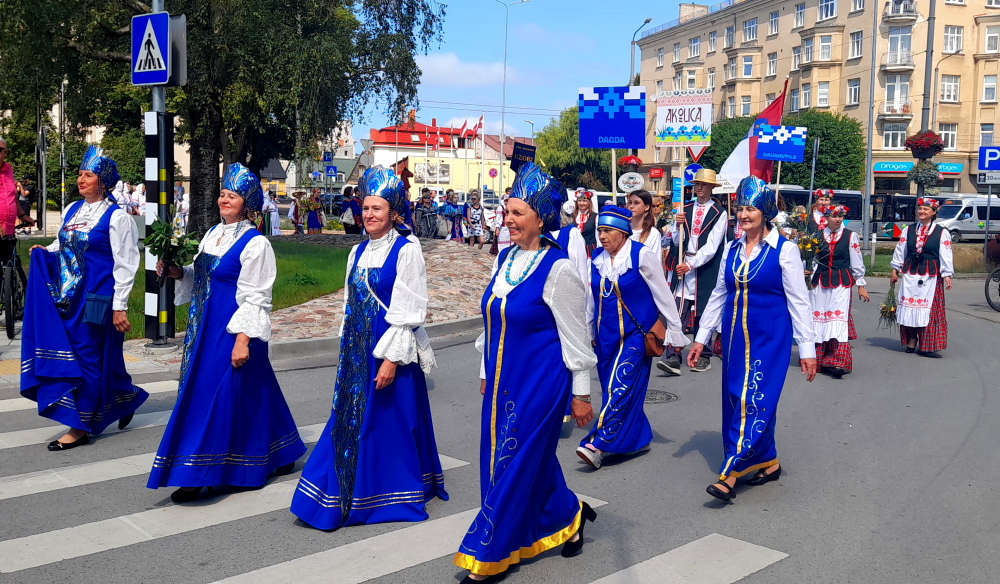
Elegant & colourful costumes & headdresses.
Today and tomorrow the Latvian Minorities Festival is taking place gathering almost 1,500 participants – singers, dancers, and craftspeople – who share the traditional cultural heritage of their people from all over Latvia.
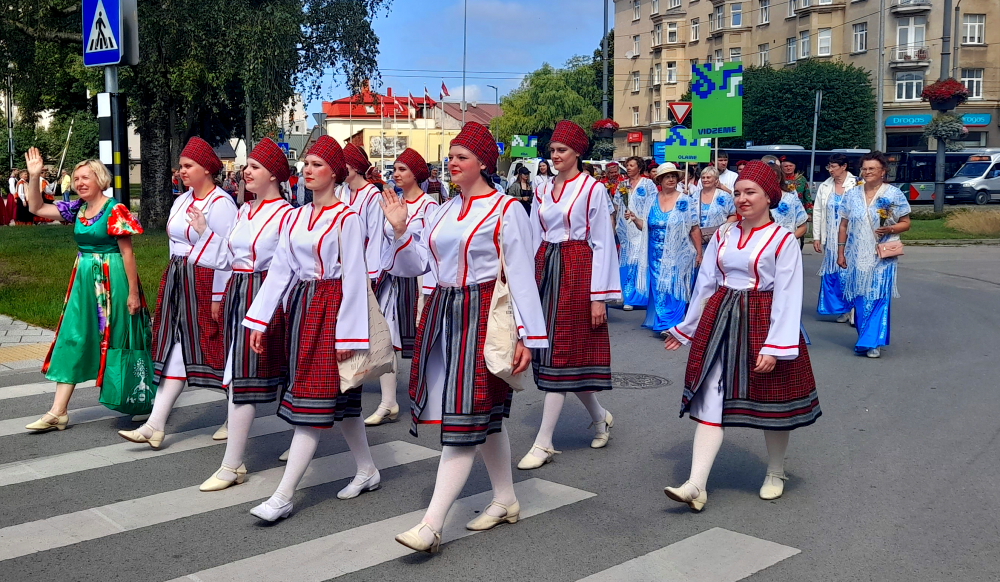
A well-drilled group!
The varied program will showcase 16 different minorities in Latvia – Azerbaijani, Belarusian, Bulgarian, Chinese, Georgian, German, Jewish, Italian, Lithuanian, Moldovan, Polish, Romani, Spanish, Pakistani, and Ukrainian.
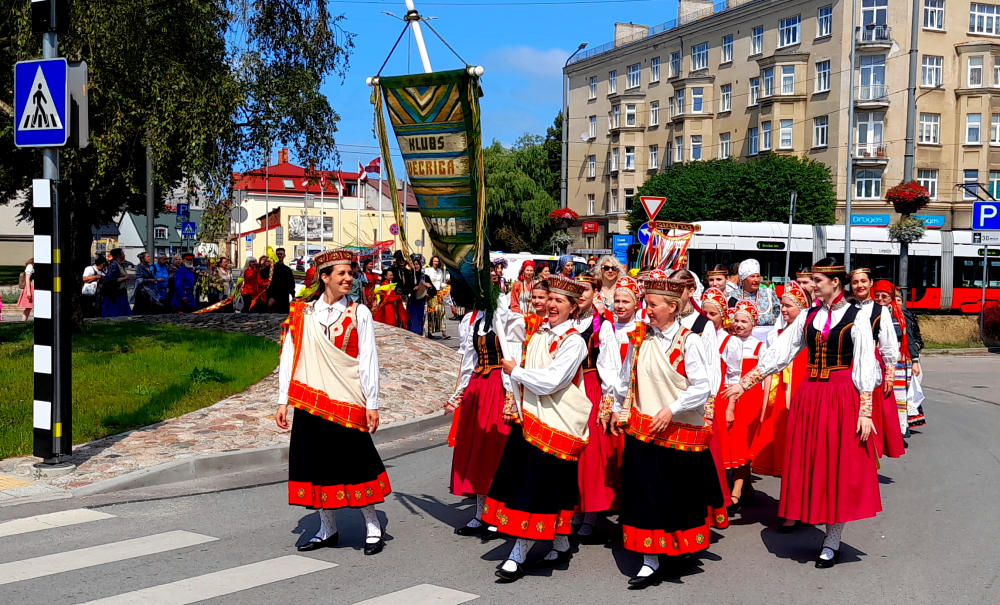
Club Old Riga troupe.
This is the 3rd time this festival has taken place and aims to promote and develop the traditional cultural heritage of minorities living in Latvia, to encourage them to understand the importance of their culture in Latvia, and to promote intercultural interaction.
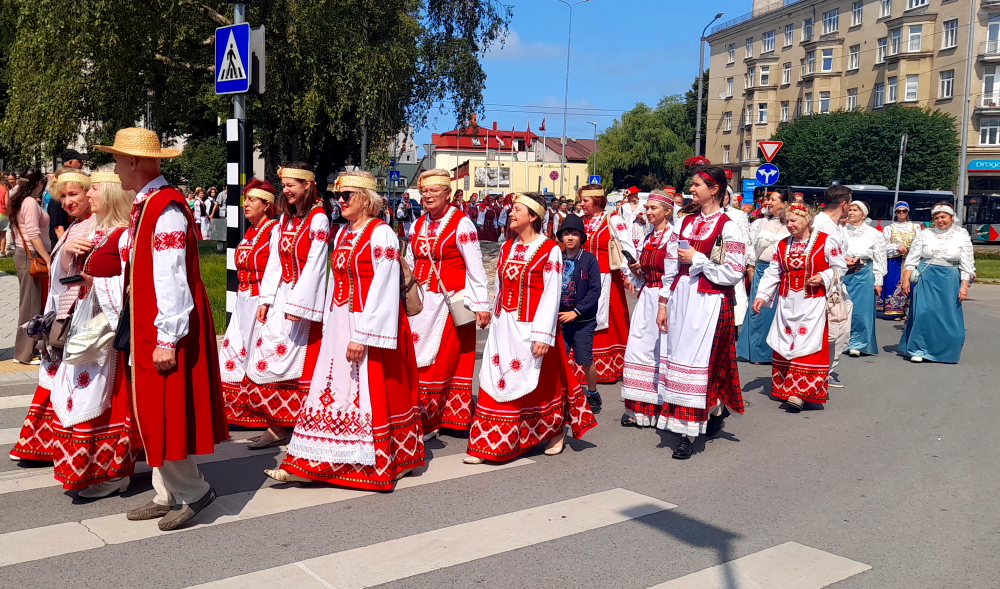
Straw headbands for the women, but a sensible straw hat for his nibs.
More than 150 nationalities live in Latvia.
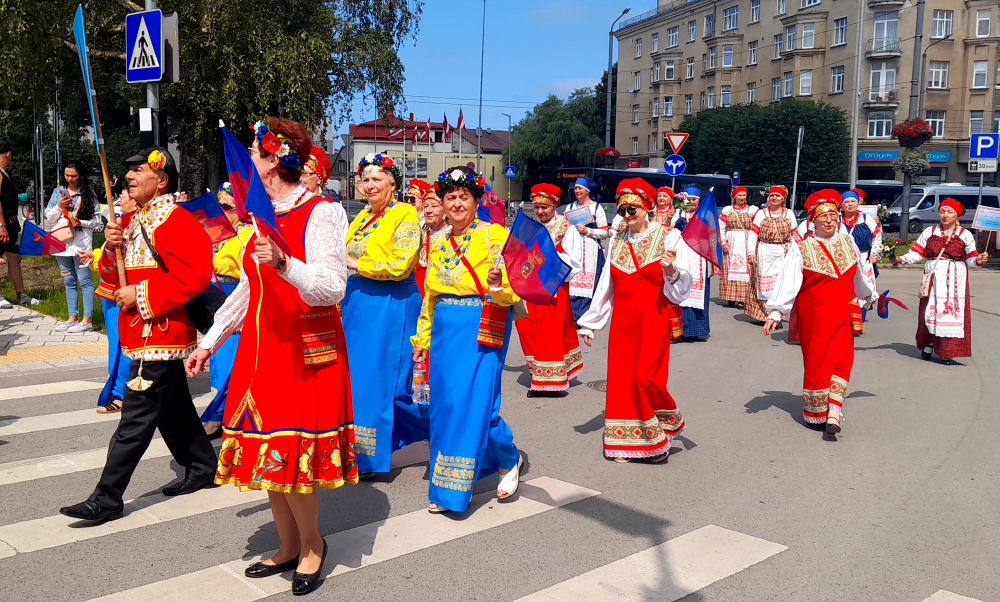
An eclectic costume collection for this group.
The festival is organized by the Ministry of Culture of the Republic of Latvia, and the Latvian National Center for Culture in cooperation with the Liepāja City Municipality and the Liepāja Folk Art and Culture Centre.
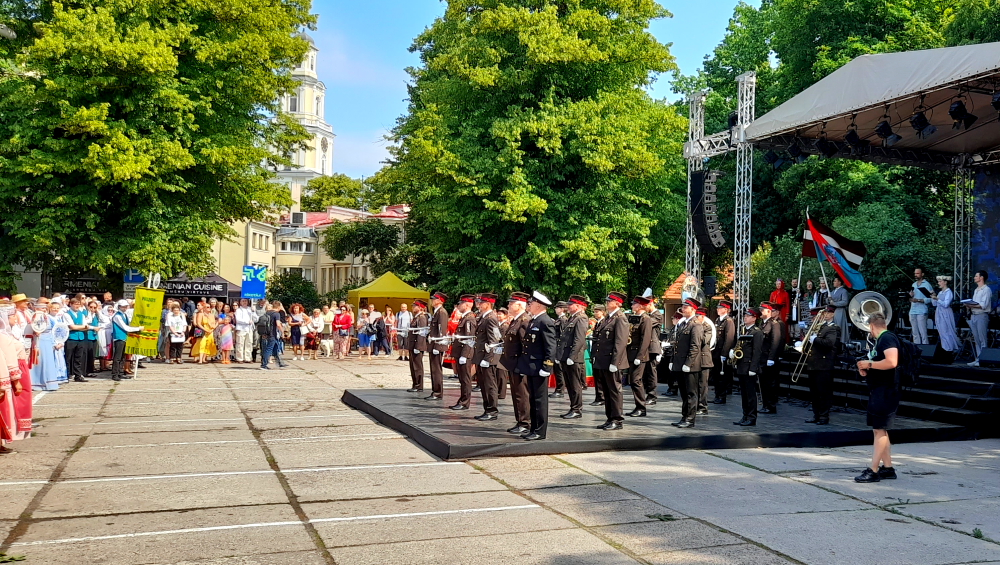
Brass band & dignitaries at the Main Stage, Rose Square, Liepaja, Latvia.
The festival is included in the program of celebrations to mark the 20th anniversary of Latvia’s membership in the European Union.
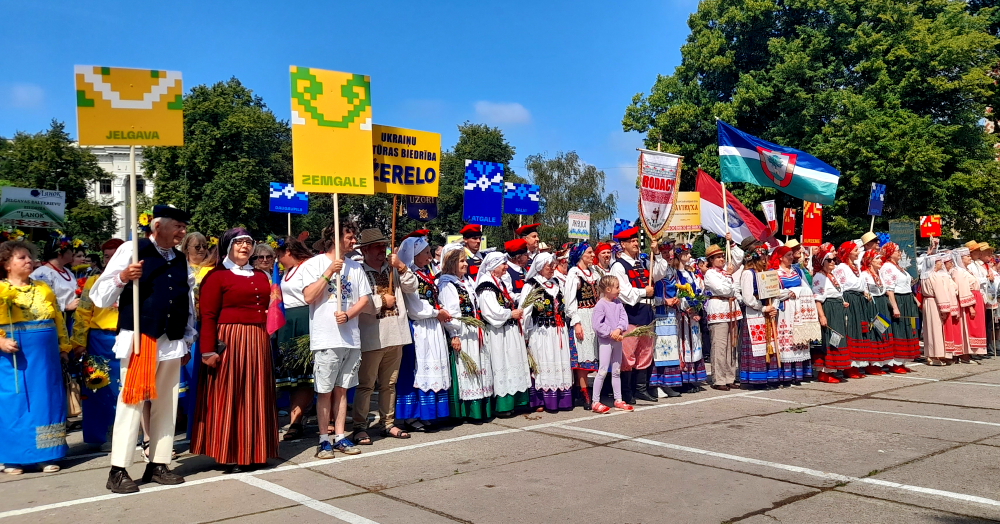
Just like the Olympics, national groups standing together for the Opening.
The 2-day event will feature concerts, an art exhibition, a costume show, a festive procession, national food tastings, lectures, masterclasses, and other activities on the main stage in Rožu Square and elsewhere in the city [lsm.lv].
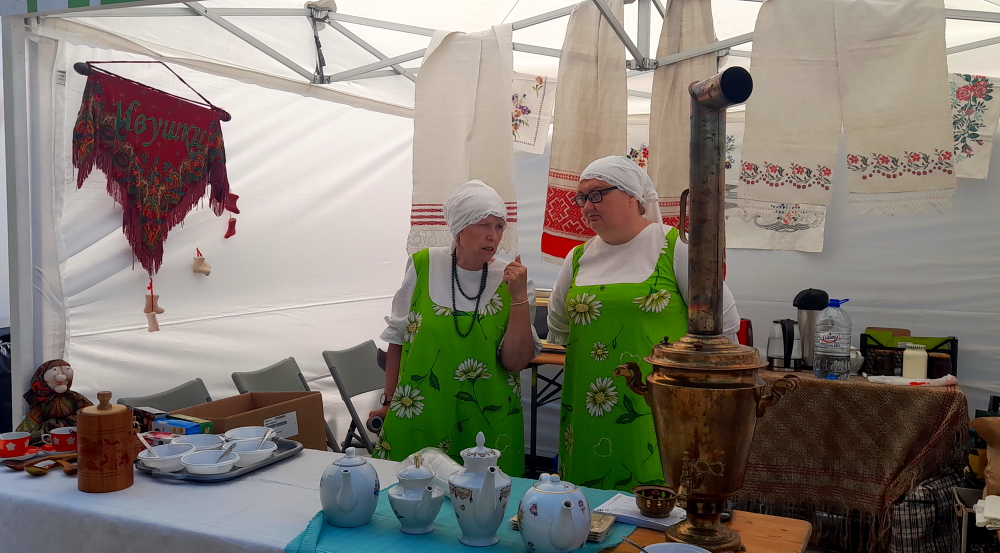
Samovar tea time.
Adjacent to the Square are numerous small marquees offering drinks, food and handicrafts.
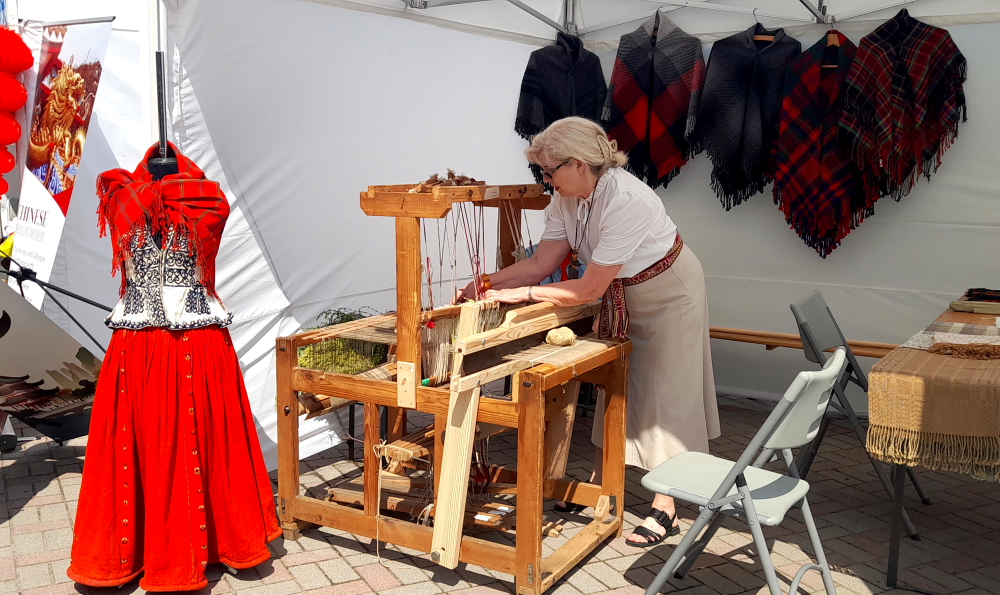
Loom-woven fabrics.
Either side of the Square are rows of benches to view the concert of musicians, singers and dancers.
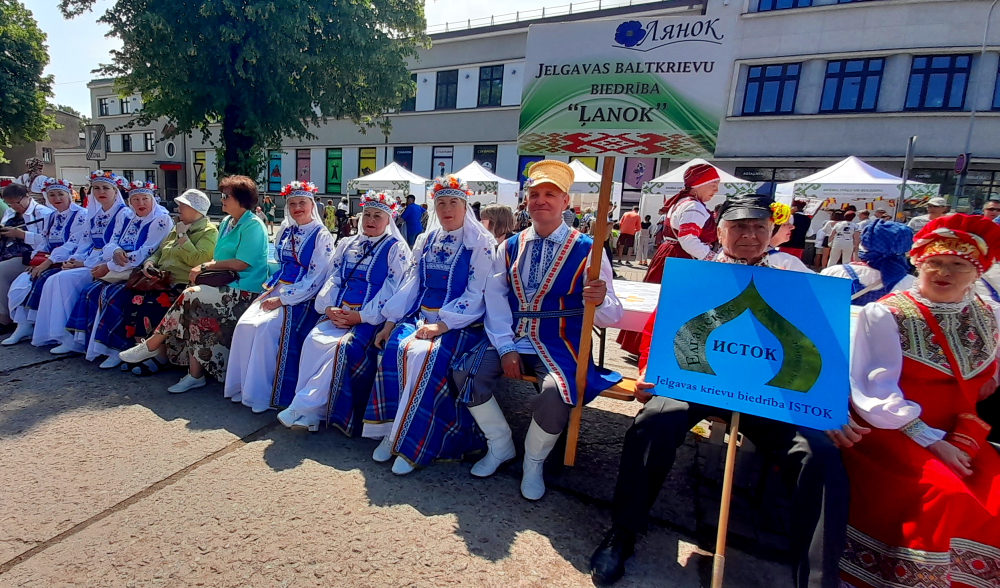
Blue & white costumed members of the Belorussian Society “Lanok”.
Once the formalities have ended the concert begins with a couple of songs from this choir, backed by their musicians …
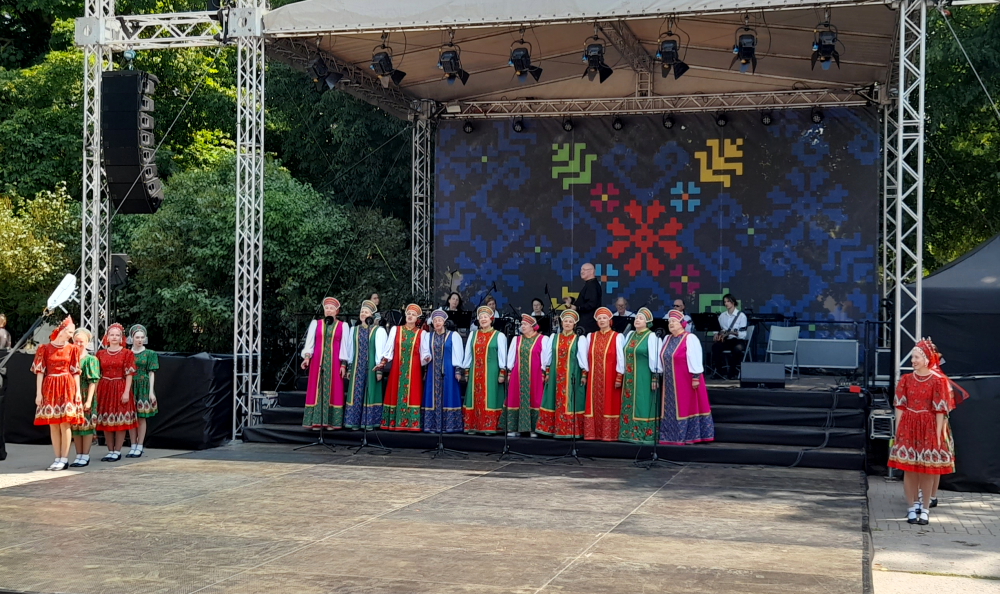
Mature ladies’ choir.
… followed by a spirited folk dance by its troupe.
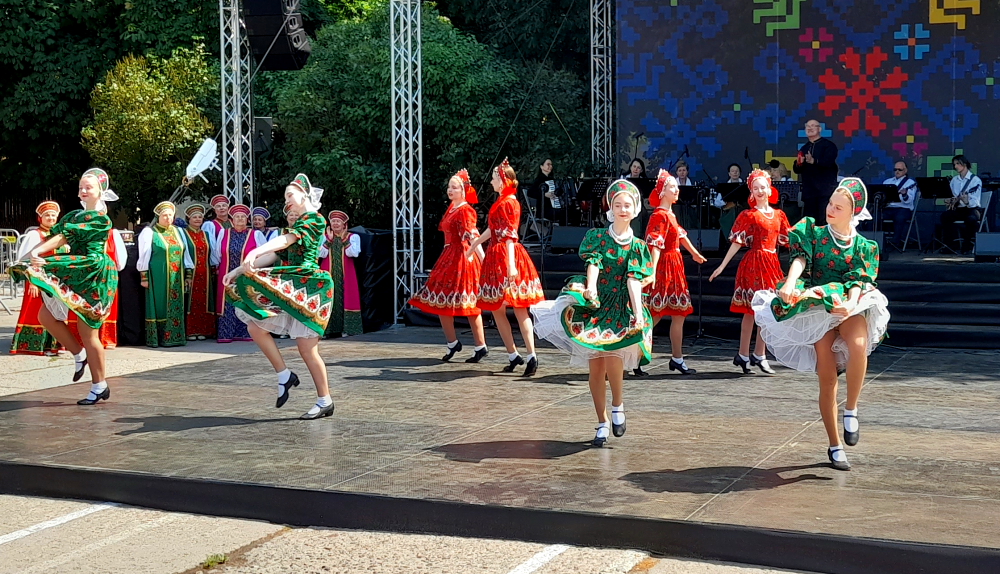
Prancing girls.
Inevitably, there are group photos being taken everywhere to mark the occasion.
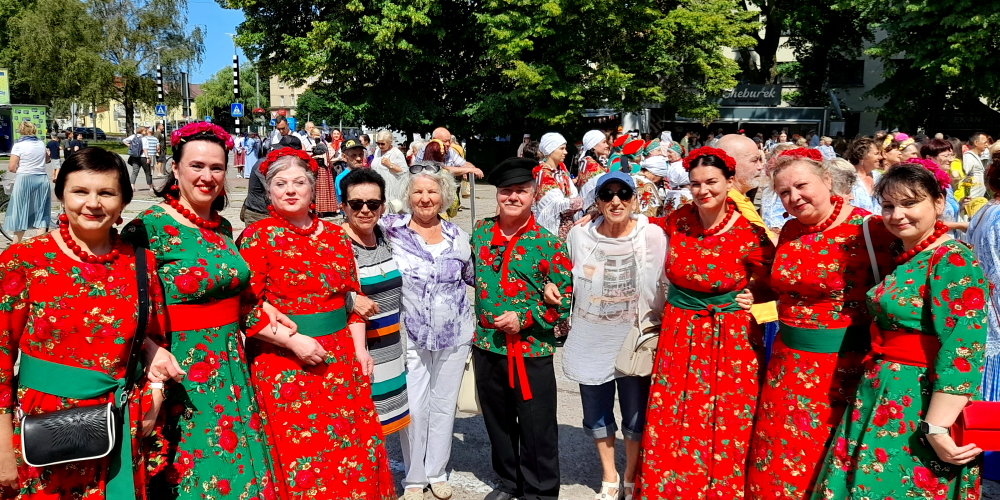
When it doesn’t matter when you are wearing the same outfit as someone else!
Walking back to the hotel we call into the Concert Hall where there are several exhibitions on display – fashion …
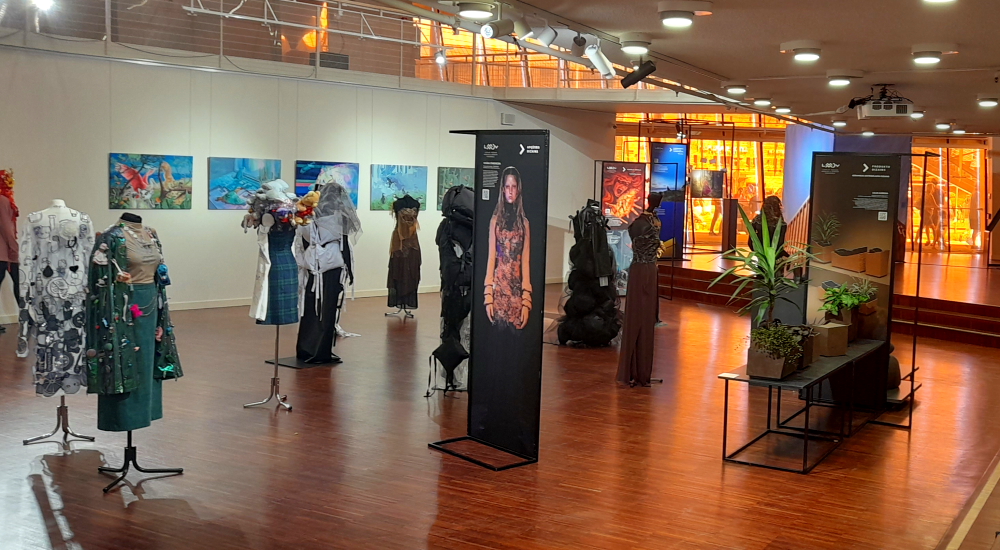
Fashion exhibition, Concert Hall, Liepaya, Latvia.
… and art work.
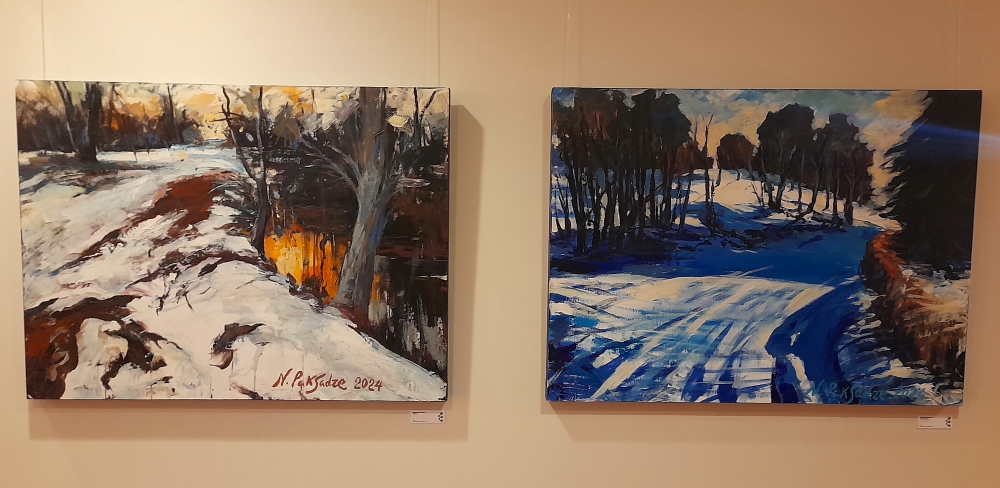
2 moods of Latvia in winter, oils, Concert Hall, Liepaja, Latvia.
With all the tourists in town today we find that most of the good restaurants are booked solid. We tried the pub next door but they advised that their kitchen was so backed up that it would be at least an hour before they could fill our order. Looks like we are back to the Piano Bar at our hotel again tonight. The food is very average and expensive for what it is. That probably explains why we can get a seat without a booking.
Tomorrow we are checking out and heading south along the coast to Lithuania. Neither of us have been to Lithuania before so we have no idea what to expect. Will Lithuania be still influenced by its Soviet past or will it be more like our experiences in Poland?
30 June, 2024
It’s 22 degrees when we leave Liepaja at 12:15 pm on our way along the A11 to another west coast port town, this time Klaipeda in Lithuania.
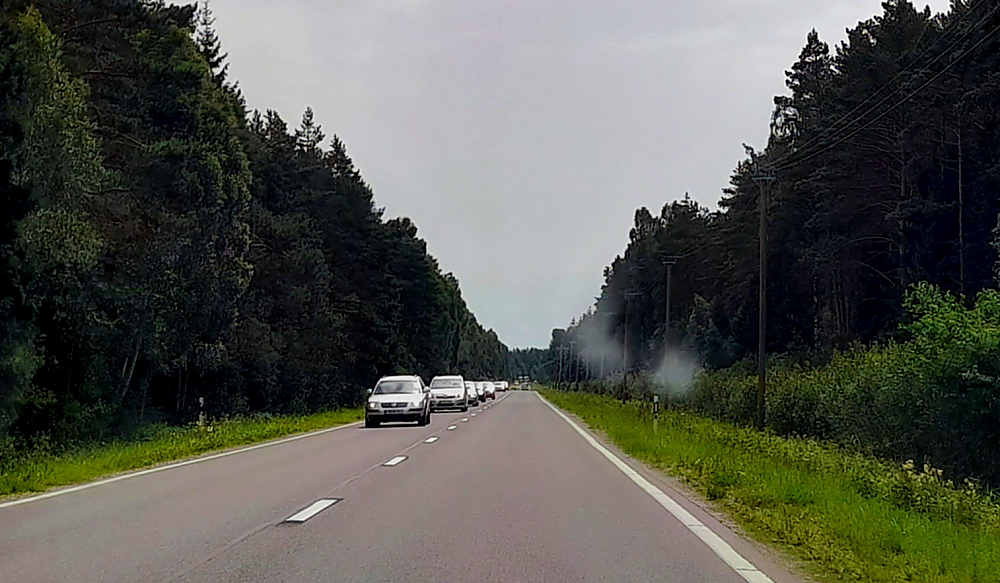
What?? Everyone seems to be leaving Lithuania!
As it’s only 1.5 hour’s drive away so we decide to call into Kunigiskiai in Lithuania to check out the beach.
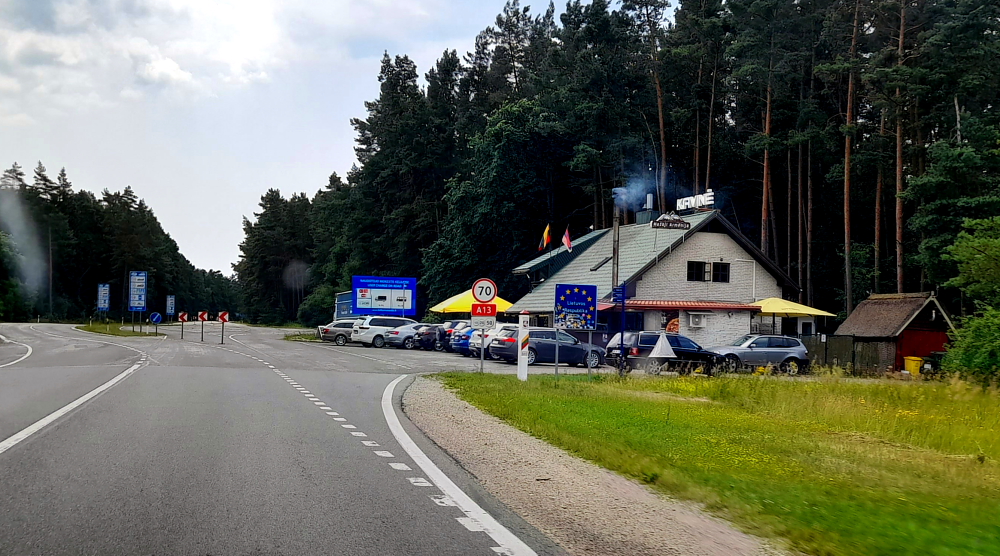
Lithuanian border guards? Why, when a restaurant will do?
At the Lithuanian border the A11 becomes the A13, noticeable by the number of patched potholes we have to drive over. We soon turn off it and drive along a road bordered by pine forests until we come to a new subdivision with swank-looking beach chalets. This is Kunigiskiai, what appears to be a revamped holiday camp.
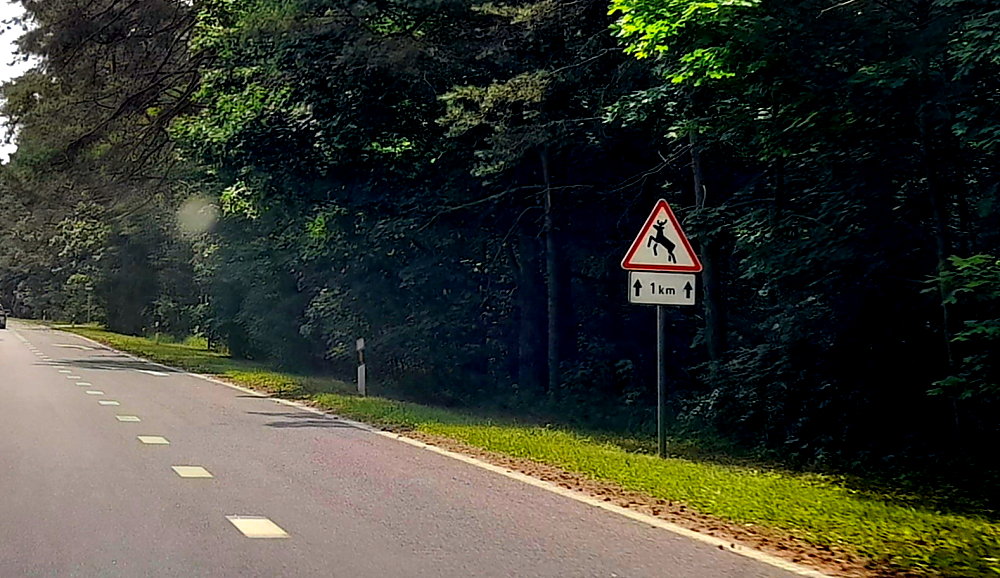
Unlike the elegant Latvian deer signs, these Lithuanian ones look like stick figures.
Closer to the beach there are more traditional houses and caravan parks and anywhere where you can park is covered in cars. The place is heaving and as we aren’t renting a chalet, apartment or caravan park slot we have nowhere to park. So we drive on to Palanga,
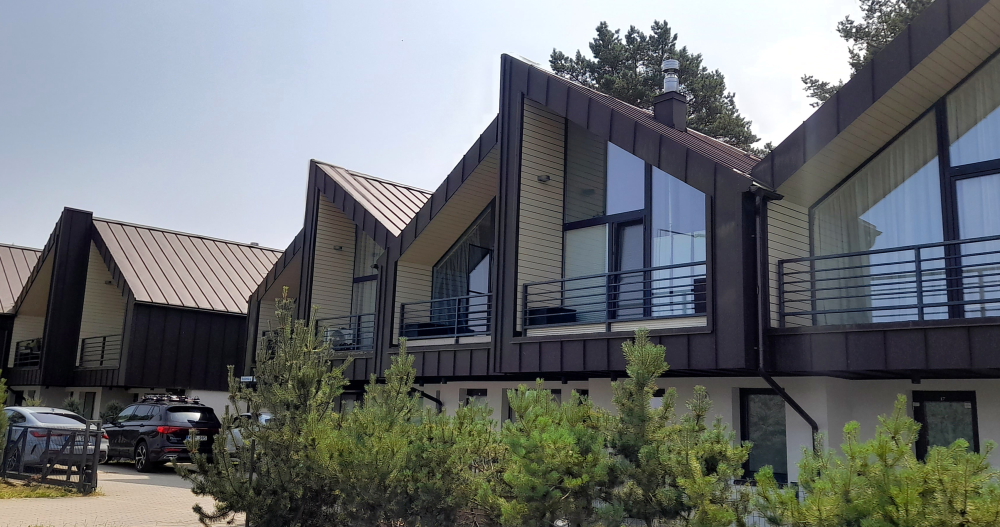
New ‘beach chalets’ in Kunigiskiai, Lithuania.
Palanga is a resort town on Lithuania’s Baltic coast. Palangos Pliažas is a long beach, backed by dunes.
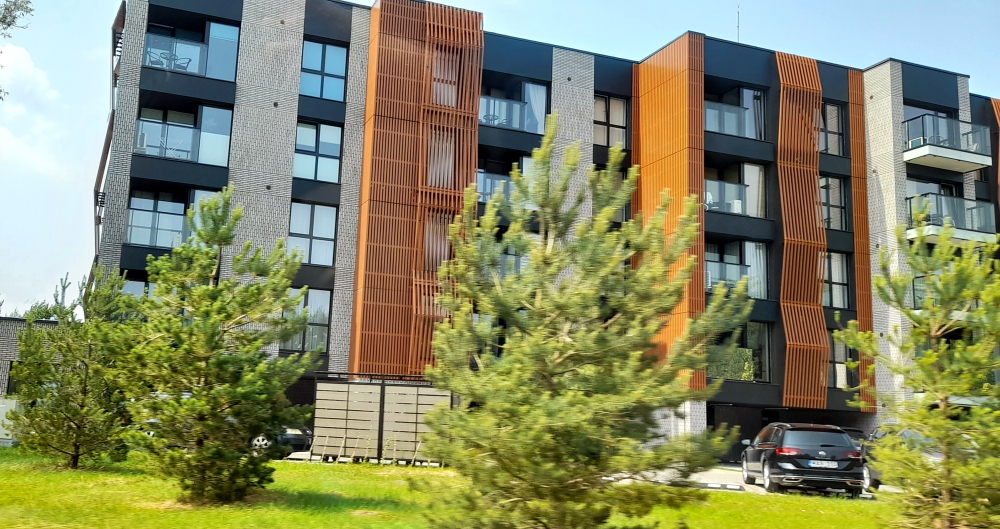
New residential housing in Palanga, Lithuania.
Palangos Tiltas, an L-shaped pier, was constructed in the late 1800s. It joins the lively, pedestrianized Basanavičiaus Street, lined with bars and restaurants. Again, parking is at a premium and there are lots of people walking along Basanavičiaus Street on their way to the beach.
This resort town looks very prosperous. There is a mix of traditional wooden villas, renovated villas and architecturally designed villas and hotels. Very nice!
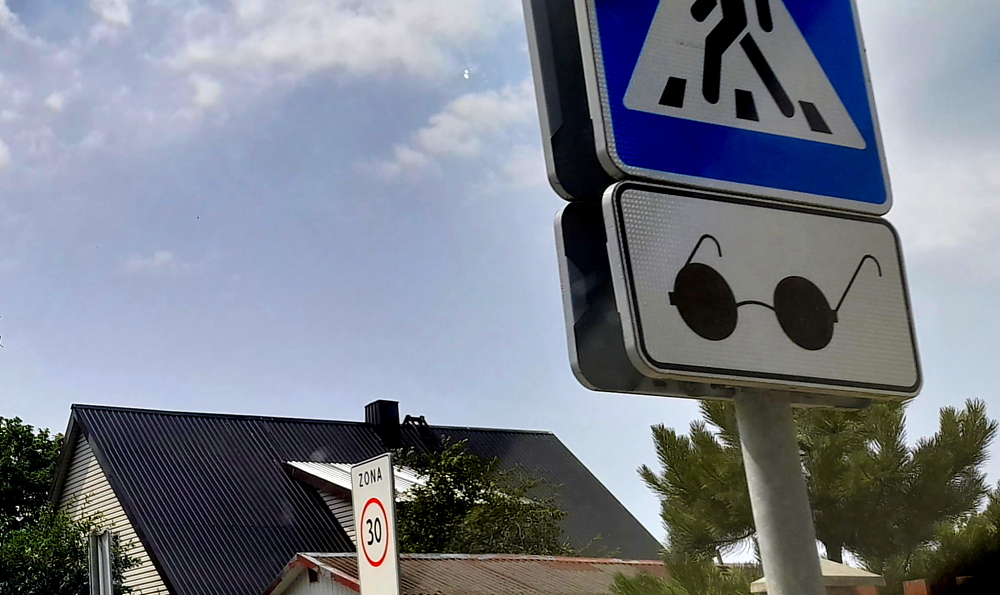
Blind people crossing or you must wear sunglasses here??
It seems that everyone from the Lithuanian Capital City of Vilinus has gone to the beach for a summer holiday. We have no option but to drive through the town and rejoin the A13 that takes us into Klaipeda. Perhaps we’ll revisit this town over the next couple of days when it is not the weekend and not great beach weather.
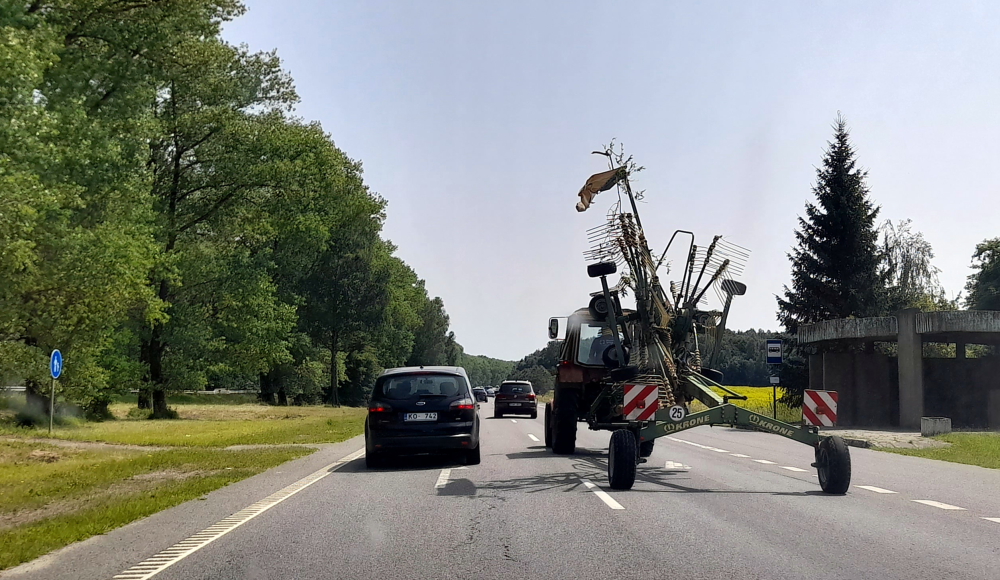
Mobile chicane, otherwise known as a tractor.
From Kunigiskiai onwards we witness a prosperous area. Most people are driving new cars and top of the range ones like Audis and BMWs.
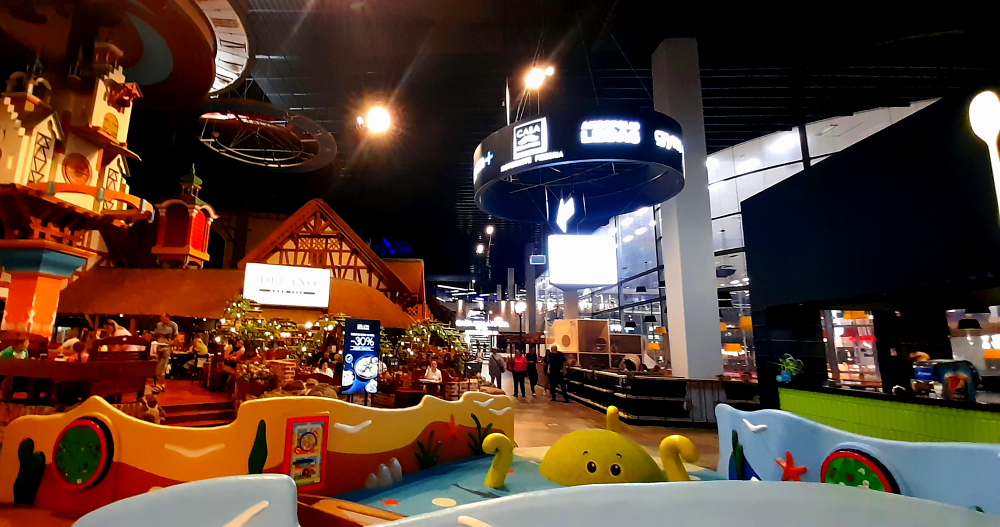
Akropolis Mall, Klaipeda, Lithuania.
This is further enforced when we call into the Akropolis Mall to the south of Klaipeda to visit the Maxima Supermarket there. The Mall is large, spacious, very modern and not one of the shops is vacant. Apparently it’s the largest multi-functional shopping centre in western Lithuania in terms of area, number of shops, and selection of services and entertainment.
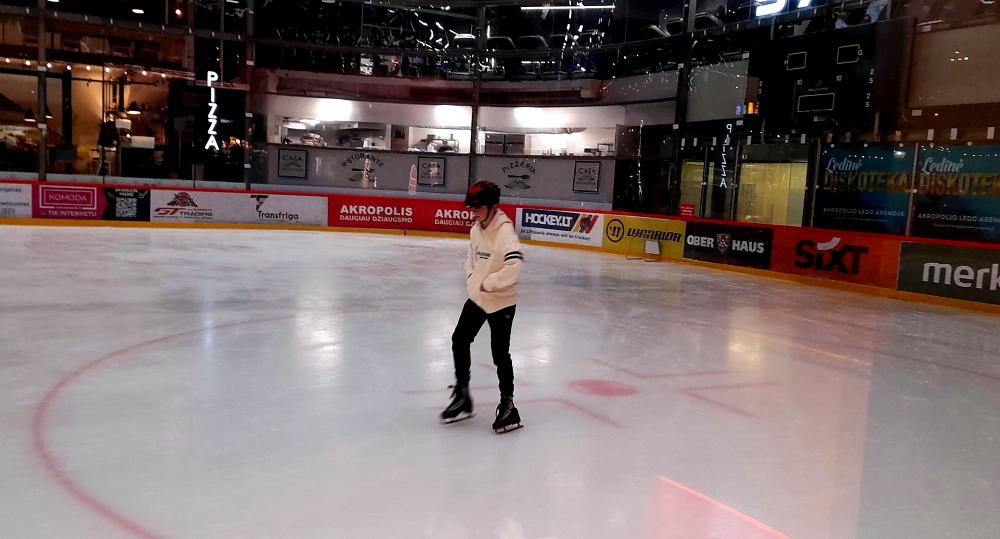
Ice rink central feature of the Akropolis Mall, Klaipeda, Lithuania.
It even has an ice rink in the middle of the Mall which is patronised by 5 kids while were were there. Figure skating performances and ice hockey matches can be observed from cafes installed around the ice arena.
Around 3:30 pm and in 30 degree heat we pull up in front of the apartment building on Sukileliu Street, over the road from the moated Klaipeda Castle. Klaipėda is a port city in Lithuania, where the Baltic Sea meets the Danė River. The old town features German-style, 18th-century wood-framed buildings.
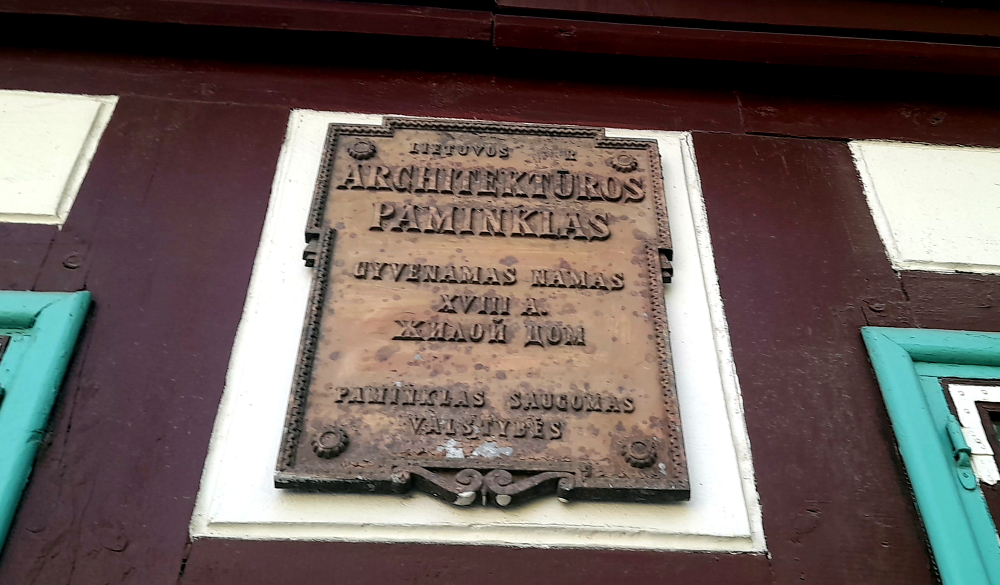
Plaque on outside of our apartment building, Klaipeda, Lithuania.
And we are staying in one of them. On the front of the building is a plaque that says: “Lithuanian architectural monument residential house 18th century. Protected by the state.”
After getting settled we walk down the street which ends in Theatre Square.
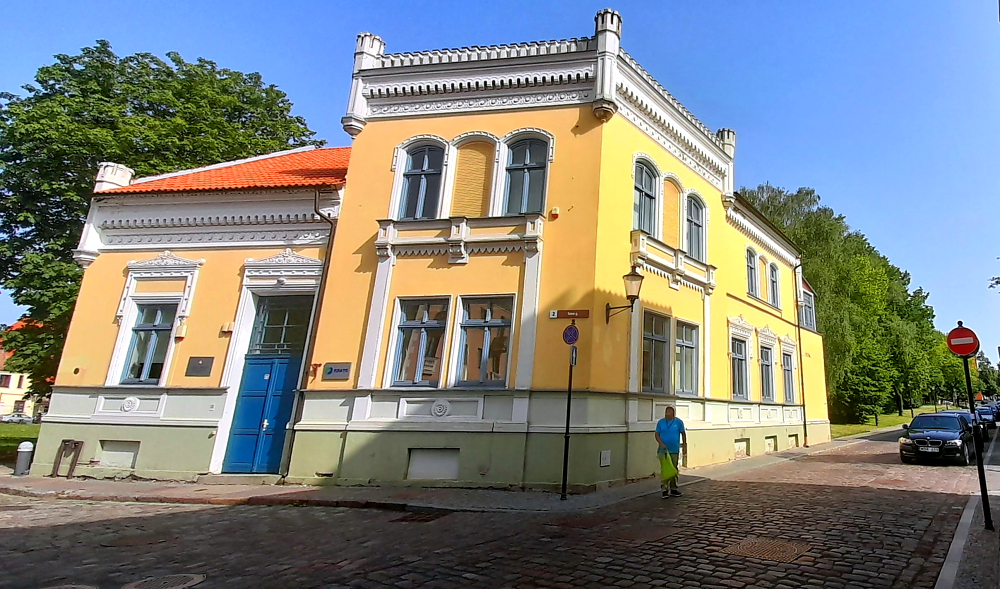
Sukileliu Street – our apartment is located at the top end of this street.
Here we dine at a traditional, family-style Lithuanian food restaurant – Etno Dvaros. Lynn orders a kastinys su karšta bulve (trans. box with hot potato).
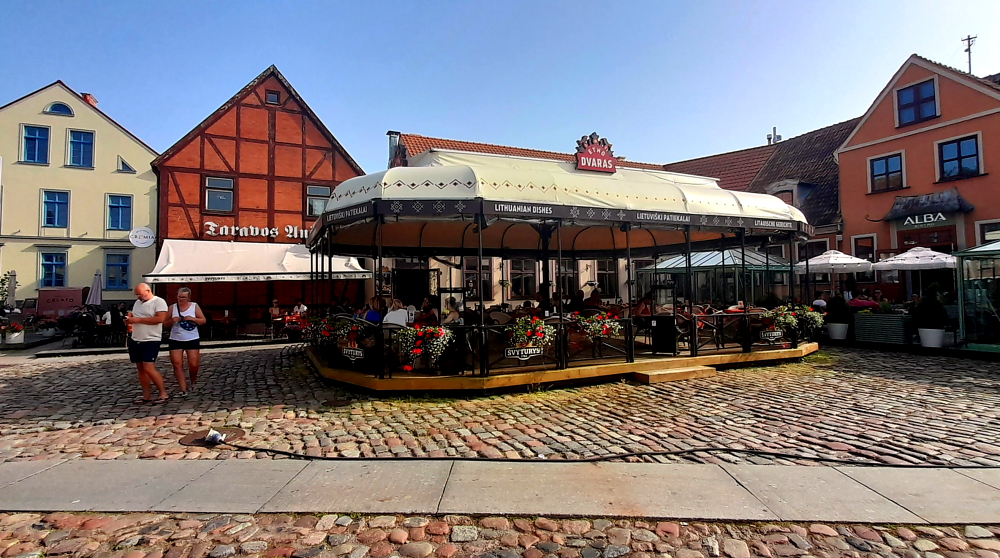
Etno Dvaras Restaurant, Theatre Square, Klaipeda, Lithuania.
The menu’s photo looks like a plate with chunks of fetta cheese with seeds, a small salad, some roast potatotes and a small bowl which looks like sour cream.
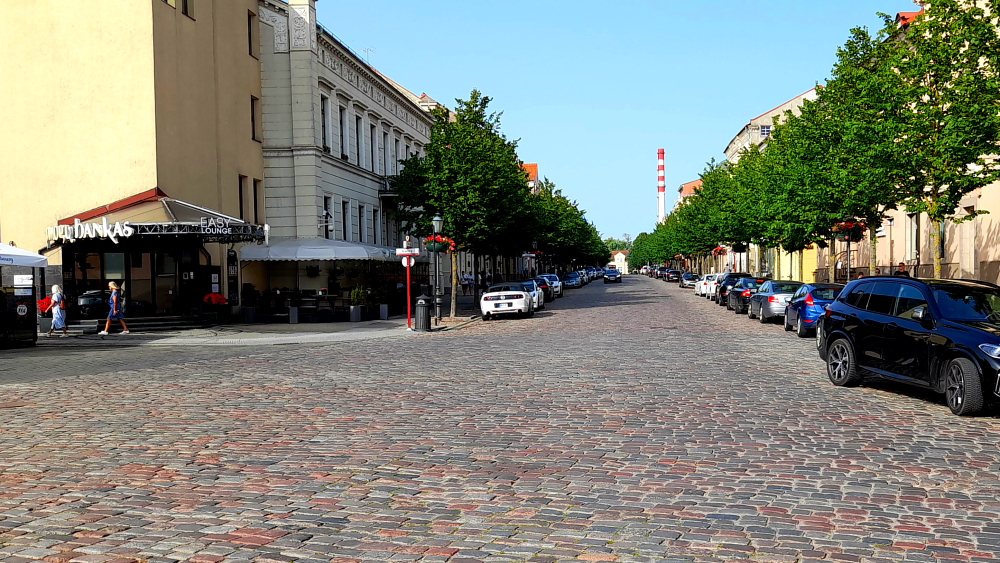
Turgaus Street – view of thermal power plant smoke stack from Theatre Square.
Turns out that the “cheese” is sour cream butter that is served as a cold, hard disk. No wonder she abandons it and tucks into my beef goulash!
My beef goulash is delicious and I indulge in a very nice Lithuania lager to wash it down. It seems that Lithuania is going to be another unexplored and underrated country.
 THE CONTINUING TRAVELS OF YOGI & BOO BOO