
29 April, 2024
62% chance of rain and a top of 19 Deg. C. has been forecast today so we’re out the door by 11:00 am and walk across the road and through the Balexert Shopping Centre opposite to the tram station.
A No. 14 tram arrives almost immediately and deposits us at the Bel-Air station on an islet in the middle of the Rhone River that bisects Geneva. For many years this islet was the only checkpoint on the route linking northern and southern Europe, thanks to its bridge (Pont de I’lle) that spanned the two river banks. A commemorative plaque tells us that Julius Caesar had this bridge destroyed in 58 BC, which is when Geneva enters into the history books. Following its reconstruction, the city became a major European trade centre. [myswitzerland.com].
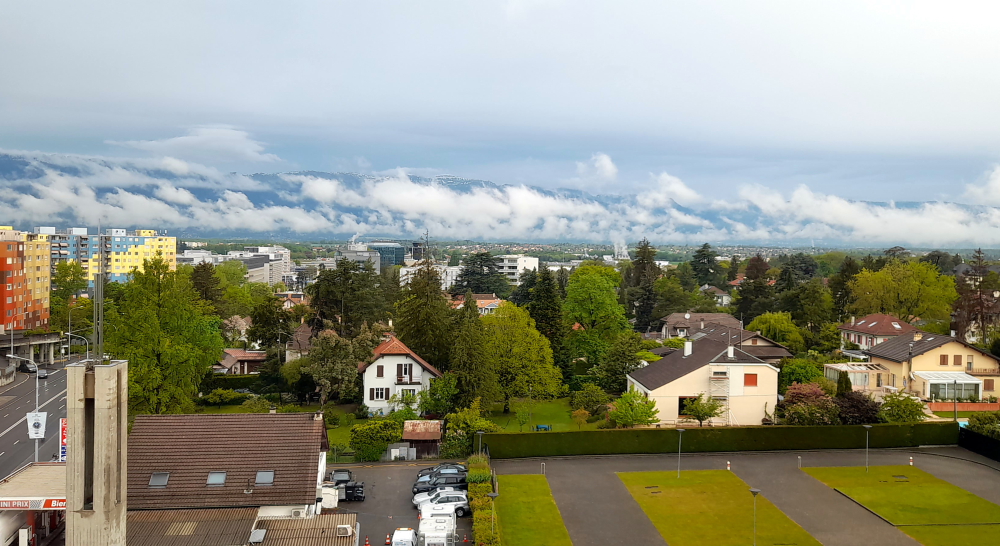
A short walk from Bel-Air we find Quai F for the No. 2 bus to take us to Vollandes which is a block or so away from the lake’s foreshore and the Jet d’Eau.
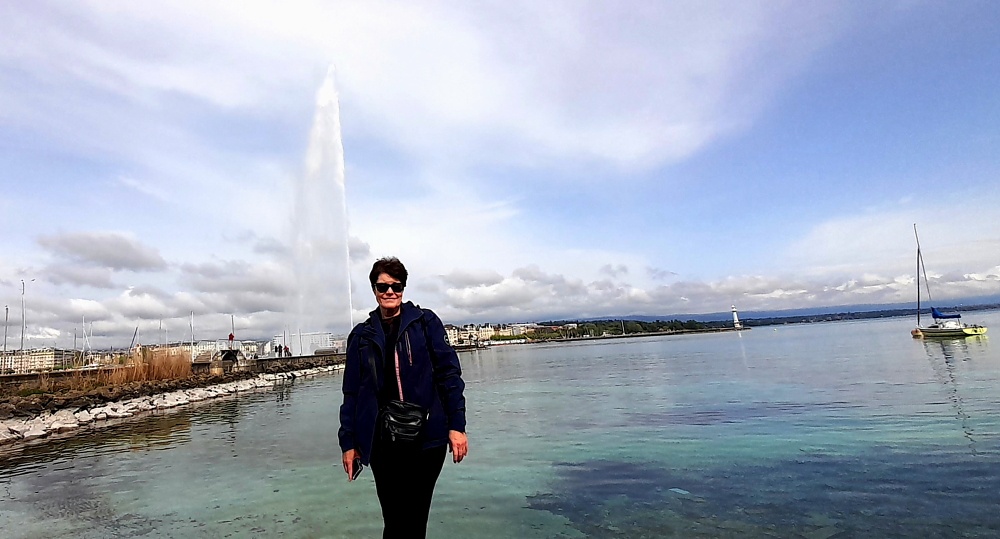
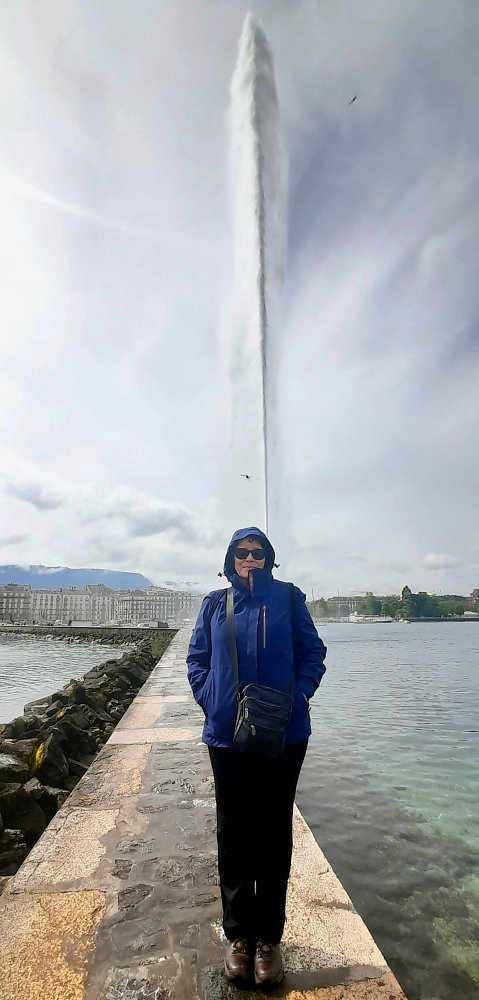
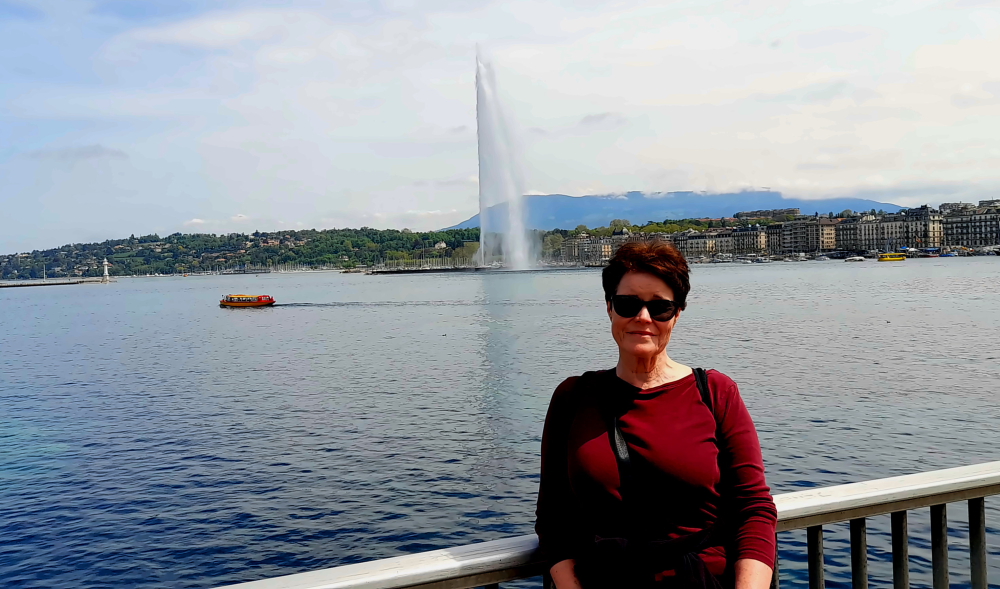
Located at the very heart of the harbour area, the Jet d’Eau is the emblem of the City of Geneva and its main tourist attraction.
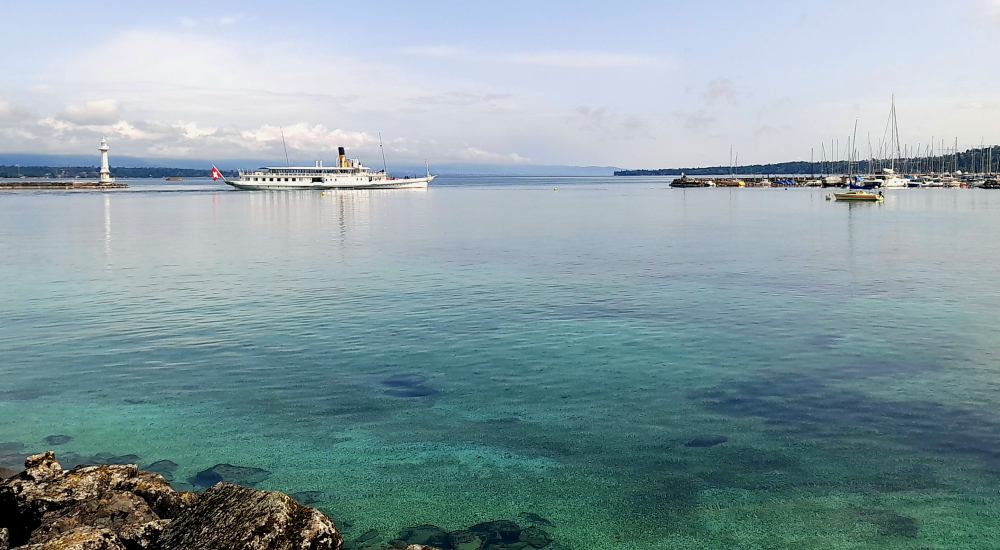
In 1891, the City of Geneva decided to promote the Jet d’Eau to the position of tourist attraction by installing it at the end of the Eaux-vives pier at the heart of the bay. The Jet d’Eau has been illuminated on a regular basis since 1930.
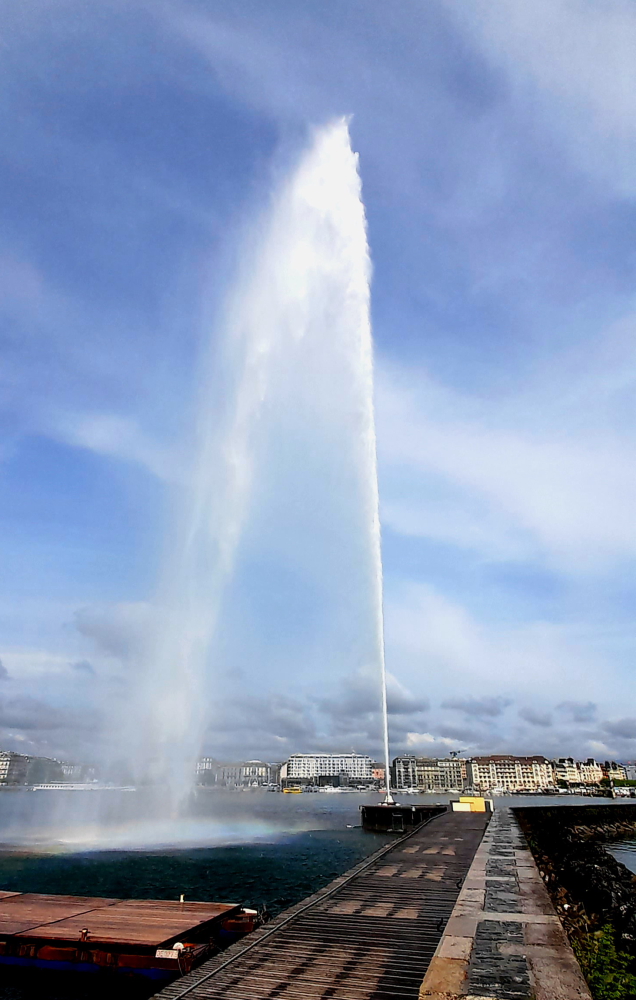
Projecting half a cubic metre of water per second 140 metres into the air requires two powerful water pumps weighing more than 16 tonnes in total and supplied with some 2,400 volts, generating almost 1,000 kilowatts of power. The water, drawn from a circular basin, is pushed towards the outlet nozzle where it reaches a speed of 200 km/h. [www.geneve.ch].
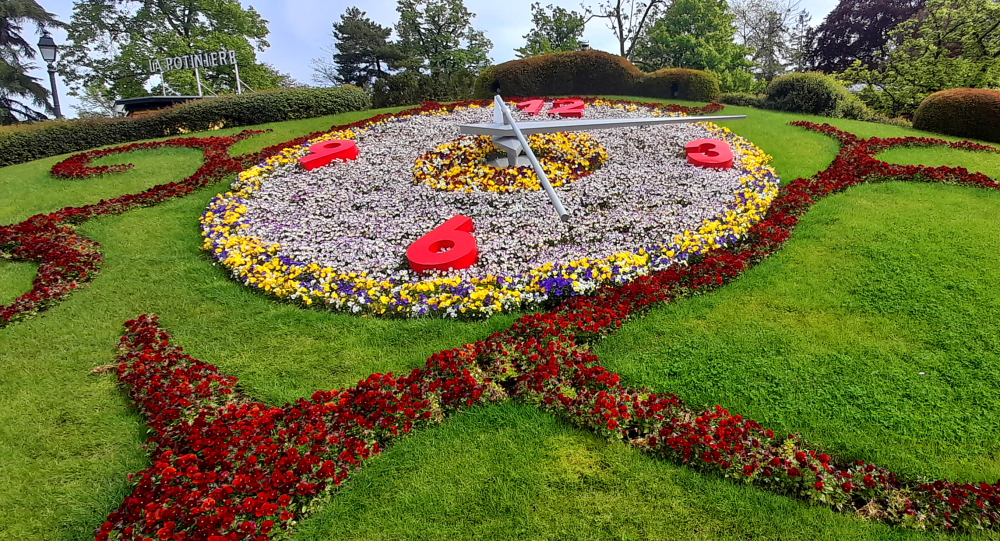
Back on the foreshore it’s only a short walk to the Parc Jardin Anglais and its botanical timekeeper – the floral clock (Horloge fleurie). Lynn remembers taking a photo of this in June 1985 on her coach tour through Western Europe.
The clock was created for the first time in 1955 and contains about 12,000 flowers (currently pansies) and plants. The floral arrangements change according to the season. The flower clock is not only decorative, it also tells the time with Swiss precision – the time being transmitted by satellite. The seconds-hand is 2.5 metres long, the world’s longest. [www.geneve.com].
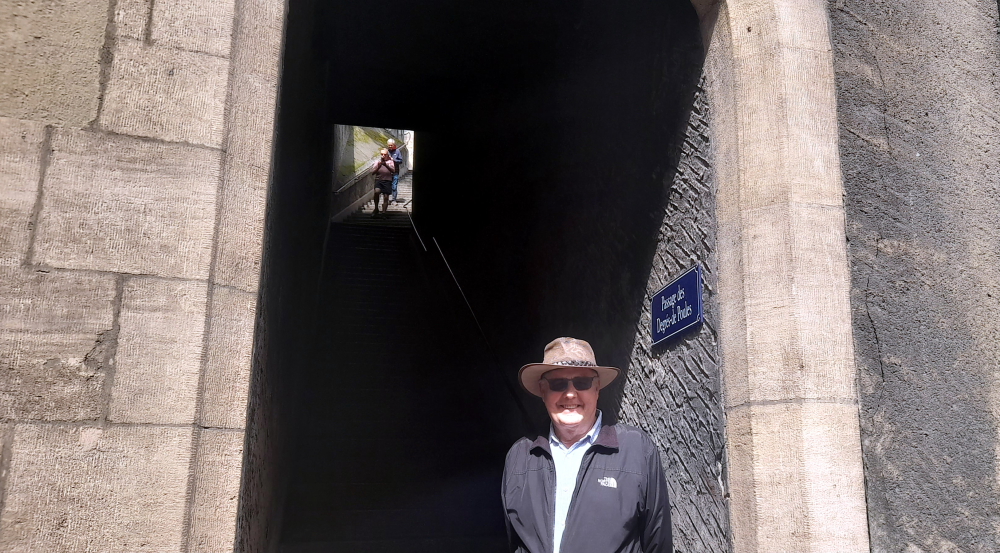
Our next destination is up a small hill in the Old Town – the Cathedral of St Peter – which we access via a steep stairway, Passage des Degres-de Poules (Passage of the Degrees of Chickens?!).
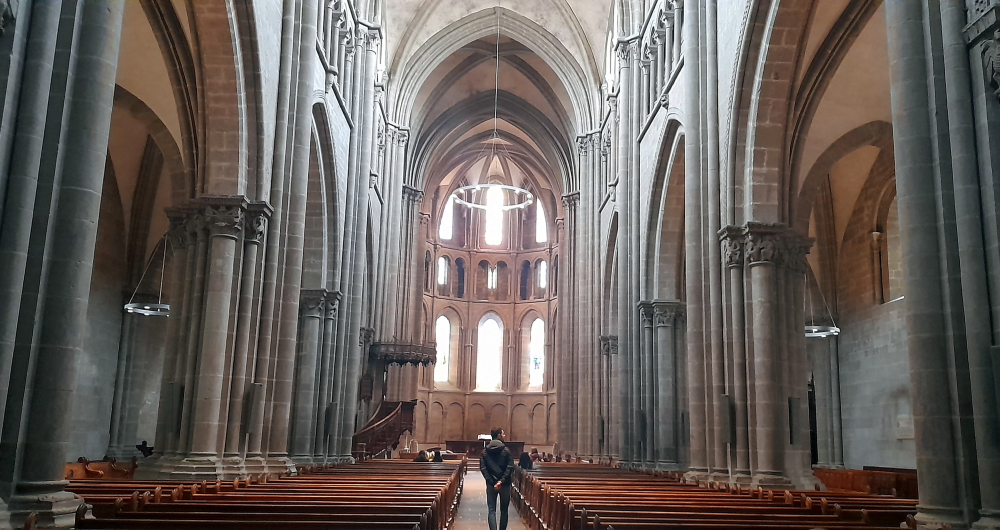
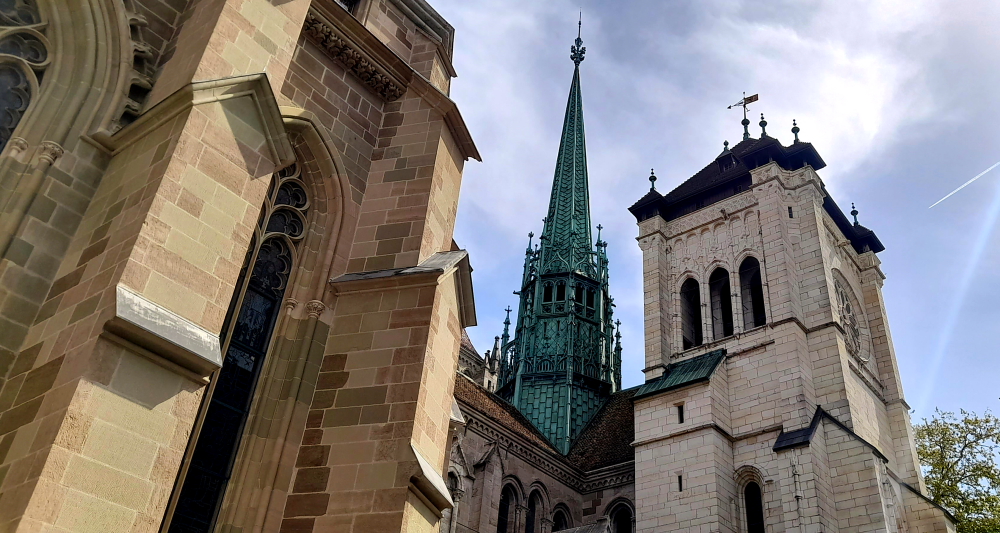
The first phase of the cathedral’s construction started in 1160 and lasted for almost a century. Restored and rebuilt on numerous occasions, in particular following fires, it now blends Romanesque, Gothic and Neoclassical styles.
With the Reformation, the cathedral was emptied of any ornament in the mid-16th century. The painted decorations were erased and only the stained glass was spared. Its medieval facade was replaced by the current Neoclassical facade in the mid-18th century.
Some 157 steps lead to the top of the north tower, offering stunning views over the city and the lake. In very fine weather, you can even see Mont Blanc. [www.geneve.ch].
The archaeological site of the cathedral is exceptionally rich. It is one of the most significant sites north of the Alps. The visit begins in the 3rd century B.C. and finishes with the construction of the current cathedral in the 12th century. Hidden under Saint-Pierre cathedral are the ruins of previous churches. The earliest date back to the end of the 4th century.
The largest of the nine bells was hoisted into the north tower in 1407. It is called “La Clémence” and weighs six tonnes, plus 20 bells comprise its carillon.
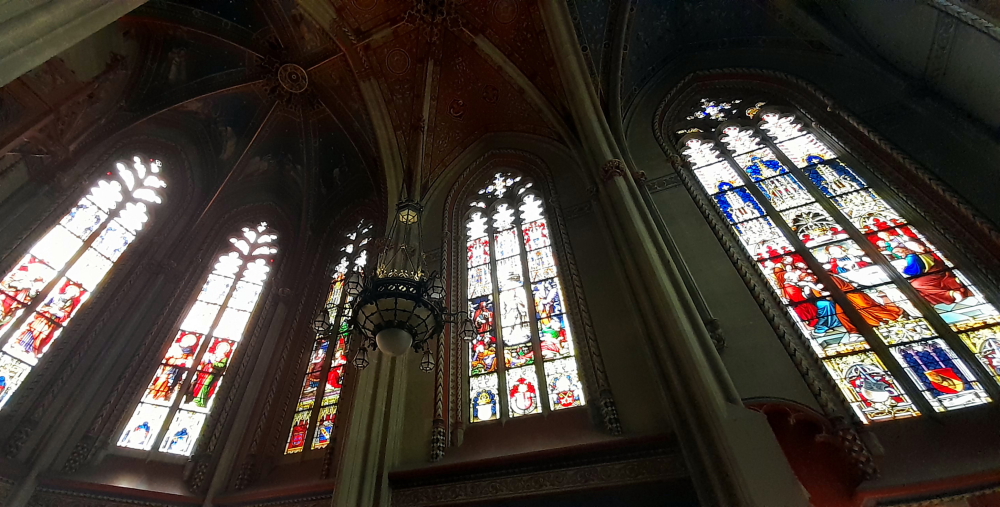
Upon entering the Cathedral, to the right is a door to the Chapel of the Maccabees. The Maccabees were a priestly family of Jewish rebel warriors (not a hamburger franchisee) who organized a successful rebellion against the Seleucid ruler Antiochus IV and reconsecrated the defiled Temple of Jerusalem (2nd century BC).
This chapel (or the Notre-Dame collegial chapel) was built between 1400 and 1405 in a flamboyant Gothic style for Jean de Brogny, a cardinal under Pope Clement VII (Robert of Geneva) to house his tomb and that of family members. During the Reformation, the chapel was subdivided into floors, converted into a salt store and was then used by the Academy from 1670. It was restored in the 19th century in a neo-Gothic style. The chancel vault was redecorated with the celestial chorus theme according to the exact layout of the original frescoes.
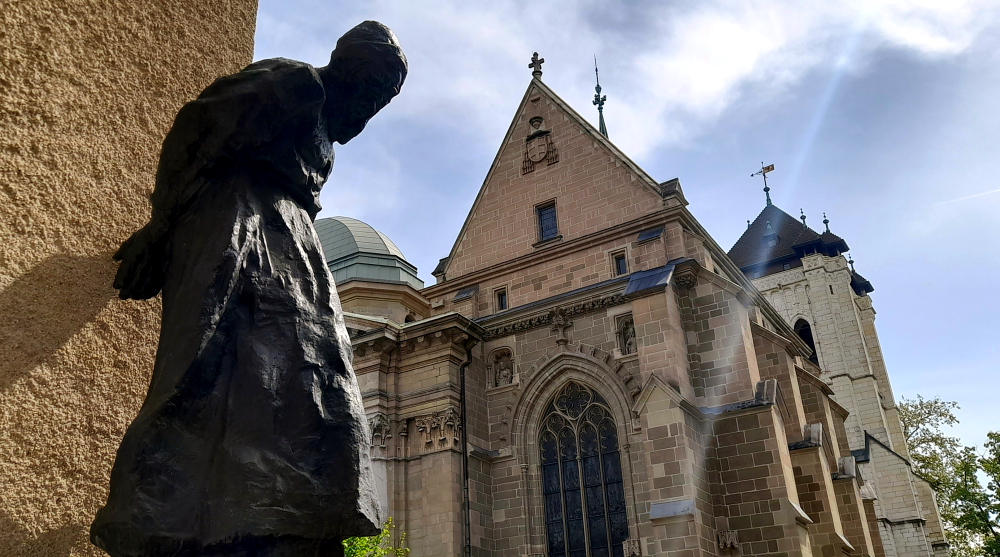
Outside the Cathedral is a sculpture entitled “Jeremie” by one of the finest-ever Swiss sculptors, Auguste de Niederhäusern, better known as Rodo. Born in Vevey of a Bernese family, Rodo studied in Geneva. But he produced most of his best work in Paris, where he collaborated with and enjoyed the backing of Rodin. Jérémie (the Old Testament prophet, Jeremiah) is considered Rodo’s greatest work, shortly after completing the plaster version he died. The statue was placed in 1939 at the present location. [www.swissinfo.ch].
A block away is the Hotel de Ville and its flag-decked street.
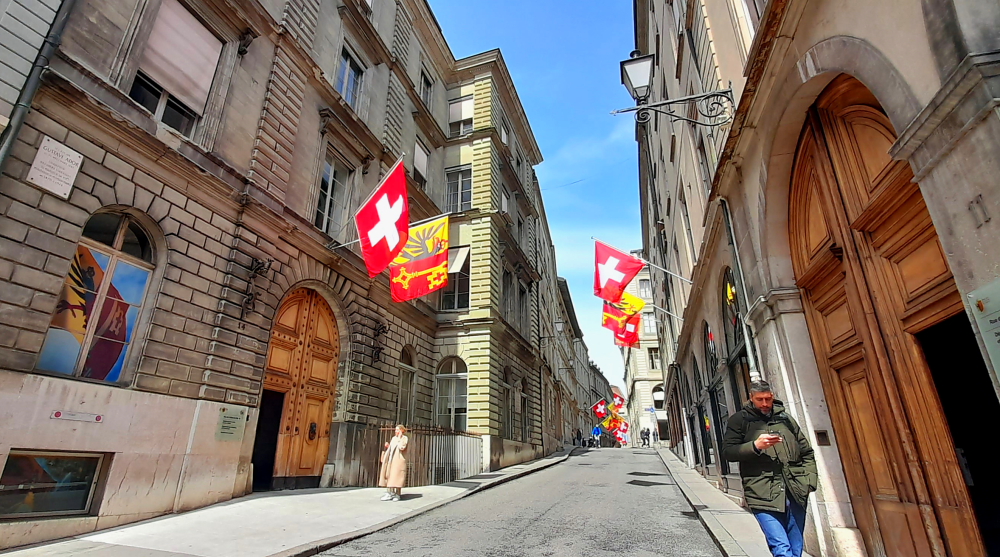
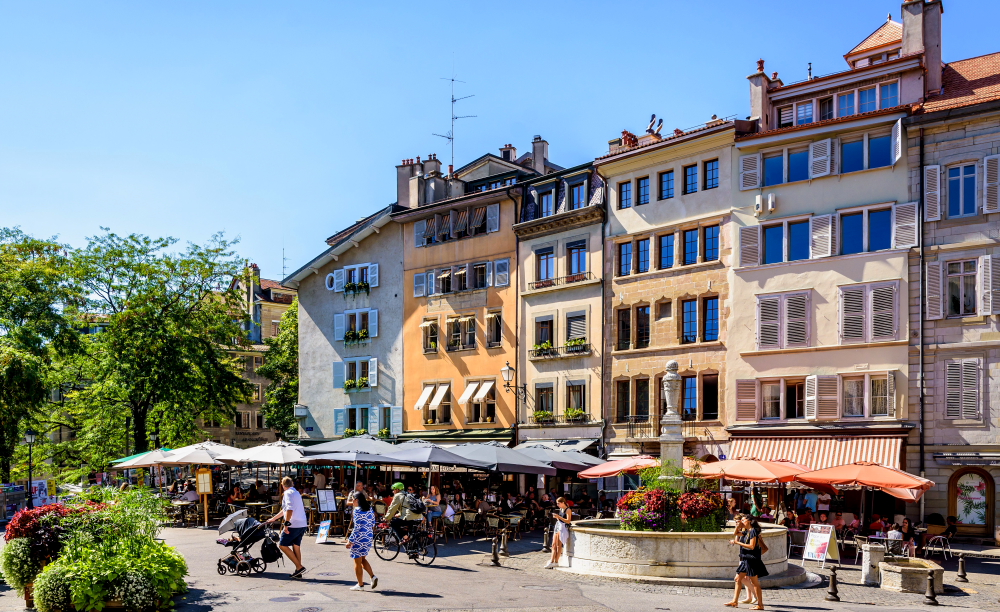
Rue de L’Hotel-de-Ville leads to Place du Bourg-de-Four at the very heart of Geneva’s Old Town. Even in the past, roads leading to Geneva led inevitably to the Place du Bourg-de-Four whose market has been of major importance since the 9th century. Over time, house heights were raised to accommodate Protestant refugees from all over Europe.
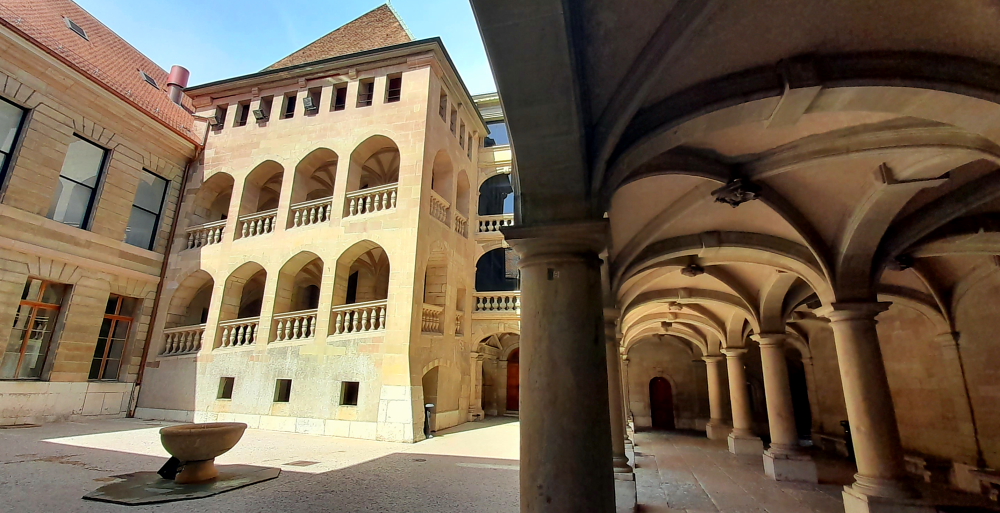
Retracing our steps back up Town Hall Street we walk past an interesting government building and courtyard which houses the offices of the Grand Counsel, State Counsel and Chancelry of the Republic and Canton of Geneva.
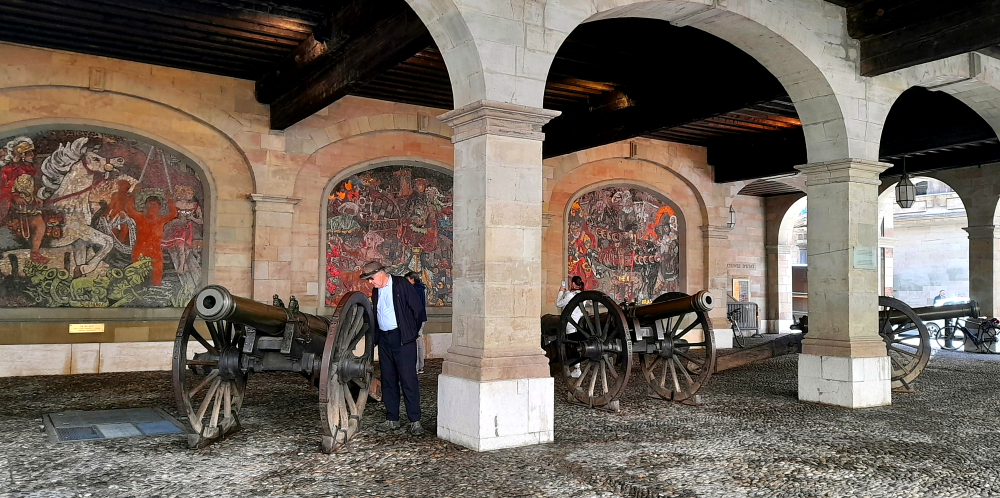
Across the road is a building housing a number of canon. The plaque states that “Two of these canon were among the artillery material of Geneva requisitioned by the Austrians in February 1814 and moved to Vienna. Following a personal initiative of the Lieutenant of Geneva, Joseph Pinon (1775-1839), these canon and other guns were restored to the Republic at the beginning of 1815.”
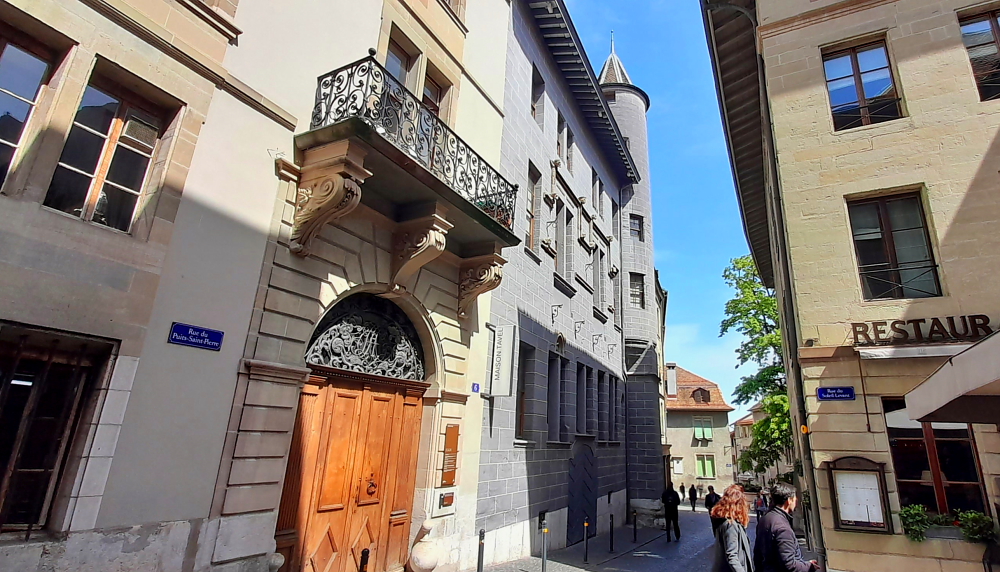
And across the road from this building is the Maison Tavel museum. A remarkable example of medieval civil architecture in Switzerland, it has also been the Museum of Urban History and Daily Life since 1986 through its permanent exhibition detailing Geneva’s past. It houses the Relief Magnin, the largest historical relief in Switzerland, which gives the visitor a general view of Geneva before the destruction of its fortifications in 1850.
An exceptional heritage building, it is the oldest private residence in Geneva. Destroyed by a fire in 1334, which spared only the cellars, the rebuilt house acquired the character of a fortified house with its turrets, and of an urban palace with a façade decorated with sculpted heads. In 1979, excavations brought to light the remains of an 11th century tower and a huge 17th century cistern for collecting rainwater.[institutions.ville-geneve.ch].
Rotating 90 degrees left, the road ends at Promenade de la Traille, an elevated park with panoramic city views. Immediately below it is Parc des Bastions which features the Reformation Wall.
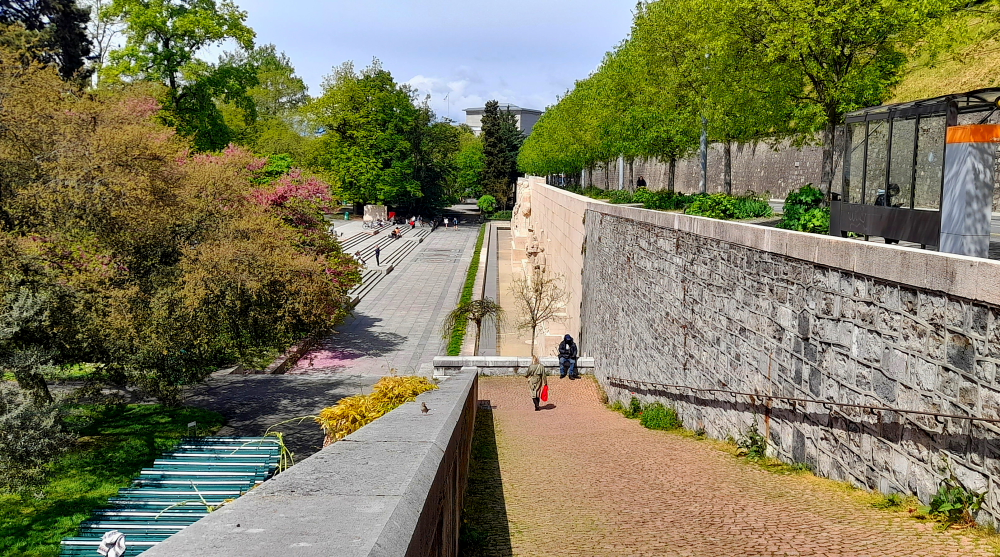
The International Monument to the Reformation, usually known as the Reformation Wall, was inaugurated in 1909 in Geneva. Key individuals, events, and documents of the Protestant Reformation are depicted there in statues and bas-reliefs.
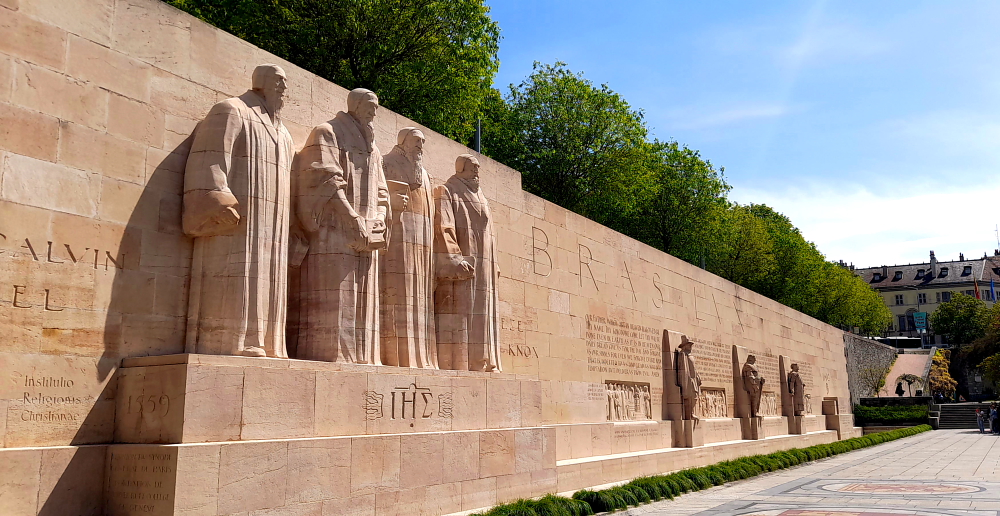
The Wall is in the grounds of the University of Geneva, which was founded by John Calvin, and was built to commemorate the 400th anniversary of Calvin’s birth and the 350th anniversary of the university’s establishment. It is built into the old city walls, and the monument’s location there is designed to represent the integral importance of the fortifications, and therefore of the city of Geneva, to the Reformation.
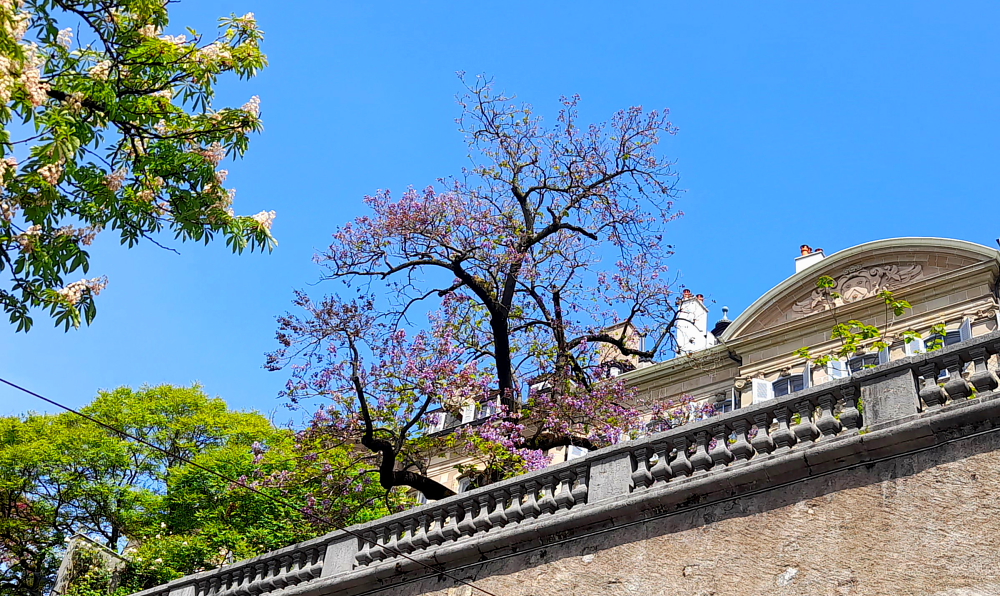
Descending the Rampe de la Treille to Place de Neuve we recognise an unexpected old friend – a jacarandah tree!
Place de Neuve is home to the General Dufour statue, inaugurated in 1884, and the Grand Theatre de Geneve. General Dufour, Swiss soldier, engineer, cartographer and statesman served under Napoleon I and held the Swiss office of General four times in his career, firstly in 1847 when he led the Swiss Confederation forces to victory against the Sonderbund. In 1864 Dufour presided over the First Geneva Convention which established the International Red Cross.
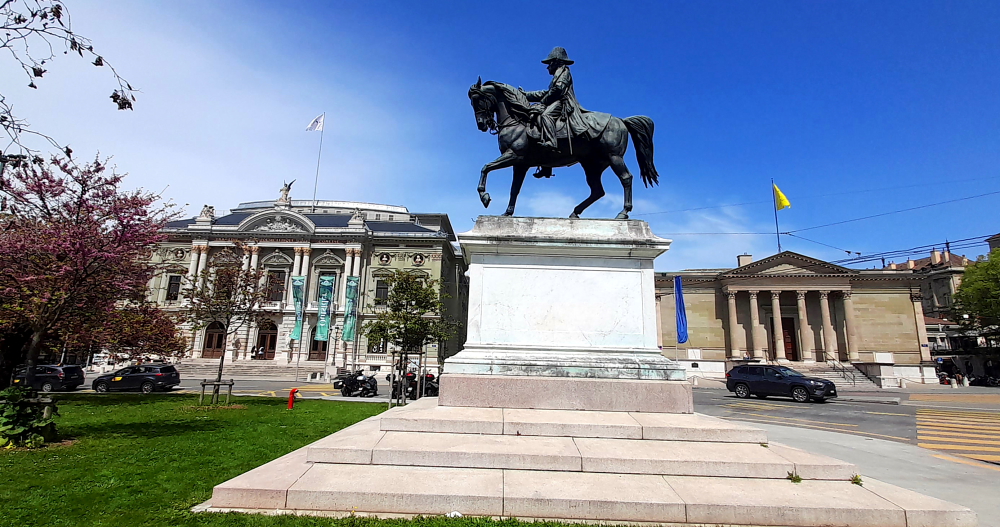
The Grand Théâtre is the city’s main opera house. It presents around a hundred ballet , operas and classical music concerts per year.
In 1862 the idea of building a large theater was born, but only became possible in 1873 thanks to the inheritance of Duke Charles II of Brunswick and the donation of 3,000 m2 of land by the ‘State of Geneva’. The prestigious building, inspired by the Opéra Garnier in Paris, has a capacity of 1,300 seats and opens its doors on 2 October 1879 with the representation of Guillaume Tell by Rossini. The Grand Théâtre quickly became the largest structure of its type in French-speaking Switzerland.
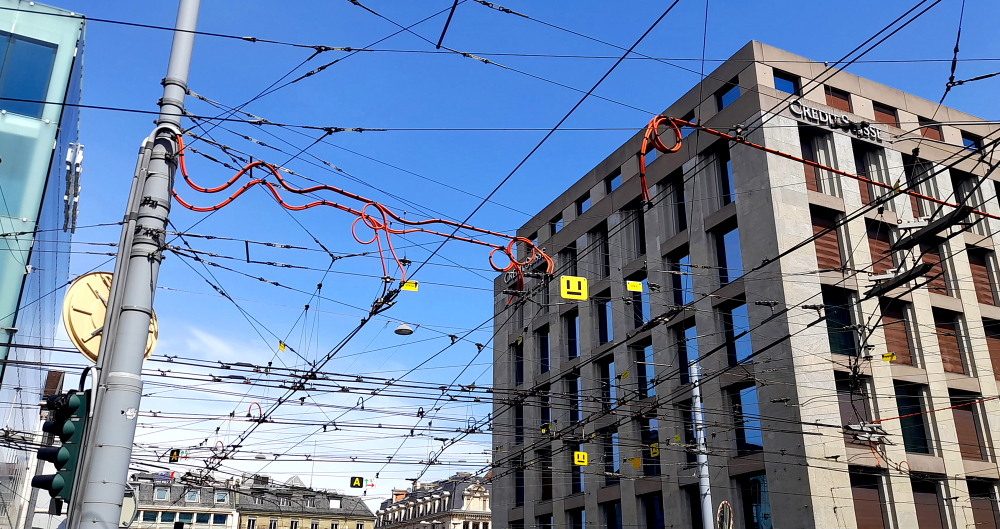
We walk back to the Bel-Air station and notice a clock tower. In the 13th century a fortified castle was built here of which only the tower, Tour de I’lle, now remains.
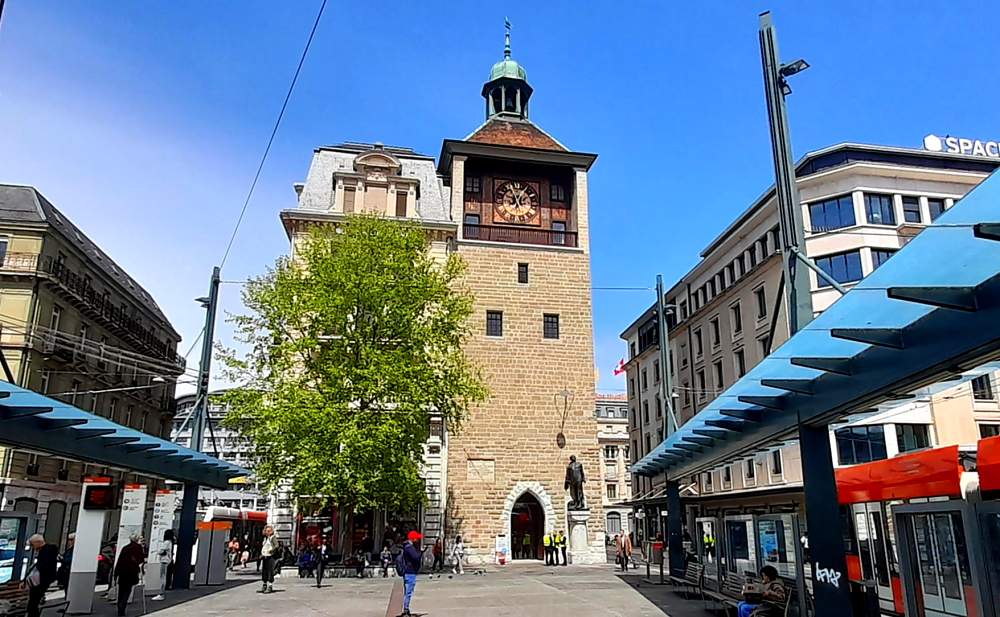
Near the tower’s doorway is a statue of Philibert Herthelier erected in 1909. Philibert Berthelier (c. 1465-1519), often known just as Berthelier, was a Genevan patriot, and an uncompromising enemy of the Duke of Savoy in his ambition to control Geneva. The accompanying memorial plaque states that he was beheaded for defending the freedoms of his homeland.
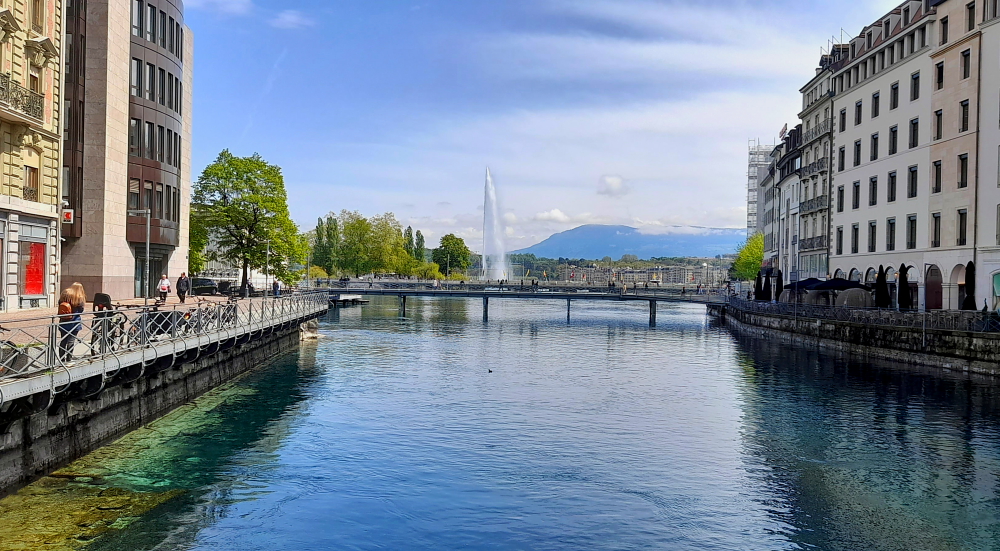
From here we cross the bridge linking the islet to the bank at Quai Bezanson-Hugues and walk to the pedestrian bridge, Pont des Bergues, that crosses back over the river to Quai des Bergues on the opposite bank.
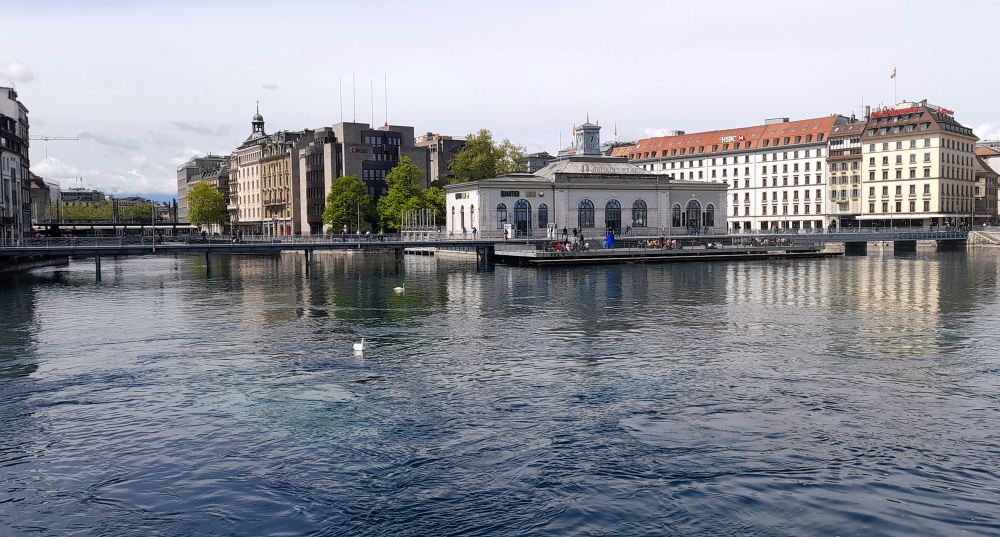
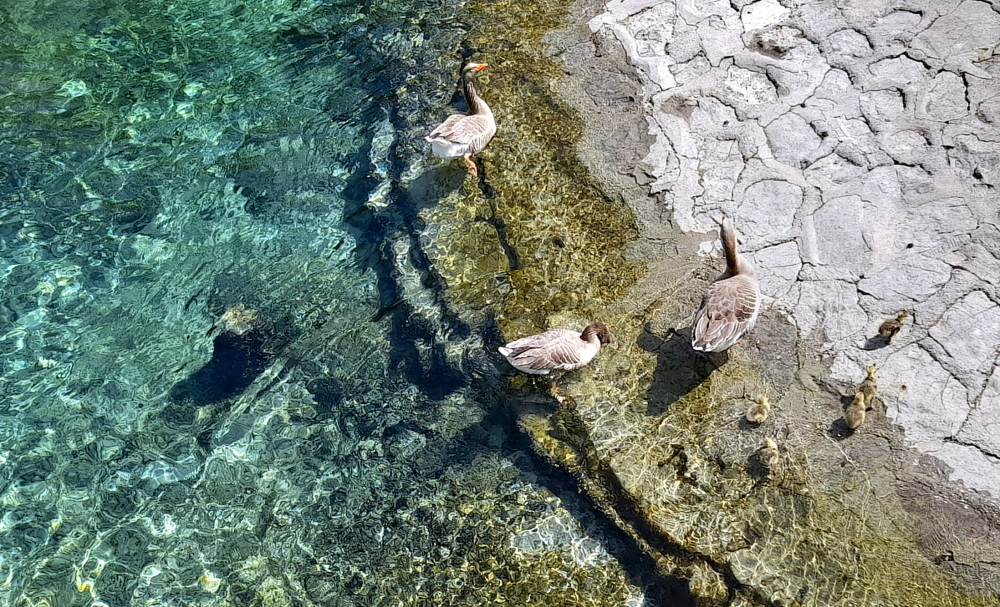
Near Ile Rousseau we come across 3 geese and 5 golden, fluffy goslings swimming in the crystal-clear waters of the Rhone.
Once on the opposite bank we walk along Quai des Bergues, under the Pont du Mont Blanc, to the Mont-Blanc paddle steamer terminal.
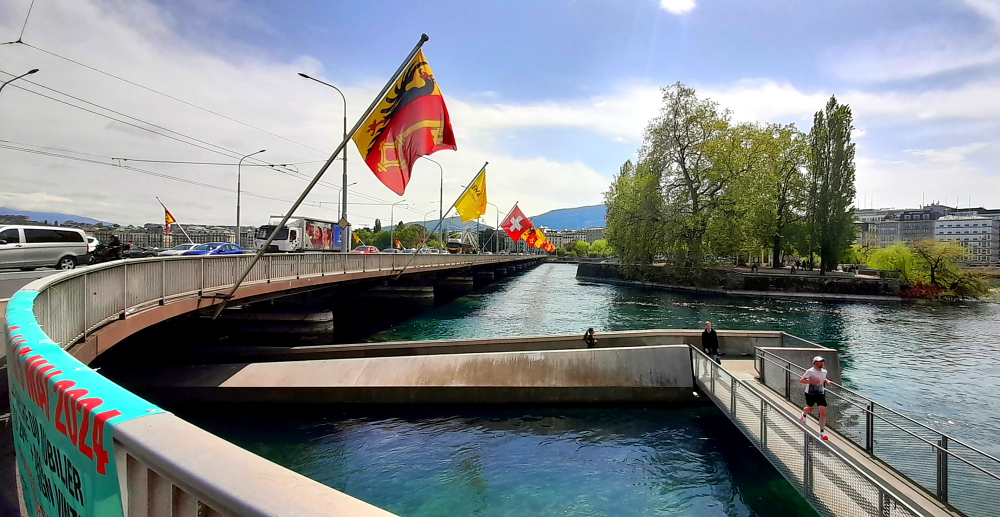
Where, would you believe, there is a completely different view of the water jet (not really).
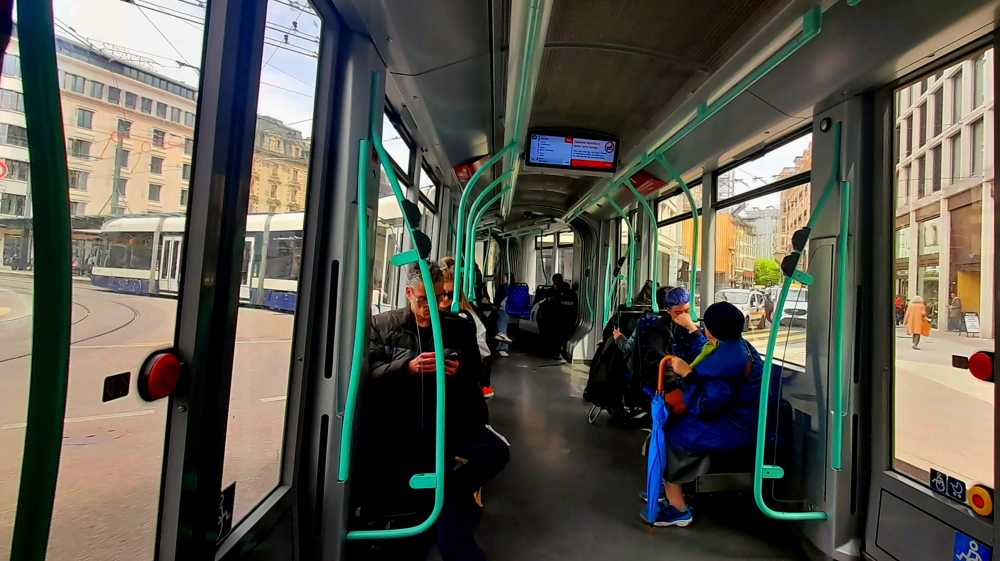
We jump on a No. 14 tram once again that returns us to our starting point.
And not a drop of rain all day – except for the water jet spray. Hope it’s the same tomorrow for our return trip to town.
30 April, 2024
Although the forecast was for a better day today, 21 Deg. C and 43% chance of rain, it turns out to be quite disappointing with overcast skies and a bit of a haze.
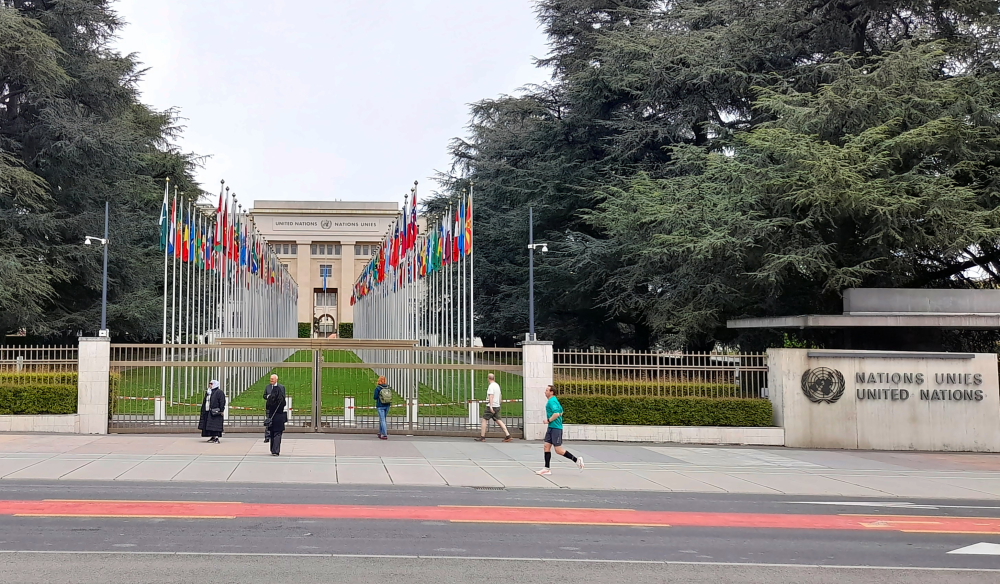
Today we are visiting the temple to watchmaking – the Patek Phillipe Museum in town. It doesn’t open until 2:00 pm so around noon, en route, we take the No. 14 tram to Servette and change to a No. 11 bus to Nations where the United Nations complex is located in Ariana Park. The Palais des Nations, an outstanding example of 20th century architecture, is formerly the headquarters of the League of Nations.
But it appears that we need a ticket to enter the grounds (we also wanted to see if we could catch a glimpse of a snowy Mont Blanc across the lake) so instead we catch a No. 15 tram direct to Plainpalais station where we walk across the extensive, crushed red-granite area of Plaine de Plainpalais to the Museum.
I wasn’t aware that there was such a museum but when Lynn was researching things to see and do in Geneva she came across it. Knowing my love of Patek Phillipe watches she insisted this was one museum that we needed to visit.
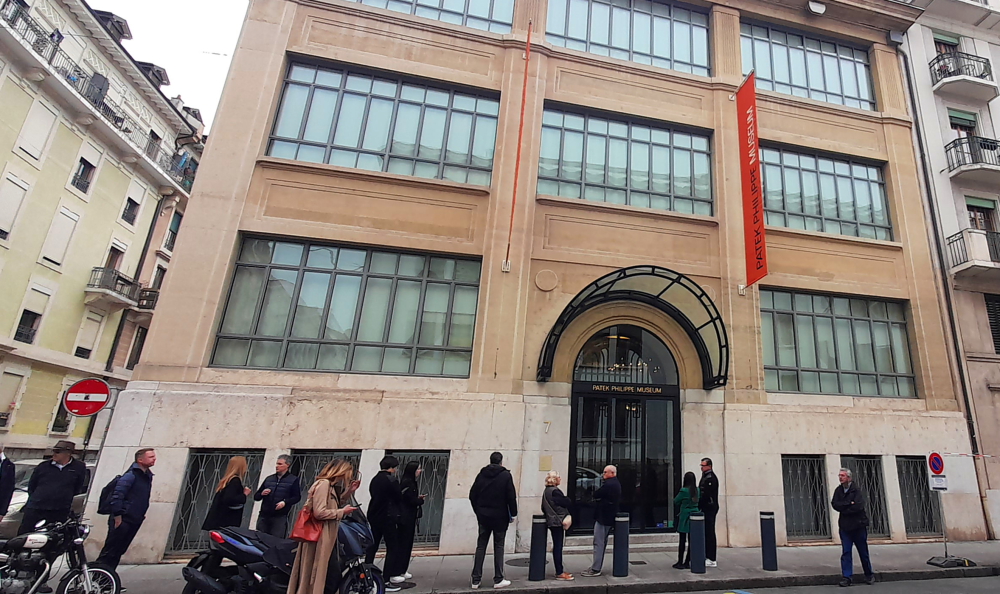
Inaugurated in November 2001, the Patek Philippe Museum was created by Philippe Stern, honorary president of the Geneva manufacture, whose passion built up one of today’s most extraordinary and prestigious horological collections.
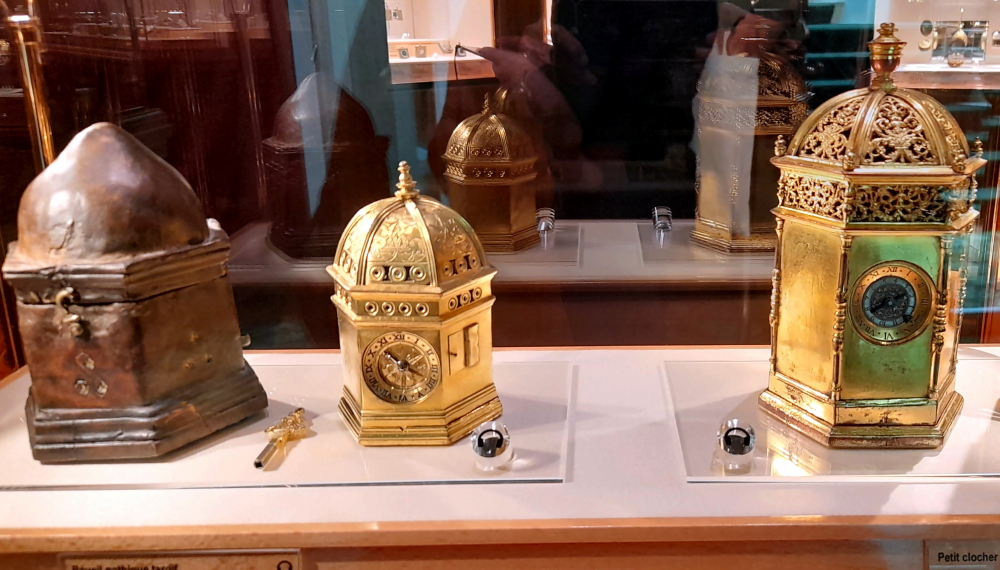
Some 2,500 watches, automata, precious objects and portrait miniatures on enamel showcase 5 centuries of Genevan, Swiss and European horological art, as well as Patek Philippe’s production since 1839. The museum also has a library with over 8,000 publications on time and time measurement [www.patek.com].
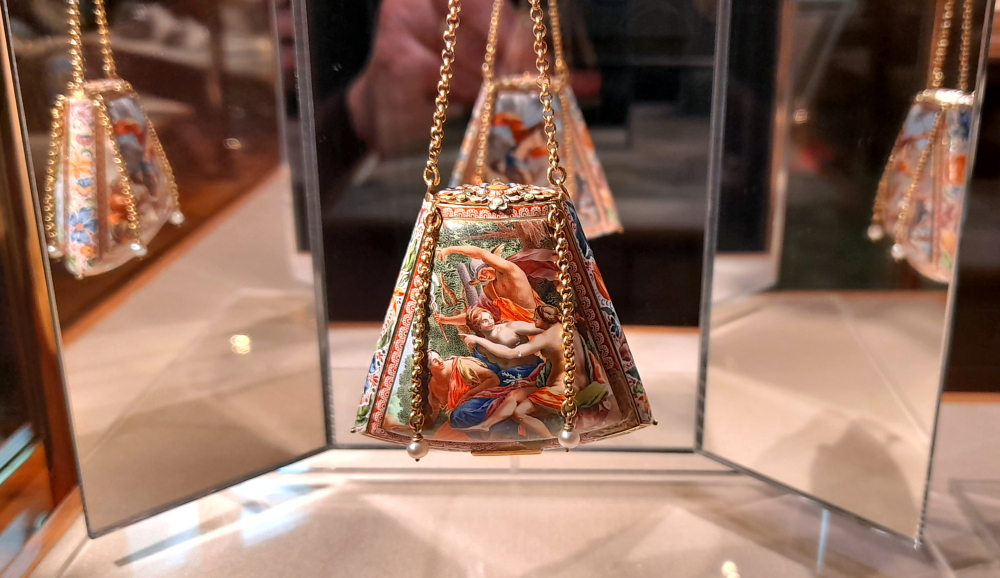
Rather than a museum devoted to a single brand, the Museum displays 5 centuries of horological heritage of designing and building movements, as well as the significance for all the decorative arts traditionally associated with watchmaking – engraving, enameling, gemsetting, guilloché work etc.
Just like Swiss clockwork the Museum opens its doors bang on 2:00 pm where we purchase our 2x CHF10 tickets, collect our audio guides and scale the stairs to the 3rd floor which is houses the archives and library. Here, unexpectedly, amongst large, weighty and beautiful gold-leaf and leather-bound tomes, we discover a copy of the children’s book, ‘Pooh’s First Clock’!
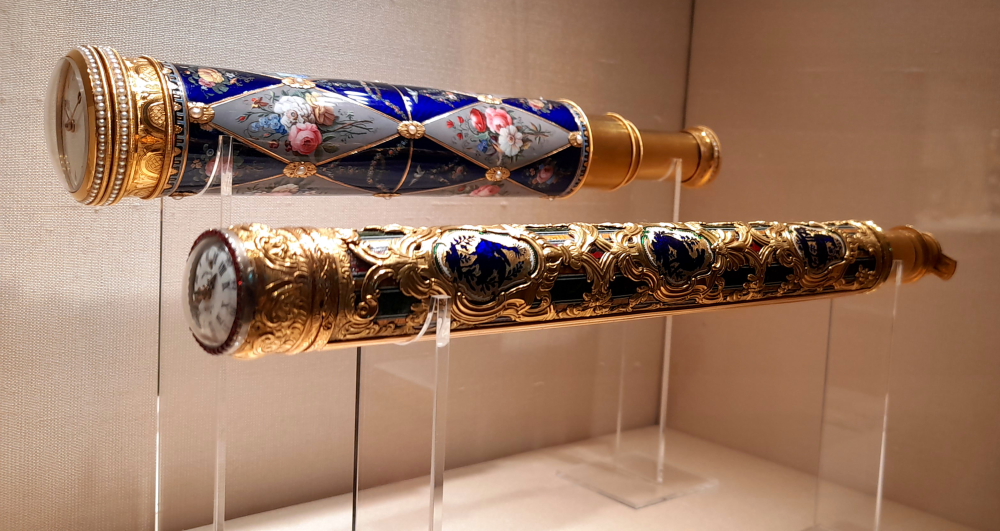
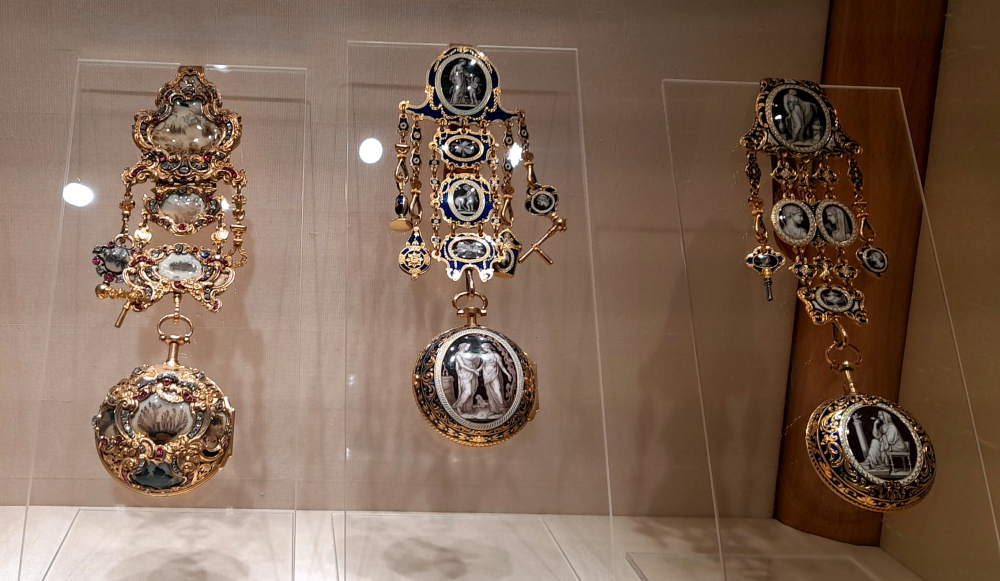
Then to the 2nd floor which has the Antiques Collection, a presentation of Genevese, Swiss and European watches and enamels dating from the 16th to the early 19th century, including a great number of masterpieces that have left their mark on the history of horology.
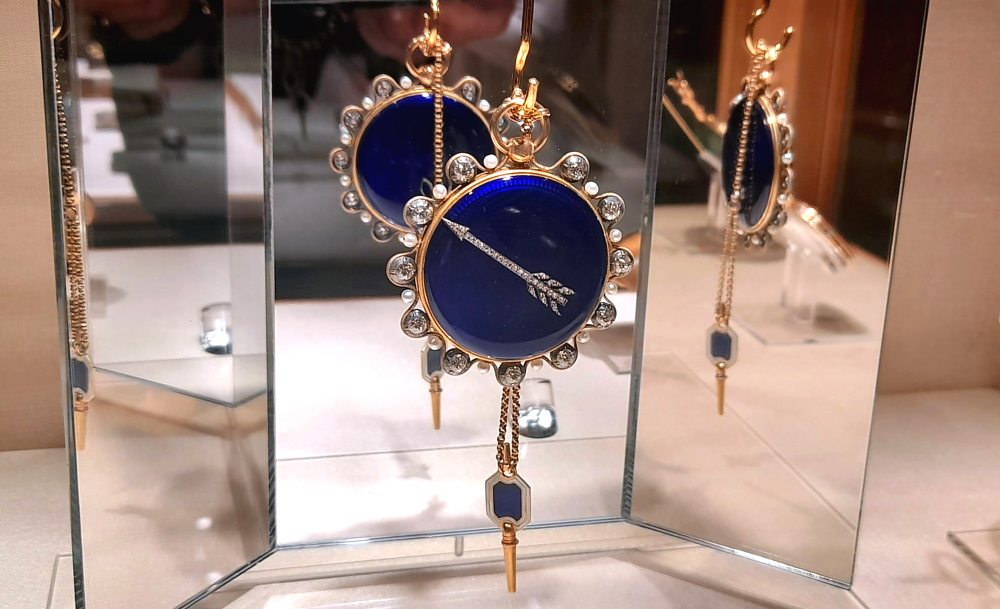
Clocks took various decorative forms, attached to a finger ring by a chain, chained to belts (chatelaines), as pendants and brooches long before they became pocket and wrist watches, and were even housed in unusual objects. Early watches were depicted in portrait art, worn by wealthy patrons, from as early as the 1500s.
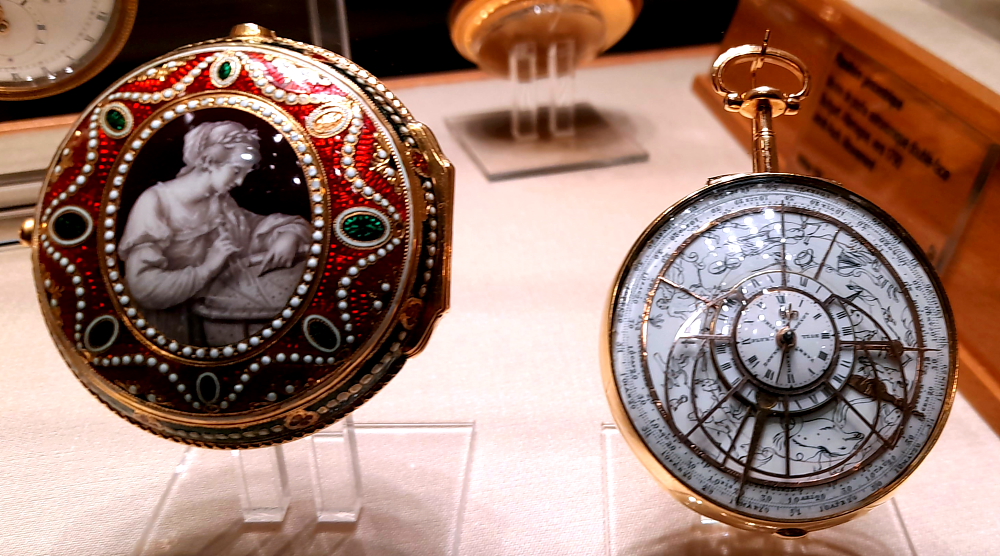
“Watches were baubles, toys and curiosities of the elite, which they could use to entertain friends and guests, flaunt their wealth and show off their education by understanding these new and complicated portable mechanical pieces.” [revolutionwatch.com]
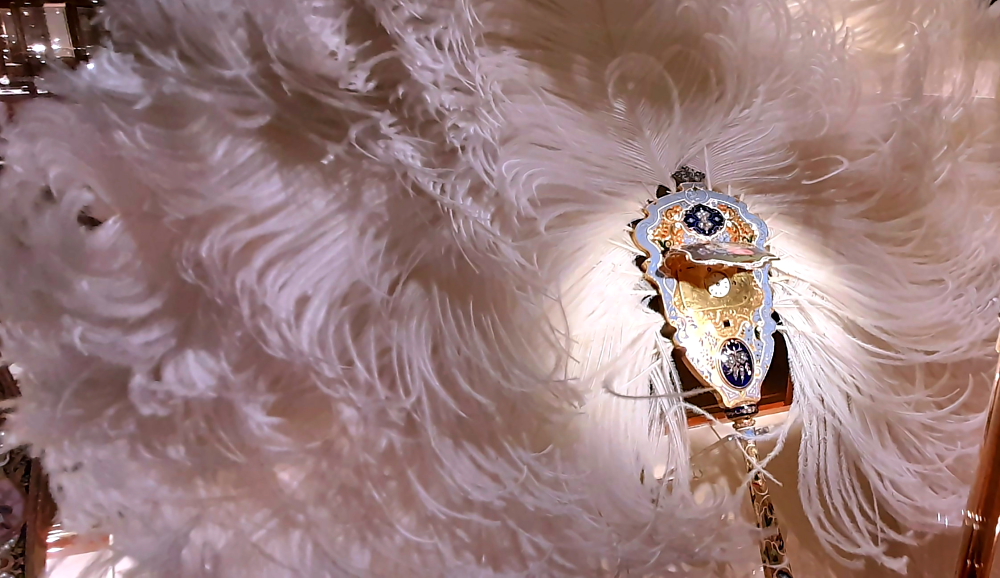
Lastly, we arrive at the 1st floor to view the Patek Phillipe Collection.
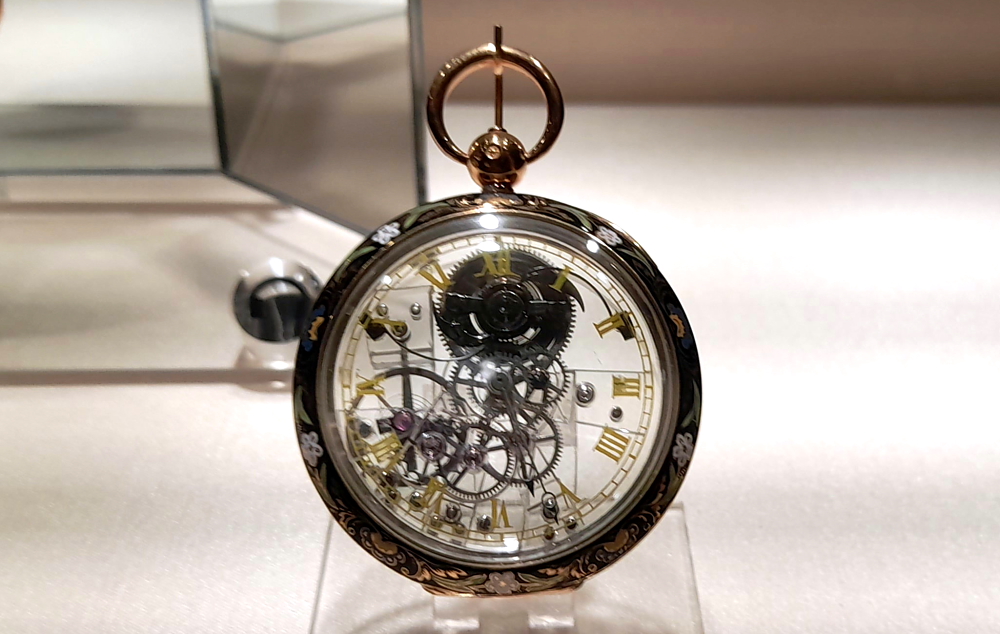
This Collection is a showcase of watches designed and created by Patek Philippe since its foundation in 1839 up to the present day, testifying to more than 175 years of creativity in the production of pocket watches and wristwatches – from bespoke creations for Royalty to innovative technology.
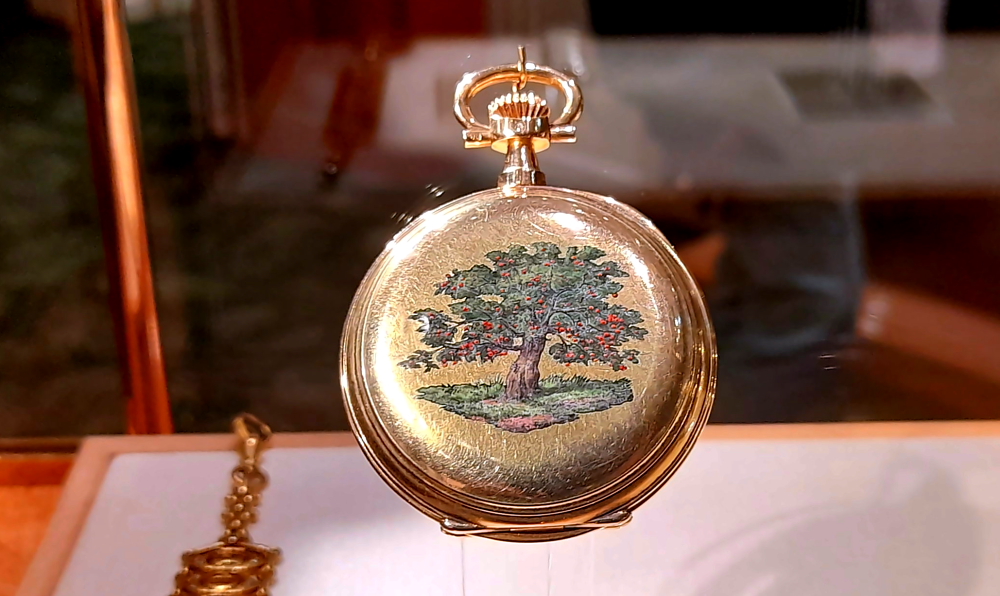
Both collections are ingenious and spell-binding (I wonder what the collections are worth?), although the location of some of the numbered display cases could have been a bit more logical!
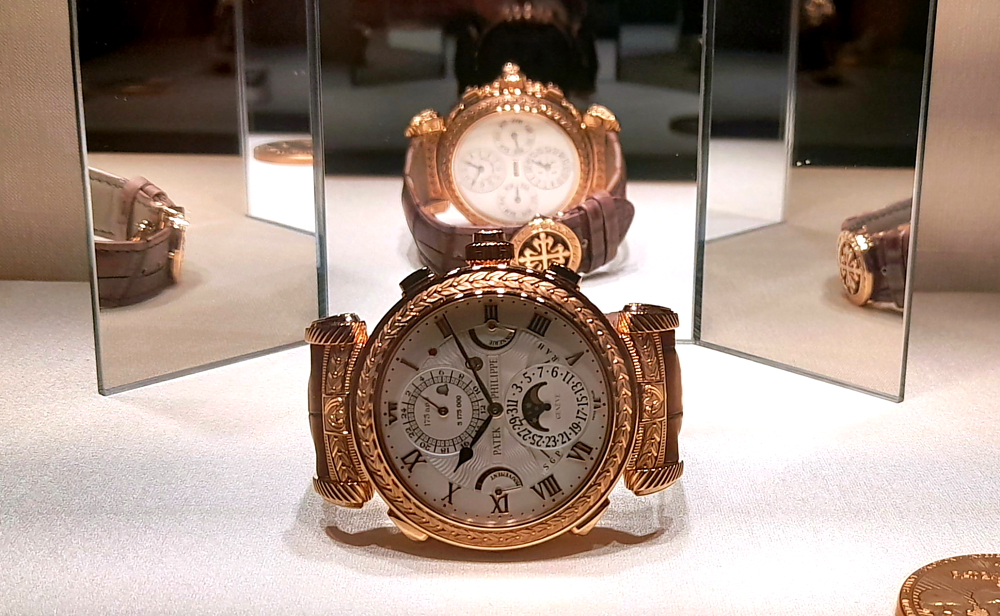
Unbelievably, we leave the Museum at its 6:00 pm closing time – 4 hours later! Never done that before.
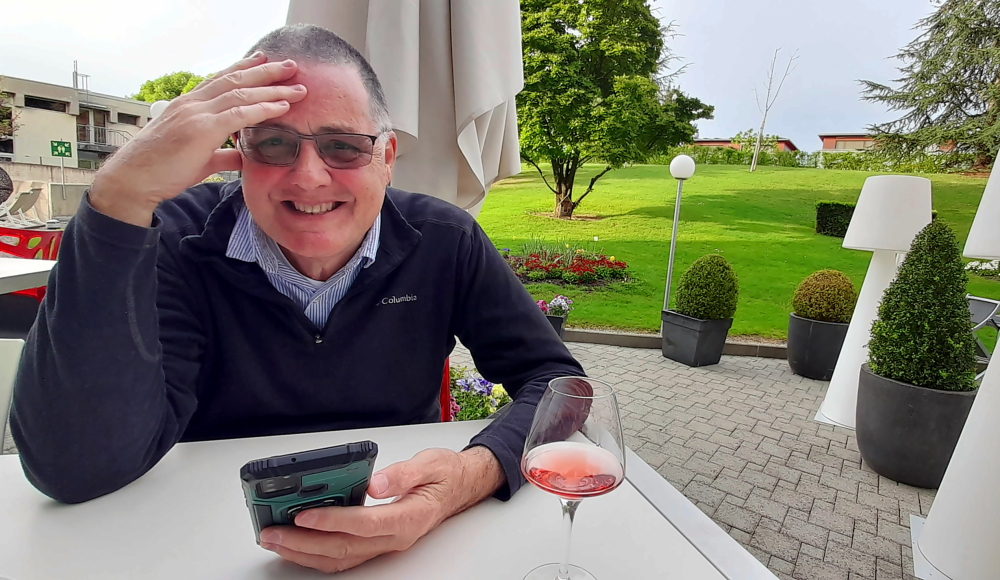
Back at the Novotel we ‘take the weight off’ and enjoy our free, welcome drinks on the outdoor terrace.
1 May, 2024
Our destination is Hilterfingen, near Thun (pronounced ‘Toon’) around 190 km and 2 hours 15 minutes drive via the northern route around Lake Geneva and through Lausanne.
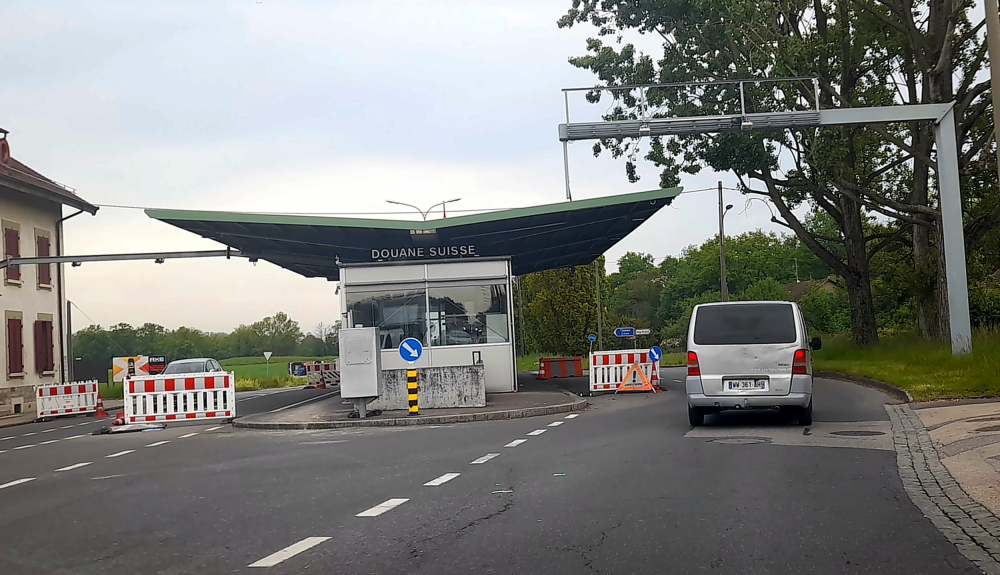
But today we’ll take the picturesque southern route stopping at the medieval village of Yvoire (France), Montreux (Switzerland) at the far end of the lake then via the Jaun Pass to Thun which will be closer to a 4-hour drive.
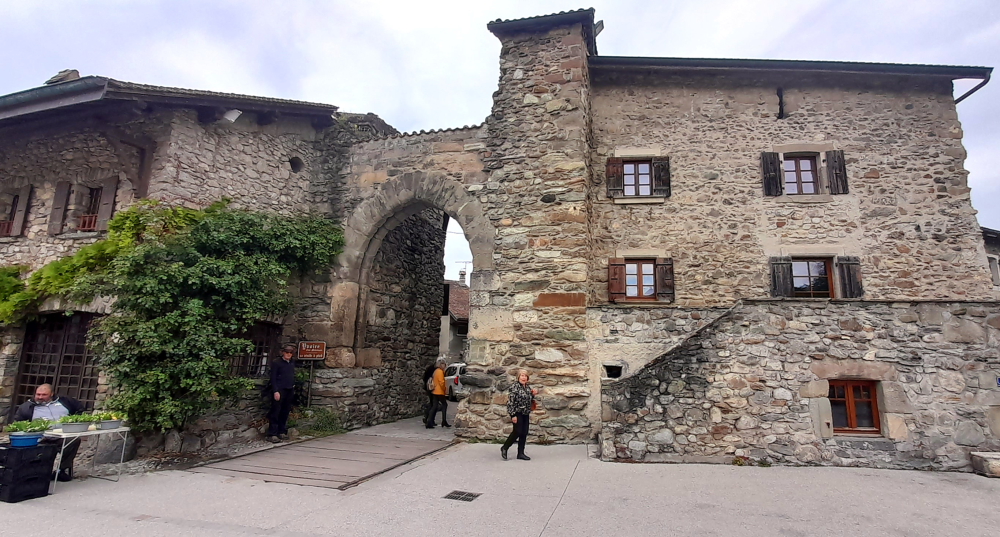
Yvoire is a medieval town built in the early 14th century so boasts 700 years of history. Located on the French shore of Lake Geneva and between Geneva and Evian, the village of Yvoire is nicknamed the “gem of the lake” and is classified among the “Most Beautiful Villages in France” [[yvoire-france.com].
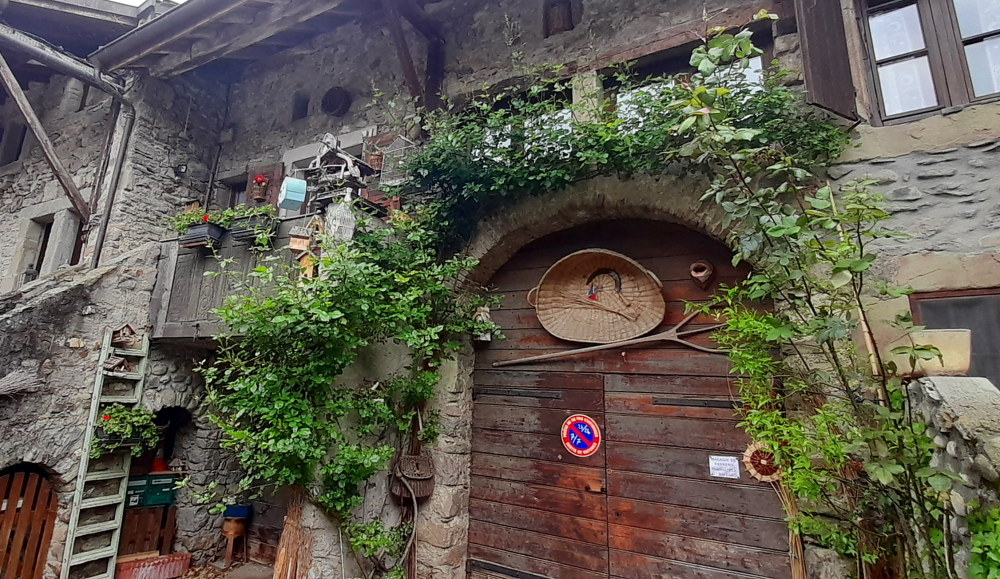
Yvoire’s written history goes back to 1306 and a time when Lake Geneva castles played an important role in protecting the strategic trade routes through the Alps and along the lake. However, changing trade routes pushed Yvoire into decline and relative obscurity since the 16th century.
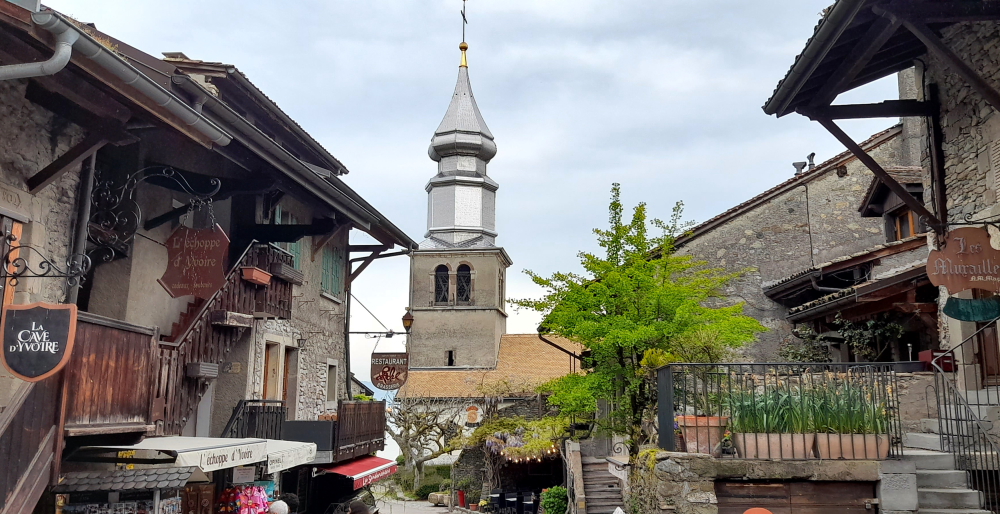
The village and its walls are built of stone, has narrow streets and is perched on a hill that hugs the shoreline. The first thing we notice is the silver metallic bell tower of the local church.
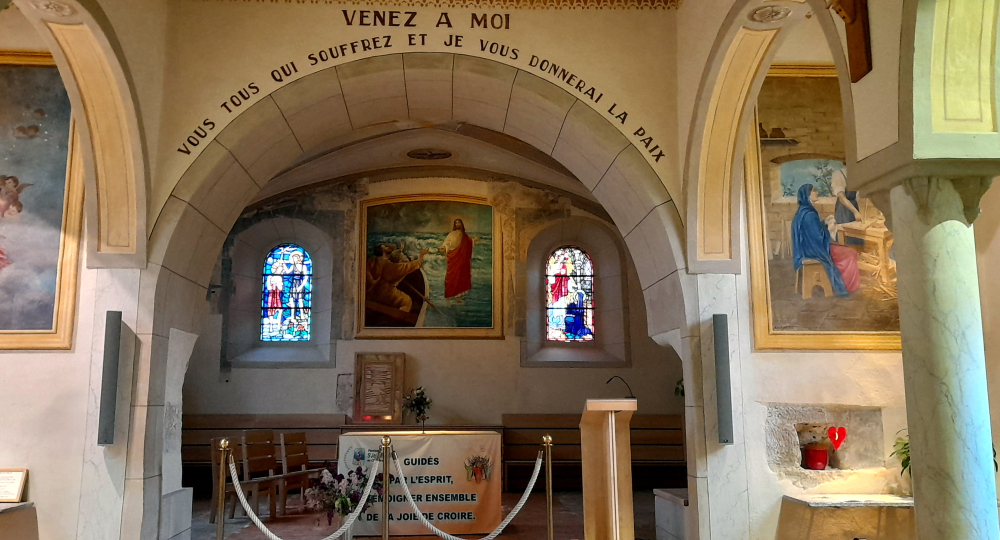
The Saint-Pancrace Church of Yvoire is a Catholic church dedicated to Saint Pancrace, who suffered martyrdom in Rome in the 3rd century. The church probably dates back to the 11th century and was transformed several times.
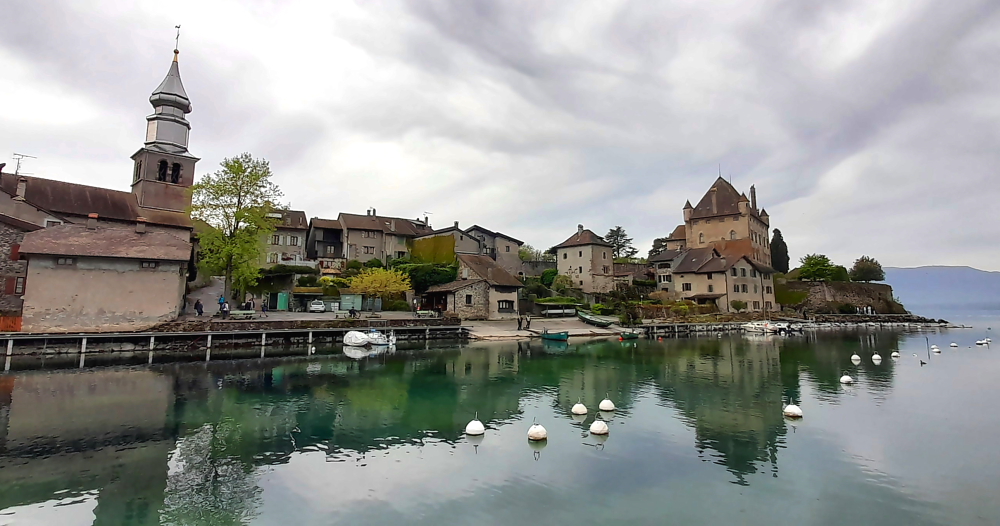
The current bell tower built between 1856-1858 belongs to the line of bell towers that characterize the Savoyard religious architecture of the late 19th century. In 1989 the bell tower was restored by covering it with stainless steel to avoid rusting [www.france-voyage.com].
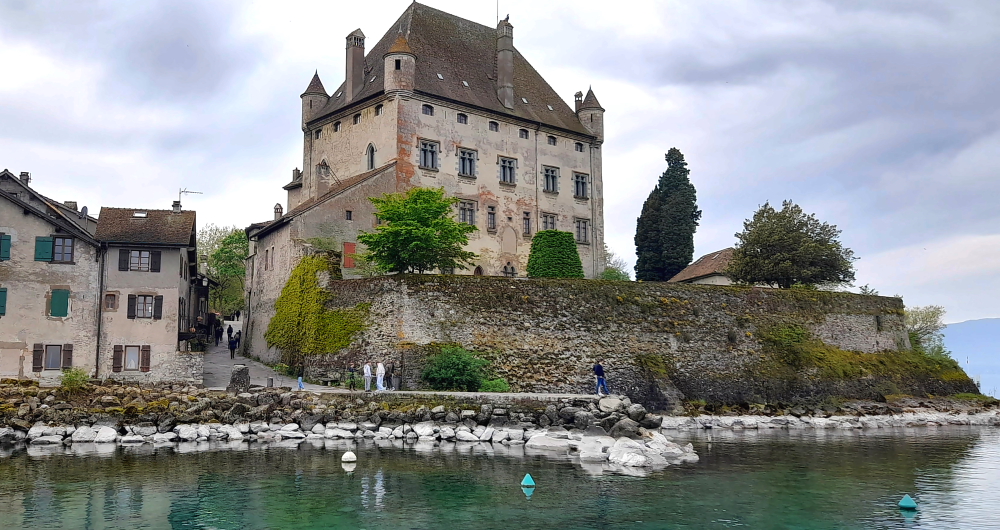
Yvoire Castle (Chateau d’Yvoire) was built in the early 14th century by Amadeus V, Count of Savoy. From 1306 he fortified the entire village as it was situated on a strategic location on a point between the “small lake” and the “large lake” that form Lake Geneva. For half a century, the village of Yvoire had an important military role, which earned certain freedoms for its inhabitants in 1324.
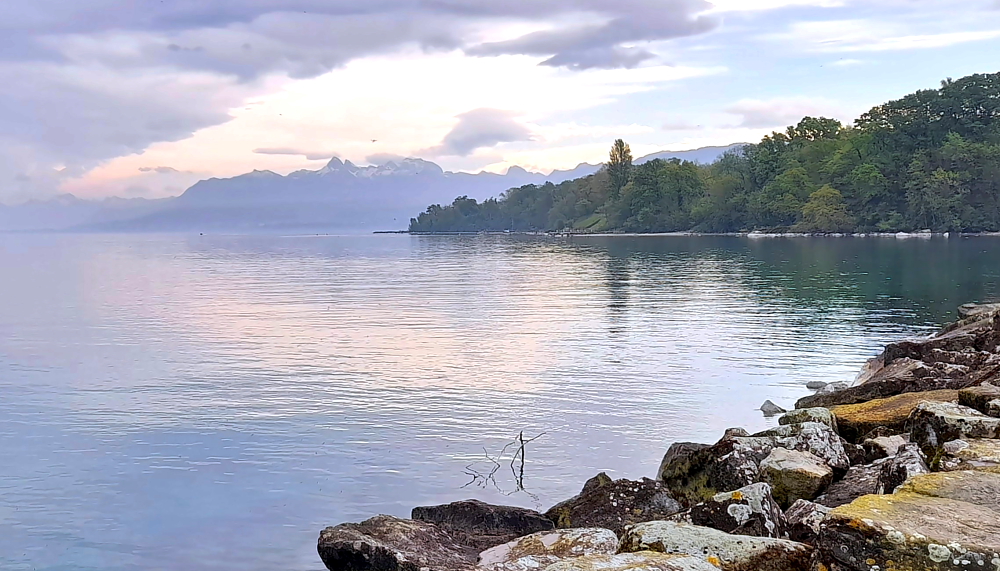
During the 16th century, from 1536 to 1591, the region was occupied by forces of the independent city of Bern, who were allies of the French and the independent city of Geneva. During this occupation the village lost its ramparts and military role. Yvoire Castle was burnt and remained roofless for 350 years.
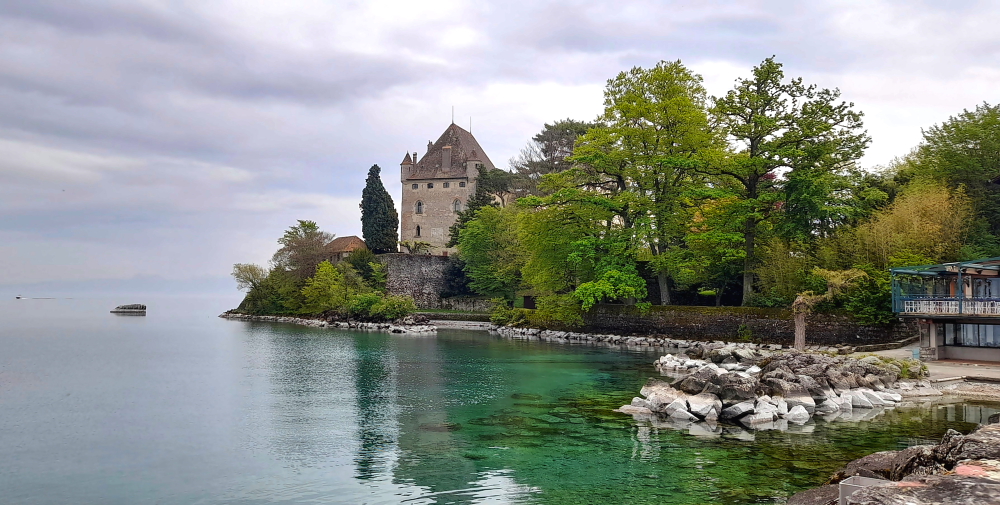
In 1655 the castle was acquired by the d’Yvoire family. Between 1919 and 1939 they had the castle restored and gave it a new roof and 4 corner turrets. At present Yvoire Castle is private property and cannot be visited.
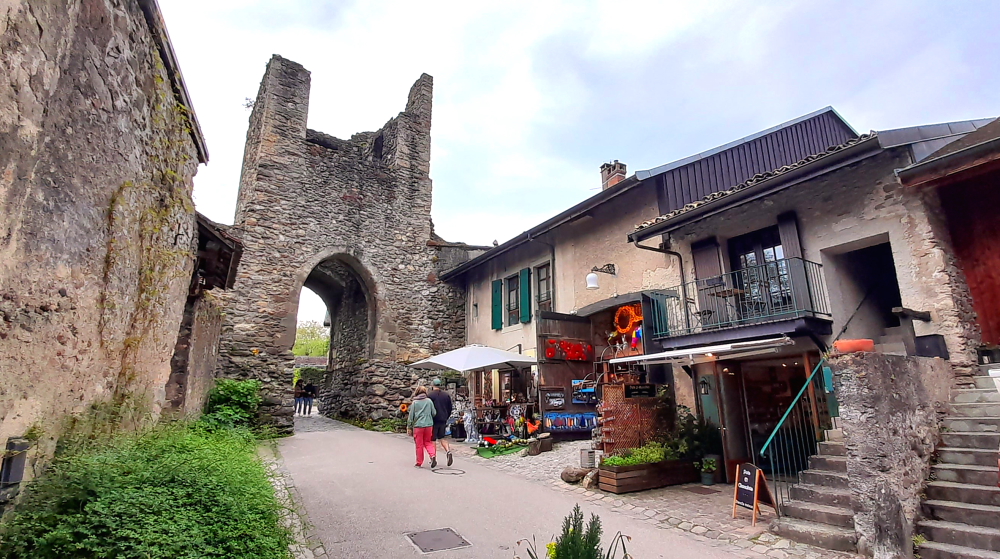
What the photos DON’T show you are the clouds of midgees that fill the air by the lake. Not the tiny Scottish ones, but big suckers.
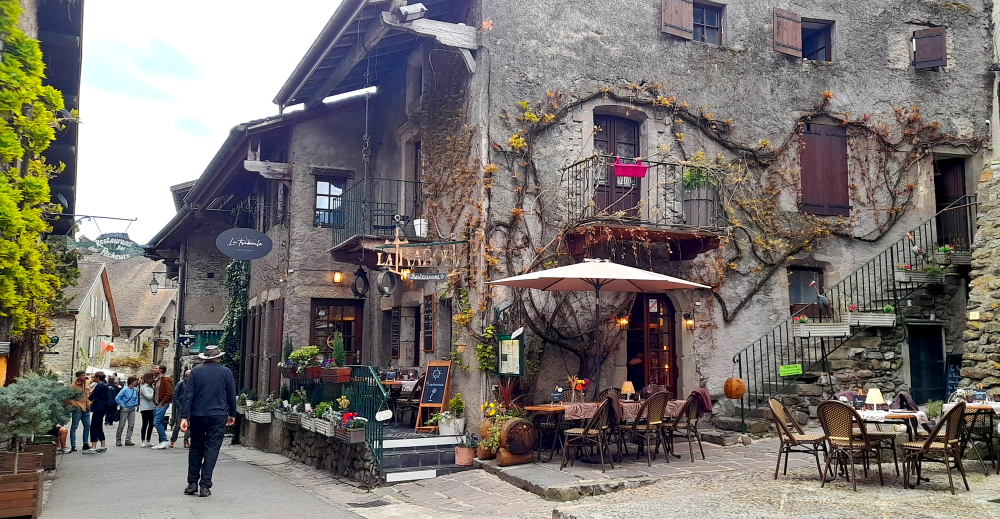
We continue along the D1005 and pass through the very attractive spa town of Evian-les-Bains which boasts a large casino, luxury hotels and marinas.
20 minutes later we arrive at Saint-Gingolph where the French/Swiss border is.
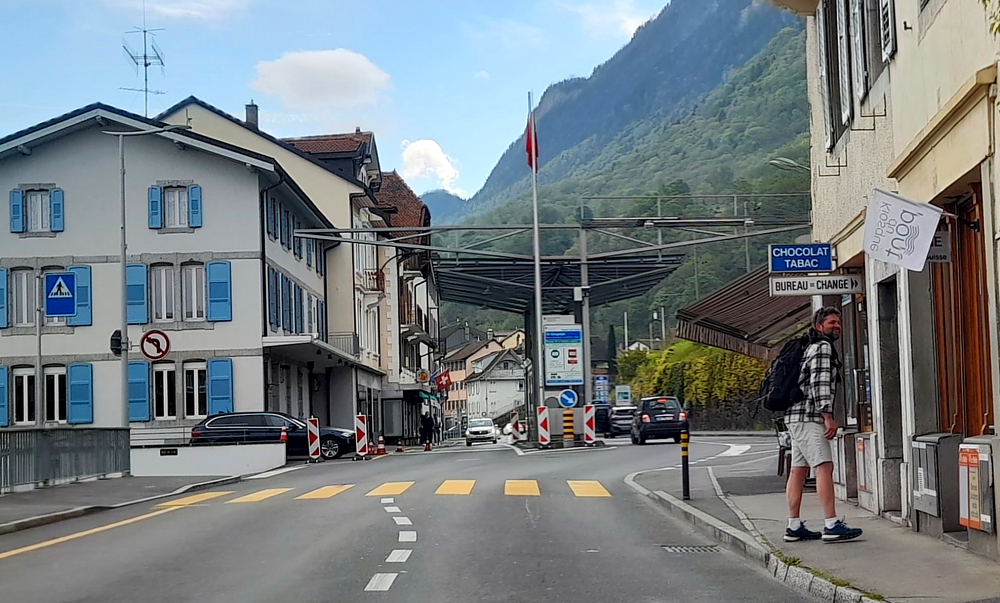
Along this route we are spoilt for choice of snow-clad alps to view.
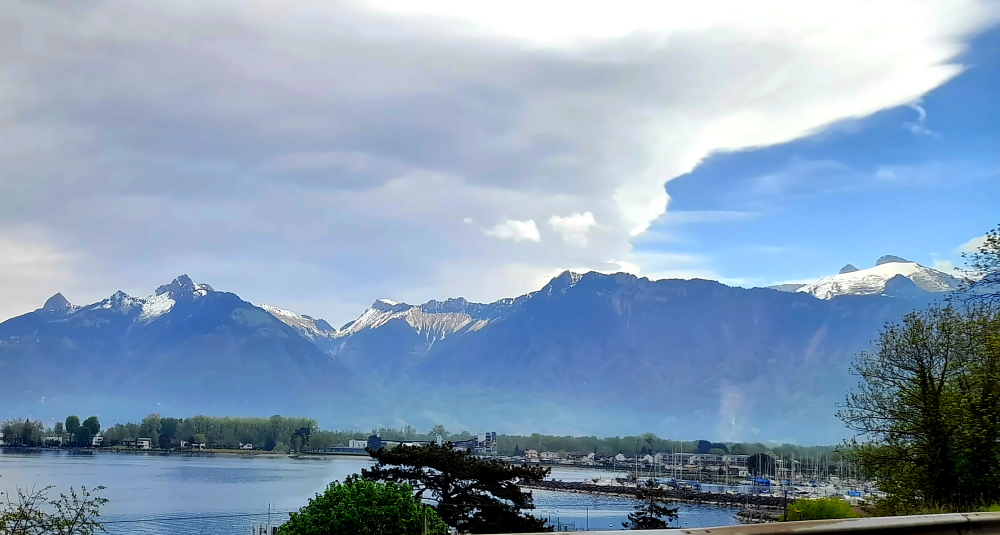
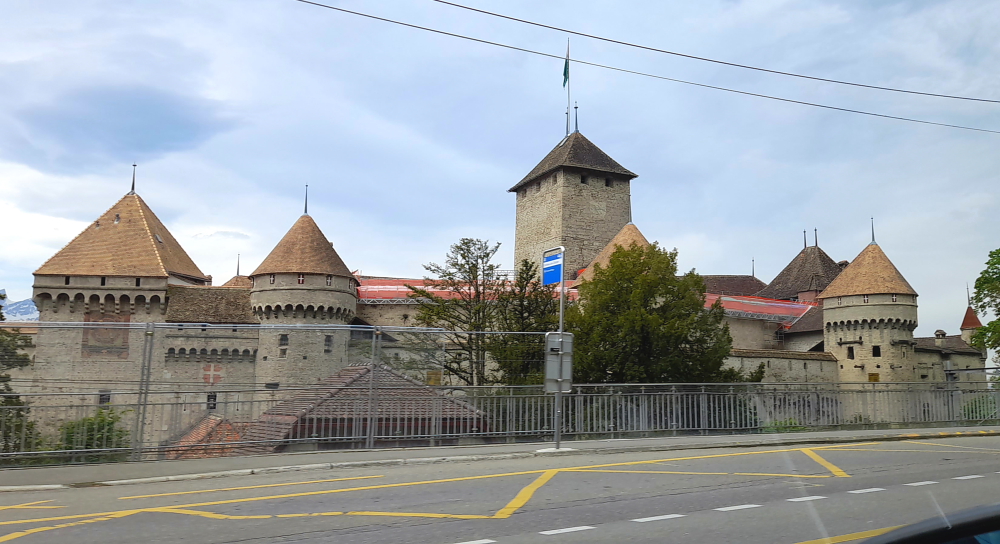
Approaching Montreux it looks to us like a more picturesque version of Monte-Carlo with a lake view and surrounded by mountains. We pass by the Chillon Castle. It’s located on a rock on the banks of Lake Geneva. For nearly 4 centuries Chillon was the residence and profitable toll station of the Counts of Savoy.
For hundreds of years the passage of ships on Lake Geneva and the important land route to the St. Bernhard Pass was controlled from this island. Chillon belonged to the Counts of Savoy from the 12th to the 16th century, when the inhabitants of Bern conquered the castle.
Now, the reason we’re stopping in at Montreux is to see the statue of Freddy Mercury on the shores of Lake Geneva.
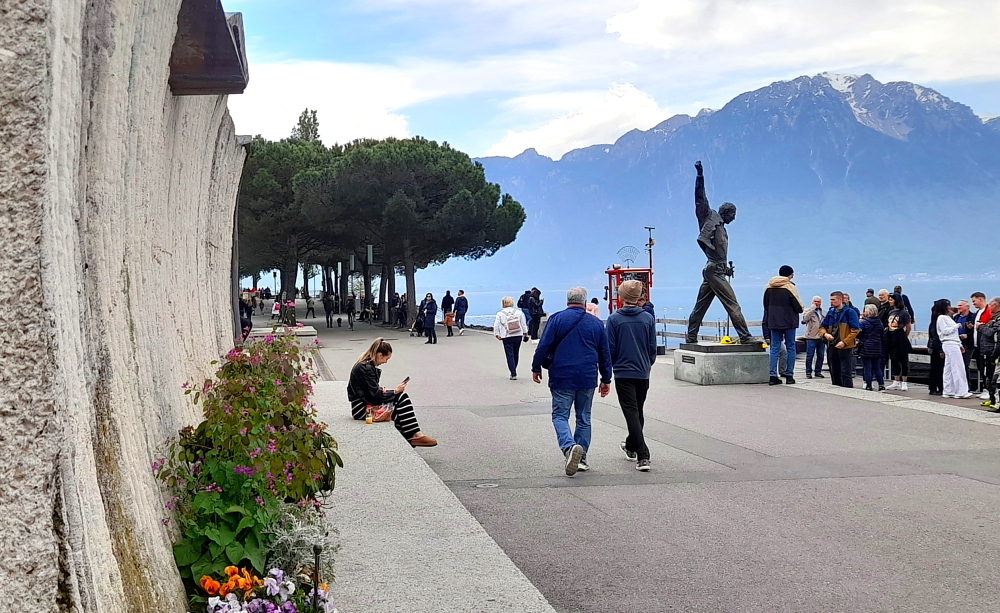
We first became aware of the statue when we watched a ‘Queen’ documentary a couple of years ago. When we were putting together our Swiss itinerary Lynn reminded me that we needed to stop here as she knows my penchant for Queen tracks and, in particular, my appreciation of Freddie’s extraordinary voice range.
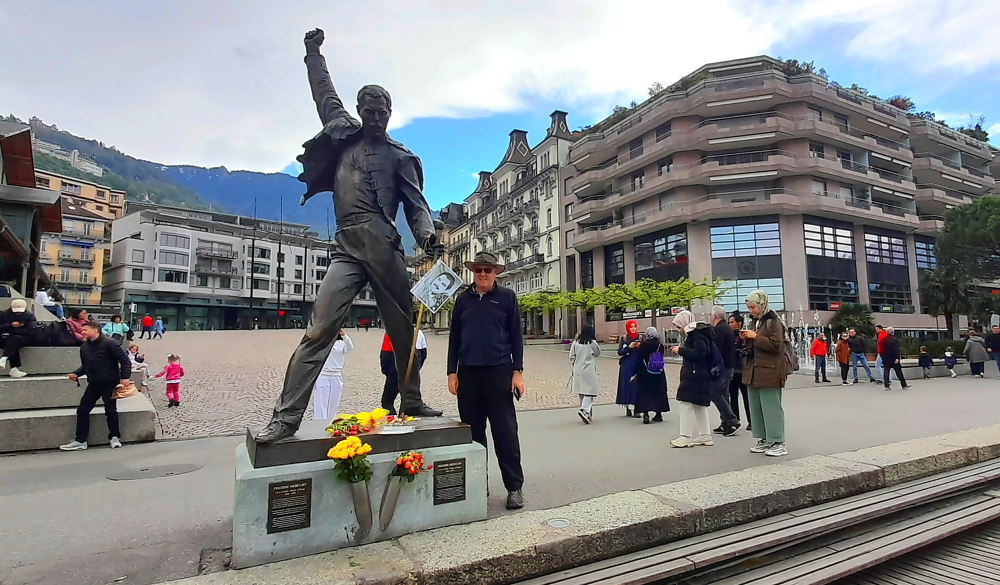
“If you want peace of mind, come to Montreux”, said Freddie Mercury (1946-1991). As well as living in Montreux, he also recorded 6 albums here with Queen, including the final album “Made in Heaven”. Both stages of recording, before and after Mercury’s death, were completed at the band’s Montreux studio, Mountain Recording Studio, which Queen acquired in 1978. In memory of his presence, Freddie Mercury’s bronze statue has stood on the lakeside promenade since 1996 [www.montreuxriviera.com].
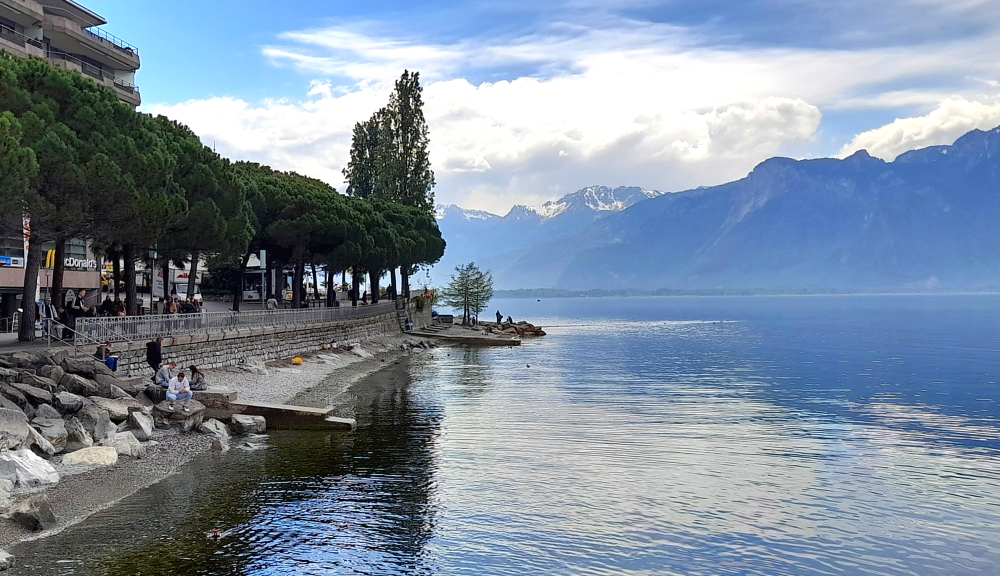
20 minutes later we leave the car park and take the A12 towards Bern then branch off onto the H189 and through the Gruyere Pays-d’Enhaut Regional Nature Park to the Jaun Pass.
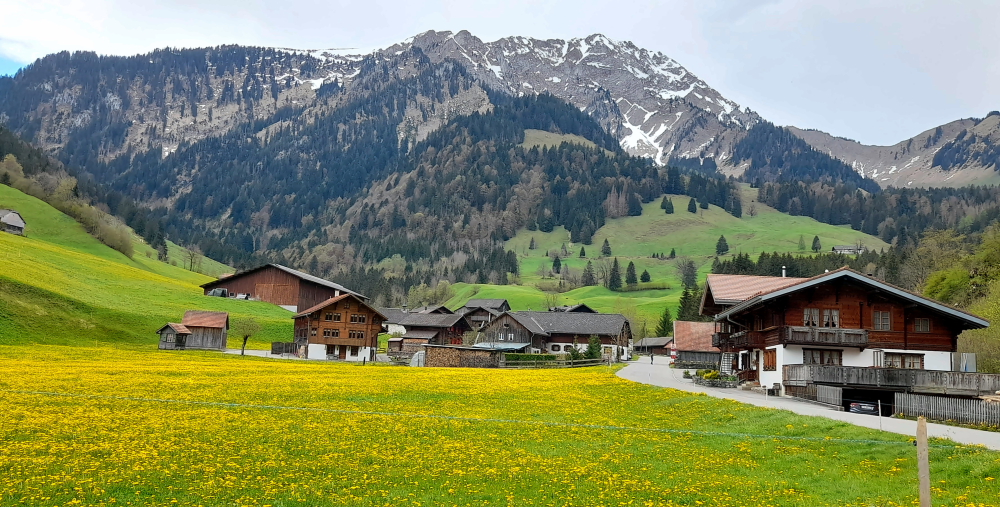
As we drive along this road we see folk out building fences and the traditional summer past time in rural Switzerland of hand-cutting grass, usually on a precipitous slope.
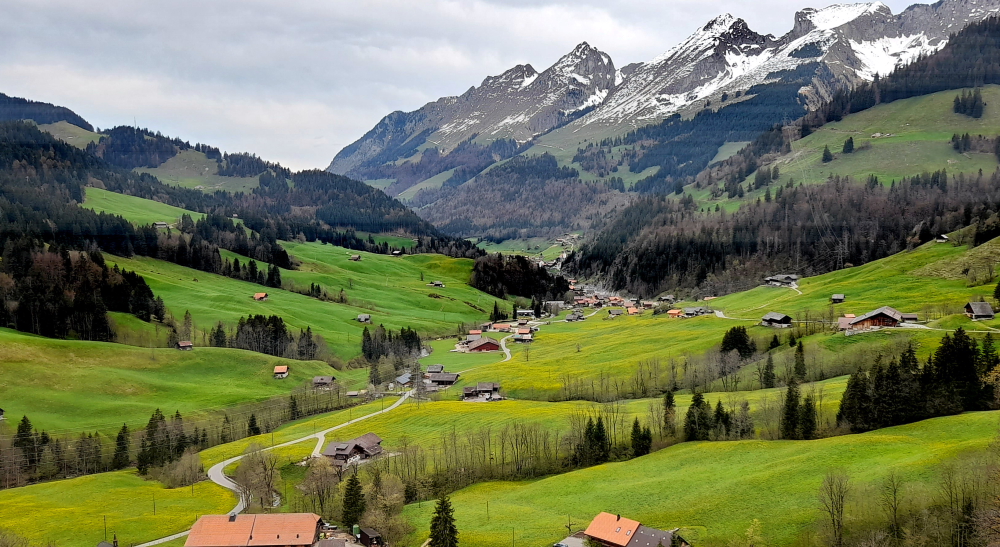
The Jaun Pass (elev. 1509m) is a high mountain pass located in the canton of Bern in the Swiss Alps. It links Charmey and Jaun in the canton of Fribourg with Reidenbach (part of the municipality of Boltigen) also in the canton of Bern. Given the pass road was completed in 1878, today it’s in fantastic condition, not a pothole in sight, although it does narrow from a dual to single lane road towards the top.
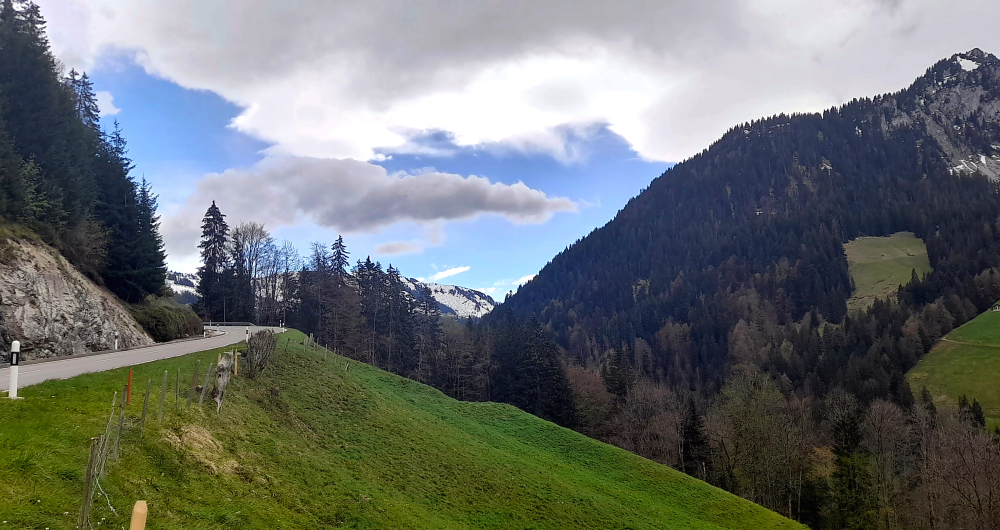
Interestingly, Jaun is the only German-speaking municipality in the district of Gruyère. It was first mentioned in 1228 as Balavarda, then in 1397 as Youn.
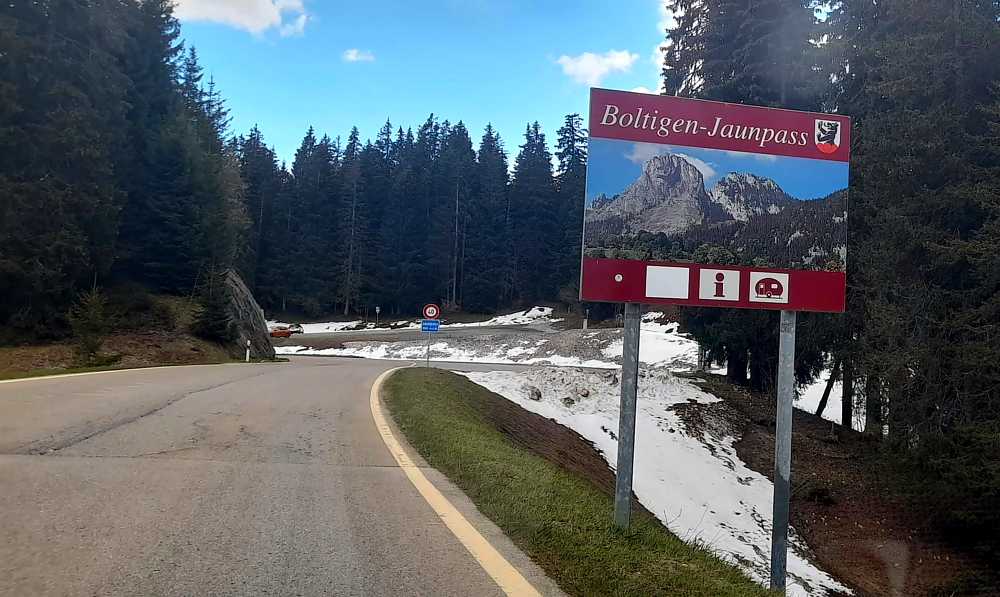
As of December 2020 its population was 633. In 2000 most of the population spoke German (621 or 89.5%) as their 1st language, French as the 2nd most common (68 or 9.8%) and, surprisingly, Serbo-Croatian the third (2 or 0.3%).
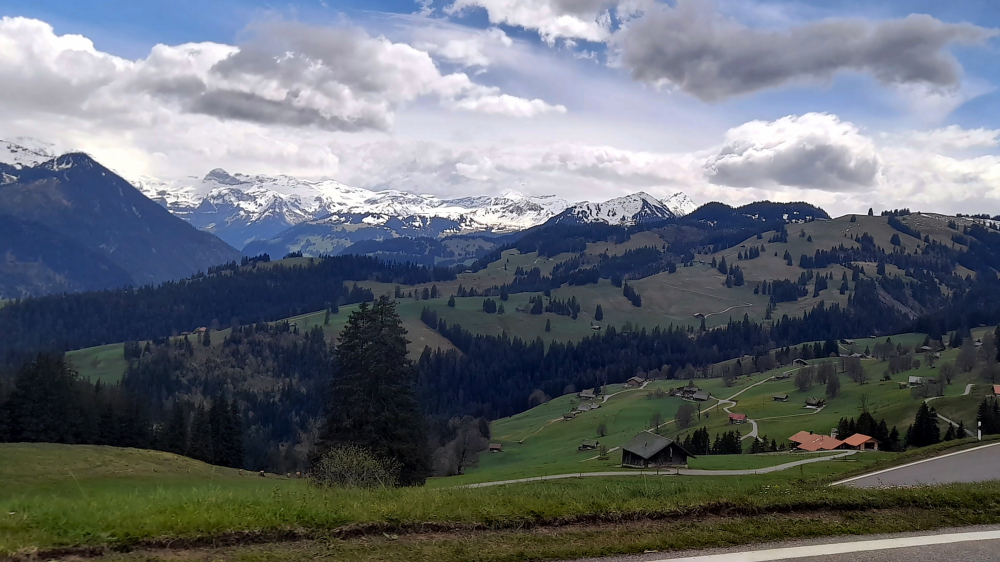
Driving down the other side, at the hamlet of Eschihalten, we see a field of cows – with bells on – and I mean, big bells.
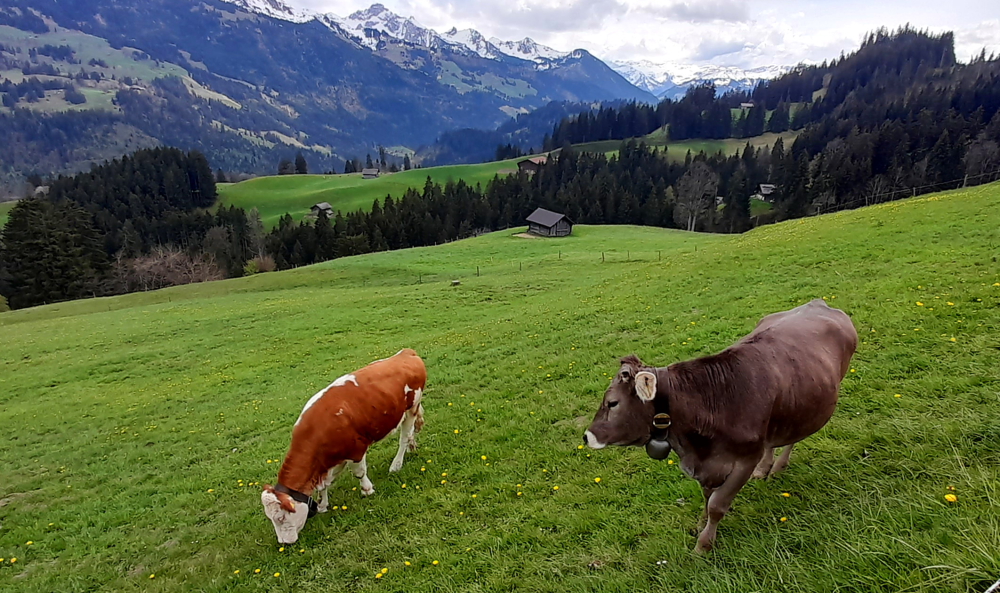
To live here it must be comforting, or not, to have the background ‘melody’ of cow bells that rattle every time a cow moves.
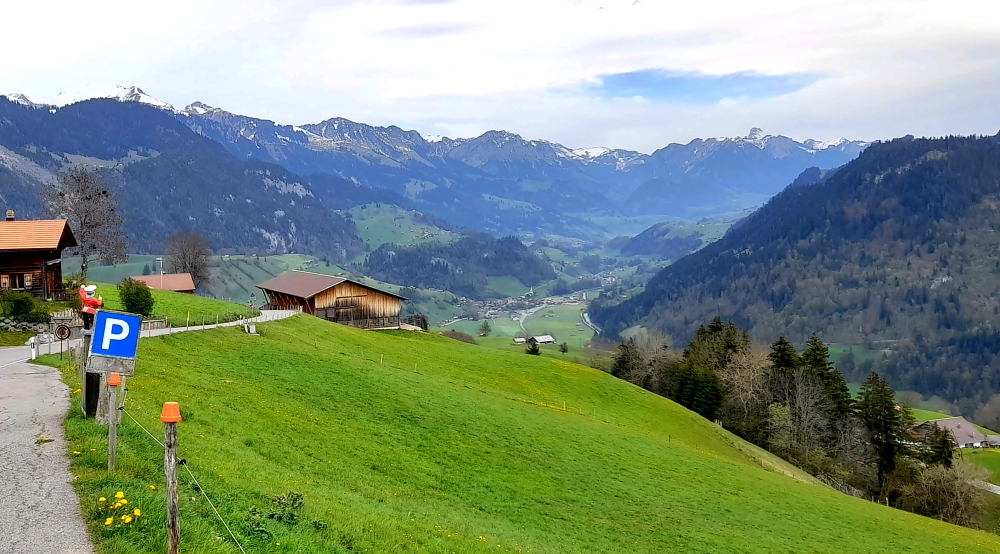
One thing that’s for sure, I couldn’t put up with this putrid smell of fresh cow dung 24/7!
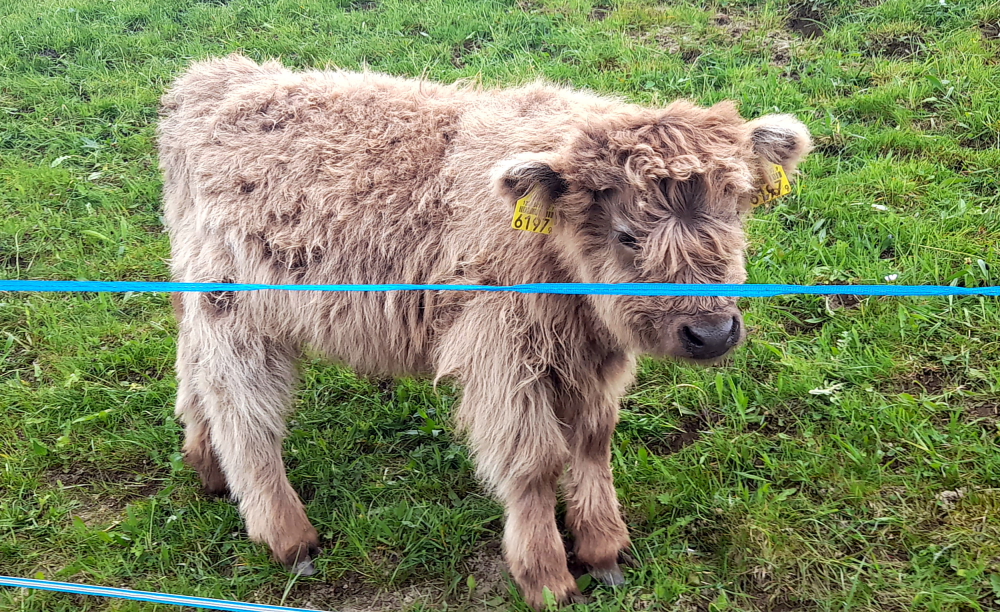
Further down the hill we come across a herd of Scottish Highland cattle – with a couple of minime’s in the mix.
Before Boltigen we join the A11 then just before Spiez on Thunersee (Lake Thun) we turn left onto the A6 and drive through Thun.
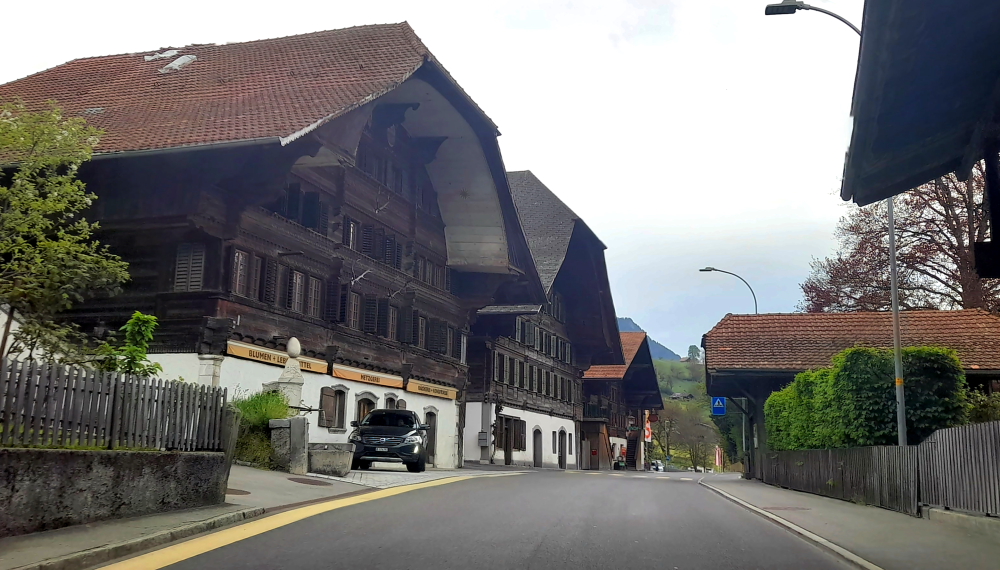
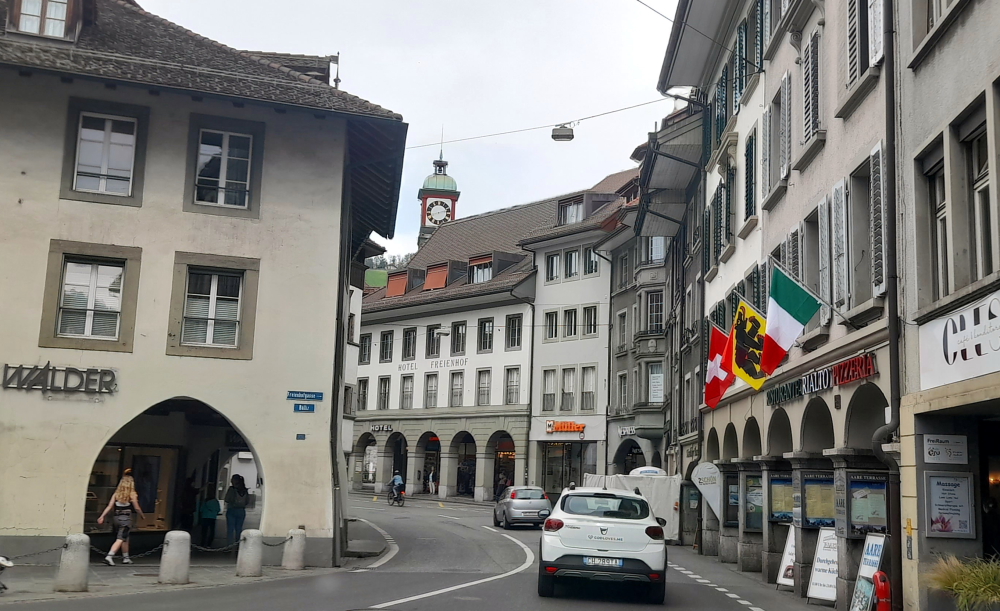
As usual, we are delayed by road works while we are driving through Thun. It’s further complicated by the fact that we need to cross over 2 bridges as part of the town is is located on a small island in the middle of the River Aare.
Around 3:30 pm we arrive at the Hotel Bellevue au Lac where we need to check in.
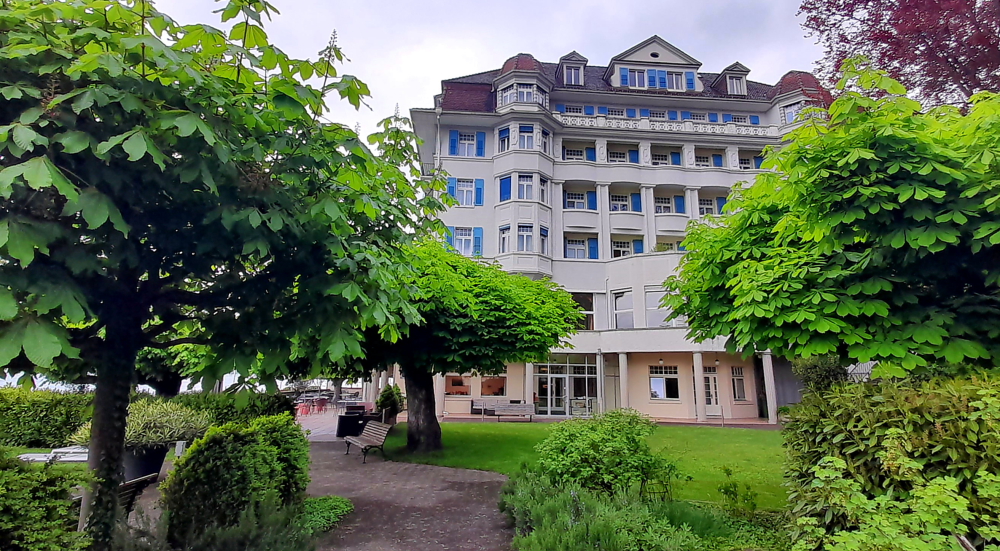
We are staying in its sister hotel next door, the Stella del Lago.
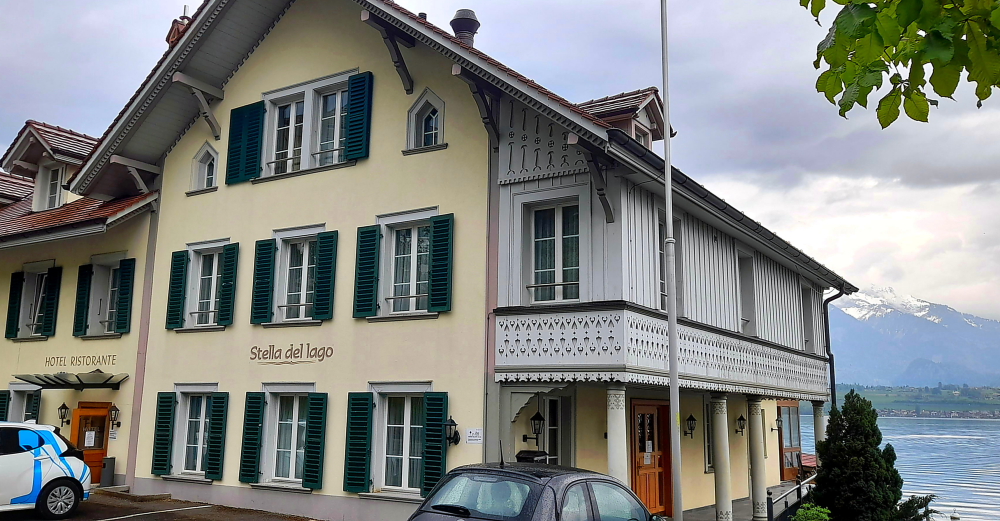
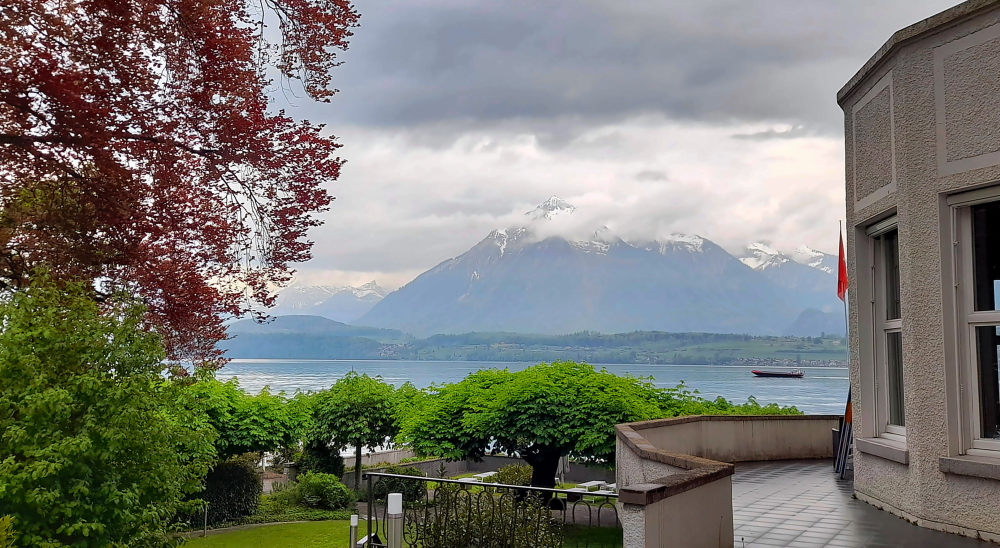
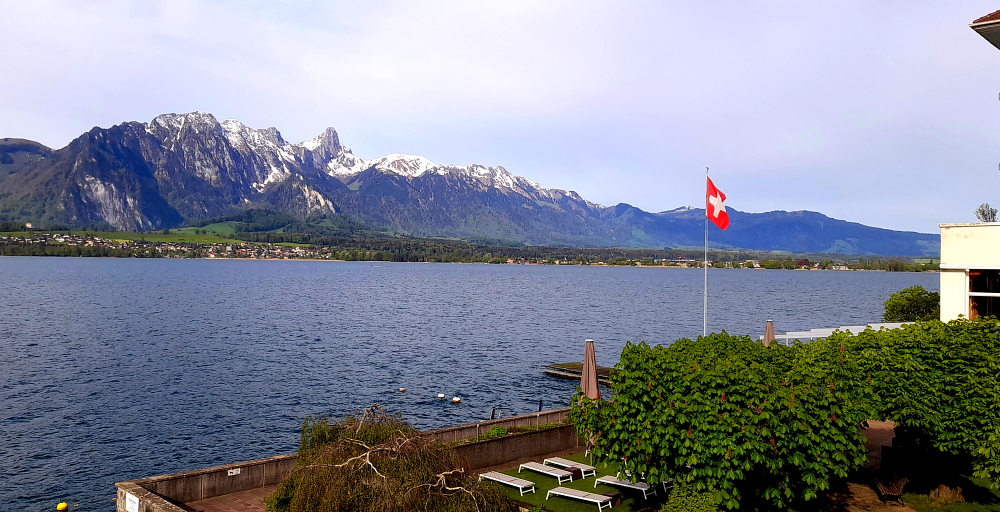
But the view from our room is stunning …
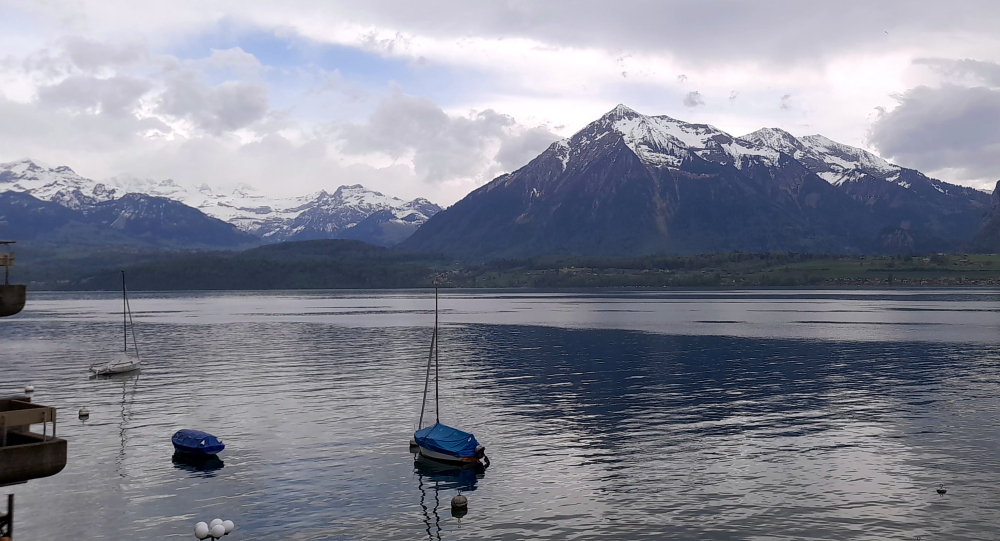
… both of the lake and the range of mountains in front of us.
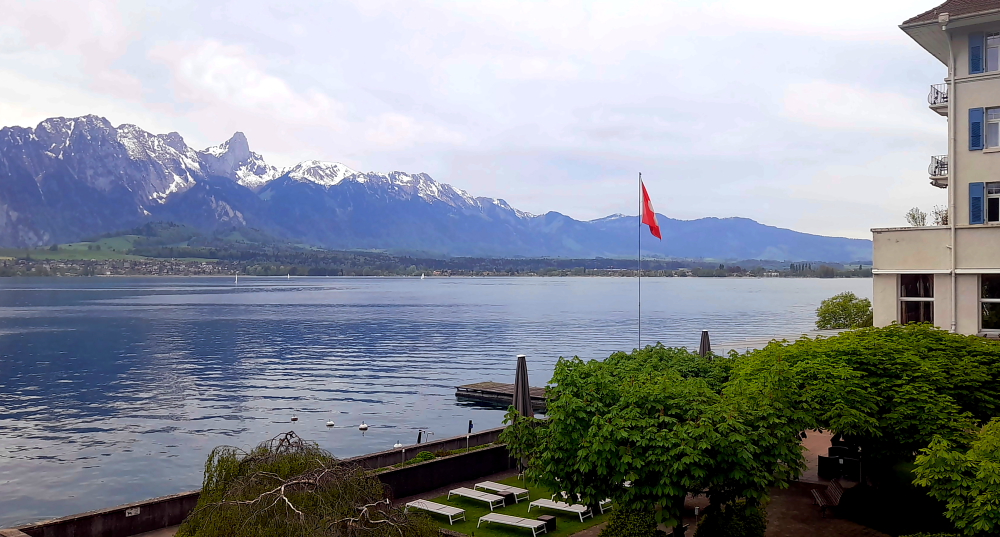
Unfortunately, the Stella del Lago has seen better days. Its interior would have been considered opulent in the 1980s but a tad run down now. Looks like the hotel management is investing all its dosh in the sister hotel next door.
Not to worry, after we unpack we sit out on the terrace with a glass of red and soak up the sun and the view as the next 2 days there’s a strong chance of rain.
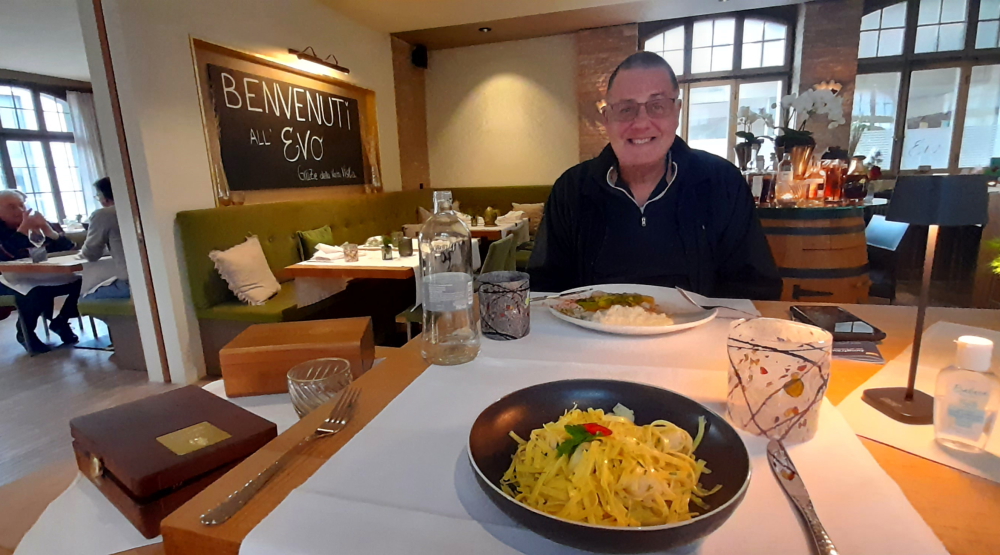
There is an excellent Italian restaurant across the road where we go for dinner as the hotel restaurant is closed tonight. Of course it is. Scaloppine for me, lemon-infused tagliatelle with scallops for Lynn and a bottle of water served in Murano glass tumblers. Not bad for CHF63 or AUD105 – NOT!!
Before bed we watch the documentary about Lucille Ball and Desi Arnaz, mainly narrated by their daughter, Lucy. What a remarkable woman for her time and the enduring legacy of their film studio, Desilu Studios initially run by Desi, which produced such great shows as “Hogan’s Heros” and “Mission Impossible”, both favourites of mine.
2 May, 2024
When we last saw the 1969 Bond movie “On Her Majesty’s Secret Service” we had wondered where on earth that spectacular station in the sky existed. Turned out to be Jungfraujoch (at 3,454m/11,333′) in the Bernese Alps.
When we arrived yesterday Lynn posed the question: “Are we or aren’t we?” in her usual shorthand lingo. She had already researched the logistics. It was now up to the weather (no point going if it’s a white out) and the cost.
Although we both want to experience it, we decide against it as the cost is crazy money. For the 3 trains from Interlaken to Grindelwald to Eigergletscher to Jungfraujoch return for the 2 of us would total CHF600 or AUD1,000 and that doesn’t include parking at Interlaken. Besides, the weather forecast for Thursday and Friday is snow at Jungfraujoch with tomorrow’s temperature at -3 and Friday’s at -6.
Today’s temperature is about 7 Deg. C lower than yesterday’s.
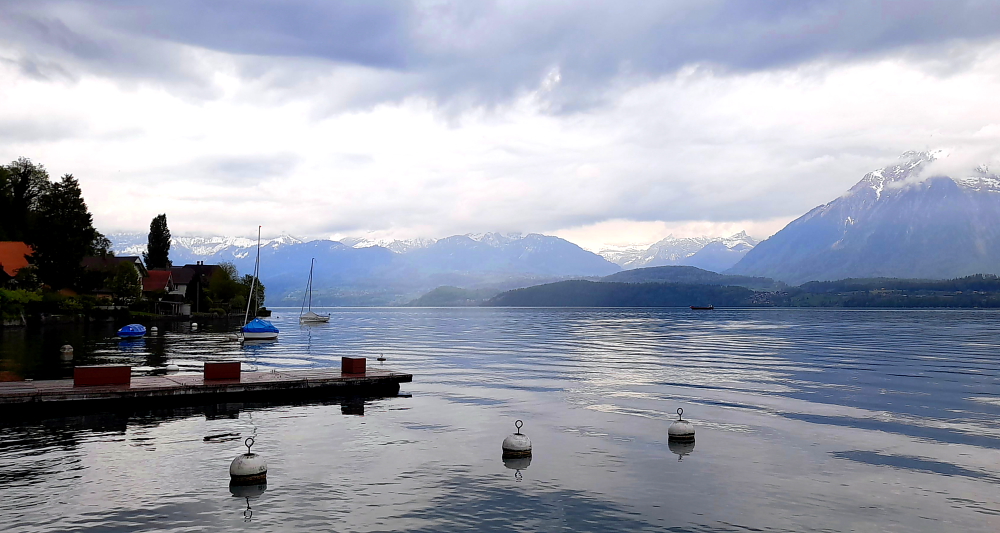
Although it starts out as an overcast morning, by afternoon it’s bucketing down. Just as well we decided on a day in to catch up on 2 busy blog days.
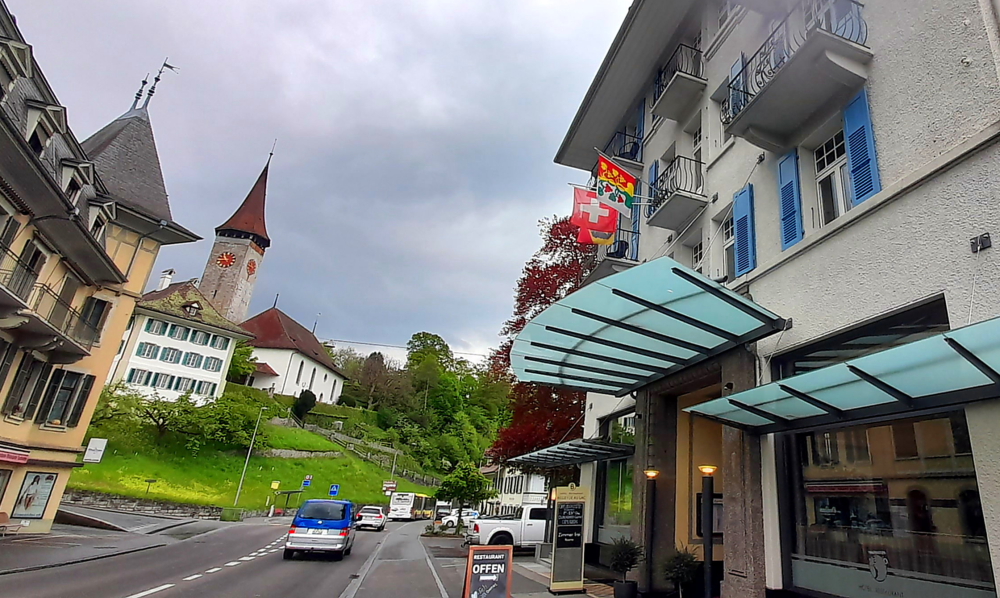
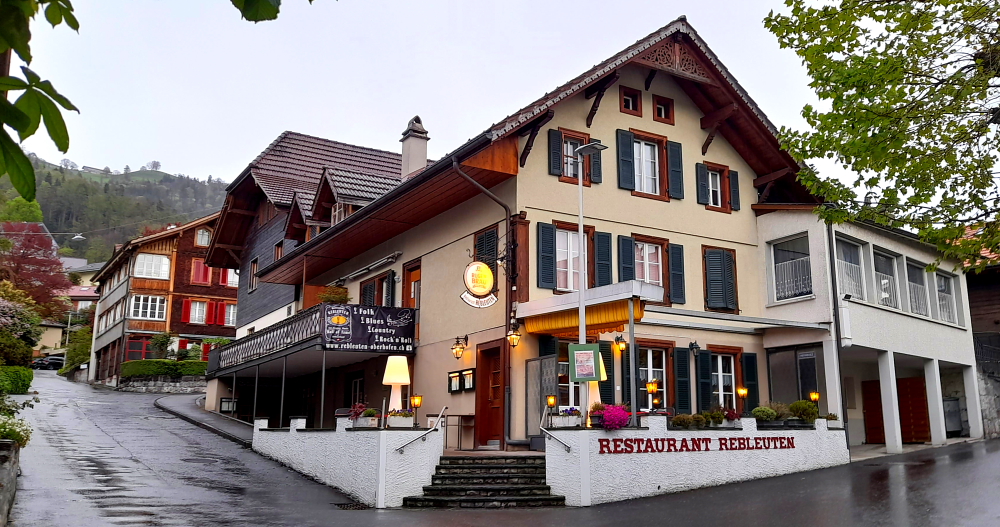
By 7:00 pm it’s time to walk the 12 minutes to the next village of Oberhof to the Restaurant Rebleuten, a bit like a Swiss pub.
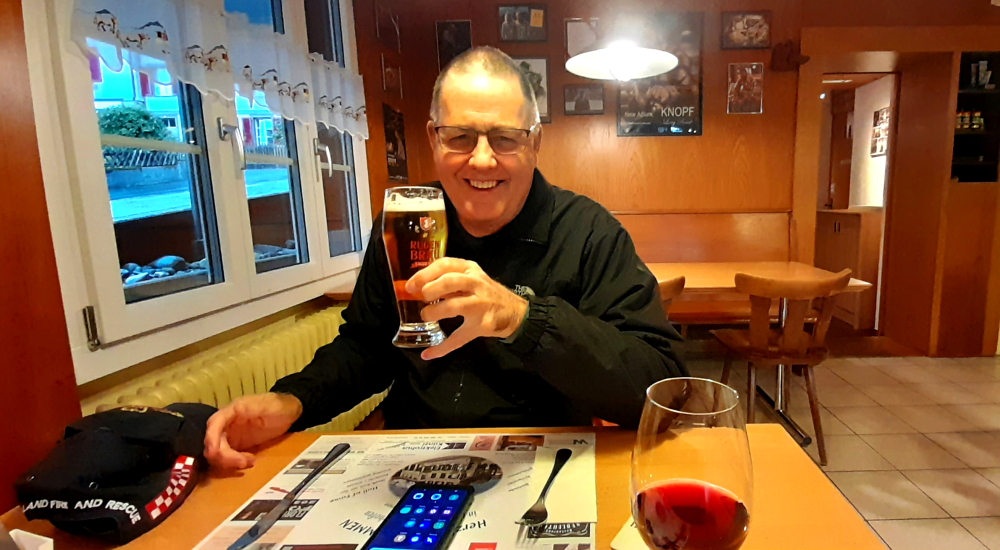
I order a 30cl glass of lager (CHF 4.20); Lynn a 10cl glass of pinot noir (CHF5.00), and we both order the breaded pork schnitzel with veggies (surprisingly, a nicely-cooked turnip) and fries (2x CHF26=CHF52). Total – CHF61.20 (AUD102). Slightly better value than last night with bigger portions and booze.
As for the trip to Jungfraujoch – tonight Lynn Googles the BBC’s “Great Continental Railway Journeys Switzerland” hosted by Michael Portillo in 2012. Here we get to view the journey he made in summer and the stunning views from the Sphinx Observatory. So, we get our trip to Jungfraujoch – just virtually and vicariously – and without a nip of frostbite and a dose of bankruptcy!
3 April, 2024
I truly hate it when hotels accept pets. There are 2 small dogs at breakfast this morning. 1 off its leash, that shake themselves with hair, fleas and dander flying into the air. Both are hand-fed tidbits by their owners at the table.
Then owners, without washing or sanitising their hands after handling and feeding these pets, proceed to the buffet and handle the implements, even putting their hands on the towels that protect the bread for slicing. Just imagine dog saliva on the implements and those towels and the bacteria, worms and whatever else that then get distributed around the place and into the mouths of unsuspecting non-pet people! Urrrrggghh!
Worse than little kids let run riot around the buffet handling all the food then coughing and sneezing all over the buffet because their noses and mouths are right at table height!
Another day of 12 Deg. C and less rain forecast for today so we walk over the road and catch the 10:11 am No. 21 bus into Thun. Again, we qualify for a Swiss tourist card, in this case the Panorama Card, which gives us free bus transport.
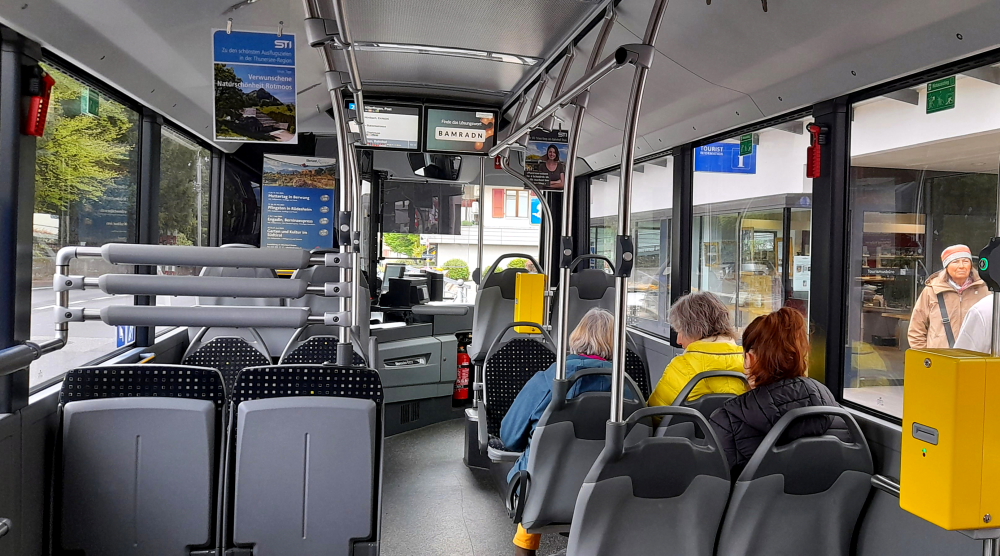
About 10 minutes later we alight at the penultimate stop called Balliz on the islet then cross the bridge (Bahnhofbrucke) and walk up Scherzligweg to the Obere Schleuse wooden bridge/upper lock.
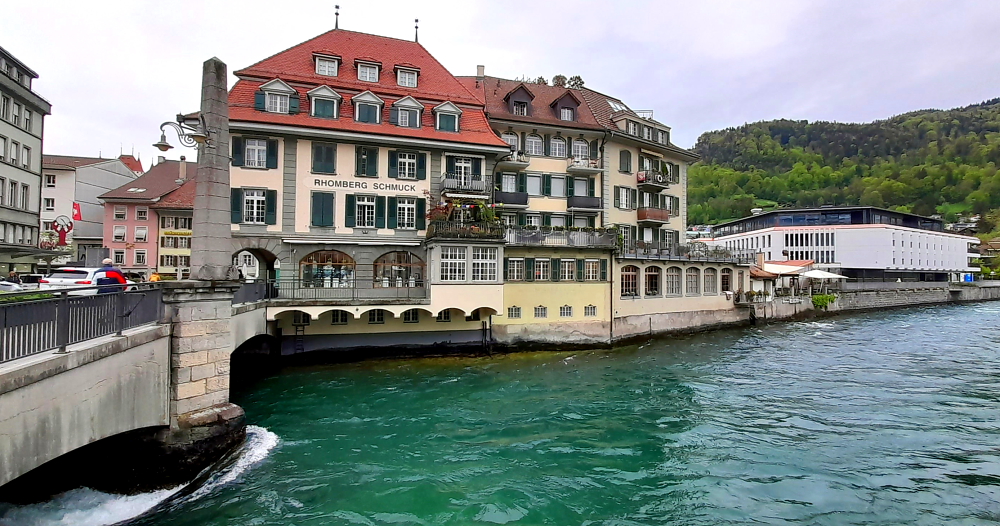
In front of us is another delightful wooden, covered bridge that we associate with Switzerland.
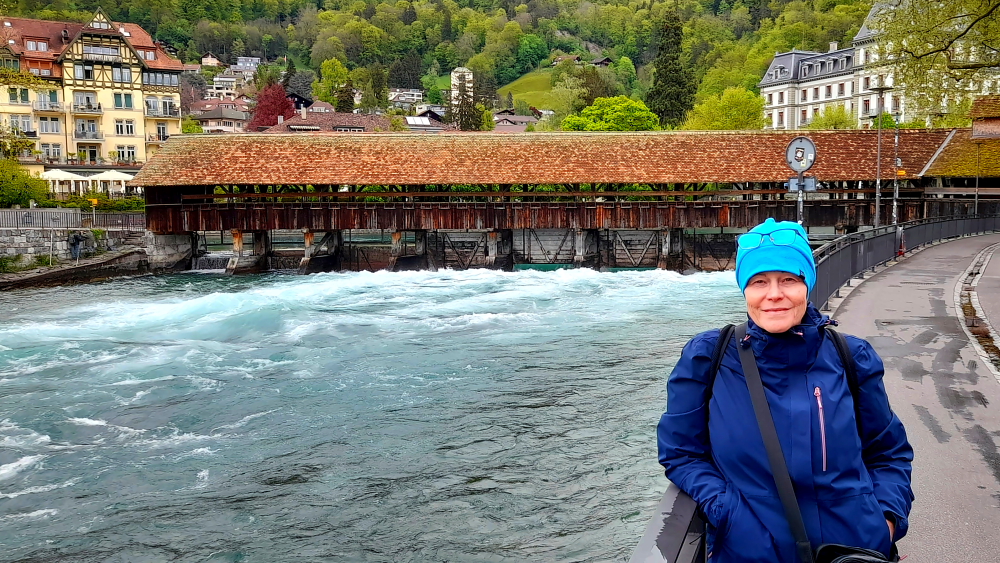
The Scherzligschleuse is the upper lock in Thun. It was built in 1726 in place of the cross dam from 1720 at the junction of the Inner Aare with the city moat and rebuilt in 1818. The lock serves to regulate the Outer Aare.
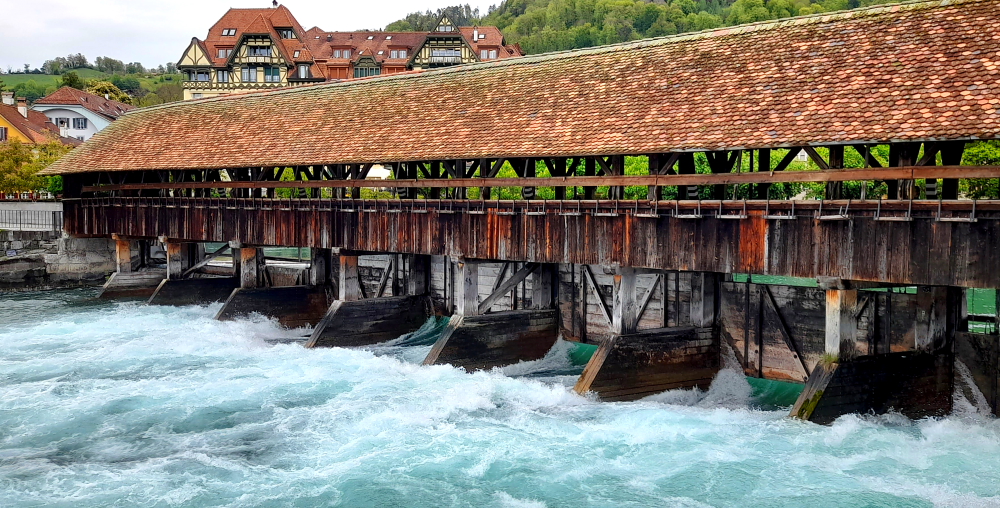
It was not until 1714 that an island emerged from the Bällizquartier through the discharge of the Kander into Lake Thun.
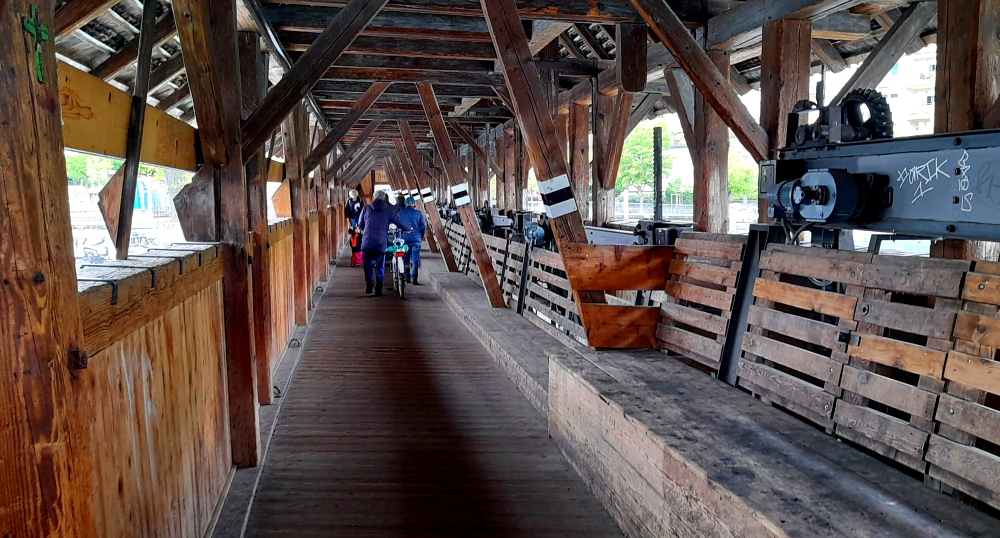
As a result, the city moat became the second arm of the Aare, called the “Outer Aare”. After a complete renovation in 1978, only the superstructure remains.
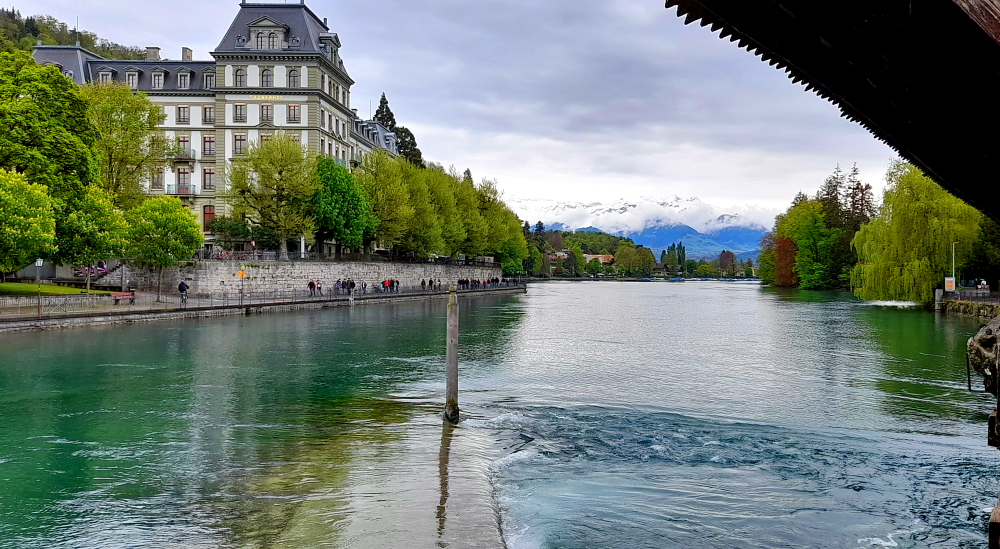
The upper and lower locks serve as a control mechanism, power generation and flood protection.
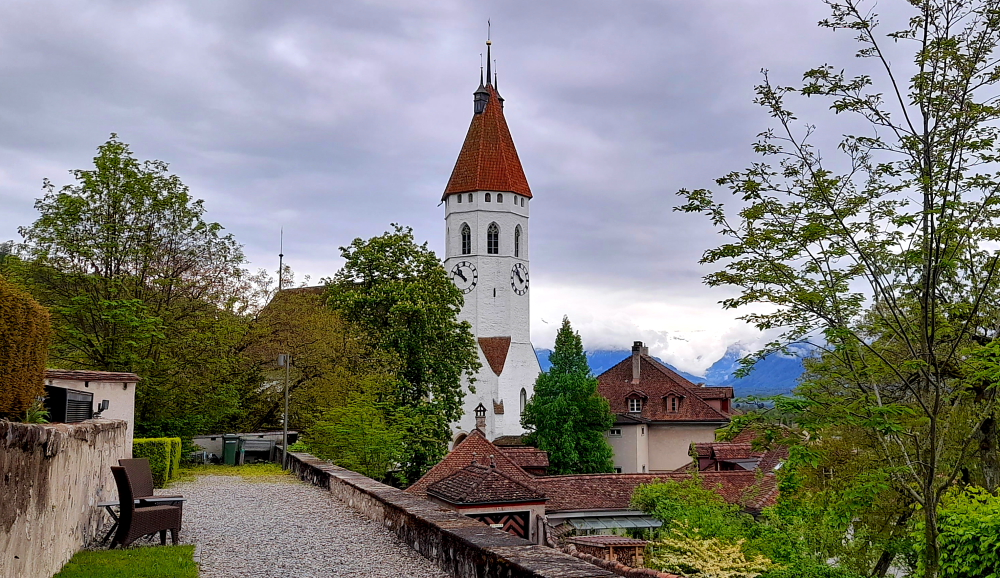
From here we cross the 2nd bridge this time over the Inner Aare to the Aare Quay where we pick up the ‘red route’ on the tourist map and make our way to the City Church (Stadkirche) via the Risgassli staircase and through the Castle Gate.
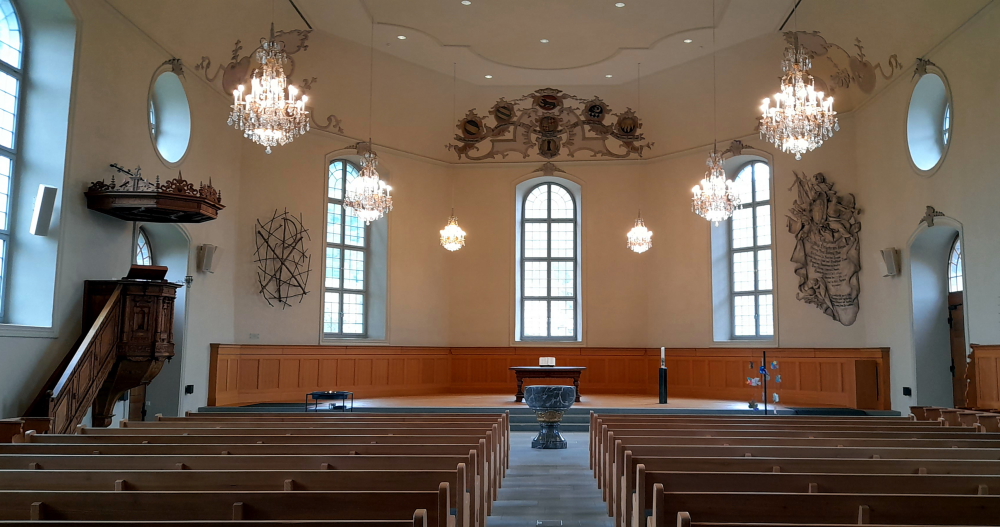
The Church’s exterior is quite plain with a clock face on its tower. Inside, it is even plainer. But the Church’s square provides a panoramic view over the town and lake.
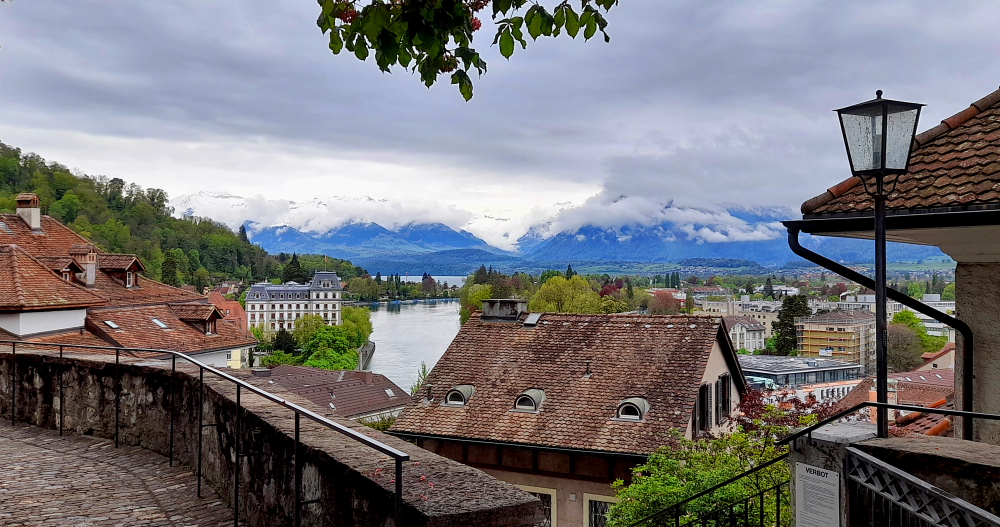
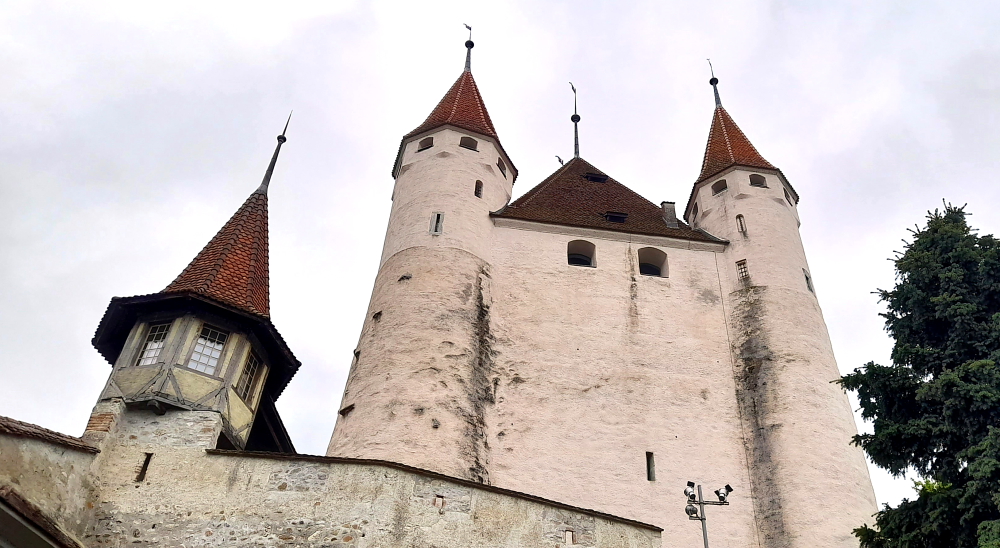
Continuing onto Schlossberg we arrive at Schloss Tun, a picturesque, hilltop donjon built around 1200 by the Dukes of Zährigen.
The present day castle with its adjoining buildings was originally a fortress. There was a stately home with a residential building and a curtain wall already in the 12th century. The Dukes of Zähringen did not intend to live here as they had a residence built in Burgdorf. Yet, it is with this imposing tower that they could leave a sign of their power over the region and the local trading paths.
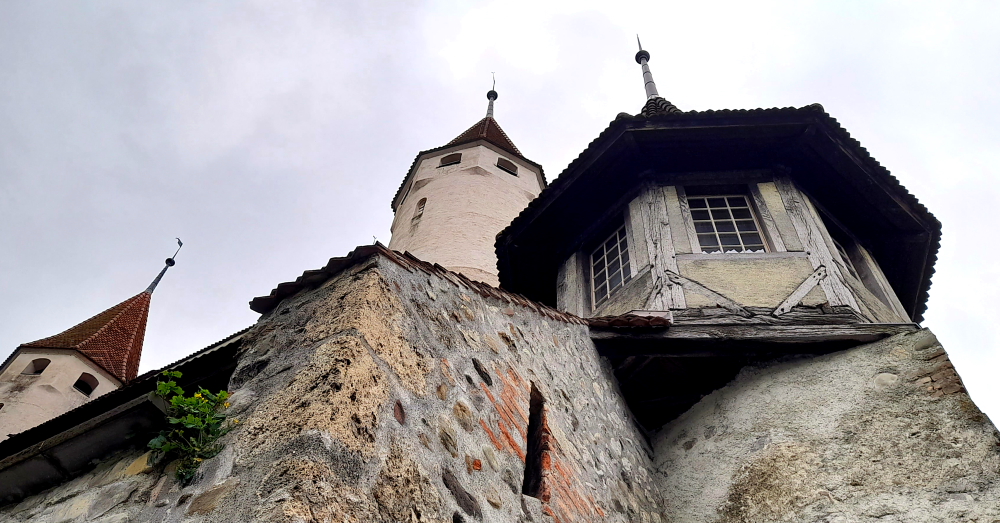
The donjon is unsuitable as a permanent residence as it is actually a single 14-metre high room, which is now called the Grand Hall. In its time an imposing place of representation, today one of the best-preserved representation halls of the Middle Ages.
Since the 12th century, Thun Castle with its adjoining buildings was the domicile of Thun nobility and was always reconstructed to suit their use. No building changes were taken during the time of the Dukes of Kyburg, yet there were many changes under the long reign of Berne up to 2006. Since the 17th century, there had also been a prison under the roof of the donjon. In 1886 the Canton of Berne erected the new regional prison on the castle wall.
In 2010, after 800 years of public possession, the city of Thun sold the property of the former castle area with the exception of the donjon leasehold. Midyear 2014 a conference and training centre were opened including a boutique hotel and a restaurant [schlossthun.ch].
We walk downthill along Untere Hauptgasse until we come to Rathausplatz.
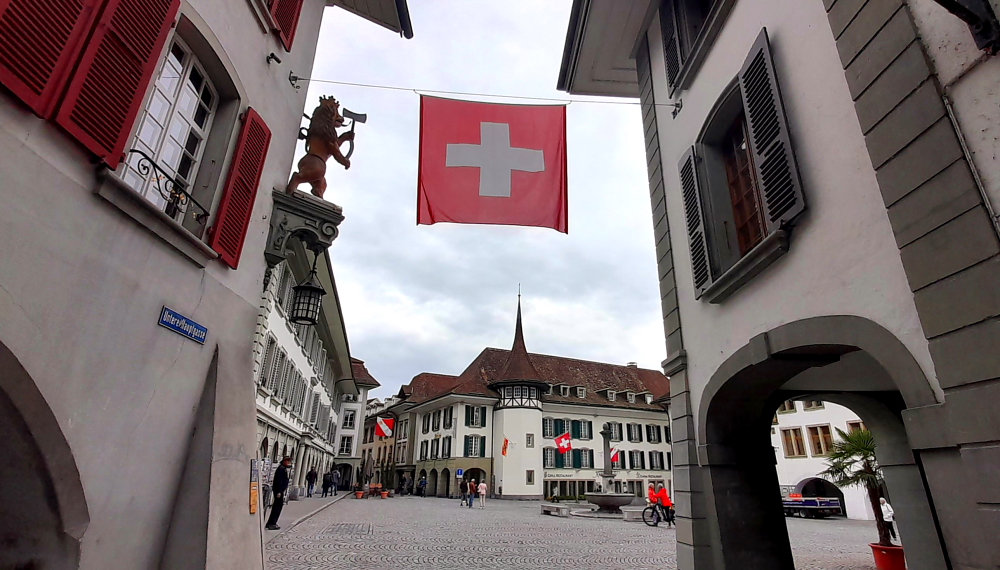
This square stands at the heart of the old town. Enclosed by many historic buildings, the square provides the setting for festivities and events and Saturday morning produce markets.
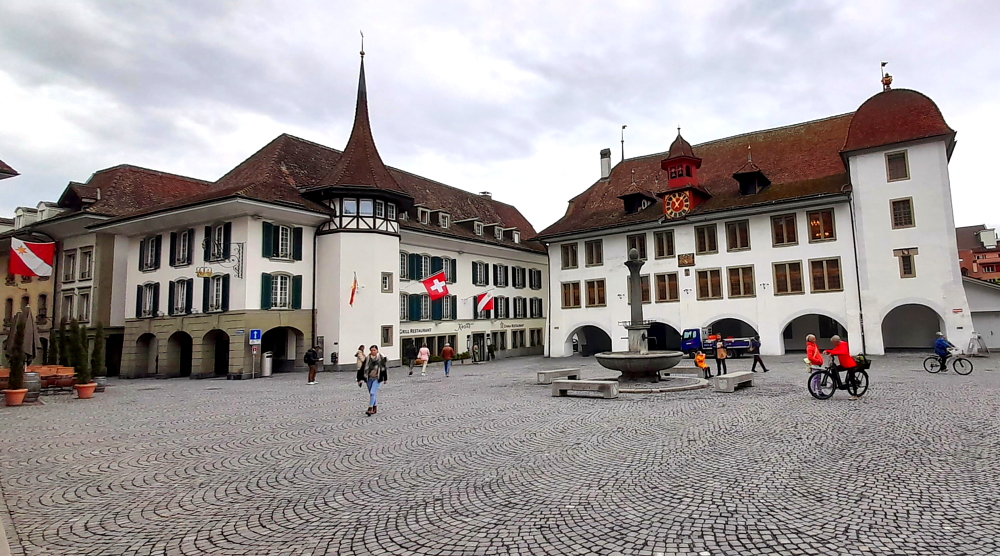
From here, the square also commands views of Thun Castle.
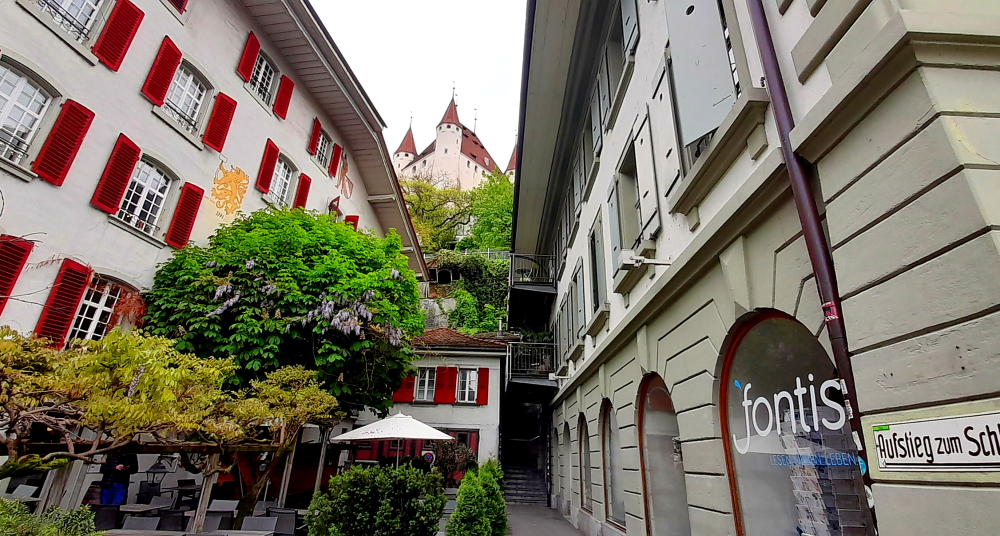
The town hall (Rathaus) was built around 1500.
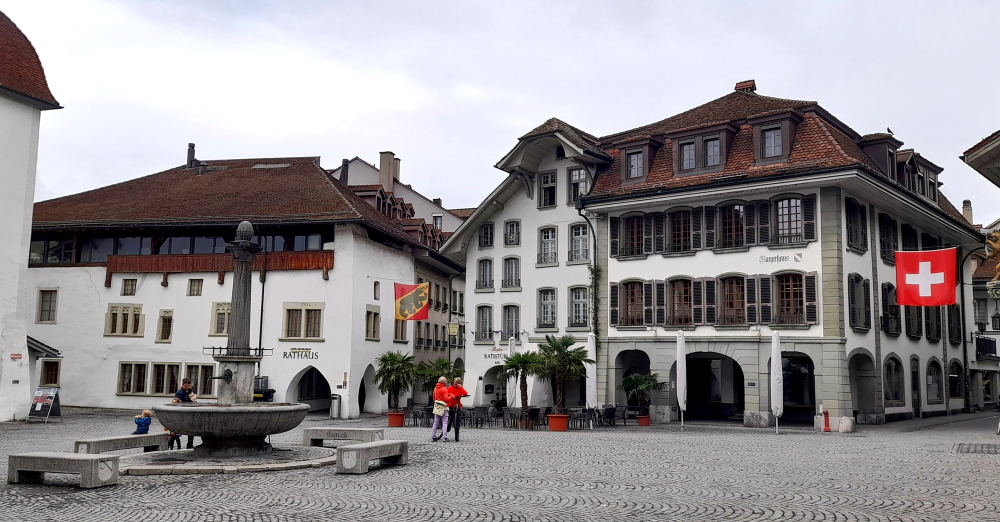
Walking along Rathausquai we cross the Kuhbrücke and walk down Balliz. The River Aare flows past on both sides of central Thun, forming a genuine “shopping island”. Known as “Balliz”, this shopping street has practically everything from well-known fashion outlets to more traditional stores and popular weekly markets on Wednesdays and Saturdays.
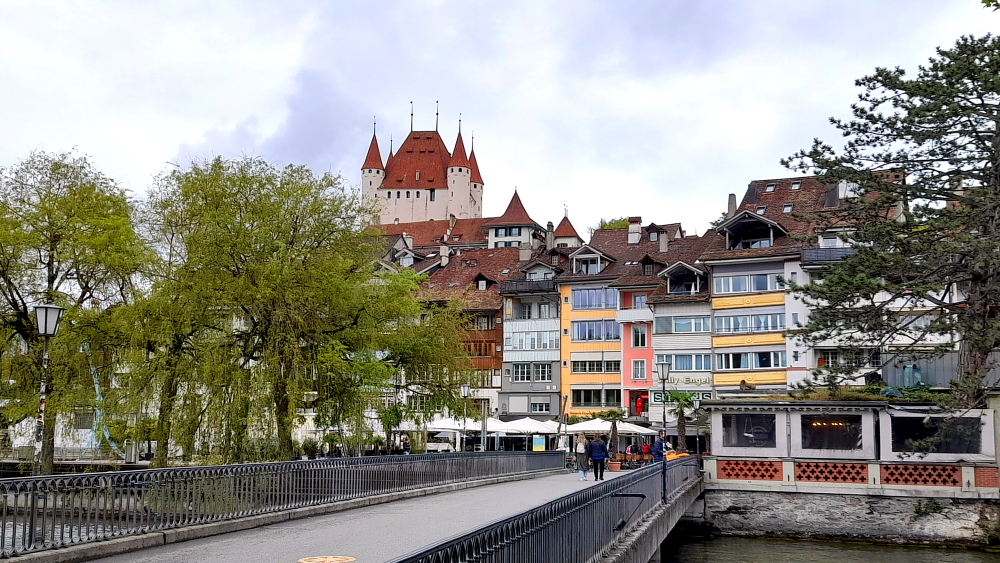
Turning left onto Muhlegassli we come to the river bank of the Inner Aare and a viewpoint.
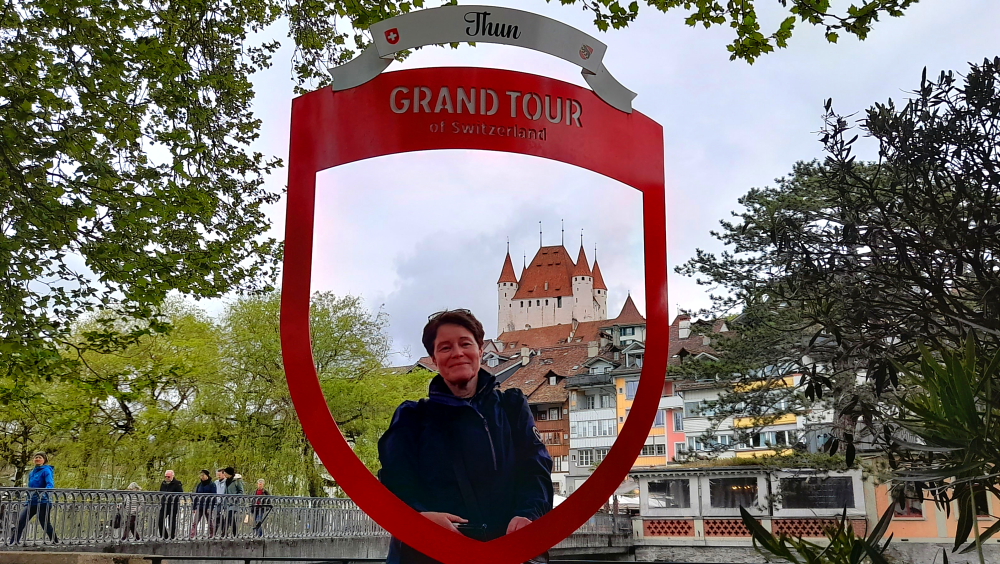
From the Mühlebrüggli bridge is also a view of the 2nd covered, wooden bridge across the Aare – the Lower Lock Bridge and Mill Lock (Untere Schleuse Brücke und Mühleschleuse).
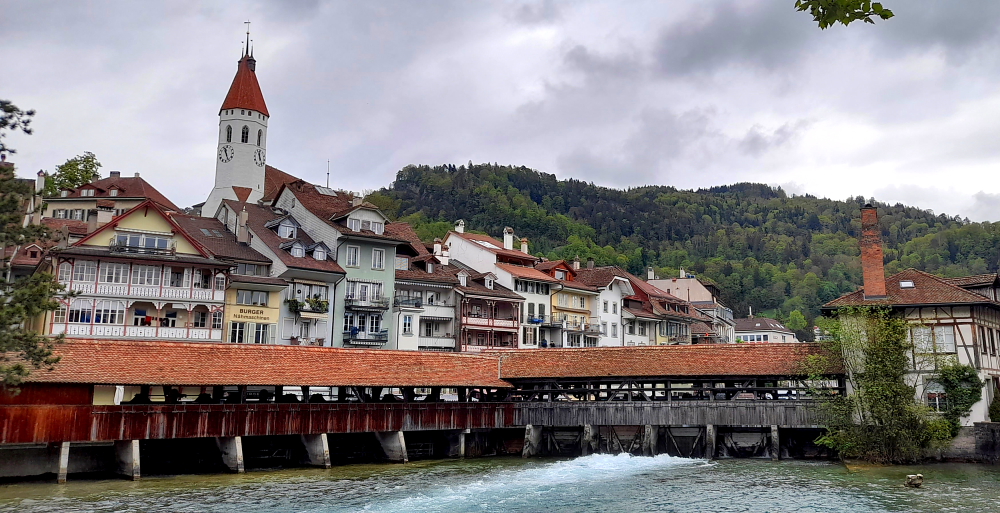
Crossing over the Mühlebrüggli bridge we walk through Muhleplatz, known locally as “Muli”, a lively square of local restaurants, cafes and bars.
Obere Hauptgasse is in the next block. This street is known for its distinctive shops and boutiques and characterised by unique raised pavements lined with shops above shops at street level. This architectural feature that makes this part of the old town an interesting experience.
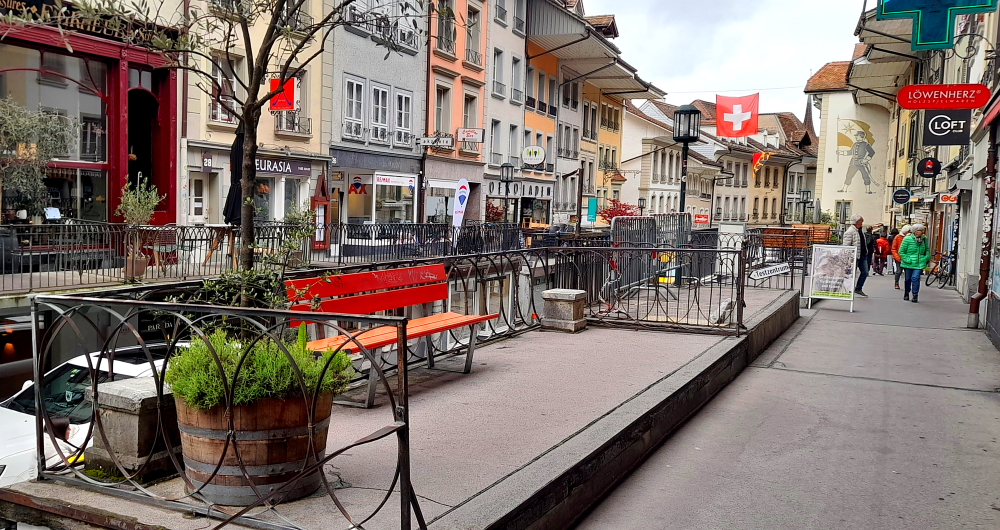
At the end of Obere Hauptgasse we turn right then right again onto Aarequai and stop for a coffee seated on the pavement. Here we strike up a conversation with a fellow patron – a Swiss woman who had lived for 30 years in the USA, now lives in Bern and has a daughter and son-in-law who live in Port Hedland, Western Australia. She’s even been to Brisbane!
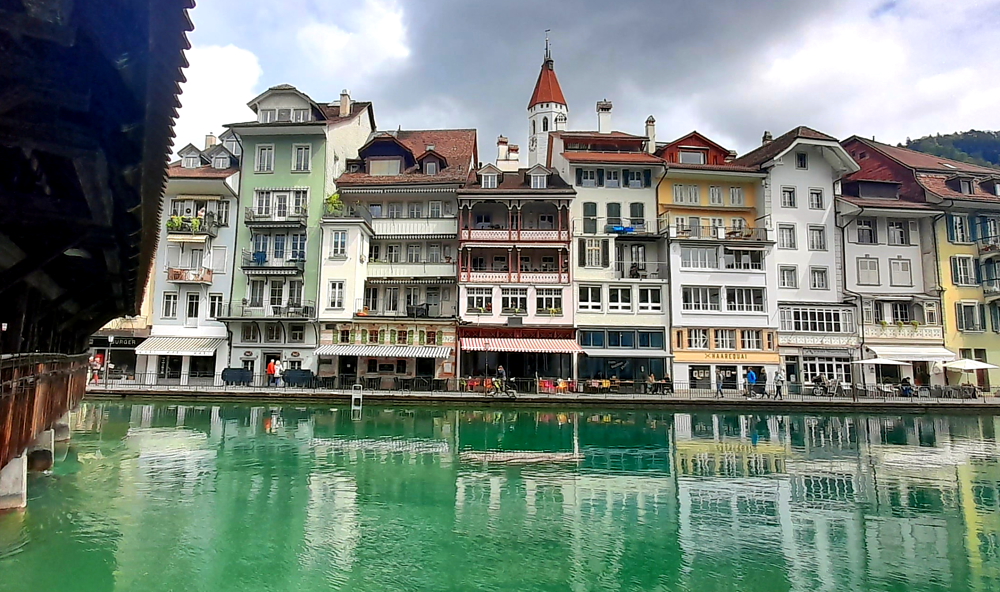
Crossing back over the Inner Aare through the wooden Untere Schleuse Brücke we visit a Co-op supermarket to purchase supplies for dinner tonight then catch the 12:50 pm No. 21 bus from the Freienhof bus stop back to our Hilterfingen Kirche stop where we arrive at 1:00 pm.
Sitting on our terrace in the sun we have a bite to eat then update the blog. Around 3:00 pm the lake is hit by waves of passing showers.
Tomorrow we are moving on to Bern, but it is only a 30-minute drive from here. Check-out from here is at 11:00 am and check-in not until 3:00 pm in Bern. To fill in time, we’ll probably drive to Interlaken along the northern shore of Lake Thun then up to Grindelwald and back. Taking the southern shore of Lake Thun we should arrive in Bern around 3 hours later.
4 May, 2024
A brilliant sunny day with not a cloud obscuring any of the mountain peaks across the lake. We end up leaving at 10:40 am in 11 Deg. C ‘heat’ and drive towards Interlaken which is only a 30-minute drive away.
Upon arrival near the Schloss we are inundated with colourful, swirling forms above us – about 10 paragliders are zooming off the hill above and are circling above the town, to land a short distance way.
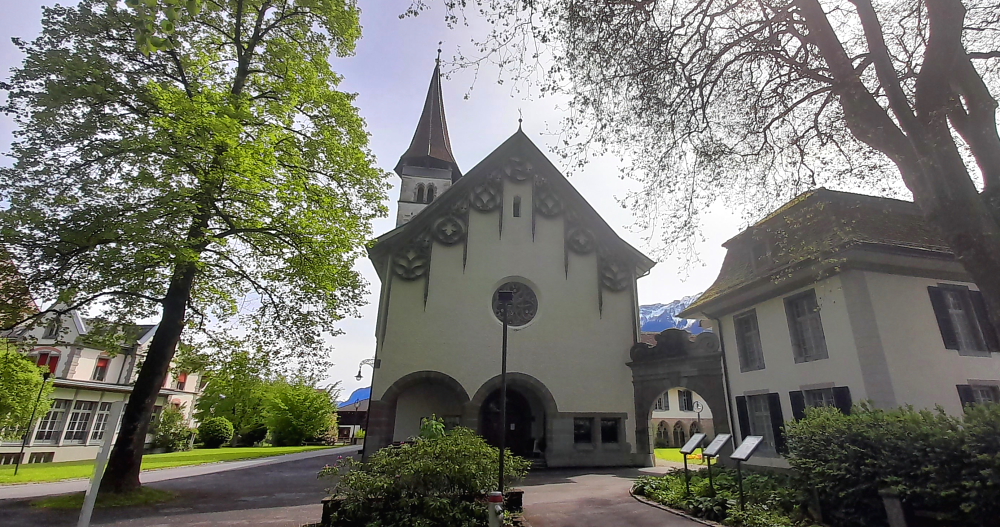
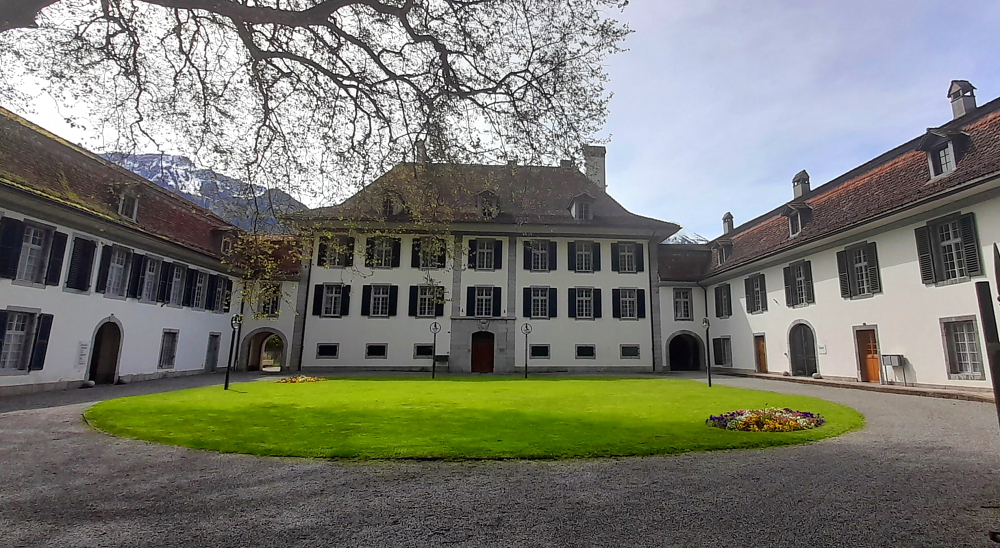
Castle Park and the former Augustinian double monastery are located here. The former monastery was first mentioned in a document in 1133. After the Reformation around 1525, the entire monastery property passed to the state of Bern and was converted into a hospital. The church tower dates back to the early 14th century and its chapel from 1452. It also has a Gothic cloister and courtyard. In 1748, today’s castle was built on the site of the former monastery as the seat of the Bernese bailiff. Today it is the seat of the Interlaken-Oberhasli governor’s office and has been completely renovated since 2009 [interlaken.ch].
At 11:30 am we drive towards Grindelwald, 25 minutes away.
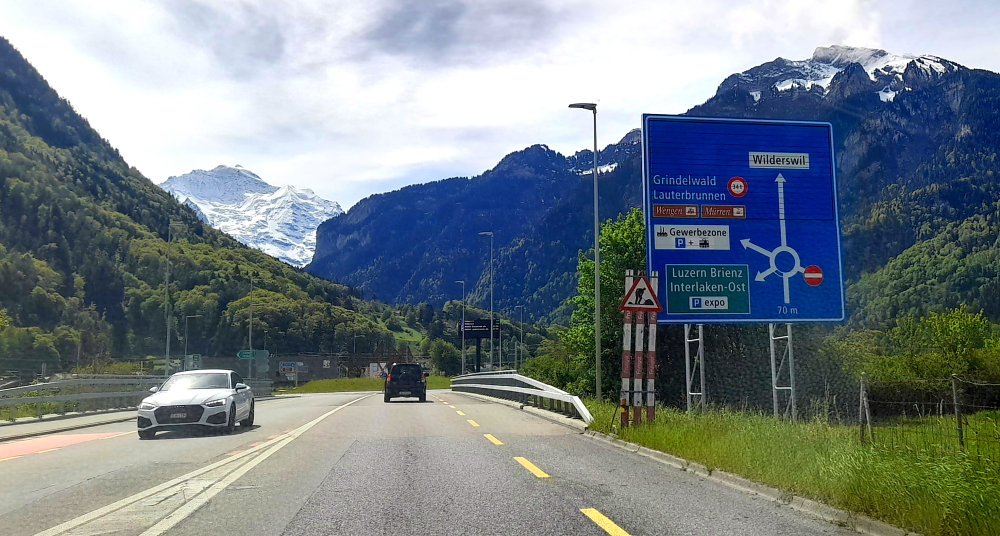
The Jungfrau at 4,158 meters (13,642 ft) is one of the main summits of the Bernese Alps, located between the northern canton of Bern and the southern canton of Valais, halfway between Interlaken and Fiesch. Together with the Eiger and Mönch, the Jungfrau forms a massive wall of mountains overlooking the Bernese Oberland and the Swiss Plateau, one of the most distinctive sights of the Swiss Alps.
The summit was first reached on August 3, 1811, by the Meyer brothers of Aarau and two chamois hunters from Valais. The ascent followed a long expedition over the glaciers and high passes of the Bernese Alps. It was not until 1865 that a more direct route on the northern side was opened.
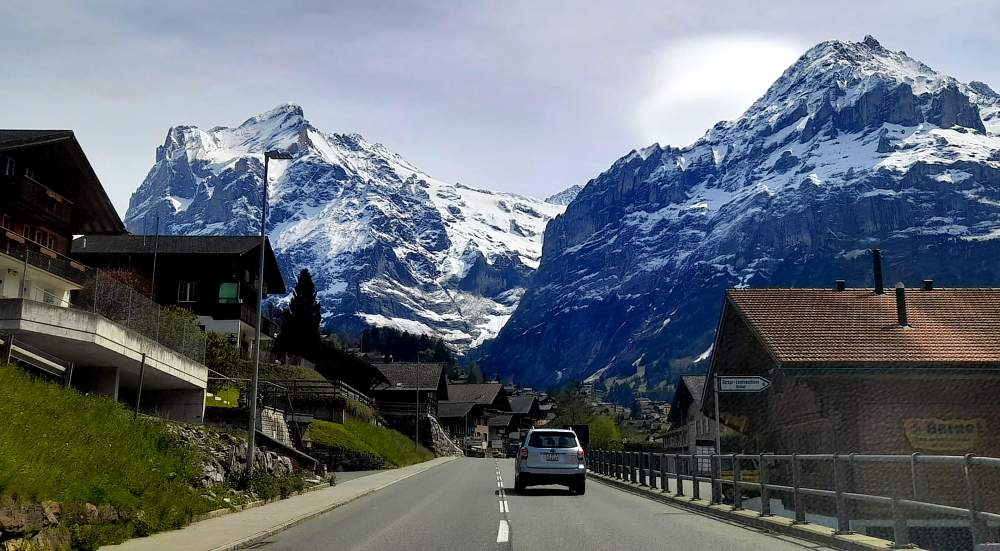
The construction of the Jungfrau Railway in the early 20th century, which connects Kleine Scheidegg to the Jungfraujoch, the saddle between the Mönch and the Jungfrau, made the area one of the most-visited places in the Alps. Along with the Aletsch Glacier to the south, the Jungfrau is part of the Jungfrau-Aletsch area, which was declared a World Heritage Site in 2001.
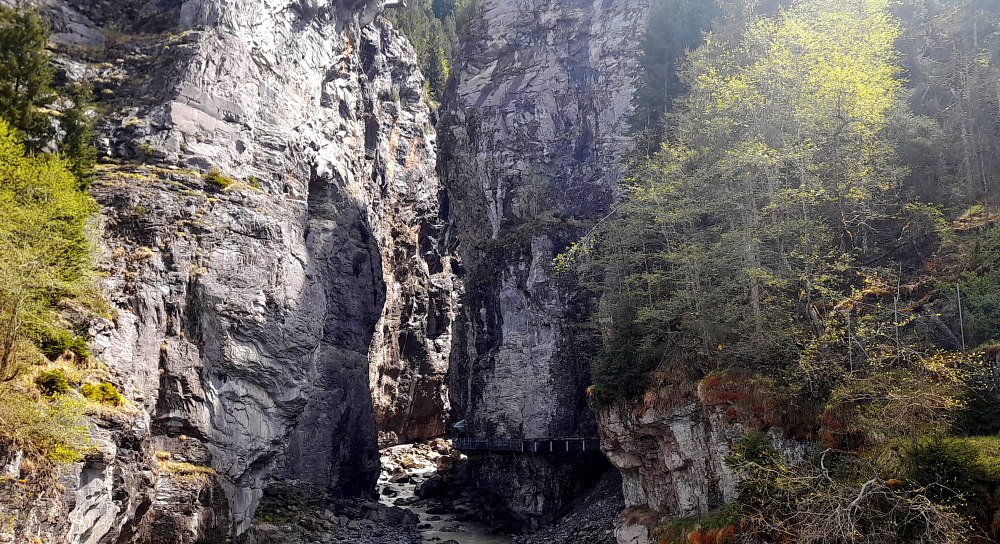
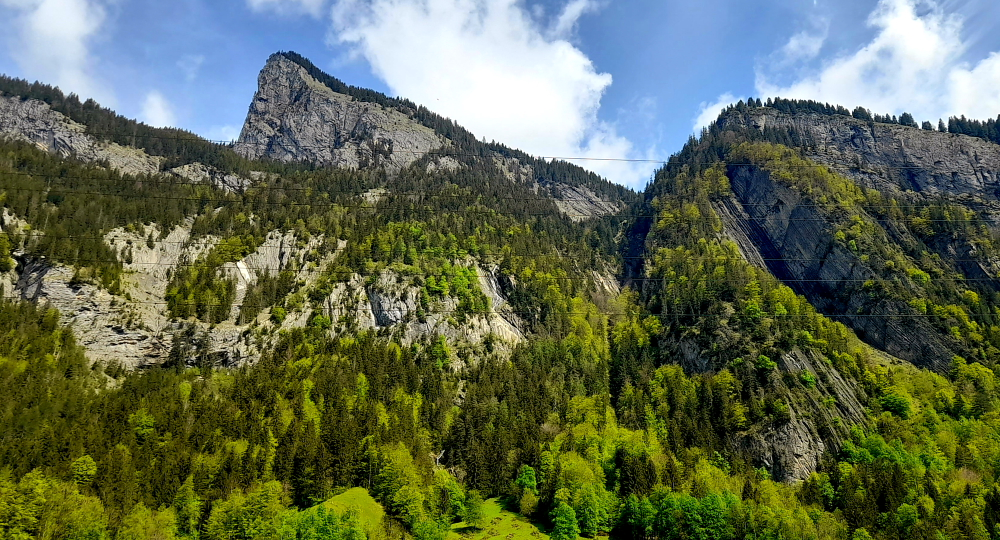
We drive through the small town of Grindelwald, passing the train and the cable car that goes to Jungfraujoch, to where the road ends at Glacier Canyon at the base of the mountains guarded by a hotel, cafe and paid entrance to the canyon.
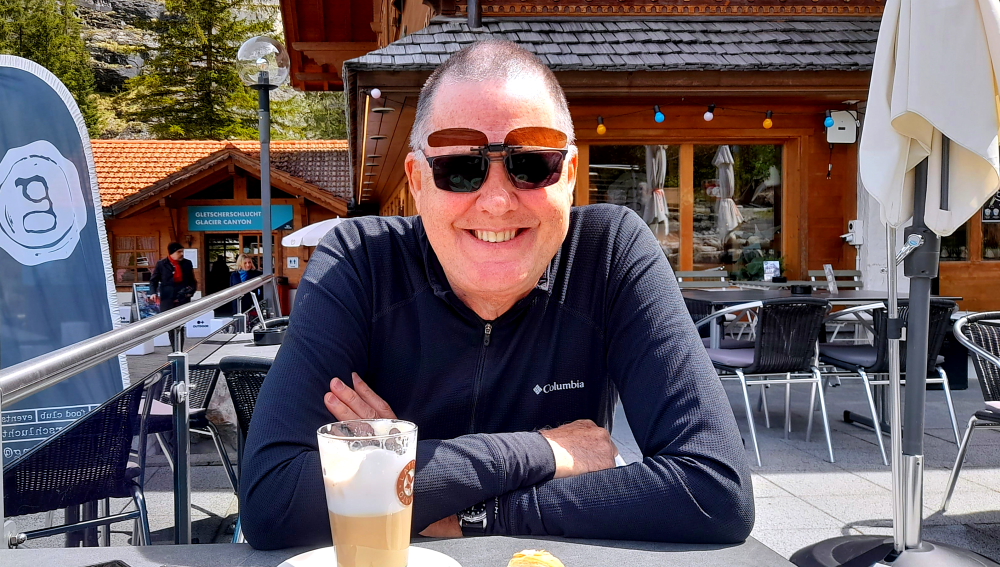
After basking in the 17 degrees sunshine with a coffee, we drive back to the Y junction at Gundlischwand and turn left onto the 222 which goes through Lauterbrunnen to Stechelberg at the end of the valley.
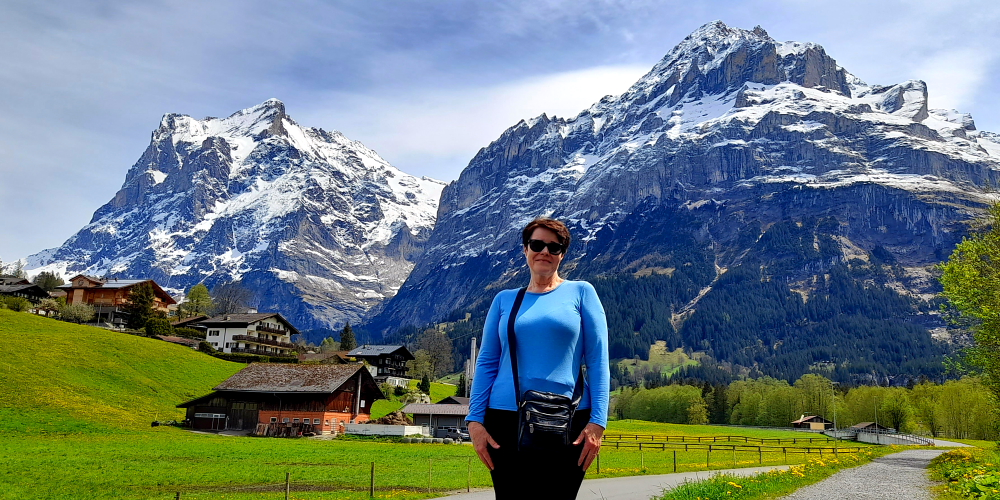
Lauterbrunnen turns out to be a very busy town with lots of hotels, restaurants, cafes and teeming with tourists.
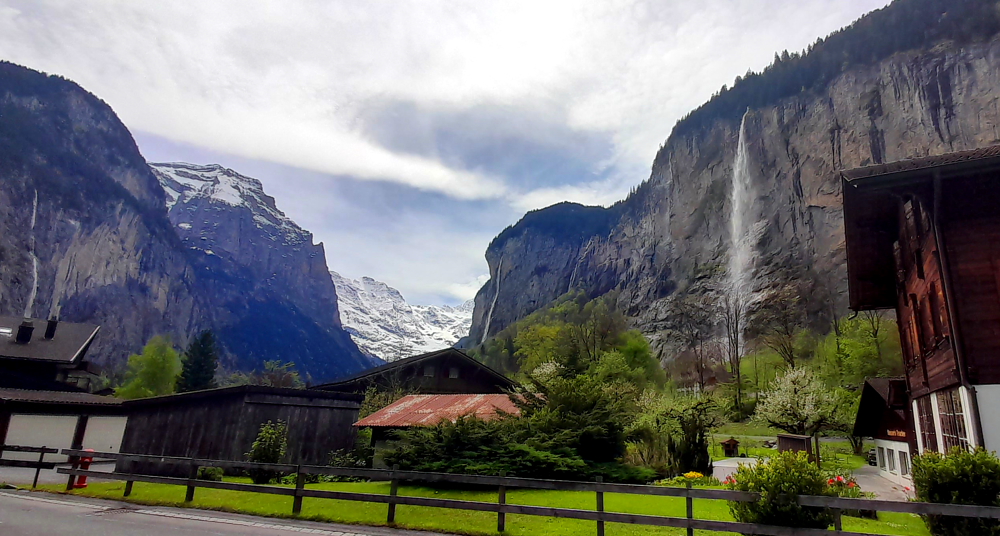
The main attraction is Staubbachfall which cascades dramatically from an escarpment above the town and can be viewed from most places around town.
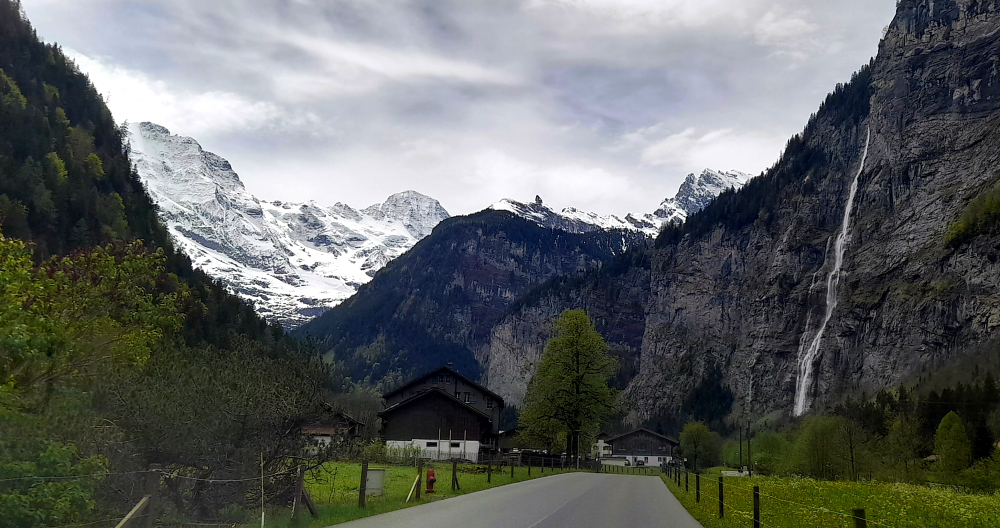
Stechelberg is a small village in Switzerland located at the base of the Schwarzmönch mountain in the Bernese Alps.
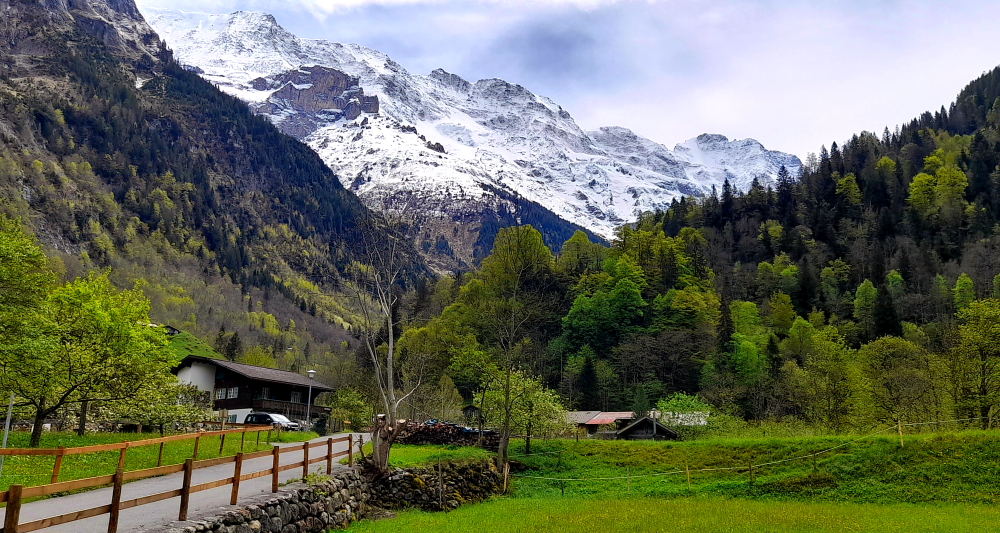
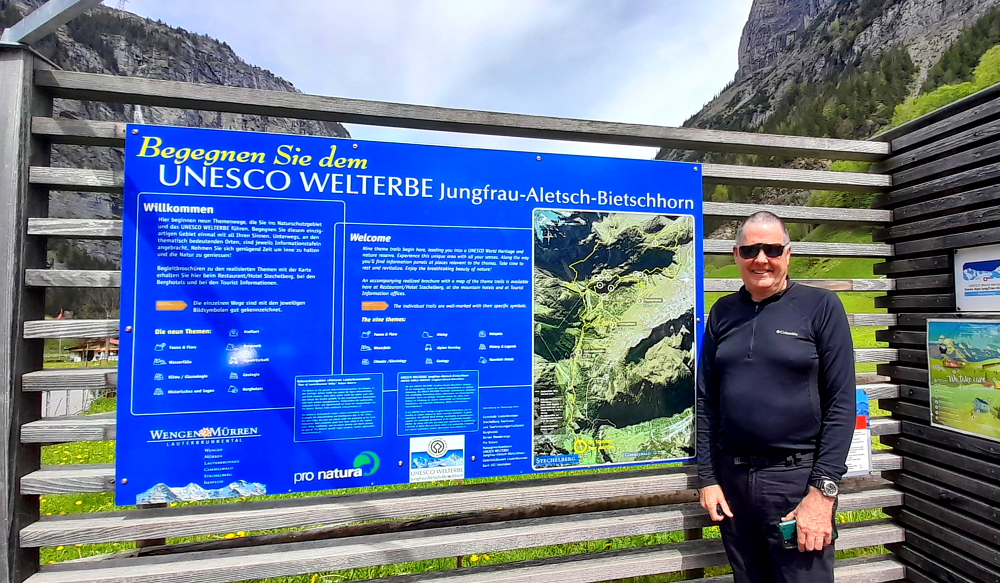
A pretty, tranquil village, Stechelberg is the starting point for 9 themed trails in the adjoining UNESCO World Heritage nature reserve. Tranquil until we suddenly hear a series of loud bangs reverberating around the valley, compliments of the nearby quarry.
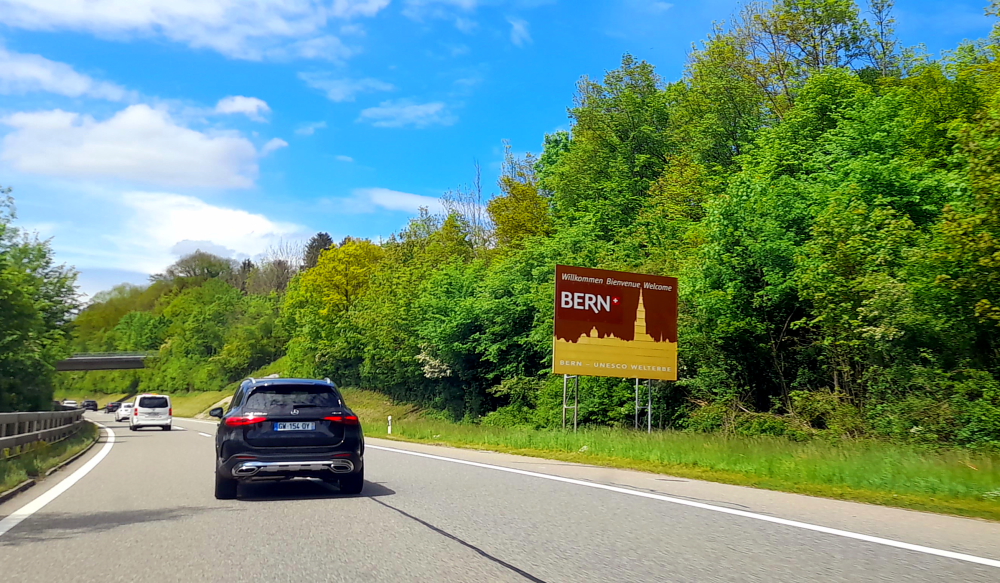
It’s 1:30 pm so time to head off to Bern where we arrive at the aparthotel near the Wankdorf (true!) train station around 2:45 pm.
Fortunately there is an intercom at the front door and an onsite concierge which negates the dreaded self-checkin process. We meet him at the apartment on the 5th floor and he takes us through the apartment’s features, most of which is tech-based.
A remote control for both sets of curtains and lights, including mood lighting. Another for the TV which is a picture on the door of the cupboard that opens to reveal the kitchen sink, stove top and microwave above a small fridge, crockery cupboard and cutlery drawer. Another to raise and lower the height of the kitchen table cum desk. Yet another for the Japanese-style toilet which doubles as a bidet, but the toilet lid is activated by a motion sensor which means the toilet lid comically and annoyingly keeps opening and shutting itself any time you venture anywhere near the bathroom door!
Unfortunately, when the tech fails to work you’re a bit stuck. Turns out the sheer curtains sensor is broken so we can’t shut those; the integrated boiling water to the kitchen tap in lieu of a kettle is also broken (need to microwave cups of water for tea); the remote terminal to pay our city tax by card also fails; the digital thermostat on the central heating also doesn’t work so I have to turn it off manually before we roast and finally, the WiFi hot spot at the underground garage has disappeared so after 2 sprints up the ramp to the front door intercom by Lynn, the concierge opens the door remotely for us. He promises us that people will be here tomorrow to fix these things.
As it’s Saturday the supermarket will close at 5:00 pm so we deliver our luggage to the apartment (thank goodness the lift works!) and quickly walk out the door for a 12-minute walk over the railway tracks and through a residential area to the local Migros supermarket, purchasing meals for tonight and tomorrow night as everything will be closed on Sunday.
Unpacked, Lynn says: “So where’s the washing machine and dryer that are listed in the room description?” Apparently at the end of Floors 3 & 4 in a cupboard and as they are right outside the doors of the 2 end apartments can only be used between 8:00 am and 10:00 pm.
One load washed and in the dryer and another loaded in the washing machine, both machines indicate that they won’t be finished until 10:15 pm. Oops! I return to the machines at 9:55 pm to find that the drying has finished and the washing hasn’t but the machine has turned off and I can’t unlock the door. That load of washing ends up being held hostage overnight.
Bed, finally, but not before a farcical performance, witnessed by an amused wife, as I try repeatedly to close the drapes and turn off the lights using the remote which is embarrassing as I consider myself tech savvy. You can imagine – drapes closed, lights still on. Mood lighting on as drapes open. Drapes close then reopen, ad nauseam. The Wife takes control of the control and within a couple of attempts the drapes are closed and it’s lights out.
5 April, 2024
Today we’ll do our own walking tour through the UNESCO site of the Old Town of Bern. Bern has been the capital city, or officially known as the “federal city” of Switzerland since 28 November 1848 when the National Council and the Council of States elected Bern as the federal seat of Switzerland.
Although it’s overcast it’s warm as we walk 5 minutes to the Markuskirche bus stop to catch the No. 20 bus which terminates at the Bern train station. Again, we have fee bus tickets thanks to the bernwelcome app which the concierge activated for us when we checked in.
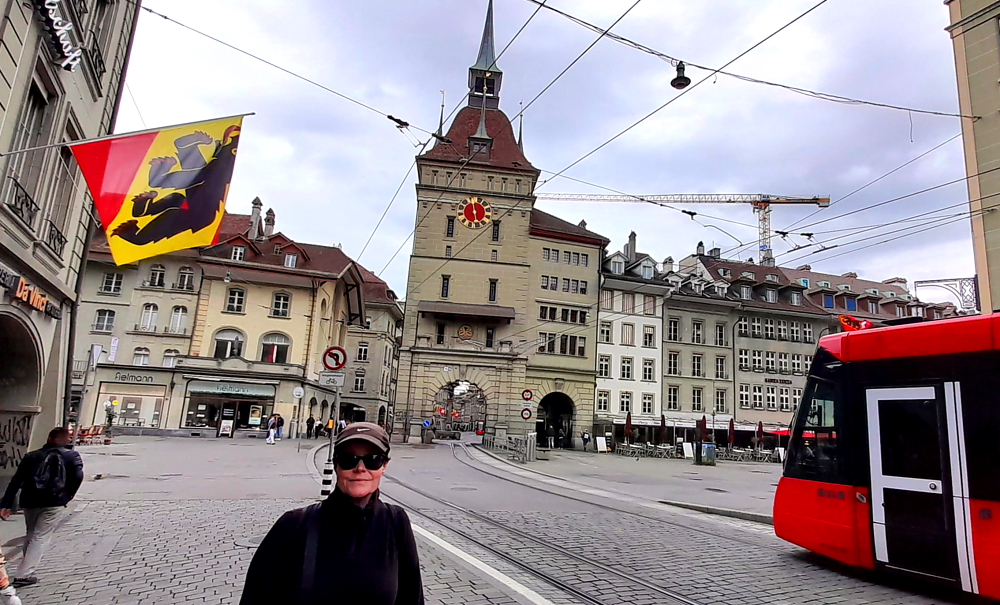
Bang on 11:26 am the bus arrives and whisks us into town arriving at the station 8 minutes later. Today Lynn has a list of places to see in the Old Town of Bern, the first of which is the Prison Tower at the end of Spitalgasse where it joins Marktgasse.
Built in 1256 it was initially a defence tower and Bern’s city gate, but when the city expanded in the 14th century, its use changed. After the devastating fire in 1405, Käfigturm took over the functions of the destroyed Zytglogge (Clock Tower) and, from then on, served as a prison. In the rooms of the tower, suspects were interrogated and locked up [bern.com].
Turning right at the tower we walk into the Bundesplatz and see its impressive Parliament Building, also referred to as the Federal Palace. Built between 1894 and 1902 according to plans by architect Hans Wilhelm Auer and officially inaugurated by the United Federal Assembly on 1 April 1902. The Parliament Building stands between the Federal Palace’s West Wing (built 1852–1857) and East Wing (built 1888–1892).
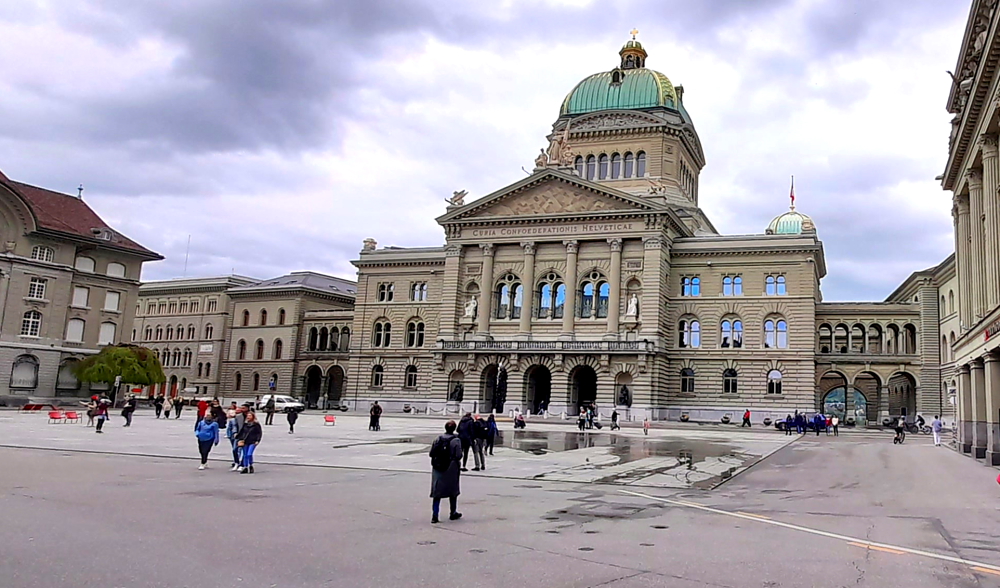
95% of the materials used were sourced from within Switzerland, symbolically to illustrate the cultural and material diversity of the country and of its people. Inside the building is beautifully decorated with stained glass, murals and statues [parliament.ch].
Walking along the terrace we rejoin Marktgasse at the Zytglogge – the Clock Tower. First, a fortified guard tower, then a prison, a lookout and fire observation tower, and finally a clock tower. As Bern continued to grow and expand its city limits, the former guard tower gradually found itself closer and closer to the city center. After the devastating fire of 1405, the structure was rebuilt and given a new identity now known as the Zytglogge (Clock Tower).
The tower was also an authoritative building for other matters in the capital city – official travel times were measured from the Clock Tower and marked on stones along the cantonal roads; ancient length measurements of cubit and fathom (still marked today in the tower entrance as meter and double meter) served as the reference length and for official checks.
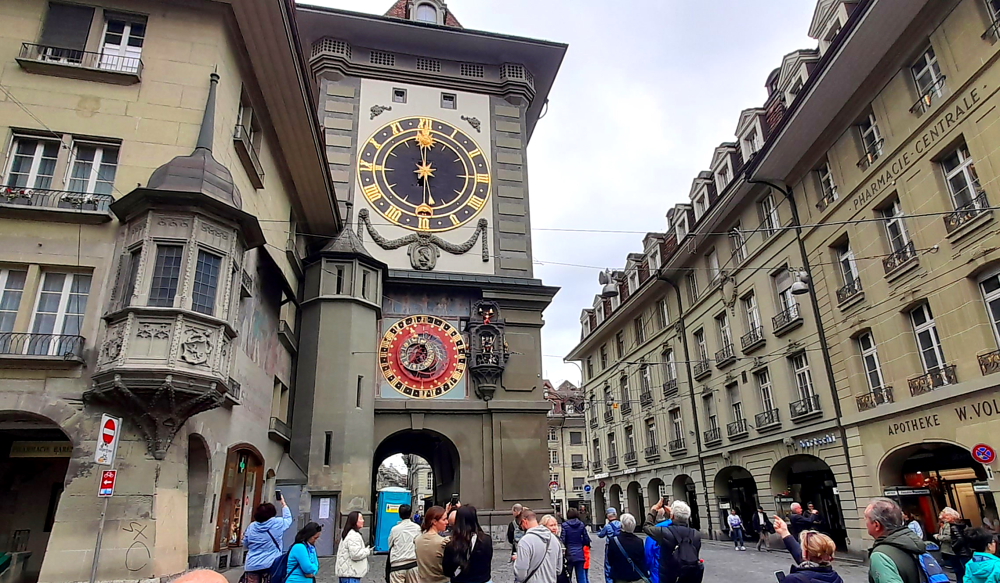
The tower’s outstanding features are the astrolabium – an astronomical calendar clock – and the musical mechanism installed in 1530. Right before the clock strikes the hour a crowing rooster announces the start of an entertaining spectacle. Bears dance their hourly routine, a jester jokingly signals the hour too early, the quarter-hour chimes are heard, and Chronos, the god of time, turns his hourglass over. The golden figure of Hans von Thann finally strikes the hour in time with Chronos’ swinging scepter [www.bern.com].
All of this we witness at 12 noon.
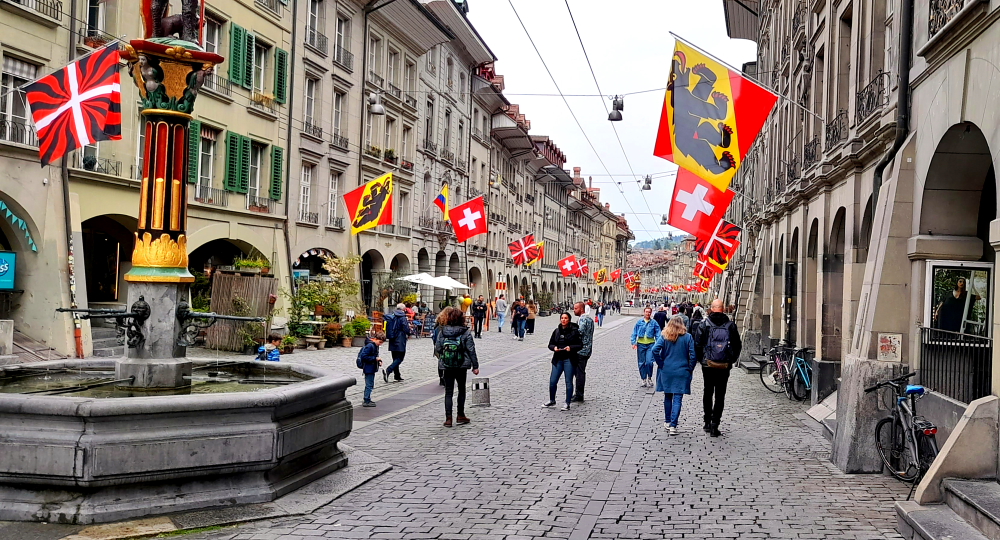
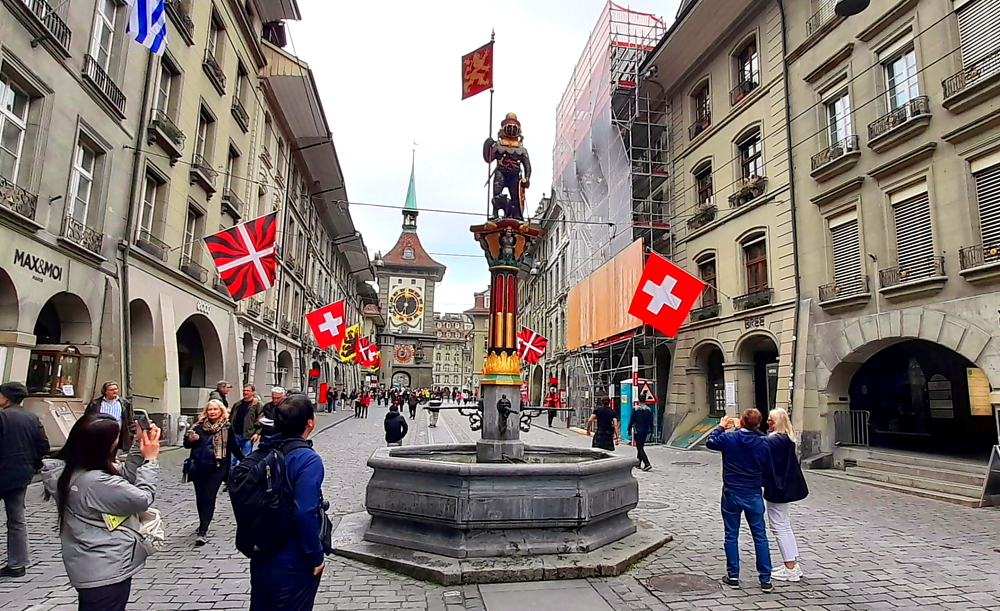
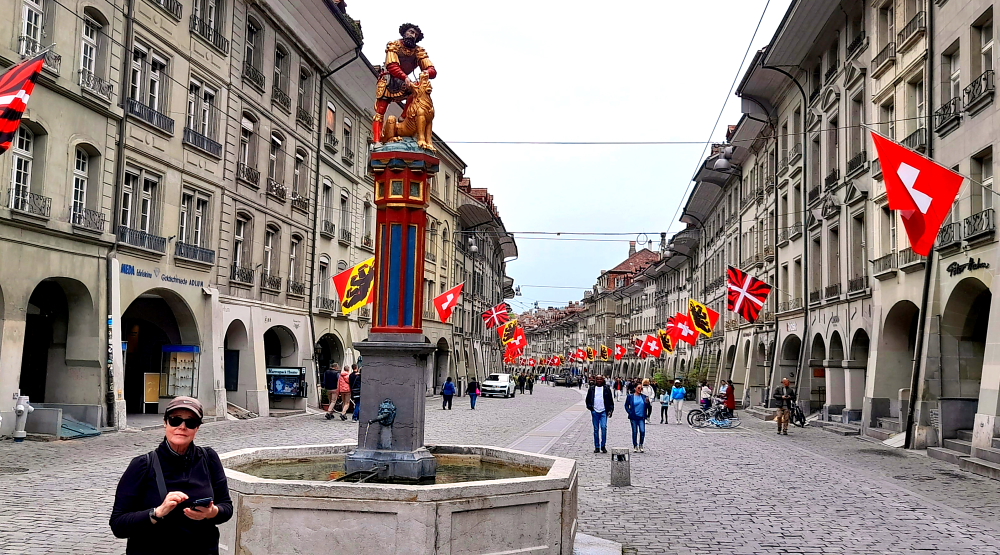
The street from here is Kramgasse which is beflagged, cobble-stoned, bordered by 3-storied buildings on either side with porticoes on the ground floor and has several of the ubiquitous, highly-decorated fountains along it. A notable one, the “Child Eating Fountain” is around the corner.
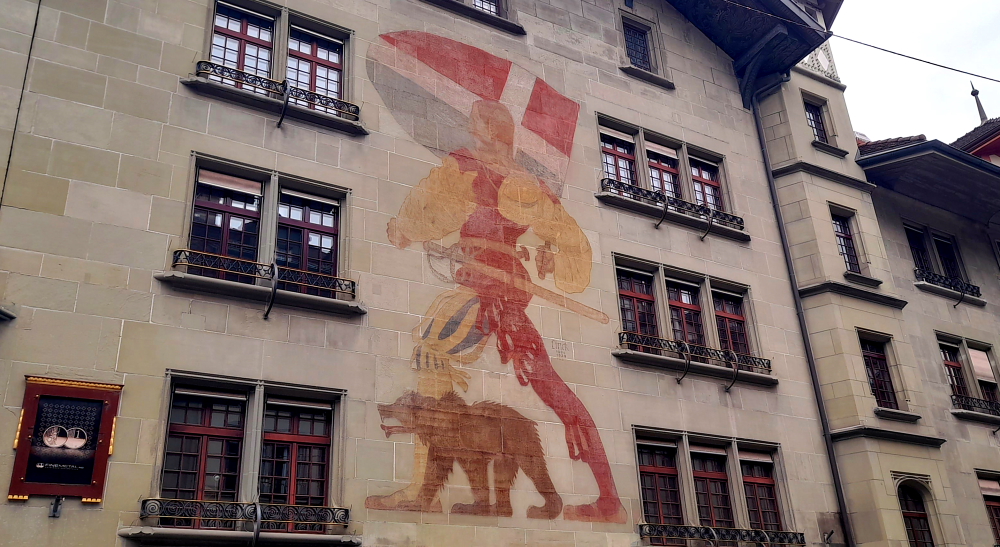
One of these fountains on Kramgasse, the Warrior Bear fountain, is a tribute to the founding family of Bern (the House of Zähringen). The bear is dressed in a knight’s chain mail, helmet and is holding a flag.
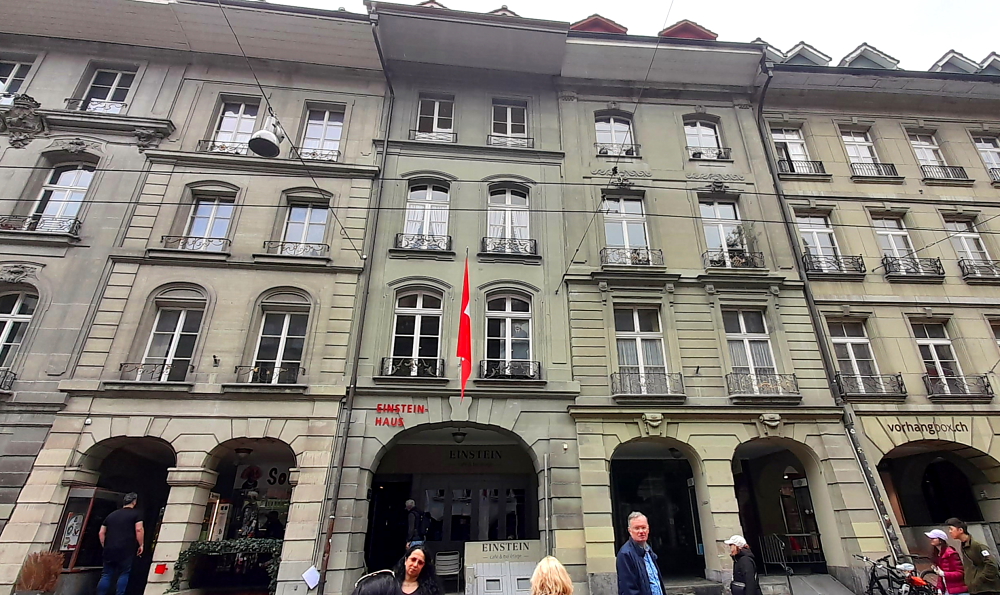
Also on this street is the house where Albert Einstein lived and wrote his fundamental treatise on the theory of relativity during 1903-1905.
The Samson Fountain recounts a scene from the Book of Judges in which Samson kills a lion [daydreamtourist.com].
Cutting through Munstergasschen, a narrow passageway accessed from the portico, we arrive at Munsterplatz and the Bern Cathedral. The Bern Münster Cathedral of St. Vincent is the most impressive late-Gothic building in the city and the largest and most important late medieval church in Switzerland. From this highest church tower in Switzerland can be admired the magnificent view over the city and of the snow-covered mountains of the Bernese Oberland.
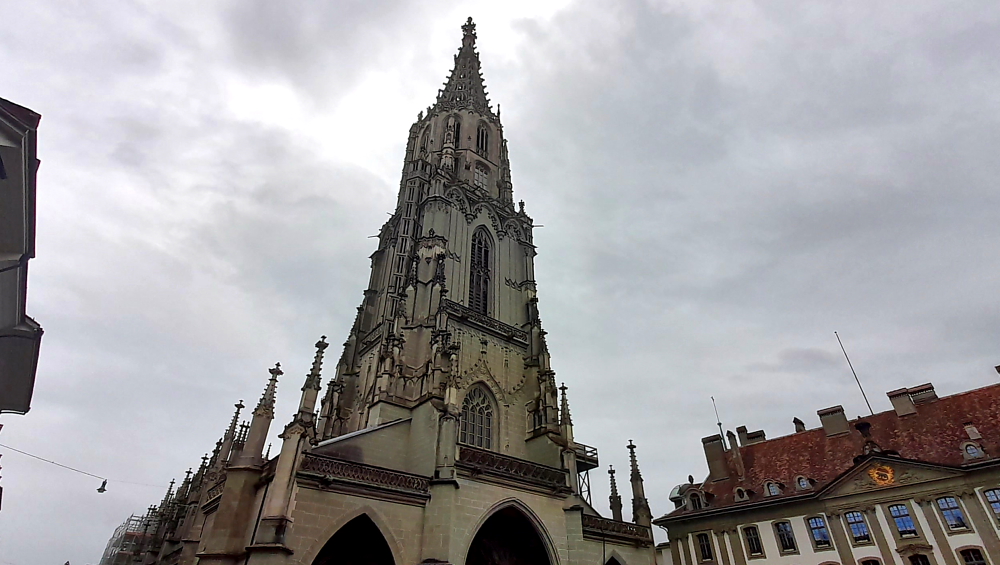
Construction started in 1421 with builders working on this masterpiece over successive generations. The steeple was only completed in 1893. An outstanding feature is the main portal, a depiction of the Last Judgment – the only image that was spared destruction during the Reformation [myswitzerland.com].
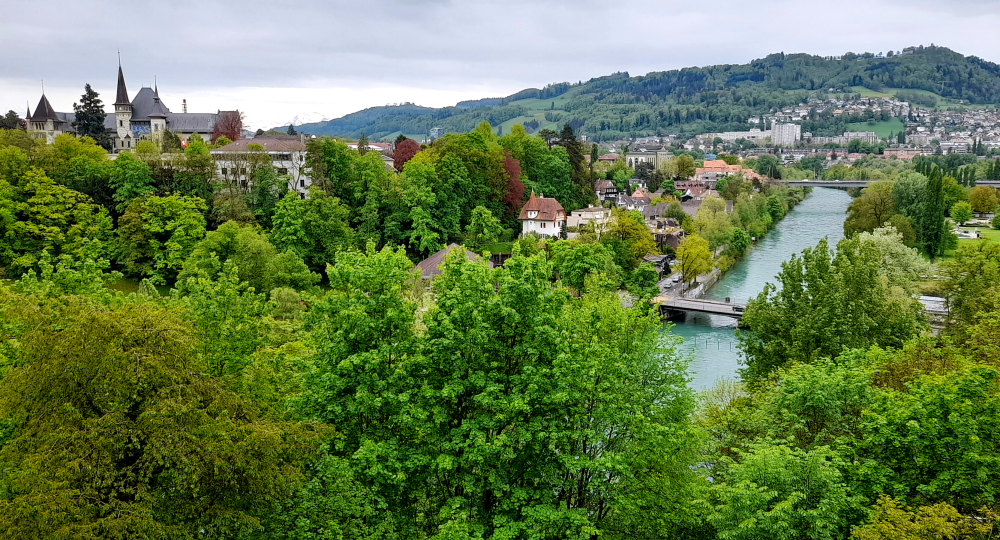
At the far side of the cathedral is the Munsterplattform, a formal garden, which overlooks the Aare and the gardens of the town mansions that also face the Aare.
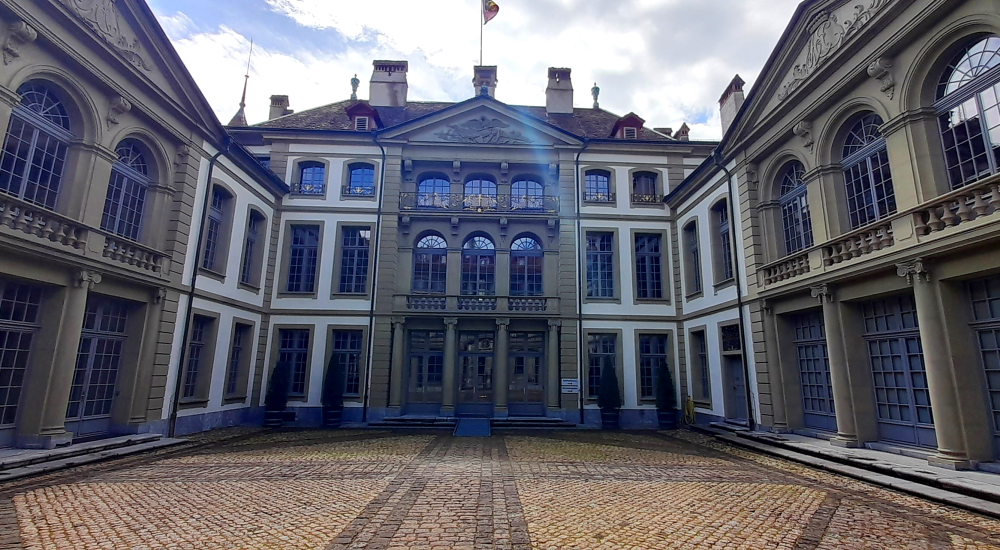
One such house is Junkerngasse 47. Commissioned by Avoyer Hieronymus von Erlach at the age of 78, it wasn’t until after his death in 1748 that the house was completed by his son. Exceptional permission was needed for its construction. The garden/residential wing’s main salons overlook an imposing garden terrace and the Aare. In 1821 the house passed to the City of Bern and today houses the city council and mayor’s offices. During 1721-46 von Erlach was mayor of Bern.
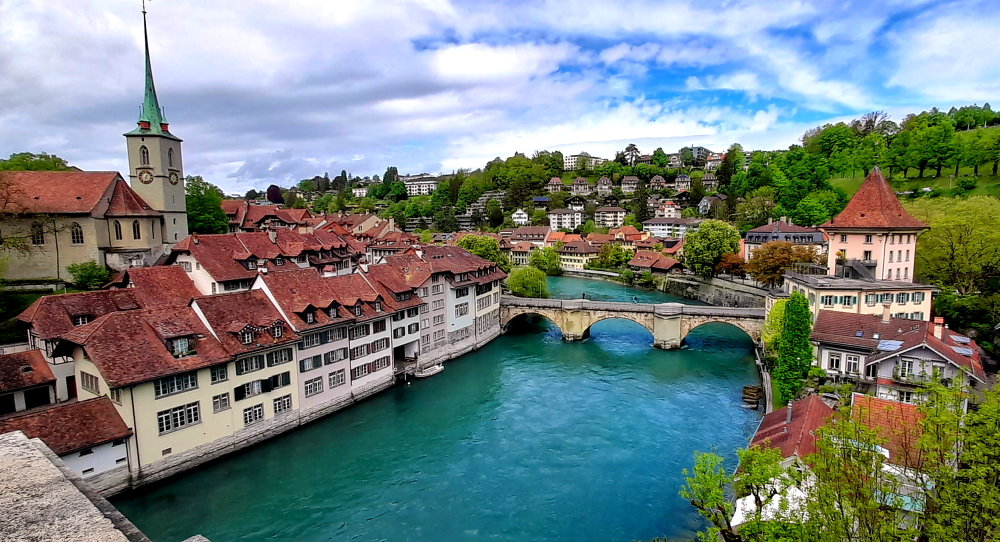
Junkerngasse becomes Nydeggstalden which crosses the Aare at the Nydeggbrucke (bridge).
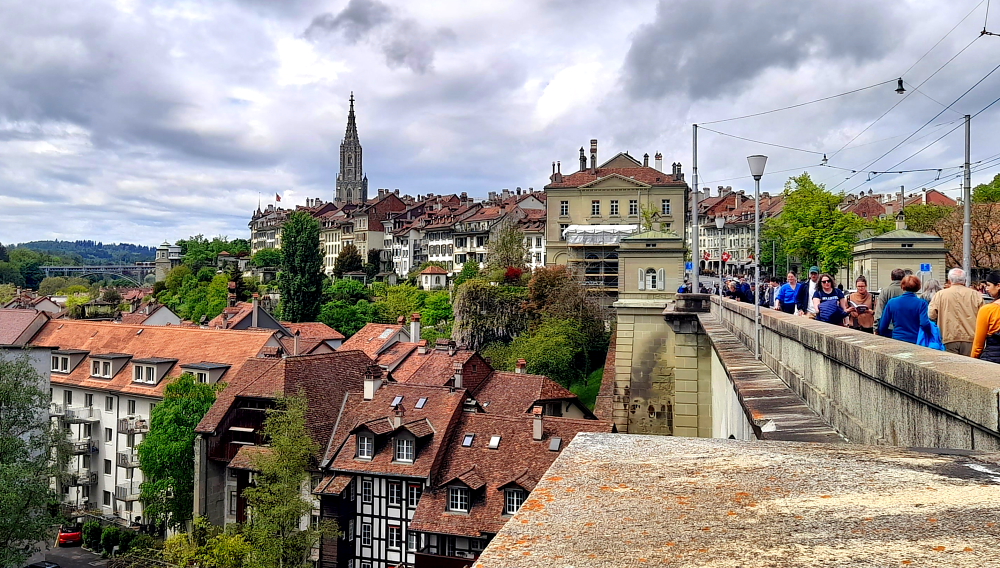
Which brings us to, on the other side, the Barengraben – the Bear Pit. The “Mutzen” – Bjork, Finn, Ursina and Berna – live exclusively in the park on the slopes of the Aare, with a view of Bern’s UNESCO-listed old town. The approximately 5,000 square metre area extends from the former bear pit down to the banks of the Aare accessed via stairs.
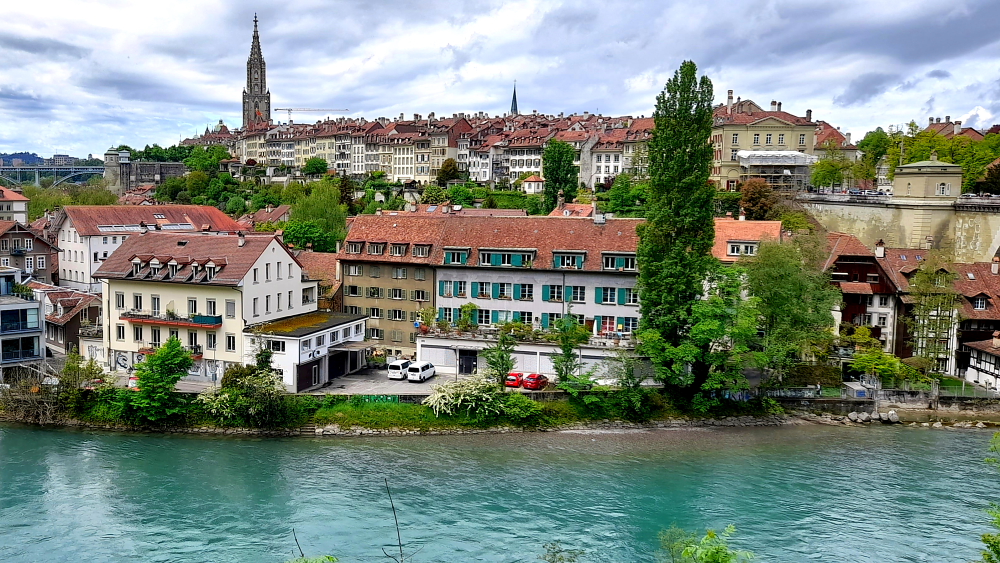
The relationship between the city of Bern and its heraldic animal has a very long tradition. It is said to have been a bear that the founder of the city, Duke Berchtold V of Zähringen, was the first animal to kill here and to which, according to legend, the new city owes its name.
The Bernese chronicler Valerius Anshelm reported in 1513 how the Bernese returned victorious from the Battle of Novara with the conquered flags and a live bear as spoils of war in their triumphal procession. The bear was kept in the city moat in front of the cage tower. The first bear pit remained on what is still called Bärenplatz today until it was moved due to traffic to the city gates in 1764. From there the bears were moved again in 1857 to the lower end of the old town, to the location where the Bear Park is still located today [tierpark–bern-ch.].
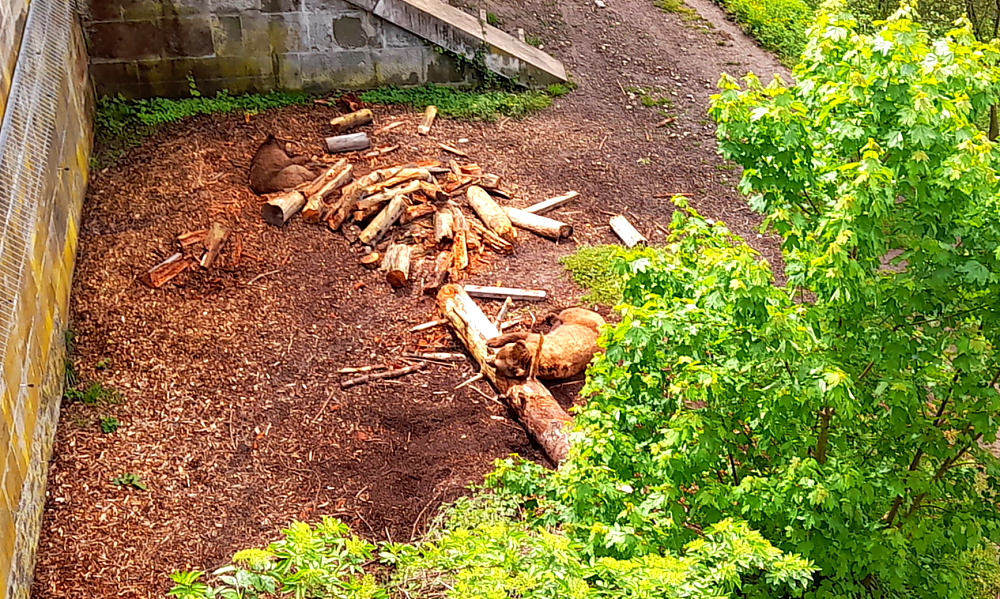
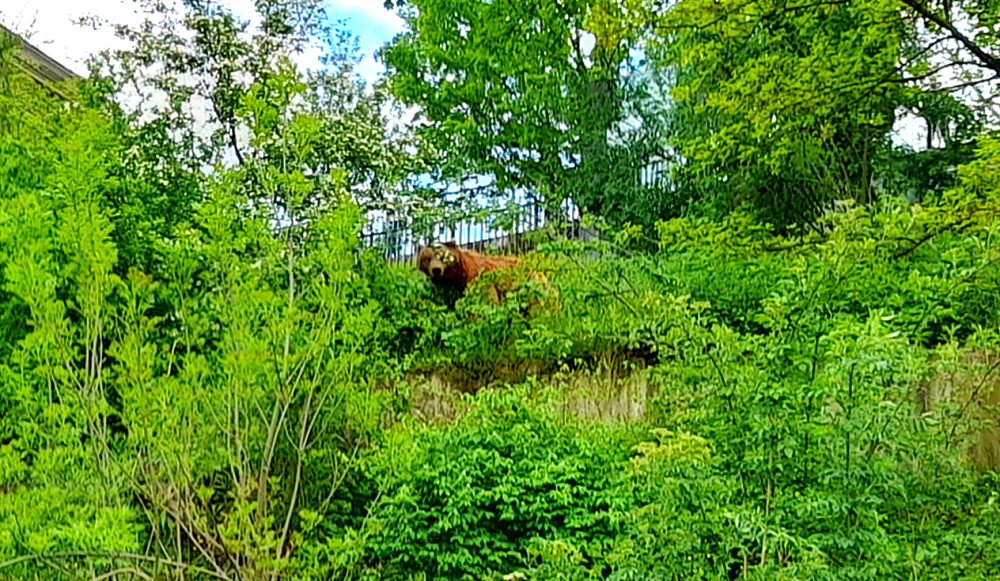
At first we see 2 brown bears asleep by some logs then after we walk down the stairs, another bear that was down there has scarpered back up the slope so we only get to see it fleetingly amongst the foliage, except for when it turns its back and we get a full view as the bear moons the crowds below.
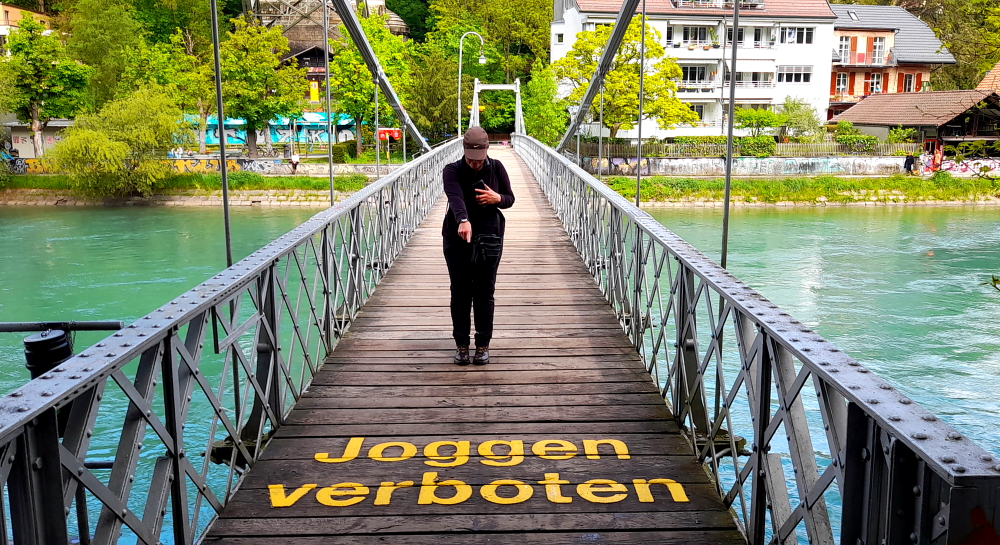
The path from the lower level of the Bear Pit takes us under the high Nydeggbrucke around to the older, lower, Untertorbrucke, where we cross back to the other side to walk along the river path to the bridge.
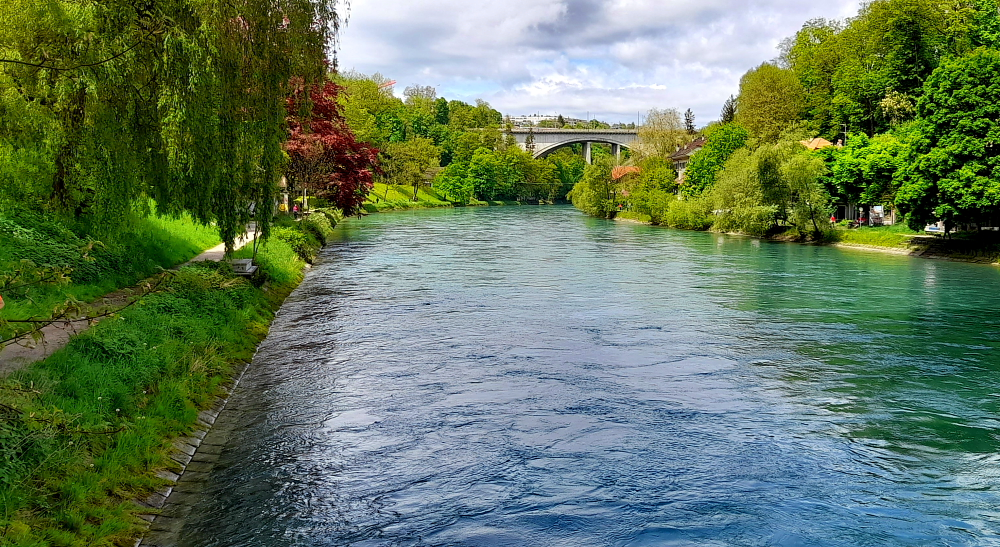
Fortunately, besides Kornhaubrucke, there is also a low-level pedestrian bridge beneath it. Looking up river we see a bevy of bikini-clad women immersing themselves in this glacial river. Not swimming, mind, just squatting in the water at the river’s edge.
The reason we are here is to walk the short distance to the Botanical Gardens. After a leisurely choc shake at the cafe, sitting in the 24 degrees sunshine, Lynn makes a beeline for No. 1 on the map, the Alpine garden towards the top of the hill.
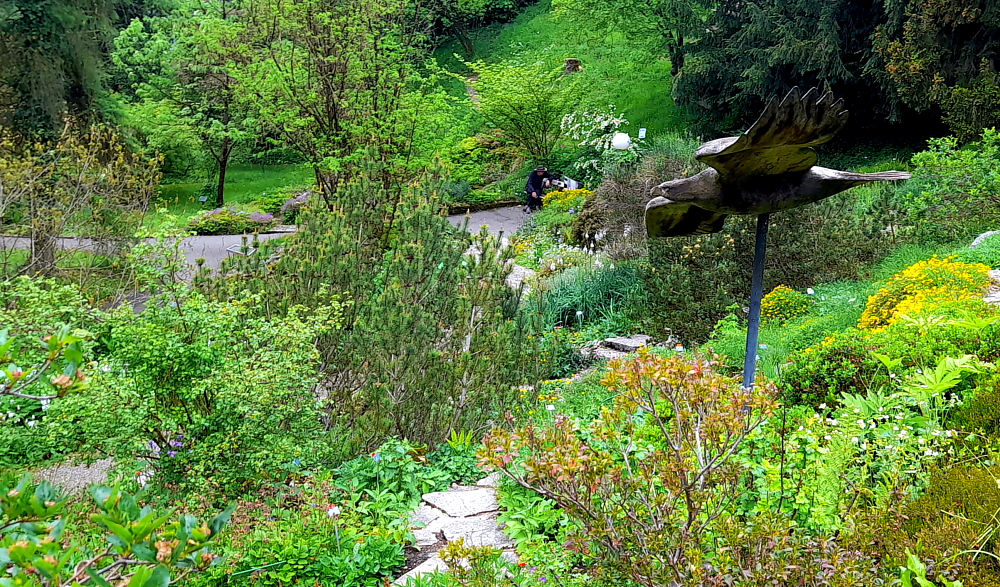
Specifically, No. 1d, the Swiss Alps, only to find that, disappointingly, there is not one, single, eidelweisse in sight!
Turning right at the exit from the Gardens places us on Nordring and up the road to the Gewerbeschule bus stop where 2 minutes later we catch the No. 20 back home.
A relaxing afternoon and dinner in followed by our continued viewing of the TV series “The Marvelous Mrs Maisel”, about a Jewish female stand-up comic in late 1950’s USA, which is interrupted from time to time by flashes of lightning and lightning bolts out the window.
Again, at bedtime, I do my repeat performance with the remote. Again, 2 seconds later, the wife has it sorted!
6 May, 2024
Rain and 13 Deg. C today, perfect for catching up the past 2 days of blog, when we are interrupted by the doorbell and the arrival of 2x hot water plumbers to fix the boiling water mechanism on the kitchen tap. Tick. Still waiting for the guy to fix the remote for the sheer curtains, though.
5:00 pm finds us waiting outside the front door of Il Profeta Italian restaurant that is 2 blocks away. The restaurant is open early and the food is pretty good however it is still at Swiss prices.
Tomorrow we depart Switzerland and head back in to France. We are staying in Nancy, France for 5 days to relax at the Mecure near the old town centre. Neither of us has been to Nancy so we have no idea what to expect.
 THE CONTINUING TRAVELS OF YOGI & BOO BOO