
16 December, 2023
Once again we opt for toll-free roads to our next destination as it’s only 30 minutes’ difference to drive the 274 kms. We depart in 12 Deg. C. sunshine at 11:10am and call into a car wash 10 minutes later. We’re back on the road 20 minutes later and are due to arrive in Zaragoza around 14:40pm – 3 hours later.
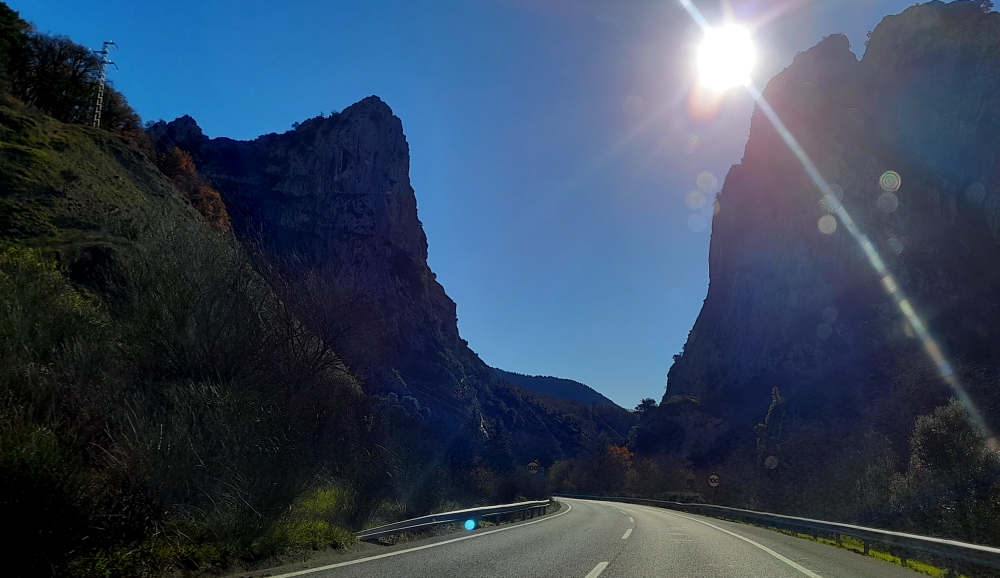
It isn’t until we arrive at the slip road just outside of San Sebastian to get onto the A15, the direct route to Zaragoza, that we see it is closed, with no alternative routing provided. So we continue driving down the N1 until the GPS finally kicks in with an alternative route – the GI-2130.
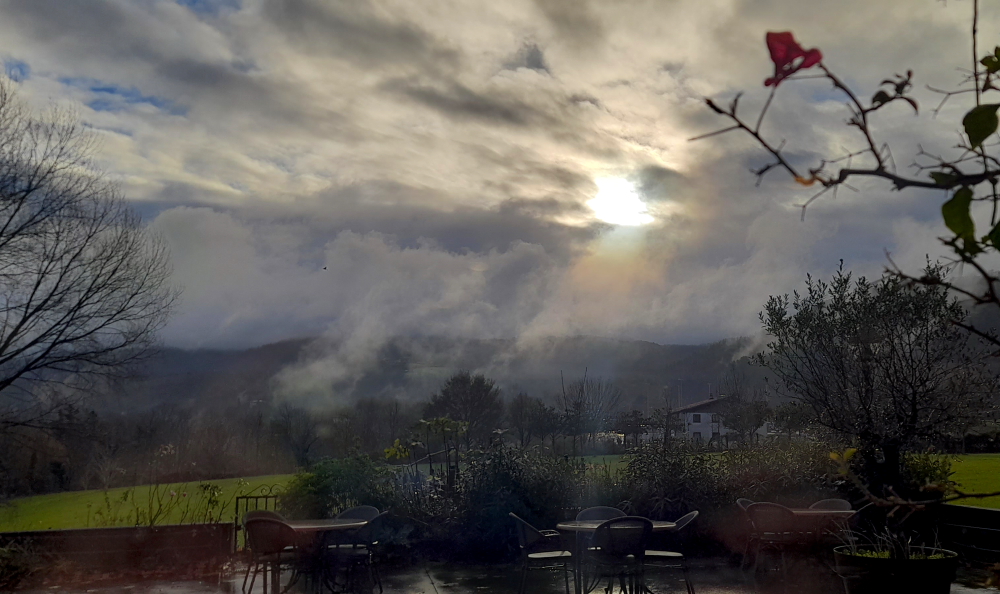
This road takes us from Tolosa through hillside villages such as Ibarra and Berrobi. With the amount of traffic coming the other way, including trucks and buses where we are sandwiched between them and road-side houses to squeeze past, that section of the A15 must still be closed. About half an hour later we rejoin the A15.
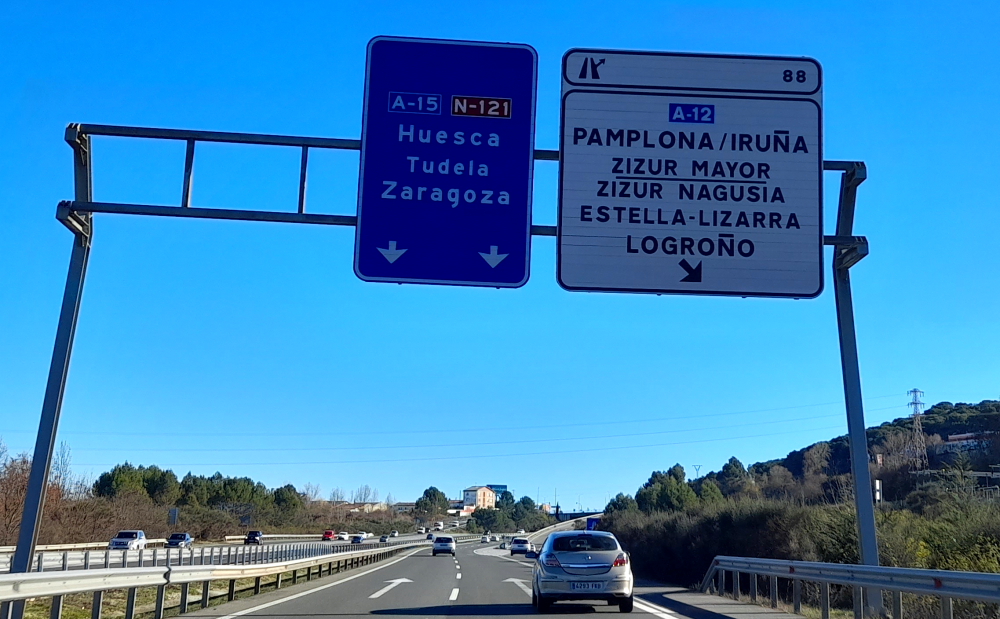
Opting to use toll-free roads actually lets us use some sections of toll roads, whereby we get off and get on them to avoid the toll booths. Often the roads we drive on parallel the AP/toll roads. The best of both worlds.
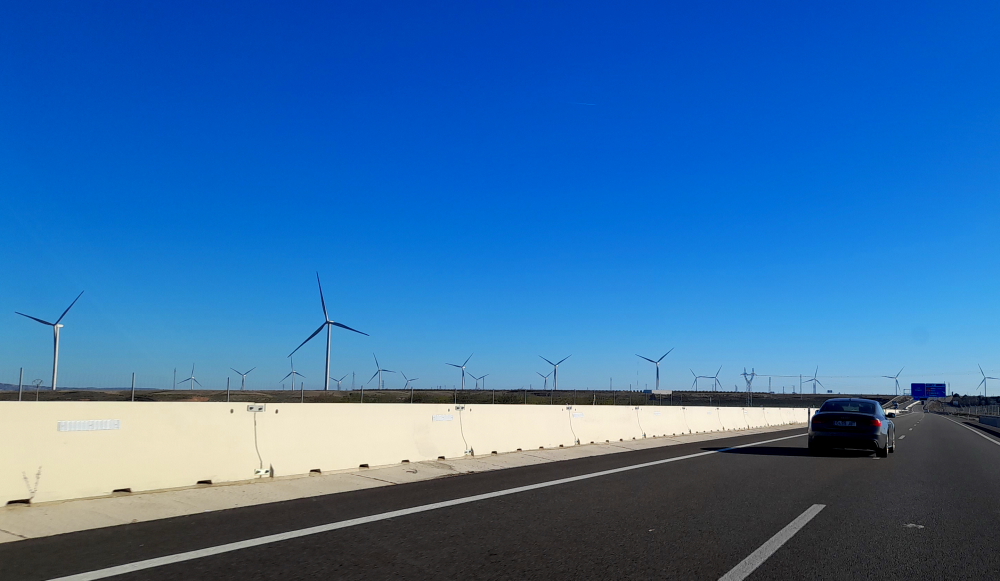
The landscape between Pamploma and Zaragoza is quite dire with some sections devoted to large solar farms and wind turbines. Quite the blot on the landscape.
So it’s with a sigh of relief that we approach Zaragoza which rises out of the desolate plain like a concrete oasis and arrive at our hotel, the NH Collections Gran Hotel which is just outside of the old town/former Roman walled town.
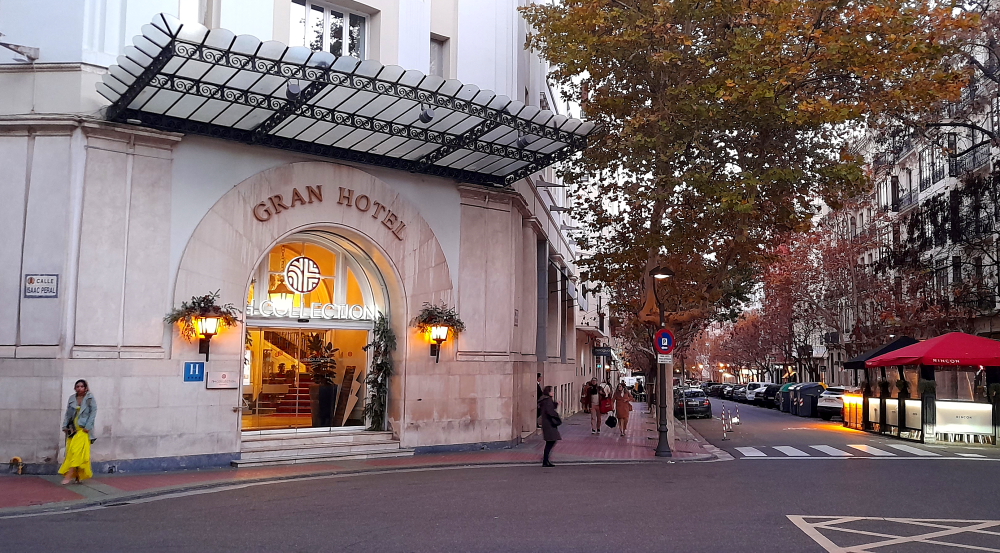
I park the car in an underground car park nearby while Lynn checks us in then we unpack.
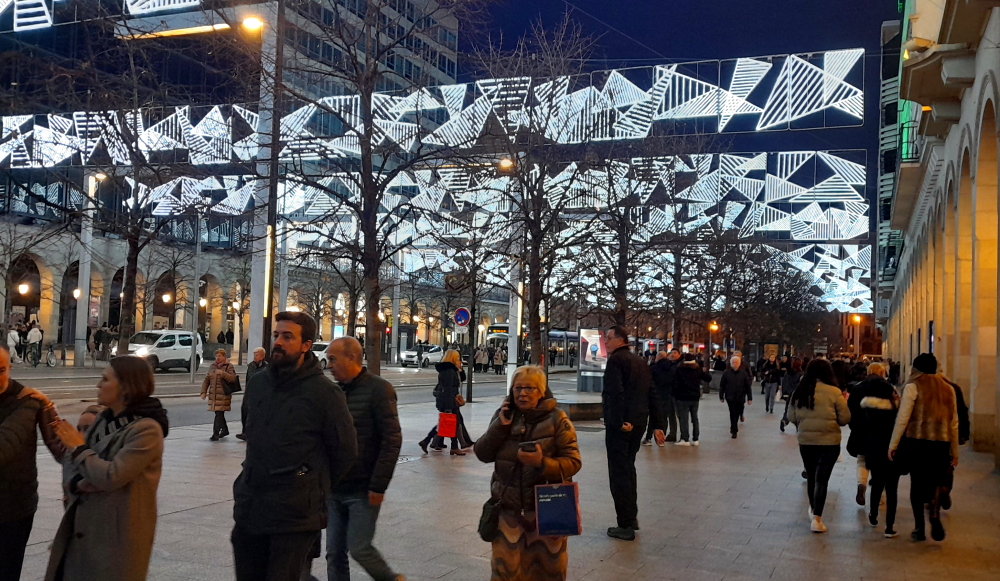
By the time we’ve caught our breath it’s starting to get dark so we walk a couple of blocks to the wide Paseo de la Independencia where there are Christmas lights strung across the boulevard, down to the Plaza de Espana and return.
17 December, 2023
Up bright and early as we need to be at Caesar Augustus’s statue at 10:00am, a 15-minute walk away near the Ebro River, to join a 2-hour walking tour of the old town.
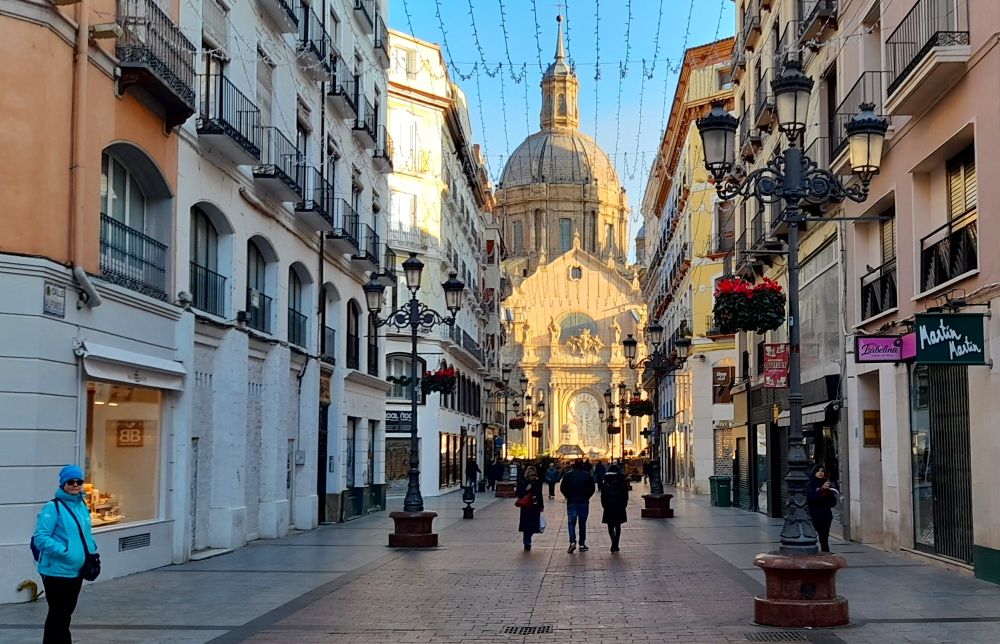
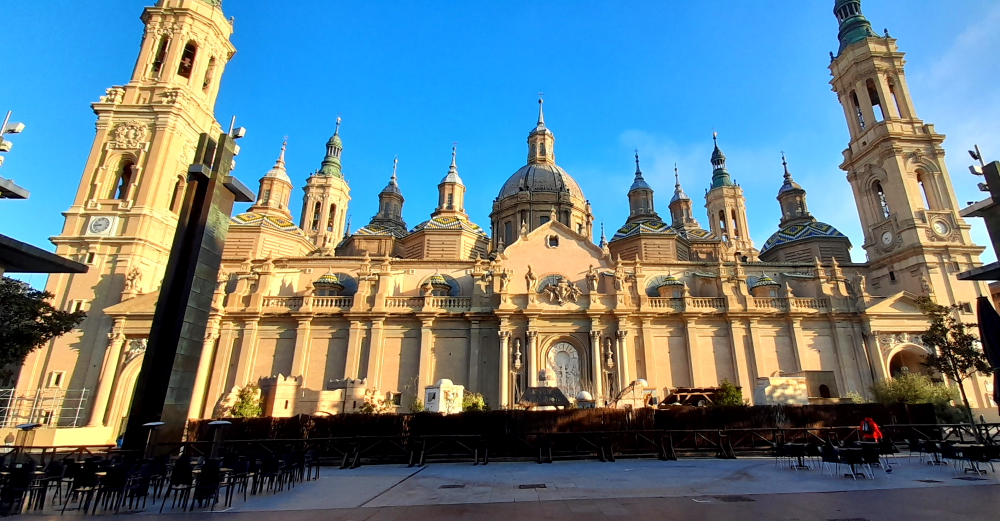
We are drawn by the view of the Basilica so we walk to Plaza de Nuestra Senora del Pilar (Plaza of Our Lady of the Pillar) where the Basilica reveals itself in its majestic entirety. And the Plaza is also the location of this year’s Christmas market!
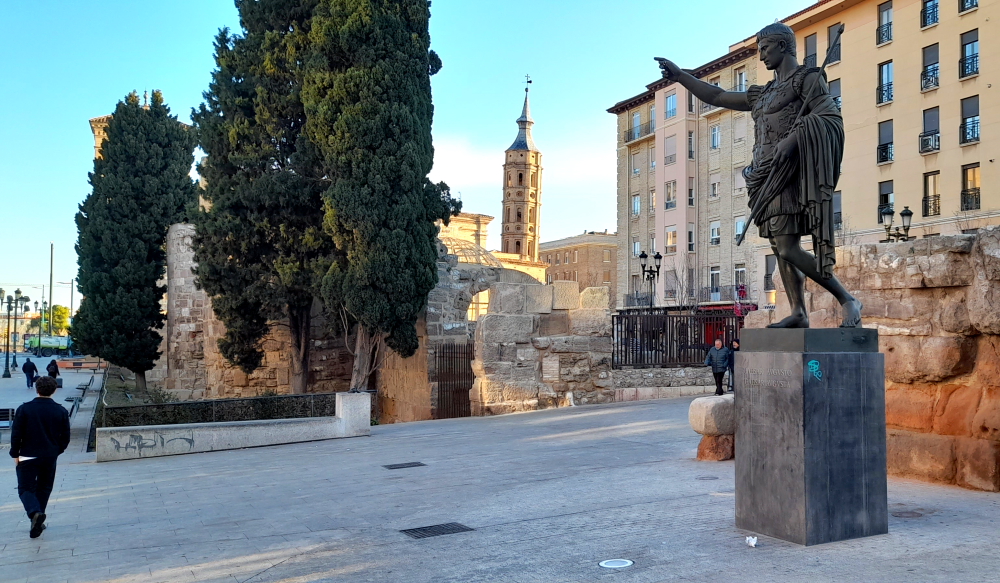
Around the corner Caesar’s statue and partial Roman walls where we meet up with Edu and 5 other like-minded individuals.
The Iberian town that preceded Roman colonisation was called Salduie/Salduba and was populated by a tribe of ancient Iberians, the Sedetani. The Romans and Greeks called the ancient city Caesaraugusta from which derived the Arabic name Saraqusṭa (used during the Al-Andalus period), the medieval Çaragoça, and the modern Zaragoza.
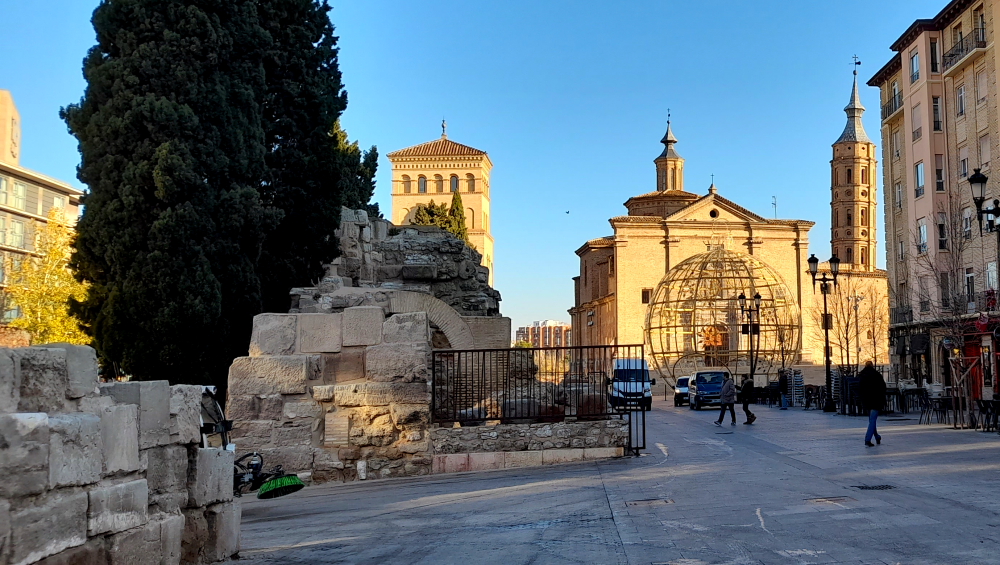
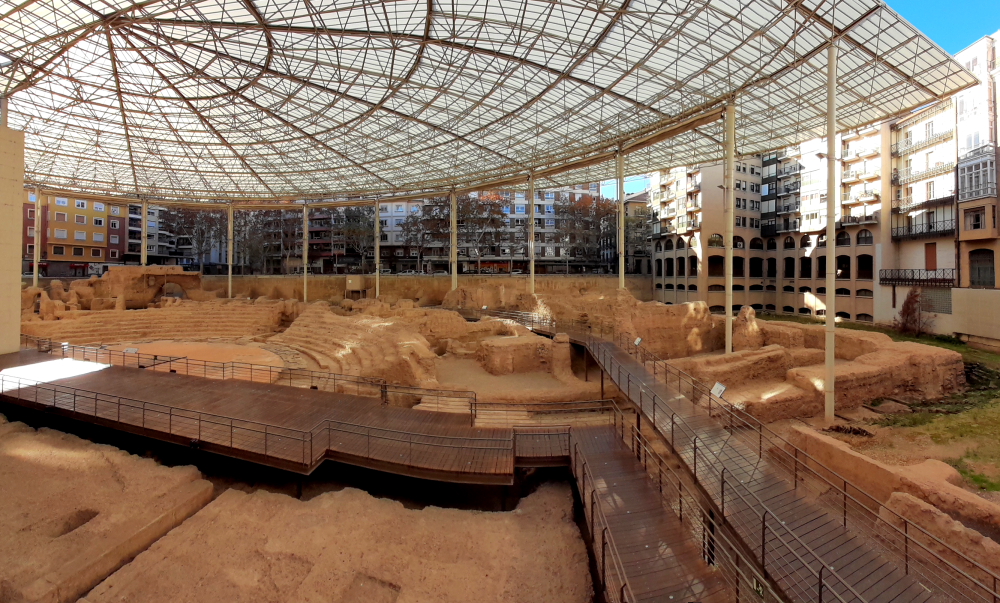
Augustus founded the city as Caesaraugusta between 25 BC and 11 BC as a colony. As a Roman city, it had all the typical public buildings: forum, baths, theatre, and was an important economic centre. Many Roman ruins can still be seen in Zaragoza today.
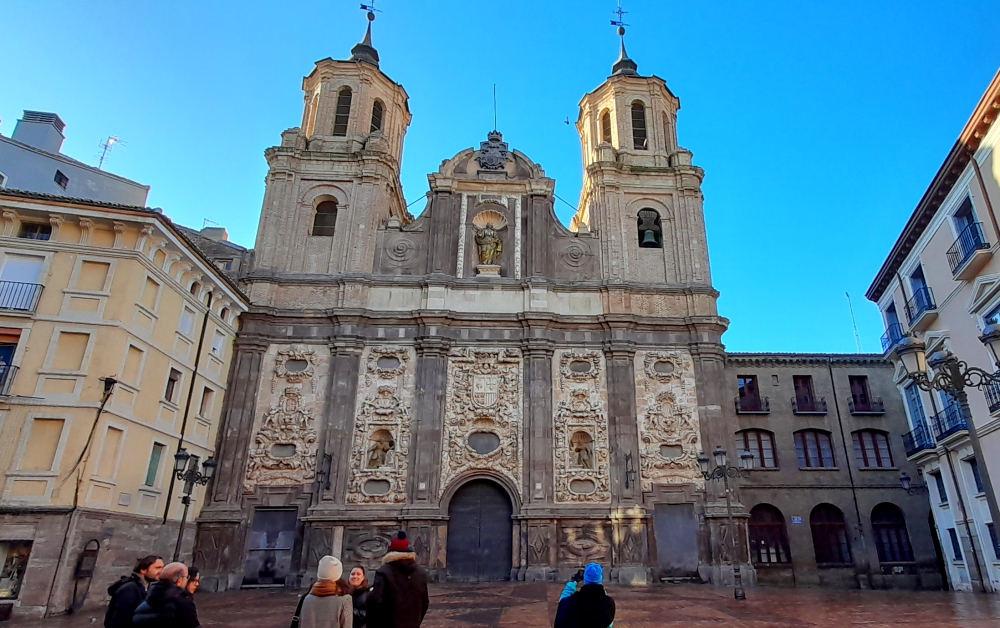
In the 5th century AD the town was captured peacefully by the Goths. During the 8th century the Iberian peninsula was conquered by the Moors.
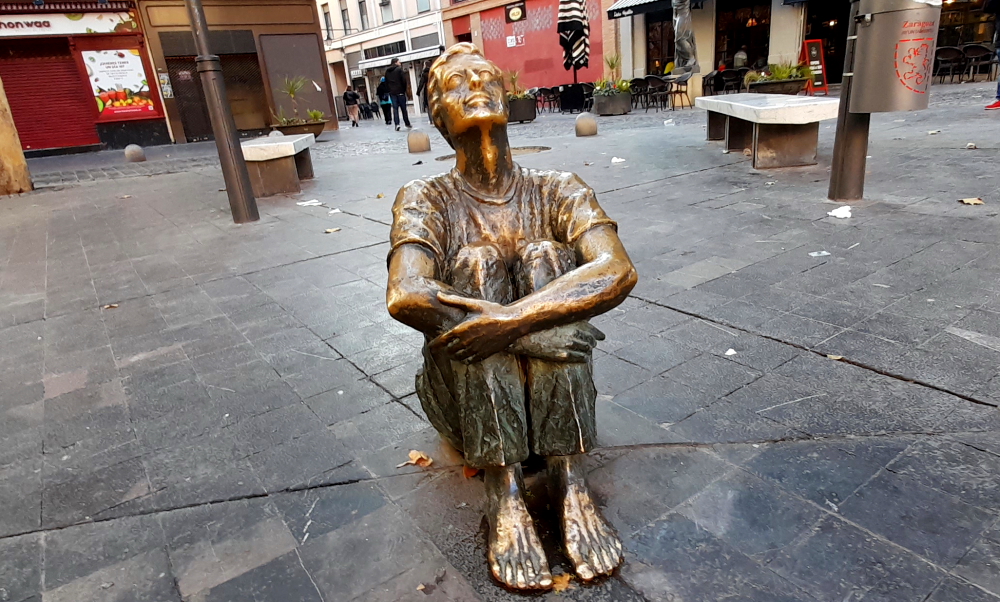
In 1018, with the collapse of the Caliphate of Córdoba, Zaragoza became an independent Taifa of Zaragoza, initially controlled by the Tujibid family. The taifa greatly prospered culturally and politically in the late 11th century but fell to the Almoravids in 1110. In December 1118, Alfonso I of Aragon conquered the city from the Almoravids and made it the capital of the Kingdom of Aragon.
Bubonic plague decimated the town in 1564, reportedly killing one-third of its population (10,000 of 25-30,000).
During the 1701–1714 War of Spanish Succession Philip V became the victor and consolidated his rule over the kingdom of Aragon. In 1766 a food riot and subsequent repression left about 300 wounded, 200 detainees and 8 deaths, followed by 17 public executions, and an indeterminate number of killings at the dungeons of the Aljafería.
Zaragoza suffered two famous sieges during the Peninsular War against the Napoleonic army: a first from June to August 1808; and a second from December 1808 to February 1809, surrendering only after some 50,000 defenders had died. During the Spanish Civil War the city played a key role for the Francoist faction as ammunition manufacturer. Being on the ‘winning’ side, the city suffered little damage during that war.
The Basque nationalist organisation ETA carried out the Zaragoza barracks bombing in 1987 which killed 11 people, including a number of children, leading to 250,000 people taking part in demonstrations in the city.
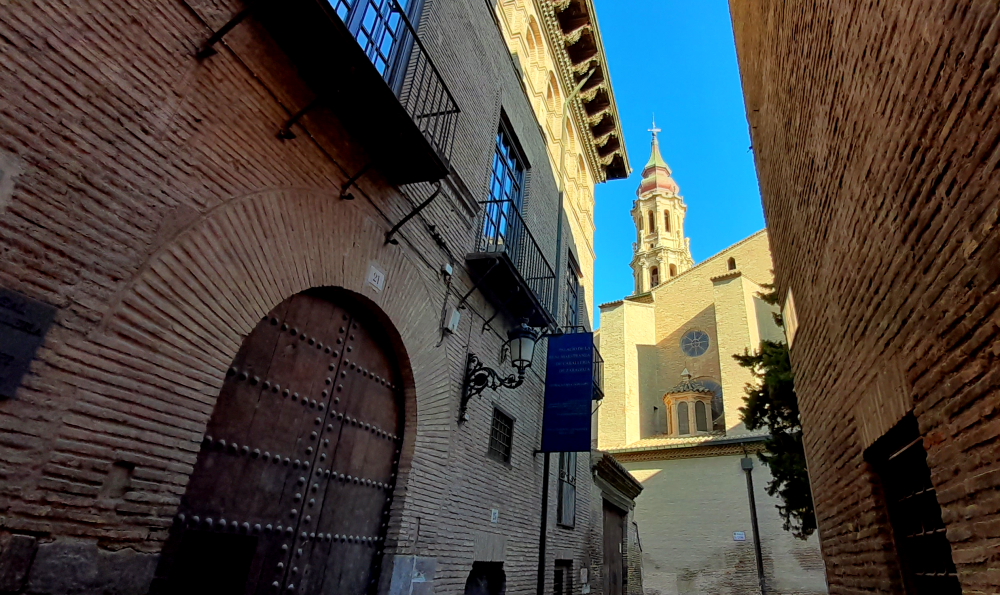
By now we have made our way through the alleyways of the old town to the Plaza de la Seo (the See) near the river.
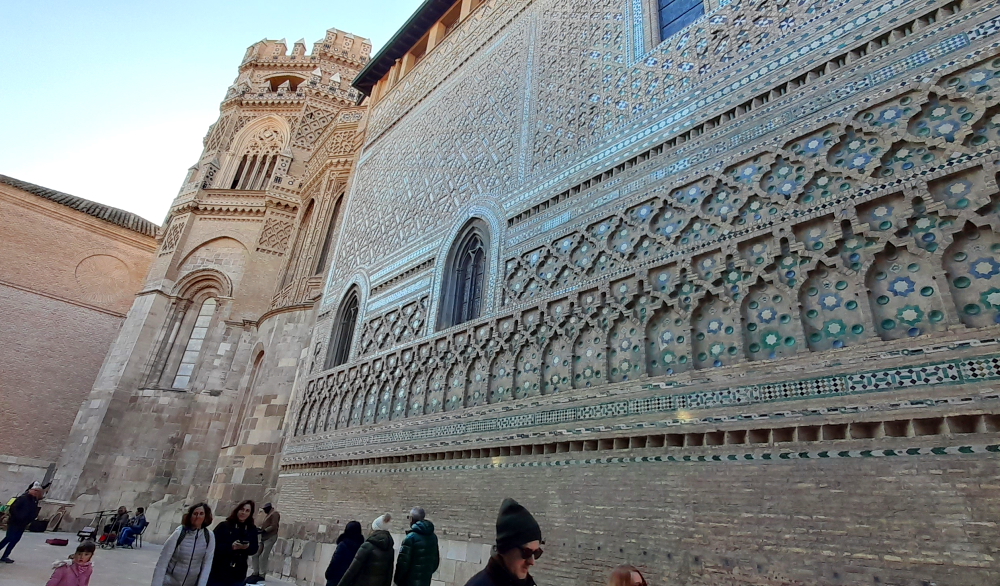
The Catedral del Salvador is a Catholic church built over the main mosque (partially preserved in the 11th-century north wall of the Parroquieta), with Romanesque apses from the 12th century.
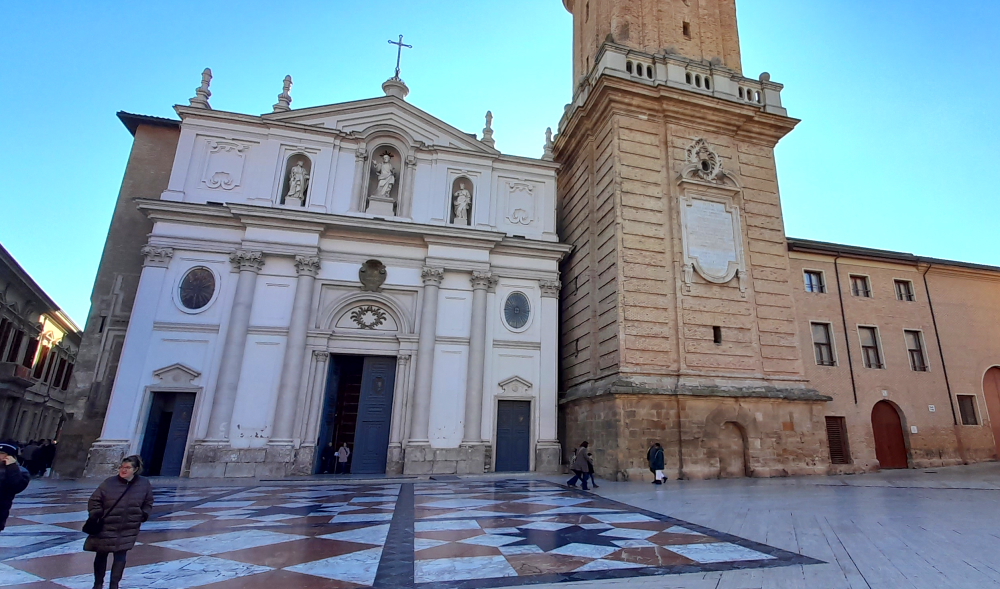
Inside, there is the imposing hall church from the 15th to 16th centuries, and its Baroque tower. Next door, to the right, is its Museum of Tapestries.
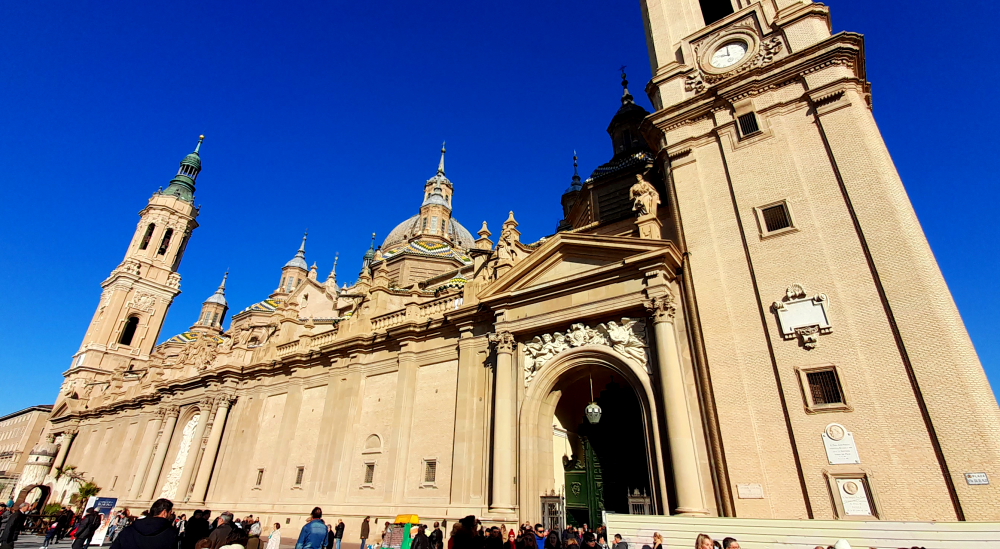
The Basilica del Pilar is dedicated to the Blessed Virgin Mary under the title of Our Lady of the Pillar, praised as “Mother of the Hispanic Peoples” by Pope John Paul II. It is reputed to be the first church dedicated to Mary in history. Baroque-style architecture, the present building was mainly built between 1681 and 1872.
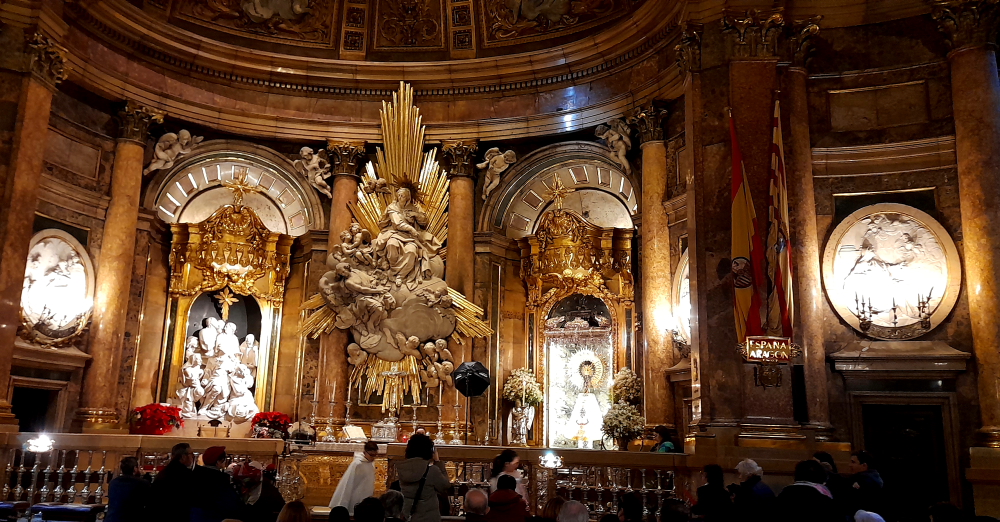
The history of this basilica is attributed to an apparition of the Virgin to Saint James the Great, the apostle believed to have brought Christianity to Spain. This is the only reported apparition of Mary to have occurred before her believed Assumption.
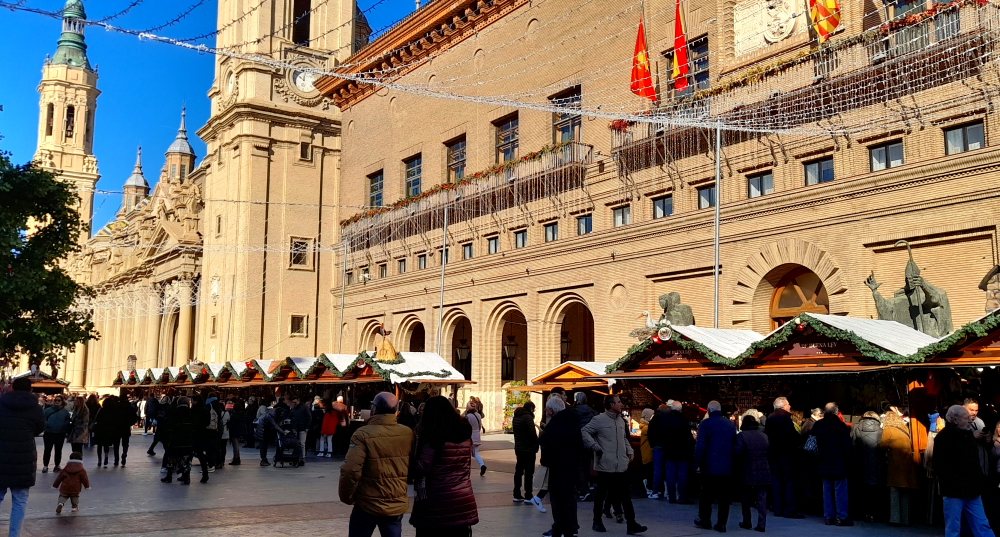
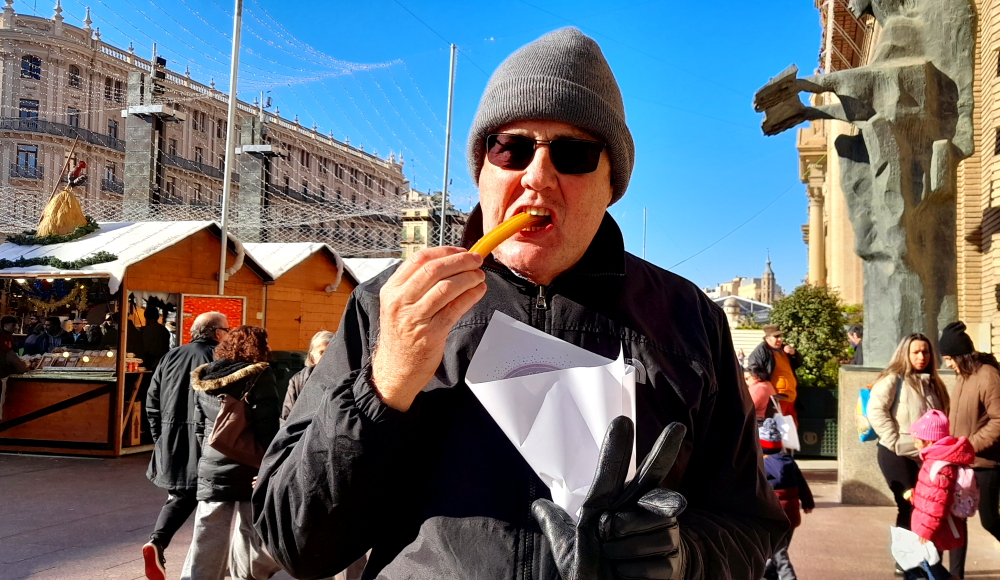
In the plaza outside the Basilica are 2 sets of Christmas Market stalls selling a variety of handcrafts and jewellery but mostly fare such as nuts, crepes, churros, cheeses, meats, etc.
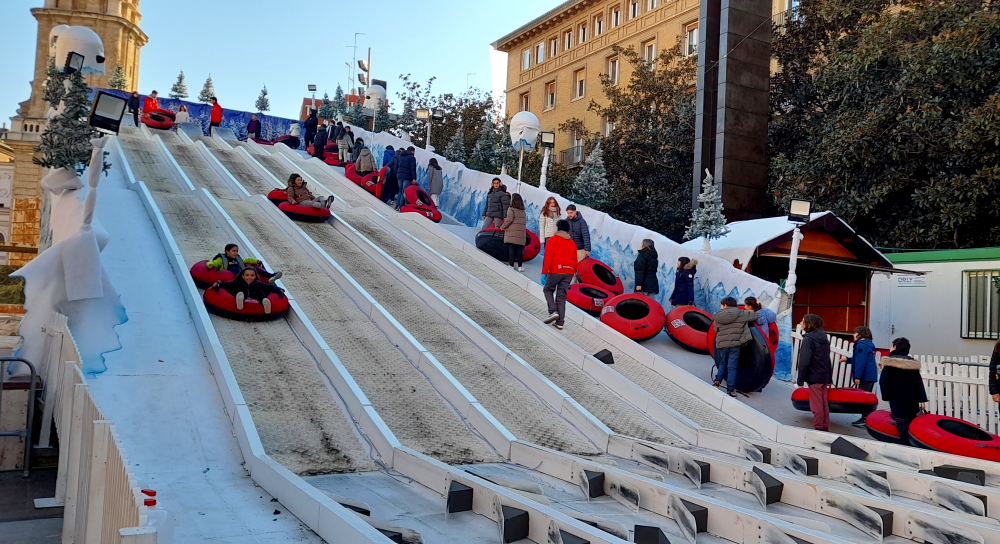
At the cathedral end of the plaza a toboggan slide has been set up with kids dragging over-sized inner tubes to the top for a short bumpy ride to the bottom.
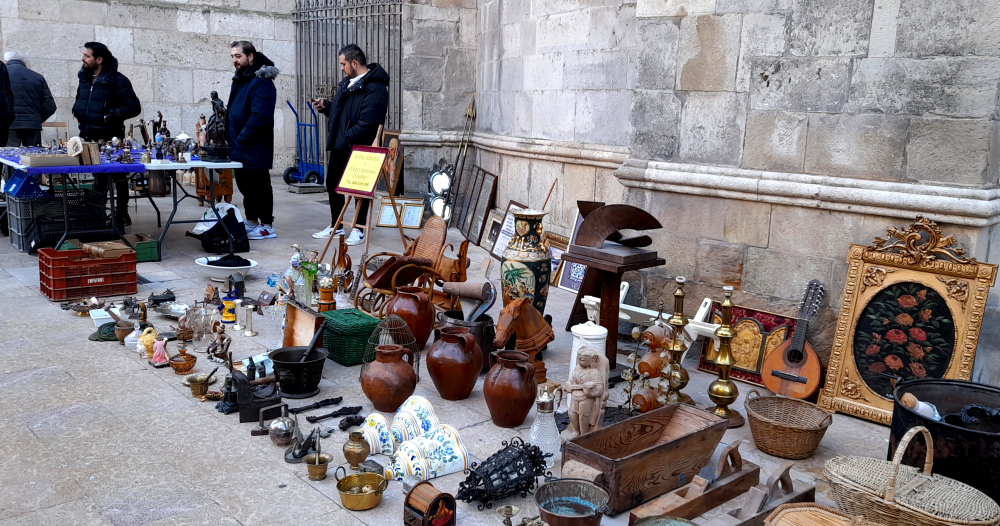
We exit the Christmas Market and walk towards the cathedral once again where we find an antiques market in progress.
Crossing the road we can see the Puente de Piedra (Stone Bridge), the oldest bridge in Zaragoza that crosses the Ebro. Its origins date back to the founding of Caesaraugusta. In the 1st century there is evidence of a bridge which gave access to one of the main entrance gates to the city.
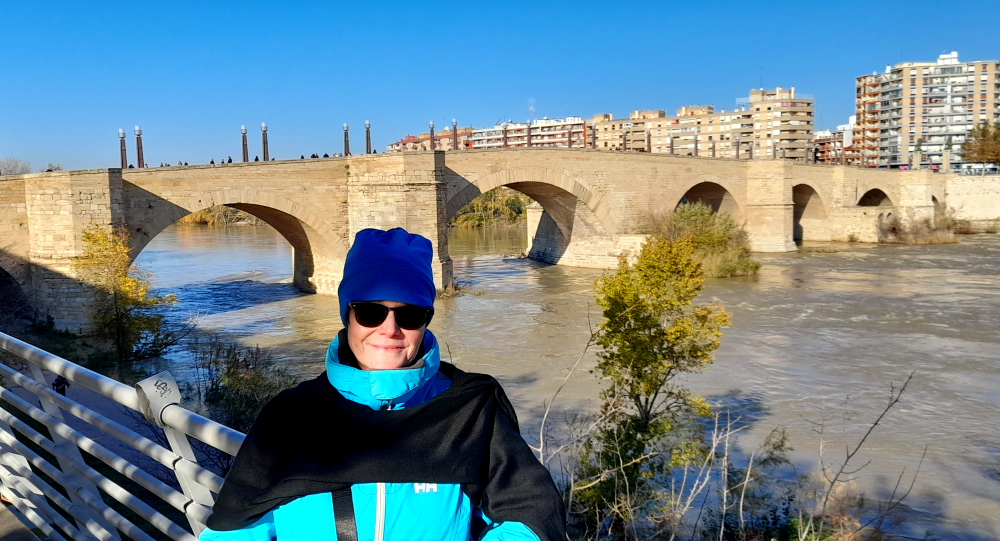
The bridge today is from the 15th century, built between 1401-1440. At the end of the 18th century, the Parapet of San Lázaro was built to protect the left bank from floods. In 1813, after the Siege of Zaragoza, Napoleonic troops blew up the archway closest to the Arrabal when they were fleeing, leaving the city cut off and preventing the Aragonese troops from pursuing them.
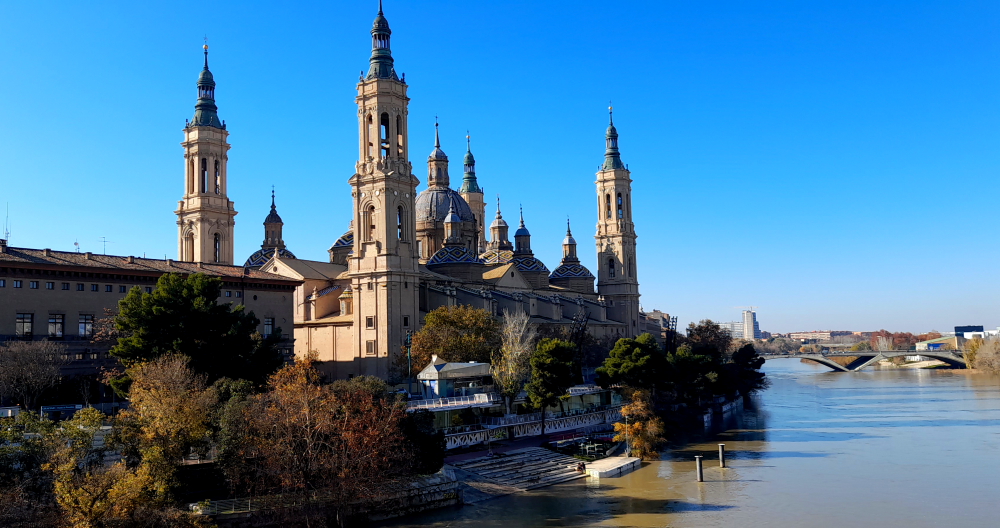
Back to the Christmas Market we sample some churros and chocolate dip.
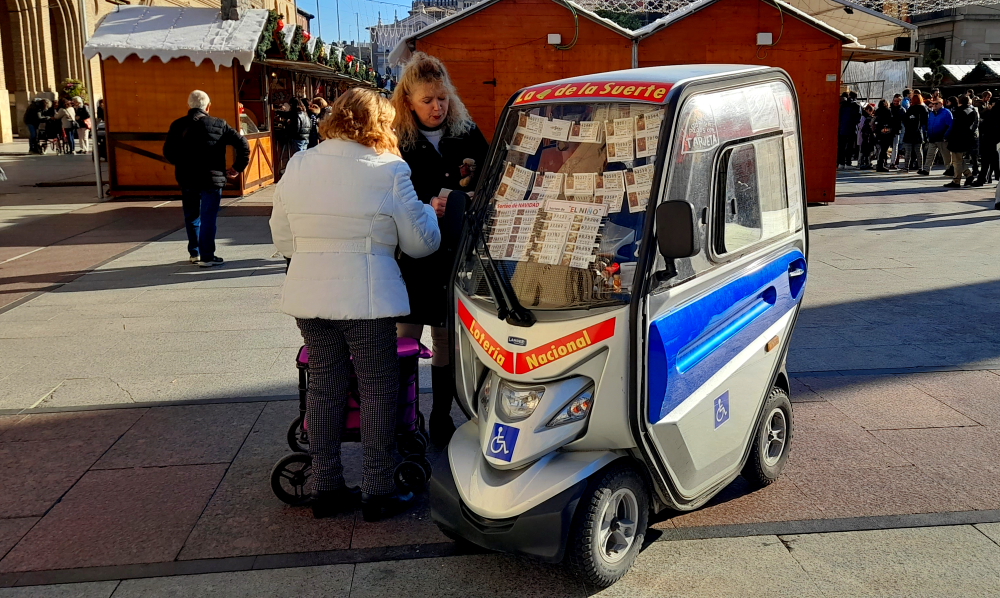
One thing we remember about Spain is its lottery, specifically kiosks or holes-in-the-wall where people queue to buy their tickets. Now, there are also mobile kiosks, this one playing Christmas music and the sound of a ringing bell associated with Santa Claus as it meanders around the market!
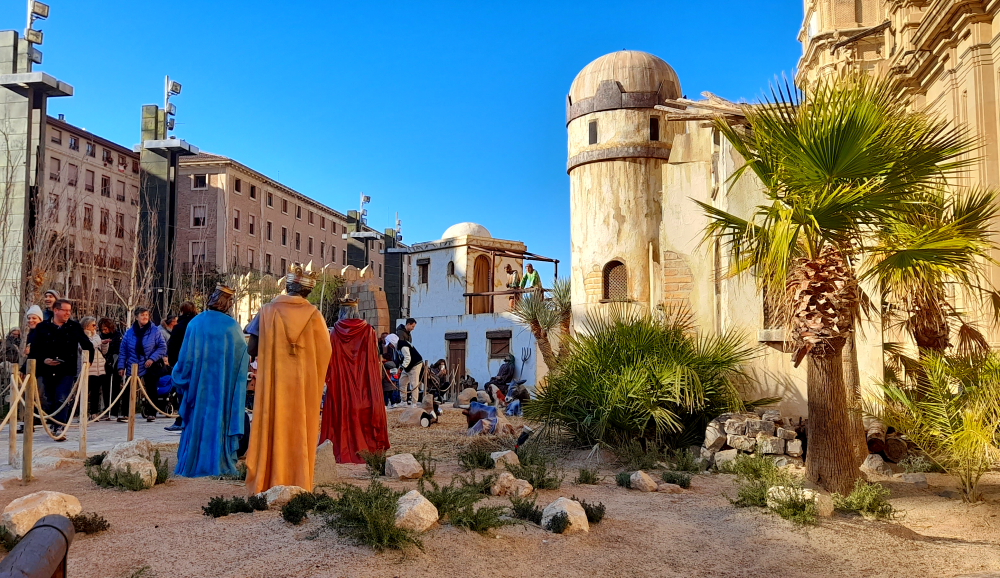
All the churches that Lynn has visited recently now feature Nativity Scenes, but not like Zaragoza’s. Here they’ve built a little hamlet in the middle of the Plaza del Pilar so that you can meander through a ‘Bethlehem’ to view the nativity. For a fee, of course!
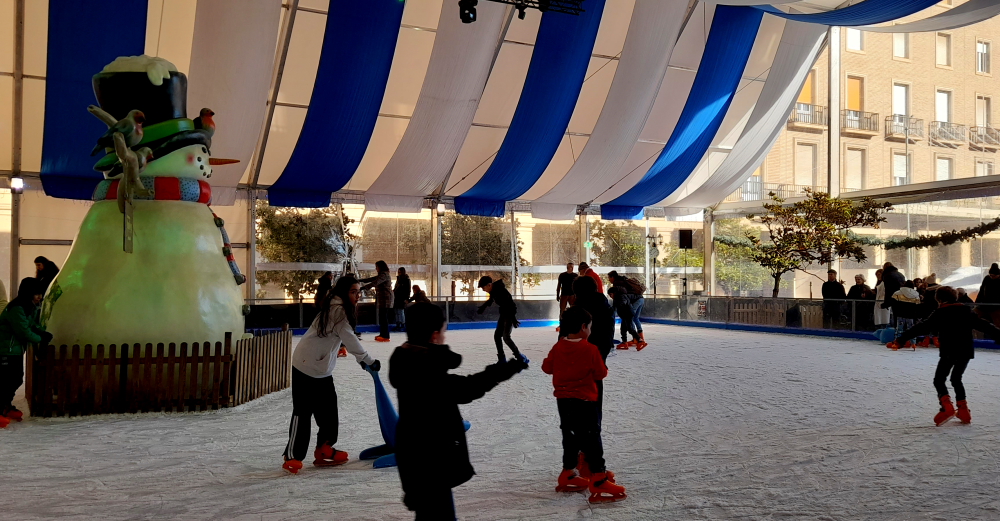
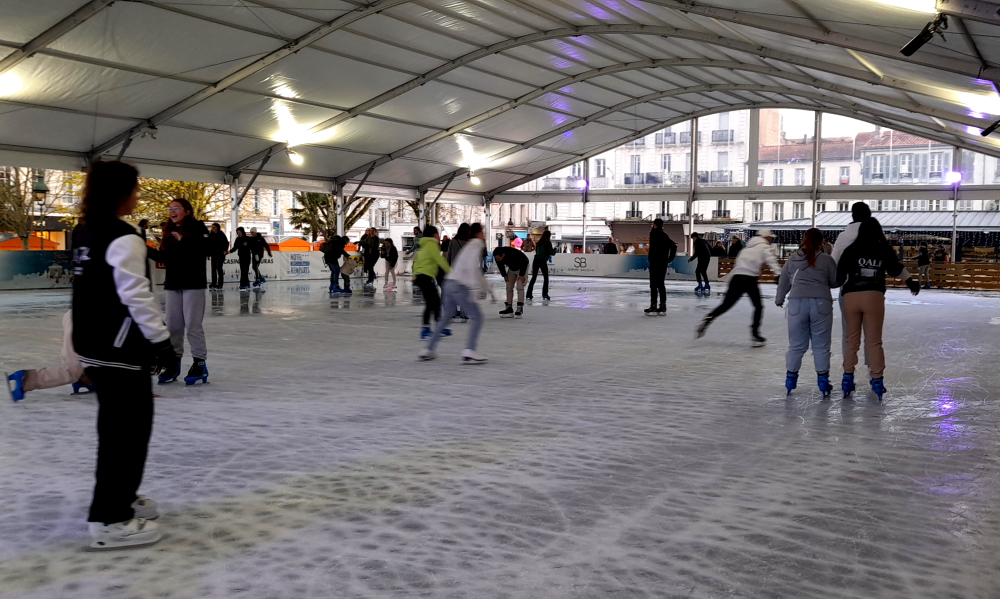
Cheek by jowl with the desert scene is an arctic one – the mandatory ice skating rink.
Remembering the amazing Christmas lights in Nerja last year we venture out this evening to see what Zaragoza has to offer.
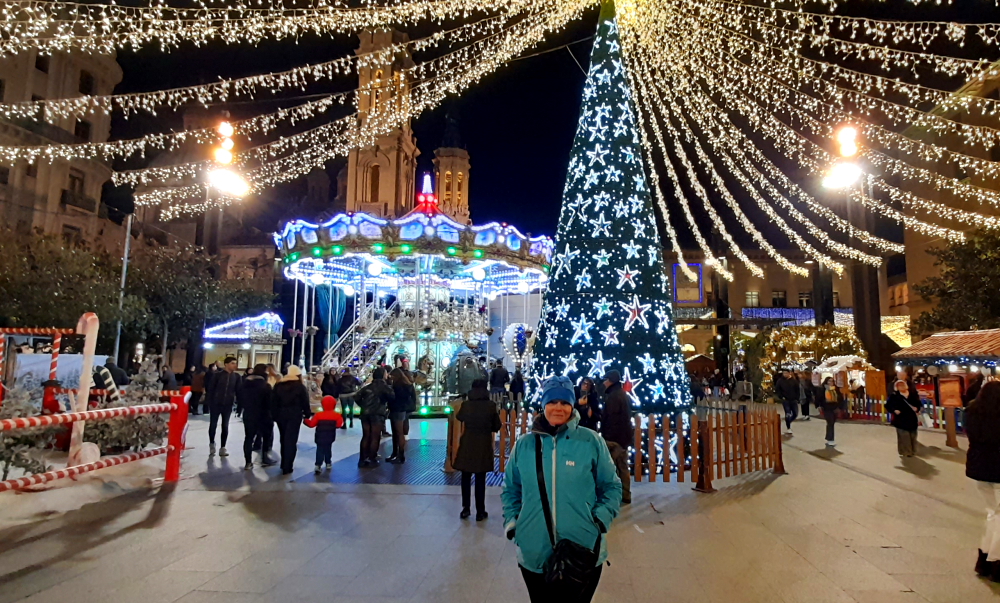
Besides the overhead banners along the length of Paseo de la Independencia, there is also a small Christmas tree at the edge of the Plaza de Pilar along with an illuminated merry-go-round …
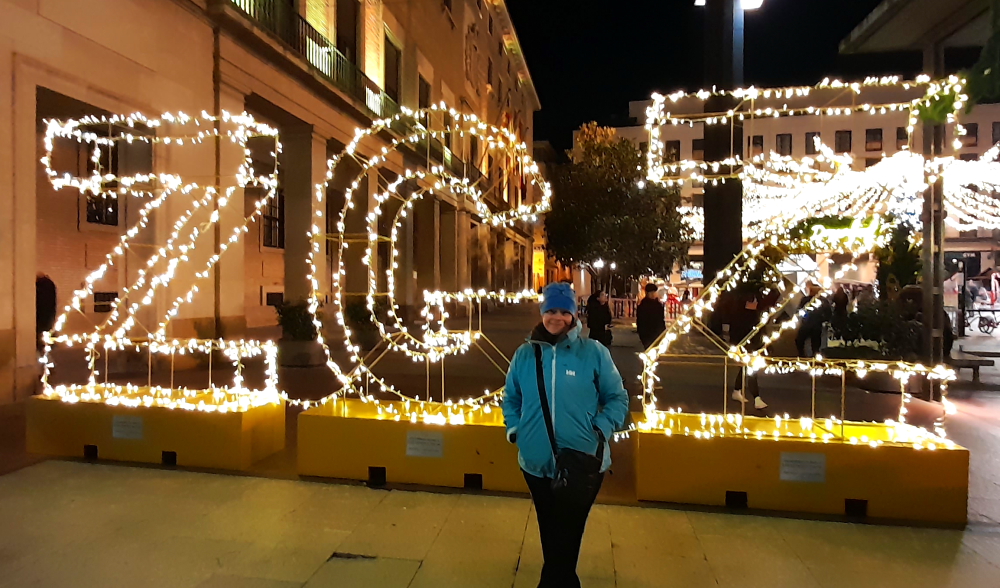
… and a ZGZ illumination. Not a patch, really, on Nerja!
18 December, 2023
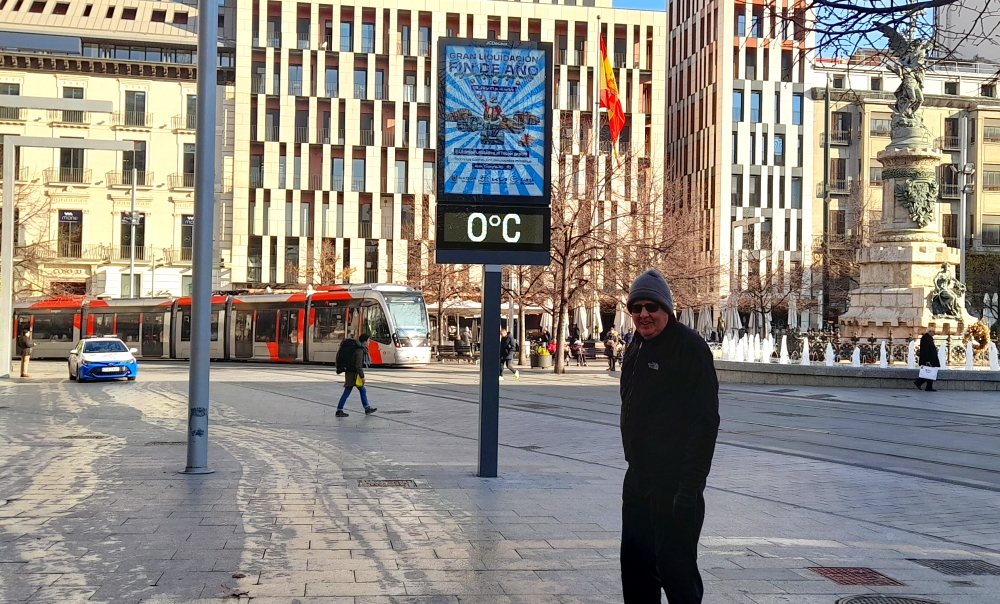
11:25am and it’s 0 Deg. C. in Paseo de la Independencia. Electric trams glide quietly up and down this street and it’s nice to see that there are no overhead lines to mar the street scape.
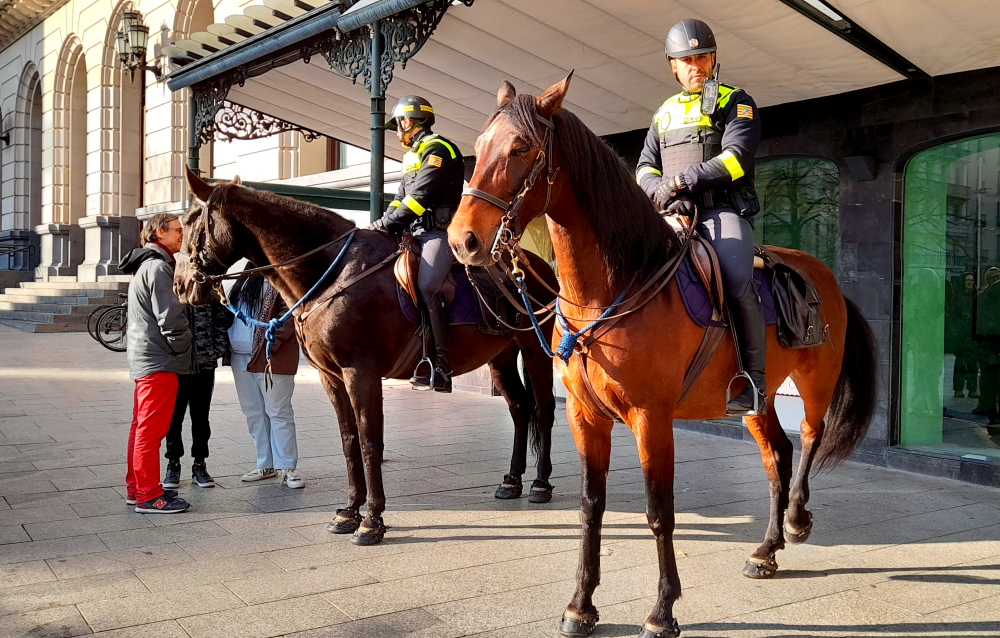
Opposite the trams, 2 horse power.
Our destination this morning is the Aljaferia Palace, a 25-minute walk from the hotel. It was a recreational residence of the Muslim kings and reflects the splendor achieved by the Taifa kingdom at its highest political and cultural peak. It has been a fortified enclosure, Aragonese royal residence, headquarters and prison of the Inquisition, palace of the Catholic Monarchs, barracks and, since 1987, the brand new headquarters of the Cortes of Aragon.
Ten centuries later, that palace of joy dreamed of by the Muslim monarch Al-Muqtadir continues to be, along with the Alhambra of Granada and the Mosque of Córdoba, one of the artistic jewels of the Muslim presence in southern Europe. In 1931 the building was declared a National Monument of Historical and Artistic Interest but it wasn’t until 2001 when UNESCO declared the Mudejar art of Aragon a World Heritage Site.
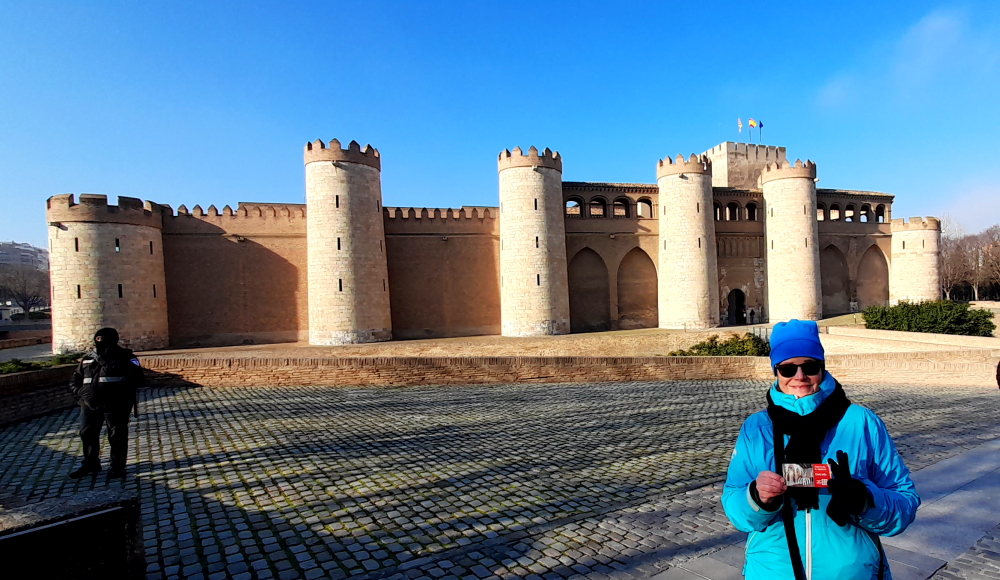
The oldest building in the Aljafería is the so-called “Tower of the Troubadour”, a defensive tower, which received this name from the romantic drama by Antonio García Gutiérrez, The Troubadour, from 1836. This drama was turned into a libretto for Giuseppe Verdi’s opera Il trovatore, from 1853.
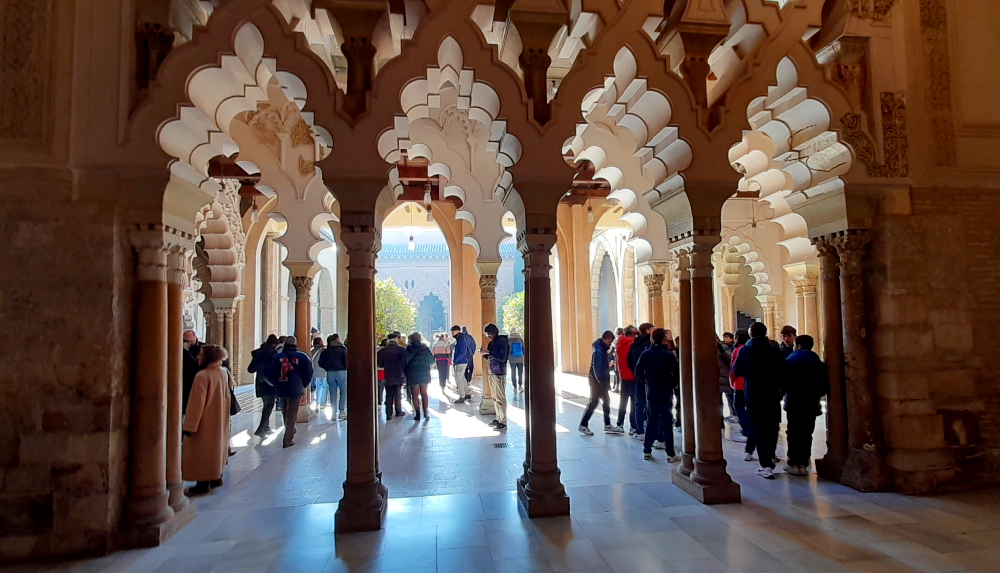
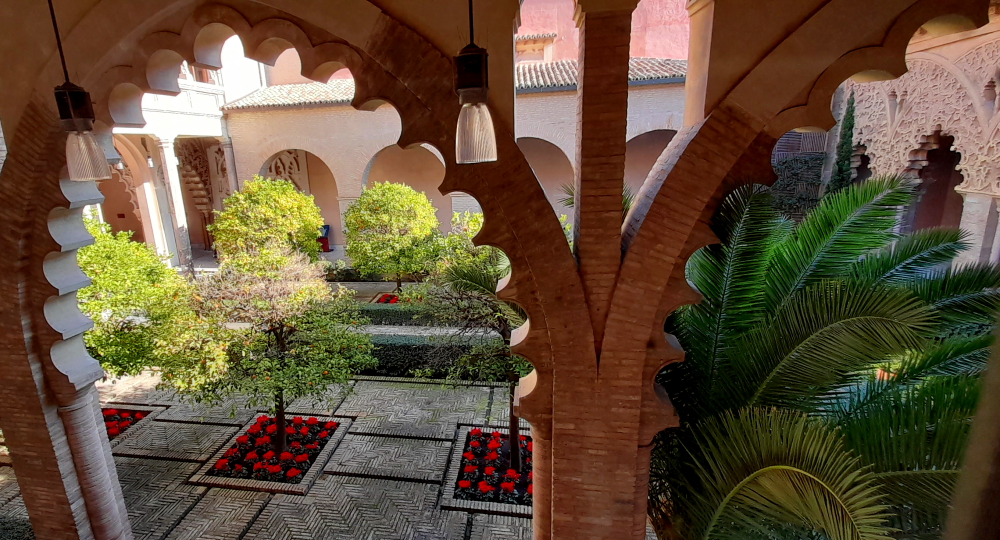
On the ground floor the Islamic palace houses residential quarters in its central area based on a rectangular open air courtyard with a pool with porticoes and a series of arches with some rooms originally intended for ceremonial and private use.
On the higher floors there are various ceilings decorated plainly and elaborately. The most elaborate of these is the ceiling of the Throne Room, with a frieze in Gothic calligraphy that reads:
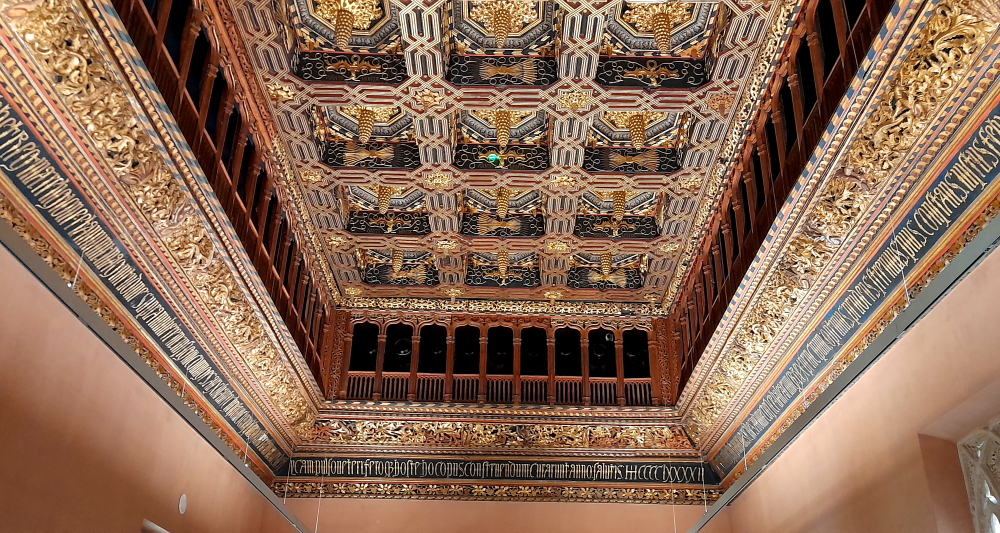
“Ferdinand, king of Spain, Sicily, Corsica and the Balearic Islands, the best of princes, prudent, brave, pious, constant, just, happy, and Isabel, queen, superior to all women for her piety and greatness of spirit, distinguished husbands Very victorious with the help of Christ, after liberating Andalusia from the Moors, expelling the ancient and fierce enemy, they ordered the construction of this work in the year of Salvation 1492.”
The tour of the building ends back at the beginning, the Patio of Santa Isabel. This open and landscaped space unifies the entire Taifal palace. Its name comes from the birth in Aljafería of the Infanta Isabel of Aragón, who was queen of Portugal in 1282. Not bad for a euro each entry fee.
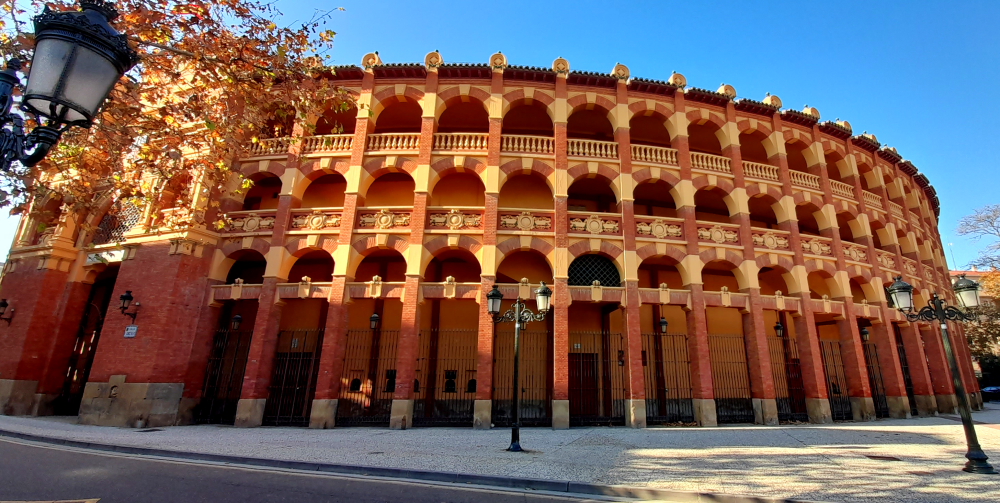
On our way back to the hotel we make a slight detour to the Plaza de Toros de Zaragoza. The Zaragoza Bullring, also known as “La Misericordia” (not The Misery, but The Mercy!) is the second oldest first-class bullfighting arena in Spain. The arena is 48 meters in diameter. It was the first bullring in Spain to have a cover. Of a Neomudejar style built in 1764, it has a capacity for 10,070 spectators.
After a brief interval back at the hotel we venture out again at 3:00pm in order to have a late lunch – tapas. Now, I normally try to avoid tapas as, with the exception of exceptional tapas we had in Granada, everything else has been bland and mega expensive for what it is. But, in order to avoid an 8:30pm start to dinner, I’ll give it a go.
We venture down ‘El Tubo’, a labyrinth of alleyways in the old town which host a multitude of tavernas, restaurants, bars and tapas bars.
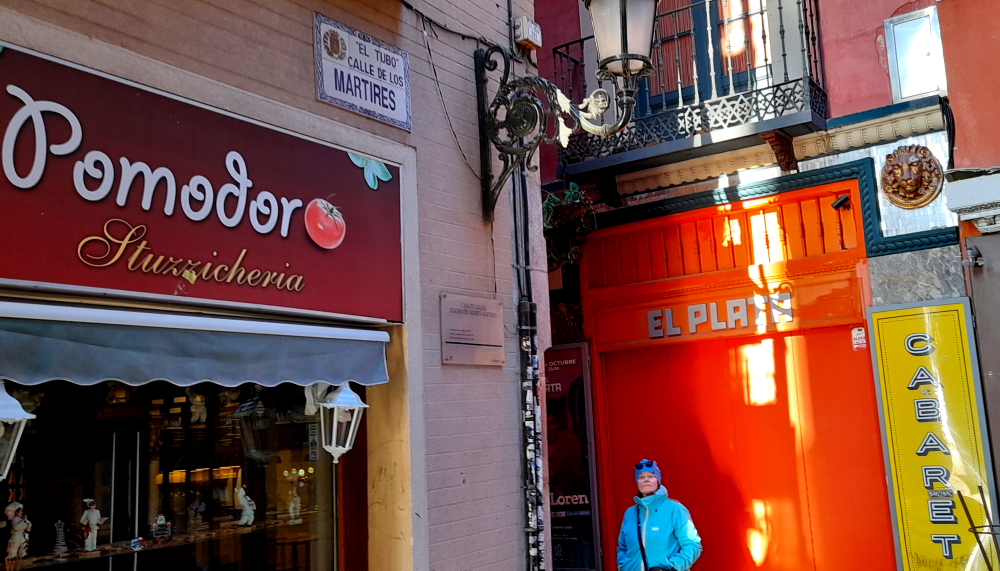
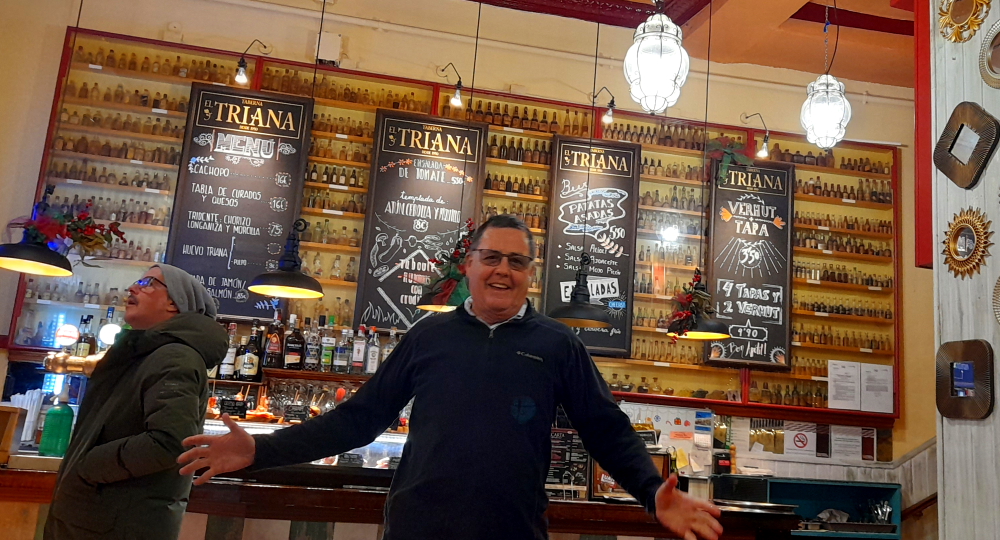
These alleyways were crowded on Sunday when we came through here on our way back to the hotel so we pick the quaint “Taverna El Triana” which we recalled was very busy, inside and out.
Today there is only one other couple in the joint. We select the daily suggestion which is “4 tapas a elegir + 2 vermuts caseros (4 tapas of our choice + 2 homemade vermouths) for the princely sum of Euro9.90. Done! In fact, they are so good that we order another round of 4 different tapas and 2 more vermouths and are out the door before 4:00pm.
Lynn now has 4 hours to ghostwrite this blog for the past 3 days before her half-hour reflexology massage at 8:00pm. Unfortunately, contrary to the photos on the brochure, it is to be held in our room, rather than in a wellness centre room, so it’s all a bit crowded when the masseuse arrives with a massage table and a small trolley of various unctions!
19 December, 2023
Another crisp, sunny day and while I choose to stay indoors to catch up and to finalise arrangements for our next destination, Lynn opts to visit the Catedral del Salvador.
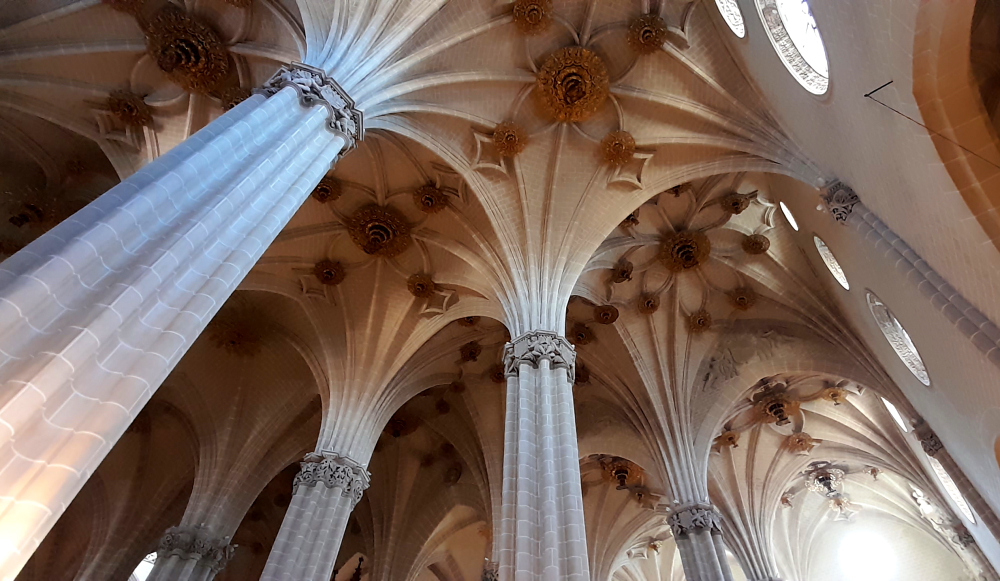
The main access to the Cathedral is on the western side, where a classicist baroque façade was built in the second half of the 18th century that replaced the Mudejar portal from the 14th century, which is located and visible behind the current façade.
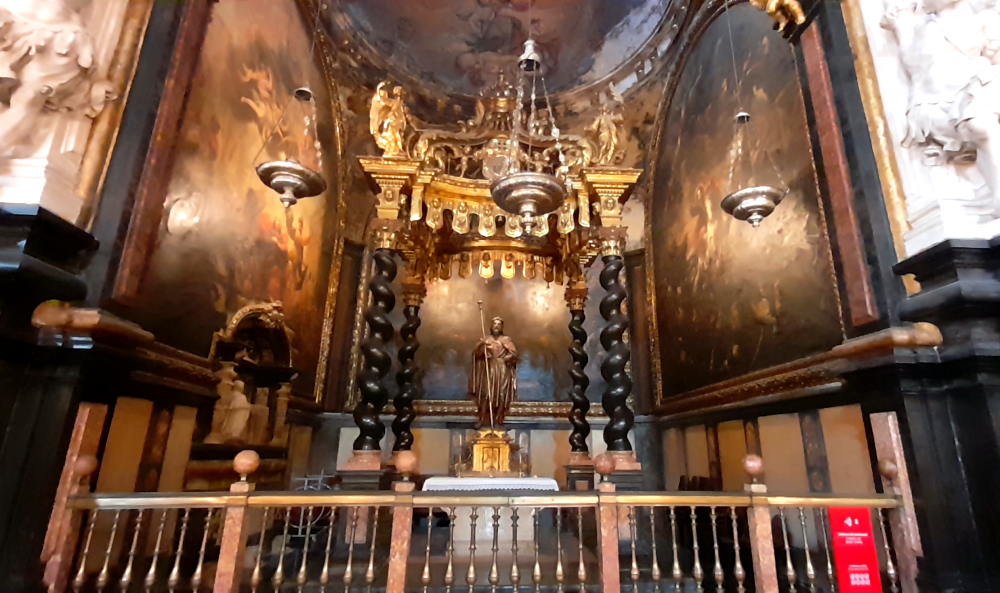
Similar to the Cordoba Cathedral which was also built inside a former mosque, the interior is spacious with high, vaulted ceilings. Along the 4 walls are chapels dedicated to various saints. Each chapel has a distinct style, from simple to OTT baroque. Interestingly, some of these have Islamic floor and wall tiles then the upper walls and altar pieces in their own individual styles of the period or, in the case of one chapel, Islamic floor and Dutch wall tiles.
Boxed into the centre space is the choir with wooden paneling and seats, the outside of which are tiny chapels.
Next door is the Chapterhouse Tapestry Museum which is accessed through the Cathedral. The museum is home to a major collection of tapestries belonging to the Cathedral Chapter, which experts consider to be the most important of its kind in the world.
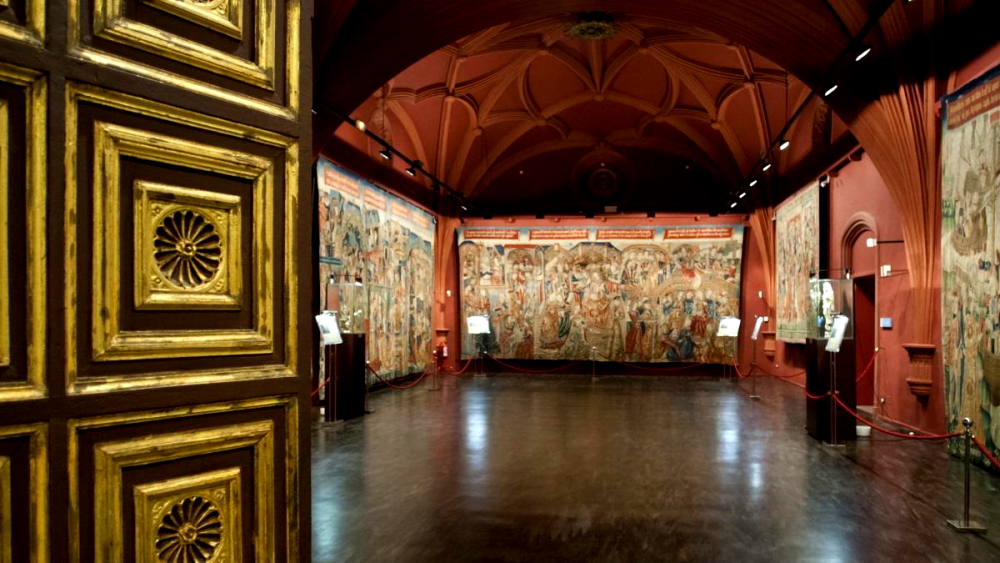
It comprises 63 Flemish tapestries and 6 pieces of heraldic embroidery. They are of very high quality, many dating from medieval times in the Gothic style, while others are Renaissance and Baroque. There are currently 11 of these tapestries on show to the public, as well as other items of precious metalwork, religious ornaments and reliquary busts.
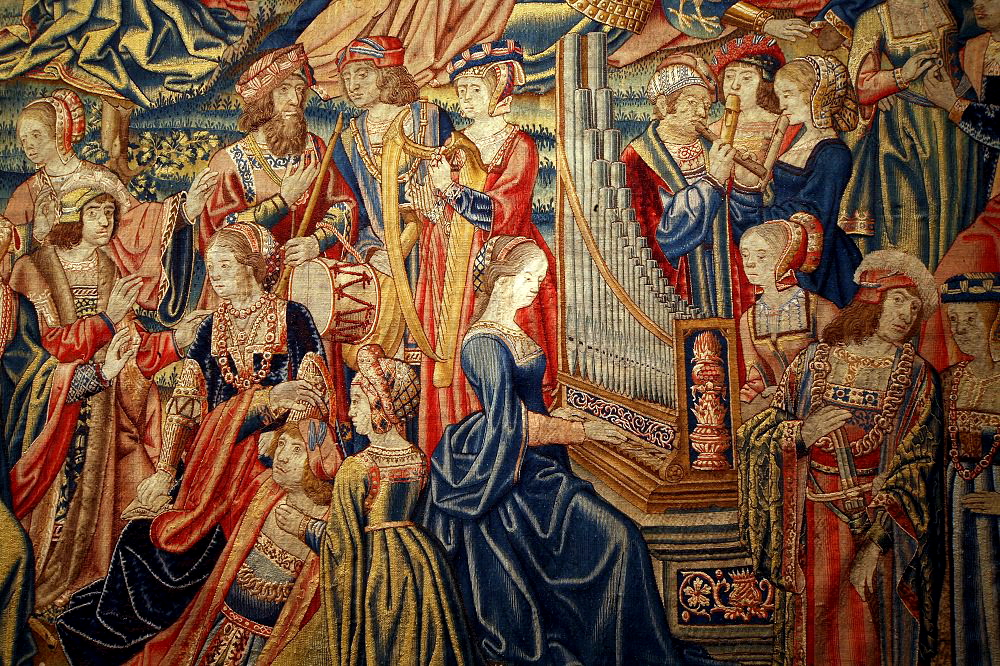
Ranging in size from small wall hangings to large room-sized pieces they are astonishing, especially given the century that they were made. The detail, compositions, proportions, the colours, the draping and richness of robes, facial expressions, the transparency of veils and opaqueness of water – all conveyed by just fine wool and silk.
Tonight we’ve booked a table at the hotel restaurant – for an 8.30pm start, of course! Talk about ‘waiting for evening’! As we’ve foregone housekeeping services we can reward ourselves with 3 free alcoholic beverages.
We find out that the hotel restaurant is the same place we tried to eat at on the first night. It is more a bar than a restaurant and the food is dreadful. We order a plate of chicken wings and a baked potato which turns out to be 6 tiny half wings and a tiny potato. They try to charge us Eu14 (A$24) for the chicken wings and Eu7 (A$ 12) for the tiny potato. After we complain they reduce the price to Eu14 for the food and an extra glass of wine. For Eu14 you can buy two KFC meals just around the corner. This will be reflected in the hotel review. Don’t you worry about that!
Tomorrow we drive 196 km to Montblanc, Catalonia which will take us about 2 hours. There we’ll be ensconced for 9 days over Christmas.
20 December, 2023
The hotel’s customer relations manager checks us out this morning but she makes the mistake of asking how our stay was at the hotel. After quite a long description of our experience with the hotel restaurant she may have regretted asking us. Overall, however, (other than the restaurant) the hotel was pretty good and probably the best breakfast so far for this European section of our trip.
The weather has cleared from a foggy morning to a bright clear day. However the wind is increasing so it feels quite chilly as we walk to the car park to collect the car.
Heading out of town we refuel the car and by now the wind is absolutely howling and whipping up a dust storm. We have a full tail wind on our drive to Montblanc and our fuel consumption is the best I have ever seen from the Insignia.
In fact, the arid landscape reminds us of a Spaghetti Western as a very large tumble weed bounces past as I’m filling the tank.
En route, a sight that reminds us of Hungary are the number of stork nests perched on electricity pylons. One actually has 5 nests on it over 3 levels – high-rise apartment living for storks.
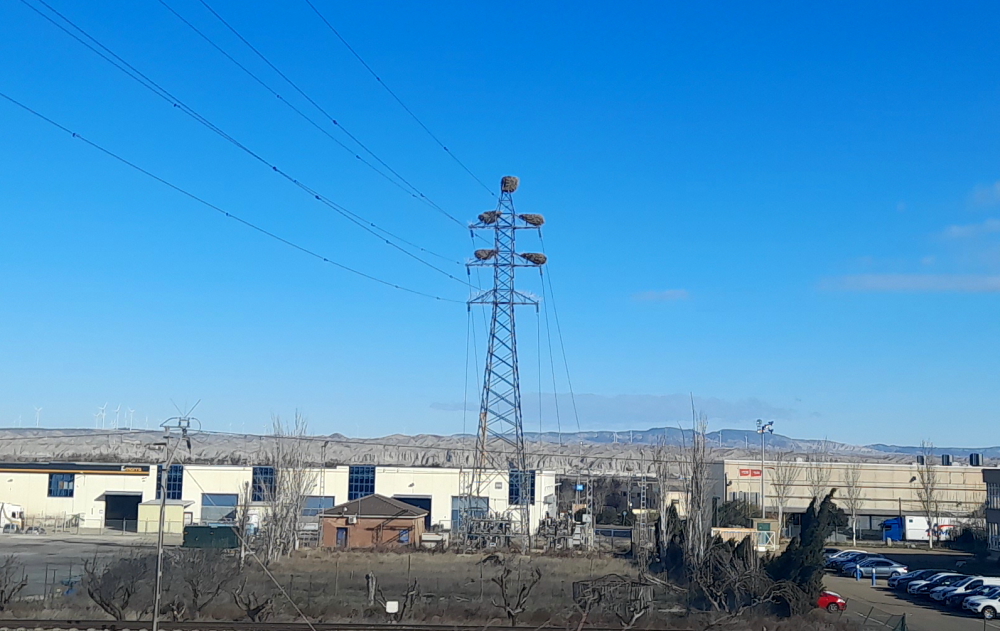
When we went to check the time taken via toll rods versus toll free, it was the same time. We discover that although there is an AP (toll) road there aren’t any tolls on the roads between Zaragoza and Montblanc.
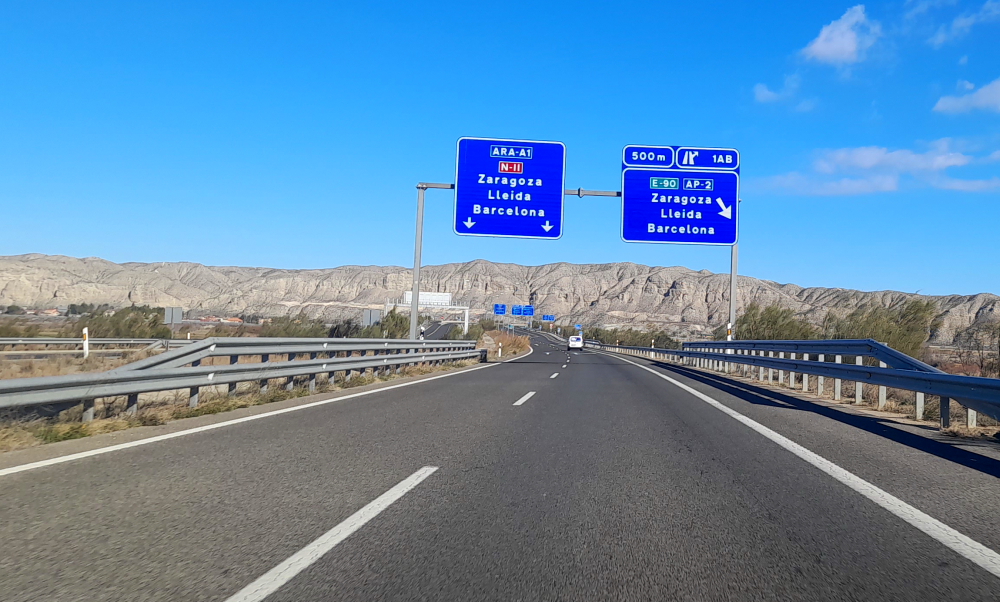
50 minutes’ drive from Zaragoza we pass the marker for the ‘meridiano de Greenwich’.
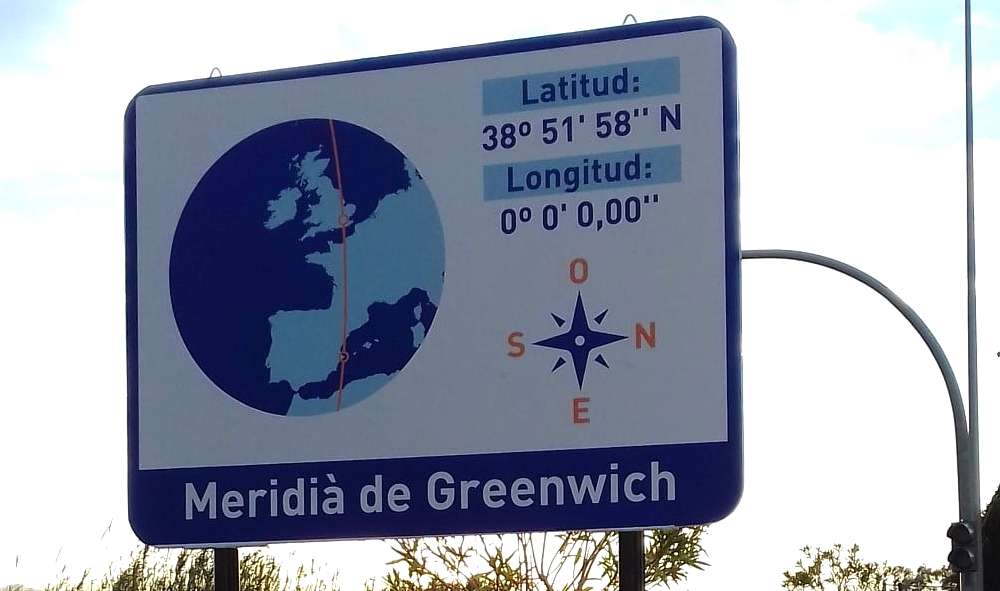
To mark the location the Spanish have spent unnecessary Euros on a non-functional marker bridge. Art for art sake, money for God’s sake.
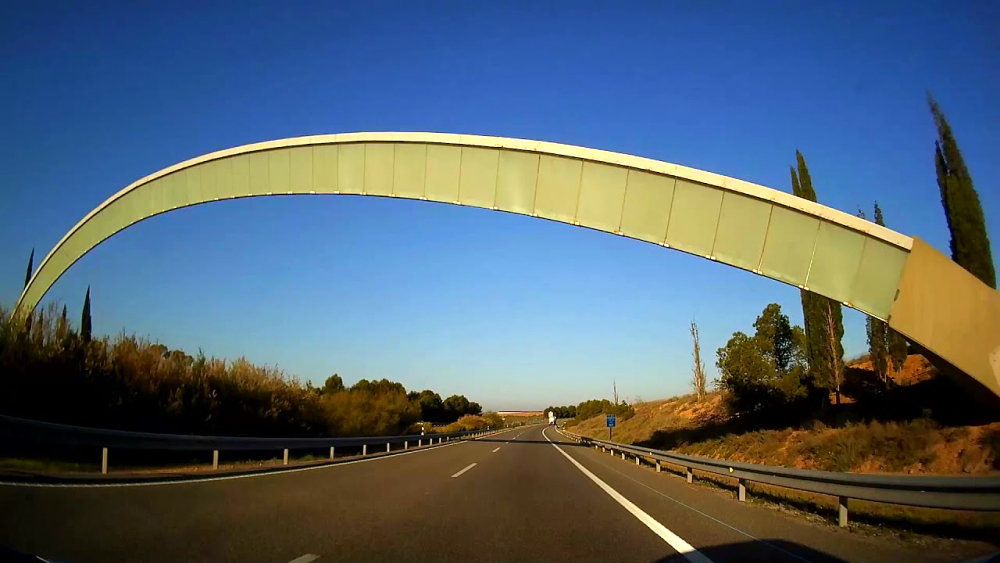
The landscape here on the E90/AP2 is arid – no wonder the Spaniards felt at home when they occupied Mexico.
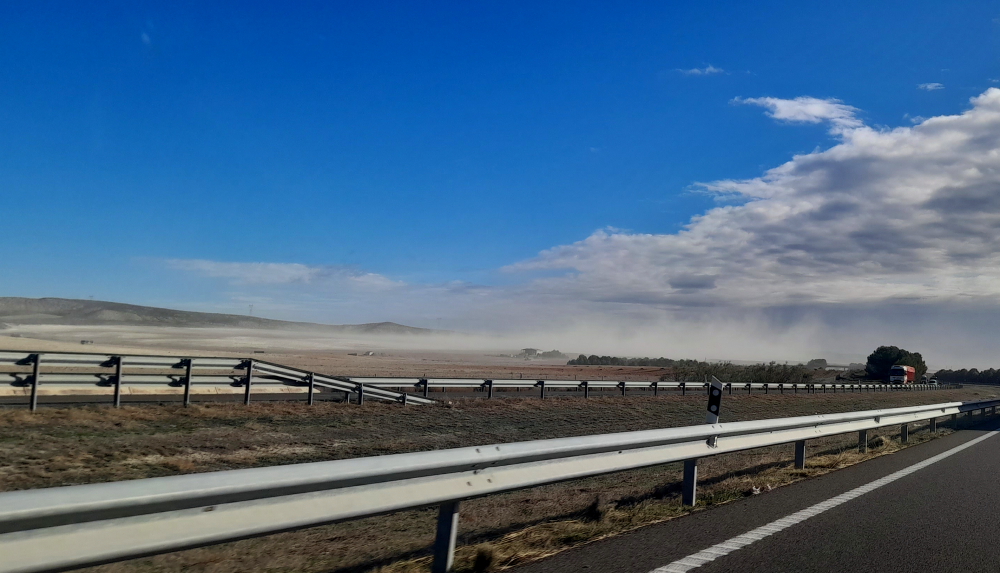
At first it looks like a lorry has driven through a patch of dirt on the road but, as we progress, the dust cloud expands until it becomes a white out.
When we started out at 11:45am it was 13 Deg. C. Now at 1:00pm it has dropped to 4 Deg. C.
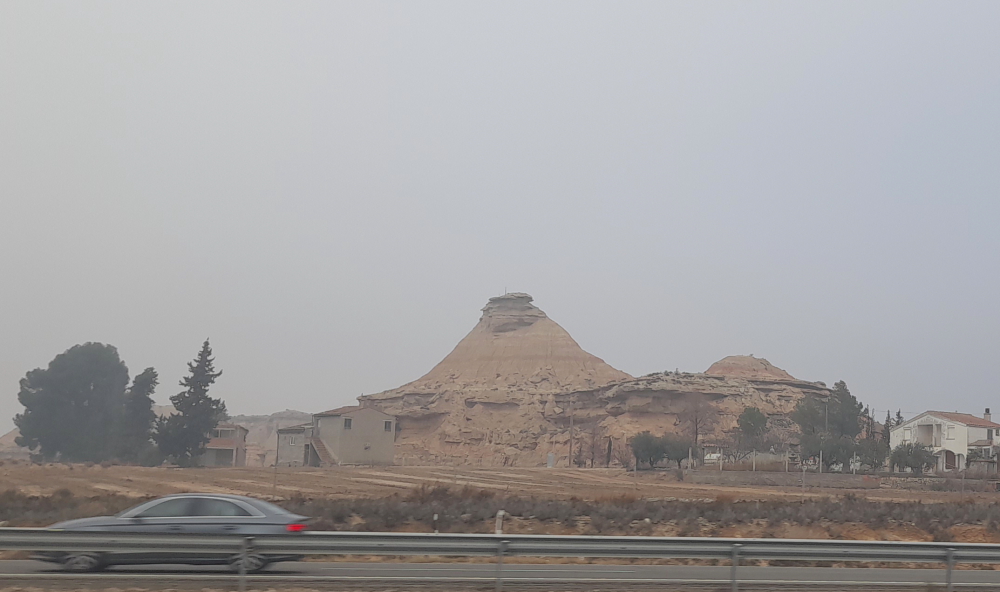
We come out the other side of the dust storm as we near the small, medieval, walled town of Montblanc (pronounced munt blank) in the Catalonia region in the province of Tarragona, Spain. Population of 7,027 – now 7,029 for the next 9 days.
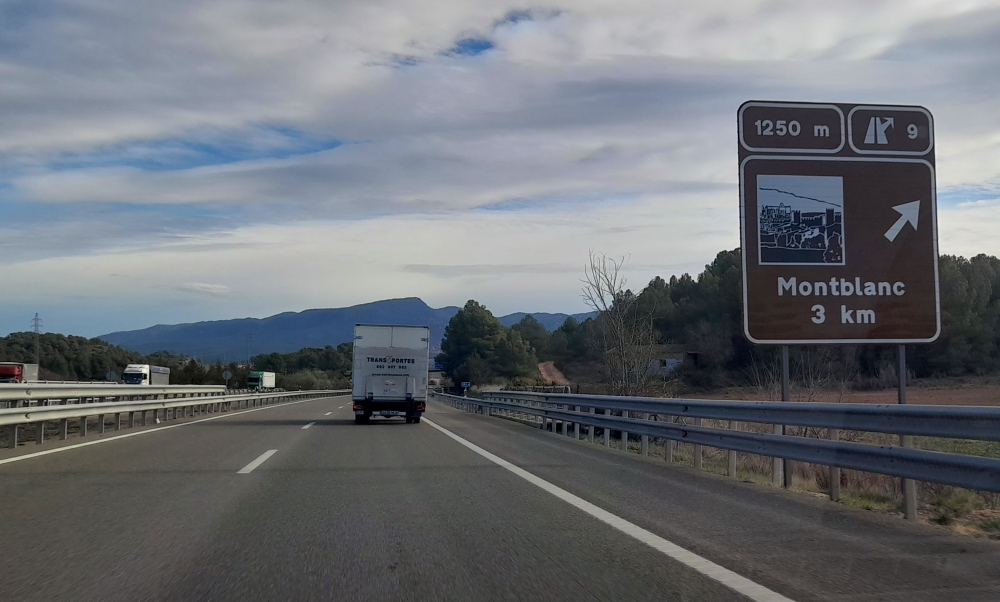
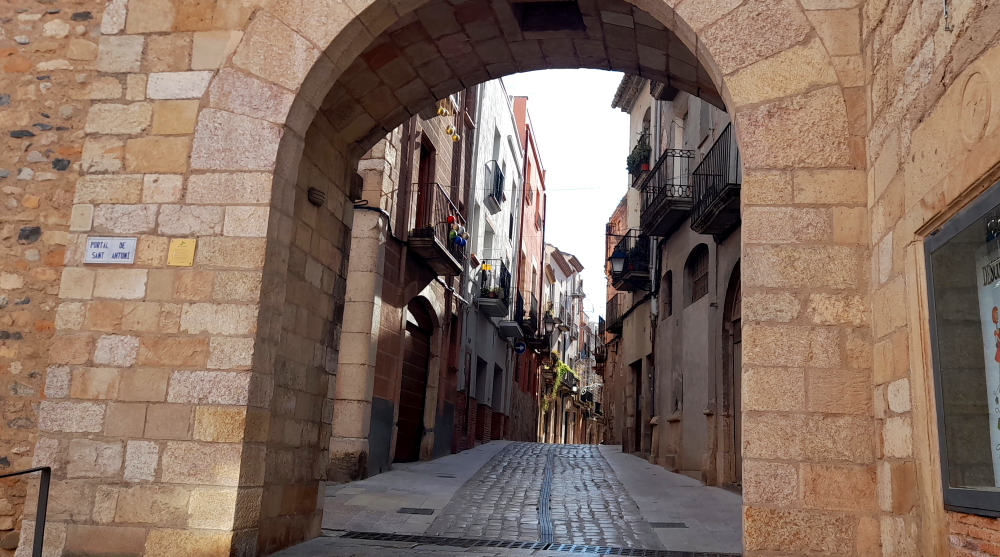
The small, 3-storied traditional apartment block we’re staying in is on a street outside of, and parallel to, the town wall. The Portal de Sant Antoni, across the road from our apartment, is at the northern end of Carrer Major, the main street through the old town.
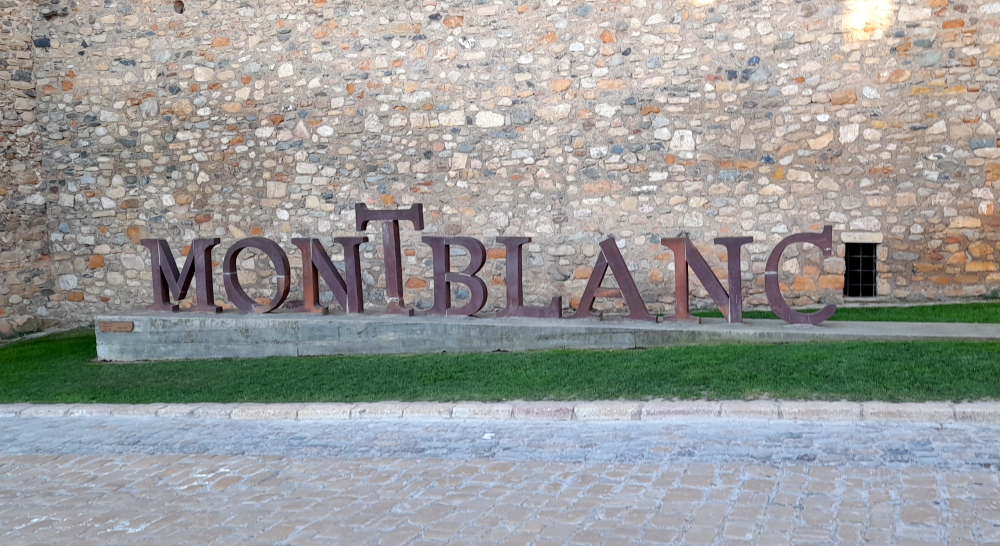
3 locks later we are in the 2nd floor, renovated 4-bedroom apartment which we’ll be calling home over Christmas.
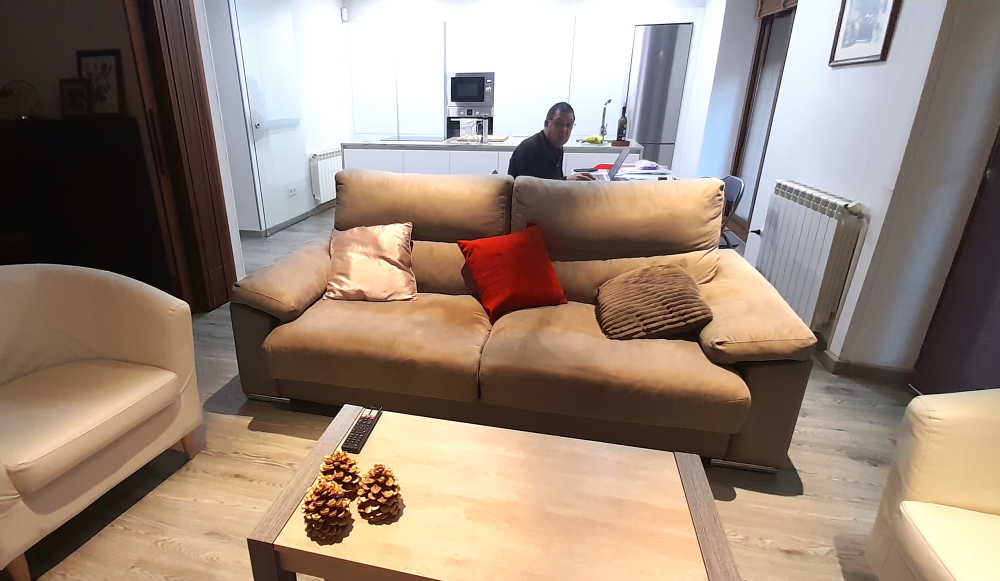
First task is to put on a load of washing while we drive the short distance to the local Mercadona supermarket for supplies for 3 days, then we’ll do another shop on Saturday for Christmas Day which is on Monday.
That done we unpack and Lynn makes sure she hangs our travelling Christmas decorations – knitted Christmas booties that Susie and Paul gave to us when they joined us in Rome just after Christmas in 2014.
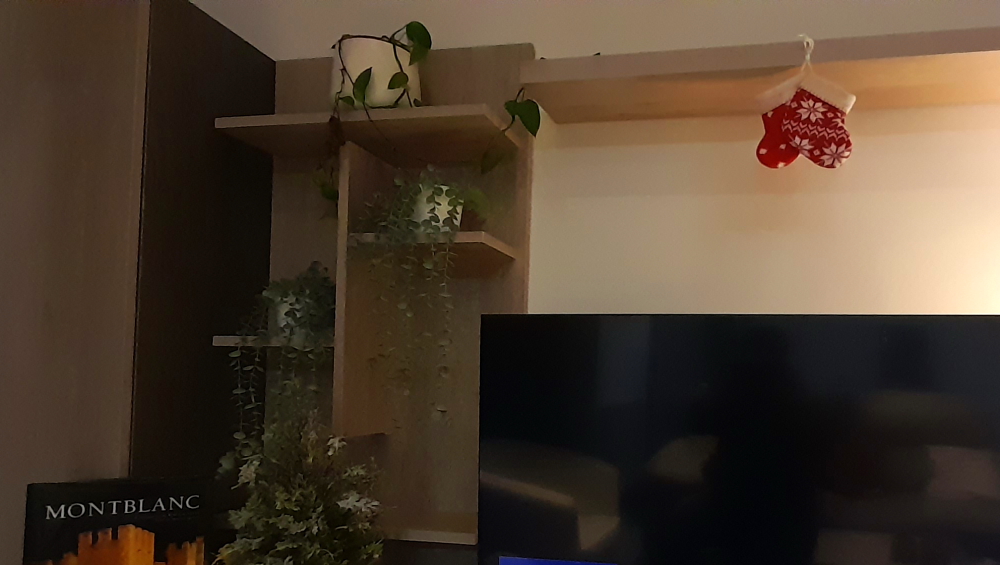
These booties have gone with us every trip since and also take pride of place at Christmas when we are home in Brisbane.
21 December, 2023
Today we’ll wander around the lanes and old streets within the town walls, one of the best preserved medieval centres in Catalonia, to view the 13th and 14th century buildings and Romanesque and Gothic monuments. It promises to be sunny with a max. of 14 Deg. C. but a biting wind makes us rug up.
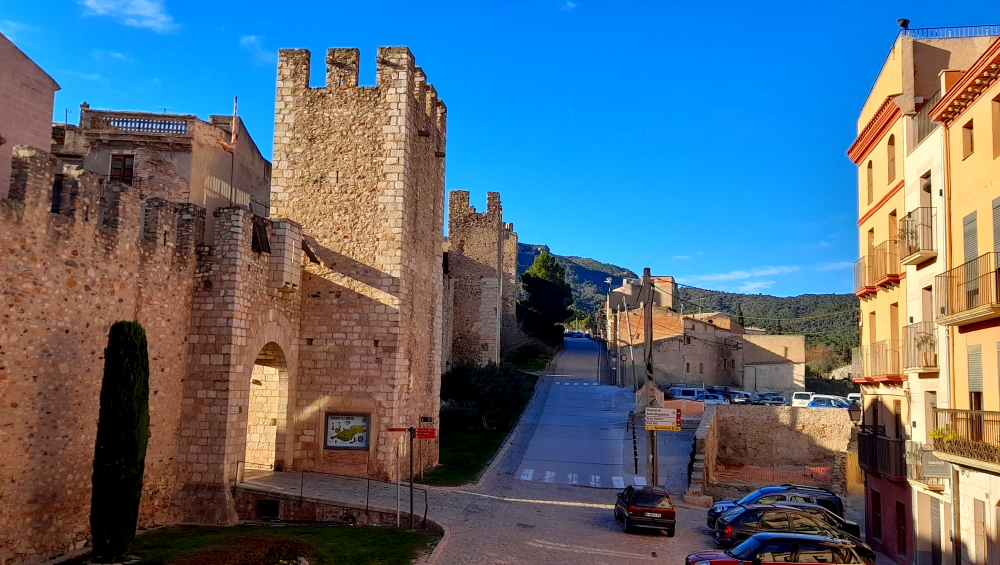
The area around Montblanc has been inhabited for thousands of years, since Palaeolithic times.
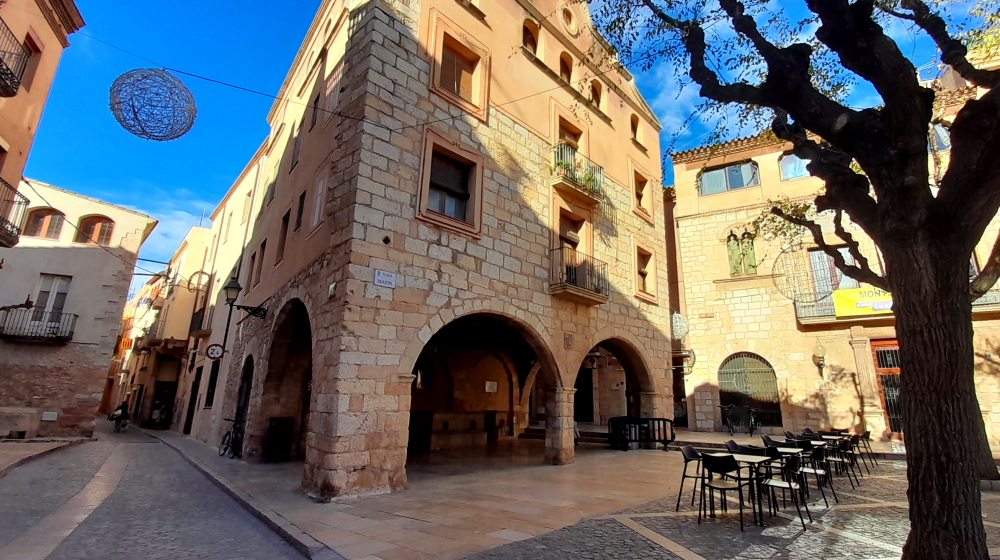
Iberian villages existed on Santa Bàrbara hill from the 4th to the 1st century BC which co-existed with the early Roman settlers (2nd century BC-2nd century AD).
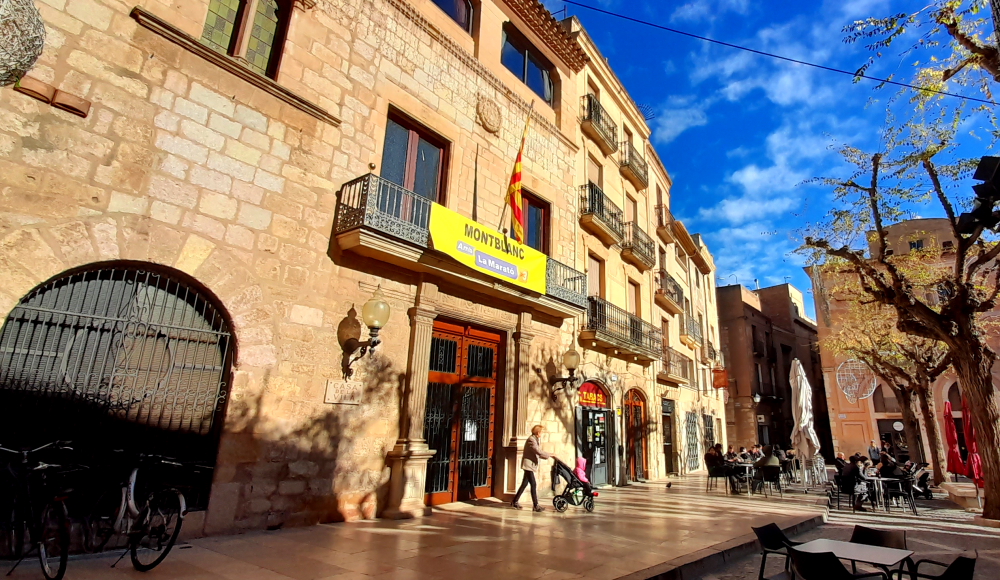
After the Moors’ invasion in 711 AD, much of the area became dominated by a patchwork of Islamic fiefdoms.
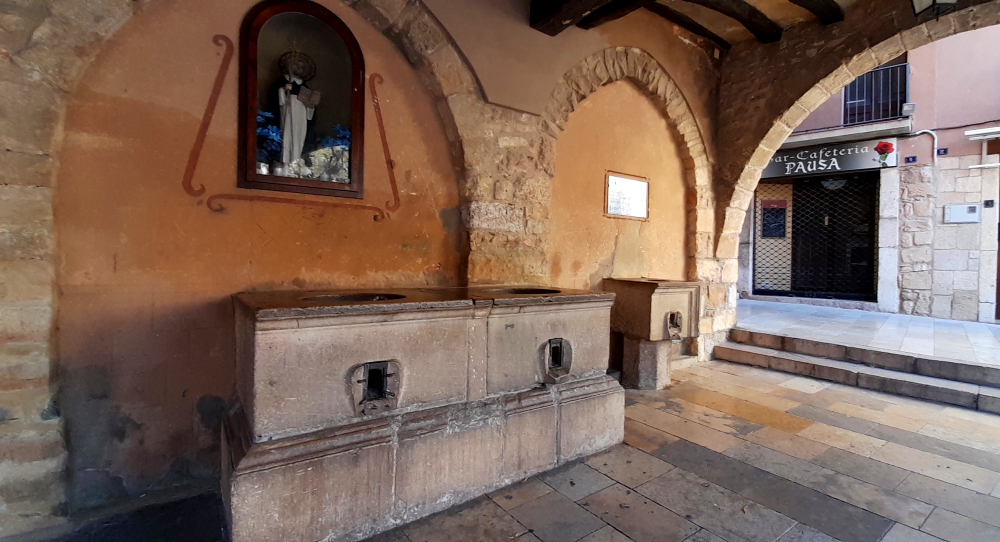
The Islamic invasion initiated a long period of very successful agricultural and commercial development. This was responsible for the birth of many towns and villages in the region which still retain their Islamic names.
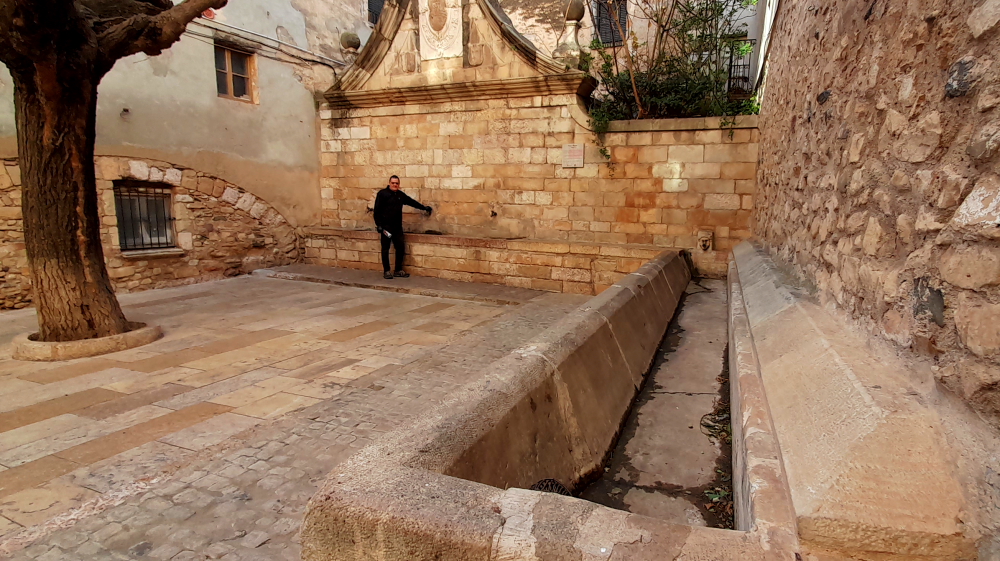
The 10th and 11th centuries seem to have been a period of relatively peaceful co-existence in which Muslims, Christians and Jews lived in the region of Montblanc.
This productive period continued until an allegiance of forces, strongly supported by the Roman Catholic Church, initiated an era of expulsions, which forced Muslims and Jews to leave the Iberian peninsula.
The city was noted as an important trading centre during the middle ages and reached its highest point with the creation of the Duchy of Montblanc in 1387. This success is reflected in the wealth of monuments in the town.
In the 14th century, Montblanc enjoyed its time in the sun: it was the seventh largest city in Catalonia thanks to its political and economic weight. Proof of this was the holding of the Corts Generals the Spanish parliament
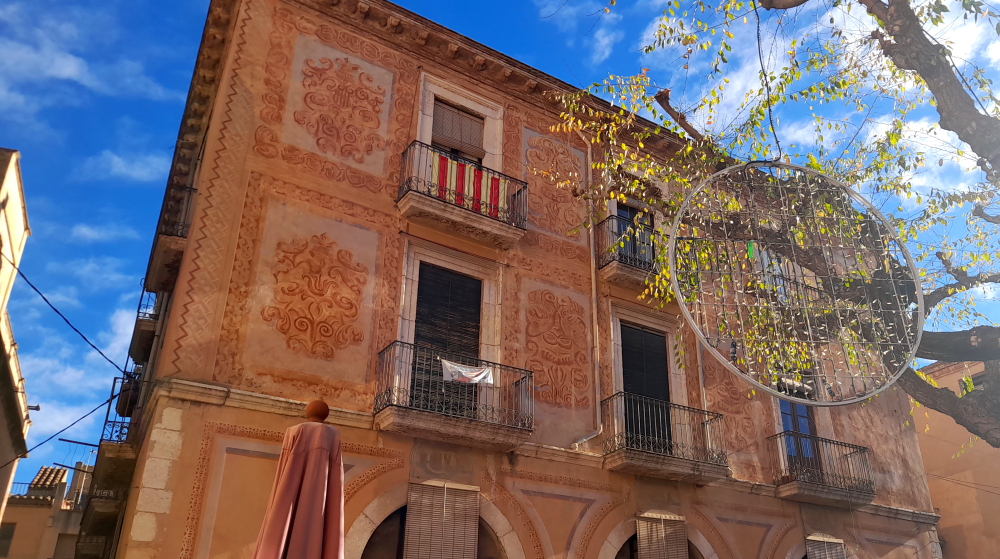
The medieval area also has a large number of Gothic civil constructions, such as the Royal Palace (14th century), the Castlà Palace (15th century), the Alenyà House (Gothic), the Desclegue House (16th century), and the Josa House (medieval).
Significant churches in Montblanc include the Gothic church of Santa Maria with its ornate facade, the Archpriest Church of Santa María la Major (Gothic, 14th-16th centuries), with a Baroque front (17th century); the Sant Miquel Church, with a Romanesque façade (13th century) and Gothic body (14th century); and the Sant Marçal Church, also Gothic (14th century).
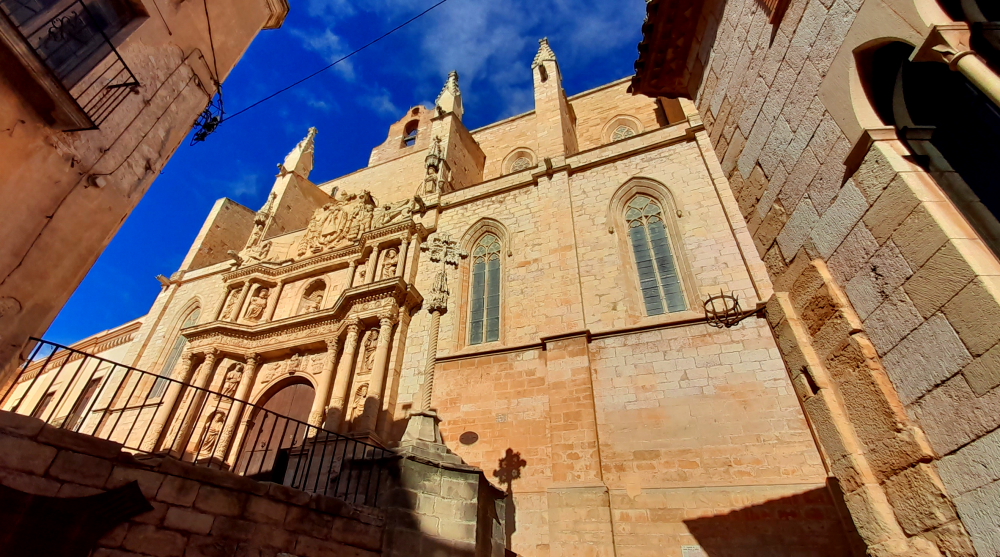
This church is situated in the highest part of Montblanc, at the same place where the ancient Romanesque church stood. Because of the increase in population it was decided to build a new one in the 14th century. The work was made in sections and due to the black death it had to be left unfinished. The large Gothic façade was destroyed during the Reapers’ War. The one in place now is in a Baroque style (17th century).
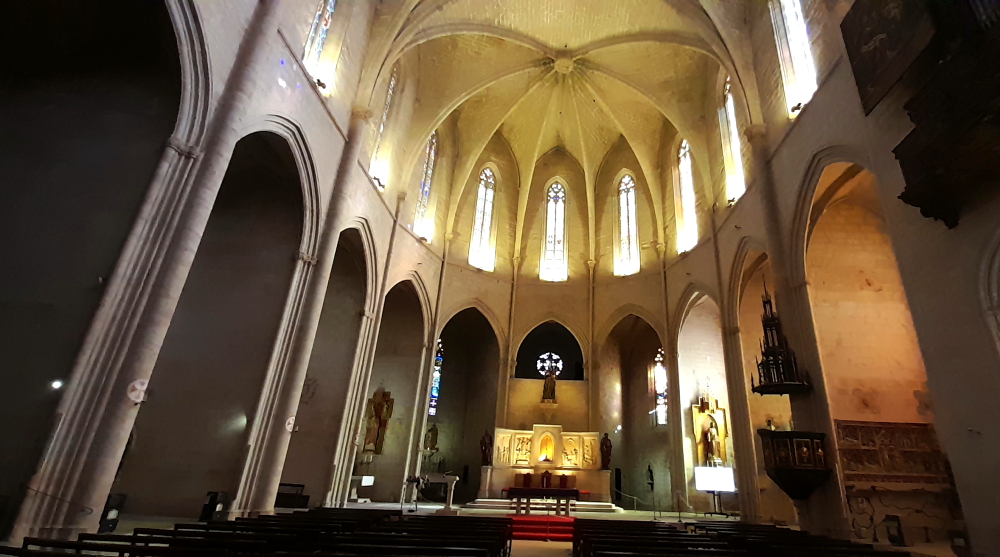
Given the Gothic exterior, the interior is surprisingly lofty and simple with a small number of chapels and colourful stained glass windows and an unusual Baroque organ.
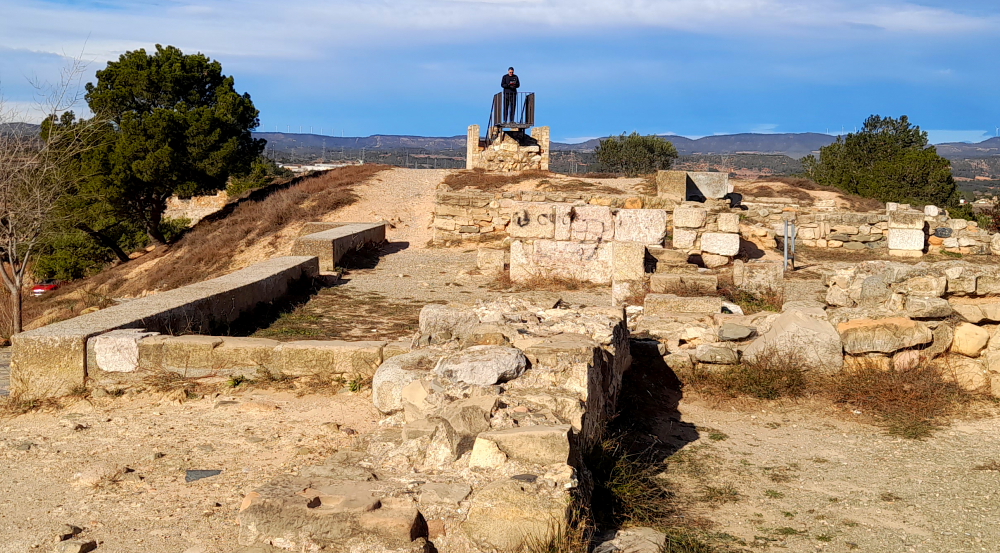
Behind the Santa Maria Church is the Santa Barbara hill. The town was placed around this hillock in the 12th century, when the king Alfonso I (in 1163) ordered Pere Berenguer de Vilafranca to move the town here.
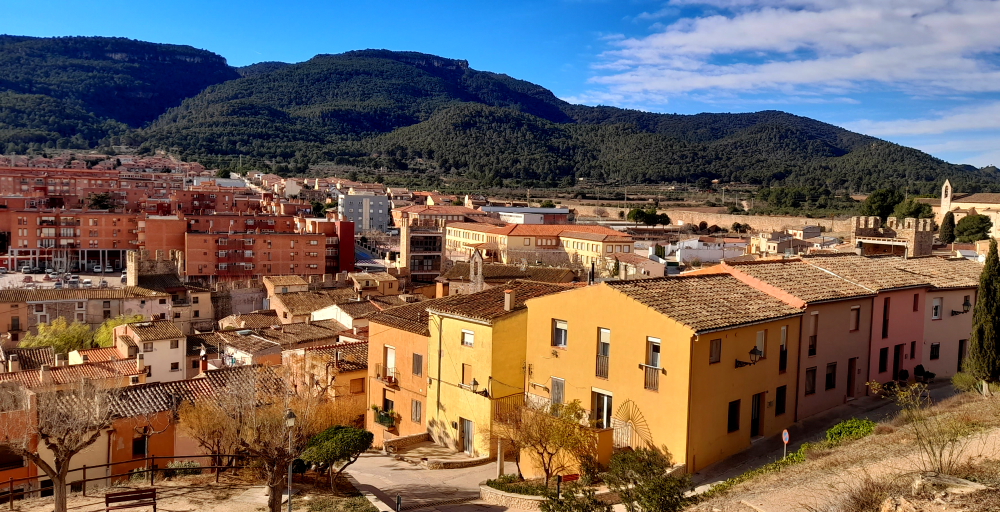
The name of Montblanc has its origin in the lack of vegetation that this hill had. A castle, next to a small church, and a rudimentary city wall triangular in shape were built.
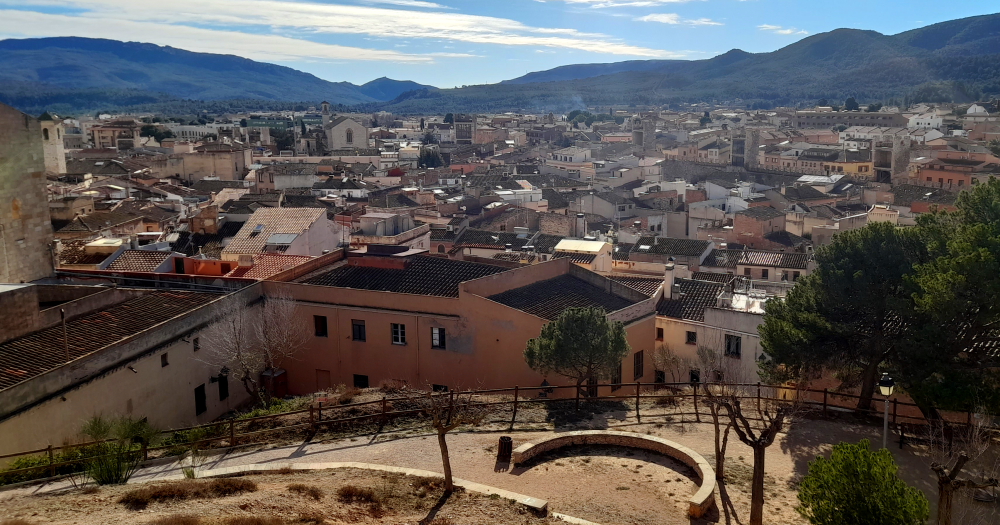
From here we exit the old town and walk around the outside walls down to Portal de Sant Antoni.
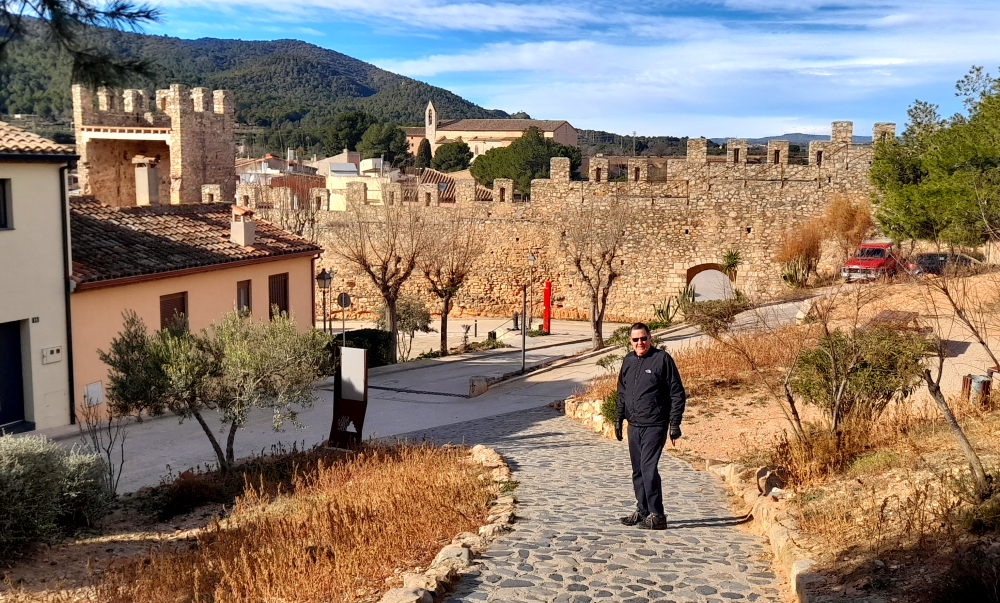
Here we enter and walk around the inside of the walls to Portal de Bove.
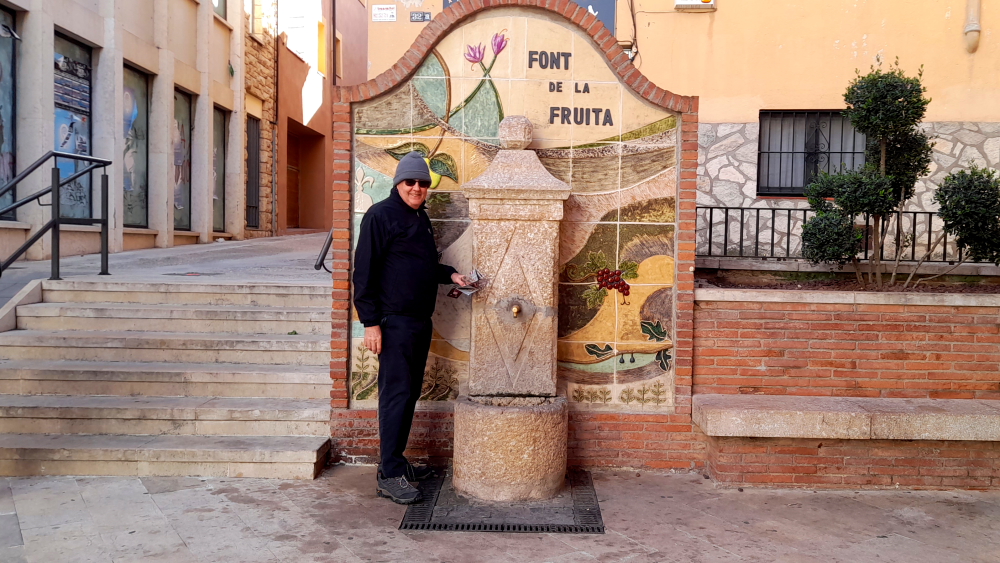
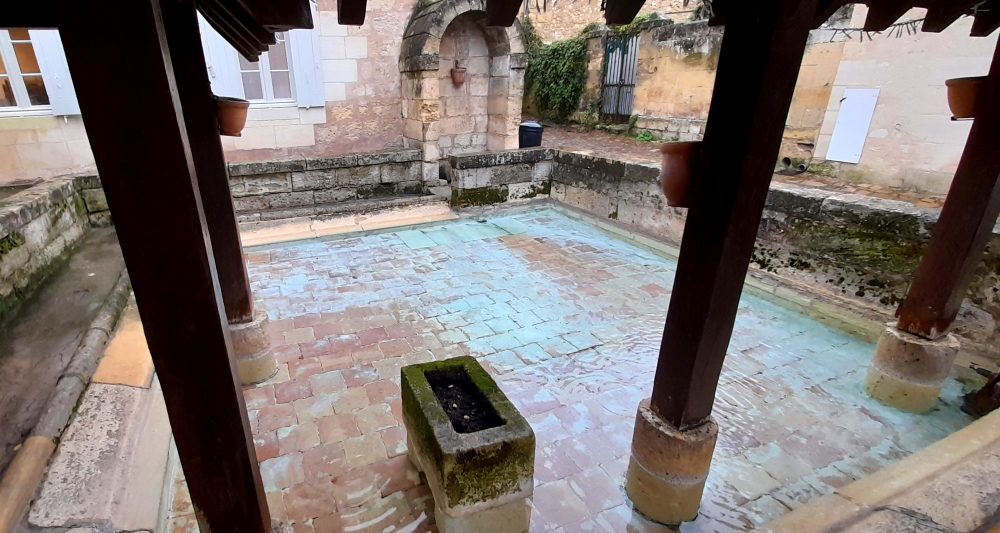
Nearby is one of numerous water fountains that are dotted throughout the old town.
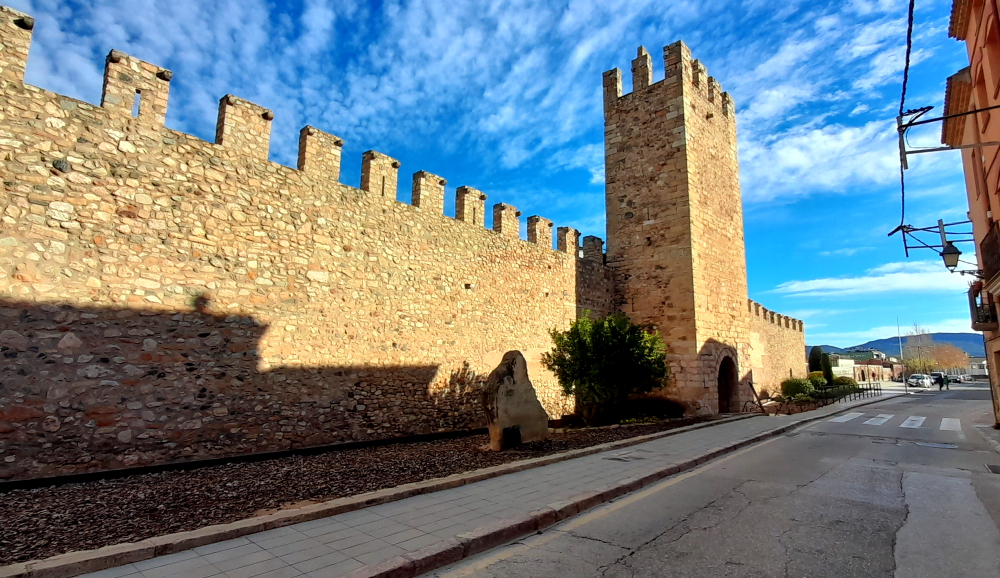
We continue around the inside of the walls trying to find the entrance where we can scale the walls. We don’t find one that is unlocked and instead come to the Portal de Sant Jordi.
Now, you’ve heard the story about St George slaying the dragon, but it never says exactly where this happened. Well, apparently he did that deed right here in front of this Portal. There is a plaque marking the site of his legendary victory and Montblanc has a festival every April filled with dragons and fire to celebrate the victory of St George. I don’t understand why they celebrate the extinction of the dragons’ species.
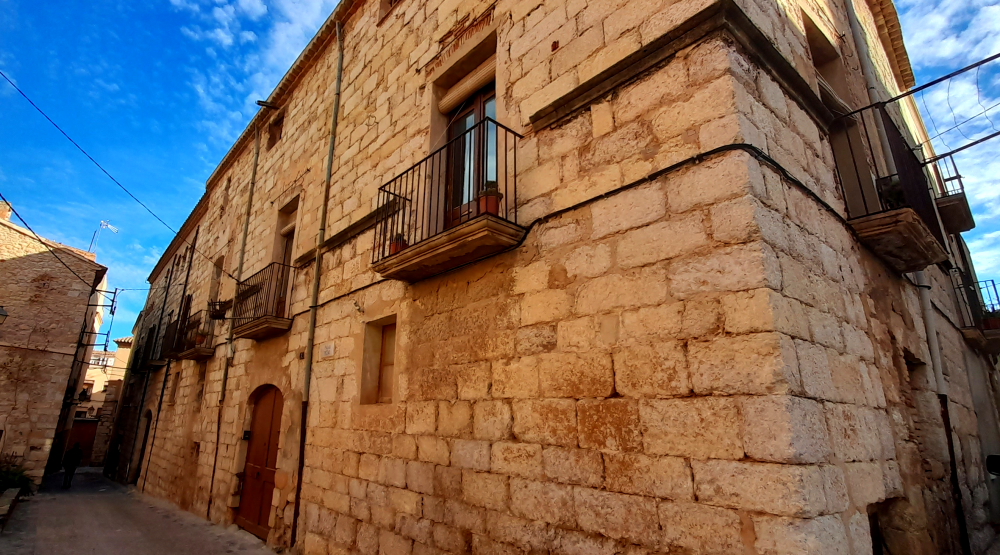
Cutting back into town we arrive at Palacio Real. During the 13th and 14th centuries, the main buildings and palaces of the town were built. One of them was the Palau Reial (Royal Palace) which at the end of the medieval period passed to the Llordat family.
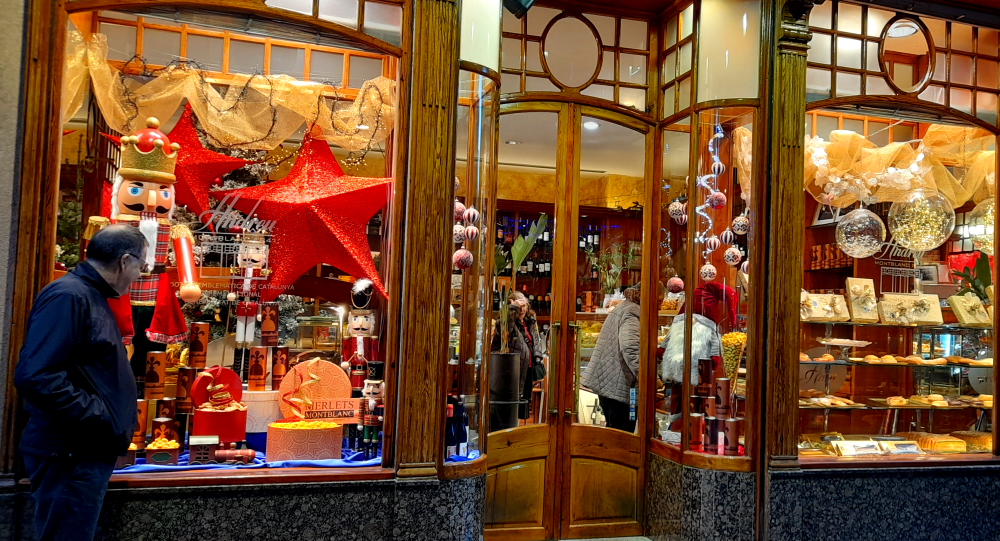
Walking back down Carrer Major we come across a number of beautifully decorated shops including jewellery, clothing, bakery and patisserie shops.
This patisserie is called Rafael Andreu which features a wooden exterior decoration, the beautiful presentation of its windows during this festive season and, especially, its stellar products on offer.
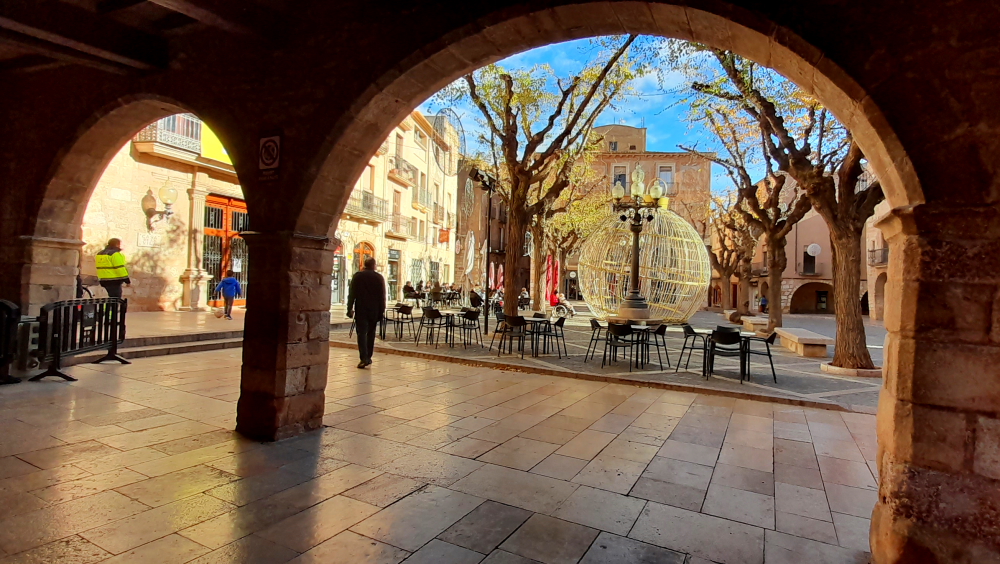
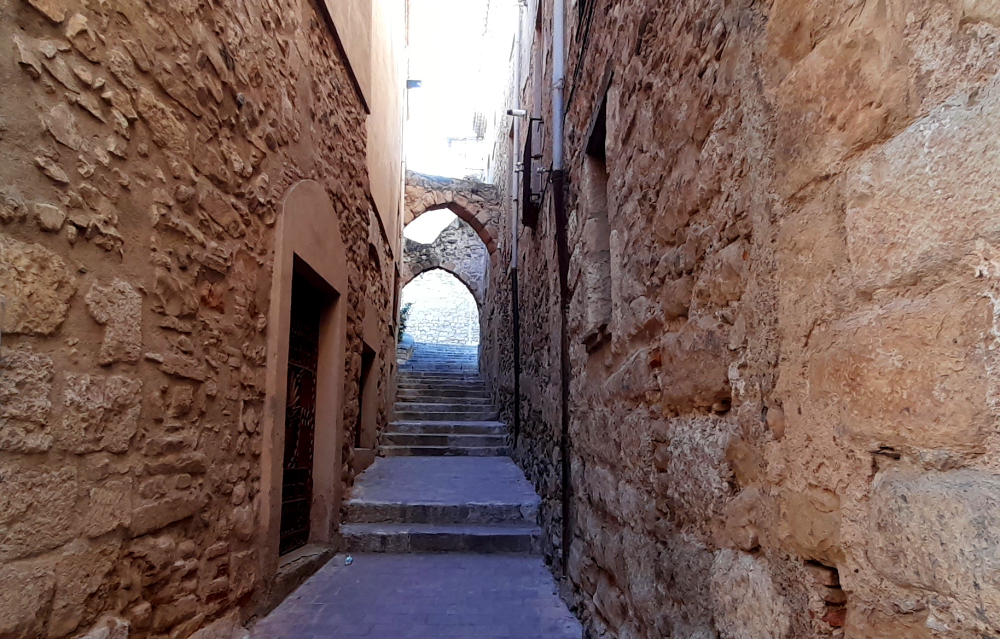
Heading to our Portal de Sant Antoni, the medieval heart of town is on display with its stone arches.
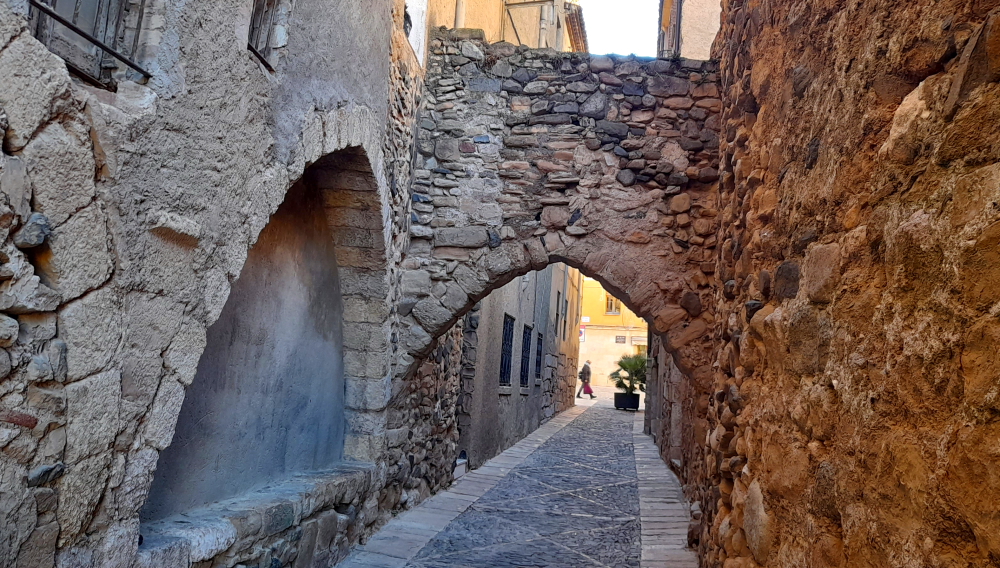
Carrer de la Plebania partly preserves its original appearance, with two pointed arches that join the facades. This street, located within what was the first core of the town, is named after the building built next to the apse of Sta. Maria between 1549 and 1552. The arches were originally used to support a construction that joined the now separate buildings.
Outside of the town’s medieval walls there are an old stone bridge of Roman origin (Puente Viejo), the Gothic buildings of the Sant Francesc Church (13th century) and the Santa Magdalena Hospital (14th-16th centuries) – for another day.
22 December, 2023
Would you believe a top of 17 Deg. C. today with sunshine and a slight wind. First up we have a Skype call with Patrick and Margaret (Donaghadee, Northern Ireland) then we take 10 minutes to walk to the Mercadona for supplies in case it is busy tomorrow with its 3:00pm closure. It definitely feels warmer – no hats or gloves needed today.
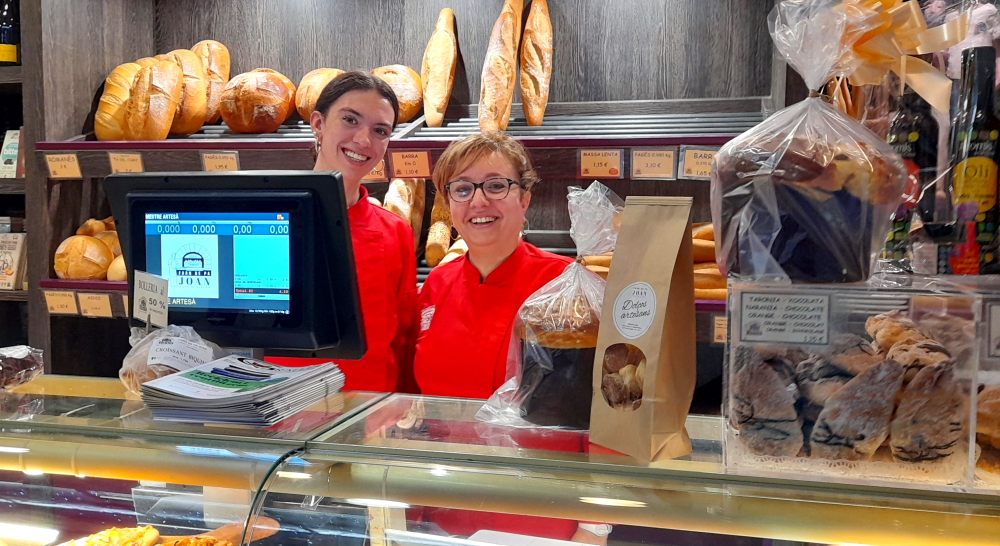
Plus we call into the bakery on Carrer Major to see whether they bake special biscuits, cakes or breads for Christmas, like the Sardinians do for Easter. It seems that the Italian specialty, panettone, is Spain’s No. 1 seller for Navidad.
23 December, 2023
Another sunny day so after breakfast we visit the bakery for a coffee then walk out of town to see the Puente Viejo, the old stone bridge and adjacent Santa Magdalena Hospital.
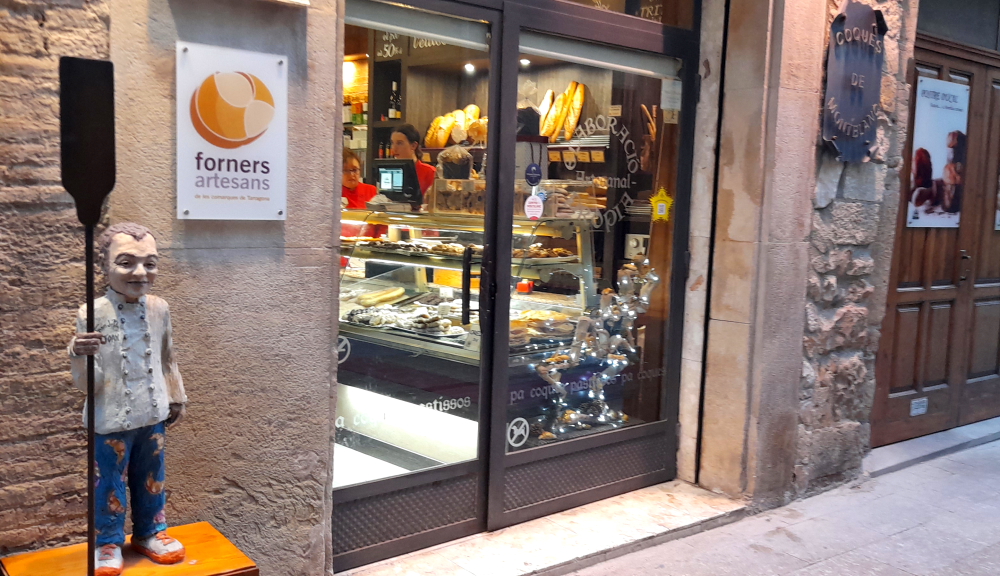
It’s a good thing that the bakery makes good pastries because their coffee is blah. Still, it’s a beautiful day out this morning and the wind has eased slightly. 10 Deg. C. seems quite warm so we must be acclimatising.
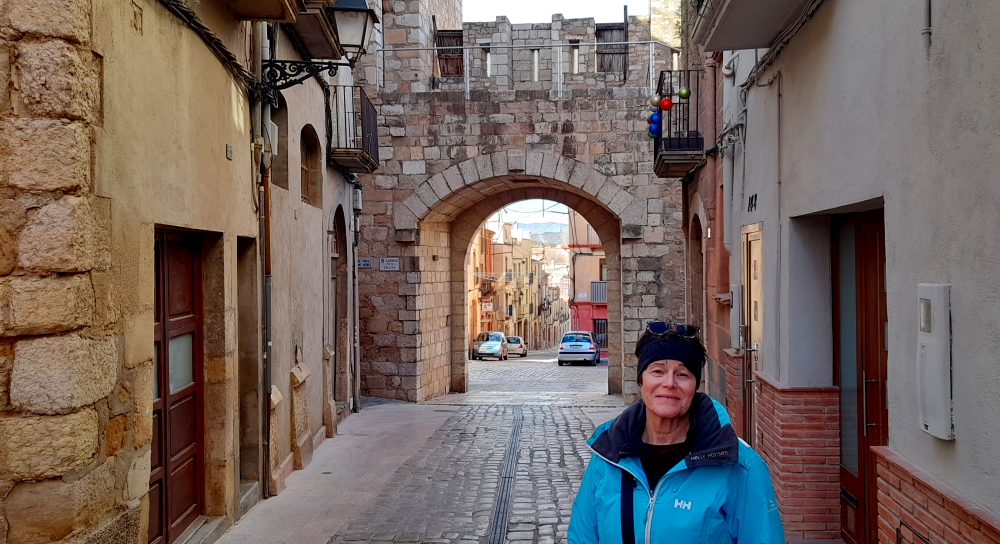
It’s only a short walk back to the portal then down a narrow, cobbled lane to the old stone bridge over the Francoli River.
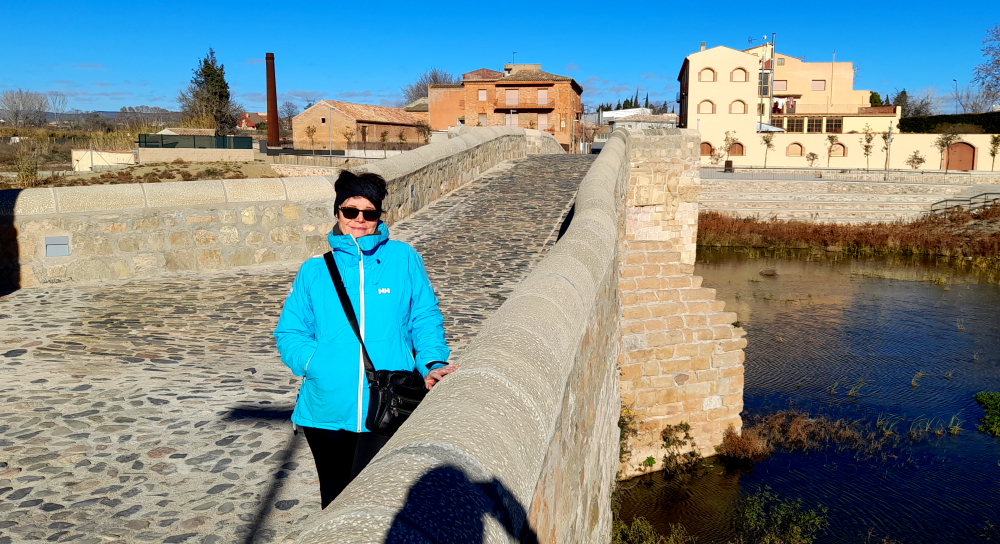
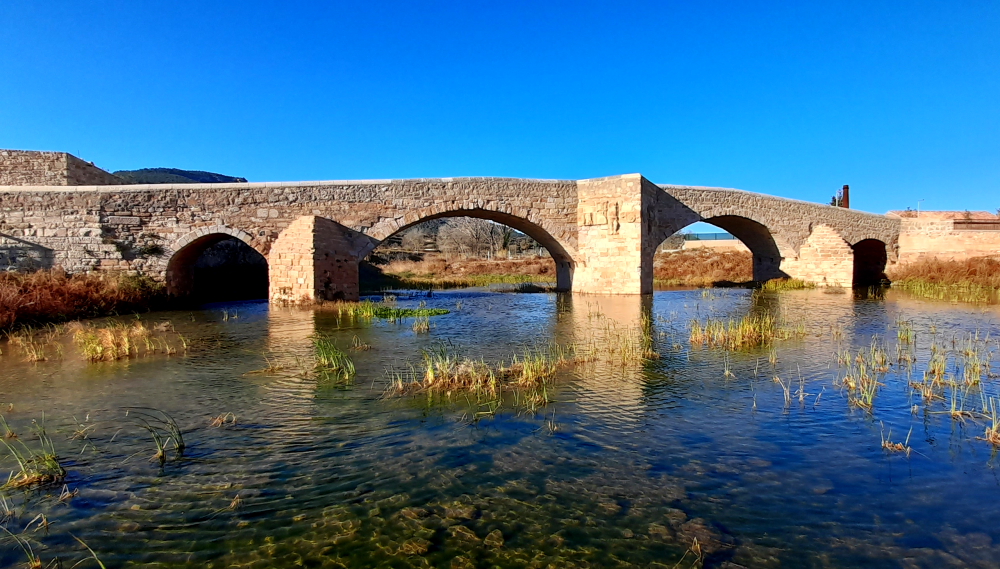
It is more like a small creek than a river but I guess it was much larger when this town was built or when it floods. Though it has a Roman origin, what we see today is from the 12th century.
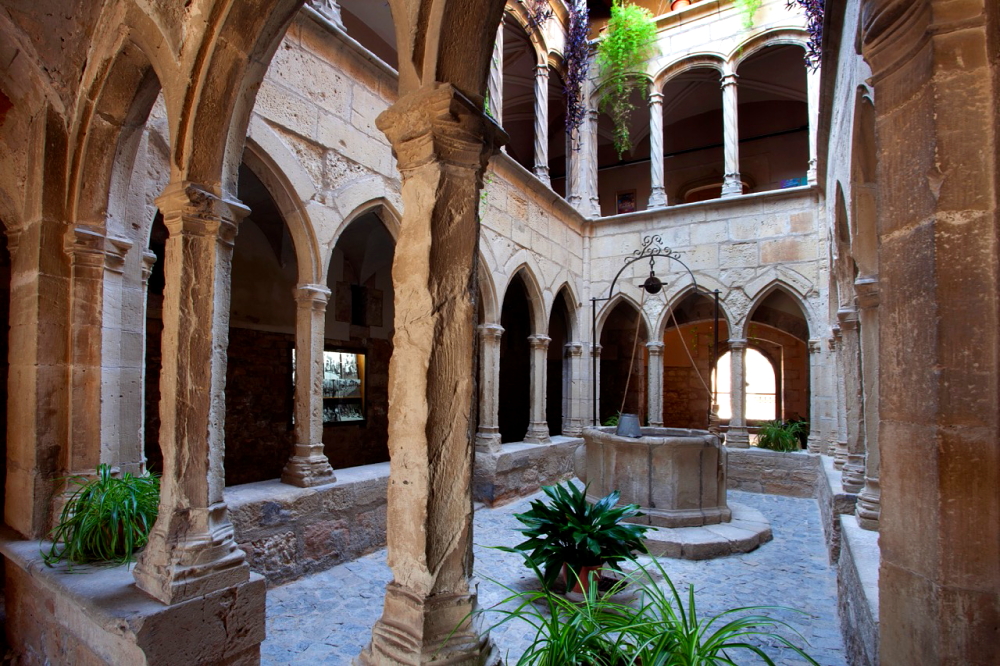
On the town side of the bridge is the Old Hospital of Santa Magdalena, a Gothic structure built in the 15th and 16th centuries in the municipality of Montblanc (Conca de Barberà). There is also an earlier church from the 14th century.
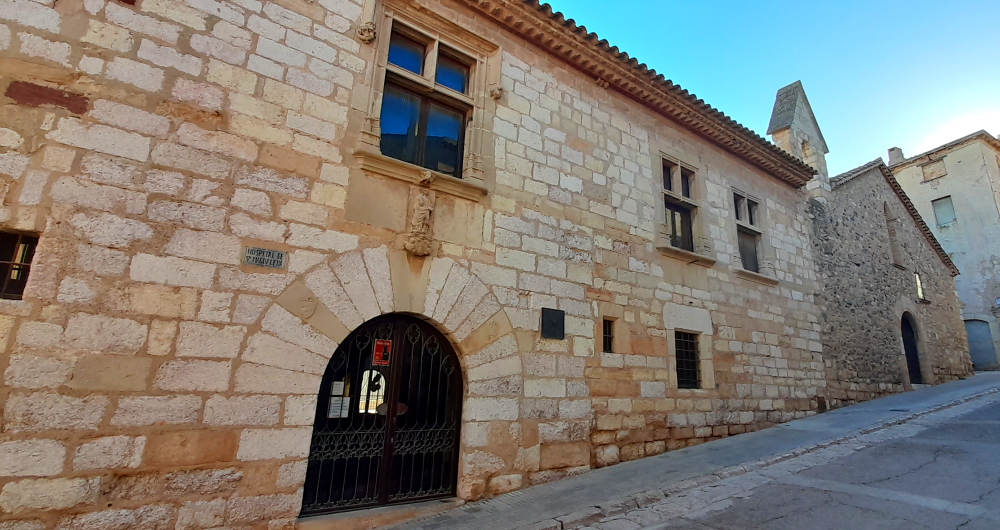
It is structured around a central cloister, in the lower part of which there is a cistern and the original pavement.
Also outside the town walls, to the west of the bridge and on top of La Serra hill, is the Santuario de la Sierra, a church and former convent of Poor Clare sisters. In the 15th century, it was the second sanctuary with the most pilgrims in Catalonia, after the monastery of Montserrat. The Poor Clares convent was the sixth oldest in Catalonia. The Virgin of the Sierra is venerated inside.
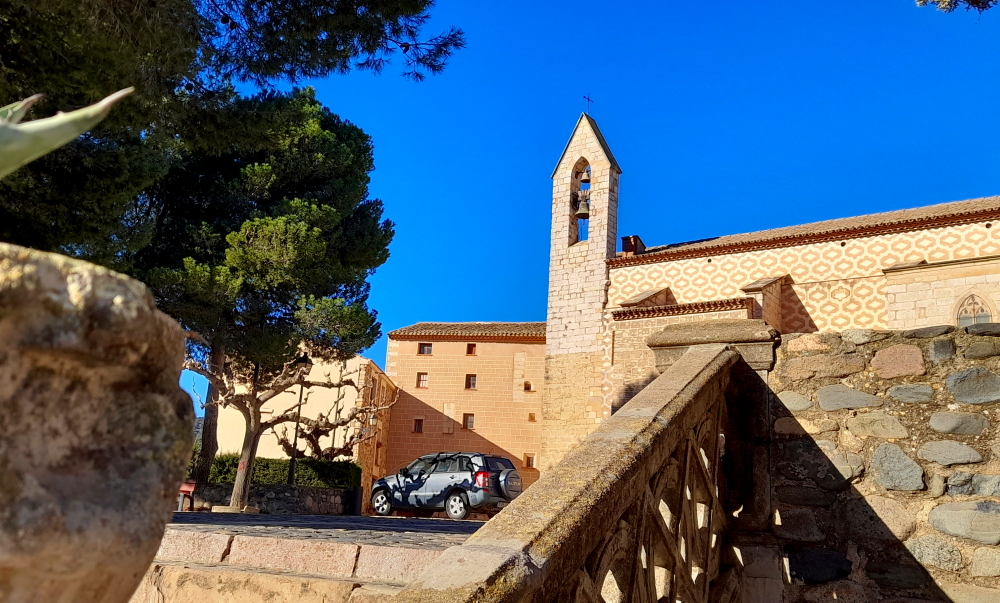
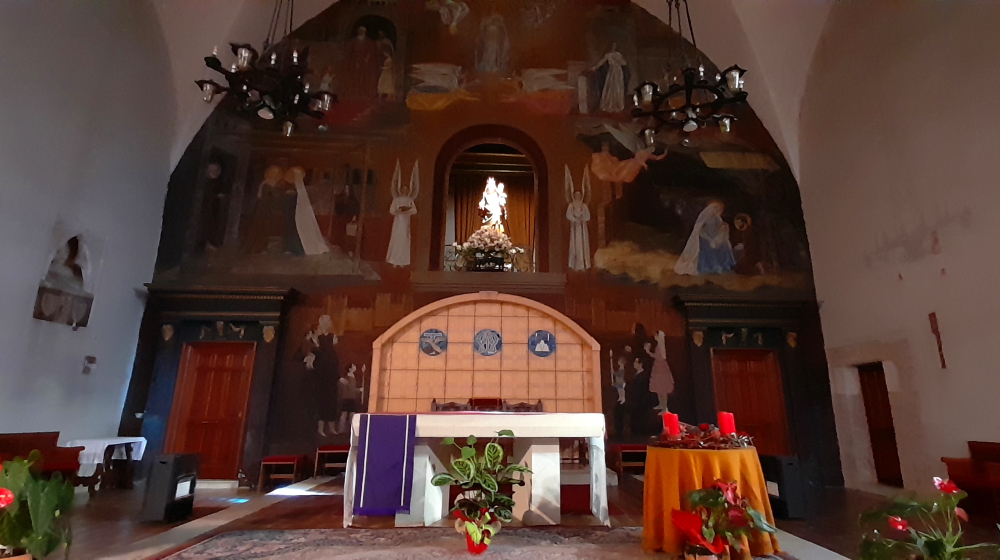
The temple that can currently be seen is in the Gothic style, very simple, with side chapels such as those of Santa Lucía or Santa Clara. Next to the main altar is the Green Cross from the 12th century. Romanesque, made of green jasper, with a small image of the Virgin Mary embedded in the central part. Next to it there is a chapel, a link between the church and the convent of the Poor Clare sisters, guardians of the image of the Virgin.
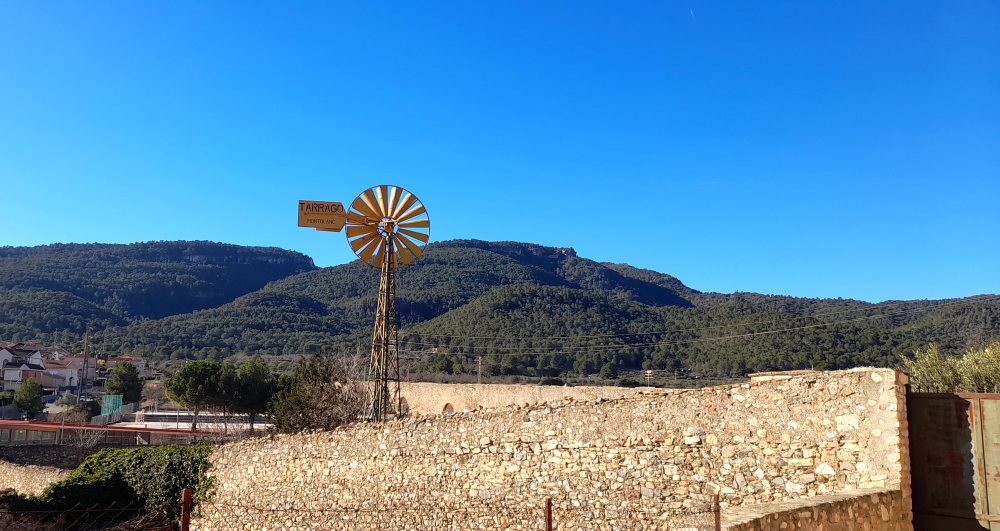
To the side of the church is a view of the surrounding hills and an unexpected sight – a metal windmill – usually an iconic symbol associated with rural Australia.
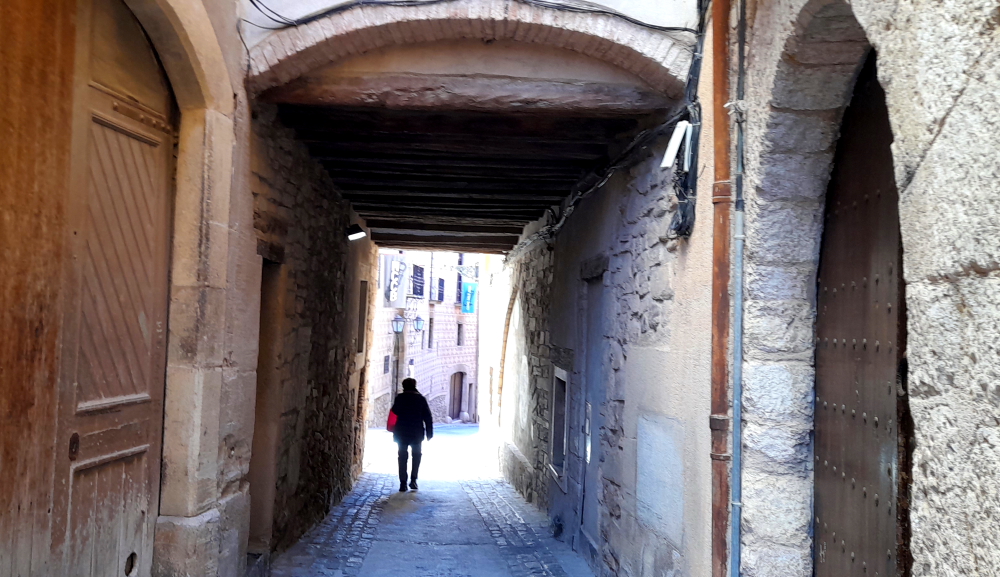
Cutting back into town, its numerous alleyways are only a car-width wide. Or more accurately the width of a horse drawn cart.
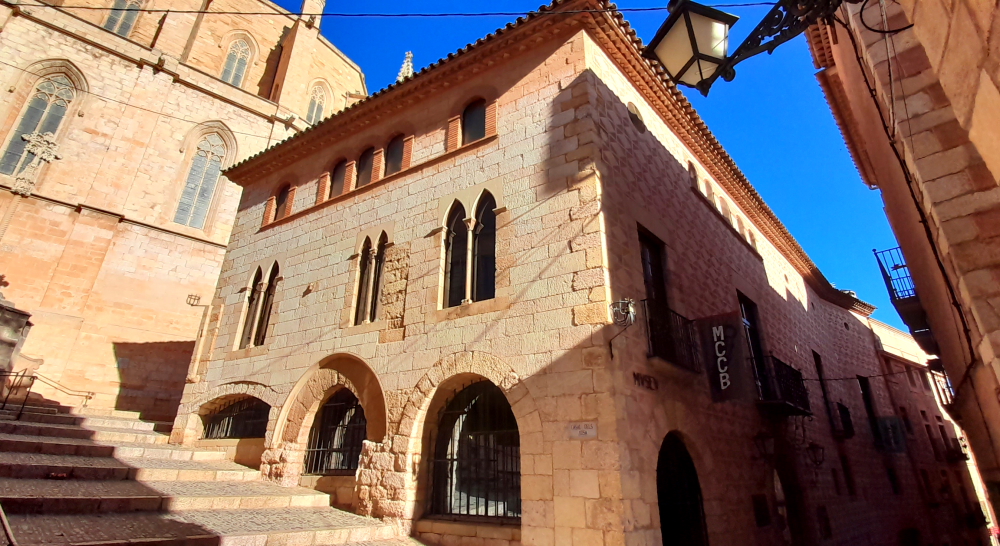
Located near the apse of the church of Santa Maria, the Casal dels Josa belonged to the Vilafranca family. It is believed that at first it should have been part of the royal desks, an adjoining building that would have occupied part of the old moat. When it passed into the hands of the Josa family in the 18th century, it underwent many modifications. It is currently home to the Regional Museum of the Conca de Barberà.
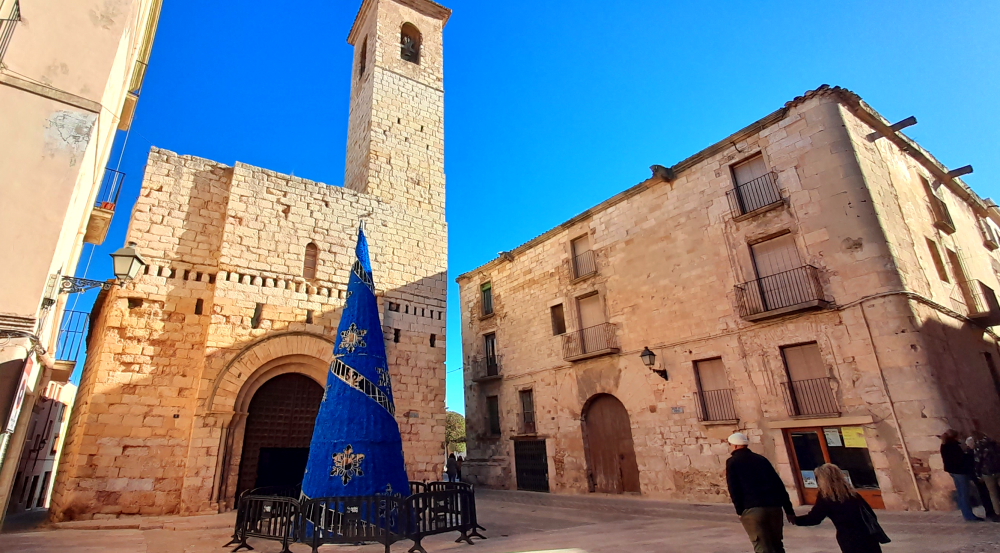
Several blocks away, off the Carrer Major, is Sant Miquel Church, the Palacio del Castla and the town’s Christmas tree.
The Church has a Romanesque façade with a Gothic-style interior. It was built during a period in which the town was growing and when the Romanesque church of Santa Maria was too small to take in all the Montblanc inhabitants. It was seat of the General Court of Catalonia in 1307 and 1370, and also during the interregnum period gathered the Parliament of Catalonia. During the 19th century the church suffered several lootings which decimated its structure and lead to the loss of the altarpieces that it had. In the course of the Spanish Civil War it was used as a store.
The Palacio del Castla was built during the 15th century. This large building has rounded corners for defensive reasons, with a porticoed interior patio, a garden and an orchard that reached the wall where a private portal was opened. Built after the Catalan Civil War, it was the headquarters of the castlà or castilian, military representative of the King. During the Carlist wars, the lower part of the building was converted into a prison, which left the structure of the building badly damaged.
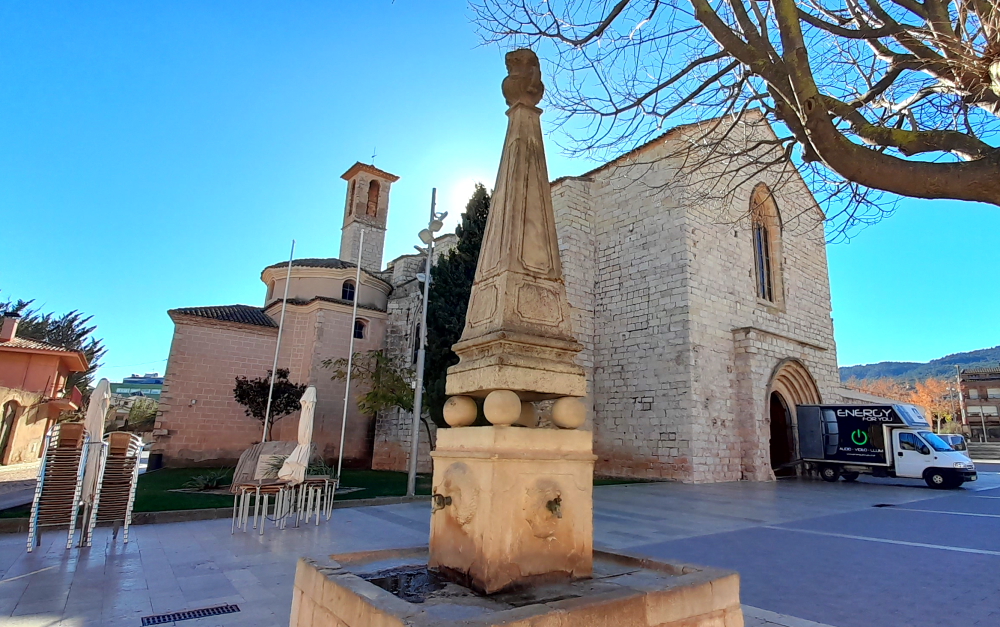
Walking along the Carrer Major to its other, southern, exit brings us to the Iglesia de Sant Francesc. It was built outside the town walls in the ??th century and it had the church, the cloister and the Franciscan monks section. It was a cultural centre of a great importance where philosophy lessons were taught and where important people were lodged.
During the 19th century with secularisation the building lost its importance and was totally abandoned. It was at this time that the cloister and the other sections were demolished. It only remained the church which, after suffering several lootings, it lost its religious character and became, among other things, a wine and liquor factory.
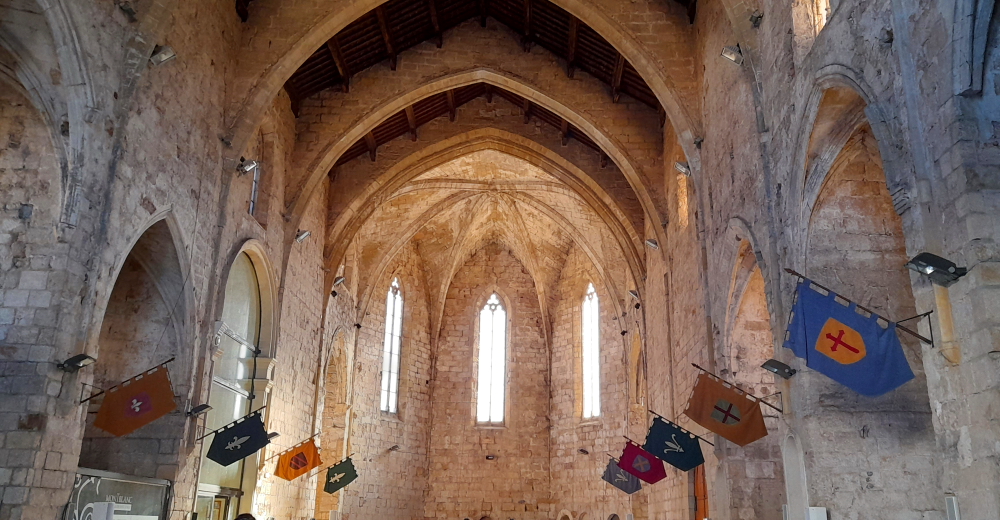
Inside, the church has only one nave with a crossing arch and six radial pointed arches. There is also a Baroque chapel from the 18th century attached to it. In the 20th century the building was renovated and converted into a cultural centre.
Half way back to the apartment we call into the Calle (Carrer) dels Jueus. Formerly the call (Jewish quarter) had three access portals, a synagogue, a cemetery located outside the walls and different businesses. Currently there is only one street that reminds us of the name where a small medieval arch is preserved.
The Call was made up of about 60 families who made their lives within the Jewish quarter and were self-sufficient. The Jews of Montblanc depended on the collection from Barcelona and dressed in their own clothing. The kings granted numerous privileges in exchange for contributions to the royal coffers, due to their commercial activity. Throughout the three centuries of its existence, the Jewish quarter suffered various looting by Montblanquins who, like all of Catalonia, did not accept the Jews, not expressly for religious reasons but for material reasons. At the end of the 15th century, and as a consequence of the inquisitorial processes, the Jews fled, a large part of them going to Menorca.
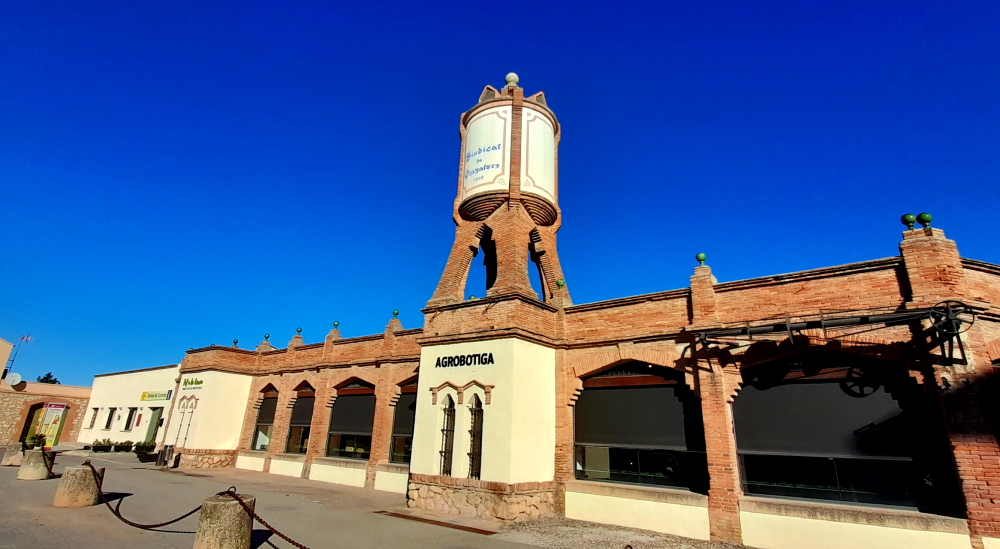
Around the corner from the apartment, outside the town walls, is the Agrobotiga located in the former Cellar of the Cooperativa de Viticultors de Montblanc, the Sindicat de Vinyaters, founded in 1918 and dissolved in 2012. The Cellar was built in 1919 and is the work of the modernist architect Cèsar Martinell.
Inside the agrobotiga is a variety of products from the region, such as all the wines from the different cellars of the Conca de Barberà Denomination of Origin and other products from different Cooperatives in the Catalan territory.
Tonight we are booked for dinner at the El Moli del Mallol restaurant at the end of our street. The afternoon we arrived in town their car park was packed. Their website said they were open Christmas Day for lunch but when we make inquiries it turns out the restaurant will be closed – of course! So, we’ll give it a whirl tonight instead at the usual earliest booking time of 8:30pm.
We are the first guests to arrive promptly at 8.30pm and, as it turns out, the only guests by the time we leave at 9:30pm. How unusual! Unexpectedly, while we wait for our orders we are offered a chilled glass of vermouth blanco each – which is on the sweet side – along with some delicious olives.
My “roast lamb” turns out to be grilled lamb cutlets (bonus!) with roasted vegetables. Lynn’s “pork meat and vegetable stew” turns out to be a small casserole dish of hot water with some noodles, half a piece of carrot ring, a tip of a small potato, some onion, a small piece of shredded pork and lots of slices of blood sausage floating in it. So much for the veg part of the stew!
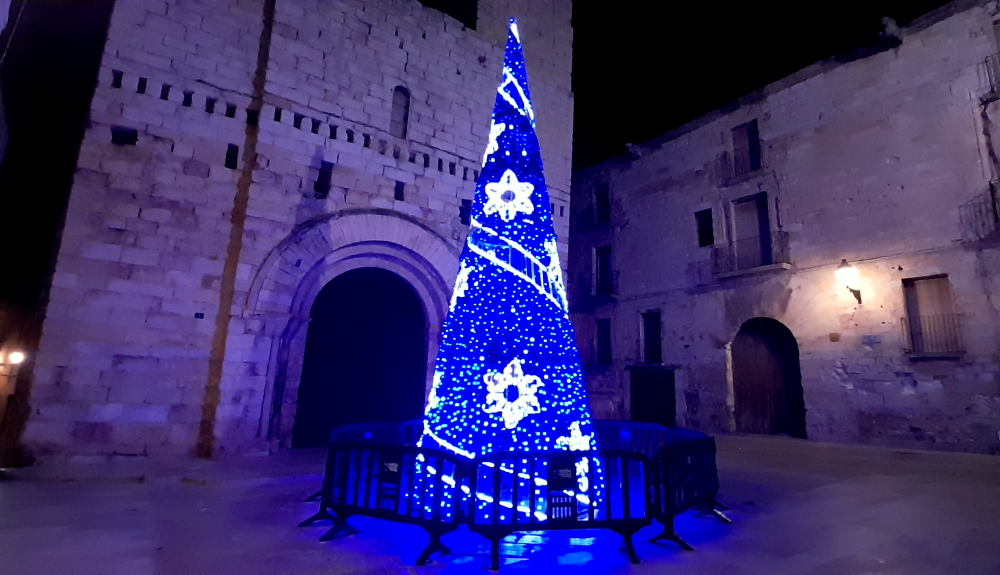
After dinner, Lynn decides to walk into town to check out the Christmas lights. Unfortunately our cameras don’t do justice to the colour of the lights that are strung across the Carrer Major which look like pieces of red, green, gold and silver-coloured jewellery.
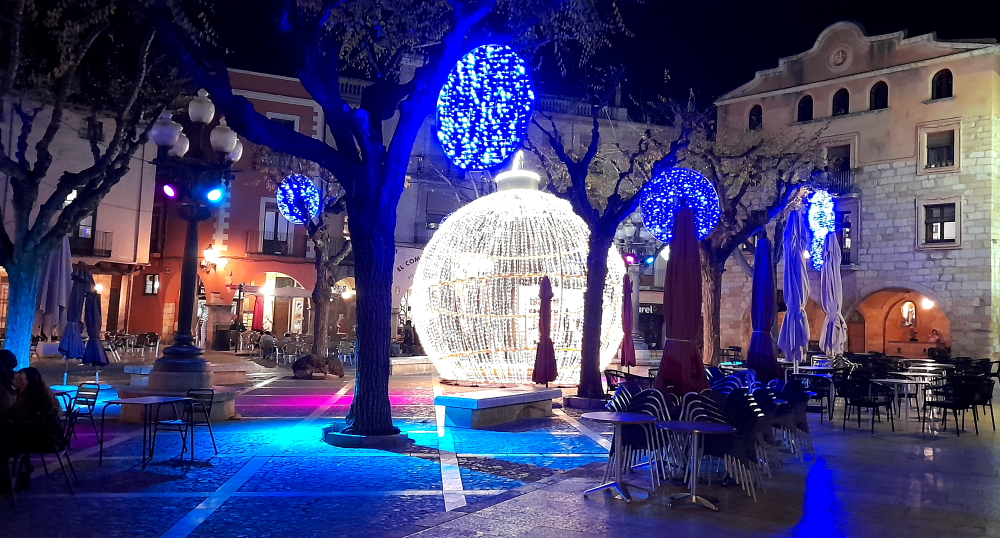
But she is able to capture the lights in Placa Major and the Christmas tree.
24 December, 2023
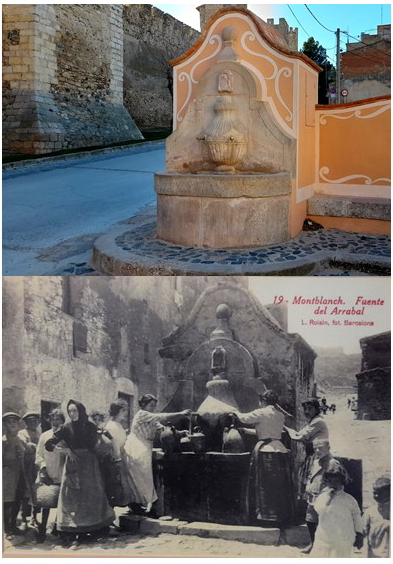
Speaking of that photographic essay of the town’s individual water fountains – that is today’s plan to capture them all. Armed with a town map we head out the door and tour the town in an anti-clockwise direction. The number of fountains dotted around the town, in particular inside the town walls, shows just how important these were/are to the townsfolk in sieges and peacetime.
No. 1 is the Fuente del Arrabal which is outside the wall and which we can see from our apartment. We’ve tried to recreate the old photo that is in our apartment with the fountain as it is today.
No. 2 is also outside the walls on the Passeig de l’Arquebisbe Joan Marti Alanis which leads to the Santuario de la Sierra.
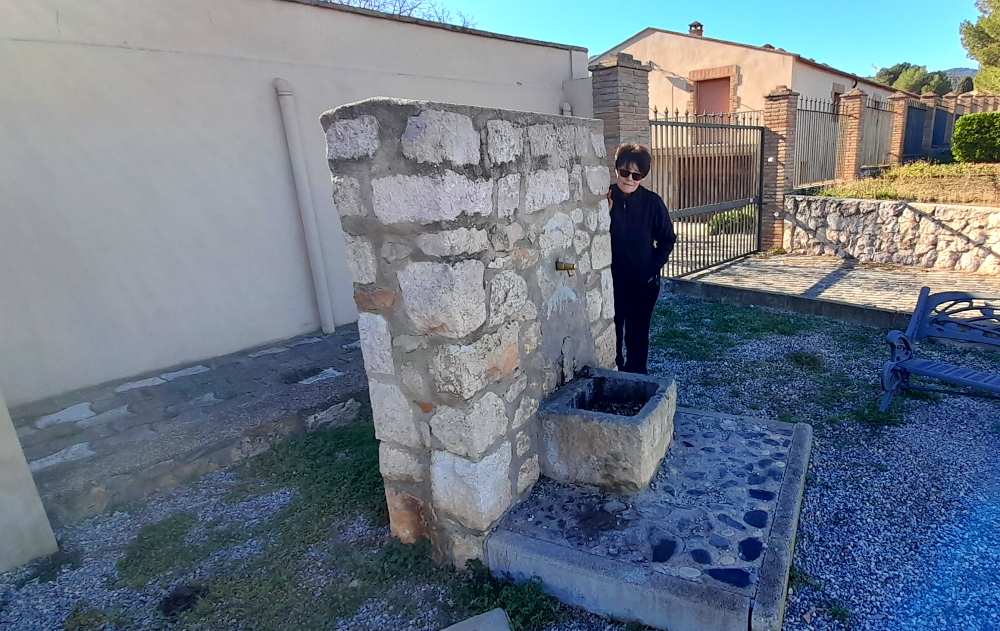
No. 3 is just inside the walls near Pla de Baix – but this one isn’t marked on the town map.
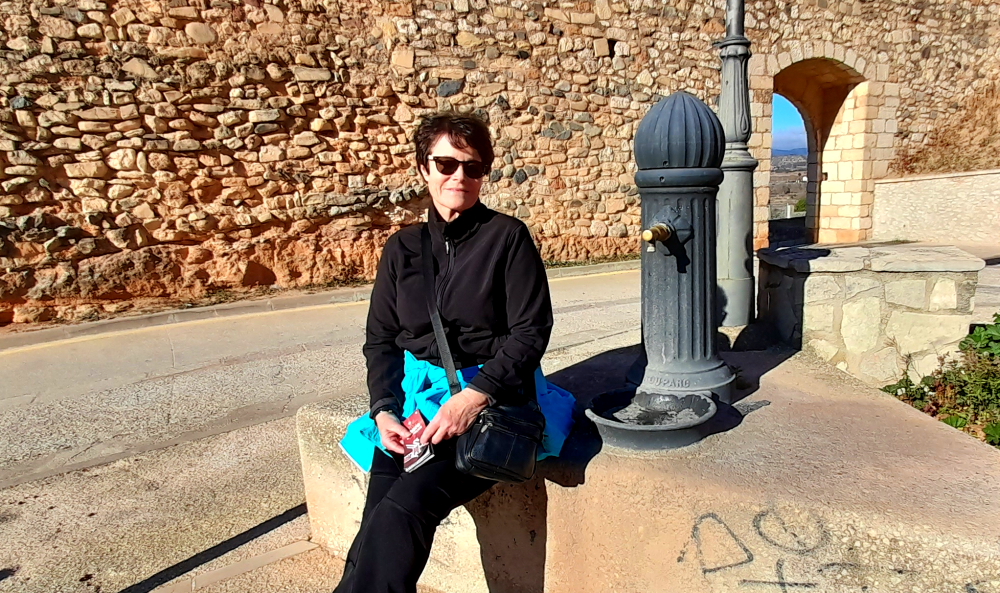
No. 4 is a more ancient-looking one (14th century?) in front of the Church-Hospital of Sant Marcal, complete with horse trough.
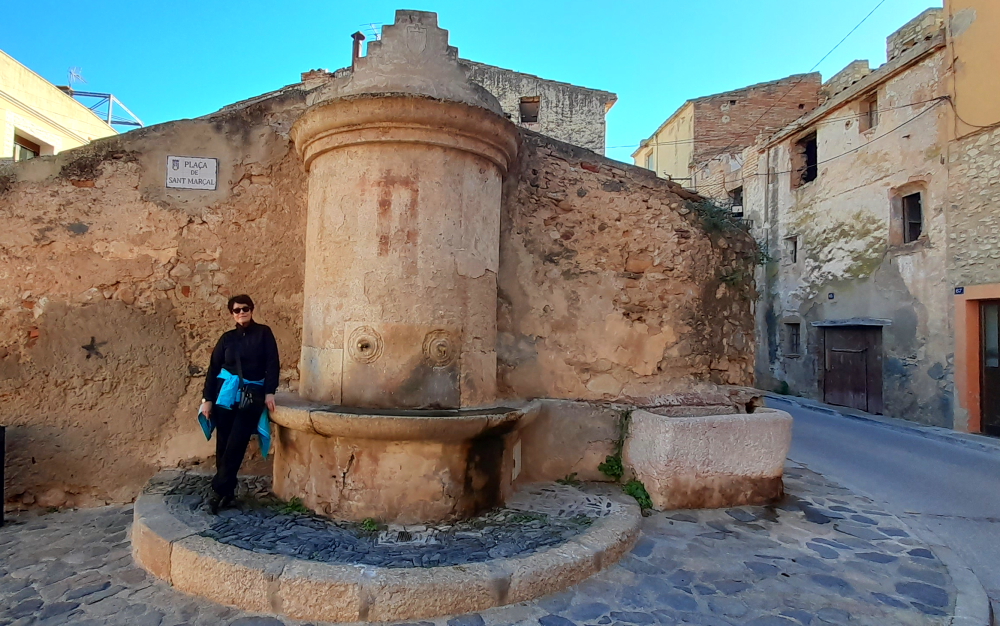
No. 5 is the Fuente Mayor which featured in the blog for 21 December.
No. 6 is outside the Rosa dels Vents restaurant on the corner of Carrer Sant Isidre and Carrer Poblet i Teixido.
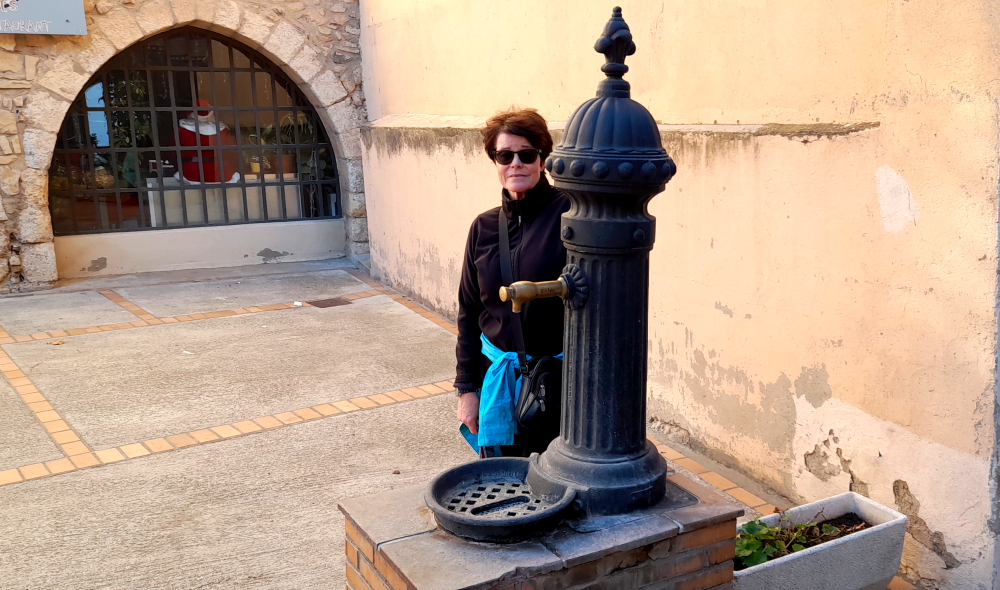
No. 7 is in front of the Sant Francesc Church which is featured in yesterday’s blog.
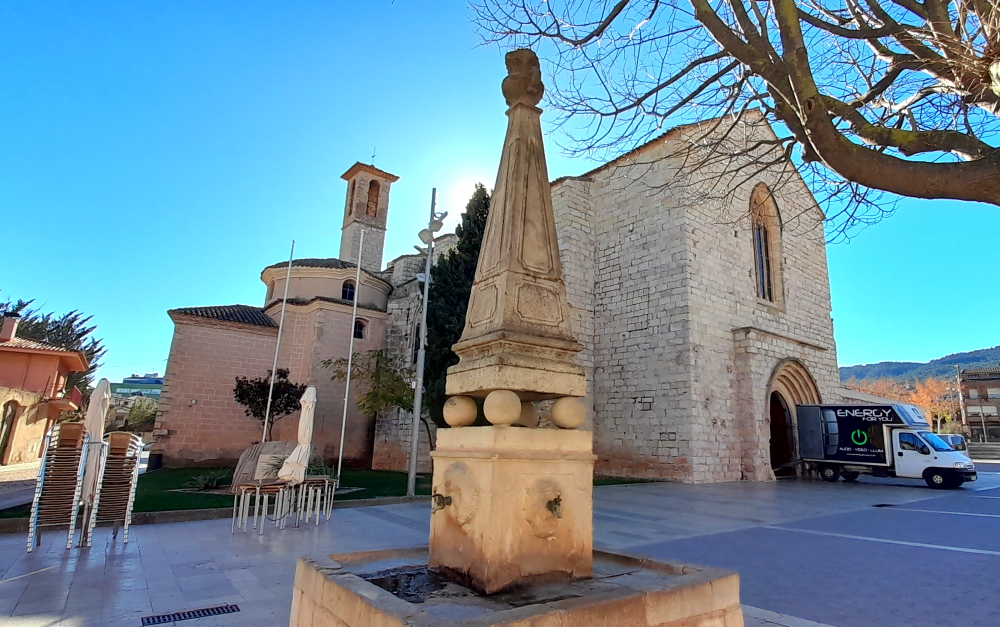
No. 8 is called ‘Als Jueus’ on the corner of Carrer Trinquet and Carrer de les Corts adjacent to La Violetta restaurant.
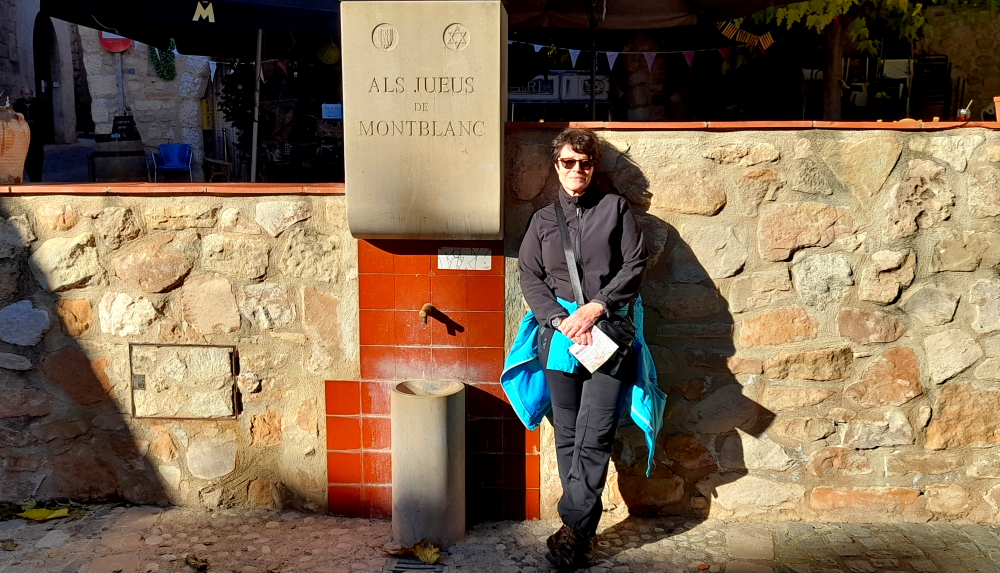
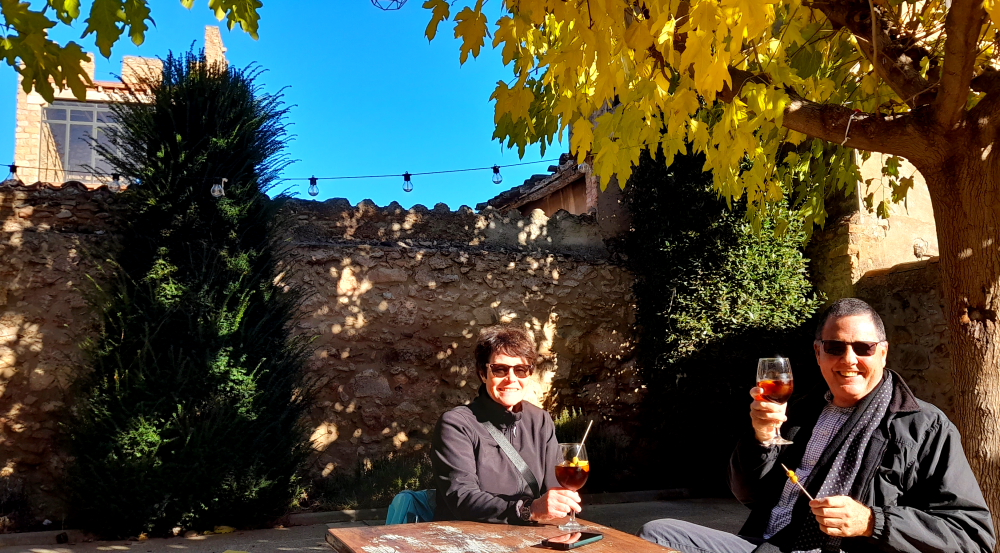
We are about to move onto the next fountain when we hear some Christmas jazz playing. Lynn suggests we sit in the sun with a glass of dry vermouth each in the restaurant’s courtyard. So we do.
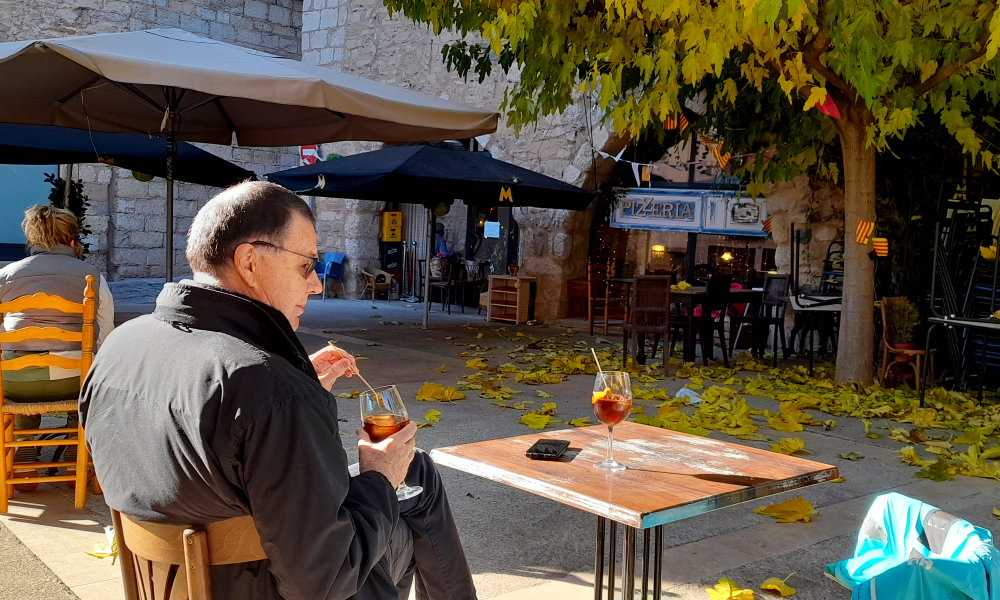
The other couple sitting in the sun turn out to be the restaurant’s owners so we strike up a conversation with them. They are so friendly that we book a table for pizza for Wednesday evening.
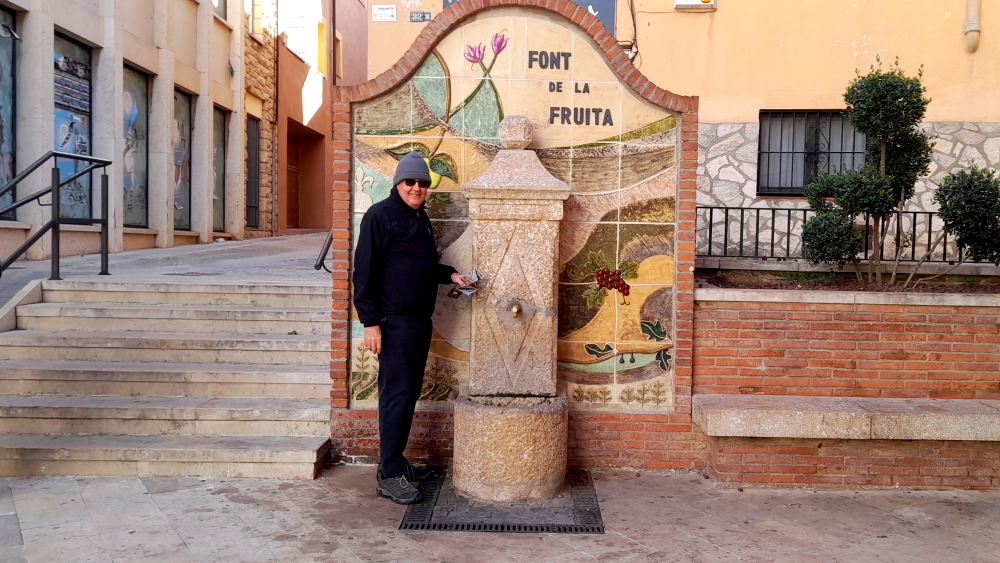
No. 9 is around the corner. It’s the Font de la Fruita featured in the blog on 21 December which kicked off this photographic essay.
No. 10 is also nearby in Placa Santa Tecla.
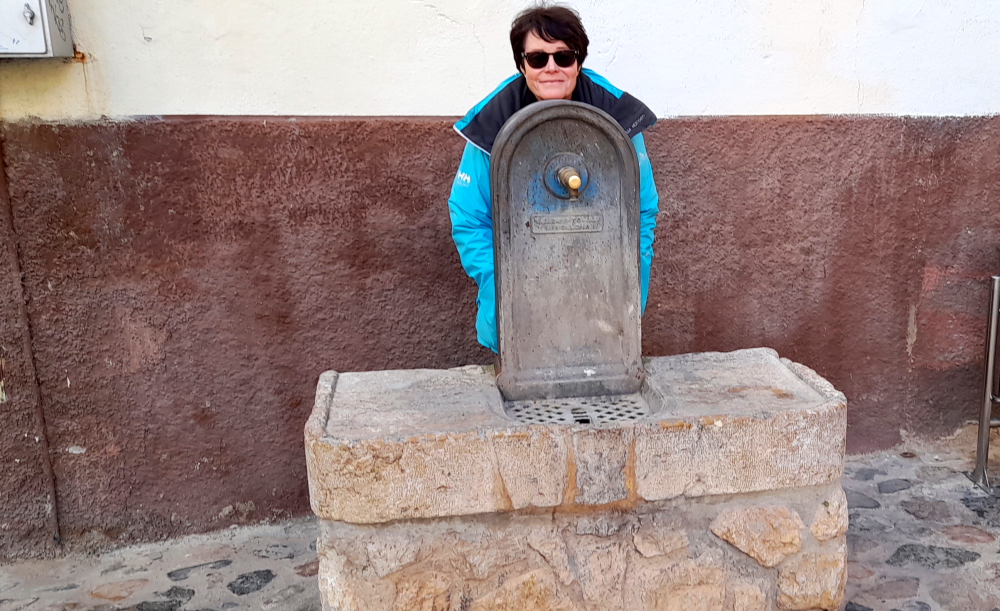
Finally, No. 11 is on Carrer del Joc de la Pilota.
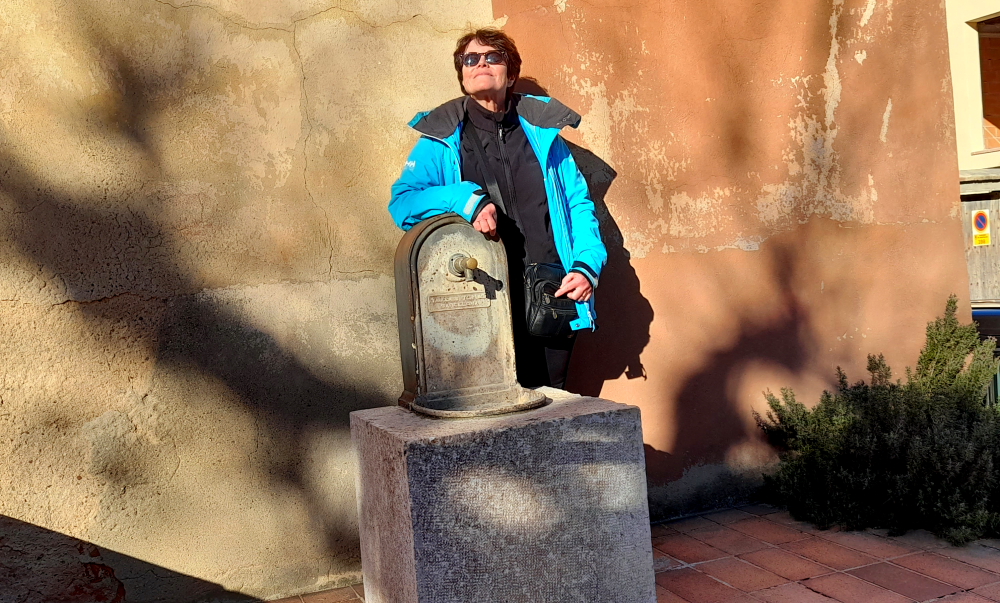
This brings us out at the tower past our own tower so it’s just a short walk home.
25 December, 2023
Feliz Navidad! Today is due to be cloudy and 14 Deg. C.
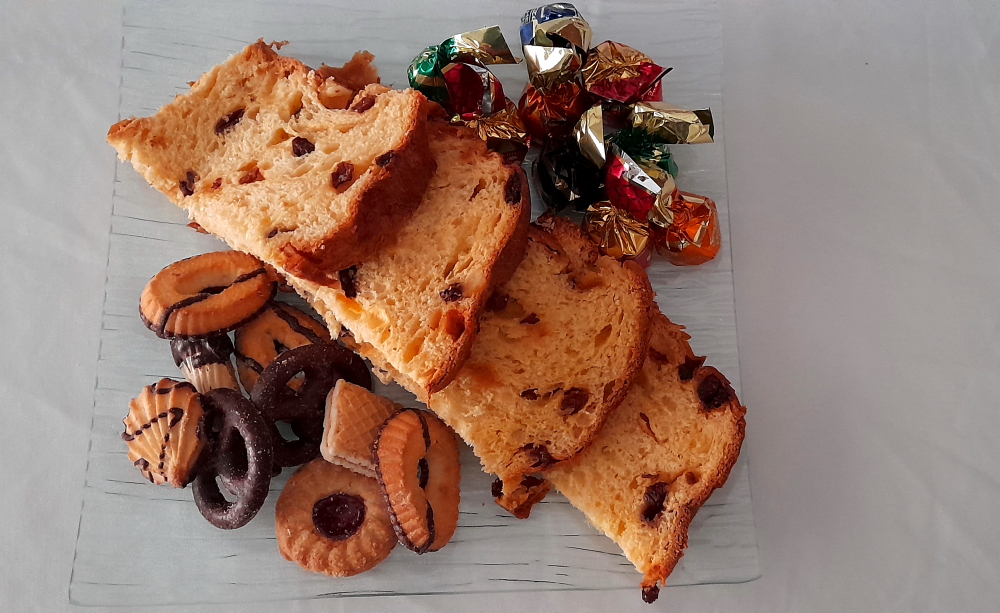
Unlike our Ozzie Christmas lunches of Prosecco, chilled seafood and Christmas pud, today it’s Cava, roast chicken and panettone for Christmas pud – followed later by a Silent Night. Perfect!
26 December, 2023
A day of doing very little. We take a post-breakfast walk around town and as expected almost everything is closed today. However, there are a number of tourists also walking the streets of the old town. Tourists and no shops open? How very non-commercial of the Spanish.
We do, however, complete the first draft of the last stage of our travels which includes Estonia, Latvia and Lithuania which is very tentative and subject to what happens in Russia over the next couple of months. I also investigate various travel options for our return to Oz.
27 December, 2023
Yet another sunny day in Montblanc. But not so sunny in the shower this morning – bloody freezing water! What is it with the Spanish and domestic hot water systems!?! Thankfully, after quite a few WhatsApp messages with the owner, the system is back up and running.
Today we are booking accommodation for our next sojourn into Europe after travelling through Wales.
Tonight, after Lynn has her hair cut, we are off to La Violetta for Spanish pizza – which turns out to be surprisingly good.
28 December, 2023
After a frustrating day yesterday doing accommodation bookings for our next European drive in April and May we soldiered on to do more today. It seems that more and more accommodation places are coming on the market with owners that have less and less knowledge and experience in both knowing what to offer guests and what to show in their online presentations. Most don’t have a F***king clue. They just get in the way of the process so it takes us longer to sort out the mess and make the bookings. I can see that previous AirBnB owners are moving to Booking.com but have learnt nothing. There is officially a lot of rubbish accommodation out there and price is not an indicator.
Tonight we are eating in to clean up what’s left in the fridge after 9 days here in Montblanc. It has been a restful stay and although the medieval town is no Spello it certainly has some friendly locals, good food and good cheap wines.
Tomorrow we will be up a little earlier than our usual sleep ins to be on the road by 10:00 am so that we can drive the 5.5 hours to Carcassonne via Andorra. Originally we were going to bypass Andorra as we expected the ski country to be under snow by this time of year but the average day time temperatures have been mid-teens with 5 to 8 Deg C minima at night. Thank you global warming!
 THE CONTINUING TRAVELS OF YOGI & BOO BOO