
16 May, 2023
The weather forecast for today is for rain to start at around 10:00 am. After a very wet walking tour of Cordoba, Spain last December we are praying for much lighter rain for our walking tour of Oslo this morning.
Due to the possibility of rain and the 30-minute walk from our hotel to the starting point of our 1.5 hour walking tour we decide to take the No. 11 tram into Jernbanetorget, Central Train Station from the Rosenborg tram stop.
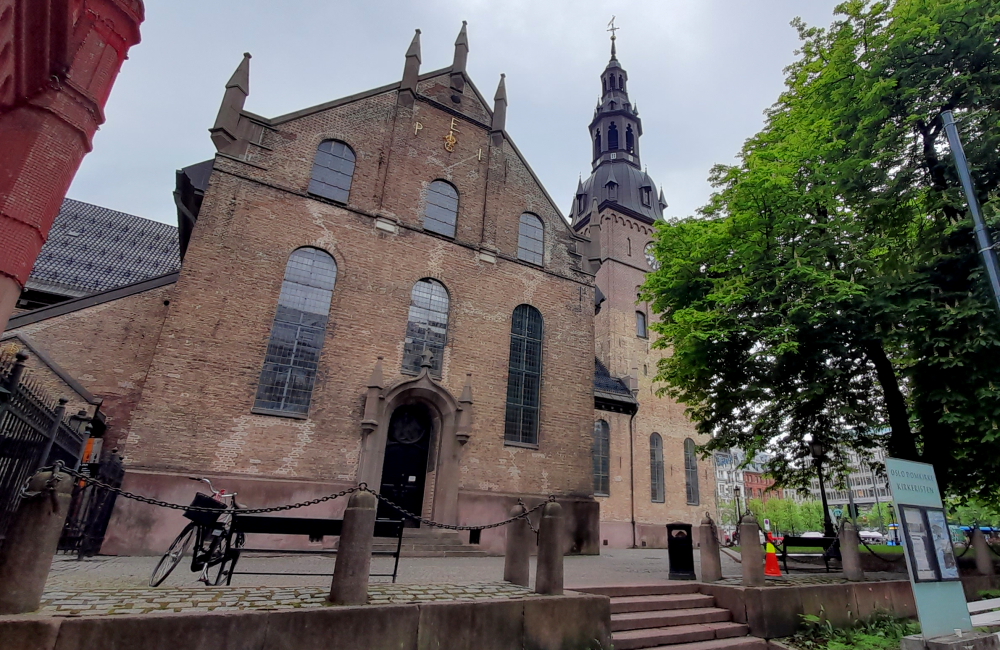
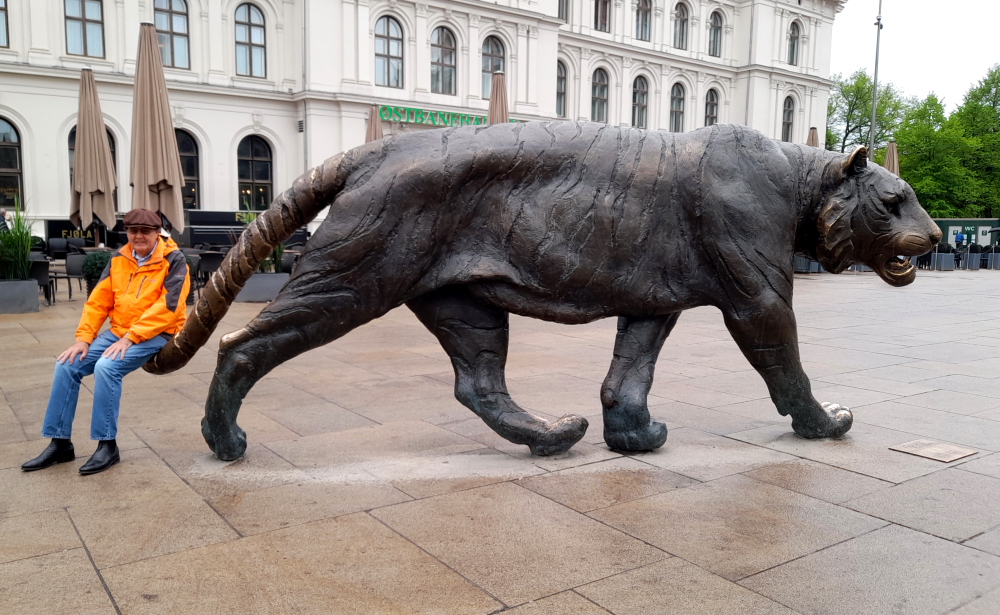
We arrive 30 minutes early so we walk to the nearby Oslo Cathedral then return to the walk’s meeting place, the Tiger sculpture in front of Oslo’s Central Station.
When Oslo celebrated its 1000-year anniversary in 2000, Eiendomsspar, (the local property development company) wanted to give the city a gift. Oslo wanted a tiger, and that’s what they got: a 4.5-metre bronze tiger made by Elena Engelsen. The reason – the city’s nickname Tigerstaden (“The Tiger City”) which most Norwegians are familiar with. The name was probably first used by Norwegian poet Bjørnstjerne Bjørnson. His poem “Sidste Sang” from 1870 was about the lawless city of Oslo with its drunken sailors, prostitutes, crime and violence.
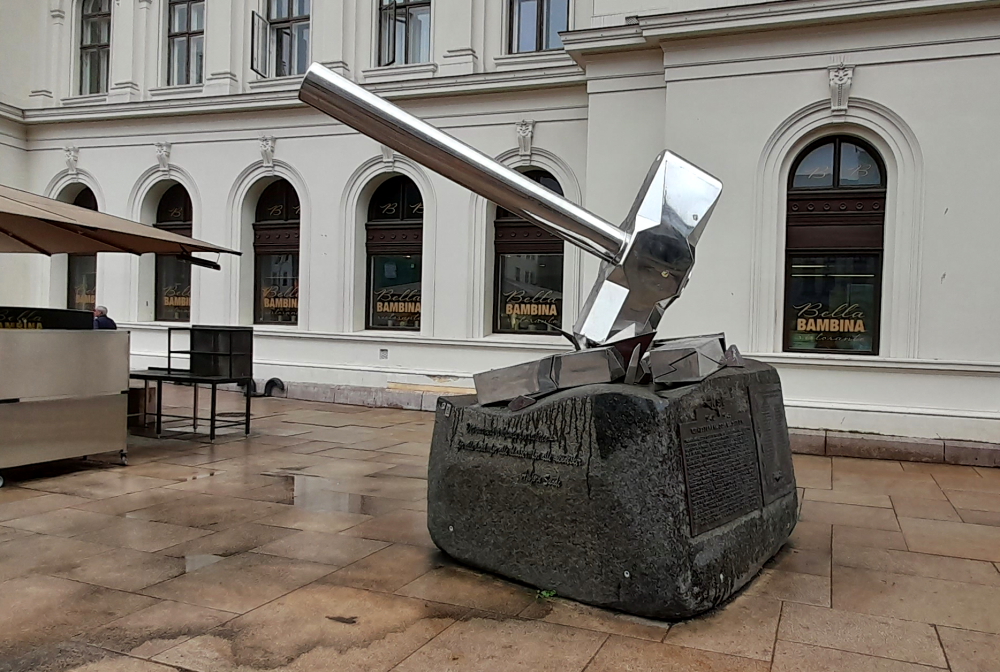
Nearby is another sculpture that is reminiscent of Thor’s Hammer. Rather it is entitled “Smash Nazism” by Bjorn Gulliksen and depicts a hammer smashing a swastika. It is dedicated to the Osvald Group, heroes of Norwegian Resistance during WWII.
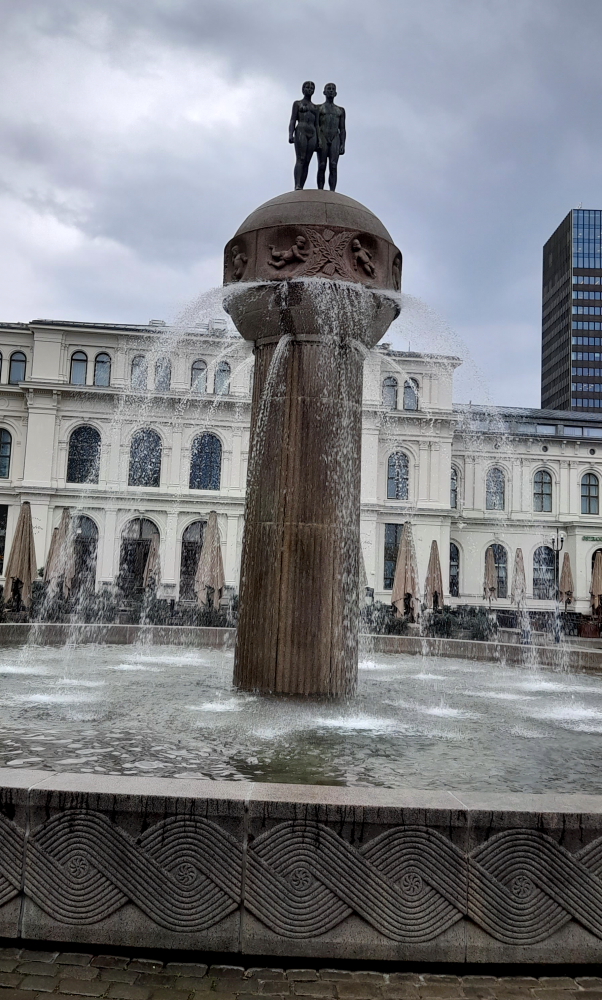
As we walk up Strandgata we pass by the Sun & Earth Fountain then onto Prinsens gate to view the Opera House at the head of Oslofjord.
The angled exterior surfaces of the building are covered with Carrara marble and white granite and make it appear to rise from the water – like an iceberg. The Norwegian architectural firm Snohetta won the design competition in 1999. Construction started in 2003, ended in 2007 with the gala opening in 2008 attended by HM King Harald, Queen Margrethe II of Denmark and President Tarja Halonen of Finland and other leaders.
The Opera House won the culture award at the World Architecture Festival in Barcelona in October 2008 and the 2009 European Union Prize for Contemporary Architecture.
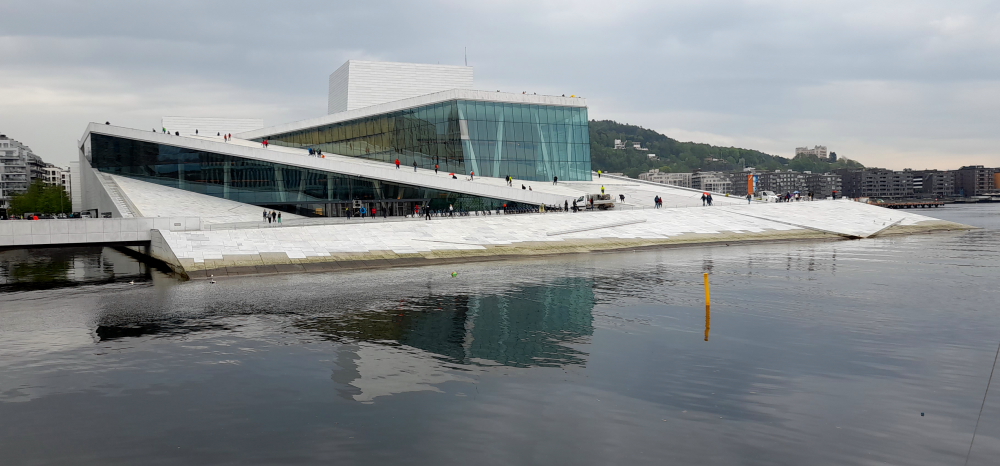
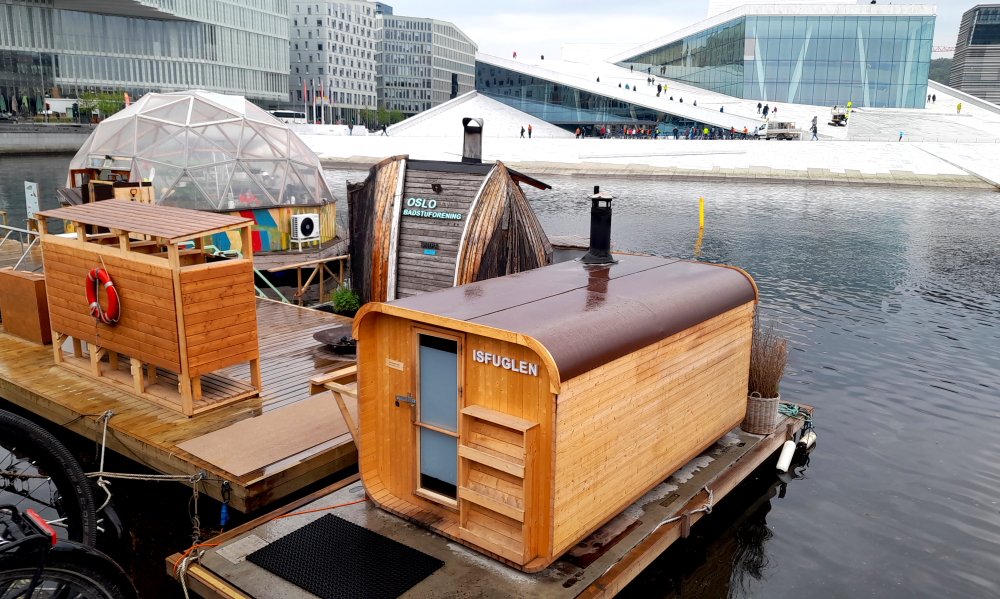
Naturally, there are several saunas on the water’s edge.
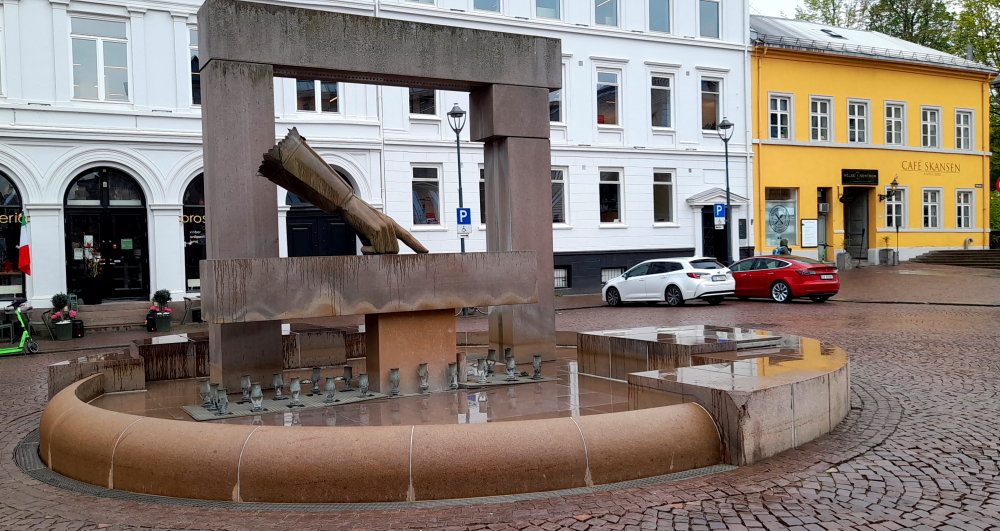
After walking up Radhusgata we arrive at Christiania torv. The Danish king, Christian IV was king of Norway when the fire of 1624 completely destroyed Oslo. He decided that the old city should not be rebuilt again. He decided that the new town be built in the area below Akershus Fortress, a castle which later was converted into a palace and royal residence. He decreed the town’s new location by dropping his glove, now immortalised by a bronze gauntlet and fountain.
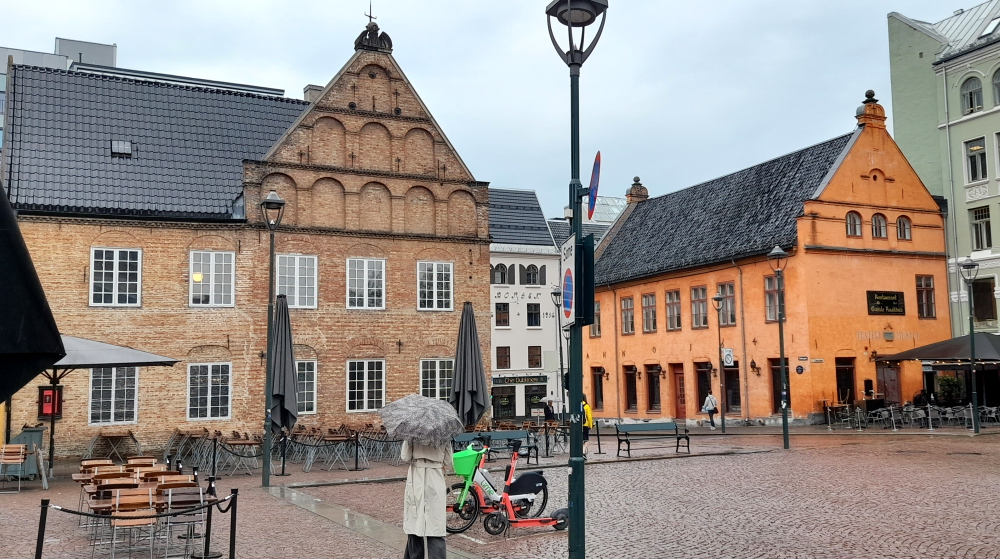
This new town was called Christiania (after himself) and was laid out with wide streets which met at right angles, designed to hinder the spread of fire.
Buildings in the new town were made of stone or brick, and not the traditional log construction. People who could not afford to build brick houses were allowed to build half-timbered structures, “in the Danish fashion.” Christiania became a little town typical of Northern Europe with 330 properties with buildings of brick, half-timbering and logs. Ramparts were built around the town for defense. These defined the town’s dimensions for many years to come.
In the next block we arrive at Akershus Fortress. The building of Akershus Castle and Fortress was commenced in 1299 under king Håkon V. The medieval castle, which was completed in the 1300s, had a strategic location at the very end of the headland, and withstood a number of sieges throughout the ages. King Christian IV (1588-1648) had the castle modernised and converted into a Renaissance castle and royal residence. Today the fortress is used by the military.
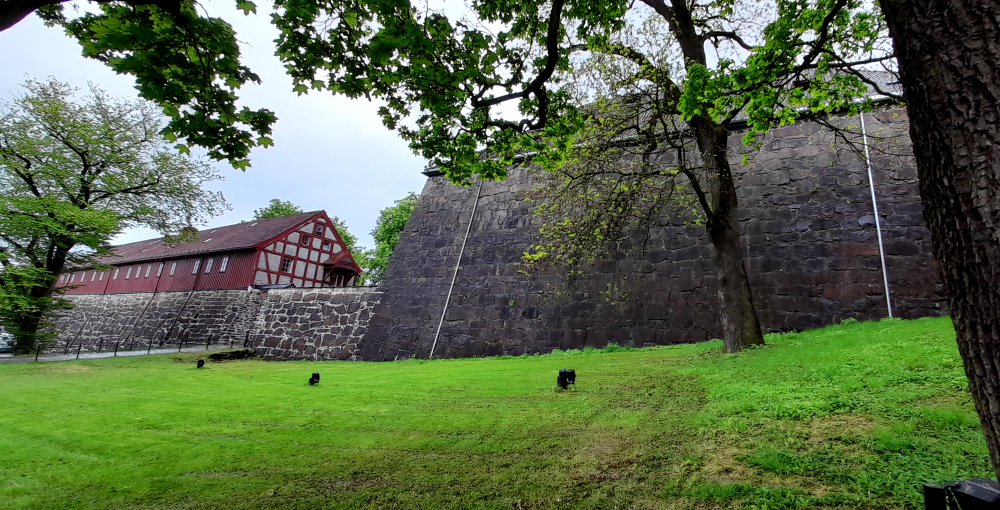
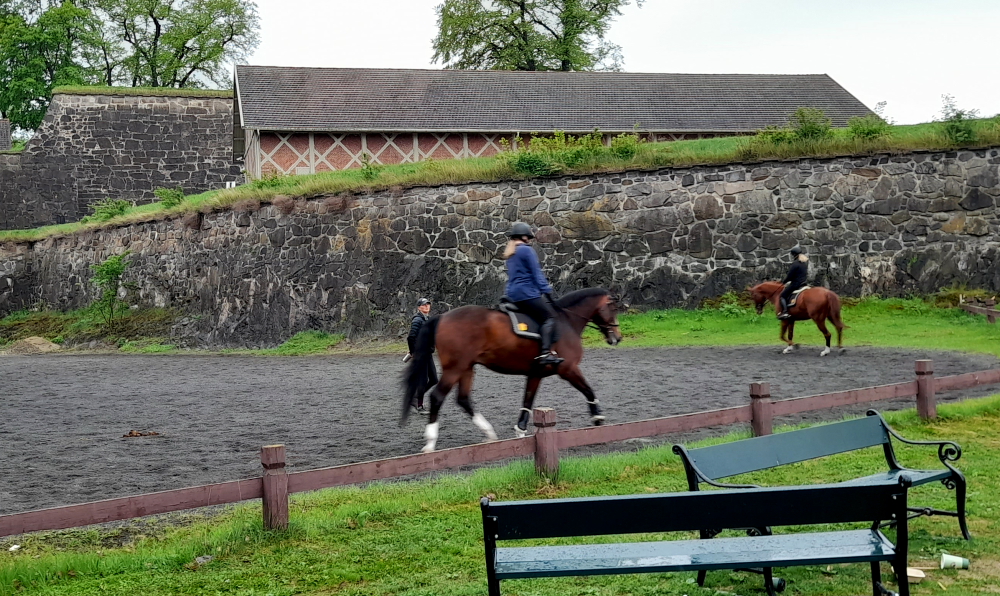
The stable block next door is used in the training of the mounted police force.
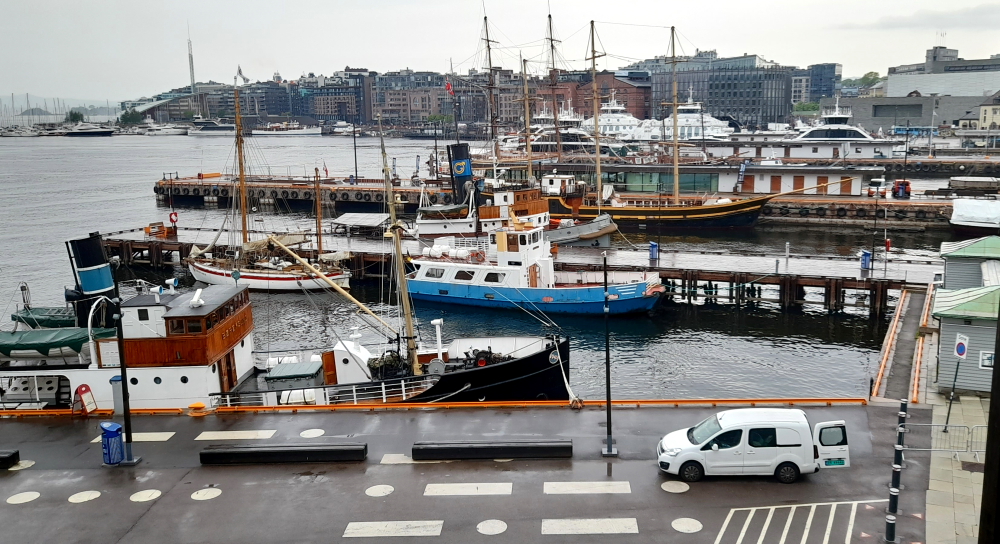
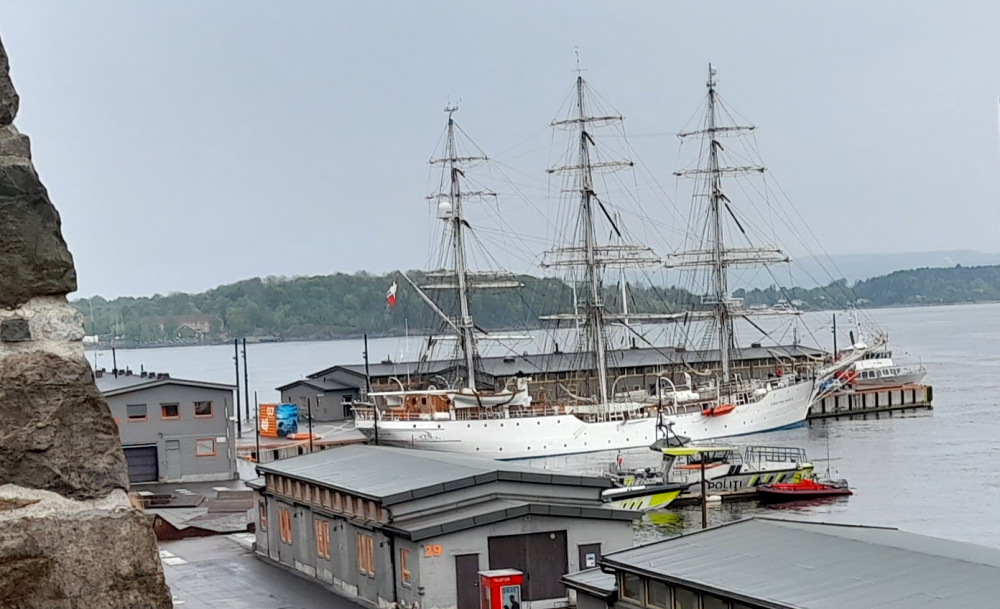
From the Fortress we walk down the stairs to the harbourside where several wooden sailing ships are moored.
Crossing the Radhusplassen opposite the piers we come to the back of the Oslo City Hall. The building as it stands today was constructed between 1931 and 1950, with an interruption during WWII. It is built of red brick and has two towers. The eastern tower has a carillon set of 49 bells which are presently silent due to being re-tuned. Various events and ceremonies take place in the building, notably the Nobel Peace Prize ceremony, which takes place every December.
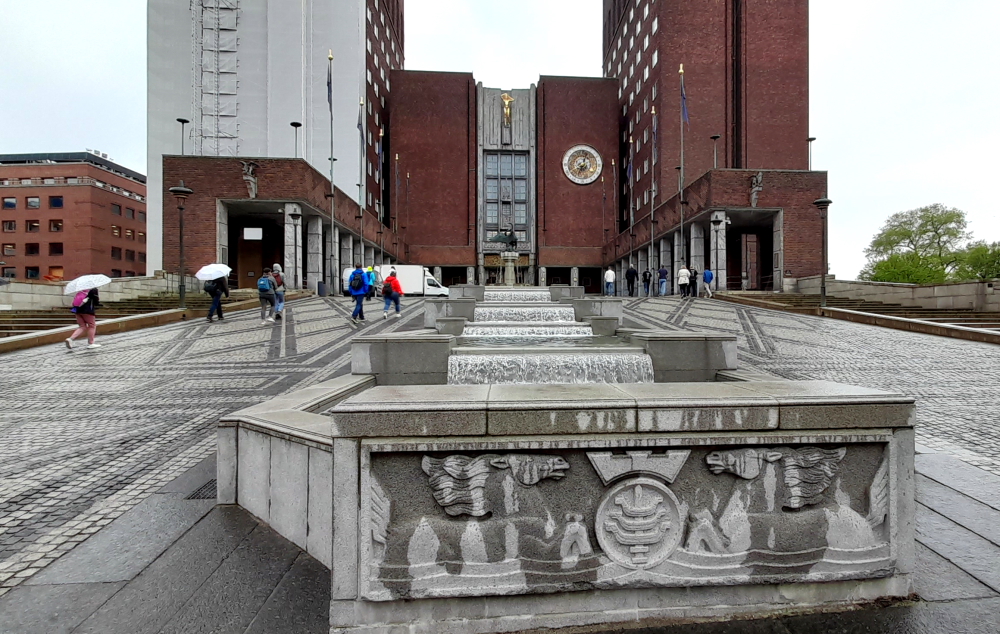
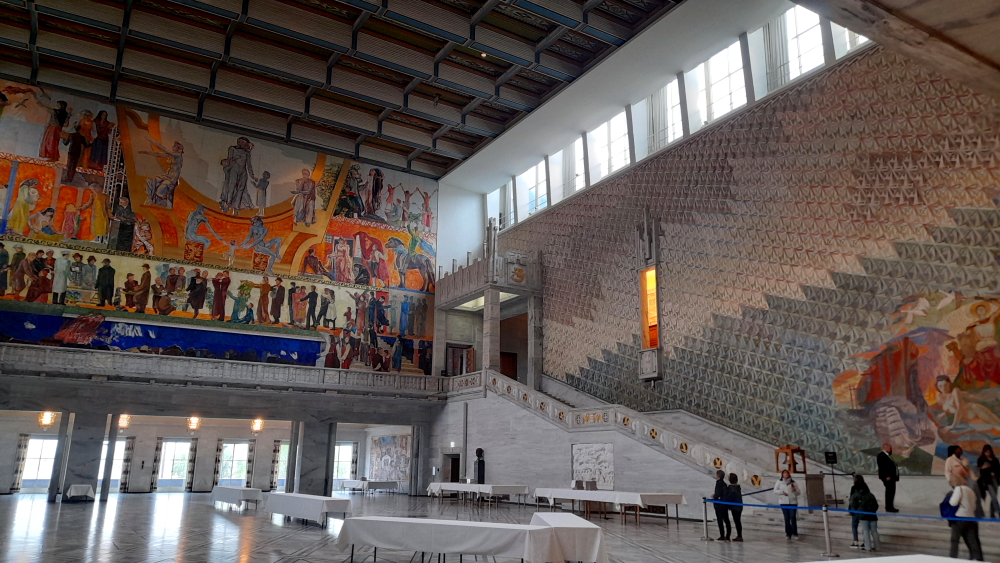
The front of the Hall has a stepped fountain and gorgeous clock. Entry into the building takes us straight into the space where the Nobel Peace Prize is presented.
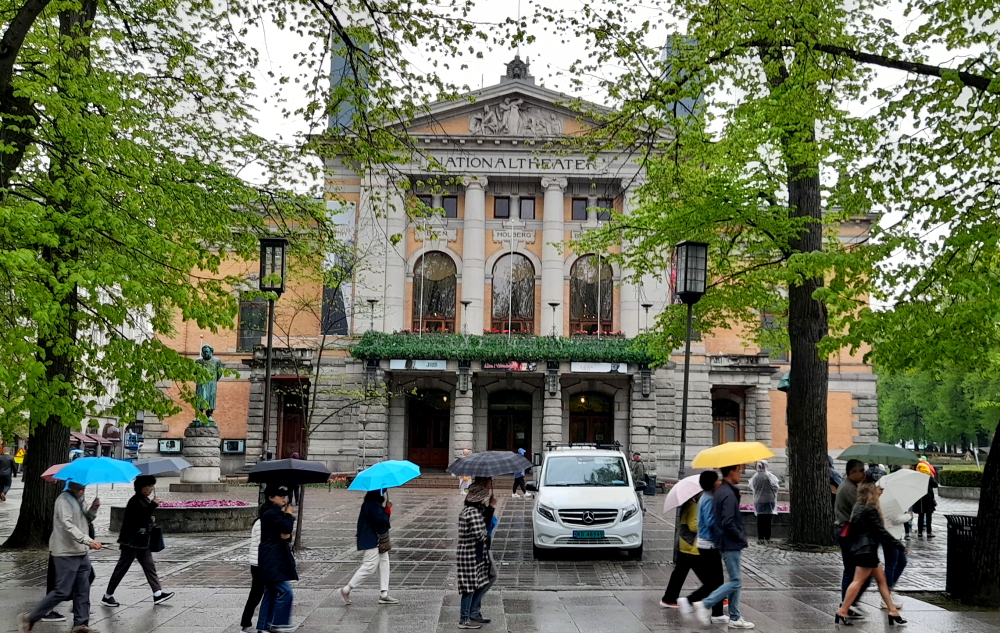
Walking away from the City Hall along Roald Amundsens gate we stop at a park where at one end is the National Theatre. The theatre had its first performance on 1 September 1899 but can trace its origins to the Christiania Theatre, which was founded in 1829. The theatre is often considered the home for Ibsen’s plays, and most of his works have been performed here.
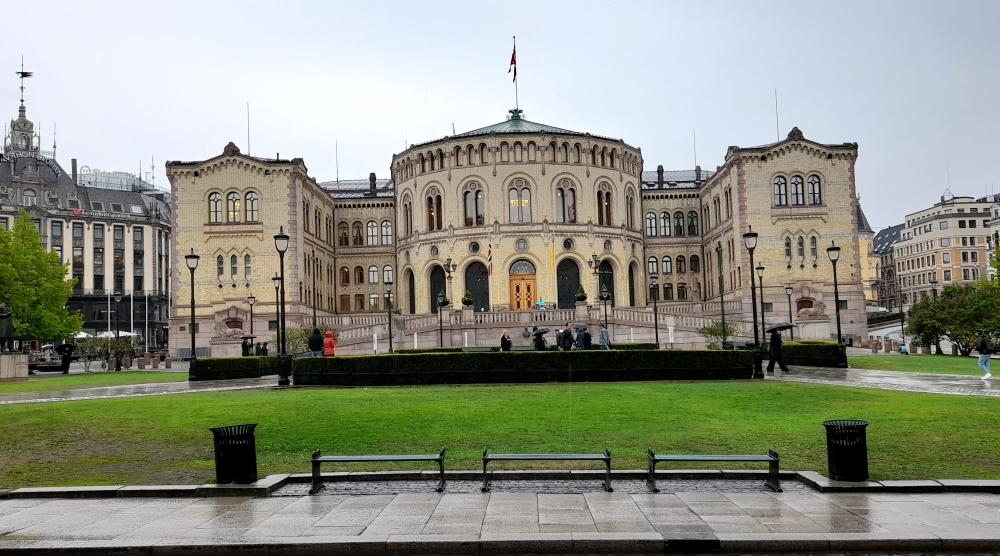
At the other end of the park is the Storting building – the seat of the Storting, the parliament of Norway. Although the Parliament of Norway was established in 1814, it wasn’t until 1866 when this building was put into use. It was designed by the Swedish architect Emil Victor Langlet.
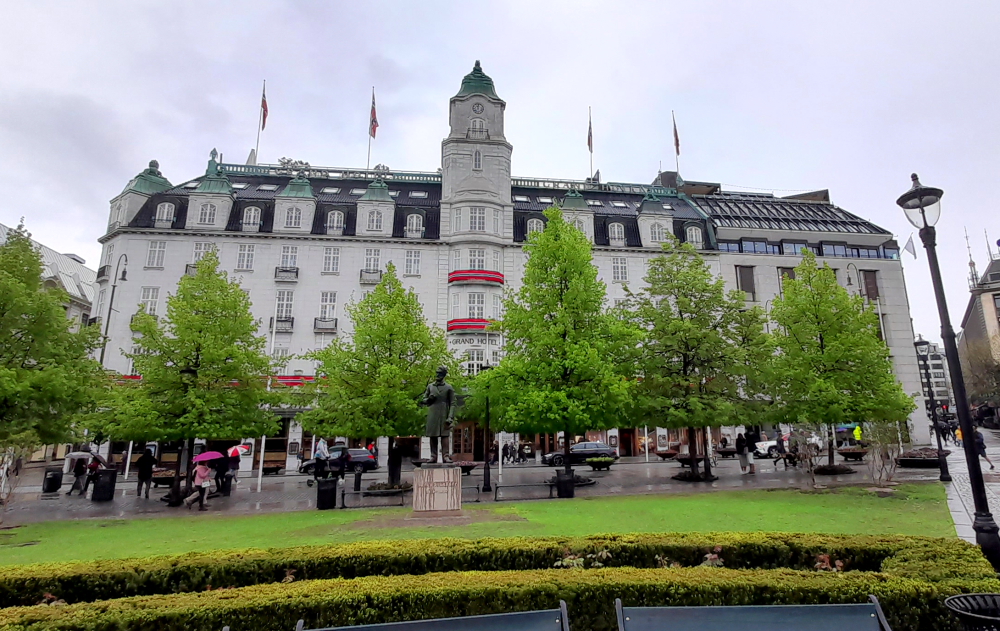
Adjacent to the Parliament is the Grand Hotel where dignitaries and celebrities stay. It is from the 2nd floor balcony that Nobel Peace Prize winners wave to the public.
It’s now 11:30 am and the end of our tour. We walk back to Central Station and get the No. 11 tram back to the hotel.
Approaching the hotel we hear a marching band and see the local school kids in procession, all in clear plastic macs, practising for tomorrow’s children’s parade to the Royal Palace as part of the 17 May Constitution Day celebrations.
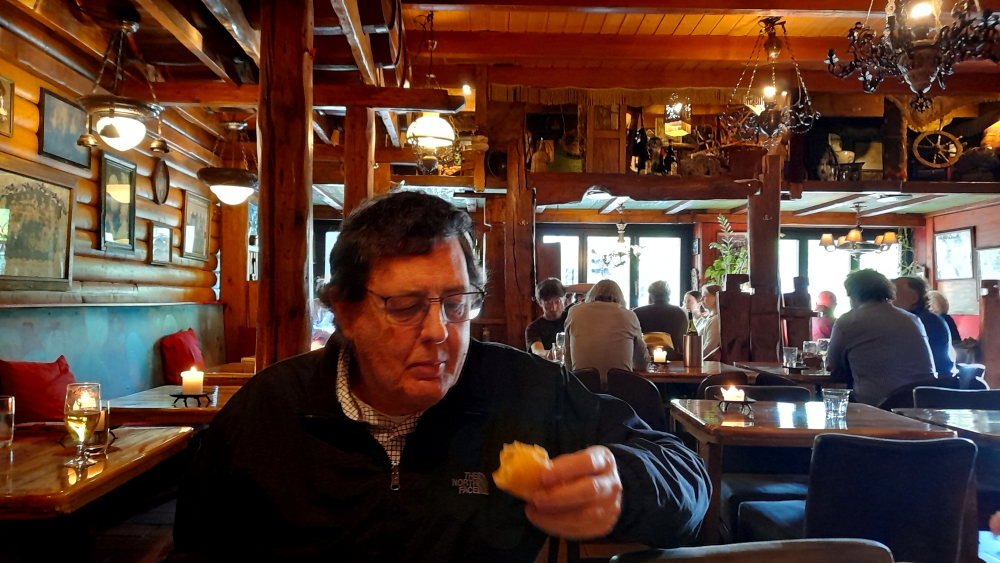
As most of the tour this morning was in drizzle and rain we decide to stay put until it’s time for dinner. At 6:00 pm we walk to Majorstuen to Larsen’s Restaurant. It opened in 1951 and had the function room, Blåsalen, on the second floor until 1982. At that time, the restaurant was a celebrity spot with the skiing elite and other celebrities as guests. Today there are only rooms on the first floor, but most of the interior and its old charm has been preserved together with its selection of home cooking.
17 May, 2023
Constitution Day is the national day of Norway and is an official public holiday observed on 17 May each year.
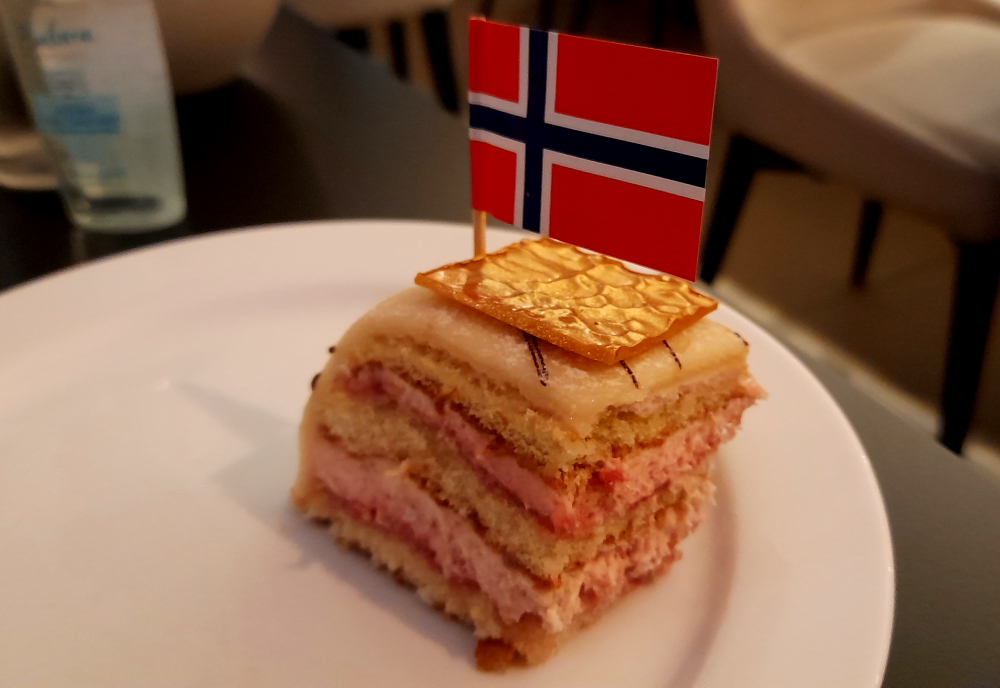
Among Norwegians, the day is referred to as Syttende Mai (“Seventeenth of May”), Nasjonaldagen (“National Day”), or Grunnlovsdagen (“Constitution Day”), although the last is less frequent.
The Constitution of Norway was signed at Eidsvoll on 17 May 1814.
The constitution declared Norway to be an independent kingdom in an attempt to avoid being ceded to Sweden after Denmark-Norway’s devastating defeat in the Napoleonic Wars.
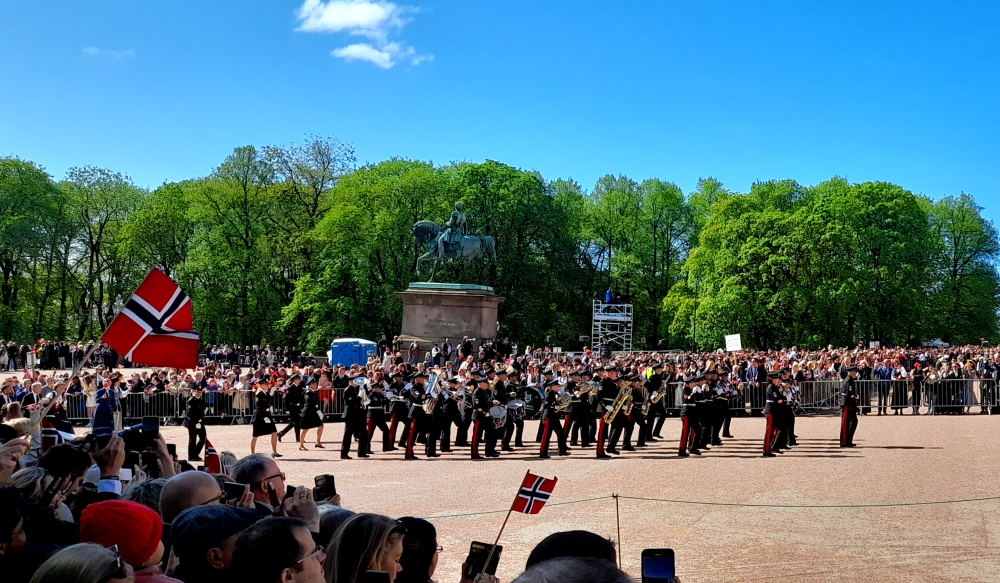
After 1864 the day became more established when the first children’s parade was launched in Christiania (Oslo), at first consisting only of boys. It was only in 1899 that girls were allowed to join in the parade for the first time.
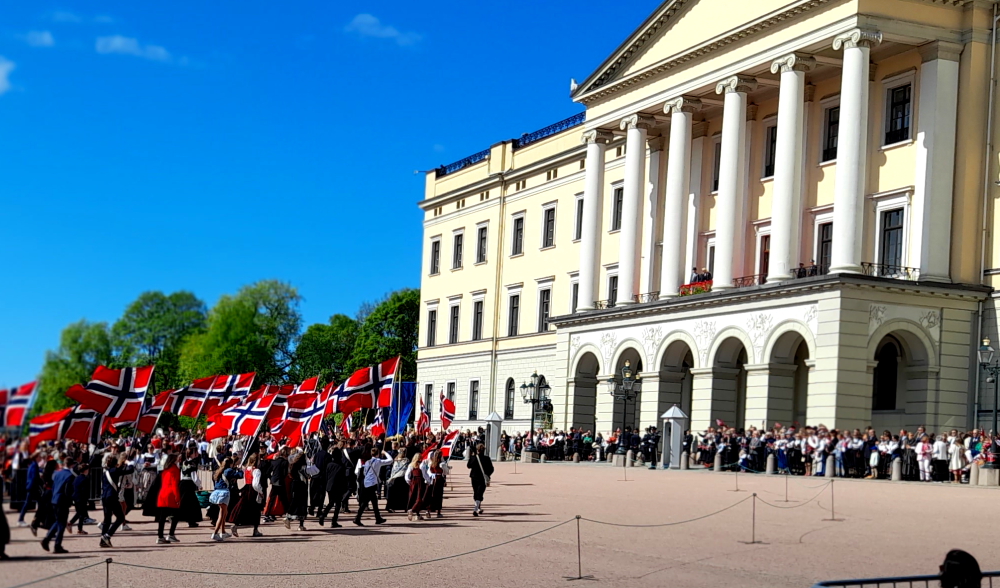
A noteworthy aspect of the Norwegian Constitution Day is its very non-military nature. All over Norway, children’s parades with an abundance of flags form the central elements of the celebration. The massive Oslo parade includes some 100 schools, marching bands, and passes the royal palace where the royal family greet the people from the main balcony.
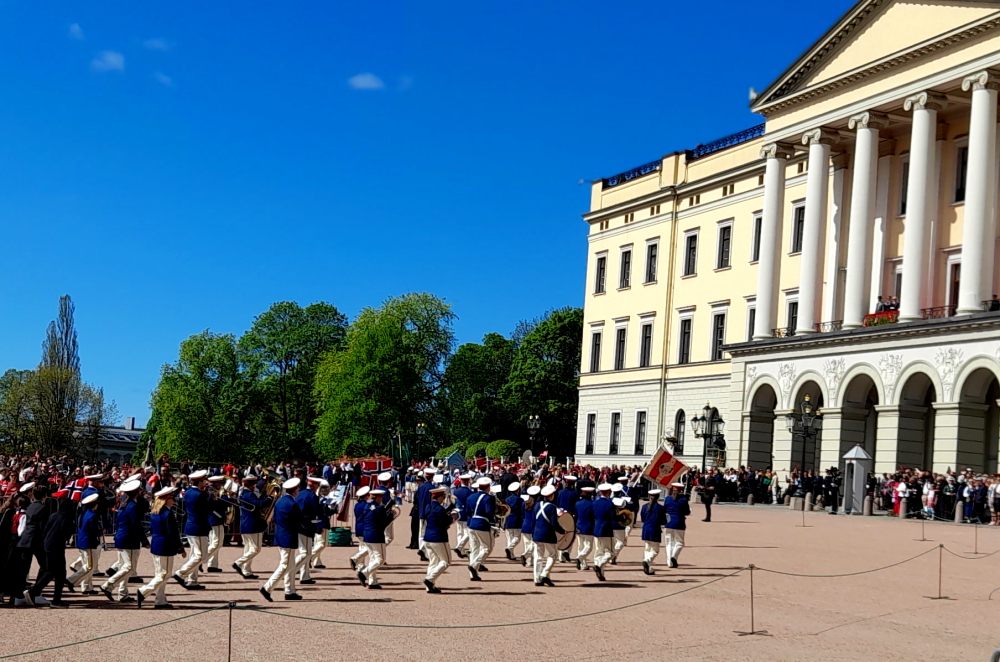
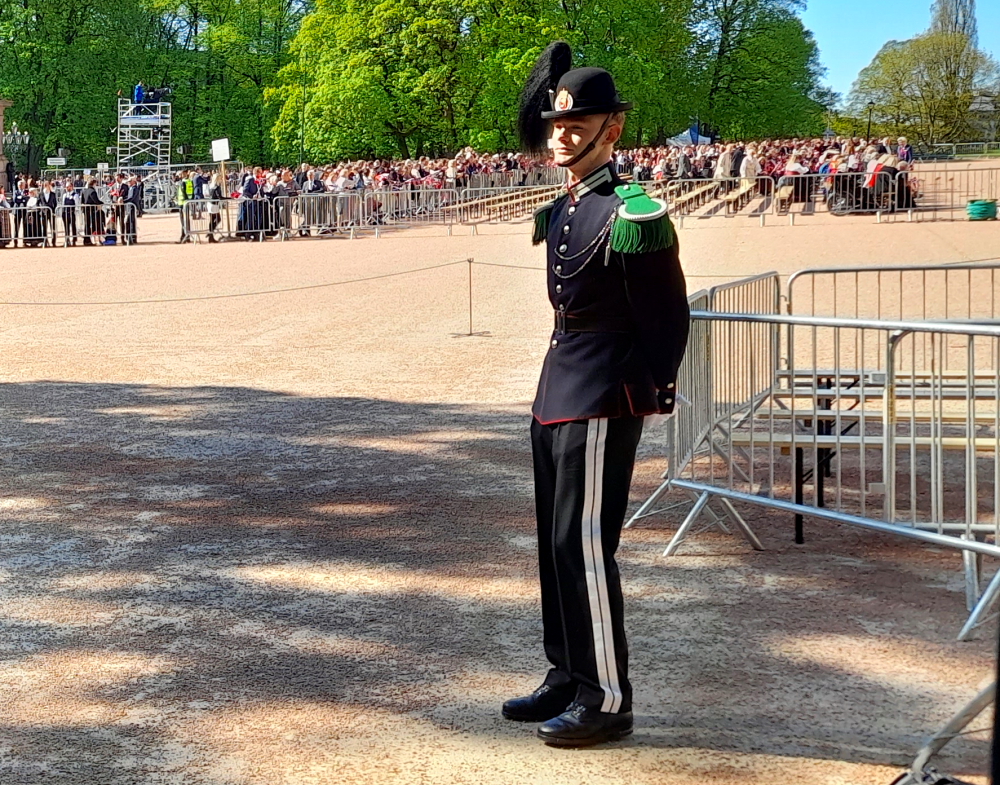
Today in Oslo everyone is involved: a large group of folk dancers in traditional costume entertained the crowd before the head of the parade arrived; kids in parade; older folk playing in bands and as flag bearers alongside kids; dignitaries sitting in the stands; lots of families in traditional costume waving flags. Even hat-tasselled body guards of the King.
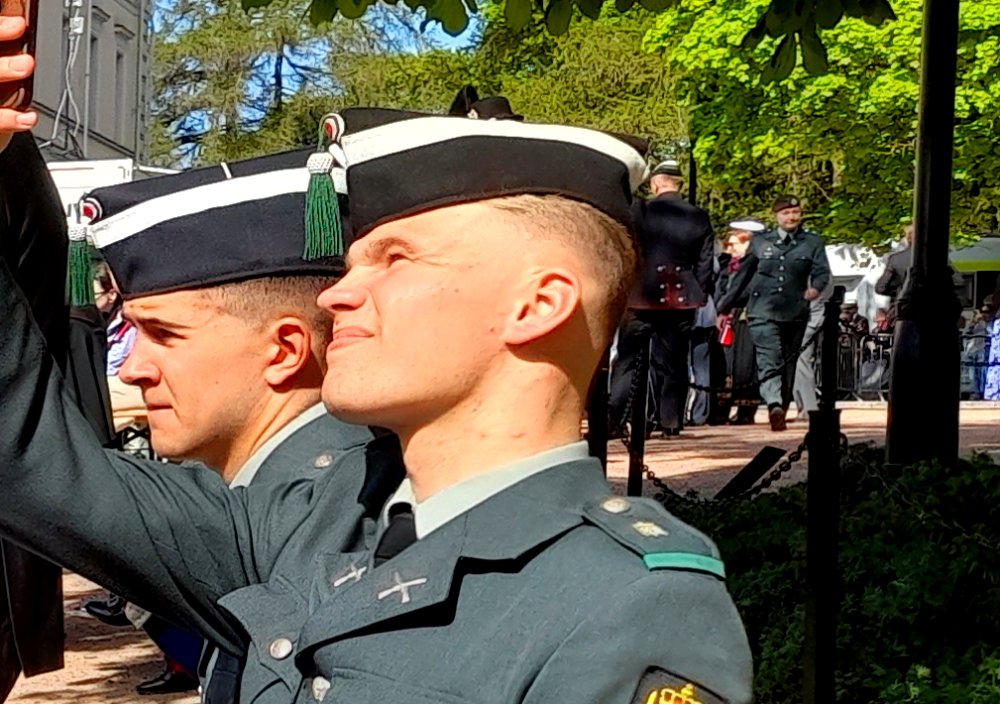
Not to mention curious tourists….
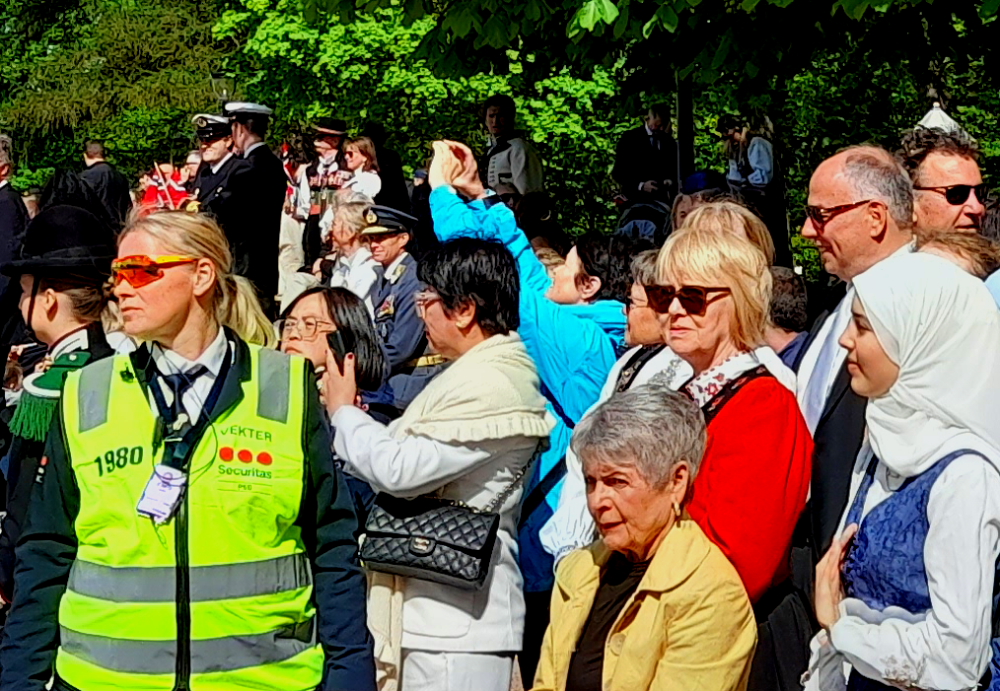
One noteworthy detail of the King’s Guards’ uniform is the plumed bowler hat which was copied from the hat of the Italian Bersaglieri troops—a regiment that so impressed the Swedish princess Louise (the great grandmother of King Harad V) that she insisted the Norwegian guards be similarly hatted in 1860 – and since.
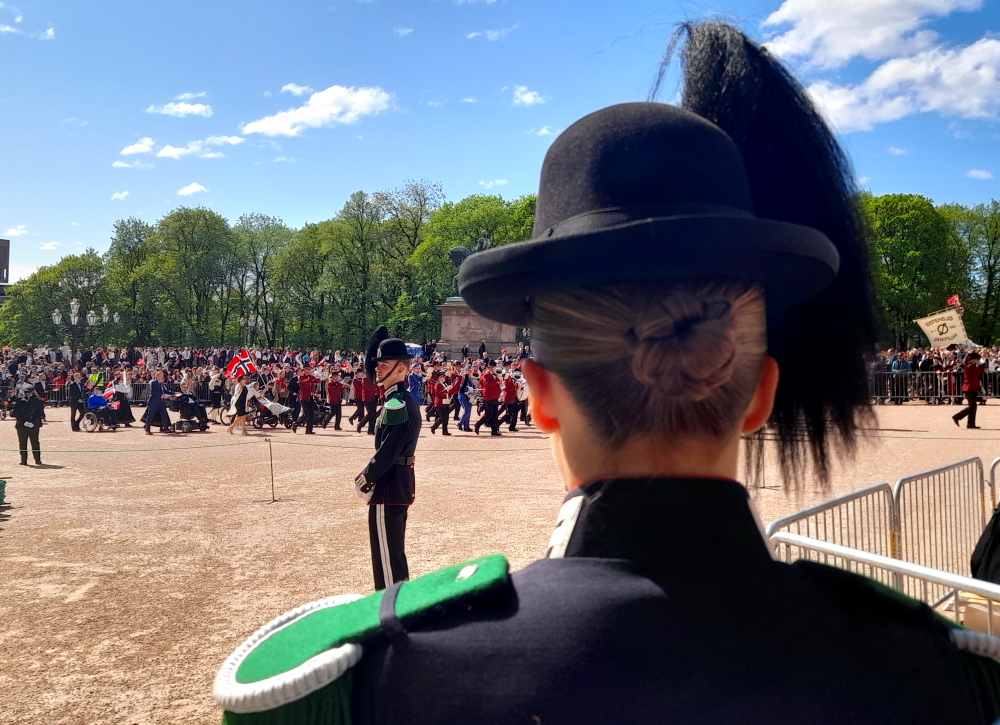
The longest parade is in Oslo where some 100,000 people travel to the city centre to participate in the main festivities.
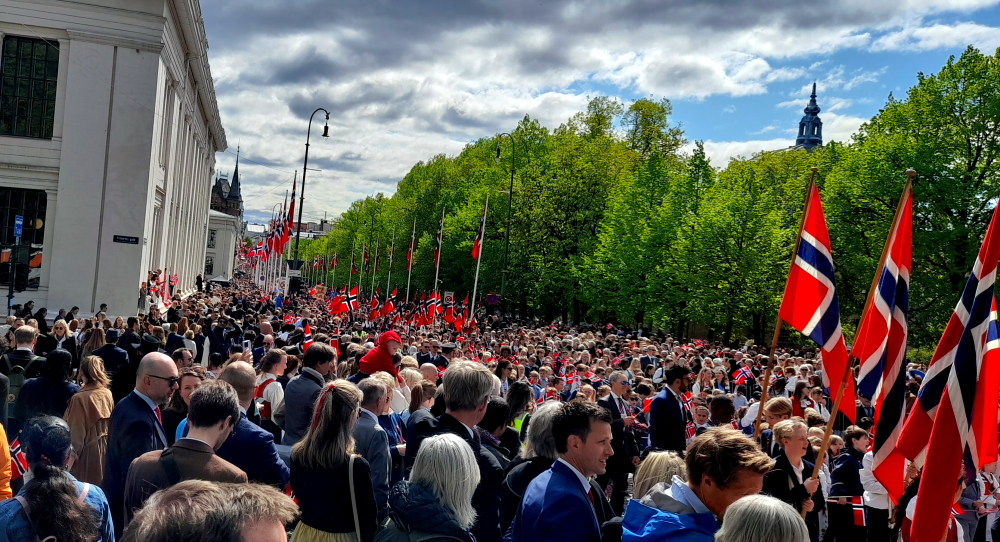
This is broadcast on TV every year, with comments on costumes, banners, etc., together with local reports from celebrations around the country.
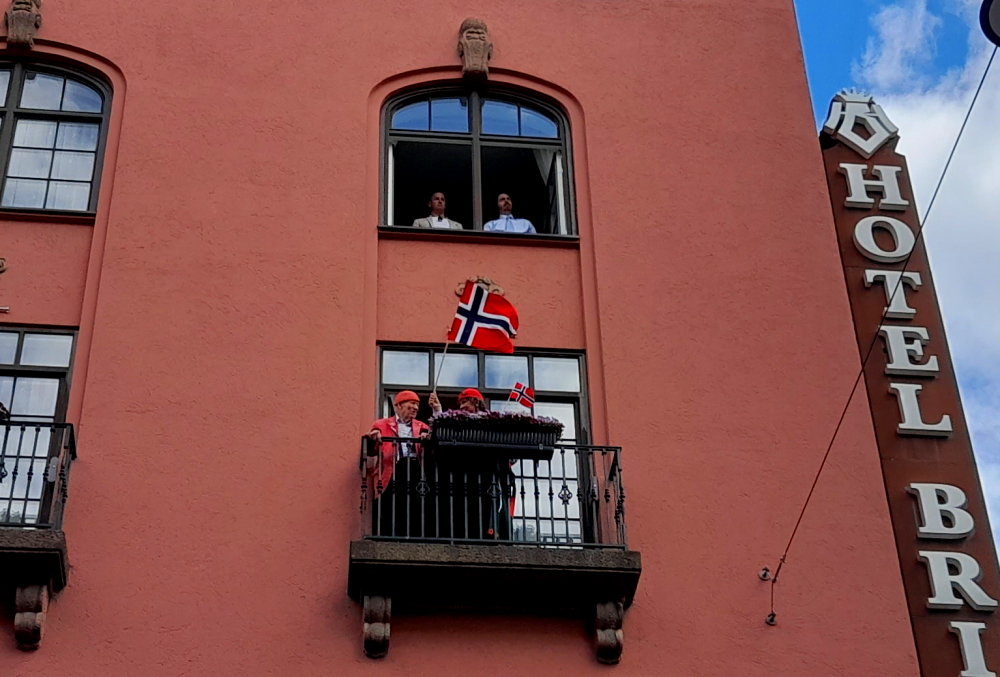
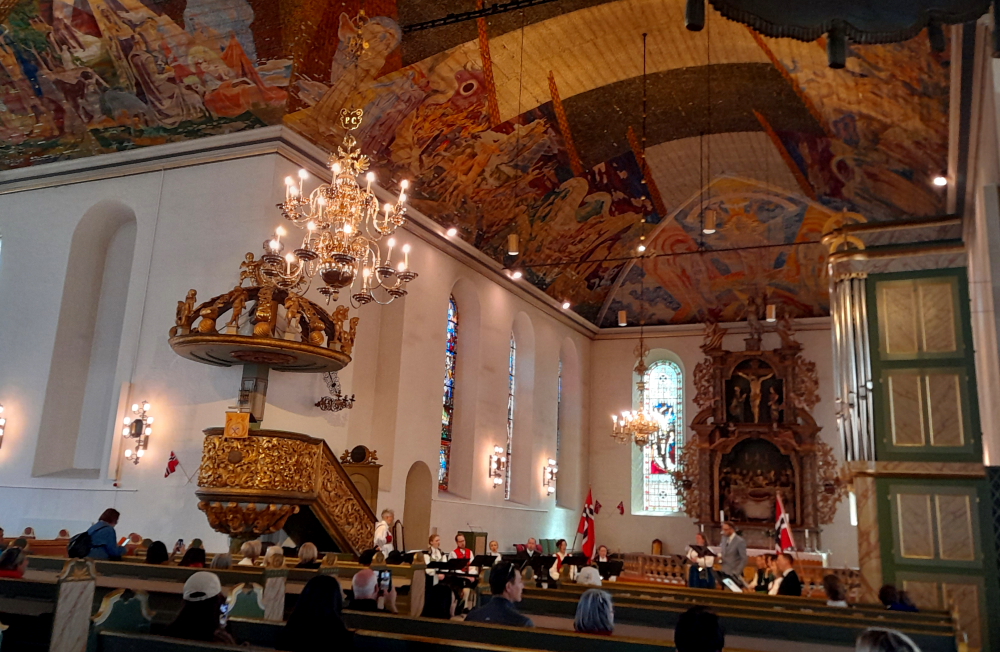
After 45 minutes of watching flags, kids and bands pass by the Royal Balcony we opt to continue walking into town. Today the Oslo Cathedral is open and is being used as a concert venue.
Our objective is the Opera House roof which we saw from afar yesterday in the rain.
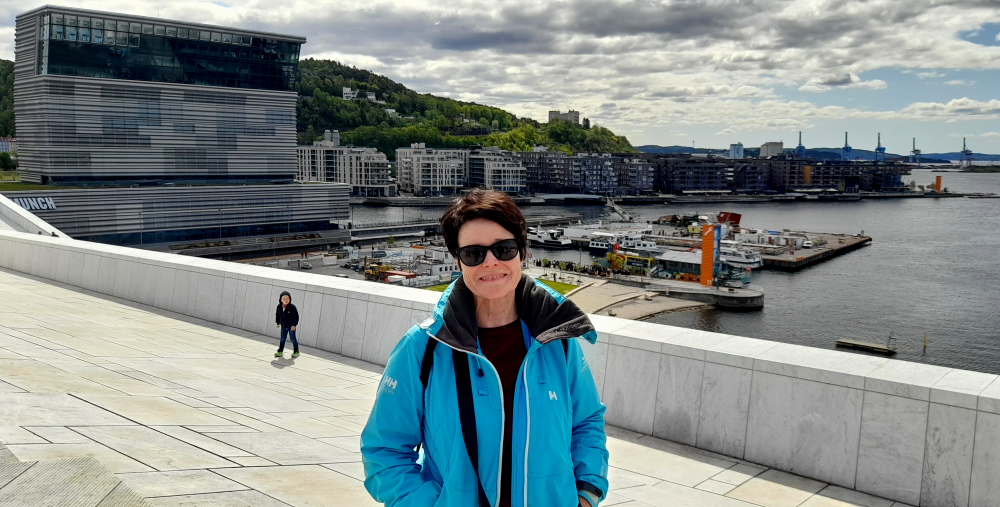
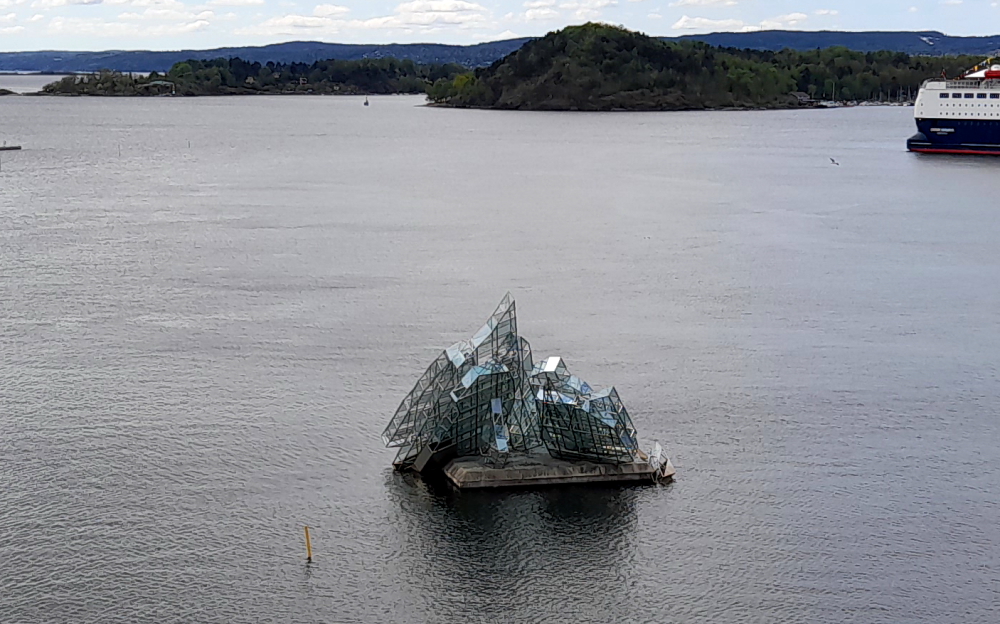
The view is quite impressive taking in the surrounding hills, the Munch Museum, the fjord, the floating ‘iceberg’ sculpture, the city cape and the Holmenkollen ski jump 8.5 kms away on the skyline.
It’s true, people below look like penguins on an icy landscape.
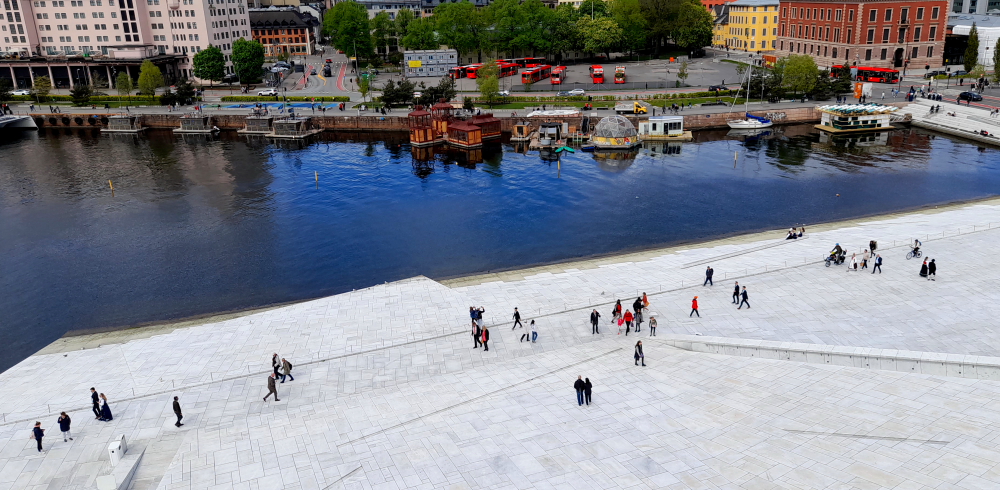
Normally Carrara marble would be polished but the surface has been left rough for walking on. The roof looks like a ski slope – probably rated ‘green’.
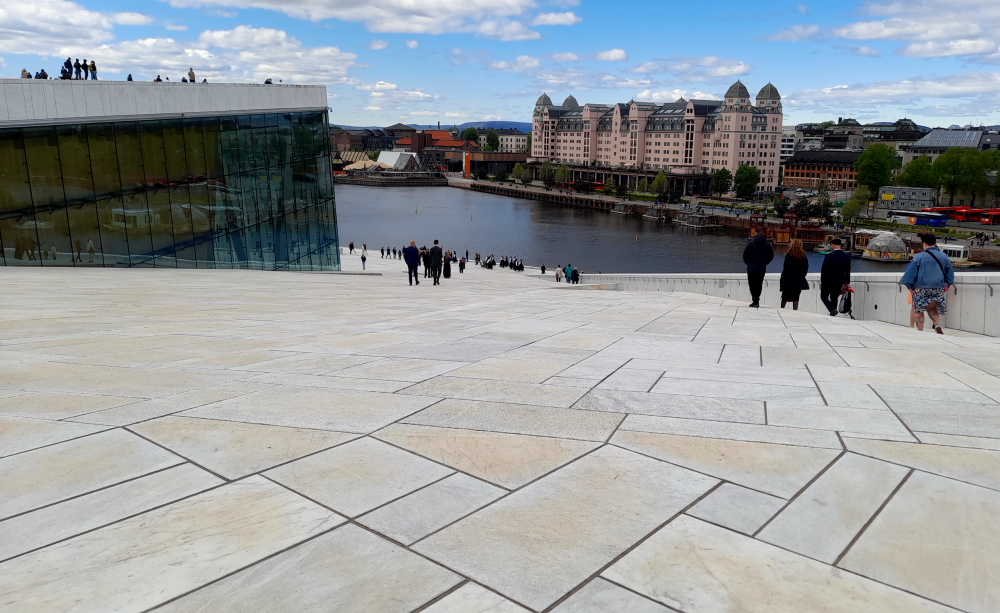
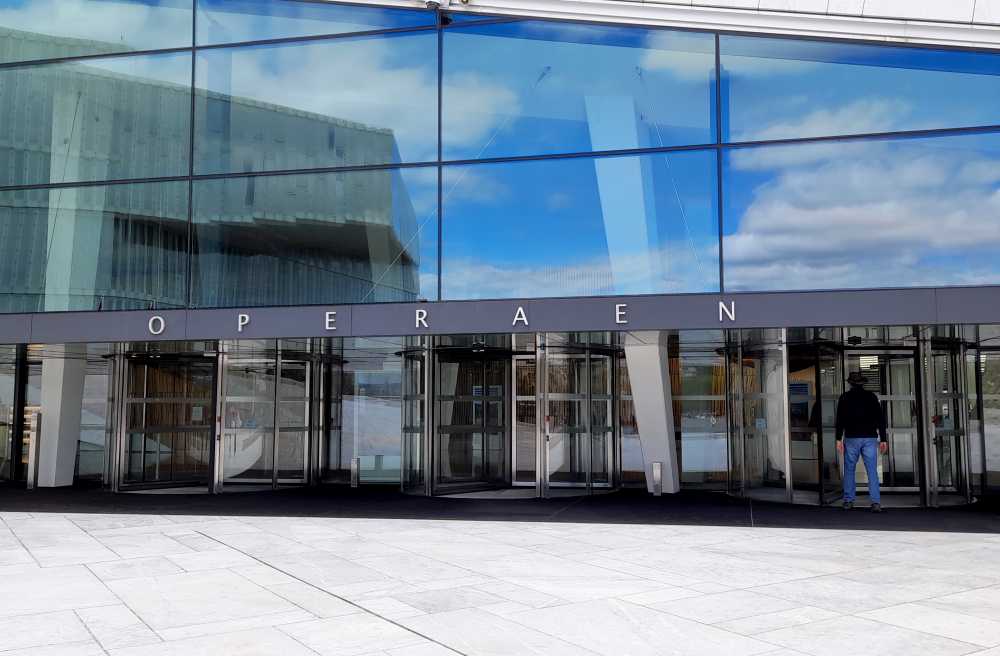
Although it is a public holiday today the Opera building is open.
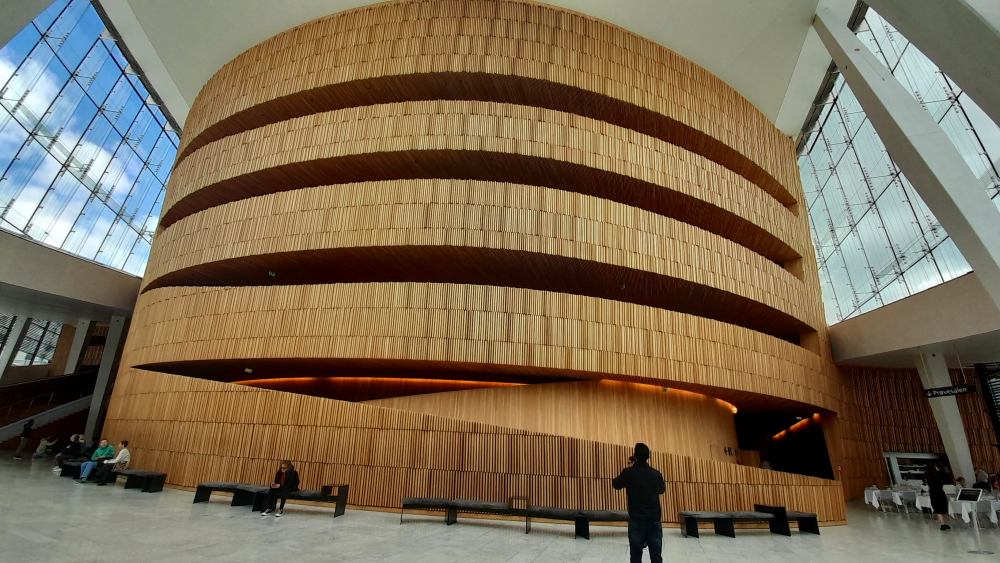
The lofty foyer is a light, open space with a large, undulating oakwood wall. Behind this wall are the opera house’s three performance halls.
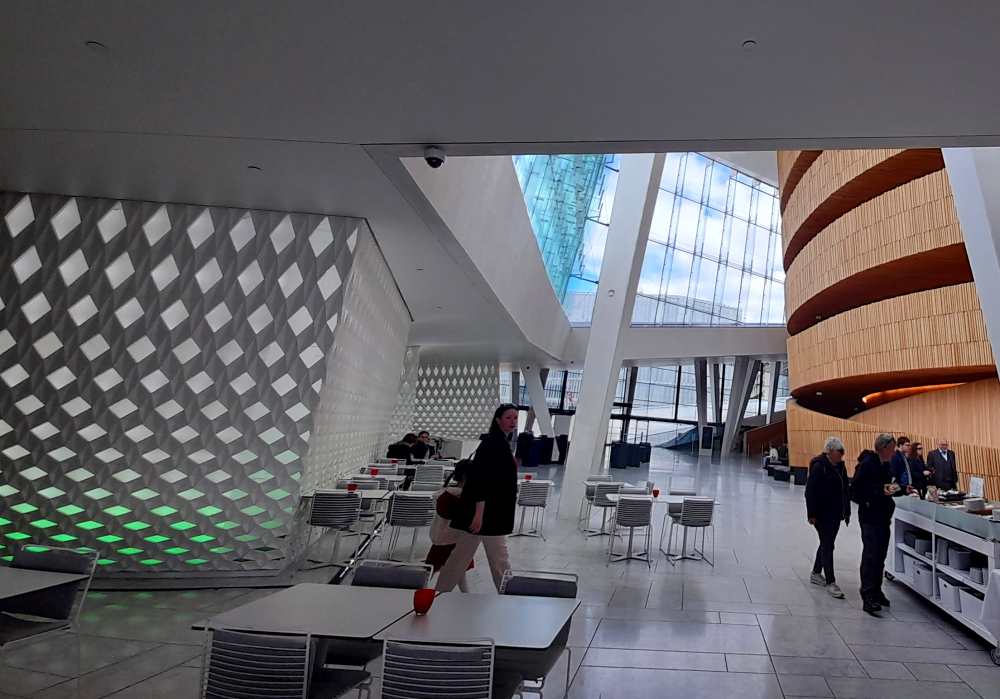
Fortunately its coffee shop is open so a hot beverage on the terrace overlooking the fjord is mandatory…
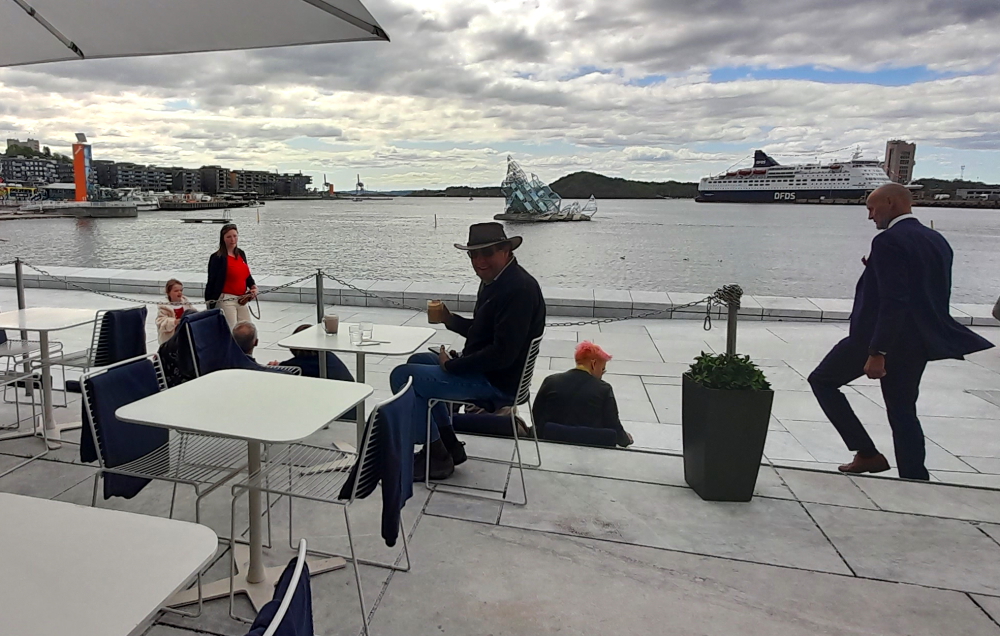
… while watching the passing parade of traditionally-clothed citizens.
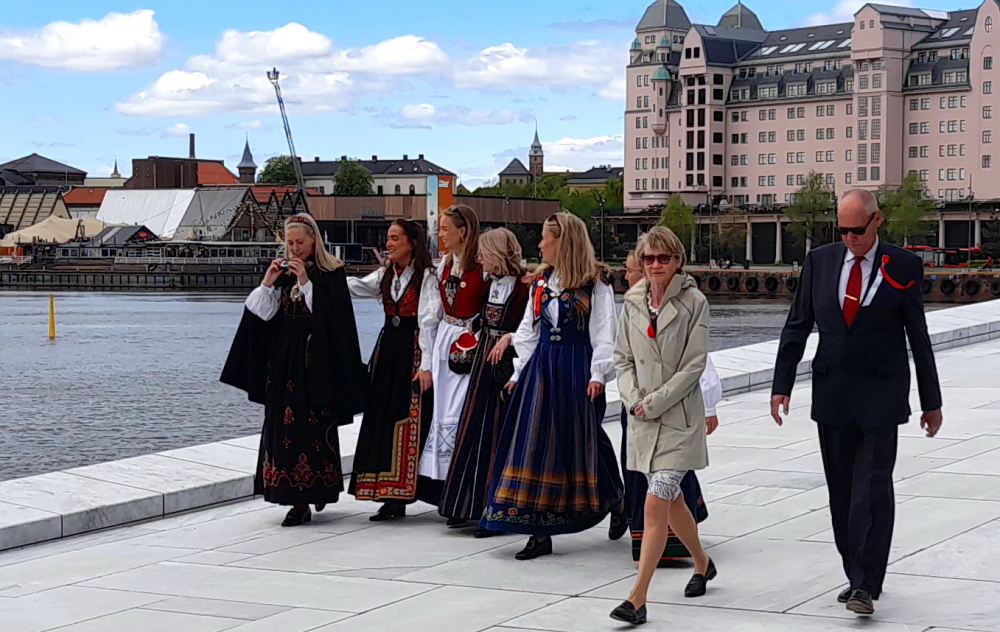
Time to walk back to the hotel. The city is still reverberating with the sounds of marching bands and processions, heaving with masses of people moving in all directions – mostly against us – and celebrations.
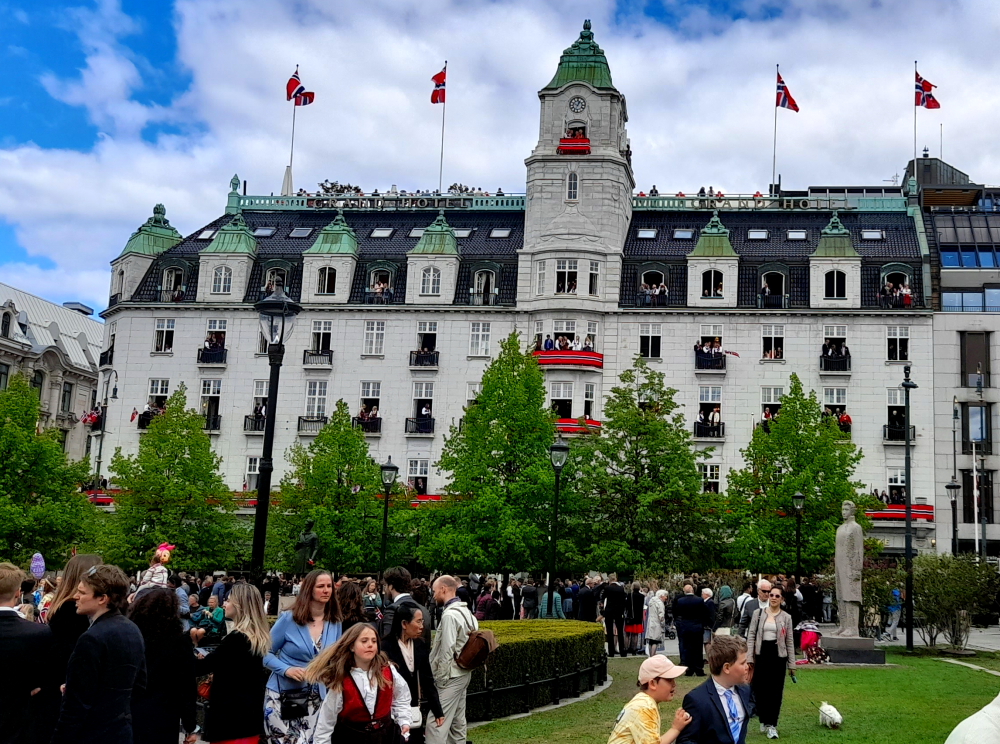
Some 4 hours after we set out this morning we stagger back into the hotel lobby – to be greeted with a small spread of canapes and mimosas. That’s lunch and dinner sorted, then!
18 May, 2023
Today is another public holiday – Ascension Day. The plan is to do a load of laundry this morning a block away at the Saga Apartment’s laundry.
There is only one washing machine and one dryer so we have to wait 30 minutes while someone else’s washing is done. They didn’t return when their washing was finished so we had to take their stuff out to do ours. They eventually returned an hour after their washing was done. A bit rude when there is only one machine.
That wait time delayed our start so I had to nurse the washing and drying past the planned time to go and see the Changing of the Guard at the Palace. Lynn took what was finished of our drying back to the hotel and continued on to the Palace.
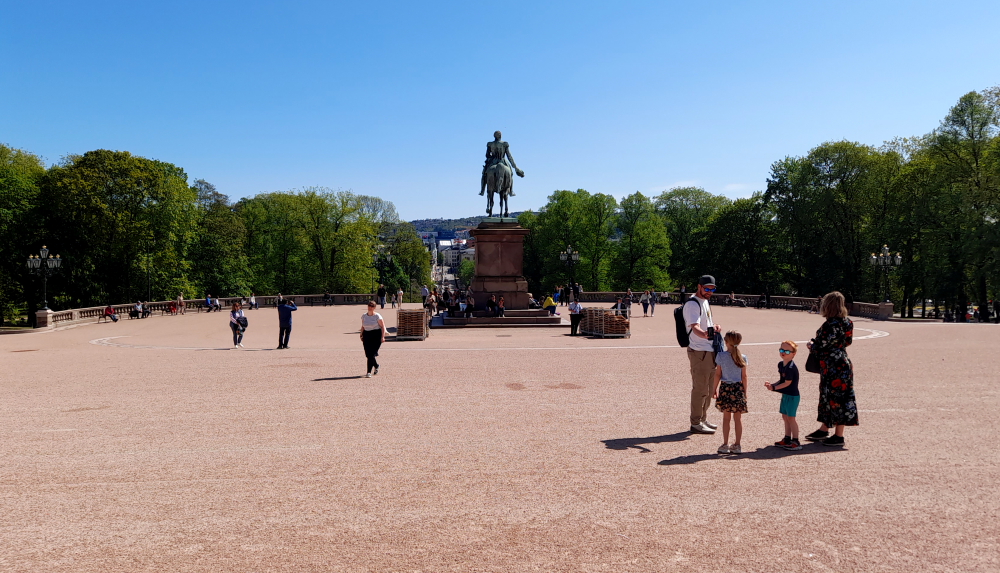
What a transformation from yesterday. The only evidence of yesterday’s festivities are a couple of pallets of benches just behind the equine statue of Carl III Johan as he perpetually looks down Karl Johans Gate.
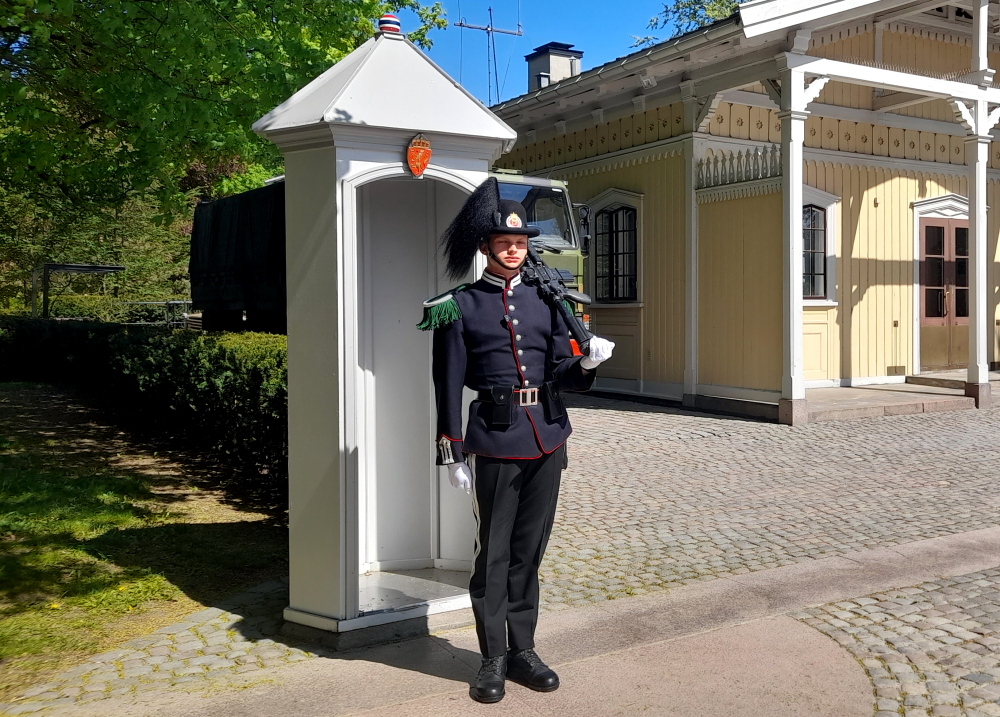
The Norwegians, bless ’em, have provided unequivocal information that the changing of the guard “…occurs on every day of the year, no matter what the circumstances are…at 13:30..” Good to know.
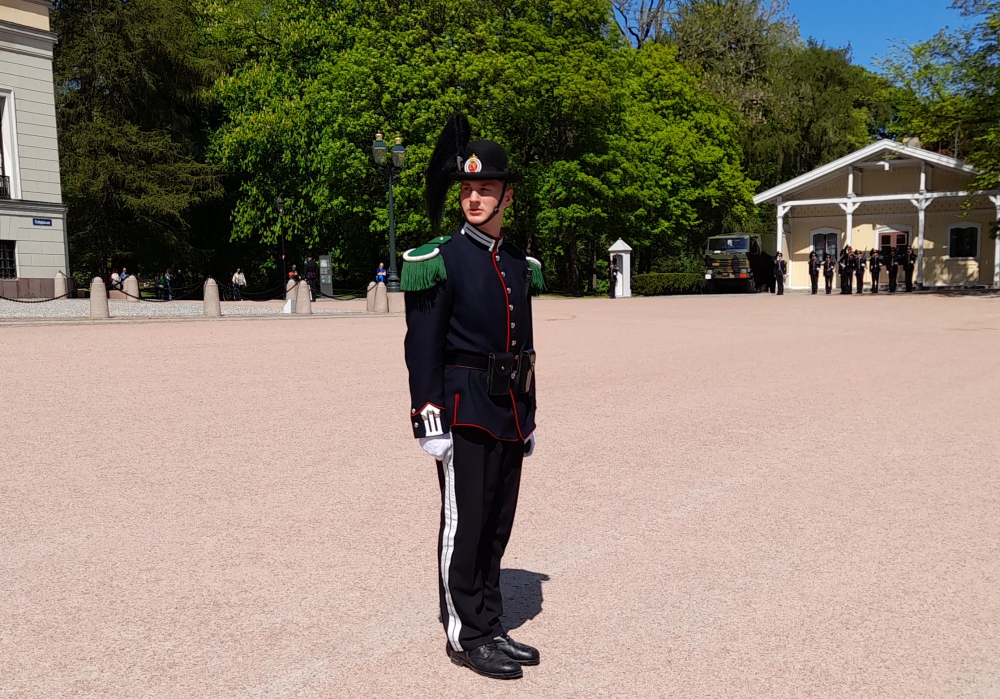
Although the Standard is flying from the Palace roof I think that this will just be an armed escort as opposed to accompanying marching band that happens when Queen Margrethe II of Denmark is in residence.
The whole affair takes about 15 minutes and seems to be a lot of people involved just to change 1 guard. Don’t blink or you’ll miss the actual change of the guard!
Surrounding the Royal Palace, and encompassing 53 acres (22 hectares) of grassy areas and winding paths through thousands of planted trees, Slottsparken is a protected Norwegian cultural landmark and a wonderful space for the public to enjoy nature within the city.
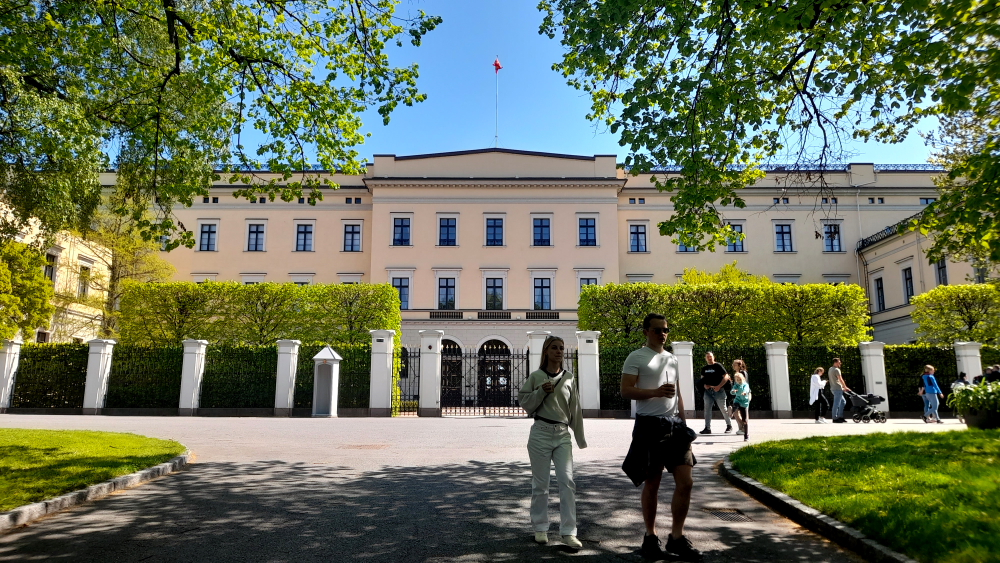
Surrounding the Royal Palace, and encompassing 53 acres (22 hectares) of grassy areas and winding paths through thousands of planted trees, Slottsparken is a protected Norwegian cultural landmark and a wonderful space for the public to enjoy nature within the city.
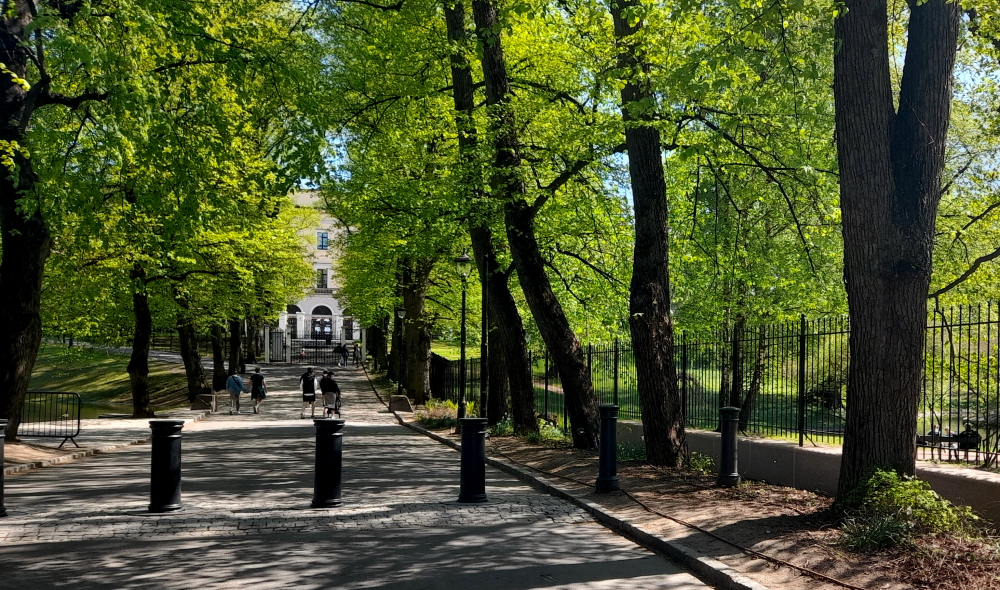
The park features pristine ponds, long-lived majestic trees planted in the 19th century, and elegant statues of notable Norwegians.
Behind the Palace on Parkveien are numerous embassy houses as well as on the street behind it, appropriately named, Inkognitogata!
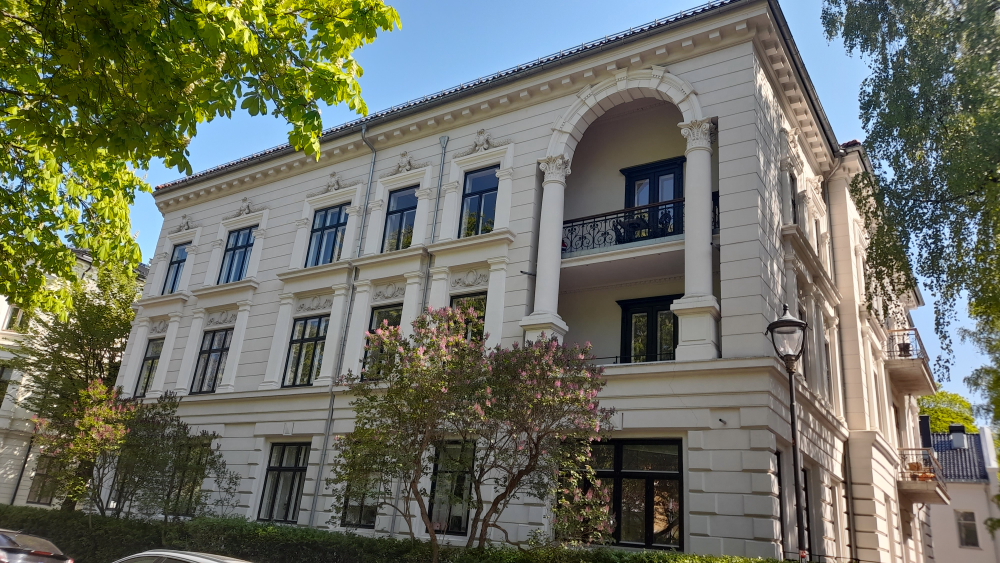
And a majestic building on Uranienborgveien which cuts through a rocky escarpment.
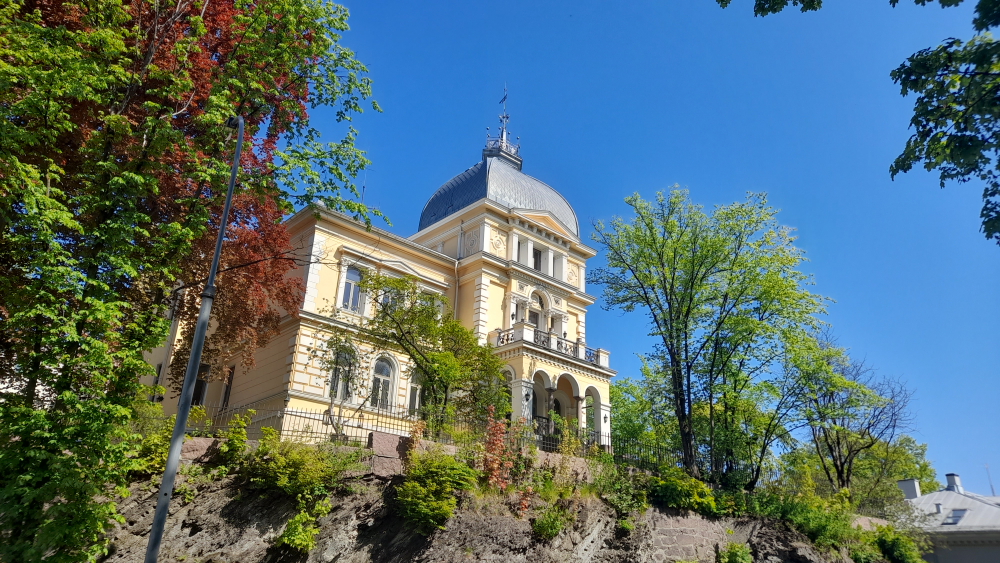
19 May, 2023
We are checking out at about midday today as we head north to Lillehammer for a few days. While I sort out some bookings for Warsaw and cancel (yet again) our planned trip to Egypt in November, Lynn heads back into down town Oslo for some last minute photos.
It is eerily quiet in town this morning so it seems that the entire population of Oslo are worn out after two days of celebrations.
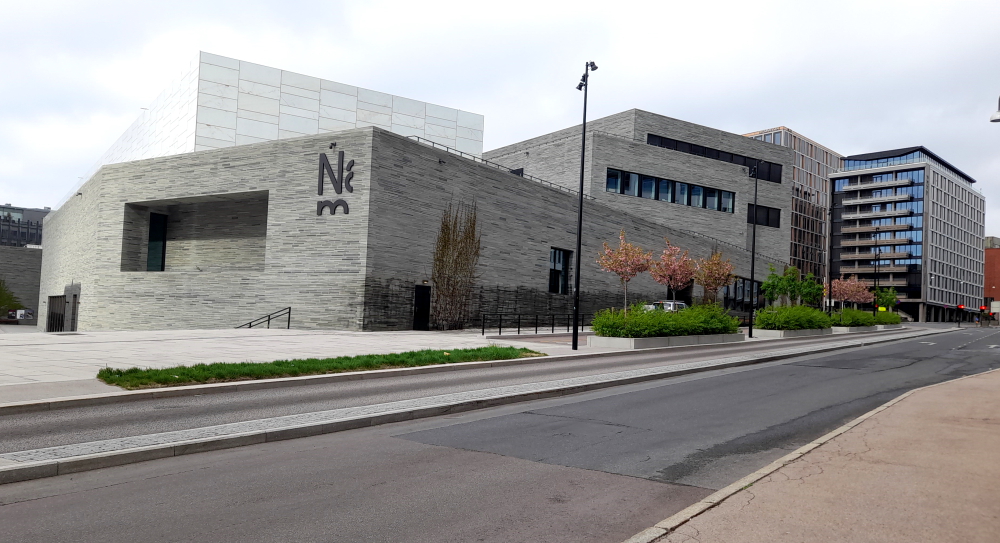
Interestingly, Oslo has two museums that feature the work of Munch: The Munchmuseet and The National Museum which has a room dedicated to him and a copy of his ‘Scream’ painting.
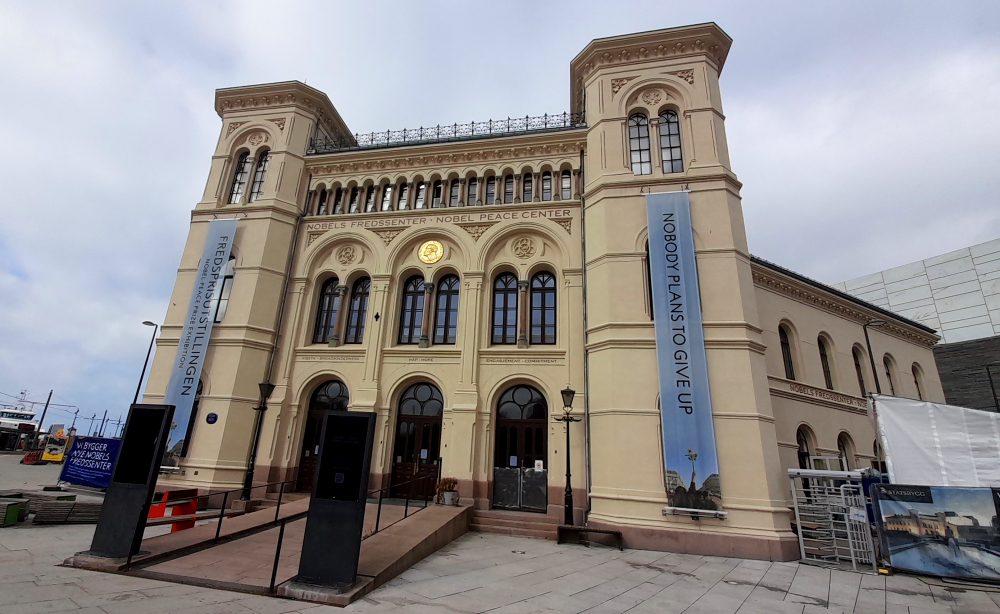
Surrounded on three sides by the National Museum is the Nobel Peace Centre. It’s a showcase for the Nobel Peace Prize and the ideals it represents. The centre is also an arena where culture and politics merge to promote involvement, debate and reflection around topics such as war, peace and conflict resolution. The Centre is located in the former Oslo Vestbanestasion (Oslo West railway station) building. Designed in 1872 it ceased to be a railway station in 1989.
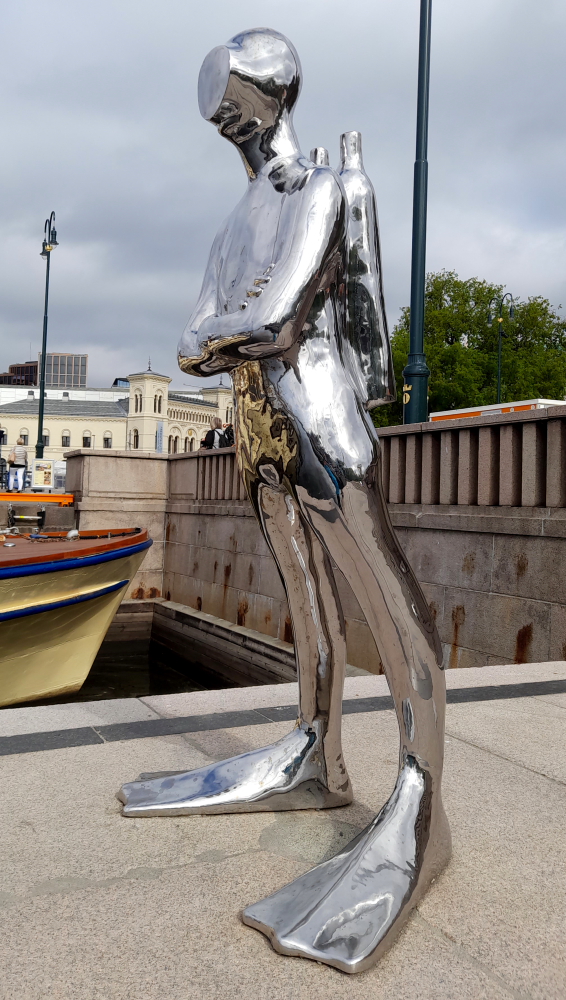
Over the road is the harbour and at the Senior Wharf is the “Dykkaren” – a statue of a silver scuba diver. It was created by sculptor Ola Enstad and was purchased by the City of Oslo in 2013. Enstad (1943-2013) was a famous Norwegian artist and worked primarily with sculpture and collage. He has used divers design several times.
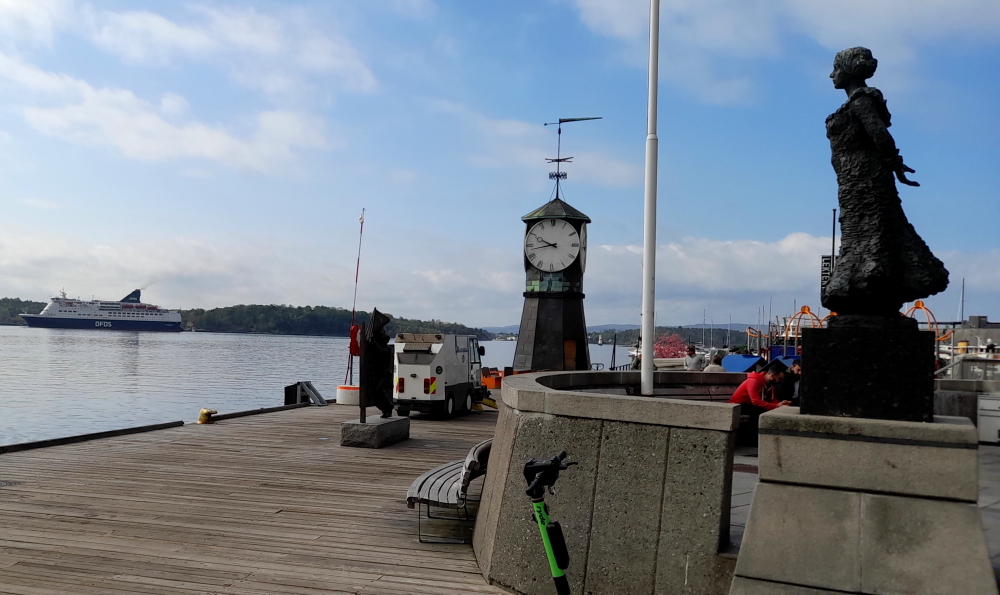
Located away from the city along the harbour is Aker Brygge. Part of the Sentrum area, Aker Brygge is known for its pier and eateries with outdoor tables. A popular summer boat bar is moored nearby, and ferries depart year-round for the scenic Oslo Fjord.
Here is located a statue of Aasta Hansteen (1824-1908), the first woman in Norway to train professionally as an artist, to give a public lecture and to write several books. She was criticised and ridiculed by many at the time for her beliefs and actions. Later she was a source of inspiration for the women’s movement. This statue of her was sculpted by Nina Sundbye and erected in 1986.
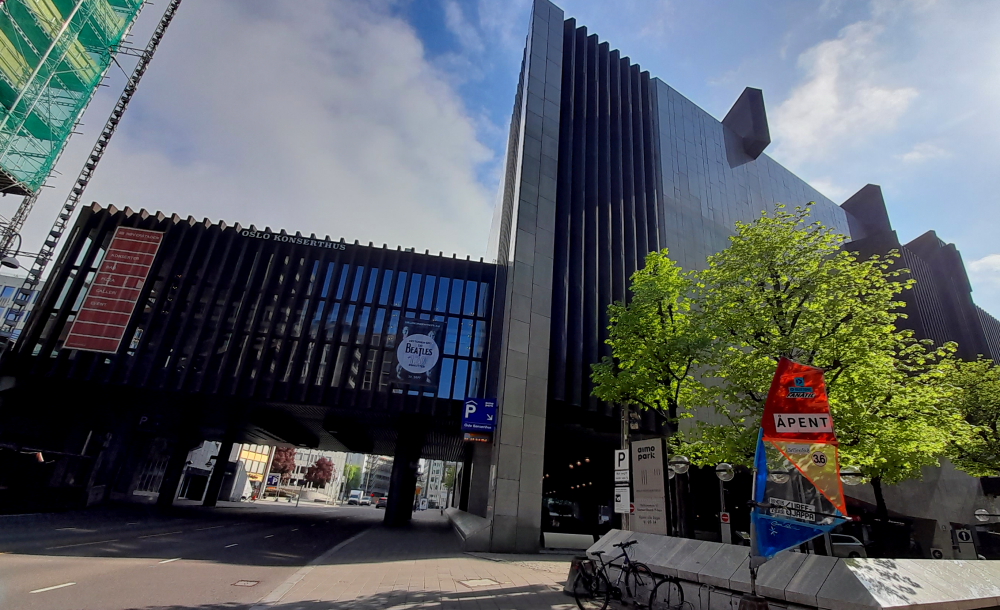
Lastly, walking back to the National Theatre tram stop is the Oslo Concert Hall, the base for the Oslo Philharmonic Orchestra (OPO) and one of the premier music venues for the general musical and cultural life of Norway. It presents more than 300 events yearly and receives more than 200,000 visitors. An architectural competition was arranged in 1955 and final drafts for the concert hall were presented in 1965, based on Gosta Abergh’s s winning proposal. Oslo Konserthus AS was founded in 1966 and, in March 1977, the concert hall was finally opened. In 2000 Mariss Jansons, then conductor of the OPO resigned his position after disputes with the city over the poor acoustics of the hall.
Noon and it’s time to check out and drive north to the Holmenkollen Ski Jump which you can see from the city.
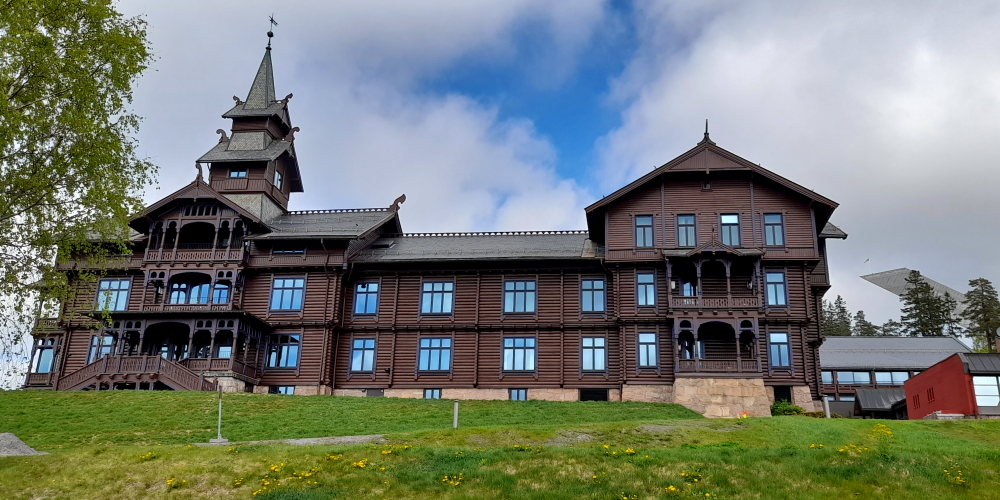
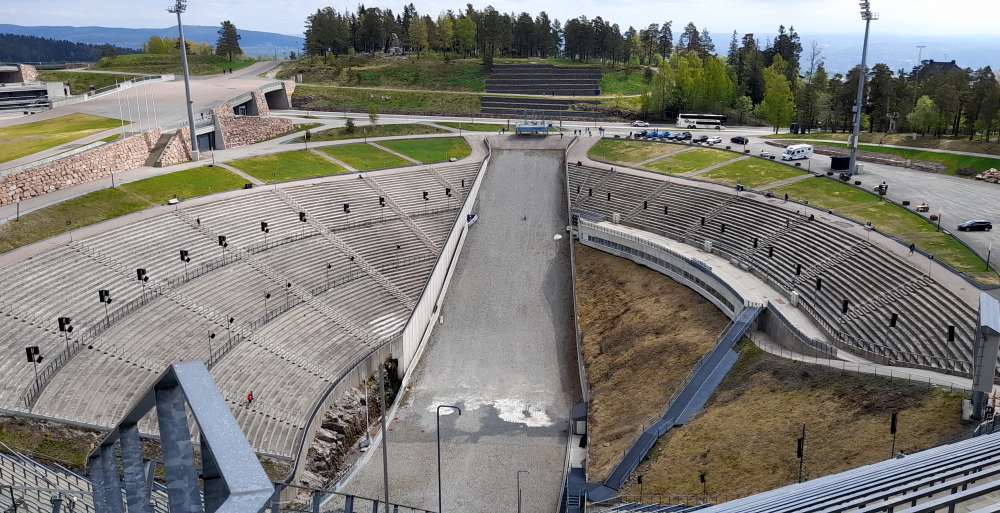
Holmenkollbakken is a large ski jumping hill located at Holmenkollen with a capacity for 70,000 spectators. Holmenkollen has hosted the Holmenkollen Ski Festival since 1892, which since 1980 has been part of the FIS Ski Jumping World Cup and 1983 the FIS Nordic Combined Nordic World Cup. It has also hosted the 1952 Winter Olympics and the FIS Nordic World Ski Championships in 1930, 1966, 1982 and 2011.
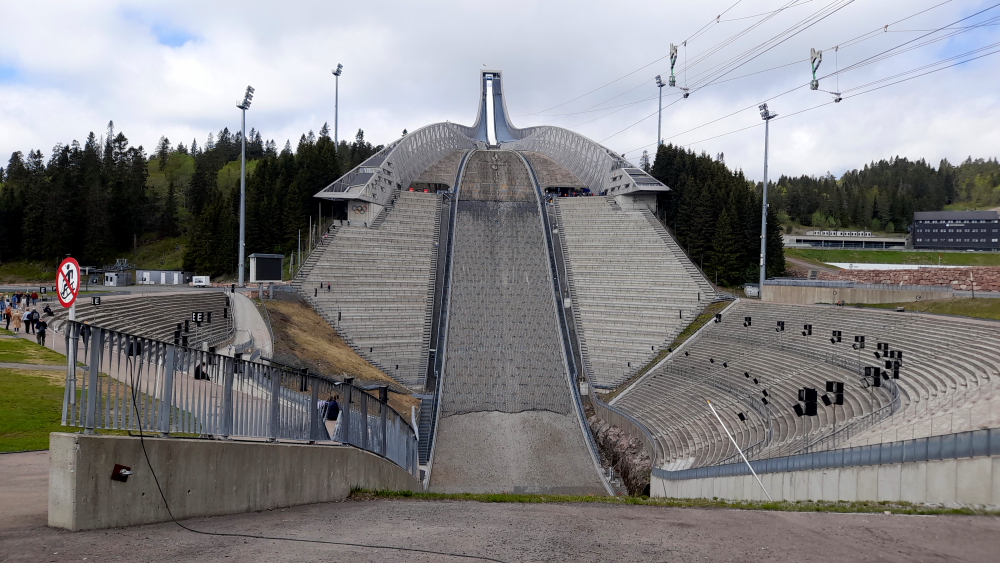
The hill has been rebuilt 19 times. Between 2008 and 2010, the entire structure was demolished and rebuilt. The hill record is held by Norwegian skier Robert Johansson (the “Wing Commander”) at 144.0 metres in March 2019.
So, that’s Oslo done and dusted. Time to drive towards our next destination, Lillehammer. Why Lillehammer? Because we became such avid fans of the 2012-2014 black comedy/crime/drama TV series ‘Lilyhammer’ starring Steven van Zandt, Trond Fausa Aurvag and Marian Saastad Ottesen where a New York mobster goes into hiding in rural Lillehammer after testifying against his former associates. If you ever get the chance …
Before we leave Oslo we top up our half empty tank with 31 litres of fuel at 19.96 Kr/litre – i.e. about AUD2.90/litre for a total of c. AUD91.00. Disturbingly, as we drive towards Lillehammer the price of 95 octane (E10) is advertised at 24.60 Kr/litre!!! Hate to think what it will be at the top end of Norway!
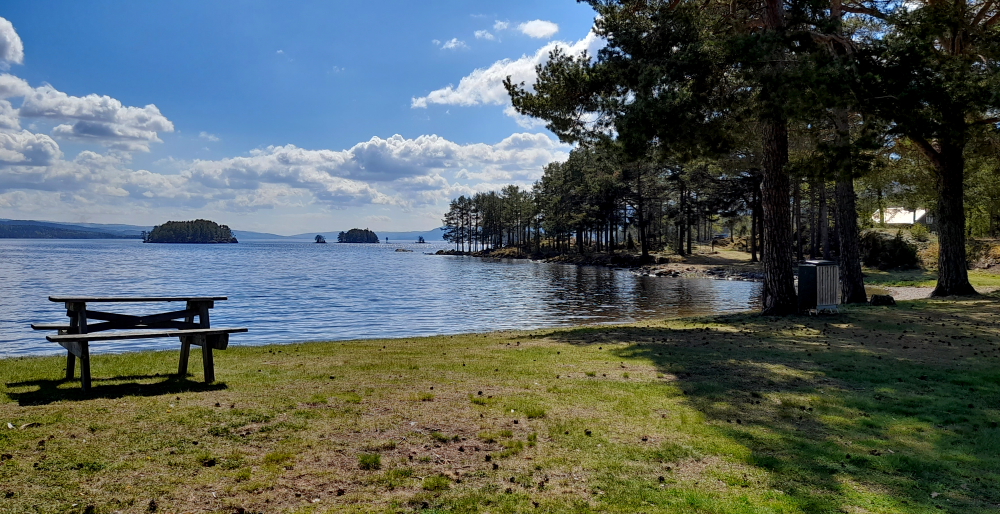
Rather than drive 2 hours on the direct E5 route, involving at least 5 tolls, we opt to drive the 240/34 up along the eastern shoreline of the picturesque Randsfjorden to arrive in Lillehammer 3 hours later.
After Dokka at the top end of the fjord we take the 250 over the range and find ourselves driving through a snowy landscape.
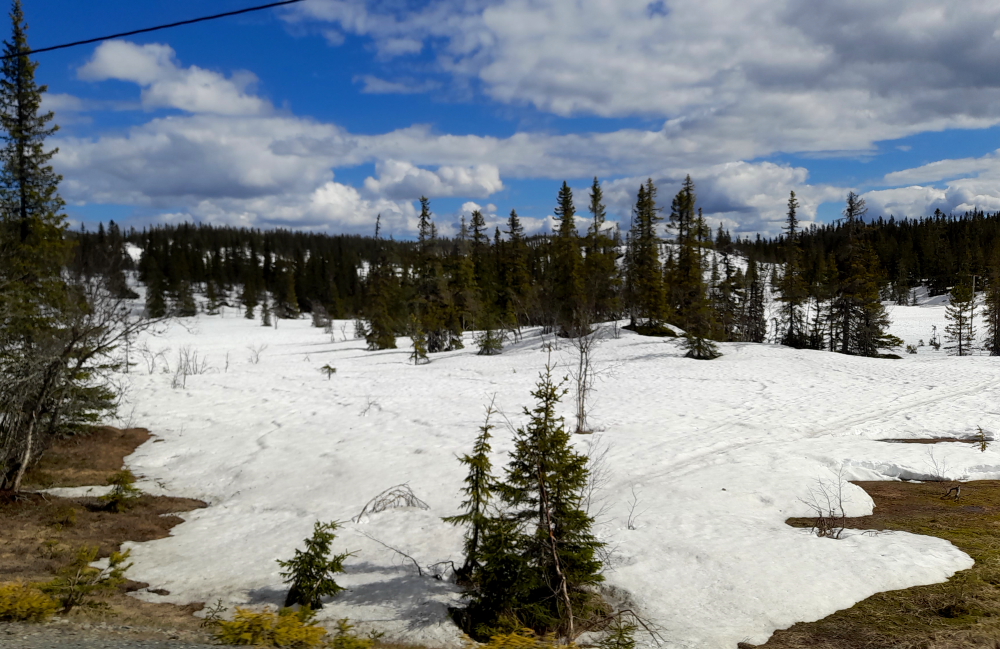
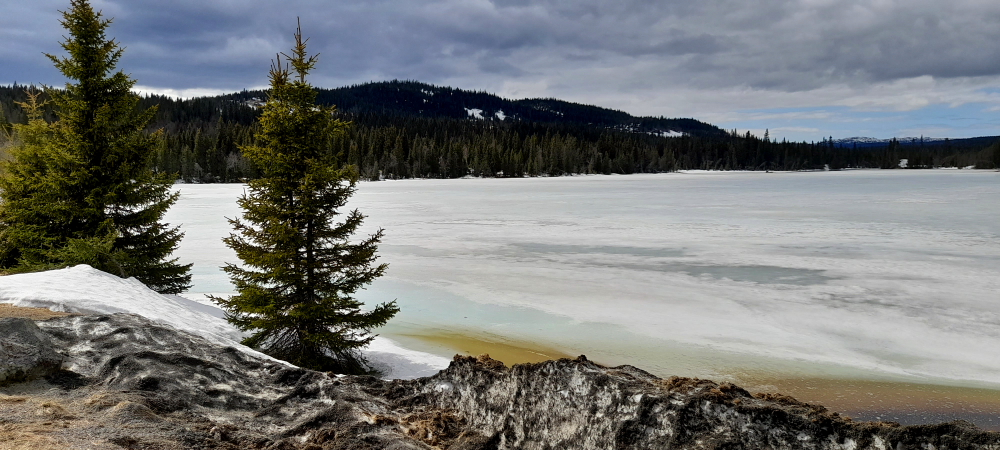
I wonder how much snow there is further north??
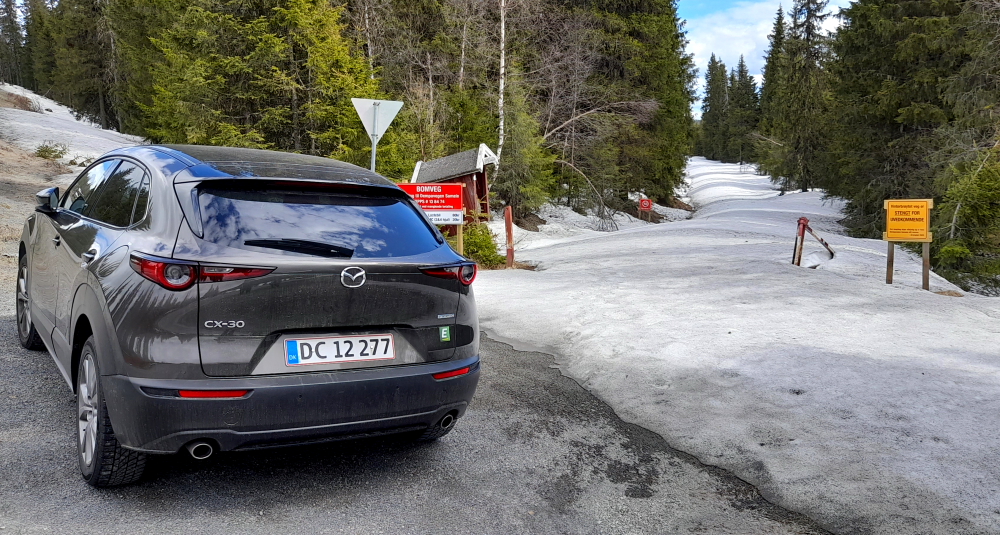
At Vingrom we turn left onto the E6 and drive up the western shoreline of the lake named Mjosa, Norway’s largest lake. Lillehammer is located on the eastern shoreline almost at the head of the lake.
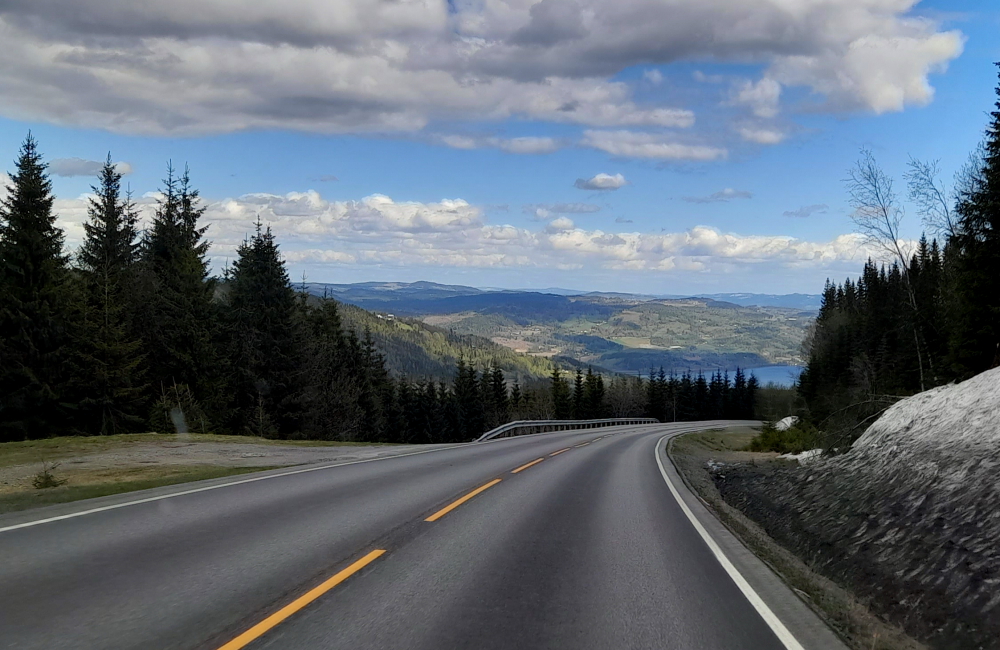
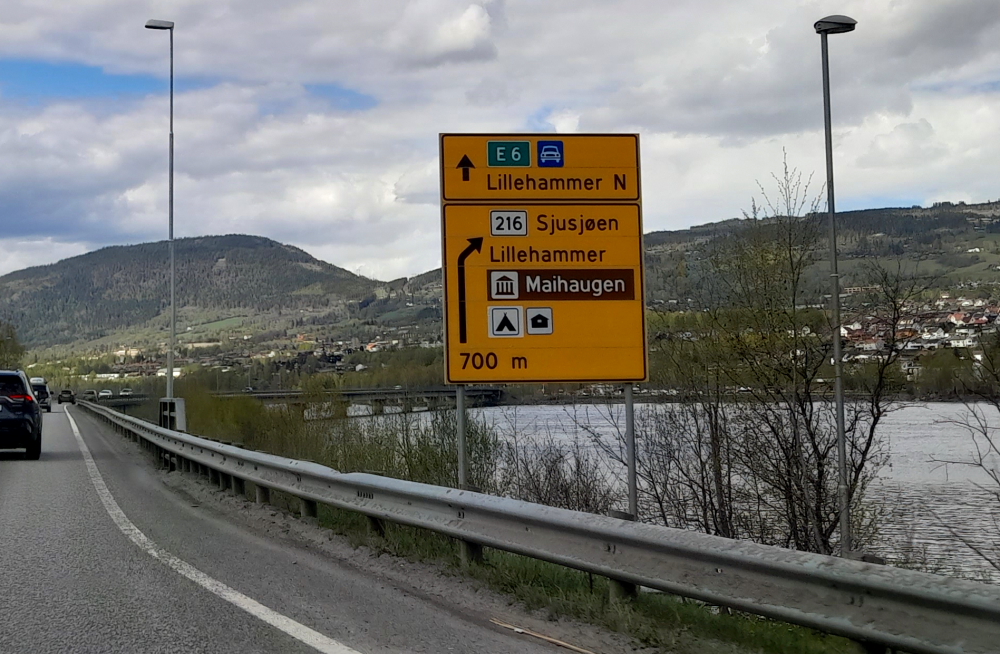
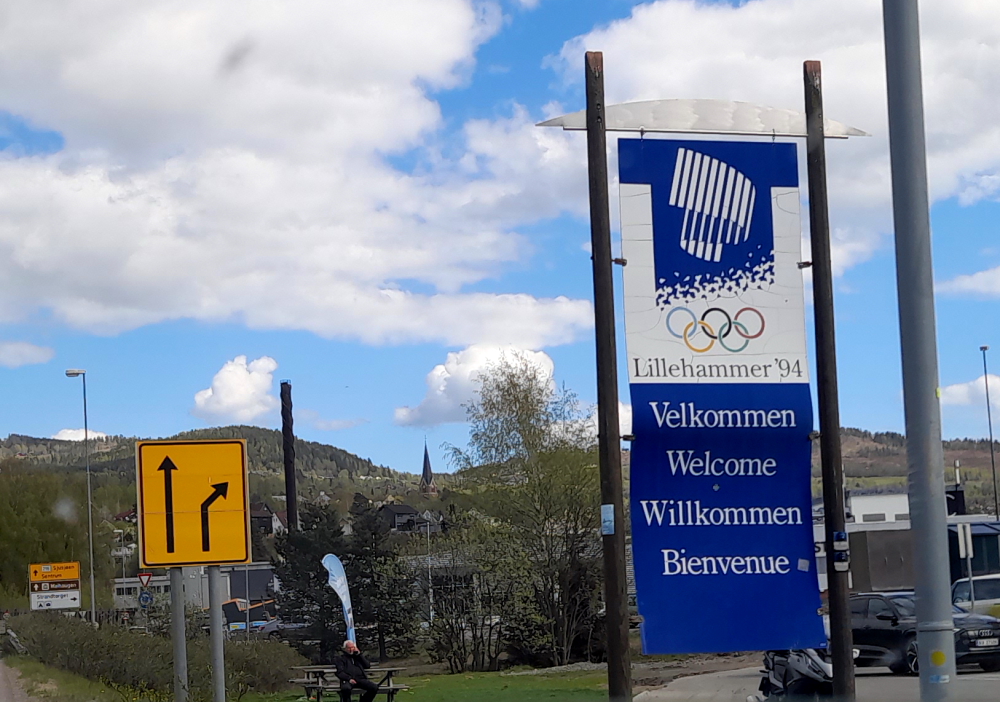
Lillehammer – Winter Olympics host – 12-27 February 1994.
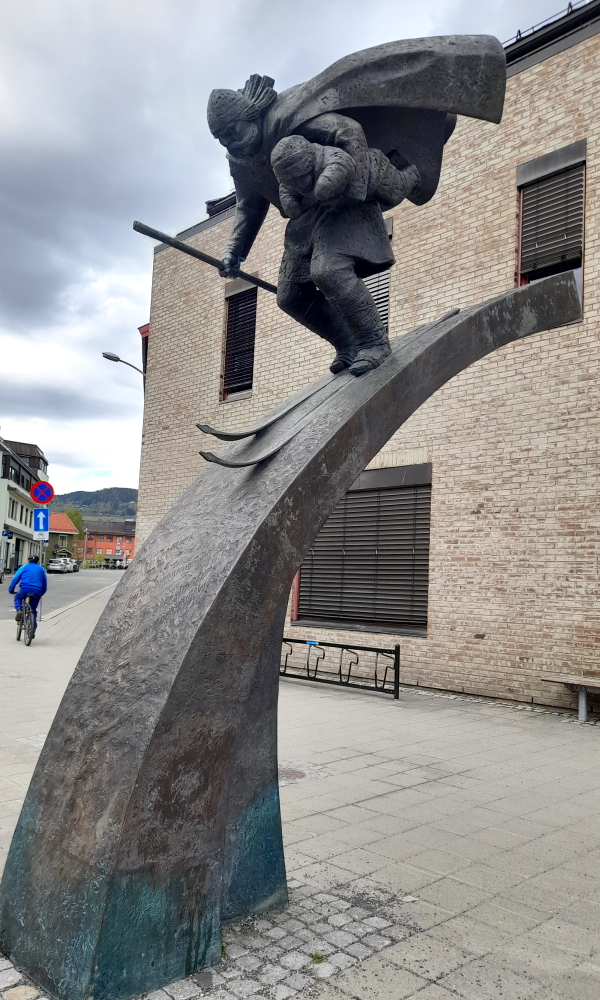
After unpacking we walk up Nymosvingen in search of a restaurant and come across a bronze statue of a large, bearded man on skis, called a Birkebeiner (birch bark leggings/footwear). Underarm he carries 2-year-old Prince Haakon Haakonsson as he flees to safety during the civil war in the early 13th Century. The Sagas say that the Birkebeiners spent Christmas in Lillehammer on their way north over the mountains. Now, every year the locals here stage a great cross-country ski race with 6,000+ contenders following the fabled path, each carrying a 12 lb pack representing the infant prince.
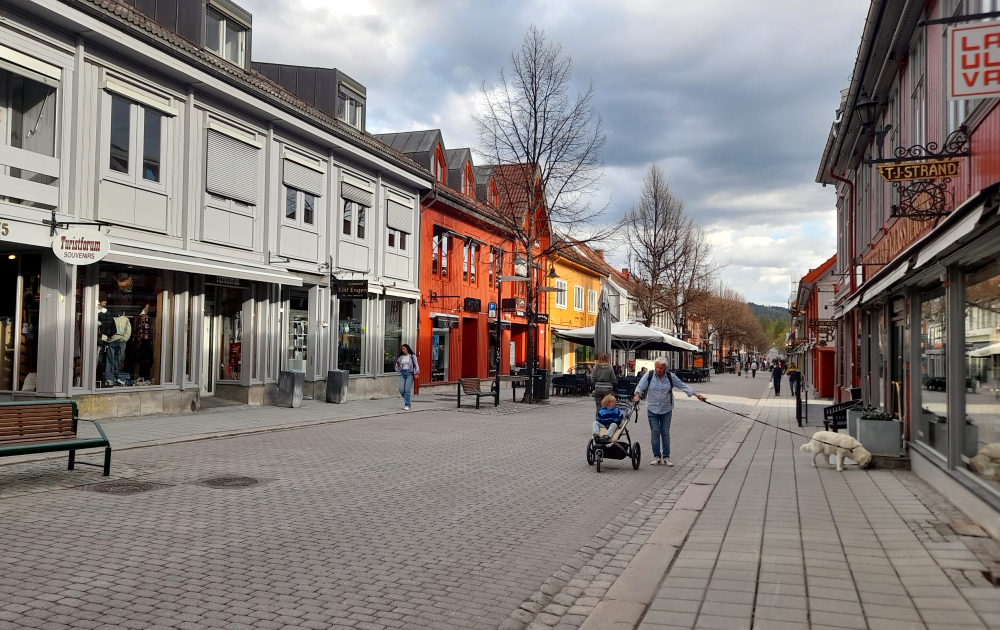
After dining at ‘Hygge’ we walk a block east along Storgata, the main shopping street, then turn down Jernbanegata to our hotel.
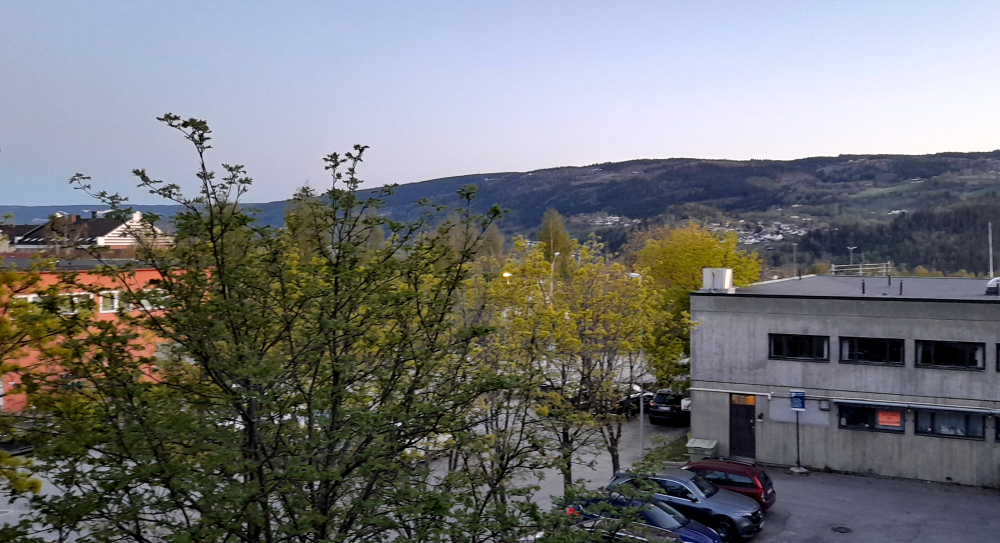
It is about 10:30 pm and time to get to bed. However, the sun has still not set so it is rather light outside. We don’t have a very good view from our bedroom window but it is worth a photo just to show how light it is. As we move further north we will soon experience the midnight sun. I just hope that the hotels that we are staying in have blackout curtains.
..
.
 THE CONTINUING TRAVELS OF YOGI & BOO BOO