
26 September, 2023
The drive from Amsterdam to Delft is only about an hour so we don’t check out of our Amsterdam hotel until nearly midday. On the outskirts of Delft we refuel the car and stop off at a laundromat to do the weekly wash. Yes, we find another Speed Queen and manage to complete the laundry while we had a coffee at a nearby cafe.

The outskirts of Delft are a bit run down and it resembles a Turkish town rather than a Dutch one. Luckily we are only in town for two nights so we have a full day to check out the Old Town and visit the Delft Museum tomorrow.
We are staying at the Shanghai Hotel which is supposed to be 4 star. It appears to have been originally built for Chinese tourists but now owned by an Indian family who have allowed the hotel to get very tired and it definitely lacks basic maintenance. At least the parking is free. WiFi is really patchy and not reliable enough to download any photos so the blog will have to wait until our next stop in Middelburg.
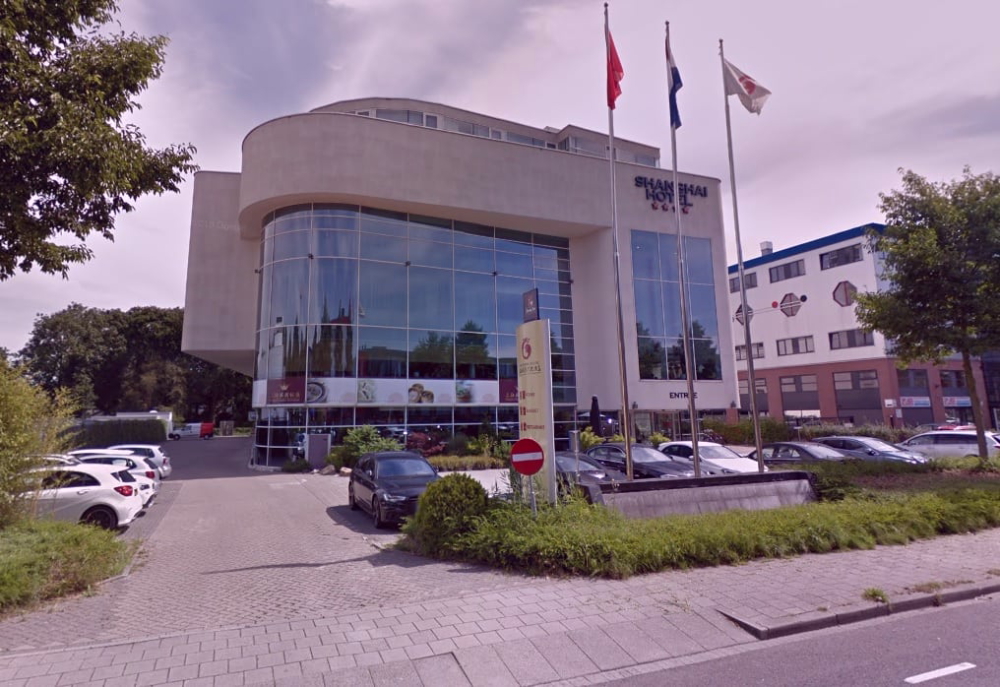
The hotel still has a Chinese-run restaurant on the mezzanine floor so we will probably try that out tonight. If it is really bad we have a Scottish franchise just around the corner… you know the franchise… McDonalds.
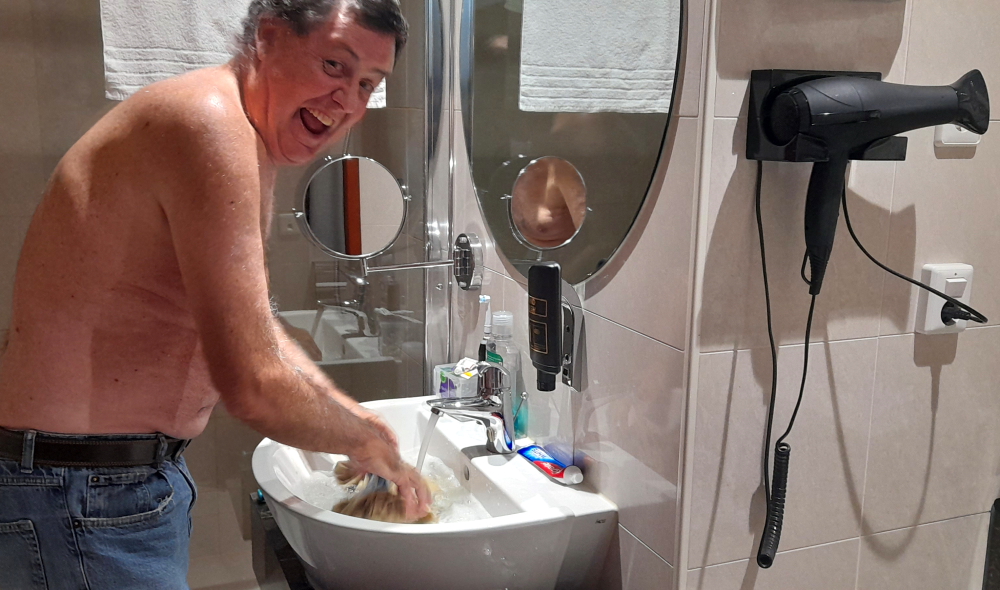
The food in the hotel restaurant is expensive for Chinese food but certainly edible. I manage to spill half my dinner down my freshly-washed and ironed polo shirt so Lynn made me hand wash it back in our room.
27 September, 2023
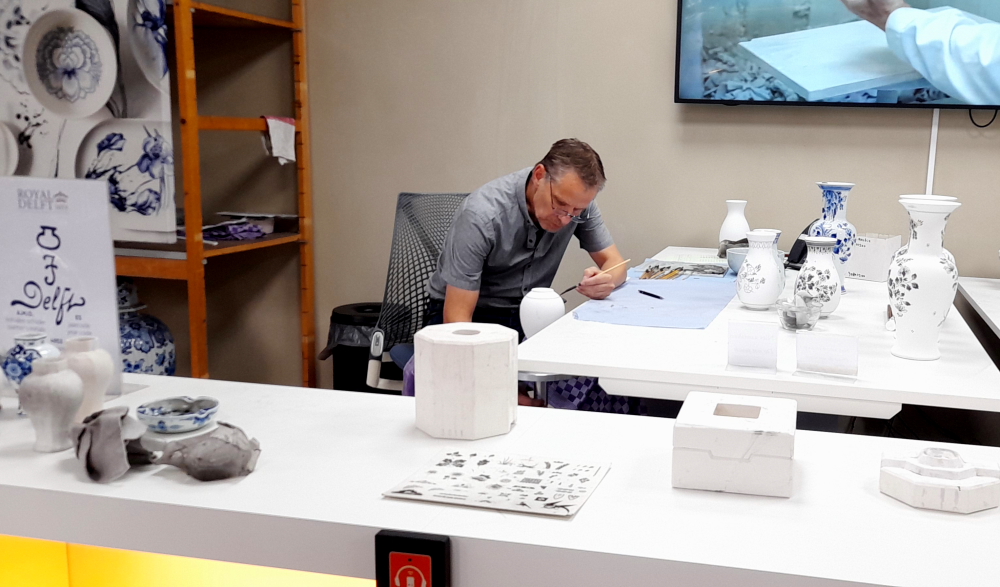
As we are only staying 2 nights in Delft we have today to do the sights. We drive into town and park beside the Royal Delft Museum/Factory.
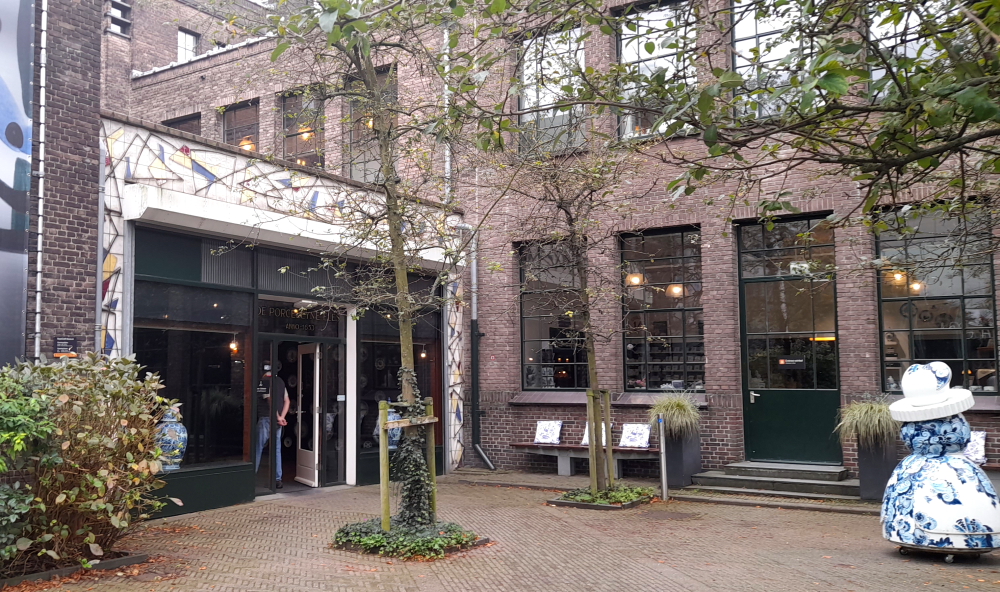
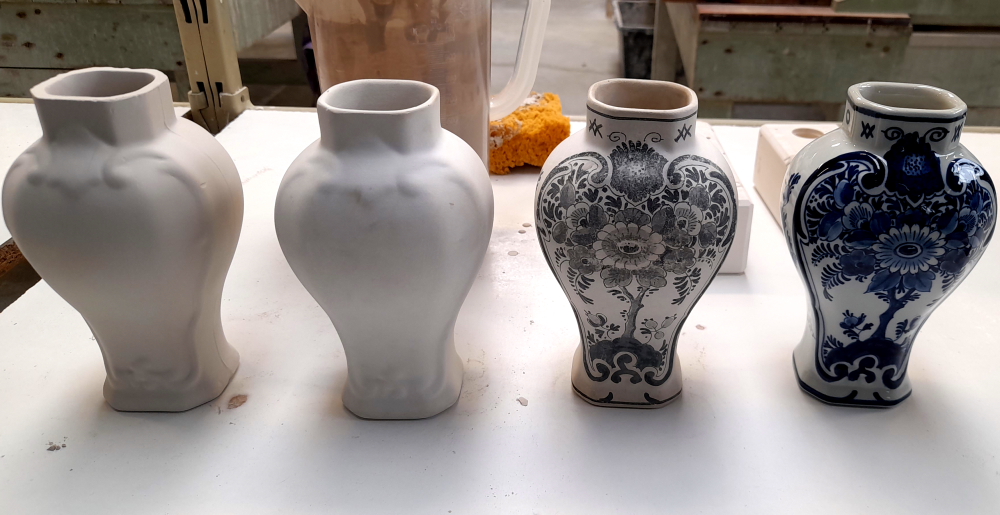
The Koninklijke Porceleyne Fles (known as Royal Delft) is the only remaining factory of c. 32 earthenware factories that were established in Delft in the 17th century.
At the beginning of the tour is an introductory film about the history of porcelain in the Netherlands, starting with a cache of Chinese porcelain on a Portuguese ship being ‘liberated’ by the Dutch and auctioned off, thereby the blue and white Chinese porcelain becomes very popular.
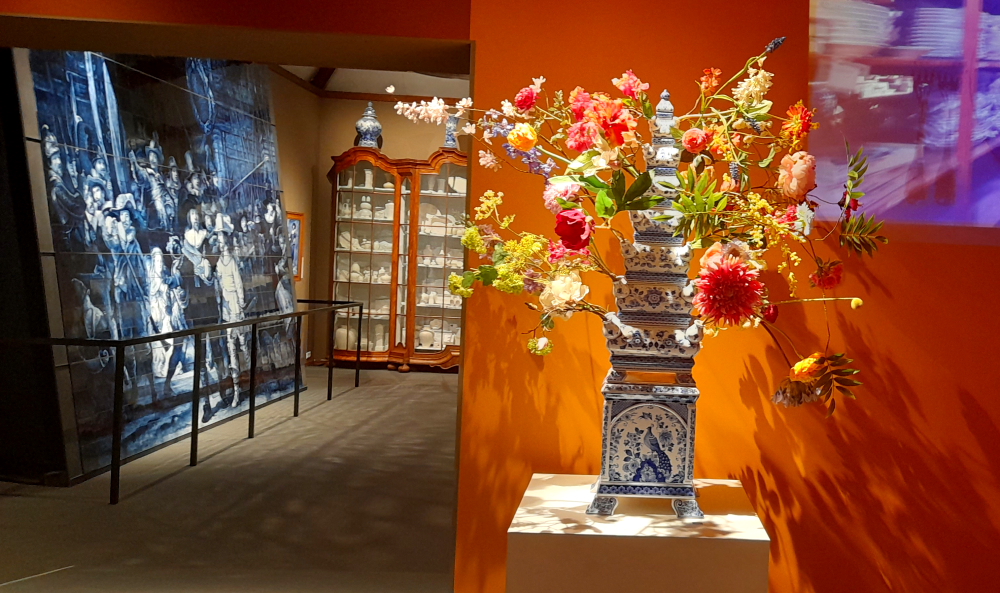
Then the Dutch East India Company decided to trade in it and existing Dutch pottery factories chose to copy the pieces from China and to reproduce and sell them to the domestic market.
“De Porceleyne Fles” ( The Porcelain Bottle) was founded in 1653 by David Anthonisz. v. d. Pieth, at the Oosteinde in Delft. After 1750, the factory was successively owned by Christoffel van Doorne, his son Pieter van Doorne and Jacobus Harlees. The latter reintroduces the jar in the trademark for the first time in 70 years. It has remained part of the trademark ever since.
After Harlees decreased in 1786, the company was owned by his son Dirck Harlees. He then sold it to Henricus Arnoldus Piccardt, who was succeeded in 1849 by his daughter, Geertruida Piccardt who helped reduce its debt by introducing fireproof bricks.
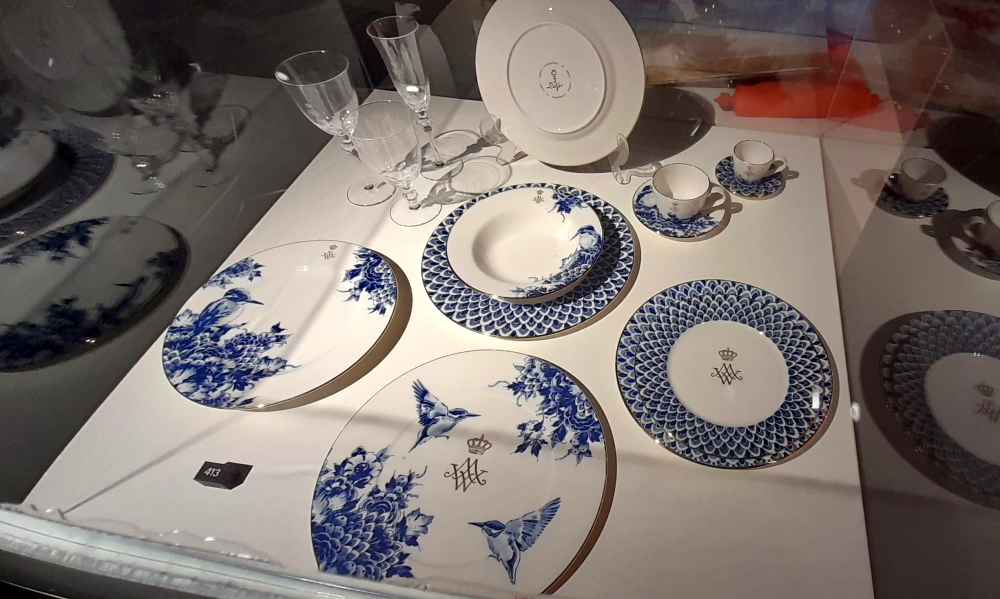
The Dutch potteries faced competition from Wedgwood and the English so decided to emulate them by producing better products for cheaper. During 1876-1844 Delft engineer, Joost Thooft becomes the new owner, purchasing the factory from Geertruida Piccardt, introduces the current trademark and aims to revive the production of Delft Blue.
1878-1930 Leon Senf becomes one of the most important designers after his apprenticeship with important painter Cornelius Tulk.
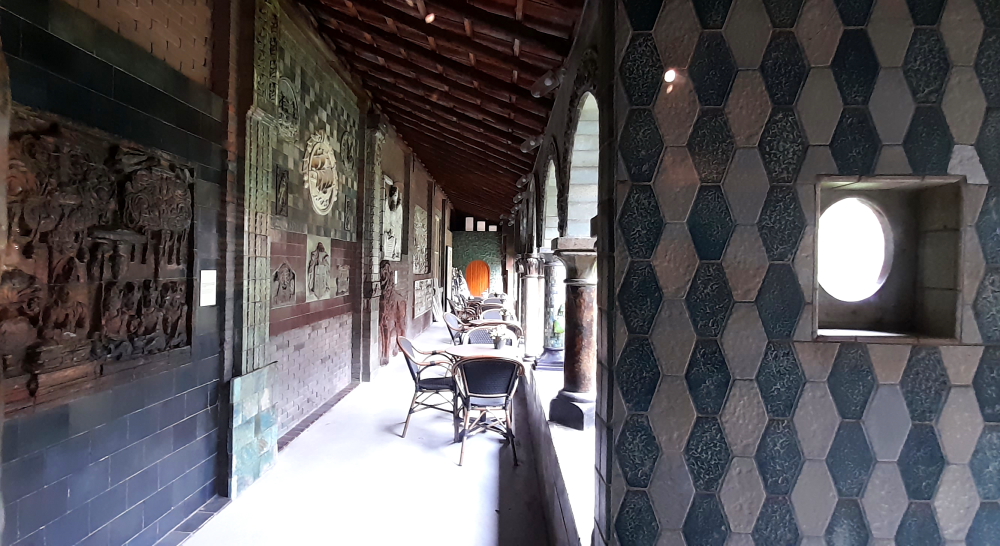
1895 saw the creation of the Building Ceramics Department after which the factory received many important orders for architectural ceramics including one for the Peace Palace in The Hague.
In 1900 Porcelyne Fles won the Grand Prix for its piece at the World Exposition in Paris. ‘Royal’ was awarded in 1919 as a sign of appreciation. 1978 saw the introduction of Black Delft in celebration of the factory’s 325th anniversary with the introduction of Jubilee to celebrate its 350th anniversary in 2003. 2008 a takeover and expansion culminating in the opening of the Royal Delft Experience in 2012.
About 1.5 hours later we drive to 1 of 3 underground parking garages in Delft and make our way to the Eastern Gate (Oostpoort).
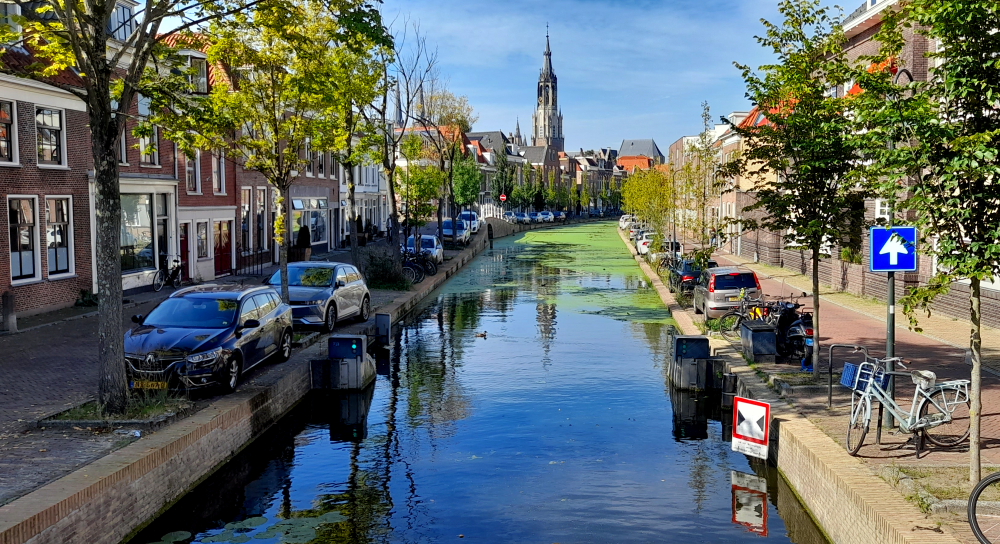
The Eastern Gate is an example of Brick Gothic northern European architecture and was built in the 1400s. Originally the walls of Delft had 8 gates and were the only ways to access the city.
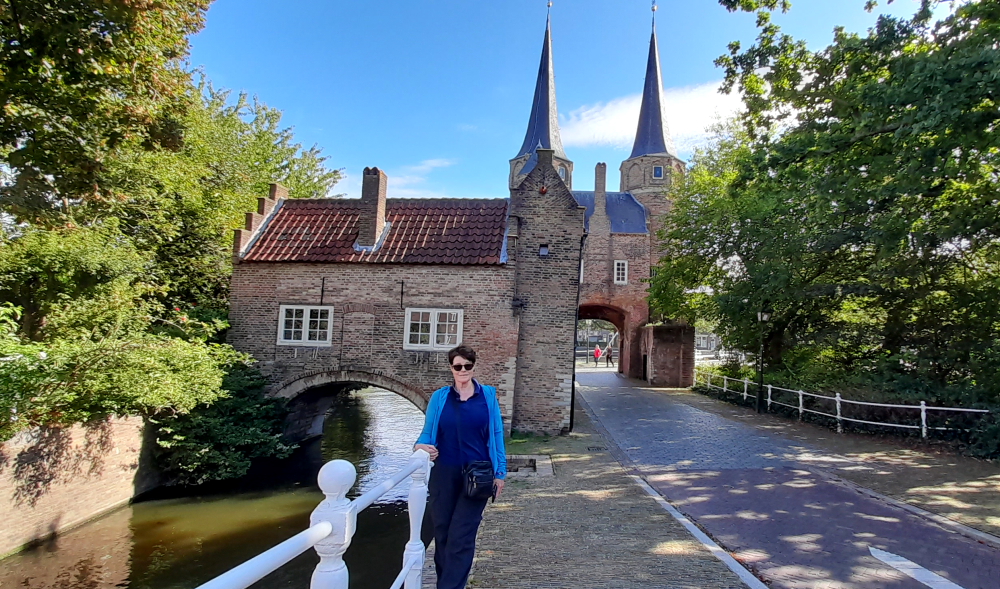
The gates along with the city’s canals and walls provided excellent defenses against hostile attacks. In fact, it was because of Delft’s strong defenses that, in 1572, William of Orange chose Delft as his base of operations.
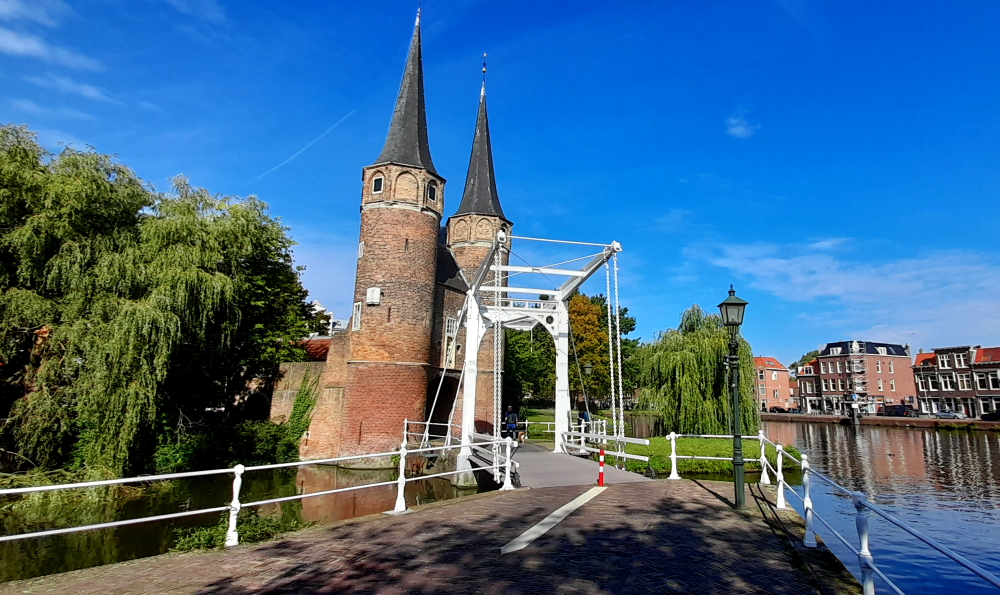
Around 1510 the towers were enhanced with an additional octagonal floor and high spires. To this day, the Gate still has a gate and drawbridge.
From the Gate we walk a couple of blocks to Beestenmarkt – you guessed it, a former cattle market which operated from 1595 to 1972. In 1969 the livestock market was relocated to a special hall but in 2001 the foot-and-mouth disease crisis marked the end of the market.
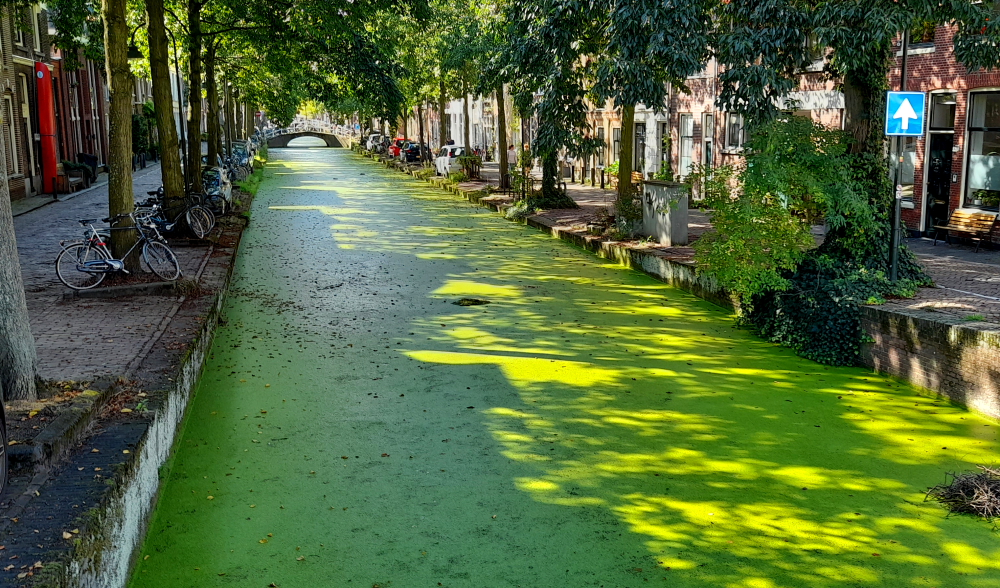
Nowadays, the Beestenmarkt is a very popular social gathering and meeting area with numerous cafes, bars and restaurants plus trees that provide shade in summer months. Since 2001 the square has been used every winter as an ice-skating rink.
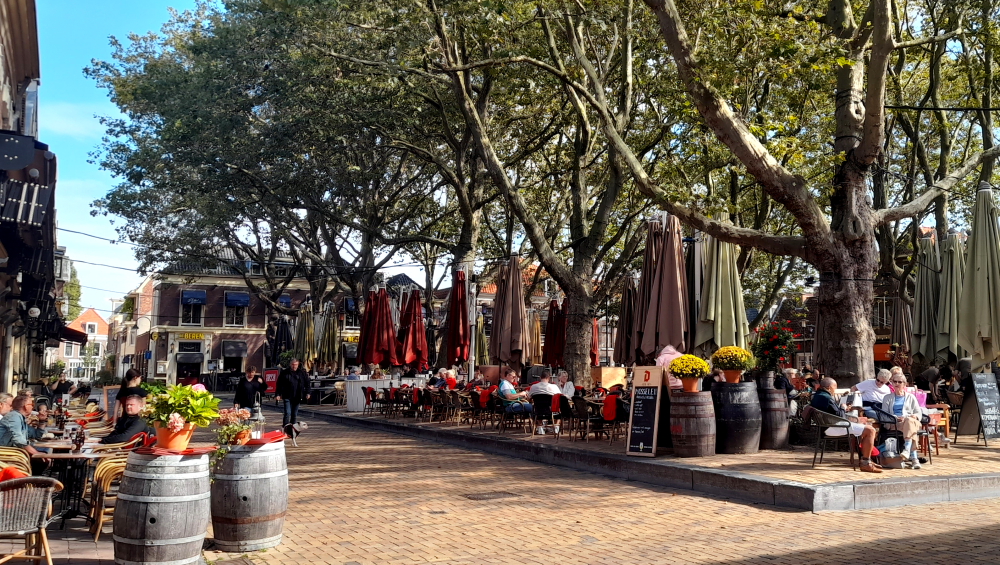
A block further on is the Markt. Dating back to the 12th century, de Markt is one of the largest and oldest market squares in Europe. The square is bordered by the Nieuwe Kerk (New Church) and the City Hall of Delft. Thursday is the main market day with 150 stalls actively selling cheese, fish, veggies, bread, nuts and other foods.
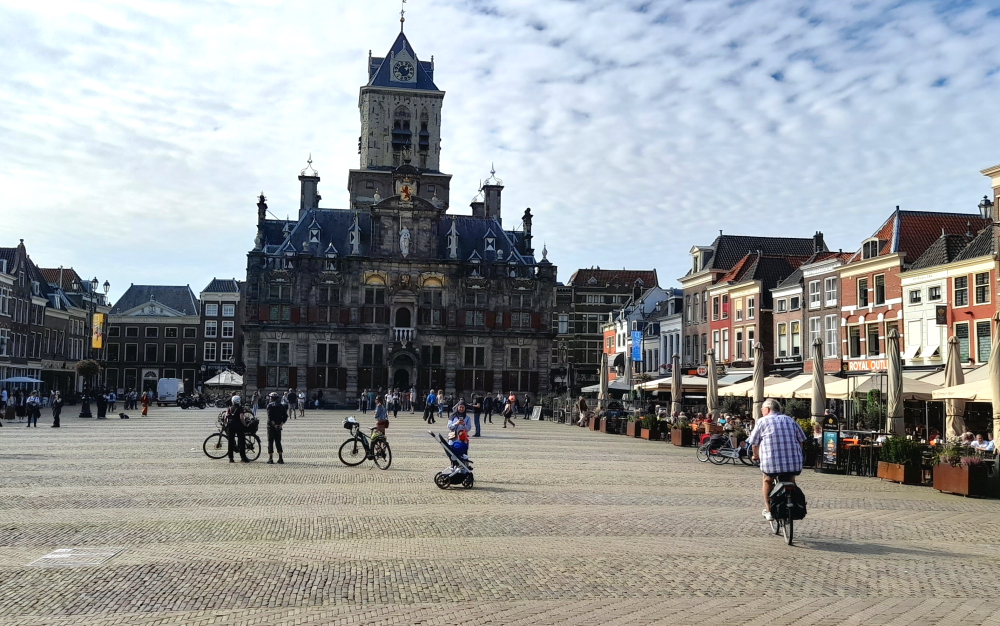
Delft’s City Hall is a Renaissance-style building designed by Hendrick de Keyser after its predecessor the old, medieval building burnt down in 1618. Formerly used as the city’s government buildings, today it has fewer official functions. Marriage ceremonies have been happening here for centuries, even today. In fact, Johannes Vermeer registered his marriage with Catherine Bolnes here.
Later in the 18th century the building housed the gold and silversmith guild and pharmacist guilds. The City Hall tower was built around 1300. The tower has decorative clock faces and bells. It once functioned as a prison where Balthasar Gerards was imprisoned here prior to his execution for assassinating William of Orange.
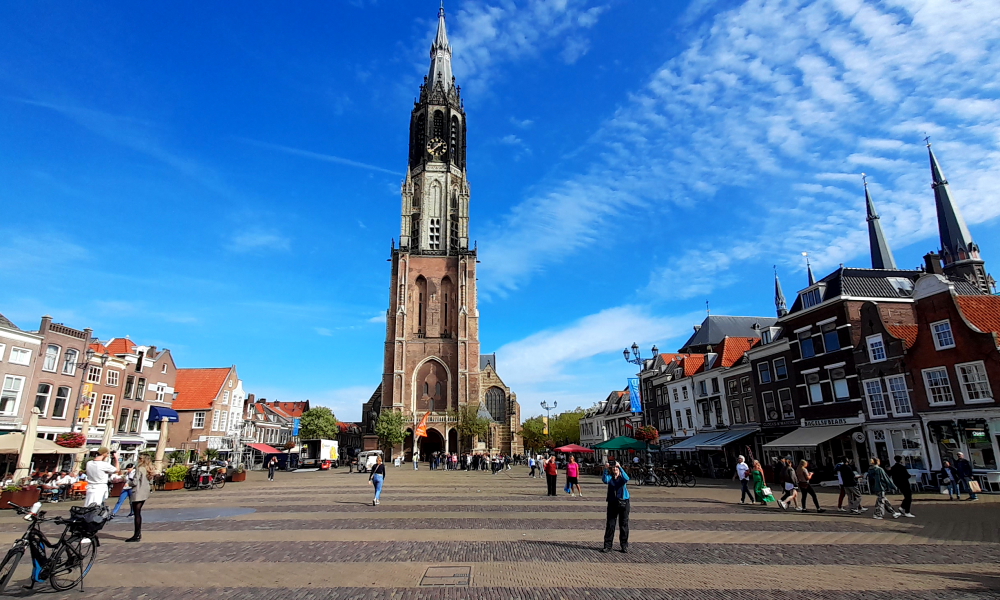
Opposite City Hall is the Protestant Church, Nieuwe Kerk (New Church). In 1584 William the Silent was entombed here in a mausoleum designed by Hendrick and Pieter de Keyser. Since then members of the House of Orange-Nassau have been entombed in the royal crypt, including Queen Juliana and her husband Prince Bernhard in 2004. The church itself is an elaborately designed architecture with 22 columns surrounding the marble tomb of William of Orange.
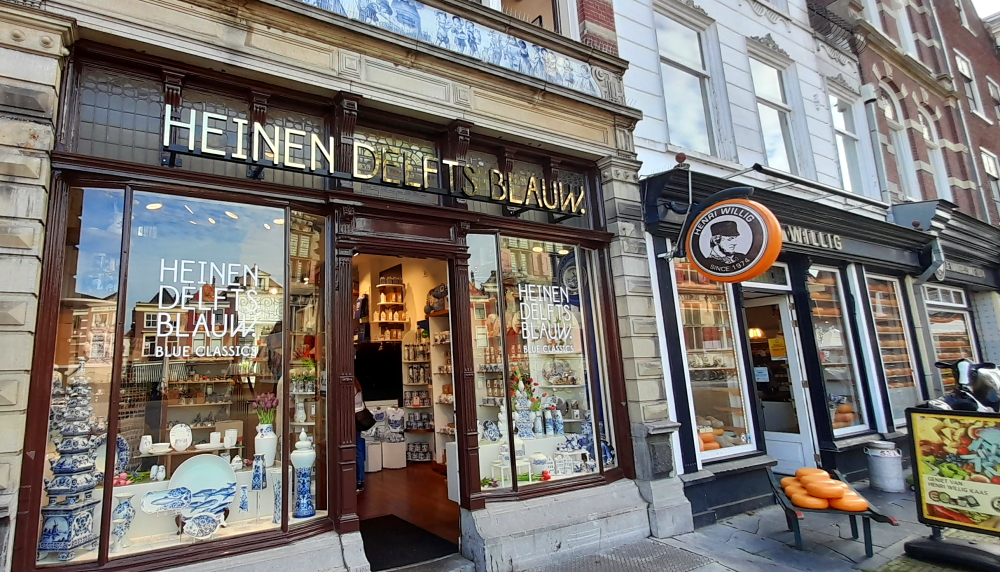
Many artisanal shops surround the Markt selling porcelain, cheese, sweets, writing equipment, Outside the market’s perimeter are pubs, cafes and open air terraces.
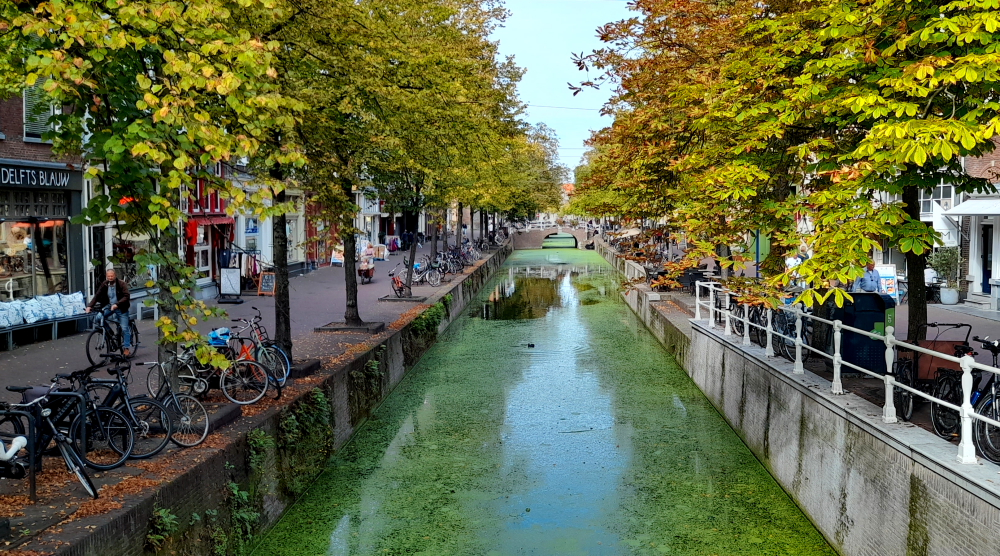
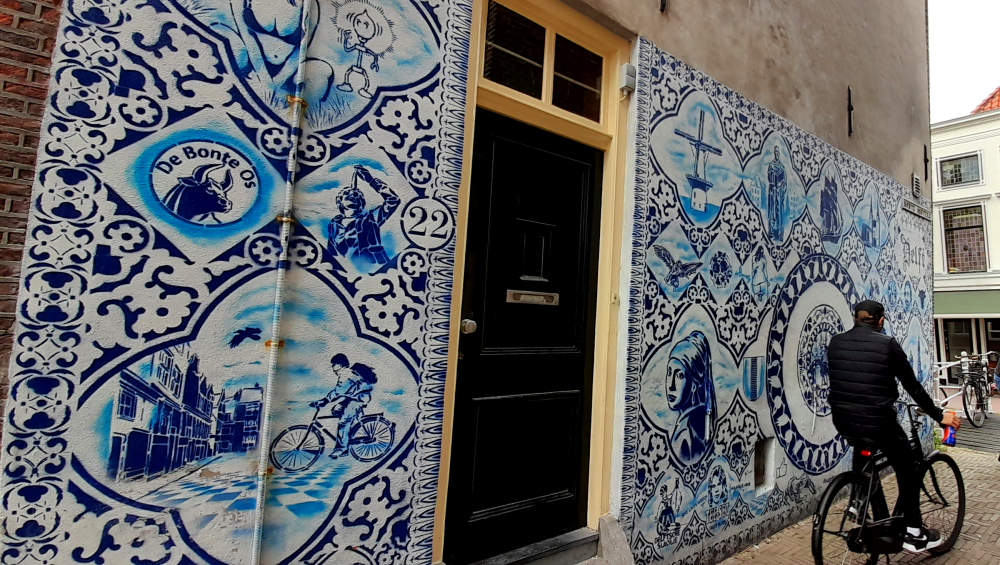
Our next stop is the Old Church. To get there we cut through a passageway which has some street art portraying Delft.
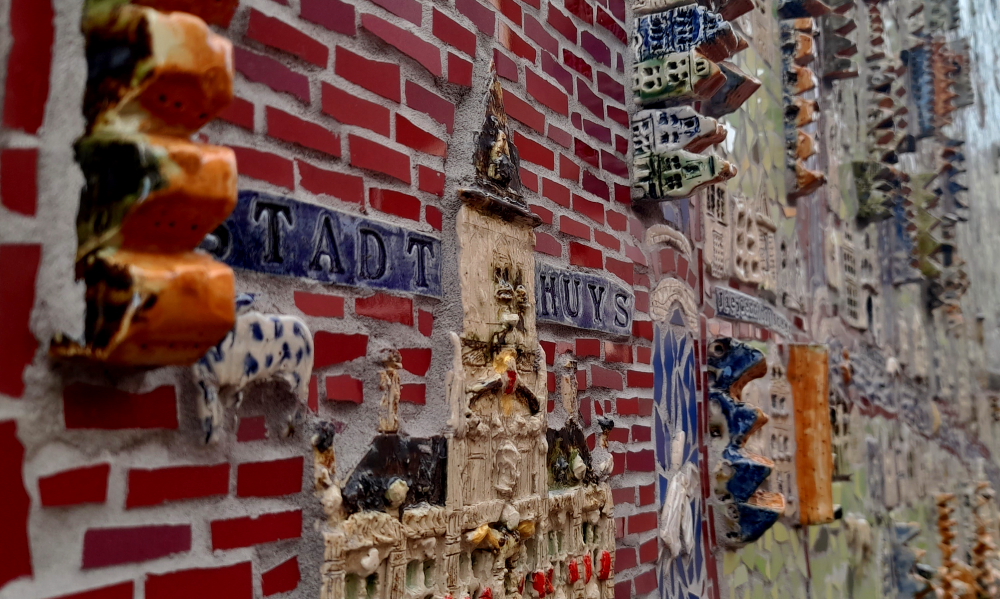
Then walking down Papenstraat we come across a Mosaic of Delft on a wall.
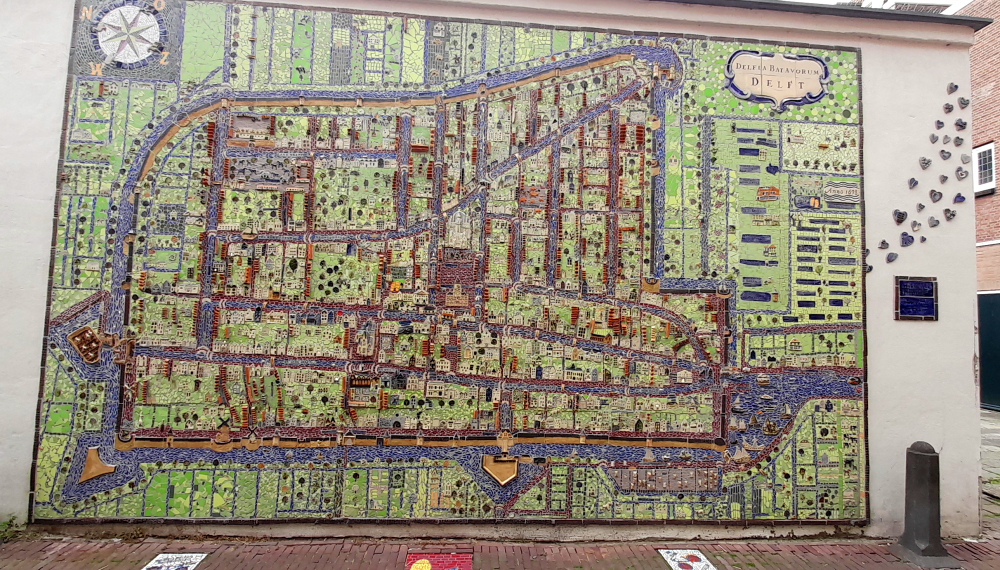
Which, when viewed up close is actually in 3D with both flat and raised buildings interspersed among the thousands of mosaic squares.
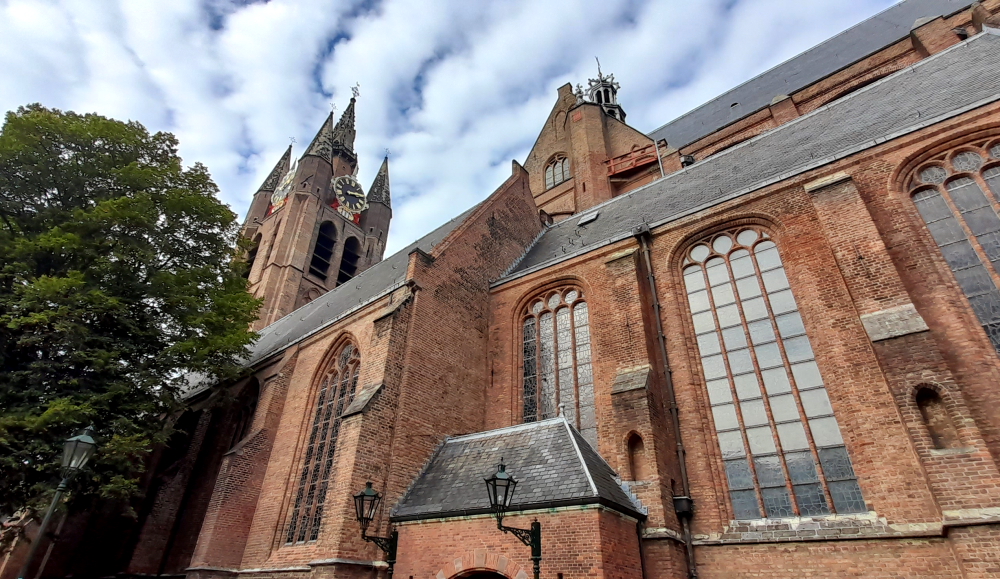
Founded in 1246 and sandwiched between Oude Delft and Voorstraat is the Old Church (Oude Kerk) nicknamed Oude Jan (Old John) and Scheve Jan (Skewed John), a Gothic Protestant church most famous for its 75-metre high leaning tower. Approximately 400 people are entombed in this church.Among them are Johannes Vermeer and the inventor of the microscope, Anthony van Leeuwenhoek.
Opposite is the Museum Het Prinsenhof.The Prinsenhof (The Court of the Prince) is an urban palace that dates back to the Middle Ages. It was here that William of Orange successfully fought against the Spanish occupation in the 16th century. William of Orange moved into the Saint Agatha cloister in 1572, later to be renamed the Prinsenhof and later still it became the Museum.
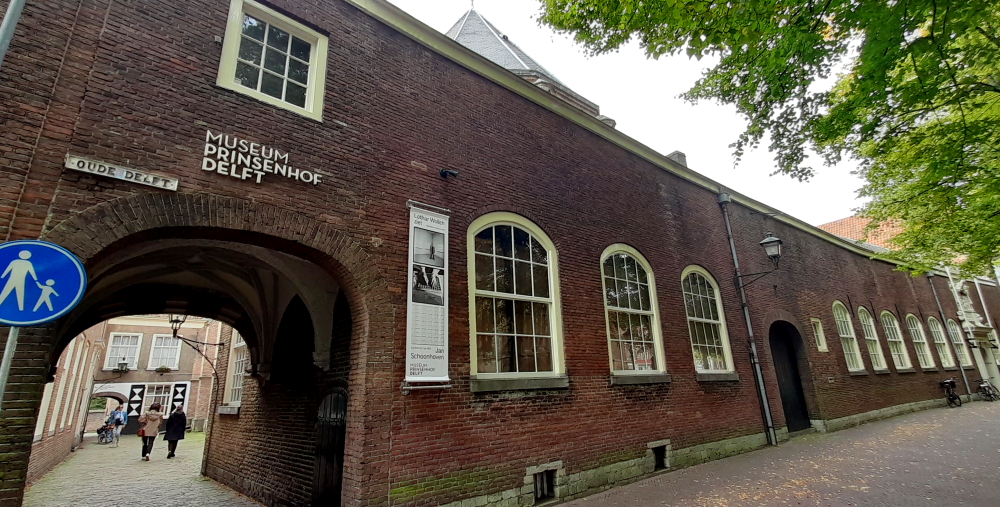
In 1584 William was murdered in the Prinsenhof by Balthasar Gerards. Established in 1911 the building now houses the municipal museum and displays a collection of Dutch Golden Age paintings, a history of Prince William of Orange and the creation of the Dutch Republic, 17th century art and the city’s famous Delftware tradition.
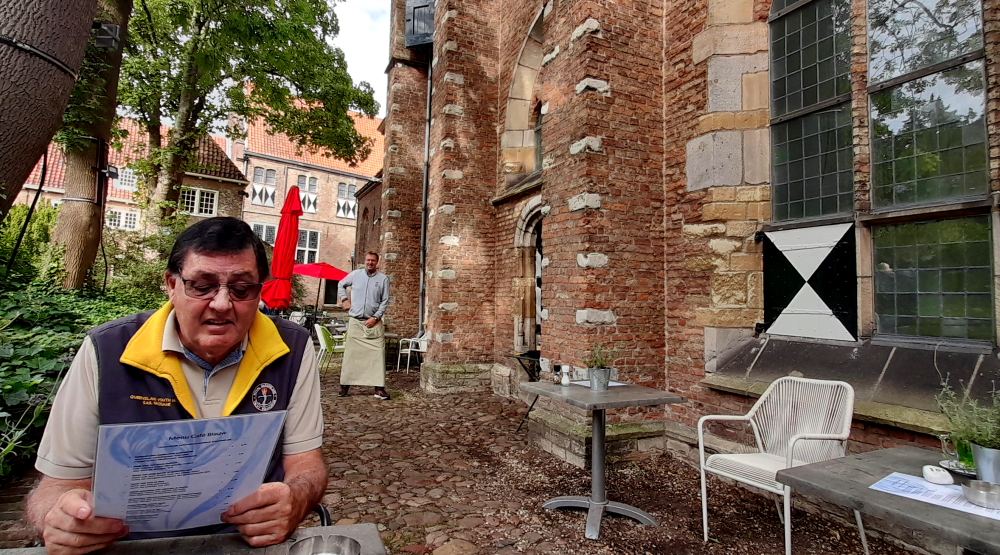
Here we sit for a while in the shady gardens behind the museum before we walk back to the parking garage and return to the hotel. As the Scottish restaurant is only a few steps away, we’ll forgo another expensive Chinese meal and head there instead for tonight’s dinner.
28 September, 2023
This morning, on our way to Middelburg, we’re going to go via The Hague which is only a 20-minute drive from Delft.
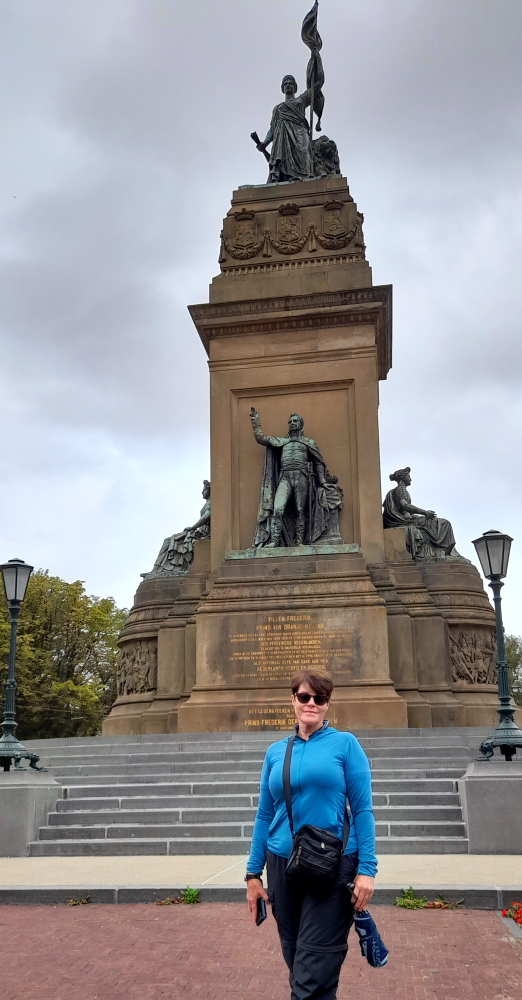
Although it’s 19 Deg C. it’s overcast and cool when we arrive and park the car at Plein 1813, next to the Nationaal Onafhankelijkheidsmonument (honestly!).
The National Monument in the middle of the square commemorates the victory over Napoleon, the end of the French period in the Netherlands, the independence and the foundation in 1813 of the Sovereign Principality of the United Netherlands, the predecessor of the United Kingdom of the Netherlands and the current Kingdom of the Netherlands. The monument was unveiled on November 17, 1869 by Prince Frederik of the Netherlands. The whole is a design by architect WC van der Waeyen Pieterszen and sculptor Jan Jozef Jaquet.
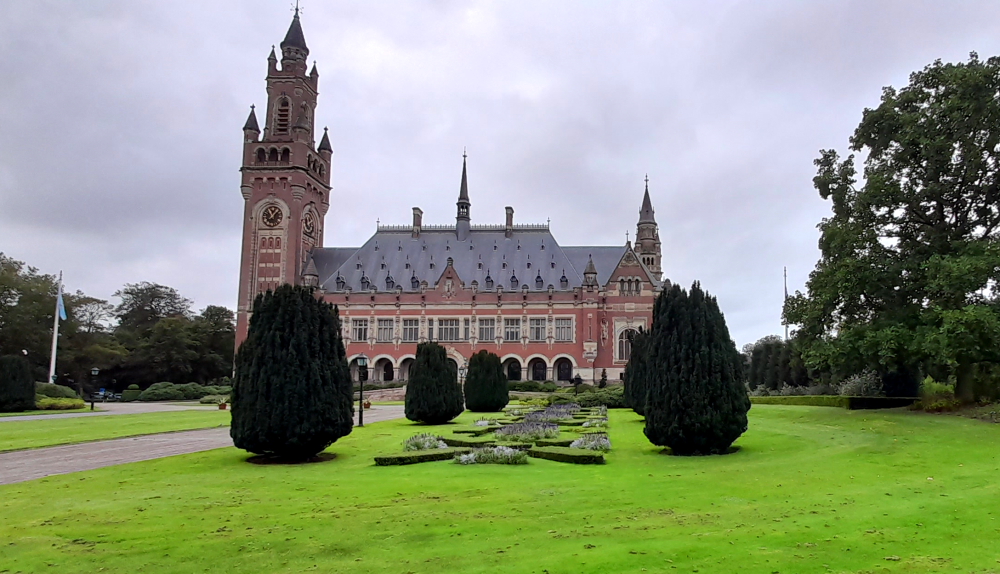
After a 12-minute walk we arrive at the object of our visit: The International Court of Justice, seated in the Peace Palace.
The International Court of Justice (ICJ) is one of the six principal organs of the United Nations (UN). It settles disputes between states in accordance with international law and gives advisory opinions on international legal issues. The ICJ is the only international court that adjudicates general disputes between countries, with its rulings and opinions serving as primary sources of international law (subject to Article 59 of the Statute of the International Court of Justice).
The ICJ consists of a panel of 15 judges elected by the UN General Assembly and Security Council for nine-year terms. No more than one judge of each nationality may be represented on court at the same time, and judges collectively must reflect the principal civilizations and legal systems of the world. Seated in the Peace Palace in The Hague, Netherlands, the ICJ is the only principal UN organ not located in New York City. Since the entry of its first case on 22 May 1947, the ICJ has entertained 186 cases through January 2023. Its official working languages are English and French.
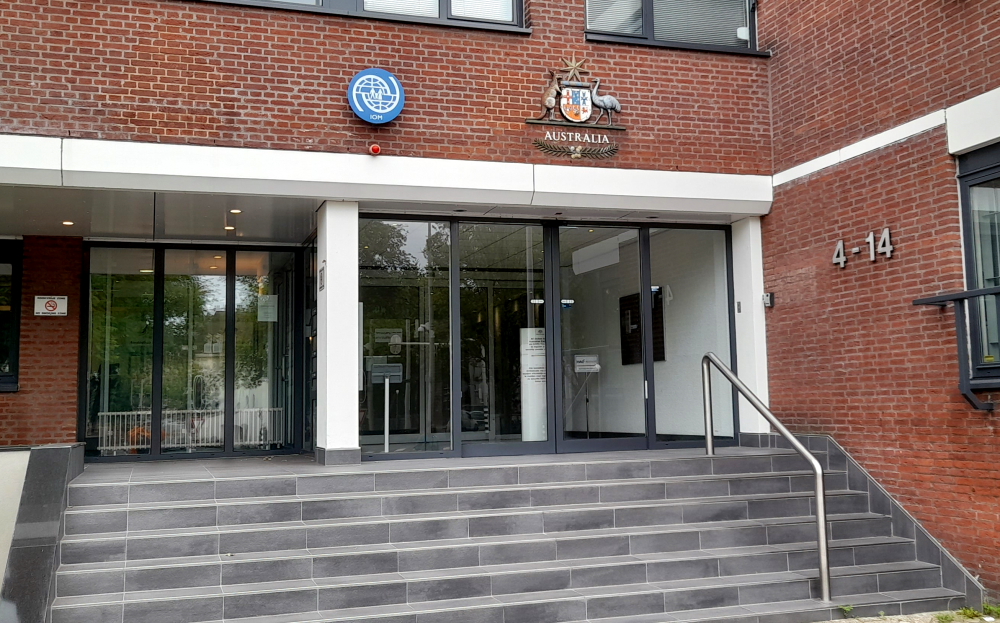
While circumnavigating the Court, we walk past a building which houses, amongst others, the Australian Embassy.
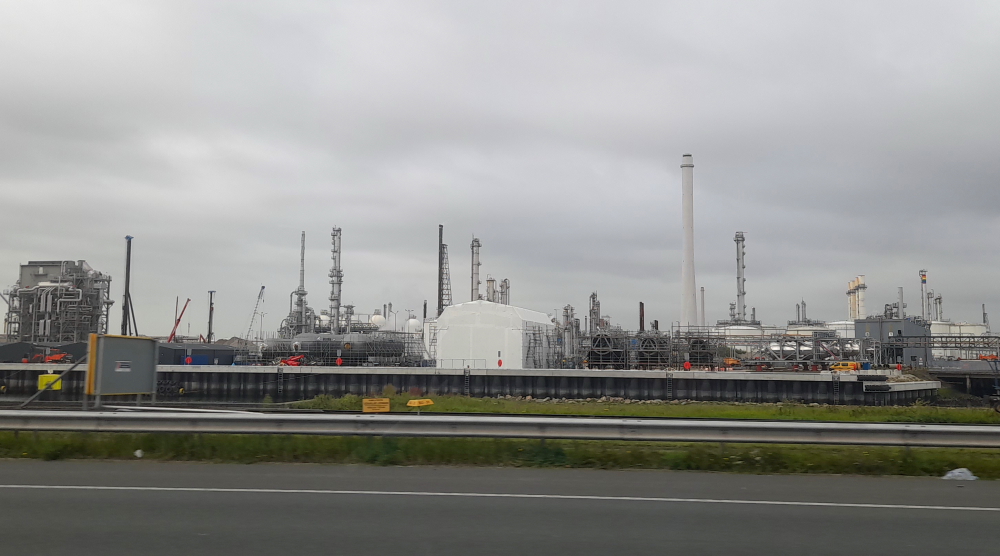
Leaving The Hague, the A4 takes us past Rotterdam Port and what seems like endless kilometres of oil and gas pipes, tanks and towers.
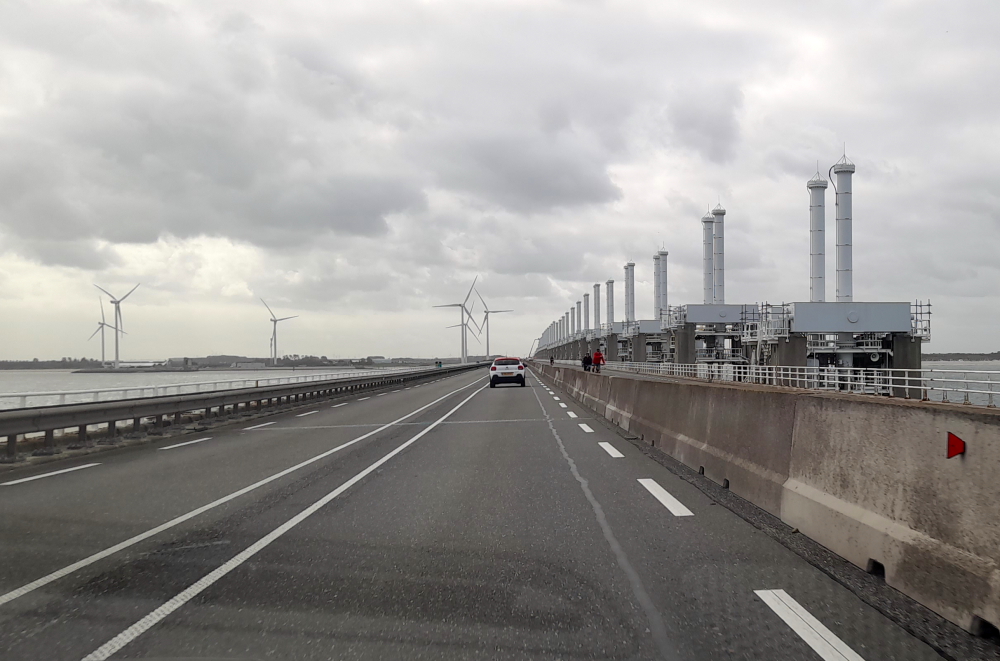
After going through 2 tunnels – the Benelux Tunnel and the Botlek – the N57 takes us SW to Rijksweg, across the island of Neeltje Jans to the delightful village of Oostkapelle.
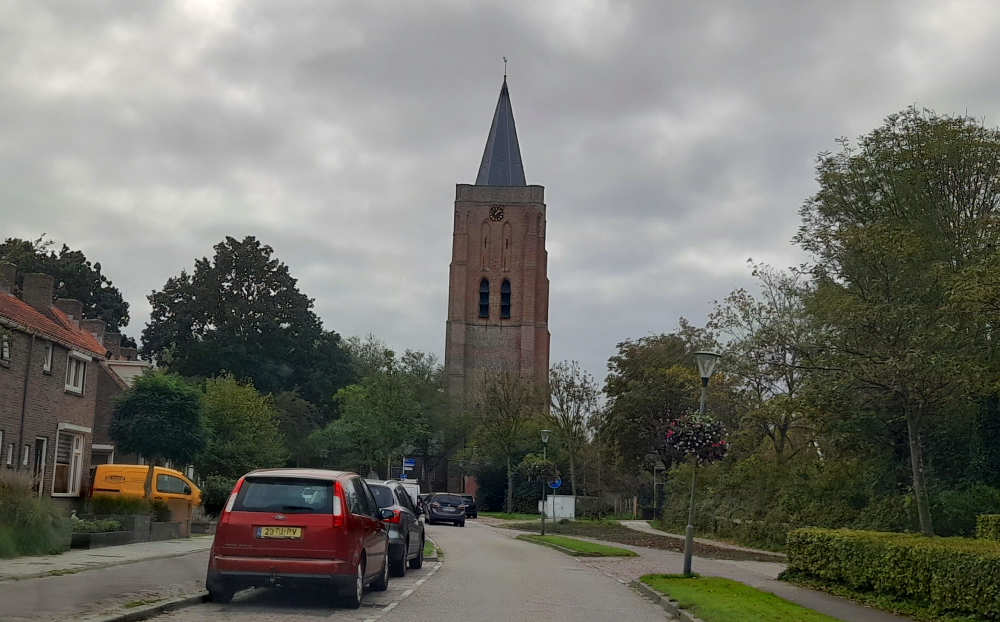
The village was first mentioned in 1162 as Hoostcapelle, “eastern chapel”. It developed as a circular church village in the Early Middle Ages on a ridge. Oostkapelle was home to 818 people in 1840. In the 20th century, Oostkapelle started to develop as a holiday resort and spa town, due to its vicinity to the dunes and the North Sea.
Along the western coast of Zeeland are sandy beaches which are backstopped by a very high dyke. On the landward side are small car parks that appear at regular intervals, right next to a very steep set of stairs scaling the dyke.
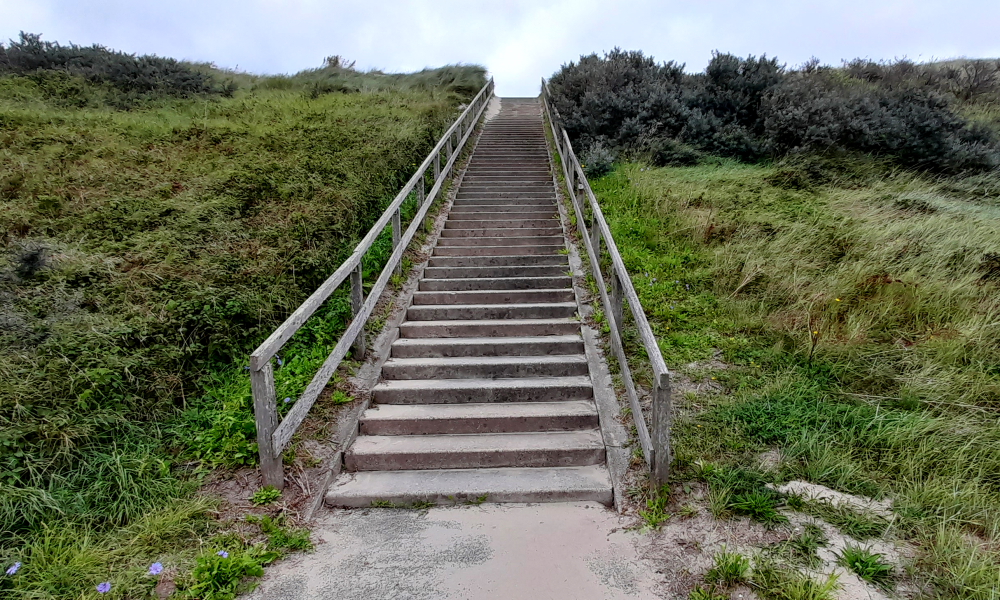
Although there is nobody in the car park they charge a fee to park here in the middle of nowhere.
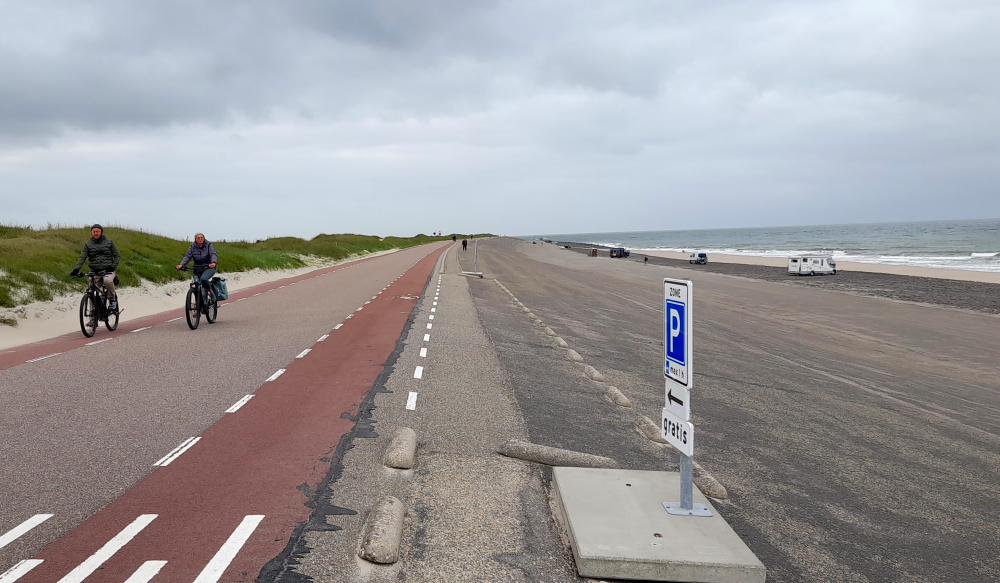
On the other side is a small road, next to either a sandy beach or, near the lighthouse (Vuurtoren Noorderhooft), rocks that have been covered in bitumen, down to the sea. Ugh!
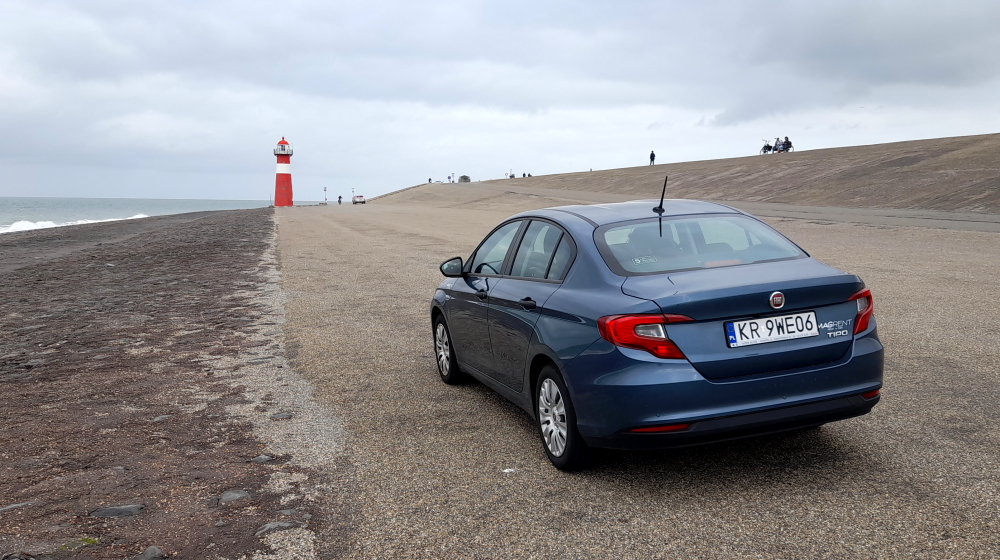
Opposite that lighthouse, from on top of the dyke a village can be seen far below – Westkapelle – which is dominated by a tall tower with a light on top.
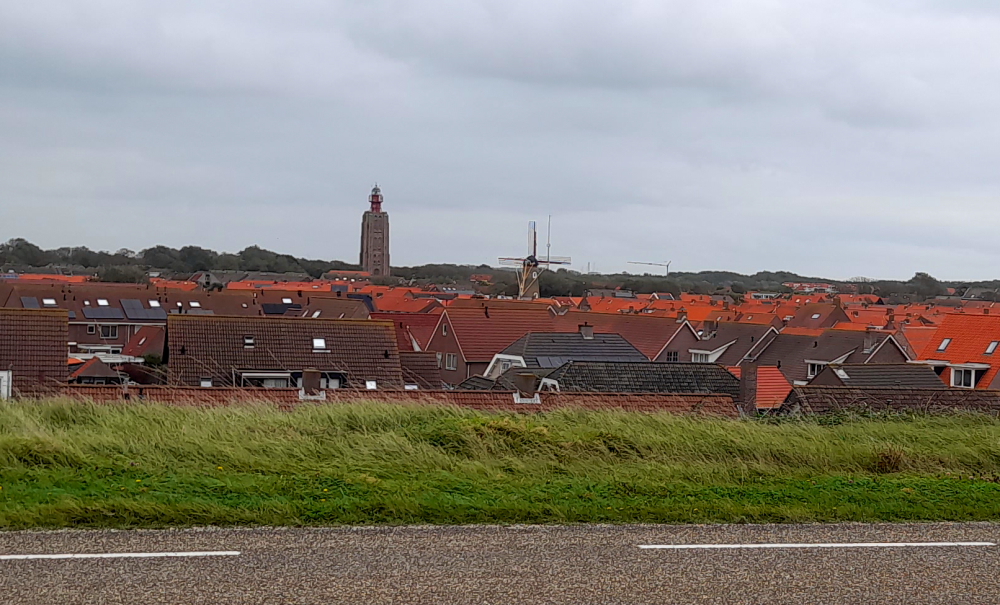
Westkapelle is on the westernmost tip of Walcheren and is surrounded by the sea on three sides. On 3 October 1944, the dyke to the south of town was destroyed by British bombers – an event still known in Westkapelle simply as “‘t Bombardement” (“the Bombardment”) – to flood the German occupation troops in Walcheren and so make liberation easier. 180 inhabitants were killed in the bombing and the village was all but wiped off the face of the earth by the bombs and the incoming sea. On 1 November 1944, during the Battle of the Scheldt British and Norwegian commandos performed an amphibious landing on the northern and southern edges of the gap made in the dyke. During these landings, only six people remained in the village; the rest of the survivors had been evacuated to other villages nearby. It took until 12 October 1945, more than a year later, to finally close the gap in the dyke.
Westkapelle has two active lighthouses. The oldest lighthouse (Vuurtoren ‘t Hoge Licht) , built 1458–1470, 52 m (171 ft) tall, visible from 28 nautical miles (52 km; 32 mi) and standing prominently at the entrance to the village, is the remainder of a church that burned down in the 18th century. In 1818 the light was added to the top. The other one (Vuurtoren Noorderhooft), standing on the outer slope of the dyke, was built in 1875 of cast iron, is only 16 m (52 ft) tall and has a visibility range of 13 nautical miles (24 km; 15 mi).
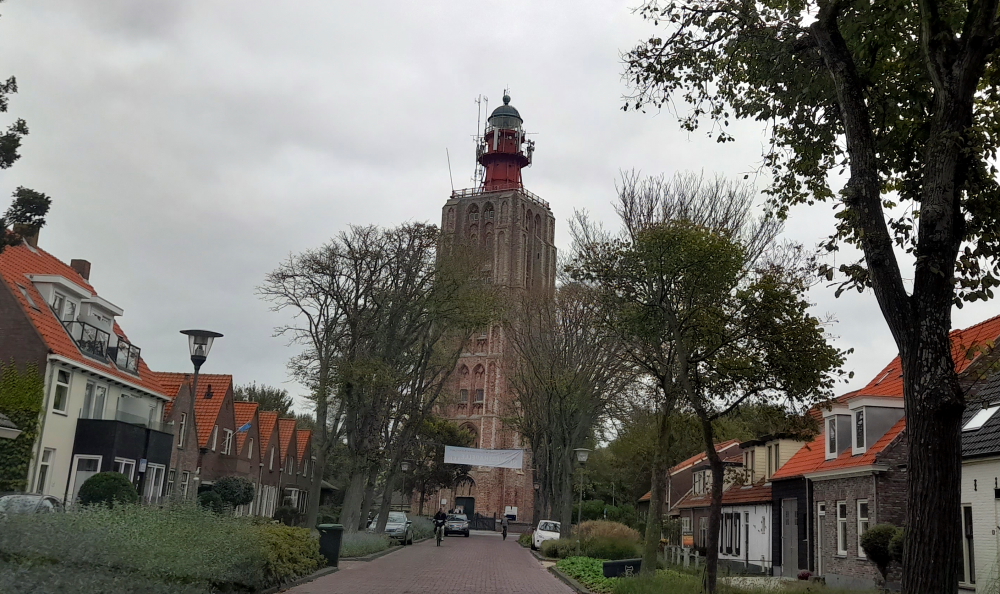
Together they form leading lights, that lead vessels coming from the northern part of the North Sea into the narrow and busy shipping lane directly under the south west coast of Walcheren, that brings them into the Scheldt estuary and towards the ports of Flushing, Terneuzen, Ghent (via the Ghent–Terneuzen Canal) and Antwerp.
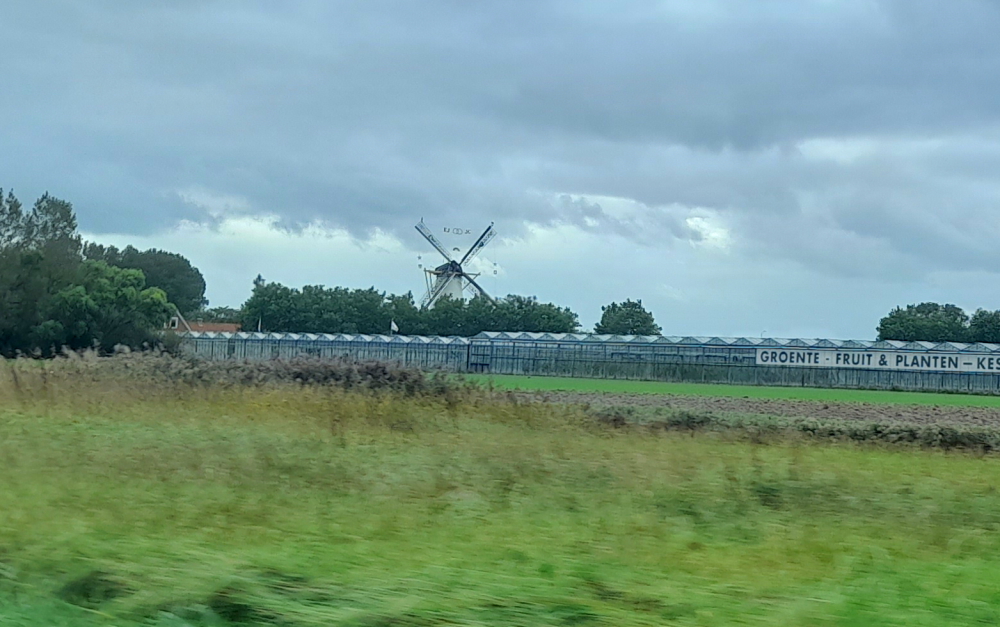
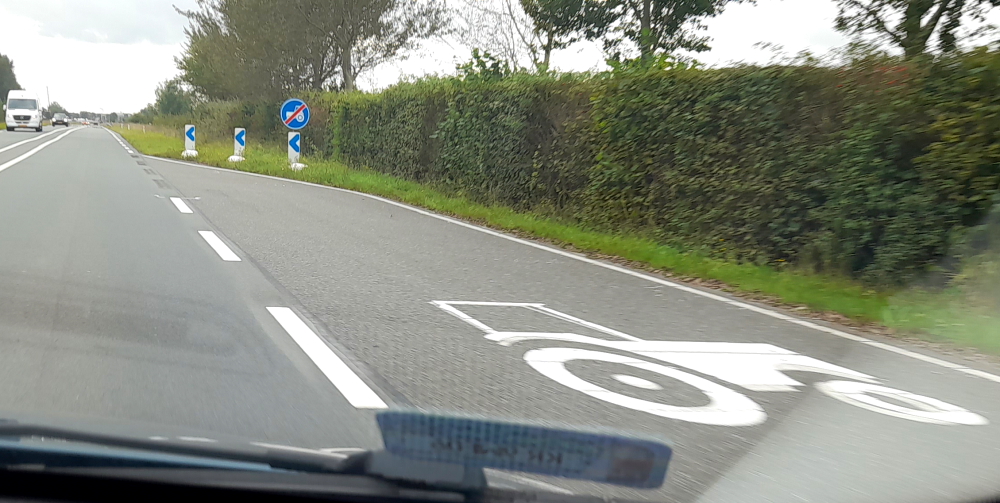
Heading south on the N288 towards Fort Rammekens, we come across several laybys reserved for tractors.
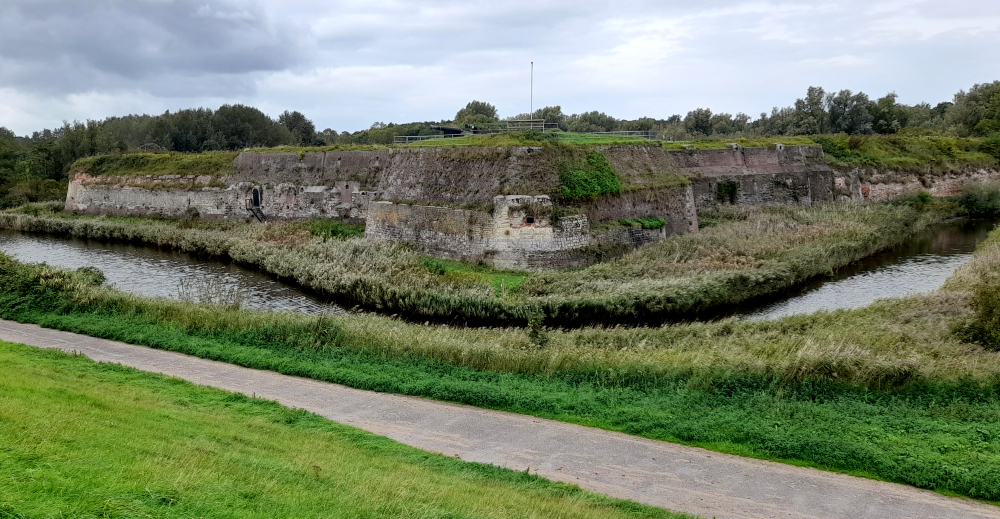
By 2.15 pm we arrive at Fort Rammekens, the oldest existing sea fort in Western Europe. Fort Rammekens is a Dutch fort near Ritthem, at the mouth of the former Welzinge canal, which provided access to the port of Middelburg, a few kilometres east of Vlissingen on the Western Scheldt. Originally the fort was also called Zeeburg. Until the French period, the fort stood half in the open sea and there were buildings on it.
Built in 1547 by order of Mary of Hungary who as governor of the Netherlands, it’s task was to protect and control the busy shipping routes to Middleburg, then the largest merchant city in the Northern Netherlands and Antwerp. Italian engineer Donato de Boni di Pellizuoli was responsible for its design. It was built over the former seawall and given a diamond shape with a bastion facing the Westerschele. The fort played an important role in the 80 Years’ War between 1560 and 1575 changing hands several times. On 8 February 1574 the transfer of the city of Middelburg was signed here by Cristobal de Mondragon and Willem van Oranje. The sea fort was abolished as a fortress in 1869 but remained in use as a power magazine. Today it’s a museum.
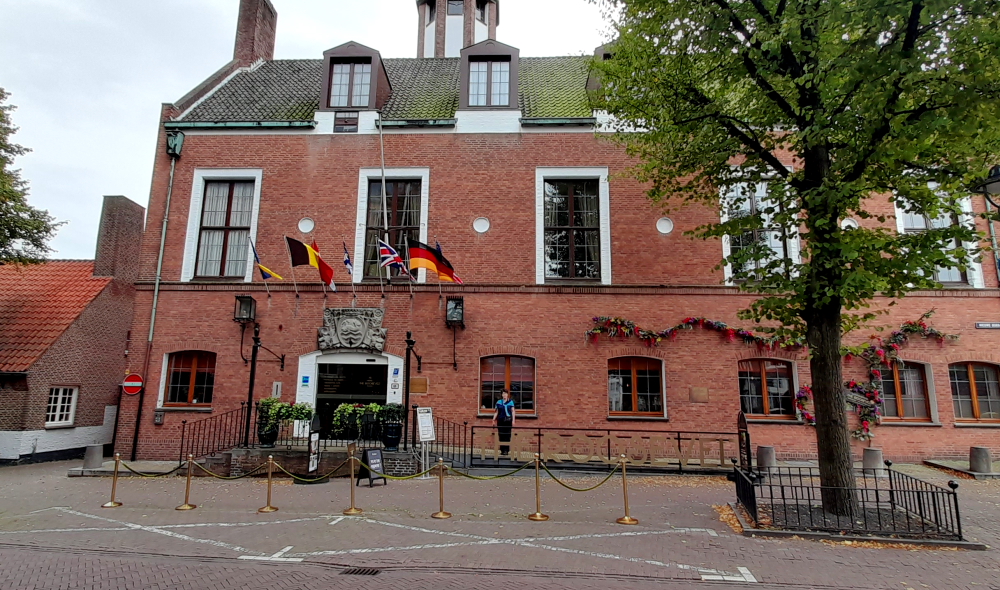
We drive into the medieval section of Middelburg where our hotel, the Boutique Hotel Roosevelt, is located.
The hotel is located in a 1950s monument by architect JF Berghoef and is located on the Burg of Middelburg. It is named after the former president of the United States with Zeeland ancestors, Franklin D. Roosevelt.
In early 2015, architectural firm ESTIDA completed the interior of hotel. The starting point for the design and implementation was the elegant style of the 1930s and 1940s, the period of Roosevelt’s presidency.
A striking detail in the use of color is the color aquamarine, President Roosevelt’s favorite color. The hotel complements this 1930s zeitgeist by, for example, using the CO Bigelow soap that Eleanor Roosevelt used.
In 2016 the hotel was officially opened by the grandchildren of Roosevelt. The Roosevelt family was originally from Zeeland and Middelburg is the capital of Zeeland.
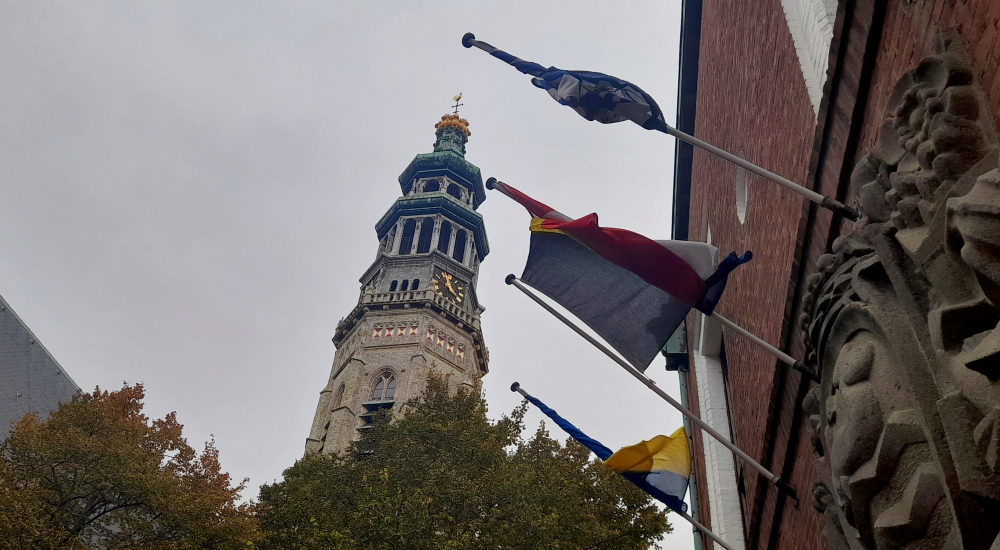
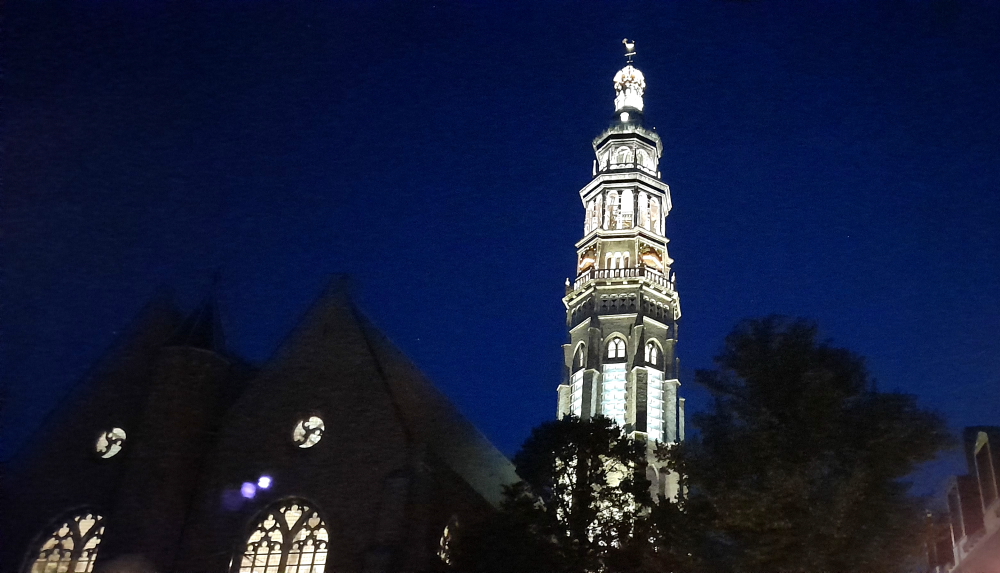
Next door to the hotel is Nieuwe Kerk (New Church), part of the former Abbey of Middelburg. Next to the church is the Koorkerk (Choir Church) and the Lange Jan tower. On the half hour we are treated to a melody of bells from the tower – which actually sounds like “We wish you a merry Christmas” – followed by the appropriate number of bongs for the hour.
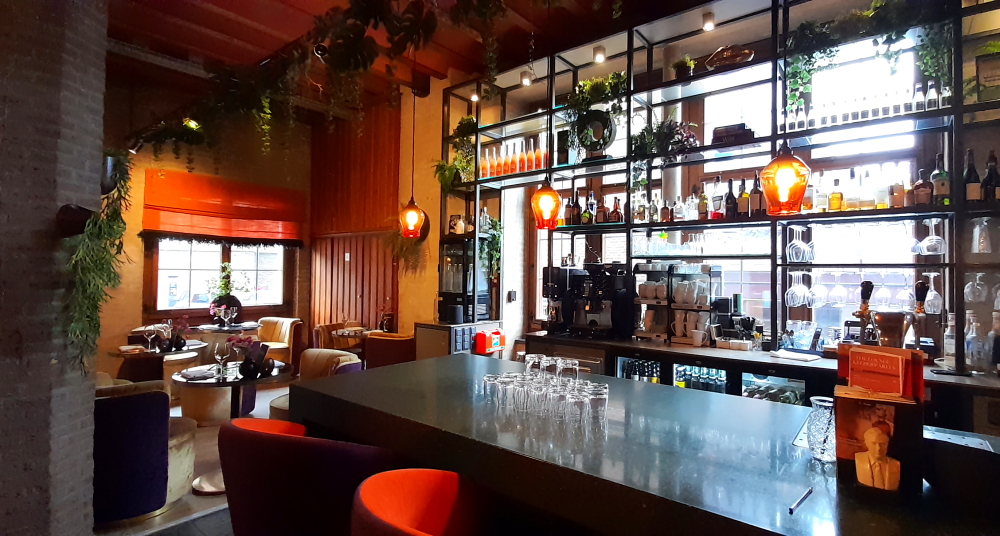
Once we check in we need to park our car at an underground parking garage, 6 minutes’ walk away. Walking back to the hotel we check out the historic city centre and Thursday’s market in the large market square.
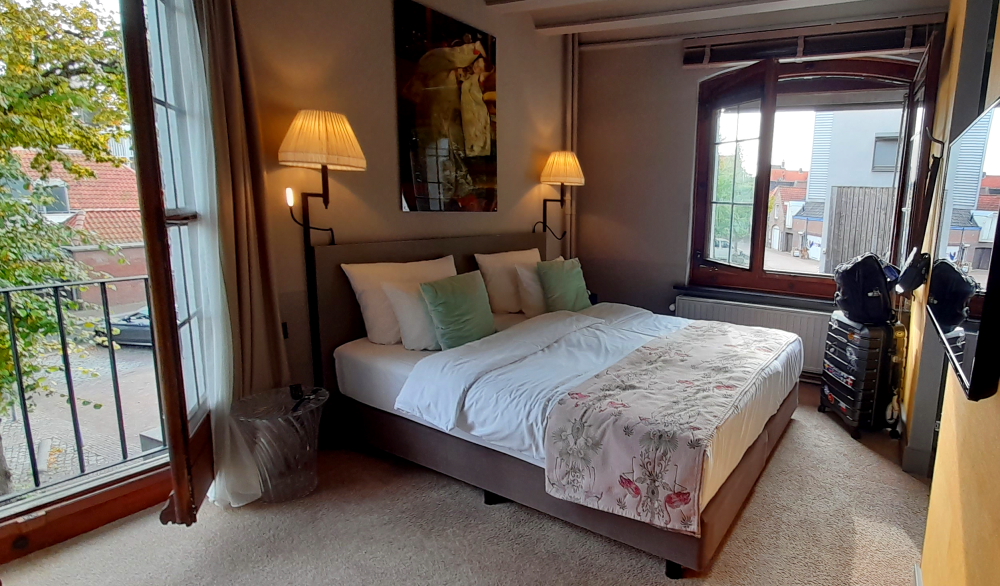
Tonight we will be having dinner in the hotel restaurant. The menu is limited but it will have to do. Turns out the food is delish!
29 September, 2023
Aahh…a sleep-in. We had elected to break our fast at 9:30 am and so get to enjoy some extra shut-eye. The overcast morning and rain also helped.
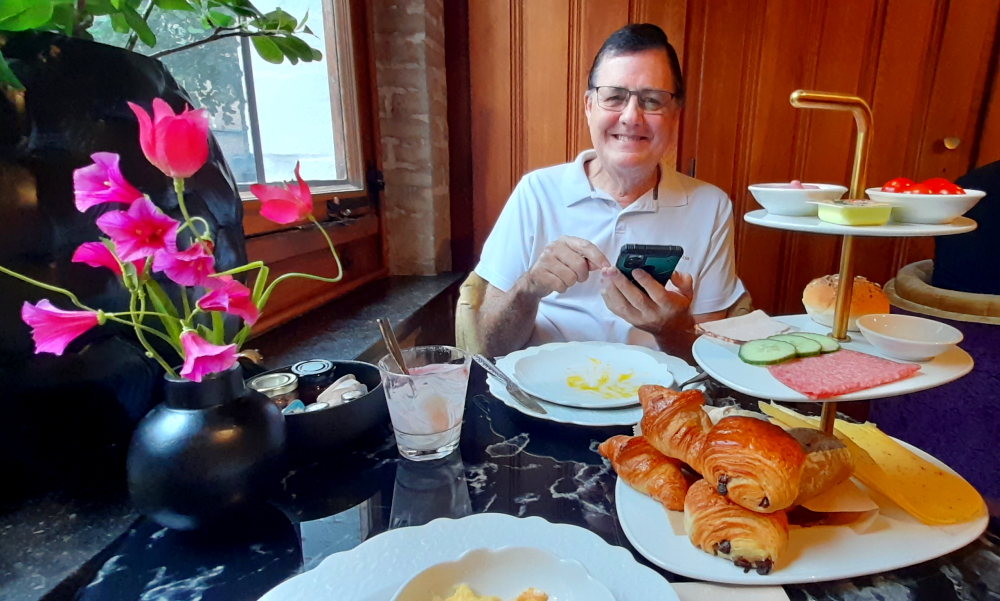
Breakfast is served at our table, rather than the dreaded buffet. It’s so nice to be waited on and to be offered a ‘high tea’ version of breakfast.
I have spent the entire morning trying to get car insurance for the Insignia. Again the Department of Making things more difficult than necessary has been at work. Car insurance is compulsory in the UK but it is both expensive and difficult to buy. So many rules and conditions that seem to contradict each other.
After a morning of ‘admin’ stuff including trying to get car insurance for the Insignia, we head outside and are reminded that we are increasingly on the wrong side of the autumn equinox. Brrr! A cold breeze whips the skeins of yellowed leaves along the cobble stones.
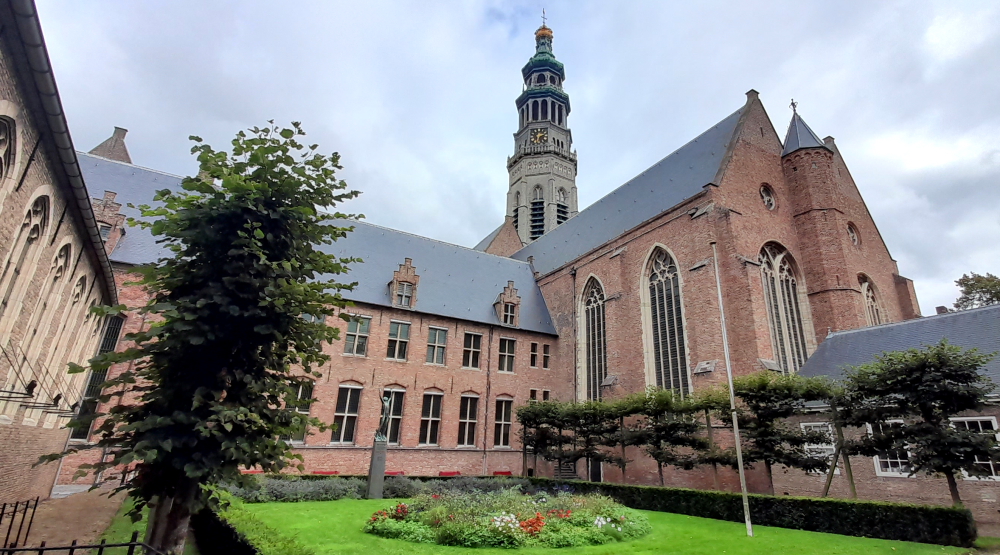
We walk around the outside of the Nieuwe Kerk and into Abdijplein, what would have been the former Abbey’s inner square.
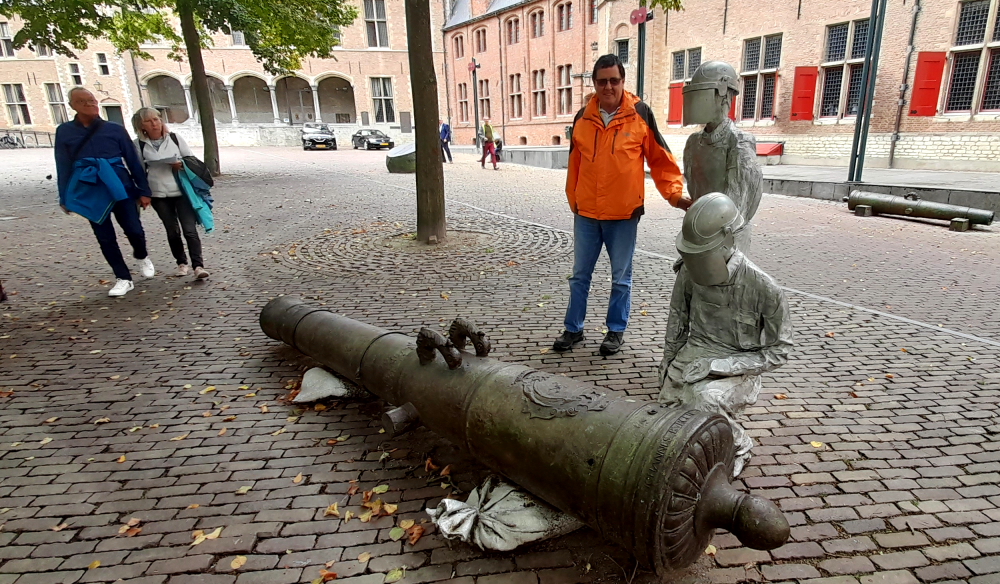
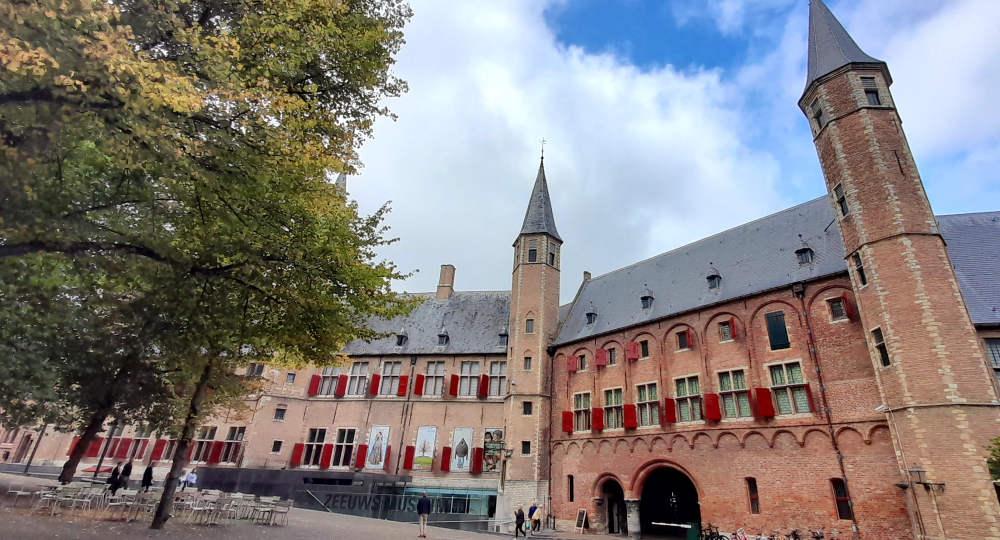
Along one side of the square is the Zeeuws Museum which moved to this location in 1972. Its collection is about the province of Zeeland and includes Zeeland tapestries, the historical collection of the Royal Zeeland Society of Sciences, porcelain from the Bal collection, Zeeland fashion and regional dress and the collection of contemporary art.
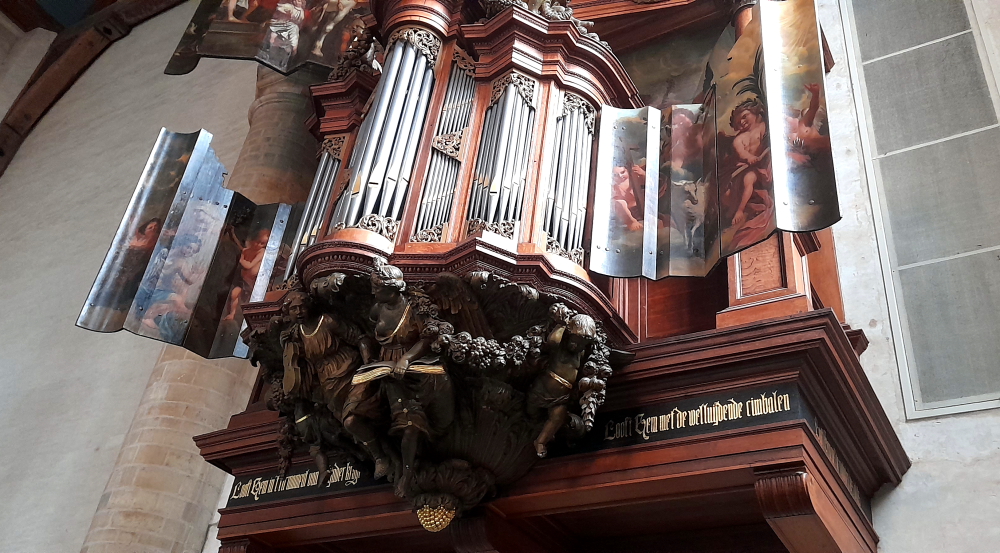
Coming full circle we enter the New Church. Its lofty space is surprisingly empty except for an exceptional-looking organ. The current Van Leeuwen organ was built in 1954, to replace the Kam organ that was lost in May 1940 due to war.
Organ builder Willem van Leeuwen from Leiderdorp built a completely new interior in the old case in 1954. The organ case comes from the Duyschot organ (1693), which served in the Oude Lutherse Kerk in Amsterdam until 1884. Before it moved to Middelburg, it was housed in the Rijksmuseum in Amsterdam.The pipework of the Duyschot organ was lost in 1884.
In 2001 the organ case, the painted shutters and the sculpture were restored and in 2004 Flentrop Orgelbouw in Zaandam performed a major restoration.
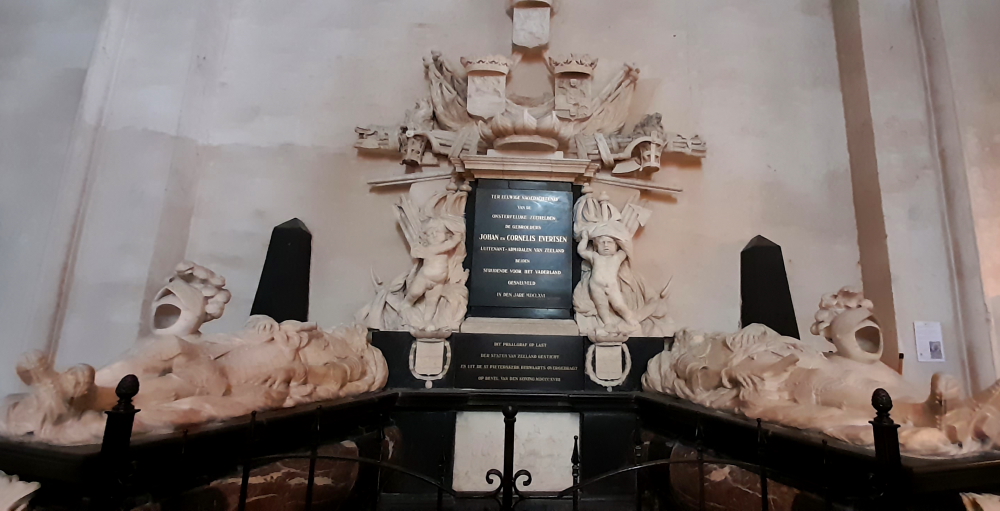
Between the 2 churches is the Lange Jan tower and the Wandelkerk (Walking Church), where the 17th century tomb for admirals Johan and Cornelis Evertsen by the famous sculptor Rombout Verhulst are located. Both brothers were killed in 1666.
Back outside we head for a Reigerstraat looking for a restaurant for tonight. At the corner of the church precinct and Reigerstraat is an amazing florist shop – selling fresh and ‘real-looking’ artificial blooms and an astonishing array of vases.
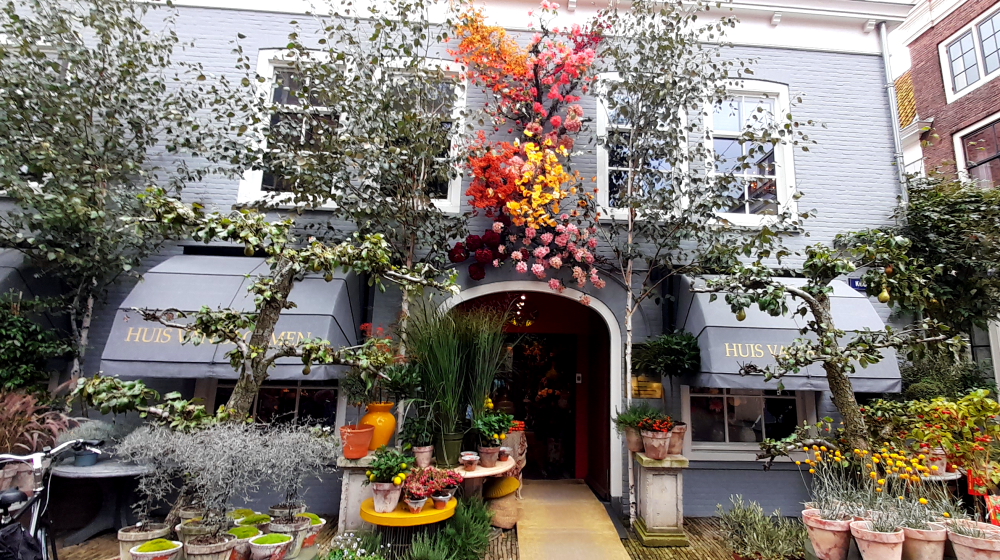
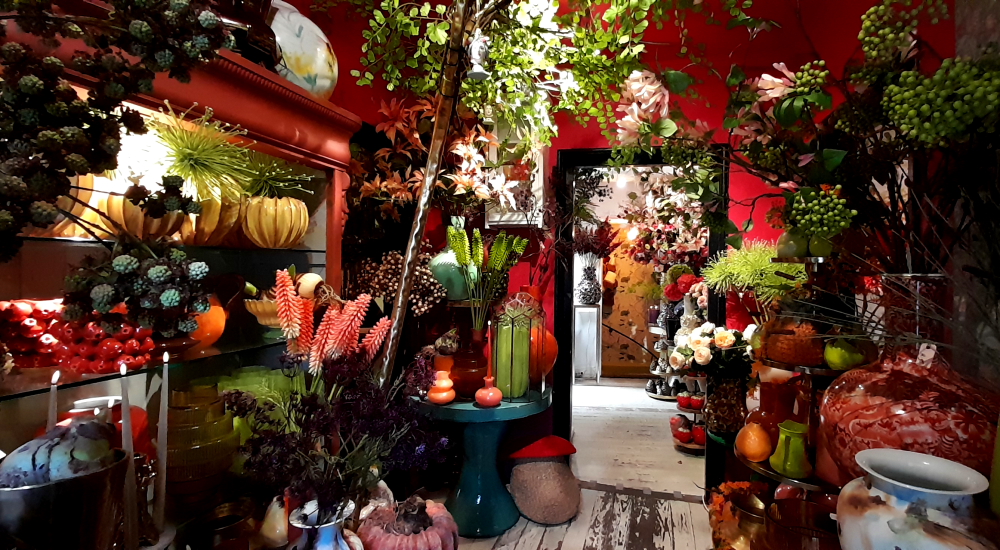
Inside is a riot of colours, fragrances and textures.
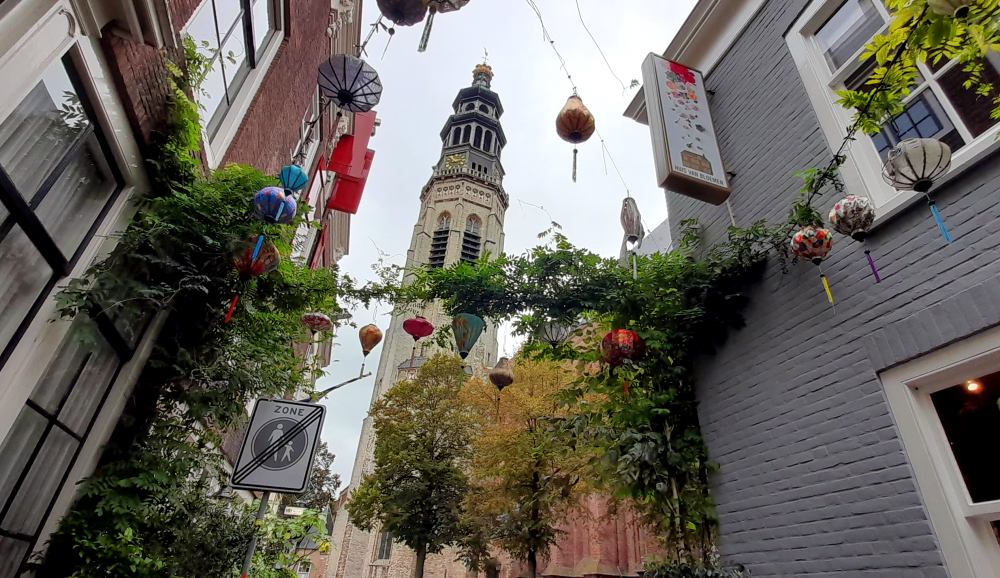
Reigerstraat houses a variety of restaurants and has a canopy of greenery and gorgeous Asian lanterns – just like Hoi An, Vietnam!
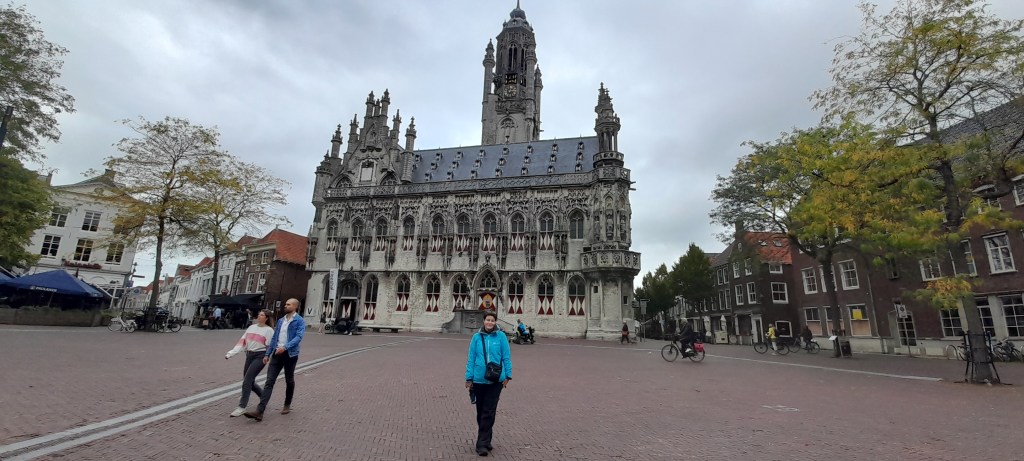
From Reigerstraat we walk down Lange Delft back to the Market Square where the Stadhuis (Town Hall ) is located in all its splendour and is considered one of the finest gothic buildings in the Netherlands.
Construction began in 1452 and was supervised by several generations of the Flemish family of architects, the Keldermans. Completed in 1520, the town hall received a facade with gothic windows, red-white shutters, smaller turrets and 25 statues of Zeeland’s counts and contesses of the time.
The building has one main tower which the Middelburgers call ‘Malle Betje’ – a mocking name due to the fact it used to run behind the town’s other clock tower, the ‘Lange Jan’.
Like most of the old town centre, the town hall suffered German bombardments. Old paintings and documents were lost and only the exterior remained. A large restorative campaign started which lasted until late in the 20th century.
By preevening (pre-evening) the clouds have dispersed and the sun is shining. We plan to head out to find a simple restaurant somewhere near the market square.
Lynn has soup and I have fish and chips for dinner and we follow this up with a shared waffle and strawberries.
30 September, 2023
Another sunny day as we head out to see what goes on in Middelburg on a Saturday.
As we walk from the market square down ?, one of the radiating streets from the square, we see an interesting building at its end but across the Binnengracht canal.
All we can discover is that it houses a restaurant and the Schuttershof Filmtheater.
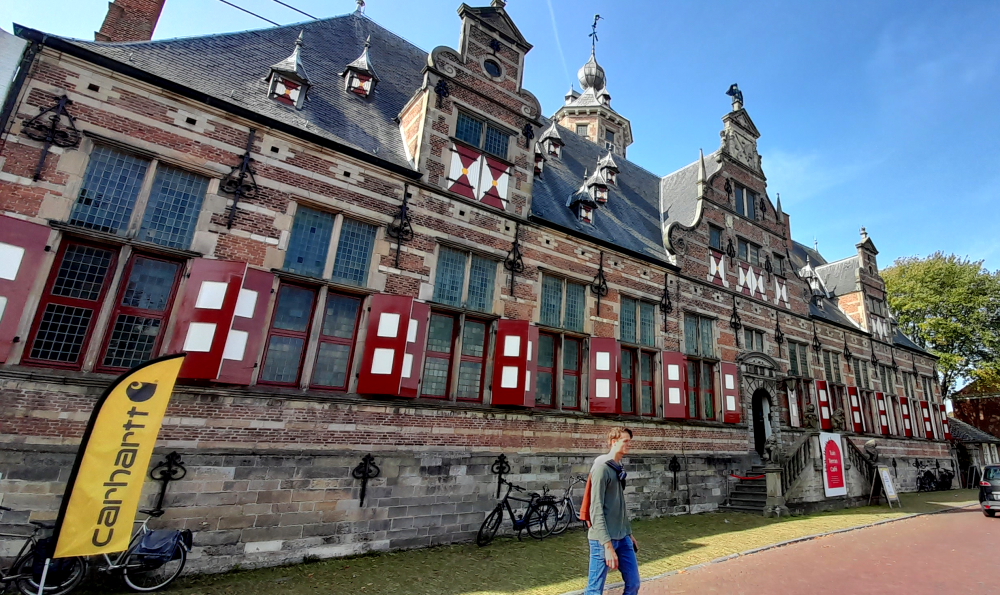
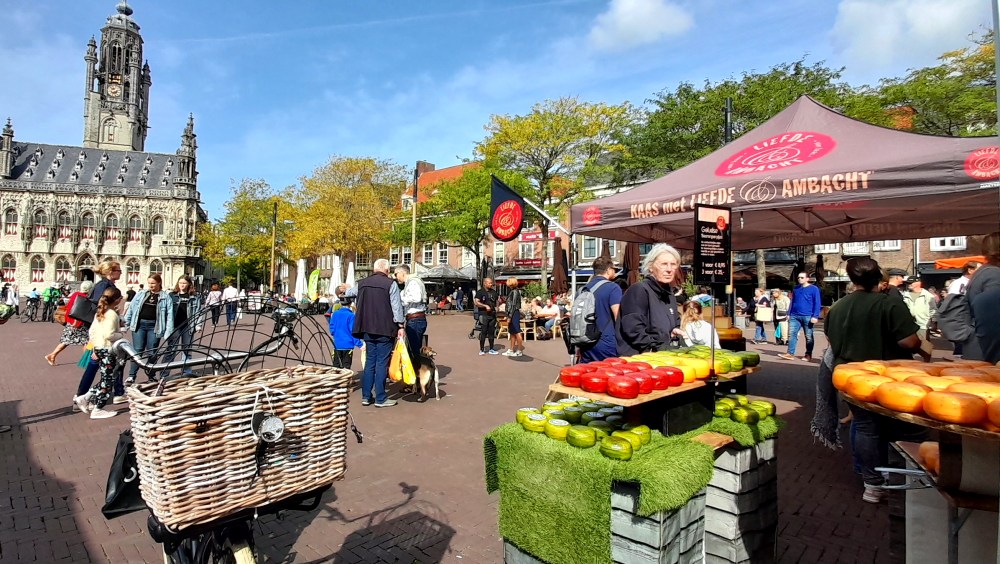
Returning to the town hall square there is a smaller market on here today, offering only food.
The afternoon is spent at the hotel finalising our car insurance then we head out to find a restaurant for dinner.
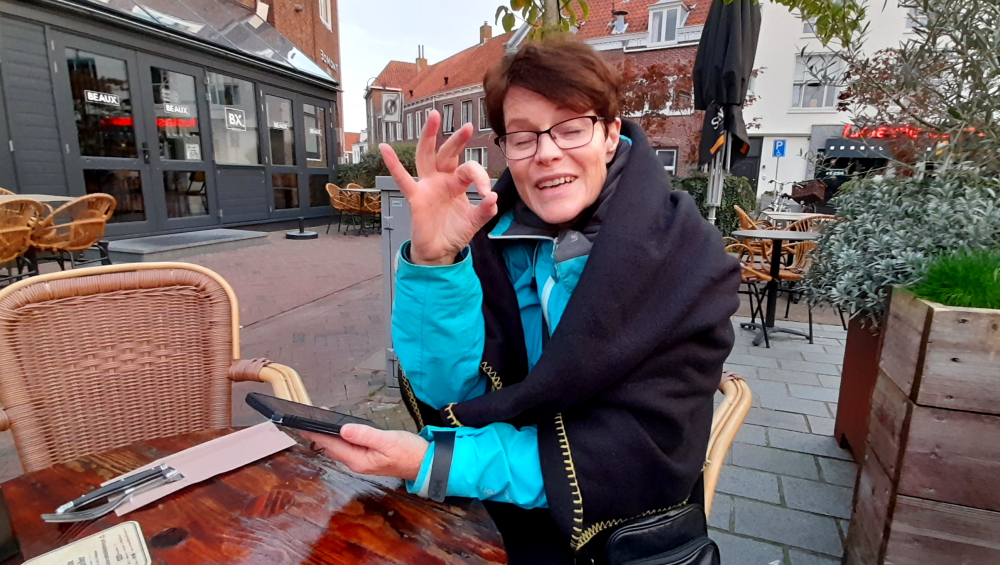
We find a pub in Plein 1940 but it is fully booked inside, so we have to make do with an outside table. It turns out it is a lot more chilly than we were expecting but the waitress kindly gives us a couple of blankets. Just the ticket!
As I head back to the hotel, Lynn takes some photos of the city’s illuminated landmarks.
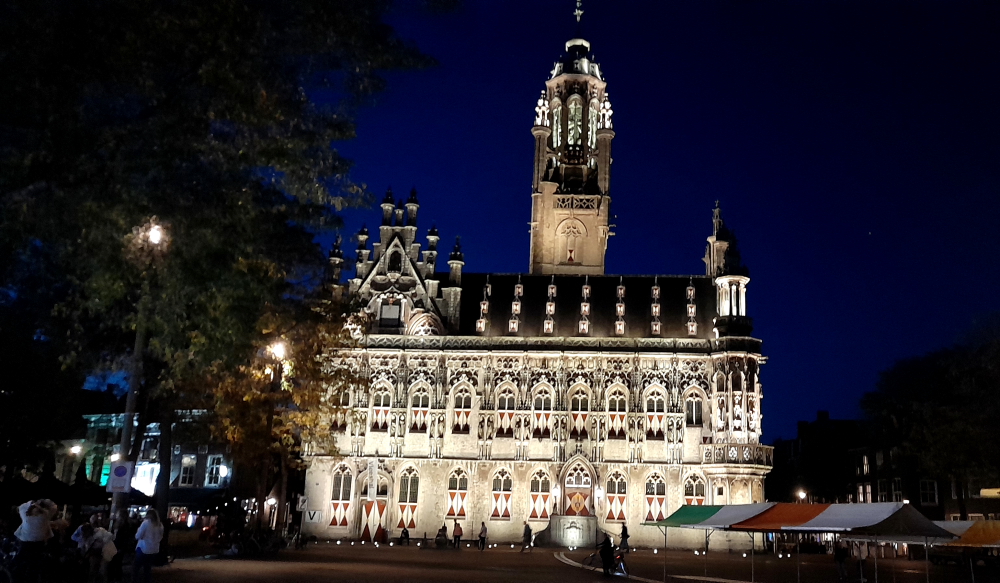
The clear night sky, cool air and magnificent subjects enable brilliant illuminations.
1 October, 2023
It is forecast to get to around 23 Deg C today so after breakfast we head out to check out the flea market set up in the square this morning. This is probably the last really warm and sunny day this autumn so I take advantage and dress in my shorts and a polo shirt for this morning’s walk around town.
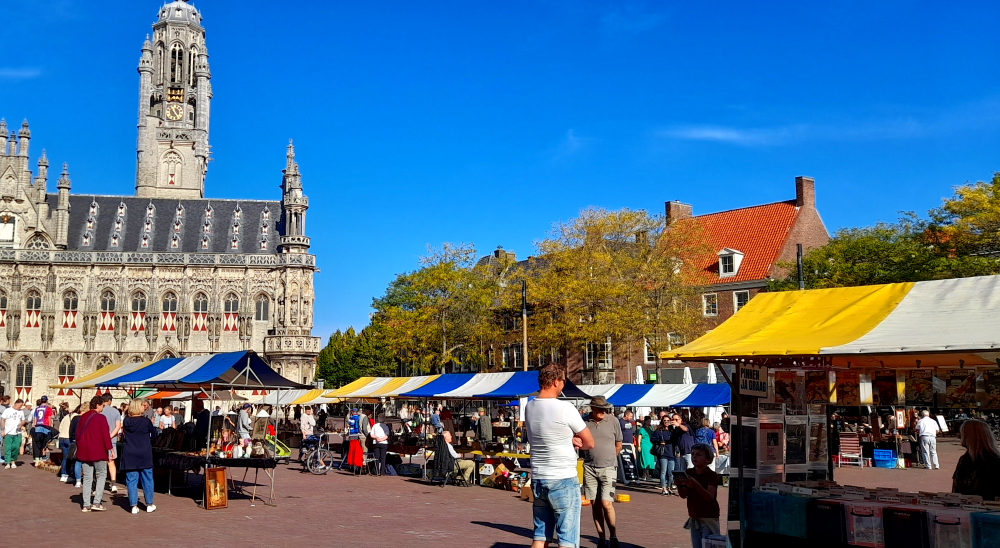
This market square sure gets a good workout – Thursday market, Saturday food market, Sunday flea market – which is great to see.
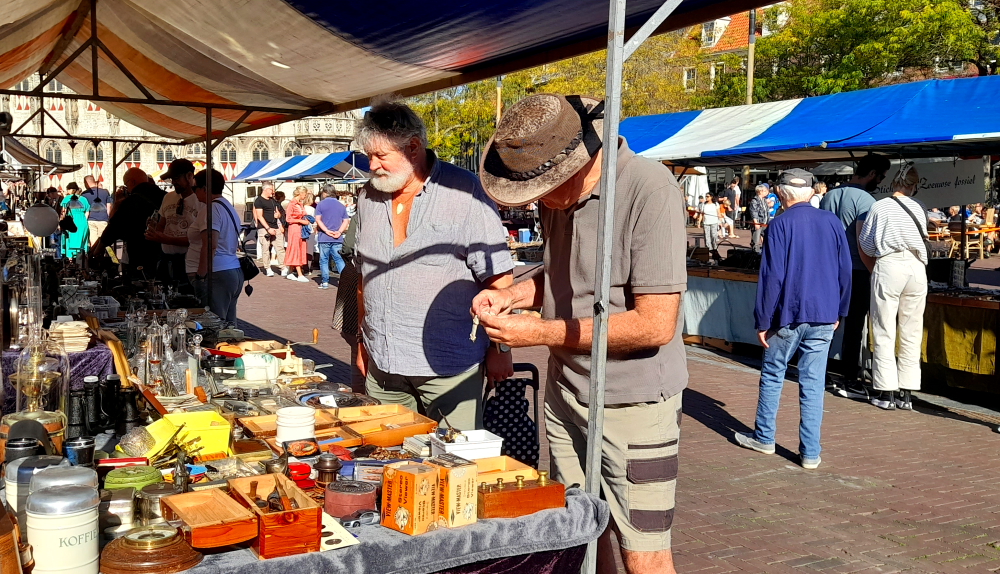
Goods on offer range from jewellery to records, binoculars, cameras, toy cars, embroidery, dolls, pictures, glassware, crockery, cutlery, cookware, old medical equipment, wooden skates – you name it, it seems to be for sale here, all with a Dutch influence.
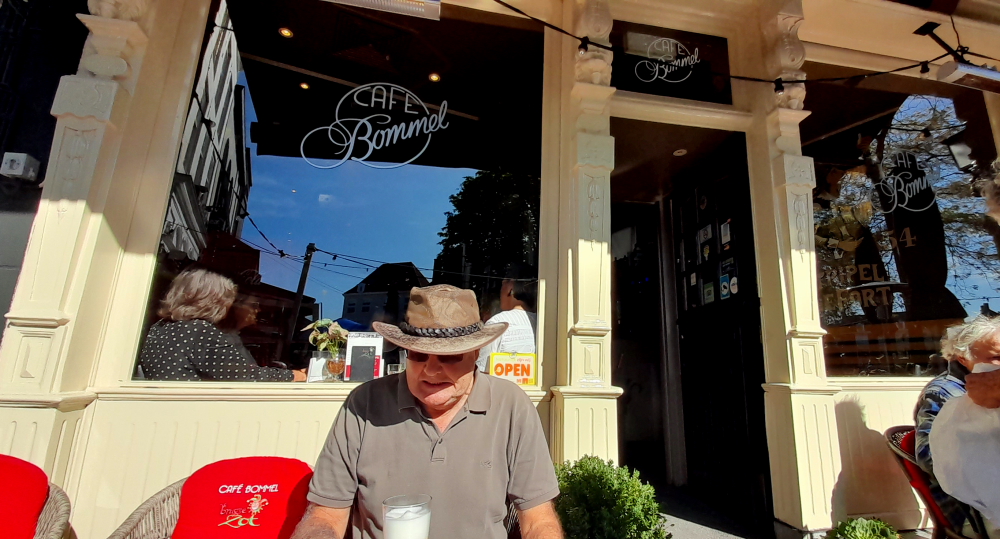
As it is such a nice day we decide to go to Cafe Bommel which is on the edge of the square for a coffee in the sun. Unlike last evening which was decidedly cool, we are soon baking in the sun.
There is supposed to be a jazz concert at our hotel this afternoon so we plan to be back by early afternoon so that we can get a seat at the session.
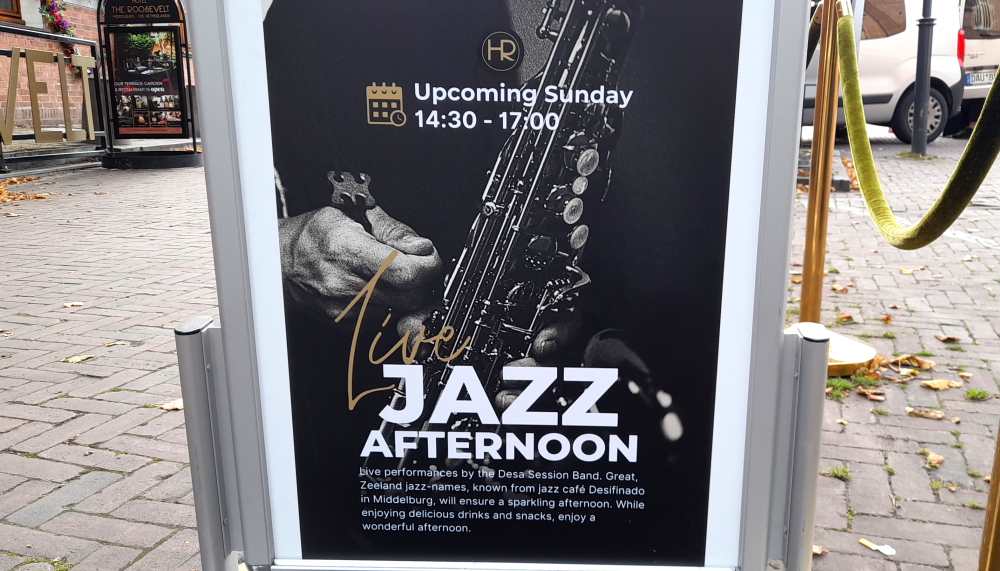
Just after the scheduled starting time of 2:30 pm the Desa Session Band takes to the stage in the hotel’s shady courtyard.
We are treated to an hour of jazz, with the occasional song, before they take a half-hour break.
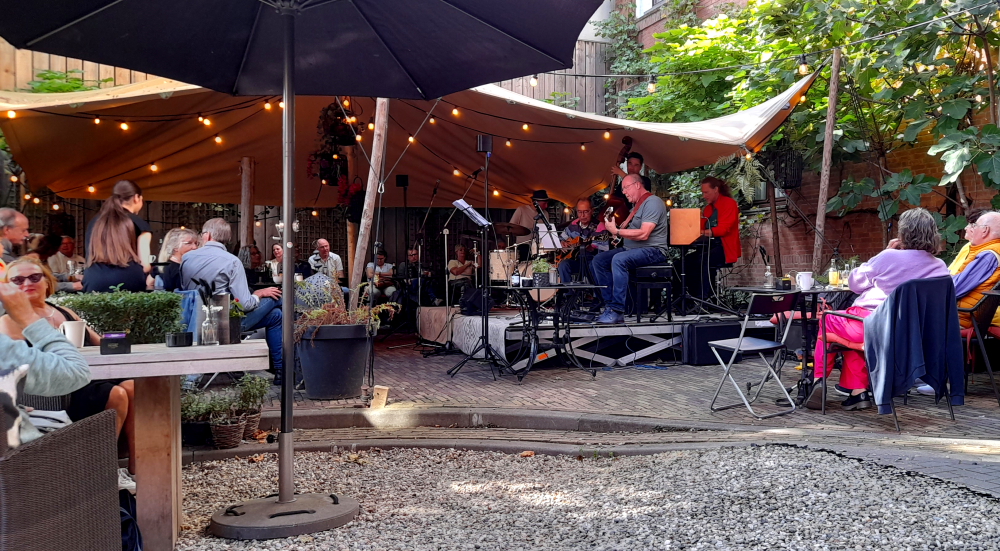
Then they return for another hour during which a woman from the audience is invited to take to the stage where she very credibly sings a couple of songs, one using the scat technique.
What a pleasant way to spend a Sunday afternoon. We’ll probably go out for ice cream this evening before we retire. We are driving to Ghent, Belgium tomorrow.
 THE CONTINUING TRAVELS OF YOGI & BOO BOO