
11 June, 2024
Although rain is forecast for today, it’s bright and sunny with a top of 17 Degree C. After a delicious breakfast, including a plate of small pancakes each which we weren’t expecting (!), we drive, rather than walk, out of the hotel grounds on account of Lynn’s sore knee.
Turns out our hotel is located in a lovely beach-side area with extensive parkland between us and the beach. First stop in Rannapark is the Kuursaal, the largest tavern in Estonia since 1893, some 600m away. Naturally, it’s closed as it’s undergoing maintenance.
For more than a hundred years, wealthy Germans and ordinary citizens of the city have partied here, the legendary Raimond Valgre has made music here, and the collective farm people, stiff from work, have danced here [www-puhkaeestis-ee].
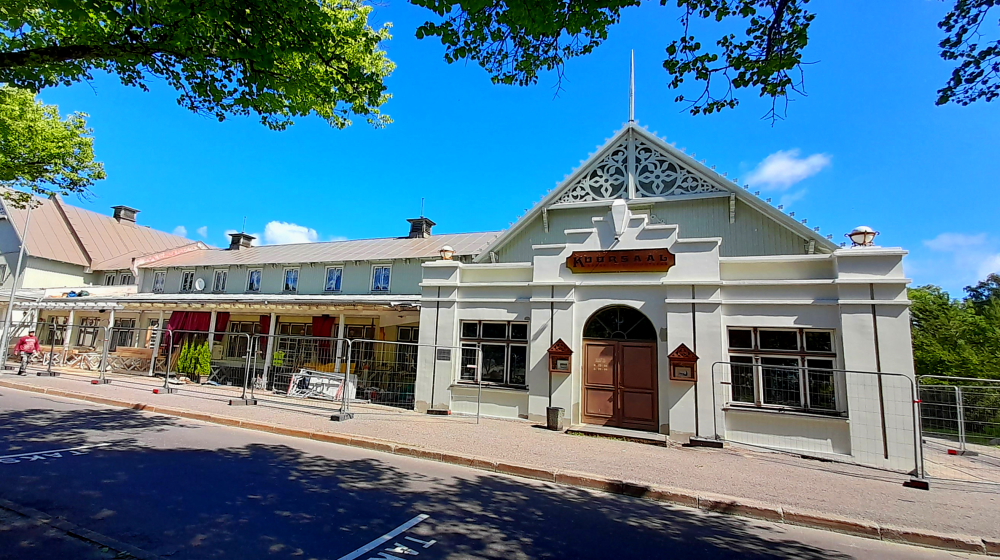
Kuursaal, Parnu, Estonia.
And speaking of Raimond Valgre (1913-1949), next to the Kuursaal is a memorial statue of the composer and accordionist. He worked as a restaurant performaer and orchestra manager in Tallinn, Tartu and Parnu.
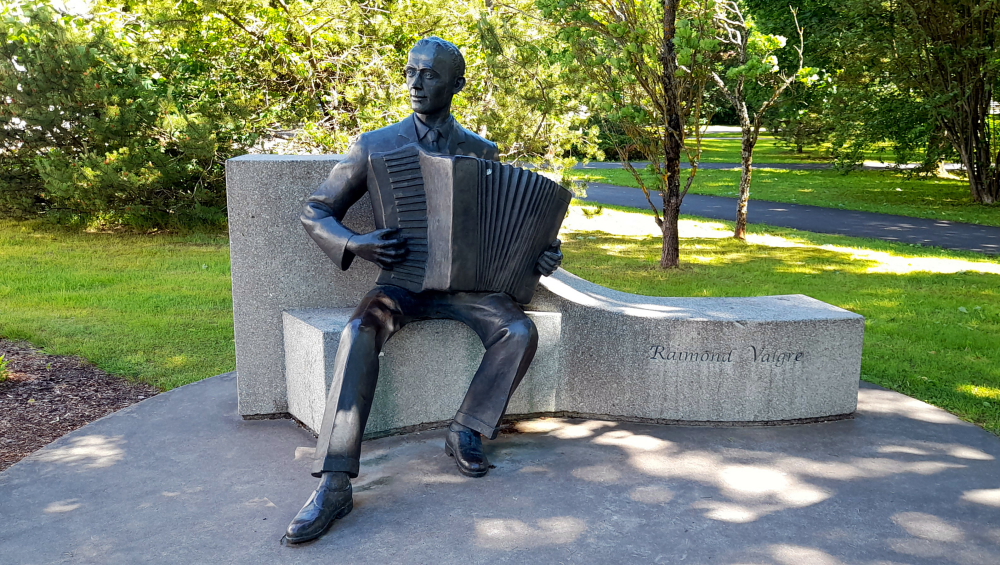
Memorial statue of Raimond Valgre (1913-1949), Parnu, Estonia.
A self-taught composer he wrote his first songs in 1933 and has composed more than 100 songs. While staying in Parnu he composed well-known pieces as “Muinaslugu muusikas, “Parnu ballaad” and “Nakineid”.
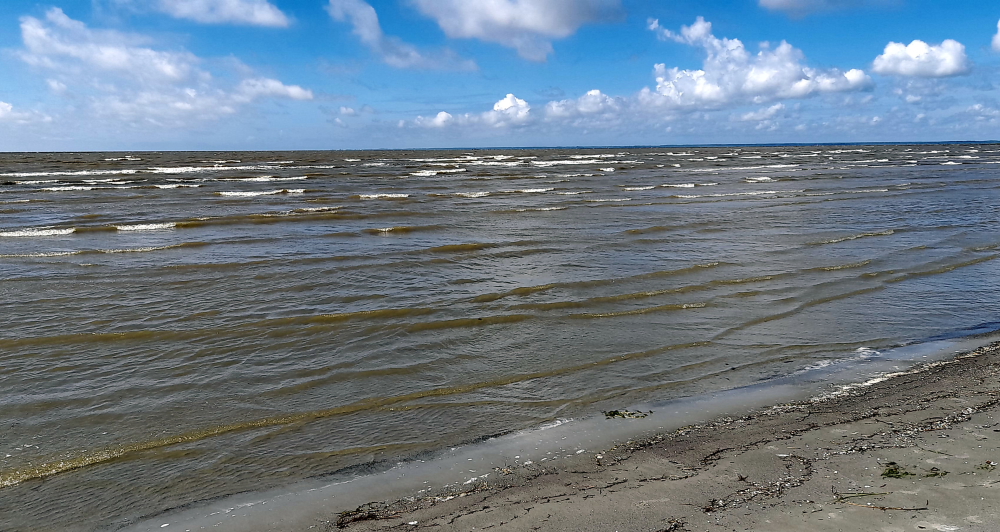
Parnu Bay, Estonia.
Across the road is an actual beach – Parnu’s Central Beach (Parnu keskrand) – with acres of actual sand. Pity about the lack of surfing waves in Parnu Bay.
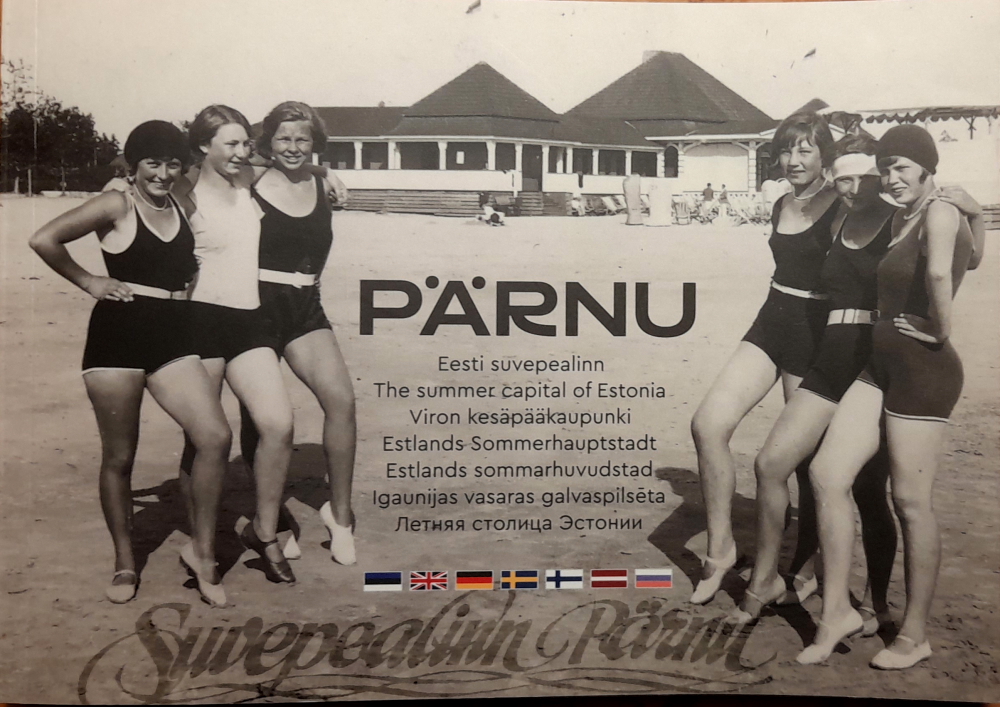
Parnu, Estonia – from ramparts to resorts, Central Beach, 1920s.
Apparently the European beach culture reached Estonia in the 1920s – with “summering” activities such as sunbathing and active beach holidays. A common bathing beach for men and women was opened on Central Beach in 1925. Parnu became the most esteemed and internationally-recognised holiday and medical resort in the Republic of Estonia – ‘a paradise for summer revellers’, ‘a most fashionable bathing city’, ‘Estonia’s summertime capital’.
1940-1990 was the Soviet era in Parnu. In 1988 the 150th anniversary of Parnu’s resort establishment was celebrated. However, the biggest threat to the good reputation of the resort city was the ever-increasing pollution of Parnu Bay.
The beach is anything but crowded today and the sea in the bay is a murky brown…
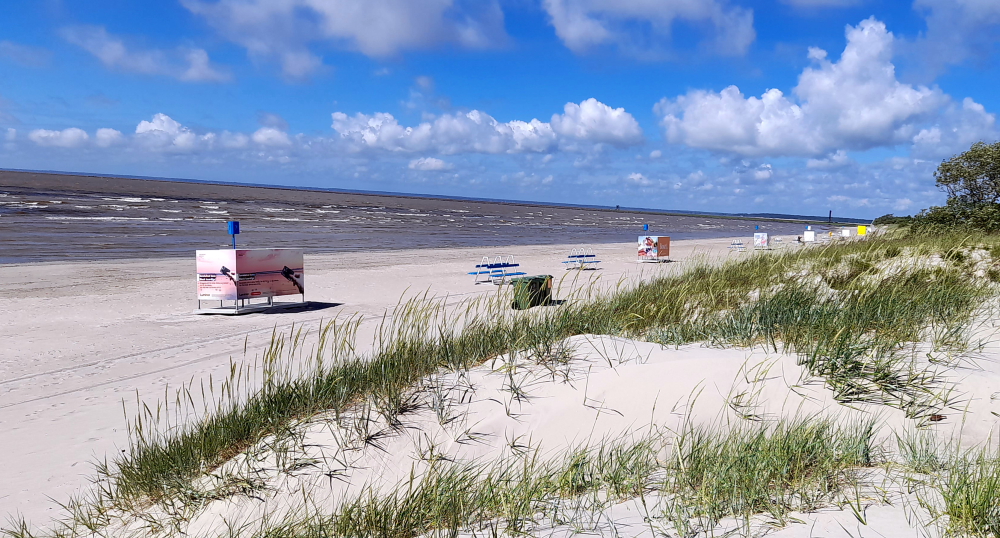
No beach huts or beach baskets here today but you can rent a white, plastic sun lounger.
However, it seems that the citizens of Parnu still take their beach seriously as, surprisingly, there are 3 competition beach volleyball courts with a stand of spectator seating backed by a restaurant, bar and cafe. Perfect!
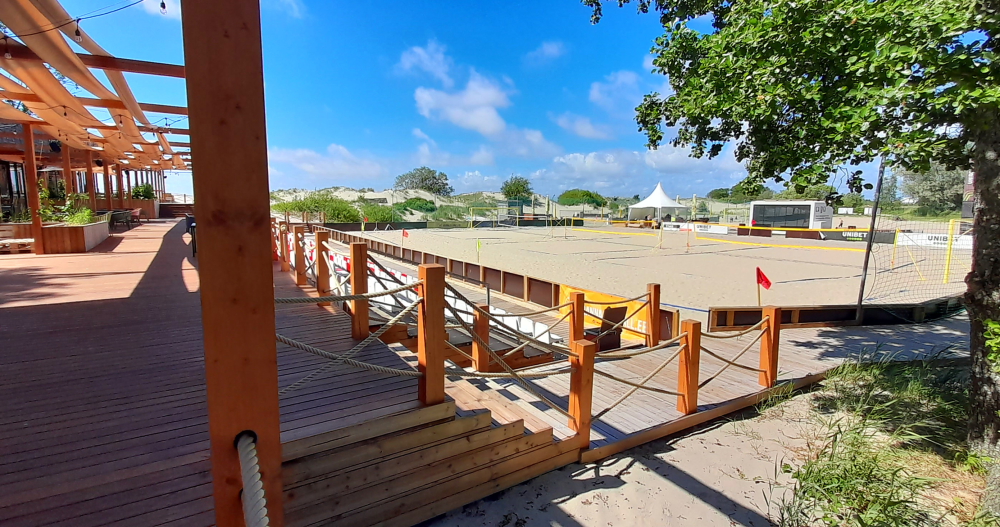
Beach volleyball courts with catering.
Next door is the Hedon Spa and Hotel, comprised of a classical-looking building at the front (the historical Mudaravila mud farm building) and a contemporary hotel building facing the beach.
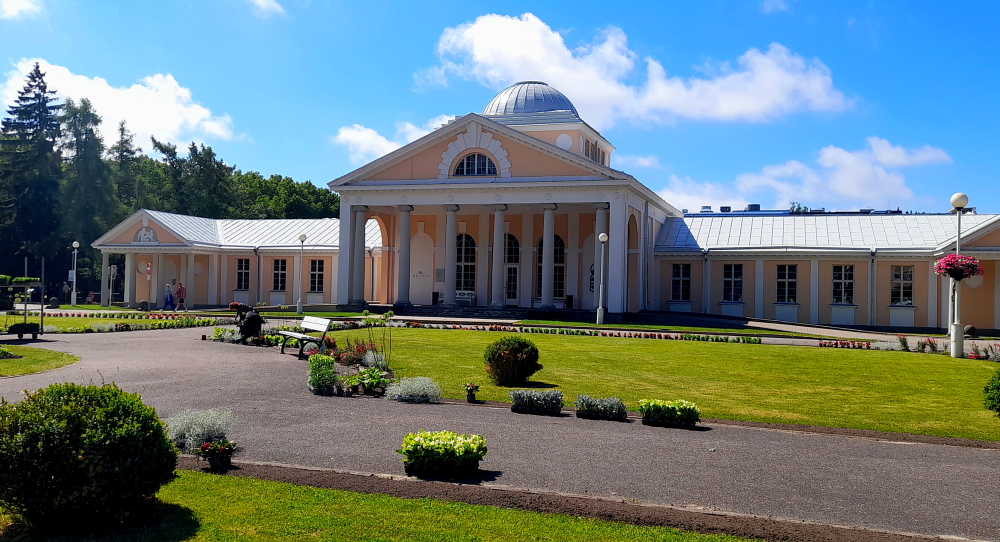
Historical Mudaravila building now part of the Hedon Spa & Hotel, Parnu, Estonia.
Further along, past the austere-looking Art Deco Rannahotel, we call into the eastern end of Parnu’s Central Beach which has rental shops for pedolos, surf boards (!) and kites for surfing (more like it!).
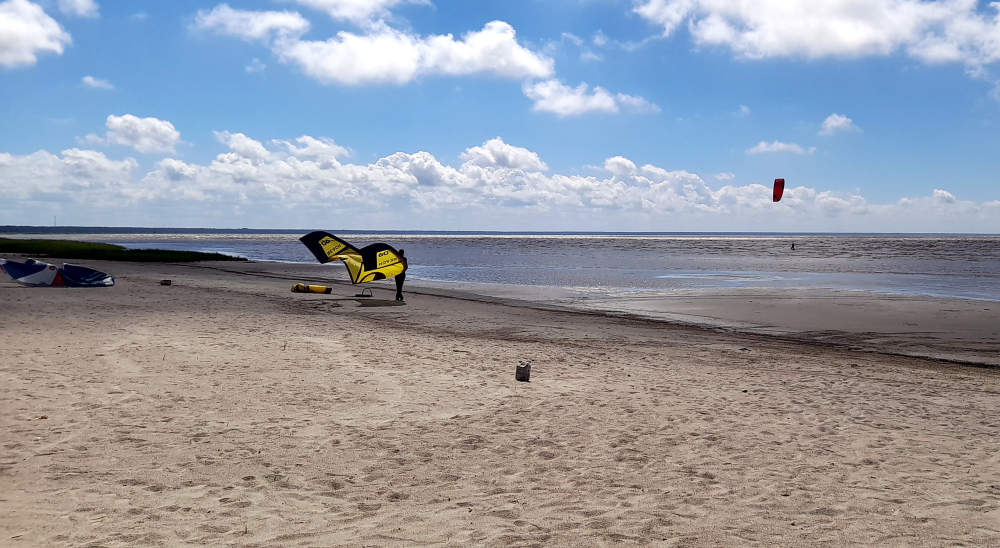
Windy day for kite surfing, Parnu, Estonia.
Not to mention a rather stylish contemporary restaurant – POKO resto Parnus – of glass and timber construction, gracing the shoreline.
From here we drive 2km into town to the 1st of 3 churches – the Church of the Transformation of Our Lord (Paru Issandamuutmise kirik).
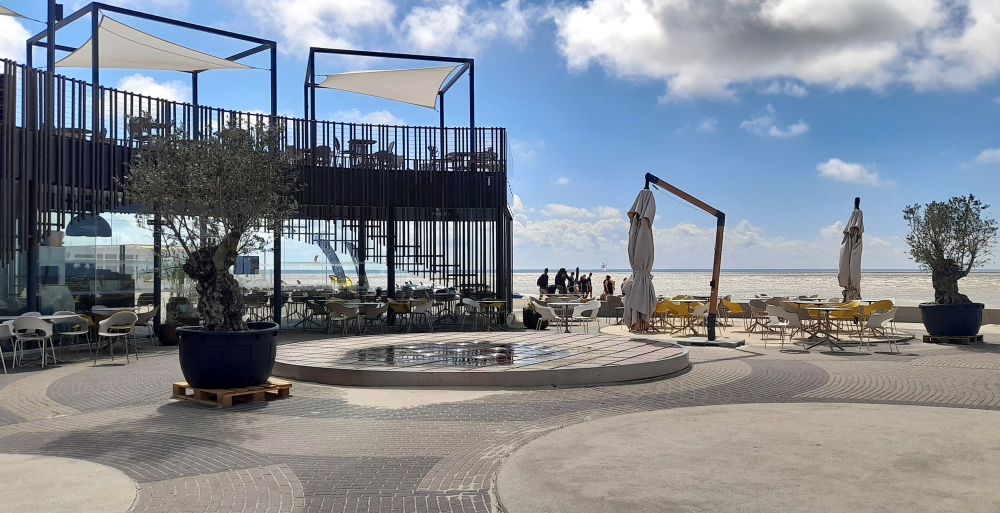
POKO resto Parnus, Estonia.
Due to the massive religious conversion at the end of the 19th century, the 18th-century Ekateriina’s Church became too small for the Pärnu orthodox congregation. So, in 1904, the historic Old Russian-style Pärnu Transformation of Our Lord Apostolic Orthodox Church was built and its congregation (Estonian) was separated from the former congregation of Ekateriina’s congregation (Russian).
The church had a typical brick facade. The campanile is 38 m high and the cupola 34 m high. The altar wall holds 11 icons and 11 major wall paintings with figurative composition – all of which locked away today as the church is closed thanks to maintenance work [visitestonia.com].
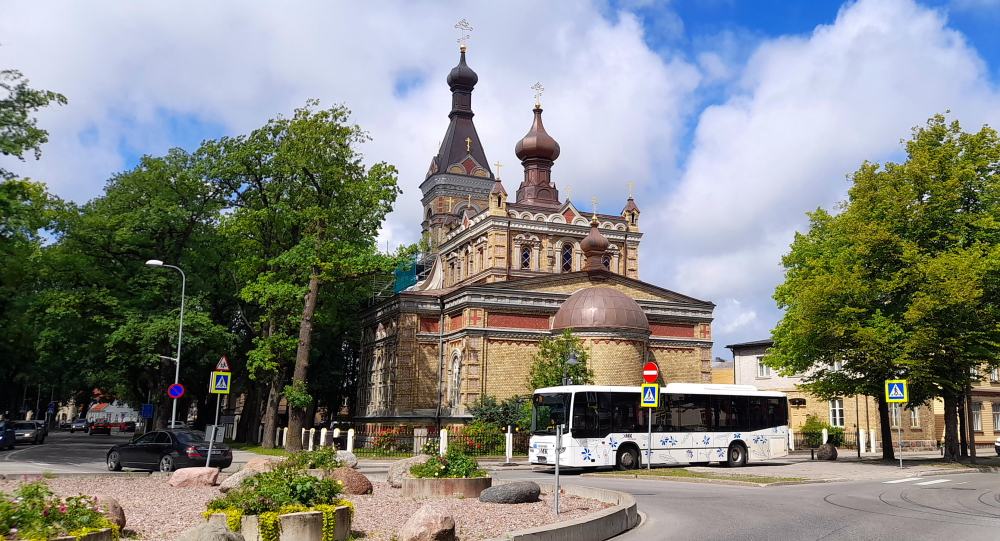
Transformation of Our Lord Church, Parnu, Estonia.
The next church is Catherine the Great Church (Parnu Suurmarter Katariina Kirik), 600m away (mentioned above).
Completed in 1768, the St. Catherine’s Church is the most baroque church in Estonia with slender needle-shaped tips that add lightness and festiveness to the building. Since church is built a century before the majority of orthodox churches, it differs from them from an architectural viewpoint but at the same time it has influenced the development of orthodox church architecture in the Baltics.
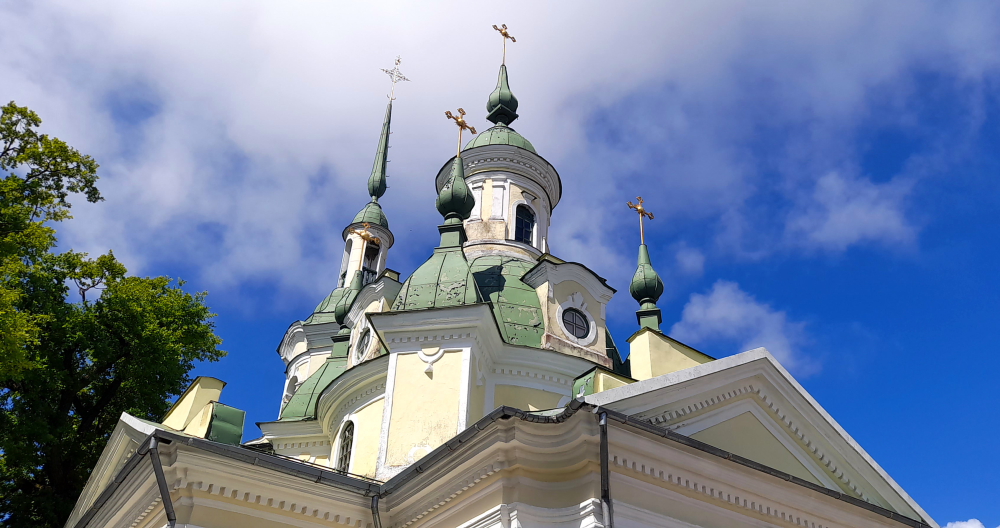
Spires, Catherine the Great Church, Parnu, Estonia.
Like the church in Kuressaare, this one was also built by order and with financing of the Russian queen Catherine II. To this day the Pärnu Russian congregation operates in the church [visitestonia.com].
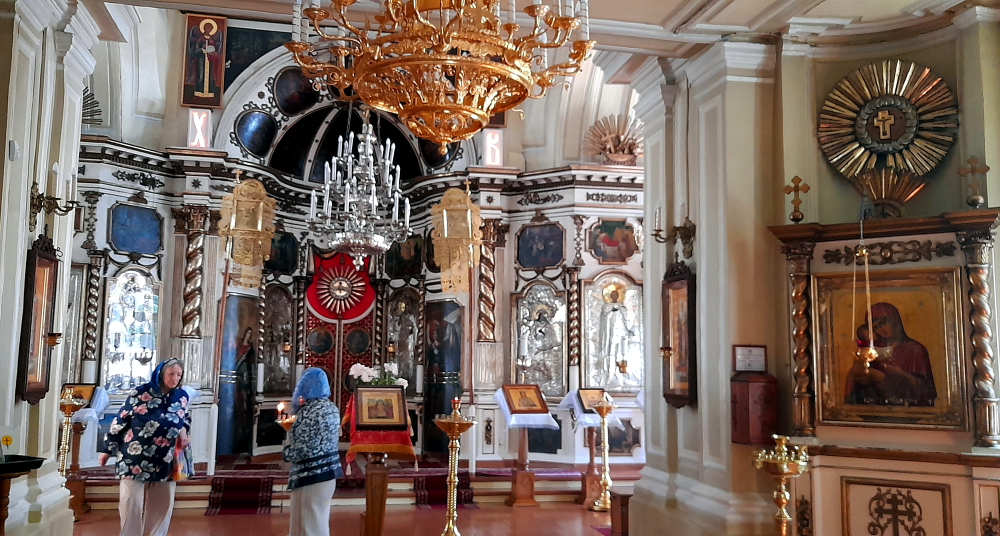
Ornate interior, Catherine the Great Church, Parnu, Estonia.
Around the corner is the Endla Teater, the 3rd oldest professional theater in Estonia. In 1911, the doors of a new grand Art Nouveau theater were opened at Rüütli Square. On February 23, 1918, the “Manifesto for all the peoples of Estonia” was read from the balcony of the theater for the first time. The theater building was destroyed in 1944.
The new theater building was completed in the current location in 1967. It offers theater lovers a versatile repertoire, from drama to musical productions and classics. The theater has a cafe and an art gallery, cinema screenings and Jazz Club concerts [visitparnu-com]. Currently “RIchard III” is playing.
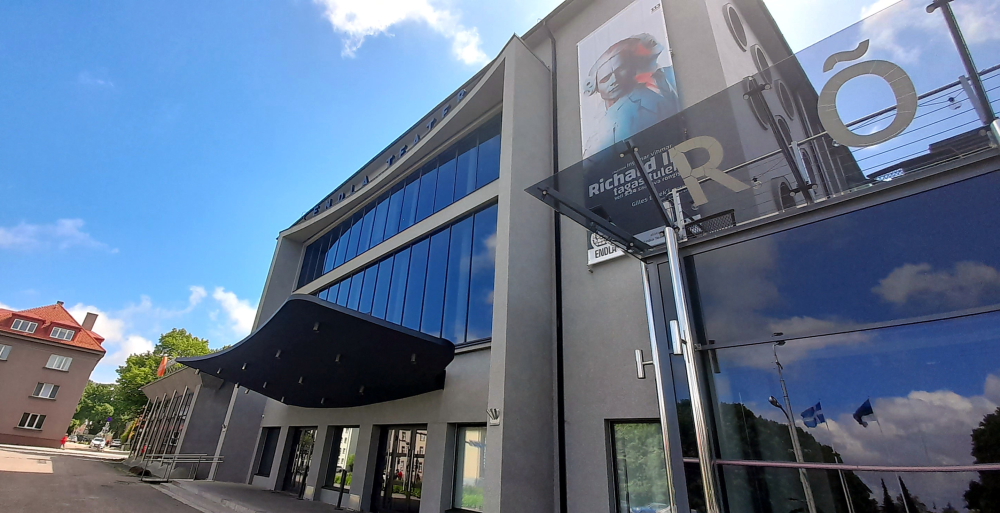
Endla Theatre, Parnu, Estonia.
From here we drive around Munamae and Jakobsoni Parks to arrive at the Tallinn Gate, now the entrance to Valli Rampart Park. The gate may have been constructed to designs by Erik Dahlbergh during the time of Swedish rule of Estonia. Before 1710 and the capitulation of Estonia and Livonia to Russian forces during the Great Northern War, it was named after the Swedish king Charles Gustav.
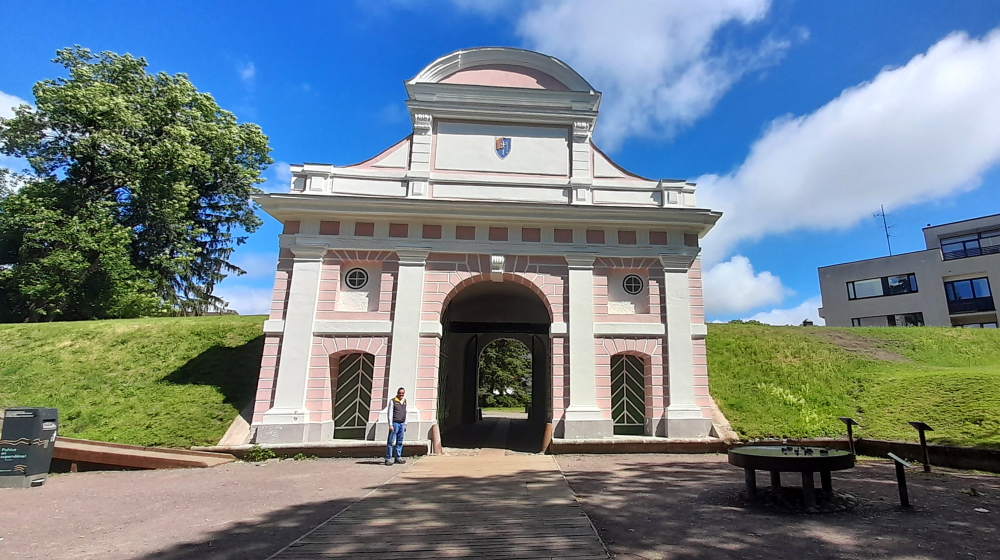
Baroque-style Tallinn Gate, Parnu, Estonia.
Since it led to the road to Tallinn it then became known as the Tallinn Gate. When the fortifications of Pärnu were demolished in the 19th century, only Tallinn Gate was preserved and it remains the only surviving city gate from the 17th century in the Baltic states. The gate is adjacent to the moat (Vallikrääv) [wikipedia].
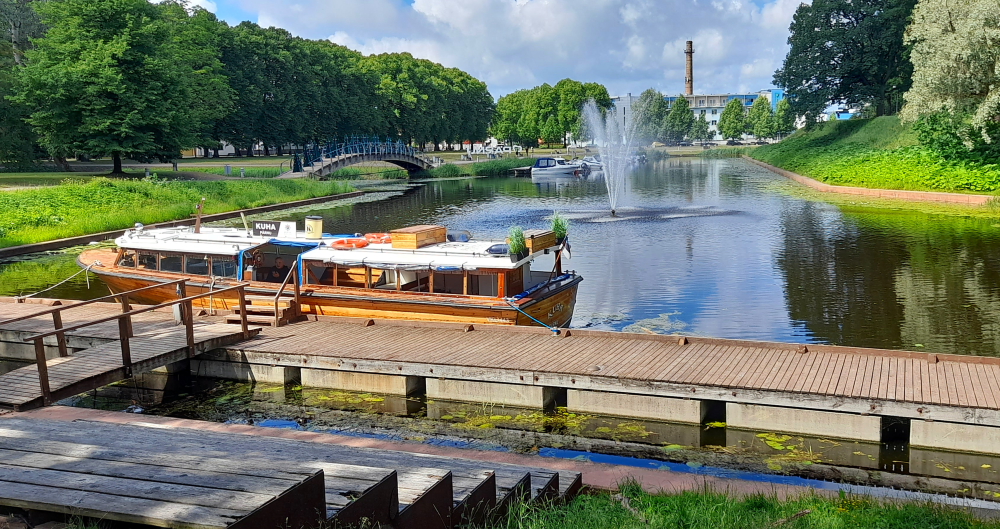
Pedestrian bridge & part of the former moat, Valli Park, Parnu, Estonia.
Next we walk to the final church, St Elizabeth’s. En route we pass by 2 rather interesting signs: the Hongkonger Club (who’da thought!) …
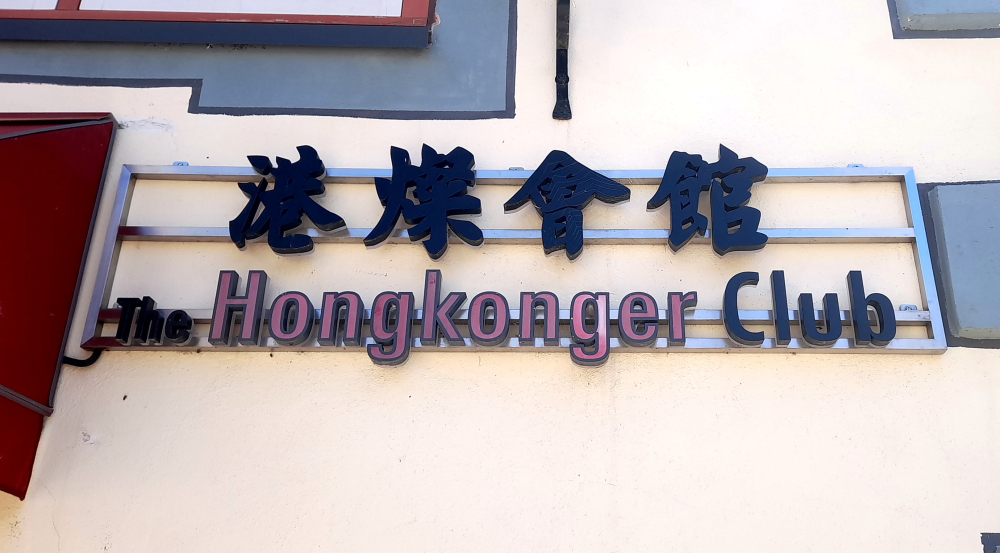
#1 Club in Parnu according to Restaurantguru.
… and the Restoran Edelweiss. So we had to travel to Estonia (where there’s not an Alp in sight) to find something we were expecting to find in Switzerland!
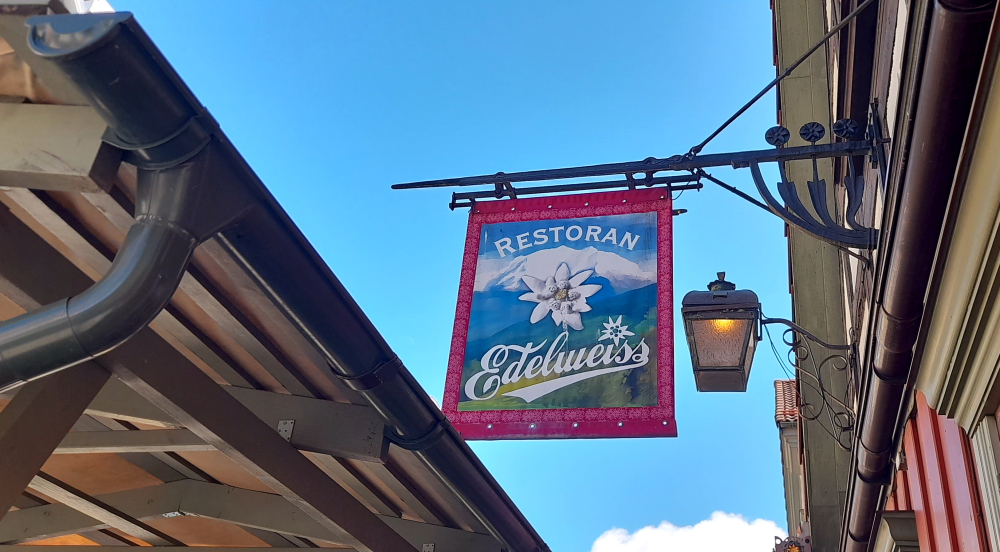
Estonian Edelweiss.
Eliisabet’s Church, inaugurated in 1750, is the most outstanding sacral building of the Baroque period in Estonia – a pulpit in the Neo-Gothic style from the middle of the 19th century, the altar and the altarpiece “Resurrection”. The church got its name from the Russian Empress Jelizaveta thanks to whom the congregation got a Lutheran church.
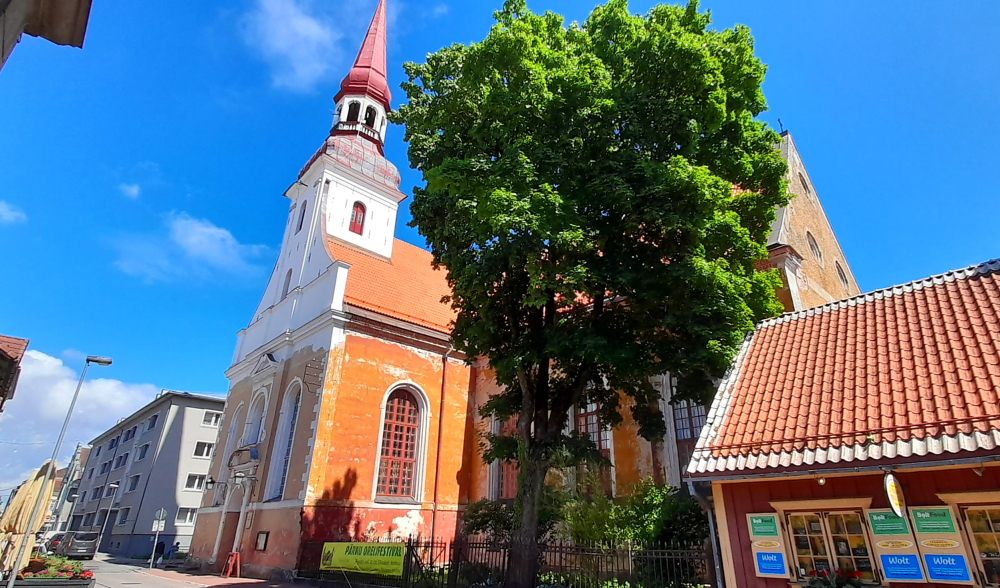
Eliisabet’s Church, Parnu, Estonia.
One of the best organs in Estonia is in Eliisabet’s Church and the place is popular as a concert hall among music lovers, including a recital here on Thursday evening as part of the organ festival [visitestonia.com].
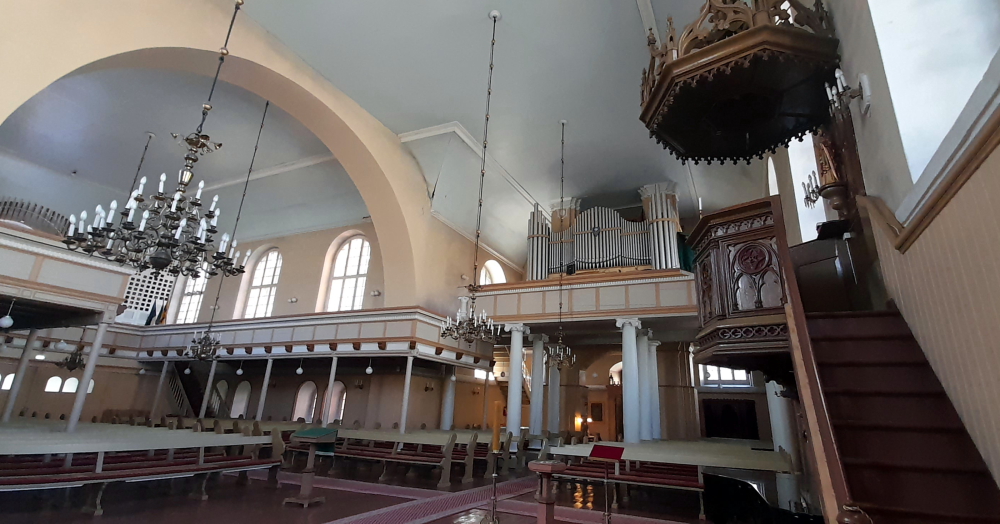
Interior with pulpit & organ, Eliisabet’s Church, Parnu, Estonia.
Across the road is a curious bust of Georg Wilhelm Richmann who was born on 22 July 1711 in Parnu in Kuninga Street (King Street) where we are now standing.
After studying at the Universities of Halle and Jena he soon became a member of the Academy of Sciences in St Petersburg where he invented the 1st electrometer in 1745. He constructed the 1st lightning rod in Eastern Europe at the very same time as American scientist Benjamin Franklin and commenced researching electricity in the atmosphere.
But, on 6 August 1753, at his lab in St Petersburg, he not only succeeded in capturing a lightning strike, he also succeeded in electrocuting himself at the very same time.
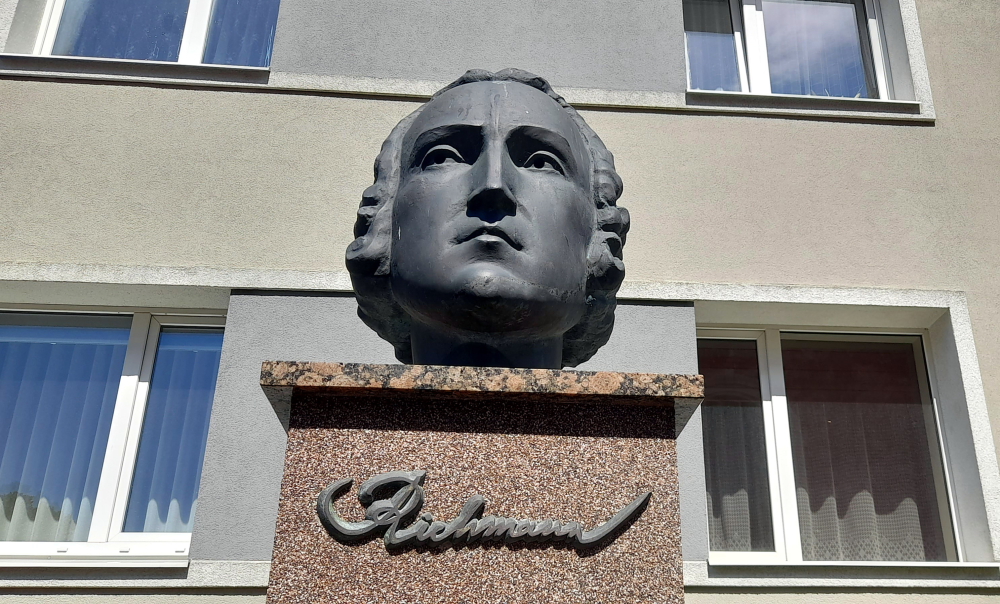
Parnu son, Georg Wilhelm Richmann (1711-1753).
3-minutes walk away is the Mary Magdale Guild (Maarja-Magdaleena Gild), nowadays the building houses a craft gift shop with onsite craft workshops.
Enroute we cross Ruutli Street, the heart of the Old Town. It’s a pedestrian street that takes about five minutes to walk through.
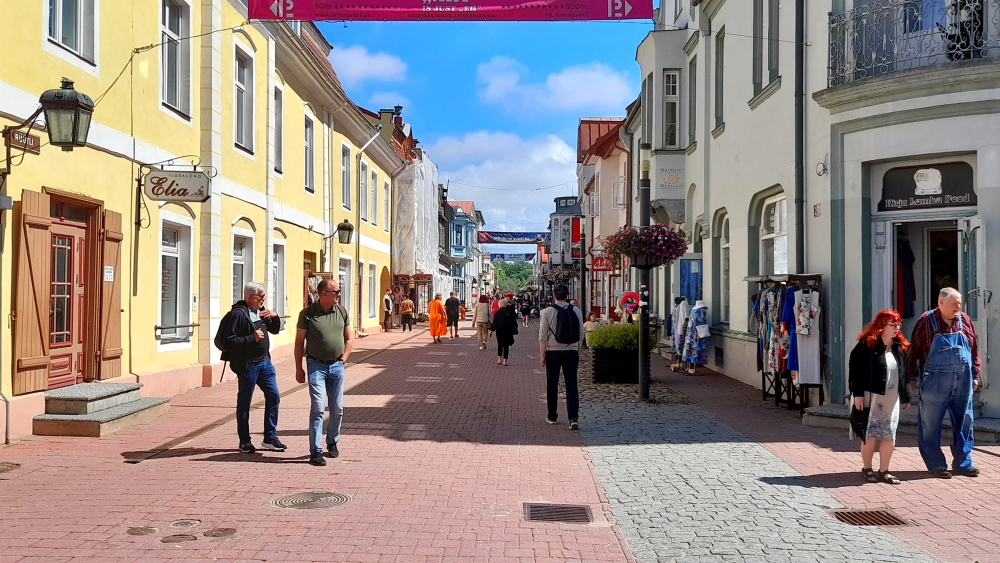
Ruuti Street, Parnu, Estonia.
On Uus Street, the Mary Magdalene Guild brings together a number of acknowledged artisans and craftsmen of Pärnu. The Guild has been named after reputedly the oldest medieval artisans’ guild in Pärnu.
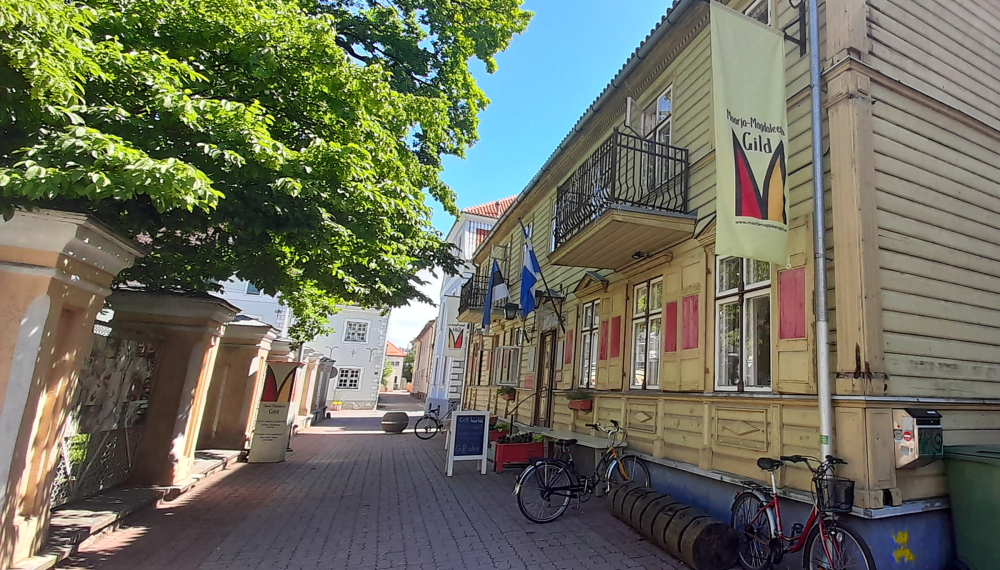
Mary Magdalene Guild, Uus 5, Parnu, Estonia.
Here are the studios of craftspeople, a shop to buy goods and people can take part in various workshops. In the summer time, Guild Days are celebrated across the city.
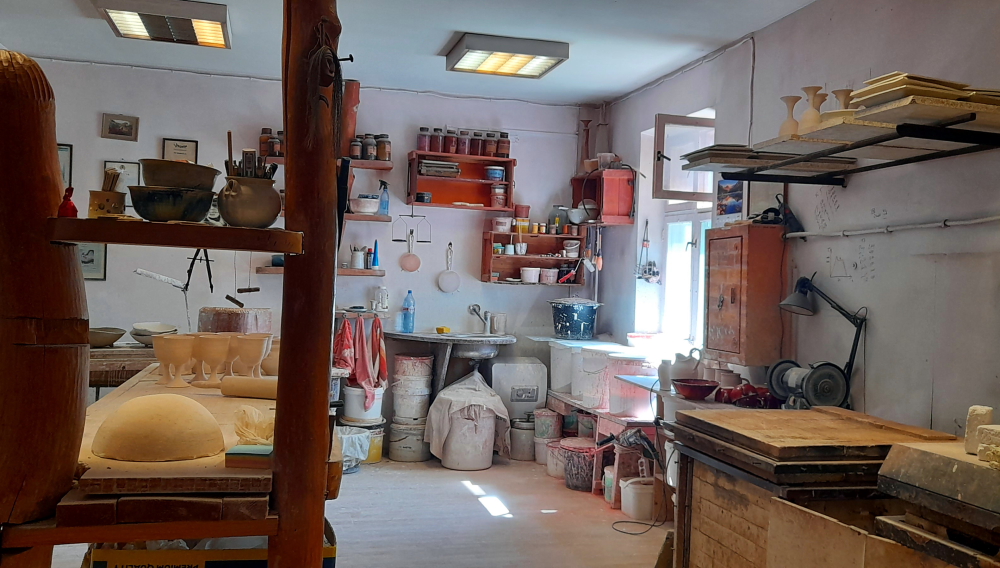
Potter’s studio, Mary Magdalene Guild, Parnu, Estonia.
Parking has been a bit difficult in town and since Lynn is struggling to walk any distance with her dicky knee we park next to the Tallinn Gate which has no mention of any parking restrictions. However, on our return to the car some 45 minutes later, we find a council parking officer who seems to be recording car number plates on a small tablet. Only time will tell if we have been given a parking ticket and for what reason??? Maybe there’s an overall parking time limit in any location and one needs a manual arrival display clock?
We will have to check before we go out to dinner tonight.
After a chat with the hotel manager (Karl), we determine that since 1 May this year the local council now charges for parking in Parnu. The 1st hour is free but then the cost is EU3 / hour until 7 pm. Karl complains that he can’t even park in front of his own house without having to pay. He also tells us that the only way to pay for parking is by SMS but international phones won’t work. Obviously the local council hasn’t thought this through very well.
We decide to avoid going anywhere near the town centre for dinner tonight. Down by the beach is an Italian Restaurant and since we don’t arrive until 6:40 pm we should be OK to park out front (maybe).
The restaurant menu is very limited and it seems that they really only do pizza. Lynn finds a chicken starter but I order a deep-dish pizza.
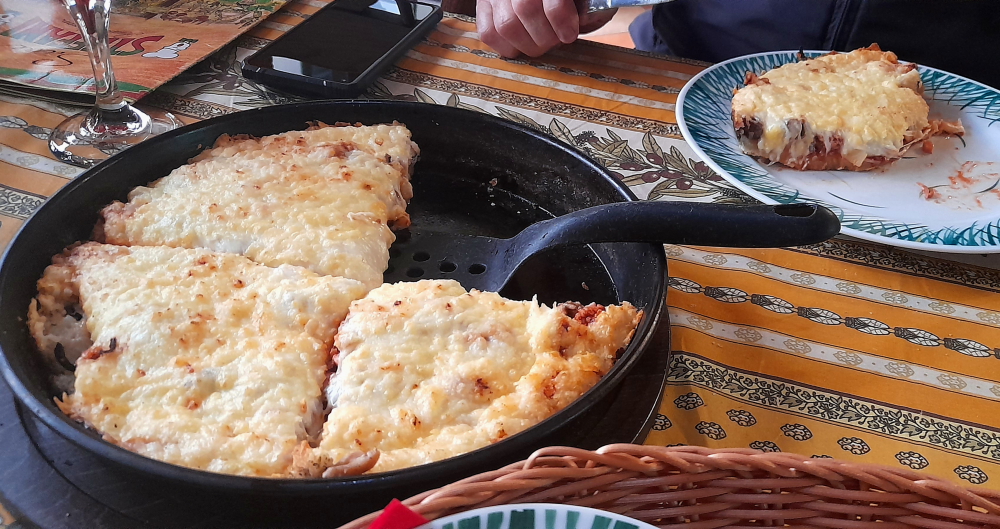
Pizza, but not as we know it.
The pizza is a bit ordinary and I only manage to eat half of it. It is so covered with cheese only the French or Swiss could eat it (Fondue Pizza?) or is it a pizza-shaped lasagne? At least the wine is drinkable and it turns out to be an Australian Malbec Shiraz from the Griffith area, labelled, would you believe, “Maori Bay”. Don’t tell the Kiwis! Not something that we would drink at home but better than most wines here in Estonia.
12 June, 2024
It’s dull and a cool 14 degrees when we walk out of the hotel grounds this morning. Our destination is Ruutli Street, 800m away.
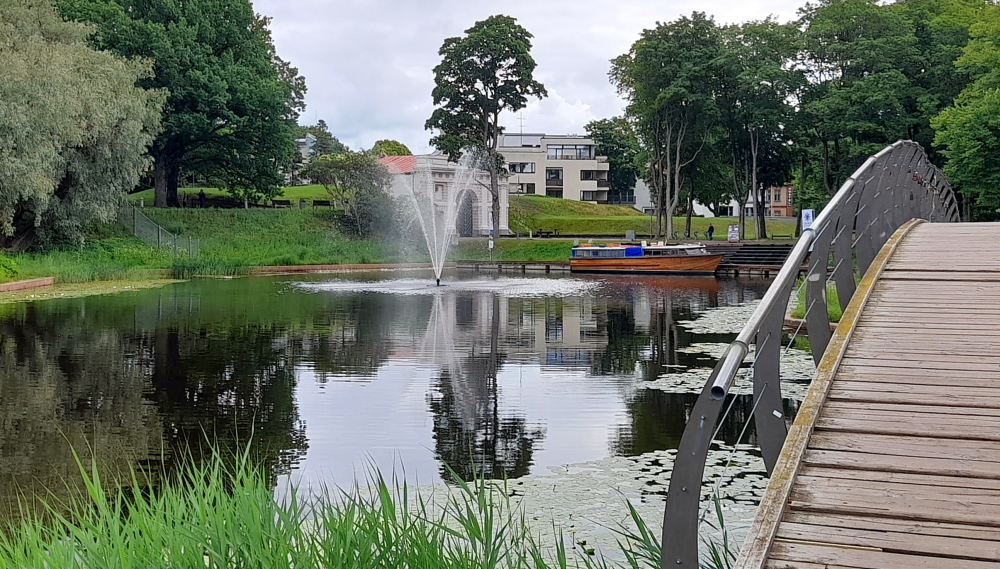
View of Tallinn Gate from pedestrian bridge, Valli Park, Parnu, Estonia.
En route we call into the Valli Park once again.
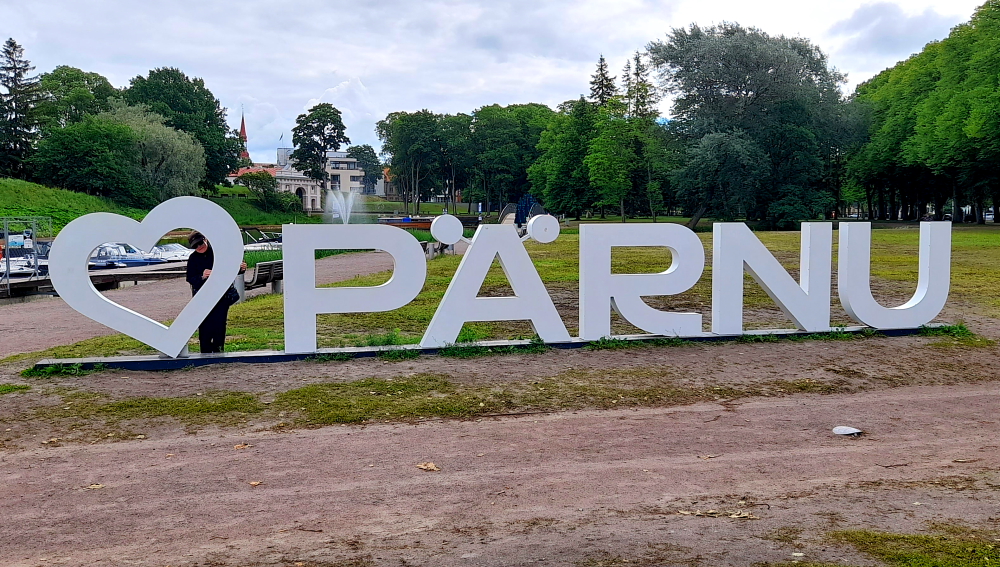
Seems every town has one!
Historic downtown Pärnu is defined by its main pedestrian thoroughfare, Rüütli tänav (Knight Street). At the end of the street closest to the Tallinn Gate is a life-sized statue of Johann Voldemar Jannsen (1819-1890), the father of Estonian journalism. The monument was created by professor Mati Karmin and ordered by Pärnu Postimees for the 150th birthday of newspaper Perno Postimees that first came out in 1857 [visitestonia.com/].
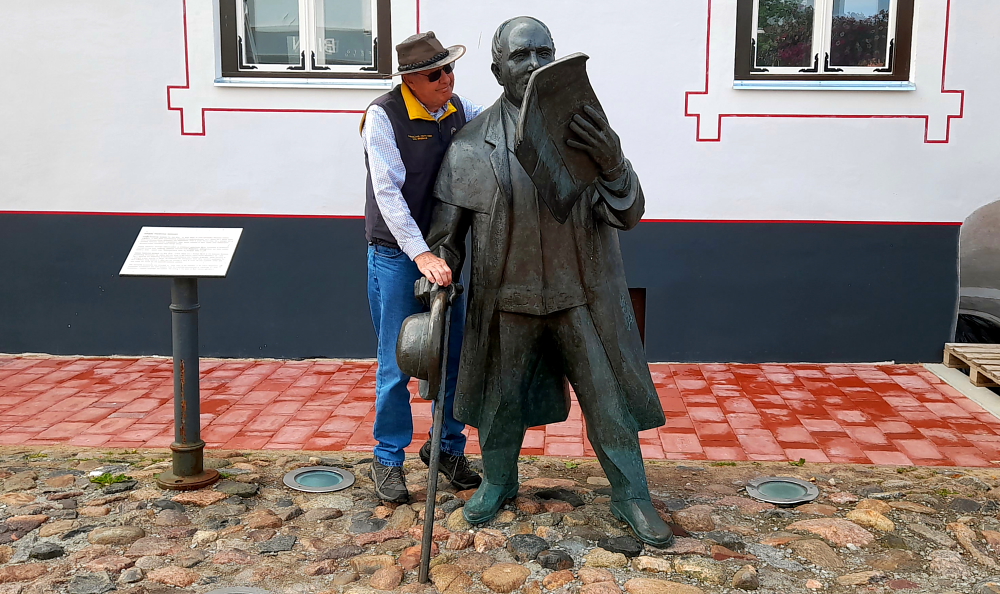
Statue of Johann Voldemar Jannsen, Ruutli Street, Parnu, Estonia.
The 400-metre stretch of Ruutli street between Ringi and Vee, and a few streets that branch off from here, are home to a hodge-podge of intriguing buildings dating from the 17th to the 20th centuries [www.inyourpocket.com/parnu].
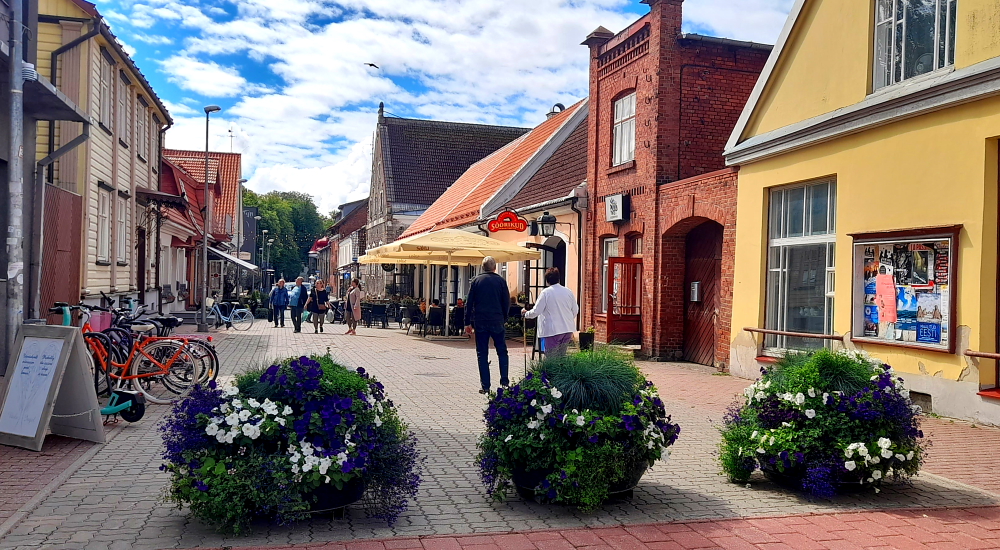
Puhavaimu, off Ruutli, Parnu, Estonia.
A new square called Rüütli plats is at the Pärnu Hotell end of the street. The current Parnu Hotell was built where the original Endla Teater was located.
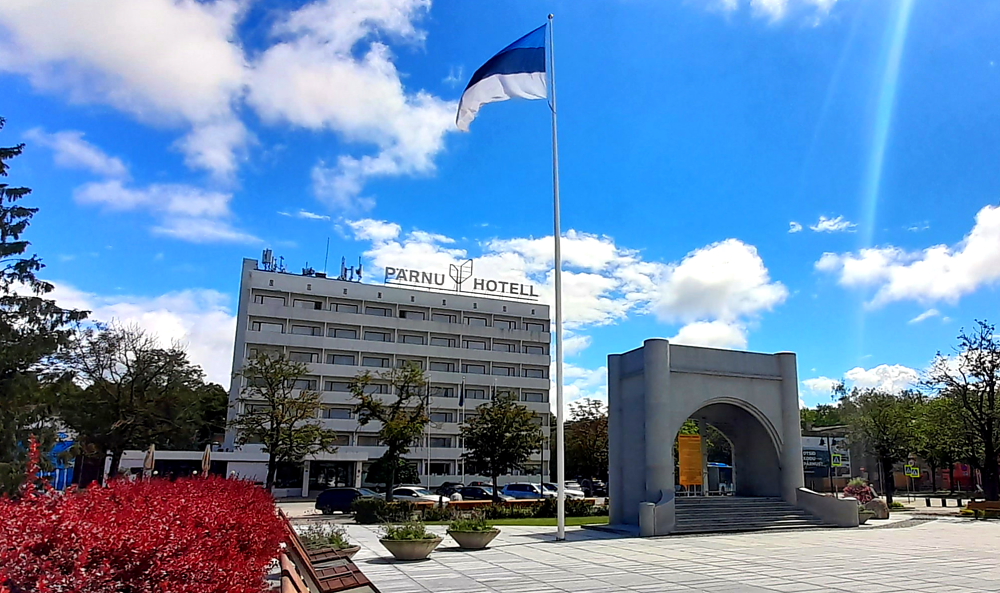
Archway commemorating Estonia’s Declaration of Independence in Parnu, 23/02/1918.
Here in the plats is an archway in front of the Parnu Hotel commemorating the declaration of Estonia’s Independece in Parnu on 23 February 1918.
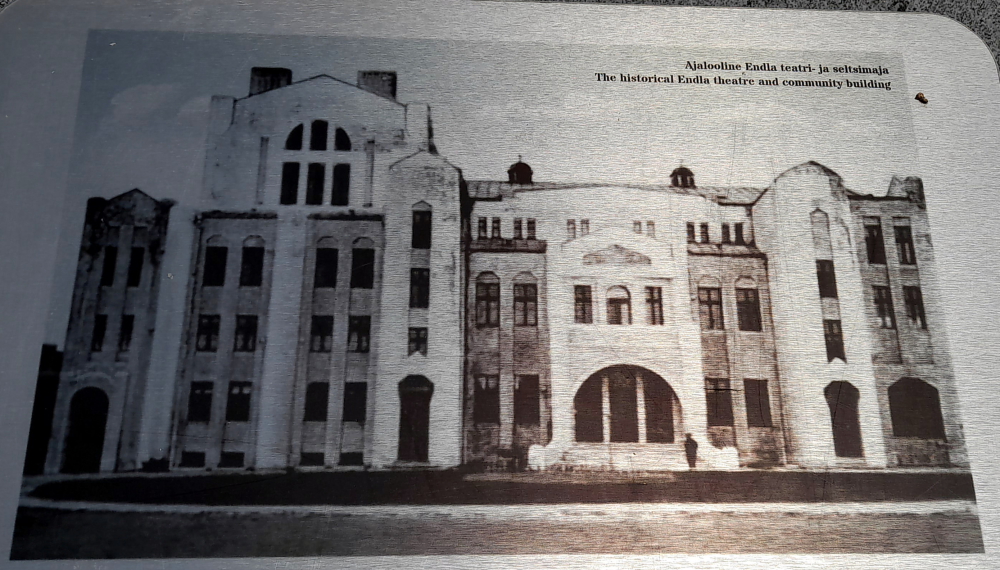
Drawing of the original Endla Teater, Aia Street, Parnu, Estonia.
Walking back to the hotel we pass the Cafe Grand, a café and restaurant in the style of the 1920s, which was known as a top-rate restaurant as far back as 1927. At the time, it was a café for the ‘finer’ people, and also offered performances by musicians from Tallinn. It was renovated in 2001 [visitparnu.com].
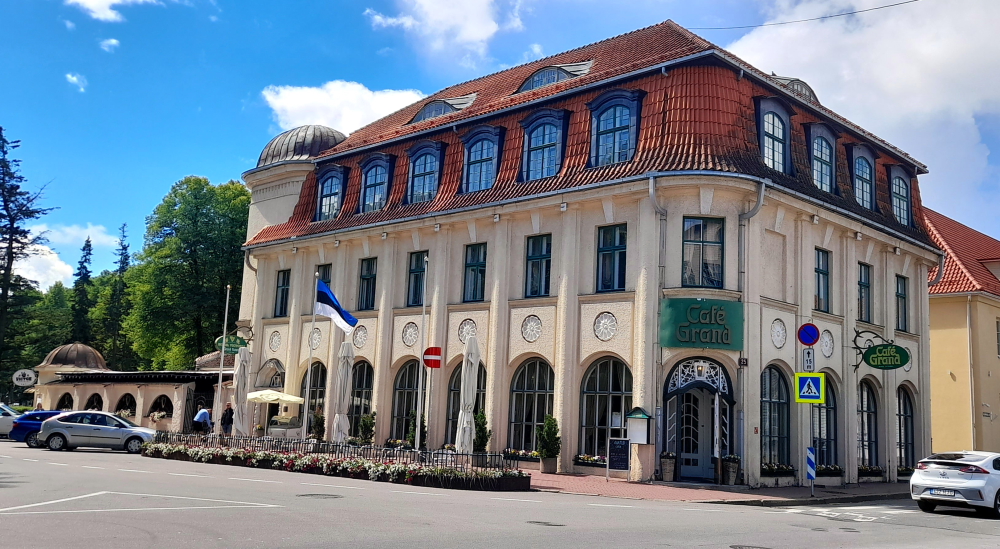
Cafe Grand, Hotel Victoria, Kuninga 25, Parnu, Estonia.
Further along Louna, opposite the Brackmanni Park, is an intriguing building at Puhavaimu 19 (Holy Spirit 19). The building was completed in 1812 and was built as a gunpowder barn. In 1906-1907, the barn was converted into a city archive. Today, the building is used as a gymnasium and library of the Pärnu Old Town Primary School. It’s recognised as a national cultural monument [wikipedia].
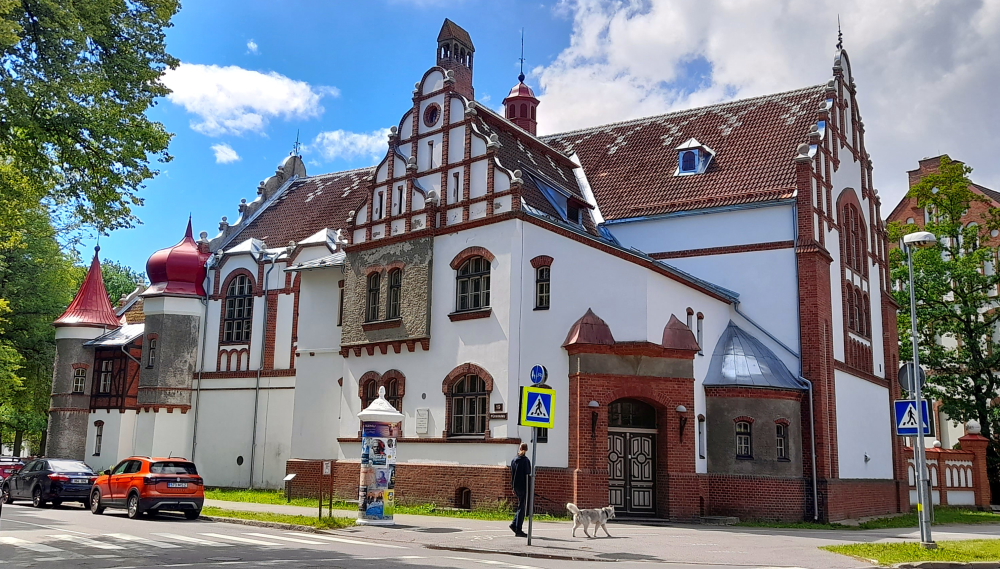
Gymnasium, Old Town Primary School, Puhavaimu 19, Parnu, Estonia.
Returning to the hotel we are struck again by the park-like nature of this villa area of town, thanks to the city having commissioned a plan for the construction and expansion of parks and avenues during the 1890s after a new, modern bathing establishment opened and Parnu was included in the list of Russian Imperial resort cities.

Mere pst, Rannapark & Villa Ammende, Parnu, Estonia.
By the end of the 19th century a resort-suburb with an abundance of wooden lace decor, wooden summer houses, guesthouses with open and airy verandas, as well as avenues and parks had emerged from the meadows and pastures that had once separated the fortress from the sea.
Tonight we walk the 800m to the Restoran Edelweiss in the Old Town for some good old-fashioned fare. Turns out the food is tasty and the prices are reasonable. Lynn has a traditional soup – solyanka (or selyanka, translated as “settler’s soup”) – a sour soup of Russian origin and a common dish in the Baltic states. Hers has meat and sausage, pickled cucumbers, black olives, cabbage, smetana (sour cream) and dill.
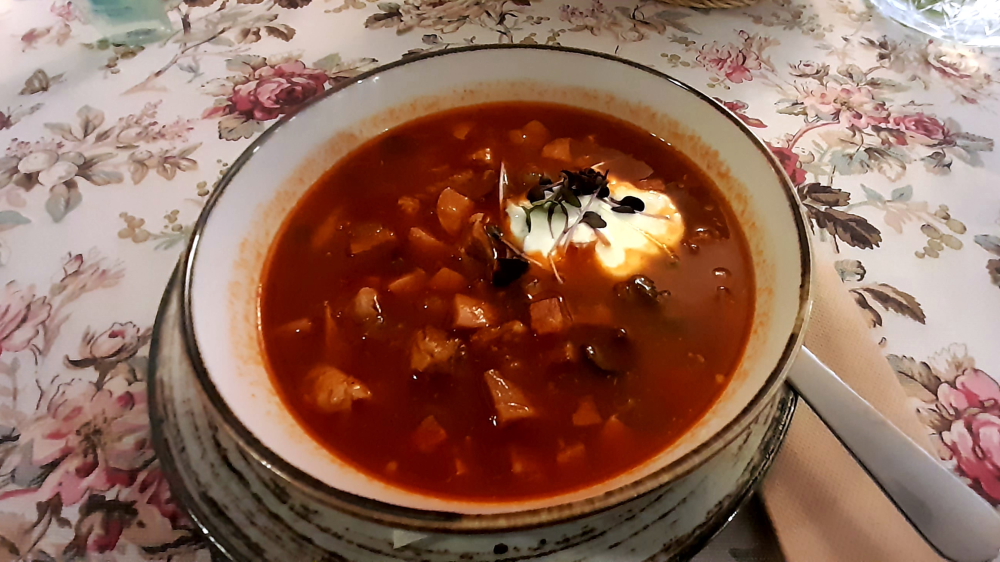
Solyanka soup.
After dinner, as we are close to the Red Tower (Punane Torn), we check it out. The Red Tower is Pärnu’s oldest surviving structure. Built in the early 15th century, the corner tower of the city wall was both a fortification and a prison. The outer and inner walls of the stone tower were covered with red bricks, thereby inspiring the tower’s name. Since November 2020, the tower houses a museum.
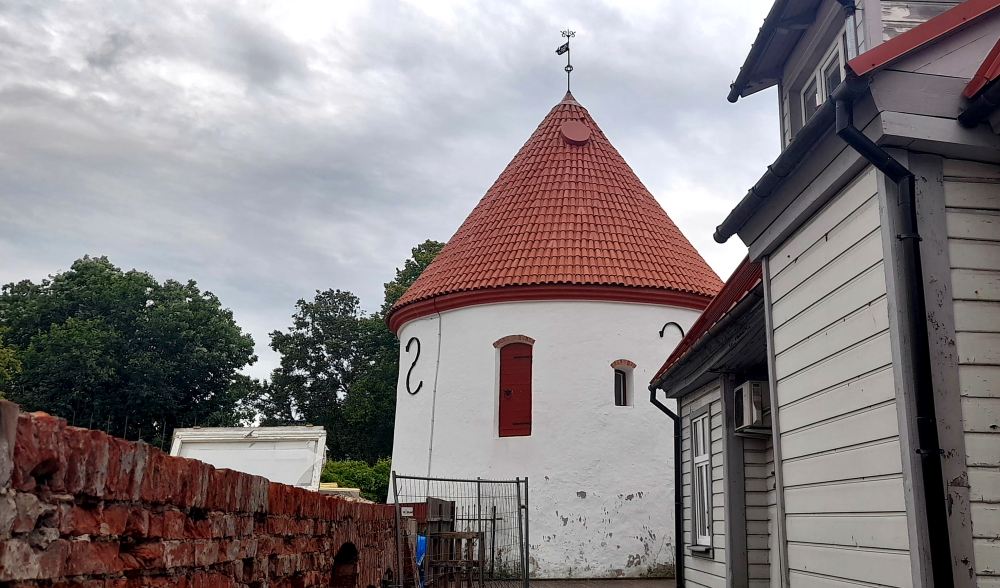
15th century Red Tower (Punane Torn), Parnu, Estonia.
Walking back home along Ruutli Street at No. 21 we pass by Merchant Mohr’s House. In 1681 the house of Christoph Heinrich Mohr, a former alderman and merchant, was among the 1st to be built along the street, the former market square. During the 18th century reconstruction, the stone granary in the yard was supplemented by a gallery expanding near the upper section, as well as with a lift pulley and hatches. Then the granary as owned by Jacob Jacke’s merchandise office.
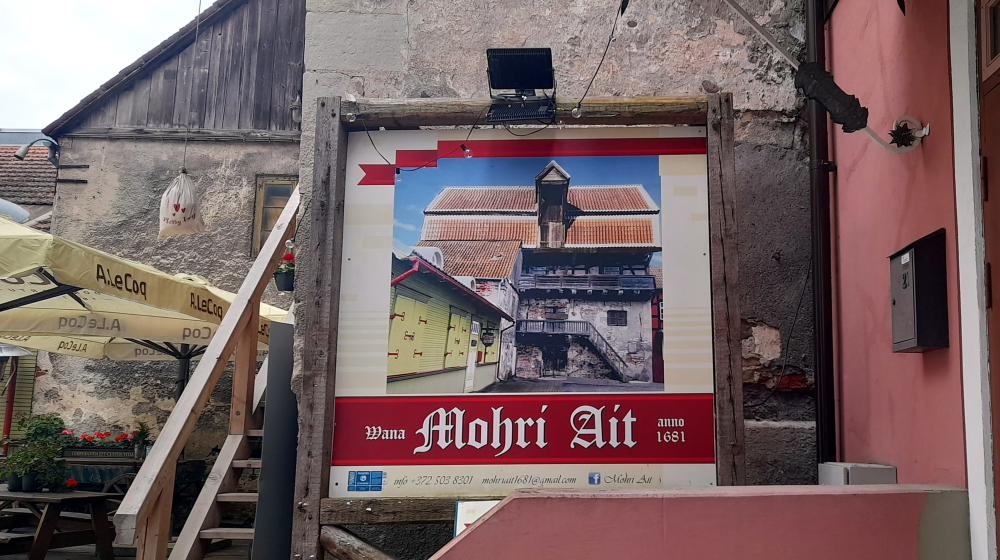
The staircase in the photo’s photo is the staircase to the left in this photo – capiche?
In October 1700 the building hosted for 10 days King Karl XII who had landed with his troops in Parnu and was heading towards Narva. In 1764 the building hosted Empress Catherine II. Later the building passed from the merchant to the town post and telegraph office.
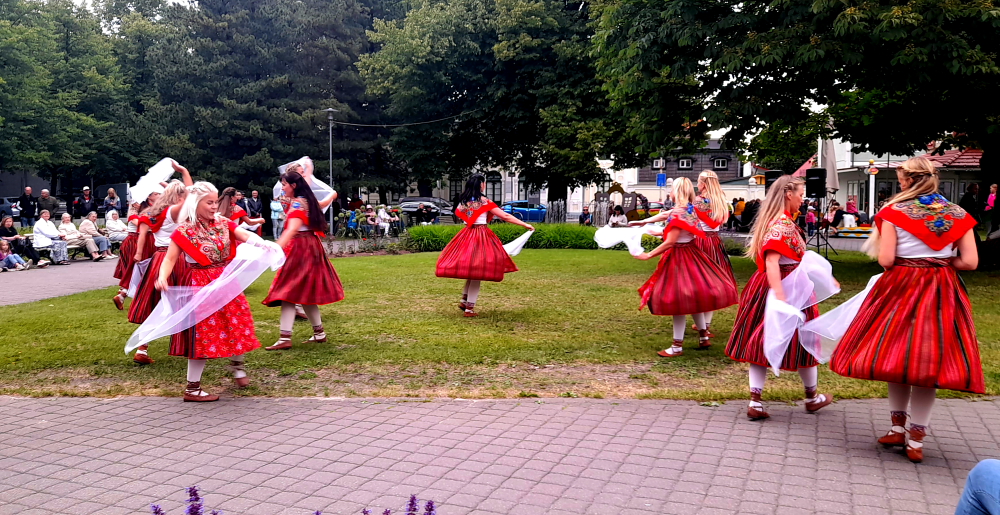
Evening folk dancing, Parnu, Estonia.
Tonight, across the road in Lastepark, is a troupe of young women putting on a delightful folk dancing display for the locals.
13 June, 2024
Another lovely sunny day so we spend some time in the hotel’s garden soaking up some rays. Looks like the staff are preparing for another concert in the grounds.
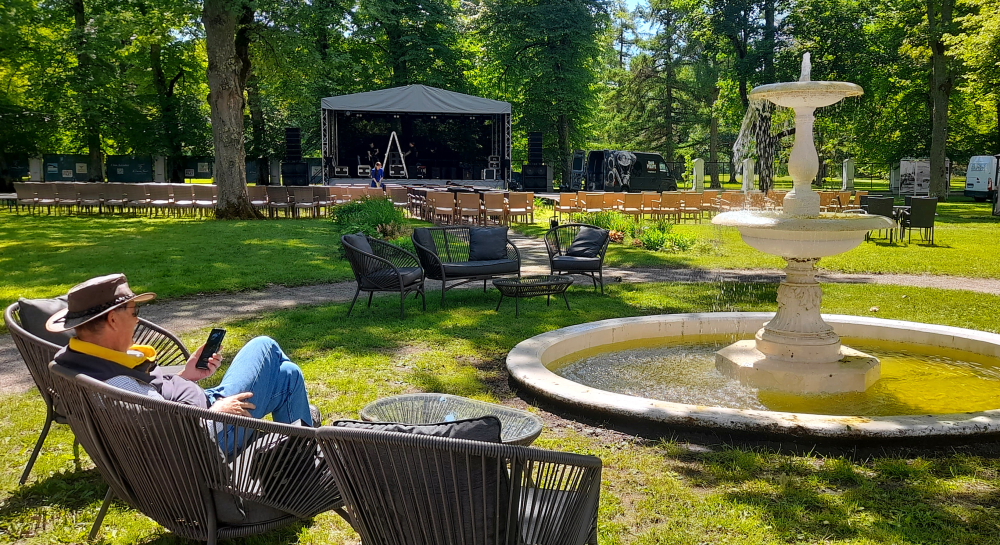
Perfect summer’s day – gentle sunshine & the sound of tinkling water from the fountain.
Yesterday we spotted a Georgian restaurant in town so we will go there tonight. Unfortunately, it’s not a patch on the one we found in Helsinki in 2022. I specifically asked whether the roast “trout” was in fact trout, and not salmon, and I was assured it was. Wrong! But we did imbibe in some interesting Georgian limonade – grape for me and pear for Lynn.
Approaching the hotel just before 8 pm we notice that it’s surrounded by parked cars so apparently that concert is on tonight, even though we have seen no advertising for it whatsoever. We even have to queue with the rug-hugging patrons to get in the gate and prove that we are hotel guests, not concert crashers – at Eu35 per head. The area in front of the stage is full and even the verandah is full of diners.
One of the windows in our room is open so we get to hear some of the concert – pop music. Turns out the artist is Maarja-Liis Ilus, sometimes better known by her performing name Maarja (born 24/12/1980), an Estonian pop musician and presenter. She has represented Estonia in the Eurovision Song Contest twice, being only 15 when she participated in the 1996 contest. So, well known and loved. The concert ends around 9:55 pm and, without a sound, the crowd melts away. 10 pm and all is quiet.
14 June, 2024
In contrast to yesterday, today is overcast and feels 4 degrees cooler. After breakfast, while waiting for the housemaids to finish our room, Lynn hobbles up the steep, wooden staircase at the end of our floor. It’s the staircase in the villa’s tower.
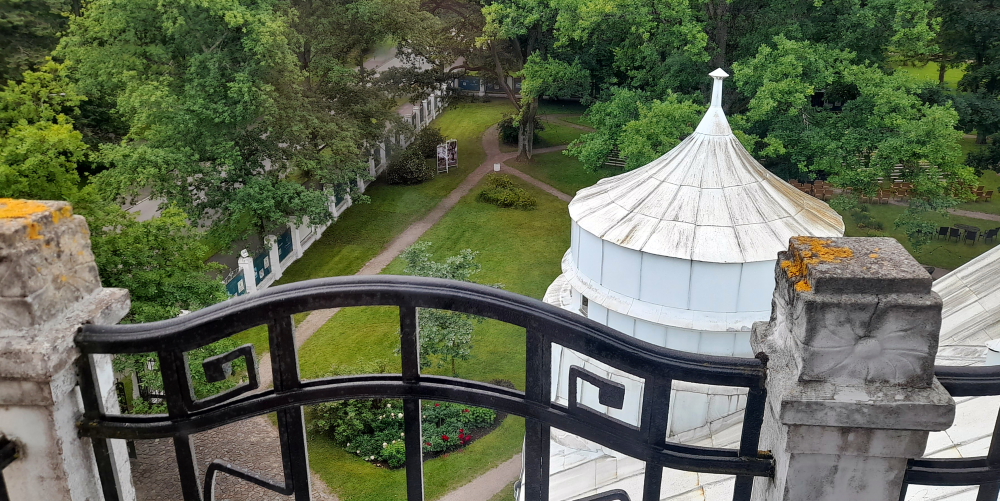
View over the hotel grounds from the tower, Villa Ammende, Parnu, Estonia.
The space has been tastefully decked out as a reading room with several sets of tables and chairs. Back in 1905 the tower was built for Ellen to see when her sea captain husband’s ship had returned to port. Back then the sea was much closer. The current parkland between the hotel and the beach being reclaimed land.
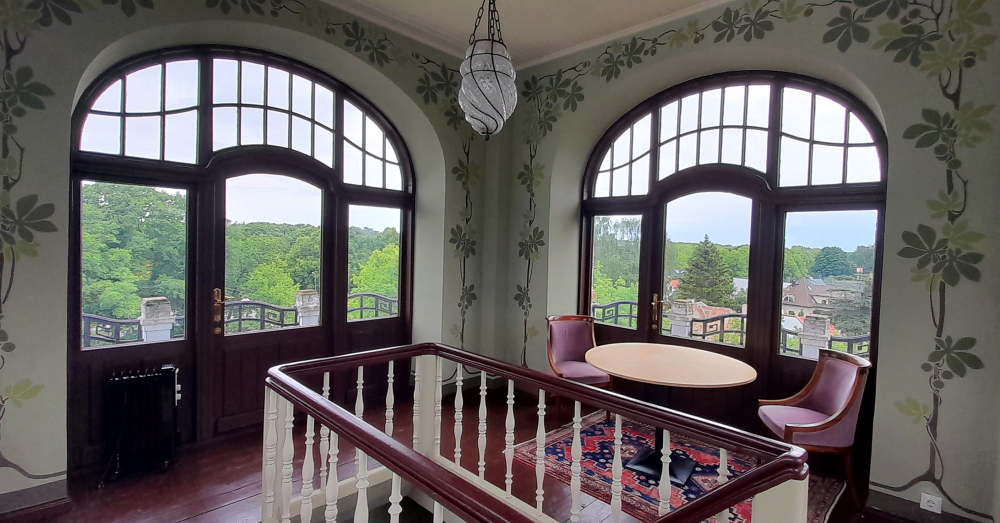
Seating area at the top of the tower, Villa Ammende, Parnu, Estonia.
This morning we take a short drive down to the beach. The Beach House was completed for the summer season of 1927 – the first of its kind in Estonia.
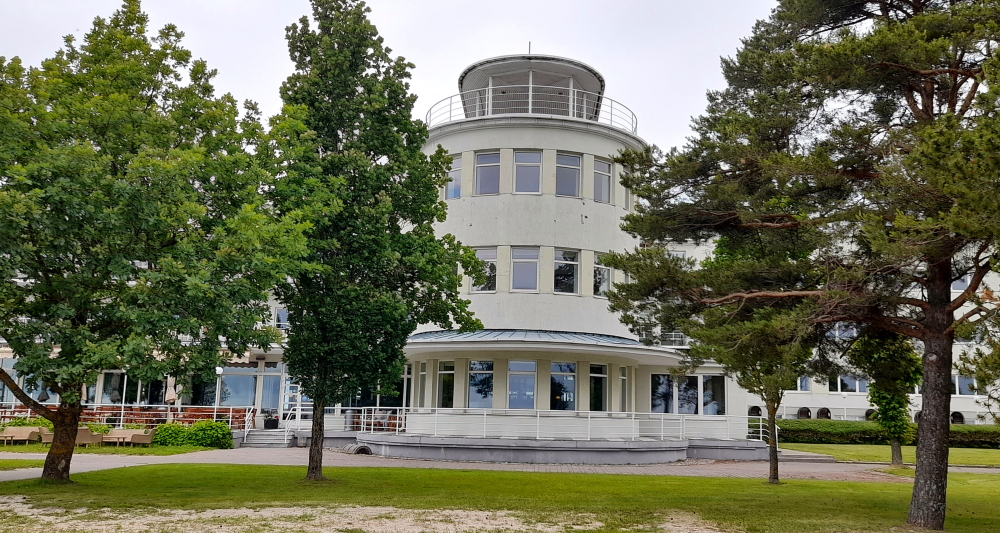
Art Deco Rannahotell, Central Beach, Parnu, Estonia.
Unfortunately, it seems that it is no more. Fortunately, its contemporary, the Rannahotell, completed in 1937, still remains. Designed by Olev Siinmaa, it’s characterized by a Scandinavian style.
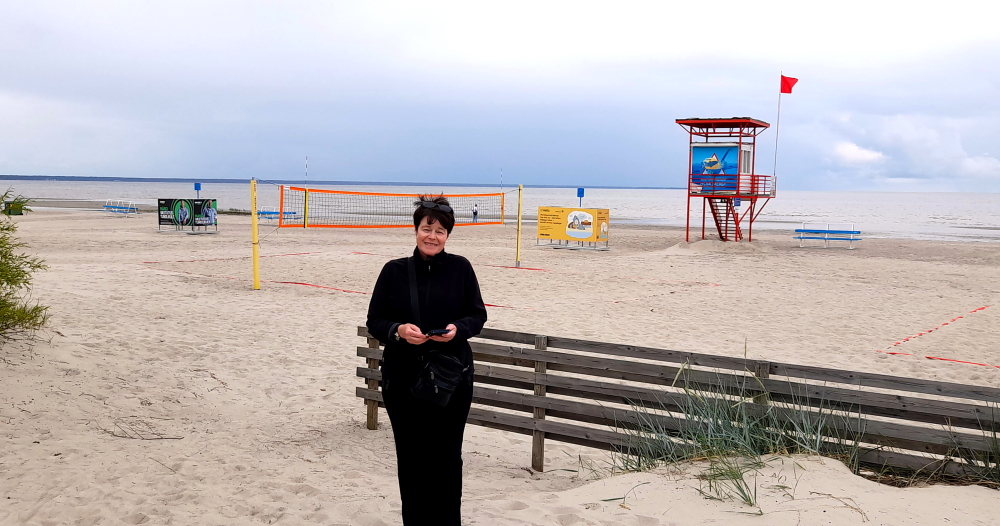
Red flag – water temperature is below 16 degrees – bracing!
Thanks to today’s 14 degrees and overcast skies, the beach is even more deserted than a couple of days ago.
Lynn decides that dinner tonight is at the Bum-Bum Pubi, a pub a block beyond the Tallinn Gate that we walk past every evening. Why? It’s the closest to walk to.
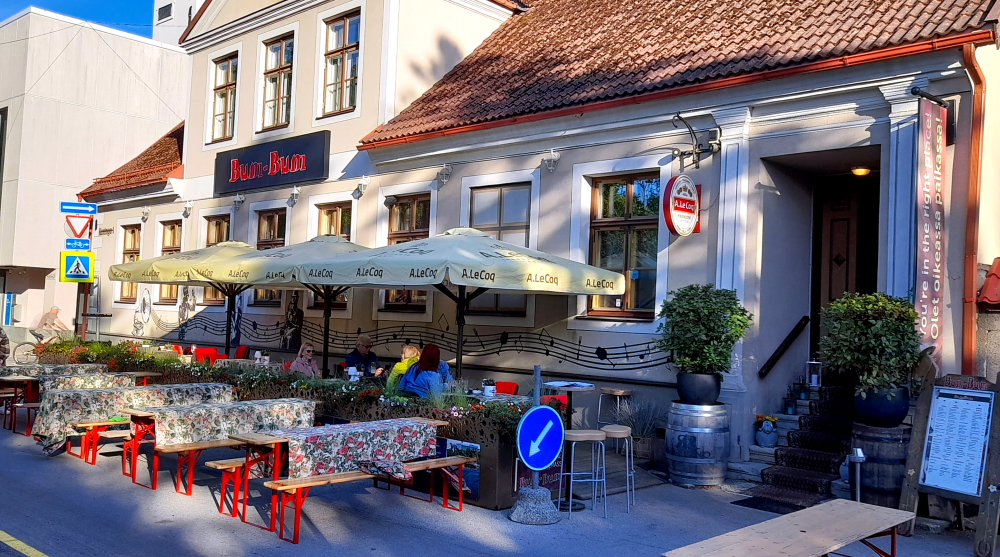
Bum-Bum Pubi.
Predictably the interior looks like a brothel, there’s 1980s music blasting through speakers and there’s even a glitter ball twirling from the ceiling. After we place our orders – roast pork and sauerkraut for Lynn and a Bum-Bum Special for me – the waitress brings us 4 slices of rye bread. Lynn asks for some butter and we end up with a whole dish full.
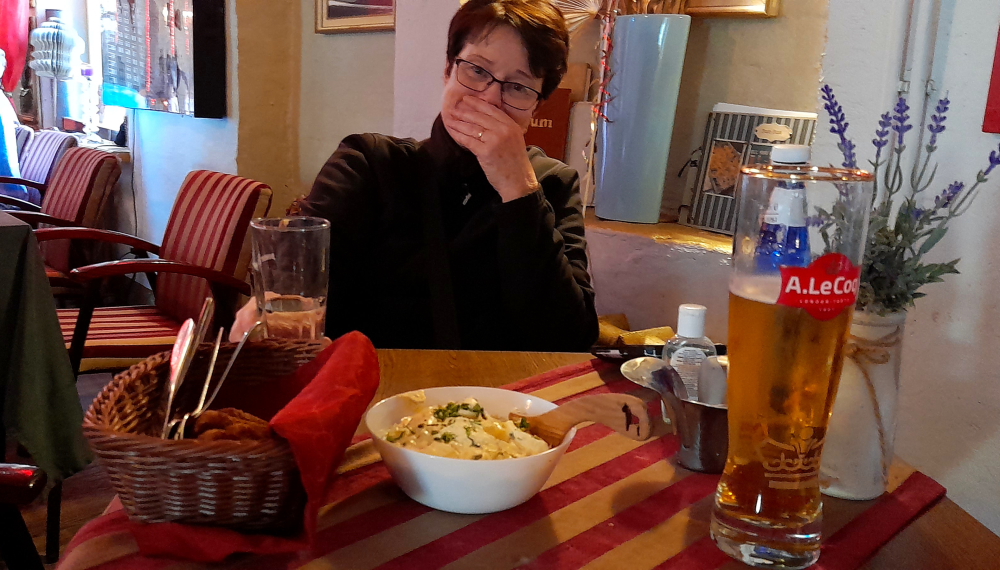
A little butter for a couple of slices of bread?
Unpredictably, the meals are large, tasty and good value.
15 June, 2024
After a fantastic few days at Villa Ammende we say our farewells to Karl and the staff and drive out the gate just before 11 am. It’s sunny and 14 degrees.
Our trip today is to Cesis in Latvia. It’s a 156km journey and should take us about 2.5 hours.
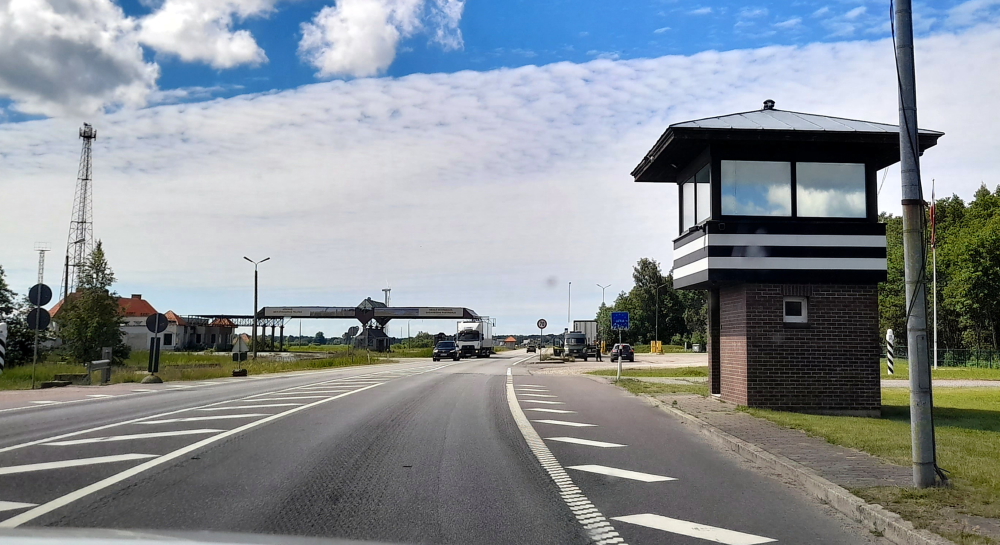
Crossing the border from Estonia into Latvia.
We take the 4 that runs parallel to the coast and cross the border into Latvia near Ikla where the road becomes the A1. At Zaki we turn left onto the P11 and drive through Limbazi which is quite a sizeable town.
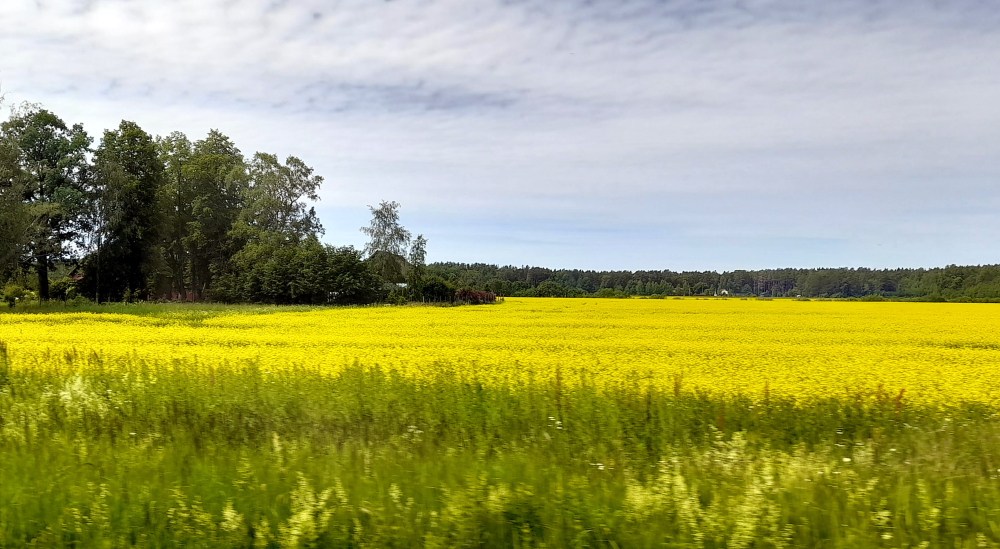
Fields of flowering rape seed, Latvia.
So far, Latvia is similar to Estonia – green pastures, wheat, baled hay, forests (with a grazing deer), timber, occasional cows, cow parsley and pink and purple lupins lining the road verges – but the rural housing seems to be more basic and less well maintained.
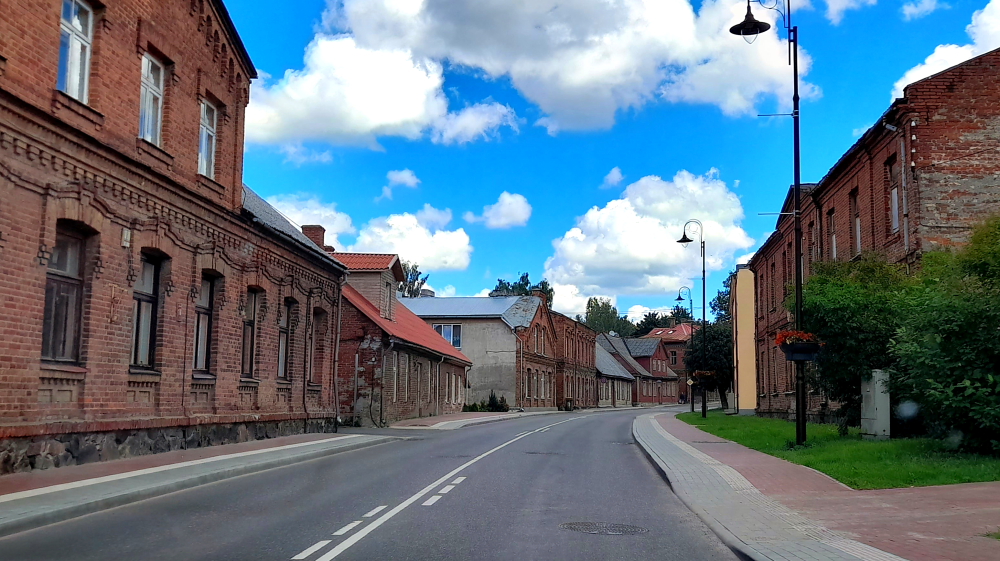
Muru iela, entrance street to Limbazi, Latvia.
Parts of Limbazi have Soviet-style, stark residential blocks, derelict buildings, then some rather impressive civic buildings.
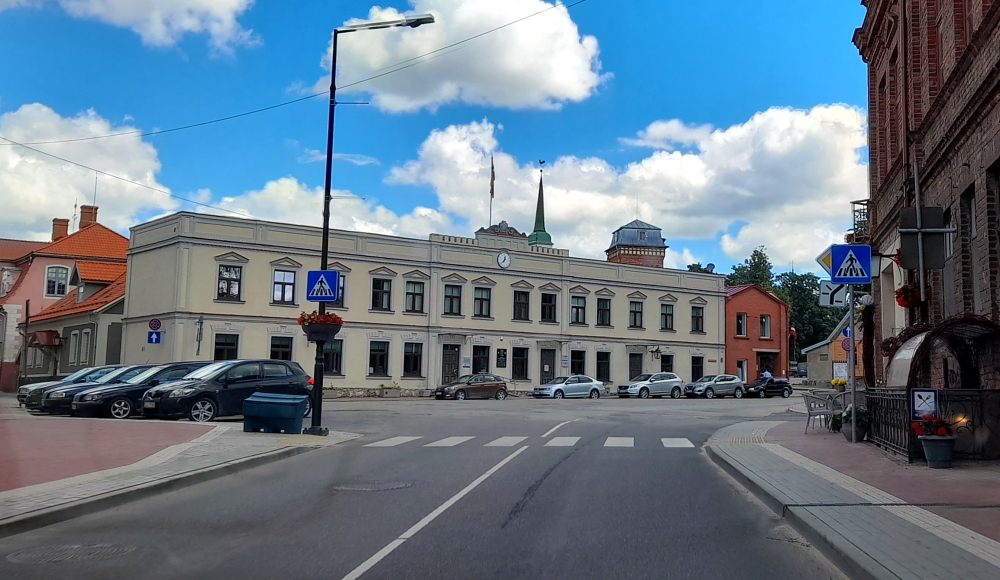
Main square, Limbazi, Latvia.
From here we take the P14 past a stork’s nest near Rozula.
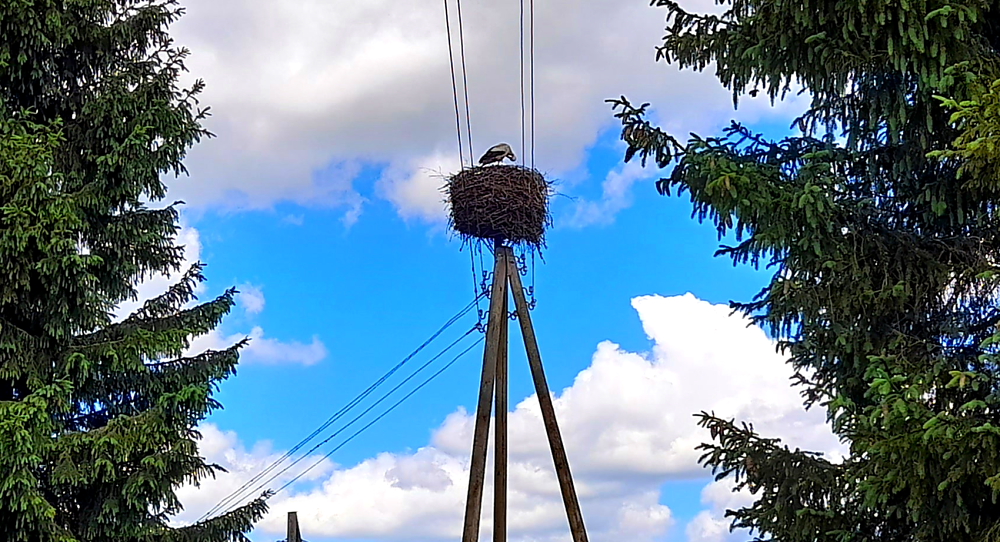
Typical stork’s nest on top of a telephone pole, Rozula, Latvia.
We briefly join the A3 then turn onto the P14 near Stalbe and skirt the northern shore of Lake Ungurs.
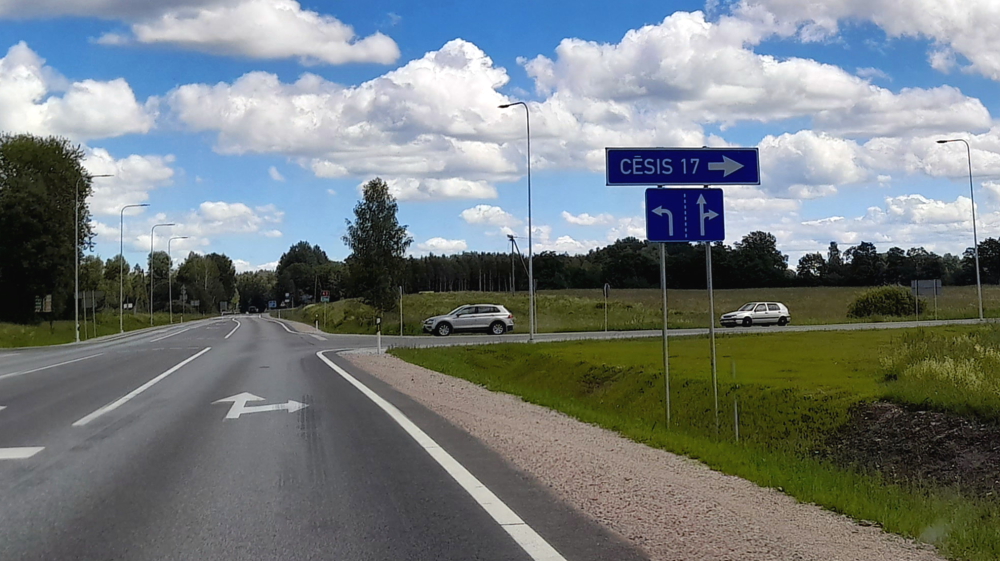
Turning off the A3 onto the P14 near Stalbe. Latvia.
Shortly after we come to a stretch of road that runs past Auciems that is under repair.
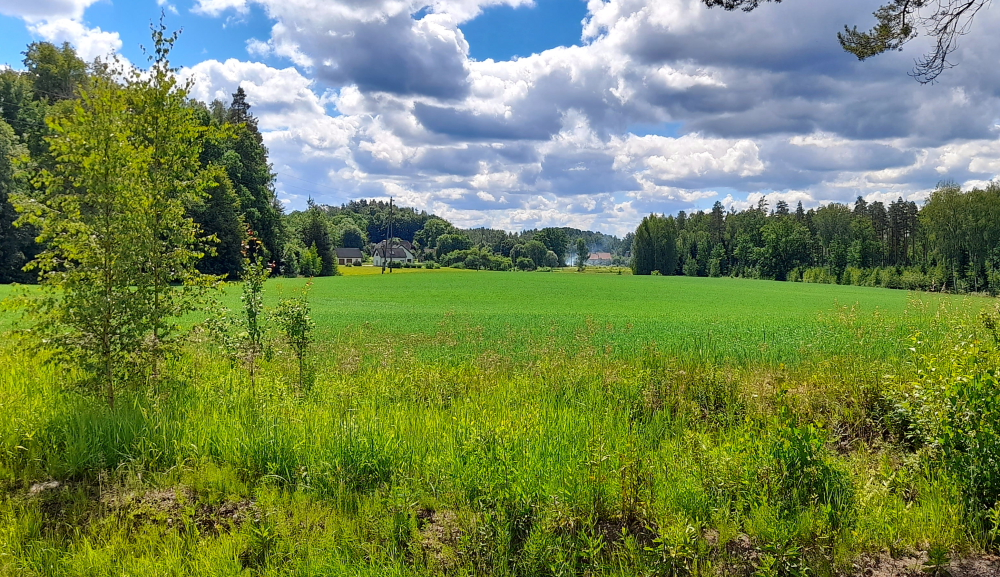
Countryside near Auciems, Latvia – waiting for traffic lights.
Here we are stopped at 3 sets of traffic lights before we finally drive into Cesis, a picturesque town of cobbled streets and wooden buildings and where the main historical objects are the castle ruins of the Livonian Order (1206) and St. John’s Church (1284).
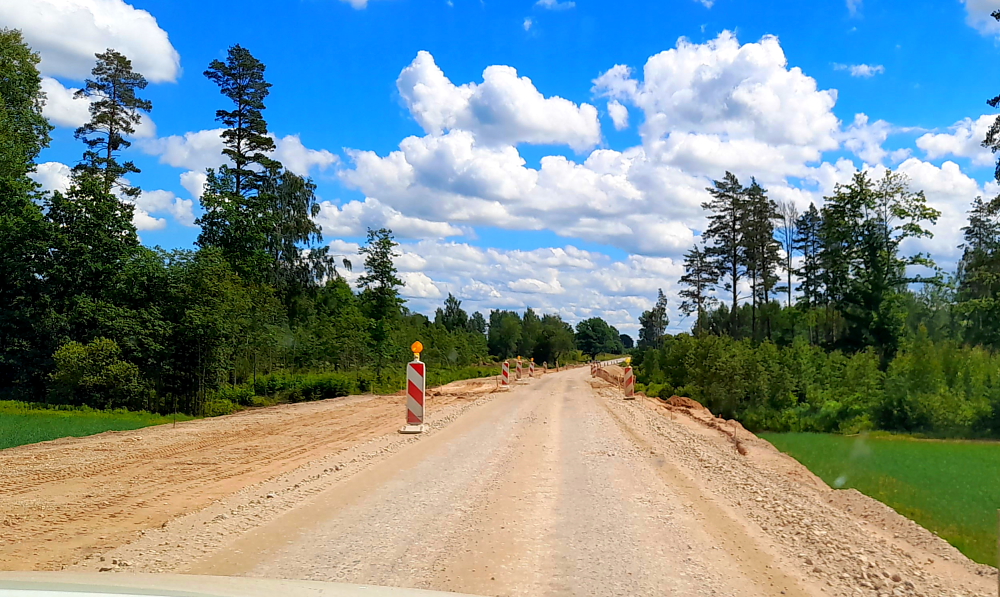
Extensive road works before Cesis, Latvia.
We arrive around 1:30 pm only to find that there are no parking spaces available in front of the hotel where we’d been told we could park for free. Lynn limps into reception to be told that we’d have to park elsewhere until a spot became available in front of the hotel.
As we bring our bags into reception to check in, the receptionist relents and lets us park next to the hotel in the staff car park.
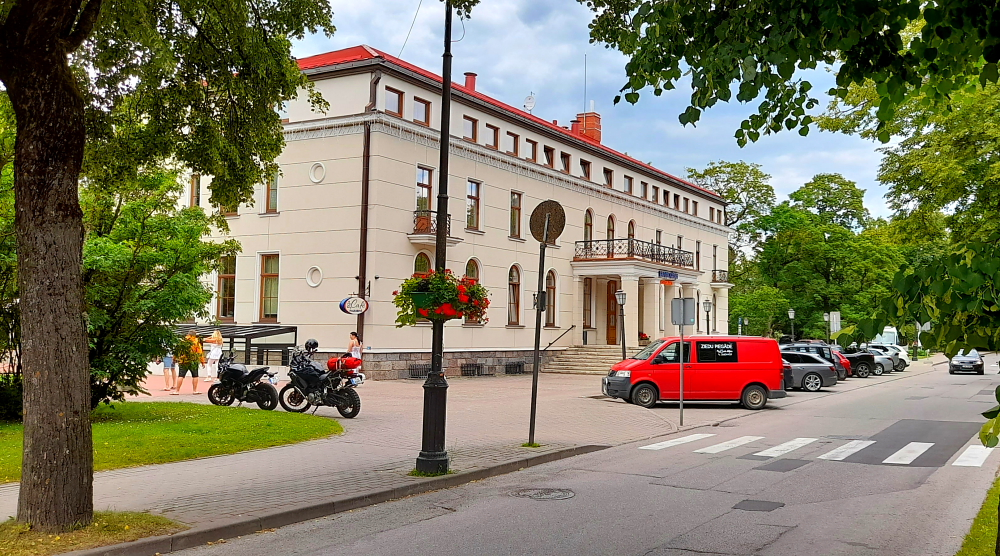
Hotel Cesis.
The hotel looks like the best in town. It’s only a 3 star but well renovated and we have a large room. The hotel seems better than some so called 5-star hotels that we had in Scandinavia.
Formerly known as Hotel “Tērvete”, it was built in 1939. It was intended as a motel for Western European car tourists – visitors to the Helsinki Olympic Games in 1940, however, due to war conditions, the big plans remained unrealized.
The hotel was built according to the project of architect A. Vilmanis and is a typical example of hotel architecture and planning style of the 20s and 30s with its interior in the style of national romanticism. The name “Tērvete” was given to the hotel – in honor of the then president of the country – the great Zemgalian Kārli Ulmani. It opened on 1 January 1941 [www-historia-lv].
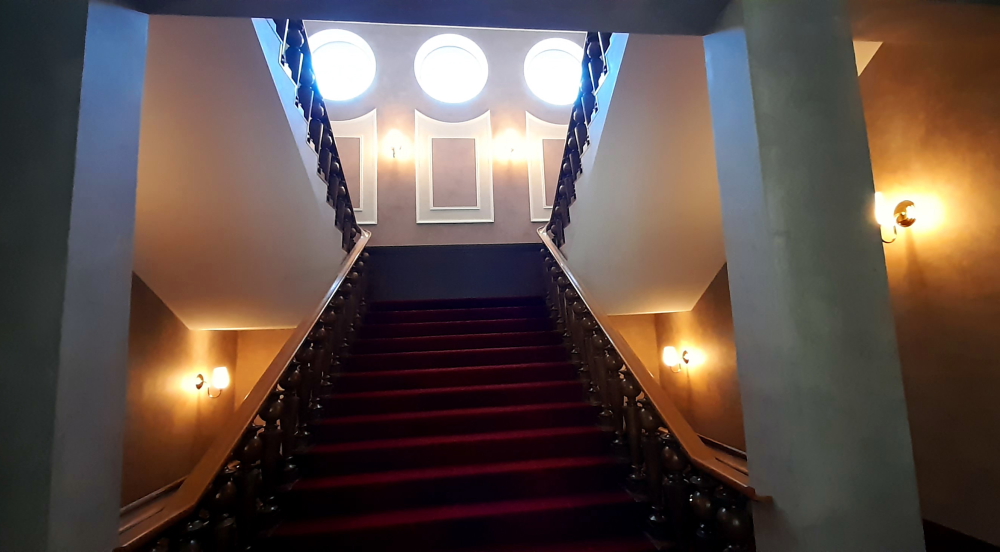
No elevator but a very nice staircase.
Only a short flight of stairs to our room on the 1st floor where we have a view over the hotel’s cafe terrace and the Maija Parks beyond.
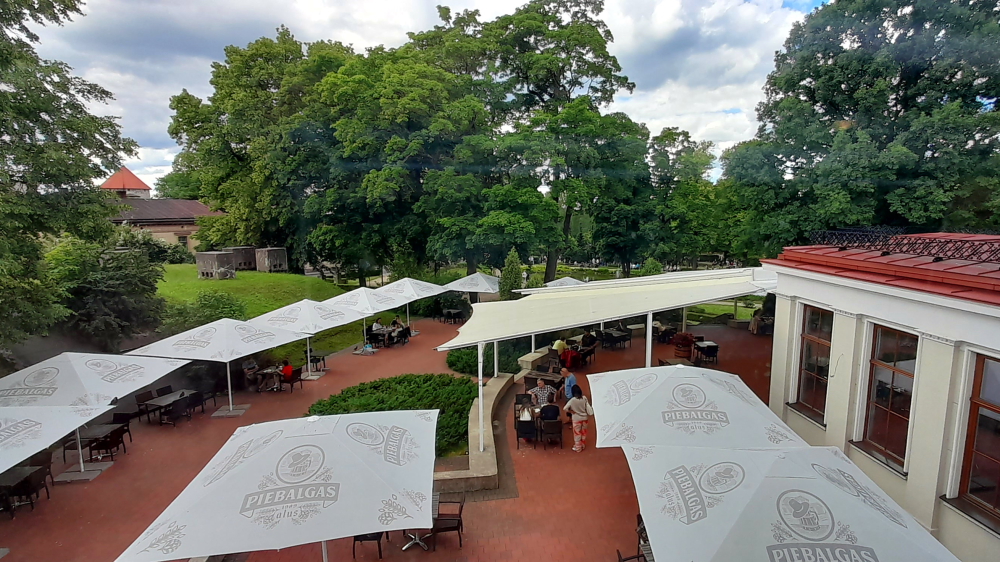
View from our Cesis Hotel window.
As it’s Saturday there’s quite a crowd out enjoying the 20 degree sunshine. We sit under the awning at the cafe only to find that there isn’t table service, we have to go and order at the counter. Only thing is Lynn finds that there is a queue of about 20 people in front of her so we go for a walk around the park instead.
It seems that there are some bands playing in one section of the park.
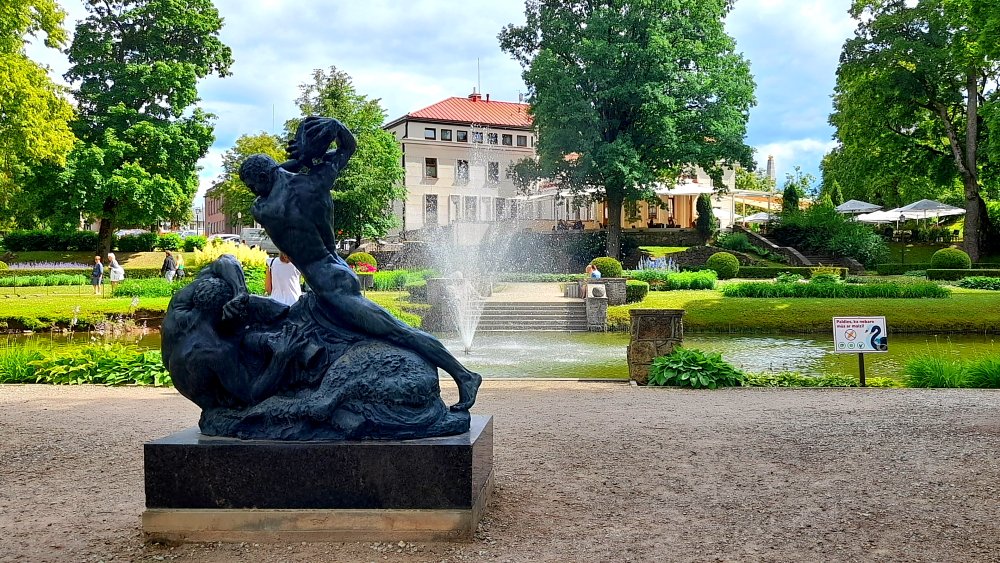
The park behind Hotel Cesis.
And in another part there are rows of marquees set up with tables and chairs and chess sets and timers – a tournament either ready to go or it’s all over.
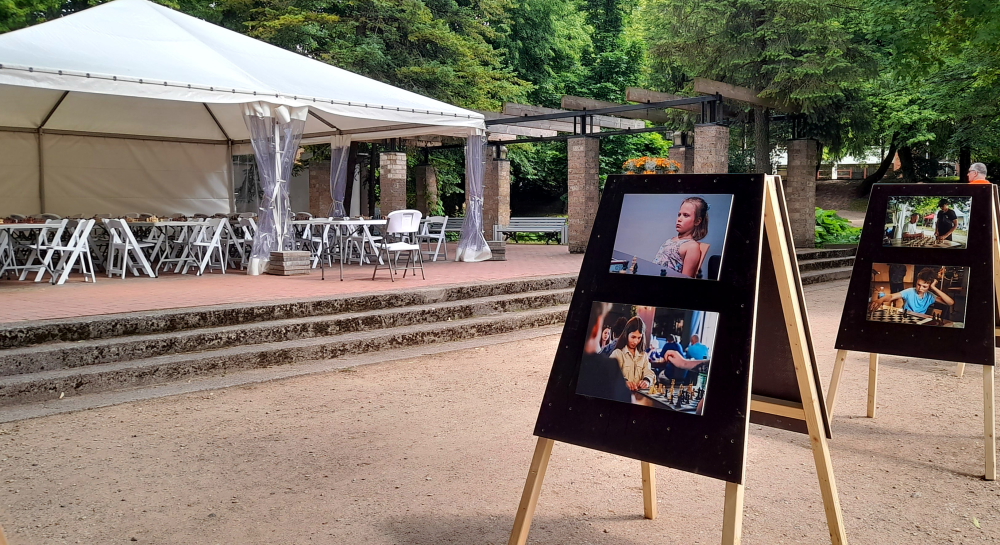
Chess tournament in the park.
We’re still thirsty so we walk to the pedestrian street of Rigas iela and find a cafe. Once again Lynn goes inside to order only to find yet another queue in front of her. She notices that the bar over the road, Rusa, only has a couple of people in it so we go there – talk about musical chairs.
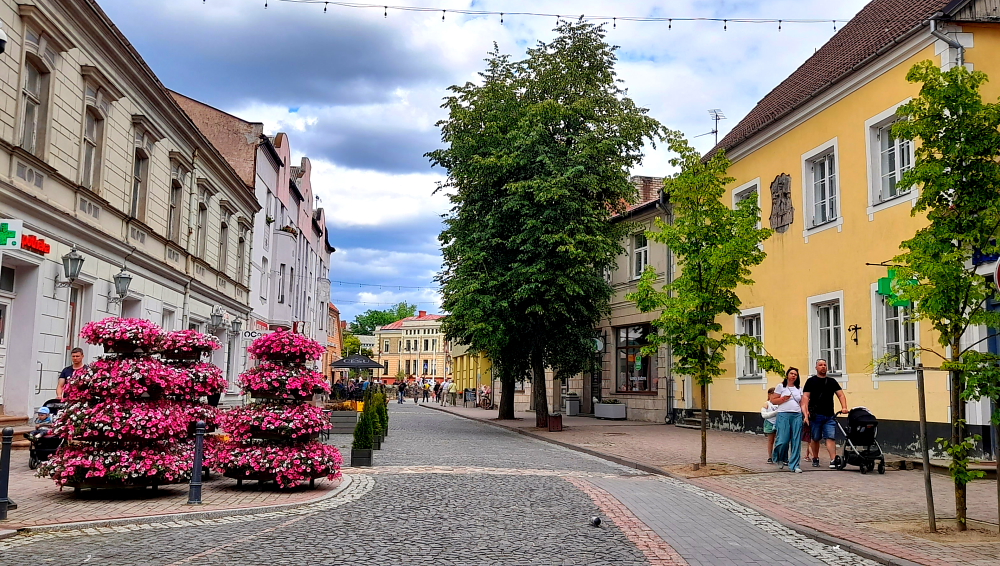
Rigas iela, Cesis, Latvia.
Somehow, Soviet-era queuing for food remains! My draft beer arrives quickly but Lynn has a bit of a wait for her USA Spritz cocktail made with elderflower liqueur – both refreshingly cold.
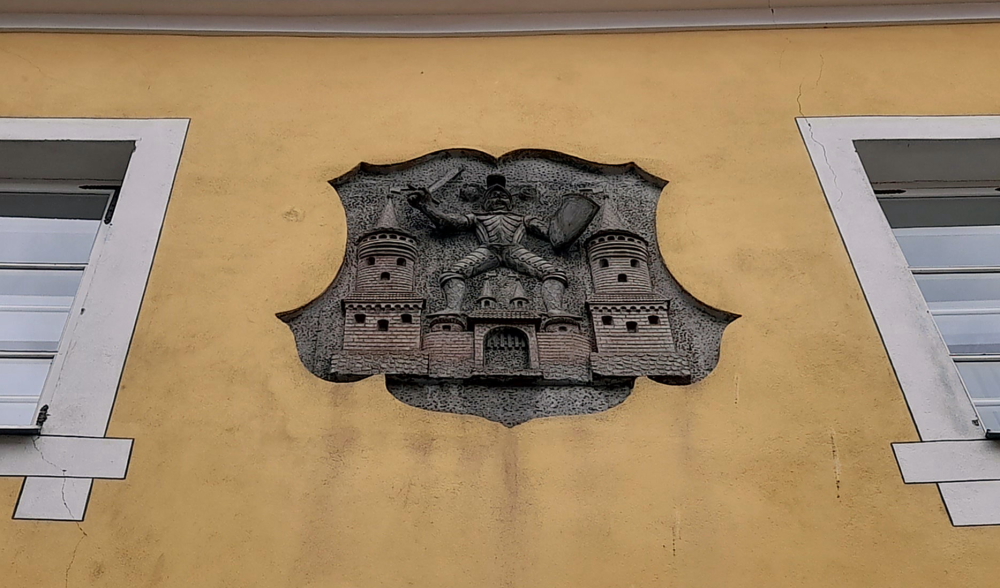
Cesis Coat of Arms.
Passing a nearby building it has a significant coat of arms on its facade. Cesis was the only large castle of the small Baltic tribe of the Vendi. In 1209 Germans built a castle Wenden on the Vendian castle. It became a residence of the Master of the Teutonic Order.
In 1323 the city and its arms are mentioned. The arms showed Saint Catherine, a patron of the city. But already in the 14th century the city seal showed a city gate with a knight on it. The gate symbolized city rights, and the knight symbolized dependence on the Teutonic Order [www.heraldry-wiki.com].
Rigas iela leads to the Freedom Monument in Unity Square. The Battle of Cēsis in June 1919, when Estonian and Latvian forces defeated the Germans, was one of the decisive battles in the Latvian War of Independence.
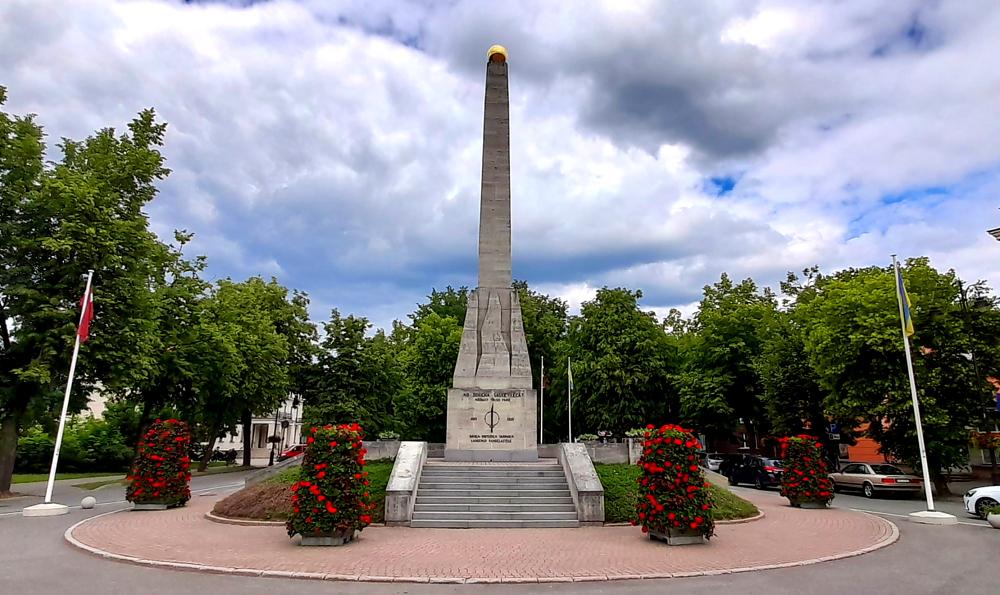
Freedom Monument, Unity Square, Cesis, Latvia.
The monument was first opened in 1924 but was destroyed in 1951 during 1 night, then restored and consecrated in 1998. The obelisk foundation is highlighted with the inscription: “From the sword the sun rose.”
Vienības (Unity) Square was renamed the Square of Convention at the beginning of the 20th century. In 1925, when the monument in honour of memory of Latvian and Estonian soldiers who defeated the Germans, the victims of the Battles for the freedom of Latvia was built, the square was renamed the Square of Unity.
The current layout of the square was formed in 1939, when Cēsis was supposed to be included in the Olympic Road to the Olympic Games in Helsinki. In 1952, the central object of the square, the Monument of Victory, was destroyed and replaced by a statue of V.I. Lenin. In 1990 the statue of Lenin was dismantled and in 1998 the Monument of Victory returned to its former place [www.redzet.lv].
We return to Rigas iela and the Go to Sushi Bar at 5:30 pm. It took about 45 minutes for our plate of 6 gyozas and a share plate of sushi to arrive. Not the best sushi we’ve had but a bit of a change to yet another plate of schnitzel!
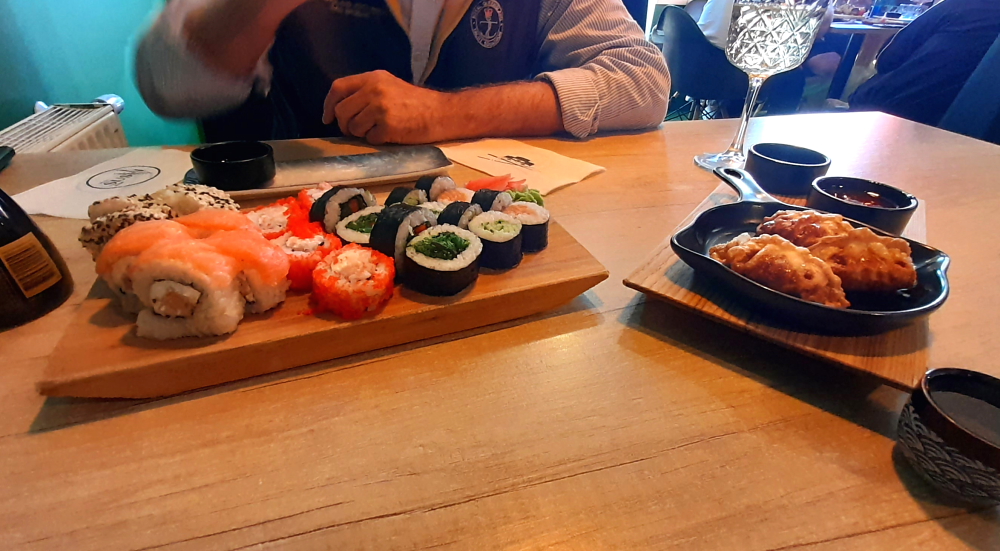
Go to Sushi, but you’ve got to wait for it.
By the time dinner arrived, Lynn had finished off her small flask of hot sake. When she tried to order another she was informed that they had run out! Catastrophe!
16 June, 2024
A lovely sunny day with an expected top of 24 degrees. After a leisurely breakfast we walk the old town.
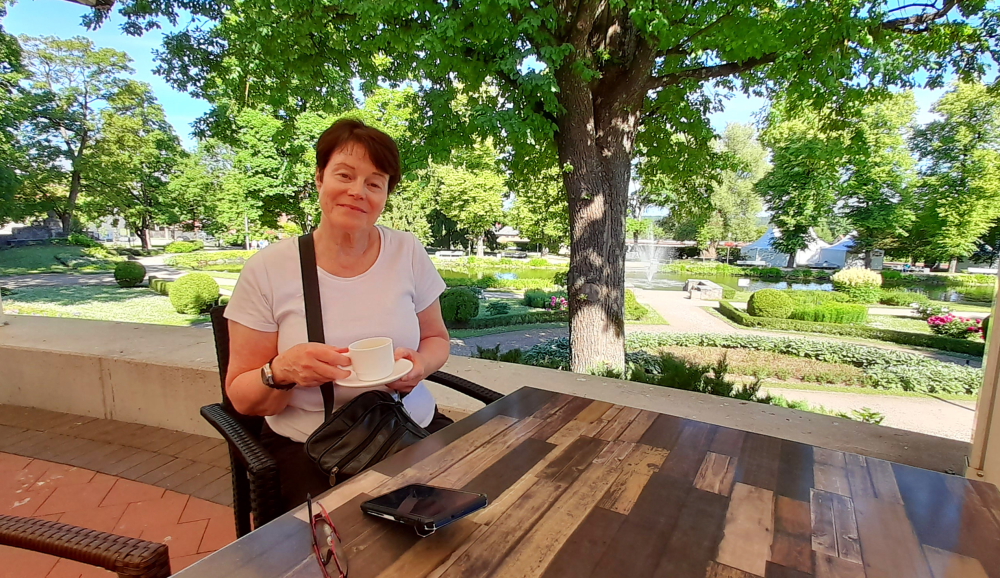
Breakfast coffee on the terrace.
First stop is Castle Square (Pils Laukum) and its manor house which was built around the year 1761 when the manor belonged to the Von Wolf family. In 1777 the property was bought from Baron Karl Adam von Wolf by Major and later Count Karl Eberhard von Sievers (Sievers, 1745 to 1821). Count Sievers family lived in the manor for five generations until the agrarian reform of Latvian Republic in 1920.
In 1919, after the battles of Cēsis, during Latvian Freedom fights, the building was occupied by Northern Latvia Civil administration. In 1922 the building was taken over by the Latvian army and until 1940 it served as the headquarters of the Daugavpils 8th Infantry Regiment of the Latvian army and officers’ club. After WWII the building was turned into an apartment building.
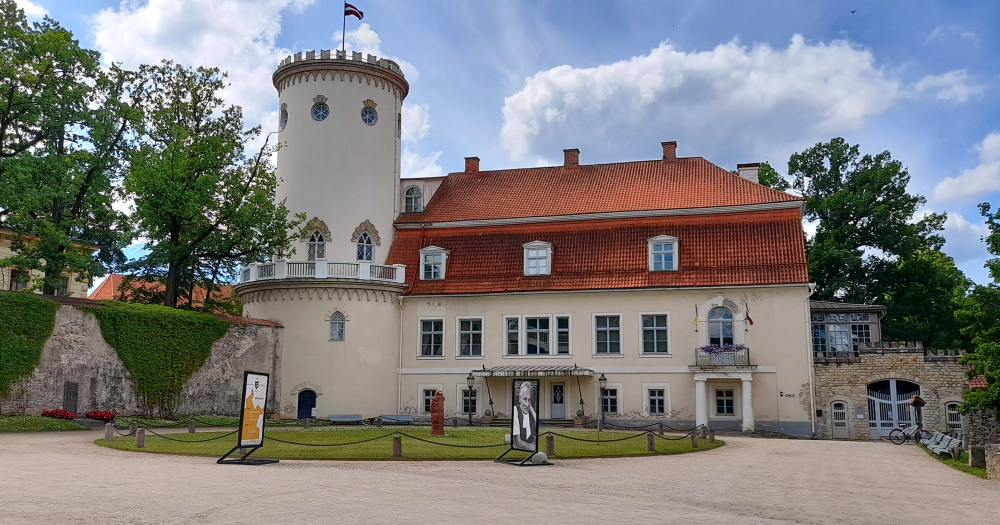
Castle Square & Manor, Cesis, Latvia.
The Cēsis History and Art Museum was established in the New Castle in 1949. After the restoration of the Cēsis manor house between 2007 – 2012 the former residence of Count Sievers family regained its historical appearance.
One of the most mysterious monuments of pre-crusader times is Riekstu Hill, a ancient hillfort once inhabited by Vendi tribe – the cradle of present day Cēsis. Right next to Riekstu Hill the castle built by the Livonian Brothers of the Sword and the Teutonic order is located.
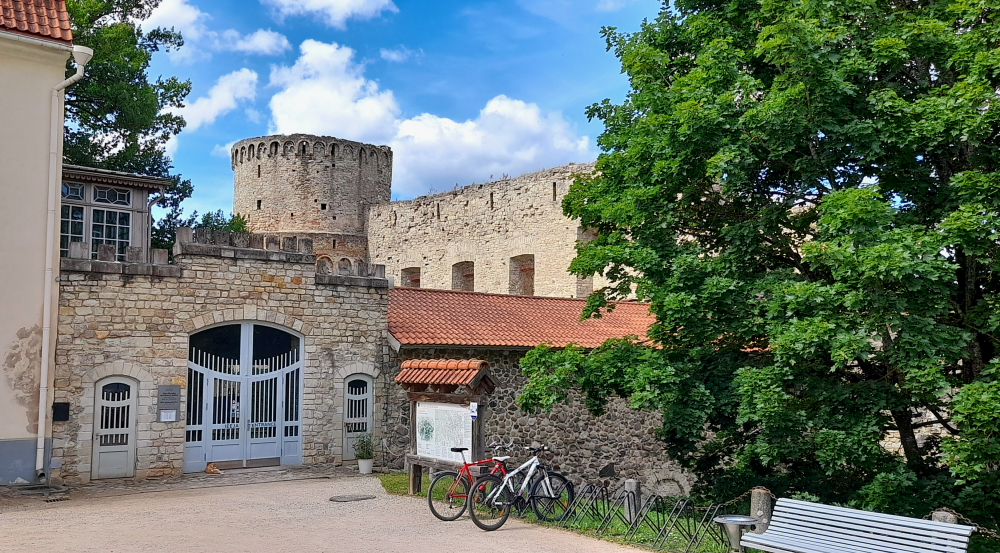
Castle ruins & west tower, Cesis, Latvia.
In the middle Ages it was one of the most important footholds for the Teutonic Order in the Baltics, but nowadays – most impressive and well-preserved castle ruins in Latvia [cesupils.lv].
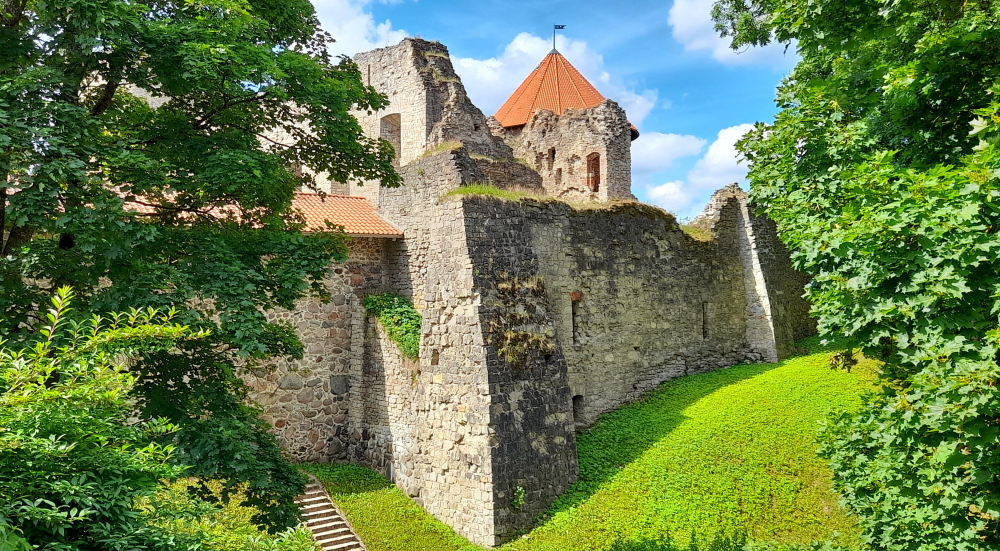
Castle walls, ruins & north tower, Cesis, Latvia.
From here we walk to the commencement of Rigas iela where a stone-wall outline shows where the Rauna Gate used to be.
Halfway along Rigas iela is the Square of Roses (Rožu laukums) which is overlooked by the St. John’s Evangelical Lutheran Church and the Cesis Branch of the University of Riga. Right now, at 11:55 am, there is church service in progress so Lynn will return later this afternoon.
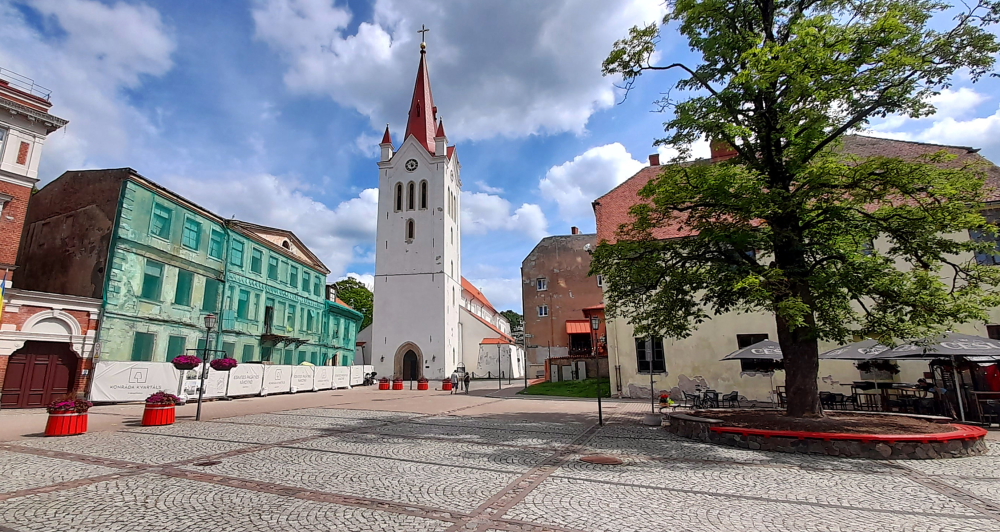
St John’s Evangelical Lutheran Church, Cesis, Latvia.
Also in this square is a fountain and sculpture of ancient Cesis.
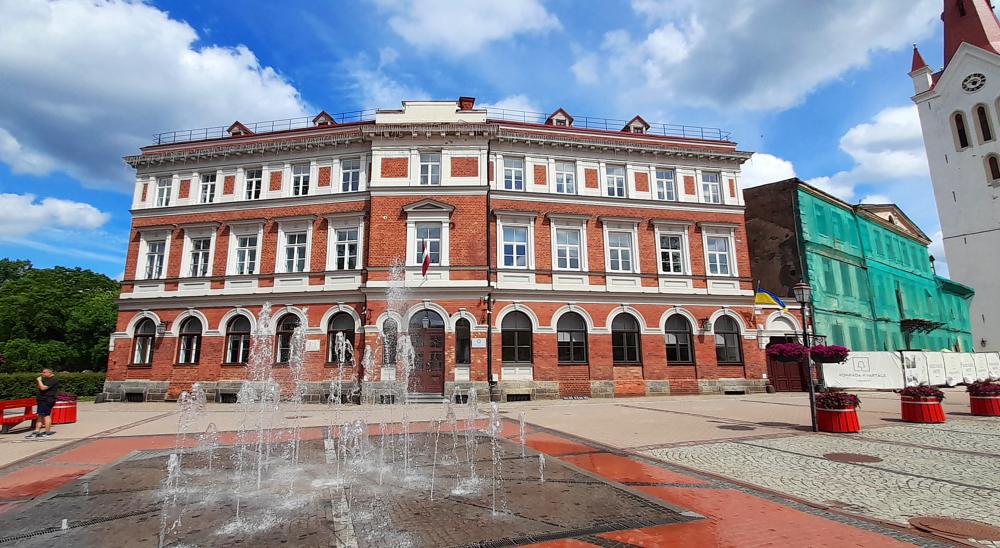
Cesis Branch, University of Riga, Cesis, Latvia.
As we continue down Rigas iela we come across an intriguing sculpture – a row of modern shoes made of concrete with the date 1941 beside them.
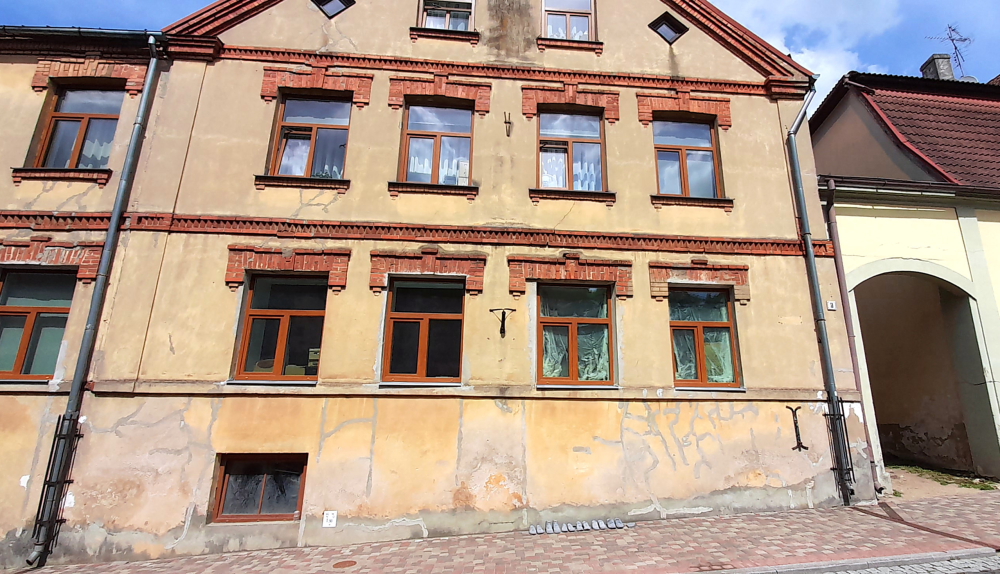
Road One Nine Four One, Rigas iela, Cesis, Latvia.
On 4 July 2022 at 6 p.m., on the Day of Commemoration of the Victims of the Jewish Genocide in Latvia, an art object was unveiled in Cesis. This monument is dedicated to the memory of Jews and is placed in the public space of Cesis, Road One Nine Four One.
Until the summer of 1941, about 200 Jews were living in Cesis and its surroundings. At the beginning of August, they were arrested and murdered on the night of 10 August in the woods near Lake Ninieris.
Krista and Reinis Dzudzilo, the authors of the art object, aim to bring Jews back to the present, to history, and everyday life in Cesis, allowing their memories to return to their former homes.
The sculptures are placed on different streets of the city where Jews lived before the Holocaust. Prototypes of the sculptures were pairs of shoes donated by Cesis residents currently living there. A special map of the city, which can be obtained at the Cesis Tourist Information Center, helps to locate the sculptures and the former places of residence of Cesis Jews.
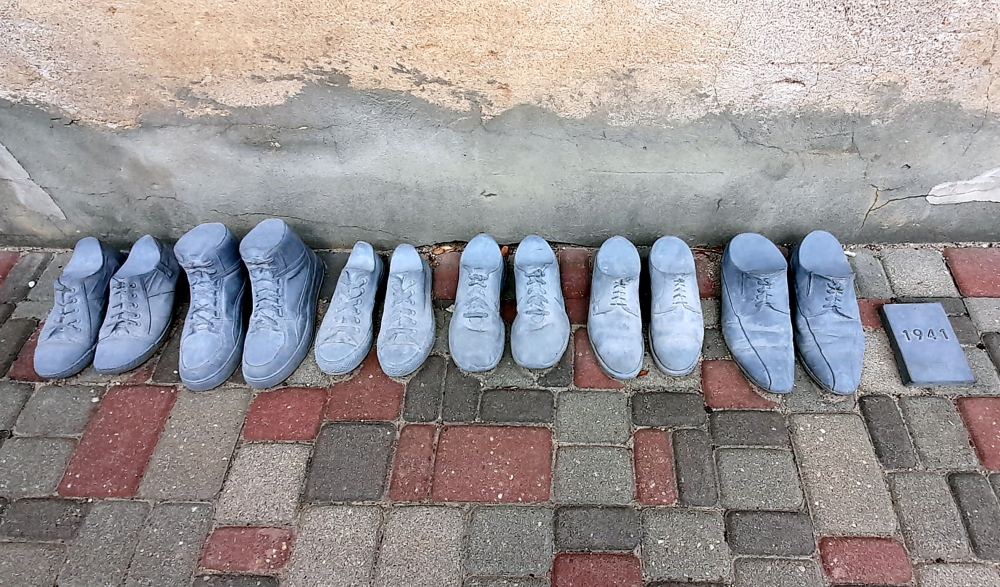
Road One Nine Four One, Cesis, Latvia.
We turn onto Palasta iela which loops back to the lake in Castle Park (Pils Parks). Off it is a short pathway that leads to the quaint Transfiguration of Christ Orthodox Church.
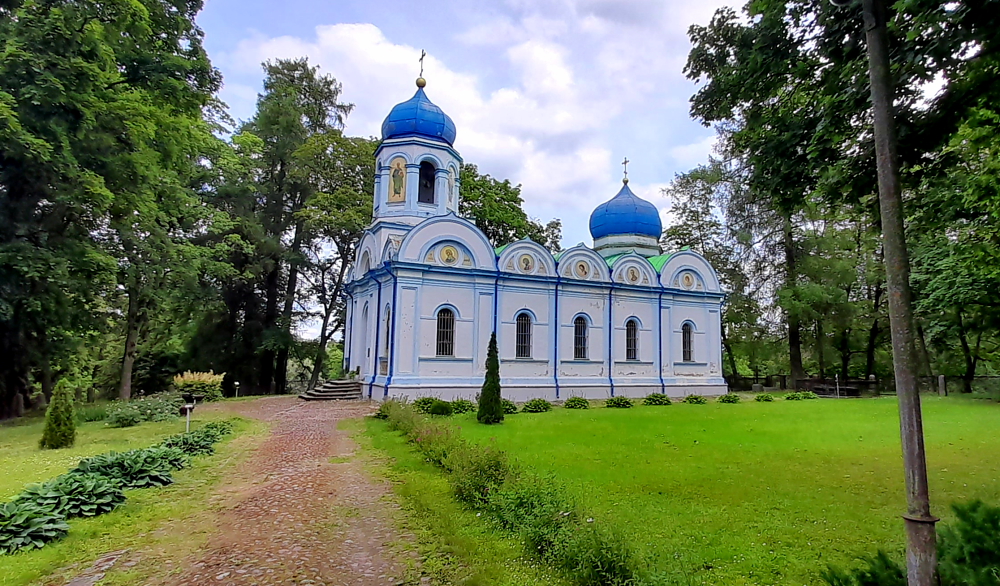
Transfiguration of Christ Orthodox Church, Cesis, Latvia.
Built in Byzantine style, the Transfiguration of Christ Orthodox Church of Cēsis is decorated with icons of saints and vivid blue turrets.
Already in the 14th century, when Saint John’s Church could no longer accommodate the many worshipers from the vicinity of Cēsis, Saint Catherine’s Church was built here. Unfortunately, it was left in ruins after the Great Northern War.
In 1845 count Karl Eberhard von Sievers, the owner of Cēsis New Castle and Manor, ordered a new church to be built on the ruins of Saint Catherine’s Church in Byzantine style. The walls of the Transfiguration of Christ Orthodox Church of Cēsis were constructed of dolomite stone, and the congregation premises were decorated in gothic style, just like in the old church.
Johann Köehler, pioneer of Estonian national art, assisted in creating the church’s interior, such as the altar piece, The Resurrection of Christ (Kristus augšāmcelšanās) [www.entergauja.com].
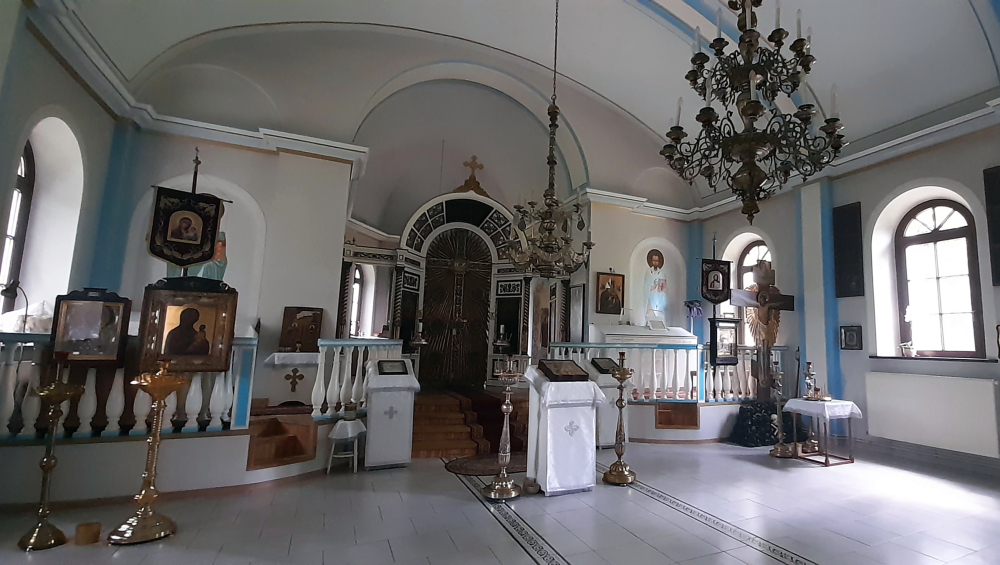
Interior, Transfiguration of Christ Orthodox Church, Cesis, Latvia.
Outside, in the church garden is the Sievers family vault which overlooks the lake below.
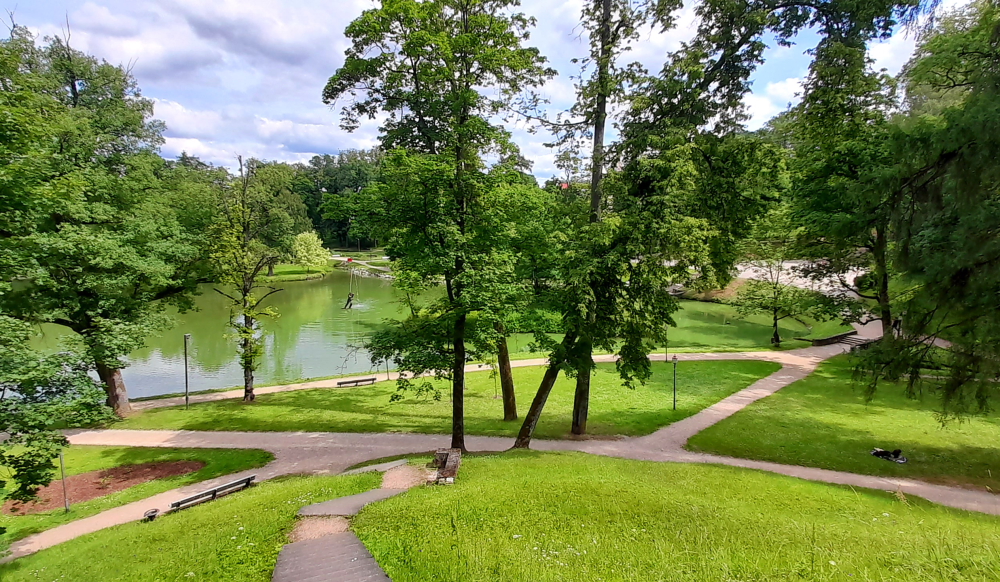
View of the lake from the Church’s garden, Cesis, Latvia.
Castle Park dates back to 1812, when the Sievers family began to build the park in accordance with the fashionable landscape parks as a family recreation area with promenades.
The park is dominated by the pond. In the centre of the pond, where there was already a fountain, now there is a sculpture – a fountain set up in 1961 by the sculptor Andrejs Jansons – “A fisherman with a cat fish”.
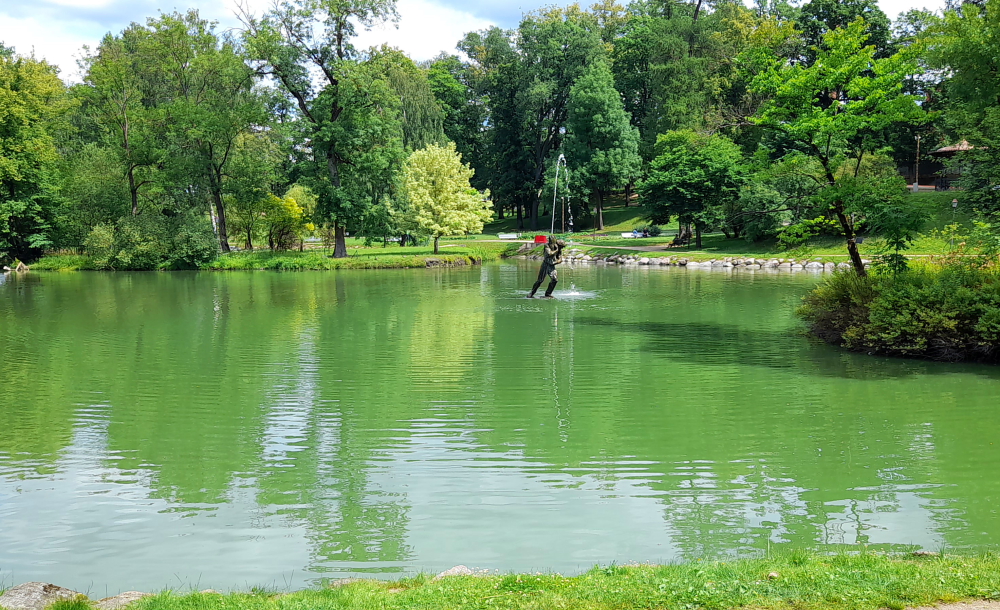
Fountain, Castle Park, Cesis, Latvia.
The park is located 22 m below the New Castle area, so park visitors can enter the park using the grand travertine staircase at the end of which is a large open-air stage used for a variety of cultural events. Today there is a rehearsal for a dance troupe.
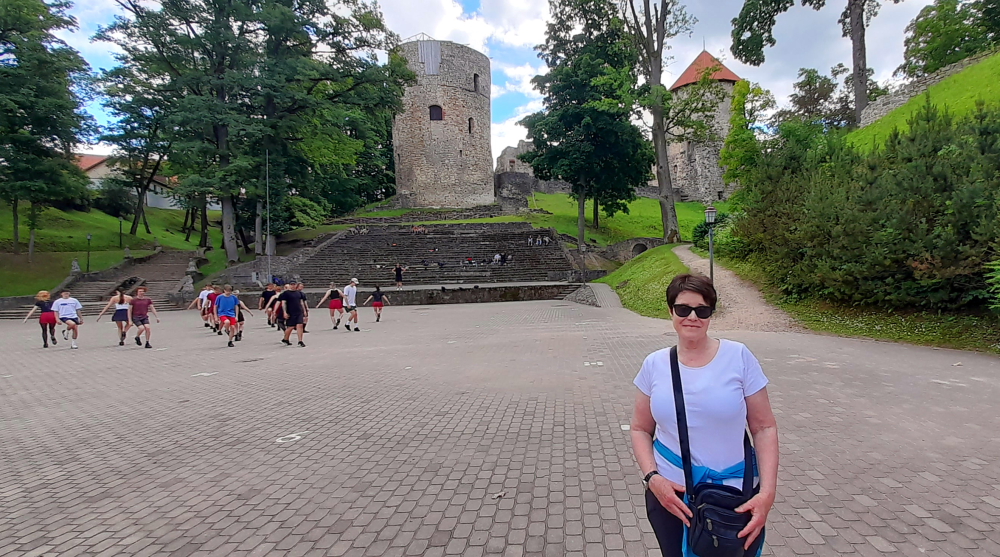
They’re at it again – more open-air dancing!
To one side of the stage area is a hillock with a bust of Count Sievers and a gazebo.
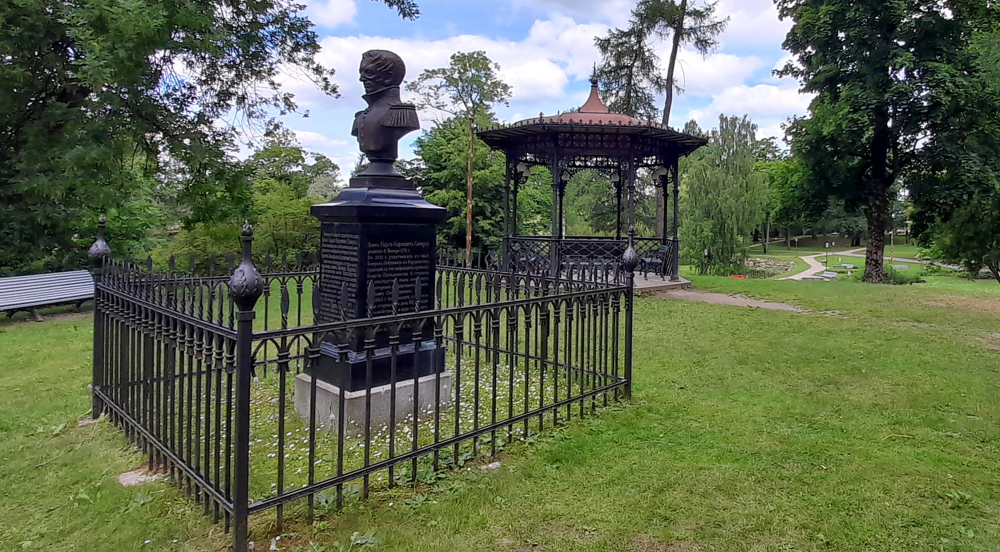
Count Sievers bust inscribed with his gallantry during the Napoleonic War (1812-1814).
The description of Cēsis in the book “The Baltic provinces” (1841) J. Kols pointed to it as a favourite destination, “Students of Tartu, whose promised Land is Cēsis, frequently make trips on foot during summertime. Like Goethe followers to Harz, Heidelberg people to Odenwald and Breslaw people to Carpathians.” [www.redzet.lv].
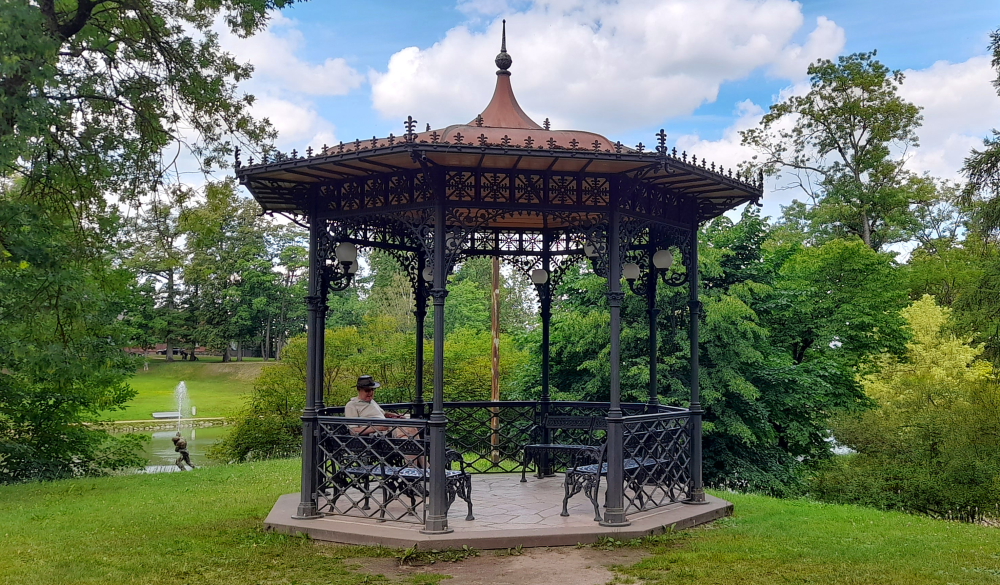
Once a Sievers Family private park, now open to the public.
As we climb the travertine staircase we see yet another photo relating to the period 1939-1957.
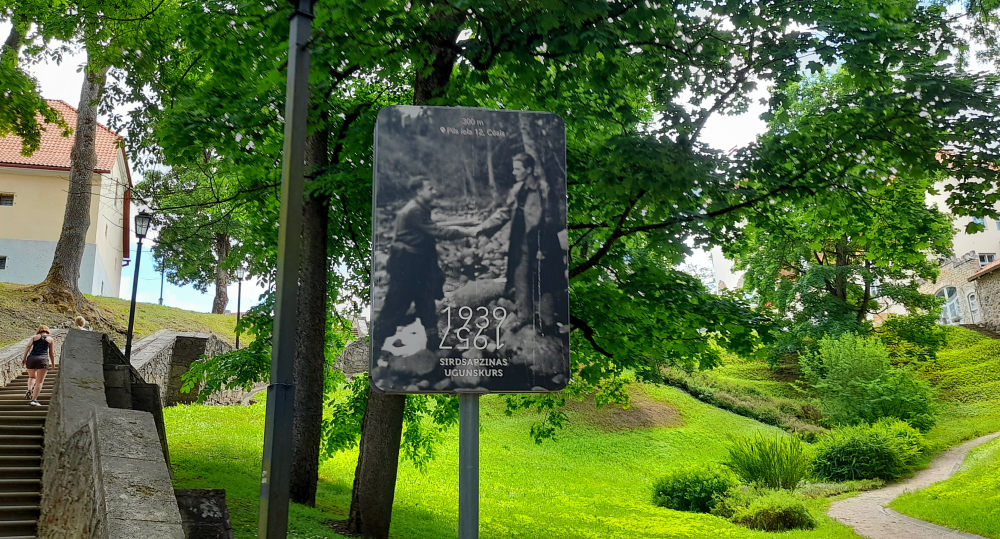
“Burning Conscience” exhibition, Latvian Resistance, 1939-1957.
‘Burning Conscience’ history exhibition tells the story of the Latvian resistance to first the Soviet, then the Nazi and again the Soviet occupations of Latvia. It focuses on the region of Cesis. Its museum is located at the Castle entrance.
Returning to the hotel we pass by another sculpture, this time a stainless steel one to local, Haralds Simanis (1951-2022), a Latvian roofer, church restorer and singer. Self-taught in guitar and organ, in the 1970s Sīmanis started a collaboration with Arvīdas Ulmi , whose poetry he used in his songs. In 1976, he composed a poem for the organ “Love never ends”, two years later the song cycle “Likteņa lietavas”, and in 1979 – the cycle “About grass, salt and you”.
H. Sīmanis gained wider recognition in 1980, when he performed his ballad “Ezers” at the final concert of the ” Microphone Song Survey “, which, with its sound, was drastically different from everything that had been broadcast on Latvian television until then.
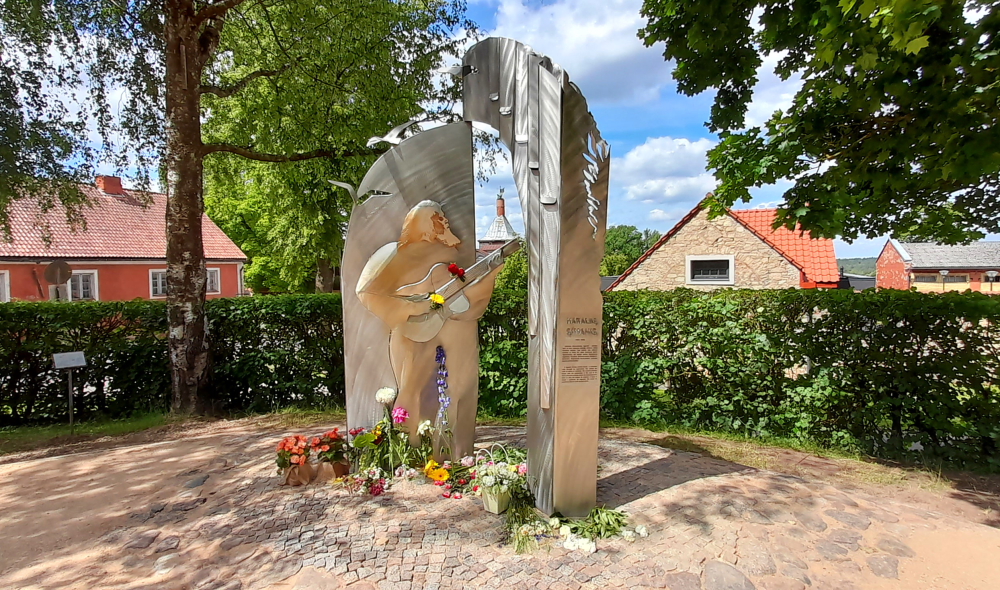
Memorial to Haralds Simanis, Cesis, Latvia.
In 1984, Sīmanis became involved in the predecessor of the “Environmental Protection Club ” organized by Arvīdas Ulma, the “Monuments Protection Center” which organized the replacement of roofs for several Latvian churches and the musician helped with his roofing skills.
Later in the afternoon Lynn returns to St John’s Church, one of the oldest medieval architectural monuments in Latvia. It was built in the beginning of 13th century during the Christianization of the Baltics for the purposes of the Livonian Holy Order as the residence for its Master, in the Castle, was located in Cēsis. Therefore, Cēsis became one of the most important German power centers in the Baltics from 1237 up to 1561.
St. John’s Church is also the largest medieval basilica outside Riga – 65m long and 32m wide with 3 spherical basilicas, a 65m-high bell tower with a 15m high Gothic spire. There are 1000 seats in the church – each pew provided with several blankets! [latvia.travel].
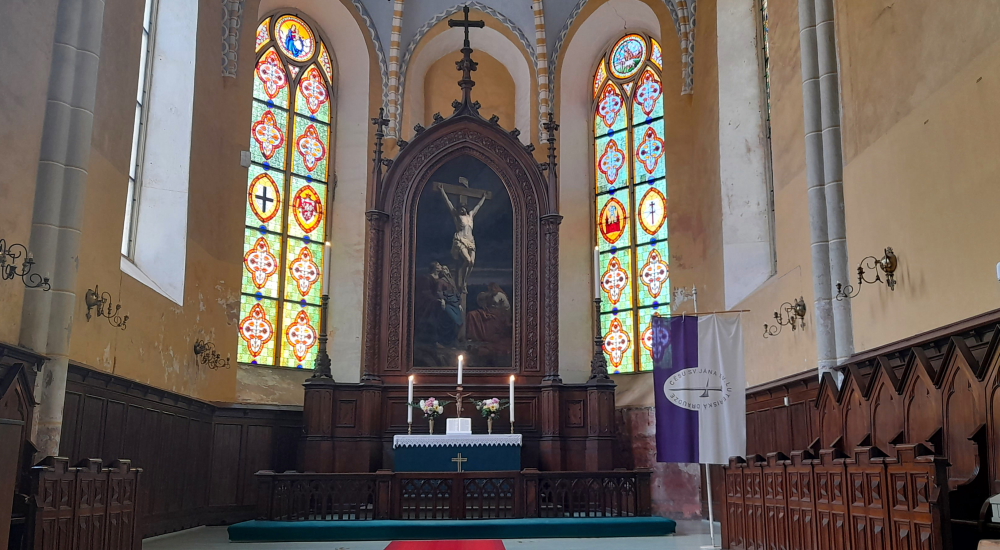
Altar, St John’s Church, Cesis, Latvia.
Around the corner from the church, on Tornu iela is a large sculpture by Matthias Janson,“Through the centuries” – popularly known as Old Time man – which was opened in July 2005. It depicts a man with a lamp, a symbol of the town of Cēsis.
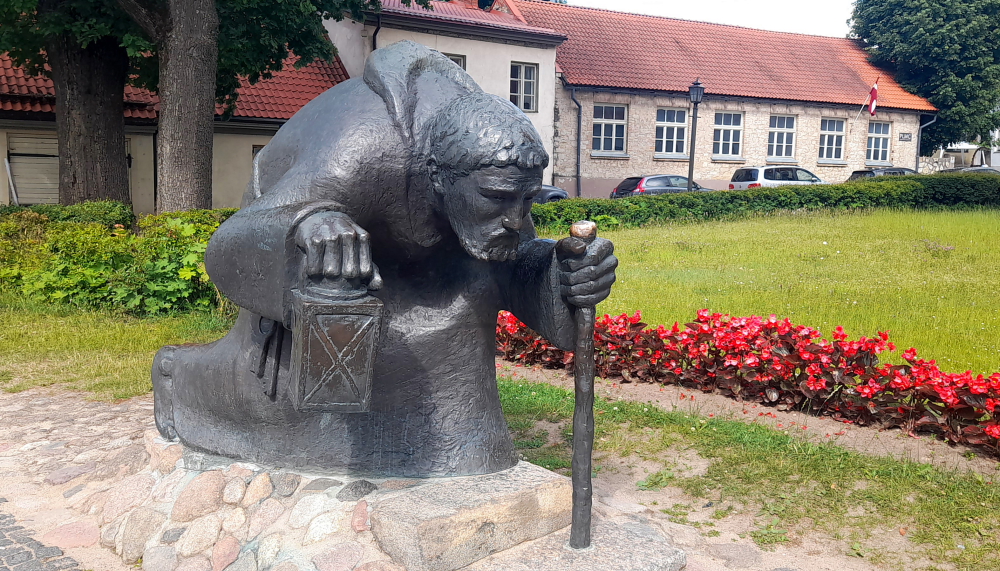
“Through the Centuries” sculpture, Tornu iela, Cesis, Latvia.
According to the legend, long ago, in ancient times in Cēsis lived a man. When the townspeople went to bed, he walked all around the streets with his reliable guides – a cudgel and an illuminated lantern – and people knew as long as this man walked through the city streets, the town is safe and peaceful. But one night the man disappeared. If you somehow, someday, in any cross street meet a man with a cudgel and a lantern in his hand, don’t forget to polish the glass of the lantern as its light will always show the right way [caminolatvia.com].
Nearby is the Cesis Tourist Office and outside is a box with a stamp for the Latvian Camino pilgrims.
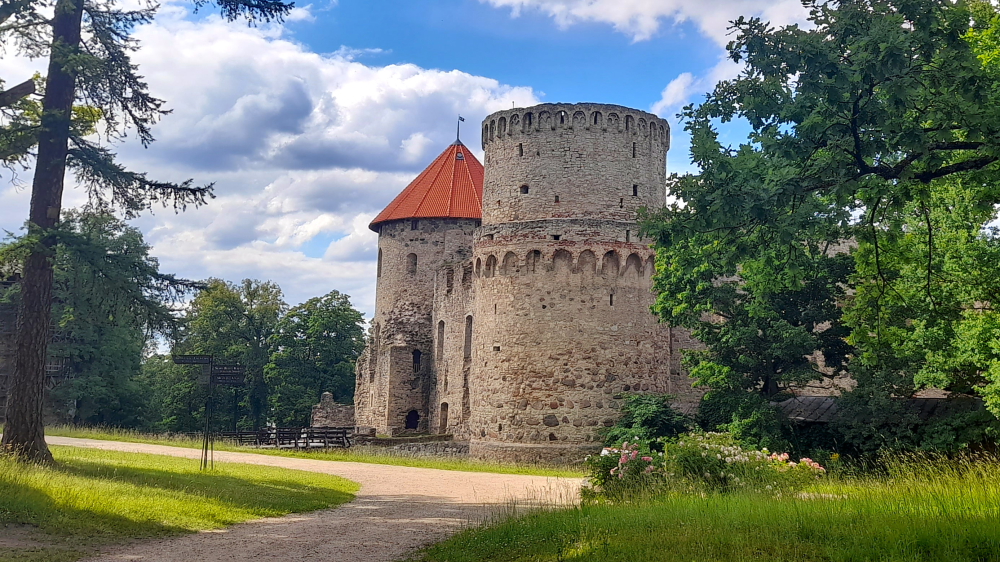
View of the Castle from Tornu Street, Cesis, Latvia.
Around the corner, in Pils iela, is the “Burning Conscience” exhibition/museum. Established in a Soviet-era temporary detention facility, it tells about the occupation of Latvia and reveals surprising and heroic stories of resistance from individuals.
The yard features a memorial wall with the names of 643 residents of the former Cēsis district who died in Soviet repressions, including national partisans deported in 1941 and 1949 and those shot and sentenced to death.
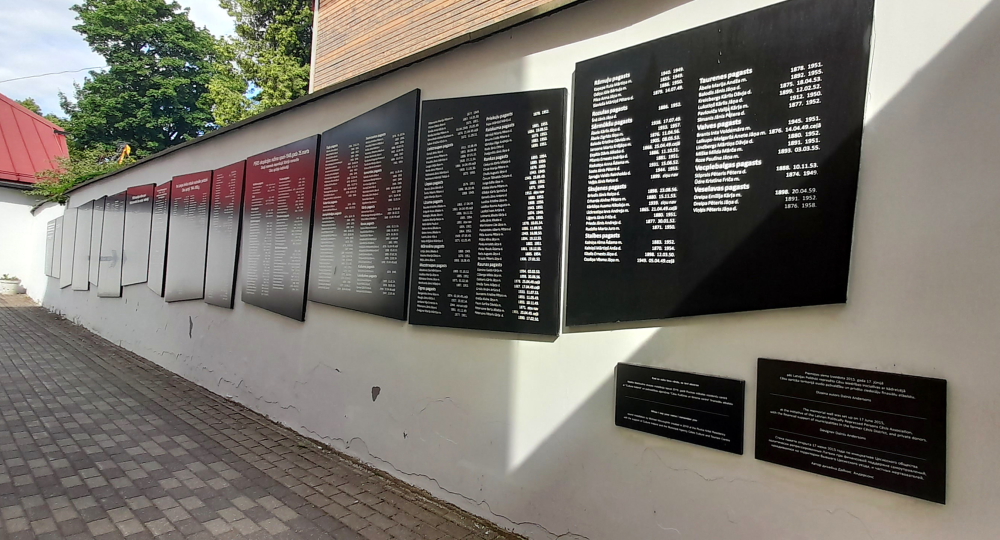
Memorial wall, “Burning Conscience” exhibit, Pils iela, Cesis, Latvia.
The 6 cells for temporary detention have survived to the present day in their original form from 1940 to 1941 and the post-war years. Here, the residents of Cēsis district, detained for various anti-Soviet activities, including national partisans, their supporters, young people who distributed anti-Soviet leaflets and other ‘traitors of the motherland’, were held for several days during the initial investigation and interrogation before being sent to the main KGB Building in Riga [militaryheritagetourism.info].
Around 5:30 pm we call into the hotel’s cafe which is in the basement. Even though the queue is short, after checking out the now meager offerings in the bain marie, we decide to go elsewhere.
Fortunately, over the road is a restaurant where we plonk ourselves. Although there are only a few tables with patrons the waitress tells us that our food will take at least 50 minutes from ordering. As we are in no hurry we stay and are rewarded with cold beverages while we end up waiting only 20 minutes for our tasty orders to arrive.
We settle into our room for the evening, expecting it to be nice and quiet like it was last night. Wrong! We hadn’t figured on the rest of the 38 rooms being occupied by primary school kids running amok in the hotel – running up and down the staircase and corridors, banging doors, yelling and jostling. While I go downstairs to complain to Valerie, the receptionist, Lynn manages to find the ‘supervising adult’ – probably a teacher – and reminds him that this is an hotel, not a kids’ playground. Although he ticks off a group of boys the mayhem continues for several more hours.
17 June, 2024
After threatening thunderstorms since our arrival 2 days ago and after rumbling all morning, it finally starts to rain heavily this afternoon. As we’d seen pretty much everything in town I backed up the blog and Lynn rested her knee. For dinner we went over the road to the bistro “Pasednica” which had a far better selection of food and far better service than the hotel’s cafe.
18 June, 2024
This morning it’s sunny and 20 degrees as we leave the hotel at 11 am. Riga is only 89km away, about a 1.5 hours’ drive so we plan on 2 stops en route.
The 1st of these is the windmill near Araisi just off the P20 which was built to service the needs of the Drabeši manor, around the mid-19th century. It’s a Dutch-type mill with a rotating cap and was used to grind groats (hulled grain), as well as flour for black bread and animal feed [latvia.travel].
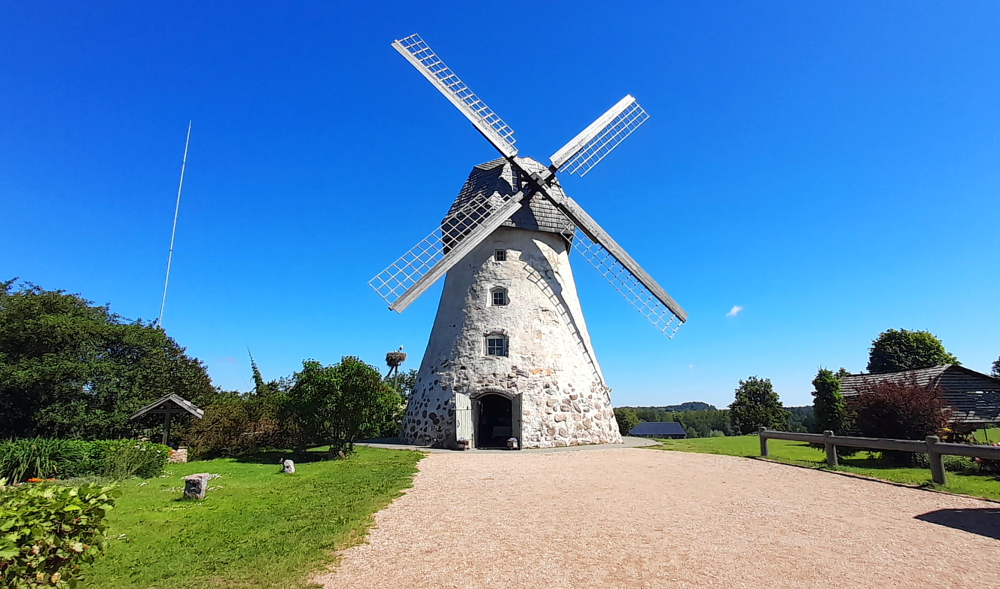
The Araisu Vejdzirnavas (Town Windmill).
What is particularly special about this stop is the elevated stork’s nest we discover behind the mill which has 3 chicks inside.
Our next stop is the castle at Sigulda, 30km SW, which we reach after a 10-minute delay thanks to roadworks on the A2. Besides the largest national park in Latvia (Gauja National Park) and parkland for summer activities (hiking, swimming, adventure park, zipline, festivals) and winter activities (skiing, bobsledding and luge) Sigulda also boasts 2 castles – medieval and new.
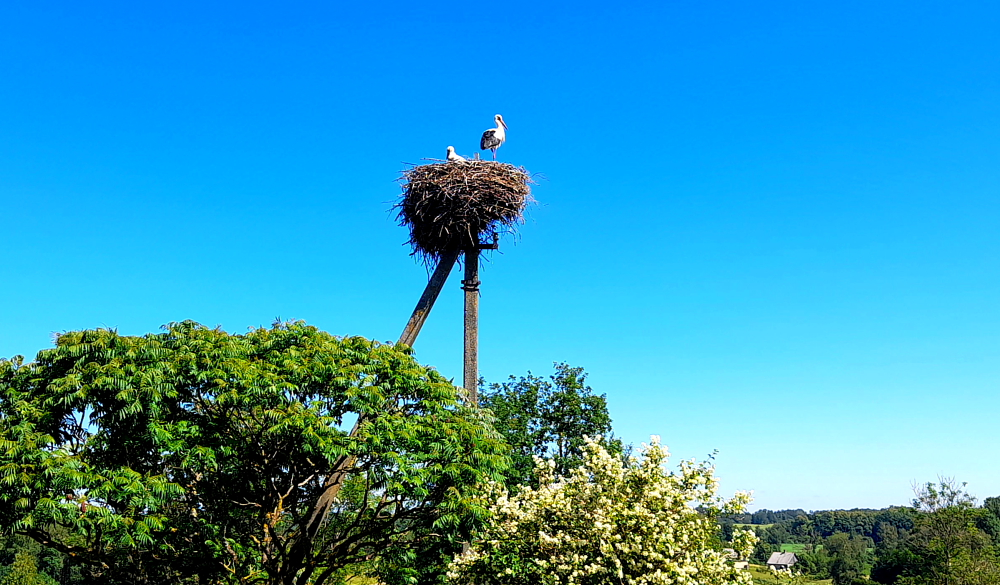
Stork with three chicks.
The Sigulda Medieval Castle was built by the Livonian Brothers of the Sword who were later incorporated into the Teutonic Order of the castle. Officially known as The Militia of Christ of Livonia, this military order, founded in 1202, was composed of German “warrior monks”, the 1st “warrior monk” order formed outside the Mediterranean region. Historical documents indicate bishop Albert of Riga and Cistercian abbot Theoderich were its co-founders. The castle was initially built to monitor and control the water ways of the Gauja River and to fend off any invasion attempts from the nearby bishop’s castle in Turaida.
Since 1432 Sigulda Castle was the residence of the Land Marshal of the Livonian Order, the second highest officer of the order after the Livonian Master, who lived in the Cēsis Medieval Castle.
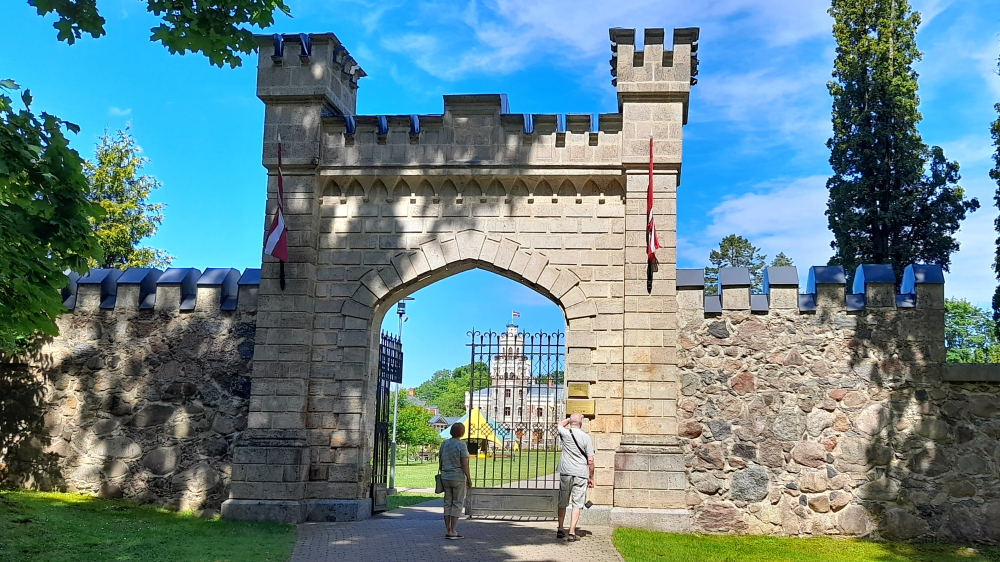
Sigulda Castle Gate.
In the 19th century the medieval castle and its layout were remodeled and a gate, inscribed 1867, was added to the front part of the castle and decorated with the Borch family coat of arms. Additionally, the ruins of the castle were fortified and two arches were constructed. Finally, between 1878 and 1881, a new castle was built by Prince Kropotkin’s family.
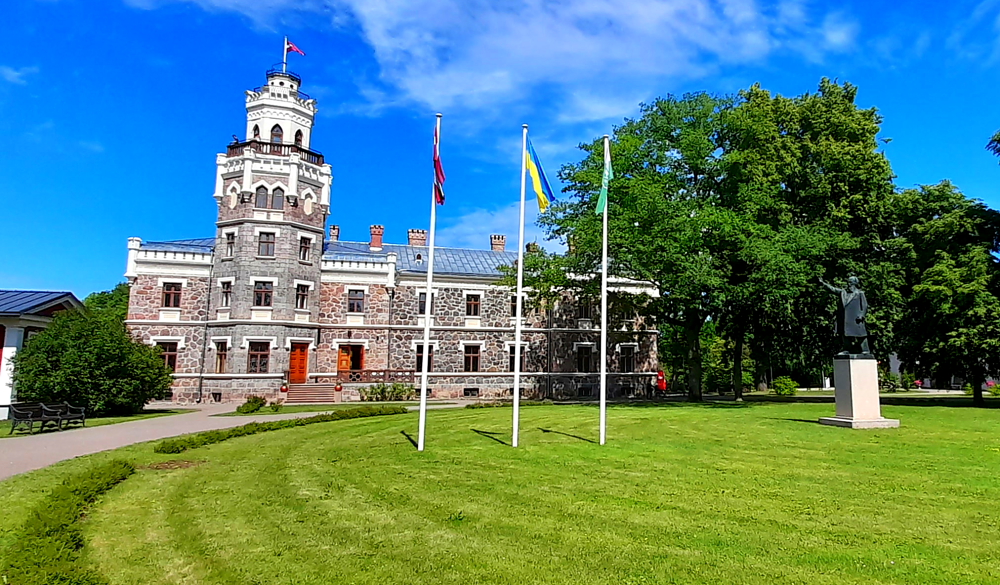
The New Castle, Sigulda, Latvia.
The exterior of the New Castle of Sigulda has retained its neo-Gothic style, meanwhile its interior became a pearl of national romanticism in 1937 when it hosted the Latvian Union of Writers and Journalists [wikipedia].
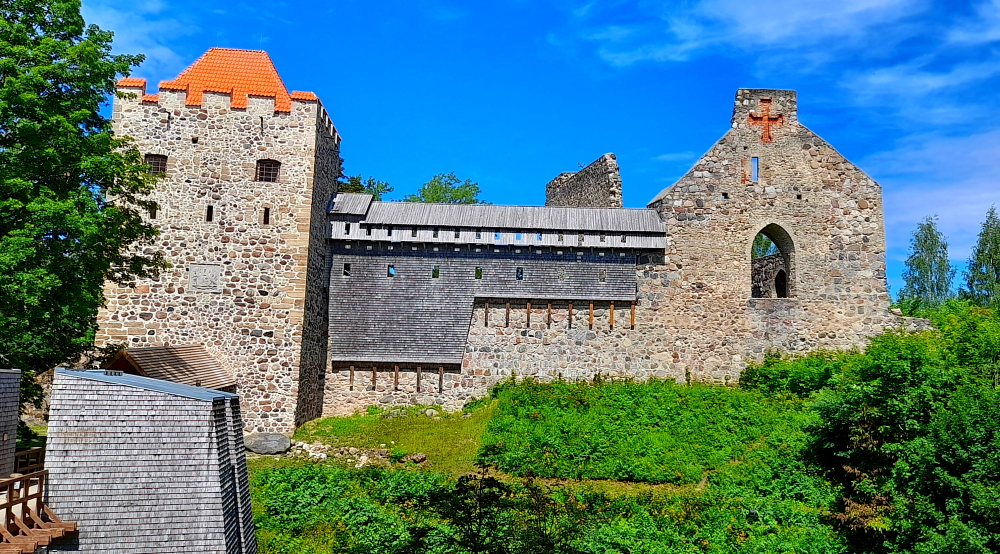
Medieval Castle, Sigulda.
From here we are due to arrive in Riga 50 minutes later, around 1:30 pm. Interestingly, it appears the Latvians have adopted Swedish highway design – i.e. 110 kph with sudden 70 kph zones for intersections. The A2 even has a pedestrian crossing – i.e. 110 kph to 0 kph! Not thought to build a pedestrian overpass??
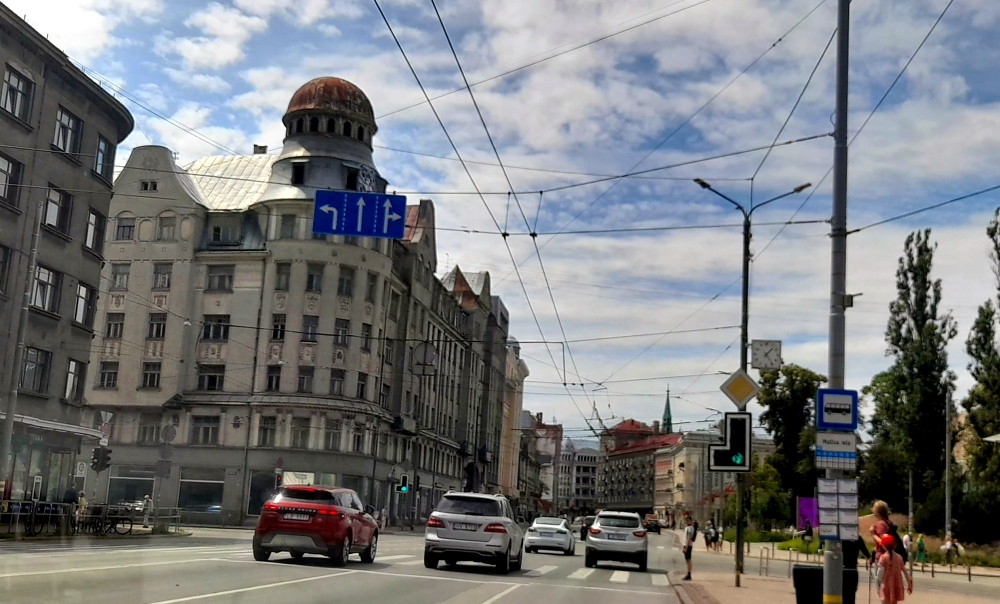
Outskirts of Riga.
Driving through the outskirts of Riga is not all that promising. Rundown concrete buildings and, in one section, the road is still made from bone-shaking cobble stones.
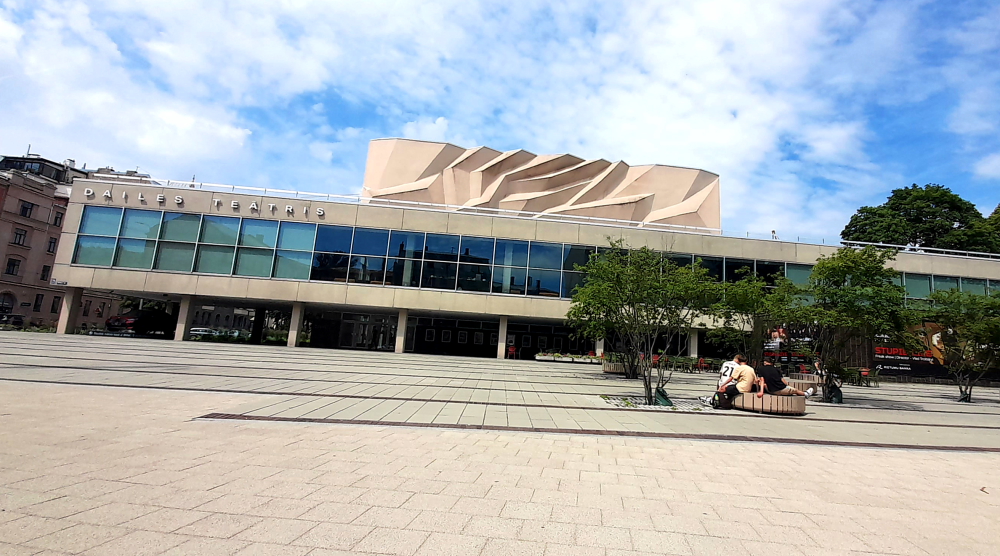
Dailes Teatris.
But as we drive closer to the Old Town, the urban scape starts to improve with more classic-style buildings.
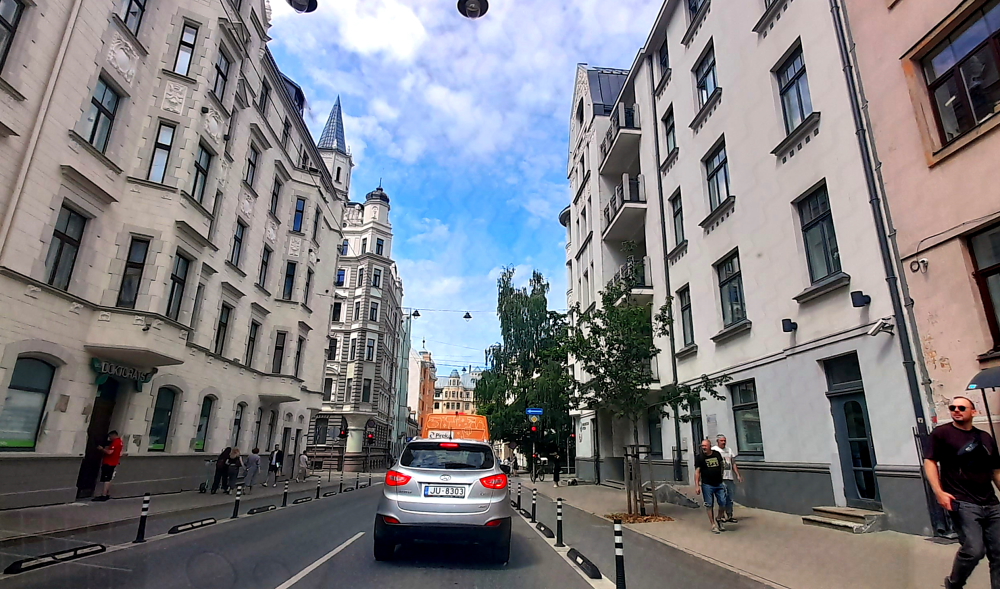
Near our hotel, Riga.
Turns out there are 6 Radisson hotels in Riga alone – 4 of which are Blus!
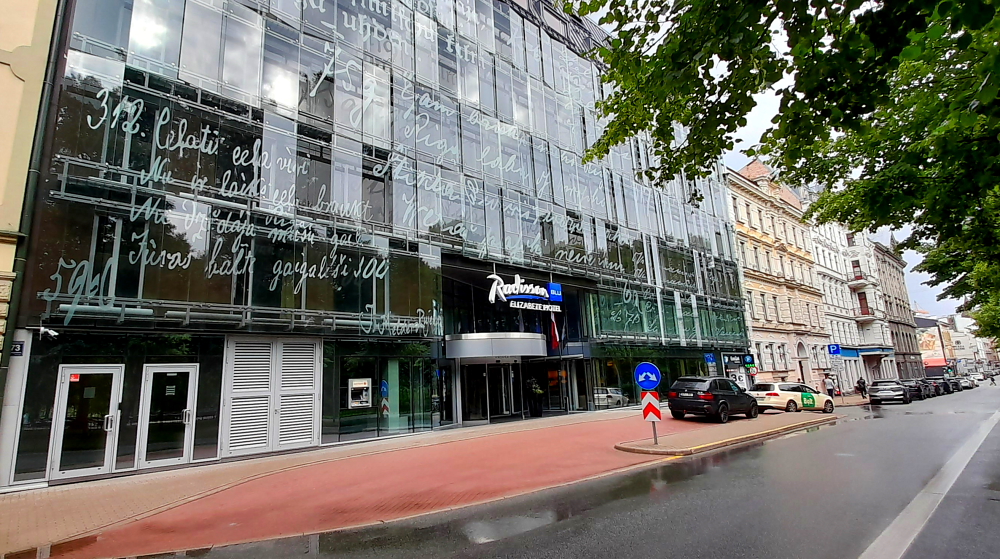
Radisson Blu Elizabete.
We stop outside its Radisson Blu Elizabete, a modern, glass structure overlooking the Vermanes Garden.
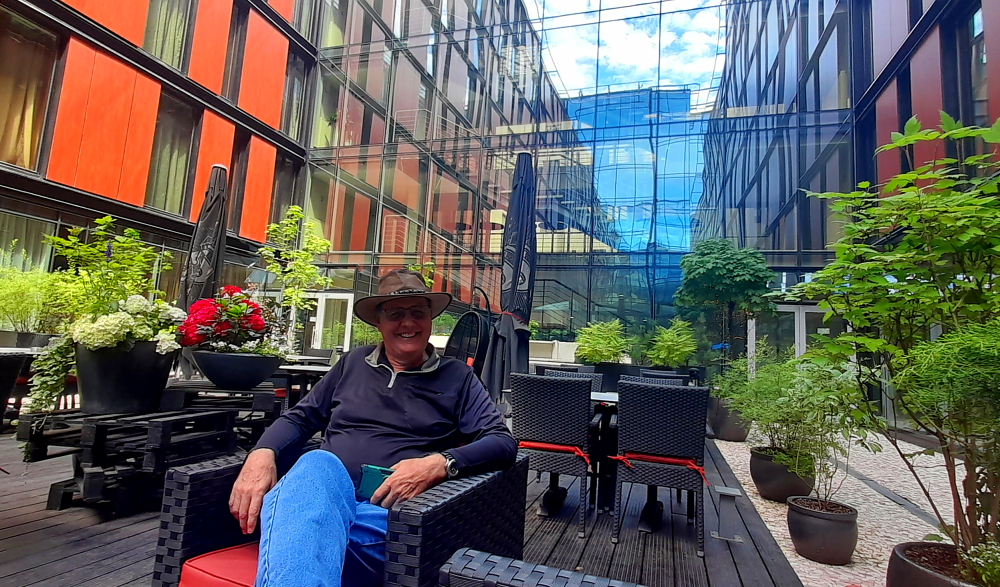
Centre courtyard of the Radisson.
As we’ve arrived 1.5 hours before our room is due to be ready, I drop the bags and park the car in the hotel’s underground car park while Lynn checks us in then we sit in the al fresco courtyard with our free, non-alcoholic, welcome drink.
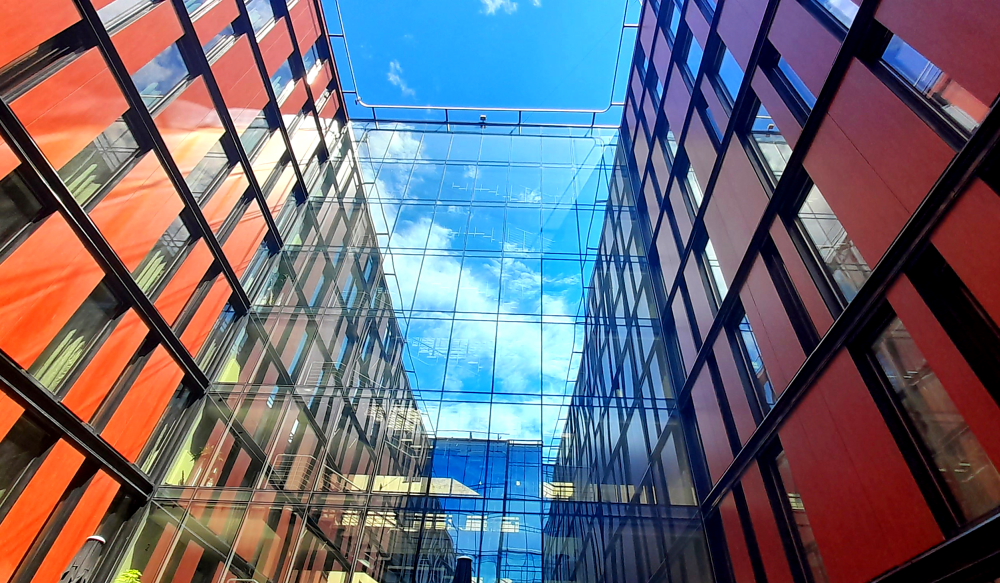
Open to the Riga sky.
40 minutes later we unpack in our upgraded Member’s room on level 7 which overlooks the courtyard.
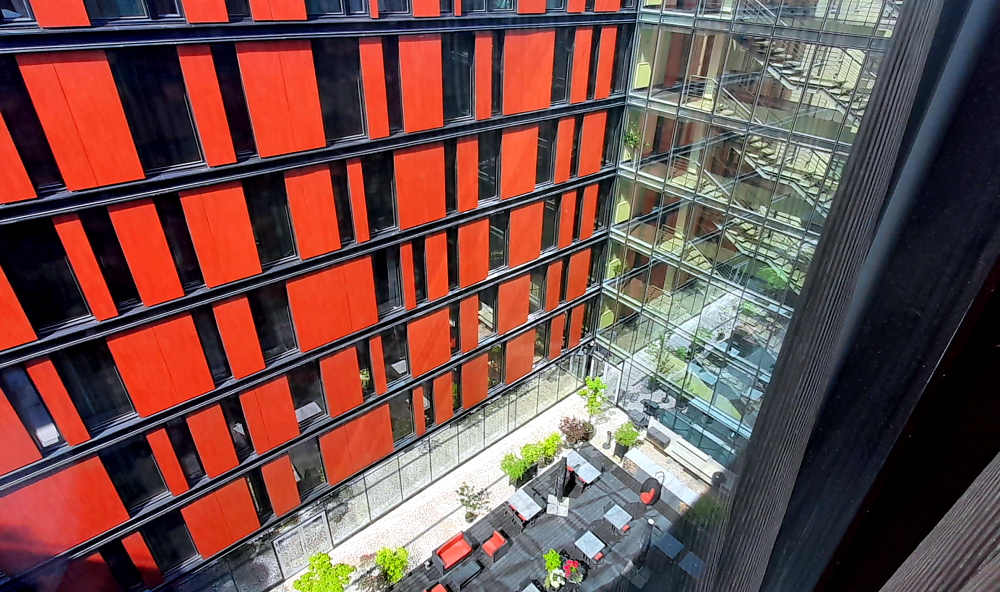
View from our room.
Lynn’s 1st priority is to find an adjustable brace for her knee so she hobbles around the corner on a walking stick – me – to the nearest chemist. Here, the young assistant tells here that further up the street is a store that sells rehab aids – physical rather than alcoholic, although Lynn probably needs both! 10 minutes later she shuffles out of the store with a new, black brace on her knee and I’m Eu47 poorer.
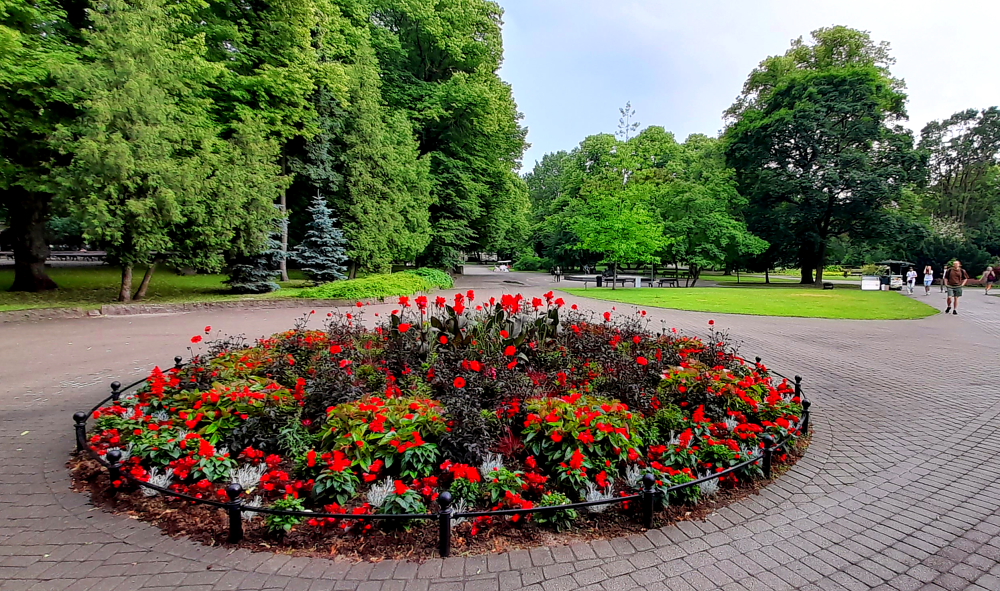
In the Vermanes Garden across the street.
We just make it back to the hotel in time before it buckets down. Later, I venture out into the gardens across the road from the hotel.
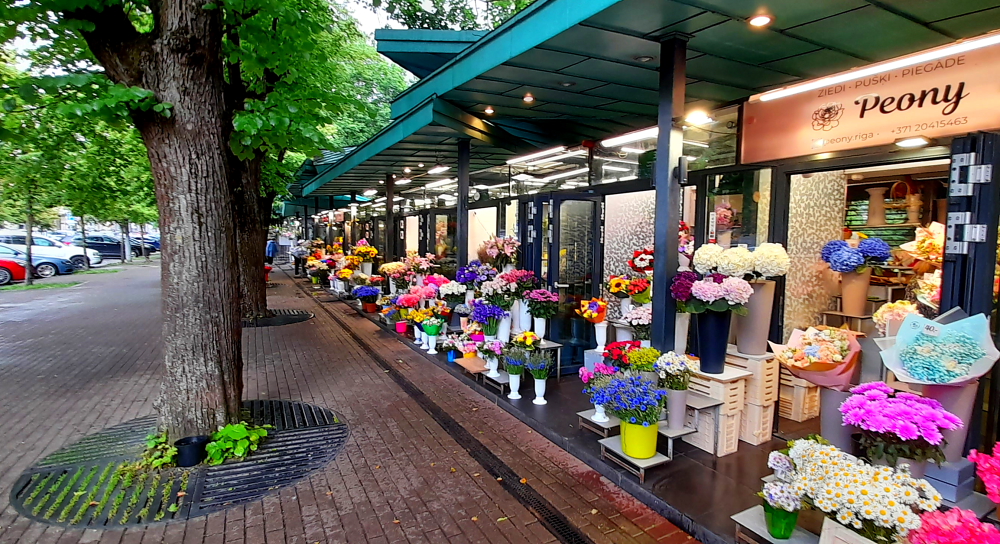
Flower stalls in the gardens.
Tonight we opt to dine in the hotel’s restaurant. Not only the best creamy tomato soup I’ve tasted in a long while but the Latvians GET IT – their “pint” of beer truly IS a pint of beer – 0.568L to be precise and not the half litre that a lot of pubs around the world call a “pint” of beer.
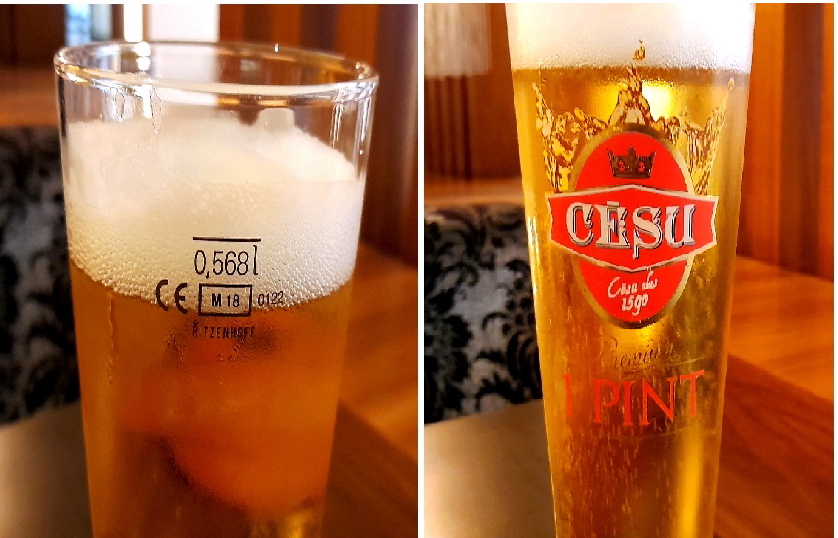
A true pint of beer or 568 ml.
19 June, 2024
It’s 7 degrees cooler today at 18 degrees and a prediction of 100% chance of rain. We were booked on a 2-hour GuruWalk at 4 pm this afternoon, “The Grand Riga Art Nouveau Tour”, which Lynn cancelled a couple of days ago but with a view that we may be able to do it on Saturday instead.
Radisson’s Member Loyalty program gives me some benefits, one of which is a Members’ dining area for breakfast. Just as well as there seems to be quite a scrum in the usual breakfast room. We order from the a la carte menu specifying that our poached eggs are to arrive after we’ve eaten our yoghurt and cereal but, something got lost in translation as they all arrive at once. Plus I have to go into the other breakfast room to rustle up 2 cups of coffee. There are cups and saucers in the Members’ area but no coffee pot or machine.
True to prediction it has been raining but lets up for about an hour while I venture out once again to check out the Old Town while Lynn updates the blog.
Since Lynn may struggle if we have a long walk when we do the walking tour tomorrow I plan to walk around the Old Town to get a feel for the distances involved. Firstly, I head across the Vermanes Garden then to The Freedom Monument which is on the bridge that crosses the city’s canal – the former moat.
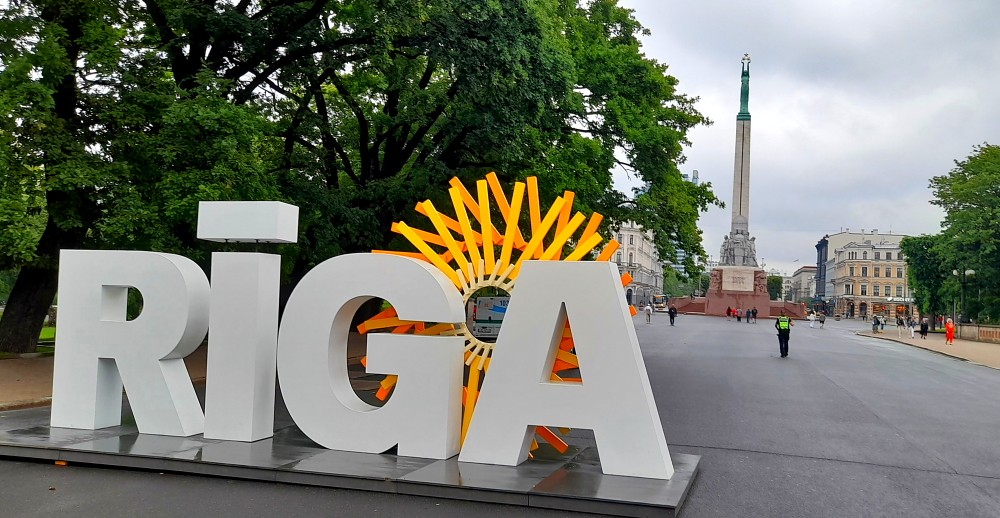
The Freedom Monument in the background.
So far the rain is holding off so I continue on to the Old Town where we will start the walking tour. There are lots of restaurants and shops about which are so typical in the tourist parts of a town.
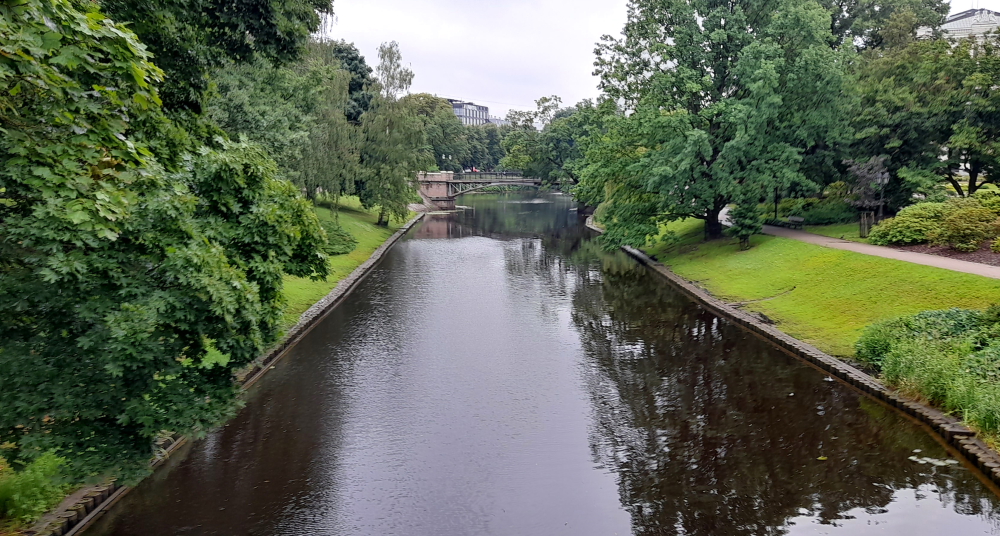
The City Canal – former moat.
Thick cloud cover doesn’t really allow Riga to show off in photos so I will wait until we have better weather to take more. The parklands around the canal are lovely and I can imagine lots of people around on a sunny day.
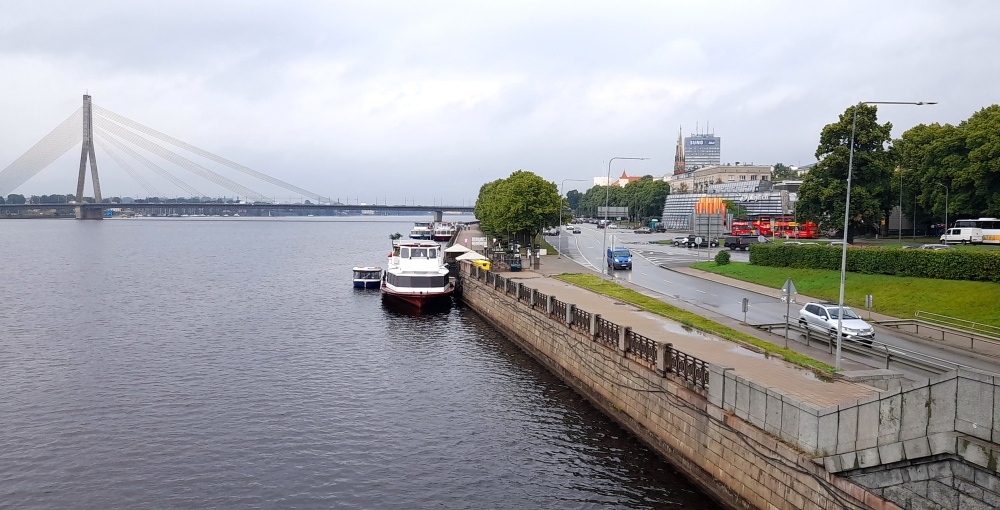
The Dangava River.
The walking tour probably won’t extend as far as the Dangava River so I head to the Akmens Tilts bridge to check out the other side and get a feel for just how big the river is in Riga.
The Old Town is relatively small so I think that Lynn will be able to manage the walk tomorrow. The sky is looking a little dark so I head back to the hotel and just manage to arrive as it starts to rain heavily.
I spend the remainder of the afternoon swearing at the WordPress editor. It seems that they have yet again updated their software and now it is full of bugs. Adding our photos to this blog will now take twice as long. Hey guys… ever heard of user acceptance testing before releasing a new version?? Thankfully we only have about 6 weeks of our trek to go (and therefore blog to write). Once we are home in Brisbane I will look for a better blog host and editor.
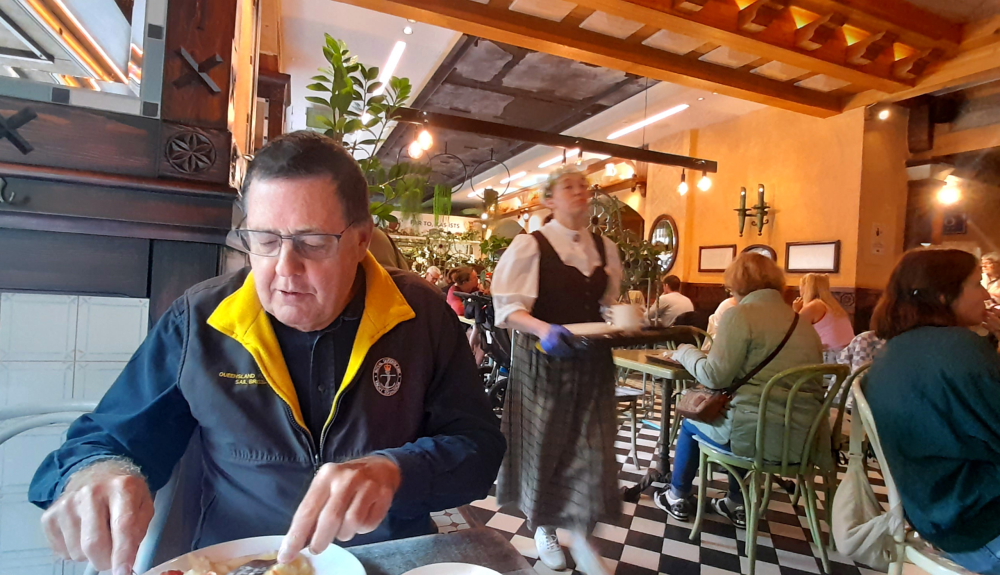
Lido Restaurant.
When we were in Tallinn we discovered “Lido” restaurants – cafeteria-style with local food. There’s one down the corner of the street where we dine tonight, more traditional in style and even the waitress is wearing traditional dress and a floral wreath in her hair in a nod to the approaching midsummer.
20 June, 2024
Rather than “gird your loins” Lynn has girded her knee with her heavy-duty knee brace in preparation for our 2-hour GuruWalk through Old Town Riga. After a rainy day yesterday, today’s sunshine and 23 degrees are perfect for a stroll through history.
En route to the meeting point we pass by the Freedom Monument which has been Riga’s central landmark for almost a century. This 42.7 m tall granite and copper work of art is a symbol of the Latvian nation’s striving for freedom and independence with the large-scale sculptures, arranged on several levels, depicting significant events and personalities in Latvian history.
The woman on top of the monument is holding up three golden stars, which represent the unity of Latvia’s historical regions of Kurzeme, Vidzeme, and Latgale. The motto “For the Fatherland and Freedom” is inscribed upon the base. It was unveiled on 18 November 1935 and financed entirely from public donations.
During the Soviet occupation, any gathering at the Freedom Monument was strictly forbidden. But with the Reawakening, people gathered here to honour the establishment of the Republic of Latvia, War of Independence, occupation and repression. After Latvia’s independence was restored in 1991, the honour guard was again deployed at the foot of the monument [liveriga.com].
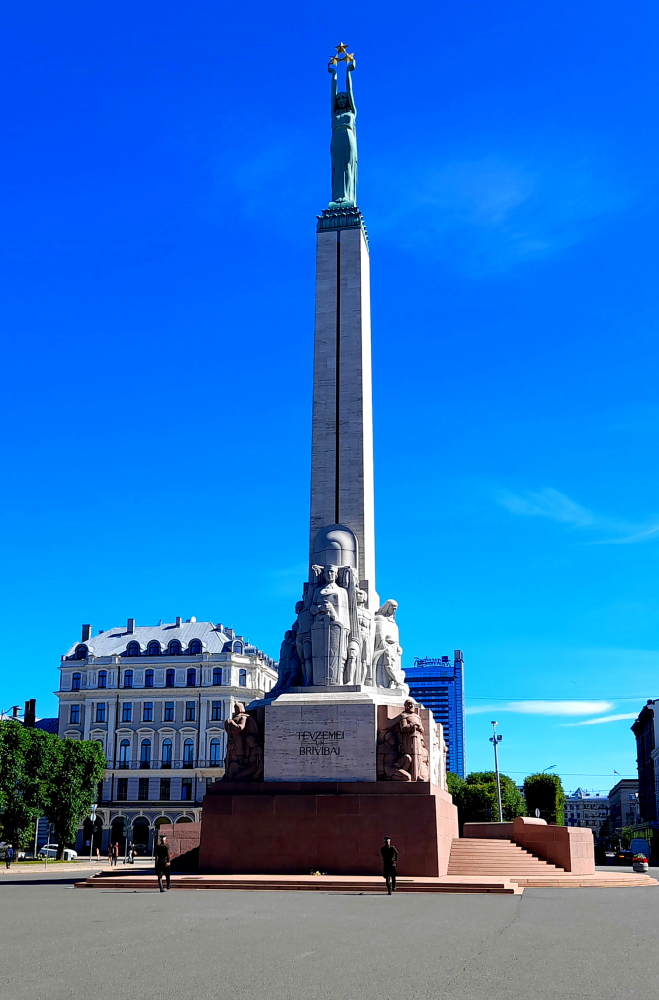
Freedom Monument & honour guard, Riga, Latvia.
Interestingly, during the Soviet occupation, Latvians were told that the 3 stars actually represented the united Baltic states of Estonia, Latvia and Lithuania held up by Mother Russia …
At 11 am we gather at the foot of the Cat House at Meistaru eila 10. The House, designed by the architect Friedrich Schefel, was built in 1909. Friedrich Schefel and Heinrich Scheel are regarded as pioneers of Riga Art Nouveau architecture. Built in the style of a medieval castle, it was completed with Art Nouveau colours [liveriga.com].
Legend has it that a wealthy trader applied for membership with the Great Guild whose building is opposite. He was refused so, in bitter resentment, he built this house and placed 2 cats on each tower with their tails to the Guild house. After a law suit he had to realign the cats.
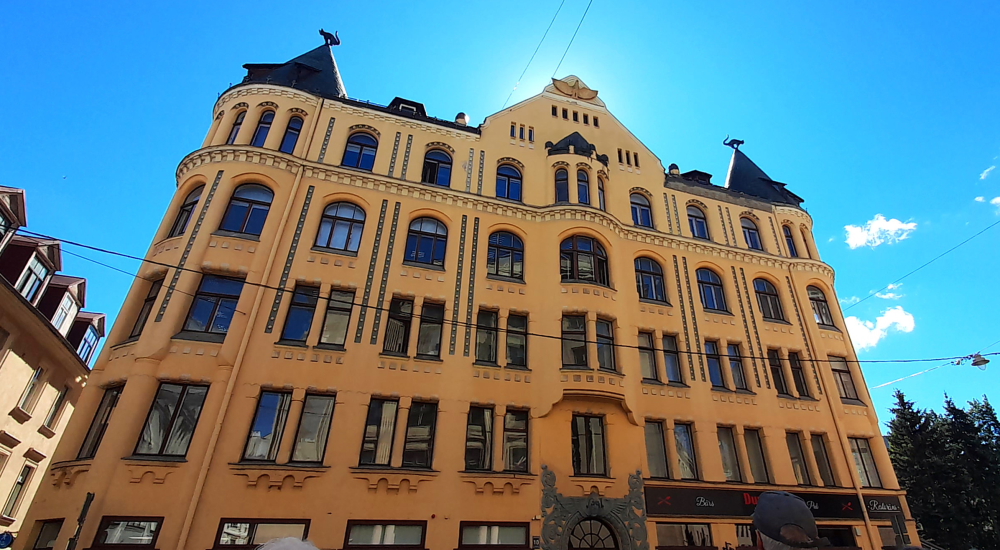
Cat House, Meistaru eila 10, Riga, Latvia.
Around the corner is Livu Square where both the Small and Grand Guild buildings are located – Small for craftsmen and Grand for merchants. Today there is a band playing in front of the Small Guild, presumably rehearsing for the Midsummer Festival which will take place in Riga, and Latvia, on 23 June.
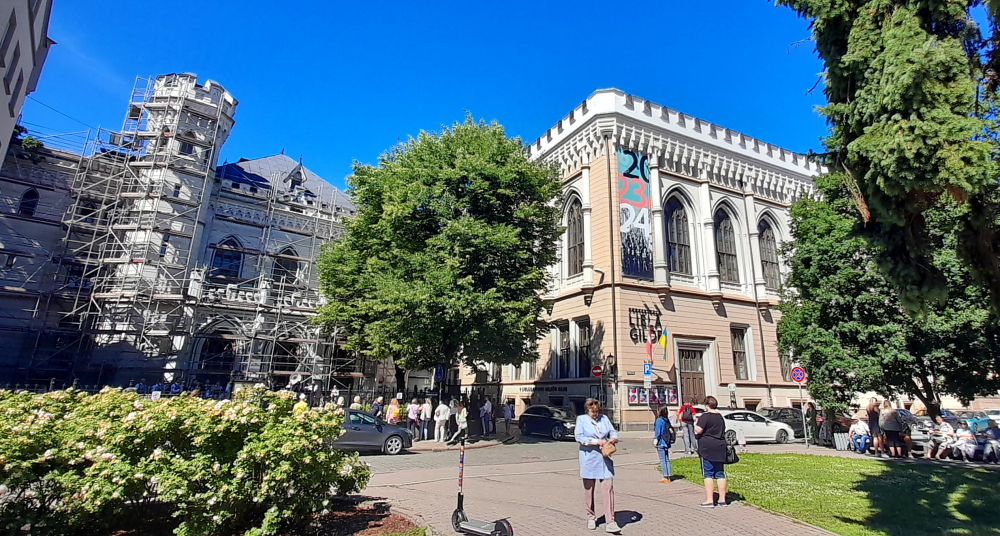
Small Guild (L) & Grand Guild (R) buildings, Livu Square, RIga, Latvia.
From here we retrace our steps down Meistaru eila and arrive at the Powder Tower where in 1919 the War Museum was established in it.
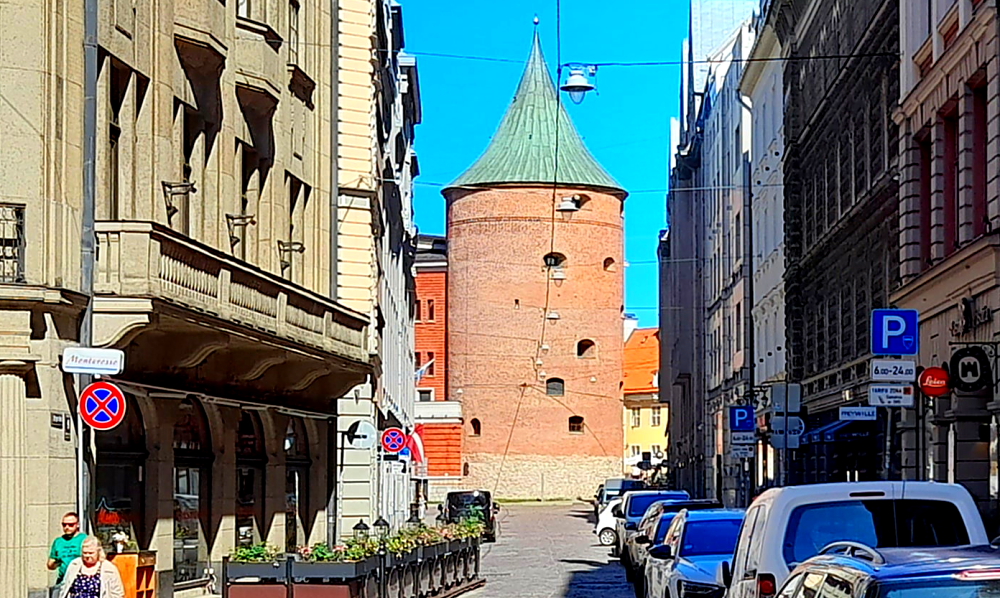
The Powder Tower.
One of medieval Riga’s fortification wall towers, it was built in 1330 and originally was called the Sand Tower. Reconstructed several times, and in the 17th century it was named the Powder Tower due to gunpowder stored here. Its present appearance was set in 1650. In 1937–1939, an annex building was added which now hosts exhibitions. The tower’s height is 25.6m, diameter 14.3m, and the wall’s thickness, 3m [liveriga.com].
Opposite on Torna Street is a very long, yellow building, the length of the town block. Army barracks in its day it was the longest building in Latvia. Jacob’s Barracks were built in the 18th century at the base of the city fortifications. From the very beginning until the 1990s the premises were used by various armies until the last restoration in 1997 [liveriga.com].
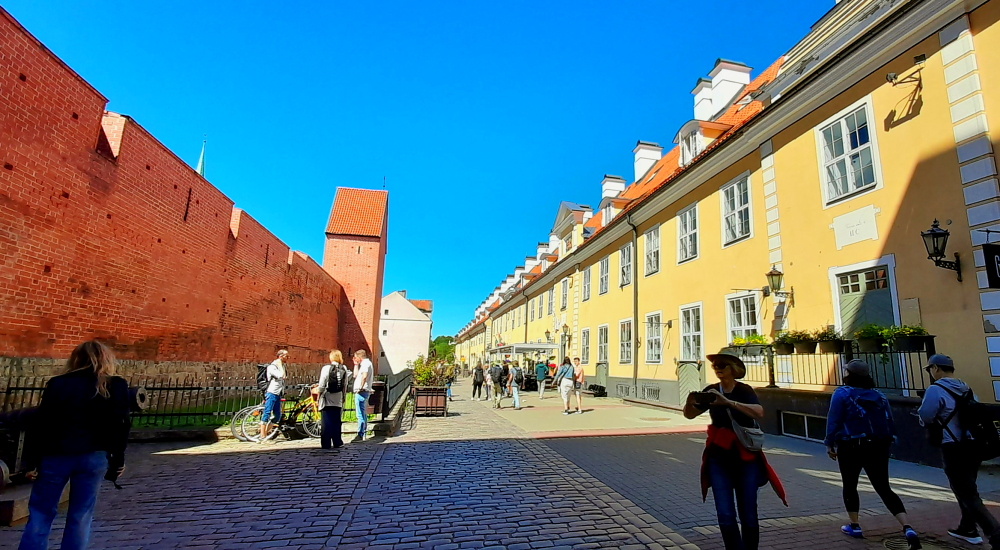
Jacob’s Barracks, Torna Street, Riga, Latvia.
Further along Torna Street is the Swedish Gate (Zviedru vārti) is part of the Old Town walls that encircled Riga during medieval times, serving as both fortification wall and as an important border for trade purposes, opening at sunrise and closing at sunset.
The Swedish Gate was also as one of the few entrances to the town, providing access to barracks outside the city wall and was built in 1698 after the Polish-Swedish War was over and Swedish Kingdom took over the city, starting a 92-year reign (1629-1721) which was called the Swedish Times (Zviedru Laiki). It’s the only gate that remains standing today of the original 8 that were part of Riga’s fortification wall [riga-guide.com].
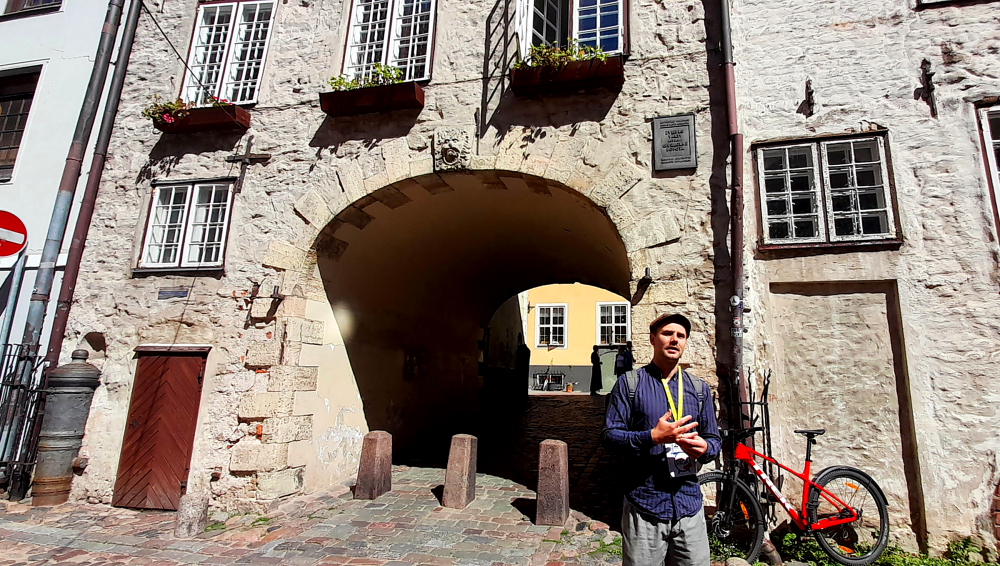
Our guide, Daniel, in front of the Swedish Gate, 11 Torna Street, Riga, Latvia.
Next is the Latvian Parliament known as the Saeima. The main building now occupied by the Saeima was constructed between 1863 and 1867 for the needs of the Livonian Knighthood. During the reconstruction of the building in 1922, the figure of the Master of the Livonian Order was replaced by Rihards Maurs’ statue of Lāčplēsis (Bearslayer).
The Constitutional Assembly was the owner of the building during 1920-1922 with the 1st sitting of the Saeima in November 1922. The subsequent Saeima convocations worked in the building until parliamentary work was interrupted on 15 May 1934. After the coup staged by Kārlis Ulmanis, the former Saeima building housed the president’s administration. After the Soviet occupational regime came to power in 1940, the building passed to the Supreme Council of the Latvian SSR.
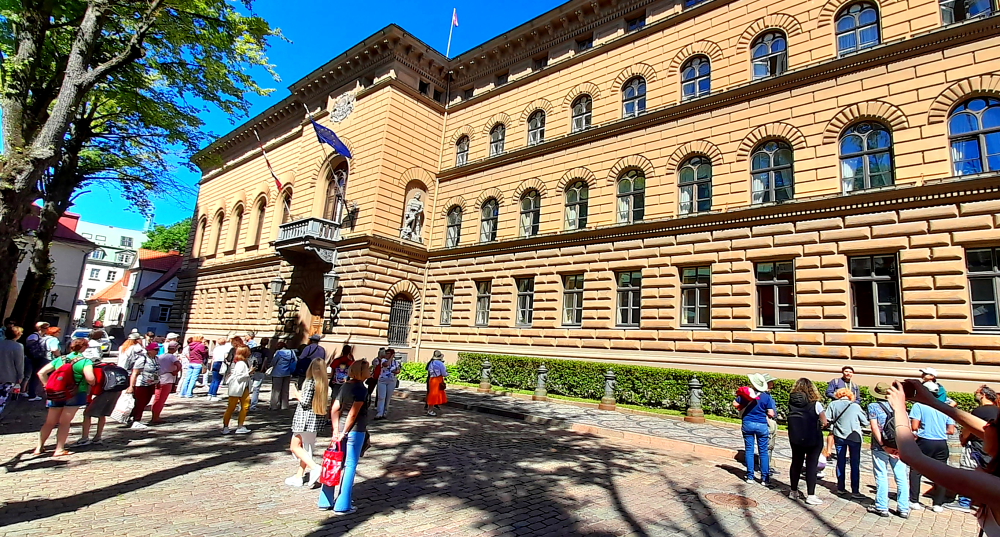
Latvia’s Saeima Building with the Bearslayer statue in the niche to right of the balcony.
During World War II, the building housed the SS (Schutzstaffel) and police headquarters of the Eastern territories. At that time, the interior decoration of the function rooms was destroyed while most of the books, applied art objects and paintings which had been preserved since the time of the Livonian Knighthood and the independence period of the Republic of Latvia were taken away to Germany. More items of the artistic heritage were lost in the post-war period, when the Supreme Council of the Latvian SSR resumed possession of the building.
After the renewal of Latvia’s independence was proclaimed in 1990, the Supreme Council of the Republic of Latvia worked in the building until it was replaced by the 5th Saeima. Since then, all subsequent Saeima convocations have been working in it [saeima.lv].
Opposite is St Jacob’s (St James’) Cathedral, 1st recorded in 1226. Over the years, the building has undergone various transformations. In the 15th century, a clock bell appeared in the tower under a small canopy. It served as a town alarm bell, the sound of which invited the townspeople to watch executions in Town Hall Square!
Over the centuries the building has hosted various denominations. From its beginnings to the Reformation period, the Catholics. After the Reformation, it became the 1st Latvian Lutheran church in Riga. In 1582, when Riga was conquered by Polish King Stephen Bathory, the Catholics. In 1621, Riga was taken over by the Kingdom of Sweden, the Lutherans. Since 1923, Catholics [liveriga.com]. So, in the spirit of UEFA Euro 2024 that is in progress right now, the score is: Catholics 3, Lutherans 2.
Walking around the back of the church we arrive at Maza Pils iela where we find, at numbers 17, 19 and 21, the Three Brothers, the oldest medieval dwelling houses in Riga. In medieval times, Maza Pils Street was located in the outskirts of Riga and craftsmen lived there. Today, the buildings that are several centuries old house the Latvian Museum of Architecture and the State Inspectorate for Heritage Protection.
No. 17 – the Oldest brother, where manufacturing and trade were carried out. Built around 1490 during the time when Riga established close links with Dutch merchants and the city’s architecture showed influences of Dutch Renaissance architecture. Decorated with Gothic niches and a stepped pediment, the portal made in 1746 has been moved to the middle brother during restoration. The house had one big room where the work, trade, and everyday life took place, and it has retained its original appearance.
No. 19 – the Middle brother, is the richest one of the three, built in 1646. It is one of the most typical, but also most modern dwelling houses of the 17th century. There is an inscription “Soli deo gloria!” (“Glory to God alone!”) above the entrance, and the facade features the style of Dutch Mannerism. In contrast to the oldest building, this one had a spacious room with large windows above the ground-floor hall, and there were special residential premises on the yard side of the building.
No. 21 – the Youngest brother, built in the second half of the 17th century and had small apartments on each floor. It’s the narrowest and the smallest one of the three brothers. It has an interesting facade element – a mask, which, according to the owners of the building, protected its inhabitants from evil spirits [latvia.travel].
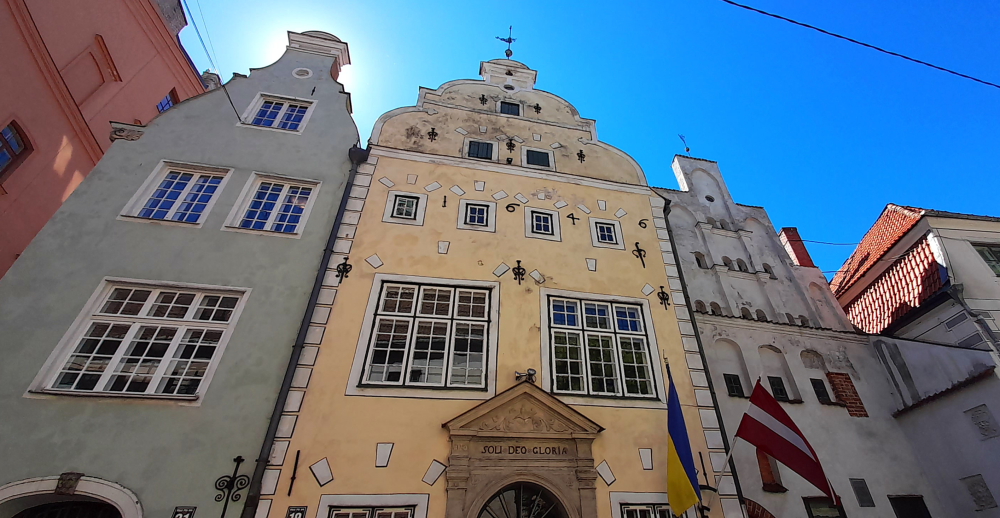
Three Brothers buildings, Riga, Latvia.
From here we walk the short distance to Dome Square, named after the Dome Cathedral that borders one side. It’s the largest square in the Old Town and is deemed to be the heart of the city as all activities meet here, flowing in from 7 streets. The square has seen many events significant to Latvia in the past 20 years such as the battles in the 1990s where bullet holes are evident on the current Latvia Radio building.
The Square’s development started in the late 19th century when several buildings were razed. In 1885 the Square acquired its present name and its construction was finished in 1936.
The Dome Cathedral is the largest and one of the oldest sacred buildings of the medieval period in the Baltic region (foundation stone laid in 1211), combining Romanesque, early Gothic, Baroque and Art Nouveau features. Today, alongside church services the cathedral hosts concerts by local and internationally renowned musicians.
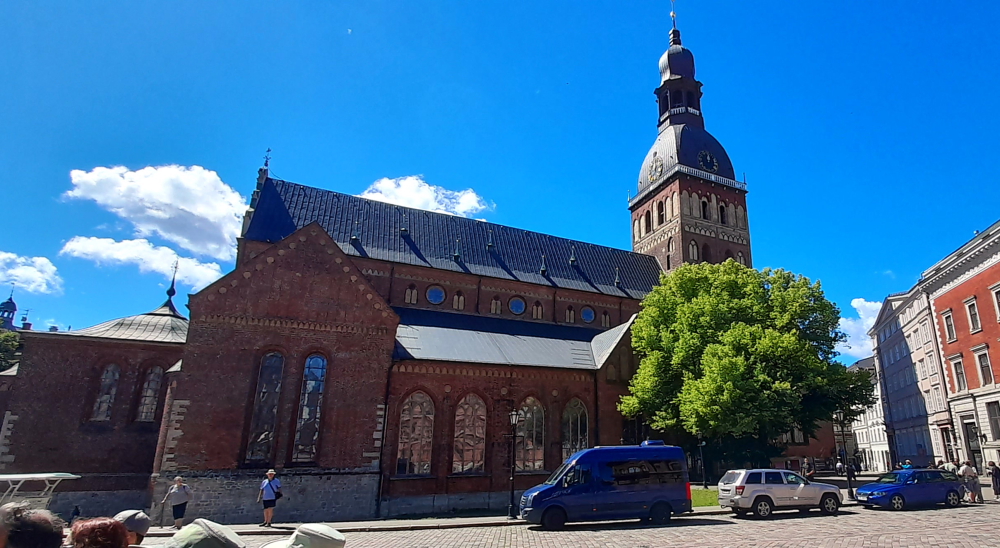
Dome Cathedral, RIga, Latvia.
In addition to the Cathedral, Dome Square is surrounded by several architectural monuments: Riga’s first Eclecticism-style building, the Riga Bourse House, on the corner of Jēkaba iela.
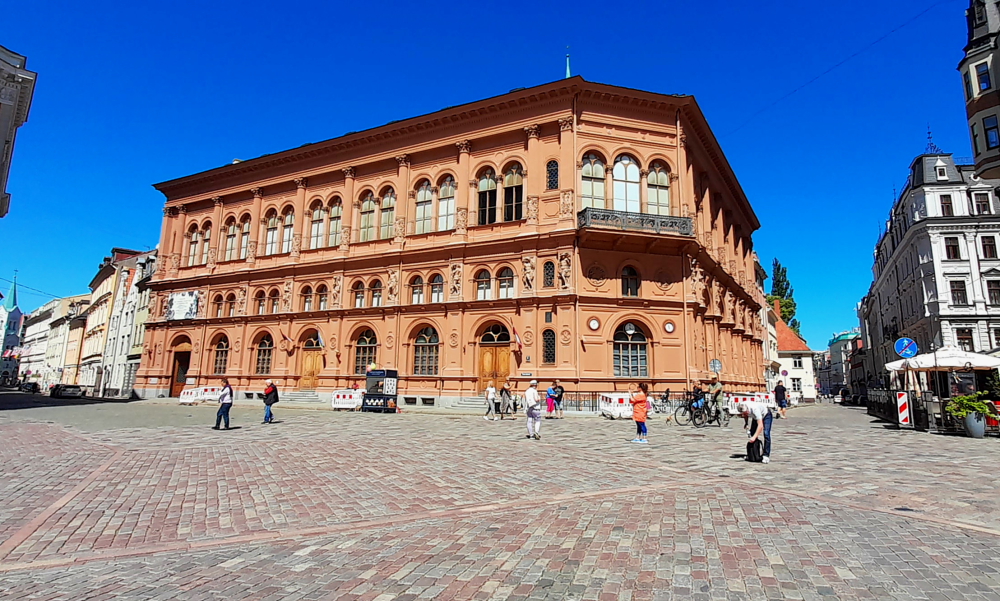
Bourse House, Dome Square, Riga, Latvia.
And the only Neo-classicism-style building, featuring a balcony, is the former Riga Commercial Bank, now housing Latvian Radio [liveriga.com].
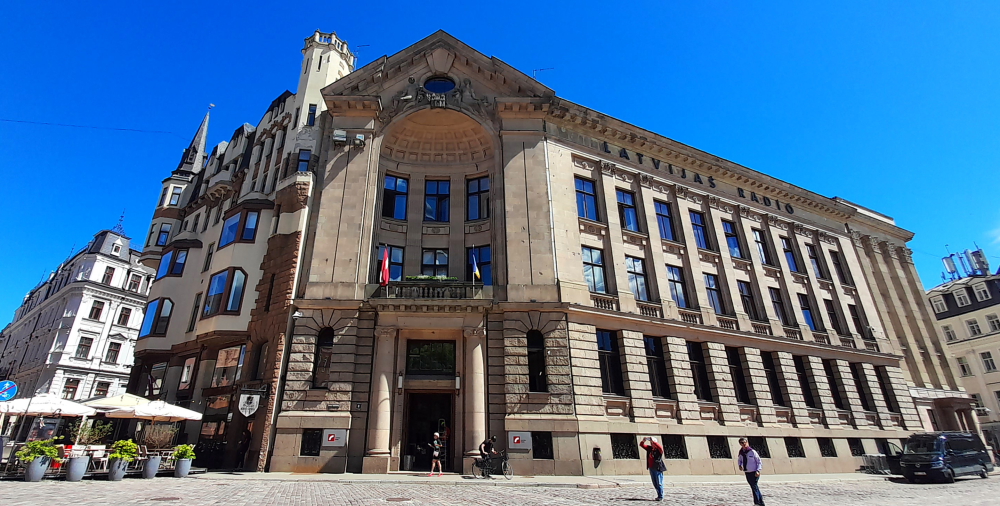
Former Riga Commercial Bank (now Latvian Radio), Dome Square, RIga, Latvia.
350m away is Town Hall Square which houses not only the reconstructed Town Hall but a rather ugly Soviet building – appropriately now used as the Museum of the Occupation of Latvia – in stark contrast to the magnificent House of the Blackheads.
Called ‘Blackheads’ as the patron saint of the Brotherhood is the black Egyptian Christian Saint Maurice whose head is also depicted on the Brotherhood’s coat of arms.
The original Blackheads building was erected in 1334 as a warehouse, meeting and celebration place for merchants. It was the biggest public building of Riga. From mid-15th century it was also used by the Brotherhood of Blackheads, a guild for unmarried merchants, shipowners and foreigners in Riga. Additionally, it is the site of the first decorated Christmas tree, which was erected in 1510.
The building and most of the old town was bombed to ruins on 29 June 1941 in a fight between Nazi Germans and the Soviet army. Ignoring the protests of locals the remains were demolished by the Soviet Government in 1948, declaring that the House was a monument to a foreign knightly culture which was fundamentally hostile to the Latvian people! Rebuilt between 1996-2000 with funding mainly provided by the city of Riga and other funds from individuals. By donating 5 lats (approx. 7-11 EUR) they could place ‘a brick in the wall’. The House of the Black Heads was officially opened on 9 December 1999 [wikipedia].
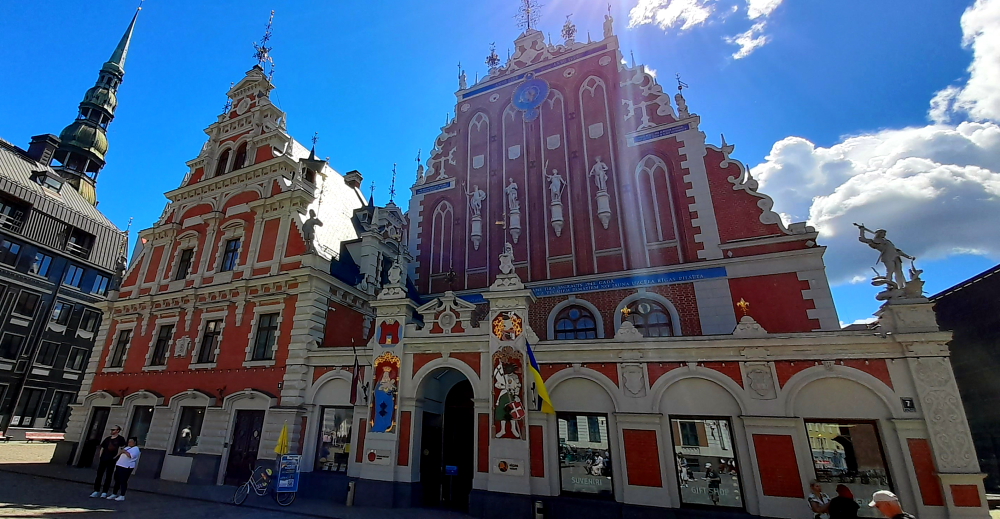
House of the Blackheads, Town Hall Square, Riga, Latvia.
The first city council gathered for its meeting in 1226 a block away from the current Town Square. At the beginning of 14th century, the City Hall was built on the new market square.
At the end of 16th century, the City Hall was expanded and acquired the shape of a 2-storey building with a bell tower in the middle of the roof. In the direction to the market square, the Town Hall had a balcony. Legend has it that in the Middle Ages, a trumpeter played from the balcony every morning and notices were read to citizens.
In 1749 the old City Hall was demolished and a new building erected. During 1848-1850 a 3rd floor of the town hall was built. In 1941 the building was destroyed and in 1954, despite the foundations and walls being preserved, they were demolished and the laboratory building of the Riga Technical University was built on this site.
In 1983, thanks to the Old Riga regeneration project, renovation of the City Hall begin in 1998 and its opening occurred in 2003. Its facade is designed as the façade of the old City hall building and is decorated with the coat of arms of Riga [riga.lv].
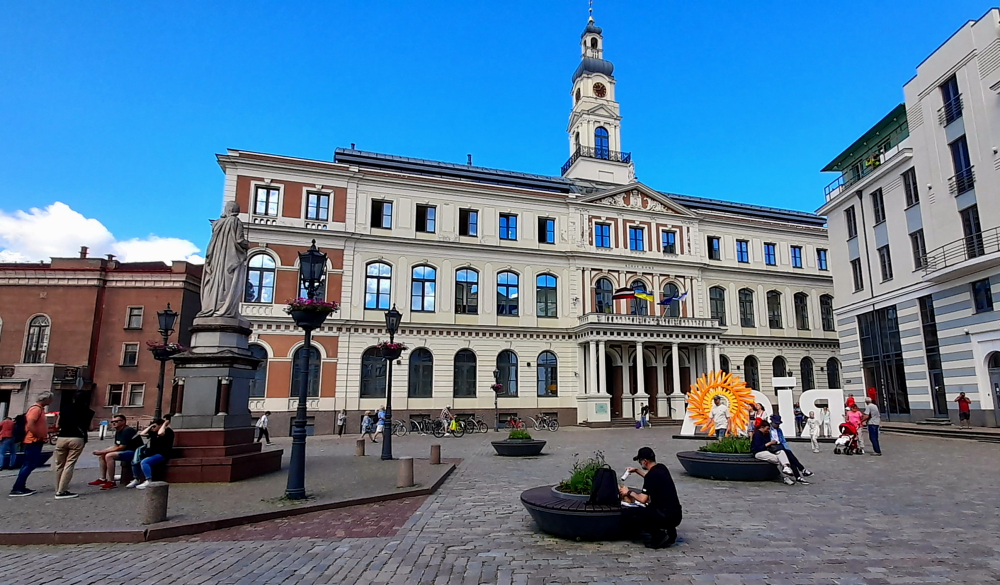
City Hall, Town Hall Square, Riga, Latvia.
Our last stop is St Peter’s Church built in 1209 and one of the oldest and most notable sacred buildings of medieval monumental architecture in the Baltic States.
The church tower at a height of 57m makes it the highest church in Riga with breathtaking views of medieval and modern Riga, the Daugava River with its harbour and the Gulf of Riga [liveriga.com].
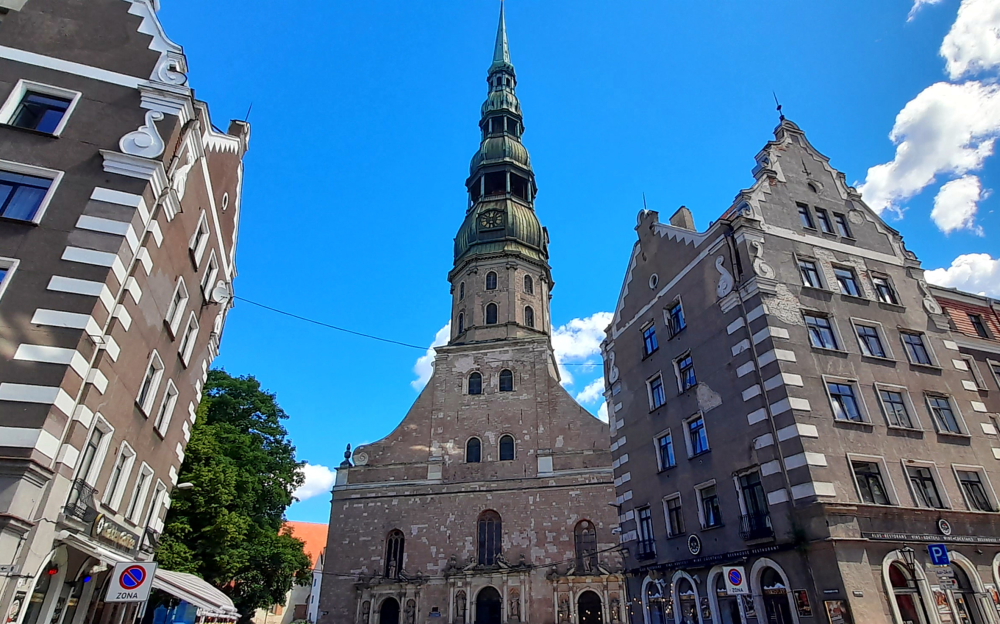
St. Peters Church Spire.
Alongside the church is a familiar statue – that of a donkey, pig, lamb and rooster – the original of which is in Bremmen but rather than them looking in a window the Latvians like to think that they are looking out through the Iron Curtain.
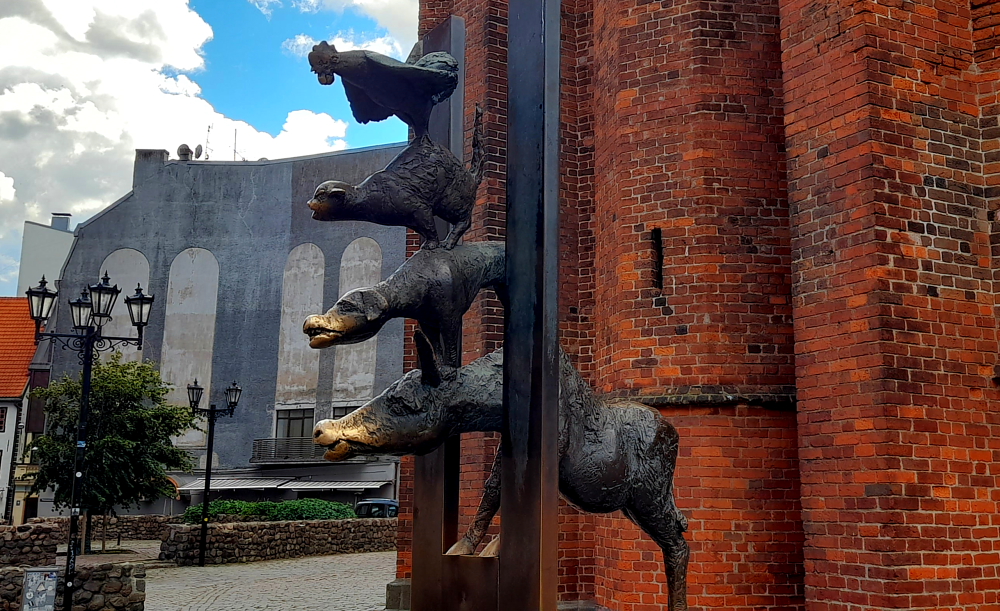
Sculpture “Bremen Town Musicians”, Riga, Latvia.
Apparently it was a gift from the city of Bremen due to Albert of Riga or Albert of Livonia (c. 1165-1229) who allegedly founded the city of Riga in 1201 being a canon in Bremen when he was named Bishop of Livonia, provided that he could conquer and hold it, and convince the pagan inhabitants to become Christians.
On our way back to the hotel we stop for a cold beverage at the Pavilion in the park.
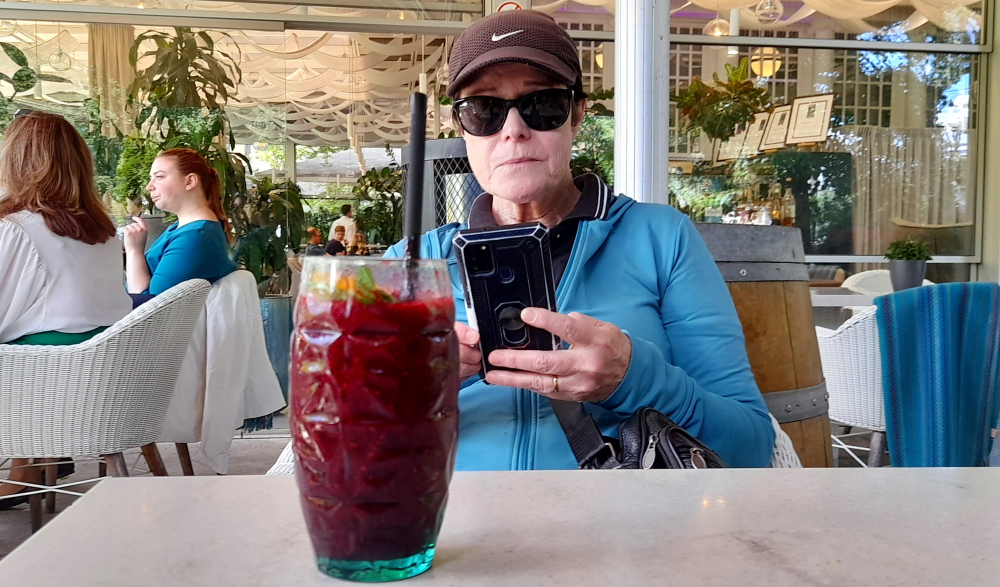
Berry Frappe.
21 June, 2024
Another lovely 24 degree day so we take 20 minutes to walk to the Central Market located on the other side of the City Canal before it enters the Daugava River.
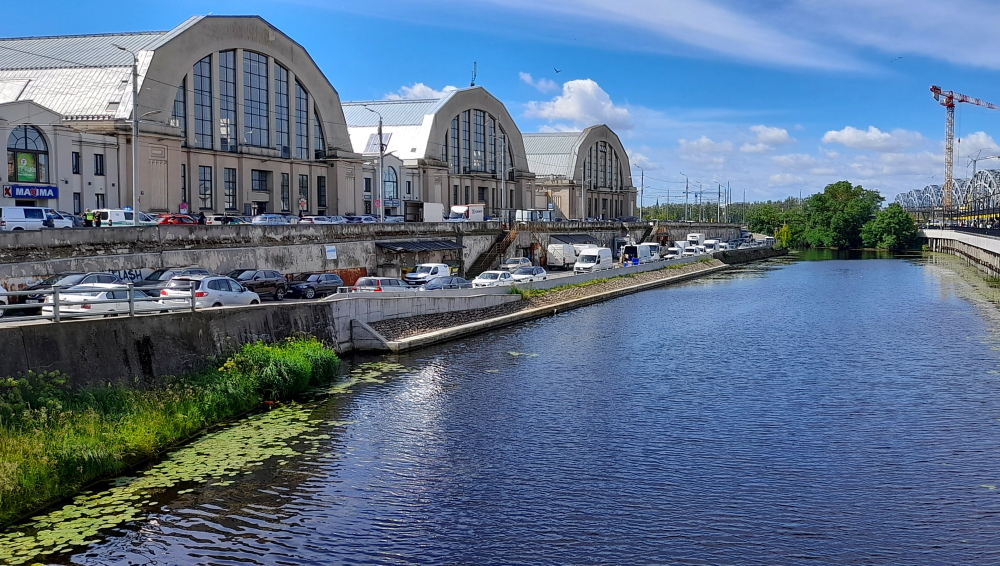
Central Market & the City Canal, Riga, Latvia.
It’s Europe’s largest market and bazaar.
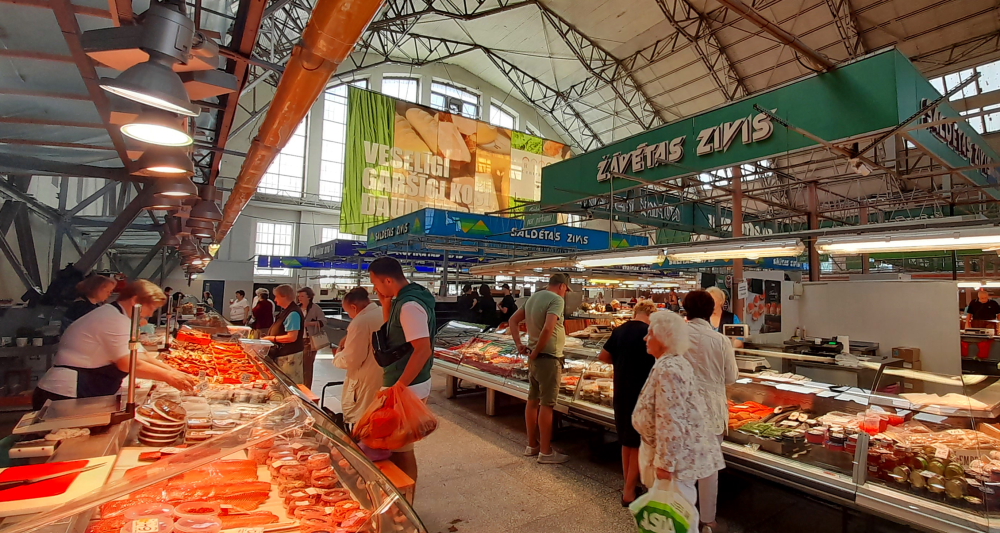
Delicatessen stalls within one of the former hangers, Central Market, Riga, Latvia.
The market’s main structures are 5 pavilions constructed by reusing old German Zeppelin hangars and incorporating Neoclassicism and Art Deco styles.
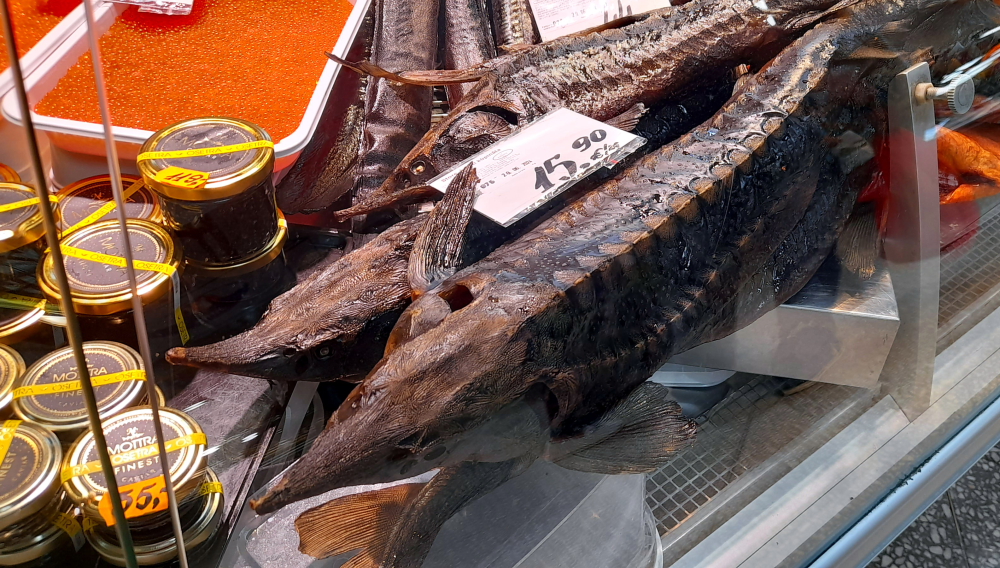
Smoked fish, Central Market, Riga, Latvia.
The market is 72,300 square metres with more than 3,000 trade stands.
Despite there being fruit and vegetable stands inside, there’s a huge area of them adjacdent to the buildings. Cherries are in plentiful supply at many stalls.
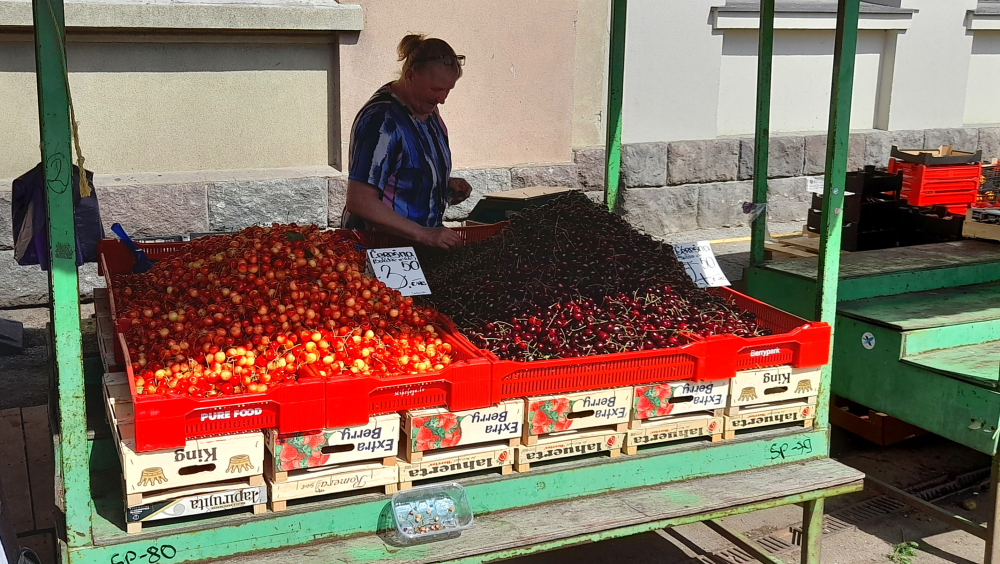
“Who will buy my cherries?”
As are flower stalls.
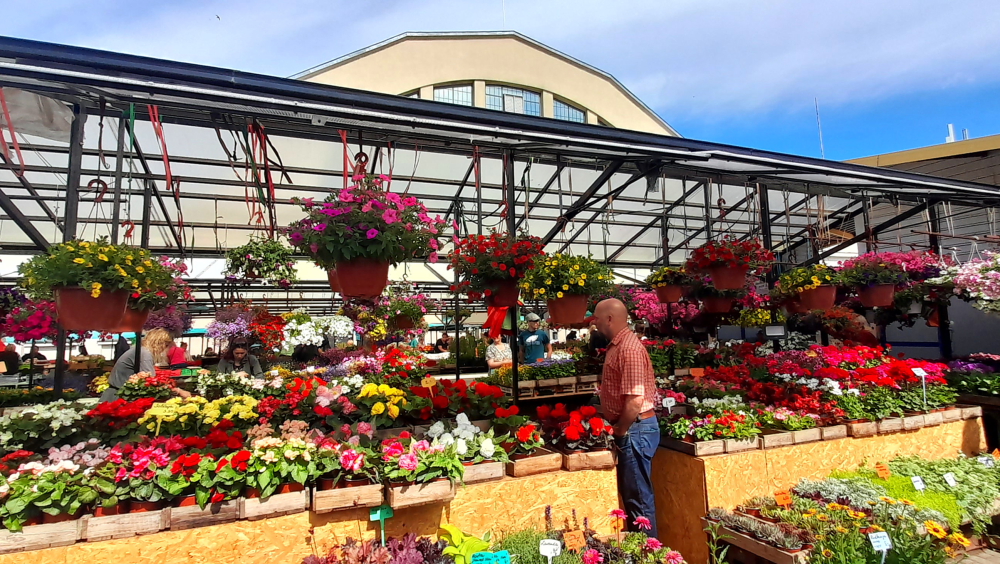
Flower stalls outside the Central Market buildings, Riga, Latvia.
Returning to the hotel we go via the underpass below the canal which features some street art and the mandatory busker.
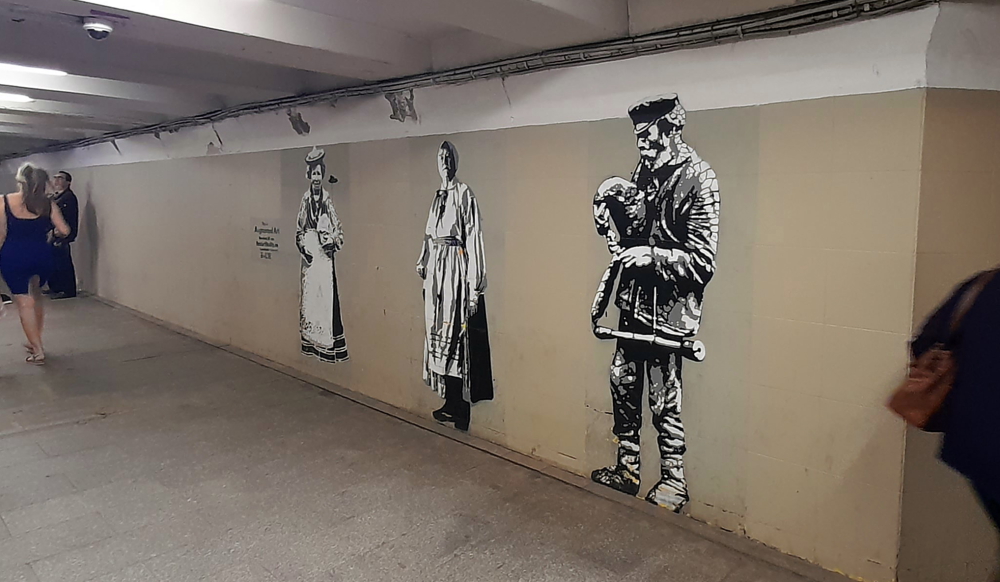
Street art, underpass, Riga, Latvia.
Surprisingly, we come across an Aussie Pub which also serves Guinness.
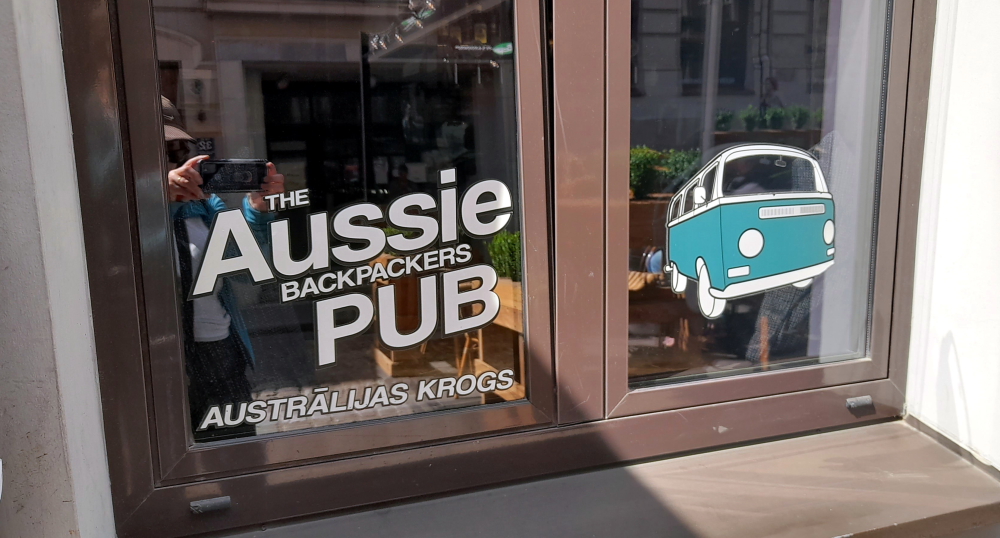
The sign says it all.
Inside, the best use of a VW Kombi van that I’ve ever seen.
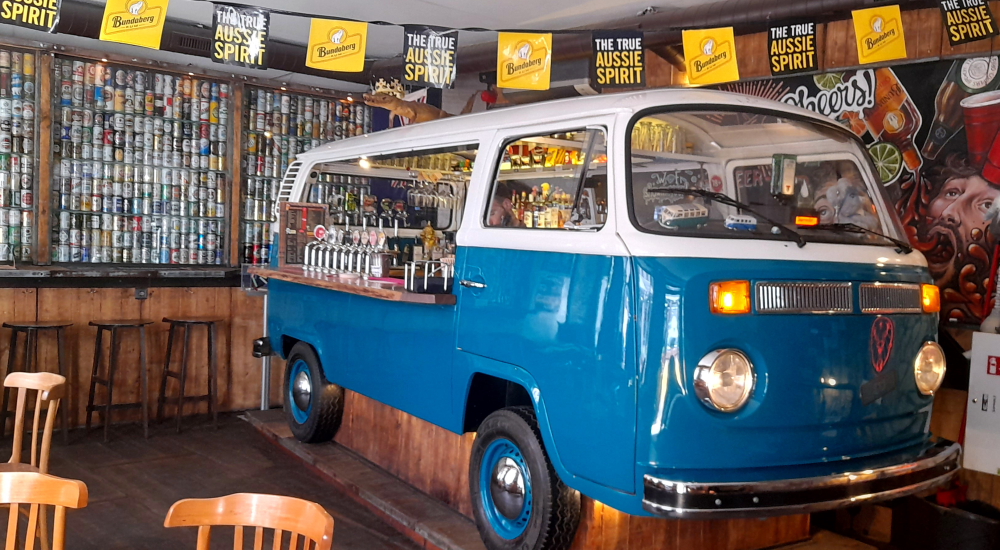
When is a Kombi not a Kombi? When it’s a bar!
Our route also takes us past the National Opera building on the banks of the City Canal.
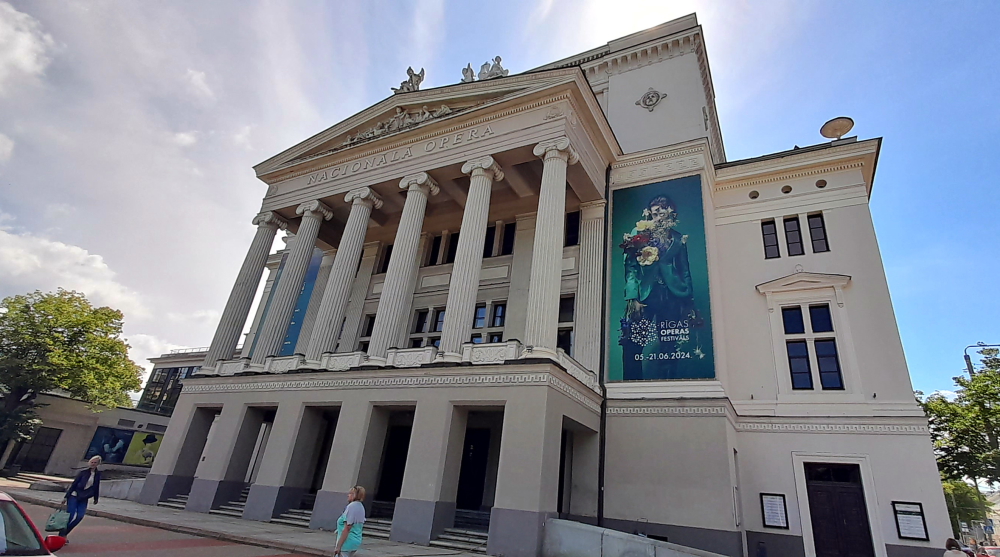
National Opera building, Riga, Latvia.
As we walk into the Vermanes Gardens, opposite our hotel, there are also market stalls set out under the shade of the trees.
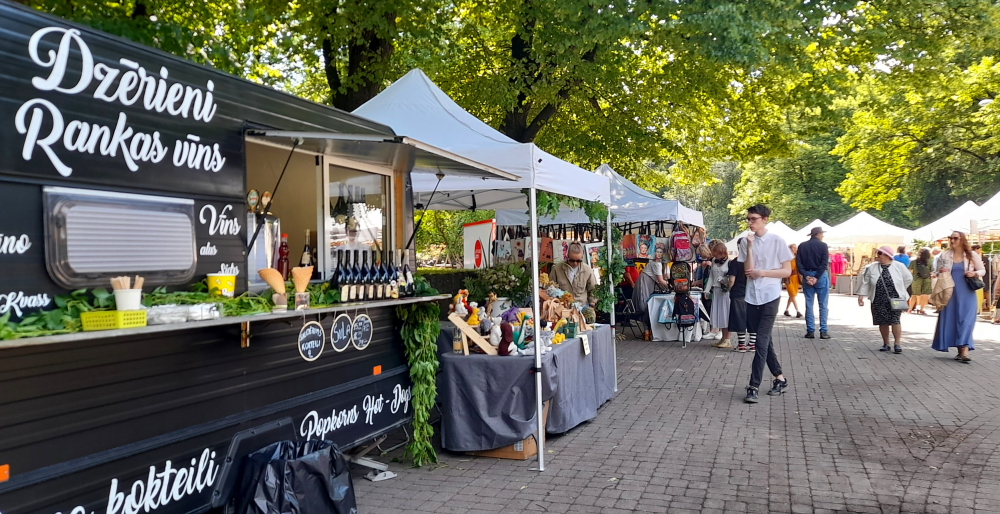
Traditional drinks, Vermanes Gardens, Riga, Latvia.
Also market stalls selling traditional clothing and wreaths to be worn as headdresses for the coming Midsummer Festival.
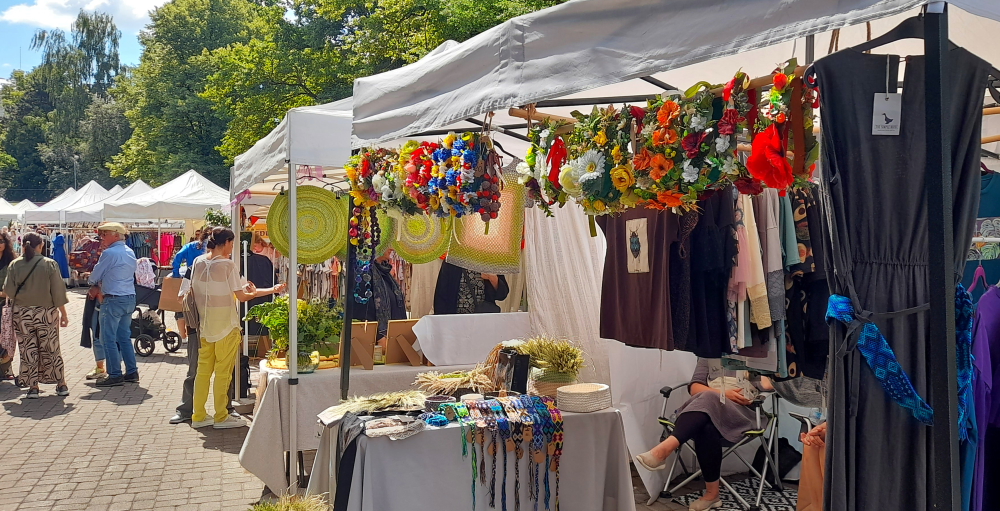
Floral headdresses, Vermanes Gardens, Riga, Latvia.
And traditional food – pick a sausage, any sausage!
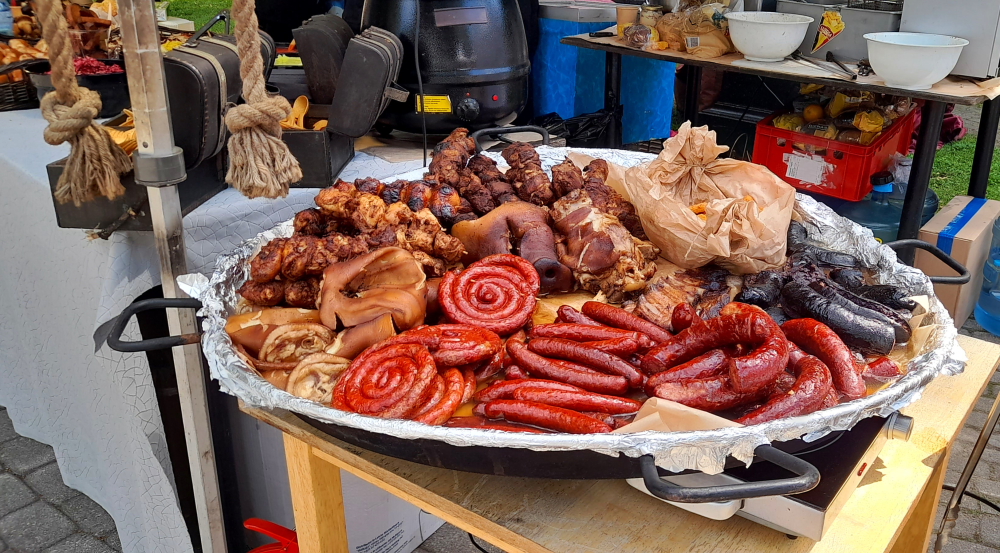
Traditional meats, Vermanes Gardens, Riga, Latvia.
22 June, 2024
A top of 25 degrees is promised today so we walk back to St Peter’s Church to take the lift up its tower.
En route we pass by the building that currently houses the Italian Embassy at Teātra Street 9. Created in 1904 by architects Heinrich Scheel and Friedrich Scheffel, this is a beautiful and eclectical building, combining Renaissance and Baroque styles with some distinctive Art Nouveau features (top floor keyhole corner window with decorative mosaic). This building has not a tower, but a globe held by 3 atlases, created by the famous sculptor of Riga August Folz [neiburgs.com].
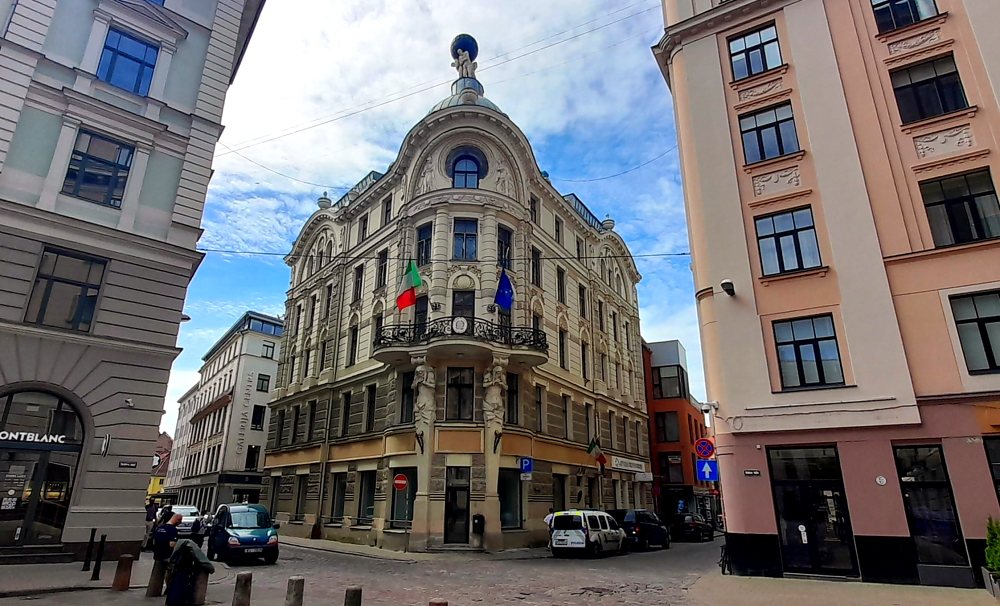
Italian Embassy, Riga, Latvia.
We return to St Peter’s, pay Eu9 each for the privilege of taking its lift. What they don’t tell you is that you need to walk (or hobble) up 3 levels of stairs to access the lift!
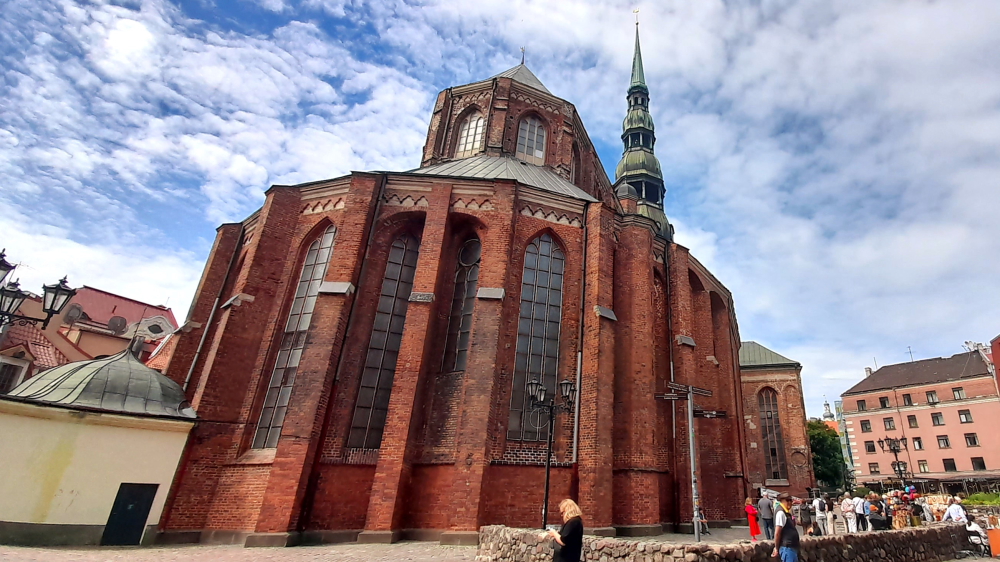
Skarnu iela view of St Peter’s Church & Spire, Riga, Latvia.
But the view is worth it, in particular just how large the Daugava River is. In the SE sector we see the Stalinist era Latvian Academy of Sciences, the 4 archies of the Central Markets, the Daugava River and on the opposite bank, the Riga Radio & TV tower.
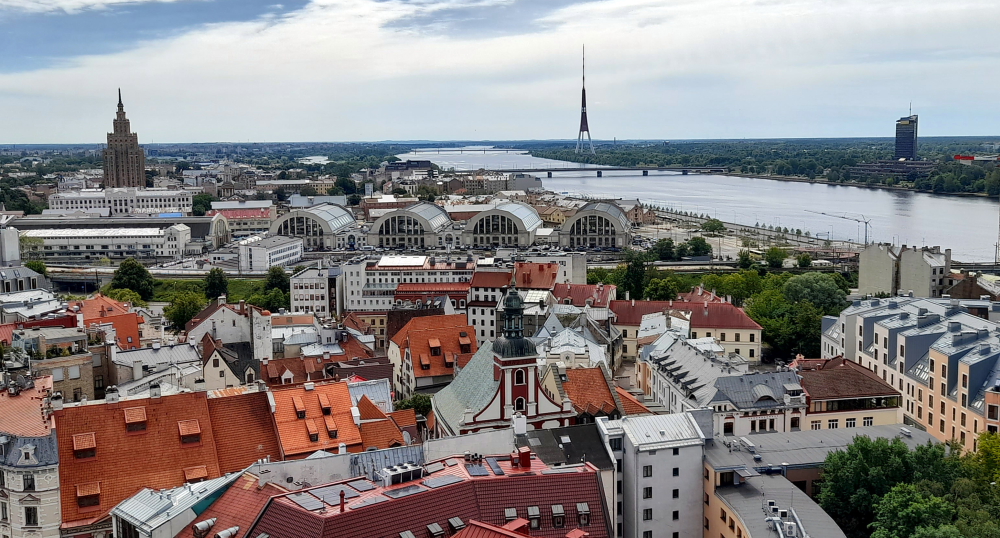
SE view of Stalinist Latvian Academy of Sciences, the Central Markets & Riga Radio & TV Tower.
The NE view shows the golden domes of the Nativity of Christ Orthodox Cathedral (Kristus Piedzimsanas pareizticigo katedrale), behind which is the Radisson Blu Latvija Conference & Spa Hotel tower. The parkland to the right of it is where our Radisson Blu Elizabete is located.
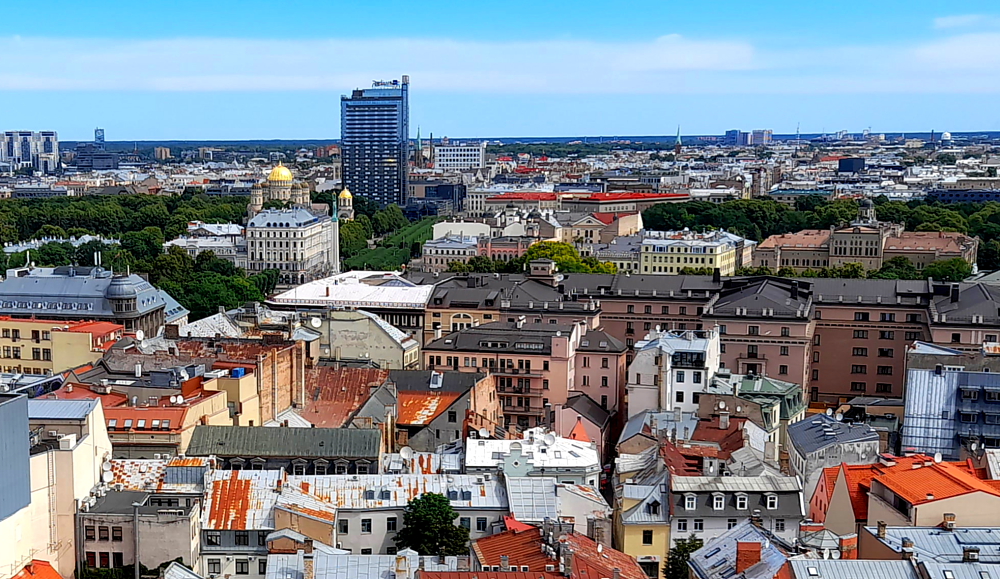
NE view of the Orthodox Church & Radisson Blu Latvija Conference & Spa Hotel tower.
The WNW view is of the Vansu Bridge (Tilts) and the Dome Cathedral tower.
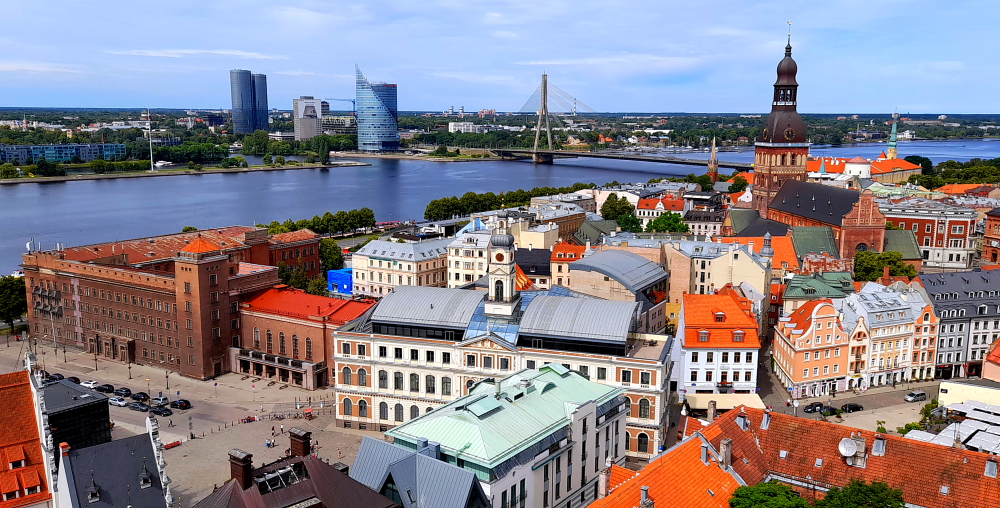
WNW view of Vansu Tilts & Dome Cathedral tower.
And, to the left of that, the WSW view, showing the arched Railway Bridge (Dzelzceļa tilts), the Akmens Bridge with the pyramid-shaped National Library in between.
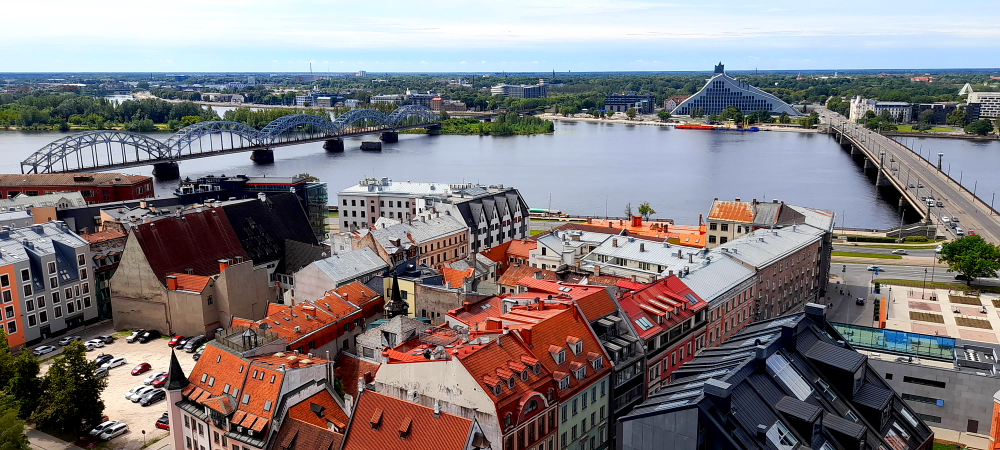
WSW view of the arched Railway Bridge, Akmens Bridge with pyramid-shaped National Library in between.
Back on the ground floor we walk through the church where information screens outline the history of the building plus there are several original interior elements – tombs, restored stone and wooden memorial plaques, and the impressive giant bronze seven-branched candlestick made in 1596 [liveriga.com].
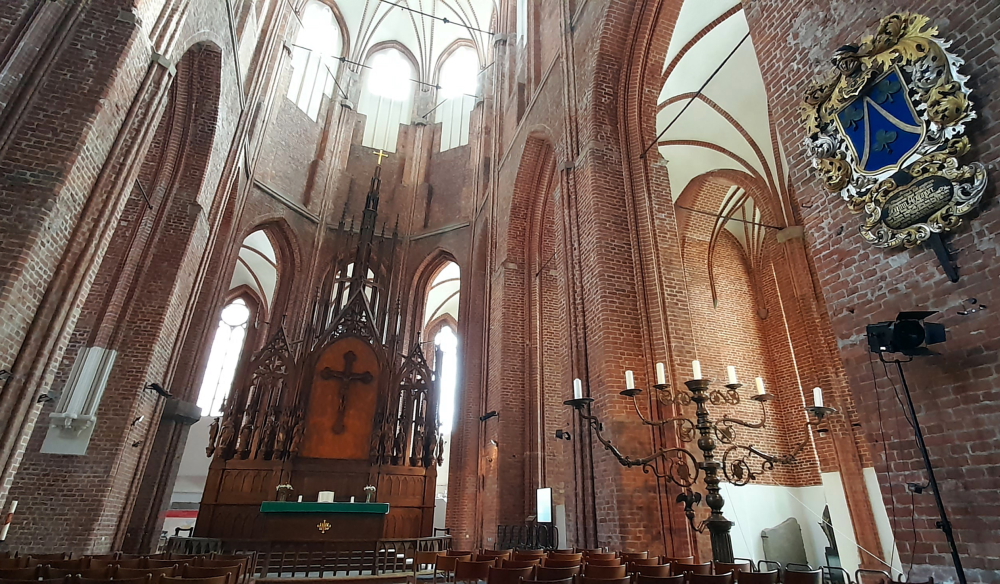
Wooden altar, plaque & the 1596 branched candlestick, St Peter’s Church, Riga, Latvia.
From here we walk the 460m to the Dome Cathedral where Lynn checks out the interior after paying Eu5 to do so. At one end is its stunning organ, considered to be one of the world’s most valuable historic organs. It was built in 1883-1884 by a famous German organ building company E. F. Walcker & Co. Its facade is much older than the organ itself. It was made in 1601 by master Jacob Raab.
The organ is 25m high, 11m wide and 10m deep.It has 124 stops, 4 manuals and pedals, 6,718 pipes of different size and material that are placed on 26 wind chests. The pipes are made of different woods: pine, fir, maple, oak, beech, and pear, as well as of different metal alloys, like tin and lead alloys of varying proportions. The pipes also vary in length -10m versus 13mm [doms.lv].
Although he has never been here, Franz Liszt knew this instrument pretty well; he wrote a chorale “Nun danket alle Gott” in 1883 to the event of dedication of the organ.
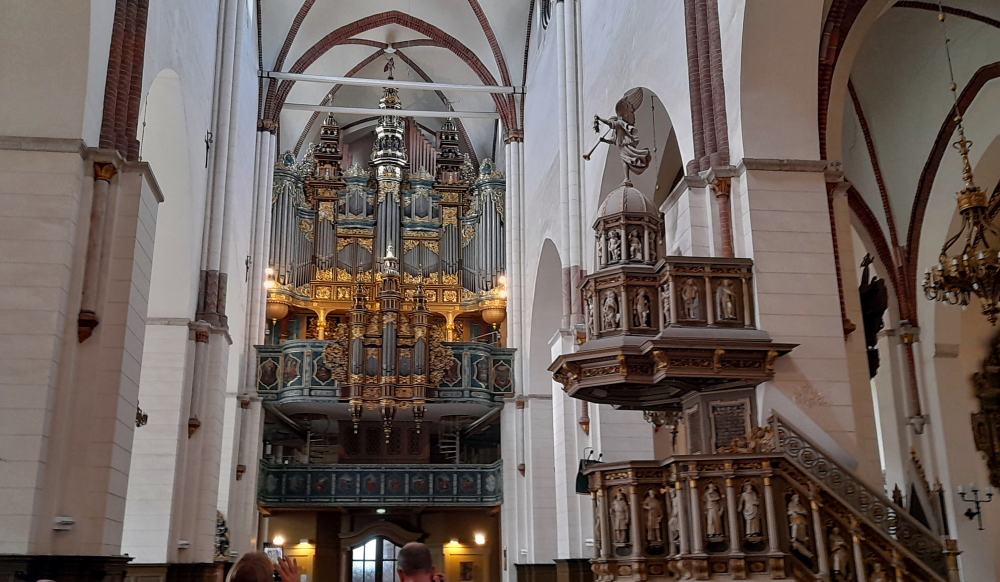
Historic organ, Dome Cathedral, Riga, Latvia.
Unfortunately, there are only 11 stained glass windows in this vast space. The left one below is “The Delegation of Riga Greeting the Swedish King Gustav II Adolph on 24 September 1621”. The right one is “Walter von Plettenberg, Master of the Livonian Order, on 21 September 1525 declares Freedom of Faith in Riga”. Both were made at the Royal Workshop of Glass Painting in Munich, 1885 [Church information sheet].
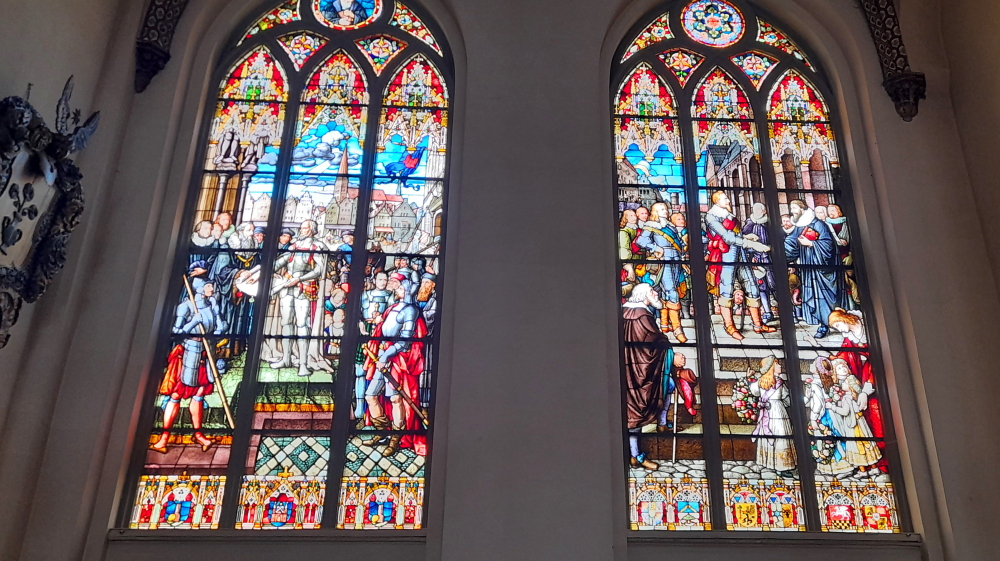
2 examples of stained glass windows, St Peter’s Church, Riga, Latvia.
A door exits from the church to its Romanesque cloister. From 1881 to 1914, the Riga Cathedral Building section of Riga Society of Researchers of History and Ancient Times carried out major reconstruction and renovation works in the church and the Cloister. As a result of these works, the Cathedral and the Cloister acquired their present-day appearance [doms.lv].
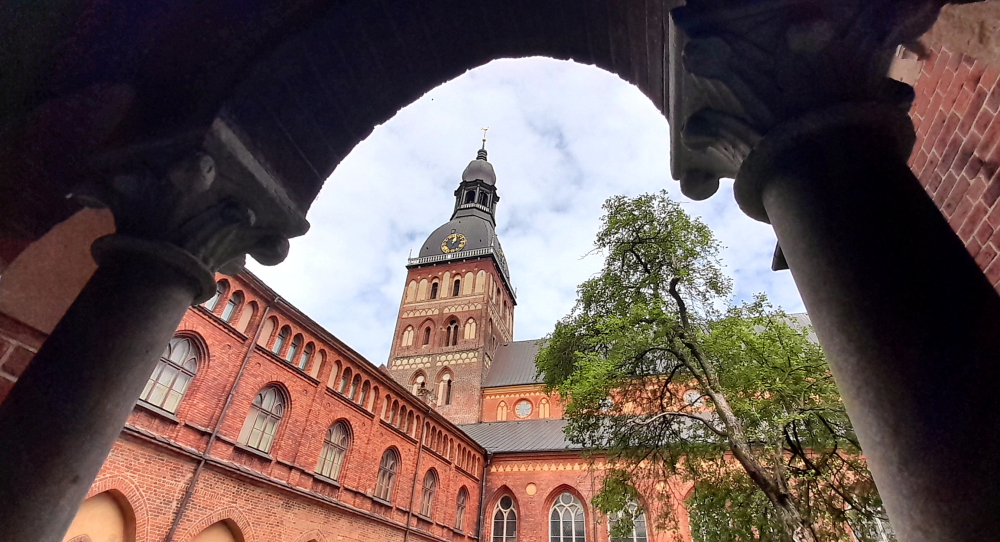
View of Dome Cathedral’s spire from cloister, Riga, Latvia.
Along the corridors of the cloister are various original pieces on display including canon and statuary.
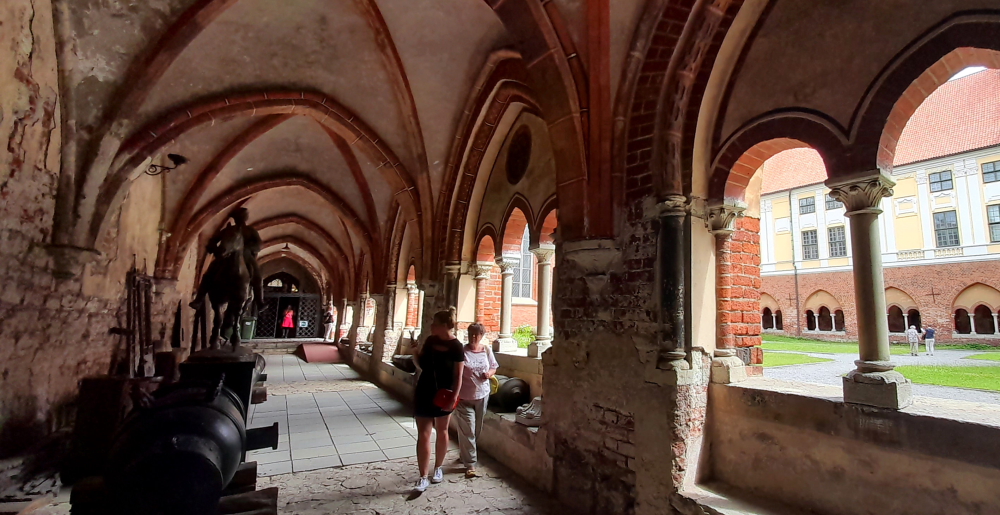
Canon & statuary on display in the cloister.
From here we make our way to the Orthodox Church via the Freedom Monument. As it’s about 3 minutes to 1 pm we witness the changing of the 2 honour guards at the base of the monument.
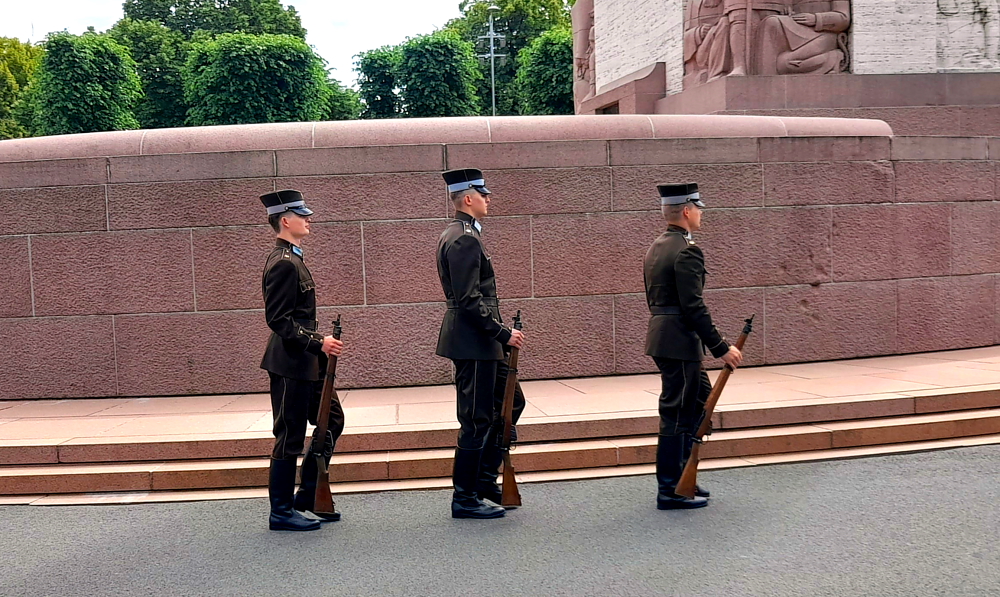
Changing of the honour guard, Freedom Monument, Riga, Latvia.
When we first drove along Elizabetes iela on our way to our hotel, this church caught our attention due to its golden domes shining in the sun.
The Riga Nativity of Christ Cathedral is the largest Orthodox church in Riga which has withstood the Soviet-era as a planetarium and restaurant, but once again has become a sacral building, where Orthodox church services take place on a regular basis.
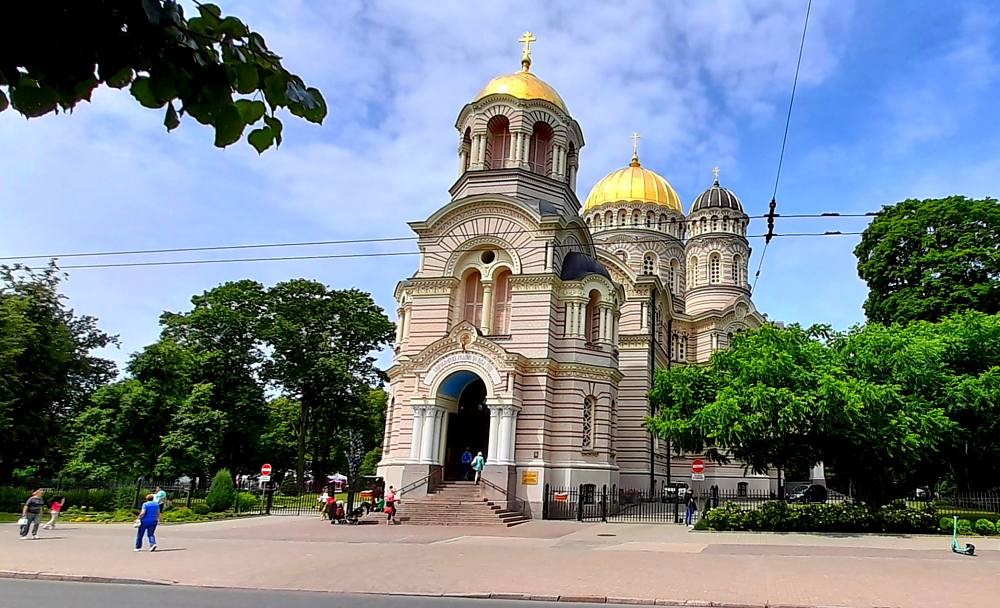
Nativity of Christ Orthodox Cathedral, Esplanade, Riga, Latvia.
The cathedral’s founding stone was laid on 3 July 1876 by Riga Bishop Serafim (Protopov). The initial design did not feature a separate belfry but as the Russian Czar Alexander II presented a surprise gift (12 bells) the design was improved with one more dome for bells. The official opening took place on 28 October 1884.
The pre-WWI period saw about 1,500 worshipers visiting the cathedral. The neo-Byzantine style building was the most expensive edifice of that time in Riga, its interior was uniquely rich and of high artistic value. The cathedral was renowned for its outstanding collection of Byzantine-style frescoes with Orthodox Christian ornamentation and ancient and valuable icons with three iconostasis painted by the brightest of St Petersburg Academy of Art and the famous Russian painter Vasily Vereshchagin. The clergymen outfits were made by the best St Petersburg seamstresses.
Although the cathedral had survived both world wars, in the early 1960s, Soviet authorities closed the cathedral, sawed down the crucifixes, and re-melted the bells, and converted it into a planetarium, called the Republic House of Knowledge.
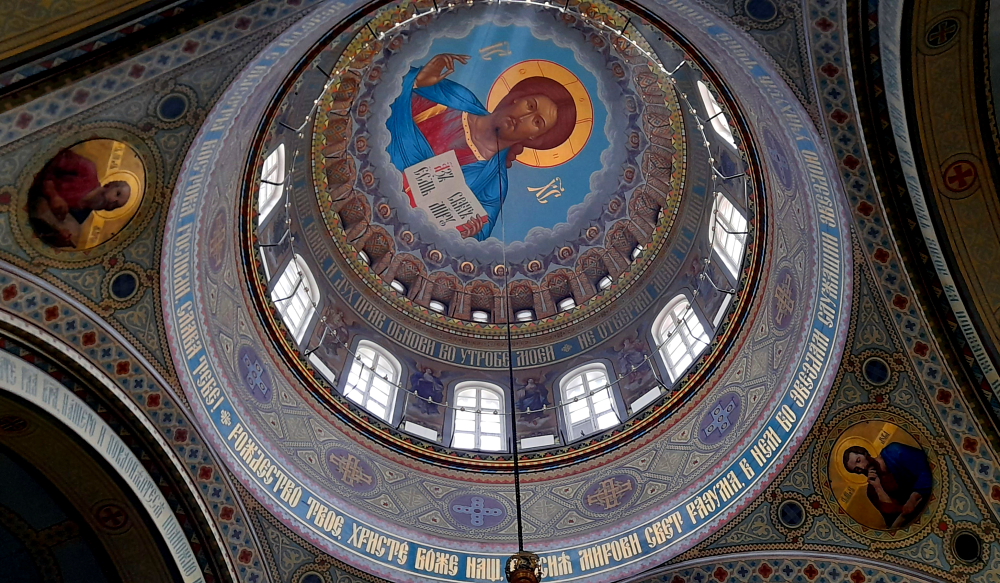
Interior, Orthodox Cathedral, Riga, Latvia.
The restoration of the cathedral began in the late 1990s, and the iconostasis was consecrated by Archbishop Alexander on May 6, 2000. The renovation is still ongoing, financed by public donations through the project ‘Svet’.
Riga is also known for its rich Art Nouveau heritage. In all, Riga has around 800 buildings of Art Nouveau, some of which can be found in the Old Town. An essential feature of Art Nouveau, a source of inspiration and unifying throughout Europe was nature. The motifs were sought not only in the local flora and fauna, but also in distant lands and in the world of fantastic beings, as well as in mythology. It’s also believed that this glorification of nature is the opposite of the 19th century industrial revolution [neiburgs.com].
Rather than walk Riga, later in the afternoon Lynn walks the kilometre to Alberta Street for a taster as this street is regarded as Riga’s Art Nouveau gem, since it’s full of historical Art Nouveau-style buildings from one end to the other.
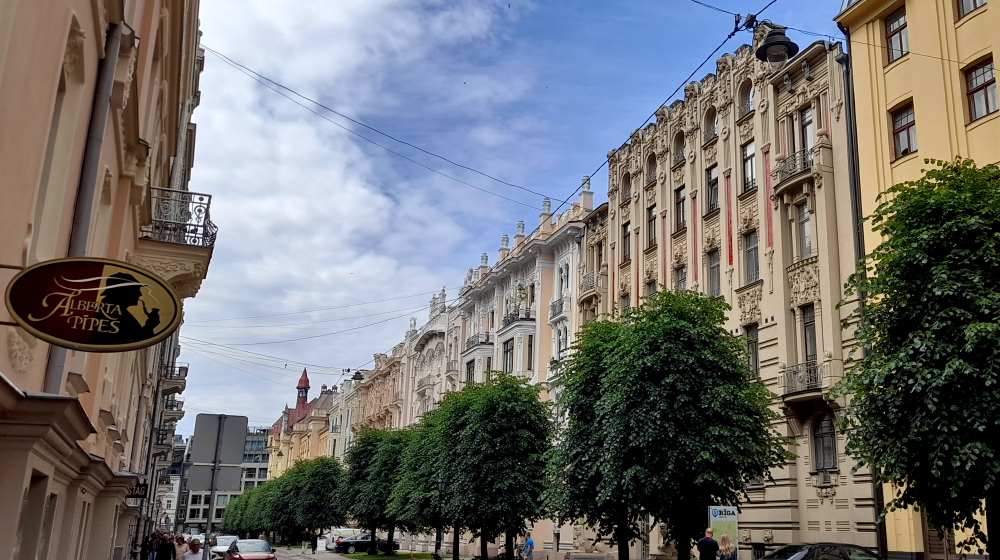
Alberta Iela, Riga.
The area was erected in a short period of time, from 1901 to 1908, each of the buildings standing alone as a 20th century architectural achievement. Eight buildings are now recognised as architectural monuments of national significance. The architectural monuments are buildings at 2, 2a, 4, 6, 8, 11, 12 and 13 Alberta Street, created by M.Eisenstein (No. 2;2A;4;6;8), N.Mandelstam (No. 10) and K.Pēkšēns (No. 12) [liveriga.com].
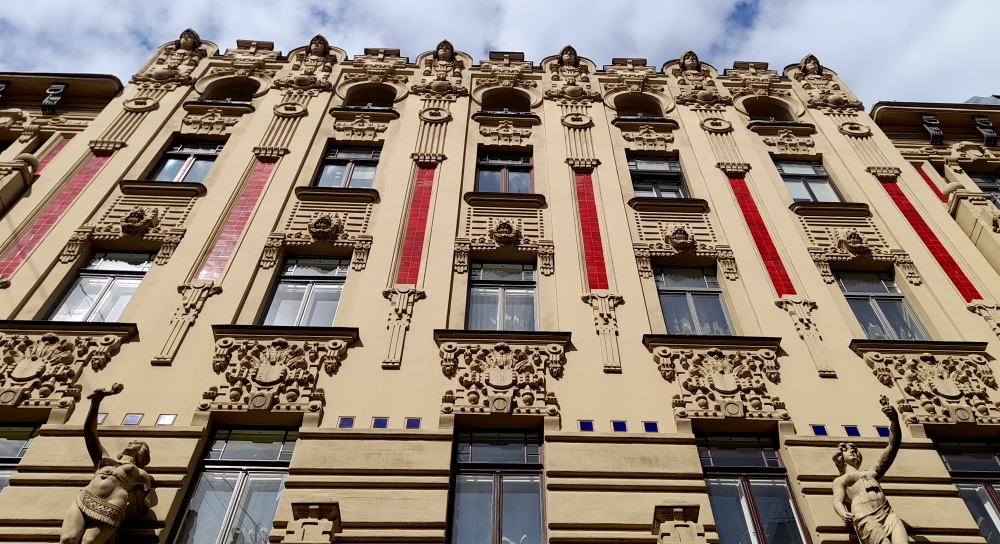
Alberta Iela 2a, Riga.
1906 – Architect: Mihails Eisenstein
Tenement house of Vladimir Bogoslavsky. The last convincingly bright example of eclectic decorative Art Nouveau designed by M. Eisenstein in Riga. It is the only house he designed whose facades are accented with glazed tiles in dark red and blue [jugendstils-riga-lv].
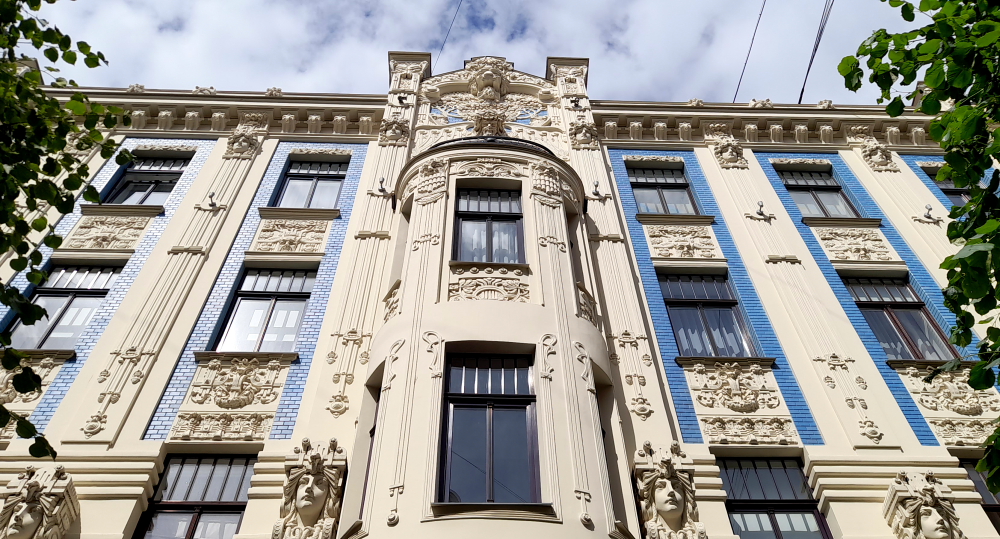
Alberta Iela 8, Riga.
1903 – Architect: Mihails Eisenstein
Leo Pole’s rental house. One of the most expressive decorative Art Nouveau buildings in Riga. The most luxurious part of the building is the central panel which is associated with a tree, the top of which has a lion’s head, which is a symbol of strength and majesty. The facade of the building is decorated with women’s heads, symbolizing elegance and beauty. Decorative ridges are used for the decorative decoration of the windows, which are decorated with masks of repulsive beasts, which protect the peace of the residents of the house. The facade of the building is decorated with blue brick and light plaster.
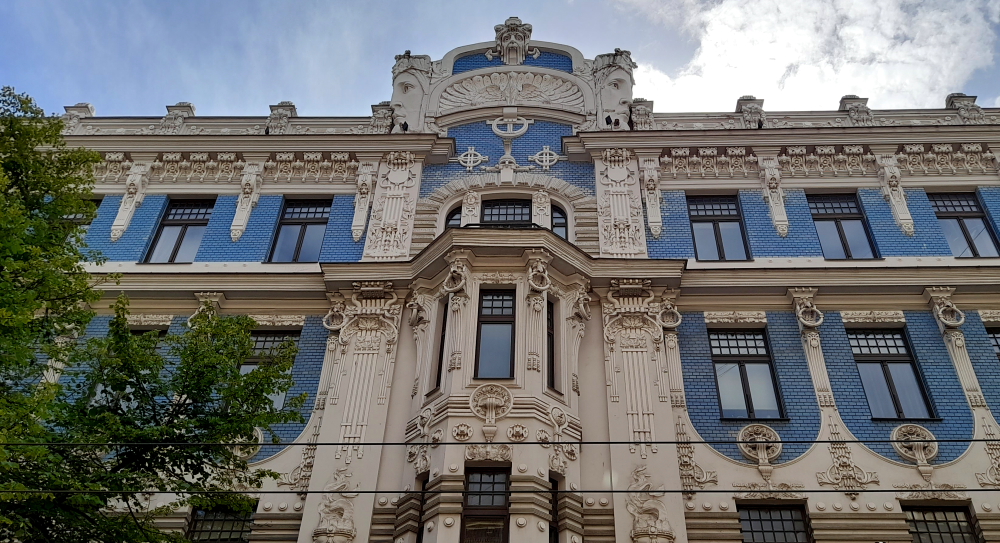
Elizabete iela 10b, Riga.
1903 – Architect: Mihails Eisenstein.
One of the most impressive early examples of Art Nouveau is the building at 10b Elizabetes Street, designed by Mikhail Eisenstein, the father of the film director Sergei Eisenstein. The building has a particularly rich facade decoration. The composition of masks, peacocks, sculptural heads and geometric figures in the crown of the facade, as well as the facade areas covered with blue ceramic tiles on the upper floors, stand out in particular. This facade was designed by copying and supplementing the facade drawing by Leipzig architects Georg Vinšmans and Hans Kotzel, which was published in a collection of facade drawings published in St. Petersburg. The building and its magnificently decorated staircase were restored in 2000 [liveriga-com].
Tomorrow we head further down the Latvian Coast to Ventspils. We have enjoyed our 5 day stay in Riga and the very compfortable Radisson Blu hotel. For the next 3 days we have to cater ourselves and catch up on our laundry.
 THE CONTINUING TRAVELS OF YOGI & BOO BOO