15 April, 2024
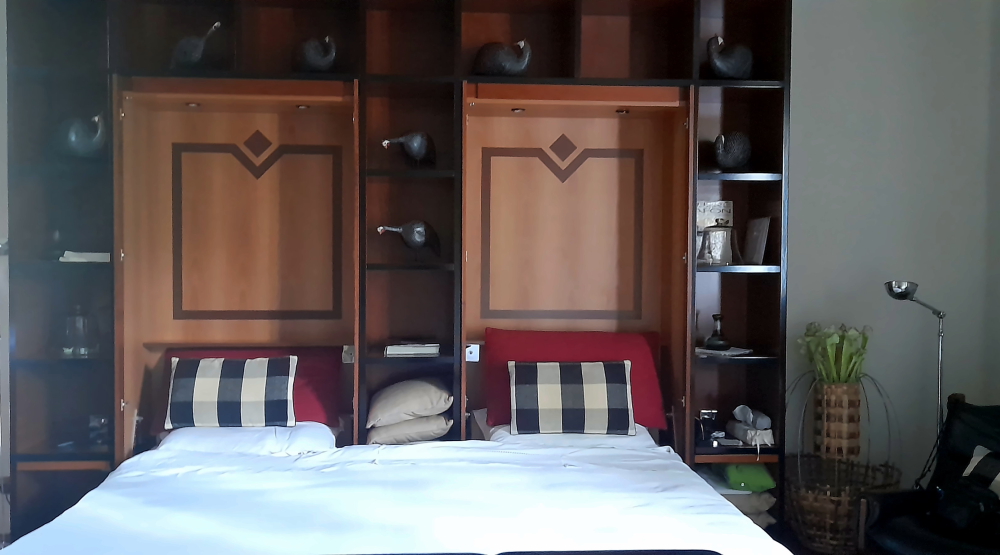
Ahh! A lovely night’s sleep in a very large and comfortable bed. In fact, the bed has been cleverly and beautifully built into a converted cupboard made of different types of wood – so the bed is huge!
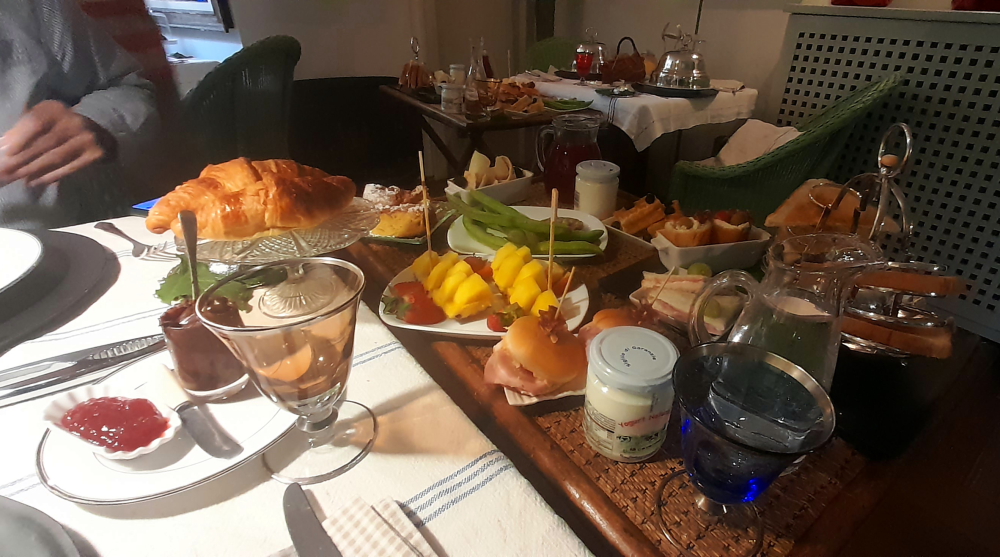
And so is the breakfast. We head down the stairs at 8:30 am to be greeted by Robbie, who checked us in yesterday, and Gabriella, the owner of the house, who is the daughter of the painter, Gigi Cuniolo.
Talk about stunning Italian hospitality. We have a side table that is absolutely groaning under the amount of different types and styles of food, from savoury to sweet. And served on some exquisite crockery and antique silverware. Breakfast, Italian style (Colazione, all’italiana)!
It promises to be 5 degrees cooler today so we walk into town to find a bank ATM, a barber that is open today (Monday), book a table for dinner tonight and check out some of the town’s sights.
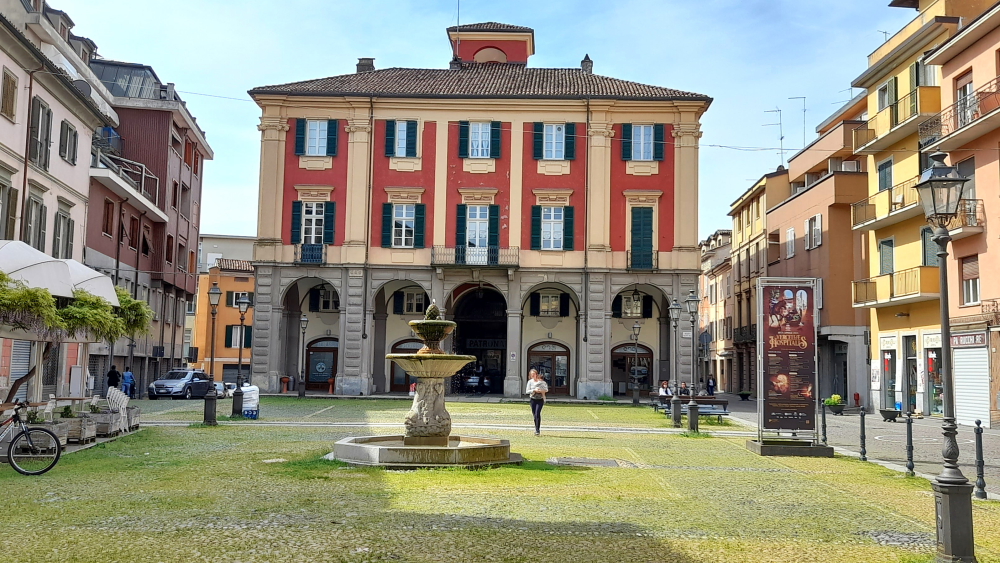
We walk down the hill to one end of Via Emilia which is the street that bisects the town and is the centre of what was the old town.
Here we find a local bank that doesn’t charge a fee to withdraw cash. Tick!
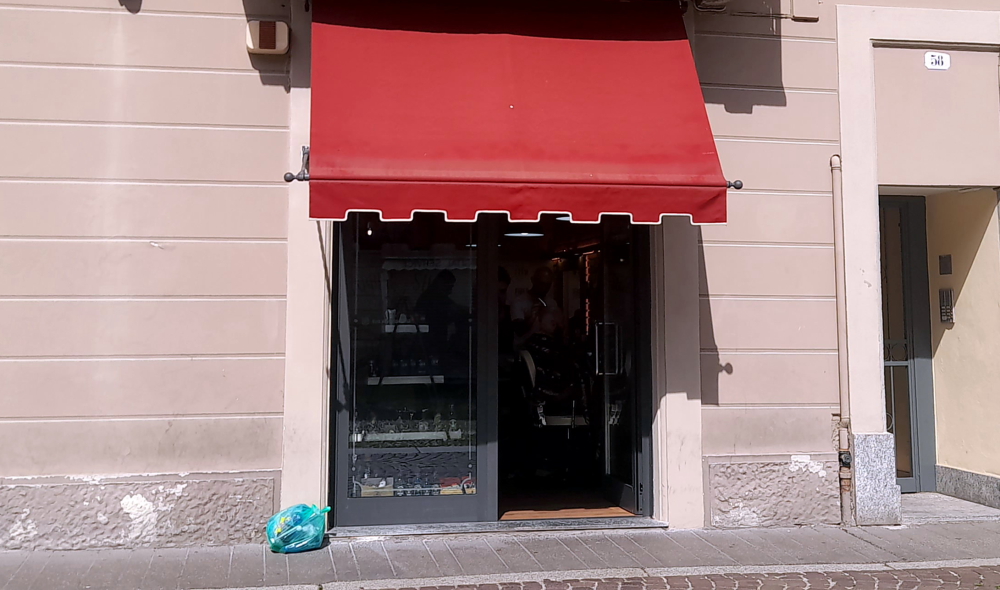
Nearby we find the barber shop that I was looking for on Piazza Alberto Malaspina – and it’s open!
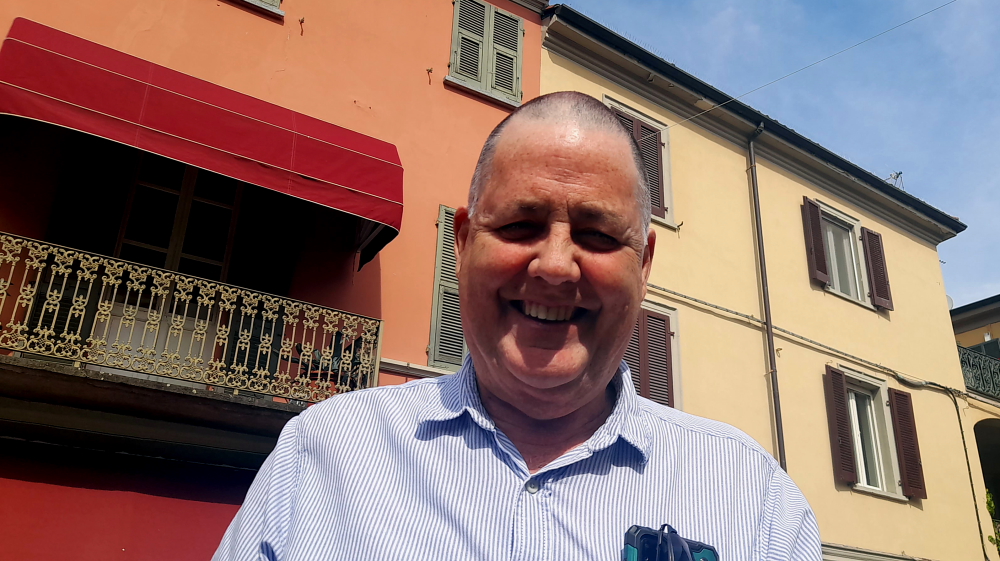
5 minutes later I emerge a different man – or should I say looking like an inmate of Prisoner Cell Block H! Something tells me that the Italian equivalent of an Ozzie No. 2 is different, by at least 1. It’s the shortest haircut I’ve ever had. In fact, I had more hair when I was born! At least I get my EU15 worth. This cut will last me through to when we arrive back in Oz in 4 months’ time. Tick!
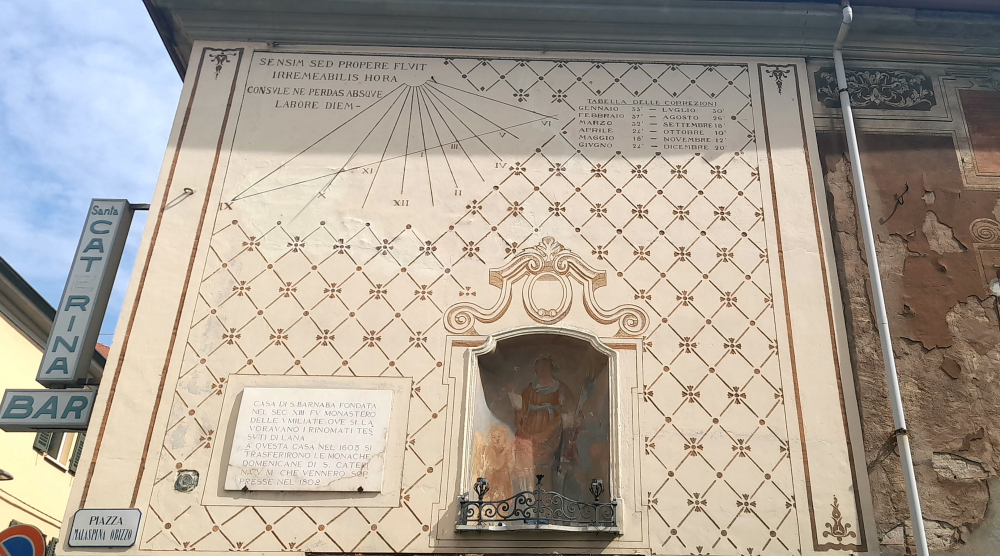
From here we commence our promenade up Via Emilia. It’s the main road axis of the city, partially identifiable with the Roman “cardo”.
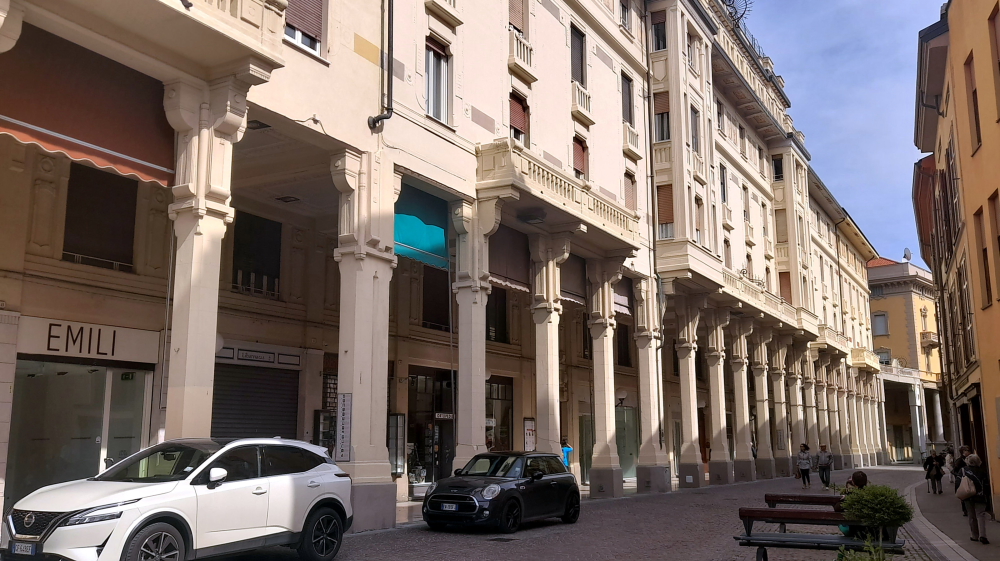
In 1846 the southern section was expanded with the demolition of old houses and the construction of the current porticoes. Along its axis that runs from north to south there is the greatest number of monuments, palaces and churches.
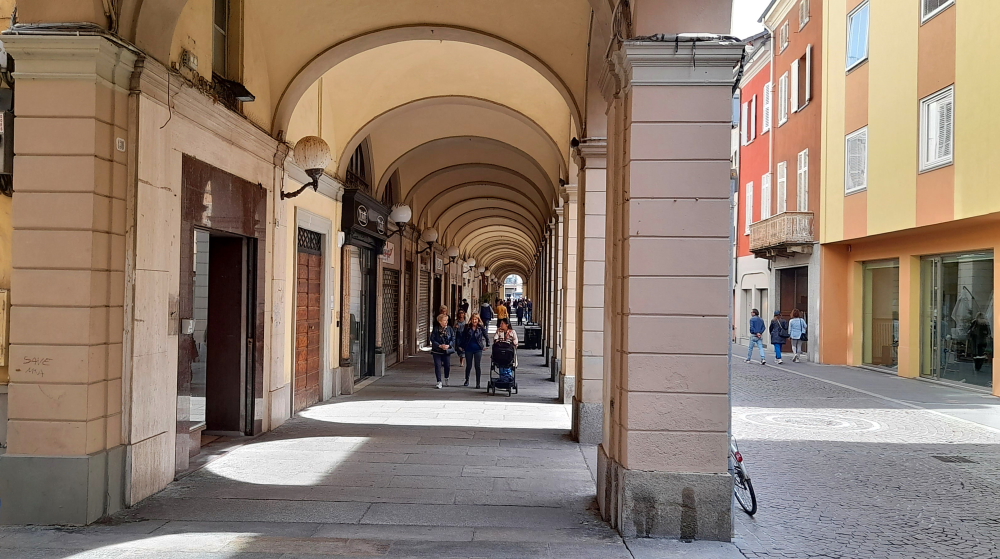
There is no shortage of commercial attractions such as shops, bars and restaurants. For much of the year, cultural, musical and food and wine events take place which attract large audiences from all over the area and neighboring provinces. [vivitortona.it].
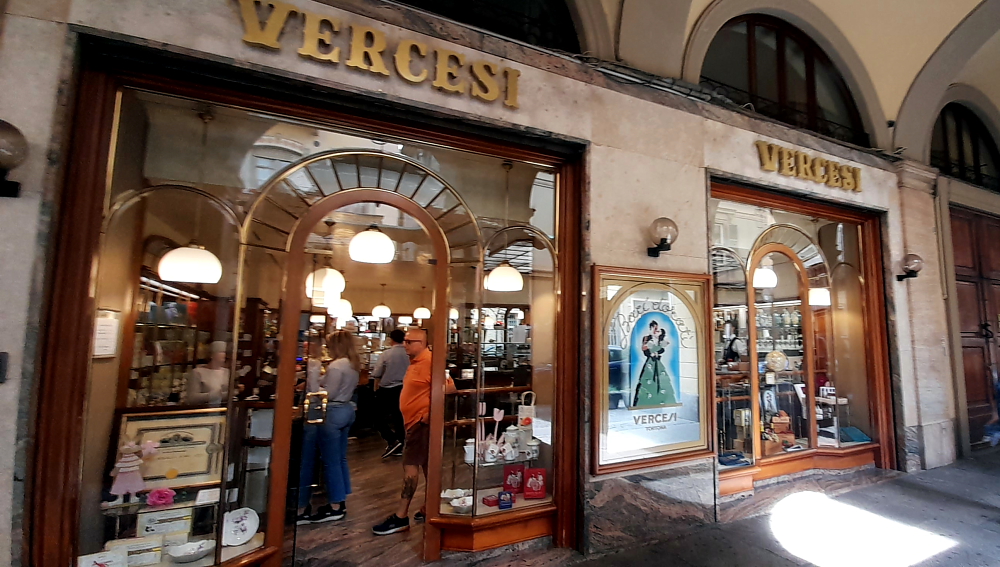
One of the delightful shops we come across is Pasticceria Vercesi (Vercesi Pastry Shop), famous for its Baci Dorati (Golden Kisses) sweets which we discover are an exclusive Tortonese specialty.
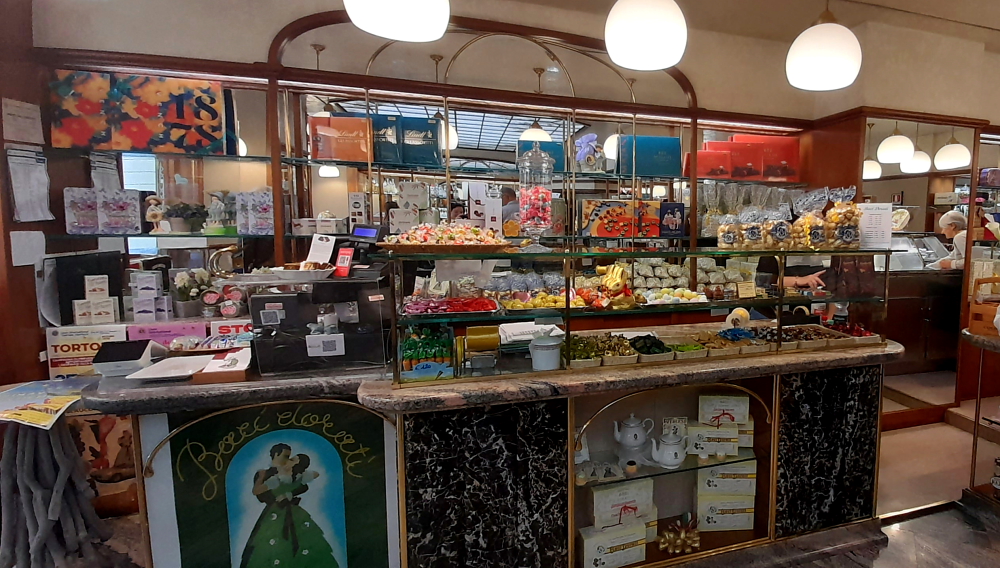
“Founded in 1898, this historic artisan company, with the passion and dedication of that time, produces desserts prepared according to ancient recipes every day: the very classic and unmistakable Baci Dorati, the ever-present fresh and dry pastries, the desserts for big celebrations such as panettone and colombe , the assorted and always delicious pretzels, the original and imaginative birthday cakes or the always fragrant fruit tarts.”
“At the end of the 19th century, the cavalier Stefano Vercesi decided to modify the recipe of the already famous “Baci di Dama”, replacing the hazelnuts, preferring almonds and adding cocoa to the soft mixture.
This is how “Baci Dorati” was born. The idea of patenting them, making them original over time, is excellent. Presented at the international fair in Milan in 1906, they won the gold medal, the highest pastry recognition of the time.
Still made today respecting the ancient recipe and sold in an elegant art nouveau box with the famous poem inside “Paggio Fernando where were the delicious Baci Dorati born?” they manage to conquer even the most refined palates. Simple, fragrant and delicate, “Baci Dorati” are suitable for all seasons.” [pasticceriavercesitortona-it]
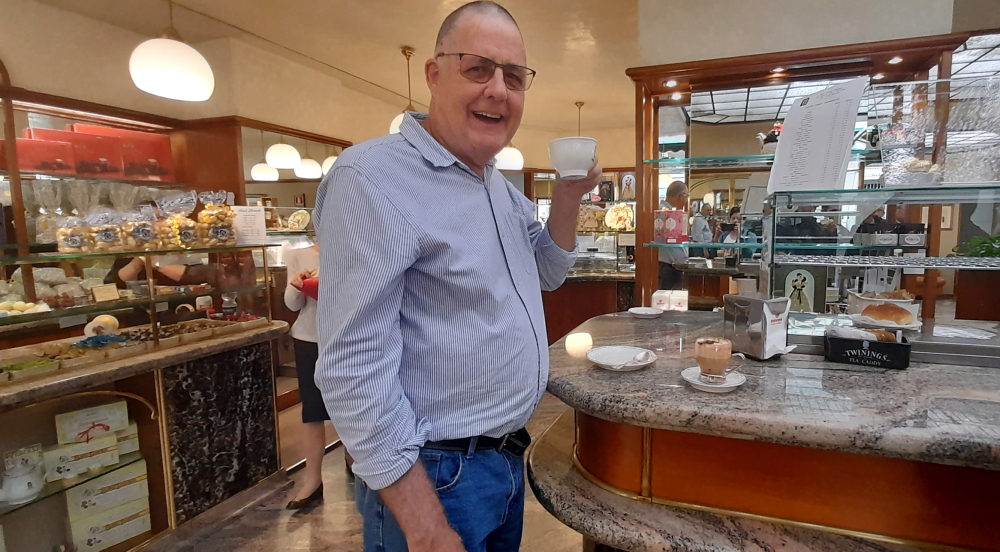
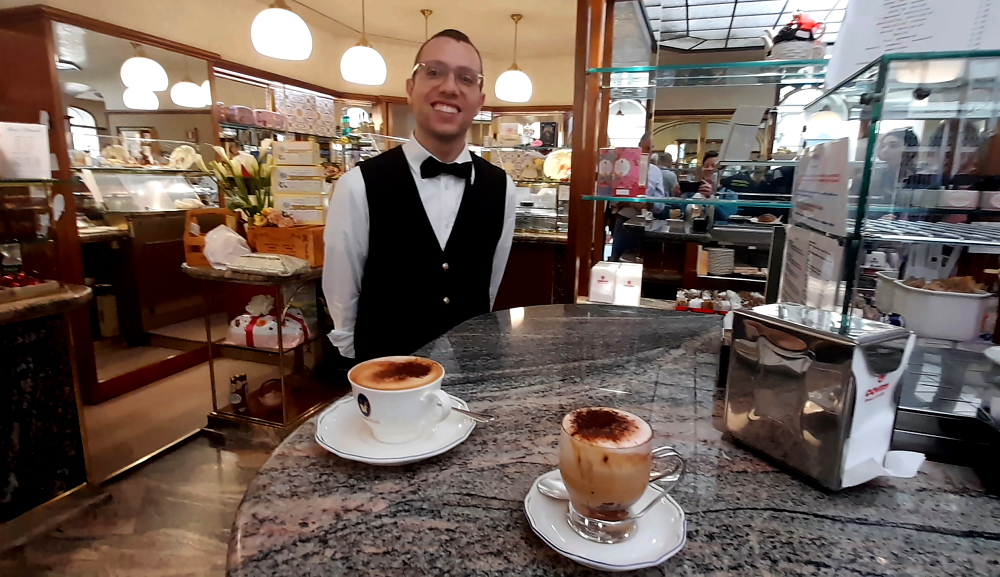
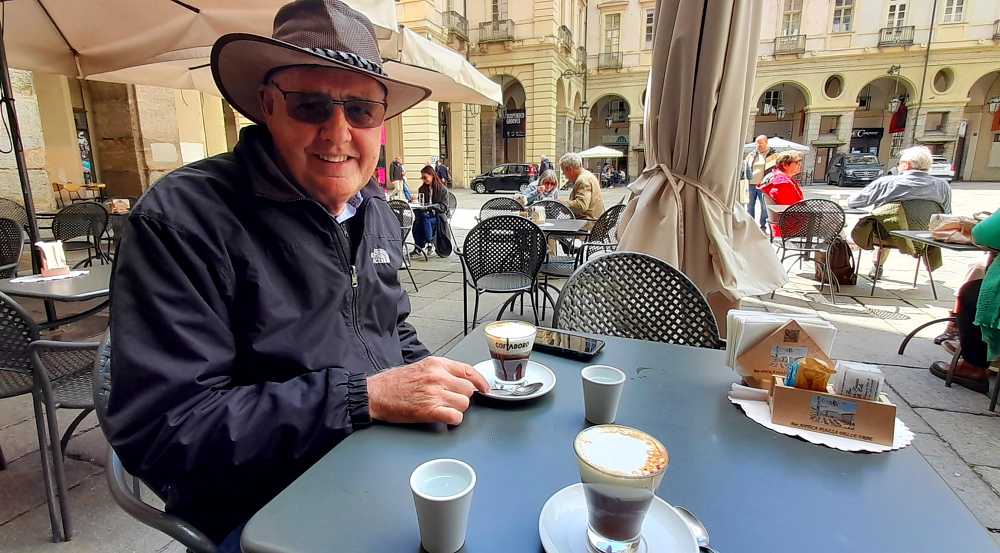
Although we each had a coffee with breakfast we decide we’d try the Italian tradition of ordering and drinking a morning coffee standing at the bar, along with the numerous locals. Talk about fast food – the number of locals ticked over at least 4 times before we finished ours.
Lynn decides on a Moroccan – an espresso made with 20/30ml frothed milk and cocoa – which has nothing to do with Morocco: it was born in Piedmont, in Alessandria (nearby town and capital of a Piedmont province), as an evolution of the bicerin of Cavour, a historic Turin drink. Why then “Moroccan”? With a color reminiscent of “Morocchino” leather, a very fine type of leather with warm tones. [www-cimbali-it.]. All for a total of EU3.00 for the two coffees.
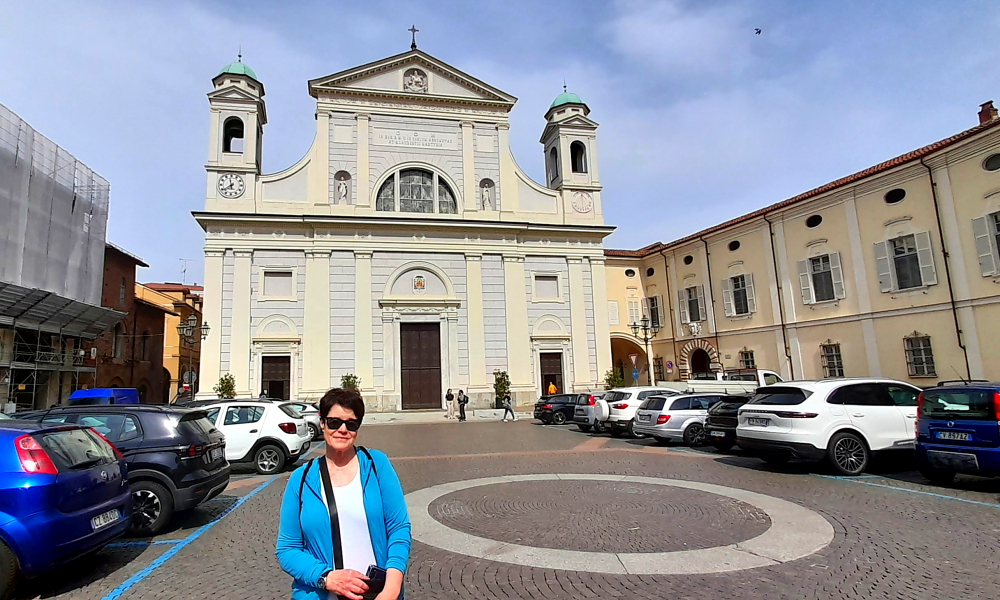
In the next block is the Cathedral of St Maria Assunta, or the Tortona Cathedral. This Cathedral is dedicated to Our Lady of the Assumption and Saint Lawrence. The foundation stone was laid in 1574 by Tortona’s Cardinal Gian Paolo. In 1583 it was solemnly consecrated by Bishop Cesare Gambara, in the presence of the Lady of Tortona, Christina of Denmark.
In the first half of the 17th century, building work ceased until Monsignor Carlo Settala became bishop, adding the arcade gallery called the “passetto” to connect the Bishop’s Palace to the cathedral in 1661. In the second half of the 19th century the façade was rebuilt.
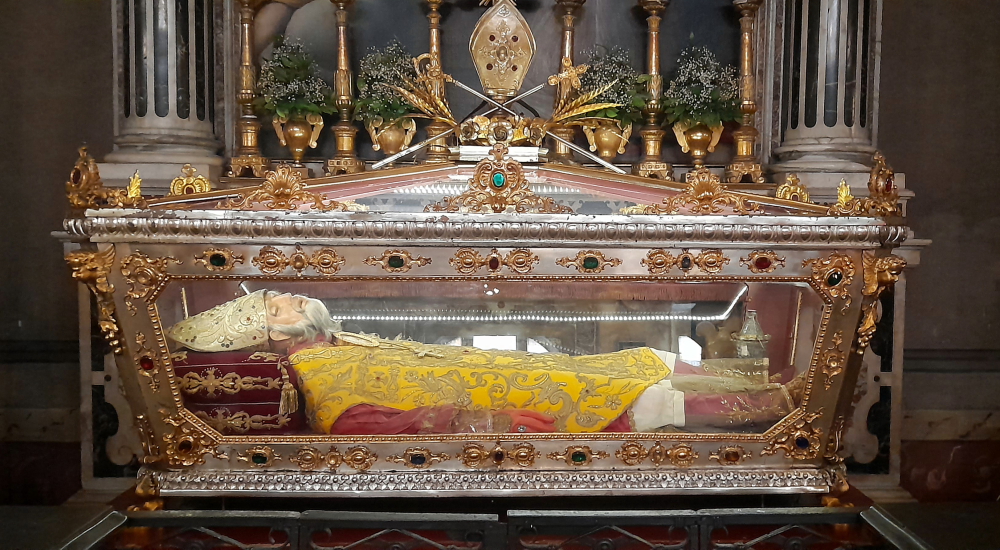
The historic, 18th-century high altar is in marble and houses an urn with the relics of Saint Martianus, patron saint of the diocese and traditionally the first bishop of Tortona, martyred in AD 122. [www.cittaecattedrali.it]
On our way to the church we call into Il Panson on Via Emilia and book a table for dinner at 7:00 pm. Tick!
Several blocks away is the Church of San Giacomo Maggiore, unfortunately closed on Mondays. Apparently an exquisite example of late-Baroque architecture, valuable both because it has not undergone decisive changes in subsequent centuries, and because it is built in a sober style, without excessive decoration that often characterizes the art of this era.
The current church was consecrated in 1784, but its origins are medieval. In 1252 a “hospital” stood next to the church, entrusted to the Brotherhood of the Templars, where hospitality was given to the numerous pilgrims heading to Santiago de Compostella.
In the 18th century the old church was in ruins, so it was demolished and rebuilt at the behest of the Tortonese cardinal Carlo Alberto Guidobono Cavalchini, with works commending in 1770. [www-cittaecattedrali-it.]
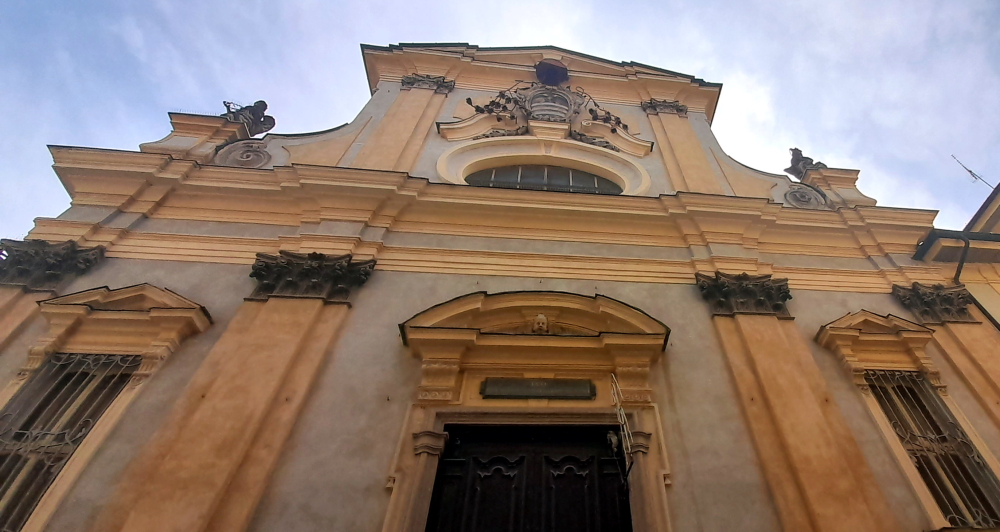
On our way back to the hotel we pass by the Church of Santa Maria Canale. It’s the only church in the city that has maintained its ancient Romanesque appearance, even if modified by numerous restorations.
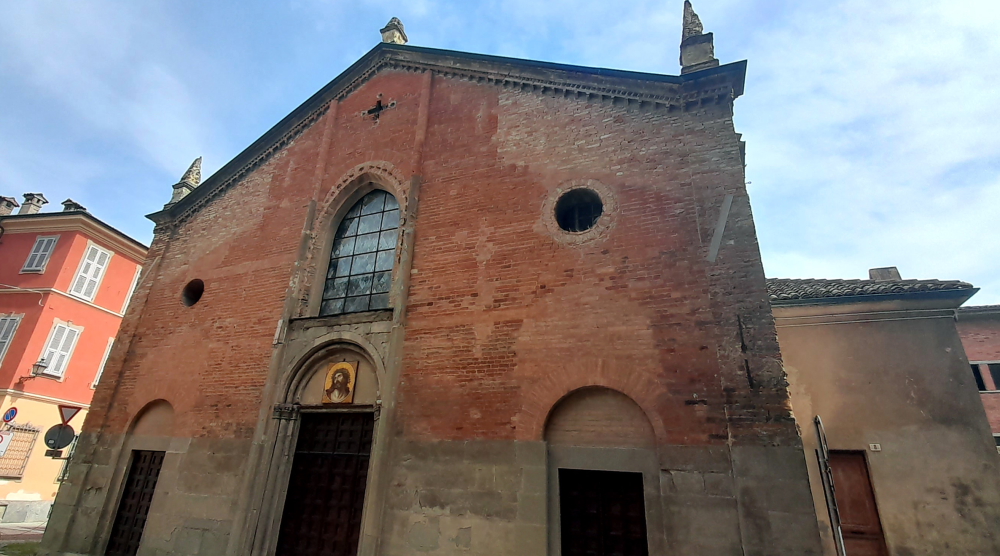
Its facade includes a large terracotta window, dating back to the 14th century, which replaced the original rose window, of which the round arch survives. Under the top of the façade there is a small Greek cross window with coloured Byzantine-produced ceramics dating to the first half of the 12th century. The façade ends with a sawtooth brick frame shape.
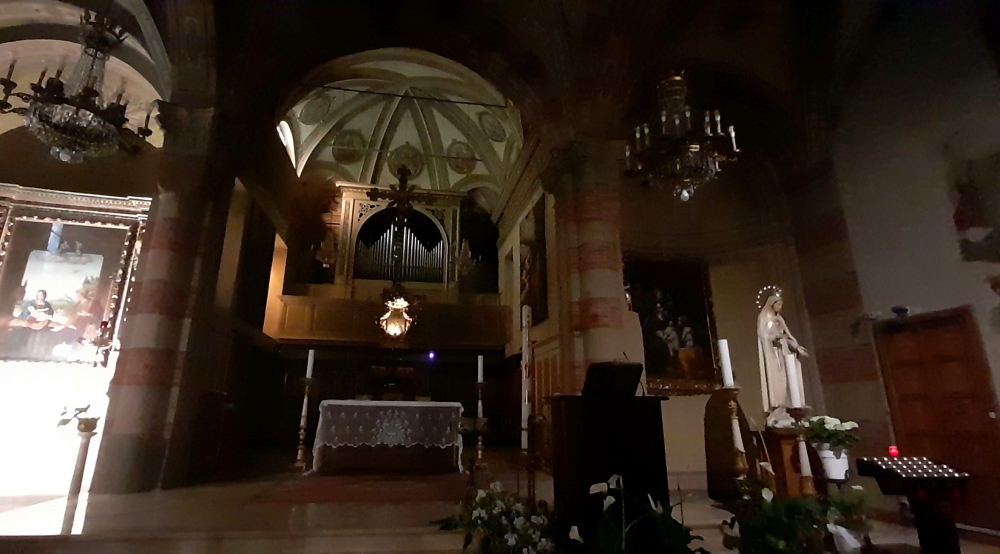
The interior has three naves, the smaller ones ending in semicircular apses, the largest in a rectangular choir, which dates back to 1564. The roof, originally with trusses, was replaced in the 14th century by ribbed cross vaults that rest on pillars. The sandstone capitals of the pillars are different from each other, decorated with stylized plant elements: an older group has been dated to around 1040, the other to around 1165. [www-cittaecattedrali-it].
After stopping in at the guest house and arranging for the car’s AC to be repaired in La Spezia (bonus tick!), we continue walking through Castle Park to the Torre di Tortona.
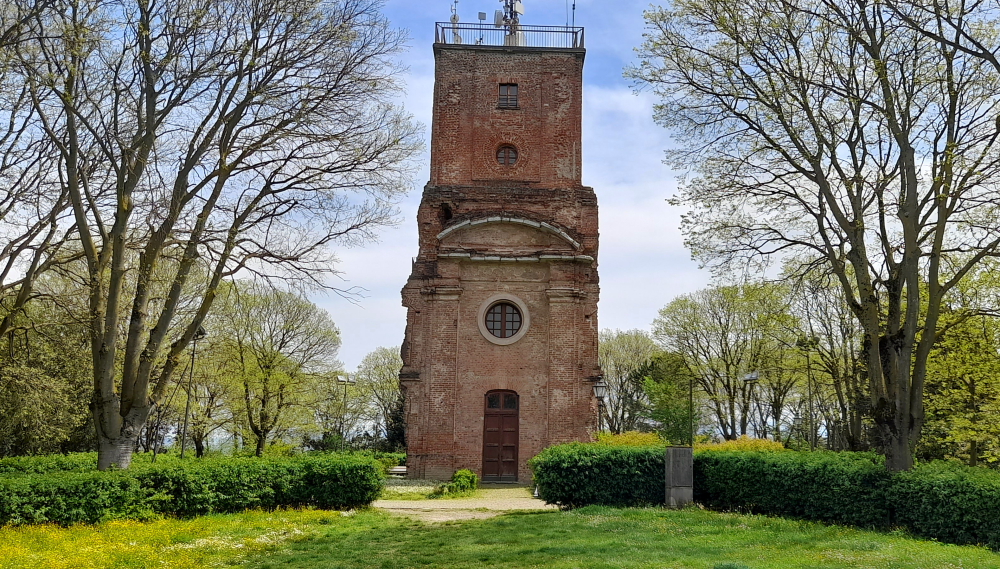
This tower (6 floors and 20m high) is the only surviving element of an imposing fortress that overlooked the city from the top of the hill.
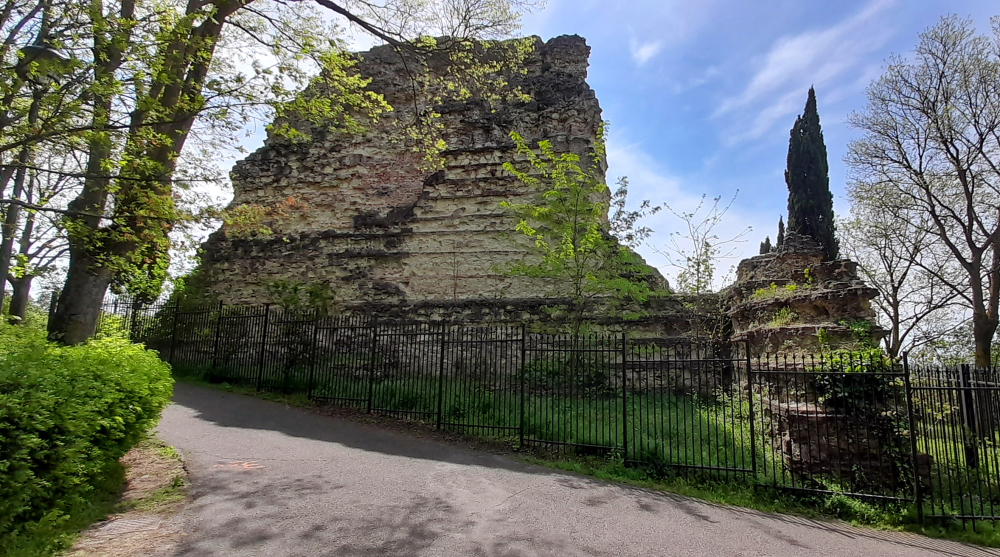
Identified as the bell tower of the chapel dedicated to the Blessed Amedeo of Savoy of the S. Vittorio fort, it survived the complete destruction of the military complex decreed by Napoleon Bonaparte in January 1801. Restoration works were carried out in 1907 and 2014. Ticks!
We spend the afternoon writing the blog and enjoying our terrace until we walk into town for dinner.
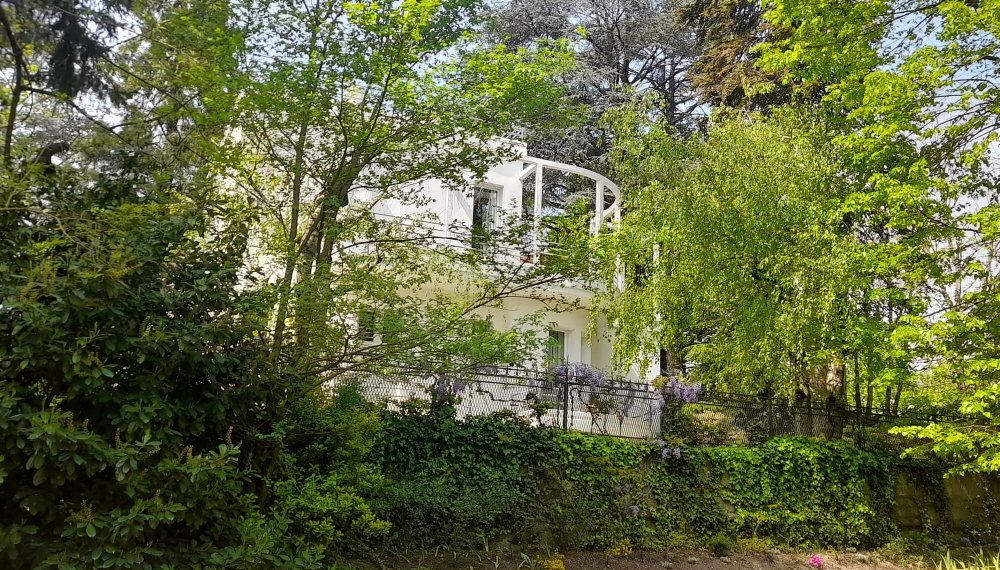
Although the restaurant’s decor is nice and simple, the food portions are small (duck breast) and the accompanying vegetables (spinach and artichoke) are inedible. Even Lynn’s Aperol Spritz doesn’t taste quite right – watered down? Luckily we had eaten the left over pork chop from last night’s dinner for lunch!
16 April, 2024
After yesterday’s sightseeing activities we have a lazy day. While I take the car into town to get it cleaned inside and out, Lynn stays at the guest house to make the most of lounging on our terrace. This afternoon we look at our upcoming week in La Spezia and plan an itinerary to visit the 5 Cinque Terre villages while we are there. This evening we’ll walk back into town, this time to an Asian restaurant.
Tomorrow we’ll have about a 2.5 hour drive (173km) to La Spezia where we’ll drop off our luggage at the apartment then drive to the Opel dealership and leave our car there for them to determine what repairs need to be made to the car’s AC.
17 April, 2024
It’s 11 Deg. C at 10:15 am when we say our farewells to Robbie and Gabriella, the owner, and take the A7 towards Genoa on the coast. Parts of the route are quite winding, thanks to following the river valley and the steep-sided hills on either side and we pass through numerous tunnels. Just before Genoa we take the A12 which bypasses it.
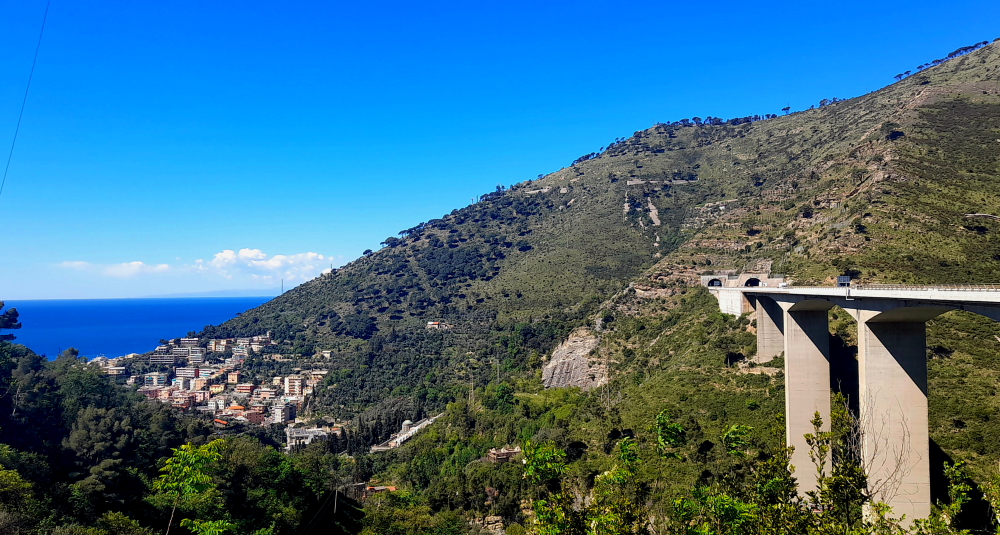
2.5 hours later we make a pit stop and take in the view of Nervi and the sea from the gas station’s cafe.
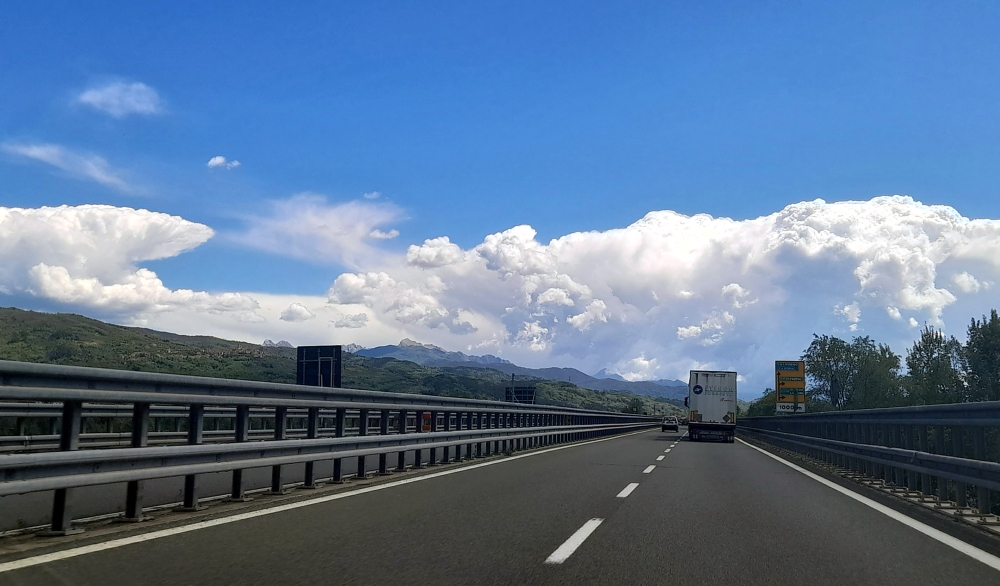
Continuing along the A12 we see some rather impressive snow-topped mountains in the distance and the even more impressive cumulonimbus clouds that are forming on the horizon. Thunderstorms are predicted for Cinque Terre tomorrow and it looks like they are on their way.
While at our pit stop we had messaged our next host asking if it would be OK if we arrived around 1:15 pm rather than 2:00 pm. So, just after 1:15 pm we pull up around the corner from the apartment in a loading bay where Marco meets us. It’s 20 Deg. C. and it starts to rain.
He helps us with our luggage and shows us the 5-roomed apartment’s amenities – including a bottle of Sangiovese and 2 chilled cans of Moretti beer, all complimentary (good man!) – before we go our separate ways.
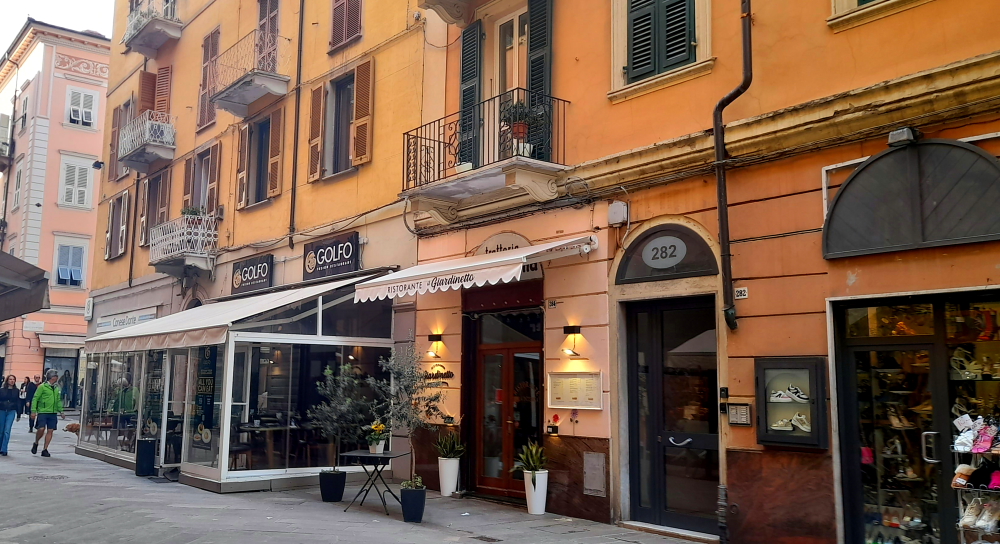
We drive the 6 minutes (4.5km) to the car service centre to drop off the car for the AC repair. But, we forgot that in Italy they shut down for a two-hour lunch. We arrive at 1:50 pm and have to wait until 2:30 pm for the office to reopen. Hopefully they won’t take a week to do what should be a couple of hours’ work replacing the AC pump.
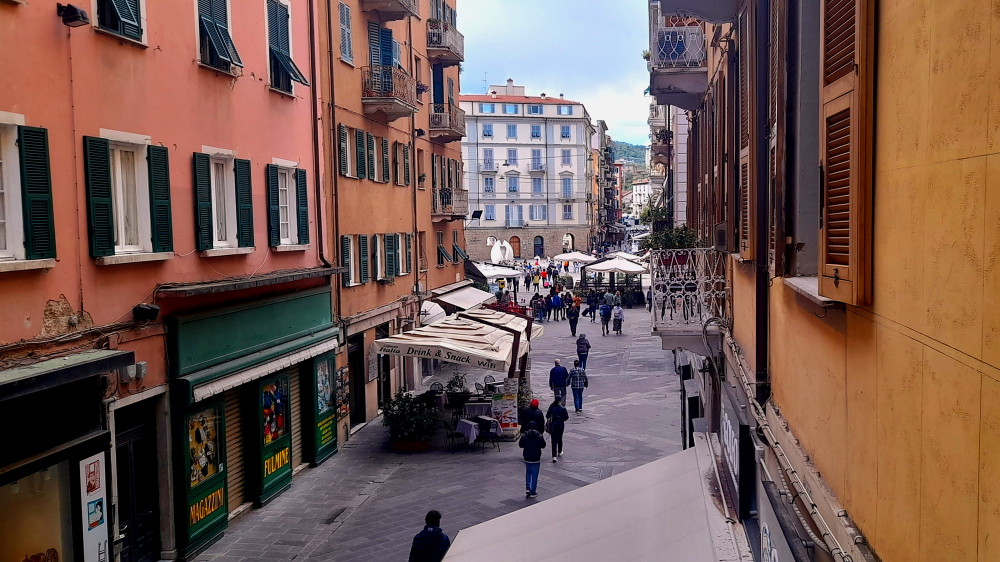
The service centre is about an hour’s walk back to the apartment but there is a bus stop close by so we are in 2 minds about trying to navigate taking a bus or walking. Just as we are about to start walking a bus arrives. Unfortunately, you can’t buy a bus ticket from the driver but he still lets us on and we take a chance of a free ride vs a hefty fare evasion fine. The bus eventually stops within a 5-minute walk to the apartment so luck is on our side today. We’ll have to work out how to buy a bus ticket before we ride back. I know that Italians only see paying their way as a suggestion but we don’t want to try our luck again.
Walking back to the apartment via a Carrefour Express we are reminded of Valencia – the neighbouring streets are lined with orange trees and the blossoms’ scent is evocative. By the time we unpack it’s 5:00 pm and we are both starving so we pop downstairs and go next door to a cheap eatery for a cold beer, Aperol Spritz, and pasta. At this point we thought we’d have an early night, but end up finding a TV series in English, ‘Resident Alien’, which is rather funny.
18 April, 2024
Thanks to our late night, double glazing and a comfortable bed, we don’t surface until 9:15 am. We had planned to take the train to Corniglia this afternoon but given the thunderstorm forecast today and Cinque Terre’s history with flash flooding and landslides we opt to stay in La Spezia for the day, get the laundry and ironing done and check out the train station and port for trips to the 5 villages.
Just as well as about an hour later we hear the rumble of thunder and it starts to rain quite heavily.
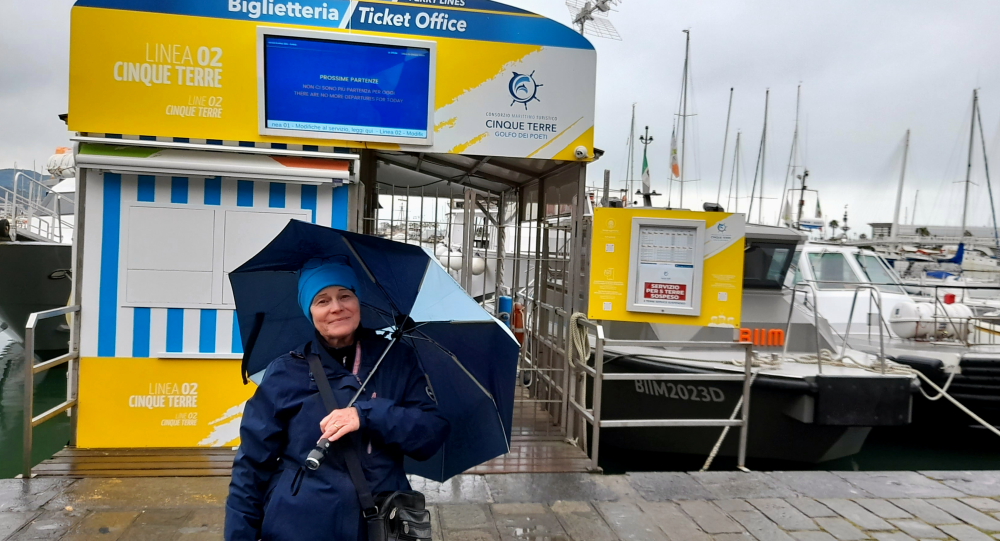
Right! Recce time. Around 4:00 pm we first walk to the train station which is an 8-minute walk away and ask at the Tourist Information Office about the best ways to visit the villages then check out the location of the train platform for the regional train and the ticket machine.
Next, we walk in the opposite direction for 20 minutes (12 minutes from the apartment) to the marina at Golfo della Spezia and locate the ticket office for the boats to the 5 villages – Linea O2 Cinque Terre. The villages are Riomaggiore (closest to La Spezia), Manarola, Corniglia, Vernazza and Monterosso al Mare (fartherest).
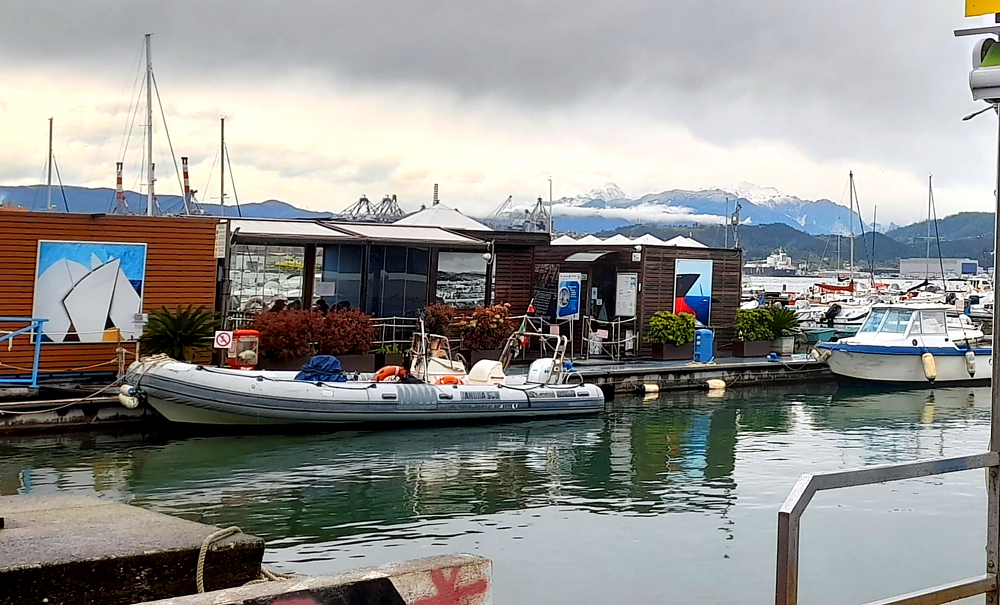
We decide that as the weather is supposed to be sunny tomorrow we’ll visit the furthermost 3 villages by train and the following day the closest 2 by boat.
On our way to the marina we noticed an adjacent park – Giardini Garibaldi – which we walk through on our return. This park was part of La Spezia’s first urban planning scheme drawn up in 1862 and approved in 1865, allocating the areas of Piazza Vittorio Emanuele, south of the old town, as public gardens.
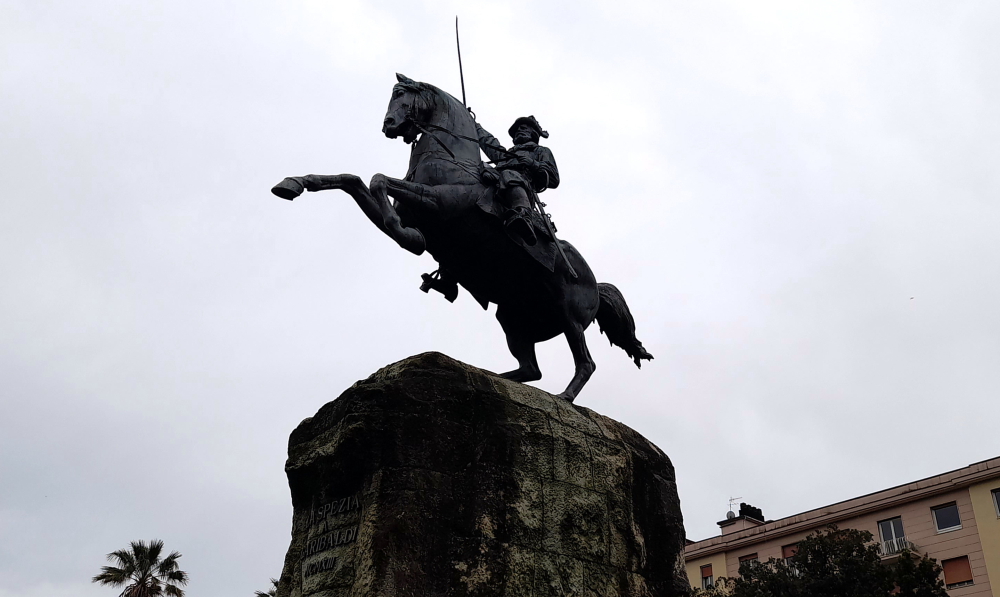
In the centre of this park is a fine equestrian statue by sculptor Antonio Garella (1863-1919) dedicated to the “Hero of the Two Worlds”, as Garibaldi was known. Great celebrations were held on 1 June 1913 in the La Spezia public gardens where the monument was installed. The sculpture was, and still is, featured in many images sent globally, transforming it into a symbol of the city of La Spezia.
19 April, 2024
Rainfall today is forecast at 1% with sunshine and an expected 18 Deg. C. By 9:00 am we are out the door on our way to the train station. Here, near the ticket machine, we find a pleasant young guy whose job it is is to assist tourists, so we engage his services and very quickly we have 2x day tickets – EU19.50 for Lynn and EU16.00 for over-70s me.
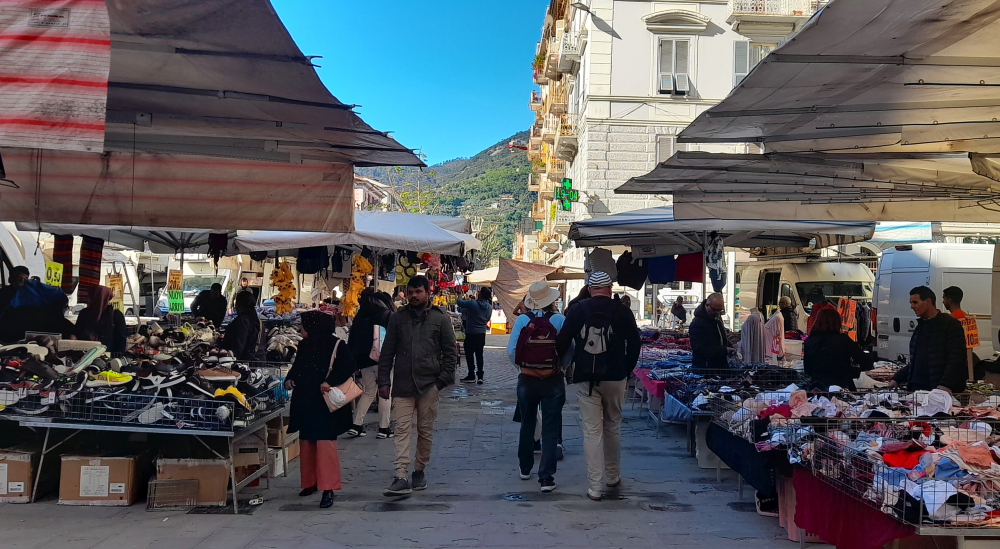
This allows us to get on and off the regional train for each of the villages and ‘free’ access to the Corniglia shuttle bus from the train station to the village centre (avoiding the Lardarina staircase of 33 ramps and 377 steps each way) and ‘free’ train station loos (normally Eu1 each visit). An absolute bargain, as it turns out!
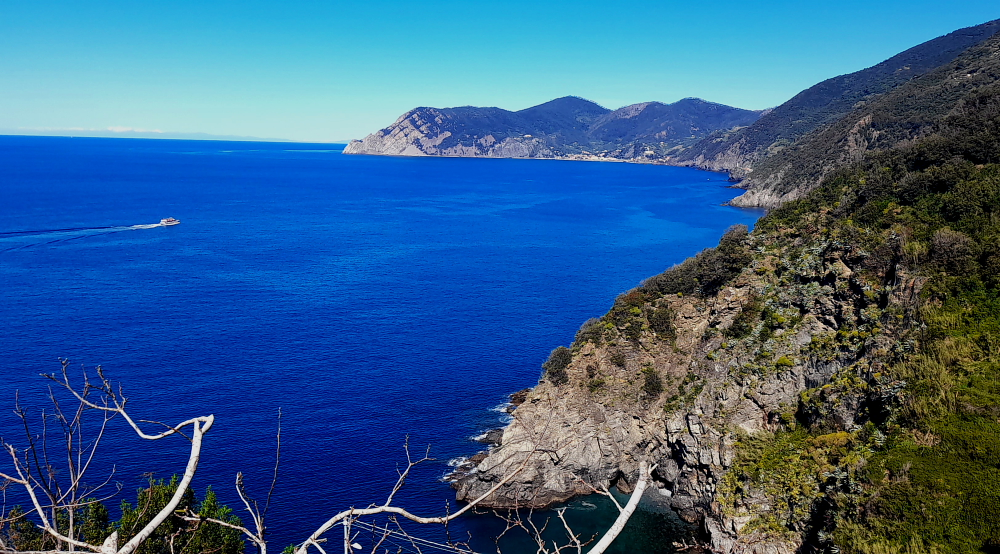
The plan is to visit Corniglia first before the hordes arrive then Vernazza and finally Monterosso, then take the train all the way home with the hope of getting a seat on these very popular trains.
Our train is already on Platform 4 when we arrive at 9:35 am. It’s a modern, double-decker train and already almost full. It departs about 20 minutes later and it takes about 20 minutes to arrive at Corniglia after having stopped briefly at Riomaggiore and Manarola stations.
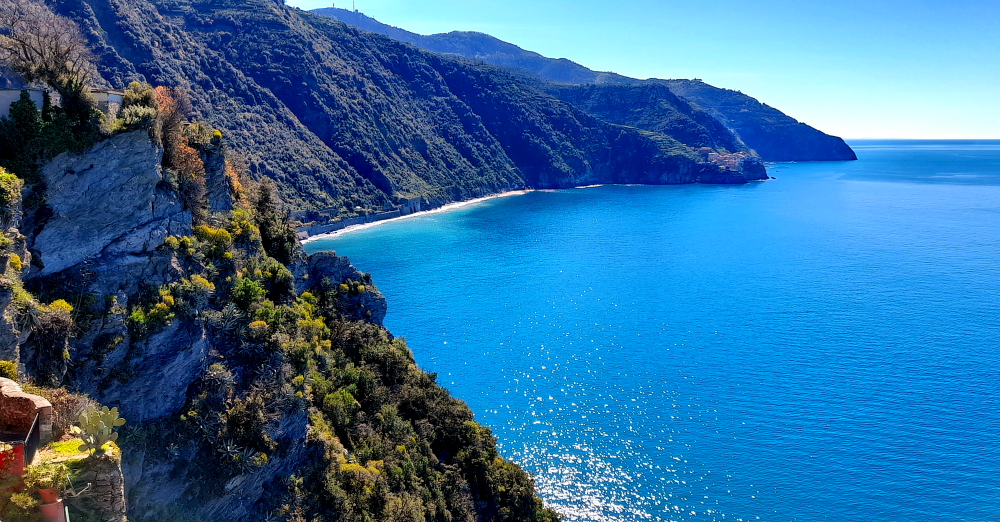
Corniglia is the central village of the Cinque Terre, the only one perched on a vertical cliff, and without a pier. The settlement has origins in Roman times and the etymology of the name, which can also be traced in some wine amphorae found in Pompeii, derives from that of the family that dominated it, the Gens Cornelia. Corniglia is still surrounded by vineyards and olive groves. Its wine – Vernaccia – is produced in Corniglia but takes the name from its port of embarkation – Vernazza. [visitcinqueterre.eu].
Clearly the hordes have already arrived as a huge bunch of people detrain. Luckily, we are the last 2 allowed on the tiny minibus, standing room only, which shuttles us to the village centre at Piazzetta Ciapara.
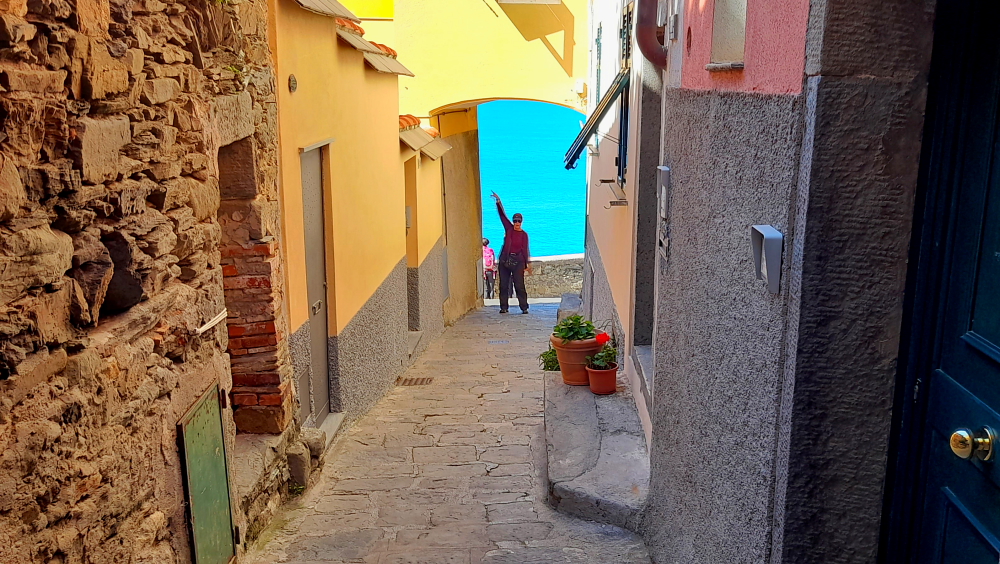
From here we take an alleyway – Via Fieschi – that wends through the 2- and 3-storied houses on either side until we come to a small square – Largo Taragio – in the heart of the village and in front of the Santa Caterina church. We continue on to the viewpoint at the Terrace of Santa Maria which is on top of a cliff overlooking the sea.
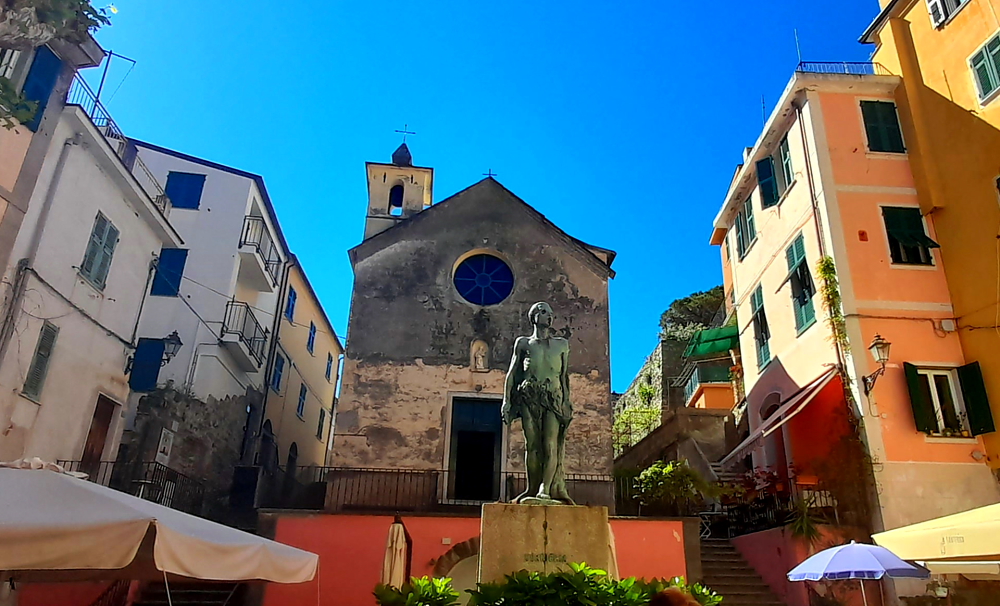
Retracing our steps to the church we scale the few steps to another view point behind it at Cinque Terre Cornelia.
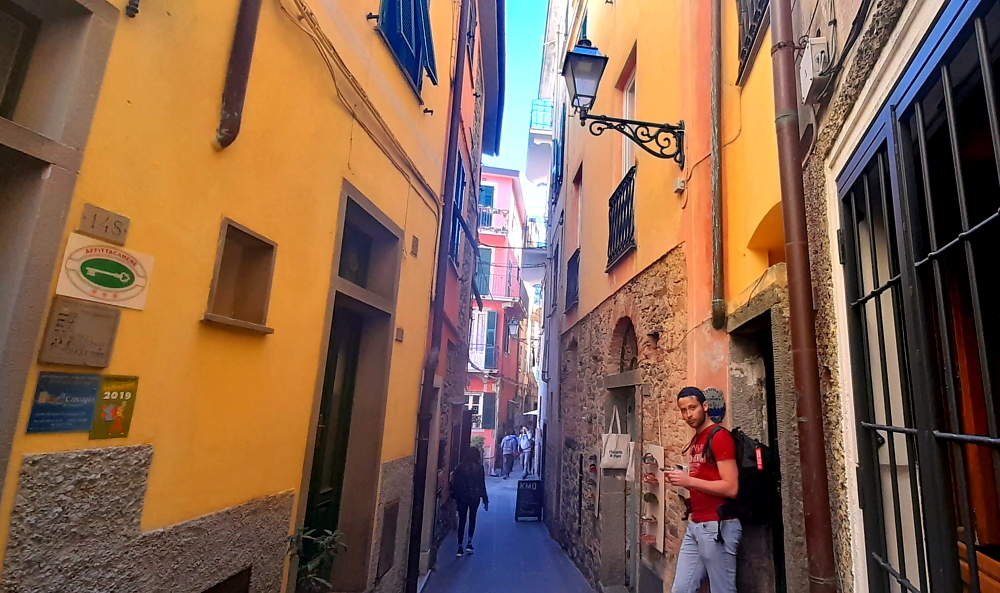
Walking back along Via Fieschi we pass by numerous cafes, bars, restaurants and boutique shops, some of which are accessed up and down alleyways and stairs and have picturesque view.
After a 12-minute wait the minibus arrives and this time we are 1st on and 15 minutes after arriving at the station we jump on the train for Vernazza.
Here we take advantage of our ‘free’ loo which we finally get to use after 15 minutes of queuing, thanks to one of the loos being ‘out of order’ – of course. Welcome to Italy! Where is Mario the plumber when you need him?
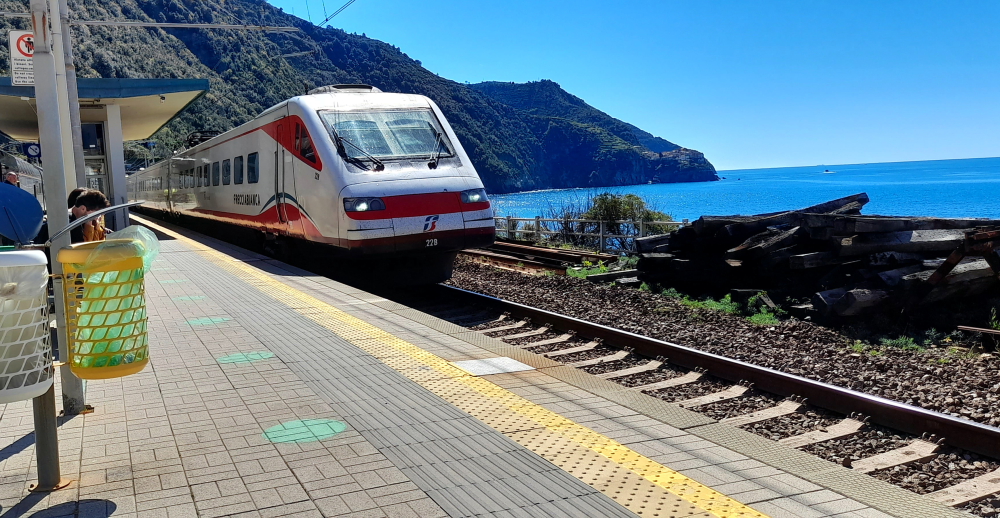
Conveniently, the Vernazza station is at the top of the village. Descending a few stairs places us on Via Roma. The town winds around this street, which covers a stream, from which carrugi (narrow alleys) and vertical stairways branch off – I’m talking grappling hooks and ropes here!
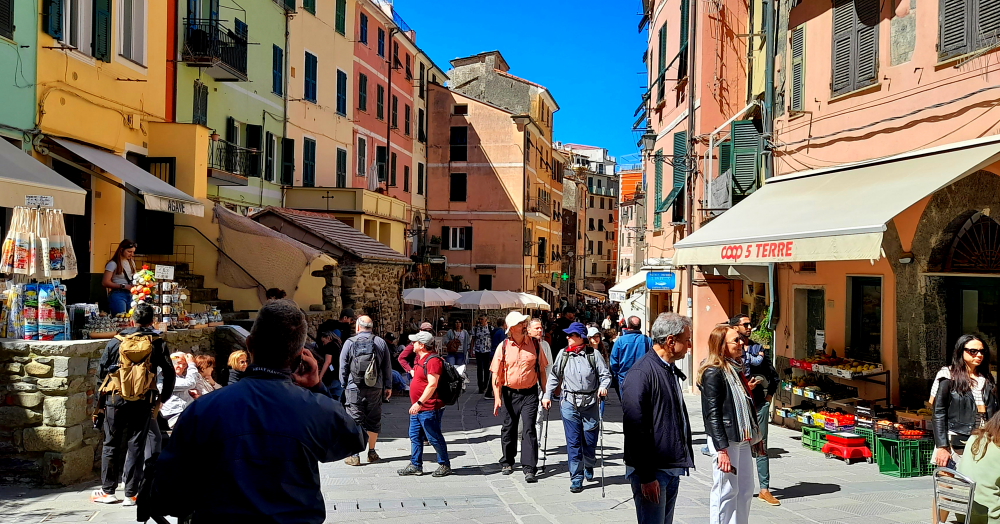
Around 1016, the settlement developed when Reggio inhabitants moved downstream, after the last Pisan-Genoese expedition supporting Sardinia to repel the Saracens.
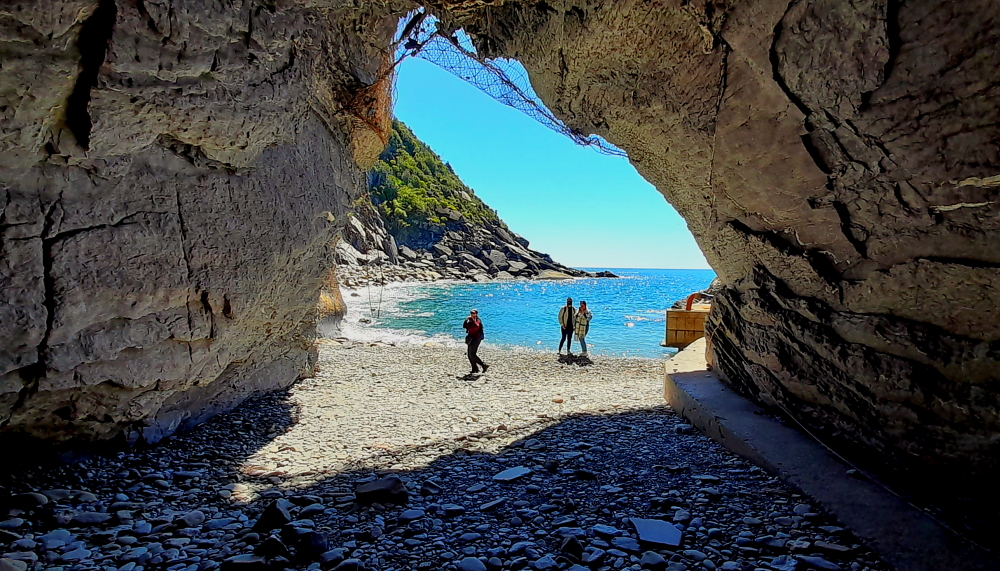
Vernazza was the maritime base of the Obertenghi, lords of the village until the end of the XII century, when the Republic of Genoa made it a commercial maritime base in 1209.
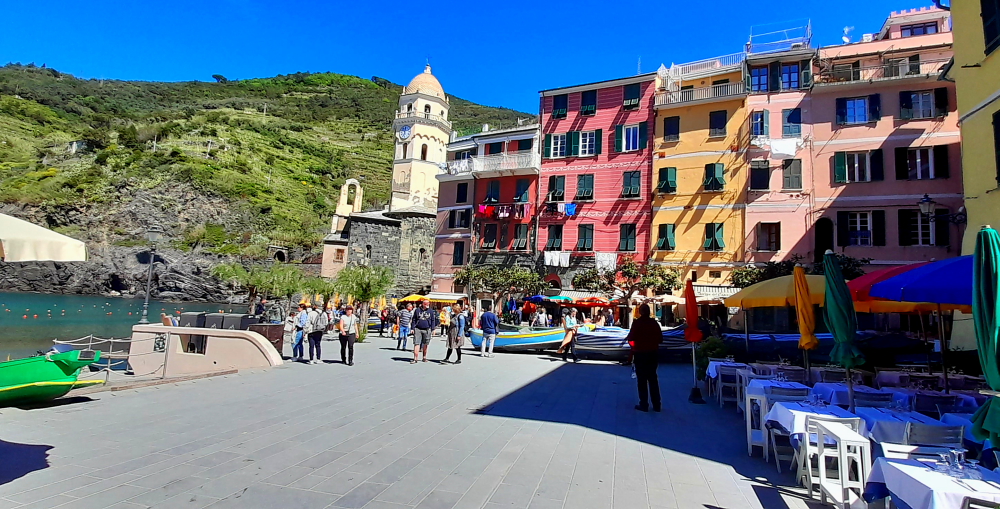
Genoa built both a fortified port for the landing of its galleys and a shipyard for their repair. Only a few portions of the walls remain.
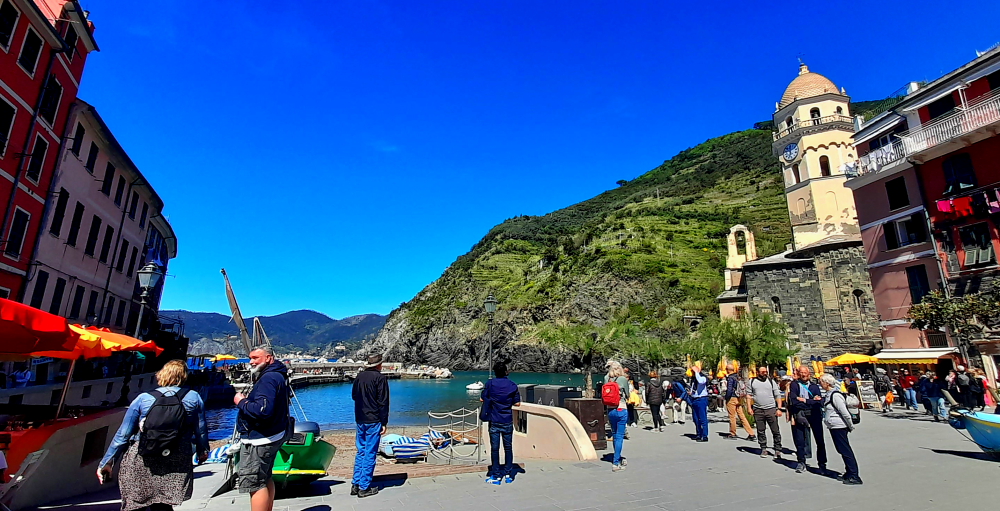
Under Napoleonic rule from the end of 1797, Vernazza was annexed to the Department of the Gulf of Venus, becoming its capital after La Spezia. From 1815 it became part of the Kingdom of Sardinia, until the creation of the Kingdom of Italy in 1861.
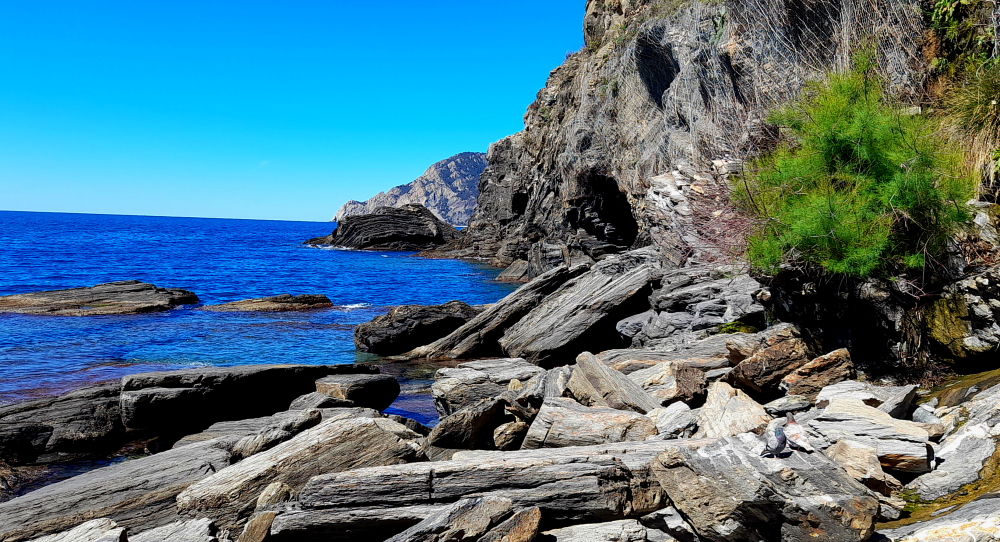
Today, it’s difficult to imagine the devastation that ripped through this picturesque village on 25 October 2011.
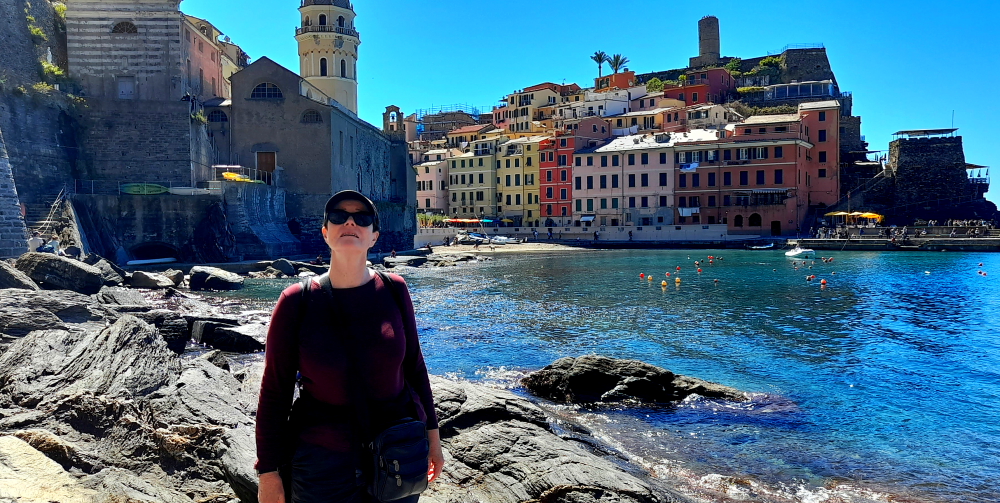
Torrential rain, massive flooding and over 100 mudslides crippled Vernazza causing over 100 million euro worth of damages, killing 3 residents, terrorizing visitors and locals and burying the town under 4 metres (13+ feet) of mud and debris.
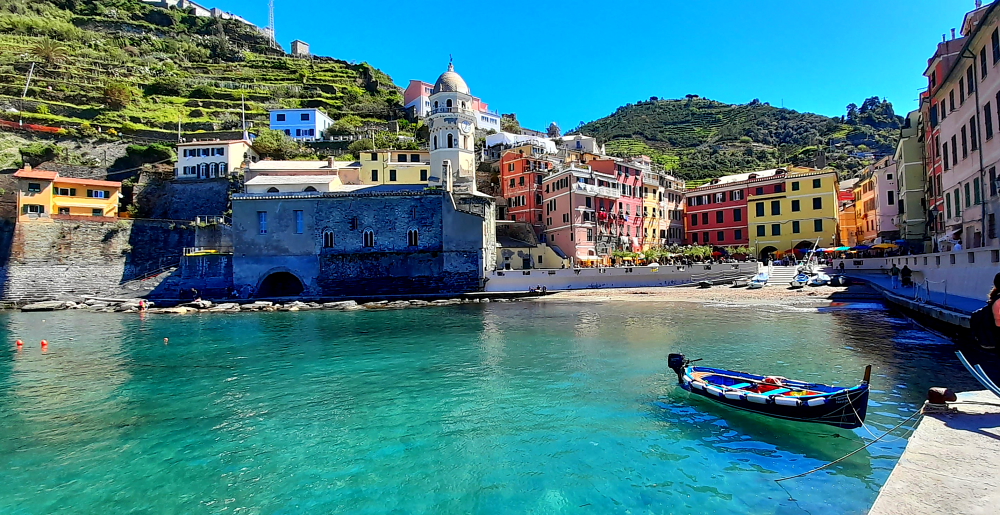
After a slice of pizza we walk back up to the station where we see our train pulling in and we still have the stairs to negotiate. Thinking that we won’t make it as we are obstructed by a huge guy walking up the stairs in front of us, Lynn makes a lunge for the train door as it is closing (all those years’ experience of catching trains on the London Underground) and makes it with me following in her wake. “Do not do that ever again!” is the admonishment from the Platform Guard, who obstructed our passage from the platform to the train door, as the door slowly recloses.
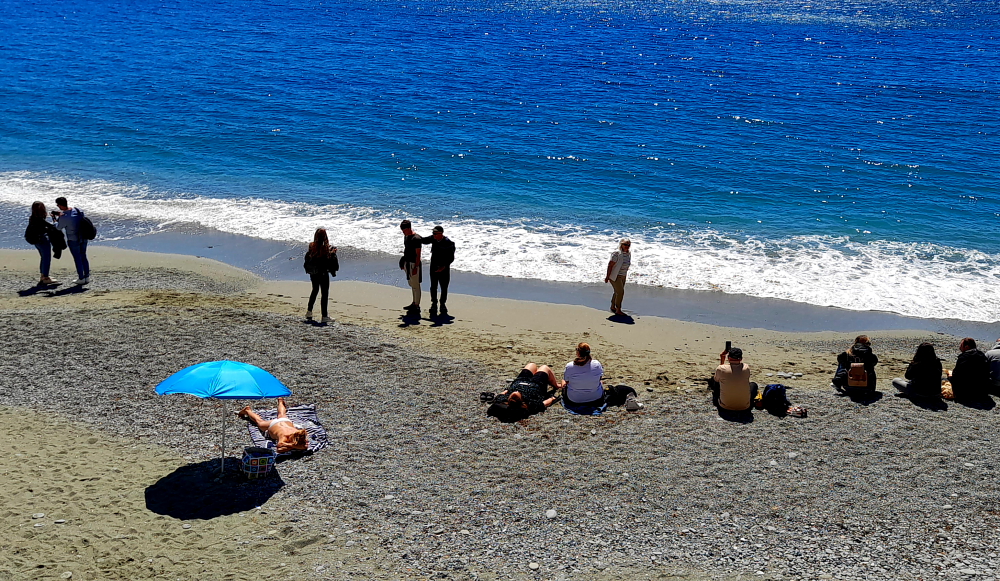
Given the picturesque nature of Vernazza, Monterosso is something of a let down.
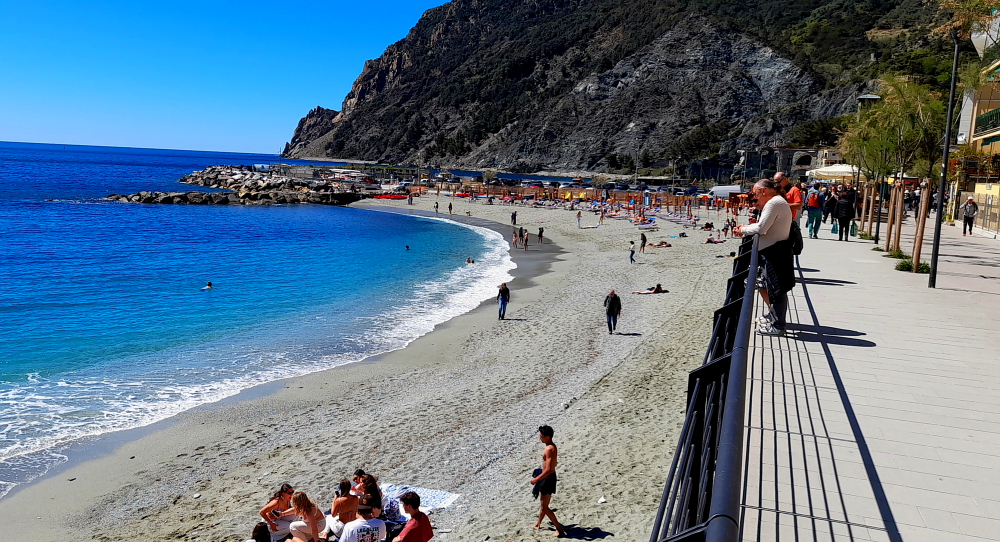
This village is the least vertical and the only one also famous for its beach and historic bathing establishments. Although the water is very clear it is not a beach as we know it relative to the Australian Gold Coast beaches.
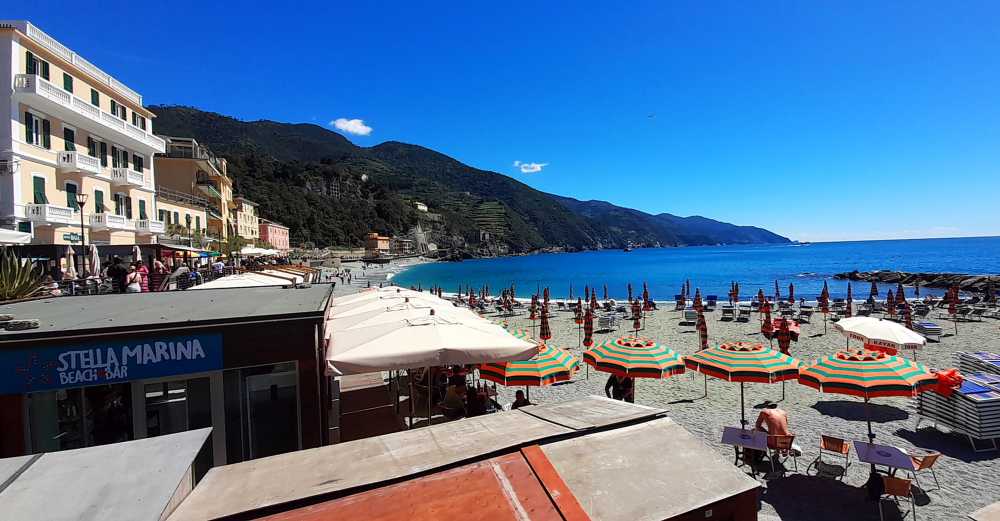
It’s also divided into two distinct parts: the old medieval town and the new town. The two areas are divided by a single tunnel that caters to pedestrians and the very few cars in the town.
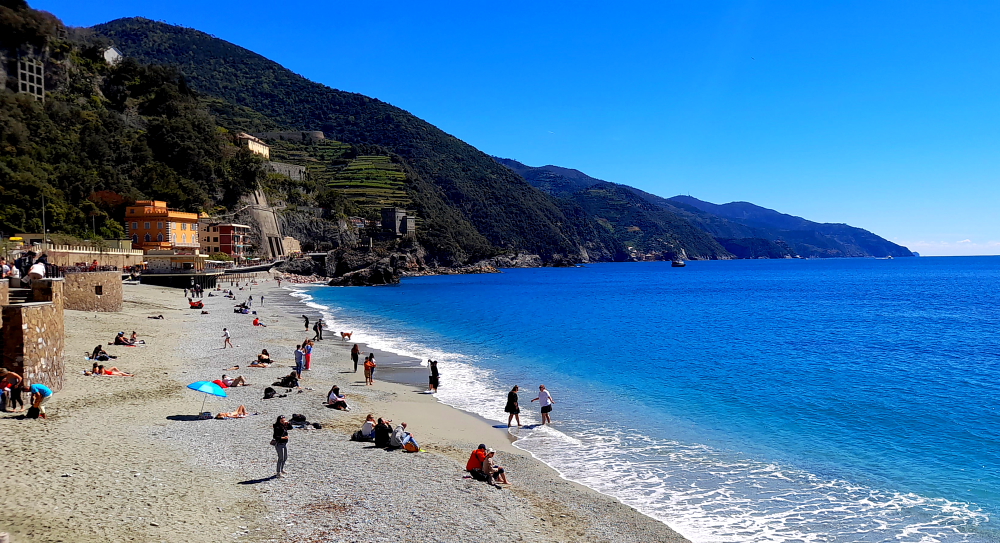
In the photo above, check out the famous ‘heroic’ vertical terraces on the hill.
It’s in the new town that the train deposits us. When we look eastwards all we see is a roadway disappearing into a tunnel so after walking up and down Via Fegina and its beach we jump back on the train.
As it’s only 12:30 pm we decide that we will also visit the other 2 villages by train today, so we alight at Manarola.
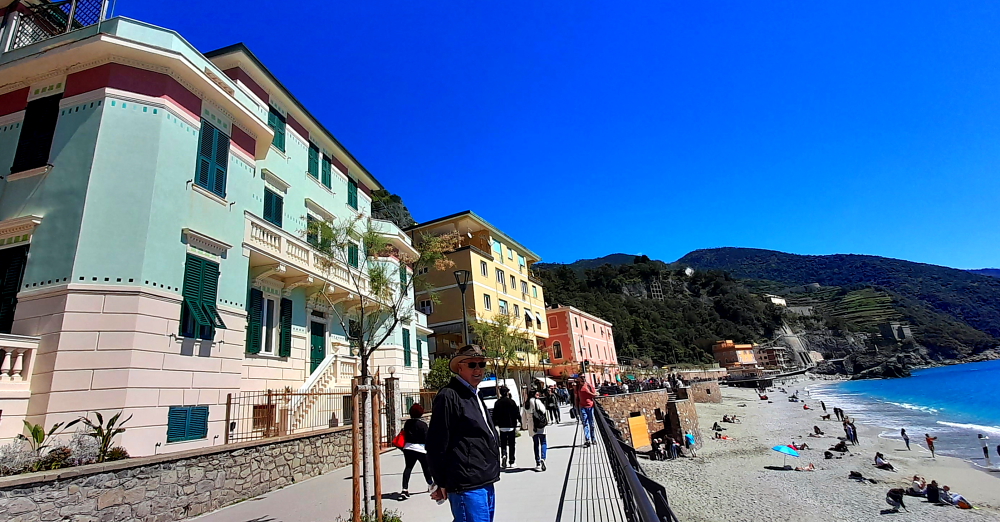
Manarola’s train station is also located out of town but is connected to it via a pedestrian tunnel that exits at Via Antonio Discovolo which becomes Via Renato Birolli down to the small harbour.
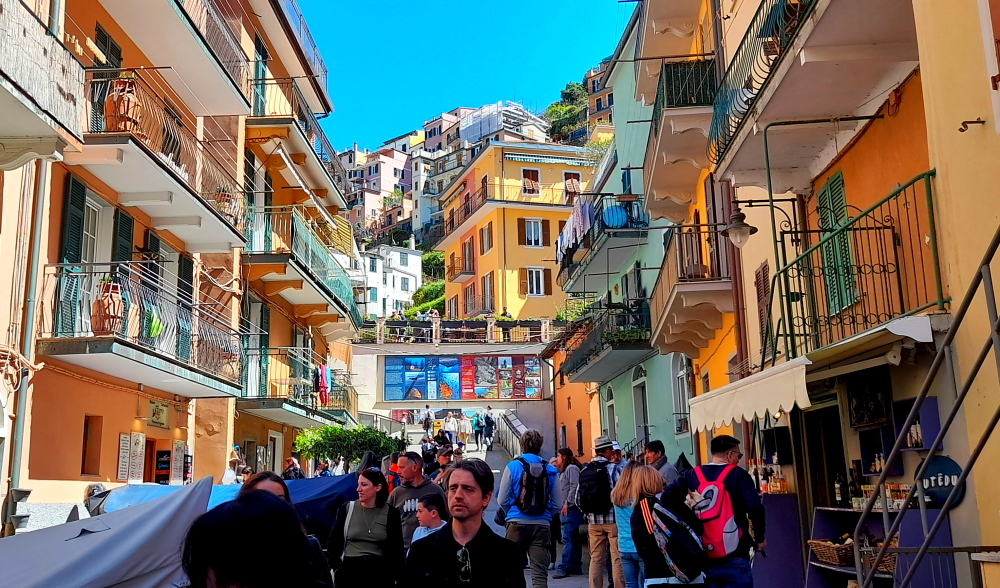
The first documents mentioning Manarola date from the second half of the thirteenth century and deal with the struggles between the Republic of Genoa and the Fieschi di Lavagna, beaten in 1273 by a fleet of 14 galleys.
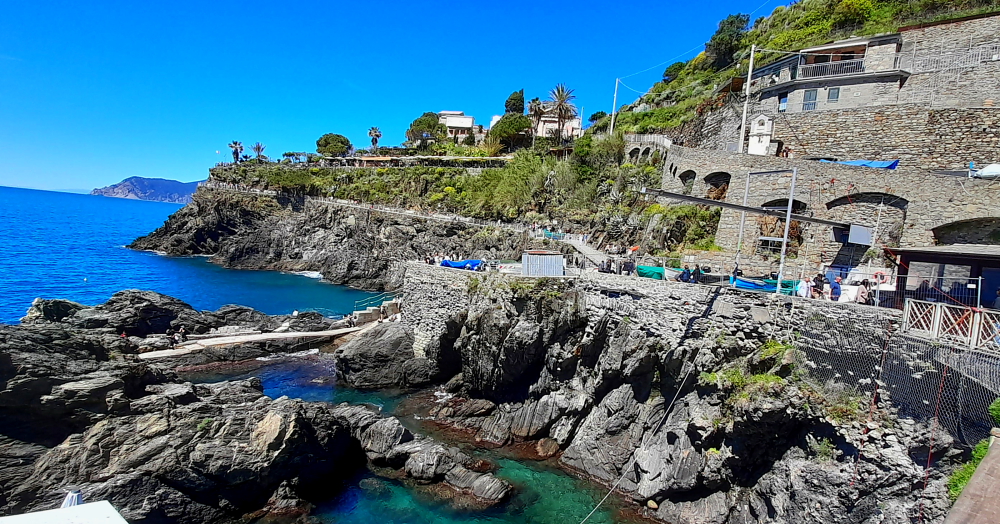
Under Genoa, Manarola became one of the major producers of wine and oil on the coast and, in the lower part of the village, still exists an old mill restored by the National Park. During this historical period, extensive terracing began, known as heroic agriculture, which is preserved in today’s landscape.
In 1863 the stream that crosses the village was partially covered then completed in 1978 when the Marina was connected by eleven stone bridges. [visitcinqueterra.eu].
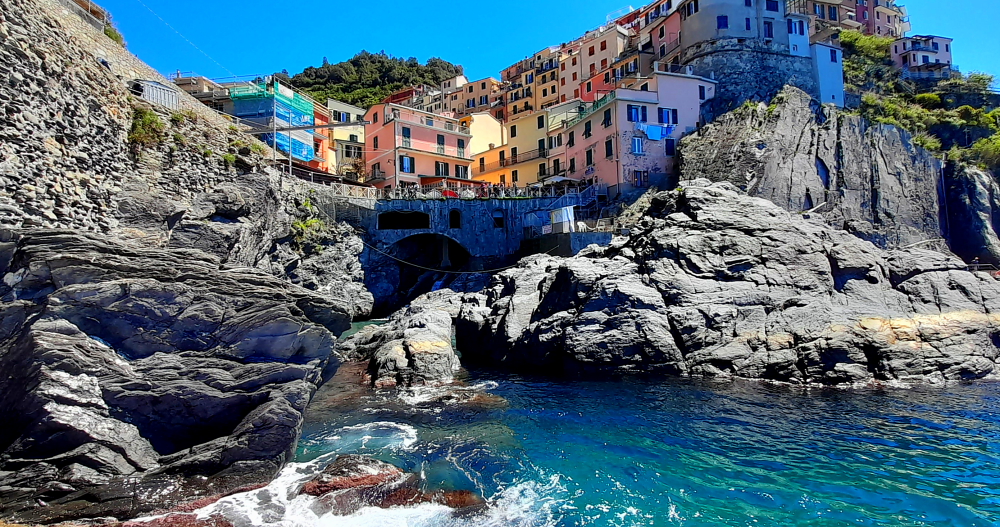
Riomaggiore is our final stop today, and another delight after Vernazzo. Documents dated 1251 first mention the village when Riomaggiore swore allegiance to the Republic as a fief of the Lords of Ripalta, to then pass under the dominion of the Fieschi and sold to Genoa in 1276.
The modern history of Riomaggiore coincides with that of the other four villages: under French rule from the end of 1797 the village was annexed to the Department of the Gulf of Venus, initially with capital La Spezia, then Vernazza, to later be included in the Department of the Apennines with the First Empire of France. From 1815 it became part of the Kingdom of Sardinia, until the creation of the Kingdom of Italy in 1861.
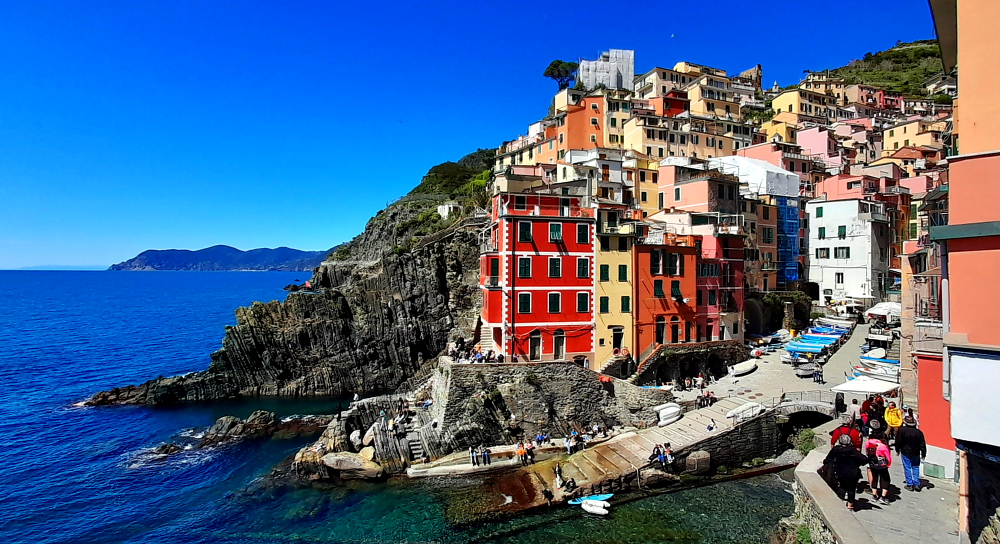
According to Genoan architectural tradition, the village’s centre was built descending along the stream course, with parallel tower houses that had both military and housing functions, with double access on different levels, one official toward the sea and one upstream, to facilitate escape in case of a sudden attack from the sea. Likewise, a large maze of narrow alleys was traced, the carruggi, following Genoa’s urban scheme.
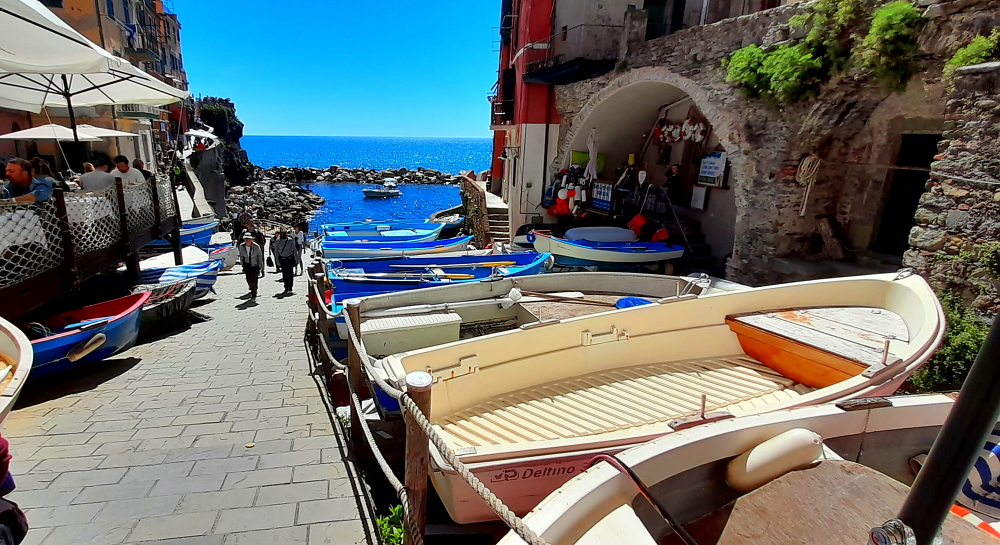
It’s said that the colors of the houses have become a tradition to allow sailors to identify their homes from a distance when getting back to the harbor. The pastel tones are those of the Provencal tradition, extended to the entire Riviera of the ancient Department of the Apennines. [visitcinqueterra.eu].
We catch the 2:40 pm train back to La Spezia and arrive 10 minutes later.
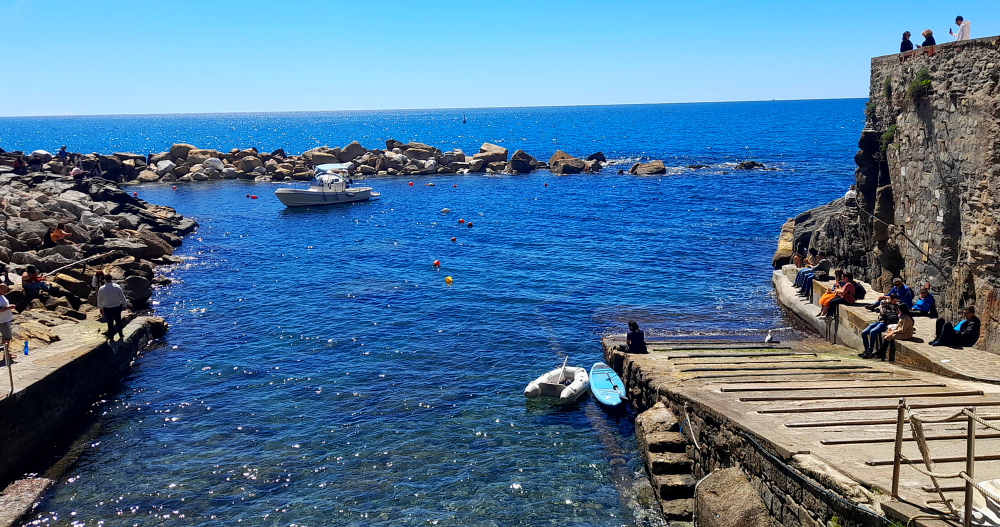
To summarise: today was the perfect day for sightseeing with sunshine and a top of 18 Deg. C. We had been looking forward to our visit to Cinque Terre since September 2012 when we spent a month in Italy but due to the floods and landslides a year earlier much of the area was closed to tourists. Today, we found Cinque Terre to be a bit like the Amalfi coast – or ‘Naples on a cliff face’, as I call it. The usual hillside villages with the mandatory cafes, bars, restaurants and tourist shops. But, the standouts were train day tickets that facilitated the entire day and the picturesque villages of Riomaggiore and Vernazzo. Vernazzo in particular, in light of the devastating effects of the flooding and mudslides of 2011. Today, you wouldn’t even realise the destruction that it had wreaked – a testament to an indomitable community spirit. Unfortunately, the volume of tourists to Cinque Terre has take the shine off the area and it is more akin to a giant shopping mall with sea views rather than quaint historic villages. We definitely found much nicer places in Italy during our 7 months tour back in 2014/15.
20 April, 2024
Yesterday, during our day out, I received an email from the Opel dealership with a quote to repair the car’s A/C. I was expecting around EU500 max. Would you believe an eye-watering EU1,100 (A$1,850) ??!! That’s a third the value of the bloody car! And we’re selling it in 4.5 weeks’ time!! After requesting a detailed quote it’s apparent that the compressor is twice the price of one that I could get online in the UK and the tax rate here is a whopping 22%. An example of how a government can make local businesses uncompetitive. Something that the Australian Labor Party doesn’t understand with their policy of “if it moves, tax it” approach.
We look at our options and consider just selling the car with the known issue when we get back to the UK or getting it fixed in the UK. That would leave us without A/C for the next month and it may delay our ability to sell the car when we get back. Time would not be on our side as we only have a week there before we fly to Helsinki.
We decide to bite the bullet and just accept that it’s costing us an extra EU400 (A$650) more than getting it fixed in the UK. Unlucky? Yes, but we are well below our budget year-to-date so we have to just suck it up and we are still better off financially (and far better off for convenience) than if we had hired a car for the time that we have used the Insignia.
The plan is to catch a taxi to the garage with our luggage on Wednesday after we check out. This will save us EU80 (A$130) for parking the car in town that I had booked.
It also means that the afternoon boat trip that last night we decided to do today from La Spezia to Monterosso return, costing EU28 each, we’ll forego and perhaps do the Bern Lake boat trip instead. Rather, we have a lazy day in catching up, including Lynn’s 1.5 hour afternoon nanna nap!
Lynn wants a takeaway pizza for dinner but after checking out the couple of pizzerias in our street I come to the conclusion that takeaway isn’t on offer. So, at 7:30 pm we walk to the nearby pizzeria to find that it is absolutely heaving but manage to get 1 of the 2 remaining tables for two. 50 minutes later our pizza and ravioli arrive, ahead of several other tables of 4 that were seated when we arrived. When we go to pay it appears they do takeaway after all!
21 April, 2024
The past couple of evenings we’ve been watching the TV series “Dexter” which has been quite compelling, resulting in very late nights, like last night – 1 season down, 7 to go! So, we don’t emerge until 9:00 am.
For a change, Lynn wants to go out for breakfast this morning so we go to a cafe that’s on the corner of our street and Piazza Guiseppe Garibaldi. At 10:00 am it, too, is heaving with its outdoor tables in the sun all occupied. I order a bowl of fresh fruit with yoghurt, Lynn a local pastry and a cappuccino each. Lynn’s order comes first and we realise we should have added “piu caldo” for the coffees.
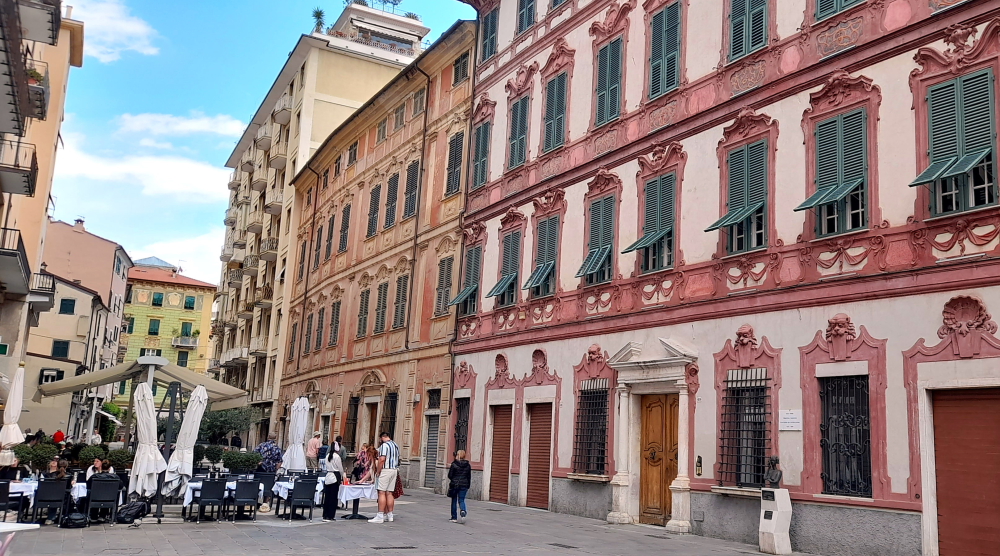
When my fruit bowl arrives it looks nothing like the picture on the menu with melon, dried fruit and walnuts added – all of which I don’t/can’t eat – and no yoghurt. Cost me EU9 for what ended up being half a serve. And that’s why I don’t like going out for breakfast.
While I do some laundry Lynn pops out to make the most of today’s sunshine with a walk down to the marina.
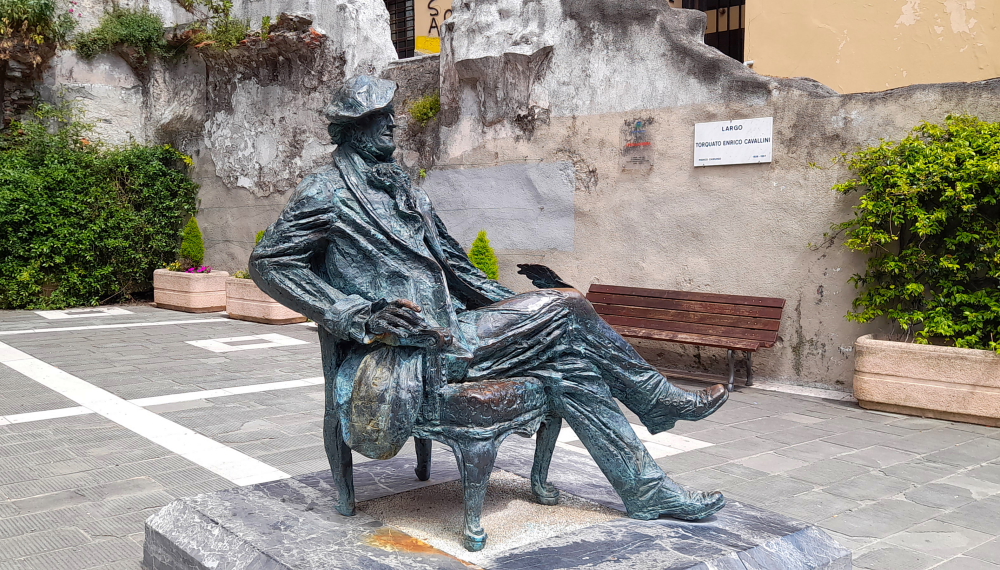
In a square dedicated to a local professor who improved healthcare in the town, is a bronze sculpture of Richard Wagner by Russian artist, Aidyn Zeinalov, installed in 2019. It’s in memory of Wagner who stayed in La Spezia on 5 September 1853 at Locanda Universo where, as reported in a letter to his wife, Minna, the musical chord of the orchestral prelude of “The Gold of the Rhine” was revealed.
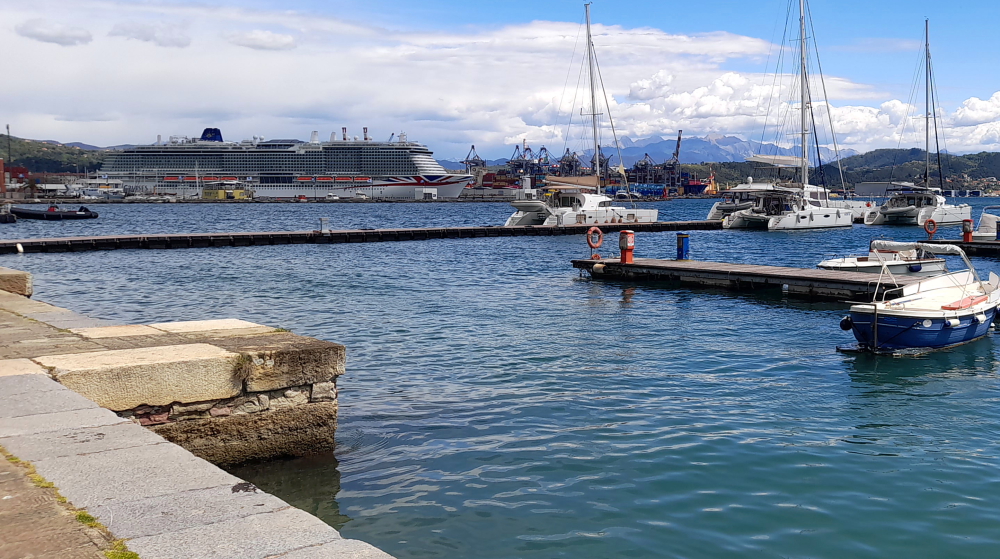
Thank goodness for tourist towns as it seems that most cafes and restaurants and some shops are open today, a Sunday. They’re doing a roaring trade as the piazzas and streets are filled with tourists dressed in a myriad of clothing – from puffa jackets, jeans and boots to singlets, shorts and sandals. Turns out there is a P&O cruise liner moored down at the port. Rain is forecast from this afternoon for the next 2 days and at 2:15 pm it does just that.
Difficult to believe that a year has passed since we were in Copenhagen at the beginning of our Scandies trip.
22 April, 2024
It’s forecast to be a cold and wet day so we decide it’s a day to stay in so we get a load of washing done and ironed and binge watch Dexter.
23 April, 2024
Good news that the car’s air conditioning compressor replacement has been completed but we will pick up the car tomorrow so that we don’t have to worry about catching a bus to the garage then/or organise overnight parking in town. Instead, we’ll take a taxi straight from the apartment to the car service location.
As we check out at 10:00 am tomorrow we pack and get the apartment organised, have a quick meal at nearby local restaurant and finish watching Season 3 of Dexter.
24 April, 2024
Bang on 10:00 am Marco, our host arrives, refunds us our Eu150 damage fee, we in turn pay him Eu25 bed tax, then he kindly phones for a taxi to collect us and take us to the Opel service centre.
Unexpectedly, we get a EU100 discount on the repair since they didn’t have to replace the belt drive, but it’s still a EU1,000 outlay. And, in order to activate the year’s warranty on the work, I have to show them photo ID and my date of birth. Is the warranty linked to the repair and the car or to me – i.e. will the warranty be transferrable to the new car owner when I sell the car?? Welcome to Italy!
At 10:40 am we depart the garage on our way to our interim stop at Asti, 2 hours 15 minutes’ drive away en route to Turin (Torino).
The A/C works well and I notice that the tyres have been pumped up. Why?? But, the car feels good and seems to have more power. Even Lynn, as the passenger, comments on the smoother drive.
Suddenly, the tyre pressure sensor for the passenger left rear wheel fails. We pull into an SOS lay-by on the motor way where I drop the tyre pressure a small amount and, in a few minutes, the sensor is working again. Never a dull moment with this car!
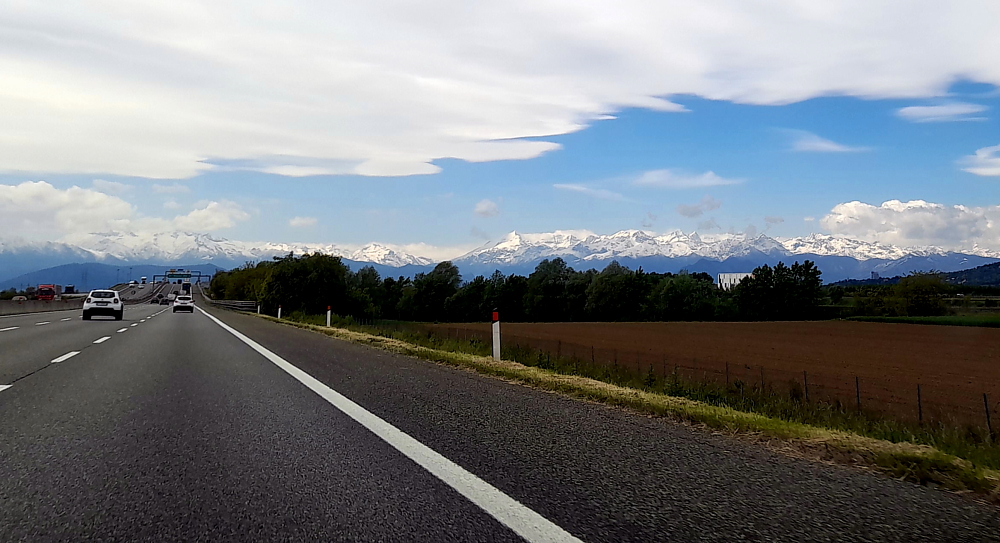
The A12 route retraces our journey bypassing Genoa where we take the A7 back to Tortona, then the A21 past Alessandria to Asti. As we are driving along the A21 we are reminded that summer isn’t that far away – we overtake a string of German caravaners! Plus we have a great view of the Alps covered in snow all along our right hand horizon.
Just after 1:00 pm we stop in the Mercato Grande car park near the station where half of the extensive car park is taken over by today’s market stalls.
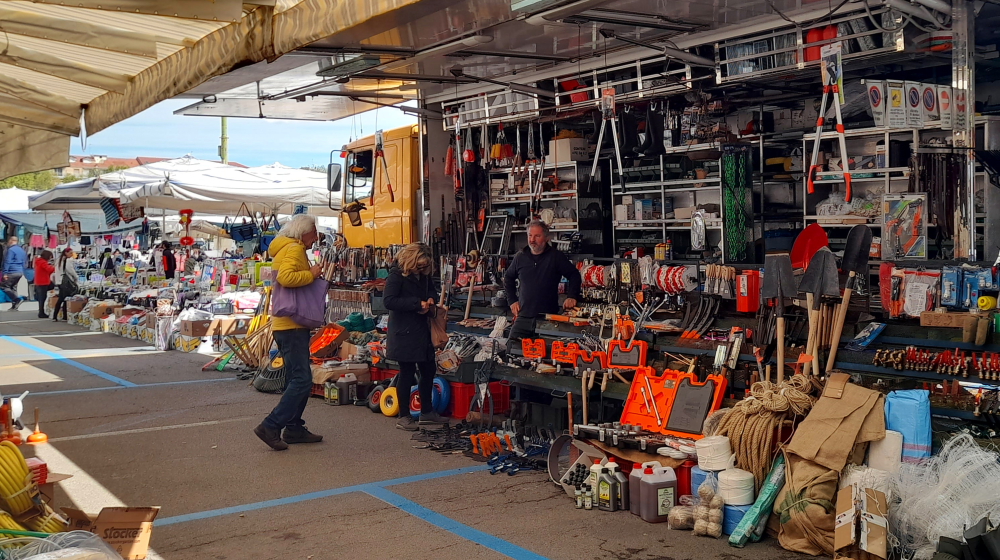
Asti, of Spumante fame, is also known for its Moscato d’Asti, as well as for the Palio di Ast—a bareback horse race through town, like Siena. As we only have an hour to spend here we focus on 4 landmarks.
The lower part of the Torre Rossa (Red Tower) dates back to the 1st century and has a 16-sided polygonal base. The upper part was built in the 12th century, when Torre Rossa began to be used as a bell tower for the Church of Santa Caterina, ongoing to the present day. This section is cylindrical, with alternating bands of terracotta and sandstone in white and red polychrome, typical of the Asti Romanesque style. Originally the tower ended with a very pointed gilded copper spire, which was demolished in 1777 because it had become unstable.
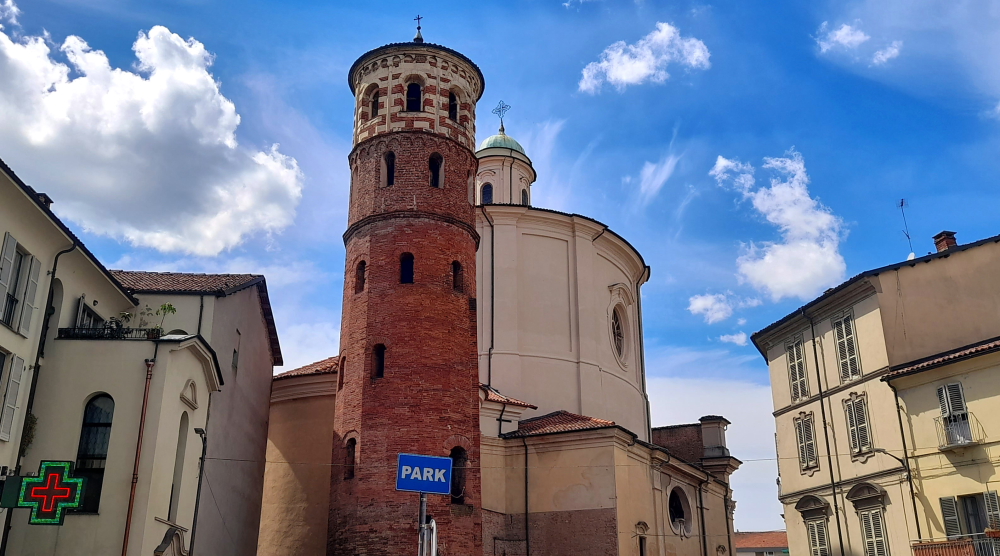
The tower, which owes its name to the De Rubeis family, is what remains of the Roman western gate located at the end of the decumanus maximus, the main road that crossed Asti (ancient Hasta). It’s probable that there was once a second identical tower which together with the Red Tower formed the entrance door to the city walls (the Porta Torre). [visit-asti-it].
From here we walk to the Piazza Fratelli Cairoli, the centrepiece of which is the equestrian monument to Umberto I.
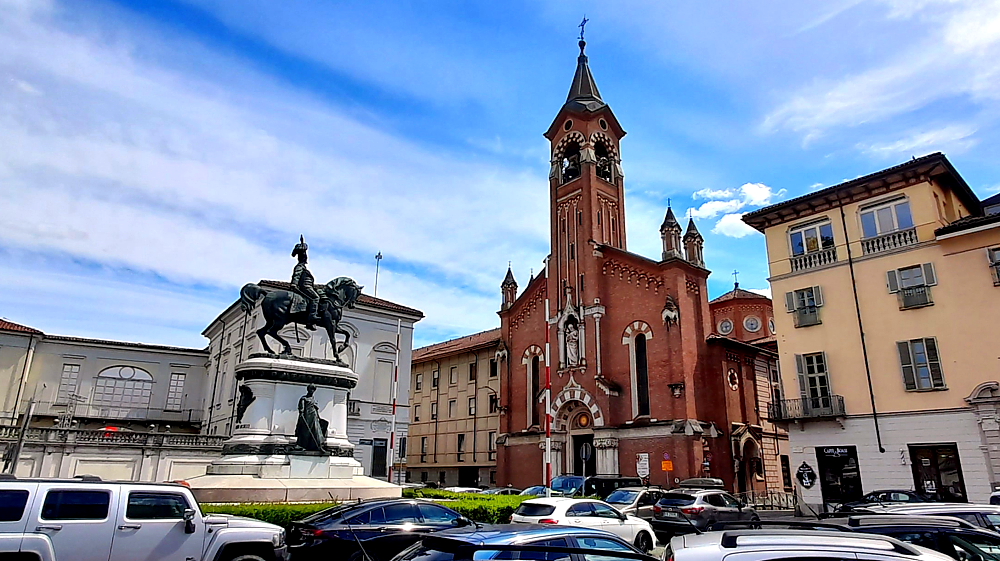
Then up to the Cattedrale di Santa Maria Assunta, the largest cathedral in Piedmont, and its square which is surrounded by ancient palaces. Its history has its roots in the 5th century, but over the course of 700 years it has undergone numerous reconstructions, having been rebuilt between 1309 and 1354 on the basis of the previous Romanesque cathedral. The exterior has maintained its original Gothic characteristics, while the interior was completely plastered and frescoed at the end of the 17th century.
Sadly, the Cathedral is closed so we are unable to view the frescoes and paintings by painters from Asti such as Gandolfino da Roreto and Guglielmo Caccia. The frescoes of the Virgin Mary found in the presbytery area were created by Carlo Innocenzo Carloni in 1768-1769 and its 11th century floor mosaic belongs to the previous Romanesque cathedral. The main altar was designed by the architect Benedetto Alfieri in 1733. Its Romanesque bell tower dates back to 1266. [visit-asti-it].
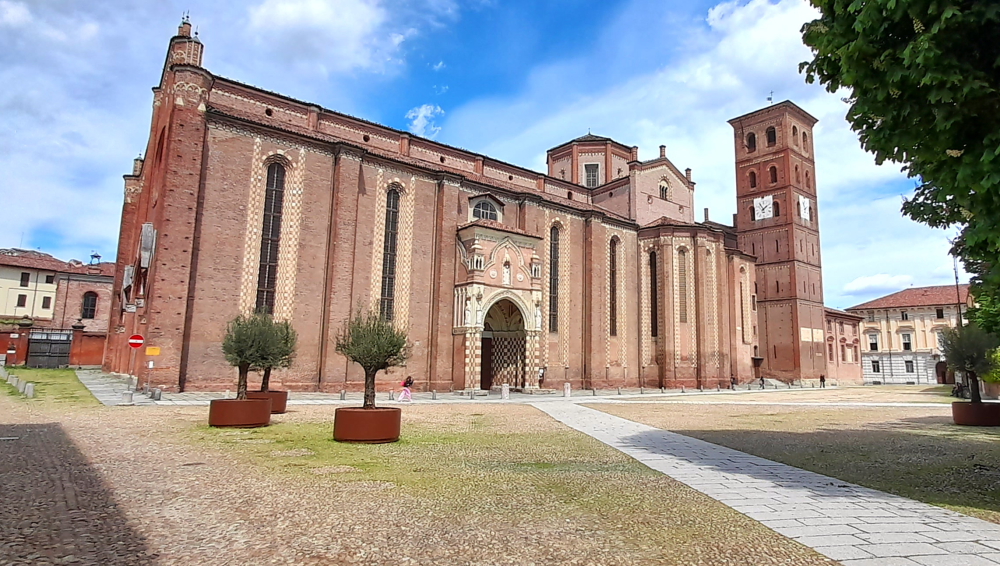
Our next 2 sights are both palaces, located opposite each other on Corso Vittorio Alfieri. Palazzo Mazzetti is a stately palace, one of the most beautiful of the eighteenth century and home of the Civic Museum since 1940. The Mazzettis were a family of merchants and lenders who settled in Asti in the 15th century, purchasing some properties from the Turco family. The privilege of exchanging money was revoked by Duke Carlo Emanuele I of Savoy, due to repeated frauds and forgeries. Regardless, over the centuries the palace hosted personalities such as Giacomo Stuart (1717), the King of Sardinia Carlo Emanuele III (1727) and Napoleon I (1805). [visit-asti-it].
Palazzo Ottolenghi, the most prestigious baroque palace in Asti, is totally under scaffolding and currently closed while it undergoes restoration. It also houses the Risorgimento Museum in its rooms.
The Palazzo takes its name from the last noble family who lived there.
Purchased in 1851 by Count Zaccaria Ottolenghi, a member of an influential Jewish family and father of the illustrious patron Leonetto from Asti, the family did not concentrate their wealth and artistic interests only on the family palace. Zaccaria became the promoter and financier of the construction of the Alfieri Theatre, while Leonetto built the New Jewish Temple and the Dante Alighieri High School, erected a monument for the 50th anniversary of the Albertine Statute and one for the memory of King Umberto I. He also purchased Palazzo Alfieri donating it to the Municipality, using it as a cultural center for the citizens.
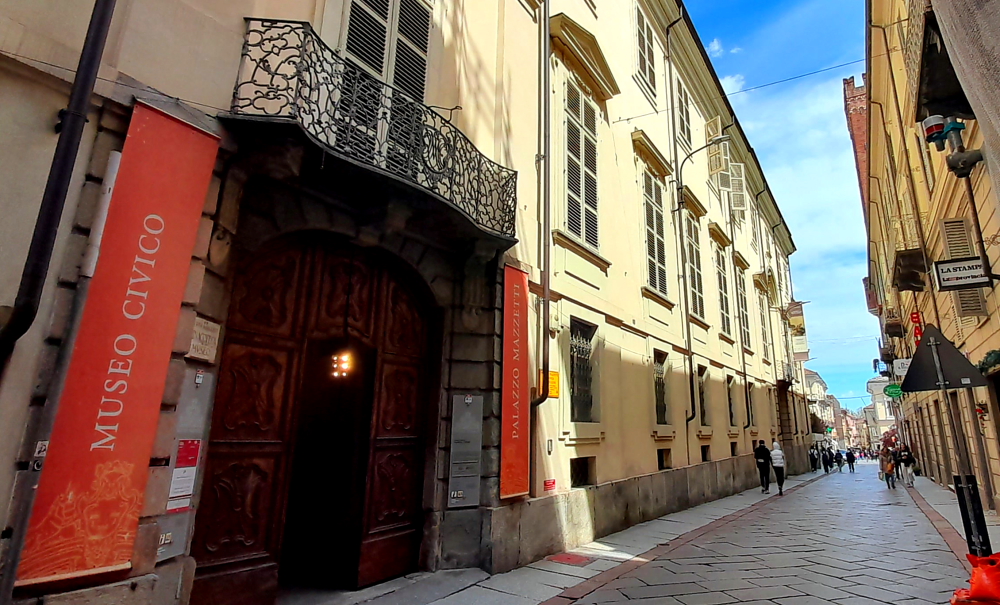
Leonetto Ottolenghi provided the idea and creation of the original nucleus of the Risorgimento Museum’s collection, namely the portraits of the protagonists of the Risorgimento and the paintings of the battles. [visit-asti-it].
In the next block along Corso Vittorio Alfieri is Piazza Roma bordered by the Castello Medici del Vascello and the Comentina Tower. For centuries the tower was called Torre di San Bernardino, the name of the church adjacent to it and for which it served as a bell tower. This church was destroyed in 1897 to make room for the Palazzo Medici del Vascello, a neo-Gothic style structure that still exists today.
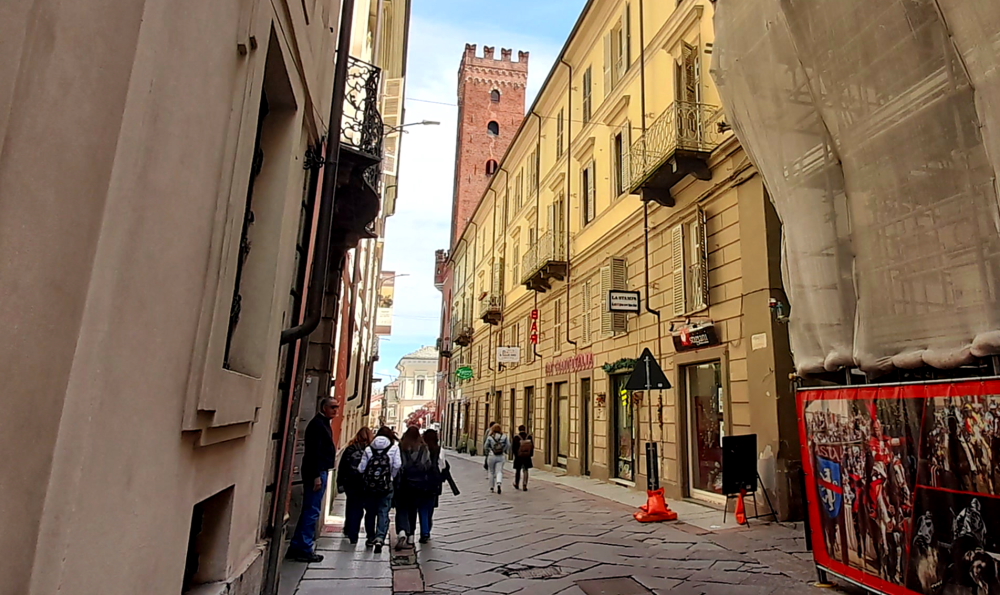
The Piedmontese-Gothic style tower is the second tallest civil tower in Asti (after Torre Troyana) and the only to retain its original height of 38.55m. Its architectural characteristics place its construction in the second half of the 13th century.
The tower was used for several centuries as a command post for the Palio di Asti race, which took place on the “long run” route in Contrada Maestra. [visit-asti-it].
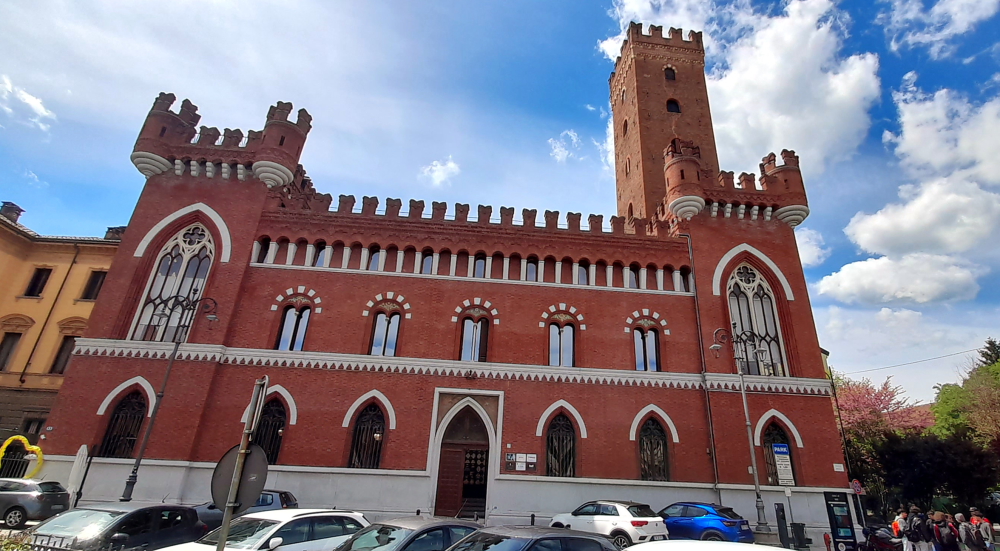
Our route back to the car takes us past a small square bordered by Collegiata di San Secondo, It’s one of the oldest churches in Asti, it’s dedicated to the patron saint of the city and the relics of San Secondo are preserved in the crypt.
A first place of worship dedicated to the patron saint of Asti was built just outside the city walls, to later become a cemetery church. In this place, according to legend, Saint Secondo was martyred in 119 AD.
The current Collegiate Church was built between the 13th and 15th centuries. Among the most significant works inside include: the Polyptych of the Magi (ca. 1518) by Gandolfino da Roreto, the anonymous Altarpiece of the Nativity (2nd half of the 16th century), the wooden statue of Saint Lucia ( 1648), the Crucifix (1658) by Michele Enaten and the wooden choir designed by Paolo Pusterla (1702). Of the original early Christian and Romanesque structures, only the 10th century bell tower and the crypt remain,
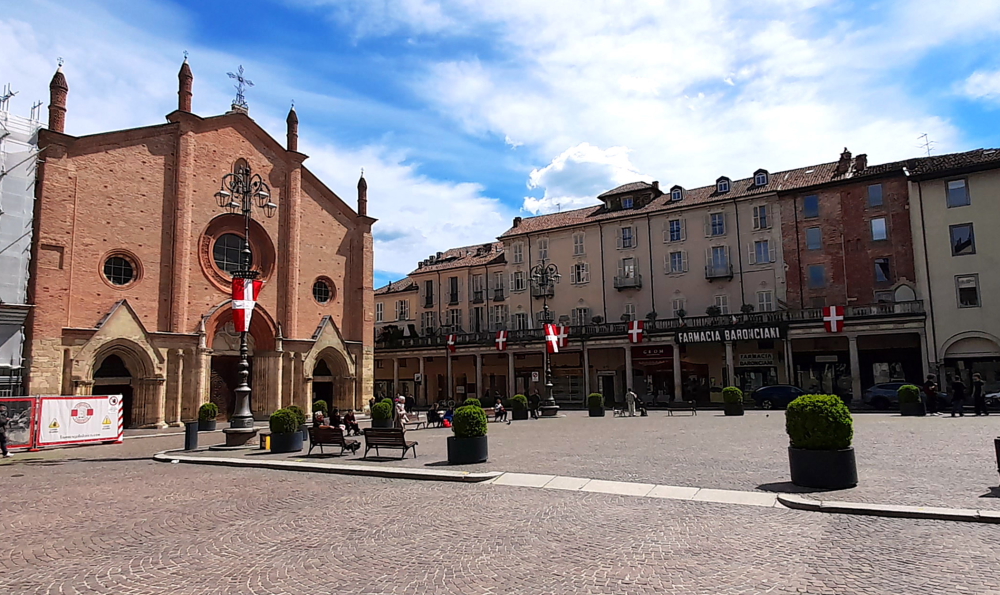
The famous Palio of Asti, which takes place every year on the first Sunday of September, is run in honor of San Secondo. The first chapel of the right nave houses the Carroccio of the city of Asti and the Palio drapes, which are donated to the Collegiate Church during the medieval ceremony of the Palio Offering, on the first Tuesday of May. [visit-asti-it].
Just as our parking ticket expires we exit the car park bound for Torino. It’s 23 Deg. C and 2:15 pm putting us in around 3:10 pm. As we are driving NW we have great views of the Alps ahead of us.
Loger Confort Residence and Apartments is located on Piazza Paleocapa. We find the courtyard parking and check in.
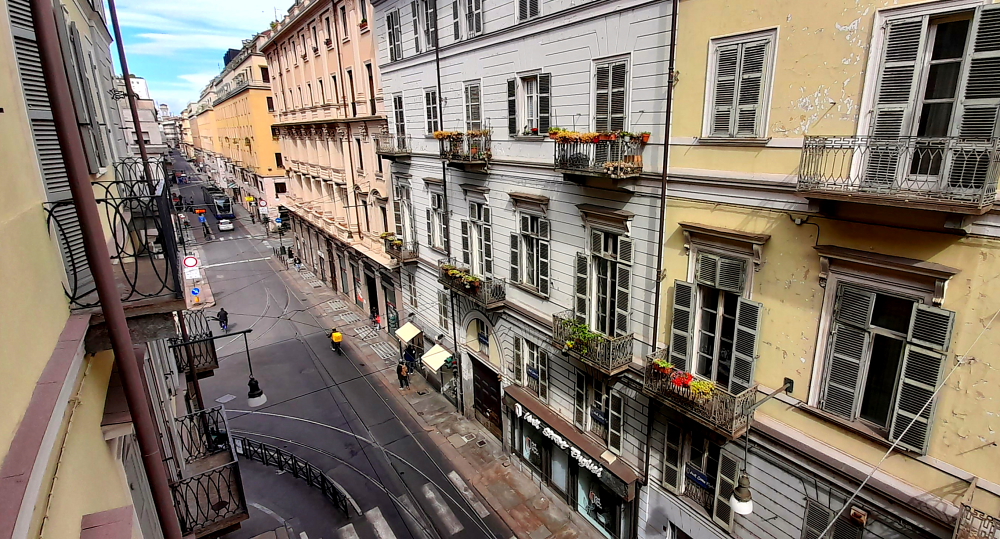
After unpacking we walk around the corner to the Carrefour Express supermarket for supplies and retire to our 3rd floor deluxe apartment which has a distinct Art Deco air about it.
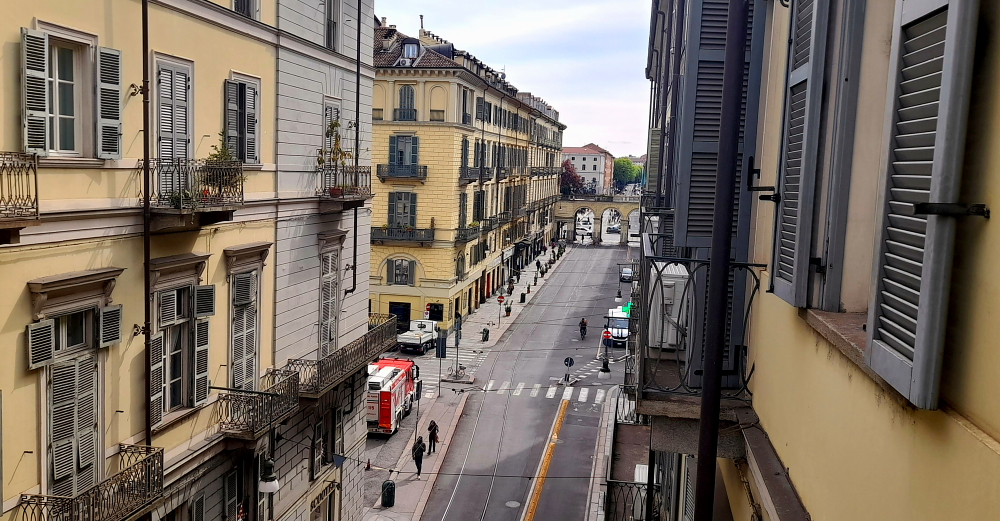
After dining on a charcuterie platter and a glass of red inhouse we finish off with a shot of Limoncello (at last!) and hit the sack.
25 April, 2024
Today is Anzac Day in Australia but it’s also a national holiday in Italy – Festa della Liberazione!
Sunshine and 17 Deg. C top today. Just as well, as we have a 3-hour GuruWalk booked this morning and it’s the first time that the meeting place is just a 5-minute walk from our apartment.
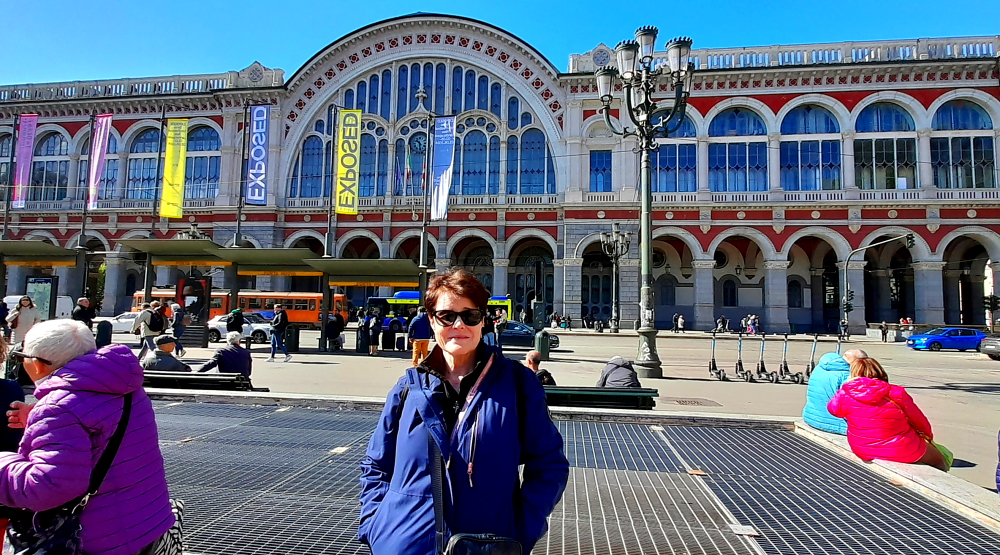
We meet up in Piazza Carlo Felice in front of the Sambuy gardens at the Porta Nuova Metro elevator which is over the road from the main train station. Today’s tour appears to be a tour of piazzas (squares) linked by Via Roma: Piazza CLN, Piazza San Carlo, Piazza Carignano, Piazza Castello, plus Cattherale di San Giovani Battista, Porte Palantine and the Quadrilatero Romano.
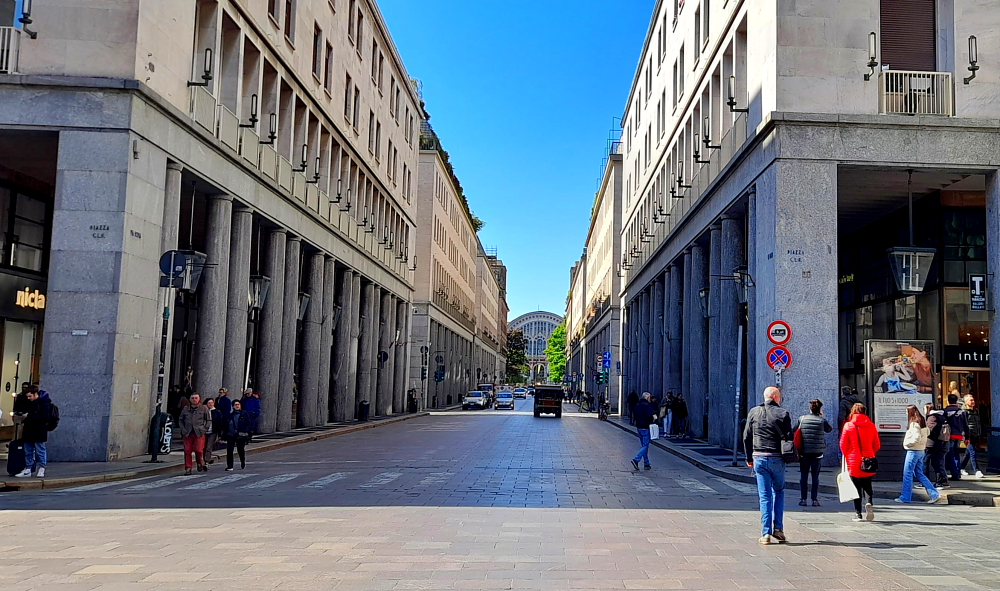
First stop is the commencement of the Via Roma. Here we learn about the 2 Turins in terms of architecture: the Baroque and the Fascist. Here, in this section of Via Roma, we see the rebuilding of the city during the Fascist era with its utilitarian style.
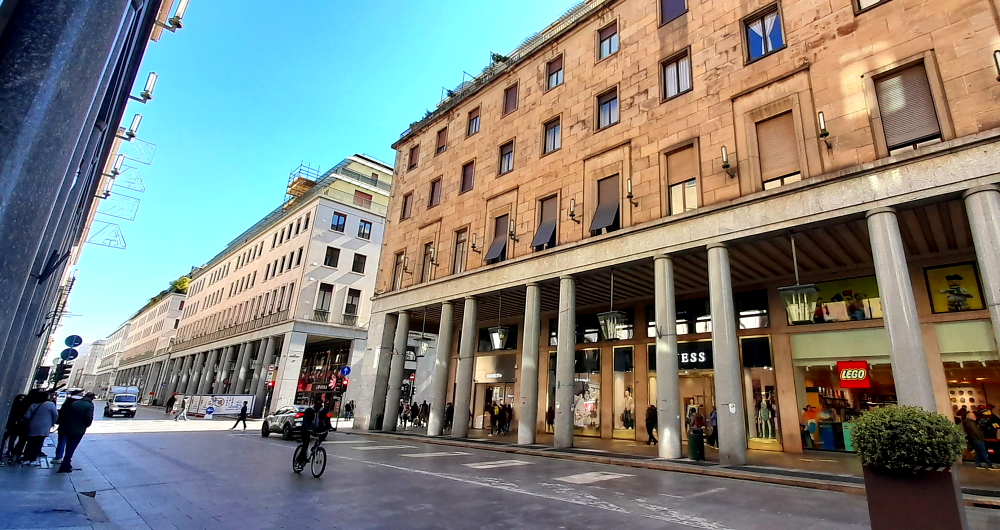
Progressing up Via Roma we arrive at Piazza CLN. Initially known as Piazza delle Chiese, later as Piazza delle Fontane, today it is named after the National Liberation Committee established in 1943 with the aim of liberating Italy from the fascist dictatorship and Nazi occupation. Somewhat appropriate as one of the buildings on the square was the former Gestapo HQ in Turin.
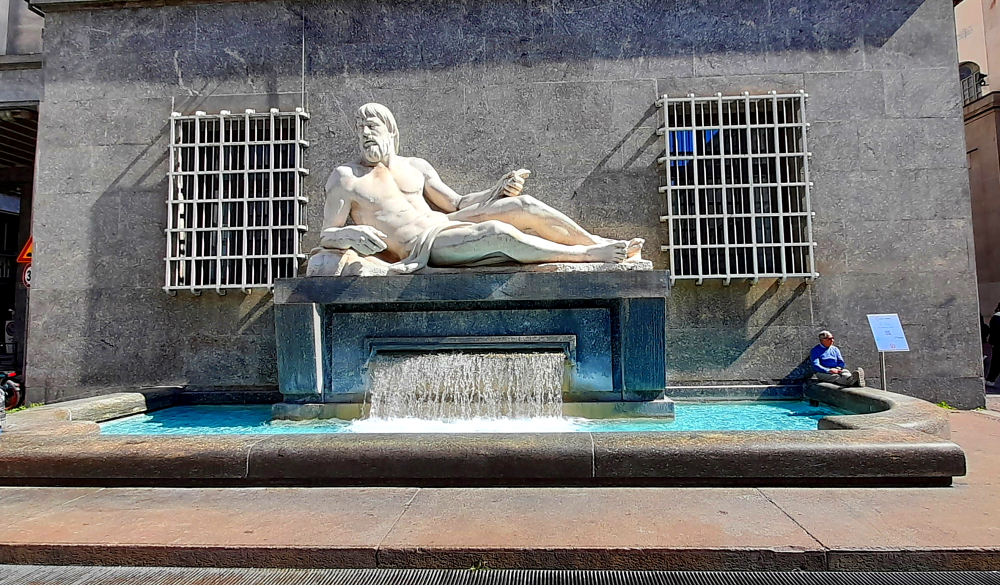
The square today is the result of the 1935 renovation as part of the project by Marcello Piacentini, architect and urban planner of the fascist regime.
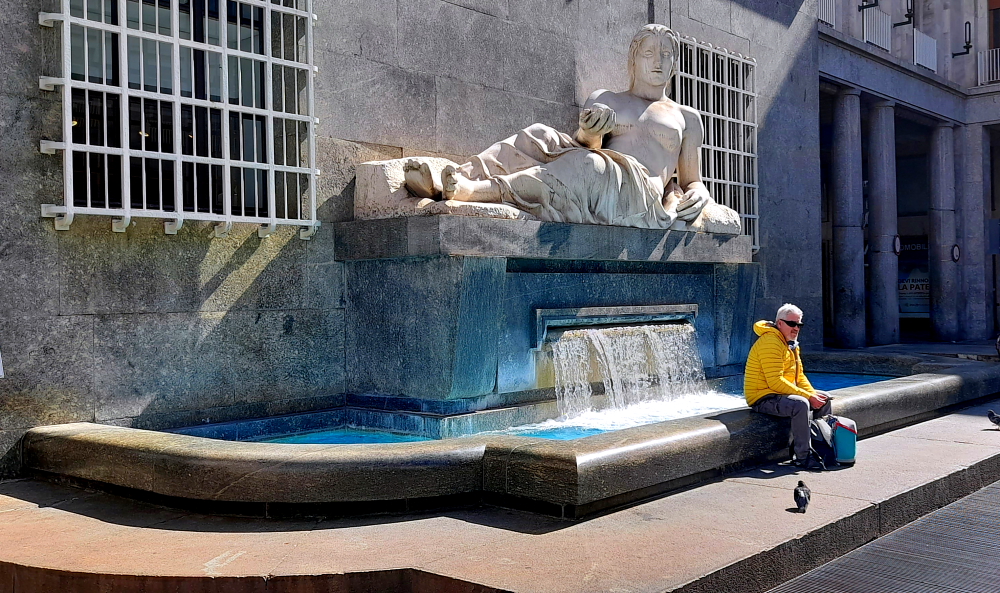
In the square there are two fountains which allegorically depict two of the rivers that bathe the city of Turin: the Po and the Dora . The two sculptures are the work of the artist Umberto Baglioni. The Po is represented by a bearded male figure and the Dora Riparia, a woman. [www-guidatorino-com].
Next stop is Piazza San Carlo which has twin Baroque churches flanking the entrance to the square. They are Chiesa di San Carlo Borromeo and Chiesa di Santa Cristina – the latter under scaffolding but apparently looks similar to the former.
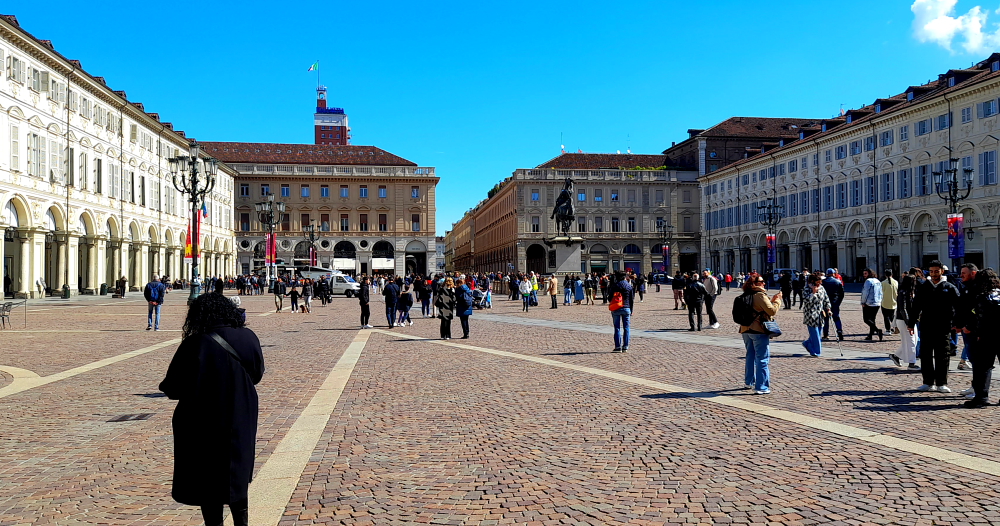
The Church of San Carlo Borromeo was built by Carlo Emanuele I of Savoy in 1619. The church, dedicated to San Carlo Borromeo, after his pilgrimage on foot to the city to pray to the Holy Shroud, leads the list of buildings commissioned by the Savoys for the baroque transformation of the city of Turin .
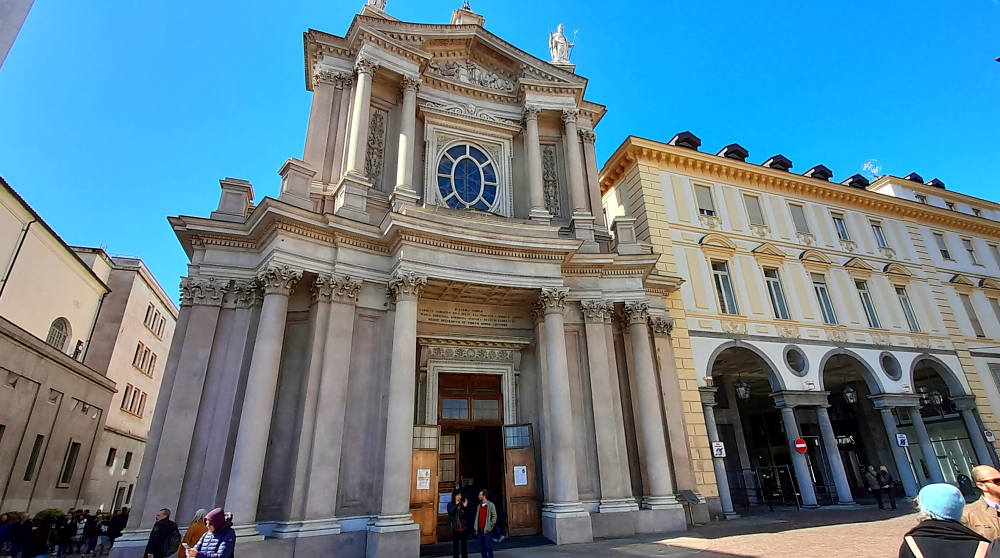
The Church of Santa Cristina was built in 1639 at the behest of Maria Cristina of France, wife of Vittorio Amedeo I of Savoy, princess of France and duchess of Savoy. Designed by Carlo di Castellamonte and continued by his son, Amedeo. The façade, built between 1715 and 1718, is the work of Filippo Juvarra.
The church was also known during the 19th century by the name of “church of the Servants”, because the Sunday afternoon mass was attended by women serving the noble and rich families of the neighbourhood. [www-guidatorino-com].
Bordering the square on the left hand side is the Palazzo Turinetti which has, on the ground floor, a row of shops protected by the portico, one of which is Caffe Torino.
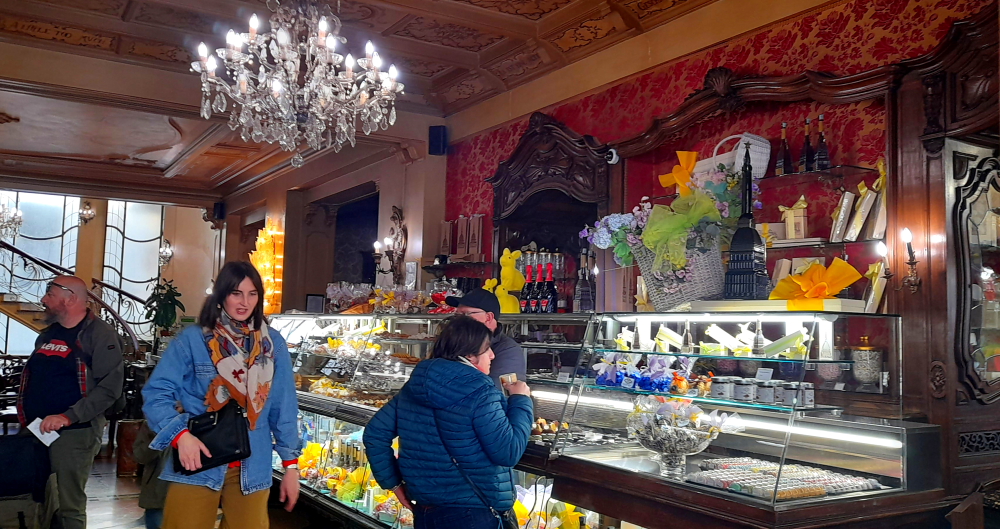
Distinguished by a timeless charm and elegance, there are 7 notable historic cafés in Turin where can be experienced antique mirrors, boiseries, satin tapestries, elegant candlesticks and porcelain plates as well as the city’s specialties.
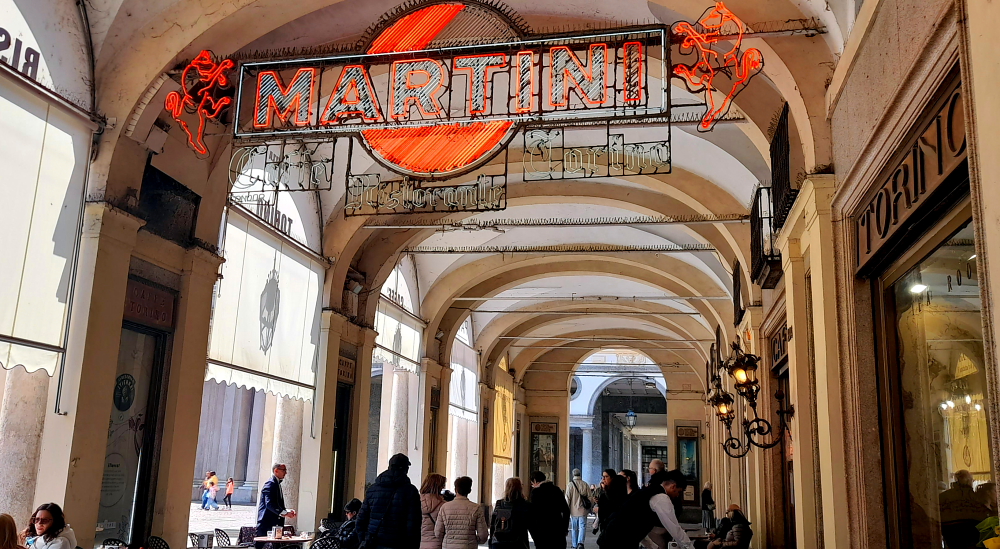
One such venue is Caffè Torino, more recently inaugurated at the beginning of the twentieth century. In an atmosphere of other times, among precious marbles and sumptuous chandeliers, you can taste some of the traditional Turin delicacies such as Turin’s liqueur, “gianduiotti”. [www-guidatorino-com]. And the Caffe is also the birthplace of the espresso machine, thanks to a collaboration with Lavazza.
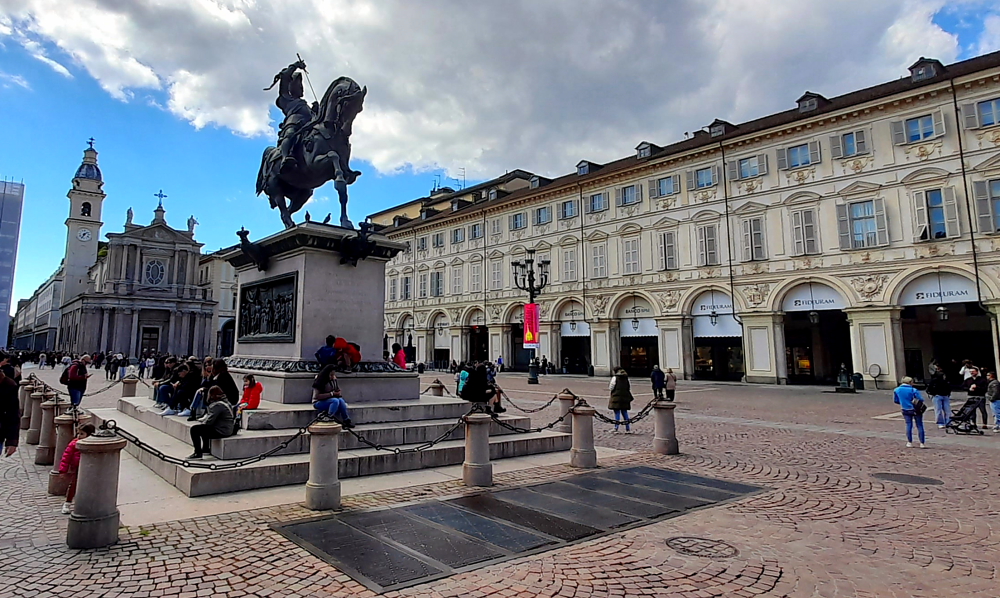
Piazza San Carlo also marks the divide between Fascist and Baroque Turin and also introduces us to the Art Nouveau era and style which is related to the industrial development in Turin and the birth of new residential areas. Examples of this period are also seen in the commercial galleries Galleria San Federico, Galleria Subalpina and Galleria Umberto I, where the middle-class families used to stroll on Sunday afternoons and stop at one of the many elegant cafes of the city center.[turinitalyguide.com].
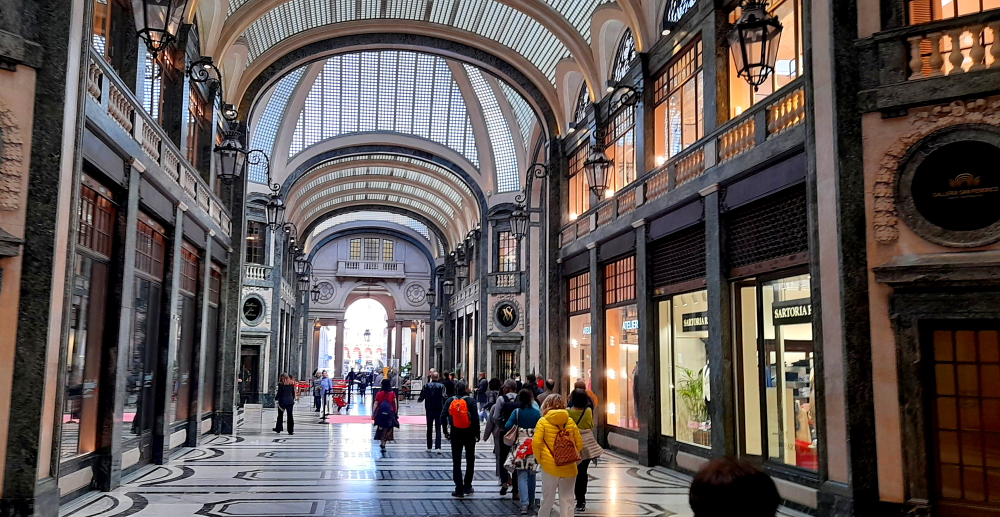
The end of the gallery brings us out near to Palazzo Carignano, a palace with a unique wavy facade. 11 of the 22 Savoy residences on the UNESCO World Heritage List are in Turin: Palazzo Carignano is one of them.
The same square hosts the Carignano Theatre, the Egyptian Museum (which, incidentally, is the oldest Egyptian Museum in the world, even older than the 1 in Cairo) and the Academy of Sciences. Palazzo Carignano is a jewel of Piedmontese baroque, commissioned by Emmanuel Philibert of Savoy and designed by Modena architect Guarino Guarini in 1679.[visititaly.eu].
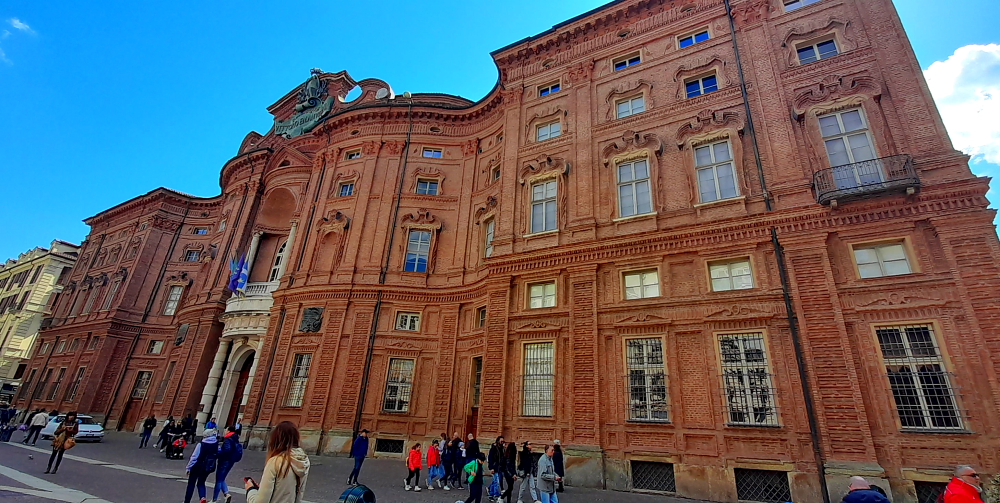
Its façade is unmistakable, featuring warm, reddish terracotta shades and a wavy silhouette. The 17th-century palace was the residence of the Princes of Carignano until 1831, and subsequently, it became an increasingly important player during the Risorgimento.
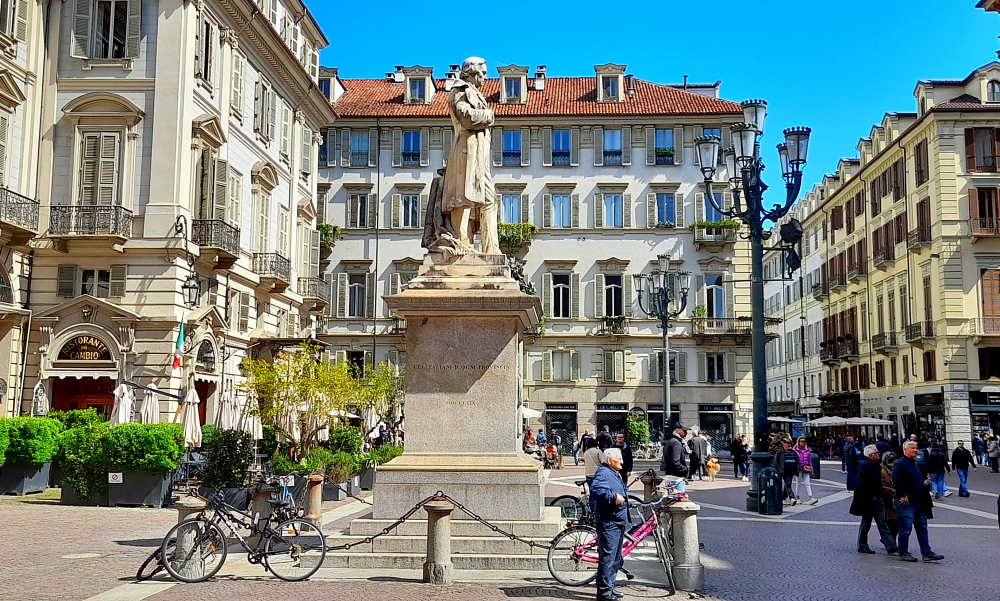
It was the seat of the Council of State, the Chamber of Deputies of the Subalpine Parliament and later the first Parliament of the Kingdom of Italy.
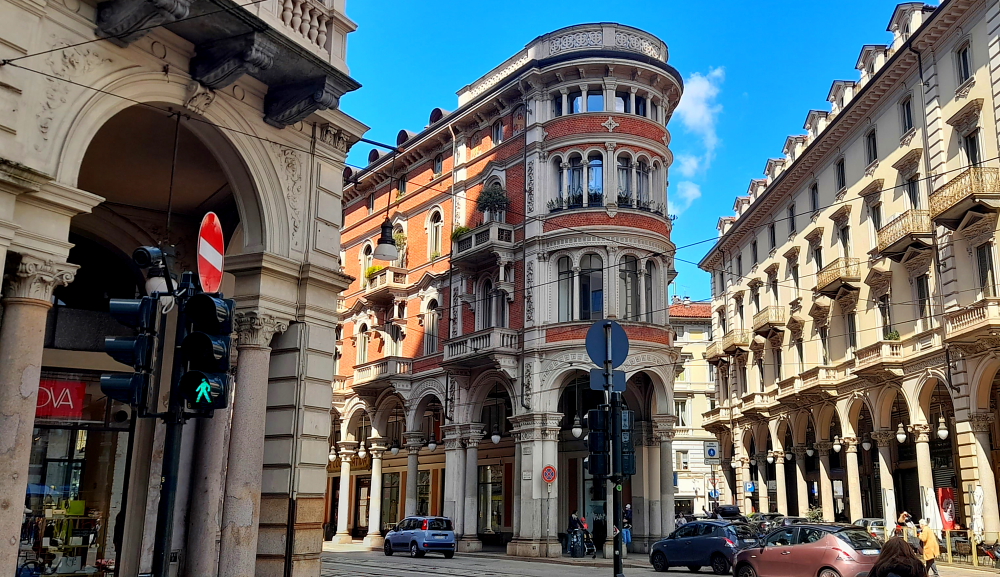
4 blocks West is Via San Tommaso which features 2 types of overhead banners: 1 is that of a bull, Torino’s symbol, and the other of a woman wearing an Elizabethan-style dress with a large hooped skirt.
Apparently a ‘guardinfanti’ was a heavy wooden structure that used to be strapped to a pregnant woman’s body, underneath her garments, to protect the unborn child. It was soon replaced by the lighter hooped skirt, but used by fashionistas, not pregnant women.
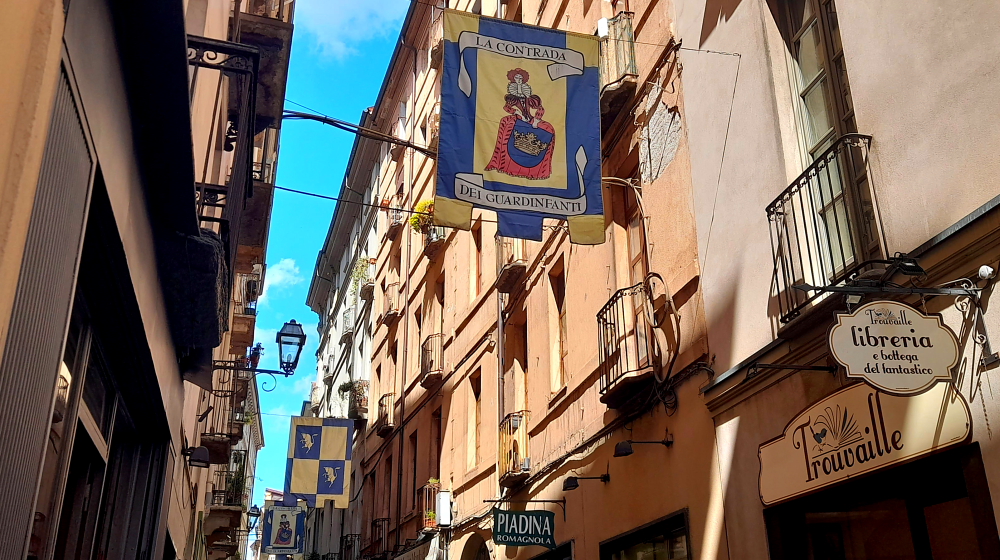
Via San Tommaso terminates at Via Giuseppe Garibaldi, today entirely pedestrian, is one of the oldest streets in Turin and connects Piazza Castello with Piazza Statuto.
In Roman times the road represented the decumanus maximus (decumanus) of the ancient Julia Augusta Taurinorum (Roman Torino) – i.e. the road that ran in an east-west direction in old Roman cities. Furthermore, via Garibaldi represented one of the main axes of the ancient Julia Augusta Taurinorum, connecting 2 of the 4 gates that gave access to the city, namely Porta Prætoria and Porta Decumana.
Over time the road took on different names. At the beginning of the 1400s the street became a noble residence and home to religious and civil institutions, including the University, and finally took the name of Contrada Dora Grossa, probably from a 1573 project where Emanuele Filiberto ordered the Dora river to be canalised. 5 June 1882 the street was dedicated to Giuseppe Garibaldi. [www-torinorete-it.]
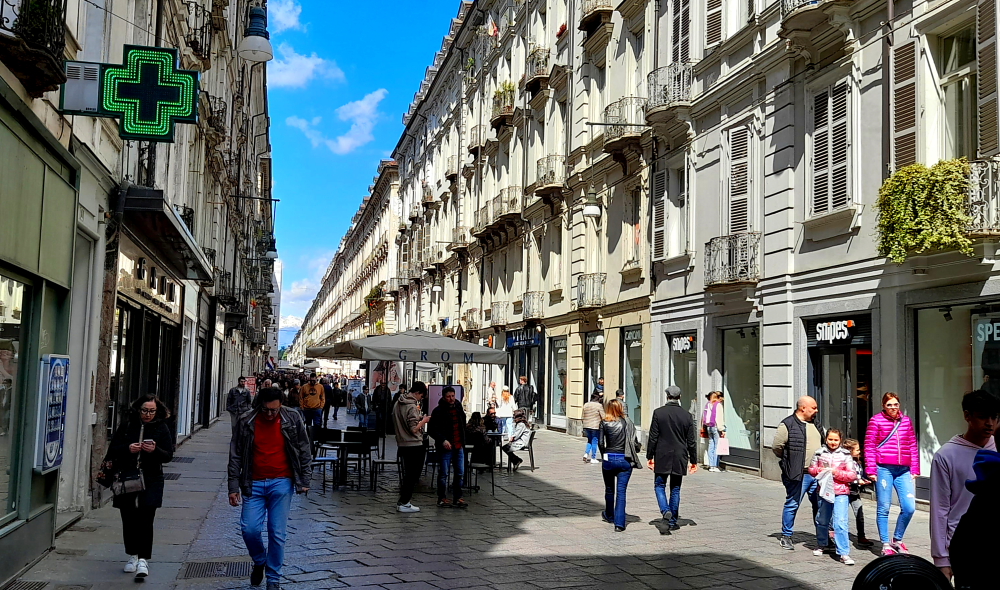
Via Porta Palatina, the extension of Via San Tommaso, brings us to a cross road leading to Piazza Corpus Domini then Piazza Palazzo di Citta, formerly known as Piazza delle Erbe.
Located in the central part of the old Roman city, Piazza Palazzo di Città has been an active center and market area of Turin life since the early Middle Ages.
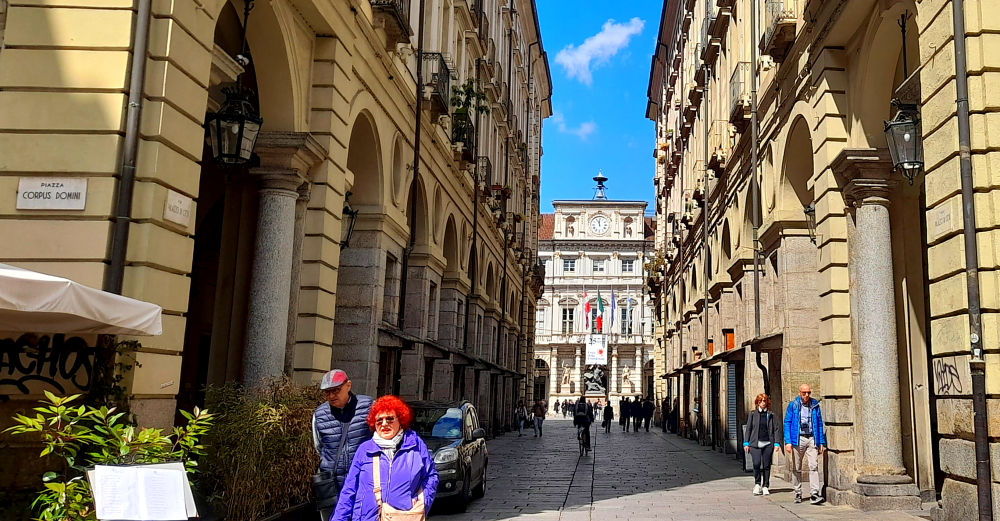
In the Middle Ages, with the construction of Palazzo Civico, the square became the most important in the city with the market, the civic tower and the town hall. It was divided into two main spaces: the Piazza delle Erbe (today’s Piazza Palazzo di Città) where vegetables were sold, and Piazza del Grano (today’s Piazza Corpus Domini), intended for the bread and grain market in general.
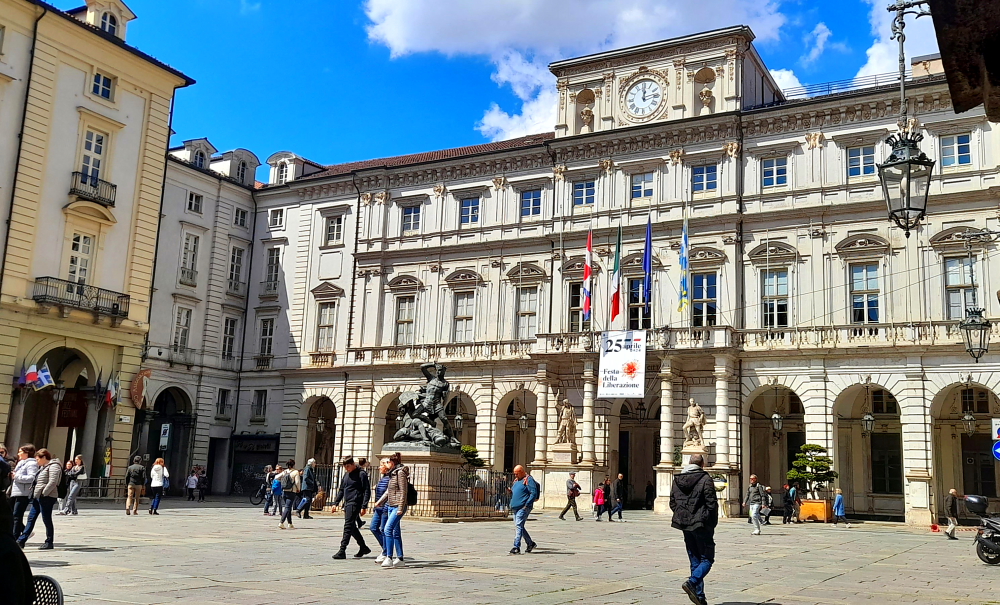
The Palazzo Civico (1659-1663), the current name of the ancient City Palace, overlooks the square. The plan for the transformation of the city included the square in front of the town hall when in 1756 an elegant portico was built. The pavilions at the entrance to the streets on the square, which characterize the development of the classicist facades, deliberately conceal and regularize the presence of the medieval streets.
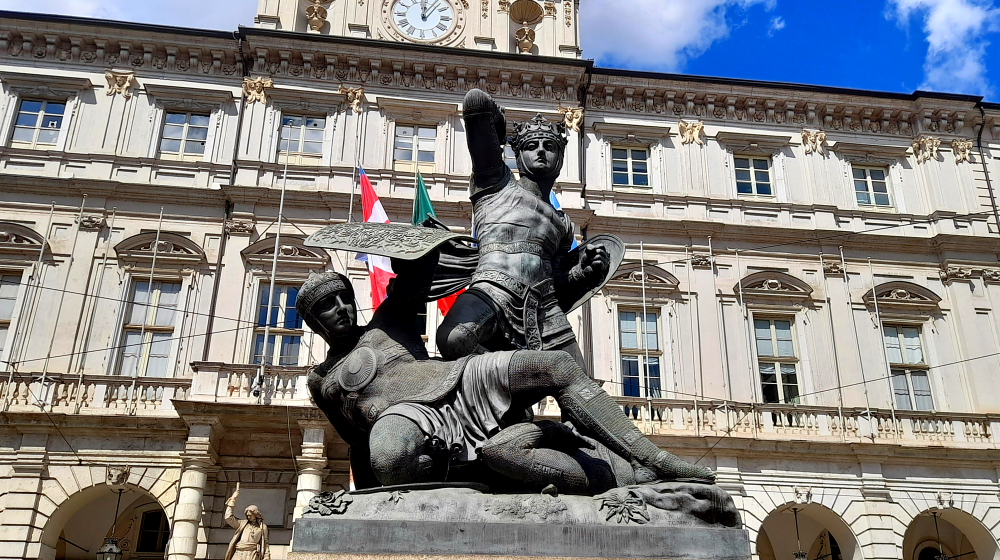
Sculptor Pelagio Palagi (1775-1860) created the monument in the centre of the square, dedicated to the Green Count (Amadeus VI of Savoy (1334-1383). Built in 1853 it was restored during 1995. [www-museotorino-it].
Here we have a 20-minute pit stop so we decide to try one of the local specialties, a Bicerin, which you actually eat rather than drink. It’s made up of a bottom layer of hot chocolate, a middle layer of espresso topped by a layer of cream. The etiquette is to plunge a teaspoon to the bottom of the glass then scoop the spoonful of the liquid into your mouth, then repeat. NEVER use the spoon to stir all the layers together then drink!
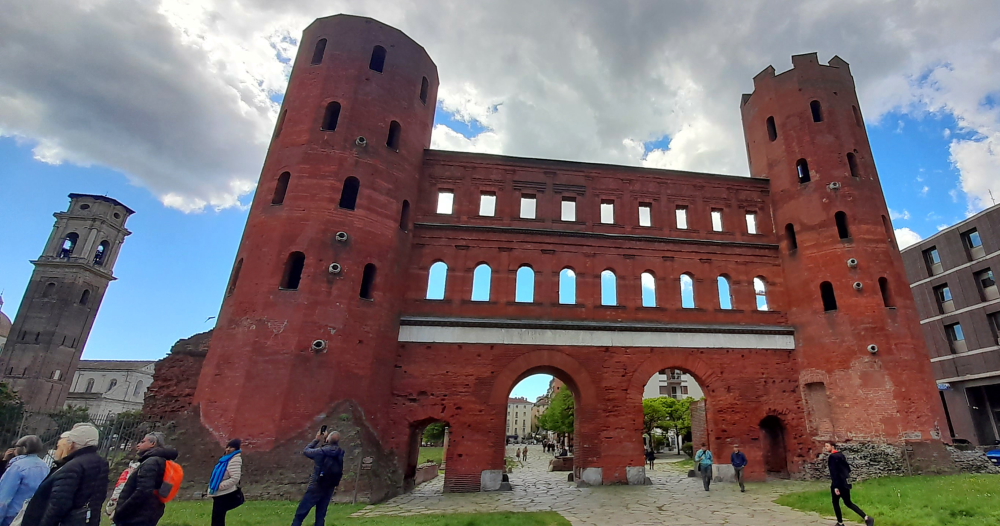
From here we walk to the Roman Porta Palatina constructed in the 1st century. The Palatine Gate was one of 4 access gates to Iulia Augusta Taurinorum. Turin was founded by the Romans probably between 25 and 15 BC and it was built following the traditional canons of Roman urban planning: a quadrangular network of streets perpendicular to each other, surrounded by a wall.
Access to the city was guaranteed by 4 monumental gates, 1 on each side of the fortification, at the end of the 2 main streets of the city: the decumanus maximus (Via Garibaldi) and the cardo maximus (Via San Tommaso and Via Porta Palatina).
The Palatine Gate was the 1 on the northern side, towards the road to Mediolanum (ancient Milan) and Ticinum (now Pavia), at the northern outlet of the cardo maximus. At that time it was called Porta Principalis Dextera.
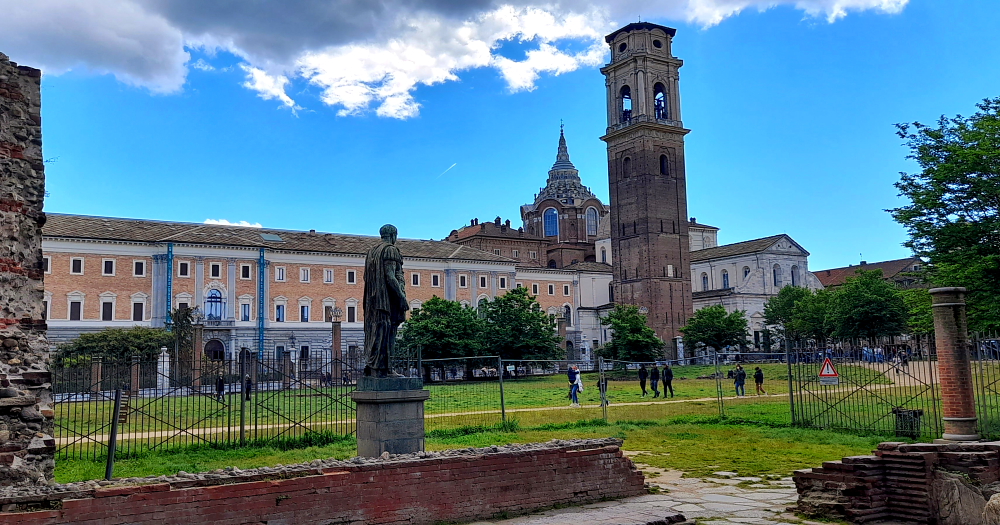
At the beginning of the 15th century it was completed with battlements for defensive purposes. The 18th century renovations and the completion of the new defensive curtain radically changed the urban layout of the area and the gate lost its role as an access route to the city. In 1724 King Vittorio Amedeo II (1666-1733) handed over the gate and the buildings that had abutted it over time to the municipality, which transformed the complex into a prison.
In the early 1900s and 1935 new restorations were started then in the 1990s the Palatine Gate was completely restored. [www-museotorino-it].
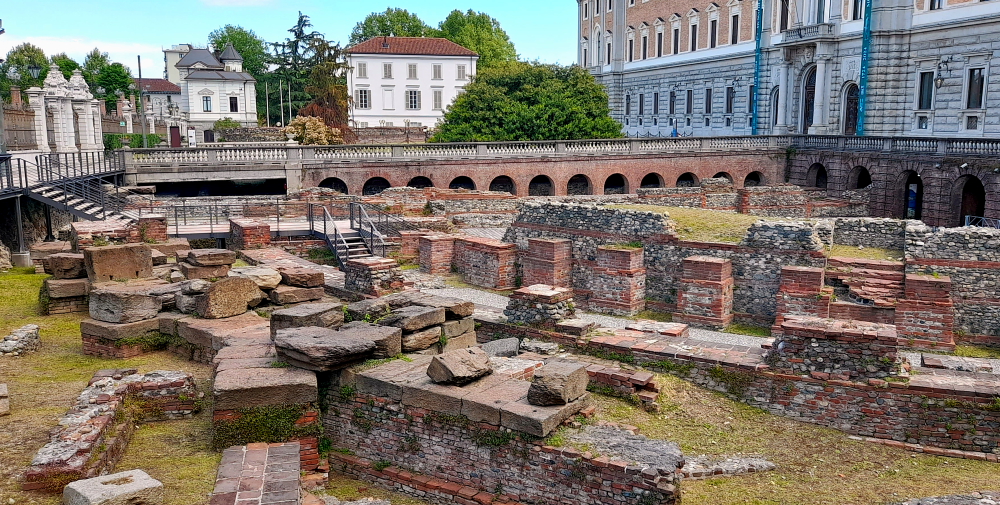
Striking across the Archeological Park we pass by the ruins of a Roman Theatre and arrive at the Campanile and the Cathedral of St John the Baptist (Cattedrale di San Giovanni Battista), the home of the Sacred/Holy Shroud of Turin.
The shroud first emerged historically in 1354, when it is recorded in the hands of a famed knight, Geoffroi de Charnay, seigneur de Lirey. In 1389, when it went on exhibition, it was denounced as false by the local bishop of Troyes. The Avignon antipope Clement VII (reigned 1378–94), although he refrained from expressing his opinion on the shroud’s authenticity, sanctioned its use as an object of devotion provided that it be exhibited as an “image or representation” of the true shroud. Subsequent popes from Julius II on, however, took its authenticity for granted.
In 1453 Geoffroi de Charnay’s granddaughter Marguerite gave the shroud to the house of Savoy at Chambéry (France), and there it was damaged by fire and water in 1532. It was moved to the new Savoyard capital of Turin in 1578. Ever since, it has been publicly exhibited only rarely, as, in recent times, on the marriage of Prince Umberto (1931) and on the 400th anniversary of its arrival in Turin (1978).
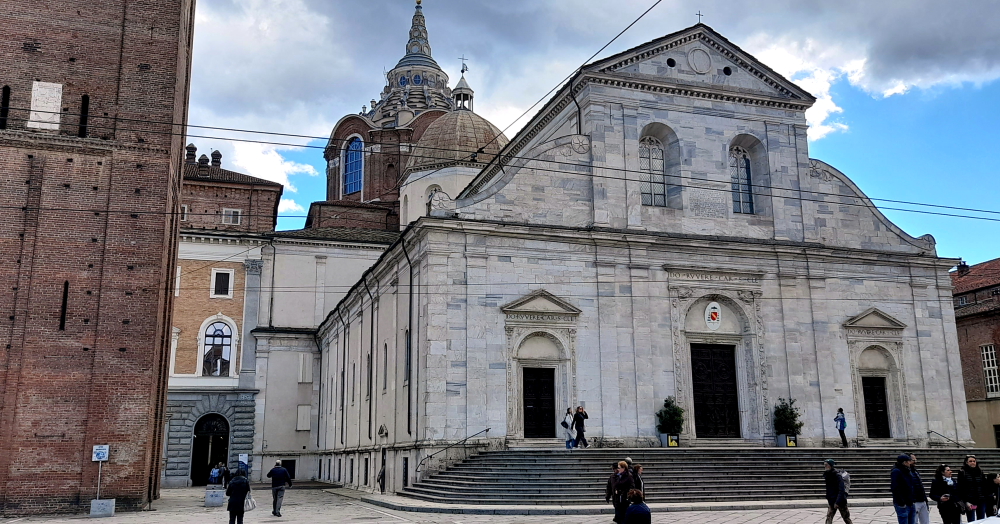
In 1998 and 2000 Pope John Paul II arranged for public viewings; he called the shroud “a mirror of the Gospel.” Pope Benedict XVI similarly arranged a public display in 2010, and Pope Francis made a pilgrimage to see it in 2015. A replica of the shroud is housed in the Museum of the Shroud in Turin. [www.britannica.com].
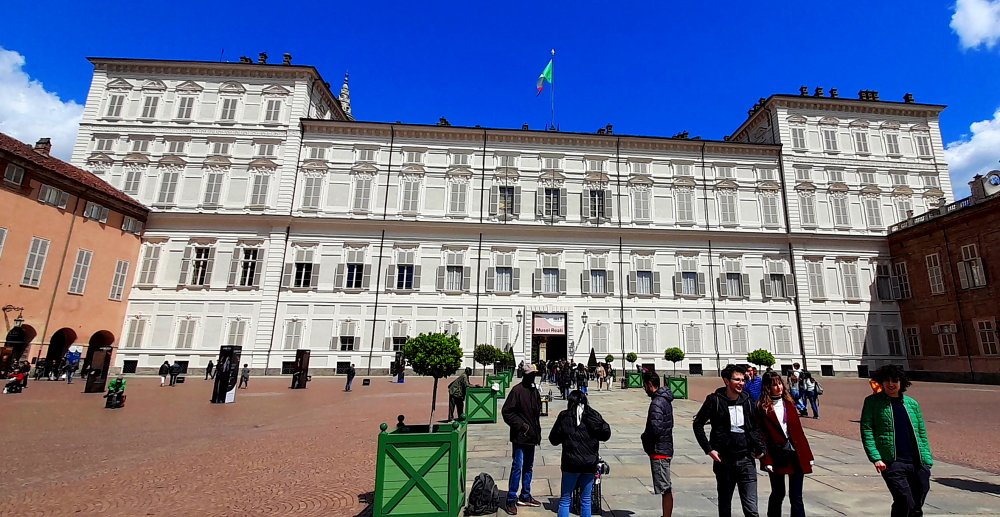
Abutting the cathedral is the Palazzo Reale (Royal Palace). A UNESCO World Heritage Site since 1997, the Royal Palace is part of the Royal Museums together with the Royal Armoury, the Savoy Gallery, Palazzo Chiablese and the Archaeological Museum.
The works that radically changed the ancient bishop’s palace that Emmanuel Philibert of Savoy chose as his residence in 1563 began at the end of the 16th century. After the unification of Italy, the royal family moved to Florence, and the palace in Turin became less and less frequented. With the advent of the Republic, it was virtually abandoned and only in 2007 was it opened to the public.
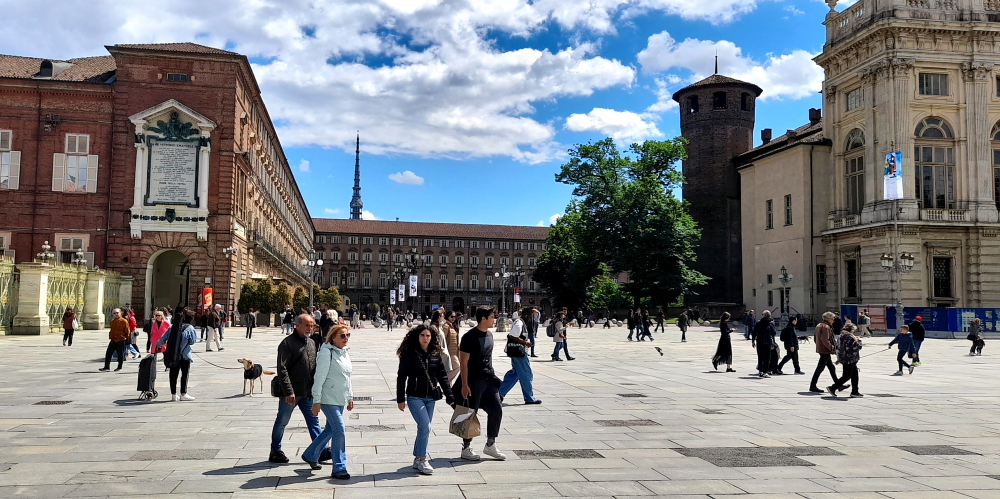
The Royal Palace faces Piazza Castello which is dominated by a rather peculiar tower – Torre Littoria – also known as “Duce’s Finger” or simply, the “Eyesore”.
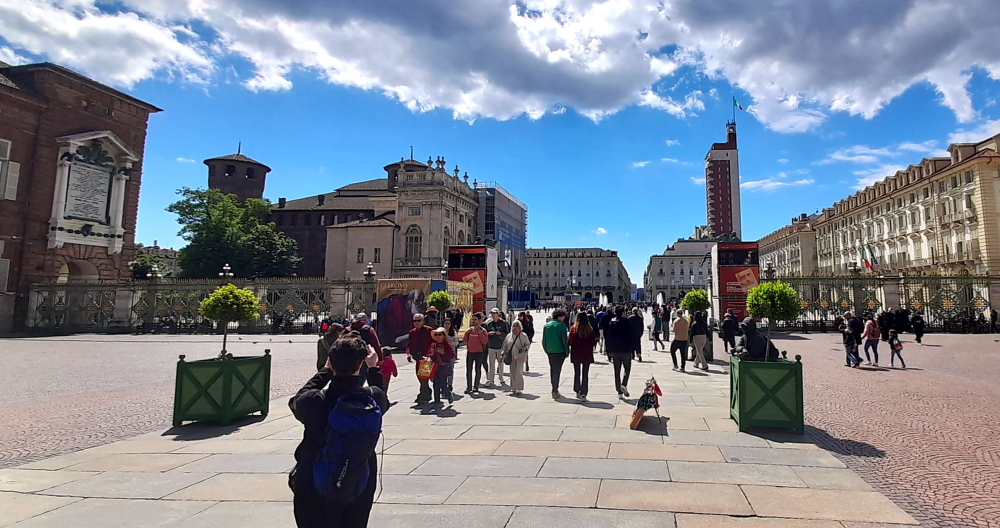
The tallest residential building in Turin, a great example of rationalist architecture, it was built between 1933-34, during the fascist dictatorship led by Benito Mussolini.
There are numerous theories regarding the location of this building – simply a technical choice or a symbolic one? While the buildings in the center of Turin present the typical Baroque and Renaissance splendor, associated with the monarchy, the Torre Littoria is modern, compact and free of excessive ornamentation. [www-guidatorino-com].
As today is sunny and the next couple of days are forecast to be cold and raining, we decide to explore more of Turin this afternoon after a quick stop at the apartment where I pick up an email from FinnAir about our flight from Helsinki to Bangkok on 29 July.
Our flight’s departure has been moved 20 minutes. I need to go into ‘Manage Booking’ to confirm this change and while there I notice that under ‘checked luggage’ we seem to have a “0”. Turns out that FinnAir business class only includes meals and beverages. Lounge access, seat allocation, checked and carry on luggage all need to be purchased in addition to the FULL business class fare. I’ll have to deal with this later.
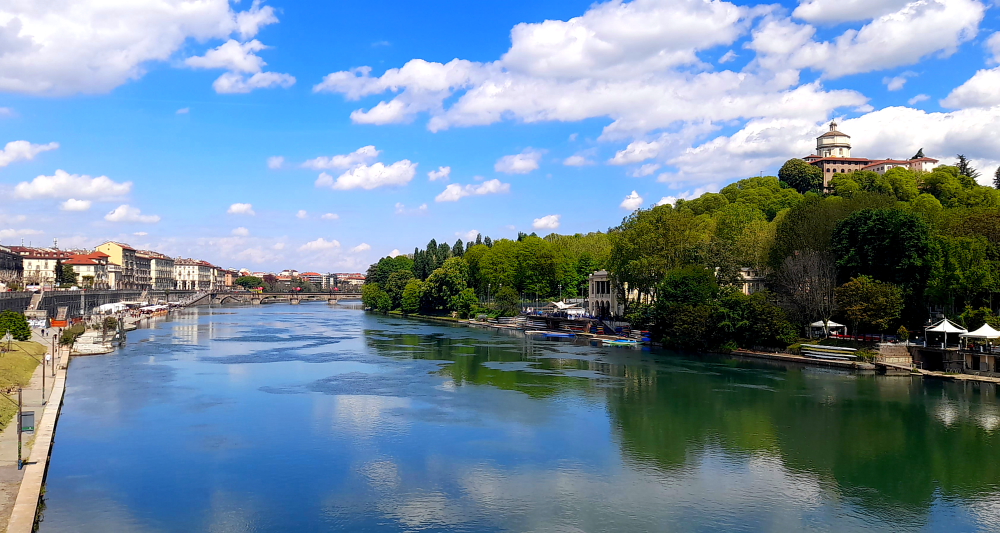
First stop is the view from Monte dei Cappuccini on the other side of the Po River. Here stands the Church of Santa Maria al Monte, whose origins, like those of many places in Turin, are linked to the deeds of the Savoy family. Duke Carlo Emanuele I, at the end of the 16th century, donated the land on the mountain, which had until then been privately owned, to the Capuchin fathers so that they could build a convent dedicated to San Maurizio and completed in 1590. The church, however, wasn’t built until a century later and so in a distinctly Baroque style, typical of the 17th century.
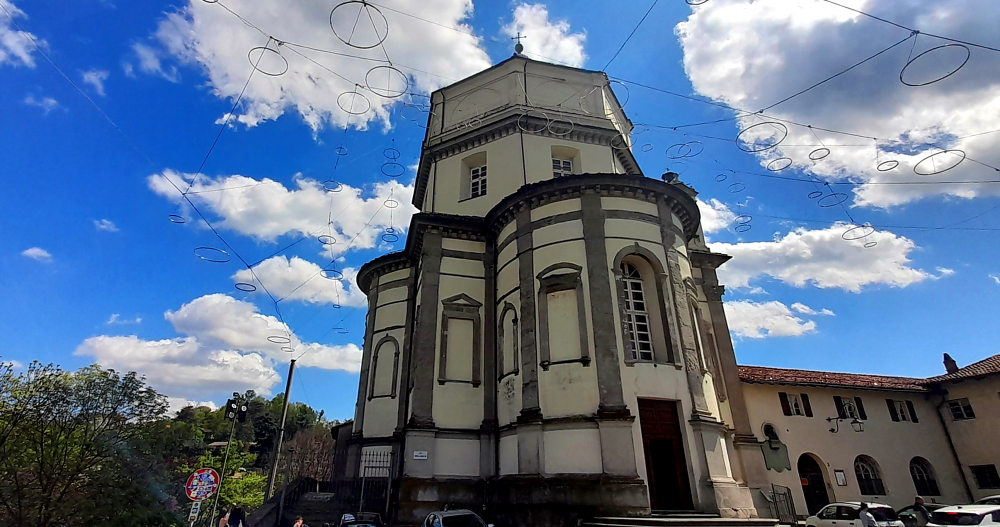
The Monte dei Cappuccini, led by the Capuchin friars, was the scene of heroic and legendary deeds. The friars performed memorable feats during the plague epidemics that struck Turin, such as that of 1630, when a large part of the city’s population died. It’s also said that in 1640, during the Siege of Turin, a Eucharistic miracle took place inside the church of Santa Maria.
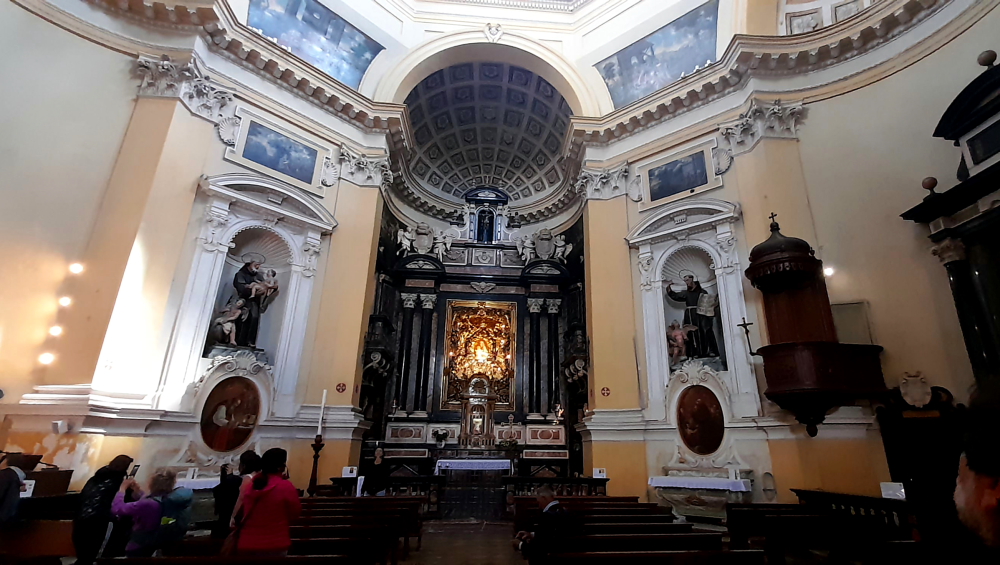
Legend has it that, when the French soldiers arrived inside the church to sack it, they were terrified by the sight of a tongue of fire coming from the tabernacle, protecting the consecrated hosts. Thus, the invader left, amazed by the Eucharistic miracle, the entire episode of which is depicted on a canvas, today exhibited inside the church.
The Napoleonic era suppressed monastic orders and, consequently, the convent ceased to exist, later suffering considerable damage due to the bombings of WWII. [www-guidatorino-com].
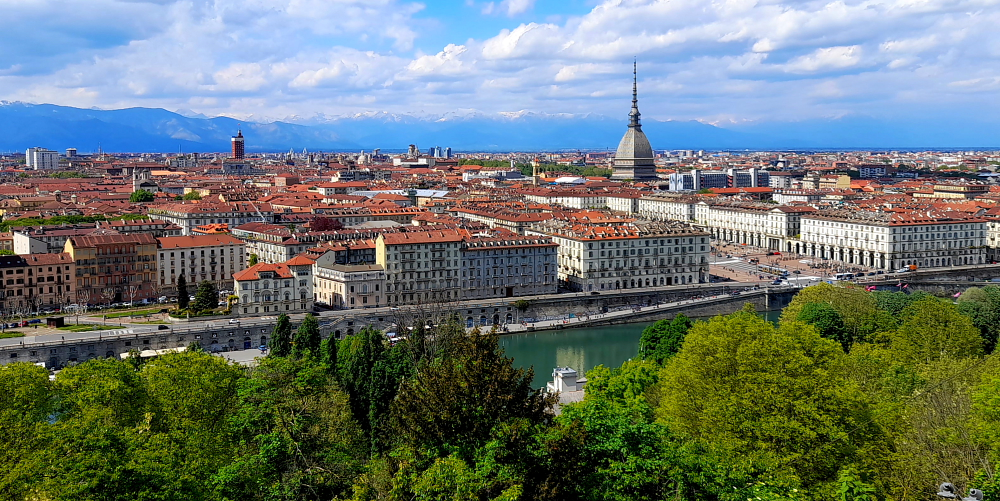
Retracing our steps over the Ponte Umberto Primo we arrive in the Parco del Valentino.
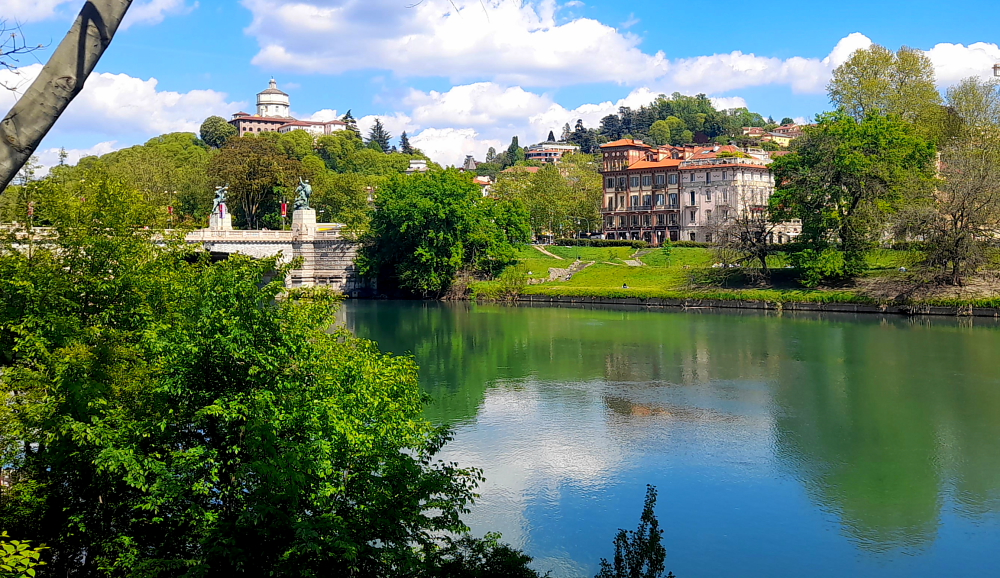
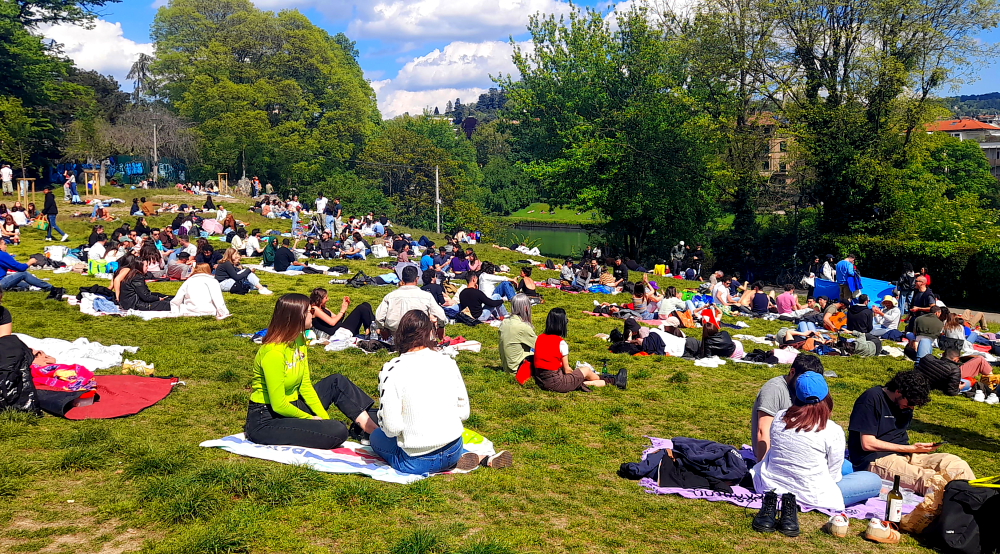
Here we make our way, through throngs of people out enjoying the sunshine on this national holiday, to the Castello del Valentino which we saw when we drove through the city the day we arrived.
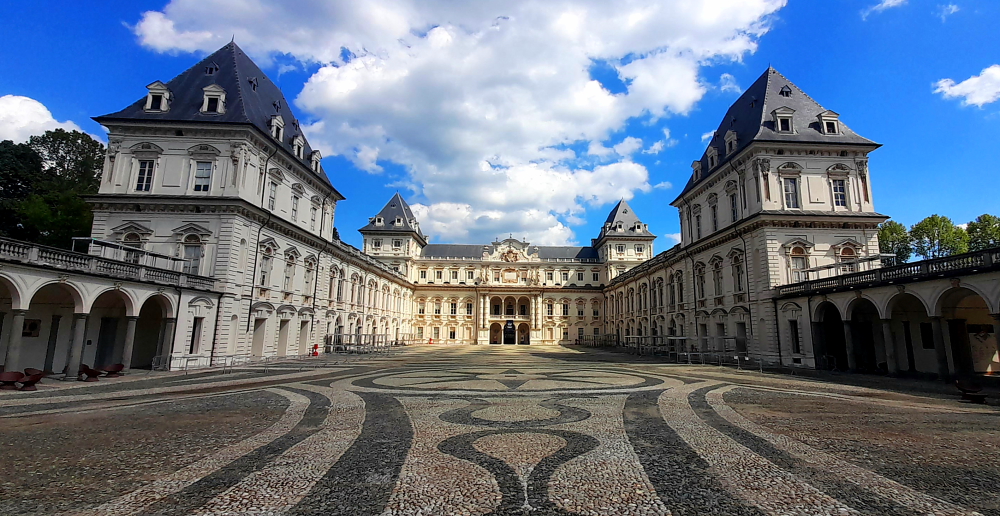
The Castello del Valentino is one of the Savoy residences on the UNESCO World Heritage List. The castle is surrounded by its park and hosts the headquarters of the Polytechnic Faculty of Architecture.
Emmanuel Philibert of Savoy bought it in 1564 from Renato Birago. At the time, the building looked like a river villa. Fifty years later, Christine of France, the regent of the Duchy of Savoy, gave a solid French look to the new palace.
Just as it shone during its heyday with the “Madama Reale”, the magnificent residence withered after Christine’s death. Only in the 19th century did it return to prominence, 1st with the National Exhibition of 1858 and 2 years later by hosting the Faculty of Engineering.[visititaly.eu].
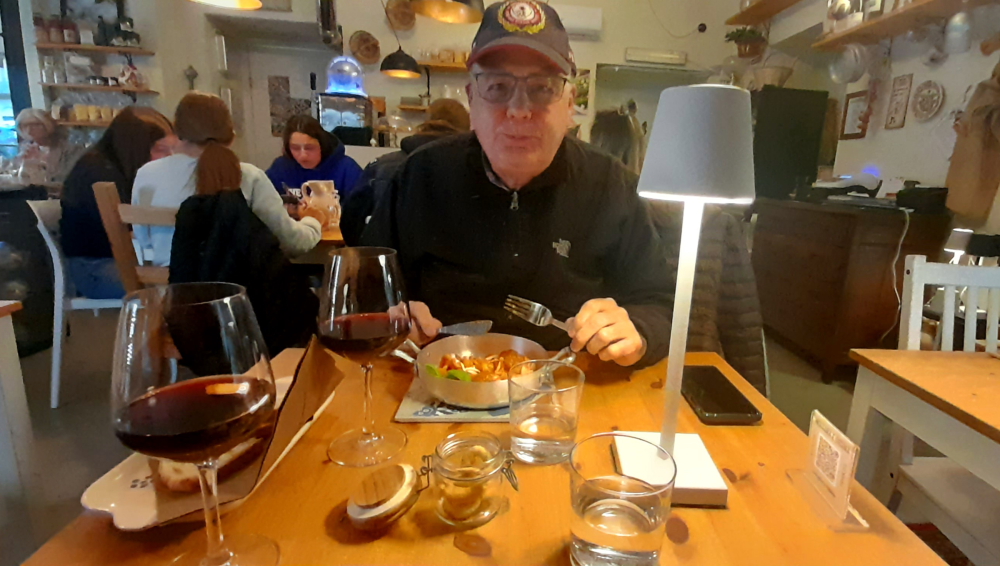
Having walked some 10 km already today we are loathe to walk to one of the restaurants recommended by our guide. Rather, we’ll pop around the corner to the “Drogheria Pugliese” (Pugliese Grocer Shop) where not only produce from Puglia can be purchased but also served to you from its restaurant.
Tomorrow’s cold weather has already arrived when we get back to the apartment so I turn on both the air conditioners as the central heating isn’t working. Lynn also turns on the oven to warm up some pastries to have with our cuppa and hey, presto – total blackout!
Lynn heads down to Reception and finds instructions to press the Concierge’s call button in case of emergencies, in this instance out of hours for Reception staff. The lady promptly arrives and sorts out the boiler for the central heating and hey, presto – lights!
Time for bed!
26 April, 2024
First task for today is to purchase checked in luggage for our FinnAir flight to Bangkok. Cost us a total of Eu150 for a 23 kg bag each. Won’t be flying FinnAir again, that’s for bloody sure.
Although it’s cold and wet I want to check out the markets that the guide mentioned. They’re located a 20-minute walk North around Piazza della Repubblica.
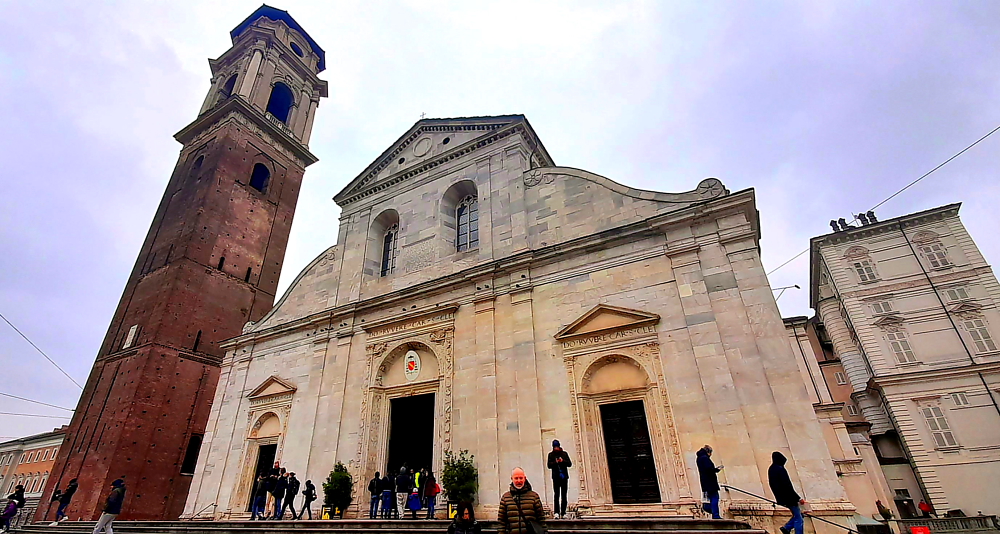
En route we walk past the Cathedral to find that it is open. It’s free to access the church and to view the closed sarcophagus that houses the Turin Shroud, so Lynn ventures in.
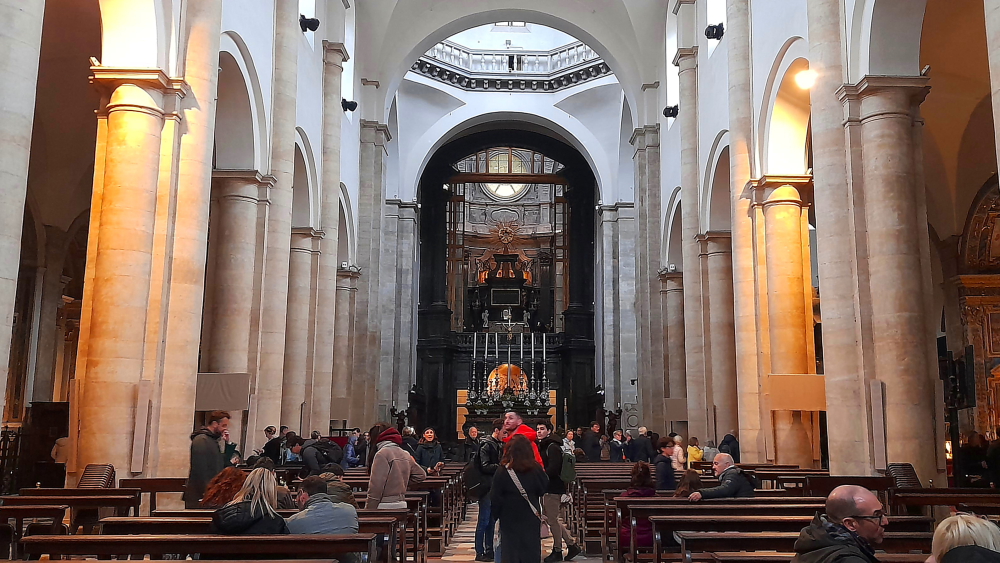
The Shroud of Turin, a length of linen that for centuries was purported to be the burial garment of Jesus Christ. It has been preserved since 1578 in the royal chapel of the cathedral of San Giovanni Battista in Turin. Measuring 4.3 metres long and 1.1 metres wide, it seems to portray two faint brownish images, those of the back and front of a gaunt, sunken-eyed, 5-foot 7-inch man—as if a body had been laid lengthwise along one half of the shroud while the other half had been doubled over the head to cover the whole front of the body from face to feet.
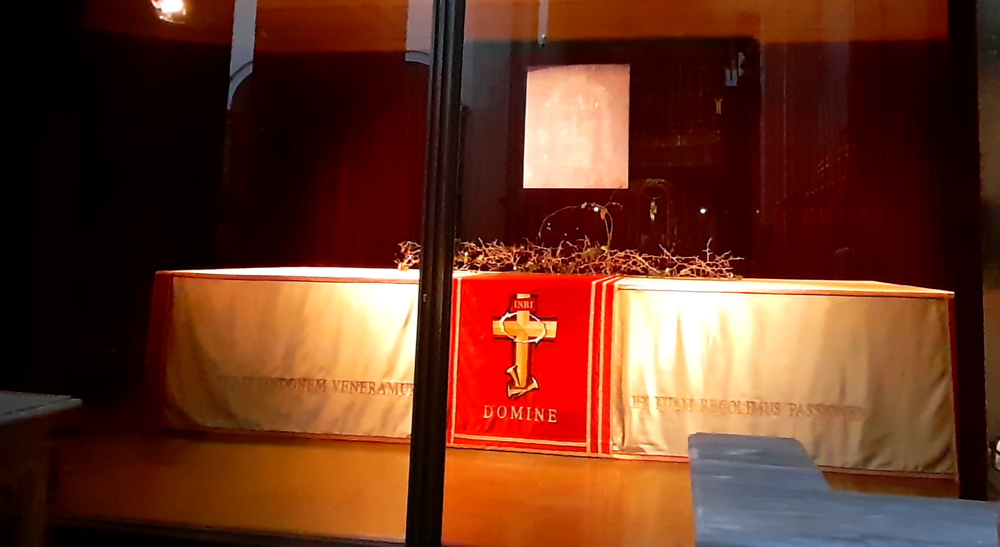
The images contain markings that allegedly correspond to the crucifixion wounds of Jesus, including thorn marks on the head, lacerations (as if from flogging) on the back, and various stains of what is presumed to be blood. [www.britannica.com/]
Due to its fragility, the Vatican has deemed that the Shroud only be revealed to the public every 5 years with the next viewing next year in 2025.
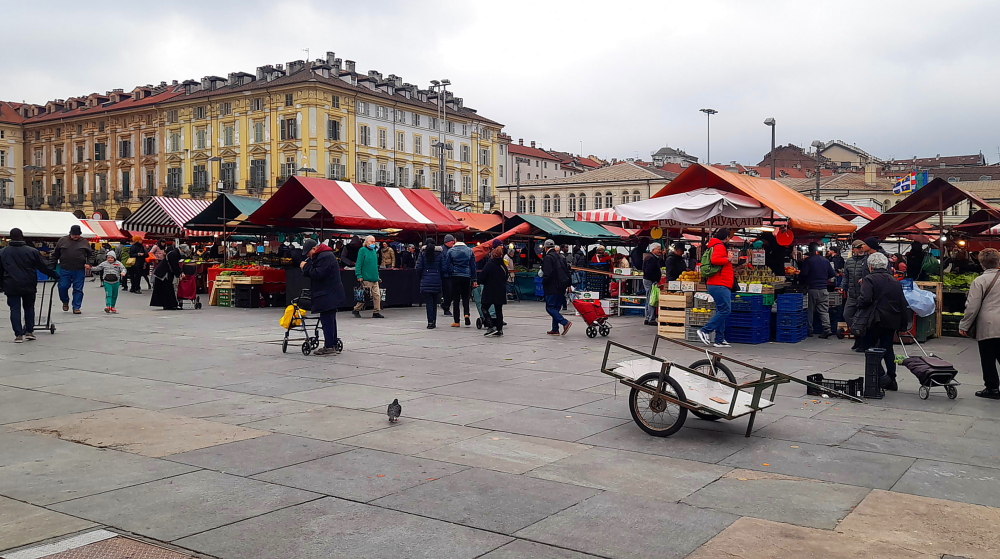
When we arrive at the markets we are met by a number of options.
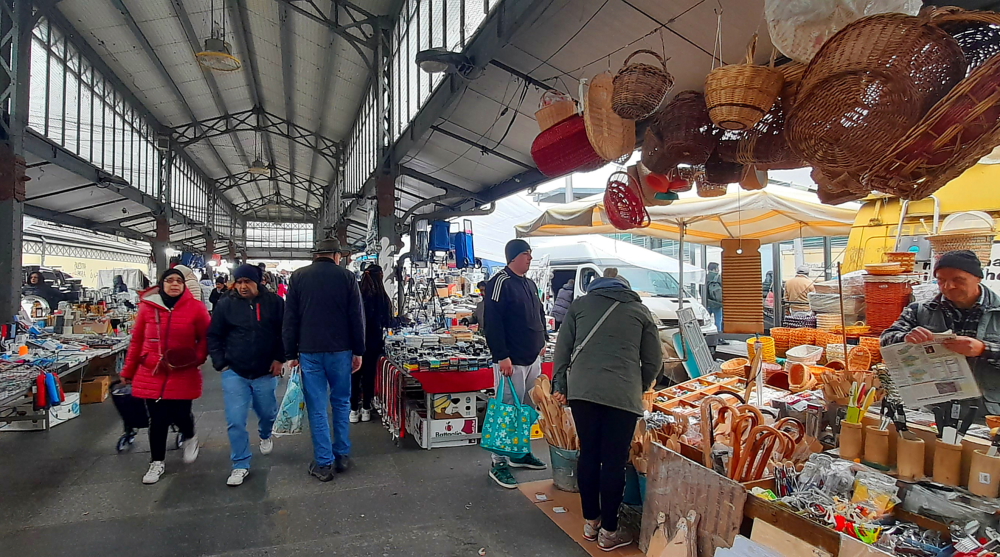
Mercato IV and V Alimentare (food), Mercato Ittico (fish), Il Mercato Centrale (modern food hall), Merato Calzature (shoes), Mercato Casalinghi (household goods) and Tettoia Contadini (farmers shed). We take the plunge and buy some small almond cakes for Lynn and a large, custard-filled donut for me.
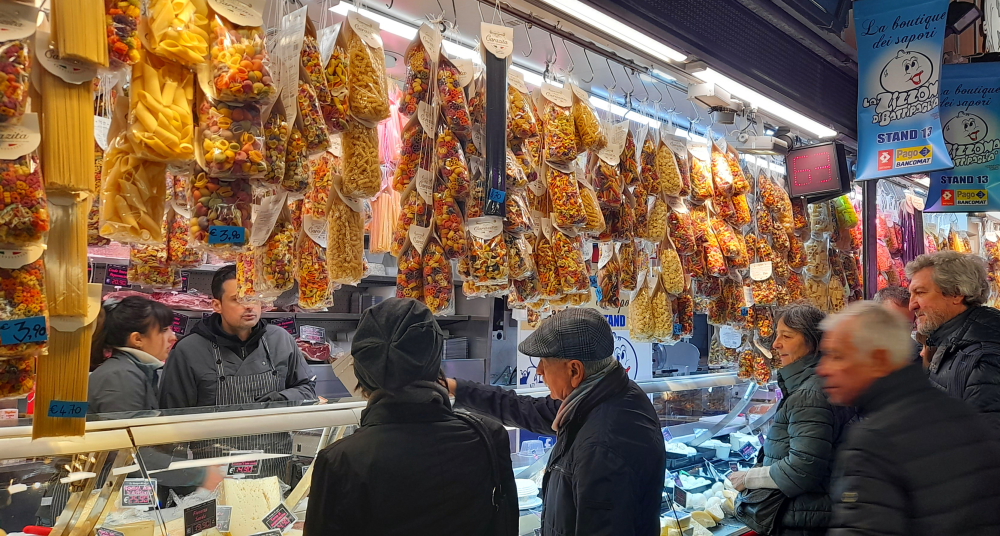
Each of these markets corresponds to a different segment of the large, circular Piazza. Most are in buildings but some – fruit and veg, shoes, clothing and electronics – are tented stalls in the open air. Needless to say the traffic around the Piazza is crammed and chaotic with lots of blaring car horns.
Returning to the apartment we walk through the public Royal Gardens (Giardini Reali) that are adjacent to the Palace.
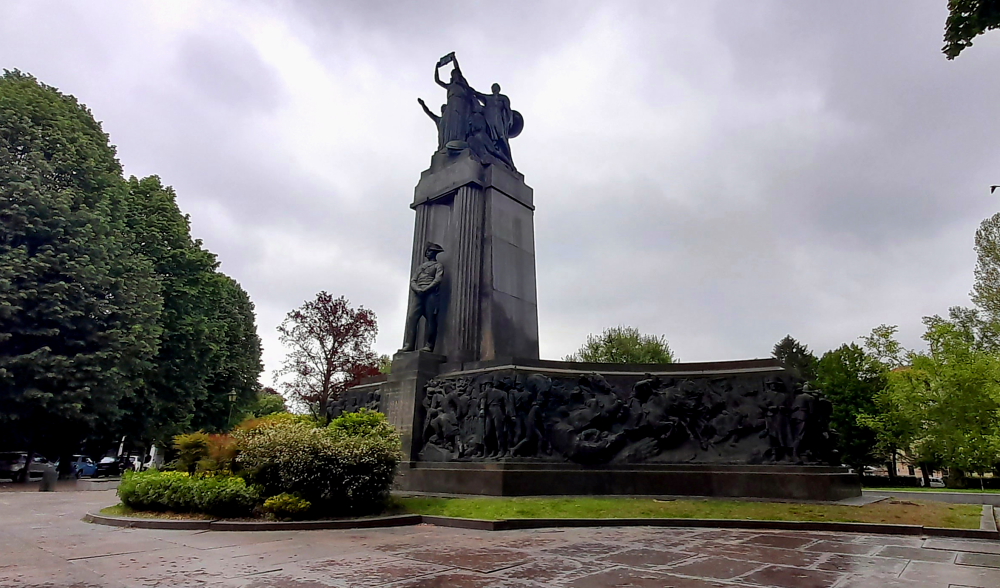
When we emerge we realise we aren’t that far from the imposing shrine and tower that is Turin’s symbol – Mole Antonelliana aka the National Museum of Cinema.
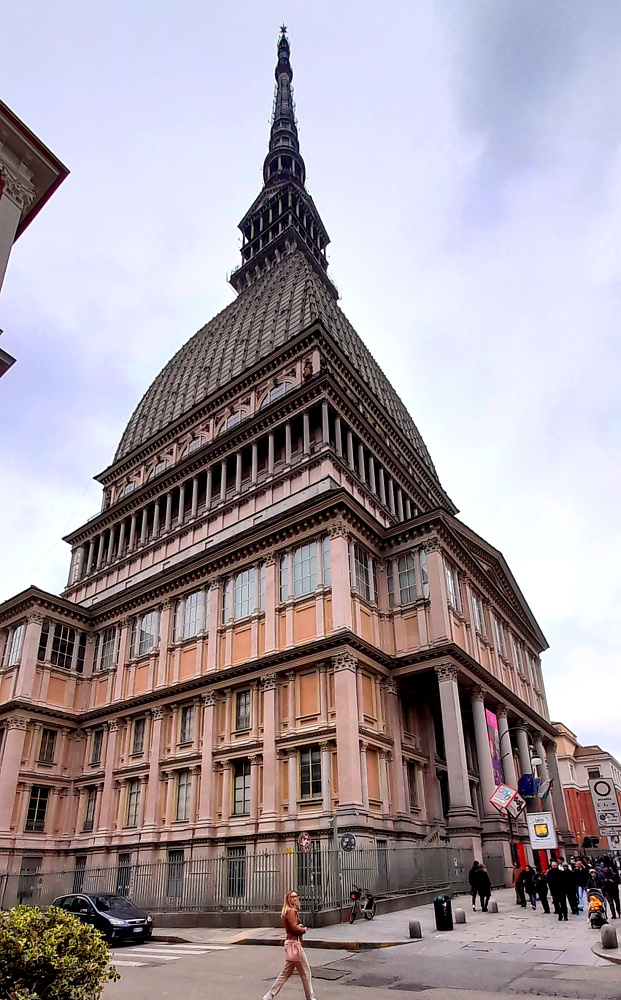
Built during 1863-1889 by the architect Alessandro Antonelli, it’s 167 metres high. First built to be a synagogue, afterwards mostly used for temporary exhibitions and in 2000 it became the site of the National Museum of Cinema. [turinitalyguide].
About 6:50 pm we scarper from the apartment as we need to walk 15 minutes north to Largo Quattro Marzo to one of the restaurants that our guide recommended to us yesterday for reasonably-priced, typical Piedmont food. He urged us to be there before 7 pm in order to get a table – how right he was, there is a huge queue of umbrellas along the pavement.
Fortunately, he also pointed out a back-up restaurant, the Host Bistrot, which is around the corner. Along we go, open the door and there are only 2 other diners. Perfect!
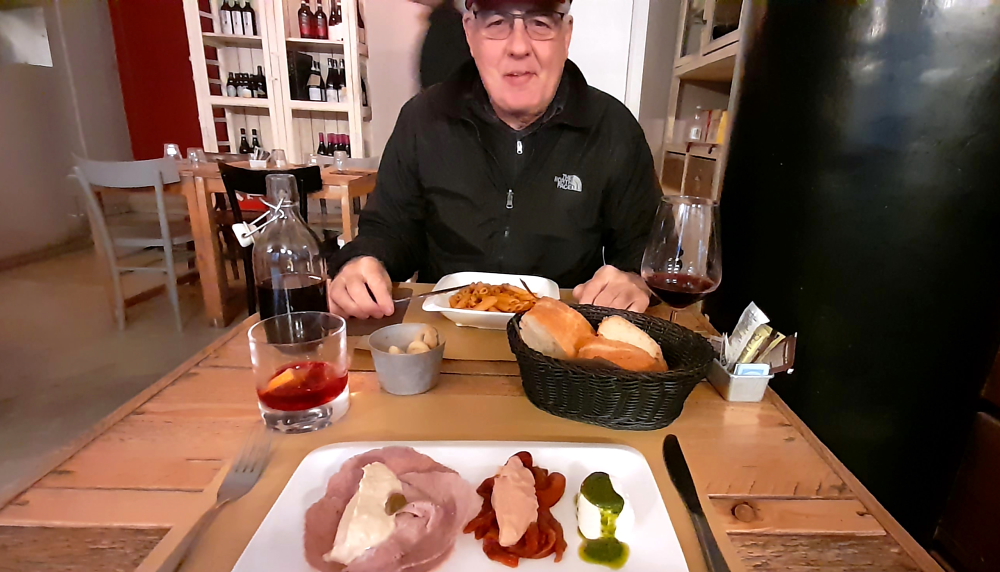
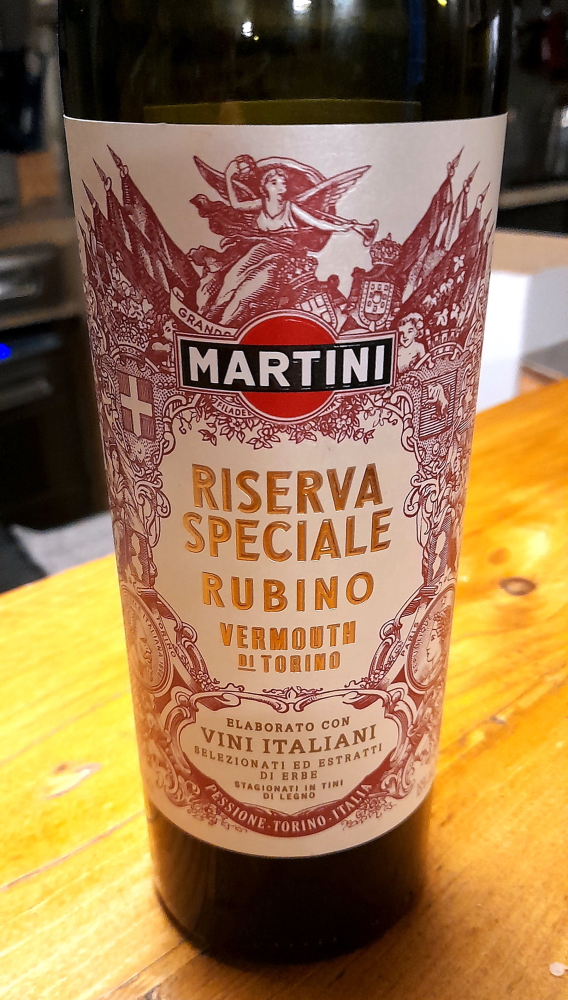
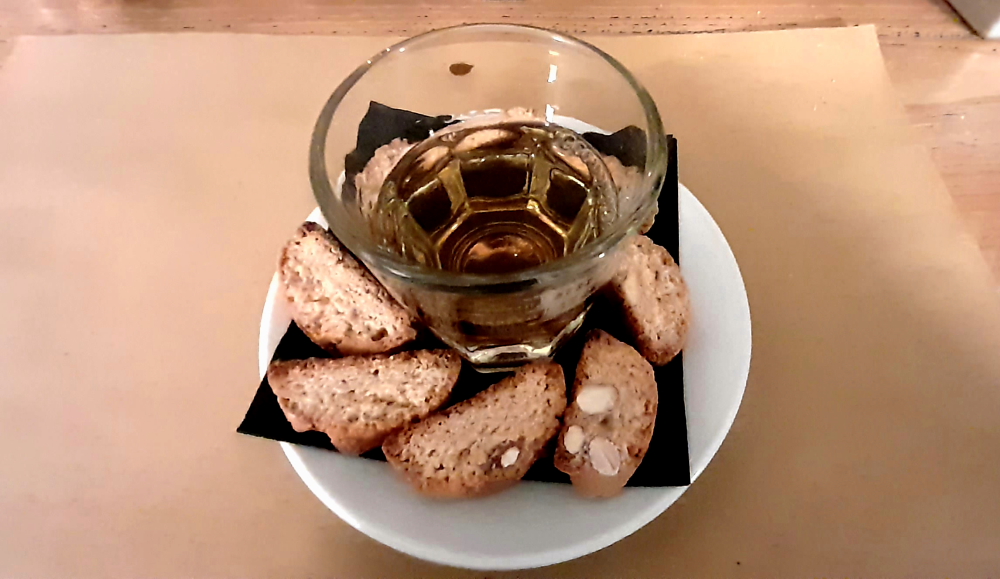
Lynn orders a Martini Riserva Speciale Rubino Vermouth di Torino together with a platter of typical Piedmontese products: veal with tuna sauce (vitello tonnato – it actually works!), roasted red peppers with hazelnut sauce (pepperoni rossi arristiti con salsa di nocciole) and tomino al verde (soft white cheese with a green parsley sauce) followed by Cantucci al Vin Santo (almond biscuits dipped in a dessert wine) for sweets.
I just have a half litre of red wine to myself and a seafood tagliolini.
27 April, 2024
Another chilly and wet day today so we spend it indoors. Lynn catches up 3 busy days of blog and irons 2 loads of washing I put on yesterday. We pack and get organised for our 3-hour drive to Geneva tomorrow, the middle leg of which will be through the 11.6km Mont Blanc Tunnel (MBT). Even though we pay for tolls in both Italy and France we still need to pay Eu55 (A$92) to access the tunnel one-way. To be clear – that’s Eu55 for 12 minutes’ use!
28 April, 2024
By 10:25 am we’ve hit the A5 on our route to Geneva. It’s 11 Deg. C and raining. The route that the car’s GPS takes us to exit Turin doesn’t take us past any urban petrol stations so l have to bite the bullet at a motorway one – Eu2/litre for a total of Eu85 to fill the tank.
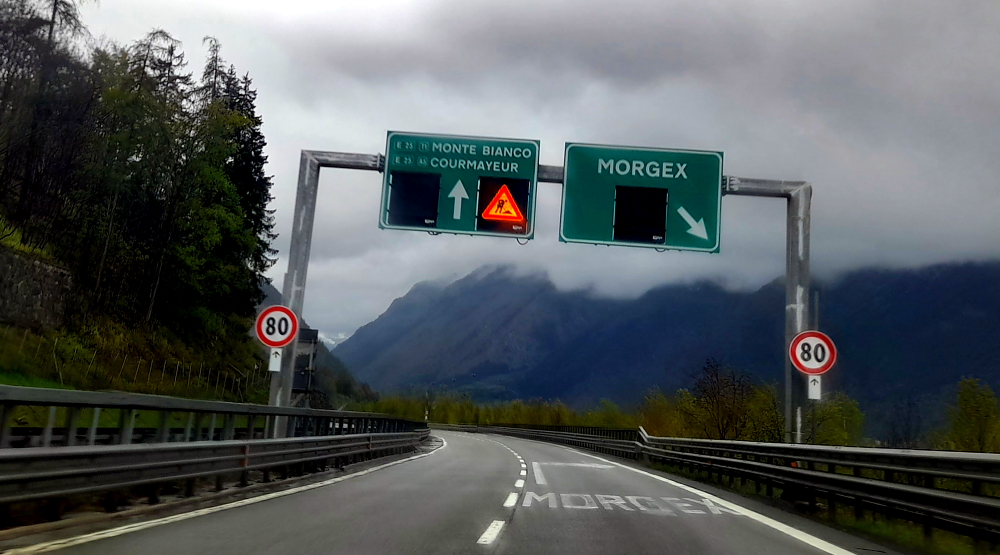
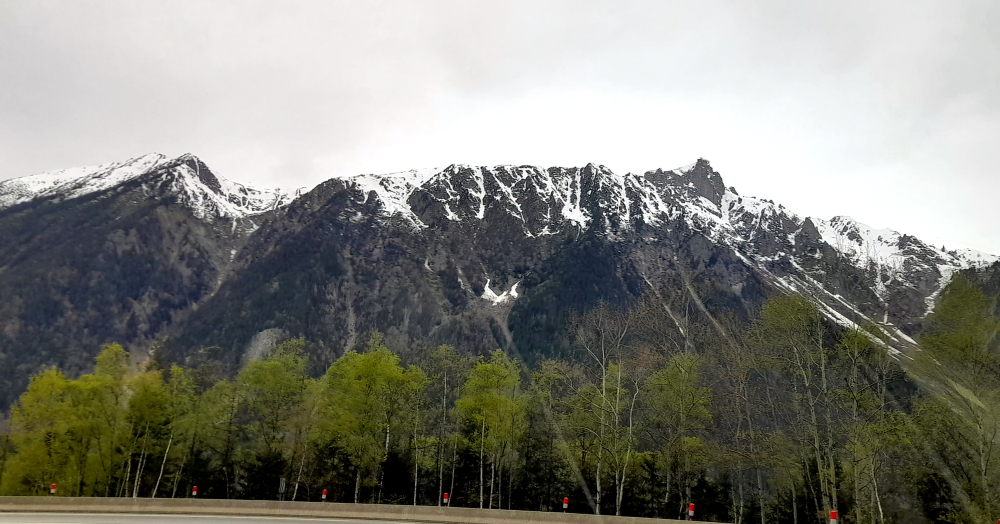
The closer to the MBT we get the more snow-covered mountains, and spectacular waterfalls, that we see.
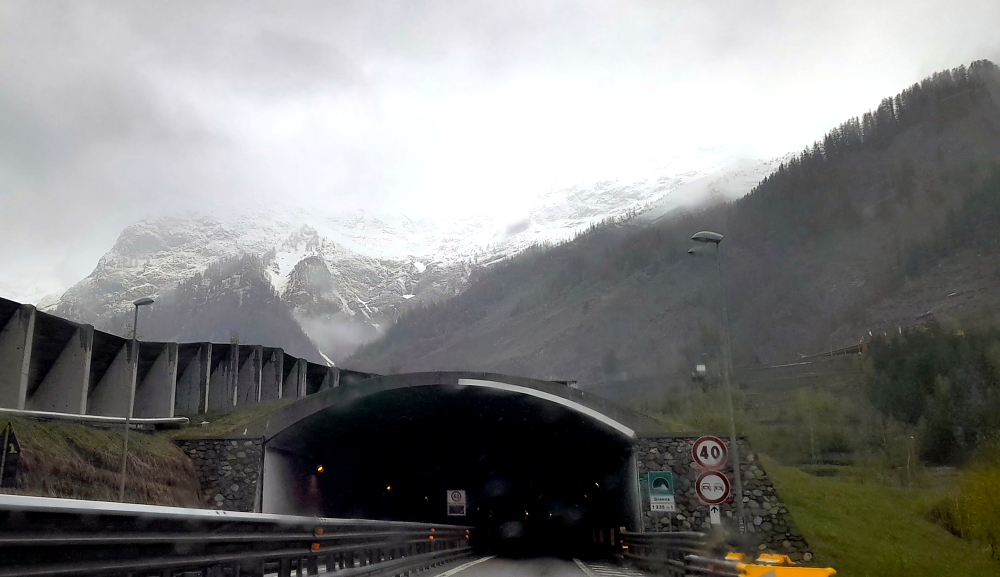
Near Entreves, still in Italy, we have to drive a rather convoluted loop in order to arrive at the toll booth where we pay our Eu55. The actual tunnel entrance is disappointingly unremarkable, given the engineering feat that enabled the tunnel to be bored beneath the Mont Blanc massif, but it’s probably due to the impending reconstruction and renovation works that will commence tomorrow night till the end of the year.
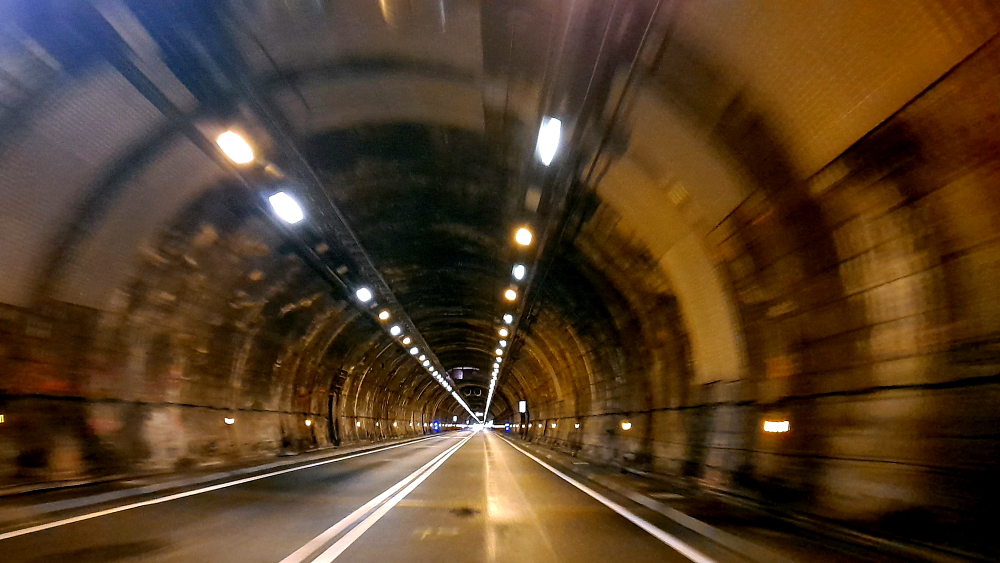
12 minutes later we emerge in France in the Chamonix-Mont Blanc Valley just before Les Bossons, having crossed the border half way through the tunnel. The first thing we see is a monument where we pull over to check it out. It commemorates the 39 people who died in a fire at the 6 km mark in the tunnel on 24 March 1999.
A Belgian transport truck that was carrying margarine and flour caught fire while driving through the tunnel. The driver stopped halfway in order to douse the fire. At this point it wasn’t considered a fire emergency as there had been 16 other truck fires in the tunnel over the previous 35 years (!), always extinguished on the spot by the drivers. But the vehicle violently combusted, other cargo vehicles nearby also carrying combustible loads caught fire. The fire trapped around 40 vehicles in dense and poisonous smoke containing carbon monoxide and hydrogen cyanide including the 29 people who remained in vehicles and the 9 who tried to escape on foot. Vehicles at both ends of the tunnel blocked multiple fire trucks from accessing the Belgian truck.
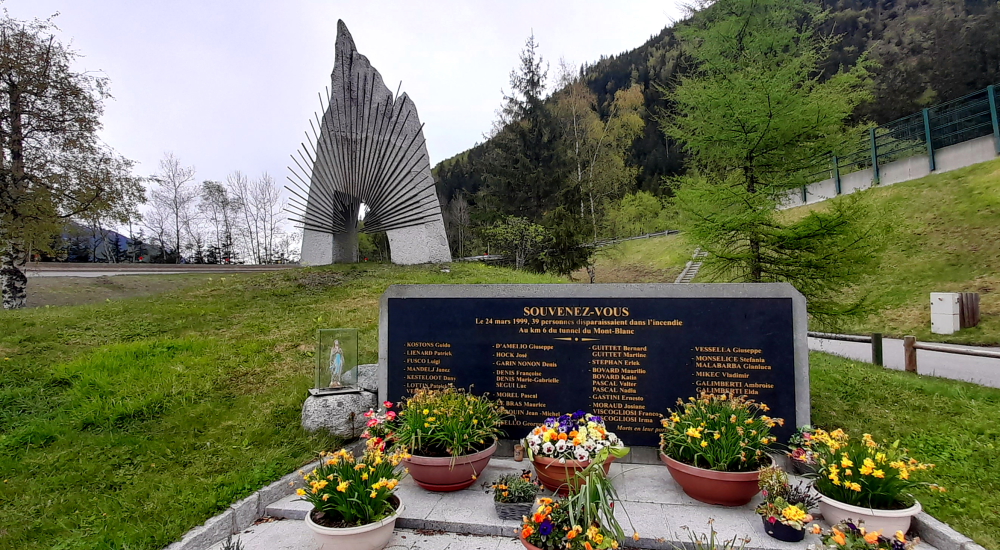
The fire burned for 53 hours and was estimated to have reached a temperature of 1,000 °C, mainly because of the margarine load in the trailer, equivalent to a 23,000-litre oil tanker. It was 5 days later that the tunnel was cool enough for repairs to commence but It was another 3 years before the tunnel reopened.
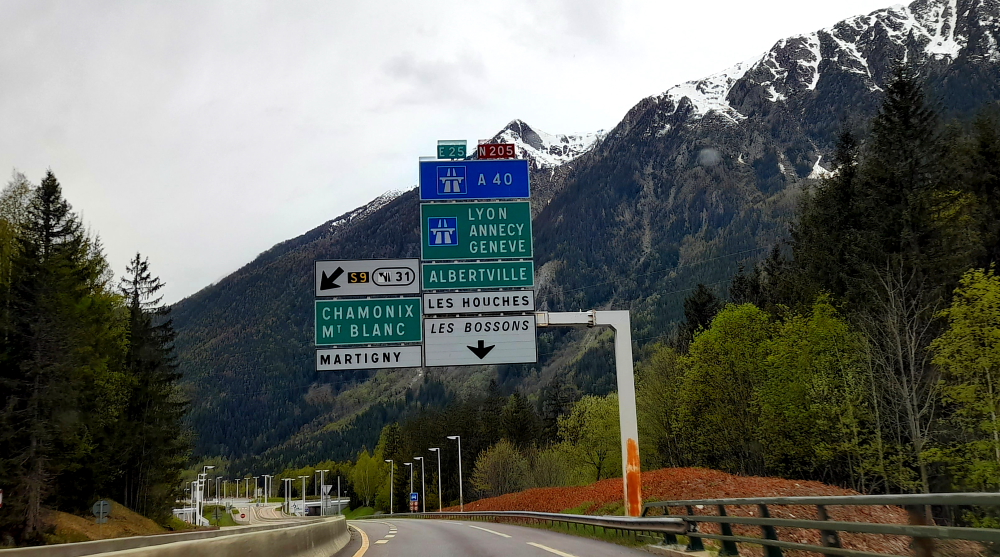
Around 1:00 pm we see our first road sign to Geneva (Geneve).
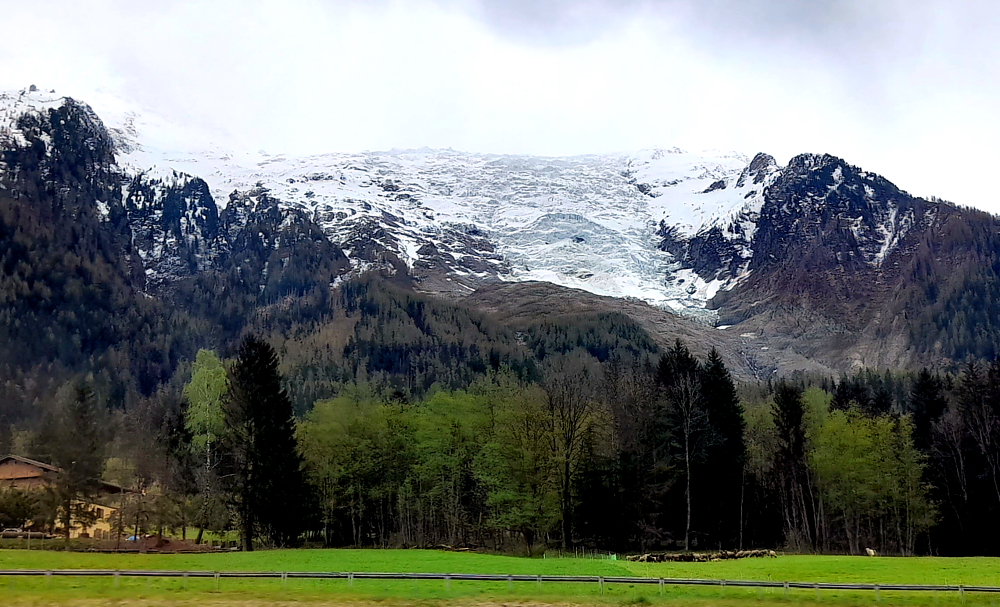
And to our left is the Glacier des Bossons.
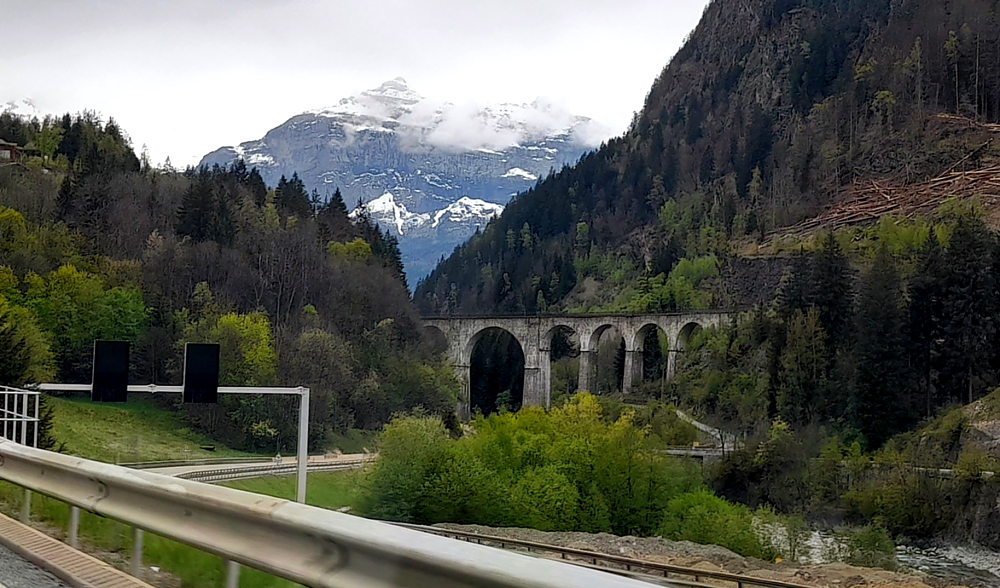
Near Le Fouilly we pass by the train viaduct Sainte-Marie. 50 metres high and composed of 7 arches that span the Arve River and go around the village of Les Houches.
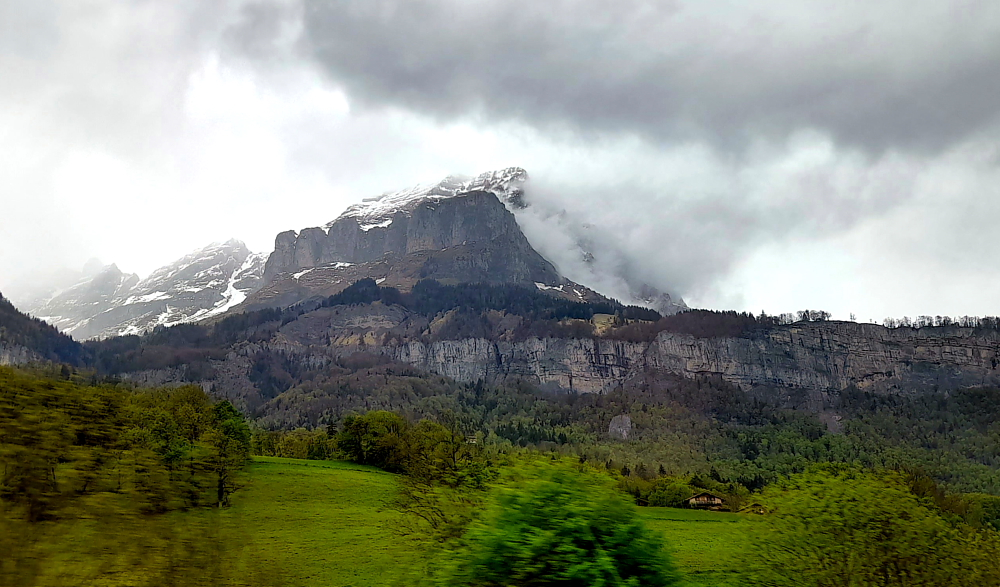
Driving along La Route Blanche provides some impressive scenery, in particular an extensive escarpment that follows the river and is opposite the Cascade de Chedde.
40 minutes later we arrive at the French/Suisse border …
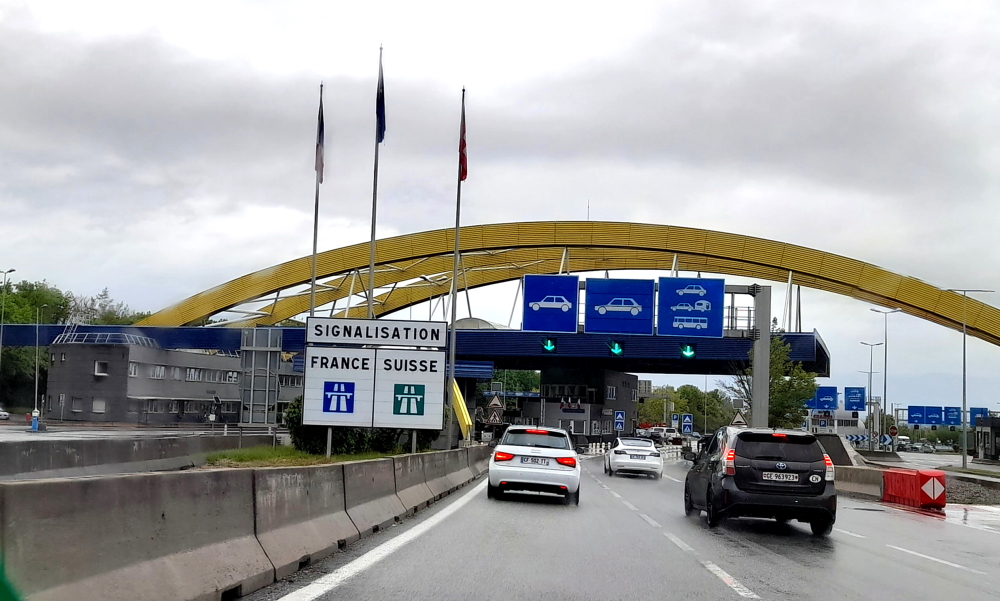
… then park at the Novotel Suites at the Geneva Airport about 10 minutes later and check in. We chose the airport location as it is cheaper and easier to stay and park here and to catch the extensive public transport options into town. And, as we are staying here for 3 days, we qualify for the Geneva Transport Card which allows us to travel for free!
As it’s Sunday, the hotel restaurant is closed so we pop over the road to the shopping centre food court for Asian. An early night, tonight, methinks.
Even though it’s forecast to be raining the next 2 days we still need to check out the town. We’ll get the tram into the Old Town tomorrow to visit the sights there. On Tuesday we may pop into Ariana Park to see the Palace of Nations then on into town to visit the Patek Philippe Museum.
 THE CONTINUING TRAVELS OF YOGI & BOO BOO