
16 September, 2023
The hotel internet (or lack of) has meant that we spent the entire day swearing and cursing at the unreliable internet. I managed to add all the photos early in the morning but Lynn spent the next few hours trying to write the blog. She gave up and decided to write the blog in a Word document and I would have to cut and paste it on to the blog when she (eventually) finished it.
What a waste of a day!
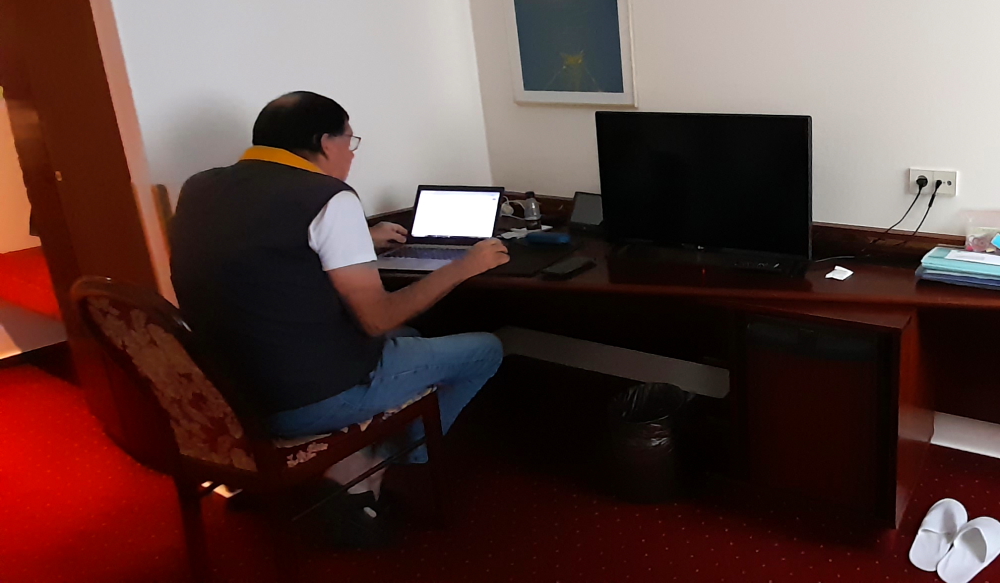
While I waited hour by hour I took the occasional stroll over to the Bremen Hbf station to check out where we will catch the train for our day trip to Hamburg tomorrow. The station is a bit seedy and while I was there at least two pick pockets were arrested by the station police. There is a permanently-manned police van in the square outside the station.
Perhaps Bremen, in hindsight, was not a good tourist stop. Or perhaps it is just the Best Western Hotel here. I have seen faster dial-up internet in the 1990s.
17 September, 2023
While we were at Anne and Jurgen’s place Anne helped us book a train trip to/from Hamburg while we are staying at Bremen. The train fare included unlimited use of the underground and buses for the day in Hamburg.
We cautiously head over to the Bremen Hbf railway station which is only about 100 metres away. That, and a good breakfast, is about the only thing going for this hotel.
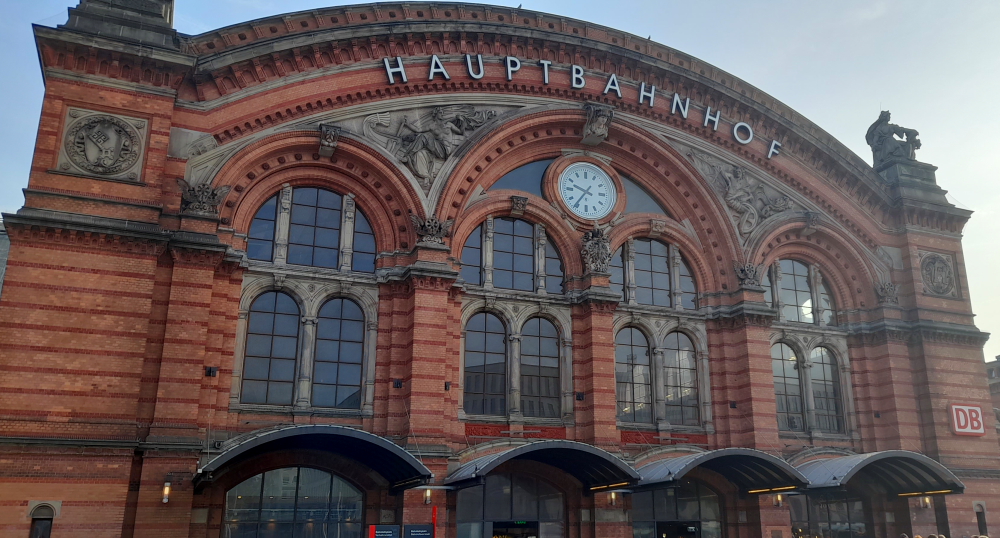
We easily find the correct platform and the train is already at the station when we arrive so we board and take a good seat. The train doesn’t seem to be that busy but then again it is a Sunday.
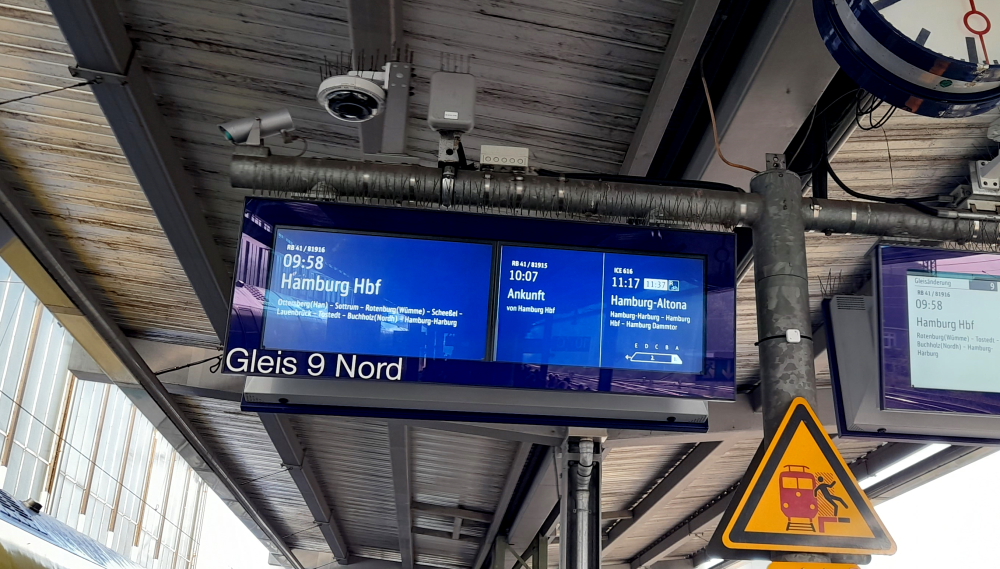
The train comes complete with a reasonable quality WiFi signal but no power outlets. With power we could have brought the laptop and avoided the hotel WiFi frustrations.
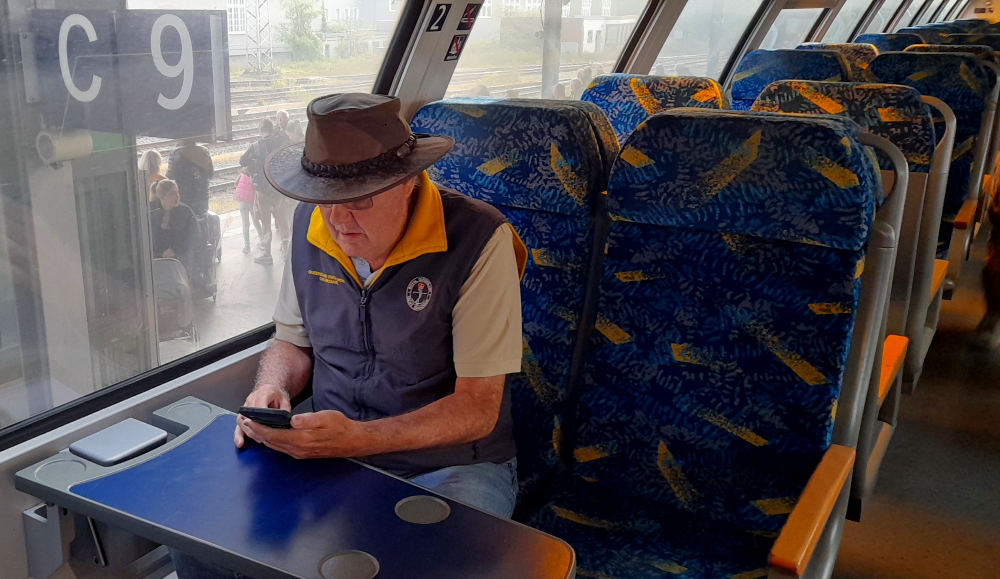
It takes us about 1 hour 20 minutes for the all-stops run to Hamburg but we enjoy the very comfortable ride checking out the scenery on the way and catching up with some emails.
Once we arrive at Hamburg Hbf (Central Rail Station) we walk over to the underground metro to the U1 line to Stephansplatz at the Botanical Gardens. Why not? Just as good as any for our starting point to check out Hamburg for the day.
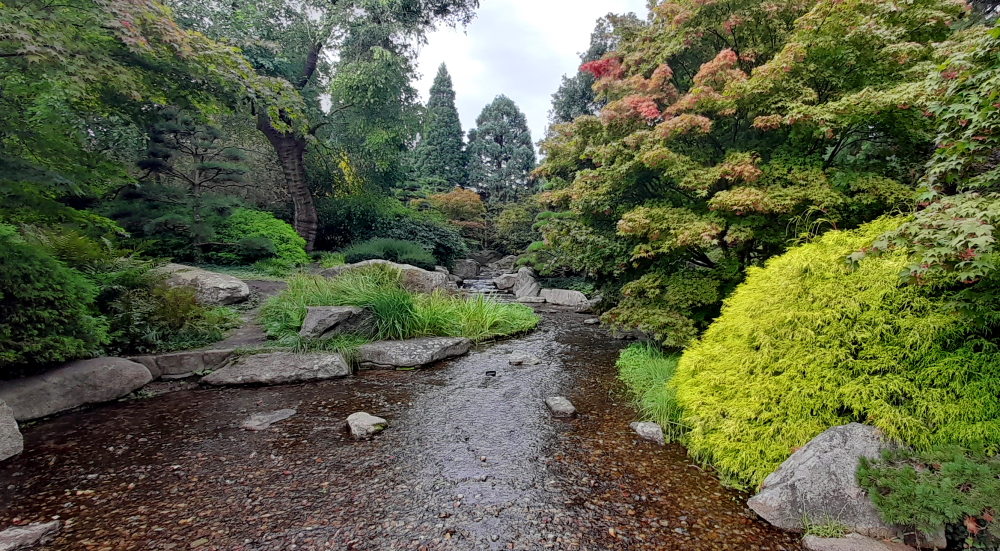
The gardens don’t seem that impressive and they are in need of some serious weeding but that may be because summer is coming to an end and very soon everything will be in hibernation. However, there are lots of people out enjoying what could be the last warm weekend.
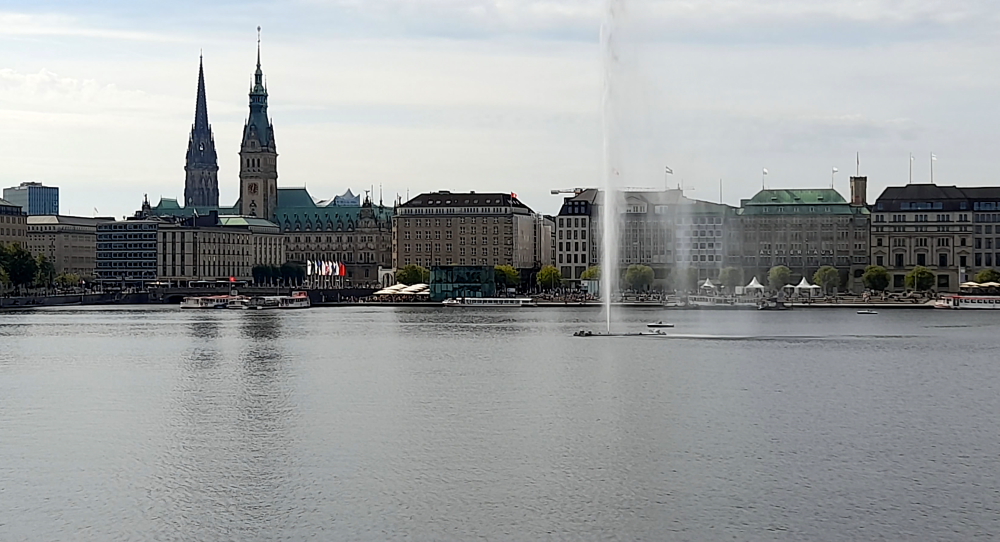
Lynn decides that we should walk to our next stop. I would have taken the metro since there is no additional cost but Lynn rightfully remarks that we need the exercise after a week of over indulgence in way too much food and drink.
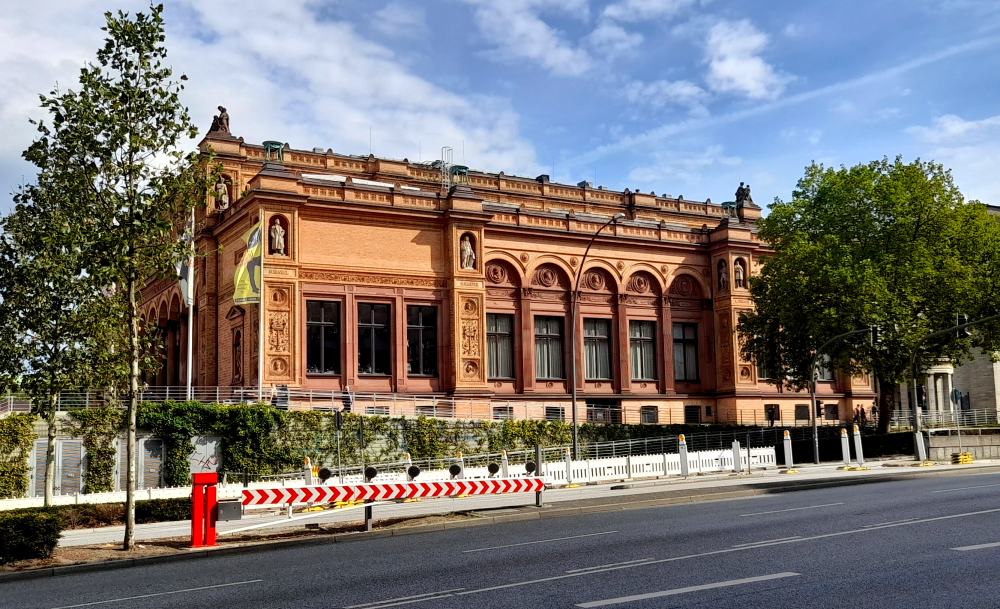
Lynn wants to see the Hamburger Kunsthalle which houses 7 centuries of world art. I make the snide remark by asking is it stolen Nazi art. That came with a slap from Lynn. I have no interest in paying a hefty fee to see art that should be on display for free so we just pass by and take a photo from the outside.
I did however ask Lynn if there are Hamburgers on display (perhaps an old Big Mac?) since it is called the Hamburger Kunsthalle. Ouch, another slap!
By this point we have walked along the North West bank of the city lake known as Binnenalster. We continue along the South West bank and get some great views of the lake and the town centre.
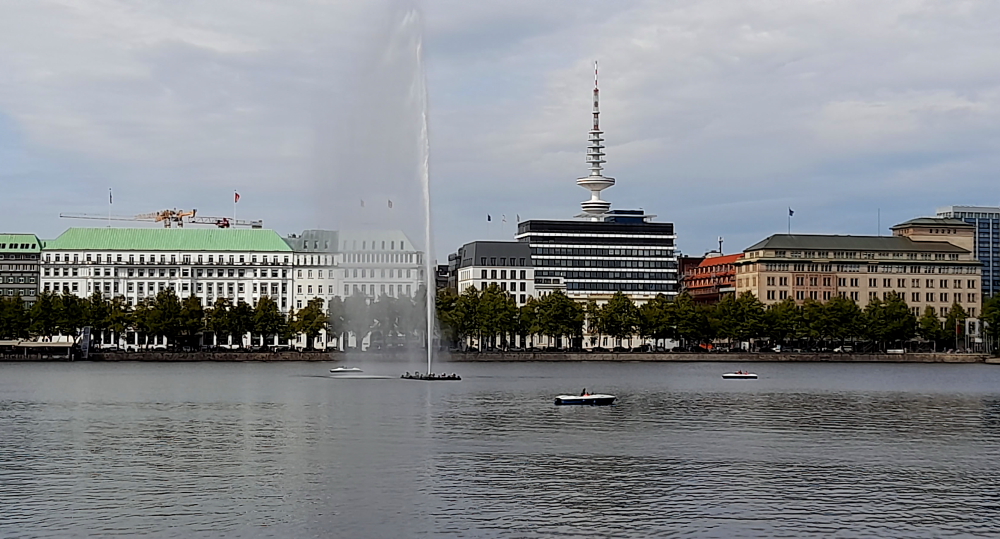
In the centre of the lake is a large fountain. This giant water spray reaches up to 60 metres and has a city backdrop.
We are heading for the Hamburger Rathaus (yes, that is its official name). It conjures up visions of a giant Big Mac with Rats running through it.
On the way we pass Kleine Alster which resembles the canals of Venice only with better-built buildings. It seems that Hamburg was also built on swampy grounds which were later turned in to canals and a very productive harbour.
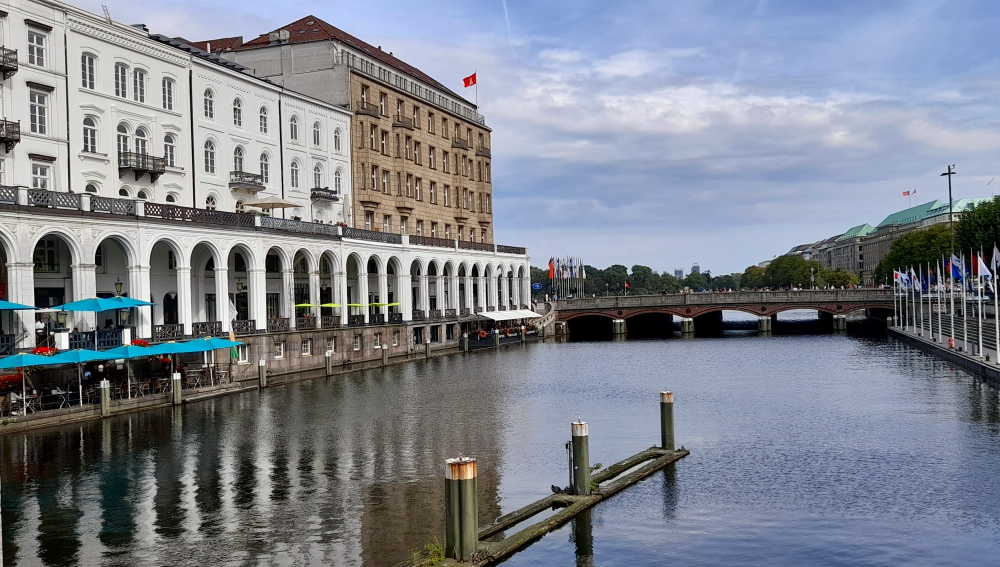
Hamburg City Hall (German: Hamburger Rathaus) is the seat of local government of Hamburg and the seat of one of Germany’s 16 state parliaments. The Rathaus is located in the Altstadt quarter in the city centre, at the Rathausmarkt square, and near the lake Binnenalster and the central station. Constructed from 1886 to 1897, the city hall still houses its original governmental functions with the office of the First Mayor of Hamburg and the meeting rooms for the Parliament and the Senate.
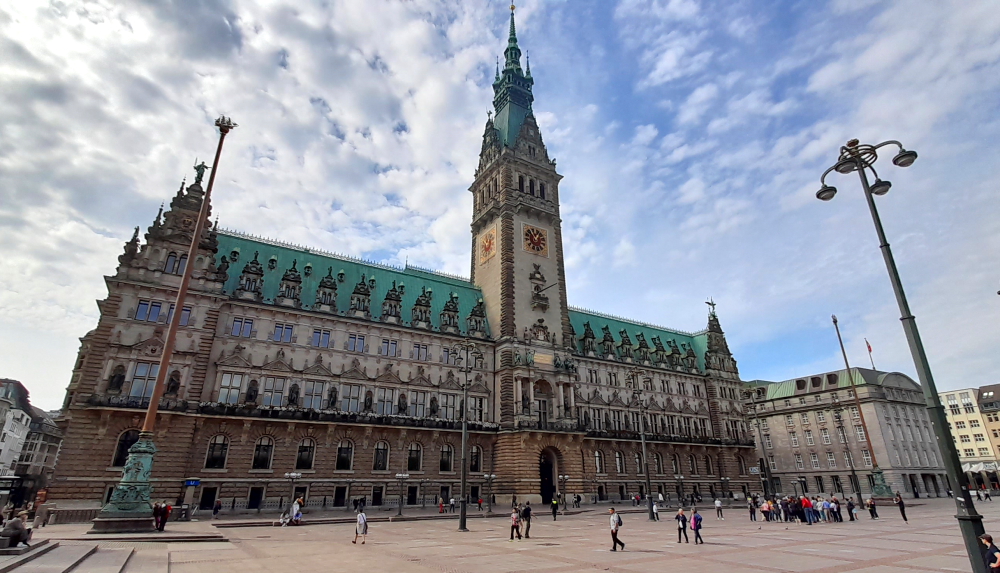
We have a quick look inside the Town Hall but visitors only have limited access to the main entrance since it is a working Parliament Building and it is a Sunday.
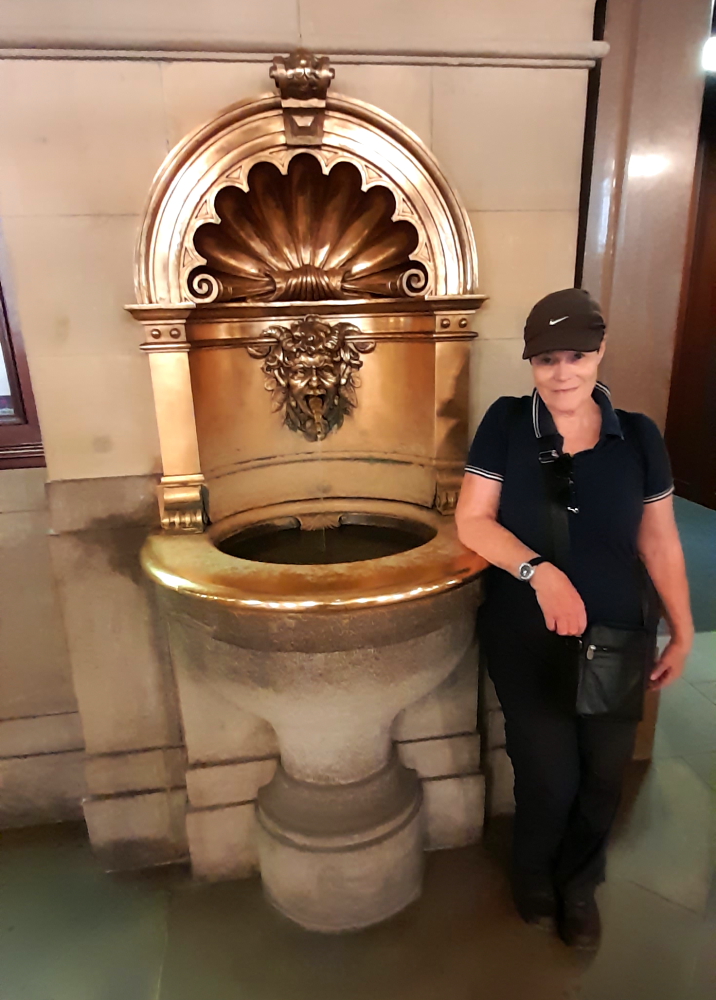
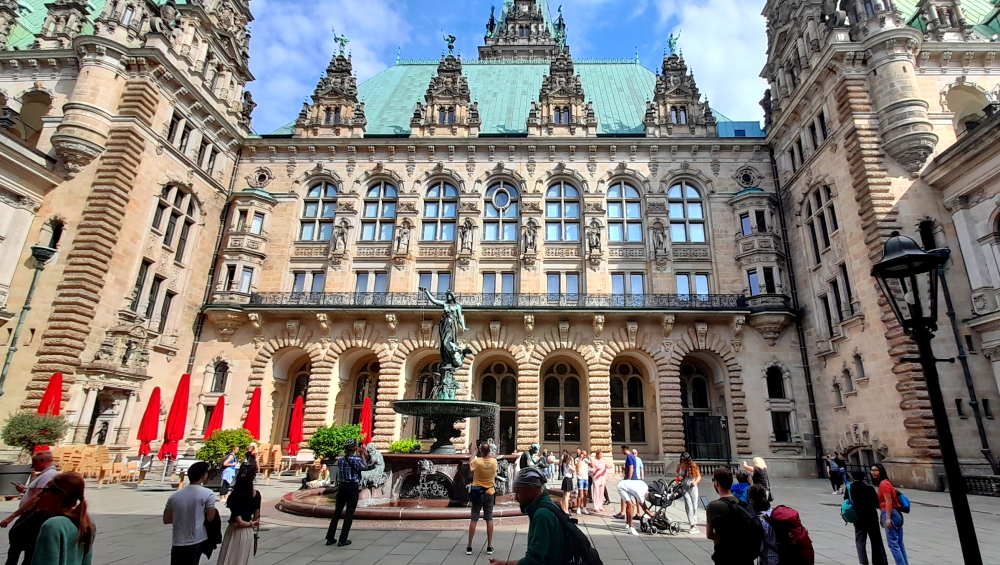
Its courtyard is decorated with a Hygieia fountain. Hygieia is the goddess of health and hygiene in Greek mythology and its surrounding figures represents the power and pureness of the water. It was built in remembrance of the cholera epidemic in 1892, the former technical purpose was air cooling in the city hall.
Lynn has a number of places to visit on her itinerary but unfortunately they require significant walking. I am sure that we could have taken the metro… Our next stop is the St Nicolai Church which is now just ruins from WWII and has been converted to a war monument.
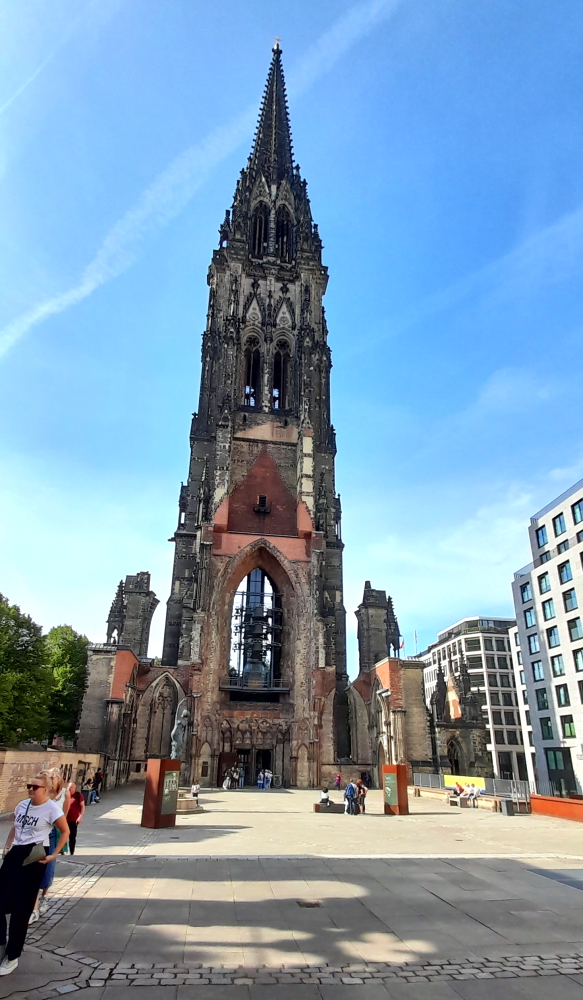
The clearly visible tower of the Church of St. Nicholas served as a goal and orientation marker for pilots of the Allied Air Forces during the extensive air raids on Hamburg. On 28 July 1943, the church was heavily damaged by aerial bombs. The roof collapsed and the interior of the nave suffered heavy damage. The walls began to show cracks, yet neither they nor the tower collapsed.
After the war, the basic structure of the Gothic church remained intact to a large extent and reconstruction was a realistic option. Nevertheless, it was decided to demolish the nave while leaving the tower untouched.
The tower and some remains of the wall have since been preserved as a memorial against war. For several decades they were not cared for, and, consequently, they gradually decayed. In 1987, the Rettet die Nikolaikirche e.V. (Rescue St. Nicholas’s Church) foundation began to restore the existing fabric of the building and erected a so-called “place of encounters” (a room for events and exhibitions) in the crypt. The organization attempts to salvage pieces of rubble that were removed in 1951, such as pieces from the destroyed nave pulled from the River Elbe in November 2000. A reconstruction of the church, as done with the Church of Our Lady in Dresden, is not intended. However, a 51-bell carillon was installed in 1993 as a memorial.
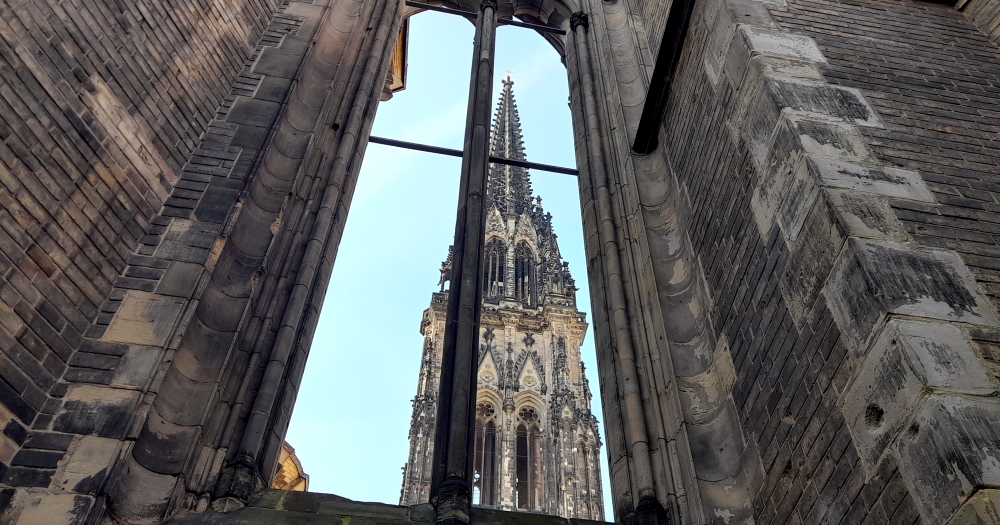
It is now starting to get quite warm at around 26 Deg C so I am truly ready for a rest and perhaps a cool drink. No? More trudging to do… We are now heading towards yet another church past more waterways with buildings that look like they all have a rising damp issue.
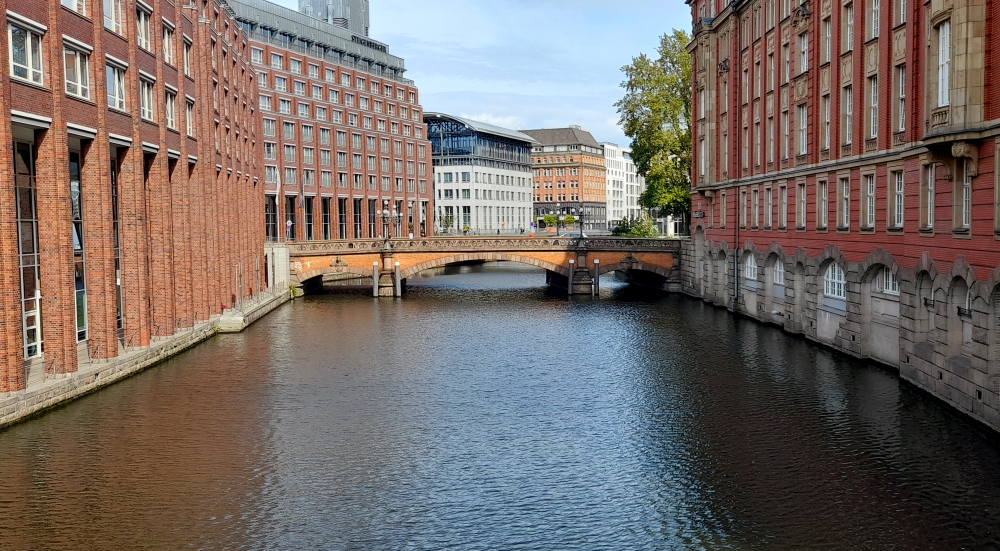
Only 15 minutes walk away Lynn proudly announces. But that really means 15 minutes to the next stop and we will be another 15 minutes further away from a rest stop. Hopefully we can find a metro station for the return journey.
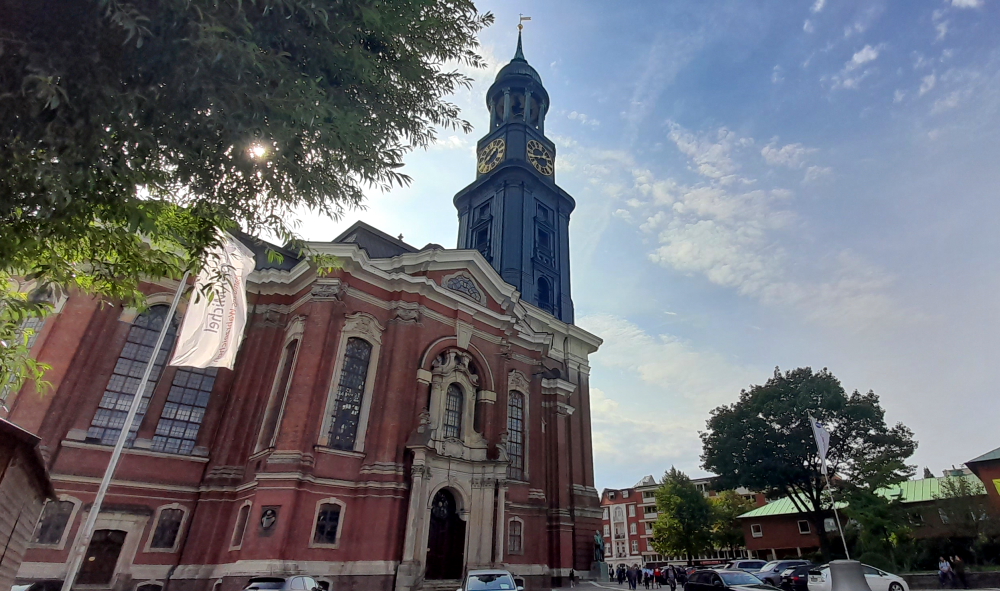
St. Michael’s Church is one of Hamburg’s five Lutheran main churches (Hauptkirchen) and one of the most famous churches in the city. St. Michaelis is a landmark of the city and it is considered to be one of the finest Hanseatic Protestant baroque churches. The church was purposely built Protestant unlike many other Hamburg churches which were originally built by Roman Catholics and were converted to Protestantism during the Reformation. It is dedicated to the Archangel Michael.
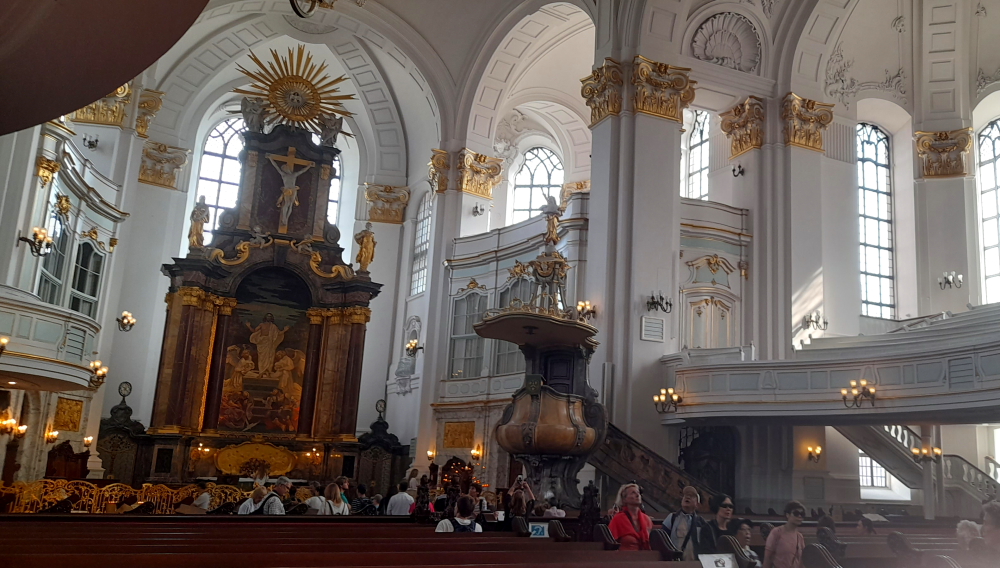
Offering 2,500 seats, the Michel is the largest church in Hamburg. The church has a Latin cross plan with 44 m width, 52 m length and 27 m height.
The church has five organs including a Marcussen organ and a large Steinmeyer organ with its 85 registers, 5 manuals and 6674 pipes. On 9 October 2008, St. Michael’s received a new crypt organ, named after Felix Mendelssohn Bartholdy.
In fact, among the famous people who have been to this church was pianist and composer Johannes Brahms who was baptized here.
The pulpit is in the centre of the building which was crafted out of marble by sculptor Otto Lessing from Dresden in 1910. It was designed to look like a rounded chalice and features a magnificent staircase. The large pulpit roof is crowned by the Angel of Annunciation.
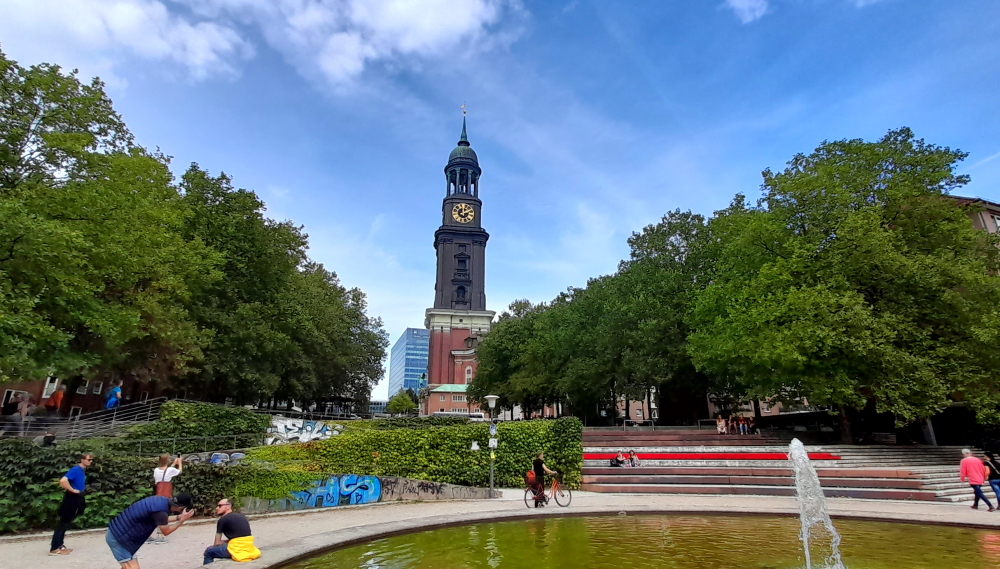
The 132 m (433 ft) clock tower is a significant feature of the city skyline and was a navigation aid for ships sailing on the river Elbe. The clock features an 106 m (348 ft) observation level which allows a panoramic view of the city and harbour. The clock tower features four 8 m (26 ft) clock faces and are the largest clock faces in Germany. The minute hands are 4.91 m (16.1 ft) and the hour hands are 3.65 m (12.0 ft).
While we were visiting Lubeck that only had a couple of brick warehouses, Jurgen suggested that we visit the extensive Warehouse District in Hamburg while we are there. Really? More walking…
The Warehouse District (Speicerstadt) is well south of the town centre and serviced by lots of waterways. Lynn also wants to get up close to see the odd-looking Elbphilharmonie Building.
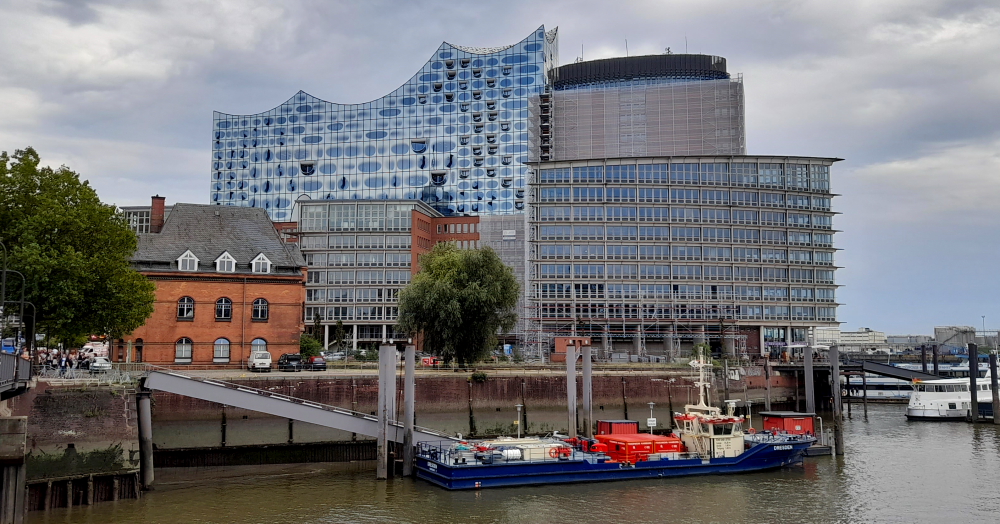
The Elbphilharmonie (“Elbe Philharmonic Hall”), popularly nicknamed Elphi, is a concert hall in the HafenCity quarter of Hamburg, on the Grasbrook peninsula of the Elbe River.
The new glassy construction resembles a hoisted sail, water wave, iceberg or quartz crystal resting on top of an old brick warehouse (Kaispeicher A, built in 1963) near the historical Speicherstadt.
We are now well and truly in the Warehouse District – blocks and blocks of brick warehouses stretching into the distance and straddling either sides of a number of artificial waterways.
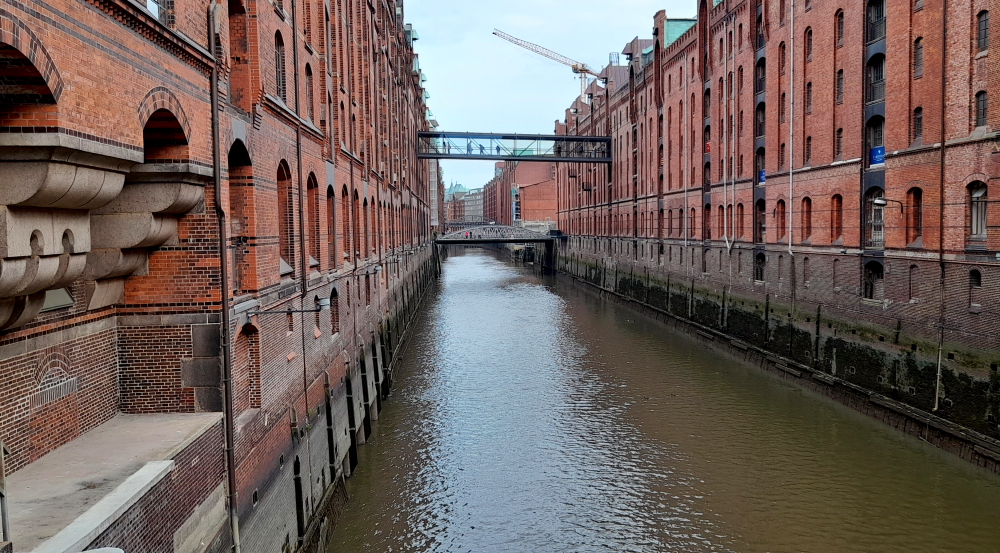
The Speicherstadt (literally: ‘City of Warehouses’, meaning warehouse district) in Hamburg, is the largest warehouse district in the world where the buildings stand on timber-pile foundations, oak logs, in this particular case. It is located in the port of Hamburg—within the Hafen City quarter—and was built from 1883 to 1927.
The district was built as a free zone to transfer goods without paying customs. The district and the surrounding area have been under redevelopment for many years as the port industry has evolved. As an exceptional example of Neo-Gothic and modernist architecture, and for its testimony to the development of international maritime trade, the Speicherstadt was awarded the status of UNESCO World Heritage Site on 5 July 2015, along with the Kontorhaus District.
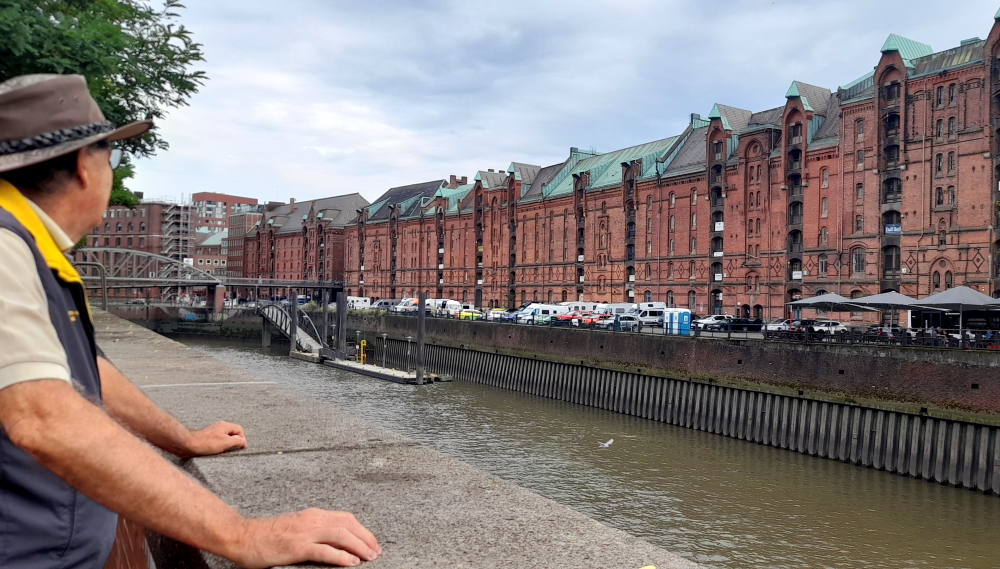
I don’t know what I expected to see in the Warehouse District but blocks of warehouses seem a bit dull. I think that I expected waterside cafes and converted 19th century buildings in to shops and boutiques like the Sydney Rocks area. Nope, just brick building after brick building.
Even Lynn is starting to need a break so we find the nearest metro station (which is still a good kilometre walk away as the nearest one is closed, of course) and head back to the Binnenalster lakeside where we know that there are some good cafes overlooking the lake.
We stop at Cafe Alex for a late lunch or early dinner and order drinks, a light meal and a loo stop. Lynn rounds off her meal with a glass of chocolate ice cream covered in Baileys.
After a long rest we head back to the metro and take the train to Central Station for our trip back to Bremen, in the hope of catching an earlier train than is listed on our return ticket. Much to our surprise (since it is now late Sunday afternoon) the platform is absolutely heaving with people trying to get on the train from Hamburg to Bremen. Did I miss something? Is this a war-time refugee train – the last one out of Hamburg???
No, this is a normal Sunday afternoon exodus from a day in town for the locals. We manage to manoeuvre our way on and find a seat each, albeit not together for the run back to Bremen. Un-German like, the train is 5 minutes late leaving Hamburg and as we pull out of a station half way home the train behind us pulls in. Surprisingly our train doesn’t stop at any of the remaining scheduled stops to Bremen so we get back a little faster than expected.
18 September, 2023
The plan for this morning is to continue the fight with the pathetic hotel internet to try and do our best to catch up on the blog then to go on our booked guided walking tour which is scheduled for 2:00 pm this afternoon.
By the time we have breakfast Lynn receives a message from our guide to inform us that he has cancelled as he needs 5 people for the tour to be viable and apparently we are the only 2. Not happy. This is the 2nd Bremen walking tour that has been cancelled on us in the past 3 days. Lynn hurriedly pulls together an itinerary so it will be a Lynn-guided walking tour. With all the issues with the hotel internet and our day trip to Hamburg we have seen almost nothing of Bremen after 3 days. I just hope it will be worth the trip here at all.
We head towards the old town which was encircled by an old town wall. The wall is gone now, as you would expect, but once we leave the seedy part of the more recent parts of Bremen we encounter what you could describe as being quite charming.
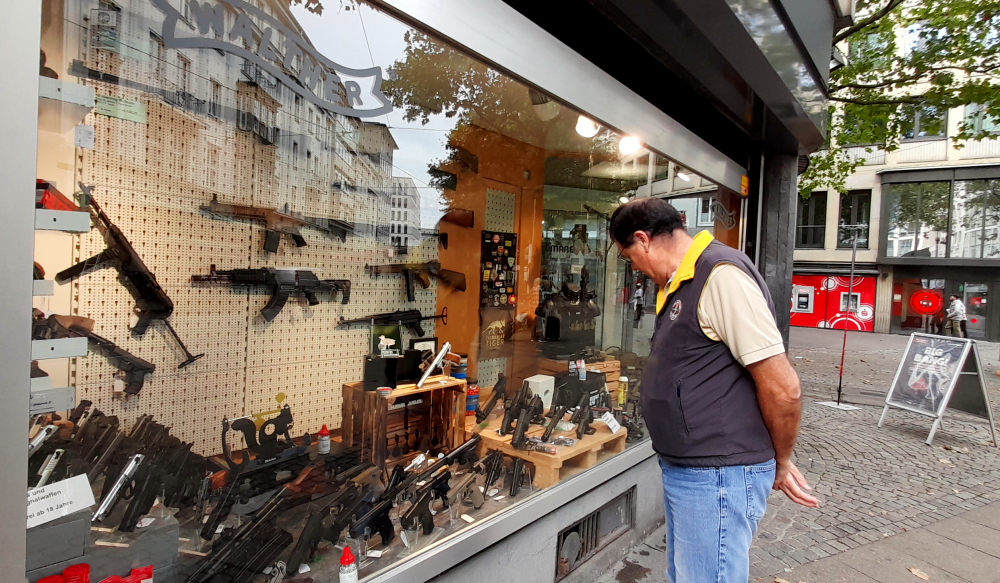
Walking into town we are quite surprised to see a gun shop on the main street, and not just revolvers but semi-automatics and knives, lots of knives – and no reinforced shop windows, either!
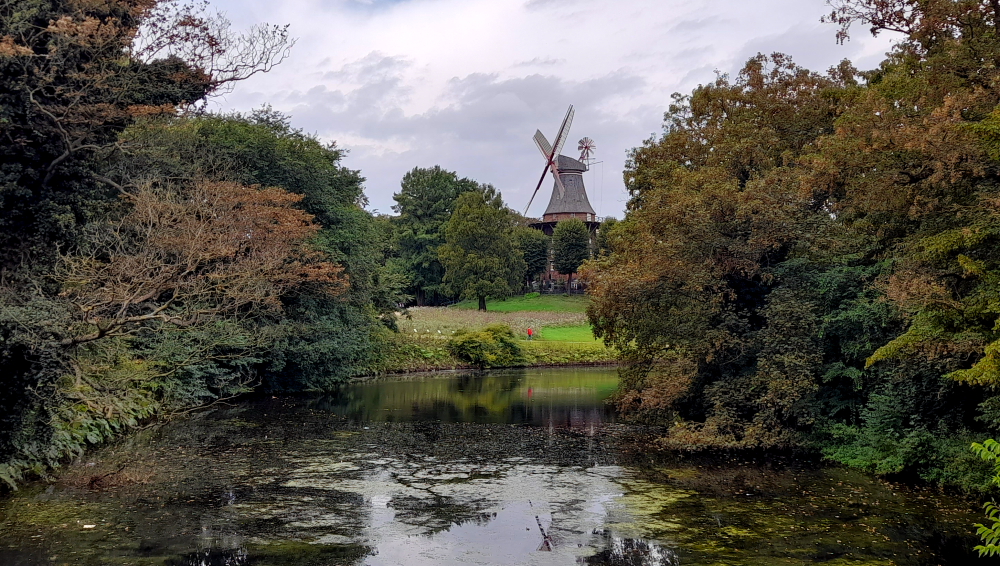
Crossing the bridge we have a view of Beck’s Muhle, now a restaurant.
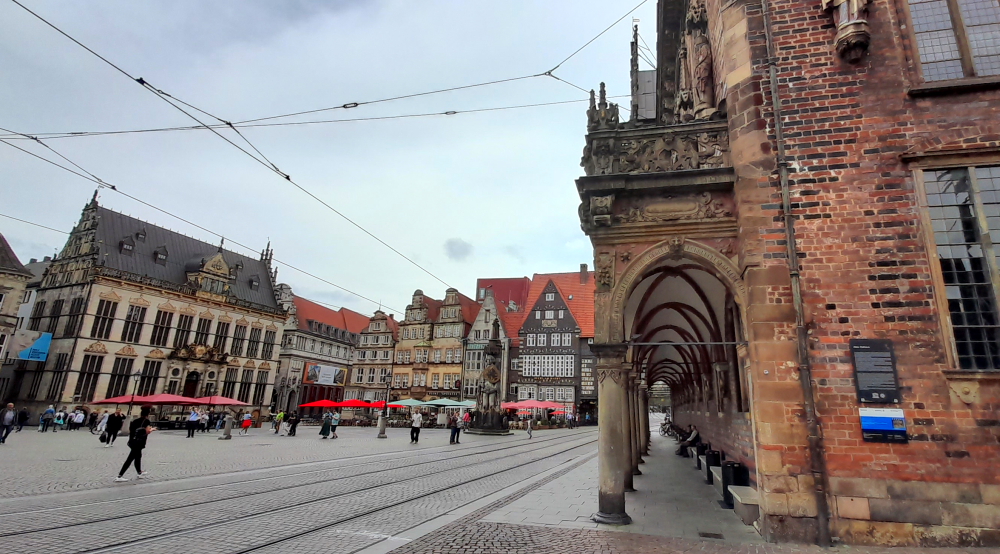
A couple of minutes later we arrive in Marktplaz, the old town market square. Several prominent buildings border it: the Town Hall, the Cathedral and the Schutting.
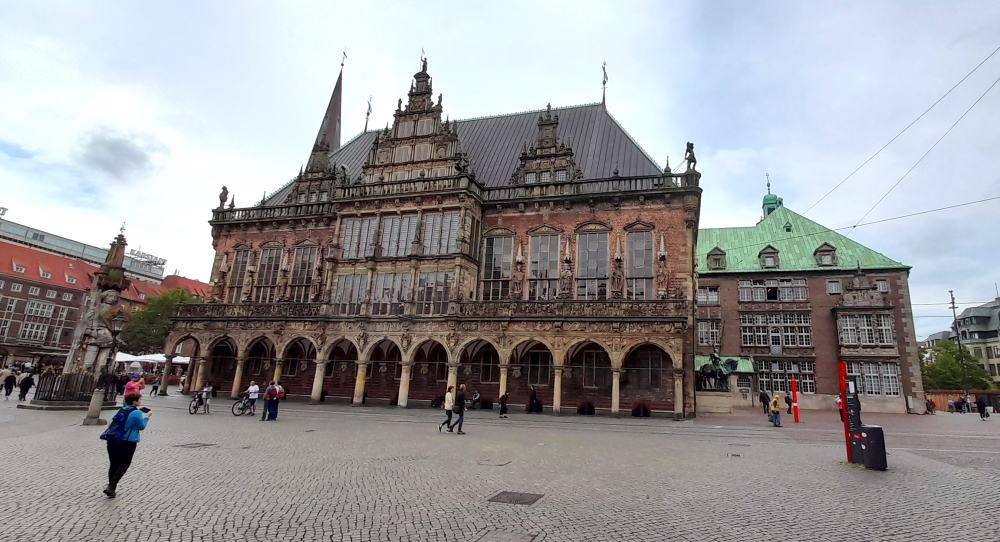
Bremen City Hall (German: Bremer Rathaus) is the seat of the President of the Senate and Mayor of Bremen. It is one of the most important examples of Brick Gothic and Weser Renaissance architecture in Europe. The old town hall itself was originally constructed in the 15th century. Since 1973, it has been a protected historical building. In July 2004, the part consisting of the Roland Statue and the Town Hall was listed as a UNESCO World Heritage Site because of its outstanding architecture and its testimony to the development of civic autonomy in the Holy Roman Empire.
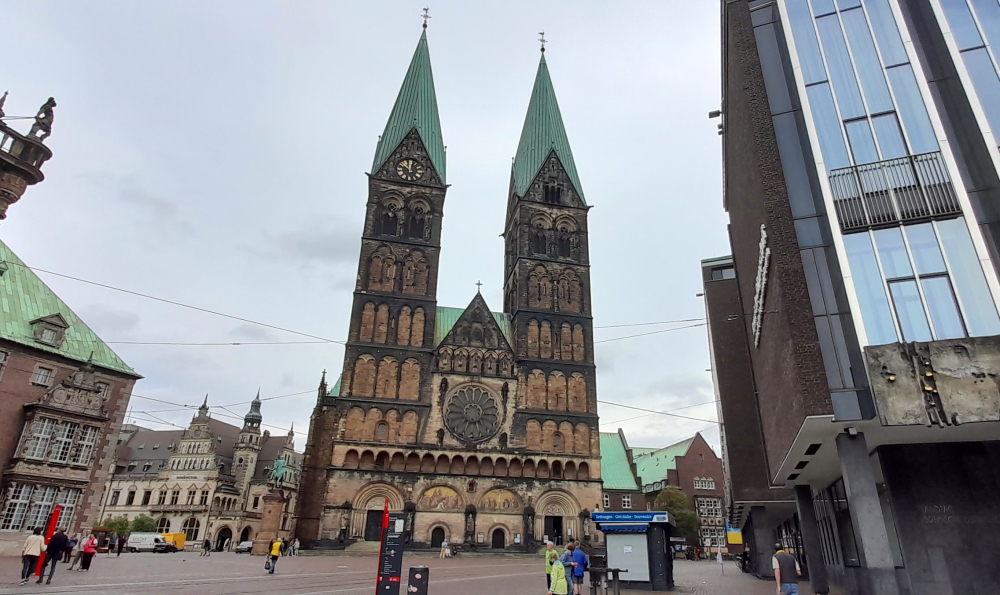
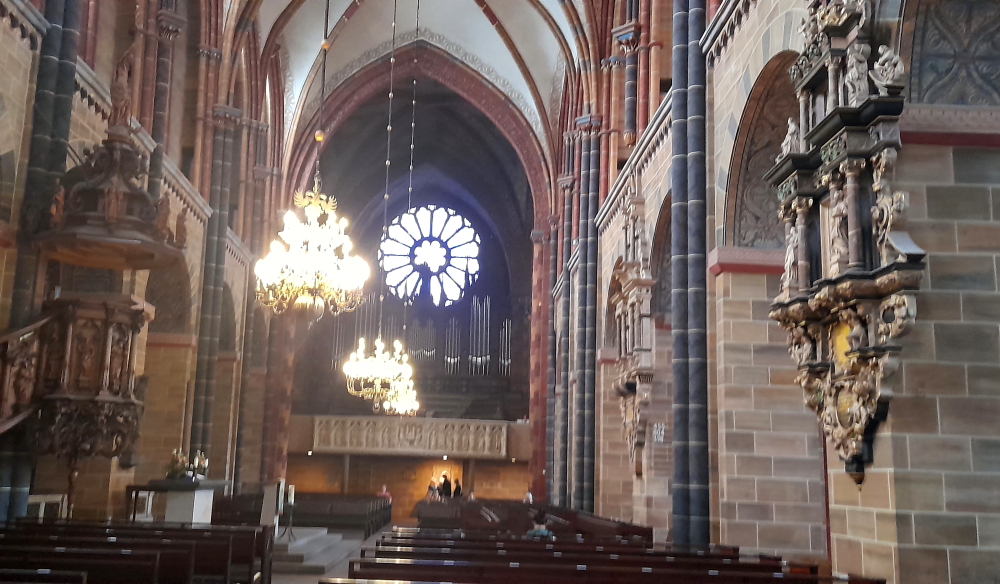
The Bremen Cathedral is, in general, a medieval building. The oldest visible structures are its two crypts. Since the late 1220s, vaults and walls were erected in bricks, partly hidden by sheets of sandstone. St Peter’s is one of the largest historic brick structures in Europe, but it comprises too many stone structures to be subsumed to Brick Gothic. During the great restoration of 1888 to 1901, the western towers and most of the western façade were rebuilt. The crossing tower was a new addition, using the medieval crossing tower of Worms Cathedral as an example.
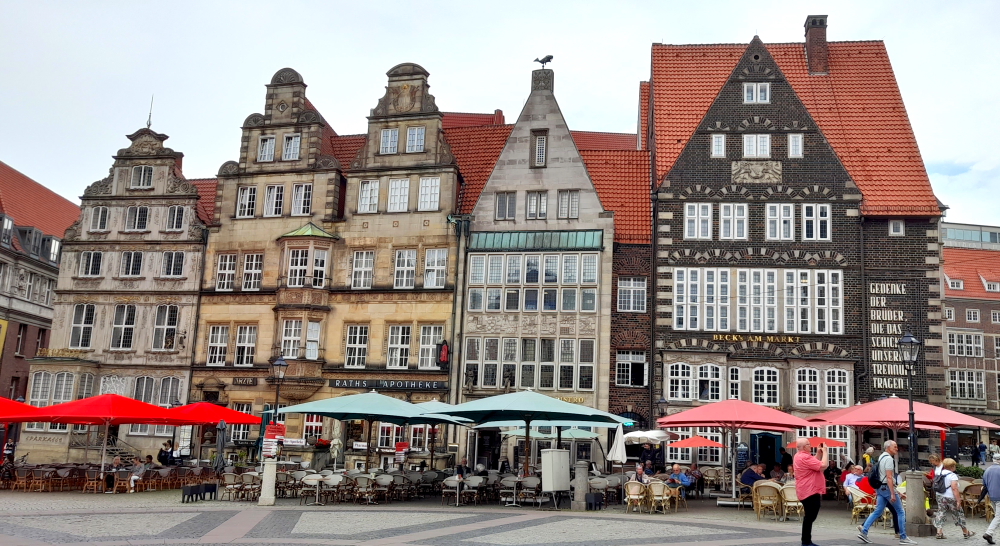
At least parts of the market place had been in use since the age of Charlemagne. In fact, the building ensemble which flanks the Marktplatz is considered one of the most beautiful in Germany with sandstone and brick being uniformly used for the facades of the buildings. The entire complex is listed as a heritage site.
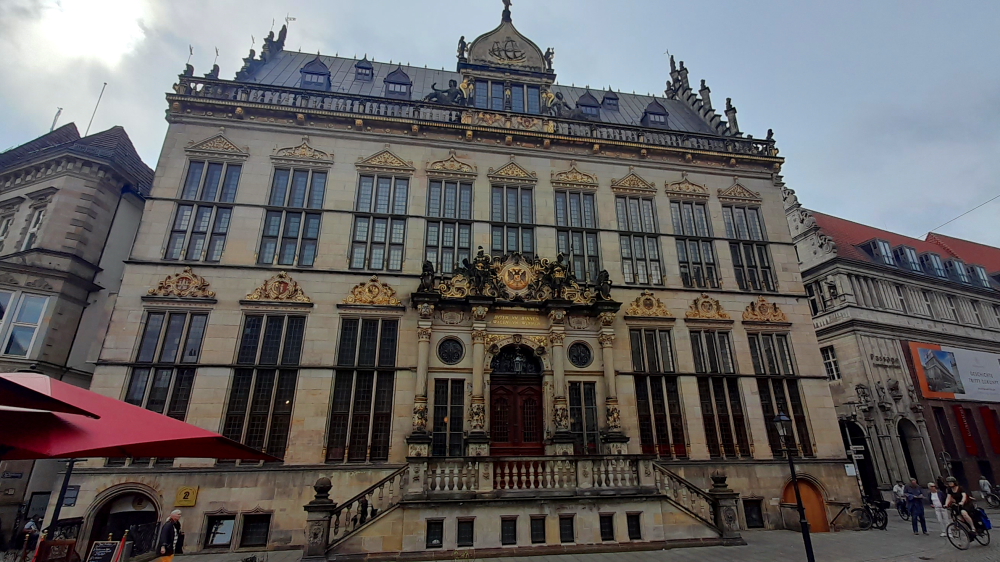
On the opposite side of that square there is the ancient guildhall, called Schutting, still today the seat of the board of commerce.
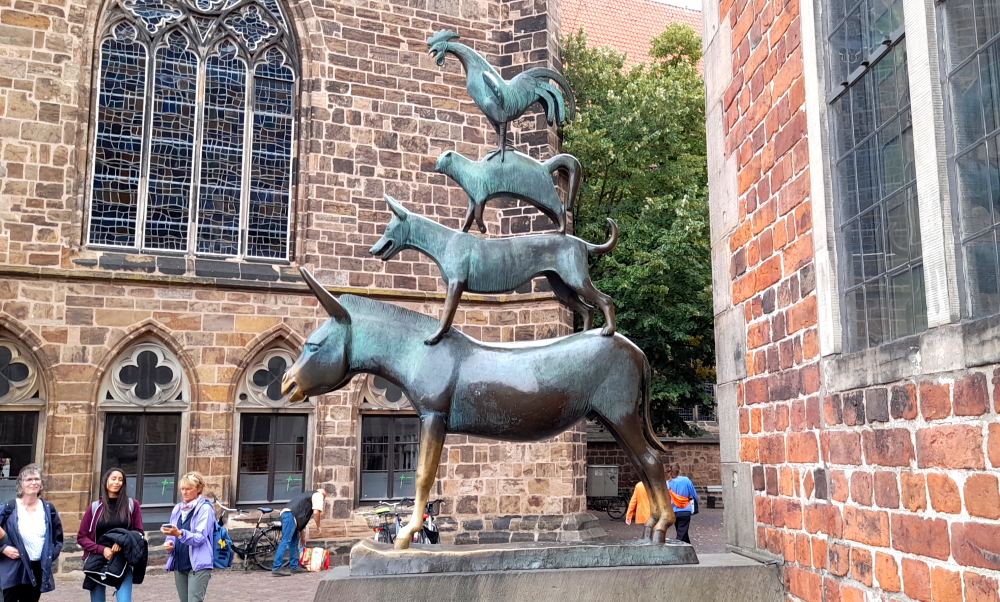
Near the northern corner of the town hall, there is a sculpture by Gerhard Marcks of the Town Musicians of Bremen based on a German fairy tale collected by the Brothers Grimm and published in Grimms’ Fairy Tales in 1819.
An alleyway off the Marktplatz is the Böttcherstraße. Only about 100 m (330 ft) long, it is famous for its unusual architecture and ranks among the city’s main cultural landmarks and visitor attractions.
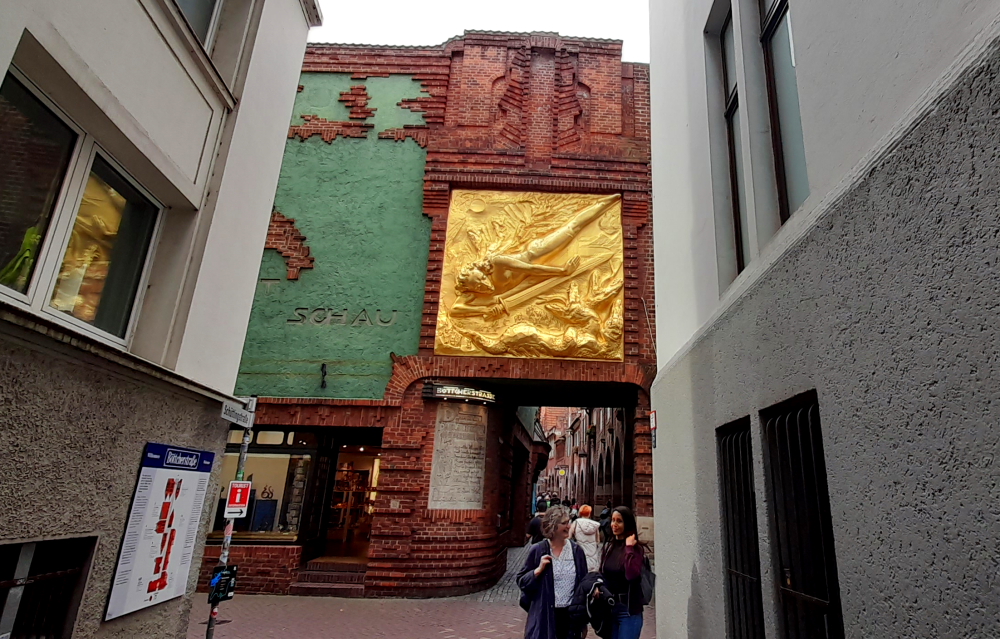
Most of its buildings were erected between 1922 and 1931, primarily as a result of the initiative of Ludwig Roselius, a Bremen-based coffee-trader, who charged Bernhard Hoetger with the artistic supervision over the project.
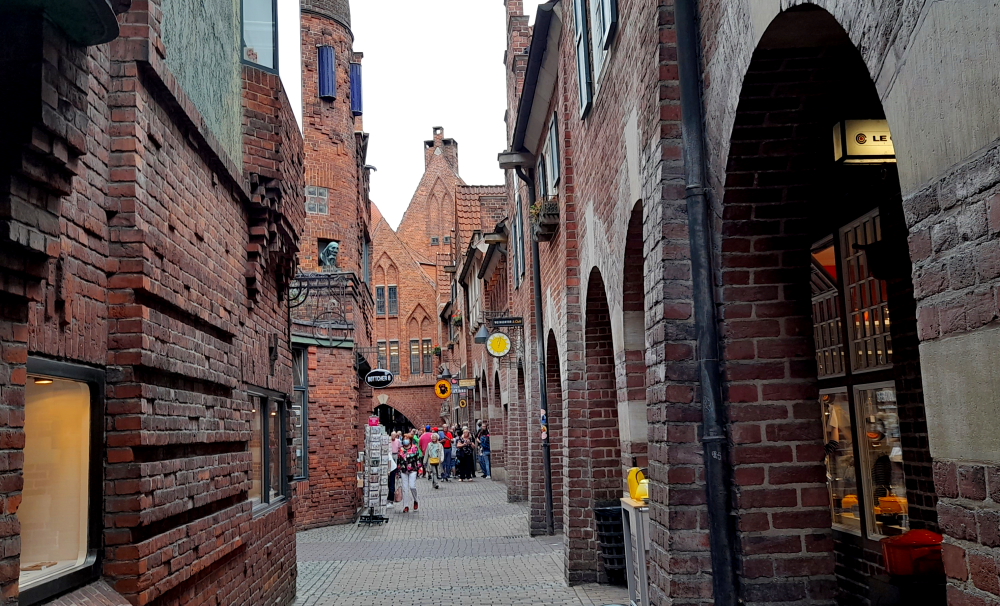
The street and its buildings are a rare example of an architectural ensemble belonging to a variant of the expressionist style. Several of the houses can be classed as Brick Expressionism. Since 1973, the ensemble has been protected by the Monument Protection Act.
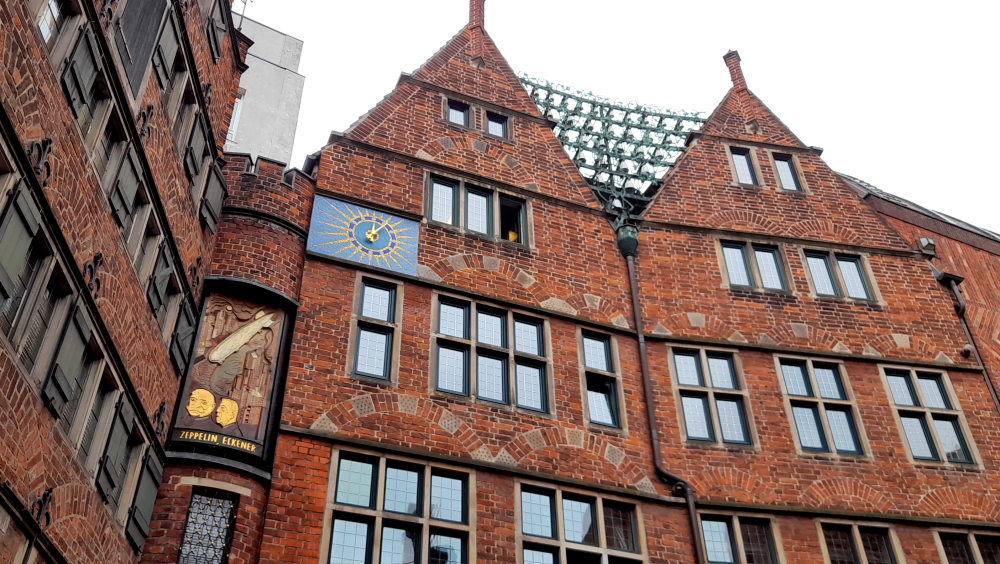
At 2:00 pm the Glockenspiel starts to chime and it goes on for 15 minutes while a fake window rotates displaying important figures in the aviation industry.
At the end of the street is the banks of the Weser River and its promenade where various sailing vessels now used as bars and restaurants are moored.
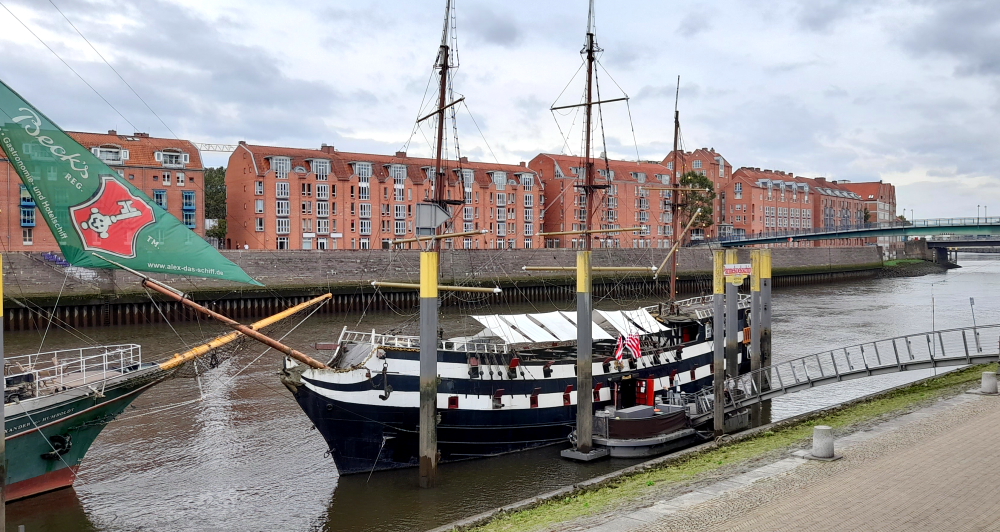
Nearby is Schnoor, a neighbourhood in the medieval centre of Bremen and the only part of it that has preserved a medieval character.
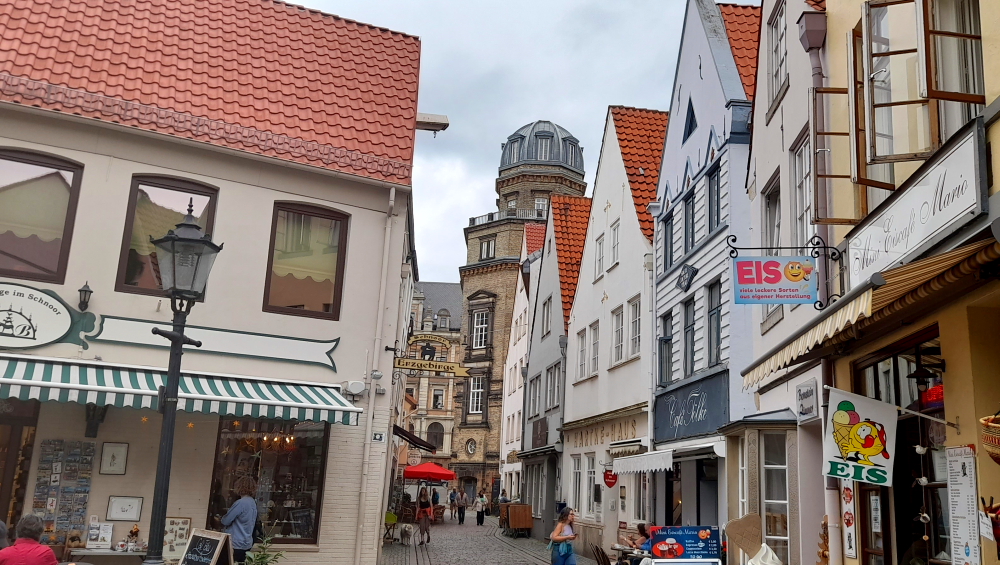
The neighbourhood owes its name to old handicrafts associated with shipping.
We found a cafe and some outside seating so Lynn orders a hot chocolate and a Mandelhornchen (a German almond horn cookie). I had a simple Cafe Latte.
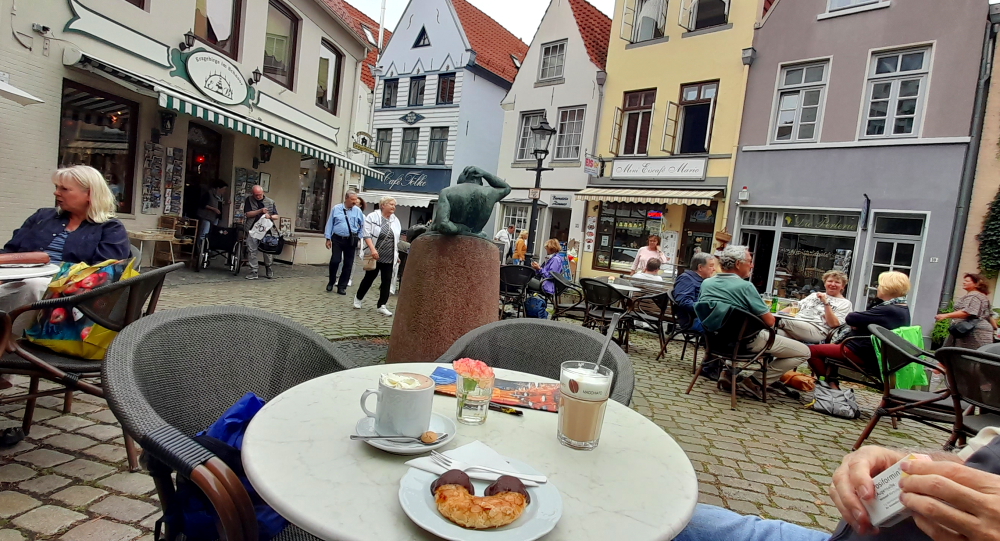
The alleys between the houses were often associated with occupations or objects: There was an area in which ropes and cables were produced (string = Schnoor) and a neighboring area, where wire cables and anchor chains were manufactured (wire = Wieren).
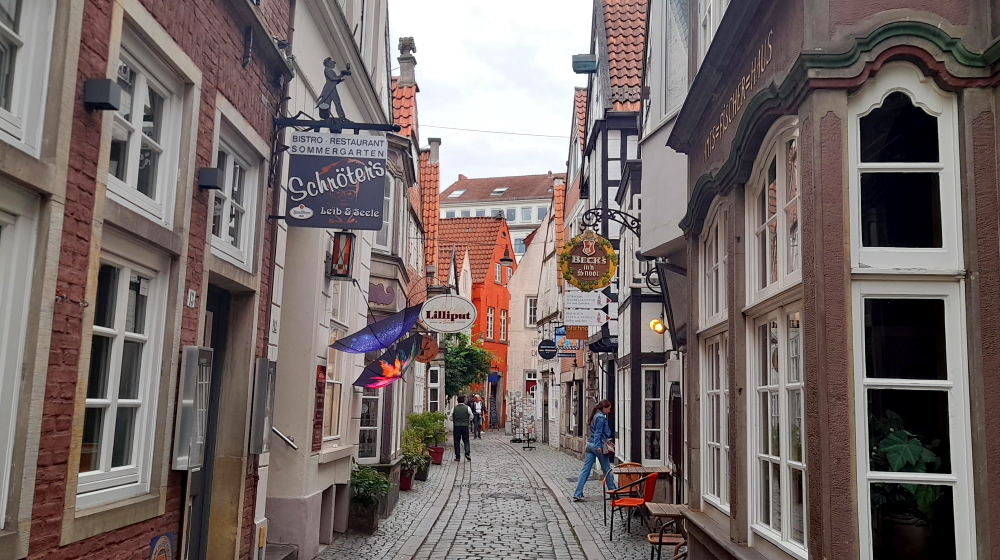
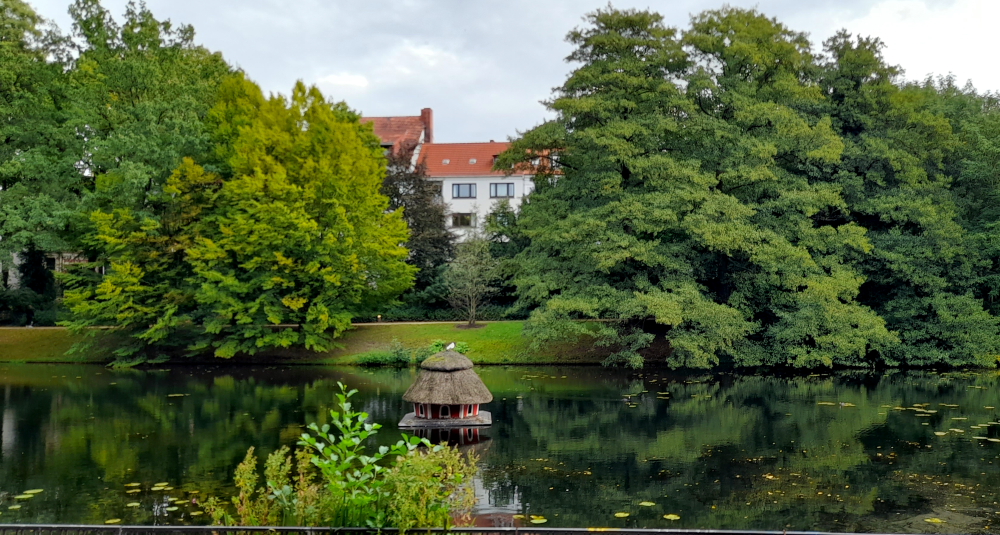
The neighbourhood is adjacent to the parkland that borders what would have been a moat around the original town. This parkland is called Wallanlagen.
As the cathedral was closed when we first arrived, we return to the Markplatz to venture inside.
Back at the hotel Lynn makes us a nice cup of tea. Again the internet has failed so I try my luck at taking the laptop down to the business centre. The internet is even worse in the business centre but I try unplugging the hotel computer from the data port and plugging the laptop into the same data port. Presto! I have reasonable internet and get stuck into trying to catch up on the last couple of days. By 6:30 pm I have completed everything except today’s wording. Time for dinner and I may try to complete the last of the blog either tonight or in the morning before we check out.
Tomorrow we leave Bremen for Leeuwarden in the Netherlands. Hopefully the internet will be better there. If nothing else we need some down time to rest after a few hectic weeks.
 THE CONTINUING TRAVELS OF YOGI & BOO BOO