
12 October, 2023
As forecast it started raining heavily from about 4:00 am. With our window open we could listen to the babbling river as well as the rain on the roof. It was very difficult to wake up but the alarm went off just as the workers arrived to start up their heavy machinery outside our window to continue on the river edge stabilisation project.
We have a few days of blog backlog to complete today (perhaps we should call it our backblog???) so a wet day is not an issue. I also have to sort out the hire car border fee with the hire car company and try not to do another rant on the blog. Late last night I escalated the issue with the hire car company head office in Krakow and threatened to publish their poor service experience on a number of review sites.
By the time we finished breakfast and started the backblog (I like the sound of that..) I received a phone call from the head of the car rental service. He was most apologetic and promised to complete the refund today. I explained that I understand errors occur but when I send all the proof to the company and get no responses to my constant emails over the past month it becomes unsatisfactory. When will companies realise that they can run off more customers than advertising can attract if they don’t have good customer service? An error quickly rectified can gain a customer for a long time but a small error poorly managed can alienate a customer and their friends for life.
My rant for the day.
We managed to get the backblog up to date and I even managed to step out for a while to acquire some red wine for Lynn and check out a few of the local stores.
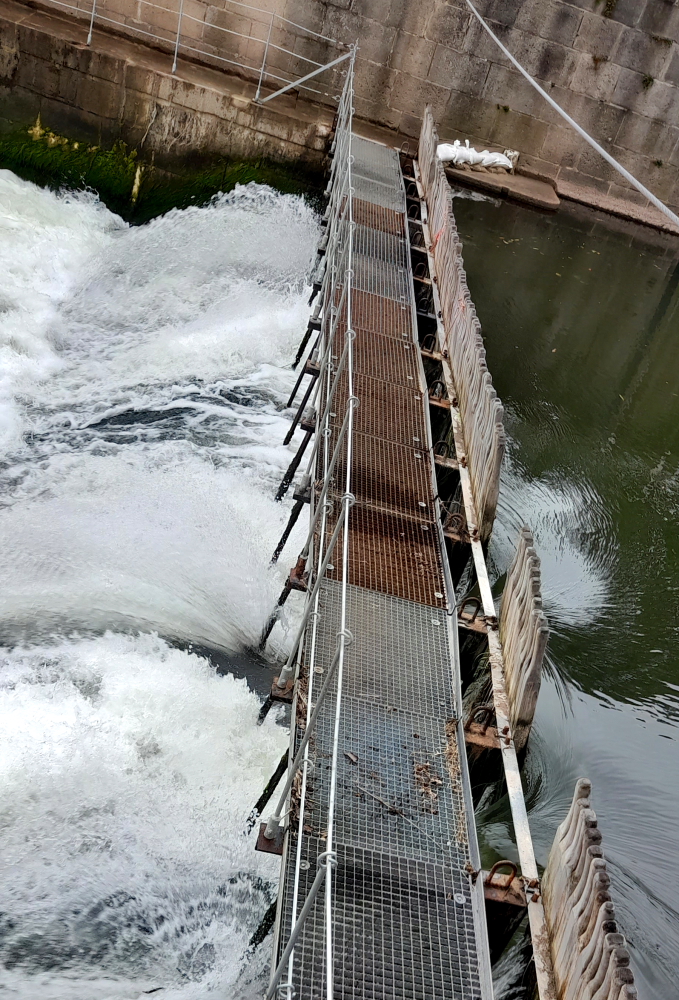
I brought Lynn back a bottle of red wine and once she completed the blog edit we headed out to find a suitable place for dinner.
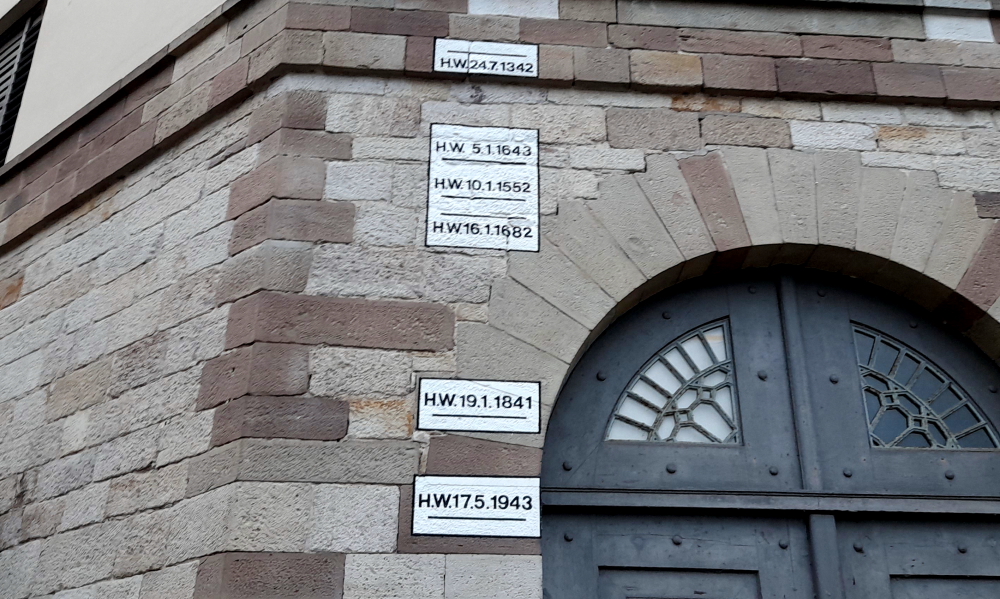
On the way, just around the corner from the hotel we noticed a number of flood markers from the past 650 years.
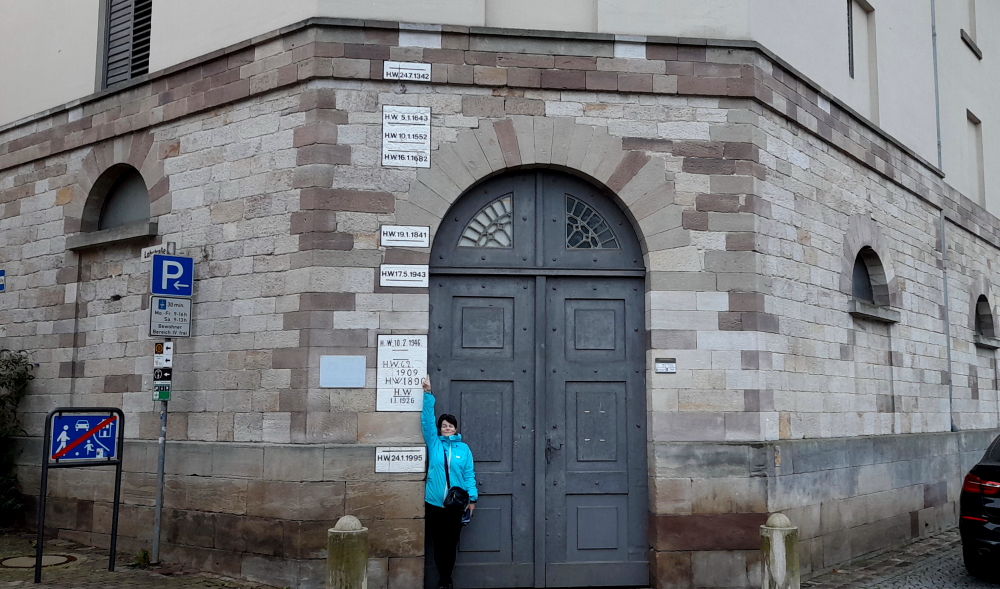
We know that the 1943 marker was caused by the dam busters who blew up a dam further upstream but the big floods were years before.
We decided to try out the restaurant and bar located in the cellar of the city hall.
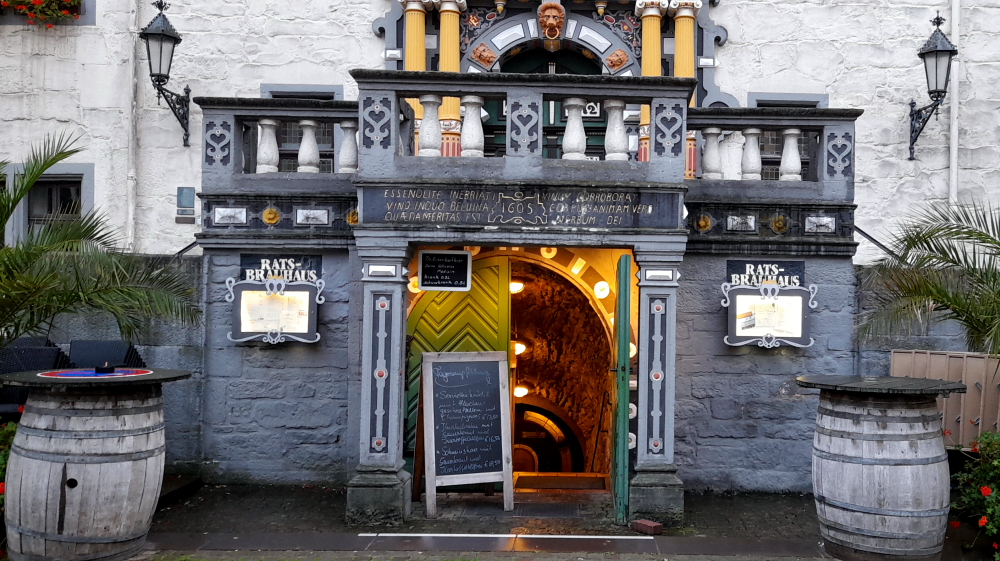
Like many famous restaurants the hype is better than the actual experience. The food just barely acceptable and the prices were aimed at tourists. We both had goulash.
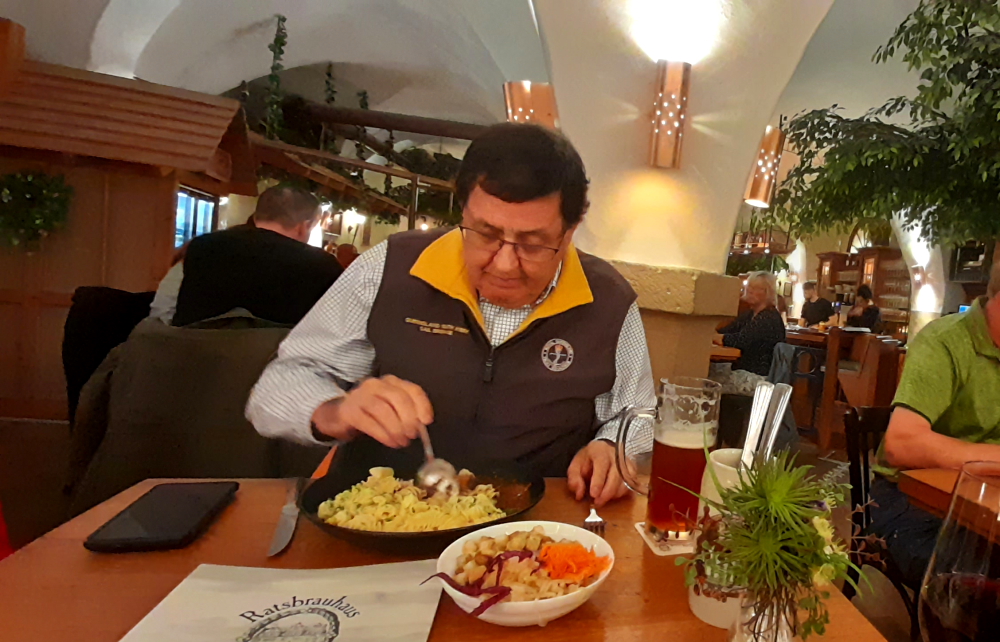
Maybe Italian tomorrow night or perhaps back to last night’s German restaurant.
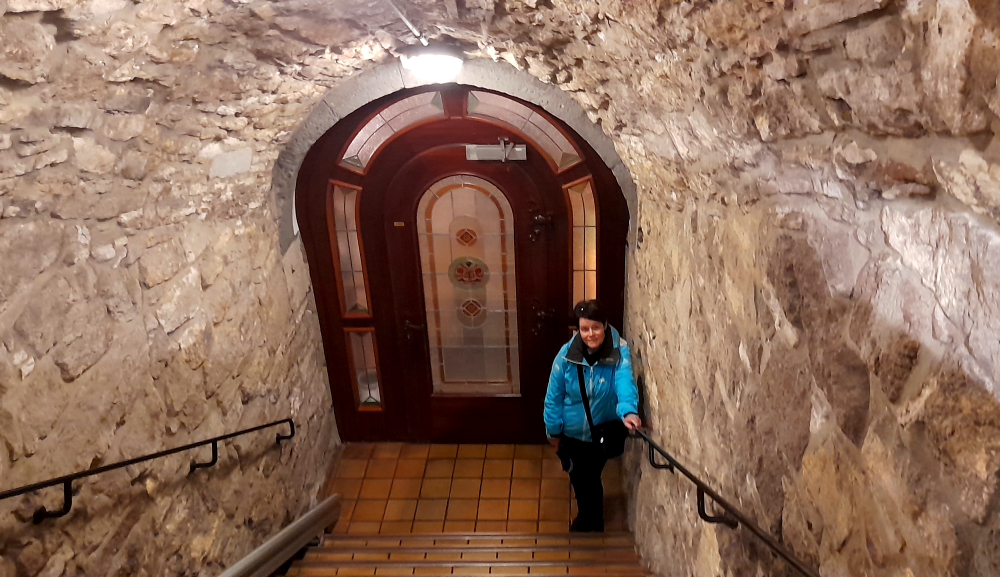
On the way back we dropped in to the mini market for some biscuits to have with a cuppa after dinner.
13 October, 2023
It has continued to rain overnight but after breakfast we decided to explore the wider areas of the town now that the rain has eased.
We headed to the outskirts of the old town with the plan to follow where the old fortifications surrounded the medieval village. There are a number of lookout towers and sections of the original wall to explore.
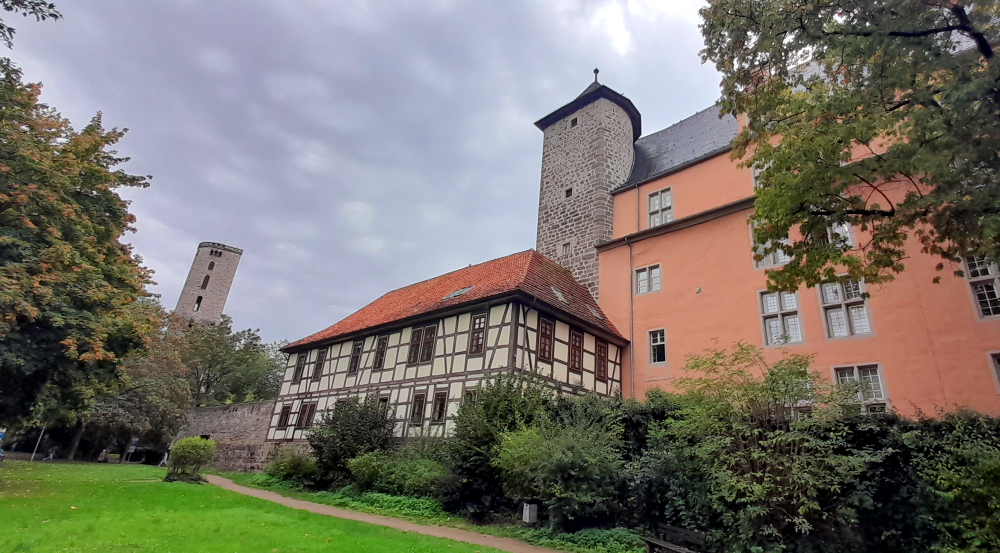
We will then walk to the parks that are outside the wall and Lynn wants to walk up to a lookout to see if there is a view of the town.
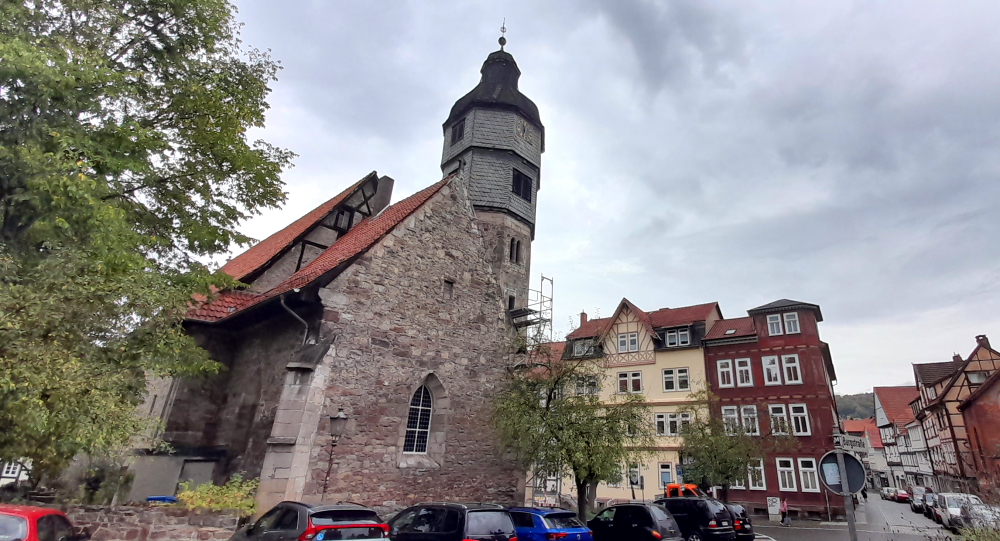
Our next stop was at the St Aegidienkirche where Dr Johann Andreas Eisenbart was buried in 1727. Eisenbart was known as a craft surgeon – experienced in his art of eye cures, stone, cancer and fracture cutting – a travelling ‘physician’ usually practising in tents at market squares and selling his potions. During his career he received a number of privileges, one of which was Braunschweig-Lüneburg (1710) with Hanover and Lower Saxony , which is why Eisenbarth was able to call himself the Royal British Country Doctor after the establishment of the personal union with Great Britain from 1714.
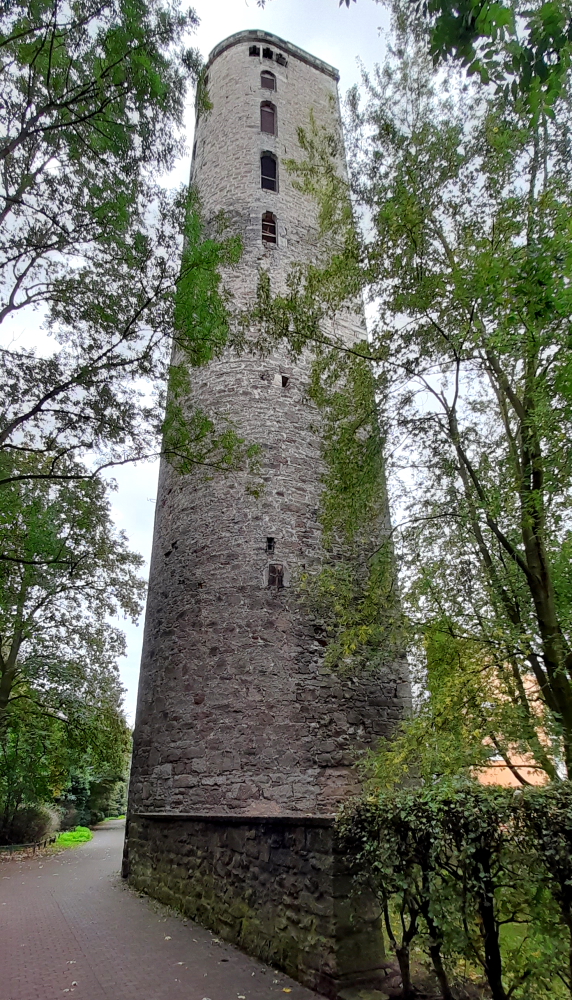
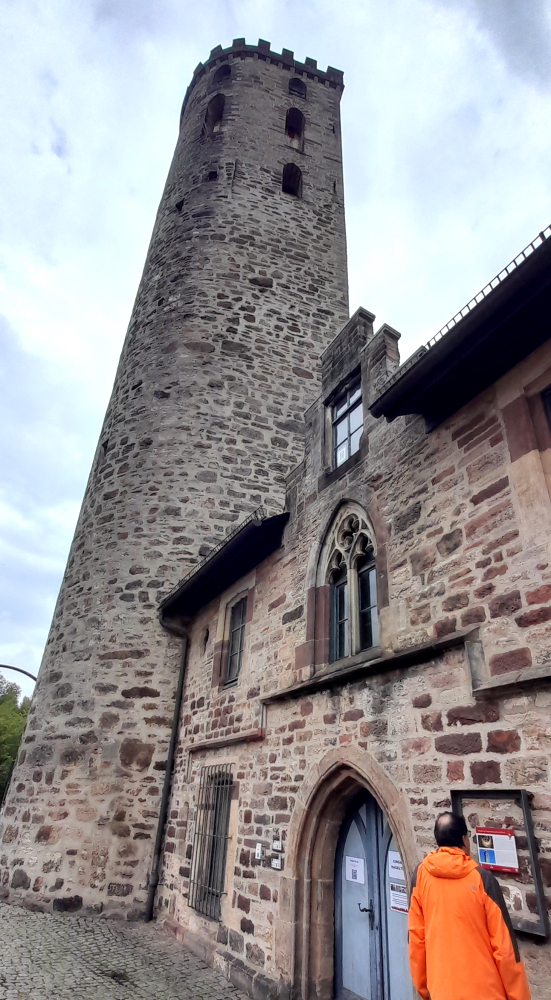
At the southern end of town the Ferry Gate Tower was purchased by the Haendler & Natermann company in the late 19th Century in order to heighten it and convert it into a shot tower (renamed the Hail Tower) to manufacture lead musket balls.
From here we cross over the Muhlenbrucke Bridge near our hotel to the Tanszwerder Island opposite.
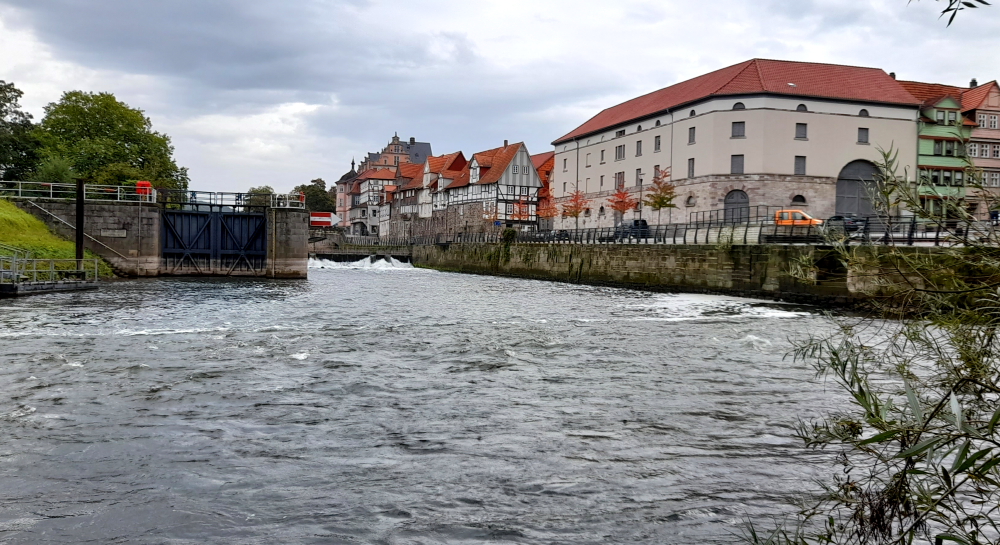
This island is surrounded by the Fulda, Kleine Weser and Werra Rivers.
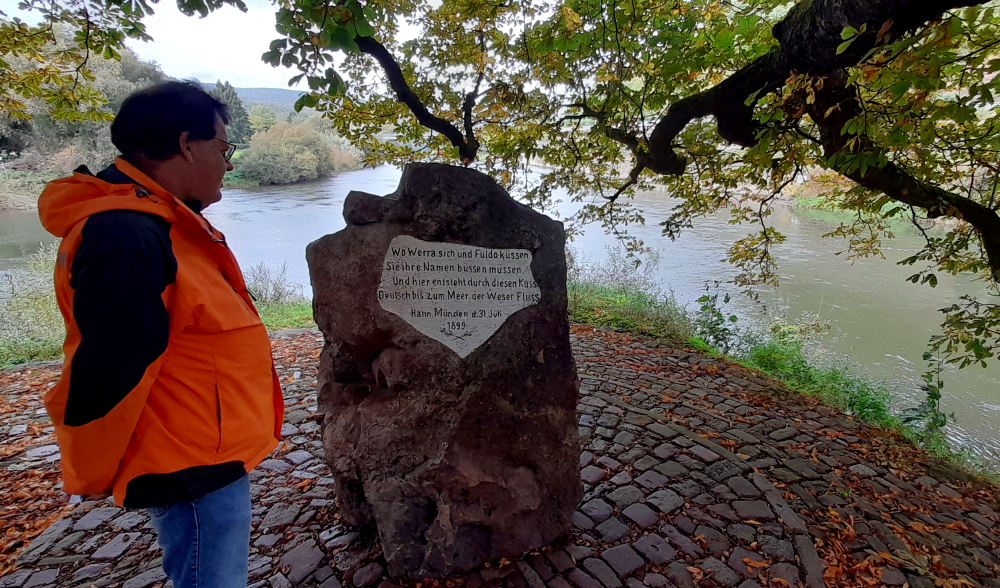
Next we cross half way over the Alte Werrabrucke bridge to the small island of Doktorwerder which is now a parkland with a number of statues by local artists.
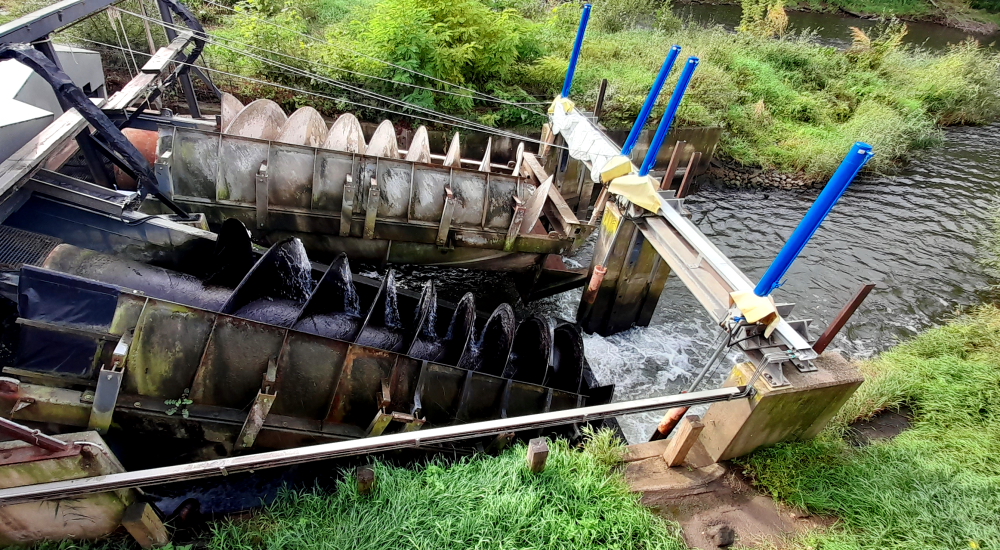
Back to the bridge we continue to the Northern side of the Werra River where a short distance downriver is a 70 KWH hydro electric generator, which is an unconventional twin-screw generator but only one of these is working today.
Lynn wants to walk up to the Weserliedanlage lookout to see if she can get a view of the town from the top of the hill. I tag along for part of the way but as my knee is hurting Lynn sends me back to the hotel while she continues up the steep hill alone.
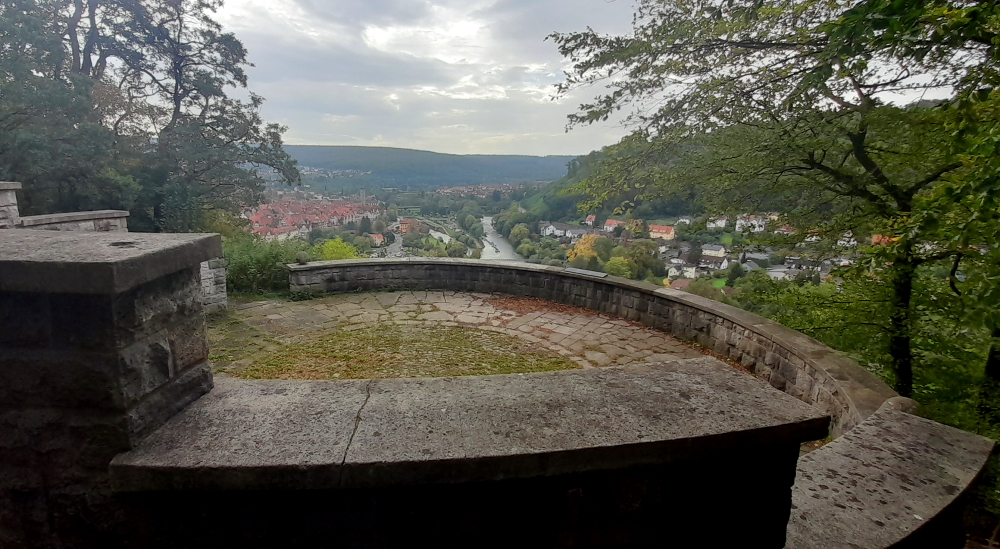
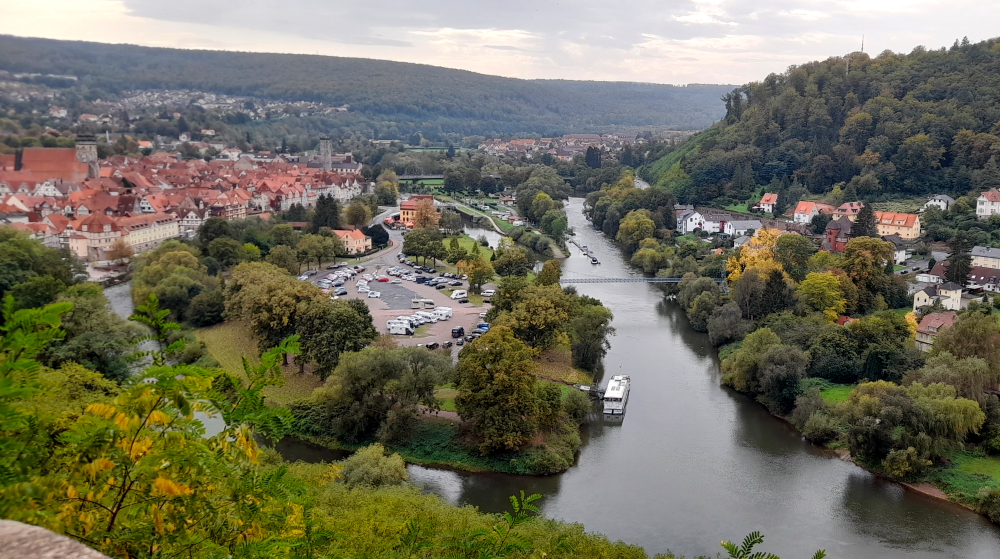
This is the view from the lookout. Our hotel is at the far left, at the top of the waterway which is the Werra River.
While Lynn edits the blog this afternoon I start checking out transport for the 2nd quarter of next year and beyond. By 3:45 pm it is red wine time and a break before we head out for dinner. We have decided that we will check out by 10:00 am tomorrow so that we can do a laundromat stop on the way to Dresden.
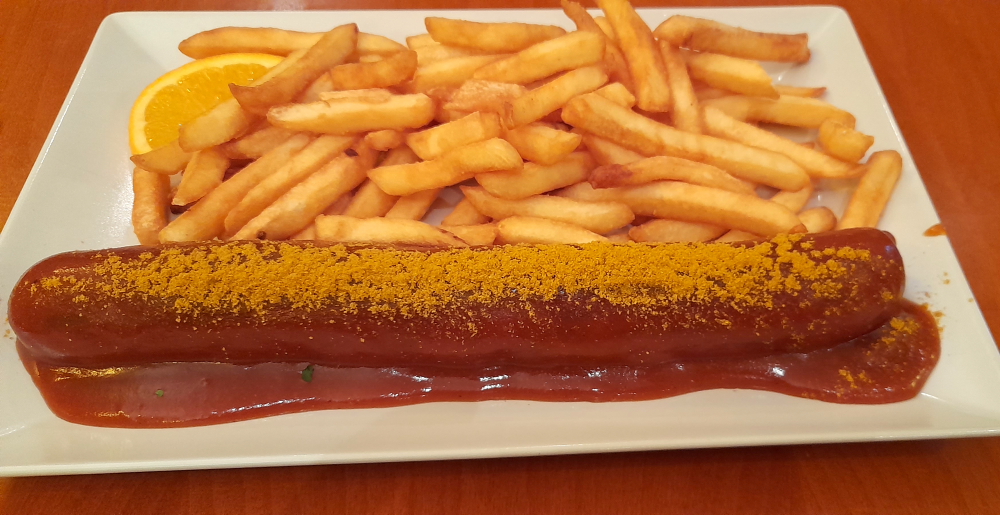
For dinner tonight we head back to the restaurant where we had dinner the first night. A light dinner is all we need so I order another schnitzel and Lynn orders currywurst. Unfortunately it is not the curried sausages that can be found in the UK or Australia. The German version consists of a German sausage covered in tomato sauce and sprinkled with a very mild curry powder. Yuck!
14 October, 2023
At 9:58 am and a chilly 13 Deg C we leave the hotel to drive to Dobeln, 2 hours and 45 minutes away where I’ve located a landromat. Then it will only be a 45-minute drive to Dresden.
Although chilly it’s a bright, sunny day as we hit the 38. We can’t believe it, after the bumper-to-bumper and heavy freight traffic and frequent tailbacks we’ve recently experienced, there’s hardly anyone else on the road!
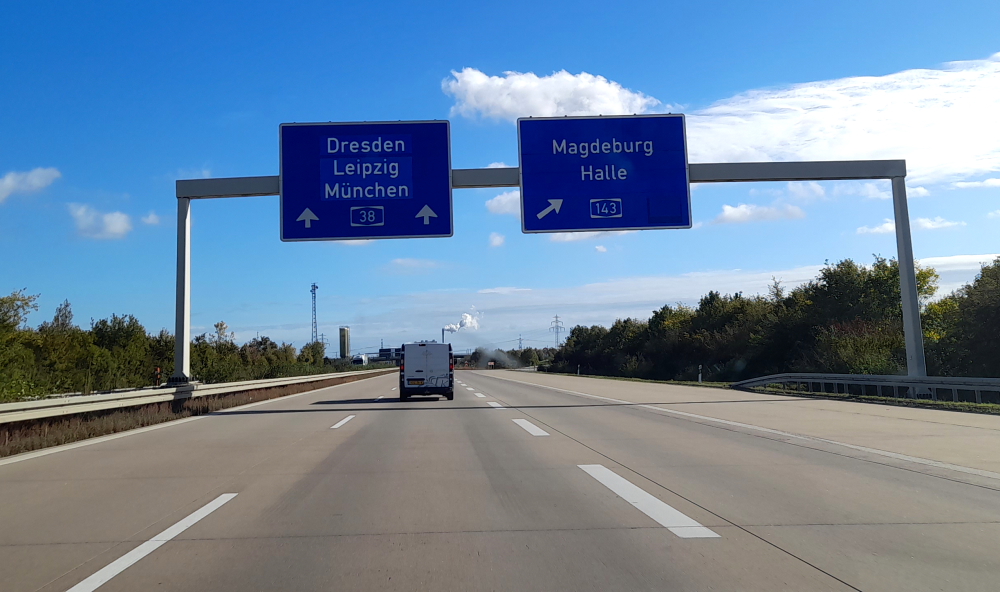
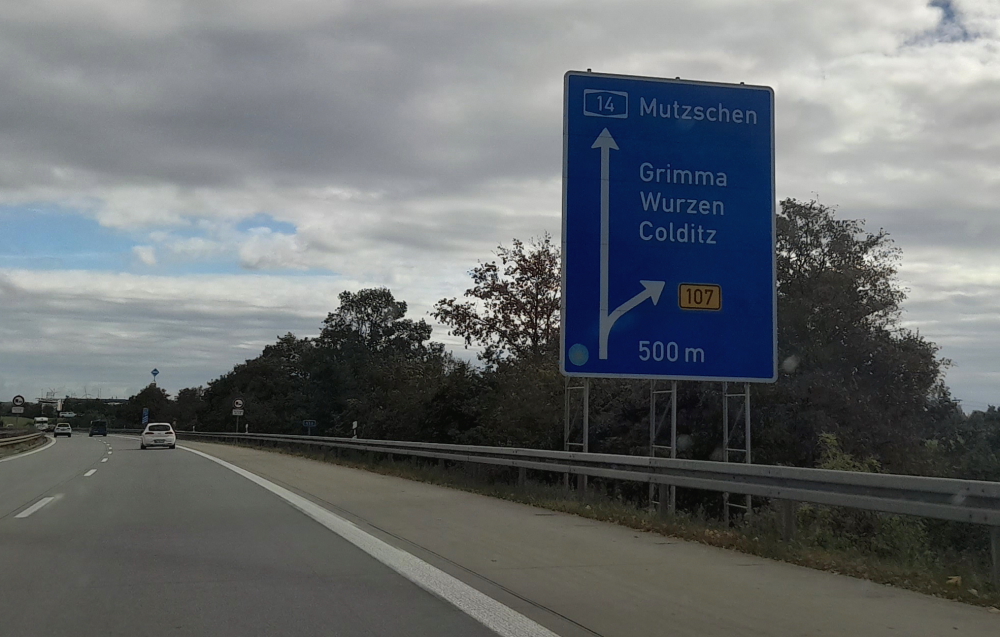
After bypassing Leipzig we turn onto the 14 and are soon surprised by a road sign that says “Schloss Colditz” and sure enough we can see it perched in the distance.
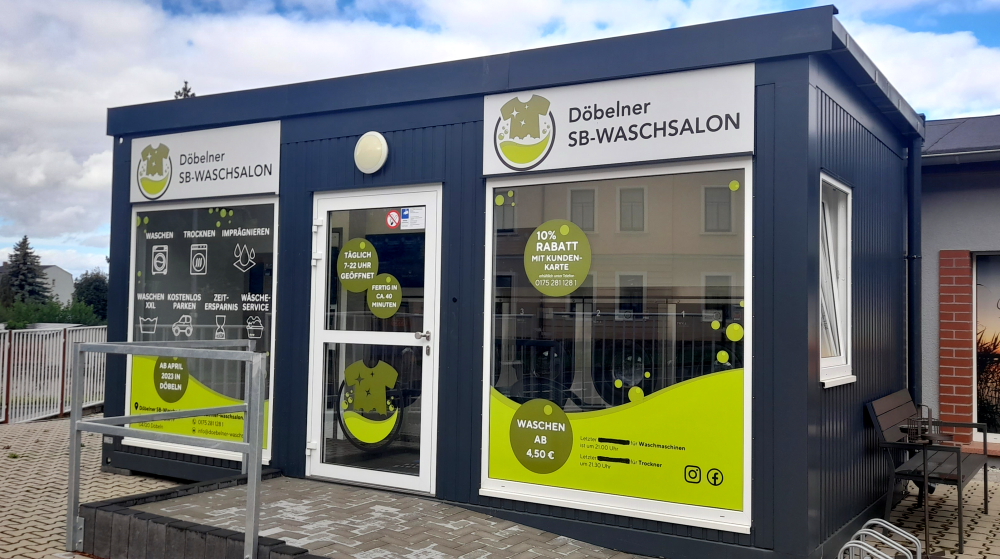
The GPS takes us directly to the edge of Dobelne where we find the laundromat next door to an angling shop.
Very compact, clean, tidy and with multi-lingual machines and parking we finish our washing, drying and folding an hour later and drive to Dresden.
We are a little concerned as we drive into the old town centre of Dresden as there seems to be an inordinate number of police cars about.
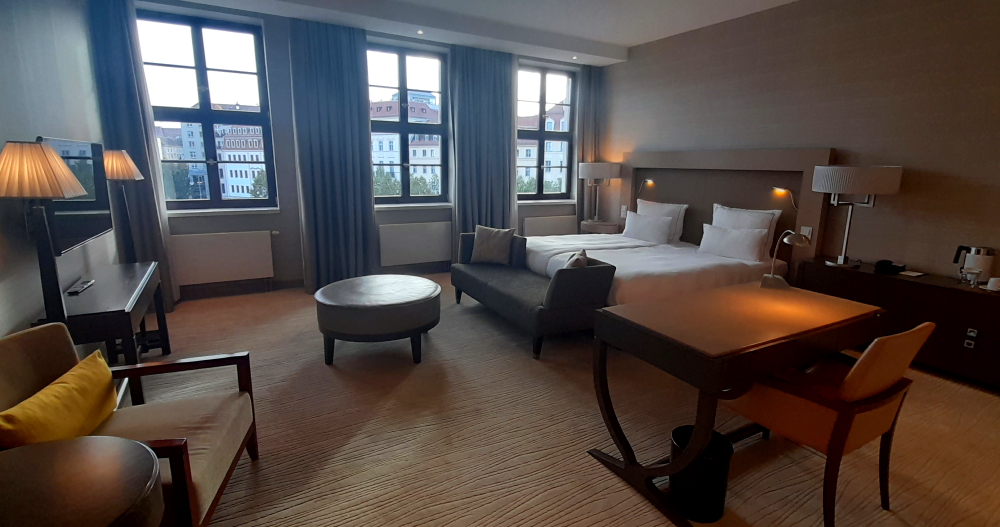
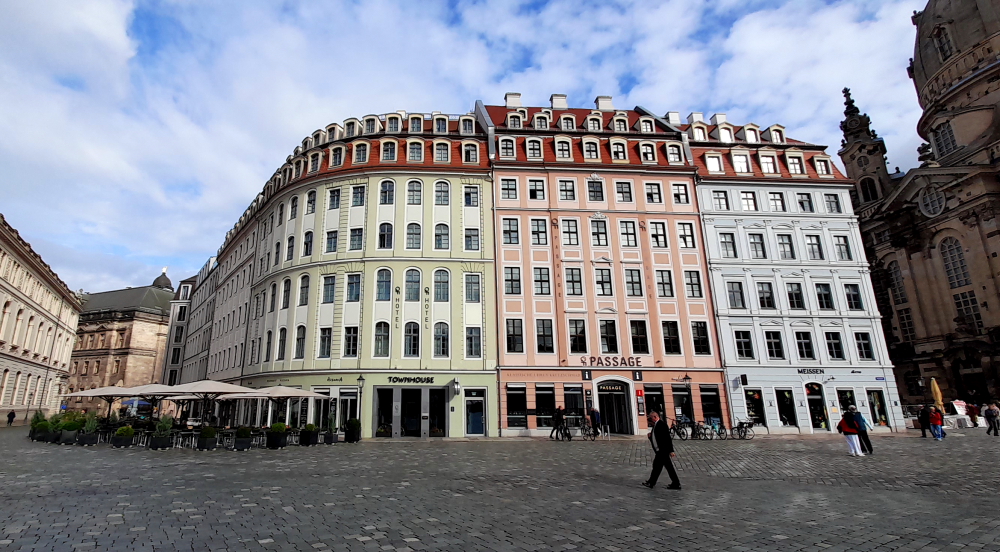
We park in the garage underneath the hotel and check in. To our delight we’re informed we’ve been upgraded to a suite overlooking the Neumarkt Square.
Looking out the window we see that a demonstration is winding up – either about Ukraine or the new war between Hamas and Israel – hence the police presence.
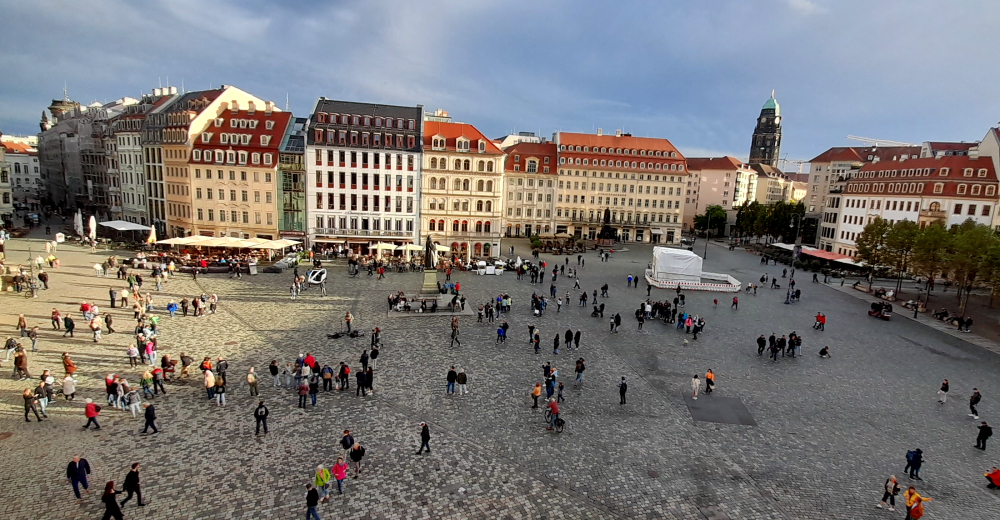
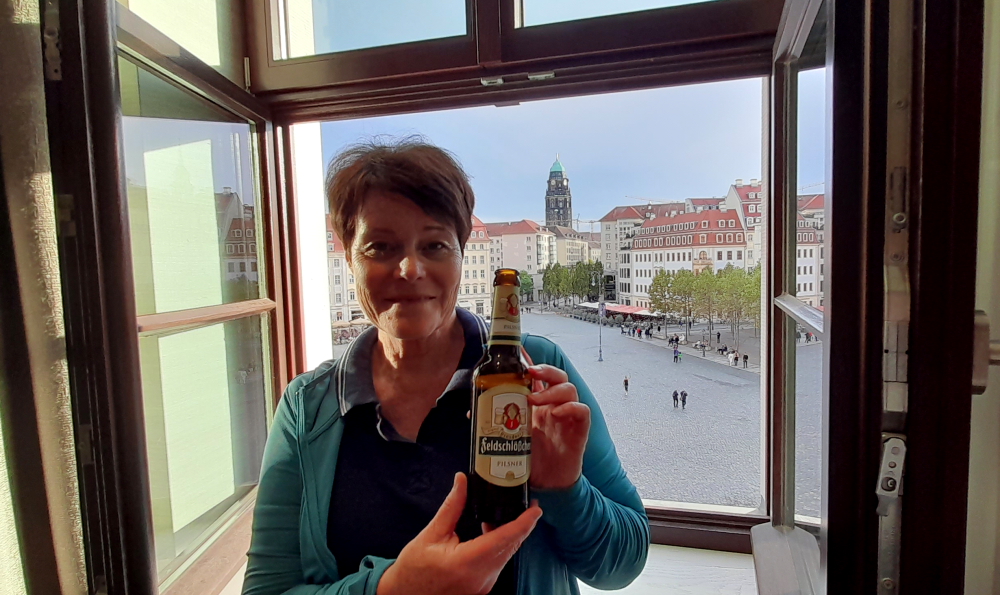
As we’re in Germany and it’s October we decide it’s about time we had a German beer to celebrate our very own, mini Oktoberfest – so we raid the free minibar and indulge.
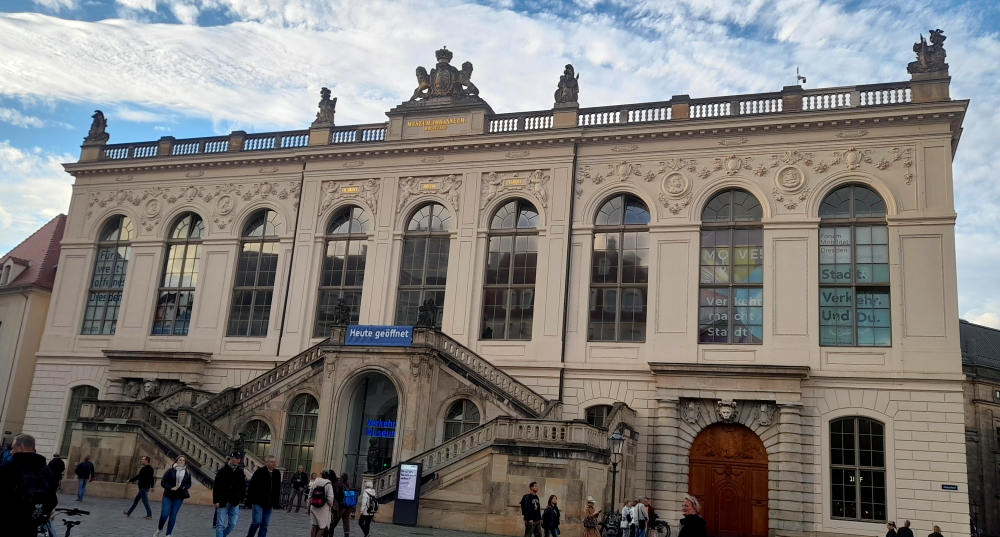
Rain is forecast tomorrow so we walk out the door to explore our beautiful surrounds.
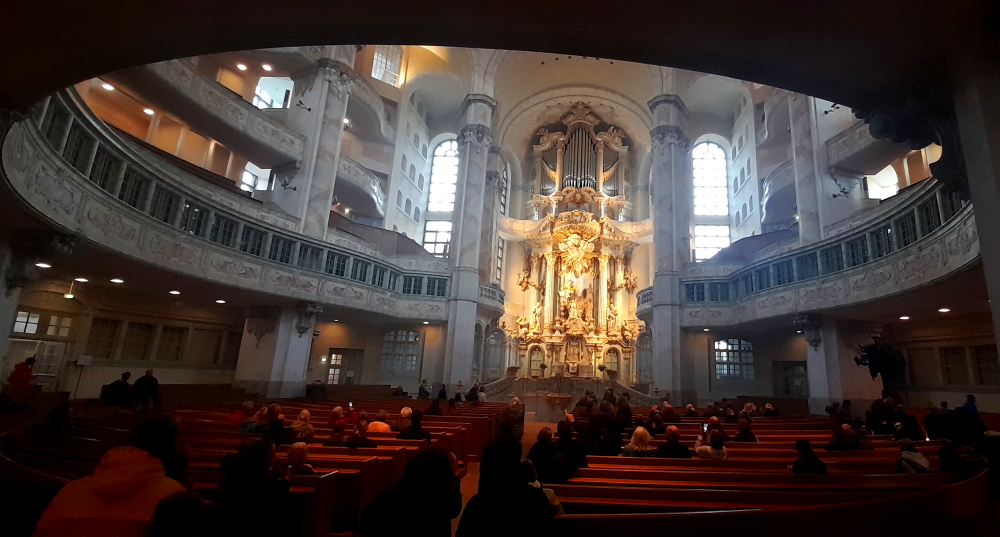
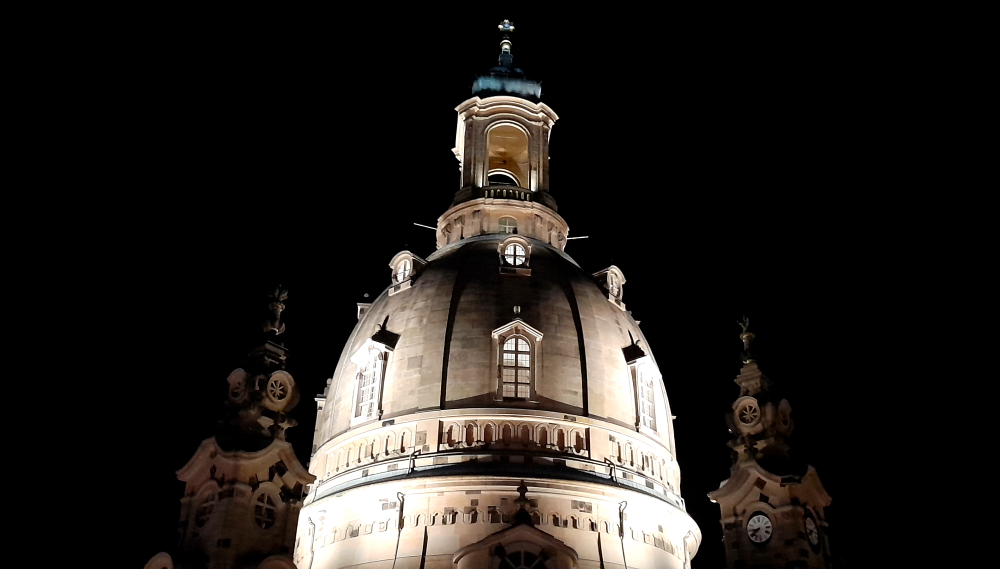
Next door to the hotel is the astonishing Frauenkirche (the Church of Our Lady), a Baroque Evangelical Lutheran church. Considered a magnificent example of Protestant sacred architecture, it has one of the largest stone church domes north of the Alps and is considered one of the largest sandstone buildings in the world.
The Frauenkirche was built from 1726 to 1743 based on a design by George Bähr. From the beginning it was plagued with serious structural defects that could never be properly remedied. At the end of WWII, its most important supporting parts were so weakened by the heat of the firestorm raging in Dresden during the air raids on the nights of February 13th and 14th, 1945 that it collapsed, burnt out, on the morning of February 15th. The ruins were preserved in the GDR and were left as a memorial against war and destruction.
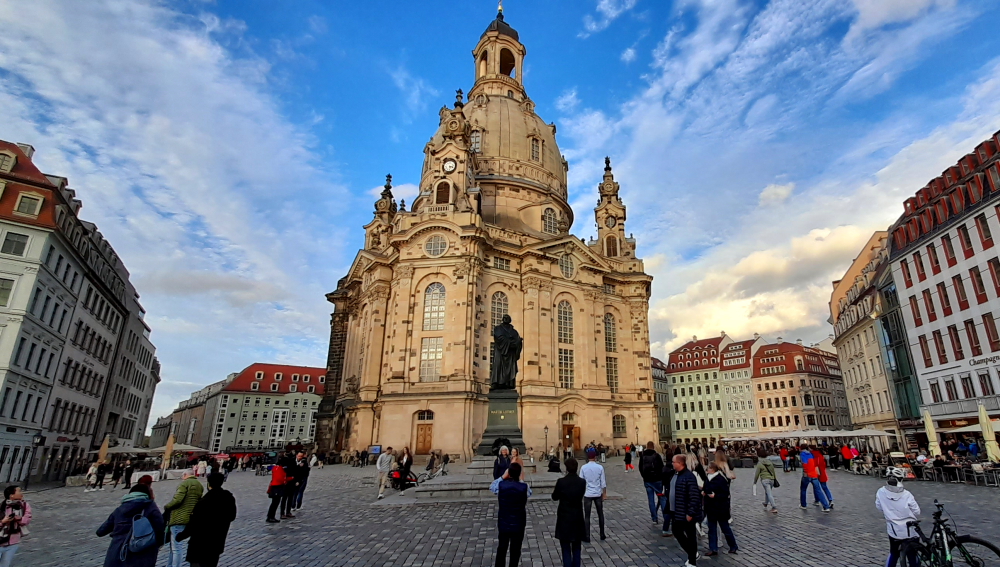
After Germany’s Reunification in 1989 the clearing of rubble began in early 1993 and the reconstruction of the church building began in 1994. The work, completed in 2005, was largely financed by support associations and donors from all over the world.
From here we walk towards the River Elbe. Up some stairs we find ourselves on top of the Bruhlsche Terrasse or Bruhl Terrace which extends for about 500 meters along the Elbe between the Augustus and Carola Bridges. The Brühl Terrace is also known as the “Balcony of Europe”, a term coined at the beginning of the 19th century and later widely used in literature.
As part of Dresden’s fortifications, the Brühl Terrace was built in the 16th century. The name goes back to Heinrich von Brühl, who had the so-called Brühl glories (gallery, library, belvedere, palace and gardens with pavilion) built on the fortress by Johann Christoph Knöffel. As a result of the development, the terrace lost its military significance.
In 1814, Prince Nikolai Grigoryevich Repnin-Wolkonsky, who was governor general of the occupied Kingdom of Saxony after Saxony’s defeat in the Battle of Leipzig, issued an order to open the terrace to the public.
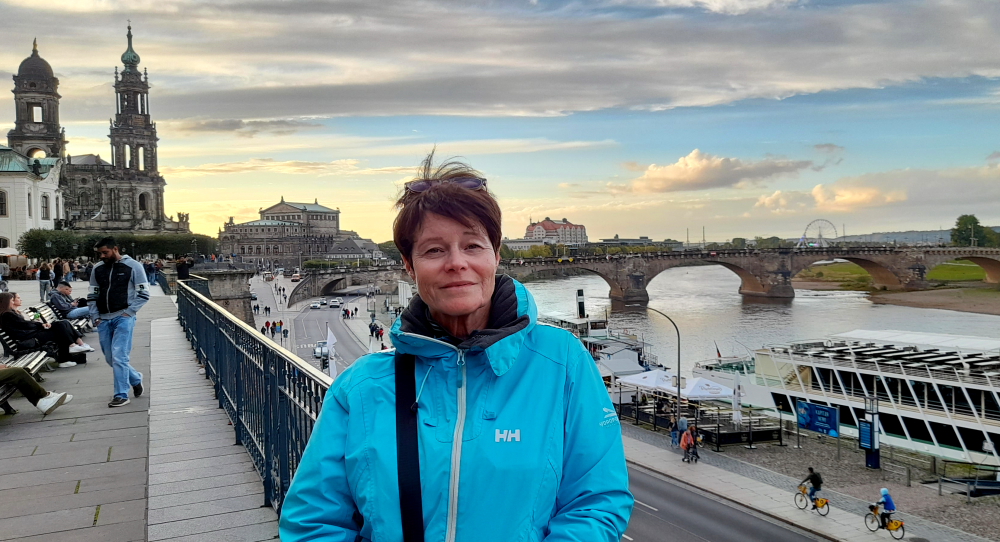
Walking along the top of the terrace is a series of beautiful buildings.
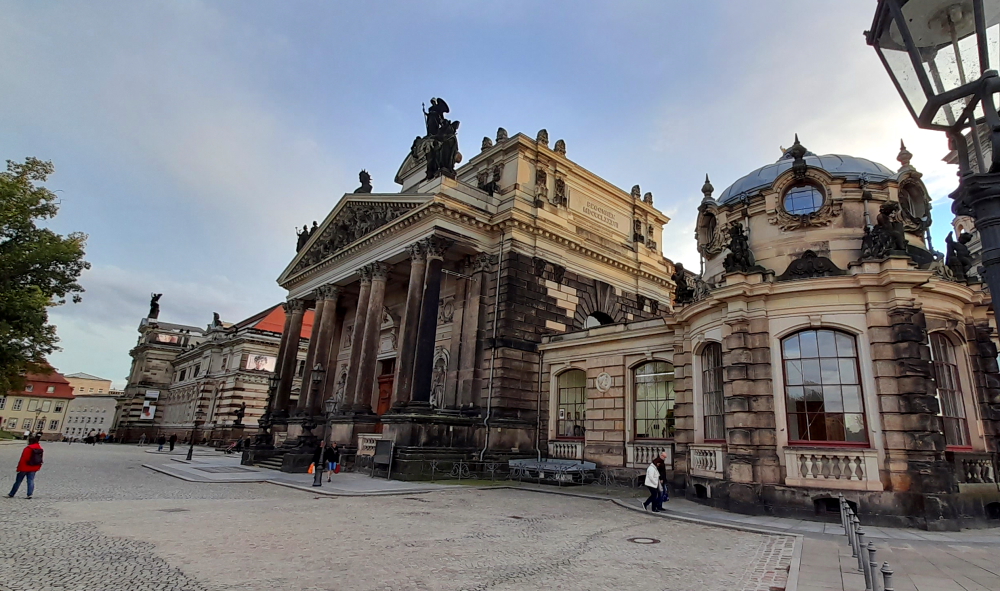
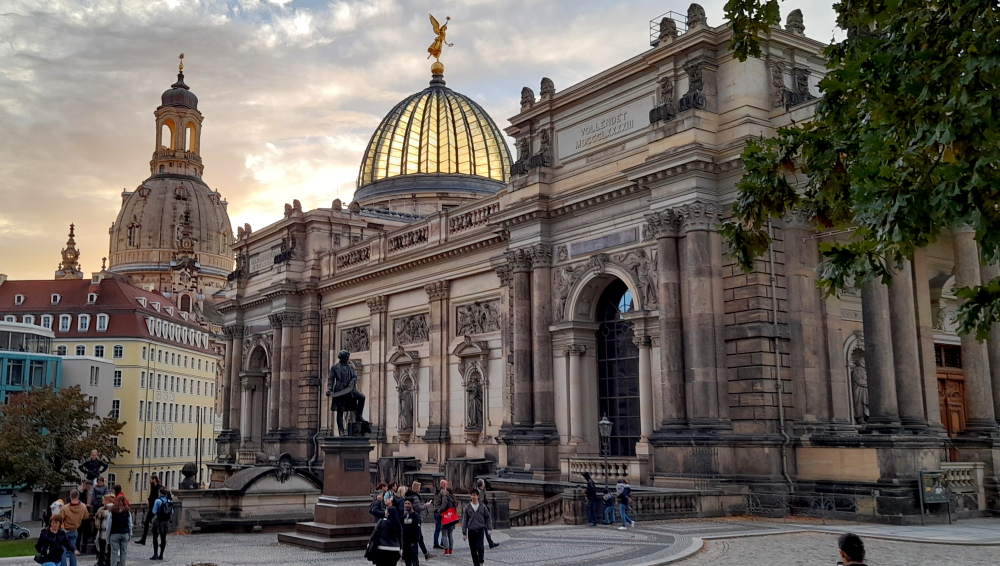
One of three buildings of today’s Dresden Academy of Fine Arts, the former Royal Academy of Arts, built in 1894, is located at a prominent position in town on Brühl’s Terrace just next to the Frauenkirche.
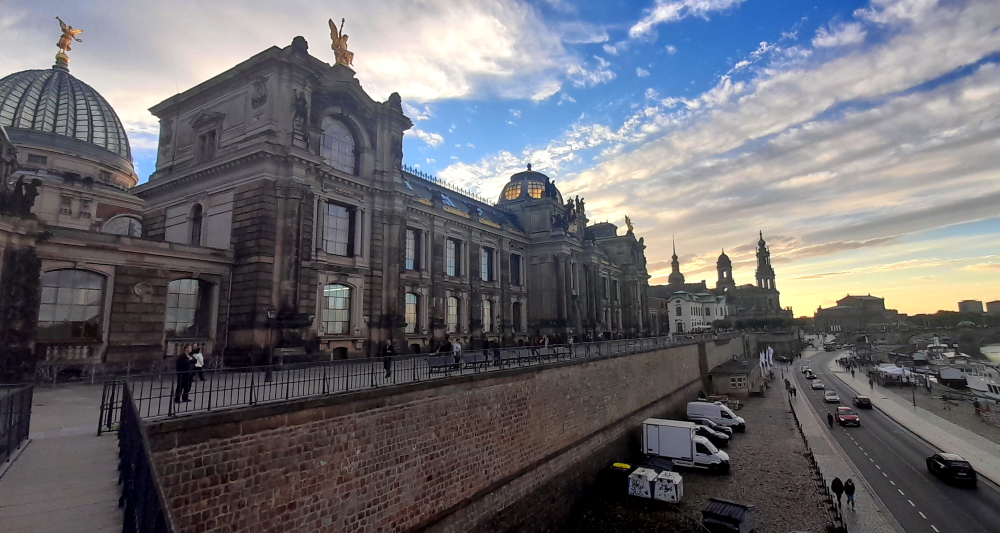
Since 1991, the building built by Constantin Lipsius on Brühl’s Terrace between 1887 and 1894 – the glass dome of which is also known as Lemon Squeezer due to its form – has been heavily renovated and the parts that were destroyed during WWII were reconstructed.
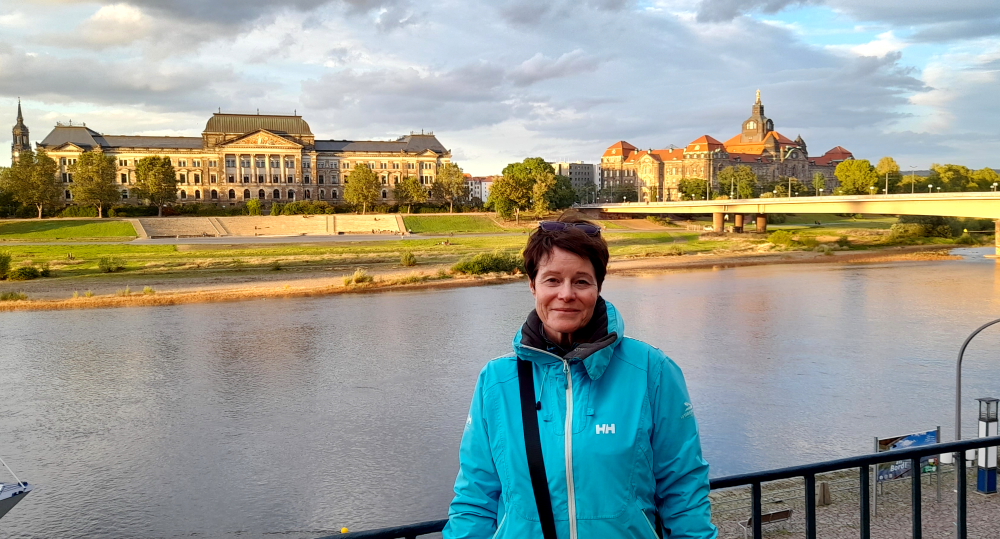
Directly across the river is the rather imposing Finance Ministry building and to the right of it, the Saxon State Chancellery, the office of the Minister-President of Saxony.
That will do for sightseeing today. After dinner we have a night cap in the hotel’s rooftop bar on the 6th floor.
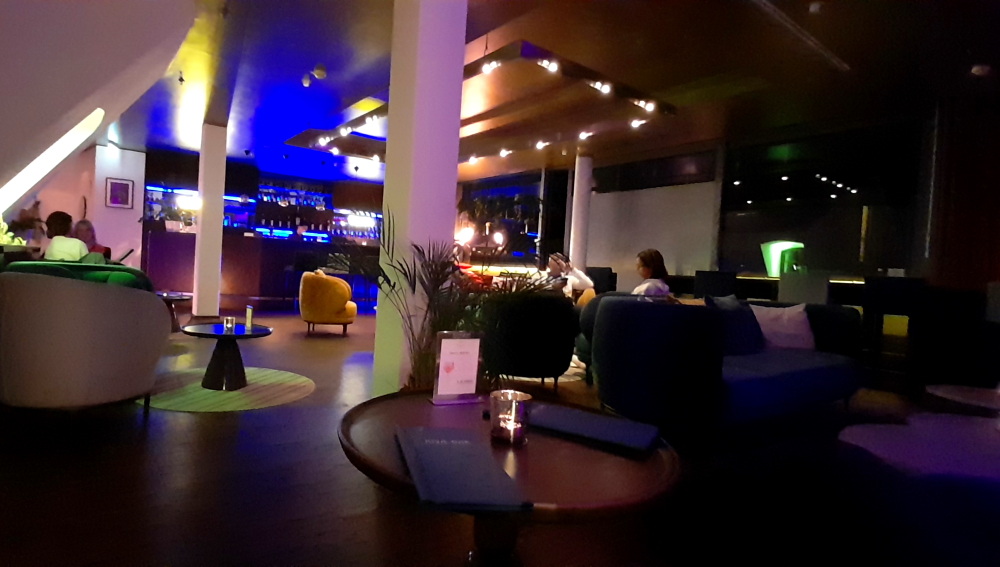
The main reason we visit the bar is to see the Church’s illuminated dome – up close and personal.
15 October, 2023
Our Townhouse Hotel is just across the square from the start of our Dresden Old Town walking tour today at 11:00 am.
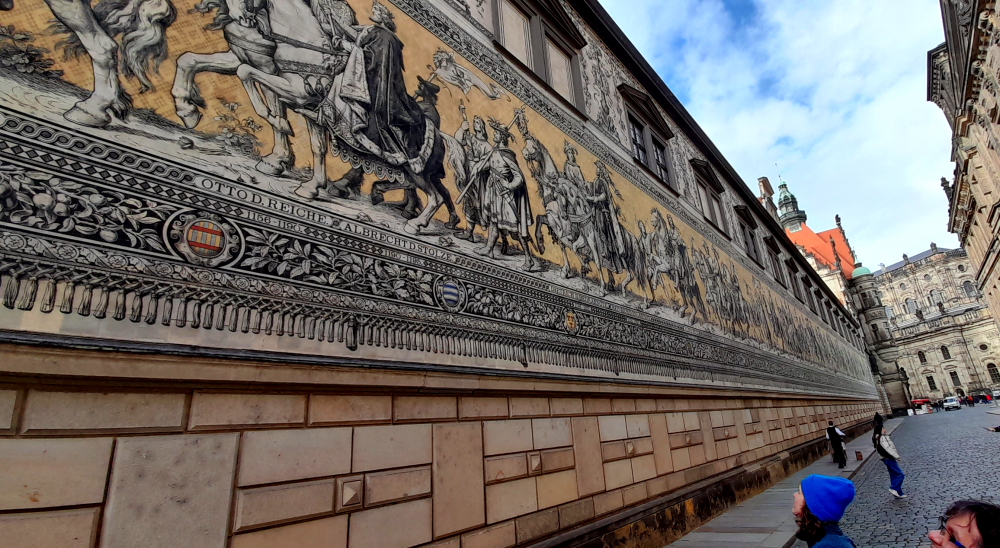
From Neumarkt we walk into Augustusstrasse which connects the Schloßplatz with Neumarkt and runs roughly along the line of the medieval Dresden city wall which was demolished here between 1546 and 1548. The name refers to the Saxon Elector and Polish King August the Strong. The most important sight is on the south side the procession of princes (Furstenzug) on the outer wall of what is today the Langer Gang (Long Corridor) in Dresden Castle, including August the Strong.
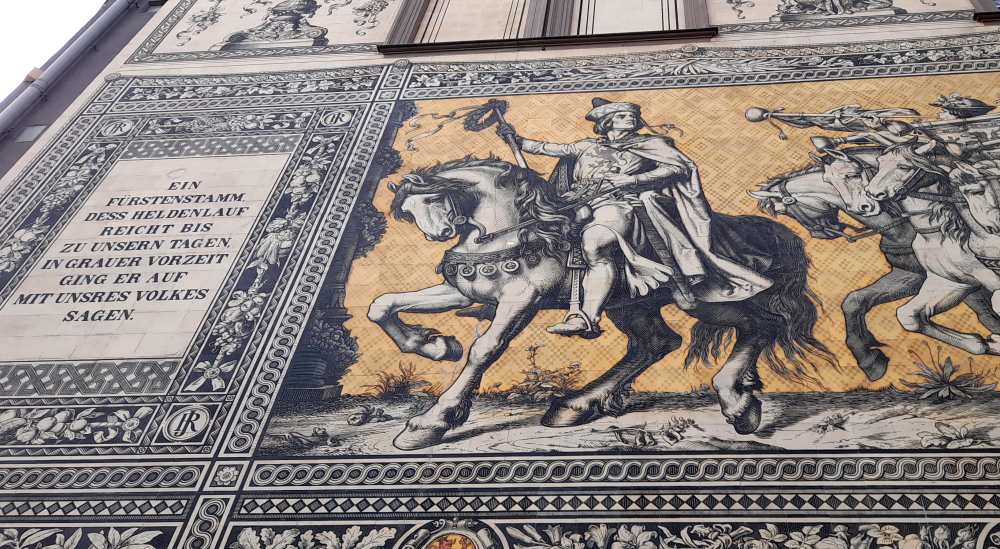
As early as 1589, the outer north wall of what was then the stable yard of the Dresden Residential Palace had just been built and over time, weathered. In 1865, the historical painter Wilhelm Walther presented a design for the redesign of the wall: A procession of Saxon regents, suitable for the upcoming 800th anniversary of the Wettin princely house in 1889. Between 1868 and 1872, Walther created a one hundred meter long and four meter high original drawing with charcoal on squared paper. The creation of the mural using the sgraffito technique, a plaster scratching technique, lasted from 1873 to 1876. However, due to weathering, it was transferred to tiles during 1904-1907.
Today, the Princely Procession is a larger-than-life image of a cavalry procession, applied to around 23,000 tiles made of Meissen porcelain. The 102-meter-long work of art, which is considered the largest porcelain mural in the world, represents the ancestral gallery of the 34 margraves, dukes, electors and kings from the family of the Princely House of Wettin who ruled in Saxony between 1127 and 1873.
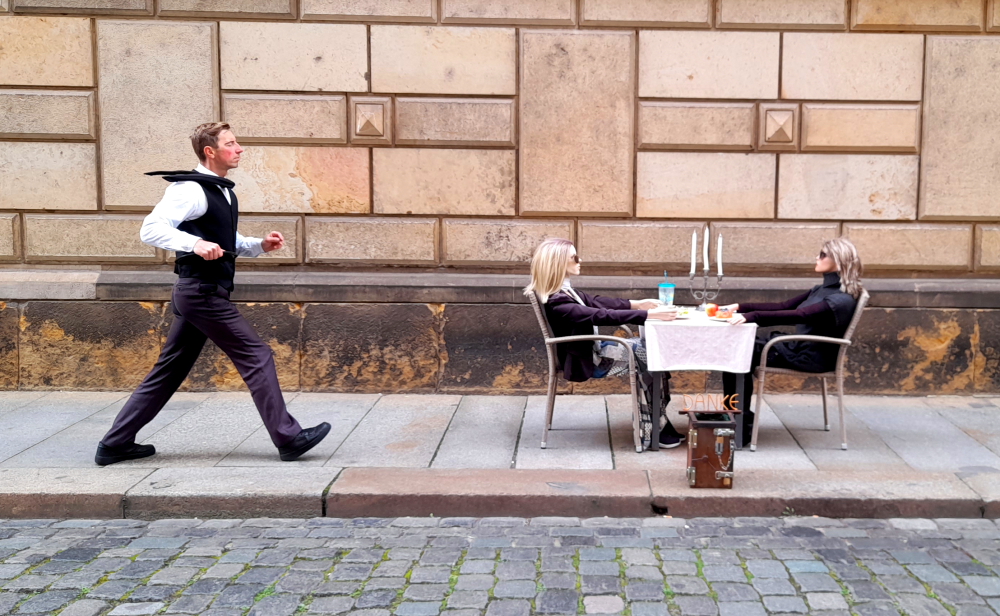
While we are listening to the guide we are entertained by a street artist who has set up his ‘scene’ on the footpath underneath the mural. He is the waiter and the 2 women are mannequins. He is completely still but, as soon as someone puts some money in his tip box, he acknowledges comically and moves into a new stationary position.
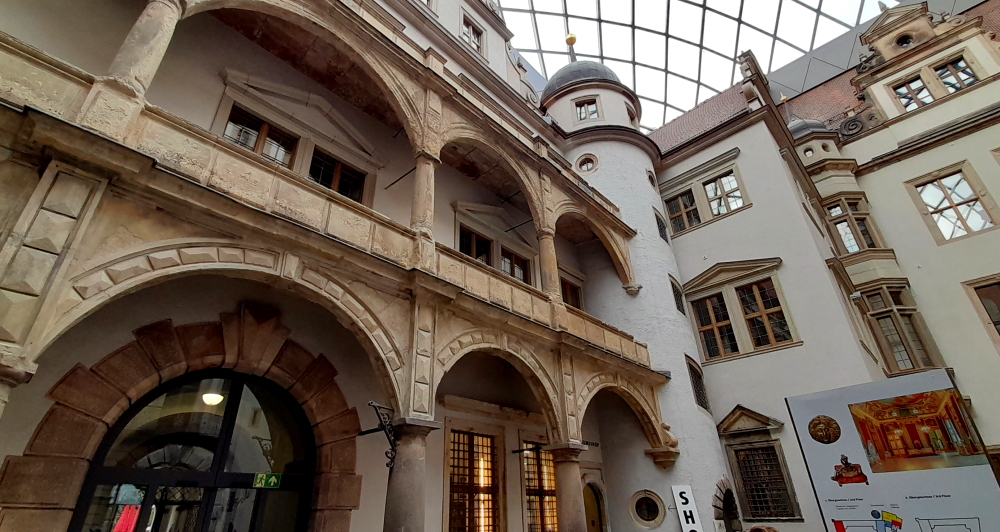
Next we walk into a courtyard of Dresden Castle or Royal Palace. It is one of the oldest buildings in Dresden. For almost 400 years, it was the residence of the electors (1547–1806) and kings (1806–1918) of Saxony from the Albertine House of Wettin as well as Kings of Poland (1697–1763). It is known for the different architectural styles employed, from Baroque to Neo-renaissance. Today, the residential castle is a museum complex.
The original castle was a Romanesque keep, built around 1200. After a major fire in 1701, Augustus II the Strong rebuilt much of the castle in the Baroque style. The collection rooms were created at this time in the western wing. The Silver Room, Heraldic Room and the Precious Hall were built from 1723–1726. The Fireplace Room, Jewel Room, Ivory Room and Bronze Room were built from 1727–1729. The 800th anniversary of the House of Wettin, Saxony’s ruling family, resulted in more rebuilding between 1889 and 1901.
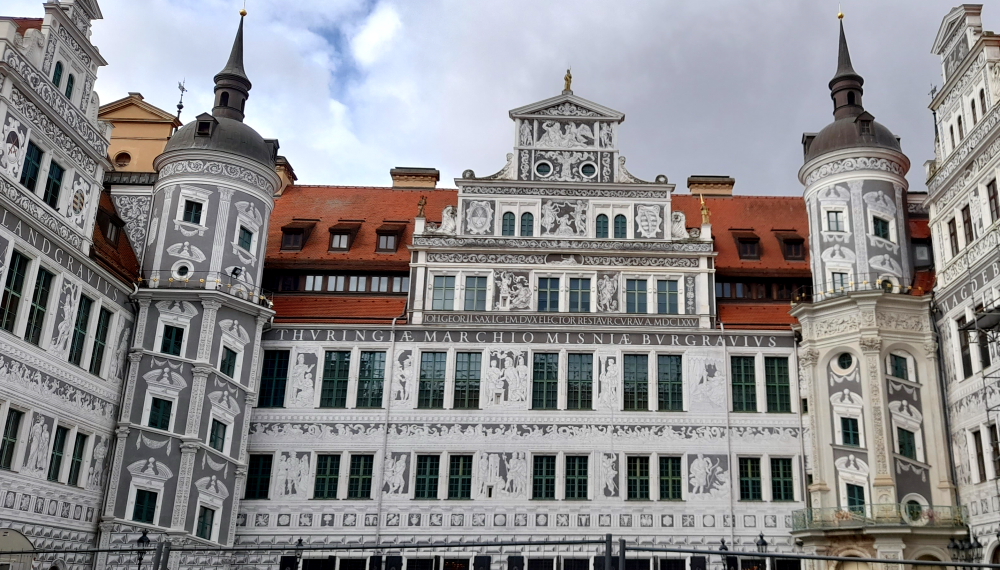
Most of the castle was reduced to a roofless shell during 13 February 1945 bombing of Dresden in WWII. The collections survived having been moved to another location earlier. Restoration began in the 1960s with the installation of new windows and has occurred rapidly since then. The castle’s restoration is ongoing, including the installation of a plastic dome over its courtyards.
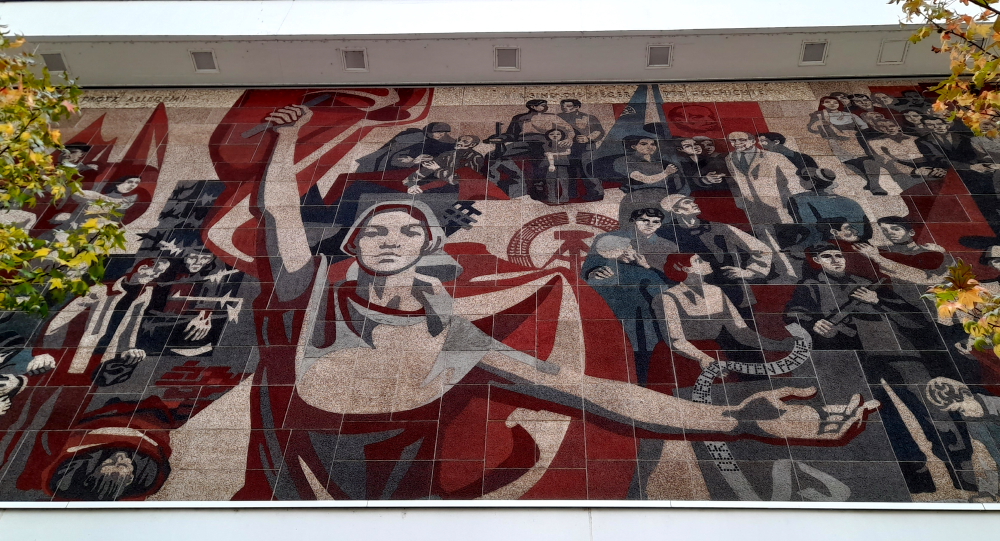
From here we walk along Schlossstrasse to the Kulturpalast – a modern Palace of Culture, part of which faces Altmarkt square. Unlike the other buildings in the Altmarkt square, the Kulturpalast is designed in the unadorned International Style. A modernist building by Wolfgang Hänsch built during the era of the German Democratic Republic (GDR) it was the largest multi-purpose hall in Dresden when it opened in 1969.
On its upper wall is a 30-by-10.5-metre (98 ft × 34 ft) mural designed by Gerhard Bondzin and created in 1969 by a working group from the Dresden Academy of Fine Arts. The mural, titled Der Weg der roten Fahne (The Way of the Red Flag), is made of concrete slabs electrostatically coated with colored glass.
Here, while facing Altmarkt, our guide told us about the firestorm that was created by Allied bombings on the nights of 13 and 14 February, 1945 which destroyed the residential buildings in that area which is now a large, open space.
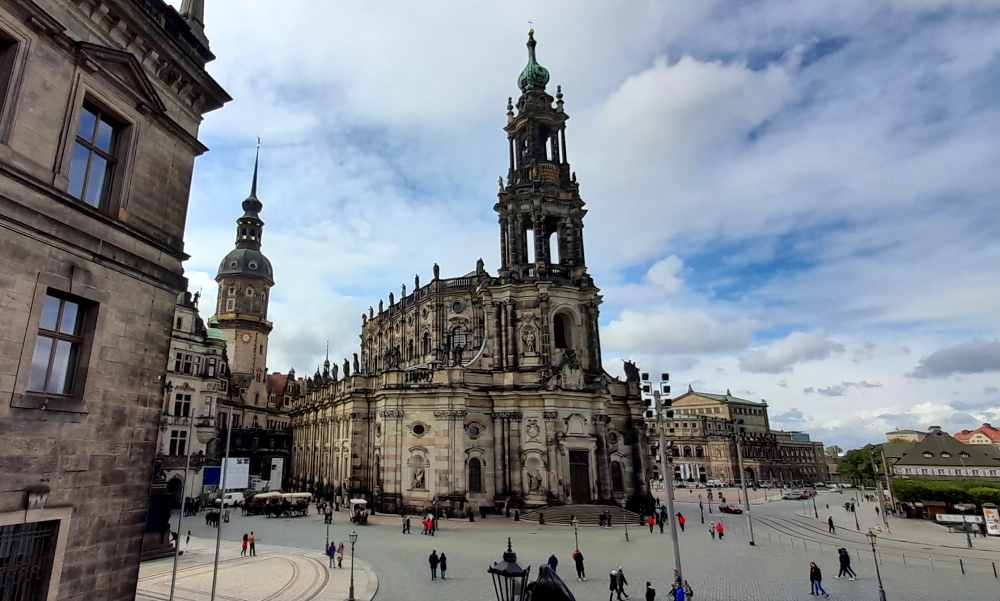
After walking back to Neumarkt we proceed onto Buhl’s Terrace to view Dresden Cathedral, formerly the Catholic Church of the Royal Court of Saxony (Katholische Hofkirche).
It was designed by architect Gaetano Chiaveri from 1738 to 1751. The church was commissioned by Augustus III, Elector of Saxony and King of Poland while the Protestant city of Dresden built the Frauenkirche (Church of Our Lady) between 1726 and 1743. While the general population of the city was Protestant, its rulers were Catholic. The Catholic Elector built the cathedral for his own use and for the use of other high-ranking officials, connecting it to his home, Dresden Castle, with an ornate high level walkway. It is one of the burial sites of the House of Wettin, including Polish monarchs.
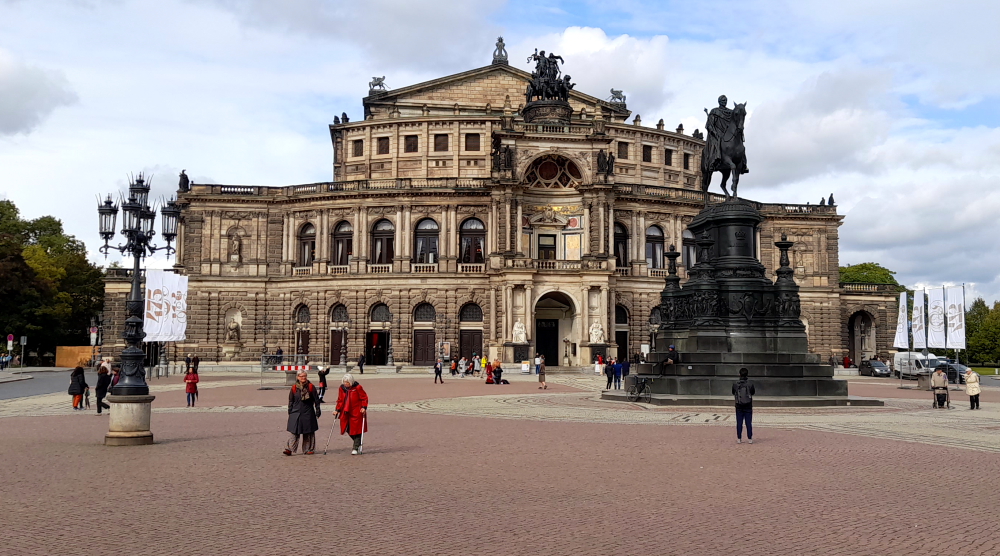
From here we walk past the Semperoper, the opera house of the Saxon State Opera and the concert hall of the Saxon State Orchestra. It is also home to the Semperoper Ballett. The building is located on the Theaterplatz near the Elbe River.
The opera house was originally built by the architect Gottfried Semper in 1841. After a devastating fire in 1869, the opera house was rebuilt, partly again by Semper, and completed in 1878. The opera house has a long history of premieres, including major works by Richard Wagner and Richard Strauss.
Nearby is the Dresdner Zwinger. The Zwinger is a building complex with gardens. The total work of art consisting of architecture, sculpture and painting, built under the direction of the architect Matthäus Daniel Pöppelmann and the sculptor Balthasar Permoser, is one of the most important buildings of the Baroque period and, along with the Frauenkirche, is the most famous architectural monument in Dresden.
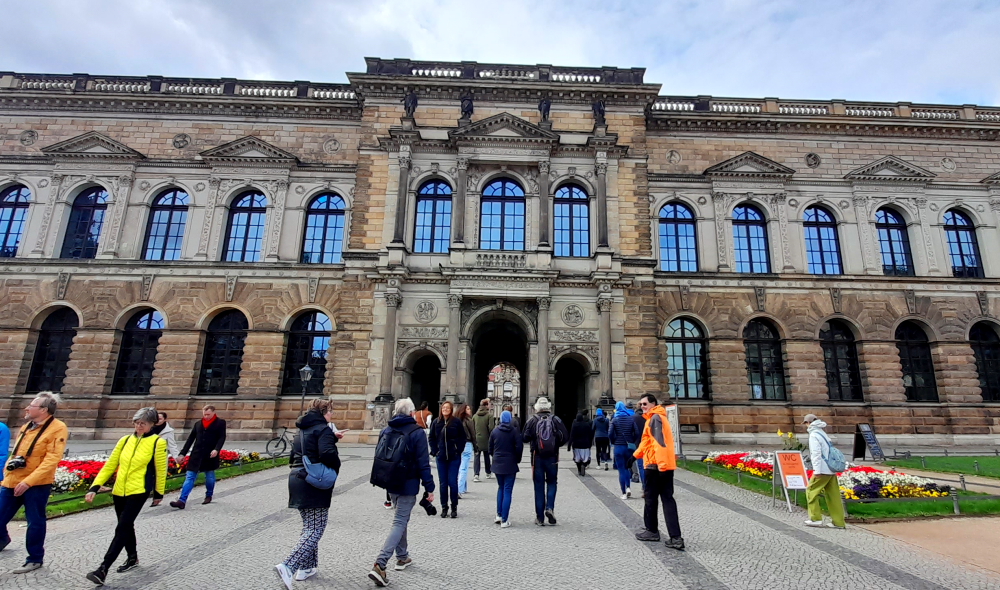
“Zwinger” goes back to the common name in the Middle Ages for a part of the fortress between the outer and inner fortress walls, although the Zwinger no longer fulfilled a function corresponding to the name when construction began.
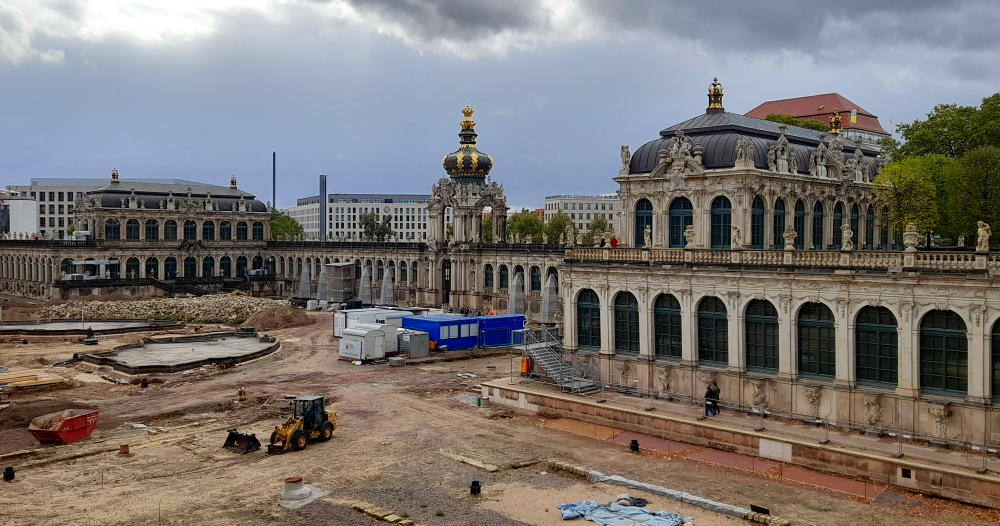
The Zwinger was built in 1709 as an orangery and garden and festival area. Its richly decorated pavilions and the galleries lined with balustrades, figures and vases bear witness to the splendor during the reign of Elector Friedrich August I (also called “August the Strong”) and his claim to power. In the elector’s original concept, the Zwinger was intended as the forecourt of a new palace that would occupy the space up to the Elbe.
The plans to build a new palace were abandoned after the death of August the Strong, and with the move away from the Baroque, the Zwinger initially lost its importance. It was only over a century later that the architect Gottfried Semper completed it with the Semper Gallery facing the Elbe.
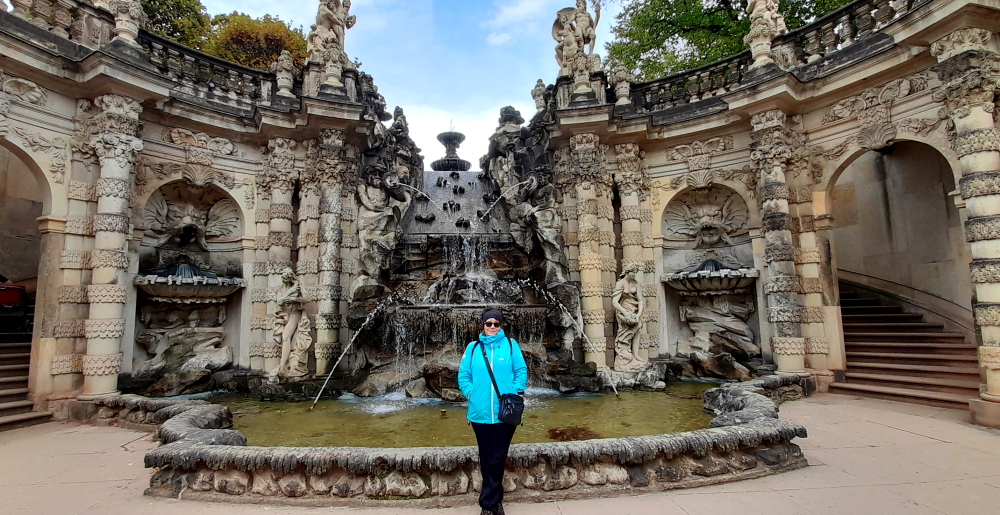
The Semper Gallery, opened in 1855, was one of the most important German museum projects of the 19th century and made it possible to expand the use of the Zwinger as a museum complex, which had grown since the 18th century under the influences of the times. The air raids on Dresden in February 1945 hit the Zwinger badly and led to extensive destruction. Since reconstruction in the 1950s and 1960s, the Zwinger has housed the Old Masters Picture Gallery, the Mathematical-Physical Salon and the Porcelain Collection.
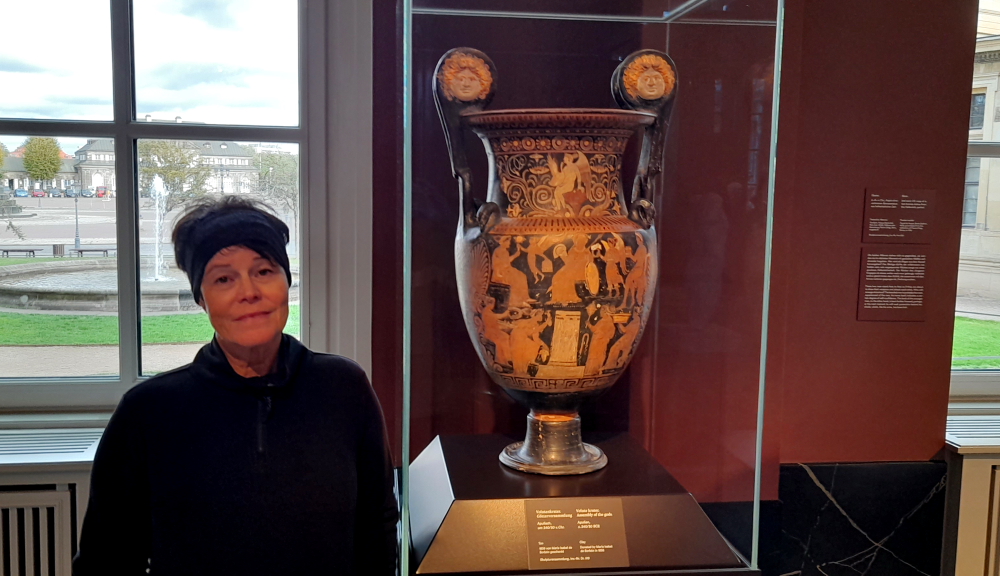
As the tour ended here at the Zwinger, we opt to visit the Old Masters Picture Gallery and the Porcelation Collection.
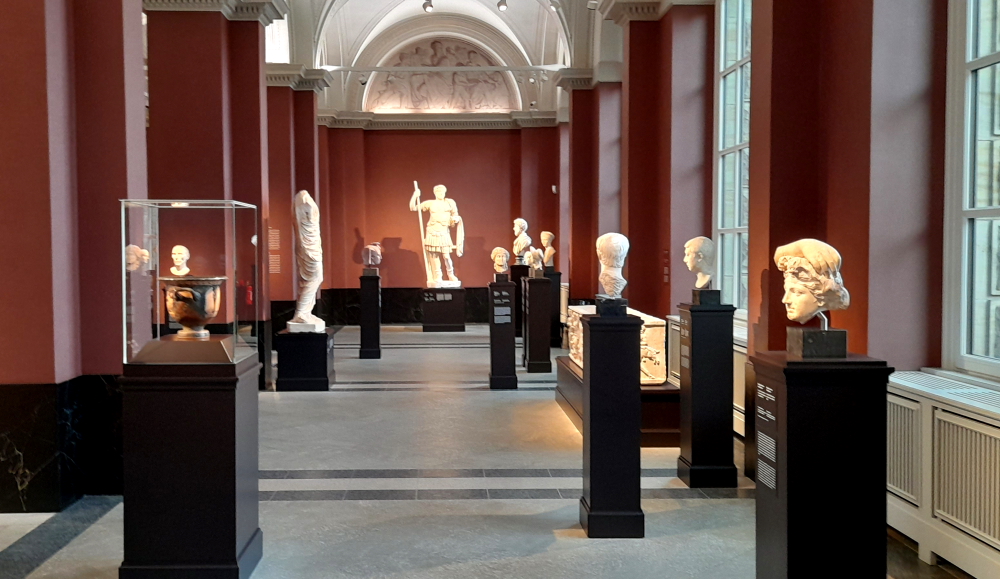
Within the gallery is also the Hall of Antiquities which appears to be the display of Egyptian, Greek and Roman collections purchased from German private collectors.
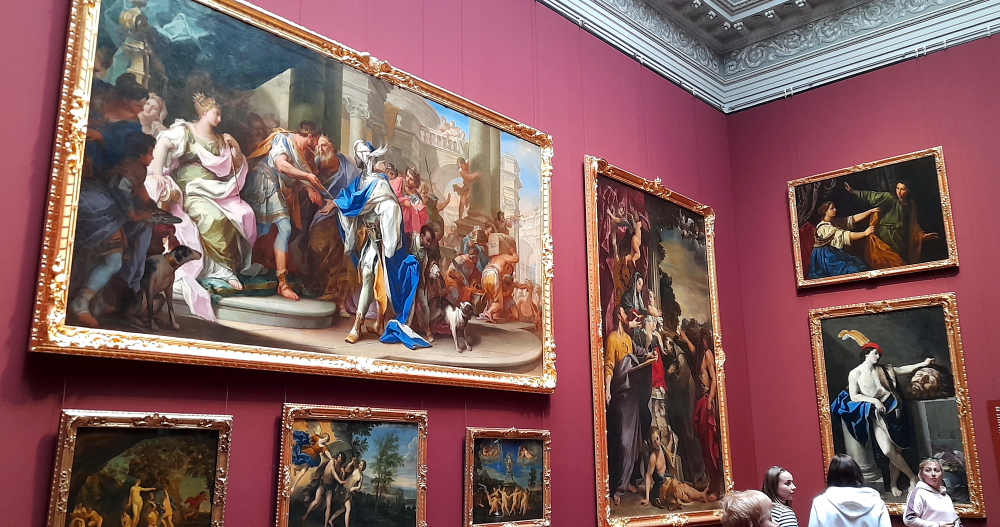
The Old Masters Picture Gallery shows masterpieces from the 15th to 18th centuries and is one of the most renowned collections in the world. The focus of the collection is Italian painting of the Renaissance. The gallery also presents outstanding paintings from early Dutch and early German paintings. The most famous painting is the Sistine Madonna by Raphael .
When Elector August founded the Dresden Electoral Art Chamber in 1560, paintings still played a subordinate role in this universal collection alongside collection items from all possible areas of science. Under the two Saxon electors who ruled between 1694 and 1763, August the Strong and his son, Friedrich August II, systematic collecting activity began in the first half of the 18th century. After purchasing the 100 best works from the outstanding collection of Duke Francesco III of Modena the collection had grown rapidly in 1746. This collection era was crowned in 1754 with the acquisition of Raphael’s picture Sistine Madonna. The collection had now achieved European fame thanks to its valuable acquisitions. The Seven Years’ War that now began ended the active expansion of the collection for many years.
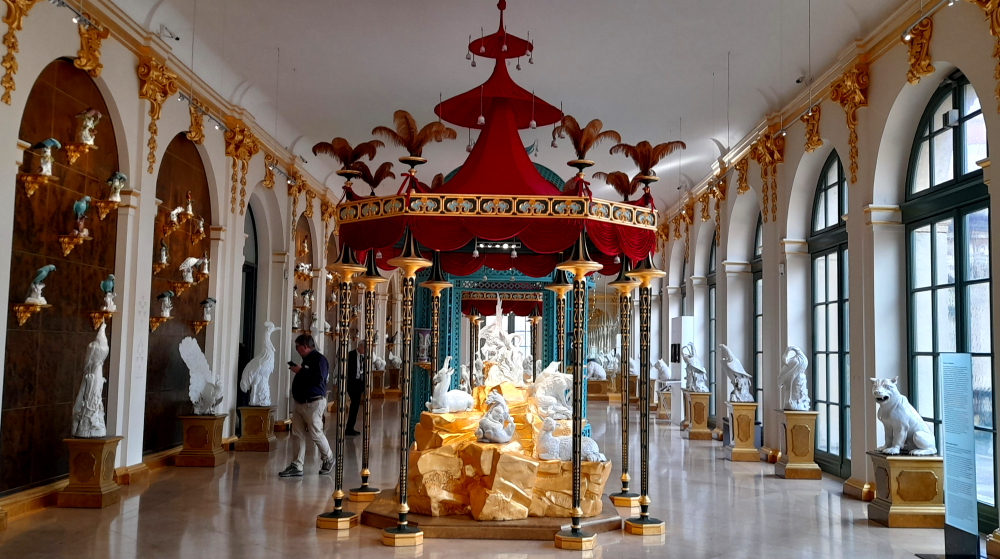
The Dresden Porcelain Collection is one of the most extensive and valuable special ceramic collections in the world. The porcelain collection includes around 20,000 exhibits of Chinese, Japanese and Meissen porcelain. The holdings of early Meissen porcelain as well as East Asian porcelain from the 17th and early 18th centuries are of particular importance.
The collection was founded in 1715 by the Saxon Elector August the Strong. It was originally located in the Dutch Palace on the banks of the Elbe in Neustadt. After moving to the Johanneum in 1876, the collections, which were largely relocated during WWII found their permanent home in the southern part of the Zwinger in 1962.
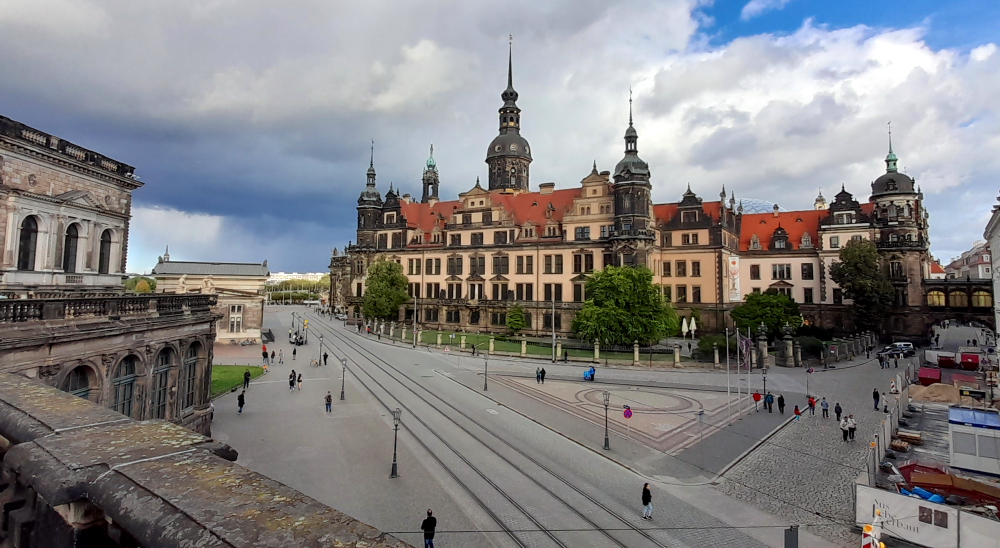
A minute to check out the view from the roof gallery of the Zwinger across to the Castle before we walk back to the hotel. Thankfully, the predicted rain today didn’t materialise but, boy is it freezing cold. Yesterday’s temp. was 22 Deg C., today, it’s 11 with a chilling wind.
Time for a hot toddy to warm up.
16 October, 2023
This morning I had an unexpected message from the property we’d booked near St-Emilion, France in early December, which we’d booked and prepaid in late June, that the property would be closed in December and so a cancellation was necessary. Bloody French!
The property had everything we wanted: on a vineyard, classic, ambience, onsite parking, king suite, etc. Which meant that a replacement accommodation property had to have these things or more.
I had to phone Booking.com to resolve. Fortunately, on our second attempt, we were directed to another property that had almost all these things (missing classic ambience a bit) but it had Euro200 knocked off the price so we took it.
This and trying to sort out an issue with HSBC blew most of the day. I get so annoyed when my time is constantly wasted sorting out problems that other people create for us.
After a quick walk to the shopping mall at the Altmarkt to visit a pharmacy for eye drops, we return to the hotel to get ready for our 6:30 pm dinner date.
Lynn had kept in touch with a colleague, Russell, over the years, since she last saw him around 2005. He had moved from working in London to Dresden and when she told him we were visiting Germany this trip he urged us to visit.
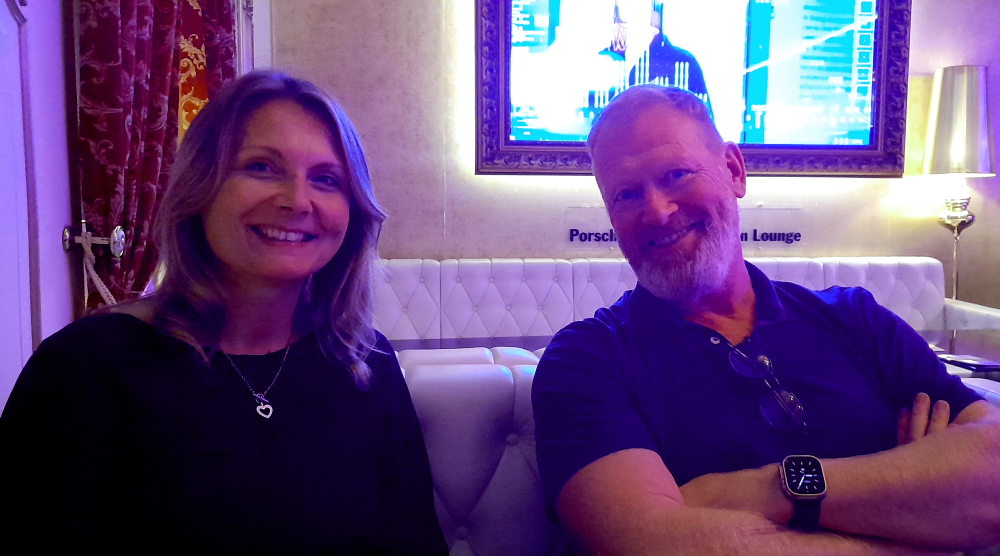
So, after meeting up in our hotel lobby and introductions all round, we walk across Neumarkt to an excellent tapas restaurant, then to a Champagne Bar on the other side of Neumarkt for a night cap.
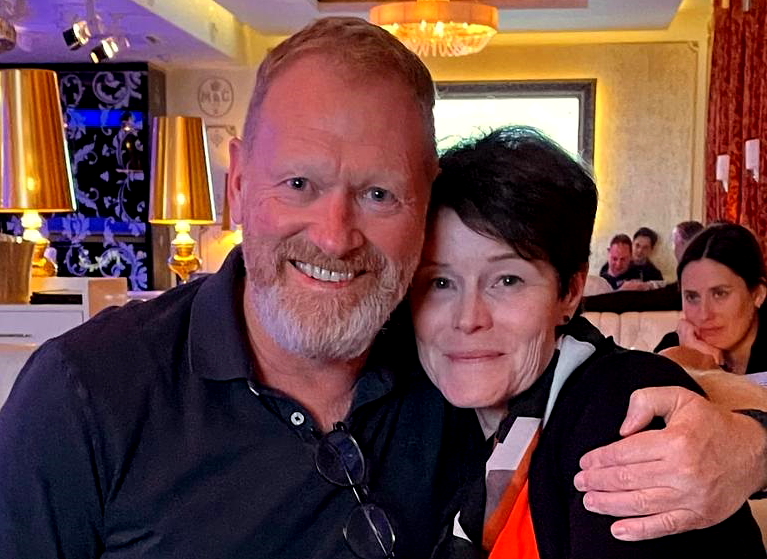
A great night out with lots of reminiscing, stories and laughs. Looking forward to hosting Russell and Caroline sometime in the future when they venture to Australia and Brisbane.
.
 THE CONTINUING TRAVELS OF YOGI & BOO BOO