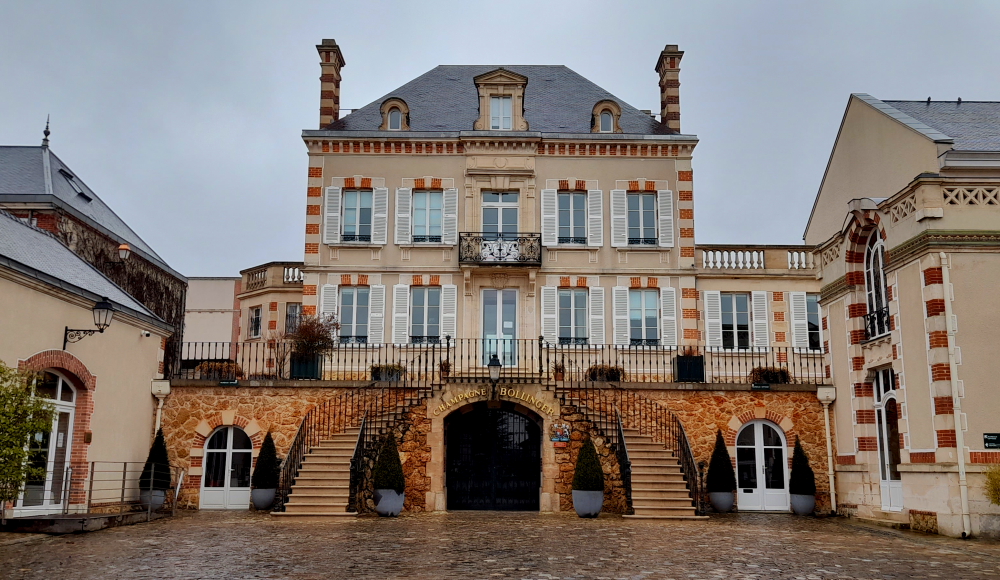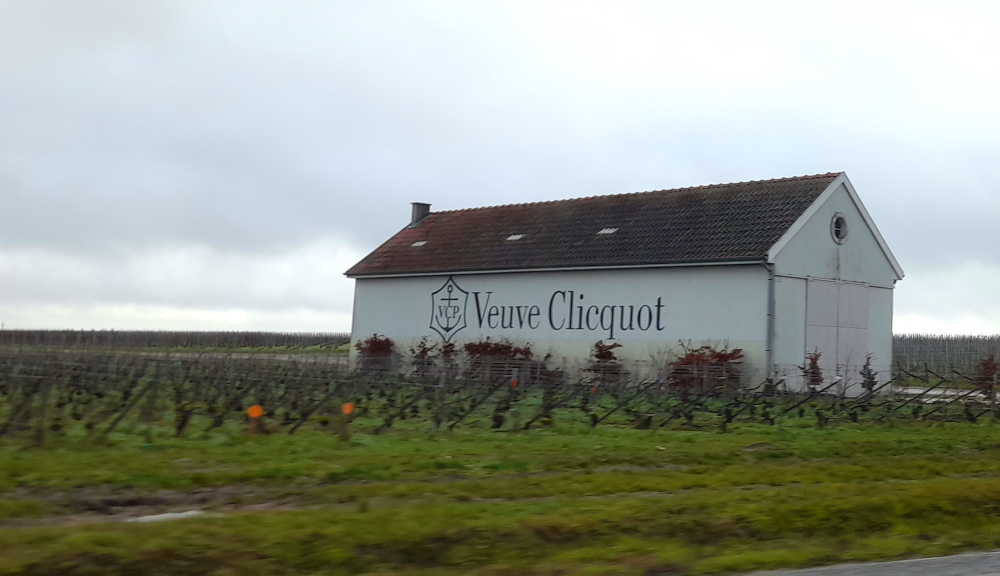
Category Archives: France

Northern France for 2 weeks.

7 May, 2024

For the next two weeks we are gradually heading back to the UK before we sell the car and fly on to our last leg of this 2-year tour of Europe. During this penultimate section we will stay in Nancy, France for 5 days then back to the Champagne region to meet up with our American friends, Becky and Jerry, for a week.
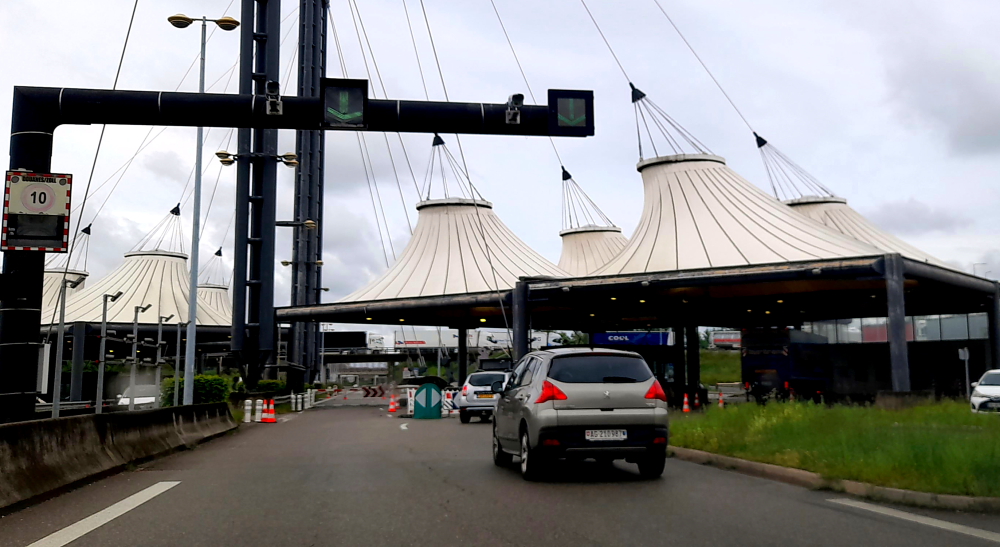
Crossing back into France from Switzerland at Saint-Louis.

We drive through some verdant countryside and lovely villages that make up part of the Moselle valley and arrived in Nancy about 4 hours after leaving Bern.
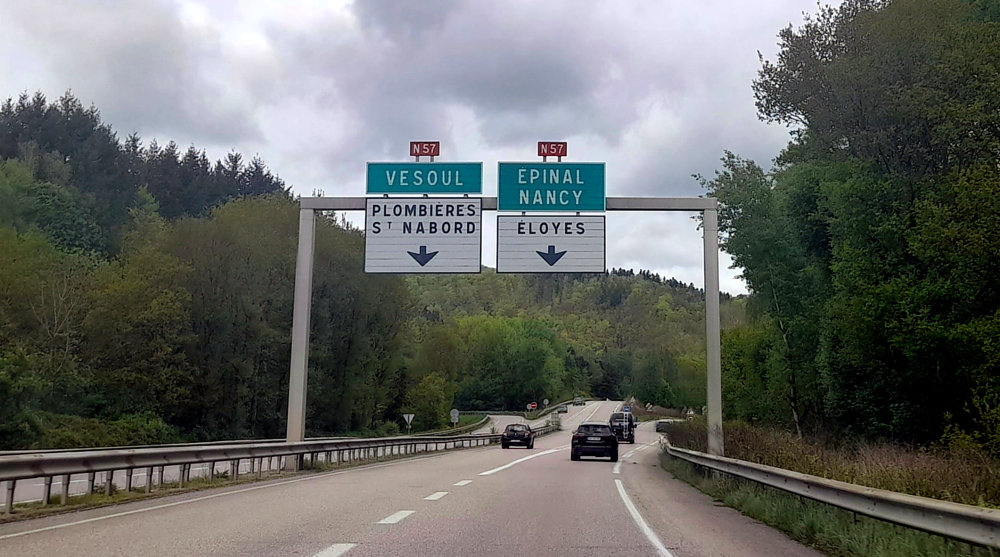
On the way to Nancy, France.

We’re staying at a Mercure in the city centre and although it has seen better days its staff have been amazingly friendly and very welcoming.

While we are having our welcome drinks at the bench that is the Bar-cum-Reception, 2 guys and their wives check in from the UK. They are taking their respective Lotuses for a spin having driven from Rotterdam this morning, overnighting Nancy, then heading onto Sorrento.
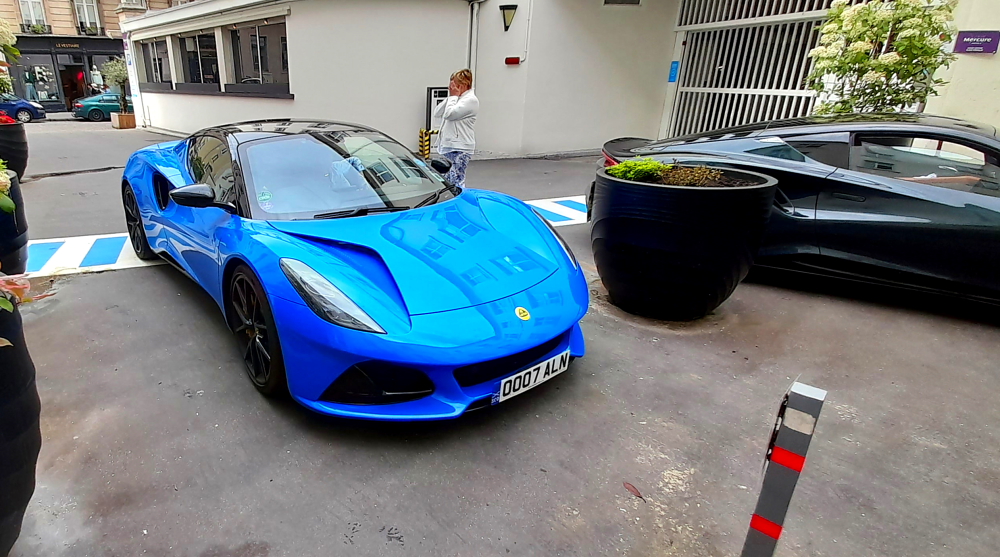
Overnighting Lotuses.

We decide to go out for a quick recce of the ‘hood’. Stanislav Square is a 2-minute walk away – and we are stunned by the opulence before us.
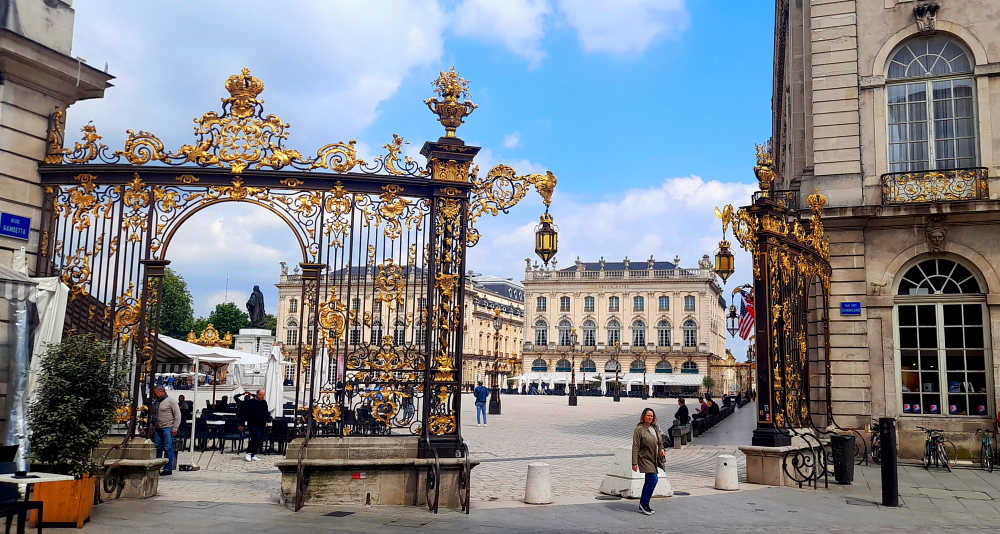
Rue Gambetta entrance to Place Stanislas, Nancy.

Everything is trimmed in sparkling gold – entrance ways, lamps, street lamps, building features … No wonder this 18th century royal square has been UNESCO listed since 1983.
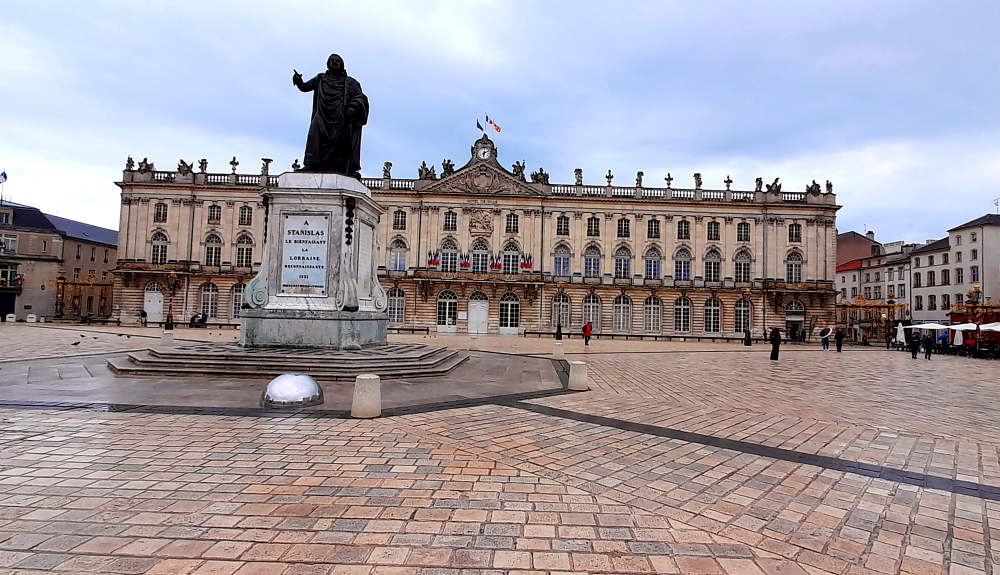
Statue of Stanislas Leszczynski backdropped by the Town Hall.

The fountains flowed with wine in 1755 when Stanislaw Leszczynski inaugurated one of the finest squares in the world. Ever since, Nancy has been known as ‘the city with the golden gates’.
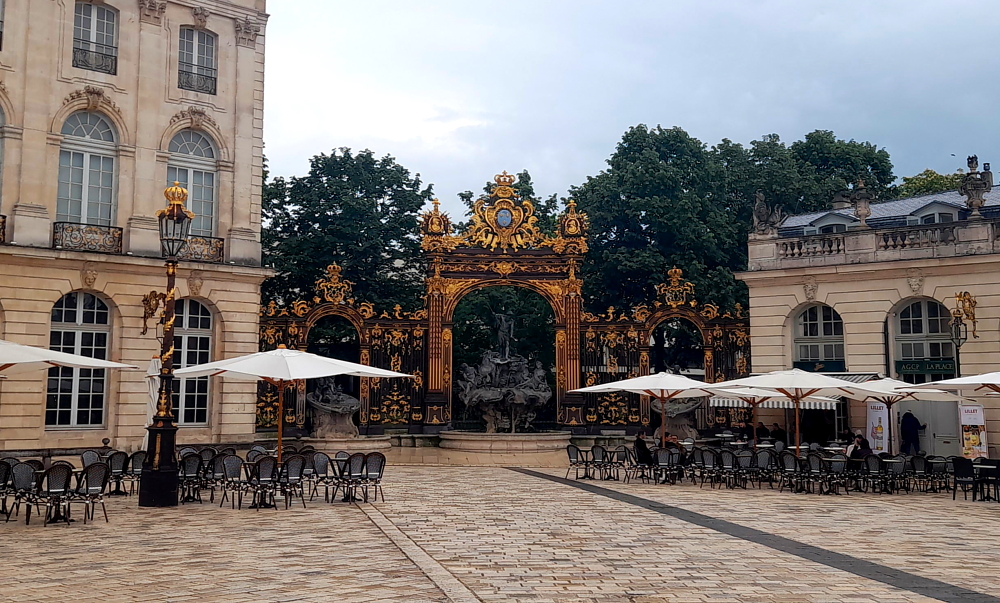
Place Stanislas entrance/exit leading to Musee des Beaux-Arts, Nancy.

The aim of the major urban development programme carried out by Stanislaw, the last duke of Lorraine, was to link Nancy’s old (Ville Vieille) and new (Ville Neuve) towns [nancy-tourisme.fr].
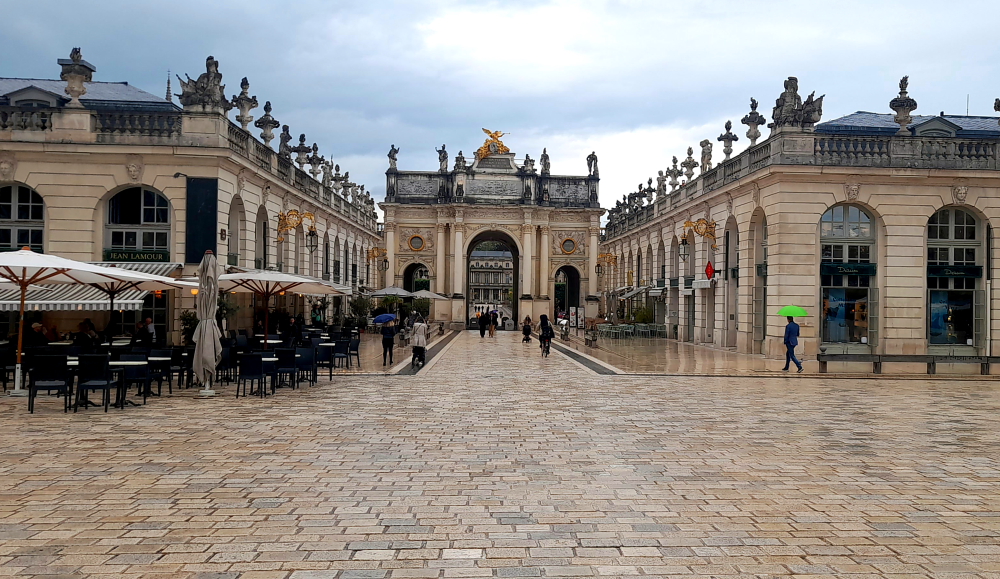
Porte Here, Place Stanislas, Nancy.

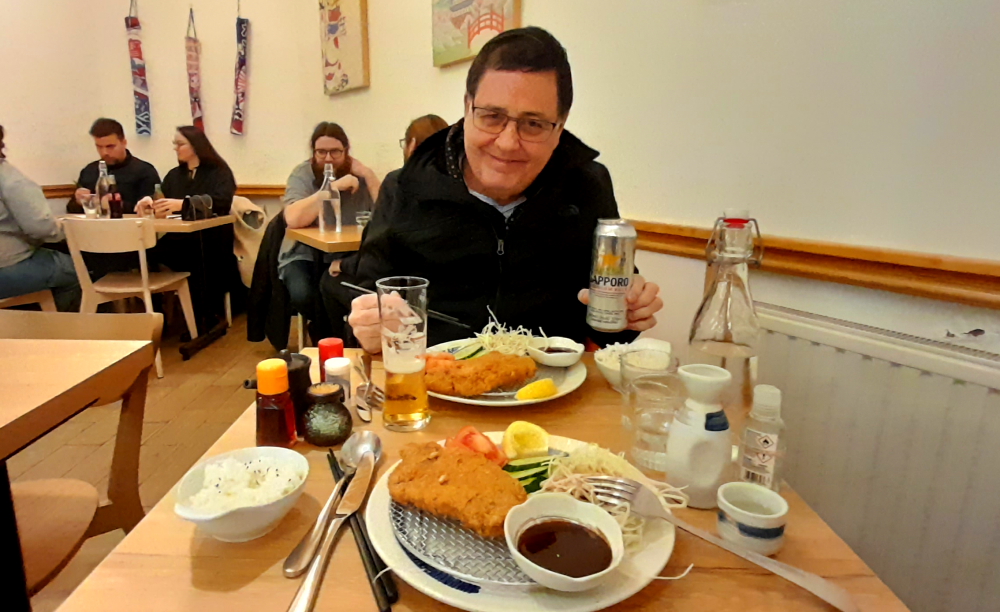
That’s enough sightseeing for today. As we are close to the Square there are lots of cafes, bars and restaurants nearby. But, as we are in France, most won’t open until 7:00 pm. Fortunately, we come across “Nagoya”, a Japanese restaurant, that is open and have a great meal there.

Tomorrow we’ll follow one of the 3 trails marked on the city map – the Historic Centre Trail.

8 May, 2024

Today is a national holiday in France – VE Day, Victory in Europe Day – its 79th anniversary. It celebrates the formal acceptance by the Allies of WWII of Germany’s unconditional surrender of its armed forces on Tuesday, 8 May 1945 and it marked the official end of WWII in Europe in the Eastern Front.

Apparently there are no formal celebrations today, just a day off. All that we see are 4 flags flying over the entrance to the Town Hall – one each for France, USA, Poland and Britain.
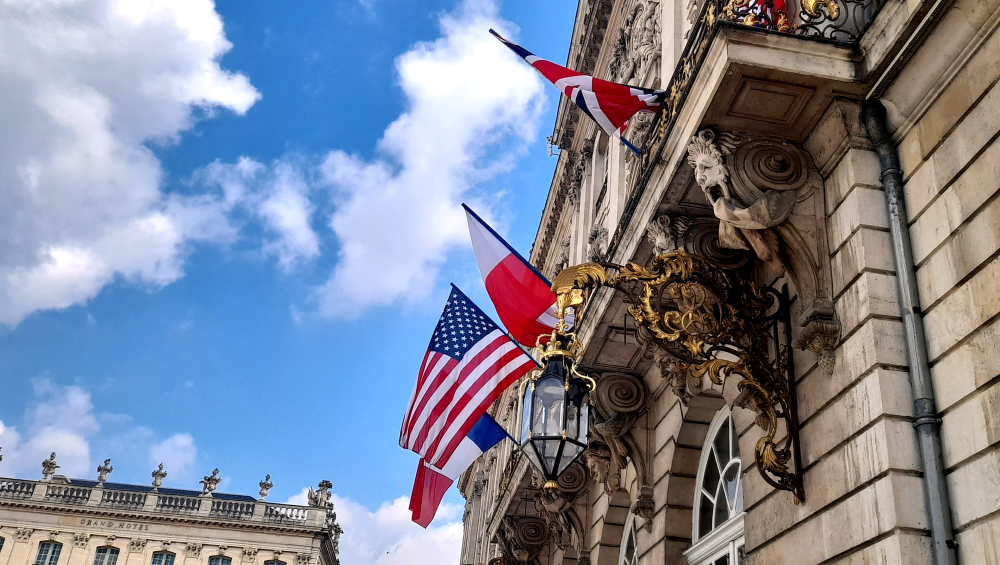
8 May flags at the Town Hall, Nancy.

Our Historic Centre Trail starts at Place Stanislas. Stanislaw had this square built in honour of Louis XV, his son-in-law, and it’s still the jewel in Nancy’s crown. The square measures 106 by 124 metres.

Crafted by Jean Lamour, the skilled locksmith in Stanisław Leszczyński’s court, the six gilded wrought-iron gates adorning the square’s entrances have bestowed upon Nancy the endearing epithet of the Golden Doors City or La Ville aux Portes d’Or [travelfranceonline.com].
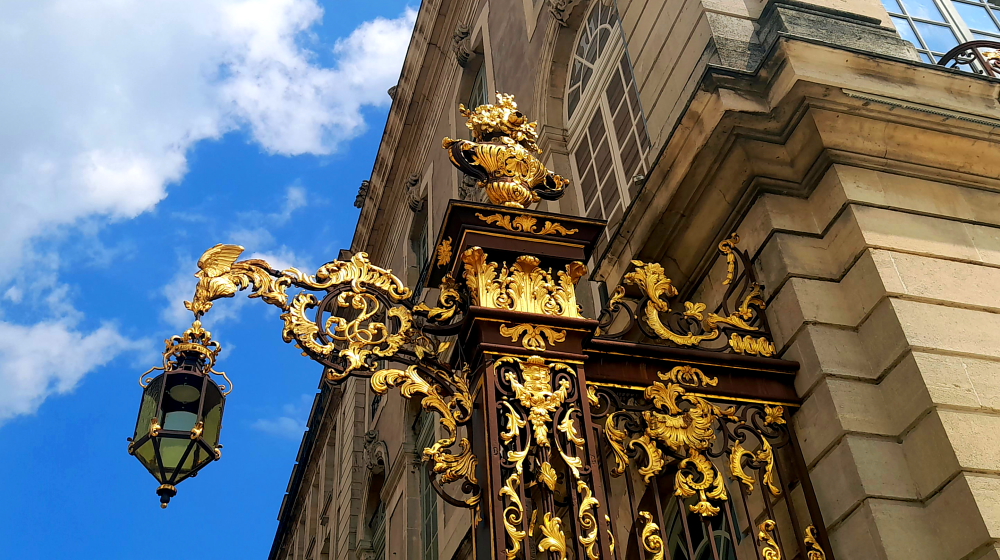
Detail of one of the entrance gates to Place Stanislas.

The City Hall occupies the whole of the south side of the square. The Lorraine Opera and the Grand Hôtel de la Reine are on the east side, opposite the Fine Arts Museum. To the north are two single-story buildings known as the Basses Faces. The classical architecture of the square is set off by the gilded wrought-iron gates created by Jean Lamour, and the ornate fountains [nancy-tourisme. fr].

From the statue in the square’s centre we walk down Rue Here to the rather impressive Porte Here. Inspired by that of Septimius Severus of Rome, the triumphal arch glorifies the King of France Louis XV represented in portrait on a medallion at the top of the building. Called today “Arc Héré”, its name recalls the architect Stanislas to whom we owe this monument which was to form the link between the Place Royale (current Place Stanislas) and the Place de la Carrière.
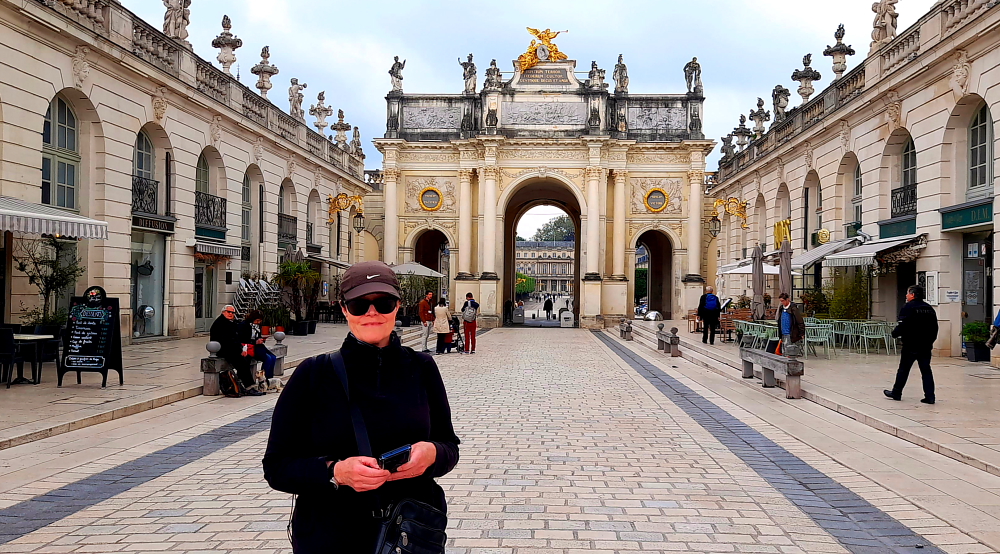
Arc Here, Nancy.

An extension of Place Stanislas, the Place de la Carrière is, in fact, a medieval square, located in the old town and was used for horse training and tournaments. In the 18th century the Palais du Gouvernement was built for the intendant, or representative of the French Government.
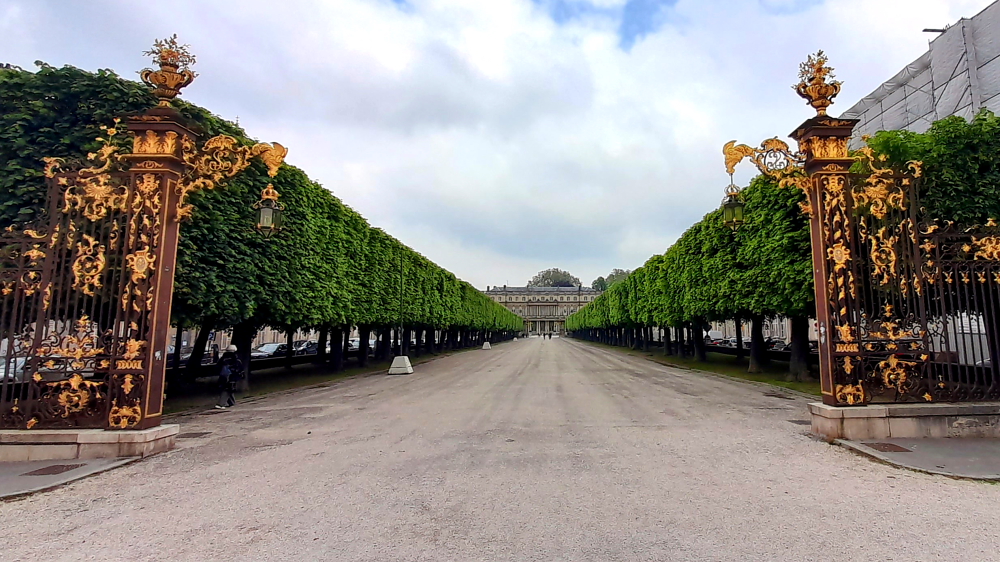
Place de la Carriere, Nancy, with the Palais du Gouvernement in the distance.

Forming a semi-circle, it closes off the far end of the square, completing the view from the City Hall. Stanislaw’s architect, Emmanuel Héré, remodeled all the façades of the square and built town houses in the corners. Four rows of trees run the whole length of the square, which is also decorated with small fountains featuring cherubs.
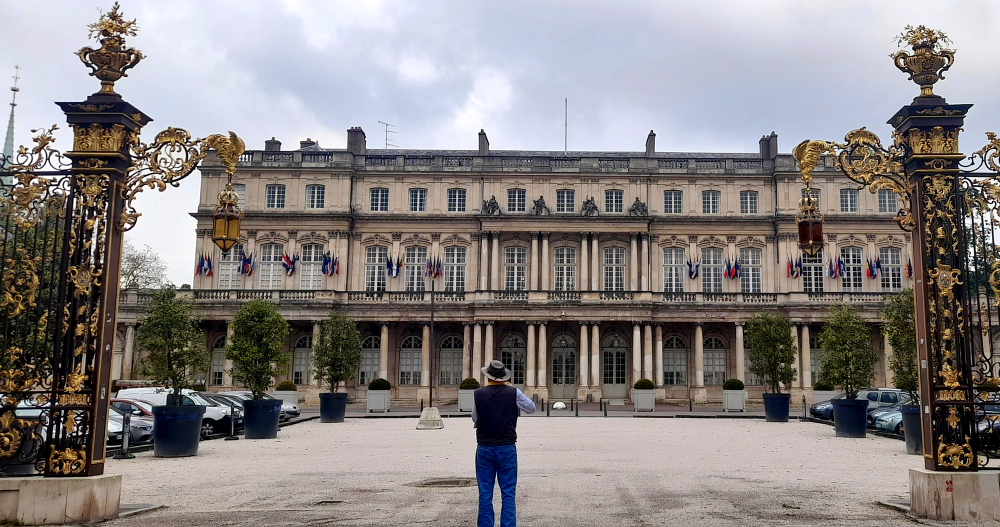
Palais du Gouvernement, Nancy.

Place de la Carrière marks the passage to the old town, and leads to the Palace of the Dukes of Lorraine [nancy-tourisme.fr].
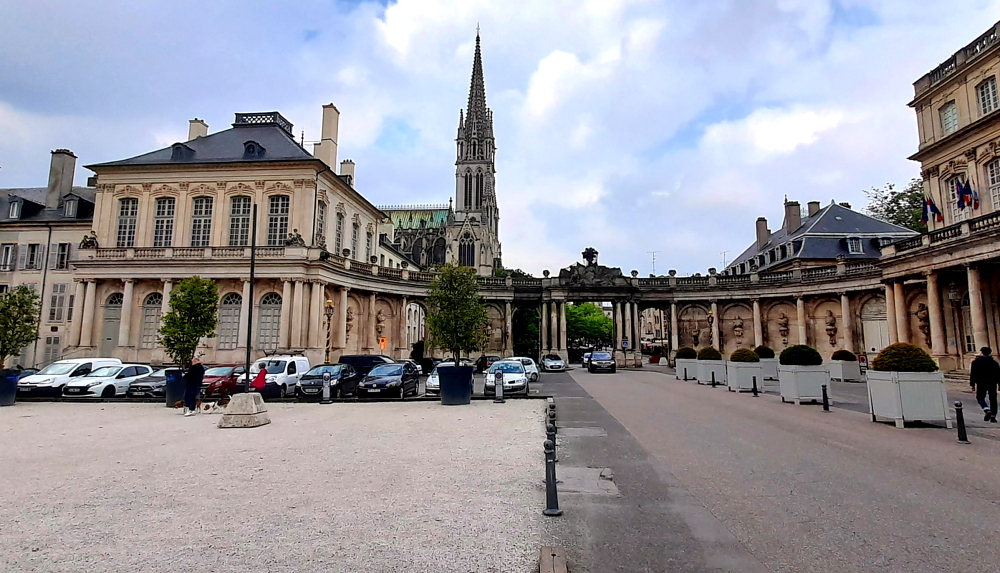
Place Joseph Malval leading to the Basilica Saint-Epvre, Nancy.

But first we walk past the Basilica Saint-Epvre, but unfortunately it’s closed today. The Saint Epvre basilica was built in the 19th century by Prosper Morey, Prix de Rome architect, in the neo-Gothic style. The work was carried out between 1864 and 1871 by numerous European workshops: glass roofs in Austria and Metz, woodwork in Bavaria, and bells cast in Budapest in particular [nancy-tourisme.fr].
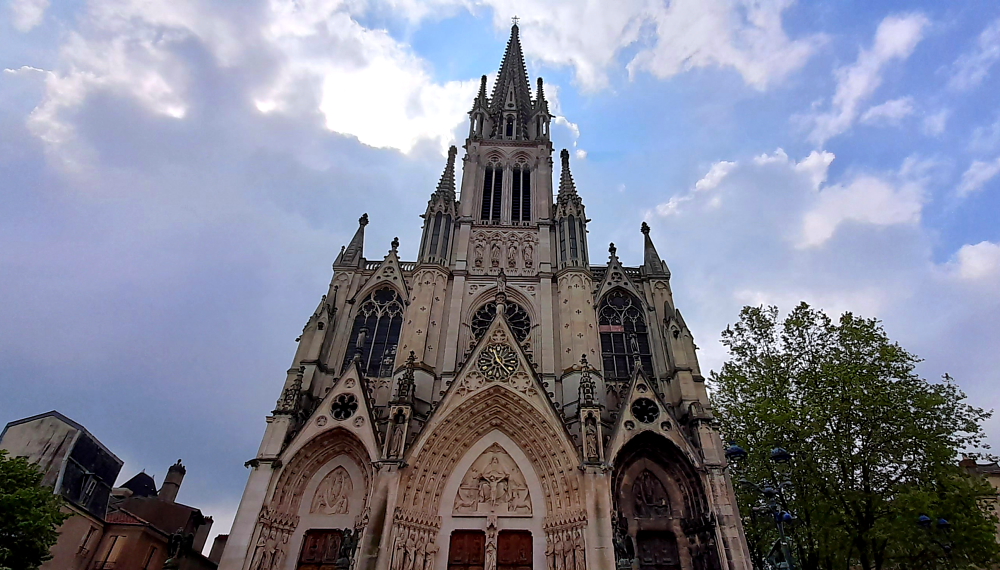
Basilique Saint-Epvre, Nancy.

Also closed is the Palace of the Dukes of Lorraine (Palais Ducal), aka the Museum of Lorraine on Grande Rue, due to renovations.
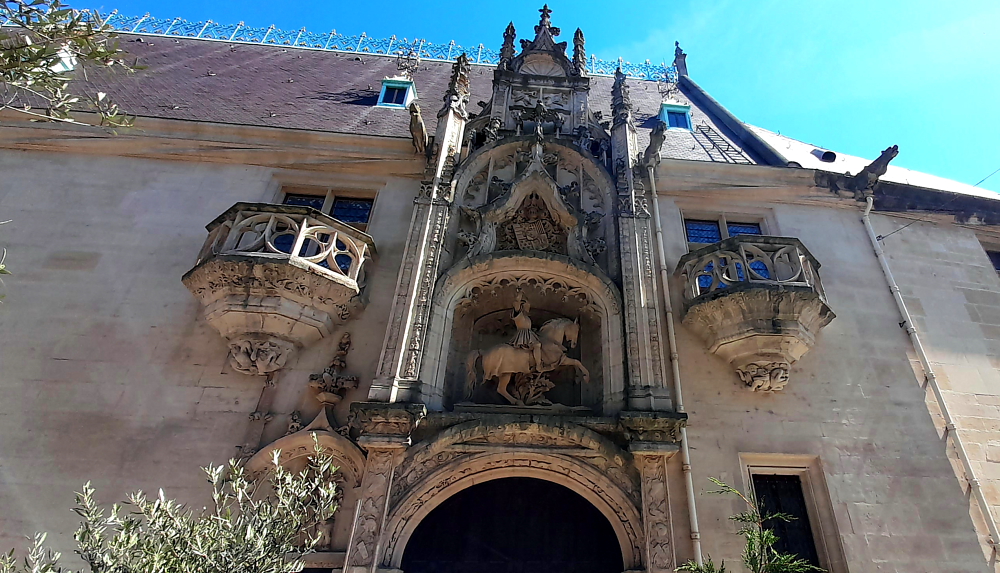
Statue of Duke Antony of Lorraine, (16th c.) – Porterie, main gate, Palais Ducal, Nancy.

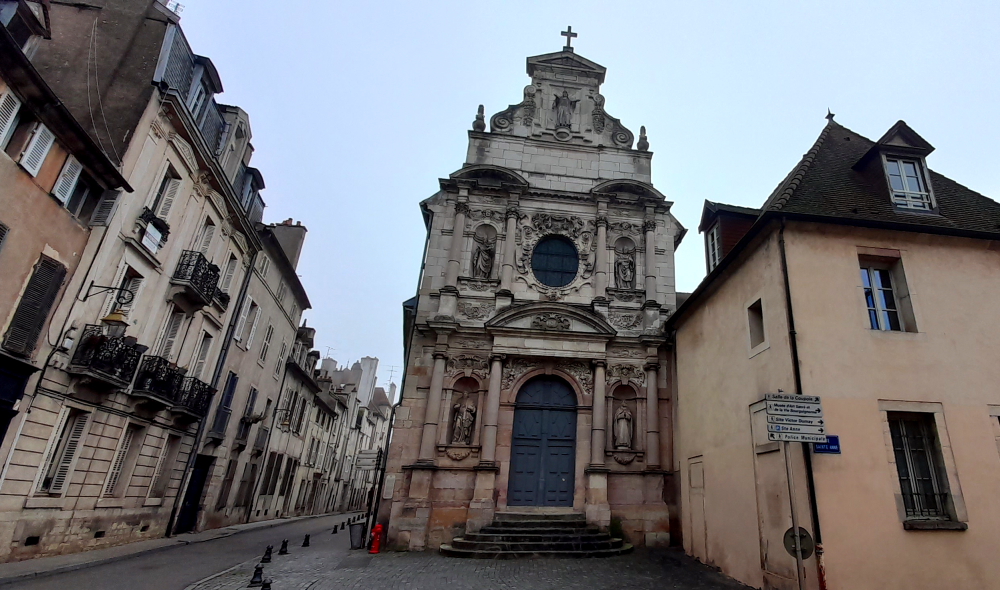
But, the nearby Church and Convent of the Cordeliers and its Funerary Chapel of the Dukes of Lorraine, is open. Today it is more a museum than a church.
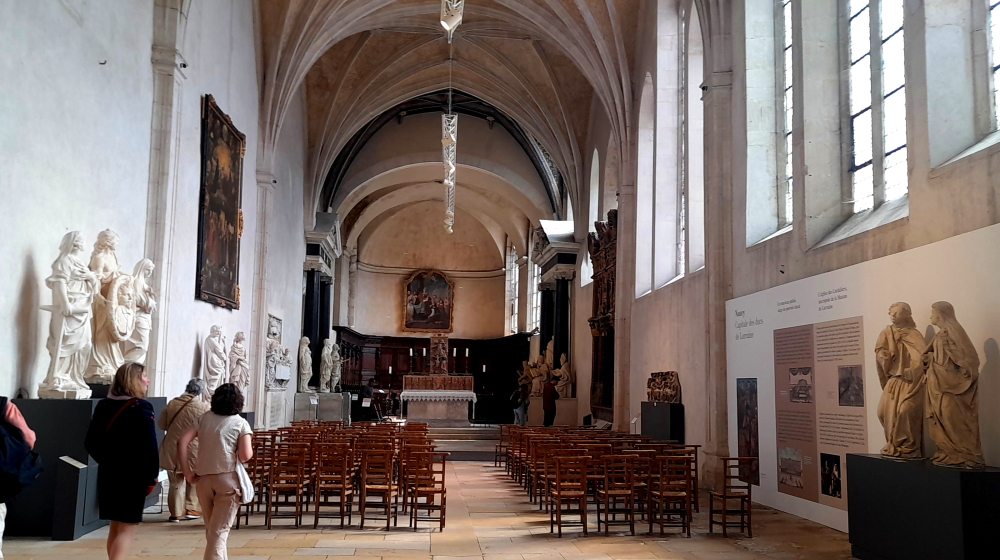
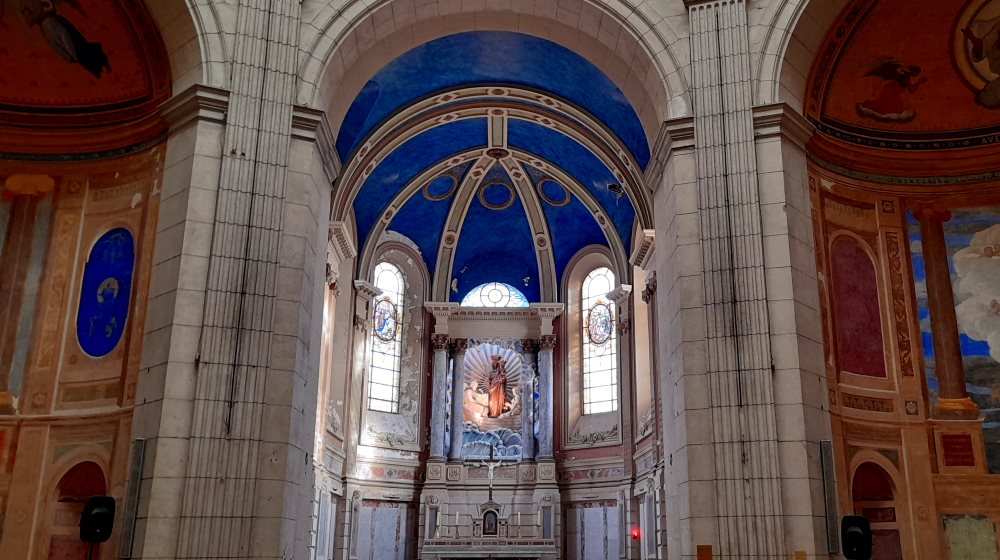
Inside the Chapel of the Cordeliers, Nancy.

Eglise de Cordeliers is named after the Franciscan Order whose members wore a cord around their waist. It was built in the 15th century by order of Duke René II, following the Battle of Nancy of 1477. Lorraine’s Saint-Denis (burial place of some of France’s famous kings), in spite of incurring damage through the ages, it still has some remarkable tombs. The chapel, inspired by that of the Medici’s in Florence, is outstanding and belongs to the Lorraine museum [nancy-tourisme.fr].
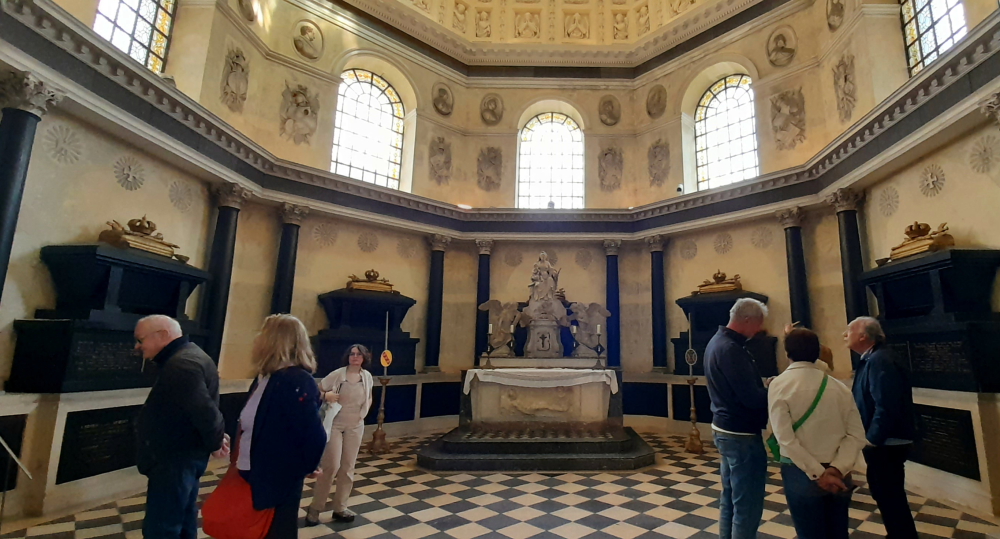
Interior Funerary Chapel.

Unlike the Danish Royal Family who had individually-designed sarcophagi, each of these 5 is exactly the same.
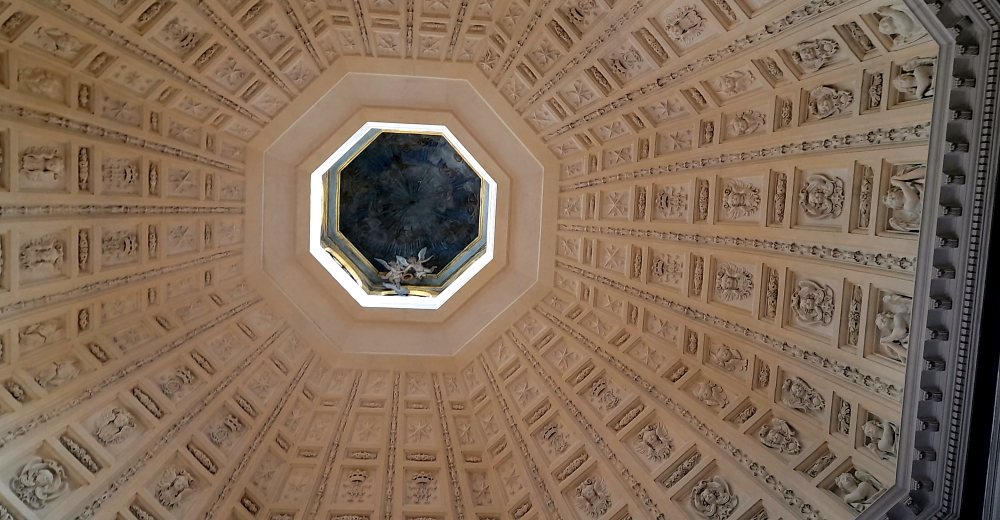
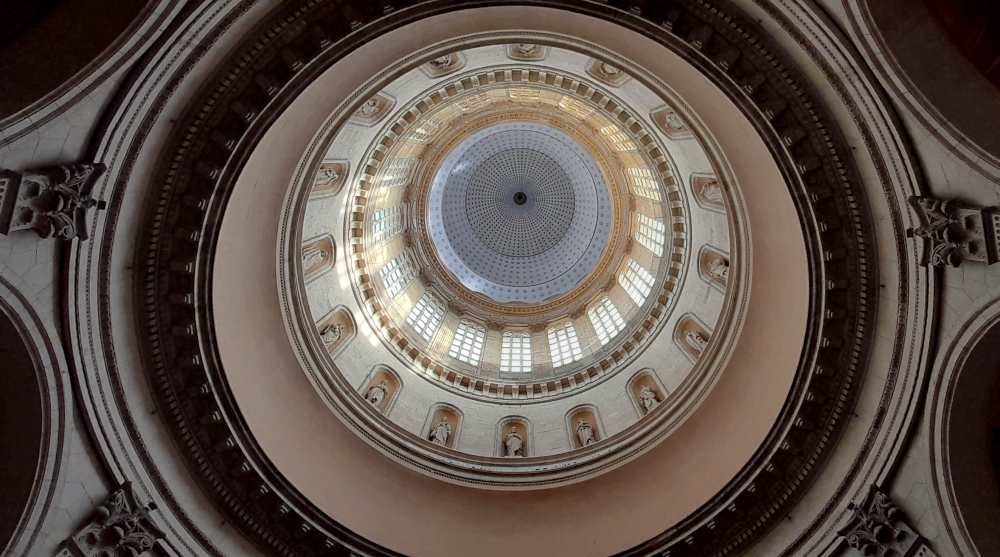
Detail of the dome’s interior, the Funerary Chapel of the Dukes of Lorraine, Nancy.

From here we continue down Grande Rue until we come to the superb Porte de la Craffe.
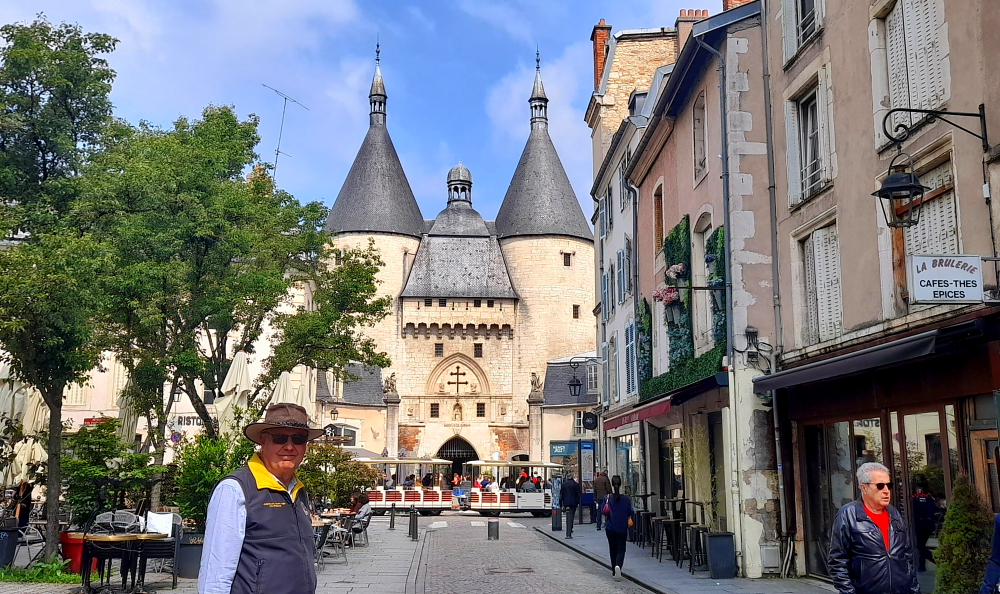
Porte de la Craffe, Nancy.

It is the oldest monument in the historic center of Nancy and the only vestige of the medieval fortifications. A symbol today of the Old Town district, it was built in the 14th and 15th centuries and its towers served as a prison until the 19th century. Its extensive brick and stone vault was restored in 2013 [nancy-tourisme. fr].
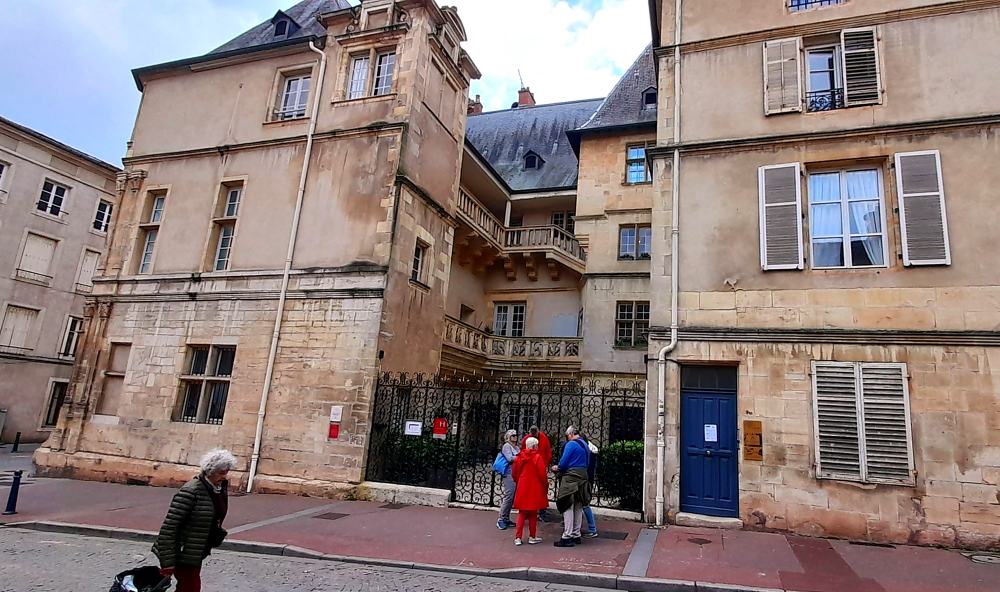
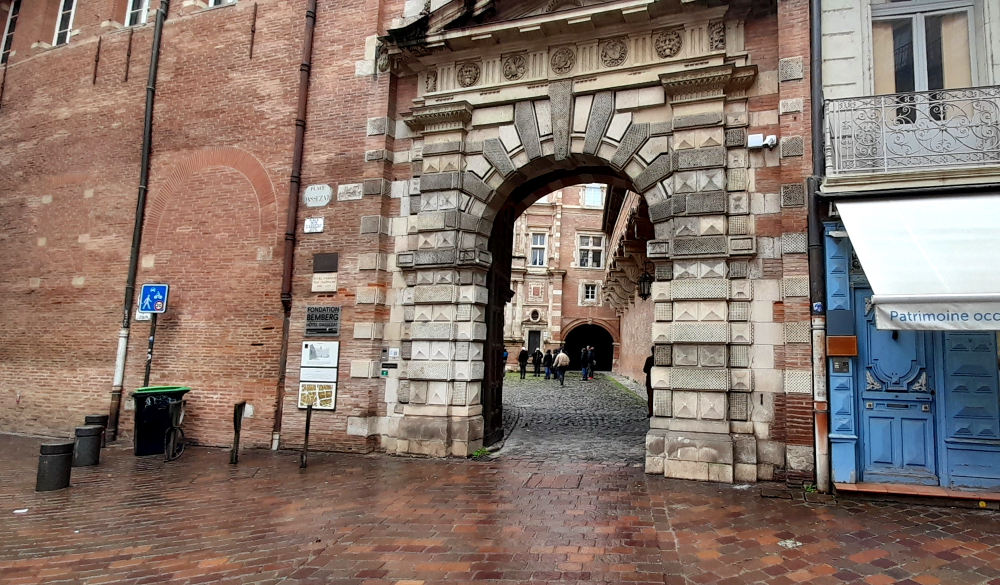
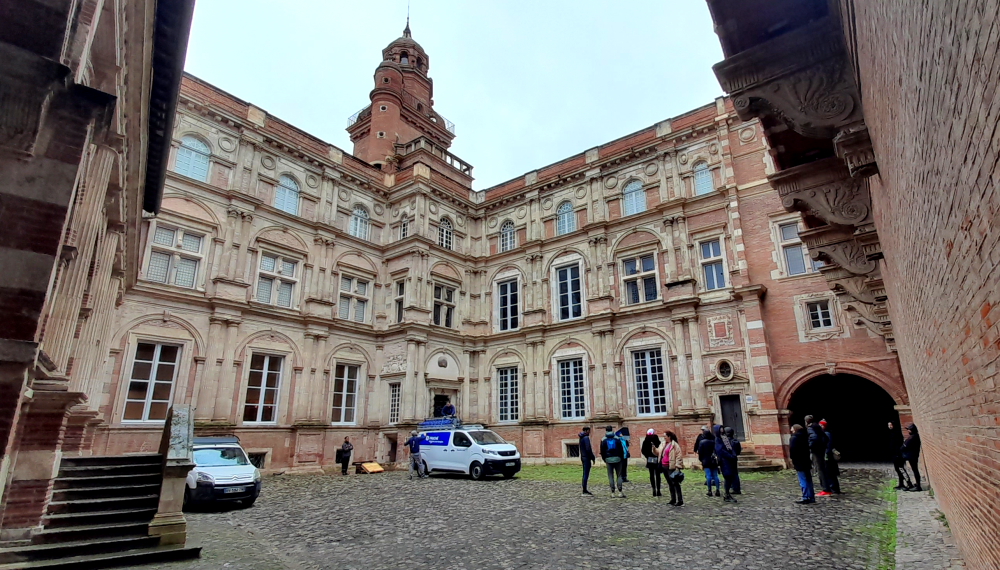
Hotel D’Haussonville, Nancy.

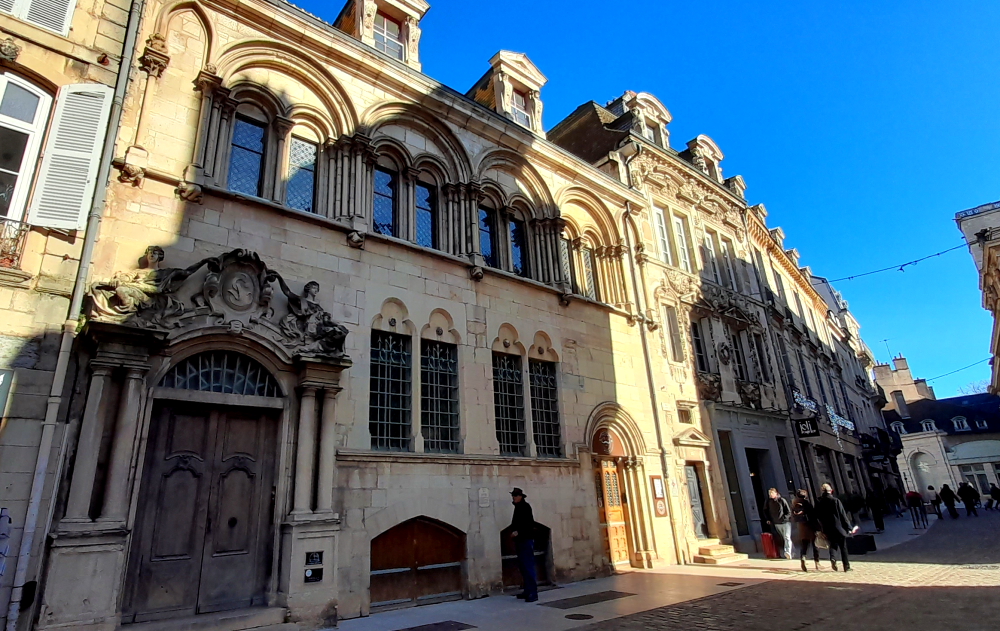
We partly retrace our steps until we come to the Hotel D’Haussonville. It was built between 1528 and 1543 by Jean d’Haussonville, Seneschal of Lorraine. A courtyard opens onto rue Monseigneur-Trouillet and has several ornate galleries, one of Gothic inspiration, the second Renaissance. This private mansion is one of the finest Renaissance examples in Nancy, along with the Palace of the Dukes of Lorraine and the Hôtel de Lillebonne. It was transformed into a 4-star hotel by Laurence and Jean-Claude Capelli in 2003 offering 3 rooms and 4 suites.
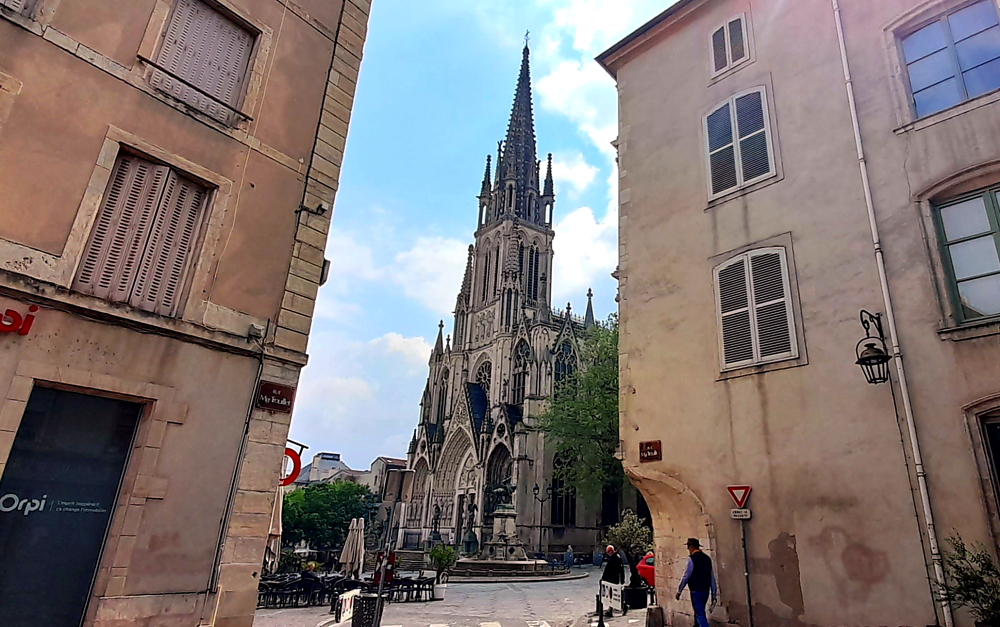
Place Saint-Epvre & its Basilica, Nancy.

Continuing along Rue Monseigneur-Trouillet brings us to Place Saint-Epvre. A former market square, it is the main square of the Old Town district, known for its terraces and which owes its name to the basilica which borders it. At its centre is the statue of Duke René II, victorious during the Battle of Nancy.
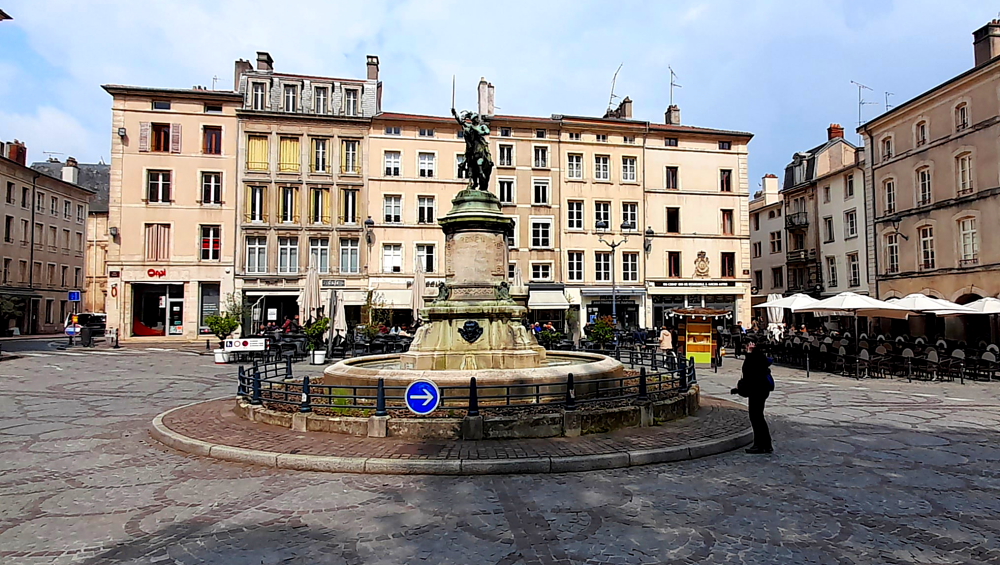
Statue of Duke Rene II, Place Saint-Epvre, Nancy.

Walking SW we come to the Esplanade du Souvenir Francais (Esplanade of French Remembrance) and the gold-tipped Obelisque de Nancy at its southern end at Place Carnot. Also known as the Carnot monument, it was inaugurated in 1896, paying tribute to Sadi Carnot, President of the French Republic who was assassinated 2 years earlier by the anarchist Caserio.

Its construction was financed by public subscription – 28,000 people, as well as 865 municipalities of Lorraine, no less. Its ornaments were removed and melted down during WWII, as part of the mobilization of non-ferrous metals. In 2016, new enameled lava plaques were inaugurated. Like the originals, they are dedicated to President Carnot, Grand Duke Constantine of Russia, the city of Nancy and the three Lorraine departments of the time.
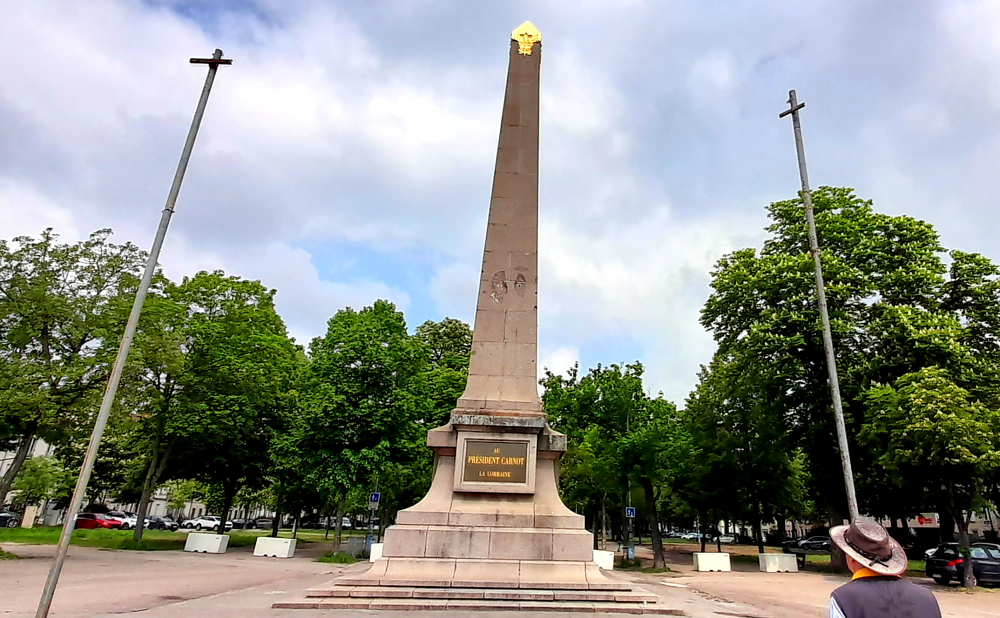
Obelisque de Nancy.

Next stop is another gate, Porte Stanislas. This gate, as well as the Sainte-Catherine gate, is part of Stanislas’s urban plan. It was built in Doric style by the architect Richard Mique in 1761 to replace an arch initially created by Emmanuel Héré [nancy-focus.com].
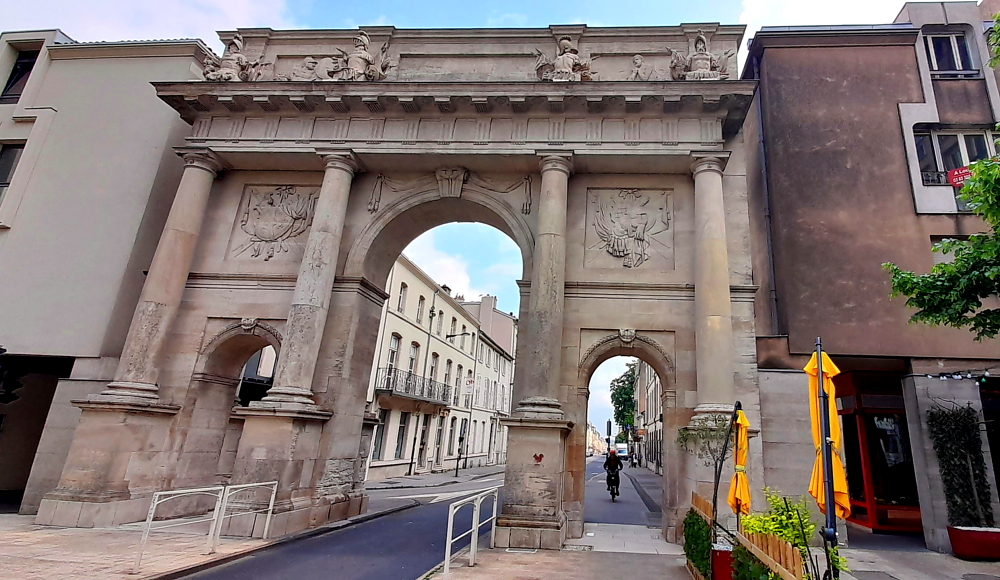
Porte Stanislas, 1752-1762.

Just down the road on Rue Mazagran is the Brasserie L’Excelsior, one of the most famous examples of Art Nouveau in Nancy. The Art Deco extension and Jean Prouvé bannister combine very well with the décor of the main room which was inaugurated in 1911. The Excelsior was founded by Louis Moreau in order to create a luxury showcase for the beer of his brewery, the Brasserie de Vézelise [nancy-tourisme.fr].
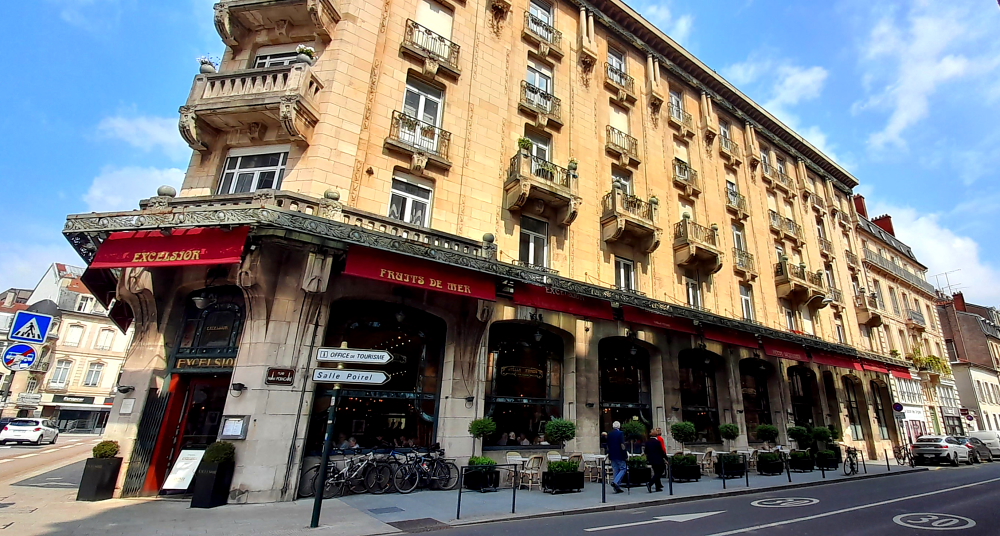
Brasserie L’Excelsior, Nancy.

Across the road is the Nancy Train Station and behind it, the Église Saint-Léon de Nancy towers.
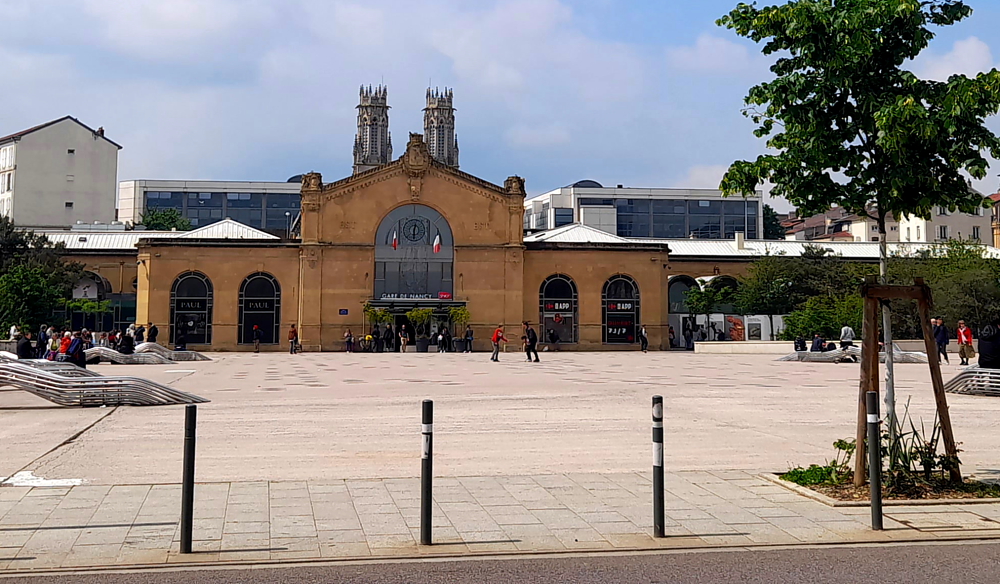
Gare de Nancy.

From here we return to the hotel. Not long after, Lynn decides to go out to see a number of other locations, the 1st of which is another gate, the Memorial Desilles, that is at the other end of Place Carot, where the obelisk is located.

Built between 1782 and 1785 at the request of Marshal de Stainville, commander of the province, in order to create an opening in the city’s granting wall in the direction of Metz, the Porte Désilles, then called Porte Saint-Louis, or Stainville , originally celebrated the engagement of King Louis XVI in the American War of Independence (1775-1783), as well as the economic and maritime prosperity that resulted from this alliance. It was the birth, on 22 October, 1781, of the Dauphin Louis Joseph of France, son of Louis XVI and descendant of the last Duke of Lorraine, who presided over the decision to build this monument.

A few years after its construction, in 1790, the Porte Saint-Louis was the scene of an event known as the Nancy Affair. The regiments then garrisoned in Nancy mutinied, because they no longer received their pay, and their revolt was severely repressed by the troops of the Marquis de Bouillé. During this fight, André Désilles, a 23-year-old lieutenant of Saint-Malo, intervened between the units and was seriously injured. He died the following October 17, his wounds having become infected. It was only in 1867 that the Saint-Louis gate took the name of Désilles, whose sacrifice became a symbol of union and devotion.
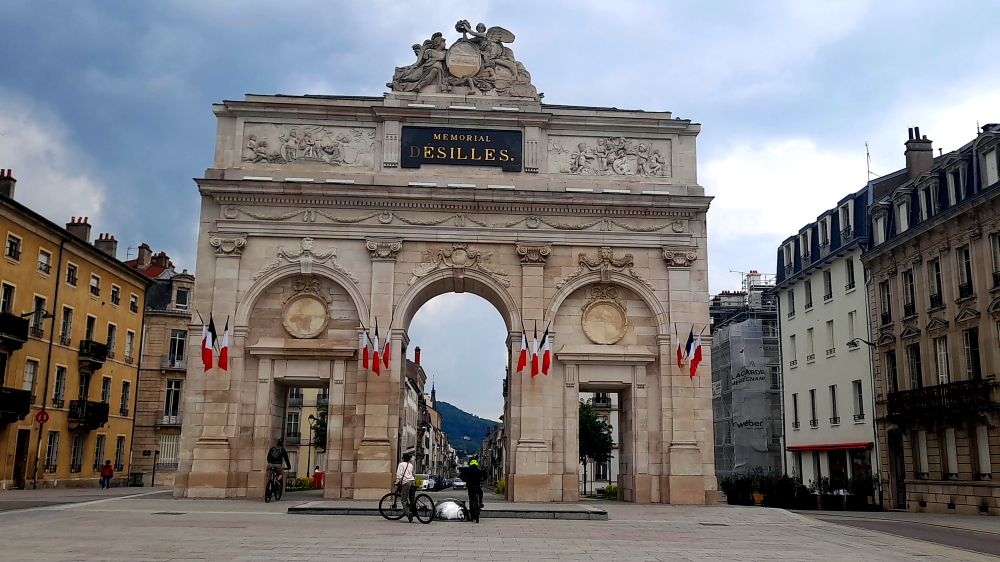
Memorial Desilles, Place de Luxembourg, Nancy.

In 1976 the building became the Monument of Remembrance. The gate then became the city’s main place of commemoration and was consecrated as such by a ceremony which took place on the following November 25, in the presence of President Valéry Giscard d’Estaing.

Next on her list is the nearby Parc de la Pepiniere (Nursery Park). Located in the heart of the historic centre, the Park offers a haven of greenery with its 21 hectares of wooded areas and its rose garden.
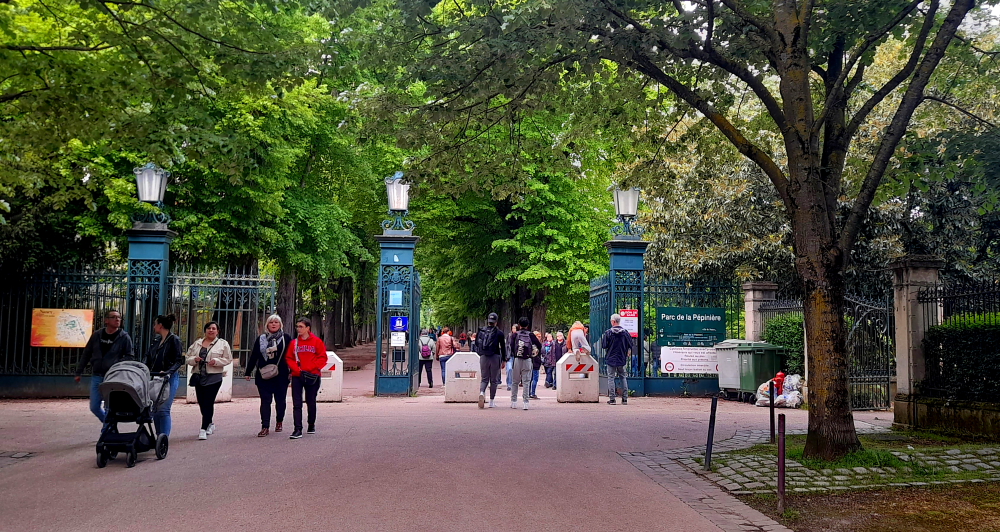
Place de Nelson Mandela entrance to Parc de la Pepiniere, Nancy.

A former royal nursery founded by Stanislas on the site of the former ducal gardens and bastions of the Old Town, it was transformed into a public park in 1835 while retaining its initial layout. The park offers numerous leisure activities: an animal area, a mini golf course, a playground, a puppet theater, several restaurants, children’s rides, as well as numerous sports fields (football, basketball, pétanque, etc.)

People who have been living in Nancy for decades remember the time when the animal enclosure used to be home to bears, lions, monkeys and kangaroos. Children loved giving dry bread to the deers and throwing peanuts to the bears. Exotic animals are no longer kept in the Pépinière, however many peacocks, ducks, white storks, swans, as well as donkeys and goats still wander around the park [frenchmoments.eu].
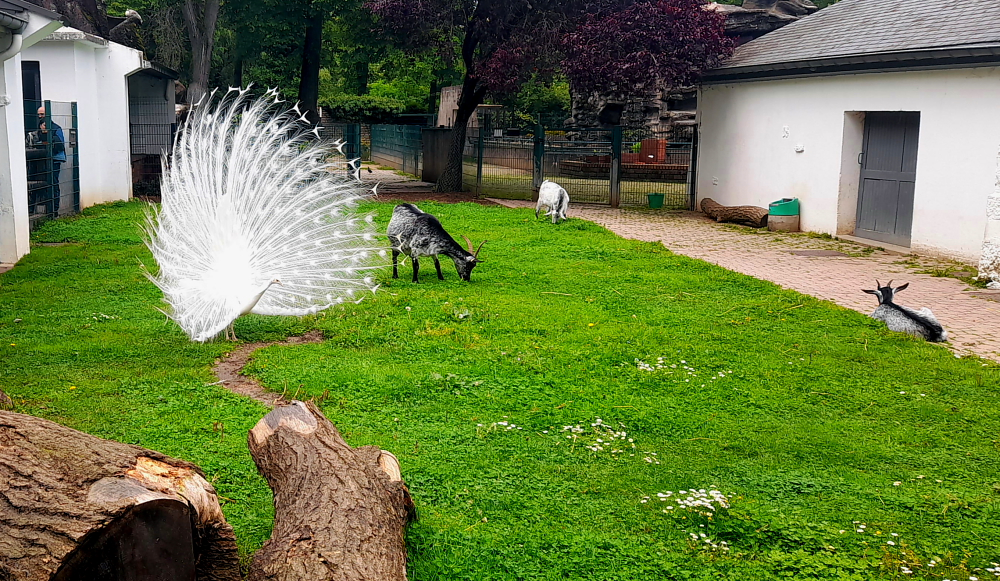
White peacock in the animal area of Parc de la Pepiniere, Nancy.

On the home stretch she calls by the statue of Jean d’Arc, located in the old town, Place La Fayette, an extension of Rue des Maréchaux. The most famous statue of Joan of Arc in Paris at Place des Pyramides is, in fact, a copy of that of Nancy installed in 1889.
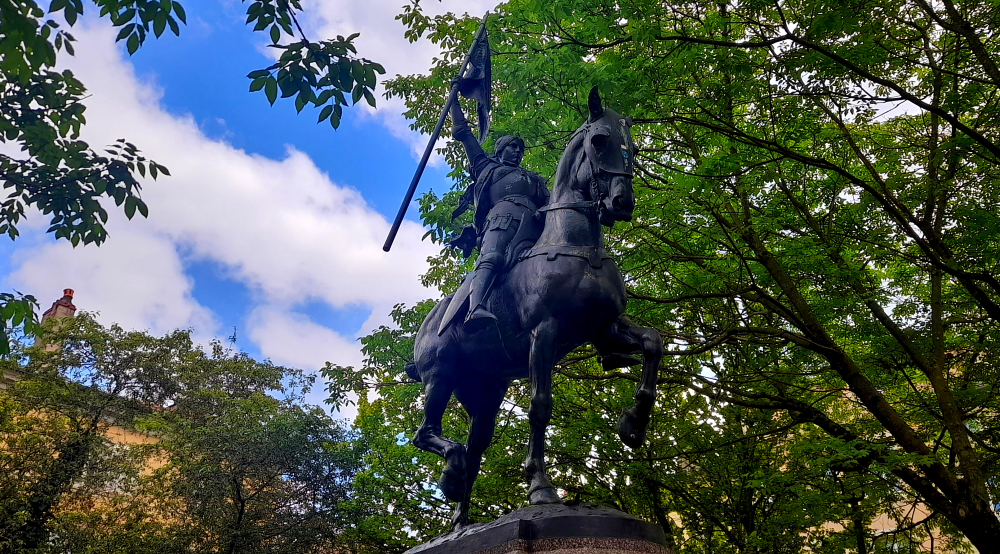
Jean of Arc, Place La Fayette, Nancy.

Another statue from the same mold flew the same year to Philadelphia and other replicas reached Lille, Compiègne, Saint-Etienne, Melbourne, Portland, New Orleans…In 1898, the sculptor Fremiet substituted his new statue, a replica of that of Nancy, for the old, discredited one at the Place des Pyramides in Paris.
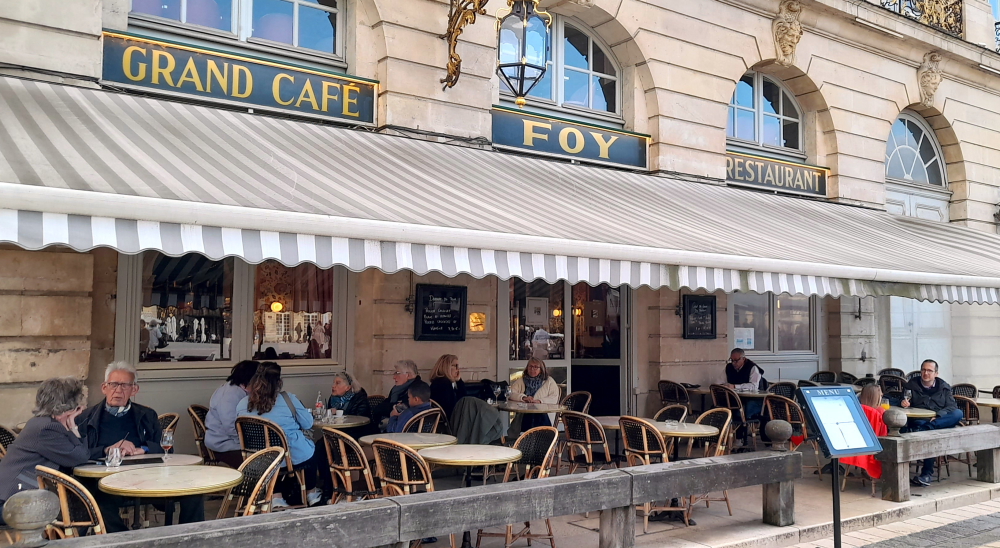
Grand Cafe Foy, Nancy.

This evening Yoanna, one of the hotel receptionists, has booked us a table at the Grand Cafe Foy on the Place Stanislas. I have lamb shank and Lynn orders Quiche Lorraine (when in Rome…).
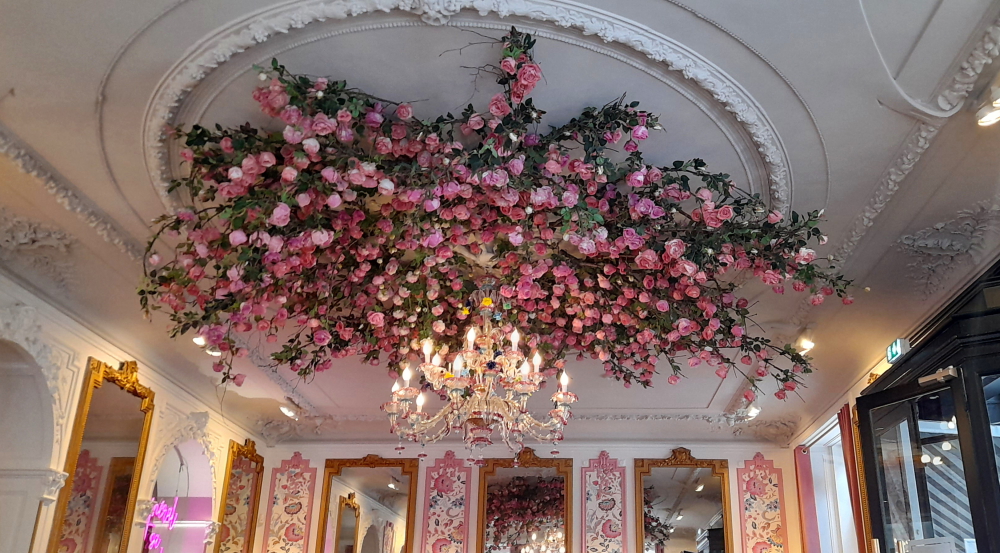
Interior centrepiece, Grand Cafe Foy, Nancy.

Plus we are very ably looked after by our waiter Eddy, well known by the staff at the Mercure. Delicious food and excellent, personalised service. It’s who you know!

9 May, 2024

Yesterday we walked the ‘orange’ Historic Centre trail. With today being another sunny day we plan to walk the ‘green’ Art Nouveau trail which is the longest of the 3.
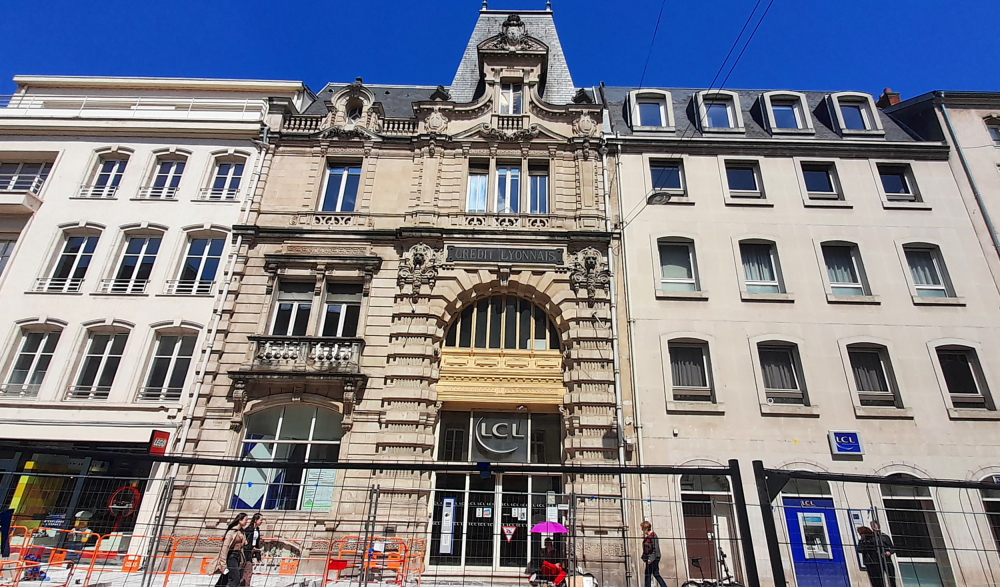
Credit Lyonnais, Rue Saint-Jean, Nancy.

We start out in front of the Credit Lyonnais on Rue Saint-Jean. The feature of this building is its monumental glass roof covering 250 square metres. One of the masterpieces of the Nancy School painter and glassmaker, Jacques Gruber, it lets light into the foyer of the bank.
Clematis wind around the imitation metal structure reproduced on the glass. The ‘CL’ monogram appears at its centre, in reference to the bank’s name. Sadly, the bank is closed today as it is another holiday, Ascension Day, so we only get to see the building’s exterior.

At the far end of the street, opposite Place Andre Maginot, is BNP Paribas. Actually it’s the building of the Banque Charles Renauld that is remarkable, built between 1908 and 1910. Since 1985, it has been a BNP Paribas agency.
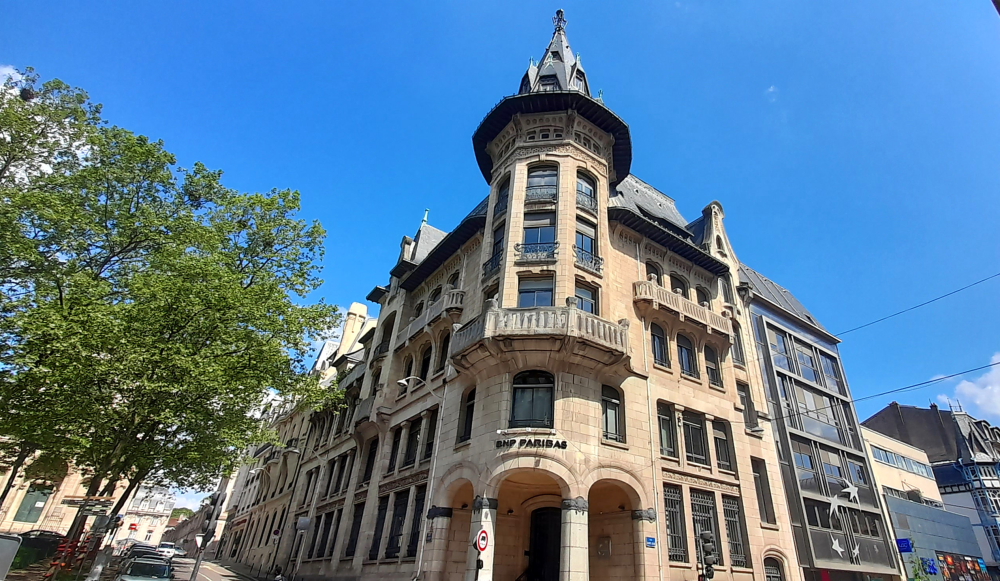
Banque Charles Renauld, Rue Saint-Jean, Nancy.

Charles Renauld, a financier originally from Rambervillers, and brother-in-law of Antonin Daum, became in 1881 co-owner of a bank founded in 1871. In July 1907, he decided to abandon his premises at 21 rue Saint-Dizier for an entirely new building, built in the Art Nouveau style.

Its architects are Émile André and Paul Charbonnier. The ironwork and furniture were made by Louis Majorelle, and the glass roofs by Jacques Grüber.
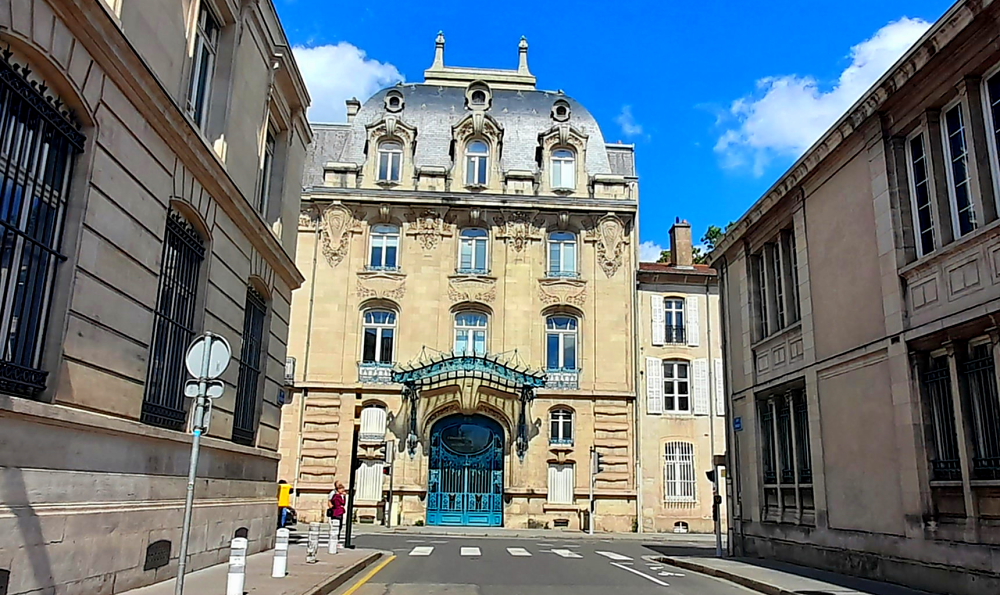
Chambre de Commerce et d’Industrie, from Rue Chanzy, Nancy.

250m away up Rue Chanzy is the Chambre de Commerce et d’Industrie Grand Nancy Metropole Meurthe-et-Moselle (!) building.
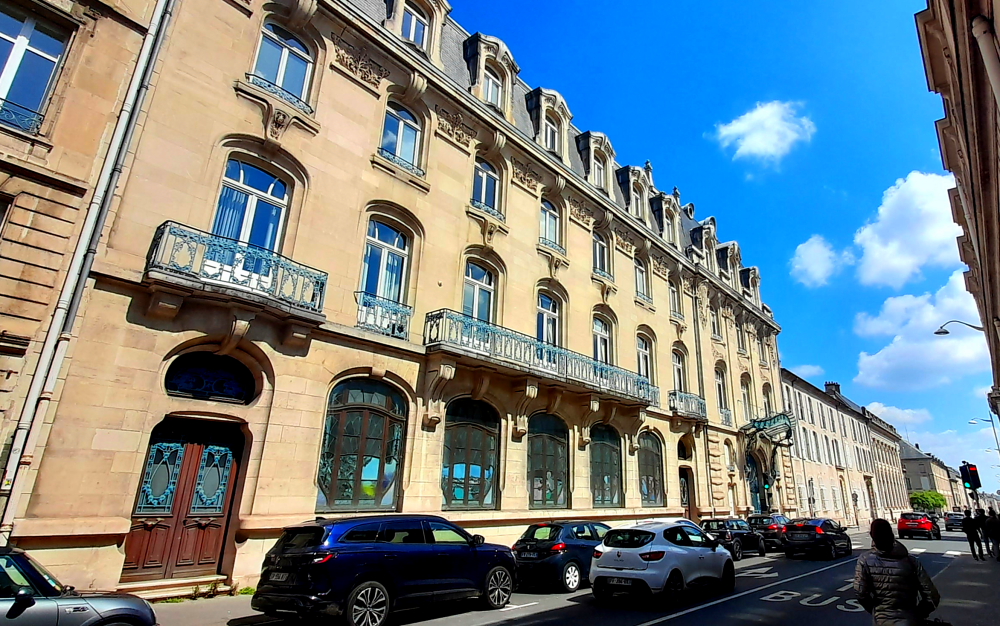
Chambre de Commerce et d’Industrie building from Rue Stanislas, Nancy.

One end of the building is visible from Rue Chanzy but once in Rue Stanislas, the full extent of the building is revealed, including the stained glass in the enormous ground-floor windows.

The next 2 sites, Brasserie L’Excelsior and the Cours Leopold/Place Carnot (obelisk) we’ve already seen so we give these a miss. But, by this time I’m getting bored so we abandon the other 5 Art Nouveau buildings and instead strike out across town towards the canal and walk part of the ‘blue’ trail, the Banks of the Meurthe River.

Walking in a westerly direction we arrive at Notre-Dame de l’Annonciation (Our Lady of the Annunciation) on Rue Saint-Georges, part of Nancy’s 18th century heritage.
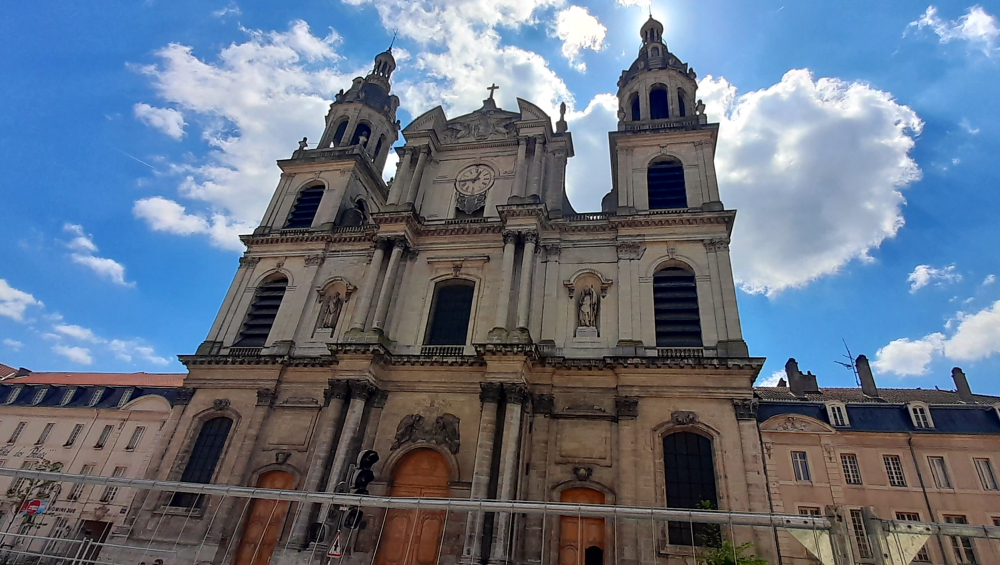
Cathedral of Notre-Dame de l’Annonciation, Rue Saint-Georges, Nancy.

The work of architects Giovanni Betto, Jules Hardouin-Mansart and Germain Boffrand, it was built at the beginning of the 18th century, during the reigns of Dukes Léopold and Stanislas. It has a dome painted by Claude Jacquard, paintings from the Lorraine School of the 17th and 18th centuries, and a listed organ. First primatial, then cathedral, since the creation of a bishopric in Nancy in 1777.
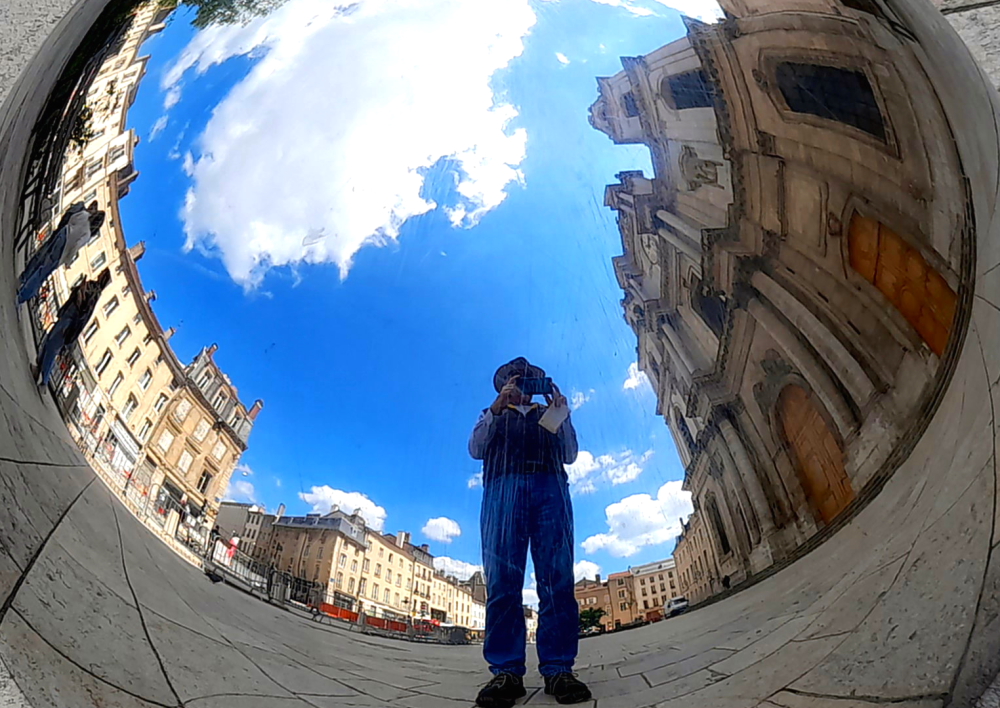
Keeping myself entertained while Lynn is inside the Notre-Dame.

From here we continue down Rue Saint-Georges, onto Place Colonel Driant and at the beginning of Avenue de XX Corps is the understated facade of the Porte Saint-Georges. Its name pays homage to the protector of the city.
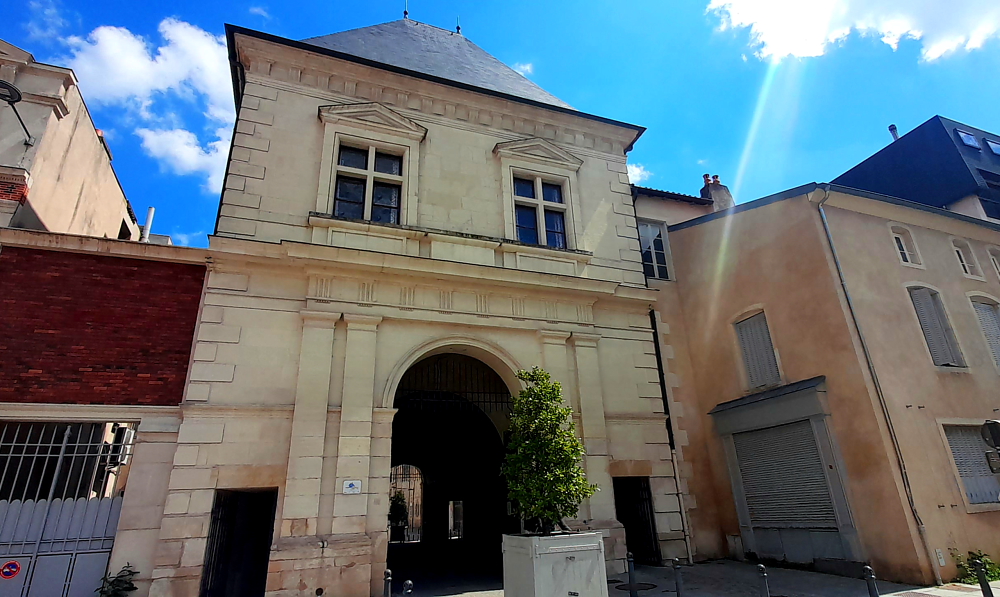
La Porte Saint-Georges, Av. de XX Corps, Nancy.

At the entrance a plaque reads: The Saint-Georges Gate was saved from demolition in 1878 thanks to the intervention of Victor Hugo. “All the cities of France would be proud of such a monument, I ask for its conservation.” Victor Hugo.

Unlike its facade, the inside vault is another matter with striking black diamond patterns in the red brickwork.
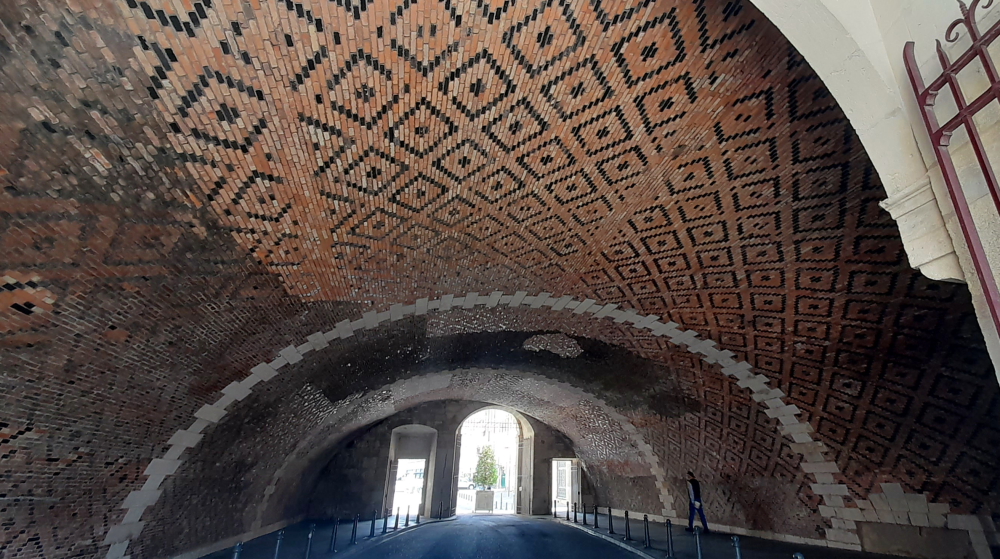
Interior vault of Porte Saint-Georges, Nancy.

And unlike its city facade, the ‘country’ facade has Saint-Georges represented on this side. Jean Richier and Simon Drouin are the two sculptors who worked on the remarkable decor of the building. Linked to the construction of the New Town, it was built between 1606 and 1619 in the Renaissance style. Its remarkable restoration dates from 2013 [nancy–tourisme-fr].
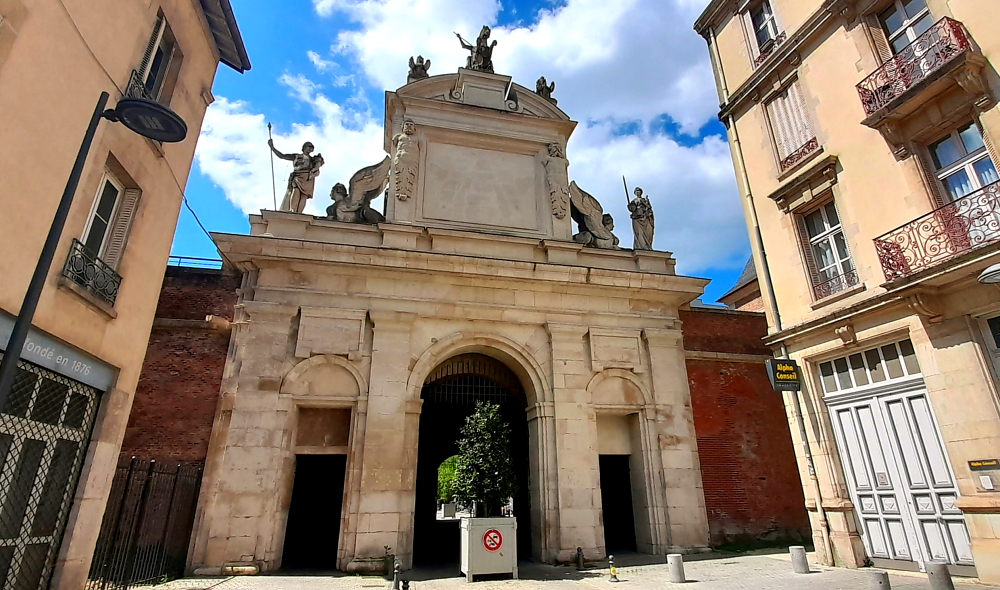
More ornate ‘country’ side of the door with St George on top.

In complete contrast, at the Avenue de XX Corps cross road with Quai Sainte-Catherine, just before the Canal, is a very modern building – an aparthotel constructed from scratch in September 2012 and operating in 2015.
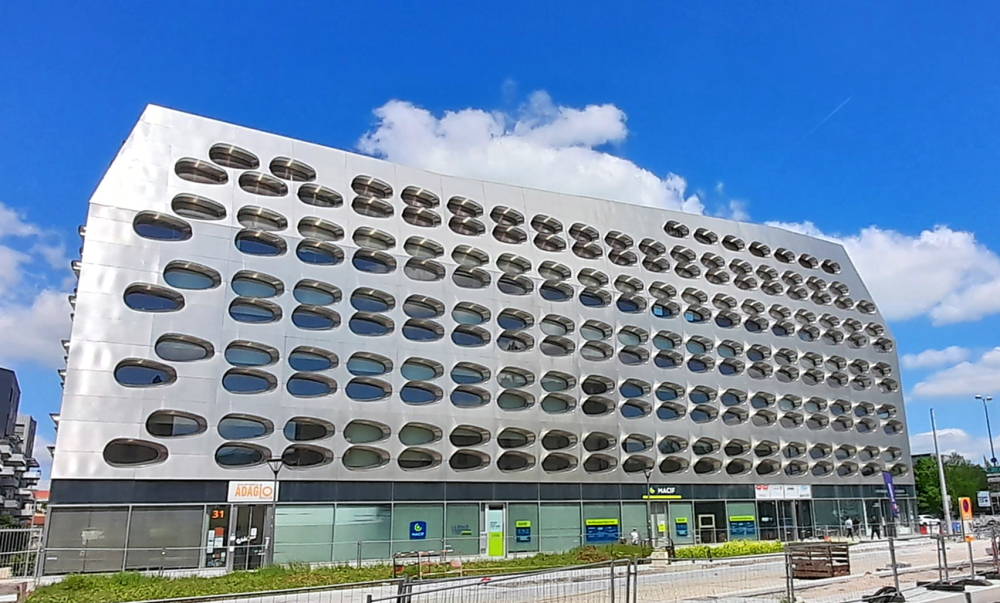
Adajio Aparthotel, Av. de XX Corps, Nancy.

At the junction of Quai Saint-Catherine and Rue Saint-Catherine is the Porte Saint-Catherine. This gate, as well as the Stanislas Gate, is part of the urban plan envisaged by Stanislas Leszczyński. Initially the gate was much closer to Place Stanislas. In 1768, it was moved 300 metres beyond the Sainte-Catherine barracks when it was completed in order to include it in the city wall.

It was built in 1761, Doric style, by the architect Richard Mique who also built the Sainte-Catherine barracks nearby. The door is dedicated to Stanislas’ wife: Catherine Opalinska, mother of the Queen of France Marie Leszczyńska.
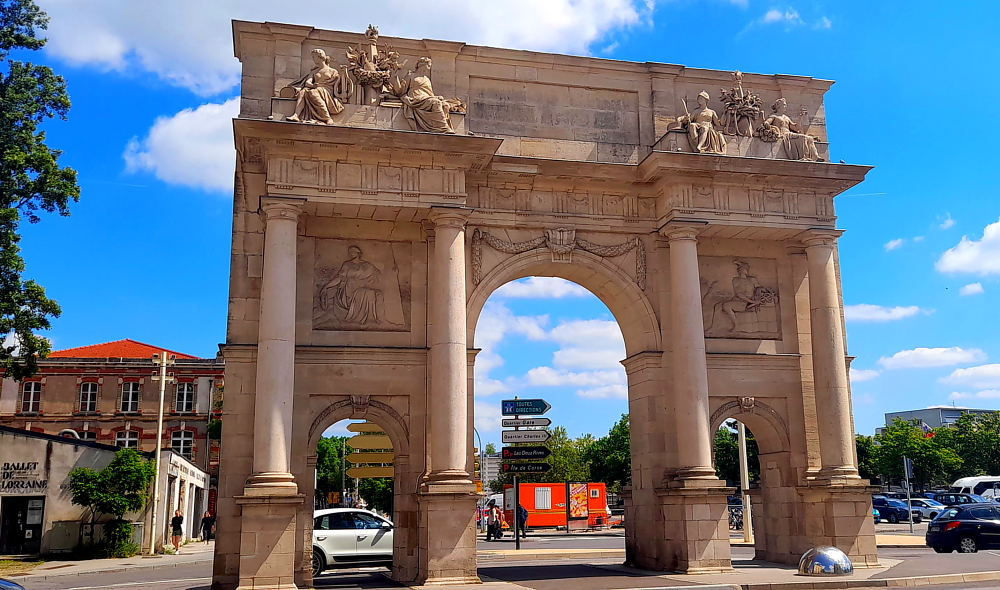
Port Saint-Catherine, Nancy.

We spend part of the afternoon downsizing, reducing the 5, large open bags that have been floating around in the car boot to 1, repacking most into our suitcases from whence the contents came.

At 7:00 pm precisely we front up at the Brasserie L’Excelsior. Lucy, one of the hotel receptionists, kindly offered to book restaurants for us for the next 3 nights. We are enchanted by its beautiful Art Nouveau interior of elegant plaster work moldings inspired by ferns …
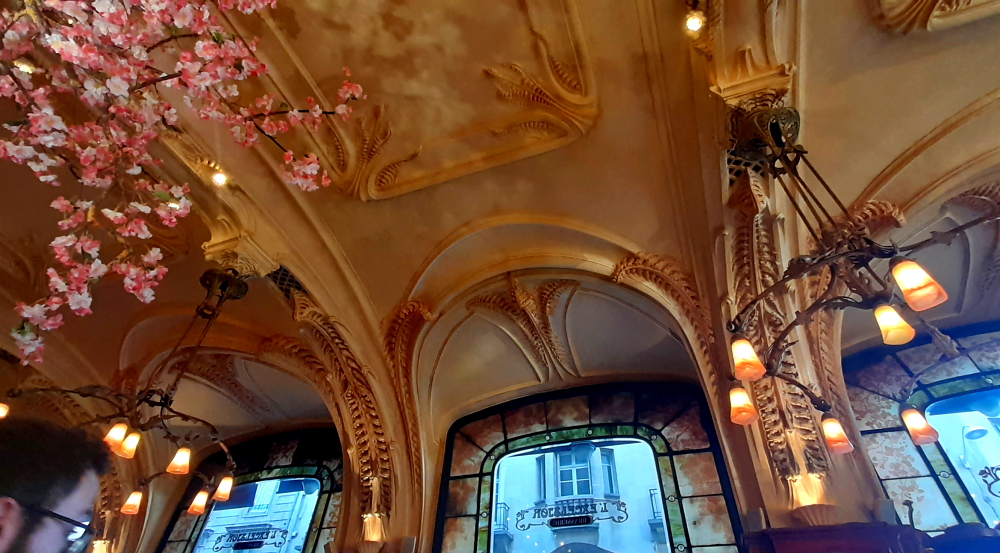
Brasserie L’Excelsior – Art Nouveau interior of fern-inspired moldings.

… and impressed by the excellent service provided by the army of waiters decked out in white shirts, black ties, vests and trousers, covered by long, white pinnies.
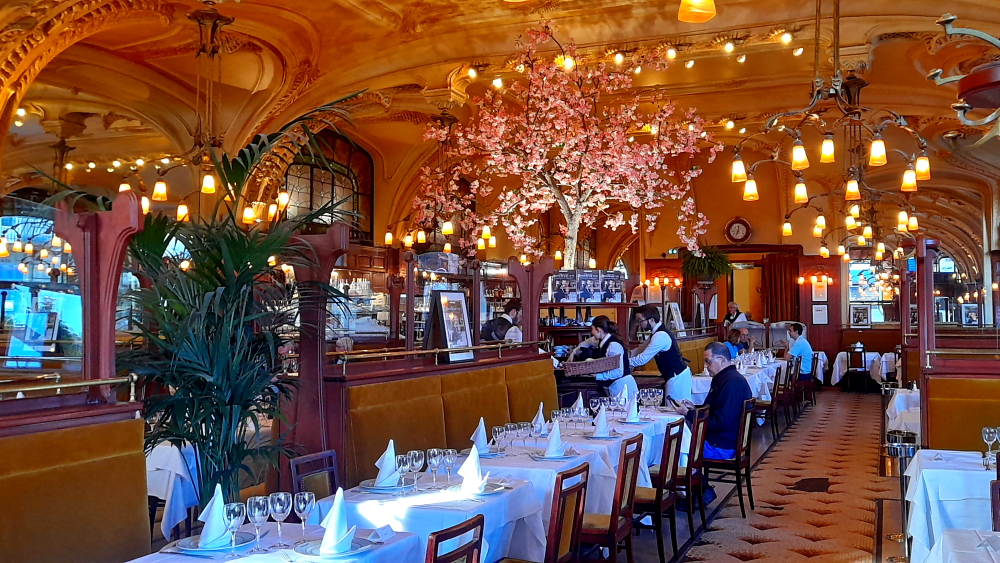
Brasserie L’Excelsior before the 8:00 pm scrum.

I order an entree of pate de foie gras and beef with bearnaise sauce and potatoes for mains – all delicious. Lynn orders salmon tagliatelle. We had been told by one of the Mercure staff about the Crepes Suzette here so Lynn orders some and we are treated to the waiter warming the crepes over a flame and dramatically setting them alight.
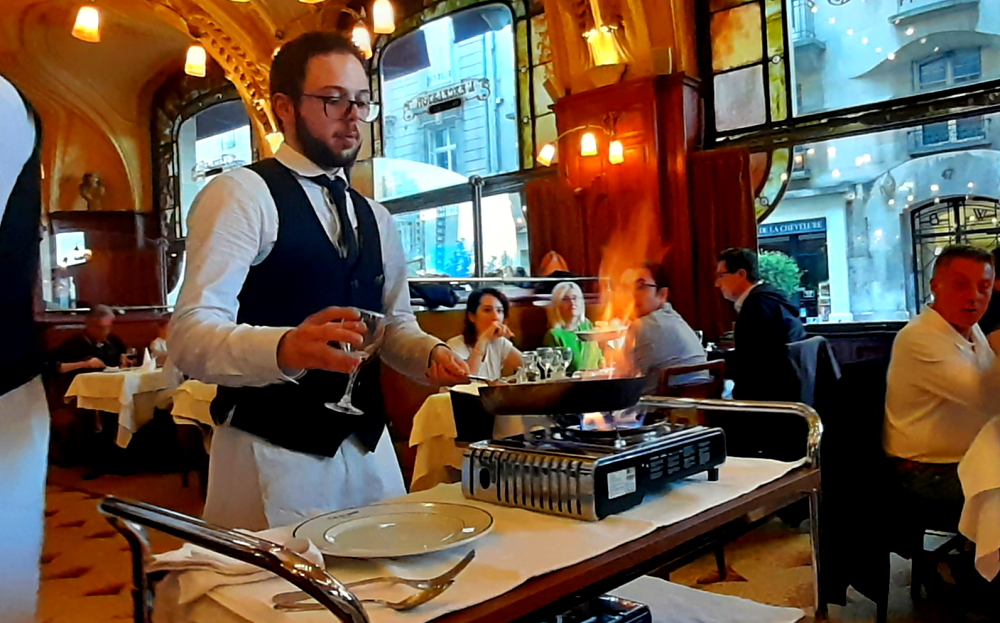
Flambe! Just don’t burn the artificial flowers on the ceiling.

Over the years various famous people have dined at the Brasserie, such as David Bowie. Lynn is sitting at a seat with the name “Arlette Gruss” who it turns out was a French circus artist and founder of the Arlette Gruss circus.
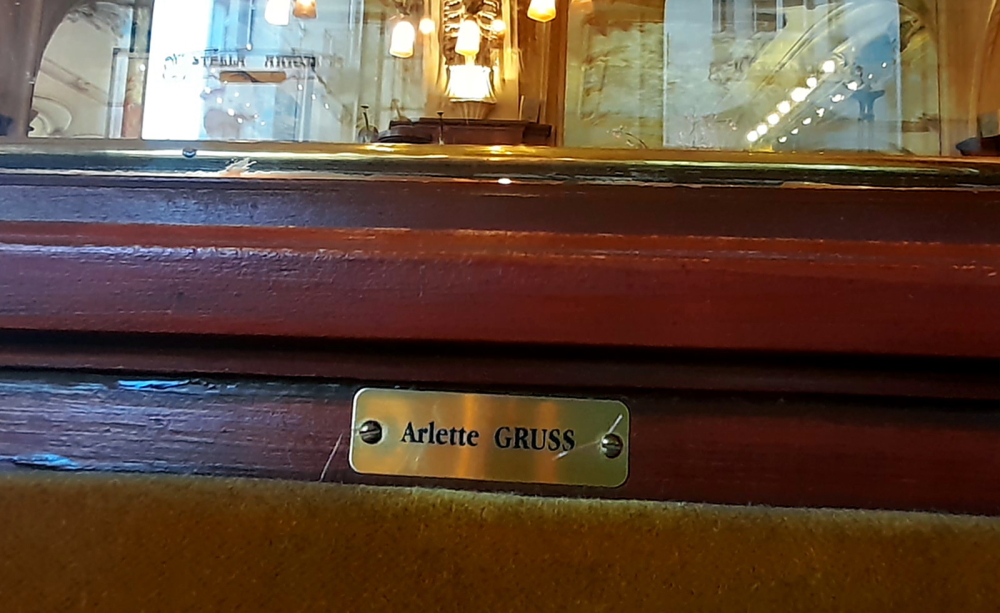
Arlette Gruss seat and memorial.

Having dabbled in all circus disciplines (trapeze and rope in particular), Arlette Gruss was best known for her panther tamer act. After the death of her father in 1985, she decided to create her own establishment, the Cirque Arlette Gruss. In 1995, she received the National Circus Grand Prix. She was also a knight of the Legion of Honor and a knight of Arts and Letters .

Featuring chandeliers designed by Majorelle and Daum, furniture by Majorelle and stained glass by Gruber, (i.e the usual Art Nouveau suspects) this is a brasserie like no other![nancy-tourisme.fr].

10 May, 2024

A brilliant sunny day with a top of 23 Deg. C. so around 11:00 am we head out and cross Place Stanislas to Parc de la Pepiniere via Place Nelson Mandela.
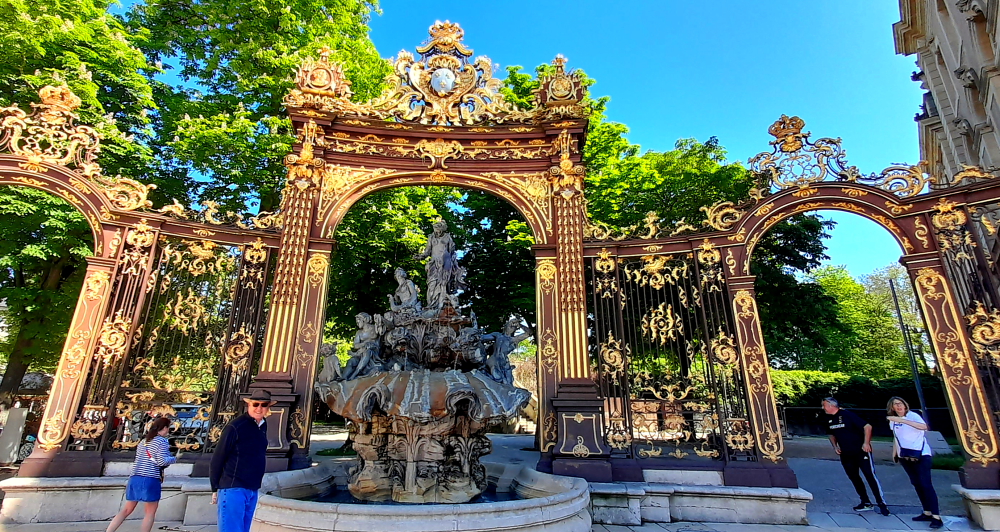
Fontaine Amphitrite, Place Stanislas, Nancy.

Our first stop is at the 1875 Mozart bandstand (Kiosque Mozart) in the Park. This circular structure, set in the English garden part of the Pépinière, was designed to accommodate musical bands performing outdoor concerts. It is still – but occasionally – in use today.
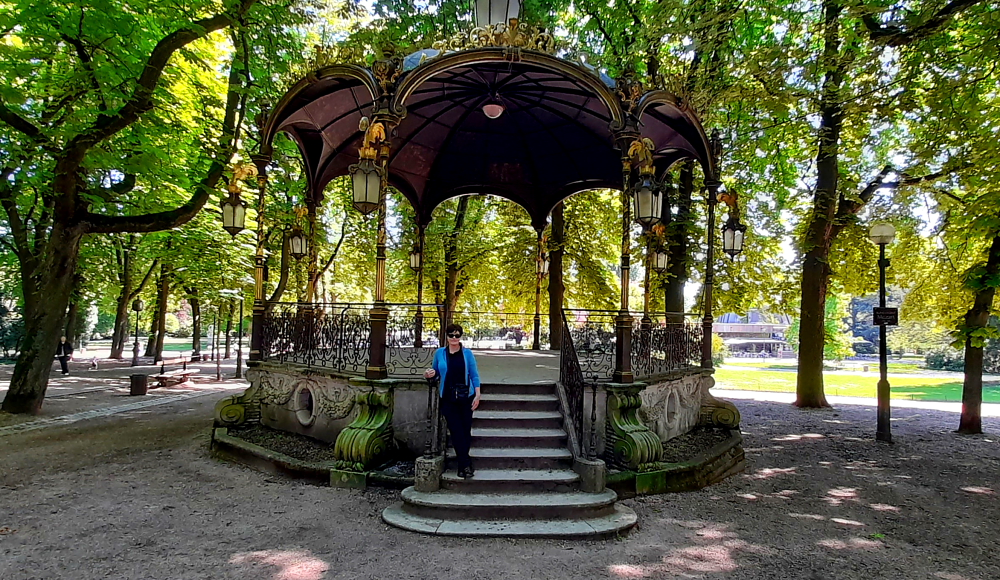
Kiosque Mozart, Parc de la Pepiniere, Nancy.

The bandstand singularly recalls some of the features of Place Stanislas’ railings, with its gold leaves and served as a model for other French towns’ bandstands [frenchmoments.eu].
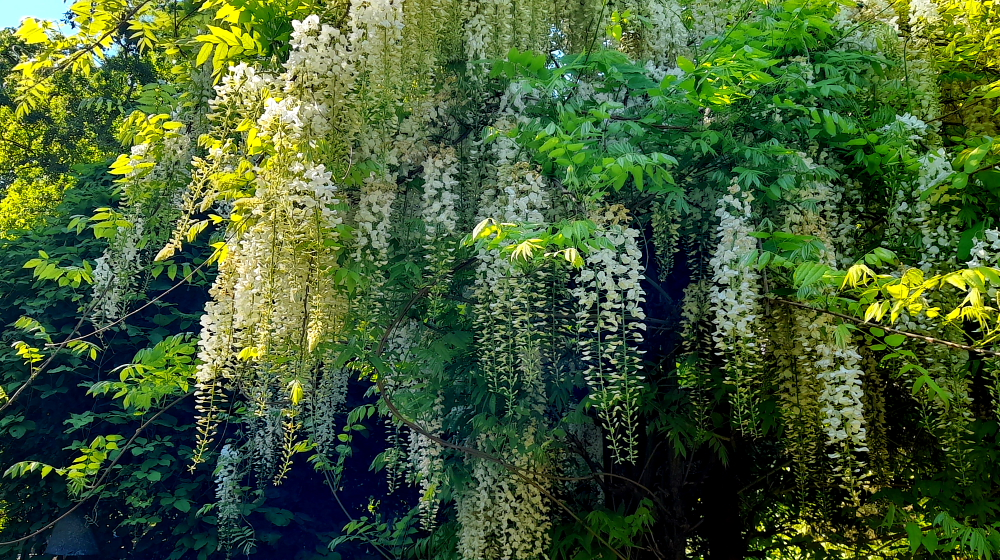
White wisteria cascades, Rose Garden, Parc de la Pepiniere.

Nearby is the Park’s Rose Garden (Roseraie) which covers 2,000 m2 and was created in 1927 on the former site of the municipal greenhouses. Here there are 197 different varieties and 2,000 rose bushes [frenchmoments.eu].
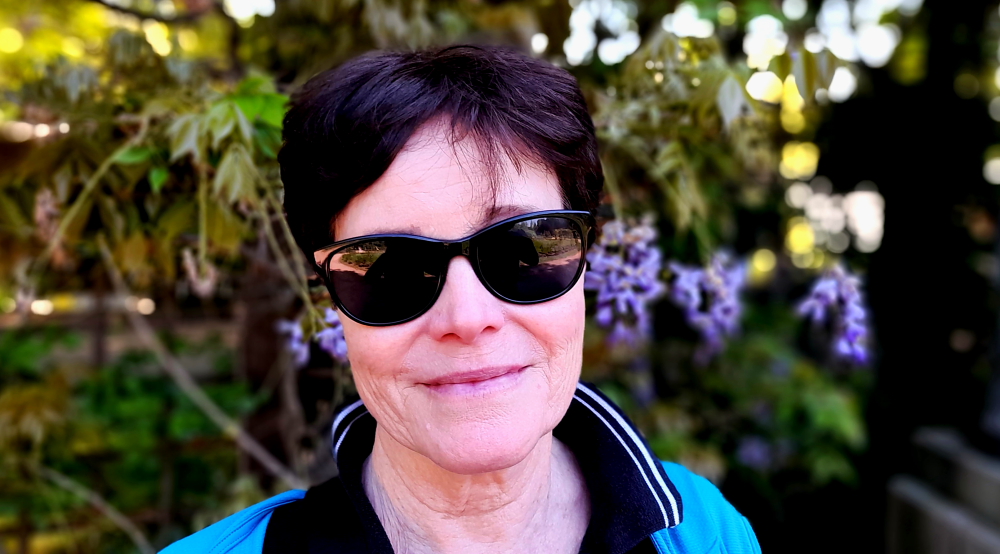
Rose Garden, Parc de la Pepiniere.

Next to the Parc is the Jardin du Palais du Gouvernement. Just like the park we’ve just been walking through, this one needs some serious maintenance – unmown lawns, weeds, a large, circular fountain totally devoid of water. Such a contrast to the pristine Place Stanislas.
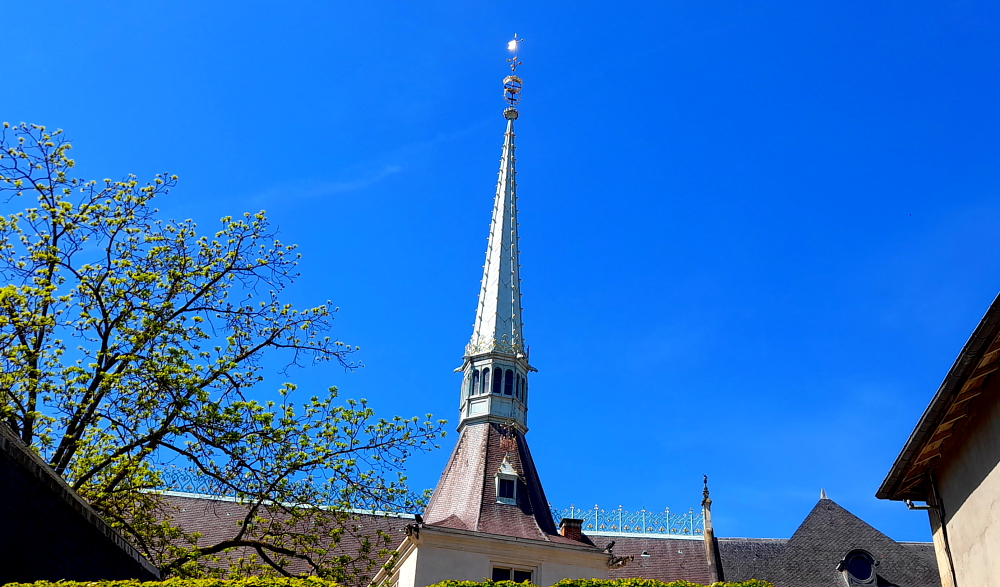
Musee Lorrain’s gilt-tipped spire viewed from Palais du Gouvernement Garden, Nancy.

What is also pristine are the spire and roof of the Musee Lorrain – tipped with gilt.
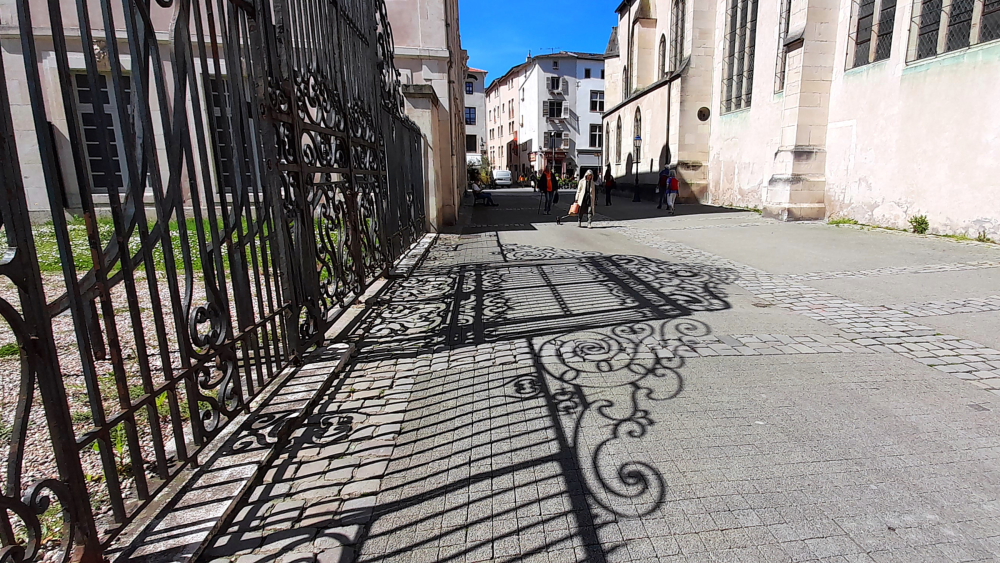
Musee Lorrain gates casting ornate, noon-day shadows onto Rue des Etats, Nancy,

Time for a cool beverage so we end up in Le Gavroche cafe on Rue Saint-Epvre where we both order cafes glaces (iced coffees).
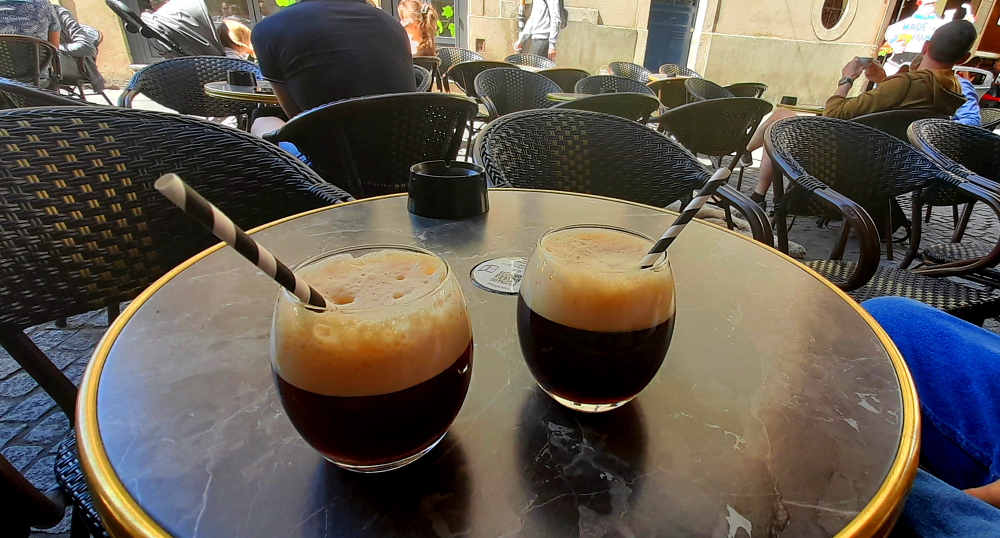
“Iced coffees, Jim, but not as we know them!”

Hmm – espresso on ice heavily sugared and topped by a foam of indeterminate origin. Pass!
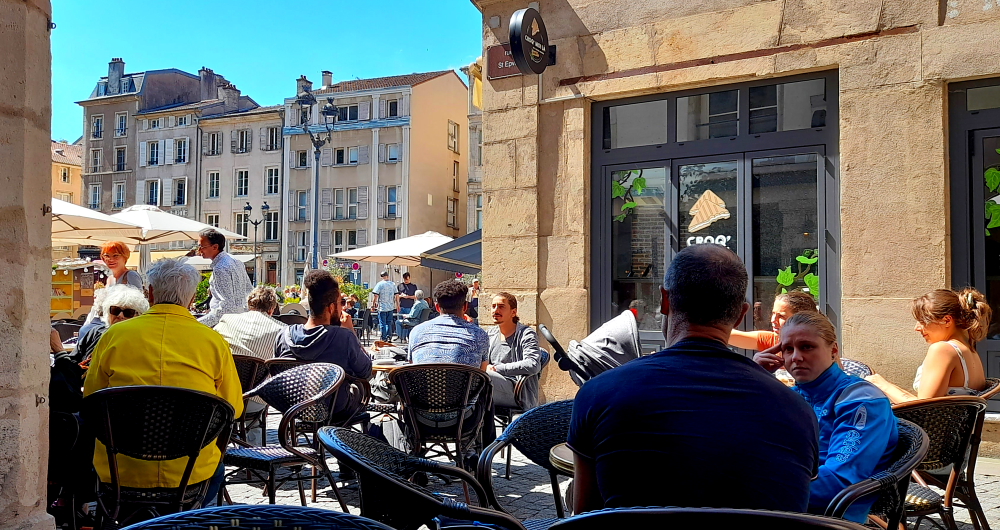
View from Le Gavroche cafe on Rue Saint-Epvre, Nancy.

Next door is a restaurant called “Made in France”. Seems that at least some Frenchmen have a sense of humour!
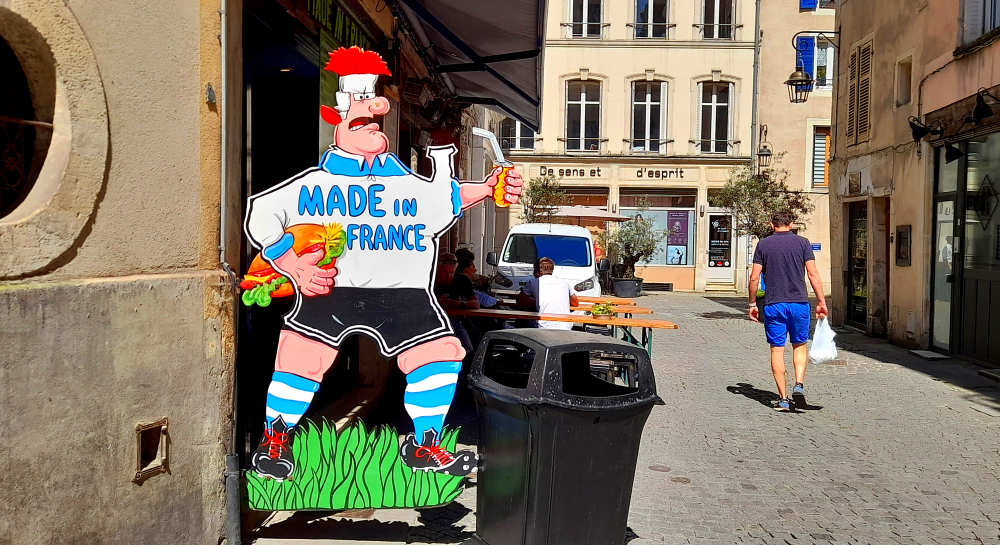
Made in France Restaurant, Rue Saint-Epvre, Nancy.

Tonight, Lucy has booked us into Le Bouche a Oreille (Word of Mouth), 2 minutes’ walk away from the hotel.
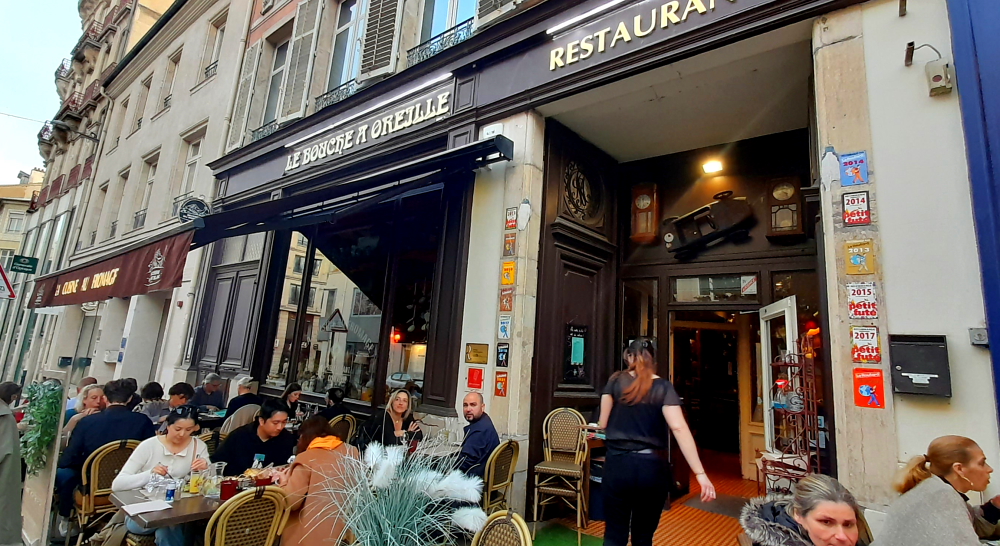
Le Bouche a Oreille, Rue des Carmes, Nancy.

It’s a quirky place and known for its famous egg casserole to tartiflette and fondues.
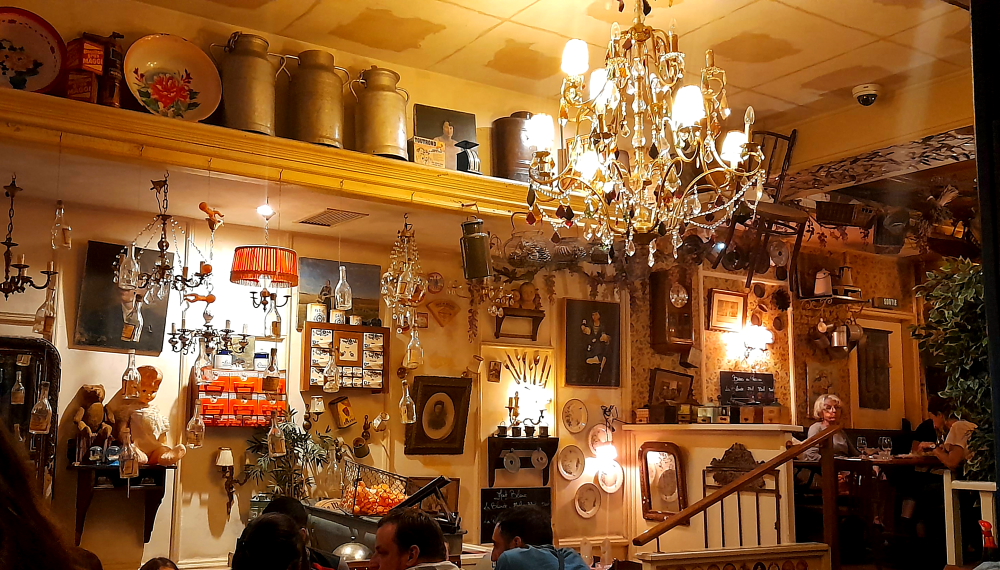
Quirky interior full of memorabilia, Le Bouche a Oreille, Nancy.

We didn’t see one, single fondue on offer in Switzerland so we’ll have to revisit this popular dish from 1970s and 80s Australian cuisine.
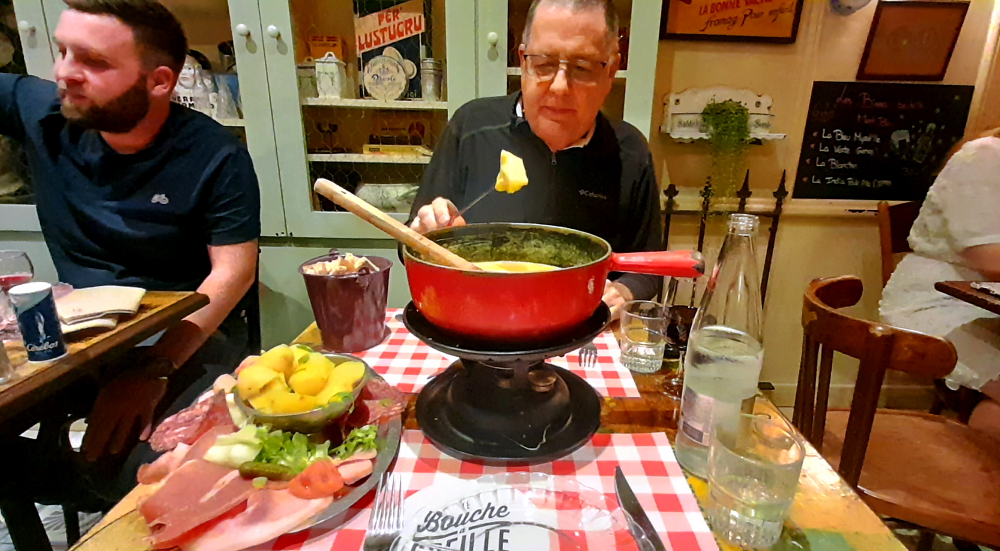
Cauldron of searing hot cheese, my dear?

And we do! Interestingly, on the menu it says that the fondue is for 2 people but the price is Eu23/person. Why not just say, Eu46??

So, a large pot of searing hot cheese arrives and is placed on a gas warmer. Accompanying this pot is a small bucket of brown bread cubes together with a large platter of charcuterie, some weeds, and a small bowl of boiled potatoes. We really struggle to get even half way through all this. And probably not a good choice as the cheese is very salty and no doubt cholesterol laden – not a good combo for the Missus. No wonder we haven’t been tempted to eat one of these for over 40 years and we won’t be for at least another 40!

11 May, 2024

Today is our last day in Nancy so we decide to walk to “Ville Vieux” to make sure that we have seen all that there is to see, double back to the Central Market, repack, and finally dine at “Suzette et Gino” tonight.
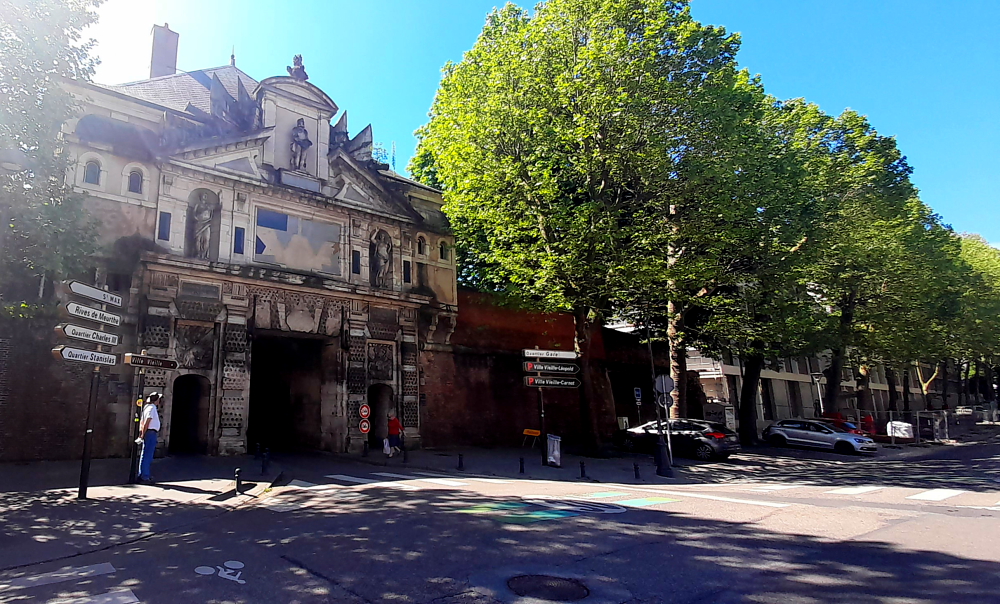
Porte de la Citadelle, Nancy.

Beyond the magnificent Porte de la Craffe is the Porte de la Citadelle. Unlike all the other ‘portes’ in town, although this one is imposing from the outside, it hasn’t been refurbished so it’s looking a little sad and neglected.

As we walk past the Basilica of Saint Epvre, we notice it’s open today so Lynn pops in, as she does.
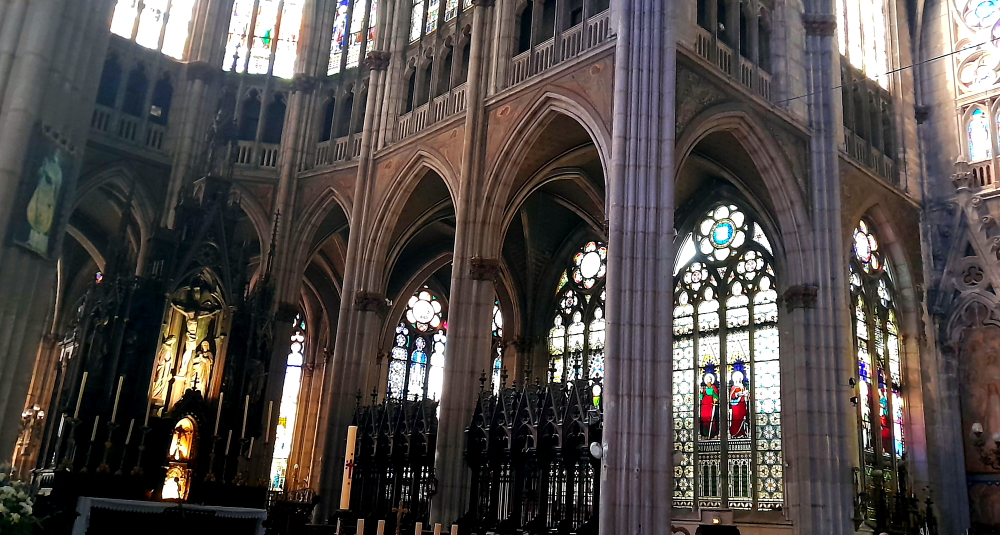
Interior of Basilica of Saint Epvre, Nancy.

What she finds is a stunning vista of tall, colourful, stained-glass windows both at floor level and the galleries above which surround the entire internal space.
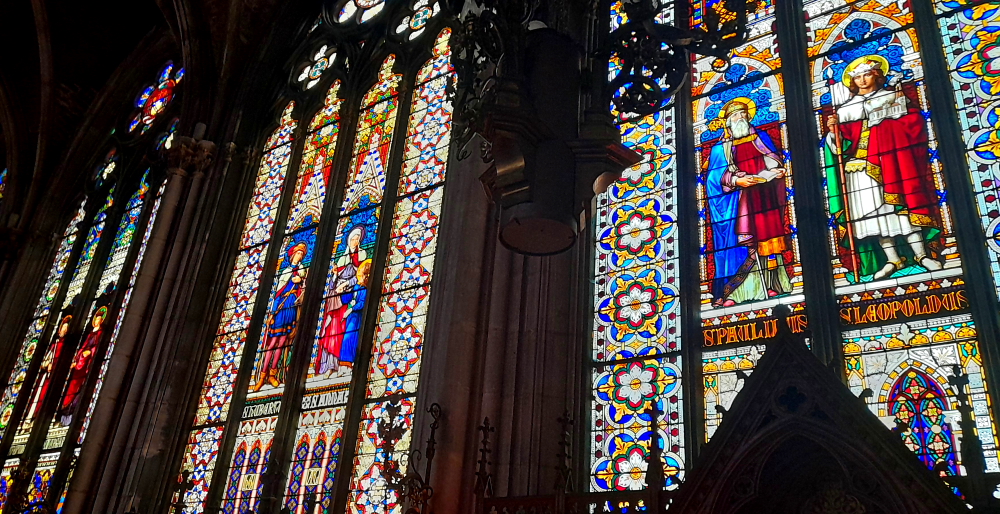
Stunning stained glass windows, Basilica of Saint Epvre, Nancy.

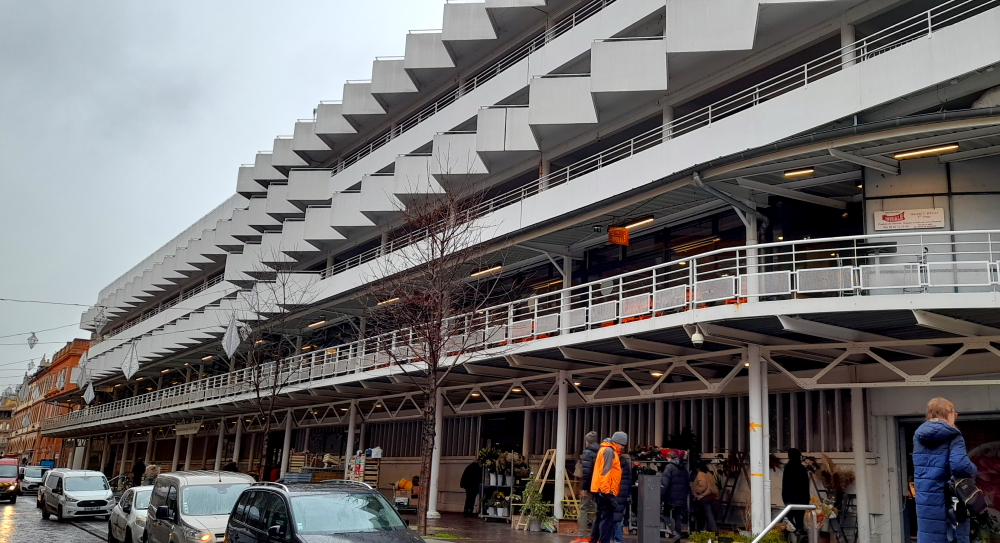
Arriving at the Central Market on Rue Saint-Dizier we find a typical metal building with glass windows along a raised roof and just about all the stands inside are operating and are busy with customers.
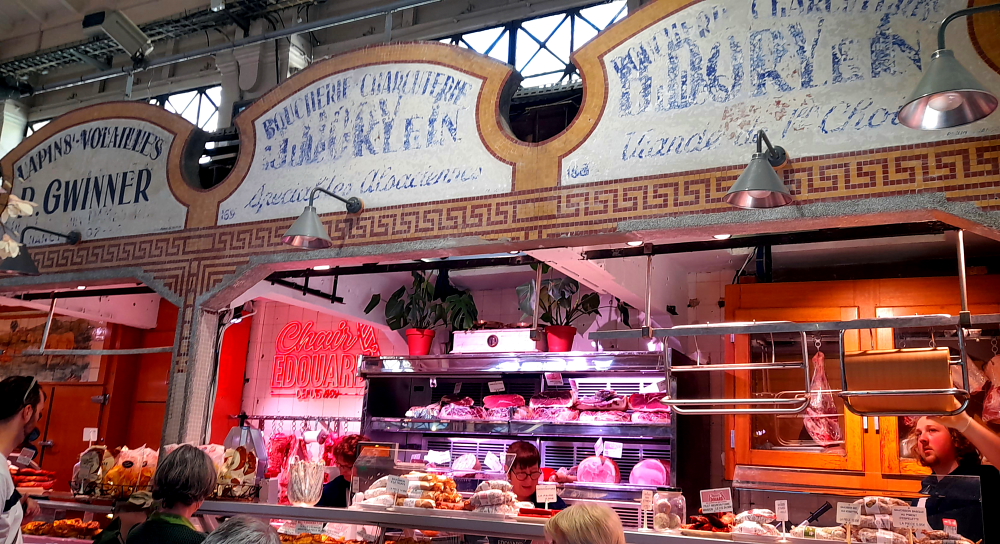
Boucherie & charcuterie stand, Central Market, Nancy.

Nancy Central Market has some 65 stalls offering quality produce: fruit, vegetables, meat, fish, fine foods, local specialities, exotic goods, flowers, bookshops and more. It is an attractive U-shaped building dating from the 19th century. The central area (which locals call the central hall) has been covered with a glass roof [nancy-tourisme.fr].
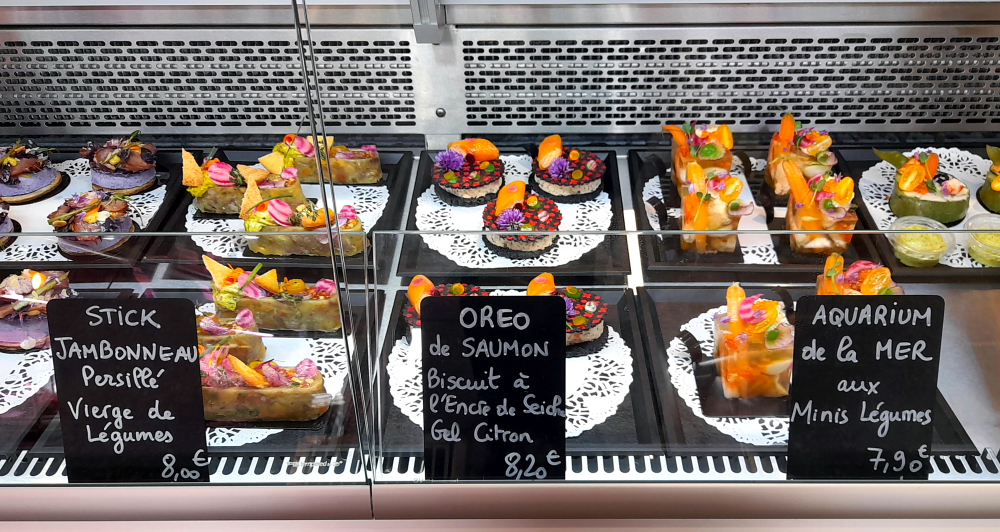
Tantalising treats, Central Market, Nancy.

Following a break back at the hotel, we walk across Place Stanislas to Rue Here where we find “Suzette et Gino” billed as a traditional Italian restaurant, another of Lucy’s bookings for us.
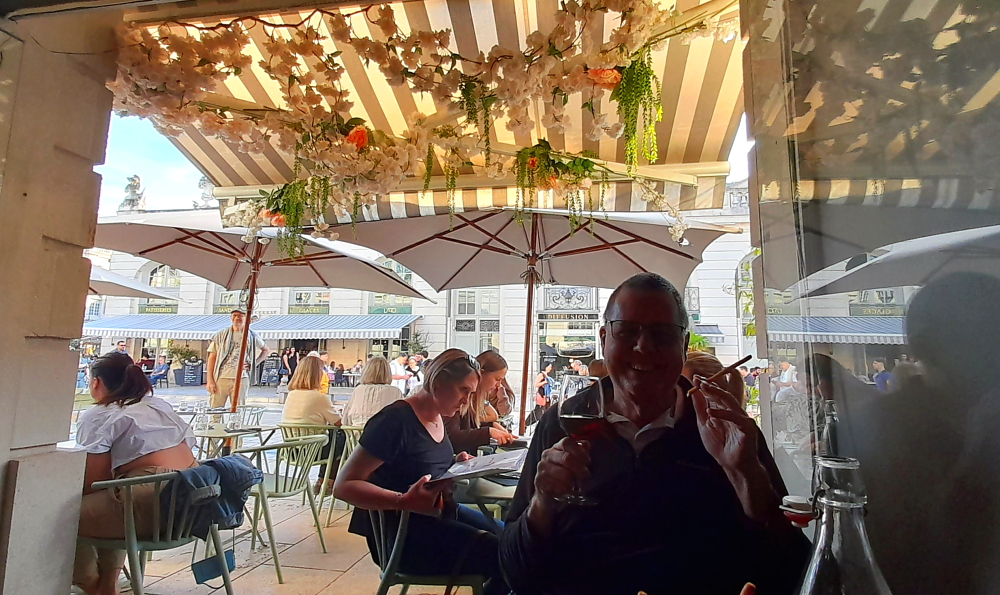
More artificial flowers decking the deck, Suzette et Gino, Nancy.

When we arrive at the restaurant just before 7:00 pm when it opens the Rue Here is already heaving with al fresco diners at all the restaurants that line the street.
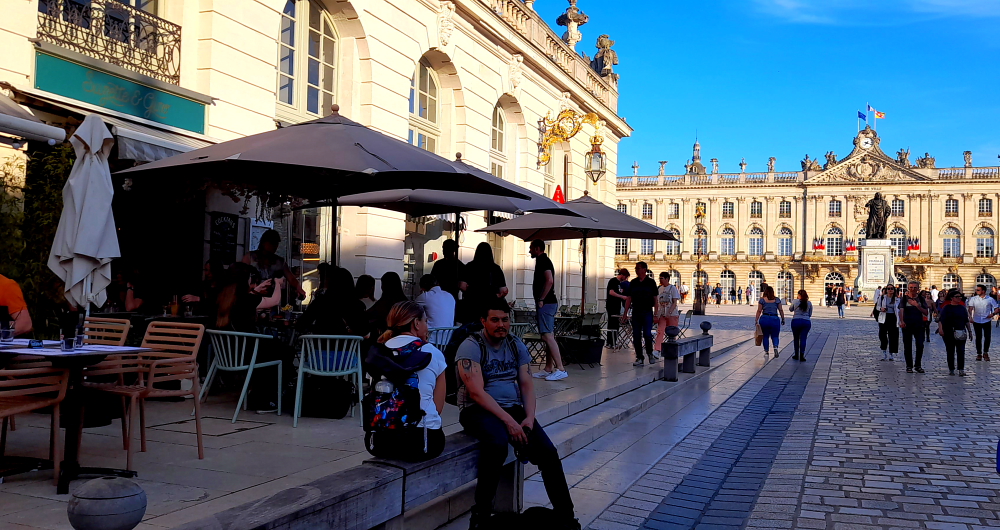
Outdoor seating at Suzette et Gino & Rue Here leading to Place Stanislas, Nancy.

While Lynn’s out taking photos she hears a bit of a racket and ventures a few metres to Arc Here where a “one-man-band” is playing a tune.
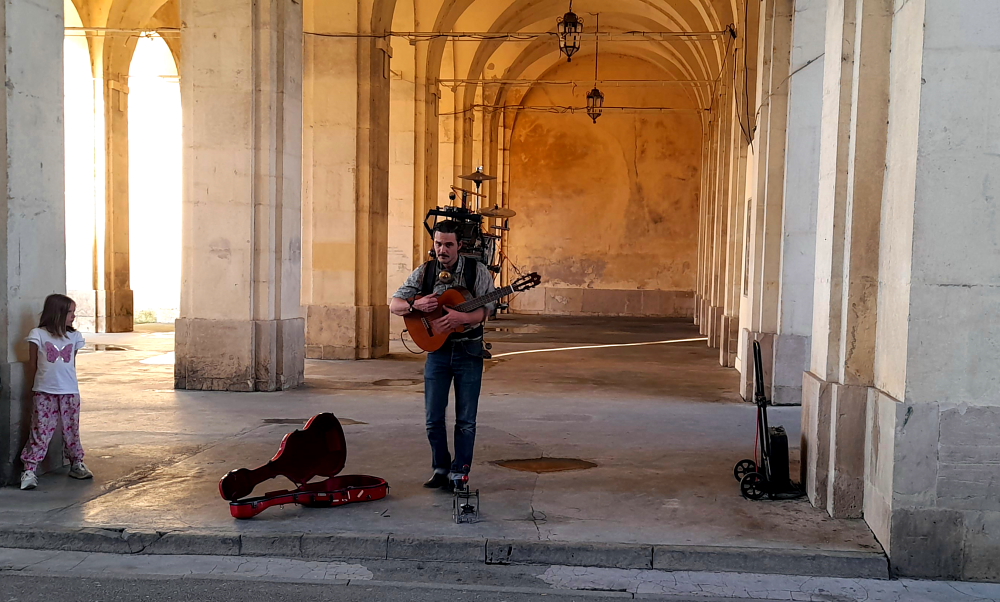
One-man-band, Arc Here, Nancy.

After a delicious meal we cross back Place Stanislas to find a crowd of people milling about in front of a grand building – the Opera House. They’re attending a performance of “Where are you going like that?”
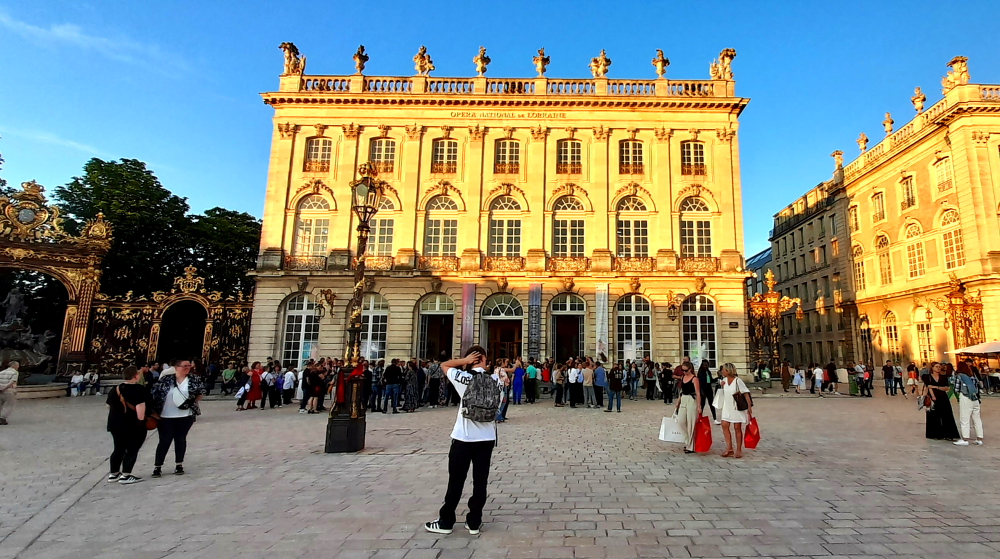
Opera National de Lorraine, Nancy.

According to the Opera’s website the performance “combines the form of documentary theatre, the force of a symphony orchestra and free choreography. But in principle, it’s a rendezvous with all the question marks that dance within us. Because there are certain answers that await a question all their lives.” [opera-national-lorraine.fr]

12 May, 2024

At 11:15 am when we depart it’s already 23 Deg. C. The 205km trip to Reims will take us about 2 hours 15 minutes. Thank goodness for the air conditioner!

Initially, my trusty GPS takes us via the A31 towards Metz (we are heading north instead of west!), but just before Metz we turn west along the A4 to Reims.
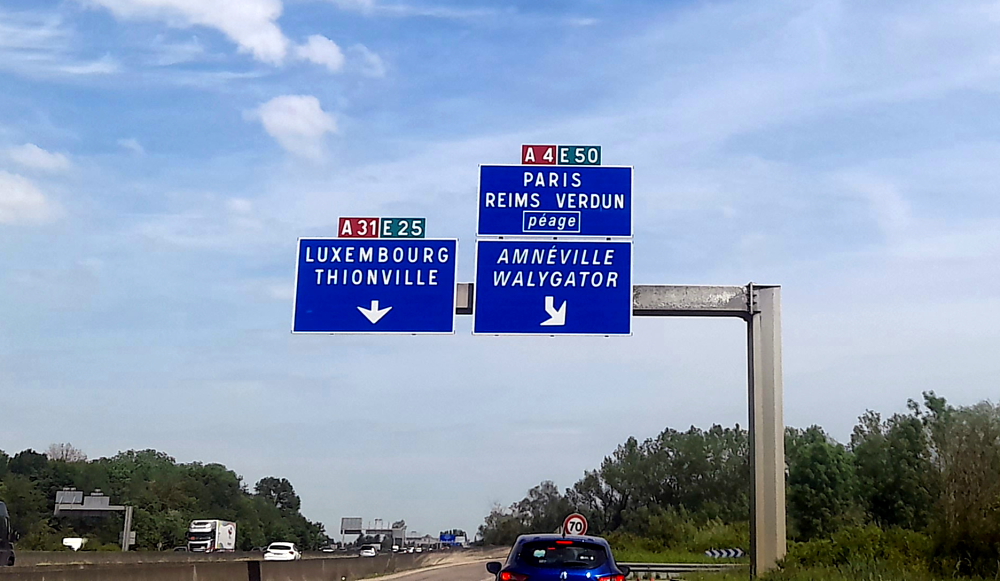
On the road to Reims.

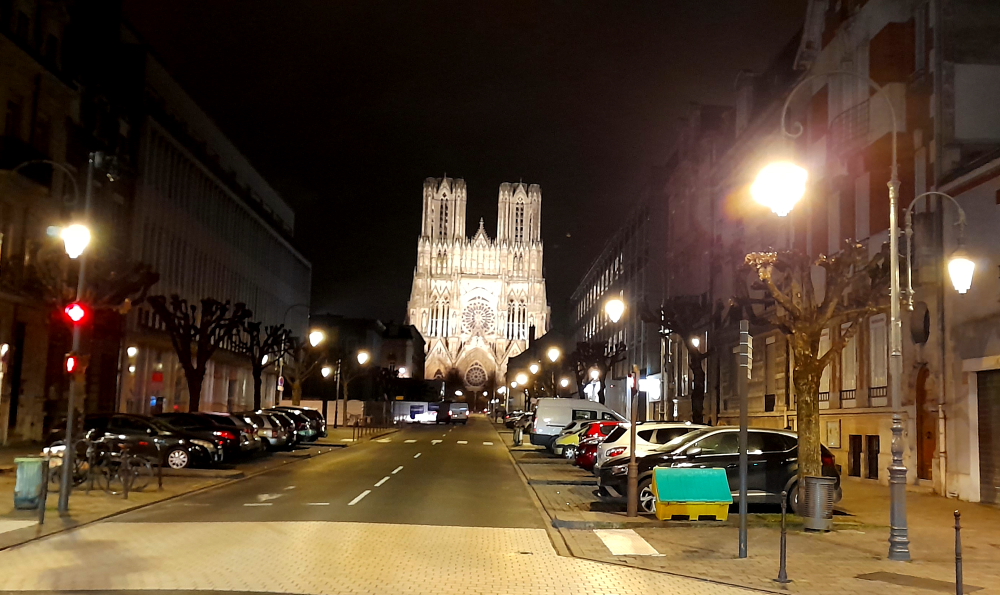
We arrive at our AirBnB apartment on Rue Libergier, which is a block from the Cathedrale Notre-Dame de Reims, around 1:45 pm. We park across the road and are met by Paolo who manages the apartment and he shows us the ropes after we drop our luggage inside.

Quickly we drive to the train station as Becky and Jerry, our Philly friends, have arrived from Paris and are waiting for us to collect them from in front of the station.
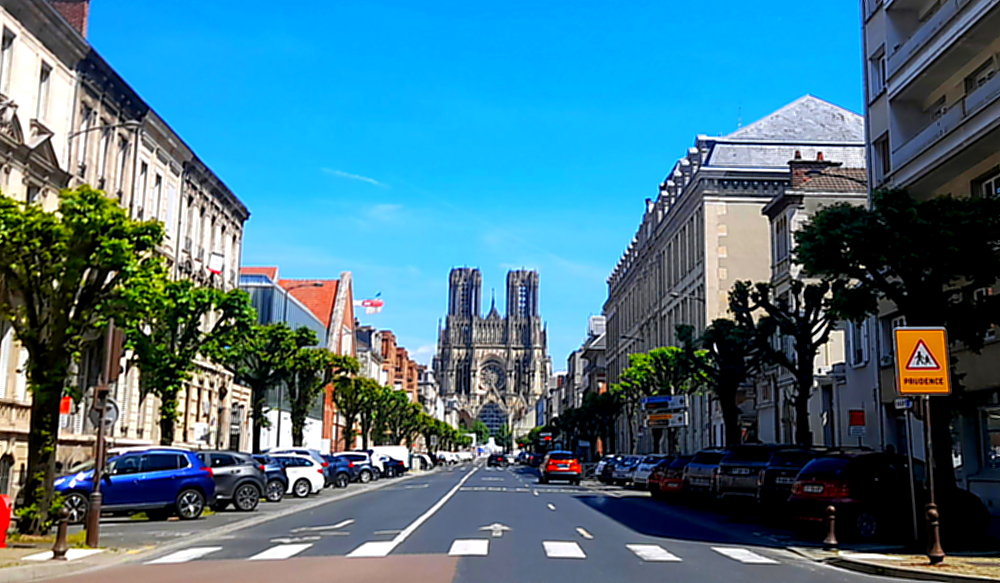
View of Cathedrale Notre-Dame de Reims from Rue Libergier.

Returning, we park around the corner in an underground car park and walk the short distance to the apartment where we all get settled in.

One of the “ropes” that Paolo showed us is a chilled bottle of champers, a Brut Blanc de Blancs, that his boss, the owner of the apartment, has kindly given to us from his vineyard – the Olivier Coutant champagne house. It seems that everyone in the Champagne region is a vintner!
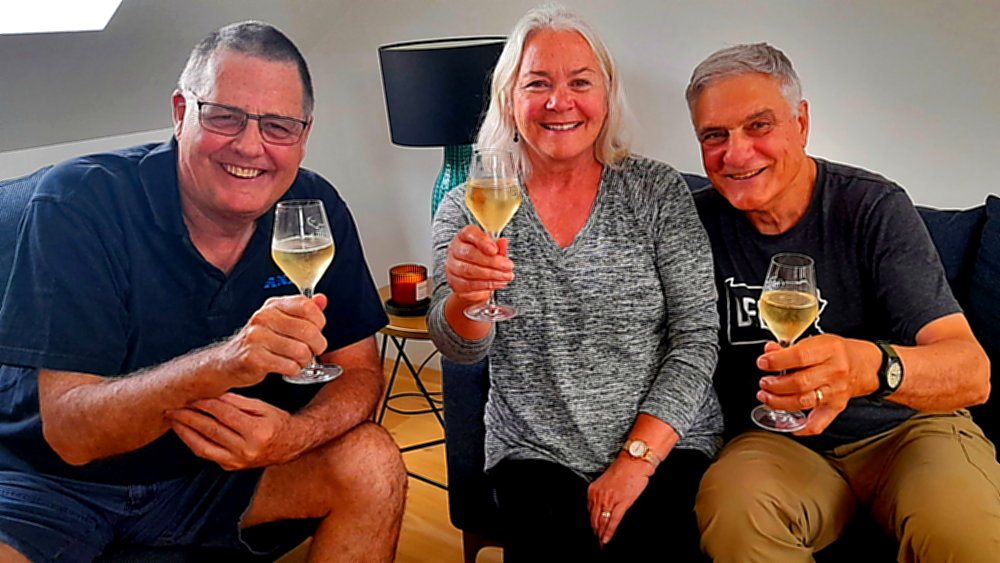
Catching up 5 years later.

It’s great to see Becky and Jerry once again. We first met them in Lecce, Italy in an Irish Pub on St Patrick’s Day – as you do – in 2015. We stayed with them in Newtown Square, Pennsylvania in 2019 and they were our saviours in March 2020 when they let us leave our Malibu car on their condo driveway in San Diego when we had to abandon our USA travels thanks to COVID.

10 months ago after a Skype call together we made this AirBnB booking, and here we are!

13 May, 2024

At 7:30 am Lynn is out the door to visit the convenience store and boulangerie to buy a few breakfast items as the supermarket was closed yesterday, being a Sunday.

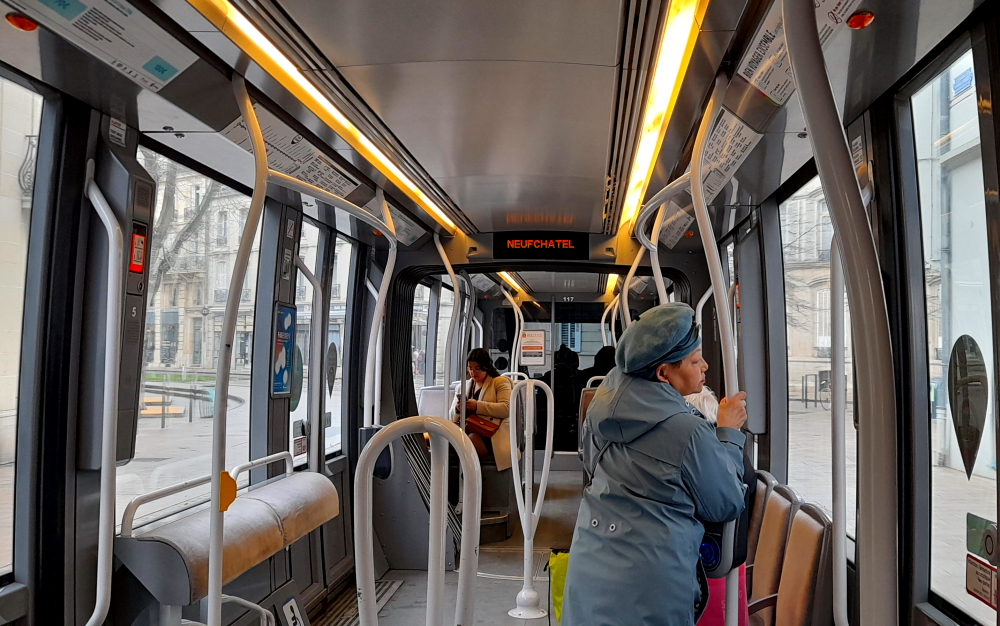
Some months ago she had re-connected with our GuruWalk guide, Rehman, and asked if he could lead another walk for us today for the 4 of us. So we catch the 9:40 tram from Opera-Cathedrale and ride the 5 minutes to Scheiter where we alight.

As we are some minutes early to meet him we walk over to La Porte de Mars which was under scaffolding and plastic when we were here 3 months ago.
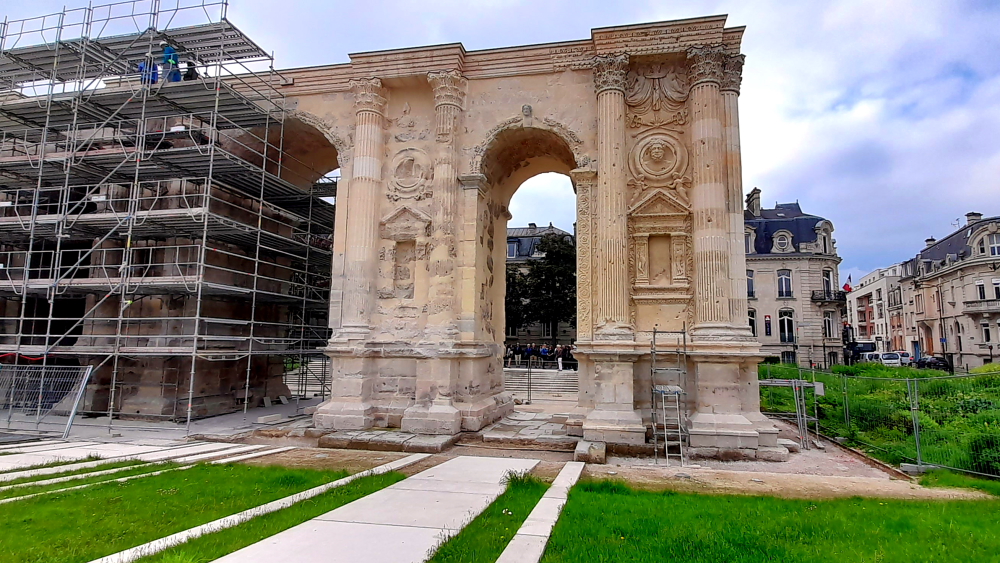
La Porte de Mars, Reims.

The Porte Mars is an ancient Roman arch dating from the early 3rd century AD, is the largest arch of the Roman world and one of the most impressive Roman monuments north of the Alps. Its name derives from a nearby temple dedicated to the god of war, Mars. At the time of its construction, the Porte Mars would have been one of four monumental arches erected as entrances to the Gallo-Roman settlement of Durocortorum (“round fortress”).

The Arch, relatively well preserved, stands 32 metres long and 13 metres high, but its height must have been equally impressive with its attic and the statue group on top which are no longer there.

The Porte Mars was included in the fortification wall of the late Roman Empire and, in 1228, in the wall of the castle of the Archbishops and served as a city gate until 1544. In 1854 the buildings around the arch were removed, bringing the arch into full view [followinghadrianphotography.com].
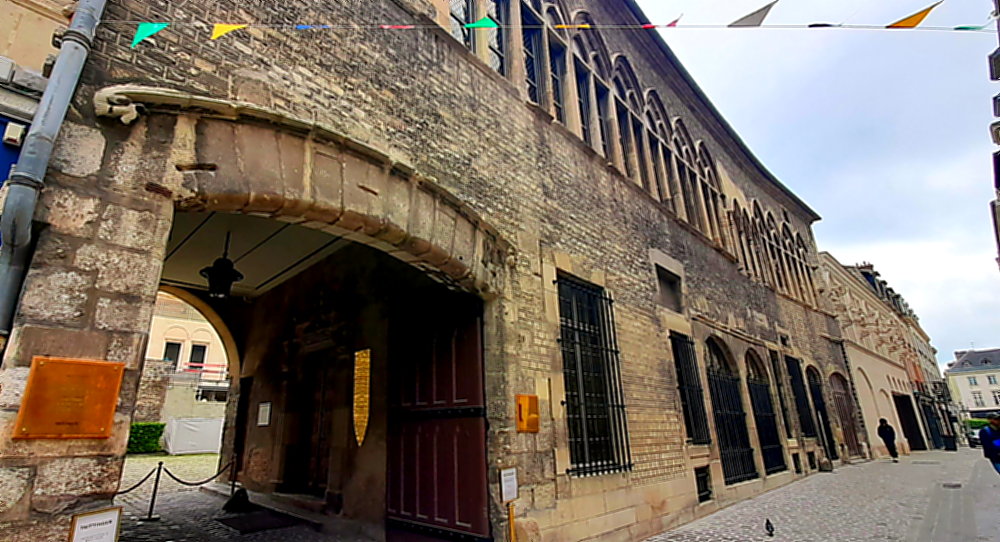
Demeure des Comtes de Champagne, Reims.

After meeting up with Rehman we walk down Rue de Tambour where we come to No. 25, the Demeure des Comtes de Champagne (Comtes de Champagne residence), the oldest civilian building in Reims (13th century) and although it has been remodelled several times, it retains all the features of a wealthy medieval building, with its ground floor arches and gallery on the first floor.

Today it’s the historic jewel of the Taittinger heritage, offering tastings and a shop!

Legend has it that it was the urban residence of the Comtes de Champagne, who used it in particular as a dwelling during royal coronations, at which time the cream of French nobility would gather across the city. During the Coronations, it was convenient for the great lords of the Court to lodge in the city. Only a very small few could stay at the Palace of Tau (Bishop’s Palace). So, these guests could spend a few weeks in private homes like this, the homes of the rich bourgeoisie.
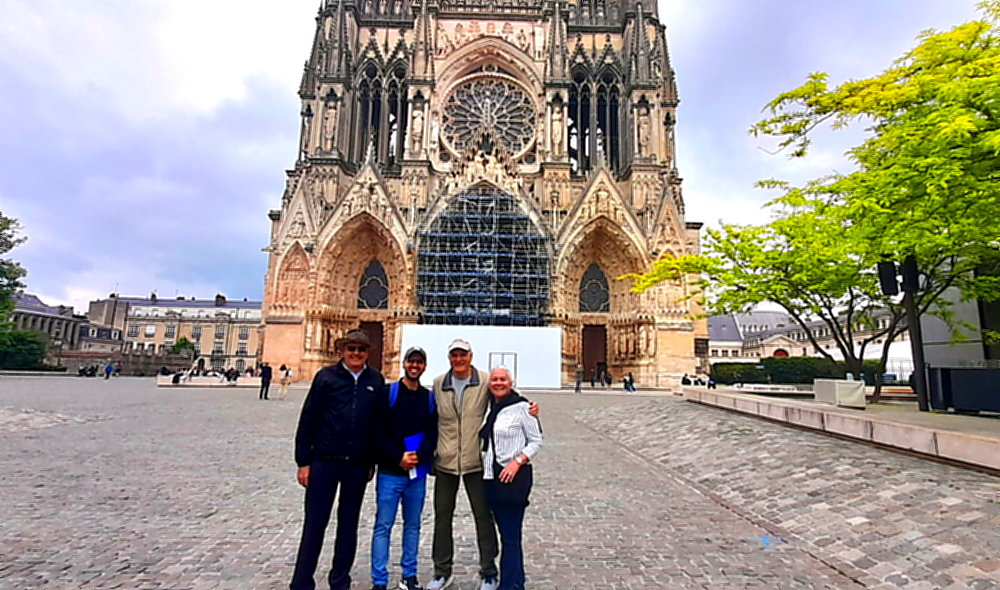
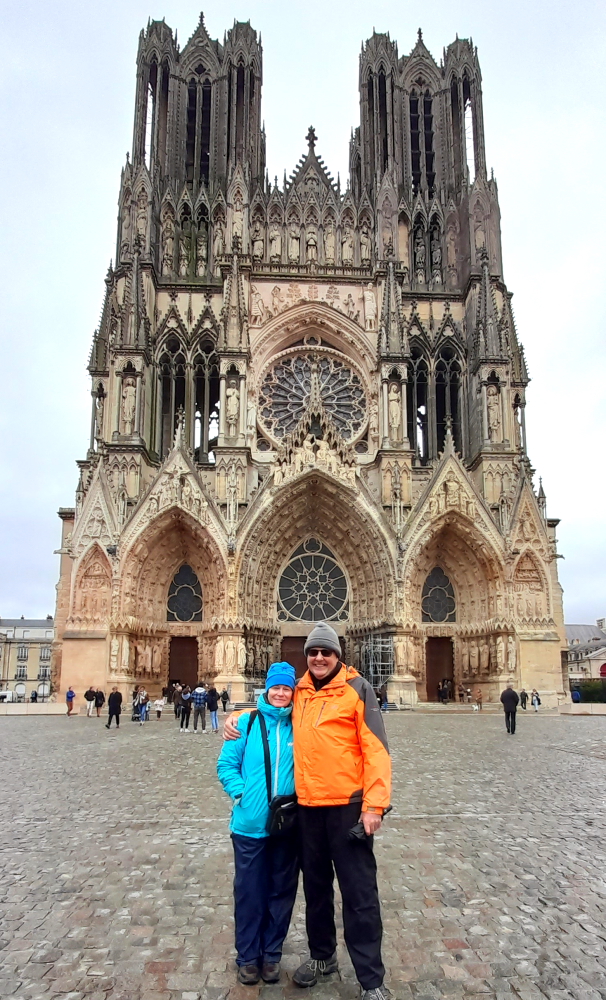
With our tour guide in front of the Notre-Dame Cathedral, Reims.

This is supported by research in the city archives which revealed a document dated 1328 from during the Coronation of Philippe VI. It’s a register of the size of the ‘Sacres’ – a tax levied on the wealthiest inhabitants of Reims to finance the reception of the Court – and features this house, which at the time was owned by Pierre Le Châtelain who belonged to one of the great families of the Reims bourgeoisie, and whose fortune had been made through contact with the Archbishops of Reims [theinstantwhen.taittinger.fr].

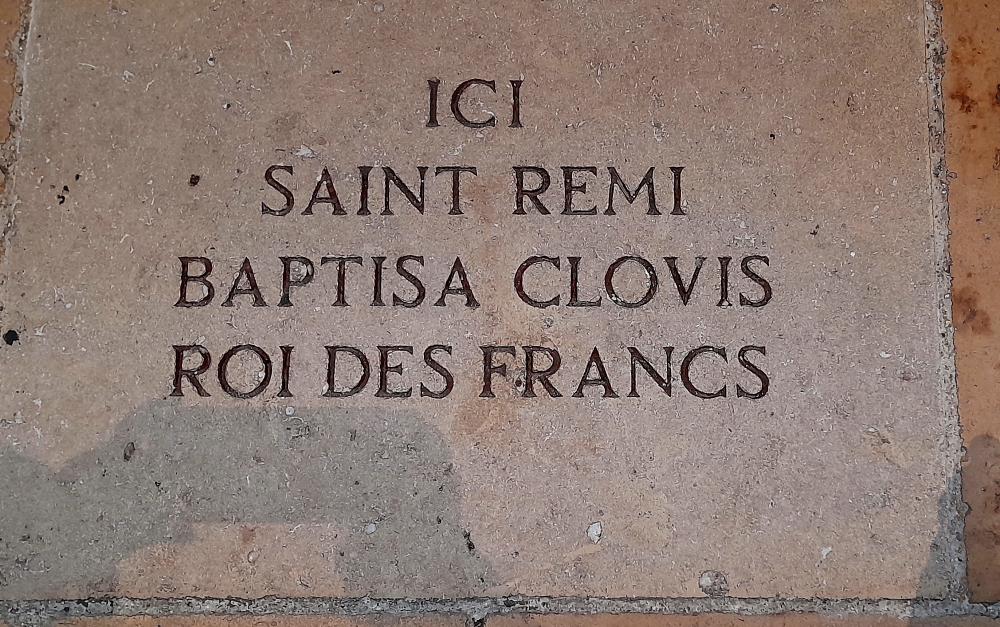
After visiting all the sites we saw on our tour on 4 February we arrive at the 13th century Cathedrale de Notre-Dame de Reims which today has scaffolding concealing its main entrance. Here we are reminded of the baptism of Clovis by Bishop Remi in 498 in front of a previous church which had been subsumed by this Cathedral.
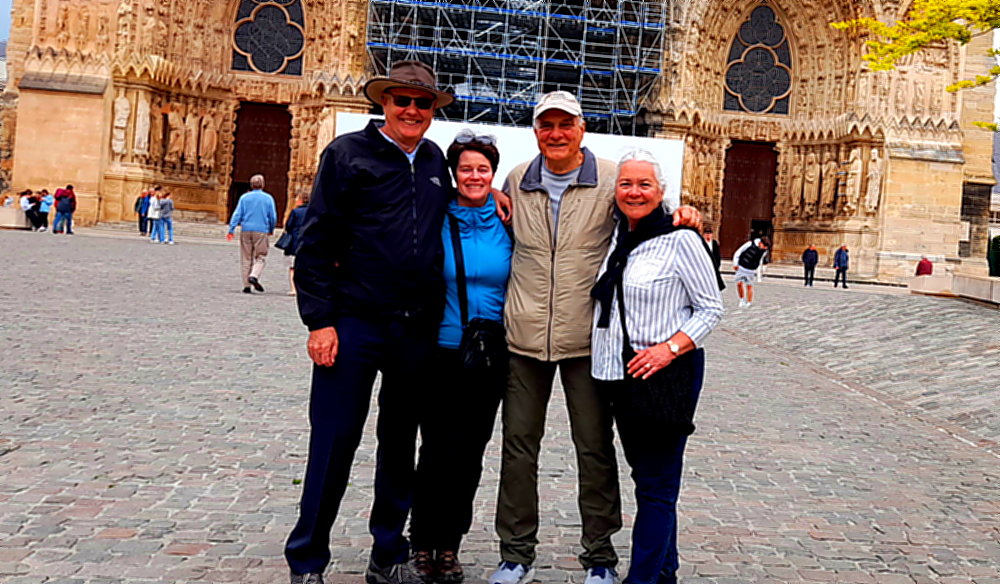
Nothing like a private walking tour!

Before we return home we scurry about trying to find a shop that hasn’t closed for the usual 2-hour lunch break that sells champers (and a bottle of Bouzy red wine) and the famous Reims Rose Biscuits solely made for dunking in champagne. Success!

After lunch and a nanna nap we head out again at 3:30 pm to walk 20 minutes SE to the Basilica of Saint-Remi, named after the Bishop who baptised Clovis.
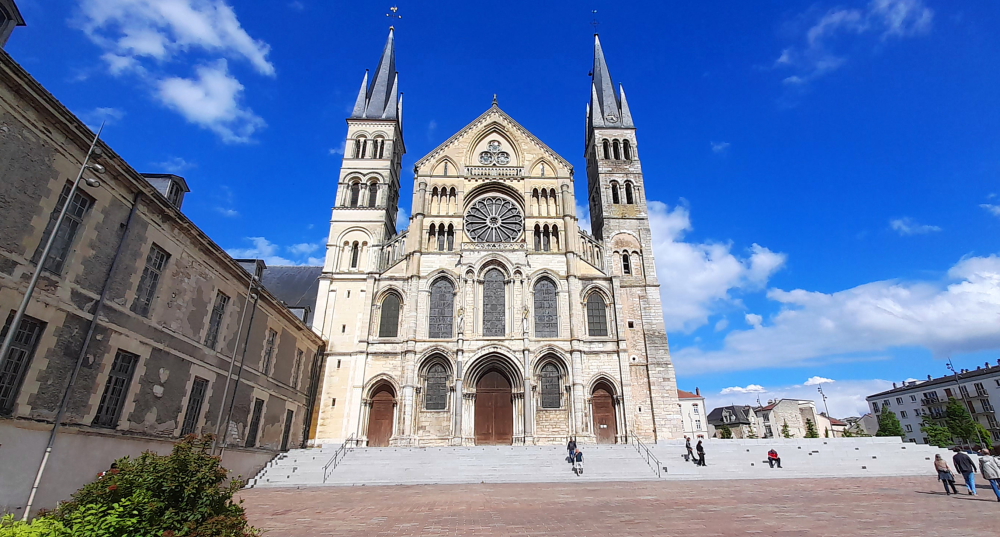
Basilica of Saint-Remi, Reims.

In Romanesque-Gothic style, it is one of the most remarkable achievements of Romanesque art in the North of France. 126 m long, it impresses with its depth and its feeling of intimacy.
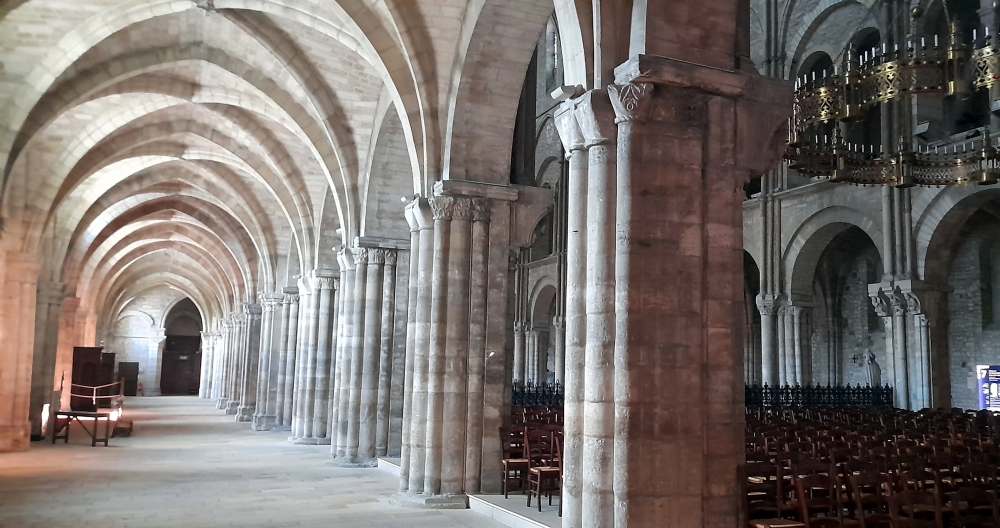
Nave of Basilica of Saint-Remi, Reims.

The sober Romanesque nave and the 4-story Gothic choir (end of the 12th century) make for an impressive ensemble of lightness and harmony. The facade was built at the same time as the choir.
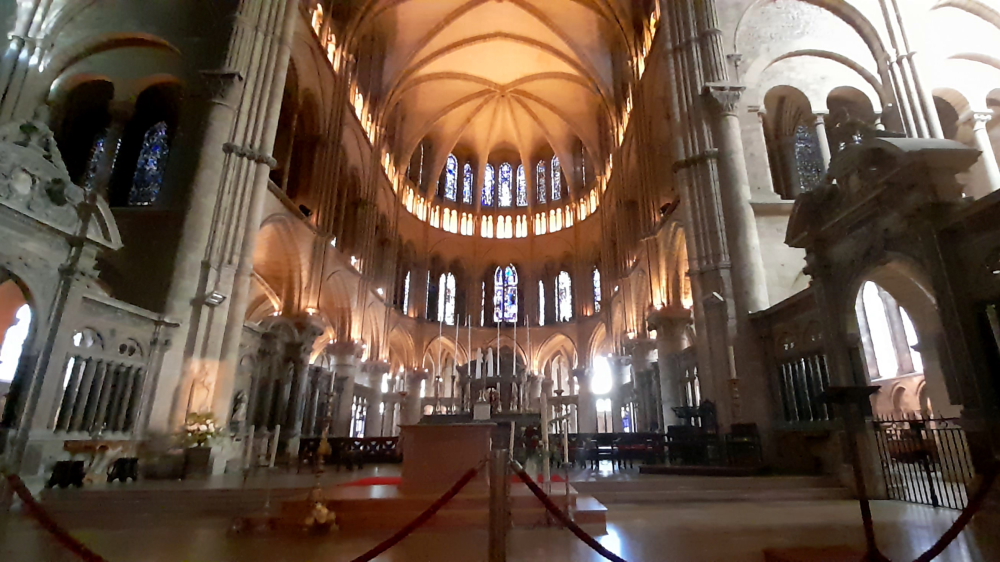
Choir, altar & apse of Basilica of Saint-Remi, Reims.

Built in the 11th century, the Basilica houses the relics of Saint-Remi. His tomb (1847) occupies the center of the choir [www-reims-fr].
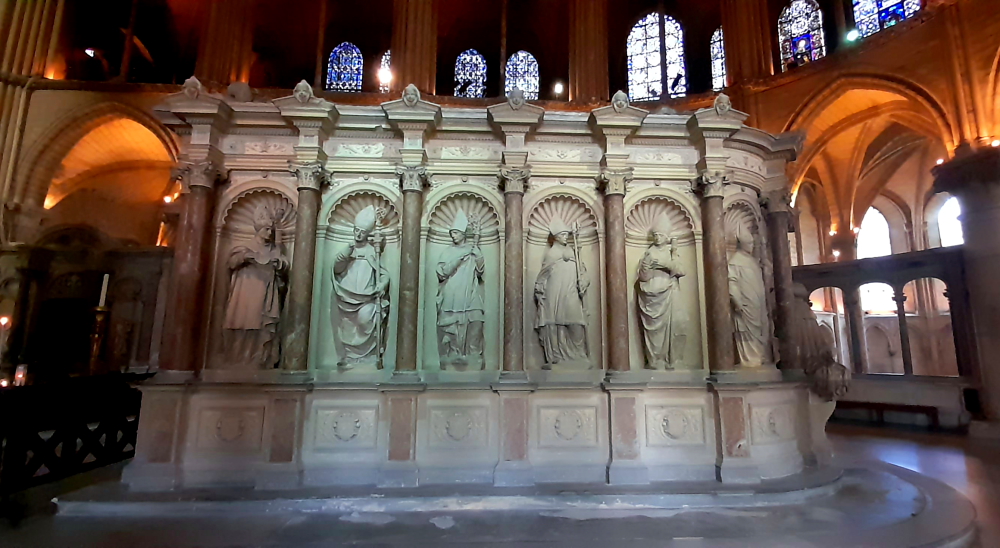
Saint-Remi tomb, Choir, Basilica of Saint-Remi, Reims.

Earlier, Becky mentioned that last night their bed didn’t have a bottom sheet on it, only a mattress protector, so after letting Paolo know this he drops by at 7:00 pm to rectify the situation. Not only does he insist he makes the bed but he also offers us a superior bottle of champers from the Coutant vineyard in recompense for this “mistake”. We jokingly said that we’d try to find more “mistakes”!

Feeling knackered after all our walking today (11.3 km) we call into the bistro that is next door to our apartment, “Bistro des Anges”. What a find! Excellent food, wine and cocktails and a very genial owner/host – an angel indeed.

14 May, 2024

Some months ago I had booked a tour and tasting at Maison Mumm for the 4 of us. Once again we catch the tram to Schneiter then walk up the Rue du Champs de Mars to arrive for our 11:00 am tour.
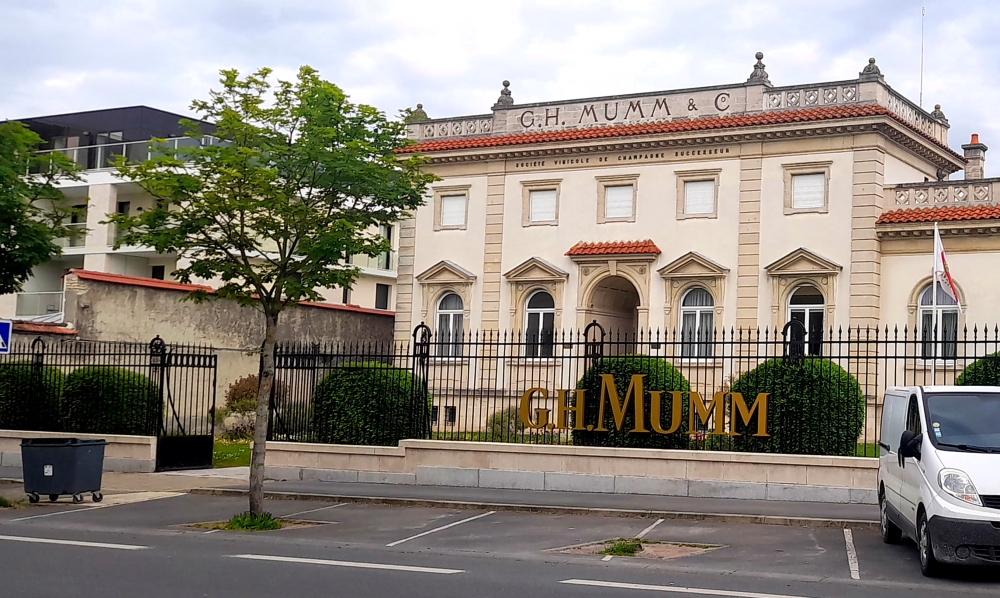
GH Mumm & Cie, Rue du Champs de Mars, Reims.

The Mumm estate is quite large, occupying both sides of the road with several classical buildings and extensive caves and galleries of bottled champagne below ground.
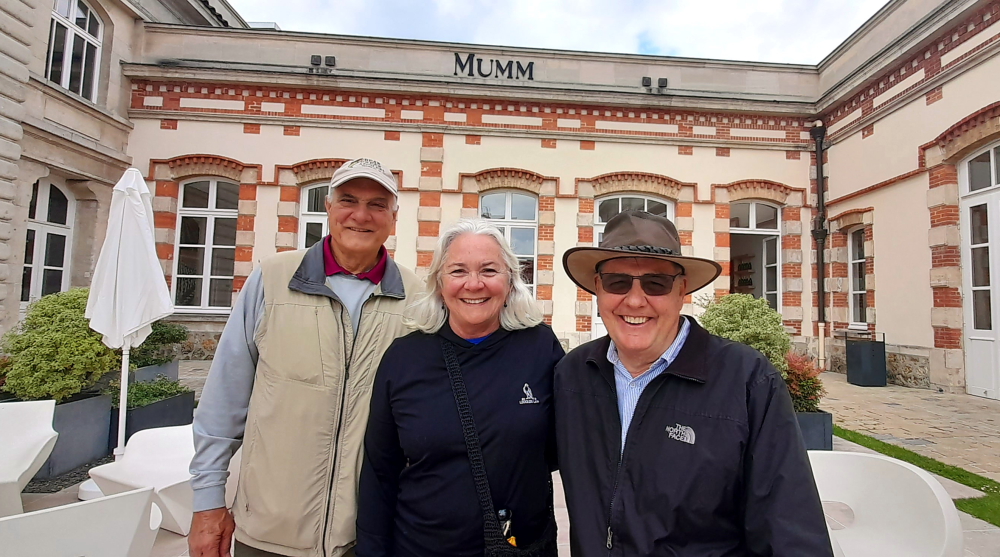
In the courtyard before the tour.

Spread across almost 25 km in the heart of the city the galleries of the Mumm cellars, built 14m underground and excavated over 70 years, are home to almost 200 years of history and expertise and house 25 million bottles.
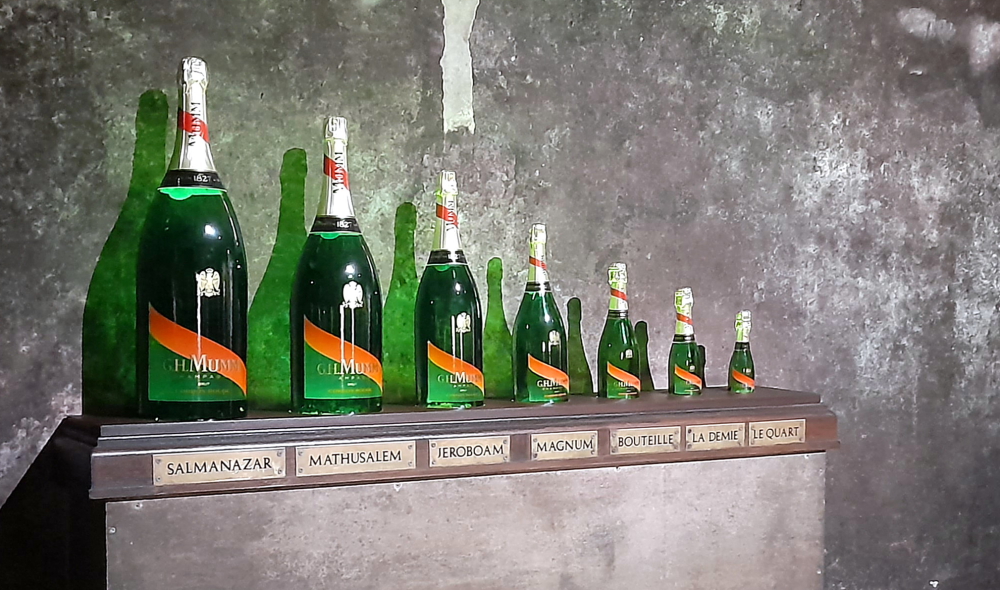
Various sizes of champagne bottles.

Eva, our guide, takes us down and through the various galleries explaining how champagne is made. Once they are filled, the champagne bottles are stored on their sides in Mumm’s cellars ready for aging.
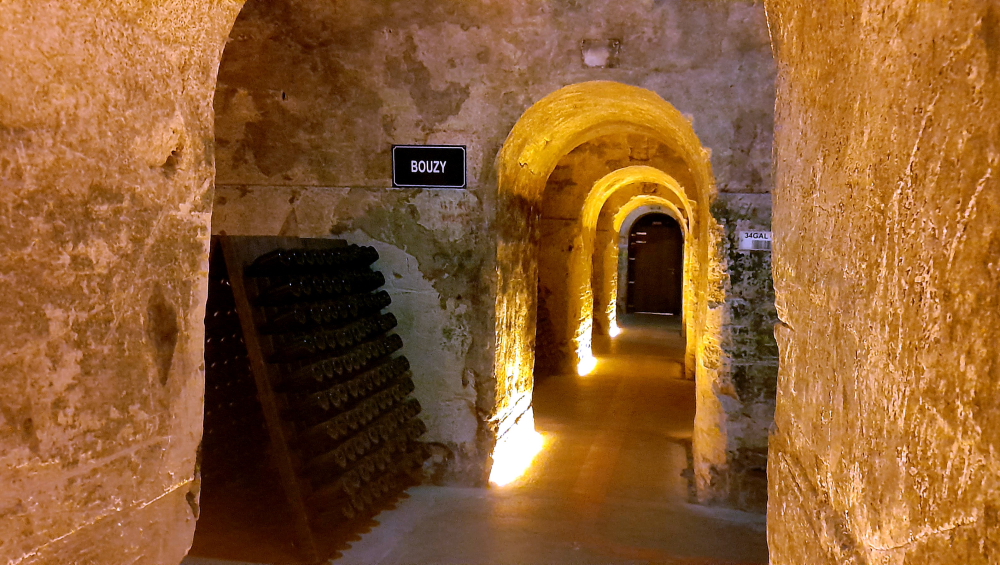
Mumm caves, this one with champagne made from Bouzy village grapes.

Champagne must be aged for a minimum of 15 months but Mumm prefers to age champagne for much longer.
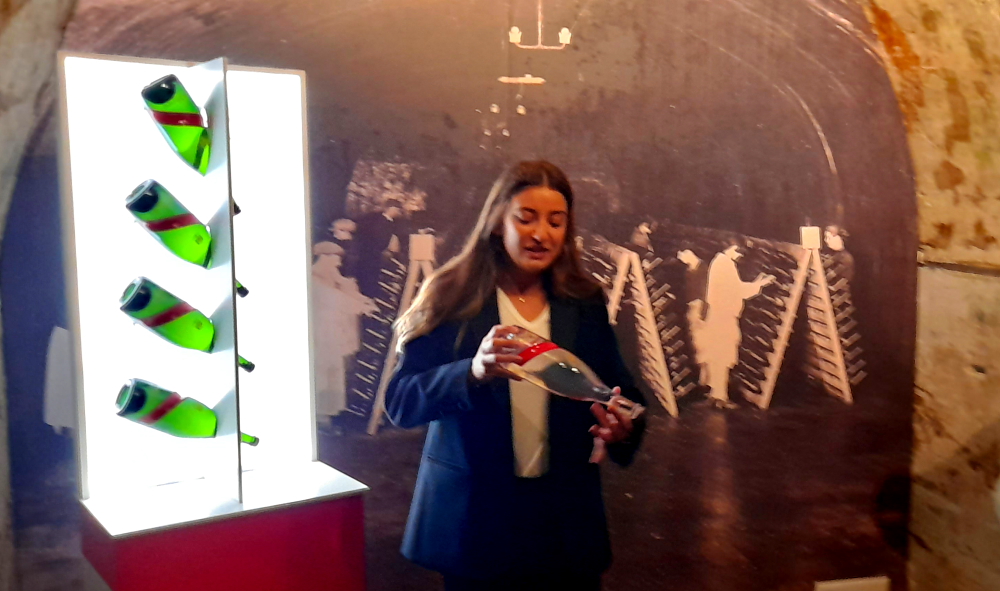
Yeast, riddling tables & disgorgement.

According to champagne specifications, a vintage champagne must be aged for a minimum of 3 years. At Mumm, aging lasts at least 5 years and can go up to 10-12 years for certain prestigious cuvees.
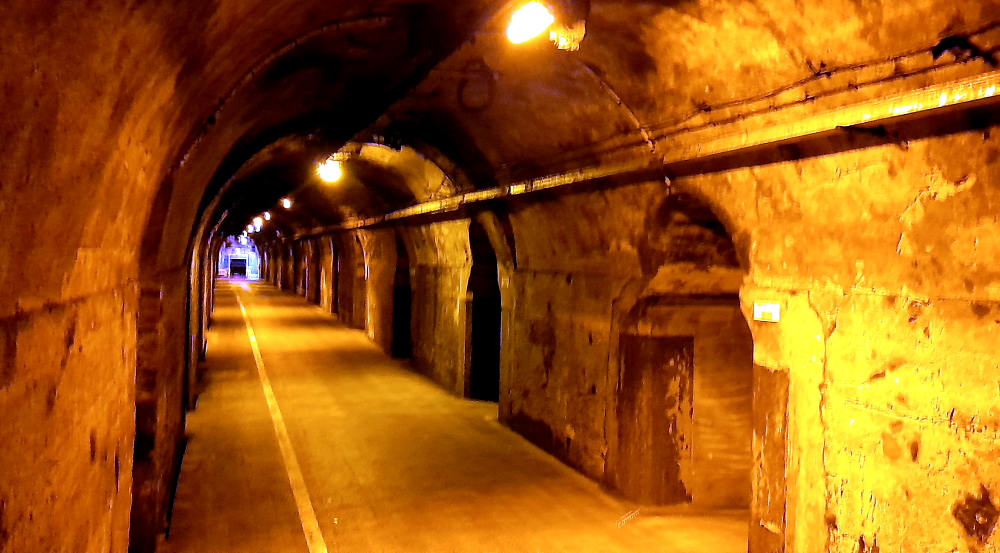
One of the galleries several kilometres long to transport the bottles.

Once aging has finished each champagne bottle is signed with the emblematic Mumm Red Sash on its paper label.

Except, created by English designer, Ross Lovegrove to mark 140 years of Mumm Cordon Rouge, the bottle is a technical feat that redesigns the champagne codes – a slimmer neck and understated lines emphasised by the indentation of the famous red sash directly in the glass – i.e. no paper label [mumm.com].
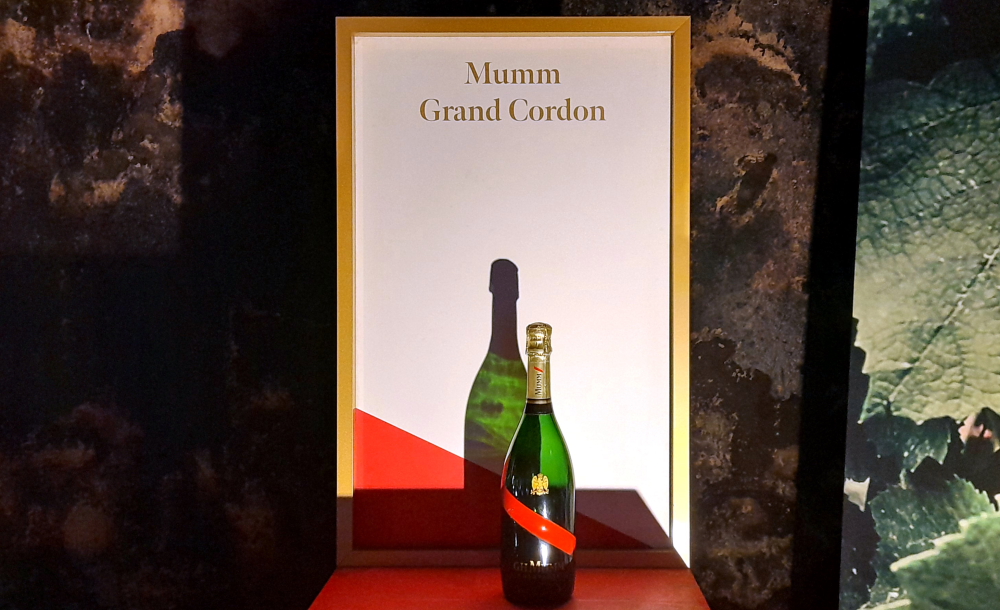
Mumm Grand Cordon – 140 year celebration bottle.

After an hour of walking the caves we emerge topside for a tasting of Mumm’s regular champers. Recommended to be served between 8°-10°C (46°-50°F) to help bring out the champagne’s full range of aromas and in a tulip-shaped white wine glass, with its wide girth tapering towards a narrow opening, that is best suited to champagne. This type of wine glass encourages the formation of bubbles and the release of aromas, concentrating them on the nose before tasting.

Opening a bottle involves holding the bottle at a 45 deg. angle, untwisting the wire, holding the cork and slowly rotating the base until the cork is released with, as Jerry noted, a “sigh” – never a pop!
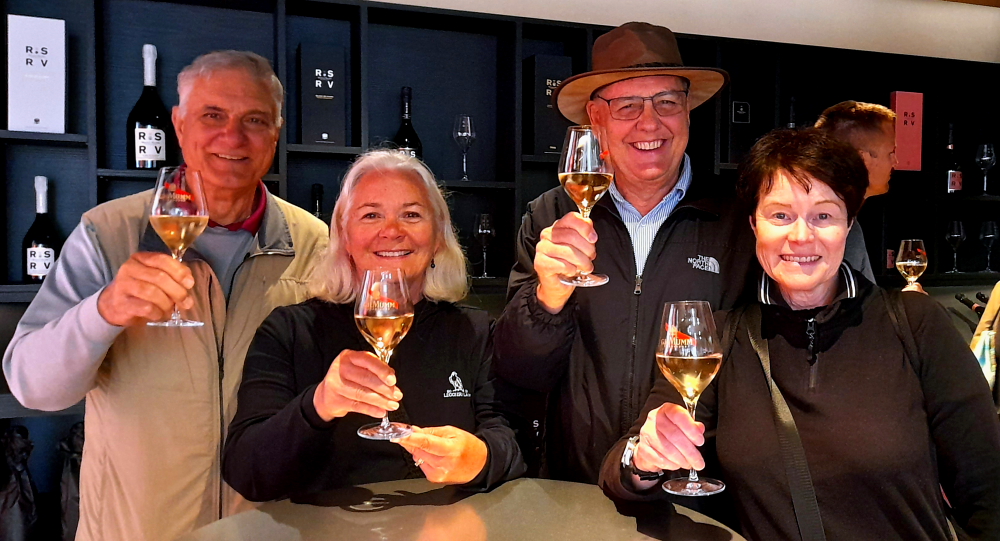
Sante!

We catch the tram back to the Opera-Cathedrale stop then walk to the City Library which is located in front of the Cathedral.
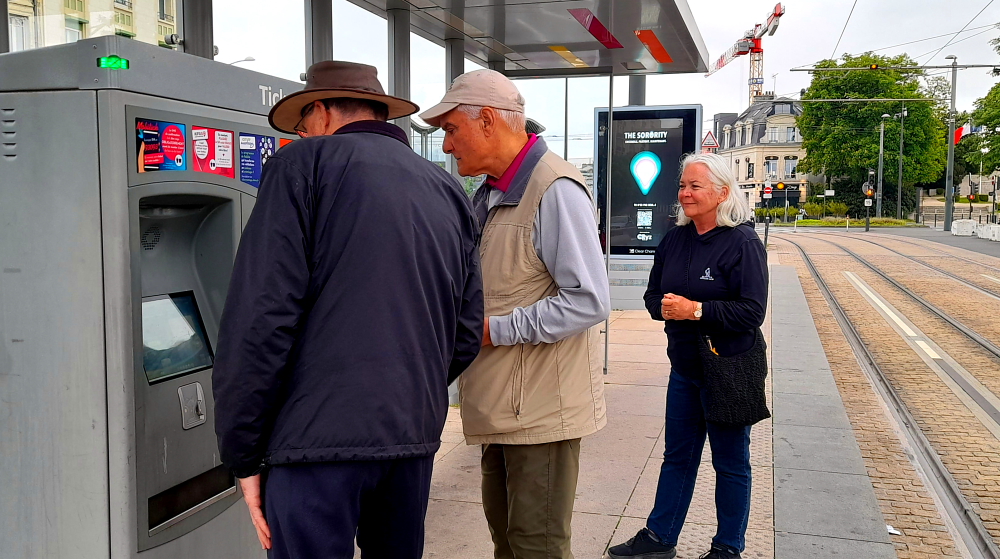
“Where’s the button for English?”

Here our guide had told us that we could view the Cathedral from an elevated perspective.
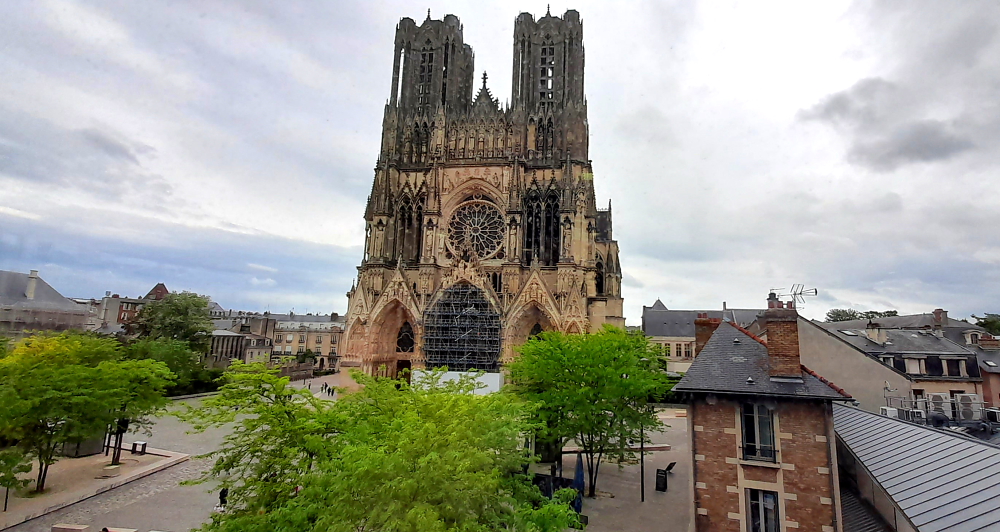
View of the Cathedral from the 2nd floor of the City Library.

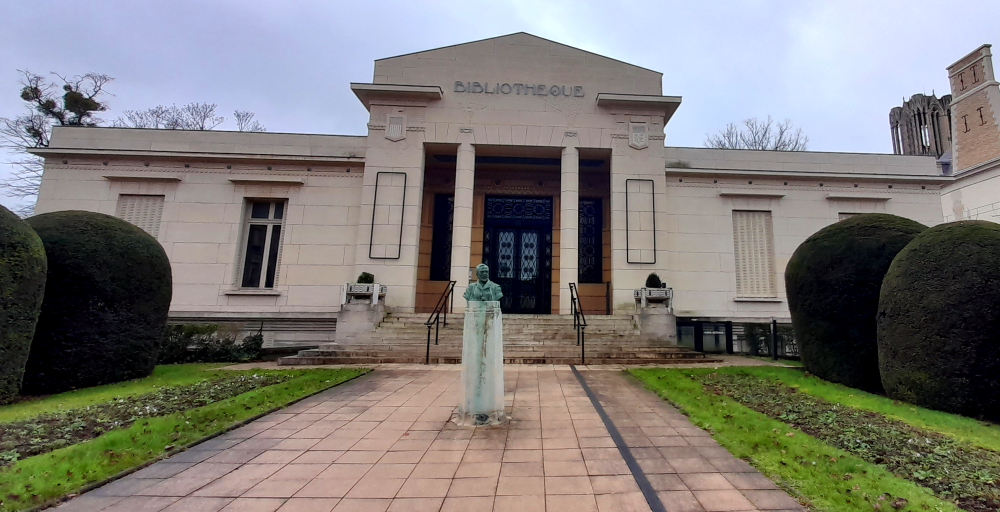
Later in the afternoon we revisit one of the tour’s sites, the Carnegie Library, a public library, which is open today.

Andrew Carnegie, a generous American benefactor, gave Rheims an Art Deco library via USD200,000 of funding. It was built in the period 1921-1927, under the direction of Rheims architect Max Sainsaulieu (1870-1953), and formally opened on 10 June 1928 in the presence of French president Gaston Doumergue and US ambassador Myron T Herrick.
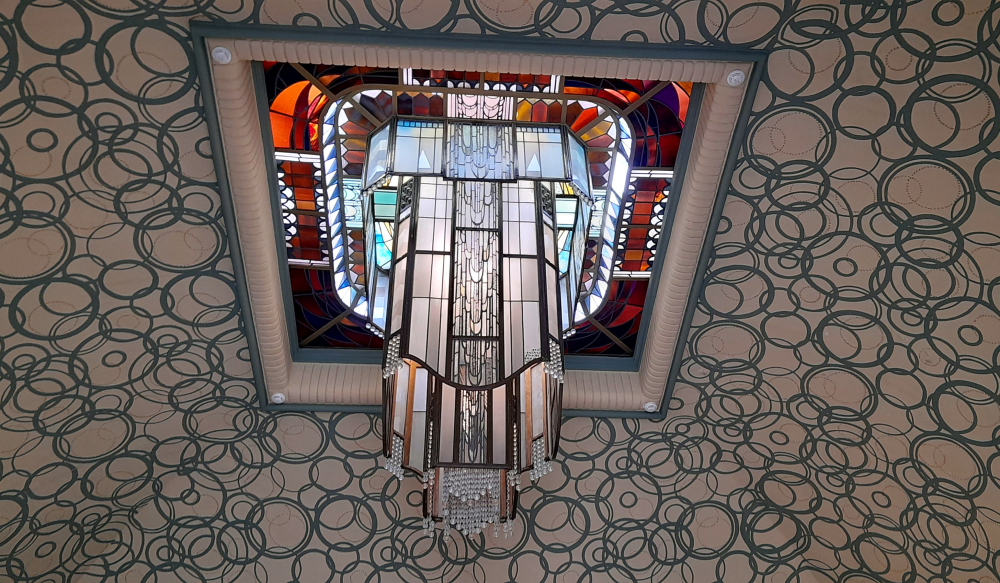
Exquisite chandelier, Carnegie Library Dome, Reims.

This library was remarkable for the quality of its materials, the richness of its ornamentation, and a very practical approach to the layout of its spaces, something rare in France at that time – a strict distinction between public space, storage space and staff working space.

The architect called on the period’s great names in decorative arts such as Schwartz-Haumont (gold medallist at the 1925 Arts Déco Exhibition) for the wrought iron gates; Jacques Gruber to design the glazing and the bays in the reading room, and stained glass artist Jacques Simon (1890-1974) for the entrance hall’s exquisite chandelier.
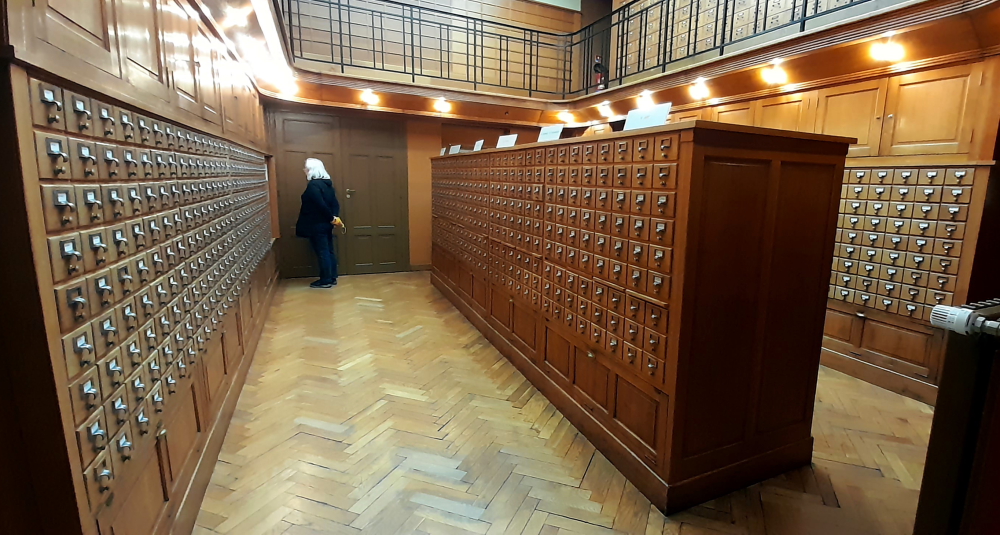
Catalogue room.

Spread across 5 levels, the collections’ storerooms have space for up to 9 linear kilometres of documents. Today, the Library is home to 400,000 documents, with 45 workspaces and reading rooms plus an exhibition hall, a 42-seat conference hall and a 30-seat lecture theatre [maisons-champagne.com…the-carnegie-library].
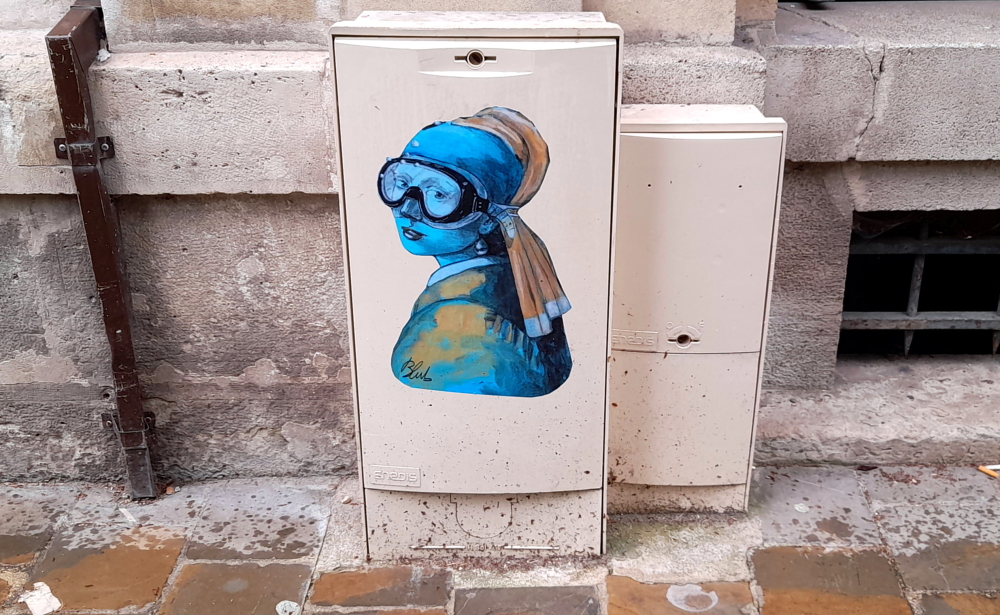
Reims’ street art.

Our final night in Reims is celebrated once again in the excellent Bistro des Anges.

15 May, 2024

In his professional life Jerry was a high school history teacher. This interest has driven us – figuratively and literally – to the French city of Verdun, 128 km east of Reims on the A4.

Specifically, we visit the museum known as the Memorial de Verdun Champ de Bataille, with immersive and interactive exhibits depicting the Battle of Verdun (302 days from February-December 1916).
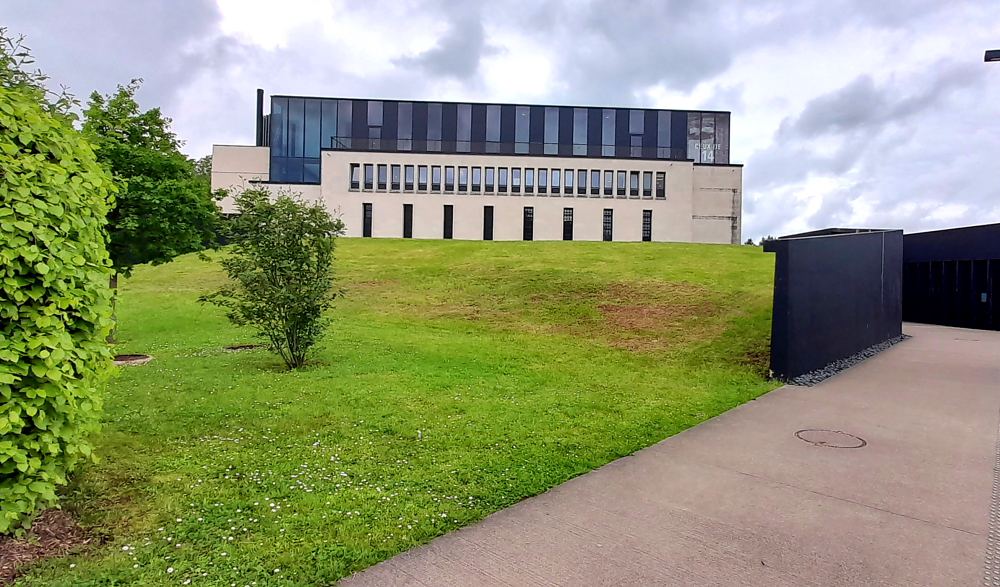
Memorial de Verdun Champ de Bataille.

The Battle began on 21 February 1916 at 7.15 am when the German army began bombarding the forts and trenches with artillery fire for 10 hours. 1,200 guns smashed the French positions. Erich Von Falkenhayn, Commander-in-Chief of the German army, wanted to put an end to the trench warfare that had begun in the autumn of 1914 and get his troops moving again.

During the first few days, the Germans breached the French front lines and captured Fort Douaumont without a fight on 25 February 1916. The French High Command was anxious to retake the fort because of its dominant position high above the battlefield. Despite heavy shelling, the French infantrymen (known as “Poilus”) clung on to their positions and the Germans were unable to advance any further. General Pétain then took command of the troops. He was ordered to defend Verdun.

He increased the volume of traffic along the Bar-le-Duc to Verdun road, later known as the “Sacred Way”, the only route taking men and munitions up to the battlefield. In all, some 4,000 trucks, 2,000 cars, 800 ambulances, 200 buses and numerous vans passed along it.
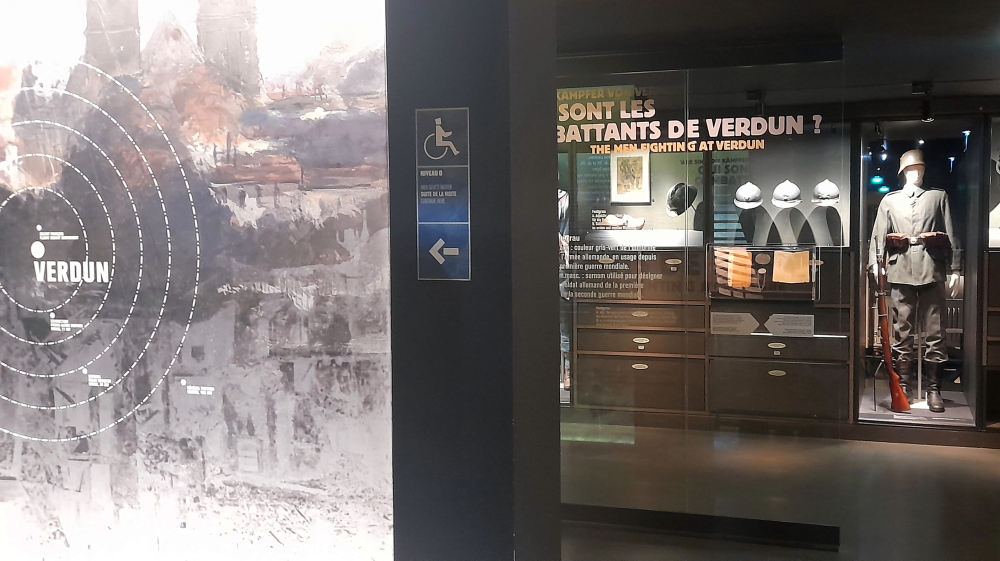
Example of exhibits in the Verdun museum.

From 6 March 1916, the Germans also attacked on the left bank of the River Meuse yet despite furious fighting on Le Mort-Homme in March and April they were unable to breach the French front line. At the end of June, having taken Fort Vaux, they launched a massive attack which failed – but only just.

On 1 July, the British and French launched a major offensive on the Somme, relieving some of the pressure being put on the French troops by the Germans in Verdun. The Germans tried to capture the town one last time, on 11 and 12 July, but they failed again.

In the autumn of 1916, the French counter-attacked. On 24 October 1916, they recaptured Fort Douaumont and, a few days later, they entered Fort Vaux. It was empty – the Germans had already left. From 15 to 18 December, the French attacked again, retaking almost all the land they had lost since 21 February.
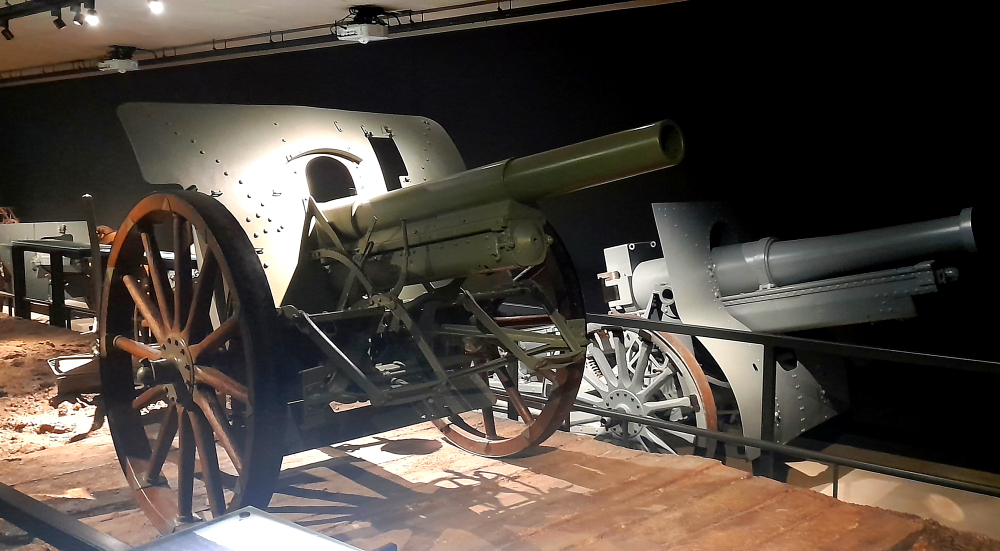
German artillery.

The 1916 battle ended after ten months of bitter fighting on 18 December. There were more than 700,000 victims – 305,000 killed and missing and approx. 400,000 wounded, at an average of 70,000 per month, with almost identical losses on both sides. Yet fighting continued around Verdun until 1918.

Almost three-quarters of the French army fought at Verdun in 1916. It was a Franco-German battle but it also involved colonial forces. The sheer scope and violence of the fighting here made it one of the major battles of WWI.

The United States did not declare its participation in the Great War until 1917, however some unofficial assistance from it was already being provided for the Allies by the start of Verdun. American volunteers played a significant role in the front line of the battle, performing as ambulance drivers, fighter pilots, soldiers and other duties [news.va.gov].
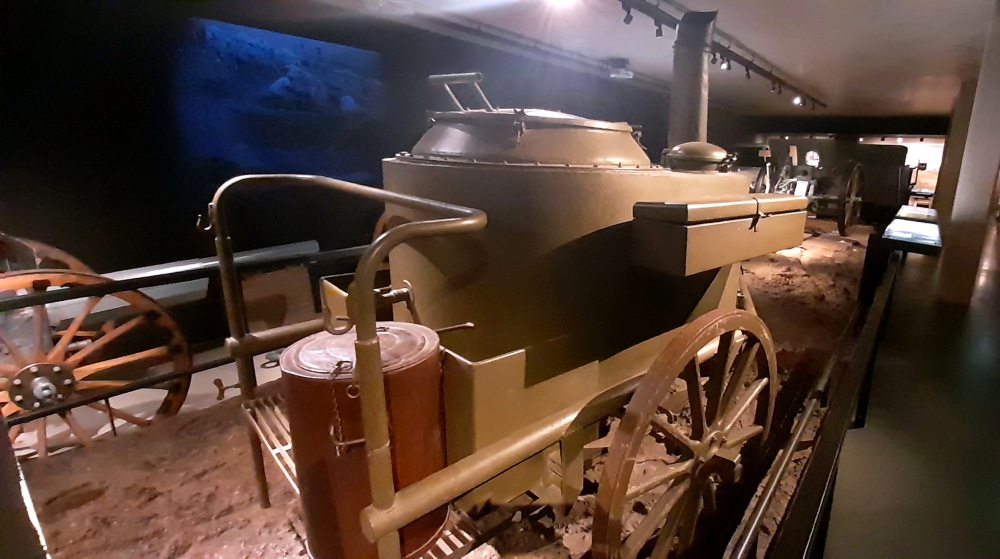
German field kitchen.

In fact, the Battle came to symbolise the Great War, a culmination of battlefield brutality. It summed up every aspect of the Great War and turned Verdun into the most iconic of all places of remembrance [memorial-verdun.fr].

Exiting the Museum we walk to the nearby village – its remains, that is – of Fleury-Devant-Douaumont – village détruit. In the forests around the town of Verdun there are 8 other villages with this “village destroyed” categorisation.

There are remnants of some structures – a few stones in the ground & markers – but otherwise there is nothing, except a rebuilt chapel, with the statue of Our Lady of Europe draped in a blue flag with gold stars.
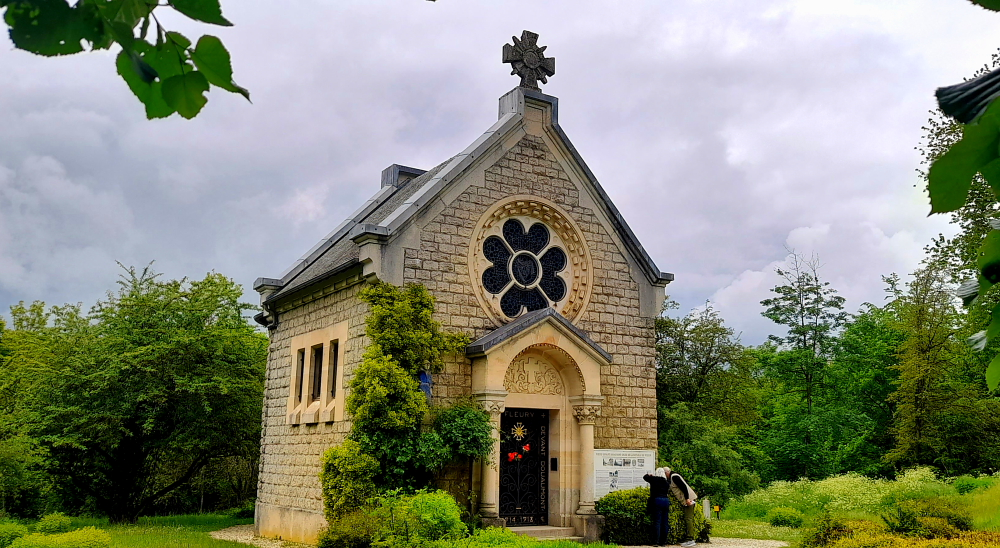
Our Lady of Europe.

Before WWI Fleury-devant-Douaumont was home to just over 400 inhabitants, who worked the land and forests or in the village itself.
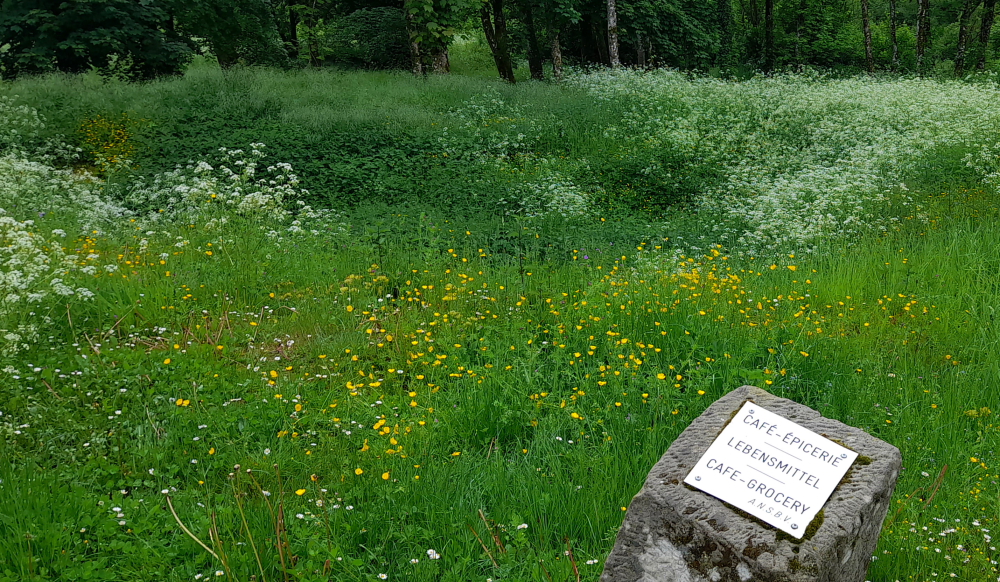
Undulating land from bomb craters & markers for former village buildings.

As the Germans advanced, Fleury-devant-Douaumont was evacuated. Altogether, what remained of the village exchanged hands 16 times over the course of the battle. When it finally ended, the village was no more. It was in the Zone Rouge, declared a village that had ‘died for France.’ Nothing was left, but in honour of its sacrifice, it kept its legal status. The red-framed white signs still stand at the entrance and exit of Fleury-devant-Douaumont. It still has a mayor [www.elsewhere-journal.com].
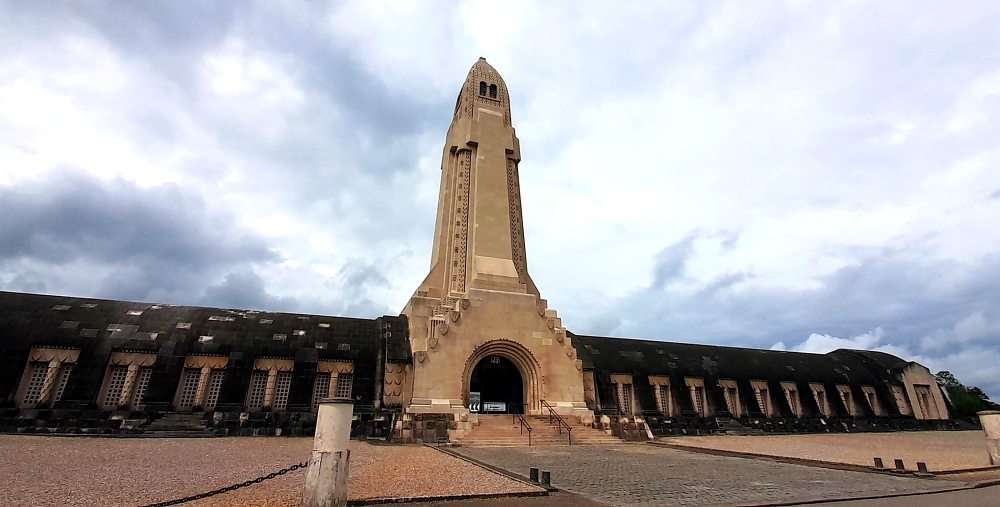
Douaumont Ossuary.

Nearby is the Douaumont Ossuary, a memorial containing the skeletal remains of at least 130,000 unidentified combatants of France and Germany. In front of the monument lies the largest single French military cemetery of WWI with 16,142 graves. It was inaugurated in 1923 by Verdun veteran André Maginot, who would later approve work on the Maginot Line. The ossuary was officially inaugurated on 7 August 1932 by French President Albert Lebrun.
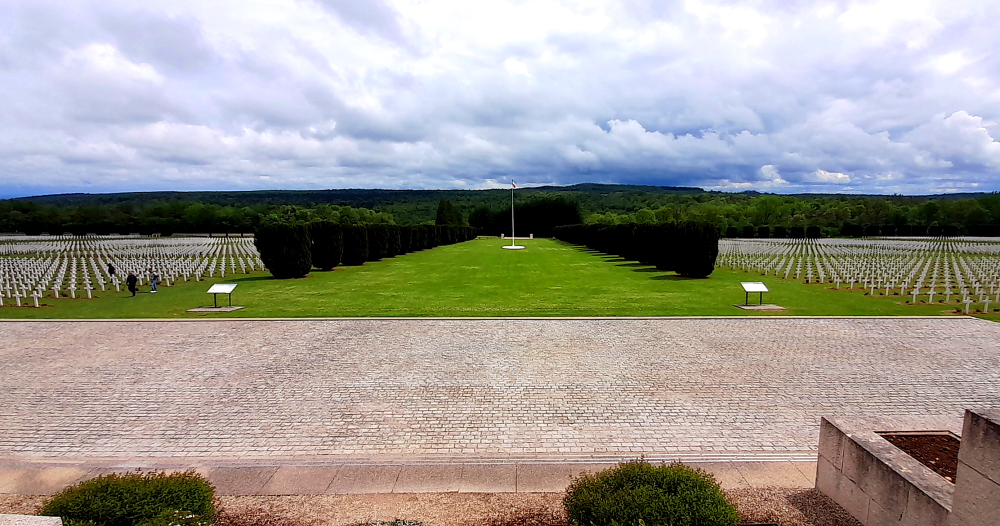
16,142 graves.

Close by is Fort Douaumont, a relic of WWI. It’s one of the most powerful works and symbols of the Battle of Verdun.
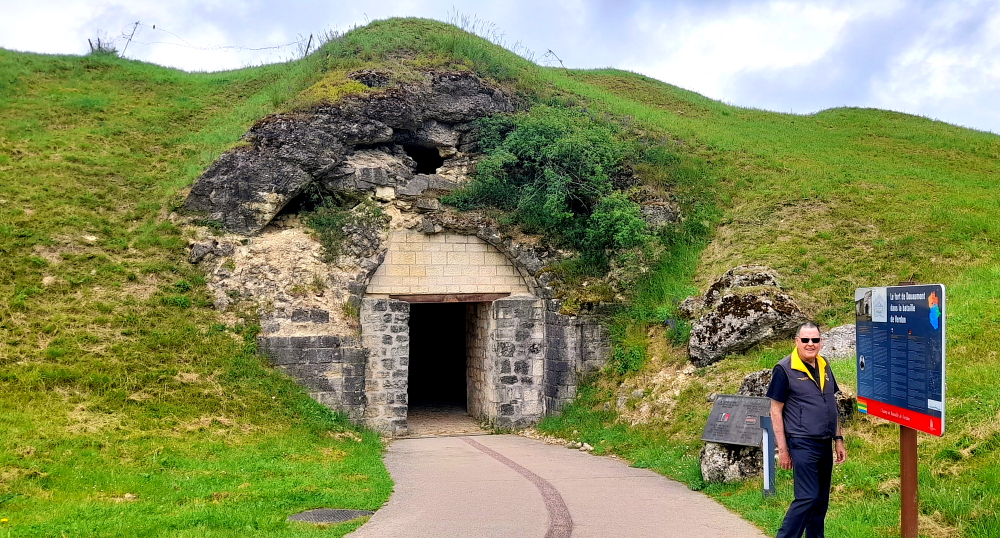
Entrance to Fort Douaumont.

Built between 1884 and 1886, Fort Douaumont was a strategic location of the Battle of Verdun in 1916. Moreover, it is to this battle that it owes its fame.
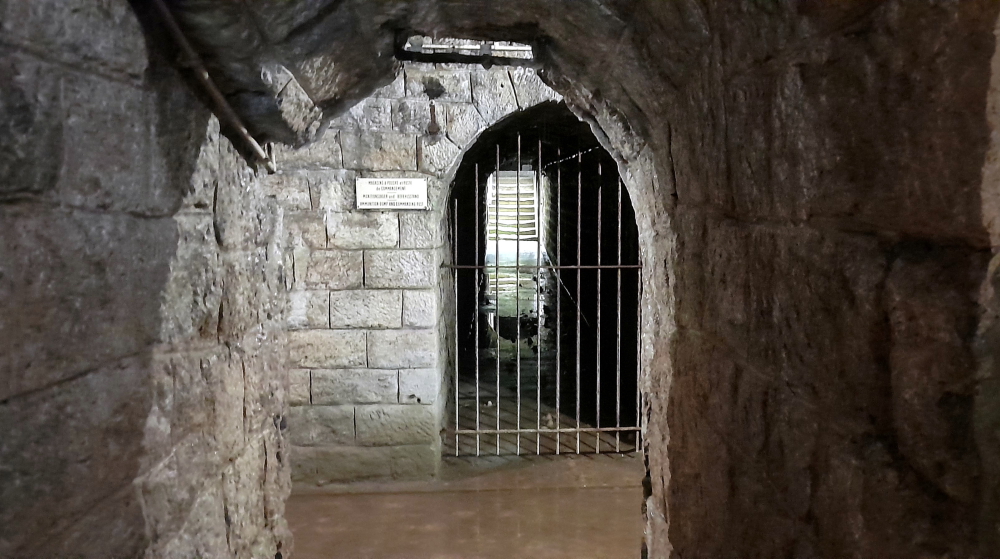
Passageways within the Fort.

Overlooking the valley SW of Douaumont at an altitude of 400 metres, the fort has been classified as a historical monument since 1970.
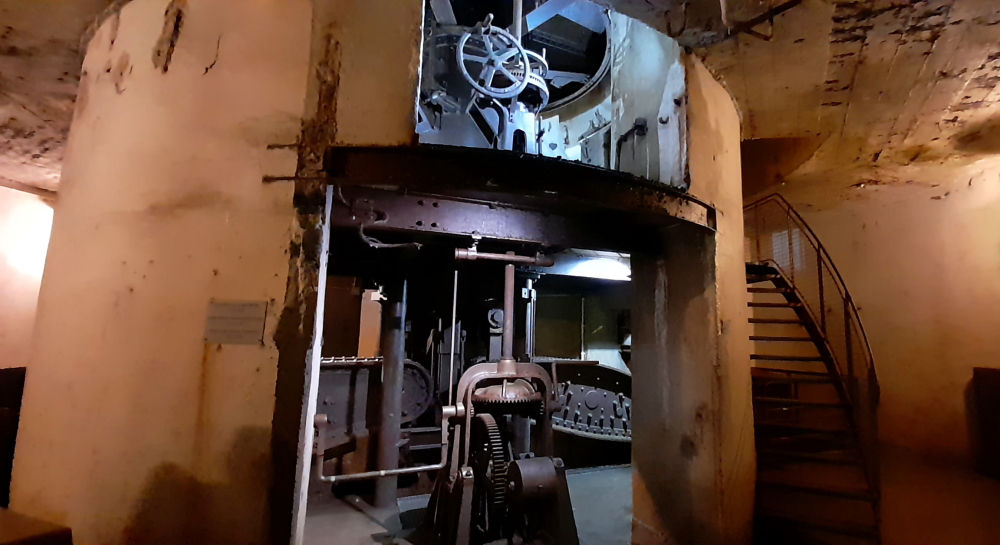
The Galopin Gun Turret – 155 mm gun.

Its masonry construction was almost immediately obsolete because at that time new shells had the capacity to destroy masonry structures.
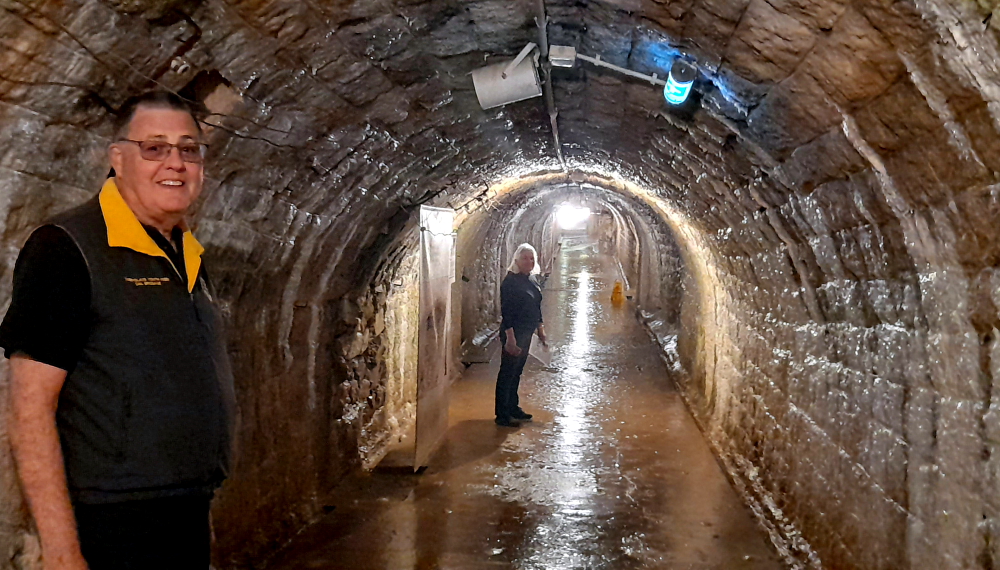
Yet another damp tunnel with calcite deposits.

That is why Fort Douaumont was covered with a thick layer of concrete in the most exposed and sensitive areas. Its efficiency and the resistance of its armament made it one of the most sturdy buildings in the entrenched camp of Verdun.
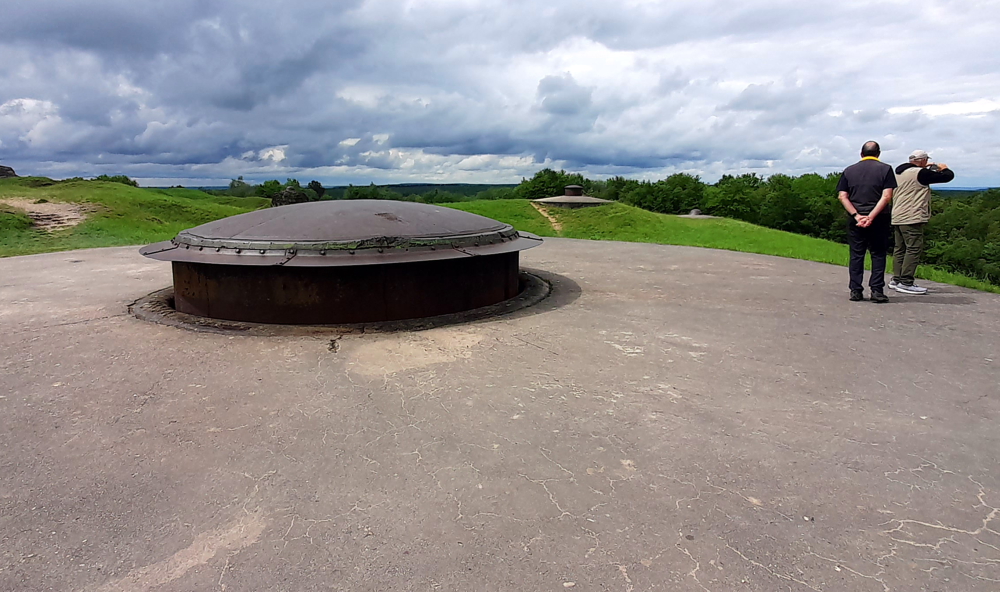
Top of the Fort showing gun emplacements.

On 21 February 1916, the Germans attacked Verdun. Fort Douaumont was a prime target: it received about 800 shells in 2 days. In a few days, the front line came dangerously close to the fort. 4 days after the beginning of the battle, it was in the hands of the German army. However, the French army fought to recapture the fort for 8 months by showering it with shells.
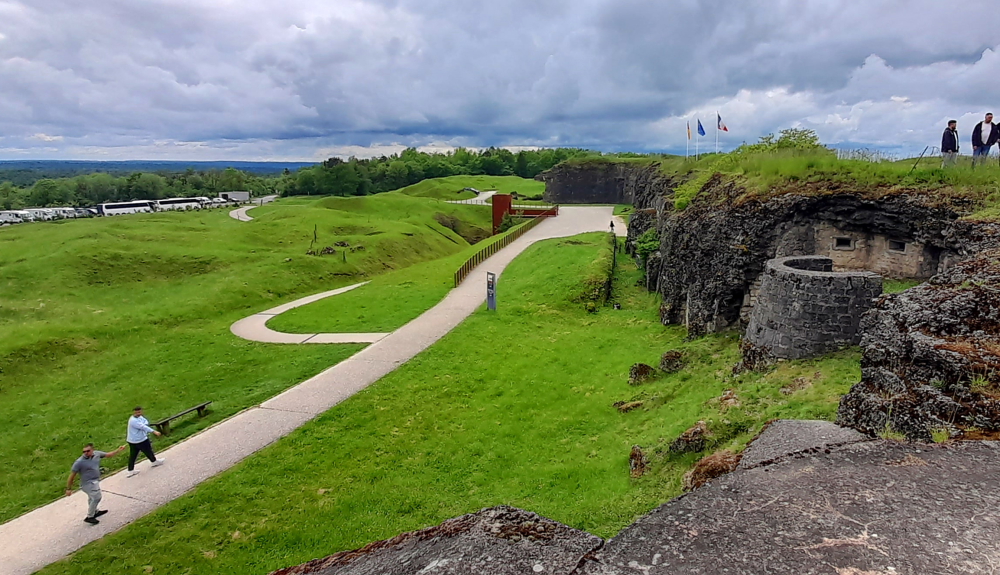
View of the Fort wall.

Finally, in October 1916, after 6 days of preparation and a particularly dense artillery deployment, an umpteenth attack succeeded in retaking the fort [landofmemory.eu].
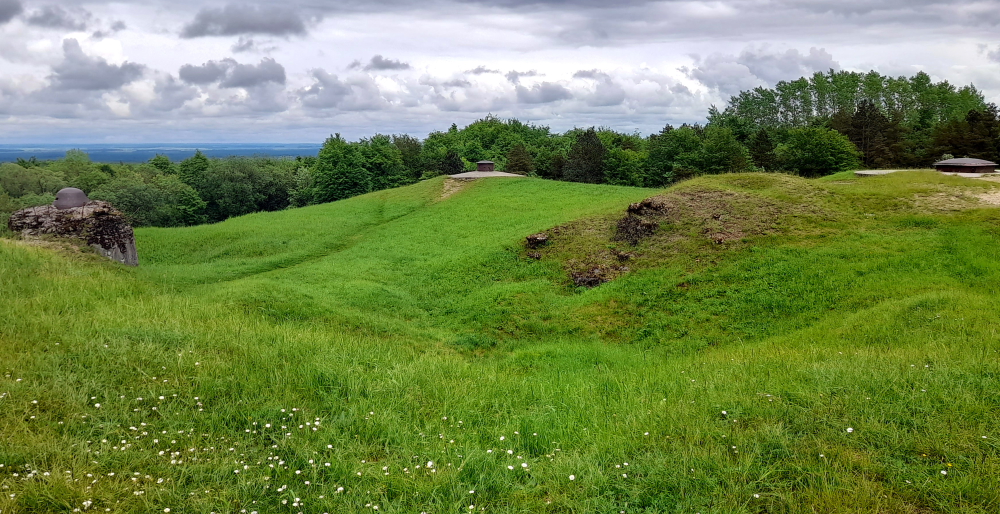
Bomb craters surrounding the Fort.

Also nearby is the “Trench of Bayonets”. “To the memory of the French soldiers who sleep standing with rifle in hand in this trench – from their brothers in America.” This is the inscription in front of the Memorial.

The monument was financed by a wealthy American banker, George T. Rand, who was moved by the famous legend that the place inhabits. French soldiers were said to have died and were then buried, standing with weapons in hand, killed by enemy shells. The Bayonet Trench is one of the myths of WWI. It was classified as a historical monument in 1922 and considered a national memorial site in 2014 [landofmemory.eu].
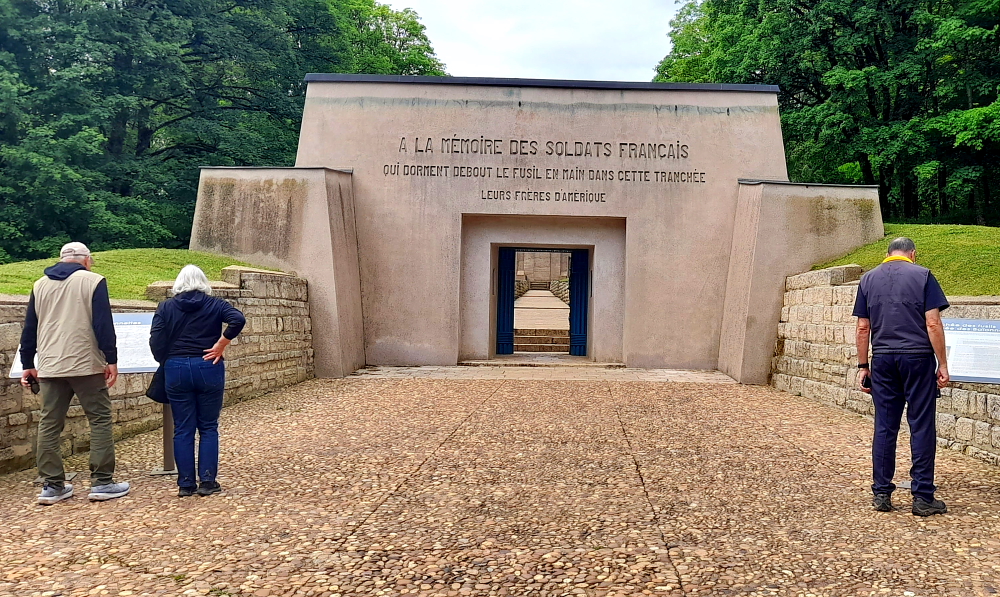
Entrance to the Bayonet Trench Memorial with inscription.

In June 1916, this entrenched position was a part of Fort Douaumont, which the Germans desperately wanted to take. On June 12, Germans unleashed a hailstorm of iron and lead upon French positions. The attack caught the French by surprise.

The 137th Regiment of French infantry was annihilated almost to the last man. Years after the war, French teams exploring the battlefield uncovered the first clues of the horrific fate of this regiment. One of the trenches was discovered completely filled in, with only a neat line of bayonets sticking out of the ground. The bayonets were still fixed to their rifles. A body was found next to each one. Under relentless bombardment, the soldiers had been effectively buried standing up, perhaps even while they were still alive.  Or so the story goes … [atlasobscura.com].
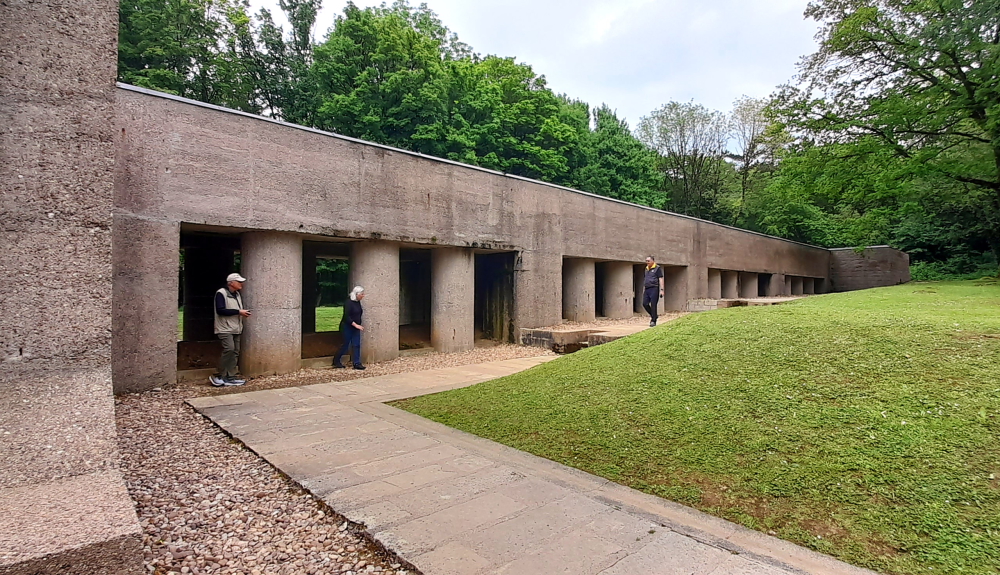
The actual trench protected by a concrete colonnade.

After the war, excavations led to the discovery of 21 bodies of French soldiers. 14 were identified and buried in the Fleury Cemetery before being moved to the Douaumont Ossuary. The other 7 bodies, which remain unknown, were reburied in the “Bayonet Trench.” [landofmemory.eu].
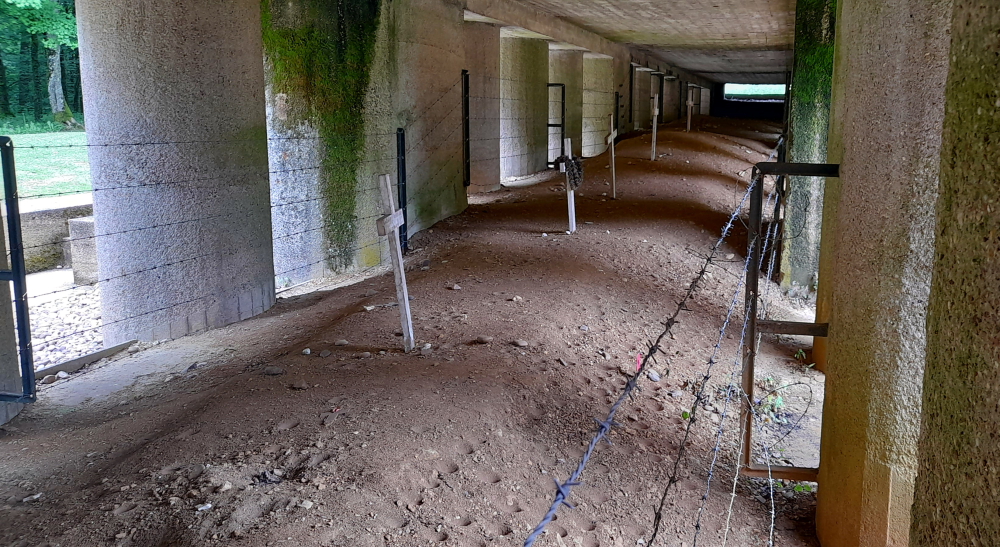
The Bayonet Trench with crosses replacing the bayonets.

Around 4:00 pm we leave this part of France and head 1.5 hours SW to the Leclerc supermarket in Pierry, a suburb of Epernay, then drive the 30 minutes south to our next AirBnB accommodation in Baye (back into the Champagne region) which Becky and Jerry had booked, where we arrive around 7:00 pm.

Louis, the owner, meets us at the gite and while he shows Becky and Jerry around and explains the history of the family home (2 houses merged), we unload the car.
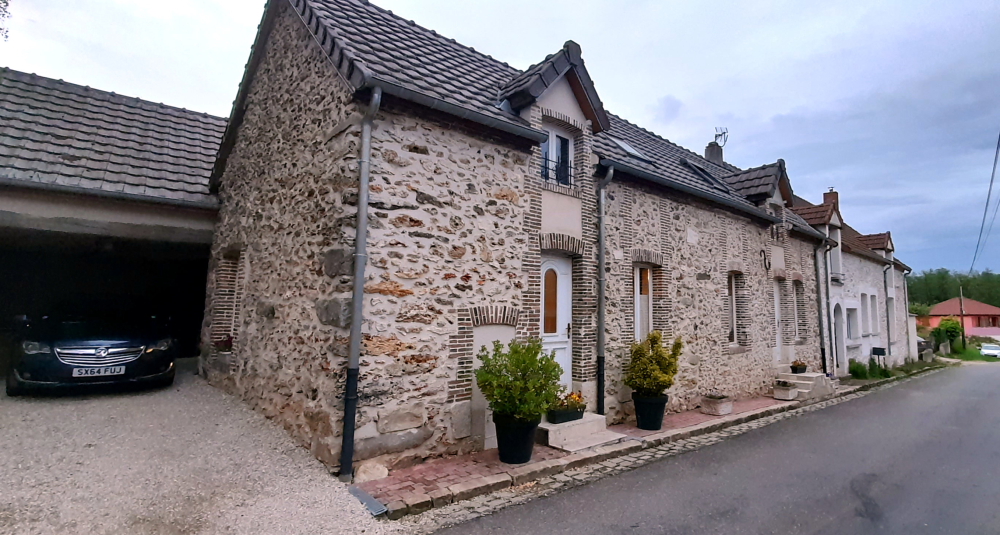
Our AirBnB gite in Baye, France.

After a lasagne and salad supper, in front of a lovely fire lit by Louis, we hit the sack.

16 May, 2024

Another glorious day. This morning we are meeting up with Tony and Florence, friends of Becky and Jerry’s, who live in Provence. 10 weeks ago Becky introduced us to them via a Skype video call so we are looking forward to meeting them today. Flo has kindly organised a tour and wine tasting this morning, a restaurant lunch, an inspection of their vines and a river cruise this afternoon.
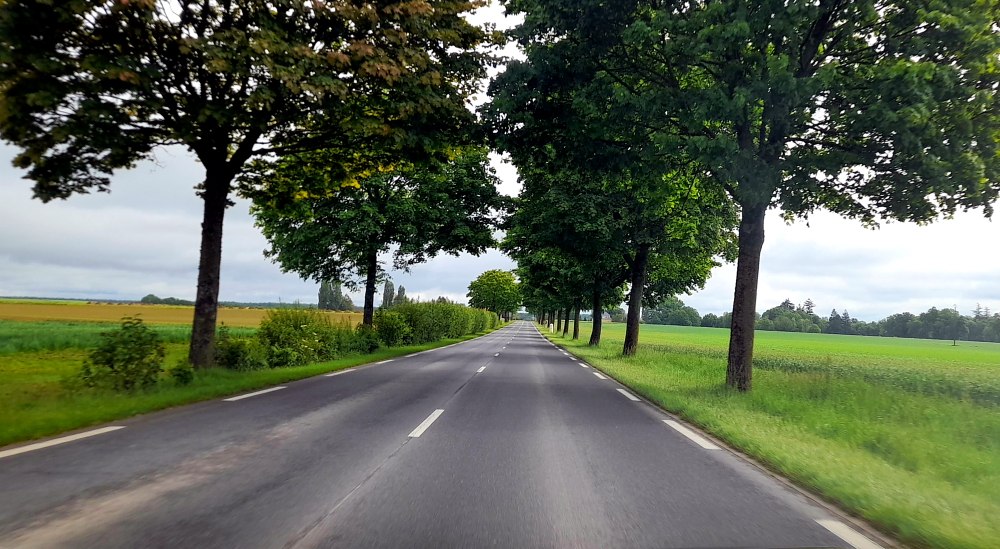
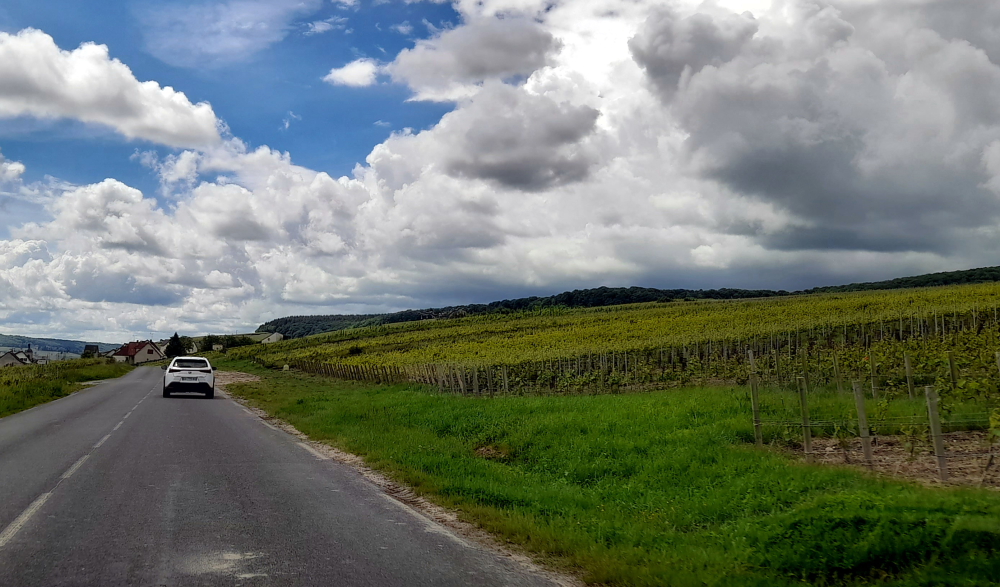
Countryside outside of Baye on the D951.

Tony is English and Florence is French, having been born and raised in Cumieres (Marne) which is where we are meeting them at 10:30 am at the Vadin-Plateau (VP) champagne house that buys the grapes from their 12 rows of vines that grow a couple of blocks away.
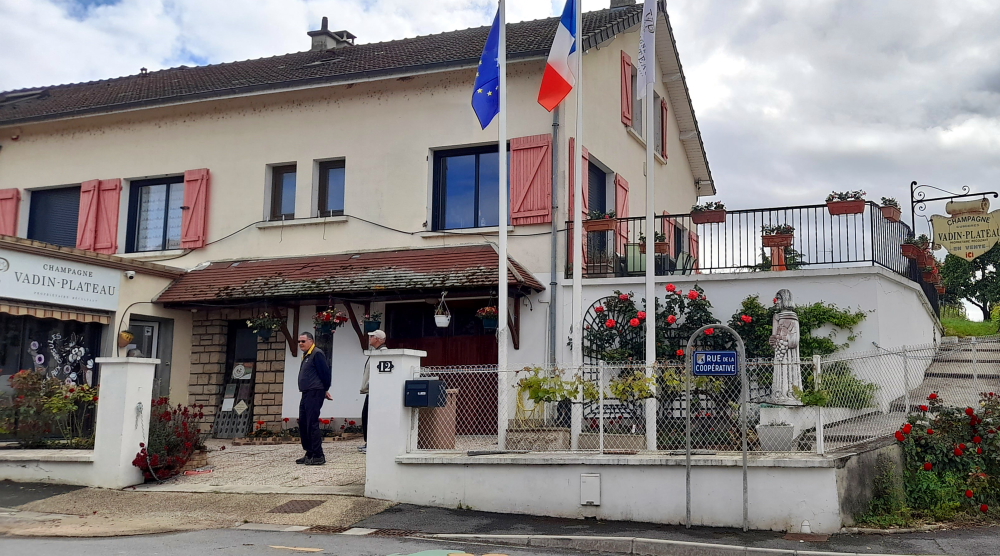
Vadin-Plateau (VP), Cumieres.

According to the Paris Wine Company website, Vadin-Plateau was founded in 1785 amongst the terroirs of 5 neighboring villages: Ay, Damery, Champillon, Hautvillers, and the home of the winery, Cumières. Since 2012, the 7-hectare estate, with vineyards spread over 100 different parcels in the fine Premier Cru of Cumières to the north of Epernay, has been committed to organic viticulture and has abstained from using herbicides for over two decades.

The wines produced at this domaine are not only typical of the region, but also highly personal, as each cuvée possesses a unique identity of its own. The Renaissance, its flagship 100% Pinot Meunier, is an embodiment of the Cumières’ grape. Along with the non-vintage cuvées, Renaissance and Intuition, Vadin-Plateau also produces an impressive selection of single-vintage, single-vineyard wines that reflect the distinct terroirs of the Cumières and Hautvillers parts of the estate, first released in 2018 [pariswinecompany.com/producer/vadin-plateau/].

This estate’s terroir (environmental factors, farming practices, habitat) is described as a Continental climate with Oceanic influence. Silty-sand, clay-limestone and limestone soils over a chalk bedrock. Mostly southern facing gentle slopes. 100-170m altitude. Its winegrowing/viticulture (cultivation and harvesting of grapes) is certified organic (Ecocert) and certified biodynamic – respecting the ecology, culture and tradition of a place.

The vigneron is the Vadin family with Muriel, and her daughter, Aurélie, running the estate since 2022. Bartholomew, who has been with them for about a year as their wine master, takes us on a tour with Flo taking on the role of occasional interpreter.
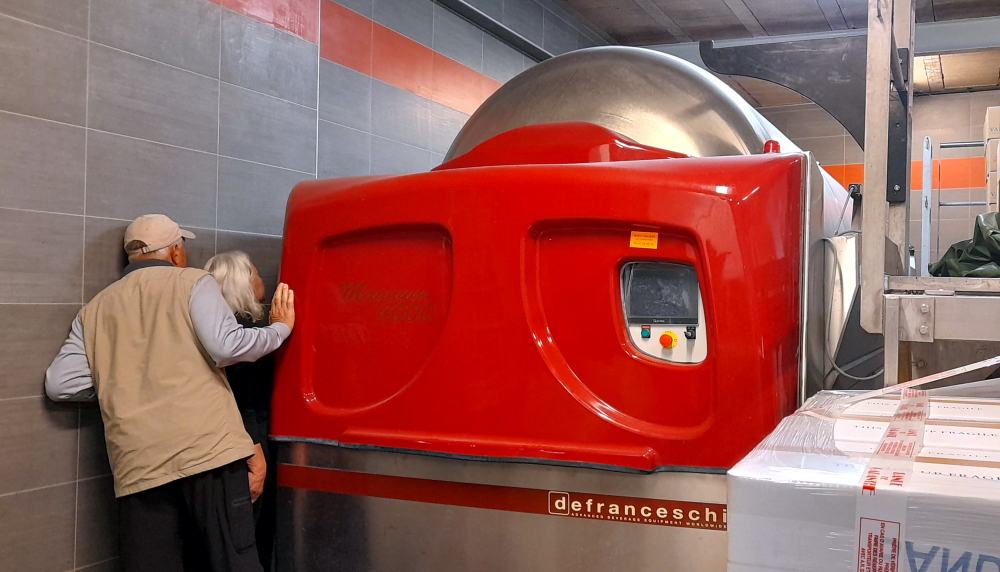
No feet involved in pressing 4000L of grapes these days!

Considering it’s such a small estate, there has been a massive investment in technology and equipment.
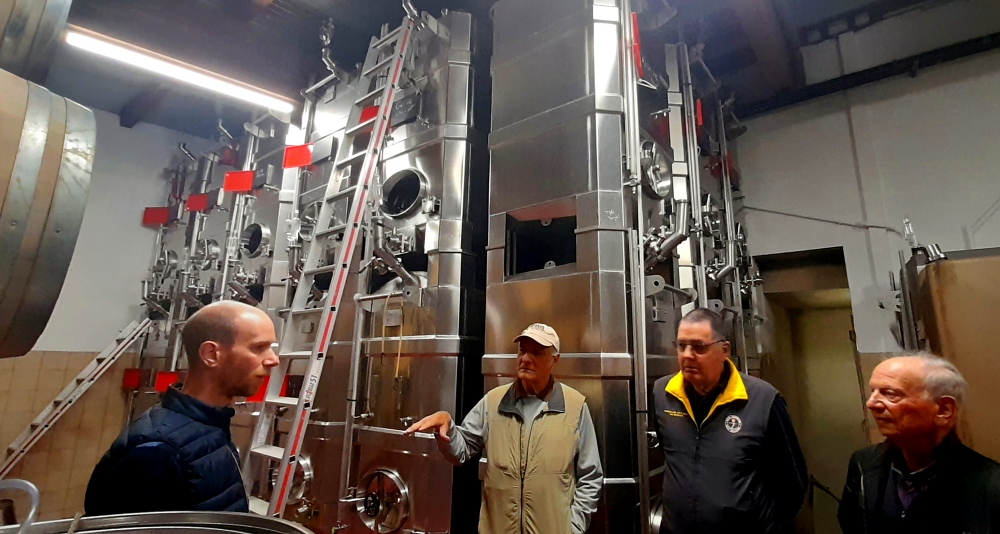
Stainless steel vats where fermentation process begins.

Working organically has helped to produce wines with purity, depth and resonance – champagnes that represent exceptional value for money which we can endorse, having purchased 2 bottles of their excellent Grande Reserve at Eu19.40 each.
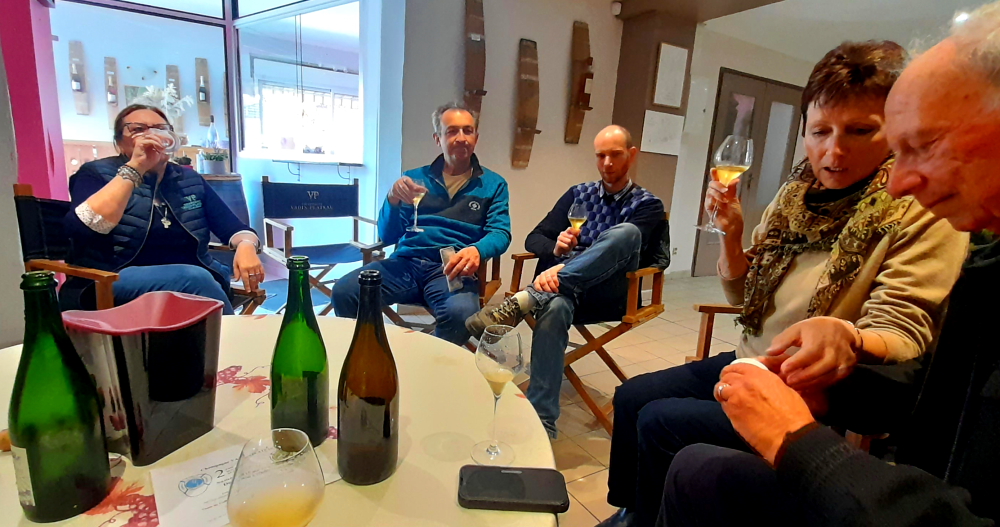
Sampling the Carte Blanche & Aurelie champagnes with Muriel (L), Bartholomew (C) & Flo & Tony.

At 12:25 pm we sprint out the door as we have a 12:30 pm booking at Chez Max – a Restaurant traditionnel Français depuis 1946 passed down from father to son – in nearby Magenta, 10 minutes’ drive away.
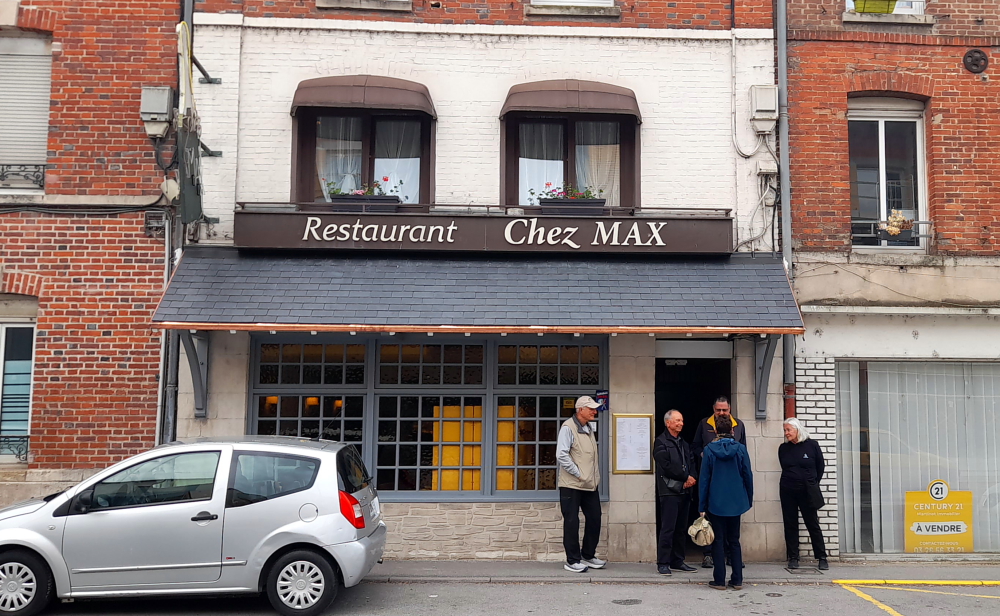
Ordinary outside, extraordinary inside.

On arrival we are greeted warmly by the current “Max”, Monsieur Besnard. We all opt for the 3-course set menu at Eu26 which has at least 2 options each for entree, main and dessert, accompanied by a bottle of the restaurant’s own wine, an exquisite Geoffroy Cumieres Rouge – délicieux all round.
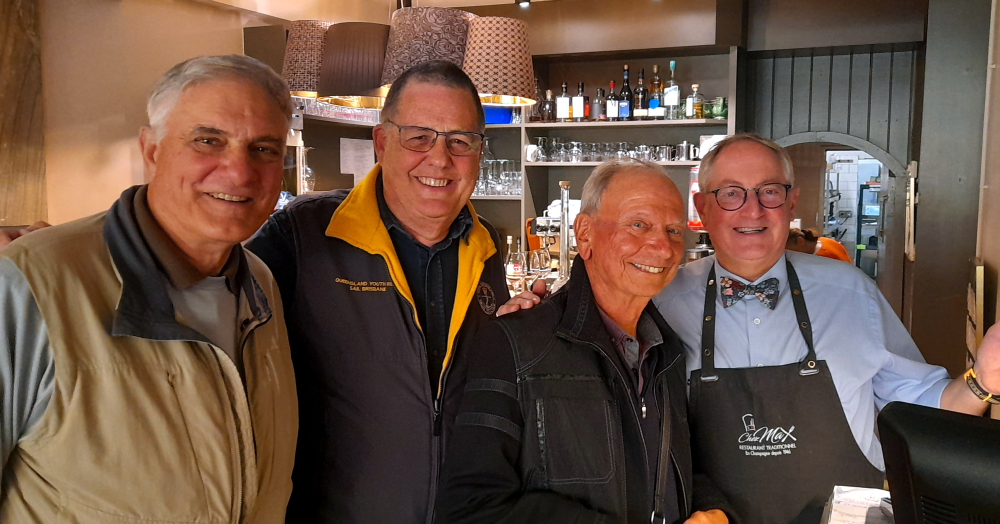
All boys together with “Max”.

Turns out Monsieur Besnard has a daughter who lives in Newcastle, NSW, so I have a bit of a lively chat with him, in English thank goodness, about his travels through Oz over the years.
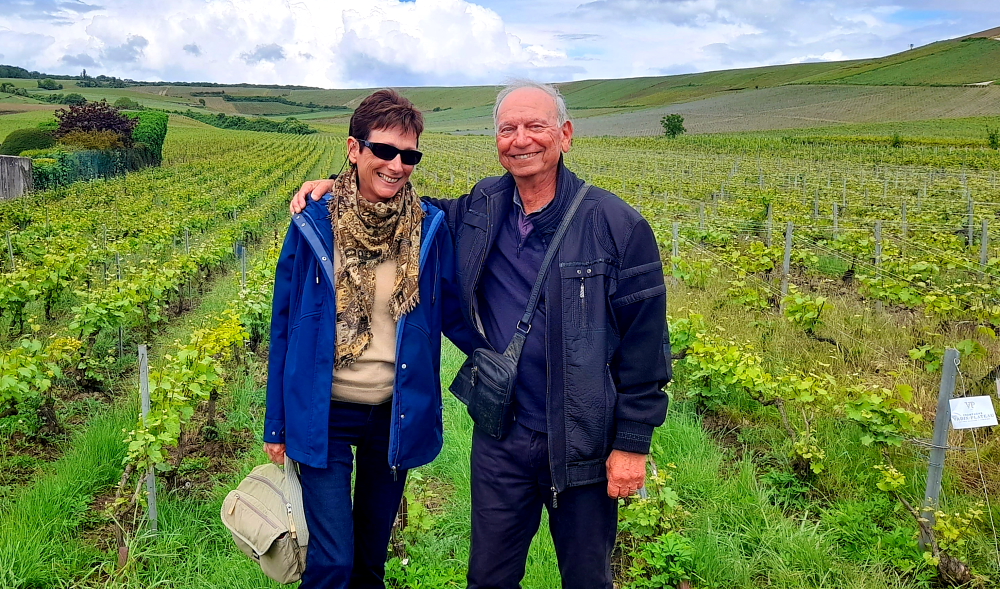
Proud owners, Flo & Tony, in front of their vines.

Several hours later we leave and drive by Florence and Tony’s 12 rows of vines on Avenue du General Leclerc in Ay on our way to the boat cruise.
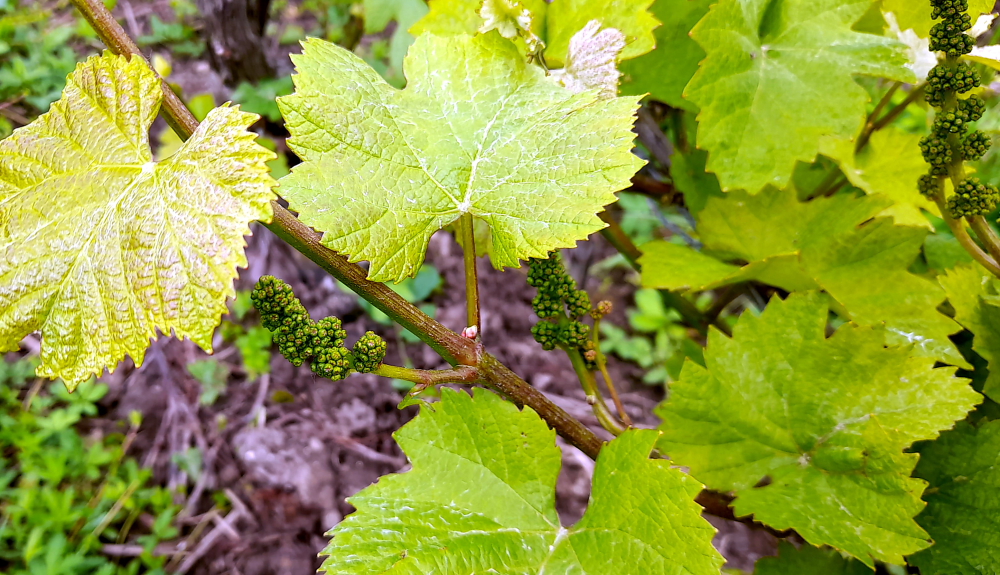
Sprigs of tiny, tiny grapes.

That’s the thing about owning vines in the Champagne region, they are usually inherited and rarely, if ever, for sale.
Vineyards under a threatening sky on Le Pre Gariot, next to the Marne River.

With 15 minutes to spare we arrive at the quai where the Champagne Vallee Bateau berths to find a small convoy of retro Citroen vans already parked.
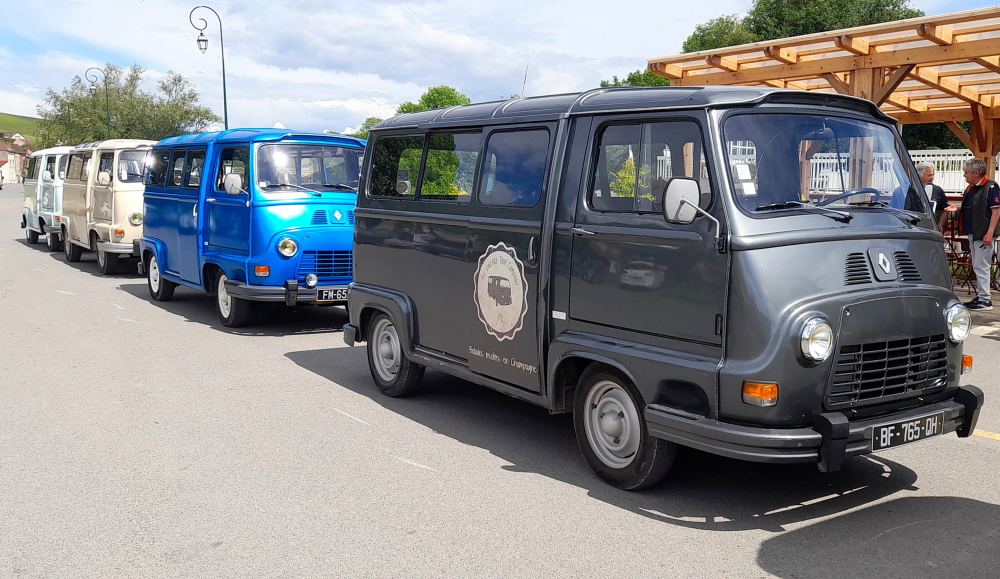
Not a Syrena amongst them.

Once on board we discover that a large group of tipsy Poles has taken over the main, inside deck and are happily serenading each other. As there is no room for us, we go topside which is drenched in rather hot sunshine.
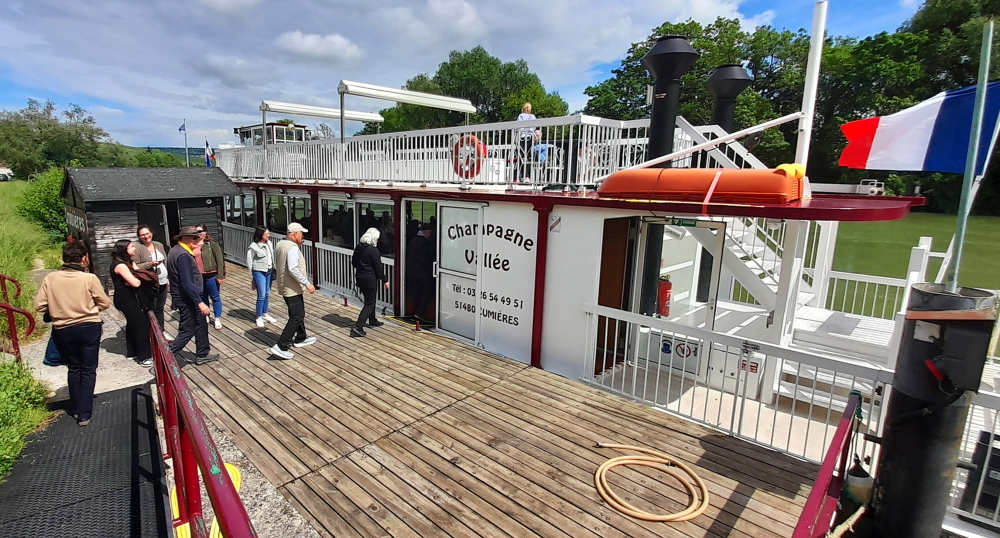
Walk those planks!

We grab some chairs, strip off unnecessary jackets and sunbathe while we wait for the cruise to commence.
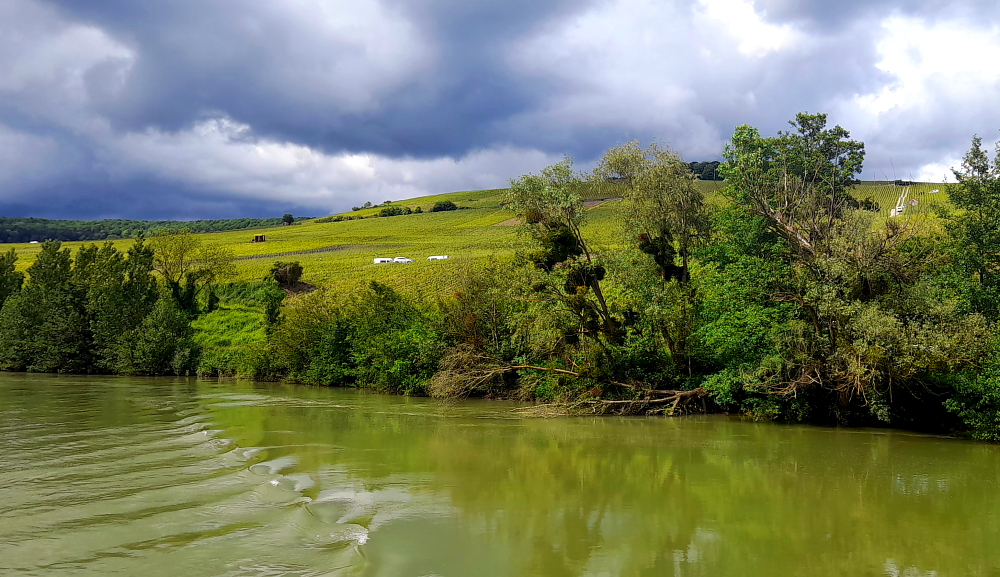
Verdant countryside dotted with tiny white vans.

Soon we have a guide who gives us a commentary in English, that is until the Poles decide they, too, want some sunshine, pour onto the top deck and begin singing once again, drowning out the commentator.
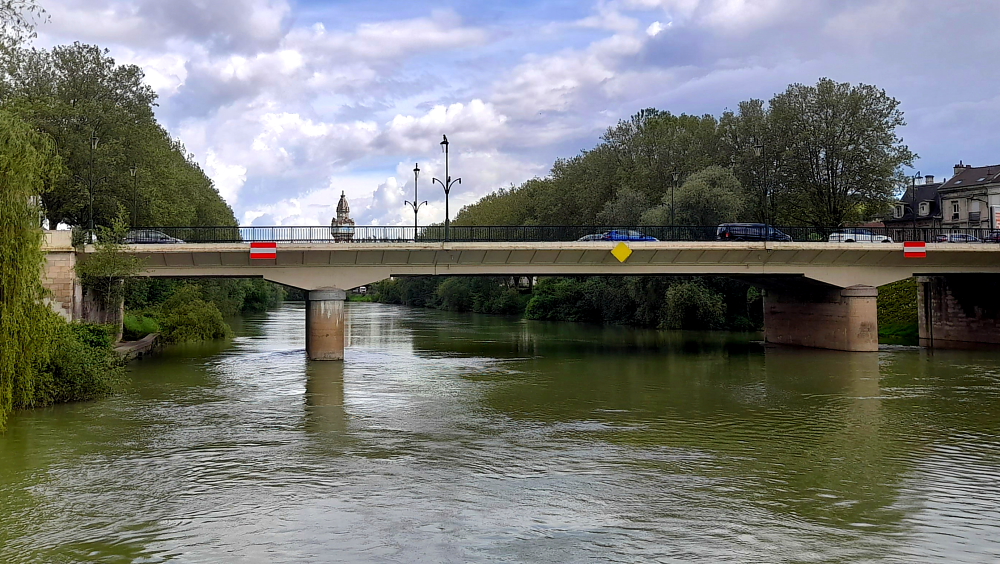
Tour de Castellane, Epernay peeking above the Pont d’Epernay.

She soon tells them to “shush” and we get to enjoy a quiet cruise taking in the surrounding undulating green countryside which is dotted with what look like toy white vans while vineyard workers tie, weed, rake and spray.
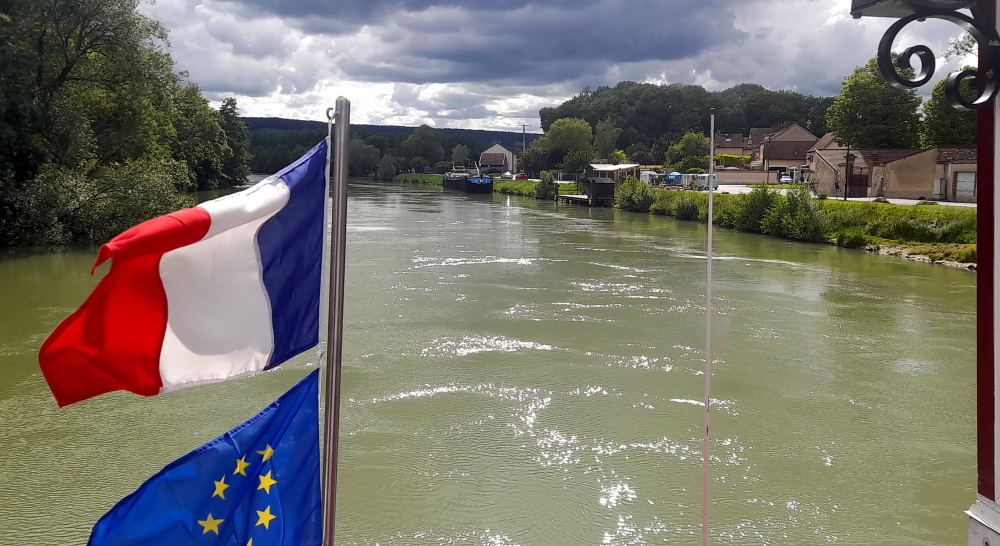
Heading downstream back to the berth at Cumieres.

Apparently there are 18 locks on the 518 km Marne River, one of which, No. 15, we pass by as we cruise upstream until we reach the Epernay Bridge where we turn around.
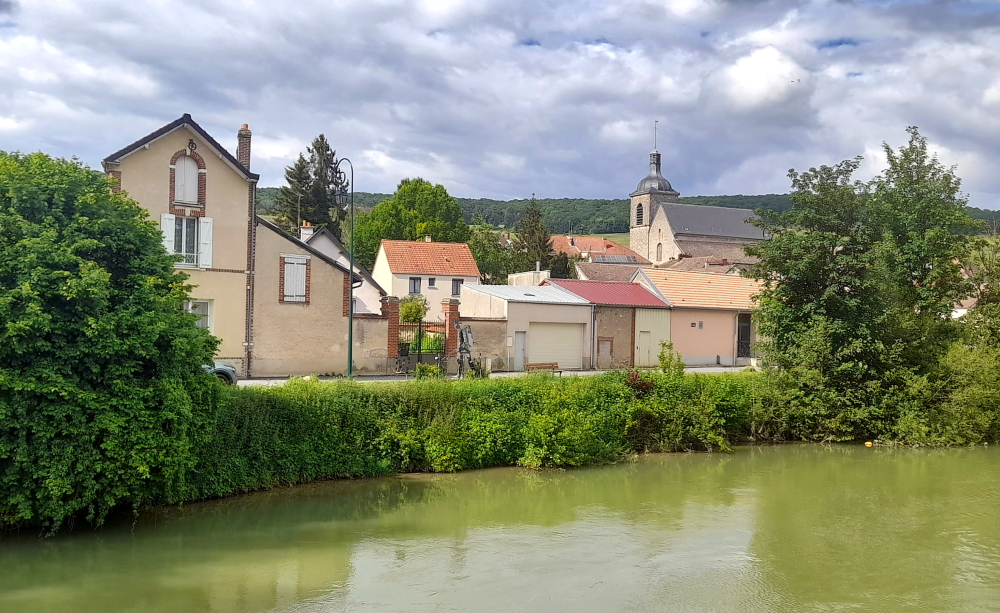
River view of Cumieres village with Champagne Marizy tower.

The sun is blazing hot, then it clouds over and a cool breeze springs up. Constantly there is the threat that we’ll be drenched by a thunder storm but the only drenching we get is an internal one when Flo and Tony produce yet another bottle of chilled champagne and 6 flutes. Cheers!
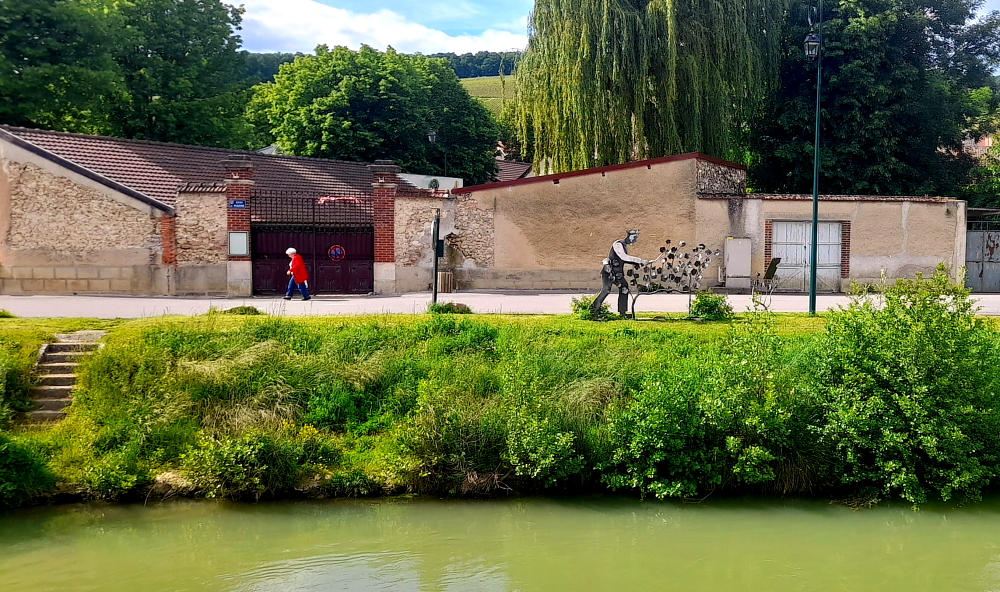
Metal sculpture of man tending vines, Quai de la Marne, Cumieres.

1.5 hours later we dock at the quai then drive back to Vardin-Plateau where we sample yet another bottle of bubbles before we collect our wine orders from Muriel – 6 boxes of champers for Tony and Flo and 1 small box of 2 bottles for us – and say our farewells to Muriel. Their boxes we place in our cavernous car boot as their small one is full of suitcases.
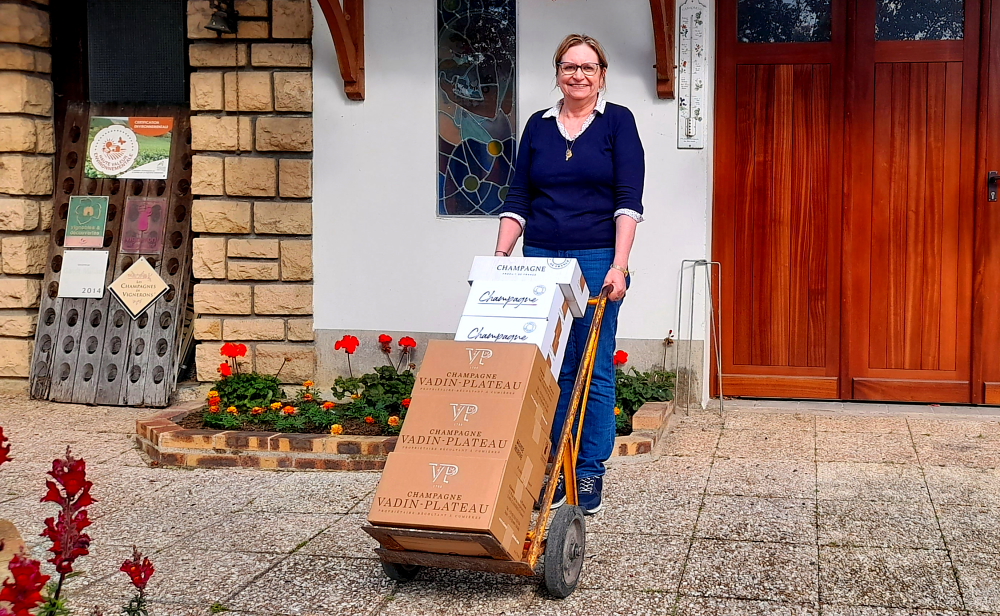
Tony & Flo’s champagne order.

En route to Baye we all stop at the Leclerc supermarket at Dizy for tonight’s dinner supplies then, with Tony following us, we drive back to the gite at Baye where they will stay overnight.
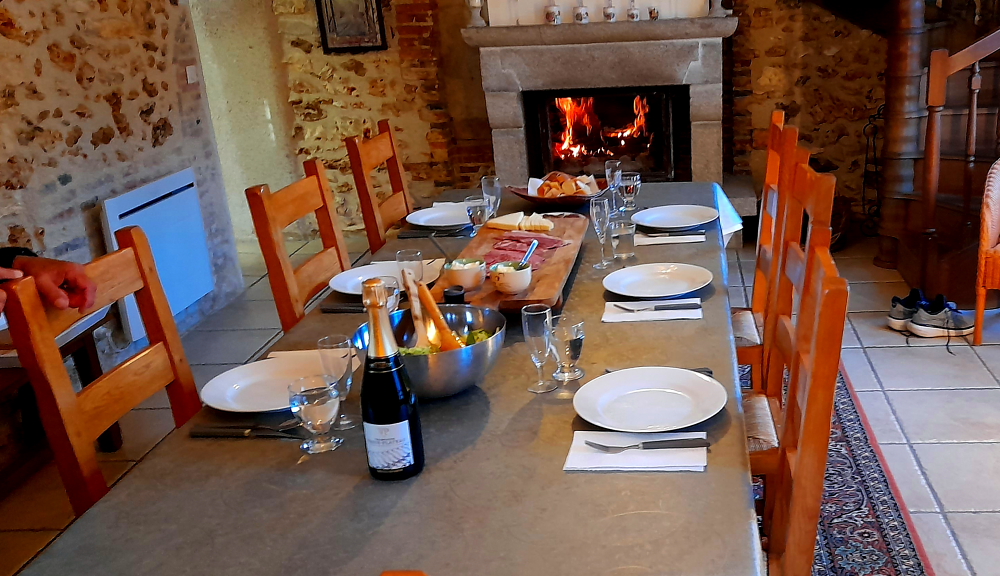
“Champagne, anyone?”

Simple fare is soon laid out on the dining table: cold cuts, cheese, salad and baguette followed by abricot tartin in front of a comforting fire laid by our resident pyromaniac, Jerry. Did I mention yet another bottle of champagne?

After such a hectic but fabulous day full of bubbles, food and laughter it’s an early night for all.

17 May, 2024

Sadly, Flo and Tony need to leave us around 10:00 am on their way to visit family. After reorganising their car boot we transfer all their boxed champagne to theirs and off they go with a cheery wave.
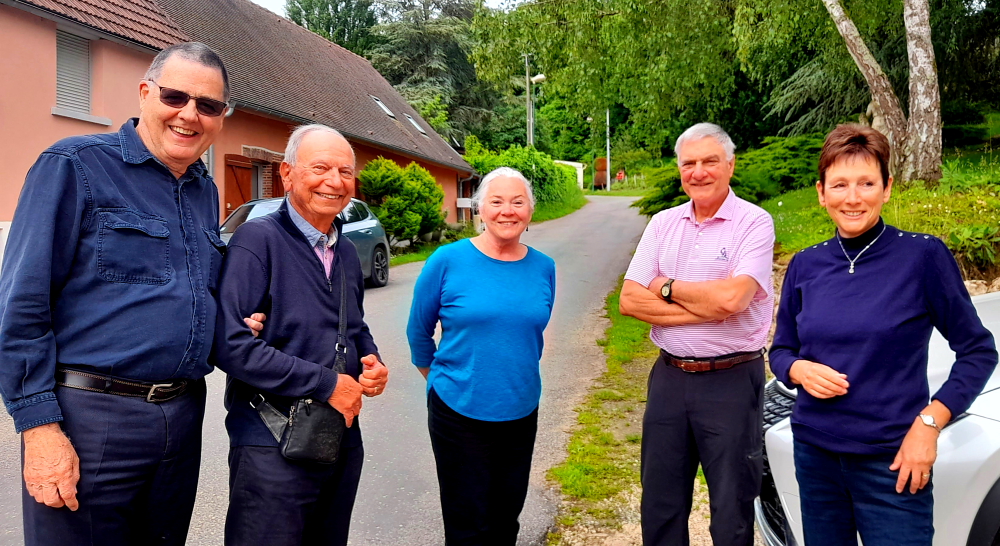
“Au revoir!”

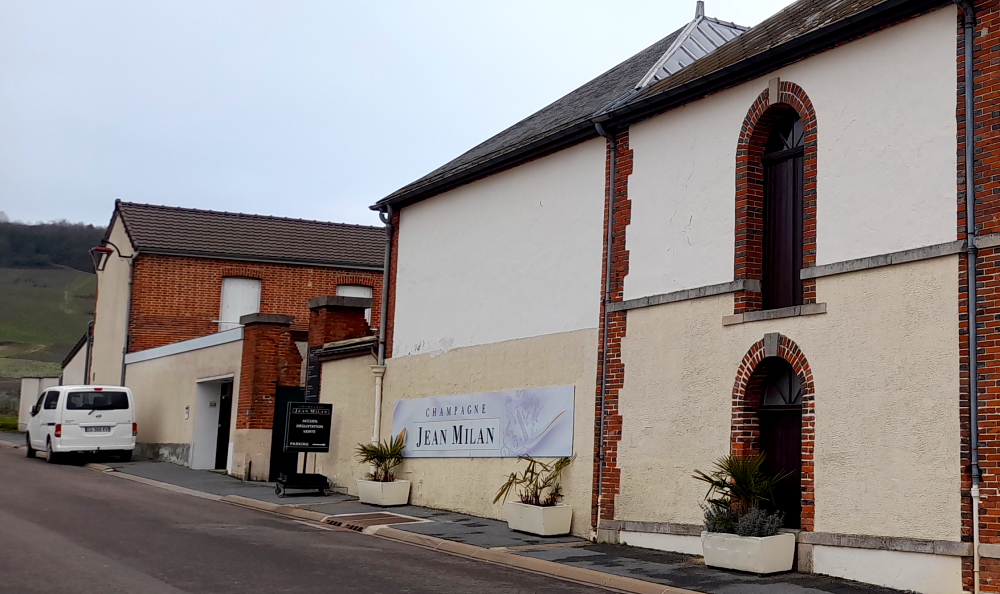
At this point we had a vague plan for the rest of the day. I want to buy another bottle of Grande Reserve champagne from Jean Milan in Oger, with its traditional string and wax seal, to share with Becky and Jerry. When we check the cellar door’s opening times it’s 11:30 am. It closes at noon for the mandatory 2-hour lunch break so we grab our kit and jump in the car for the 25-minute drive to Oger.
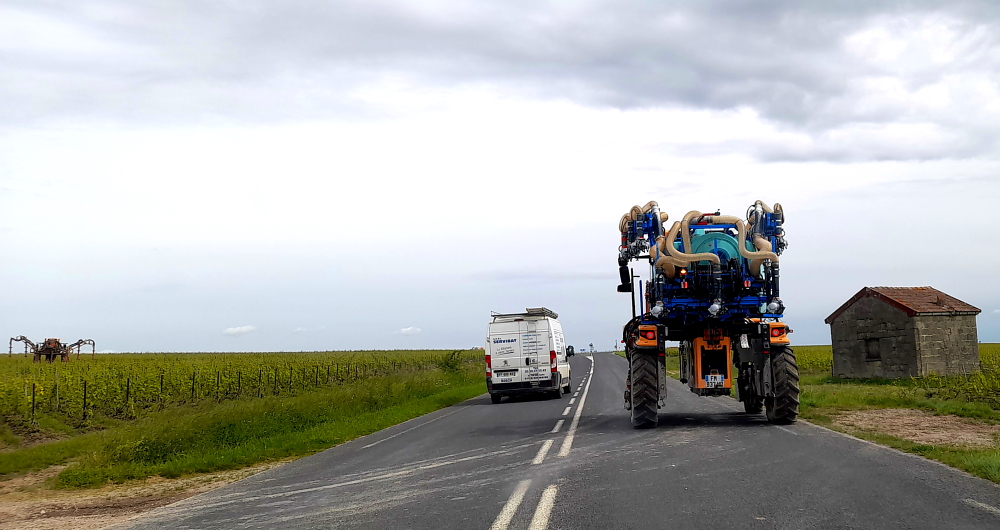
En route to Oger passing 2 spraying machines.

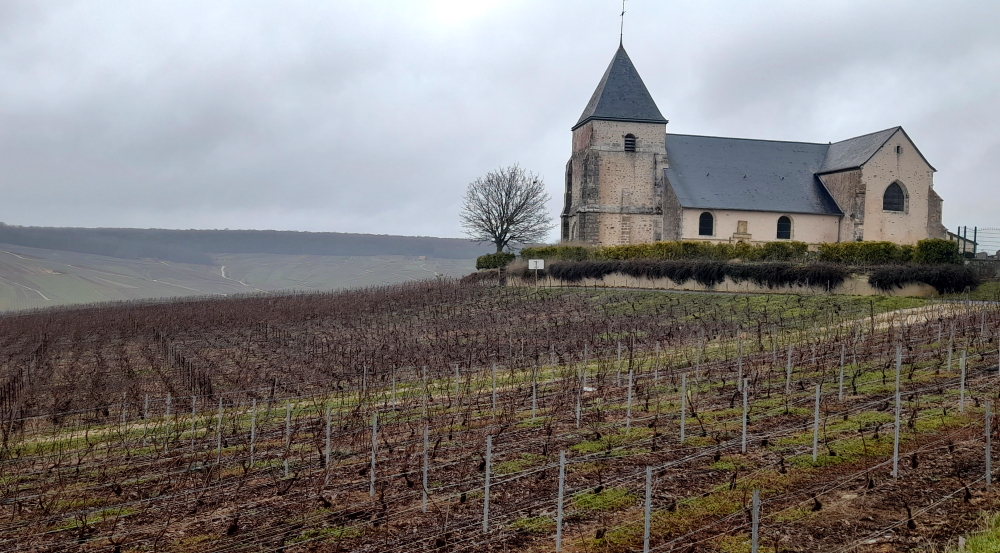
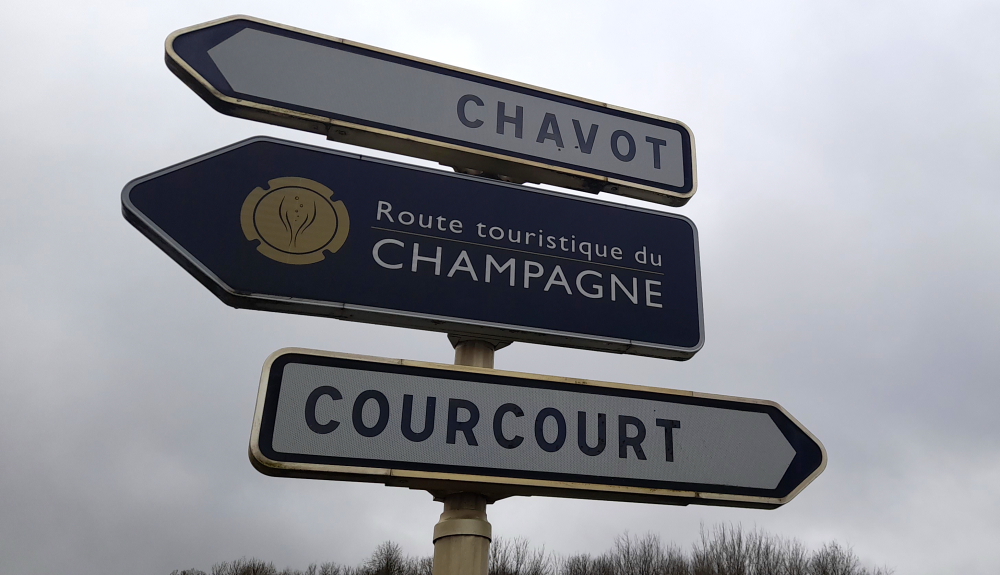
With 5 minutes to spare I make my purchase. From here we drive the rest of the Orange Champagne Trail via Cuis to Morangis then to the Saint Martin Church perched on the hill at the northern end of Chavot Courcourt.

To vary our return to Baye we see that Abbatiale Saint-Pierre d’Orbais has been highlighted as an attraction on the map so after calling in at Leclerc at nearby Pierry for sandwiches we take the D11 to the picturesque village of Orbais-l’Abbaye.
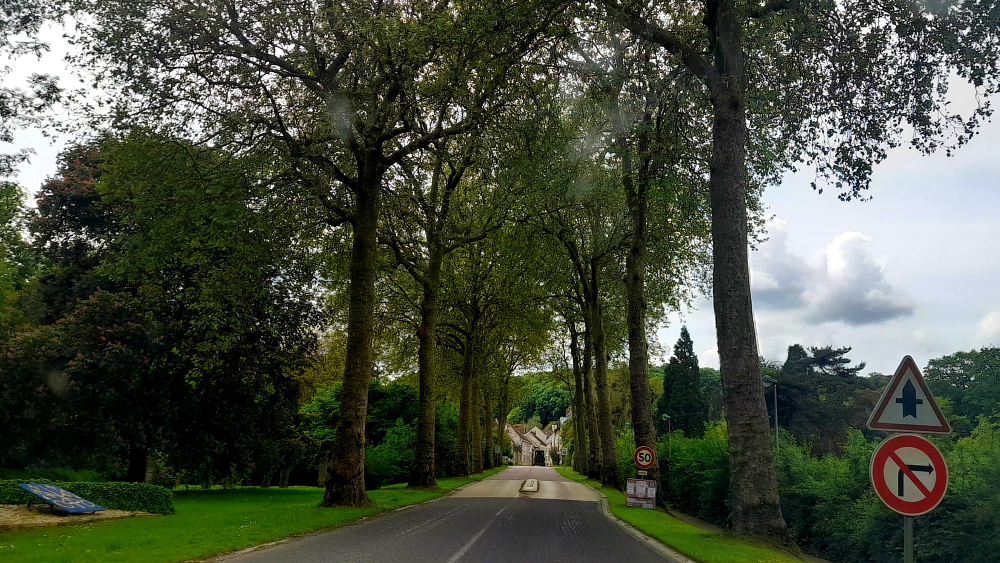
Arboured entry to the village of Orbais-l’Abbaye.

We park in the square in front of the Abbey and find some discarded stone slabs at one side beneath a tree and tuck into our al fresco lunch.
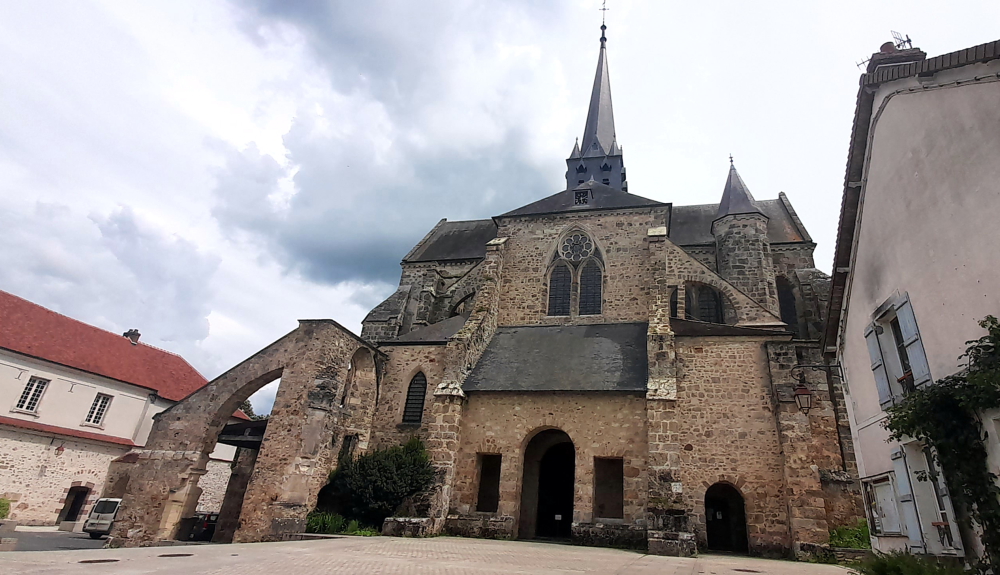
View of the abbey church from Place Jean d’Orbais.

The Benedictine abbey at Orbais was founded at the end of the 7th century by Saint Réol. The St. Pierre-St. Paul church was built at the end of the 12th century and early 13th century by Jean d’Orbais, one of the architects of the Cathedral of Reims.
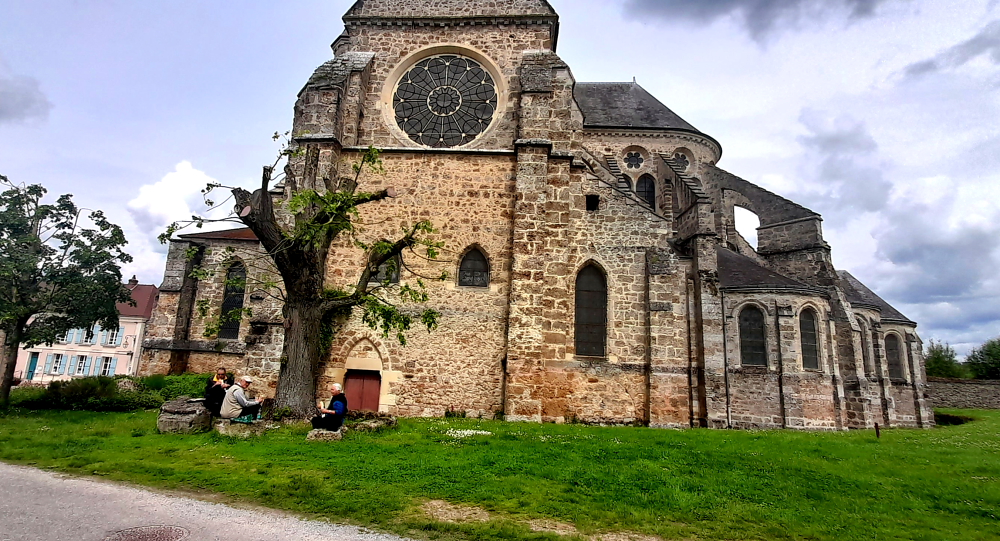
Al fresco dining at Orbais-l’Abbaye.

The abbey church had a length of 78 m with 8 bays of nave, 2 of which remain today.
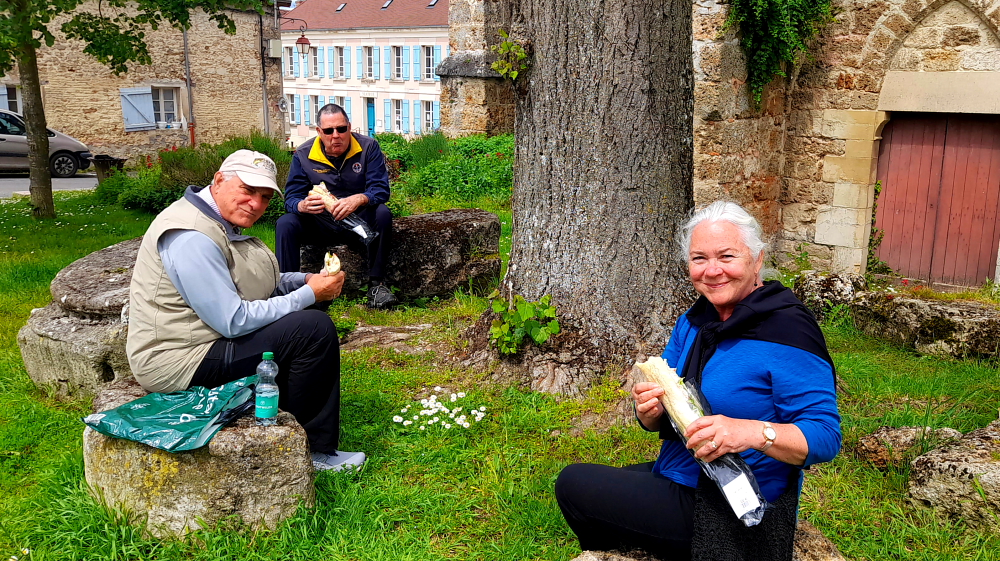
Can’t beat a French baguette for lunch!

The façade has 2 towers similar to those of the Basilica Saint-Rémi de Reims and the choir an ambulatory with 5 radiating chapels.
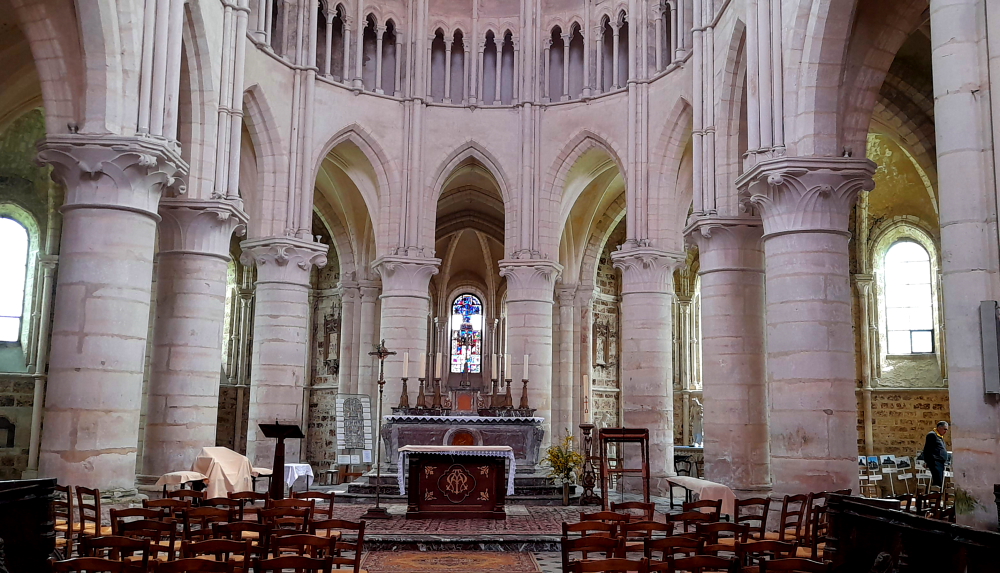
Altar within the St Pierre-St Paul Church, Orbais-l’Abbaye.

There is also stained glass windows of the 12 century, funerary slabs from the 14th and 15th centuries, a baptismal font from the 16th century, glazed tiles from the 15th century and impressive choir stalls with decorated misericords.
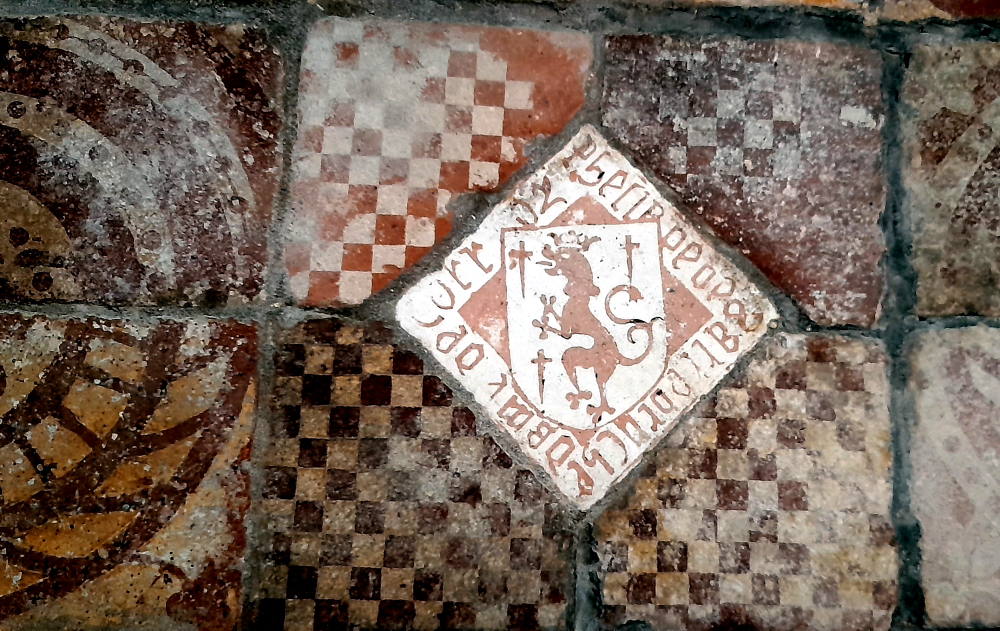
15th century glazed tiles, St Pierre-St Paul Church, Obais-l’Abbaye.

Whenever we drive north from Baye we always drive through the cross roads at the hamlet of Champaubert. This time we stop to discover the purpose of the commemorative column here, the Battle of Champaubert, one of Napoleon’s counter-offensive victories over the allied armies (the Army of Silesia led by Blucher) on 10 February 1814 during the Campaign of France.
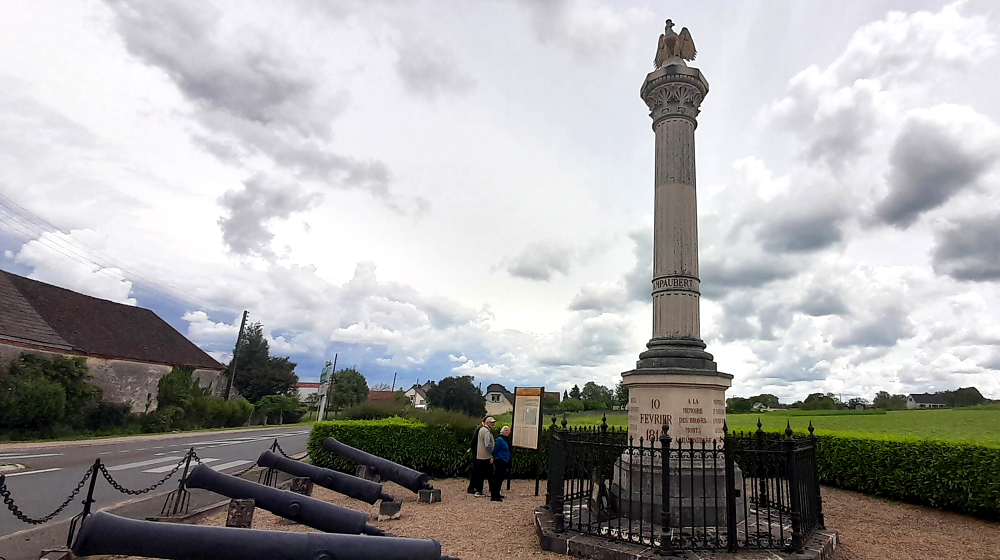
Colonne de Champaubert, Champaubert.

Although a fund was started in 1839, the column was not actually built until 1865-67 according to the design of architects Louis Visconti (responsible for the Emperor’s tomb at the Invalides in Paris) and de Bigault de Granrut. 9 January 1867 it was topped with the imperial eagle and in June Emperor Napoleon III made a gift of the 8 cannon that now surround it.

We arrive back at Baye mid-afternoon where Becky purchases another bottle of champers, a Cuvee Traditional Reserve for Eu18.30, from the local vintner, Champagne Yves Jacques.

Opposite the 1 and only boulangerie in town (open 7:30 am-1:00 pm and 4:00-7:30 pm) is an interesting vending machine – for baguettes. Obviously a stop-gap for when the boulangerie is closed. We had seen something similar in Reims for 3-minute pizzas but it looks like the baguettes are already baked and ready to go. Don’t stand between a Frenchman and his daily, fresh baguettes!
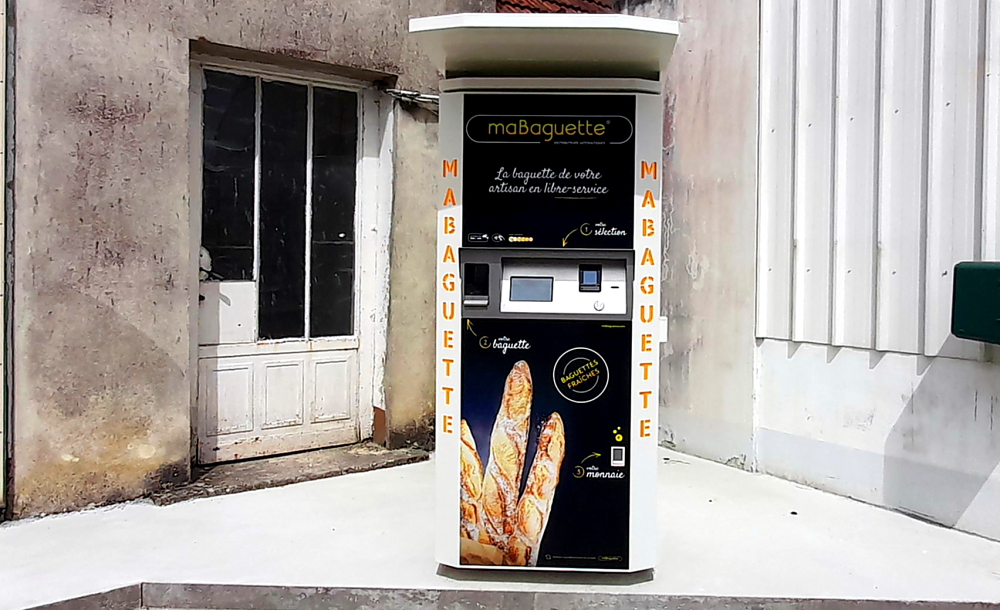
“Who will buy my fresh baguettes – plain or traditional?”

While we 3 rest, Lynn heads out to walk into Baye. She goes via La Gare which features a disused railway station building with no sign of a railway track anywhere near it.
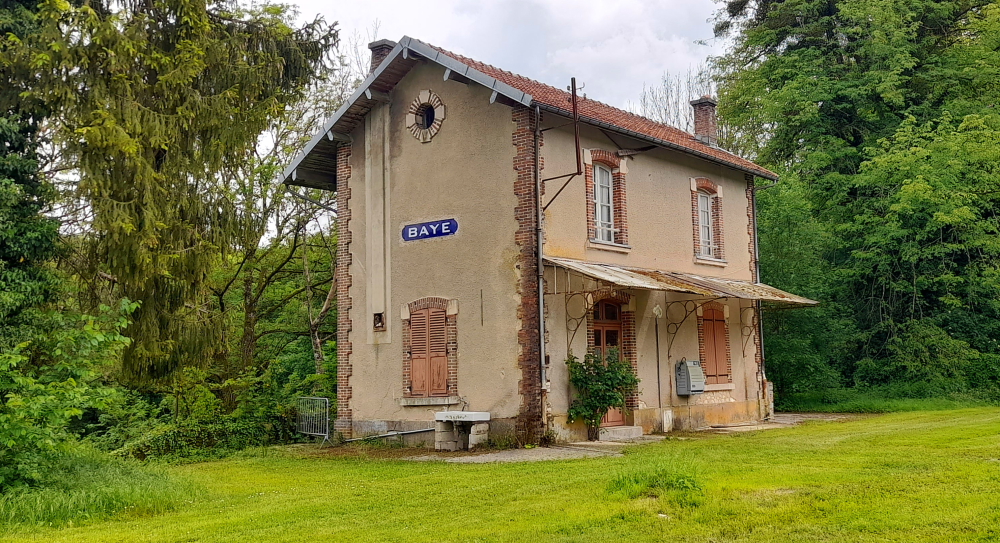
Disused Baye train station building.

Walking up La Cote de Saint-Roch which is bordered both sides by woods she is taken by the amount of loud and varied birdsong, something she sorely misses in the concrete “wood” that is the Brisbane CBD.

This road brings her to the eastern view of Le Foyer de Charité de Baye (Baye Charity Home), a religious retreat for followers of the Catholic faith.
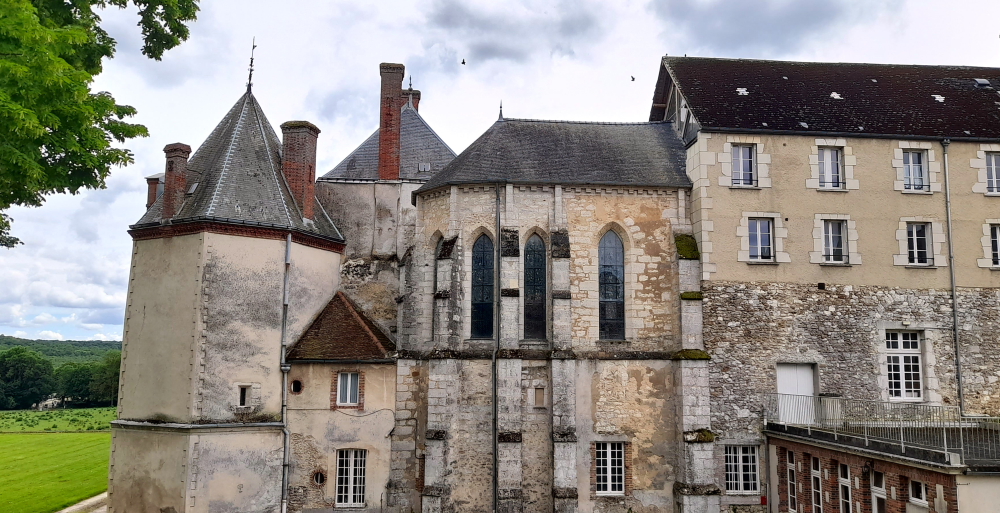
Part of Le Foyer de Charité de Baye featuring its 12th century chapel.

Previously, it was the Chateau de Baye. Tradition has it that Saint Alpin was born here in the 5th century. Lords of Baye are known from the 11th century but there are no documents to trace the establishment of this castle. However, there must have been a castle on this location because, at that time, Baye was one of the large baronies of the County of Champagne.

Rather, its history commences at the beginning of the 13th century as shown by the chapel, probably built between 1205 and 1220, by Simon I of Châteauvillain. The chapel is mentioned in the will of Alix de Luzy, his wife, written in 1270. This chapel is known for its stained glass windows dating from the 13th century.

Over the centuries the castle’s ownership was inherited via marriages and family transfers and the sale of the barony of Baye.
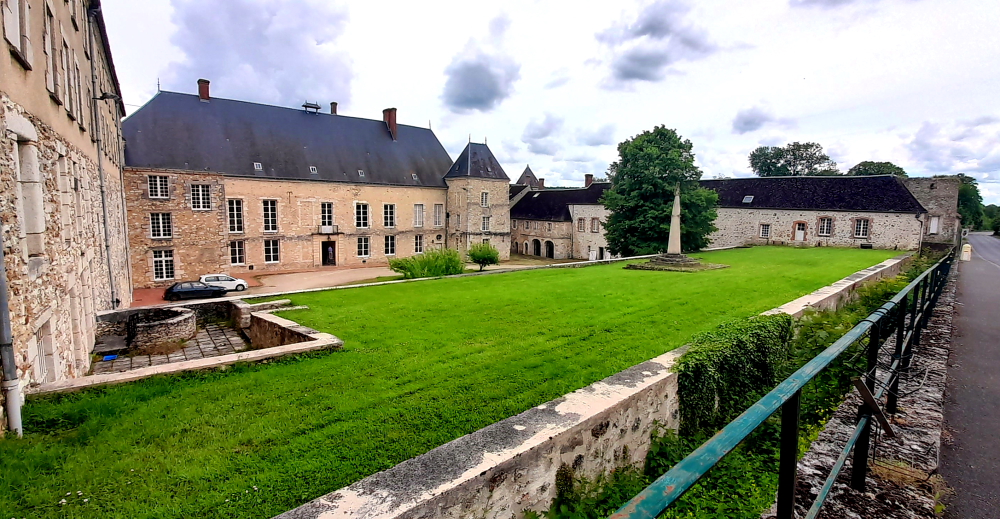
View of Le Foyer de Charité de Baye from Grande Rue.

In the 19th century, the Berthelot de Baye family became particularly interested in the administration of the estate. Around 1859, the castle farm was rebuilt by the Parisian architect Claude Parent. In 1950, the dilapidated castle became practically uninhabitable. It was donated by Miss Yolande Berthelot de Baye to the Foyers de charité and has since been repaired and transformed. The Saint-Alpin chapel of the castle is the only element that has remained intact for 800 years and was classified as an historic monument since 1923.

In September 1914 the chateau was the general HQ of General Otto von Emmich, commanding the 10th German Corps.
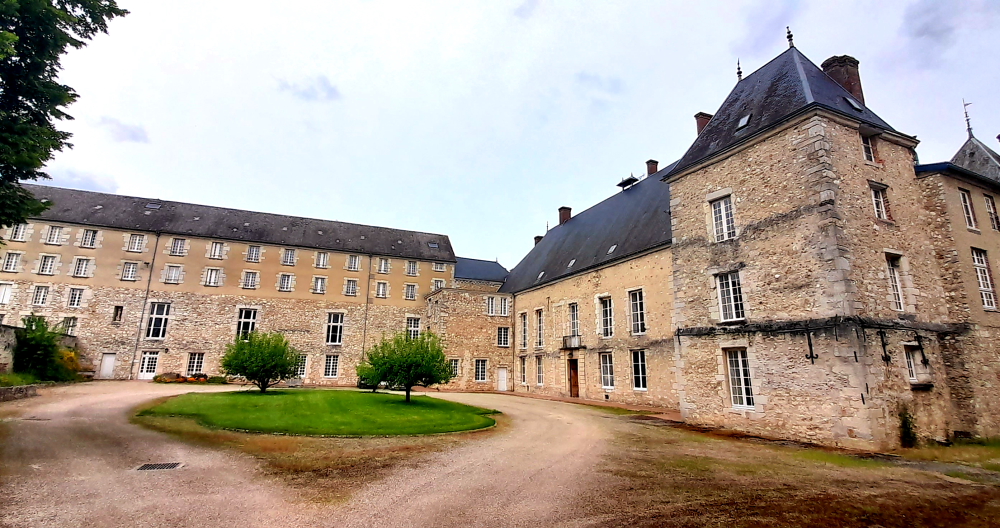
Courtyard of Le Foyer de Charité de Baye.

Walking north along Grande Rue there is an intriguing street sign: “Rue de la Font Poisson” and sure enough, half way up that road is a large water trough that probably had fish in it, back in the day.
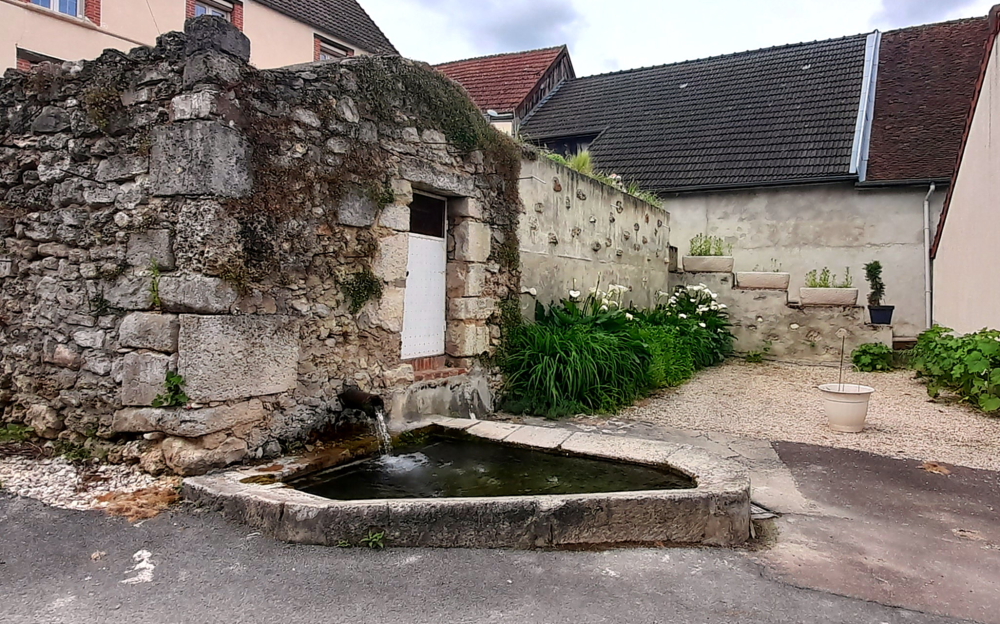
La Font Poisson, Baye.

Each time we drive through Baye we are struck by the lack of people about – the place seems to be totally deserted.

A major building is the Catholic Church of Saint-Pierre-et-Saint-Paul de Baye, with an imposing porch gallery. The church has been closed since 1999 after storms damaged the roof. Renovation commenced in 2018.
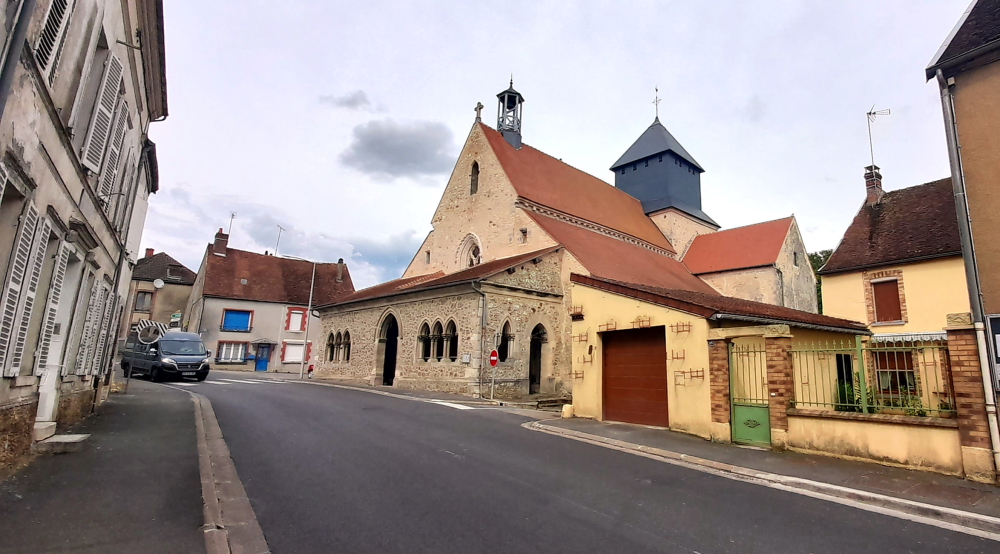
Church of Saint-Pierre-et-Saint-Paul de Baye, Grande Rue, Baye.

Walking around to the opposite side of the church is a small door. Above it, inscribed in stone, is a plaque in Latin: The Holy Alpinus Baye, Bishop of Catalonia, was buried in this crypt in the year 455.” So, born in the chapel in the Chateau de Baye and buried in the crypt of another church just up the road.
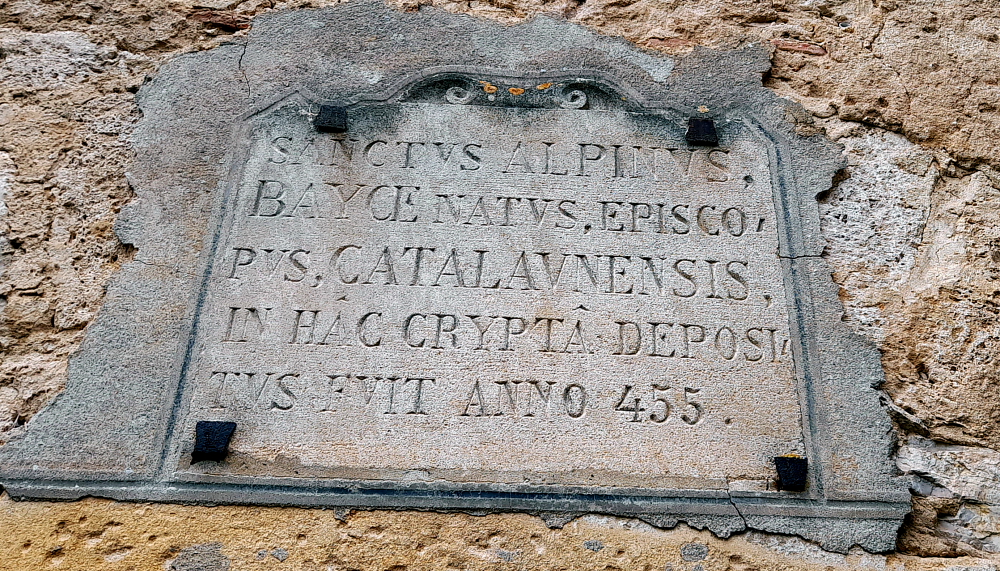
Sign indicating the burial place of Saint-Alpin.

At the corner of the church is Rue des Ecoles where Lynn walks towards its intersection with La Cote de Saint-Roch. She passes by a derelict-looking buiding whose door is open.
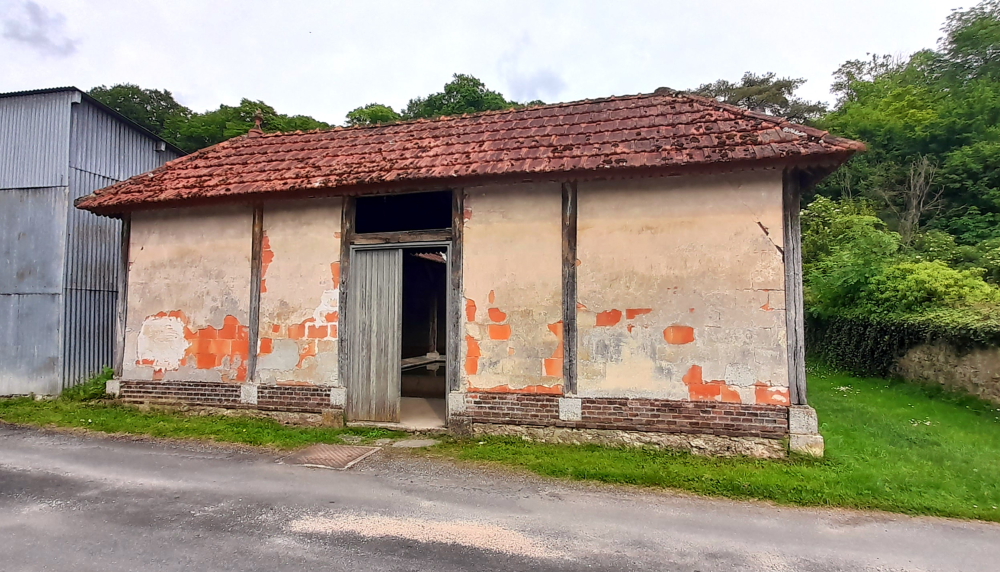
Non-descript building with a secret.

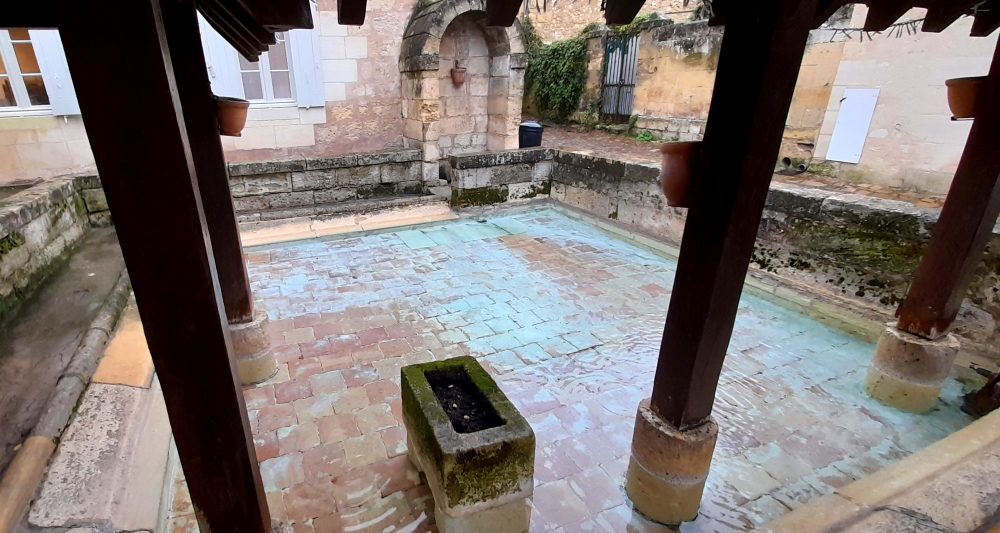
Inside looks like a disused wash house with a copper in the corner and slime green, still water in the trough.
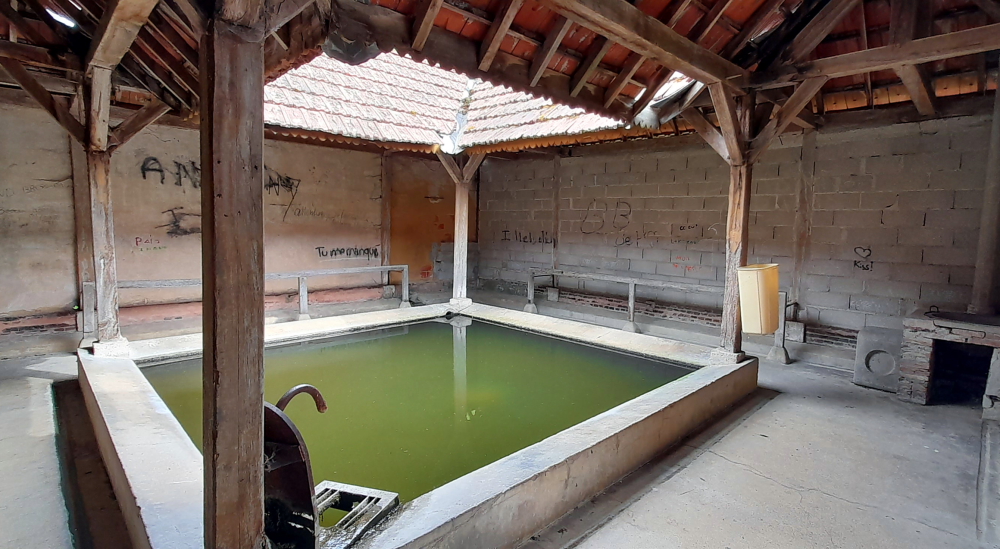
Disused wash house?

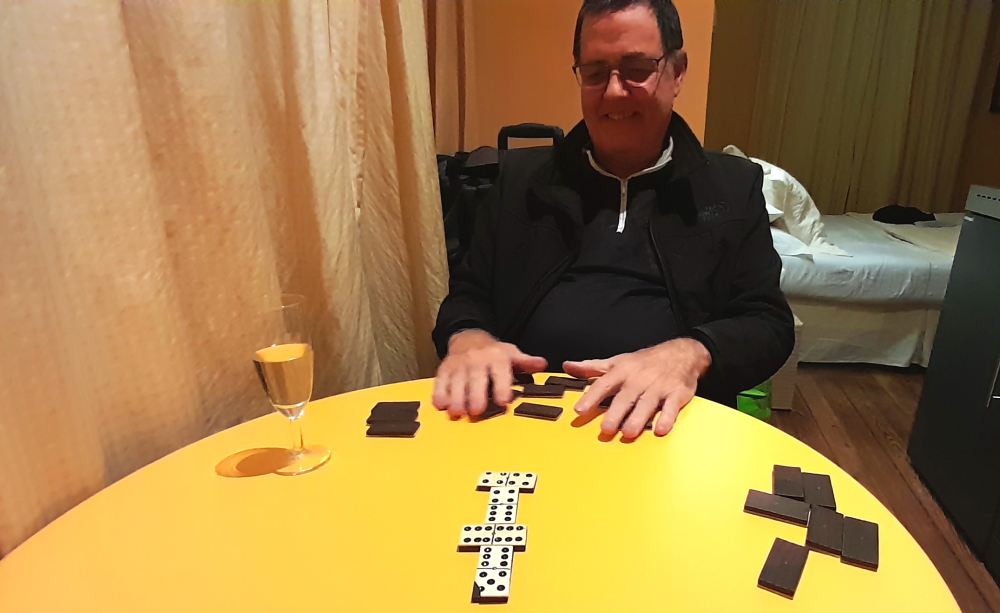
After a supper of cold roast chicken, tricolore salad and fruit flan Lynn suggests we have a couple of games of dominoes.
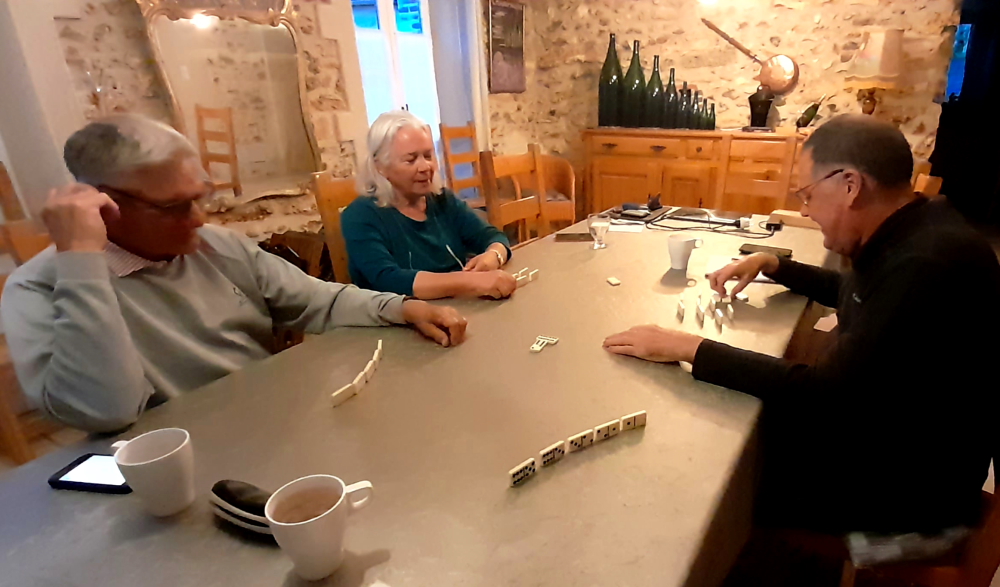
“What a lot of tiles you have, Robert.”

The 1st game is won by Becky with yours truly last, but I get my revenge by winning the 2nd game.

18 May, 2024

For our last full day in the Champagne region we’ve elected to drive to Hautvillers, north of Epernay, then to drive part of the Maroon Champagne Trail through Venteuil, Cuchery and Reuil to Vandieres, then cross the Marne to visit the Memorial des Batailles de la Marne in Dormans.
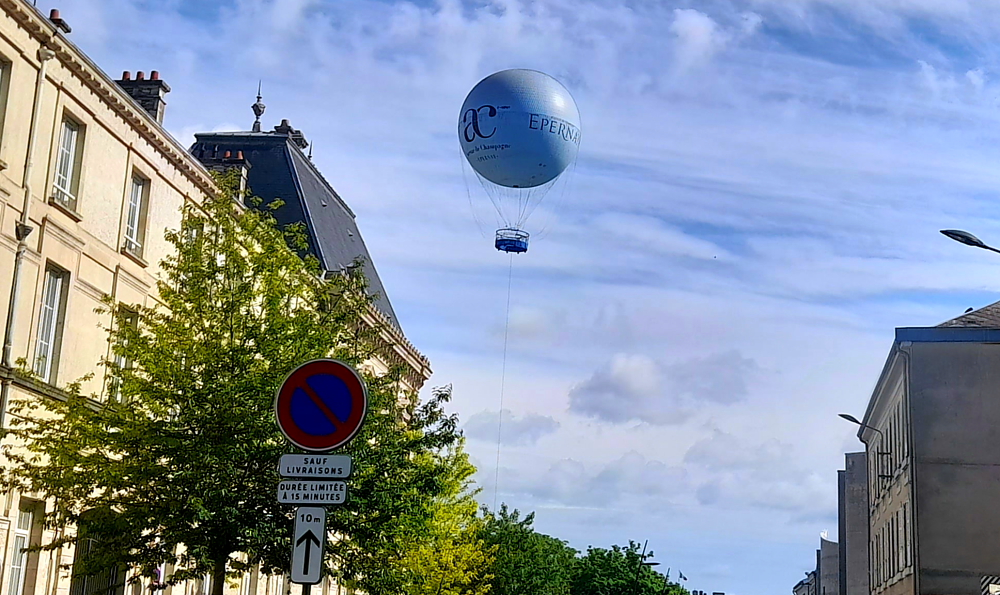
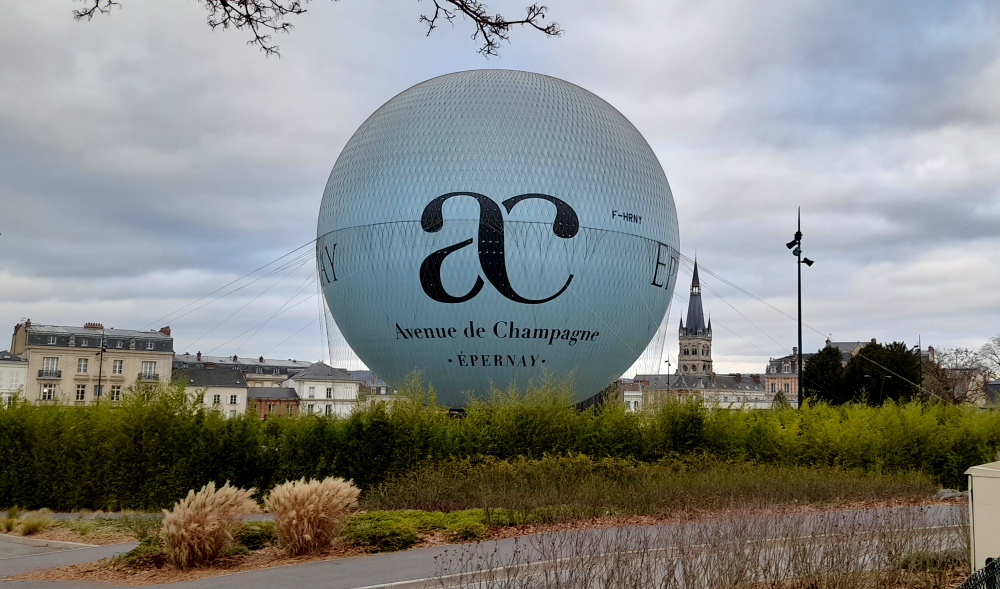
Aloft is Epernay’s giant Avenue de Champagne tethered balloon.

As we approach Epernay we see that its tethered giant helium-filled balloon, located at the town end of the Avenue de Champagne, is in operation today. It flies up to 150 metres from the ground where views over the town and the surrounding UNESCO World Heritage vineyards can be seen.
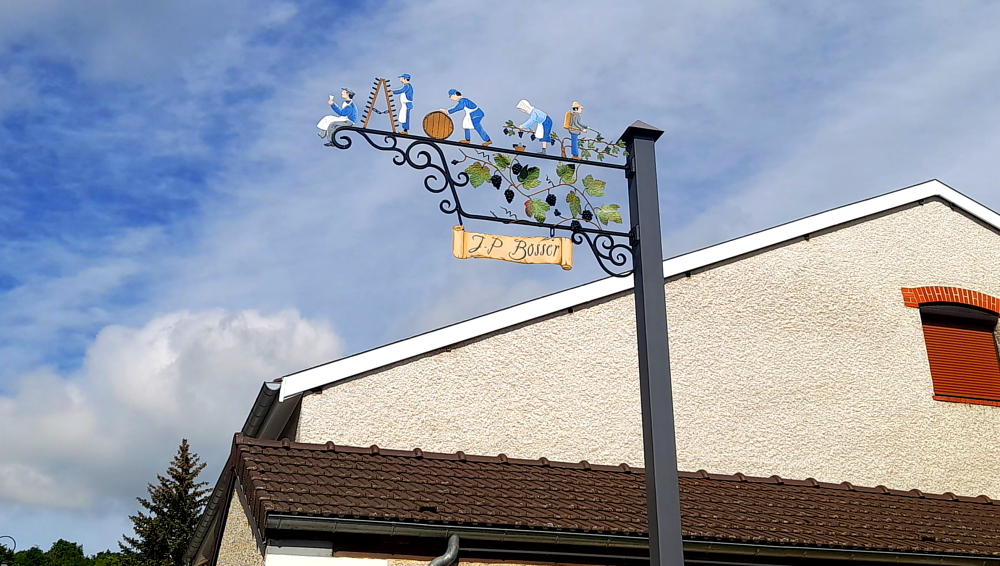
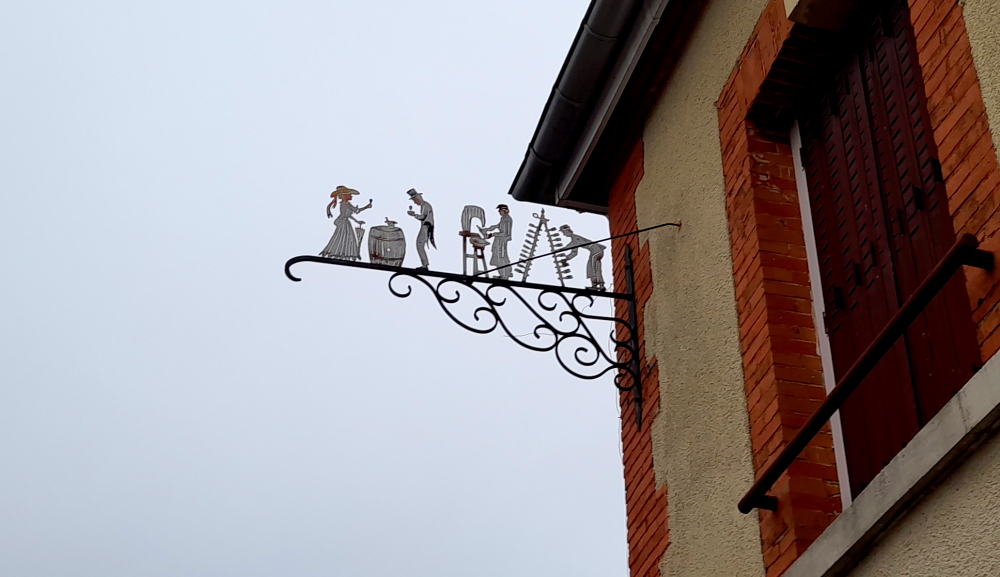
One of Hautvillers’ many ironwork signs.

The reason for our trip to Hautvillers is to show Jerry and Becky the tomb of Dom Perignon which is in the Abbey Church of Saint-Sindulphe, next door to the former Benedictine Saint-Pierre Abbey of Hautvillers (now the private property of Moet & Chandon) and to walk through the village on this gorgeous, sunny day to see the different ironwork signs that are on display outside numerous buildings.
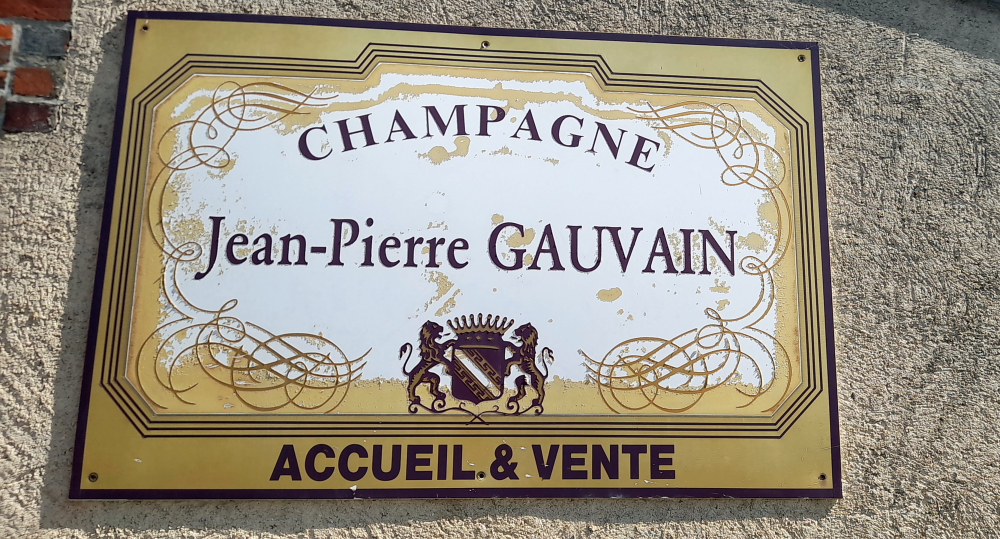
Old-style sign for Jean-Pierre Gauvain champagne house, Hautvillers.

Around the corner from Gauvain’s is Place de la Fontaine where we find just that, a public wash house for communal laundry with a copper in each back corner and a rectangle of wooden drying rails above the large trough.
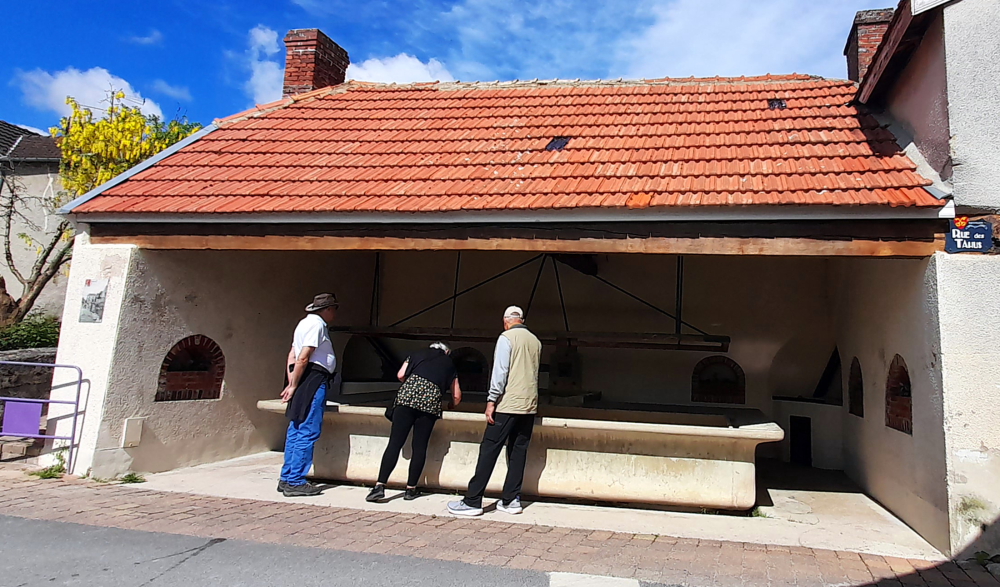
Communal laundry building, Hautvillers.

Displayed on a nearby wall is a morning prayer, seemingly endorsed by the monks of yore: “Give me health for a long time. Work not too often. Love from time to time. But Champagne all the time.” We’ll drink to that!
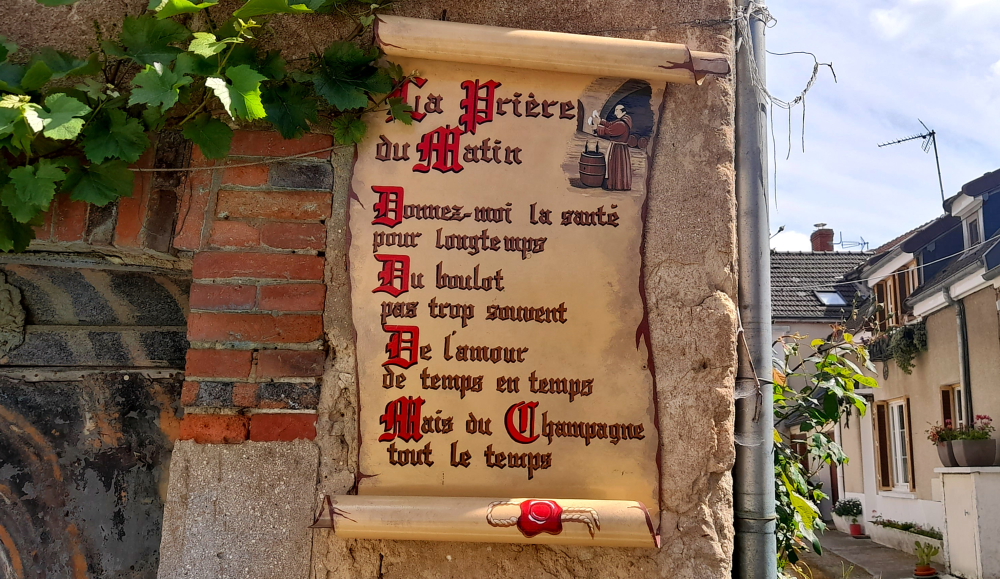
Unique Morning Prayer, Hautvillers.

The display of ironwork signs is a tradition that dates back to the Middle Ages when more than 80% of the popuation could not read.
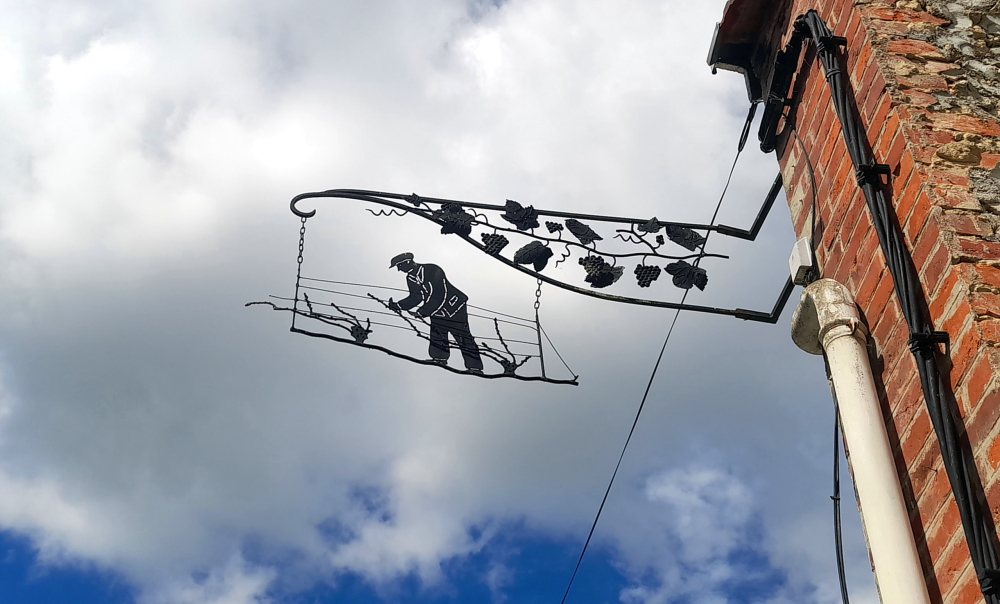
Vine pruner, Hautvillers.

The shopkeepers of the time had devised this simple means of communication to inform their customers of their trade.
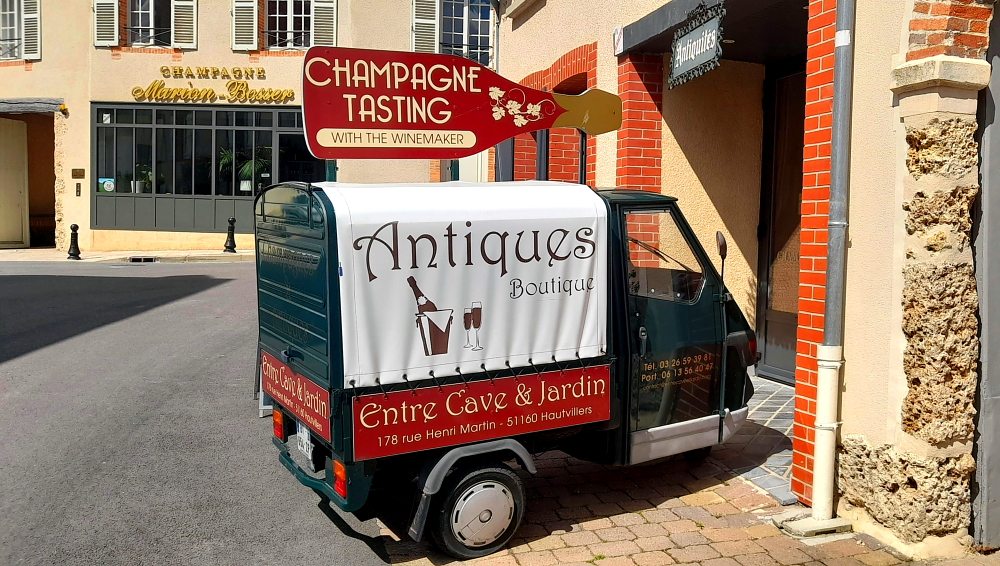
An unusual “hoarding”, Hautvillers.

In 1962 the mayor of Hautvillers wanted to revive this tradition. Today, the village has more than 140 signs representing not only the trade, but also the passion or the origin of its inhabitants.

The village has also retained its now vintage street signs: some to honour a person (such as Henri Martin); others are old directional and distance signs such as Dizy a 2 k 5 (2.5 km).
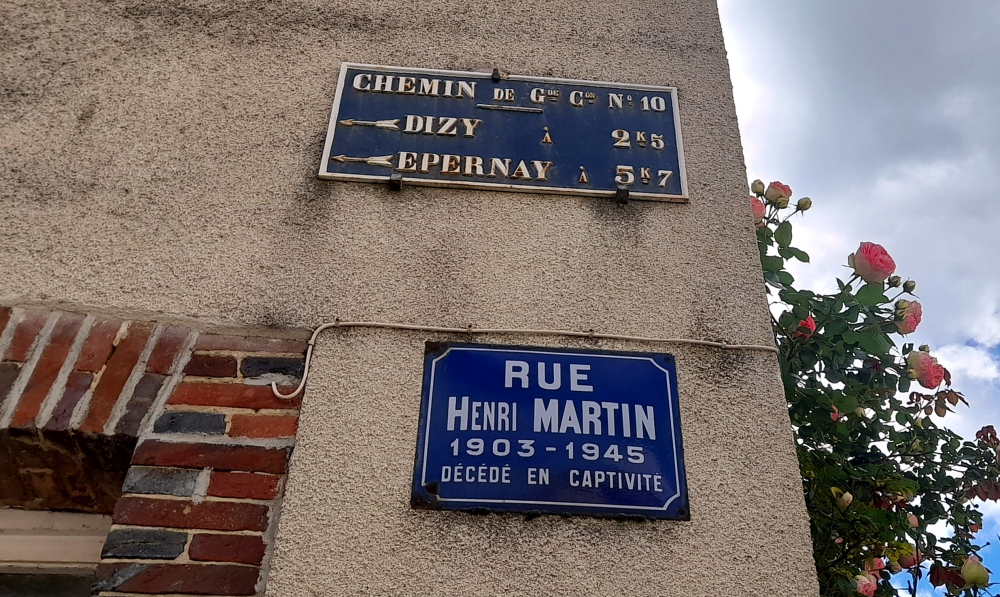
Is this the way to Amerillo, err Epernay?

Hautvillers is also a very pretty hillside village with beautiful and impressive buildngs that accommodate champagne houses, restaurants, cafes, bars, boutiques and its public buildings.
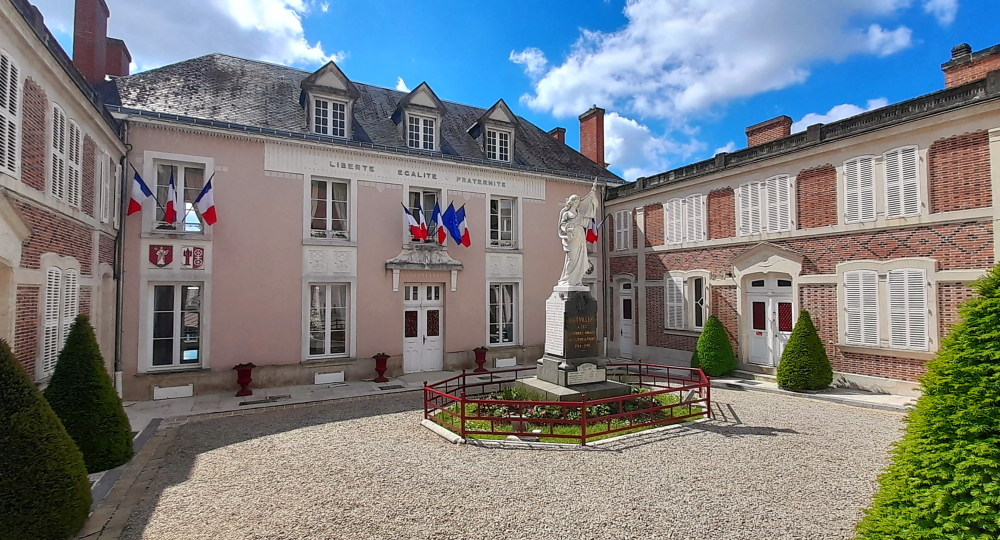
Town Hall, Hautvillers.

Being a hillside town also affords perfect panoramic views.
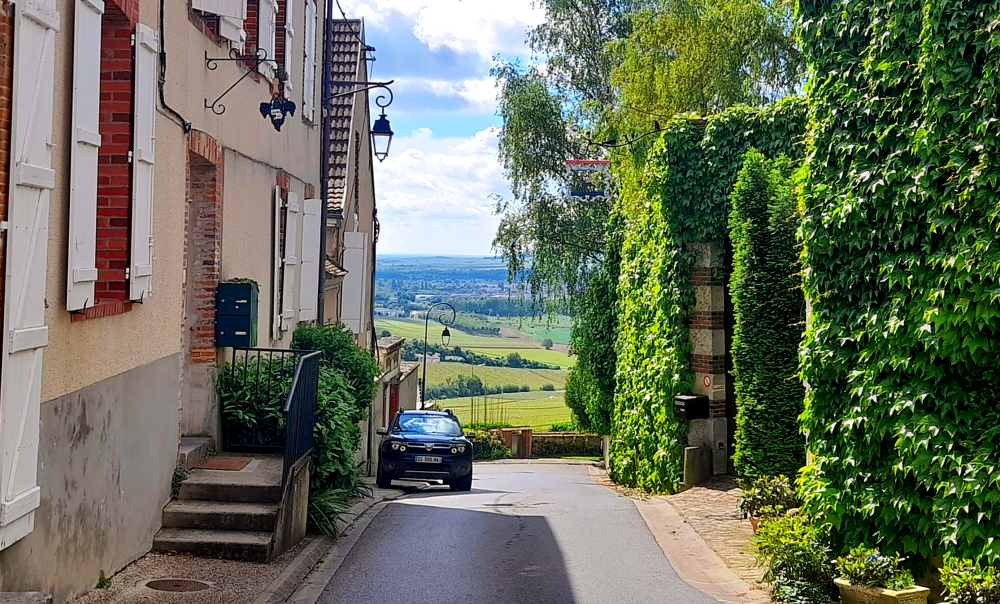
View at the end of Rue de la Font Gillet, Hautvillers.

Such as an informal one at the end of Rue de la Font Gillet, or more formal ones from the Belvedere Dom Perignon that include the historic hillsides of Champagne, the Marne Valley and Epernay.
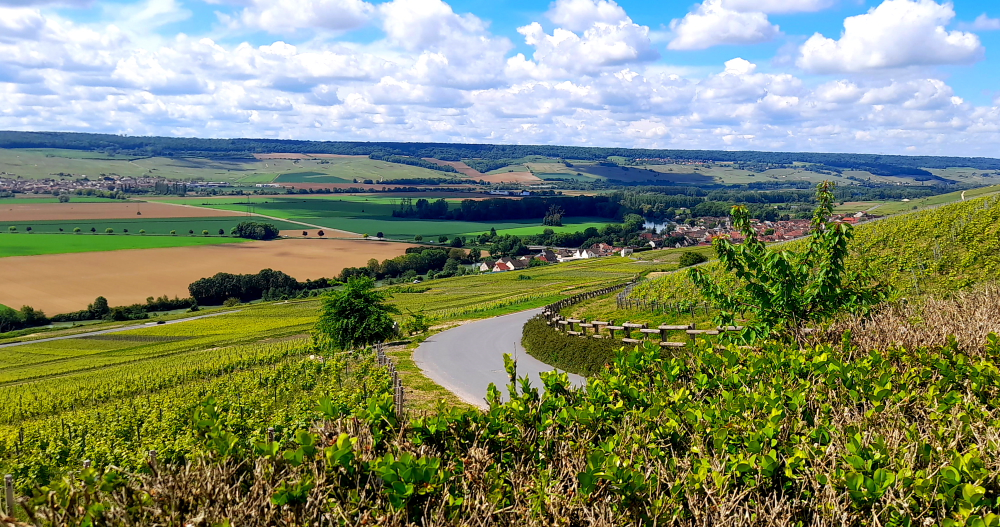
View of the Marne Valley from Belvedere Dom Perignon, Hautvillers..

As we wend our way along the Champagne Trail we catch a tiny boulangerie/patisserie just before it shuts at 1:00 pm where the Leggieris buy filled baguettes, savoury pastries, espressos and a small bottle of local beer called “Pain de Minuit” that has been brewed from stale, leftover bread. It’s catch phrase printed on the cap is: “No Pain (de Minuit), No Beer”.

A few steps away is a square on Rue du Chateau with a large picnic bench where we tuck in while admiring the ingenuity of the various winery-related sculptures that dot the square, all made out of the metal caps that sit between a champagne cork and its metal cage.
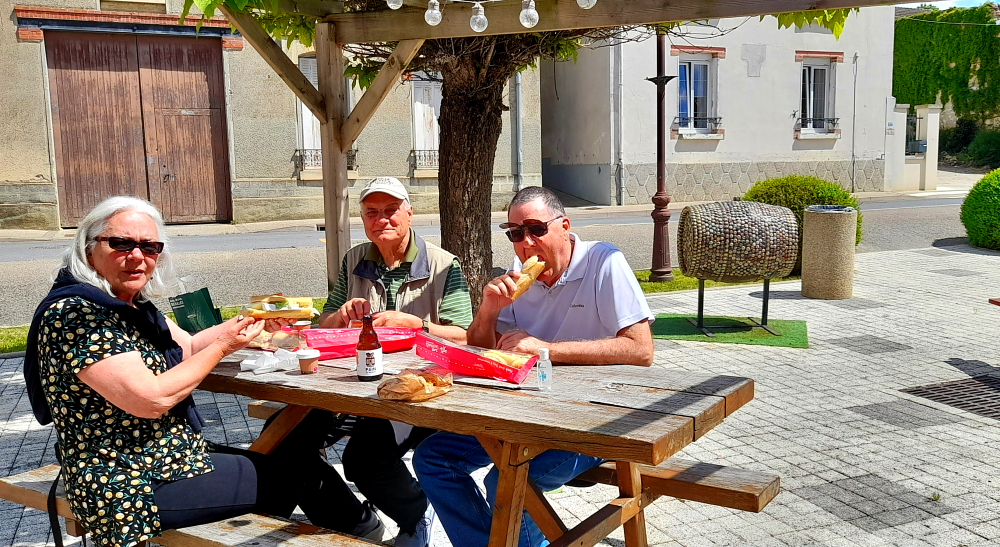
Lunch at Venteuil square with a metal-cap barrel in the background.

By 2:00 pm we arrive at the Battles of the Marne Memorial in Dormans, a fitting conclusion to our visit to the Verdun Memorial/Museum a couple of days ago. Built between 1921 and 1931 to a design by architects Marcel and Closson, the Dormans Memorial commemorates the victories won in the Marne between 1914 and 1918 and is located on a hill behind the Chateau de Dormans.
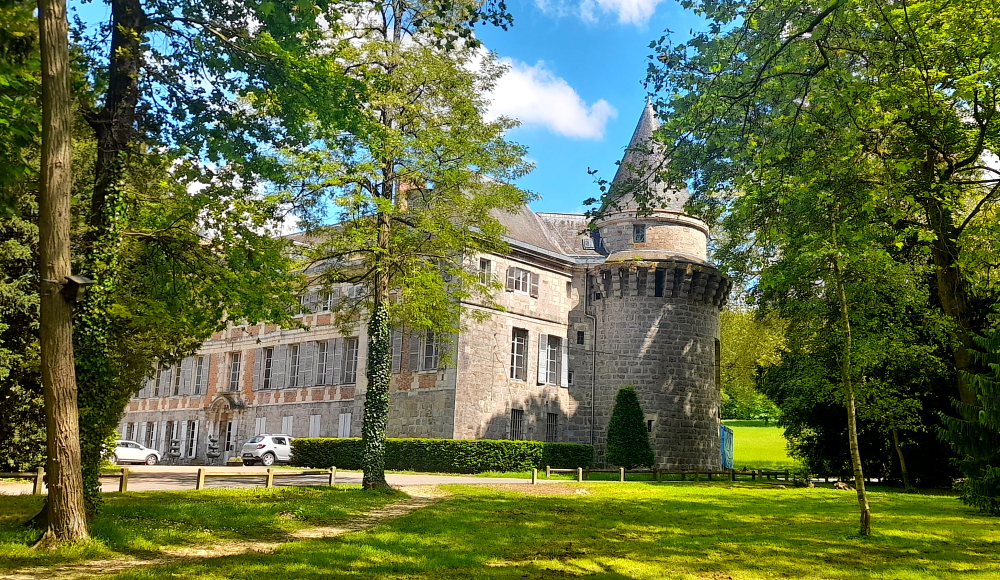
Chateau de Dormans.

When the plan to erect a large monument to remember all of the battles in Marne was confirmed, this site was chosen by Marshal Foch as a place that represented both battles. The building was made possible thanks to an association founded by Madame de la Rochefoucauld in 1919, overseen by the Cardinal of Reims and the Bishop of Châlons.

A vast park with a chateau was purchased, and the first brick laid on 18 July 1920. The construction was funded by numerous donations, in particular those collected by ‘national subscription’ in 1929 dubbed “four monuments day”.
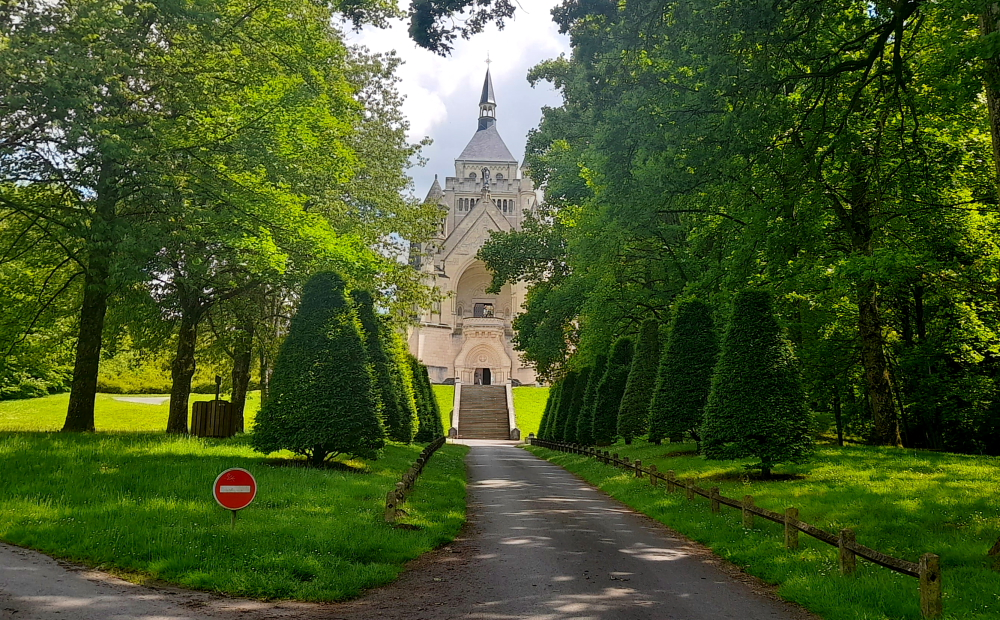
Battles of the Marne Memorial, Parc du Chateau de Dormans.

A monumental staircase leads to a large square with a sundial and a viewpoint indicator that shows the names of the Marne Valley villages where the Battle of 1918 was fought.
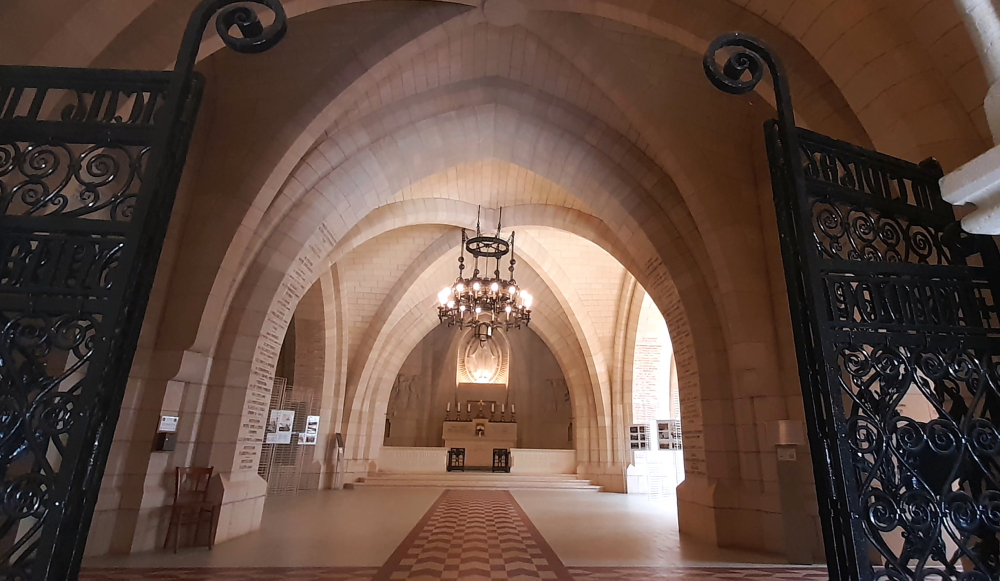
Crypt, Battles of the Marne Memorial, Dormans.

The square leads to a crypt that is overlooked by the church that has a bell tower and 2 towers.
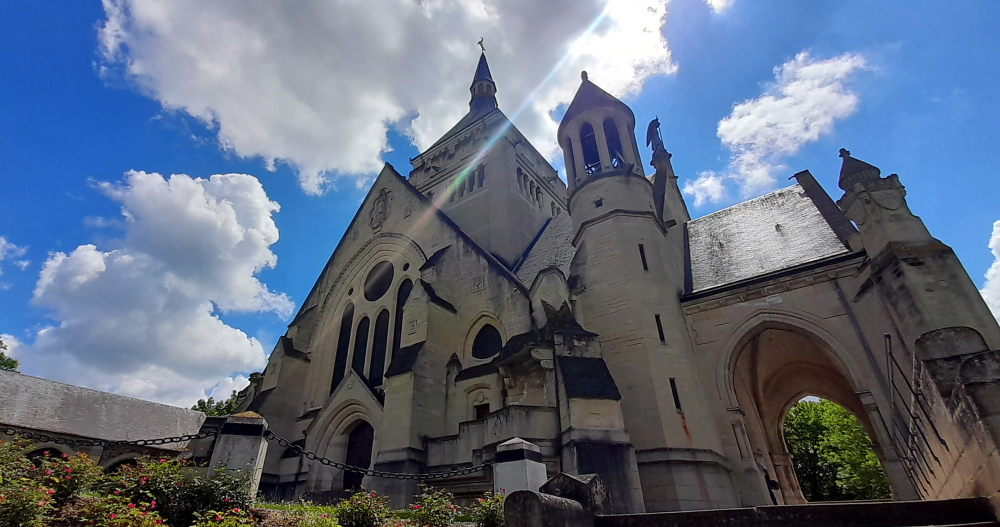
Church, Battles of the Marne Memorial, Dormans.

The inside of the chapel is entirely dedicated to the glory of the “soldiers, the army and the fatherland”.
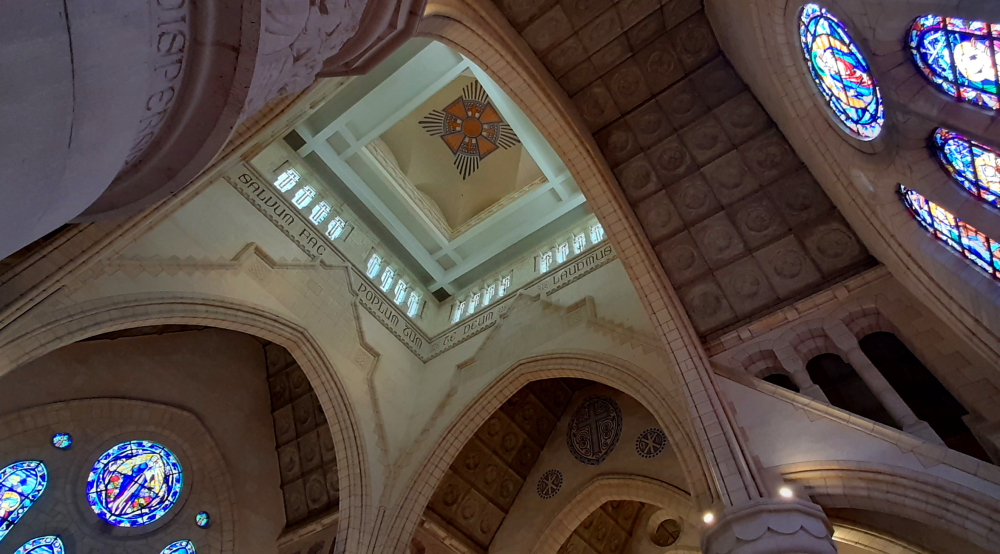
Chapel, Battles of the Marne Memorial, Dormans.

The stained-glass window in the choir represents Christ welcoming a soldier to symbolise all those who died during the Great War, presented to him by Joan of Arc and St Michael. On each side, angels intercede in his favour.

The four columns standing on the crypt’s vaulted bases are decorated with sculptures depicting the 4 great invasions of France by the Huns, the Arabs, the English and the Germans, which were all contained (the Catalunian Plains in 451, Poitiers in 732, Orleans in 1429 and Dormans 1914-1918).
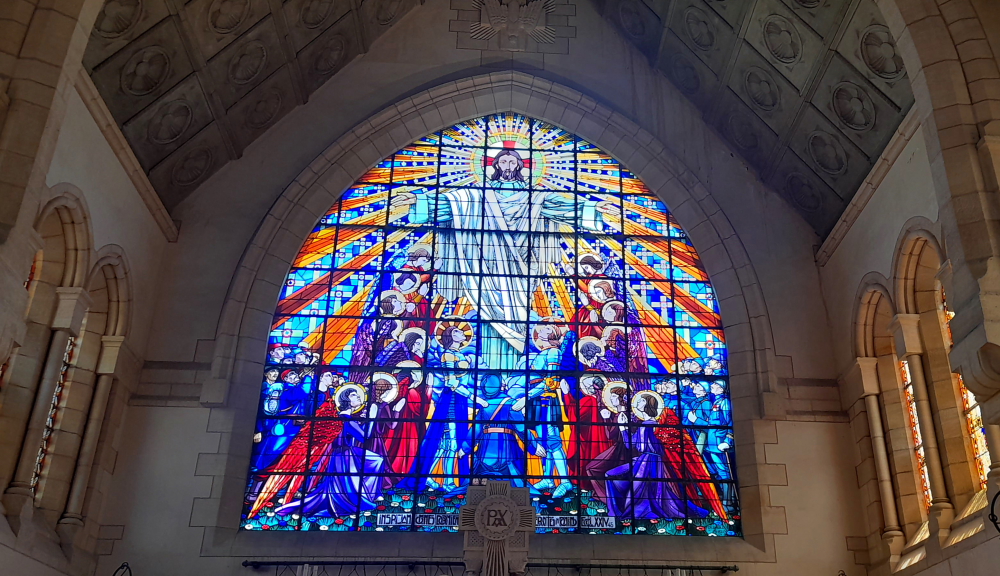
Stained-glass window with Christ, Joan of Arc & St Michael.

The 52-metre tower houses several bells, the largest weighing 304 kg. Beside the chapel is a cloister attached to the ossuary. A medallion features the effigies of marshals Foch and Joffree, the 2 victors of the battles of the Marne, while the names of all the soldiers who fought in the battles are engraved in the wall plaques.

Inside the ossuary, the remains of 1,332 French soldiers who fell between 1914 and 1918 are held in 130 coffins; only 11 of these men were identified. Every year since 1993, during the Armistice commemorations, an official ceremony is held in the ossuary where a wreath given by the French President is laid by a delegate from the Elysée Palace [www-cheminsdememoire-gouv-fr].
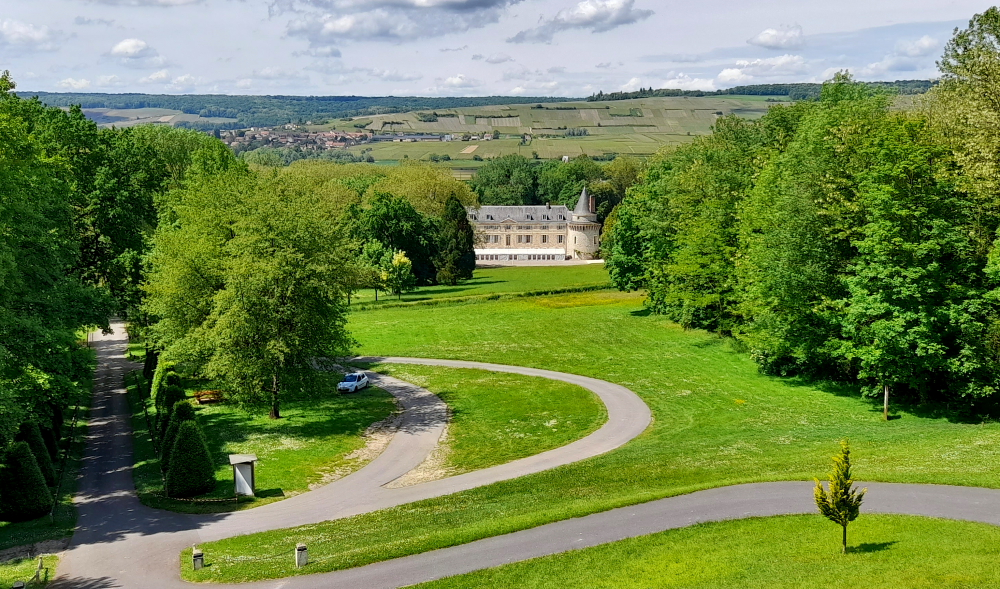
View of the Dormans Chateau & its park from the church’s balcony.

Right! Time to drive home. We’re all looking forward to a chilled drink and a rest before we head out to dinner. Just as I do a hill start and turn onto a road to exit the town, we hear a brief grating sound. Lynn and I say in unison, “That didn’t sound good!” A short distance later I pull over and open the bonnet. Revving the engine produces a horrid, grating metallic sound.

That bloody car air conditioner compressor clutch has failed – AGAIN! It lasted a total of 3 weeks and 4 days since it was replaced. Well, we’ll just have to resort to car air conditioning that our parents used – turn the fan on high and open all the windows!
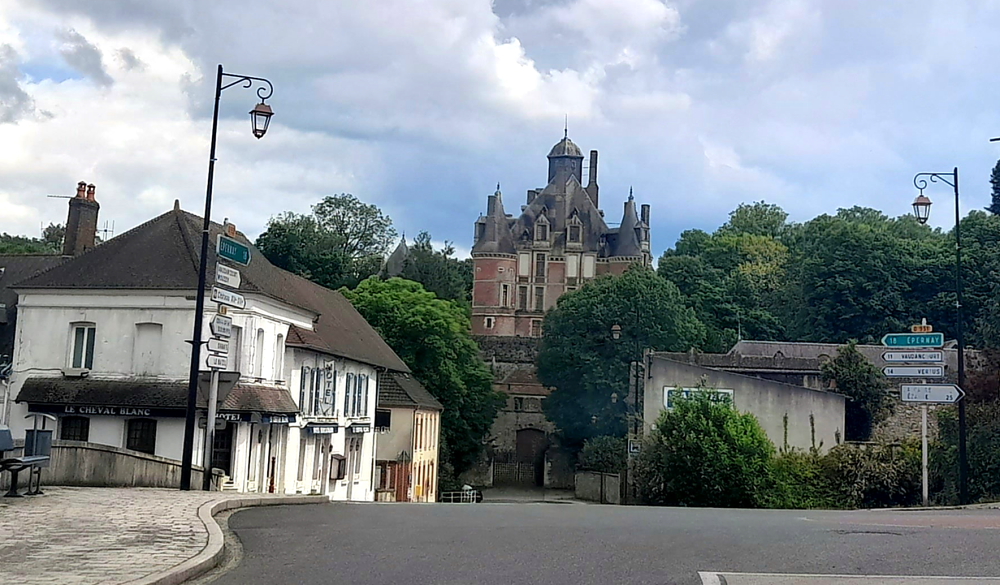
Chateau de Montmort, Montmort-Lucy.

On the drive home we pass through Montmort-Lucy once again. This time we remember to take a photo of its impressive chateau that dominates the village.

At 5:45 pm we drive to the village of Etoges which is 10 km away. Thunderstorms are threatening at the end of the day.
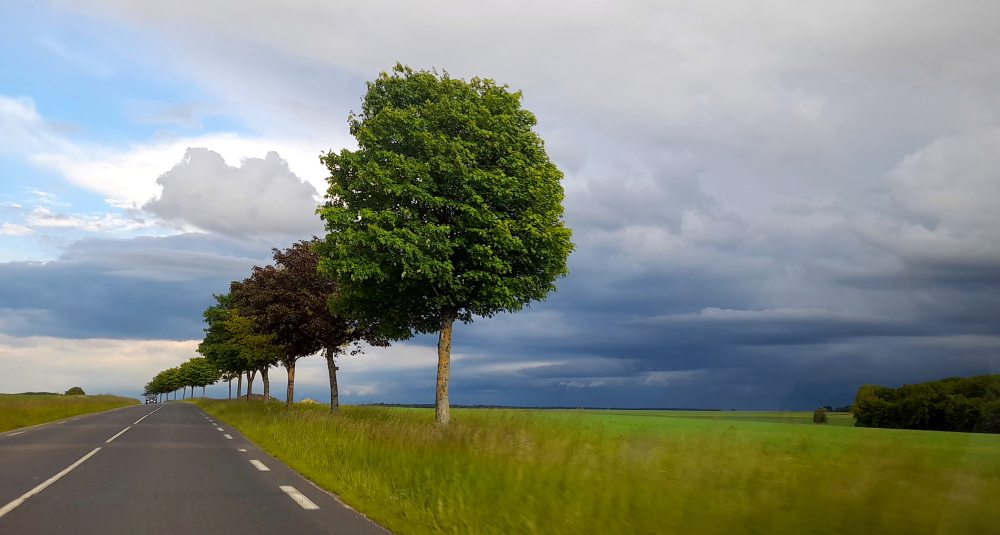
D933 between Champaubert & Etoges.

Etoges also has its own chateau, now a boutique hotel, which is next door to L’Atelier d’Etoges Brasserie, one of our host’s restaurant recommendations.
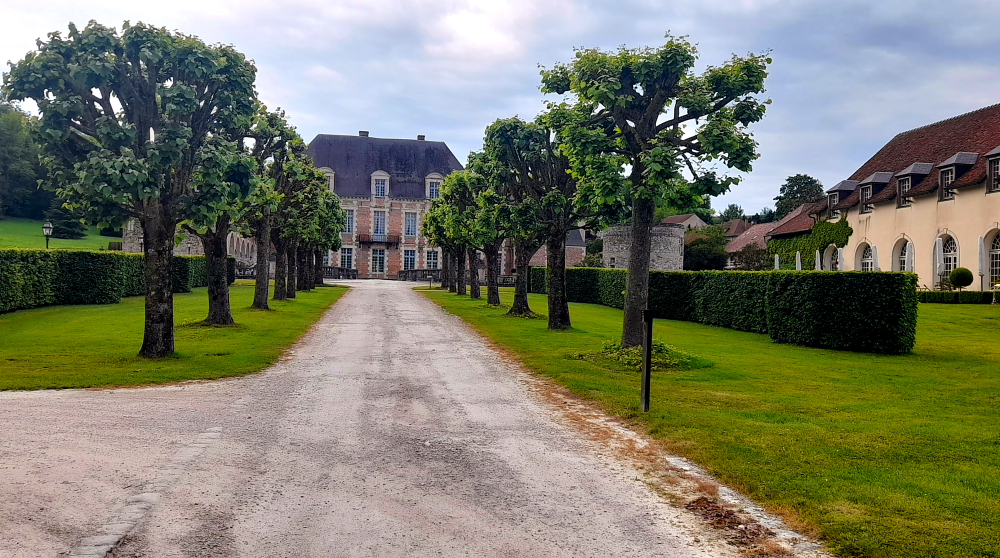
Chateau d’Etoges.

When we arrive at 6:00 pm only us and another car are parked. 30 minutes later the place is packed.
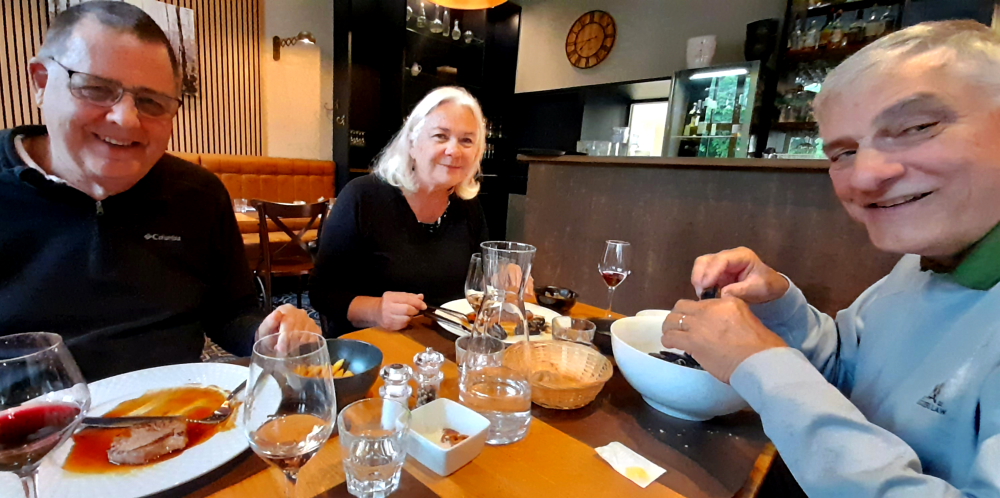
Celebratory dinner at L’Atelier d’Etoges.

When we get home we open our final bottle of champers, the Jean Milan Grand Cru, to toast the great week of Champagne experiences that we’ve shared and especially to toast our enduring friendship with the Leggieris.
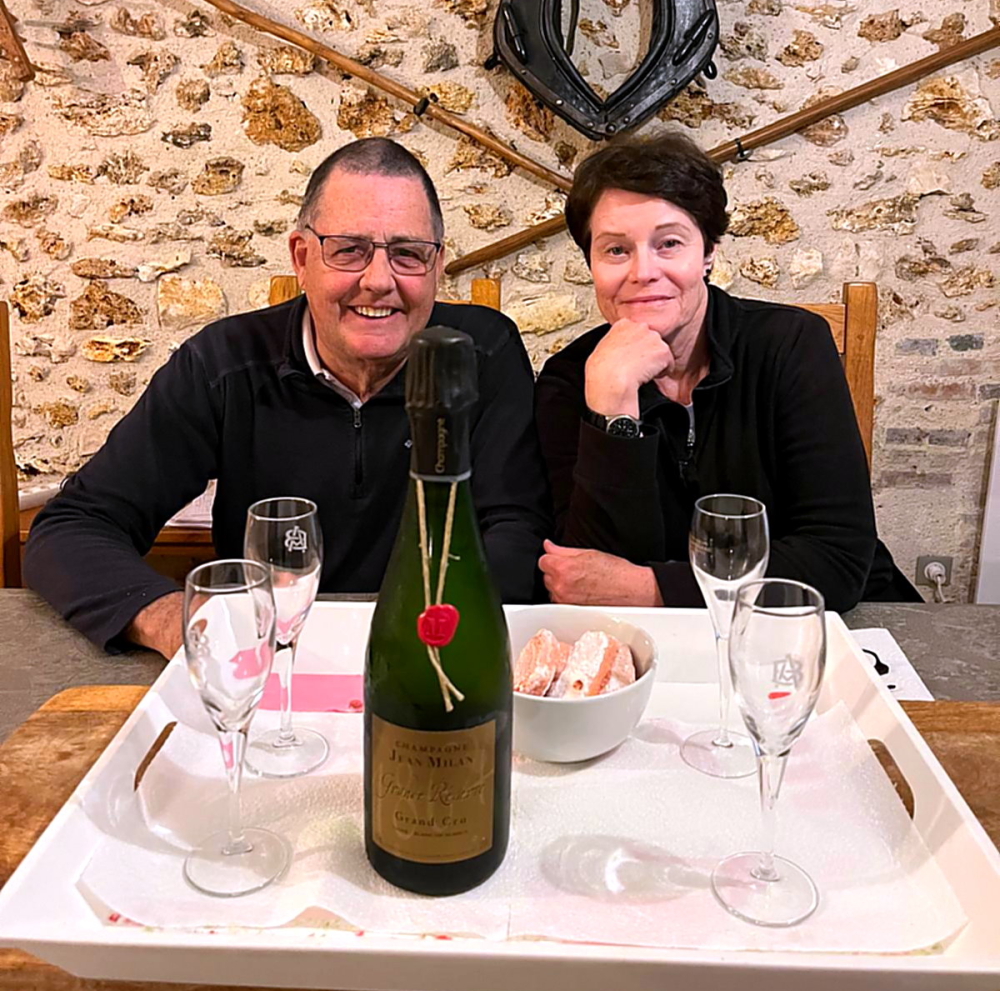
About to open the beautiful bottle of Jean Milan Grand Cru.

It has been a wonderful week catching up with friends and meeting new ones. We have definitely drunk more champagne this week than ever before in a single week. Next week we are on the wagon before we head to Estonia, Latvia & Lithuania which will be our last leg of this two year Grande Tour of Europe.
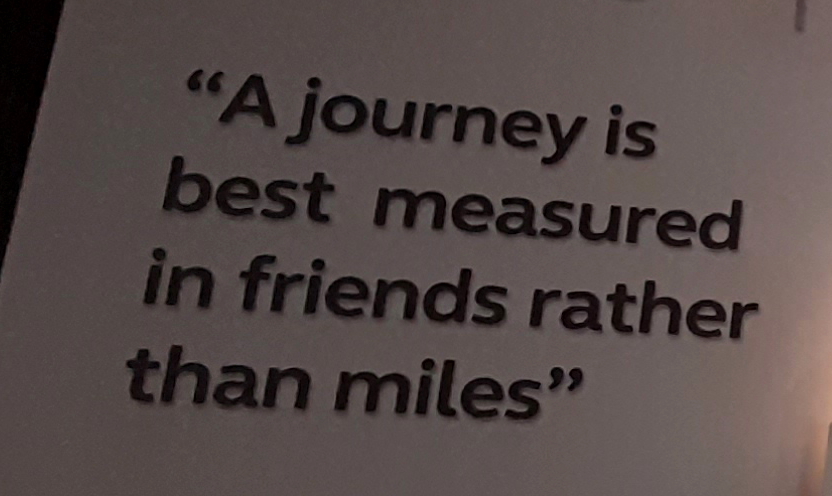
A true story.

19 May, 2024

We’re all packed and out the door of the gite by 9:40 am. It’s 16 Deg. C and raining. I refuel at Pierry then take the A4 from the outskirts of Reims towards Paris, turning off to follow signs to Paris Charles de Gaulle Airport which is NE of Paris.

This airport is a nightmare with roads going in every direction to service a multitude of terminals. We’re a bit startled when we see a plane taxiing along an elevated roadway right in front of us. Anyway, we need Terminal 2C where the Sheraton Hotel is located, hoving into view like a ship in the middle of the roadway.
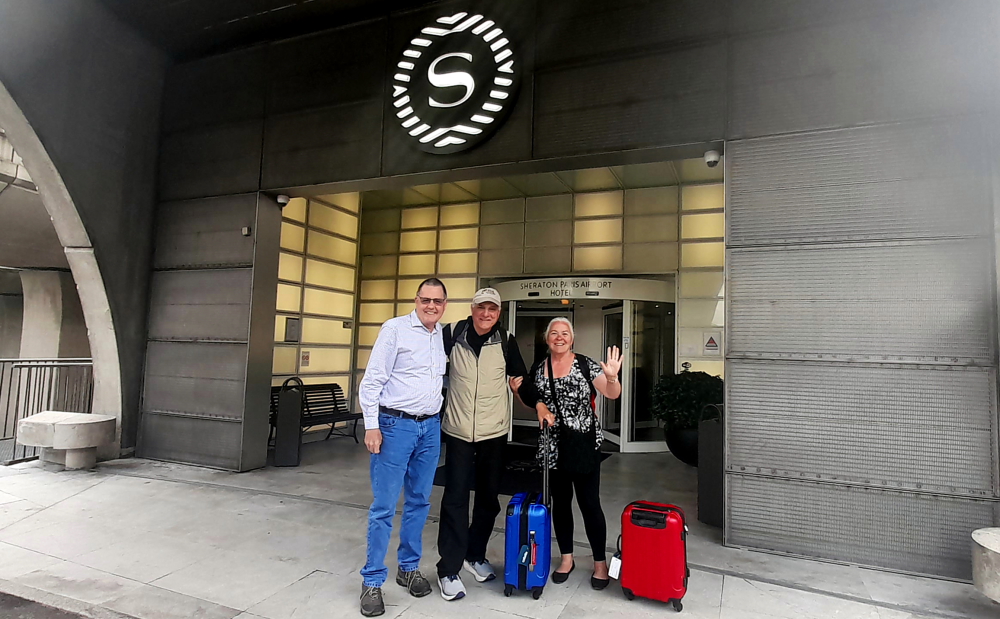
Fond farewells to Becky & Jerry.

More by good luck than design we choose the correct entrance to the Sheraton parking from a number of other parking entrances side by side and drop off our Philly friends at the hotel’s entrance.

Long hugs and au revoirs with hopes of catching up again when we hit California to finish off our COVID-ravaged USA trip of southern national parks, we skidaddle as we only get 10 minutes’ free parking.

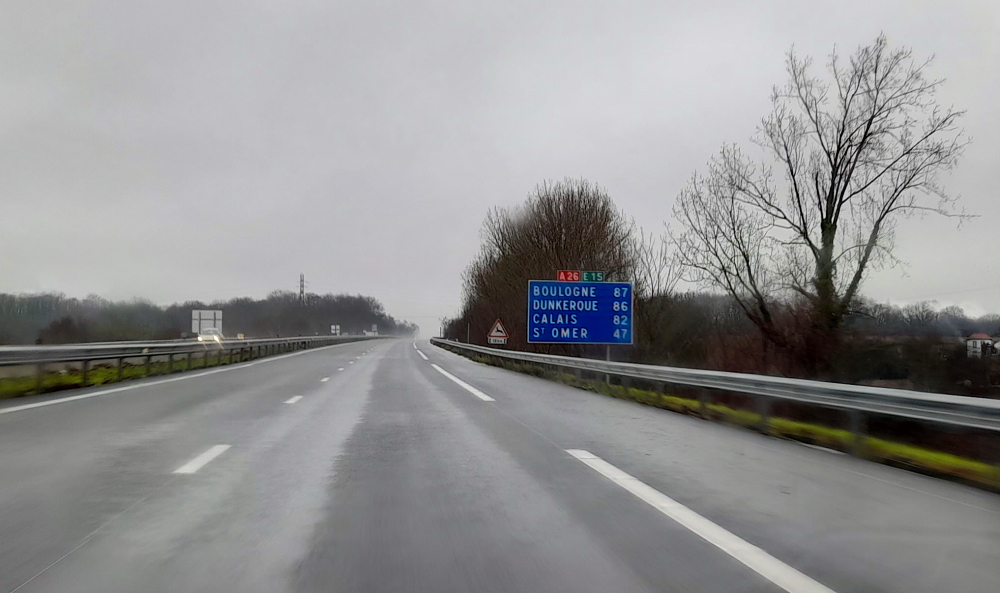
It’s now 11:50 am and by taking the A1/A26 we should arrive in Calais around 2:30 pm. At 12:30 pm we cross over the Somme, it’s finally sunny and 20 degrees.

Bang on 2:30 pm we pull into the car park of an Ibis Hotel. It’s very basic but more than adequate for our overnight stay and offers surprisingly good snacks via its bistro service. Just as well as there ain’t any restaurants nearby!

20 May, 2024

Hoping to get an earlier LeShuttle train than our booked one at 12:18, we leave at 9:55 am (13 Deg. C) and drive to Coquelles, refuel, then proceed to check in. Compared to the past couple of times that we’ve used LeShuttle we’re in a queue of cars. Summer must be fast approaching.

Although our rearview mirror hangar says the 11:18 train we’re loaded onto the 10:48. Unlike previoulsy, we’re directed to park on the ground-floor level of the train carriage and end up being the only car in that carriage. Which is all very well until we’re into the journey when we feel the car rocking violently side to side.

This is worse than a ferry crossing! Getting out of the car we find that the train carriage itself is not rocking as much as the car which is going crazy. Inside the car it was just like riding the bucking bronco machine in a Rockhampton pub. Must be those new springs I had fitted to the car before its MOT last October!

35 minutes later we detrain, driving into sunshine and 16 degrees. On both the M25 and M3 we’re delayed by non-existant road works. We’d forgotten about these. Welcome back to England! But the splash of purple rhododendrons on both sides of the A322 is stunning.

Just before 3:00 pm we pull up in front of the Premier Inn, take most items out of the car, check in and after a very confusing conversation with the receptionist as to how to pay for parking we drop off all our luggage in the room and hurry back to the car as we are parked on a double yellow. Around the corner is the multistorey where we park and pay at the ground-floor kiosk.

There is a hotel restaurant so at 6:00 pm we present ourselves to find that there is a different receptionist on duty. We finally have a lucid and informed conversation with her, organise a free ticket for overnight parking and extend tomorrow’s until 10:00 am – all via an identical kiosk in reception.

Surprisingly for a Premier Inn, the food is excellent, then we crash out for a good night’s sleep.
Dunkirk to Luxembourg.

27 March 2024

As it’s Easter break we decide to depart at 10:30 am to arrive at LeShuttle terminal early. We’re booked on the 2:20 pm train so don’t need to be there until 1:20 pm for check-in, but we have a flexible ticket so may be able to board an earlier train.

I put the terminal co-ordinates into the car GPS, selecting ‘avoid toll roads’ only for it to tell me that the route we are to take, via the M25, that the tolls are unavoidable.

Thank goodness Lynn does the same with her MapsMe offline maps and informs me that we can, in fact, get there toll free, following the A20/M20 to the 11A exit from the M20 straight to LeShuttle check-in booths where we arrive at 11:45 am.

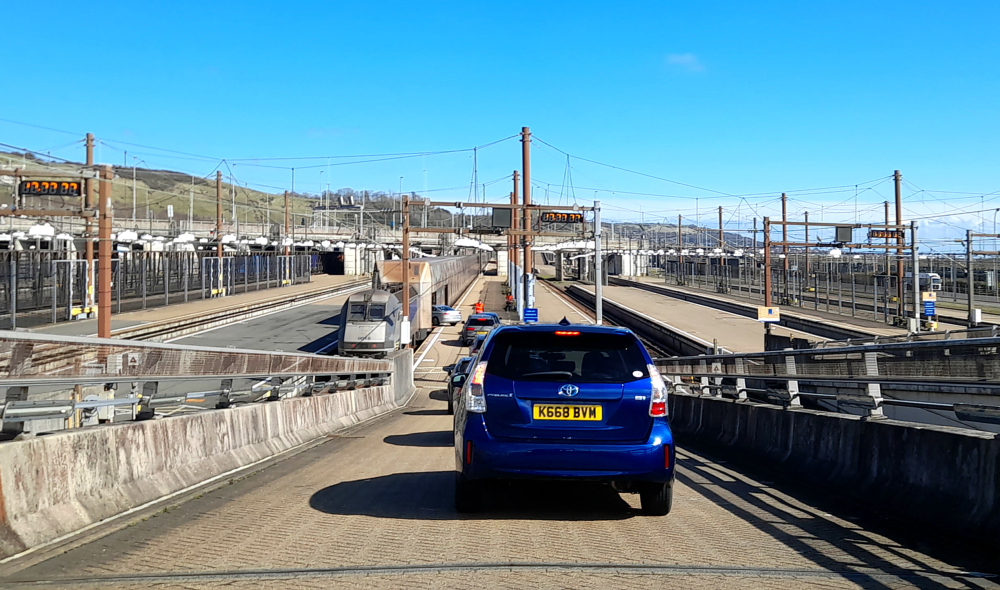
Boarding Le Shuttle again at Folkestone, UK.

Unlike the last 2 times we’ve used LeShuttle we don’t get to drive straight onto the train, thanks to the crowds. Rather we park and wait in the terminal over a coffee for 55 minutes until we get the call at 12:45 pm to proceed through both passport controls and drive onto the train.

Promptly the train departs at 1:15 pm and we arrive at Calais some 35 minutes later.

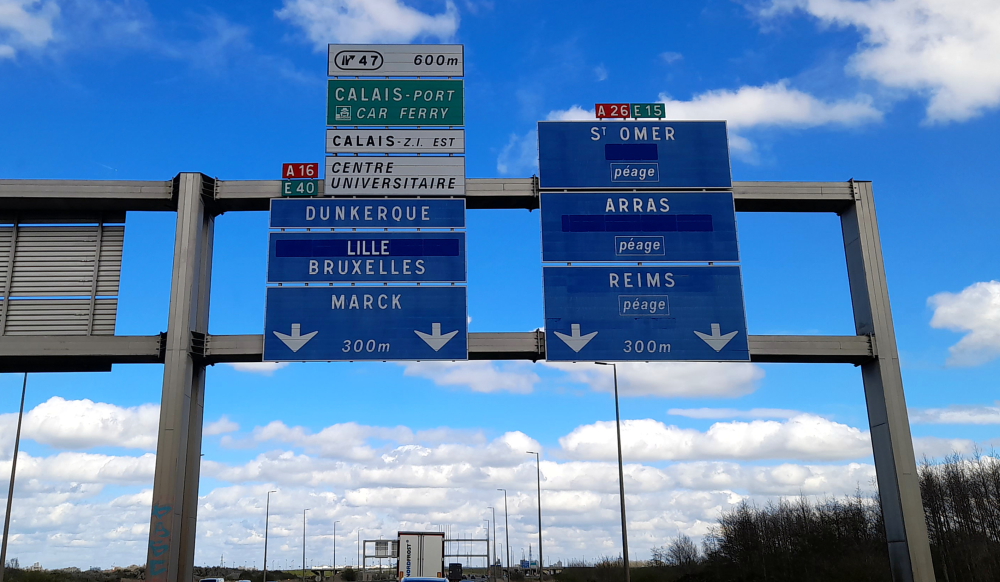
Driving to Dunkirk.

In Dunkirk, our apartment is a block back from the beach, east of Malo-Les-Bains.

We follow our usual drill: unpack then drive to our nearest supermarket (Leclerc) for provisions. As today is Wednesday and Friday is Good Friday when all the shops and presumably restaurants will be closed, we plan to eat in tonight and Friday night. We drive to Luxembourg on Easter Saturday.

Fortunately, we find some English-speaking movies on YouTube and watch the hilarious 1976 ‘The Cheap Detective’ starring Peter Falk (of Columbo fame) and this movie’s send-up of ‘Casablanca’ and ‘The Maltese Falcon’.

28 March, 2024

One thing we do love about France is the use of window shutters for blocking out light and noise. When we wake we discover we’ve slept for 11.5 hours!

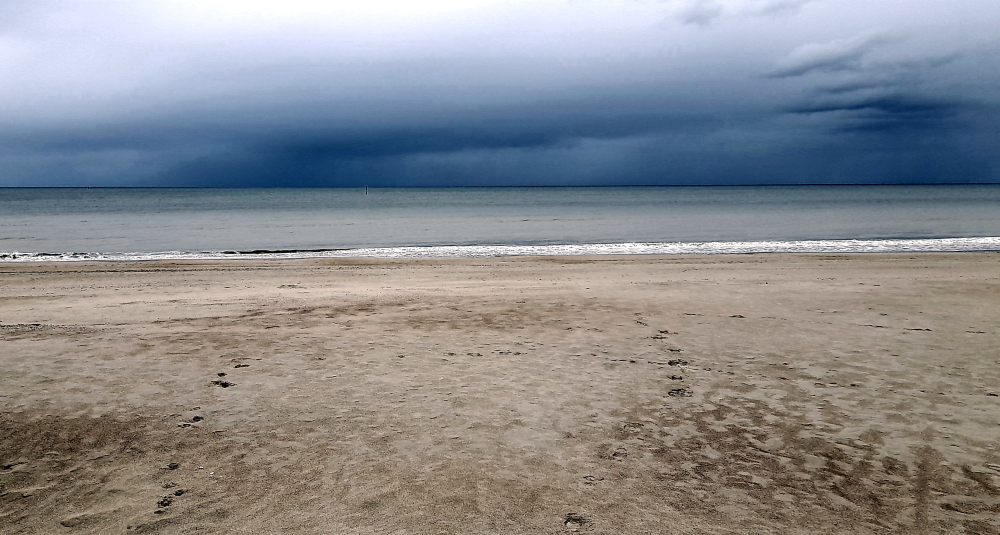
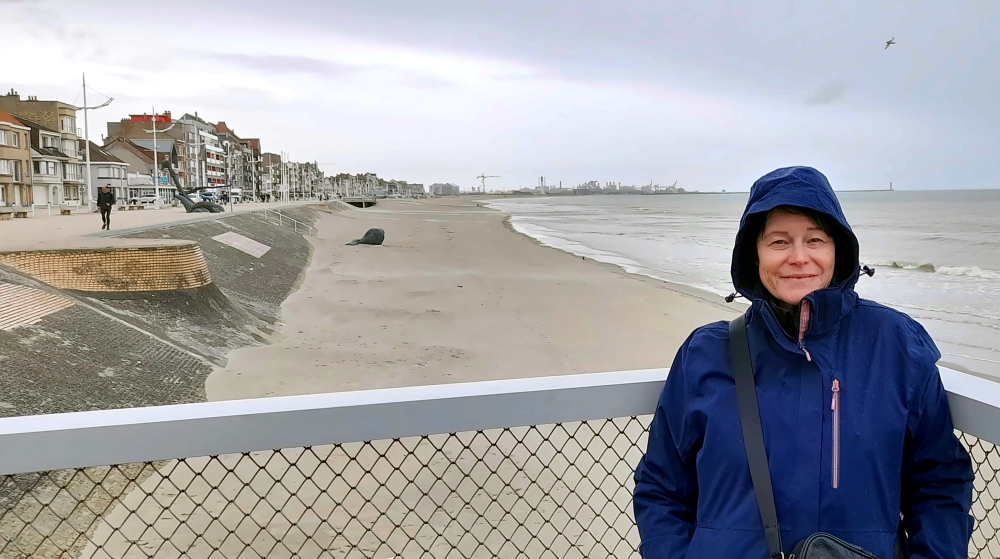
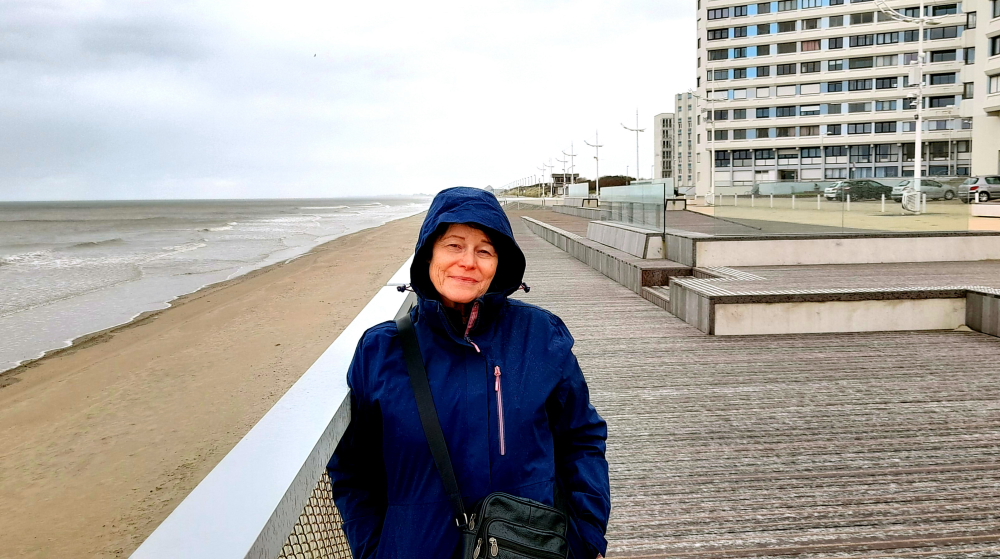
Although it’s raining lightly and quite windy, we still venture outdoors to view the famous beach.

Dirty water and dark clouds.

In May and June of 1940, Dunkirk was the scene of a major turning point in history. During the Second World War, the famous Operation Dynamo succeeded in evacuating more than 338,000 soldiers to England, in only nine days.

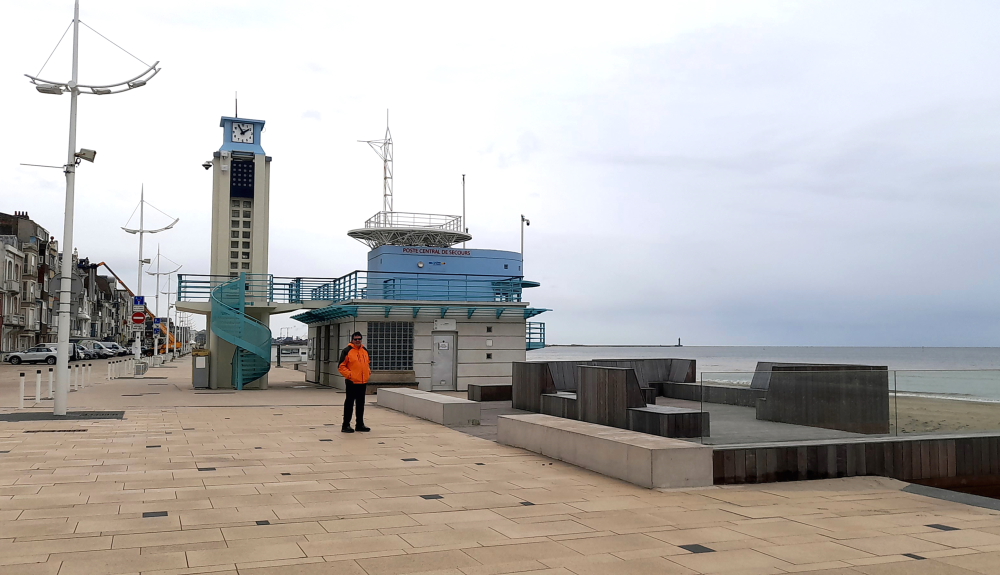
View west along the beach at Dunkirk.

The relative calm of the “Phoney War” period that followed the 1939 declaration of war between Britain and Germany suddenly ended on 10th May 1940, when Germany launched an attack on Holland, Belgium and Luxembourg. In the space of just a few days, the German army had pushed through and the allies were retreating towards the North.

View east along the beach.

Fearing that its troops would be trapped, and judging the battle to be lost, Britain decided to evacuate the troops retreating on Dunkirk by sea. Admiral Ramsay led the evacuation, which the British called ‘Operation Dynamo’.

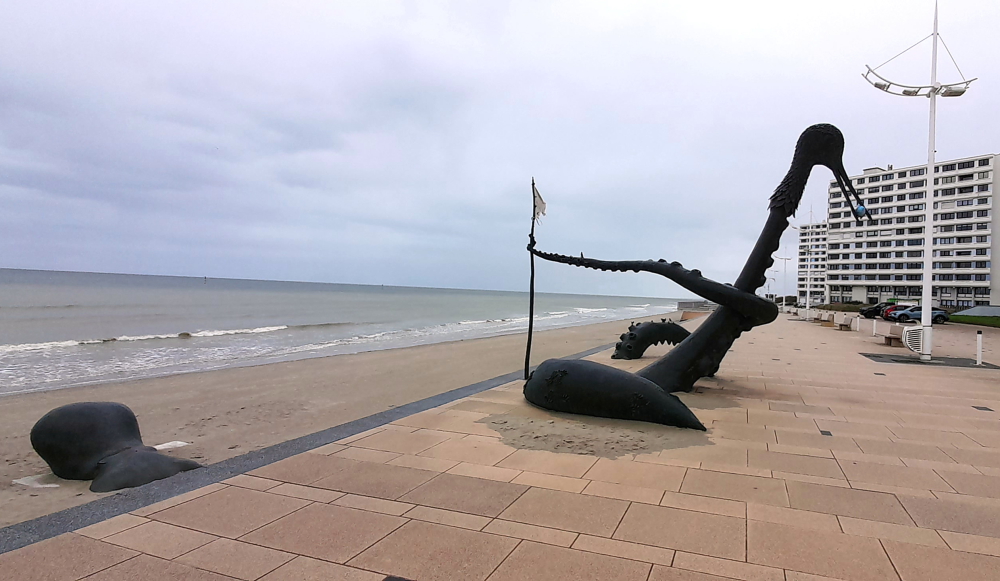
Peck-uliar sculpture of an octopus with 1 tentacle ending in a bird’s head eating a fish!

England sent over everything and anything that could float: warships, commercial vessels, fishing boats, sailing boats, barges and “little ships” that had never before been more than a few miles off the coast. Under continual aerial attack, more than 330,000 allied soldiers, including 120,000 French and a few thousand Belgian soldiers were evacuated through Dunkirk, and about a third of the soldiers left from the beaches. 40,000 soldiers were left behind and taken prisoner. Most of them belonged to the divisions in charge of slowing down Germany’s advance, a crucial element in the operation’s success.

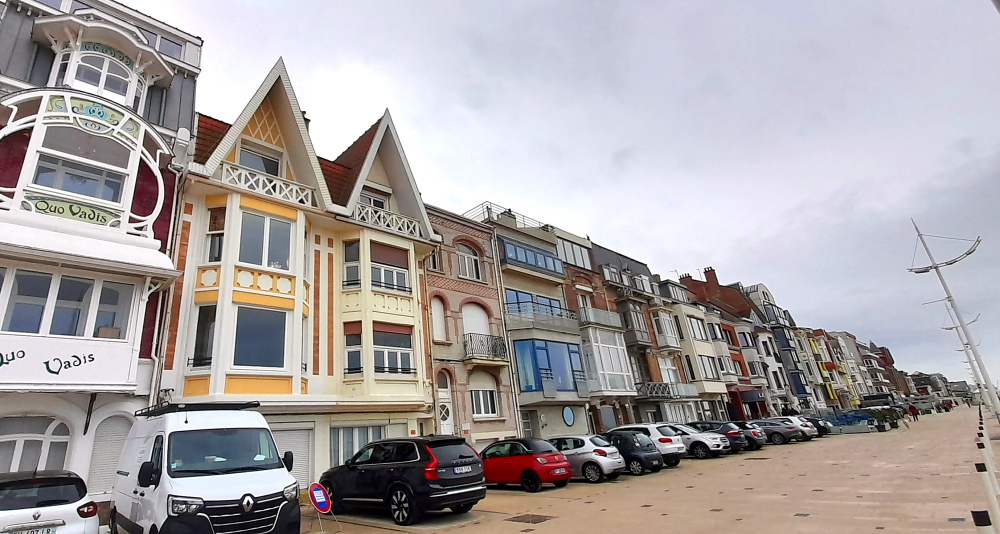
Digue de Mer houses.

Today there is a road that runs parallel to the beach, Digue de Mer (sea wall), upon which there is a variety of buildings – both ‘new’ high-rise and the more traditional houses, often with cafes, bars or restaurants on the ground floor.

And the usual beach-side sights: a building for emergency services …

Art deco ‘secours’ centre.

… and colourful beach huts. Thank heavens that Australia has maintained that the sea and river fronts are common property and nobody can “own” or build on the shores or rent out space on ugly sun beds, etc.

Assembling the bathing boxes on the beach.

Surprisingly, given the war, most of the houses in the side streets still retain their French-ness, the rest are ‘modern’ brick monstrosities.

French-style houses in Dunkirk with balconies and mouldings.

We return to our apartment which is a 3-story building amongst 2-story dwellings that have that rural village cottages look. Unlike its rustic exterior, the apartment has been renovated inside creating quite a spacious apartment with an outdoor terrace.

Holiday apartment on Rue de Gembloux.

Given our coastal location, we’re going to forego the usual ‘moules’ and try the local sushi house for dinner this evening instead.

29 March, 2024

As we have about a 3.75-hour drive to cover the 396 km to our next destination in Luxembourg we depart at 10:05 am in 10 Deg. C and rain. We should arrive around 1:50 pm.

Our route will take us past Bruges, Ghent, around Brussels and Luxembourg to the Mercure Kikuoka Golf & Spa about 25 minutes’ drive SE from Luxembourg City – essentially we will drive the length of both Belgium and Luxembourg finishing 10 minutes’ drive from the German border at Remich.

12 minutes after departing we cross the border into Belgium. Soon after I get an error message on the dashboard console: “Air con has been stopped due to engine high temperature.” WTF??

The usual inclement weather in Belgium.

It’s then I notice that the Engine Temperature gauge is not registering at all. It’s still at its starting point, not half way around where it should be after driving the car for half an hour. Terrific! Why couldn’t this have happened while we were in the UK in an English-speaking country with RAC breakdown service and not on Easter Saturday!

Fortunately, a service station is up ahead so we pull in so that I can check under the hood. Nothing seems amiss – no hoses blown, no leaking coolant, even the engine isn’t that hot to touch. Logic tells me that it’s the console gauge that has had a brain fart so I decide it’s safe to continue, even though the error message persists.

Discussing the issue we decide to pull into the next lay-by – where it turns out there are a couple of police cars with flashing blue lights. It seems that they have intercepted a lorry with a load of African illegal immigrants in the back. Away from the fracas I retrieve the OBD2 (On-Board Diagnostics computer) gizmo from the boot, the one that I bought when I had the issue with the faulty radiator sensor back in October 2022. I put it through its paces, turn on the ignition, the engine temperature gauge springs into life and the error message disappears. Thank goodness for that! Probably a faulty cheap Chinese computer chip in the car or is it the fact that the poor car has had to endure the constant wet weather in the UK and Europe.

A good outcome for us but not so the gaggle of Africans that a bevy of police are interrogating plus the police officer who is photographing the contents of the back of a lorry in the lay-by. Time to hit the road or we might be next!

Then the usual traffic jams on Belgian freeways.

Now that that drama is over we have to contend with the usual Belgian roadworks and interminable tail backs and traffic jams, especially on the northern E19 RO ring road around Brussels. Since we left Dunkirk it’s been unbelievable the amount of traffic on the roads on an Easter Saturday.

More than one Belgian traffic jam.

We finally break free of that madness when we hit the E411 on the other side of Brussels and drive the length of Belgium.

Nary a car on the E411 to Luxembourg.

At the 90 km mark on the E411, near Lavaux-Sainte-Anne, is apparently the largest sculpture in the world. A monumental work by French internationally-renown artist, Bernar Venet, the steel, “L’Arc Majeur” weighs 200 tonnes, measures 60 meters high and was installed in 2019. It was in response to then French President, Mitterand, asking that works of art be installed along highways – presumably French highways, that is, not Belgian ones??

Art work or a bloody big Piston ring?

But, 34 years later, to celebrate the 200th anniversary of John Cockerill arriving at Seraing, the Cockerill CMI Welding Expertise Center in Seraing produced it, a showcase of Walloon Region know-how in the field of construction.

Instead of daffodils planted along footpaths, the local villages have planted tulips. The nearer we get to Scheierhaff, where the Golf Resort is located, the more remote, rural, picturesque and serene becomes the landscape.

Countryside leading to the hotel.

We finally stagger into reception at 3:05 pm – a 75-minute delay – and quickly unpack so we can unwind with a glass of red and an excellent meal in the hotel restaurant after our “3 countries, 3 traffic jams, 3 pee stops and a check engine warning sign” day.

View of the main entrance to the Mercure.

Our desire for an early night is scuppered by having to turn the clock forward an hour for tomorrow’s commencement of Central European Summer Time.

31 March, 2024

Happy Easter! Although the weather forecast for our entire 5-day stay in Luxembourg is for rain we wake to a bright, sunny day.

Let me out before they eat me!

After breakfast we decide to enjoy the sunshine with a walk in the Luxembourg bush.

From road to boggy trail.

The trail turns out to be too boggy to be enjoyable so we walk around the golf resort instead.

View over the back 9.

The path around the back of the hotel looks over the back 9 as well as the restaurant, bar and wellness areas of the hotel.

View of the accommodation, restaurant, bar and wellness areas.

A lazy day in watching golfers progress around the course with a meal in the hotel bistro tonight.

1 April, 2024

Happy April Fool’s Day! Even though it’s raining we’re going to drive the 18 minutes into Luxembourg city for a quick squizz at the Old Town. In the past we have both been to Luxembourg for work but the banks’ offices were in the new town. So, we park in the Knuedler car park which is under the Place Guillaume II in the Old Town and surface by his statue.

Since the middle of the 13th century, this square, named after William II, King of the Netherlands and Grand Duke of Luxembourg, has accommodated the church and the monastery of the order of Saint Francis. In common parlance the square is also called Knuedler – derived from the Luxembourgish word “Knued” denoting the knot in the belt of the Franciscan friars.

Guillaume II statue in Place Guillaume II with Notre-Dame Cathedral spires (L).

In 1797 the French seized the monastery with all its grounds and disposed of it part by part. In the following centuries the whole cluster of edifices was pulled down and the square redesigned. Today, the William Square hosts not only the Town Hall and the Luxembourg City Tourist Office, but also plenty of markets, open air concerts and feasts [Luxembourg ma ville].

Town Hall.

A short walk from the square, along Rue de la Reine we come to the Grand Ducal Palace which has only 1 guard standing on duty.

Grand Ducal Palace.

From here we walk along Rue de la Boucherie, past a host of small marquee tents that are part of a street market, alongside Saint-Michel’s Church and onto the Bock Casemates, also the N1 road.

View from the Casemates over the River Aizette, Church of Saint-Jean & Plateau du Rham.

The Bock (Luxembourgish: Bockfiels) is a promontory in the north-eastern corner of Luxembourg City’s old historical district.

Pont de Stierchen straddling the River Alzette.

Offering a natural fortification, its rocky cliffs tower above the River Alzette, which surrounds it on three sides.

View back to the Old Town from the Pont du Chateau on top of the Casements.

It was here that Count Siegfried built his Castle of Lucilinburhuc in 963, providing a basis for the development of the town that became Luxembourg.

Walkway from the casements to the river.

Over the centuries, the Bock and the surrounding defenses were reinforced, attacked, and rebuilt time and time again as the armies of the Burgundians, Habsburgs, Spaniards, Prussians, and French vied for victory over one of Europe’s most strategic strongholds, the Fortress of Luxembourg.

View upstream from Pont de Stierchen with casement galleries on the right.

Warring did not stop until the Treaty of London was signed in 1867, calling for the demolition of the fortifications. Ruins of the old castle and the vast underground system of passages and galleries known as the casemates continue to be a major tourist attraction.

On account of these impressive fortifications, Luxembourg was even given the epithet of the “Gibraltar of the North”. In 1994, the casements were inscribed on the UNESCO World Heritage List.

View from pedestrian bridge towards Pont de Stierchen & Eglise Saint-Michel.

After crossing over the pedestrian bridge we walk upstream along the river bank where we come across a bright purple sculpture of a mermaid.

Melusina.

According to legend, Melusina was the wife of Sigfried, 1st count of Luxembourg, living in his castle on the rocky Bock promontory. On their marriage, Melusina required her husband never to see her during a particular day and night of the week.

House foundations forming part of the Alzette River bank.

One fine day, unable to resist his curiosity, Sigfried spied her in her bath through the keyhole of her room’s door and discovered her fish’s tail. Melusina, noting that her husband was watching her, then vanished forever into the torrents of the Alzette river.

Entrance to Restaurant L’Hetre Beim Musee on Rue du St Esprit.

Walking up some switchback roads we arrive outside the Notre-Dame Cathedral.

Interior of Notre=Dame Cathedral.

Where Lynn is a little taken aback by a prominent sign in the cathedral’s vestibule warning against pickpockets!

Is nothing sacred??

In all we spend about 1.5 hours wandering about the Old Town. After refueling (at Eu1.63/litre cheaper than France and Belgium) we drive back to the Resort where, over the course of the afternoon, the course is inundated with periods of alternating torrential rain and sunshine.

2 April, 2024

As today is supposed to be the least wet day of our stay, we plan to drive 51 km north to Chateau de Vianden, also close to the German border. But first, what makes Luxembourg, Luxembourg?

The Grand Duchy of Luxembourg is a small landlocked country in Western Europe bordered by Belgium, Germany and France. It is a representative democracy headed by a constitutional monarch, Grand Duke Henri, making it the world’s only remaining sovereign grand duchy.

Its capital, Luxembourg, is 1 of 4 institutional seats of the EU (together with Brussels, Frankfurt, and Strasbourg) and the seat of several EU institutions, notably the Court of Justice of the European Union. It is also a founding member of the EU, OECD, the UN, NATO, and Benelux. While Luxembourgish is the only national language of the Grand Duchy and its people, French is the only language for legislation, and all three – Luxembourgish, French and German – are used for country’s administrative matters.

With an area of 2,586 square kilometers (998 sq mi), Luxembourg is Europe’s 7th-smallest country. In 2023, it had a population of 660,809, which makes it 1 of the least-populated countries in Europe, albeit with the highest population growth rate with foreigners accounting for nearly half the population.

Back to Castle Vianden – “one of the 21 most beautiful castles in the world” (CNN).

Viandan Castle – view from Grand-Rue.

Vianden Castle was constructed between the 11th and 14th centuries on the foundations of a Roman ‘castellum’.

Castle view from Montee du Chateau.

It is one of the largest and most beautiful feudal residences of the romanesque and gothic periods in Europe.

Inner wall view from the castle bailey.

Until the beginning of the 15th century it was the seat of the influential counts of Vianden who could boast their close connections to the Royal Family of France and the German imperial court.

View of Viandan Dam/’reverse graffiti’ artwork on River Our from castle entrance.

Henry I of Vianden (1220-1250) is known as ‘the Sun Count’ for it is during his tenure that the holdings, lifestyle and influence of the House of Vianden reached its zenith.

Arms Hall.

His ancestors were influential in the Ardennes, Eifel and Luxembourg regions for hundreds of years.

Arms Hall – complicated locking mechanism for chest.

His wife, Margarete of Courtenay, was of the French Royal Family, daughter of the Latin Emperor of Constantinople, sister-in-law to the King of Hungary and cousin to King Philip-Augustus.

Upper Chapel – used by nobility.

Margarete’s ancestors, included the Crusaders from the Houses of Flanders and Hainault, Henry’s and Margarete’s son, Frederic had served in the Fifth Crusade.

View of houses within old castle wall.

In 1417, the dominion passed by inheritance to the House of Nassau, which, in 1530 collected the principality of Orange as well.

Loggia-style gallery.

From then on, the castle was no longer the official residence of the counts.

View of Vianden township.
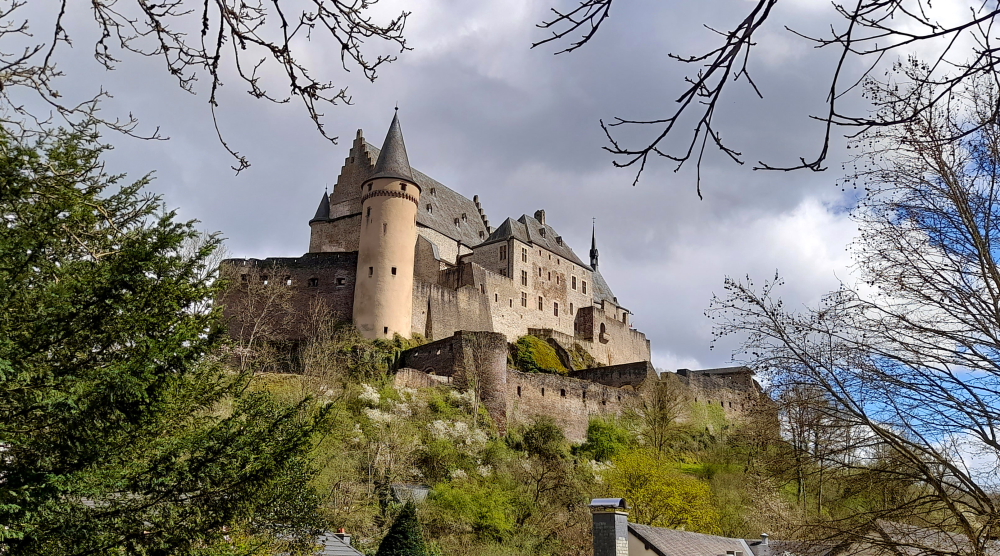
The rich architecture the House of Nassau inherited can still be seen today, as no further modifications were made.
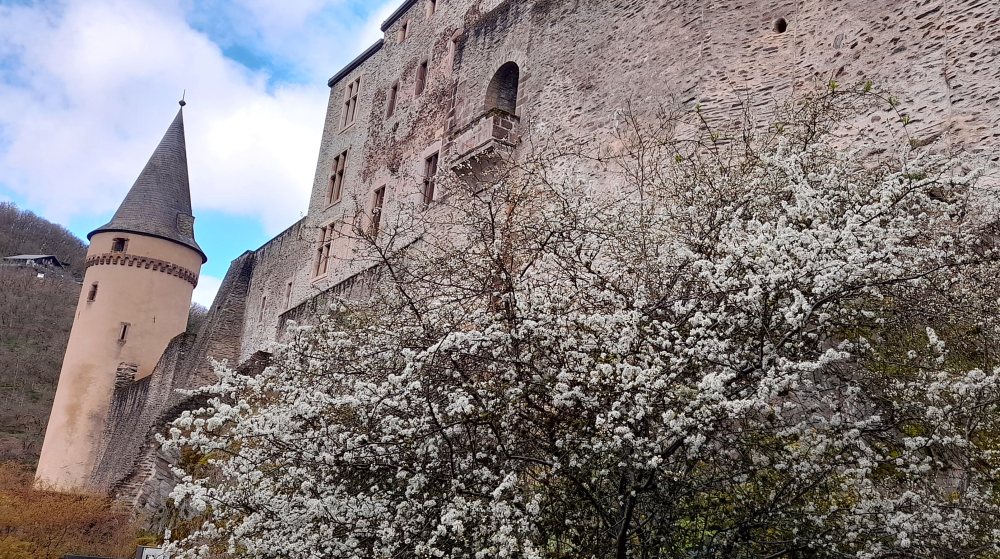
Banqueting Hall.

The main construction parts of the castle which are preserved today, in particular the chapel and the small and large palaces, originate from the end of the 12th and the first half of the 13th century.

Bedroom.

The ‘Quartier de Juliers’ on the western side of the large palace (no longer existing today), originates from the beginning of the 14th century. The House of Nassau was only constructed at the beginning of the 17th century.

Vic. Abens Hall – event space with tapestries.

In 1820, under the reign of King William I of Holland, the castle was sold piece by piece, and as a result, it fell into a state of ruin.

Grand Kitchen.

It was a pile of rubble until the family of the Grand Duke of Luxembourg transferred it to State ownership in 1977.

Wooden wheel over deep well off Grand Kitchen.

Since restored to its former glory, the castle now ranks as a monument of not only regional, but European importance [castle-vianden.lu].

Dining Hall off Grand Kitchen.

Several halls are dedicated to those responsible for the castle’s restoration, in particular: Charles Arendt and Jemmy Koltz.

Knights’ Hall – stained glass coats of arms.

Jean Charles Wenzeslas Arendt (1825-1910) was state architect for Luxembourg and author of over 130 publications, mainly on architectural and art historical topics. He carried out extensive restorations of historical buildings, including the ruins of the Vianden Castle.

Presentation in the Information Centre.

Jean-Pierre (“Jemmy”) Koltz (1909-1989) was a Luxembourgish engineer, technician and historian. His main research topic and his passion was the building history of the Luxembourg fortress. He was also president of the Syndicat d’Initiative of the City of Luxembourg and of the Commission des sites et monuments nationaux where he was involved the restoration of various castles, especially the reconstruction of Vianden Castle.

Vianden Town.

Below the castle is the picturesque, medieval walled town of Vianden. Within its walls is the Gothic Trinitarian Church which has a 13th-century cloister and the Victor Hugo Literary Museum is in a house that hosted the writer in 1871 during his political exile from France.

View of Vianden Town from N17.

In total we spend 3 hours wandering through the castle and enjoy the hour’s drive in sunshine back to the hotel.

Stark contrast to the rain-drenched countryside we saw 3 days ago.

Tonight we drive 10 minutes to a small, family restaurant in the town of Remich on the banks of the Moselle River. The food is pretty good but the meal is so large that we could have shared it.

Post-dinner walk along the flooded Moselle River.

3 April, 2024

It has rained hard all day but we have no plans to be outside. Lynn has a massage booked this afternoon and I plan to spend that time in the indoor heated pool and jacuzzi.

We are heading to Heidelberg tomorrow but since it is only a few hours’ drive we plan to check out at noon and do our packing in the morning.

4 April, 2024

After breakfast this morning we have a WhatApp video call with my grandson for his 3rd birthday. As you would expect he is more interested in spending time playing with his birthday presents than talking to his grandfather. Still, we have an interesting call with Vanessa to catch up on their lives and get to see the ‘new’ addition to their family, Zara.

At 11:00 am we check out of the hotel and load up the car in the heavy rain and head across the Moselle River into Germany.

Crossing the Moselle River at Remich.

It rains heavily all the way to Heidelberg and, as usual, we encounter a heavy traffic jam near Mannheim where the freeway comes to a complete standstill. We manage to find a detour on smaller back roads direct to a supermarket just south of Heidelberg where we do our usual grocery shopping before checking in to our Aparthotel for the next 4 nights.

We have a suite at the Staycity Aparthotel just out of the centre of Heidelberg. The suite is modern and very comfortable.

View from our apartment in Heidelberg.

Tomorrow we are heading in to the old town for a walking tour but this afternoon we are just relaxing and doing our laundry in the hotel laundromat.

Crossing France back to Calais.

21 January, 2024

After 4 blissful days in the village of La Napoule we retrace our journey along the A8/E80 to just before Avignon where we take a right onto the A7. We need to check out at noon but can’t check into our next accommodation until 5:00pm. With the trip only taking 3 hours, we have some time to kill. Therefore, our first destination is the village of Mirmande which is 32 km south of Valence.

Leaving the rugged beauty of the Cote d’Azur.

It’s a lovely sunny day and 8 Deg. C. when we depart the hotel at 11:03am. Would you believe, within half an hour of driving, we come across not one, but two, accidents on the opposite carriage way – the first with 2 fire units in attendance. Not surprising as it is a Sunday and given the risks that we’ve seen French drivers take such as cutting in front of you to change lanes and other haphazard forms of driving. There are some dreadful and dangerous driving examples and probably the worst that we have seen so far in Europe.

It seems that French drivers don’t know how to use their cruise control. The speed limit on the freeways is 130 kph but we are in no hurry so I set our cruise control to 116 kph and stay in the slow lane other than when passing trucks who are limited to 90 kph.

On many occasions a French driver would slowly pass us doing about 120 kph then move back into our lane with about 1 car length between us. They would then slow to about 110 kph and I would have to pas them again. One woman passed us three times doing the same thing. I eventually decided to speed up and put some distance between her and us and thankfully we didn’t see her again. Perhaps it is a women driver thing that they can’t work out how to use the cruise controls as every one of the drivers that did this to us was a woman driver. It helps driving on the RHS as I get to see the French drivers up close and personal when we pass them on the freeways.

What??! 2 accidents within 30 minutes? Must be a Sunday!

2 hours into our journey we see the first road sign to Valence.

Road sign to Valence.

An hour later, after we take a rural road, we arrive at the idyllic hillside village of Mirmande, a French commune located in the Drôme department in the Auvergne-Rhône-Alpes region of France.

The hillside village of Mirmande surrounded by orchards.

“One of the most beautiful villages in France”, in Drome. Hidden behind the ramparts, intertwined in a labyrinth of alleys, the houses of Mirmande have preserved their beautiful stone facades and their old doors.

The walled town is not anywhere near as beautiful as our favourite medieval town of Spello in Umbria, Italy but still quite pleasant.

Restaurant Margot, Mirmande.

We park outside the village and walk to its base. Shortly we come across Restaurant Margot which seems to be open so we pop in for a hot chocolate each.

After the wonderful, friendly service we received from the staff at the Pullman, the owner’s taciturn ‘welcome’ is disappointing.

Interior, Restaurant Margot, Mirmande.

However, the restaurant is beautifully appointed, from its curved vaulted ceiling to its chandelier, framed colourful posters advertising past art exhibitions and a wall featuring framed butterflies which turns out to be wall paper.

View over Saint Pierre church from Rue du Rempart, Mirmande.

Our goal is to walk to the top of the town where the medieval Eglise Sainte-Foy is located which we achieve in about 15 minutes, wending our way upwards along steep medieval cobblestone-paved laneways between stone walls and cottages and passing several galleries and artisanal workshops.

Eglise Sainte-Foy, Mirmande.

From a feudal point of view, Mirmande was a land (or lordship) first owned by the Adhémar, with the first part of the village built by the Adhémar de Monteil family in the 12th century. From the 14th century it passed to the bishops of Valencia who gave its inhabitants a charter of freedoms in 1469.

Nuclear power station in the distance.

In 1835 the village hosted 5 annual fairs, had a few tile factories and 5 silk-working factories.

NW view from the church.

After the disappearance, at the end of the 19th century, of silkworm breeding which supported nearly 3,000 people and which supplied the silk industry in Lyons 135 km north, it was fruit production which ensured Mirmande its development and reputation.

Typical stone & tiled cottage in the village.

During WWII, the Resistance was established in 1942. From April 1944, Mirmande was home to a marquis. According to Pierre de Saint-Prix, he notably contributed to hiding opponents and refractors to the STO, with the support of many notables of the village (including the mayor dismissed by the Vichy authorities, Charles Caillet).

Narrow alleyways with supporting wall arches.

Then based in Mirmande, the painter Marcelle Rivier actively participated in this movement as a liaison agent. Following the failed arrest of Pierre de Saint-Prix by the Gestapo, the latter took refuge in the woods, upstream from the Caillet farm.The Mirmande marquis participated in receiving airdrops and in certain sabotage and skirmishes.

One of several ancient, wooden doors.

After the village’s decline in the 20th century, 2 men contributed to the resurrection of this village: the cubist painter André Lhote, attracting numerous artists and organizing large-scale exhibitions, and the famous volcanologist Haroun Tazieff who was its mayor for 10 years from 1979-1989.

Light blue window shutters a common feature of the village.

After we leave the village it is our intention to call into a Leclerc hypermarket for supplies. But, as it’s Sunday no supermarkets are open, not even Carrefours Expresses.

We arrive at the accommodation at 4:30pm and after much faffing about involving my parking while Lynn accesses the apartment building, gets into the apartment via a keybox code to get a parking card and returns we finally park the car in a nearby parking garage and lug our luggage up a very narrow, winding staircase to the 1st floor apartment.

It’s a very small, basic apartment more suited to student accommodation but it will suffice for the 4 days that we are here. Fortunately there are a couple of fast food shops along the street so, while a load of laundry is being washed, we go to the pizza shop directly across the road for some take away.

After fiddling with the TV’s settings we settle down to watching a couple of movies then hit the sack.

22 January, 2024

Today’s temperature is due to be 9 Deg. C. and raining so after some cereal for breakfast we drive to the Leclerc hypermarket we were planning on visiting yesterday.

Here I buy a new pair of jeans for the grand total of Eur8.95! My others, which I’d purchased before our trip to the USA in 2019, have been wearing very thin so time to avert a disastrous wardrobe malfunction!

Supplies purchased, and while Lynn does my ironing, I head out to case the ‘hood in search of restaurants that might be open tonight (most shut on Mondays) and a quick look at the old town for places to visit over the next day or so.

Ironing done, Lynn then works on updating the blog while another load of laundry is being washed. As only restaurants in the old town might be open tonight we opt for a simple meal in followed by a couple more TV movies.

23 January, 2024

After a long lie in we wake to a sunny day with a promised top of 14 Deg. C. Clothing repairs completed, we walk the 10 minutes into town with our first stop the Hotel de Ville in Place de la Liberte.

Located in the heart of the Rhone corridor, Valence is often referred to as “the gateway to the South ”. Founded in 121 BC by the Romans, it quickly acquired importance thanks to its position at the crossroads of Roman roads and achieved the status of a Roman colony. Over the centuries, the city grew. The period from the Middle Ages to the 19th century is well represented in the city center.

The town hall is located in the heart of downtown Valence, in the pedestrian streets. The building was inaugurated in 1894 by Jean-François Malizard, then mayor at the time. Its architecture is particular, since it has a belfry, a secular bell tower symbolizing the independence of the city from the Catholic Church, a classical facade and a roof of tiles of different colors. City halls under the Third Republic were designed to exalt republican values.

The Hotel de Ville.

One of the streets off Place de la Liberte is Rue Dauphine which has some traditional apartment buildings and a street art mural.

Rue Dauphine.

The area we are in now is all purely pedestrian lane ways. We walk several blocks and notice this stand-alone archway that frames the craggy Ardeche hills on the opposite side of the Rhone River.

The gate is firmly locked and the park looks like it has been abandoned. Apparently it has been closed since 2018 due to subsidence and cracks in basement vaults explained by the history of the site. Before becoming a public park in 1982, the place had homes, an abbey, a prefecture and a bombing in 1944. The outcome of an independent survey was due in 2022, but still the park remains closed.

Parc Saint-Ruf & the portal of the Saint-Ruf abbey.

From here we wander around the corner to Place de Saint Jean which is the location of a covered market and Eglise Saint-Jean-Baptiste de Valence, a Catholic church located in the old town. It is perched at the highest point of the city, a sign of its antiquity, and would be one of the very first places of Christian worship here. Documents evoke the course of different councils within it, notably those of 374 ( 1st Council of Valencia ) and 855. It is traditionally held that the original part of the church was built during the High Middle Ages .

A farmers’ market operates here on Tuesday mornings. In fact, Valence is very well catered for by markets, having one every day except Sunday in the various places around town.

Place de Saint Jean.

Although the bell tower is ancient, the interior of the rebuilt church is non-descript except for the unusual, curved wooden seating behind the altar.

Interior Eglise Saint-Jean-Baptiste.

Several blocks away to the SW is Place des Clercs, a public square with restaurants, bars and shops and adjoining it is the apse of Saint-Apollinaire Cathedral, the oldest monument in the city.

From the 5th century when the episcopal district was created Place des Clercs began to gain importance. Businesses were set up, markets took place and justice was done.

Place des Clercs & Cathedrale Saint-Apollinaire.

Bishop Gontard (1063-1099) initiated the construction of this building in the historic district of Old Valence. It was consecrated in 1095 under the triple name of Saints Cyprian, Cornelius and Apollinaire by Pope Urban II who went to the Council of Clermont to preach the first crusade.

Destroyed during the Wars of Religion, the cathedral was rebuilt in the 17th century and its bell tower was replaced in the 19th century. It has an ambulatory, allowing the passage of pilgrims and confirming its role as a stopover church on the way to Santiago de Compostela. It was burned twice, in 1562 and 1567, by the Huguenots and rebuilt from 1604 in the initial Romanesque style. The entire building, although almost entirely rebuilt in the 17th century, retains all the characteristics of the first Romanesque cathedral.

In 1799, Pope Pius VI was exiled and sent to France. He is in his eighties, he is very weak and his journey stops in Valencia, where he dies on 29 August. First buried in Valencia, his body was brought back to Rome, but the Valentinois demanded his heart and his entrails, which were returned and are still preserved in the cathedral. The visit of the Pope and his Swiss Guards encouraged a pastry chef to create a character-shaped shortbread cookie, the Swiss, which is still a specialty of Valencia.

Cathedrale Saint-Apollinaire under renovation.

Further South is Esplanade Pic, bordered by the Champs du Mars, where the Kiosk de Peynet, created by architect Poitoux in 1890, is located.

Mon Valence sign in Esplanade Pic.

Also in Esplanade Pic is a statute of General Jean Etienne Championnet who was born in Valence in 1768 and died in Antibes in 1800, a major general of the French Revolution. The statue is homage from his home town.

General Jean Etienne Championnet.

In 1942, while passing through Valence, Raymond Peynet, drew for the first time, his two lovers. He says “Sitting on a bench, I drew the Valence kiosk which was in front of me, with a little violinist who played alone on the platform and a little woman who listened to him and waited for him. We also saw all the musicians who, with their instruments in their cases, were leaving the Valence kiosk in the park. In the caption the little musician said: “You can leave alone, I will finish on my own”. Raymond Peynet will name this drawing: “The Unfinished Symphony”. Max Favalelli, editor-in-chief of the magazine Ric et Rac, renamed it “Les Amoureux de Peynet”.

Kiosk de Peynet.

The Peynet Lovers couple enjoyed immediate success and quickly became part of the heritage of popular imagery. Since then, Le Kiosque des Amoureux de Peynet, as it is called, has become a historic monument.

From the Esplanade is a view of Parc Jouvet below, the Rhone River and the Ardeche hills beyond.

Parc Jouvet.

We retrace our steps to Place des Clercs to sit in the sun for a while with a cuppa, then we return to the apartment.

Time to enjoy the sunshine.

Tonight, for dinner, we plan to take advantage of the take away shops in our street – Mexican tonight, methinks.

24 January, 2024

18 Deg. C. is the forecast today so we plan to visit the remaining sights listed for Valence this morning.

First stop is the Chapelle des Cordeliers on Rue Andre Lacroix, a former Catholic place of worship, now disused. The most attractive part of this simple church is the facade. The monumental baroque portal has retained its original carpentry.

Cordeliers was the nickname given to the Friars Minor of the Observance or to the Conventual Friars Minor established in France. The name of these monks would have been attributed to them mainly because of the rope which encircled their robes, and proposed by John I of Beauffort during the Seventh Crusade.

The Cordeliers settled in Valence in the 12th century. Their convent is built to the north of the city. Ruined twice during the Wars of Religion, it was rebuilt not far from its original location in the 17th century. The chapel, consecrated in 1696, is the only vestige. During the Revolution, it was successively transformed into a fodder store, an ammunition store, a meeting room, then after 1945 it housed the Departmental Archives. Currently it houses the headquarters of the Drôme Heritage Conservatory.

Chapelle des Cordeliers.

In the same street is the 13th century Draper’s House, the oldest house in Valence, built from stone and tucked away in the Saint-Jean district. Its architecture indicates that it was likely to have been a wool merchant’s house. The facade’s rendering, the quality of the material used (large mollasse blocks, ornamentation, alternating archstones) shows how wealthy the owners must have been.

Draper’s House, Rue Andre Lacroix.

Several blocks SW is Place de la Pierre. In the 15th century, the inhabitants of Valence obtained from the Dauphin Louis, the future King Louis XI, the concession of two annual fairs and a market which were confirmed by François I in 1538.

A traditional market place in the old town, Place de la Pierre owes its name to an imposing stone hollowed out with three holes used as wheat measures. The bottom of the holes was slightly inclined in order to lead the grain towards another opening through which it flowed. This stone disappeared in the 19th century.

Place de la Pierre.

The western part of this square has seen a succession of different buildings, including a small church dedicated to Saint Martin during the Middle Ages, destroyed at the beginning of the 16th century. A market hall was established on the site of the church. It remained in operation until the end of the 19th century, then converted into a Labor Exchange (Bourse du Travail) at the beginning of the 20th century. Since the trade unions stopped using the building in the 1980s the site occasionally hosts exhibitions and is generally used for cultural purposes.

Bourse du Travail.

A block further South is Le Pendentif, a Renaissance-style funerary monument built in memory of Canon Mistral. Erected in 1548 in the cloister of the Saint-Apollinaire cathedral, this is a triumphal arch, renowned for the perfection of its vault (a pendant vault, hence its name). The monument, which was to serve as a chapel on the ground floor and a tomb in the basement, was once more sumptuous, decorated with stained glass windows, glass roofs and wrought iron fences. The upper surface of the vault was topped with a copper cap. But the Wars of Religion ransacked the building and pillaged its treasures.
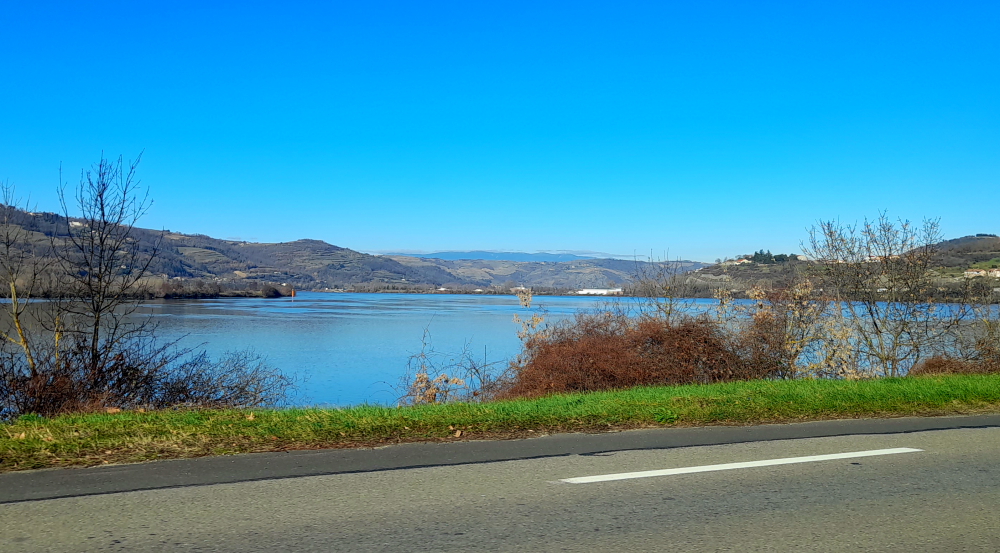

Put on sale in 1796, the pendant was bought by Antoine Gallet, a liqueur maker who converted it into a pubic house, to the great dismay of Jules Ollivier, historian and magistrate from Valentin, who tried to restore its dignity. In 1832 it was sold at auction and fortunately bought by the City of Valence and the Pendant was one of the first monuments classified in France in 1840, barely three years after the creation of the Historical Monuments Commission.

Le Pendentif.

One of the laneways off Place des Clercs is Grand Rue where La Maison des Tetes is located. Antoine de Dorne, a law professor at the university and the consul of the town, was the first known owner of this urban residence, built him around 1530, when he returned from travelling in Italy.

A jewel of architecture from the beginning of the 16th century, this former private mansion, marking the transition from the flamboyant Gothic style to the Renaissance style, owes its name to the numerous heads which adorn its facade. Sculptures symbolize the winds, Fortune, Time, or even theology, law or medicine while the corridor is decorated with busts of Roman emperors.

The residence was purchased in 1794 by the widow of Pierre Aurel whose son, a friend of the young Bonaparte then stationed in Valence, would later be recruited as the army’s head printer in Egypt. Today, the building belongs to Valence town council and it how houses the Interpretation Centre for Architecture and Heritage.

Maison des Tetes.

We return to Place des Clercs which is adjacent to the apse of the Cathedrale Saint-Apollinaire.

Stone commemorating the execution of Louis Mandrin on this spot.

The square was once the site of public executions in the city, the most famous of which was that of smuggler Louis Mandrin in 1755.

Site of the execution stone in Place des Clercs.

The sunshine entices us to sit at one of the cafes that border the Place. It specialises in desserts so Lynn decides to order a traditional crepe with lemon juice and sugar. Imagine her surprise when she discovers her crepe has been sprinkled with lemon juice – and salt!

Lemon juice & salt with your crepe??

Time to wander back to the apartment which we do via the Fontaine Monumentale with its view of Boulevard Maurice Clerc.

Fontaine Monumentale.

What’s for dinner? Take away, of course, from the ‘Chicken’s Run’ shop on our street.

Tomorrow we plan to leave at 11:00am for a 4-hour drive north to Dijon where we’ll be for 5 days.

25 January, 2024

Normally the drive from Valence to Dijon on the A7/E15 toll road would take 2 hours 50 minutes for the 315 km trip, whereas the toll-free route would take 4 hours 55 minutes. Yesterday, Google Maps had forewarned us that the toll route would instead be 4 hours, thanks to the motorway north being closed in a couple of places.

Kilometres of tailback of semitrailers north of Valence.

What it didn’t forewarn us was as to why it would take so much longer. It’s thanks to the Bloody Idiot French! There’s obviously absolutely nothing going on between their ears when it comes to managing road closures and diversions!

We leave the apartment at 10:30 am, expecting to arrive 4 hours later at 14:30 pm. 15 minutes later we come to the entrance to the motorway which is closed and are diverted onto the N7 which inexplicably comes to a standstill for over half an hour.

View of the Rhone River while sitting in the truck stop that is the N7.

As we slowly stop and start we believe it’s due to the D86C bridge over the Rhone that ends in a small roundabout at the junction with the N7 at Saint-Vallier that is the cause, only to find miles up the road that an electrician has parked his van on the side of the N7 to do some work but it’s slightly blocking the road which means that the lorries have difficulty passing each other in the opposite directions. The electrician’s stupidity or typical French “don’t give a sh*t about anyone else” attitude has caused at least a 15 km traffic jam in both directions. Mind you, closing the only major freeway from Marseilles to Lyon without police traffic management in the small towns and roundabouts on the N7 doesn’t help.

Trucks queued into the distance near Saint-Rambert-d’Albon airport.

We finally get back onto the A7/E15 at 12:30 pm at Chanavas with the motorway taking us through Lyon which, incidentally, has grown enormously since Lynn last visited here about 20 years ago. But this only lasts 45 minutes as just on the other side of Lyon the motorway is closed once again for no apparent reason.

Why close a major freeway in both directions? Surely there are better solutions. Again the French “don’t give a sh*t about consequences” or “didn’t think that through” causes major economic consequences for thousands. Must be related to the same French guys who tested nuclear blasts in the Pacific in the ’70s. It doesn’t affect them so who cares.

Musee des Confluences (Rhone & Saone Rivers) beside the M7, Lyon.

This time we are left to our own devices as there is just the 1 ‘Diversion’ sign that leads us into a labyrinth of narrow, suburban streets. 18-wheeler semitrailers struggle even to get around the corners. What moron thought that it is OK to divert a major freeway through small suburban streets? Again we sit in the “truck stop” for half an hour while we creep onto the D306 where a series of traffic lights block the traffic with no police traffic management in place. What a total f*** up. Eventually we merge with the A7 once again. Our new ETA is 3:30 pm.

Road sign to Dijon.

I vow to never go to France again after our upcoming trip is completed. France has become a third-world country with third-world management thinking. The food is rubbish and way over priced. Have all the French chefs moved abroad?

4 blocks from our hotel with a street view of Eglise Notre-Dame.

Thank goodness, we have no more issues once we are back on the motorway, arriving at the underground parking station adjacent to the hotel on Place Grangierin Dijon at 3:30 pm – 5 bloody hours later!

“Drinking a canon is saving a winemaker.” Hmmm.

By the time we check in and unpack we are knackered after such a long and frustrating day, but a glass of red and the bold, quirky artwork that is characteristic of the hotel revive our spirits, somewhat.

View east from our 5th floor balcony to the Eglise Notre-Dame at sunset.

Fortunately the hotel has both a restaurant and a brasserie so we choose the cheaper brasserie for dinner. A nice change to take-a-ways but probably lower quality at a higher price.

View west from our balcony.

9:00 pm – lights out – literally and figuratively! Little did we realise that today still hadn’t finished with us …

26 January, 2024

By the time we surface Australia Day is almost over. It’s due to rain in Dijon today so we plan to have a day in to catch up while enjoying the view of Dijon’s rooftops, and thousands of chimney pots, from our room.

By 1:00 pm, although overcast, it still hasn’t rained so we decide to pop out to see what’s nearby. Typical of all the French towns and cities that we have visited on this trip the pavements are covered in dog poop. Despite doggy doo plastic bags provided by the towns and signs telling owners to pick up their dog crap, none of the dog owners bother. Filthy French!

The obvious place to start checking out the town is the imposing Eglise Notre-Dame at the end of our street. A masterpiece of Burgundian 13th century architecture the Notre-Dame has a remarkable facade decorated with fine arcatures and rows of false gargoyles. On top of one of the front towers is a clock known as Jacquemart.

Eglise Notre-Dame.

Adjacent to the Church is the Palais des Ducs et Etats de Bourgogne (Palace of the Dukes and States of Burgundy). In the square in front of the palace is a statue of Philippe Le Bon (Philip the Good).

From its height of 46 m, the Philippe le Bon tower offers a panorama of Dijon and its surroundings. The Tower, originally called the Terrace Tower (Tour de la Terrasse), dominates the entire Palace of the Dukes and the Estates of Burgundy whose designer was Lyon architect, Jean Poncelet. Built between 1450 and 1460 for Philippe the Good at the same time as the ducal dwelling, it recalls the prestigious medieval past of Dijon under the reign of the great dukes.

Dukes of Burgundy Palace, statue of Phillipe Le Bon & his Tower.

Walking through the Palace we come to Place de la Liberation and the Town Hall. The semi-circular square was designed in 1685, by the Versailles architect, Jules Hardouin-Mansart, to receive the equestrian statue of King Louis XIV but the statue didn’t arrive in Dijon until 1725 due to transport difficulties at the time. However, it ended up being melted down to make canons for the revolutionaries in 1792.

Place de Liberation looking towards Eglise Saint-Michel.

The classic reconstruction of the Palais des Ducs began in the 17th century according to Jules Hardouin-Mansart. It was finished during the course of the 19th century.

Town Hall with Le Bon Tower in the background.

The whole building now houses the Town Hall and the Musee des Beaux Arts (Fine Arts Museum).

Museum of Fine Arts.

Next door is the Theatre Municipal, built on the site of Sainte Chapelle. Work of Jacques Cellerier, it was built in neo-classical style which was fashionable at the beginning of the 19th century.

Municipal Theatre.

In the next block, on Rue Vaillant is the Church of Saint Michael. The first phase of construction was of gothic influence whereas the the facade was inspired by the Italian Renaissance.

La Nef (The Nave) is located in the former abbey church of Saint-Etienne and is now occupied by a cultural centre, local library and the Musee Rude which has moulds of works by the Dijon sculptor Francois Rude.

Eglise Saint-Michel with La Nef in the foreground.

Dotted throughout the Old Town are half-timbered houses …

Old houses on Place des Ducs.

… now used as restaurant venues.

Au Moulin a Vent restaurant on Place Francois Rude.

Place Francois Rude is also known as Place du Bareuzal due to the statue of the grape harvester placed above the fountain in the centre of the square. After having spent a long time treading grapes, the wine growers came out with “red stockings” (bas roses).

Place Francois Rude with the wine grower fountain.

On Rue de la Liberte is the Moutarde Maille house, creators of flavours since 1747 – master mustard makers also offering vinegars, oils and pickles. Famous for Dijon Mustard.

Moutarde Maille – since 1747.

At the end of Rue de la Liberte is Porte Guillaume, a 18th century triumphal arch named after Guillaume de Volpiano, the 11th century reformer of the Saint-Benigne Benedictine abbey. The arch was inserted into the town’s ramparts but at the end of the 18th century when the ramparts were demolished, the arch became stand alone.

Porte Guillaume.

Around the corner on Rue de la Poste is the Post Office building which faces Place Grangier.

Hotel des Postes.

Henri Grangier Square occupies the site of the Dijon Castle built by Louis XI in 1478. The King of France had this fortified site built to protect the city militarily and impose its power after the death of Charles the Téeraire. For the Dijonedes, the castle became the symbol of the resumption of control of Burgundy by royalty after more than a hundred years of independence. It was demolished during 1887-1897.

Le Computeur du Temps.

Also on Grangier Square is a 2020 sculpture entitled Le Computeur du Temps (The Time Counter) by visual artiste Gloria Friedmann. The 4 m high work is “an allegory which represents our planet on which sits a man with a clock in front of his face”. Riveting.

As it’s now mizzling we return to the hotel. We will venture out again this evening to find a restaurant around Les Halles, the covered market.

In the meantime, I go back to the car to get some fruit out of the ASDA cold bag we have in the footwell behind the passenger seat, only to find that the cold bag has disappeared. I check with Lynn that we hadn’t taken the bag upstairs to our room, given that we don’t have a fridge. She is as perplexed as I am. Her response is: “(1) We put it in the boot with the other bags. (2) When we took some items out of it yesterday then you asked me if we needed to take anything out of the boot I got distracted, we locked the car and walked away, with the bag still sitting on the ground out of sight behind the car and someone has picked it up. (3) The car has been broken into with a scanner key and someone has taken it, like what happened in Boston.” After we check the bags in the boot and determine that nothing has been taken, I conclude that option (2) is the most likely and that Lynn is losing it.

Around midnight I decide to go and check on the car which is on Level -6, the lowest level in the parking station. Who should I see but a 20-ish year old, skinny black dude in a black track suit and grey beanie walking along the row of cars checking if any of the doors are unlocked. He legs it. It’s then that I realise that in addition to the missing cold bag my prescription sun glasses are no longer in the glove box, my heavy duty black leather snow gloves and the 2x hi-vis vests that were tucked into the passenger seat pocket are also missing. What is it about my prescription sunnies and leather gloves?? Also taken during the car break-in when we were in Boston!

I take it up with the guys on Level 1 who are supposed to be managing the parking garage. It turns out that they hadn’t locked the garage when they went home whereby people can only get after-hours access by scanning their parking ticket – i.e. they have a legitimate reason to enter the secured garage.

27 January, 2024

Straight after breakfast we go to the head office of the parking garage company which is a couple of blocks away in order to view the CCTV footage of Thursday evening, the 25th. We are told we have to report it to the police in order for them to request and view the footage. Typical French bureaucracy. They can’t just do it the easy way.

15 minutes’ walk later we enter the police station at Place Suquet. I want to report this, not because the missing items are particularly valuable nor was the car damaged, but if it isn’t reported these petty thieves won’t ever be deterred.

Fortunately for us both the cop on reception and his colleague who interviews us and submits the report speak English so about 50 minutes later we are walking out the door again having been seen promptly and courteously, even sharing a few jokes with the interviewer. He says they will review the tapes tonight and will email me, but I’m not going to hold my breath. They probably have no intention of checking out the video but just want us to think that they are doing something.

Police Nationale on Place Suquet.

Right, time go get on with what we had actually planned to do today. Like Zielona Gora in Poland with its trail of Bacchus sculptures, Dijon has a trail of brass owl markers on the footpaths which take you around the old town to discover various historical sights. In addition to the Owl Trail there are also the Zola, Rousseau and Moses Loops which link into the Owl Trail.

Bric-a-brac market stalls line the street.

But first, we see that there are Saturday morning markets set up in the nearby streets so we check these out.

Les Halles covered market.

These market stalls lead to Les Halles covered market which was closed yesterday afternoon. Today, it is surrounded on all sides by market stalls, such as the flower stall with large bunches of mimosa.

The only brasserie in the market.

Inside it is vibrant with all the stalls trading giving the place a buzz. So far, every Les Halles market hall we’ve visited in France, only a few of the stalls have been open which tends to suck the energy out of these spaces.

Now, onto the starting point of the Owl Trail, Jardin Darcy. This was the town’s first public garden created in 1880 designed around the reservoir built 40 years earlier by the engineer Henry Darcy to bring water to the town. This garden is guarded by the “White Bear”, a tribute to the famous animal sculptor, Francois Pompon.

White Bear by Francois Pompon – being harassed by an idiot.

From here we walk past Porte Guillaume, which we visited yesterday, to just passed the Hotel des Postes with its academic architecture. Here is a surprising Art Nouveau building with pagoda roofs, quite different in style despite the fact that it was designed by the same architect, Louis Perreau, who designed the Hotel des Postes.

Art Nouveau building (Centre) & Hotel des Postes (L) – both by Perreau.

The next spot on the Trail is Les Halles so we cut to the next site, Place Francois Rude which is named after a famous Dijon sculptor who was born near here and who sculpted “La Marseillaise” the famous bas relief on the Arch de Triomphe in Paris.

Also here is a contemporary piece by artist Gloria Friedmann – a sculpture of a tree with a human face.

Gloria Friedmann sculpture.

No. 40 Rue des Forges is Hotel Aubriot. Its cellars in the 13th century were used to store the monetary reserves. Guillaume Aubriot was in charge of these exchange vaults with his house built above.

Hotel Aubriot.

Next door at No. 38 is Maison Maillard, erected for Jean Maillard, Dijon’s mayor in 1560 which has a remarkable Renaissance facade.

Maison Maillard.

Next is the Eglise Notre-Dame. As mentioned yesterday, on top of one of the front towers is a clock, “Jacquemart”, a war spoil of Philip The Bold. Originally, the clock was made before 1382 in Kortrijk, Belgium. Philip the Bold, who had sacked the city, brought back the clock as a trophy and in recognition of their help in the Flanders war. “The most beautiful work that could be found here or beyond the sea”, as the medieval chronicler Jean Froissart described it, was mounted in the months that followed on a tower of the Notre-Dame church.

Eglise Notre-Dame & its clock.

The clock is almost too difficult to read from the street. Just stolen for the sake of stealing. They could have mounted it in a better location.

Too small to see the clock. Not sure why they bothered.

On a building around the corner of the church is a sculpture of an owl which, over the centuries, has become a good luck charm for passers by who have defaced it by rubbing it.

The Owl on the Owl Trail and a symbol of Dijon.

Also on Rue de la Chouette (Owl Street) is Maison Milliere. Built in 1483 by the merchant Guillaume Milliere it has retained its typical Medieval appearance – street stall on the ground floor and family dwelling on the 1st floor. The facade has kept its wooden-beamed walls and enameled bricks.

Maison Milliere.

Up the street is L’hotel de Vogue, the best example of a 17th century town house between courtyard and garden. It was built for parliamentary president Etienne Bouhier and passed by marriage to the ‘de Vogue’ family in 1782.

L’hotel de Vogue.

Fun fact: Maison Milliere and the courtyard of L’hotel de Vogue were used as decor for the 1990 movie “Cyrano de Bergerac” with Gerard Depardieu.

L’hotel de Vogue courtyard.

At the corner of the street is Rue Verrerie (Glassware Street) where the antiques dealers’ quarter begins. In the past, this street was known by other names often connected to the activities carried out in it: Pig Market Street, Sargis Street (textile), Shearers’ Street. Typical of the Middle Ages it has well-aligned houses with corbelled, wooden-beamed walls and arcades.

Rue Verrerie.

This brings us to Place du Theatre which we visited yesterday. This time we enter La Nef (The Nave) located in the former abbey church of St-Etienne at the Musee Rude which has casts of the monumental works by Dijon sculptor Francois Rude (1784-1855).

Dominating the space is the cast of “The Departure of the Volunteers of 1792” , commonly called “La Marseillaise”, which was commissioned by the State in 1938 fearing that the Arc de Triomphe de l’Etoile in Paris would be destroyed during the war.

La Marseillaise casting.

Most of the museums in Dijon have free entry so today we also visit the Museum of Fine Arts (Musee des Beaux Arts).

Entrance staircase to the Musee des Beaux Arts.

The collections range from Antiquity to the Middle Ages in Europe and in Burgundy featuring the tombs of the Dukes of Burgundy. Then from the 17th century to modern times.

Crown used at the funeral of Phillippe le Hardi (Phillippe the Bold) in 1404.

The tombs of John the Fearless (1371-1419) and his wife Margaret of Bavaria (1363- 1423). Behind, the tomb of Philip the Bold (1342-1404), are in the Guard Room of the Palace of the Dukes of Burgundy. The tombs consist of painted alabaster effigies with lions and angels, and below, figures of mourners. The Guardroom, a large ceremonial and banquet hall, was built 1450-55 by Philip the Good (1396-1467) in flamboyant Gothic style.

Detail of a Duke of Burgundy, John the Fearless, tomb in the Guard Room.

The tombs were originally from the Chartreuse de Champmol, a Carthusian monastery which was sacked during the French Revolution and the tombs moved to Dijon cathedral in 1827. The effigies are 19th century reconstructions, the originals being destroyed in the French Revolution.

The 4 Dukes of Burgundy.

In all, there are 1500 works presented over 4200 sqm of exhibit space. These works cover more than 2000 years of art history combining paintings, sculptures, art objects and furniture.

The Eternal Father (God) Blessing the World, Reni, 1630-40 – looks nothing like Charlton Heston!

Outside, in the courtyard, is the Tour de Bar. Designed according to the model of a medieval dungeon, the Tour was built from 1365 by Philip the Bold. It is the most ancient part of the Palais des Ducs.

At this point my back is starting to ache so we terminate the Owl Trail for today and will do the remaining 5 of 22 sites tomorrow.

La Tour de Bar.

After an afternoon nap, Lynn is very hungry by 4:00 pm so by 5:00 pm she can’t wait for the French restaurants to open at 7:00 pm so we head around the corner to Burger King for an early dinner.

Unfortunately, they are so slow it takes nearly an hour to receive our meal and to make matters worse it’s cold. Lynn takes it back to the counter and asks them to redo a hot meal. This is the most pathetic attempt at fast food that we have ever experienced. Ahh, the French… bad expensive food, non-existent service, thieves and dog poop everywhere. It really is a third-world country – or perhaps it is just inhabited by third-world people these days.

28 January, 2024

Fog! Freezing fog as it turns out with a top of 6 Deg. C. today.

Our view west all fogged out.

This does not deter us from reconnecting with the Owl Trail at the Palais de Justice (Law Court) which was designed for the old Burgundy Parliament in the 16th century.

Palais de Justice.

Attached to this building is Hotel Legouz de Gerland with its elegant facade on Rue Vauban and its courtyard.

Courtyard of Hotel Legouz de Gerland.

At this point we join the Zola Loop at Place Jean Mace. From here we walk to Place des Cordeliers. Dijon architect Pierre Le Muet (1591-1669) is credited with building the Hotel Gauthier which has a dormer window bearing the date 1642. Its facade with bossed windows is typical of its time.

Hotel Gauthier, Place des Cordeliers.

On Rue Sainte-Anne we come across the former convent church (17th century Carmelite Convent). Its facade is typical of the religious architecture of the Counter-Reform period.

Former Carmelite Convent church.

Towards the end of Rue Sainte-Anne is the former church of the Bernardine Monastery which is now the Sacred Art Museum.

Dome of the Museum of Sacred Art.

Next door the other buildings and cloister are part of the Museum of Burgundian Life. We decided to check it out since it is warm inside and entry is free. Typical of the French… it is just after noon and they close the Museum for two hours from 12:30 so it will be a dash around to see things. My kind of visit actually. Unlike Lynn who likes to read every detail and mull over every exhibit I just want a quick glance at some of the more interesting exhibits. A 20 minute visit is more than enough.

Museum of Burgundian Life – entrance & cloister.

This museum presents a collection of items showing the daily life in Dijon and rural Burgundy from the 18th to 20th centuries.

The show must go on!

Recreations of 11 shops that used to line the streets of Dijon (pharmacy, hat shop, grocery, butcher’s, furrier, clockmaker, biscuit shop, toy shop …) are presented.

Hospice.

Next is Place Emile Zola named after the French novelist, journalist, playwright, and an important contributor to the development of theatrical naturalism.

On this square, which at the time was called Place du Morimont, public executions took place until the turn of the 19th century.

Place Emile Zola.

From here we walk to Place Boussuet, named after the bishop of Meaux and writer Jacques-Bénigne Bossuet (1627-1704), whose birthplace is located nearby. His sculpture stands in front of the Saint-Jean Church on the Place where Bossuet was baptized.

Across the road from the church at No. 15 is the ‘Roofless House’. Legend has it that a pie-maker made delicious pates but one day a child’s finger was discovered in one. The pie-maker was put to death and the roof of his house destroyed…

Hotel Catin de Richemont & the ‘Roofless House’.

Next door at No. 13 is the Hotel, a beautifully-restored 15th century house.

Here we end the Zola Loop and rejoin the Owl Trail continuing on to Saint-Philibert Church. The porch of this ancient church in the parish of wine-growers served as a place for the election of the town’s mayors until the French Revolution at which point it became a storage room for salt. The church was reconstructed during the height of Romanesque Burgundian Art in the middle of the 12th century. The porch is now a sleeping place for the homeless.

Saint-Philibert Church & porch.

Not part of the Trail, but on the corner of the street is a house with a bench upon which are 2 wreaths A plaque on the wall indicates that Maxime Guillot, pioneer of the Resistance, was seriously injured on this spot on 29 January 1944 by the Gestapo.

Wreaths laid by the Association of Maxime Guillot & the Mayor.

The last stop on the Trail is Saint-Benigne Cathedral. From the time of the ancient abbey rebuilt from the year 1000 by Guillaume de Volpiano, the church features a crypt of Romanesque Burgundian Art. Here the relics of Saint-Benigne, the 1st apostle of Burgundy, are to be found.

Cathedrale Saint-Benigne.

Attached to the cathedral is the former abbey which now houses the Musee Archeologique (Archaeological Museum) on the Square des Benedictins.

Musee Archeologique & the Square des Benedictins.

It is now just after 1:00 pm and it is bloody cold and still foggy. We decide we need to find a cafe for a hot chocolate to warm up. As this is a third-world country nearly all shops are closed on a Sunday. We find a bistro open near our hotel but, as it’s lunch time, it’s only serving food. However, they serve food all day so we make a booking for a 5:00 pm dinner (surely they can’t be as slow as Burger King!).

As we pass by the Galeries Lafayette next door to our hotel we discover they have a cafe on the 1st floor. The hot chocolate is very good and while we sip our warming drinks I notice the store has a 60% off sale. I find a very nice pure cotton shirt reduced from Eu65 to Eu25.99. A real bargain for this country!

A proper dinner at a reasonable time.

L’edito Restaurant & Cafe turns out to be a real find. Good service, varied menu, great food and beer at a reasonable time and price and they can also be found in Reims, Chalons-en-Champagne and Dunkerque. That’s dinner sorted at those 3 upcoming destinations!

29 January, 2024

Back to a sunny day with a top of 13 Deg. C., or 7 degrees warmer than yesterday.

Today we will walk the Rousseau Loop which starts near the Hotel de Vogue. At 7-9 Rue Auguste Comte is a timber-framed house from the early 16th century. At the corner of the house is a small street called Rue Pouffler. In the Middle Ages, where the car park is now, used to be a market specialising in salted meat and lard.

16th century house at the corner of Rue Pouffler & former market.

About half way down Rue Jean-Jacques Rousseau is the bell tower of the former Church of St Nicholas.

Bell Tower of former Church of St Nicholas.

Nearby is Rue Vannerie which has a number of mansions and gardens. One of them is No. 39, Hotel Chartraire de Montigny which has a superb rocaille door (one of the more prominent aspects of the Rococo style of architecture and decoration that developed in France during the reign of King Louis XV (1715–74) featuring scrolls and curves).

Hotel Chartraire de Montigny.

At No. 66 is a Renaissance sentry box at the Hotel Le Compasseur mansion.

Renaissance sentry box.

Back onto Rue Jean-Jacques Rousseau we come to Placette Garibaldi. This small square is a tribute to the man who helped Dijon defend itself during the 1870 war. The trompe l’oeil wall is the work of Dominique Maraval (1986) and the bust of Garibaldi by Macorati (1961).

Placette Garibaldi.

A market selling cheese, vegetables and lard took place in the Middle Ages at the “corner of five streets”. On the original site, at No. 79, a low-relief depicting a bull lying down still adorns the building’s facade.

No 79.

At the corner of Rue Jean-Jacques and Rue Chaudronnerie is another 16th century house, this one was owned by the Ramaille family.

16th century Ramaille family home.

No. 28 Rue Chaudronnerie, the Maison des Cariatides (House of the Caryatids) was built for the Pouffier family in the late 16th century. The decorative facade is typical of the Burgundy Renaissance style. Life-size statues called caryatids surround a cauldron, a symbol of the owners’ trade (cauldron merchants). This is the end of the Rousseau Loop.

Maison des Cariatides.

En route to the hotel Lynn calls into the Notre-Dame Church to find that she has the place entirely to herself. I have seen more than enough Churches in Europe to last a lifetime so she can really have the place to herself.

Inside Notre-Dame Dijon.

For dinner this evening we are booked into the hotel’s Brasserie once again to take advantage of our 2 free drinks!

Tomorrow we drive NNW to Epernay for a total of 8 days in the Champagne region. Bonne sante!

30 January, 2024

Taking the toll roads will take us around 2 hours 40 minutes to drive the 285 km to Epernay. We are going to leave at 11:00 am as we need to call into Ikea to buy 2 more hi-vis vests and get fuel at the Leclerc petrol station next door which will have us arrive on time for our 2:00 pm check-in.

Just as well we leave at 10:30 am as we find that the information from the cop that we could buy the vests at Ikea is wrong (Leclerc has them) and a young woman in front of us in the pay-at-the-pump queue faffed for ages – doing the same thing over and over – trying to get the pump to work and then to get a receipt from the machine.

Getting close to Epernay.

So, at 11:30 am we finally get onto the motorway. It’s sunny and 9 Deg. C. Compared to our trip from Valance the motorway is relatively quiet with the occasional semi-trailer.

Murals on water towers, rather than silos.

Thankfully our motorway route has us skirting Troyes and some distance from Paris as French farmers are blockading major roads into Paris at a 30 km radius. Hopefully that won’t be blockading Calais when we are due to arrive there on 7 February and due to depart on LeShuttle 3 days later.

Not a vine in sight!

We take the D3 off the A26 and a road sign tells us we are now in the Champagne region. Only trouble is, there is not a vine in sight! And we don’t get to see any until about 100 m from where the D3 becomes the Avenue de Champagne in Epenay where elegant wine houses form an impressive guard of honour on both sides of the avenue into the town.

At the apartment we collect the keys and I haul our suitcases up 3 flights of narrow stairs. Our apartment is under the eaves with solid, exposed wooden timbers supporting the roof.

Next we drive about 4 km away to a Leclerc hypermarket for provisions. Needless to say they have an extensive collection of bottles of champagne in their wine section.

As we have found in most French supermarkets, the locals just love their fromages. These 2 rows of chiller cabinets are chockers with cheese.

Say “cheese”!

When we return to the apartment we find bottles of champagne chilled in the fridge which we can purchase, plus a small wine fridge also full of wine. We promptly open a bottle, an Andre Dormay 2016 champagne from Cauroy-Les-Hermonville. Now, that’s how you should run a rental apartment!

31 January, 2024

Bliss! A lie in and when we crawl out of bed we discover it’s a sunny day. This prompts us to walk up the block to check out today’s morning market in the Halle Saint Thibauld. As usual, only a handful of stalls are open offering fruit and veg and one fish stall.

As we venture further up the street we come across a Monoprix store where we need to purchase some batteries and an optometrists (there are several in the same street) where I buy a pair of clip-on, polarised sun glasses, to temporarily replace those that were stolen. Lynn reckons I look like a mad scientist in them, when I flip them up!

Portal de l’Eglise Saint-Martin.

The Saint-Martin Portal was built in 1540 and is attributed to the Reims sculptor, Pierre Jacques. In Renaissance style, the portal is one of the oldest monuments in Epernay. Classified as a historic monument in 1908, the portal was preserved after the demolition of the church and was reinstalled in the square located near Place Hugues-Plomb. Decorating the portal are stone garlands between which all kinds of animals play, including salamanders, an architectural detail which links this portal to the time of Francis I.

Several blocks away is the Eglise Notre-Dame. Built on the site of the Ursuline convent during 1897-1915 it has been restored several times due to the effects of bombing and presents different architectural styles. The church is characterized by a medieval transitional style: the exterior is inspired by Romanesque and the interior by early Gothic.

Eglise Notre-Dame.

It houses large Cavaillé-Coll organs offered by Paul Chandon de Briailles in 1869. They come from the old Saint-Martin church. Its listed bell dates from the end of the 14th century.

Notre-Dame’s interior.

We continue to Place de la Republique, a large roundabout from which 6 roads radiate, one of which is the Avenue de Champagne.

The Avenue de Champagne (formerly the Avenue de Commerce) extends for nearly 1 km lined on both sides by magnificent private dwellings constructed over many centuries by the Champagne Houses. Some were originally built as a Head Office, others as the private home of the proprietor. All of them reflect an architectural style that celebrates the brand in particular and Champagne in general. The Avenue is now a (UNESCO) World Heritage site, listed under the heading Champagne hillsides, Houses and Cellars.

Where the big Champagne Houses can be found.

Here on the Place we find a number of daggy, old-style restaurants, bistros and wine salons.

La Fine Bulle – The Fine Bubble wine salon.

For example, La Fine Bulle, a tasting room entirely dedicated to champagne. From the outside, would you have guessed that the boutique highlights the vintages of 25 winegrowers and those of prestigious houses? And every month, a new House offers 2 of its vintages for tasting plus a tasting of 5 champagnes from partner winegrowers? Nor us!

Later in the afternoon we head out to investigate the Avenue de Champagne. At the Place de la Republique is a large orb which we discover is actually a balloon that flies aloft but tethered to the ground – just not today. Apparently the attraction accommodates up to 29 passengers and offers, at 150 meters in the air, a 360º panoramic view of the Montagne de Reims, the Marne Valley, the western slopes and the Côte des Blancs.

Ballon captif.

The Avenue de Champagne is also said to have been called the Faubourg de la Folie (“crazy suburb”) — a name that still suits it well, conjuring up the grandeur of the buildings that line it on both sides.

The late 17th century marked the construction of magnificent cellars, which by the end of the 18th century made this avenue the address of choice for pioneering Epernay Champagne producers. The arrival of the railway then brought a boom in business that fostered a taste for architecture on a monumental scale. The avenue became home to grandiose properties of every style that were constantly rebuilt as successive wars and fires took their toll. Famous residents of the avenue include such great names in Champagne as Moët & Chandon, Perrier-Jouët, Boizel, de Venoge, Vranken, Pol Roger, Mercier and G.H. Martel

At the beginning of the Avenue is the Hotel Particulier Auban-Moet. This stately home was commissioned around 1858 under the direction of architect Victor Lenoir, who also designed the Gare Montparnasse in Paris. In 1920 it became the Town Hall of Epernay.

Auban-Moët Hôtel Particulier

Across the road on a corner block is the huge, “modern” headquarters of Moet & Chandon. In July 1918, the building was badly damaged by a bomb and its subsequent fire. Reconstruction ran from 1928 to 1934, under the direction of the then House Director Jean-Rémy Chandon-Moët, to plans drawn up by architects Henri Picart and Bruno de Maigret.

The facade consists almost entirely of windows, providing maximum light to the offices and workshops. The surrounding masonry is meanwhile composed of sand-coloured bricks that are quite untypical of the region and probably deliberately chosen to convey the image of the wine itself. The architects opted for what was then a relatively modern building material: concrete.

Moet & Chandon’s Headquarters.

The construction of the “Commerce” building, in particular, could not have been achieved without load-bearing concrete columns — essential to overcome the instability of a site hollowed out by cellars below the surface. The building is exceptionally tall, standing some 80 metres high and positioned like a sentry at the entrance to the Avenue de Champagne — a concrete expression of confidence in the future of the Avenue’s residents and their namesake Champagne wine.

Since the 1800s, the original headquarters building of Moët & Chandon Champagne next door has conserved its aesthetic value.

The Champagne man himself – Dom Perignon.

Several doors along the Avenue is the “Musée du vin de Champagne et d’Archéologie régionale”, previously the Chateau Perrier. In 1811 cork-manufacturer Pierre-Nicolas Perrier married Adèle Jouët and founded what was to become the celebrated House of Perrier-Jouët. In 1854 they commissioned the building of this Louis Treize style chateau. It originally served as the Perrier private family home and stands today as a magnificent example of Late Romantic Era French architecture.

In WWII the chateau served as Army Headquarters, first for the British Army (1940), then for the Germans (1942-1944) then for the Americans in 1945. It was then converted into the Epernay Municipal Library and Museum, making an important contribution to the magnificent built heritage of the “Champagne Avenue”.

Since 1950 the chateau has also housed the regional museum of prehistory and archaeology, based on a major donation of artworks and archaeological artifacts to the town of Epernay in 1893. Some 40 years later eminent French archaeologist, Abbé Pierre Favret, was appointed as the director and curator of the collection — one of the most important archaeological exhibitions in France comprising some 80,000 regional artifacts (dating from the Paleolithic to the Early Middle Period) together with (since 1960) 4,000 artifacts and documents relating to the history of Champagne wine.

Chateau Perrier – Museum of Champagne Wine & Regional Archaeology.

Nearby is the Boizel Champagne House launched in 1834 by 2 pastry chefs which has since operated as a family concern and by both husband and wife, now in its 6th generation. During its history the House has always been innovative – shipping its wines to London in 1851; launched the first brut champagnes in 1872; shipping wines to Australia in 1923; creating the first Blanc de Blancs in 1929; 2008 introducing the first ‘Zero Dosage’ cuvee and in 2018 opened its Atelier 1834 tasting room on site.

Boizel Champagne House.

Tonight we are walking back into the town square to have dinner at Sacre Bistro that is recommended by our hosts and has a good rating on Google. Perhaps it is the quiet winter time and maybe they have a temporary chef working in the Bistro because the food is inedible.

We order Chicken Supreme but there is nothing supreme about it. At A$46 a plate it is part chicken breast and part wing with a swirl of mashed potato. By now we are getting used to overpriced food in France but the chicken piece is tough, microwaved and under-cooked rubbish. Even the serrated knifes we have been provided with (a clue, perhaps?) can’t cut it – literally and figuratively!

I send mine back and Lynn struggles through about half of hers until she encounters pink, under-cooked meat. Even the wine is a tiny (125ml) glass of undrinkable Chenin at A$12. Have all the good French Chefs gone skiing for the winter or moved to better countries??

1 February, 2024

After the rain stopped this afternoon we went to an underground cave in town for a champagne tasting – a flight of 6 degustations for Eur15 – normally you only get 2 for Eur16.

They were: 1. a chardonnay (Chapuy, Brut Reserve Grand Cru Blanc de Blancs) – our rating 1; 2. a meunier (Sendron Destouches Cuvee de Reserve Brut) – our rating 3; a pinot noir (Baron Dauvergne Grand Cru) – our rating 2; 4. a traditional blending of 3 grapes (Collet Brut) – our rating 4; 5. a blended rose (J Perard Pere et Fils Grand Cru Brut Rose) – our rating 5, and 6. a rose de saignee/maceration rose (Leriche Tournant Brut) – our rating 6. We leave with a bottle of No. 1 for Eu35.

A flight of 6 degustations each.

At 7:30 pm we rock up to Chateau Perrier (the Museum) on Avenue de Champagne to see the competitors in this year’s 26th Monte-Carlo Historic Car Rally that is driving through Epernay tonight with an expected 90 classic cars. The rally is from 31 January to 7 February and is organised by the Automobile Club de Monaco.

No. 23 – Audi Quattro – German team.

Leaving Reims at around 7:00 pm tonight, the competitors will head for Langres, passing through three compulsory checkpoints: Epernay, Vitry-le-François and Bar-sur-Aube.

No. 86 – Lancier – Italian team.

The first team is due to arrive at around 7.45 pm in Epernay for the first checkpoint. These collector vehicles, exclusively models that took part in a Monte-Carlo Rally between 1911 and 1982, will then make their way along the famous Sparnac artery driving towards the next 2 checkpoints.

No. 91 – Renault Elf – French team.

In all, 248 competitors, starting from Reims, but also from Bad Hombourg (Germany), Glasgow (Scotland) and Milan (Italy), are expected in Monaco for the real start of the big race, on Saturday 3 February. The cars will then travel the small roads of SE France for six days.

2 February, 2024

Savouring our last long lie-in for a couple of days we have a late breakfast and catch up with a few things. After our below-par restaurant experience a couple of nights ago we’ve decided to dine in with a charcuterie board, a freshly-baked baguette and an artisnal flan for dessert.

Check-out tomorrow is an early 10:00 am and as it will only take us 30 minutes to drive north to Reims through the Parc Naturel Regional de la Montagne de Reims, we’ll take a circuitous route visiting a number of Champagne villages along the way.

3 February, 2024

Pity it’s an overcast, cold, rainy day as we won’t be able to see the usual views of the Champagne region. Naturally, our first stop is at the abbey where Dom Pierre Perignon is buried in the village of Hautevillers, 7 km away.

Appointed procurator of Abbaye d’Hautvillers in 1668, Dom Pierre Perignon spent 47 years overseeing the abbey’s worldly affairs until his death on 24 September 1715. He acted as manger, builder, legal specialist, merchant and, above all, winegrower and maker.

Eglise Saint-Sindulphe.

Abbaye d’Hautvillers’ reputation flourished under this stewardship as he pursued his proclaimed mission: “to make the best wine in the world”. He was a visionary who developed revolutionary grape-growing and winemaking techniques that helped earn Champagne wines their reputation for unique nobelesse and refinement.

His wine was served in Versailles and praised by the Sun King, Louise XIV. In the 19th century his renown spread worldwide and he was celebrated as “the spiritual father of champagne and Hautvillers as “the birthplace of champagne”.

Perignon tomb (L) in the choir of Saint-Sindulphe Church.

Hautevillers is also famous for its 140 traditional wrought iron signs. There’s even a map that plots a circuit to view them.

Wrought iron sign in Rue de L’Abbaye.

Driving down the hill towards Ay we come across a field of vines which, by the tombstone by the roadside, indicates that the grapes from these vines are grown for Moet & Chandon.

Moet & Chandon vines near Hautvillers.

The village of Ay-Champagne is the location of the House of Bollinger. Athanase de Villermont inherited a vast estate from his family on the outskirts of Ay. He unerstood the potential of Champagne wines but as an aristocrat he was forbidden from undertaking any commerical activity.

Then he met Joseph “Jacques” Bollinger who specialised in selling Champagne wines and Paul Renaudin, a born-and-bred Champenois. On 6 February 1829 the company Renaudin-Bollinger & Cie was founded with Joseph in charge of sales and Paul overseeing the cellar. Anthanase had founded a Champagne house that would transcend centuries.

Maison Bollinger.

From Ay we drive to Avenay Val-d’Or, Mareuil-sur-Ay, Cuis, Oger, and on our way to Vertus we drive past vineyards owned by Veuve Clicquot near Le Mesnil-sur-Oger.

Veuve Clicquot vineyards near Le Mesnil-sur-Oger.

Barbe Nicole Clicquot Ponsardin was born in 1777, the daughter of a textile manufacturer in Reims, Champagne. Widowed at the age of 27, she took control of her own destiny and became one of the first modern entrepreneurs. In an era when women were excluded from the business world, she dared to assume the head of the company founded by her father-in-law in 1772, a role she undertook with passion and determination. True to this heritage, the House is proud of its motto: “Only one quality, the finest.”

Her creativity and drive for innovation led to many firsts in Champagne: the first known vintage champagne; the invention of the riddling table; the first known blended rosé champagne. Three inventions that revolutionised champagne making and were widely adopted by producers, becoming the basis of modern champagne production.

Madame Clicquot made her name into a brand of excellence and her formidable contributions earned her the nickname of “la grande dame of Champagne”.

Eglise Saint-Martin, Chavot-Courcourt.

Vertus is our furtherest stop south where we turn NW and drive to the ridge-top Eglise Saint-Martin at Chavot-Courcourt with views down to the Marne River valley.

Modern Route du Champagne Route sign.

From Chavot we drive across the Marne River to Vandieres …

Older Route du Champagne sign in Vandieres.

… where we find the Chateau de Vandieres, a private chateau owned by the Desrousseaux family. It was built in the 16th century, remodeled in the 18th and completely restored after damage from the 1914-1918 war.

Acquired in 1816 by the gentleman glassmaker, Joseph-Auguste Desrousseaux (1783-1838) was the castle, its buildings, courtyard, and garden. It was then inherited by Edward in 1836 then passed to his son Auguste in 1861. The castle park was created in the 19th century by the famous landscape architect Jacques Lalos.

Chateau de Vandieres.

Driving through woodlands on our way to Vandieres we had come across a couple of triangular road signs with an exclamation mark and the word, “Chasse” – Hunt!

De rigueur shooting accessories – hi-vis vest, gun and parapluie!

Sure enough, driving to Cuchery we pass by a hunting party. One guy in a hat with, in addition to his gun, a big, black umbrella (un parapluie), and the rest of the party further down the road with their hounds.

“I vote we go that way!”

From Cuchery we continue eastwards past the villages of Fleury-la-Riviere on the D324 and Mailly-Champagne on the D26.

View from vineyards at Fleury-la-Riviere.

On the approach to Verzenay we pass its windmill. This pivot-type windmill was built in 1818 by the Tinot-Vincent couple on Mont-Bœuf to grind cereals (wheat, barley and rye). It stopped operating in 1903.

It served as an observation post during the war of 1914-1918 . On 27 September 1917, Raymond Poincaré, President of the Republic, and the allied leader Victor-Emmanuel III, King of Italy, went there to observe enemy lines. It regained its role as an observatory in 1944 for the American army.

In 1923 it became the property of the Heidsieck Estate and underwent restoration in 1949. In 1972, the Mumm Champagne house acquired it and has since maintained it and opened it, for private receptions, to its guests who can enjoy an exceptional panorama of the champagne vineyards.

Le moulin de Verzenay.

Our penultimate destination today is the Lighthouse at Vezenay – miles from the ocean – but overlooks a sea of vineyards. To publicize his brand of champagne created in 1909, Joseph Goulet decided to do a publicity stunt. He decides to build a lighthouse on a hillock, in the middle of the Champagne vineyards. In the evening, the lantern begins to rotate and lights up the hills of Verzenay until it is visible from Reims. It is one of the first buildings in the region made of reinforced concrete.

During WWII, the lighthouse was used as an observation post. After the war, only the reinforced concrete tower resisted the shots. For many years it was abandoned until it was bought by the town of Verzenay from a champagne house in 1987.

Today, the lighthouse offers several services to visitors. After climbing the 101 steps, the belvedere offers a 360° view of the vineyards; the ecomuseum offers a guided tour on the history of champagne, and the tasting area offers prestigious vintages from winegrowers in the Montagne de Reims.

Le Phare de Vezenay.

At 3:00 pm we arrive at the Mercure on Boulevard Paul Doumer overlooking the Canal de l’Aisne a la Marne and the Stade Auguste-Delaune which we discover will host a spirited match between Reims and Toulouse tomorrow afternoon.

Stade Auguste-Delaune on the canal.

The hotel is a block away from Rue Libergier which leads to Reims Cathedral.

Since it has been a long day we decide to eat in the hotel restaurant tonight. I am now absolutly convinced that there are no good French Chefs left in France. I had a steak that was supposed to be succulent and covered in a sauce. The meat was so tough that even a very sharp steak knife couldn’t cut it. I had no chance of chewing it (and I tried). I managed to eat about 25% of the meat but gave up before I broke my teeth on it. I have eaten more tender boiled lollies in my life. What a joke. It is almost impossible to make steak this tough no matter how bad you are as a chef. I am seriously done with French food!

4 February, 2024

Another freezing, overcast day greets us with a top of 11 Deg. C. At 10:15 am we walk a couple of blocks to the Vesle tram stop where we buy 2x Eu1.80 daily tickets and jump on an A tram towards Neufchatel, alighting at the Schniter tram stop.

The A tram to Neufchatel.

This tram stop is near to the Monument aux Morts de Reims, the meeting point for our 2-hour GuruWalk of Reims Town and Cathedral.

The monument is located above the Place de la République created on the site of the ramparts of the medieval city. The war memorial was designed by the architect Henri Royer in collaboration with the Reims sculptor, Paul Lefebvre. It was erected in 1930 in memory of the town’s children killed during WWI (1914-18).

Monument aux Morts de Reims.

Across the road is the Halles du Boulingrin where flea, book, arts and crafts and festive markets are held and it’s also used as an exhibition space.

Halles du Boulingrin.

While we have been in France we have seen numerous red and white Historic Monument plaques about the place. The red design is based on the maze that used to be in the Reims Cathedral, then adopted France-wide as the logo for historic monuments. Apparently numerous cathedrals in France had labyrinths embedded in their floors but have mostly been removed. Chartres Cathedral is the only undisturbed medieval labyrinth left in a cathedral nave in the world.

Historic Monument plaque logo based on Reims Cathedral maze (former).

On Rue de Mars is a gorgeous pastry shop, “Aux Merveilleux de Fred”, which highlights traditional specialities including Merveilleux, a delight from Flanders. A flagship product revisited by Frédéric Vaucamps, this dessert is distinguished by its light meringue. Initially in chocolate, it’s now available in a multitude of flavors and sizes, the individual-sized ones seen in the bottom LH corner of the photo.

Aux Merveilleux de Fred shop.

Further along the street is a building with interesting architectural features. The Mumm expedition cellar, known as Le Cellier, is a former place where champagne was made, currently a cultural center in Reims.

It was built in 1898 under the direction of Reims architect Ernest Kalas for the champagne company Jules Mumm. The facade is made up of two very distinct parts: a practical part in red brick pierced with a large circular forged door evoking the shape of thunderbolts; the decorative upper part presents in five scenes the stages of champagne manufacturing – an example of an advertising facade.

In 1905 the cellars passed into the Mumm GH fold; they were then the property of Veuve-Cliquot champagnes, then Jacquart before becoming the property of the city in 2010. After the bombing of the town hall in March 1917, the Reims municipal council sat in the cellar.

Le Cellier.

Across the way is the Hotel de Ville. Previously housing a museum, the city archives, a savings bank, a library, the city police, a tribunal and the chamber of commerce, it now only houses municipal services.

Nicolas Lespagnol, the city inhabitants’ lieutenant, laid the foundation stone on 18 June 1627 and the new building was constructed to a design by the architect Jean Bonhomme. The council began meeting there from 1628 onwards. The façade was completed in 1636 and the building as a whole completed with the corner tower in 1823.

Construction resumed in 1863 and completed in 1880. It was burned down on 3 March 1917 during WWI and rebuilt post-warin 1924. The architects Roger-Henri Expert and Paul Bouchette contributed, along with the sculptor Paul Berton, born in Reims. President Gaston Doumergue reopened the building on 10 June 1928.

Hotel de Ville.

Past the Hotel de Ville, th Rue de Mars becomes the Rue du Tambour (Drum Street). Located in the heart of the commercial district, Rue de Tambour was one of the busiest in the old town. Here is located the oldest bourgeois house in Reims, known as the Hôtel des Comtes de Champagne because it served as residence to Thibaud IV (1201-1253) and more generally to the Counts of Champagne when they came to Reims for the coronation of the kings of France.

The residence dates from the Middle Ages. It belonged to Nicolas Razulet, viscount of Saulx-Saint-Rémi in 1703, but apart from this it was a residence of the city’s bourgeois. This residence was also a “hotellerie” under the name of Le Coq Royal. Before WWI, when it was partially destroyed, the ground floor was occupied by shops. After the war the Taittinger Champagne House bought and restored it under the direction of the Ministry of Fine Arts then occupied it. The house is currently owned by the Taittinger champagne company and is used at cultural events.

Hôtel des Comtes de Champagne.

Rue du Tambour becomes Rue Colbert which ends in the Place Royale (Royal Square). A bronze statue of King Louis XV stands in its center, commissioned by the city from the sculptor Jean-Baptiste Pigalle and inaugurated on 26 August 1765, depicting “the sovereign in Roman garb, with laurels on his head and one hand extended ‘to take the people under his protection'”.

Place Royale & statue of King Louis XV.

From here we walk around the back of the Cathedral past Jardin Henri Deneux to the Carnegie Library of Reims (Bibliothèque Carnegie de Reims), a public library built with money donated by businessman and philanthropist Andrew Carnegie to the city of Reims after WWI. Reims was one of three “front-line” cities to be given a Carnegie library, the other two being Leuven and Belgrade (Belgrade University Library).

Founded in 1910 by philanthropist Andrew Carnegie, the Carnegie Endowment for International Peace decided after WWI to provide a library to the cities particularly battered by bombings. The Carnegie Endowment offered the city of Reims a sum of US$200 000 (more of 3 million francs at the time) to build the new library.

Built in the 1920s of Art Deco designby French architect Max Sainsaulieu (1870–1953), it combined the mission of heritage conservation and of a reading public library. Until 2003, the Carnegie Library was the main library of Reims.

Bibliothèque Carnegie de Reims.

Finally we walk around to the front of the stunning Notre-Dame de Reims also known as Reims Cathedral. The Catholic cathedral was dedicated to the Virgin Mary and was the traditional location for the coronation of the kings of France. Reims Cathedral is considered to be one of the most important pieces of Gothic architecture. It became a UNESCO World Heritage Site in 1991.

Interestingly, according to the cathedral’s original drawings there were supposed to have been 2 spires topping the 2 front towers and one in the centre over the space where the altar is located.

In front of the balayaged exterior of Reims Cathedral.

The cathedral church is thought to have been founded by the bishop Nicasius in the early 5th century. Clovis was baptized a Christian here by Saint Remigius (Saint Remi), the bishop of Reims, about a century later. He was the first Frankish king to receive this sacrament. The stone’s location marking this spot in relation to the size of the church at the time shows that Clovis was baptised outside the church, a requirement before he would be allowed into the church according to Christian law.

The Clovis Baptism stone.

Construction of the present Reims Cathedral began in the 13th century and concluded in the 14th. A prominent example of High Gothic architecture, it was built to replace an earlier church destroyed by fire in 1210. Although little damaged during the French Revolution, the present cathedral saw extensive restoration in the 19th century. Severely damaged during WWI and II, the church was again restored in the 20th century.

Detail of statues outside the front doors.

At the beginning of the 10th century, an ancient crypt underneath the original church was rediscovered. Under the archbishop Heriveus, the crypt (which had been the initial centre of the previous churches above it) was cleared, renovated, and then rededicated to the sainted bishop Remigius. The cathedral altar is still in the same place, directly over the crypt, where it has been for 15 centuries.

Cathedral altar directly over the crypt, for 15 centuries.

During the Hundred Years’ War’s Reims campaign the city was under siege by the English from 1359 to 1360, but the siege failed. In 1380, Reims Cathedral was the location of Charles VI’s coronation and eight years later Charles called a council at Reims in 1388 to take personal rule from the control of his uncles. After Henry V of England defeated Charles VI’s army at the Battle of Agincourt, Reims along with most of northern France fell to the English. The English held Reims and the cathedral until 1429, when it was captured by Joan of Arc, allowing the dauphin Charles to be crowned king on 17 July 1429. Following the death of Francis I, Henry II was crowned King of France on 25 July 1547 in Reims Cathedral.

Rose window within the Cathedral.

With the restoration of the French monarchy after the downfall of Napoleon, the practice of royal coronations at Reims resumed, but only briefly. The last king of France to be crowned there was Charles X in 1825. His reign was deeply unpopular. He was overthrown in the Revolution of 1830 and replaced by a Constitutional monarch, Louis Philippe I, who was sworn in at the Parliament in Paris rather than crowned in Reims.

Joan of Arc.

The coronation of Charles VII in 1429 marked the reversal of the course of the Hundred Years’ War, due in large part to the actions of Joan of Arc. She is memorialized at Reims Cathedral with two statues: an equestrian statue outside the church and another within.

Reims tram with Champagne flute-shaped front.

On our way to Place Drouet d’Erion we cross the tram lines on Rue de Vesle. Our guide tells us that there was a competition for the design of the new trams and one suggestion was for the front of the trains to look like a Champagne flute – the winner!

Eglise Saint-Jacques.

We pass by Eglise Saint-Jacques. In 1190 the erection of the new church of Saint-Jacques-le-Majeur began. The roof was finished in 1270. An enlargement was made in 1548 in the choir and the side chapels. The Gothic tower was destroyed by a storm in 1711, and the new bell tower has a Louis XIV-style lantern.

Fontaine Sube in the distance in the middle of Place Drouet d’Erion.

Our tour ends at the Fontaine Sube. From here we walk up Rue de l’Etape to the Cryptoportique (today a sunken theatre space) at Place du Forum and visit the Musee Hotel le Vergeur’s garden.

The private mansion is named after Nicolas Le Vergeur, a wealthy 16th century landower who created the Renaissance part of the building consisting of the facade to a courtyard with a gallery on the upper floors. The constuction work that had stared in the 13th century with the Gothic room continued through to the 17th century. After WWI the whole bulding was restored and restructed by Hugues Krafft, founder of the Societe des Amis du Vieux Reims to which he bequeathed the mansion house and his collections for the creation of a museum.

Musee Hotel Le Vergeur garden.

Tonight, as most restaurants are shut on a Sunday evening or the kitchen doesn’t open until 7:00 pm, we fall back on our old stalwart – the Asian restaurant – in this case a Vietnamese restaurant (Saigon Ca phe) opposite the Fontaine Sube. Does not disappoint!

Walking back to the hotel we cross Rue Libergier where we have an illuminted view of the cathedral.

An illuminated Reims Cathedral.

5 February, 2024

While our room is being cleaned we walk up the road a couple of blocks to the AirBnB accommodation we’ve booked in May, which is in the block right in front of the Cathedral on Rue Libergier, to check out the parking.

in 2005 I travelled around the Champagne region with friends Luc and Ilse (now living in Antwerp) and I recall visiting a Chamagne House in Oger where we bought copious quantities of its Grand Cru Brut – Champagne Jean Milan. When Luc and Ilse lived in Australia Luc used to import itsince he liked it so much.

Champagne Jean Milan at Oger, France.

So today will be a deja vu day when I drive Lynn to Oger, 40 km South, for a tasting which I’ve booked for 2:00 pm. After tasting 6 different champages we settle on 2: the Extra Brut Grand Cru, and the Grand Reserve Grand Cru which has been kept in oak barrels – what a difference in taste. And I now have their Sydney distributor’s address!

Another wrought iron sign, this time in Oger.

Late this afternoon we walk 15 minutes back to Place Drouet d’Erlon, where we were last night, to L’edito Restaurant, the restaurant group we found in Dijon which has a continuous dining service from 7:00 am to 11:00 pm and a varied menu of good food at a reasonable price.

6 February, 2024

Not only is today Lynn’s sister’s birthday, but also their departed father’s. Eric would have been 99 today.

It’s supposed to be raining all day today so we had planned a day in. As bits of blue sky emerge after breakfast we walk up to the Library which overlooks the Cathedral. Our walking guide suggested we go to the top floor to get a good photo of the Cathedral but, of course, the Library doesn’t open until 1:00 pm today. This is our third attempt to visit the library. The French go out of their way to make things difficult. I would hate to be a French student needing library access. We’ll leave it until we return in May.

Nothing beats a warm sake on a cold, winter’s night.

However, we venture down Rue Chanzy and discover more restaurants, one of which is the Japanese restaurant, Genki, which we returned to this evening. Here we have an excellent, reasonably-priced tonkatsu meal each plus a sake and a Sapporo beer, a beer I haven’t had the opportunity to enjoy since our visit to Sapporo, Hokkaido in 2017.

A tonkatsu meal each, surorunded by students.

Around midday tomorrow we’ll depart for Calais via the toll roads. We should arrive around 3:00 pm, but as we can’t check in until 5:00, we’ll leave our luggage and park the car and head around the corner to the local laundromat.

7 February, 2024

I open the blackout curtains to find that we have a large puddle on the windowsill – on the inside of the room. I know we had sustained heavy rain overnight, but this is ridiculous!

After checking out at noon I walk around the back of the hotel to where the car is parked while Lynn moves our luggage down to the hotel entrance, under cover. Would you believe some freaking idiot Frenchperson has reverse parked next to our car but has managed to park crookedly so that his/her front bumper is protruding into the driveway as well as only being 0.01mm from my back bumper!

This involves me having to repeatedly parallel reverse/forward until I have moved the car to the right of his/hers so that I can finally reverse out of the parking spot. Then, instead of simply reversing down the ramp so I can drive around to the side of the hotel to the entrance, I have to drive further up the car park then do multiple point turns (there’s a truck in the way) to accomplish the same thing.

Finally, we have packed the car and drive away but not very far until the road we are supposed to take is – CLOSED! Of course it bloody is! At least this time we have a complete set of Diversion signs to follow. When we rejoin the road we see that only 1 block of road has been closed, and not a workman in sight. Must be lunchtime.

On the A26 to Calais.

It takes us 2 hours 45 minutes to drive the 273km on the toll road in poor visibility due to the incessant rain the entire way. It was 11 Deg. C when we left Reims. It is 6 Deg. C when we arrive at Calais.

We park right outside the BnB which is just located behind the Grand Theatre de Calais. Laurent, our host, greets us, helps us put our luggage in the house then jumps in the car to direct us to our secure parking. This involves driving around the block, driving through a very narrow rolladoor entrance into a courtyard, then reverse parking into a very narrow garage – at least not as narrow as the one in Toulouse. A 2-minute walk later we are back at the BnB.

Grand Theatre de Calais.

Here we collect our bag of laundry and walk 3 minutes to the local laundromat on Rue des Fontinettes. An hour later the laundry is washed, dried, folded and packed and we return to the BnB around 4:45pm – close enough to our check-in time of 5:00 pm.

Room view overlooking the Grand Theatre de Calais & Le Beffroi de l’Hotel de Ville de Calais in the distance.

Nathalie, Laurent’s wife, is home to check us in and show us the room which is on the 3rd floor under the eaves. Back in the day this would have been the maid’s room accessed by a very steep and narrow set of stairs.

“Tom Souville” is the name of our chambre – the name of one of the Corsaires de Calais (1777-1839) – and hence has a nautical theme. Our hosts purchased the house just before COVID. During COVID they employed a woodwork teacher at the local school (as there were no students in attendance) to custom-make the wooden window shutters, table, oar headboard and overhead light.

Tom Souville Chambre.

As soon as Nathalie recommends a local pub to us which has a continuous meal service we are out the door and walk the 5 minutes to “Au Calice” for fish and chips and pork mignon which has a huge serving of delicious, cooked vegetables included in the price of the meal – at last!

BnB (centre left) – our room at the very top.

A nice quiet room with blackout shutters and a big comfy bed – a great sleep guaranteed.

8 February, 2024

100% chance of rain is forecast today and it is 100% accurate. After a quiet breakfast we rug up and walk across the square to the Theatre bus stop where the No. 1 bus will take us around a 20-minute ride to the Outlet Centre at Coquelles. All buses in Calais are free – parfait!

Well, it should have been around 20 minutes, but for some unknown reason our young bus driver stops the bus just short of our destination – something about a blocked road?? Even though no other vehicles have stopped and all drive onwards. So we all get off and we walk the 5 minutes to the Outlet Centre. Here there is an Asic store where Lynn buys a new pair of trainers for Eur114. She needs a size larger than usual in order to fit her orthotics.

Prior to arriving at Asics, Lynn took a photo of the shopping centre to show just how empty it was of shoppers. A short time later when we are in the Galerie Layfayette store she is confronted by 2 security guards dressed in red who indicate to her, in French, that she is not to take photos and to delete those that she had. Nowhere is there a sign that says no photos. Bizarre!

A hot Lindt chocolate in front of the Lindt store – sshh, don’t tell anyone we took a photo!

Mission accomplished we make our way to the Outlet bus stop and 5 minutes later we are on the No. 1 bus and alight at the Theatre bus stop.

At 2:30 pm the rain has finally stopped so we walk a short distance to a watchmaker. The rubberised strap of Lynn’s watch broke last night so we try to purchase a new one. The French, being French, didn’t have a strap narrow enough but instead of finding a slightly wider one and filing it down to fit like our guy in Brisbane did, they just give up (surrendered, as they do). Looks like it will have to wait until we get to Wales.

Since we are out we decide to continue down the street to visit Le Beffroi and l’Hotel de Ville de Calais.

Calais street art.

Following the merger of the cities of Calais and Saint-Pierre-Les-Calais, the former Hôtel de Ville de Calais became a museum. The town hall of Saint-Pierre was used for a time for the Greater Calais agglomeration, but it quickly proved to be too small and the construction of a new building was decided.

Le Beffroi & l’Hotel de Ville de Calais.

Of the 95 projects proposed, architect Louis Debrouwer’s was selected and was a pioneer by using reinforced concrete. The architecture combines the Flemish and Renaissance styles.

Top of grand staircase with its stained glass window.

The town hall contains magnificent stained-glass windows depicting the liberation of the city by the Duke of Guise in 1558 as well as a canvas by Jeanne Thil representing the dedication of the Burghers of Calais and the busts of Henri de Guise and Richelieu.

Town Council Room.

Its construction began in 1911. The building was inaugurated in 1925 and saw the marriage of Captain Charles de Gaulle and Yvonne Vendroux. It was listed as an Historic Monument in 2003.

In 1885 the City of Calais placed an official order with the sculptor Auguste Rodin for a work about the dedication of the 6 burghers of Calais (Eustache de St Pierre, Jacques and Pierre de Wissant, Jean de Fiennes, Andrieus d’Andres and Jean d’Aire), heroes, during the siege of the city in 1347.

The Burghers of Calais – by Rodin.

It was inaugurated in 1895 and installed in front of the Richelieu park. The monument was moved several times in the city and since the end of WWII placed in front of the current town hall. This bronze is the first in a series of 12, scattered around the world. Only the first four were executed during Rodin’s lifetime.

As we exit the Town Hall we walk into freezing cold rain blown by a freezing cold wind. Back at the BnB I update the blog while Lynn does my ironing. Later this afternoon we are returning to Au Calice for some more delicious pub grub.

9 February, 2024

Sunshine! Now, that’s a change. And just as well as we plan on visiting the ‘old town’ and port this morning.

The bus stop for the city centre shuttle is in front of the Coeur de Vie mall, around the corner from the Theatre and our B&B. We must have just missed one as we stand on the footpath in the freezing cold wind for about 20 minutes before one comes along.

Balad’in – city centre shuttle.

Unlike the regular bus routes, the shuttle’s route is up Rue Royale then turns onto Boulevard des Allies. Here we alight and walk to the Phare de Calais – the lighthouse.

Those who scale the 271 steps to the top of the brick-built tower and its black lantern room are rewarded with a 360° panoramic view of Calais, its hinterland, the port facilities, the Strait of Dover and, in clear weather, the White Cliffs of Dover.

Phare de Calais.

It has an unusual situation as it is located in the town, among residential streets and opposite a church. It’s also built on a mound, a reminder that one of the bastion’s of the old city walls once stood there. A busy port for centuries, Calais has always figured in maritime signalling documents. The top of the watchtower had served as a landmark for sailors before the current lighthouse entered service in 1848.

Eglise Notre-Dame de Calais & La Citerne Royale.

Several blocks away is the Notre-Dame de Calais church, unlike any other church in France. Tudor style, it is the only religious building built in the English perpendicular style and its bell tower is in the center of the building.

In 1214, Adrien de Wissant built a church dedicated to Notre-Dame and established a parish in 1224. After the capture of Calais in 1347, Edward lll attached Notre-Dame to the archbishopric of Canterbury. The city having been emptied of its inhabitants, the English called on Flemish workers, then allies, to build the upper parts of the nave, the choir and the bell tower. In 1921 the young Captain Charles de Gaulle and the Calais native Yvonne Vendroux were married in the church.

To one side of the church is La Citerne Royale – the Royal Cistern. In 1691 Louis XIV ordered the construction of this reservoir which could hold 1,800 cu. m of rainwater from the church’s roof for use of the garrison and the population during drought. It was in use up to the middle of the 19th century, now preserved as an historic building.

Tour du Guet.

Close by, on Place d’Armes, is the Tour du Guet which was possibly part of the defence system created by Philippe Hurepel (1224). From the 1st floor of this tower Jean de Vienne, governor of Calais announced to the surviors of the 1346-47 siege the conditions for surrunder of the town set by Edwrd III, King of England.

In 1580 an earthquake shook the tower which was split down the middle and one half totally destroyed. In 1696 an English cannon ball opened a large breach in its wall. In 1940 German bombs and shells fell around it, likewise allied bombing during 1940-44, especially in 1944 to assist the Canadian ground forces to liberate the town. During its existence it was used as a military pigeon loft, a military optical telegraphic system and a lighthouse. Its bell was cast in 1770.

Statue of Charles & Yvonne de Gaulle on Place d’Armes.

From here we walk towards the coast. On our right is the lighthouse which is separated from the sea by the Courgain Maritime quarter, the city’s maritime heart. Outside Calais’ old city walls for several centuries, the quarter developed a rebellious and united spirit. A domain of sea-farers, it spawned generations of fishermen, lifeboatmen and even pirates, among them Tom Souville, nicknamed “Captain Tom” by the English sailors. The quarter is the venue for events such as the Herring Festival, the Blessing of the Sea and water jousting. The daily fish market is run by local artisan fishermen and is a regular and very popular meeting place for the locals.

Crossing over the Canal des Pierrettes we pass by the statue of Tom Souville.

Statue of Tom Souville.

On the opposite side of the road is Fort Risban. First mentioned in 1346 when Edward III of England’s troops, finding Calais’ defences impenetrable, decided to erect a small fort to prevent any supplies from reaching the town by sea. Under the English occupation the wooden tower was replaced by a stone structure, the New Tower, renamed Lancaster Tower after 1400. Altered many times by Vauban in the 17th century and the Corps of Engineers in the 19th, this sea fortress was dismantled in 1908 but refortified during WWII.

Fort Risban.

Unexpectedly, standing in front of one section of the fort’s wall is a bronze bust of Gilbert Brazy by sculptor Wagener. Master air-mechanic, Brazy was lost in the Arctic in 1928 with the Norwegian explorer Roald Amundsen and the crew of the seaplane “Latham 47” who were searching for General Nobile’s expedition to the North Pole. We saw reference to this when we visited the Roald Amundsen section of the Polar Museum in Tromso, Norway last year. The survivors were saved by a Danish icebreaker but the mystery of the loss of “Latham 47” has never been solved.

Gilbert Brazy.

Walking further towards the beach we walk past the large, glass structure that houses the Calais Dragon, a colossal construction made of steel and carved wood – the most imposing and technical construction imagined by François Delaroziere. Highly expressive, it spits fire, smoke and water. It can lie down, stand up, run up to 4 km/hour and flap its thick canvas wings. Its opal-colored wooden skin covers an area of ​​600 sq. m. 48 passengers can climb up to its back by means of a staircase built into its tail and embark on a 45-minute ride along the Calais beach front.

Today it appears it’s in hibernation, surrounded by cherry pickers carrying out maintenance. In fact, it appears that St George visited recently – its head has been severed!

Jetee de Calais.

From here we walk to where the Calais Beach meets the jetty, then walk out along the narrow jetty to a small lighthouse at its end.

La Plage Calais.

The beach extends for several kilometers to Cap Blanc-Nez, passing through the neighboring beaches of Blériot-Plage and Sangatte. Today, it looks like the beach will need to undergo a fair amount of maintenance and grooming to make it usable by summer bathers.

Throughout France we have seen these signs and bags for dog walkers directing them to pick up after their pooches otherwise incur a Eu135 fine. Obviously there doesn’t seem to be an army of poop inspectors on the prowl given the amount of poop we see on sidewalks.

Poop poster.

At the end of the jetty we can see parts of the Port of Calais where several ferries are docked.

Calais Port 2015 was the first maritime project under the European Union priority infrastructure plan.

Lighthouse at the end of the Calais Jetty.

Conceived in 2003 in response to a twofold challenge: to be capable of berthing the next generation of ferries and ro-ro (roll on roll off) ships, and cope with the increase in traffic forecast on the 2020/2025 horizon by installing state-of-the-art port facilities on land reclaimed from the sea.

This project enabled the doubling of the port’s capacity by the construction of a new dock leading to the sea. Calais Port 2015 entered into service on 31 October 2021.

Irish Ferries vessel hoving into view.

As we were walking to the end of the jetty we saw several small, white dots in procession on the Channel. By the time we get to the end of the jetty one of those dots materialises into a rather large ferry.

Given the wind today, I’m glad we’re taking the LeShuttle train tomorrow rather than having to deal with a ferry crossing.

Irish Ferries – “Isle of Inishmore”.

Clouds are gathering so we walk back to the BnB from the beach. Along the way we see another example of Calais street art.

More Calais street art.

En route Lynn calls into the Coeur de Vie shopping mall and books a hair cut for this afternoon.

Tonight we will experience “table d’hote” at the BnB which is where you sit down with the hosts to dine. Laurent conducts cooking classes so we will be treated to his cooking this evening. On the menu is local charcuterie for starters, chicken fillet with mustard and sauteed carrots for mains and chocolate hearts for dessert – starting at 7:00 pm, of course.

In anticipation of a proper dinner.

The food is excellent and probably the best French food we have had in France this trip.

Tomorrow we board the 11:20 am LeShuttle at Coquelles to Folkestone arriving at 10:55 am – real-time time travel! We’re due to have lunch with Alex at Anvil Green then drive 160 km to Wokingham to stay with Lynn’s friends, Barbaran and Stuart, for several days en route to Wales. We last saw Barbaran and Stuart in Villaricos, Spain in November 2022 when we visited them at their shed on the Med reno, fondly known as ‘Wonky Walls’.

On the French Riviera.

14 January, 2024

Today Lynn has booked us on a 2.5 hour GuruWalk of the Nice Old Town and Castle Hill. We are due to meet at 11:00am at the Fontaine du Soleil in Place Massena.

Fountaine de Soleil in Place Massena.

On the dot of 11:00 our guide, Sergio, turns up and our small group of 5 introduce ourselves. One of the 3 women is an Australian lawyer, originally from Townsville, who worked in Sydney with FIFA but is now on a belated gap year working in Paris. In order to get the most out of her 2 days off, she travelled on the overnight train from Paris.

We enter the Vieille Ville and walk along Rue Saint Francois de Paule to the Nice Opera Theatre. In the distance we can see Castle Hill.

The Opéra de Nice is the principal opera venue in Nice offering operas, ballets and classical music concerts and also houses the Ballet Nice Méditerrannée and the Nice Philharmonic Orchestra.

Rue Saint Francois de Paule in the Old Town.

A wooden theatre in 1776 it reopened in 1790 under the name “Théâtre Royal”. In 1826, the city of Nice had it demolished, rebuilt and inaugurated in 1828. In 1856, a great ball was organized in the honour of King Victor Emmanuel II.

In 1860, Napoleon III was invited to attend an evening at the Théâtre Royal. For this special occasion, Johann Strauss led the orchestra. The same year, the theatre became the “Théâtre Impérial”. In 1864, Napoleon III returned, accompanied by Tsar Alexander II of Russia. In 1868, Louis II, Duke of Bavaria attended a performance of Cendrillon. The Théâtre Royal was renamed “Théâtre Municipal” in 1870.

1881 saw the theatre reduced to ashes. The city of Nice immediately decided to rebuild another theatre on the same site. It was designed by architect François Aune with the apparent approval of Charles Garnier, the architect of the Paris Opera. In 1885, the Théâtre Municipal re-opened with Verdi’s Aida. Over the following years it hosted the French stage premieres of operas such as A Life for the Tsar and Eugene Onegin. In 1902, it was named Opéra de Nice and is today referred to as Opéra Nice Côte d’Azur.

Opera Nice Cote d’Azure.

Further along the street in Cours Saleya we come across this morning’s Sunday flower market.

The Flower Market.

The market stalls stretch the length of Cours Saleya and into the adjoining Place Pierre Gautier. We have 10 minutes to look around the market on our own and need to return to the guide in Place Pierre Gautier, which we do a couple of minutes early.

Flower market looking west.

While we are chatting to Sergio an almighty ‘BANG’ is heard which sets off all the dogs in the area and flocks of pigeons take to the sky, not to mention making Lynn jump a foot in the air, as she does whenever she hears an unexpected loud noise. A daily, noon gun (cannon). How quaint.

Flower market looking east.

Also in Place Pierre Gautier is the former palace of the King of Savoy, who used to own this part of France back in the day. Today it is the Palais de la Prefecture.

Palais de la Prefecture.

From here we walk around the corner until we arrive at the Cathedrale Sainte-Reparate de Nice. Reparata was, according to tradition, a 3rd-century virgin, who was martyred for her Christian faith in her hometown of Caesarea, Roman Province of Palestine, and later canonised by the Catholic Church.

At age 15 she was arrested for her faith and tortured during the persecution of Roman emperor Decius (r. 249–251). Her persecutors tried to burn her alive, but she was saved by a shower of rain. She was then compelled to drink boiling pitch. When she again refused to apostatize, she was decapitated. Her legend states that immediately upon dying a dove appeared to symbolize the departure of her spirit to Heaven.

View of the Cascades on Castle Hill.

Later elaborations of her legend state that her body was laid in a boat and blown by the breath of angels to the bay presently named the “Baie des Anges” in Nice.

Cathedrale Sainte-Reparate de Nice.

The original cathedral on the site, called St Mary of the Castle, was consecrated in 1049. In 1060, relics belonging to Saint Reparata (for whom the current cathedral is named) arrived in Nice. By 1075, a chapel dedicated to St Reparata was constructed at the foot of the castle.6.

What is the Saint holding in her hand?

During the first half of the 16th century, the seat of the bishops of Nice from Cimiez Cathedral, which sits on the hill of the castle overlooking the city, was gradually transferred to the church of St Reparata in 1590. After an official ceremony presided over by the bishop Luigi Pallavicini, and in the presence of Charles Emmanuel I, Duke of Savoy, the church was recognized as a chiesa-cattedrale.

Sainte-Reparate holding a feather.

In 1649, judging the building to be too small, Bishop Didier Palletis commissioned the architect Jean-André Guibert to produce a structure more in keeping with the importance of the city. The construction of a new cathedral (the current main building) took place between 1650 and 1865. In 1699, the new cathedral was officially consecrated. The prominent bell tower was built next to it between 1731 and 1757.

Inside the Cathedral.

A block NE away we arrive on a cross street with Rue de la Loge where we see a plaque that translates as: “Cannonball fired by the Turkish fleet in 1543 siege of Nice where Catherine Segurana, the heroine of Nice, distinguished herself.” Apparently she was washing clothes when we saw the Turks coming so she picked up her laundry beating stick (like a club), killed the flag bearer with it, destroyed the flag then all the soldiers dispersed.

Turkish cannon ball or an errant midday cannon ball?

Around the corner is the Palais Lascaris museum, a 17th-century aristocratic building. Currently, it is a musical instrument museum housing a collection of over 500 instruments, which makes it France’s second most important collection after the Musée de la Musique de la Philharmonie in Paris.

Entrance foyer to Palais Lascaris.

A No. 28 Rue Droite we come across Chez Theresa that is renown for its traditional street food, Socca, chick peas sprinkled with pepper, baked in a large pan and looks a bit like a tortilla espagnola. There’s a very long queue in the street waiting to be served take-away from a small window.

Socca – Nice street food.

Walking towards the Med we pass by a shop which features small objects – butterflies, fish, balloons – encased in transparent blocks which captures Lynn’s attention.

Pretty, colourful things.

Soon we are standing at the steps to the Castel Beach for a group photo, then we 3 Australians accompany Sergio to Castle Hill via the lift.

Steps to Castel Beach.

A short walk up a broad path brings us to the Belvedere.

Belvedere du Chateau.

This platform gives a commanding view of the sea, the bay …

View from the Belvedere of the town.

… the town, the hills and, to the rear …

Distant view of snow-capped Alpes-Maritimes.

… the snow-covered alps.

Top of the Cascades.

Directly below the Belvedere is the top of the Cascades with the semi-circular balustrade path around the base of the falls below.

After Sergio heads off we order a couple of drinks and sit in the sun at one of the tables for a couple of hours to enjoy the view of the Alps.

Walking back along the Promenade the foot traffic has increased substantially. Along the way are a couple of buskers. This guy is a very good saxophonist.

Live music on a sunny Sunday arvo.

We head back into the Old Town for dinner tonight at yet another Italian.

Our hotel at night.

At least the French seem to do a reasonable Italian, unlike their French cuisine!

15 January, 2024

Sunshine, again! And a promised 17 Deg. C. today. After a quick breakfast we head for the Promenade once again to walk most of its length to the Monday morning markets, this time an extensive flea market has replaced the flower stalls.

The flea market in Nice.

The usual suspects are on sale – antiques, retro and junk. Clothing, carpets, drapery, nappery, embroidery, jewellery, fur coats, silverware, crockery (Limoges), cutlery, glassware, paintings, vases, posters, bric-a-brac, cameras, fur coats, trinkets, baubles, gewgaws, Royal mugs, curios, sunglasses, handbags (Louis Vuitton), scarves (Hermes), shoes, vinyl, mirrors, picture frames, medals, wooden boxes, religious icons. Did I mention fur coats?

Harry & Megan on the liquidation table.

Exiting the market we walk past the Castel Beach steps from yesterday to a flat area at the tip of the headland and find the “I Love Nice” sign. Would you believe there are some people actually swimming in the bay? And even sunbathing, but it’s only 13 Deg. C.!

Like perhaps… Love is a bit OTT.

Close by is the lift to Castle Hill which we take but this time we turn right to see the view of the Quartier du Port where there is a tall ship docked.

Nice Port.

Next we take a lower path to the one we took yesterday and arrive at the curved balustraded path at the base of the Cascades.

The Cascades.

With a little breeze it would be very easy to get very wet at the base of the cascades.

Trying to stay dry.

Time to head home, again along the Promenade, where we stop at the beachside cafe/restaurant, ‘Bocca Mar’, for a beer and a spritz while sitting in the sun and watching small waves crash onto the pebble beach only a couple of metres away.

Soaking up the alcohol and sunshine.

The sun is very warming as the temperature rises to a balmy 13 Deg C. We need all the vitamin D that we can get this winter.

The beer is not good but at least it is cold.

Back at the hotel, after I’ve loaded the photos Lynn catches up 3 days of blog and I sort out some credit card issues with CommBank that turn out to be issues with our Firefox browser.

At 7:00 pm we walk the 2 minutes to a nearby Corsican Pizzeria – why not – and call it a night around 10:30pm.

16 January, 2024

Sunshine, again, and a promised 15 Deg. C. today with rain overnight and tomorrow.

Soaking up the warm sunlight.

Yesterday we promised ourselves we would return to Bocca Mar for a coffee by the sea this morning before we walk into the Old Town.

Lucy in the Sky with Diamonds.

Looks like everyone is a Lounge Lizard, sitting in the sun, soaking up the rays. There are a number of seating areas along the Promenade, facing the sea, that are filled with like-minded people. What’s the collective noun for sunbathers? A bask of sunbathers; a glow; a lounge; a ray, or a fritter of sunbathers??

Basking Brigade – at ease.

On the opposite side of the Promenade is the back of the Nice Opera House and in front of that a small Statue of Liberty – at 1.30m tall on a 2m high plinth – a replica of the original by Auguste Bartholdi and the last one to be held by the Coubertin foundry, it was bought by the city of Nice in 2011. It was inaugurated in 2014 to commemorate the centenary of the First World War in keeping with the history of the Quai des Etats Unis (USA Quay), which itself was renamed in 1917 to mark America’s entry into the war.

In the words of Chrisitan Estrosi, the Mayor of Nice at the time, “we wanted it to be modest in order not to rival New York!”

Nice’s Lady of Liberty.

In front of the Nice Opera House is Henri Auer’s – a confiserie since 1820. Then, a young Swiss confectioner, Henri Auer, attracted by the abundance of Mediterranean fruit production, came to the Côte d’Azur and settled in Nice where his business prospered.

In 1890, his son Henri-Chrétien took over the establishment and made his candied fruits famous throughout the world. In 1931, Henri-Joseph and his son Jean-Jacques took over the business adding a patisserie and chocolatier. Today, Thierry Auer represents the fifth generation of confectioners.

Opulent Florentine interior of Maison Auer, Confectioners.

Apparently, back in the day, Opera patrons would visit this boutique during performance intervals.

We stroll back to the hotel where we need to pack and work out our trip tomorrow. It’s only about an hour’s drive to Cannes from Nice so we might take a detour up the coast to Monte-Carlo in Monaco then back down the coast to Cannes.

At 6.30pm we stroll around the corner to a restaurant we found last night. Then the owner was most welcoming when we made enquiries about the menu and opening times and he is just as welcoming tonight. After we are seated Fata, the Algerian owner of Restaurant La Vague in Rue Dalpozzo, serves us with kir royales and a delicious black olive tapenade and crostinis, compliments of the house.

Great food for a change in France.

The menu is uncomplicated and is what is ‘says on the tin’. I order lamb chops and Lynn grilled salmon both served with fresh vegetables. My dish is accompanied by a glass of very pleasant house red. The crusty bread is fresh, the meals are perfectly cooked, particularly the vegetables. Why can’t all restaurants do this? We even like his taste in music – a soothing Blues sound track.

17 January, 2024

As it’s only an hour’s drive to our next accommodation in Cannes, we decide to take a quick drive to Monaco so I can add it to my list of countries visited. Lynn had already visited Monaco in 1985 and again in 2009 for work.

It’s a miserable, raining, grey day and 13 Deg. C.

The Big Giant Head – leaving Nice & heading towards that cloud bank.

Apparently you get gorgeous views of the coastline and the Med from the village of Eze (supposedly one of the most beautiful villages in France if we could see it) which is about 12 minutes’ drive up the hill from Nice. Not today. Thanks to the rain we are soon immersed in thick mist.

Thick mist in the hills near Eze.

As soon as we descend the mist clears but it is still a grey day. Shortly after we see a road sign to Monaco.

Entering Monaco.

I have to say that Monte Carlo is a real disappointment. Nothing but ugly 70s high-rise apartment buildings and a multitude of high-rise cranes constructing more high-rise buildings, with only the odd classical French apartment building in sight.

Welcome to Monte Carlo – home of the super rich.

The plan is to drive to the Casino for a photo but as we drive around the back of it, the road leading to nearby parking is- closed – so we drive on by and head back out of town past the Port Hercule marina.

Opposite direction to the F1 track direction.

We retrace our route back to Nice then onto Antibes. Originally we had booked the beautiful Art Deco 1932 Hotel and Spa Cap d’Antibes – MGallery for this next stay to celebrate our anniversary but they decided to close the hotel for the week we had booked which is why we are now driving along Golfe Juan to Cannes then to the Pullman Mandelieu-La Napoule Royal Casino which is the other side of Cannes.

Antibes, itself, looks quite pretty with a large square and views of the sea, marinas, fortifications and the Chateau Grimaldi.

On the road to Antibes.

Like Monte Carlo, Cannes seems to be another old, seedy, overcrowded town. It’s a bit difficult to see the old town as just beyond the Hotel Carlton the Boulevard de la Croisette is – closed! We are trying to drive to see the venue where the Cannes Film Festival is hosted each year but give up and drive to our destination.

Hotel Carlton, Boulevard de la Croisette, Cannes.

Taking the diversion we rejoin the Croisette at the Old Port and drive past, would you believe, Plage Waikiki!

Sign to Mandelieu-La Napoule near Cannes Old Port.

The D6098, the Boulevard du Midi, skirts the Golfe de la Napoule which delivers us to the Pullman after we cross the bridge over the Siagne River.

Pullman Mandelieu-La Napoule Royal Casino.

After such a grey, and frustrating, day our welcome at the hotel is a ray of sunshine.

View from our room balcony.

The staff had noted our 50th anniversary and give us a room upgrade, welcome drinks and a gift of local produce.

Hotel welcome gifts.

Too tired to check out the local area for restaurants tonight we opt for the hotel’s and have an early night, falling asleep to the sound of small waves breaking on the small, sandy beach below.

18 January, 2024

Today’s top promises to be 18 Deg. C. (turns out it gets to 20!).

Sunrise at 8:01 am.

While having a late breakfast we are greeted by the hotel’s Customer Relations Manager, Marie, who also welcomes us to the hotel. She mentions that a local flower is currently in bloom should we wish to view it in the countryside.

Colourful sculptures dot the hotel’s reception area.

Turns out that the flower, local to this area only, is mimosa or, as we know it, wattle. Must admit that the name of the cocktail is more suited to Mimosa than Wattle!

Sun, surf and snow.

Such a contrast to yesterday and previous weeks where we have been swaddled in at least 4 layers under a waterproof jacket as we wander about outdoors. Just a long-sleeved t-shirt today, even with the brisk wind we encounter when we walk past the point.

Pullman from the sea wall.

Rather than walk along the road to La Napoule we take the path along the sea wall and by its port.

Port la Napoule.

Lots of expensive boats in the marina and, surprisingly, quite a few restaurants are open so we pop into one and book a table for dinner this evening.

Walkway around the castle.

A dominating feature of the town is Chateau de la Napoule. Built in the 14th century by the counts of Villeneuve on the seaside road, the castle and its gardens were listed as historic monuments in 1947. Who would have thought that a rich American’s fantasy hid such an amazing history.

Originally a castrum (old Roman fort), in 1284, the abbey of Lérins exchanged its share of the land and church on this site to a local lord, Raymond de Fayence, who belonged to the Villeneuve-Tourettes family. This family will own the lordship of La Napoule until the 17th century.

The village of La Napoule served as a retreat for land and sea pirates which is why Antoine de Villeneuve-Tourettes brought inhabitants from the Oneille valley, in 1459, to form a town.

Seaside fortifications to repel pirate attacks in the 1500s.

In 1501, Louis XII confirmed to Honoré de Villeneuve-Tourettes, married to Blanche Grimaldi of Monaco, the possession of the lordship of La Napoule. It was in 1521 that the existence of a port in La Napoule was first mentioned. In 1530 , the corsair Kheir-ed-Din, known as Barberousse, attacked and sacked La Napoule. Repeatedly throughout history the castle and the village of La Napoule succumb to attack, the plague and demolition, only to rise again.

Dodging a dousing by errant waves.

In 1918, two Americans, Henry Clews (1876-1937) and Elsie Whelen, known as Marie Clews (1880-1959), settled in the remains of the medieval residence that they acquired to rebuild it. Henry Clews was the son of a New York banker and had inherited a large fortune enabling the couple to restore the buildings and create others adding their personal touch as Henry was a sculptor and his wife an architect.

They resided in their castle between 1919 and 1930 and were both the owners and designers of their castle and garden where they designed a neo-medieval work without any archaeological research. In 1930 the lower courtyard was transformed into an Anglo-Provençal garden with a monumental entrance gate. The northwest wing remained as it was in 1880. In 1943, the castle was incorporated into the Südwall marine battery network built by the German army.

Ancient castle to fairy tale creation.

Founded in 1951 by Marie Clews, the La Napoule Henry Clews Memorial Art Association has made the castle a place of international cultural exchange including the organization of conferences, exhibitions, concerts and shows to which is added an artist residency program.

Street entrance to the Chateau Clews.

Nearby are some elegant residences. Unfortunately, their original ocean views now obscured by more modern constructions.

Elegant residences.

Tonight we are booked in at La Brocherie Restaurant overlooking the harbour. The restaurant logo is a shark so that should have been a bit of a hint to us.

Tonight’s restaurant – note the shark logo?

Before trying to make out what is on the menu we are shown a basket of today’s catch of the day. Little did we know that we were actually the catch of the day.

The fish are very fresh but we go for the smallest option of a shared John Dory at 1.5kg whole and uncooked which will be oven baked.

The catch of the day.

The fish arrives cooked and filleted in a very watery sauce. It tastes more like steamed fish and a bit flavourless but the meal is not bad and comes with some freshly steamed vegetables, some whitebait and mashed potatoes.

It is not as good as our meal in Nice at La Vague but certainly fresh and edible. The bill however for one piece of fish and vegies comes to an eye watering A$263.00. That’s what happens when you dine with the sharks. Lynn only had a glass of tap water and I had a small glass of white wine.

It will be back to the Pullman Hotel for dinner tonight.

19 January, 2024

Today is the 50th anniversary of our meeting way back in 1974 at the Coffs Harbour Ex-Serviceman’s Club.

Champagne for our 50th.

The plan is to laze around the hotel, have dinner in the hotel’s restaurant tonight and to crack a bottle of celebratory bubbles – which is exactly what we do.

20 January, 2024

Although it’s only 10 Deg. C. it’s warm in the sun.

Soaking up the morning sun.

After such a lazy day yesterday we take a walk back into the village of La Napoule via the sea wall.

Snow on the Alps but warm enough for some.

Wandering along the other side of the road we come to a railway underpass.

The Orient Express artwork.

Alongside the underpass is some detailed street art that shows the Orient Express stopping at this train station in a bygone era.

Detail – showing poster for the Mandelieu-La Napoule Le Mimosa Fete.

As well, the underpass has been cleverly painted also to look like the inside of the Nautilus, Captain Nemo’s underwater ship, as portrayed in the 1954 movie “20,000 Leagues under the Sea” (based on the 1870’s novel by Frenchman, Jules Verne) and starring Kirk Douglas, James Mason and Peter Lorre.

Railway subway art work.

We get back to the hotel in time for Lynn’s massage then, after catching up on some chores, we head back out into the night to find a restaurant for dinner.

Tomorrow we start our journey back to the UK via Valance (South of Lyon), Dijon, the Champagne region then Calais before we take Le Shuttle back across the channel.

Two Weeks in South-Eastern France

29 December, 2023

We are packed up and ready to head off to Carcassonne via Andorra by 10:00 am but the car is covered in a thick layer of Spanish desert dust and visibility is almost impossible so we decide to put the car through the local car wash before we fuel up to go.

Meanwhile Lynn goes to the supermarket to pick up a bottle of Cava for New Year’s eve and some other essentials.

Sunrise at the apartment in Montblanc, Spain.

It’s 10:15 am and 6 Deg. C. as we depart Montblanc for the 160km, 2 hour 20 minute drive to Andorra la Vella, the capital of Andorra.

Dusty plains with the Pyrenees in the distance.

Our route takes us north on the C-14 to Ponts, again through dry, desolate countryside.

El Segre River dam.

The road starts to climb, passing through some dramatic, rocky landscape alongside the dammed El Segre River.

By 12:30 pm we arrive at the border and sit in a traffic jam for 15 minutes. Why? When we get to the booth we, and everyone in front of us, are waved through – seemingly as an afterthought – by an officer who is standing alongside the booth having a chat with his fellow officer.

We are astonished by Andorra la Vella. It’s located in a narrow valley so all the buildings are several stories high, narrow and stand cheek by jowl. And it goes on for miles up the valley with even more apartment blocks on ridges above the valley and even more in the process of being built.

Andorra Border Control traffic jam.

Apparently in 2015 the population of this town was 22, 886 with a density of 1,900/sq km. And that was 8 years ago. I’d hate to book an apartment here to ski, I’d never find it in this rabbit warren, let alone the chaos of finding a car parking spot and getting to and from the ski fields.

At 1:10 pm after we pass several parking lots that are full we find one with a couple of spare spaces and head into the busy maze of streets between buildings to find a souvenir shop. Luckily we quickly come across a duty free shop that sells stickers so we buy 2 and vamoose. Back in the car 10 minutes later, parking cost us Eu0. Amazing!

Road through Soldeu.

The CG-2 takes us further up the valley through Canillo and Soldeu which are much nicer villages to ski. It’s an unbelievable 9 Deg. C. and we really can’t believe our eyes at the scenery in front of us in late December in a European ski-destination country. No winter wonderland here, instead there is patchy snow on the hills. The further through the valley it’s obvious that only one of a number of ski slopes per resort is being maintained, the rest are patchy and unused. If this is the future, Andorra la Vella will become a ghost town. Population density 0.

At least the Petrol is reasonably priced. We have been seeing French and Spanish petrol between Eu1.62 to Eu2.00 per litre but every block in Andorra seems to have a petrol station and at about Eu1.34 per litre. Perhaps that’s why there is so much traffic in town. Perhaps the French and Spanish come here, not to ski, but to but petrol.

Toll road to France.

40 minutes later we take the toll road to France. So, 60 minutes to drive through Andorra. After a short drive through a tunnel, we are at French border control where we are bienvenue’d by two rows of empty booths. They’re obviously not concerned about illegal immigrants here.

N20 across the Pyrenees.

We join the N20/E09 that takes us downhill through diminishing (!) snow cover until we are on flat, green plains heading towards Toulouse.

At the junction of the A66 we join the A61/E80 and drive SE to Carcassonne.

Toulouse left, Carcassonne right.

At 4:15 pm we pull up outside our B&B accommodation which turns out to be perfectly located between the Carcassone Old Town (known as the City of Carcassonne), which we’d come to see, and the Carcassonne new Old Town (known as the city of Carcassonne – note the distinction?) and also known as the lower town – 10 minutes’ walk to either.

La Demeure Saint Louis B&B.

The stately mansion was built in 1811 by the brewer Fritz Lauer and has been renovated by the current owners.

Lounge room.

2 years of work and development were needed to create the guest house in order to highlight the luxury and charm of the place, combined with modern hotel comfort.

Dining room.

It has 6 rooms and 4 apartments, all individually decorated with period and antique furniture.

Rear of the B&B from its garden.

In addition to a bedroom and en-suite we also have a kitchenette which is handy as we need a fridge to chill the Cava for New Year’s Eve.

Our room with garden view.

The B&B is located at the foot of the Medieval City of Carcassonne, in the picturesque, lively and pedestrianized “La Trivalle” district. It is also the name of the street, 2 minutes walk from the B&B, which we are delighted to find offers us a wide choice of restaurants.

La Trivalle Street with the medieval city illuminated in the background.

One of our host’s recommendations is Restaurant Le37 which we book for its opening time of 7:00 pm. After a pleasant meal with a convivial host we are back home in a couple of minutes and hit the pillow by 8:45 pm.

30 December, 2023

A gorgeous sunny day with an expected top of 15 Deg. C. After being served a late breakfast in the dining room we head out the door to discover the medieval city.

First of all we walk across Pont-Vieux (Old Bridge) which straddles L’Aude River then we walk up the hill to the Narbonnaise Gate, the main entrance to the medieval city and join the crowds of people inside.

Old Bridge over the Aude River with modern Carcassonne on the opposite bank.

This fortified medieval city, whose origins date back to the Gallo-Roman period, owes its fame to its double enclosure, reaching nearly 3 km in length and comprising 52 towers, which dominates the valley of the L’Aude. The City also includes a castle (the count’s castle) and a basilica (Saint-Nazaire).

Narbonnaise Gate.

The City is built at the end of a small plateau formed by erosion caused by the Aude at approximately 150 meters above sea level above the lower town.

Entrance across the moat.

The City was successively a Gallo-Roman city, a Visigothic stronghold, a county and viscounty, then finally a royal seneschal (jurisdiction). Each of these stages, between the Roman period and the end of the Middle Ages, has left evidence in the buildings that compose it.

2 stages of fortifications.

The beginning of feudalism was accompanied by the expansion of the city and its fortifications. It is also marked by the construction of the cathedral from 1096 then by that of the count’s castle in the 12th century. This castle was originally made up of two main buildings to which a chapel was added in 1150 which gives a U-shaped plan around the central courtyard. Around 1240 the castle was enhanced with a second floor.

The moat/ditch.

It was the period of the Counts of Carcassonne and of a new religion, Catharism, successfully established in Languedoc. In 1130, Bernard Aton ordered the start of construction of the count’s castle and the repair of the Gallo-Roman ramparts. From then on, the City of Carcassonne was surrounded by its first complete fortification.

Through the Narbonnaise Gate onto Rue Cros Mayrevielle.

August 1, 1209, the City is besieged by the crusaders. Raimond-Roger Trencavel surrendered very quickly, on August 15, in exchange for saving the lives of its inhabitants. The viscount died of dysentery in the prison of his castle on November 10, 1209. From then on, the City served as headquarters for the troops of the crusade.

Entrance to the Castle.

The lands are given to Simon de Montfort, leader of the crusader army. He died in 1218 during the siege of Toulouse so the City passed to his son, Amaury VI de Montfort who ceded his rights to Louis VIII of France. In 1224, Raimond II Trencavel regained possession of the City. A second crusade was launched by Louis VIII in 1226 and Raimond Trencavel had to flee. The City of Carcassonne is now part of the domain of the King of France and becomes the seat of a seneschalism. A period of terror sets in inside the City. The hunt for the Cathars led to wild denunciations, with the installation of the Inquisition, whose house can still be seen within the City walls.

Rue Saint Louis.

Louis IX ordered the construction of the second enclosure so that the square could support long sieges as, at that time, there were numerous threats in the region. The City was part of the border defense system between France and Aragon. The first construction concerned protecting the count’s castle by walls and towers within the City itself. A second line of fortifications, about 1.5 km with fourteen towers, was flanked by a barbican which controlled the approaches to the Aude.

Unusual concave roofed building on Place Auguste Pierre Pont.

In 1240, Raimond Trencavel tried to recover the City, was soon forced to lift the siege and flee in the face of the arrival of reinforcements from King Louis IX and in 1247 he renounced his rights to the City before the King. The City became attached to the Kingdom of France and governed by seneschals. From this date, the stronghold was no longer attacked, including during the Hundred Years’ War.

Altar of the Basilica of Saint-Nazaire & Saint-Celse.

In 1258, the Treaty of Corbeil fixed the border between France and Aragon near Carcassonne, in the Corbières. In 1418 on the other side of the Aude, a new town called lower town was built. Pope Clement V passed through Carcassonne in 1305 and 1309. The city became a state prison in the 15th century, the plague decimated the inhabitants of Carcassonne and the City in 1557. In 1585, the City was attacked by the Huguenots but they were repelled.

Exterior of the Basilica of Saint-Nazaire.

The 17th century marks the beginning of the abandonment of the City. In 1657, the presidial, the jurisdiction in place in Carcassonne, was transferred from the City to the lower town. In 1659, the City lost its strategic position following the signing of the Treaty of the Pyrenees which fixed the border between France and Spain at its current location.

NW view from the ramparts towards the city of Carcassonne. The Church of Saint Vincent tower top right.

The lower town prospered thanks to the cloth industry. Under the Ancien Régime then under the Revolution, the City was reduced militarily to the role of an arsenal and by 1820 was abandoned and the army was ready to hand over the City to demolition workers and stone salvagers. Between 1846 and 1911, the City lost 45% of its population, going from 1,351 to 761 inhabitants.

SW view from the ramparts.

However, the City was saved from total destruction by Jean-Pierre Cros-Mayrevieille, notable archaeologist and historian. In 1853, Napoleon III approved the restoration project. From 1850, the restorations of Eugène Viollet-le-Duc were strongly criticized, in particular the restoration of the roofs. He chose to top the towers with a conical roof covered with slates, contrasting with the flat roofs covered with Romanesque tiles of the region’s castles and this is why today there are different types of roofs in the City. Despite his errors, today the work that Eugène Viollet-le-Duc carried out is considered remarkable architectural work which made it possible to restore to visitors a coherent, if not faithful, image of the City of Carcassonne.

Castle walls with 1 tower complete with wooden surround.

In 1944, the city of Carcassonne was occupied by German troops who used the castle as a reserve of ammunition and explosives and the inhabitants were expelled from the City. In 1961, a museum was installed in the count’s castle. Then in 1997, the City was listed as a world heritage site by UNESCO .

Lunchtime crowds in Place Marcou.

Several cinema films have been shot around the City because it offers an almost perfect Middle Ages cinema setting, such as: The Return of the Crusader by Louis Feuillade in 1908, A Lion in Winter by Anthony Harvey in 1968, Robin Hood, Prince of Thieves by Kevin Reynolds in 1991.

‘Eccentric Concentric Circles’ – 2018 art installation at Porte d’Aude.

In 2018, a transitory work of art was installed on the walls and towers of the City of Carcassonne, presenting a new view of the architecture of this medieval fortress. Based on the principle of anamorphosis – a distorted projection or drawing which appears normal when viewed from a particular point or with a suitable mirror or lens – was chosen by the Centre des Monuments Nationaux to celebrate the 20th anniversary of Carcassonne’s inscription on the UNESCO World Heritage List.

Conceived by Felice Varini, a renowned French-Swiss artist whose work uses frames to play with architectural space. Thin, painted aluminium sheets were laid by a team on the western walls and towers of the medieval city, to form a succession of yellow ‘eccentric concentric circles’. Today the colour has faded to just give a hint of its former presence.

From the Porte Aude we walk down steep steps, through a park and cross over the river on a low cement ford and walk up the other bank for a view of the Pont-Vieux.

Pont-Vieux over L’Aude River.

The oldest document relating to the bridge dates back to 1184 when Roger Trencavel authorizes the city’s inhabitants to build a new bridge on the condition that they cover the cost. This bridge, built in around ten years, had to be made of wood and was probably called the King’s Mill Bridge which was on the old arm of the Aude.

Pont-Vieux access to the medieval city.

The king had the town which surrounded the ramparts destroyed, the Aude diverted, and the marshes drained. Louis IX authorized the inhabitants to build the lower town and at the beginning of the 14th century, the king authorized the inhabitants to build a stone bridge – the only passage to access the City from the Lower Town.

Full extent of the City.

The Carcassonne Bridge was under construction in 1315 and perhaps completed around 1320. Originally divided into two parts by a stone arch which marked the border between the lower and upper towns. In 1820, the bridge was restored, reworked and somewhat disfigured and classified as an historic monument in 1926.

Wine O’Clock and dominoes time.

It must be wine o’clock, so we take a tray of goodies down to the garden. In the meantime Lynn finds a box of dominoes in the lounge and brings them too.

At 6:00 pm we front up to ‘Le Vintage’ restaurant in the street around the corner for a surprisingly tasty meal and by the time we leave at 7:00 pm were the only customers during that time.

31 December 2023

After another late breakfast the plan is to discover the Lower Town so we are out the door at around 11:00 am. It’s 5 Deg. C. cooler today at 10 Deg. C with the threat of rain.

After crossing the Old Bridge we walk to Place Carnot where the colourful Christmas Markets are located.

Christmas Markets in Place Carnot.

Walking north we come to the 14th Century church of Saint-Vincent with its prominent bell tower. Part of the church’s exterior is under renovation.

Church of Saint-Vincent & bell tower.

Further north brings us to Square Andre-Chenier which today has a Christmas fairground, large ferris wheel and Christmas Market stalls (all closed).

Miniature London Eye.

The Square is opposite the train station and next to a lock on the Canal du Midi.

A lock on the Canal du Midi.

The Canal du Midi links Toulouse and Sète, the Mediterranean and the Atlantic: 240 km long, between 10 and 20 metres wide and 2 metres deep with 63 locks, 126 bridges, 55 aqueducts and 7 canal bridges and was listed as a UNESCO World Heritage site in 1996.

Canal du Midi the other side of the bridge flowing SW.

It was constructed according to the plans of a genius, Pierre-Paul Riquet, and thanks to a meeting with Colbert, the Financial Controller for the Sun King, Louis XIV. Between 1666 and 1681, Riquet overcame all the obstacles to make his dream a reality. In Carcassonne, works began in 1787 and were completed in 1810 with the Canal flowing through the centre of Carcassonne.

Art Deco cop shop with festive bow.

From the bridge we walk due south along the street that connects the bridge with a city gate at the other end of town.

The Portail des Jacobins is the last vestige of the four gates opened in the walls of the fortifications which surrounded the lower town, built from 1355 to 1359. The gate was rebuilt in its current state on its original location in 1779. The transfer to the community of the Lower Town of the walls, towers, ditches, ramparts and parapet walk were made by a decree of the Council dated March 31, 1778.

Portail des Jacobins & partial city wall.

A block west from the Portail is the Gothic Saint Michel Cathedral dating from the 13th Century. It became a cathedral in 1803 and was restored by Viollet le Duc after the fire of 1849. The cathedral plan is characterised by its relative simplicity and, amazingly, the choir screen has retained its 14th century stained glass.

Cathedrale Saint-Michel.

Returning home we walk past Le Dôme de l’Ancien Hôpital. In 1728, Castanier, the heir of William IV, allowed the construction of a Hotel-Dieu (hospital), completed twenty years later. The common rooms on the first floor were arranged in the shape of a Greek cross and in its centre was situated the chapel, allowing bedridden patients to attend mass.

Le Dome with the Centre de Congres behind.

In 1977, when the hospital was destroyed, all that remained untouched were the dome covered with glazed tiles and the door situated on Georges Brassens Street. Today it stands next to the Centre de Congres – a conference centre.

Opposite is part of the old city walls.

Old city walls.

At one end of Rue du Pont Vieux is the Square Gambetta which today is the venue for festive activities (all closed) .

Coy sweetheart posing in Square Gambetta.

Opposite is the Fine Arts Museum dating from the 17th Century which houses, quoting from the Tourist Office brochure, “…a rich collection of paintings and ceramics from the XVIIth-XXIth Centuries…”

Fine Arts Museum.

Promptly at 7:00 pm we front up to a small restaurant on Rue Trivalle where we’ve booked a table. I choose a rib steak (to see if the French can get it right – not quite) and Lynn chooses the local dish, cassoulet. Tonight the restaurant is totally booked out as, unbelievably, most restaurants in both towns of Carcassonne are closed tonight!

We return home around 8:30 pm, crack a bottle of bubbles and finish off our game of dominoes. Also, unbelievably, Lynn beats me 89-110!

Keep picking up!

And for the first time in years, we are in bed by 11:30 pm. This is because Carcassonne does not put on a fireworks extravaganza over the medieval city (as you would expect). Rather that only occurs once a year on Bastille Day. Instead the sporadic sound of fireworks alerts us when 2023 becomes 2024. Bonne annee!

1 January, 2024

Let’s hope that today is not an indicator of what to expect from 2024. We spend the entire day at the laptop trying to book a flight from Europe back to Australia for the end of this two-year European tour. If it isn’t the airline websites not providing all the information to make an informed selection it is HSBC either rejecting our payments or not bothering to send SMS messages with pass codes to complete the bookings.

In the end we give up and go out to find somewhere to eat for dinner. Even that is a chore. It seems that the French don’t like to make any money when there are a lot of customers about. Almost no restaurants are open and what are open only offer limited menu options. We manage to find a small restaurant but the food is very ordinary and the French wine only just drinkable. Service and quality food in France are just memories of the 1950s.

Tomorrow we are driving to Toulouse for 4 days. We are not sure why we decided to go there but neither of us has been so it may yet be worth seeing. We have a walking tour booked for Friday, 5th so we will try to complete a few bookings, if we can get HSBC to let go of our money.

2 January, 2024

We are up before sunrise this morning, i.e. just before 8:23 am. After breakfast and packing we are ready to leave at 11:20 am for the 95 km trip to Toulouse. We are taking the toll-free roads so it should take us about 1.5 hours. It’s a chilly 8 Deg. C.

Sunrise with silhouettes of Old Town turrets behind next door’s building..

The toll-free D roads run parallel to the motorway and take us at a leisurely pace along country roads and through country towns including Castelnaudary, the home town of cassoulet.

On the D6113 to Toulouse.

In the distance we can just see the snow-clad peaks of the Pyrenees.

Pyrenees.

From time to time the country roads are lined with denuded plane trees.

Plane-tree avenue outside of Villefranche-de-Lauragais.

As we approach Toulouse we are greeted by modern office blocks on a wide roadway which morph into apartment buildings along the Canal du Midi which has a variety of houseboats and barges on it.

Driving into Toulouse with view of Canal du Midi.

It’s about 1:00 pm when we arrive outside the apartment building. Although private check-in isn’t until 3:00 pm we’re hoping that if the apartment isn’t ready for us, that we can collect the key to park the car in the garage.

There are no parking spaces available outside the building so I illegally park nearby while Lynn follows the set of instructions in French on how to access the apartment. She manages to get inside the building but when she enters the 9-digit code on the huge key lock box hanging from the apartment door, it refuses to open.

After texting to-and-fro in French with the apartment’s agent, we are told firstly that the apartment isn’t available until 3:00 pm, then shortly after that, “bonne nouvelle” (good news), the apartment is, in fact, available and for Eur15 for an early check-in we will be able to access the key box with a temporary code.

We remind them that we don’t have internet while on the road so we can’t click the link, not that we want to, given the fee we’ve already paid for the rental and not to mention the Eur250 damage deposit we had to stump up yesterday. Can we at least get the key to park the car until 3:00 pm?

View south of Boulevard Lazare Carnot from our balcony.

By this time it’s now 2:00 pm. The phone rings and a young guy speaks to us, in accented English, explaining that as it is now an hour before check-in, he can give us a temporary code to retrieve the key, park the car and move into the apartment. Mon Dieu!

The garage is actually under the apartment building accessible by a lift but due to the one-way systems we have to drive around the block to get to it. We proceed, only to find that the road we need to drive down is closed. Of course it bloody is!

Fortunately the Garmin redirects us and comparing the driveways with the photo we have we finally spot the parking entrance. However, it is on a narrow, one-way street immediately before a set of traffic lights and the entrance way is narrow. A queue of cars builds up behind us as I try to negotiate the tight turn into the entrance that is 90 degrees to the road.

View west from our balcony.a

The next obstacle is the fact that the entrance under the building is very low with about 18″ clearance. Lucky we don’t have an SUV! In the gloom we find the garage door which requires unlocking manually with a key then folding the doors back.

We take our gear out of the boot before parking the car in the actual garage. Although we don’t have an SUV we do have a large Insignia and with held breath I very, very, very, gingerly creep the car into the space, nudging the left wing mirror with the wall as I go. Then, guess what? I can’t open my door to get out. I have to scoot over the centre console and only just manage to carefully squeeze myself out the other side.

Into the apartment only to find that it is all bling and not much substance. It’s one of those apartments that the owner lives in and rents out so personal stuff is everywhere; cupboards and drawers are chaotic; the kitchen smells like a Moroccan spice market; cleaning could be better and there’s no room to put our groceries.

Lynn being Lynn she promptly starts reorganising the cupboards and putting away extraneous stuff that we won’t use and which is taking up valuable real estate. After unpacking and putting on a load of washing we head around the block to the local Carrefours City supermarket for supplies.

After a simple meal we watch a couple of movies sitting on the sofa under a blanket as the sitting room heaters have regulators on them that we can’t change.

3 January, 2024

Joy o joy. Nothing like having a shower in water up to your ankles. Straight onto the phone to text who turns out to be the owner’s son to arrange for someone to come to fix the partially blocked drain.

Today will be devoted to bookings, specifically flights, ferries, LeShuttle and associated hotel bookings. But first, will Thai Airways reject my payment, for the 7th time? Yay! Finally!! We are booked on a business class flight from Bangkok to Sydney arriving on 9 August 2024.

Around 5:00 pm he arrives. He had to wait to call his mother as she is holidaying in Hawaii, 11 hours behind. He disappears into the bathroom with a bottle of Draino, a spoon, paper towel and some elbow grease and with his mother on the other end of the phone giving him instructions! Apparently it is a recurring problem which the cleaner is supposed to keep on top of with the Draino on a regular basis. Obviously her diligence is as good as her cleaning.

Between helping me with the bookings Lynn does my ironing then prepares another simple dinner, compliments of Carrefours, before we sit down to watch a couple more movies – without the blanket this time as the flat has warmed up a bit.

4 January, 2024

Good ol’ Draino. Looks like it’s done the trick.

Another ground hog day, this time accommodation bookings for our 2nd trip in Europe through Italy and Switzerland. By dinnertime we have 2 left that we’ll do tomorrow.

5 January, 2024

Today at 10:00 am we are joining a 3-hour walking tour of the old section of Toulouse town. Unlike the past 3 days which has been brilliant sunshine, the forecast today is for a top of 9 Deg. C. and 100% chance of rain. Unfortunately no tours were on offer those 3 days so we don 5 layers plus our ‘wets’ and take a brolly each off to our meeting point, 15 minutes’ walk away at the rear of the Basilique Saint-Sernin.

Our guide is quite the character. A Glaswegian with a Yank accent who has lived in Toulouse these past 20 years. He’s also into Medieval history having researched this part of Toulouse’s history in order to write a novel about a troubadour. Surprisingly, about 18 of us turn up to do the tour in the rain.

Basilique Saint-Sernin.

The Saint-Sernin basilica is the most important Catholic religious building in Toulouse, capital of the Occitane region. It is one of the largest preserved Romanesque churches in Europe, along with the Cathedral of Santiago de Compostela, in Spain .

The basilica was built at the end of the 11th century to house the relics of the first bishop of Toulouse, Saint Saturnin (becoming Sarnin or Sernin in Occitan), one of the first and most venerated Gallo-Roman Christian martyrs. In the middle of the 3rd century, Saturninus was at the head of the first Christian community in ancient Tolosa. In 250 he was attacked by pagans and killed.

After the French Revolution, and despite the destruction of the cloister and most of the abbey buildings between 1804 and 1808, it was classified as a historic monument in 1840 and also listed as a UNESCO world heritage site as part of the routes to Saint-Jacques-de-Compostelle in France since 1998. It is also renowned for its 128 relics (including those of 6 apostles), which make it the church in France with the largest number of relics and the 2nd church in the world with the most, after the Vatican.

From here we walk to the Place du Capitole. In 1152, Count Raymond IV joined the Crusade, where he died. A council of eight men, selected for one year, was established at this time to rule the state – law, justice, police and trade affairs. The council was called ‘the Capitouls’ and was then called to rule Toulouse for 600 years.

The Capitoleum in the Place du Capitole.

The ‘Capitoleum’, a neoclassical building, displays a facade of bricks and stones. Enlarged, transformed, embellished with each era, the decorations inscribed on its walls recount the great moments of Toulouse history: from the Cathar episode to the creation of the Floral Games, from the Counts of Toulouse to the siege of the city. It’s famous for its State Rooms and In the Henri IV courtyard is the commemorative plaque of the place where the Duke of Montmorency was executed.

Western side of the Place du Capitole opposite the Capitoleum.

5 minutes later we arrive at the Couvent des Jacobins. Normally you would think that a convent houses nuns and a monastery, monks. But not always, as is the case here.

The Jacobins Convent of Toulouse is made up of a church called the “Church of the Jacobins”, a cloister, chapter house, refectory and a chapel, the Saint-Antonin chapel. Built by the order of Preachers, a mendicant order whose male branch was founded in 1215 in Toulouse by Dominique de Guzmán, future Saint Dominic, in order to promote the preaching of the Gospel and fight against the Cathar “heresy” – essentially the initial training school to instruct Inquisitors.

Since 1369, the church has housed the relics of Saint Thomas Aquinas (his skull) to whom it is dedicated. It is also in these buildings that the ancient University of Toulouse was established for several centuries from its foundation in 1229 until its suppression during the French Revolution.

Convent des Jacobins.

These buildings made entirely of brick are considered gems of Languedoc Gothic art in terms of monastic construction from the 13th and 14th centuries.

Across the street is the rather formidable entrance to the College Pierre de Fermat. Formerly a private mansion, in 1566 three capitouls purchased the Hotel de Bernuy for an educational institution entrusted to the Jesuits. In 1605 , the capitouls built the large portal of the college, decorated with their coats of arms, the royal coat of arms and the monogram of Jesus, which opens onto the rue des Jacobins, also called rue des Jésuites. The expulsion of the Jesuits in 1762 transformed the establishment into a Royal College. Today’s Toulouse high school was founded in 1806 during the creation of the imperial high schools by Napoleon Bonaparte.

College Pierre de Fermat.

A short walk later we arrive at the Port de la Daurade, a river port on the right bank of the Garonne. Since the Middle Ages the port has been used for local trade. A link between the river and the Canal du Midi, it was the place where all watercraft and boats came together.

Garonne (Occitan “who carries the stone”) and the Canal du Midi were used at the time to transport this material from the Pyrenees and played an important role in the wode industry.

Port de la Daurade.

Nearby is the Basilique Notre-Dame de la Daurade, also known as Sainte-Marie la Daurade, a minor basilica. Viewed from the side, there is a small, undersized bell tower but from the front it has an impressive classical facade.

Nondescript entrance to the Basilique Notre-Dame de la Daurade.

Its history begins in the 5th century, built on the remains of a dodecagonal Roman temple.

The cult of the Virgin received new dogmatic definitions in the town of Ephesus in 431. This is perhaps one of the reasons for the construction of the Daurade church, dedicated to the Virgin Mary represented in the form of a black virgin. It was integrated into a Benedictine monastery in the 9th century. In the 11th century, the church, which remained dodecagonal, was extended by a Romanesque nave. The church was attached to Moissac Abbey in 1077.

The Black Madonna.

Poorly maintained, the entire Romanesque church had to be demolished in 1761. Completely rebuilt on the site of one of the oldest churches in Toulouse, probably the chapel of the Visigoth kings, its apse was covered with paleo-Christian golden mosaics, hence the name daurada – golden. Consecrated in 1836 and erected as a basilica by Pope Pius IX in 1876 (2 years before the Saint-Sernin basilica) it wasn’t finished until 1883.

Classical facade to the Basilique Notre-Dame de la Daurade.

The quai in front of the church was lined with mills until the end of the 14th century and overlooked the main bridge of Toulouse from the 12th to the 17th century – the Daurade bridge.

Quai de la Daurade & the Point Neuf.

Contrary to its name, the Pont Neuf (New Bridge) is the oldest bridge in Toulouse constructed during 1544-1632. It was built to allow merchants to circulate as the old bridge (destroyed by a flood) was often impassable due to the multitude of businesses that had set up on the bridge. Being a new bridge it was simply called “new bridge”.

View towards Point Saint-Pierre.

5 minutes later we are standing outside Hotel d’Assezat, the most elaborate of a number of similar mansions along the street. The location of this particular mansion was occupied since antiquity. This magnificent private mansion was built by a rich merchant, Pierre d’Assézat, who made his fortune due to the pastel trade (woad dyeing) in the 16th century. He entrusted construction during 1555-1562 to one of the most famous Toulouse architects, Nicolas Bachelier and is one of the earliest examples of French classicism.

Hotel d’Assezat street entrance to inner courtyard.

The courtyard is made of brick but the decor is in stone. The imposing staircase tower at the corner rises high enough to be visible in the distance. The property remained in the Assezat family until 1761. After changing hands several times, Théodore Ozenne, owner since 1894, bequeathed it to the city to accommodate learned societies.

Courtyard of the Hotel d’Assezat.

Today, besides being the home of the Bemberg Foundation (private collection of art works from 15th to 20th century), it is also hosts academies and learned societies: The Academy of Floral Games – founded in 1323 under the name Consistori del Gay Saber by 7 troubadours with the aim of perpetuating courtly lyricism in Occitan in Toulouse (precursor to the Eurovision Song Contest!). Since 1323 the floral games have been celebrated every year on May 3. This academy is considered the oldest literary society in the Western world; The Archaeology Society of Southern France; The Academy of Sciences, Inscriptions and Belles-Lettres of Toulouse founded in 1640; The Society of Medicine, Surgery and Pharmacy; The Geographical Society and the Academy of Legislation.

Victor Hugo Markets.

At the end of our 3-hour tour we head to the Victor Hugo Markets which turn out to be quite a modern affair. The market stalls are inside on the ground floor and on the first floor are a string of restaurants.

We choose one and perch on a bench seat overlooking the street below dining on pate and terrine and a glass of red. 10 minutes’ walk later we are back at the apartment. What do you know, the rain has stopped.

Manger ici, s’il vous plait

6 January, 2024

Time to head to our next port of call – Aigues-Mortes – near the Mediterranean coast in Camargue Country. But first, checking out of the Toulouse apartment. It’s a convoluted process of packing up; several trips carting the bags down to the basement garage through locked doors where the keys don’t work properly; squeezing into the car via the passenger side door in the dark; reversing without scrapping the walls; packing the car; locking the garage doors; reversing out of the space; zapping 2 gates with the remote; finally exiting onto the street then park illegally.

After getting me out of the final gate, Lynn goes back through the garage; has to double lock the basement door with the key that doesn’t work properly; takes photos of the apartment (as we have a Eur250 damage deposit riding on this); locks the apartment then wrangles the massive keybox hanging from the door with the code. It’s 11:58, the code expires at 12:00, but it seems that the clock linked to the box is fast. The code no longer works! A text and phone call later she gets a temporary code and does the deed. What a hassle!

D5 before Argeliers.

We’re finally off at 12:10 pm for the 304 km trip which should take about 4 hours on toll-free roads which is just as well as we can’t check in until 4:00 pm.

9,000 miles (14,400 km) since we bought the car.

Initially we drive back down the D6113 past Carcassonne then take the D5 past Beziers, the A75 to Cyras where we take a right onto the A750, the M66 to Port de Plaisance then the D62 along the spit to La Grande-Mott and into Aigues-Mortes.

On the A75 just before turning onto the A750 near Ceyras.

The landscape changes from views of mountains and rocky hills to extensive vineyards, salt marshes and lakes and finally a distinct Mediterranean influence with pines, palm trees and Spanish-style houses.

Turning off to Aigues-Mortes.

Just outside of Aigues-Mortes we pass several lakes, one of which has a flock of flamingoes on it – Etang du Ponant. Hence the large metal flamingo that graces one of the roundabouts into town.

French wine and flamingos.

At 4:30 pm we arrive outside a gated community, which surprises us as the photos on Booking.com seemed to indicate the house was just on an ordinary street. The concierge, Nathalie, arrives and lets us in then takes us through the house 3-storied, 3 bedroom house which backs onto a waterway. Will do very nicely for the next week.

A quick trip to the nearby Lidl then unpack, a light dinner and a couple of episodes of ‘The Grand Tour’ on Amazon TV. Lights out – literally and figuratively.

7 January, 2024

So, yesterday was my very last day of being 69. Today dawns with me entering the 7th decade of my life.

Lynn has booked us into a restaurant in the old town for noon so after a cuppa for breakfast we walk the 15 minutes to the Sunday market which is held outside the northern town wall.

3-bedroom house on a waterway.

This gated community that we are in is quite interesting – a range of different styles of provincial French houses have been constructed side by side. Far preferable to being confronted with rows and rows of the exact same ugly house that you can find in Spain.

As we walk to the market along the Canal du Rhone a Sete the 43 kph winds that were forecast for today have arrived and 11 Deg. C. feels like 8!

View from 2nd storey at the back of the house.

We walk down Rue du Vistre where we get our first view of La Tour de Constance, a fortification located in the walled town of Aigues-Mortes. The summit terrace is topped by a watchtower which served from the 13th to the 16th century as a lighthouse.

La Tour de Constance.

While we cross the bridge on Route de Nimes over the other branch of the Canal we see the tower in relation to the rest of the walled town.

View of the tower and the walled town.

Today’s Sunday market is located in the parking lot outside of, and parallel to, the northern town wall on Avenue Frederic Mistral.

Toilettes – essentially a pissoir for blokes.

The market is quite extensive with stalls offering local Camargue produce, pastries, honey, fresh veg and clothing.

Camargue produce.

As we pass by a pastry stall the owner offers us tasters. I end up buying a couple of that well-known French pastry – baklava – but I bet they are made with the local honey. She packs them in a pretty little box.

Tempting local pastries.

It’s almost noon so we cut through some streets and enter the old town through the massive Porte Saint-Antoine on the northern wall.

Porte Saint-Antoine.

Which gives us a glimpse down Boulevard Gambetta of the gate at the other end of this small, walled town, the Porte de la Marine.

Portal to a parallel universe?

There’s still 5 minutes before the restaurant opens so we take a quick walk along its street (Rue Pasteur) to a small square with a statue of Saint-Louis as its centre piece. His head is securing the strings of Christmas lights.

Statue of Saint-Louis.

We are quickly seated at a table in the front window of the restaurant and are given menus in French but there is no Wifi for quick Google translations. Thank goodness our waitress speaks Anglais.

First in and best dressed.

After her description of the various dishes we quickly choose – a set menu of a bull casserole with rice, a glass of an interesting local red wine followed by apple pie for me and Lynn chooses white fish fillets in a cream sauce with rice and a glass of champers. Both the Spanish and French seem to disdain serving fresh vegetables with main courses. They’re not even offered on the menu as a side dish.

For the 1 hour 15 minutes we are there, there is a constant stream of customers walking through the front door, not to mention the number turned away as the restaurant is fully booked. A very popular place for Sunday lunch patronised by the locals.

Slightly better French food.

Across the street from the restaurant is a quaint little shop – essentially the front room of a house – selling ‘les bijoux’, period clothing, hats, Hermes scarves and antique knick knacks. Before lunch Lynn espied in the window a pair of unusual diamond-shaped, green stone drop earrings which I buy for her birthday, which is on Friday, as the shop is only open on weekends.

Bijoux Boutique.

Returning home we take the Grand Rue Jean Jaures through the other town gate on the northern wall, the Porte de la Gardette.

View of the Tower and ramparts from inside near the Porte de la Gardette.

A brisk walk home in the even brisker wind and an afternoon of catching up on the blog followed by a small repast for dinner accompanied by a celebratory bottle of bubbles.

8 January, 2024

The plan is to walk into the old town this morning and do some of the Estonia, Latvia and Lithuania bookings this afternoon. However it is cloudy and cold out so we decide to just do bookings today to try and break the back of the last of our bookings for the year.

It has taken us all day to complete most of the Estonia and some of the Latvia bookings but we have come to a standstill by 7:00 pm trying to find a place to stay in the countryside towns of Latvia. They seem to think that badly-planned hovels are acceptable to tourists. Not these tourists. We give up and I need a beer.

We will try again another day as we only have about a month of bookings to complete but since the weather is not looking good for the 10th we will spend the day in the old town tomorrow.

Need beer and food….

9 January, 2024

Sunshine and no wind! As we walk along Quai des Bateliers we see that the railway bridge has been deployed across the Canal. The guy who operates it confirms, in halting English, that a train is due and, after consulting his pocket watch on a chain, says that he needs to retract the bridge at 11:50 am for a boat’s passage down the Canal.

Constance Tower with railway bridge in place.

Aigues- Mortes: In 791, Charlemagne had the Matafère tower built, in the middle of the marshes, for the safety of fishermen and salt workers then he granted it to the Benedictine abbey, Psalmody.

In 1240, King Louis IX, who was looking for a port open to the Mediterranean to launch his crusades, settled on Aigues-Mortes. He obtained the town and surrounding lands from the monks of Psalmody Abbey by exchange of properties, built a road between the marshes and constructed the Carbonnière tower there to serve as a watchtower and so protect access to the city. Saint Louis then built the Tower of Constance to house its garrison.

In 1272, the son and successor of Louis IX, Philippe the Bold, ordered the continued construction of ramparts to completely surround the small town. The work was only completed thirty years later thanks to Philippe le Bel.

Inside the western wall looking north towards the Constance Tower.

From this city Louis IX left twice for the Crusades: the 7th crusade in 1248 and the 8th crusade in 1270 for Tunis, where he died of dysentery, typhus and even scurvy according to historians. What a way to die!

Engineering studies confirm that in 1270 water lapped the walls of the town. At that time, the port of Aigues-Mortes included the port proper, which was in the Etang de la Marette, the Canal-Viel and the Grau-Louis, with the Canal-Viel being the access channel to the sea. It is approximately on the Grau-Louis that La Grande-Motte is built today.

Southern wall with rounded gates of Porte des Moulins & Porte de la Marine.

At the beginning of the 14th century, Philippe le Bel used the fortified site to incarcerate the Templars. Between 8-11 November 1307, 45 of them were questioned, found guilty and held prisoner in the Tower of Constance.

Porte de la Reine.

After circumnavigating the town we walk home and drive the 4 minutes to the Maison Grand Site de France which is positioned between Etang de la Marette (Marette Pond) and Etange de la Ville.

Fantine & Solange who run the interpretation centre.

The building is an interpretation centre for the salt marshes of The Camargue, outlining its formation and geology, land use history (including fishing, salt production, the famous Camargue horsemen and their cattle), and flora and fauna, notably the population of flamingos that graze the salt lakes.

Aigues-Mortes from the shores of Etang de la Marette (Marette Pond).

It takes us about half an hour to walk the circular route through dried out salt marshes and past waterways with flocks of flamingoes in the distance.

Salt marshes and ponds.

Next we drive to Le Grau-du-Roi and along the Quai Colbert to where the Vidorie River, in the form of a channel, empties into the Med.

Former lighthouse of Grau-du-Roi on the Vidourie River.

Retracing our route we can see from the road the dunes that result from salt harvesting. These can also be seen from the gates of the southern town wall.

Salt dunes on Etang de la Ville.

Parking by the north wall we continue our walking tour of the town. On the Place Saint-Louis is Notre-Dame des Sablons (Our Lady of the Sands). This church is the last testimony to the embarkation of Saint Louis for the Crusades. The exact date of its construction is unknown but was probably built before the ramparts, around the middle of the 13th century, during the time of Saint Louis and is in Gothic style.

It was ransacked by Protestants in 1575 and the fall of its bell tower in 1634 caused extensive damage, rendering it unusable for almost a century. The parish was transferred, for a time, to the chapel of the White Penitents. During the French Revolution, the building served as a church, then as a barracks and salt depot. It only became a Catholic church again in 1804 and was restored in a rather busy “neoclassical-baroque” style. Listed as an historic monument since 1949 then classified in 1990 for its Gallo-Roman altar which unfortunately we can’t view as the church is closed for restoration.

Notre-Dame des Sablons.

Walking east, a block away is the Chapel of the White Penitents, one of the oldest chapels in The Camargue, which also has a museum and various relics. Its construction dates from 1668, at the request of, and financed by, the brotherhood of White Penitents of Aigues-Mortes. This brotherhood was founded in 1625 from the brotherhood of the Gray Penitents.

It contains a copy of the Jerusalem altarpiece, as well as a statue representing Saint Felix, saint of captives, and Saint James the Less, who was the first bishop of Jerusalem. During the Revolution, this chapel was the headquarters of the “sans culottes” club.

Chapel of the White Penitents – & the bloke in front isn’t one of them.

Several blocks away, almost to the eastern wall is a square bordered by palm trees, at the back of which is the Chapel of the Brotherhood of the Grey Penitents. The current chapel was built in 1605 in place of an old chapel from the beginning of the 15th century. Until 1657, the chapel was the burial place of members of the brotherhood. It is home to the brotherhood of the Pénitents-Gris which works to help the sick and the destitute.

Chapel of the Brotherhood of Grey Penitents.

Having now seen all the historical highlights within the town we jump in the car and drive 10 minutes to the Carbonniere Tower which stands in the middle of the marshes, between the Vistre River and the Rhône-Sète canal on the old road linking Saint-Laurent-d’Aigouze to Aigues-Mortes.

Carbonniere Tower.

Around 1240, the King of France Louis IX (Saint Louis) had a bridge built on piles at this location, on the lands of the Psalmody Abbey, which allowed people to reach the city by crossing the Vistre, The tower owes its name to this “Carbonnière bridge”, which is mentioned in an act of 1270.

Solitary crane in pond near the Carbonniere Tower.

The Carbonnière tower was built at the end of the 13th century at the same time as the ramparts of the town of Aigues-Mortes with stones from the same quarry and acted as the town’s advanced post.

Walkway to the Tower over a flooded Old Vistre River.

Located in the middle of the marshes, it is was then the obligatory passage to access Aigues-Mortes. The monks of Psalmody were its guardians, ensuring its maintenance and collecting a toll. The Carbonnière tower was then held by a garrison made up of a lord and several guards. The terrace could support up to four artillery pieces .

In the same pond as the crane, in the distance a flock of grazing flamingos.

In the 16th and 17th centuries, the Carbonnière tower was attacked with cannon fire on several occasions, particularly during the Wars of Religion, where Protestants and Catholics fought to conquer this control point towards Aigues-Mortes.

Tower & bridge over Le Vieux Vistre at sunset.

The tower was taken by the Huguenots (Protestants) in 1562. In 1576, Aigues-Mortes was given to the Huguenots as one of their places of safety in Languedoc and they were also granted the fort of Peccais and the Carbonnière tower.

View from the Tower north towards Saint-Laurent-d’Aigouze.

During the Huguenot rebellions under the reign of Louis XIII until the Peace of Alès in 1629 the town and tower were attacked. Interestingly, the Duke of Rohan laid siege to the Carbonnière Tower on March 18, 1622 with 4,000 men and 3 cannon but was not successful!

View from the Tower south towards Aigues-Mortes.

In 1870, the tower was about to be demolished because the path was too narrow to transport goods, but it was then decided to go around the building to the right and left in order to preserve it.

Since most of the town restaurants are not open mid week in winter and it is forecast to rain for the next two days we stop at a proper supermarket on the way back to the apartment to stock up on food supplies with the plan to eat in for the next three evenings. We also have to complete the very last of our accommodation bookings that will take us all the way back to Brisbane in late August.

10 January, 2024

Rain is forecast all day today so we remain indoors and crack on with the Estonia, Latvia and Lithuania accommodation bookings.

I will also do a few loads of washing while we are housebound.

We start around 11:00 am and finally finish the last booking around 6:30 pm – a total of 9 bookings researched and finalised today. All booked up until our return to Oz in August. Hooray! Now we can get on and enjoy the rest of our trip.

11 January, 2024

As it’s raining again today Lynn will do the ironing and catch up with the blog once I sort and clean up the photos from the last few days.

It’s Lynn’s birthday tomorrow so it is very nice to be all up to date on our admin tasks. I just have to crack on with cleaning up a backlog of emails. Hopefully we can find a restaurant that is open to celebrate her birthday. At least the Prosecco is cold.

12 January, 2024

We head into town around 10:30 am so we can ‘do’ the Constance Tower and ramparts before lunch.

Birthday pressie – no, not the boat, the earrings!

The exhibition is very well done with lots of short films and information boards dotted around the space in various languages. Perhaps we should have done this exercise after lunch at a more leisurely pace.

Stone bridge to the Constance Tower over a former moat.

Given the time of its construction in 1248, the Constance Tower is quite impressive. It is all that remains of the castle built in Louis IX’s reign.

Accessing the bridge to the Constance Tower.

It was a gatehouse tower designed to be impregnable with its 6-metre-thick walls and has a spiral staircase leading to the different levels of the tower.

View North from the Tower’s terrace of both branches of the Canal du Rhone a Sete.

The 1,640 metres of city walls were completed between 1289 and 1300. The enclosure was to be adapted for new weapons during the ensuing centuries especially the northern side most exposed to attack.

View SW along the wall & the canal that joins the Vidourie River to the sea at Le Grau-du-Roi.

The Tower’s terrace is an ideal outlook post as it surveys the entire region.

View South from the Tower’s terrace over the town, walls & Etang de la Ville.

The turret used to house a lighthouse to guide the boats and ensure they paid their customs duties.

Former lighthouse atop Constance Tower.

Entering the Tower from the bridge, we enter the circular, lower room which lies beneath a 12-ribbed vault.

View of the lower room from the circular passageway near the ceiling.

The upper room was used as a prison for Protestants (Huguenots) in the 18th century.

12-ribbed vaulted ceiling of the lower room.

Within the floor of the lower room is a hole only accessible by an iron ladder which was used as a dungeon.

Former dungeon floor glittering with modern-day coins.

Next we take a walk along the top of the ramparts, starting with the western wall.

Western rampart, Constance Tower, courtyard & former Governor’s Residence.

For a long time, the NW quadrant of the town was a military quarter with the Place d’Armes and the Governor’s residence built in the 17th century on the site of the old king’s palace which was destroyed by fire in 1421.

View along Western rampart. towards Porte des Remblais.

Protected naturally by a lake where boats have sailed since ancient times, this side had a landing stage from 1278 on.

Looking across the town towards the Constance Tower from the southern wall.

There are 3 gates along this wall: Porte de la Marine for its proximity to the port where goods were transported in flat-bottomed boats; Porte des Galions and Porte des Moulins from 2 windmills built on it in the 17th century.

View along the Southern wall where the lake used to lap the walls.

The salt works, which were connected to the town in 1290 are the source of the “white gold” which formed the basis of the city’s wealth.

Original ‘long drop’ design.

I’m quite impressed by the number of dunnies we pass along each wall – one every 20 metres! The kings obviously had the welfare of their defending soldiers in mind when the walls were constructed. Any attacking army wouldn’t want to be below the long drop.

Walking along the Northern wall back to the Tower.

The northern wall has 2 gates: the Porte Saint-Antoine and the Porte de la Gardette, the town’s military gate and the only one with the remains of a drawbridge. It was the only way into the town from the 16th to the 18th century. It had been protected since the 14th century by the Carbonniere gate tower, 3.5 km to the north on the road.

View from North wall towards Governor’s residence, moat bridge & base of Constance Tower.

By 12:30 pm we exit the ramparts and go in search of a restaurant that is open for lunch. As luck would have it, as we walk along the wall to go to the main street, the Victoria Hotel is open and we are beckoned inside by its owner to find an inviting space with a fire in the grate and a view of the ramparts.

Birthday Champagne.

Some tapas, a burger, 4 glasses of champers and a shared plate of profiteroles later we head home.

French-style birthday cake with sparkler.

Time to pack our cases and the apartment as we need to depart by 10:00 am tomorrow then settle in to watch the remainder of S1 of “Reacher” – a cracking show.

13 January, 2024

Brrrr! When I go outside onto the upstairs terrace to open the shutters I notice the waterway behind the house that is fed by the Canal du Rhone a Sete is covered in ice! Most unexpected.

Ice on the canal.

We’re back on the road at 10:05 am driving under a clear and sunny sky with 2 Deg. C. We have 301 km to cover which should take us around 3 hours via toll roads to Nice.

The toll roads have us bypassing Arles (N113) and Aix-en-Provence (E80). South of Aix we drive under a late 19th century railway viaduct for the line between Aix and Marseilles which turns out it is way larger than it looks as it was built to traverse the Arc Valley and is itself, when viewed from above, built in an arc.

Le viaduc ferroviaire de l’Arc de Meyran.

About halfway through our trip it becomes quite smokey and difficult to take any decent photos of the changing landscape.

When we see a sign for St Tropez we know we are getting close and arrive at the hotel in Nice around 1:30pm.

E80/A8 to Nice.

Although check-in isn’t until 3:00pm, our room is ready so we deposit the bags then retrieve the car from nearby street parking, so tight we only have about 2cm between the front and back bumpers and the other parked cars, drive around the block and park it in a ‘box’ within a secure parking garage dedicated to the hotel.

View from our ‘quiet’ hotel room in Nice.

When booking accommodation we always request ‘a quiet room’ and here we have one, at the side of the hotel which overlooks the courtyards of some traditional French apartment buildings.

Nice Beach.

Unpacked, we walk the 3 blocks south to the Promenade des Anglais which runs parallel to the Med shoreline.

Looking East to the Rauba Cape & Nice Port entrance.

Although the weather looks threatening, is seems to disappear.

On the Promenade de Anglais.

Time to promenade on the Promenade so we walk eastwards to the main street, Ave Jean Medecin. Lynn tells me she visited Nice in 1985 on a Contiki coach tour. She recalls trying to sunbathe on Nice Beach with only a beach towel between her and the small rocks. Ouch! Needless to say she only lasted 5 minutes then gave up and went shopping in Les Galeries Lafayette instead.

Where’s the sand?

The Promenade is quite busy with ‘young things’ showing off their designer handbags, shoes and fur coats! No wonder, the street with the luxury boutiques, Rue Paradis, is not far away.

Fur coats at the beach.

Rue Paradis takes us to the main street where there is a noisy demonstration going on. 2 small groups of people are slowly walking down the street towards Place Massena brandishing placards and yelling chants about the Palestinians and Gaza, topped and tailled by 2 sets of police cars apiece…

Palestinians protesting instead of staying home to fight.

… and tailed by a group of 5 armed and camo’d soldiers. Not a sight you see everyday, thank goodness!

French army keeping the peace.

We grab a quick snack and have an early night.

Southern France to Northern Spain

4 December, 2023

Today will be one of our longer drives – about 400km from Quimper to Rochefort. We leave about 9:45 am for the 4.5 hour drive. It’s 10 Deg. C and raining.

About half way we bypass Nantes and cross the Loire River. It is bordered on both sides by a large industrial area.

As we get closer to our destination the sun breaks through and it’s now 14 Deg. C. Outside of Rochefort the land flattens – this is canal and marshland country and sections of fields are flooded.

Marshland outside Rochefort.

Rochefort is built on the Charente estuary, a “new town” created in 1666 at the initiative of Minister Colbert to establish a construction site for the navy with a maritime and military arsenal which will become the main one in the kingdom. The site offered, in addition to being a committed royal domain which could be taken back, the advantage of being set back from the coast and English attacks, easily supplied with foodstuffs and materials by navigation on the Charente River with the river port of Tonnay.

Entering Rochefort.

In the 18th century, the French monarchy organized the supply of the Atlantic colonies (Antilles, Guyana, Canada, African trading posts) and the Indian Ocean (Mauritius and Reunion) from Rochefort. During this century it was also the departure point for 27 slave trade expeditions.

Since the departure in 1927 of the National Navy, Rochefort has retained several military and industrial activities relating to armaments, and has become a seaside and tourist town, the 7th spa town in France with 15,000 spa guests per year. From this prestigious past, Rochefort inherits an urban heritage which has earned it the status of city of art and history.

We arrive around 2:30 pm and check in. Our apartment is part of the refurbished Royal Arsenal rectangular compound which overlooks the Bassin de Plaissance Laperouse on one side which connects to the Charent River. As the sun is still shining we decide to drop the bags and check out the ‘hood.

Best use of an old canon – the dockside of our hotel.

The old town of Rochefort and its suburbs were built on a Jurassic limestone island which is evident in the large number of historic buildings constructed from limestone.

In particular, the compound where Napoleon stayed during 4-6 August 1808 and 3-8 July 1815.

House where Napoleon stayed in Rochefort.

As it’s a Monday, there probably won’t be m/any restaurants open tonight so we walk to the local Carrefours on the other side of the old town for supplies.

Street Art downtown opposite Carrefours.

Returning to the hotel we walk past Place Colbert which this time of year has an ice rink set up.

Entrance to the ice skating rink.

Along one side of the Place is the impressive, flag-bedecked Hotel de Ville.

Ice skating.

We come across some more street art, in this instance elegantly advertising an optician’s shop.

‘Spectacular’ street art.

When we get back to the apartment we are relieved to feel that the heating has made it very cosy and even the washer/dryer has finished its load as expected.

After an entree of pate toasts, a main of chicken and mushroom risotto accompanied by a glass of red and a dessert of mango sorbet we’re ready for an early night.

5 December, 2023

Opening the shutters at 9:00 am reveals a sunny morning with a forecast top of 11 Deg. C. Breakfast is served in a Cafe attached to the Apartment complex in the vaulted basement of limestone blocks.

Unfortunately, it’s rather disappointing. Just juice, yoghurt tubs, no fruit, no savoury dishes, some bread, butter, jams and pastries plus strong, stewed coffee in a large pump pot. When we go out for a walk we’ll have to find a cafe for some decent coffee!

Our town map reveals a couple of walking trails so we walk to the basin and the river beyond.

Bassin de Plaisance Laperouse next to our apartment building.

Walking along the river bank we pass the Corderie Royale, now the rope-making museum.

Corderie Royale Museum.

At L’Arsenal des Mers we walk from the harbour front under the Porte de l’Arsenal and up Avenue Charles de Gaulle.

Porte de L’Arsenal from Ave Charles de Gaulle.

Today there are open-air market stalls set up on both sides of the avenue – fruit, vegetable, roast chook and cheese stalls.

A bunch of holly with your vegetables today, Madame?

On the street corner is the Les Halles building, for indoor markets. Interestingly, there are several fish stalls open today with one or two meat stalls and a cheese one.

Les Halls – indoor markets.

The majority of the stalls are closed. It must be an amazing atmosphere here when all the stalls are open at the same time.

Fish, meat and cheese market today.

Turning the corner we are at Place Colbert and in search of a cafe where we can sit outside in the sun, which we find at ‘Yves Thuries’, the chocolatier/salon de the. While we are waiting for our hot beverages, Lynn crosses the road to check out the Saint-Louis Church.

Saint-Louis Church with bell tower at rear.

The Saint-Louis Church is one of the main parish churches in the town of Rochefort and one of the rare examples of neoclassical architecture in the area.

One of the side chapels houses the tomb of the intendant of the navy and the general of La Rochelle, Michel Bégon, who contributed to the beautification of the city at the end of the 17th century.

Inside the Saint-Louis Church.

The current Saint-Louis church was built in 1768 on the site of the former chapel of the Capuchin convent, in the immediate vicinity of Place Colbert. It was rebuilt in 1835 to the plans of the architect Félix Garde, retaining only the bell tower of the former Notre-Dame church established in 1686 and demolished shortly after the Revolution.

Our host at the Chocolatier/Salon de The.

From Place Colbert we walk west to the Post Office (Hôtel des Postes de Rochefort) which was designed in 1911 by the architect Léon Lavoine. With an imposing appearance and academic style, this monument consists of a large two-story central body flanked by two single-level pavilions. It’s also opposite the Place des Martyrs de la Resistance.

Rochefort Post Office.

Next to the Martyrs’ monument is Square Herriot which leads to a long, but unkempt, public garden that ends at the former Naval Medical School and Library.

Former Naval Medical School & Library.

Like no other in France, the Naval Medical School was founded in 1722. At the time, it was the first in the world. For more than 240 years, the Naval Medical School trained surgeons for duty on warships. They also
actively participated in exploration trips around the world. Then, the collections of human anatomy, ethnography and natural history, as well as the library, grew.

The garden boasts a multitude of medicinal plants, as well as aromatic and dyeing plants that echo the voyages of exploration that brought some of them back to Rochefort.

In front of the Naval College is an elegant building which now houses the Marine Museum.

The Marine Museum.

After walking past the Bassin de Plaissance Bougainville, now a heavily populated marina, and booking a table for dinner tonight at the O’Gabier seafood restaurant, we wander past the remaining town ramparts and past some more striking street art, this time adorning a Ministry of Justice building for the Prison and Probation Service.

Street art on a Ministry of Justice building.

On our return to the apartment we realise we have completed an appropriate naval maneuver – we’ve circumnavigated the old town!

6 December, 2023

Another chilly but sunny day so our first task after another inadequate breakfast is a walk into the old town for a coffee.

Yesterday we remembered seeing a tabac across the road from Les Halles with tables outside in the sun so we head there. Surprisingly, we are told that cappuccino is available, rather than the ubiquitous cafe au lait, so we order one each. Turns out that the cappuccino is ‘not as we know it’, just a black coffee with a bit of light foam on top which soon disappears. Still, sitting in the sun is nice, and free!

Although the cafe where we have breakfast is open this evening (drinks and snacks) we decide we’ll get some provisions from the supermarket and dine in instead.

We spend the rest of the day in the apartment emailing Christmas postcards.

7 December, 2023

Rain is forecast today with a top of 12. It’s definitely a cold and grey day when we go to breakfast. So, another day in sending out the rest of the Christmas postcards, several loads of washing and ironing, and dinner across the quay at Le Cap Nell seafood restaurant at 7:00 pm.

Tomorrow we’ll drive about 2 hours to our accommodation at Chateau Valandraud, a winery about 6.5km E of Saint-Emilion which in turn is 45km E of Bordeaux.

8 December, 2023

It’s 11 Deg. C. and sunny as we depart Rochefort for Saint-Emilion. During the trip it rains from time to time which means we end up driving in to a blinding ribbon of silver as the sun reflects off the tarmac.

On the road to Bordeaux.

As it’s a relatively short drive we opt for toll-free roads which takes us through countryside and occasionally on motorways.

Vineyards on the outskirts of Libourne.

Again, water is lying on parts of fields and in some low-lying areas there is local flooding. I wonder how prevalent ‘root rot’ is in these wine growing areas.

Getting closer to St Emilion.

Our route bypasses Saintes, Jonzac, Libourne and Saint-Emilion where we arrive at the Chateau around 1:30 pm.

Driving past the medieval walled town of Saint-Emilion.

Driving from Saint-Emiliion to the Chateau, both sides of the road are covered in vineyards as far as the eye can see, interspersed with limestone buildings each with the name of a particular chateau, surrounded by rows and rows of staked and leafless vines. Chateau Valandraud seems to have extensive fields of vines surrounding it.

Chateau Valandraud – cellar door (L), accommodation (R).

The Chateau combines a modern extension which houses the cellar door/tasting room. Separately there is a modern building which houses the stainless steel vats. An older house comprises the accommodation. It has been extensively renovated with mod cons and a modern extension at the rear which overlooks the terrace and a small valley of vineyards below.

View from the communal lounge room.

Apparently the vineyard started in 1991 on a plot of 0.6 ha whose production was vinified in a garage transformed into a cellar. Today Château Valandraud has grown significantly and its now 10.70 ha on the clay-limestone plateau of Saint Etienne de Lisse with a diversified grape variety: 70 % Merlot, 25% Cabernet Franc, 5% Cabernet Sauvignon.

View of the lounge room (far left) & tasting room windows (R) from the vat building.

The Chateau is described both as a Saint-Emilion Grand Cru and a Premier Grand Cru Classe.

The Chateau brand.

The Saint-Émilion Grand Cru Classé classification is for major grapes of Merlot and Cabernet Franc whose blends are of high-quality. A dynamic classification established in 1955 that gets revised every 10 years. According to the Wine Folly website: “Expect these wines to deliver ripe plum and blackcurrant aromas, with fresh violet, leather, chocolate, smoke, and earthy undertones.”

Within this classification there are 2 main tiers: Grands Crus Classes – 64 wineries and Premier Grands Crus Classés – 18 Wineries.

‘Grand Cru Classé’ on a label – a really good wine, and ‘Premier Grand Cru Classé’ – some of the highest quality red Bordeaux. Expect to pay high prices, ranging from $40-$4000/bottle. Most of these wines are meant to age for at least 10 years before opening, but many benefit from 10+ years of cellaring.

To be honest they are overpriced compared to similar Australian wines and they don’t seem to have the quality or depth of flavours of our home- grown varieties.

Sampling local produce and the Chateau’s wine.

After checking in we unpack then drive into nearby Castillon-la-Bataille to get supplies for dinner.

View from the terrace in front of the lounge windows.

We’ve decided we’ll sit in the lounge this afternoon and gaze out over the lovely view until sunset while indulging in an early supper of local produce accompanied by a bottle of red – Bad Boy – from the Chateau.

Tomorrow we will visit the medieval town of Saint-Emilion located at the crossroads of Bordeaux, Saintonge and Périgord. The town and surrounding vineyards was made a UNESCO World Heritage Site in 1999, owing to its long, living history of wine-making. Romanesque churches and ruins stretch all along steep and narrow cobblestone streets.

Saint-Émilion’s history goes back at least 35,000 years ago, to the Upper Paleolithic period. An oppidum (a large, fortified Iron Age settlement) was built on the hill overlooking the present-day city in Gaulish times, before the region was annexed by Augustus in 27 BC. The Romans planted vineyards in what was to become Saint-Émilion as early as the 2nd century.

Saint-Émilion, previously called Ascumbas, was renamed after the Breton monk Émilion. He created the Hermitage of Saint-Émilion, carved from a rock shelter in a deserted forest. He lived in the oratory until his death in 767. The monks who followed him started up the commercial wine production in the area.

9 December, 2023

After a great night’s sleep in this rural setting we head downstairs for breakfast. Here we chat with a delightful couple who are staying for a couple of nights and whom we briefly saw last night. They are French and between Ghislaine’s English and Google Translate we actually manage a reasonable conversation. I might have to change my view of the French. Perhaps it is just the Parisians I have an issue with. So far this trip, ‘provincial’ French people we have encountered have been very pleasant, accommodating and extremely tolerant of our crap attempts at speaking French!

Unfortunately, the weather for the rest of our stay in this area is rain. So we don our ‘wets’ and drive into Saint-Emilion and park at the NW corner of the town next to the wall. On the way we see small gatherings of people on grass verges to vineyards donning long rain coats and gum boots ready to put in a day’s work pruning the vines.

Our first stop in the upper town is the imposing Collegiate Church of Saint-Emilion and its cloister. The religious community installed within the church between the 12th and 18th centuries was a college of canons following the rule of Saint Augustine. The size of the site is a reflection of the importance of this community and its desire to mark its dominance in the town. Most of the architectural elements visible today are Gothic. The church houses a statue of St. Valery, a local saint and protector of the wine growers.

Collegiate Church altar.

The cloister of the 14th century forms a space thirty metres square and whose galleries are covered with a wooden frame. The groups of columns at the four corners of the gallery are topped by decorated capitals. Of the first cloister, built in the Romanesque period, only the east and south walls and openings remain, the rest of the monument was rebuilt in the Gothic period.

Collegiate Church Cloister.

Outside the church there is a viewpoint of the town adjacent to the bell tower of the next imposing church in Saint-Emilion, the Monolithic Church.

Square in front of the Monolithic Church (R).

To get to the Monolithic Church we walk down Rue Guadet turn right through the Porte de La Cadene and down Rue de la Cadene to the square.

Porte de la Cadene & charcuterie.

The church, sited in the higher part of Saint-Emilion town, is an incredible underground feat, carved out of the rock over three centuries. As large as a cathedral, it was built by Benedictine monks between the 11th and 12th centuries, and is the largest of its kind in Europe. It has a maze of tunnels that include vast catacombs. The bell tower sits an amazing 53m above the town and offers fantastic views over the area.

Monolithic Church entrance (L) & bell tower.

From here we walk down Rue de la Petite Fontaine and, sure enough, there is one here. The sources of the water for the wells and fountains which supply the upper and lower parts of the town come from the forest where Emilion lived. This water hollowed out the limestone rock and gave an amphitheater shape to the town.

Two of these water sources were converted into the town’s 2 wash houses – the King’s Fountain and the Place Fountain. The wash houses were public basins, supplied with large quantities of water diverted from a source, where the washerwomen rinsed clothes after they had been washed.

Place Fountain.

From here we make our way to the Tower of the King (Le Tour du Roy) which entails walking up some steep roads and steps to the town’s wall.

En route to the Tower of the King.

Standing high above the lower town, the King’s Tower was built on the edge of the plateau from which it is separated by a deep moat hewn out of the rock.

King’s Tower.

Despite its name, there is nothing royal about the tower. On the contrary, it is a symbol of the town because it is in fact the town’s old bell tower, built c. 1230, at the foot of which stood the medieval town hall of Saint-Emilion until 1720.

View of the town from the stairs leading to the King’s Tower.

When part of this building collapsed it was demolished and the other town hall, located on the market square, enlarged. So Saint-Emilion had two town halls for over 250 years!

View of the town from the base of the Tower.

From here we walk to the opposite side of town, past the Cloitre des Cordeliers to the Porte Brunet.

The ramparts of Saint-Emilion were allegedly commissioned by England in the 12th century with the aim of protecting the prosperous village of Saint-Emilion. This fortification wall can also be considered as a ceremonial and prestigious wall whose primary purpose would have been to show the power of the village rather than to protect it.

The inhabitants began by digging deep ditches all around the village. With the extracted stones, they built a surrounding wall encompassing more than 18 hectares and running approximately 1.5 km around the village. This wall was probably flanked by seven gates and small defensive towers with a walkway linking these gates together.

With the exception of the Brunet gate to the east the other gates, as well as a majority of the old fortification, were destroyed during the wars of religion in the 16th century and then again in the 19th century with the opening of rue Guadet and the desire to open the city to ‘modern’ traffic.

Porte Brunet from inside the wall.

The Brunet gate takes its name from the Gascon “Branet” meaning moors, heather, clearing . This door opened onto the countryside. With a length of 9.50 m and a width of 3.90 m, between its two arches is a ‘stunner’ through which the defendants threw stones and boiling water at attackers.

Porte Brunet from outside the wall.

In the 17th century the sides were widened so that carts could pass each other. The passage was closed with wooden doors on hinges still visible today.

Despite the rain we head back into Saint-Emilion at 6:30 pm for dinner. The roads are dark, wet and narrow and our car headlights are definitely inadequate for the job.

The King’s Tower is all lit up with cascades of Christmas lights but unfortunately our phone camera is not up to the task of showing the true pale golden colours of the lighting.

Christmas lighting on the King’s Tower.

Dinner tonight is better than most restaurant meals that we have experienced in France so far but way over priced for what we eat. We try a Grand Cru local red but again a bit underwhelming.

Since continued rain is forecast and since many restaurants will be closed tomorrow night we decide to head back to the supermarket in the morning to buy a meal to eat in. The Chateau has streaming services so we will enjoy a warm, dry evening watching a movie or two tomorrow night.

10 December, 2023

We wake to a foggy morning – a white out – as we take in the view this morning at breakfast time.

Foggy start to the day.

Again we have a ‘conversation’ with Ghislaine and Jean-Claude at breakfast then, after a photo, bid them farewell and safe travels for their onward journey. But, I feel sorry for them …. they’re back to work tomorrow!

A farewell photo with Ghislaine and Jean-Claude.

As we are driving to the supermarket at Castillon-la-Bataille we see a startling silhouette at the grass verge between the road and a vineyard – a man dressed in camo with a shot gun – not something we see everyday, thank goodness!

It is a cold and very wet day so we spend it relaxing and I catch up on some outstanding items on my to do list.

11 December, 2023

Ground hog day! Another grey day raining cats and dogs – or should I say ‘il pleut des chats et des chiens’. So, I think another night in. But, we notice that the seasonal cycle of wine production doesn’t grind to a halt because of bad weather. A hardy soul is out in the vineyard adjacent to the house, in the pouring rain in his ‘wets’, pruning row upon row of vines. Like the saying goes: “It’s not bad weather, just bad clothing.”

Just a-pruning in the rain.

Tomorrow we leave France for 18 days when we drive to our next stop just inside the Spanish border near Oiartzun. Looks like it will be ‘same old, same old’ with rain forecast for our 4 days there. But, looks like we’ll be driving to Zaragoza in sunshine and will have a sunny day for our next walking tour. Yay!

12 December, 2023

Only 16km difference between taking the toll roads or toll-free roads today but an hour longer. Given the constant rain we opt for the toll roads. Would you believe that in the 276km journey we have 5 French tolls totaling Eur18 and one Spanish toll of Eur1.09 – and that was as soon as we cross the border!

Our room at Usategieta Hotel, Arragua, Spain.

After driving up a narrow, winding and bumpy road we arrive just before 2:00pm in torrential rain at our rustic, chalet-style hotel and are made feel very welcome by the receptionist.

Mountain view from our room.

We have a corner room which gives us dual aspect views – a mountainous view …

A break in the rain – valley view.

… and a valley view.

Although the hotel description on booking.com says that the hotel’s restaurant will be closed for dinner in winter Monday-Wednesday, we are informed that, in fact, it is open. Thank goodness, as we really don’t want to have to go out in the darkness and rain in search of a decent restaurant.

Dinner is served at 7:30pm at which time we promptly arrive to find we have the place to ourselves.

Good food and wine at last.

Our waitress is also very welcoming and soon we are served not only a delicious Rioja but also a delicious steak, superbly cooked, and veal and scrumptious bread. Absolute bliss after weeks of mediocre French fare.

13 December, 2023

As breakfast doesn’t close until 11:00am we sleep in until 9:00am. A quick look out the window shows that the rain has cleared, but this doesn’t last for long.

Morning in the back yard.

Soon there is torrential rain once again. We were contemplating going for a bit of a drive but decide instead to drive 7 minutes to a local Mercadona supermarket for supplies, then purchase a bottle of Rioja from downstairs.

Nothing to do but drink house red.

We’ll stay in for the next 2 days and watch the curtains of rain gust past our windows and watch the landscape fade in and out of low cloud. Instead we’ll venture out on Friday when rain is predicted to reduce from 94% today to 62% and the temperature rise from 11 today to 13.

Plus, we have an excellent restaurant on site and an extensive wine cellar at our disposal …

14 December, 2023

Actually, the rain seems to have stopped for the moment so we think, ‘carpe diem’ and jump in the car to go for that ‘bit of a drive’.

Possibility of sunshine today?

San Sebastian (known as Donostia in Basque) is the largest town nearby on the coast so we make a bee-line for Monte Igueldo to get a panoramic view of the city.

Driving through town it’s the usual circuitous route thanks to one-way and blocked-off streets, but it gives us a chance to view the many elegant buildings that make up this, essentially, seaside town.

One of the stately buildings in San Sebastian.

Over the centuries the city has had its moments in history including being beseiged, razed and rebuilt a number of times; the summer retreat for King Alfonso XIII and then his widow; a seaside resort with casino. Following the outbreak of World War I, San Sebastian became a destination for renowned international figures of culture and politics including Mata Hari, Leon Trotsky and Maurice Ravel.

Bay of Biscay from Monte Igueldo.

The city was one of the early towns affected by the 1918 Spanish Flu epidemic. In 1930, Spanish republican forces signed up to the Pact of San Sebastián, leading to the Second Spanish Republic. Unrest and repression did not stop with the new political regime, and large-scale industrial action was called several times by the growing anarchist, communist and socialist unions.

Santa Clara Island in Concha Bay ringed by San Sebastian.

The 1936 military coup was initially defeated by the resistance, led by the Basque Nationalists,  anarchists and communists, but later that same year the province fell to Spanish Nationalist forces during the Northern Campaign resulting in many executions in the city.

Igueldo Tower.

At the top of Monte Igueldo is not only a Mercure Hotel but an aging, 1970s concrete theme park – closed as it is winter. This theme park is dominated by the Igueldo Tower which began as a lighthouse (La Farola) in the mid-18th century. Once a new lighthouse was built in 1854 the old tower was abandoned but given a new lease of life in 1912 when it was refurbished as an observation tower.

Monte Igueldo Theme Park.

Monte Igueldo is also the destination of a funicular railway from the beach.

From here we drive up the coast to Cape Higuer considered the westernmost land strip of the Pyrenees. Here there is another disused lighthouse on this promontory on the Spanish-French border.

Cabo Higuer – another abandoned lighthouse.

The cape is near Hondarribia and Irun – identified as the Roman port town of Oiasso.

Below the cape has been built a sheltered harbour for some fishing boats. Interestingly, part of its harbour walls has been built out into the Bidasoa River which so that part of the wall is in Spain and the other part has been built across the borderline in the river as shown on the map, in France. I wonder how they got planning permission for that?

Harbour Wall.

When we get back to the hotel we notice a traditional haystack in the field. We saw these ‘stacks during our trip through Spain and Bosnia in 2014/15.

Traditional Hay Stack.

15 December 2023

Torrential rain during part of the night but overcast with intermittent sunshine upon waking. As we did our sightseeing yesterday it’s a day in to enjoy the view.

Mist in the backyard.

Tomorrow we drive to Zaragoza, 273 km away which will take about 3 ¼ hours on toll-free roads.

France – from Calais to Quimper.

18 November, 2023

Last night Alex made a wonderful Argentinian casserole for dinner. It was warm and filling on a very cold and raining night. We slept soundly.

It is still raining this morning but luckily we only have to repack our suitcases for our trip to France and Spain tomorrow and head over to a Tesco Supermarket to restock some supplies and refuel the car. It is a good chance to test the car which ran faultlessly and see if I still know how to drive on the correct side of the road. Tomorrow I will see how I go driving a Right Hand Drive car in a Left Hand Drive country. It will be interesting at least. I prepare the car with all the French requirements and we sort and repack ready for the next three months in France and Spain.

Alex has very kindly offered to do our laundry while we are out shopping and saves us a lot of time so Lynn not only irons my newly-laundered clothes but irons 12 of Ross’s business shirts as well.

Tonight we are taking Ross and Alex out to dinner at the local pub. The pub is packed full tonight so it is lucky that Alex booked us a table. We all eat well and had some good bevvies. We will also sleep well again tonight.

Dinner at The Compasses Inn.

19 November, 2023

It is windy by the time we are out of bed at 8:00 am but at least the rain has stopped. A quick breakfast, pack the car and farewells and we are driving the 20 minutes to Folkstone to catch Le Shuttle (English Channel Tunnel railway) to France. We have to traverse a number of very narrow lanes to the M20 then straight in to the loading area for the shuttle train.

The narrow country lanes of Anvil Green.

The train is not very busy this morning so we are loaded on the 10:45 am train instead of our booked 11:50 am scheduled service.

About to load on Le Shuttle in Folkstone.

It is only takes about 35 minutes to make the crossing and it is so much easier than flying or taking a car ferry.

Driving along the top deck of the train to exit.

On the other side of the English Channel we emerge in bright sunshine but obviously after rain. It is now a matter of getting used to driving our car in France.

Emerging in France.

It isn’t long before the clouds build and it starts to rain heavily. We manage to arrive two hours early at 1:00pm at our accommodation in Boulogne-sur-mer but since it is off season the owner arrives and agrees to let us check in early.

We unpack and head downtown to get some provisions for dinner as most restaurants are closed on a Sunday evening and as we find out, so are most of the supermarkets. We manage to find a small store and pick up some essentials to have with a bottle of wine for dinner.

The Maison is beautifully restored and even has a number of peacocks and peahens roaming around the grounds.

Some of the local livestock.

20 November, 2023

Since it is bucketing down with rain and there is a strong wind outside Lynn’s decided she will spend the day resting to nurse her cold. I have a few emails to catch up on and some Ancestry information to correct so I spend the day at the PC down in the breakfast area. I also use the time to again deal with HSBC issues and buy the grandchildren’s Christmas presents online. It would be far better to have Christmas with the grandkids but they are still too young to remember this one. However, we hope that the Christmas letters from Santa which we organised whilst at Santa’s Village in Finland back in June may surprise them.

There are only two rooms booked at this B&B at the moment and the other couple who are French are out all day sight seeing around Calais. On their return they tell us that it rained so heavily that they saw nothing all day. It felt like I had this Grand Maison to myself for the day.

Maison Grandsire.

We have to venture out tonight to find a restaurant for dinner. Unfortunately it is still raining and since it is almost winter it is also very dark, very early. To our surprise driving back into the town is a pain as the traffic is very heavy. Where is all this traffic coming from or going to? As was the case last night many restaurants are not open and there is absolutely no parking anywhere near our restaurant choices. In the end we give up and settle for that famous Scottish Restaurant as they have plenty of parking. Tomorrow morning we will go into town and find some suitable places to park with restaurants close by. It is still forecast for rain again tomorrow but we can’t miss seeing some of this town.

21 November, 2023

It is still raining this morning as we go down to breakfast. The other guests are checking out today so we have the house to ourselves for the next two days.

After breakfast I locate a free parking area next to the old town walls so we drive in to see if we can find a restaurant for tonight and explore some of the old town. It is so much easier with less traffic and in daylight. There is plenty of parking and the rain has eased off a little.

The North Gate with Basilica behind.

We have parked right by the North Gate of the fortified old town. Rue de Lille with Place Godefroy Bouillon (named after a local lord who departed from the port of Boulogne in 1096 to lead the first Crusade and was made King of Jerusalem) at one end and the Basilica at the other end, is lined with shops and restaurants which we check out for tonight.

Surely some of these places are open tonight?

Boulogne-sur-Mer’s Ville Haute is a beautifully preserved medieval town with the Basilica Notre Dame which has the longest crypt in France (dating back to Roman times). Cobble stone streets, ancient buildings, a chateau museum, quirky shops and restaurants. Also, the UNESCO-listed Belfry where cannon balls were fired on the town by King Henry VIII when he laid siege to the town in 1544.

The Town Hall & 12th century Belfry.

Julius Caesar took off from this town to invade England in 55BC. Napoleon mustered an Armada for the same purpose centuries later.

In fact, Napoleon Bonaparte spent three years in Boulogne planning an invasion of England. He stayed in a mansion called the Imperial Palace, now a university building, at the Place Godefroy de Bouillon.

Napoleon’s House – the Imperial Palace.

Past the Imperial Palace the road changes its name to Rue du Puits d’Amour which continues through the city wall where one can climb the stairs and stroll around the ancient, boulevard-wide ramparts which have 17 towers.

The Lower or Southern Gate beneath the ramparts.

The archway frames a French flag and monument known as ‘Le souvenir francaise aux enfants de Boulogne morts pour la patrie’ (French memory of Boulogne’s children who died for their homeland).

Children’s Memorial at the Lower Gate.

The Basilican of Notre Dame, built on the site of other churches dating to AD636, is unique – part Rome’s Pantheon, London’s St Paul’s Cathedral and Les Invalides in Paris – it was designed by a priest with no architectural experience but is magnificent.

Back to the Basilica.

As it starts to rain again we reach the car and head back to the Maison to do some washing and update the blog. Early this evening we will head back to hopefully find a functioning restaurant.

Driving along the D96 into town the Basilica dominates the skyline and there are several pieces of very good street art along the way.

Street Art in town.

Once again we park by the city wall where the illumination of the Basilica’s Dome is rather impressive.

The Basilica at dusk.

Unfortunately, none of the restaurants in Rue de Lille in the old town is open so we walk to Place Dalton where we find a pub and bistro open with boards outside illustrating the food they serve.

Pub for dinner watching Curling.

It’s now about 5:30 pm. After perusing the menu which lists both drinks and food, the waitress promptly comes to our table to take our drinks orders. When she delivers the drinks we go to order food but she says: “Non, non, non! Ze kitchen duz not open until 7 pm for food!”

Buggar! We sit and nurse our drinks for 1.5 hours while we watch the curling on the Eurosport channel. At 7:40 pm our food finally arrives and is almost inedible. So much for French cuisine!!!

22 November, 2023

Finally, the rain has stopped and this morning is bright and sunny with a top forecast of 11 Deg. C.

After our solitary breakfast we drive into town.

The Basilica dominating the skyline.

This is the other piece of street art that is on the D96 drive into town.

More Street Art.

Today we park closer to the West Gate entrance to the old town which has a more ornate facade.

West Gate.

Once inside the gate there is a set of stairs leading up onto the ramparts that totally enclose the old town.

From here we get another view of the Belfry which is behind the Hotel de Ville (Town Hall).

Bell Tower from the top of the Old Town Wall.

Also from here we get an aerial view of the Square of A. Mariette-Pacha, the famous Boulognaise Egyptologist. In the square is a monument to the man, atop a pyramid, behind that a step period and behind that a modern gold-capped obelisk with hieroglyphics. Alongside the square is an Egyptian boat.

Square of A. Mariette-Pacha.

François Auguste Ferdinand Mariette (11 February 1821 – 18 January 1881) was a French scholar, archaeologist and Egyptologist, and the founder of the Egyptian Department of Antiquities, the forerunner of the Supreme Council of Antiquities. He discovered the ruins at Saqqara in 1851 and other significant Egyptian discoveries. In 1869 he even wrote a brief plot for an opera which Verdi accepted as the subject for Aida.

Walkway on top of the town walls.

When we arrive at the stairs to the Basilica we descend and enter the church.

The first Christian building on the site was probably built by the Romans during the 4th or 5th century, on the peak of the hill that forms the modern haute ville. In around 1100 a new church was built on the site and over the next few centuries underwent numerous changes.

In 1567, on the creation of the Diocese of Boulogne, the church was elevated to be its cathedral, and flourished until the French Revolution. The building was then demolished in stages. Of the original cathedral, only the impressive Romanesque crypt from the medieval building survives.

A local priest and self-taught architect, Benoît Haffreingue, vowed to rebuild the destroyed cathedral. After a vigorous campaign he was able to gain the support of many, including Victor Hugo and François-René de Chateaubriand, and soon had considerable public opinion behind him.

Better view from the wall.

Construction of his design began in 1827 with the building of the rotunda and continued for nearly fifty years. The dome that now dominates the town was finished in 1854 and its western towers were completed in the 1870s. In 1879 the rebuilt church was declared a minor basilica.

Main altar.

Notre-Dame was built to a new design inspired by both Classical and Renaissance styles, and bears many similarities to St Paul’s Cathedral.

Inside the dome.

The area beneath the dome was initially designed to form the complete church, but additional funding allowed the expansion to the nave and transept that form a Latin cross. This gives the finished building the unusual internal appearance of being formed by two distinct churches, each of which is equally beautiful.

Another altar off the dome area.

Decorated in Romanesque style, the crypt’s walls are covered with frescoes and there are relics on display. Here Edward II of England married Isabelle of France in 1308. Their son Edward III later started the 100 years war.

In the Crypt.

When Haffreingue began work on the new church in 1827, the workmen discovered a crypt that had lain unknown for centuries, having probably been filled in during the 1544 siege of Boulogne by Henry VIII of England. The crypt is 128 metres long in total, and is believed to be the longest in France. Its Romanesque columns date back to the 11th century.

The Romanesque Crypt.

With 19th-century masonry accompanying the original medieval work, the many rooms also include the foundations of a Roman temple dedicated to Mars and evidence of Roman barracks.

The Treasury – Liturgical Goldsmithing.

Back up on the ramparts it’s a short walk to the Chateau which was built in the 13th century by Philippe Hurepel (1180-1234), count of Boulogne and son of Philip II of France.

The Castle.

The castle is built in the eastern corner of the medieval walls surrounding the Haute Ville, the walls themselves reconstructed by Hurepel. The eastern part of the castle was built over the corner of the Roman wall, parts of which are still visible in the basement. Housing together the political, legal and economic powers of the time, it was also a residential and defensive site.

The Castle Moat.

Classified as a court castle it has its own moat. It’s accessible from both the outside – the large gateway to the city is still used today – as well as from the castle courtyard.

Castle entrance over the drawbridge.

With its 9 cylindrical towers joined by curtain walls its shape resembles an irregular polygon.

After passing the main entrance, which has lost its original drawbridge, the first building on the left is what was the state room when the castle was built then follows the chapel, armoury, lodgings and kitchens.

Safely across the drawbridge.

After completing a circuit of the ramparts we jump in the car and drive 3 minutes to Rue Napoleon.

Napoleon built 2000 boats and was so sure of success he had a 54 metre high victory column (Colonne de la Grand Armee) erected 3 km away from the old town at Wimille between 1804 and 1841. The column is topped by a statue of Napoleon Bonaparte turning his back on the sea. His ambitions didn’t go to plan, but the column remains.

Napoleon’s Column.

After we return to the Maison, I order a Clean Air Certificate (Crit’Air) for the car which has been a requirement since August if you want to drive in 13 of France’s towns. We’ll be staying in 3: Toulouse, Nice and Reims so I organise for it to be delivered to our accommodation in St Emilion. It only costs Eur3.70 and is for the lifetime of the car, but if you don’t have one the fine can be up to Eur135.

As we can’t find a restaurant that opens before 7:00 pm for dinner we opt to drive to the large Leclerc supermarket 4 minutes away to buy something to cook at home.

Tomorrow we drive the 240 km to Honfleur, about 2 hours away.

23 November, 2023

After our host, Nick, kindly produces a compressor so that I can inflate the car tyres, we are away at 11:10 am driving under an overcast sky with an outside temperature of 13 Deg. C.

The GPS takes us down the A16 then the A28 and A29 to our destination of Honfleur.

About to cross the Pont de Normandie on the A29.

So, 2 tolls and a bridge fee later – for crossing the impressive Pont de Normandie over the River Seine – we arrive around 1:30 pm and check in.

Pont de Normandie.

Honfleur is located in the Calvados area of Normandy. It is located on the southern bank of the estuary of the Seine across from Le Havre and very close to the exit of the Pont de Normandie.

View from our room – the impressive Pont de Normandie in the distance.

Honfleur is especially known for its old port, characterized by its houses with slate-covered frontages, painted frequently by artists – such as Gustave Courbet, Eugène Boudin, Claude Monet and Johan Jongkind, who formed the école de Honfleur (Honfleur School) which contributed to the Impressionist movement.

The Honfleur Harbour.

The first written record of Honfleur is a reference by Richard III, Duke of Normandy, in 1027. By the mid-12th century, the city was a significant transit point for goods from Rouen to England.

After 1608, Honfleur thrived on trade with Canada, the West Indies, the African coasts and the Azores. As a result, the town became one of the five principal ports for the slave trade in France. During this time the rapid growth of the town saw the demolition of its fortifications.

The wars of the French revolution and the First Empire, and in particular the continental blockade, caused the ruin of Honfleur. In recent times its recovery as a significant port has been hindered by the development of the modern port at Le Havre.

After the Normandy landings, Honfleur was liberated together by the British, Belgian and Canadian armies on 25 August 1944 without any combat.

North end of the Harbour.

The Sainte-Catherine church, dedicated to Saint Catherine of Alexandria, has a bell tower separate from the principal building, and is the largest wooden church in France. The church is partially covered in chestnut shingles, which are called “essentes” in the local dialect.

St Catherine’s Church.

The first nave is the oldest part of the building, dating to the second half of the 15th century, constructed right after the Hundred Years’ War. It was built on the model of a market hall, using naval construction techniques, which gives the impression of an upside-down ship’s hull.

Inside the wooden Church.

In the 16th century, a second nave was added, whose vault was like the wooden vaults of modest Gothic churches. This second part was more round, and did not look like a ship’s hull.

The Altar.

The famous “Axe masters” of the naval yards of the city created this lovely building without using any saws, just like their Norman ancestors (who can be seen in action in the Bayeux Tapestry), and like the Vikings before them.

The 14th Century wooden bell tower.

The bell tower was built a good distance away, so that parishioners would not be burnt in case of a fire. Indeed, the bell tower drew lightning strikes due to its height and its position on the side of a hill.

Narrow lanes and 14th Century buildings.

We stop at the ‘Green Parrot’ Bar & Bistro which is one of many that line the harbour – but one of few that is open at the moment – for its special: Le Vin Chaud de Maison!

Stopping for hot wine by the harbour.

24 November, 2023

Finally, the rain has stopped so we decide on a walk along the Seine then through the Jardin des Personnalities to the Croix de Grace just before the beach commences.

Walk in the park.

The garden is landscaped over more than 20 acres and pays tribute to 21 people.

Claude Monet.

Each person has a space of his/her own, within a boat-shaped hedge and with a bust and a sign with homage to their work. There are 4 categories: painters, artists, navigators and historical figures.

The River Seine at Honfleur.

At the top end of the garden is an exit onto the promenade which ends where the beach commences.

The Seine as it enters the sea. Le Harve in the background.

Walking back to the Old Harbour we pass by La Lieutenance. The lieutenancy building (la Lieutenance) is at the entrance to the old harbour. It is an old building of the 18th century, and the former home of the Governor of Honfleur. One of the sides of the building is an old gate of the city, the Port de Caen, which was to be part of the city’s fortifications. It was between 1684 and 1789 home to the Lieutenant of the king. In 1793 it became the commerce tribunal.

La Lieutenance.

Opposite is Le Vintage Bar and Restaurant so we pop in for a coffee and a hot chocolate to warm up.

Hot chocolate for lunch.

After hot beverages we cut down Rue Haute which has more restaurants and shops and Boulevard Charles V.

Lynn’s a big fan.

In Boulevard Charles V we come across the house where Erik Satie, another notable Honfleur artist, was born. Satie (1866-1925), a French composer and pianist was born and lived in Honfleur as a youth. He studied at the Paris Conservatoire and in the 1880s worked as a pianist in a café-cabaret in Montmartre, and began composing works, mostly for solo piano, such as his Gymnopédies and Gnossiennes.

A meeting with Jean Cocteau in 1915 led to the creation of the ballet Parade (1917) for Serge Diaghilev, with music by Satie, sets and costumes by Pablo Picasso, and choreography by Léonide Massine.

Satie’s example guided a new generation of French composers away from post-Wagnerian impressionism towards a sparer, terser style. Among those influenced by him during his lifetime were Maurice Ravel, Claude Debussy, and Francis Poulenc. There is a museum dedicated to him in Honfleur in the house where he was born.

And more…Erik Sartie’s house.

At this point we part company with me returning to the hotel while Lynn continues to explore.

While photographing Jongkind’s house in Rue du Puits she hears a small bang and a tinkle of falling glass to witness a truck that has reversed into a shop window and pierced it with the edge of its extra long tray.

Hit and run – French Style.

She photographs the truck, both immediately after the incident and as it drives away, as well as the damage to the window. This shop, nor the 2 related shops opposite, is open.

The truck and the damage done.

Returning to the hotel she walks past the top end of the harbour and calls into the Eglise Saint-Leonard.

Walking back past the harbour.

There already existed a sanctuary in 1186 on the site of the current church as evidenced by a charter from Grestain Abbey. The facade is in the flamboyant Gothic style and is the only remaining part of the old Gothic building. There are also some Renaissance elements remaining. Most of the church was burned by the Huguenots during the wars of religion in the 16th century. Most of the building was rebuilt in the 17th and 18th centuries, which explains the particular shape of the dome bell tower, rare in Normandy, but reminiscent of those found in Eastern France.

Eglise Saint-Leonard.

Near to the hotel is a fun fair which, when we had arrived, looked like it had been closed down for the winter, but along one side several booths have been opened and behind them is a large stall serving goodies like crepes, churros and ice creams.

The carnival concessions are open this evening.

Arriving back at the hotel Lynn phones the shop and leaves a message that the shop window has been damaged and that she has photos if the driver of the truck hasn’t been in contact with the owner.

25 November, 2023

At breakfast Lynn gets an SMS from the shop owner asking for her photos and thankful that she had left a message as apparently the driver hasn’t been in touch.

A sunny morning but 4 degrees cooler today at 8 Deg. C. The plan is to walk to Mont Joli to see the view but as we head out we realise that as it’s Saturday, it’s market day. In the Cours des Fosses car park there are clothing, leather and jewellery stalls set out which then continue along the edges of the harbour.

Saturday Markets – clothing section.

Then along the street next to the Eglise Sainte-Catherine and in the church’s square are food stalls.

Saturday Markets – fruit and vegetables.

We walk through the town then up a very steep roadway then a steep switchback path to the summit of Mont Joli.

Hike to the top of Mont Joli.

The hill dominates the city and offers a panorama of the Seine valley and the Pont de Normandie which connects Honfleur to Le Havre.

The view of Honfleur from Mont Joli.

We had planned to go out to dinner later this evening but the local French food is uninspiring and I seem to be developing a gut ache so we just have a snickers bar and a cookie with a cup of tea in our hotel room for dinner.

Lynn went for an early evening walk to get some supplies from the local supermarket and to see what was causing all the thumping noise and doof-doof music. Apparently the carnival is open tonight from 2:30 pm to 11:00 pm so we are assaulted with the noise and music until late. There are not many people at the carnival which we can understand with a night time temperature of 4 Deg C.

Dodgem car ride.

26 November, 2023

It’s our 7th wedding anniversary today so we’ve booked a more upmarket restaurant for lunch. Since it’s Sunday many of the local restaurants will be closed tonight.

Each year Lynn sends me an anniversary email, this year with a very appropriate message attached:

Reflecting Lynn’s reduced hearing.

I had a bad night’s sleep spending much of the night on the loo. Bloody French food. It makes Polish food seem excellent quality.

We head off to lunch just after midday. The food is a little better but these restaurants wouldn’t survive a week’s reviews in most places around the world. And they allow diners to bring their dogs in with them!

Smile! Anniversary lunch.

I order a fatty and gristly entrecote and Lynn orders duck breast which she tells me is delicious.

I am still feeling unwell – I suspect a mild case of food poisoning – so we head back to the hotel where I update the GPS. At around 4:30 pm we get an email from next week’s hotel advising us that they have decided not to bother opening during our booking. This is the third French hotel to cancel our booking that we made last June. I knew there was a reason that I hate the bloody French. Couldn’t organise a piss up in a brewery.

And the carnival is open again this afternoon, too. Thump! Thump! Thump! Thump!

27 November, 2023

It has been raining all night but at least the carnival closed down early by about 9:00 pm.

Heavy rain most of the way to Beauvoir.

We only have a short 1 hour 50 minute drive on toll-free roads to our next stay at Beauvoir where we have a partial view of Mont-Saint-Michel from the bedroom window.

This stay is in a gite but for some very strange French reason we are not supposed to check in until 5:00 pm. There obviously isn’t a French word for ‘Service’ as most of our French accommodation so far has been a hassle one way or another (excluding the Maison). At least we don’t have to check out of the Mercure Hotel in Honfleur until midday.

A break in the weather to see Mont-Saint-Michel.

As I’m fed up with French cuisine, when we arrive we drive to the local supermarket in nearby Pontorson and stock up on wine and food so that we can eat in for the next 3 nights.

28 November, 2023

Bliss! Finally a lie-in this morning thanks to the quiet village we are in and the external window shutters. When we finally surface we are greeted by a stunning, 9 Deg. C. sunny day with no wind.

We’re out the door at 11:15 am to drive the 3 minutes to the car park then walk the short distance to the free shuttle bus that departs immediately.

Sunny day at Mont-Saint-Michel.

The bus takes about 10 minutes from departure, with a stop at the hotels, across the causeway to drop off at the footbridge. They run every 10 minutes up until 10:00 pm.

At this point Lynn reveals that it has been almost 19 years since she last visited here, on 26 December 2004 – otherwise known as the day of the devastating Aceh Tsunami.

We deliberately chose this time of day – 3 hours before low tide – to ensure access to the Mont.

Tide’s out.

Today’s high tide earlier this morning was 12.72m. Low tide at 2:20 pm will be 2.36m. By comparison, today’s low tide at Snapper Rocks (near Burleigh Heads) was 0.26m and high tide was 1.8m. Apparently at the Spring high tide the Mont’s causeway has been known to be inaccessible as the bay of Mont-Saint-Michel is the zone of the highest tides in continental Europe, with a tidal range of up to 15 metres. The sea then reaches the coasts “at the speed of a galloping horse”, as the saying goes.

Walking around the ramparts.

A statue of Saint Michael placed at the top of the abbey church rises 157.10 meters above the shore. The urban ramparts seen today are essentially the work of Abbot Robert Jollivet. In 1417, it surrounded the lower town and the foot of the Mont with a continuous enclosure with a crenelated parapet. The abbey and its outbuildings are classified as historic monuments by list of 1862; the islet and the coastal strip of the bay have been on the UNESCO world heritage list since 1979.

The road in. These days usually above the high tide mark.

The mountain also benefits from a second world recognition as a stage of the Routes of Saint-Jacques-de-Compostelle in France for “pilgrims from Northern Europe (who) passed through the Mount when they went to Galicia”.

The economy of the Mount has been dependent, for twelve centuries, on numerous pilgrimages, notably until the French Revolution. People came from all over Northern Europe on pilgrimage to the abbey.

Fast-running tide.

Originally it was known as Mount Tombe. There were two oratories, one dedicated to Saint Symphorien, the other to Saint Stephen, built by hermits in the 6th and 7th centuries. Following this first Christianization of Mont Tombe, an oratory was erected in honor of the Archangel Saint Michael in 708 (709 for the dedication), as indicated in the Annals of Mont-Saint-Michel written at the beginning of the 12th century.

View of the mud flats from the ramparts.

For the first time in 710, the Montoise island lost its name of “Mont-Tombe” and took that of “Mont-Saint-Michel-au-peril-de-la-Mer”, referencing the passage of pilgrims crossing the bay getting stuck in the mud or drowning, before the name “Mont-Saint-Michel” was gradually established.

Outside the Abbey at the top.

In 709, Aubert, bishop of Avranches, installed a community of twelve canons on the site to serve the sanctuary and welcome pilgrims – the mountain became both a place of prayer and study, and pilgrimage. It was at this time that the mountain, to the east of the rock, welcomed the first villagers who were fleeing Viking raids.

Maisons’ marks for accounting purposes.

This first habitat must have housed the different trades necessary for the construction of the first sanctuary: stonemasons, masons, laborers and carpenters. Most houses had to be built of wood and cob. It is likely that the pilgrims found room and board in one of the village inns, which appeared to welcome them at the foot of the mountain. The village thus developed in the shadow of its medieval abbey, growing at the turn of the year 1000 thanks to the protection of the Benedictine abbots.

Casting a shadow over the bay.

The replacement of the canons by Benedictine monks took place in 965 or 966, the year being the founding of the abbey of Mont-Saint-Michel. From then on, the Dukes of Normandy wanted to make the mountain one of the great centres of pilgrimage in Christianity and launched vast construction projects. It was the beginning of the glorious era for the abbey which would be led by 41 Benedictine abbots, from 966 to 1622.

The impressive interior of the Abbey.

It was these first Benedictine monks who endowed the abbey with the pre-Romanesque double-nave church of “Notre-Dame-sous-Terre” (966), then had the nave of the abbey church whose transept crossing was established on the top of the rock. The island of the mountain being too small to house a stone quarry, the granite came from the quarries of the nearby Chausey Islands where it was cut from the rock by stone cutters, transported by sea (blocks hauled under small boats or barges, by means of hawsers and a winch operated at high tide) and assembled in blocks sealed by masons.

The human treadmill to lift the stone to the Abbey.

Through the centuries the Mont was owned by various dukes and kings, was besieged, fortified, burnt numerous times and subsequently rebuilt numerous times. In 1731 part of the abbey became a state prison and after incarcerating some 14,000 prisoners was finally abolished in 1863 by Napoleon III.

3 July 1877, the grandiose celebrations of the coronation of the statue of Saint Michael took place in the abbey church, in the middle of a period of sacral recharge. Celebrated by the Bishop of Coutances in the presence of a cardinal, eight bishops and a thousand priests, these festivities attracted 25,000 pilgrims.

Coronation of the statue of Saint Michel – reproduction.

Urgent work to consolidate and restore the abbey, classified as a historic monument in 1862, was carried out from 1872 by Édouard Corroyer, archivist of Historic Monuments, with the mission of restoring it to its original condition. The bell tower and the spire, which suffered storms and lightning having set the abbey on fire twelve times, were rebuilt by the architect Victor Petitgrand between 1892 and 1897, in styles characteristic of the 19th century – neo-Romanesque for the bell tower, neo-Gothic for the spire.

The Cloisters.

The Archangel Saint Michael (statue in laminated, embossed and gilded copper plates) which crowns the spire (finally completed in 1898) was made in 1895 by the sculptor Emmanuel Frémiet. Measuring 3.5 m, weighing 800 kilograms and having cost 6,000 francs (or 15,000 euros today), it was erected on August 6, 1897 in spare parts. Damaged by lightning strikes and corroded by sand-laden winds which caused its gilding to disappear, the statue underwent a removal, restoration and re-installation operation, via helicopter, in 1987 and 2016.

In 1922, worship was restored in the abbey church. From 1965 to 1966 the last major restorations were carried out by Yves-Marie Froidevaux.

View from the Cloisters.

Since the 19th century, romantic authors and painters came to the mountain, for its unique charm and its picturesque qualities, such as Guy de Maupassant.

It would be hard to warm this place in winter.

At the end of the century, several hotels were established on the mount. In the second half of the 20th century, the transformation of the site into a world-class place to visit made the small Normandy town one of the leading tourist destinations in France.

The commercial alleyways below the Abbey.

Since 2001, brothers and sisters from the Monastic Fraternities of Jerusalem, coming from the Saint-Gervais church in Paris, have provided a religious presence all year round. They replace the Benedictine monks, who had returned to the Mount since 1966. They are the tenants of the Center des monuments nationaux and do not intervene in the management of the abbey.

Every day, the community meets for services in the abbey church (or in the Notre-Dame des Trente Candles crypt in winter), thus returning the building to its original destination, to pray and sing.

Starting to cloud over as we head home.

In 2020, the commune had 27 inhabitants, called the Montois. In 2023, the village of Mont-Saint-Michel joined the list of villages labeled Heritage Village, which work to highlight their heritage.

A short drive back to Beauvoir.

Over time, the islet of Mont Saint-Michel has become an emblematic element of French heritage.

Back at the gite in the afternoon sunshine.

29 November, 2023

After a late sleep-in we wake to another relatively sunny day. It is cold outside but we plan a quiet rest day – except that Lynn has some ironing to do.

We have now managed to rebook properties where the French seem to think that it is OK to cancel bookings made 6 months ago at the last minute. We have caught up on the blog, done the washing and ironing so the only thing outstanding is to deal with 3 HSBC banking issues. The bank must be seriously employing untrained monkeys as, after three months they still have not returned my AUD Term Deposit funds, can’t seem to fix Lynn’s Global View so that she can transfer funds and now, there One Time Password by SMS has failed so we couldn’t make a payment last night for out accommodation in Cannes.

They respond quickly to my complaint emails apologising for the inconvenience but nothing actually gets fixed. Still the issues persist. I have now had to resort to reporting them to AFCA which they promptly apologised for but still nothing is done. It seems that HSBC is employing more mindless Chinese staff like we encountered just before we left Oz when we had to go to the branch manager (Australian guy) to get things rectified. That problem was caused by a poorly-trained Chinese girl who only partially entered our residential address despite reading it off our drivers’ licenses.

Tomorrow we are off to Quimper where we booked 4 nights in a Best Western Plus hotel 6 months ago in the old town only to be told a few days ago that they will be closed this weekend and have cancelled two of our four booked days. We manage to find a Mercure hotel a little further away for the other two days. Originally we were going to cancel all four days and stay at the Mercure but we decided that the original hotel is closer to the old town and it also gives us the ability to give them a proper serve when we do their review!

30 November, 2023

7:00 am and it’s still dark outside! After packing the car we leave at 9:40 am and drive away under an overcast sky and in 5 Deg. C. temperature.

Rather than take the toll road direct to Quimper, we stop firstly at Saint-Brieuc – named after the monk, Brioc. Unfortunately it is chucking down rain so we continue on. As we are driving out of the town we can see that it is quite picturesque with houses on cliff tops and cliff faces that descend into deep valleys. In fact, the town is crossed by two valleys where the Gouët and Gouédic rivers flow.

Crossing from Normandie into Bretagne.

Our second stop is Morlaix which is also a picturesque town with a fine marina and a massive viaduct, a railway structure which allows the crossing of the Morlaix river and the service to the city station by the line from Paris-Montparnasse to Brest.

Construction of the viaduct began on 20 July 1861. It measures 292 meters long and rises to 62 meters high. Its main span is 15.50 m. It includes two levels with nine arches on the lower level and fourteen arches on the upper level.

In January 1943 the Royal Air Force dropped 43 bombs on the town in order to cut the rail line by damaging the viaduct which it only managed to do fleetingly. A few hours later the Germans had repaired it, but the other 42 bombs killed 80 residents and injured many others.

The viaduct at Morlaix.

From here we take the D785 SW then the N165 to Quimper. The D785 bisects heath land where we drive through misty rain and see enticing glimpses a lake through scudding low clouds.

Lac de Brennilis.

A bit reminiscent of driving through the Scottish Highlands with the odd cottage here and there, a thin ribbon of a road with scant traffic on it and wild weather enveloping the heath.

On the road to Quimper/Kemper – bilingual road signs in French & Breton.

After enduring torrential rain, suddenly it is blue sky and sunshine as we arrive in the town of Pleyben. Its most striking feature is the Pleyben Parish Close housing the opulent Gothic and Renaissance-styled Eglise Saint-Germain, a triumphal arch and a monument called ‘the Calvary at Pleyben’.

And as we drive through town we pass a guy walking along the footpath with 2 baguettes under his arm, happily munching on a piece he broke off one of them.

Eglise Saint-Germain in Pleyben.

Around 1:30 pm we arrive at the hotel and promptly walk the 180m to the commencement of the old town while the weather holds.

Quimper is the capital of Finistere in Brittany. It was the ancient capital of Cornouaille, Brittany’s most traditional region, and has a distinctive Breton Celtic character. Its name is the Breton word kemper (having the same linguistic derivation to the Welsh ‘cymer’), meaning “confluence” – the confluence of the rivers Le Steir and L’Odet. It’s even twinned with Limerick, Ireland.

The lane from our hotel to the old town centre Quimper.

Quimper was originally settled during Roman times. By AD 495, the town had become a Bishopric. It subsequently became the capital of the counts of Cornouailles. In the eleventh century, it was united with the Duchy of Brittany. During the War of the Breton Succession (1341–1364), the town suffered considerable ruin. In 1364, the duchy passed to the House of Montfort.

The Cathedral of Saint-Corentin, with its Gothic-style façade, was constructed between the 13th and 16th centuries. It is the oldest Gothic structure in lower Brittany. Its two towers are 76 m (250 feet); its spires were added in the 19th century.

Cathedral of Saint-Corentin, Quimper old town.

The 15th-century stained glass windows are exceptional.

3 different styles of stained glass in the Cathedral.

Monseigneur René Nicolas Sergent pressed for an altar to match the grandeur of the cathedral and Mon. Boeswilwad, the architect-in-chief of “Monuments Historiques” was put in charge of the project. He commissioned the goldsmith Placide Poussielgue-Rusand to create the altar. Poussielgue-Rusand’s altar was exhibited at the 1867 Exposition Universelle and was gifted to the town of Quimper by Napoleon III. The altar is consequently known as the L’autel d’Or or the autel Napolėon and was consecrated in 1868.

L’autel d’Or.

The cathedral is dedicated to Quimper’s first bishop, Corentin.

Inside the Cathedral.

The pedestrianised streets of Vieux Quimper have a wide array of crêperies, half-timbered houses, and shops.

Quimper old town centre.

The town has a rustic atmosphere, with footbridges spanning the rivers that flow through it. The town’s eating establishments boast some of the best crêpes and cider in Brittany. The town has also been known for copper and bronze work, food items, galvanised ironware, hosiery, leather, paper and woollen goods.

On Pont Medard – Le Steir River running through town.

The town’s best known product is Quimper faience, tin-glazed pottery. It has been made here since 1690, using bold provincial designs of Jean-Baptiste Bousquet. Quimper even has a museum devoted to faience.

Banksy-style street art rat with a selfie stick.

It’s chilly so we decide that it must be wine o’clock so we call into a Tabac and order “deux vins chauds, s’il vous plait”.

Stopping at a Tabac for a vin chaud each.

As usual, restaurants here won’t open until 7:00 pm for dinner. On the way back to the hotel I espy a pizzeria which opens at 6:30 pm – that’s got my vote!

Unfortunately, when we turn up at the pizzeria they advise that they are only open at 6:30 pm for take-a-way orders and the restaurant is not open until 7:00 pm. We leave.

Since we have to wait another half an hour we decide to head back to the warmth of the hotel and then head out at 7:00 pm to Mario’s, a trattoria in the same street as the hotel. It is a good choice as the food is delicious, the house wine quaffable and the prices reasonable. So good that we order veal scaloppine and book a table for pizza tomorrow night – at 7:00 pm, naturally.

Half a litre of drinkable red wine for Eu 8.00.

1 December, 2023

The weather forecast is for a sunny day but as I throw open the curtain it is cold, dark and cloudy outside. The plan for today is to walk the town to see all the tourist hot spots in Quimper. It is only a small town so that shouldn’t take long.

Since it is very cloudy outside we have a slow breakfast and don’t emerge from the hotel until about 12:15 pm. There is a very cold wind blowing and it is about 7 Deg C outside. I describe it as like having an ice cream headache.

Our first stop is close by just on the other side of L’Odet River – the Max Jacob Theatre. In 1893, the lawyer Urbain Couchouren (1864-1893) bequeathed to the city of Quimper a plot of one hectare, located on the edge of the left bank of the Odet, on the condition that this land be used for the construction of an old people’s hospice. However, the town hall is committed to the project of building a theater on this land, while allocating funds to the construction of the hospice desired by Urbain Couchouren, but on land close to the civil hospice.

The Max Jacob Theatre building being renovated.

This non-compliance with the will causes a legal dispute leading to lawsuits. The Council of State was seized, and the President of the Republic Émile Loubet ended up signing a decree on 20 August 1899, which authorizes the Quimper municipality to carry out its project. These adventures are the plot of Max Jacob’s play, Le Terrain Bouchaballe, written twenty years after the events.

It was the proposal of the Nantes architect Georges Lafont which was chosen, the sculptures of the facade being entrusted to the Nantes sculptor Émile Gaucher and the interior decor to the Parisian Adrien Karbowsky. Work began in the spring of 1902 and the building was inaugurated in 1904. In 1913, Sarah Bernhardt performed here in l’Aiglon while in 1997, the theater was renamed the “Max-Jacob Theatre”.

Multiple pedestrian bridges over L’Odet River.

Walking back along the Odet River we are impressed by the number of footbridges, and a couple of road bridges, that cross it. Further down the river we come across a sign that indicates this river bank, where cars are parked, can become inundated during high tides.

Odet River, footbridges, cathedral & fortified wall remnant.

On both sides of the river there are traditional French apartment buildings and other impressive buildings, one of which is the Prefecture of Finistere building.

Prefecture du Finistere government building.

Continuing along the river’s edge we arrive at our destination, Le Quartier de Locmaria which comprises: the Museum of Faience (Quimper pottery); the Art Embroidery School and its exhibition space, and the Church of Locmaria – the Place of Mary.

The Locmaria district is emblematic of Quimper. Initially the place of the original port city in the 1st century AD and the place where the oldest abbey of Quimper was established, Locmaria is known today as the district of earthenware makers where Quimper earthenware – faience – is manufactured.

At the beginning of the 18th century, the prioress brought in, through a Benedictine convent, a Provençal earthenware maker named Pierre Bousquet who became the founder of the first factory, which later became La Hubaudière-Bousquet (HB). The development of earthenware gave Locmaria the character of an industrial suburb of Quimper for the following two centuries.

Church of Locmaria.

Architecturally, the Notre-Dame church is a very fine example of the beginnings of Breton Romanesque style. Built from the 11th and 12th centuries, it was modified in the 16th century by the addition of a Gothic portal with ribbed vaults, the apse was rebuilt in the 17th century, then restored in its Romanesque layout in the 19th century. It is one of the best preserved Romanesque buildings in Brittany.

Side chapel.

The church is flanked by a 17th century cloister along the south aisle which connects it to the adjoining priory to the west. Excavations revealed the classic plan of a Romanesque abbey organized around its cloister.

In 1150, there were 8 nuns in the choir, which is a significant number for a simple priory. During the Middle Ages, Locmaria is one of the four female abbeys in Brittany. In 1633 the priory was rigorously reformed. During the Revolution, the monastery closed and the 22 nuns who occupied it left. After being disused, the church was reassigned to parish worship in 1857.

The river adjacent to the quarter here ceases to have a dock alongside, rather showing mudflats at low tide. Obviously this is as far as boats can go upstream thanks to the number of low-level pedestrian crossings.

End of the shipping part of the River.

Our next stop is back along the river and into the old town, at La Place Terre-au-Duc – the Duke’s Land. During the Middle Ages, this square was the center of the secular city of the city of Quimper. The dukes exercised their power here – the court, the prison, the mill and the market of the Duke of Cornwall. Many typical houses were found here, called “timbered houses” or even “half-timbered” which have given them their reputation today. Apparently, in 1745, Terre au Duc was the largest and most beautiful district of the city.

La Place Terre-au-Duc.

Next is Les Halles, the market hall. Opened in 1847, on the site of the former Saint-François convent, it is the only covered market located in the heart of Quimper.

Les Halles – the market hall.

Today it has a modern look but unfortunately a lot of stalls were closed.

One of a handful of stalls open today in the market hall.

Walking to our next location, we walk past a shop that has a yellow-tiled frieze saying in black writing: ‘Faiences de Quimper’. It may have been a pottery shop in the past but today it is a beauty salon. The building still retains its shingle showing a woman in traditional Breton dress (with a tall lace hat) sitting while painting pottery.

Faiences de Quimper.

Around the corner is the Cathedral and its Episcopal Palace which is now the Breton Departmental Museum.

Entrance to the Breton Departmental Museum.

In the corner of the Cathedral square is an interesting half-timbered house which has lots of plates decorating its exterior – advertising that it is a souvenir shop. Inside it has a huge variety of quality Bretagne souvenirs…

Souvenir shop.

…including an extensive range of painted, pottery plates. Lynn buys some Christmas postcards as we have 2 old-school friends who don’t have Internet so we need to post Christmas cards to them instead.

Painted plates.

The post office is around the corner and along the way we pass by remnants of the 14th century fortified wall. Cards duly posted we walk north to another section of the fortified wall which has an intact tower called La Tour Nevet.

A small section of the old fortress wall.

The Nevet Tower is the only defense tower that remains today. Nearby is La Place au Beurre.

More wall and turret at the northern end of the old town.

Formerly called Place aux Ruches, then Place au Beurre-de-Pot, this is where winter butter was once sold – very salty so it kept for a long time in stoneware pots. This square could now be renamed Place aux Creperies, as their terraces occupy most of the place.

La Place au Beurre.

On our way back to the hotel Lynn calls into an artisanal patisserie that we had walked past earlier and purchases a canale – a small French pastry (a specialty of Bordeaux) flavoured with rum and vanilla with a soft custard centre and a dark, thick caramelized crust – to have with her afternoon cuppa.

Canale.

2 December, 2023

Today we need to drive a whole 450m SE from our existing hotel to the Mercure Quimper Centre. It’s forecast to be raining the next 2 days with a top of 8 Deg. C on Saturday and 12 on Sunday.

Apparently the Breton Departmental Museum has free entry on weekend afternoons during winter so we’ll probably mosey along there to check it out.

And, yes it does! The Museum presents the archaeology, popular and decorative arts of Finistère.

Torque from Irvillac.

Ancient arts include gold jewelry from the Bronze and Iron Ages, silver dishes from a Roman temple and gold coins from the Gauls, France and England.

The above torque has been dated to Middle or Late Bronze Age (1300-900 BC). It’s 80% gold, silver and copper. It’s a torsade gold belt (a decorative twisted braid, ribbon, or other strand used as trimming) with connections to similar jewellery made in Ireland at the beginning of the Late Bronze Age and discovered in NW France.

Part of 203 mainly royal gold coins contained in 2 pottery ‘moneyboxes’ (1360-1394).

2 floors are dedicated to Breton traditions and arts such as costume, furniture and Quimper earthenware.

Popular faience 19-20th centuries.

Costumes are covered extensively for men, women and children showing differences between each area of Brittany, according to occupation (fisherfolk versus farmers) and activity (every day to celebrations such as weddings, religious festivals and Sunday best). Sunday best included velvet, colourful embroidery, satin and lace, ribbon work and buttons.

Women in their Breton hats.

Interestingly, after WWI Breton men stopped wearing their traditional waistcoats, jackets, trousers and hats with ribbons but women continued. In particular, Brittany stove-pipe white lace hats grew 39 cm in height between 1915-1935!

Variety of men’s hats, most with ribbons.

And, of course, footwear based originally on sabots, or clogs.

Modern clogs.

By late afternoon it is bucketing down outside. We have a booking at one of the few restaurants nearby which is only about 6 minutes’ walk away but by the time we sit down for dinner we are drenched. The restaurant is called ‘Asia’ and is a type of Asian Fusion. The owners are Vietnamese and Chinese but only speak French. Still, the food is good and worth getting wet in both directions.

The Mercure is a bit further away from the town centre (by about 300m) but also further away from restaurants. It is hard enough finding restaurants open this time of year in France let alone away from the town centres. We are having trouble getting our room warm. The heating is up full blast but the best we can do is to get the room to about 15 Deg C!

3 December, 2023

The forecast is for heavy rain all day today so we rug up to keep warm in our cold hotel room and I spend the day developing our annual Christmas e-card. The FX rate between the Euro and the AUD spikes a little in our favour this morning so I purchase enough currency to get us through to July next year. At this stage the planned trip to Estonia, Lithuania and Latvia in July and August is not certain depending on the idiot Putin and his dictatorial mates.

Since today is Sunday we have even less dining options tonight but head out again in even heavier rain. We find a Chinese restaurant and it seems that we are the only customers tonight. The food is very ordinary but it is either here or a kebab take-away. We look like drowned rats by the time we are back in our chilly room at the hotel.

Tomorrow morning we are off further south to Rochefort which is about 400km further south and hopefully a bit drier and warmer.