
24 June, 2023
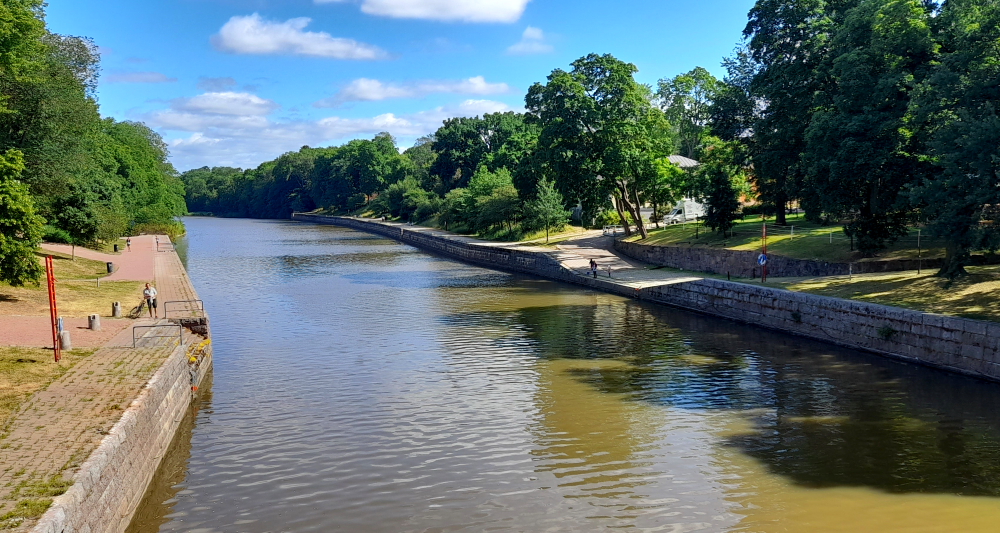
At 1:55 pm today we need to collect Alan from Central train station so this morning we’ll go for a walk and investigate some of the sites across the river from our hotel.
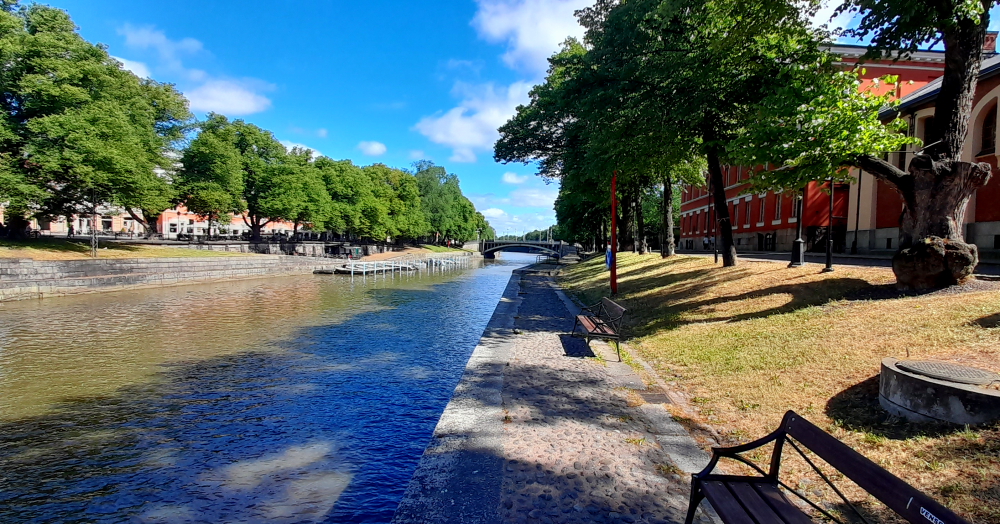
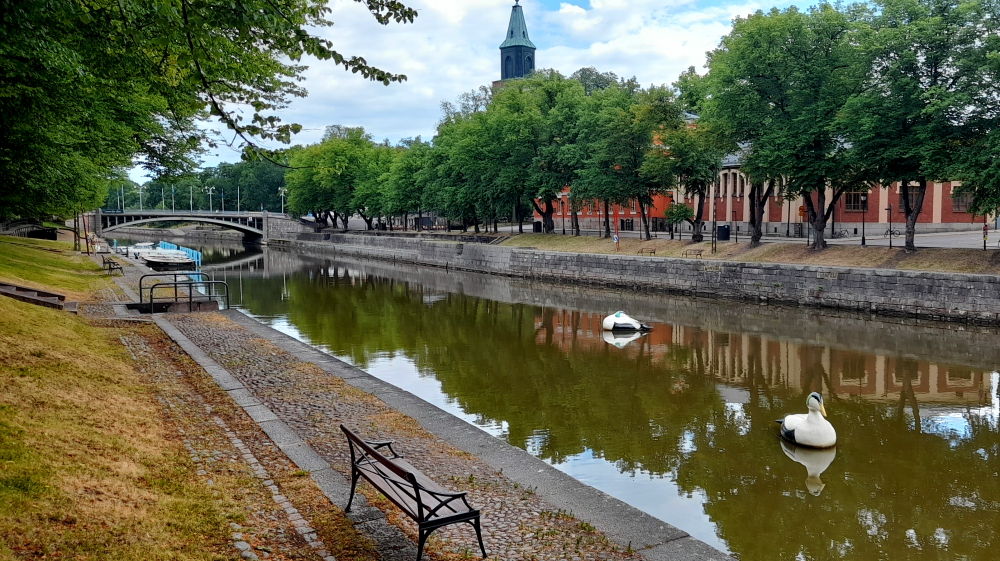
Immediately across the bridge is Turku Cathedral and its park. Today there is seating and food and drink marquees set up in front for midsummer celebrations.
A small parish church was built on the hill of Unikankare in Turku, and consecrated as the church of St. Mary around the middle of the 13th century. The church, originally made of wood, and later rebuilt with stone, was consecrated as the Cathedral in 1300. At the same time, the Cathedral was dedicated to the patronage of St. Henry, the first bishop in Finland.
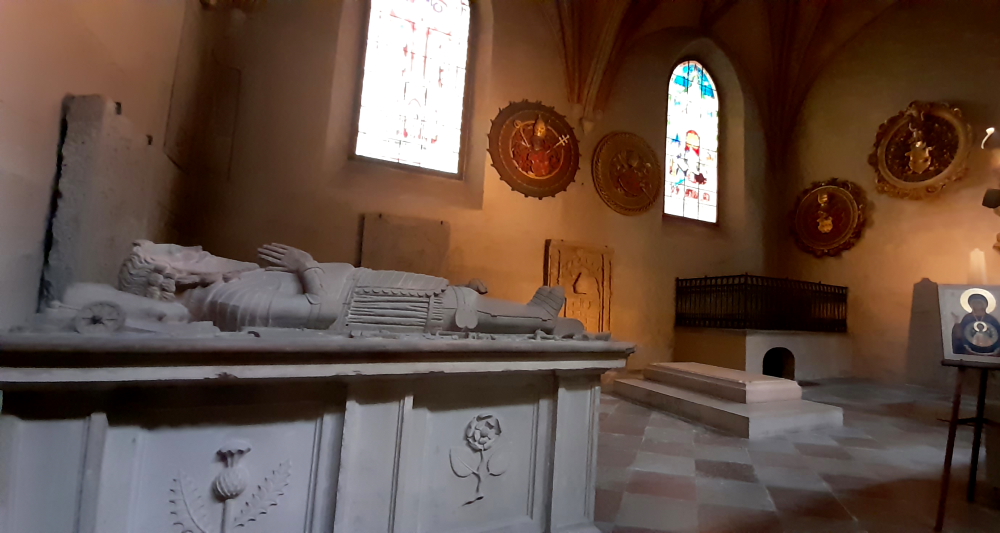
The monuments and details of the Cathedral record the history of the Finnish people over seven centuries. Bishops, military commanders, and a queen, among others, have found their last resting places in the Cathedral. The most famous tomb is the sarcophagus of Queen Karin Mansdotter, the wife of King Erik XIV, who spent her later years in Finland, and was buried in the Cathedral in 1613.
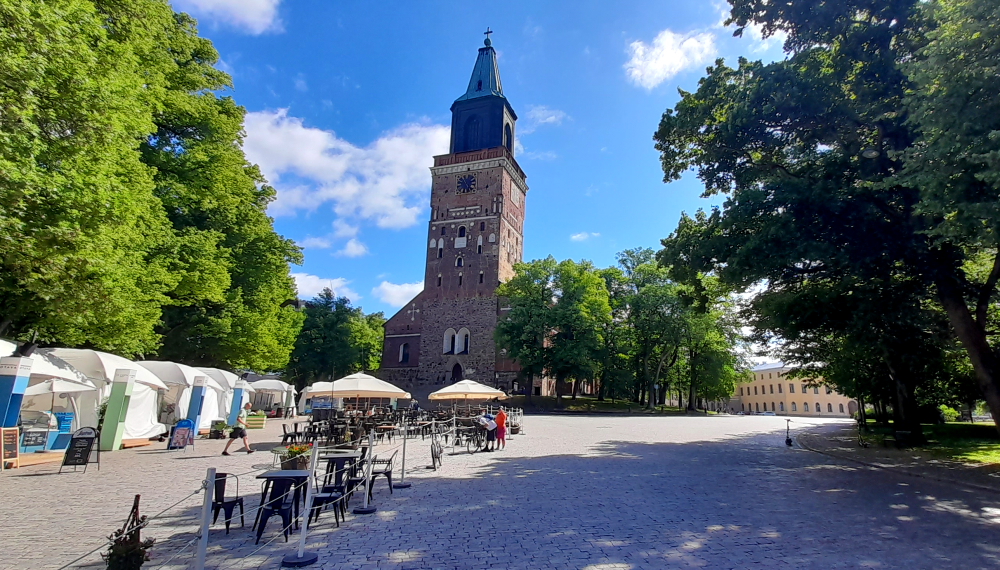
By the end of the Middle Ages the church had approximately taken on its present shape. The major later addition to the Cathedral is the tower, which has been rebuilt many times, as a result of repeated fires. The worst damage was caused by the Great Fire of Turku in 1827, when most of the town was destroyed, along with both the tower and the interior of the Cathedral. The present tower reaches a height of 101 metres above sea level, and is visible over a considerable distance. Most of the present interior also dates from the restoration carried out in the 1830s, following the Great Fire.
Across the road and through a park is the Old Great Square – the heart of Turku’s historic centre of the oldest city in Finland. The Square hosts Christmas markets and a medieval market in summer. It is surrounded by buildings of historic interest such as the Brinkkala Mansion and the Old Town Hall.
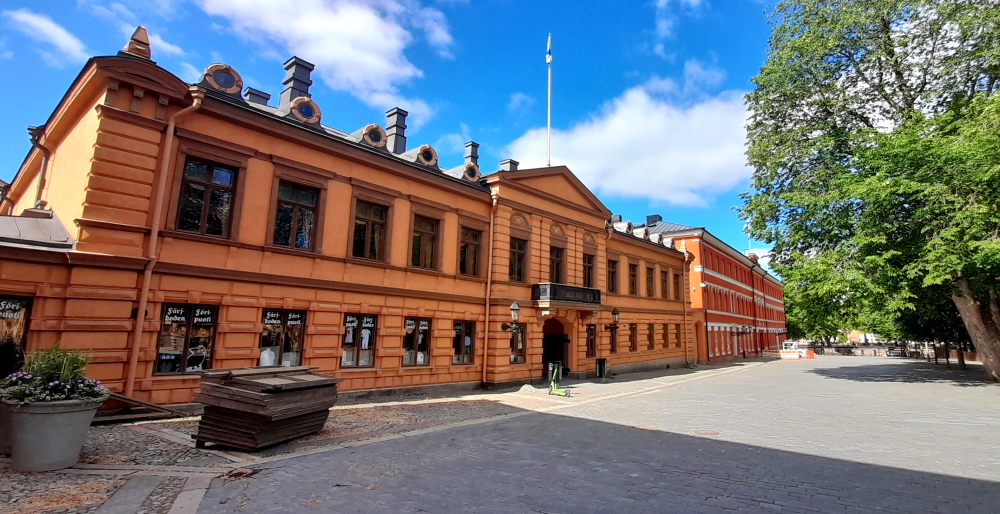
The earliest records of the Brinkkala Mansion date back to the 16th century. During its history the mansion has functioned as the town house of the owners of Brinkhall Manor, as a hotel and as the home of a Russian Governor General.
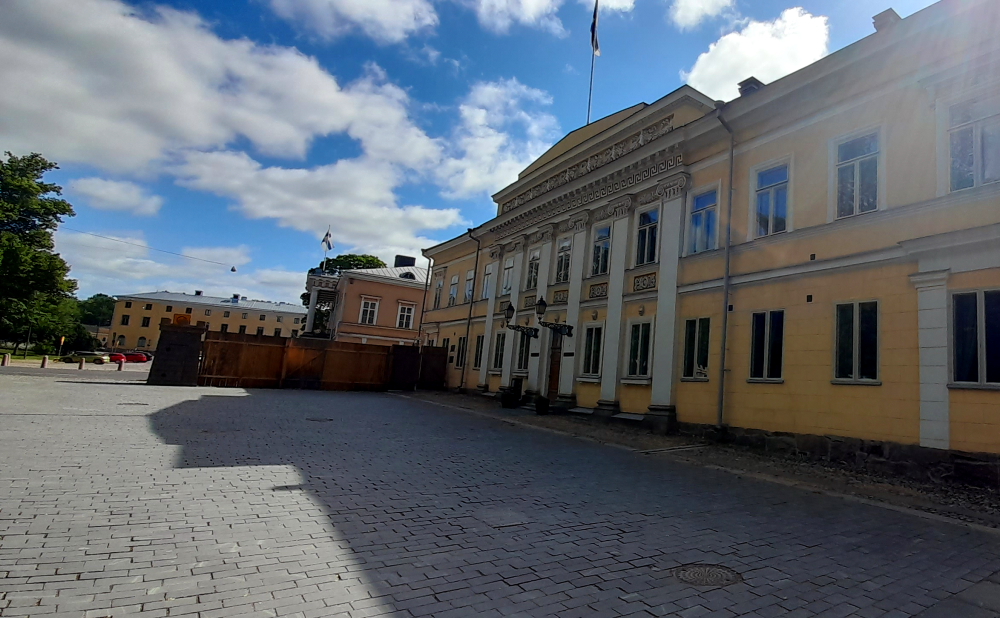
After the fire of 1827 in Turku, the Brinkkala Mansion was renovated as the new town hall. It is best known as the place where Christmas Peace has been declared every Christmas Eve at noon since 1886.
A block back from the river and in Vartiovuorenpuisto (Guard Mountain Park) is the Vartiovuori Astronomical Observatory. A former observatory designed by Carl Ludvig Engel, was originally built for the Royal Academy of Turku, the Grand Duchy of Finland’s only university at that time. The neoclassical building was completed in 1819. The beginning of research at the observatory was delayed for a further five years, since the telescope ordered from Germany arrived only in 1824.
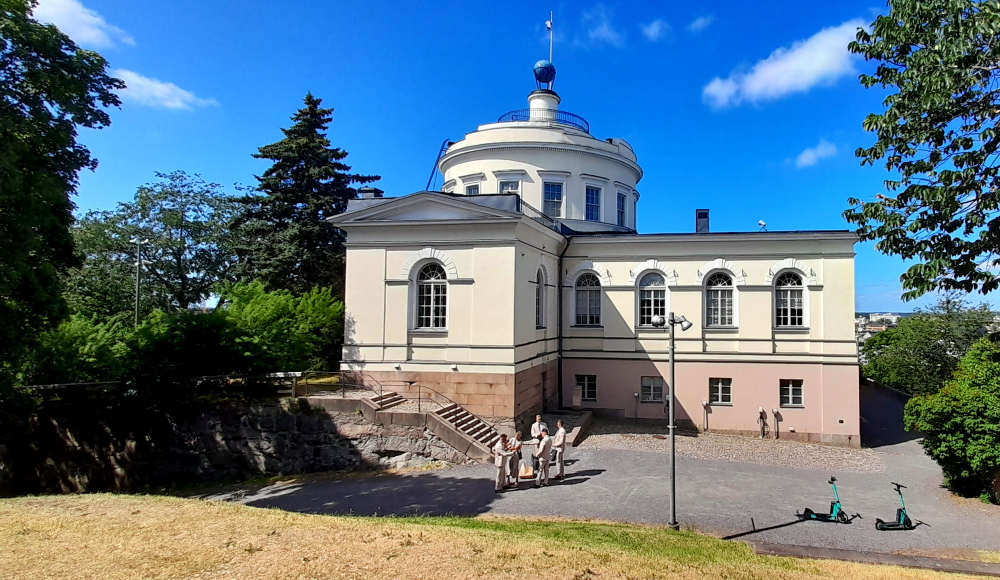
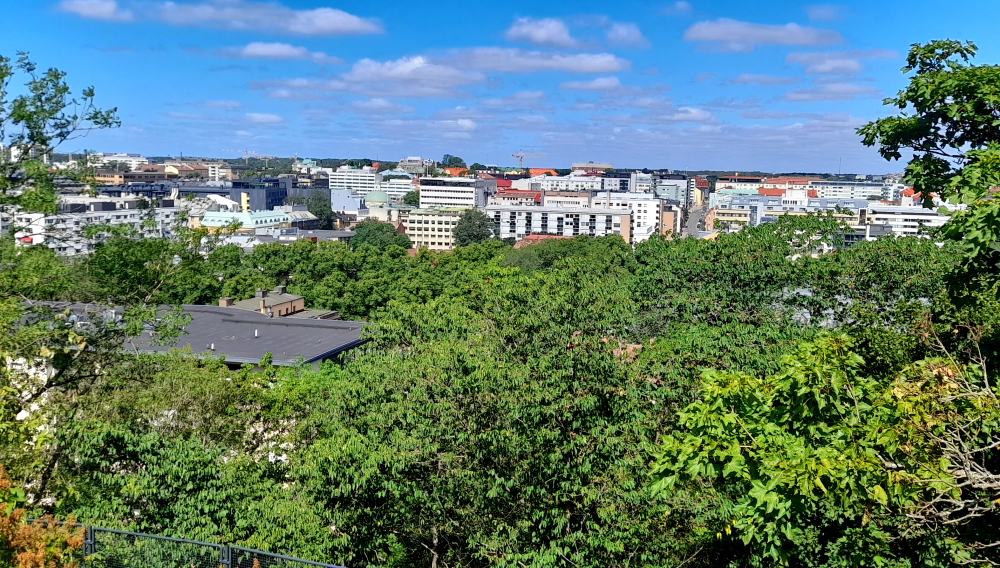
Most of the city was destroyed in the Great Fire of Turku, but the Vartiovuori observatory survived. After the fire the Royal Academy was transferred to Helsinki, the new capital of the grand duchy. The observatory became defunct in 1836 since the researchers and the equipment were transferred to Helsinki. Today the building is owned by the Åbo Akademi University Foundation and houses the foundation’s offices.
We leave the hotel at 1:40 pm for the 4-minute drive to Turku Central Station only to arrive 3 minutes before the train does due to road works, closed roads, detours and one-way streets!
Right on time the train arrives from Helsinki, via Toijala, at Platform 7 and at the end of the exodus the happy, smiling Alan (our leprechaun from Melbourne) emerges.
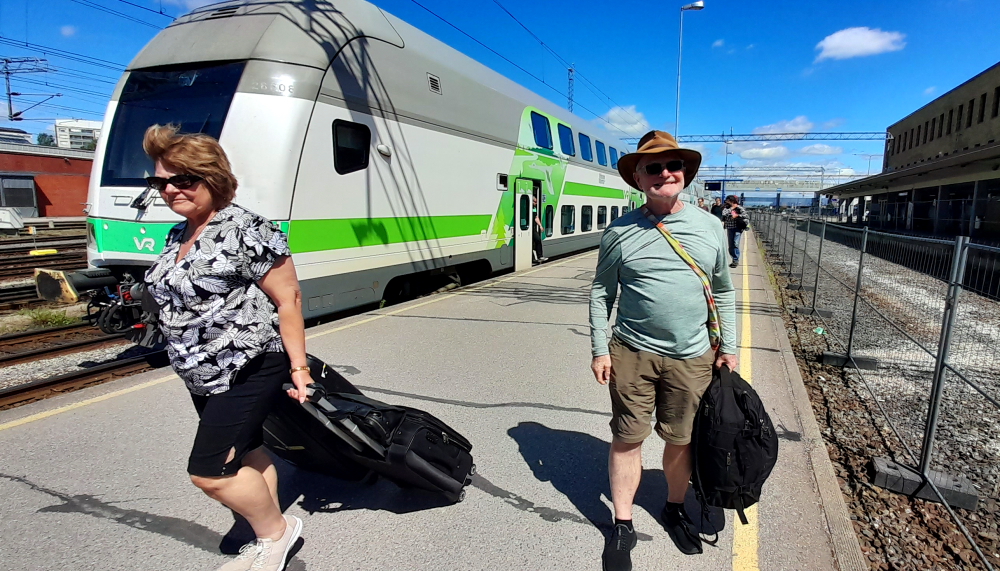
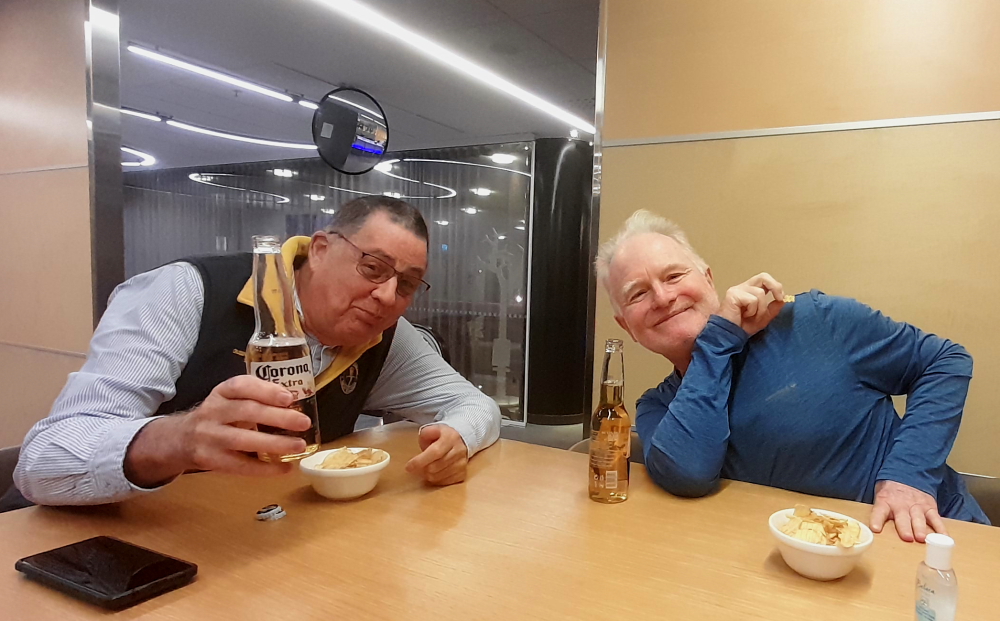
Once he is settled into our hotel, we head downstairs to the lounge for a couple of bevvies and a catch up. It’s been 2 years since we last saw Alan and his wife, Lyndal, when they stopped in Brisbane for a couple of days on their way to FNQ (Far North Queensland).
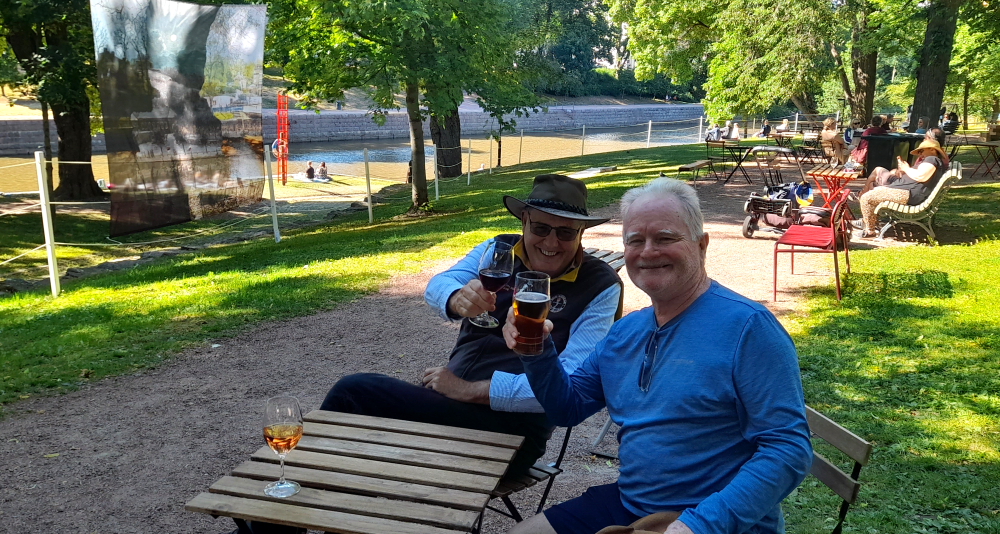
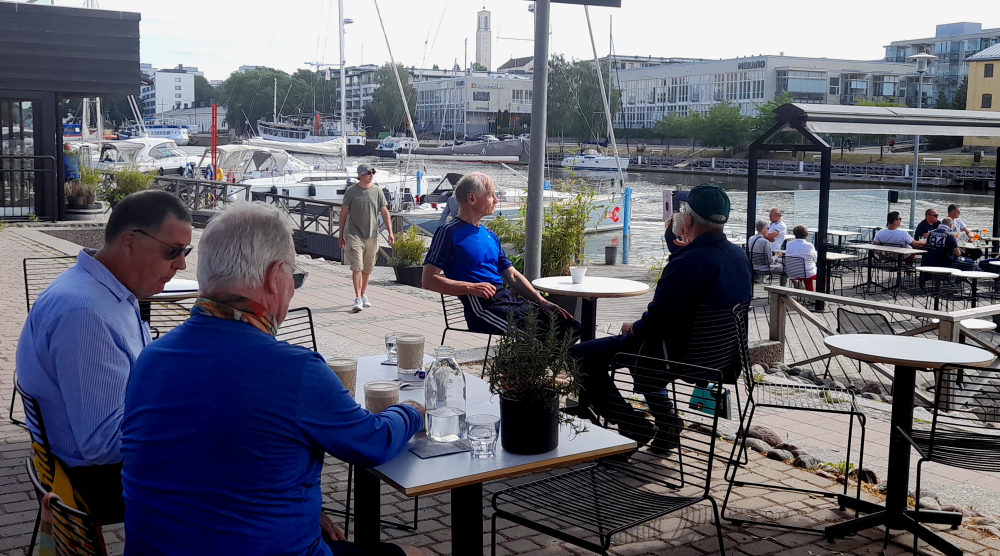
Before dinner we decide to cross over the bridge again towards the Cathedral and sit in the riverside park to celebrate midsummer with the locals with two wines and a beer to the accompaniment of some very nice music.
In a televised address today Putin denounces Prigozhin’s rebellion as “treason” and that he and his troops will be wiped out. But later this evening we learn that Prigozhin has turned his troops around, that he and his troops will be relocated to Belarus and everyone pardoned. Damn! The opportunity for civil unrest and the toppling of the current regime that should have happened is lost before it barely started. But, the President has said in the past that the only thing that he can’t forgive is betrayal. To boot, a photo of him is circulating on WhatsApp with the caption: “Pity that Prigozhin committed suicide next week.” Dead man walking.
25 June, 2023
After breakfast today the plan is to walk down this side of the river to the Turku Castle then back the other side. After a warm day yesterday (27 Deg C) it is a cooler 20 Deg C today. Just perfect for our planned 10 km walk on either side of the river.
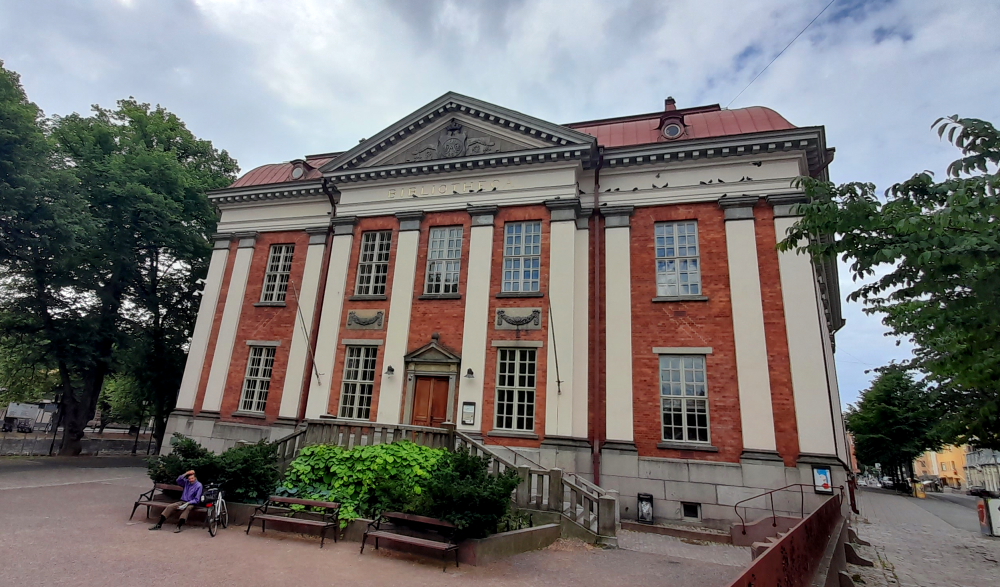
From our hotel room we can see a very impressive building with a red metallic roof. It turns out to be the Bibliotheca.
Nearby, on the river bank, is an unusual tableau statue.” Meeting in Turku 1812″ is a bronze sculpture by the Russian sculptor Andrei Kovaltšuk. It depicts the meeting between the Russian Emperor Alexander I and the Swedish Crown Prince Kaarle Juhana in Turku in 1812 . It was a work commissioned by the Russian consulate with the co-operation of the city of Turku and unveiled in 2012 in connection with a seminar organized in honor of the 200th anniversary of the incident.
It wasn’t until we returned to the hotel to write the blog that we discover that the statue caused controversy in 2012 and again in 2022.
In the work, Alexander I sits on a chair and offers Kaarle Juhana a seat next to him on a chair that already has the crown prince’s headdress. The public can take part in the historic moment by sitting for a while on Kaarle’s chair (which is what Alan did). Kaarle Juhana (Bernadotte) still wore Napoleon’s marshal’s uniform, even though he no longer served in the French army at that time. The crown prince was originally named Jean-Baptiste Jules Bernadotte, and from 1818 onwards he was King of Sweden under the name Karle XIV Juhana.
According to the city of Turku, the figure of Kaarle Juhana was added to the sculpture only after requested by the city. Originally, the Russian donor hoped that it would only have Aleksanteri. The statue project was presented to the city of Turku by the Russian Consul General Aleksandr Svertshkov with the help of Aleksandr Belov. Belov was the secretary of the Finland group of the Russian Duma; at one time in the Finland-Neuvostoliitto (Soviet Union) society and as a military interpreter, which possibly meant that he was trusted by the Soviet intelligence service. Some say that Belov was the real mastermind behind project as he had previously organized a statue of Empress Maria in Mariehamn. It was also sculpted by Kovalchuk, regarded as Vladimir Putin’s favorite artist.
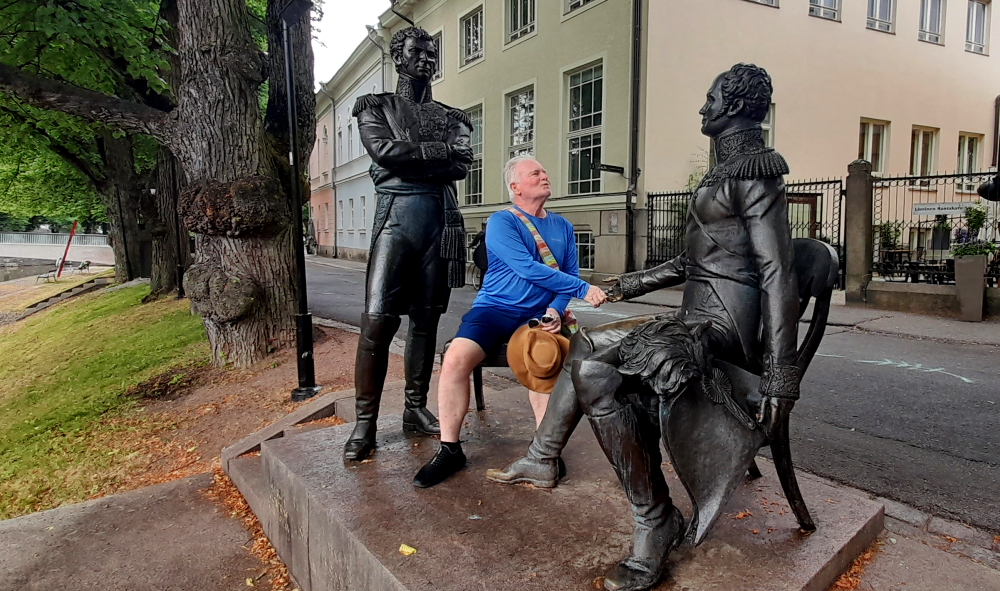
The statue is not representative of the actual event because the emperor’s chest has badges of honor that he received only after 1812, and the heir to the Swedish crown, Kaarle Juhana, is wearing Napoleon’s army uniform. So the sculpture sparked a heated debate not only regarding the associations related to the meeting, but also regarding the appearance and location of the statue.
It was proposed to remove the sculpture in the spring of 2022 after Russia invaded Ukraine and again in October 2022.
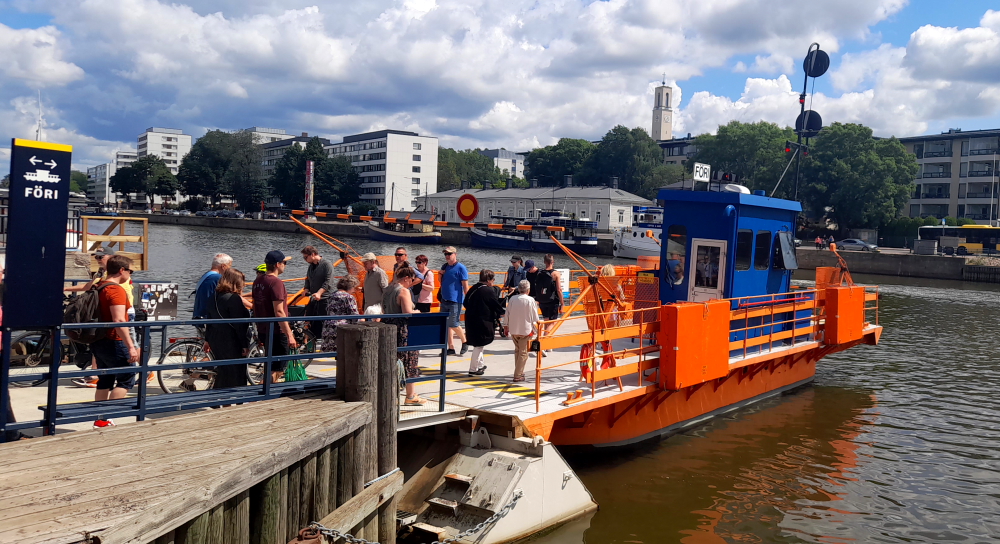
Further down the river is the Fori, the foot passenger ferry, which takes about 2 minutes for the river crossing from the east to west bank.
The ferry was completed in 1903 and put into service in 1904. It is the oldest vehicle used in everyday commercial traffic in Finland and can accommodate a maximum of 75 passengers at a time.
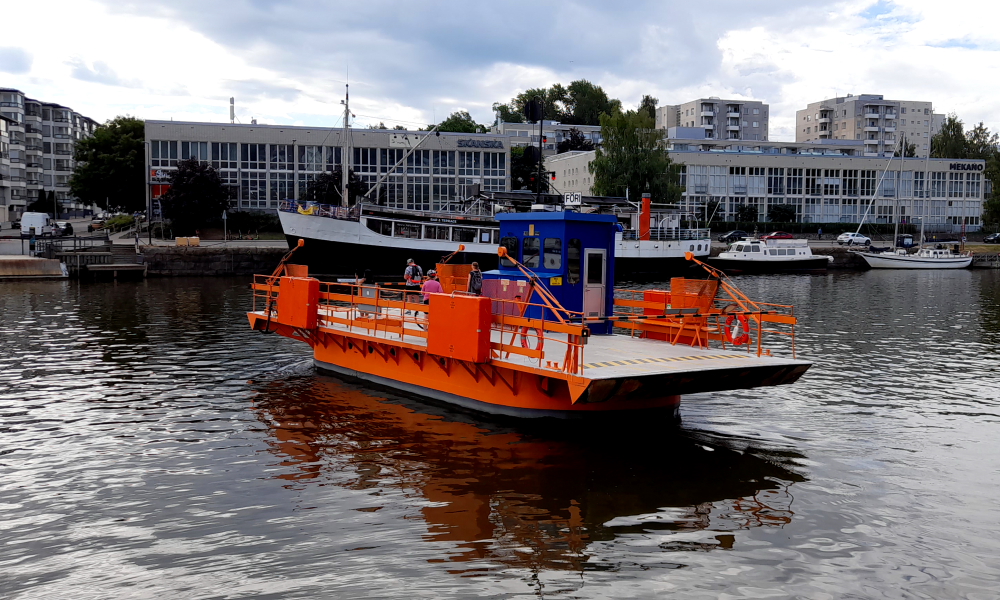
The chain-driven Föri works with electric motors powered by batteries charged overnight. Originally it had a steam engine that was dieselised in 1953 then replaced with electric motors in 2017.
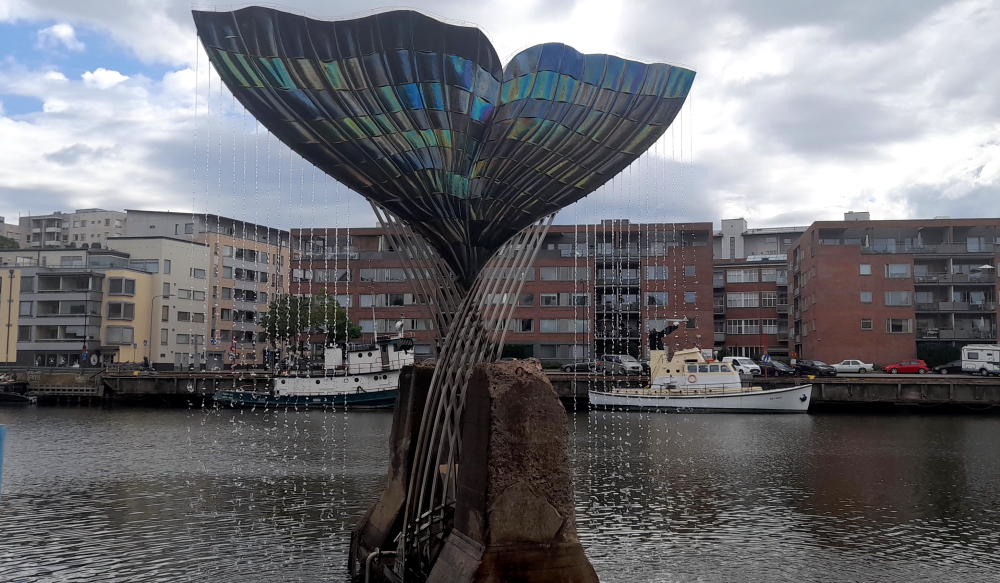
Nearby is a fountain sculpture entitled “Harmony” by Achim Kühn, a German sculptor and blacksmith.
Towards the mouth of the river is the Forum Marinum, a maritime museum founded in 1999 by merging the Turku maritime museum established in 1977 with the Åbo Akademi University museum of maritime history established in 1936. It has 13 ships/boats in its collection, 2 of which are the “Sigyn” and the “Suomen Joutsen”.
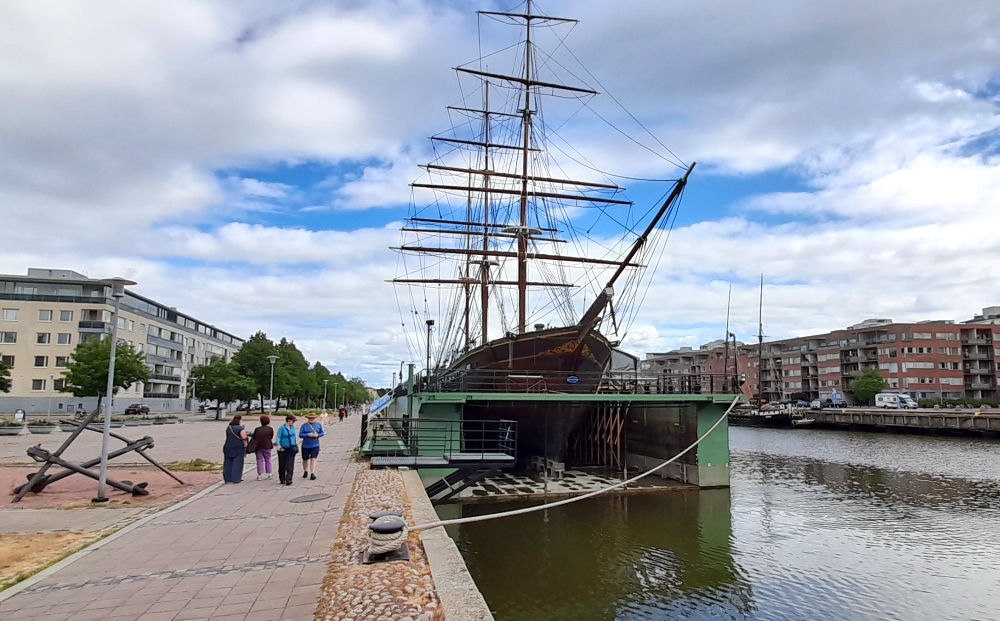
Sigyn, a wooden merchant ship, was built in Gothenburg 1887, even at a time steam ships were taking over the most important routes, Sigyn was planned for another niche: the small size and small draught made her suited to use small remote harbours.
The first decade Sigyn sailed the Atlantic on tramp trade, mostly with wood (pine, spruce, pitch pine, mahogany, cedar) and also coal. In 1897 she made one journey to Bangkok. After 1900 she sailed mostly in European waters.
After being severely damaged while seeking shelter outside Kristiansand in 1913, Sigyn was rerigged as a barquentine. She was already old for being a softwood ship and the freight prices on ocean trade were declining, so a cheaper rig suited for coastal trade on the Baltic and North Sea seemed appropriate. This changed with the World War: transatlantic trade became very profitable and she crossed the Atlantic 12 times in 1915 and 1916.
After Sigyn ran aground in 1917 the copper hooding protecting against shipworm was removed and sold. Sigyn was no longer fit for the oceans and was bought by a Swedish sawmill. In 1927 Sigyn was sold to Finland to Arthur Lundqvist from Vårdö in the Åland islands, one of the last big peasant shipowners.
In 1936 Åbo Akademi proposed the foundation of a maritime museum in Turku. A museum ship was needed and Sigyn was soon considered the best alternative. At that time there were only a few museum ships worldwide and Sigyn was to be the first in Finland. She was bought in 1939 and first opened to the public in June of that year.
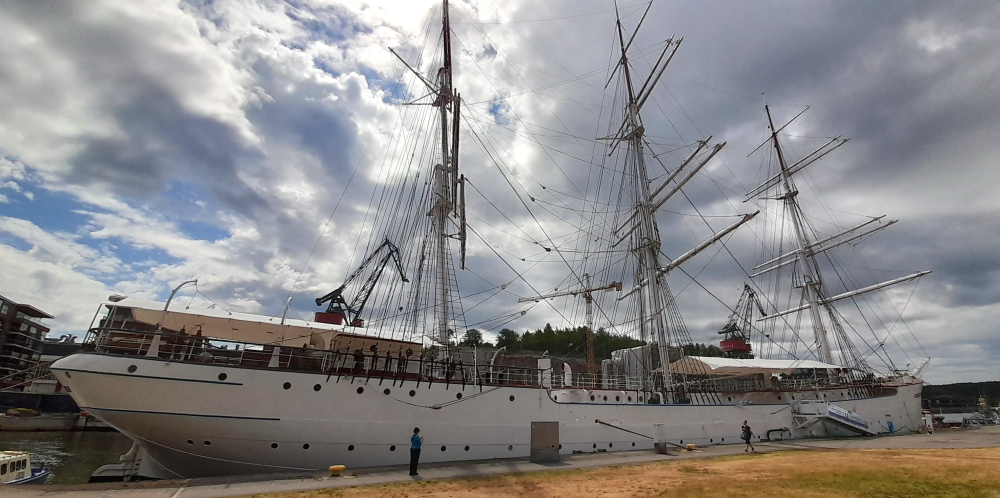
Suomen Joutsen is a steel-hulled full-rigged ship with three square rigged masts. Built in 1902 by Chantiers de Penhoët in St. Nazaire, France, as Laënnec, the ship served two French owners before she was sold to German interest in 1922 and renamed Oldenburg. In 1930, she was acquired by the Government of Finland, refitted to serve as a school ship for the Finnish Navy and given her current name. Suomen Joutsen made eight long international voyages before the Second World War and later served in various support and supply roles during the war. From 1961 on she served as a stationary seamen’s school for the Finnish Merchant Navy. In 1991, Suomen Joutsen was donated to the city of Turku and became a museum ship moored next to Forum Marinum.
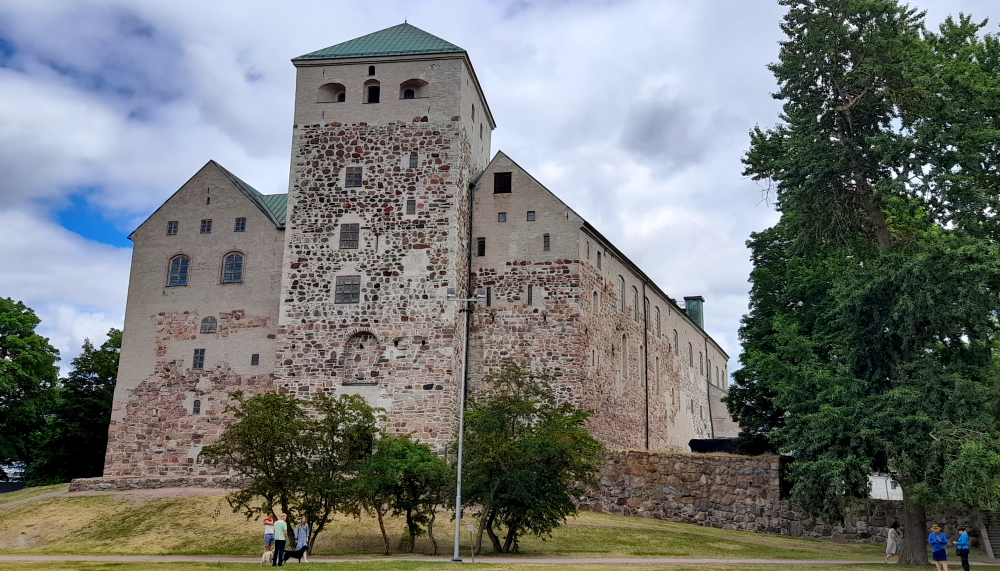
At the river mouth is Turku Castle. Together with Turku Cathedral, the castle is one of the oldest buildings still in use and the largest surviving medieval building in Finland. It was founded in 1280 and served as a bastion and administrative centre in Eastland, as Finland was known during its time as a province of Sweden. Only once did the castle figure in the defense of the realm, when Russian invaders from Novgorod destroyed Turku in 1318. It more frequently played a role in internal struggles for power within Sweden and the Kalmar Union.
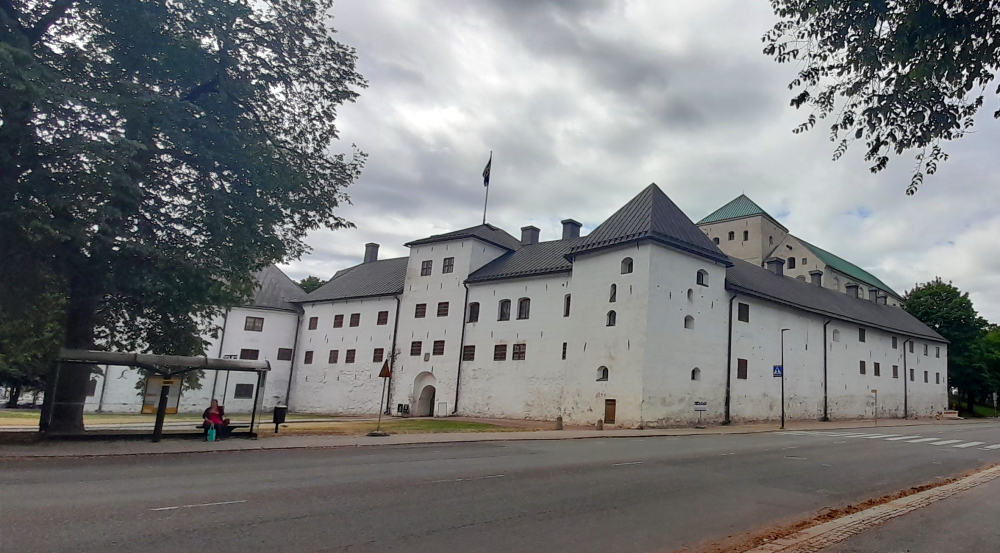
The castle’s heyday was in the mid-16th century during the reign of Duke John of Finland and Catherine Jagellon. That was when the Renaissance Floor and King’s and Queen’s hall were built. It lost its status as an administrative centre in the 17th century after Per Brahe’s period as governor-general of Finland came to an end. Turku castle is today Finland’s most visited museum, with attendance reaching 200,000 in some years. Today it is closed for midsummer.
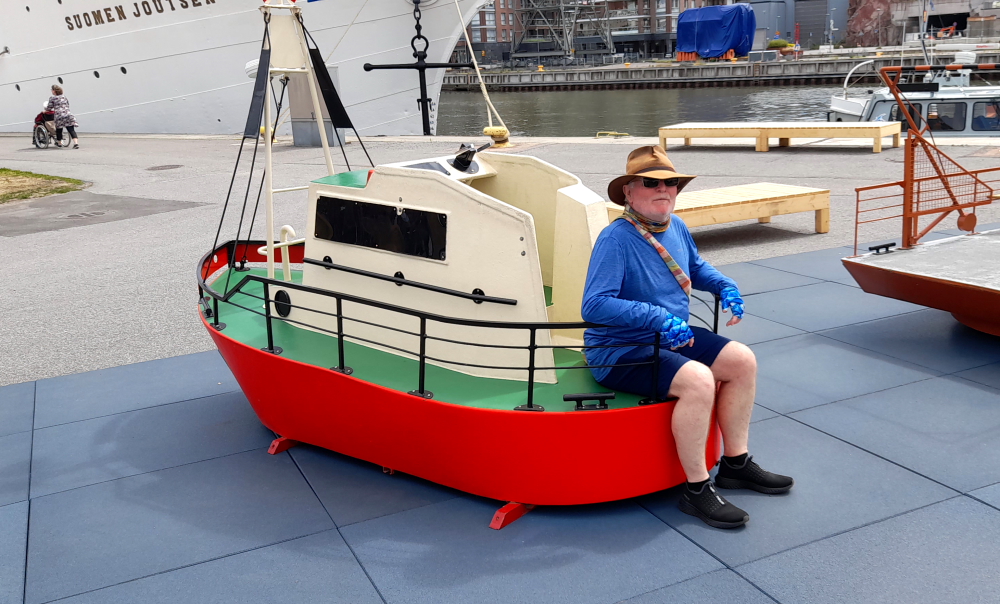
We retrace our steps and walk back through the dock area of the maritime museum. Did we mention that Alan is a leprechaun??
This time we jump on the Fori for a trip to the eastern bank.
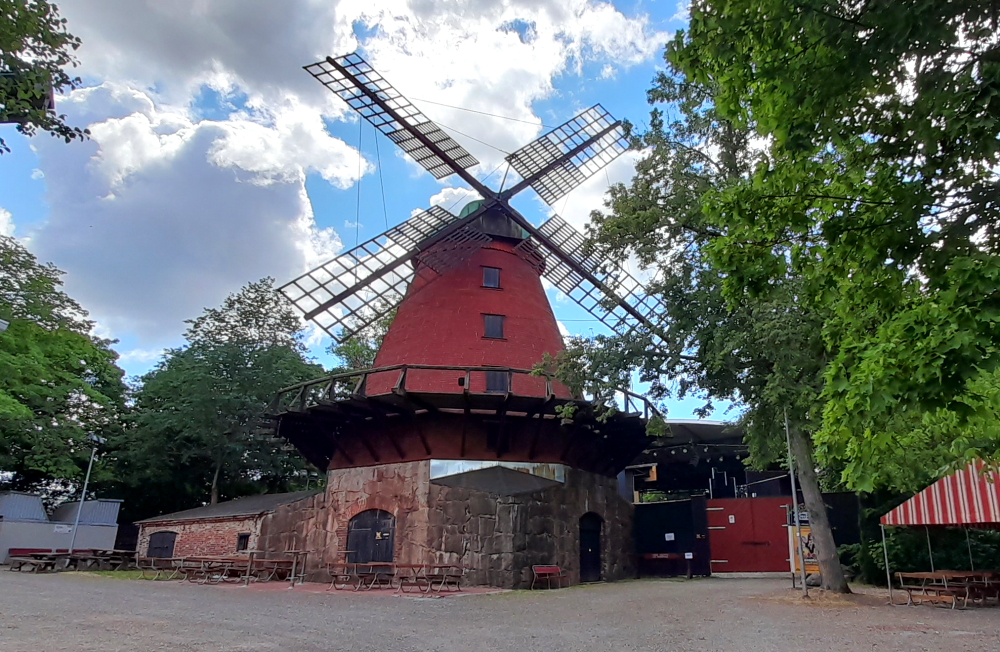
And walk a couple of blocks to Samppalinnan tuulimylly (Samppalinna Windmill). The mill was built in 1859-1860 by sailor Juho Antinpoika. It stopped operating after changes of ownership at the beginning of the 20th century and it became an observation tower. Over the years, the very large mill has become familiar to many townspeople, probably due to the popular summer theatre “Samppalinna summer theatre” next to the mill.
26 June, 2023
As we have 3 sites to visit en route to our next destination, Vaasa, the 3 of us depart the hotel at 10:40 am and hit the E8 highway. It should take us around 4.5 hours to cover the 350-odd km.
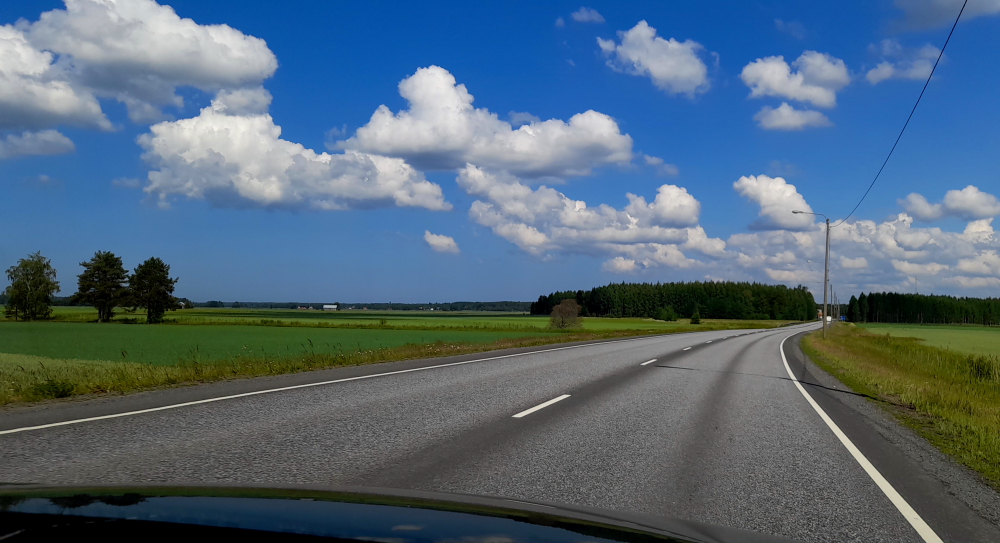
Today, the 3 stops along the way are the meteor crater near Sundom (Meteoria Soderfjarden); the Mustasaaren Kirkko and the old Vaasa ruins – the last 2 of these are about 8 kms SE of Vaasa.
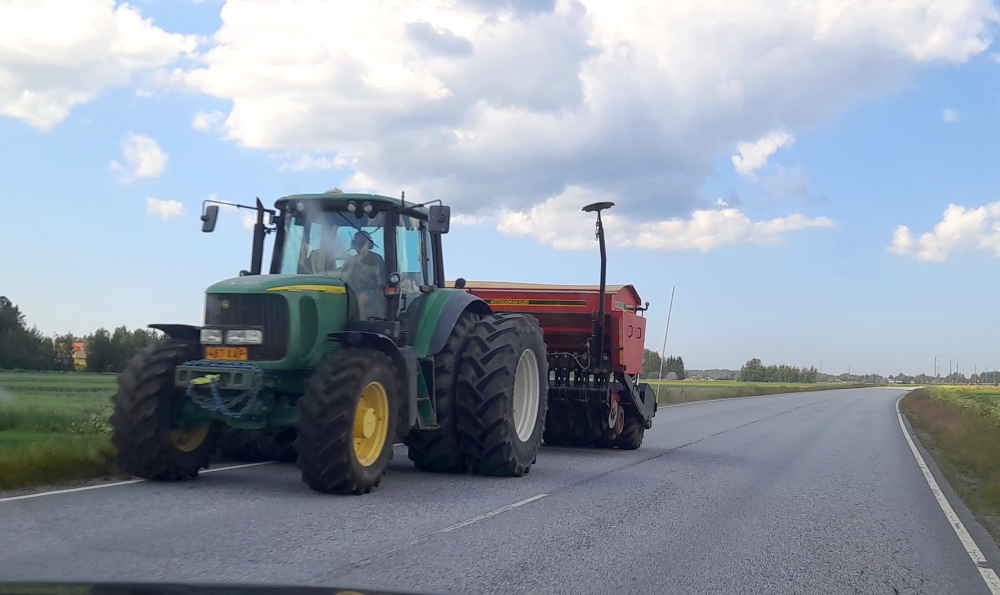
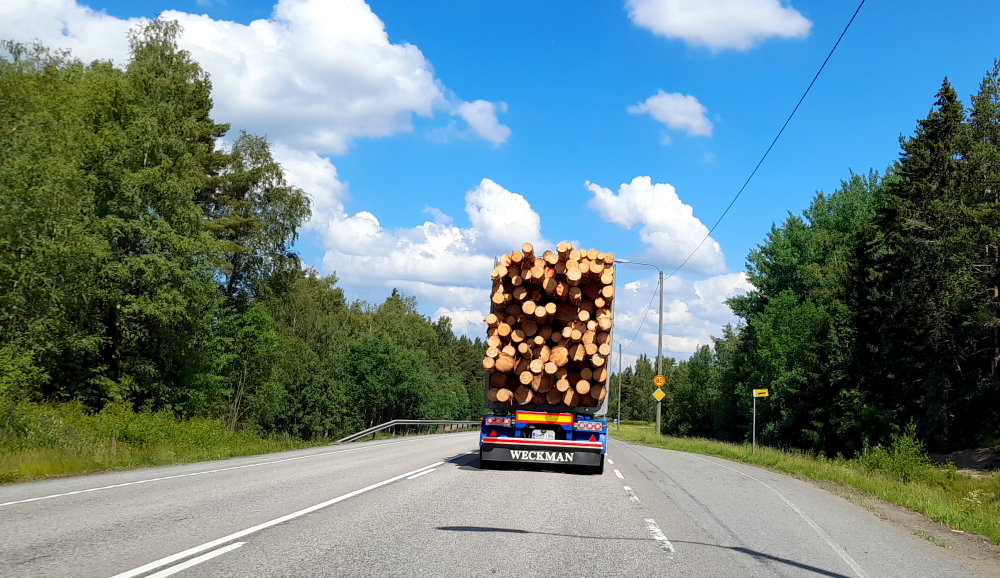
The E8 is a nice, wide highway with the usual 100 kph limit. There are some industrial areas, extensive farmland on both sides of the road including commercial glasshouses (frames covered in white plastic, that is) and greater logging activities.
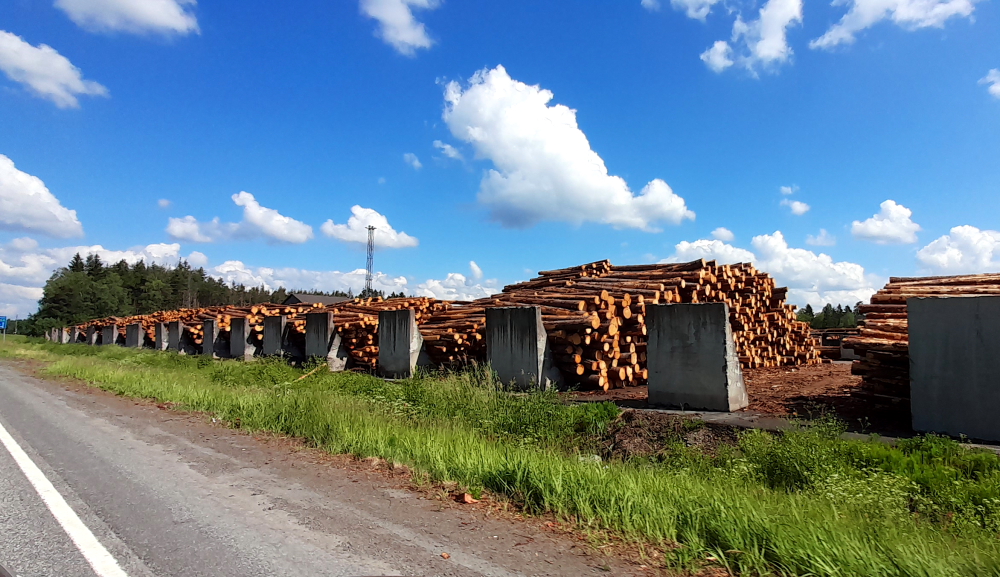
We are all looking forward to seeing the meteorite impact crater which was formed some 520 million years ago. Certainly on the MapsMe App there is quite a large disk area shown which is about 5.5 km across, in the middle of which is the Visitor Centre. However, on approach, all we can see is extensive farmland and perhaps a slightly-elevated edge covered in pines on the periphery. Unlike the rest of Finland there are no forests growing inside this area. Plus there is about a 2.5 km gravel road to get to the Information Centre, so we continue on to the church.
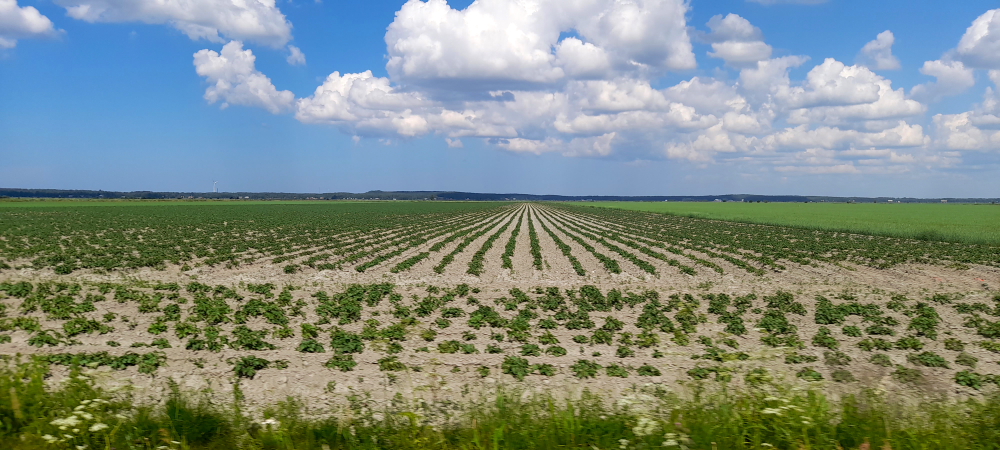
The road takes us around the western edge of the “crater”, over 2 bridges that connect the island of Vaskiluoto to the mainland and through the town of Vassa.
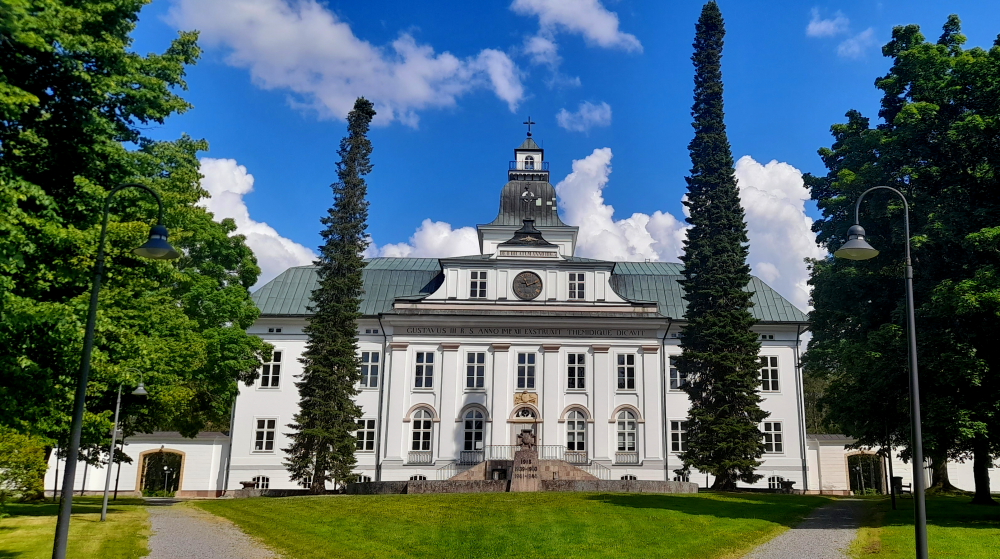
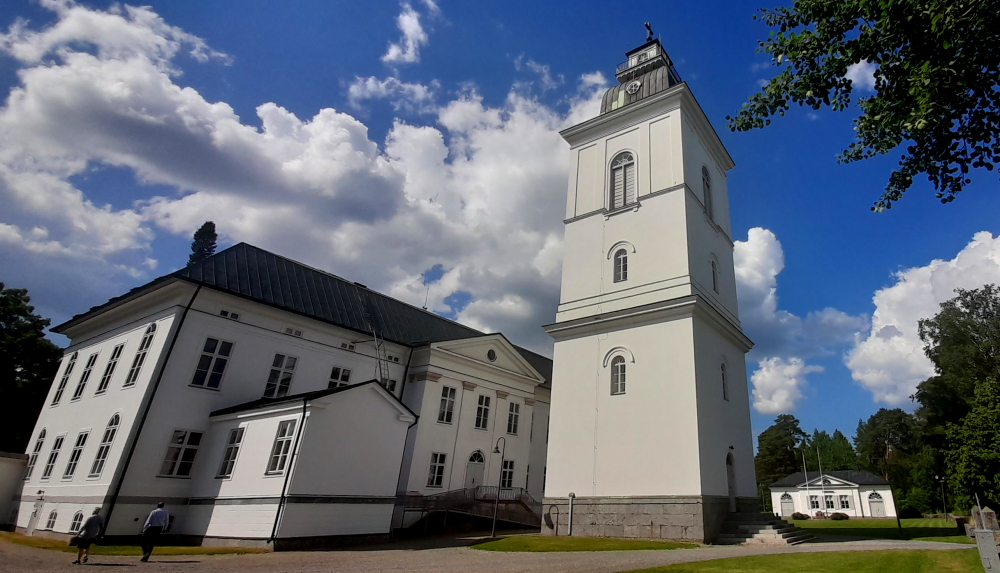
Lynn chose to visit this church as it is unlike any she has seen in Finland, or Scandinavia, so far. We discover the reason is because the building didn’t start out as a church, but rather as the Vaasa Court of Appeal when the town of Vaasa was located here pre-1852.
Designs for the building were commissioned from the royal architect Carl Fredrik Adelcrantz. The designs were approved by King Gustav III after he had presented his own demands for the building’s architecture. The inauguration of the Court, described as a magnificent occasion, was held at the Royal Palace in Stockholm on 28 June 1776. The courthouse was completed in 1786 under the direction of Johan Davidsson Elfstrom, master mason and fortification expert.
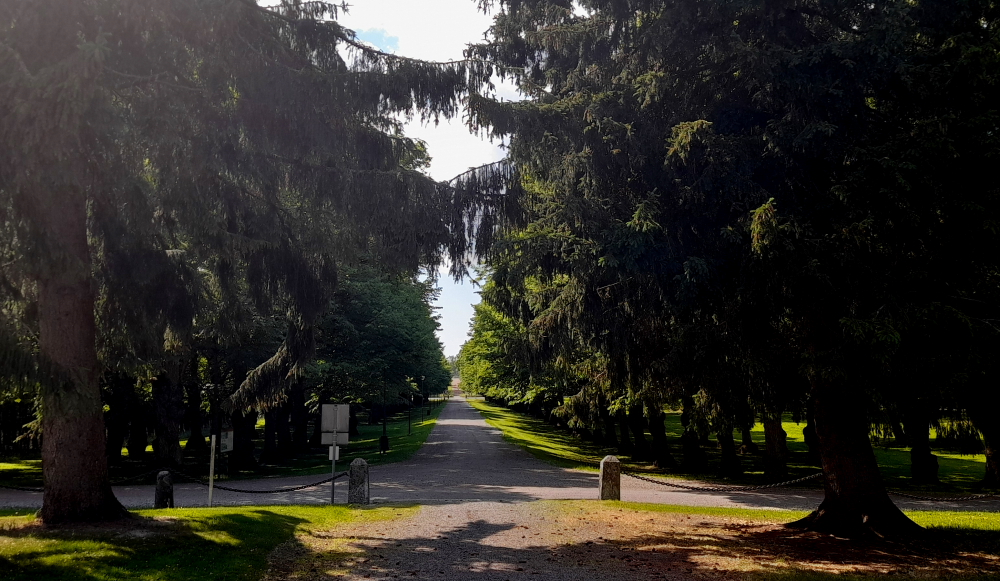
A public park designed by Adelcrantz connected the Court with the site of the Korsholm Castle. The esplanade park, with its four rows of lime trees, was spared the 1852 great fire and was modelled after the Place de Stanislas Leszczynski in Nancy, France.
After the 1852 fire, the courthouse was converted into the Mustasaari Church as the court was moved to the new town. A new belfry was added to the building. The conversion was carried out by Carl Axel Setterberg, a Swedish-born architect who had designed the town plan of the new Vaasa, and Erik Kuorikoski, a famous church builder from Ostrobothnia.
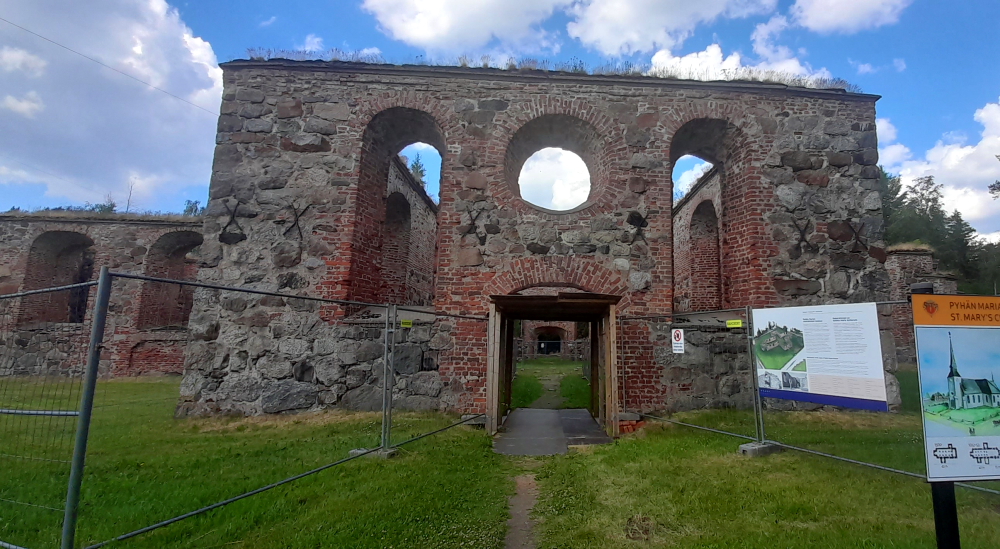
A kilometre away and closer to town are the old town ruins. Those marked are the Grammar School, the bell tower, St Mary’s Church, and the town hall. Only the bell tower and the church have substantial remains.
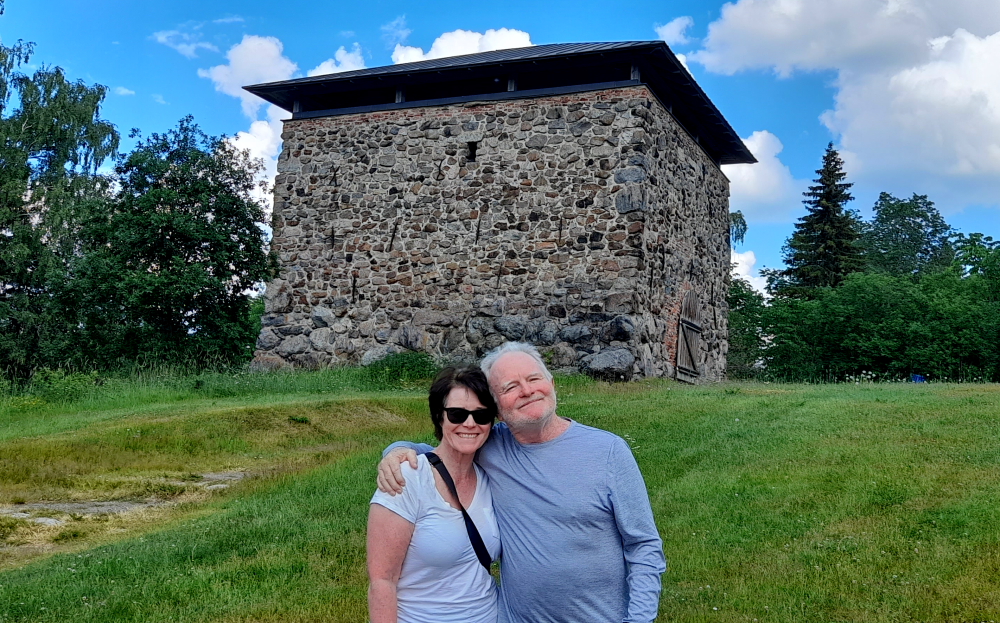
The bell tower was built in 1675. Gabriel Gabrielsson Oxenstierna, Count of Korsholm and Vaasa, promised the parish a new church bell in 1668. It soon became clear that the bell, weighing more than 1,000 kgs, required a sturdier tower. The townspeople wanted a stone tower while the rural parish folk favoured wood. Only the stone plinth survived the fire.
A stone church dedicated to St Mary was built in the Mustasaari parish in the early 16th century and it later became the church of the town founded here in 1606. The church was constantly extended as the number of churchgoers grew due, in part, to Puritanism which called for increasing control of churchgoing with the seating order strictly regulated. The present cruciform church was inaugurated in 1753 as Sofia Albertina Church. After the great fire, the decision to convert the house of the Court of Appeal into a church sealed the fate of the stone church to remain a ruin.
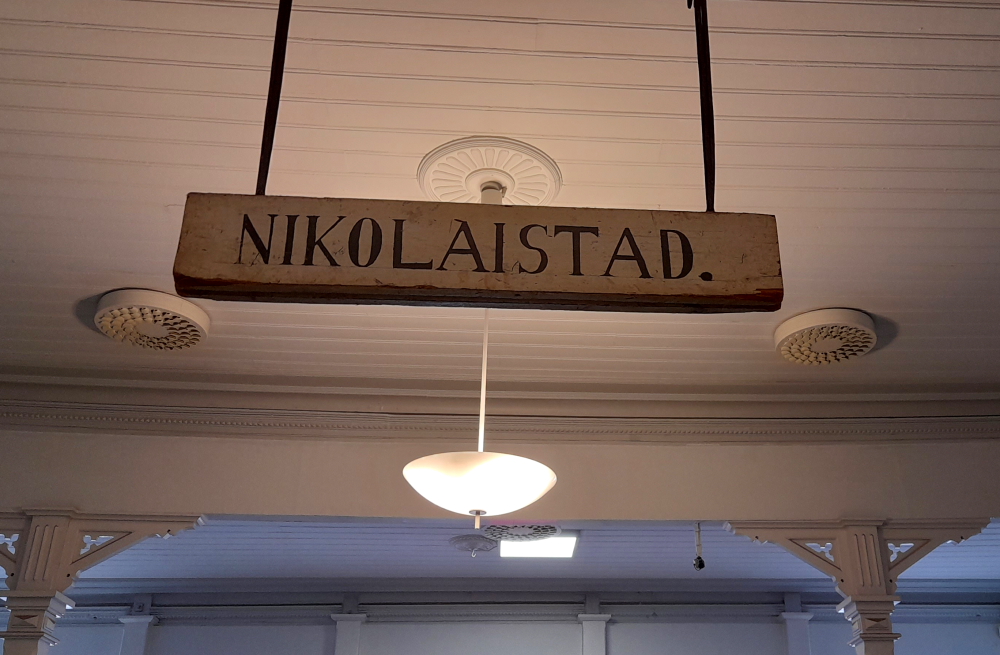
In 1611 the town in Ostrobothnia, Finland, was called Wasa in honour of the ruling Swedish royal house. Sweden ceded Finland to Russia under the Treaty of Hamina in 1805. Following the great fire that razed Vaasa in 1842, the town was moved to the Klemetso peninsula. In tribute to the Russian emperor who had died in 1855 this new town was named Nikolainkaupunki, or Nicholas’ town. The name Vaasa was reinstated during the 1917 Russian revolution some time before the independence of Finland on 6 December 1917.
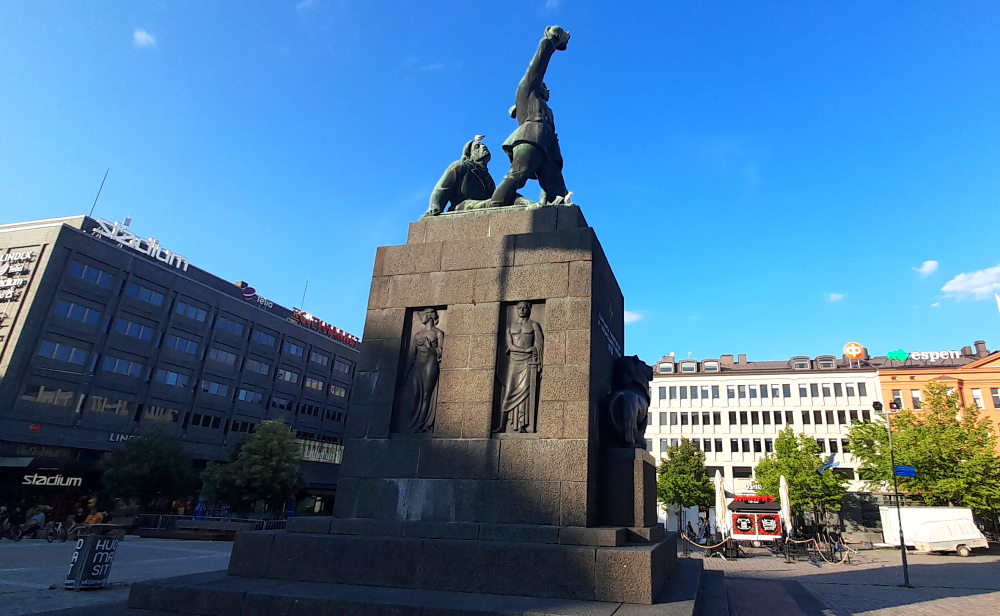
When Lynn learnt that there is a “Statue of Liberty” in Vaasa she was intrigued. It turns out to be a monumental bronze sculpture located in the Market Square. The statue celebrates the victory of the Whites in the Finnish Civil War in 1918. The height of the work with its pedestals is 14 metres (46 ft), the height of the figures is 6 metres (20 ft) and the sculpture weighs 3.6 tonnes (4.0 tons). Designed by by Yrjö Liipola and Jussi Mäntynen, it was unveiled in 1938.
27 June, 2023
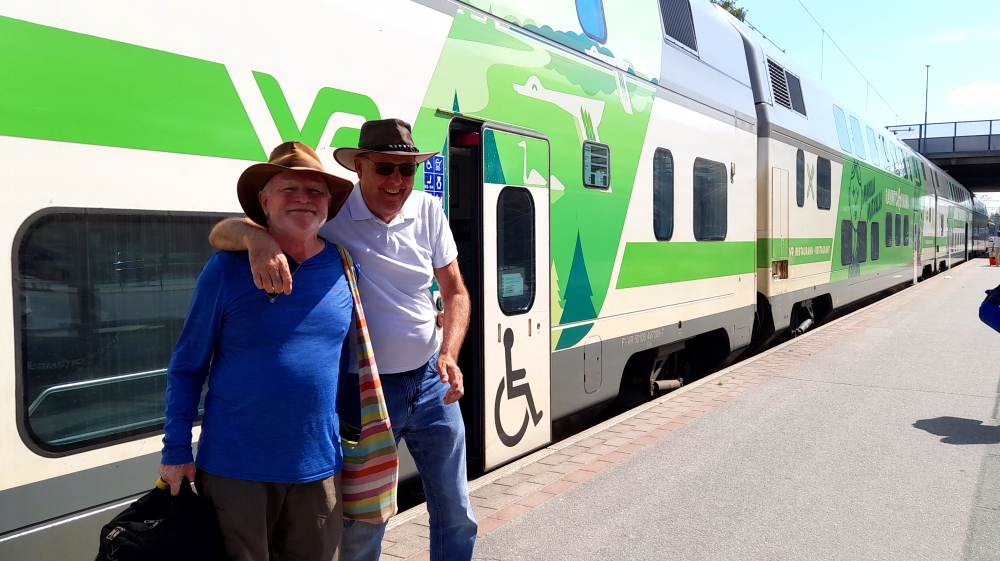
Sadly, Alan is leaving us today to catch the train back to Helsinki and to continue his onward travels through eastern Europe. He joins us on the apartment’s balcony for breakfast.
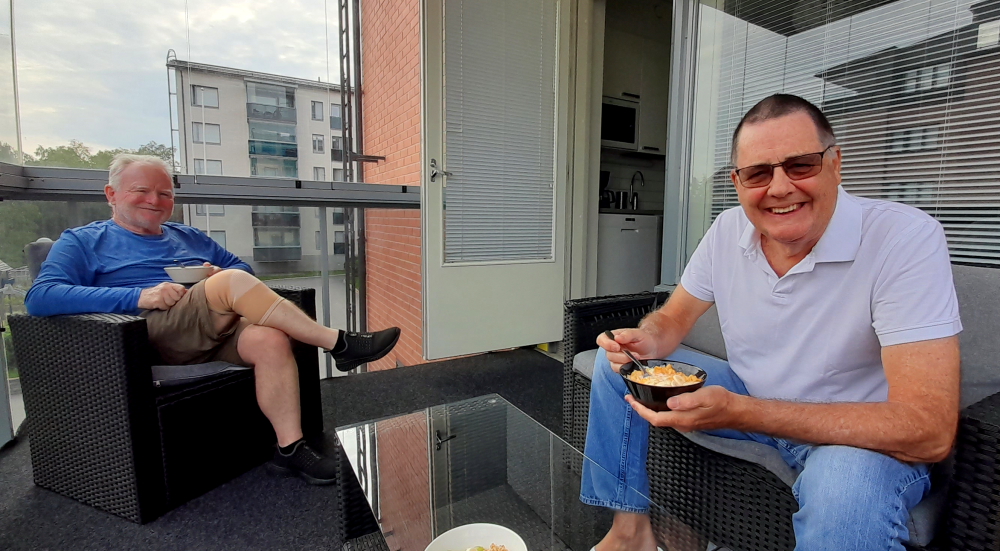
While Lynn goes off to get her woolly, pom-pom hairstyle tamed, she sends Alan and I to the nearby Auto-ja moottorimuseo (Car and Motor Museum to you and I) – Finland’s largest private car museum owned by the Vaasa Veteran Automobile Association.
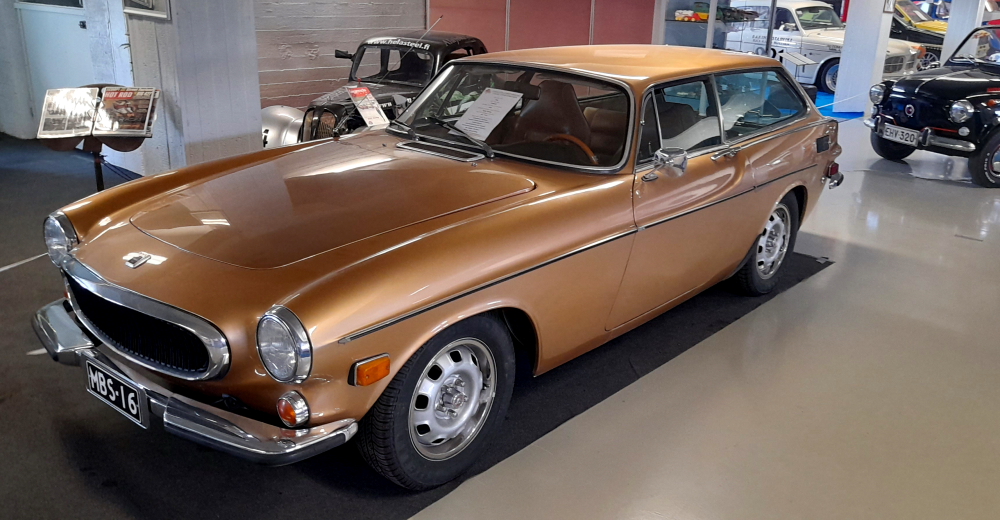
There are 3 floors of exhibits: Floor 1 – German masterpieces over the decades; Floor 2 – sports cars and historic pick-up trucks and Floor 3 – a cross section of the cultural history of modern society (old TV sets, old Nokia phones, etc).
Conveniently, Lynn’s hair salon is located in the wooden train station building so we call by the apartment to collect Alan’s backpack and park ourselves in the train station cafe until Lynn joins us.
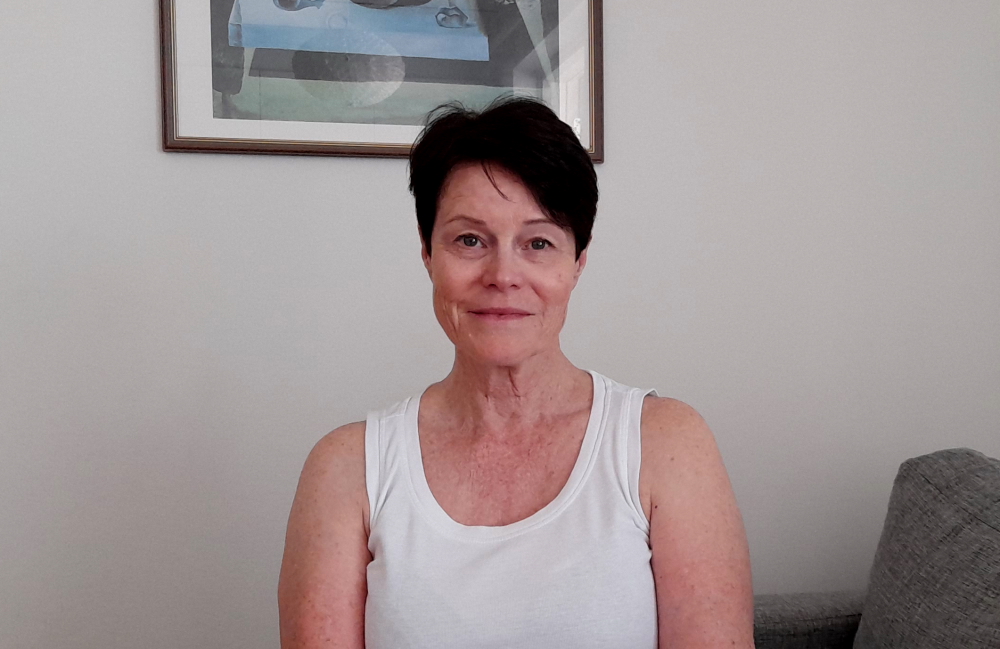
We bid Alan a fond farewell. Uncharacteristically, the train is almost 1 minute late in departing at 12:48 pm.
28 June, 2023
Today is a rest day. Well, at least from being a tourist. We spend most of the day doing the remainder of the November bookings for France and northern Spain. We are now booked all the way out to mid-January, 2024.
It is warm and sunny outside so after a long day in front of the computer we are walking the 25 minutes to the waterfront to the Strampen Restaurant.
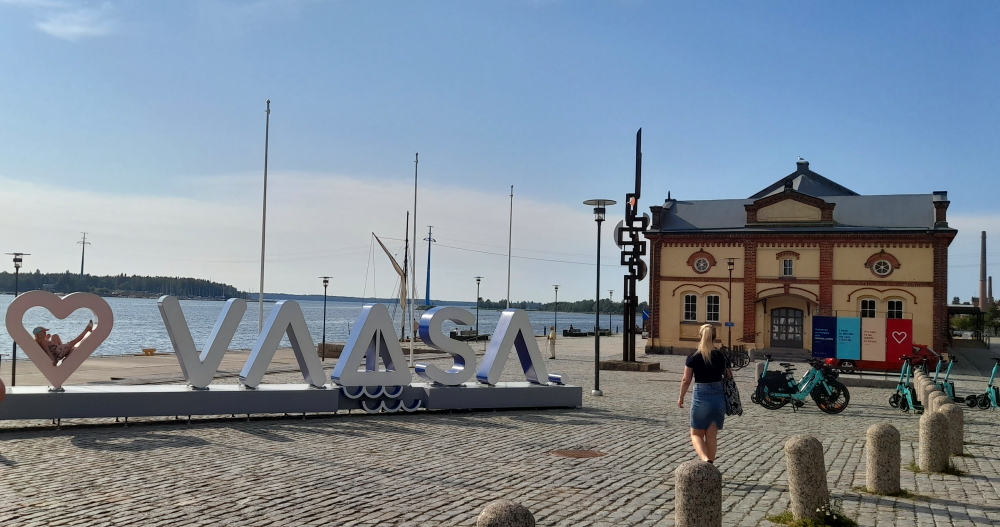
It is still rather warm even with a slight breeze off the water. This area is so much better preserved than the 1970s architecture of most of the town.
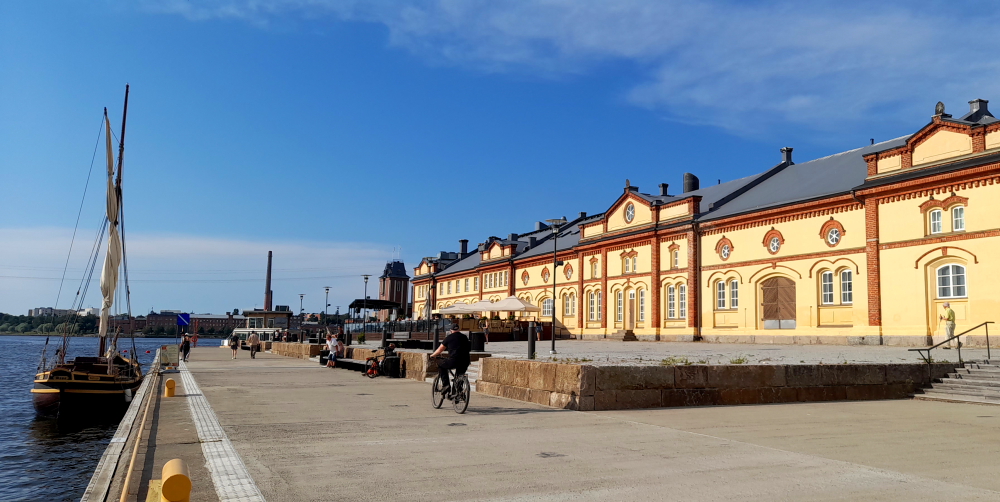
We get the last outdoor table on the deck just as a queue starts to form at the restaurant entrance. Still, inside would have been very charming with its old-world styling but the Finns are sun worshippers so the sunny deck is packed full this evening.
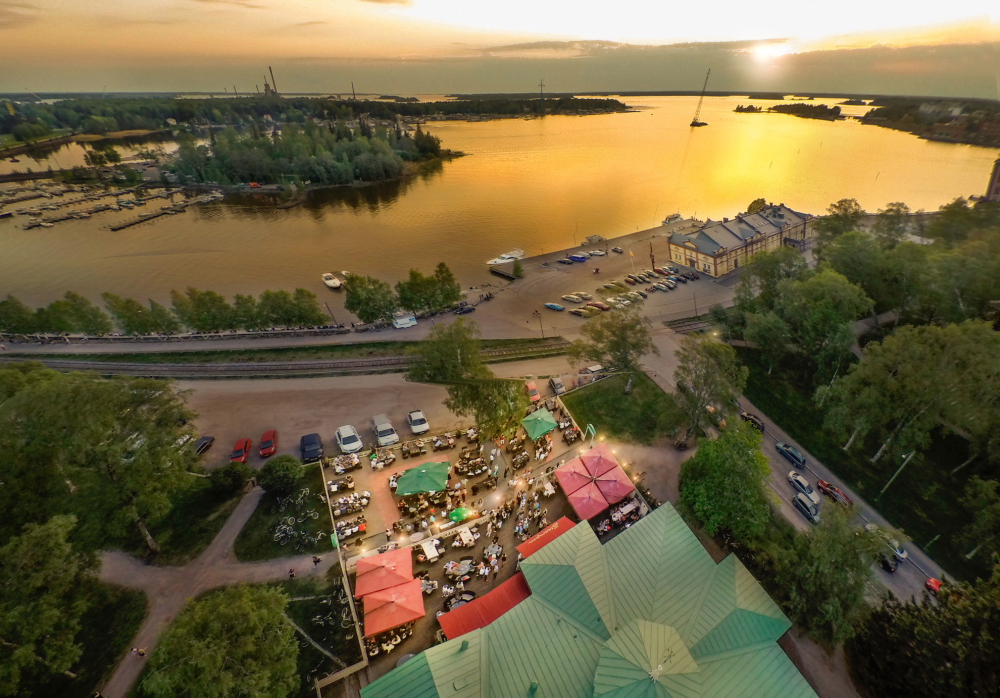
Restaurant Strampen began in 1868 when confectioner Sebastian Coray was granted permission to build a pavilion in the park surrounding the Court of Appeal. Coray commissioned architect C.A. Setterberg to design the summer pavilion. His earlier work included two local landmarks, the Vaasa main Lutheran Church and the Vaasa Orthodox Church. The construction of the summer restaurant lasted for two years, 1868-1869. In 1876 restaurateur Heinrich Ernst bought the pavilion and maintained the business for years. The original building had eight corners. In the 1930s the building was modified to its present footprint. In 1980 the terrace was added. Since then it has remained the largest and sunniest terrace in town. In the winter of 1997-1998 the interior was restored and renovated to its original state.
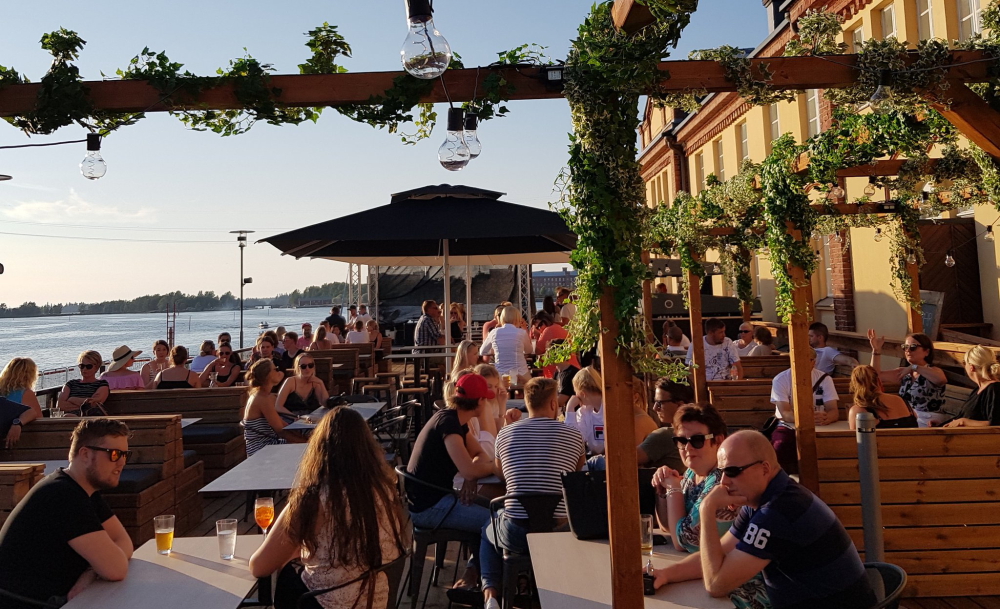
Dinner is reasonable. I have pork ribs and Lynn has her usual 2 starters. The 25-minute hike back to the apartment is needed to walk off dinner but I don’t really appreciate it.
29 June, 2023
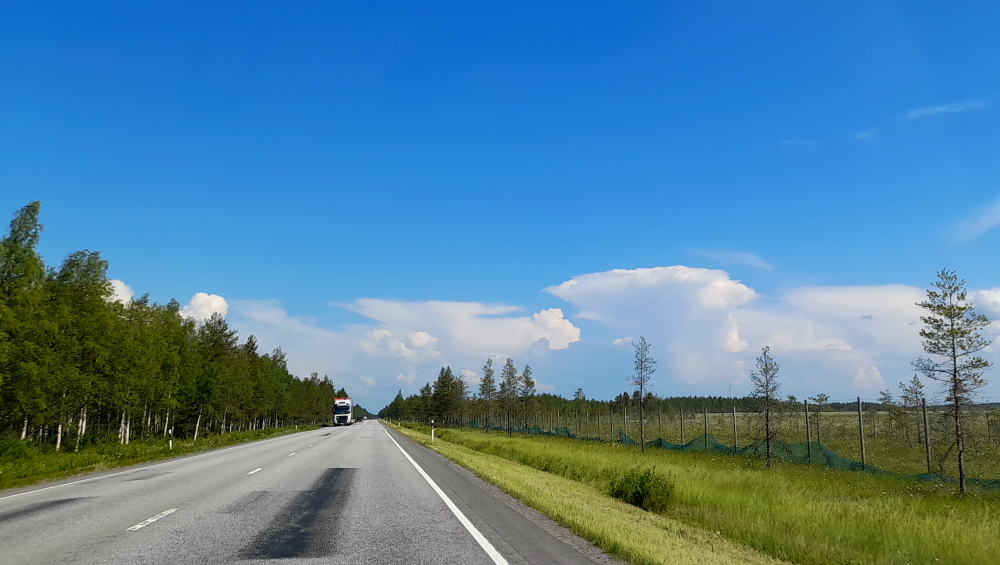
We are moving on to Oulu this morning for the next two days – our last in Finland for this trip as we head for Sweden and then trek south to Denmark. As usual, the 4-hour drive from Vaasa to Oulu is a bit boring with pine forests, farmland, logging and speed cameras the usual suspects. We don’t get to see much coastline, just the one glimpse near Arvasgarden plus crossings of small rivers.
The weather is a warm 24 Deg C with bright sunshine. Traffic in the opposite direction is quite heavy with most being RVs and caravans. Luckily the traffic going in our direction is flowing well with very few caravans.
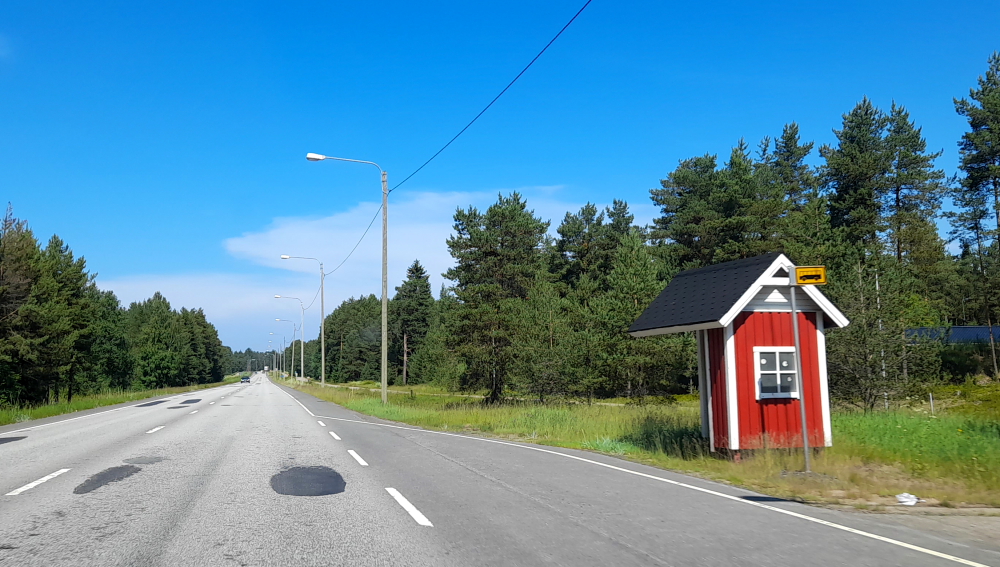
The most interesting thing is the tiny house-shaped bus shelters. Let’s hope Sweden is a more interesting drive.
We check into our hotel in Oulu where the parking is free and easy to access. The first thing I make Lynn do is my ironing using the communal iron/board located in the corridor outside our room – which has no fan or air conditioning. Although we had a washing machine at our last place, alas no iron/board (go figure!).
Naturally, there is no air conditioning in the room but by late afternoon the clouds are building and a cool breeze is wafting through the now open window. The small, electric rotating fan helps, too. Pity we didn’t have one of these in our last place!
We take a prevening stroll through town down to the harbour and find that summer food markets have been set up in the Old Market Square, in front of the traditional Market Hall.
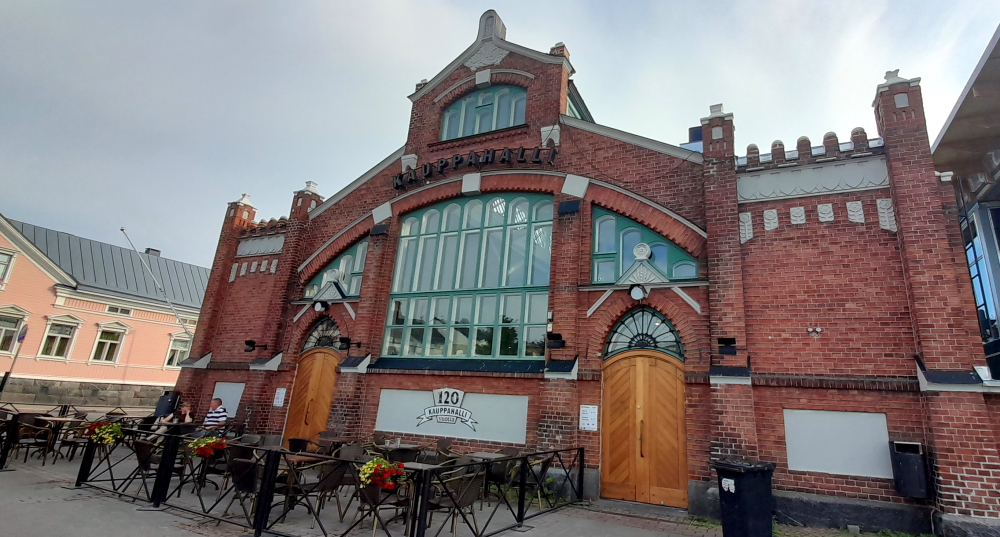
Over the centuries the Oulu Market Square has offered its visitors a year-round, lively meeting and trading place which has also required guarding. A peculiar feature in the local policing history were the Market Square policemen who kept an eye on the Market Square and maintained order there during 1934-1979. Then the policemen were commemorated through a citizen’s fundraiser for erecting a bronze statue in front of the Market Hall. The Market Square Policeman’s 2.2 metres tall statue was designed by sculptor Kaarlo Mikkonen.
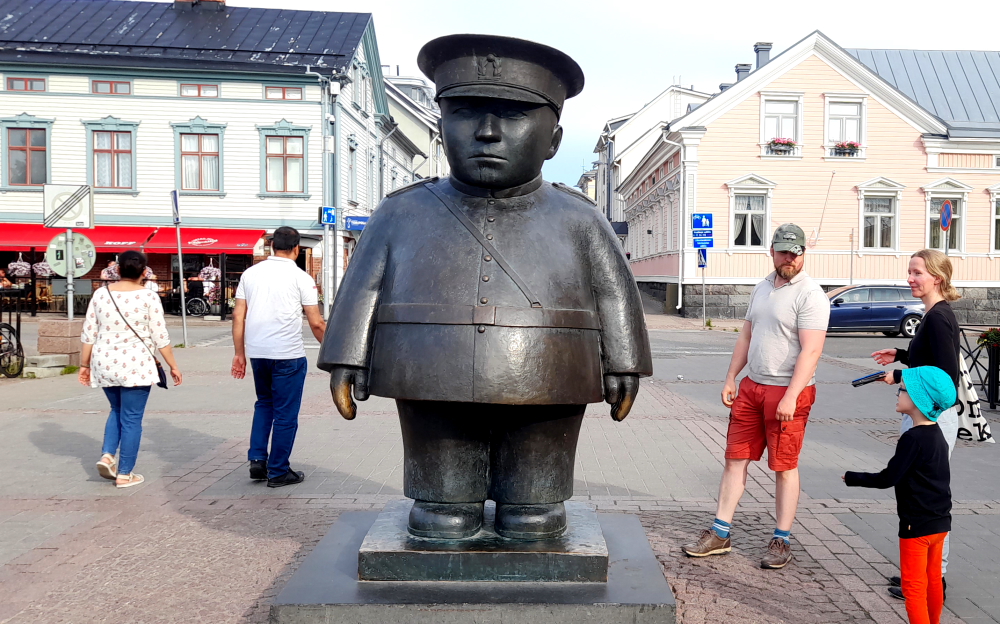
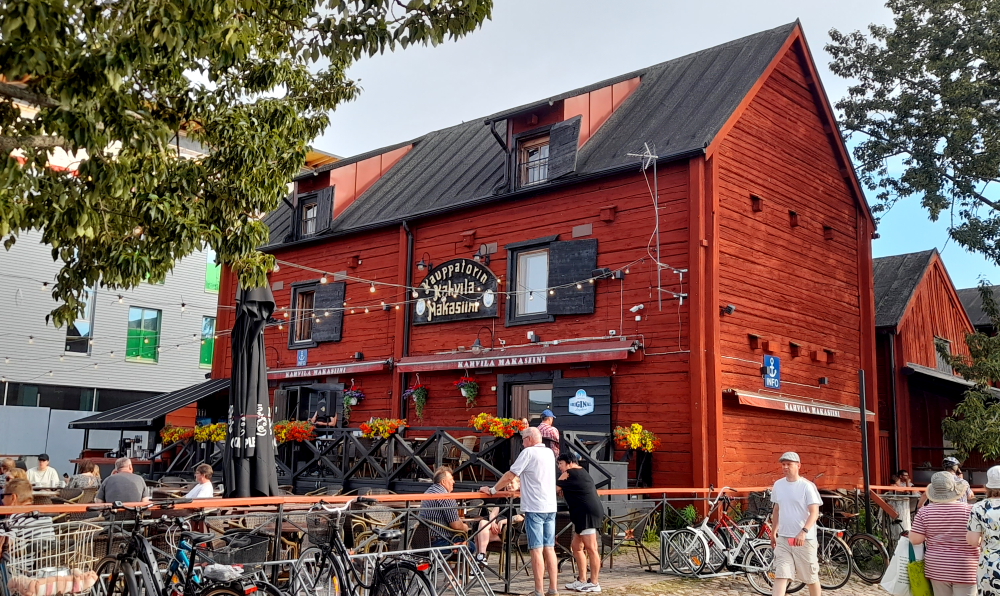
Traditional tan-coloured, wooden buildings line the harbour including this lively pub.
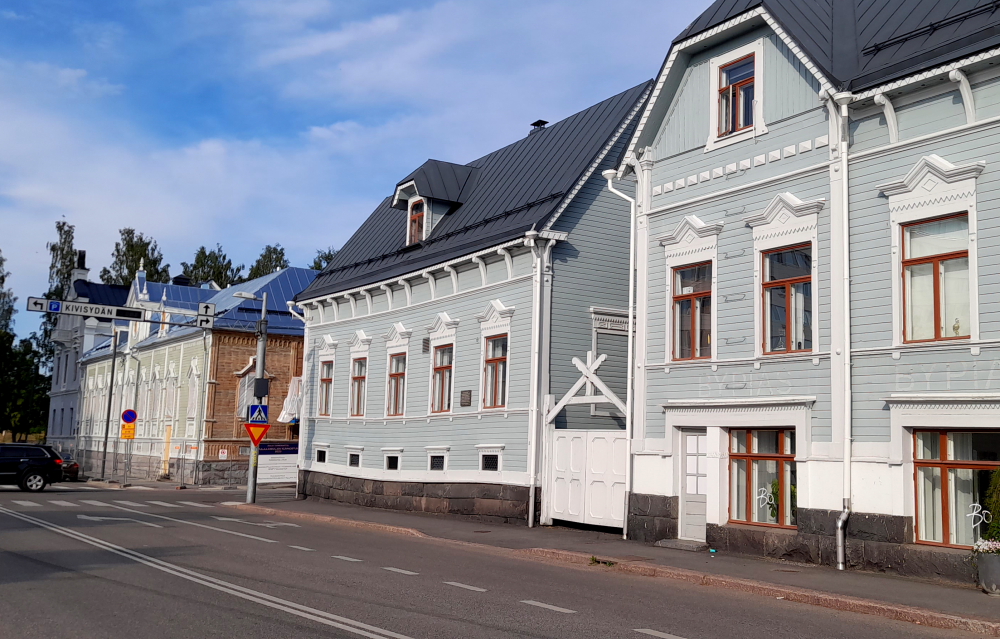
Our walk back to the hotel features various wooden buildings with simple to more intricate adornment. This one caught our eye with its warped base.
Situated by the Gulf of Bothnia, at the mouth of river Oulujoki, Oulu is an ancient trading site. The city proper was founded in 1605 by King Charles IX of Sweden, opposite the fort built on the island of Linnansaari. This took place after favourable peace settlements with Russia, which removed the threat of attack via the main east–west waterway, the river Oulu.
In 1822, a major fire destroyed much of the city. The architect Carl Ludvig Engel, chiefly known for the neoclassical (empire style) buildings around Helsinki Senate Square, was enlisted to provide the plan for its rebuilding. With minor changes, this plan remains the basis for the layout of Oulu’s town center. During the Åland War, part of the Crimean War, Oulu’s harbour was raided by the British fleet, who destroyed ships and burned tar houses, leading to international criticism.
Today, Oulu is a city and seaside resort of about 210,000 inhabitants and is one of the largest cities in the world for its latitude. Due to its large population, economic and cultural/historical location, Oulu has been called the “capital of Northern Finland”. It’s also considered one of Europe’s “living labs”, where residents experiment with new technology (such as NFC tags and ubi-screens) on a community-wide scale. Once known for wood tar and salmon, Oulu has evolved into a major high-tech centre, particularly in IT and wellness technology. It has been chosen as the European Capital of Culture for 2026
30 June, 2023
After weeks of sunshine we wake to a dull day that soon evolves into a rainy day. While I do some year-end figures, Lynn braves the rain to see the local sights.
Nearby is the Oulu Cathedral built in 1832 to Carl Ludvig Engel’s designs, with the spire being finished in 1844.
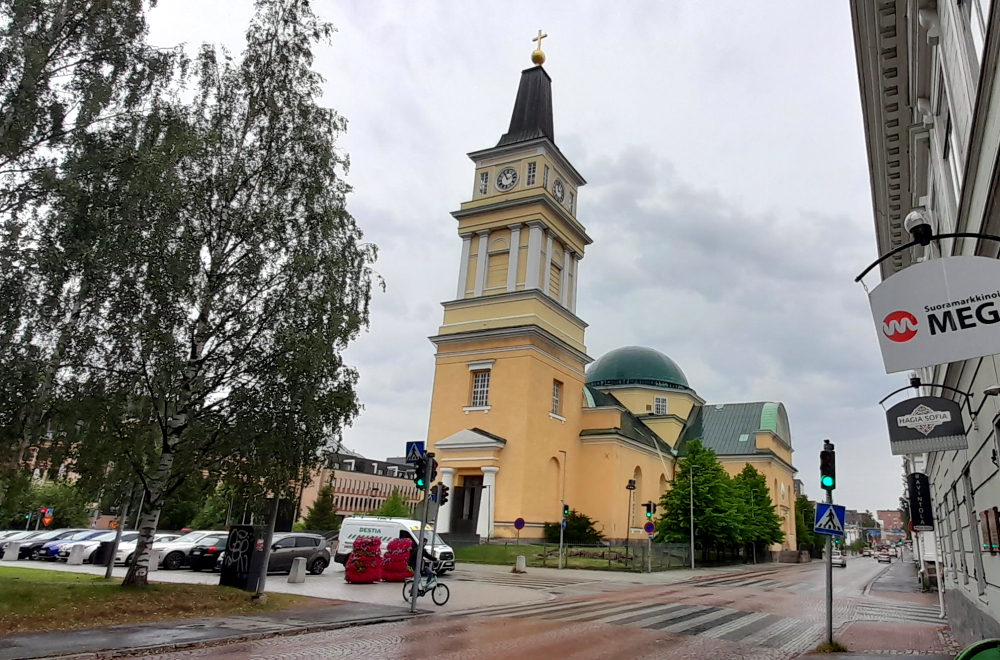
Today, like a lot of buildings in Scandinavia, it’s undergoing maintenance.
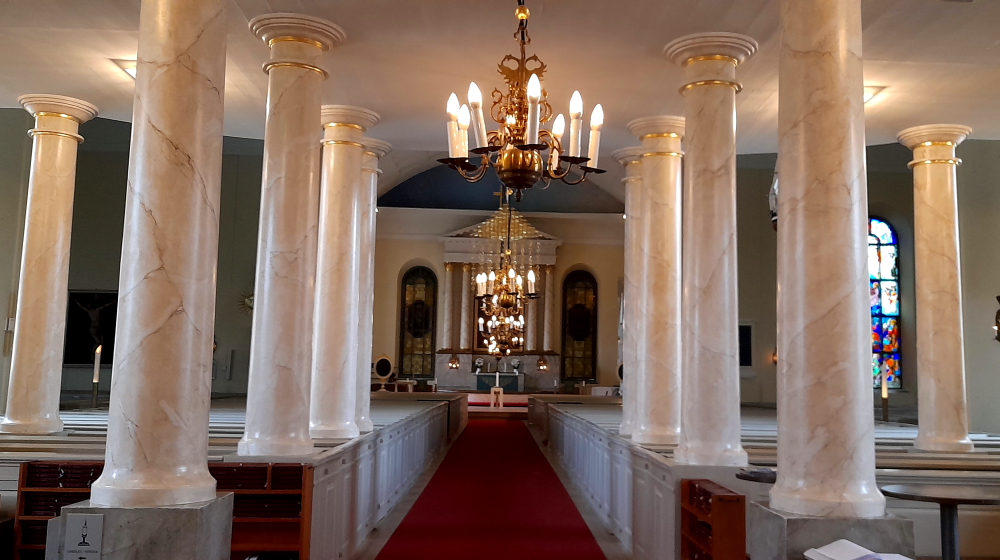
I don’t know what Lynn will do when we get to Europe and see some serious Cathedrals. Perhaps she takes photos of these country churches in Scandinavia as the towns don’t have much else to see.
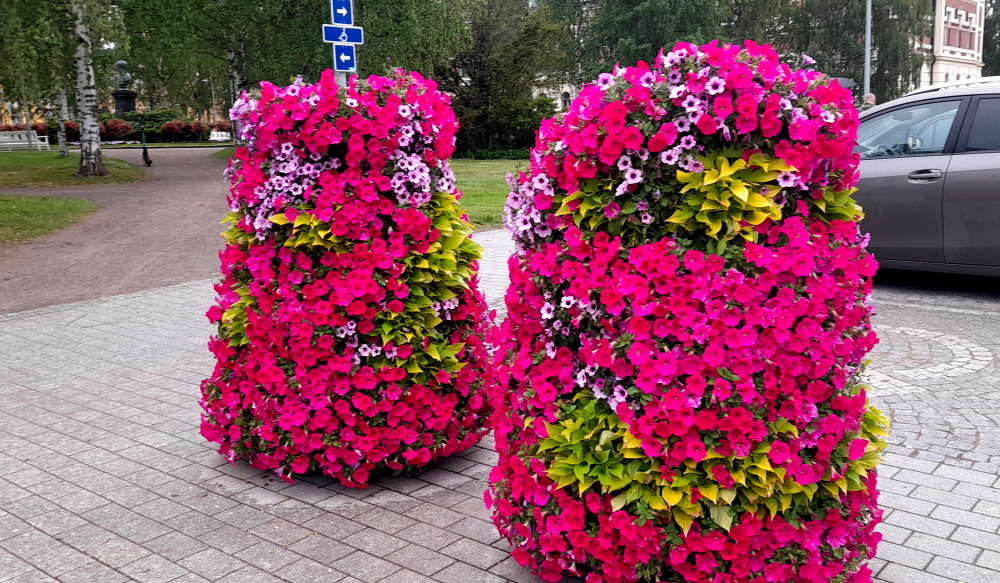
In the UK, summer floral decorations for city streets are usually hanging baskets. In Oulu they look more like some daleks (minus metal extensions) have been captured and decked out with petunias.
Opposite the City Hall (also undergoing a massive external renovation) is located the Cultural Centre Valve – a mix of historical and modern buildings.
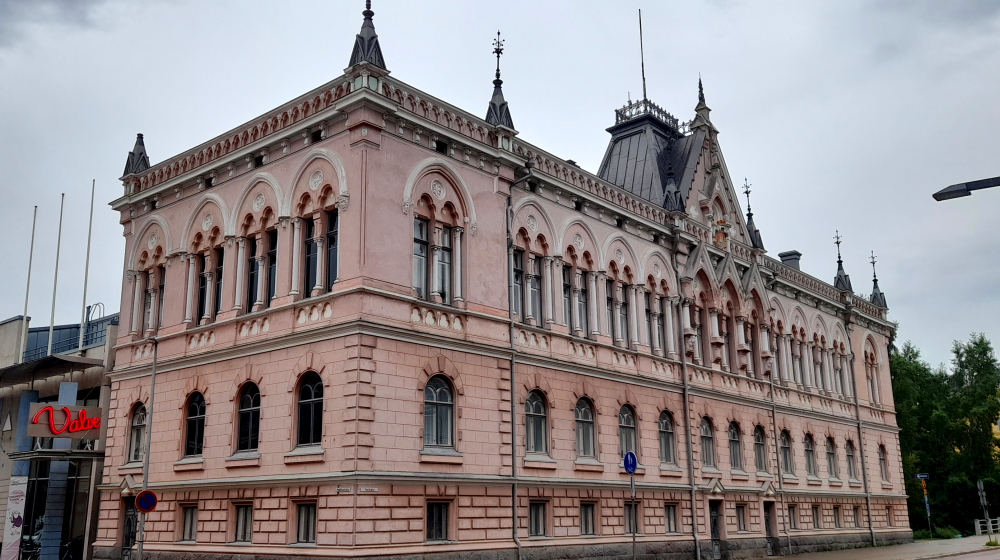
Not only an event venue, it is also the home for many cultural organisations and works in co-operation with different actors, artists and event organisers.
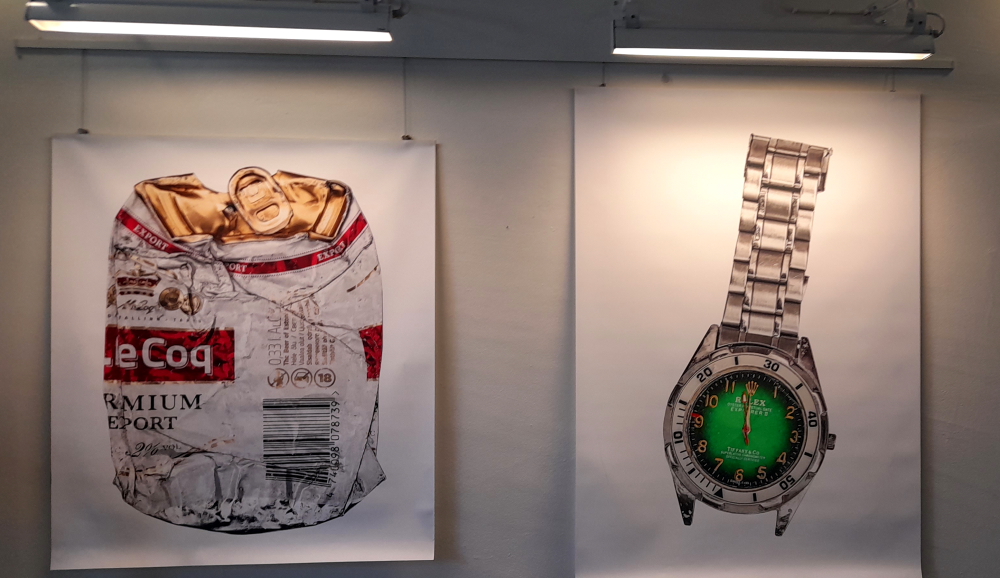
Some of the artwork on display within Valve – ‘Fun of the Month’ images.
Back down at the waterfront is another ‘modern’ building, the Oulu Theatre which is built on a small, artificial island named Vänmanni. In existence since 1931 it has 350-400 performances per year for an audience of 80,000 across 4 stages. The 100 staff include c. 35 artists, 15 set and costume makers, 30 technical employees, and 20 in admin, production, marketing and sales.
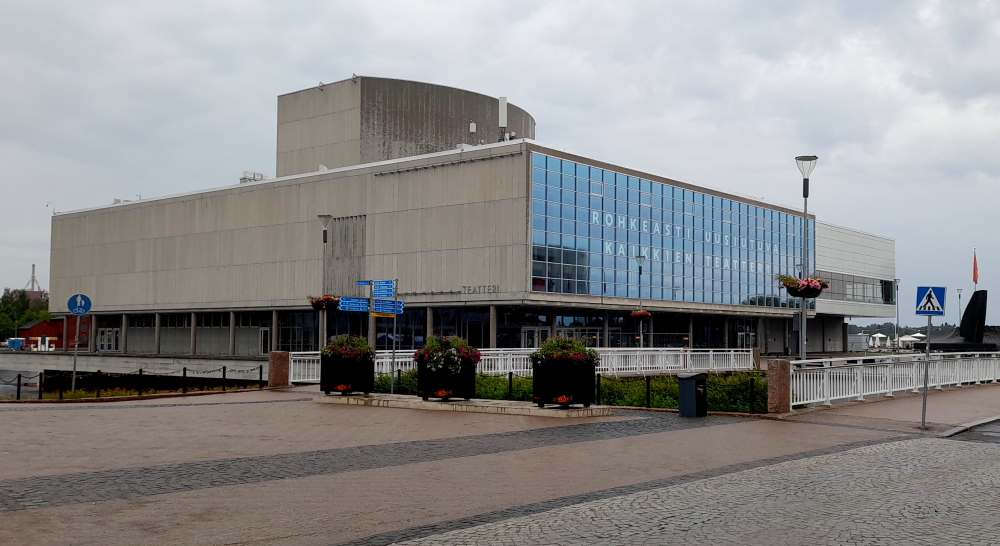
Directly across from Vänmanni via a narrow pedestrian bridge is the island of Pikisaari (Pitch Island) and its wooden old town. The island got its name from an old pitch works founded in the 17th century. Besides that, the island has housed shipyards, a sawmill, a distillery, a wool mill, and a machine workshop.
Oulu was an important sea and port city in the 19th century and the most important tar port in the world, and a considerable number of the city’s inhabitants were sailors by profession.
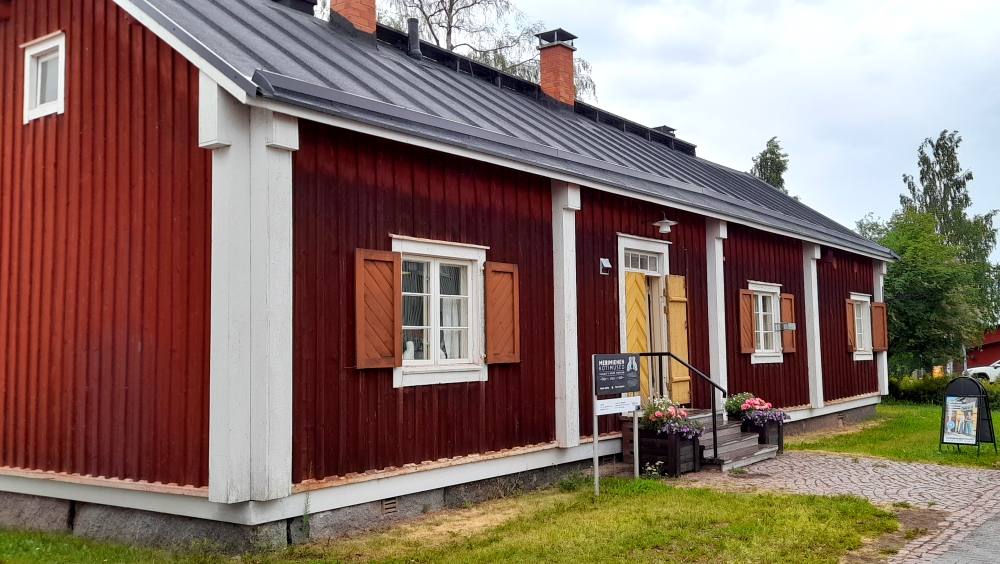
Sailors’ families lived in small wooden houses on the outskirts of the city, such as Matila’s house, which is now a Sailor’s Home Museum.
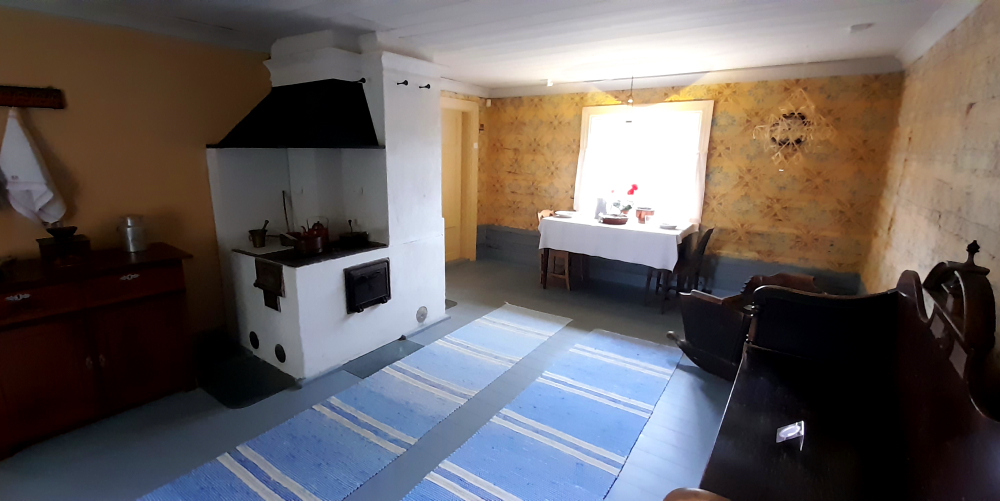
The building is the oldest surviving wooden house, dating from 1739, having survived, among other things, the great fires of Oulu in the 19th century.
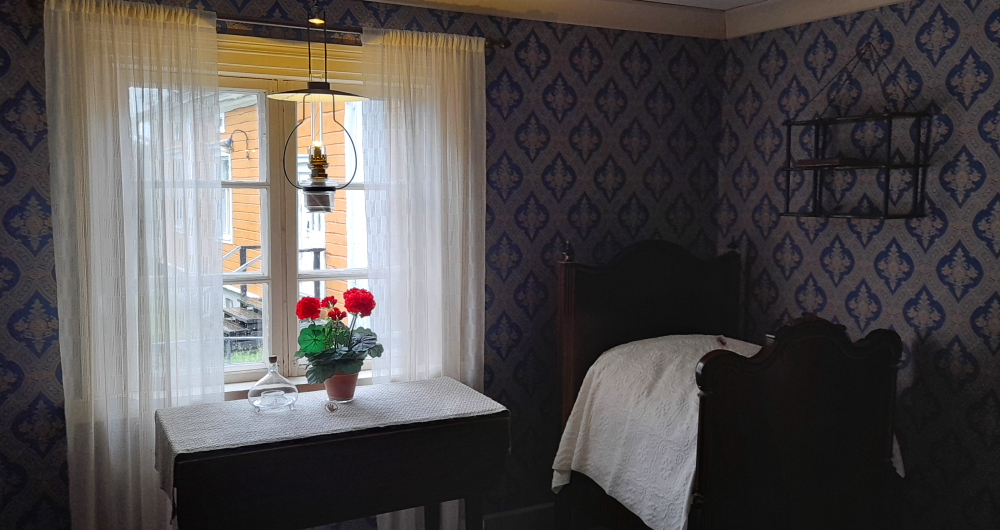
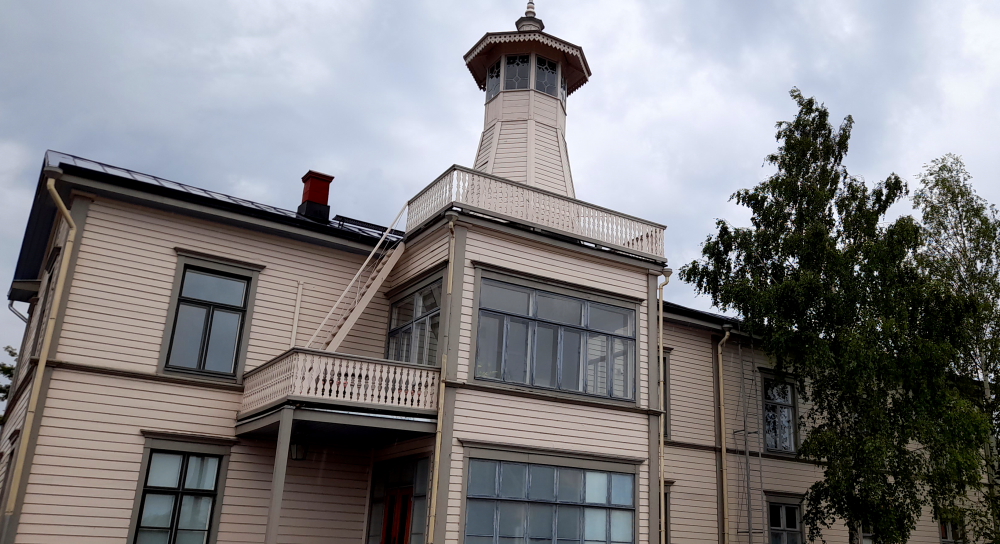
Another building of note is the old, decorative office of the local machine workshop from the 1880s, nowadays used as a residential house. It represents the neo-renaissance style with a tower that is a notable landmark among the houses on the island.
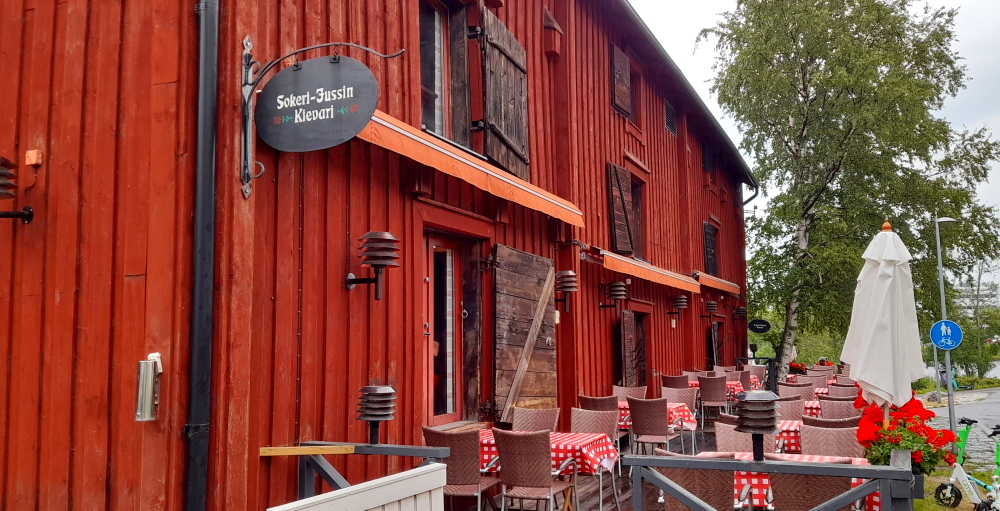
Nowadays the island is the home and studio for many artists and artisans, not to mention boutique accommodation and charming restaurants like the Sokeri-Jussin Kievari.
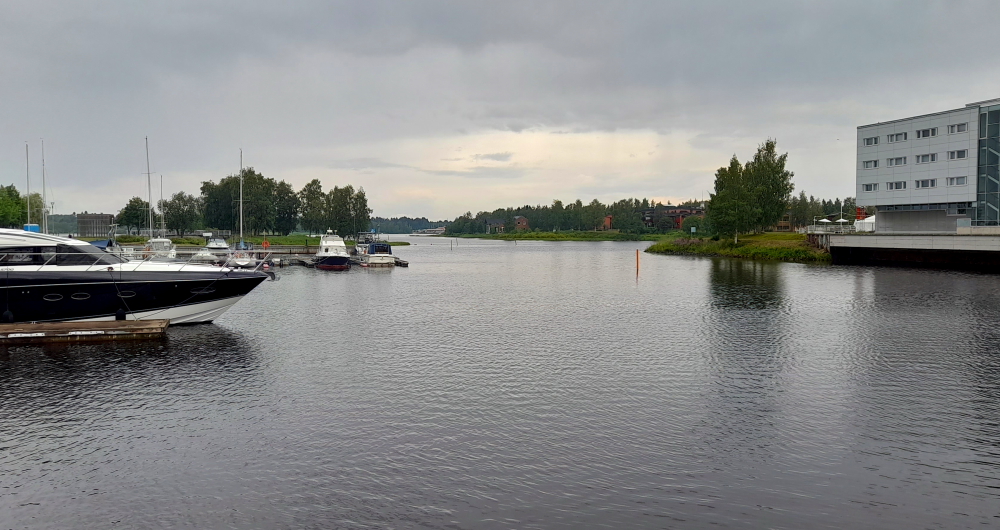
Back on the mainland at the harbour’s edge Pikisaari Island can be seen in the distance behind the Oulu Theatre.
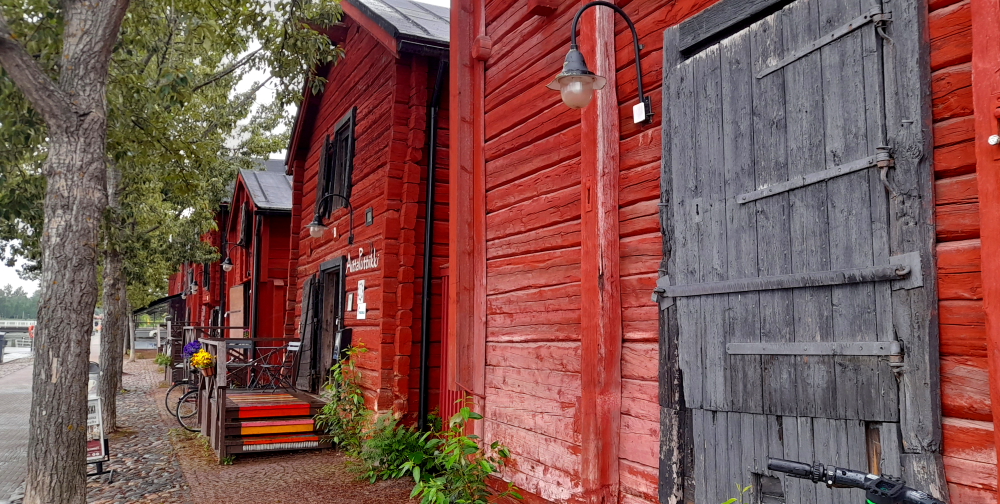
Next door to the Kahvila Makasiini pub on the Old Market Square is a series of wooden buildings, old granaries, housing artisanal shops.
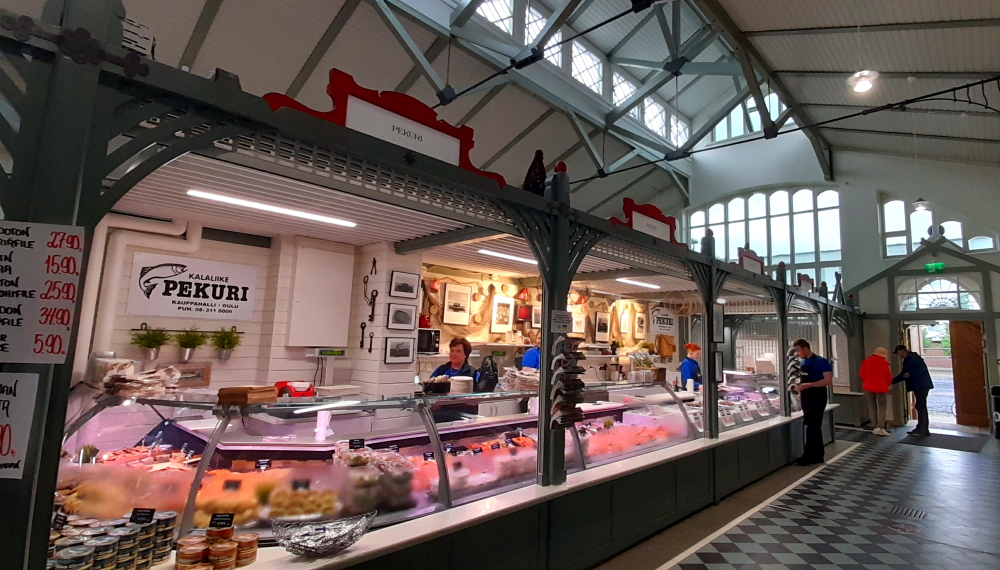
Inside the Market Hall it looks like a miniature version of the one in Helsinki.
In 1889 the Oulu city council decided to build the market hall due to the tightened food safety regulations in Finland. Specifically, butchers were to be moved from the open market square to the covered market. The market hall was designed by architects Karl Lindahl and Walter Thomé and completed in 1901. Along with two aisles there were 62 wooden shop stalls. The warehouses surrounding the Hall are former granaries converted into handicraft shops.
Tonight we are having dinner at what seems to be a very nice looking restaurant in the centre of town. Unfortunately the menu was very limited and quite expensive even for Scadinavia generally. I had a small piece of fried chicken breast with boiled potatoes and almost cooked cauliflower and Lynn had a couple of pieces of fried tofu with similar vegetables and the bill came to A$77. They even charged us A$3 for tap water. That has to be the most expensive KFC (although not as good as KFC) that I have even eaten.
Tomorrow morning we are still heading north but then crossing over to Lulea in Sweden. It will take us about 3 hours to drive the remainder of the Finish west coast. I just hope that the food improves in Sweden (maybe they have flat pack food there). At least I am losing weight but we dropped by the supermarket after our dinner “snack” and picked up some chocolate and another 6 pack of Long Drink (Gin & Grapefruit).
 THE CONTINUING TRAVELS OF YOGI & BOO BOO