
28 May, 2024
It’s a miserable rainy day here at London Heathrow Terminal 2 as we leave the hotel at 8:00 am for the walk to Terminal 3. As we had already checked in online we go through the easy process at a kiosk to check our bags in and drop them off.
The plane is due to take off at 1:30 pm and we are finally in the air around 1:45 pm. We had booked our Finnair economy flight through Qantas so not sure what we are entitled to in the cabin but we still have a spare seat between us, I have leg room and unbelievably we get free entertainment for the almost 3 hour flight to Helsinki. It’s a new A350 – hope we get something like this for our flight to Bangkok.
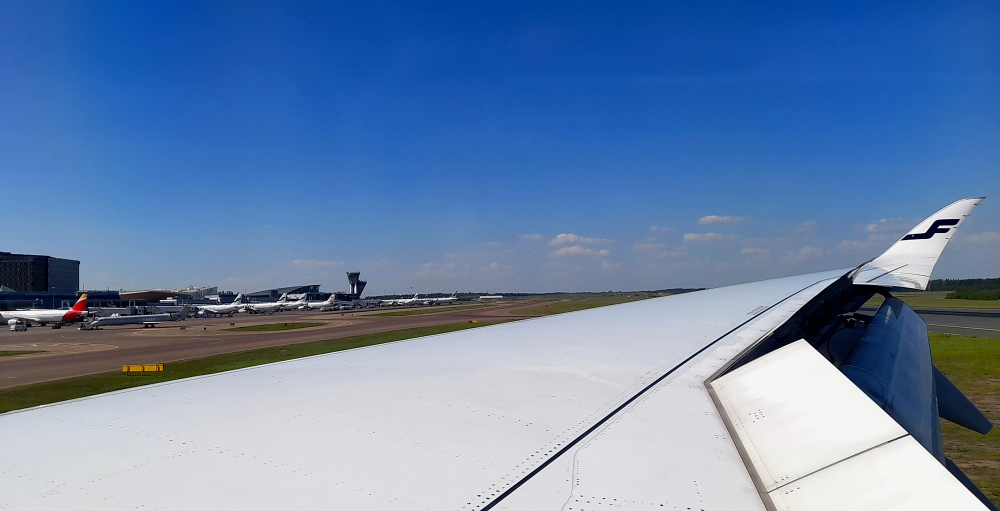
We arrive on time to a sunny and warm Helsinki. As Lynn’s bag weighed in at 23.5kg and deemed ‘heavy’ we have a bit of a wait for it to appear on the baggage carousel after mine.
Henri, our driver who I’d booked through Booking.com, meets us and whisks us into town and down to the port, about a 30-minute drive away from the airport, and drops us in front of the Scandic Grand Marina hotel.
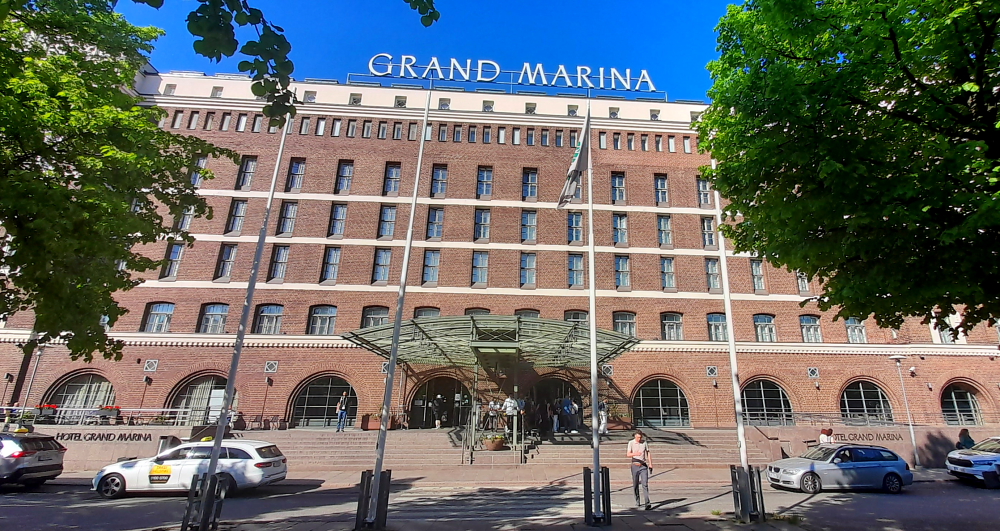
The hotel is a former warehouse building completed at the beginning of the 20th century, featuring high spaces and large windows and is close to the city’s market square and harbour.
We ask about trams to the West Port and discover a No. 4 in the next street will take us 3 stops where we need to change to a No. 7 which will take us to the port and opposite the local tram stop is a convenience store where we can purchase tickets. Done! A total of Eu6.90 for 2 single tickets rather than about Eu20 for a taxi. And we purchase an old friend, a chilled can of Hartwall ‘Original’ Long Drink – Finland’s refreshing Gin and Grapefruit beverage.
29 May, 2024
Besides having to push our suitcases up a slight hill from the hotel to the tram stop the entire process is easy and seamless.
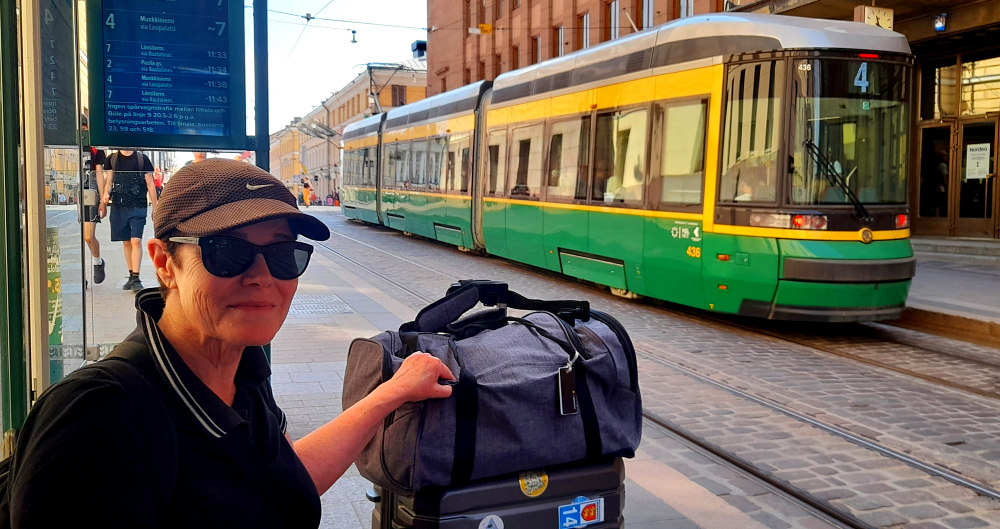
It takes about 40 minutes having walked out of the hotel at 11:05 am and arriving at the Tallink Silja ferry terminal at 11:45 am.
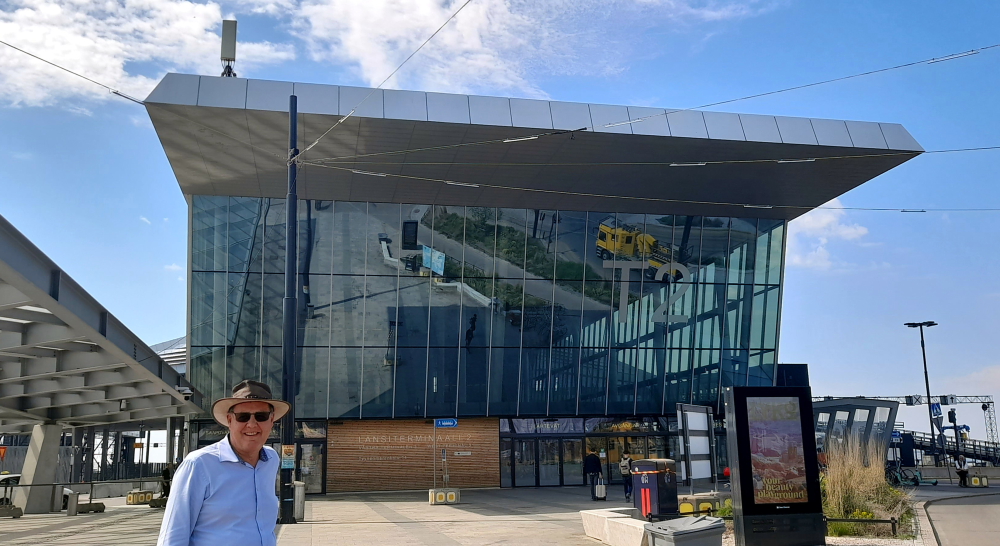
We use the QR code on our boarding passes to pass through the gate, take the lift to the huge, panoramic waiting area and have a coffee while we wait for the ferry to arrive.
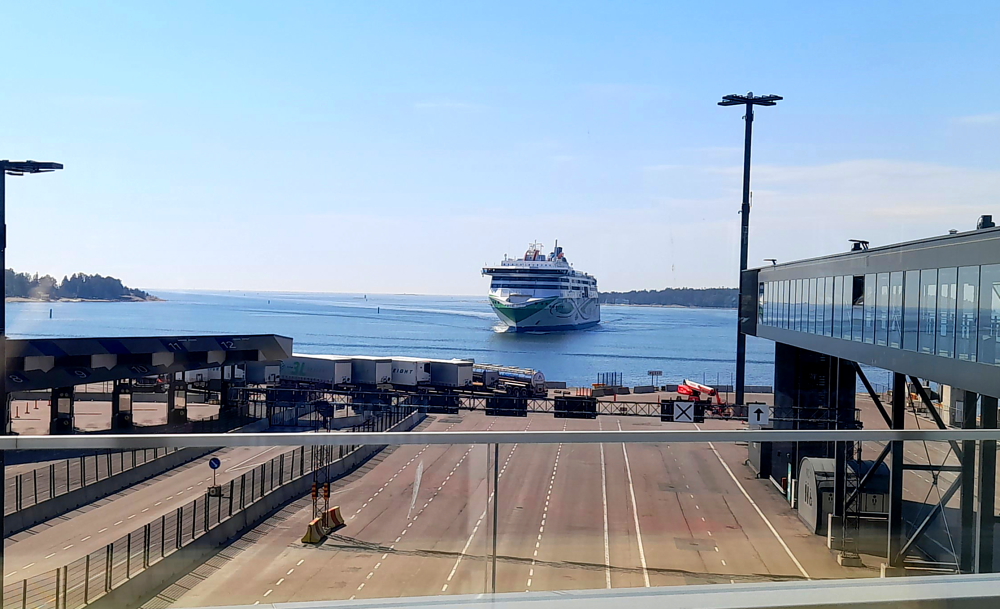
As we are ferry passengers we join the queue and shuffle along the glass and steel corridor onto the vessel at Level 8 then find a seat near a window. The vessel is modern with a superstore full of duty free shopping from Boss clothing and Gucci handbags to perfumes and Toblerones. Level 9 has a buffet and bar and a rear deck while Level 10 has a sports bar and a rear deck for smokers.
Surprisingly, we depart 15 minutes early at 1:15 pm.
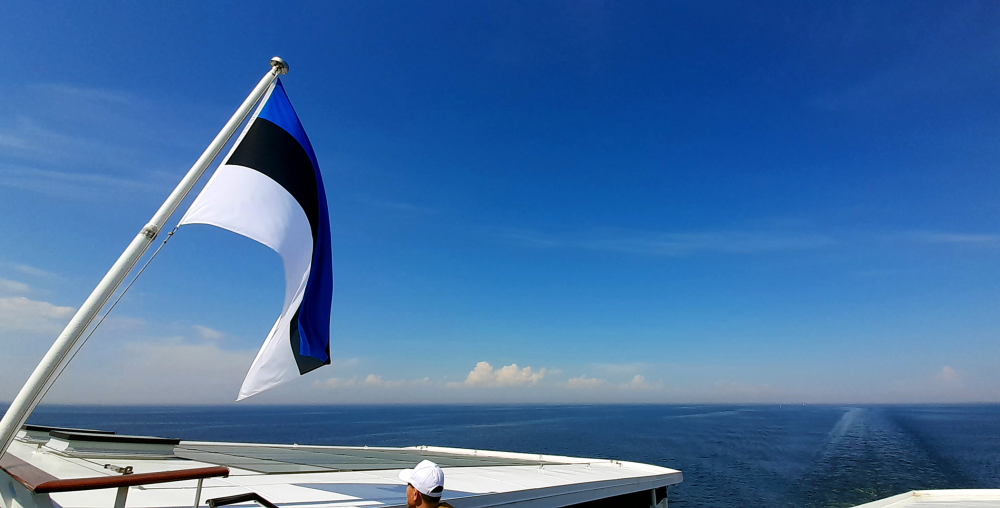
Bang on 3:30 pm, our scheduled arrival time, we dock at Terminal D and are met by Andrei, our Booking.com driver, who drives us to our Art Deco hotel at the edge of the Old Town, about a 10-minute drive away.
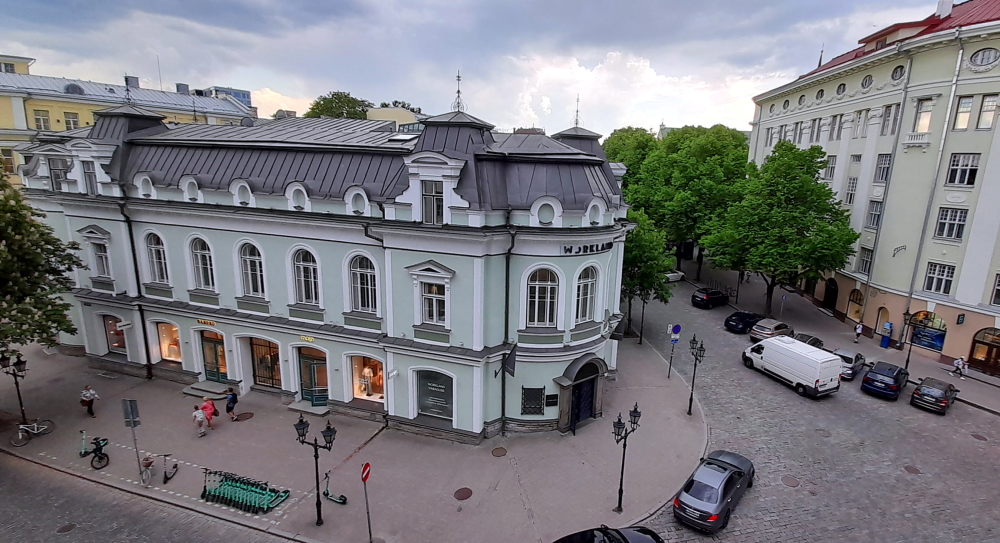
Thunderstorms are forecast for this afternoon and it looks like they are imminent.
We need to get some supermarket supplies (including more cans of ‘Original’) so the receptionist kindly tells us that there is a large shopping centre a couple of blocks away that has one so off we pop.
Good call as we also find a Lido Restaurant where you pick up a tray and wander by various counters of freshly-prepared or cooked food, Estonian traditionals amongst them, then pay, collect cutlery then find a seat in an airy greenery.
I order a chicken cutlet with vegetables and a cucumber salad plus a large waffle with fresh strawberries and cream. Lynn has a chicken caesar salad plus a honeyed, cottage cheese-filled pancake. Good to see that Hardys has made an inroad into Estonia, but at Eu5 for a 125ml bottle of wine, we pass.
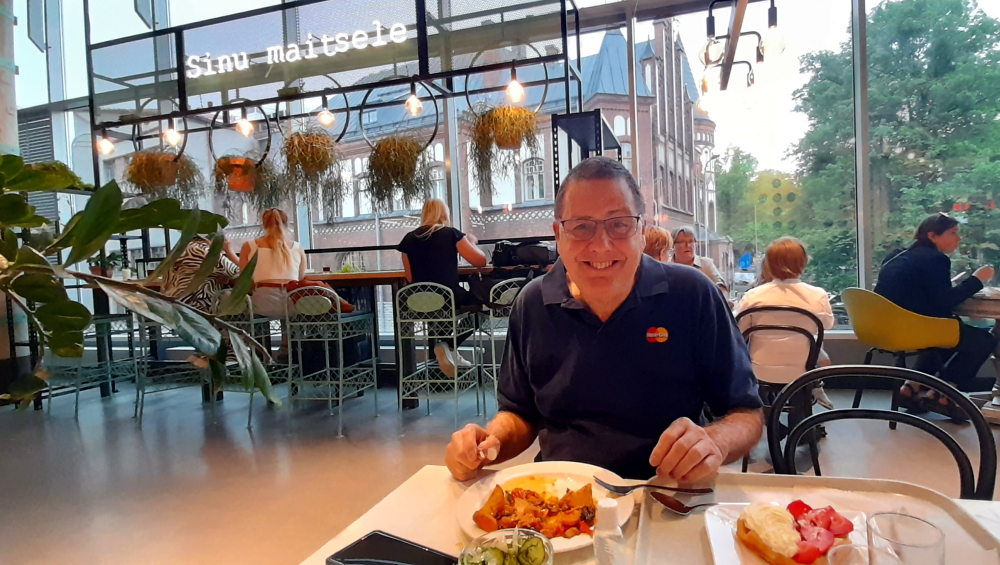
While we are eating a flash of lighting appears and a rumble of thunder. As soon as we walk out the door large splotches of rain fall.
Although our hotel says it has air conditioning we find that any cool air is confined to the narrow entry way to the room with none actually passing into the bedroom at all so Lynn collects a fan from reception which does the trick overnight.
30 May, 2024
Lynn has booked a GuruWalk for 2:30 pm so we do a bit of a recce of the ‘hood ourselves this morning.
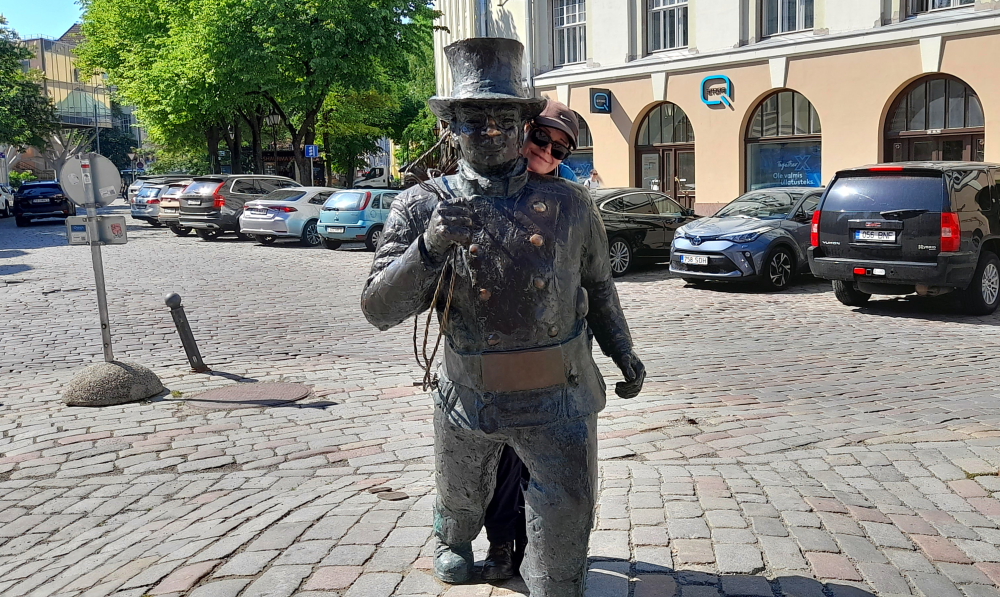
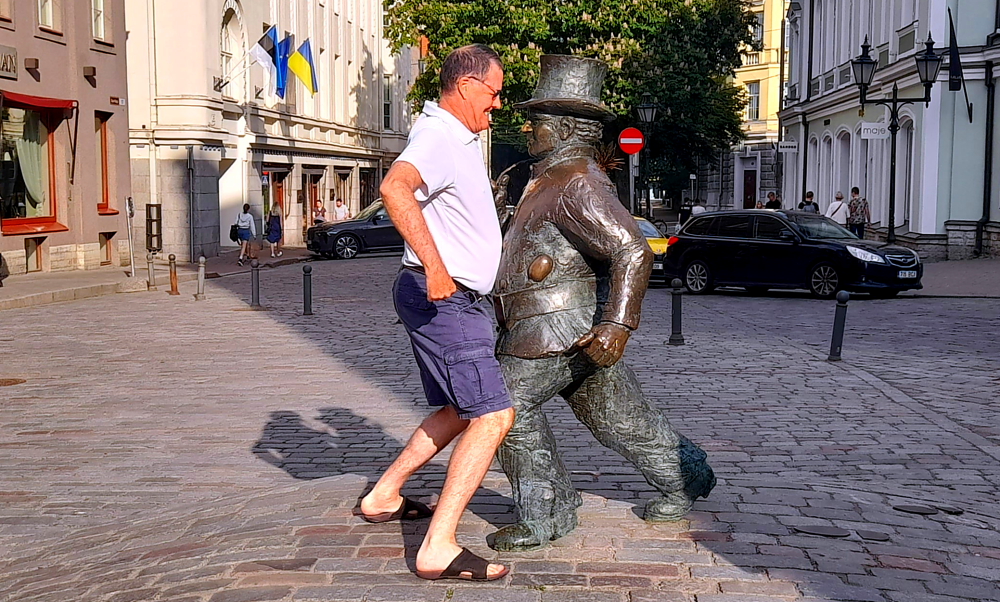
Just outside the hotel is a jaunty chap complete with top hat and a large bottle brush slung over his shoulder – Onnelik Korstnapuhkija – translated as ‘Happy Chimney Breaker’.
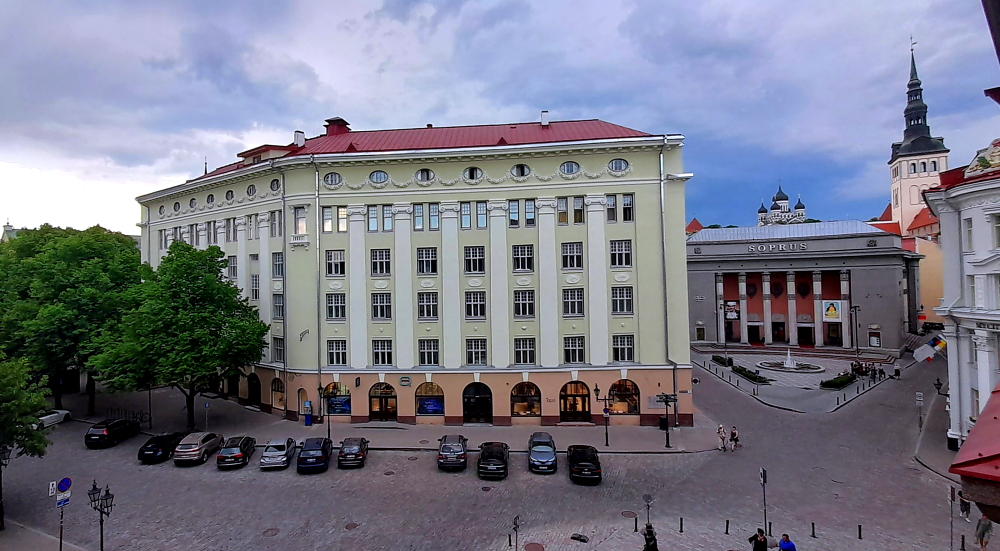
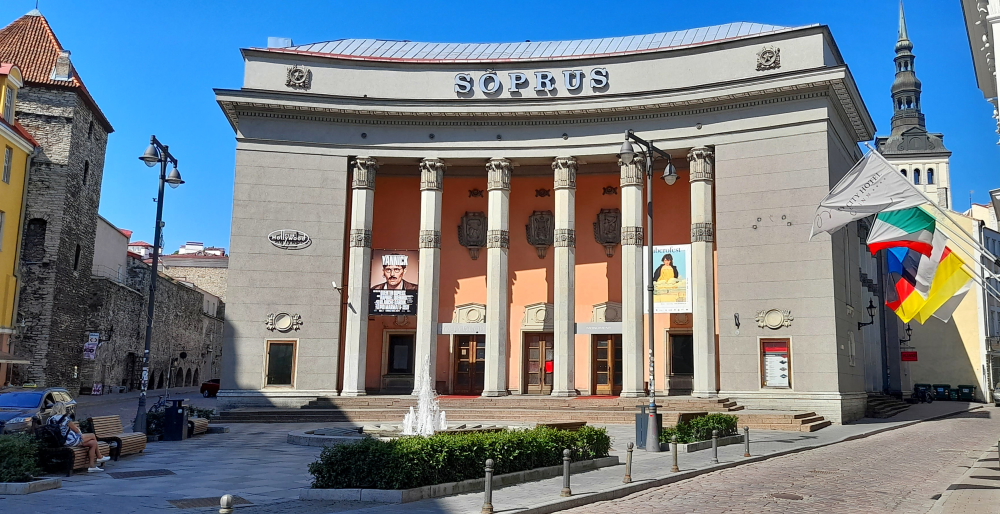
Behind him is the impressive Soprus Cinema with its columned portico.
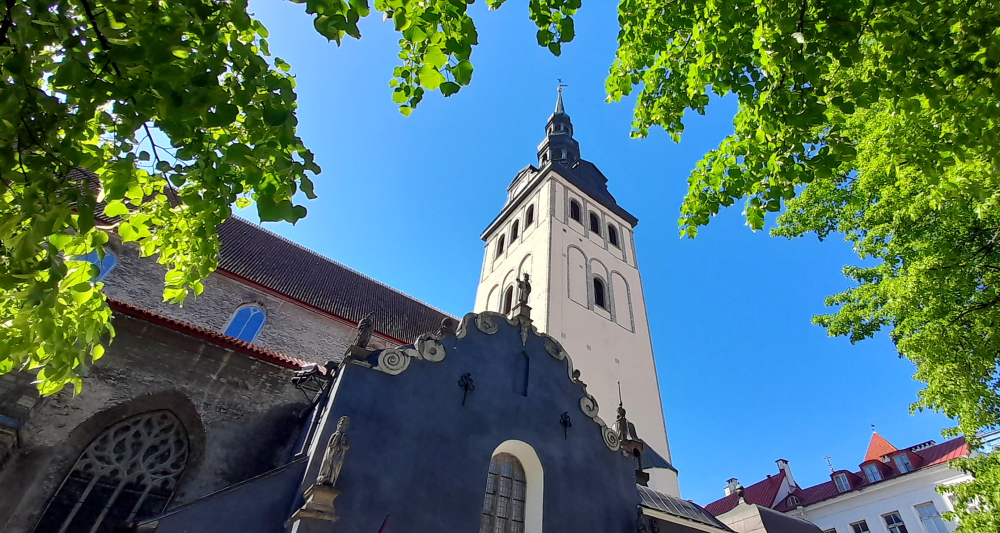
We decide to check out the meeting point for this afternoon’s walk which is about 3 minutes away so we walk up Vana-Posti, the road to the right of the Cinema then up Noelasim, a staired walkway, to the forecourt of the St Nicholas Church and Museum.
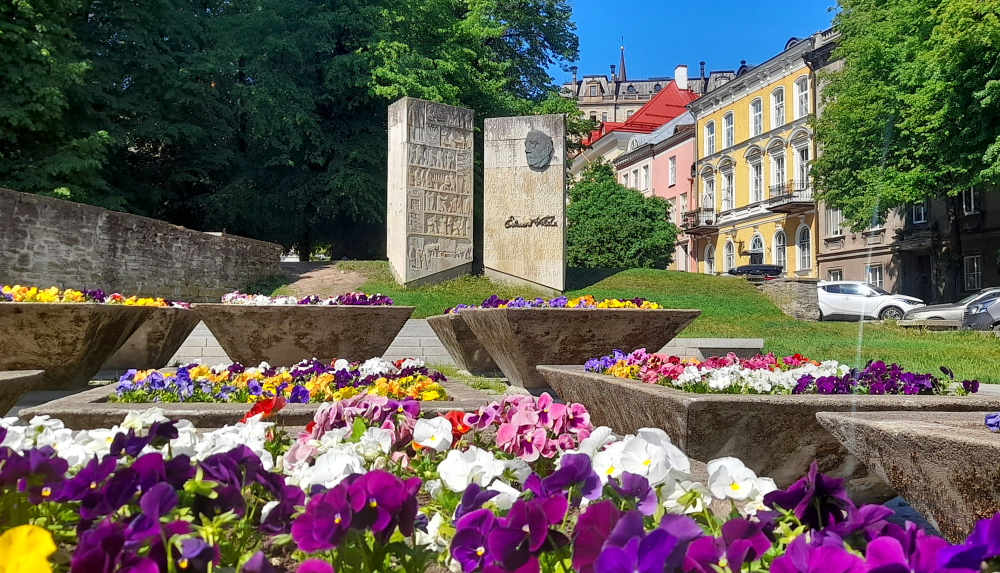
Walking down Niguliste Street, parallel to the church, we come to the monument of the writer Eduard Vilde. This memorial was opened in 1965 on Harju Street, in a green area across the street from the House of Writers. It also comprises a rising dolomite staircase which ends near the church with an open book carved from the dolomite of the Mustjala mine in Saaremaa featuring a bronze bas-relief and autograph of the writer and scenes from his novels “Mahtra’s War”, “When Anija’s Men Went to Tallinn” and “The Prophet Maltsvet”.
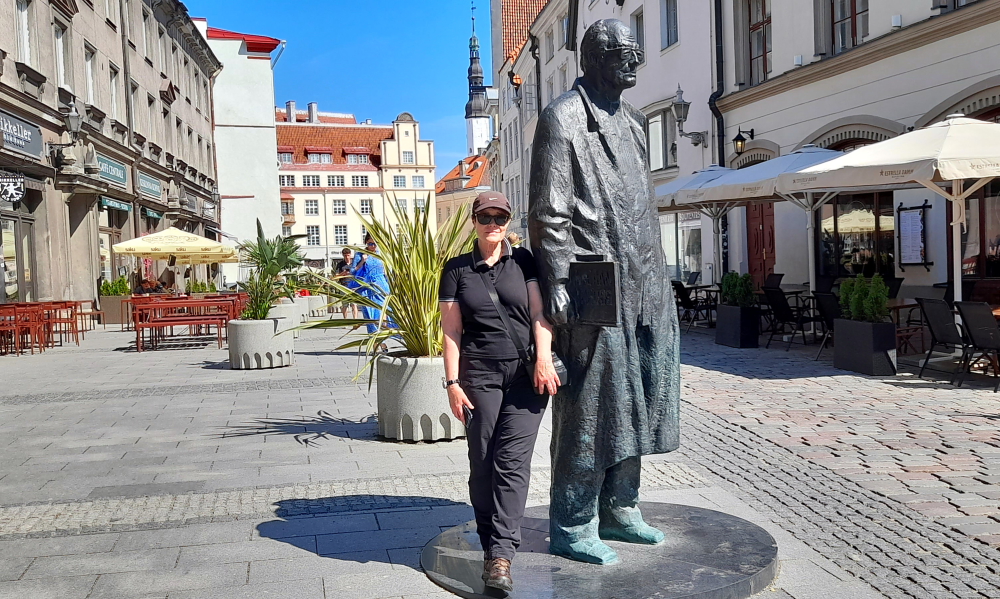
Around the corner is another sculpture, of Jaan Kross, at the intersection of Kullassepa, Niguliste, and Harju streets, which faces the author’s house. Kross had been nominated for the Nobel Prize twice for his literary achievements, many of which were set in Estonian history but presented in an insightful and captivating manner.
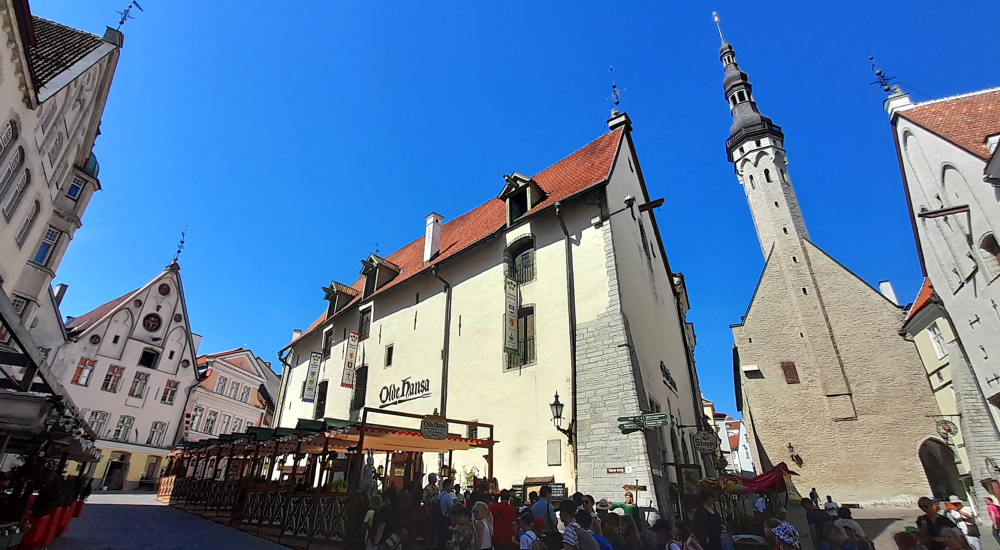
From here we walk down Raejoja Street behind the Gothic Town Hall to its intersection with Vana Turg and into Viru Street.
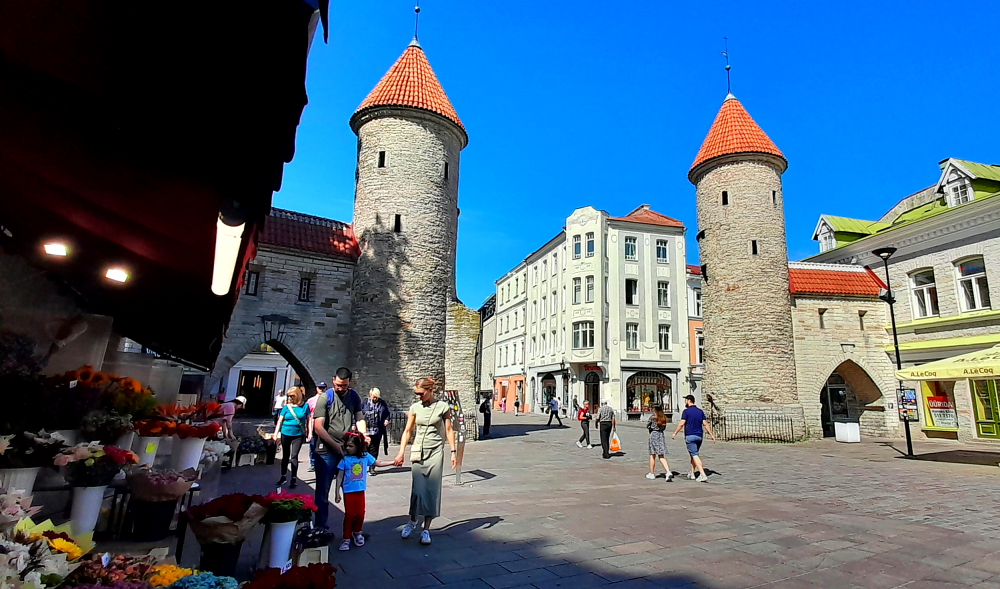
At the end of Viru Street are 2 towers that form the Viru Gate (Viru Väravad). Built in the 1300s, these 2 watchtowers mark the entrance to Tallinn’s Old Town and the road to the lower town market place and where the roads leading to Tartu and Narva began.
Nearby is Muurivahe, a narrow street that runs along the inside of the city wall.
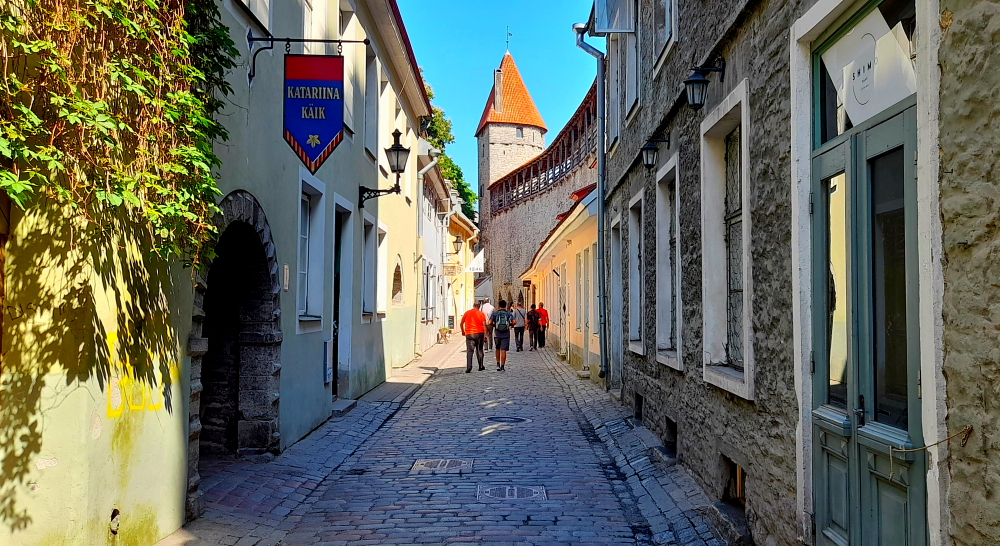
Built at the beginning of the 15th century it was named (initially Holleman) after a citizen who owned a plot nearby. This tower improved the protection of the Viru Gate. It has 3 floors with the vaulted room on the ground floor previously an ammunition storeroom. The tower has been restored in 1935, 1962-66 and 2005-06.
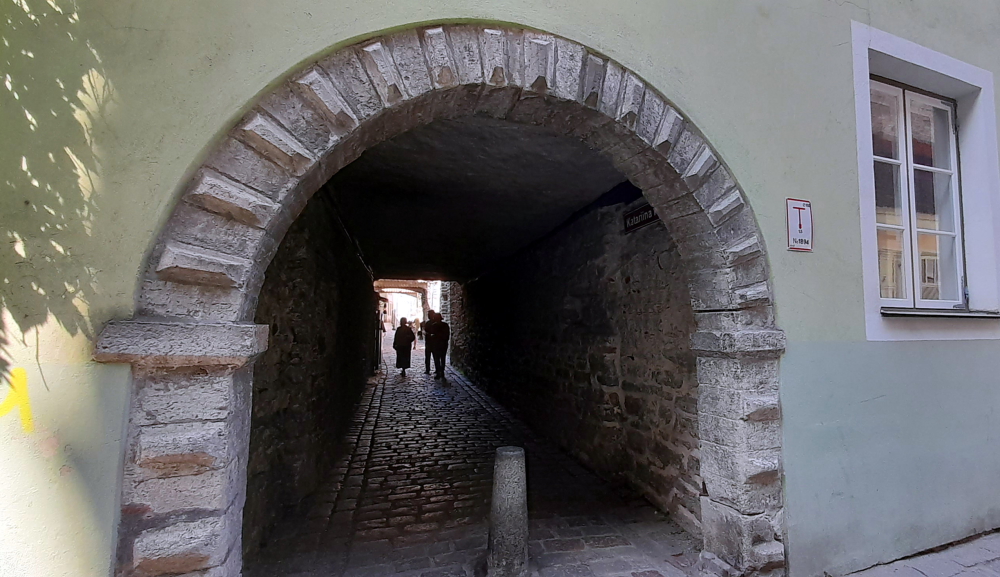
Retracing our steps we return to Katariina Kaik, an alleyway beginning with an archway. Catherine’s Alley, formerly known as Monk’s Alley, winds its way from Vene Street past the southern end of the Dominican monastery to Müürivahe Street.
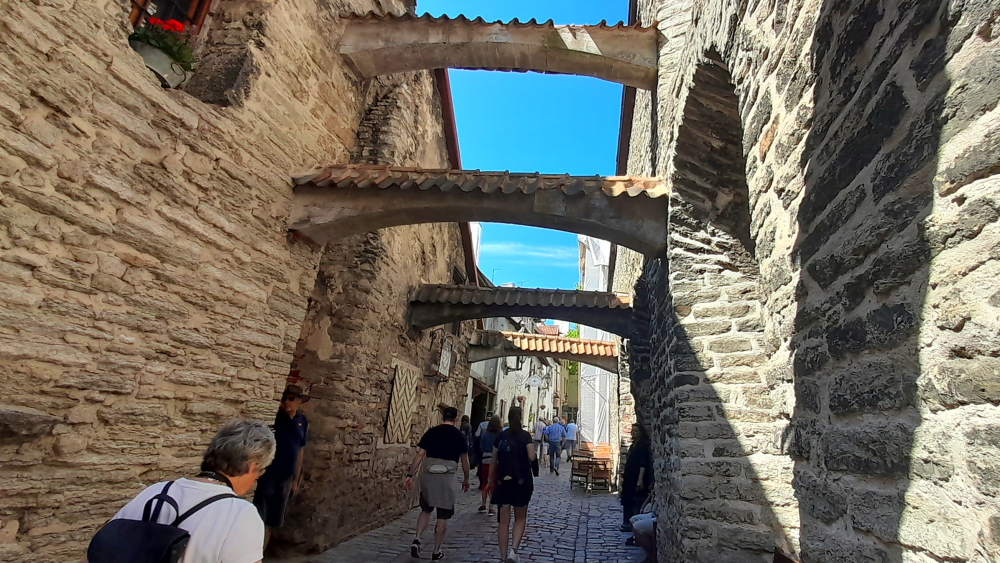
St Catherine’s church, which lent the alley its name, is thought to have been built more than 700 years ago. The southern side of the alley is lined with predominantly 15th-17th century buildings. The alley as a whole retains its medieval charm and was last restored in 1995. A number of handicraft workshops can be found here where artists create ceramics, hats, glass, and more [visittallinn.ee].
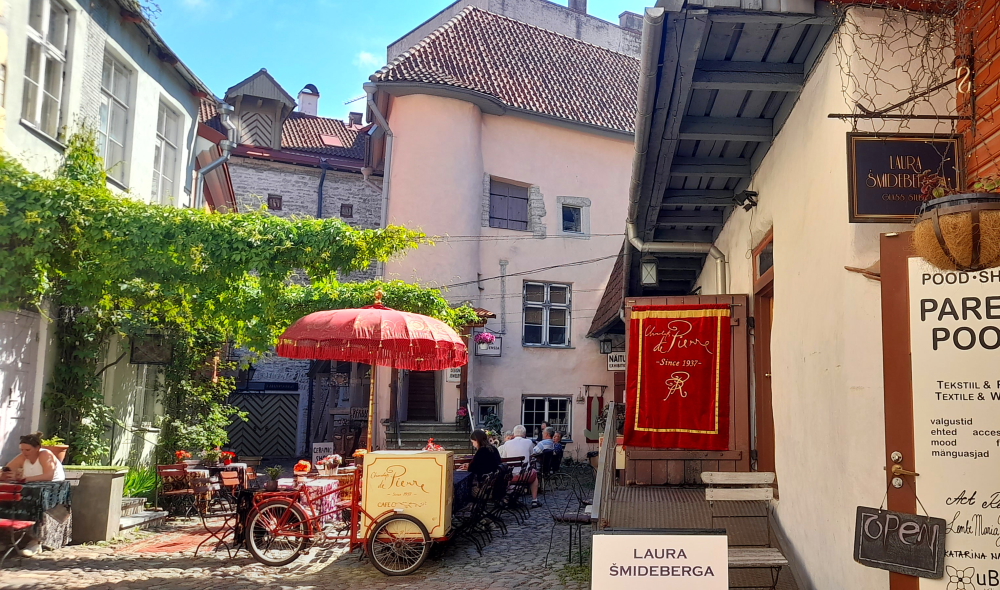
Left into Vene Street when we come across another medieval alleyway which leads to the Masters’ Courtyard (Meistrite Hoov) today an inviting space with inns, craft workshops, clothing stores and a chocolate cafe…
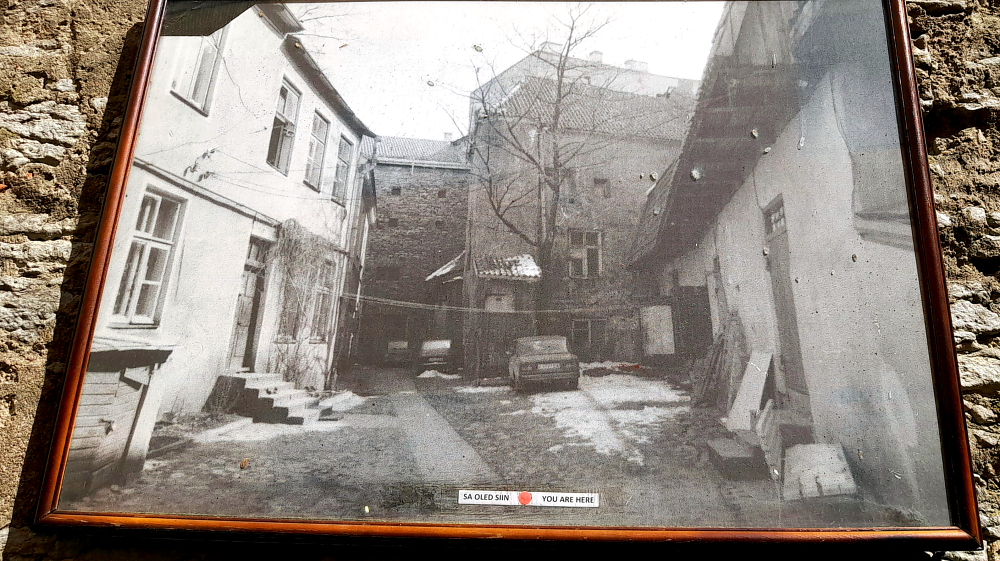
… compared to what it looked like in earlier (Soviet?) times.
After a break back at the hotel we return to the entrance to the Niguliste Church and Museum to meet up with Gleb, our GuruWalk guide, and 3 Mexicans who make up our group, for his Upper Town Tour.
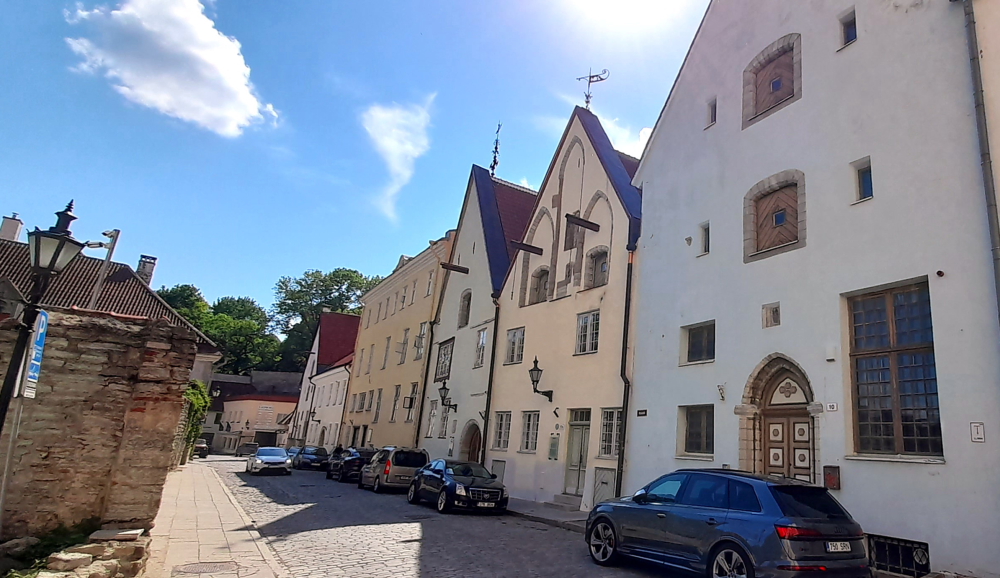
After giving us an outline of Estonia’s history we walk to Ruutli Street where we see some restored examples of typical Estonian houses which had warehouse storage on the upper floors.
From here up stairs towards Toompea with a stop at the ‘Danish King’s Garden’ on the slope facing St Nicholas Church – where there is no garden whatsoever. Rather cobblestones and stonework and a marker of where the Danish flag is said to have been born.
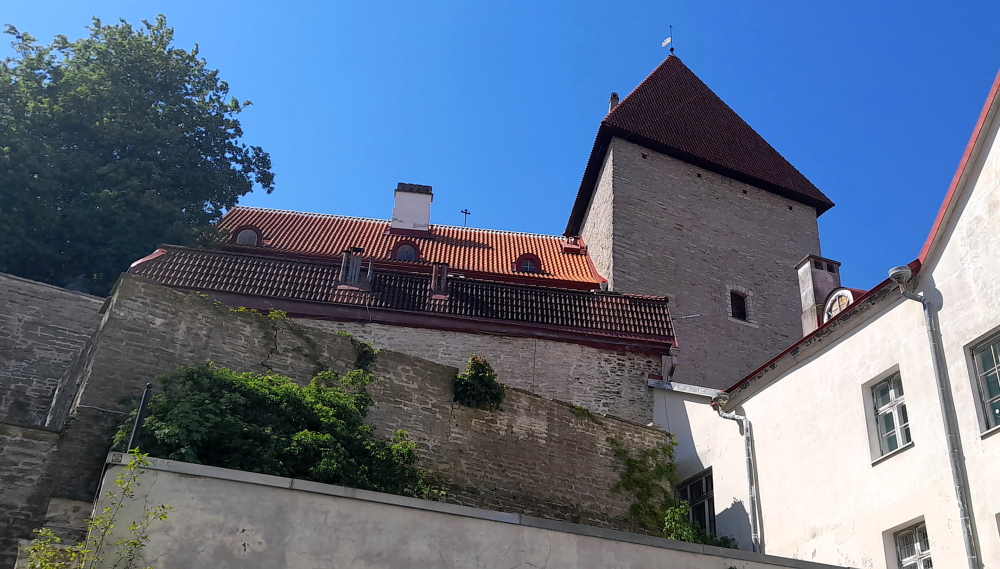
According to legend, this is the spot where, on 15 June 1219, the Danish flag, Dannebrog fell from the sky. During his crusade to Estonia, Danish King Valdemar II was close to losing the Lyndanise battle near present-day Tallinn, but suddenly a a red banner with a white cross fell from the heavens, the luck of Valdemar II immediately changed and he won the battle.
This alleged event was captured by Danish artist CA Lorentzen in his painting “Dannebrog falling from heaven during the Battle of Lindanise” (1809).
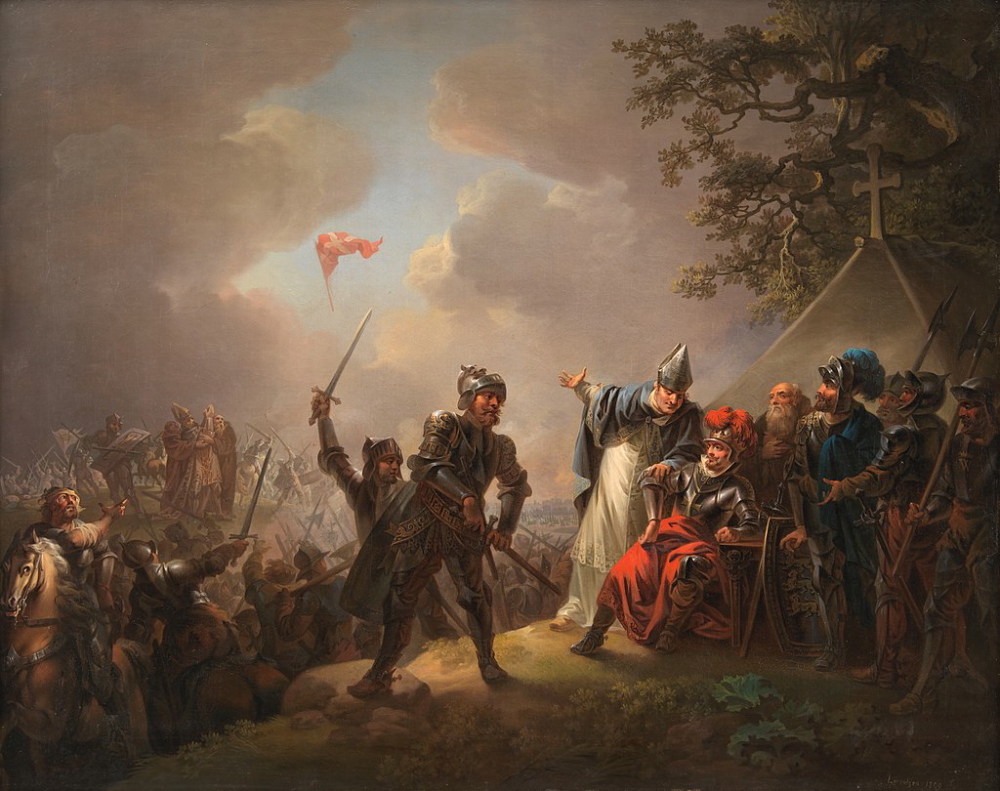
If the legend of how Dannebrog became the Danish national flag were true, it would make it the World’s oldest national flag still in use. The first factual proof that Dannebrog was used to represent the King of the Danes can be traced back to 14th century, as it was incorporated in the coat of arms of King Valdemar III [estland.um.dk].
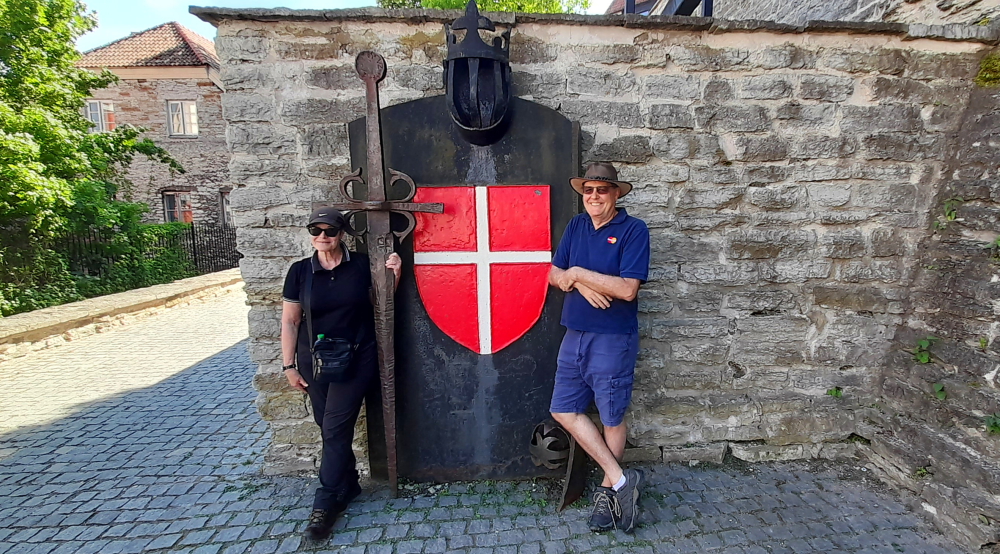
The word “Dannebrog” means “the cloth of the Danes”. The name of Tallinn is believed to derive from “Taani linn” (in Estonian “Danish Town”).
A couple more stairs and we arrive at the Maiden Tower (Neitsitorn), previously built as a defence tower in the 14th century and since an artist’s home and now part of the Kiek in de Kok Fortification Museum.
The museum complex is over 500 metres long that includes four towers: Kiek in de Kök (Peep in Kitchen Windows), Maiden’s Tower, Tallitorn Tower, and the Gate Tower of the Short Leg (Lühikese jala väravatorn).
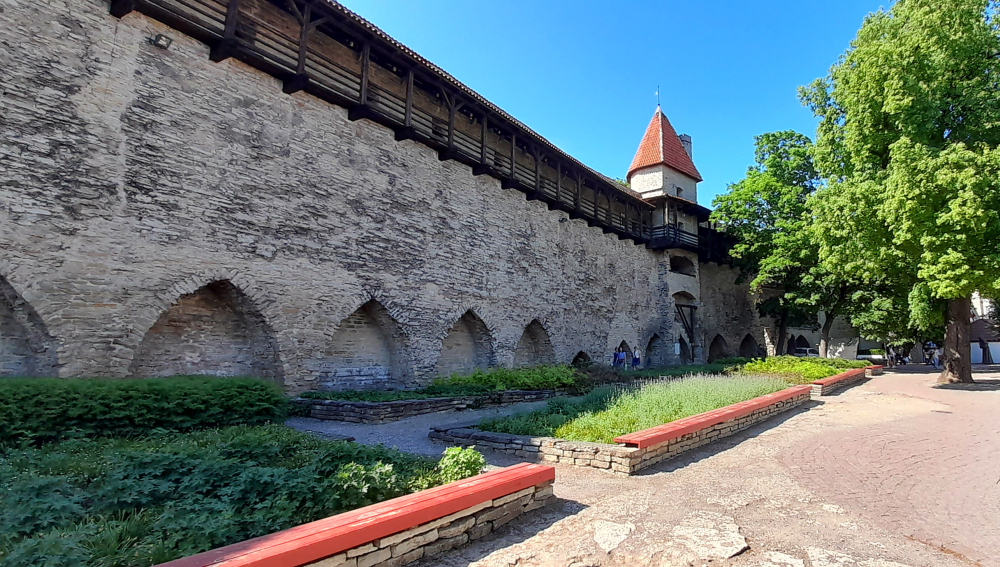
Here there are 3 more statues – each a faceless monk. They reference the stories and legends of the historically important courtyard. The work “Three” by Simson von Seakyll and Paul Mänd were executed in 2015. The bronze sculptures stand 2.5 metres tall and represent Ambrosius, the “Waiting Monk”, Bartholomeus, the “Praying Monk” and Claudius, the “Observing Monk”.
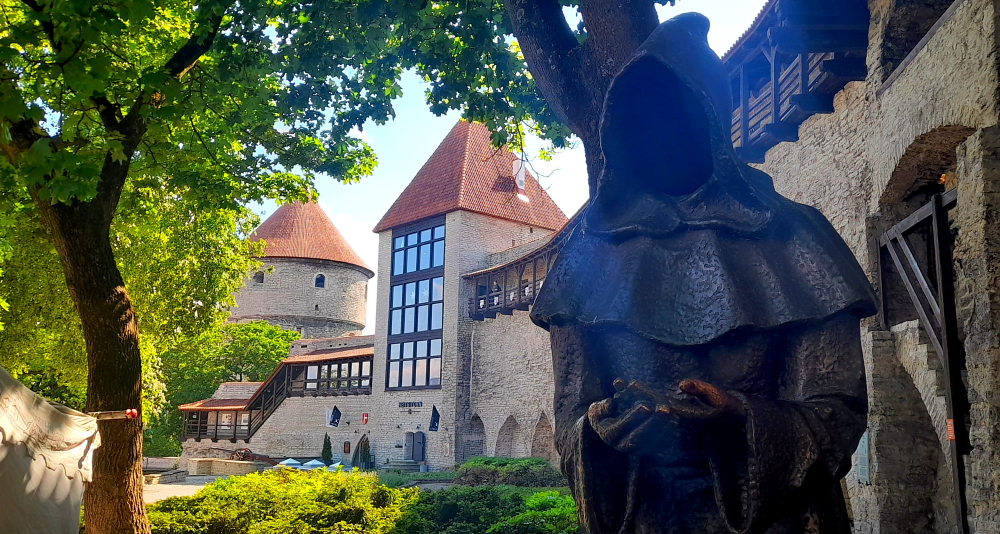
Through the base of the Gate Tower we climb the Short Leg to Lossi Plats and the Parliament Building (Riigikogu) which is situated in the courtyard of the Toompea Castle. The Riigikogu building stands on the foundations of the old convent building, built by the knights of the Order of the Brethren of the Sword who started to fortify Toompea in the beginning of the 13th century.
After World War I, the Empires of Russia and Austria-Hungary collapsed and several new states were founded in Europe with the Republic of Estonia being the first to build a new parliamentary building. The medieval convent building that had been burned down during the February Revolution in 1917 was chosen to be its site. Thus, in 1920–1922 the Riigikogu building, designed by architects Eugen Habermann and Herbert Johanson, was erected right in the heart of the ancient Toompea stronghold.
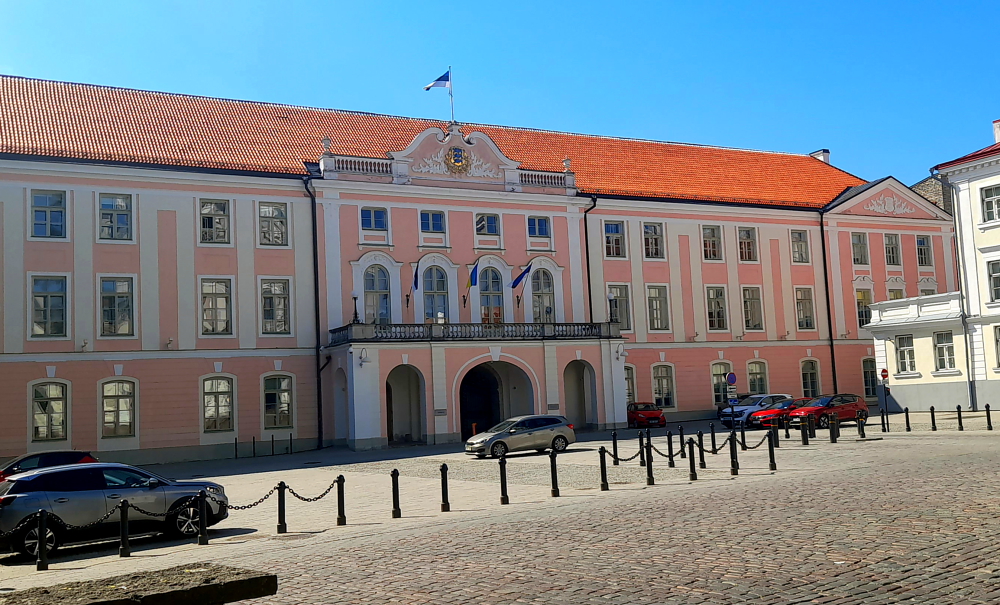
Originally the building was designed in Art Nouveau style, but in the course of construction it became Expressionist. As far as it is known, the only expressionist parliamentary building in the world. It was also the first public building in Estonia designed to have electric power [www.riigikogu.ee].
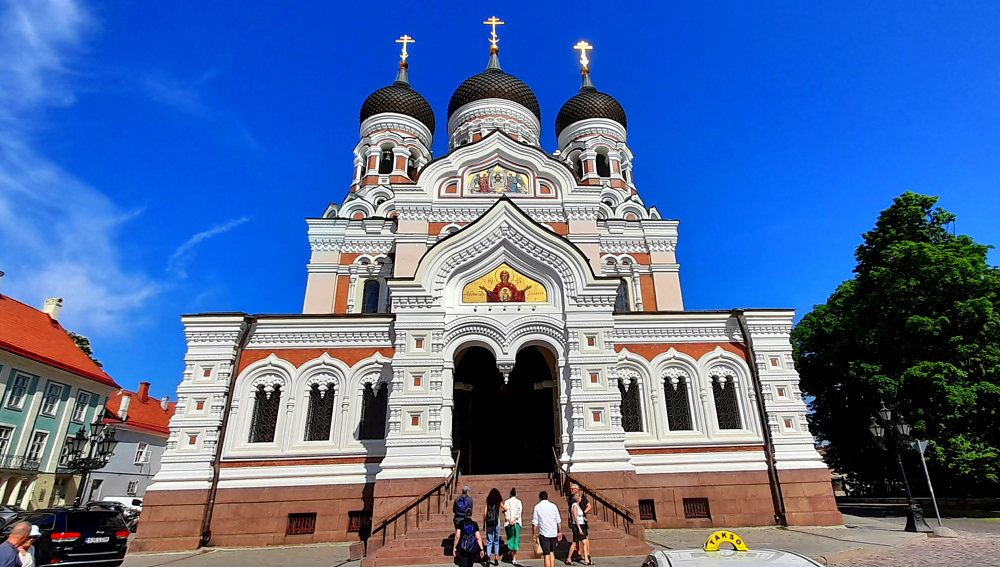
Opposite is the St Alexander Nevsky Cathedral. The large and richly decorated Russian Orthodox church was completed on Toompea Hill in 1900, when Estonia was part of the Czarist Empire. In its towers are
11 bells, including Tallinn’s largest bell weighing 15 tonnes. The church’s interior is decorated with mosaics and icons plus a cracked marble plaque which commemorated the visit by Czar Alexander II in July 1902.
We proceed along Toom-Kooli towards St Mary’s Cathedral, a medieval church with a Baroque bell tower.
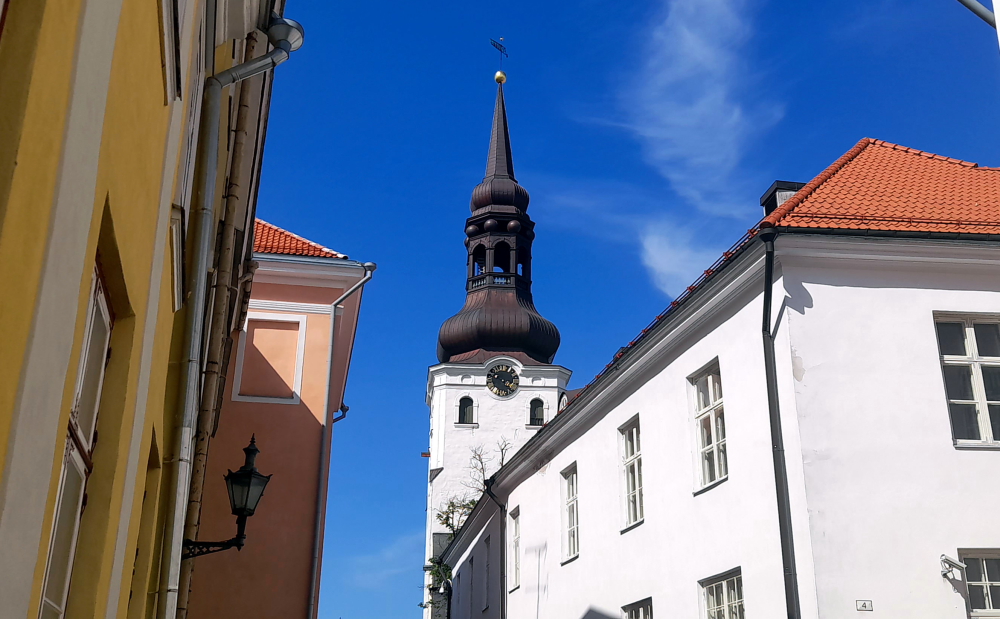
And arrive at our first viewing platform, Piiskopiaia vaateplats, the Bishop’s Garden, and an encounter with Steven Seagull.
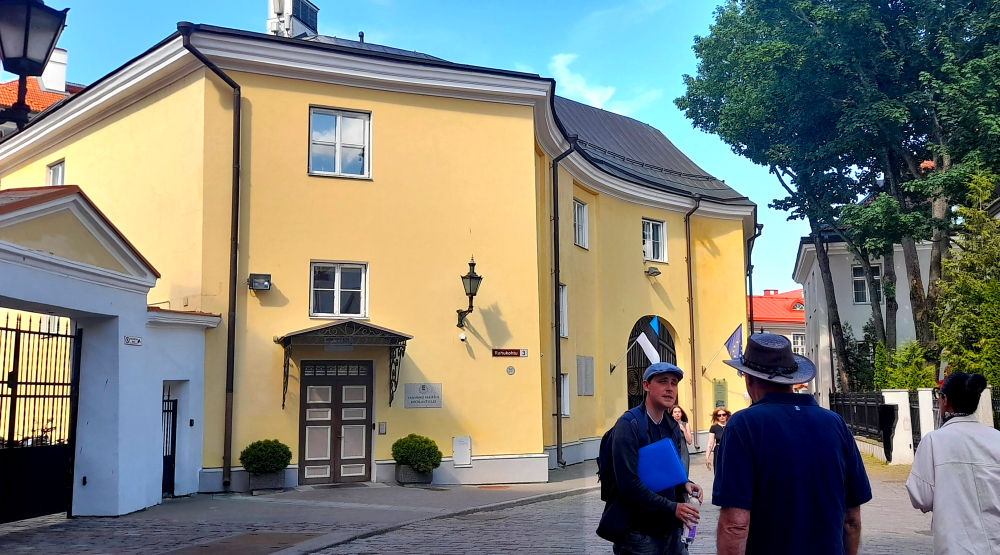
From here, along Rahukohtu we arrive at Stenbock House (Stenbocki Maja). Although the building complex here has changed owners and functions over the years, it has always been called Stenbock House in works of art as well as historical sources and scholarly studies.
The house was designed by architect Johann Caspahr Mohr for the courts of the province of Estonia but, when the house was finished in 1792, it became the town residence of Count Jakob Pontus Stenbock. After Stenbock’s death, the house was used for various purposes until it first became a courthouse in 1891 and was the seat of courts until 1987.
After that, the house stood empty until 1996, when works began to restore it into the seat of the Government of the Republic and the Government Office and where the Prime Minister works daily. The first Government session in Stenbock House was held on 8 August 2000 [riigikantselei.ee].
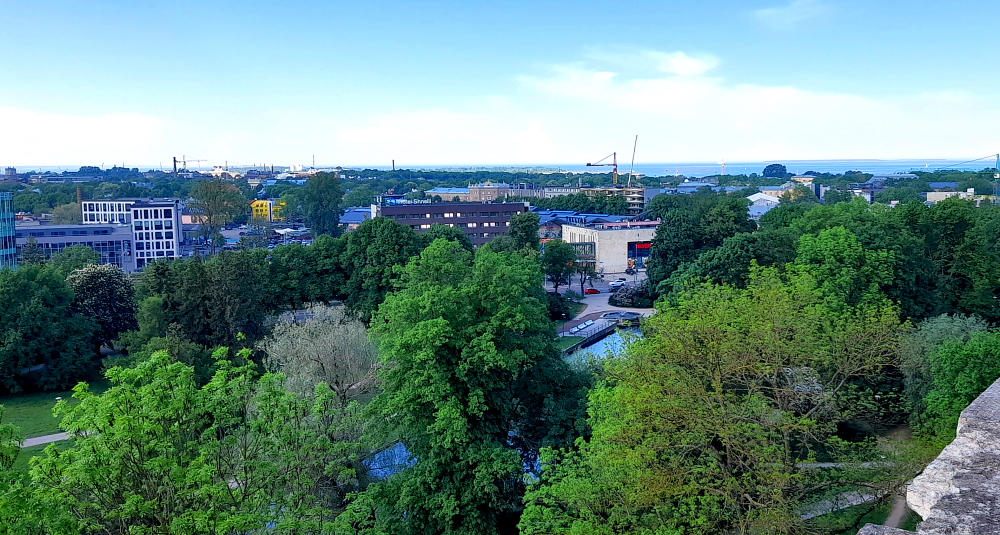
Patkuli viewing platform is the 2nd one we come to with view of St Olav’s Church spire and medieval city wall towers.
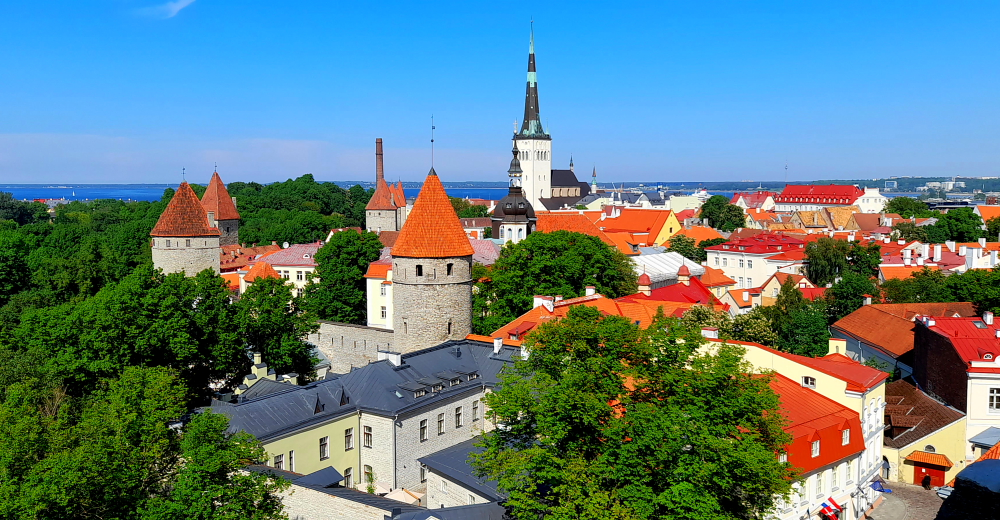
Our last viewing platform is Kohtuotsa where we see the St Nicholas Church tower once again.
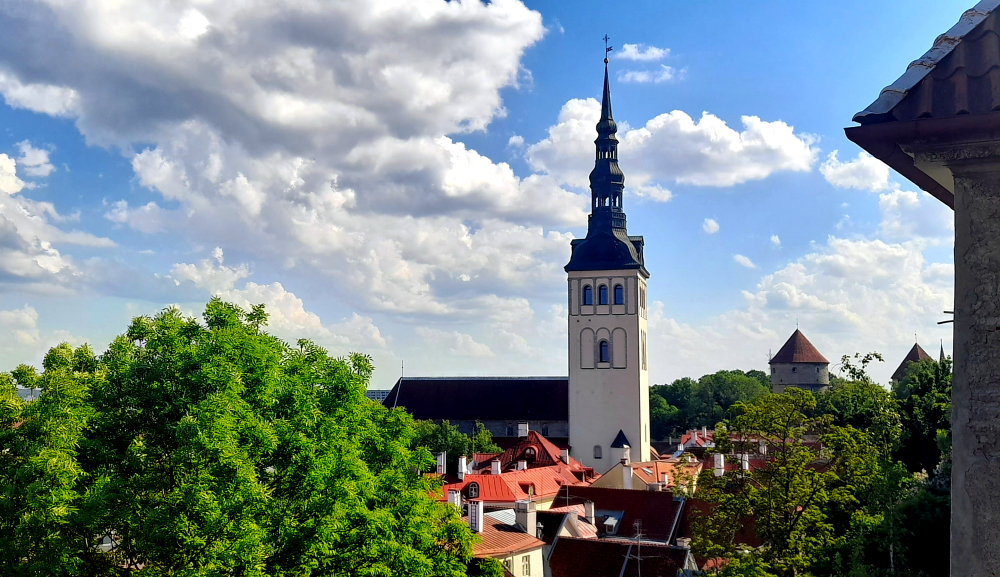
And another view of St Olav’s Church spire, Ferry Terminal D where we arrived yesterday, and the Baltic Sea beyond.
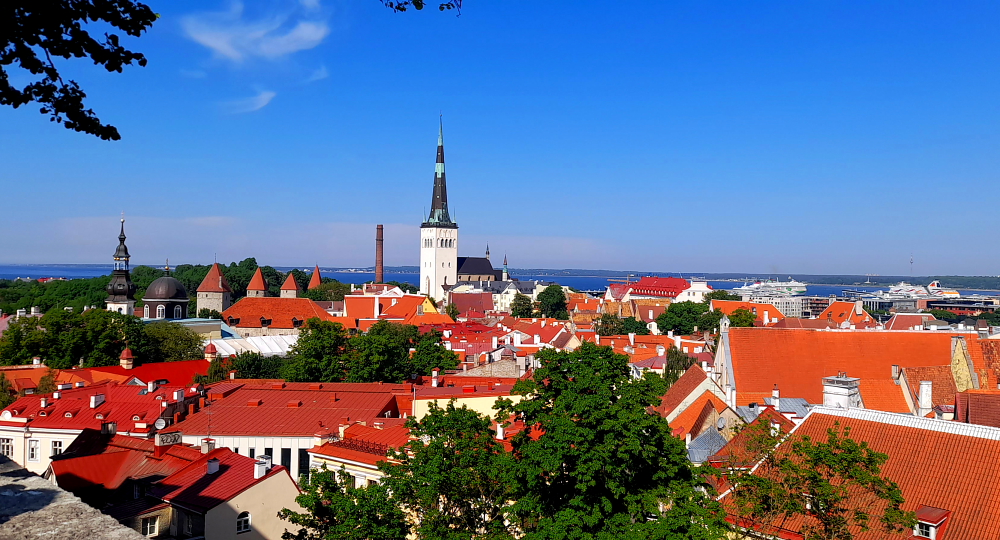
Plus a view of the Tallinn Town Hall and modern Tallinn.
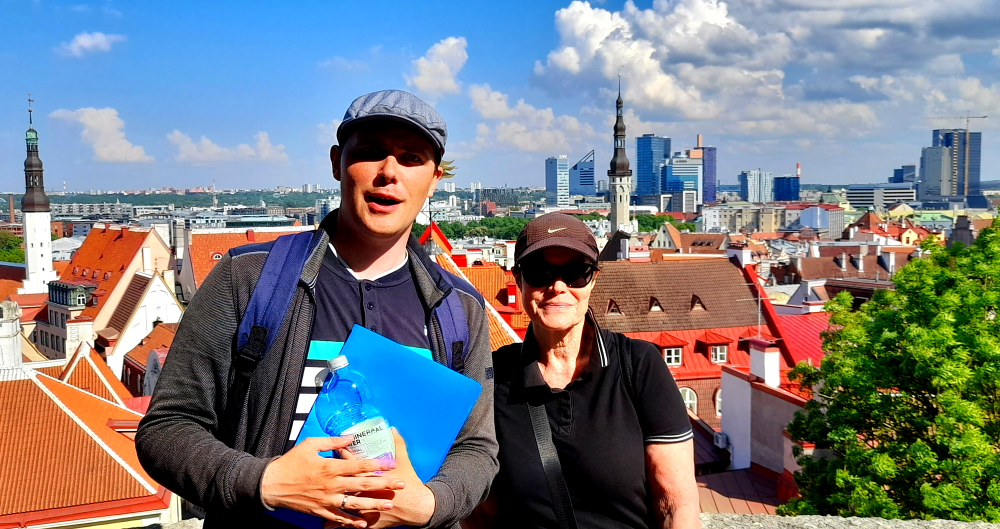
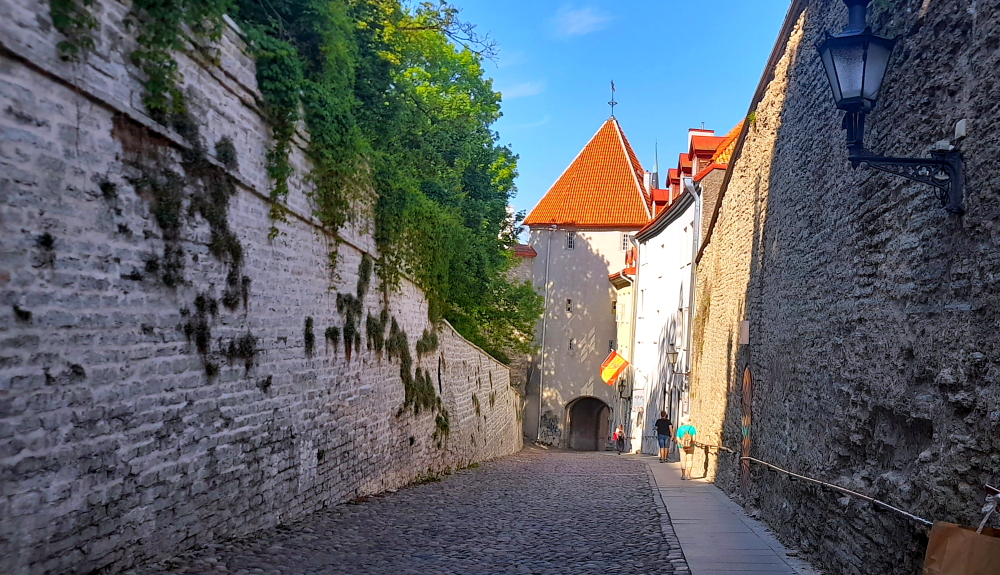
On the homeward stretch we walk down Pikk Jalg (Long Leg) and its Gate Tower.
Towards the end of Pikk is the Holy Spirit Church. Built in the 14th century with timber interior and a hexagonal tower, the white Church of the Holy Spirit is one of the oldest and finest structures in Tallinn. On its facade is a clock that has been measuring time since the 17th century.
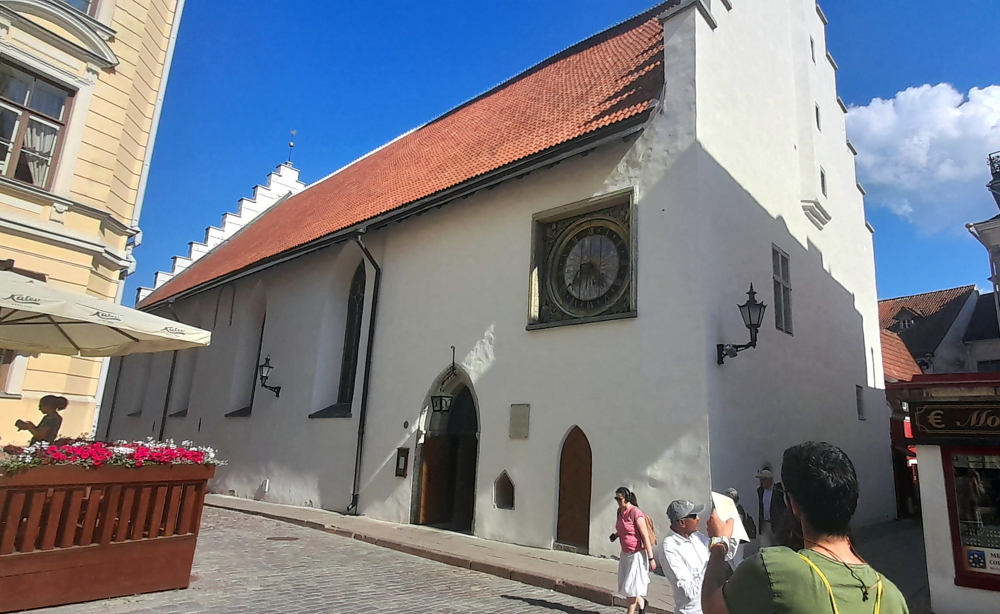
The treasures inside include a unique altar created by Berndt Notke in the 15th century and the pulpit built in 1597. In medieval times, it was the main sanctuary for commoners. After the Reformation, the first Estonian sermons instead of German ones were held here, and Johann Koell’s Catechism, written by the pastor of the church and published in 1535, is considered the first book in Estonian [visittallinn.ee].
Which brings us to our final destination, some 2.5 hours later, Town Hall Square (Raekoja plats) and the Gothic Town Hall itself, the oldest surviving town hall in Northern Europe. First mentioned in 1322, the building history of the Town Hall goes back to the 13th century. The management of the city worked in this building until 1970. Today it functions as the ceremonial building of the city government.
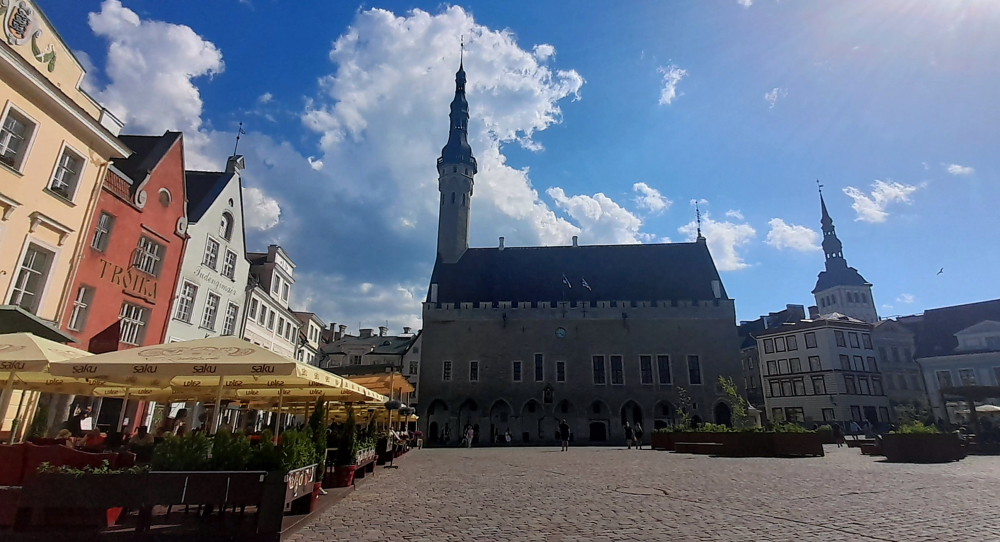
The Square itself has been a marketplace and the centre of this old Hanseatic town since the Middle Ages. It became the centre of the Lower Town at the turn of the 13th and 14th centuries.
In summer it’s filled with outdoor cafes, it plays host to the Old Town Days and other medieval festivals, and is also a venue for open-air concerts, fairs, and more. In winter it becomes a Christmas market, the centrepiece of which is a towering spruce tree. The tradition of celebrating Christmas festivities here dates back to 1441 when the Brotherhood of the Blackheads are thought to have erected the world’s very first Christmas tree.
(Historically, the Brotherhood was a professional association of ship owners, merchants and foreigners dating from the 14th century. They were active in Livonia (present-day Estonia and Latvia) but fled to Germany during the Soviet occupation of the Baltic States in 1940.)
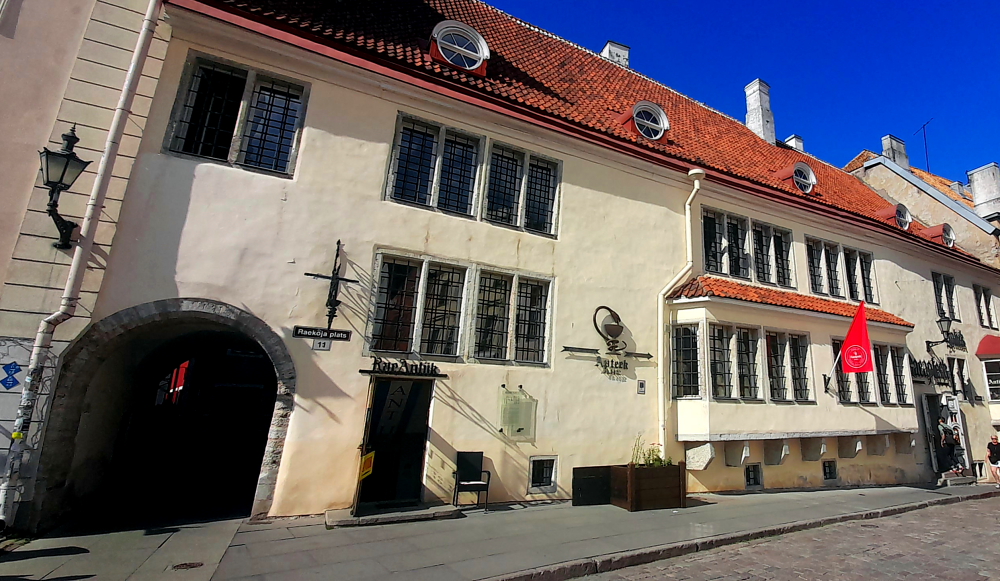
Also on the Square is the Town Hall Pharmacy (Revali Raeapteek), dating from 1422 and still in use, with a small museum of medicinal remedies.
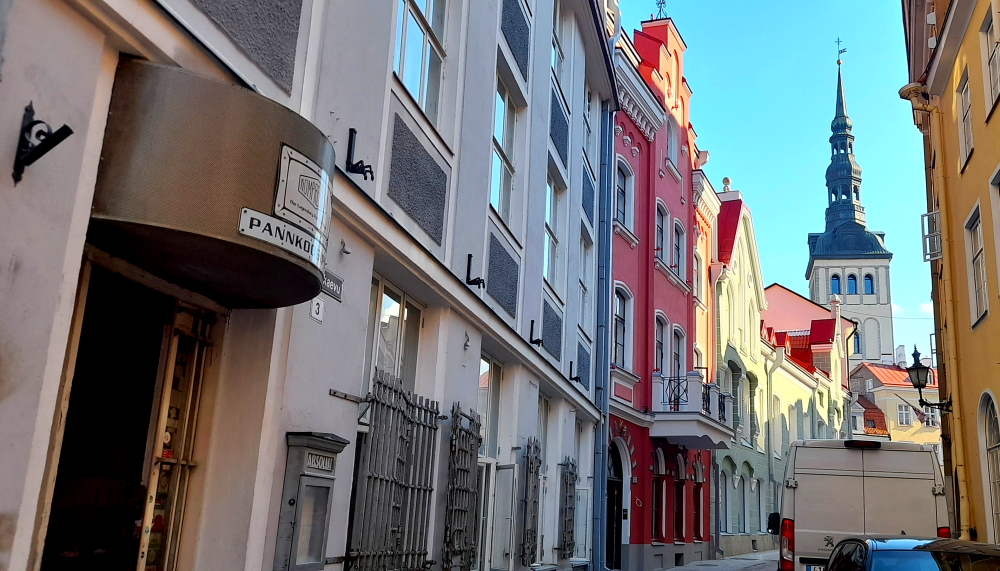
One of Gleb’s restaurant recommendations is Kompressor – a pancake pub (Pannkoogirestoran). As it’s been quite warm walking around under the sun (27 Deg. c) we want to opt for something light so we head to Rataskaevu 3.
It’s quite basic, except for the large screen TV on the wall and at 6:00 pm there are only a couple of tables that are occupied.
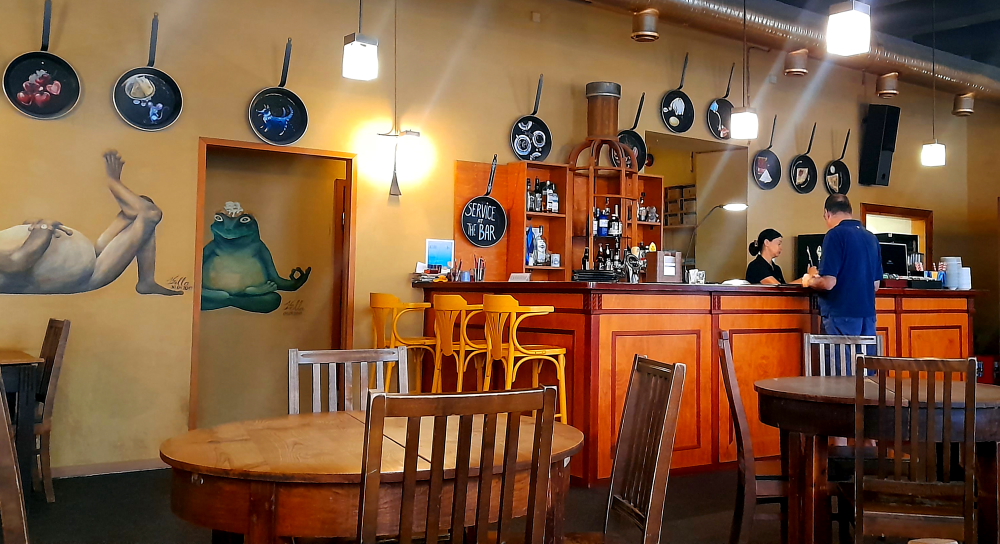
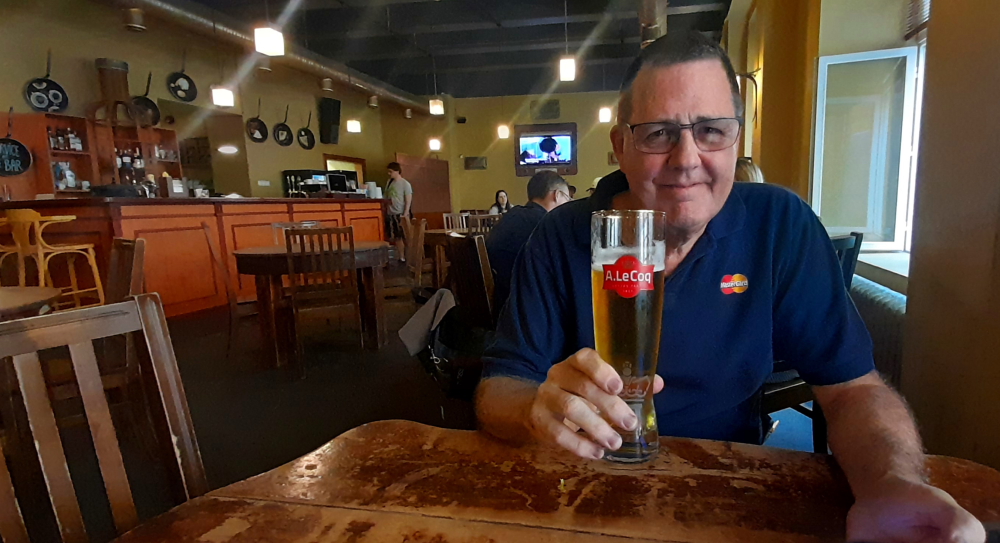
We order a ham and cheese pancake followed by a caramelised apple pancake with apple sorbet, both to share and both delicious. Good call as we are both stuffed by the time we finish. I also order a local beer – A.LeCoq – which turns out to be rather nice.
6 minutes later we are home again where we finish off a can of nicely-chilled ‘Original’.
The room is quite warm when we hit the sack so we leave the fan running. Trouble is, the fan is on the windowsill on my side of the bed and its hum keeps me awake, so I turn it off. Not long after Lynn wakes all hot and bothered and demands that the fan is turned back on and moves it to the far end of the room. Consequently, I get very little sleep. So much for a 5-star hotel.
31 May, 2024
Although the alarm doesn’t go off until 8:30 am I’m like a bear with a sore head – very grumpy. I ask the receptionist again if anything can be done about the lack of air conditioning in our room. She’s going to call a guy.
In the meantime we walk 7 minutes to the nearest Rimi supermarket for some supplies then after dropping them off at the hotel we head out to the Balti Jaam market which is adjacent to the Tallinn Railway Station, a 15-minute walk away. Between ‘balti’ (Baltic) and ‘hindu’ (prices) anyone would think we were in India!
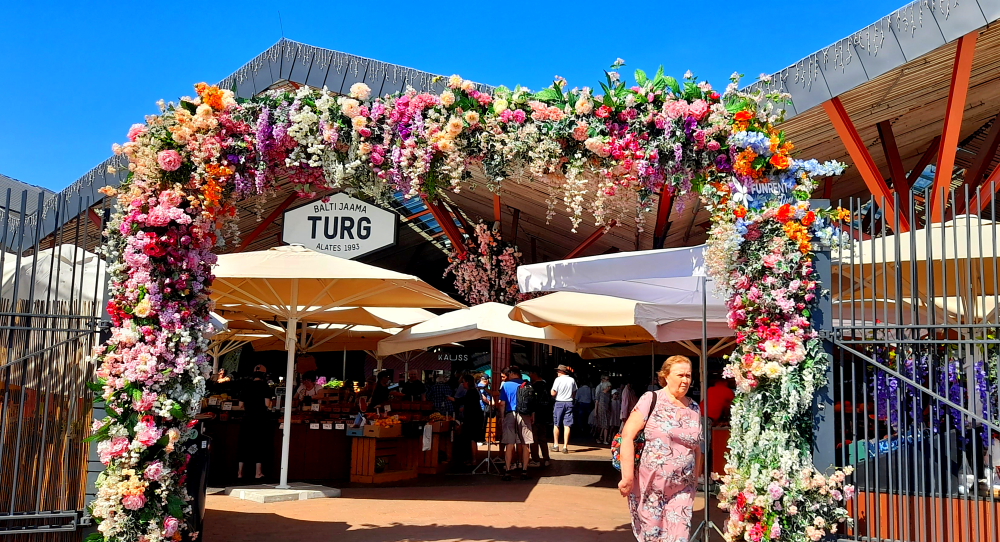
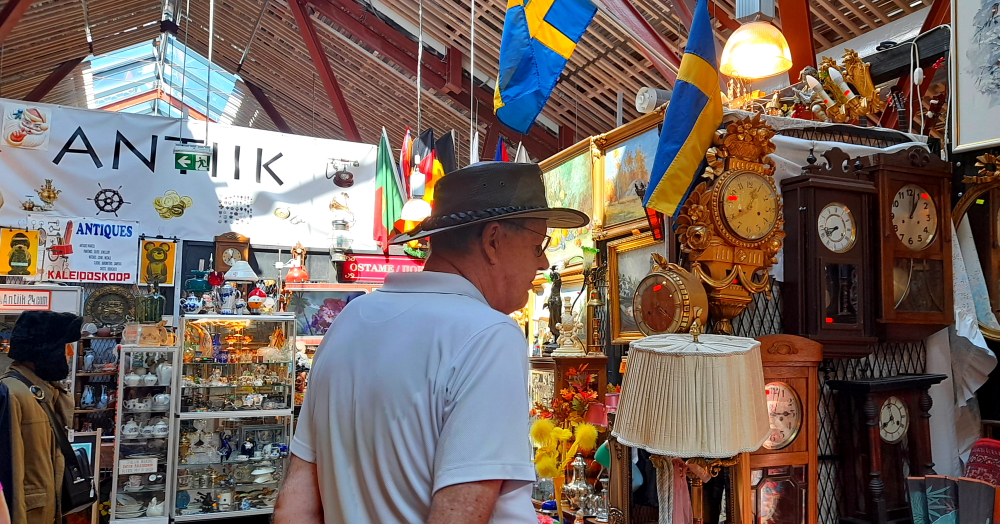
It’s a unique market in Estonia, which includes nearly 300 traders on 3 floors. On the underground floor there is a supermarket, a sports club, and various services. On the ground floor, a large hall for fish and meat, a street for vegetables, and a versatile street food area with nearly 20 dining options. The 1st floor is mainly devoted to Estonian design and crafts, clothing, household goods, and antiques.
And it is the 1st floor that I’m interested in, to see what Soviet-era trinkets might be for sale. There are lots – posters, books, busts of Lenin and Stalin, Soviet uniforms, equipment, medals, coins – not to mention a not-so-healthy dose of Nazi paraphenalia.
On our way back we call into a gelateria for a scoop each for lunch. When we enter our room we find the fan has been moved and it’s running (we’d turned it off before we left) which seems to indicate that the air con guy may have already called by.
A visit to the receptionist confirms this and that there is nothing that the guy can do. I ask her whether there is another room we can move to where the A/C is working. I inspect one located on the other side of the building (away from the afternoon sun) but it is a smaller room and marginally cooler. I’ll just have to bite the bullet for another 2 nights, I guess. It is not going to be a very good hotel review when we go.
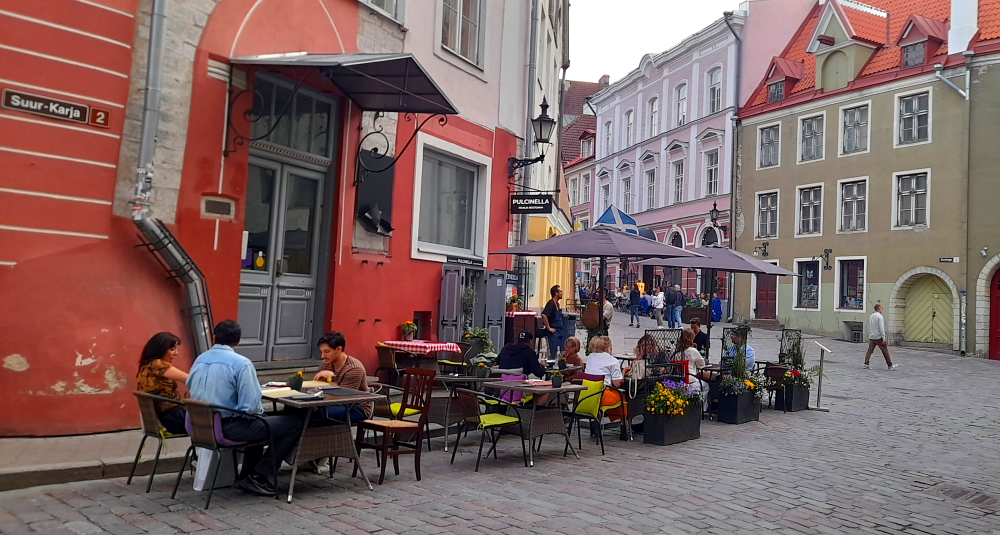
The afternoon is spent with Lynn catching up the blog for the past couple of days, a brief storm, and us ducking out around 6:30 pm to our local Italian, a very busy “Pulcinella”, for an excellent meal.
We’ll see who wins the ‘Battle of the Fan’ tonight! Actually, I take Lynn’s advice and use ear plugs.
1 June, 2024
A slightly cooler day today (22 vs yesterday’s 24) with afternoon storms predicted. Today we’ll visit/revisit sites around town.
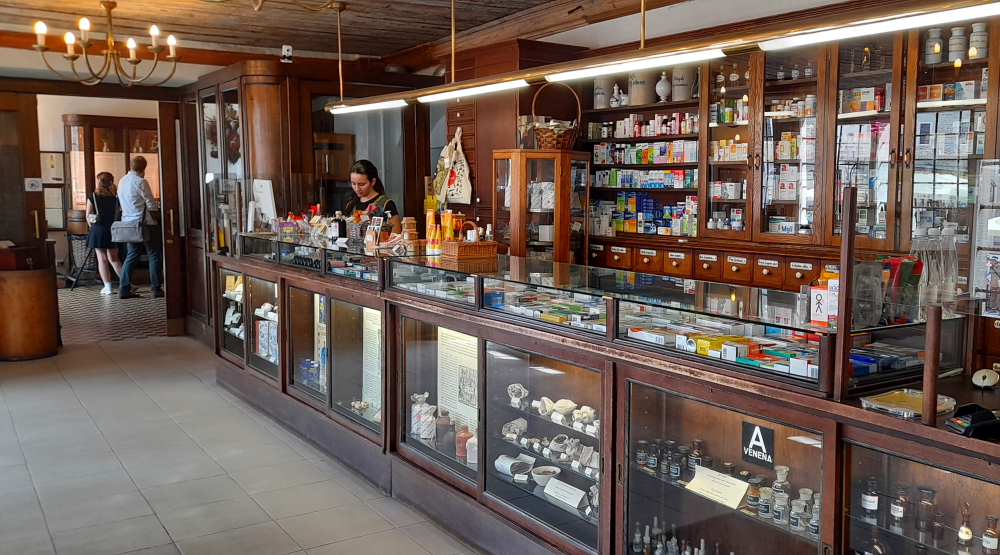
Our first port of call is the Tallinn Town Hall Pharmacy, the oldest pharmacy in Europe that has continually operated on the same premises.
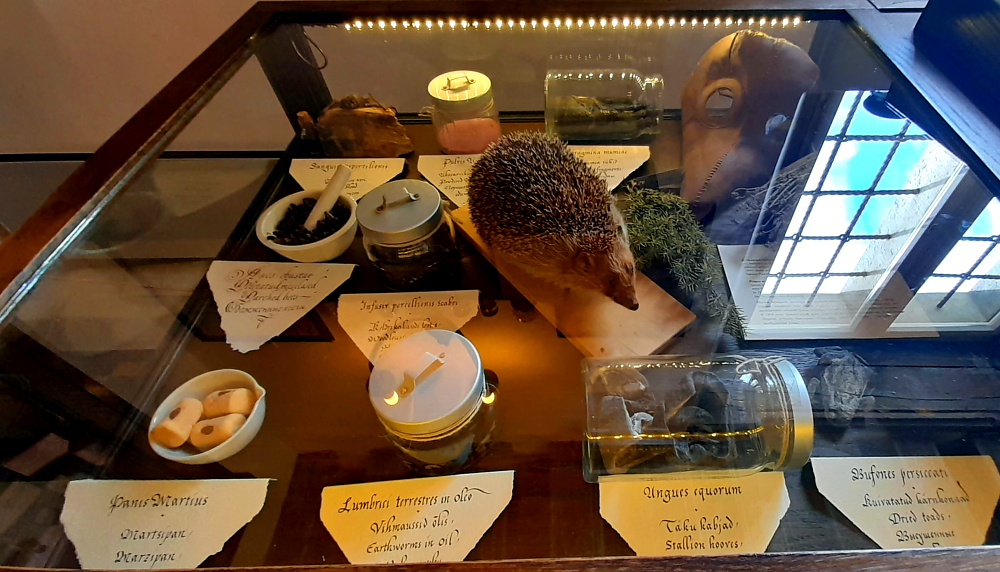
It was first mentioned in town records in 1422. During the long history of the town hall pharmacy, many men have been pharmacists here. A special honour belongs to the Burchart family, who worked in the pharmacy for as many as 10 generations.
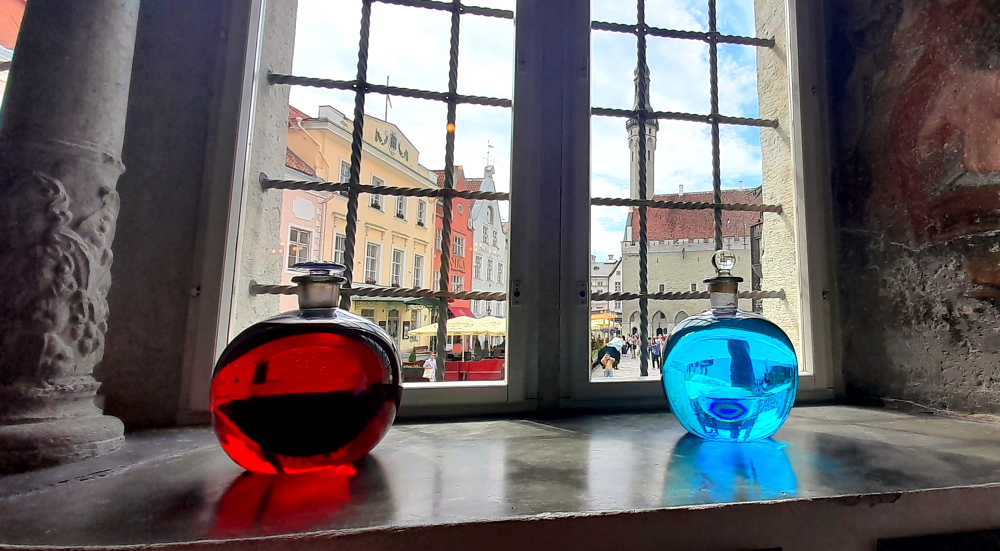
Today, there is a small museum next to the pharmacy.
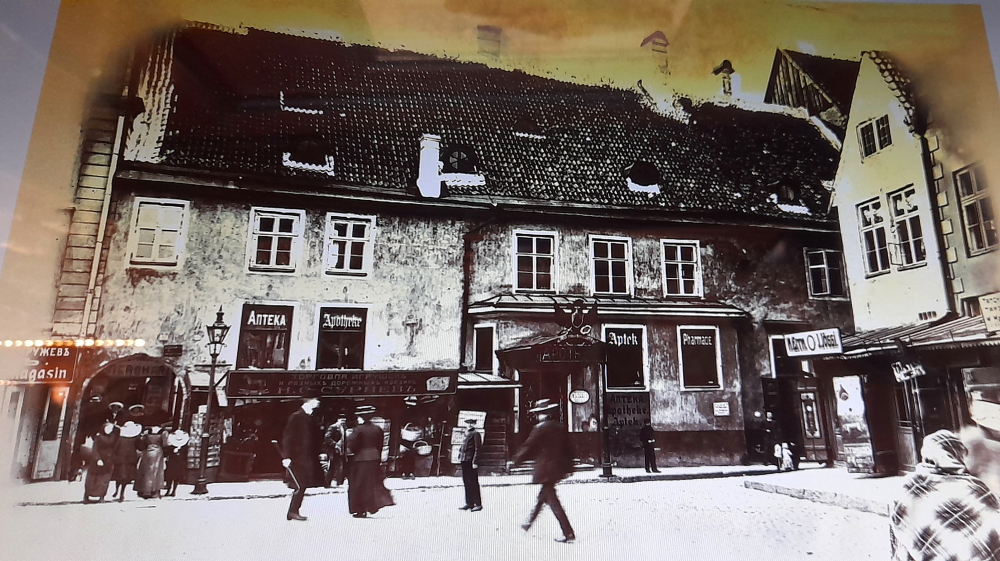
We walk through the archway next to the Pharmacy along Borsi Kaik to Pikk 17 which is the Great Guild Hall. The Great Guild was an organisation for major merchants and dealt with international trade and had an official building built in 1407-17. The hatch doors next to the archway opened to the popular wine cellar “Sweet Pit”. in the 19th century the Great Guild carried out the tasks of the stock market [visitestonia.com].
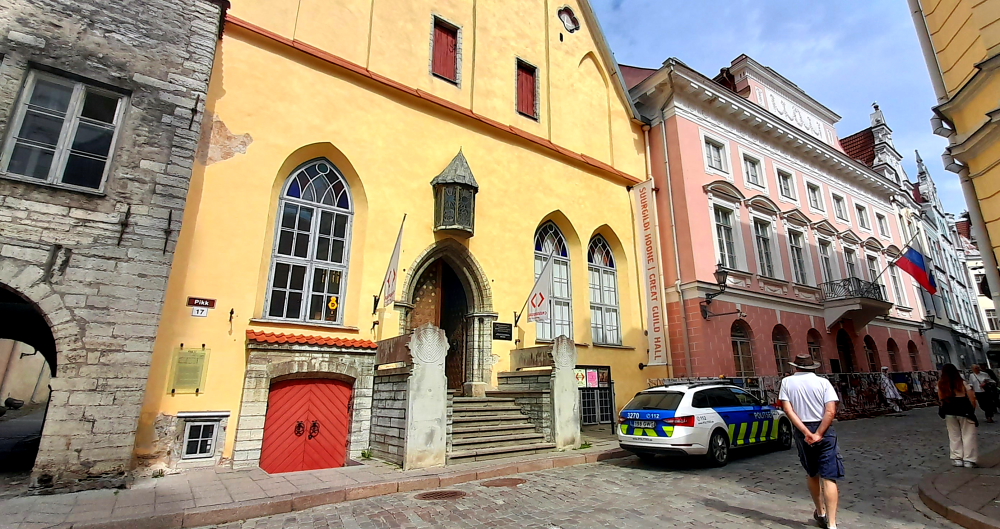
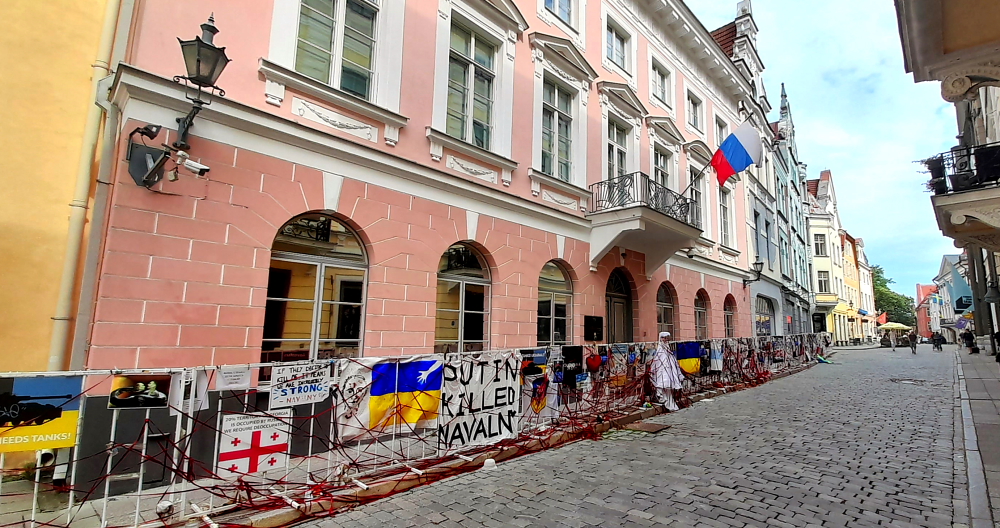
The Estonian History Museum has been situated here since 1952 – which is interesting as right next door is the Russian Embassy which today is effectively fenced off with a barricade decorated with protest material.
From here we walk through the archway and continue along Borsi Kaik to Lai where we walk northwards to the St Olaf’s Church. En route Lynn espies some tiny Faberge Egg pendants so she purchases one.
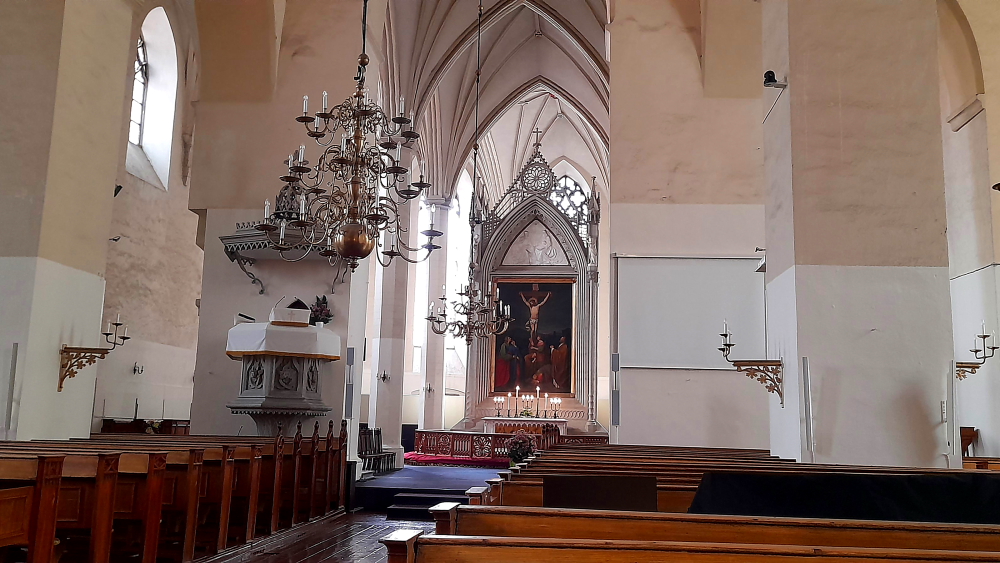
St Olaf’s Church is the largest medieval building in Tallinn, offering stunning views of the historic Old Town from its 60-metre-high viewing platform. First mentioned in 1267, the church was named after the sainted Norwegian king Olav II Haraldsson. The church’s prominent spire now stands at 123 metres, but in the 15th century, it reached an astonishing height of 159 metres, making St Olaf’s Church one of the tallest structures in medieval Europe.
Lightning is known to have struck the church tower at least a dozen times, 3 of which led to extensive fires – in 1625, 1820, and 1931 [visitestonia.com].
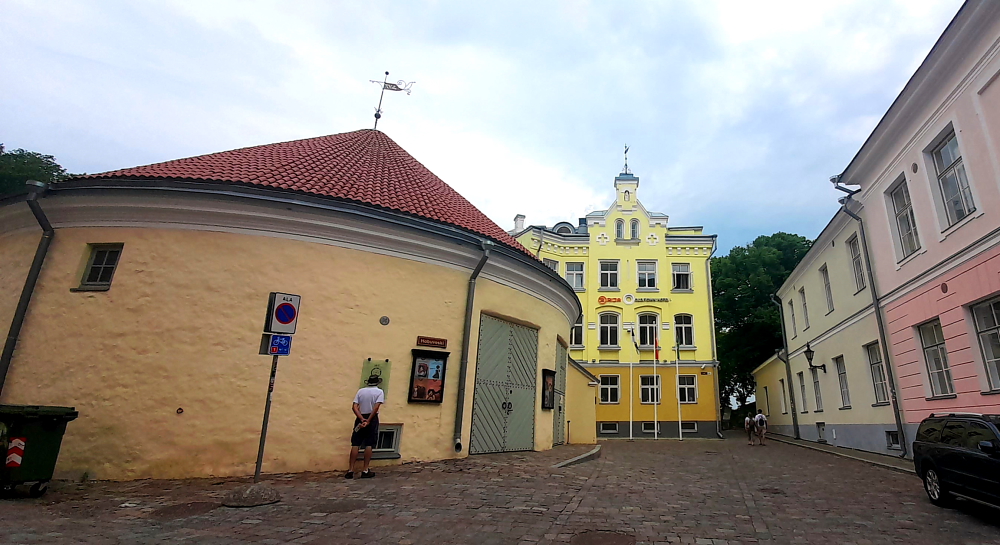
To the right of the church is the circular Horse Mill Museum (Hobuveski). This limestone building with a round floor plan and a basement has a diameter of 16 metres. Hobuveski, dating from 1379, was originally used for milling flour when the city was under siege or when watermills could not be used due to lack of water. The mill mechanism was operated by 8 horses that turned it inside the building. Today, the mill is also a venue for theatrical performances, events, presentations, and mediaeval evenings for up to 140 people [visittallinn.ee].
Walking through the gap to the right of the Rija Old Town Hotel we find ourselves outside of the city wall. Skirting along to the right we arrive at the Great Coastal Gate (Suui Rannavarav).
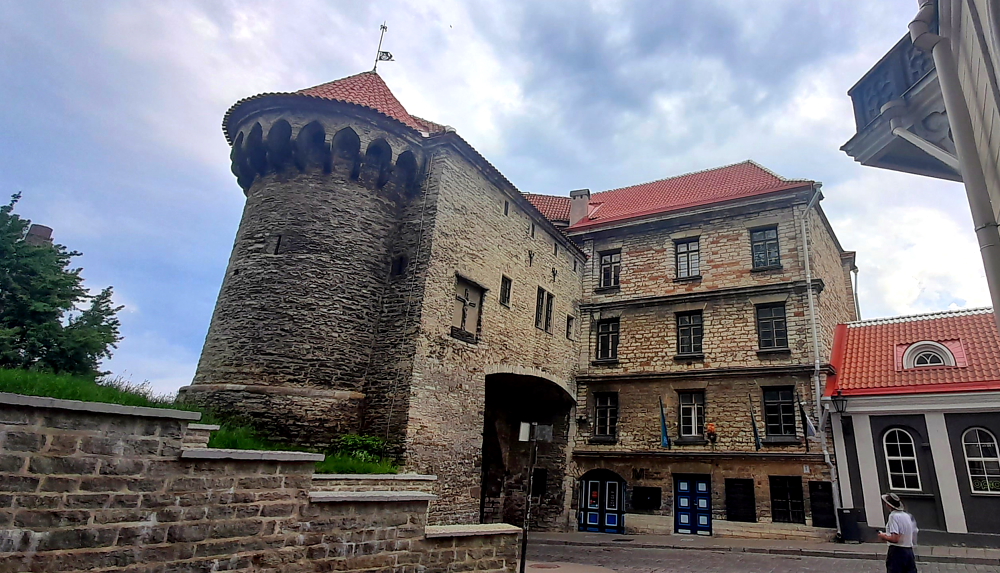
The Great Coastal Gate is first mentioned in 1359 with sources initially referring to it as “Strandporte” and since 1384 as “major Strandporte”. During the construction works, 1510-1531, the coastal gate received an addition of a new barbican and a western tower, called “Fat Margaret (Paks Margareeta). The building complex was established mainly to protect the harbour, and its exterior appearance was meant to give an imposing effect.
The harbour was just outside the gate when it was constructed but these days the water is some 500 meters away. Perhaps they had global warming when the Fat Margaret was built and the water will be back in a few years?
In the 19th century, Fat Margaret was repurposed as a prison. During the February Revolution of 1917, the prison was torched and the whole complex was left in ruins.
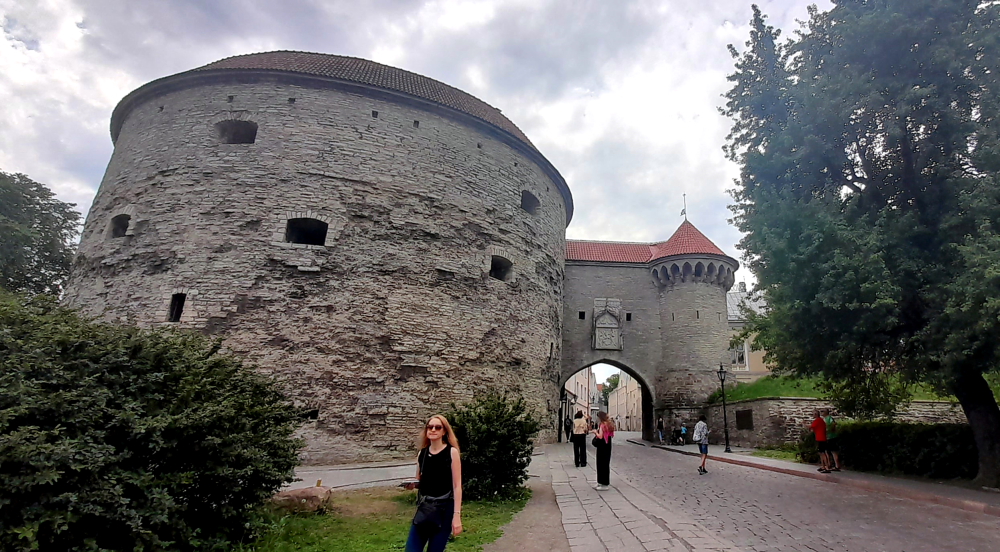
In 1938–1940, the prison outbuilding and the barbican building were reconstructed as the City Museum premises. In 1978–1981, the whole remaining complex was reconstructed for the use of Maritime Museum [meremuuseum.ee].
Walking through the Gate and back up Pikk we come to “The Three Sisters” – 3 medieval merchant houses which during a 2001-2003 reconstruction were combined into 1 boutique hotel.
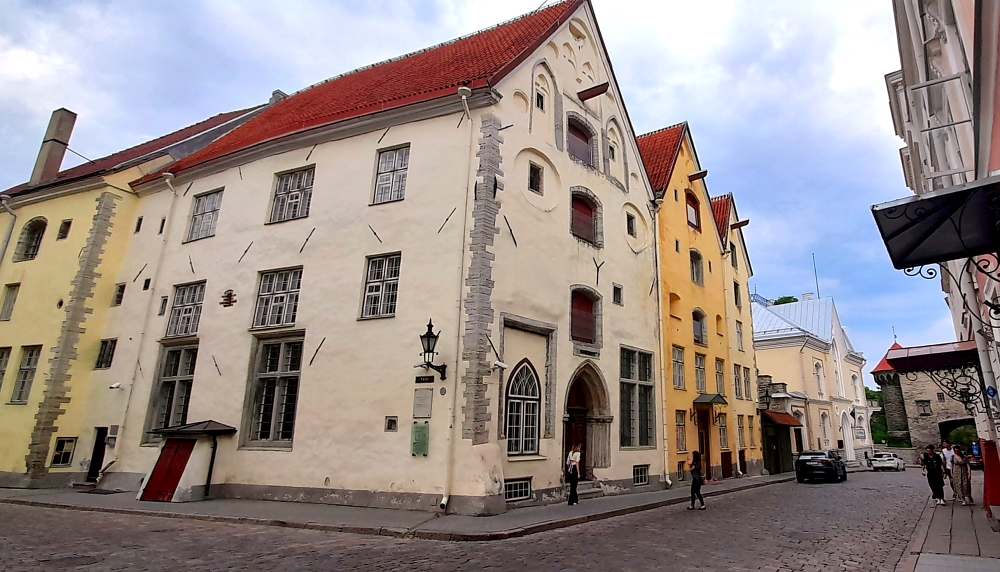
Situated at the crossing of the Pikk and Tolli streets, in the northern part of the old city of Tallinn, the 3 tightly-knit buildings known as the Three Sisters are of great historical and architectural value.The origins of these merchants’ houses date back to the Middle Ages and the earliest written documentation to the 14th century, when in 1372, Richard and Johannes Ryke (from the Dutch Ryk = rich) were recorded as the owners of the buildings on the site. Thereafter, the buildings drifted into the possession of different owners until in 1649 the entire complex again had a single owner. Although belonging to one “family”, the Three Sisters are quite different from one another architecturally [schuurmanarchitects.com].
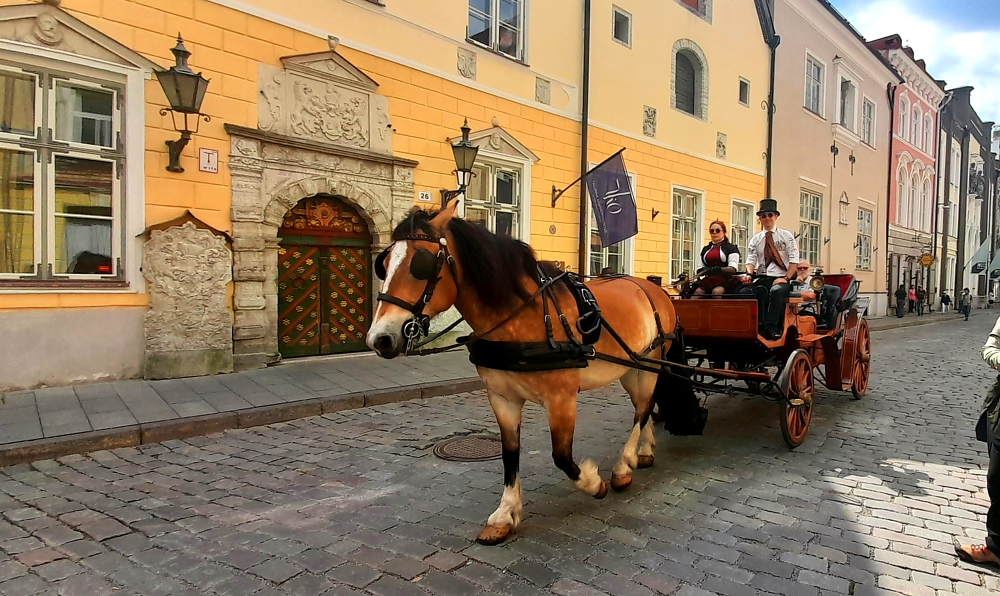
House of the Blackheads is one of the oldest and most renowned building complexes in Tallinn’s Old Town. The most unique rooms are the White Hall (1532), which is the first venue in Renaissance style in Tallinn, and the St. Olaf’s Guild Hall (1422), built in the late Gothic style.
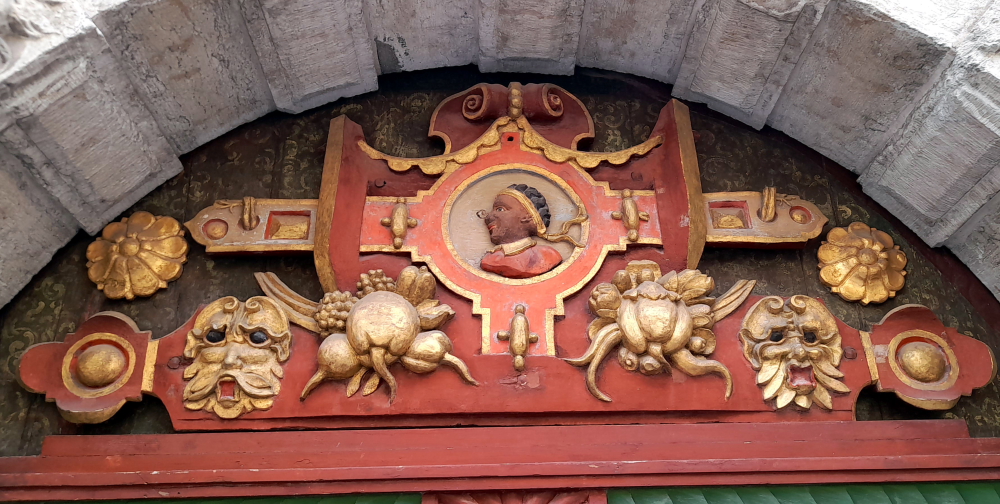
Today, the former merchant guildhall, located in the historic gathering place of Tallinn’s former merchants and craftsmen’s associations, is now a venue for classical & jazz concerts in its grand ballrooms [visittallinn.ee].
We return to the square in front of the Holy Spirit Church. There we hear a young busker playing, of all tunes, “Waltzing Matilda”, (perhaps in response to seeing my hat??) on an extraordinary-looking instrument which sounds very much like a violin. Turns out it is a nyckelharpa of Swedish origin.
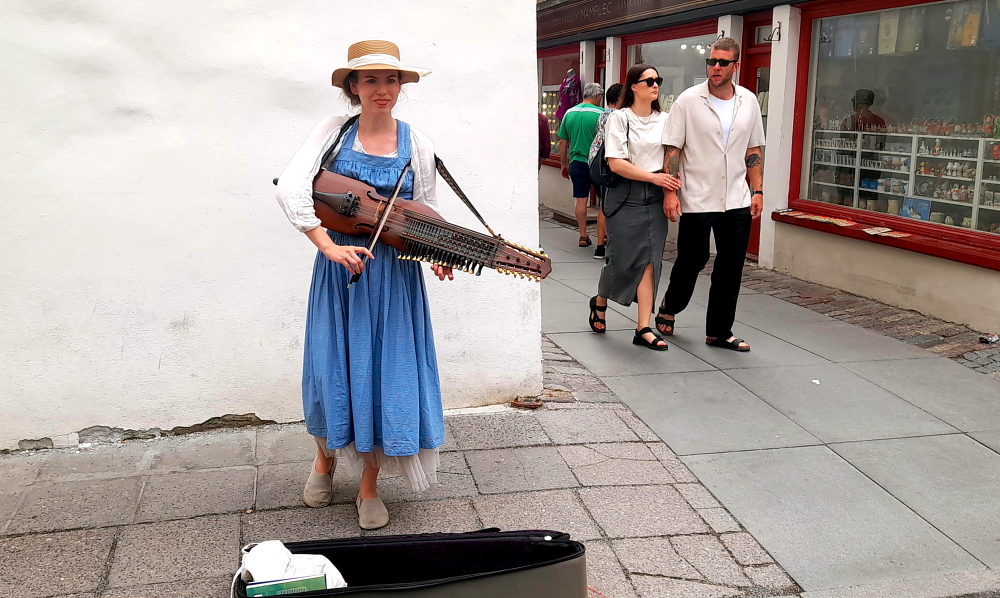
Meaning “keyed fiddle” or “key harp” it’s a bowed chordophone, similar in appearance to a fiddle or violin but larger (in its earlier forms essentially a modified vielle), which employs key-actuated tangents along the neck to change the pitch during play, much like a hurdy-gurdy.
The origin of the instrument is unknown, but many of the early historical depictions of the instrument are found in Sweden, the earliest found on a relief located on a 14th century church portal [Wikipedia].
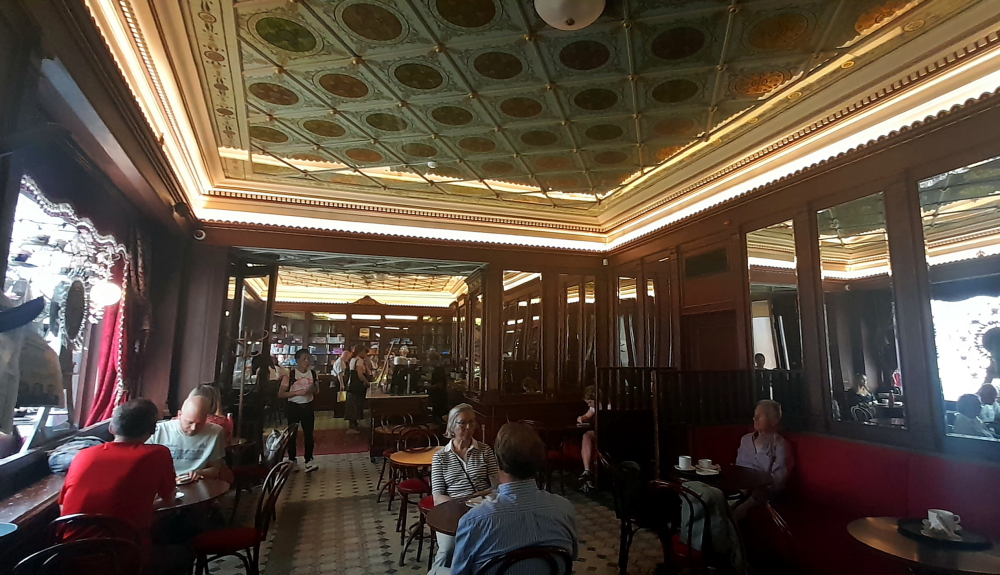
The reason we are here is to visit Cafe Maiasmokk, one of the oldest cafés in Tallinn, which has been continuously operating since 1864. The cafe is unique due to its interior which has remained practically unchanged for more than 100 years.
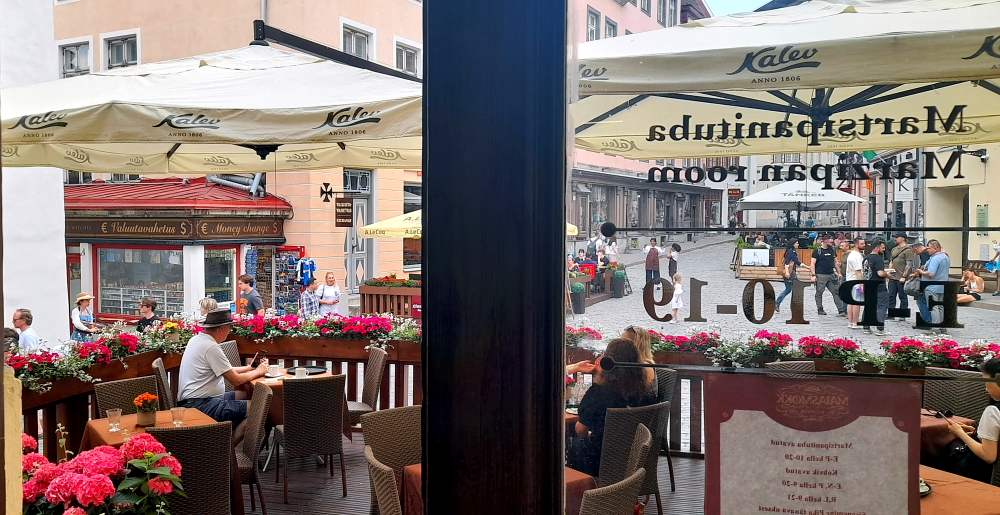
There is also the Kalev Marzipan Room on the premises of the café with an exhibition of marzipan figures, marzipan painting and marzipan goodies to buy [visitestonia.com].
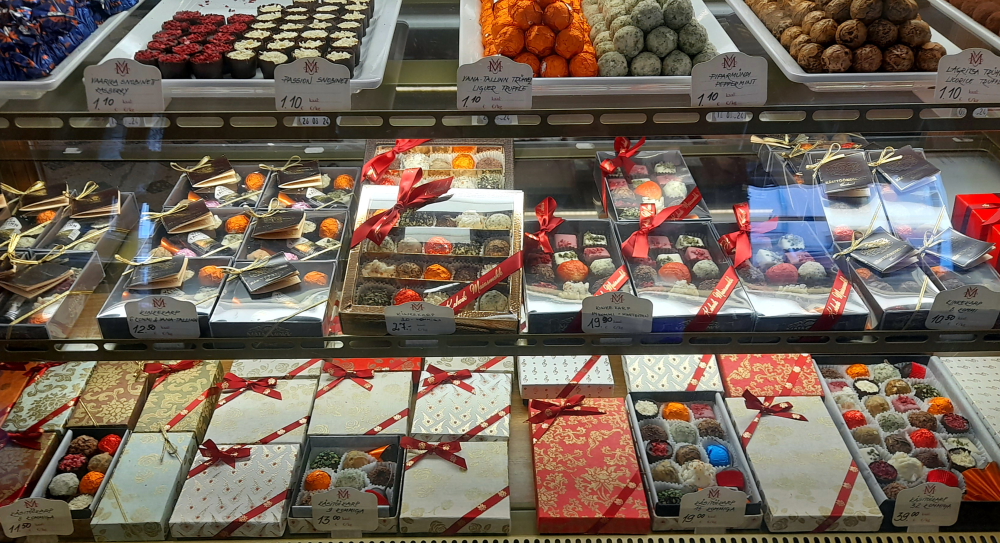
Our coffee drinking is curtailed thanks to the continued rumbling of thunder so we beat a retreat to the hotel. Just as we get there the sun comes out again so we walk up Muurivahe which is the street to the left of the Soprus Cinema building.
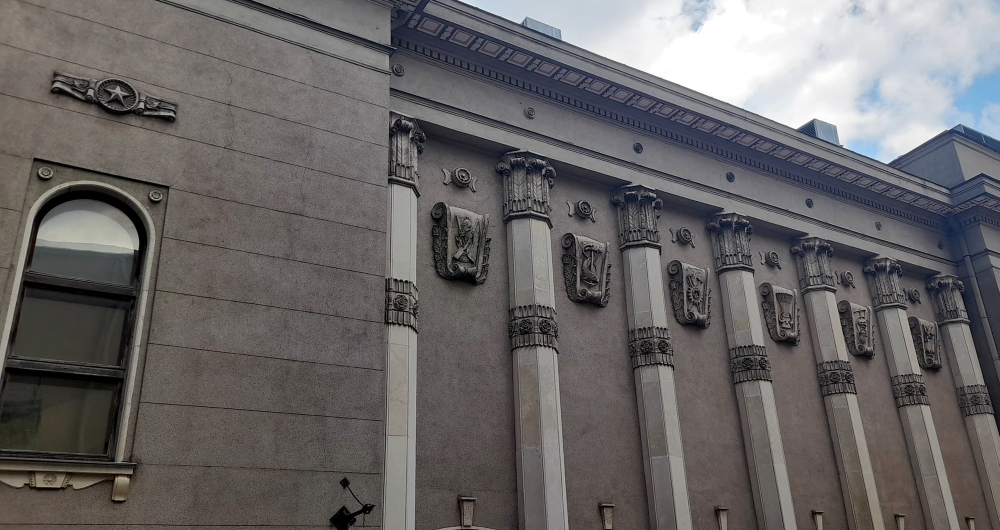
Here we get a different view of the building’s decoration, lots of stars and coats of arms-type adornments.
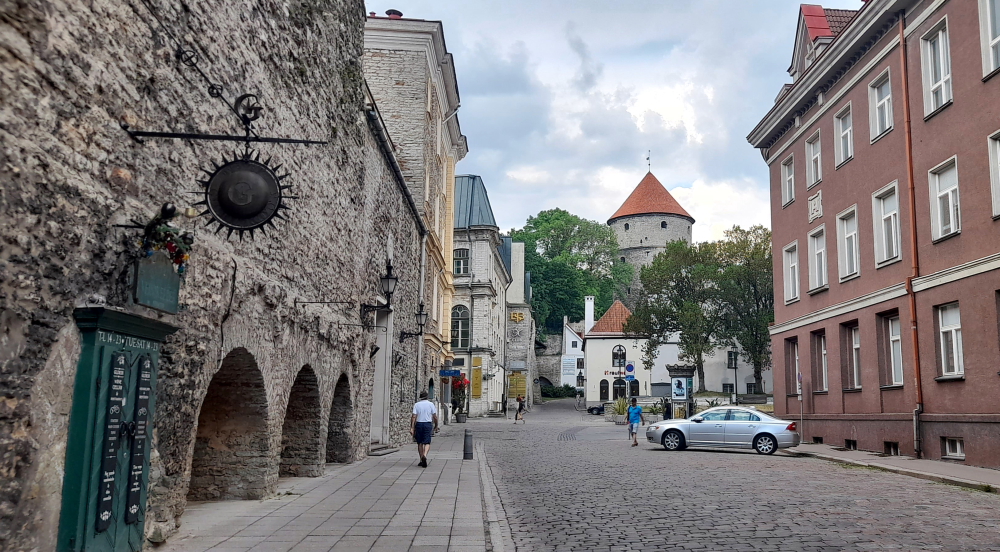
Another different view is that of the Kiek in de Kok tower. Muurivahe intersects with Harju where we turn left into Freedom Square.
The representative square of Tallinn – Freedom Square – is a popular meeting place designed for pedestrians. Over the years, the square has gone by many names: Heinaturg (Hay Market), Peetri Plats (Peter’s Square), and Võiduväljak (Victory Square) among them. It was first named Freedom Square in 1939, remaining so way until 1948. The name was readopted in 1989.
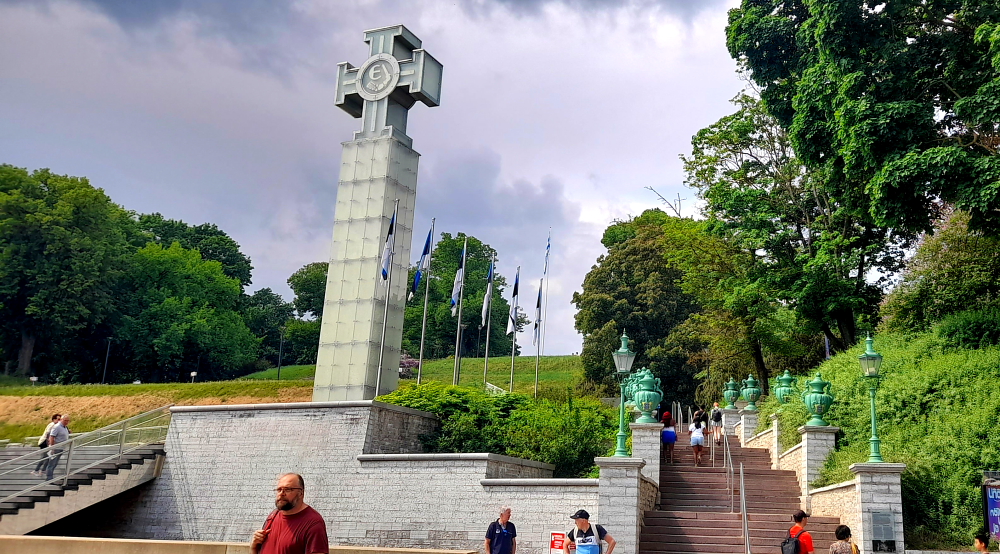
The Cross of Liberty, a monument to the War of Independence is also located here. The glass pillar & cross was erected in 2009 to memorialize Estonia’s 1918–1920 War of Independence from the Soviets. The campaign was the struggle of the newly-established democratic nation of Estonia for independence in the aftermath of WWI. It resulted in a victory for Estonia and was concluded in the 1920 Treaty of Tartu.
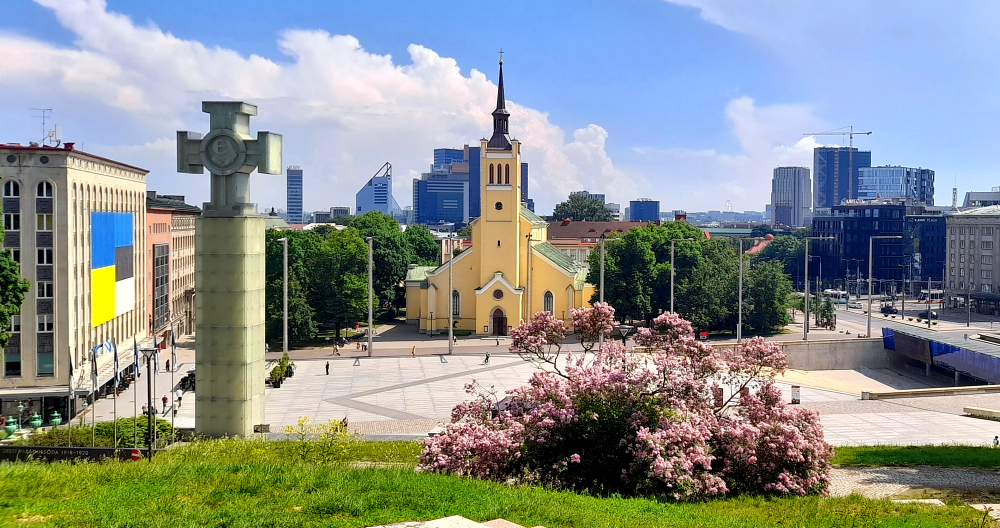
Mayer’s Staircase (also known as Harju or Harju Hill staircase) was built in 1864-1865 at the initiative and with the funds of Carl August Mayer (1789-1871) a grand merchant and mayor to facilitate access to the park that was established in Toompea and on Harju Hill.
As we walk up the stair case we are surrounded by the delightful scent of lilacs. That’s one thing that we will forever associate with Tallinn, the scent of flowers, pansies and lilacs in particular, counterpointed by the smell of sewage in the Old Town!
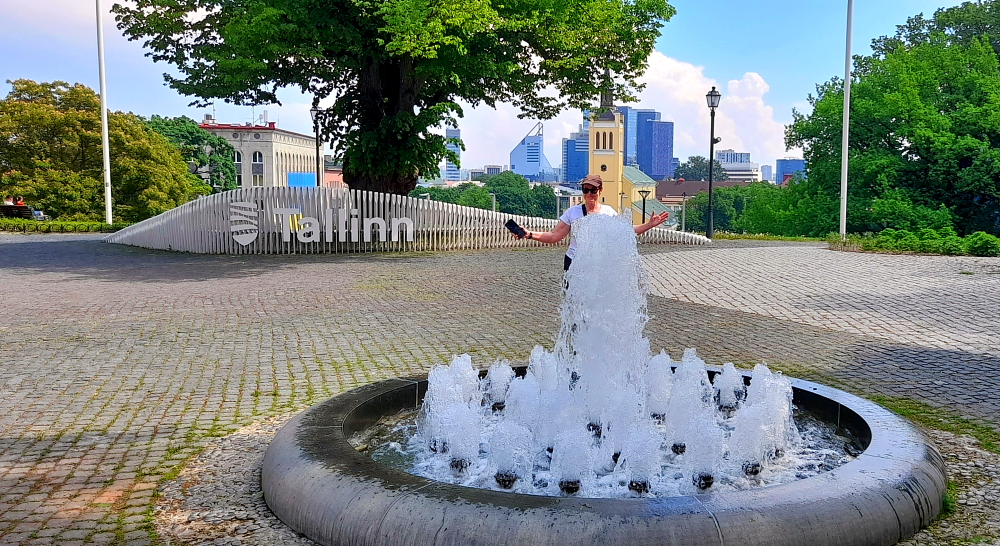
Further thunder rumblings have us scurrying back to the hotel to emerge at 6:00 pm to dine at a nearby cafe on Muurivahe which we walked past this afternoon.
Dinner was a couple of soft shelled tacos with chicken and vegetable fillings. Tacos, but not as we know it. Still, they were quite edible.
On the way back to the hotel I couldn’t resist one last photo with our bronzed chimney sweep. Much to Lynn’s bored indifference and comment, “Really??!”
2 June, 2024
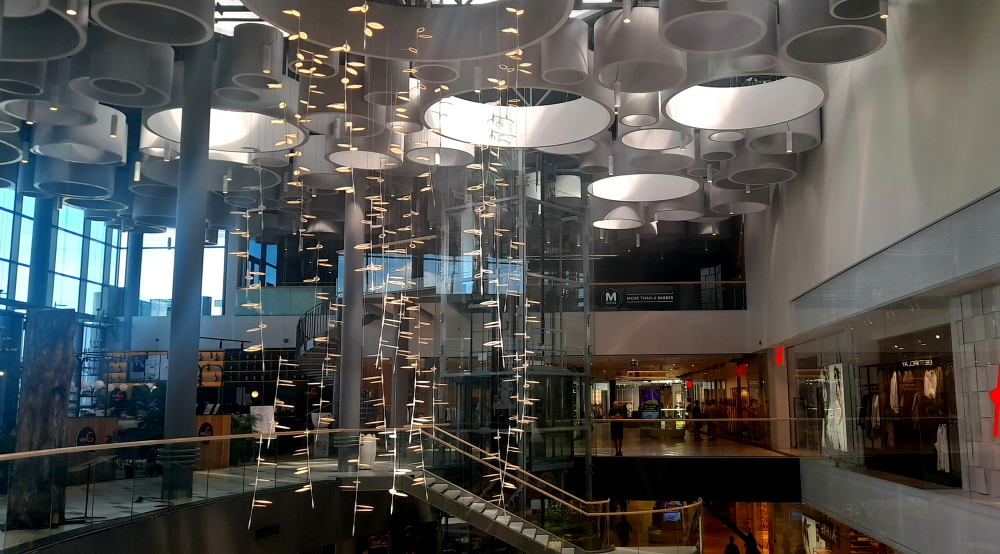
We check out of the Rixwell Boutique Hotel by 11:00 am and order a taxi to take us to the Green Motion car rental yard out by the airport. Two minutes later the taxi arrives and It only take us about 15 minutes to get there. So, we are over 1.5 hours too early to collect our hire car. As expected the car is not ready but Julia at the hire car desk suggests that we leave our luggage in the shed and head to the shopping mall which is just 5 minutes’ walk away in the 24 degree sunshine.
We are back at the rental shed by 1:00 pm, complete the paperwork and start loading up the luggage in to the car. We have been given an almost new Nissan Quashqui SUV. After a bit of fiddling by removing the unnecessary false boot floor all our luggage fits in the boot. It’s not as big as the Insignia boot but everything fits well.
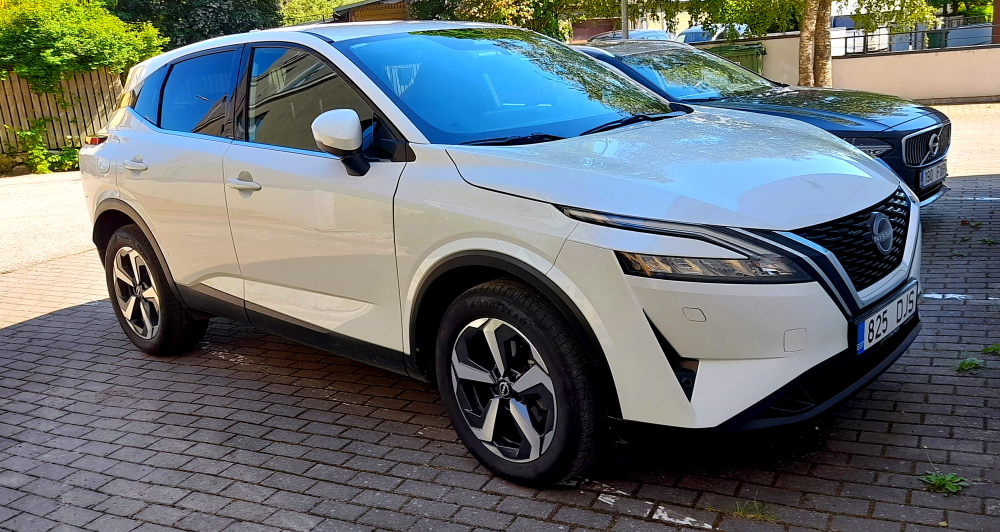
I spend a good 20 minutes setting the car up the way I want it with cables, GPS and music USB. We’ve found by experience that it’s better to take our time finding out how the car works (switches, knobs, driver information, mirror positions, seats and A/C etc) before heading off. This car also has a built-in GPS which we won’t bother with for today’s trip until we get used to everything else.
The car has only done 36,000 km so it feels new. We would never buy an SUV due to their clumsy handling but this one will do for the next 60 days. It’s comfortable but feels like a truck to drive with almost no road feeling in the very light steering. It does however have every gadget know to man but once we work out the bits we need and set up the other ones that we don’t it will be time to take the car back.
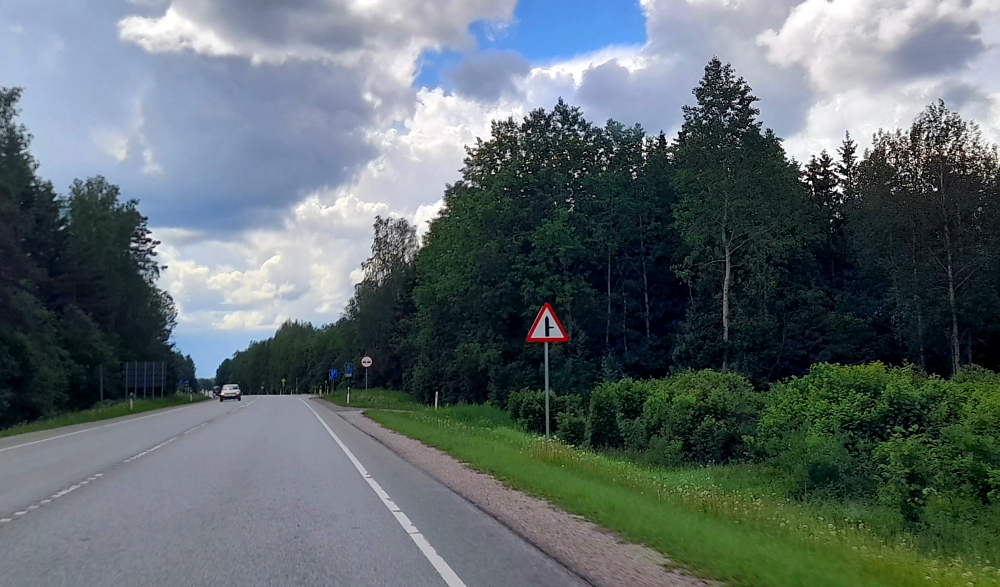
50 minutes into our trip the black, threatening clouds that we have been driving towards open up and hit us with torrential rain – as in can barely see out of the windscreen even with the wipers at full tilt.
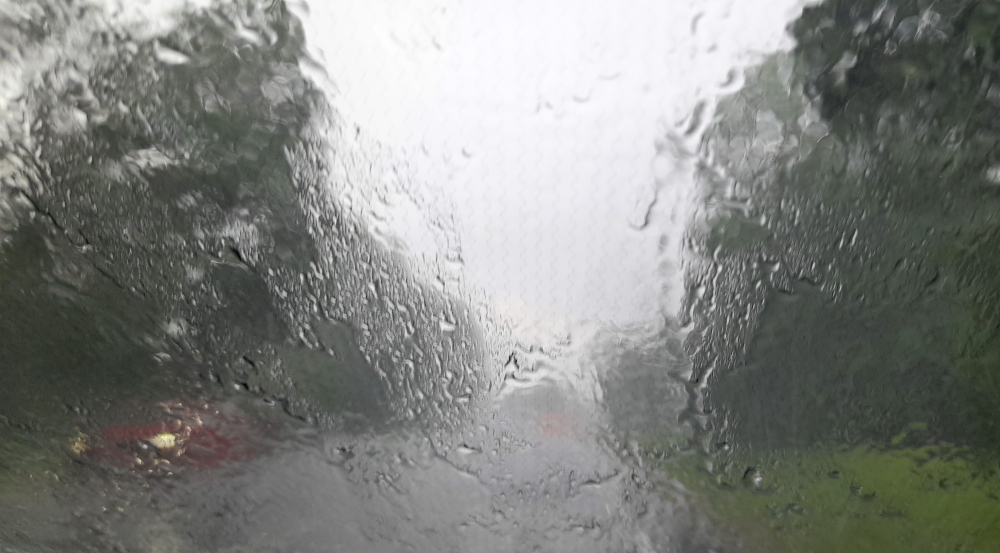
10 minutes later, more torrential rain and it stays raining and grey for the remainder of our journey to Haapsalu where it is now 16 degrees.
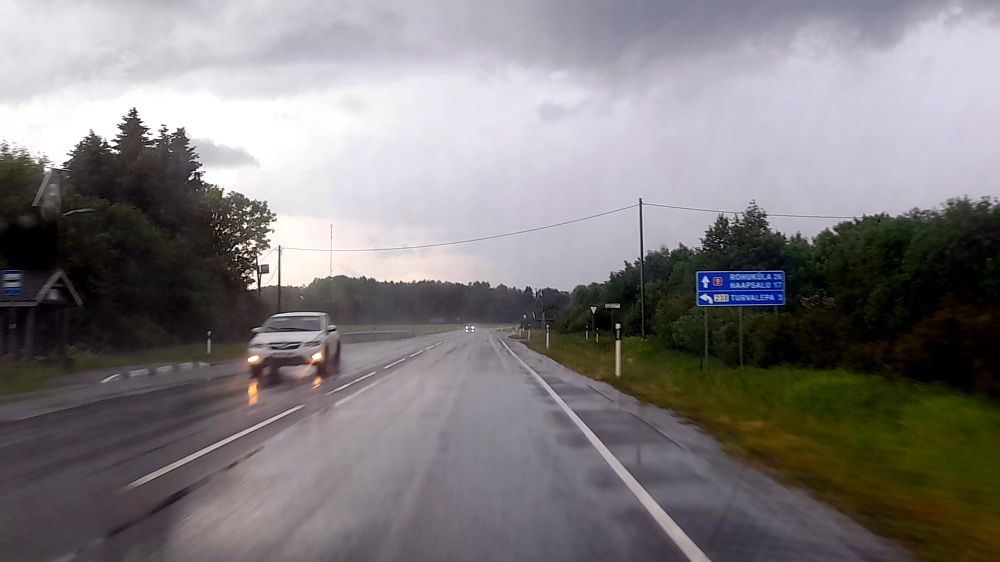
When we booked the property on 8 January we let them know that we’d be arriving between 2 and 3 pm. 15 minutes ago at 2.30 pm Lynn phoned the property to let them know that our arrival was imminent. No answer.
We arrive at the property and Lynn phones twice more. On the next attempt a guy answers and tells us to phone another number, of the person who is supposed to meet us here to let us in.
The woman answers and says, “Didn’t you get my message that I won’t be able to be there to let you in?” Obviously not. After half an hour of faffing to get in we drop off our bags and head for the nearby supermarket.
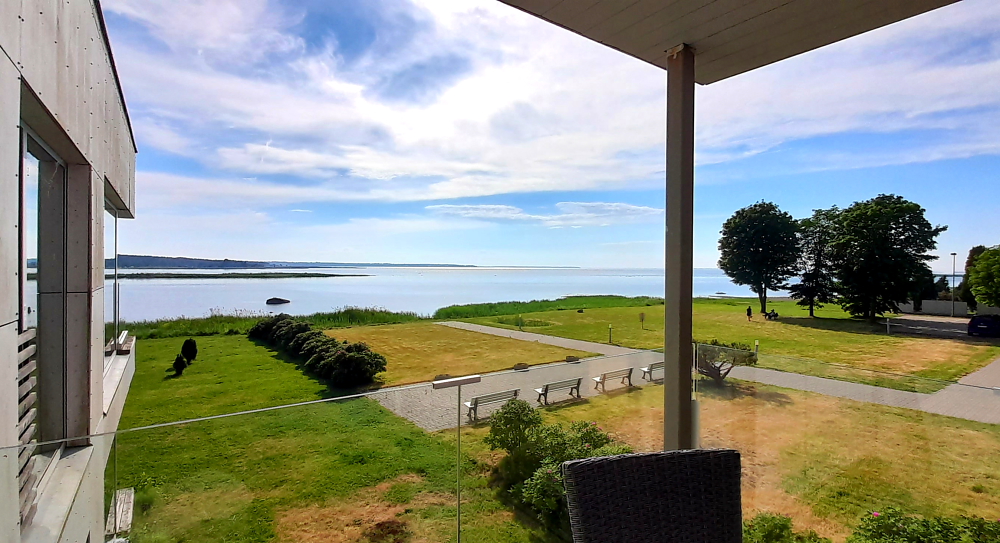
By now the rain has gone and the area is bathed in sunshine. The apartment faces west which means we get a nice sunset but it also means we need to crank up the A/C (which actually works here, thank goodness) and we’ll need to wear eye masks to get to sleep.
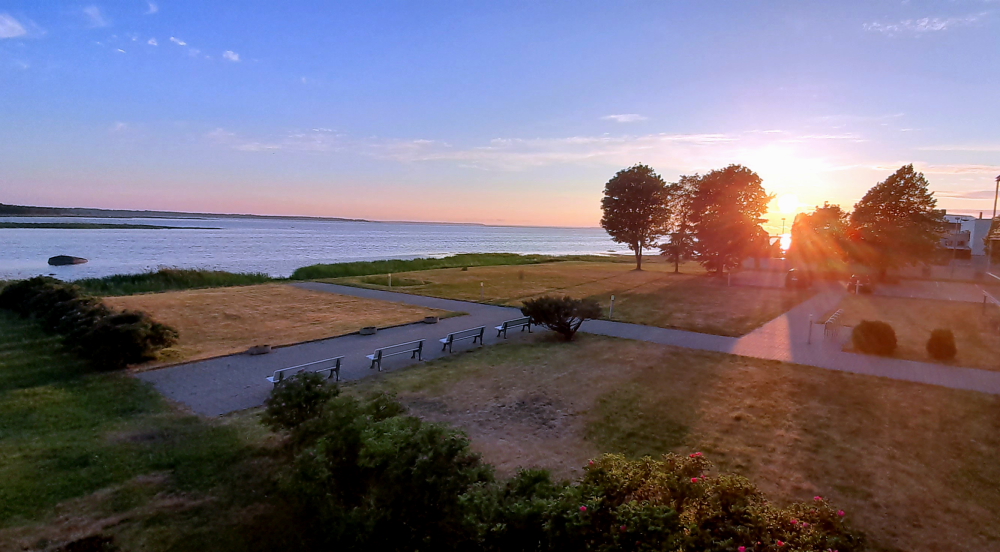
After a cold roast chicken, potato salad and coleslaw dinner, washed down with a chilled glass of “Original” we settle in to recommence our viewing of “Dexter”, once I’d worked out how to change the TV’s settings from Russian to English, that is.
3 June, 2024
According to Lynn, it started out as a beautiful clear and cool morning, before mist arrived up to the water’s edge. By mid-morning it clears with a predicted top of just 21 Deg C. Lynn’s suffering from what seems to be vertigo so while she’s gone back to bed I take a stroll down to the water’s edge to check out the bay up close.
It’s not a suitable swimming beach as the water is quite shallow and the bottom is both muddy and rocky. The water is cold but clear. I am not sure why you would have a holiday house her, especially without a pool. Apparently the water freezes over in winter.
The view, however, is very nice and there is a cool breeze blowing off the Baltic. A Twitcher’s paradise with lots of bird-life, mainly seagulls and terns, but also the odd cuckoo.
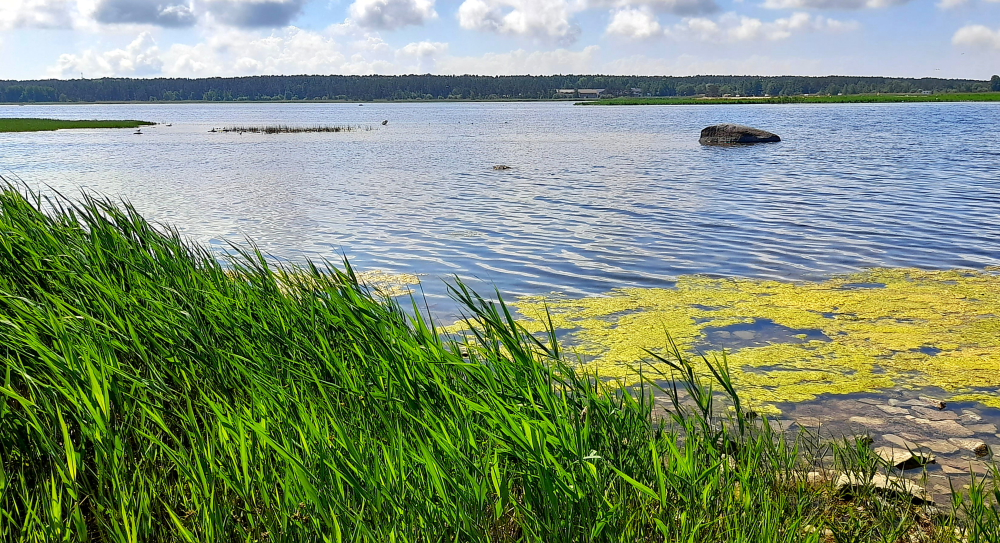
Our view is across the Haapsalu Eeslaht Bay but the westerly sun comes straight in our windows and lights up the poorly-curtained apartment until 10:30 at night. The poor air conditioner can’t quite cope.
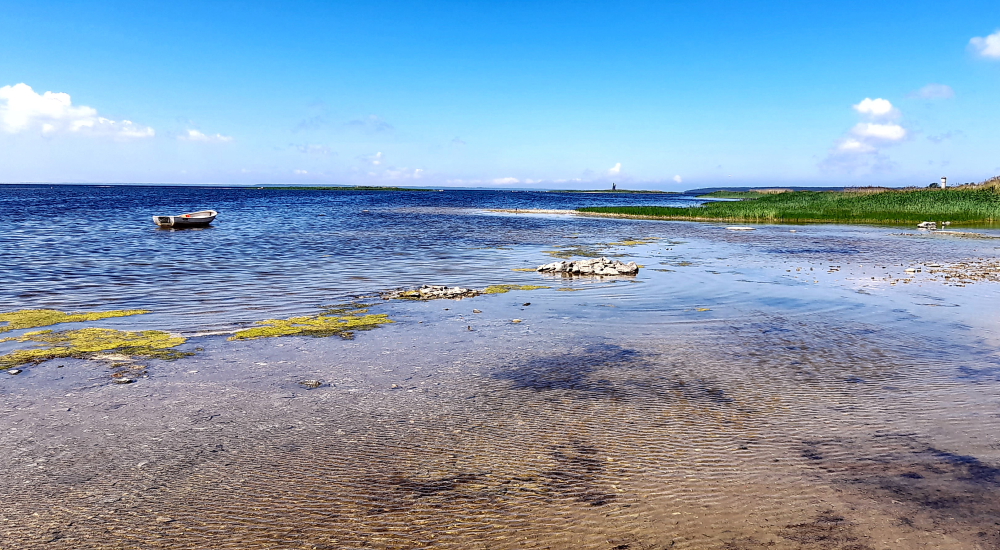
Lynn is finally out of bed by about 1:30 pm and decides to do my ironing so I head out for a walk in to the village to get a closer look at places for dinner tonight. It will also give me a chance to get a feel for how big Haapsalu is since we will be here for another 3 nights.
It only takes me about 10 minutes to walk to the town centre which is dominated by the ruins of the Haapsalu castle. I just take a couple of photos and head back to the main street as we will come back here when Lynn is feeling up to a visit.
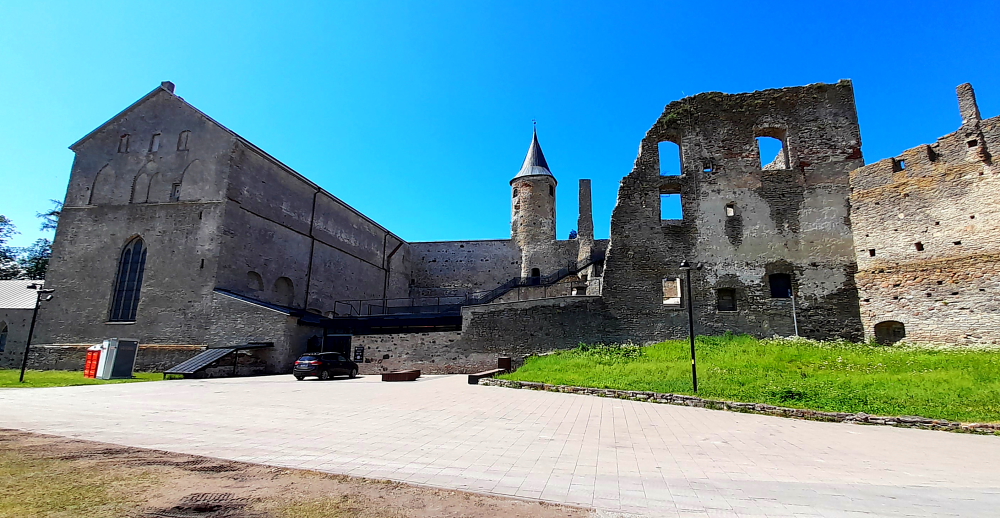
The town shows all the signs of being dominated by Soviet Russia yet there are Ukrainian flags flying all over town.
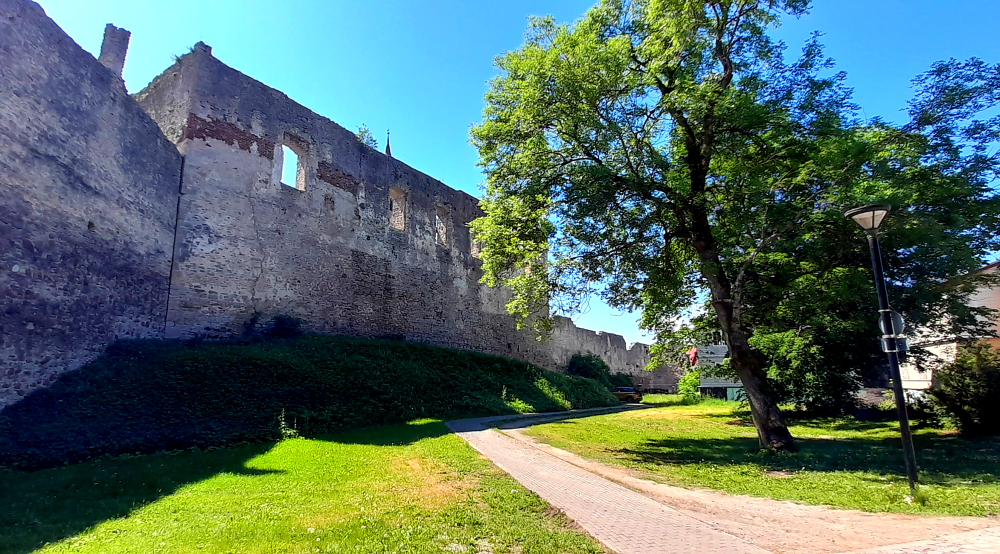
It only takes about 5 minutes to walk the main street of the old town. There seems to be a few restaurants close by so we should be able to find something suitable for tonight at least.
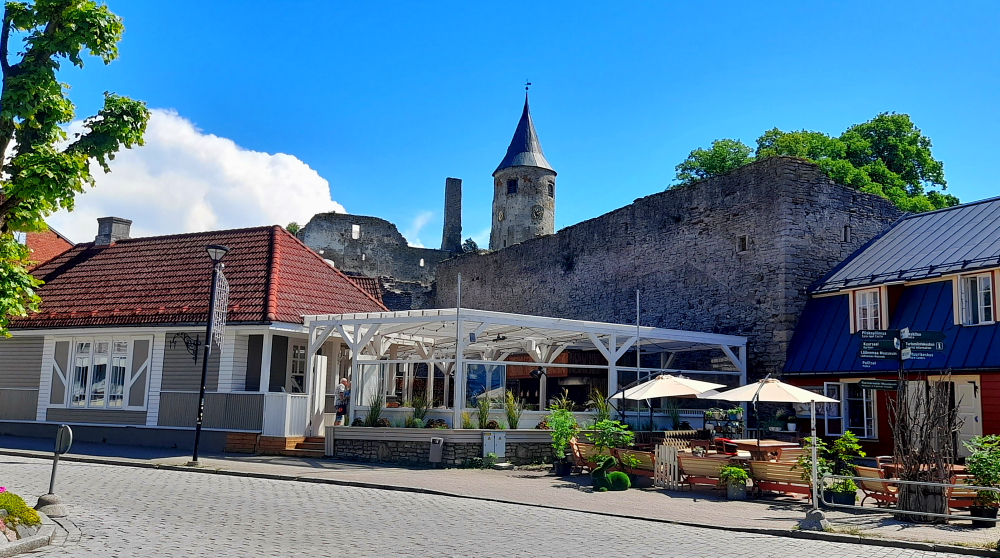
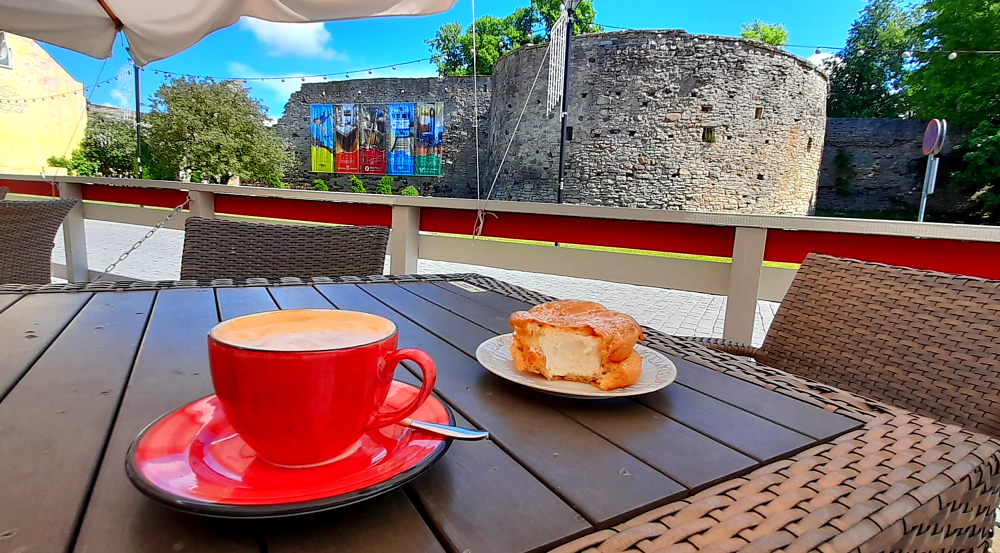
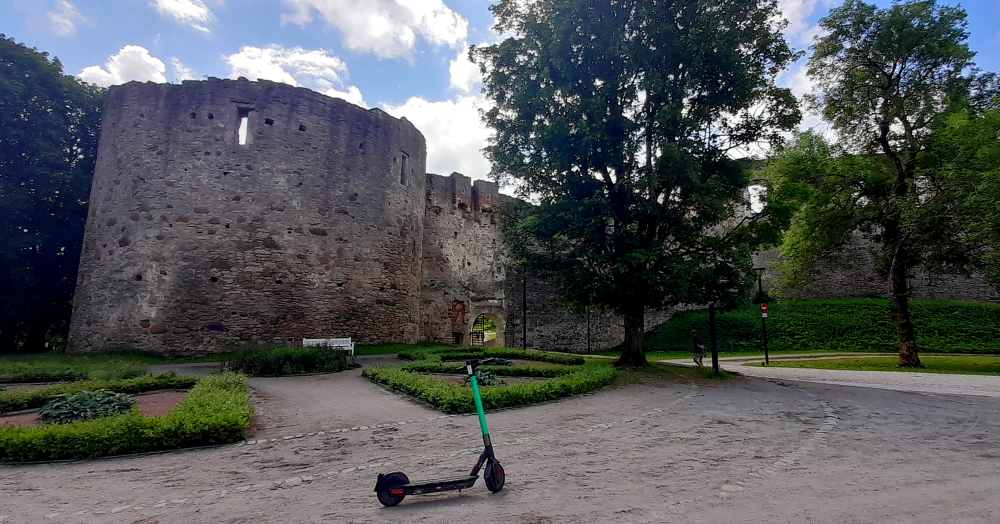
I also find a nice bakery and decide to try a local pastry and a coffee for a 10-minute break while I soak up the sunshine. Both are surprisingly good. Too bad Lynn has missed out. You snooze, you loose!
I take the long way back to the apartment via the lake. Vaike vilk is the local lake and swimming hole. I just can’t imagine swimming here but the local kids are already hitting the water despite the water temperature still being in the single digits.
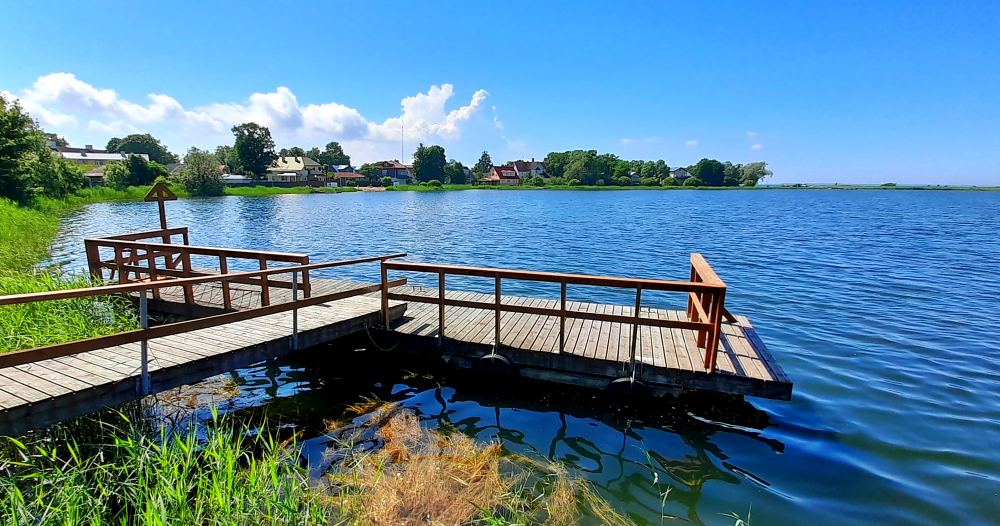
When I return Lynn informs me that the reason she’s feeling woozy is that she’s not supposed to drink grapefruit juice (one of the main ingredients in the “Original” drink, nothing to do with the other being gin, of course) while she is taking Amlodipine, 1 of the 2 meds she takes for her high blood pressure. Mystery solved, and all the more “Original” for me!
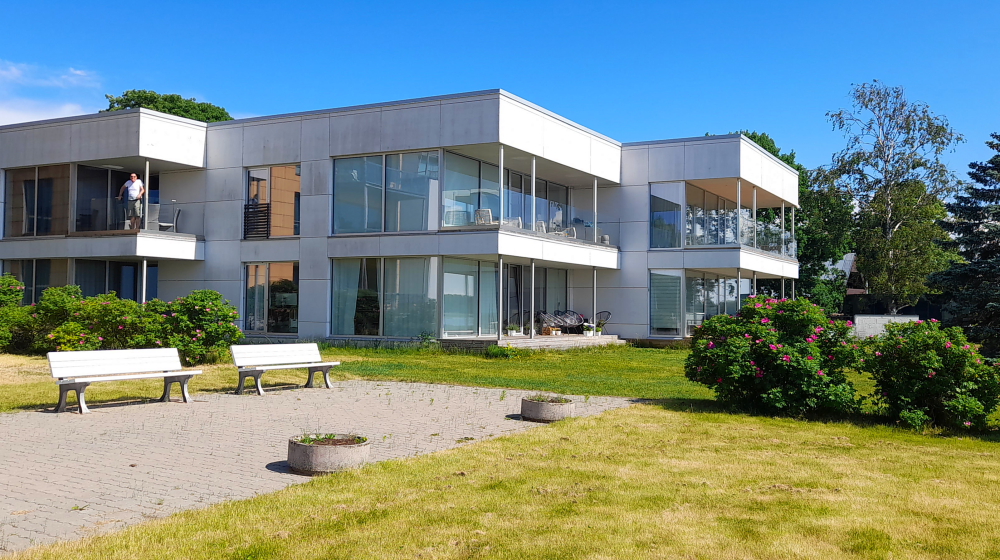
Why are we here in Happsalu? An Estonian resort town that looks like a piece of another era with its refined style. Described as, “Wooden lace architecture in the old town, a beautiful beach promenade, cozy cafes, warm sea water, famous healing mud and the most famous ghost of Estonia, Valge Daam, who lives in the bishop’s castle”.
The first Haapsalu mud farm opened its doors already in 1825, and since then the town has attracted vacationers from all over the world, especially the Russian nobility in the 19th century. In Haapsalu, with the warmest sea water (that’s debatable!) in Estonia, there is a beach called the African or chocolate beach. It was named after the locals who smeared themselves with medicinal mud to relieve joint pain [www-puhkaeestis-ee].
So, we’ll be checking out these sites over the next couple of days, starting this evening for dinner at the Arhitekt Steakhouse which I walked by earlier.
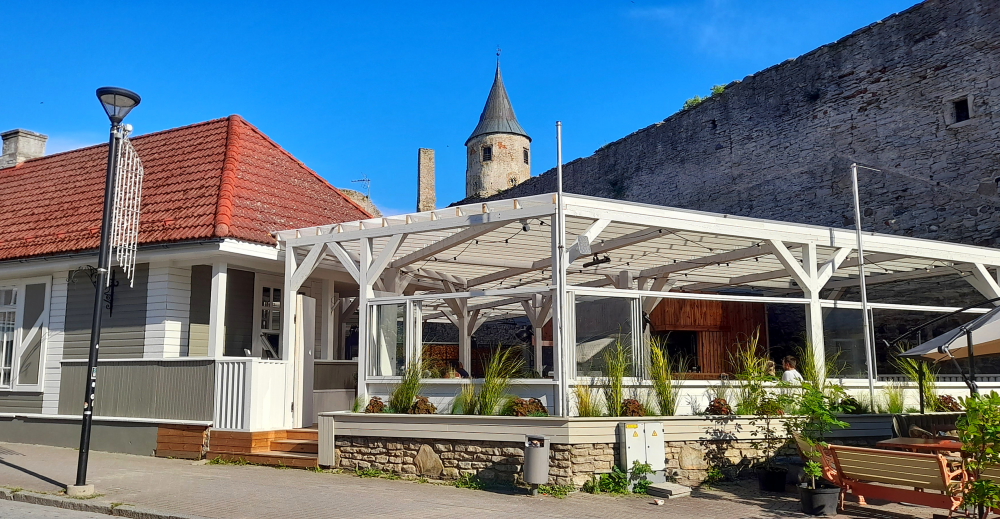
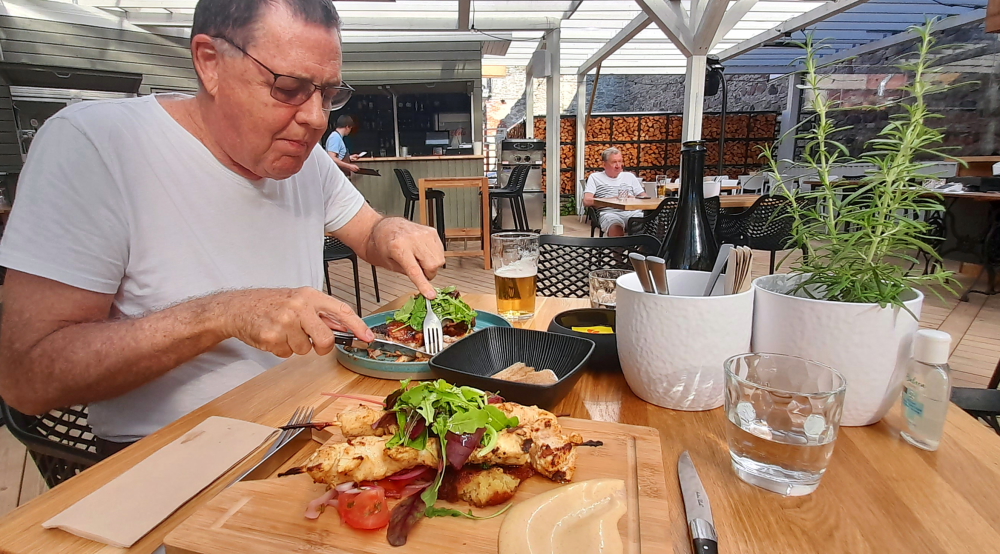
Our dining experience is excellent from start to finish – from the friendly welcome to the restaurant, the waiter translating the Estonian menu for us, recommending the ribs to the taste and presentation of my proper rack of ribs and Lynn’s chicken skewers – and the banter.
Walking back to the car park we pass by a large photograph that decorates the side of a large building. It was taken on 13 March 1918 in this house, the HQ of the officers of the 1st Estonian Infantry Regiment 1917/18.
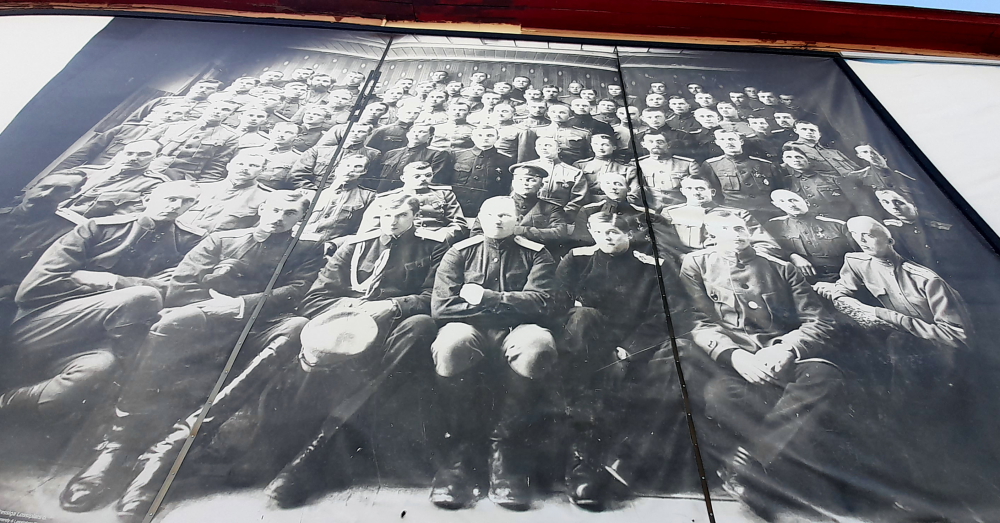
When we return to the apartment we settle in for another binge viewing of “Dexter”.
4 June, 2024
Lynn’s feeling a bit better today so we walk – slowly – into town
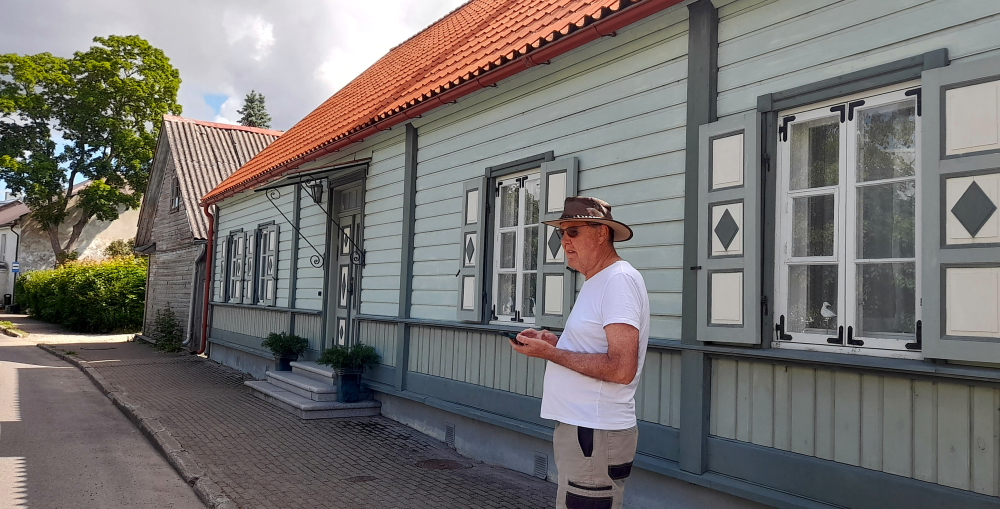
We make a beeline for Muuriaare Pagar, the bakery I visited yesterday, for a coffee.
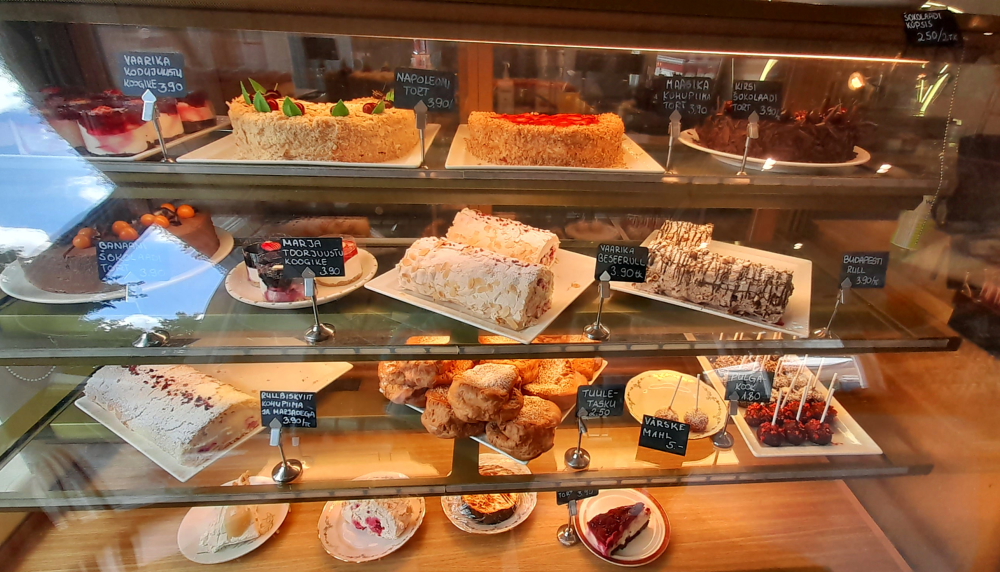
Next we walk around the grounds of the castle ruins.
Then along Mangu to the lake foreshore and promenade where the Kuursaal, now a restaurant, is located. Haapsalu Kuursaal is a summer restaurant that is located in the only spa hall preserved in its original form in Estonia.
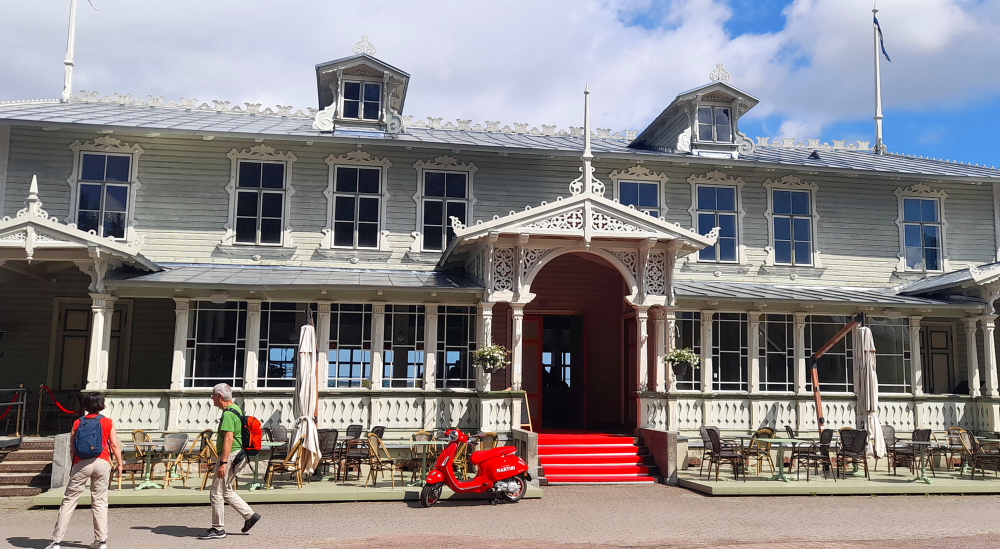
The spa hall was designed by the architect Rudolf Otto von Knüpffe . Originally, the hall was planned to be smaller, but during the construction works it was decided to add a gallery surrounding the building.
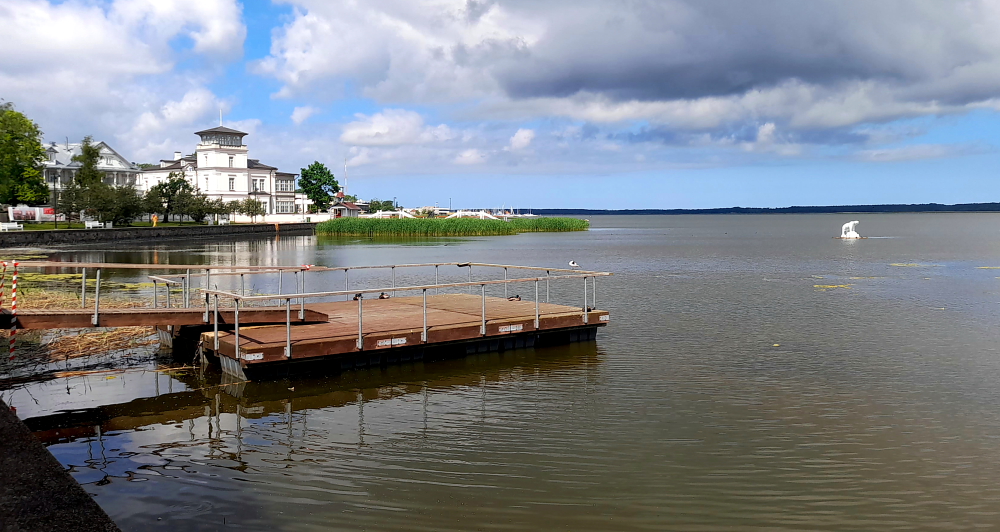
According to various sources, the building was finally completed either in 1898 or 1905. in 2010 it was recognised as a cultural monument.
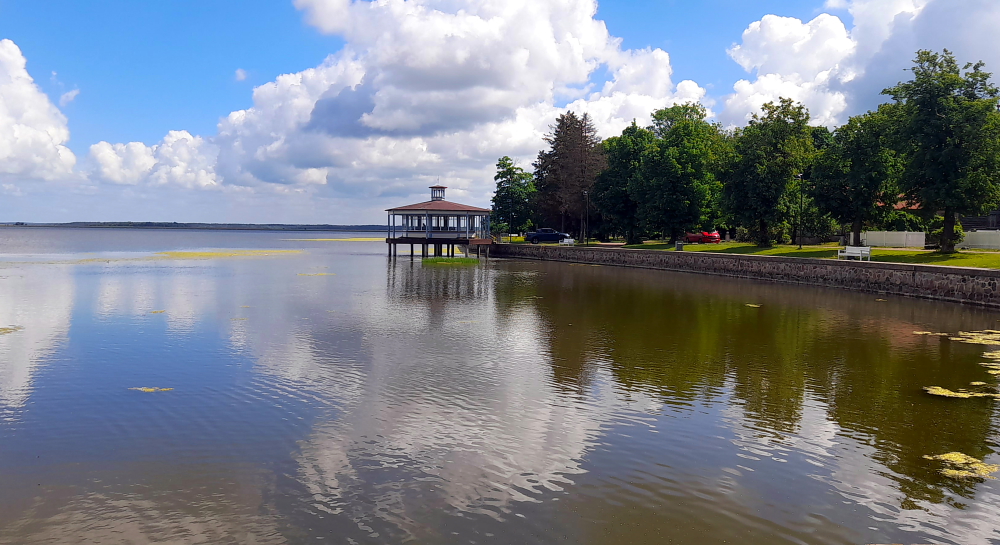
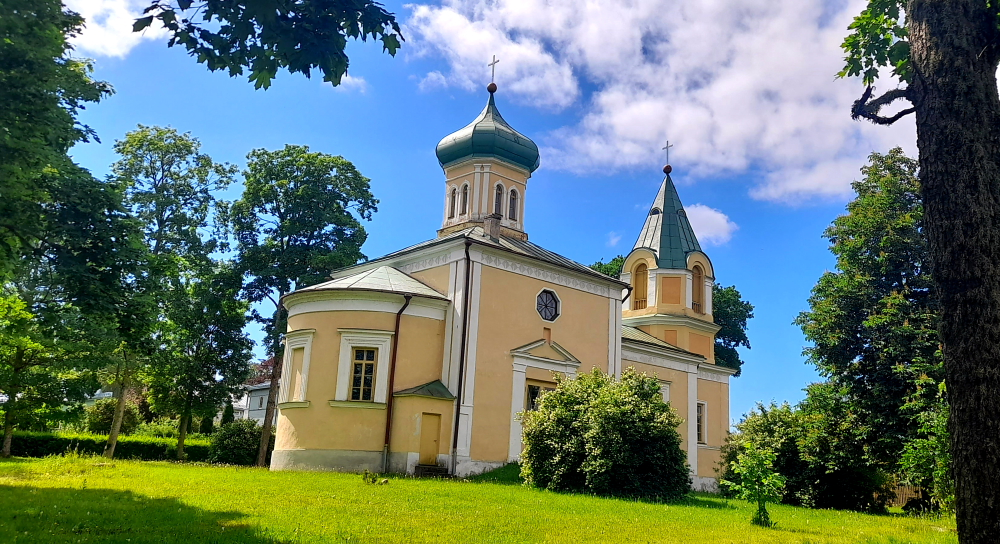
Just past the pavilion we cut through the Jaan Poska Park to the Happsalu Maria-Magdaleena Kirik. The Orthodox Church of St Mary Magdalene was consecrated on 21 July 1852. It’s built combining classical elements with those characteristic of old Byzantine architecture. In 1964 the church was closed under the Soviet administration and planned to be used as a sports hall but ended up as a storehouse instead.
It wasn’t until 1994 that the church was returned to the congregation of the Estonian Apostolic Orthodox Church, recognised by the Patriarchate of Constantinople.
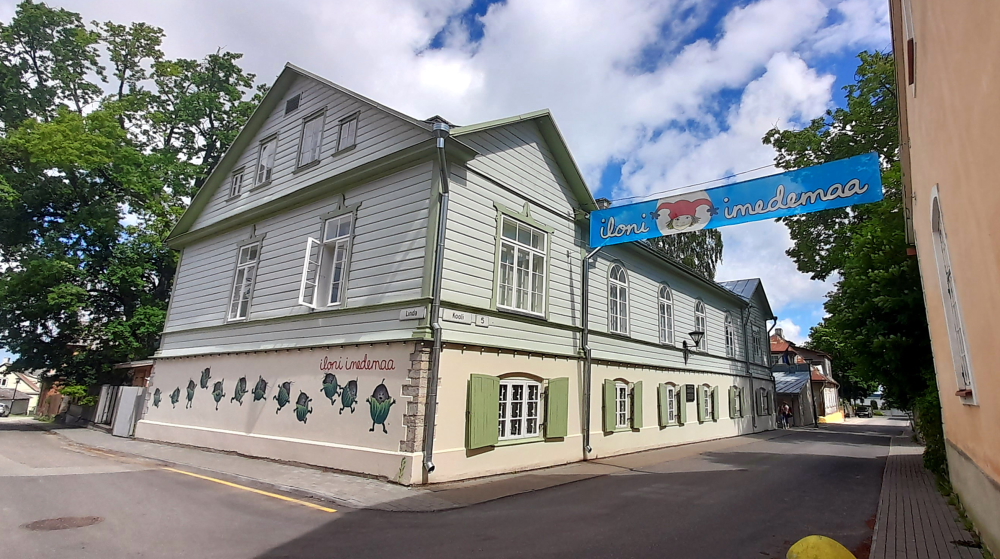
Walking along Kooli we come across Ilon’s Wonderland, a small theme park for children and families that showcases the work of Ilon Wikland, the illustrator of Astrid Lindgren’s children’s books.
The 3-storey building, open from September to April, has a gallery, a cinema, an exhibition hall, Karlsson’s Room, Ilon’s Kitchen, and a playroom. Today, the Wonderland courtyard is also open featuring Mattias’s cottage and a handicrafts workshop.
Returning to the Haapsalu Lossipark where the Haapsalu Episocal Castle is located, we stop by a memorial. Earlier, when we entered the Castle at noon, there was a ceremony being conducted next to this in front of 3 hoisted flags by a small gathering of about a dozen people with a national anthem recording being played, speeches and the tolling of church bells.
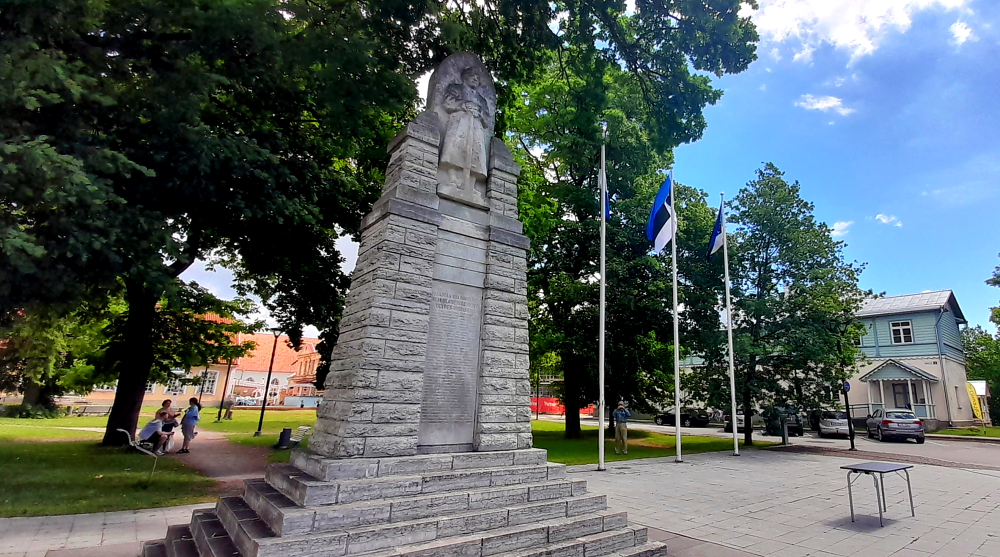
Turns out today is National Flag Day in Estonia. The1st Estonian flag was produced in the spring 1884 by the Estonian Students’ Society, and was blessed and consecrated in Otepää on June 4 of the same year and is marked on this day each year.
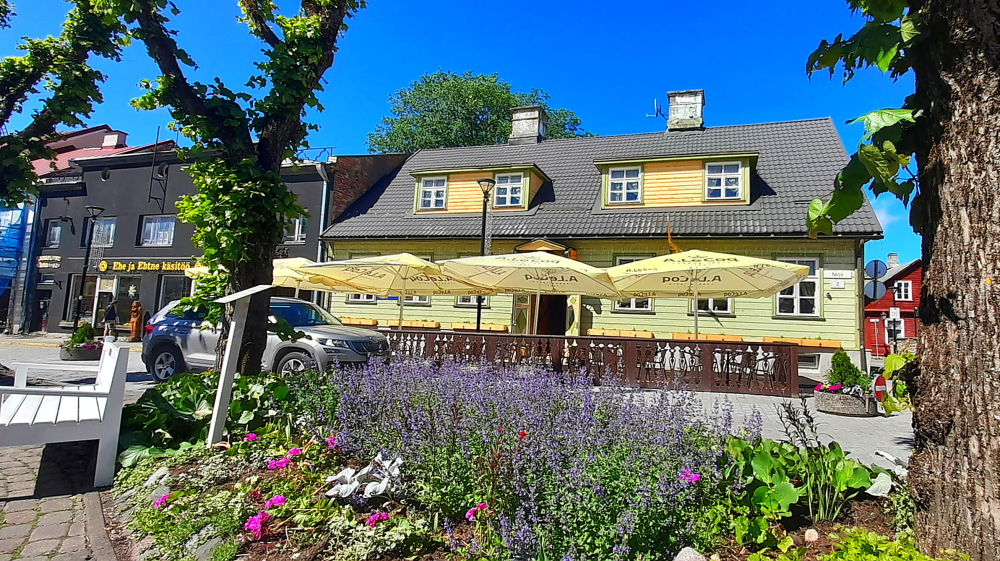
We end up at the local pub, Talumehe Korts on Karja for dinner. It’s opposite a small park with a central fountain. Here we have another delicious meal, both ordering the crumbed pork with cheese and onion topping served with warm sauerkraut and baked potato wedges and cold salads of red beet and pumpkin, washed down with an A.LeCoq beer for me.
Another binge watch of “Dexter” until 11:00 pm as by then the sun has set and a form of darkness descends so we can more easily fall asleep.
5 June, 2024
Binge watching has its pros and cons. The con being that we don’t surface until 10:00 am.
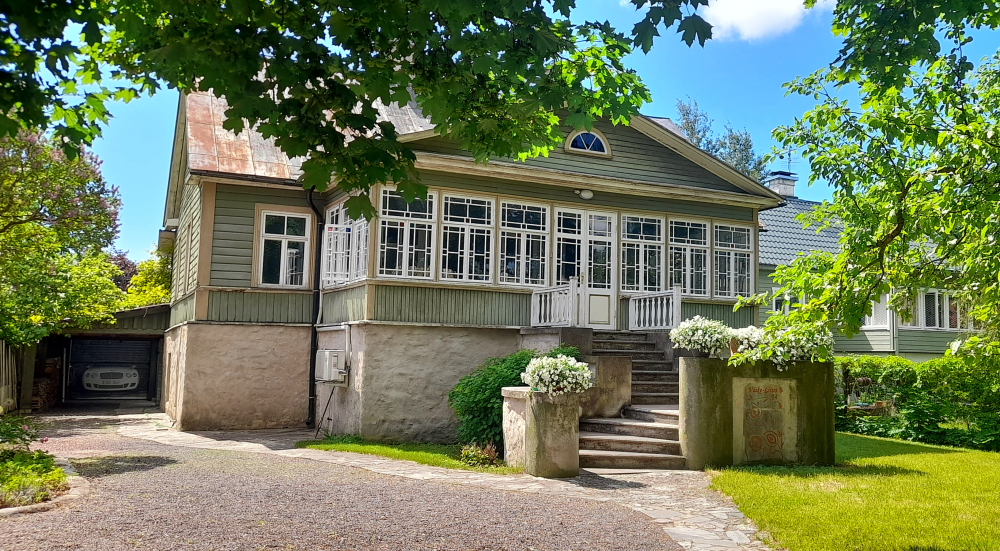
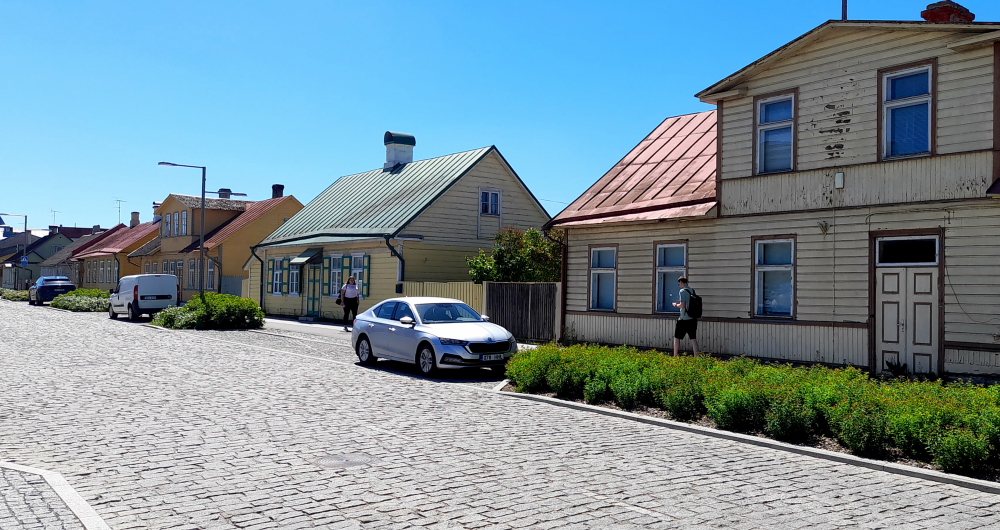
After a WhatsApp video call with my grandson, Louis, who is 5 today, we have a quick breakfast and wander into town for coffee. Some of the housing in Haapsalu reminds us of our time in Iceland.
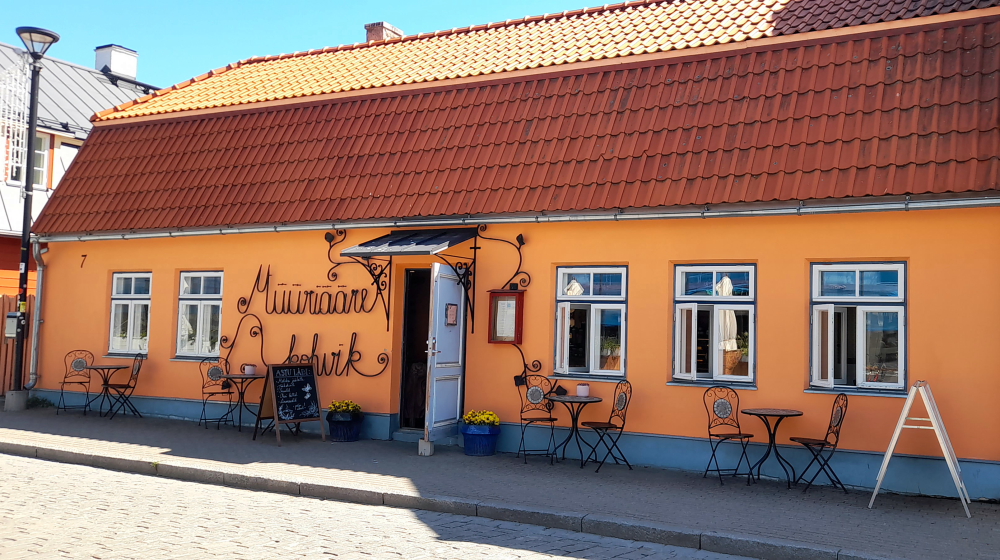
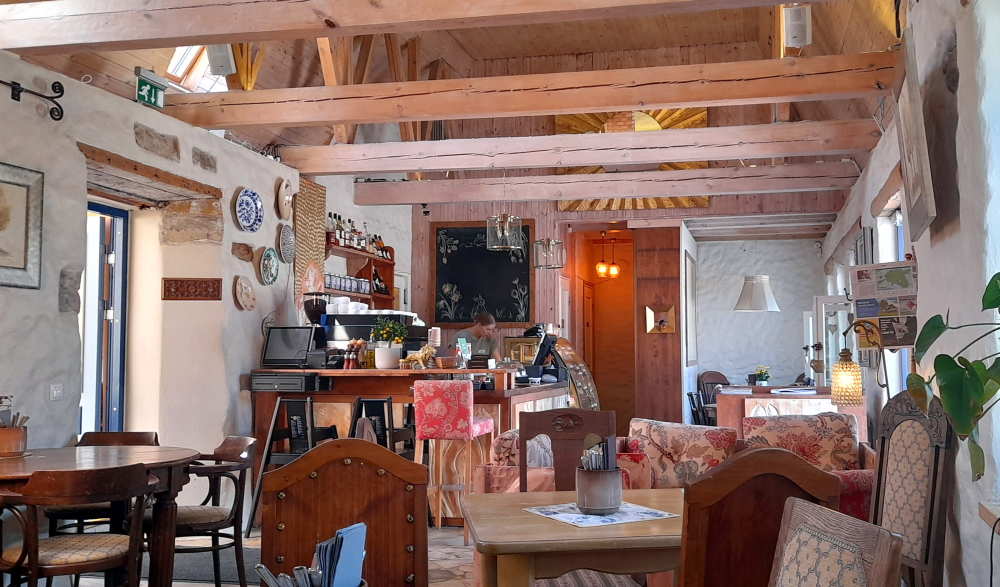
This time we try the other cafe in town, the Muuriaare Kohvik. In addition to pavement seating, it also has an outdoor courtyard and a quaint interior. Sadly, its coffee isn’t as good as the ones we’ve had at the bakery.
As it’s another lovely sunny day with a cool breeze we explore other parts of town. Firstly, we walk along Posti, the main street heading out of town.
Then we return to Kuursaal on the seashore where we walk NW along the footpath,.
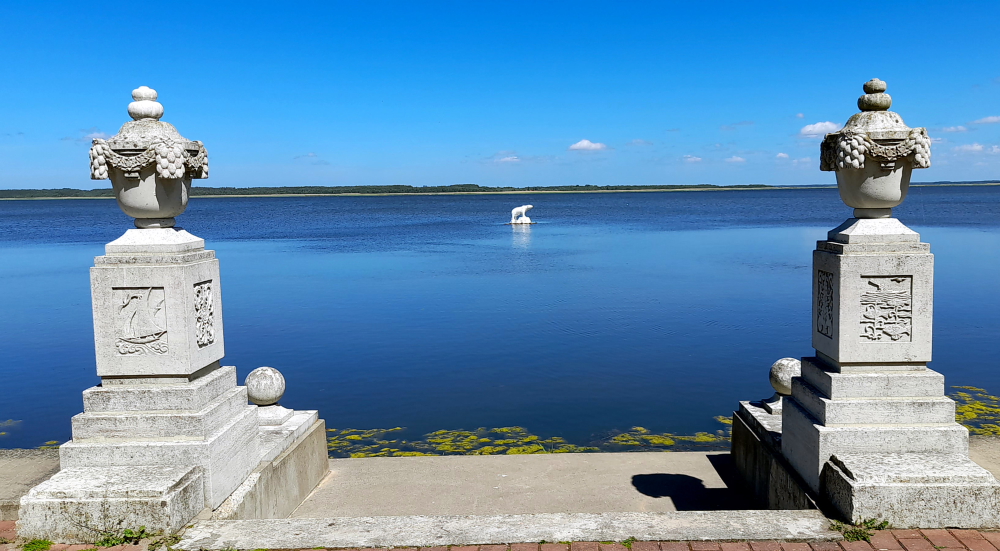
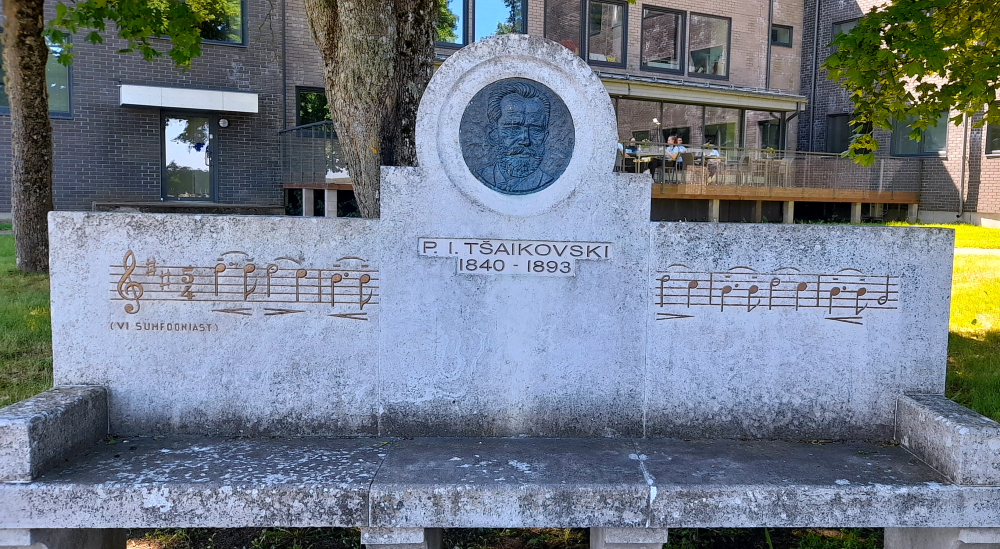
The footpath becomes Pjotr Tsaikovski pst where a bench in his memory is located. The world-famous Russian composer Pyotr Tchaikovsky rested in Haapsalu in 1867. In his honor, a memorial bench was erected on the Chocolate Promenade, where the maestro loved to watch the sunrise from the shore and admire the swans.
In Haapsalu, Tchaikovsky continued his work on the opera “Vojevood” and wrote the piano cycle “Souvenir de Hapsal”. Having heard the Estonian folk song “Kallis Mari”, he later used the melody in his famous VI symphony, the opening notes of the tune were also carved on a memorial bench made of dolomite stone [www-puhkaeestis-ee].
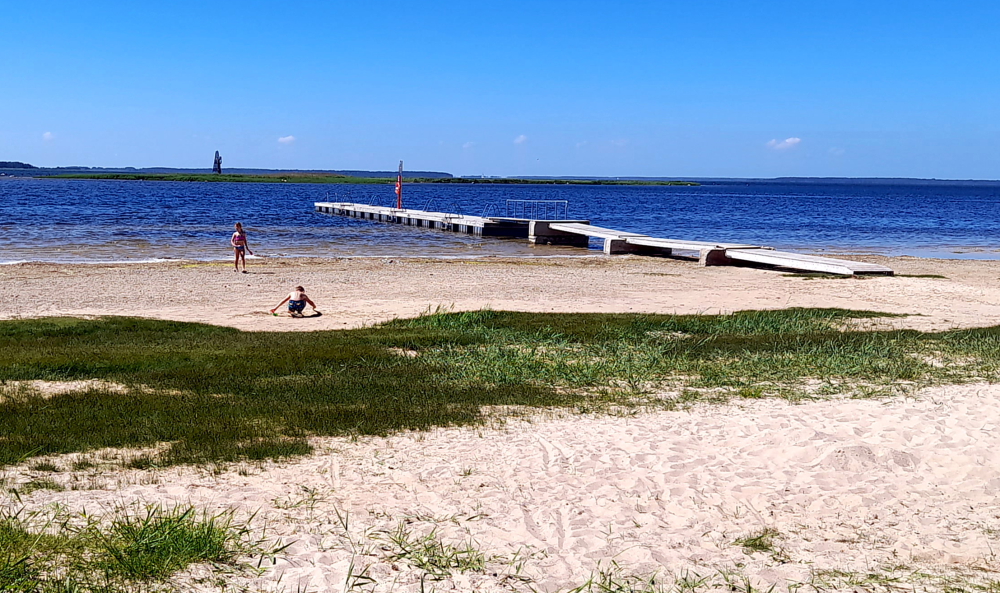
From here we cut across the peninsula above the lake to arrive at another of Haapsalu’s “beaches”, Vasikaholm Beach which is the 2nd official bathing spot in Haapsalu in addition to Paralepa beach.
Officially the beach season is from June 1 to August 31. Today there is a green flag flying – bathing is safe and the water temperature above 18ºC. Whereas a yellow one would indicate dangerous for children and the elderly, and a red one dangerous for everyone, with the water temperature below 16ºC – that’s only 2 degrees difference between OK & dangerous! [www-visithaapsalu-com].
The channel marker is the one we can see from our apartment’s balcony.
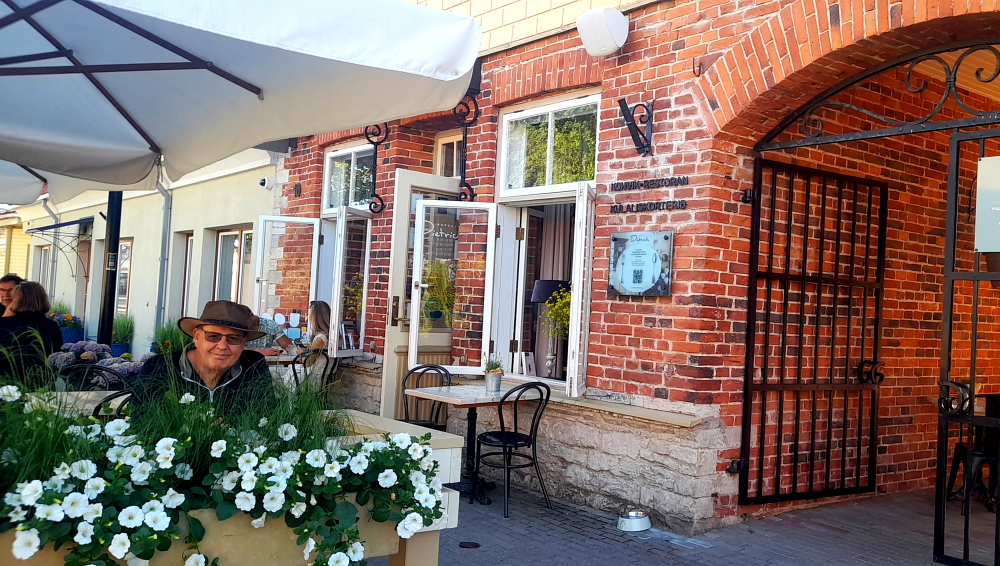
Another couple of loads of laundry done as we sit down to another episode of “Dexter” before we head out to dinner at “Dietrich”. We’re now half way through the 8 seasons.
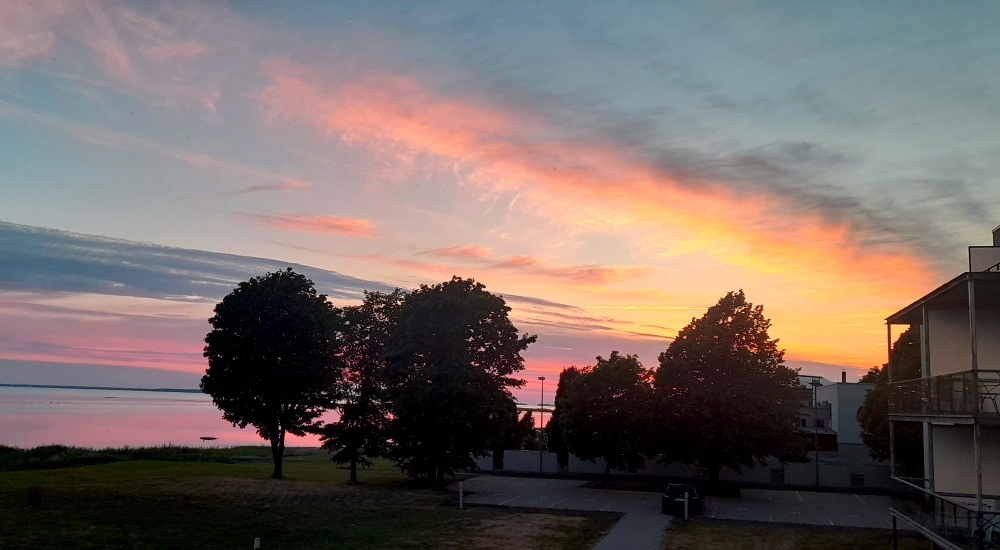
Sunset at 10:33 pm – turning the water and sky a delicate shade of mauve.
Plan to leave tomorrow around 10:00 am as we have a ferry to catch to Saaremaa Island.
6 June, 2024
Rain and 14 Deg. C when we leave the apartment at 9:55 am. It’s a 65- minute drive to the ferry terminal at Virtsu, some 77km SSW away.
By the time we arrive there at 11:05 am the sun is shining and although we are booked on the noon ferry, we are directed onto the 11:25 am one instead.
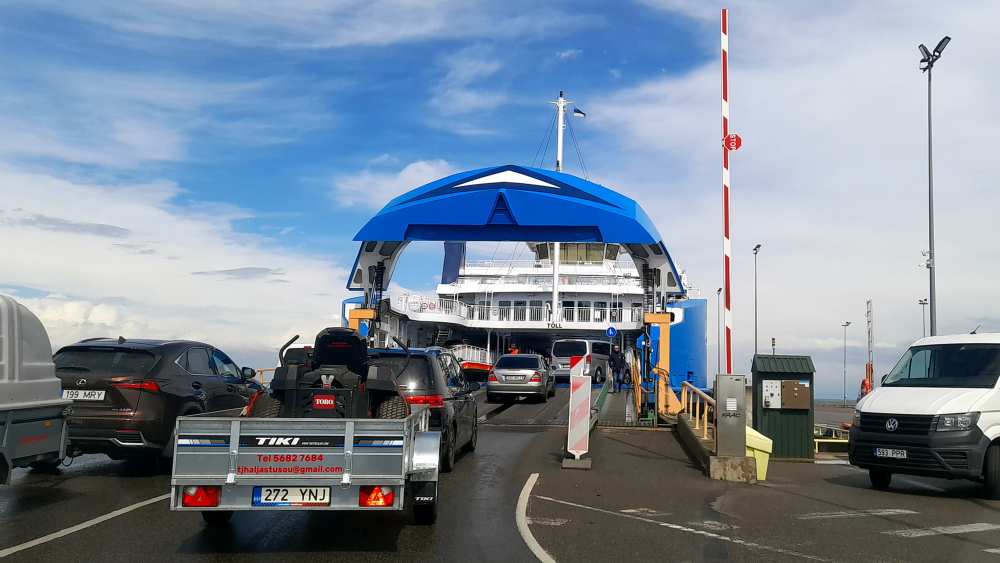
We drive onto the “Tween” deck – mezzanine – and go upstairs for the 25-minute, smooth crossing.
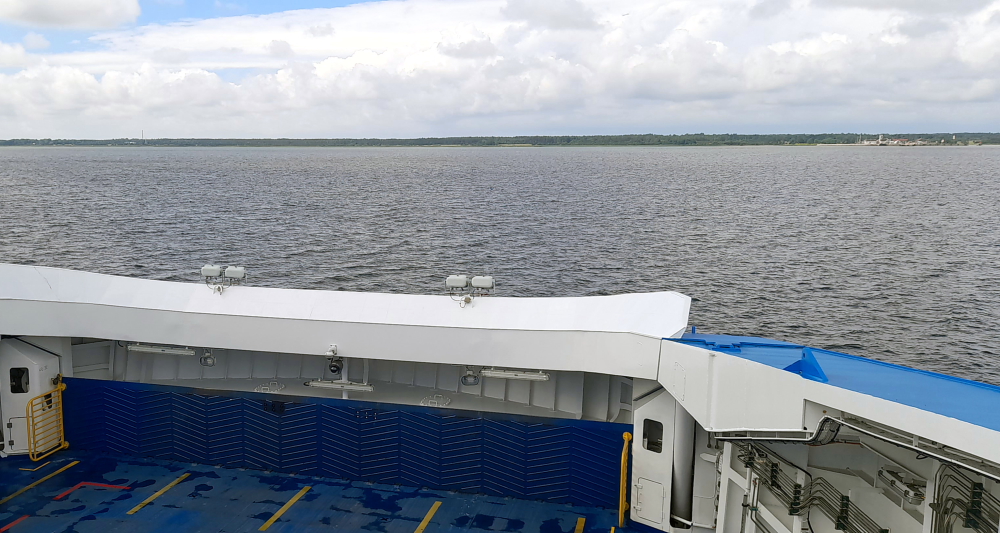
So, we drive from one area of flat land with pastures and trees with minimal people and cars to another area of flat land with pastures and trees with minimal people and cars. Wherever, the scenery is very green.
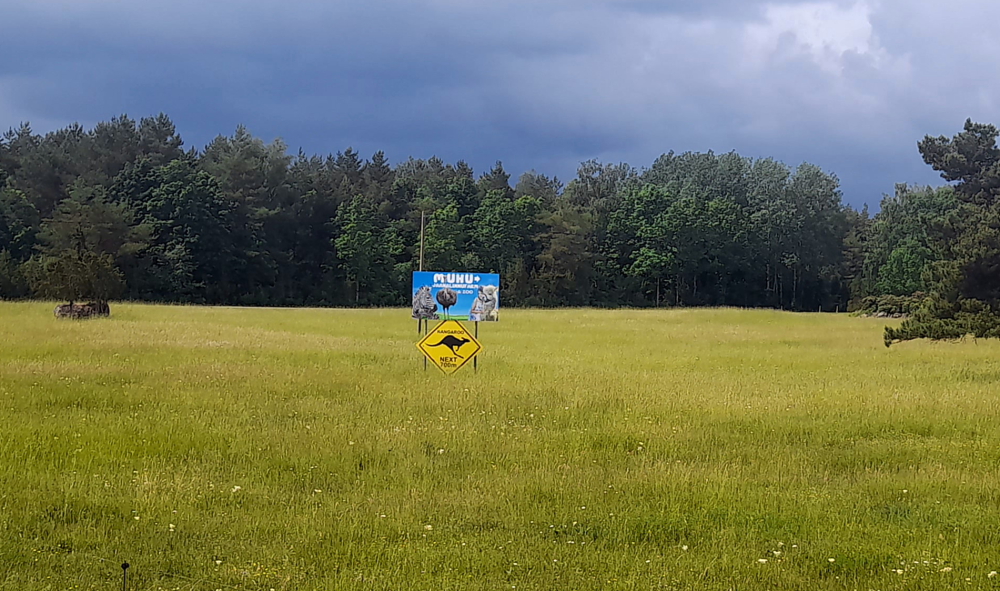
Now, this is a road sign you don’t expect to see in the middle of Estonia, “Kangaroo, Next 700m”. Turns out there’s a Zoo on Muhu.
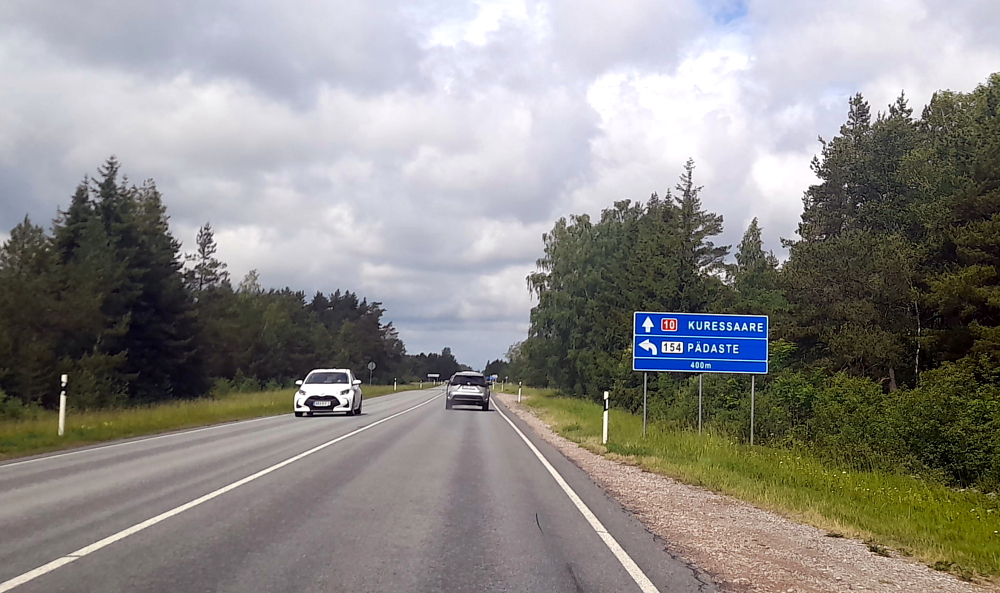
Driving across the small island of Muhu takes all of 15 minutes on the 10 when we come to the bridge that connects Muhu to Saaremaa Island.
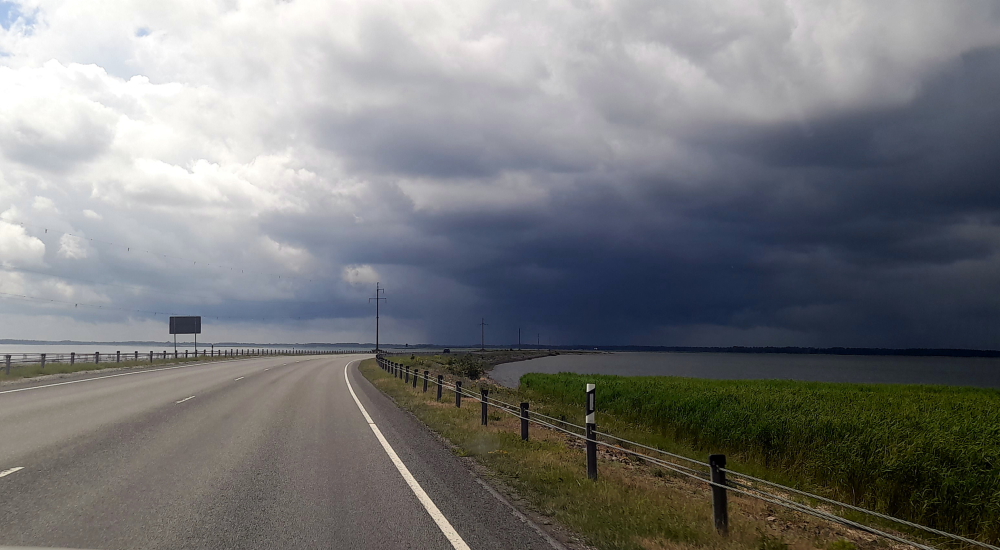
Another shower of rain, now 13 Deg. C …
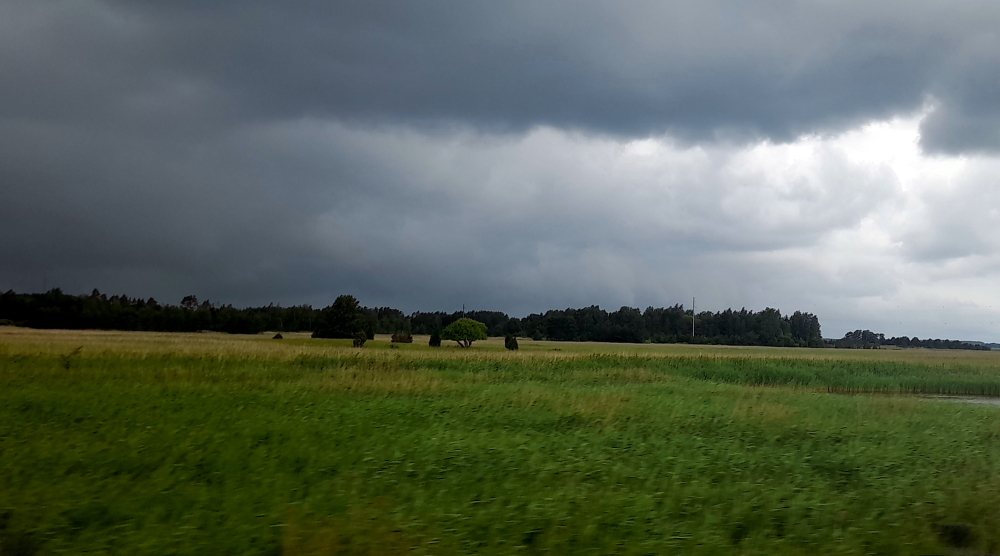
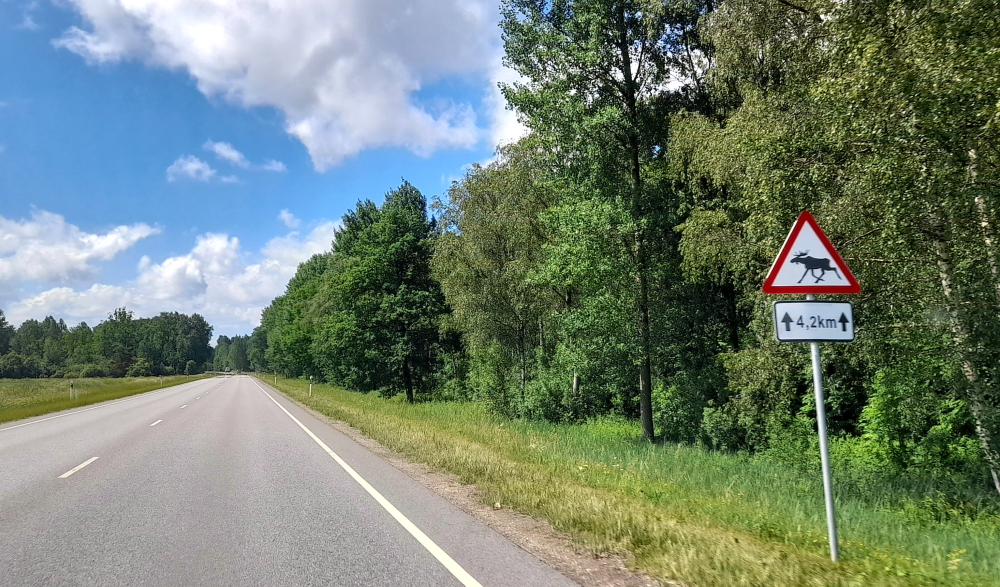
… and 20 minutes later we emerge into sunshine and see an old friend, a Moose road sign. Anyone would think we were back in Canada once again.
It takes a total of 40 minutes to drive across the island to its main town of Kuressaare where we stop at a Selver supermarket for supplies then drive the 8 minutes to our apartment, a bit like a granny flat extension to the house, where we meet our lovely hostess, Merle.
Bless her, she has a chilled bottle of Reserva Cava on the kitchen table for us and after giving us a quick tour and instructions on how things work in her beautifully-appointed apartment, we unpack then settle in on the outside deck to relax and enjoy the sunshine.
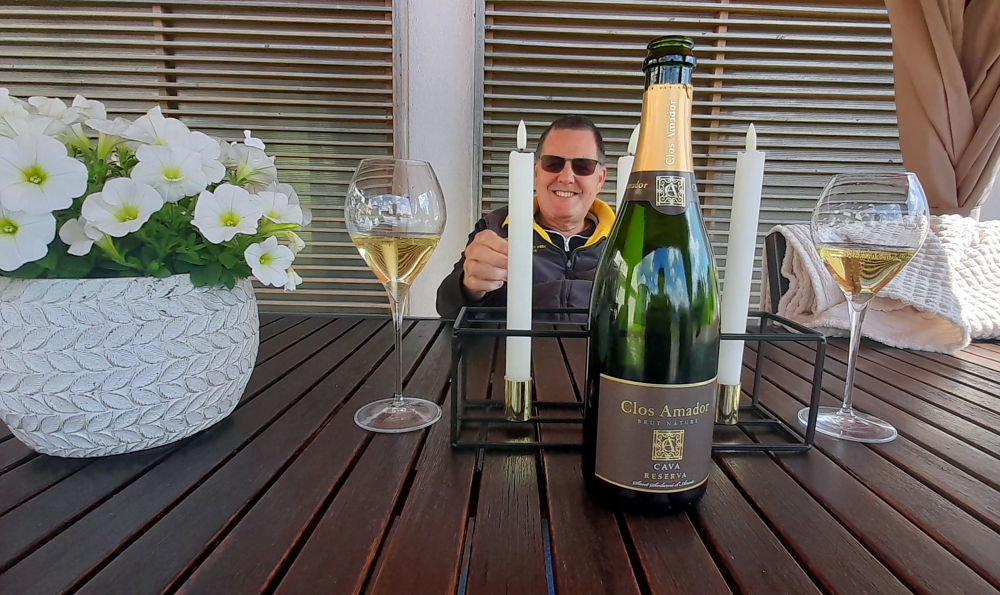
A simple dinner interrupted by the news that Dr Michael Mosley has been reported missing in 40 deg. C heat while holidaying on the Greek island of Symi. Something about “Mad dogs and Englishmen, out in the midday sun”! Do hope he’s OK.
7 June, 2024
As rain is forecast for the next 4 days we decide we need to get oot and aboot the island while there’s sunshine. So today we’re driving to the lighthouse on the Sorve Peninsula which is located at the southern tip of the island, a distance of 50km.
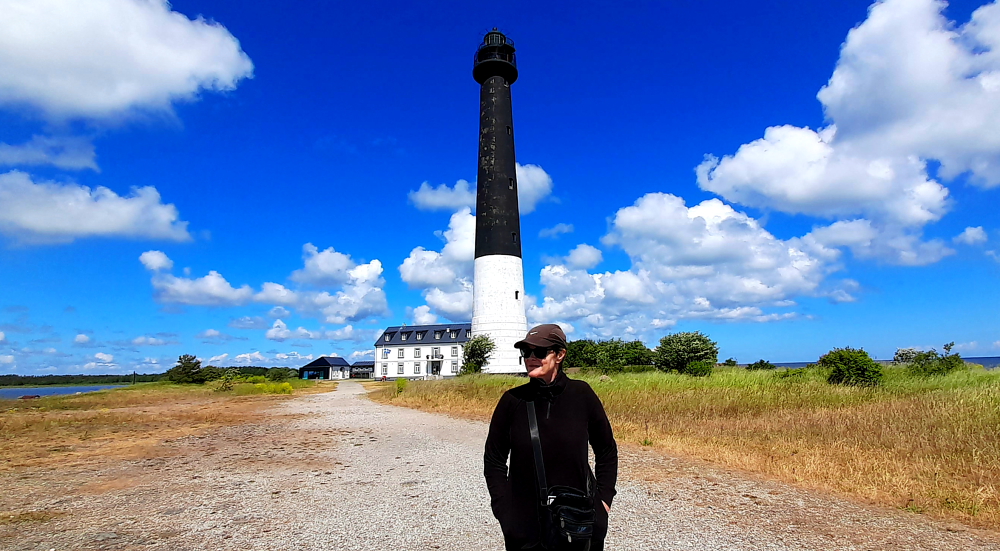
When we arrive we find a cafe and museum in addition to the lighthouse and the usual ruins of a WWII concrete bunker littering the place.
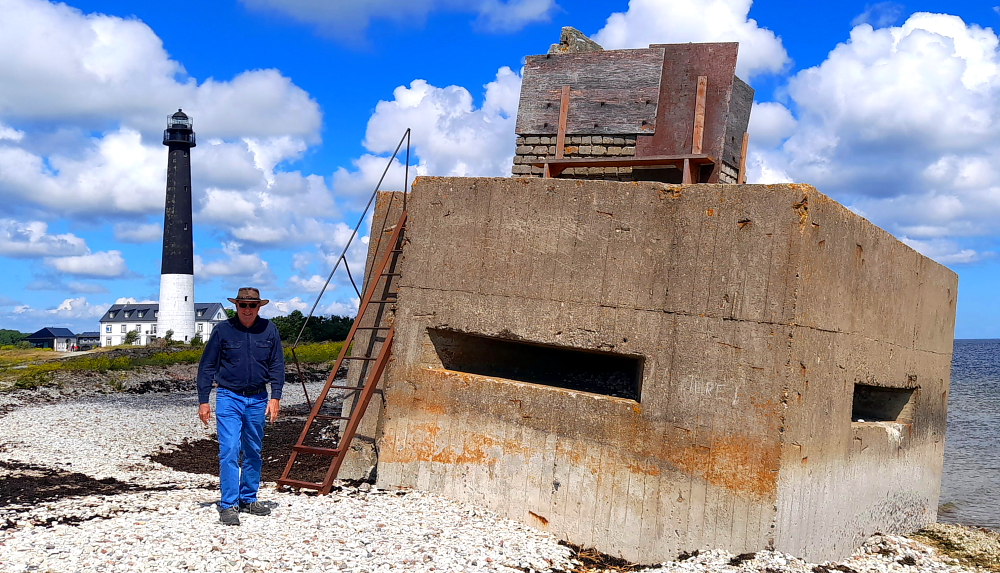
In 1646, the Livonian governor-general Gabriel Oxenstierna had a primitive lighthouse – a simple beacon built on a little island located at the tip of Sõrve Peninsula.
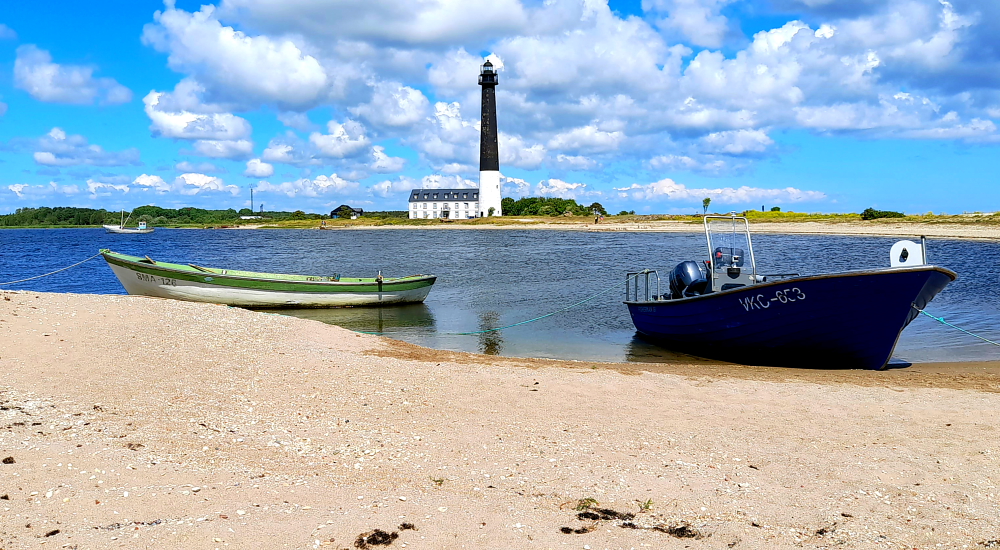
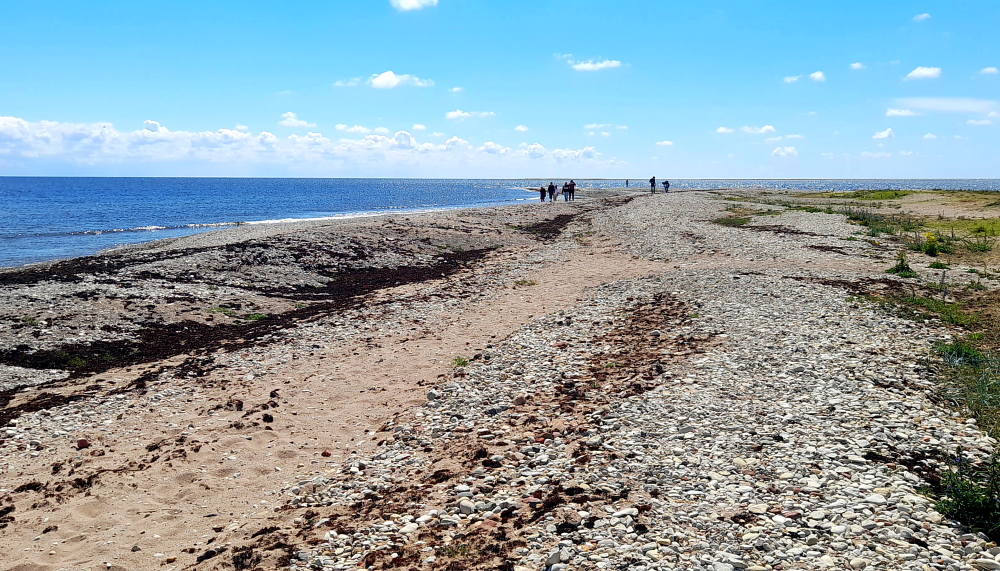
Autumn storms made it clear that the small island chosen for the beacon was unsuitable and the beacon was relocated to the tip of Sõrve Peninsula.
A stone tower was established there in 1770, but it was destroyed during the Second World War. The current cone-shaped lighthouse of monolithic concrete was built in 1960.
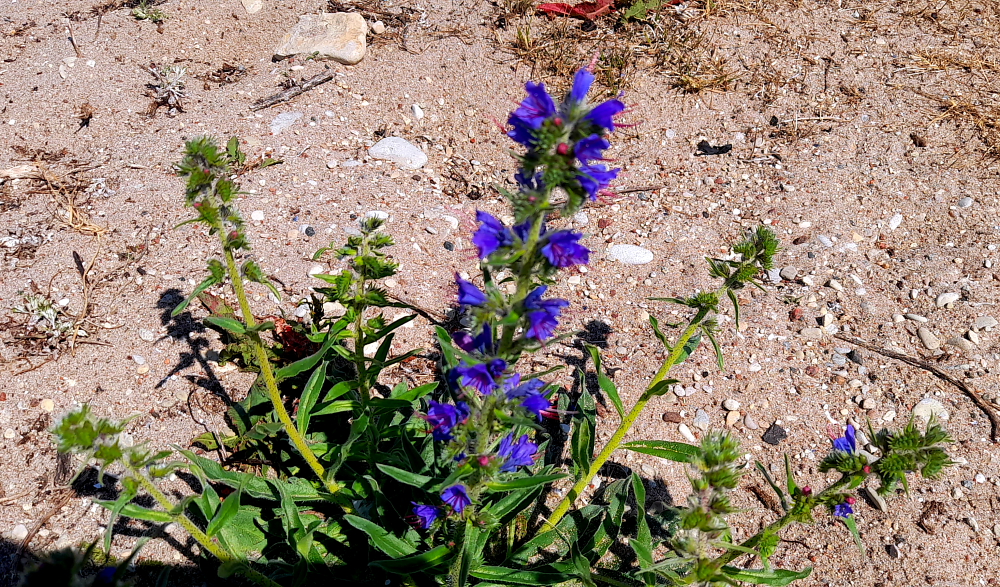
Today, as its summer, people can climb to the top of the highest lighthouse on the Baltic Sea. The lighthouse is 52m tall and stands 53m above sea level [visitestonia.com].
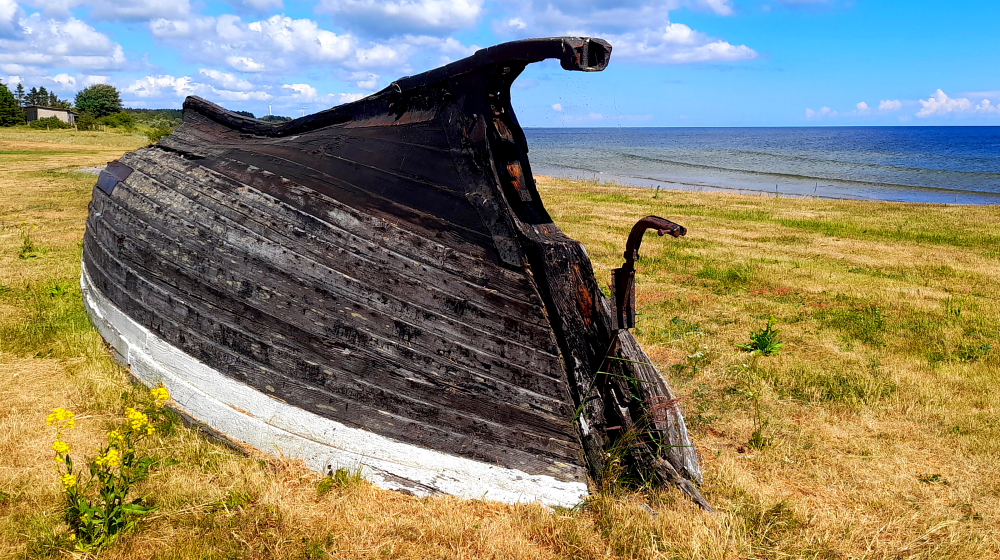
From here we decide we’ll take a look at the NW side of the island and drive a short distance to the Ohessaare Windmill (Tuulik), one of many different windmills that dot the island.
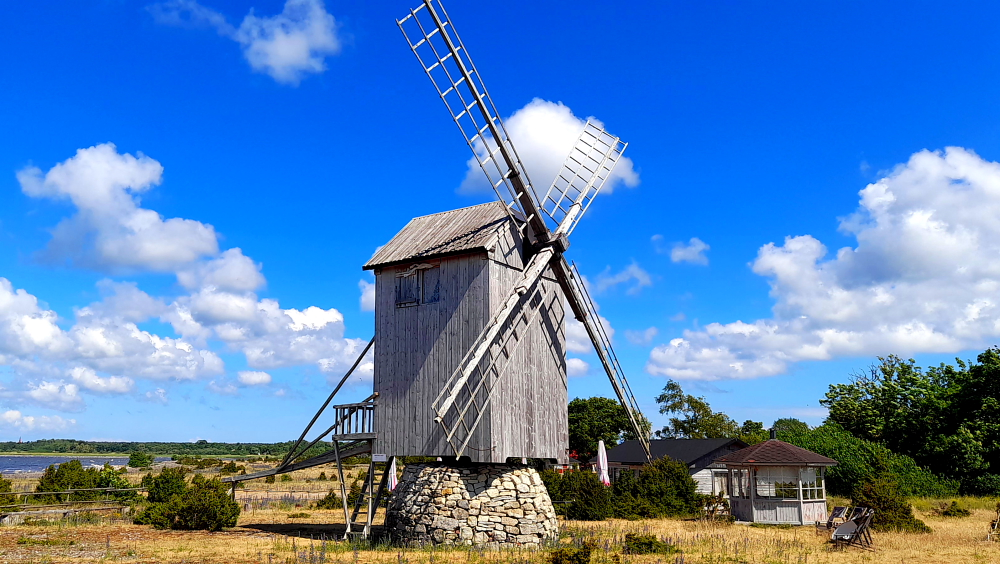
It’s a simple, bleached wooden affair atop a concreted mound of boulders so that the entire structure can be rotated into the wind.
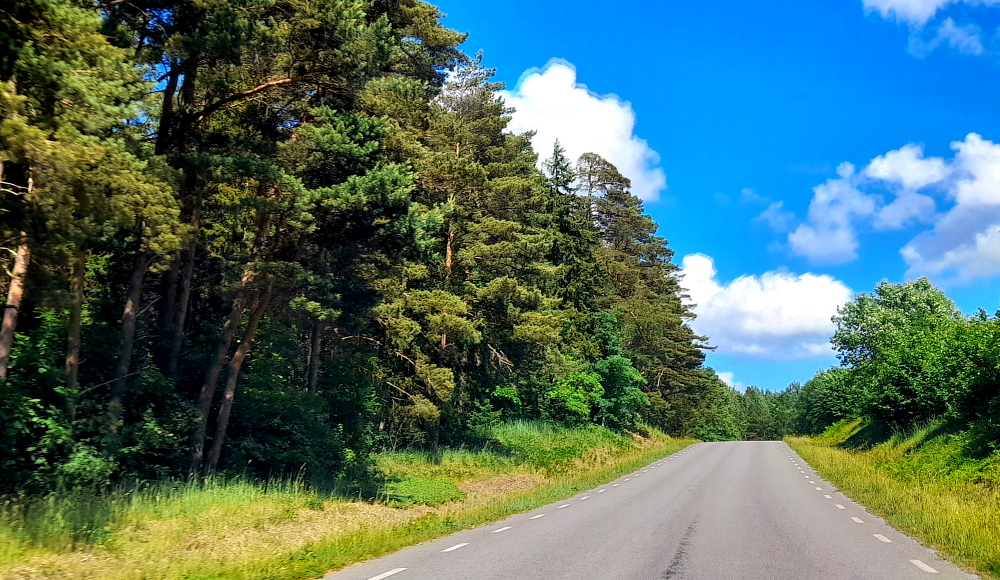
Surprisingly, here at the south end of the island besides forests of silver birch there are vast forests of Scots pines. The last time we saw these were in – Scotland! Other peculiarities are Danish farmhouses with thatch roofs and wooden battens, wooden bus shelters with net curtains and seawater swans – who’da thought?
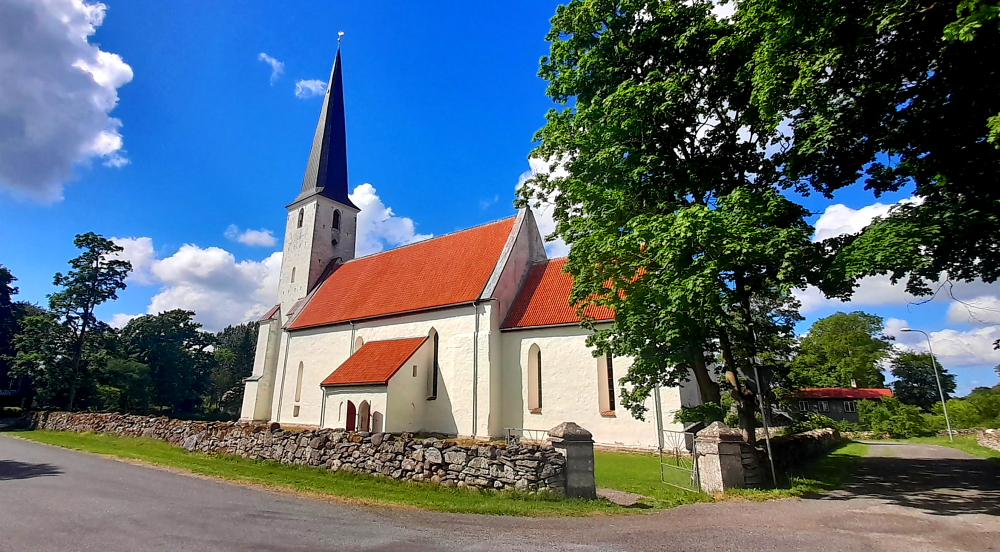
Our meanderings north along the 102 bring us to the town of Kihelkonna and its rather substantial church, St Michael’s, which was built in the third quarter of the 13th century. This isn’t obvious as the outside looks relatively recent but it isn’t until you walk through the outer door that you realise that it’s a shell, protecting a more ancient structure within.
The vault paintings of the church from the 13th century have been preserved. The hanging headstone of the choir room is unique in Estonian architecture. The Renaissance-style altarpiece was painted in 1591 and the pulpit was made in 1604 and completed completed in 1794.
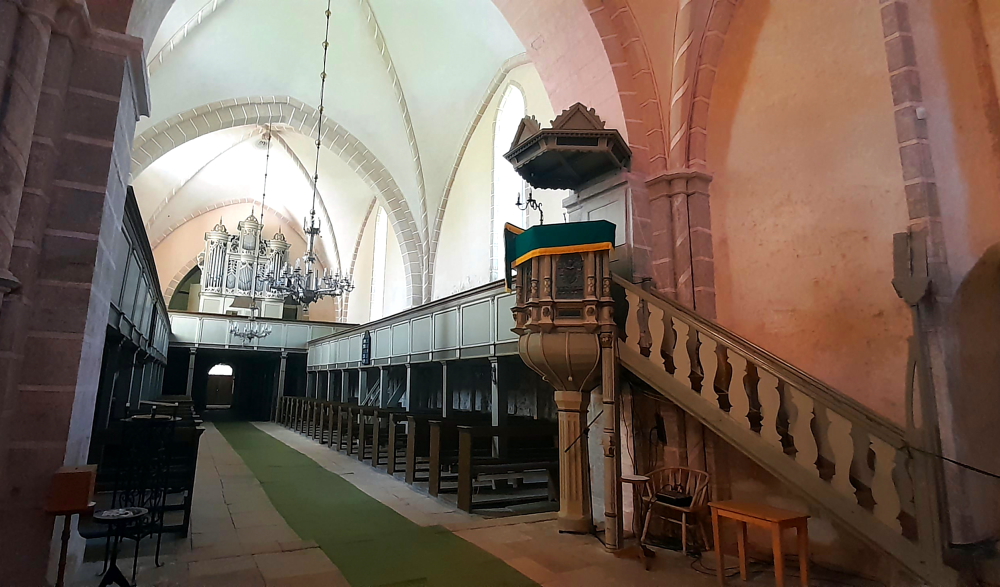
The oldest organ in Estonia, with 14 registers, was built for the church in 1805 by master Johann Andreas Stein. Friedrich Weissenborn rebuilt it in 1890 and it was further restored in 2018.
The bell tower was built in 1638 and is unique in the entire Baltic region, as it is the oldest preserved bell tower separate from the church.
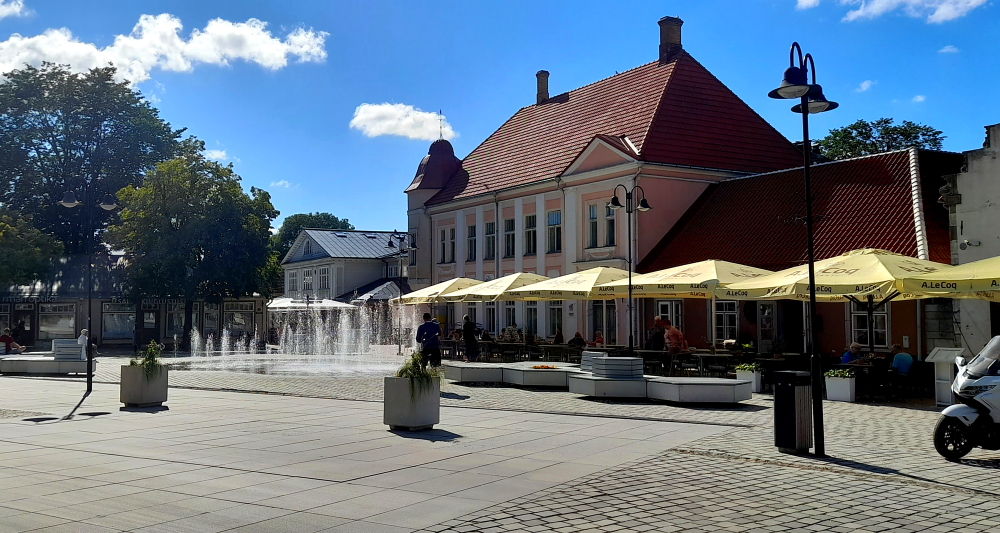
We continue as far NE as Vohma then turn south on the 86 and drive back to Kuressaare to find a restaurant for dinner. We like the menu on offer at the Pritsumaja Grill & Bar and pull up a chair around 5:30 pm.
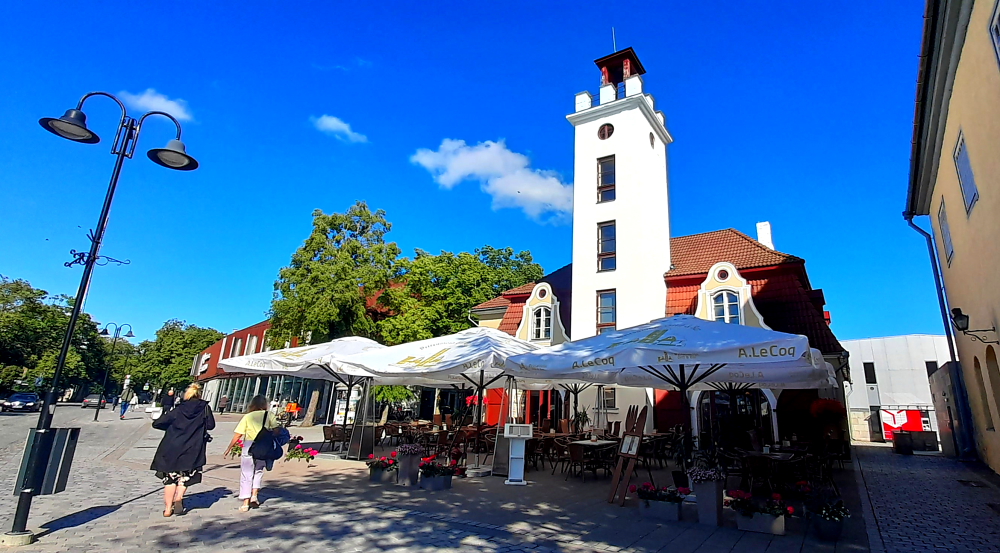
An eye-catching former fire station standing by the Kuressaare town hall. It was built in 1911, except for the stone tower that was built for drying the fire hoses in 1958. Apparently, one of the very first voluntary fire societies in Estonia was established in Kuressaare in 1867. Today, the building is home to the Pritsumaja Grill & Bar Restaurant.
Another 6 episodes of Dexter before bed at 11:30 pm.
8 June, 2024
Somehow Lynn managed to twist her left knee last night while stacking the dishwasher so today it’s swollen and she is hobbling around in agony. She’s definitely falling apart – vertigo last week, crook knee this week. I’ll have to trade her in on a younger model. Just kidding! I’ve known the old girl for 50 years – can’t abandon her now.
Anyway, another sunny day dawns with an expected max. of 18 degrees. We’re going to drive eastwards to check out the harbour at Suure-Rootsi, 20km away.
En route we stop by another windmill, this time a fixed one but, sadly, one that has lost its sails. However, it’s the home of Sutu OU, a manufacturer of biodegradable drinking straws made from reeds.
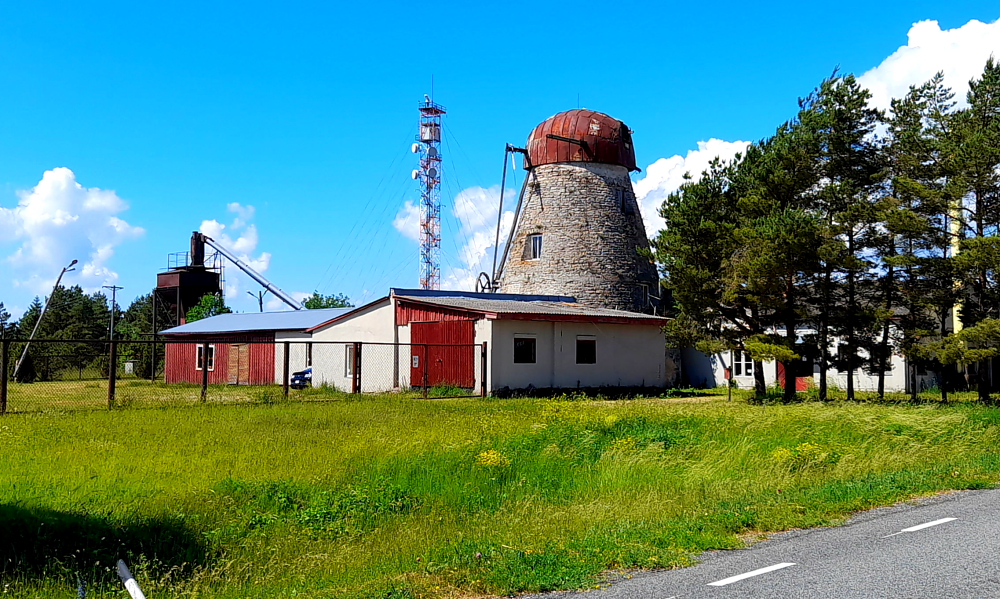
According to its website: “This 8,000-year-old island grows hectares of a never-ending natural resource. By using reed from this UNESCO protected sea-side area we provide an alternative for plastic straws as well as help clean and protect the Sutu Bay area” [sutustraws.com].
We don’t actually get to visit the harbour as it seems to be a restricted access so we retrace our steps and park near the Castle in Kuressaare.
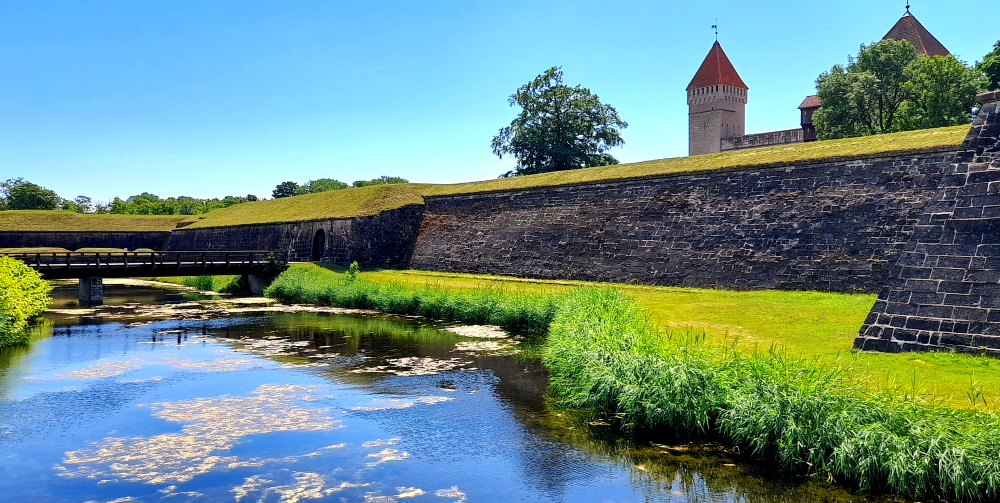
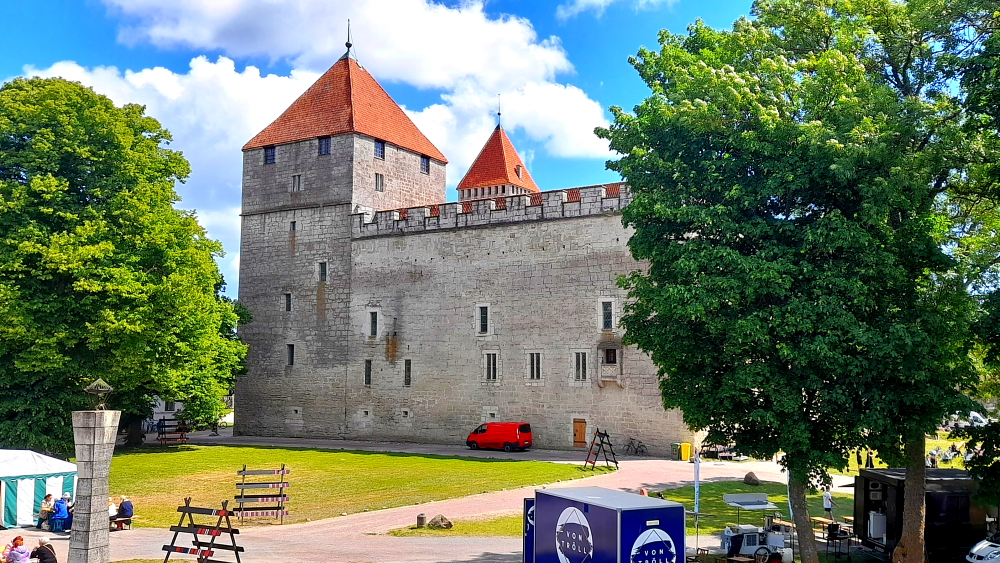
Kuressaare Episcopal Castle, also known as Kuressaare Castle, is one of the most interesting and best-preserved fortresses in Estonia.
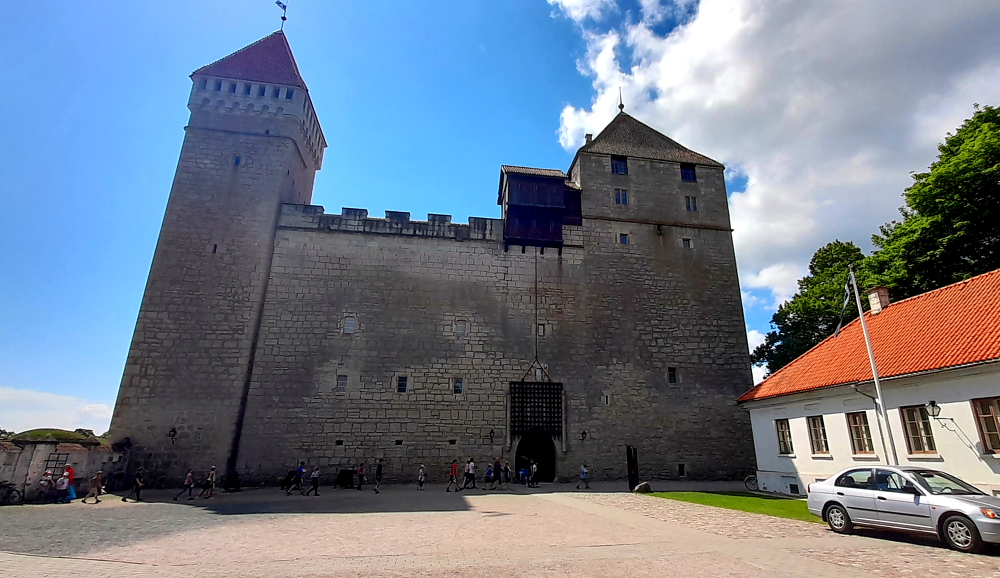
While built during the 14th–19th century, the castle became one of the most remarkable buildings in Northern Europe.
The Castle stands facing the sea at the southern end of the town, on an artificial island defended by stone-faced earth bastions and ringed by a moat.
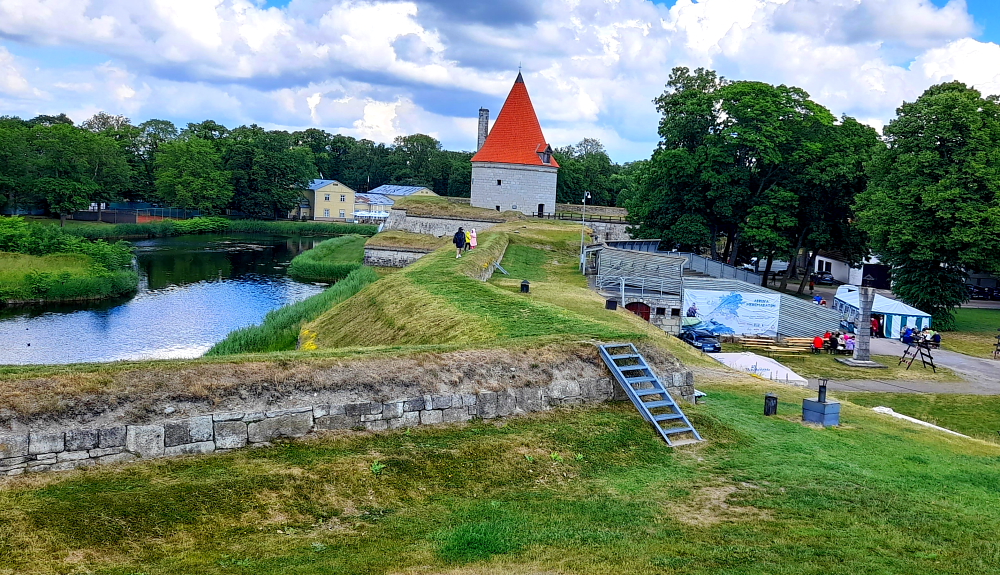
It’s the best-preserved castle in the Baltic and the region’s only medieval stone castle that has remained intact.
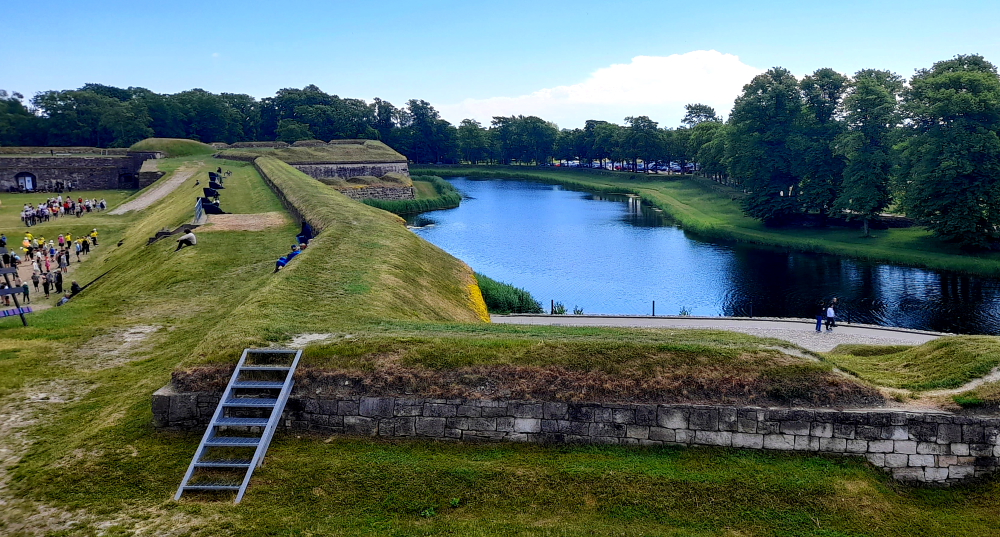
A castle was founded in the 1260s, but the dolomite fortress that stands today was not built until the 14th century, with some protective walls added between the 15th and 18th centuries.
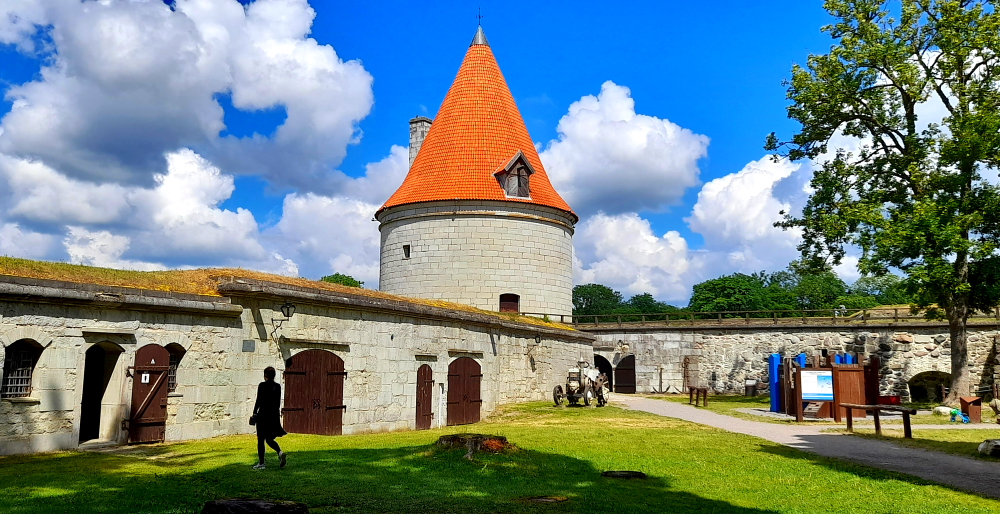
It was designed as an administrative centre as well as a stronghold. The more slender of its two tall corner towers, Pikk Hermann to the east, is separated from the rest of the castle by a shaft crossed only by a drawbridge, so it could function as a last refuge in times of attack.
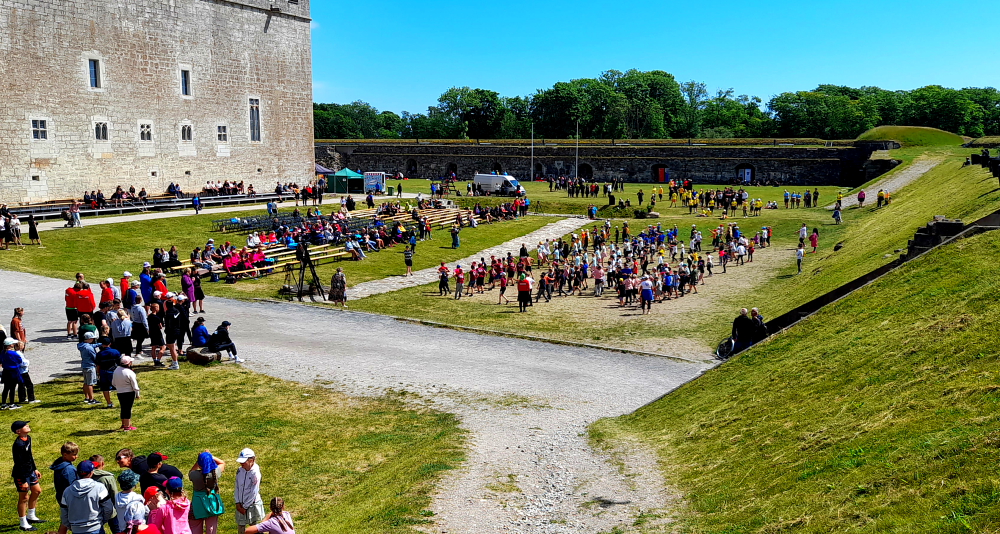
Outdoor concerts are held in the castle yard throughout the summer. Today is the bi-annual folk dancing festival which attracts children and adults from around this island to compete.
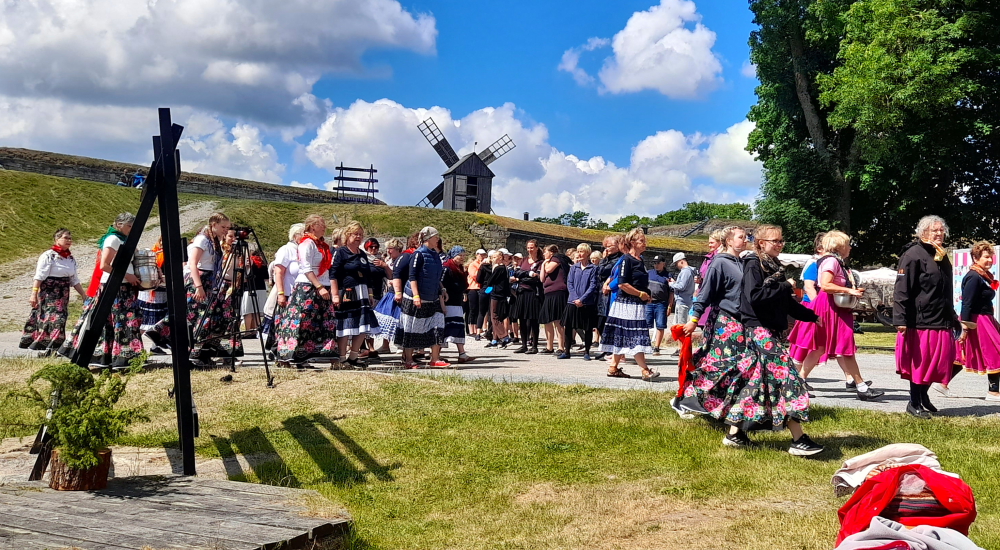
When we arrive around lunchtime various groups were having a rehearsal. Circles of older women were dancing with a wooden ladle and a mixing bowl each in their hands, followed by school kids using more modern moves. Apparently one of the contests starts at 4:00 pm and the other at 7:00 pm.
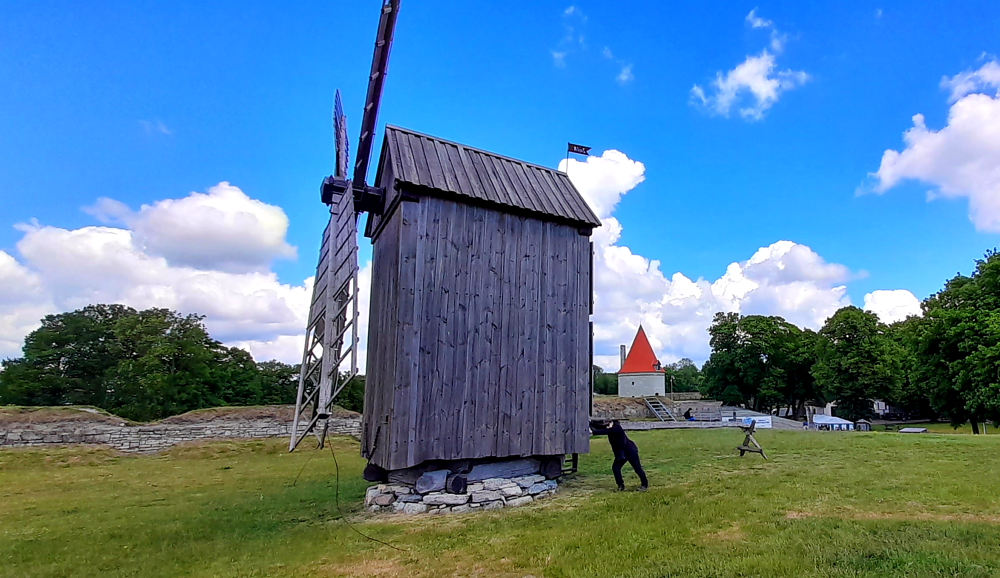
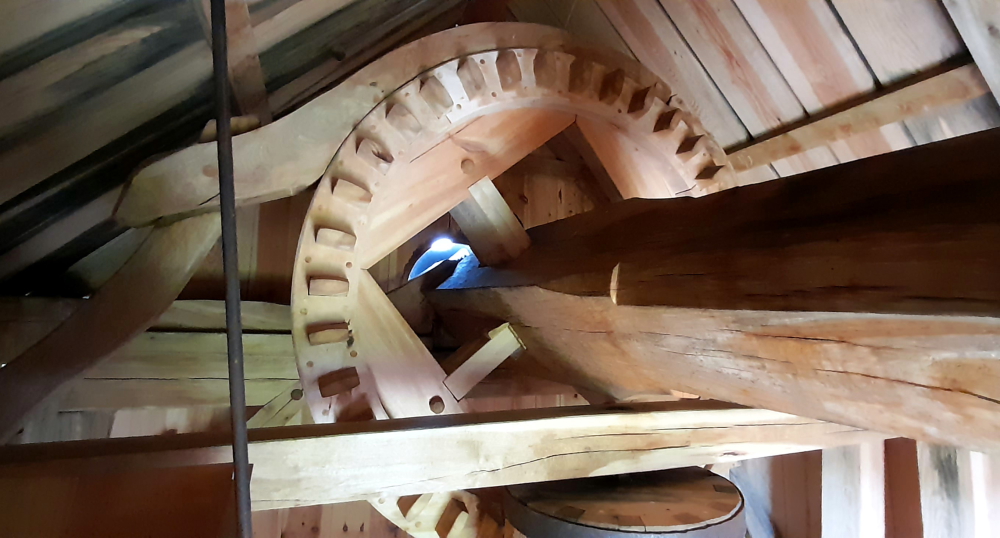
Up on the bastions is a post windmill, a reconstruction built by Hiiumaa windmill builders in collaboration with Masters of Saaremaa Windmills following the oldest documented tradition.
In the 2nd half of the 17th century the windmill of the Kuressaare Fortress was located on the western bastion (Mill Bastion) but destroyed in April 1711 during the Great Northern War when Russian troops blew up the bastions of the fortress. In 1787 a local merchant built a new one, only for it to be destroyed by fire in 1795.
There’s a memorial on the eastern wall to 90 people killed within the castle grounds by the Red Army in 1941. Its grim companion piece lies beyond the castle wall on one of the island ramparts – a large memorial to 300 people executed during the Nazi occupation.
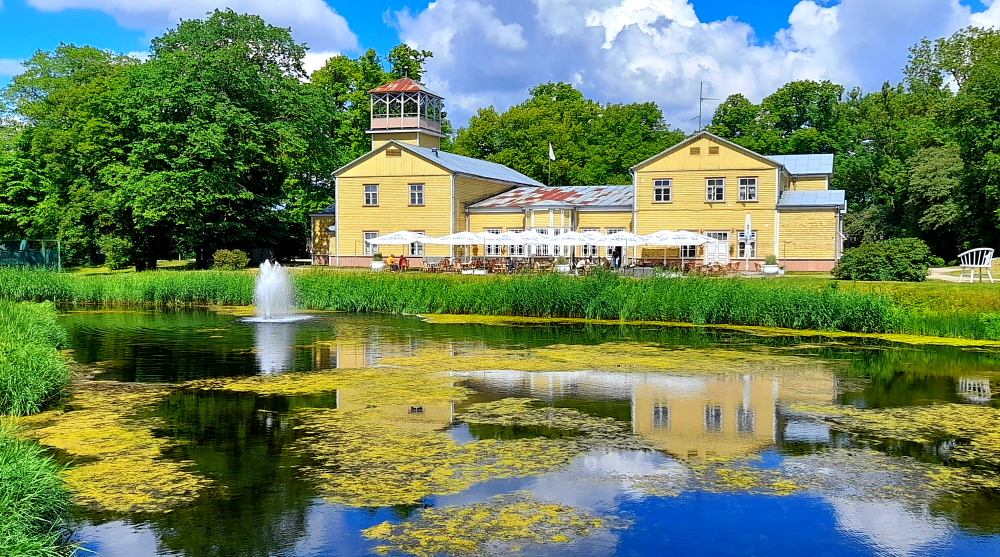
The shady park around the castle moat was laid out in 1861 and there are some fine wooden resort buildings in and around it, notably the Spa Hall (Kuursaal) dating from 1899, which is now a restaurant, and the neighbouring bandstand from 1920. There is also the Ekesparre Residents Boutique Hotell [visitestonia.com].
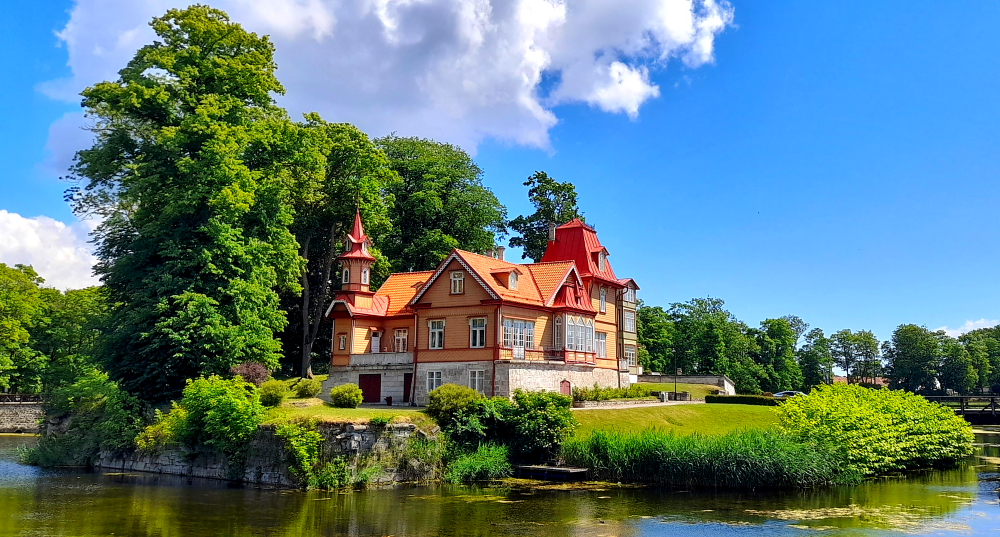
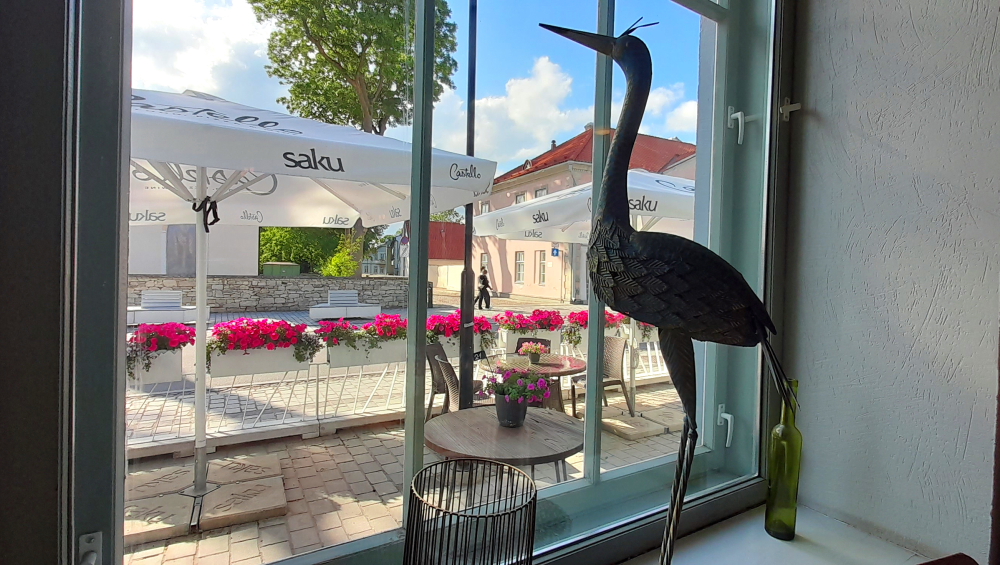
This evening we return to the neighbourhood of the fortress, stopping at the Castello Restaurant for dinner.
Opposite is the St Nicholas Church, built by order of Emprss Catherine II.
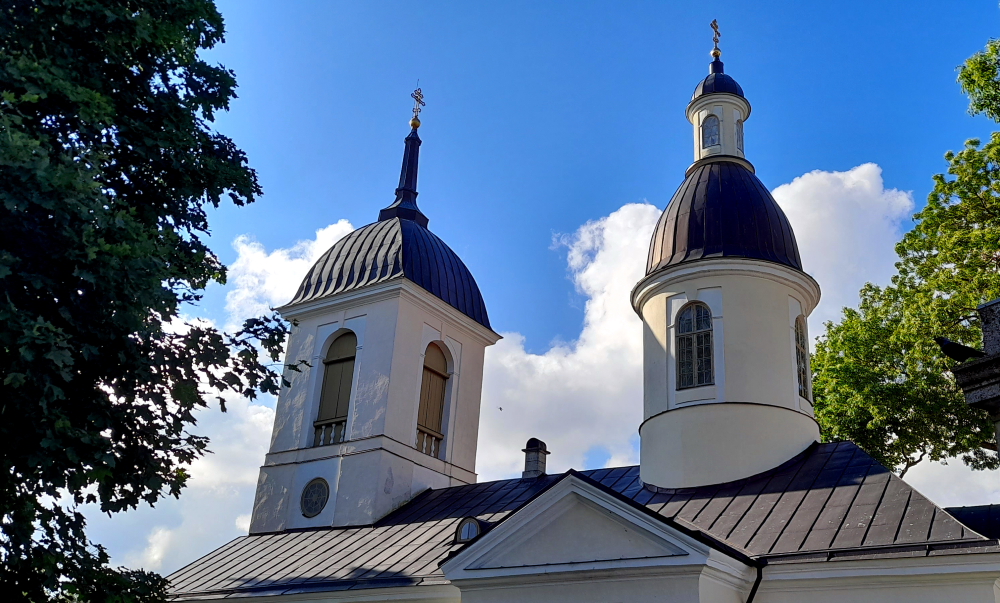
The church together with the gates from dolomite and surrounding wall is under protection as architectural memory. The church was built in 1790 and, at the same time, a 3-part entrance gate was built at the footpath [www-puhkaeestis-ee].
Time for some more Dexter.
9 June, 2024
Lynn’s knee is no better this morning so we plan to have a quiet day to rest up. It’s cold and very windy outside but better than the forecast of rain all day. I think that Lynn just wants an excuse to sit down and watch Dexter all day. I am a bit over it but you know what they say…”Happy wife, happy life.”
And the tragic news that they’ve found the body of Michael Mosley who, it appears, has been dead for several days. We always enjoyed watching his programmes.
Tomorrow we move on to Parnu, Estonia for 5 days in an Art Nouveau Hotel – Villa Ammende (1904). Parnu is only a relatively small city so I can’t see us being all that busy this week.
Like Haapsalu and Kuressaare, Pärnu attracts holiday makers with its large sandy beach, numerous restaurants, cocktail bars, spas and a relaxed, laid back vibe. This medieval city is now the largest resort in Estonia. Pärnu is also a home to a variety of spas from large water parks to the smaller, historical bath houses. Long, white sandy beaches, shallow waters and “the best Sun in Estonia” attract Estonians and visiting guests alike. Activities include walking, cycling, roller skating, water skiing, yachting, canoeing/kayaking down the Pärnu river to the open sea and nearby islets.
10 June, 2024
We are out of bed at an unusually early hour of 7:30 this morning. It’s a chilly 14 Deg C with a cold wind blowing across the Baltic. Time to pack up the car again for the drive back across Saaremaa and Muhu Islands then to the ferry to cross over to the mainland at Virtsu. The total trip to Parnu is only 157km but considering the whole of Estonia can be crossed in less than 3 hours, locally this would be seen as a long drive.
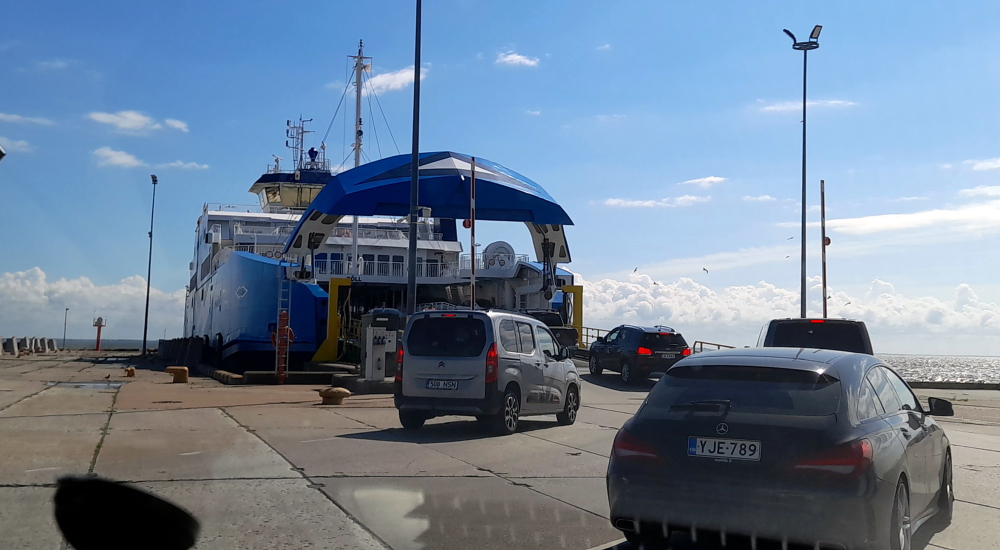
Just as we arrive at the Ferry Terminal at 10:45 the ferry finishes unloading and we drive straight on the 10:50 ferry instead of the one we’d booked for 11:25. These ferrys are very efficient. By the time we exit the car to go to the lounge area we are already underway.
Despite a strong cross wind this morning the crossing is still very smooth except as we pass the ferry going in the opposite direction. We bounce around a little as we cross the wake and half the car alarms burst into urgent warnings.
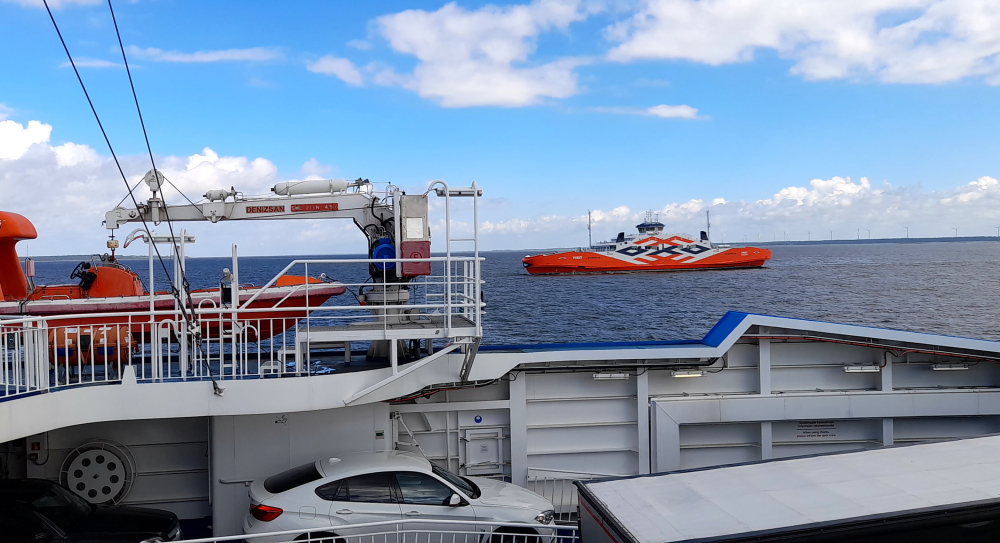
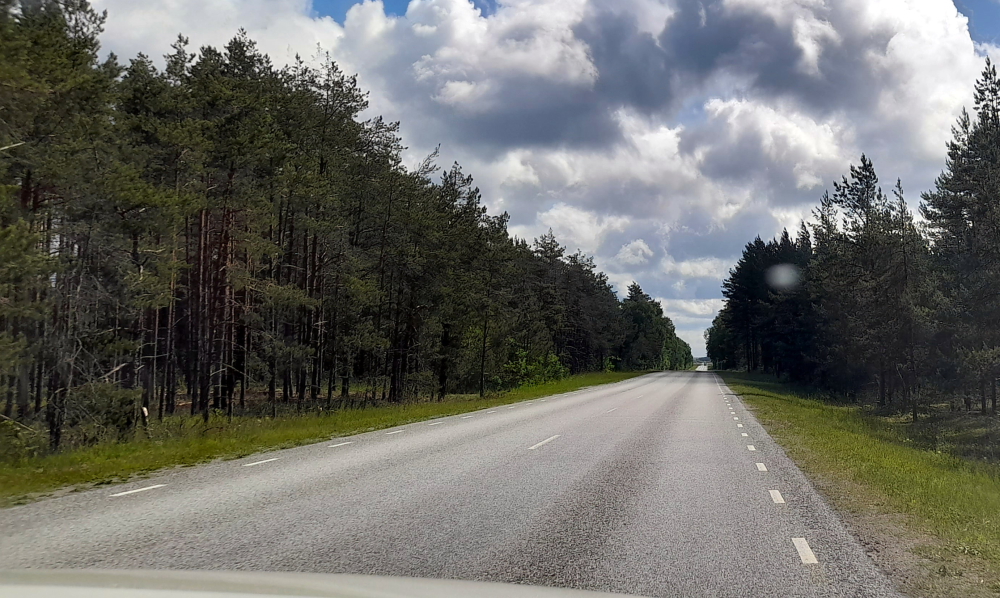
The drive is uneventful with yet more forests and some agriculture. But we did see a couple of cranes in a field and a stork in an elevated nest. The speed limit on the intercity roads is just 90 kph but there is no traffic and very few towns on the way so we make good time.
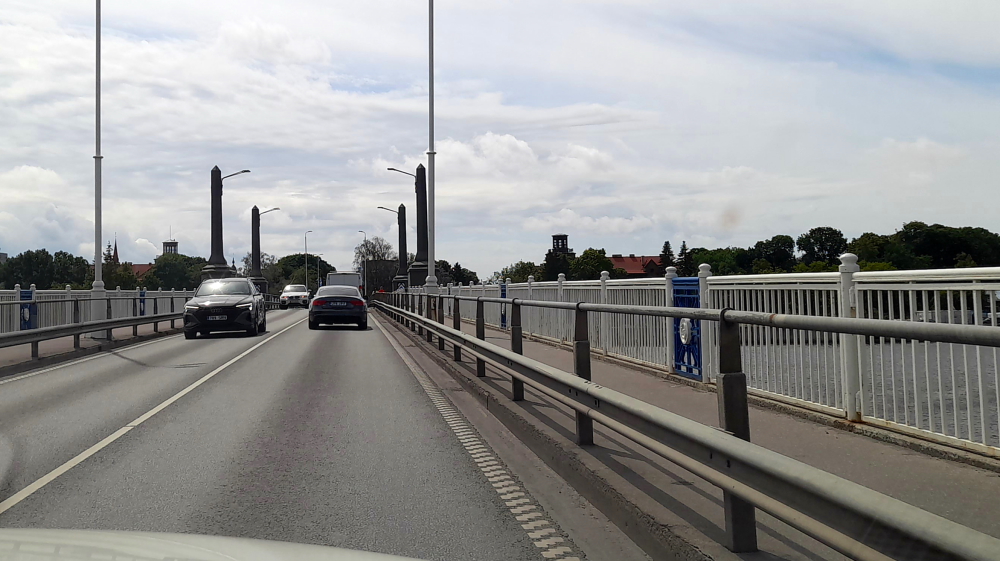
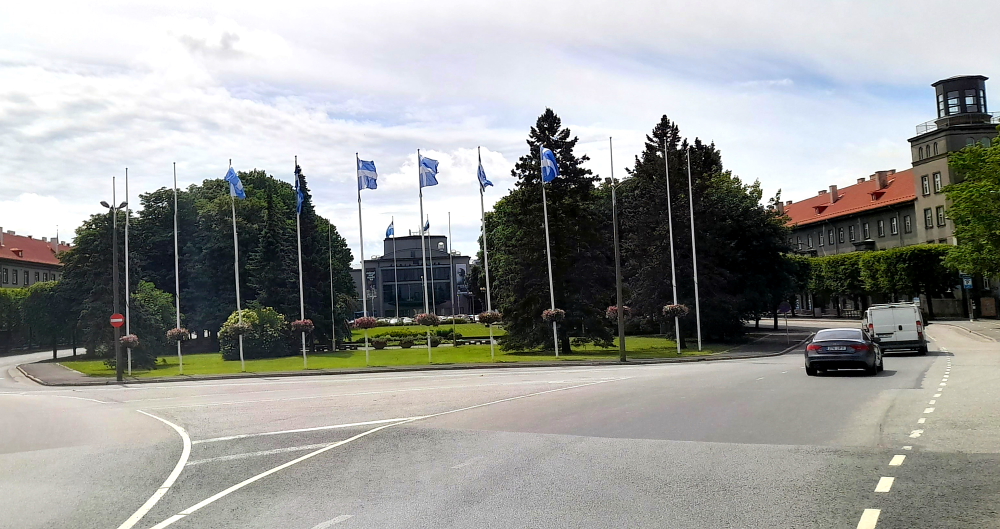
We arrive in Parnu just around midday. Parnu seems to be yet another small town, and compact, so it shouldn’t take long to see it all.
Lynn has a number of sites to visit but we head straight to the hotel in the hope that we can check in nearly 3 hours early.
We pull into the hotel parking area at 12:20 pm and surprisingly our room is ready. We are on the top floor of this grand old house and as you would expect there are no elevators.
Luckily however, the hotel has a strong male concierge who takes all our bags to the room while I repark the car.
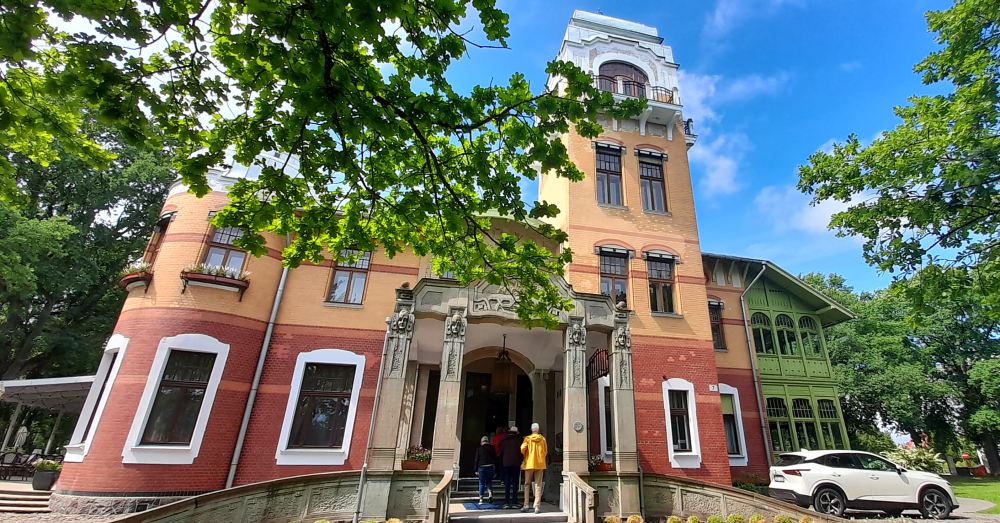
The Baltic-German merchant who built the beautiful Villa Ammende, who at the beginning of the 20th century inherited the first department store in Pärnu from his grandfather, and with it the status of Pärnu’s wealthiest businessman.
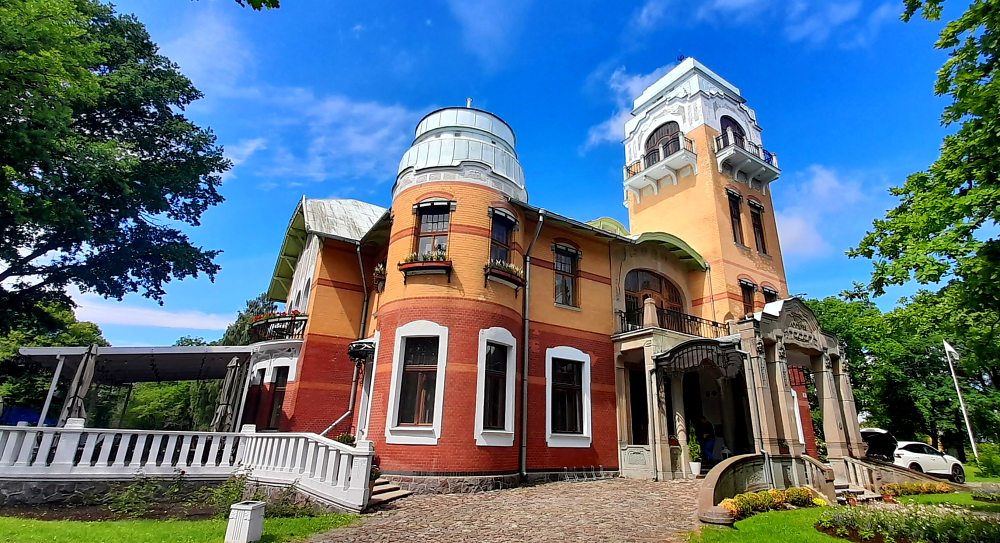
Hermann Leopold Ammende, one of the wealthiest large merchants in Pärnu, whose ancestors had settled in Estonia from Germany in the 18th century, was looking for a suitable house for the wedding of his only and passionately loved daughter, Ellen, who was in love with a ship captain. Unable to find a suitable place, he decided to build a luxurious villa for his daughter’s wedding party and for the family’s future summer home, and to commission the design of the luxurious building from the St. Petersburg architecture office Mieritz & Gerassimov in 1904.
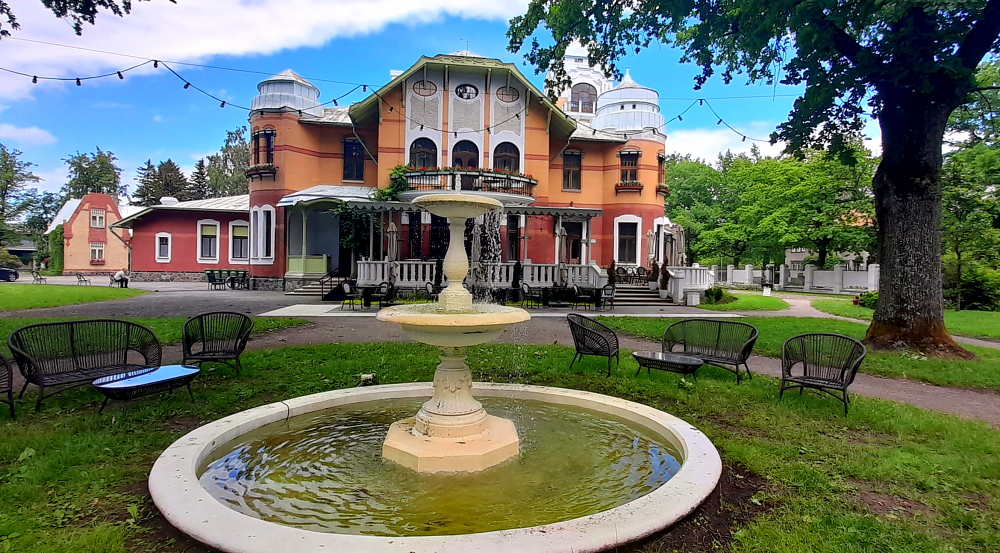
Construction was completed in 1905. All new methods and materials were used on the facades of the building which were emphasized with different colors characteristic of the era: multi-colored ceramic tiles, black wrought iron and bluish-gray rolled iron, olive green wood, light blue plaster and carved stone details. Legend has it about the special tower of the building that it was built so that Ellen could see her husband arriving from a sea voyage.
WWI and the Russian Revolution dealt a blow to the family’s economic situation, which from then on gradually deteriorated until they finally went bankrupt and sold the villa to the City of Parnu in 1927 for 8 million marks with the original intent to use the house as a Kurhaus(spa hall) and beach hotel.
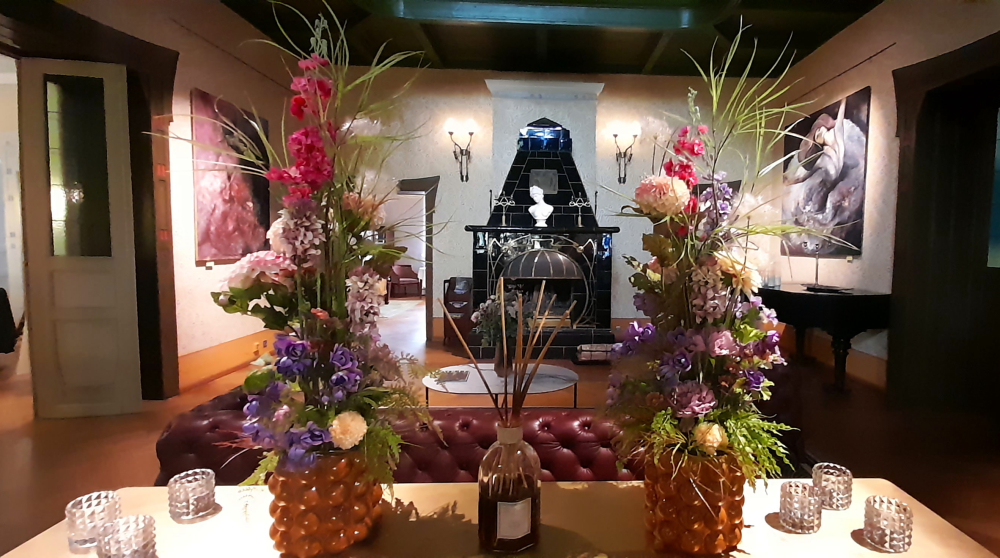
In 1935 Villa Ammende was rented to a family who ran a summer casino on the first floor and set up their living quarters on the second floor. The house became a meeting place for Estonian high society, which was often visited by Konstantin Päts, the first president of the first Republic of Estonia. In 1940, the house passed into the hands of the Russian military authorities. During the German occupation, the villa operated as an officers’ casino.
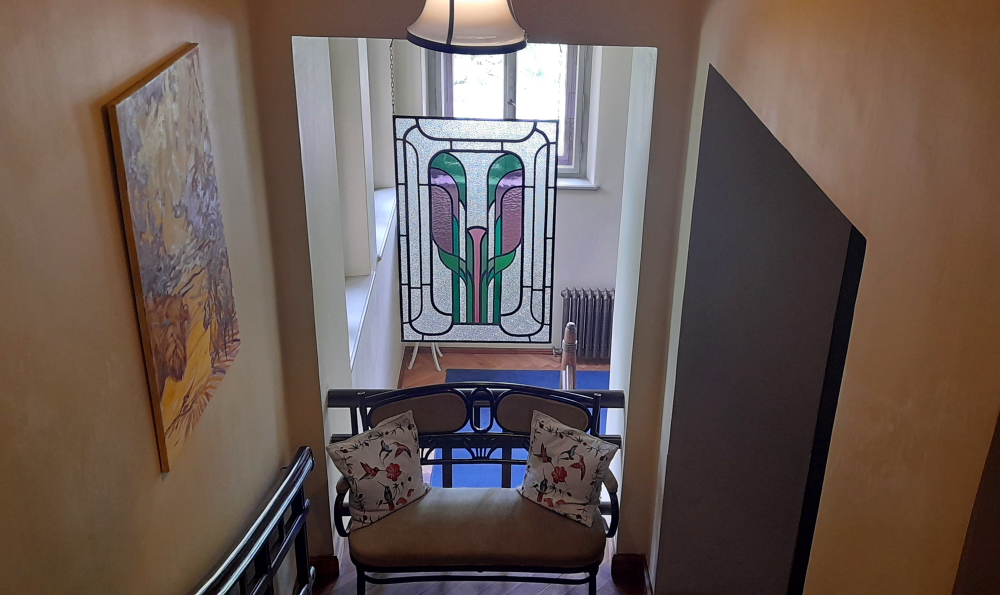
In Soviet times, the villa belonged to the resort government. At the end of the 70s, instead of a sanatorium, there was a plan to furnish the Palace of Happiness for those getting married. When the large flow of vacationers stopped at the end of the 1980s with the collapse of the Soviet Union, the house remained empty.
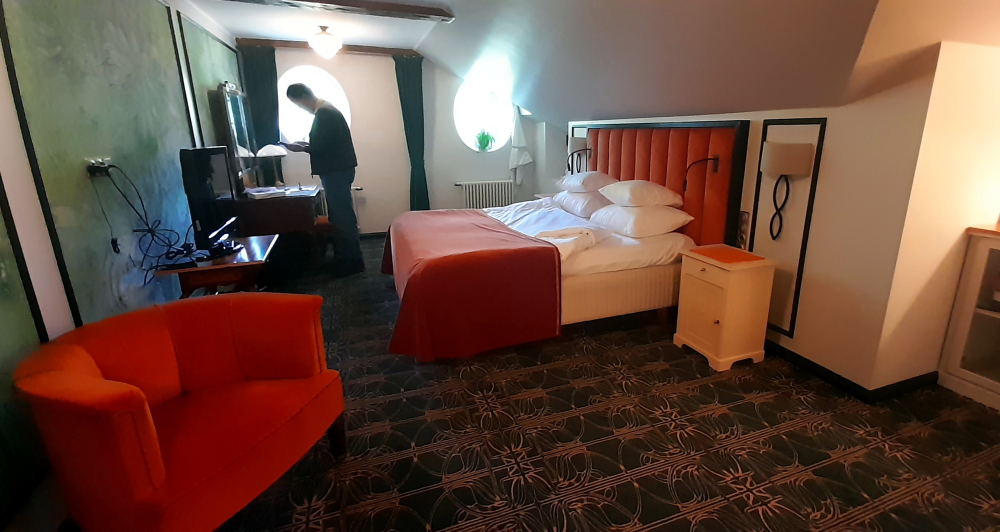
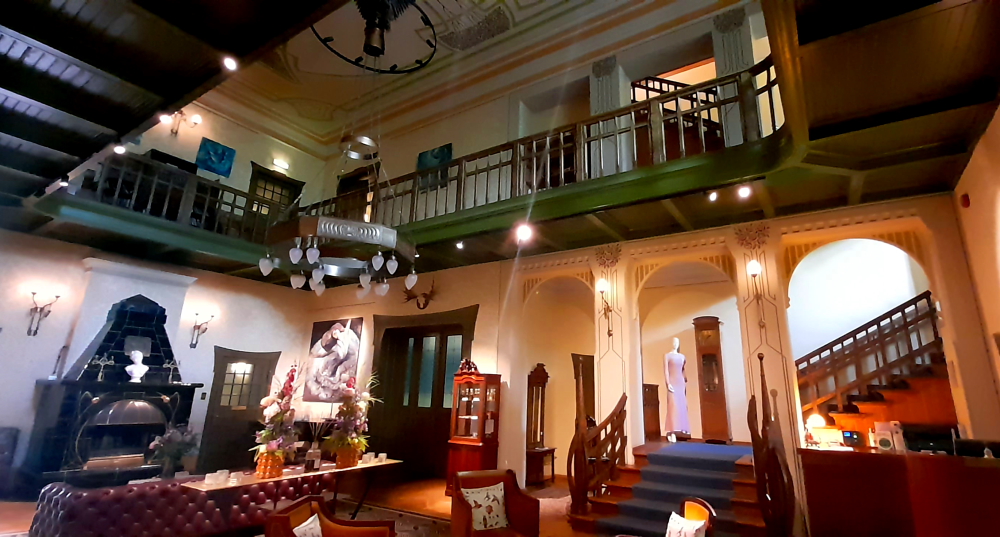
In 1995, Two Estonian businessmen, Rein Kilk and Hans H. Luik, decided that the beautiful villa must be renovated. In September 1999, an exclusive hotel and restaurant with a newly renovated historical interior and furnishings, located in a beautiful park in the Pärnu beach district, was officially opened.
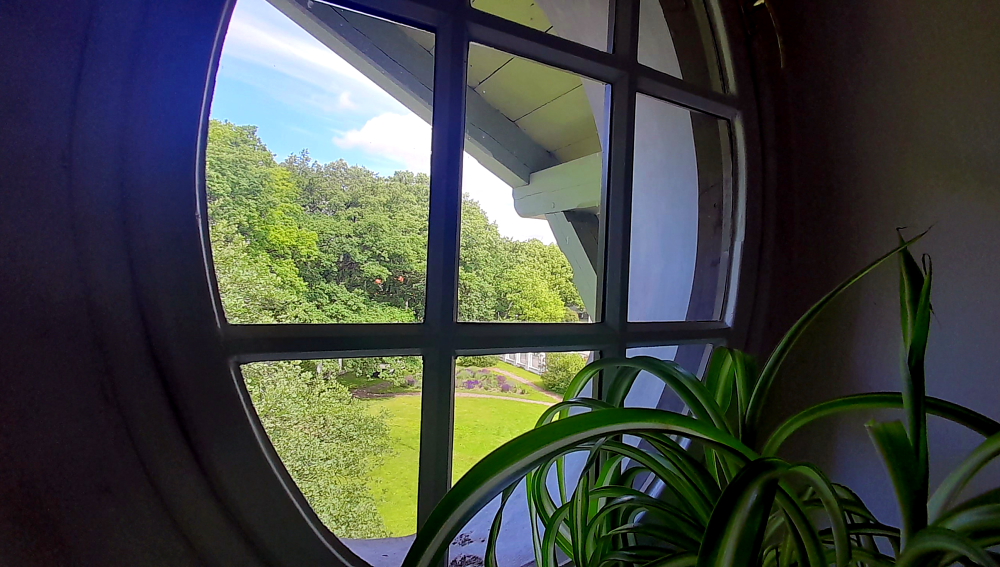
By 2020, Villa Ammende had been operating as a hotel for over 20 years [ammende-ee].
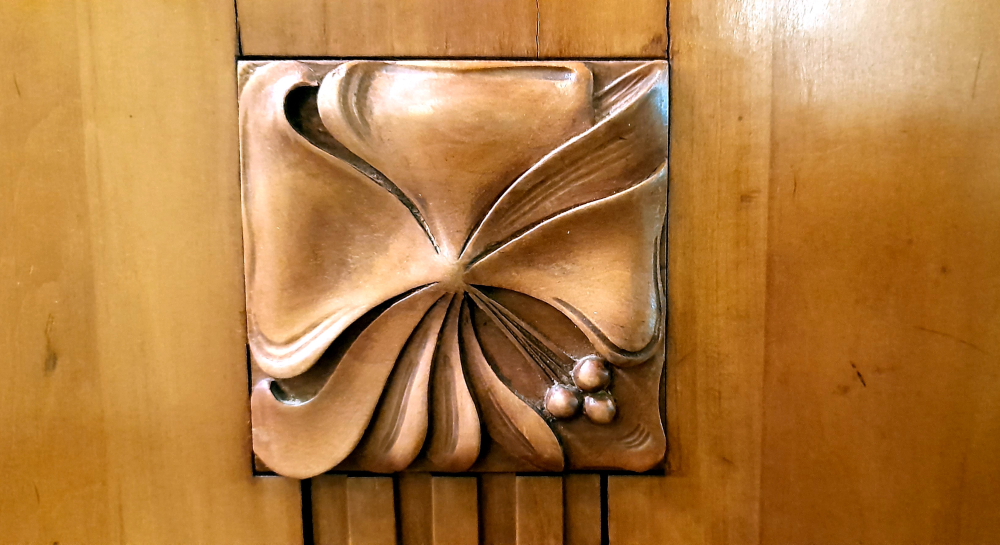
Today’s Villa Ammende looks like it did in its very early days at the beginning of the 20th century.
Luckily, the hotel has a restaurant which offers, naturally, nouvelle cuisine. A trio of Estonian breads starter, roast duck breast for me, venison for Lynn followed by chocolate fondant with cherries and passionfruit sorbet. Delish.
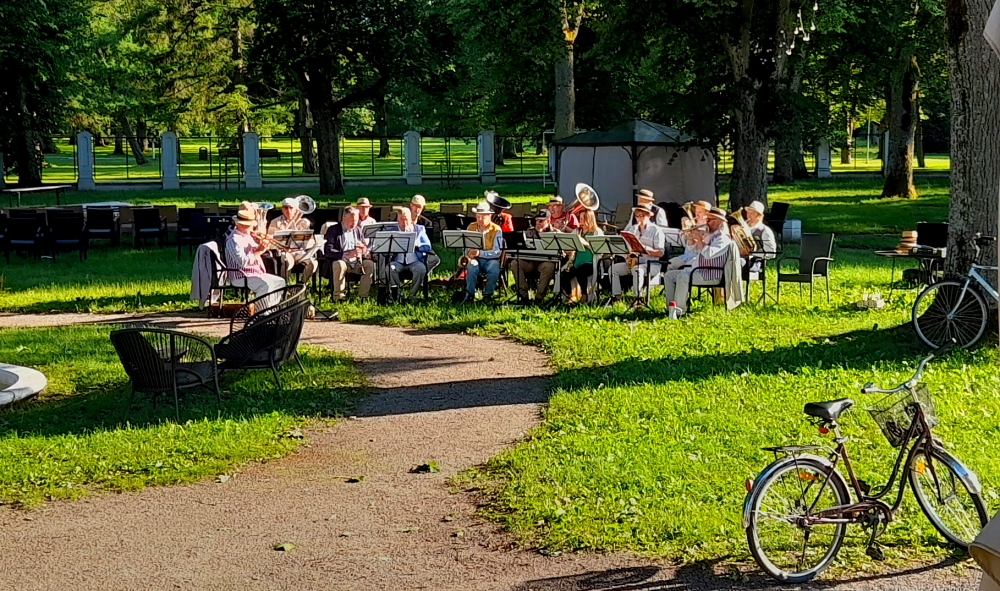
During dessert we notice a gaggle of people begin to form outside which slowly morphs into a band and right on the dot of 7:00 pm their practice session begins. One way to use a beautiful garden!
 THE CONTINUING TRAVELS OF YOGI & BOO BOO