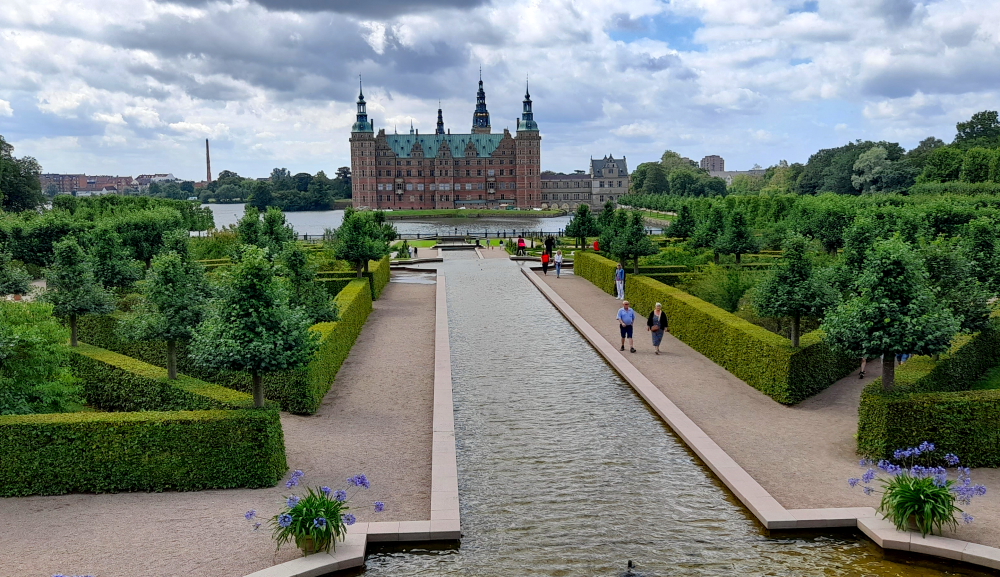
One of the reasons we decided to spend the last couple of days in this part of Denmark is to visit Frederiksborg Slot which is located in the centre of North Sealand.
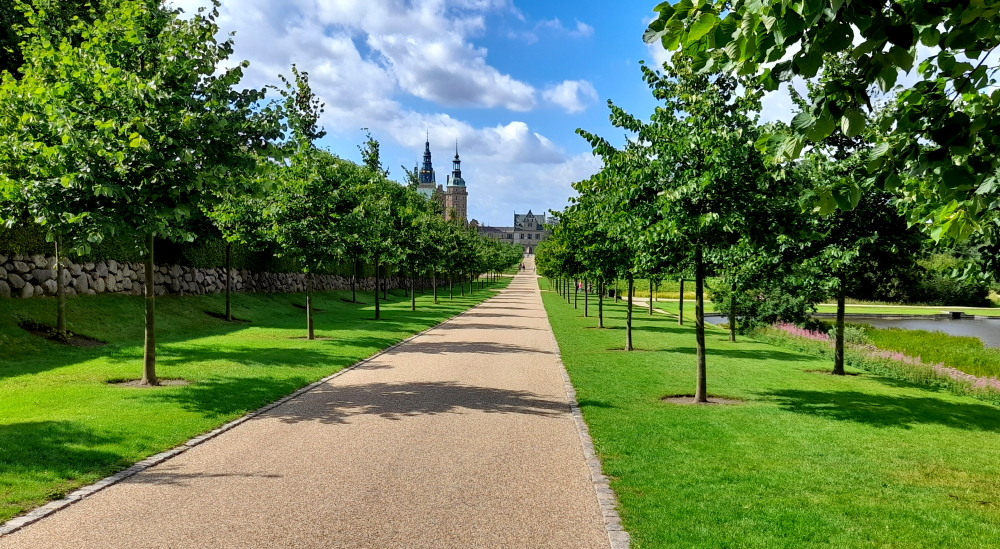
View of Frederiksborg Slot from Rendelaeggerbakken.
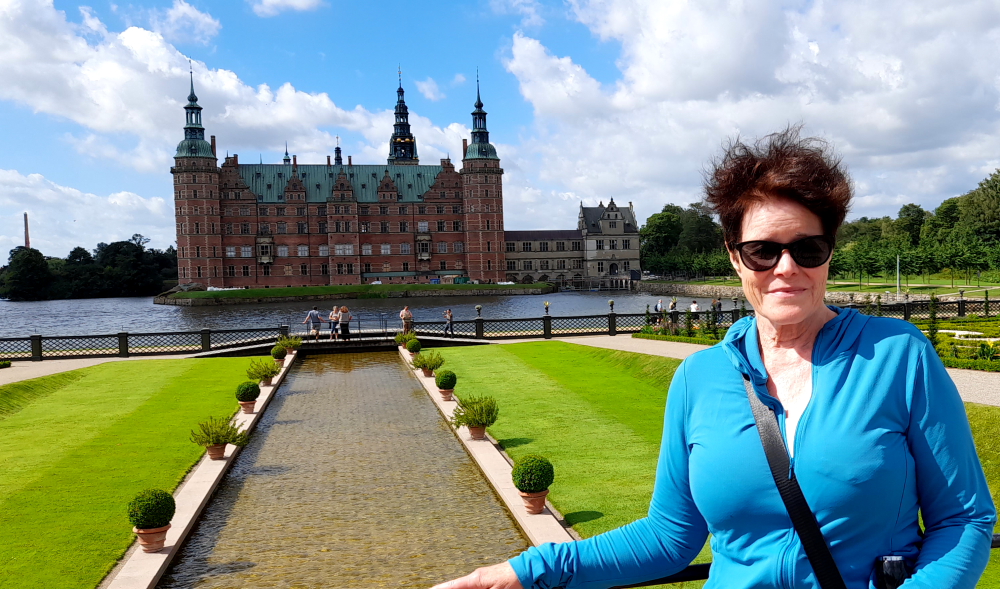
Frederiksborg Castle is a palatial complex in Hillerød, Denmark. It was built as a royal residence for King Christian IV of Denmark-Norway in the early 17th century, replacing an older castle acquired by Frederick II and becoming the largest Renaissance residence in Scandinavia. The aim of the building was to show off and enhance Christian IV’s status as a powerful European monarch. On three islets in the Slotssøen (castle lake), it is adjoined by a large formal garden in the Baroque style.
Hair-raising day overlooking the Slot & its lake.
After a serious fire in 1859, the castle was rebuilt on the basis of old plans and paintings. Thanks to public support and the brewer J. C. Jacobsen, its apartments were fully restored and reopened to the public as the Danish Museum of National History in 1882. Open throughout the year, the museum contains the largest collection of portrait paintings in Denmark – the National Portrait Gallery.
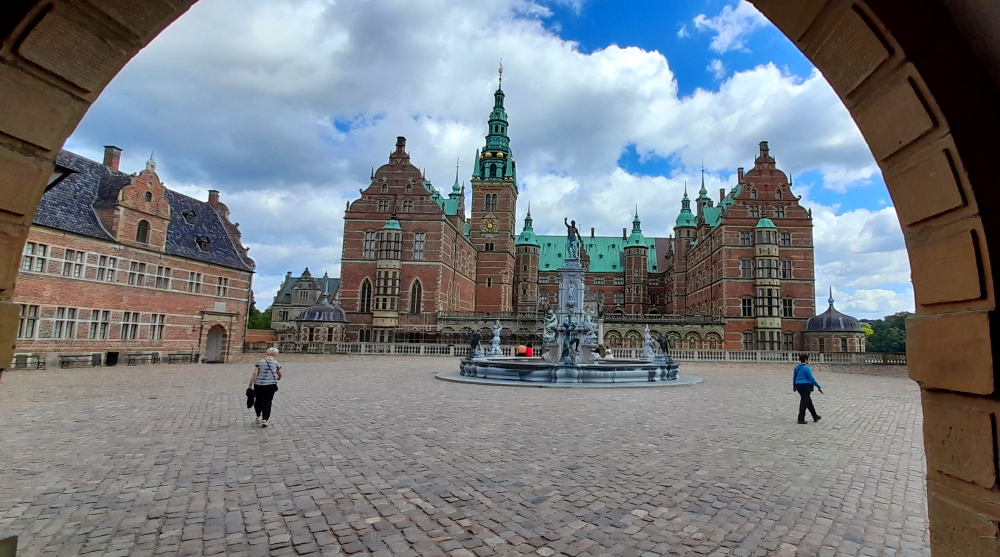
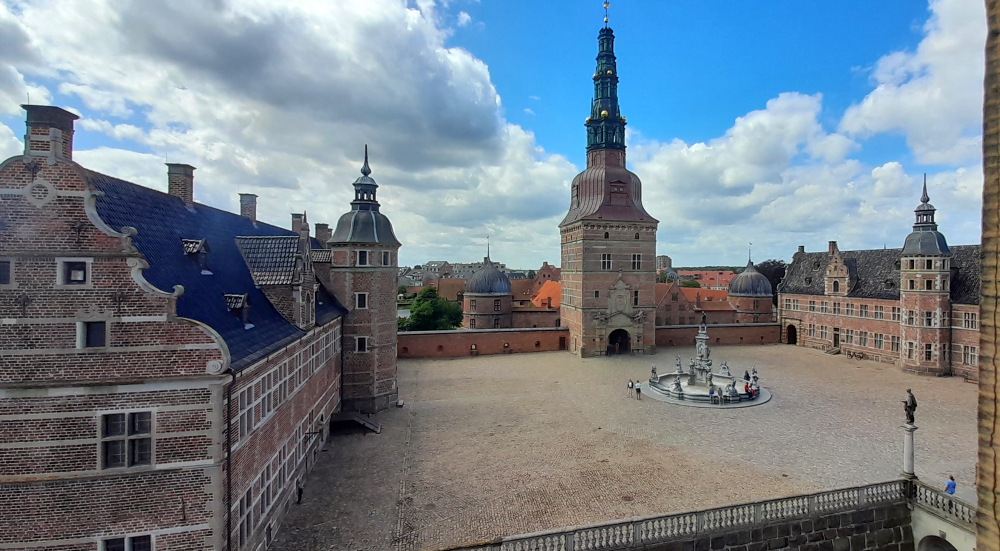
Designed in the classic Dutch Renaissance tradition, Frederiksborg is shaped in a quadrangular structure. Dutch Renaissance architecture used red bricks for the exterior and the buildings were topped with stepped gables and towering copper spires.
View of courtyard from under the Fangetarnet (Prison Tower).
There are four main structures, which make up the quadrangular castle. To the west, is the Chapel Wing built in 1606. Centre is the main wing, the King’s Wing, built in 1604. To the east, the Princess Wing built in 1608. The fourth structure is the clock tower built in 1617 after nine years of construction. The Terrace Wing joins all these buildings together to form the great Frederiksborg Castle.
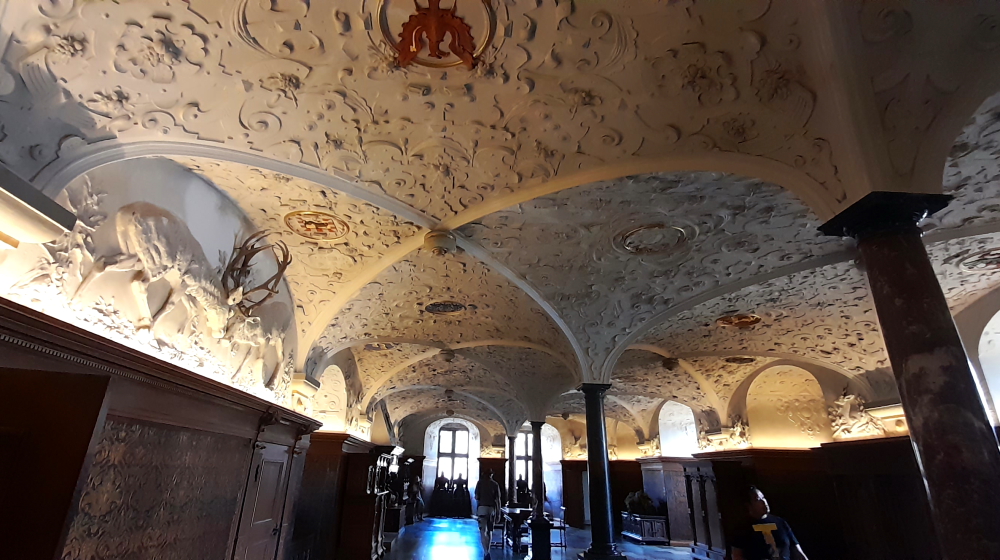
The first room we enter is the Rose Dining Room (also known as the Knight’s Room). This room on the lower level is a recreation of the great Dining Room of King Christian IV. The naming of this room as the “Rose Room” is a hint at the true nature of the goings-on at royal dinner parties. The Latin phrase sub rosa means “under the rose”, and is used in English to denote secrecy or confidentiality. This dining room was where the court could come and be themselves, away from the eyes of the public.
The Rose Dining Room also known as The Knight’s Room.
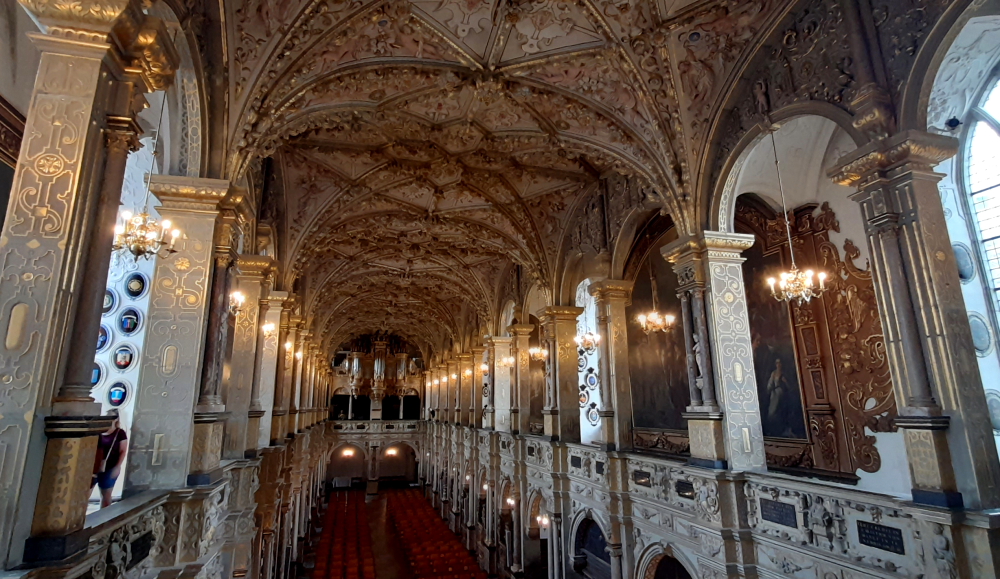
The chapel, consecrated in 1617, is also part of the museum. It is the best-preserved part of the Renaissance complex, having largely escaped damage in the 1859 fire. The chapel extends along the entire length of the west wing with a long nave and a two-storey gallery. The richly decorated six-vaulted stucco ceiling is borne by pillars rising from the galleries. The pillars bear grisaille frescos of Biblical figures, painted in the 1690s. Grisaille is a painting technique that uses only shades of grey to imitate the looks of sculptures. It was a method of achieving a more luxurious look at half the cost.
The Chapel’s most significant artifact is the organ, built by Esajas Compenius in 1610. It was installed by Compenius himself shortly before his death in Hillerød in 1617. The oldest organ in Denmark, it has 1,001 wooden pipes. Its original manually-driven blower has been preserved. The instrument is richly decorated with ebony, ivory and silver.
The altarpiece and pulpit from the early 17th century are the work of the silversmith Jacob Mores from Hamburg. In the king’s prayer chamber adjoining the Chapel, there is a small silver altar crafted by the goldsmith Matthäus Wallbaum from Augsburg in 1600.
The Chapel inside Frederiksborg Castle was for more than just the king’s private prayer room. After 1648, the chapel was the place where the future kings and queens of Denmark were crowned and anointed.
The Chapel.
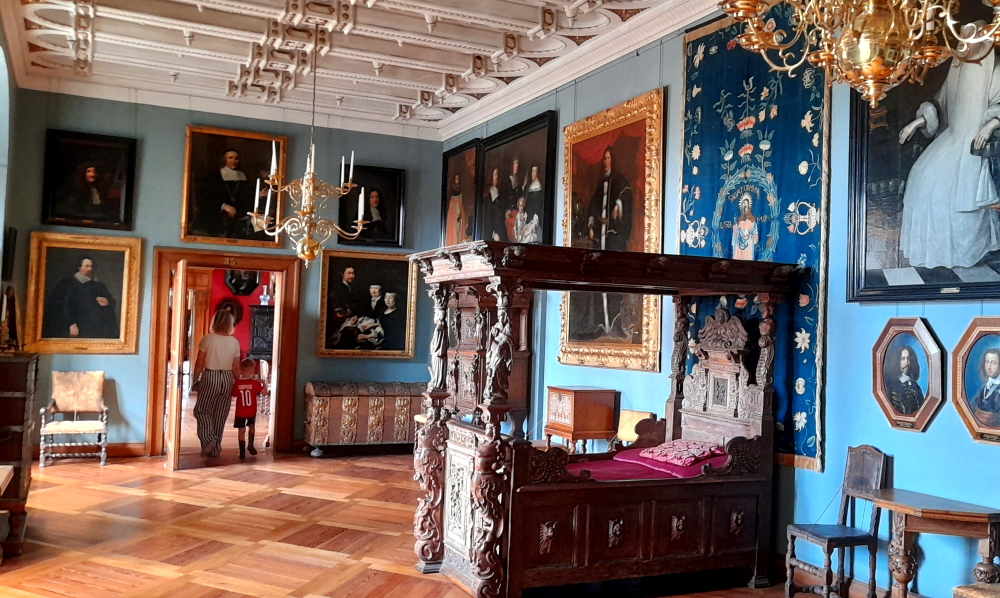
A pale blue room with a star vaulted ceiling is dedicated to the reign of Frederik II. Hanging above the main wood dresser are two portraits, facing each other. This is King Frederik and Queen Sofia, who would have made this room their bedchamber.
Small bed for royalty.
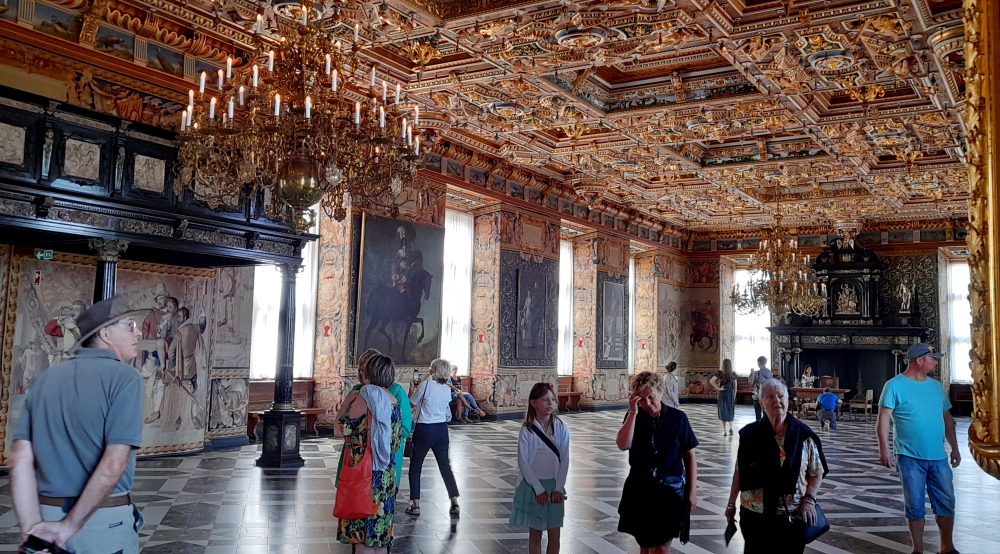
The Great Hall was built for King Christian IV (ruled Denmark 1588-1648) but was destroyed in the great fire. It was almost fully restored thanks to architectural paintings made by Heinrich Hansen and F.C. Lund. The restoration work, completed in 1880, was carried out by Ferdinand Meldahl who made use of preserved segments of the ornate gilded ceiling.
This room was used for balls throughout Christians’ reign and is set directly above the Chapel so has the same dimensions as it as well. The Hall is also known as the ‘Hall of Knights‘ as the king would often host galas for members of his royal order here.
The Great Hall.
Since 1878 Frederiksborg Castle has housed The Museum of National History, which presents 500 years of Danish history with a collection of portraits, history paintings, furniture and applied art. The Museum was established by the founder of Carlsberg, brewer J. C. Jacobsen, and ever since has been an independent department of the Carlsberg Foundation.
View of the Prison Tower & courtyard from the Slot.
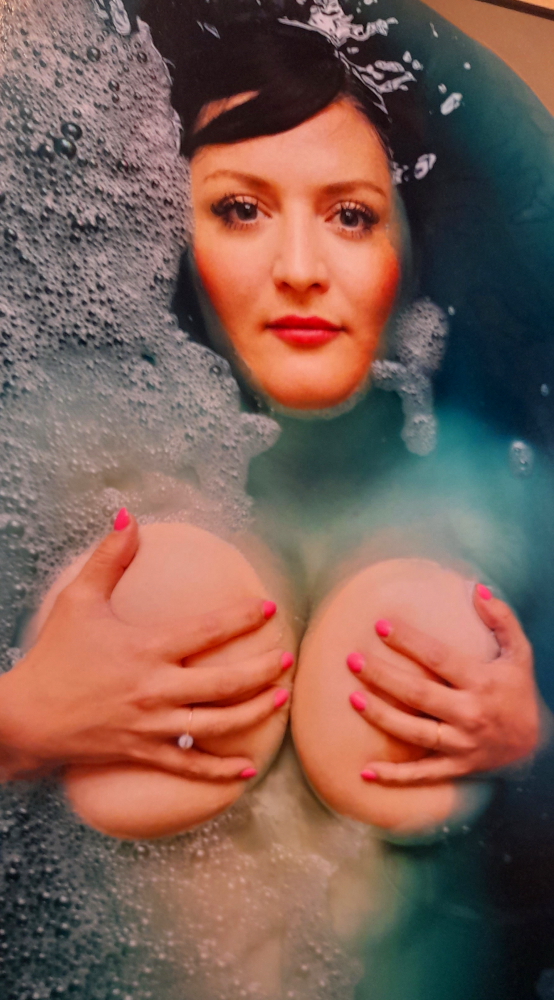
In the National Portrait Gallery, one of the current Special Exhibitions is “Marie Hald: Exposed” where body activism, taboos and vulnerability are featured. Hald is one of the most trend-setting female photographers in Denmark.
Titillating – the exhibition’s promotion poster.
Photojournalist Marie Hald does away with stigmatizing and unattainable beauty ideals. With a series of self-portraits, together with images of women of all ages and sizes, she shows her own vulnerability. Hald’s ‘Exposed’ is about having permission to exist and be who you are.
View of the Slot from its Baroque garden.
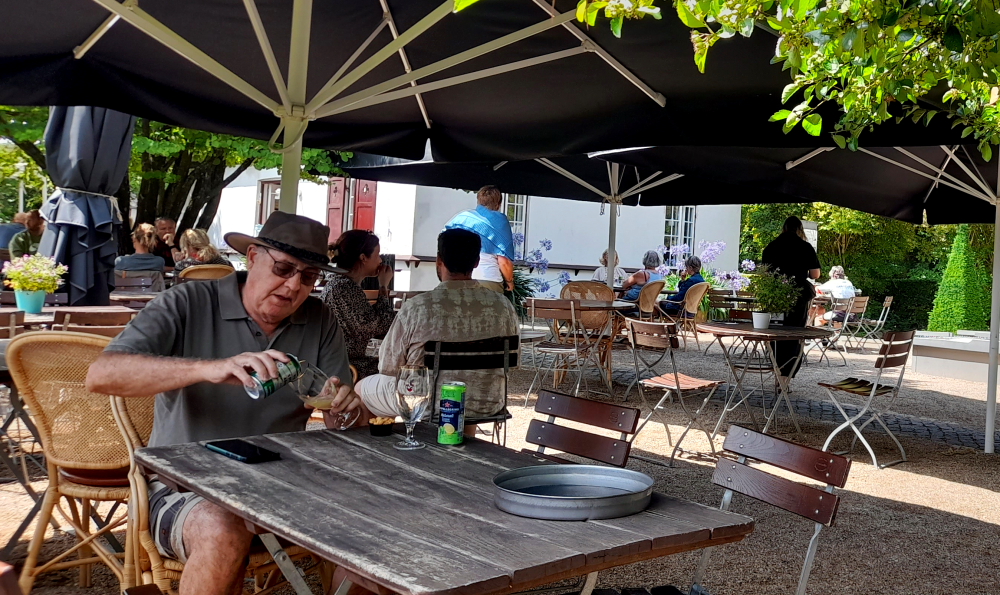
1.5 hours after entering the Slot we take a well-earned rest in the outdoor area of the Slot’s cafe for a cold beer.
Best part of the visit – a beer at Cafe Havehuset (Cafe Garden House).
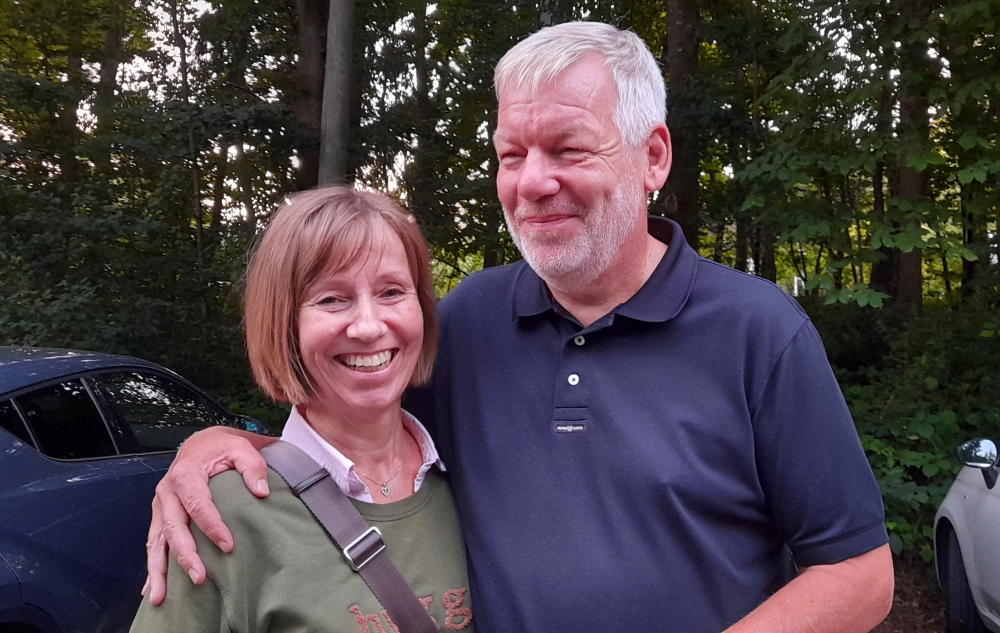
Tonight we are hosting Henning and his wife Vibeke for dinner at our hotel’s restaurant to reciprocate their hospitality at their home and for lunch at the Maersk offices in Copenhagen 3 months ago.
Vibeke and Henning.
17 July, 2023
We need to return the hire car at Copenhagen Airport by noon so we check out at 9:35 am and drive the 45 minutes to firstly top up the tank, drop our bags at the hotel and drive a couple of km up the road to return the car. All good.
In the lift I notice a sign mentioning a laundry room. Enquiries at reception reveal that, yes, we can wash and dry our clothes for the price of DKK50 per load. 2 loads of washing are ready to be dried but for both dryers their automatic sensors aren’t working properly and after several paid loads I give up and Lynn has to iron my clothes dry. We are re-embursed DKK50. What should have taken 1.5 hours turns into 3. Even the maintenance guy who we had summoned couldn’t fix the dryers.
Thank goodness getting our boarding passes printed by Reception went without a hitch.
18 July, 2023
5:00 am alarm wakes us in time for an early breakfast and check out at 7:00 am. A cool but sunny start to our last day in the Scandies. A quick walk across the road and through Terminal 2 to the Ryanair check-in kiosk and bag drop then head to security.
A large queue of people plus us shuffles its way towards the various conveyor belts. Copenhagen has automated the process so that when you get to the head of the queue you have to wait until an automated sign tells you which belt to proceed to, even though that belt could be at the other end of the hall to where you are standing, so people are criss-crossing the space. Most inefficient!
We are separated and both of us end up behind families who proceed to remove articles from various bags at the belt rather than have them ready beforehand, plus have baby buggies and lots of liquids to be scanned. What should have taken 10 minutes turns into 25. We need COFFEE! It’s now about 8:40 am. Gate information is due at 8:55 am. Our flight is at 9:35 am with the gate closing at 9:05 am.
While I park myself at a table Lynn goes in search of a proper Italian coffee machine as she knows how much I detest the pre-selected ones. That turns into a 20-minute wait in a short queue for her as there are insufficient staff. When she leaves the queue is now 4x as long.
Departing Copenhagen.
When Lynn gets up to go 35 minutes before the gate closes I say to her: “What’s the rush? We have priority boarding. There’s plenty of time.” To which she replies: “You don’t know that.”
Sure enough, although there is no queue at Passport Control, when we are processed together at the EU booth the Border Guard says to Lynn: “You have exceeded your time in the Schengen Area. Please wait here.” This came as a complete surprise to both of us as I’d used the official Schengen Calculator to plan our itinerary and we still had 2 days up our sleeves before we would have reached the 90 day limit for her.
That aside, she explains that she has official EU advice that the 90/180 day limitation doesn’t apply to her as a non-EU passport holder as long as she remains with me, her husband (an EU passport holder), the entire time we travel in the Area. He disputes this and calls for other Border Police to come and investigate further. It is now 20 minutes before the gate closes.
10 minutes later 2 Border Police arrive and state that according to their documentation she has exceeded the time limit and the scenario Lynn is describing doesn’t exist, unless she has a residency permit. They tell me that I can go but that they will hold Lynn’s passport and air ticket, she will be detained, she will miss the flight and she will need to pay a fine of EUR200. So, she hands me our onward bus tickets and the spare key to the car and I head off to the gate.
In the meantime Lynn forwards her EU email to one of the police officers and after multiple phone calls, in Danish, they tell her she is free to go and that she needs to sprint to the gate to catch the flight. Really??! Telling a pensioner that she has to sprint! It’s now 9.10 am, 5 minutes after the gate has closed.
Just as well she’s been released as our next 6 months’ itinerary and bookings (and plans to September 2024) are based on that EU advice. If that advice had been disputed we’d be screwed. Well, Lynn would be screwed, I’m all right, Jack. I’d just leave her behind and do Europe myself. Turns out my Irish passport is (Kerry) Gold!
Arriving Dublin.
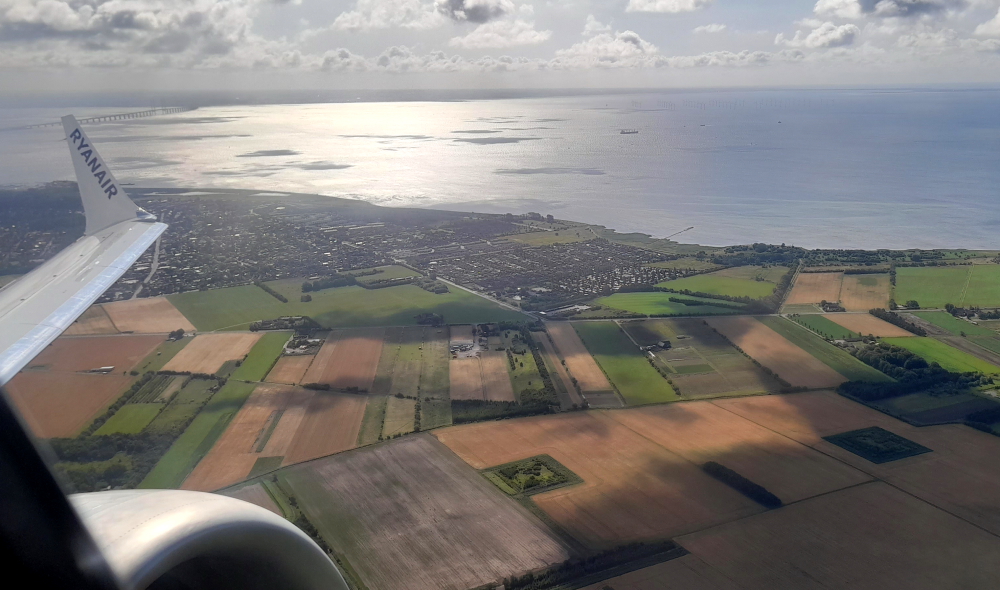
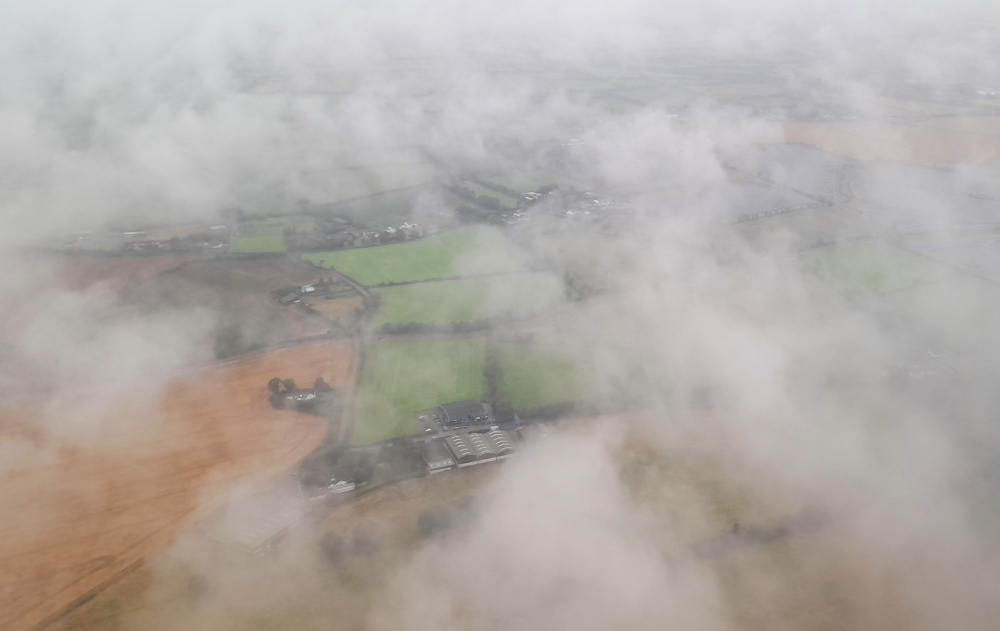
After that bit of drama, 2 hours 20 minutes later we land in a cold, dull, damp, and rainy Dublin. Our bags arrive after some delay and are covered in raindrops.
Although we are booked on the 1:20 pm Translink X1 bus service to Belfast, we scoot through the rain to get to the bus stop as we may be able to get on an earlier bus but arrive at 11:21 am, 1 minute too late and no bus in sight.
We hang around the seat-less bus shelter waiting for the next X1 at 12:20 pm and although Translink staff assure us we’ll get on it as it’s not usually busy, the crowd grows. Probably because I’m wearing an orange outdoor coat, people keep coming up to me asking for information and instructions about buses and destinations!
Of course, by the time the bus arrives there is a huge queue. So, all those with online bookings for this bus board first, then all those whose flight was delayed and had booked earlier buses, then all those who haven’t booked any seats but can pay cash are next to board. Thanks to Lynn’s tenacity, by sticking to the end of the cash payers’ line, she is able to secure the last 2 seats on the bus as we have pre-booked tickets for the next bus.
10 minutes late, the bus finally departs and 104 minutes later we arrive in Banbridge, our destination. Lucky for us, there are taxis at the bus station so we jump into one and 10 minutes later we are at Harry and Jenny’s.
Thanks to Harry’s diligence and charging the car battery previously, the car starts first go. Now, all I have to do is remember to drive on the left and that I have to change gears!
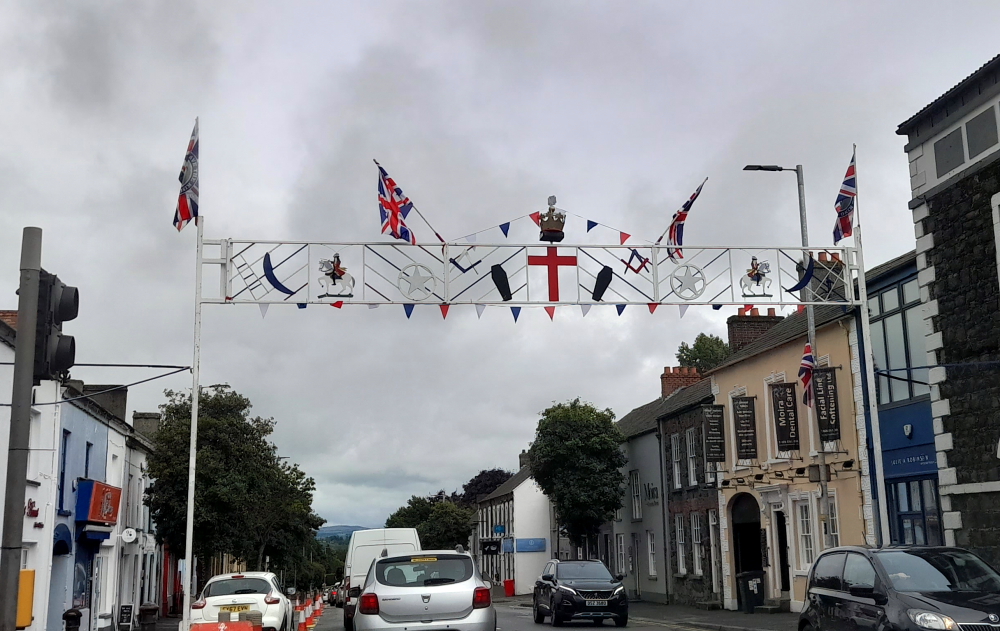
Flags and bunting in the streets remind us that we are now in Northern Ireland. These are left over from the Glorious 12th – William of Orange, the Battle of the Boyne and all that – marches and celebrations that happened on 12 July. Some of the Union Jack flags even have a picture of King Charles on them.
Driving to Dunaghadee.
The car feels much better to drive than the hire car was in the Scandies. There is a lot better feel to the steering and brakes but I have to admit that some of the driving aids will be missed.
One thing is obvious when we collect the Insignia. It seems that there is a nasty water leak in the boot and the boot carpets are starting to get a bit mouldy. Once I catch up on a few things this week it looks like I have some cars issues that need attention. I can’t imagine how many car issues will be facing me when we get back to Oz after two years when we try to fire up the Calais at home.
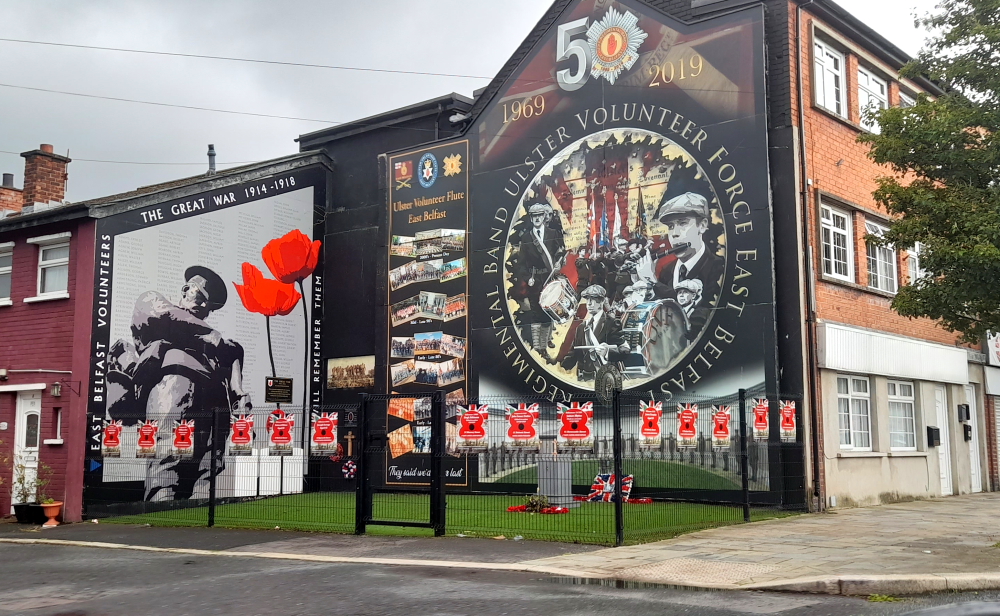
Belfast street art.
Driving on towards Donaghadee Lynn spots more street art on small, town buildings. Perhaps these are to antagonise the Republicans?
We arrive at Donaghadee by 4:10 pm and after we drag inside our luggage and all our extra items that had been left in the car for the past three months we do a quick unpack only to find that some of our clothes are damp as the rain has seeped through the zipper during baggage handling. Time to say hello to Patrick, Margaret and Benson (the old English Sheep dog).
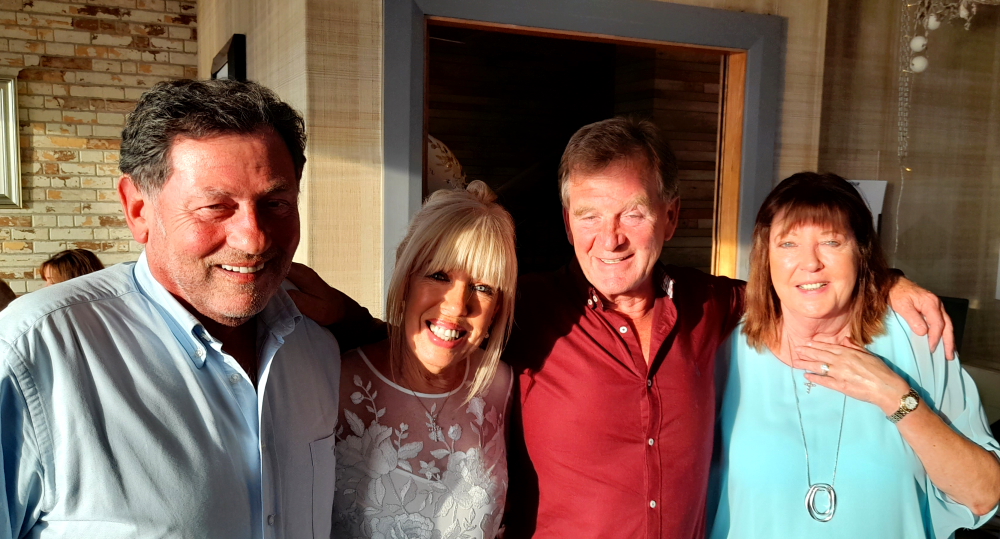
Tonight we have been invited to a wedding celebration. Janice and Guy are friends of Margaret and Patrick and they very kindly invited us to their wedding dinner, too. We have a wonderful evening with lots of great food and booze. Typical Northern Irish hospitality. We feel like part of the family.
Guy, Janice, Patrick and Margaret.
After a few drinks in great company the stress of dealing with the European border guards, Scandinavian idiosyncrasies and flying in the Ryanair sardine can fade and we start to relax and enjoy being back in our second home in Northern Ireland.
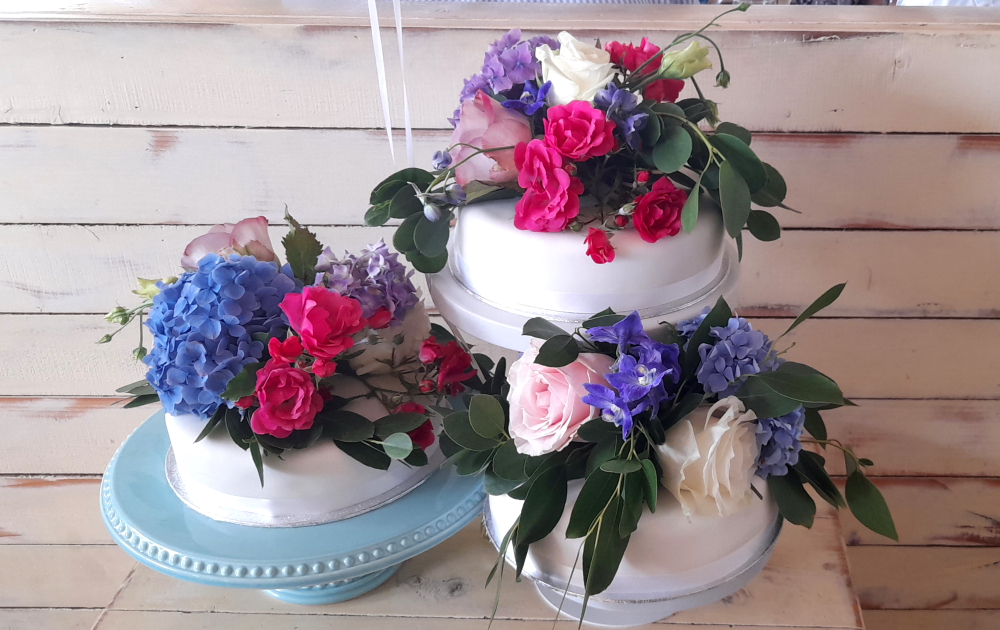
The wedding cake.
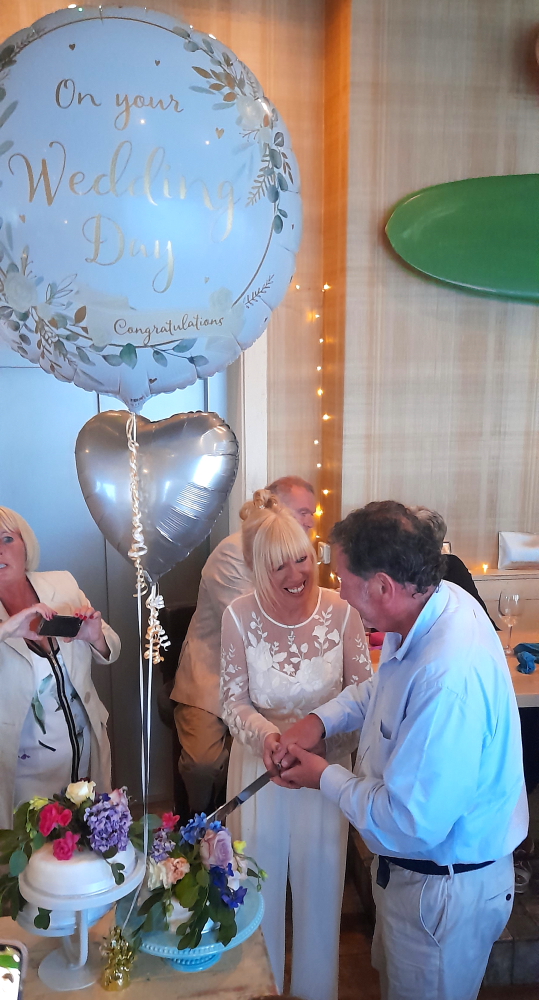
The wedding includes some brief but hilarious speeches, meeting new friends and great food and drink – and delicious wedding cake to boot.
Cutting the cake.
It seems that the whole town is here enjoying the festivities. We seem to be the first people to leave the wedding at 10:00 pm but by the time we scramble into bed at around 11:00 pm we quickly fall asleep after a very long, busy and dramatic day.
We will be in Donaghadee for the next week so it will be catch up time and Lynn has a couple of dentist appointments to fix 2 broken teeth.
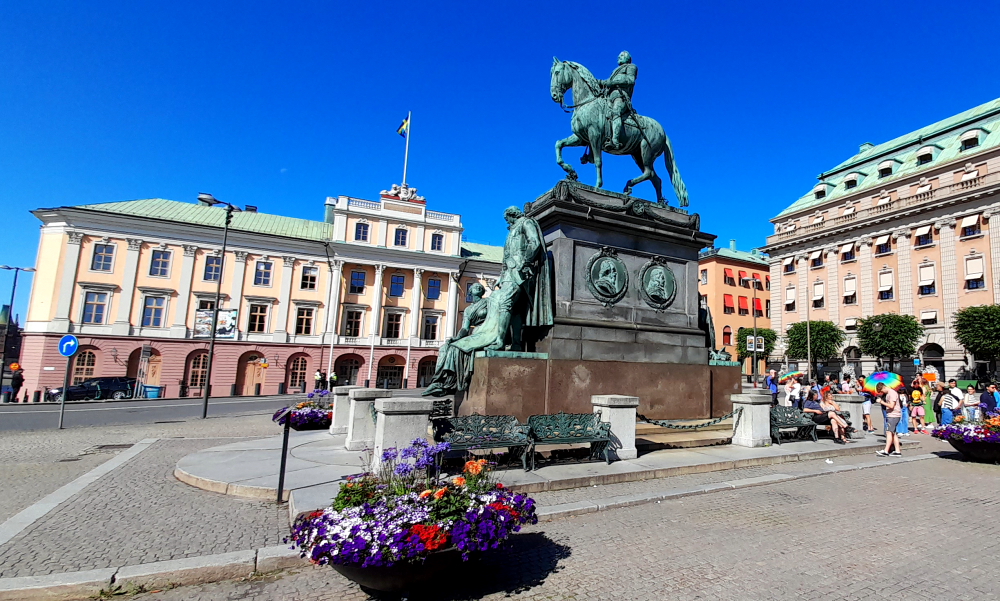
Must be time for another free walking tour. It is! We leave the hotel at 9:30 am to walk to the meeting point at Gustav II Adolf torg via Vasagatan and the Nordstrom (North Stream).
Moe, Larry & Curly?
We’re booked on a 2.5 hour walk through Gamla Stan, the Old Town, one of the largest and best preserved medieval city centers in Europe where Stockholm was founded in 1252.
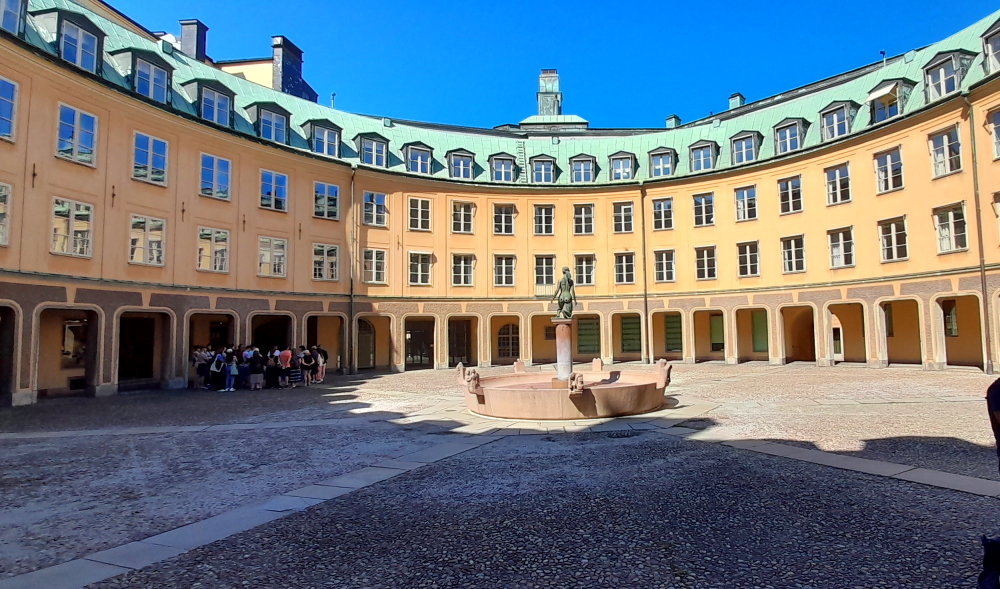
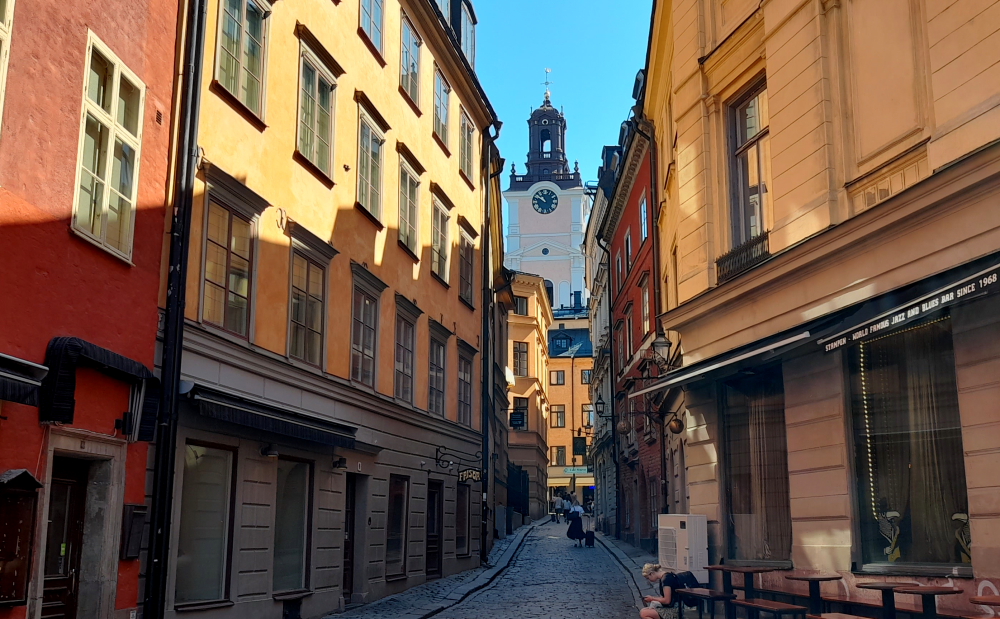
All of Gamla Stan and the adjacent island of Riddarholmen are like a pedestrian-friendly museum full of sights, attractions, restaurants, cafés, bars, and places to shop. The narrow winding cobblestone streets, with their buildings in so many different shades of gold, give Gamla Stan its unique character.
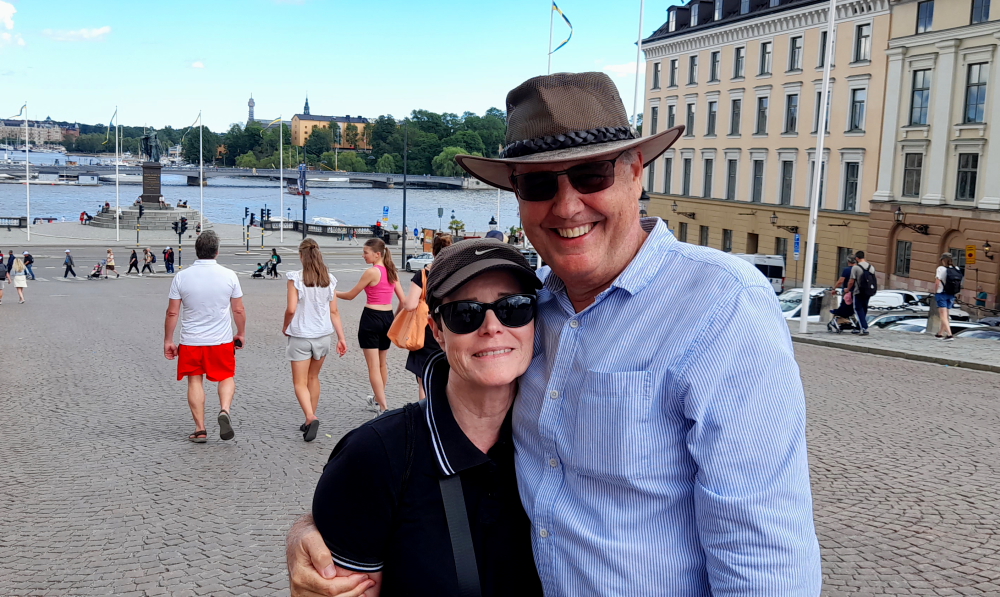
Our meeting point – Gustav II Adolf statue.
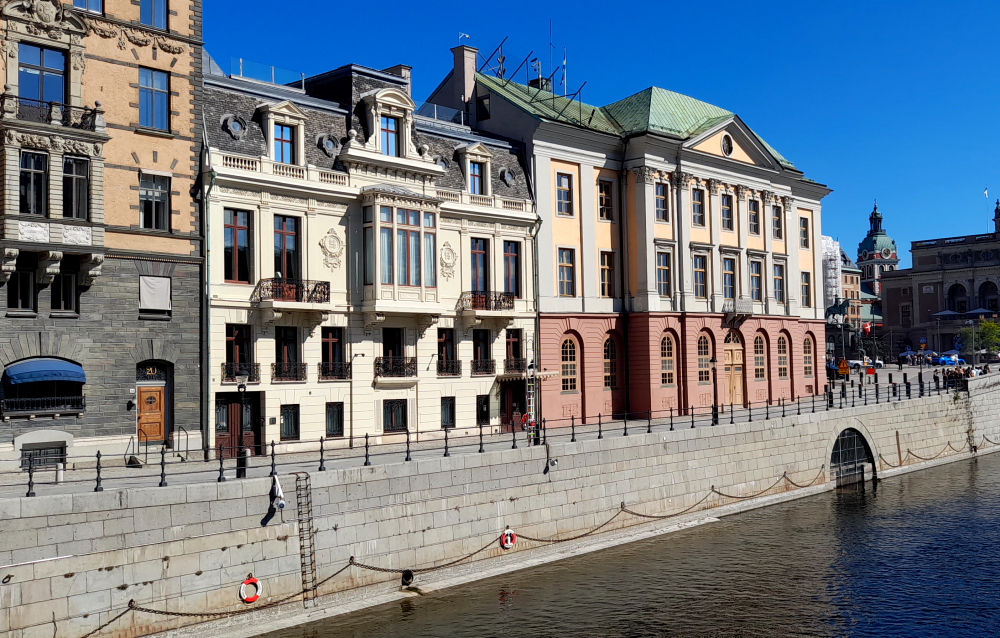
Sager House is the prime minister’s official residence in Stockholm. The first historical records of a building on the site are from the 1640s. In 1880 the property was purchased by the Sager brothers. The Sager Palace was owned by the Sager family from 1880 to 1986. In 1893 Robert Sager had the palace remodeled, including the addition of a new floor within a Mansard roof and a French Baroque Revival style facade with Neo-Rococo details, that are still seen.
The Swedish State bought the house in 1988 specifically for the PM’s residence. After extensive renovation the first PM to be housed in this building was Göran Persson (1996–2006).
It lies across from the Parliament House (Riksdag) building (on the island Helgeandsholmen), and the Royal Palace (on the island Stadsholmen), and is connected with them over the Norrström River through the Riksbron and Norrbro bridges, respectively.
The Prime Minister’s House.
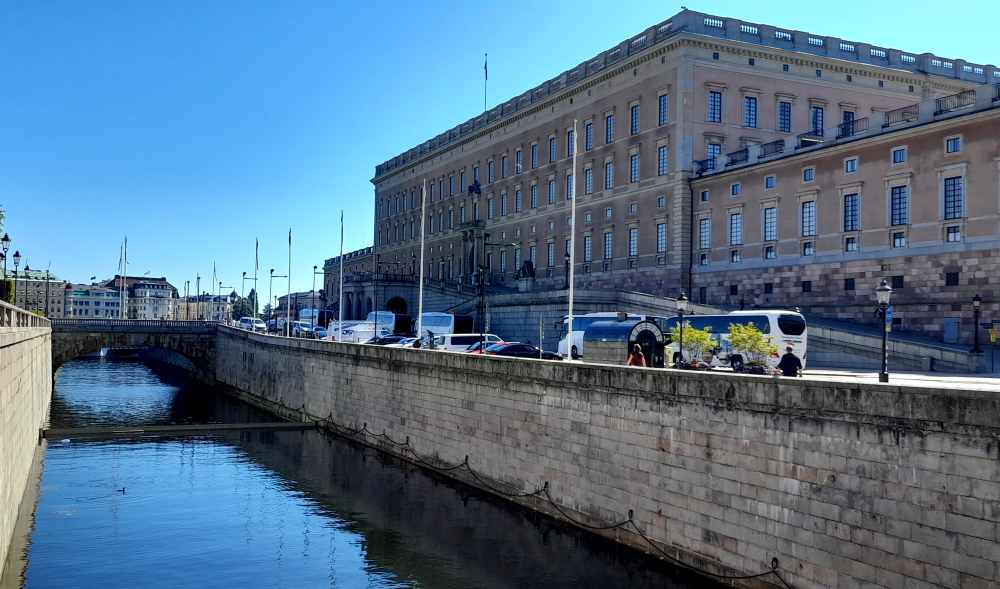
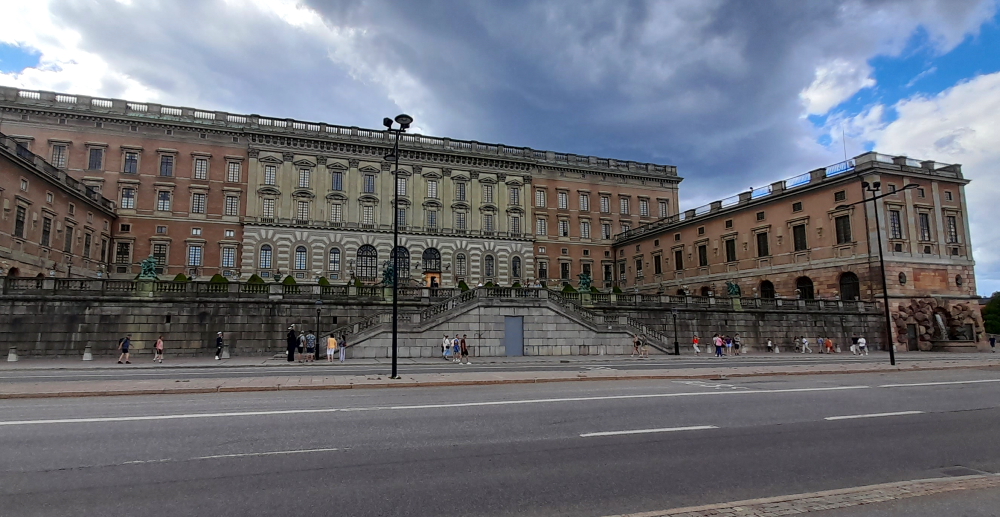
Stockholm Palace (Royal Palace) is the official residence and major royal palace of the Swedish monarch (King Carl XVI Gustaf and Queen Silvia use Drottningholm Palace as their usual residence). The offices of the King, the other members of the Swedish royal family, and the Royal Court of Sweden are here. The palace is used for representative purposes by the King whilst performing his duties as the head of state.
This royal residence has been in the same location by Norrström since the middle of the 13th century when the Tre Kronor Castle was built. In modern times the name relates to the building called Kungliga Slottet. The palace was designed by Nicodemus Tessin the Younger and erected on the same place as the medieval Tre Kronor Castle which was destroyed in a fire on 7 May 1697. Due to the costly Great Northern War which started in 1700, construction of the palace was halted in 1709, and not recommenced until 1727—six years after the end of the war. When Tessin the Younger died in 1728, the palace was completed by Carl Hårleman who also designed a large part of its Rococo interior. The palace was not ready to use until 1754, when King Adolf Frederick and Queen Louisa Ulrika moved in.
The rear of the Royal Palace.
The Palace photo was taken from the bridge (Stallbron) that separates the Kvarteret Luna Island from Stockholm City. This Island is the Old Town where Stockholm (meaning log island) was established over a thousand years ago. A bridge leading over to the Royal Stables is first mentioned in 1288. The present bridge was opened in 1904. It was widened in 1987 and an enclosed passage was added beneath the bridge to link parliament with its offices.
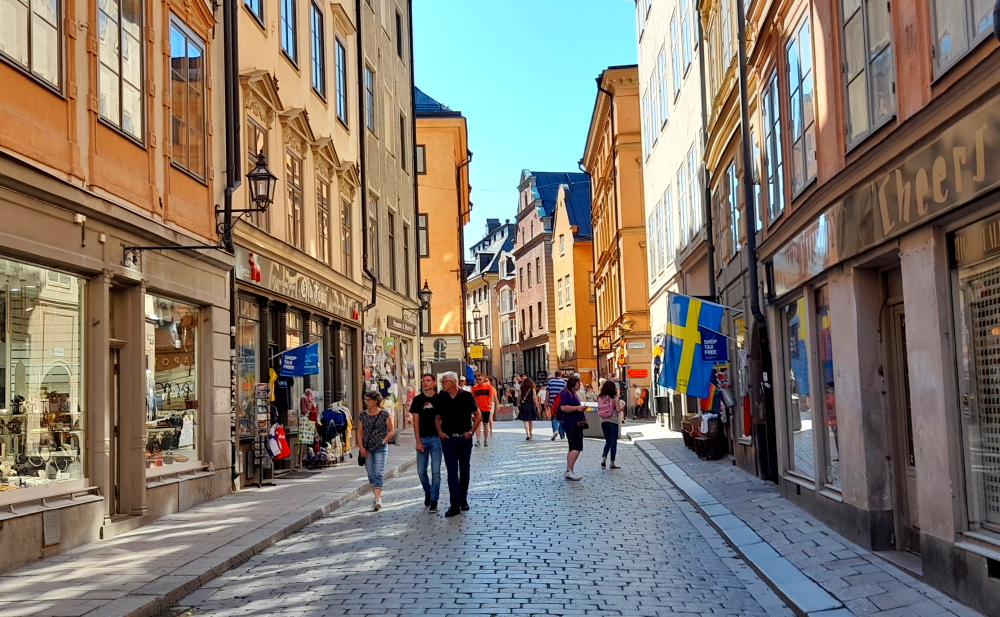
Vasterlanggatan, Gamla Stan.
Västerlånggatan and Österlånggatan are the district’s main streets. The city wall that once surrounded the city ran inside these streets along what is now Prästgatan.
Politician’s apartments in Förvaltninghuset surrounding Brantingtorget & its statue “Morning”.
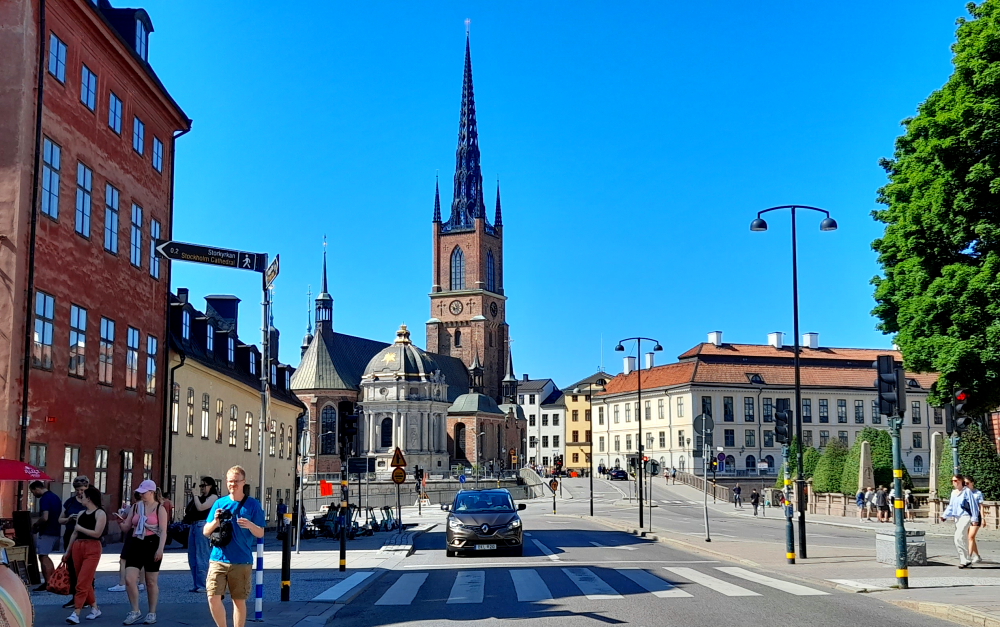
There are several beautiful churches in Gamla Stan, including Sweden’s national cathedral Stockholm Cathedral. But, across a narrow channel on Riddarholmen Island is Riddarholmen Church, the church of the former medieval Greyfriars Monastery in Stockholm.
Riddarholmen Church.
The church serves as the final resting place of most Swedish monarchs including Magnus III (d. 1290) and Charles VIII (d. 1470) and from 1632 to 1950. Today the church is used only for burial and commemorative purposes.
A view from Stora Nygatan.
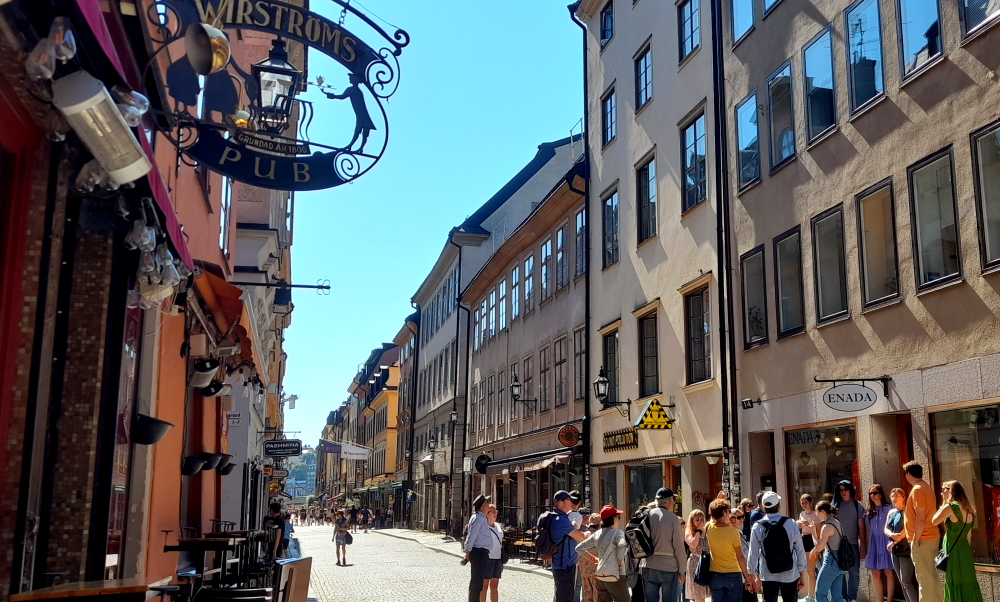
In the middle of Gamla Stan is Stortorget, Make sure not to miss Riddarholmen and the Riddarholmen Church. The church is a royal burial church and was built as a Franciscan monastery for the so-called Grey Brother monks in the thirteenth century.
Wirstroms Pub on Stora Nygatan.
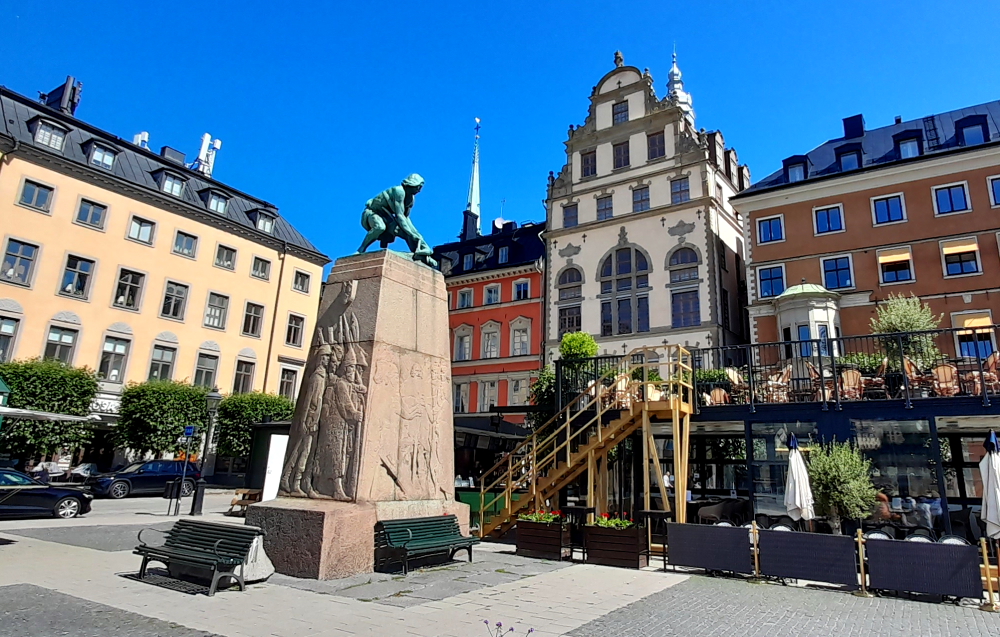
At the end of Stora Nygatan is a square featuring a statue called “The Bow Tensioner” by Engelbrekt Engelbrektsson erected in 1916 with funds from the Association for the Decoration of Stockholm with Works of Art and was the first work of art that the association gave to the city of Stockholm. Here we stop to look at the next island behind us, Sodermalm, currently festooned with construction cranes.
The Bow Tensioner.
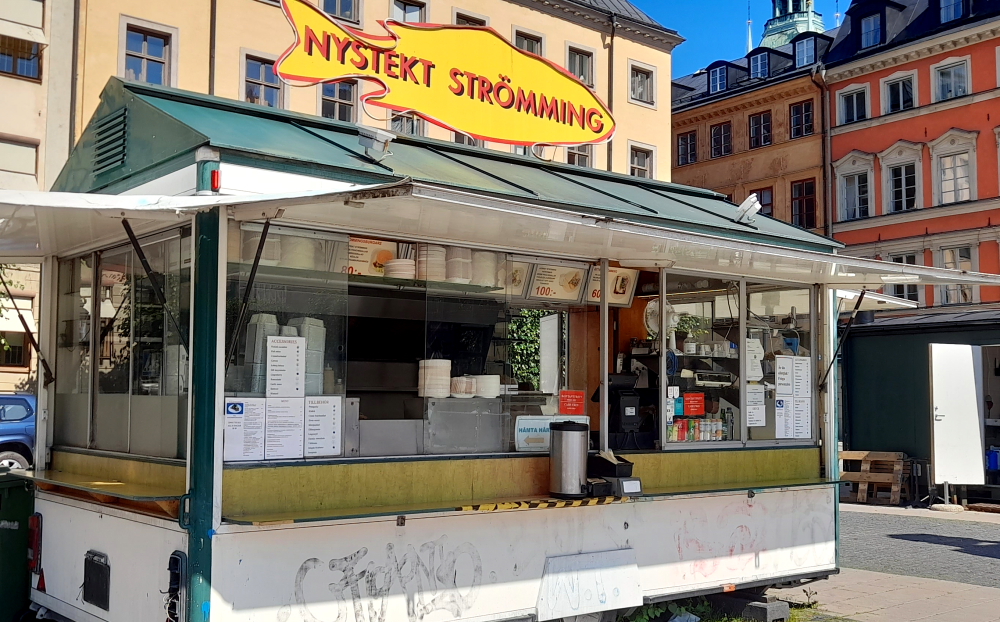
Also in this square is a food truck selling nystekt stromming – freshly fried herring – and seems to be a permanent fixture here…
Freshly fried herring.
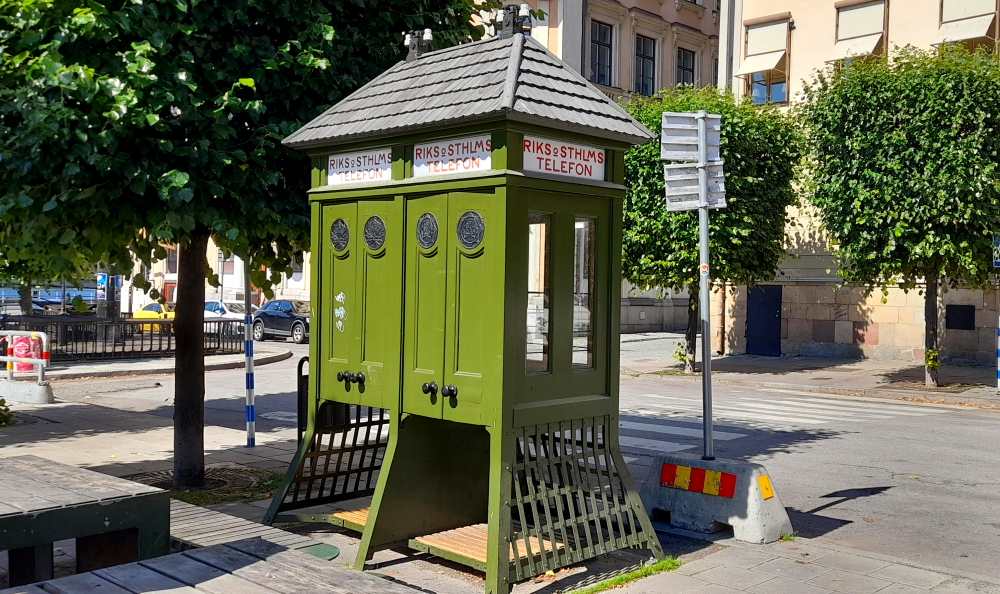
… as are these 2 vintage telephone boxes.
More telephone boxes.
Next stop is Järntorget (‘The Iron Square’), a small public square. located in the southernmost corner of the old town. The second oldest square in Stockholm, slightly younger than Stortorget, Järntorget dates back to around 1300 and remained the city’s most important trade centre for centuries with several streets accessing the Baltic Sea and other leading into Gamla Stan and the mainland.
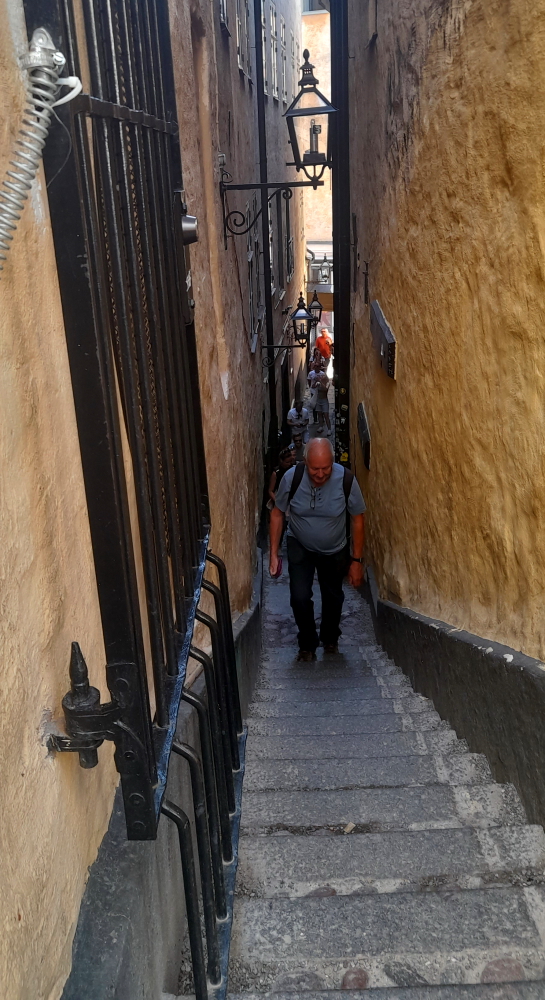
Just off this square is Mårten Trotzigs gränd (Mårten Trotzigs alley). It’s the narrowest alley in Gamla Stan, only 90 centimeters wide at its narrowest point.
Very narrow lane.
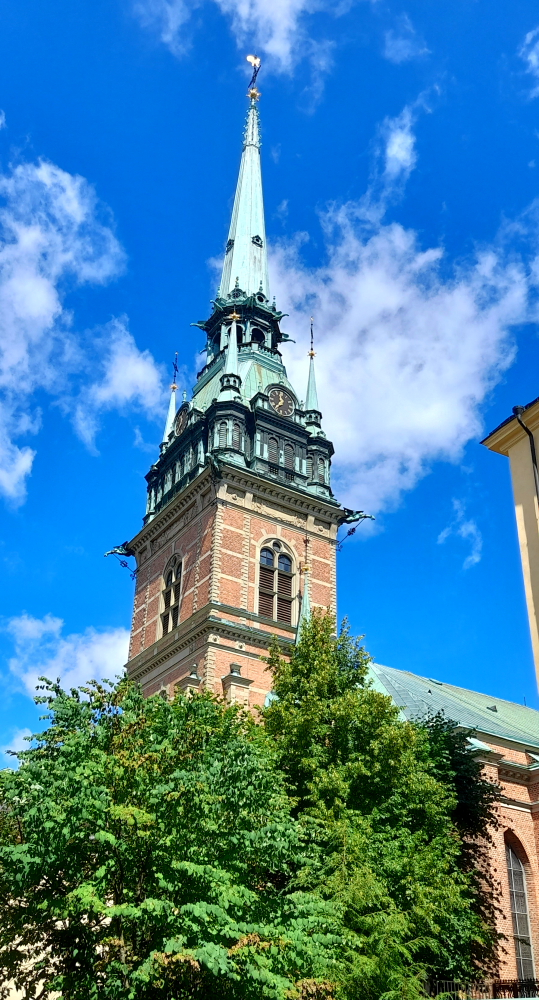
From here we walk past the German Church. It is named for standing in the centre of a neighbourhood that in the Middle Ages was dominated by Germans. Officially named Sankta Gertrud, the church is dedicated to Saint Gertrude (626-659), abbess of the Benedictine monastery of Nivelles, in present-day Belgium, and patron saint of travelers.
Another church – The German Church.
We stop by a small square and the restaurant “Under Kastanjen” (Under the Chestnut Tree) a tree which provides a leafy canopy on this warm, sunny day.
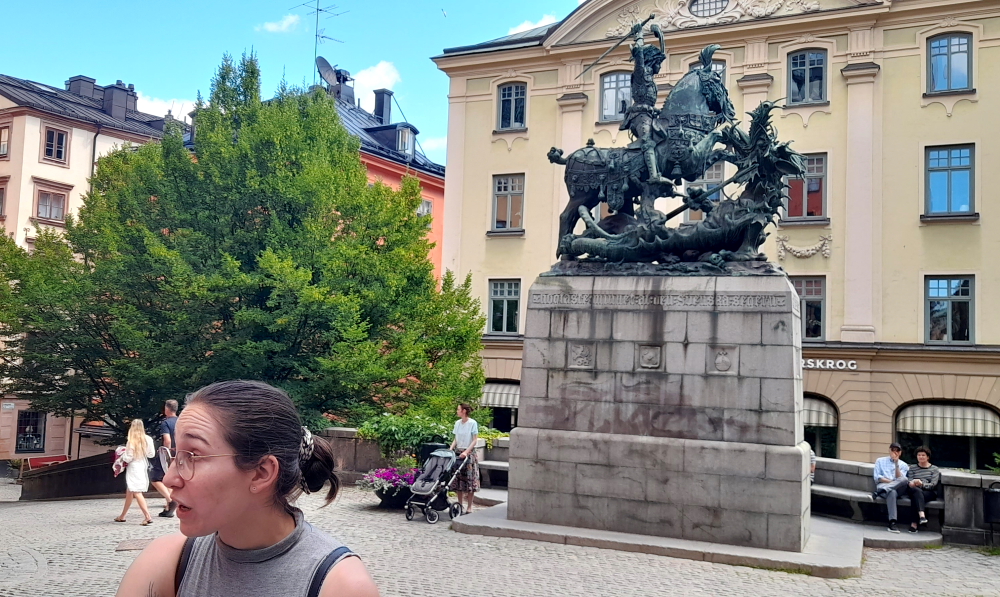
A few steps further on, in Köpmantorget (Merchants’ Street), is another small square where a statue of St George and the Dragon is located which was molded by Otto Meyer. Unveiled on 10 October 1912, marking the anniversary of the Battle of Brunkeberg, it is a bronze replica of Bernt Notke’s wooden Saint George and the Dragon, which is in Stockholm’s Storkyrkan (Cathedral).
St George, the Dragon & our guide, Sanchia.
Next we visit Stockholm’s smallest statue (15 cm high) in the backyard of the Finnish Church. The sculpture of the Swedish artist Liss Eriksson (1919 – 2000) is actually named “Little boy looking at the moon”. However, it is usually just called “Järnpojke”, the “Iron Boy”.
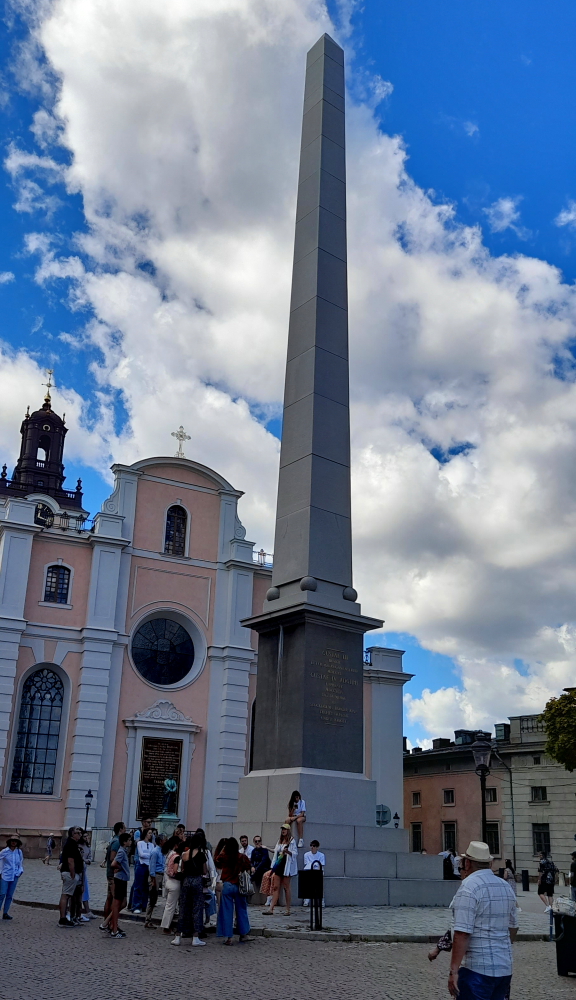
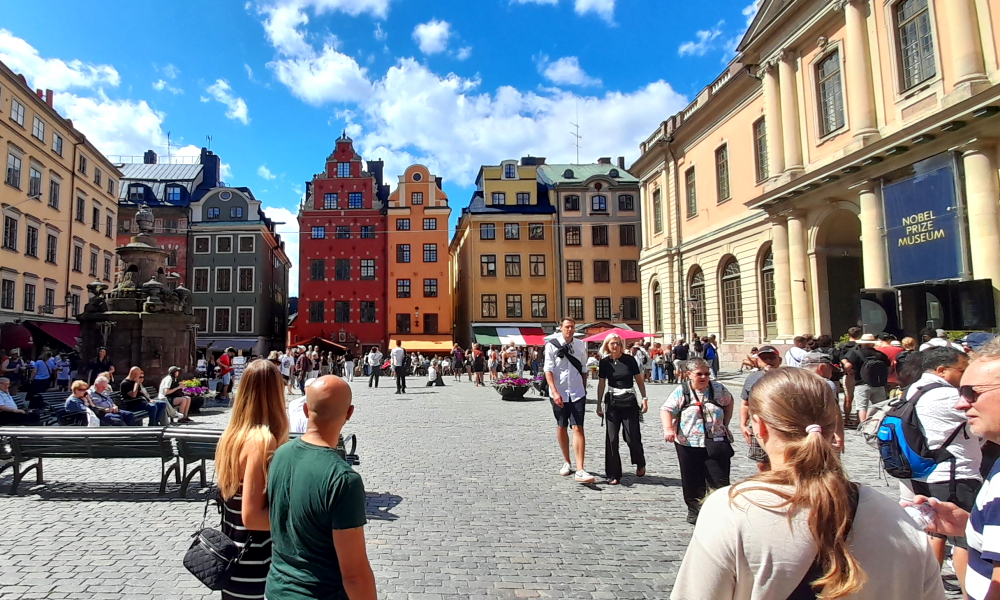
From there we enter Slottsbacken and walk past Gustav III’s Obelisk into Stortorget the oldest square in Stockholm. Stortorget is the central point from which runs Köpmangatan, the oldest street in Stockholm, which was mentioned as early as the fourteenth century.
Our resting place to watch the Changing of the Guard.
It was from the beginning the central point around which the city grew. Stortorget was also the site of Stockholm’s bloodbath in 1520 (represented by the red building). The events occurred after the coronation of Christian II as the new king of Sweden when guests in the crowning party were invited to a meeting at Tre Kronor castle. (Christian II was a Scandinavian monarch under the Kalmar Union who reigned as King of Denmark and Norway, from 1513 until 1523, and Sweden from 1520 until 1521).
.Archbishop Gustav Trolle, demanding economic compensation for things such as the demolition of Almarestäket’s fortress, questioned whether the former Swedish regent Sten Sture the Younger and his supporters had been guilty of heresy. Supported by canon law, nearly 100 people were executed in the days following the meeting despite promises of amnesty. Among those killed were many people from the aristocracy who had been supporting the Sture Party in the previous years. Thereafter King Christian II became known in Sweden as Kristian Tyrann (‘Christian the Tyrant’).
Stortorget.
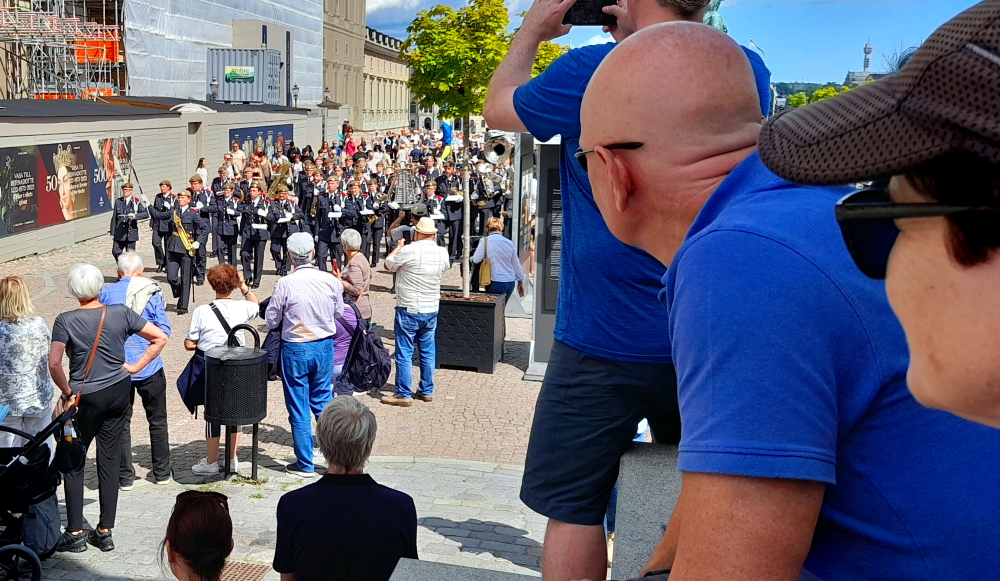
Our tour ended at 12:30 pm so we sat in the shade on the steps of the Obelisk awaiting the arrival of the Army Band which is part of the daily Changing of the Guard at the Royal Palace.
The arrival of the Army Band.
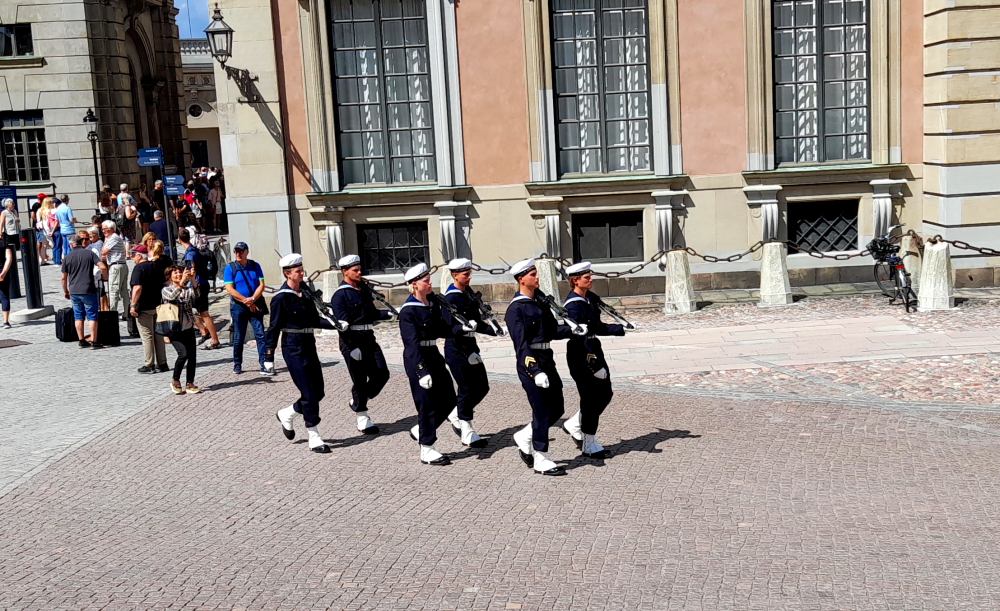
Unlike the Changing of the Guard in Oslo, this ceremony lasts 40 minutes and features several pieces of music played by the Band, along with maneuvers, in the Palace Outer Courtyard.
The changed guards exiting the Outer Courtyard.
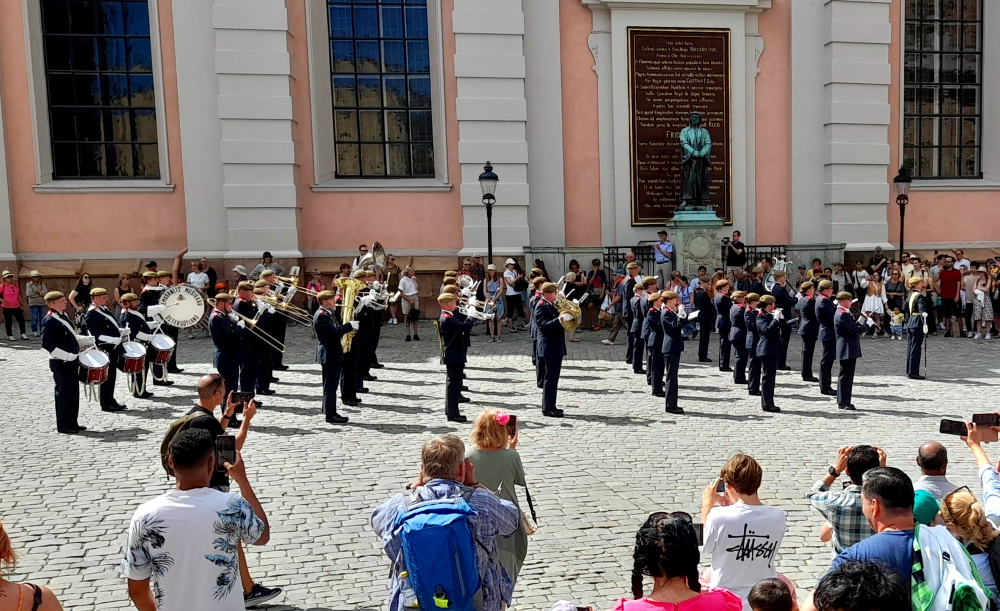
The Band then marches to the space between the Stockholm Cathedral and the Obelisk to play their final number.
The Finale in the square in front of the Stockholm Cathedral.
It’s now around 1:00 pm and time to start our 30 minute walk to the Vasa Museum located on another island called Djurgården.
Miny, miney, moe.
The weather has managed to stay dry so far and even at 24 Deg C it feels quite hot. We will certainly rack up the kilometers walking around today.
Still short.
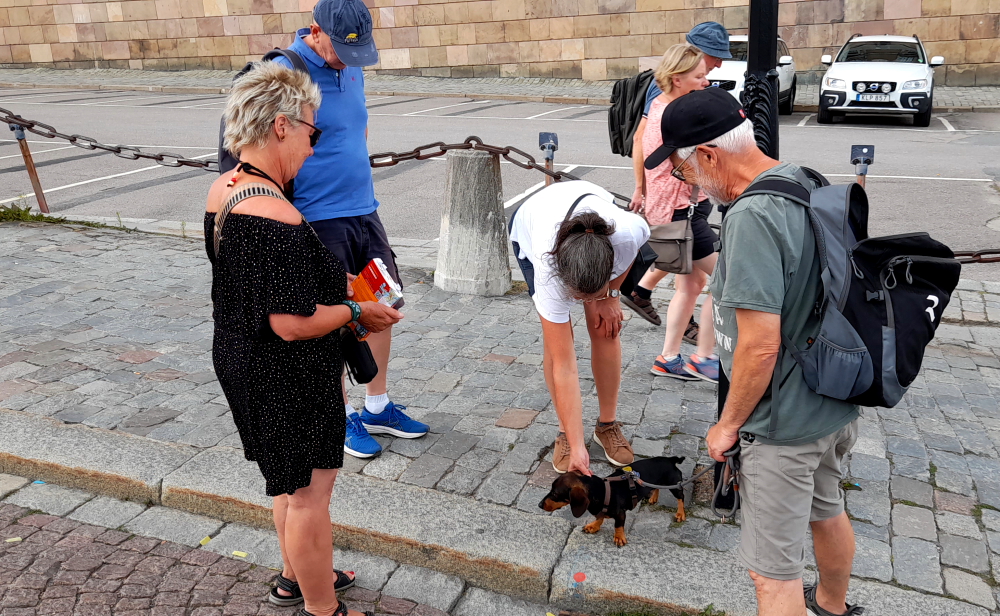
We hardly take 10 steps when we realise Susie and Paul are no longer with us. Being the proud parents of ‘Colin’, their miniature dachshund, they couldn’t resist saying hello to another dachshund and its owners.
Couldn’t resist a Colin clone.
Our route takes us past the front of the Royal Palace, across Skeppsbron, along Stallgatan onto Nybrokajen which skirts the harbour where most of the ferries dock onto Strandvagskajen.
Front of the Royal Palace.
Paul, Susie and I enter the museum after a cool drink in the shade of the outdoor museum cafe. Lynn stays to mind our bags as she had already visited the museum years ago.
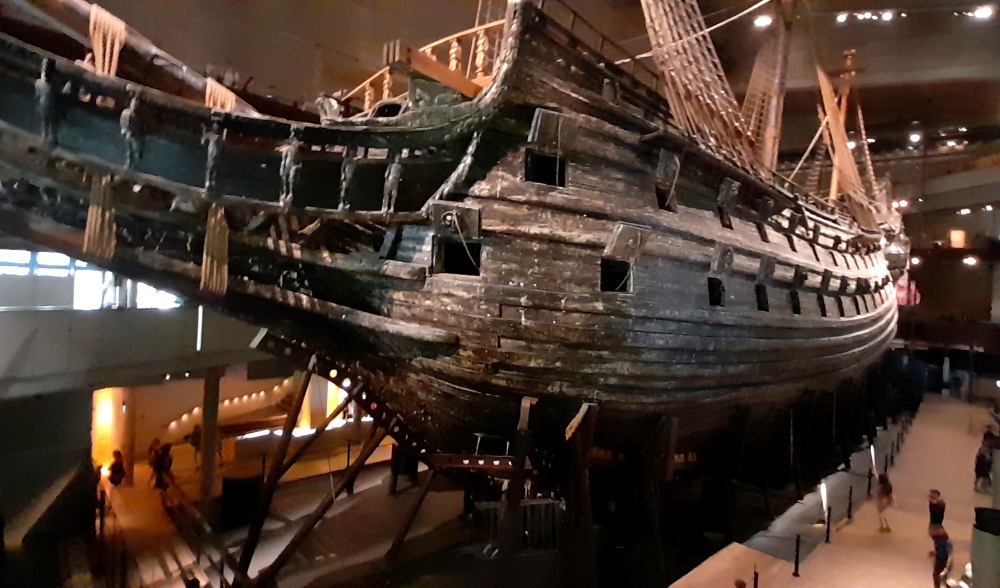
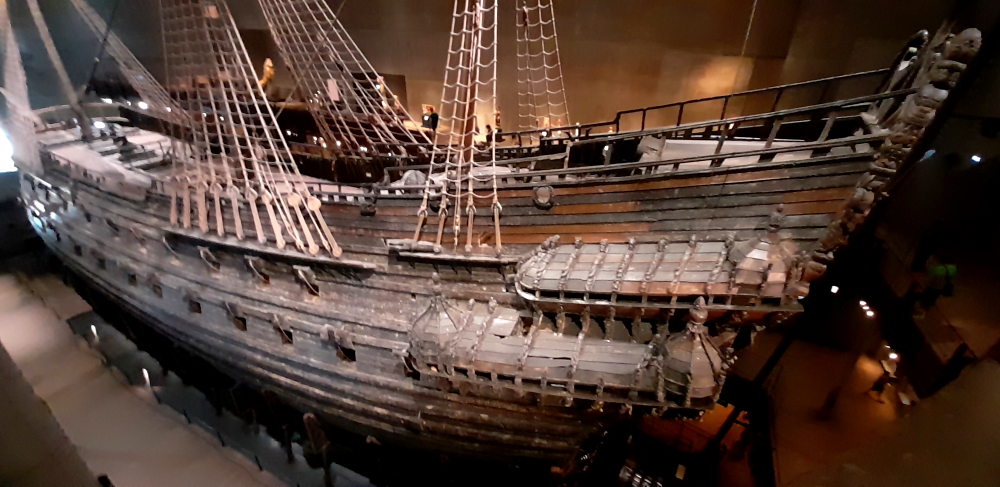
A maritime museum, the museum displays the only almost fully intact 17th-century ship that has ever been salvaged, the 64-gun warship Vasa that sank on her maiden voyage in 1628. She sailed a total of 1km before she sank. The Vasa Museum opened in 1990 and, according to the official website, is the most visited museum in Scandinavia.
The 1628 Vasa Warship.
Inside the museum the ship can be seen from six levels, from her keel to the very top of the sterncastle. Around the ship are numerous exhibits and models portraying the construction, sinking, location, and recovery of the ship. There are also exhibits that expand on the history of Sweden in the 17th century, providing background information for why the ship was built.
Impressive museum.
1.5 hours later we emerge and walk the 30 minutes back to the hotel.
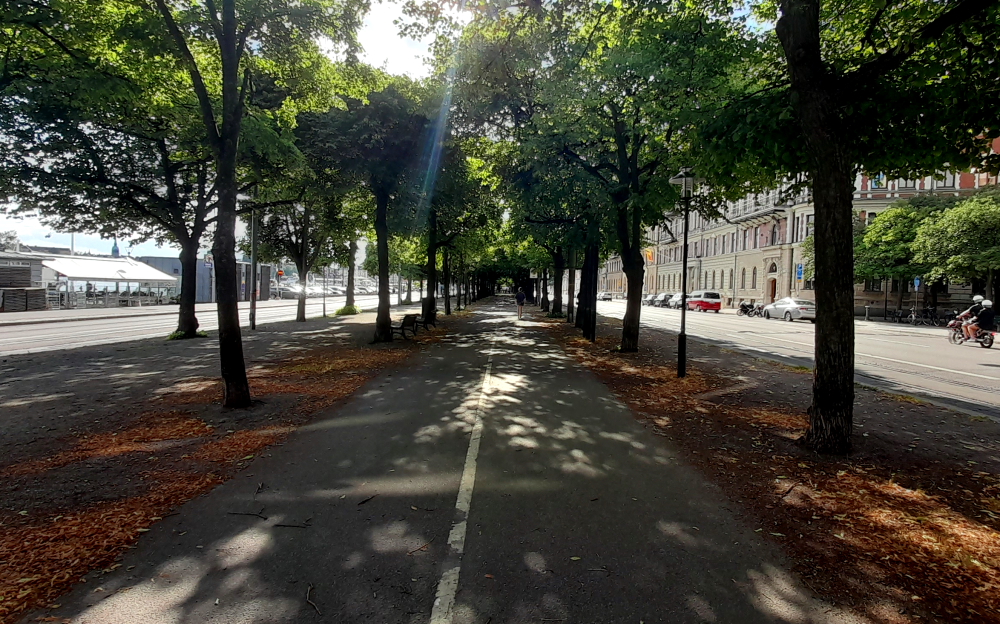
Shaded stroll home.
After a long day on our feet we need a rest in our rooms then dinner just two doors down at a very nice Asian restaurant. It’s Sunday so the restaurant can’t sell wine or beer but Chinese Tea is just the shot after a day in the sun.
Total steps today: 15,078. Total km:- 9.8. Total calories burned: 588.1. This is starting to read like Bridget Jones’ Diary!
10 July, 2023
After a day of walking yesterday we’ve decided we want to see a lot more of Stockholm but sitting on our bums instead. Enter stage right – a 2.5 hour Stromma cruise through Stockholm’s archipelago – from Stockholm to Vaxholm return. Perfect day for it with sunshine and 24 Deg. C.
Before breakfast Lynn and I go online to book the tickets. Worryingly, the instructions were that we needed to be at the dock 20 minutes before departure otherwise we might lose our seats to people who hadn’t booked tickets.
Lynn, being her usual cautious self, has us leave the hotel at 1:00 pm for the 20-minute walk to the boat. While we go and sit in the shade of a nearby park she ventures to the dock to check out the situation. Just as well as a queue has already started to form in the ‘pre-booked’ queue. So she waits in the queue, in the sun, and has us join her at 1:40 pm. By the time we get there the pre-booked queue is huge with only a couple of people in the other queue.
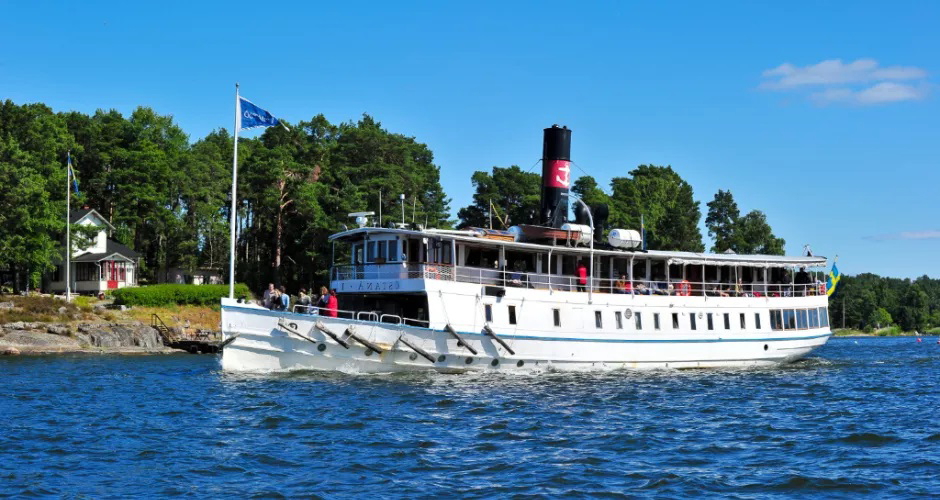
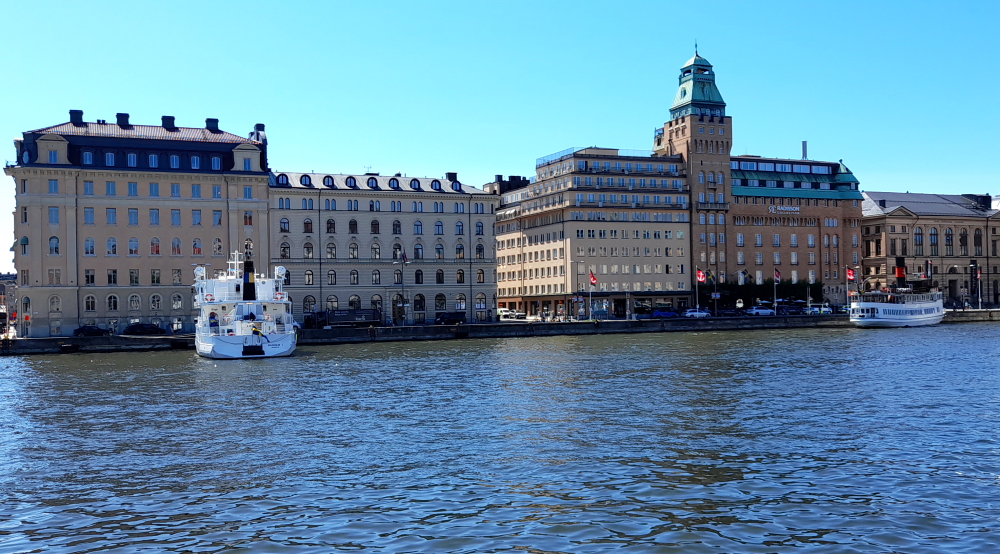
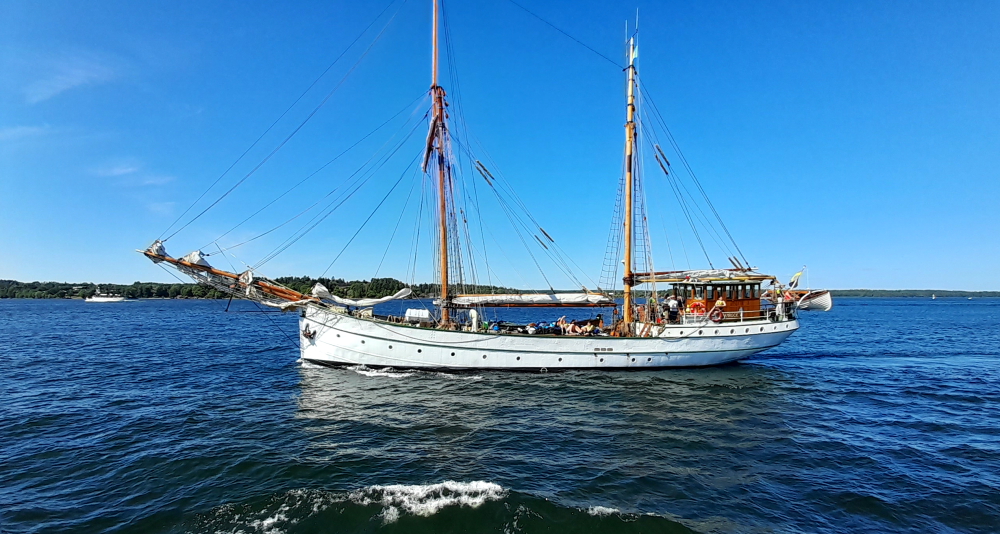
The M/S Ostana.
The M/S Östanå I, was built in 1906.
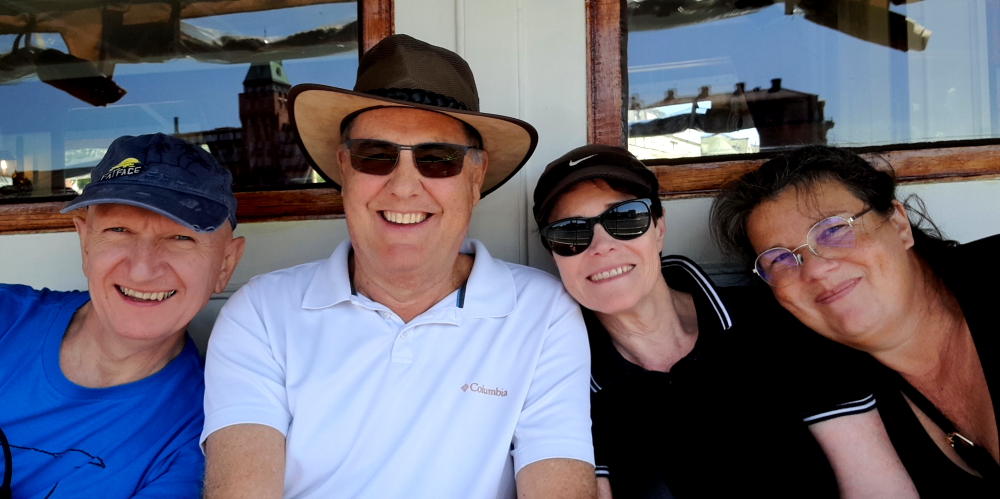
All seated on the boat.
Lynn and Susie scamper onto the boat and up the stairs to the outside, covered deck and snag some bench space for the 4 of us. Right on time the capacity-filled boat departs for Vaxholm.
Docked in the harbour facing the Radisson Collection Strand Hotel.
Had we known, we would have gone to the other side of the boat as the guide’s commentary on the way out and back tends to refer to historical, cultural and natural features on the other side of the boat.
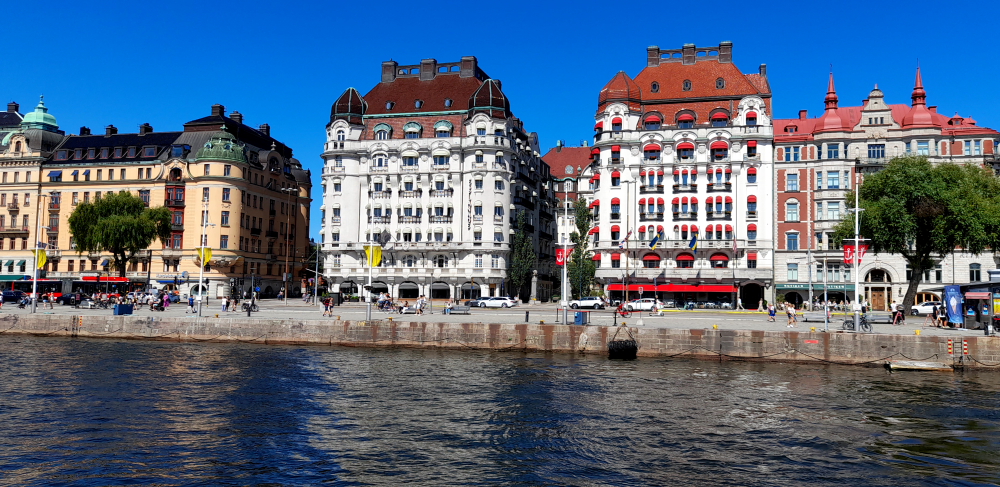
Departing the dock in front of the red awnings of the Hotel Diplomat.
The boat’s outward route goes to the right of Djurgarden and up the channel, around the island of Tegelon and into the port of Vaxholm.
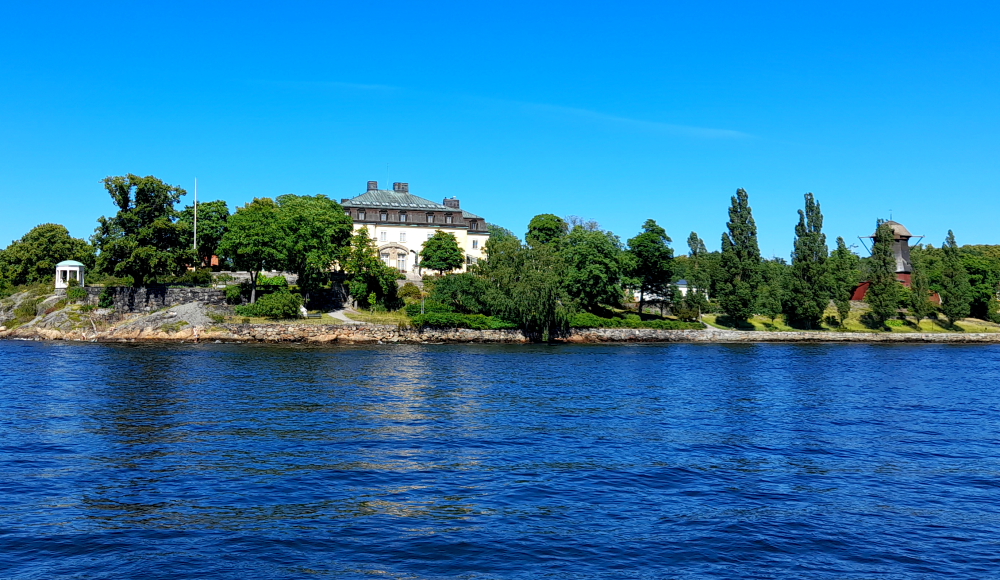
The first island we pass is Djurgården (technically Kungliga Djurgården Swedish for ‘The Royal Game Park’), home to historical buildings and monuments, museums, galleries, the amusement park Gröna Lund, the open-air museum Skansen, the small residential area Djurgårdsstaden, yacht marinas, and extensive stretches of forest and meadows.
Prins Eugens Waldemarsudde & windmill on Djurgarden.
Since the 15th century the Swedish monarch has owned or held the right of disposition of Royal Djurgården. Today, this right is exercised by the Royal Djurgården Administration which is a part of the Royal Court of Sweden.
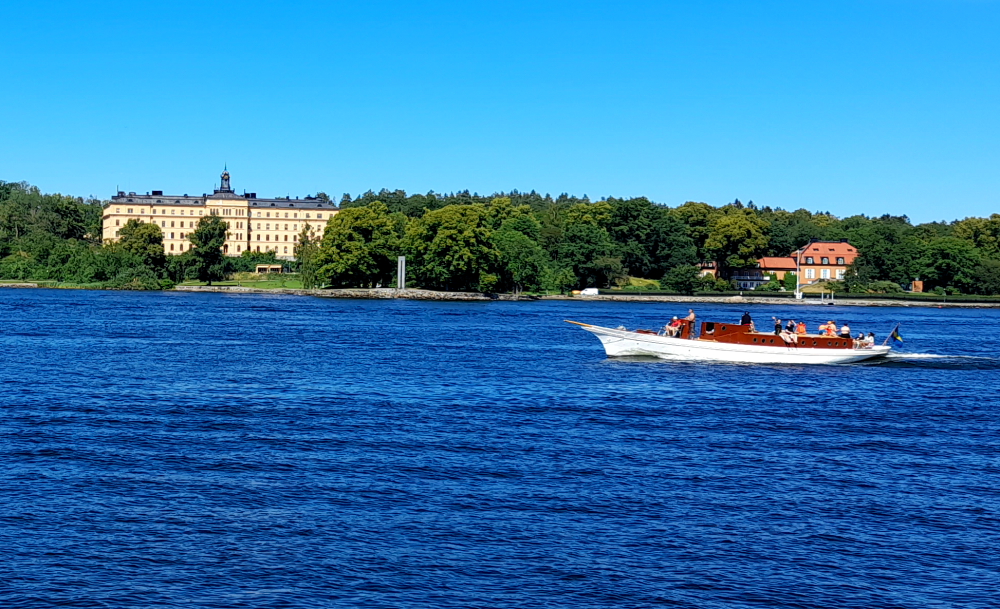
Campus Manilla school, Djurgarden.
Unlike other lakes and bodies of water that we’ve driven past in Sweden, the Stockholm waterways are busy with a variety of watercraft (at least in the summer months or weeks).
“The Shamrock” – definitely a party boat.
The boat deviates from the channel and takes a detour around the small island of Tegelon (Brick Island). In 2005, Tegelön had 24 permanent residents and also has many holiday homes. In the past, the island has belonged to Velamsund’s manor. Its current name is linked to a brickworks that existed on the island during the 17th and 18th centuries.
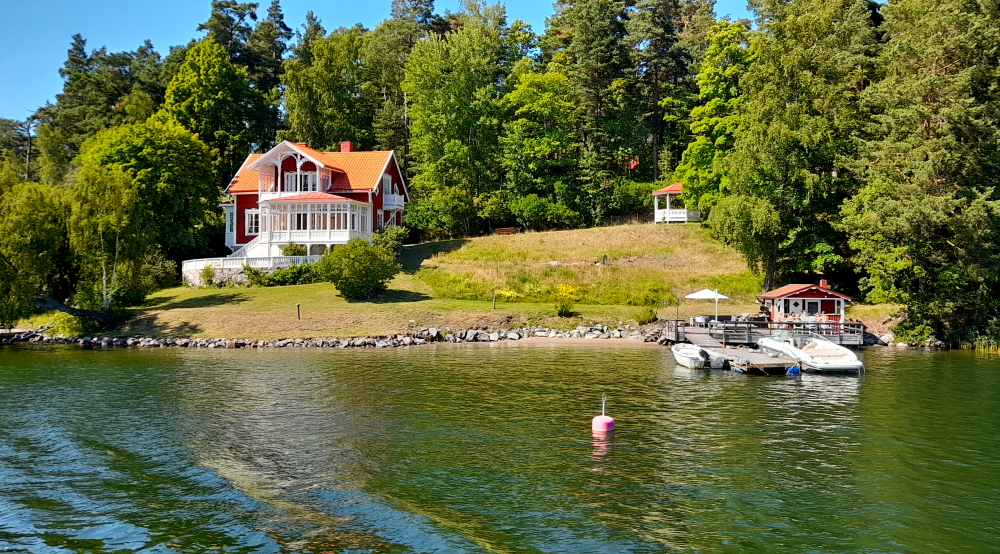
Summer house on the island of Tegelon.
Around 3:15 pm we arrive at Vaxholm where we stop for 5 minutes to drop off and collect some passengers.
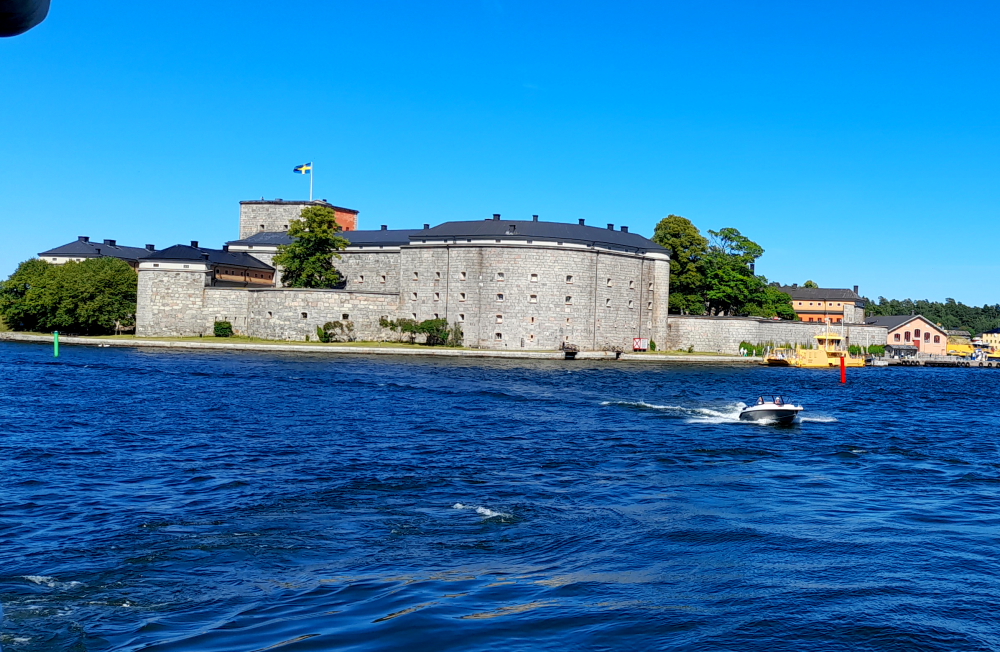
Vaxholm Fortress was originally constructed by Gustav Vasa in 1548 to defend Stockholm against shipborne attacks from the east. The fortress lies in the middle of the Kodjupet strait, one of two main routes into Stockholm from the open sea.
The town of Vaxholm, which lies adjacent to the fortress but on the western side of the Kodjupet strait, was established in 1558, when King Gustav Vasa bought some farms from Count Per Brahe the Elder. It later received rights as a merchant town (köping) and in 1652 was granted the Royal Charter.
Fortress at Vaxholm.
In 1849, the Djurgårdens Ångbåts-Aktie-Bolag introduced a steamboat service from Stockholm to Vaxholm. Through a number of acquisitions and mergers, this company became that known today as Waxholmsbolaget. As a consequence and in the 1860s, Vaxholm became a popular resort town, especially for bathers, and many wooden summer houses were built by people from Stockholm.
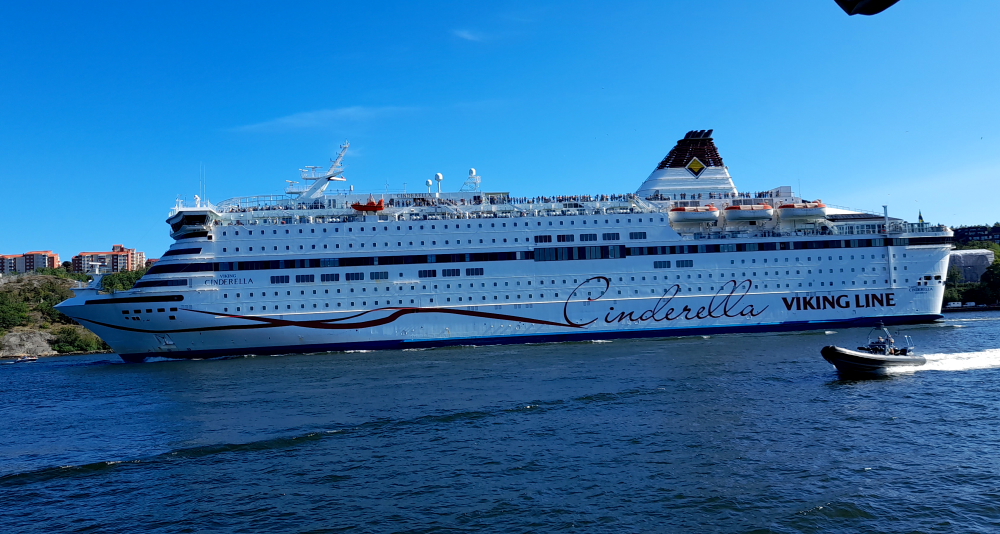
The Ferry to Gothenburg.
Our return route from Vaxholm skirt the righthand side of the islands of Ostra and Vastra Granholmen, Stora Hoggarn and Saltsjon before rejoining the main channel back to the Stromma mooring site in front of the Hotel Diplomat.
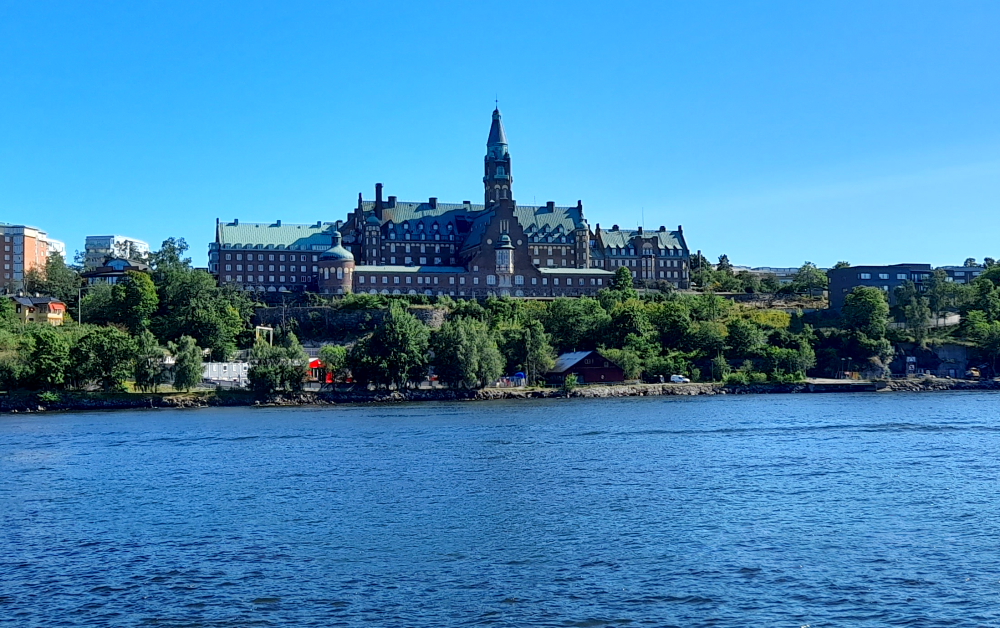
Danvikshem Retirement Home
Originally a hospital Danvikshem was converted to a retirement home a few years ago. We all smiled at the though of older folk trying to climb the stairs to the penthouse rooms in the eves. Hopefully they have installed elevators since the original 1801 building was built.
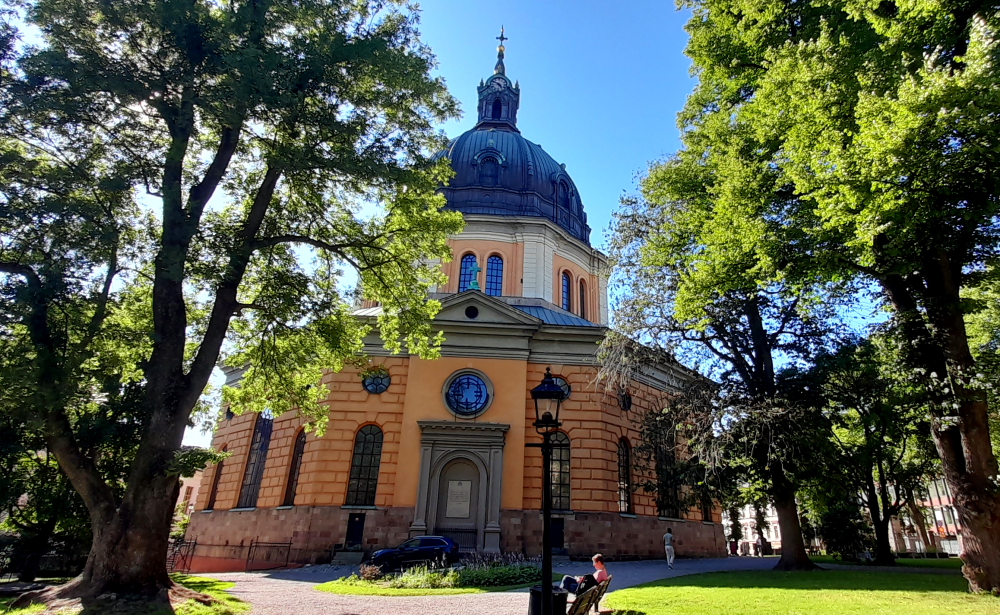
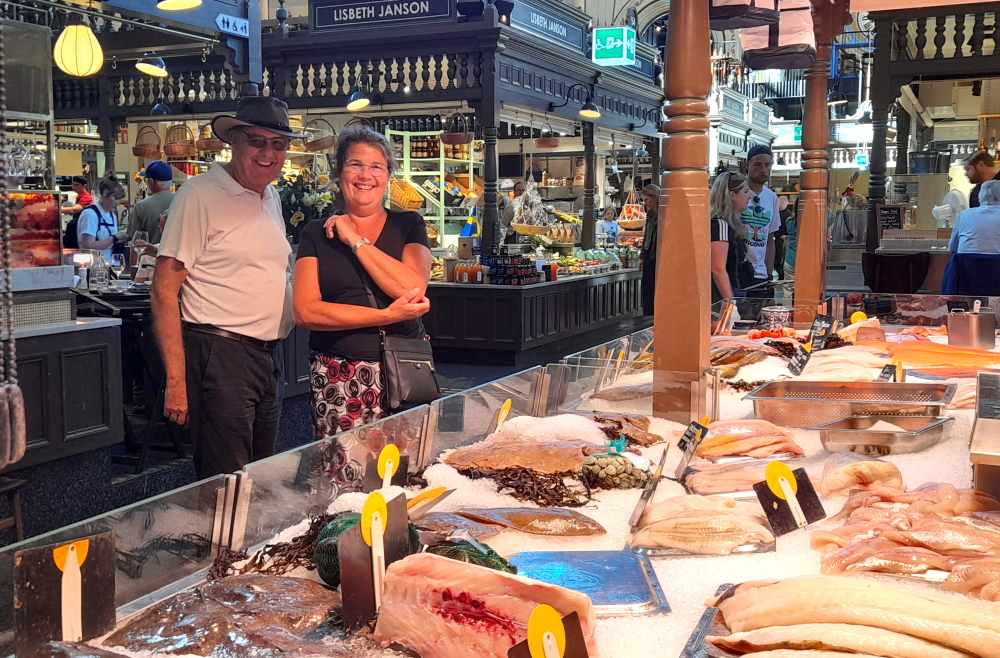
As soon as we disembark at 4:30 pm we walk up Artillerigatan to the Hedvig Eleonora kyrka where we cut through the church yard onto Storgatan and the square that faces the Ostermalms Saluhall (Ostermalm’s Sales Hall or in this instance, Food Hall).
The idea being to stroll around the various food stalls then choose one restaurant from the many nearby for dinner.
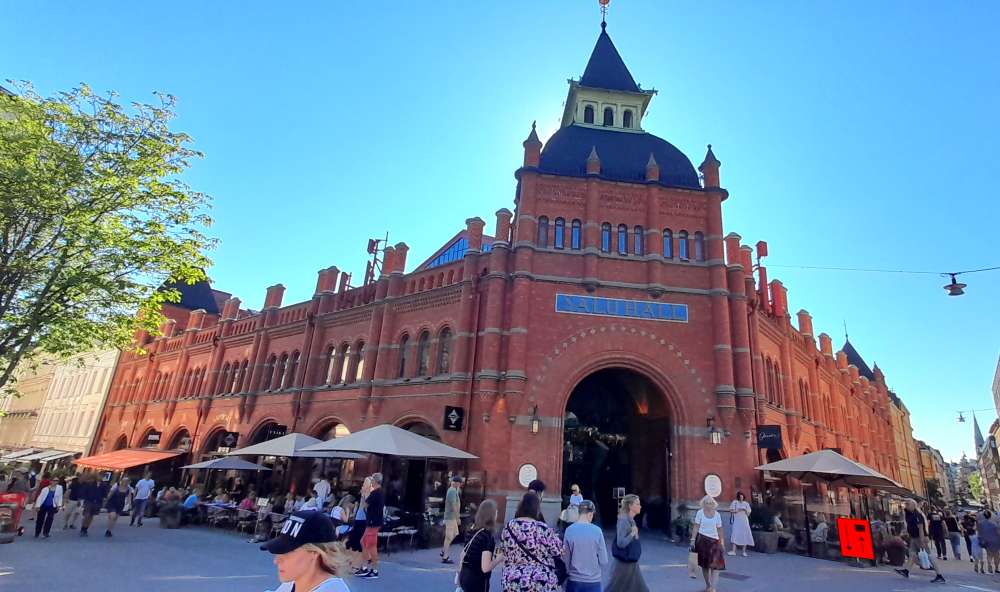
The approximately 3,000 m² hall was inaugurated on 30 November 1888 in the presence of King Oscar II. At that time, only six months had passed from the start of construction to completion. In part, 300 to 500 men were employed in the record building. On December 1, Östermalm’s Saluhall opened its doors to the public and Stockholm had its own temple for the culture and preservation of good food.
Hedvig Eleonora Church.
The architects were Isak Gustaf Clason and Kasper Salin , who were also responsible for the complicated inner cast iron construction . Prior to the work on Östermalm’s Saluhall, Clason and Salin had gained inspiration during a scholarship trip in 1883-1886, when they studied many new examples of brick architecture in Northern Germany, Italy and France. Particularly in France, there were several monumental cast iron constructions of this advanced type that would become the framework of Östermalmshallen’s brick cathedral, the facades of which were built in Börringitegel. Construction was a novelty in Sweden. Right from the beginning, the hall had electric lighting with arc lamps and light bulbs.
The Stockholm Food Hall.
The building is dominated by a corner tower with a slate-clad roof surmounted by a lantern with the winged hermes hat (the symbol of commerce) on top. The building is one of Sweden’s finest in brick from the late 19th century.
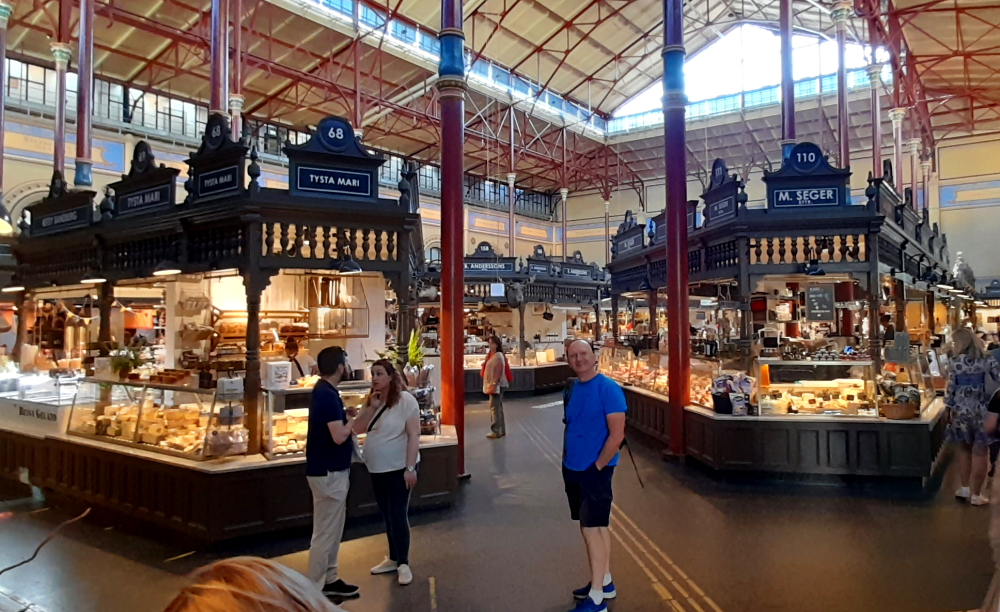
Inside the Food Hall.
During 2016-2020 the hall was closed for renovation which was based on the building’s period character and cultural-historical values. The hall retained its warm and convivial atmosphere while the building’s original star-shaped layout from 1888 was recreated as were original details such as colours, friezes, paintings and carpentry.
Fish for dinner?
Today there are 18 traders, many of whom run family businesses that have been here for several generations.
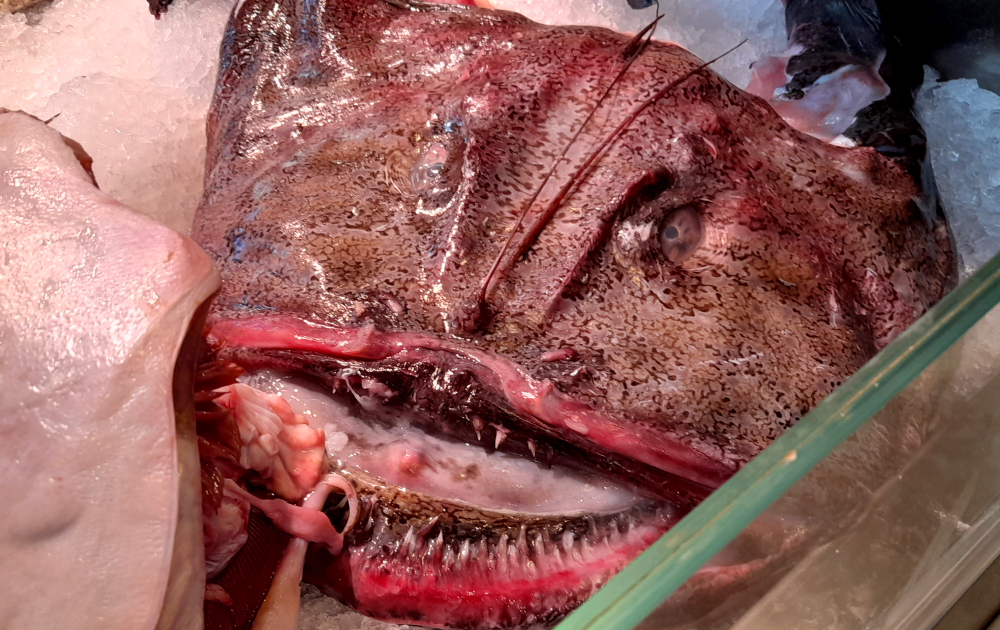
Now, that’s one ugly fish.
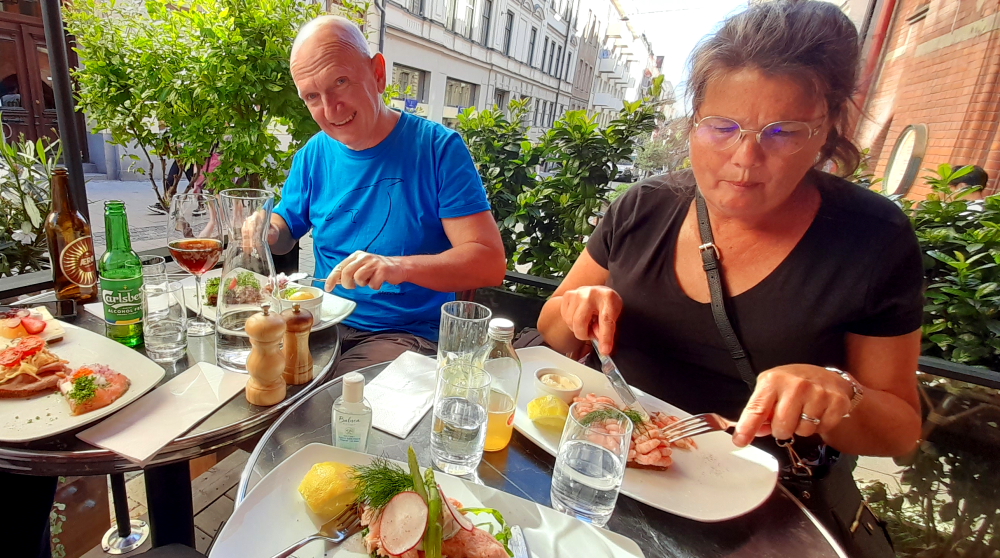
As it’s such a nice evening we choose to eat outside and to have something light – each of us choosing a different smorrebrod. Smørrebrød, “butter bread”, is a traditional open-faced sandwich in the cuisines of Denmark, Norway and Sweden that usually consists of a piece of buttered rye bread, topped with commercial or homemade cold cuts, pieces of meat or fish, cheese or spreads, and garnishes.
Early dinner at the Food Hall.
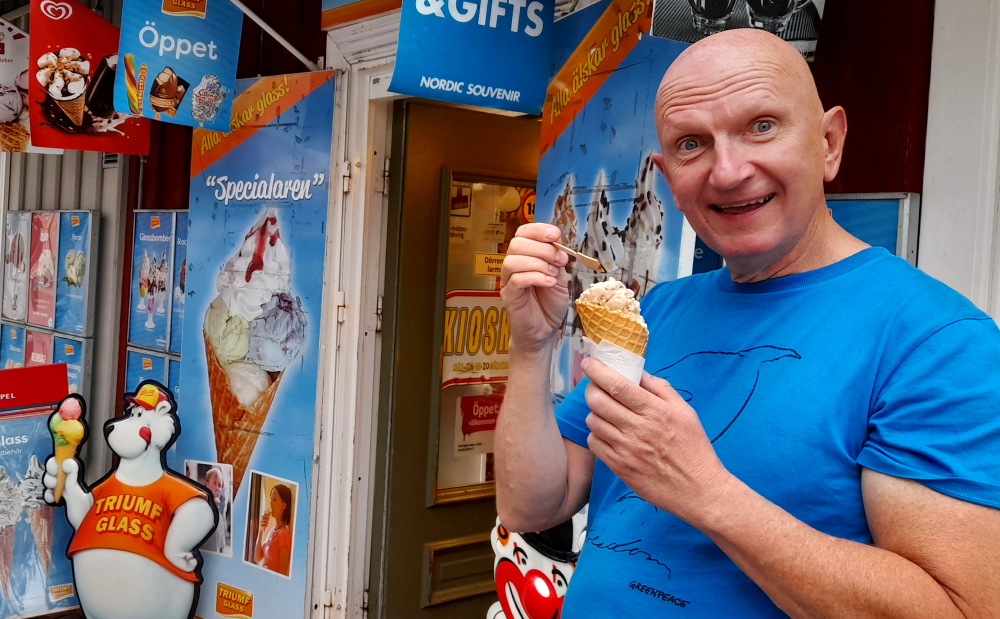
For dessert we purchase ice cream cones from a stall inside the Hall which we eat while walking back to the hotel where we all convene in Susie and Paul’s larger room over a glass of DOCG Chianti.
11 July, 2023
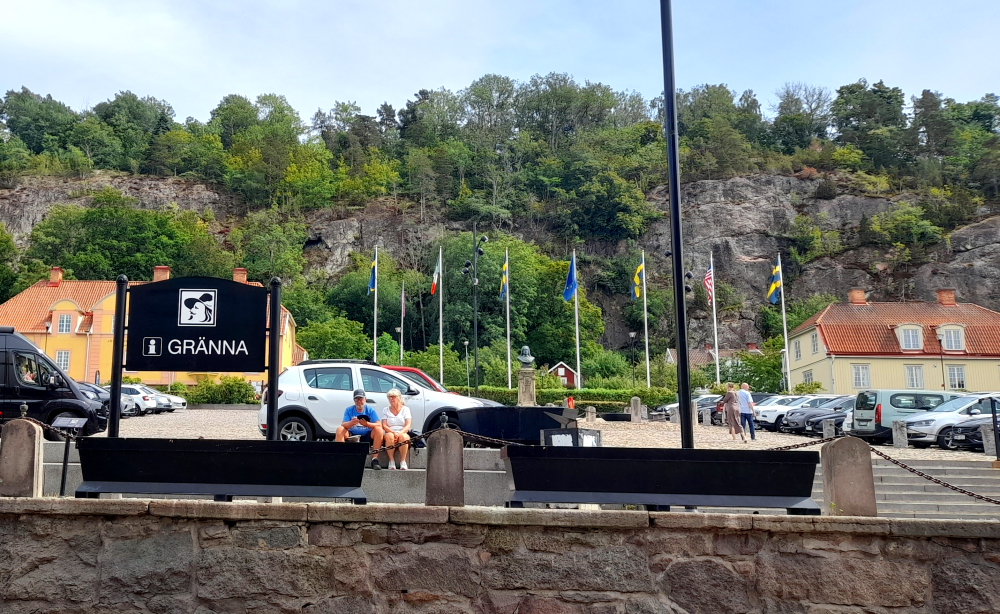
Our route today takes us South West from Stockholm to Jonkoping via Granna on the Vattern Lake. About a 300 kms trip under sunny skies where we should arrive in Jonkoping at around 3:00 pm after a short stop in Granna.
Back on the E4 we drive through extensive farmland and rarely pass a caravan driving south – most are heading north. We also come across our first extensive solar farm covering a couple of fields. But the gathering dark clouds that we are driving towards and the corresponding weather forecast are likely to make the panels redundant for at least the next week.
At around 1:15 pm we drive into Granna along with every other tourist in Sweden, it seems. The long, main street is heaving with cars, caravans, motor homes and pedestrians.
Gränna is an idyllic (when tourist-free!) small town with painted wooden houses, cobbled streets, candy bakeries and a lively harbour area. It was founded in 1652 and planned following a certain symmetry and spaciousness in its design.
The granite cliffs behind Granna.
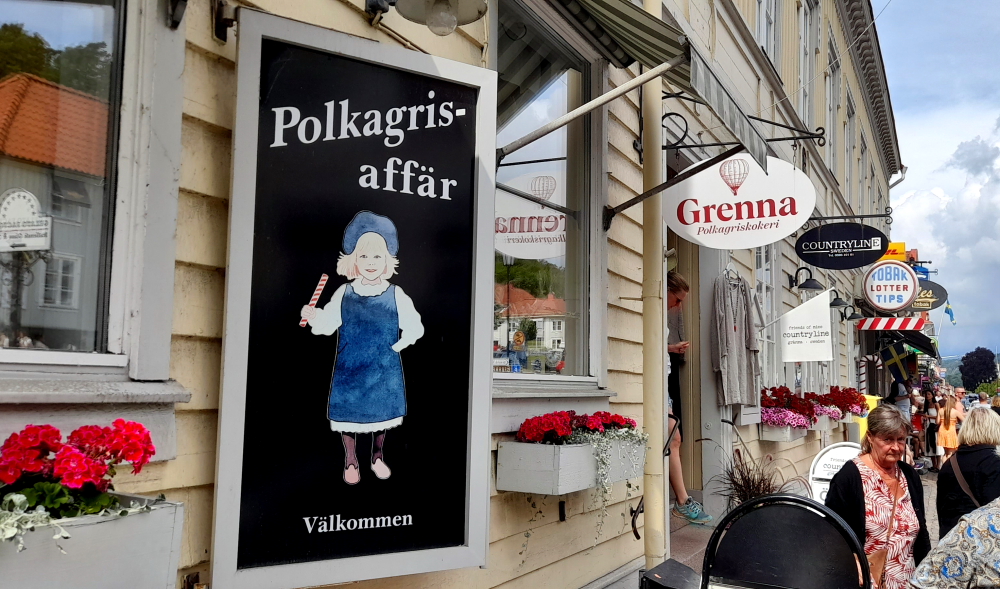
Since the 1850s, the small town has been renowned for its red-and-white candy canes. Today, there are around a dozen bakeries in the town centre making “polkagrisar”.
Crowded village to buy sweets.
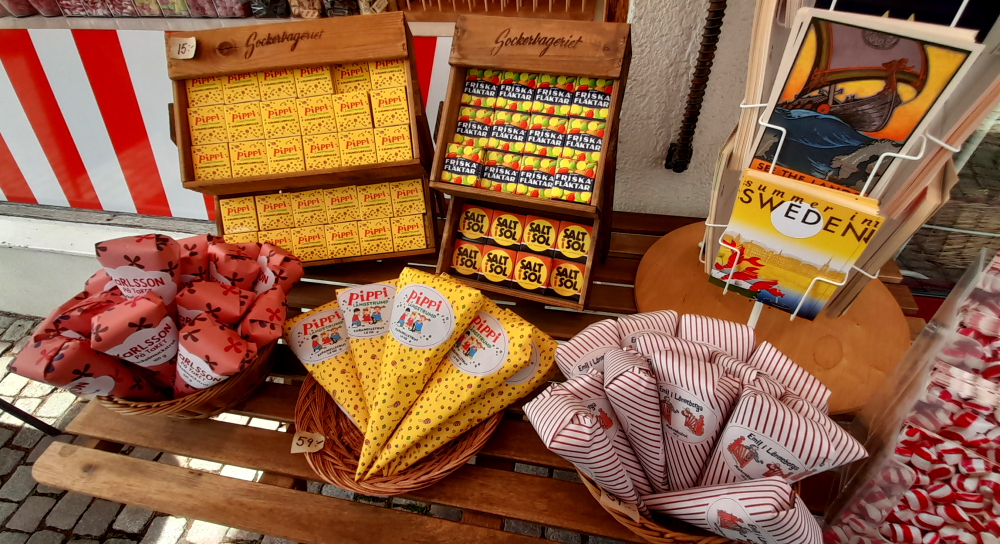
Almost all of them offer visitors the chance to watch the manufacturing process. The shapes, colours, sizes and flavours of the sweet are varied and the candy canes are a popular souvenir.
Sweeties.
15 minutes is more than enough time walking in this crush so we jump in the car to drive the 30 minutes to our hotel in Jonkoping. 15 minutes later it starts to rain.
Thanks to the GPS we easily negotiate the complicated exits off the E4 and drive into the hotel’s parking garage. We are staying at the Best Western Plus John Bauer Hotel for the next 2 nights on the edge of Lake Munksjon which, via a narrow channel, feeds into Lake Vattern.
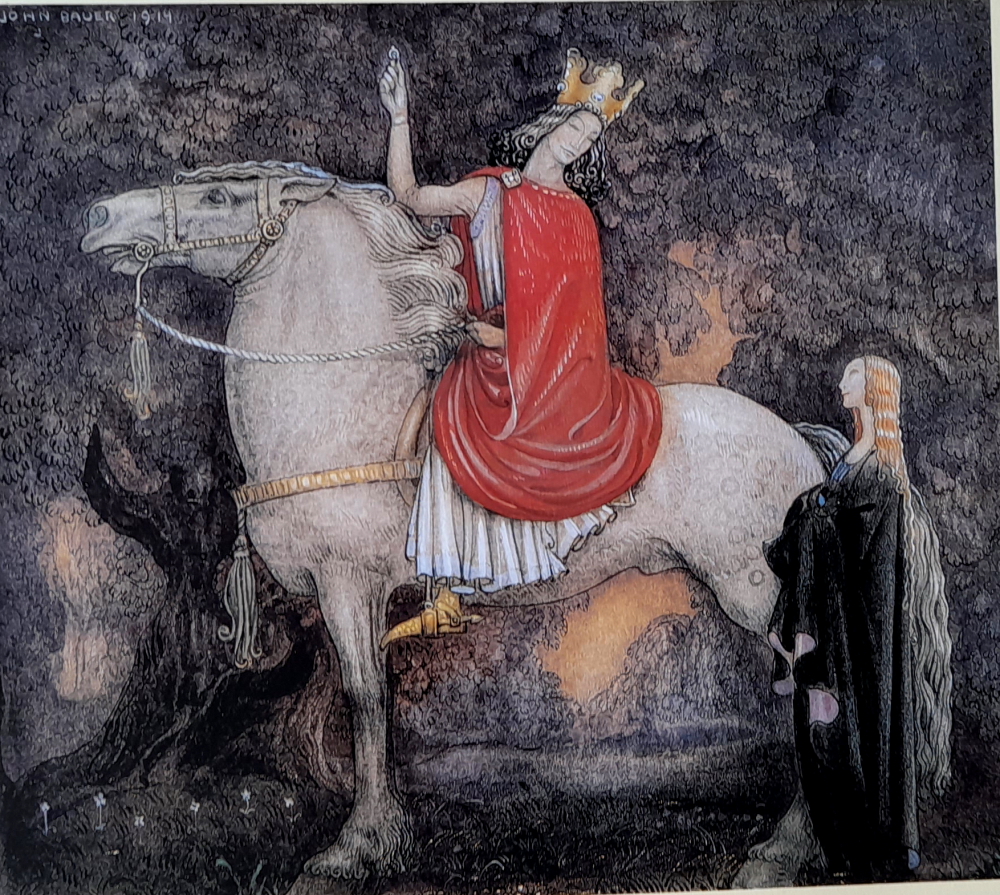
The hotel’s interior is very “arty” and has reproductions of Bauer’s work throughout. John Albert Bauer (1882-1918) was a Swedish painter and illustrator. His work is concerned with landscape and mythology, but he also composed portraits. He is best known for his illustrations of early editions of Bland tomtar och troll, an anthology of Swedish folklore and fairy tales. Bauer was born and raised in Jönköping.
Nordic Myth by John Bauer
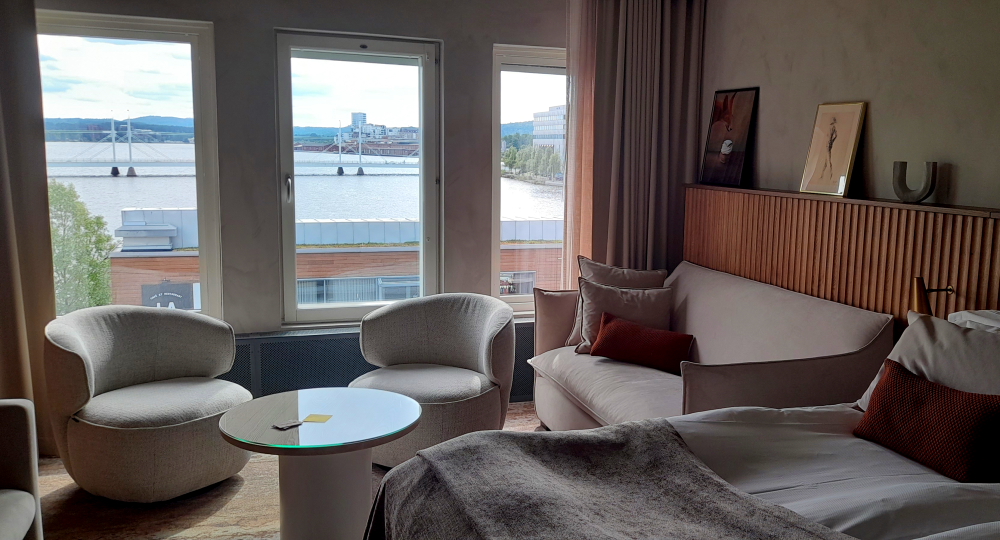
Our room is very tastefully decorated including books and artwork.
Hotel room with a view & artwork.
Jönköping’s old city area consists of a sandy area with two smaller lakes (Munksjön and Rocksjön ) on the southern shore of Lake Vättern, surrounded by hilly slopes. The urban area also includes the former urban areas Huskvarna and Norrahammar. The city received city privileges as early as 1284. Jönköping’s charters are the oldest in Sweden.
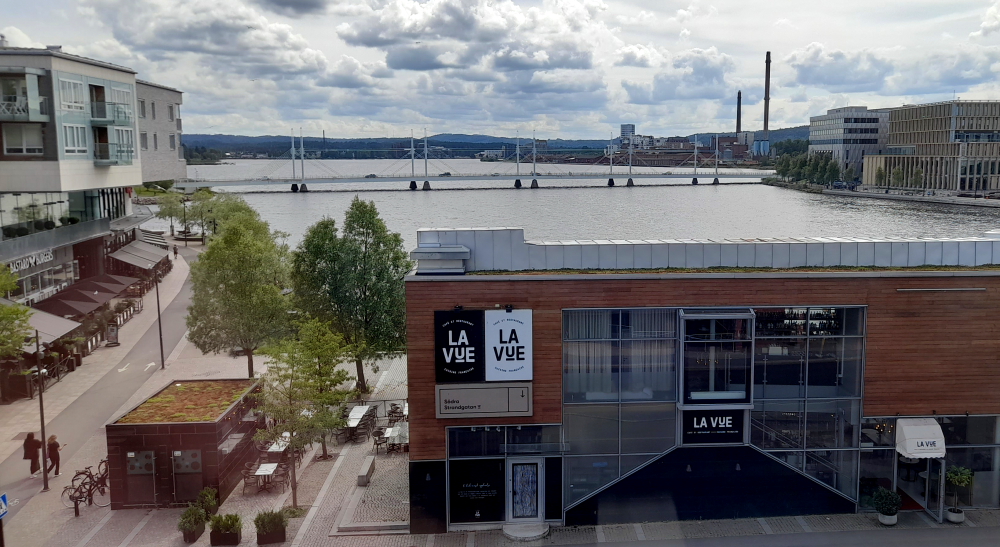
View from our room of the Munksjo Bridge over Lake Munksjon.
Jönköping is called the city of matches, which is based on the success that the Jönköping Tändsticksfabrik from the end of the 19th century had with its safety matches. No less than five match factories were active in the city for a period.
Walking around the town – Radhuset & Radhusparken.
Paul, Lynn and I venture out for a quick recce of nearby streets. After visiting the pier that juts into Lake Vattern we walk into the old town.
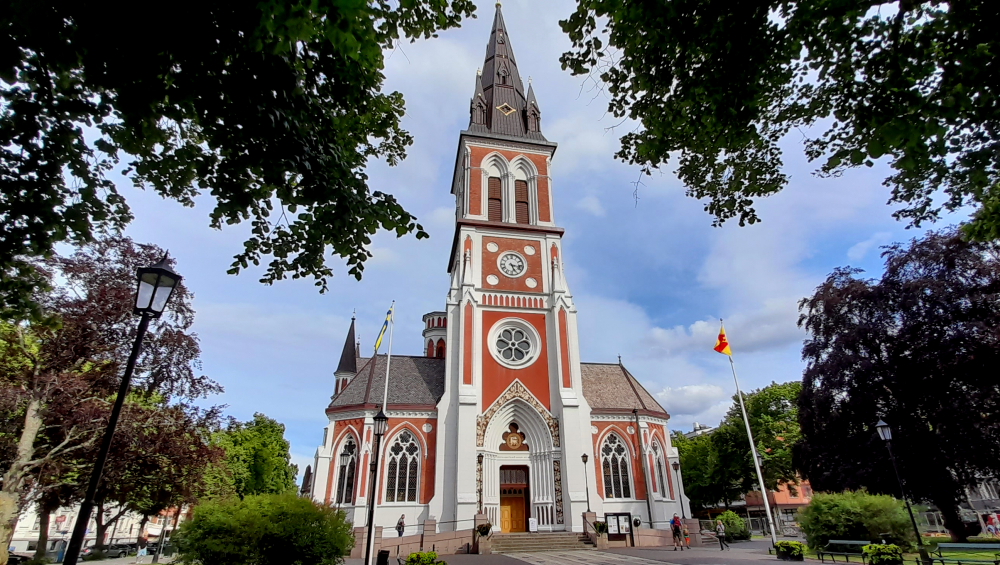
Sofiakyrkan.
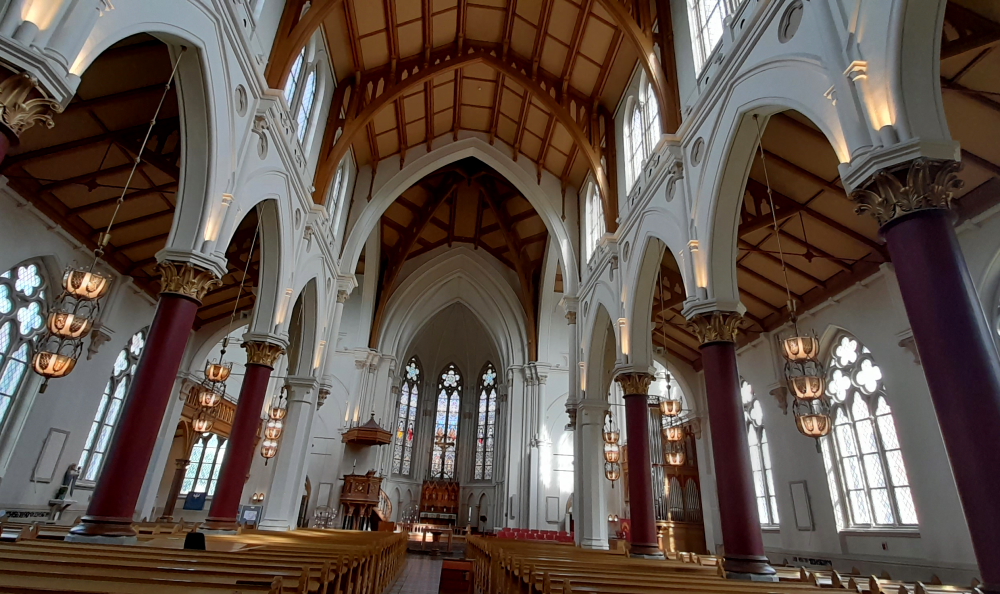
The Sofia Church is built in neo-Gothic style and designed by the architect and professor GF Dahl, who also designed the Royal Library in Stockholm. The church is named after Queen Sofia, Oscar II’s wife.
Inside the church.
The town’s streets feature both traditional wooden houses and shops as well as modern civic buildings, shops and units.
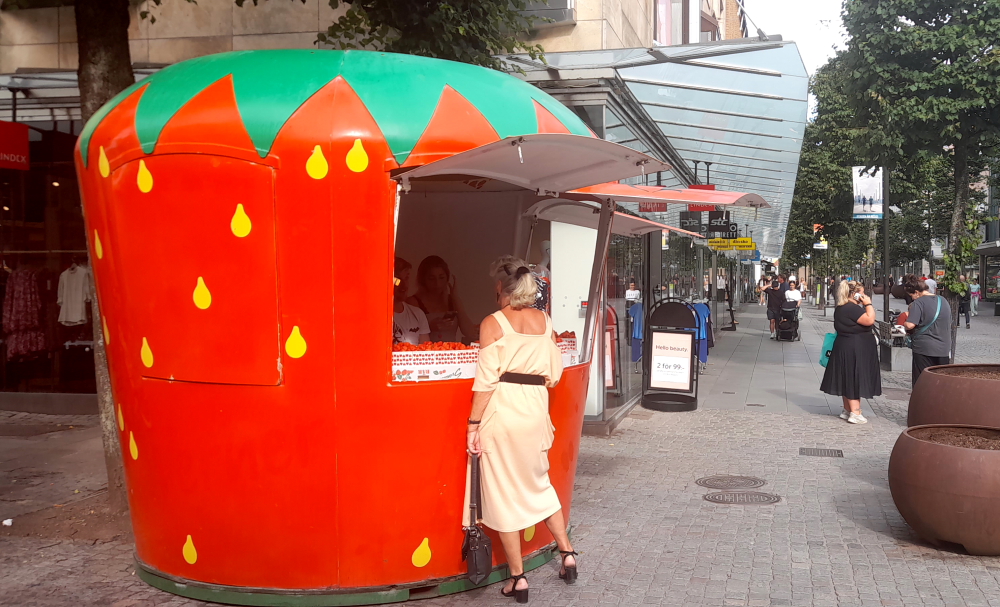
Punnet of strawberries, anyone?
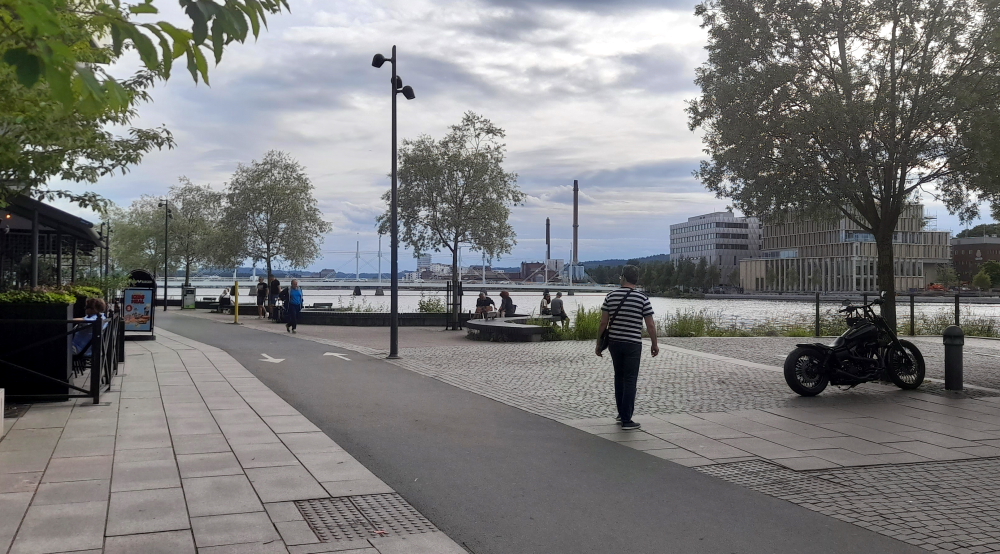
Around the hotel are numerous restaurants taking advantage of the boardwalk along the waterfront.
Beginning of the boardwalk by the lakeside.
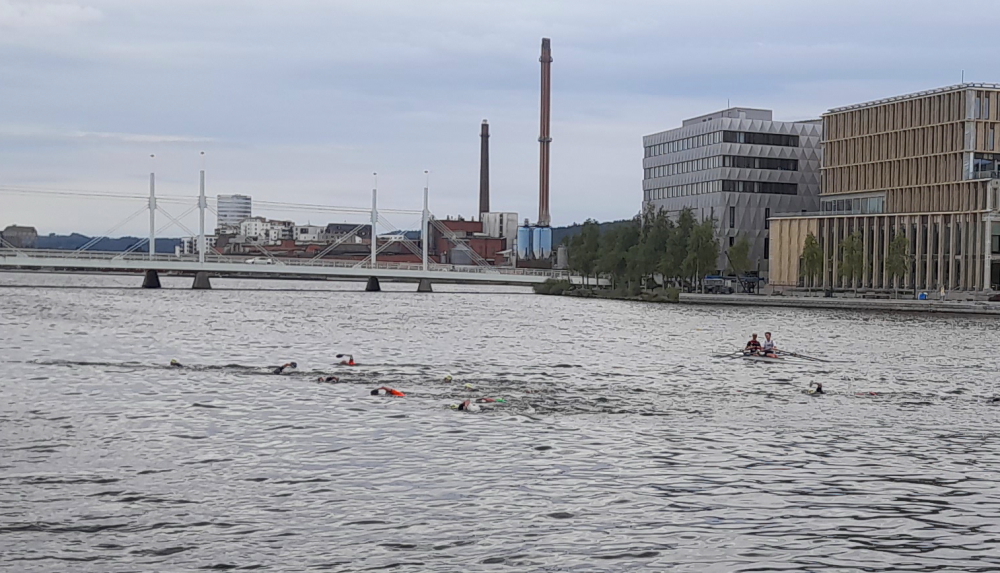
While having dinner in La Vue restaurant we notice a flotilla of swimmers crossing the lake.
Swimming training in the cold lake.
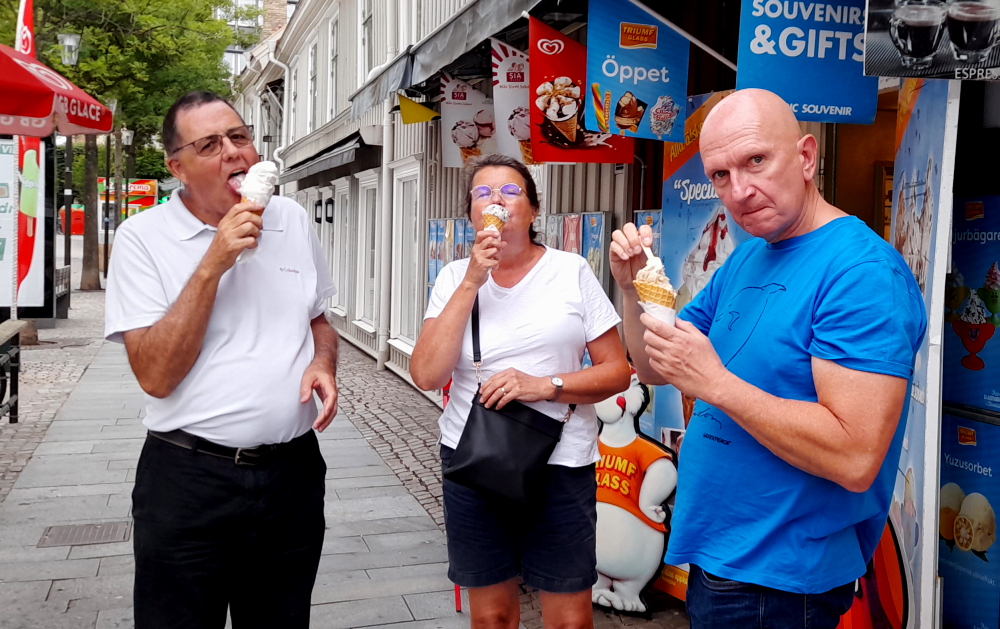
Time for dessert – ice cream, naturally – and a walk around the other side of town.
Ice cream for dessert.
We made pigs of ourselves on rather large ice creams so after Susie and Paul go home we are back on a diet.
What’s your favourite dessert, Paul?
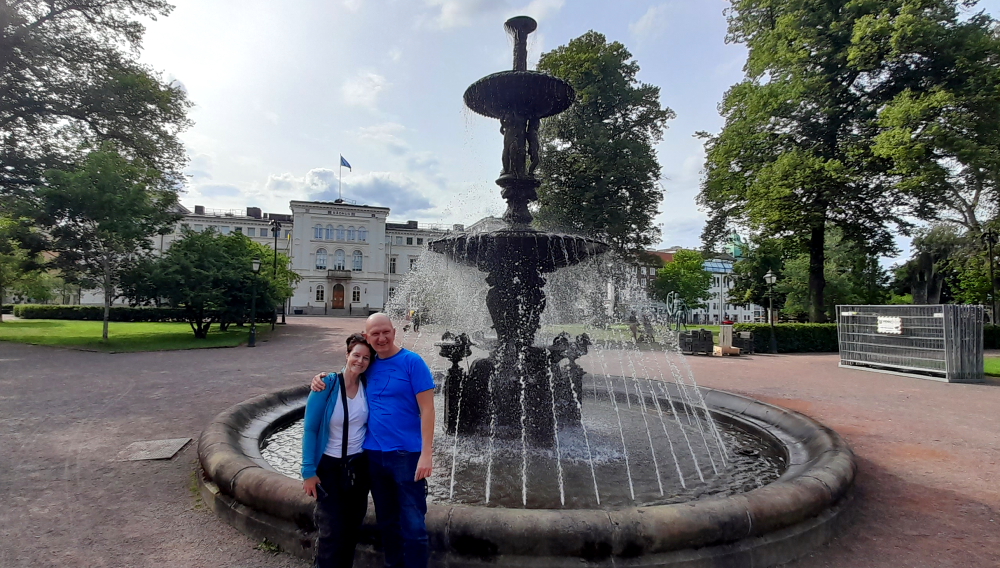
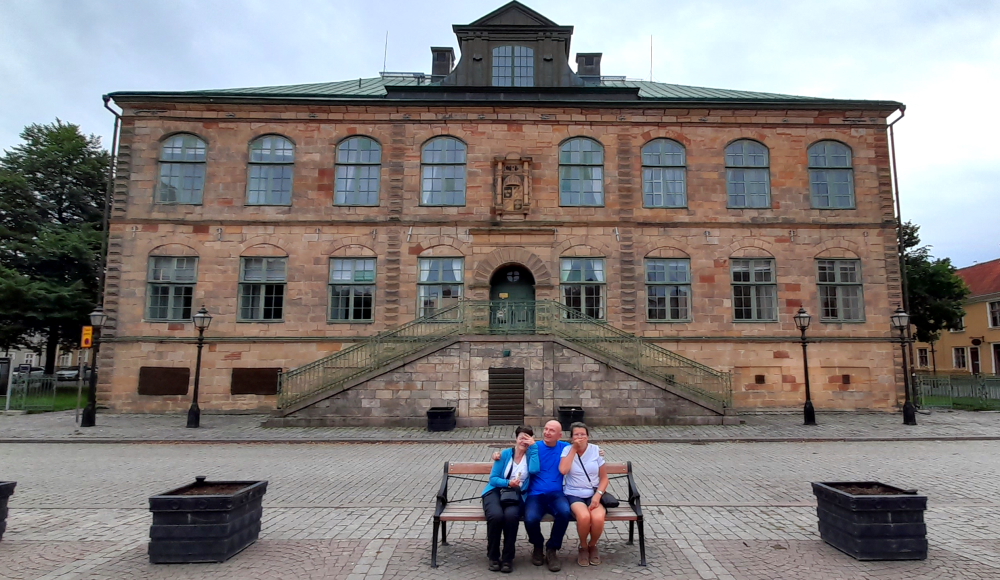
We get as far as the Göta Court of Appeal which is one of the six appellate courts in the Swedish legal system. The court was established in 1634 during the regency of Queen Christina. It is the second oldest of the Swedish courts of appeal.
Monkeying around outside the old Court of Appeal.
Time to head home!
12 July, 2023
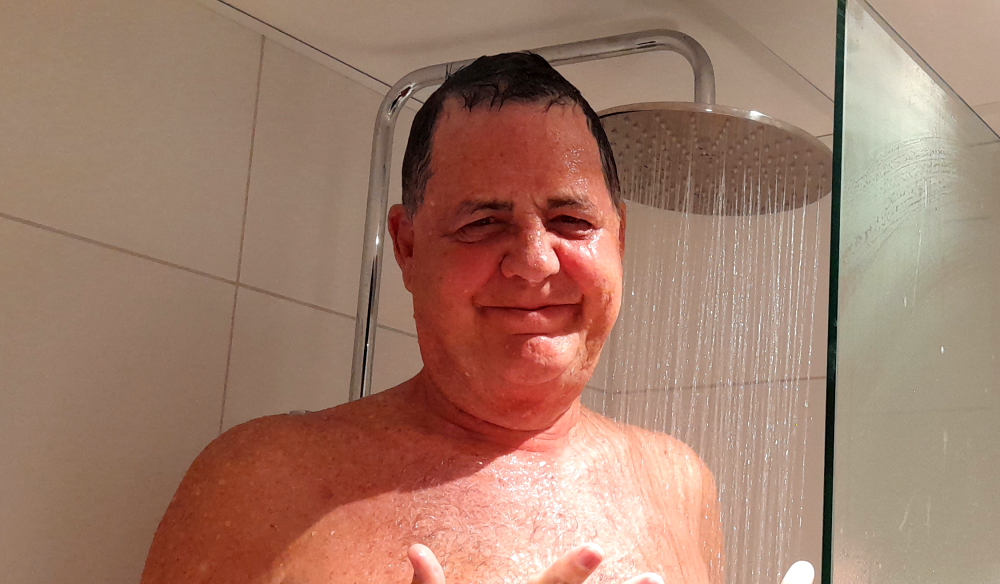
The Swedes seem to have some very strange engineering. It seems OK with them to almost get things right but it seems that they just can’t be bothered making things perfect. In the shower this morning I found that although our room is one of the best so far in the past three months the shower is about 30 cms too low so I can’t stand upright under it. It seems that close enough is good enough in Sweden.
No head room in this shower.
As predicted, the 100% chance of rain today has come true. We decide that today is a ‘day in’ day, except for a quick sprint across the road to ‘La Vue’ for elevenses.
While Lynn catches up the blog for the past couple of days, Susie and Paul visit the Jonkoping County Museum which features John Bauer’s fairy-tale art, Småland cultural history and collections of Swedish 20th century art.
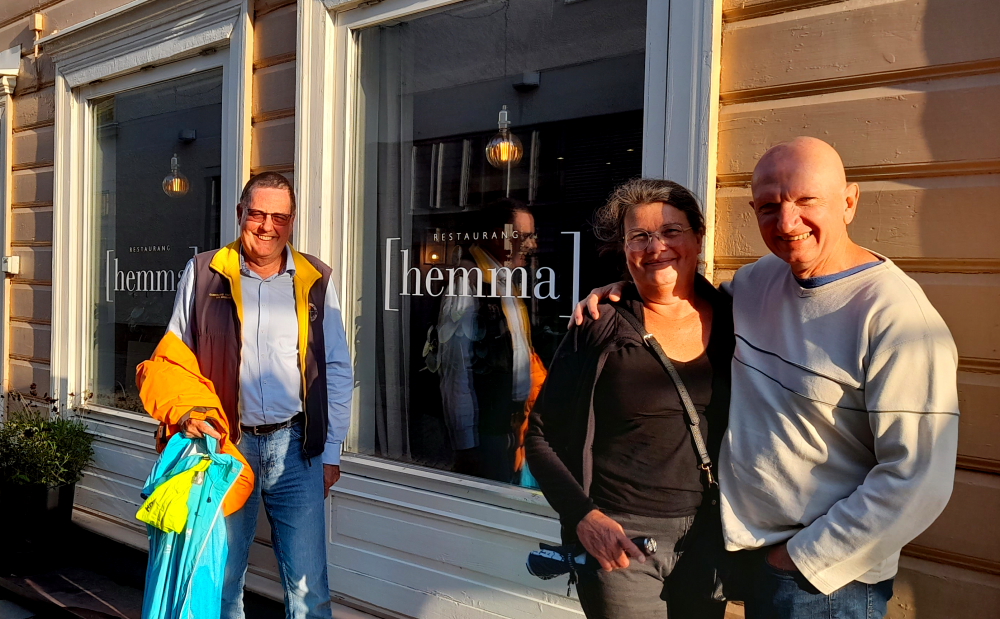
Just as we are about to head out to dinner the rain stops and the sun breaks through at last. We can’t guarantee that we won’t get wet later so we take our wets and head out to ‘Hemma’ for a very nice dinner.
Still sunny as we leave the restaurant.
We didn’t get to visit the Jonkoping Rose Gardens today due to the weather but the plan is to head there in the morning on our way to Kristianstad as there seems to be a two-hour dry window in the morning according to the forecast. The plan is to be on the road by 10:30 am tomorrow.
13 July, 2023
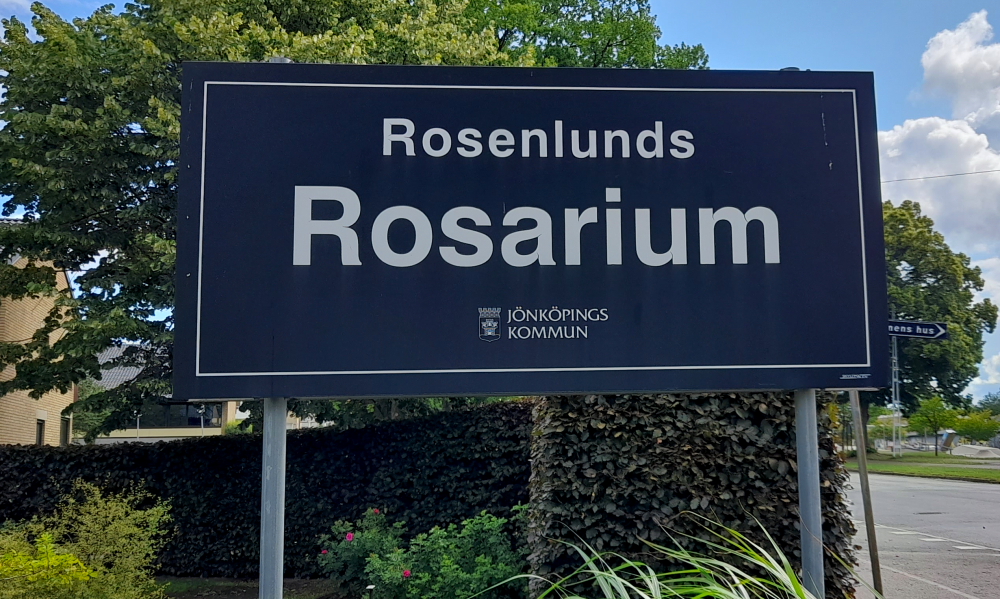
Bang on 10:30 am we are driving out of the hotel parking garage on our way to Rosenlunds Rosarium, a 6-minute drive away. Rosenlund Rose Garden is beautifully situated in the grounds of Rosenlund Manor, just a stone’s throw from Vätterstranden beach. The Manor was built in 1788 by Gustaf Posse.
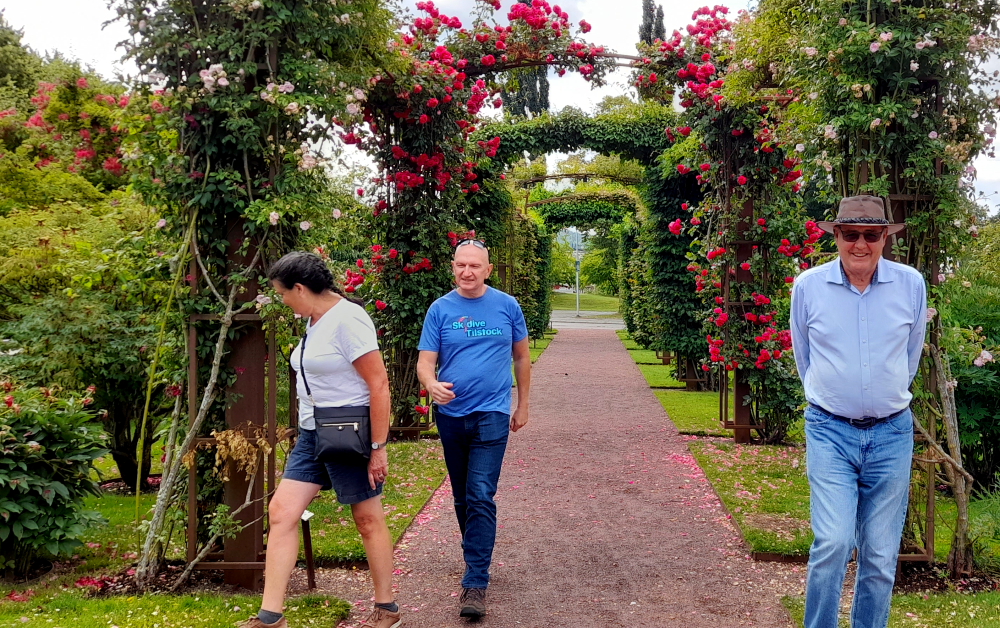
In the late 1970s, the Rose Garden was added to the east of the Manor, followed in 1993 by a perennial garden lined with an assortment of shrubs and perennials. Between 1997 and 1999, the Rose Garden was given a complete makeover by the Jönköping municipal landscape architect Björn Kalin. In 2007 and 2008, the park was enhanced even further with the addition of more rose beds and trellises.
A short visit to the Rose Gardens in Jonkoping.
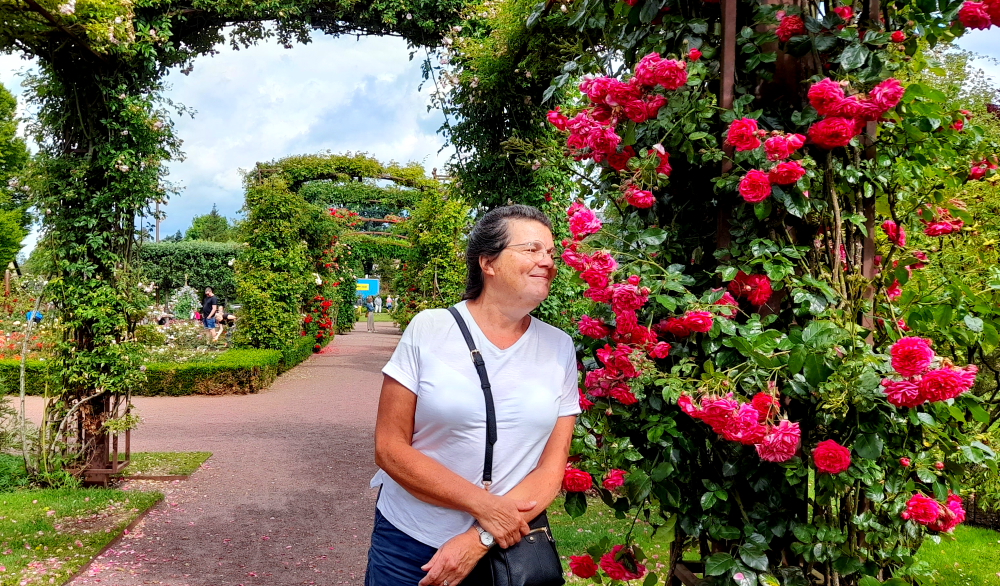
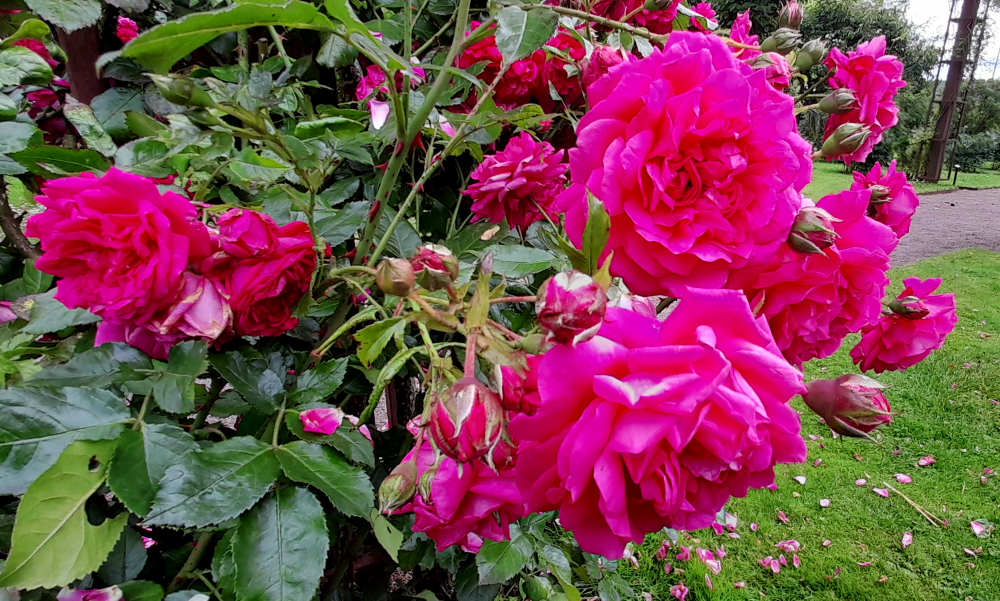
The Rose Garden boasts around 600 varieties of roses, both old-fashioned and newer shrub roses, climbing roses, groundcover roses, wild roses, and polyantha roses, all enclosed by low box hedges. Checks are made continuously and any sub-standard plants are removed and replaced.
Taking time to smell the roses.
Peonies run along both sides of one of the footpaths, mainly common garden peonies, but also a few varieties of tree peonies.
A clematis area with custom-made trellises was laid in 2005. More clematis were planted in 2013 to climb among the roses lining the rose arch.
Sweet smelling roses.
Every year, around 30 different dahlia varieties are planted in the flower beds at the southern end of the park
Heading back to the car before it rains.
The clone archive for 36 selected varieties of Småland cultivated roses has been established. The work took place in collaboration with POM, Sweden’s National Program for Cultivated Plant Diversity.
Rain as usual on the way south.
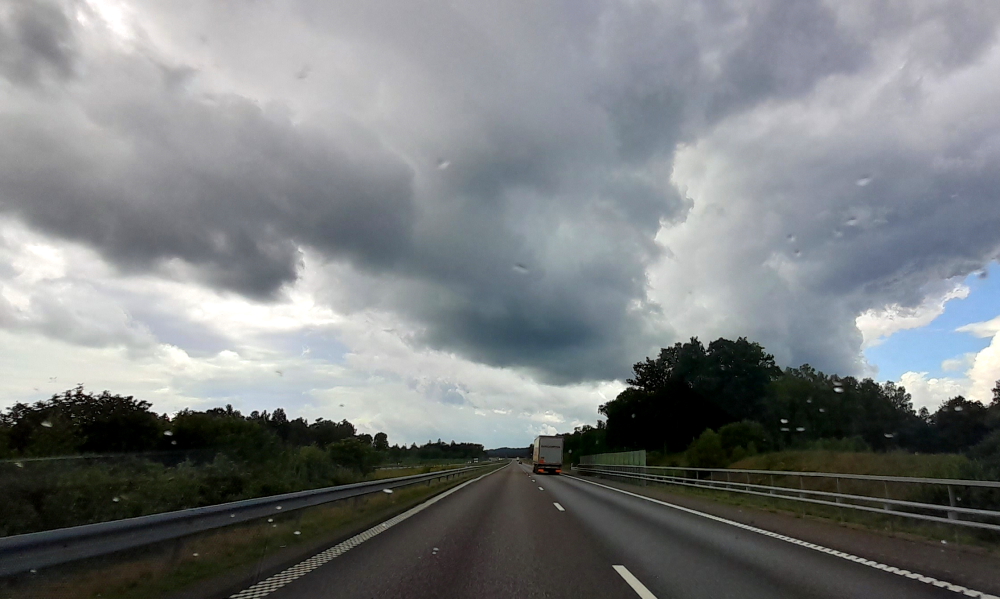
We drive through intermittent rain the entire trip along the E4, 15 and 19. The odd moose sign along the road, then one for wild boar. 1.5 hours into the trip Lynn says, “We haven’t had any speed cameras today.” 8 minutes later, 2 speed cameras!
And, true to form, 1 km from our hotel there are road works which have closed our designated route which means we have to find another as no diversion has been set up.
Our hotel in Kristianstad.
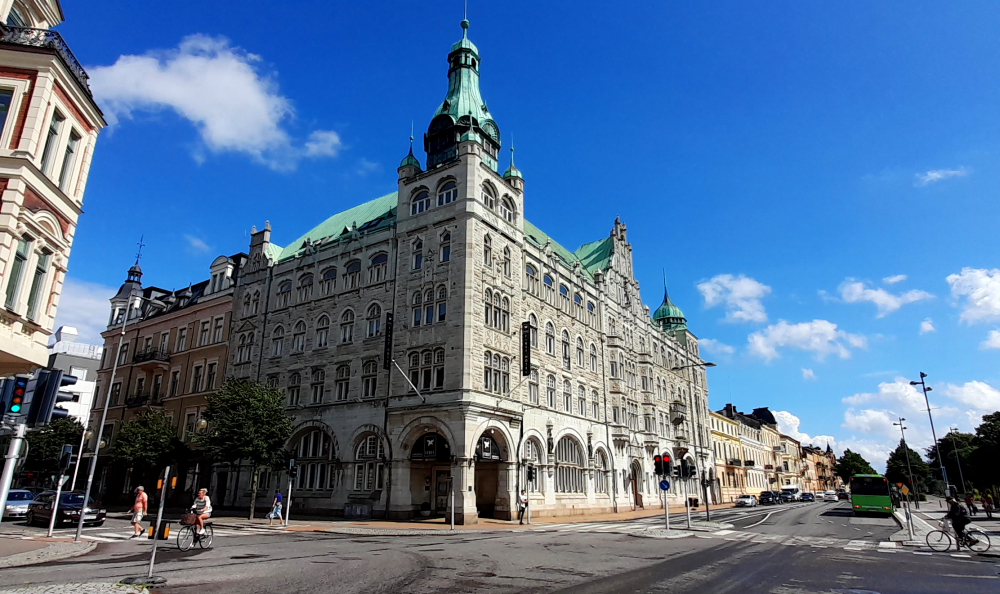
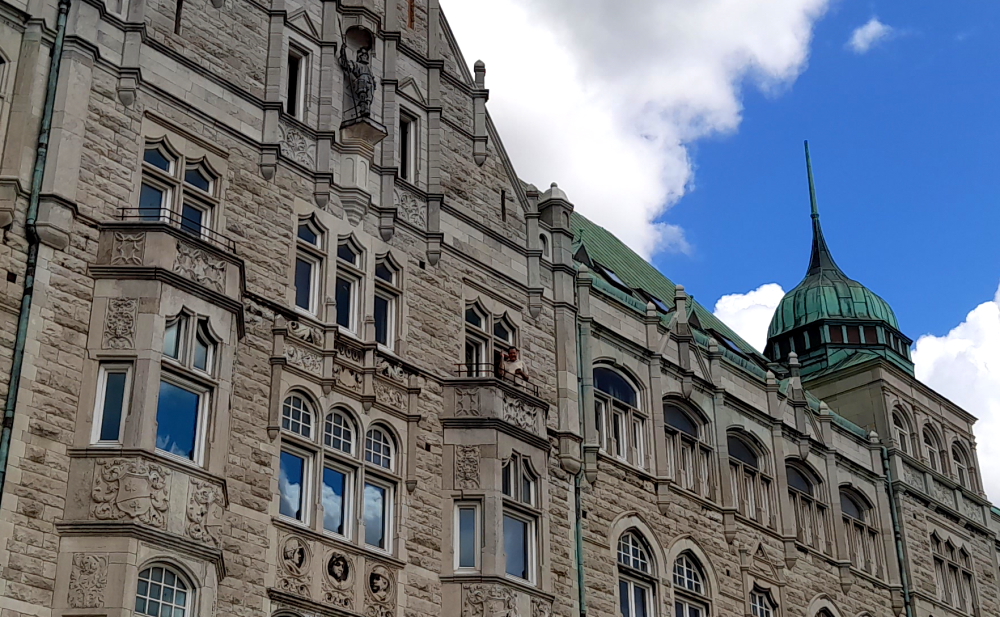
But our hotel – First Hotel Christian IV – is very grand, having previously been a Sparebank building. The hotel is located in the “new” savings bank’s building from 1901.
Former Bank building transformed into The First Hotel.
It was chosen as Kristianstad’s most beautiful building in connection with the Year of Architecture 2002. Today, the wine cellar is fittingly located in what used to be the bank’s spacious vault.
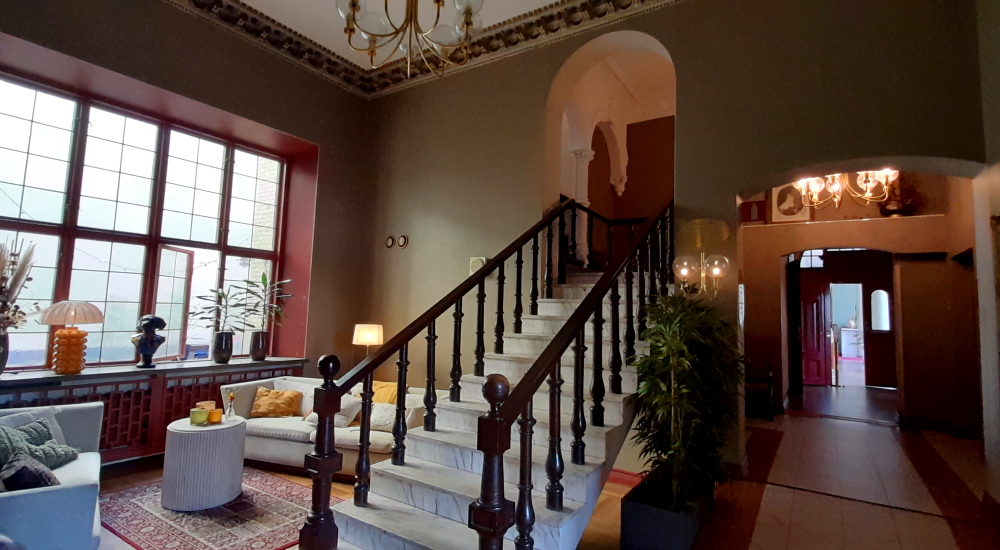
Room with a balcony and a view.
Of course, there are lots of references to Christian IV (1577 – 1648) in the hotel including numerous portraits. Christian was King of Denmark and Norway and Duke of Holstein and Schleswig from 1588 until his death in 1648. His reign of 59 years, 330 days is the longest of Danish monarchs and Scandinavian monarchies.
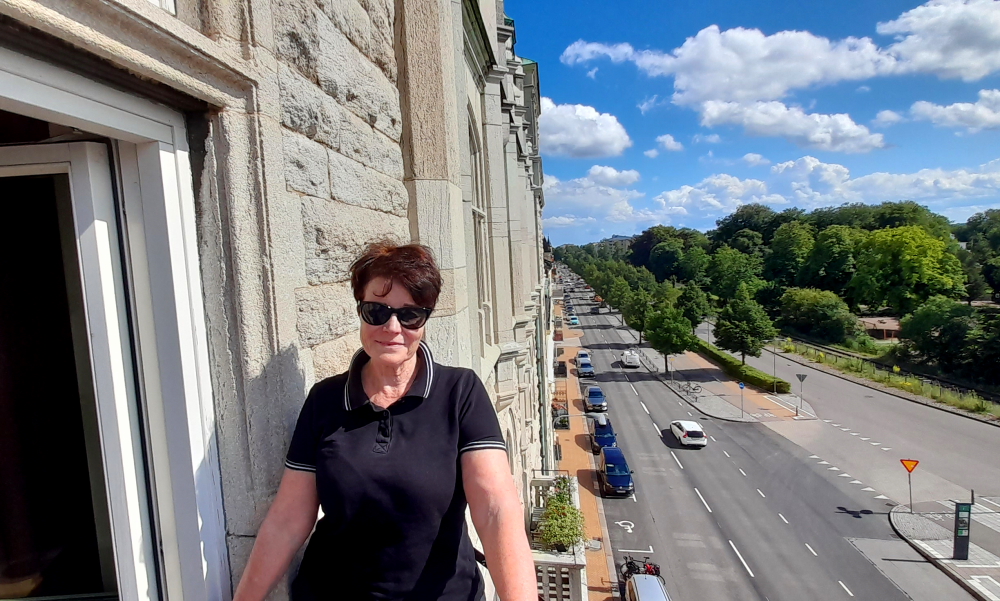
A view in both directions from the balcony.
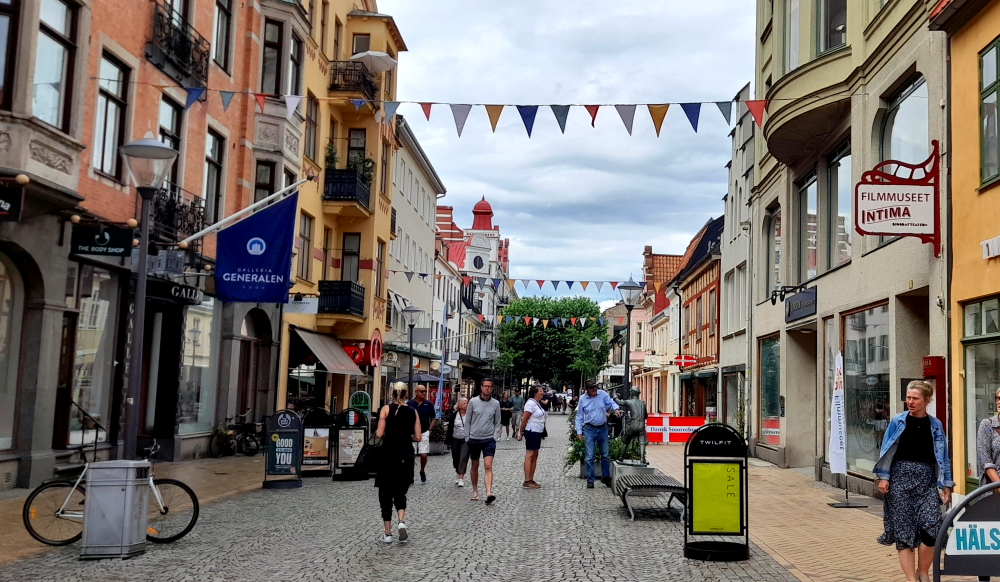
After we check in we head out to find a cafe. The neighbourhood is a mixture of modern and historic buildings with the ubiquitous cobble streets.
Pedestrian Mall in Kristianstad.
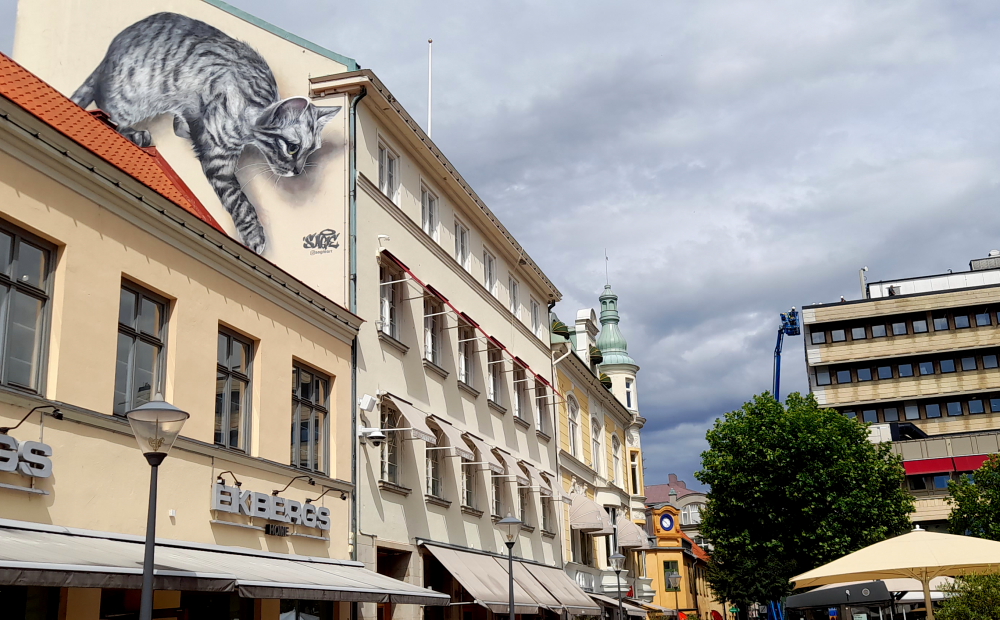
Not to mention the occasional piece of street art.
Big cats in this town.
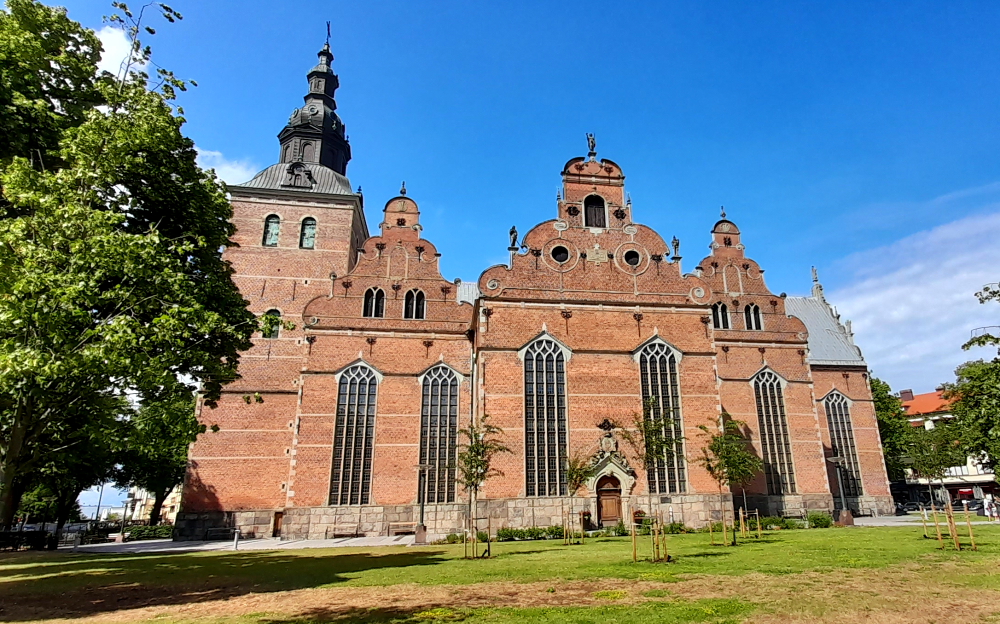
Near to the hotel is the Heliga Trefaldighetskyrkan (Holy Trinity Church) built between 1617 and 1628 by Christian IV of Denmark. He had founded the city of Kristianstad in 1614 at a time when Scania was part of the Kingdom of Denmark. The church’s large size and style reveal the king’s ambitions for his new city.
Designed by the Flemish-Danish architect, Lorenz van Steenwinckel, the grand building is widely considered by many to be Scandinavia’s finest Renaissance church. Like many Danish churches of the times, it is built of red brick. But this church is decorated with many sandstone statues and ornaments, including several monograms of Christian IV, testifying to his involvement.
Holy Trinity Church.
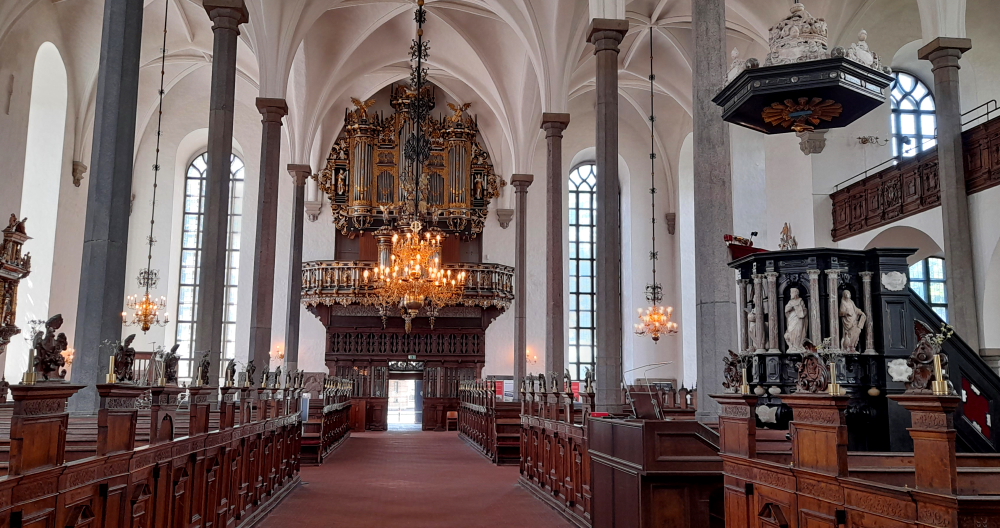
Trinity Church has been little altered since it was built. The carved benches are as old as the church itself. The main addition is its 59 metre-tall tower constructed in 1865. The church is abundantly illuminated due to its 26 tall windows.
The pulpit, which is carved in Belgian and Italian marble, shows Christ and the four evangelists. The impressive canopy hanging above the pulpit weighs almost a ton.
Inside the church.
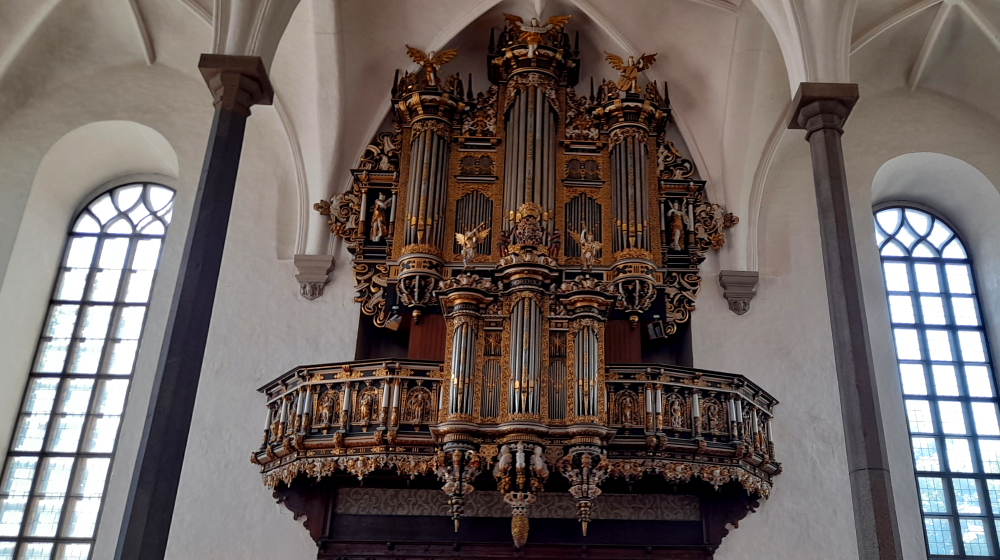
The Baroque organ case survives, including the case pipes, from German-born Johan Lorentz’s 1630 organ, but the organ itself has been replaced.
Impressive organ.
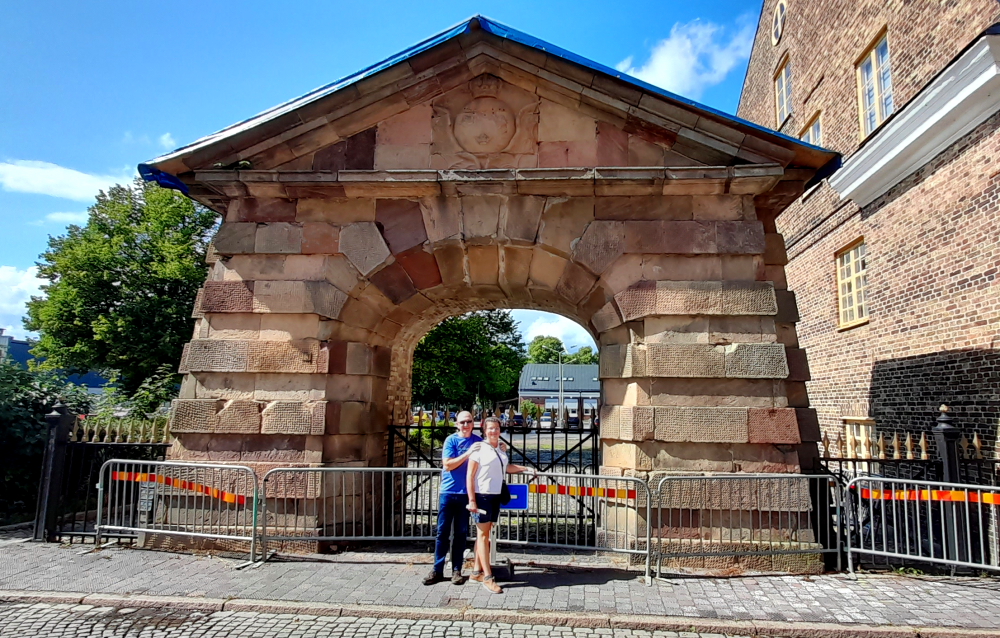
While Lynn was doing some window shopping Susie, Paul and I checked out what was left of the old town fortress. The star-shaped fort base and some of the old moat still exist and some replica cannon have been posted around the moat. One of the old town fort gates is still standing and seems to be under restoration.
The fort gate.
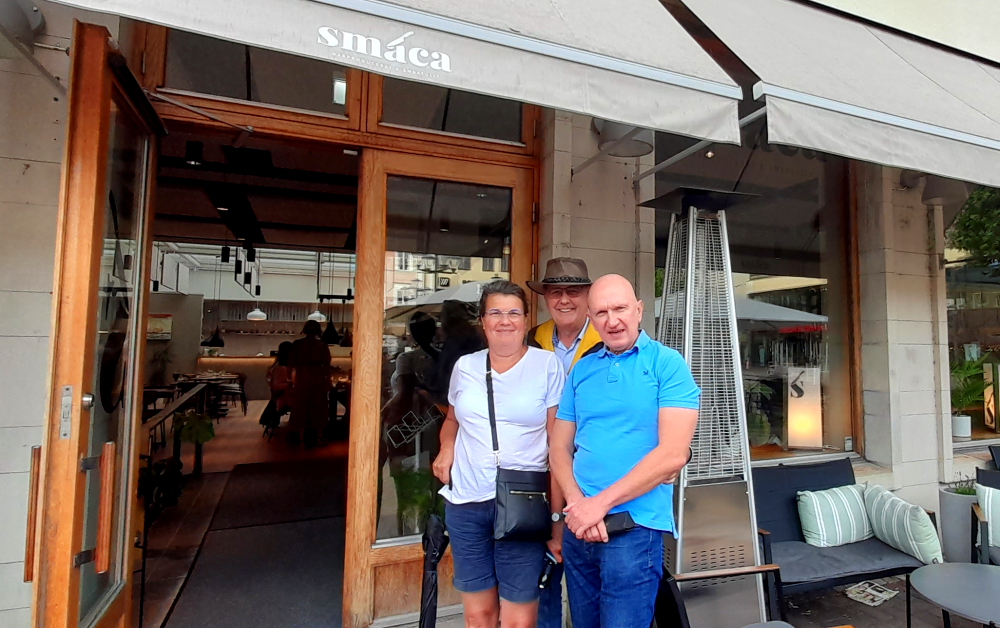
We meet up with Lynn at the church then head back into the mall area for a coffee as storm clouds are starting to form overhead. We find an Italian Cafe just as it starts to bucket down and by the time we down our coffees with a slice of cake the storm has passed. We stroll back to the hotel to unpack and rest before heading out again for dinner at the Swedish restaurant, ‘Smaca’. And the food was lip-smackingly good, too.
At the Smaca Restaurant, Kristianstad.
14 July, 2023
Hoorah! The weather forecast has improved from rain during the day to sunshine with 2% probability. This means we can head out of town today to visit a couple of sites/sights.
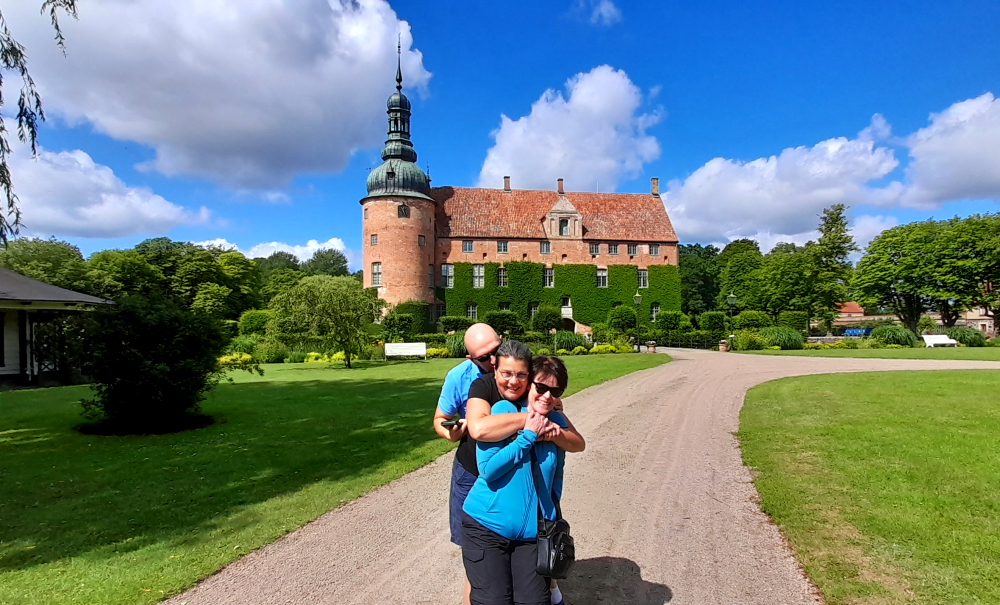
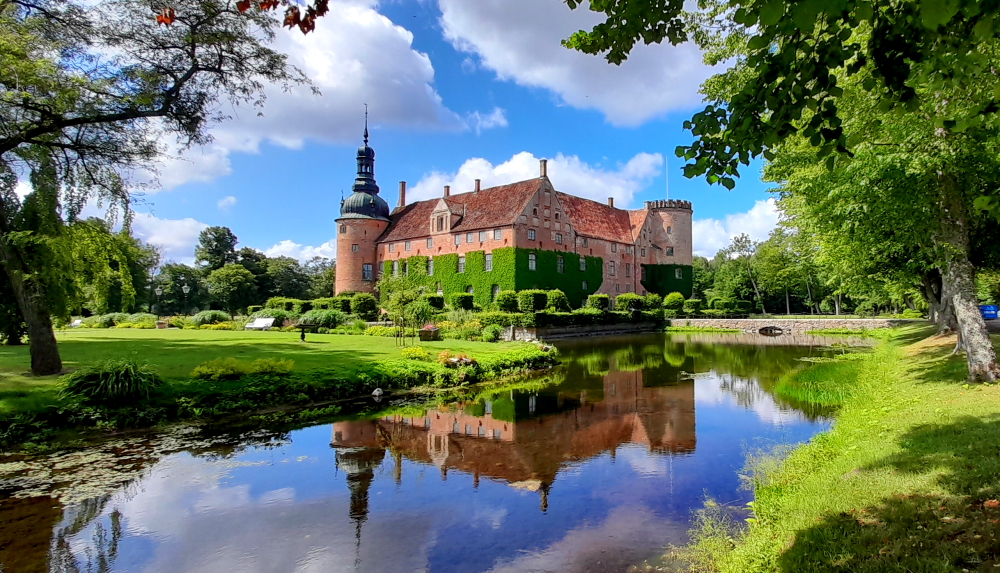
Vittskovle Slott.
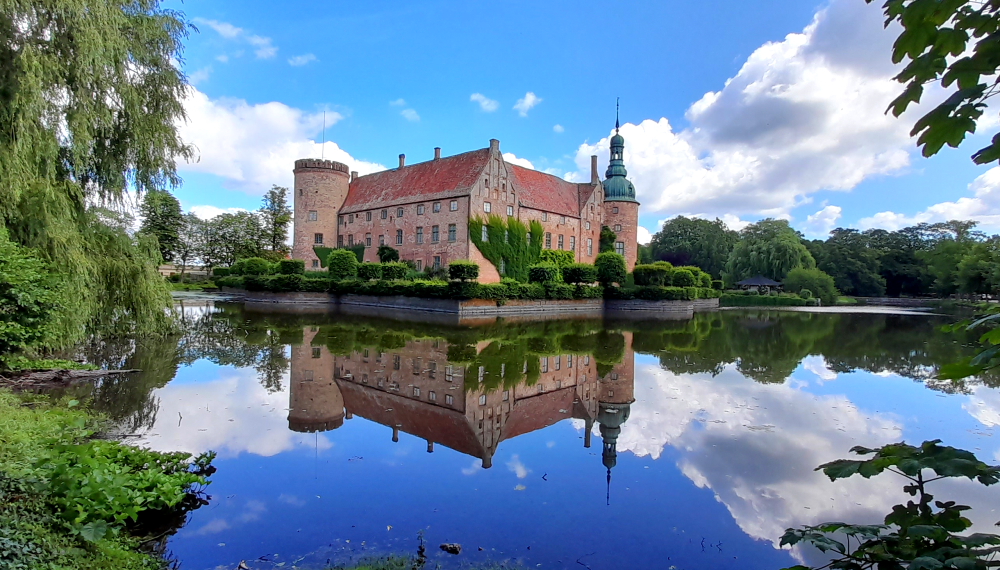
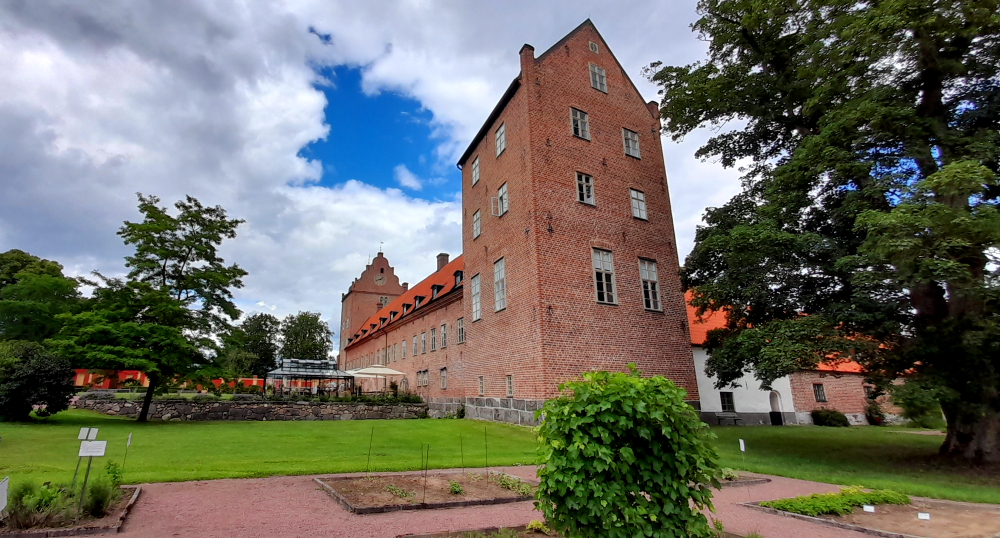
The first stop is Vittskovle Slott, about 30 minutes’ drive south of Kristianstad. The building is one of the best preserved Renaissance castles in Sweden and it is Scania’s largest castle building with over 100 rooms. The castle is today a private residence owned by the Stjernswärd family.
NE corner view of the Slott
During the last years of the Middle Ages, the estate belonged to the Archbishop of Lund. The main house was erected by Jens Brahe (ca 1500–1560) in the 16th century as a defense structure. It was completed in 1577. In the 18th century, the northwest tower burned and the spire was built in a romantic medieval style. The park and gardens were mainly built by Adolf Fredrik Barnekow (1744–87).
At the beginning of the 19th century, the castle was newly decorated with murals and ceiling paintings by Swedish painter Christian Laurentius Gernandt (1765-1825). Vittskövle has belonged to members of the Stjernswärd family since 1837. East of the Slott is the village of Vittskovle and its church.
SW corner view of the Slott.
The oldest parts of the church are built in Romanesque style during the late 12th century or early 13th century. In the 15th century a chapel was built in the north and dedicated to Saint Anne. In this chapel there are the symbols of the evangelists, as well as the four female medieval saints: Saint Barbara, Saint Ursula, Saint Gertrude and Saint Catherine. The tower was built in the 16th century.
Sadly, the church is closed today but Wikipedia reveals that the vaults were built in the 15th century with murals from the 1480s, showing stories from Genesis. In the chancel, the legend of Saint Nicholas has been depicted. The pulpit is made in oak 1704–1705. The baptismal font is from the Middle Ages and made of sandstone. In the 17th century a grave chapel was built to the south for the members of the Barnekow family.
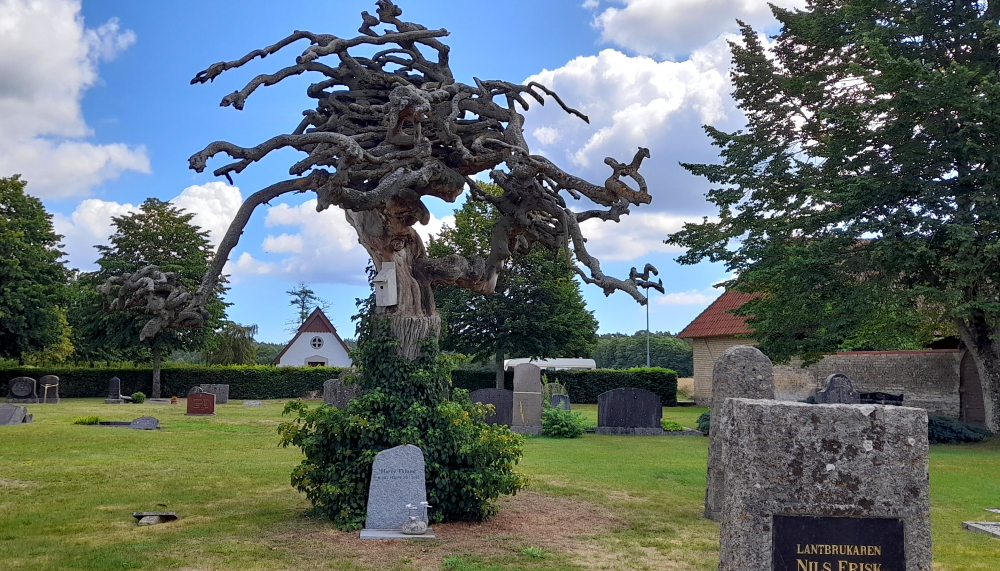
Weird tree within the church graveyard at the village of Vittskovle.
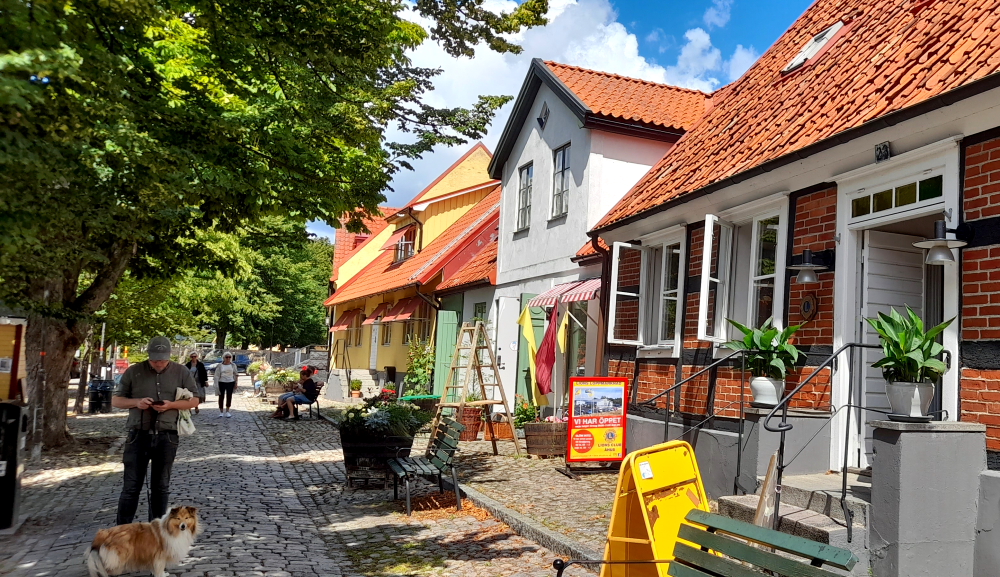
13 kms NE is the town of Ahus. We were planning on visiting its famous beach but it seems that there is a summer festival happening at the beach today and the car parks are full. So we turn around and park in the Torget next to the Ahus Museum and after a quick walk to the Kloster Bageriet we sit in the shade for cold drinks and buns.
Shops bordering the town square in Ahus.
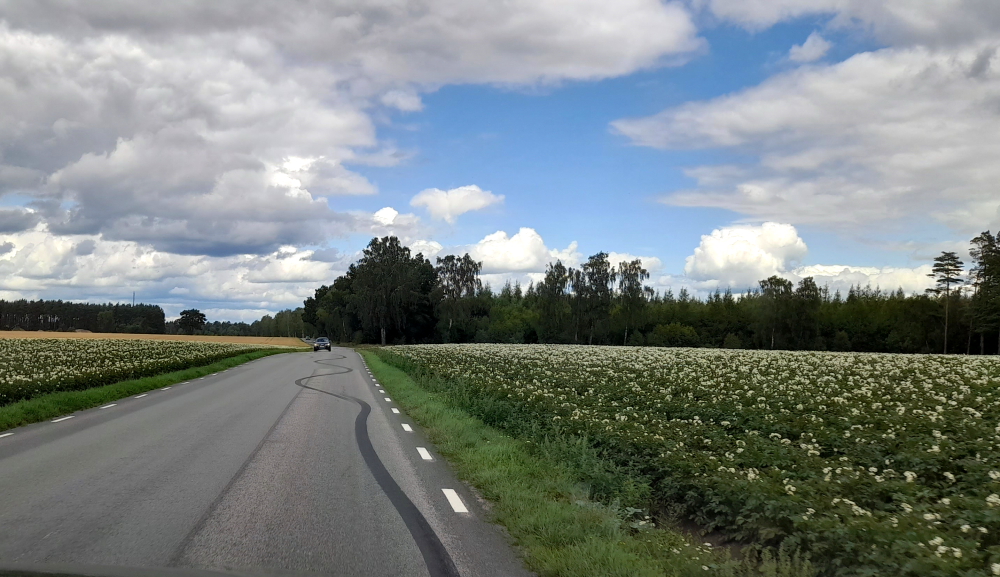
Our 3rd stop today is Backaskog Slott, a 30-minute drive NNE of Ahus. We drive through vast fields of crops where workers are busy hand harvesting.
Fields of potatoes.
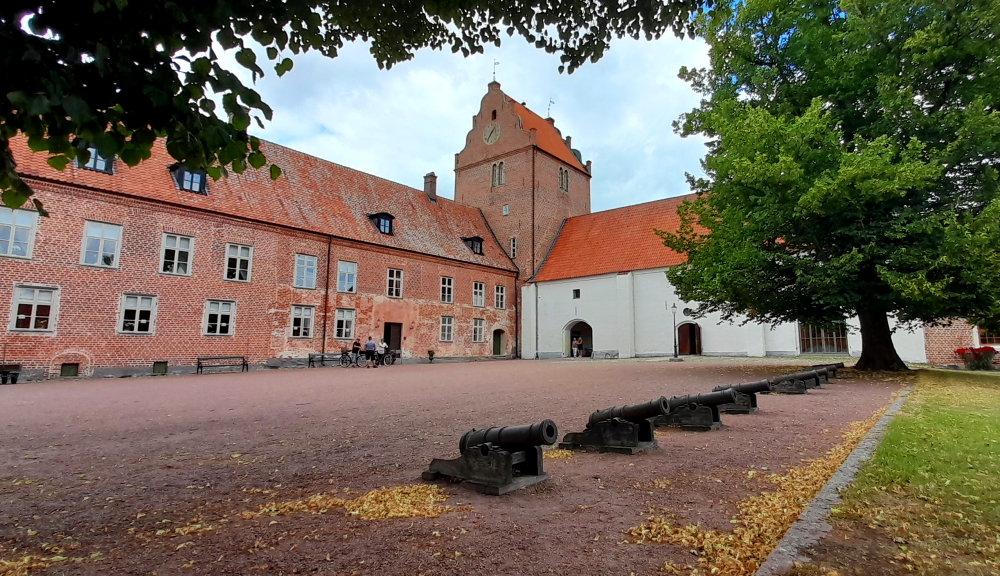
Built on an isthmus between Lakes Oppmannasjon and Ivoleden, Bäckaskog was founded as a monastery in the 13th century but ceased at the Reformation in 1537 when Bäckaskog was taken over by the Danish state. In 1640 it was converted to a castle. It was granted to the Ulfstand, Brahe , Bille and Parsberg families. Finally, it was left with ownership to the Ramel family.
Backaskog Slott from its courtyard.
In 1684 it was withdrawn to the Swedish crown by Charles XI. It then became the residence of the colonel of the Södra Skåne cavalry regiment. Among the owners, it is in particular field marshal Johan Christopher Toll and Karl XV who beautified the castle and its surroundings. Oscar I leased the property in 1845 and in 1853 transferred the contract to Crown Prince Karl, later Karl XV. He was the owner of Bäckaskog until his death in 1872. Crown Prince Fredrik of Denmark, later Fredrik VIII, took over the property in 1885, but in 1900 handed over the contract to chamberlain Filip Stjernswärd.
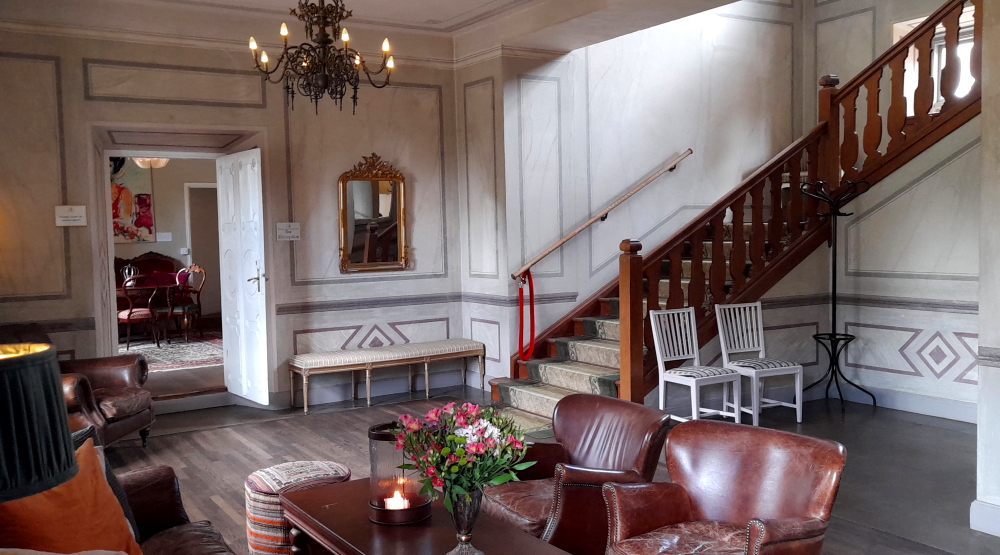
Inside the hotel.
Around 1924, Bäckaskog was leased by Per Åkers (Nilsson), who was director of the Swedish-owned telephone company in Poland. In 1956, the castle was separated from agriculture. The castle was leased by Gustav Ferlenius , who made Bäckaskog a popular tourist destination. Since then, Bäckaskog has been used for conferences and courses and is open to the public. In 1996, the castle was bought by the Statens Fastighetsverk and is now a hotel.
The SW corner of the Slott.
It’s now 1:30 pm as as there is a Rock Concert being held in town this weekend I’m keen to get back and reclaim our free hotel car parking spot – which we do.
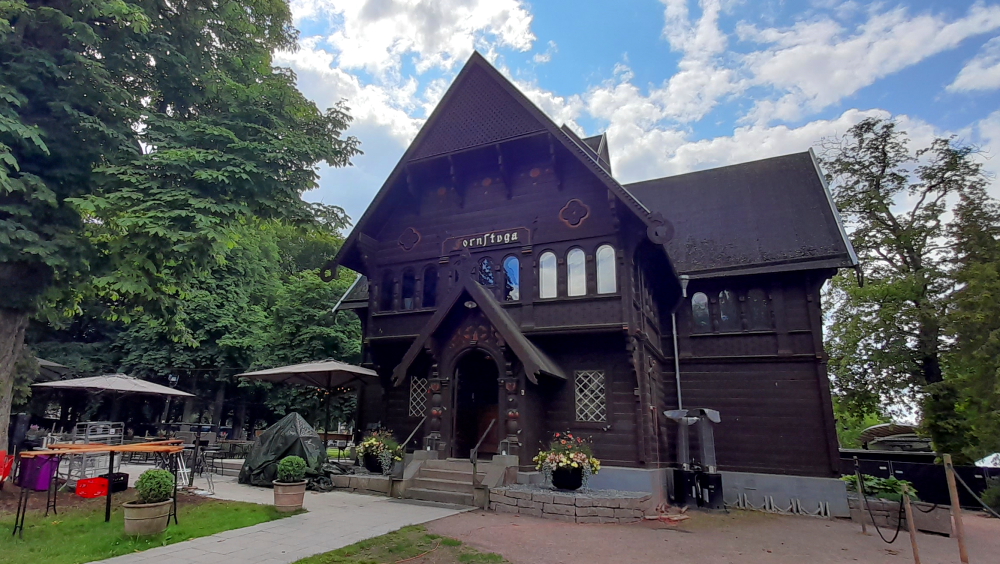
Tivoli Park is next to the car park so we decide to check it out. ‘Flabben’ (like flabbergasted) is a quaint, wooden restaurant and bar. According to its website: ‘As a tribute to Bengt Österman, Flabben was named exactly Flabben. Come as you are, eat and drink, and go home.’
Flabben Restaurant & Bar, Tivoli Park, Kristianstad.
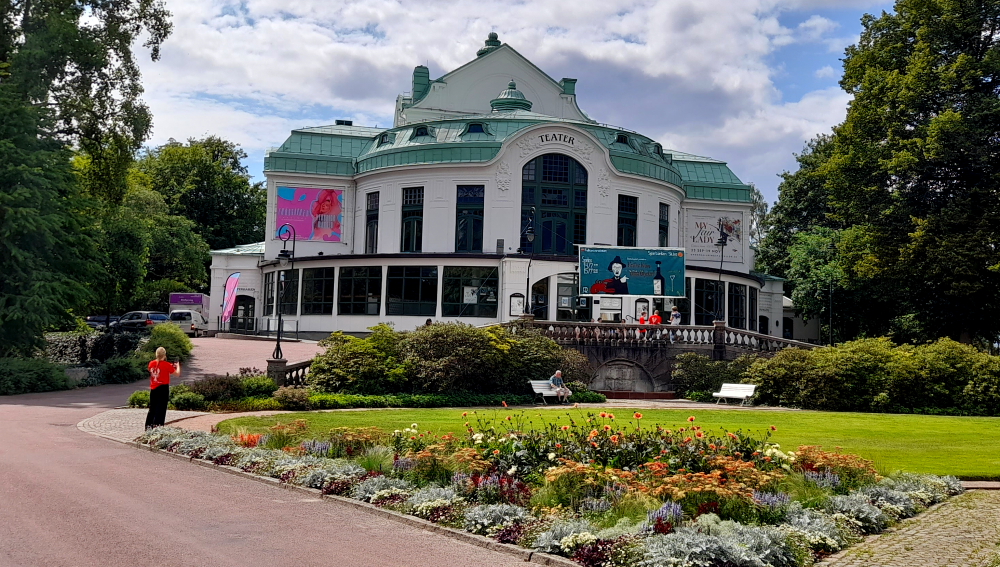
Nearby is the Teater. Kristianstad’s theater is one of the country’s oldest still in use. Kristianstad’s Axel Anderberg (1860-1937) was the architect of this white wooden building in Art Nouveau style, who also designed the Royal Theater and the Oscar Theater in Stockholm, among other things.
The Teater building across the road from our hotel.
The salon is in red, green and gold with two balconies, 362 seats and ceiling paintings with mythological motifs by Nils Asplund. The theater functions as a guest theater with, among other things, yearly recurring musical productions, by, among others, Emil Sigfridsson’s company, the Riksteatern, concerts and more.
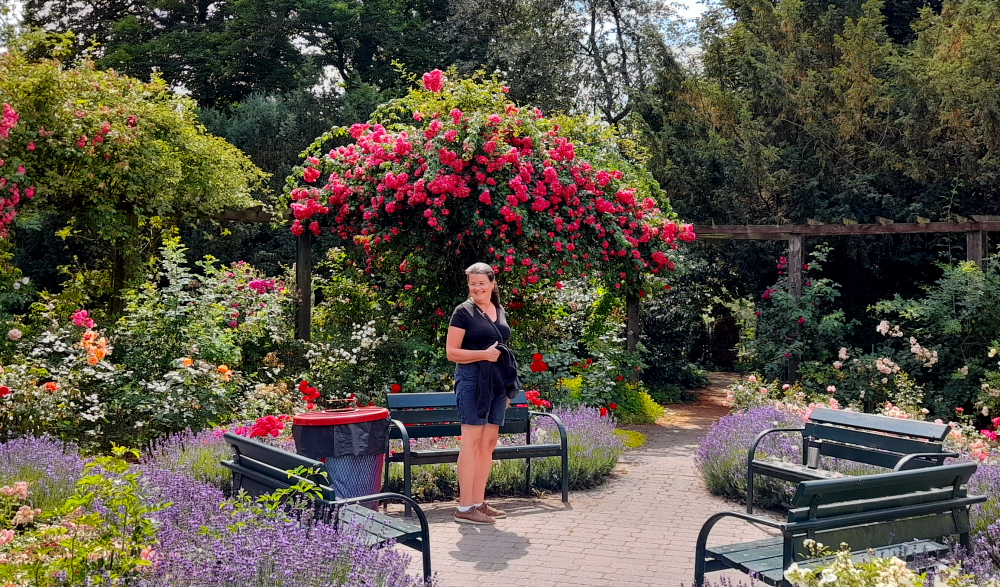
Tivoli Park also boasts a small rose garden to which Susie is drawn.
A visit to the rose garden in Tivoli Park.
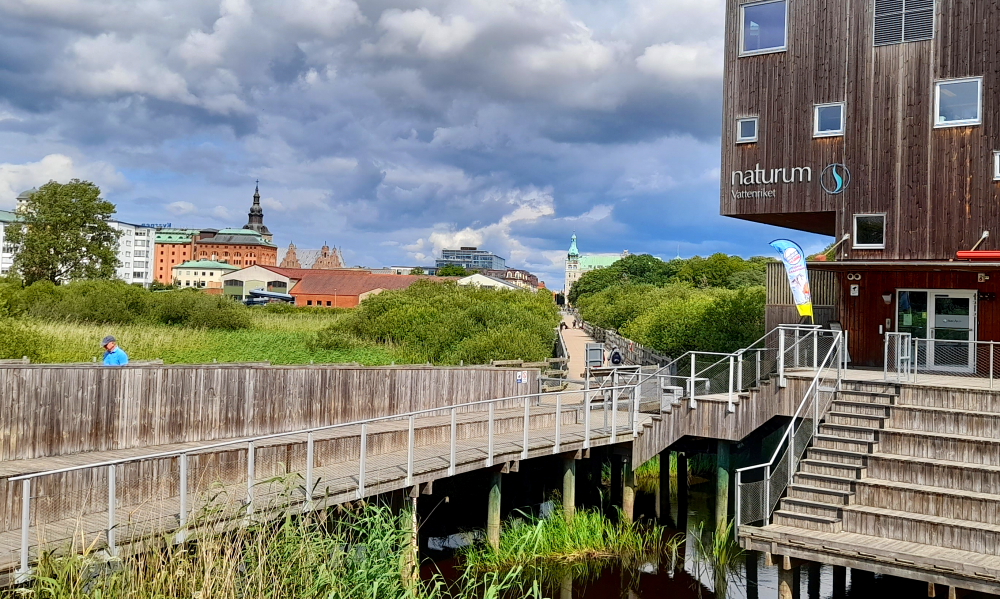
Across the Helge A River is ‘Naturum Vattenriket’ (Water Kingdom) – a visitor center that is located in the middle of Kristianstad’s Water Kingdom Biosphere Reserve. On stilts in the middle of the water, entirely made of wood with unusual angles and nooks and crannies, the naturum is a node between city and nature.
The Biosphere Reserve & Visitor Centre.
Kristianstad’s Vattenrike is Sweden’s first biosphere reserve and was inaugurated in 2005. The area is three by three miles, from the forest in the north along Helgeån and further out to Hanö Bay. Within the biosphere area, farmers, entrepreneurs in ecotourism, associations and authorities cooperate to preserve and develop the landscape.
Vattenriket works actively to ensure that community and cooperation lead to sustainable development. Through appointed biosphere ambassadors money is collected and supports various projects in the biosphere area. There is also a biosphere camp where young people and children have the opportunity to learn more about Vattenrike and become young ambassadors during the summer holidays.
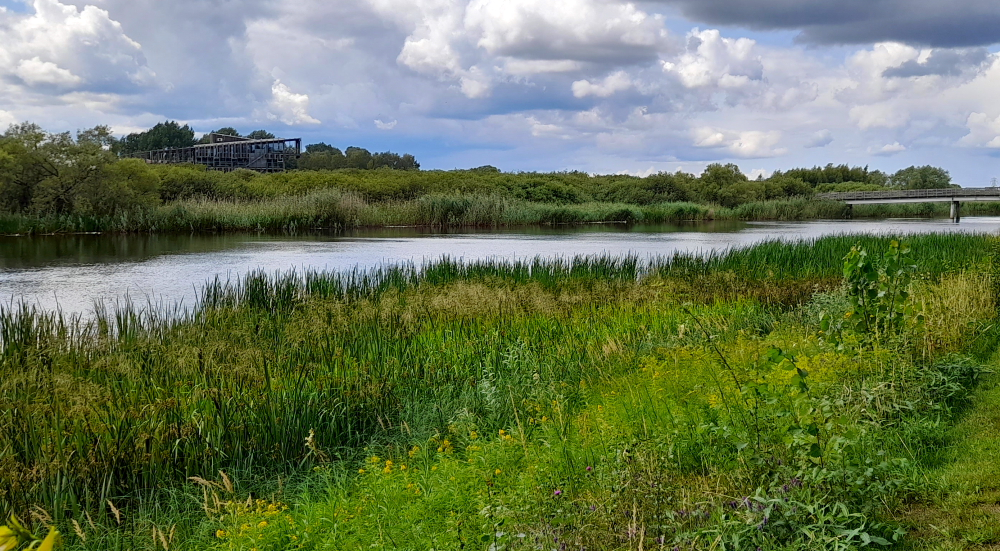
The view back across the swamp to our hotel.
We even hear a cuckoo just as we turn to walk back over the bridge to the hotel.
A royal wave from our balcony.
We have been dreading the thought of the noise that a concert this evening will generate. Crew have been setting up 2 concert stages in Tivoli Park across the road from our hotel. Tommy Korberg’s Grand Finale concert was due to happen tonight but then we see a notice in the hotel lobby that it has been cancelled due to his ill health.
Tomorrow night is a rock concert but we’ll be miles away in Snekkersten, Denmark. Whew!!
15 July, 2023
After breakfast we are heading SW to Denmark and will be leaving Sweden and its half-finished engineering behind.
Departing Kristianstad and on to Denmark.
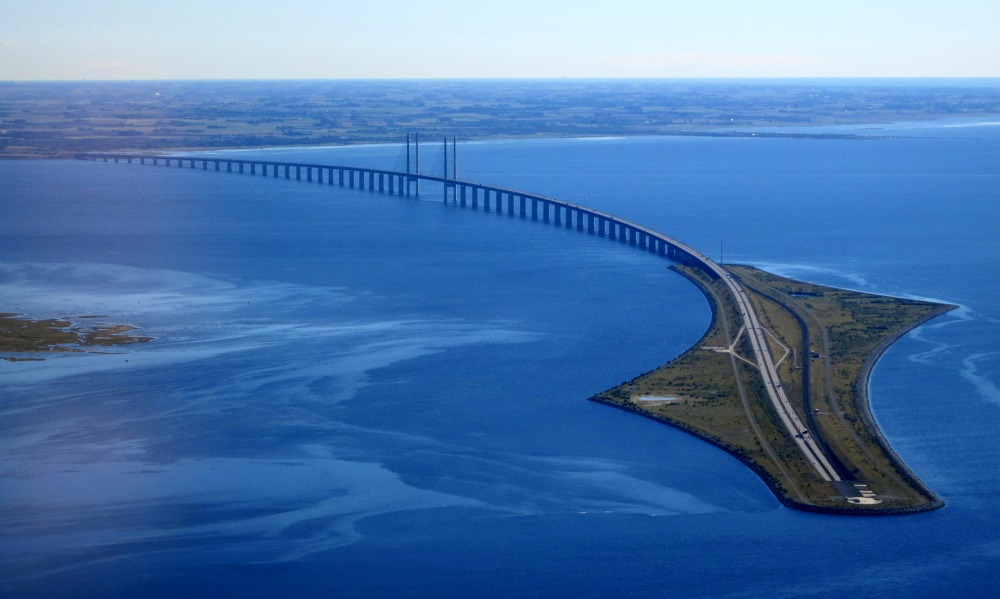
However, we cross the incredible Oresund Bridge that joins Sweden to Denmark near Malmo. Perhaps the good engineers spent all their time designing the bridge so had no time to work on Swedish highways, hotels or buildings.
The Oresund Bridge.
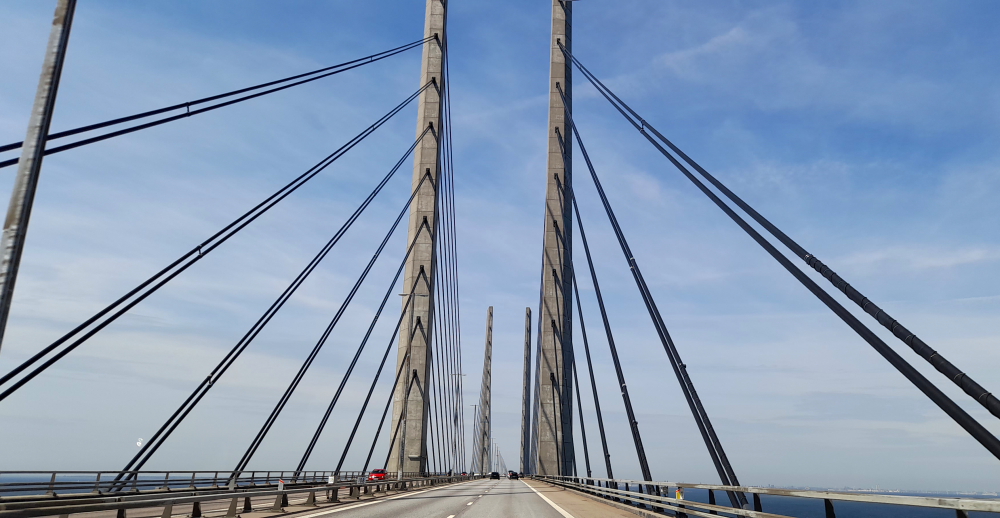
The Øresund or Öresund Bridge is a combined railway and motorway bridge across the Øresund strait between Denmark and Sweden.
Half way across the bridge section.
It is the longest in Europe with both roadway and railway combined in a single structure, running nearly 8 kms from the Swedish coast to the artificial island Peberholm in the middle of the strait.
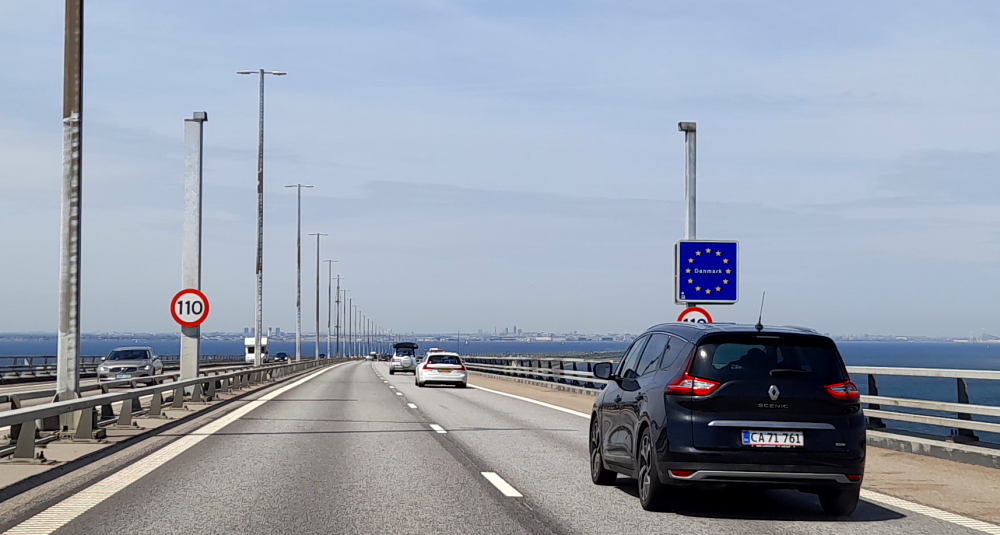
Leaving Sweden and entering Denmark.
The crossing is completed by the 4 km Drogden Tunnel from Peberholm to the Danish island of Amager.
The bridge connects the road and rail networks of the Scandinavian Peninsula with those of Central and Western Europe. A data cable also makes the bridge the backbone of Internet data transmission between central Europe and Sweden. The international European route E20 crosses via road, the Øresund Line via railway. The construction of the Great Belt Fixed Link (1988–1998), connecting Zealand to Funen and thence to the Jutland Peninsula, and the Øresund Bridge have connected Central and Western Europe to Sweden by road and rail.
The bridge was designed by Jørgen Nissen and Klaus Falbe Hansen from Ove Arup and Partners, and Niels Gimsing and Georg Rotne.
The bridge toll is a whopping A$104 each way. I would hate to commute across this everyday. Makes Sydney NW tolls look cheap.
The justification for the additional expenditure and complexity related to digging a tunnel for part of the way, rather than raising that section of the bridge, was to avoid interfering with air traffic from the nearby Copenhagen Airport, to provide a clear channel for ships in good weather or bad, and to prevent ice floes from blocking the strait. Construction began in 1995, with the bridge opening to traffic on 1 July 2000. The bridge received the 2002 IABSE Outstanding Structure Award.
When we were planning our trip we were going to finish our drive in Sweden in Helsingborg and take the ferry across to Helsingor in Denmark. Turned out that it was cheaper to drive to Malmo, cross the Oresund Bridge and pay the toll and drive up to Snekkersten.
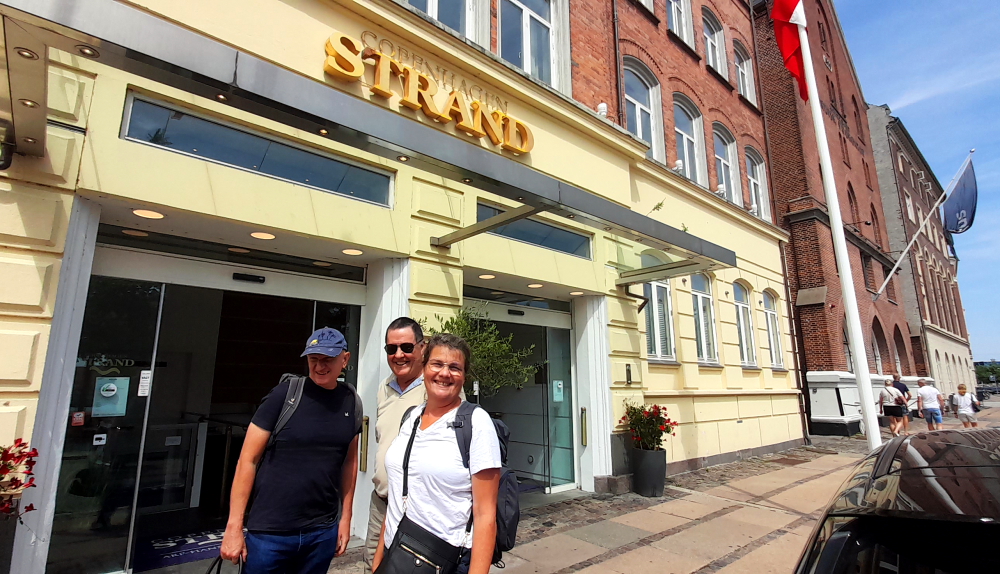
We drop Susie and Paul at their hotel in Copenhagen then continue on to Snekkersten for our last 2 full days in Denmark. Before we drive away I notice that we have passed the 10,000 km mark on the odometer. That means that we will have driven about 10,250 km in the past 3 months in the Scandinavian countries. My original estimate was just over 7,500 km for the trip and my fuel budget.
Dropping Susie & Paul at the Strand Hotel, Copenhagen.
En route we pass the sign for Karen Blixen’s house – she of ‘Out of Africa’ fame. About 30 minutes later we arrive at our mixed traditional/modern-style Danish hotel, the Comwell Borupgaard.
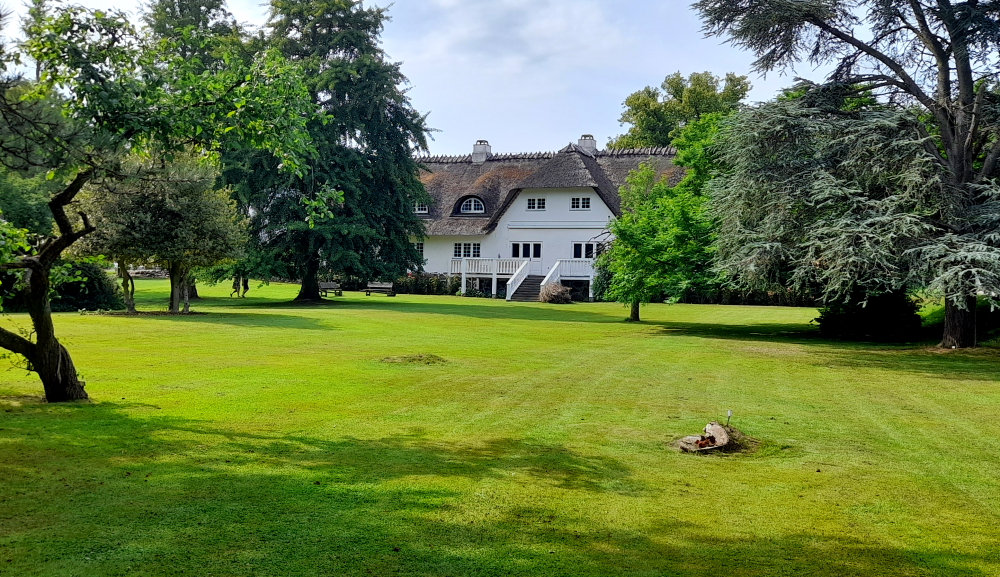
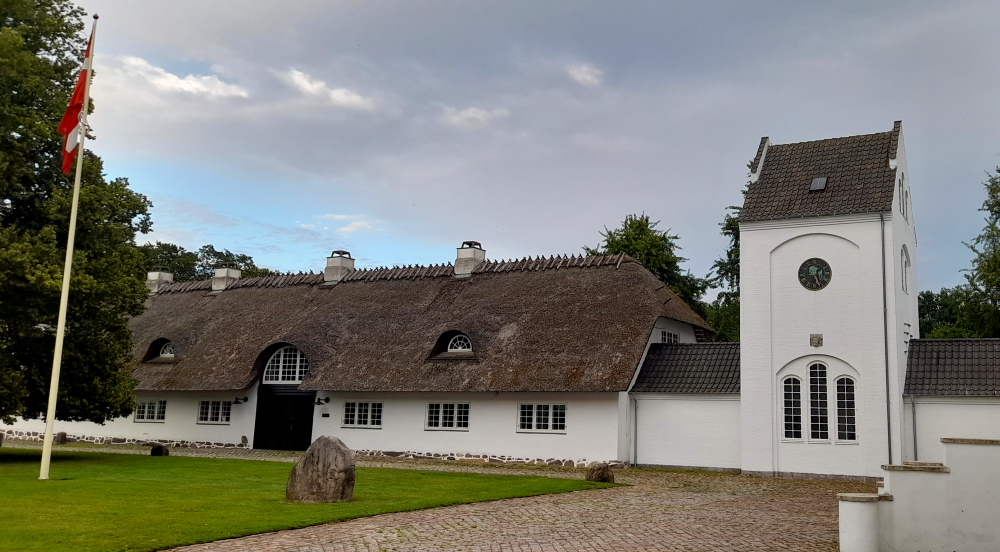
Borupgård is an estate (originally a manor) with a long history. It is now the Comwell Hotel Borupgaard .
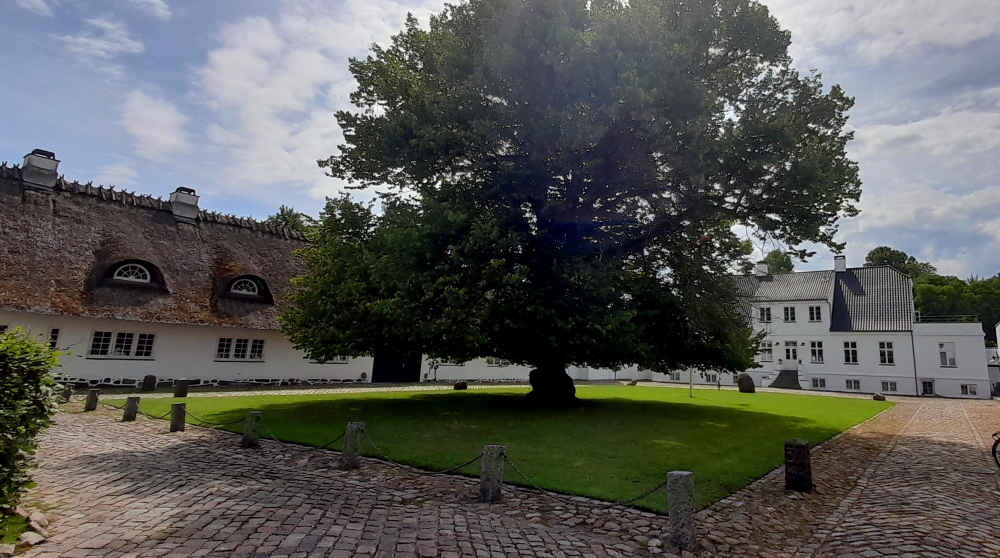
The Comwell Hotel grounds.
Borupgaard by Snekkersten belongs to the country’s oldest settlements. From the time of Valdemar Sejr, the name form Bothorp 1211 has been handed down. The farm belongs to the torp group of Danish place names and has its origins perhaps as far back as around the year 1000, when the great new cultivation began.
The hotel grounds.
In the 12th century, Borup and its land belonged to Esrom Kloster. Later it is mentioned in privileges to the bishops of Roskilde such as Absalon and Peder Sunesen. From the later part of the Middle Ages, nothing is heard of the farm. It is not until the middle of the 16th century that the farm reappears in documents, and from then on it is mentioned regularly until approx. 1800. In 1898 , the farm was 27 3/4 acres of hartkorn , 338 acres of land, of which 8 acres were forest, the rest arable.
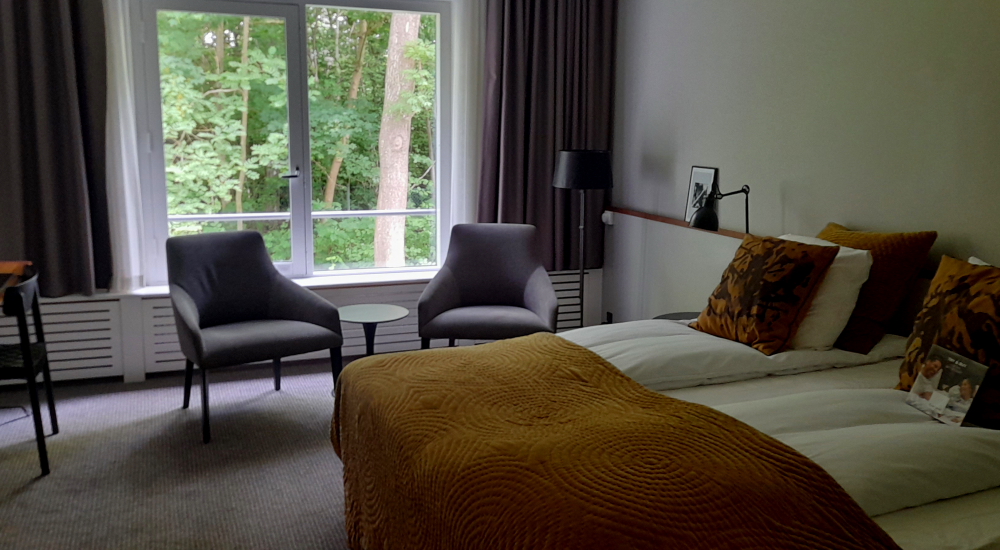
Our room with woodland views.
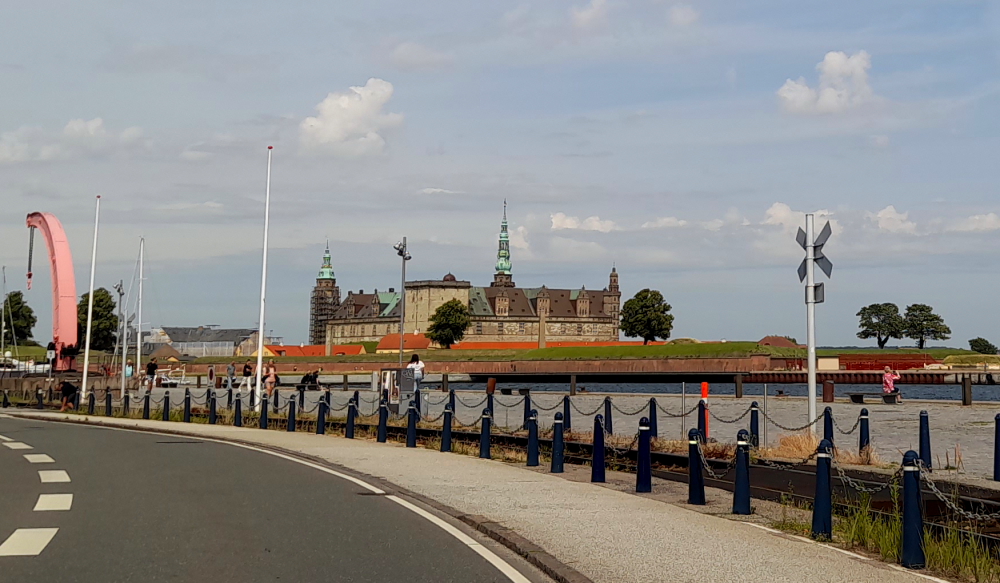
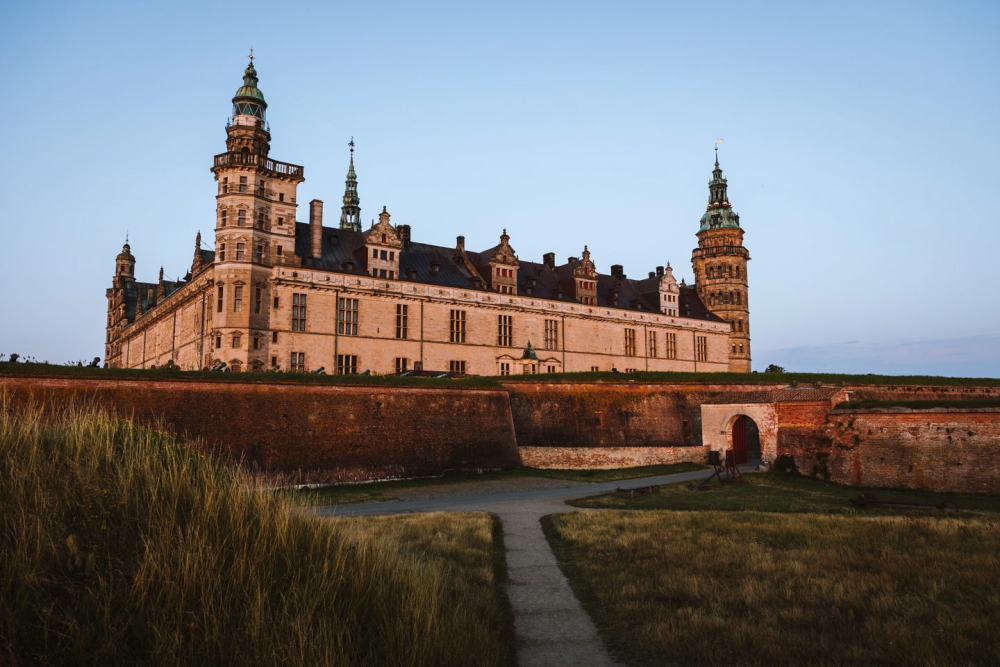
While it’s still sunny we drive the 4.5 kms to see Kronborg Castle, otherwise known as Hamlet’s castle which is heavily defended by a couple of moats landside and the sea on its far side.
Kronborg is a castle and stronghold in the town of Helsingør, Denmark. Immortalized as Elsinore in William Shakespeare’s play Hamlet, Kronborg is one of the most important Renaissance castles in Northern Europe and was inscribed on the UNESCO’s World Heritage List in 2000.
The castle is situated on the extreme northeastern tip of the island of Zealand at the narrowest point of the Øresund, the sound between present Denmark and the provinces of present Sweden that were also Danish at the time the castle was built. In this part, the sound is only 4 kms (2.5 mi) wide, hence the strategic importance of maintaining a coastal fortification at this location commanding one of the few outlets of the Baltic Sea.
Kronborg Slot aka Hamlet’s Castle.
The castle’s story dates back to a stronghold, Krogen, built by King Eric VII in the 1420s. Along with the fortress Kärnan in Helsingborg on the opposite coast of Øresund, it controlled the entrance way to the Baltic Sea. From 1574 to 1585, King Frederick II had the medieval fortress radically transformed into a magnificent Renaissance castle. The main architects were the Flemings Hans Hendrik van Paesschen and Anthonis van Obbergen, whereas the sculptural work was coordinated by Gert van Groningen.
In 1629, a fire destroyed much of the castle, but King Christian IV subsequently had it rebuilt. The castle also has a church within its walls. In 1658, Kronborg was besieged and captured by the Swedes who took many of its valuable art treasures as war booty. In 1785 the castle ceased to be a royal residence and was converted into barracks for the Army. The Army left the castle in 1923, and after a thorough renovation it was opened to the public.
Kronborg Castle.
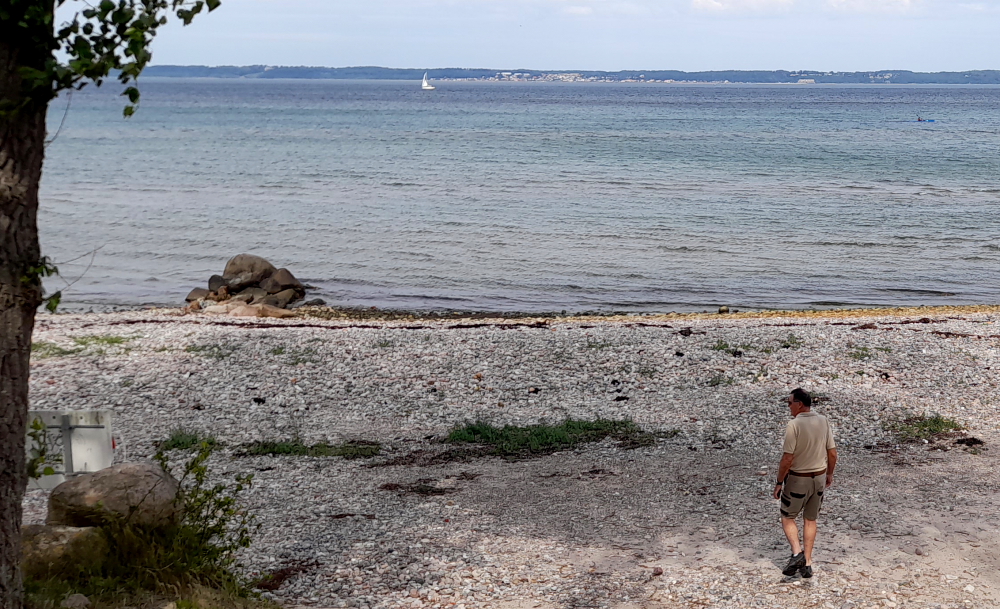
While we are here we decide to drive part of the northern coast. The north coast is nicknamed ‘The Danish Riviera’. Along the almost 70 km stretch between Lynæs and Nivå, there are golden sandy beaches, classic promenades and cosy seaside resorts.
We drive along Nordre Strandvej to Julebaek Strand, 4 kms from Helsingor.
Checking out a North Coast beach – Julebaek Strand.
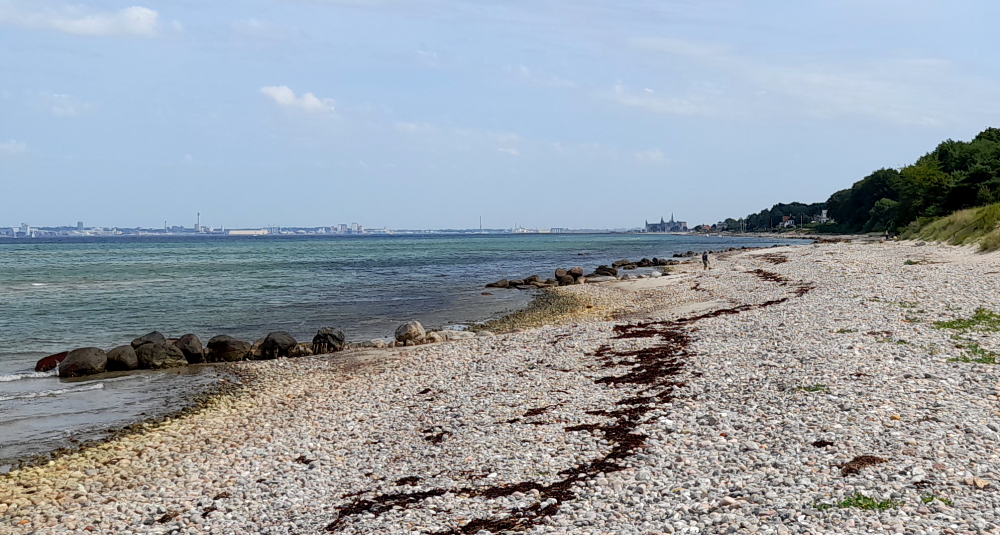
Hmmm – not our idea of a beach, but then again French Riviera beaches are known for their pebbles (rocks), too!
Looking back to the Castle and over to Sweden.
On our way back to the hotel we stop for a quick car wash and our last full tank of petrol for Scandinavia.
Dinner tonight is a quick Burrito and Pizza at Omo’s next door to the hotel. For fast food it was very good and the place was very busy. It seems that the locals really like this place.
Walking back to the hotel we take a stroll around the hotel gardens to enjoy the very pleasant summer evening in the quiet gardens.
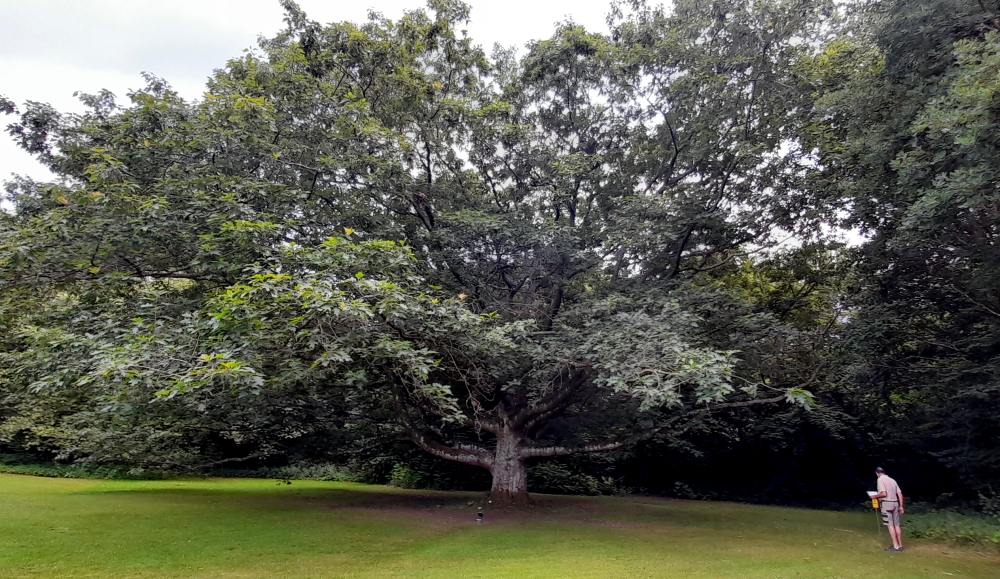
100 year old tree.
Lynn also takes a photo of one of the traditional buildings that is part of the hotel.
Hotel wing with clock tower.
Tomorrow is our last day of being a tourist in Denmark so Lynn has planned for us to visit the Frederiksborg Castle.

 THE CONTINUING TRAVELS OF YOGI & BOO BOO