
2 May, 2023
We are getting lots of sunny weather lately and even experience a maximum of 16 Deg C yesterday. Today is sunny again but because of the chilly north wind our expected maximum is only 12 Deg C. Lynn struggled to sleep with our over-heated room last night so we plan to open one of the windows slightly tonight. She is a bit cranky this morning due to lack of sleep.
Originally we’d booked this hotel out of town as it was on a tram line direct into the city centre. However, the price of a return ticket of A$9 each is prohibitive compared to driving the 5km (A$1.5 for petrol at Denmark fuel prices) into a free 2-hour parking lot at the Botanical Gardens and walking the 20 minutes to the Cathedral.
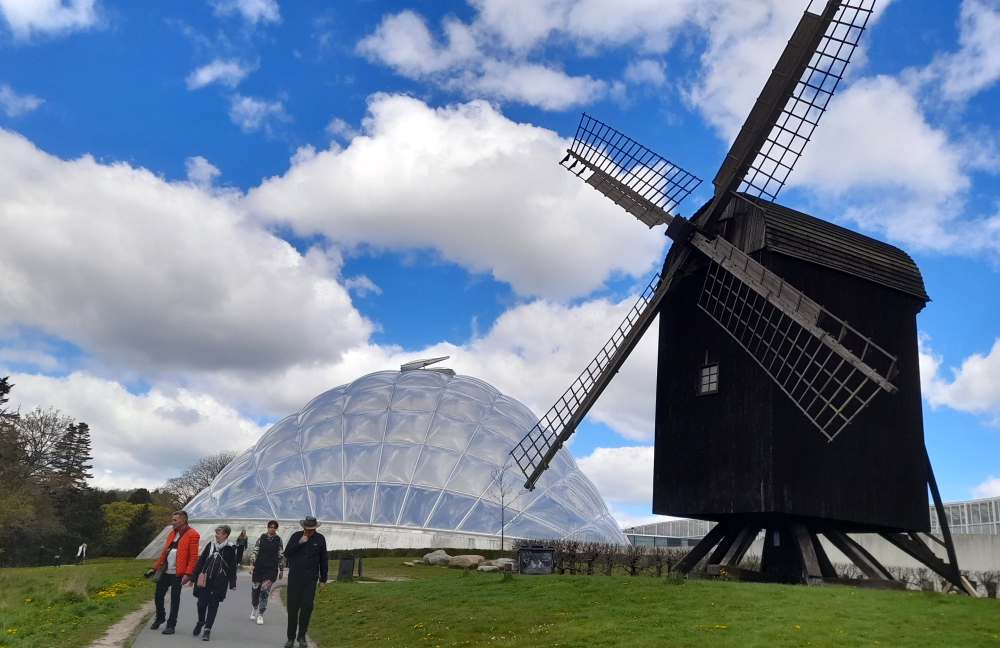
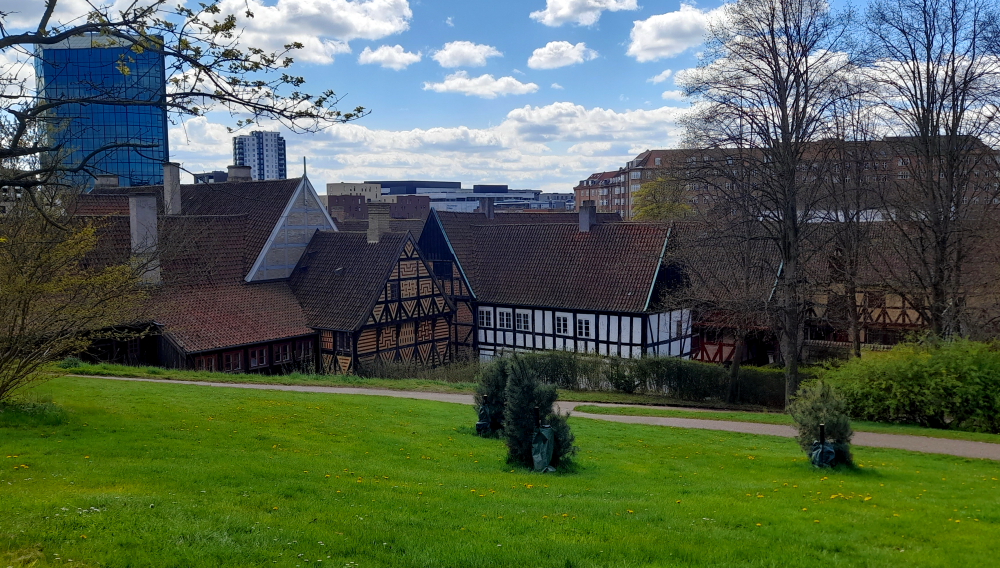
Walking down the path through the gardens we can see the back of Den Gamle By (The Old Town), an open-air town museum located in the Botanical Gardens. In 1914, the museum opened as the world’s first open-air museum of its kind, concentrating on town culture rather than village culture. Today the museum consists of 75 historical buildings collected from 20 townships in all parts of the country.
The museum buildings are organized into a small town of chiefly half-timbered structures originally erected between 1550 and the late 19th century in various parts of the country and later moved to Aarhus during the 20th century.
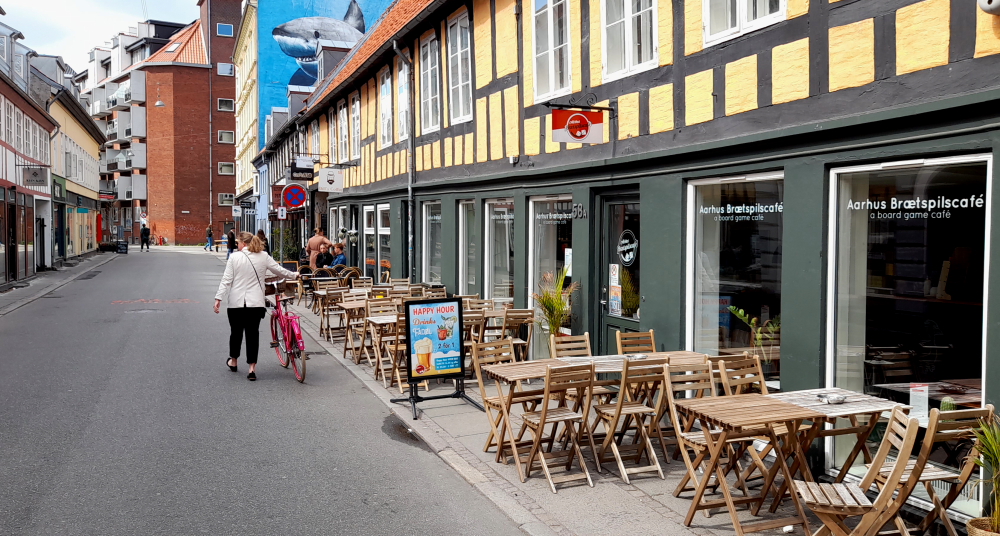
Several times while we were walking around the town we had to walk on the road as al fresco dining tables and chairs had encroached upon footpaths. This is what happens when the cyclist lobby goes too far. The cyclists in Denmark can ride on the footpaths even when there are dedicated cycle paths. Add restaurant and cafe outdoor tables and suddenly there is nowhere for pedestrians to walk. We regularly had to risk walking on the road and dodging cars as well as cyclists. Luckily the dreaded electric scooters haven’t yet invaded Denmark or it would be a dangerous free for all.
20 minutes later we arrive in front of the Aarhus Cathedral/Domkirke.
Its building was started in the last decades of the 12th century. Peter Vognsen of a famous aristocratic family, Hviderne, from Zeeland, was the one who really got the building going. He was ordained as a Bishop in 1191. The Cathedral – a magnificent Romanesque basilica – was a gigantic project, not finished until about 1350. Red bricks were used, a kind of material not otherwise used in Denmark before approx. 1160. The outer walls of this Cathedral and the chapels along the eastern wall of the transept are the only surviving Romanesque elements today.
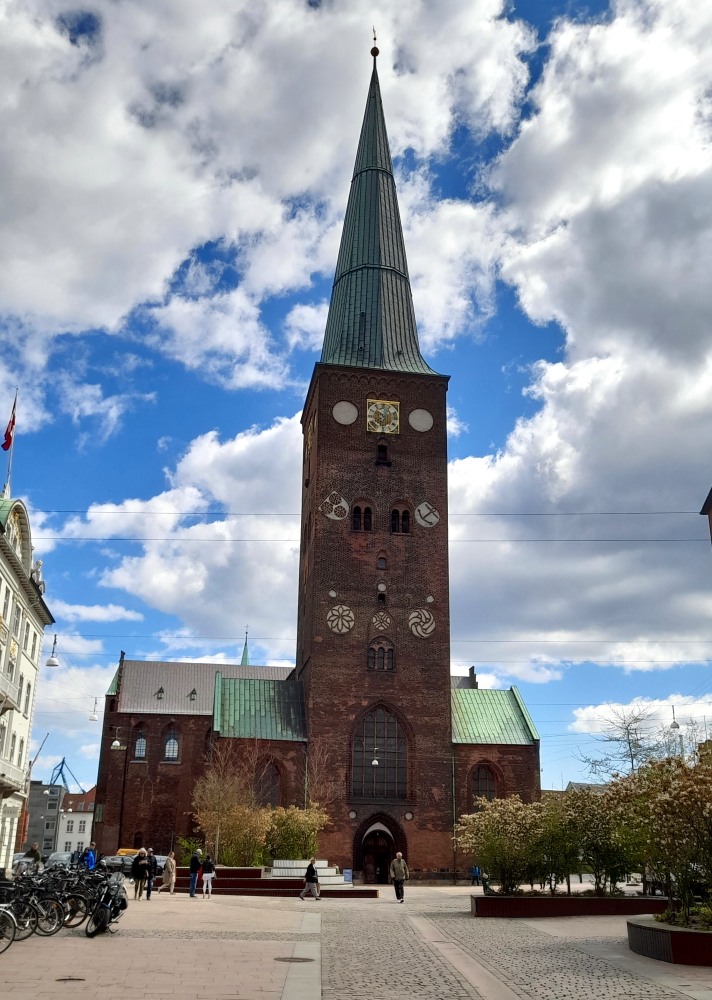
The Cathedral, as it stands today, is the result of radical rebuilding in the Gothic style, undertaken from 1449 till about 1500, transforming the heavy and sombre building into a Gothic cathedral, inspired by the great contemporary churches in the Hanseatic towns around the Baltic Sea.
With a length of 93 metres, Aarhus Cathedral is the longest church in Denmark, and it seats approx. 1200 people. From the beginning it was dedicated to St Clement, the patron saint of sailors.
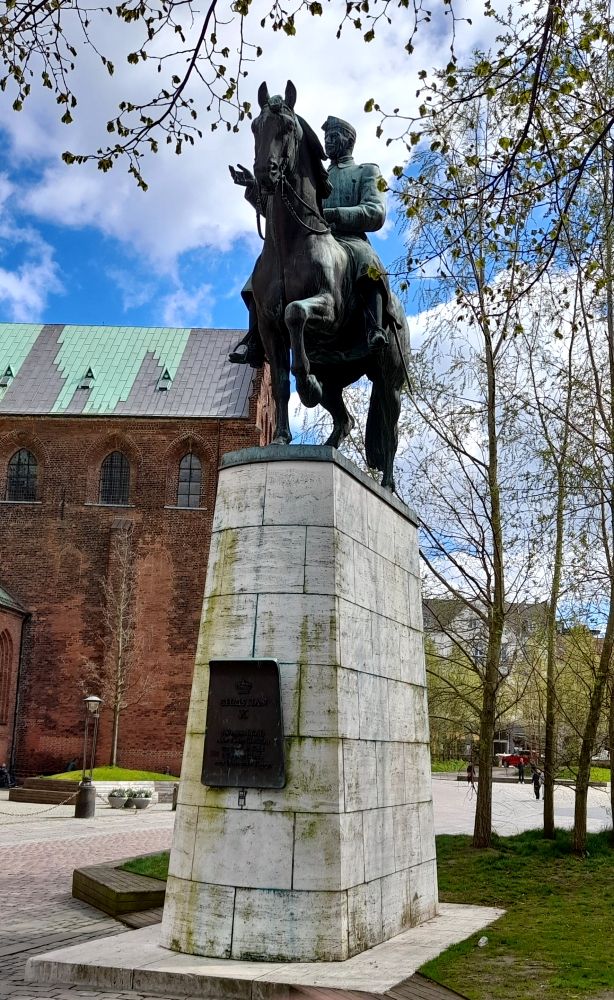
Nearby is a statue of Christian X (1888-1955) King of Denmark and Iceland. Christian was a popular king who took a daily ride on horseback through Copenhagen during the German occupation.
The Danish sculptor was Helen Schou (1905 –2006) who began the work in 1944. It was installed in 1955.
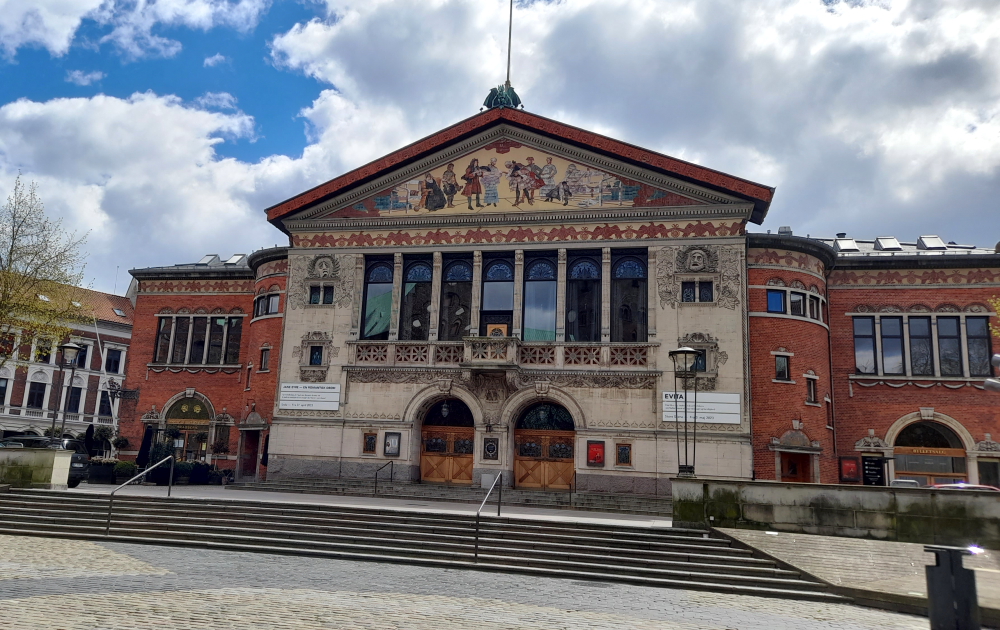
Across the square is the Aarhus Teater, the largest provincial theatre in Denmark.
The present theatre house was constructed in the late 19th century, as a replacement for the old theatre, nicknamed “Svedekassen” (The Sweat-box). Since Aarhus had grown to become Jutland’s biggest city during the 19th Century the old theatre had become too small to serve the public demand. A new building was designed by the Danish architect Hack Kampmann (1856–1920). Construction began on 12 August 1898. Only two years later, Aarhus Theatre stood completed and was inaugurated on 15 September 1900.
Crossing a couple of streets we arrive at the harbour front.
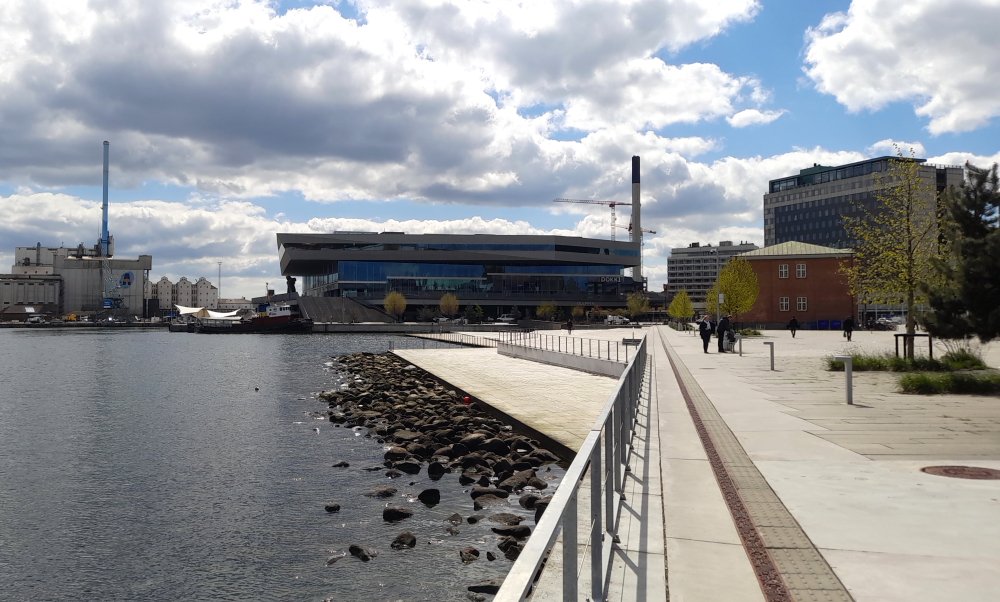
At the southern end of the harbour is Dokk1, a public library and cultural centre.
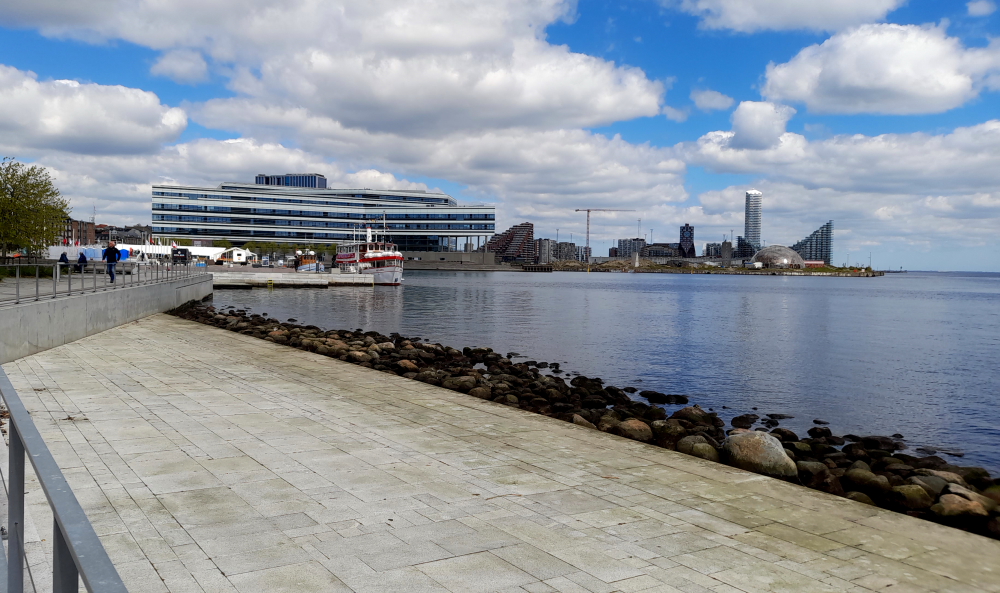
At the northern end is a building called Navitas described as “a unique collaboration between education and business” involving the Aarhus Universitet and the Aarhus School of Marine and Technical Engineering.
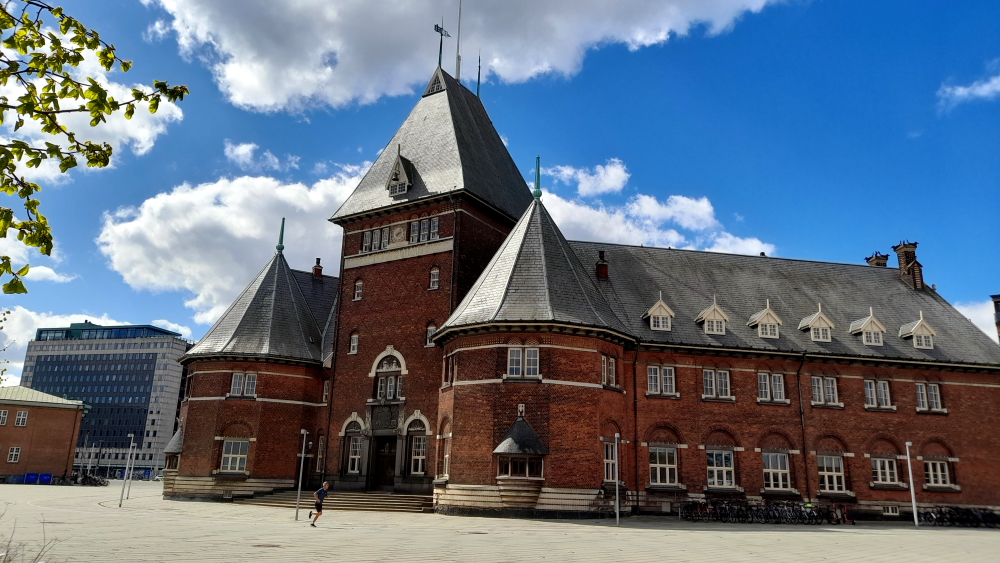
Behind us is the Toldkammeret – the Aarhus Custom House. Completed in 1898, it is said to be Hack Kampmann’s finest work. Kampmann also designed other buildings in the city including Marselisborg Palace and the Aarhus Teater. The building was used by the tax authorities until the mid-1990s. After full renovation and being used in recent years by the architecture school and as a student hostel, the building currently houses a restaurant
We walk back through Pustervig Square where the annual, 9-day Aarhus Festuge takes place. It’s part of the Latin Quarter which surrounds the Cathedral and has a Parisian air to it along with its cobbled streets.
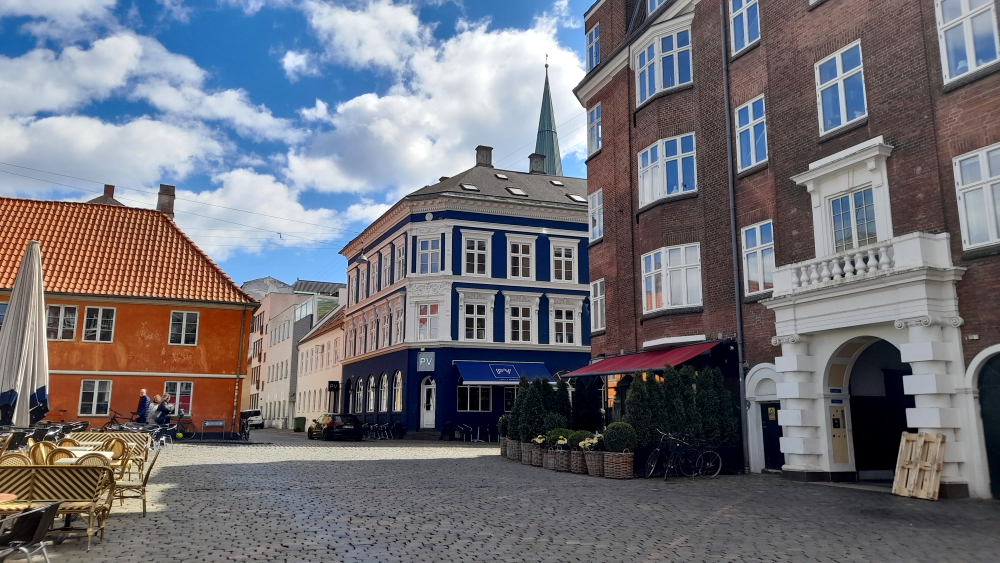
In the 17th Century the city’s blacksmiths lived here and the district was known for its forges. Blacksmiths were known as coal blowers hence the name Puster vig – breathe away.
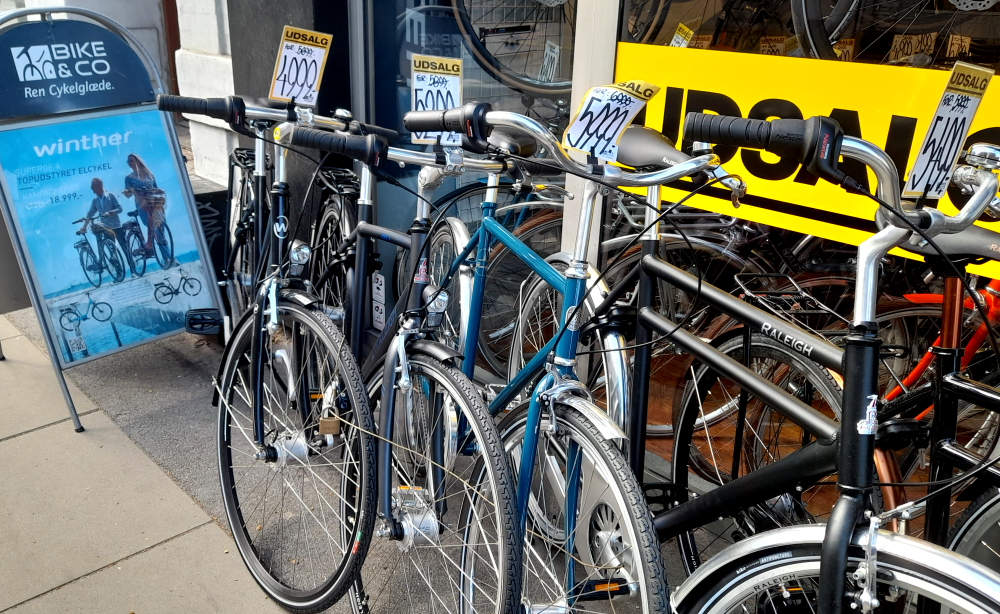
Walking back to the car park we come across a bicycle shop and gasp at the prices for a basic model push bike. We can buy similar quality bicycles in Big W for about A$250 versus these starting at A$1,000 for a basic bike with no gears.
As we head back to the car we drop in at a supermarket and buy a bottle of red wine and three 33cl bottles of beer. I am surprised that the beer is only about A$0.80 each (including a bottle deposit). Either this is a great bargain or the beer is undrinkable.
Back at the hotel I put a bottle of the beer in the freezer and half an hour later we open the wine and the beer for an afternoon tipple. The pilsner beer isn’t the best beer I have ever had but it is certainly a good drop. I might have to get more as we travel around. So far it is the only thing less than twice the price in Denmark. It doesn’t help when their GST is 25%. I guess it is only a matter of time until the Australian Labor Party plans to increase our GST. Their policy has always been…”If it moves – Tax it!”
Tonight we are attempting to find a Japanese Sushi Train restaurant nearby. In short, Danish food sucks so I need a change. I would even consider Chinese food as an alternative.
We manage to find a Sushi restaurant not far from the hotel. We originally planned to do the Sushi Train – or ‘Running Sushi’ as the Danes call it – but it is booked out so we eat in the restaurant section. The restaurant has added all sorts of electronic gadgetry to try to make the experience a bit funky – including the option of having a robot deliver your food to your table – but most of it doesn’t work and the staff have no idea how to use it. They should just give up and use the KISS principle – Keep It Simple Stupid. The technology is way too sophisticated for the Asian staff let alone non- Danish speaking tourists.

Still, the food is acceptable if not quite as good as we get at home.
3 May, 2023
When we were in Copenhagen we were planning on watching the Changing of the Guard in front of the Amalienborg Palace but, as the Queen had absconded and was now resident in the Summer Palace, Marselisborg Slot in Aarhus, we were told that we could watch it there. So, that is the plan for today, to arrive there in time for the 12:00 noon guard change.
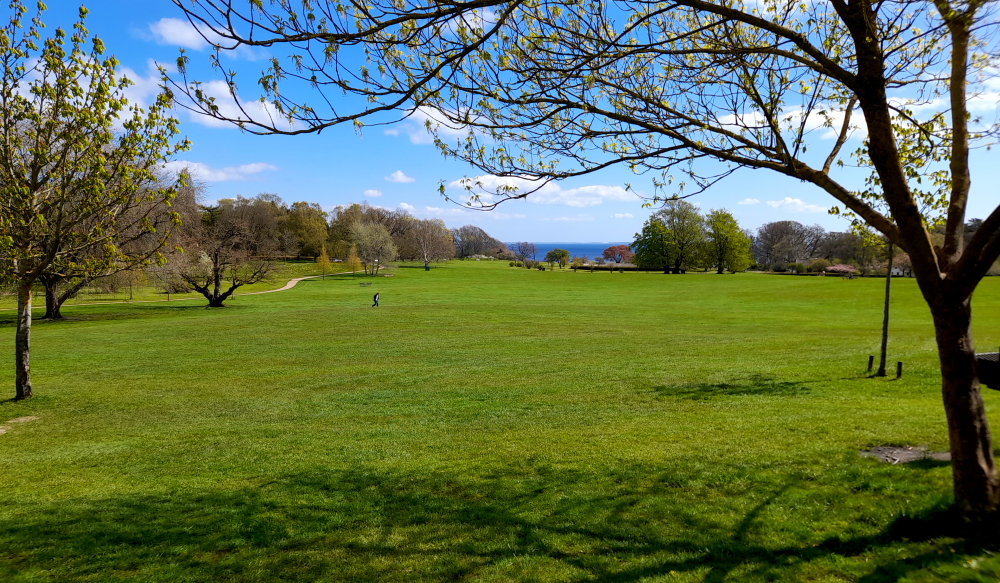
As we walk down towards the courtyard in front of the palace gates Lynn stops a guy walking in the opposite direction with a group of school kids. He informs us that the guard change won’t be happening for another couple of weeks. Typical Danish lack of/incomplete info! The website distinctly said that the guard change would be on every day at 12 noon at this palace. Oh well, perhaps we’ll get to see one when we are in either Oslo or Stockholm??
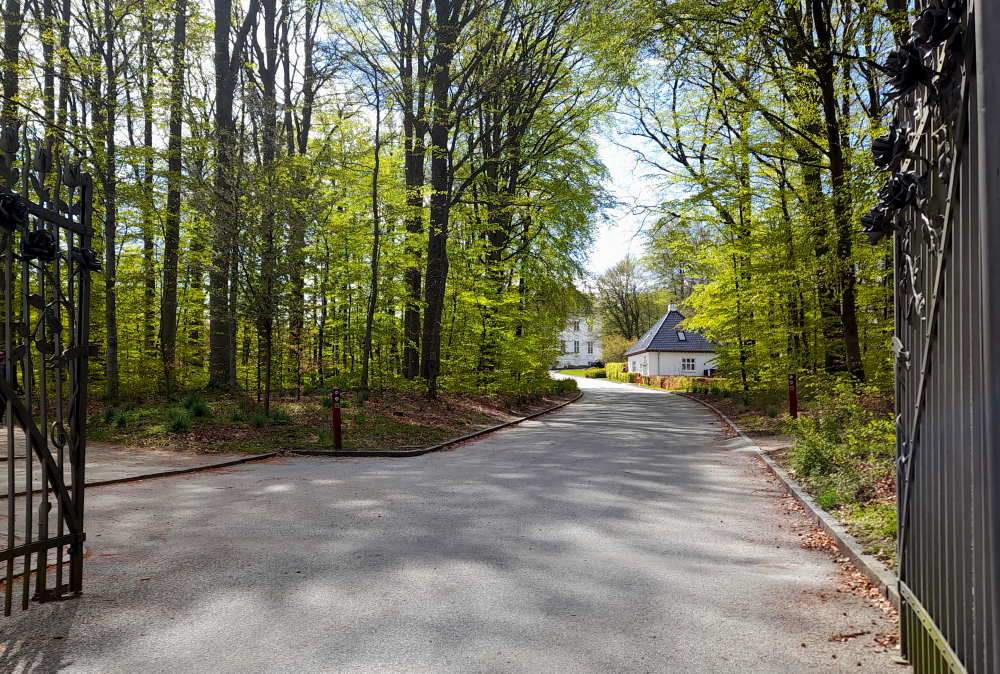
As we walk past the palace gates back to the car park a huge garbage truck exits which makes us laugh. Even Royals need council services.
Our next stop is the Infinite Bridge just 2 minutes away. Again, the website said that it was ‘temporarily closed’ – but here it is, OPEN!
Just as we arrive we both receive a text message advising that they are about to test the national emergency warning system. Before we finish reading the message a number of sirens started wailing mournfully across the city. Perhaps they know more about what the Russians are planning than we do.
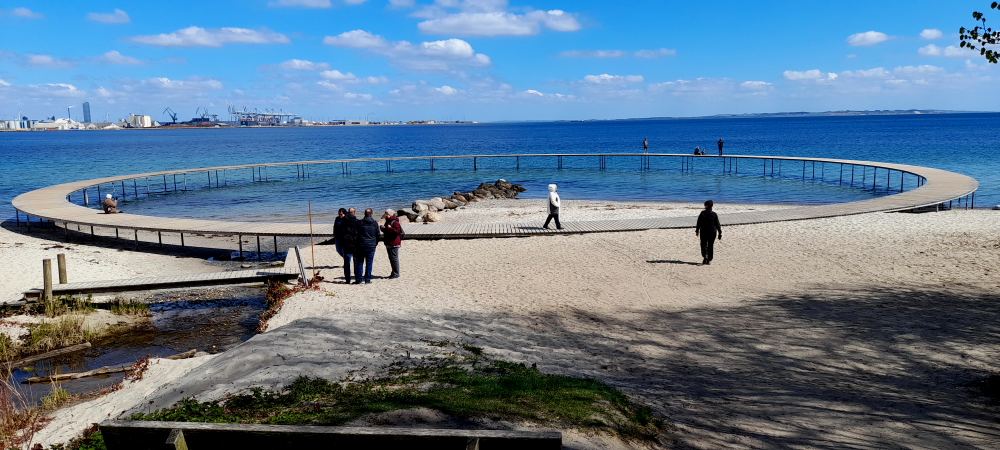
Located on Varna Beach on the outskirts of Aarhus is a bridge that leads to nowhere. Consisting of a wood-paneled deck raised on steel legs, the simple form of the Infinite Bridge seamlessly connects the land with the sea as it stretches out into the Bay of Aarhus.
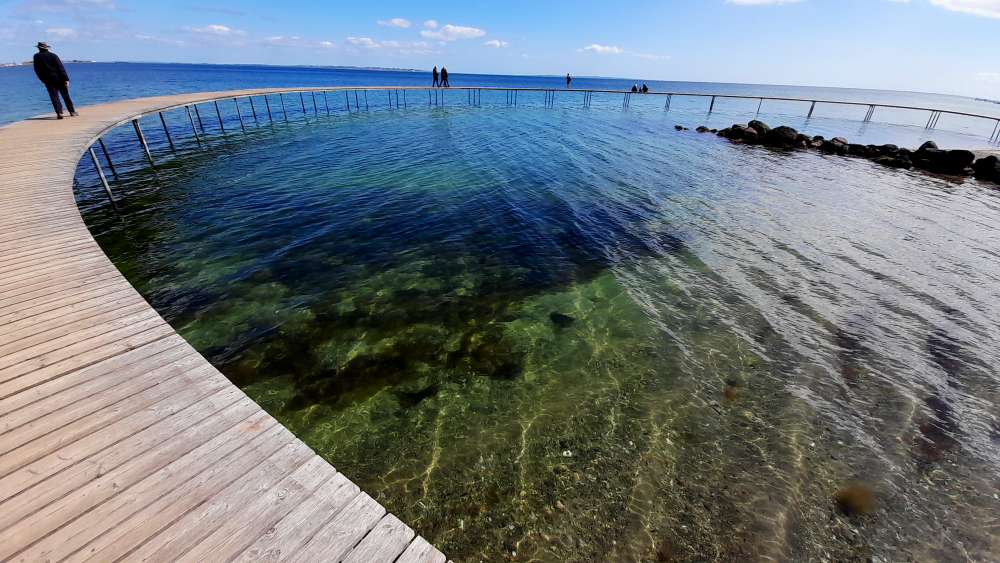
The bridge forms a perfect circle overlapping the sand and sea. The height of the bridge decking above the water varies with the tide. The bridge spans 60 meters in diameter and provides a panoramic view across the bay and along the forest-lined stretch of beach.
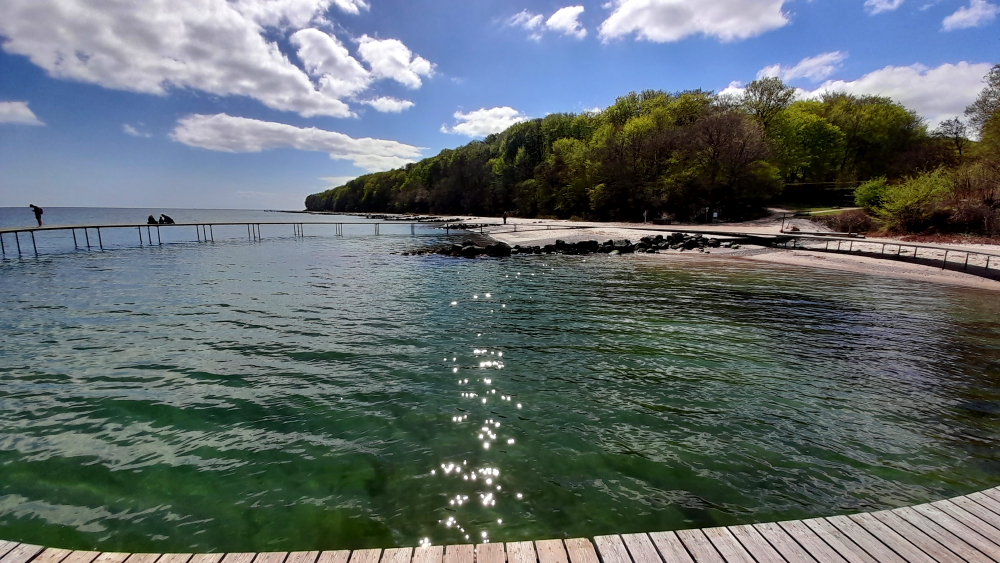
The Infinite Bridge was designed by Danish architects Niels Povlsgaard and Johan Gjødes. It was constructed in 2015 for the biennial Sculpture by the Sea event.
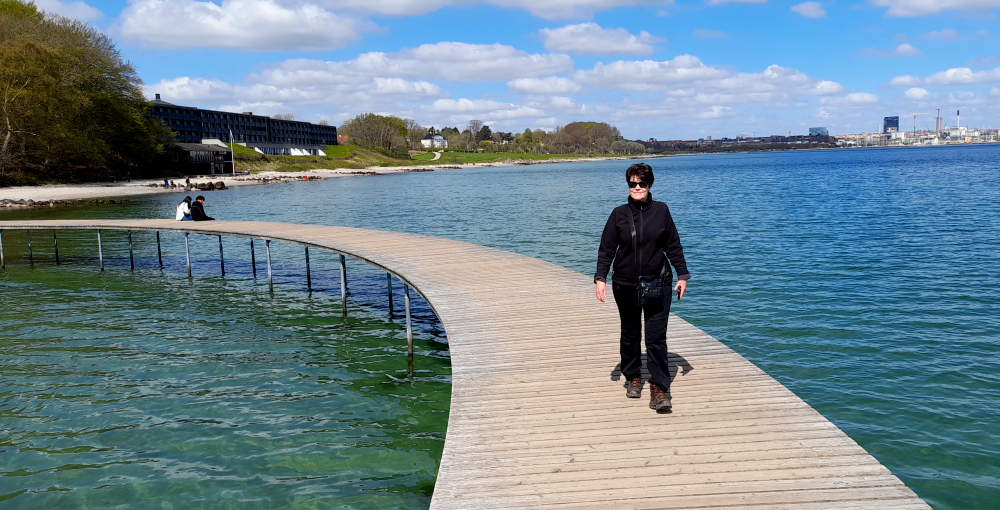
The bridge is located on the site of a former historic pier. The bridge was one of 56 sculptures in the Aarhus area and was originally designed as a temporary display. However, the bridge was so popular, particularly with locals, that the bridge became a permanent piece of functional interactive artwork.
The Danes seem to have a thing for circular bridges. There is also a much larger elliptical bridge (Filso Ellipsen) at Filso Lake near Henne, Jutland.
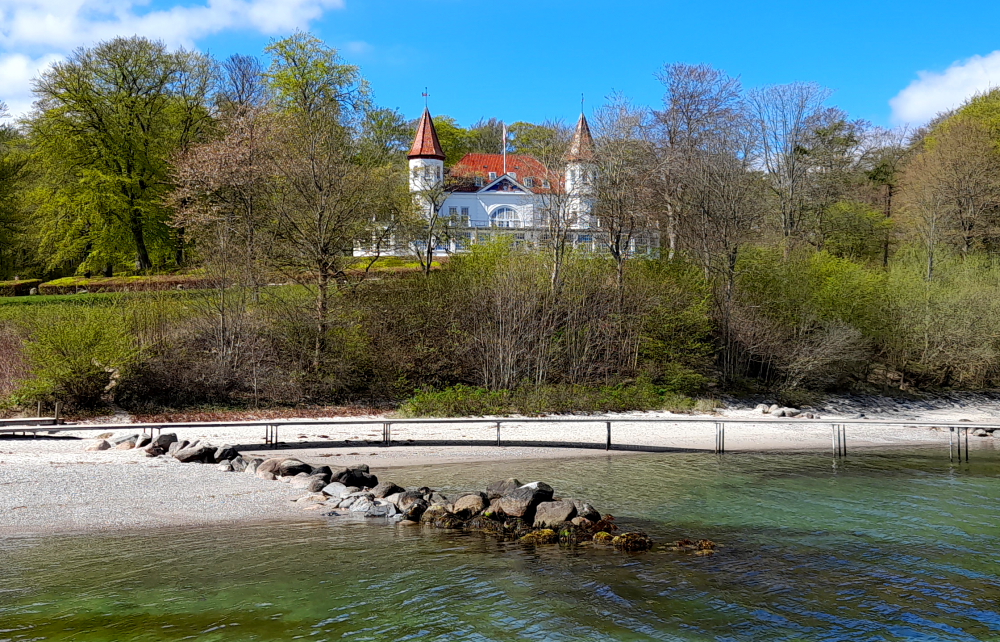
Overlooking the Bridge is Varna Palaeet (Vana Palace) or Odd Fellow Palace Varna situated in the Marselisbog Forests. It was built in 1908 by designs of the Danish architect Eggert Achen in Neoclassical style for the Danish National Exhibition of 1909. Today the building is owned by the Odd Fellows Society which uses it for activities within the organization. The building houses a restaurant on a lease basis and it is a well-known landmark in Aarhus and its southern forests.
Driving back to the hotel we call into an Ingo service station as we see that the Unleaded 95 price is DKK13.68/litre. We have been paying DKK14.19/litre in Zealand. However, by the time I pay at the machine then pump the fuel the price has changed to DKK13.69 which we see on the display board outside the service station when we exit. Talk about real time petrol prices!
I decide that it would be best to do a couple of loads of washing while we have the washing/drying machines here on site rather than trying to find a laundromat in Aalborg so that’s what we do this arvo. As usual, the Danes make it far more difficult than it needs to be to pay for the washing – i.e. you need to download an AirWallet app then jump through hoops to actually verify and confirm that you want to pay for the bloody washing instead of just installing a ‘tap and pay’ pad on the machine.
Lynn was planning on us attending a free trumpet concert at the Aarhus Concert Hall in town this evening at 7:30 pm (I used to play trumpet in high school) but by the time we get the washing dried and she irons it, then we find somewhere for dinner, I don’t think we’ll make it in time …
4 May, 2023
We check out of the funky Hotel GUESTapart at about 10:00 am as we are planning to take the long way around to Aalborg today. The plan is to go via Hobro whereas we had originally planned to drive via Viborg, Skive and Thisted but we may do a day trip across the Western peninsula while we are in Aalborg. Much of the Danish countryside and small villages are all similar so the saying “seen one, seen them all” seems to hold true.
However, Lynn wants to visit at least one Viking site which doesn’t cost an arm and a leg while we are in Denmark so we stop in at the Hobro Vikingemuseet Fyrkat and Ring Fortress.
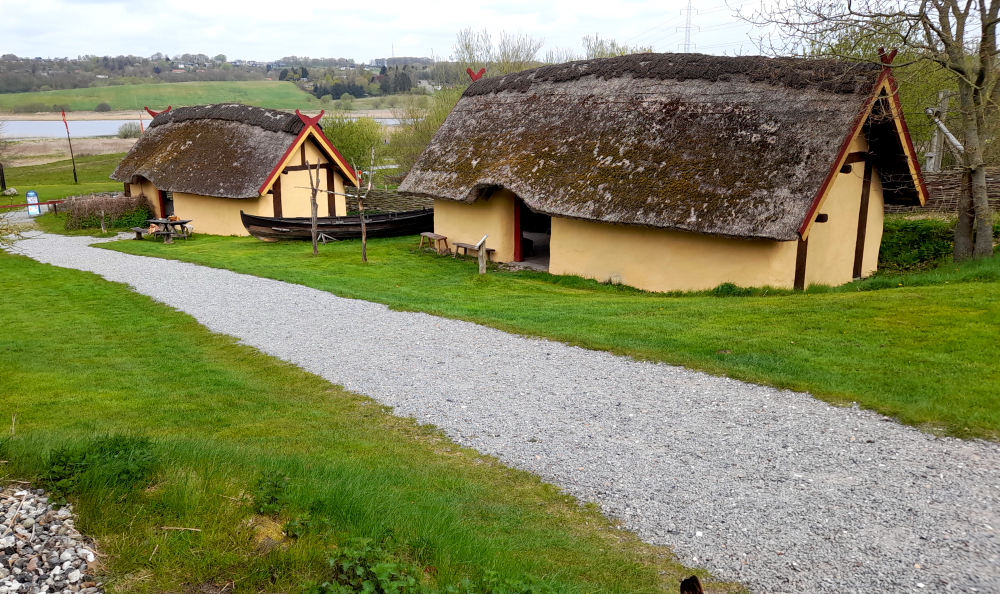
The VIking Village – a reconstructed settlement based on previous finds at Vorbasse – is located at the chieftain’s estate approx. 1km before arriving at the fortress via Fyrkatvej. The estate has nine residential and workshop buildings, including a smithy made of oak timbers, mud-built walls and thatched roofs and gives an insight into everyday Viking life.
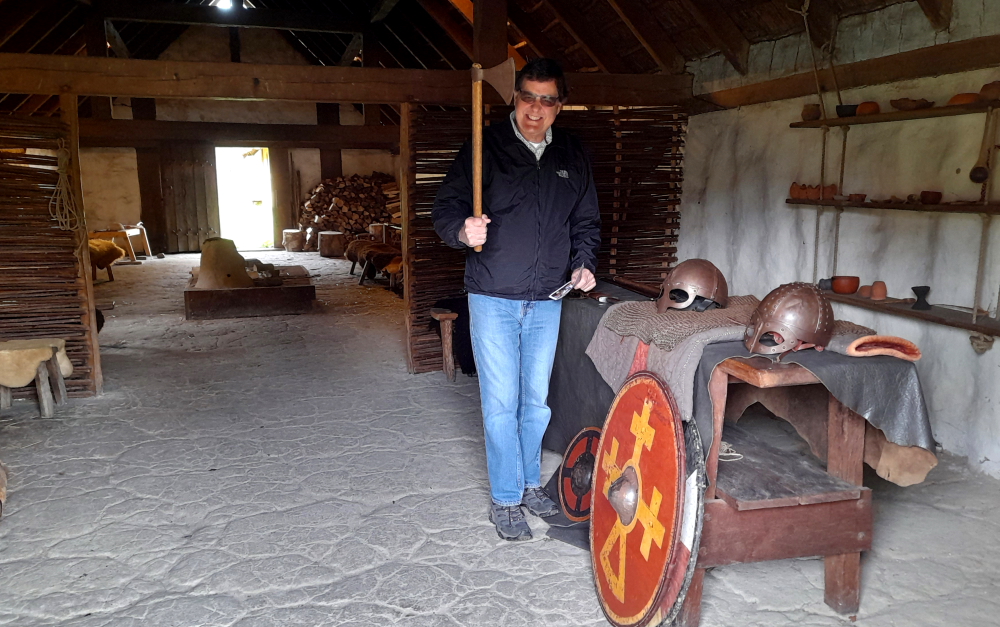
Staff are dressed in Viking gear. Today a small furnace is being heated to melt tin to make amulets in clay moulds.
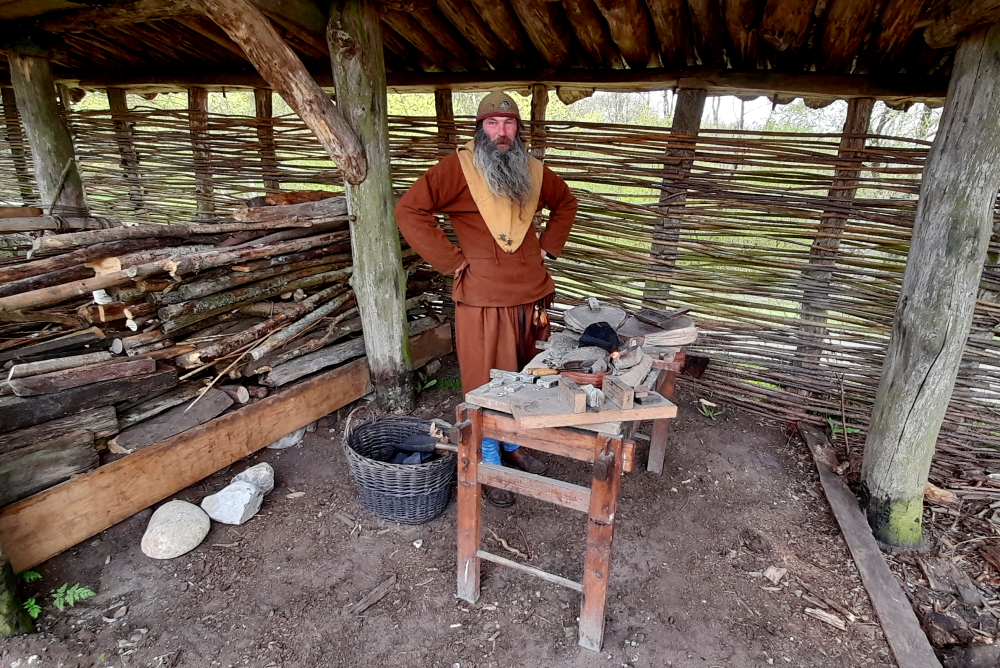
I find the Viking Village thing a bit lame and even the local school children visitors prefer the attached playground more interesting. Still, at least one Viking Village had to be visited while we are in Denmark, I suppose.
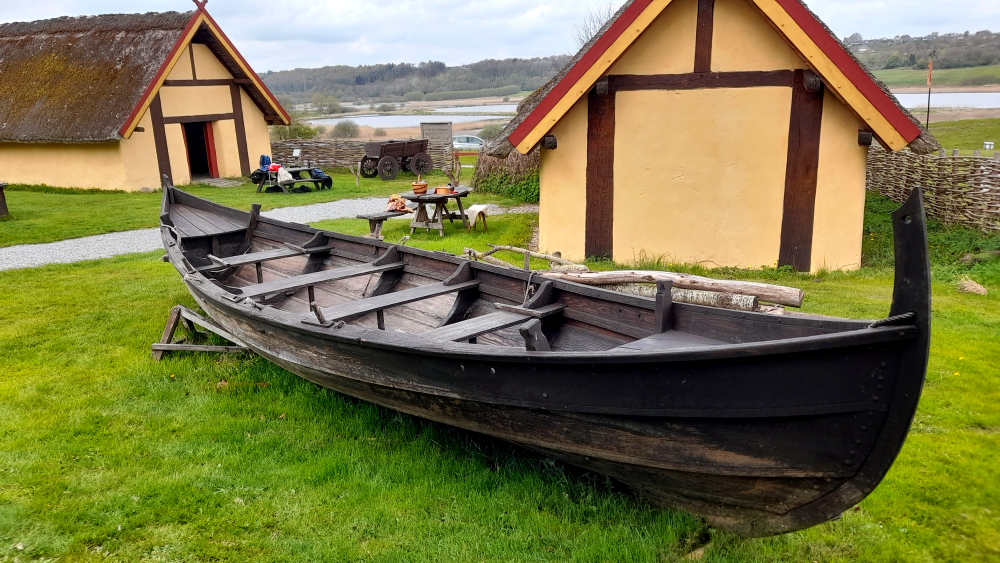
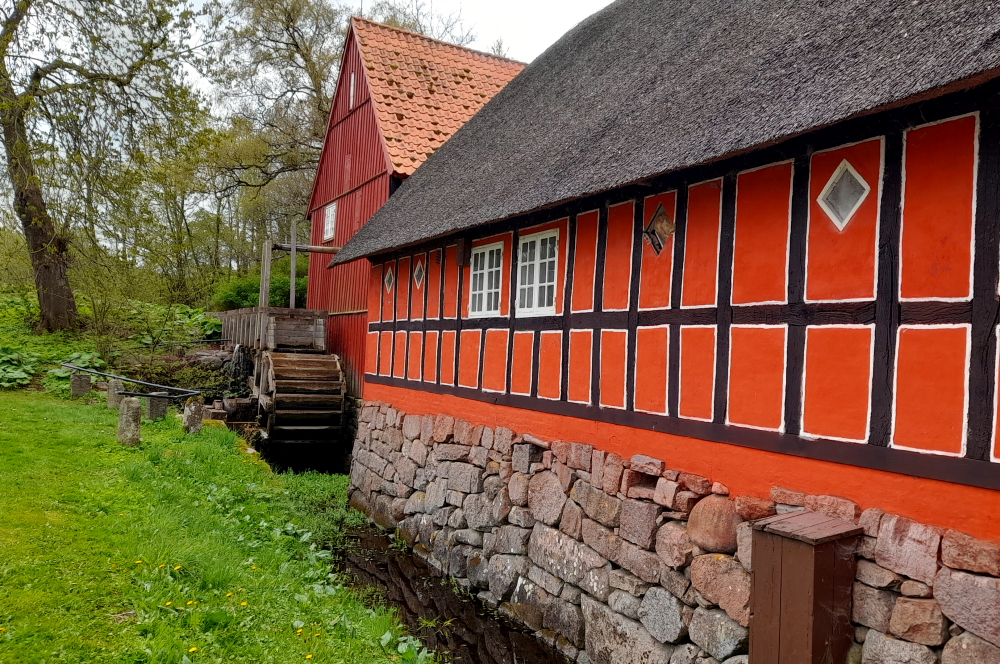
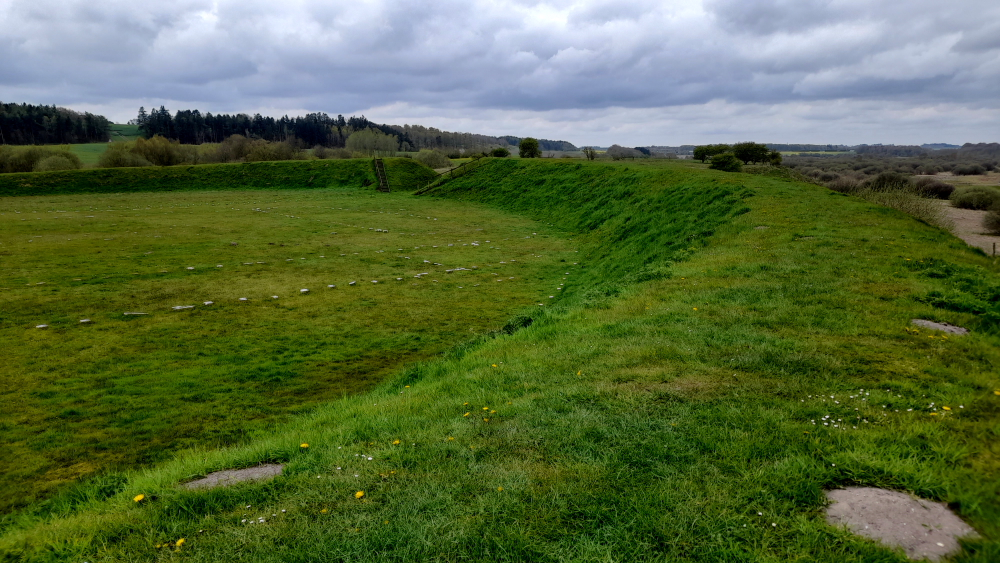
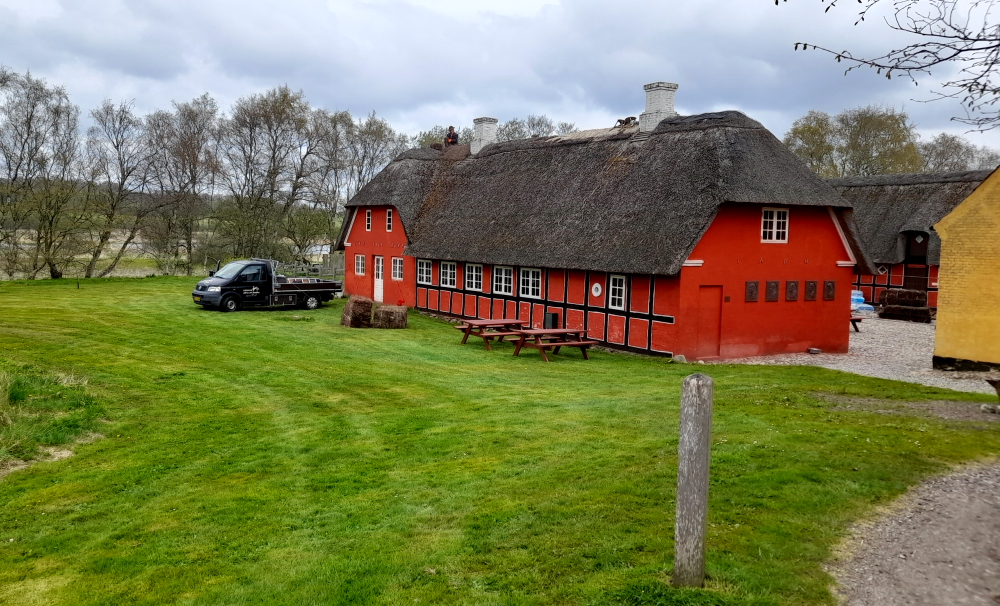
About 900 meters away is the remains of a Viking Ring Fortress – the mound at least – and next to it is an 18th century farm house which is now a museum of Viking Life. The fortress and house visit are included in the Viking Village entrance fee so we take the walk along the lake side for the exercise.
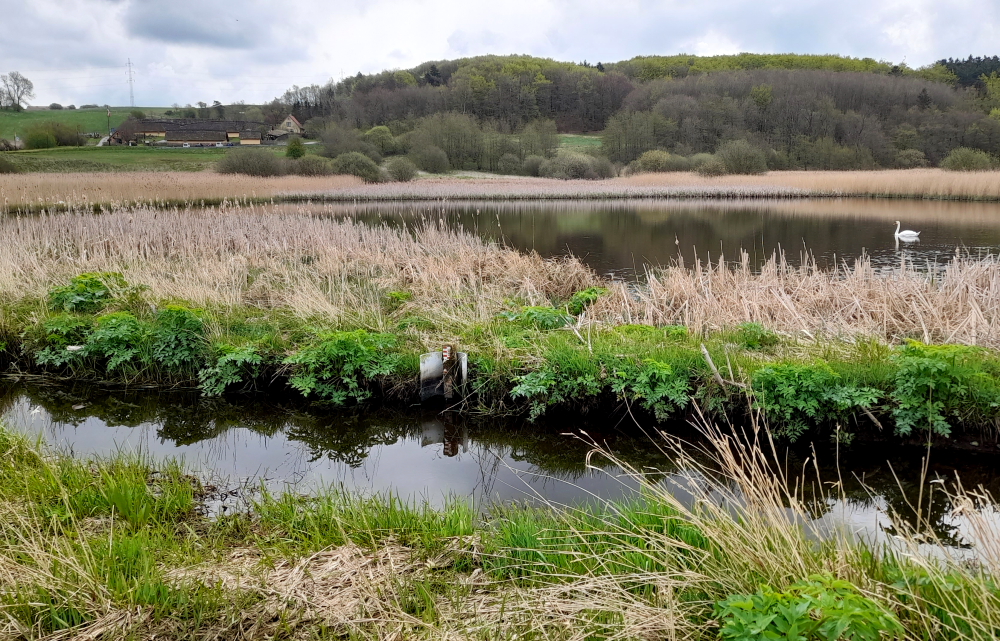
The ring fortress was built around 980 near Onsild River in the reign of Harold Bluetooth. Ships could sail right up to the fort via Mariager Fjord, Vestre Fjord and then the river.
The long halls the archaeologists found inside the ramparts are marked out. A long hall like one of those inside Fyrkat has been reconstructed just outside the fortress. The hall is built of oak, is 28.5m long and 7.4m wide.
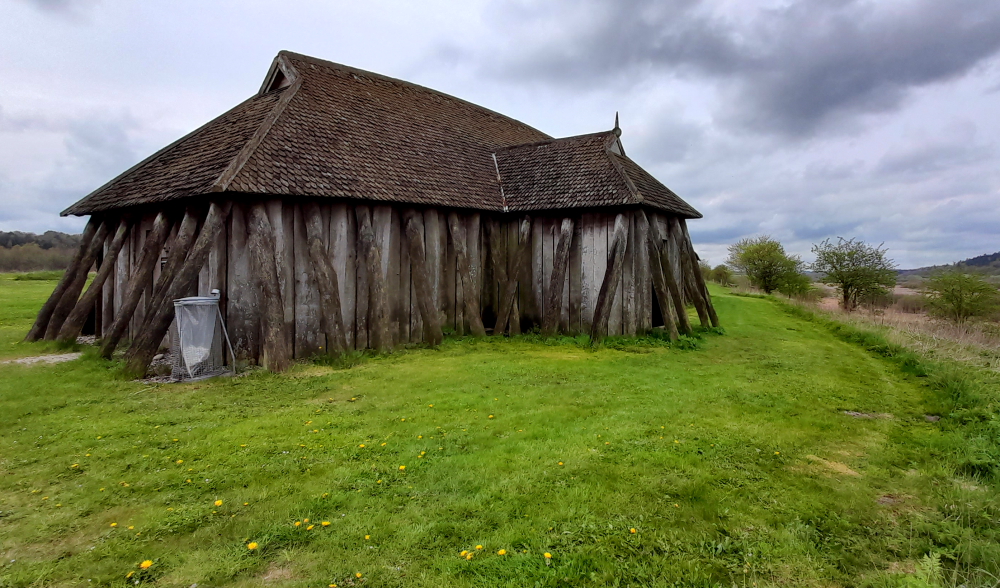
There’s a burial site in the area between Fyrkat and the reconstructed long hall. About 30 men, women and children were buried here during the time the fort was in use.
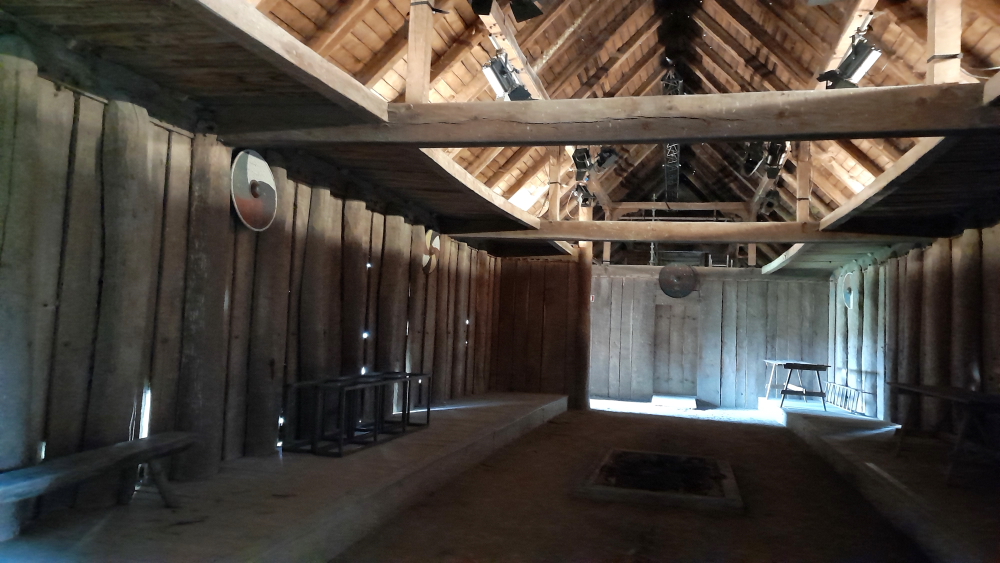
Excavations in the 1950s showed that the original turf embankments and palisades of oak had been levelled due to agricultural activity. The ramparts have now been rebuilt and can be clearly seen in the landscape. The earthen embankments have a circumference of nearly 450 metres.
Lynn notices that the farmhouse roof is being repaired so wanders over and has a bit of a chat with the thatcher. Turns out the thatcher – Jeffrey – is actually Canadian and has been in Denmark for 8 years where he has learnt his craft.
From Hobro we head west towards Ulbjerg so that we can follow the coastline of the Limfjord to Nibe.
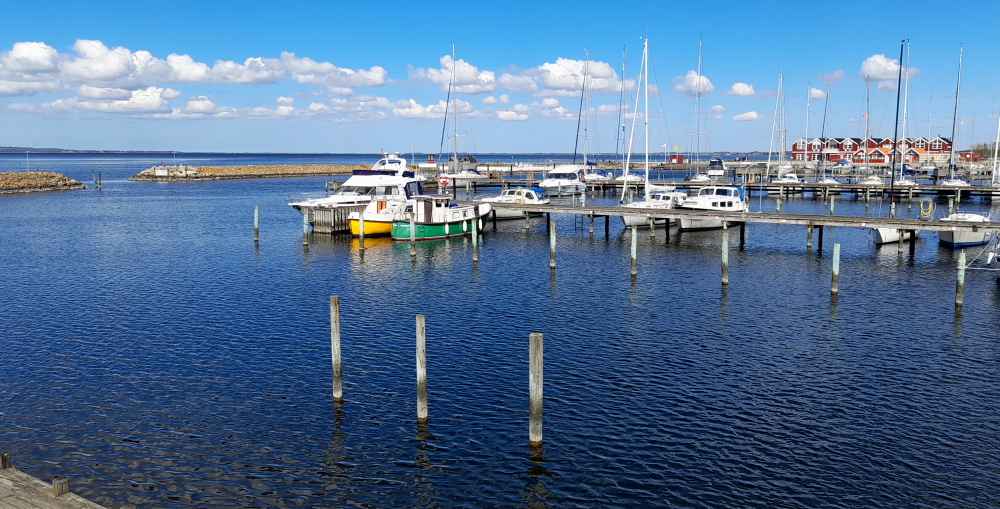
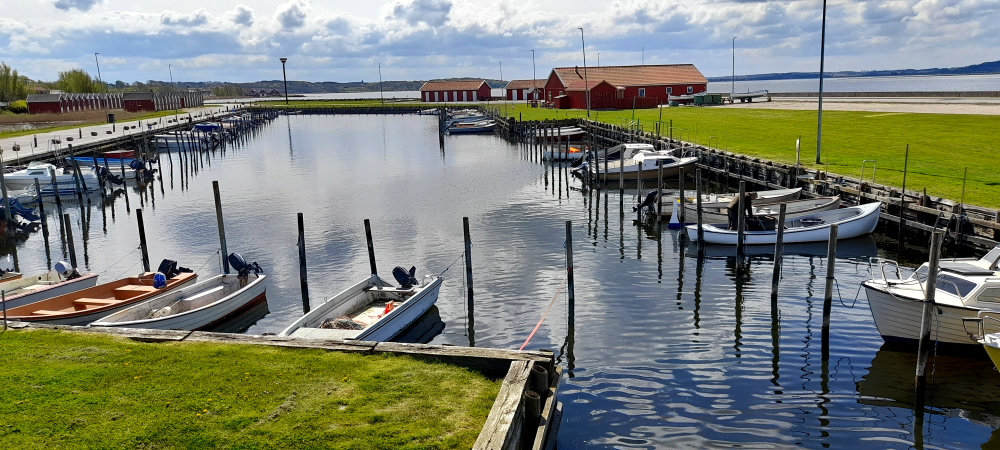
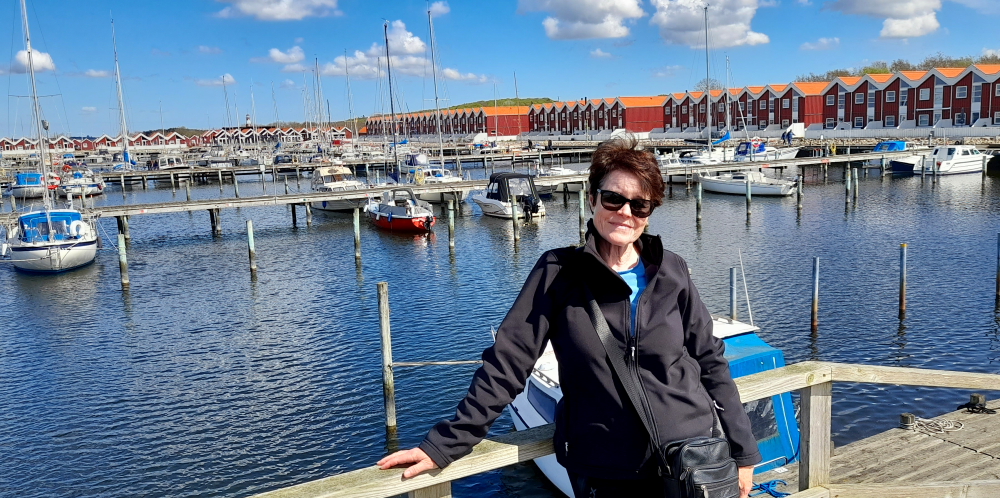
Nibe is a pleasant summer coastal holiday area with lots of summer cottages and a large marina with all forms of sailing vessels that undoubtedly exit the marina at the height of summer.
During her research Lynn learnt that Aalborg is also noted for its street art. On the outskirts of Aalborg we sight our first mural capturing the artist Curtis Hylton created on 16 September, 2022 by Case Maclaim entitled “Heart is Aching”.
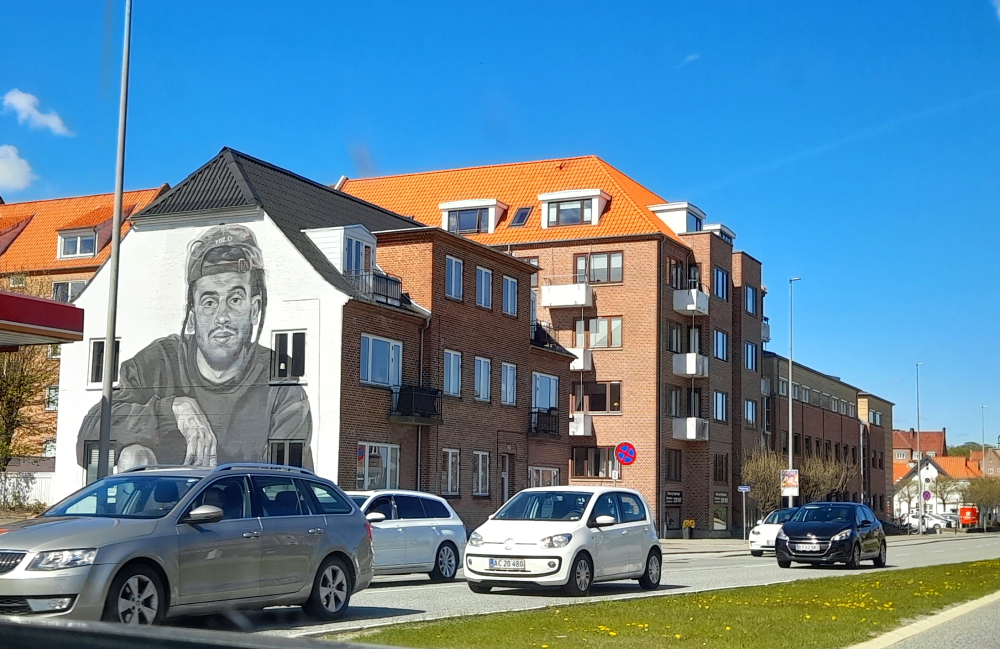
Just about 1 km from our hotel in the centre of Aalborg we hit thick traffic – perhaps the purpose of the murals is to entertain drivers while they are stuck in traffic – and it takes about half an hour to travel the last km due to a very badly-designed double intersection.
I have come to the conclusion that the Danes prefer form over function. It is a timely epiphany as Aalborg is the home town of Jorn Utzon (born Copenhagen – 1918). Utzon is the famous or infamous architect who designed the Sydney Opera House. He was sacked during construction due to the fact that the design was spectacular but wasn’t buildable as he didn’t engage a construction engineer or an acoustics engineer to ensure that his design was functional.
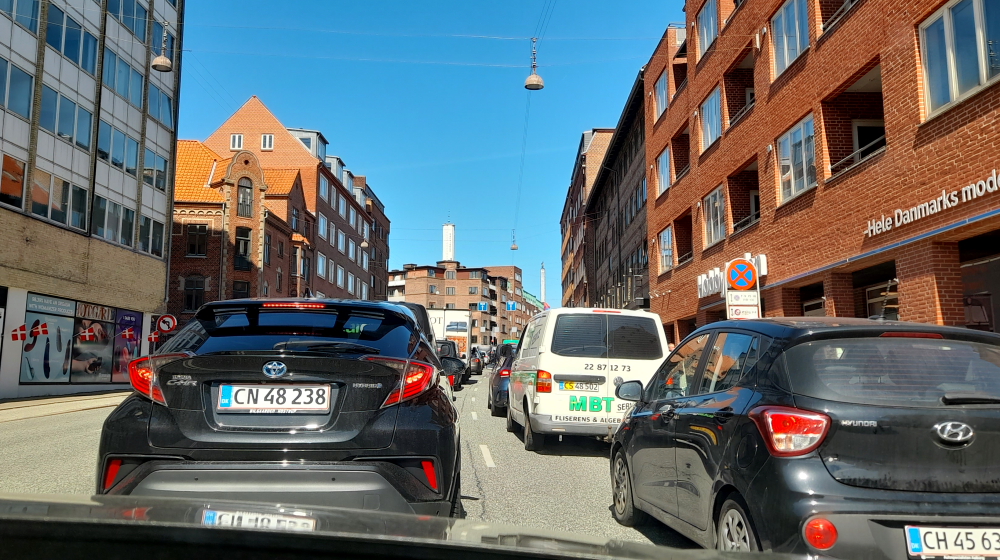
We are planning to go to the Utzon Centre while we are in town (if we ever get there).
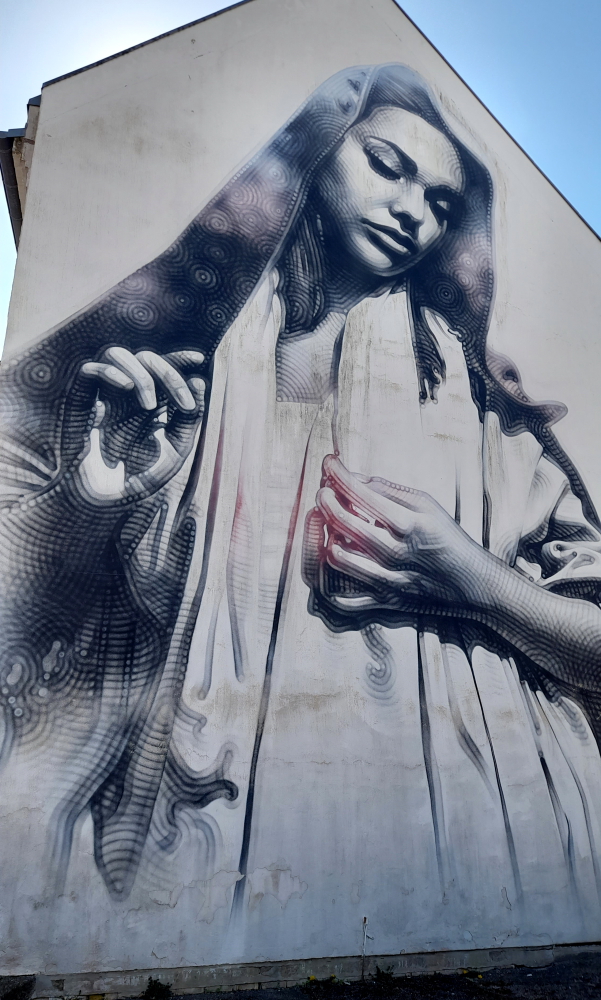
As we finally approach the hotel, Lynn spots another mural, this time in the hotel car park.
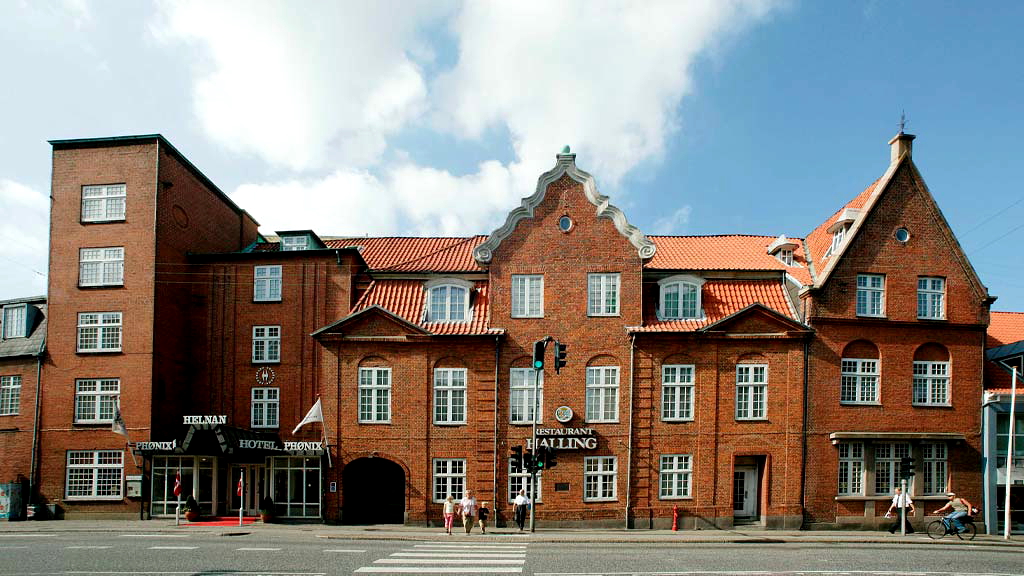
We are staying at the Helnan Phoenix Hotel which is adjacent to the old town centre so we will be able to walk to everything that we need to visit while here in Aalborg. The hotel is an old building but has been tastefully restored including a very old-style elevator that goes as far as the 4th floor. We are on the top level which happens to be the 5th floor so we have to lug our suitcases up the last flight of twisted stairs. Our room is large and comfortable and will do for the next 5 days.
Our view only looks out over the old buildings of Aalborg but we get great light and can open the windows for fresh (read, very fresh) air without too much city noise.
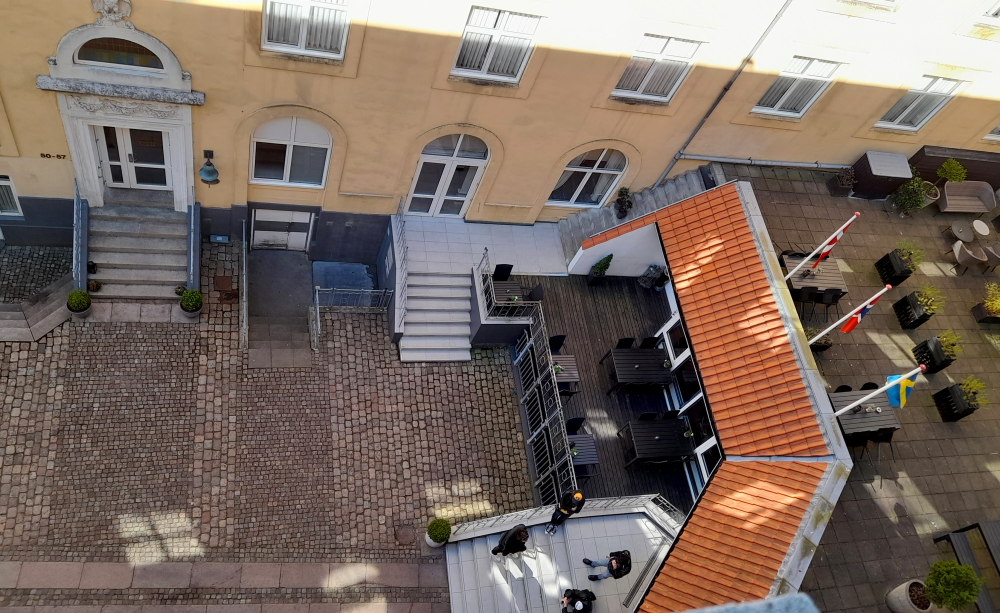
After we unpack we head out for a recce of the town and streets around the hotel. We firstly head down our front street to the harbour foreshore then along the foreshore before walking the cobbled streets of the old town centre.
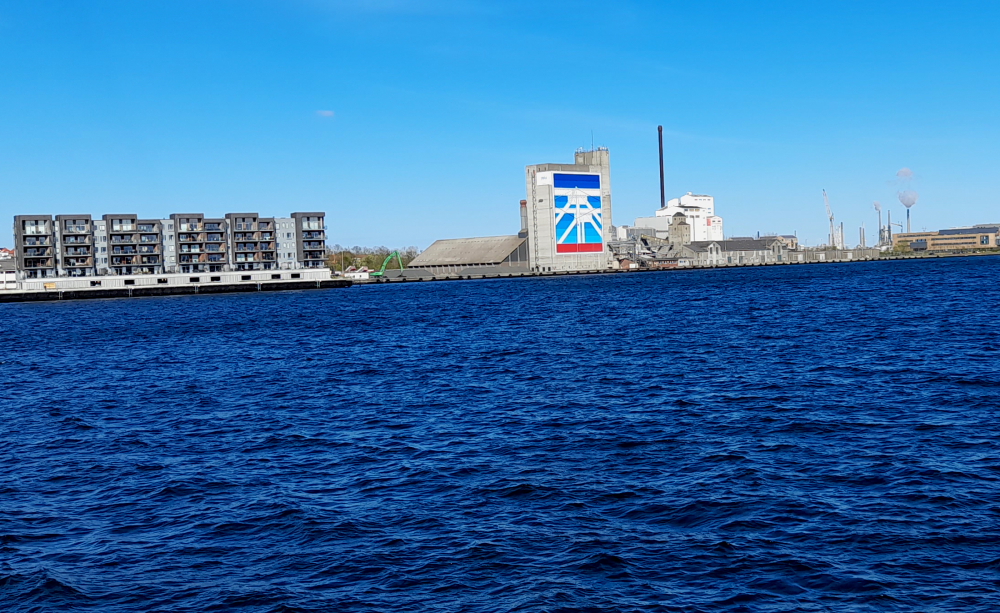
Yet another mural appears across the water. Soren Elgaard’s “Silo”. The work represents a section of the railway bridge crossing the Limfjord.
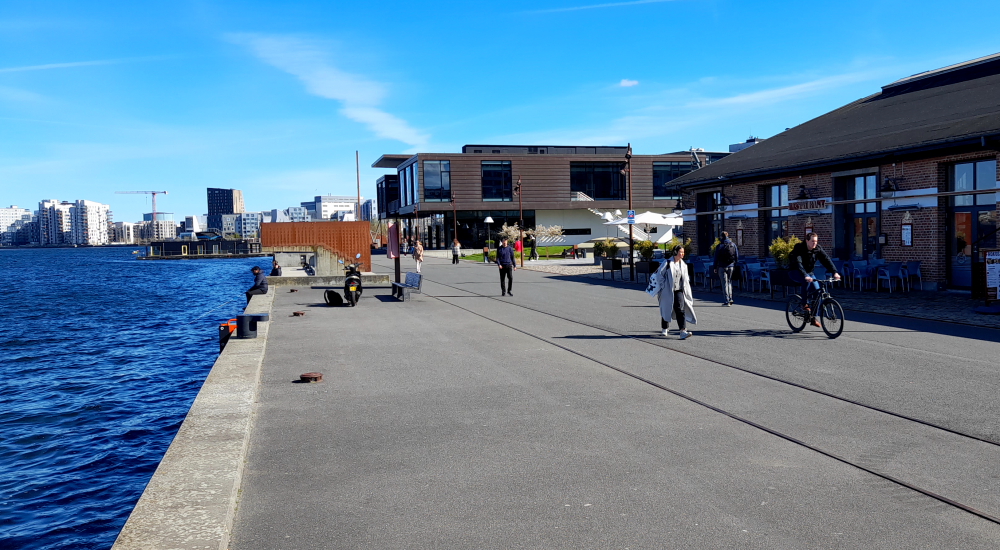
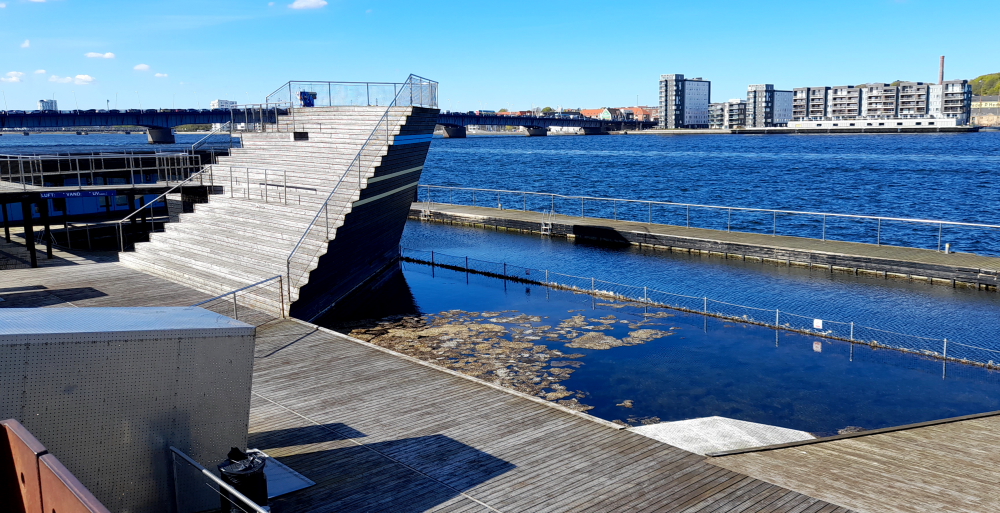
We stroll east along the harbour front and come across the fjord pool. The harbor bath, which is a floating bridge, provides space for both young and old – a children’s pool, a play pool, a splash pool and an exercise pool. The ‘grandstand’ is quite strange as it looks away from the pool. Apparently it faces that way to provide as much sun as possible for the bathers in summer (i.e. faces south).
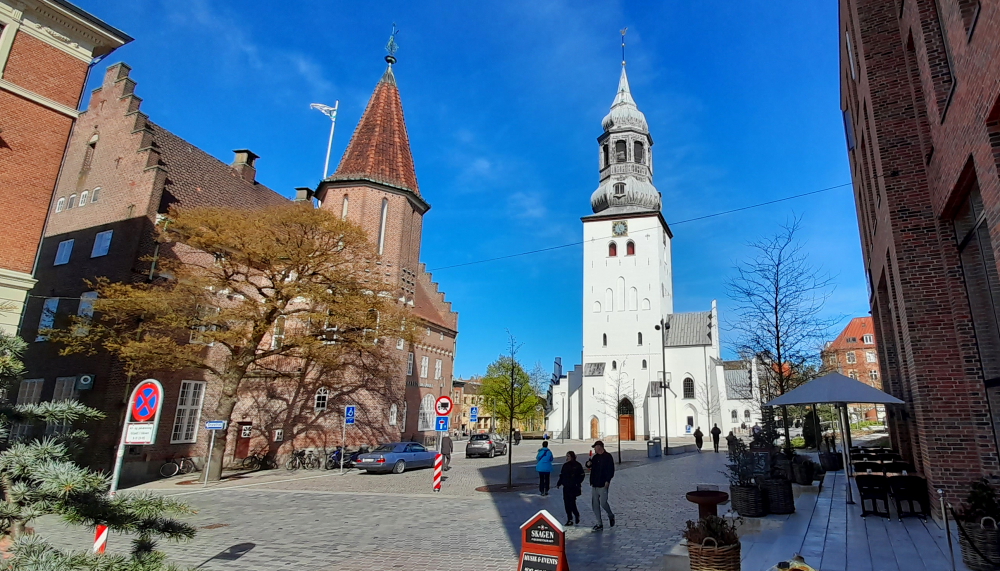
After turning south to walk the old town streets we come across the Budolfi Church which is a restored gothic cathedral with a spire.
The existing Budolfi Cathedral was built in the last decades of the 14th century over and around the original St Budolfi Church and was listed for the first time in the Atlas of Denmark in 1399. The church was named after St Botolph, an Anglo-Saxon abbot and saint. His reputation as a learned and holy man in Anglo-Saxon England and as the patron saint of farmers and sailors made him a popular saint in pre-Reformation Denmark.
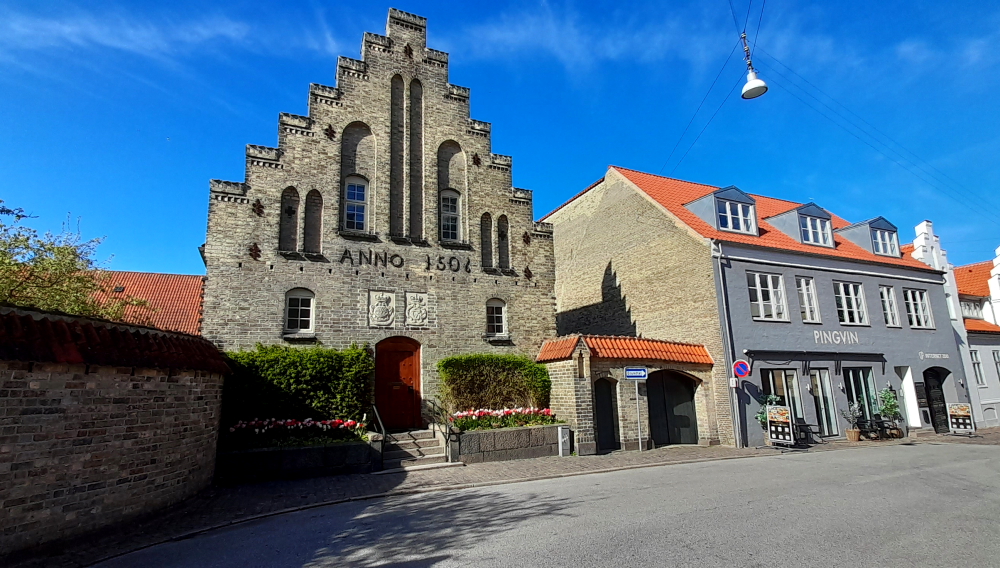
Behind the Cathedral is the southern end of the Aalborg Kloster building, dated 1504.
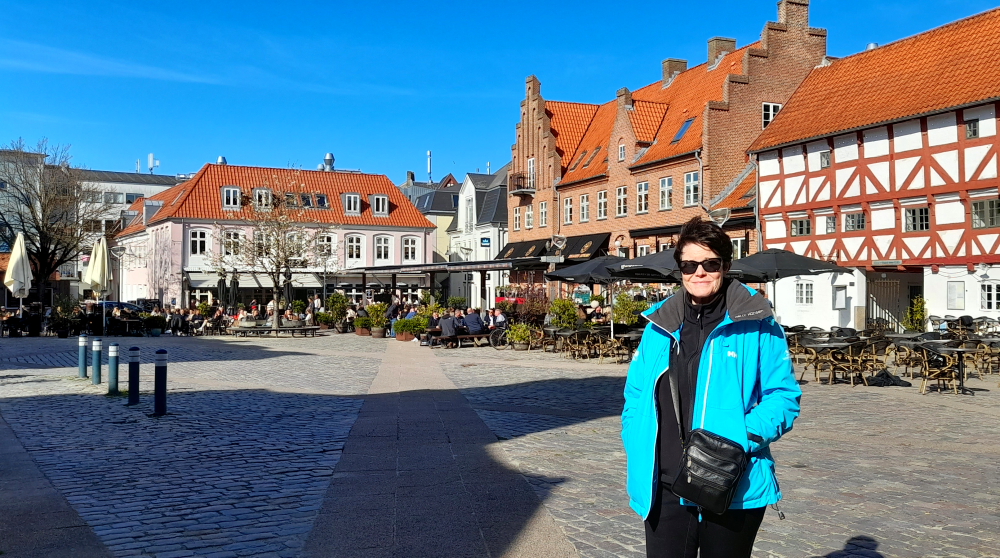
Further along Adelgade we come to the C W Obels Plads which is obviously the afternoon suntrap of Aalborg with lots of patrons drinking and dining al fresco in the square. Apparently, in winter, this square becomes an ice rink.
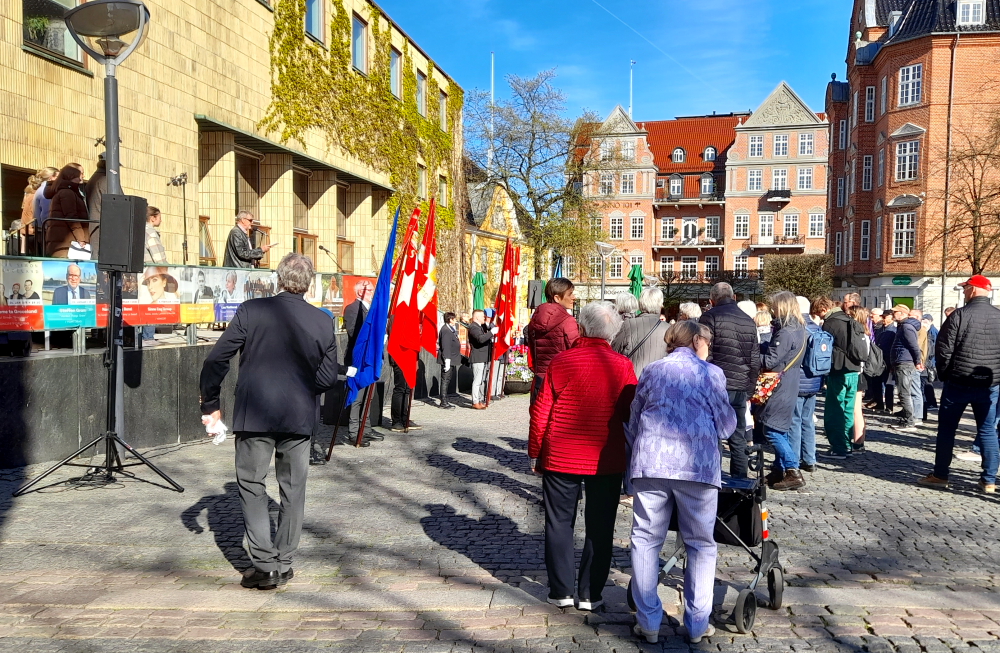
Around the corner we come across a small gathering of people in front of 6 flag bearers behind whom is a dais with a speaker and choir. Although the speech is in Danish we conclude that it has something to do with WWII. We later learn that 4 May 1945 was the date when Denmark was liberated from German occupation.
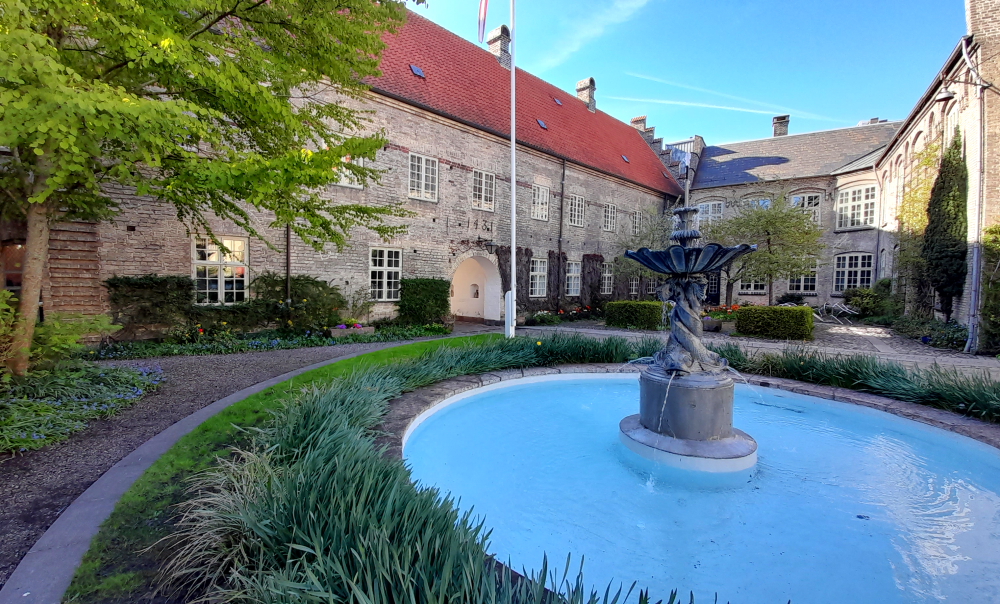
Facing the square is a narrow entrance to the Aalborg Kloster, also known as the Monastery of the Holy Ghost. This part of the Kloster buildings is dated 1431.
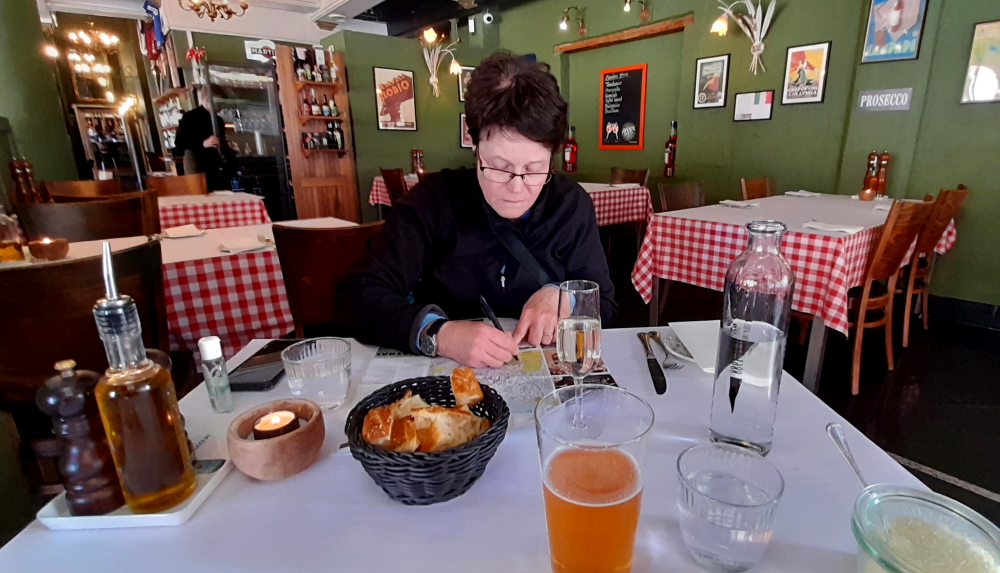
After wandering around for some time we head back towards our hotel with the plan to have dinner at San Giovanni Italian restaurant which is across the street. After eating very lightly for the past few days it is time for a proper dinner.
The food is fairly good for an Italian Restaurant in Denmark. Lynn even lashed out and had a Prosecco. However, the meal turned out to be more expensive than we thought with a fee added before she presented the tap and pay machine with the ‘final’ amount!
 THE CONTINUING TRAVELS OF YOGI & BOO BOO