Two Weeks in England.

12 March, 2024

We leave Llanrwst, Wales at 10:00 am for our 147km drive to Ludlow, Shropshire, England, about a 2-hour drive. It’s sunny and the air has lost its chill as it’s 12 Deg. C.

Our route takes us along the A5 through Corwen where we see a rather fearsome, life-size bronze statue of a knight on a steed, Owain Glyndwr (1359-1415) which is opposite the pub that bears his name. He had a home in Carrog, near Corwen, back in the day.

Also known as Owain ap Gruffydd he was a Welsh leader who led a long and fierce war of independence which he hoped would end English rule in Wales during the late Middle Ages. He formed the first Welsh parliament and is believed to be the last native-born leader to unite Wales in a common cause. He was the self-proclaimed Prince of Wales with a reign lasting from 1400-1415.
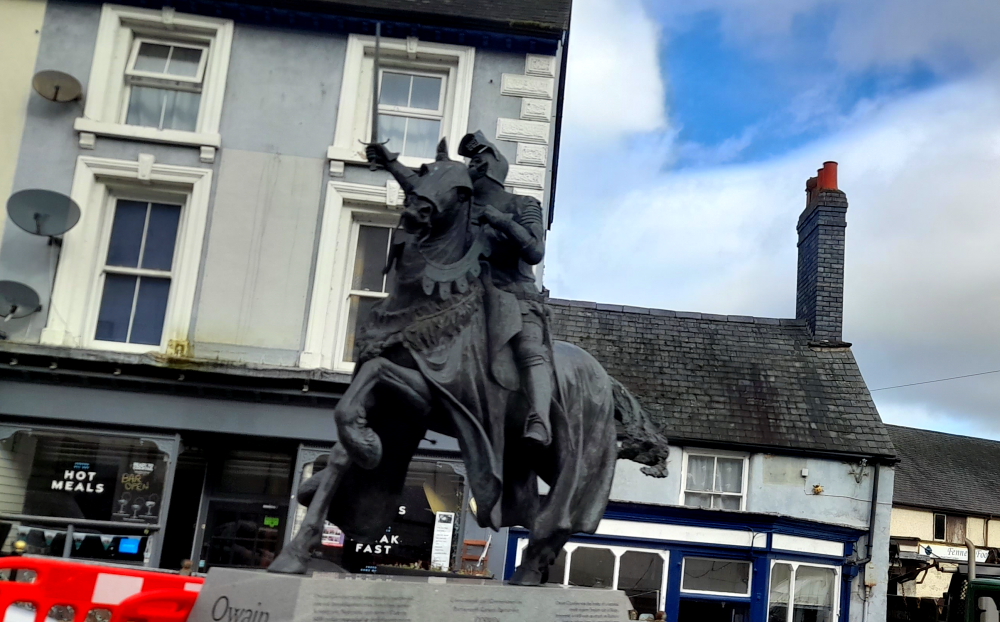
Owain Glyndwr.

We also pass signs for the Pontcysyllte Aqueduct, a navigable aqueduct that carries the Llangollen Canal across the River Dee in the Vale of Llangollen in northeast Wales.

The 18-arched stone and cast iron structure is for narrowboats and was completed in 1805 having taken ten years to design and build. It is 12 feet (3.7 metres) wide and is the longest aqueduct in Great Britain as well as the highest canal aqueduct in the world.
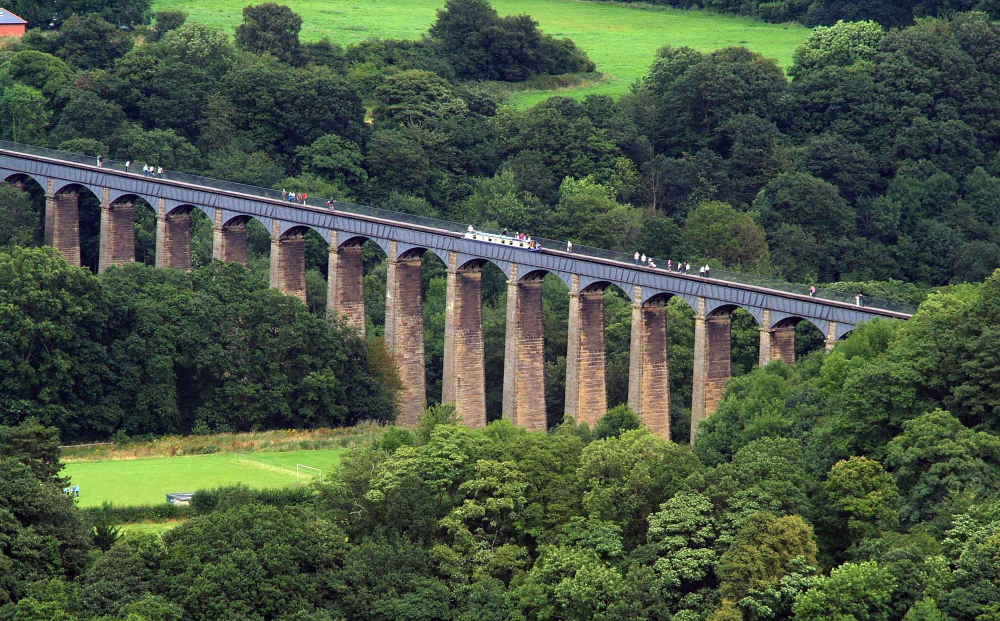
Pontcysyllte Aqueduct.

Soon after we arrive at a roundabout that by turning right we continue on the A5 towards Shewsbury. Going left we would end up in Wrexham which has achieved recent fame thanks to actor Ryan Reynolds and his mate, Rob McElhenney, buying its football club. We turn right.
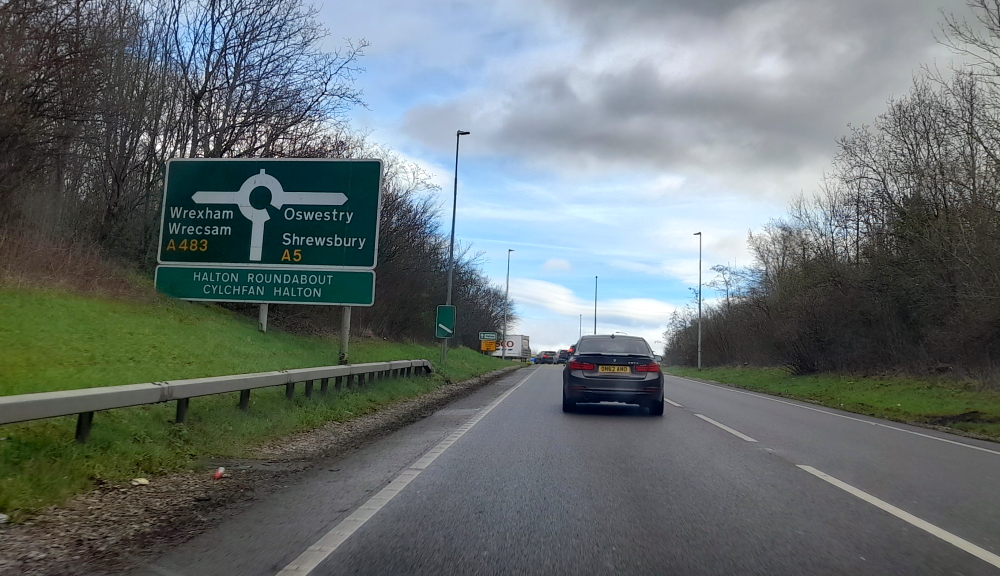
Wrexham or Shrewsbury?

2 minutes later we cross the River Ceiriog and enter England once again. Bypassing Shrewsbury we take the A49.
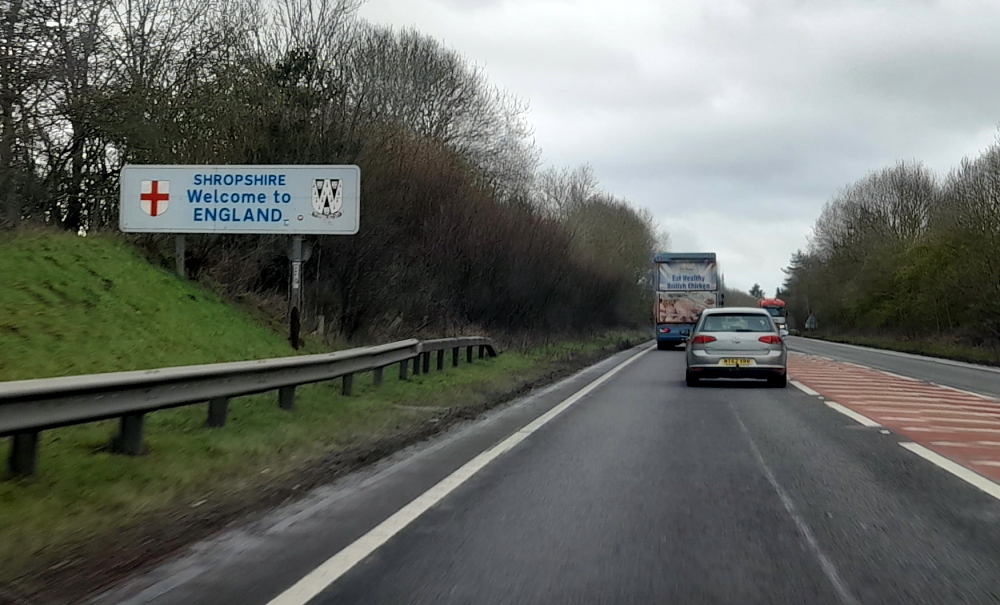
Wales-English border.

It isn’t until we are virtually at Ludlow that we finally see a sign for it as you need to take the B4361 off the A49 to get there.

Fortunately, our hosts had agreed to an early check in so after shopping at the nearby Tesco we arrive at ‘Charlie’s Cottage’ in Lower Corve Street at 1:45 pm.
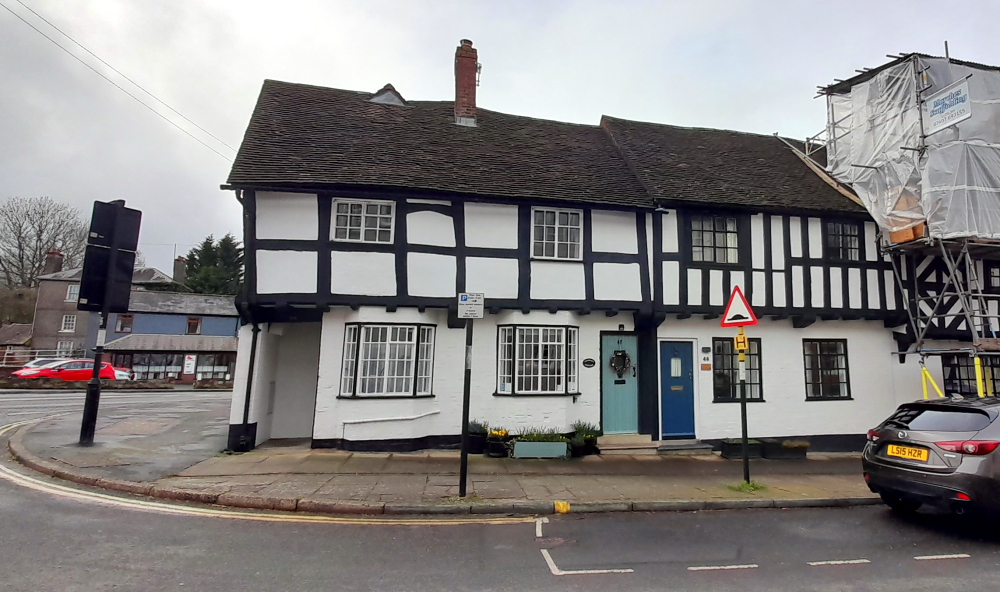
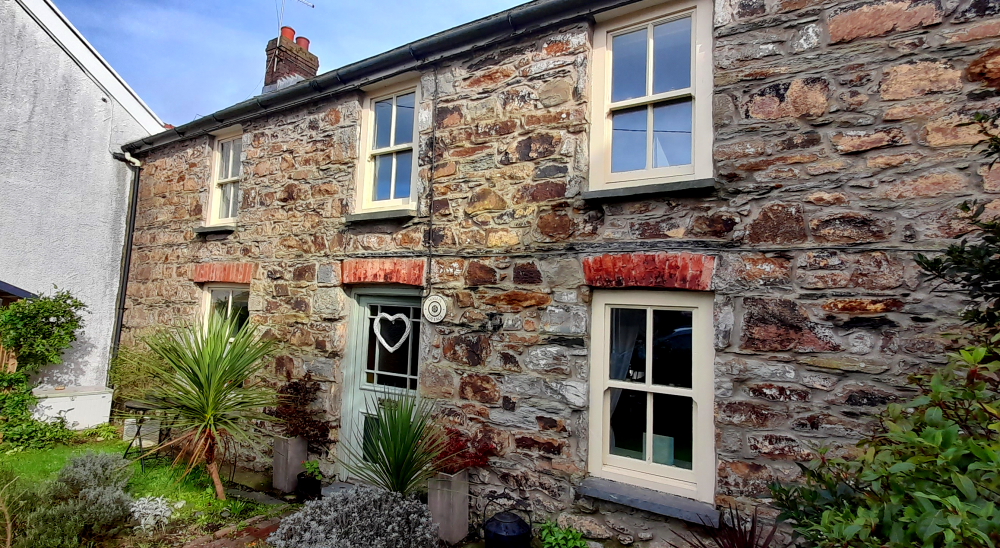
Charlie’s Cottage, Ludlow (the one with the pale blue door).

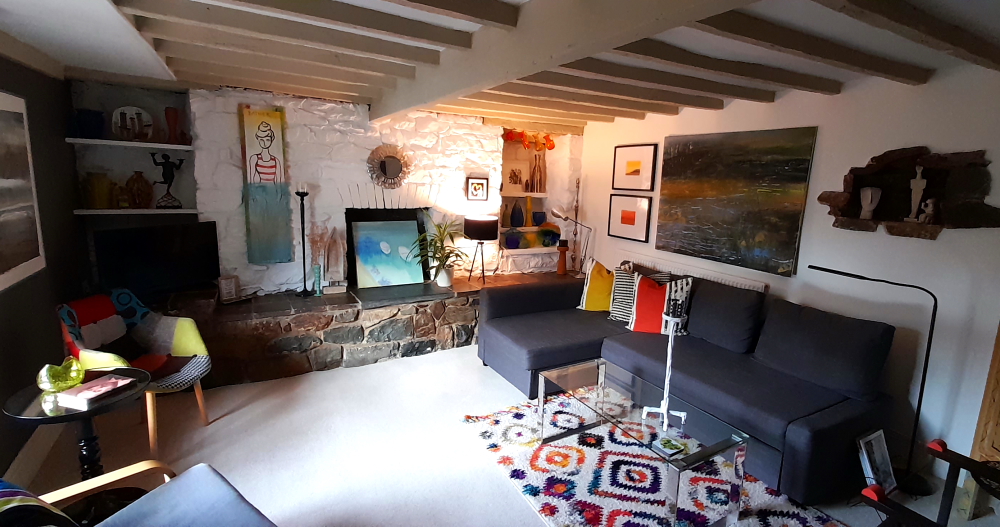
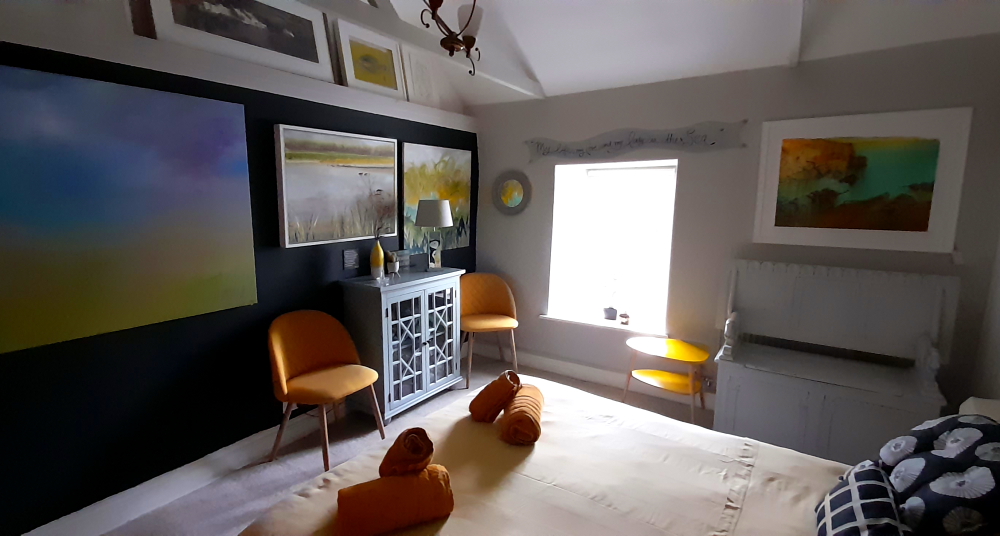
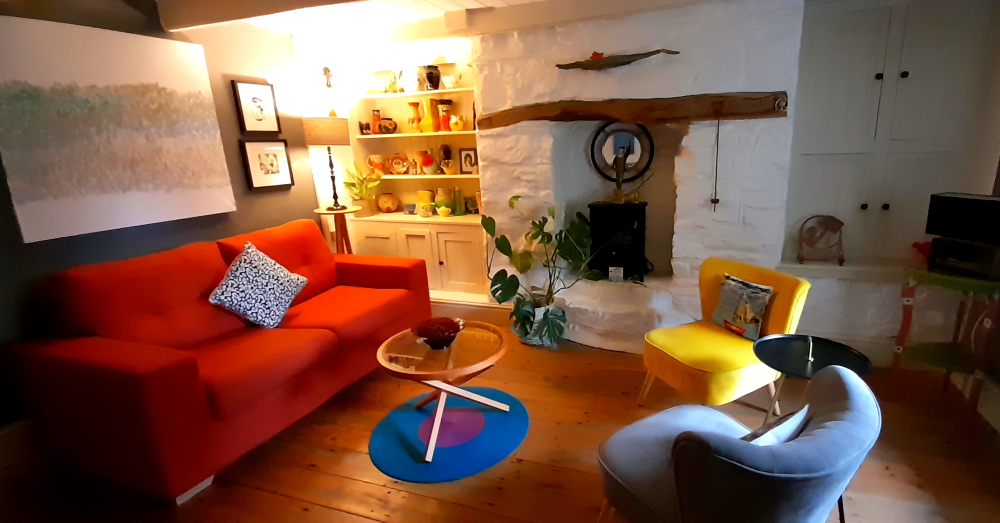
And what a delightful, cozy cottage it is, too. A Grade II* listed building built about 1650 and retains many of its original features – sloping beams, old brick fireplaces and the sloping floor in the main bedroom – not to mention the care and attention to its exquisite decor. Plus it’s functional and I don’t have to ‘duck or grouse’ at all!

After unpacking we take an exploratory walk up the street. Ludlow is a thriving medieval market town and an architectural gem. The historic town centre and the 11th century Ludlow Castle are situated on a cliff above the River Teme and are surrounded by the south Shropshire countryside and the Welsh Marches.
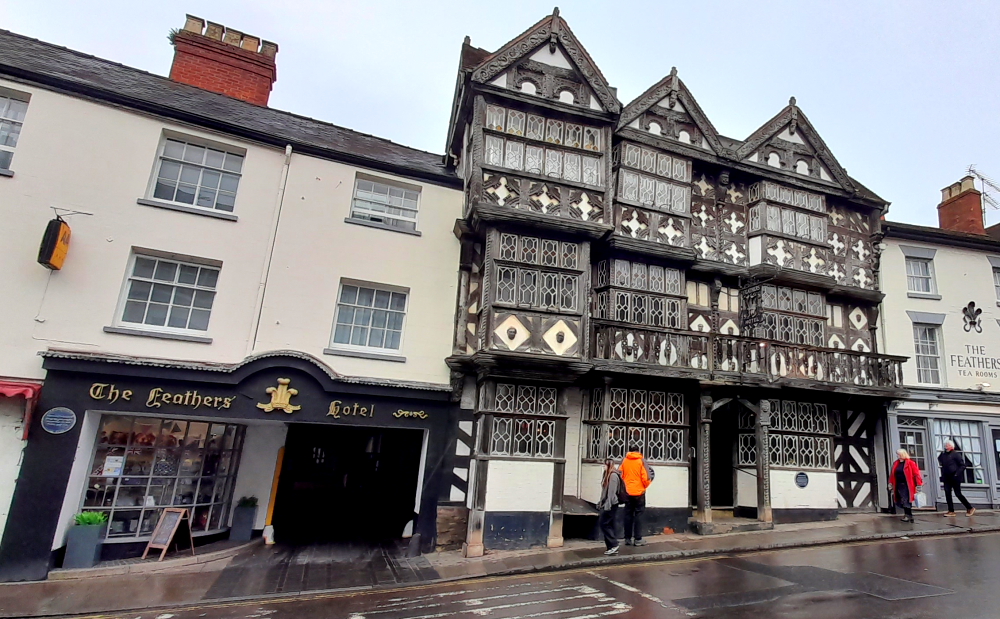
The Feathers Hotel, Ludlow.

First of its architectural gems we come across is The Feathers Hotel. Built in 1619 by an ambitious attorney called Rees Jones, who moved to Ludlow to pursue his career at the ‘Council of the Marches’, the building was converted into a hotel by his grandson 50 years later and has been welcoming guests since 1670.

The Feathers’ famous half-timbered Tudor façade is adorned with carved wooden motifs of the Prince of Wales’ three feathers emblem, which gives the hotel its name. Guests have stepped through The Feathers’ original studded plank front door, which survives to this day, and enjoyed food, drink, rest and relaxation within its Jacobean interior for over 400 years. [Feathers website].

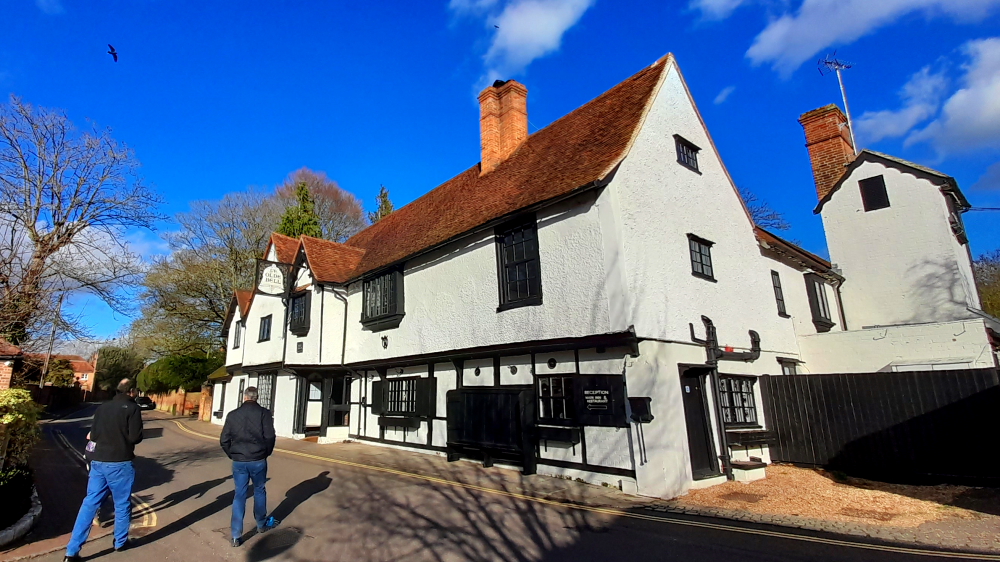
Around the corner is Ye Olde Bull Ring Tavern. The area where the Corve Street track once turned into the early trading market was given the name of The Bull Ring, due to the fact that livestock was bought and sold there in an early version of a cattle market.

Built around 1365 on the former site of a cattle market, the buildings grew into houses and a pub. The original tavern is the central twin gable roofs. In the 18th century the house with the twin left gable roofs was an ale store, a shop. The shop at the right was, in 1905, Woodhouse Chemist, later bought by Boots; now a book shop. Mr Woodhouse had been Mayor in 1909 when the Princess of Wales, later Queen Mary, came to Ludlow and her patronage of his shop – the local tale is that she bought a toothbrush – entitled him to display the royal coat of arms.
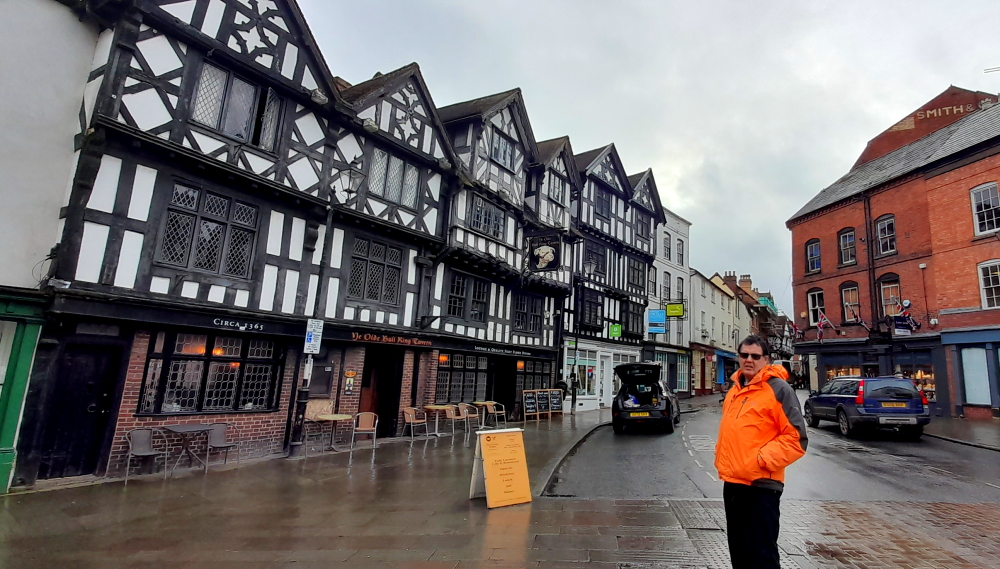
Ye Olde Bull Ring Tavern.

Nikolaus Pevsner in his 1958 book ‘The Buildings of England: Shropshire,’ said, “they make up the longest continuous Elizabethan and Jacobean timber-framed frontages in Ludlow.”

Further along is The Buttercross, now the Ludlow Museum. The building is prominently located within the historic walled town of Ludlow, forming a key focal point at the head of Broad Street. The Buttercross occupies the main approach to the town centre from the south, forming a pivotal point on the junction of Broad and High Streets that leads from Ludford Bridge via Broadgate to the Ludlow Castle gates. {Welcome to Ludlow].
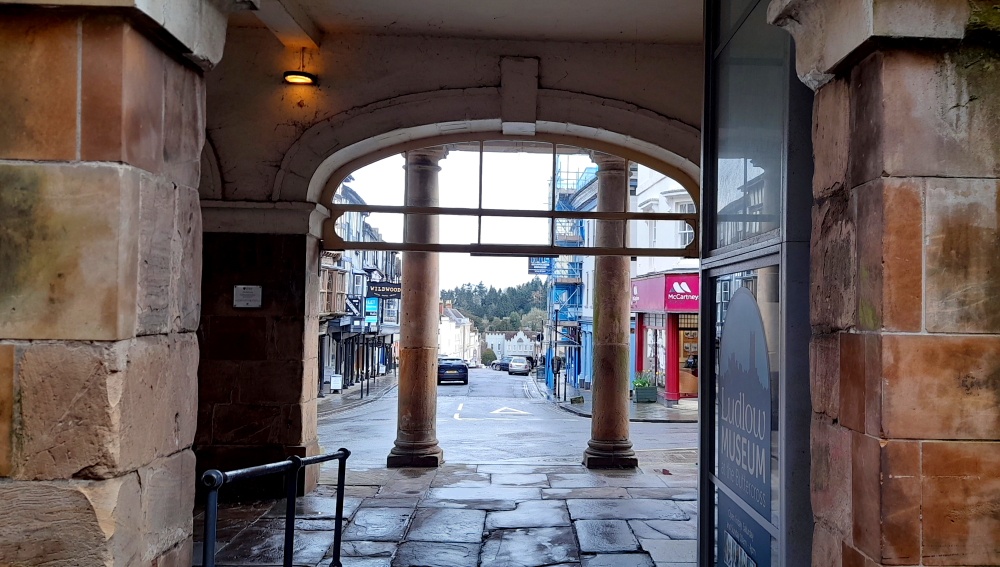
View through The Buttercross building down Broad Street to Broadgate.

Walking along High Street we pass several pubs, passageways and the market square that leads to Ludlow Castle – a ruined medieval fortification. The castle was probably founded by Walter de Lacy after the Norman conquest and was one of the first stone castles to be built in England. Throughout history its owners were Geoffrey de Geneville (1250s), Roger Mortimer (1351), and Richard, Duke of York (1425). When Richard’s son, Edward IV, seized the throne in 1461 it passed into the ownership of the Crown.
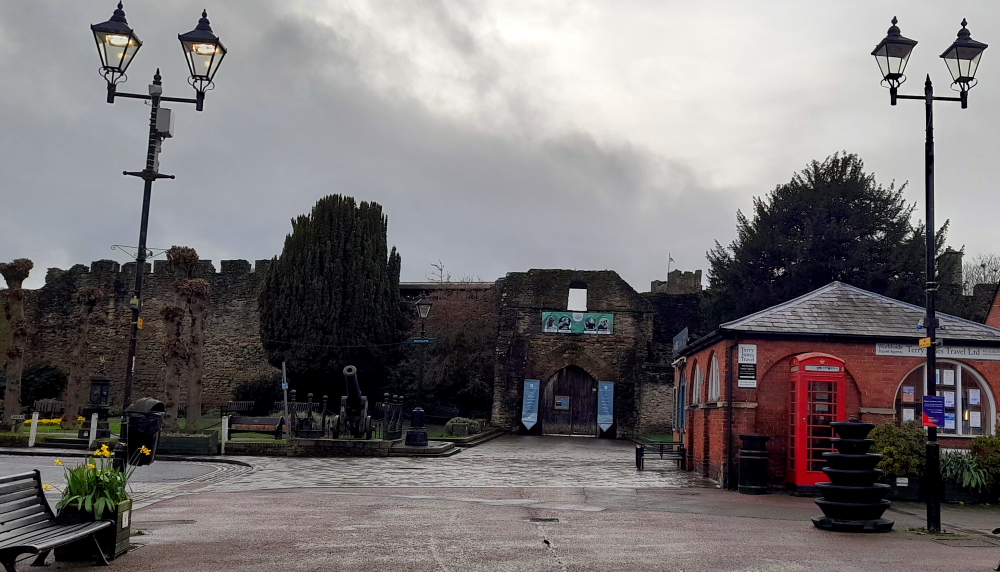
Ludlow Castle ruins.

Ludlow Castle was chosen as the seat of the Council of Wales and the Marches, effectively acting as the capital of Wales. The Castle was held by the Royalists during the English Civil War of the 1640s, until it was besieged and taken by a Parliamentarian army in 1646. Henry, 1st Earl of Powis, leased the property from the Crown in 1772 while his brother-in-law, Edward, 1st Earl of Powis bought the castle outright in 1811. In the 21st century it is still owned by the Earl of Powis and operated as a tourist attraction.
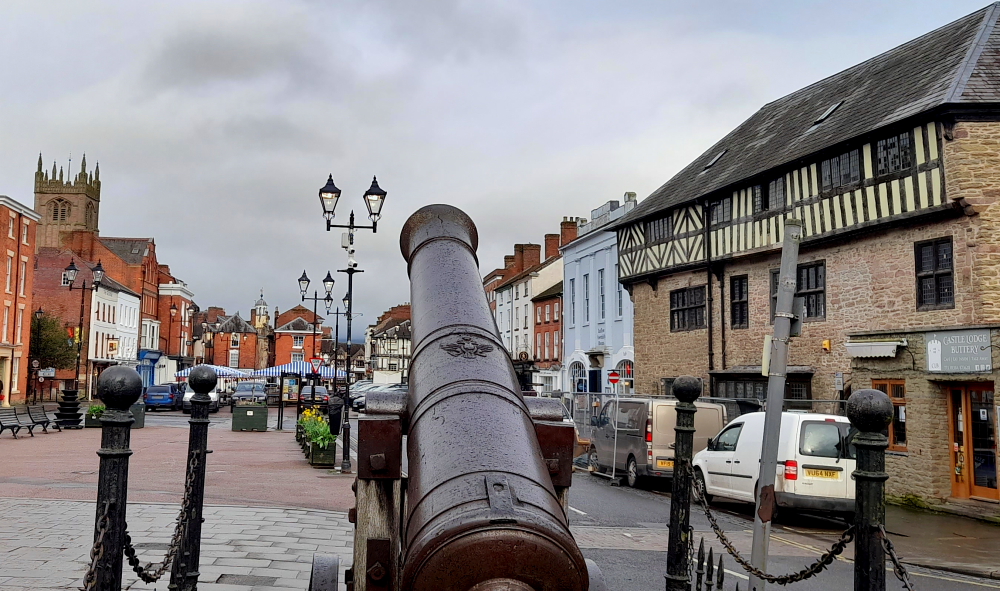
Ludlow market square.

Returning to the Buttercross, we pass by the Assembly Rooms until we reach Broad Street which we walk down.
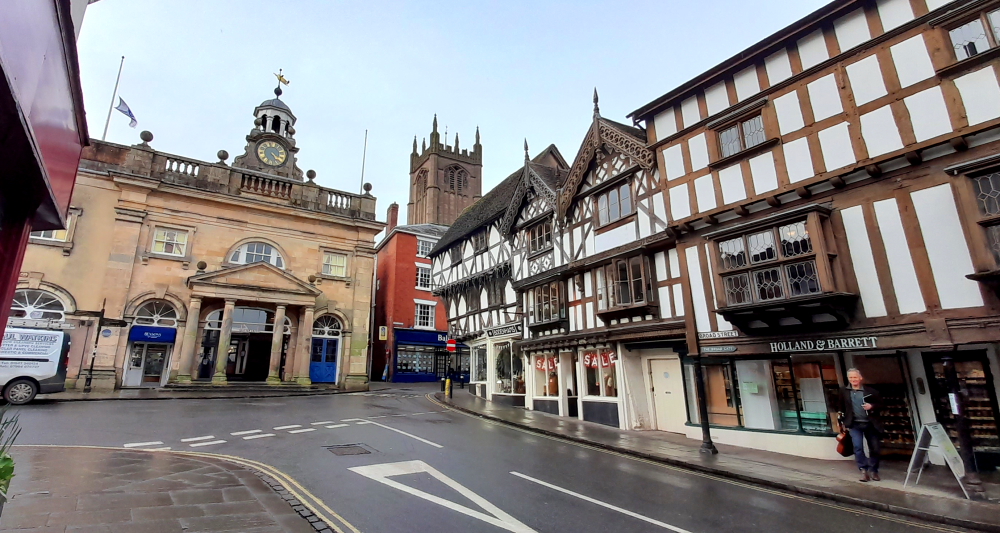
The Buttercross, St Laurence’s Church and retail shops on Broad Street.

Broad Street, perhaps the finest street in Ludlow, has a variety of terraced town houses from Tudor to Georgian eras, many with heritage listings and several sporting blue plaques. It also has The Angel pub, an inn since at least 1555. In 1822 the Aurora coach went from this pub to London – in 27 hours!
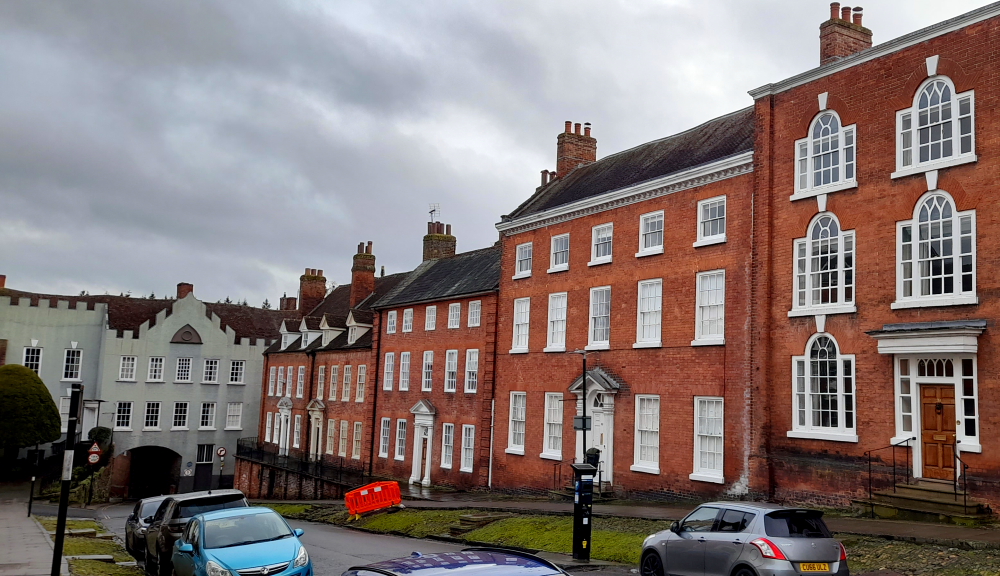
Elegant Georgian terraced town houses in Broad Street.

At the bottom of Broad Street is The Broad Gate, the only survivor of Ludlow’s 7 medieval gateways.
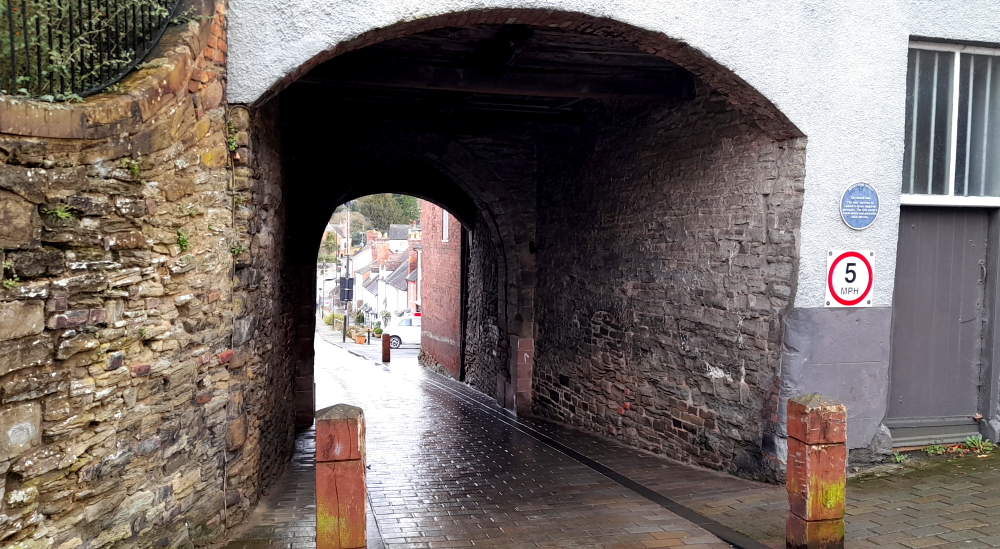
The Broad Gate.

The 13th century drum towers and portcullis arch survive.
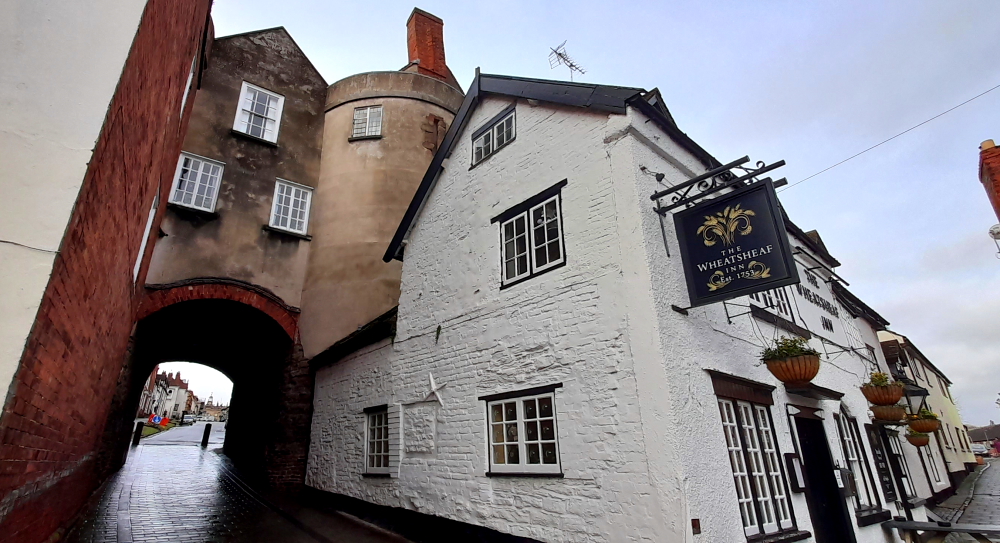
Reverse side of Broad Gate and drum tower.

13 March, 2024

As it’s supposed to be raining later today we take off back up the A49 for 11km to Stokesay Castle. Needless to say, it starts raining immediately we start driving.

Rather than a castle, per se, Stokesay Castle is one of the finest surviving fortified manor houses in England, situated at Stokesay, north of Ludlow.
The castle was never intended to be a serious military fortification. Originally designed as a prestigious, secure, comfortable home, the castle has changed very little since the 13th century, and is a rare, surviving example of a near complete set of medieval buildings.
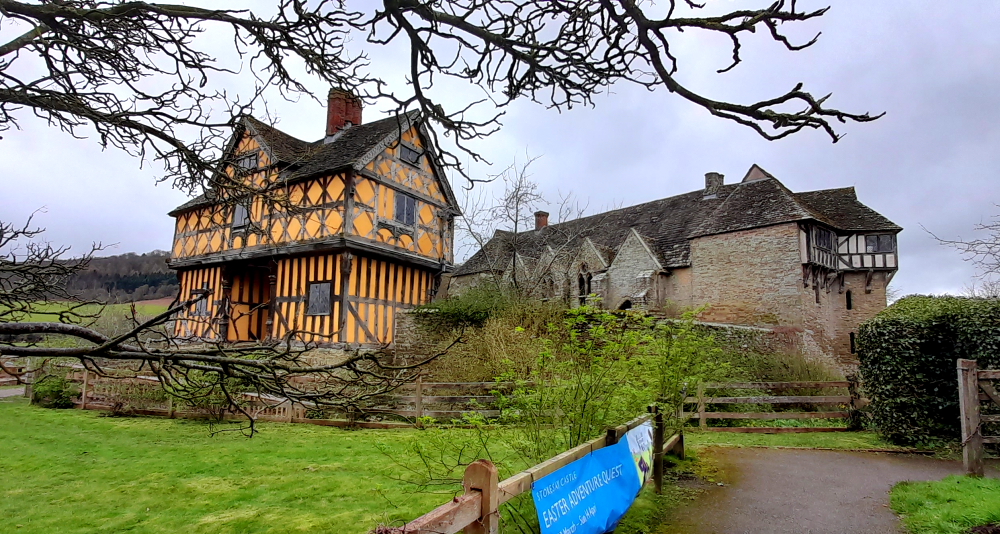
Stokesay Castle from the churchyard.

It was largely built in its present form in the late 13th century by Laurence of Ludlow, on the earlier castle founded by its original owners the de Lacy family, then passed to their de Verdun heirs, who retained feudal overlordship of Stokesay until at least 1317.

Laurence ‘of’ Ludlow was one of the leading wool merchants in England, who intended it to form a secure private house and generate income as a commercial estate. Laurence’s descendants continued to own the castle until the 16th century, when it passed through various private owners. By the time of the outbreak of the First English Civil War in 1642, Stokesay was owned by William Craven, 1st Earl of Craven (1608–1697), a supporter of King Charles I. After the Royalist war effort collapsed in 1645, Parliamentary forces besieged the castle in June and quickly forced its garrison to surrender. Parliament ordered the property to be slighted, but only minor damage was done to the walls, allowing Stokesay to continue to be used as a house by the Baldwyn family until the end of the 17th century.

Restoration work was carried out in the 1830s and 1850s by William Craven, the second Earl of Craven. In 1869 the Craven estate, then heavily in debt, was sold to the wealthy industrialist John Derby Allcroft who paid for extensive restoration during the 1870s.

Architecturally, the castle has an entrance way through a 17th-century timber and plaster gatehouse.
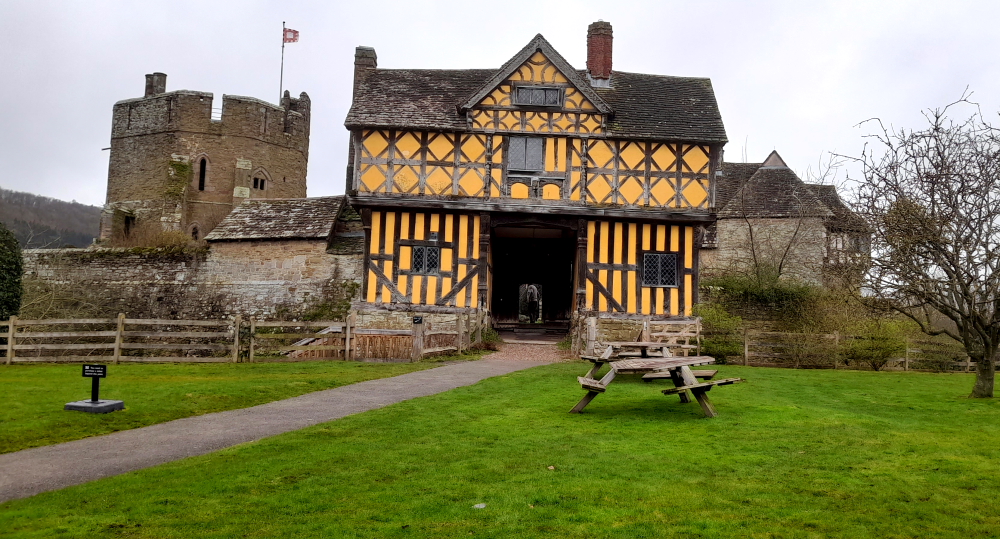
Gatehouse fronting the manor house and South Tower.

It’s surrounded by a walled, moated enclosure.
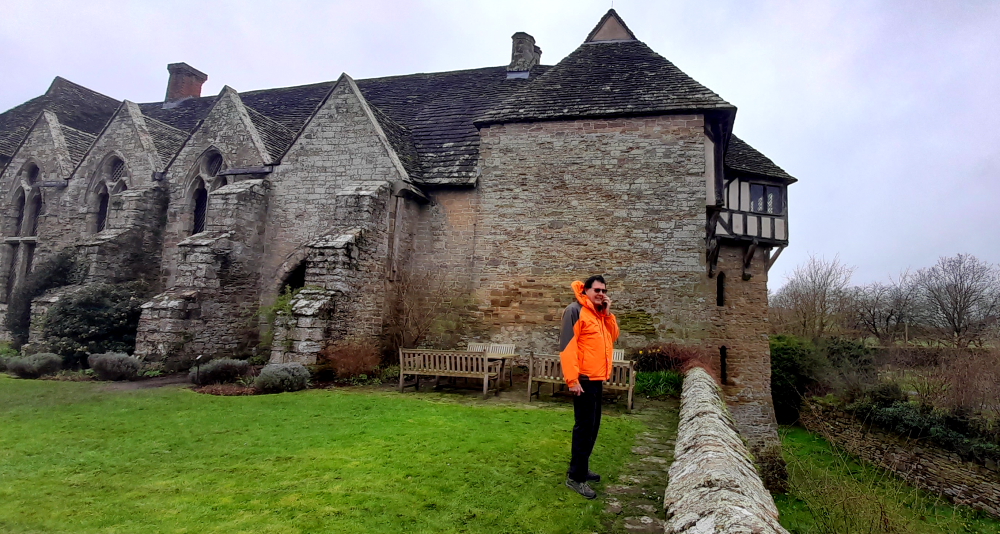
View of the Great Hall, North Tower and moated enclosure from the courtyard.

Inside, the courtyard faces a stone hall and solar block, protected by two stone towers.
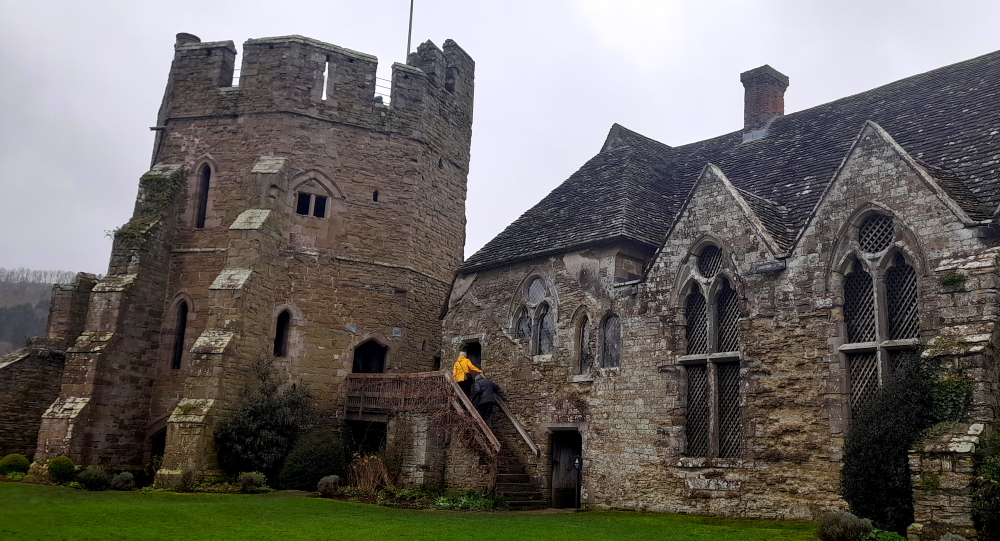
View of the South Tower, Solar Block and Great Hall from the courtyard.

The hall features a 13th-century wooden-beamed ceiling and staircase, and 17th-century carved figures ornament the gatehouse and the solar block.
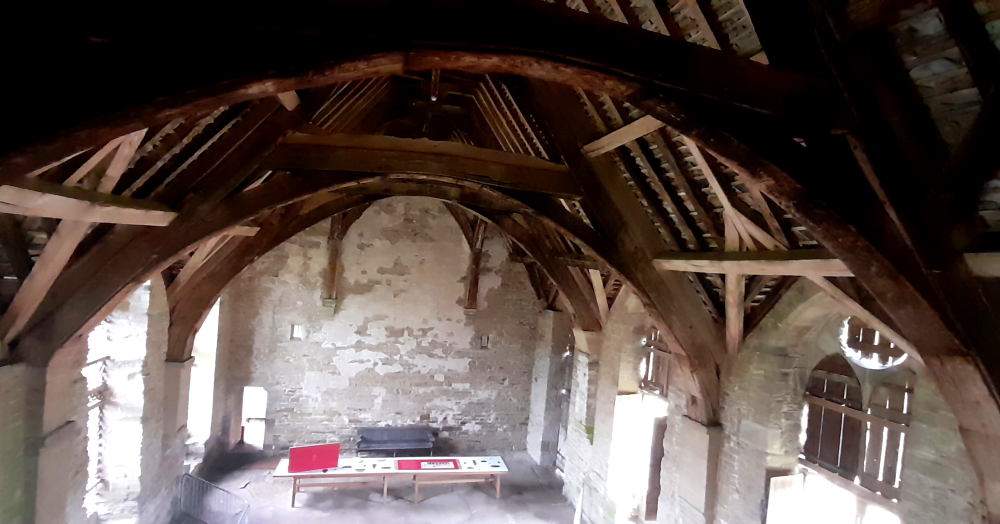
Great Hall with wooden-beamed ceiling.

Up the worn, wooden staircase at the end of the Great Hall is access to the North Tower and a spacious room. It features a simple wooden-beamed ceiling similar to the great hall’s, a large fireplace with a wooden canopy and dual-aspect views through diamond-shaped Italian glass and lead light windows. Tapestries would have hung on the walls.
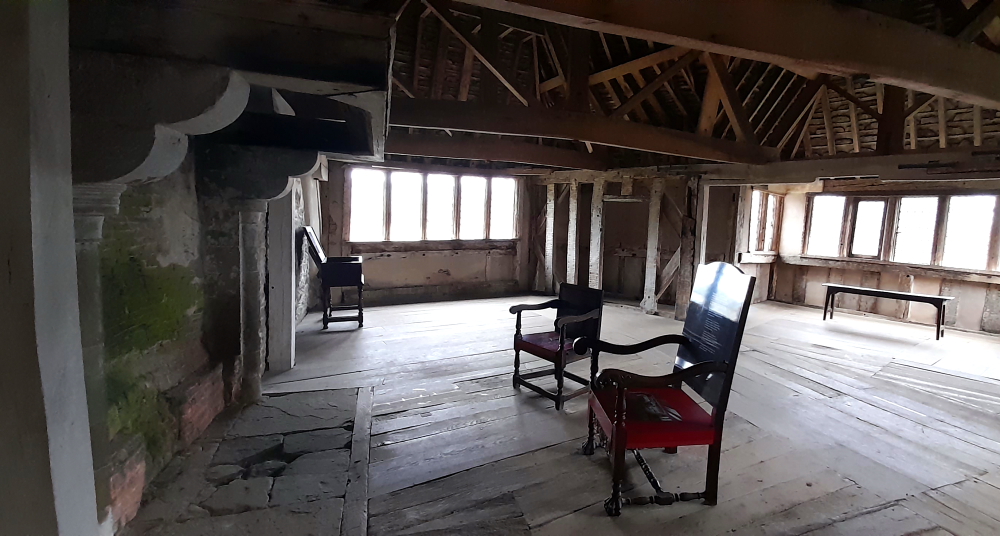
Spacious room with wooden-beamed ceiling.

By contrast, the room in the Solar Block as decorated by the Baldwyn family some 400 years later in the 17th century is highly decorated with wood panelling, a plaster ceiling and an outstanding Jacobean fireplace overmantel which would have been painted in vivid colours at the time.
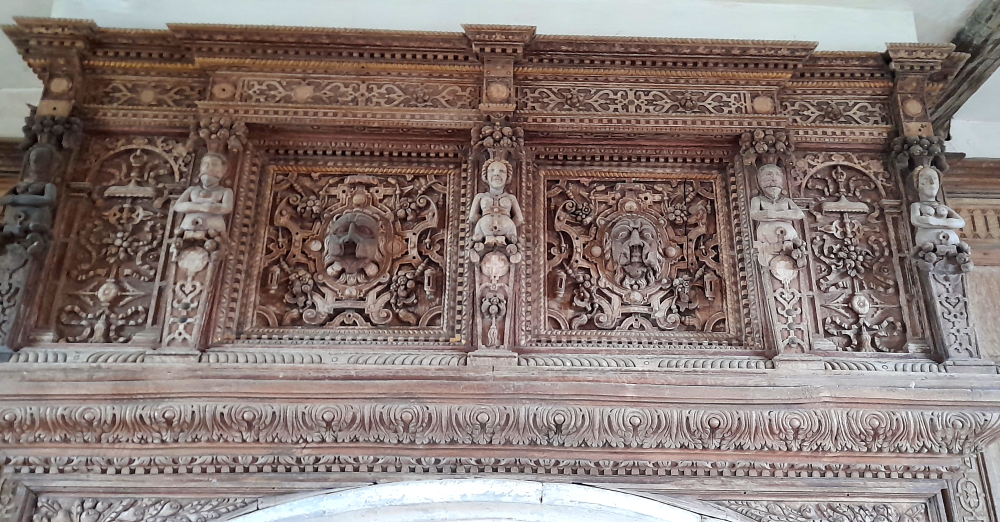
Jacobean fireplace overmantel.

At the top of the North Tower are the parapets …
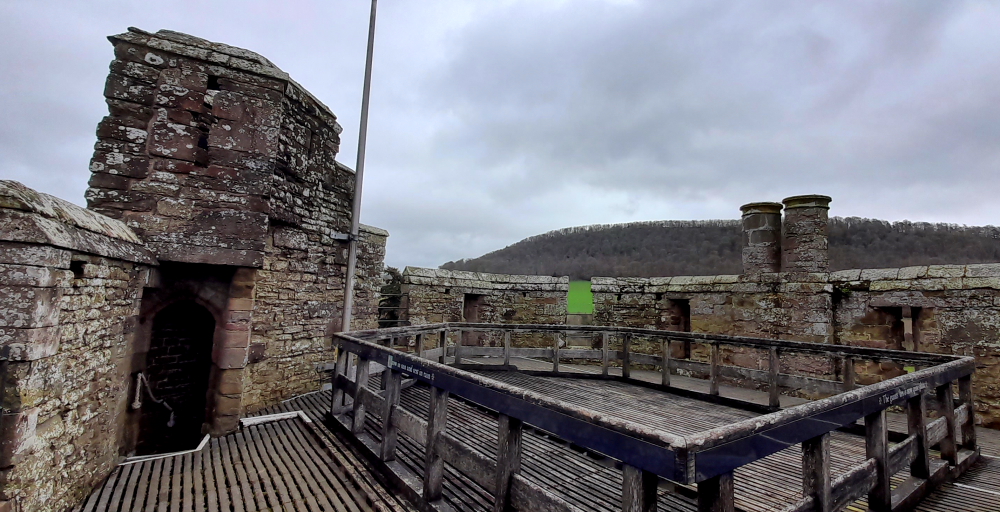
North Tower parapets.

… with commanding views of the surrounding Shropshire countryside …
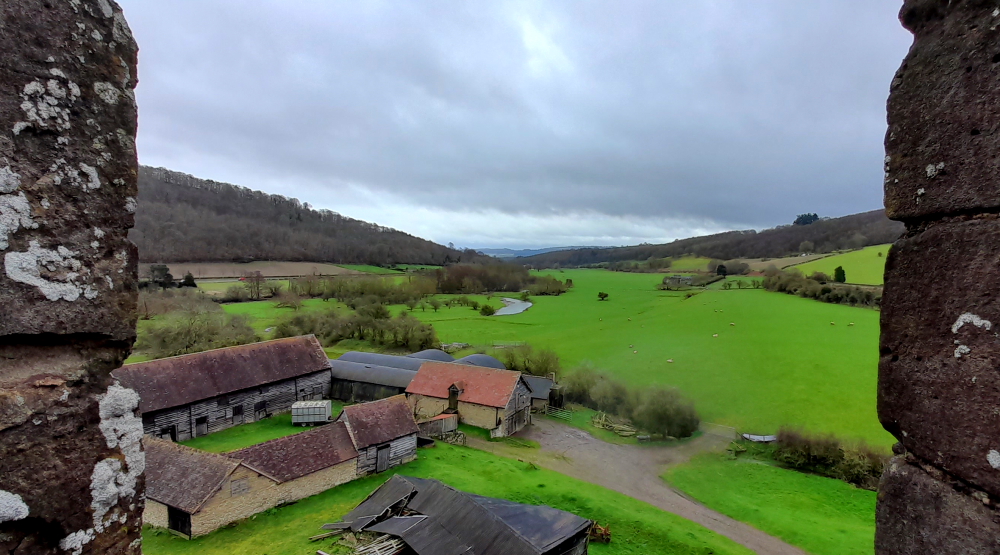
View from parapets towards Ludlow.

… and a bird’s eye view of the castle’s buildings.
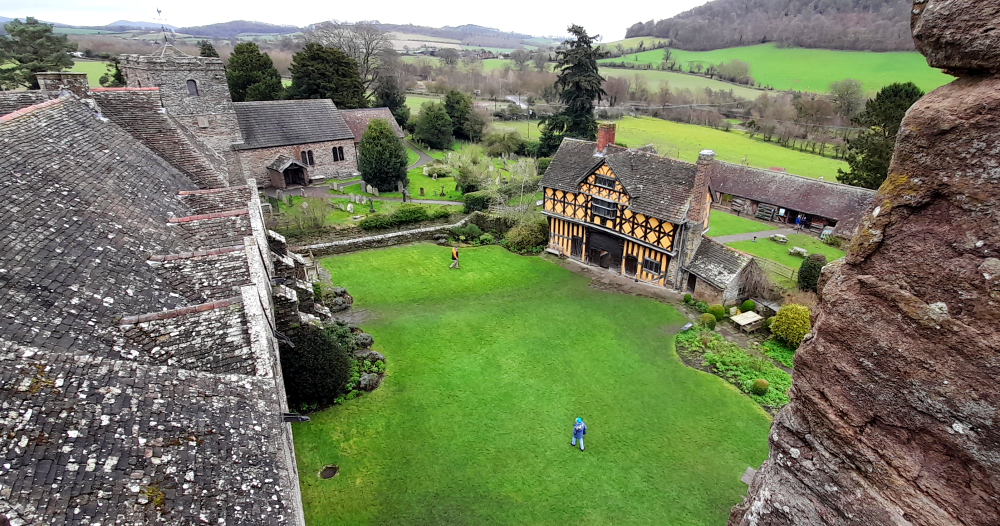
View of castle buildings from the parpets.

The castle became a popular location for tourists and artists, and was formally opened to paying visitors in 1908.
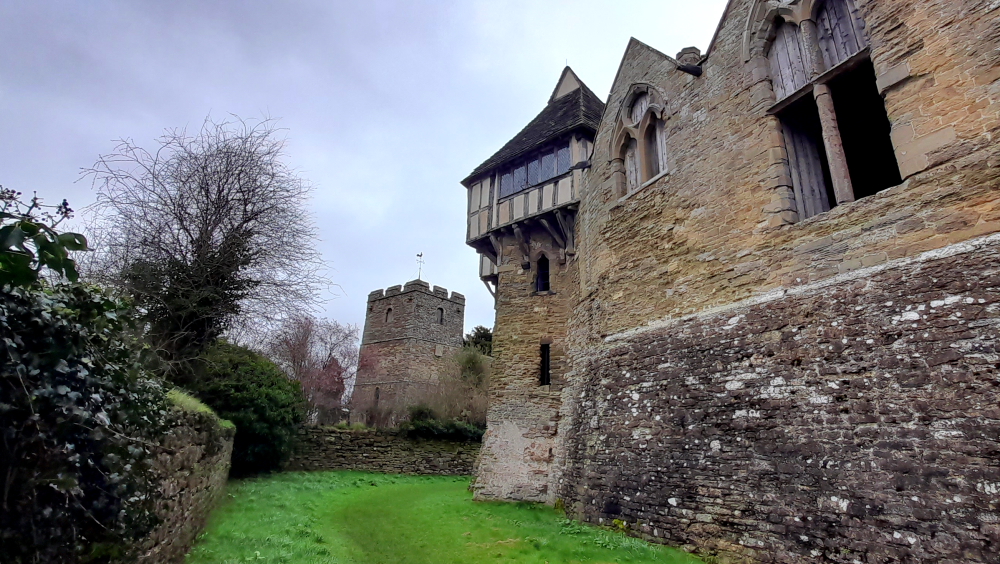
Church & North Tower from the moat.

Allcroft’s descendants fell into financial difficulties during the early 20th century, and had difficulty covering the costs of maintaining Stokesay. In 1986 Jewell Magnus-Allcroft finally agreed to place Stokesay Castle into the guardianship of English Heritage, and the castle was left to the organisation on her death in 1992. English Heritage carried out extensive restoration of the castle in the late 1980s. In the 21st century, Stokesay Castle continues to be operated as a tourist attraction.
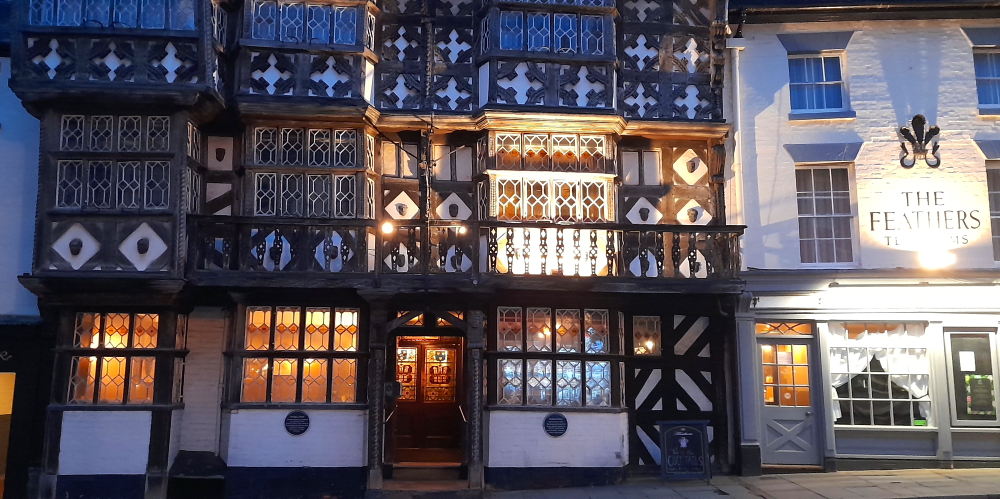
The Feathers’ illumination.

Returning from dining at The George Inn on Castle Street this evening, as the town descended into twilight, its buildings became illuminated, some of them showing off their colourful stained glass..

14 March, 2024

According to the weather forecast there is a brief window of ‘no rain’ between 11:00 am and 1:00 pm today so we venture out to see Ludlow Castle, the River Teme and Whitcliffe Common.
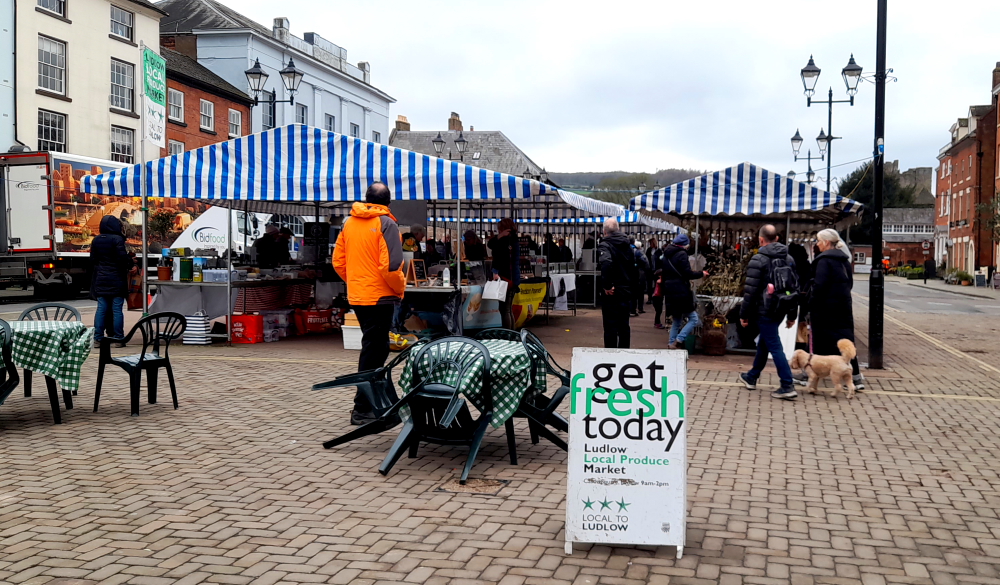
Market stalls in Market Square.

Previously we had arrived at the Market Square too late in the day to see the markets, but not today. Lots of local produce on sale.
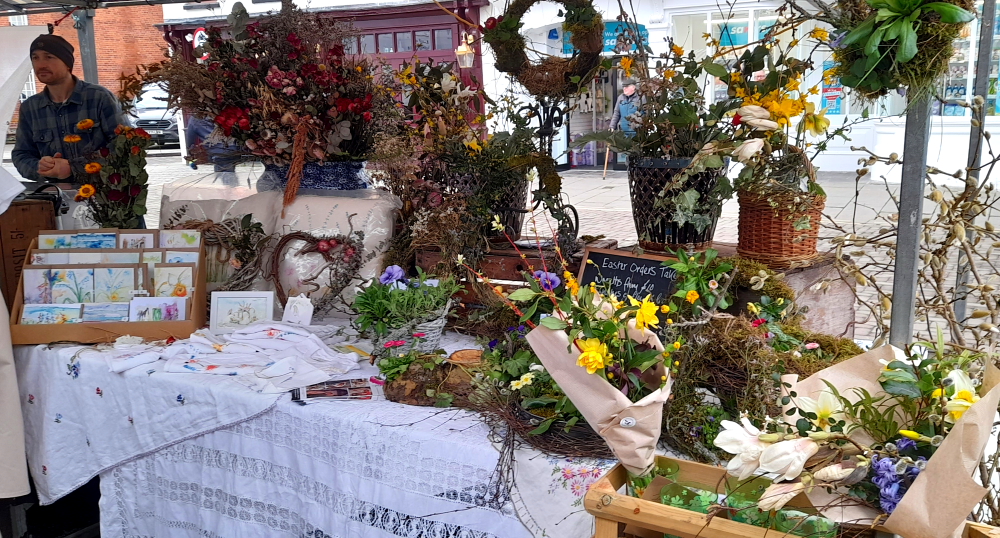
Floral stall at the market.

At the top end of Market Square is Ludlow Castle. Walter de Lacy, a trusted member of the household of William fitzOsbern, arrived in England with the conquering army of William the Conqueror in 1066.

FitzOsbern was rewarded for his loyal part in William’s victory with an Earldom over the lands of Hereford and planned to keep his new acquisition secure by developing a string of castles along the border of England and Wales.

Walter de Lacy was granted the manor of Stanton, which contained the site of present day Ludlow. Walter’s sons, Roger and Hugh, built the earliest surviving parts of the Castle that can still be seen today, and the de Lacy family retained the lordship until the end of the 13th century.
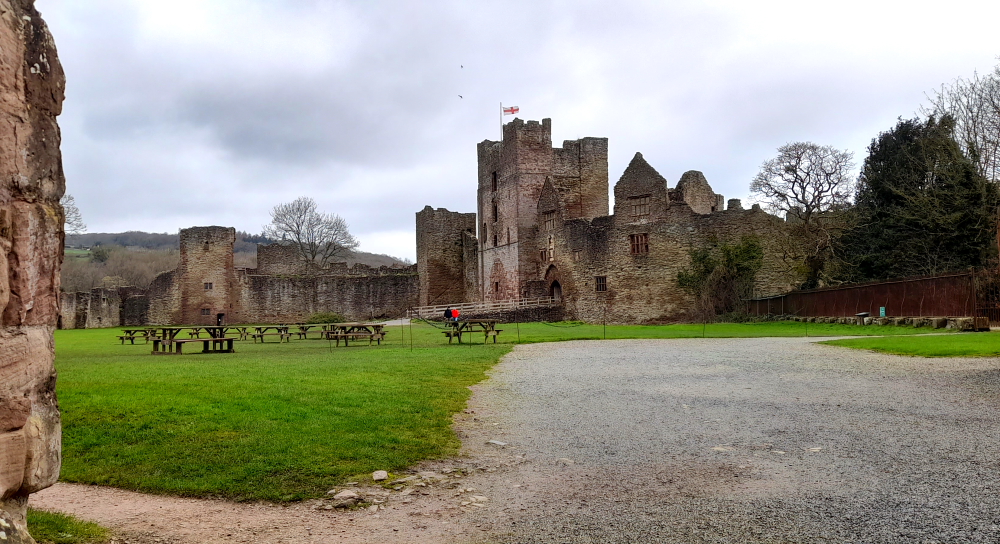
View of the Castle from the Outer Gatehouse on Castle Square.

1473-1483 Ludlow Castle was the home of Prince Edward (known as one of the ’Princes in the Tower’). He was in residence here when he learned of the death of his father, Edward IV, and assumed the title of King Edward V.

Prince Arthur (eldest son of Henry VII) spent a few months at Ludlow with his wife Catherine of Aragon before his death here on 2 April 1502. Catherine went on to marry Arthur’s brother, who became Henry VIII and their daughter, Mary, spent three winters at the castle between 1525 and 1528.

Throughout the 16th and 17th centuries, Ludlow Castle was held by the Crown, except for a brief time during the Civil War and the Commonwealth.
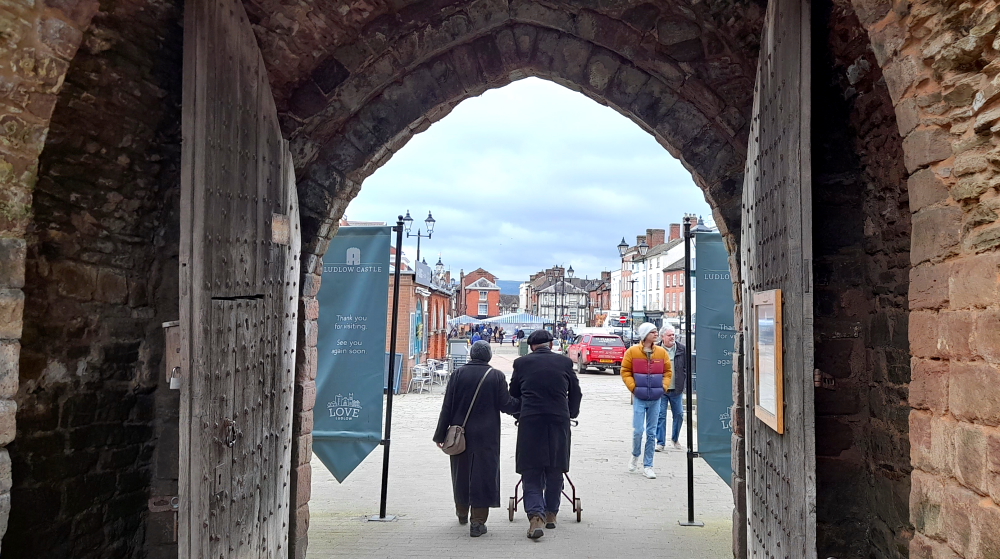
View through the Outer Gatehouse down Market Square.

The castle held great status as the centre of administration for the shires of the Marches and for Wales. The Council of the Marches was set up by Edward IV when he sent his son Edward, Prince of Wales, to live at Ludlow in 1473. It became responsible for the government of Wales and the border counties. For over a century Ludlow was seen as the capital of Wales and its courts were kept busy hearing criminal, civil and ecclesiastical cases. The result was a surge in construction at the castle to house the judges. Although primarily an administration hub, the castle had many features of an Elizabethan stately home. The Council was dissolved in 1641 but was revived with fewer powers from 1660 until its abolition in 1689.

Further along the Castle wall we walk through an entrance to the Castle Walk, between an outer and inner wall that leads us to the riverside. Here there is an old sluice gate that used to regulate flows into the River Teme.
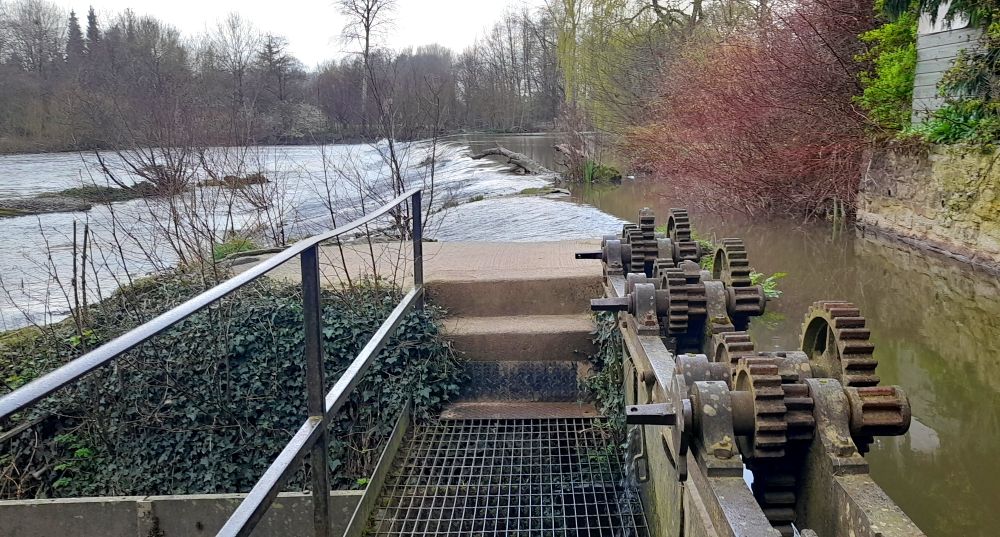
Old sluice gate on the River Teme.

Taking the riverside path we walk under the stone Dinham Bridge, the work of Shrewsbury mason and contractor, John Straphen, who completed it in 1823.
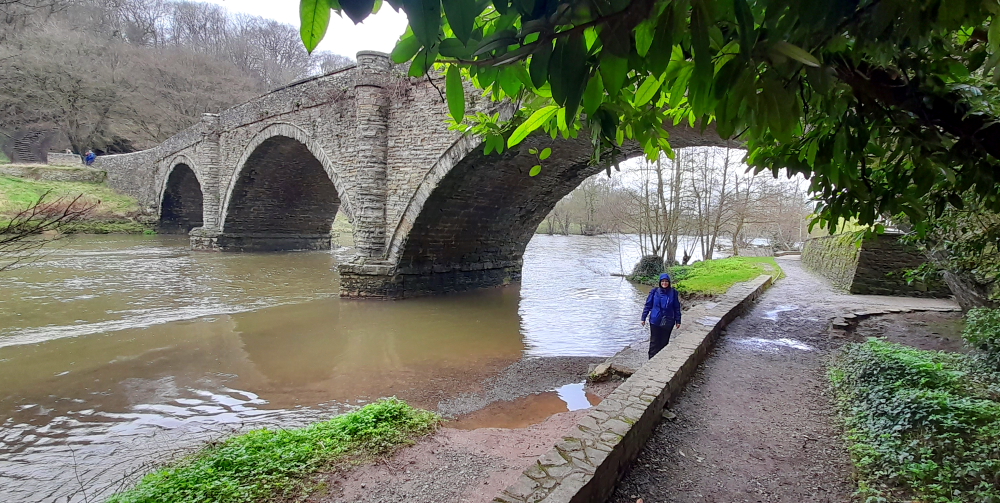
Dinham Bridge over the River Teme.

In 1646 the town was besieged by a Parliamentary force and the castle was surrendered after negotiation. The castle was abandoned after 1689 when the Council of the Marches was dissolved and power was centralised in London. The townspeople looted the castle for useful materials and it soon became a ruin.
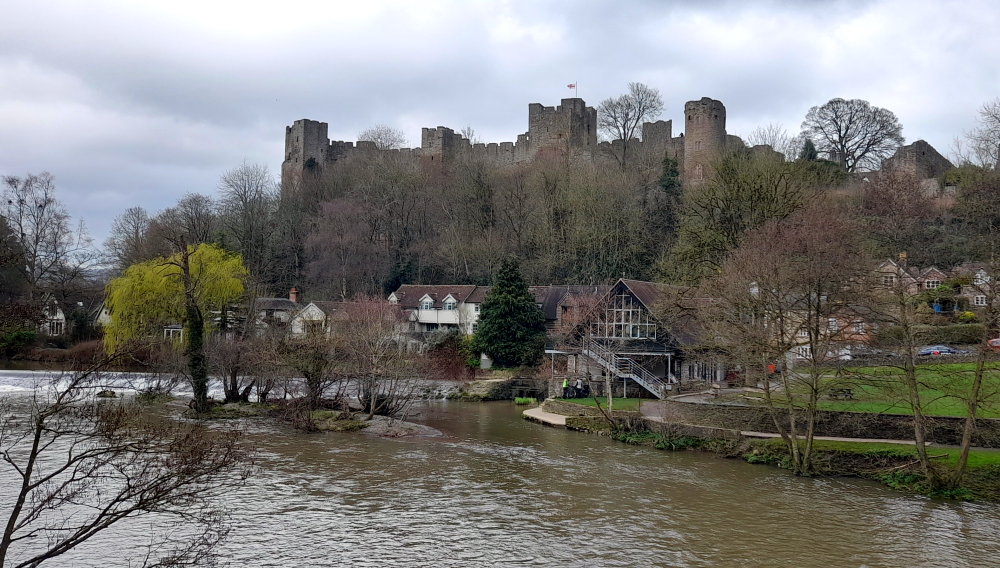
View of Ludlow Castle from Dinham Bridge.

In the 1760s the Government considered demolishing the castle, a costly exercise, so instead it was leased to the Earl of Powis in 1771. The castle began to attract visitors as part of the new tourism movement concentrating on the Picturesque style, and as part of this, walks were set out around the castle.

The Earl of Powis bought the castle in 1811 and it is now owned by the Trustees of the Powis Castle Estate on behalf of the family. [Ludlow Castle website].
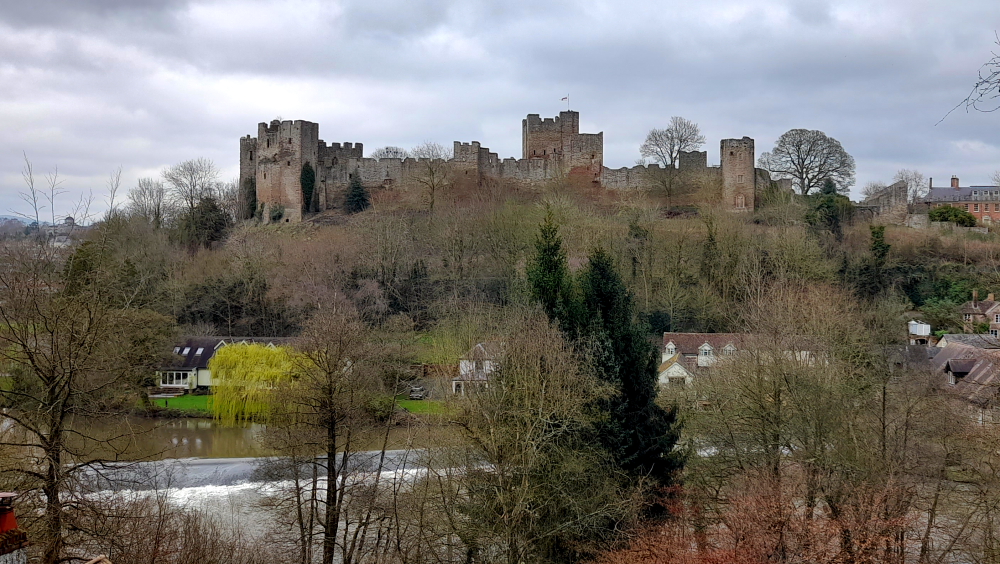
Castle view from the opposite river bank.

Walking across the bridge we arrive at Whitcliffe Common and take the stairs and path to the top of the hill.

Here there are panoramic views of the Castle, Church, town and surrounding Shropshire countryside.
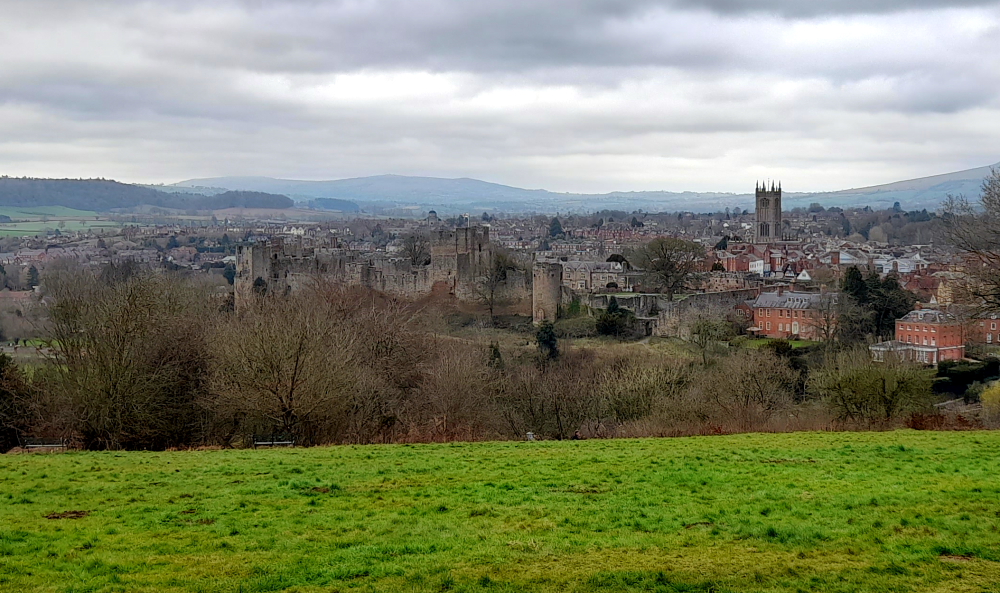
View of Ludlow town from Whitcliffe Common lookout.

Thanks to all the rain we’ve had the paths are a tad boggy.
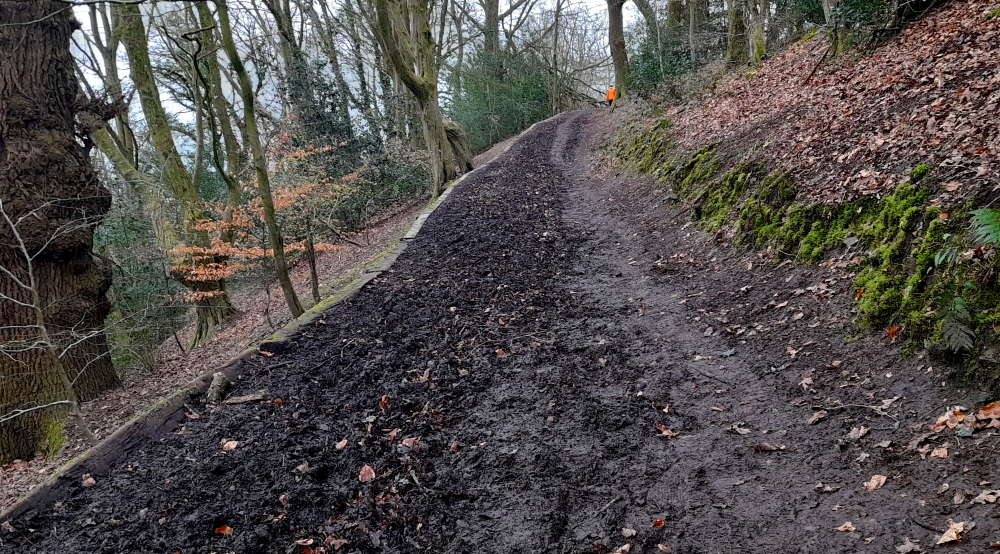
Beating a path in the mud.

After walking down the hill we join The Bread Walk (workers were paid in bread so they didn’t squander their wages on booze) that overlooks the river until it meets Ludford Corner. Turning left we walk over the town’s second, but famous, bridge, Ludford Bridge.

Known as the Battle/Rout of Ludford Bridge which occurred on 12 October 1459 during the War of the Roses. A combined Yorkist force under the command of Richard, Duke of York, the Earl of Salisbury and the Earl of Warwick was routed by the Royal army after the Yorkists’ Calais garrison switched sides making a battle for the Yorkists futile. As a consequence of the battle, York, Salisbury and Warwick fled into exile in the dead of night although their army was pardoned the following day.

With the three strongest Yorkists out of the country it appeared that King Henry VI was once again secure in his position. However, the Yorkist faction regrouped very quickly and attacked in force in 1460 and 1461. [Schoolshistory.org.uk].
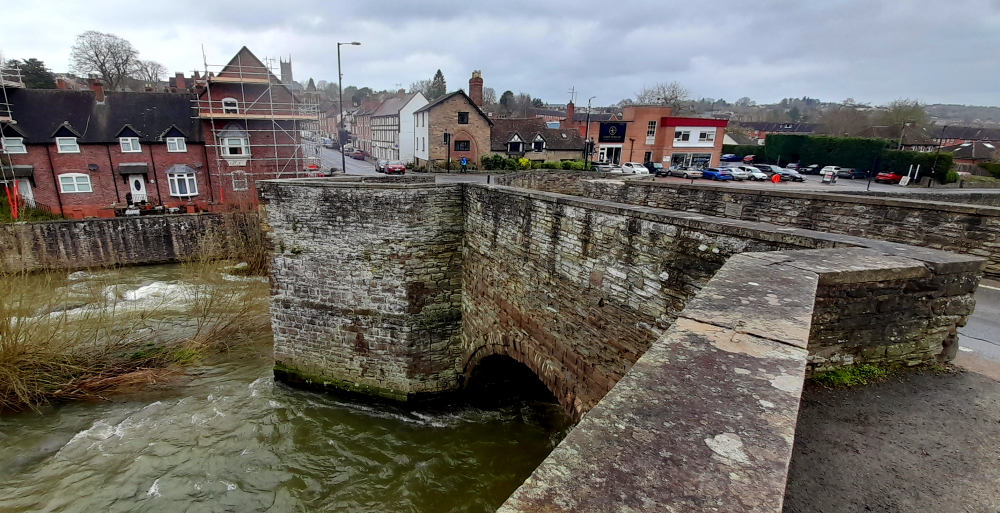
Ludford Bridge.

On the other side we are met by this rather interesting street sign at the corner of Lower Broad Street and Temeside.
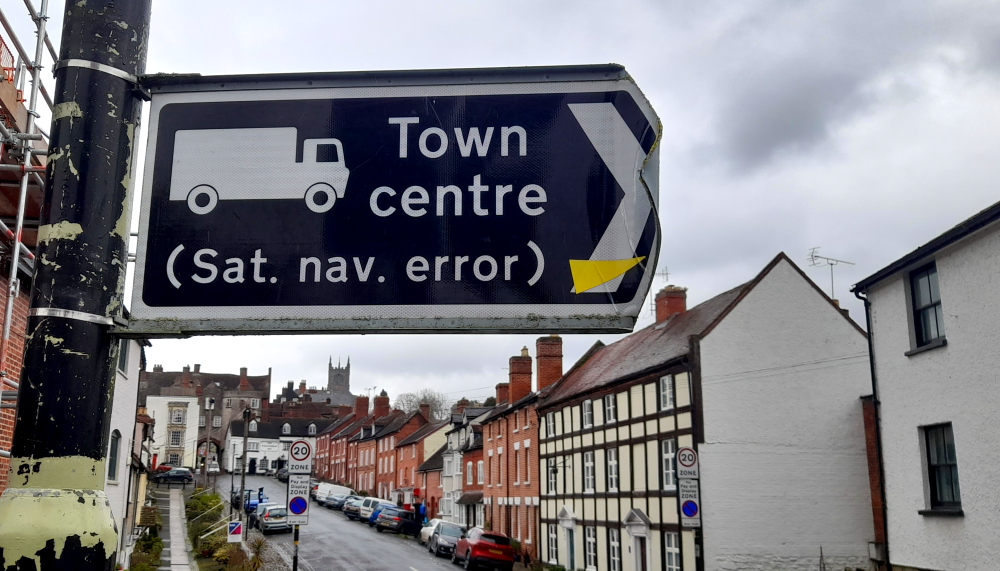
Not sure exactly what the sat. nav. error is.

We walk up Lower Broad Street to Broad Gate and the Wheatsheaf Inn which is built onto the old town wall. We’re having dinner here tonight.
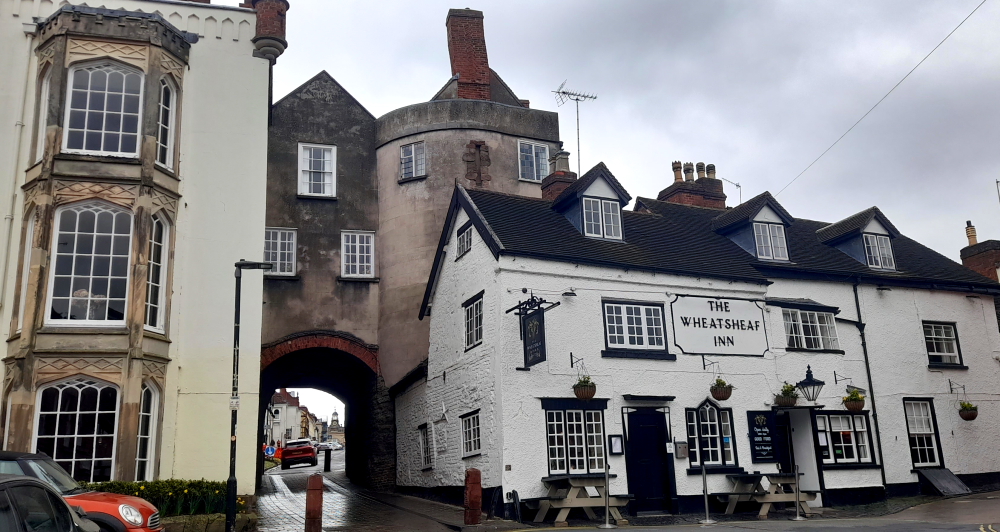
View of Broad Gate & the Wheatsheaf Inn from Lower Broad Street.

Broad Street leads uphill to the Buttercross and nearby at the corner of Market Square and Harp Lane is the Harp Lane Deli which has an amazing variety of tempting goodies. Pity Brisbane hasn’t one of these delectable shops in town!
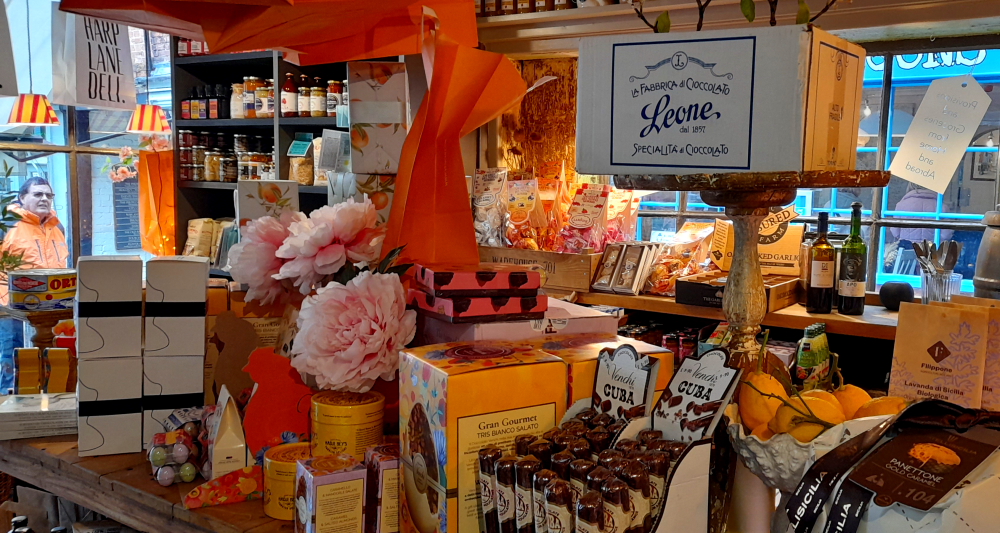
Tantalising interior of the Harp Lane Deli.

I’ve built up a thirst after all that hill walking so we stop in at the Rose and Crown, the entrance of which is through a large wooden door and courtyard off Church Street.
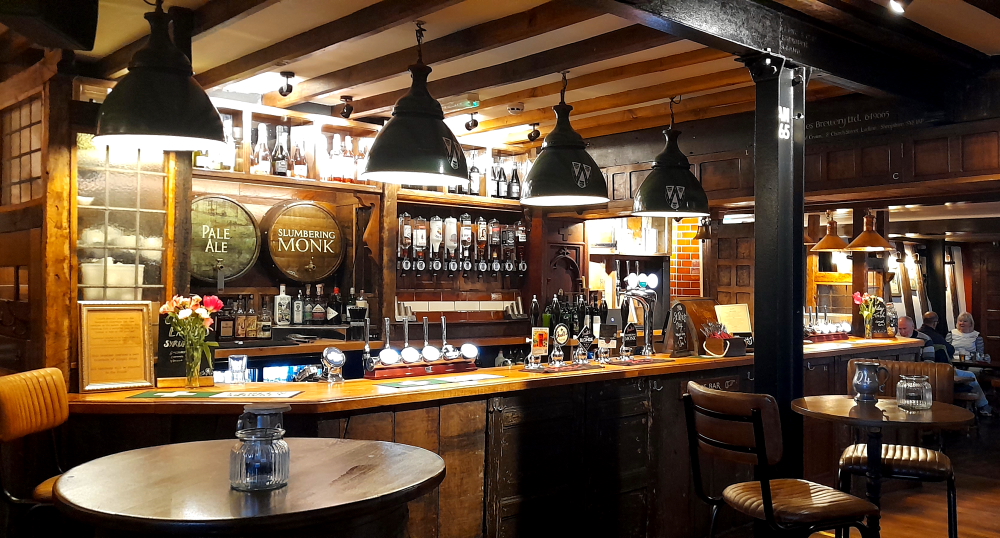
The bar at the Rose and Crown.

A large sign over the front door states that the deeds of the inn date from 1102 and recorded as the Rose and Crown since the 13th century – one of the ancient public houses in England plying its trade continually as an inn for over 600 years.

We certainly appreciate that its interior is quirky with unmatched wood paneling creating nooks and crannies, rather than the Feathers Inn which has modernised its interior.

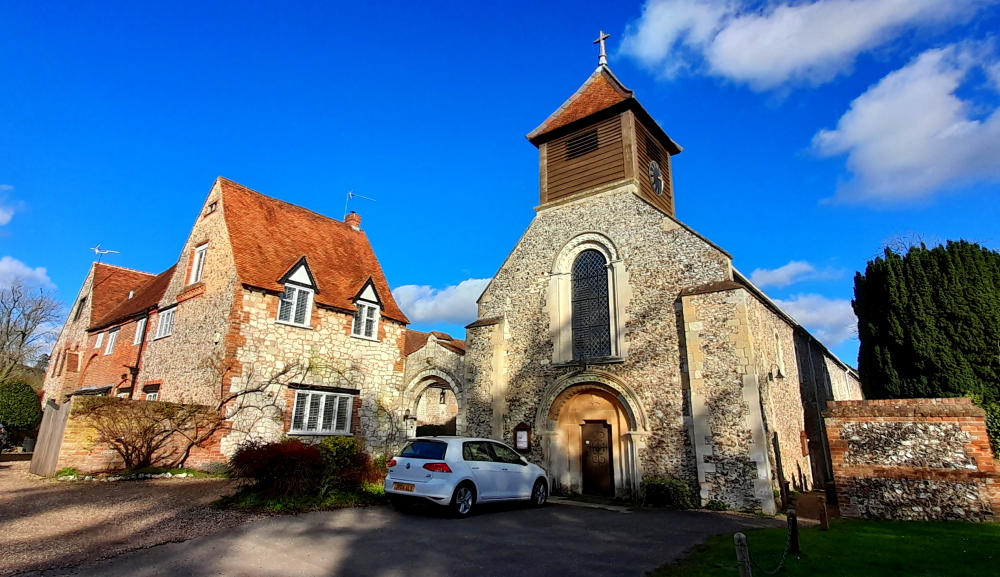
As we are in Church Street we slip through a laneway named Callens and into St Laurence’s Church. What a revelation!
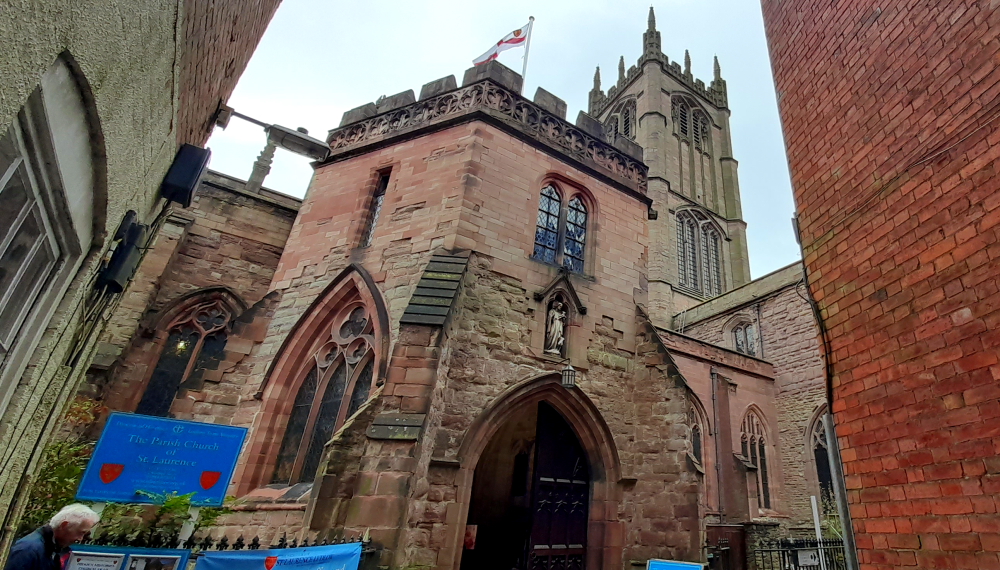
St Laurence’s Church.

Now, I’m not a church visitor, I leave that to Lynn, but I must say this church is in outstanding condition thanks to the efforts of the Palmers’ Guild and others through the centuries and The Conservation Trust for St Laurence’s Church today.

St Laurence was one of the seven deacons of Rome who assisted the Bishop of Rome (the Pope). He was placed in charge of the administration of Church goods and care for the poor. For undertaking this duty, Laurence is regarded as one of the first archivists of the Church and is the patron saint of librarians.

Due to an act of defiance whereby instead of handing over the riches of the church to the authorities, he instead presented the poor to whom he referred to as ‘the riches of the church’. This act of defiance led to his martyrdom on 10 August 258. The traditional account of his death says that he was roasted on a gridiron, which has become his symbol [stlaurences.org.uk].
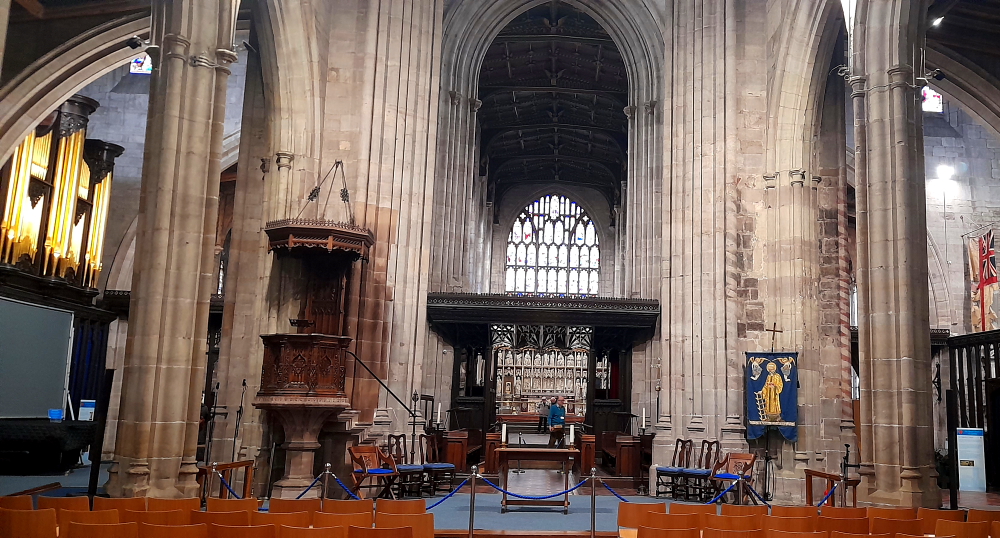
View of the Chancel.

The parish church was established as a place of worship in association with the founding of Ludlow by the Normans in the late 11th century. It is situated atop the hill around which the medieval town developed. The church was rebuilt in the year 1199 and has had several later additions and modifications.
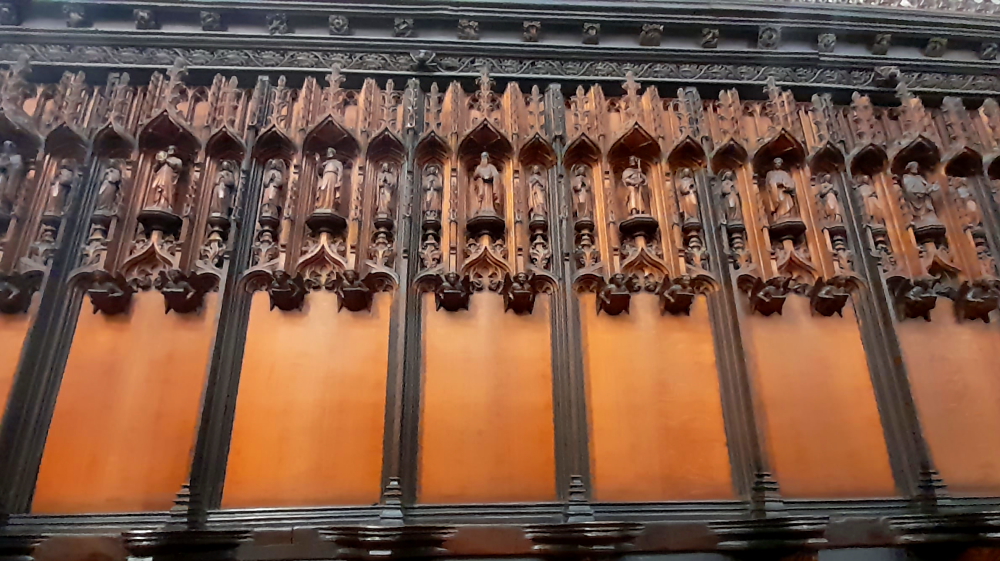
Carved wooden detail of choir stalls.

The tower is 48 metres high to the top of the pinnacles and commands expansive views of the town and surrounding countryside. Notable features include an extensive set of misericords in the choir stalls as well as fine stained glass windows.

Prince Arthur (1486-1502) was the eldest son and heir of King Henry VII. In 1492 he became Prince of Wales and spent some time at Ludlow Castle as head of the Council of the Marches.

In November 1501 Arthur made an arranged marriage with Catherine of Aragon. They came to Ludlow Castle several months later but on 2 April 1502 he died of sweating sickness.

His ‘heart’ (euphemism for bowels!) was buried at St Laurence’s. 3 weeks later, with much pageantry, a funeral service was held after which the body was taken in procession to Worcester Cathedral, 33 miles away, where a chantry chapel marks his grave.
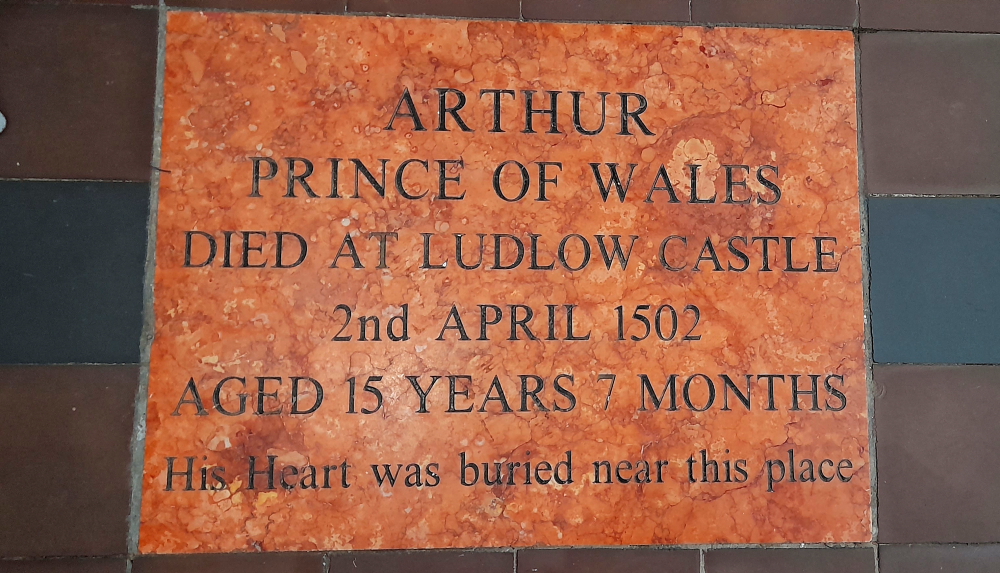
Stone placed in the Chancel.

Another feature of the church is the ornate carved altar screen and the beautifully preserved 16th century tombs of Council of Marches nobles – here Sir Robert Townshend, Knight Chief Justice of the Council of Wales and Chester and Dame Alice, his wife (1555).
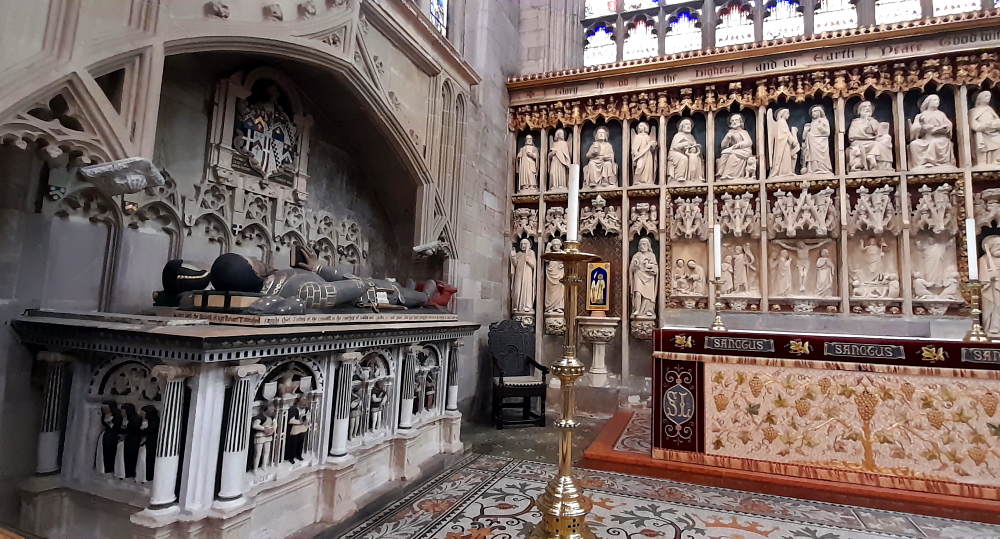
Sir Robert Townshend & Dame Alice tomb adjacent to ornate altar screen.

Elsewhere Edmund Walter, also a Chief Justice (1592) and an ornate wall-mounted monument with 3 coats of arms to “the Right Honorable Syr Henrye Sydney, Knight of the most Noble Order of the Garter, Lorde President of the Councell of Wales and the Ladye Marye daughter of ye famous Duke of Northumberland who died in Ludlow Castle” (1574).
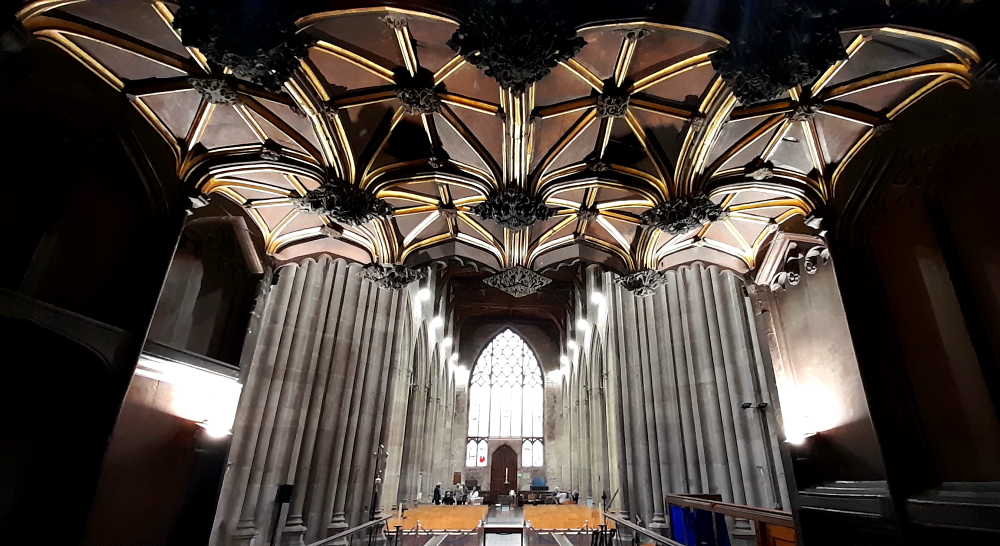
View from the Choir towards the West window.

The stone tracery of the West window dates from the remodelling of the church in the second quarter of the 15th century, but the glass is 19th century. The artist was Thomas Willement, the ‘Father of Victorian Stained Glass’. The figures in the 11 main panels are connected with Ludlow’s history, 7 of whom were Lords of Ludlow.
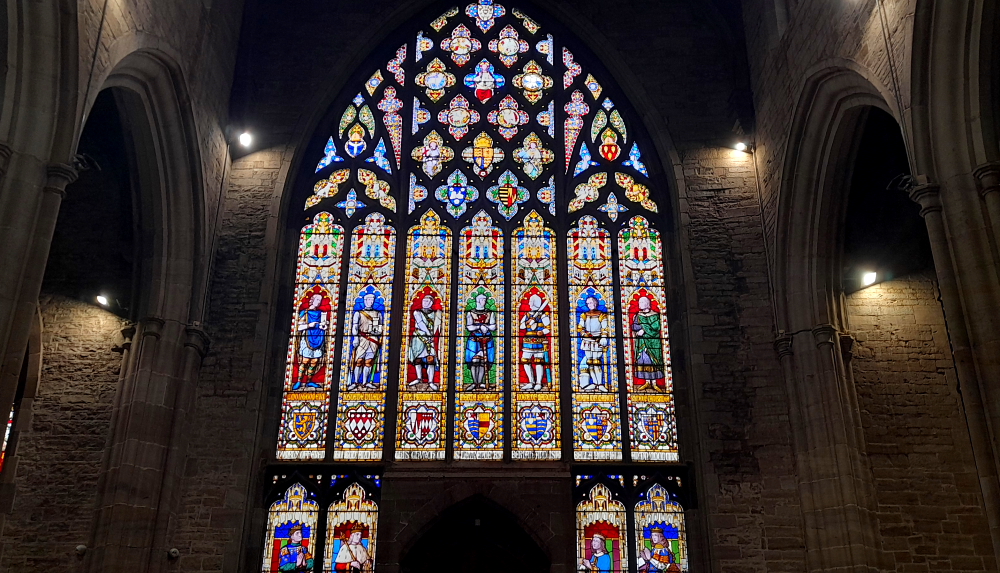
West window.

The other remarkable feature of the church are the 3 modern additions that do not detract from the sacred space within this edifice: the Icon Coffee Shop, the Gift Shop and an informal seating area with leather settees, not to mention the church is a venue for recitals and concerts – a church dedicated to serving its community.

15 March, 2024

After breakfast while I’m sorting the photos for the blog, Lynn decides to venture into town once more to discover parts we have missed. In particular, Mill Street which runs between the Ludlow Assembly Rooms and the Castle Lodge Buttery. Here resides the Guild Hall, a 15th century timber structure remodelled in red brick in 1768, which housed the Ludlow Magistrates’ Court. In 2012 Ludlow Town Council took up residence and the chamber now used for council meetings.
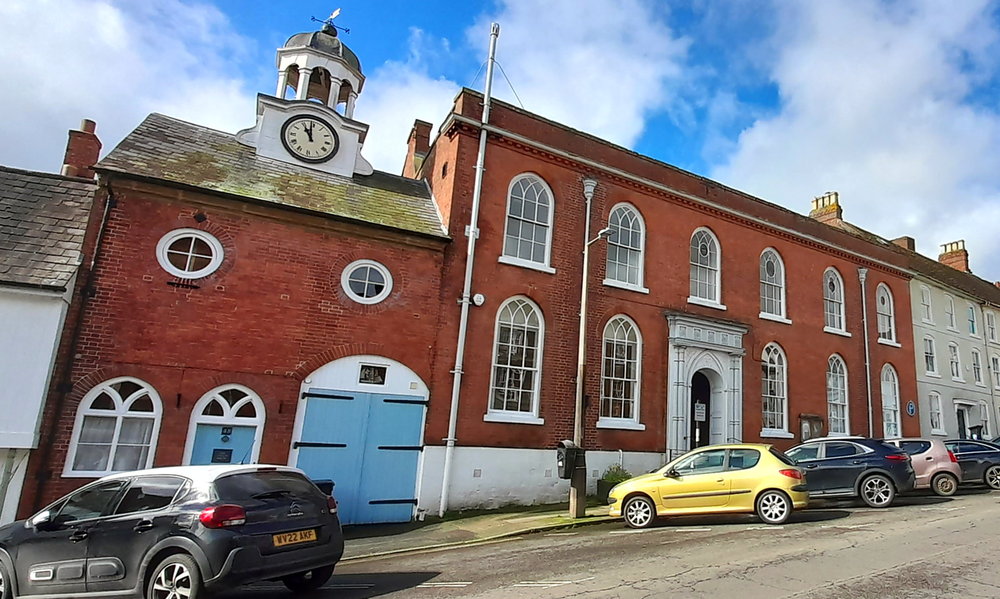
Guildhall & adjacent Coach House.

Built around 1410 by the influential religious guild of Palmers (pilgrims to the Holy Land) who supported St Laurence’s Church and sold in 1552 to the town for civil use, is notable for being the only known aisled hall in Ludlow. Despite extensive 18th century refurbishments, the hall retains its original 15th century roof.

Mill Street ends at the old town walls and the site of what was Mill Gate.

Turning right onto Camp Lane follows the town wall which joins the street named Dinham. On this street is Dinham House, an 18th century town house used by the Knights of Downton, the Johnes of Croft Castle and the Earls of Powis.
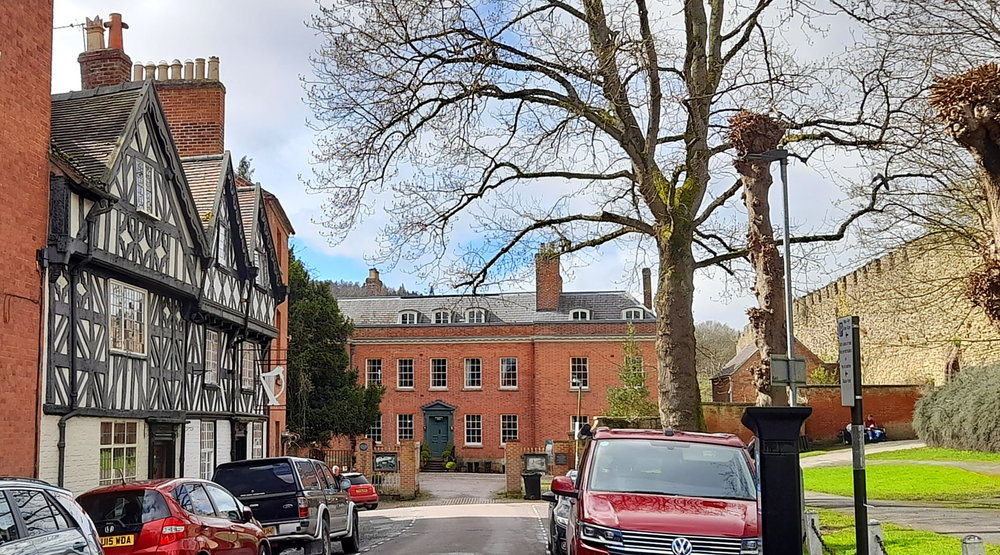
Dinham House (centre).

Apparently Lucien Bonaparte, brother of, was a prisoner here in 1811.

Further up the road is Dinham Hall, built in 1792 by Samuel Nash, agent of Richard Payne Knight of Downton Castle – and currently for sale! At No. 2 Dinham – the half-timbered house on the left in above photo – a blue plaque states: “‘Newly built’ in 1656 after burning in the Civil War.”

The Fish Feast at The Corner House restaurant on the Bull Ring is the venue for dinner tonight. I order a sea bream which is just delicious and perfectly cooked – not a sentiment I usually make about English cuisine!

16 March, 2024

After checking out at 10:15 am we drive directly to Lower Slaughter for a 4-night stay at The Slaughters Country Inn which takes about 1.5 hours to cover the 108km. The Slaughters (Upper and Lower) are between Stow-on-the-Wold to the north and Bourton-on-the-Water to the south in the Cotswolds.

The name ‘slaughter’ makes it sound like the villages have a dark history. But it’s a mispronunciation of the Old English word ‘slothre’ which means muddy or miry place, and came about due to the River Eye which flows through both villages.
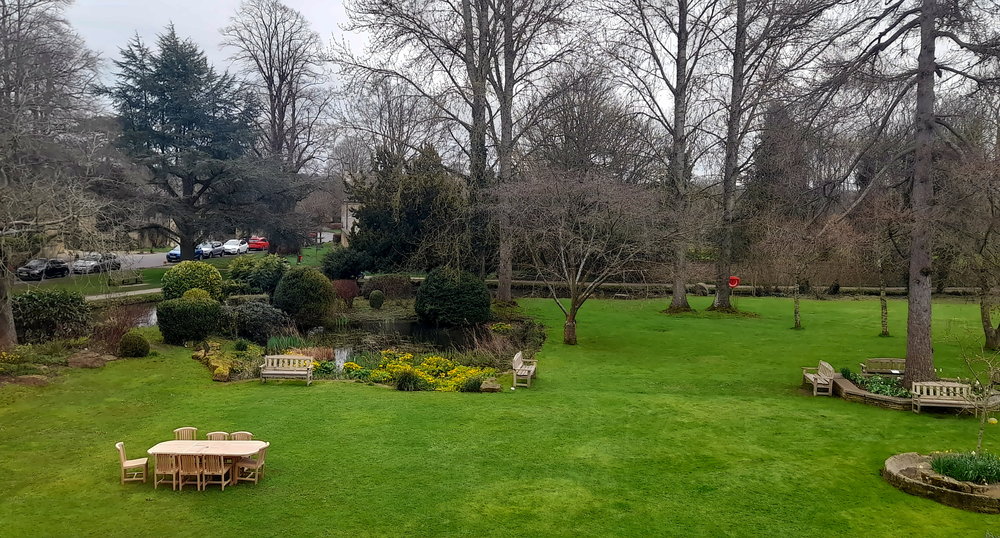
The view of the hotel grounds from our room.

We arrive at 12:45 pm but check-in isn’t until 3. Fortunately our room becomes available around 1:30 pm so after a quick unpack we pull up the chairs and settle in to watch the final 3 matches of the 6 Nations Rugby tournament that start at 2:15 pm. In particular, the exciting Ireland v Scotland game which Ireland finally wins 17-13 and retains its Championship crown for another 2 years.

17 March, 2024

It’s such a nice, sunny morning that after breakfast we wander around the village of Lower Slaughter.
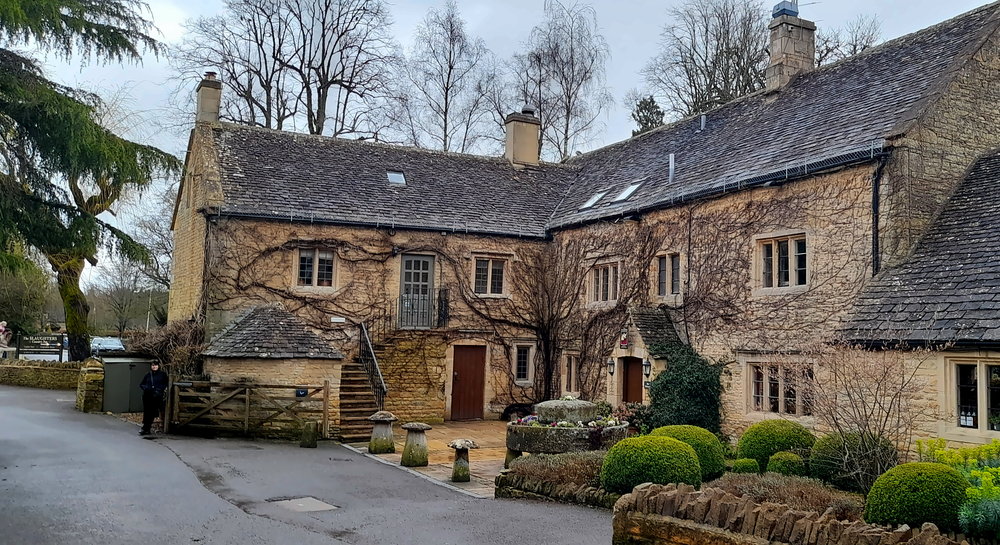
Entrance to The Slaughters Country Inn.

Through the village and in front of the Inn runs the River Eye, its waters quite shallow and crystal clear.
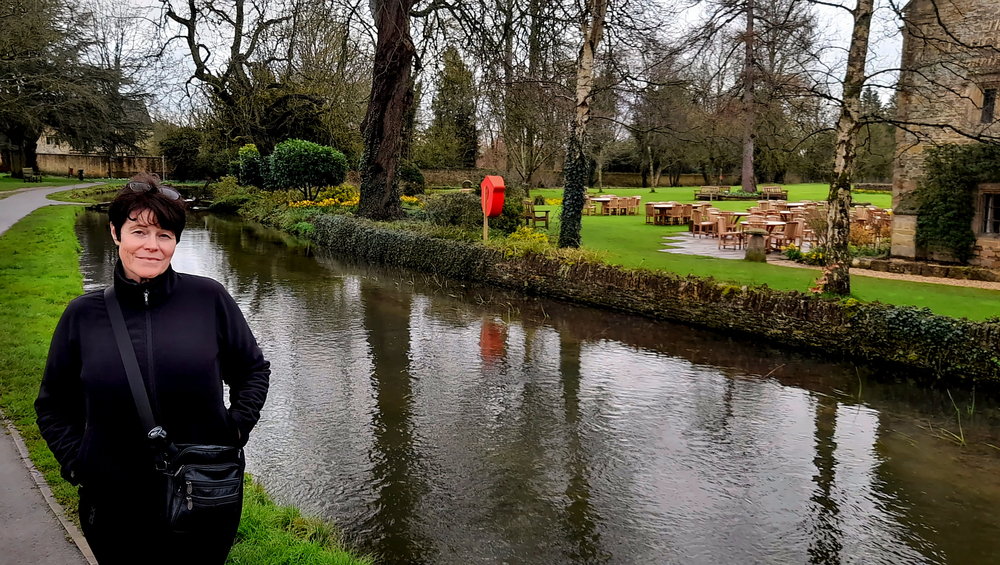
River Eye in front of the Inn.

Across the road from the Inn is the Lower Slaughters Manor, now an hotel. It is known that a manor house stood on the site before the Conquest, even as early as 1004 A.D. In 1443, the Manor became a convent housing nuns from the order of Syon, the order being granted the land during this period. The Manor was returned to the crown in 1603 and in 1611 was granted to Sir George Whitmore, High Sheriff of Gloucestershire. It remained in his family until 1964 when it became a hotel. The property was purchased by Andrew Brownsword Hotels, who also own The Slaughters Country Inn, in 2011 and renamed The Slaughters Manor House [slaughtersmanor.co.uk].
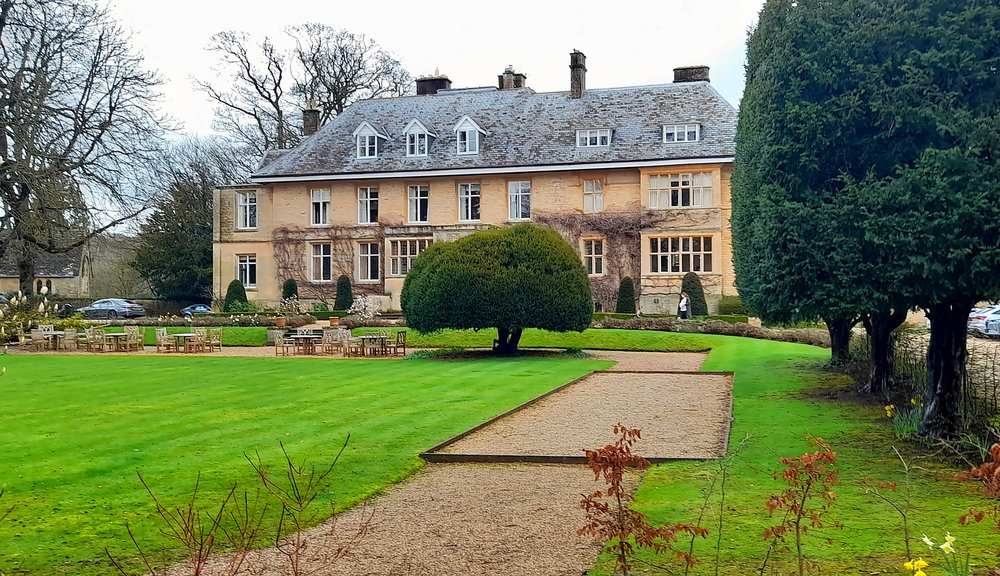
The Slaughters Manor House.

Next door to the Manor House is St Mary’s Church which was built in the Norman and then the Decorated style. It was rebuilt in the Victorian era in the Decorated Gothic style.
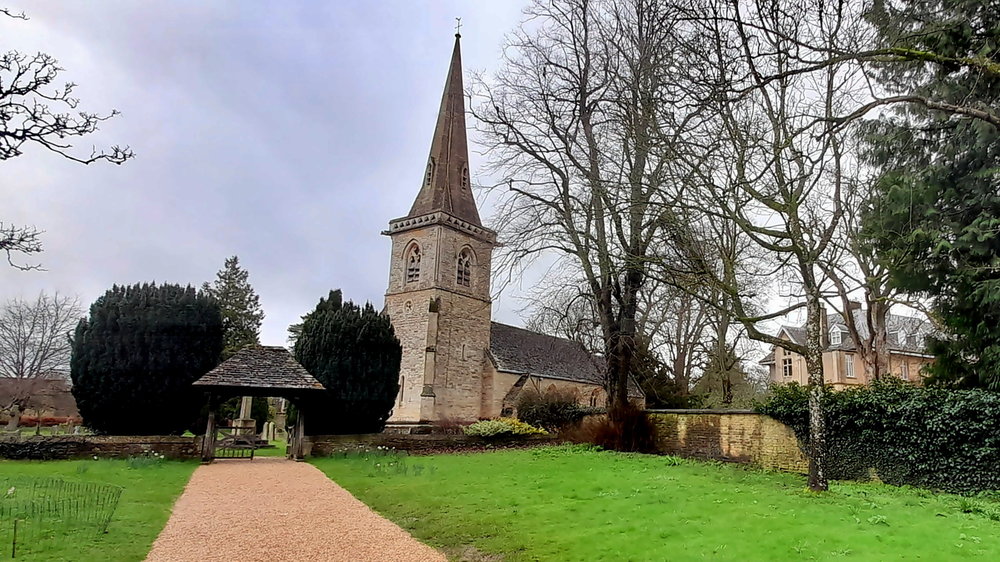
St Mary’s Church.

Like the village, the church is in immaculate condition and features interior arches.
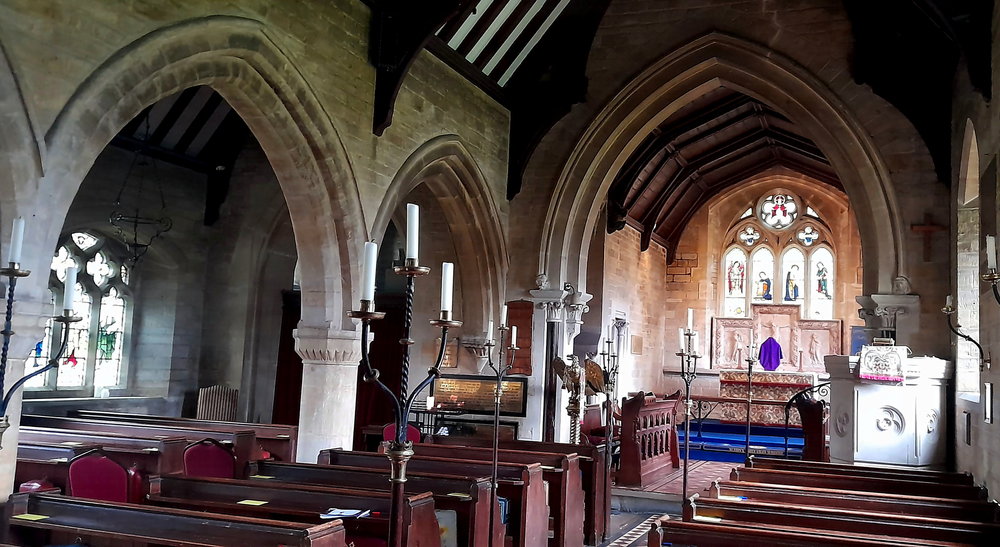
Interior of St Mary’s Church, Lower Slaughter.

Walking along the river path in the direction of Upper Slaughter we come to The Old Mill on the edge of the river.
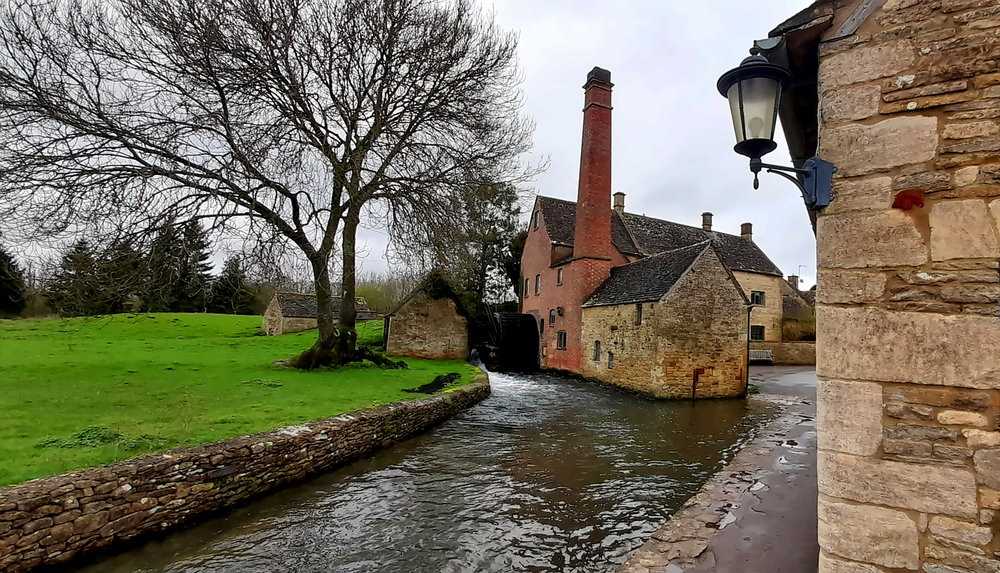
The Old Mill with intact wooden water wheel.

In April last year it was announced that the mill, a popular Cotswolds’ attraction and which also housed a museum, gift and craft shop and cafe was to close 2 months later after 35 years. Many have stopped to take photographs of the water wheel at the mill, which was built in the 19th century and was last used commercially in 1958. The site is one of the reasons why the village has in the past been named as the prettiest in the UK [gloucestershirelive.co.uk].
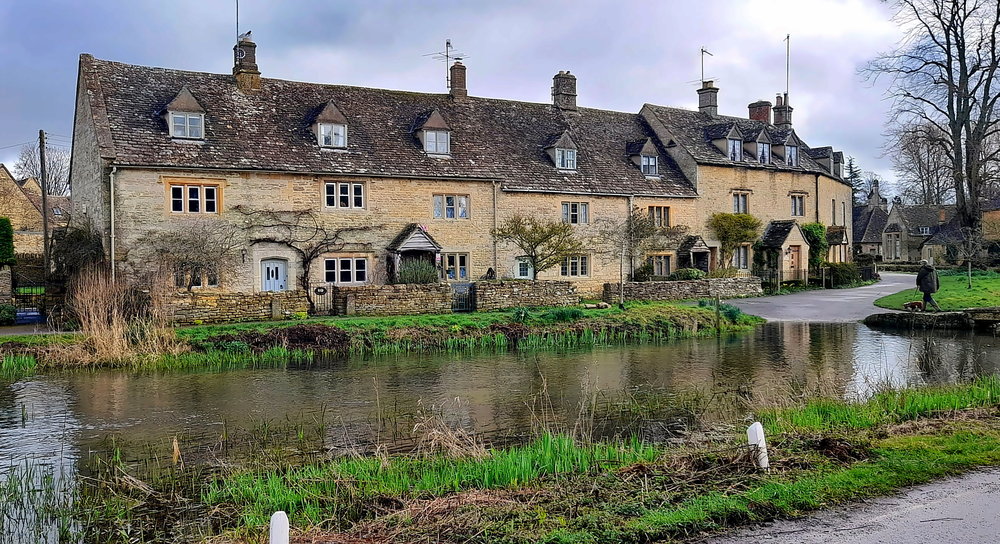
Row of honey-coloured stone cottages opposite the Lower Slaughter Hall.

When we return to the Inn about 30 minutes later the sun has broken through again so we have a coffee on the terrace.
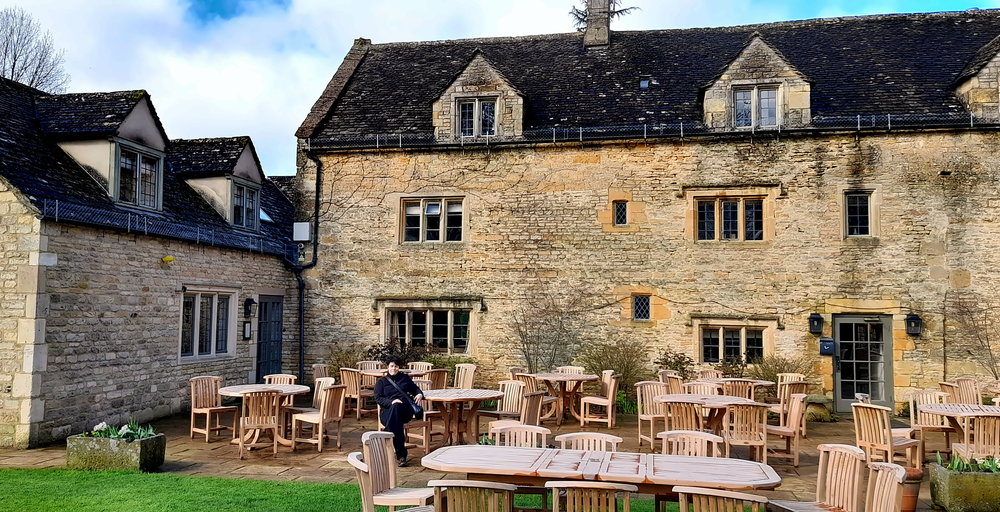
Terrace for coffee. Our room is the 2nd-floor gabled window behind Lynn.

The Inn is located on an area formerly known as Washbourne’s Place which took its name from the family who owned it in 1470. The building was originally divided into three farm-workers cottages with a stable block.
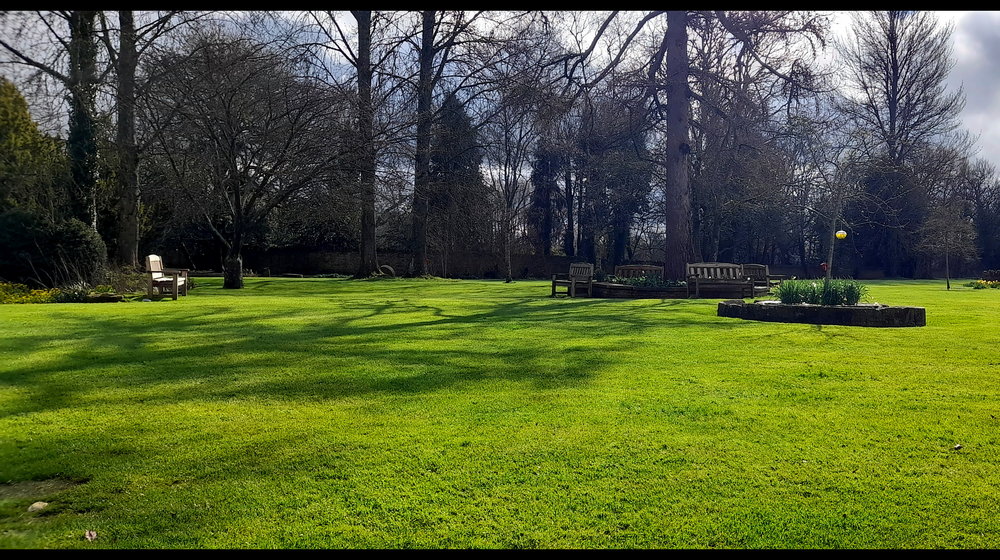
Sun-lit hotel grounds viewed from the terrace.

In the early 1920’s the cottages were converted into a large private house before it became an Eton cramming school. The boy’s assembly and dining room was located in what is now the Inn’s bar area and Westbury, one of the Superior bedrooms, used to be the location of the Headmaster’s office. The barn building was a recreation area, with the upper floor covered by a large model railway.
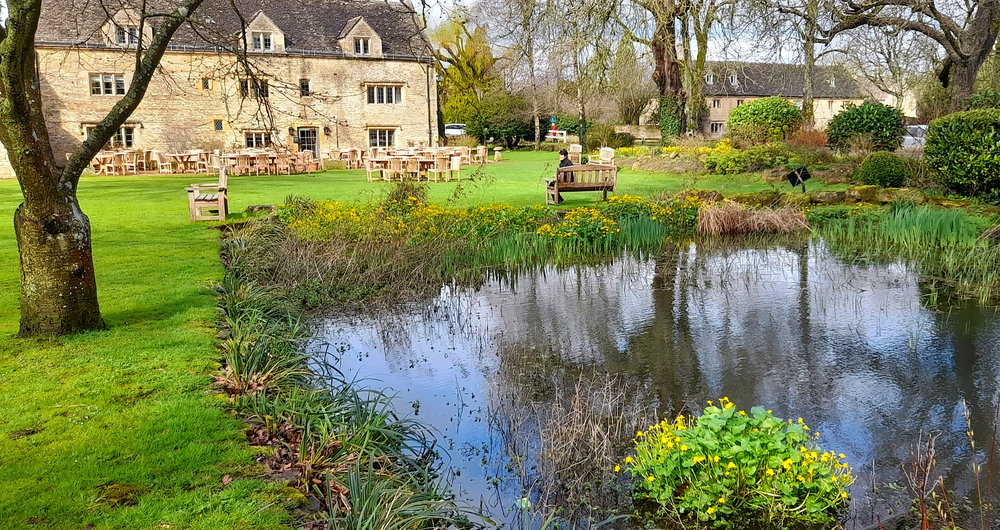
View of the terrace from the pond.

After its school days Washbourne’s Place reverted once again to private ownership and in 1988, the house opened as a hotel, known as Washbourne Court. In 2011 the Brownsword family bought the hotel and reinvented the property as a traditional country inn, renaming it The Slaughters Country Inn [theslaughtersinn.co.uk].
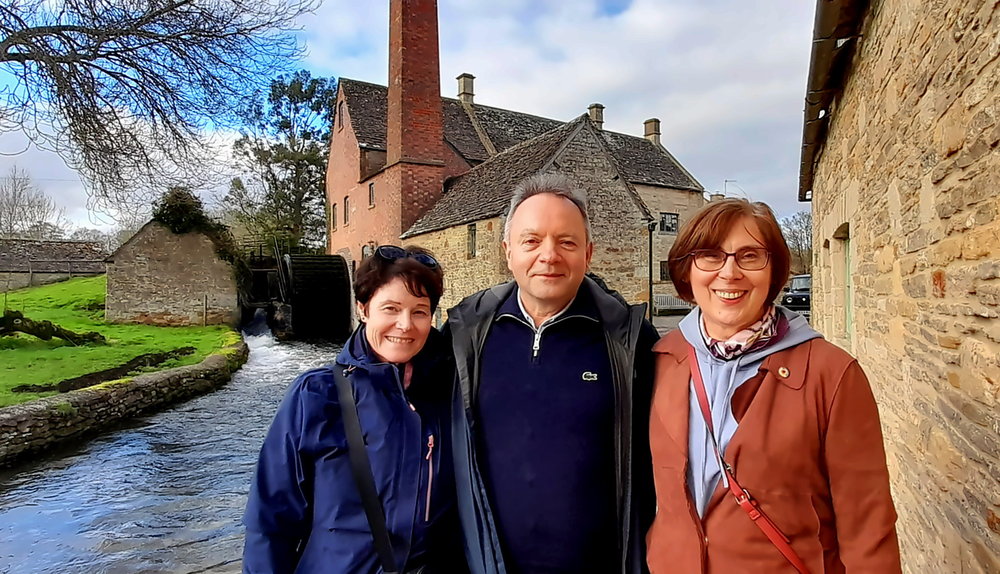
Lynn with Igor & Tania in front of The Old Mill.

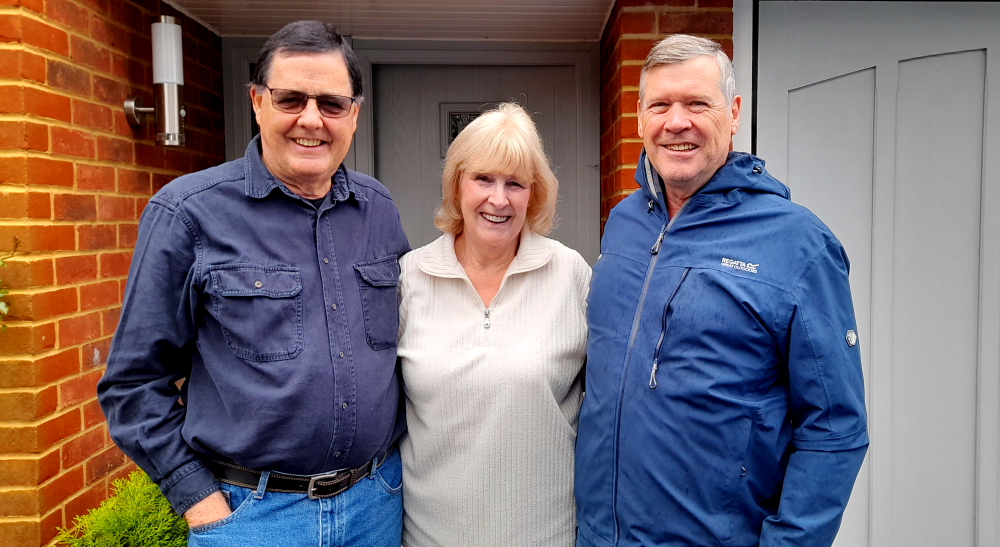
Today, Lynn has invited her friends, Tania and Igor, who have graciously driven from their home in Princes Risborough, Buckinghamshire to join us for Sunday Lunch at The Inn.
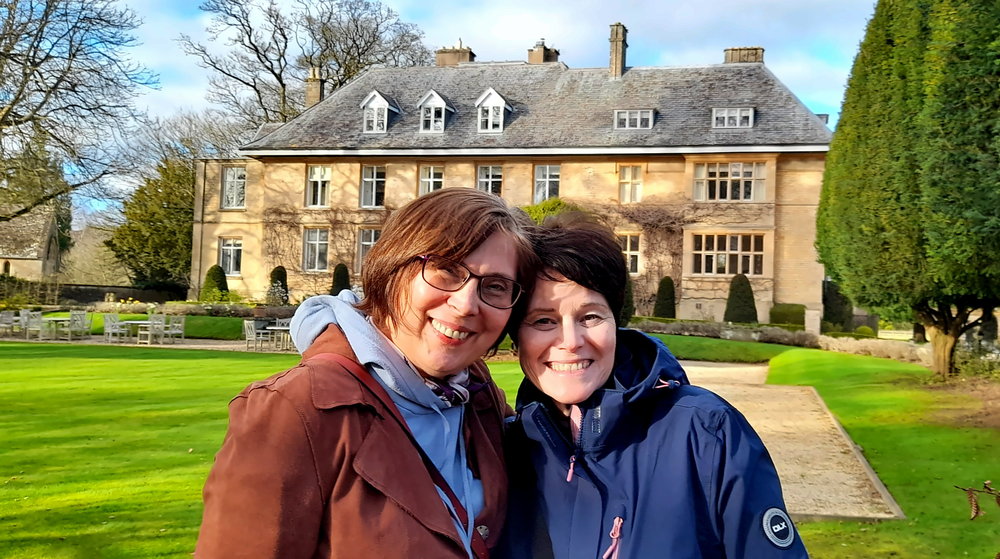
Tania & Lynn in front of the Manor House.

Lynn and Tania first met when Lynn lead a project at a Barclays office around the corner from Pall Mall, London in 1999 where Tania worked in IT and they’ve remained firm friends. They last saw each other at Lynn’s farewell bash in April 2010 and have stayed in touch since. After a delightful lunch in the restaurant catching up and coffee on the terrace where we discuss Russia – their homeland which they left years ago – the 4 of us wander around the village in warm sunshine before they depart. Perhaps we will next see them in Brisbane?

18 March, 2024

An amazing top of 15 Deg. C. is predicted today with little chance of rain so we don our boots and jackets and walk the Warden’s Way to Bourton-on-the-Water – about 30 minutes to walk the 2.4km.

Today is Monday and, as we enter town around 11:30 am in mid-March, the town is already starting to heave with visitors and cars vying for parking spots.

One of the first places we come across is the The Duke of Wellington pub on Sherborne Street. This is where I stayed for several days during winter in about 1984. In contrast to today, there was snow on the ground and very quiet with few tourists.
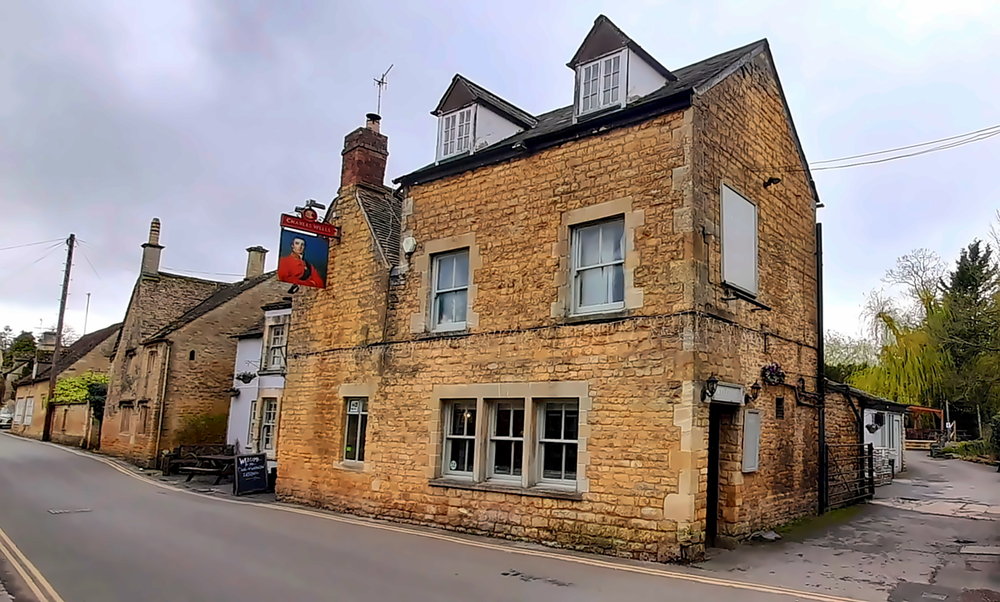
The Duke of Wellington pub.

From here we take the path along the River Windrush that bisects the town. At the Sherborne Street bridge the river runs between a bakery and the Motoring Museum – complete with a Mini made from grass.
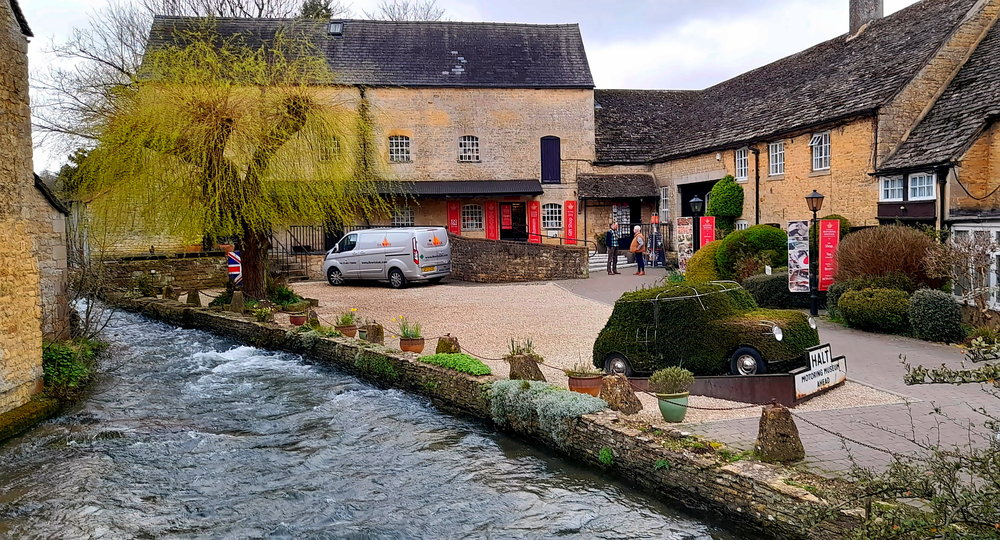
The Motoring Museum at Bourton-on-the-Water.

Walking to Bourton this morning it was evident that Spring is just around the corner – the increased volume and variety of birdsong, spring blooms and leaf buds on bare branches – such as the willow near the Sherborne Street bridge.
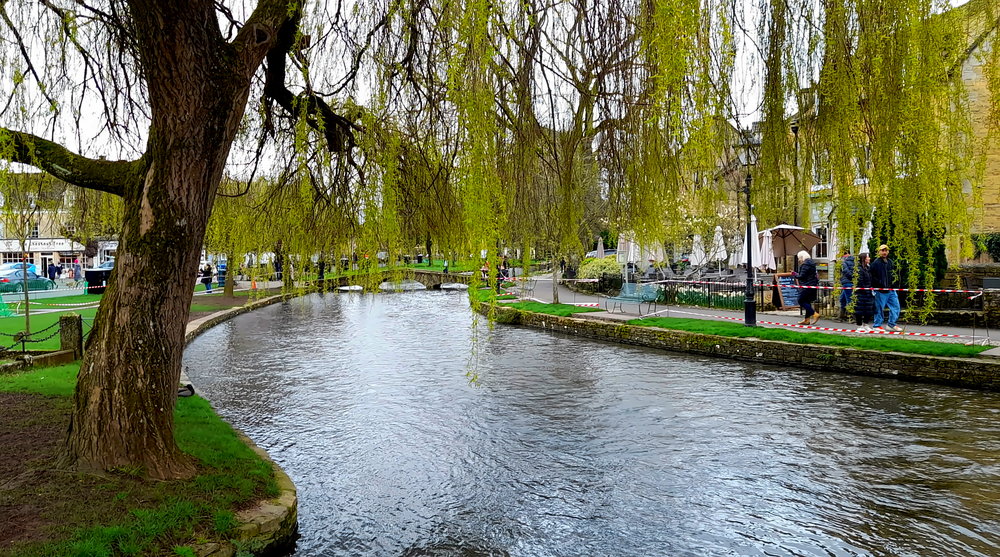
Willow with spring foliage on the River Windrush.

Unfortunately, large swathes of grass have become trampled and muddy at the river’s edge on the upper reaches, so there are incidents of red and white tape cordoning off areas – a bit of an eye sore.
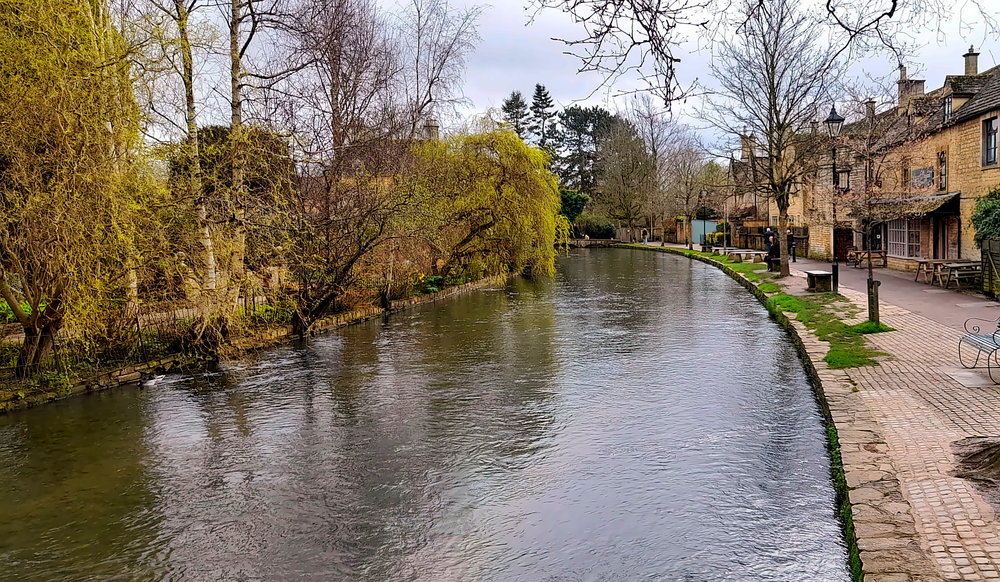
Downstream view.

But lower downstream the scenery is quite picturesque with a variety of stone bridges and houses.
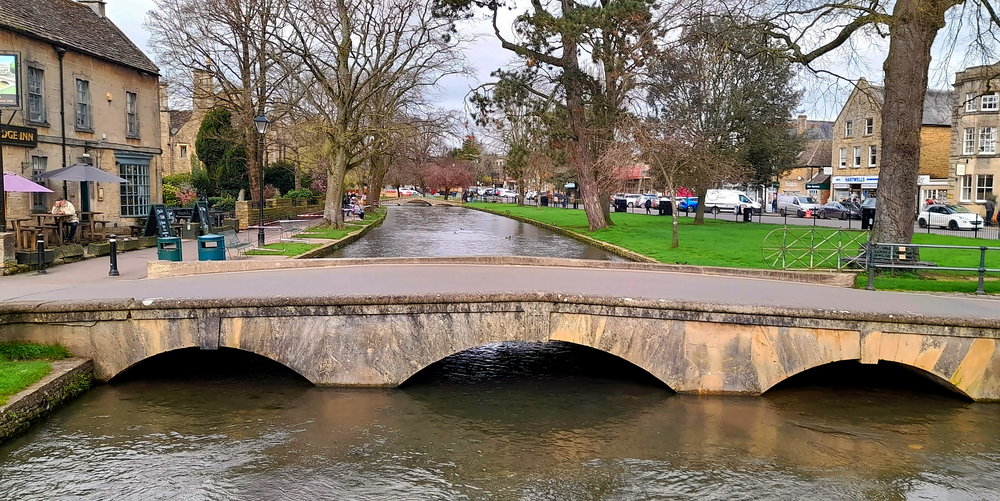
View upstream.

Retracing our steps on the other side of the river, walking along the High Street, there is a filigree town sign.
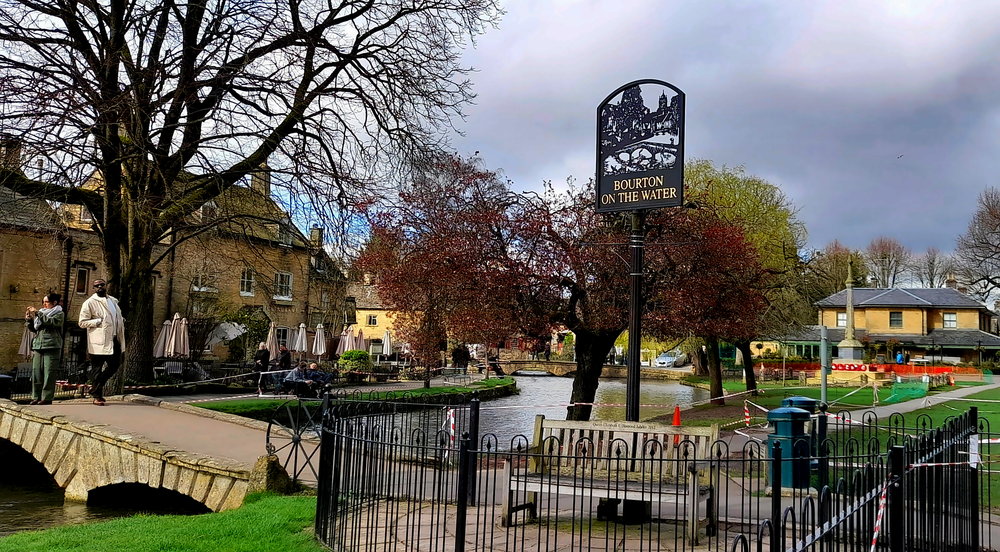
Bourton town sign.

Of course, the Poms being their eccentric selves, demands a gesture – in this case a crocheted cover topped with a rodent ensemble for the Royal Mail post box!
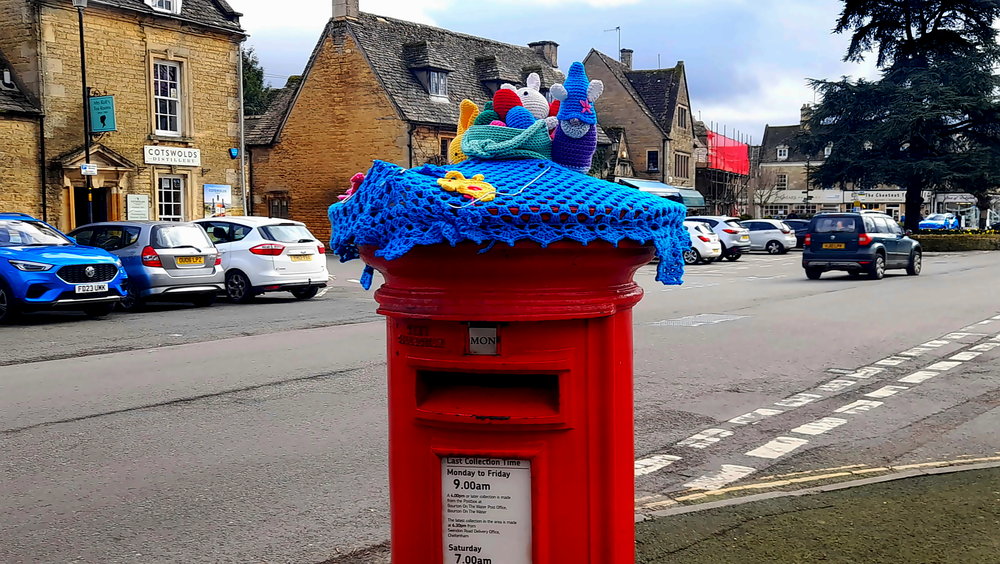
Crazy crochet!

The past few weeks in Wales we’ve seen lots of magnolia trees with tiny buds. Here they are finally in full bloom.
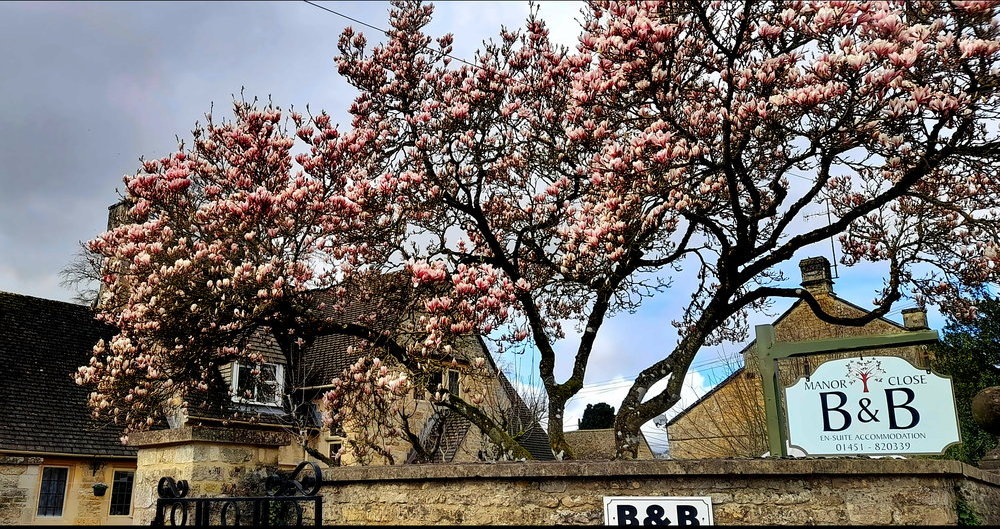
Magnificent magnolias.

RIght, that’s Bourton done. Time to retrace our steps to Lower Slaughter. The Avenue passes by St Lawrence’s Church and tomb stones.
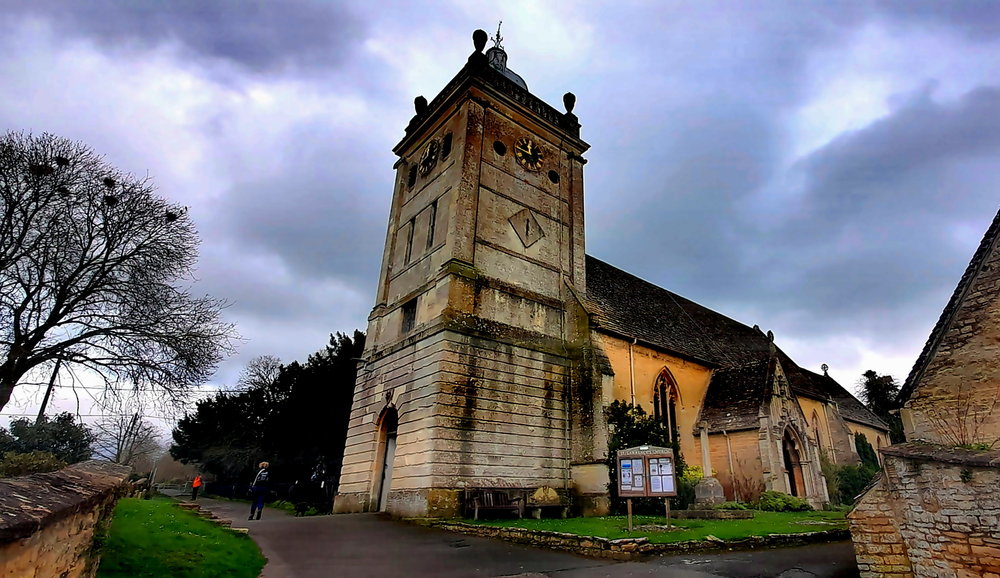
St Lawrence’s Church.

There has been a church on this site since 709 AD. The church also has a list of Rectors dating back to 1291. Like St Laurence’s Church in Ludlow, the interior space has been reconfigured to meet the current needs of the community in addition to its pews.
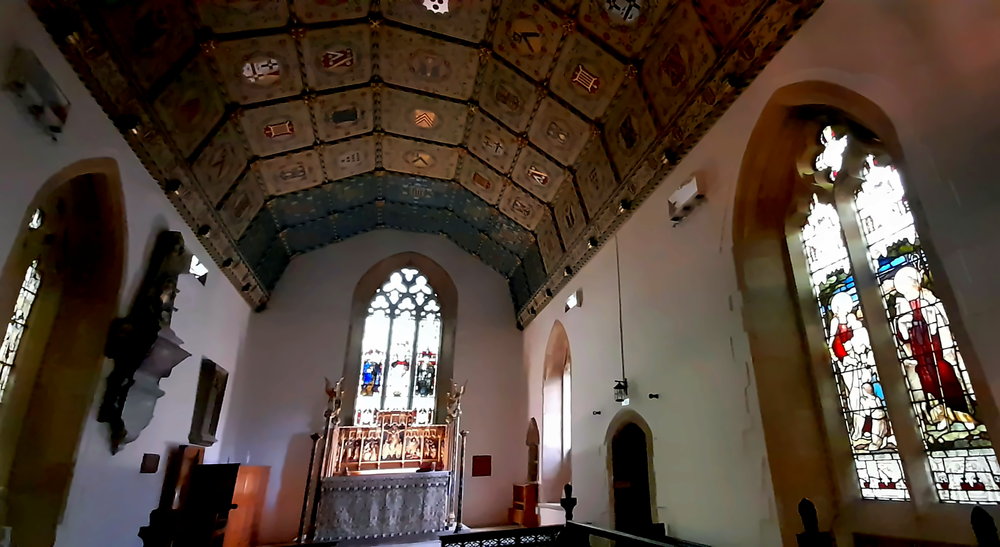
Altar, ceiling and stained glass within St Lawrence’s Church.

Besides the small, ornate altar screen, the church’s ceiling is decorated with heraldic devices. 8 of those are listed on a board including that of Queen Elizabeth I, sometime Patron of the Living; The Diocese of Worcester to which the Parish belonged before 1540 and that of Gloucester to which the Parish has been since that date; Wadham College, Oxford, the present Patron; Evesham Abbey, the Abbot of which was Lord of the Manor of Bourton until the Dissolution; and 2 other Lords of the Manor Sir Thomas Edmunds (one-time Lord) and Lord Chandos described as Lord of the Manor and although this seems to imply the current Lord, it may in fact refer to the 1650s!
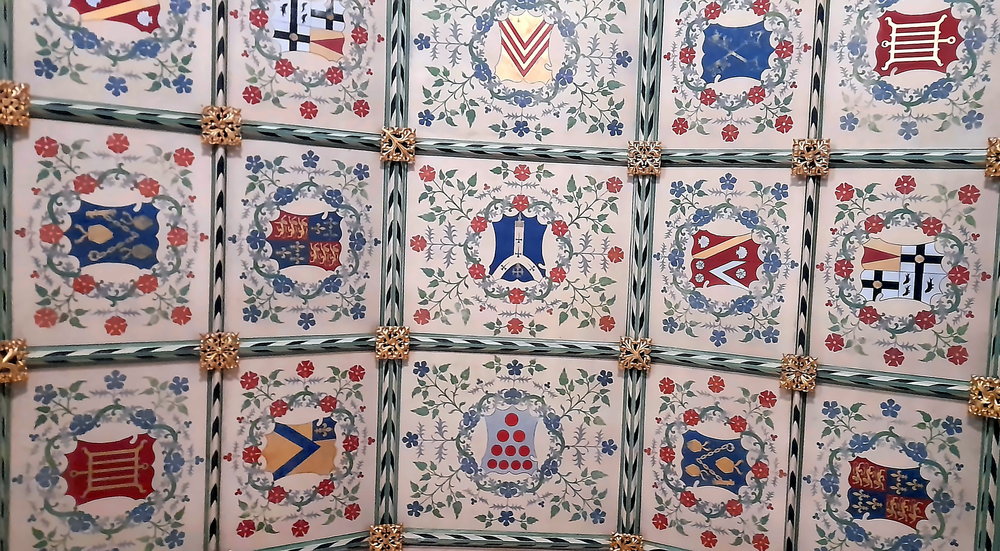
Heraldic devices decorating the church’s ceiling.

And just a ‘friendly’ reminder that we are using a public footpath that is bordered by rural properties – a sign that dogs and sheep don’t mix.
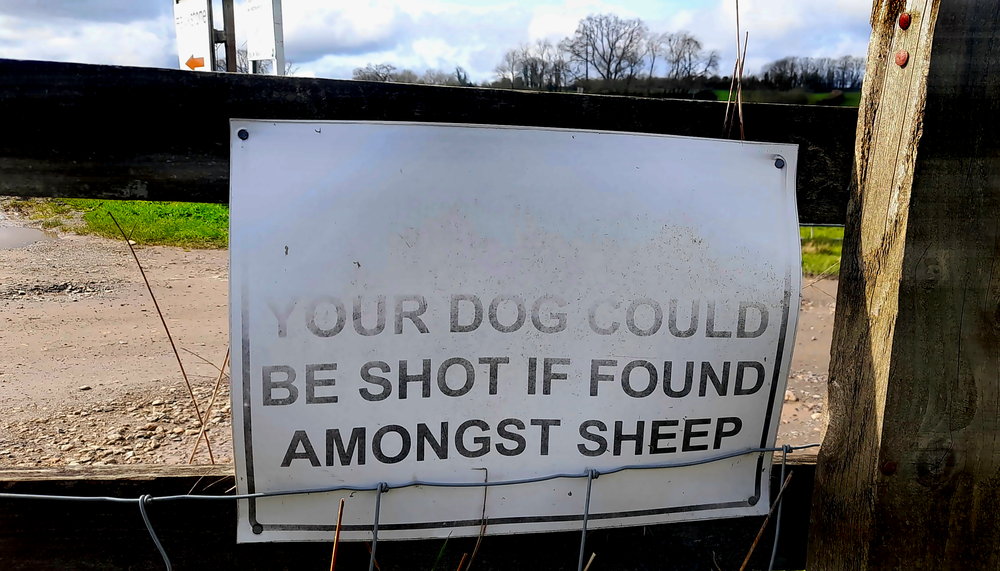
Friendly reminder!

Back at The Inn the afternoon has become overcast and colder. With the forecast tomorrow for rain we plan to drive into Stow-on-the-Wold for a look-see then further north onto Moreton-in-Marsh, some 7.5 miles away from Slaughter, to spend some time in what is the nearest laundromat.

19 March, 2024

After a 10-minute drive north we arrive at Moreton-in-Marsh and parking the car nearby we head to The Laundrette on New Road.
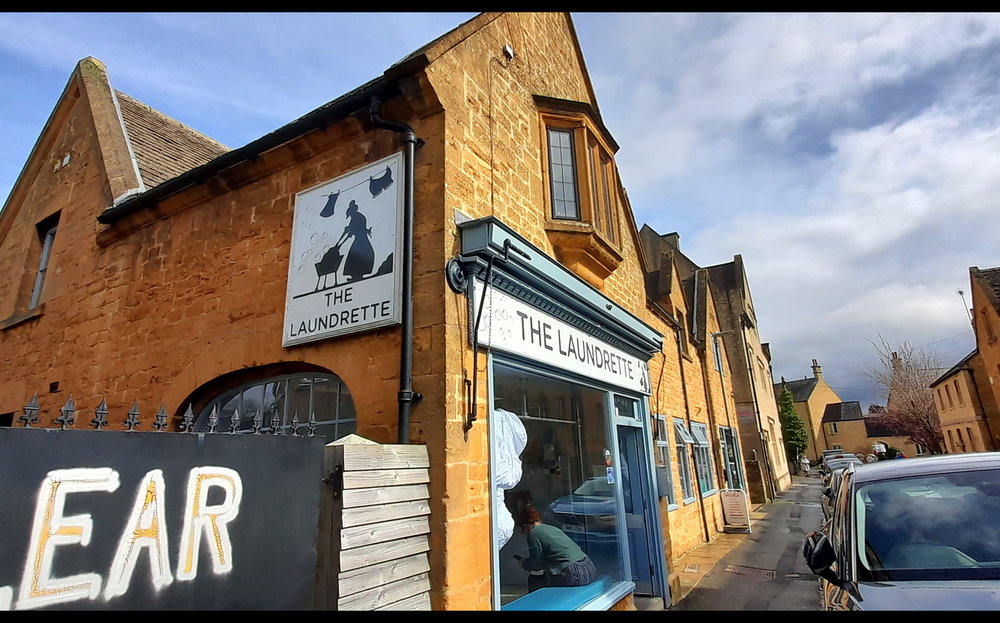
The Laundrette.

It’s a busy little place with 2 ladies in attendance to either do your laundry for you or to assist DIYers like us – “I’ll have 20 pounds’ worth of 1 pound coins, please!” – as there’s no credit card reader in sight.
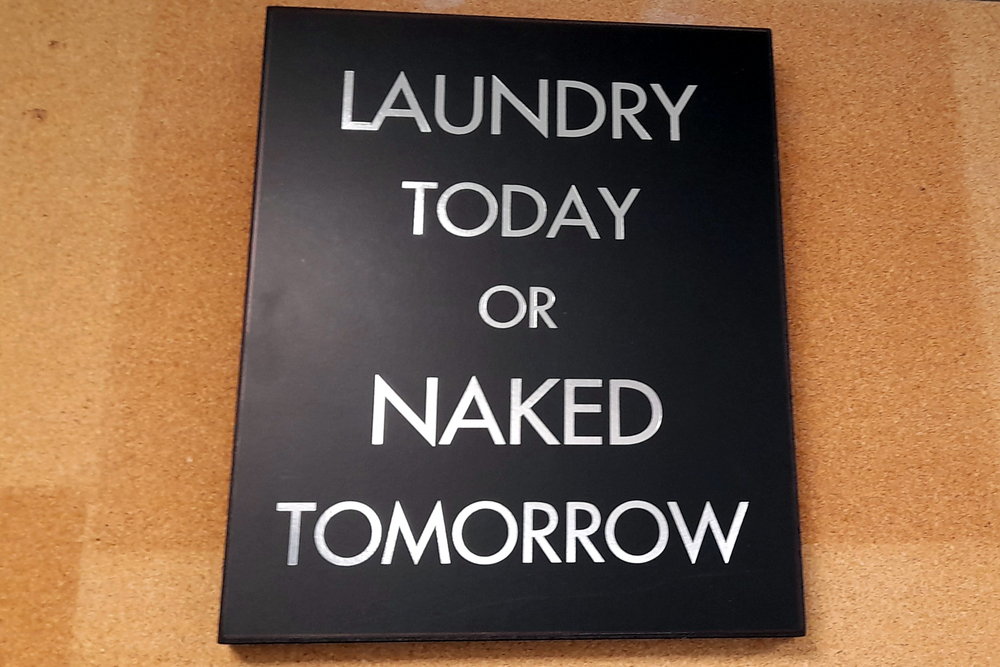
That’s about right.

The laundromat is relatively expensive but our next laundry isn’t for another 9 days in Dunkirk.

Laundry time at Moreton-in-Marsh.

While our 3 loads of washing are swishing away we turn the corner onto the High Street to check out the Tuesday market.
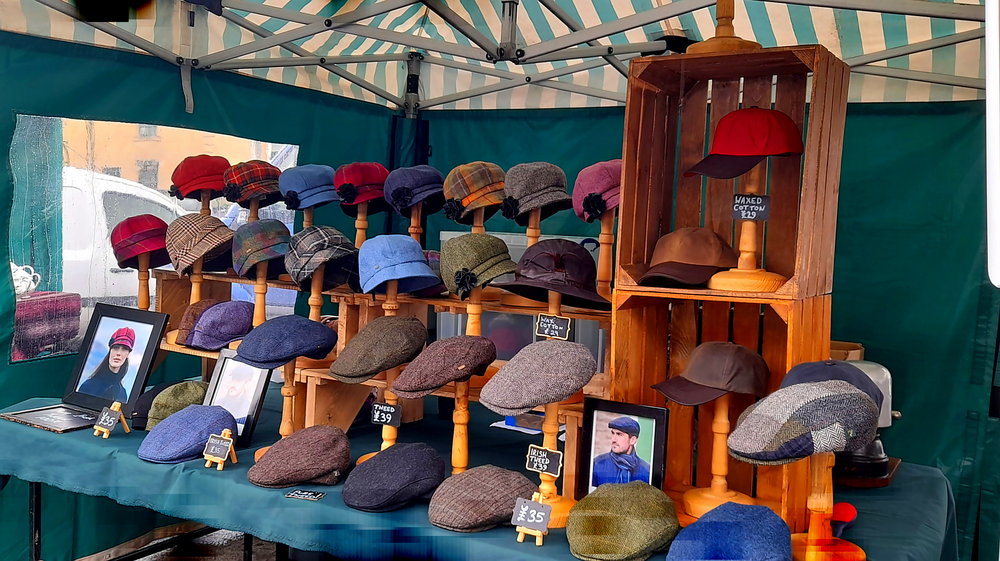
Flat cap stall at the markets.

1.5 hours later we are out the door with our clothes washed, dried and folded and my wallet GBP18 lighter, we jump in the car for our return journey. We deviate to drive through Stow-in-the-Wold. We pass by the Market Cross but nary a parking spot to be found.

Back at The Inn, Lynn starts on my ironing but is soon interrupted by the housekeeper who arrives to clean our room. We take our leave and walk to see what’s at Upper Slaughter, savouring the 16 Deg. C. temperature along the way.

Walking up the Becky Hill road we pass by the impressive Upper Slaughter Manor House.
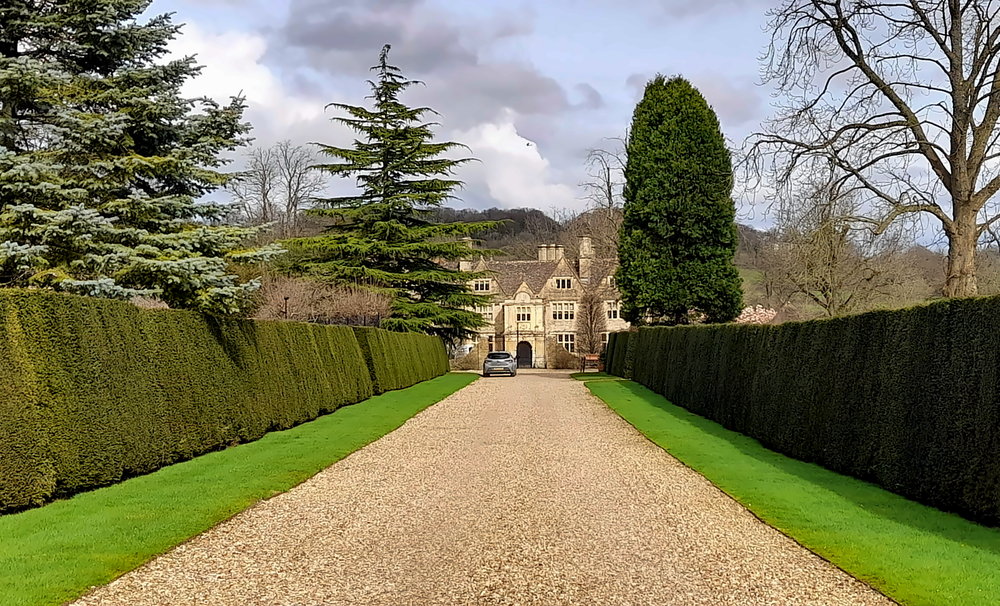
Upper Slaughter Manor House.

At the edge of the village is a small hill upon which sits Saint Peter’s Church. Like St Lawrence’s Church in Bourton, this church once belonged to Evesham Abbey and although it dates to the 12th century there are numerous 19th century modifications made to look much older.
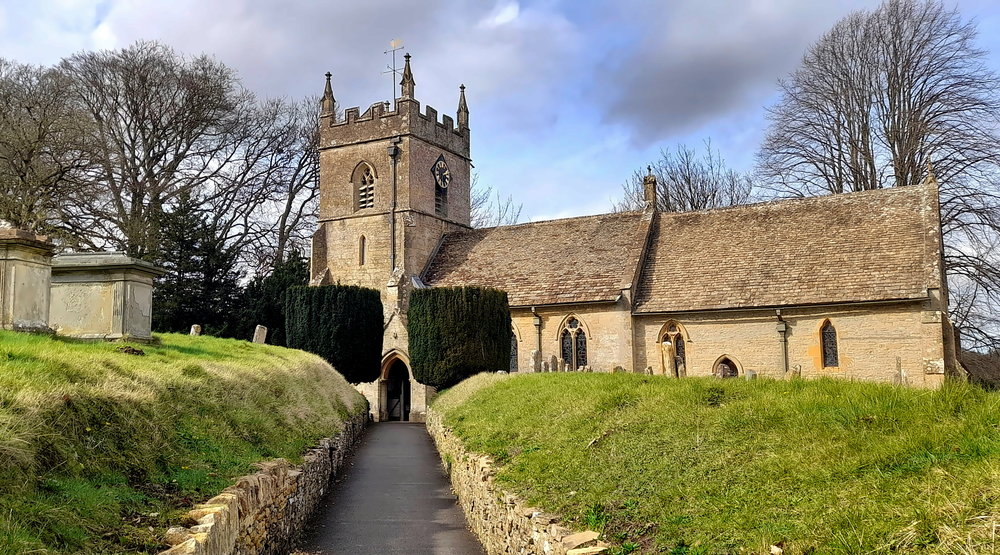
St Peter’s Church, Upper Slaughter.

Its interior has a similar layout to St Mary’s Church in Lower Slaughter. What is different are the very simple, but nonetheless beautiful, painted panels on the altar, with the painted motif repeated on each organ pipe.
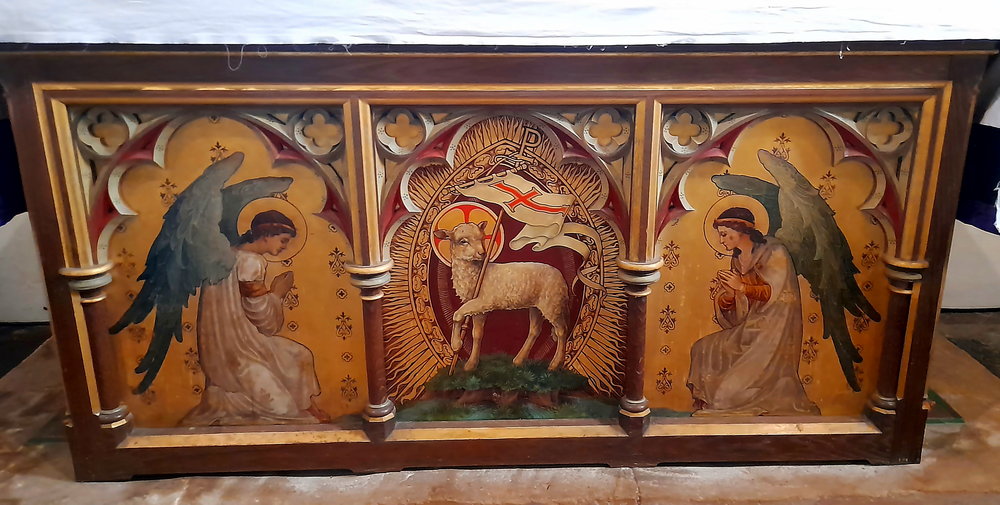
Alter of St Peter’s Church, Upper Slaughter.

Down the hill we come across the Lords of the Manor Hotel & Restaurant which is next door to the Upper Slaughter Manor House but separated by a fence.

Our Cotswolds tip: Don’t stay in the congested and crowded destinations of Stow and Bourton. Rather, stay at one of the Slaughters and relax in serene countryside pampered in affordable luxury. Using one of the Slaughters as a base, get to really enjoy the Cotswolds’ countryside by taking the easy walks to Stow and Bourton, saving yourself the hassle of trying to find non-existent parking spots.
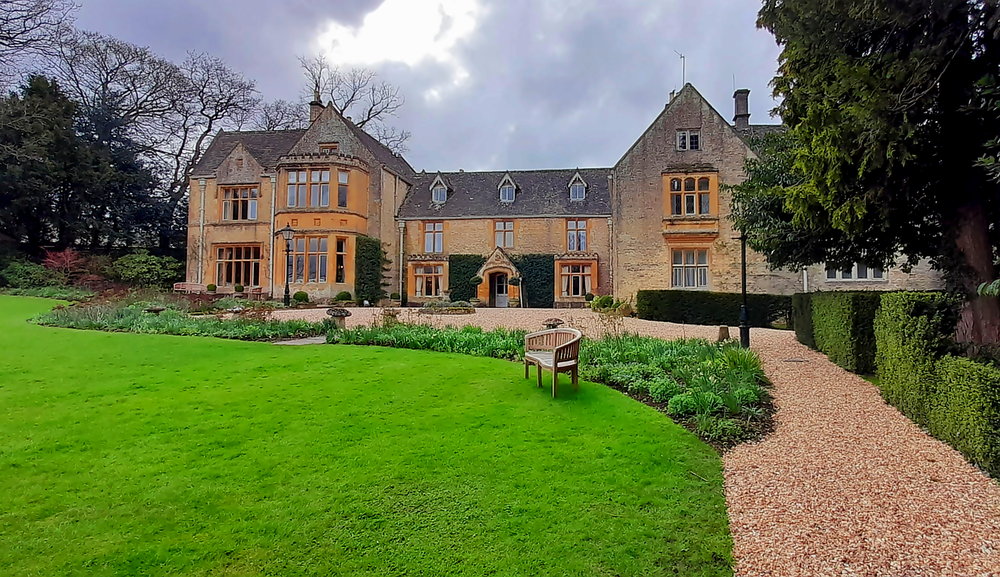
Lords of the Manor Hotel & Restaurant.

At this point we decide to return to Lower Slaughter via the Warden’s Way which will involve walking across muddy fields and along a muddy path.
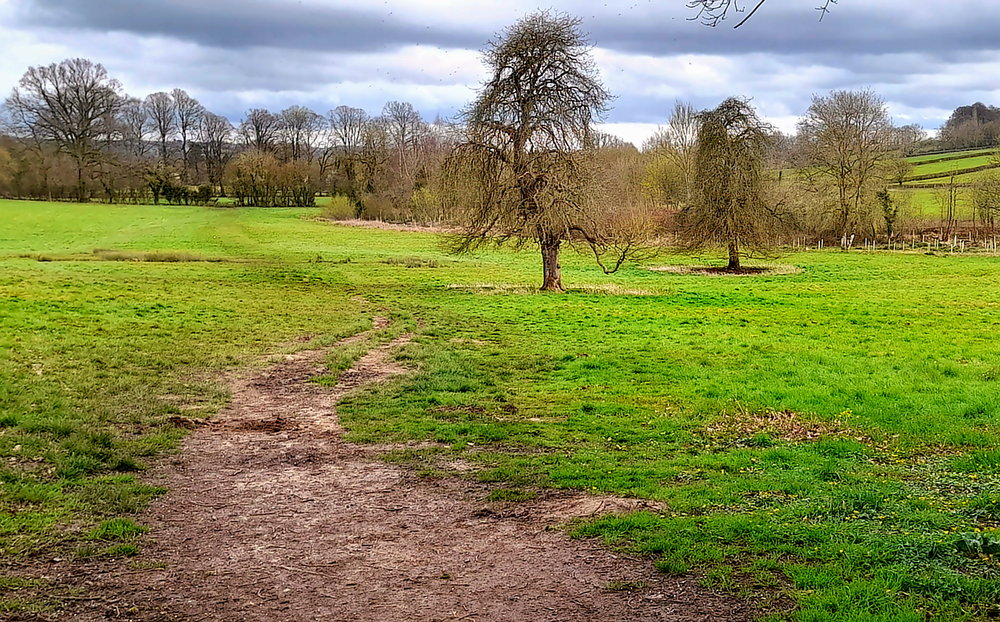
The Warden’s Way trail.

The path soon converges with the River Eye which we discover is actually privately owned – well, the canal part at least – according to a prominent waterside sign.
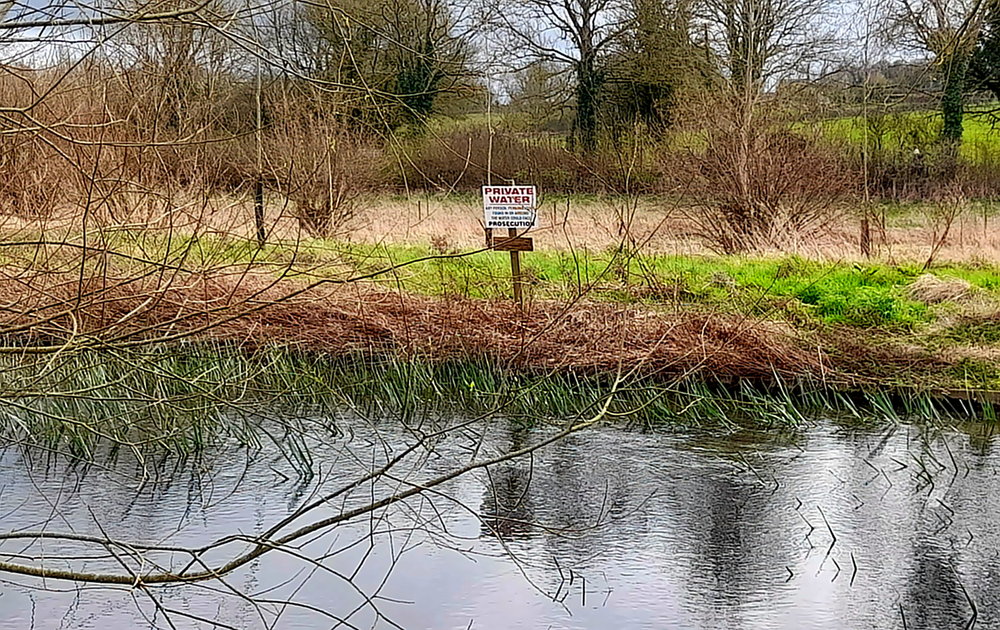
“Private water”.

It appears that the river has 2 branches, the small stream itself and a branch which was diverted to become the wider canal that now cascades past a sluice gate and the wooden wheel at the Old Mill.
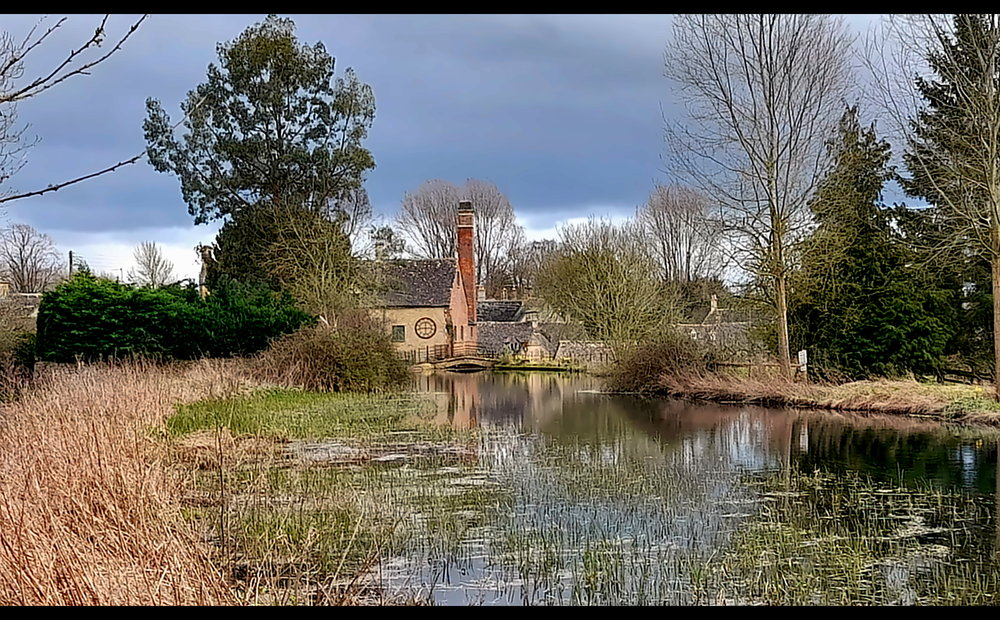
Canal above the Old Mill.

Bordering the river on either side are honey-coloured, stone cottages. The cottages on the Mill side of the river are lower and several sport a metal plate that is kept in place by 2 side runners. These metal plates are ‘flood gates’ to prevent flood water from seeping in under the door.
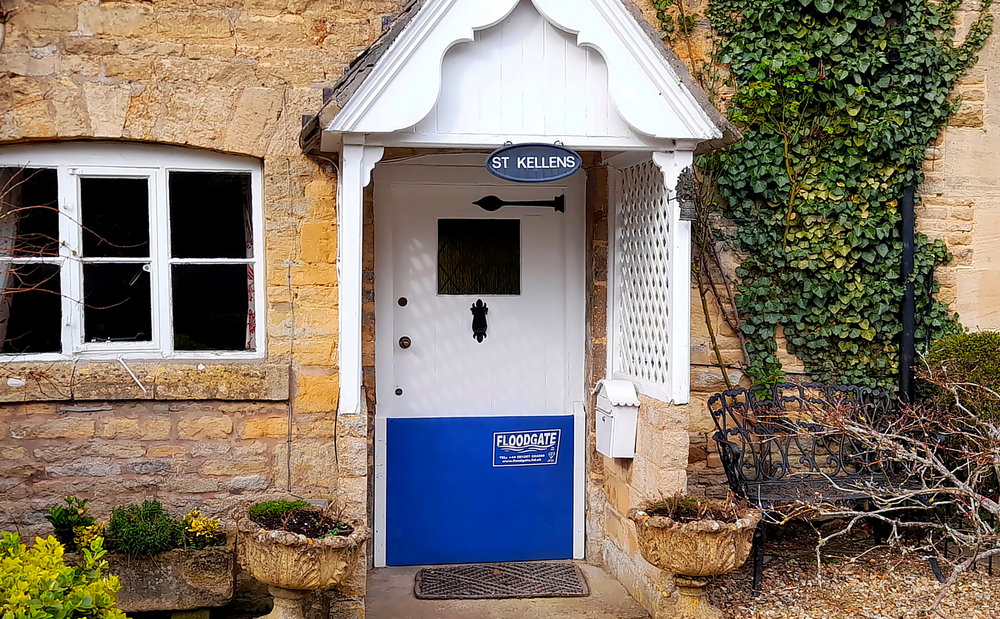
Flood mitigation, English style.

Honey ham and smoked salmon baguettes are just the ticket for a light bar meal this evening before we head upstairs to pack an overnight bag ready for our trip to Richmond in the morning for a 2-night stay.

20 March, 2024

It’s 14 Deg. C. when we drive out of the hotel’s car park at 10:45 am. It should take us about 1 hour 45 minutes to drive the 140km to Richmond, so arriving around 12:30 pm at Susie and Paul’s. We take the A424 through the beautiful, ancient market town of Burford then the A40 around Oxford. At 11:30 am when we join the M40 the sun shines through and the temperature nudges up a degree.

About 20 minutes later we grind to a halt at the back of a very long traffic jam on the M40. Fortunately, this occurs just before the A40 slip road to High Wycombe, which we slowly make our way over to and exit the motorway. As we are now driving through towns our progress is hampered by following lorries on narrow roads, people parked on double yellow lines, pedestrian crossings, traffic lights etc. We phone Paul to let him know we have been delayed and won’t be arriving any time soon.
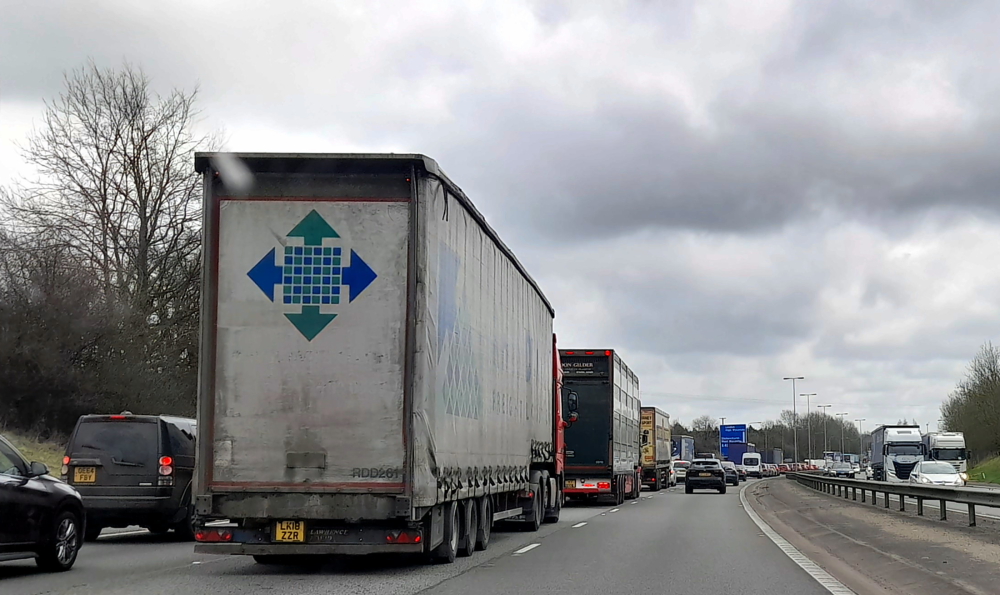
Stopped and stranded on the M40.

At Loudwater, on the other side of High Wycombe, we chance that the M40 is clear, which it is, so we join it once again. Finally we arrive at Lorne Road at 1:20 pm – the traffic jam and diversion costing us 50 minutes!

By 3:00 pm the sun is shining and it’s 18 Deg. C. so we decide a walk is in order. We cross Richmond Green, onto Cholmondeley Walk along the River Thames, under Richmond Bridge, up Terrace Gardens then back home, in time to meet Colin (their miniature dachshund) who has been away on a play day.
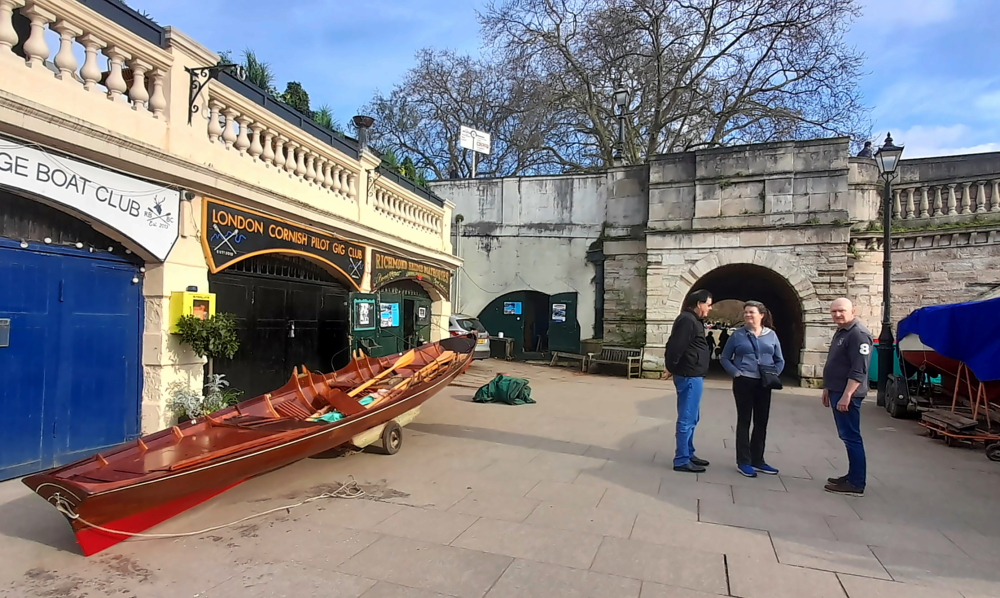
Where the Towpath meets Richmond Bridge.

This evening we are dining at The White Horse pub which is Susie and Paul’s “local”. Beforehand, Lynn’s friend Mary, who lives in Ealing, will be joining us at the house for drinks. They first met in 1990 when they both worked for BP Oil (UK) at Hemel Hempstead and last saw each other just before Lynn left the UK in April 2010.
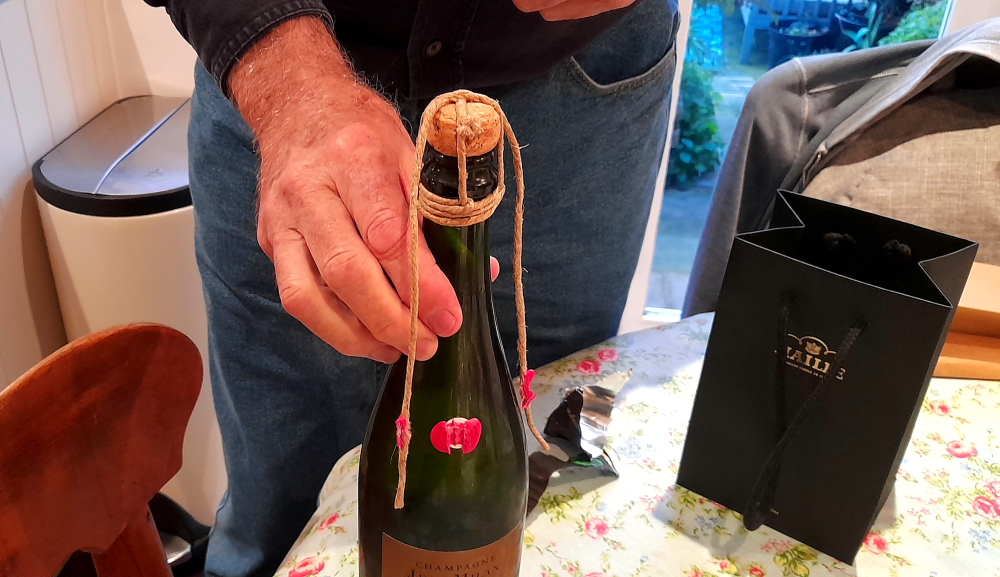
Old-style string vs wire closure.

To celebrate, we pop the cork on the 2nd bottle of champers we purchased at the cellar door at Jean Milan in the Champagne Region. Interestingly, its cork is secured by string which has been stuck to the bottle by a red, wax seal. The champers is divine – a subtle hint of apricot with tiny bubbles.
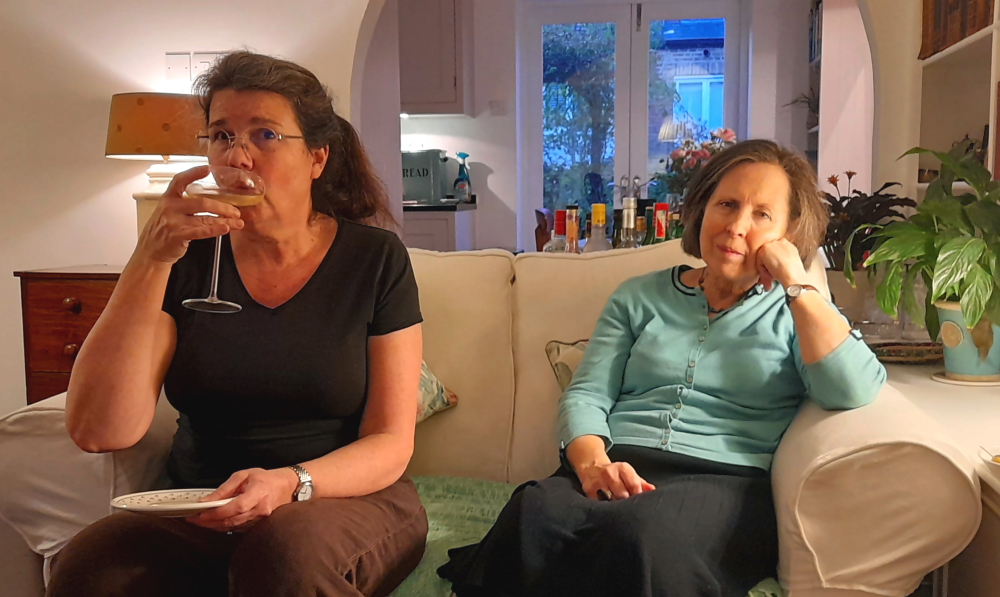
Pre-dinner champers.

Lynn had booked our table at the pub several months ago so imagine our surprise when we arrive to learn that Wednesday night is “Quiz Night”, starting tonight!

We had planned on sharing a quiet dinner to catch up but given the layout of the pub it will be impossible to compete with the Quiz Master on the microphone for the next couple of hours so we decide to enter the quiz and quickly call ourselves “Colin’s Crew”.
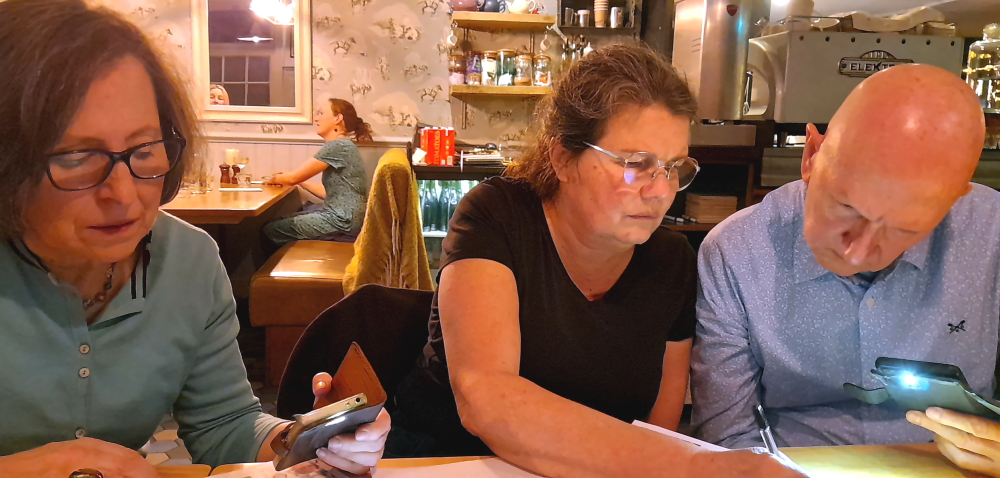
Great minds winning the Pub Quiz.

3 hours later of cryptic, audio and visual questions – including both Susie and Paul each winning the 2 free drinks rounds – Colin’s Crew is declared the winner with a total of 65.5 points and awarded a GBP50 bar tab voucher. Needless to say, it was the input of the 3 Poms that won the day.
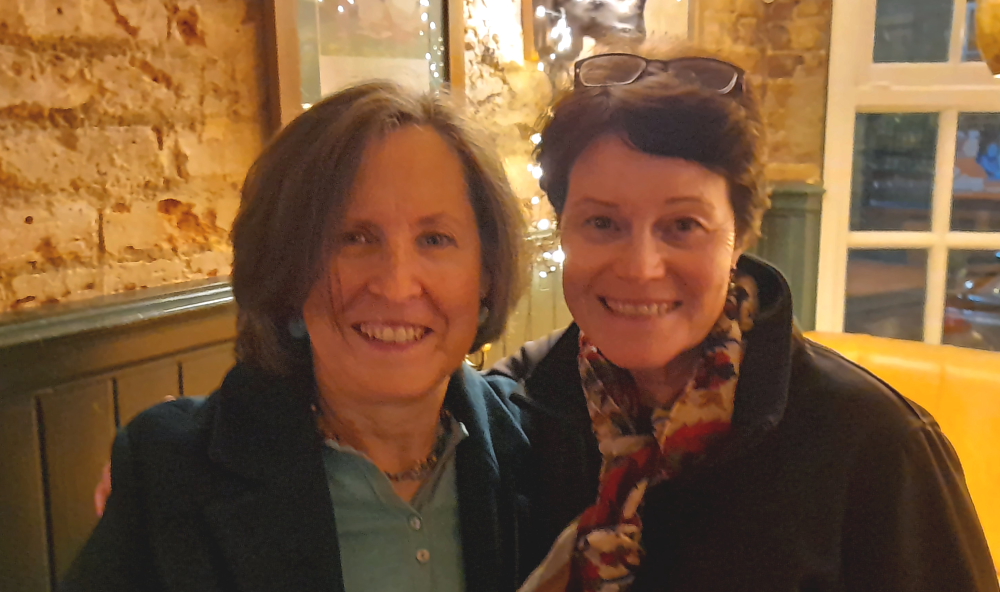
Let’s do this again in 14 years’ time!

We plan to use the GBP50 voucher tomorrow night when we return yet again for dinner.

21 March, 2024

While Susie is at the gym this morning we decide to go out for coffee, taking Colin with us for the walk. Our “coffee run” turns into a 3-hour walk thanks to Colin’s tiny legs.
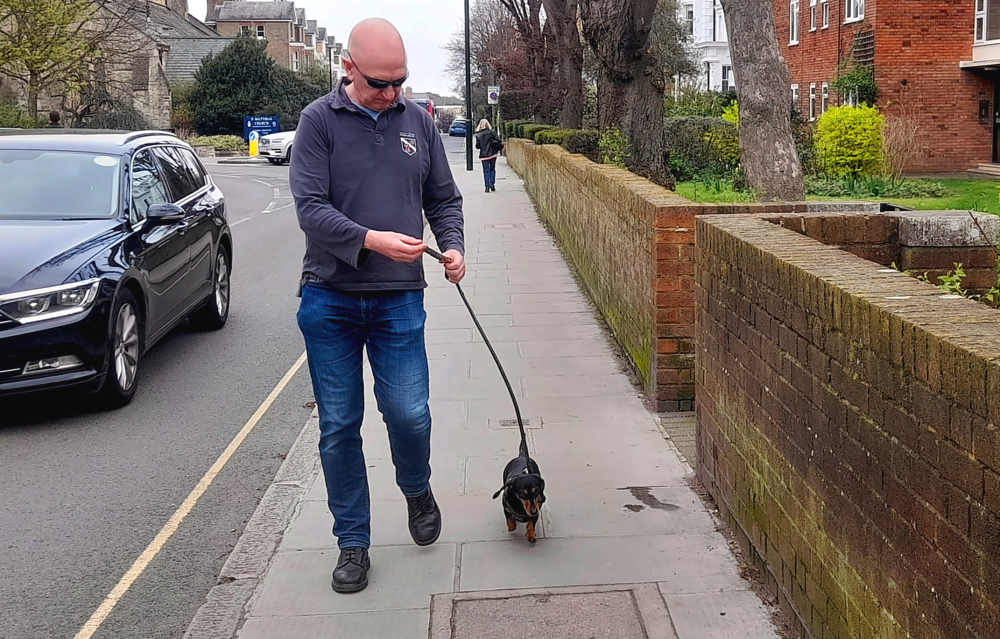
Cool dude with cute canine.

We start out by reversing our walk from yesterday, walking to Richmond Hill and into the Terrace Gardens to the Holyhock Cafe for coffee.
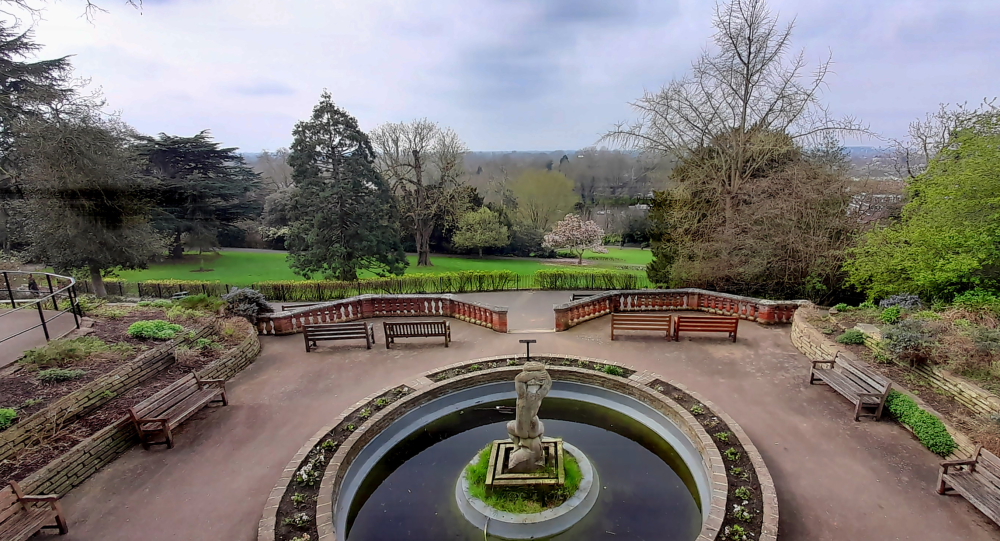
Terrace Gardens.

From here down to the river and walking upstream along the towpath to the Ham House Ferry Terminal.
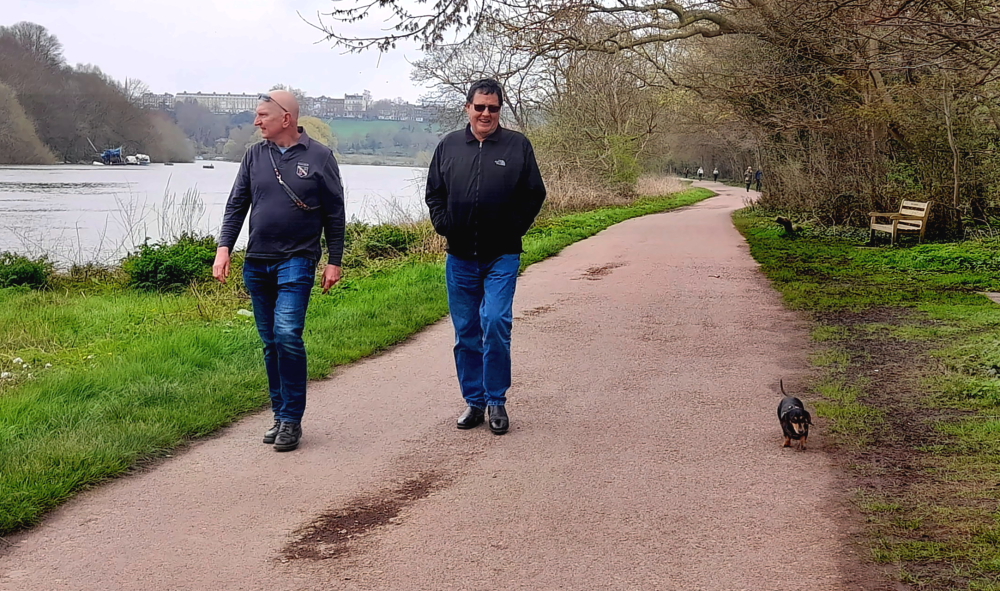
Two men & a dog.

“Ferry Terminal” is perhaps a tad overstated – it’s a small clearing with a couple of brick steps on the river bank where a tinny pulls in before crossing back across the river. GBP2/adult. Dogs free, of course!
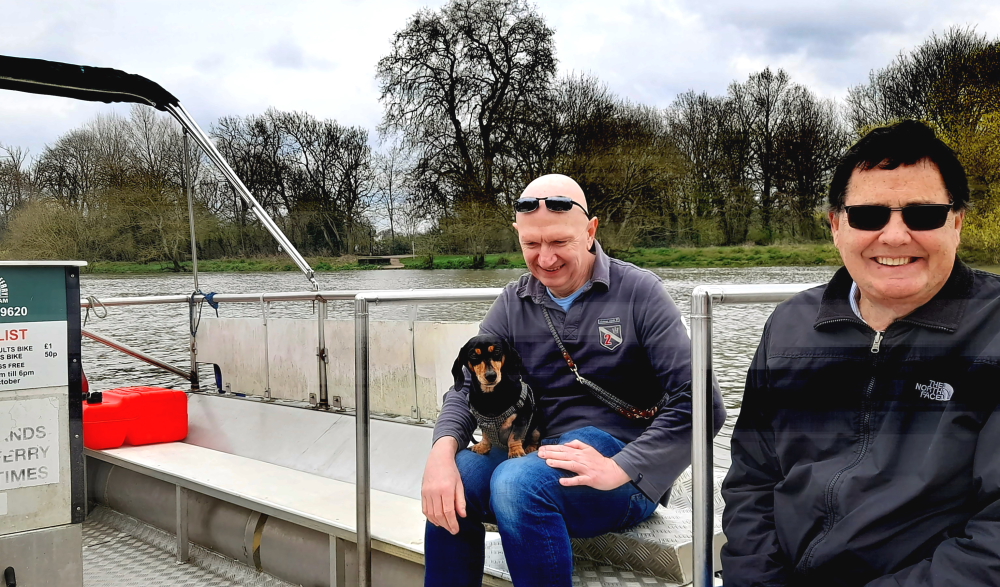
Colin enjoying a rest at the mid-point of our walk.

Walking back up the other side of the river we cross over Richmond Bridge.
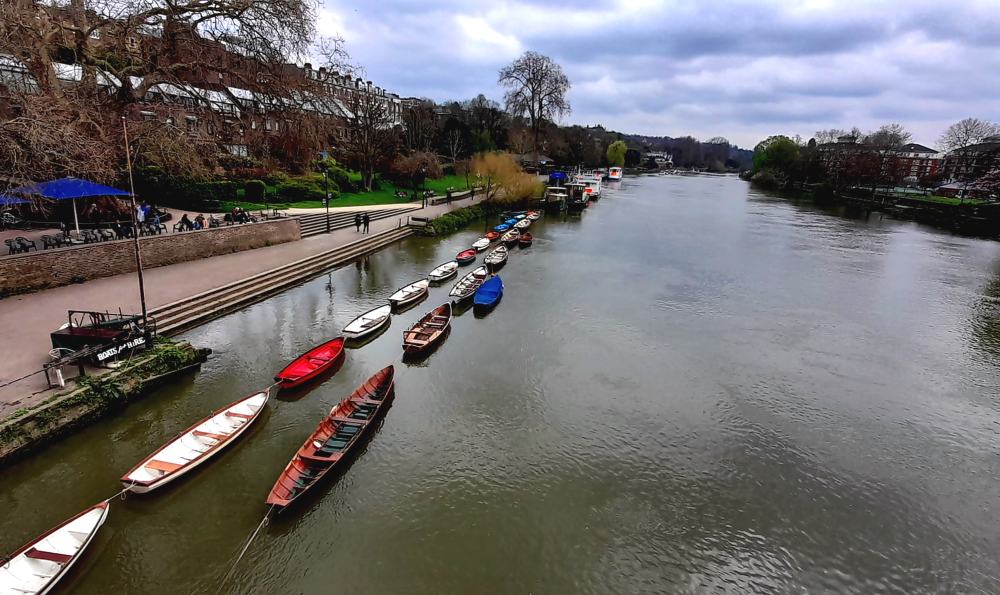
Crossing back over Richmond Bridge.

And walk up Hill Rise to The Vineyard then home.
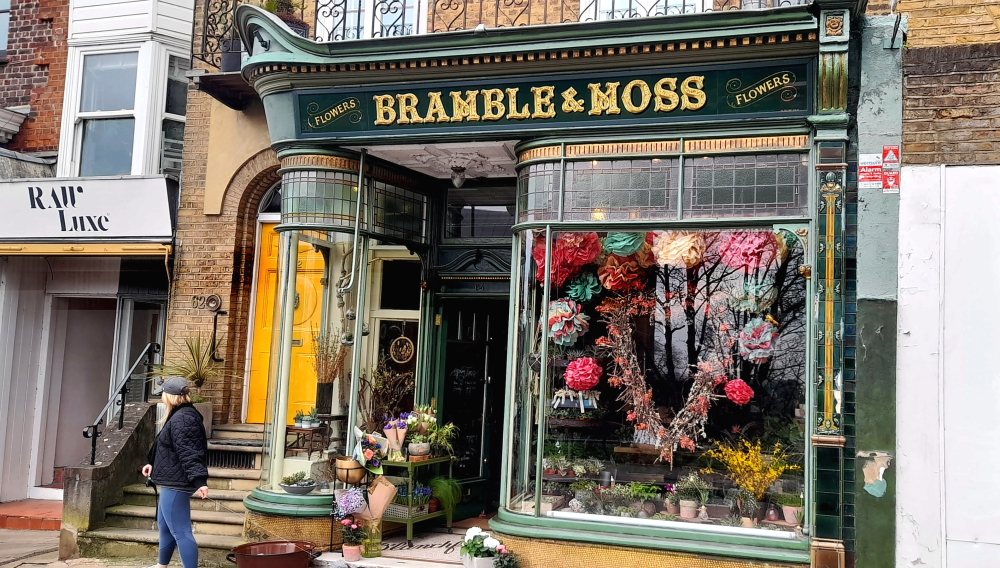
Old-style florist shop on Hill Rise.

For ease and convenience (and damned fine food and wine) we’re booked into The White Horse again for dinner where we use last night’s voucher to cover our bar tab. This time to meet up with another friend and former colleague of Lynn’s, Richard, who lives in nearby Wimbledon.
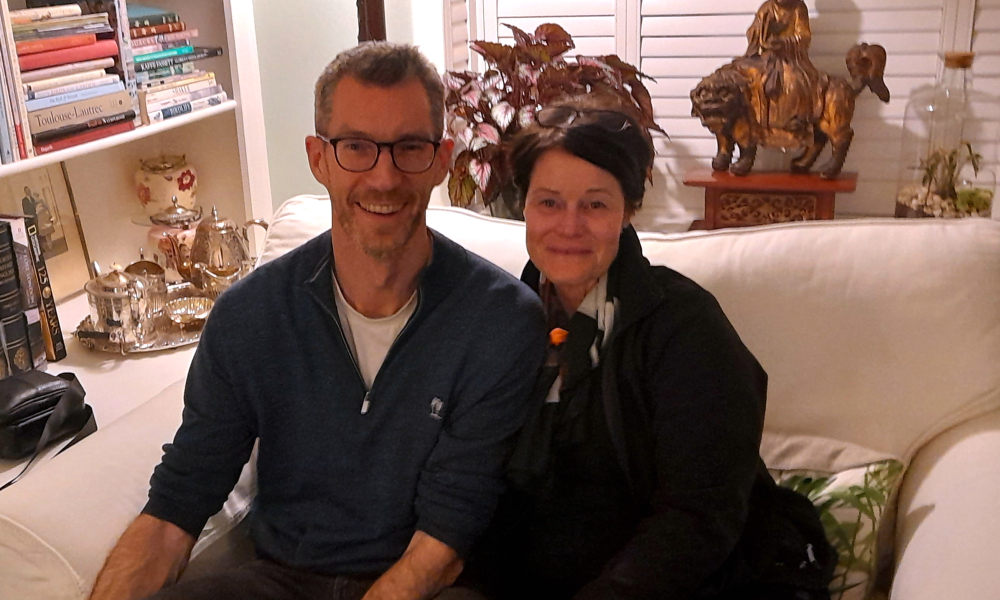
16 years’ worth of catching up in 4 hours.

Their paths diverged in 2008 when Lynn started working at Credit Suisse but they kept in touch and here they are catching up some 16 years later.

22 March, 2024

At 9:00 am we say farewell to Susie and Colin who are getting the train to High Street Kensington where Susie works 2 days a week. We have a leisurely breakfast with Paul then say farewell to him as we drive from Richmond to Greenwich via the South Circular.

Along the way, at Lewisham, we pass by the church that we are going to visit tomorrow as part of my family tree research.
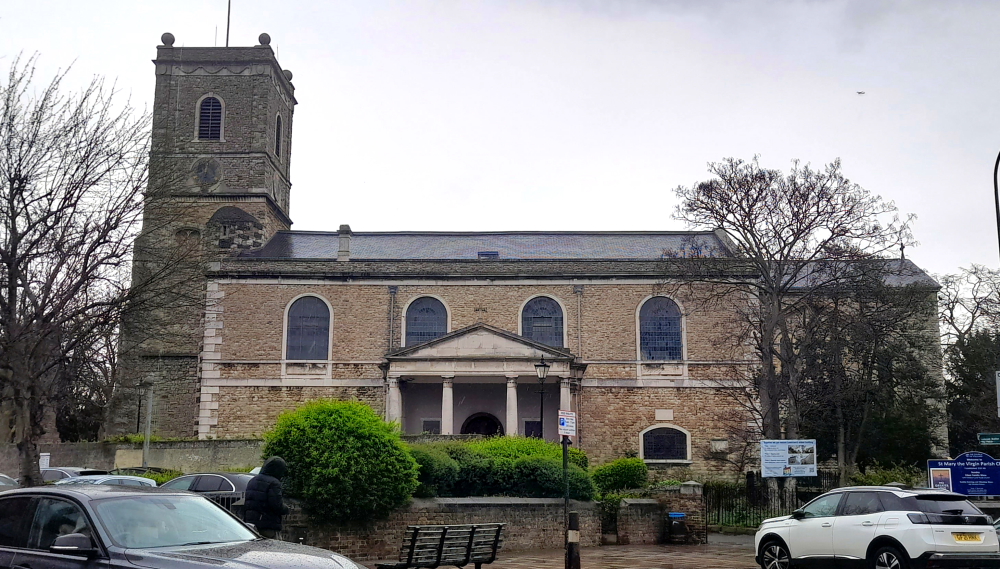
Parish Church of St Mary the Virgin, Lewisham.

What should have taken 40 minutes to drive the 26km to the Novotel Greenwich takes an hour 15 minutes thanks to the tortuous route that the South Circular takes along suburban streets.

After parking the car and having a coffee our room is ready so we unpack and catch up on the past 3 days before we head out to the local Chinese.

23 March, 2024

Our task today is to trace my Great Great grandparents – George Till and his wife Mary Lambert Hawkins. We found George’s birthplace of Beals Oak Farm, Wenbash Lane, South Wadhurst in East Sussex back in November 2022. And that he had lived in Little Snape, Wadhurst, East Sussex in 1851 while Mary had lived in High Street, Ticehurst, East Sussex that same census year.

Records state that they were married in the Parish Church of St Mary the Virgin in High Street, Lewisham on 5 August 1867. So we jump on the DLR next door to our hotel at Greenwich and walk some 20 minutes from the DLR station at Lewisham to arrive at the church.
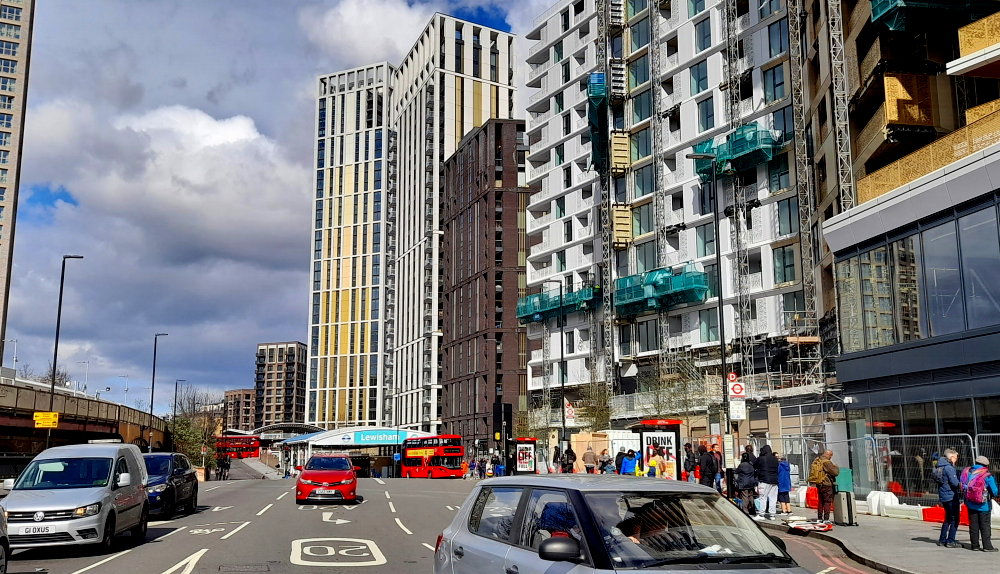
Lewisham DLR station.

St Mary’s Church has stood on this spot for about a thousand years. The present church stands on the site of previous parish churches dating back probably to the 10th century when the whole of Lewisham was owned and administered by the Abbey of St Peter’s, Ghent in Flanders. The tower of the present church was built 1471-1512 and is the oldest structure in Lewisham. Restoration work was carried out on it in 1907.

The present church was built 1774-1777 and then restored and re-ordered in 1881. At the time of my great great grandparents’ wedding the interior was plain and austere: a ceiling hiding the roof structure, high dark oak box pews, slender iron pillars supporting the galleries, a western gallery and organ, a 3-decker pulpit and a plain, wooden altar in a small rounded apse at the east end.
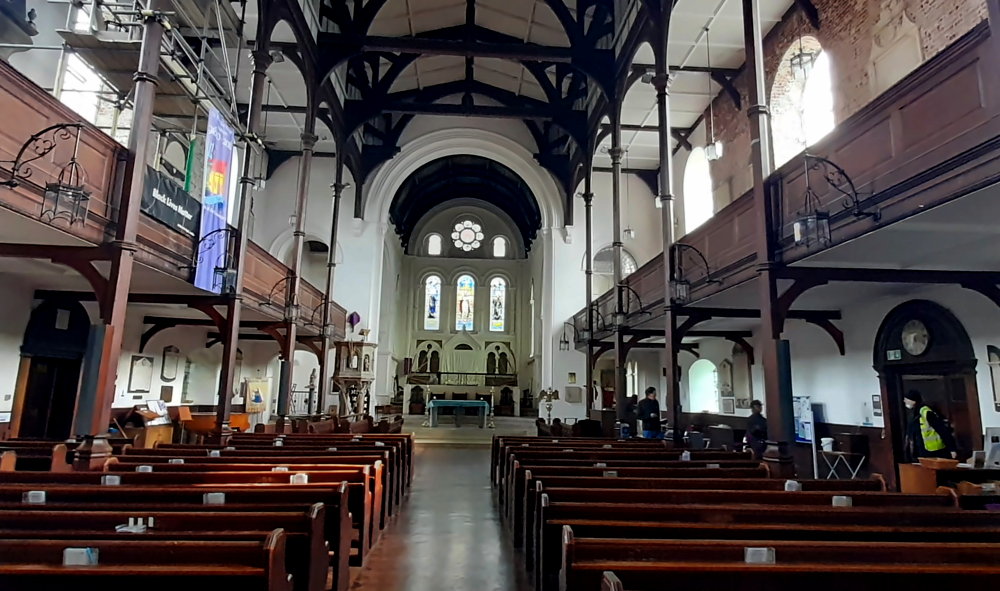
Inside St Mary’s Church, Lewisham.

In 1881 new building work took place creating the present interior which became Victorian in style. The apse was taken down and the present chancel built.

In 1931 as part of the church’s 1,000-birthday festival, a chapel to Our Lady was created under the north gallery.

The 1995-96 re-ordering was the first major work to be carried out since 1881 with considerable repair, restoration and modernisation. Together with the 2016 Re-roofing project, all culminating in the church we see today.
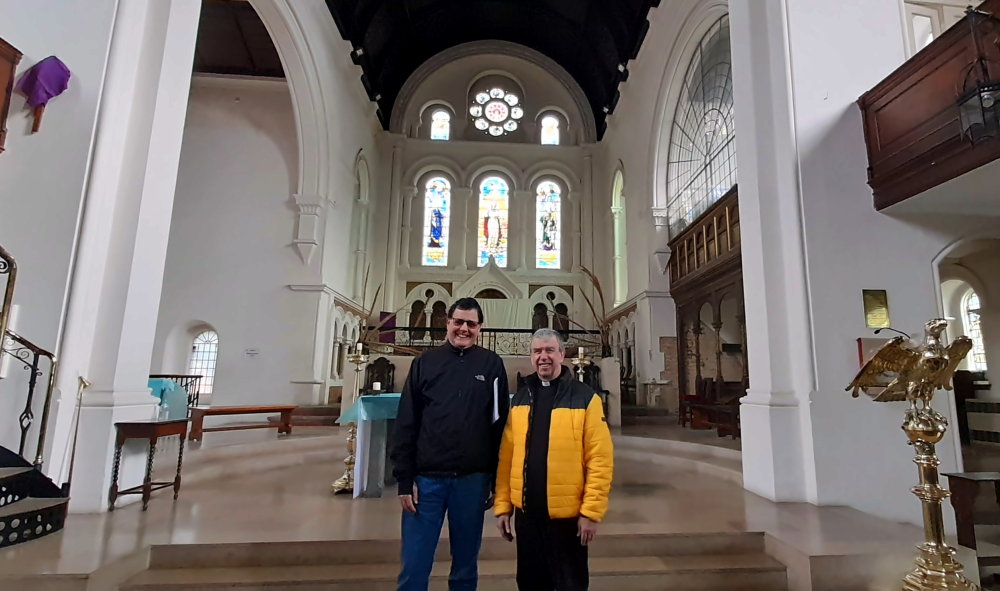
Help from Rev. Steve Hall, the current vicar.

As it’s such a fine day today and we know that the DLR is running we decide to carry on with the family research we were going to do tomorrow. So we catch the DLR from Lewisham to Bank.
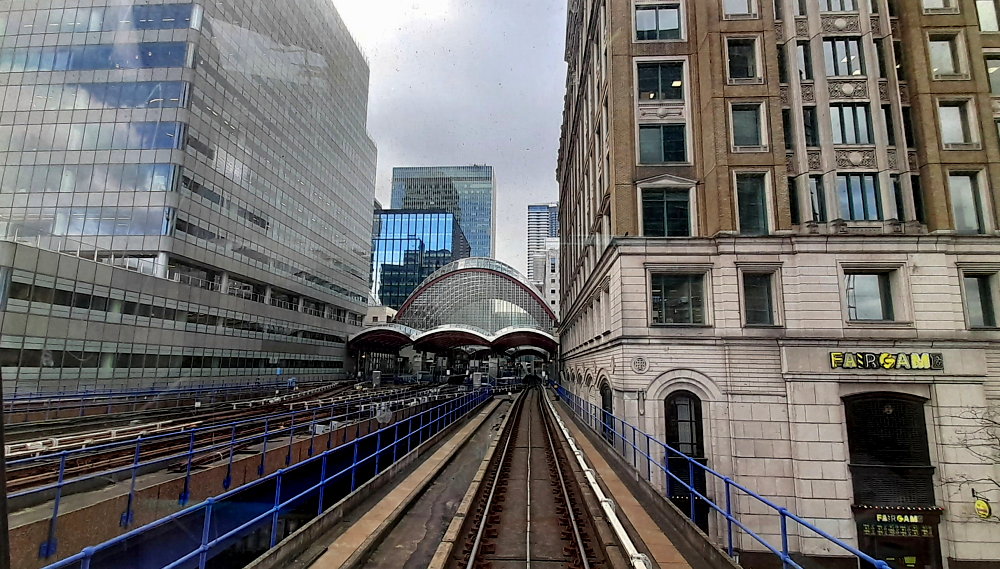
Canary Wharf DLR station where Lynn used to alight when she worked at Canary Wharf.

Rather than take the train to Aldgate we opt to walk through the streets of London.
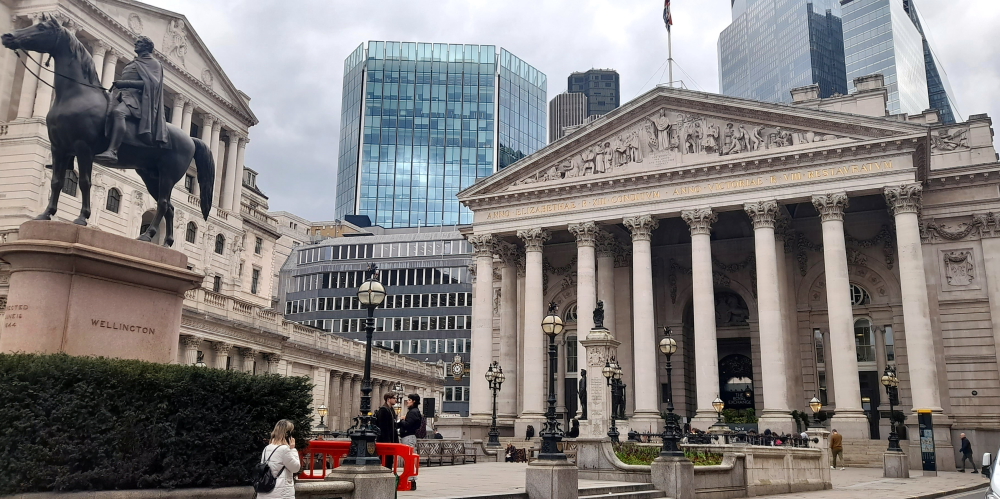
Royal Exchange Building at Bank.

Here we walk past some familiar landmarks such as the Royal Exchange where Lynn had her farewell bash in 2010.
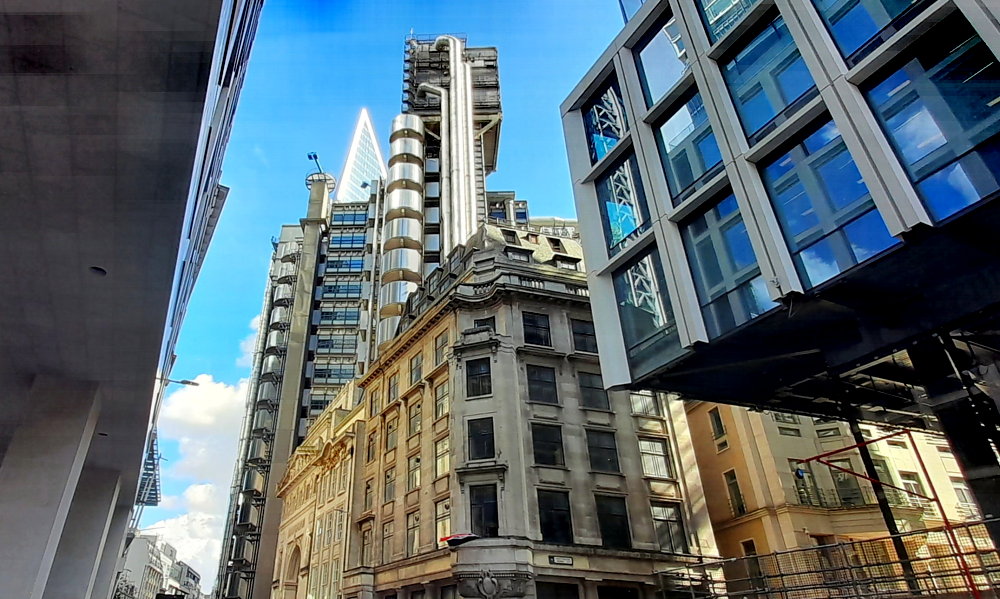
Lloyds of London Insurance building.

As well as taking in the changes that have occurred since Lynn left in 2010.
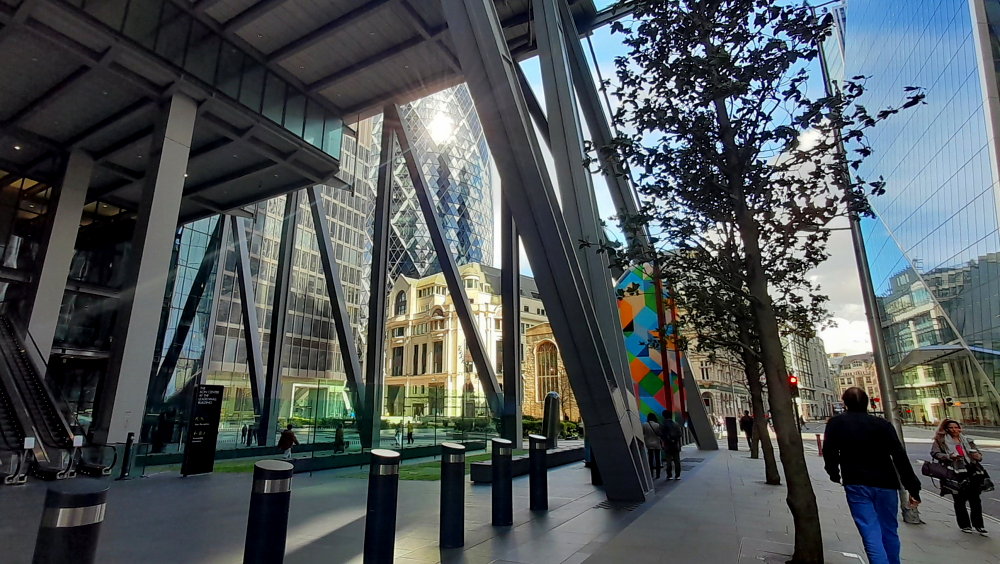
The Gherkin.

On our way to Duke’s Place, Aldgate we pass by an Austin 7.
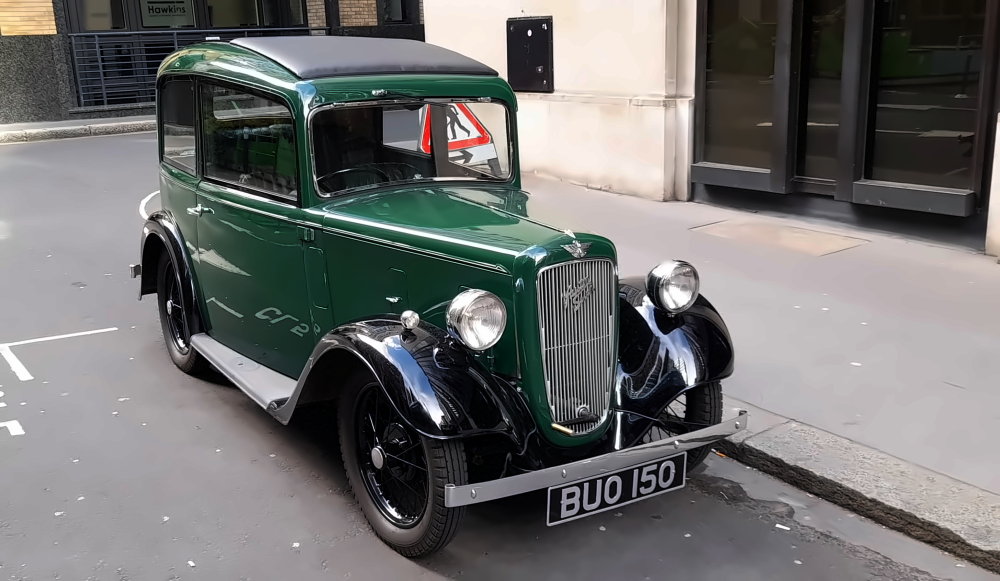
An Austin 7 parked in downtown London.

At the corner of Duke’s Place and St James’s Passage there is supposed to be a plaque marking the site of the Great Synagogue from 1690-1941. After much searching the surrounding area I finally find it high up on a wall of a modern building.
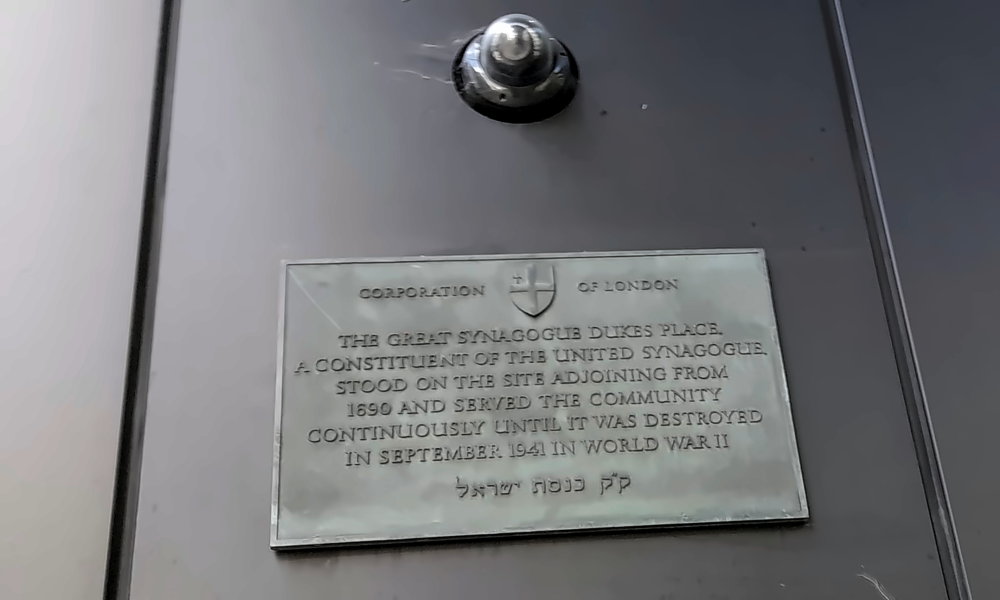
Plaque re. Great Synagogue, Duke’s Place, 1690-1941.

Joseph Hart, my 4 times great grandfather was born in Duke’s Place on 25 September 1791 and was married to Esther Garcia at the Great Synagogue on 2 May 1810.
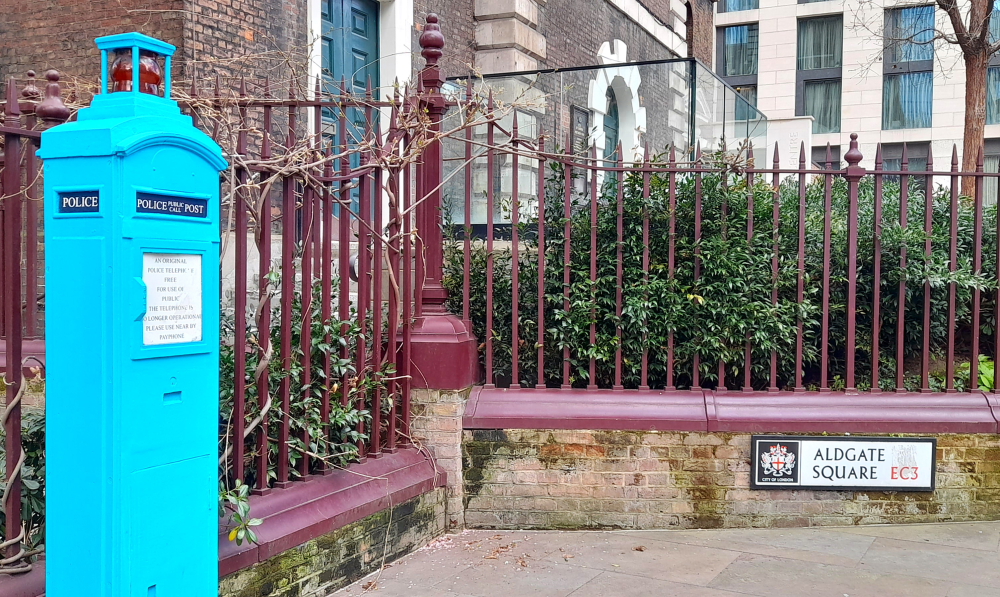
Original Police telephone box in adjacent Aldgate Square to Duke’s Place.

Walking to Aldgate East station we take the District Line, getting off at Stepney Green. Here we are in search of the cemetery where Joseph Hart was buried.

We find the Mile End (Jewish) Ashkenazi Old Cemetery, Alderney Road, Bethnal Green which is adjacent to the modern Mile End campus of the Queen Mary University. Unfortunately, it is completely walled with sole access via a small wooden door with a keypad but burials had stopped around 1770.
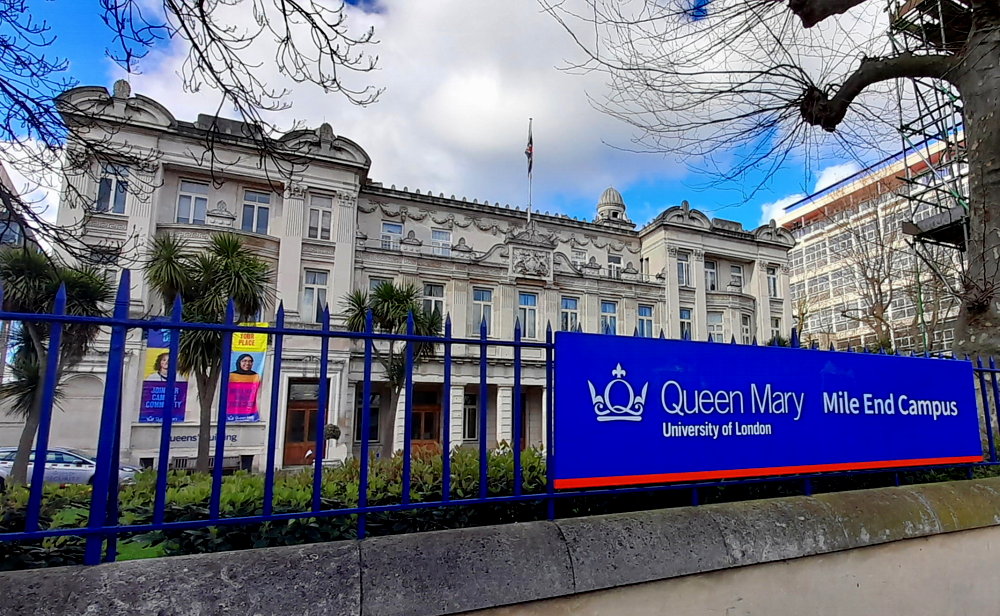
Queens’ Building, Queen Mary University, Mile End Campus.

Further along Mile End Road we pass by the stately Queens’ Building of the Queen Mary University. It turns out there is another cemetery to the right of, and behind, this building which we will need to check out on Monday.
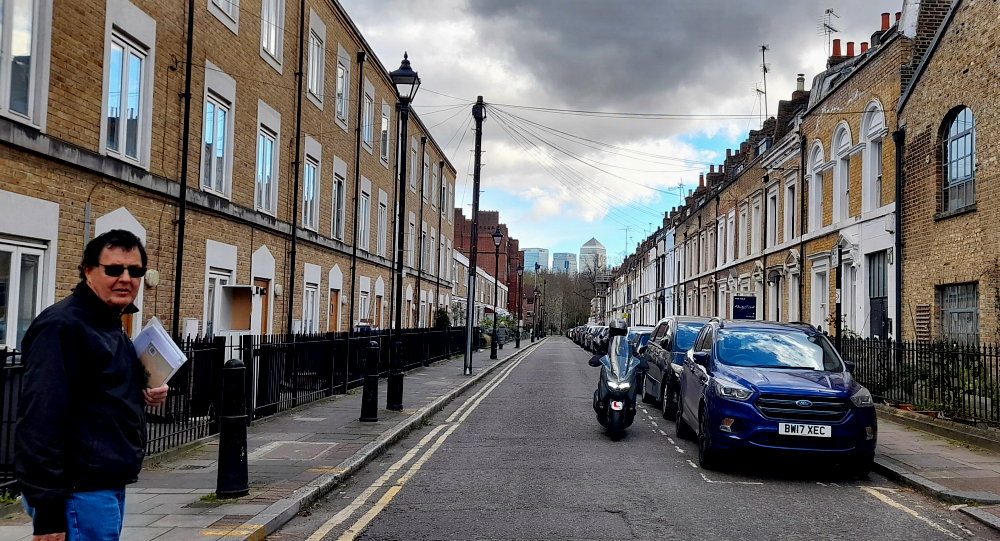
Brokesley Street, formerly Lincoln Street, London with view of Canary Wharf towers in the distance.

Our last task is to find the house in which Joseph died in on 5 May 1884 at 73 Lincoln Street, London (renamed Brokesley Street, Mile End) so we walk several more blocks up Mile End Road until we find that street.
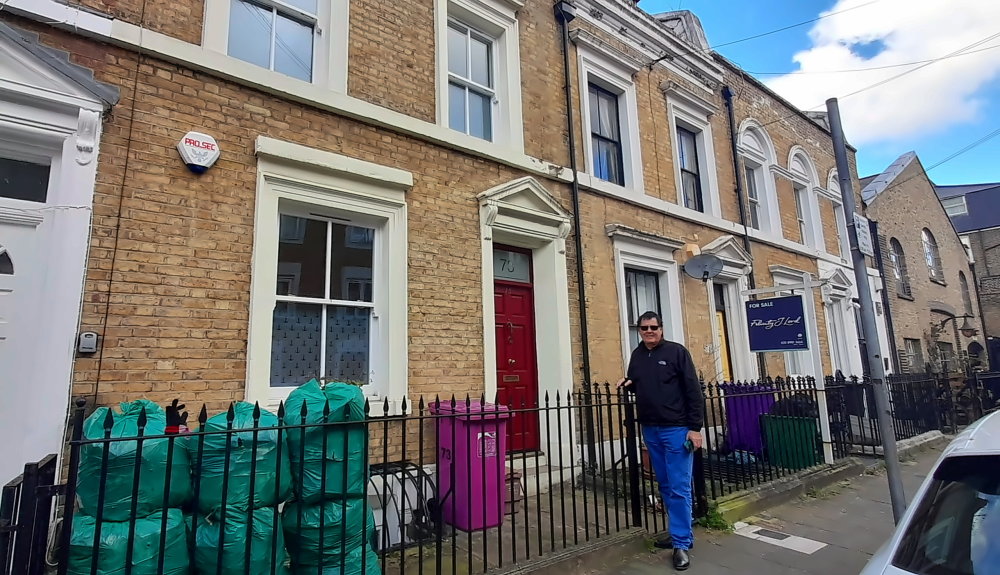
73 Brokesley (formerly Lincoln) Street, Mile End.

Time to head home so we walk a further couple of blocks until we reach the Bow Church DLR station. En route we pass by what appears to be an old telephone box now housing an ATM machine, complete with graffiti. This is the third one we’ve seen today during our travels.
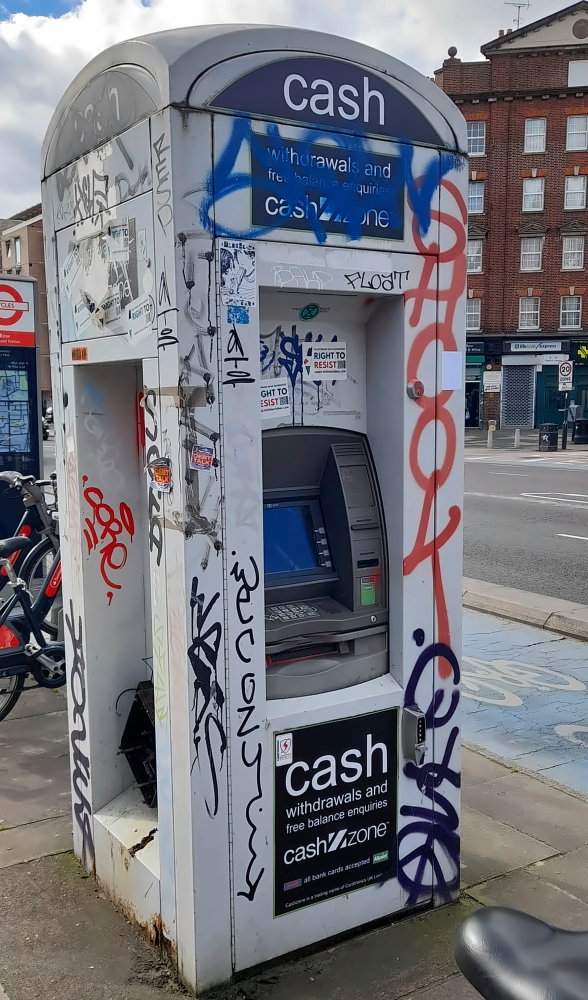
I bet Superman was surprised when he went to change in this phone booth!

We have a short wait for a DLR to arrive. Although it terminates at Canary Wharf all we need to do is move to the opposite platform to catch the DLR to Lewisham, alighting at Greenwich.
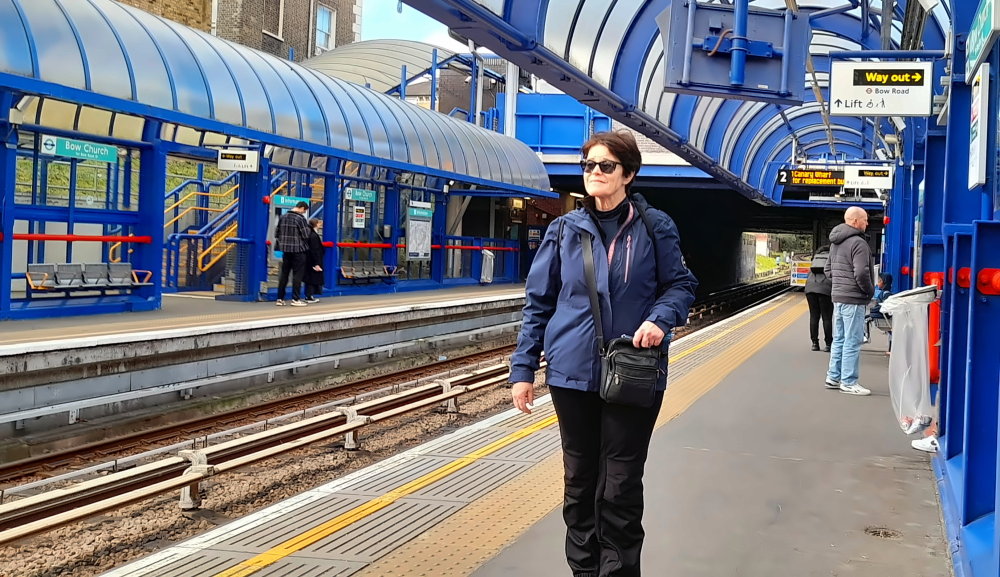
Bow Church DLR Station.

We’re hardly home when we notice storm clouds heading our way. 15 minutes later sunshine turns to hail.
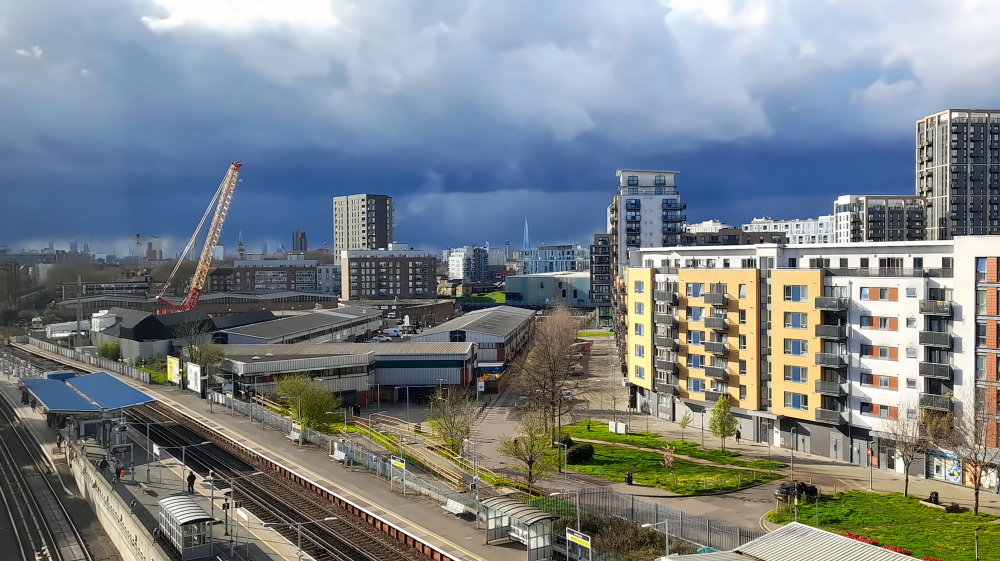
View of a storm coming from our hotel window. The Shard is centre.

It quickly passes by and sunshine returns.
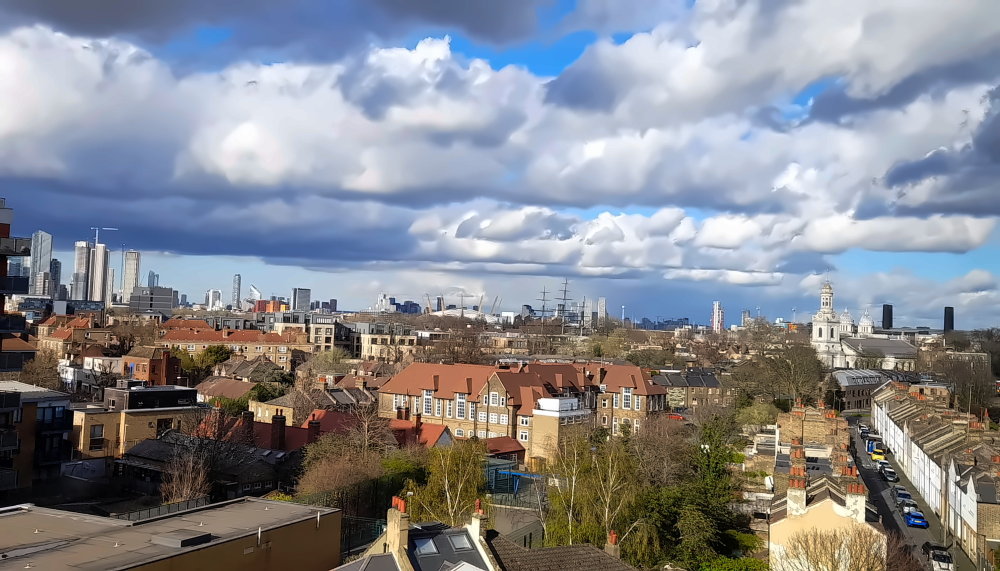
Passing storm. 02 Arena centre & Cutty Sark masts to right of 02.

Exiting the Greenwich DLR station earlier we discover Davy’s Wine Vaults next door which is where we return to for dinner. The Wine Merchants and Shippers were established in 1870 supplying “Claret, Champagne, Hock and Burgundy. Port (the most noted Vintages) Sherry and Madeira.” Today’s complex of Wine Shop and Vaults reflects its heritage with historic memorabilia and a quaint floor layout including some small, one-off private dining rooms.
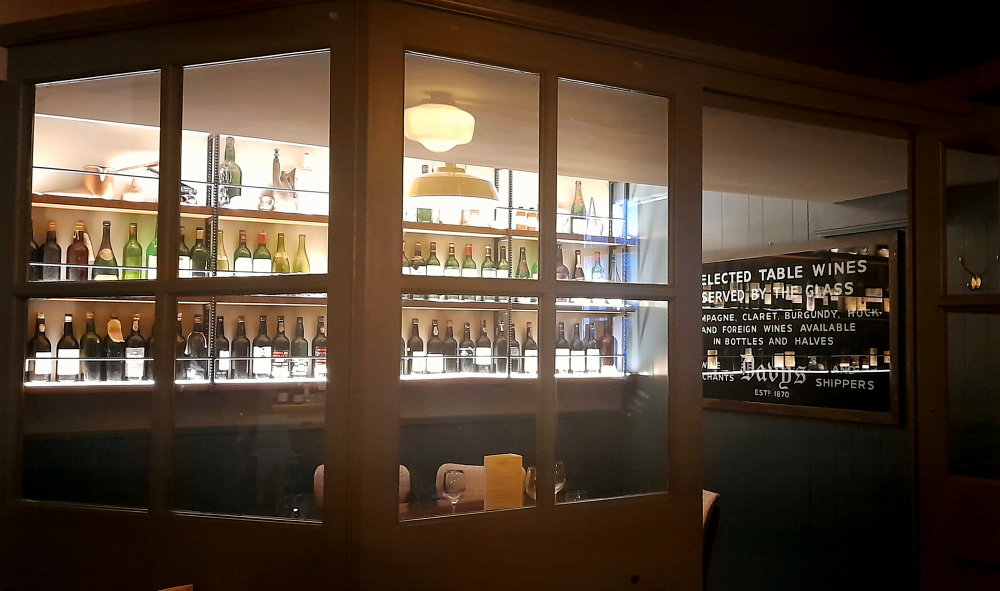
Private dining room.

When we get into the lift there is an ad hoc sign taped to the wall in small print that says, “If you can return a spare key card to reception you will be rewarded with either a free drink or free parking.” 5 minutes later we are rewarded with a GBP50 refund on our GBP100 parking fee. Bonus!

As we’ve finished most of the family tree research and tomorrow’s weather is due to be fine, we’ll take the day off to wander around Greenwich.

24 March, 2024

About 11:30 am we walk up Greenwich High Road to King William Walk then into Greenwich Park.
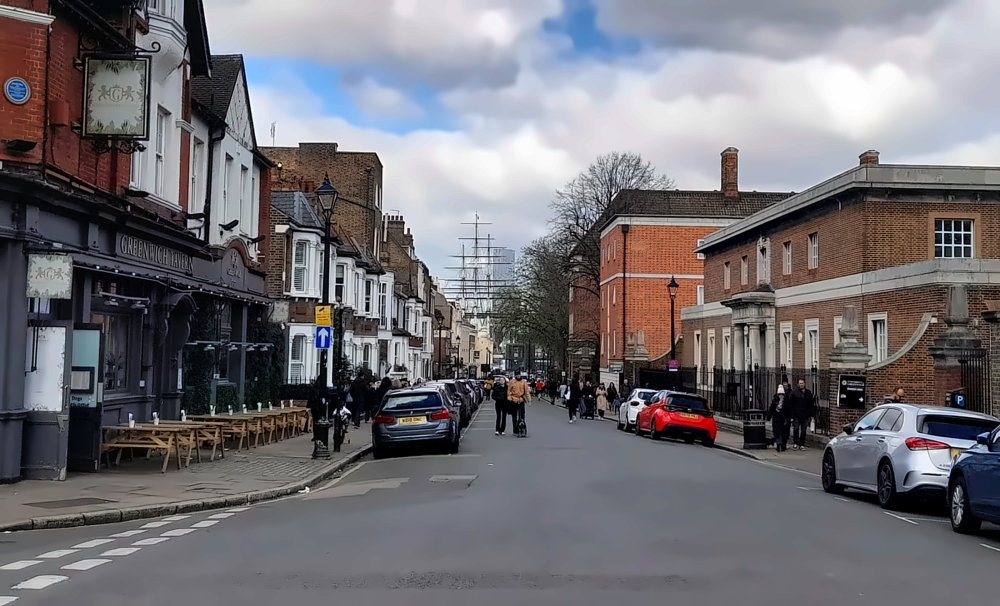
Greenwich High Street with view to Cutty Sark.

At 13 Deg. C. there are lots of people about in cafes and walking in the Park mostly with baby carriages and/or dogs.
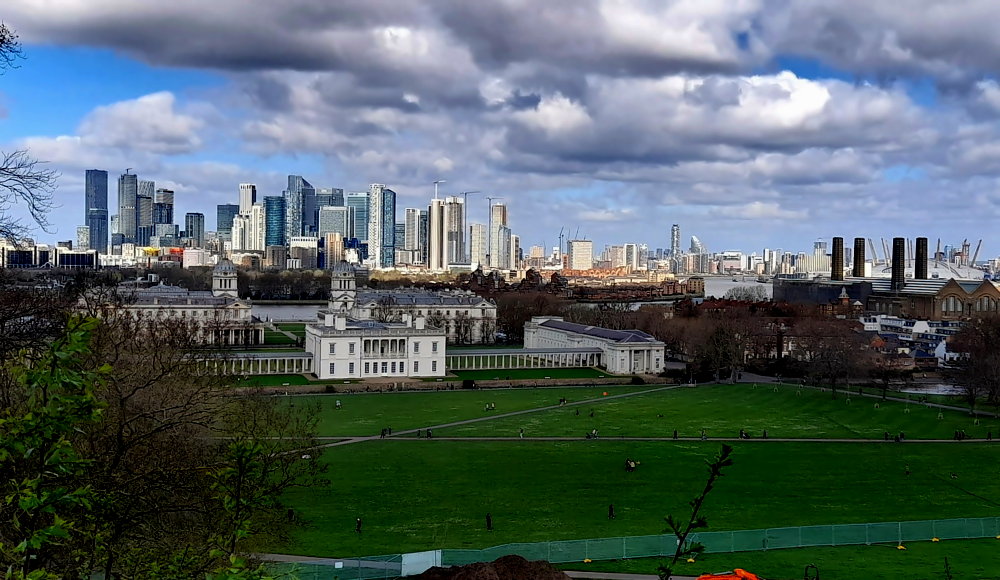
Royal Observatory view of Queen’s House & Colonnade backdropped by Canary Wharf towers.

Up the hill at the Royal Observatory we pass by a set of instruments that designated Public Standards of Length and I straddle the Greenwich/Prime Meridian – a standard longitudinal point at 0 Deg.
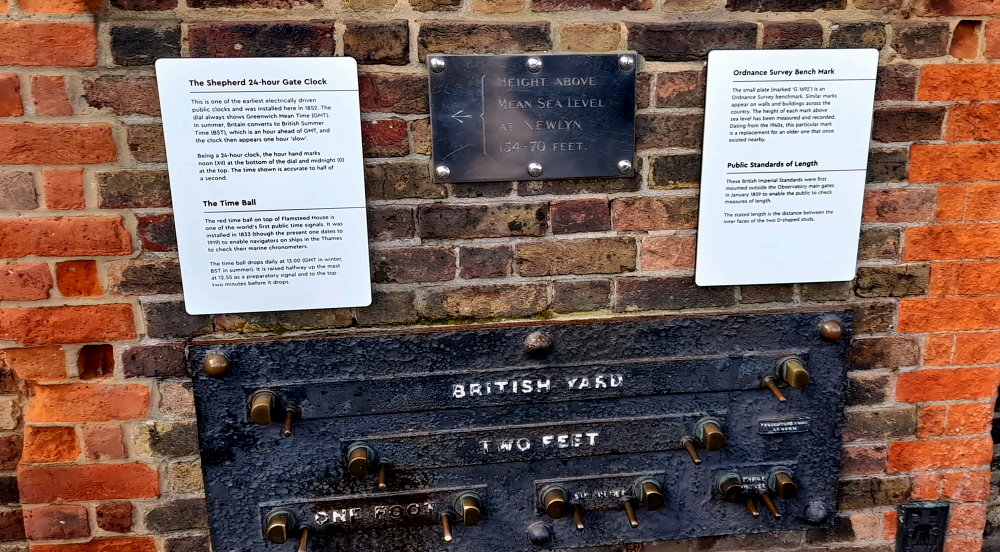
British measurements.

Plus another measurement mechanism – for time. As the industrial world came into shape, trains, factories and global businesses could use Greenwich Mean Time as a universal measure of time, meaning that the timings of journeys, transactions and production periods could be standardised across the whole planet. On the outer wall of the Observatory is the Shepherd Gate Clock which has an unusual 24-hour display.
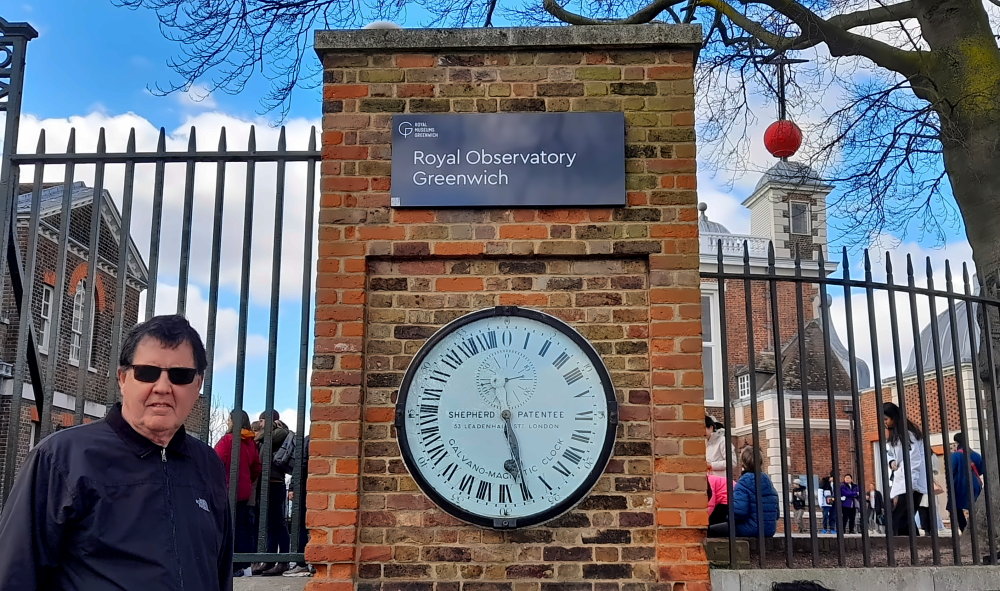
Shepherd Gate Clock – Greenwich Mean Time.

From the Observatory we walk down the hill past a row of ancient trees, including the Queen Elizabeth’s Oak, thought to have been planted in the 12th century with traditions linked to Queen Elizabeth 1 and King Henry VIII.
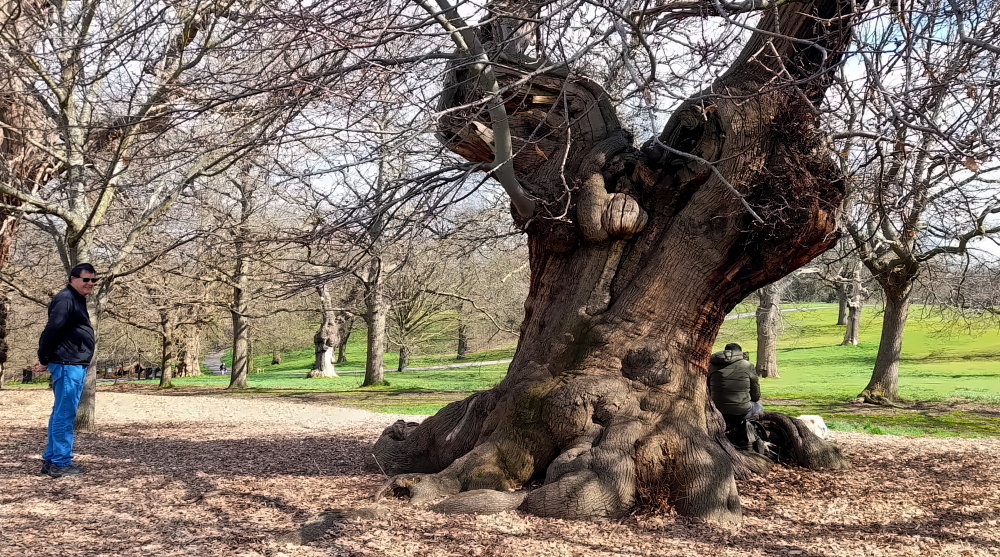
Ancient trees.

Next to this oak, another English oak was planted by Prince Philip in 1992 to commemorate 40 years of the reign of Queen Elizabeth II.
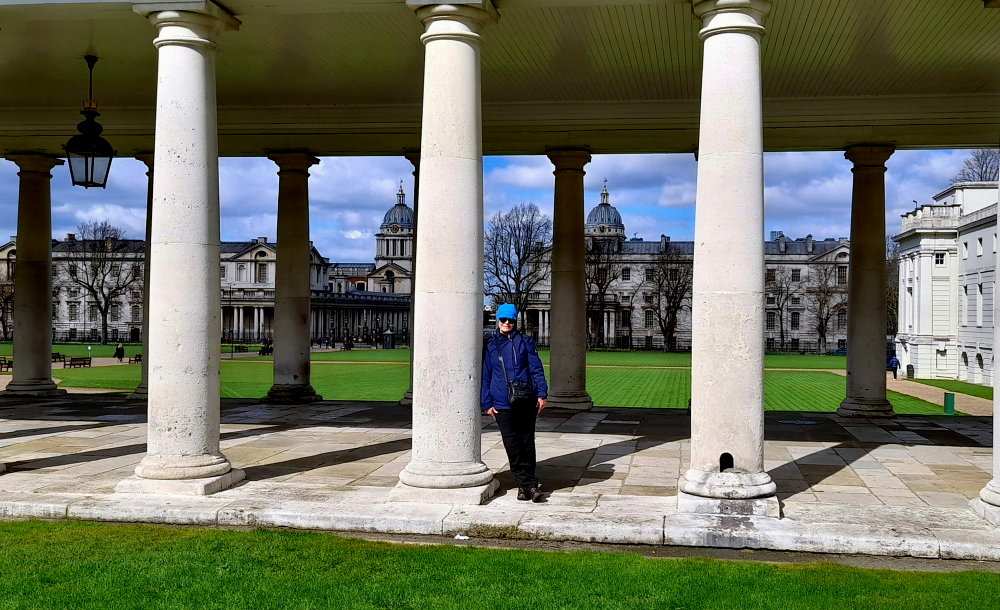
Colonnade linking Queen’s House with the National Maritime Museum.

At the bottom of the hill is Queen’s House, a former royal residence built between 1616 and 1635. It was built near the now demolished Greenwich Palace, a few miles downriver from the City of London.
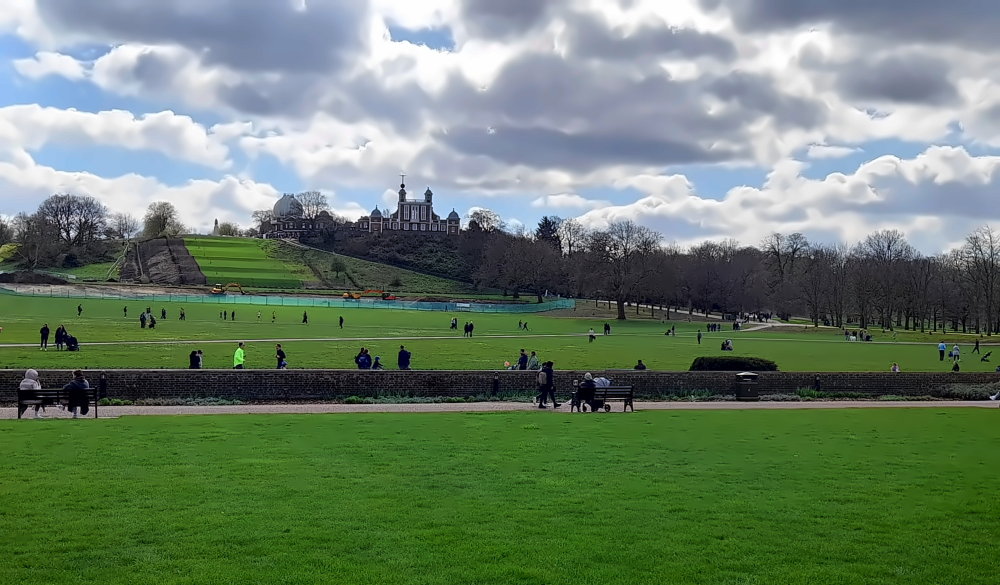
View of the Royal Observatory from Queen’s House Colonnade.

Across the road is the main campus of the University of Greenwich, at the Old Royal Naval College. The Old Royal Naval College are buildings that serve as the architectural centrepiece of Maritime Greenwich, a World Heritage Site.
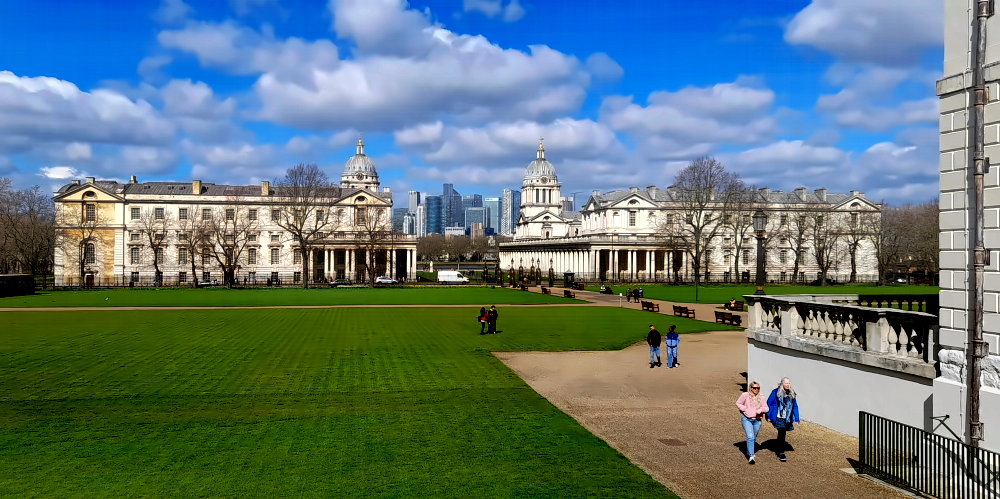
View of University of Greenwich from Queen’s House.

The buildings were originally constructed to serve as Greenwich Hospital, designed by Christopher Wren, and built between 1696 and 1712.
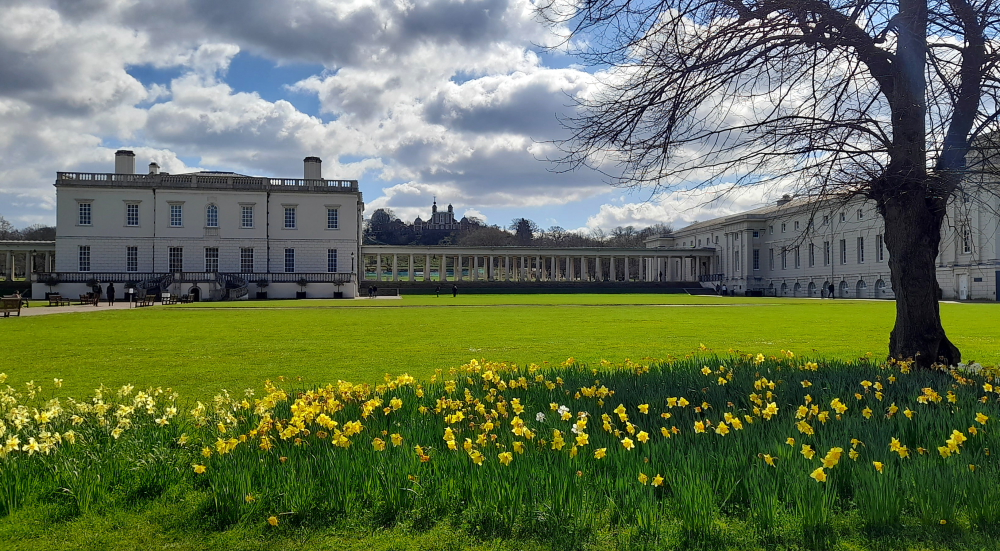
View of Queen’s House from the University of Greenwich.

The hospital closed in 1869 and so between 1873 and 1998 the buildings were used as a training establishment for the Royal Naval College, Greenwich.
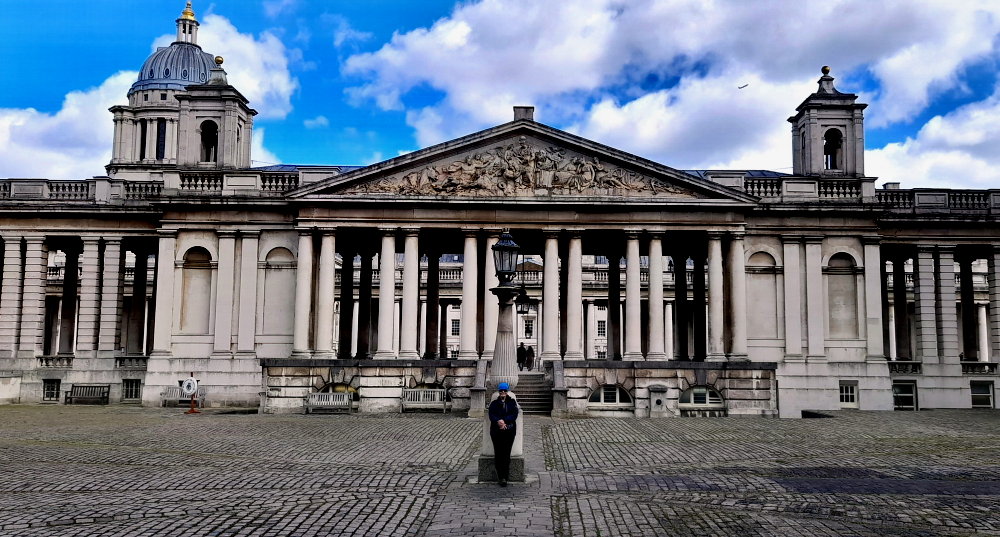
King William Court, University of Greenwich.

This was originally the site of Bella Court, built by Humphrey, Duke of Gloucester, and subsequently renamed Palace of Placentia by Margaret of Anjou upon its confiscation. Rebuilt by Henry VII, it was thenceforth more commonly known as Greenwich Palace.
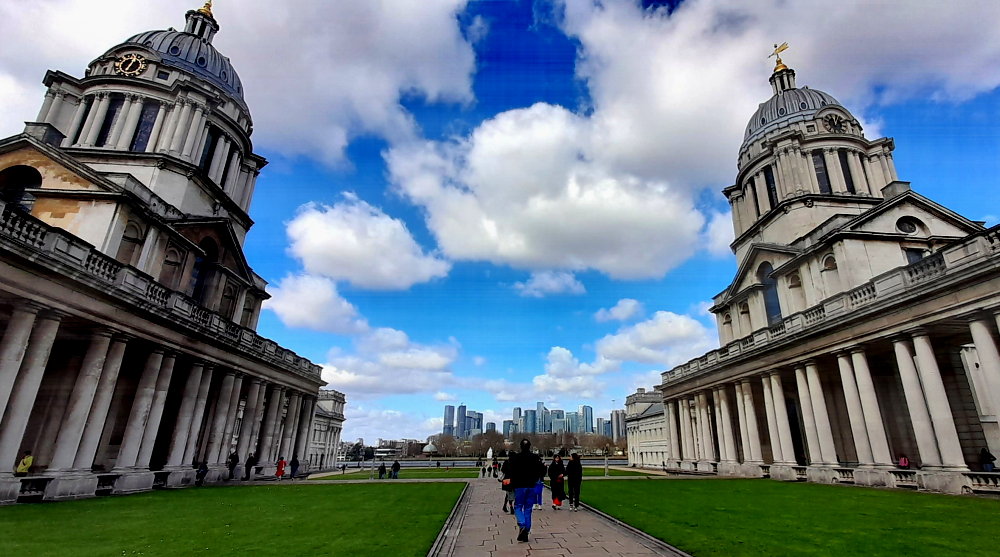
The Grand Square, University of Greenwich.

As such, it was the birthplace of Tudor monarchs Henry VIII, Mary I, and Elizabeth I, and reputedly the favourite palace of Henry VIII. The palace fell into disrepair during the English Civil War. With the exception of the incomplete John Webb building, the palace was finally demolished in 1694.
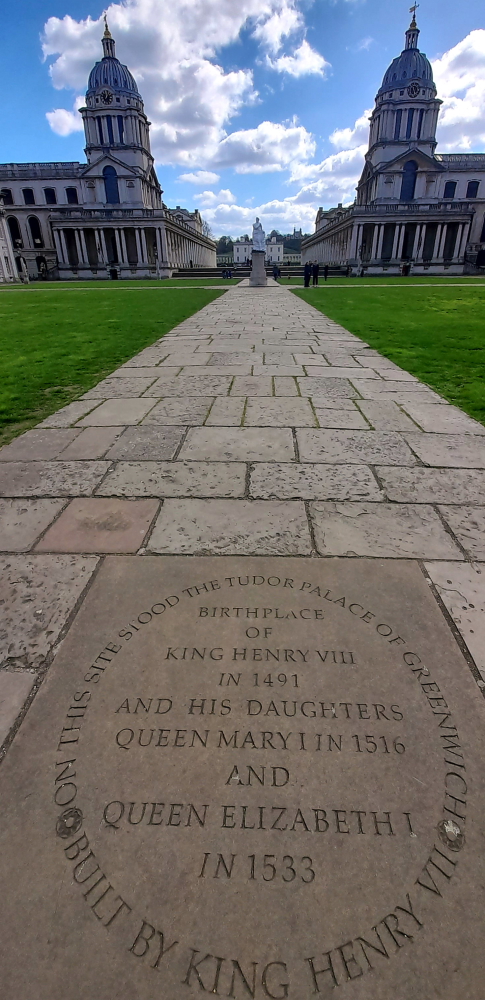
Stone marking the site of Greenwich Palace.

Near the Greenwich Pier is the rotunda that houses the staircase and lift to access the Greenwich Foot Tunnel which passes under the River Thames connecting the south bank with the Isle of Dogs at Millwall.
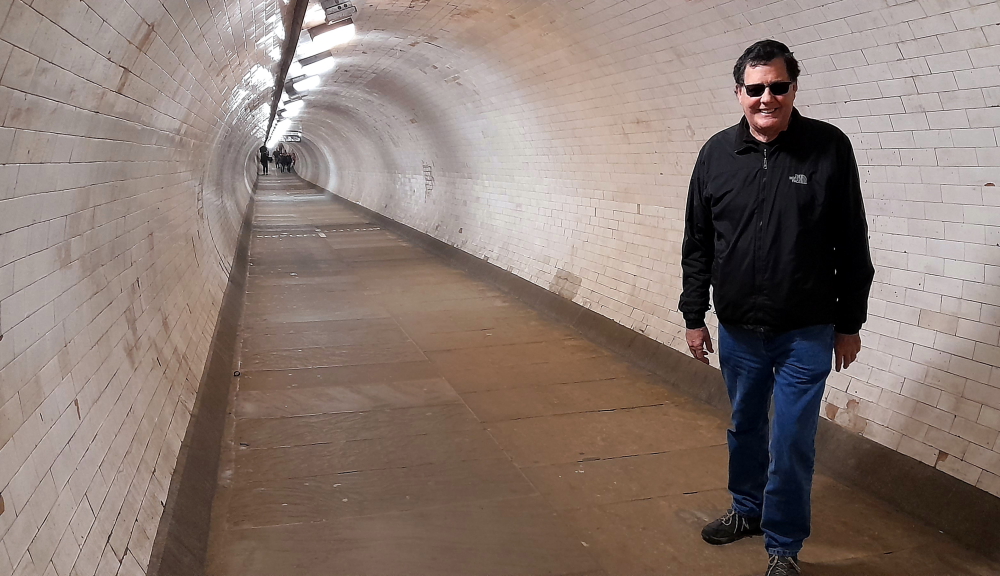
Tile-lined Greenwich Foot Tunnel.

The tunnel was designed by civil engineer Sir Alexander Binnie for London County Council and constructed by contractor John Cochrane & Co. The project started in June 1899 and the tunnel opened on 4 August 1902. The tunnel replaced an expensive and sometimes unreliable ferry service allowing workers living south of the Thames to reach their workplaces in the London docks and shipyards in or near the Isle of Dogs. Its creation owed much to the efforts of working-class politician Will Crooks, who had worked in the docks and, after chairing the LCC’s Bridges Committee responsible for the tunnel, later served as Labour MP for Woolwich.
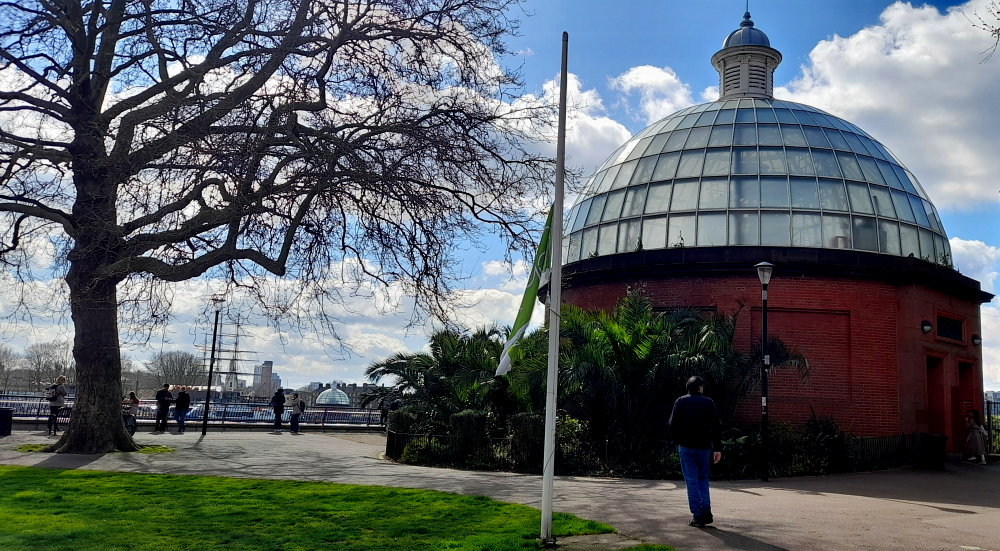
Northern rotunda with view of Cutty Sark across the Thames.

The cast-iron tunnel is 1,215 feet (370.2 m) long, 50 feet (15.2 m) deep and has an internal diameter of about 9 feet (2.74 m). The cast-iron rings are coated with concrete and surfaced with some 200,000 white glazed tiles.
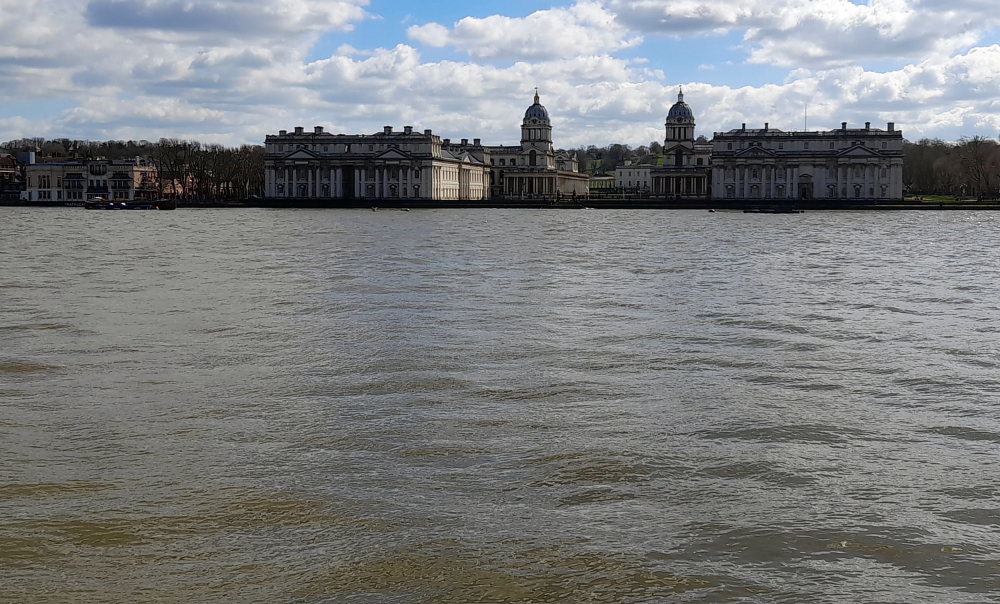
Riverside view of the University of Greenwich.

The northern end was damaged by bombs during WWII and repairs included a thick steel and concrete inner lining that substantially reduces the diameter for a short distance. The northern shaft staircase has 87 steps; the southern one has 100.
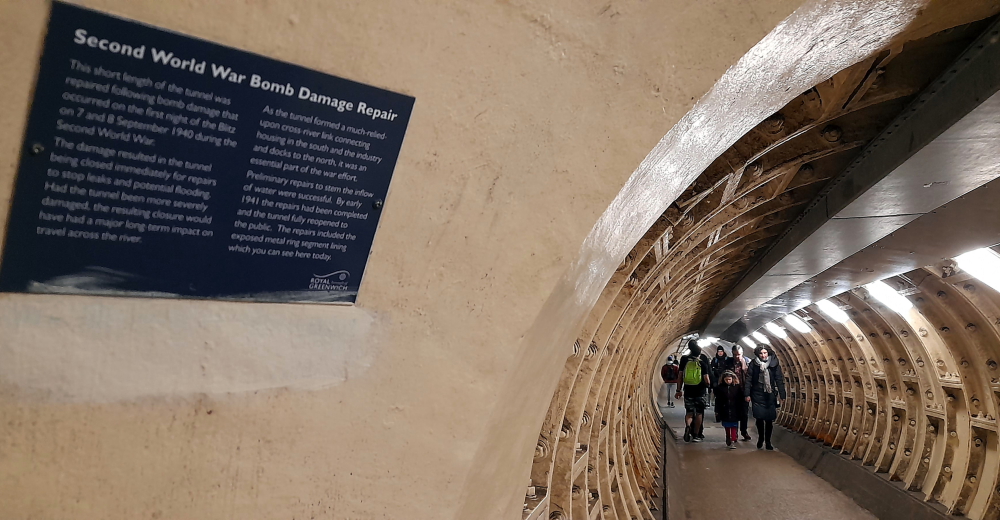
Site of WWII bomb damage & tunnel repair.

Retracing our steps we emerge next to the Cutty Sark. Since we both visited it years ago, its hull is now encircled by a transparent shell which protects it and also provides visitors the opportunity to view the hull from below.

Cutty Sark was built exclusively for the China tea trade. Tea had been enjoyed in Asia for centuries, but it did not reach Britain until the 1650s. Initially hailed for its medicinal qualities, tea was mainly enjoyed by the wealthy. But by the early 19th century working families were consuming it twice daily. It was also huge business, with over 28 million kilograms imported in 1869 alone.

A fashion developed among Victorians for consuming the first tea to be unloaded in London. This spurred the ‘great tea races’ and a spirit of intense competition: get home first and you could command huge prices. That’s why, as a clipper ship, Cutty Sark was designed to be fast.

On its maiden voyage, the ship departed London on 15 February 1870, bound for Shanghai. On this outward voyage the ship carried a general cargo, including wine, spirits and beer and manufactured goods. After successfully reaching China on 31 May, the ship was loaded with 1,305,812 lbs of tea. After only 25 days in port in Shanghai the ship sped back to London, arriving on 13 October the same year [Royal Museums Greenwich].
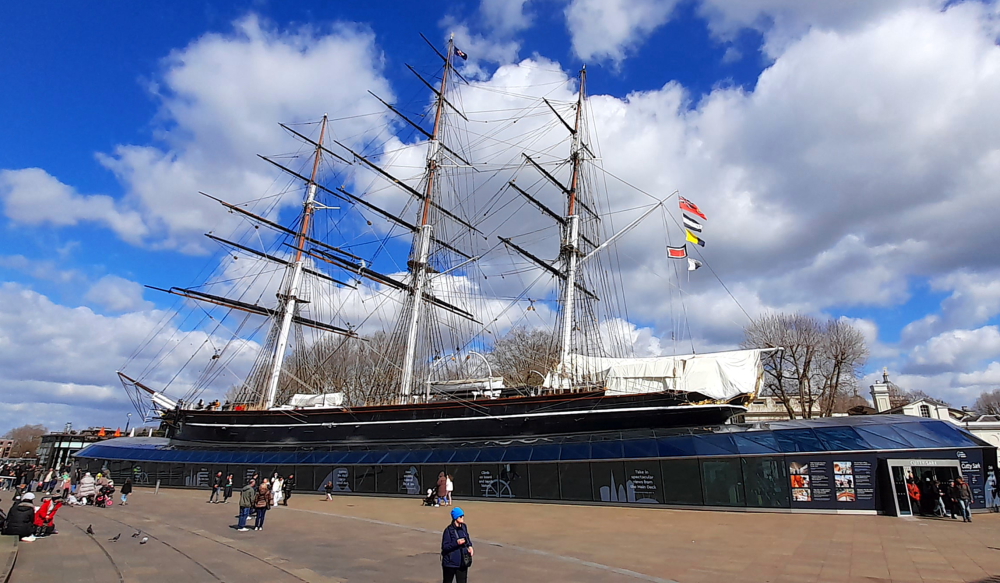
The Cutty Sark.

Walking back to the hotel we pass by Greenwich Market, a pretty 19th-century covered market selling unique gifts and knick-knacks, which is absolutely heaving this afternoon.
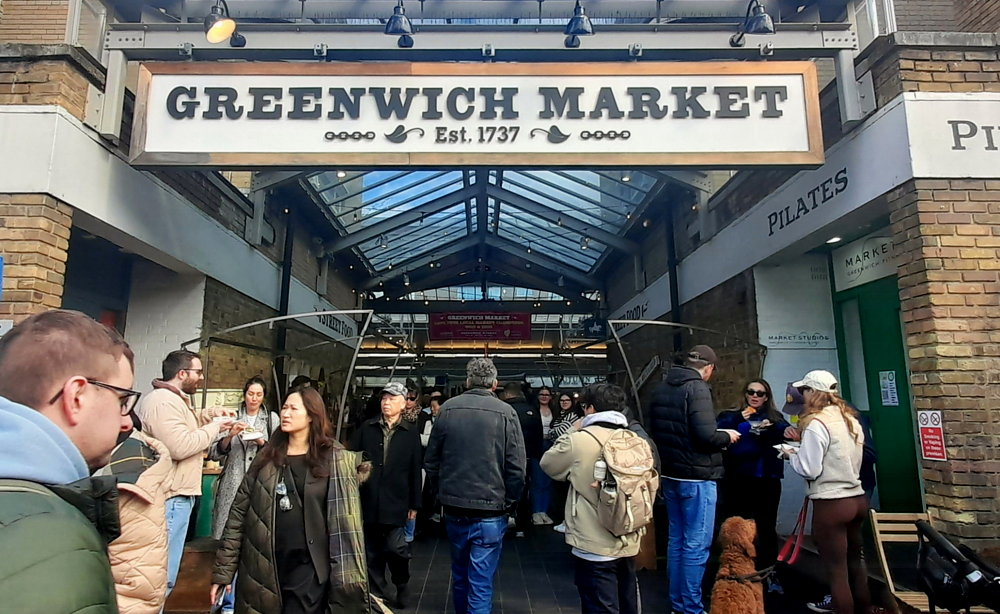
Greenwich Market.

25 March, 2024

Today, Lynn has arranged to meet up with another friend and former colleague, Dr Elizabeth Shepherd, who is Professor of Archives and Records Management and Head of Department at University College London (UCL) and currently on sabbatical writing her 3rd book, this time about the role of women archivists in recent history.
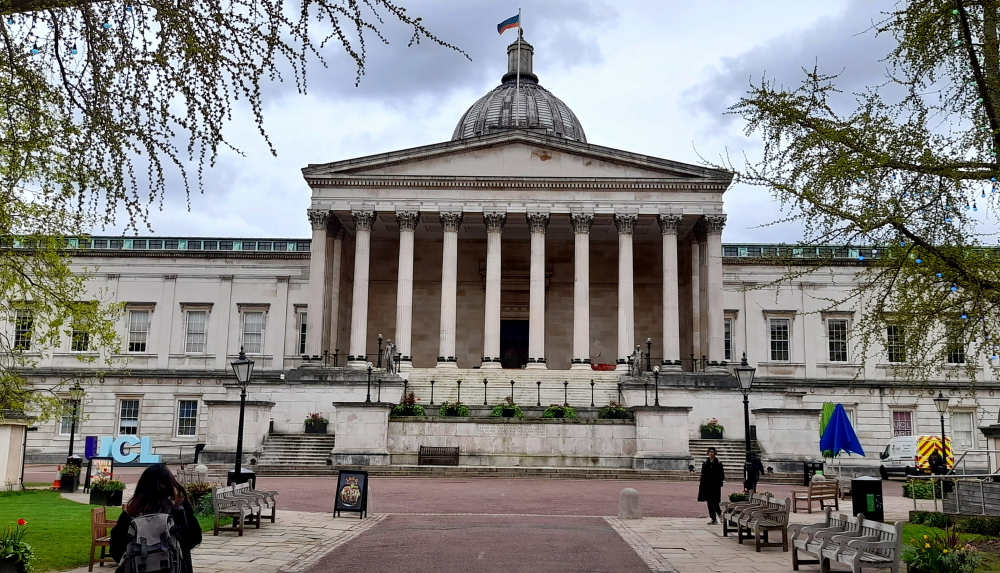
Wilkins Building & Main Quad, UCL.

Elizabeth joined the Department of Information Studies (as it is now known) at UCL in 1992. They met in 1993 when Lynn was organising, on behalf of the International Records Management Trust, a team of consultants to visit The Gambia on an Overseas Development Agency trip to advise The Gambian Government and its civil servants on archives and records management in government. Both were consultants on that trip.
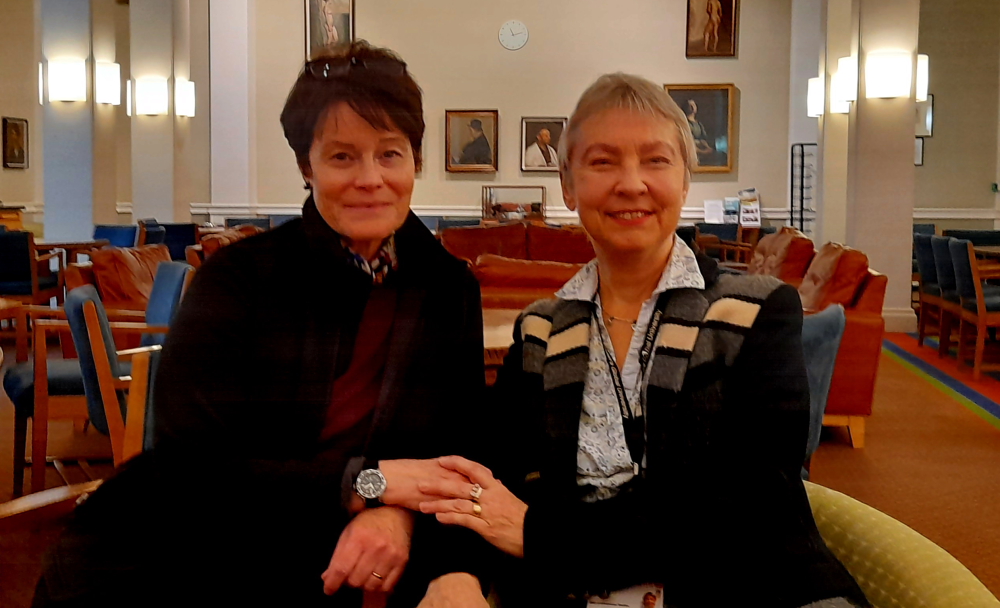
Catch-up coffee in the Houseman Room, UCL.

Their association continued when Lynn undertook her MSc at UCL during 1995-97. Elizabeth employed Lynn as a Research Assistant then later for a semester as a Lecturer in Records Management to undergrad. students, both part-time positions.

Lynn’s most recent collaboration with Elizabeth was on 12 March 2020 when she participated in the Department’s centenary exhibition “Geographies of Information” as an alumni interviewee – https://www.ucl.ac.uk/information-studies/geographies-information

It truly was about ‘geographies’ as the interviewer, an MA student, was in London on a Skype call to Lynn in Northern Ireland as we’d just arrived from our trip to Iceland and were about to return to the USA to continue our travels there, only to fly home to Australia from San Diego a week later on 19 March due to COVID.
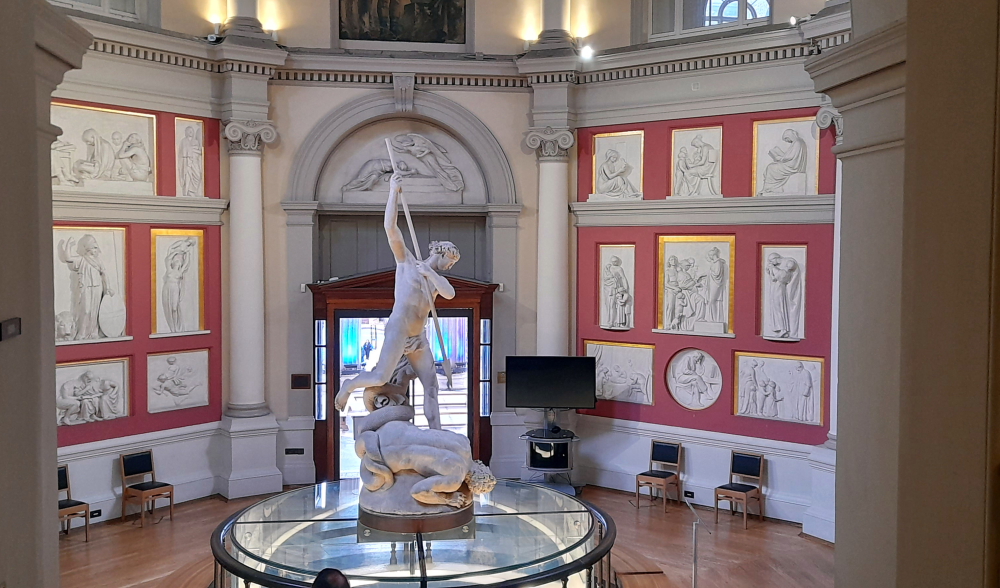
Flaxman Gallery, UCL Library.

Elizabeth took us on a brief tour of the campus including the Library, the Jeremy Bentham booth, the Henry Morley building where the Department used to be located to Foster Court, its current location.

I learnt that the ‘mannequin’ of Jeremy Bentham displayed below is framed around his skeleton and that his head is actually an artifact in a box in the UCL Archives. Weird, or what!
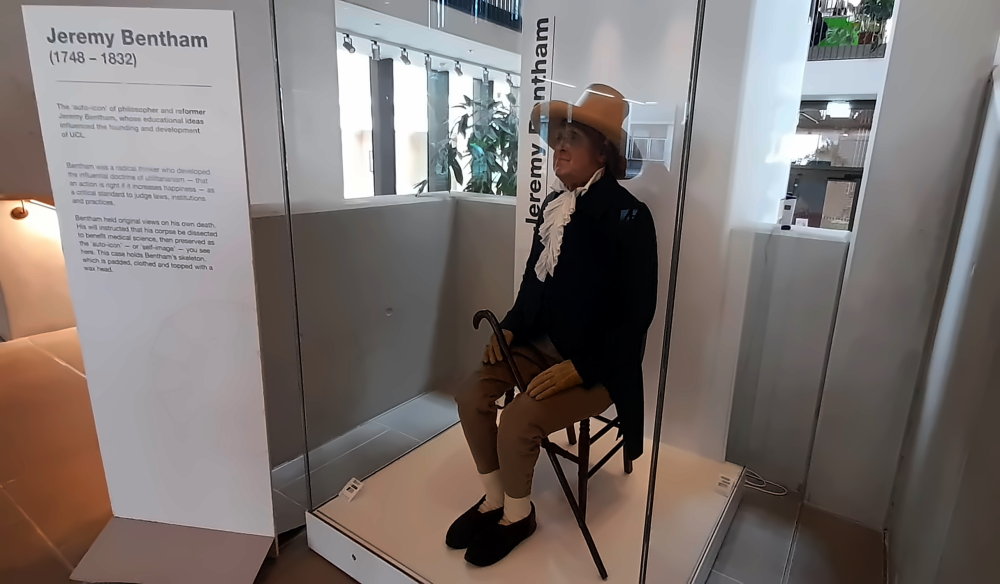
The strange “auto-icon” of Jeremy Bentham, founder of UCL.

As we have 2 hours before we need to meet up with another friend of Lynn’s, we decide to take the Tube to Mile End to check out the Jewish cemetery, the Novo Cemetery, located within the grounds of Queen Mary University, the one we missed on Saturday.

In 1657 with the encouragement of Oliver Cromwell, then Head of State, Jews were allowed to return to England after an absence of over 350 years. Many who arrived were descendants of families that had fled persecution in Spain and Portugal. Upon arrival in London they founded a synagogue in the City of London (at Duke’s Place) and acquired a burial ground (the Velho) in Mile End, at an adjacent site, on the now Alderney Road, which was used from 1696 as a cemetery by London’s growing Ashkenazi (Eastern European Jewish) community.

By the beginning of the 18th century, the Velho was nearly full. Plans were made for a second, much larger Sephardi burial ground nearby. In 1726, about 400 metres to the east of the Velho, another former orchard, was leased by the Sephardi community.

The first burials at the Novo (new) cemetery took place in 1733. Over the next 150 years, most Sephardi burials in London took place here. By the middle of the 19th century, another expansion became necessary, and in 1855 a further 1.7 acres were added to the east, between the pre-existing cemetery and the Regent’s Canal. Those buried here include the comic actor David Belasco, alias David James (1839-93); Joseph Elmaleh (1809-86), chief rabbi of Mogador and Austrian consul in Morocco, and several members of the prestigious Montefiore family.

By the end of the century, London’s more affluent Sephardim had moved away from the City and East End and, in 1897 the Novo was effectively superseded by a new Sephardi burial ground at Hoop Lane in Golders Green. The north-eastern part of the Novo remained open for adult burials until 1906.
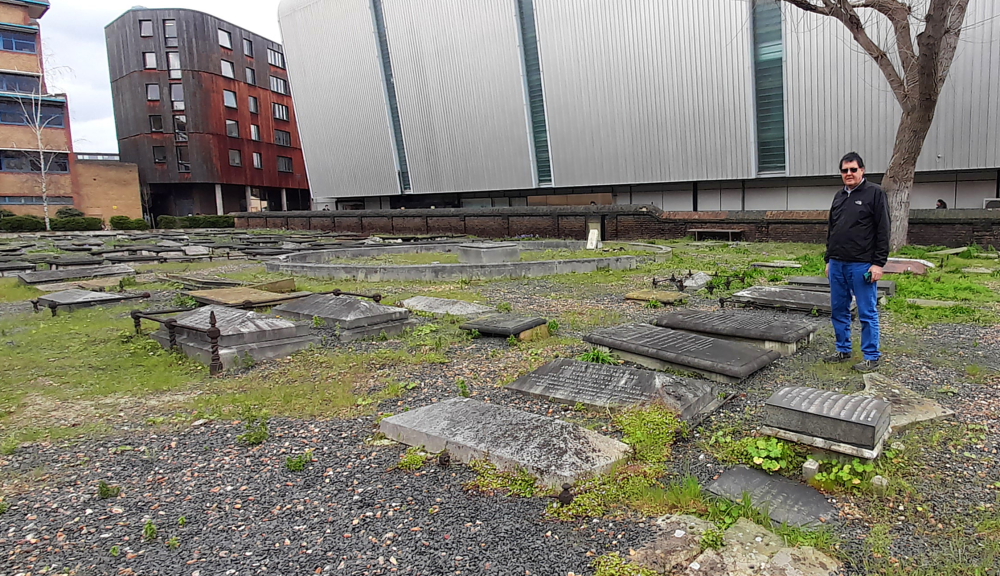
Standing next to a couple of Hart tombstones in The Novo Cemetery, Mile End.

Here amongst the Montefiores, da Costas and Belascos I find a couple of Hart and Garcia tombstones, but not the ones we are specifically searching for – Joseph Hart buried 1884 and his wife, Esther nee Garcia, buried 1853.

Back on the Tube we arrive at 33 King William Street, Wells Fargo’s London HQ, with 15 minutes to spare. Unfortunately, we discover that Lynn’s friend, Masaki, has had to work at home today due to childcare issues, so we continue to Greenwich.

We dine at the local Pizza Express and I have to say that both their pizzas and wine offerings aren’t half bad and are reasonably priced.

26 March, 2024

There’s the off-chance that Masaki may be able to make it to Greenwich today. In the meantime we catch up with the blog and get organised for our trip to catch LeShuttle from Folkestone tomorrow and our upcoming 7.5 week trip through Luxembourg, southern Germany, Switzerland, NW Italy, and France.
A Month in Wales.

10 February, 2024

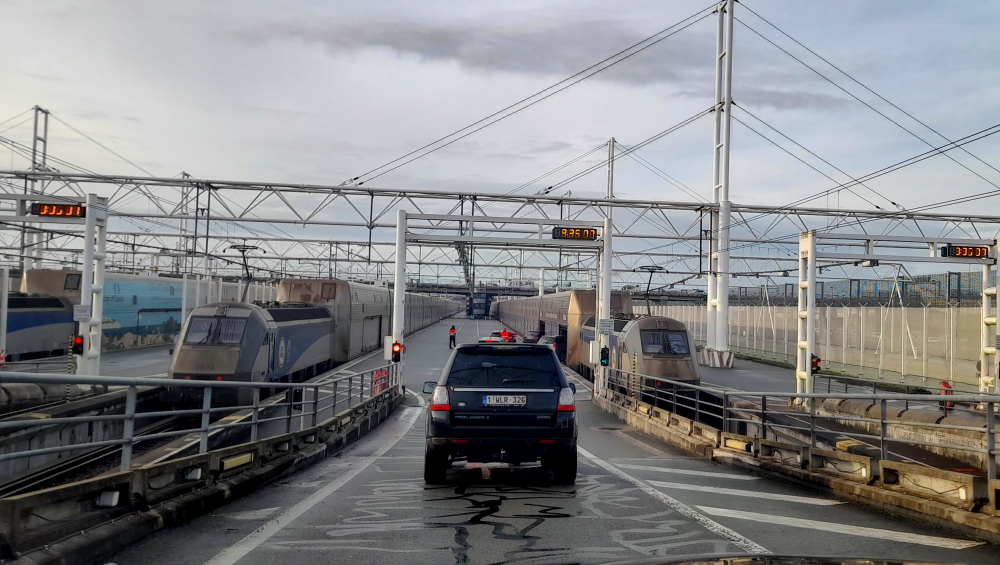
We end up leaving our accommodation half an hour earlier than planned which means we are at LeShuttle check-in 2 hours before our scheduled departure of 11:18 am. Nevertheless, we are offered an earlier train of 10:18 am which we accept and promptly proceed to the French, then UK, border controls then line up in the short queue to board the train.

Boarding Le Shuttle to depart Calais.

Perhaps the Danish border guards linked our passports on the ‘system’ as since Lynn’s run-in with them in Copenhagen in July last year we’ve not had an issue with her exceeding the Schengen’s limitation while she has been travelling with me in Europe. Result!

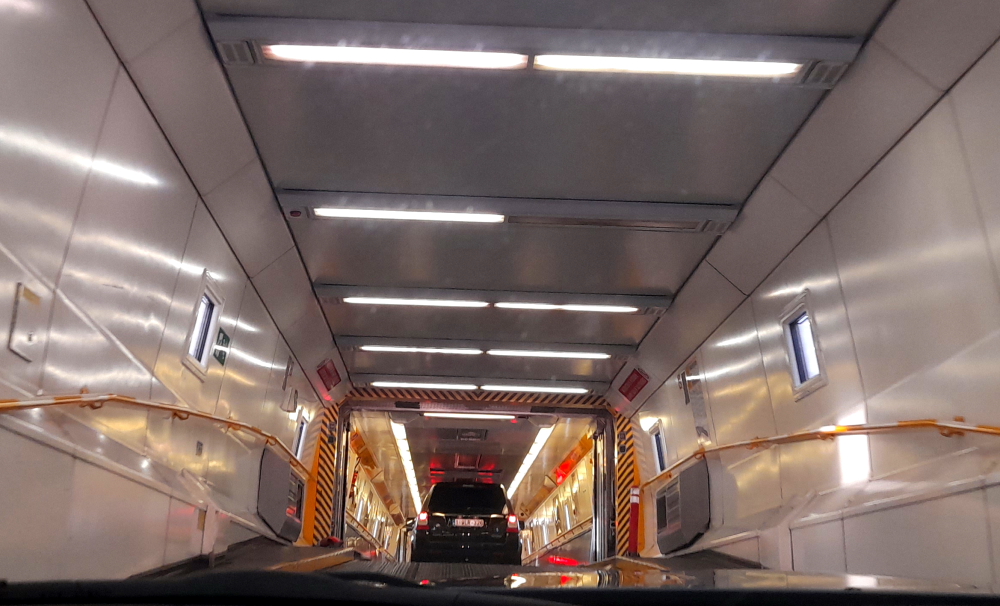
Soon we are waved onto the train and park and before we know it, we are rolling – even though the time is only 09:48 am!

Inside Le Shuttle.

35 minutes later we are rolling off the train at Folkestone and half an hour later, after driving through a misty and muddy landscape, we arrive at the Burns’s at Anvil Green.

Foggy Kent on our way to Anvil Green.

After a quick repack we give Alex our cast-offs that are destined for the charity shop and drive 5 minutes in the family’s Daimler to the Compasses Inn, their ‘local’ for lunch with Alex.

Lunch with Alex at her “local”.

When we arrive we have the place to ourselves and quickly commandeer a table by the open fire as it is really chilly outside.

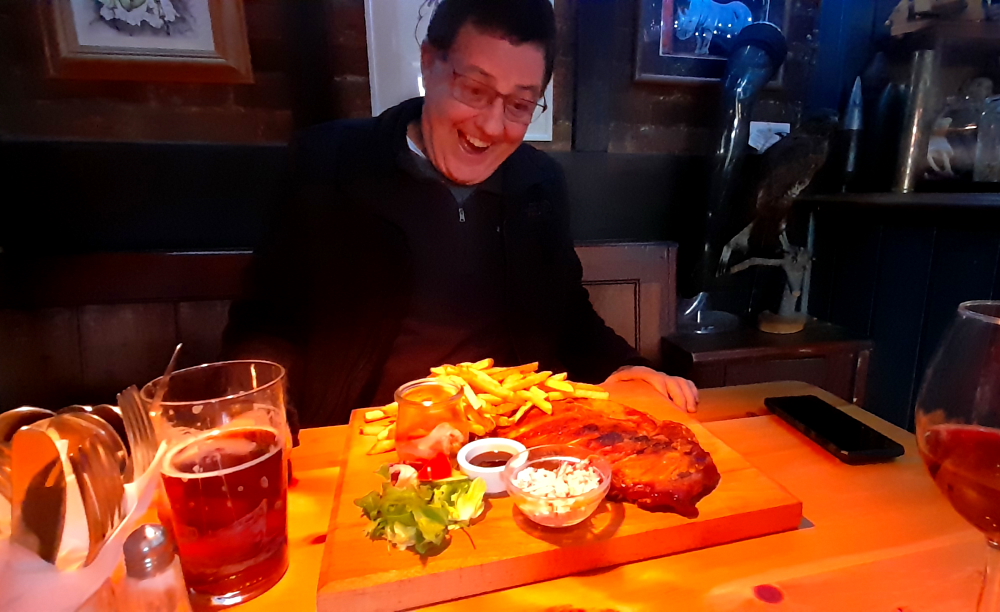
To say their main courses are ‘generous’ is an understatement!

A full rack of dinosaur ribs.

Fond farewells to Alex then we hit the road at 2:45 pm for the 2.5 hour drive to Wokingham in mizzle to stay with Barbaran and Stuart for the next few days.

Arriving in Wokingham.

Although it’s been 15 months since we last saw them in Spain, it’s just like it was yesterday as we sit down to catch up. After watching the 6 Nations rugby match “on the telly” between England and Wales (16-14), we sit down to a delicious homemade meal and have an early night.

11 February, 2024

It’s still grey, raining and miserable so we opt for a lazy day in. After a late breakfast we continue chatting until the next 6 Nations rugby match on TV – Ireland v Italy (36-0) – a masterful display and lesson in how to play the game and much to Barbaran’s delight- given she is Irish.

For dinner we are driven half an hour away to Reading where we are booked into the London Street Brasserie, a former 18th-century toll house by the River Kennet for great food and wine.

On our way home Barbaran insists we call into the local casino to try our luck at roulette. Needless to say we lose our meager bets quickly but I am instrumental in getting Barbaran to place a bet on black and win her some money back.

12 February, 2024

A nice sunny day greets us this morning but we have some chores to get done before we get out and enjoy the countryside today.

First job is to head down to the local pharmacy to get ourselves a flu shot since we can’t get a Covid booster thanks to the inefficiencies of the UK NHS system. It has been well over a year since our last Covid booster so the next best thing is to get a flu shot.

Lynn is eligible for a free shot but mine costs me GBP14.00. I would have been glad to pay for a Covid jab but that was way too hard to organise. Makes you appreciate the Australian health system despite it having a small cost vs the NHS free system. At least we can access the health system when we need it in Australia!

Our second task today is to have three new tyres fitted to the Insignia. I was planning to have the tyres last until we sold the car in May but they are already worn down to the legal limit and we still have a month travelling around soggy Wales before our 2-month driving tour of Luxembourg, Switzerland, Italy and our week with the Leggieries back in the Champagne region.

The third compulsory task today is to visit the car wash that Stuart and their eldest son, Alexander, own to have the Insignia cleaned inside and out. The car is still sporting Spanish dust from our 9 days in Montblanc and the mud from Kent.

Once the shots and the new tyres have been done I leave the car at the car wash and we all go for a drive in the countryside.

A walk in the sunshine interrupted by a flooded trail.

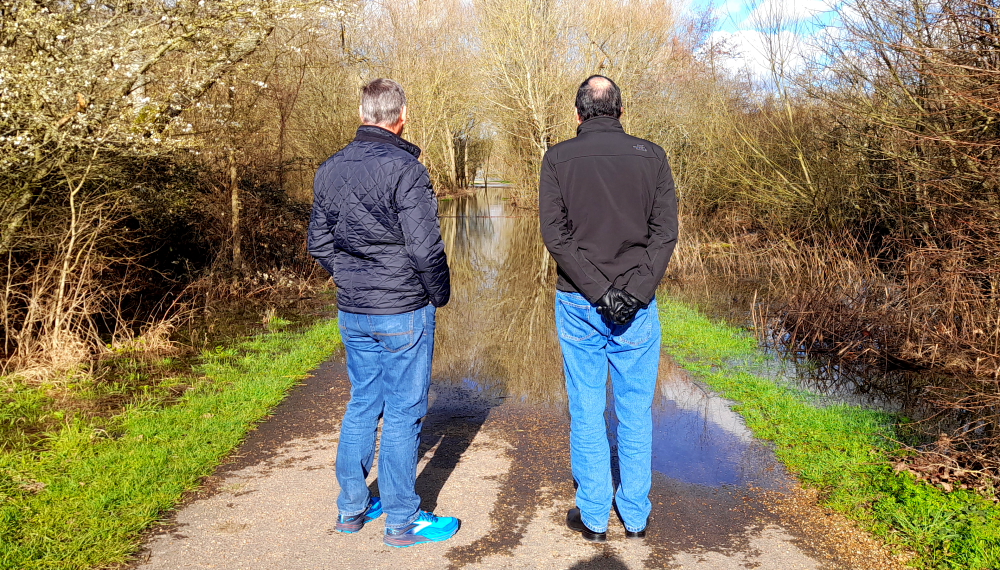
Initially we were going to walk around a lake near Sunbury-on-Thames and have a spot of lunch at the local pub but, alas, the path is flooded, the pub is closed and the area is about to be over-run by a film crew.

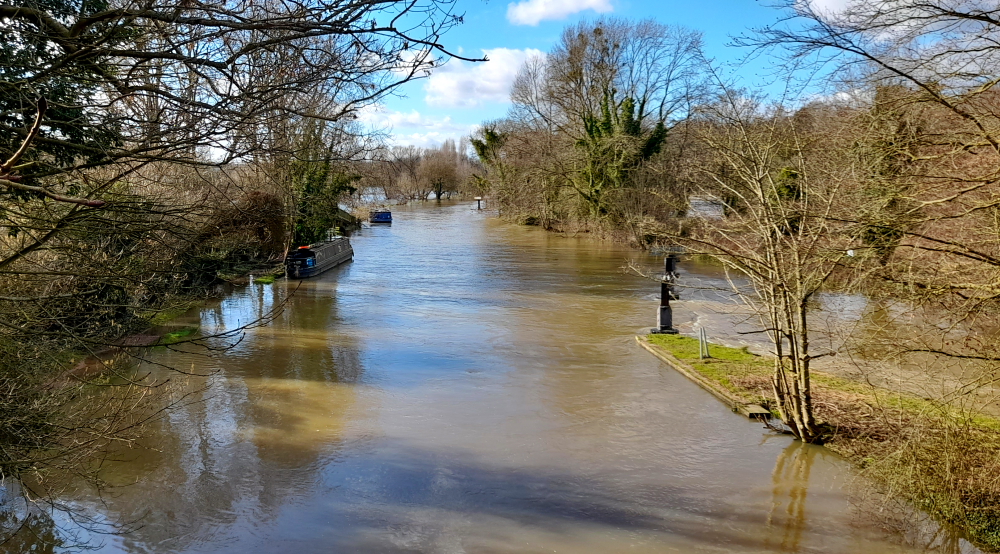
Canal has flooded into the Thames River.

Plan B is to drive 45 minutes in the opposite direction to Hurley Lock which is between Henley-on-Thames and Marlow. We park in the charming village of Hurley and take the path to the Lock. Although the canal and the Thames are flooded, at least we don’t need to abort our walk.

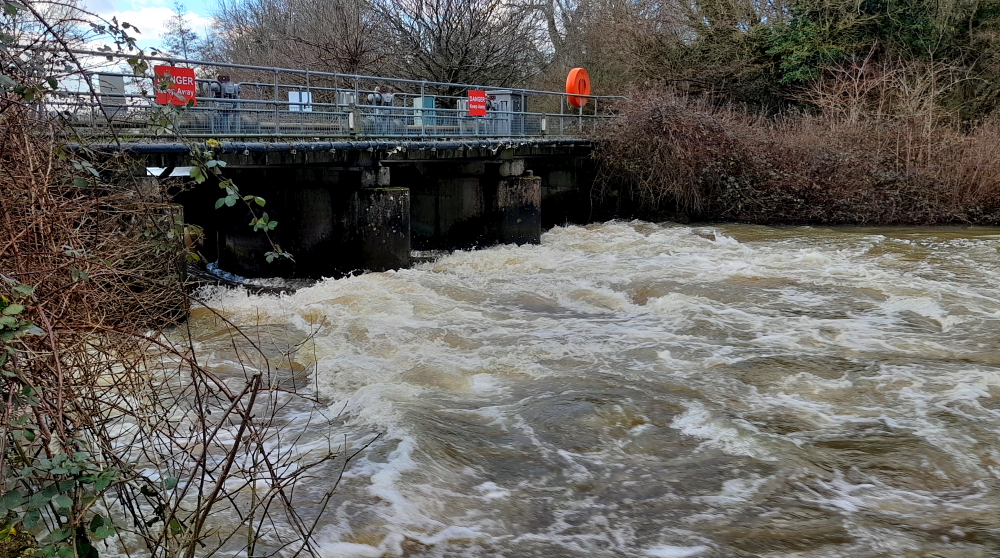
Even the weir has overflowed.

Several dog walkers are out and about but it will be several months before the tea shop is open again.

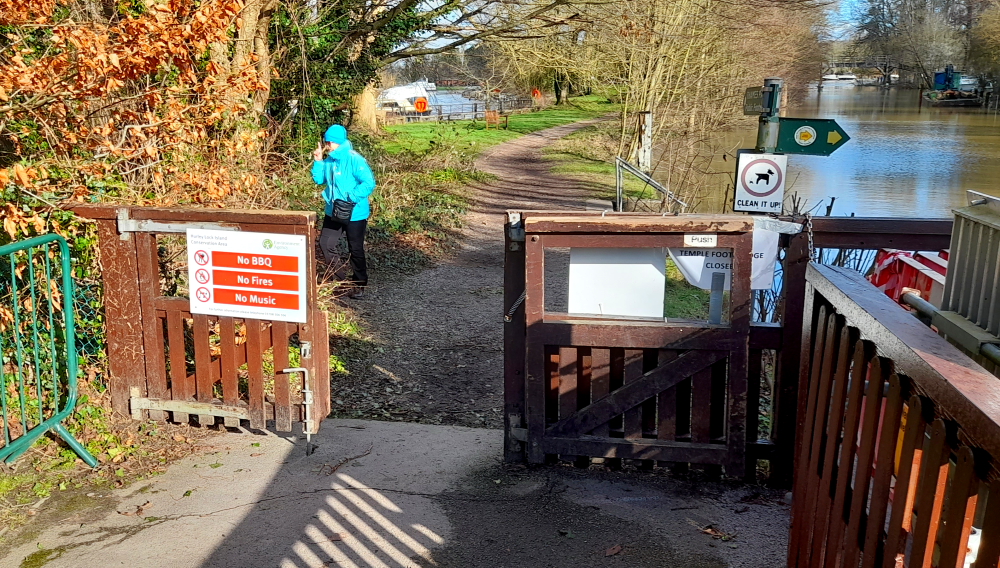
No Music here.. just looking for a loo.

Walking back into the village we check out the St Mary the Virgin Church. The first church was probably built c.700 AD when St. Birinus passed up the Thames. During the next 200 years the Danes may have sacked Hurley during their occupation of Reading and the battle of Danesfield. Next mention is in 894 when the Danes are reported to have “Traversed Herlei” during their march from Essex to Gloucester.

The village grew around the small Saxon church and the lands came under the control of Esgar (Asgar), the Chief Staller and Master of the Horse to Edward the Confessor in the middle of the 11th Century.

After the Conquest, William I confiscated all the lands at Hurley and gave them to his trusted supporter, Geoffrey de Mandeville, for services rendered. In 1086, at the request of Geoffrey de Mandeville’s second wife Leceline, Bishop Osmund of Old Sarum dedicated the rebuilt church at Hurley as a Benedictine Priory, a cell to Westminster Abbey.

The Domesday Book, compiled during this time, states that the village of Hurley consisted of a church together with a mill, 2 fisheries, 25 villagers, 12 cottagers and 10 slaves.

St Mary the Virgin Church, Hurley.

1536 saw the Dissolution of the Monasteries by Henry VIII and Hurley Priory did not escape. The entire eastern end of the church and the transepts were demolished until only approximately the present day building was left.

In 1545 the estates passed to John Lovelace and much of the materials from the Old Priory were used to build the first Ladye Place Mansion. At the turn of the 17th century, Richard, 1st Baron Lovelace of Hurley, installed the bell turret and the largest bell. A major restoration took place in 1852.

From there we walk to the Olde Bell – today a stylish coaching inn with a restaurant and rooms that dates from 1135 – for a spot of lunch. Now this pub serves lunch from noon-5:00 pm – how civilised!

Lunch at the Olde Bell, Hurley.

When we return to the house Stuart and I drive down to the car wash to collect the Insignia.

Sparkling clean car at the Waves Car Wash, Wokingham.

It has been a while since we had the inside of the windows cleaned and as I’m running out of ceramic car polish I also have a coating of it applied. The car now looks immaculate. I take some photos of the car so that when we come to sell it in May I have the photos ready just in case the weather is not conducive when we need it to be.

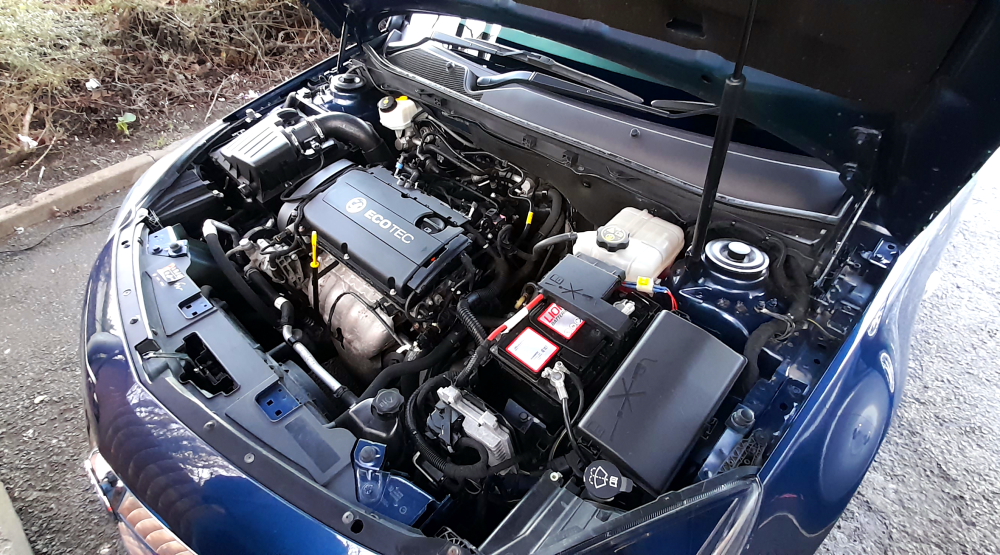
I also had the engine bay cleaned just to help the sales process. It’s also come up a treat.

Like brand new under the bonnet.

Barbaran cooks us a delish chilli con carne which we have while we watch a movie on TV, then hit the sack.

13 February, 2024

It’s 9 Deg. C. and mizzling when we say farewell at 11:45 am for our 197 km drive to Cwmdu, Wales, via Tesco’s first for fuel and provisions as the weather forecast for the next few days is – rain.

Hitting the road again.

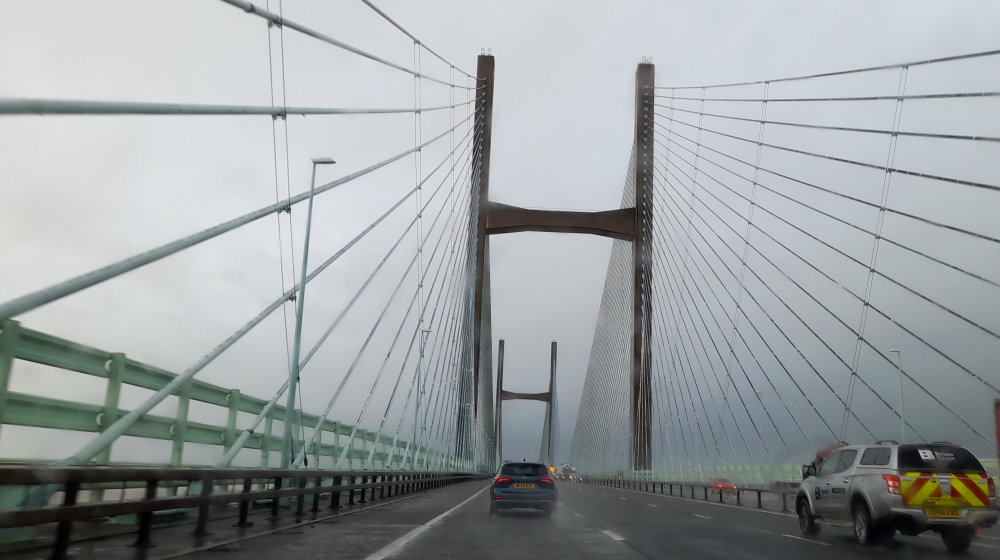
Mizzle soon turns to rain and while crossing the Prince of Wales Bridge from England to Wales over the River Severn, it’s bucketing down.

Crossing the Prince of Wales Bridge from England to Wales.

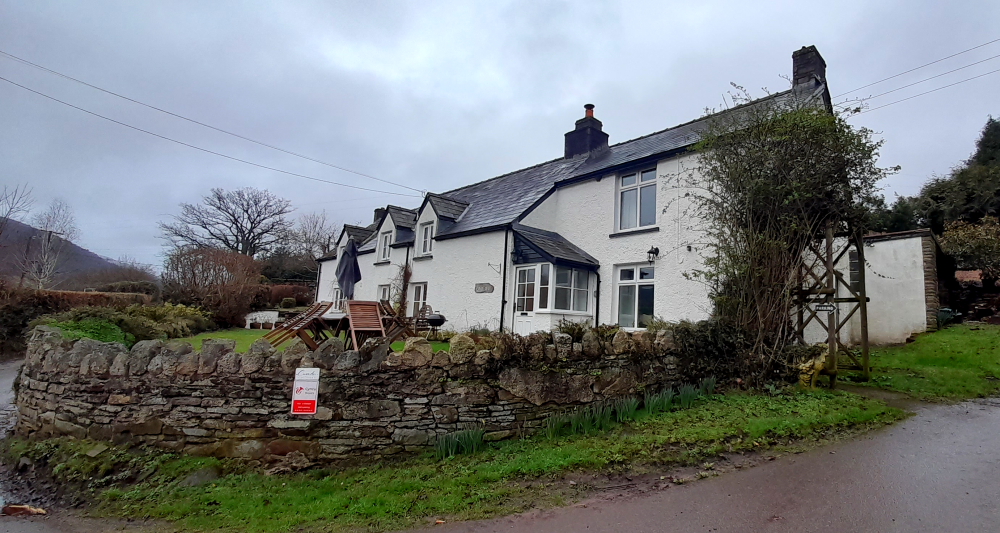
We arrive around 3:00 pm and settle into our “Scenic Welsh Cottage in the Brecon Beacons”.

Our cottage for the next 4 days.

Not too sure about scenic as we can’t see the surrounding countryside thanks to the mist but it is definitely a cozy, 3-BR farmhouse cottage, lovingly looked after by the family since the 1950s, complete with family heirlooms.

During our drive here we noticed that there isn’t a supermarket or a pub that is open for the next two nights within a 20 minute drive so after we unpack we have to head out to look for a supermarket. My GPS says that there is a Tescos 13 km away. Little did I realise that 13km meant “as the crow flies” and due to the hills, valleys and lack of main roads the drive is 25km and takes over half an hour. Driving back to the cottage in the dark and wet is a major headache and one of the reasons that we would never live in a remote country region of the UK. Nice place to visit but WHO THE HELL WOULD LIVE HERE?.

14 February, 2024

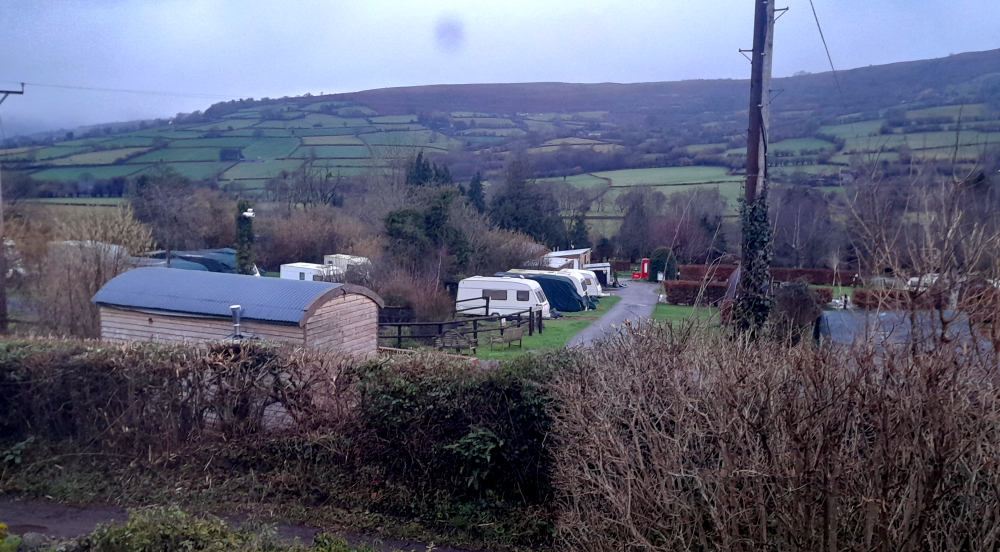
A grey start to the day but we get glimpses of the surrounding hillsides as rain shower after rain shower pass by.

View from the cottage.

We spend the day catching up the blog and doing several loads of washing and ironing. We even have a visit from a guy from a broadband company who’s come to extend the WiFi coverage at one end of the cottage. Lynn asks him if he wants a cup of tea to which he replies in a magnificent Welsh accent: “Thanks, but can I have a glass of the Council’s pop, please.” Turns out he wanted a glass of water!

Before we know it, it’s dusk. Time for another meal in and a movie on TV. Hopefully the local pub is open tomorrow night as I have no intention of trying to drive these narrow lanes in the dark and wet again.

15 February, 2024

It’s cold and raining again today so we take the opportunity to go through our “stuff” to jettison anything that is unnecessary. I also backup our photos of the past couple of months and make a few alternative plans for when we are back in the UK in late May for selling the car.

It doesn’t help that we slept in until after 11:00 am and didn’t have breakfast until midday. It’s nice to be able to just hibernate occasionally when the weather outside is cold and wet and the countryside is absolutely quiet. Not even a bird or sheep to break the silence.

Tonight we plan to go to the local pub for dinner but when we arrive at the hotel car park there are no lights on. The publican comes out to meet us in the car park to apologise that they planned to be open but are having electrical issues, the electrician has not been able to rectify the problems so they won’t be opening tonight. She assures us that they will be open tomorrow night.

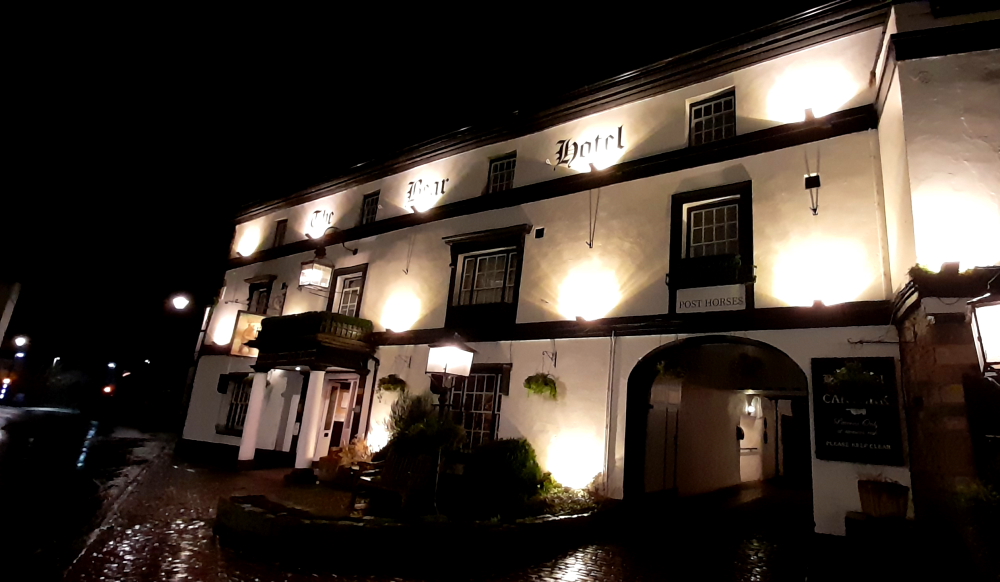
The next closest pub is the Bear Hotel in Crickhowell which is about 7 km away. I hate driving in these wet conditions when the narrow roads are busy with local traffic but we have no choice.

The Bear Hotel.

Luckily the food is excellent and there is good parking and a lively atmosphere in the pub. Hopefully our local is open tomorrow night.

16 February, 2024

We are out of bed slightly earlier than we were yesterday but it’s still raining outside. It looks like we will have another lazy day inside and do the little things that we have neglected these past few months.

It’s now 2:30 pm and there is a break in the weather and for the first time in Wales we can see patches of blue sky. It’s not forecast to be dry very long so I map out a driving route through the Brecon Beacons National Park for our relocation to Llanelli tomorrow. Since the ground is absolutely saturated we decide to minimise our driving on local roads and try to at least stay on A roads. Even taking a zig-zag route through the Park it’s still only a couple of hours’ drive from here to Llanelli.

Tonight we try to have dinner at the pub just down the road but again we are told that they are not serving food tonight. How hard is it to open the kitchen on a Friday night? We have to drive down to the neighbouring village. This time we stop at the Nantyffin (try to pronounce that!) Cider Mill Inn which is a few kilometres closer than the Bear Hotel. The food is not quite as good as the Bear’s but it will do on this very wet and windy night. At least we have a table by the fire.

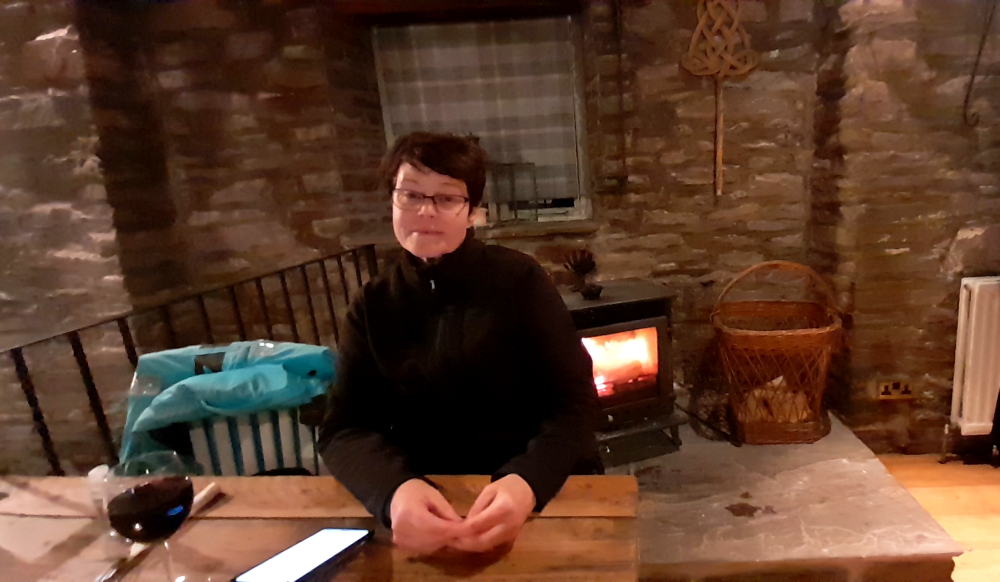
Red wine and a warming fireplace.

17 February, 2024

We are out of bed early (or at least early for us) this morning as we have to check out by 10:00 am. How uncivilised on a winter’s morning! The weather is no better this morning so our drive around the National Park is in heavy rain and regular fog patches. Just getting to an A road is an effort as our GPS takes us up and over the hills behind the cottage. Luckily there are very few cars or tractors on the lanes this morning.

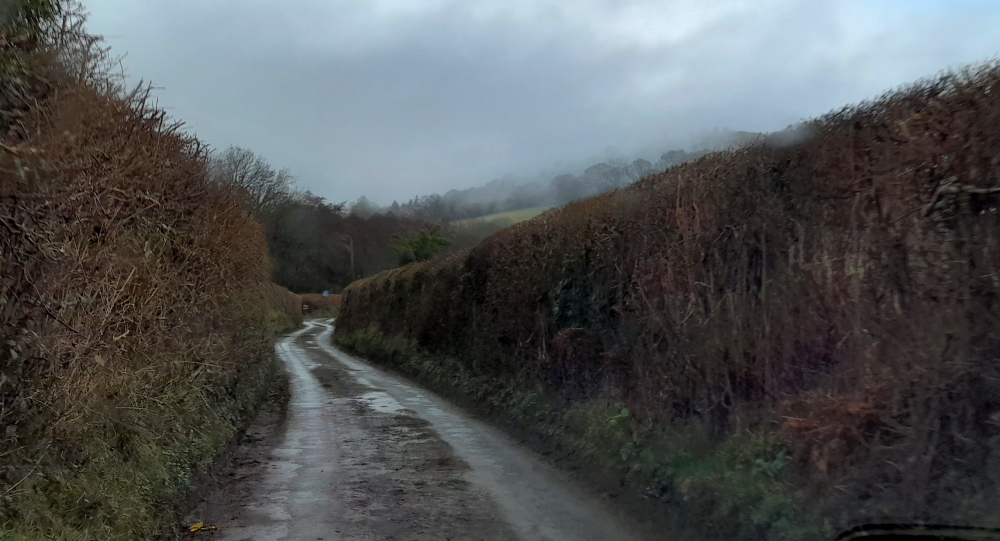
That’s not a road!

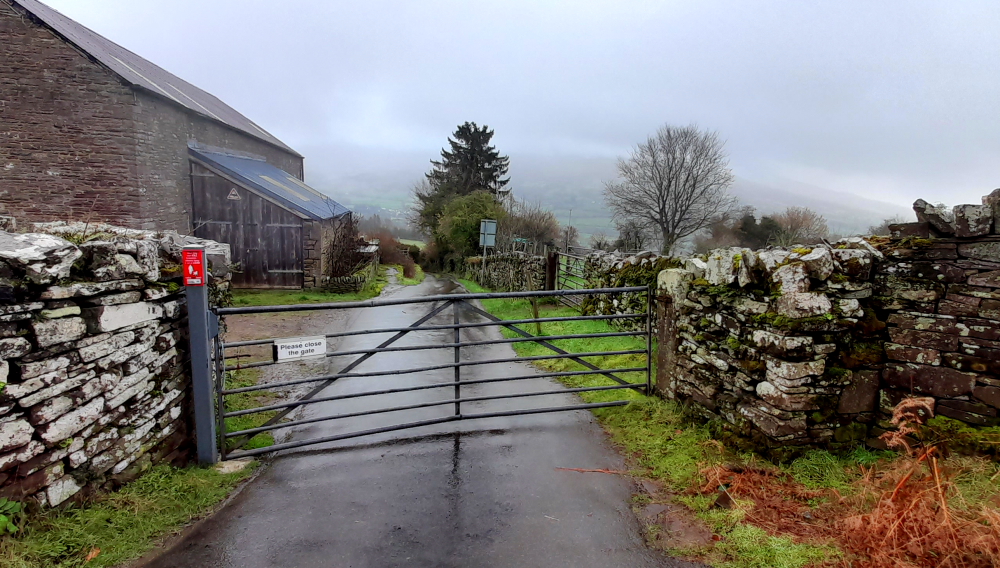
The country lanes even take us over a number of cattle grids and we come across a closed gate on the main road between villages. Talk about back of beyond.

Lynn gets wet manning the gate.

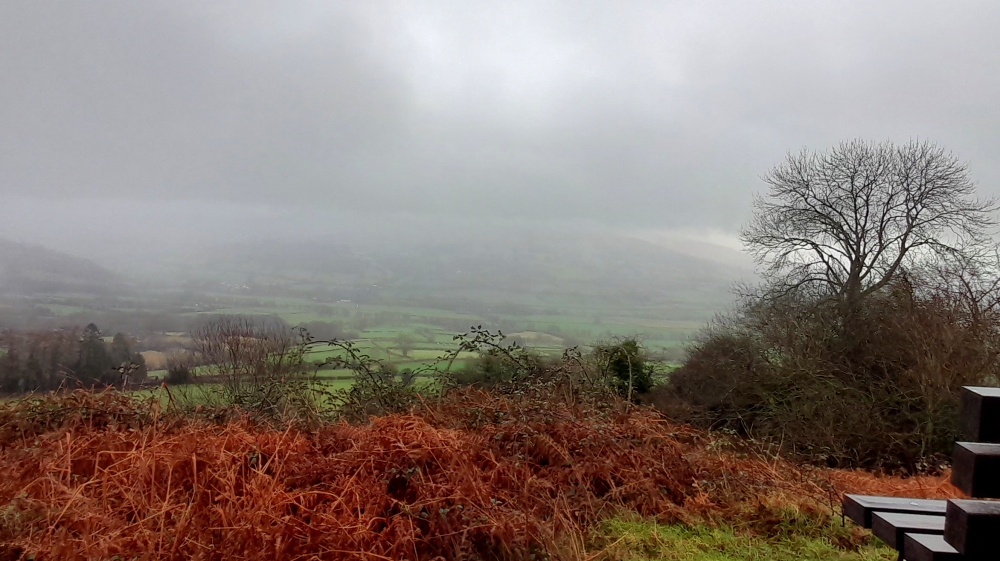
As we climb higher into the National Park we find ourselves driving in thick fog. The plan was to stop at a few lookouts to get some views of the National Park. All we see are views of low cloud.

Best view we get all day.

It’s Saturday morning and at every lay-by in the National Park there is barely a parking space available. These crazy Welshpeople are all out either hiking, jogging or cycling in this crazy weather that is almost too poor to even drive through.

At the highest point on the drive through the Park the sun is almost shining through the clouds. The edge of the road is an absolute bog so passing cars in the opposite direction means we have to come to a complete stop without leaving the bitumen. We even come across a small car on its roof and it appears that they drifted on to the muddy verge and slid into the ditch and rolled over.

Almost sunshine at the highest point of the Park.

By 2:00 pm we arrive in Llanelli and stop in at the local Tesco for supplies. We are camped in a 1970s house on a housing estate for the next 4 nights. Another AirBnB equivalent that should not be on Booking.com. Still, with this weather forecast for the next few days at least it is warm and dry inside. The original plan was to visit the local beaches and drive around the Gower Peninsula Area of Outstanding Natural Beauty but not if this weather persists. Maybe another four-day rest may be in order. At least we can watch the rugby on TV.

18 February, 2024

After breakfast there is a hint of blue sky so we take the opportunity to take a 25-minute walk each way back to Tesco to buy a few items that we missed yesterday. At least we get some exercise and fresh air.

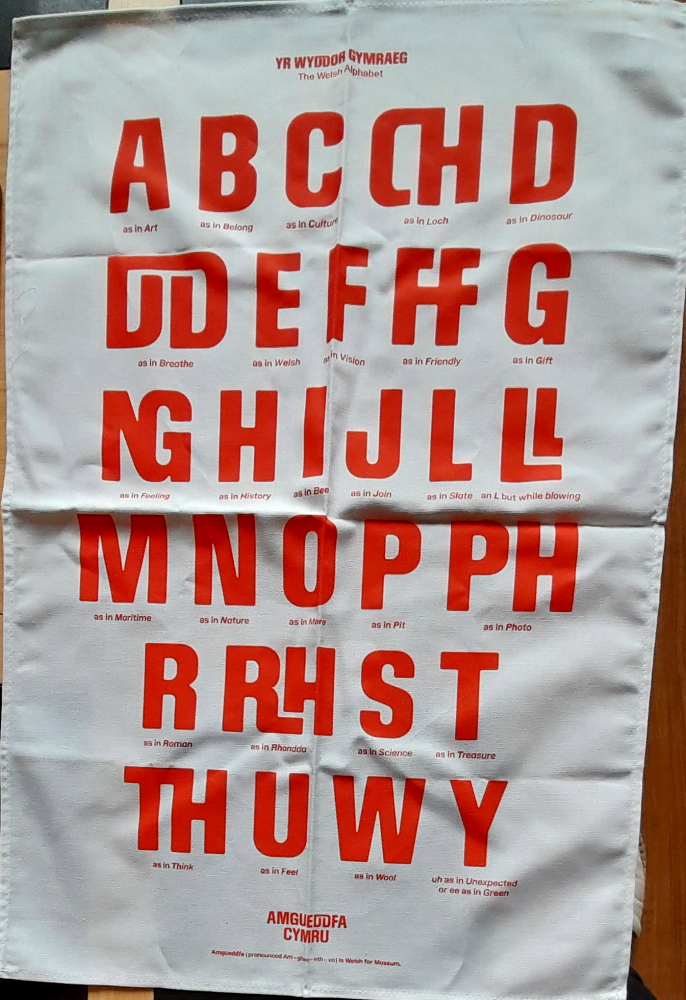
On our return to the house Lynn finds a tea towel in a kitchen drawer featuring the Welsh alphabet. Even with this, the language makes absolutely no sense what so ever. Chinese is easier!

The Welsh Alphabet.

This afternoon we spend time putting together an itinerary for our trip back to the Champagne region in May, ready for our Skype call with our Philly friends, Becky and Jerry, on Tuesday to finalise.

19 February, 2024

Sunshine! Time to hit the road to check out the Gower Peninsula and its Area of Outstanding Natural Beauty. When we were in Ireland early last year staying at the Golf Resort we met a Welshman there and he said: “If ever you get to Wales make sure you visit the Gower Peninsula. It is incredible!” So, we’ll see …

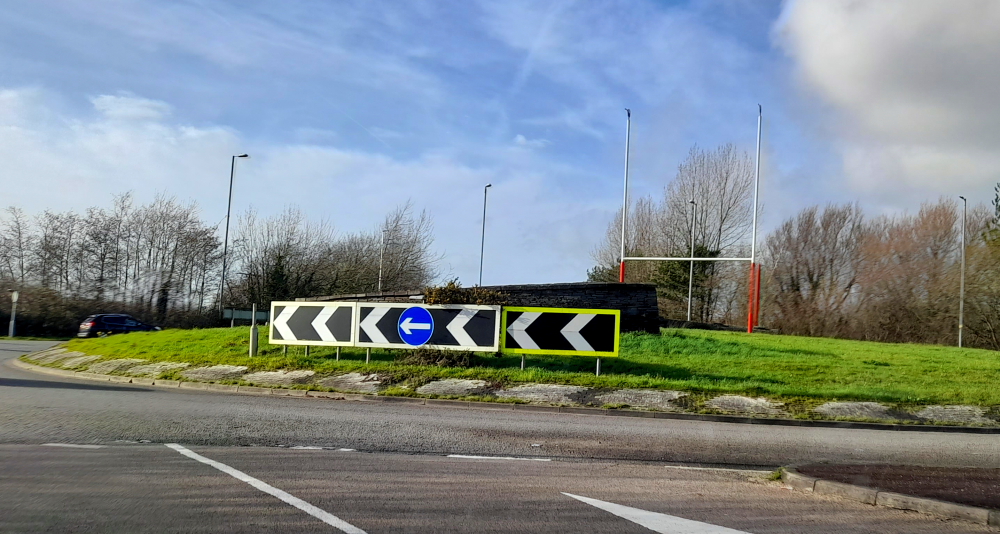
Exiting Llanelli all we see is litter along the A484 roadside and all things rugby – rugby fields, impressive rugby stadium (Parc y Scarlets) and even rugby goal posts on a roundabout. These rugby posts were used in Llanelli’s famous 9-3 victory over the touring New Zealand All Blacks in 1972. The posts, 9.6m tall and set 5.5m apart, faced an uncertain future after Llanelli’s Stradey Park, where they stood for decades, was replaced by Parc y Scarlets. Now they are the gateway to the town.

Stradey Rugby Posts – Berwick Roundabout.

We drive over the bridge which straddles the RIver Loughor and take the B4295 along the coast through Penclawdd to Oldwalls then a small road past the Britannia Inn, onto Frog Lane.

This takes us through Llanmadoc trying to get a view of the beach. We come to a dead end. Typical of Wales, we are stopped by a caravan park that has prime real estate overlooking the beach so we backtrack to St Madoc’s Church.

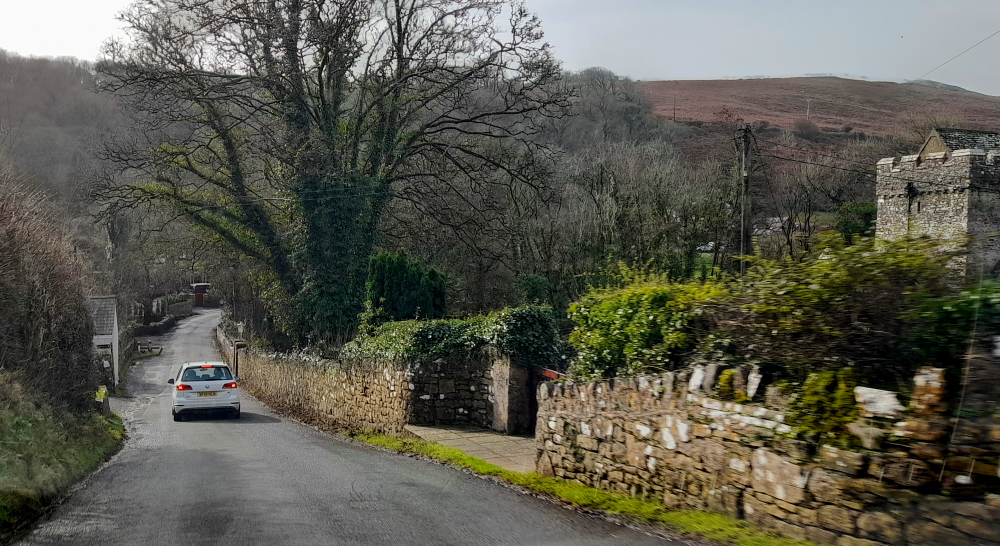
Stone walls, houses & hedges on the B4295.

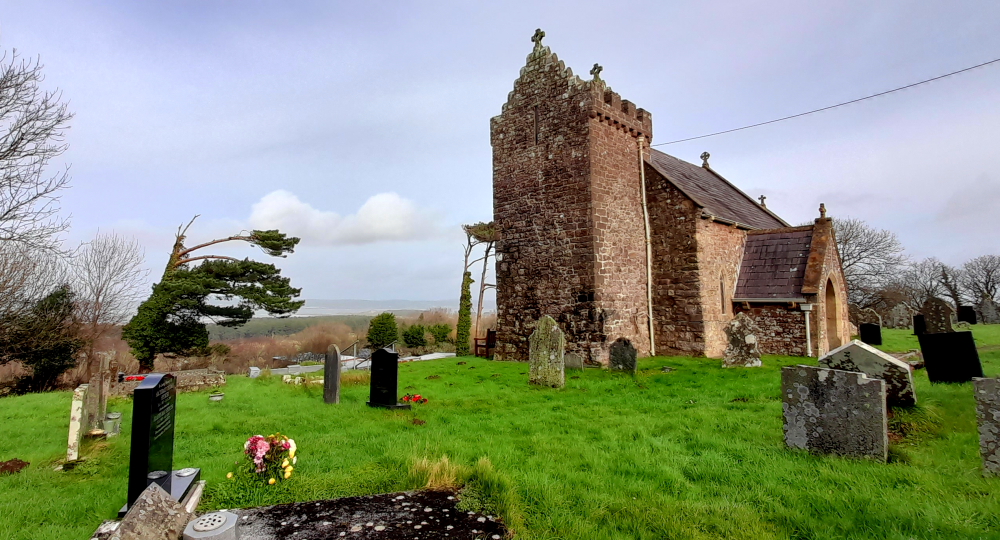
St Madoc is reputed to have founded a church here in the 6th century, and the present building is 13th century.

Set in one windowsill is a lettered stone dating from the 6th century which was discovered in 1861 in the walls of the old parsonage house, and commemorates ‘Advenctus son of Guanus’. In the west wall is a crude pillar cross and a boundary marker dating from the 7th to 9th centuries, whilst the font is probably Norman.

During the 12th century the parish was controlled by the Knights Templar, before passing to the Knights Hospitaller of St John of Jerusalem, though no visible evidence now remains of this. The Revd J D Davies, a skilled woodcarver, was Rector here from 1860 to 1911. He carved the oak altar frontal and led the major restoration begun in 1865.

13th century St Medoc’s Church.

From here we return to Oldwalls then drive through Burry to join up with the A4118 to Port Eynon.

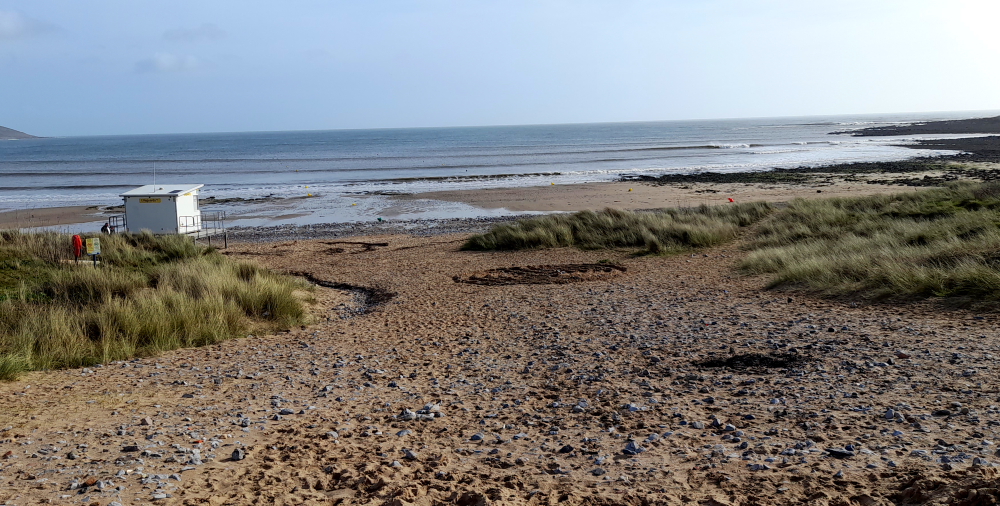
Lifesaving hut & beach at Port Eynon Bay.

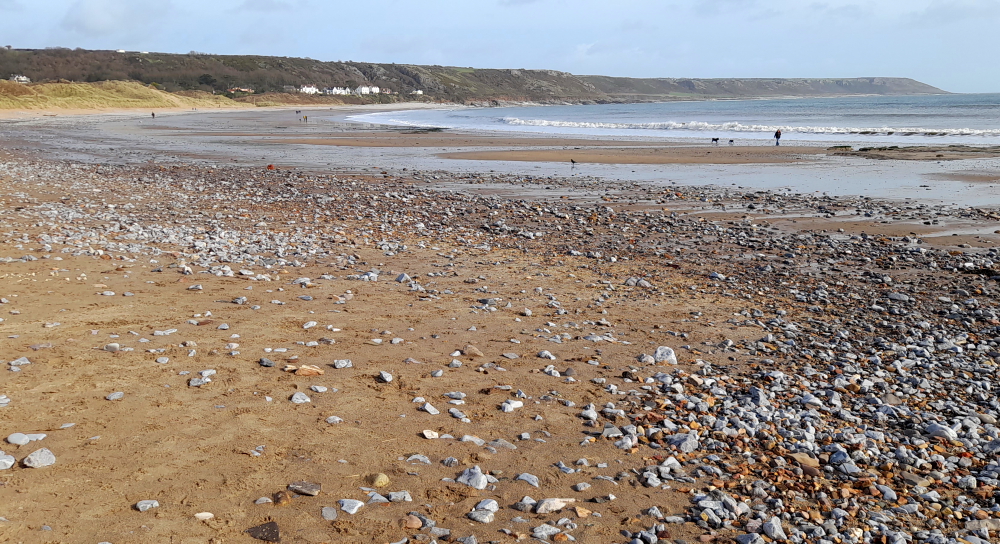
According to the visitswanseabay.com: “Port Eynon Bay is safe, sandy and award winning, with both a Blue Flag and a Seaside Award.” Porkies??!!

Award winning, “sandy” Port Eynon Bay Beach.

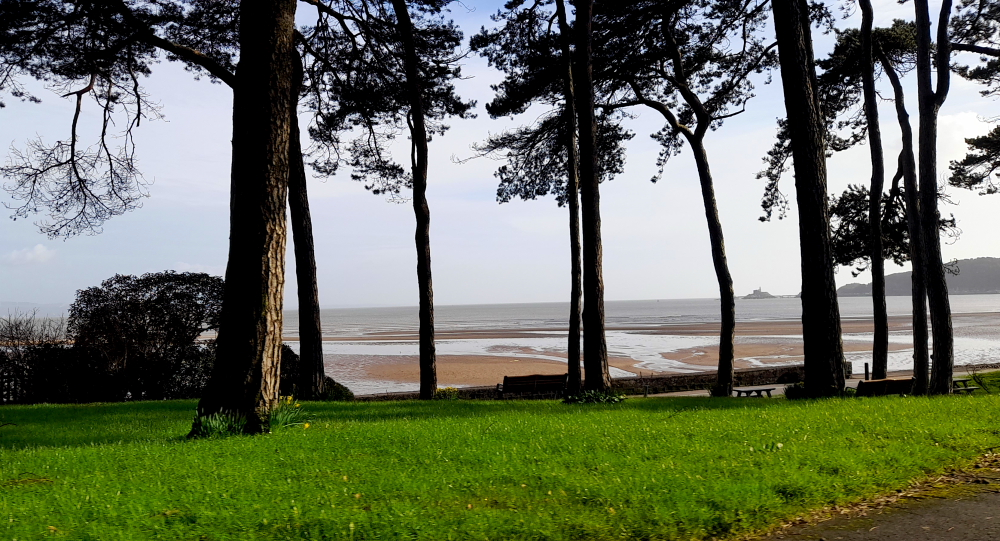
Returning along the A4118 we turn off onto Kittle Hill Lane, drive down the hill to the junction with the A4067 then turn right to drive to the Victorian seaside town of Mumbles – Mwmblwls to a Welshman!

View of Swansea Bay from the A4067 to Mumbles.

We stop for a coffee at Verdi’s Restaurant at Knab Rock then drive past the Mumbles Pier and Ferris Wheel before we turn around and drive to the intersection with the A4216. We were planning on booking accommodation here but I’m glad we didn’t. Today’s a Monday. The place is heaving; there’s not much parking available and half the town is under scaffolding.

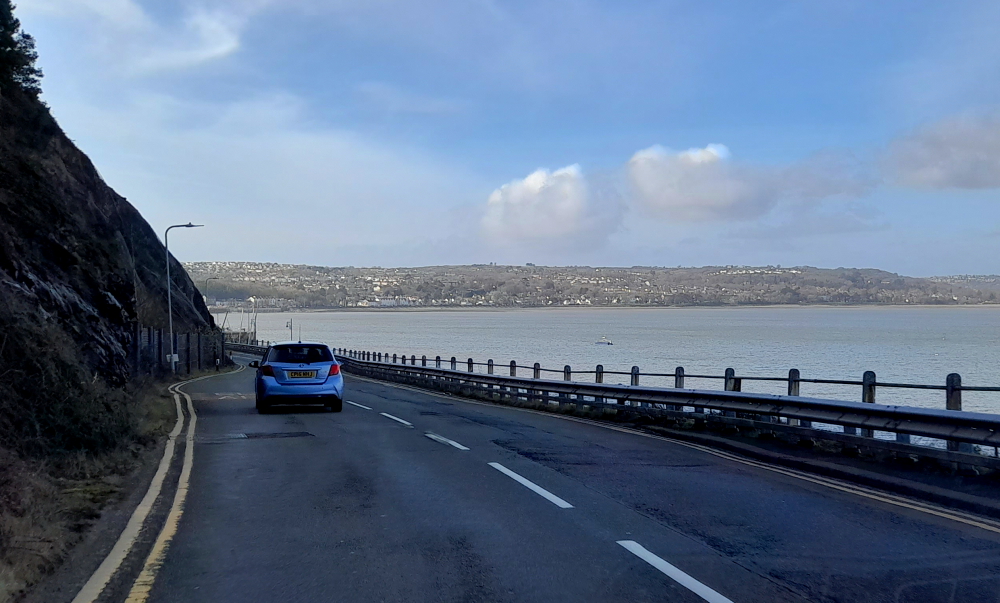
View of Swansea across the bay from Mumbles Road.

The A4216 takes us north up to the top of the Peninsular to rejoin the A484 to Llanelli. Our conclusion: the Gower Peninsula is not a patch on the Ring of Kerry or even the Beara Peninsula in SW Ireland.

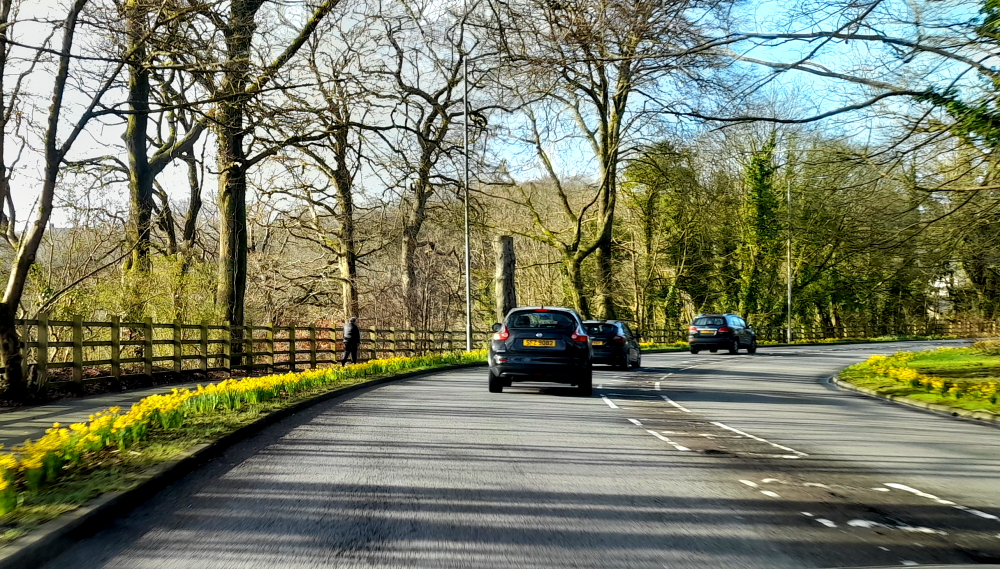
Flowering jonquil verges along the A4216.

En route we stop at the Tesco shopping centre. Yesterday, we noticed a Trespass store there with an end of season sale so we call in to see if we can find an outdoor hiking jacket for Lynn to replace her bright blue Helly Hansen sailing jacket we bought in Ireland in 2014. As luck would have it we find a navy blue replacement for Eur133 so, sadly, her HH jacket will be consigned to Vinnies.

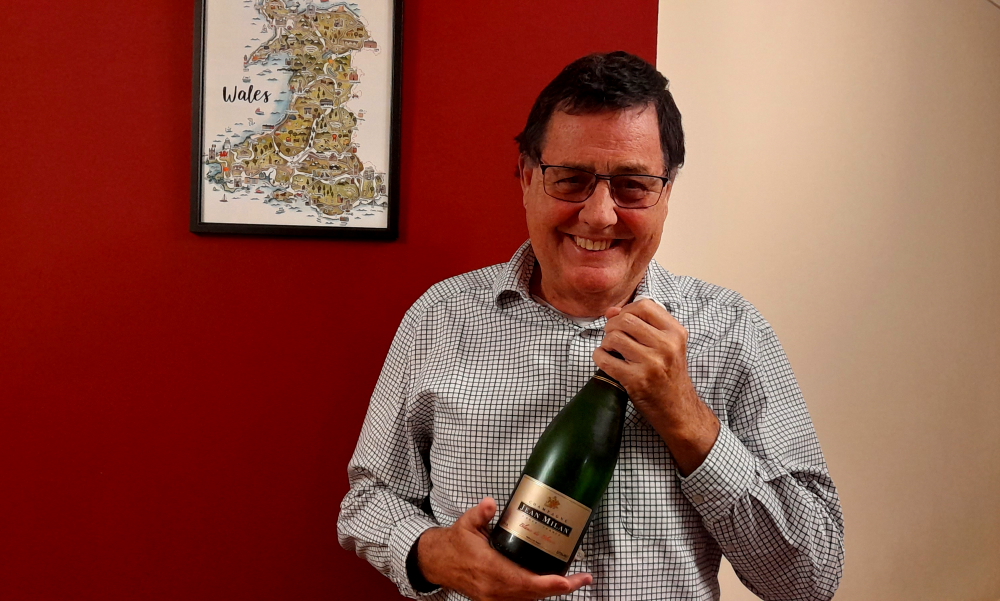
Cracking a bottle of Jean Milan Blanc de Blancs Extra Brut.

Now, we have 2 bottles of champagne that we need to enjoy so we crack 1 of them to celebrate Lynn’s new jacket – and its participation in many more new adventures. So, any old excuse, really!

20 February, 2024

Yet another cold, dark and damp day in 1970’s Llanelli. Between rain showers we decide to walk the 25 minutes to the shopping mall to pick up a few items for dinner and see if Timpsons have a replacement watch band for Lynn’s dive watch.

The rain holds off for the entire trip so not only do we get a replacement watch band but Lynn also has her shoulder bag restitched. It cost more to repair it than it did to buy it at the market in Cordoba, Spain over a year ago but the bag works for Lynn and we are unlikely to find another at the price for a long time.

A few more stores visited and we have everything done that needed repairing or replacing. We even manage to return to the house before the rain starts again.

Tomorrow we are heading to Fishguard on the West Coast of Wales which is a short ferry ride to Ireland from the Goodwick Harbour.

Since Fishguard is only about 1.5 hours’ drive away we will take the coast roads but still try to avoid B roads due to the likely risk of local flooding.

21 February, 2024

We leave Llanelli around 11:00 am. It’s 12 Deg. C. and raining and drive a rambling route that takes us by Carmarthen, St Clears, Tenby, Pembroke, over the Daugleddau River, Newgale, Solva, Saint David’s, Trevine, Mathry, Goodwick and into Fishguard.

Travelling around we are constantly reminded we are in Wales, with the bi-lingual road signs and other reminders like Ambulance/Ambiwlans. Some Welsh words are totally unrecognisable, but some are similar to English – like when a deaf person speaks and they don’t quite get the enunciation right. And, if the pronunciation of Ll is Fl as in Llandudno, then is Ff pronounced Lf as in ffrani (frenzy)??

An Ambiwlans.

By 12:10 pm we arrive at the popular Victorian seaside town of Tenby with its cobbled streets, pastel-coloured houses, Tudor Merchant’s House and Museum, and harbour.

Some of Tenby’s pastel houses on the harbour front.

Apparently Tenby has not 1, but 4, sandy beaches and, in summer, there are daily boat trips to Skomer, Skokholm and Caldey Islands, the latter home to Cistercian monks who hand make chocolates and perfume. Today we can hardly see the harbour thanks to the rain obliterating the view. Of what we see, Tenby looks like a place worth a visit in the sunshine.

Five Arches, Tenby – part of the original 13th century town wall gate.

Regardless of our attempts to avoid local flooding we can’t avoid it on the A4139 between Penally and Lydstep, the other side of Tenby. Funnily enough, we drive past a sign that says: “Pond Field Glamping”!

Even the A roads are flooded.

Finally, after 2 hours of constant rain, it stops and the sun comes out. By this time we are cresting the hill overlooking the beach south of Newgale and St Brides Bay.

Sunshine at last – St Brides Bay & Newgale.

More local flooding is evident here at Newgale where a small lake has formed on low-lying land adjacent to the A487.

Newgale-on-Pond?

15 minutes’ later we are driving through picturesque St David’s via the pretty hamlet of Solva. St David’s is Britain’s smallest city with the largest cathedral dating back to the 12th century. It’s documented that 2 pilgrimages to St David’s equaled 1 pilgrimage to Rome.

Nun Street, St David’s.

Shortly after we are driving through Mathry, twinned with Champagne-Vigny, France – closer to Cognac than Epernay.

Mathry near the A487.

Here we get a glimpse of the countryside towards the coast.

Sweeping pastoral views from Mathry towards the Preseli Hills.

The A487 takes us to Goodwick at the opposite end of the harbour to Fishguard. Here the Stena Line ferry is sailing for Rosslare, Ireland, reminding us of this harbour’s history as more than a century ago, in the midst of the race for ever-faster transatlantic travel, Fishguard achieved global fame when the Mauretania sailed in from New York.

The Cunard Steamship Company had chosen Fishguard as its first port-of-call for its Atlantic liners. In its inaugural crossing from New York to Fishguard, the Cunard ship Mauretania gained the much-coveted Blue Riband for the fastest Atlantic passage time of 4 days and 14 hours.

The Daily Mail described scenes of excitement as it was first sighted on the headland on 30 August 1909: ‘her four great red funnels with their black tops were sighted round Strumble Head. Every point of vantage from the cliffs on the Goodwick side to the ruined fort on the old Fishguard side was lined with people, whose cheers crossed the dancing blue waves, borne on the brisk southerly breeze to greet the Cunarder.’

The Stena Line ferry leaving Goodwick for Rosslare, Co. Wexford.

Ten local women in Welsh costume presented sprigs of white and purple heather to the passengers as they landed, flags hung from every house, local lifeboats danced on the waves and the Territorial Artillery fired a salute [Ports Past & Present].

Quite a contrast to today where there is hardly a soul about the harbour and the town thanks to the freezing cold wind.

“An Artist’s Cottage” in Fishguard.

At last we arrive at our accommodation, an 18th century stone cottage owned by an artist who is also using the cottage as a gallery of her artwork. Needless to say it has a colourful and characterful interior design, a nice change from some of the more unimaginative self-catering places we have stayed in.

Lounge room.

However, as I find out, it’s more functional as an art gallery than as a house. But the cottage’s location is excellent, just a 5-minute walk to the local Co-op supermarket and, better still, just a 2-minute walk to what turns out to be the excellent Royal Oak pub, which becomes our ‘local’.

Like sleeping in an art gallery – oh, that’s right, we are!

Now, this local pub is not your ordinary local. 227 years ago tomorrow, on 22 February 1797, four French warships sailed into Fishguard Bay with a force of 1400 soldiers led by Colonel Tate, an Irish/American veteran of the American War of Independence. They hoped to set up a base in Fishguard and recruit a revolutionary army to march on England.

However, Fishguard was well defended by a fort, the ruins of which can still be seen on the cliffs overlooking Lower Town, and when it fired its cannon (with blanks!) at the small fleet as it entered Fishguard bay, they beat a hasty retreat landing instead at Carreg Wastad near Llanwnda, a few miles down the coast from Goodwick.

Three days later the army surrendered in the Royal Oak pub on Fishguard Square and the Battle of Fishguard was over.

Off to the Royal Oak pub.

After some delicious pub grub we return to the cottage to watch a couple of Netflix movies, after sorting out a hitch with the heating.

22 February, 2024

It rained hard all last night but we both get a good night’s sleep. It’s freezing cold and windy outside so we plan to spend the day inside and catch up on the blog and do some laundry. I have spent most of the morning fighting with the pathetic internet. Typical of an 18th century cottage – the internet can’t penetrate the thick stone walls and the power points aren’t in accessible locations. It doesn’t help that the owner is an artist and uses the cottage as an art gallery. It’s a better art gallery layout than a functional cottage.

The below-mentioned couch & unsuitable occasional table in the sitting room.

In desperation I move the laptop closer to the router but there is no comfortable table or desk so I try to use the couch and an unsuitable occasional table for the laptop. My back is going to be very painful by tonight.

View of the cottage terrace from the kitchen.

We’re booked into the excellent Royal Oak for dinner again this evening, followed by more Netflix movies tonight.

23 February, 2024

After breakfast we head to our local – for their excellent coffee – then venture over the road to the Town Hall to view the Last Invasion Tapestry.

The Town Hall and Library.

The story of the Battle of Fishguard in 1797 is told in an embroidered tapestry which was designed and sewn by 73 local women and at least 3 men. It’s in a similar format and shape as the Bayeux tapestry and like the Bayeux tapestry is 100 foot long. The tapestry was commissioned as a permanent legacy of the Invasion Bicentenary commemorations in 1997. It took four years to complete and is on permanent exhibition in a purpose-built gallery attached to the Library in Fishguard Town Hall.

The Last Invasion Tapestry – all 100 feet of it.

Opposite the Town Hall is St Mary’s Church where a headstone was erected in 1897 in memory of Jemima Nicholas (1750-1832), a Welsh heroine during the 1797 Battle of Fishguard.

Headstone for Jemima Nicholas.

According to folk legend, armed with a pitchfork, Nicholas led a group of women and rounded up 12 French soldiers who had been drinking, and held them captive inside a locked church overnight. The French soldiers may have mistaken local women wearing their traditional tall black hats and long red cloaks for Grenadier Guards, and surrendered before they realised their mistake. The French surrendered shortly afterwards at the Royal Oak. She was awarded a lifetime pension for her efforts.

View of River Gwaun outlet from Bridge Street.

Although rain looks imminent, we walk down the A487 to Lower Town/Fishguard (Abergwaun) en route to the Fishguard Fort. We cross the bridge over the River Gwaun then take a left to walk up the hill. During this time there are several rain showers which test Lynn’s new jacket.

We pass by the Ship Inn made famous by the filming of Under Milkwood in 1971 as the cast and crew, notably Richard Burton and Peter O’Toole, regularly frequented this pub.

The Ship Inn.

After scaling the hill we take a pathway off the main road where we get a view of the fort ruins on the point directly on the Pembrokeshire Coast Path Trail.

Fishguard Fort is an 18th-century fortification on the rocky promontory of Castle Point. In 1779 an American privateer named the Black Prince captured a local ship and demanded a ransom of £1000 from the Fishguard townsfolk. The Black Prince sailing under a French flag, and its captain Stephen Manhant, a Boston native, were commissioned by the US government to attack British targets as part of their efforts to gain independence from Britain. The Black Prince was very successful as a privateer, destroying more than 30 British ships over the course of three months.

The townsfolk of Fishguard rejected Manhant’s ransom demands who responded by bombarding the town, damaging St Mary’s Church and several houses. A local ship fired back, followed by cannon fire from the shore. Manhant decided it wasn’t worth the trouble, and the Black Prince sailed away.

Fishguard Fort ruins at Castle Point.

To prevent similar attacks in the future, an artillery fort was built on Castle Point, at the eastern approach to the harbour. Fishguard Fort was completed in 1781, just two years after the attack.

The fort was armed with eight 9-pounder cannons. It was manned by three invalided gunners from Woolwich, London. The fort later became the headquarters for the local militia, known as the ‘Fishguard Fencibles’.

Gun battery.

The Last Invasion was the only action that the fort ever faced. The fort continued to be manned until the early 19th century, but was then allowed to decay. However, it came back into use during WWII when searchlights and Lewis machine guns defended Fishguard Port against German seaplanes.

View from the fort looking NE to Cemaes Head.

We retrace our steps and have a good view of the entry of the River Gwaun into the harbour, Lower Fishguard and its Quay Street where parts of Under Milkwood were filmed in 1971.

Lower Fishguard and its Quay Street.

Not that we are creatures of habit or anything, but we are looking forward to more delicious tucker at our ‘local’ tonight.

Having Welsh Faggots for dinner at The Royal Oak.

24 February, 2024

As usual it is a cold, wet and windy day so the plan today is to watch the 6 Nations Rugby on TV at the pub. We were told to be at the pub by about 1:00 pm to get a good seat. However when we arrive the place is heaving and seating is impossible so we head back home to watch the game on our TV.

After a half hour of trying to access live TV (based on the instructions provided by the cottage owner) we have to phone the owner to come and sort the TV.

After a lot of trial and mostly error we manage to get the game live on the Welsh BBC channel which means that the commentary is in Welsh. At least we can watch the game.

First up is Wales vs Ireland which Ireland wins quite easily 31-7. Perhaps just as well we didn’t go to the pub – no doubt lots of glum faces. We change to the UK BBC channel to watch England vs Scotland for the second game of the afternoon – 30-21 to England.

25 February, 2024

It will take us just over 2 hours to arrive at our next accommodation at Llawryglyn so we decide to make a couple of stops along the way.

We leave at 10:15 am and a chilly 8 Deg. C. 20 minutes’ drive away is our first stop, the archaeological site known as Pentre Ifan – a Neolithic burial chamber. Today it is a dolmen, the bare bones of a burial chamber that would originally have been covered with an earthen mound. The giant 5m ‘capstone’ appears to be precariously balanced on three ‘uprights’, though it has remained in place for over 5,000 years.

Pentre Ifan’s outline neatly frames the Preseli Hills towering above, the source of the famous Pembrokeshire ‘bluestones’ that went into the making of Stonehenge as well as Pentre Ifan itself.

Pentre Ifan.

To rejoin the A487 the GPS takes us on an exit road, only to be confronted by a ford. Given the amount of rain that has fallen recently, thank goodness the water is less than a foot deep.

How deep is the water?

Our next stop are the Aberystwyth Castle ruins. The castle was built in response to the First Welsh War in the late 13th century, replacing an earlier fortress located a mile to the south. During a national uprising by Owain Glyndŵr, the Welsh captured the castle in 1404, but it was recaptured by the English four years later. In 1637 it became a Royal mint by Charles I, and produced silver shillings. The castle was slighted by Oliver Cromwell in 1649.

Aberystwyth Castle curtain wall.

The inner ward was built in a diamond-shaped concentric castle, with a twin D-shaped gatehouse keep and mural towers at each corner. The outer ward is described as consisting of a “twin D-shaped gatehouse, a barbican, a rock-cut ditch and a large curtain wall with towers”.

Aberystwyth Castle North Gate.

After shopping for supplies at Morrisons we take the A44 across country through a pretty river valley with pine forest-clad hills rising either side.

B4569 with view of Trefeglwys in the distance.
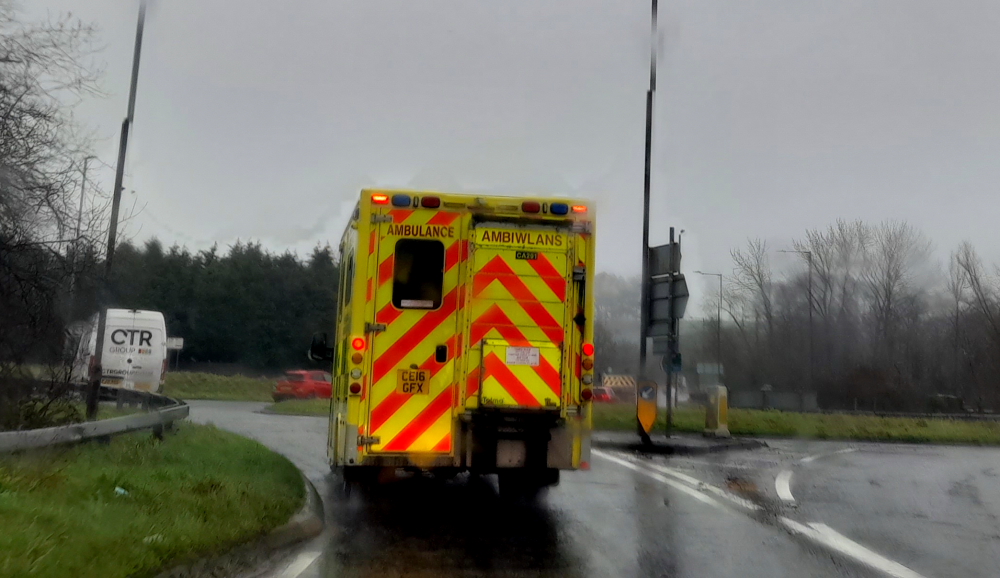
After we join the A470 it takes us to Llanidloes where we take the B4569 to Trefeglwys. Turning left at the centre of the village on the road to Llawryglyn we drive another 5 minutes and arrive at the cottage at about 2:30 pm. We are surrounded by sheep-dotted steep, green hills that drop into a stream.

Just as wonky on the inside as well.

Fortunately the cottage is nice and warm. It seems to be a former family cottage that was turned into a holiday rental some 15 years ago without alteration or de-cluttering.

Mind your head!

Original furniture and furnishings and typical of old, rural cottages, cobwebs, dust, low doorways and ceilings and narrow stairs!

26 February, 2024

Thanks to a skylight in the bedroom we are woken by brilliant sunshine. Venturing outside the cottage we are greeted by freezing cold air and all we can hear is the breeze in the trees and the sound of fast, flowing water from the Afon (River) Trannon below.
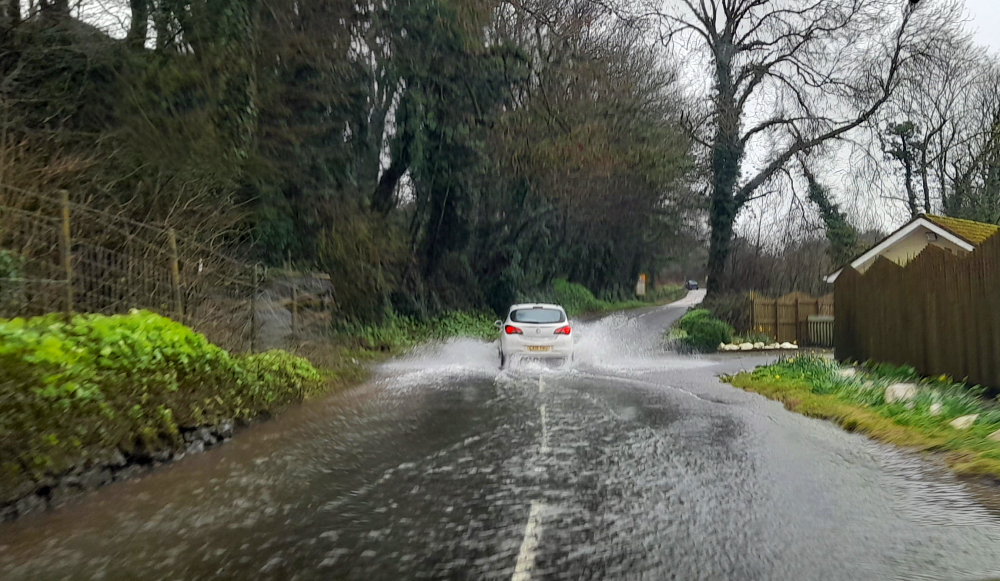
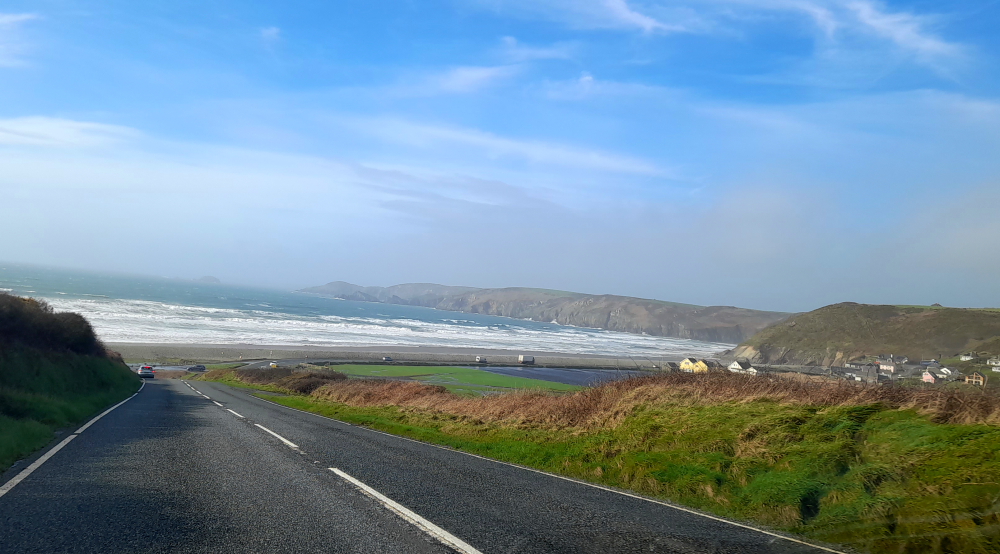
View from the front door.

Our cottage garden has loads of spring flowers coming into bloom: cherry blossom trees, daffodils, jonquils, crocuses, snow drops and primulas.

Early morning crocuses.

To make the most of the sunshine we take the B4569 through Caersws to Newtown which turns out to be a disappointing sprawling town with few charming Victorian buildings.

As we approach the cottage on our return we decide to continue on this road to the hamlet of Llawryglyn then on back roads to the B4518 for a view of the Clywedog Reservoir.

Glimpse of the Clywedog Reservoir.

Turning north then east on more back roads we rejoin the road back to our cottage.
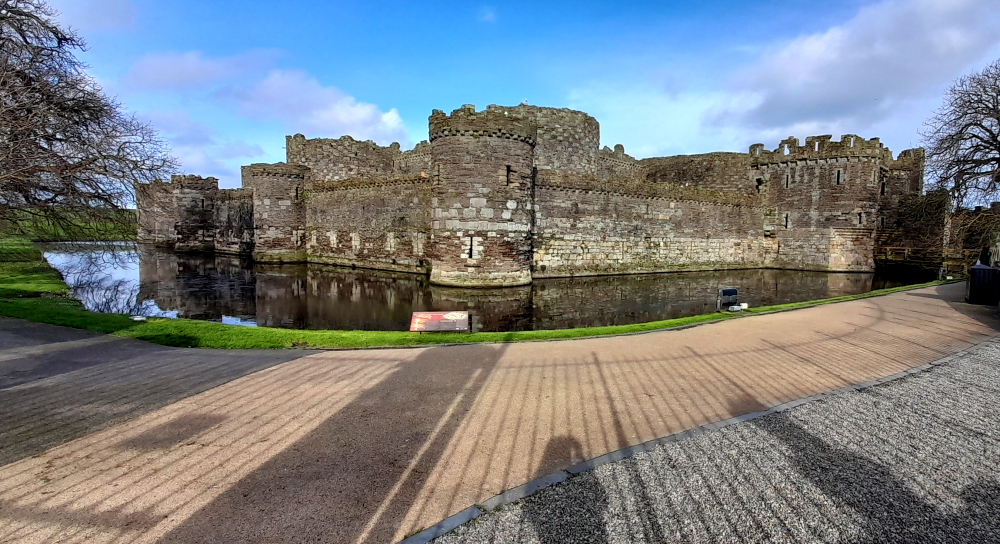
How green is my valley?

Our local pub, The Red Lion, in Trefeglwys won’t be open for dinner until Wednesday evening, so we’ll dine in again tonight. Probably just as well as it’s forecast to be -1 Deg C tonight.
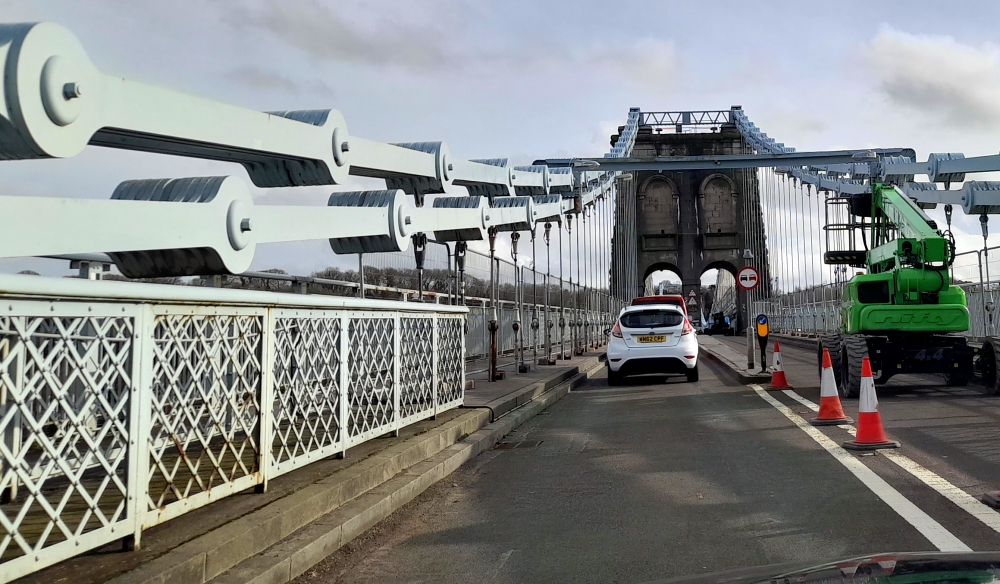
27 February, 2024

As today’s forecast is for 9 Deg. C. and 36% chance of rain we decide to go for a bit of a drive so we drive south for 45 minutes to the Victorian spa town of Llandrindod Wells, or ‘Landod’ or ‘Dod’ as it’s known to locals.

Station Crescent, Dod.

The ‘healing qualities’ of the local spring waters, first enjoyed by the Romans, attracted visitors to the area in large numbers during the mid 18th century.

Chalybeate (iron rich) spring near the Pump Rooms.

As a result, the town enjoyed an economic boom and a number of hotels were built.

1879 spring water fountain donated by the Lord of the Manor.

During the ‘season’ between May and mid-September, visitors to Llandrindod would take the waters at the pump rooms at the Rock Park and Pump House Hotel entertained by orchestras, and in its heyday the resort enjoyed a vast array of activities ranging from golf to horse racing.

The Glen Usk Hotel.

Most of the town’s architecture dates from the boom periods of the Victorian and Edwardian eras when ornate hotels and shops were built, including the Metropole and the Glen Usk hotels and the Albert Hall theatre.

An example of the style of shops during its spa town era.

The town attractions include an 18 hole golf course, (originally 9 holes built in 1893), 3 international standard outdoor bowling greens dating from 1912 which regularly host national and international events and is a regular venue for the start/finish of many annual National Car, Bike and Cycle rallies. [Visit Mid Wales]

However, on this cold (now 7 Deg. C.), dull and drizzling day it’s not a patch on Buxton, another Victorian spa town, in Derbyshire.

On our route back to the cottage we drive via the Elan Valley, 70 sq. miles of hills, woodlands and lakes within the rugged Cambrian mountains.

The Elan Valley Reservoirs are a chain of man-made lakes created from damming the Elan and Claerwen rivers within the Elan Valley. The dams, reservoirs and 73-mile aqueduct were built a hundred years ago to supply desperately needed clean water to Birmingham. It was an epic feat of civil engineering set within an area of outstanding scenic beauty.

There are four dams on the river Elan; from the lowest Caban Coch, to Garreg Dju, Peny Garreg and the highest, Craig Goch.

Caban Coch Dam – view of the dam wall and downstream.

Caban Coch Dam is the simplest and most functional in appearance of all the dams, resembling a natural waterfall when the reservoir is full.

Caban Coch Dam – view of the wall and dam behind.

It’s such an impressive sight, driving to the top of the wall, as illustrated by its statistics. Height: 37m. Length: 186m. Area: 220ha. Volume: 35,530 megalitres (ML – 1 million litres).

Continuing along the winding road, the next dam is Garreg Ddu which serves a dual role. It is a low, completely submerged dam which plays a vital role in maintaining a constant supply of water to Birmingham.

Garreg Ddu Dam.

It also supports masonry pillars carrying the access roadway to the neighbouring valley of the River Claerwen.

Nant Dolfolau brook that flows into Garreg Ddu Dam.

Pen y Garreg is the third dam up the Elan Valley, often referred to as the ‘middle dam.’ Height: 37m. Length: 161m. Area: 50ha. Volume: 6,055ML.

Pen y Garreg Dam.

Finally, Craig Goch Dam, the highest upstream of the series of dams and is often referred to as the ‘top dam.’ As with all the dams, work started with the arrival of the railway line at the site. With this dam the line had the furthest to go and a rocky outcrop had to be blasted and dug through on the route to the site, now known as ‘Devil’s Gulch.’

Craig Goch Dam.

Work on excavating the foundations for a secure base for the structure started in July 1897, some three years after the start of work on the lowest dam at Caban Coch.

Craig Goch Dam – domed valve tower.

Craig Goch is seen by many as the most attractive of the dams, with an elegantly curved retaining wall and a series of arches carrying a narrow roadway across the top of the dam.

Craig Goch Dam – dam-side view of the roadway.

It has a domed valve tower and the structure is typical of the ‘Birmingham Baroque’ style of much of the waterworks scheme. Height: 36m. Length: 156m. Area: 88ha. Volume: 9200ML. [Cwm Eden Valley].

The GPS then takes us to the village of Rhayader on the A470 via the mountain road.

Mountain road at the northern tip of the Craig Goch reservoir.

It’s only as we approach the cottage around 4:00 pm that the rain, that has been falling since we left, actually stops – 36% probability my foot!

28 February, 2024

Another cold and wet day – perfect for catching up the blog and getting organised for our departure tomorrow.

This evening our “local”, the Red Lion, is serving food from 5:00 pm. En route I drop Lynn off at the road junction in Trefeglwys village for a photo of the village church while I park the car at the pub.

Sitting in the middle of the village and looking out over the surrounding countryside is St Michael’s church, a local landmark. It was originally founded by Bledrws in the 12th century, and the building has been adapted and refurbished over the years since then. The present building dates only from the 1863-5 refurbishment. Its unusual square, timbered bell turret consists of four louvred apertures and houses its 15th century bell.

St Michael’s Church, Trefeglwys.

The pub is empty when we arrive just after 5:00 pm, only the 3 staff and the chef, who we share a joke with, but soon the local men drift in to sit at the bar with their pints and to have a natter.

The Red Lion pub & some of the locals.

By the time we leave an hour later all the bar seats are taken. Apparently the pub is under new management and there are signs that it will do well – good food and heavy, local patronage. After all, the locals would have to drive 10 minutes in either direction for a pint if this pub shut down.

29 February, 2024

As we need to check out by 10:00 am and can’t check in until 3:30 pm we have some 5 hours to kill so I plan another circuitous route. It’s 8 Deg. C. when we depart and for once – no rain!

When we get to nearby Caersws we take the A470 NW to meet the A489 then SW, driving through the town of Machynlleth with its distinctive clock tower which was built by the town’s residents to celebrate the coming of age of the eldest son of the Fifth Marquess of Londonderry – Charles Stewart Vane-Tempest (Viscount Castlereagh) – in 1873.

A competition to design the clock tower attracted 30 to 40 entries. The winner was architect Henry Kennedy, of Bangor. His design was built by Edward Edwards, a local builder. It was made mostly of stone from Tremadog, near Porthmadog, complemented by red sandstone from Mansfield, Nottinghamshire. The tower stands 24 metres high, to the base of the weathervane.

Town clock, Machynlleth.

The clock tower became a meeting point for temperance (anti-drunkenness) campaigners. Hundreds of people gathered here in 1907 to greet General William Booth, founder of the Salvation Army, who paused for five minutes while on his way to Aberystwyth. [historypoints.org].

Here we turn north to take the A493 SW to the coast but find that the road is – CLOSED! With no diversion signs we continue north until we can turn left on to the B4405 past the lake, Llyn Mwyngil, on a parallel route to the coast.

Just as we make the turn we are startled by the sight of a large, military cargo plane heading straight for us at low altitude before it continues its lumbering way up a nearby valley.

Low-flying military cargo plane.

This route takes us down the pretty valley of Afon Dysmynni with its astonishingly green pastures – greener than Irish green!

Afon Dysmynni valley.

We join our intended A493 on the coast and follow it up past Fairbourne until we join the A470 near Llanelltyd then the A487 to Portmadog. Here we drive through a town with 16 letters in its name – Penrhyndeudraeth – that’s over half the letters in the (English) alphabet!

View of sand spit from the A 493 with Fairbourne this side & Barmouth the other.

Originally we were going to visit the picturesque village of Portmeirion, which is near Porthmadog, but it would have cost us GBP20 for the privilege.

Portmeirion Village

As Lynn had already spent a week living in the village one Christmas including dining at the Hotel Portmeirion for Christmas lunch, I declined the suggestion to visit for myself.

To enter Porthmadog we drive across The Cob sea wall, the building of which was the idea of William Alexander Madocks (1773-1828). Madocks built the town of Porthmadog (Port Madoc originally). Before The Cob people had to employ experienced guides to cross the sands safely, and a boat had to be used at high tide. Work began in 1805 and it was opened officially in 1811. [People’s Collection Wales].

Crossing The Cob.

After stocking up on supplies and fuel at Tesco we drive past Criccieth and its castle to the Promenade and beach at Pwllheli.

Pwllheli beach.

We still have 2 hours to kill so we drive across the peninsula and cross the Menai Suspension Bridge to the pretty town of Beaumaris on the island of Anglesey.

Entering Beaumaris, Anglesey.

Our intention is to spend some time visiting Beaumaris Castle but with nearby parking costing GBP6 on top of the castle entrance fee of GBP18, I stay with the car while Lynn jumps out and takes some photos.

View from Beaumaris Castle to the mountainous shoreline of North Wales.

The Castle was built as part of Edward I’s campaign to conquer north Wales after 1282. Work began in 1295 following the Madog ap Llywelyn uprising. Edward’s invasion of Scotland soon diverted funding from the project and work stopped, recommencing after an invasion scare in 1306. When work finally ceased around 1330 a total of £15,000 had been spent, a huge sum for the period, but the castle remained incomplete.

In 1403 the Castle was taken by Welsh forces during the rebellion of Owain Glyndŵr, but recaptured by royal forces in 1405. In March 1592, the Welsh Roman Catholic priest and martyr William Davies was imprisoned here and was eventually hanged, drawn and quartered a year later.

South Gatehouse, Beaumaris Castle, Anglesey.

Following the outbreak of the English Civil War in 1642, the castle was held by forces loyal to Charles I, holding out until 1646 when it surrendered to the Parliamentary armies. Despite forming part of a local royalist rebellion in 1648, the castle escaped slighting and was garrisoned by Parliament, but fell into ruin around 1660, eventually forming part of a stately home and park in the 19th century. In the 21st century, the ruined castle is still a tourist attraction.

UNESCO considers Beaumaris to be one of “the finest examples of late 13th century and early 14th century military architecture in Europe”. The fortification is built of local stone, with a moated outer ward guarded by 12 towers and 2 gatehouses, overlooked by an inner ward with 2 large, D-shaped gatehouses and 6 massive towers. The south gate could be reached by ship, allowing the castle to be directly supplied by sea. Today, this access is blocked by houses and a large car park.

Beaumaris Castle & its partial moat.

Time to head to our accommodation so we cross the impressive Menai Suspension Bridge once again, which is undergoing repairs.

In 1819, civil engineer Thomas Telford began working on ambitious improvements to the journey between London and the port of Holyhead for vessels to Ireland. Recognising the danger to travelers that crossing the Menai Straits involved, Telford designed a groundbreaking piece of civil engineering – the Menai Bridge.

Menai Suspension Bridge between the mainland & Anglesey.

Completed on 30 January 1826, the Menai Bridge was the biggest suspension bridge in the world at the time. Sixteen huge chains held up 579 feet of deck, allowing 100 feet of clear space beneath. This allowed tall sailing ships navigating the seaway to pass underneath, whilst spanning the Straits at its narrowest point.

One-way traffic due to repairs.

The Menai Bridge not only made Telford’s reputation as a civil engineer, together with his road improvements, it also dramatically reduced the time and danger it took to travel from London to Holyhead – the journey time was cut 36 hours to 27. [Menai Heritage].

By 3:30 pm we arrive at Graianog Farm, a working sheep farm, which is off the A487 between Llanllyfni and Pant Glas – and it is freezing. Apparently the farm is really busy this time of year thanks to lambing. That makes for hardy lambs and hardy farmers. Our host greets us wearing what can only be described as foul weather gear that trawler men wear – the antidote to Welsh wind and rain he tells us.

We move into the stone farmhouse conversion next to the main farm house and settle in for the evening.

1 March, 2024

4 Deg. C. is the forecast maximum today with an overnight of -1. And, as predicted, around 10:00 am it starts to sleet with flurries of snow for an hour or so.

Sleeting at the farm.

We’re booked into The Goat Inn – Tafarn Yr Afr – at Glandwyfach, about 6 minutes’ drive away for dinner. The sun is starting to break through around 4:00 pm so by 5:15 pm we decide to head to the pub early for a pre-dinner drink and to ensure we drive at least one way on the narrow lane in the daylight.

This morning’s snow still evident on the hill tops.

It’s lucky that we leave early as the road (more like a driveway) is not registered on our GPS. The lane is narrow and potholed but not much worse than the longer alternative. It’s a very chilly 3 Deg. C. outside and there is snow on all the hill tops either side of the valley.

The Goat Inn.

The Goat Inn car park is nearly full as we arrive at around 5:30 pm. For a country pub this one seems more like a 4 star restaurant. It is warm and cozy inside and since they have a gin specialty Lynn orders a Hendricks and I order a Morretti Berra while we interrogate the menu. The food is quite reasonable quality and similarly priced. It must be the best pub in the area as it is booked out tonight including a party in the adjoining room.

Our drive back to the cottage is slow and careful in the very cold and dark night. No street lamps on this route!

2 March, 2024

The cold weather is very conducive to a late sleep-in and since we plan to have a quiet day in we don’t finish breakfast until nearly midday. Lynn books us on GuruWalks for Heidelberg, Turin, Tallinn, Riga, Kaunas and Vilnius.

At least there are patches of blue sky today but I’m starting to be very over the cold and wet of not-so-sunny Wales.

The sheep yard across the road.

Ha! Just read that Wales has had its warmest February since records began in 1884. Hate to be here for its coldest!!

3 March, 2024

A sunny but chilly catch-up day where Lynn finalises arrangements for our week in London between meeting up with some more of her friends and finishing off our ancestry research.

4 March, 2024

Check-out time is 10:00 am, so after a farewell chat with our host, Guto, we take the A487/A55/A470 to LLandudno.

Told you Wales is wet & boggy!

We are about 3 km from Llandudno when the highway comes to a complete stop. There is no indication of the problem and no escape off the highway. We sat for about 20 minutes in the line of traffic before it started to move again. Along the way there were no signs of what caused the delay. Just another road closure without any proper traffic management. Typical of European thoughtlessness.

Llandudno is the largest seaside resort in Wales located in Conwy County Borough. The town’s name means “Church of Saint Tudno”.

View of snow-capped mountain range before the A55/A5 junction.

The town developed from Stone, Bronze and Iron Age settlements over many hundreds of years on the slopes of the limestone headland, known to seafarers as the Great Orme (207m) and to landsmen as the Creuddyn Peninsula which juts into the Irish Sea. Its origins in recorded history are with the Manor of Gogarth conveyed by King Edward I to Annan, Bishop of Bangor in 1284.

Great Orme from the Pier.

Mostly owned by Mostyn Estates, the Great Orme is home to several large herds of wild Kashmiri goats originally descended from a pair presented by the Shah of Persia to Queen Victoria and subsequently given to Lord Mostyn.

In 1848, Owen Williams, an architect and surveyor from Liverpool, presented Lord Mostyn with plans to develop the marshlands behind Llandudno Bay as a holiday resort. These were enthusiastically pursued by Lord Mostyn.

North Parade in 1887.

The waterfront buildings have changed very little since the Victorian Era.

North Parade in 2024.

The influence of the Mostyn Estate and its agents over the years was paramount in the development of Llandudno, especially after the appointment of George Felton as surveyor and architect in 1857 with much of central Llandudno developed under Felton’s supervision between 1857 and 1877.

Llandudno Pier.

The Llandudno Pier is on the North Shore. Built in 1877, it’s a Grade II listed building.

View towards the end of the Pier.

The pier was extended in 1884 in a landward direction along the side of what was the Baths Hotel where the Grand Hotel now stands.

Snow on the background mountains of Snowdonia seen behind the Grand Hotel.

The West Shore is a quiet beach on the estuary of the River Conwy. It was here at Pen Morfa that Alice Liddell (of Alice in Wonderland fame) spent the long summer holidays of her childhood.

The Grand Hotel by the Pier.

That explains the number of Alice in Wonderland character sculptures that dot the town.

Llandudno Esplanade.

For most of the length of Llandudno’s North Shore there is a wide curving Victorian promenade.

The St.George’s Hotel where I stayed over 20 years ago.

The road, collectively known as The Parade, has a different name for each block and it is on these parades and crescents that many of Llandudno’s hotels are built.

The St.George’s Hotel dining room.

Elisabeth of Wied, the Queen Consort of Romania and also known as writer Carmen Sylva, stayed in Llandudno for five weeks in 1890.

Neville Cres at the East end of the Promenade.

On leaving, she described Wales as “a beautiful haven of peace”. Translated into Welsh as “hardd, hafan, hedd”, it became the town’s official motto.

Looking West back to Llundudno.

Running behind the promenade is Mostyn Street leading to Mostyn Broadway and Mostyn Avenue.

Mostyn Street near Holy Trinity Church.

These are the main shopping streets of Llandudno with Mostyn Street lined with high street shops with pavement verandahs, major banks and building societies, two churches, amusement arcades and the town’s public library.

Emmanuel Christian Centre (L) & Conwy Town Hall (R) on Lloyd Street.

A little known fact is that Australia’s 7th Prime Minister, Billy Hughes, attended school in Llandudno.

After a stop a Llandudno Junction’s Tesco for provisions and fuel we go to join the A55 for a short distance to get on to the A470 south only to find that it is – CLOSED! Fortunately the A547 does the same thing so soon we are on the right road and arrive at the town of Llanrwst and our accommodation, The Coach House, about 20 minutes later.

Arriving at The Coach House in Llanrwst.

While unpacking our very pleasant hosts arrive (their office is in the stone cottage next door) to introduce themselves and to check that we have everything.

5 March, 2024

Today’s forecast is for 10 Deg. C. and 10% chance of rain so we decide to get out the door for one of the scenic drives we had planned on taking during this stay. 2 seconds out the gate it starts to rain.

As we are driving through the charming village of Bets-y-Coed, gateway to Snowdonia National Park, we stop at a Trespass outdoor shop and buy Lynn a new pair of winter trousers for half price as her other pair are beginning to disintegrate after constant wash and wear since their purchase in December 2022.

From here we take the A5 to Capel Curig then the A4086 past Llynau Mymbyr lake which has a smattering of snow on the opposite hilltop.

Lake Llynau Mymbyr.

Further on we take the A498 fork which passes by Llyn Gwynant.

A498 driving towards Llyn Gwynant.

We stop at a view point above Llyn Gwynant at which time it starts to rain heavily. I think we’ve passed the 10% chance of rain point.

Llyn Gwynant.

The road continues past the next lake, Llyn Dinas, until we arrive at the village of Beddgelert.

Road past Llyn Dinas.

By now it’s 12:30 pm and still raining so we find a cafe for a hot beverage. Unfortunately, it seems to be the ‘only cafe in the village’ so it attracts a number of rain-bedraggled walkers who choose to bring their pooches indoors, too. It’s like dining in a kennel with snarling, barking, whining, drooling, sneezing and shedding dogs!

Let’s hope that Australia doesn’t fall into the trap of allowing dogs into eating establishments.

Stone bridge crossing the Afon Colwyn at Beddgelert.

Needless to say we make a quick exit after there are 4 dogs occupying the confined space and retrace our route to Llanwrst.

By the time we return to the viewpoint overlooking Llyn Gwynant once again it has stopped raining. In front of us is a clearer view of the opposite side of the valley at the top end of the lake.

Opposite side of the valley towards Gallt y Wenalt.

In the opposite direction to the lake there is now a clear view of drifting cloud in front of a snow-capped peak.

View NE from Llyn Gwynant view point.

Tonight we have a Skype call with our Philly friends, Becky and Jerry, to finalise our trip to the Champagne region with them in May.

6 March, 2024

Sunshine and the promise of 11 Deg. C. and a 5% chance of rain convinces us to scoot out the door and drive the 32 minutes to the Llanberis Lake Railway depot at Gilfach Ddu in order to get a good view of Mt Snowdon.

View of the main house from upstairs bedroom window.

To a certain extent we retrace our route from yesterday along the A5 to Capel Curig.

A4086 driving past Lake Llynau Mymbyr.

But then we take the A4086 through the Llanberis Pass.

Through the Llanberis Pass on the A4086.

Then onto Nant Peris, past Llyn Peris, the 13th century Dolbadarn Castle, skirt Llanberis, cross the Afon y Bala to arrive in the car park that serves both the Railway depot and the National Slate Museum at around 11:50 am.

Llanberis Lake Railway returning to Gilfach Ddu station from Llanberis Station.

The small steam engine will take us on a 5-mile, 1 hour, return journey alongside Lake Padarn, in the heart of Snowdonia, hauled by one of Railway’s restored vintage steam engines rescued from the nearby Dinorwic slate quarries.

Counterweight mechanism that delivered a slate-filled dolly to the Vivian Quarry base & an empty one to the top at the same time.

The train departs at 12:15 pm but first drives to the nearby station at Llanberis to deposit and collect passengers, then the small engine skips to the front again to take us on our journey.

Moving the engine at Penllyn Station for the return trip.

From Llanberis the train runs non-stop through the Padarn Country Park passing the former Dinorwic slate quarries and workshops at Gilfach Ddu station.

View of Mt Snowdon.

It joins the 1845 slate railway route to run along the shores of Lake Padarn to Penllyn.

Checking out the cabin’s simple interior.

Along the lake and at Penllyn we have great views of Snowdon, the highest peak in England and Wales.

Short stop at Cei Llydan.

There’s a short stop at Cei Llydan on the return journey and we alight at Gilfach Ddu where we visit the National Slate Museum.

At its peak in the 19th century, Dinorwig was the second-largest slate quarry in the world. In the mornings, thousands of men in flat caps hiked up the zig-zag path to the quarry huts which perch high on Elidir’s mountainside, their clogs clacking on slate waste. Once, slate carved from the quarries here in North Wales was sent all around the world, literally roofing the Industrial Revolution.

The National Slate Museum established 3 years after the quarry closed in 1969.

Located in the Victorian workshops that were built in the shadow of Elidir mountain on the site of the vast Dinorwig quarry is now the Museum.

Museum courtyard with one of the quarries, Vivian Quarry, in the background.

Its workshops and buildings are designed as though quarrymen and engineers have just put down their tools and left the courtyard for home.

Parlour in the Chief Engineer’s house.

The Dinorwig Workshops were built in 1870 and serviced all the needs of the quarry. Over 100 men were employed here with skills to make the operation self-sufficient.

Slate trimming after having split the slates.

Wood from local trees was lifted in by crane to make trucks, sleepers and engines for slate tansport. In the smithy and foundry, men built and repaired machinery.

The foundry with moulds in the sand.

Pattern makers crafted hugh wooden pattern templates for cast metal machine parts.

Wooden casting patterns on the wall.

The giant water wheel provided power. Today it’s the largest working waterwheel on mainland Britain – 15.4m in diameter, 1.5m wide and built around a 0.3m axle it was constructed in 1870 by De Winton of Caernarfon.

Quarry water wheel.

The original was replaced in 1925 by a Pelton turbine, still in use, but remarkably the water wheel was not scrapped. Restored to full working order in 1982 it’s powered by water from the opposite side of the valley, carried by a 0.6m diameter cast iron pipeline. Water is gravity fed onto the wheel without the need for pumping.

Gravity-fed water wheel.

At its height, Dinorwig Quarry employed 3,000 men. By this time the landowner (Assheton) had built Port Dinorwig at the nearest coast, he’d built a steam railway to transport the slate there, and he’d also built a grand workshop and state-of-the-art quarry hospital.

As we exit the Museum around 3:00 pm the air is getting chilly. We stop in at the Snowdon Mountain steam railway office but are advised that the train up Mount Snowdon won’t be running until 23 March.

Driving back along Lake Llyn Peris we can see the extent of the Dinorwig Quarries on the opposite side where the mountain’s slate bones are exposed in a series of square-cut quarried galleries that reach almost to its summit. Names like Australia, Tasmania, The Mills, Serengeti, Wellington, Hefod Owen and even Mordor!

Alarmingly, for every ton of slate produced, 20 tons of waste material was dumped.

The remaining scars of the former Dinorwig slate quarries.

Back home we treat ourselves to a warming cuppa and a slice of buttered bara brith.

7 March, 2024

Today’s forecast is for 8 Deg. C. and rain so we opt for a day in to catch up. Late afternoon we walk around Betws-y-coed and have dinner at The Stables – another dog-loving restaurant!

As tomorrow’s forecast is for 9% rain and 9 Deg. C. we plan to drive the northern coast of Wales through Colwyn Bay to Rhyl.

8 March, 2024

At 11:50 am it’s cloudy and 8 Deg. C. when we hit the A548 and drive to the Point of Ayr which is at the NE tip of Wales.

Past Abergele at Towyn where the A548 runs parallel to the beach we see depressing caravan park after caravan park lining the road. What a tawdry part of Wales.

Depressing caravan parks in Towyn.

Who in their right mind would want to holiday here? It would be exchanging one housing estate for another!

Bridge over River Clwyd at Foryd Harbour.

We stop on West Parade at Rhyl to check out the views. Firstly straight out to sea where the river mouth empties into the Irish Sea.

View of River Clwyd mouth from West Parade, Rhyl.

And a view of the beach front looking NE up West Parade.

View NE up the beach at Rhyl.

Driving through Rhyl we come across 2 features: its Skytower and …

Rhyl Skytower.

… its town clock.

Rhyl Clock Tower.

At the Clock Tower roundabout West Parade becomes East Parade and finally Marine Parade. The beach view is pretty much the same – boring mud flats (with a hint of sand) and dirty miniture waves.

When we get to the Point of Ayr there is nil view of the beach from the levy path as it’s obscured by a vast swathe of grassland. Our advice: give this part of Wales a miss. That’s 3 hours of our life we’ll never get back!

Beach view SW down Marine Parade towards Rhyl town centre.

Around 4:00 pm we drive into Betws-y-coed for dinner. I manage to find an eatery that doesn’t cater to bloody dogs – the Hangin’ Pizzeria – which is near the railway station.

Betws-y-coed Railway Station.

The Pizzeria is a delight: serving food Midday til 8 pm, quirky industrial decor, well organised and laid out, clean, varied drinks and pizza menu at reasonable prices, excellent service by a young staff and delicious 12″ pizzas.

Bar within the Hangin’ Pizzeria.

Why can’t all UK eateries be this good??

9 March, 2024

It’s dull and raining when we emerge this morning and rain is also forecast for all day tomorrow. We were contemplating circumnavigating Anglesey today but thanks to poor visibility there is no point. During the afternoon I stumble across the thrilling England v Ireland (23-22) 6 Nations Rugby match on TV which England wins by 1 point thanks to a quick field goal in the dying seconds of the game. Unfortunately we miss the earlier game between Italy v Scotland which Italy surprisingly wins 31-29.

10 March, 2024

Today we’ll do a final load of laundry, tie up some loose ends with our future bookings and watch the Wales v France rugby match. Although holding their own in the first half, Wales fades and France wins 45-24. We also have a catch up Skype call this evening with our friends Larry and Joan who now live on Vancouver Island.

11 March, 2024

Another dull and damp day which we’ll spend packing up and getting organised for our trip to Ludlow, Shropshire, tomorrow.

We have four days in Ludlow and four more days in the Cotswolds before spending a week in London catching up with some of Lynn’s friends and finalising the last of our Ancestry research. Then it is back across the Channel to complete our last couple of months traveling around the parts of France, Italy, Luxembourg and Switzerland that will complete our bucket list locations.