Back to the finish in Poland

12 November, 2023

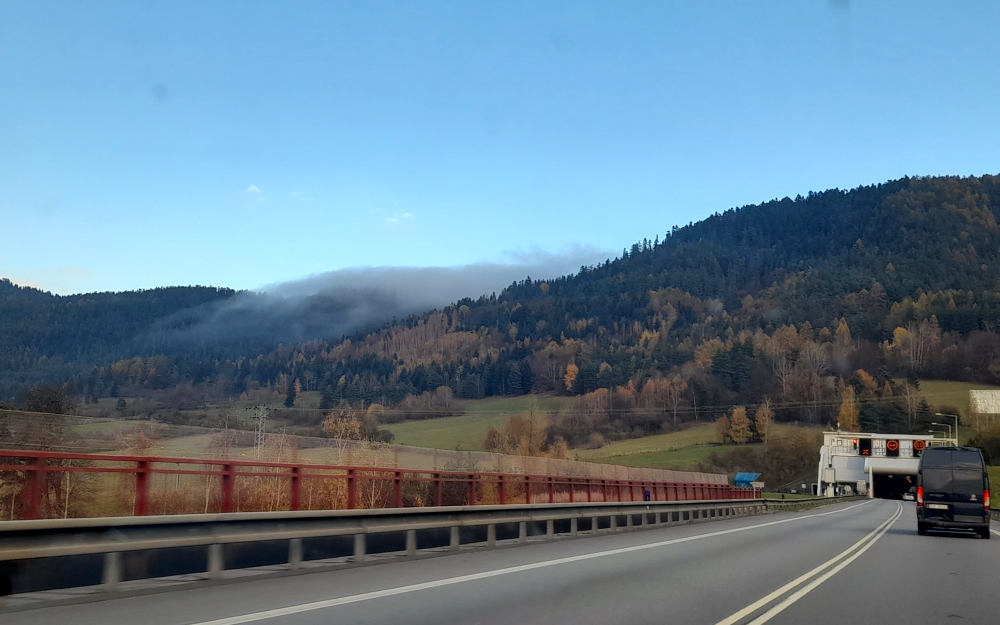
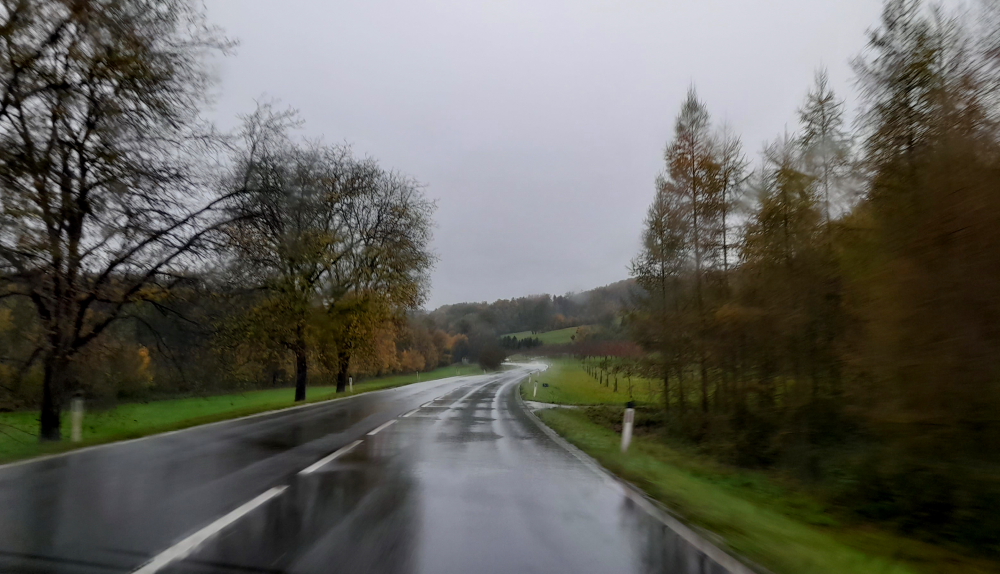
A chilly 8 Deg. C and dreary start to our 250 kms drive to Krakow on the D1, 18 then 68 to the Polish border.
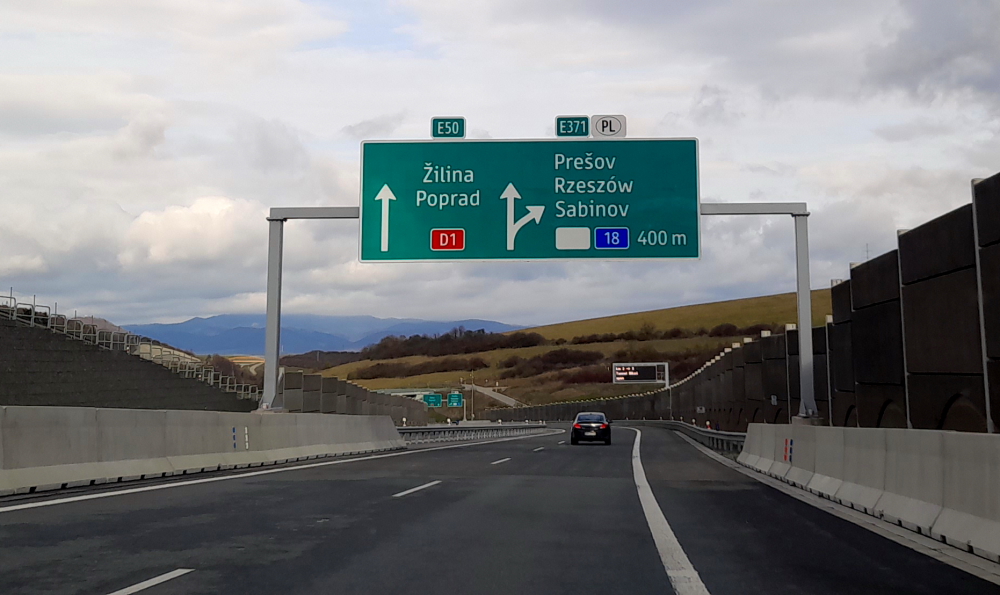
Heading to Poland from Slovakia.

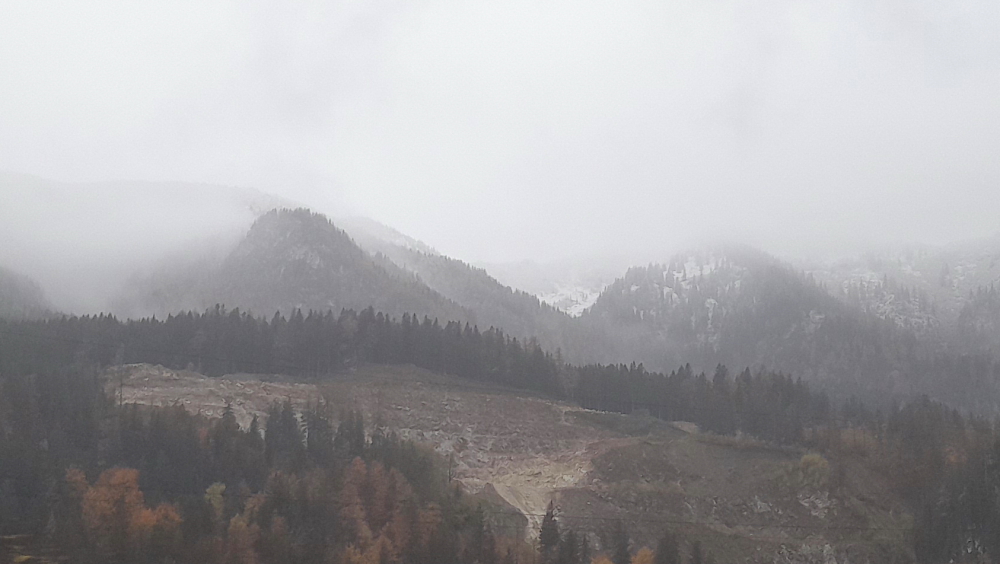
Driving up into the hills south of the border around Plavnica there is snow on the hills to our right as the temperature drops to 4 Deg. C. I think we are getting out of Slovakia and Poland at the right time!
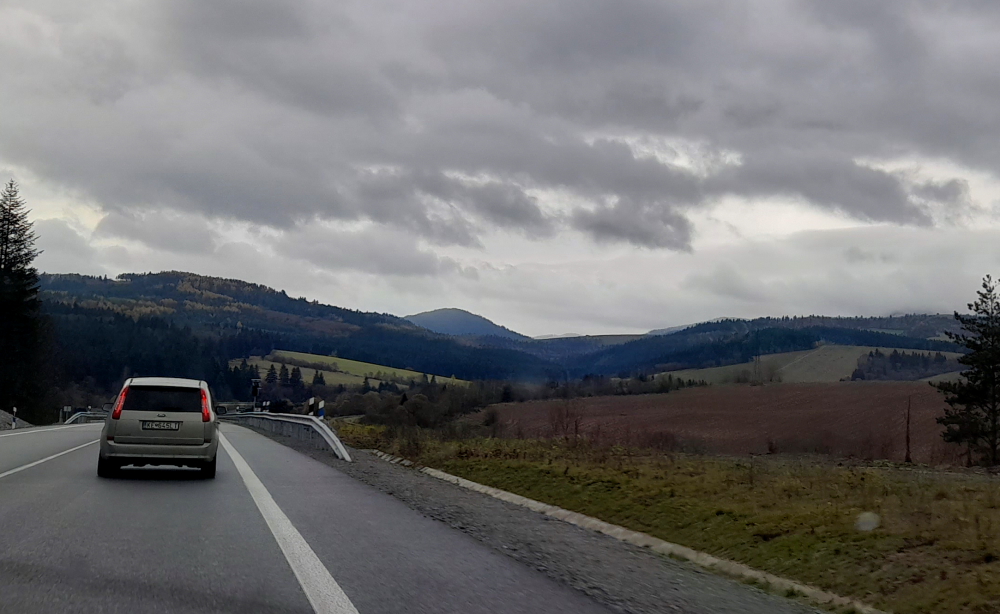
Small country roads in Slovakia near Plavnica.

Further on in the village of Stara L’ubovna we see several man-made platforms for stork nests – similar to what we saw in Hungary in 2015.
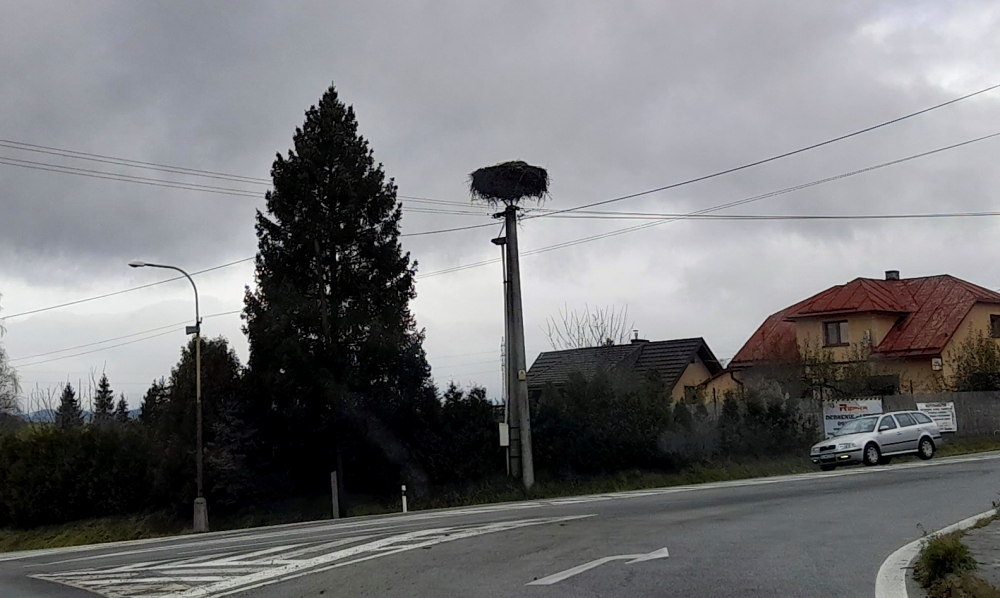
Stork nest in Stara L’ubovna.

At the small village of Mnisek nad Popradom we can see Poland across the river which is the border with Slovakia.
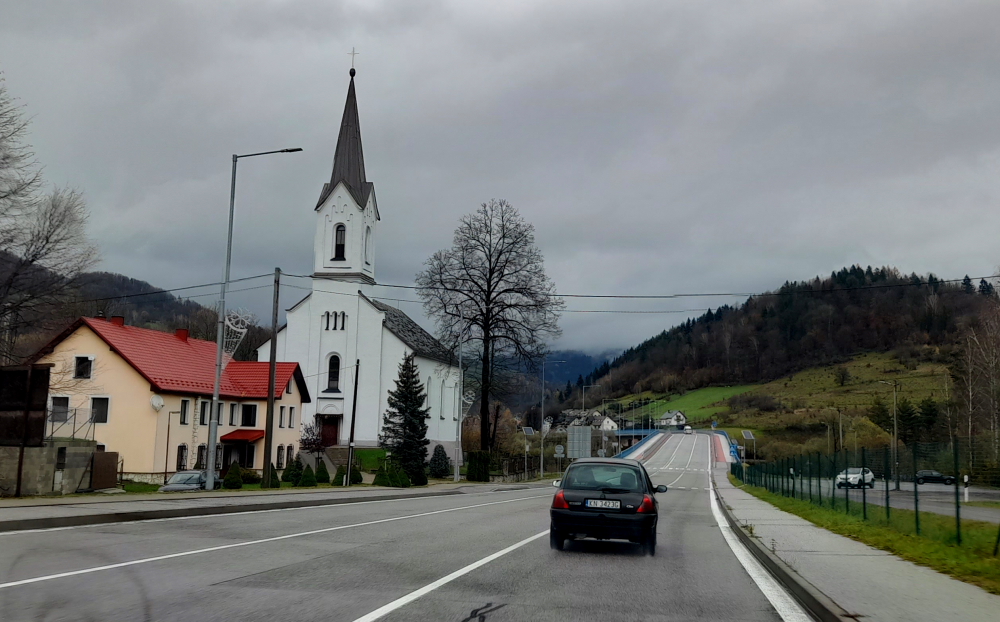
Border town of Mnisk nad Popradom in Slovakia.

But before we can get there we need to stop in the middle of the bridge and show our passports to the Polish Border Guard.
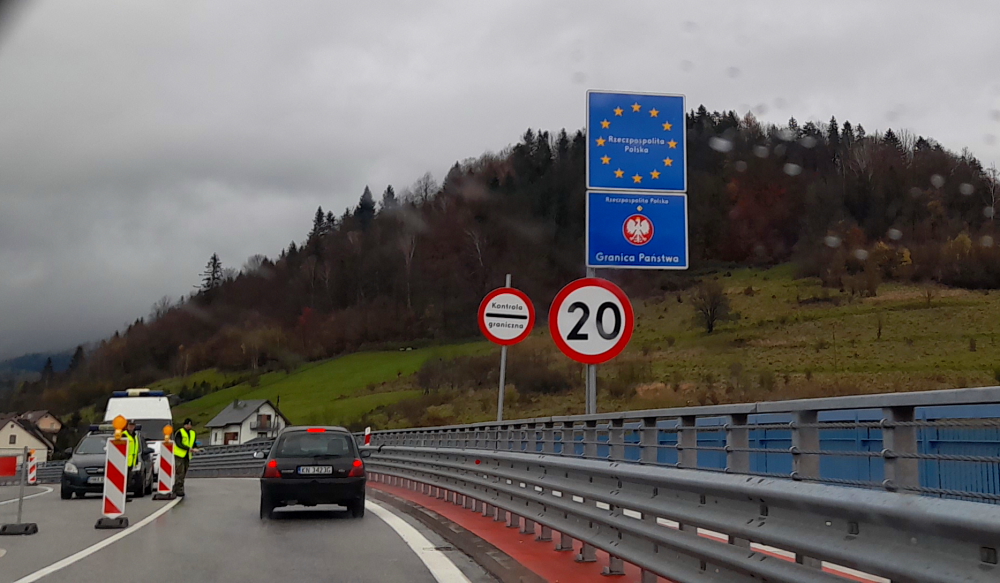
Illegal immigrant check at the Polish border.

We are now on the 87 which will change to the 75 and A4 into Krakow.
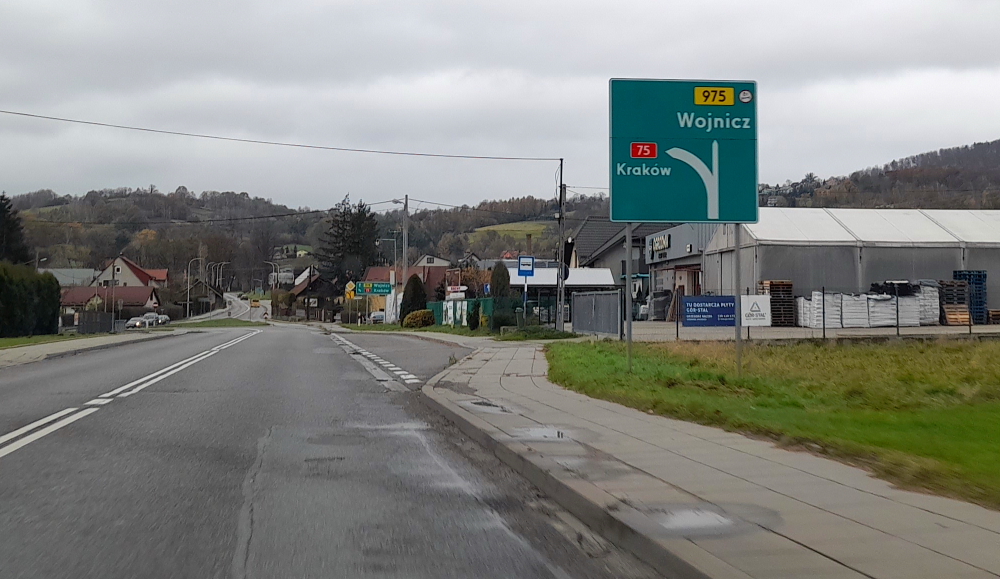
Continuing B roads to Krakow.

Past Tegoborze on the 75 we drive up the hairpin bends which gives us a view of Lake Roznow.
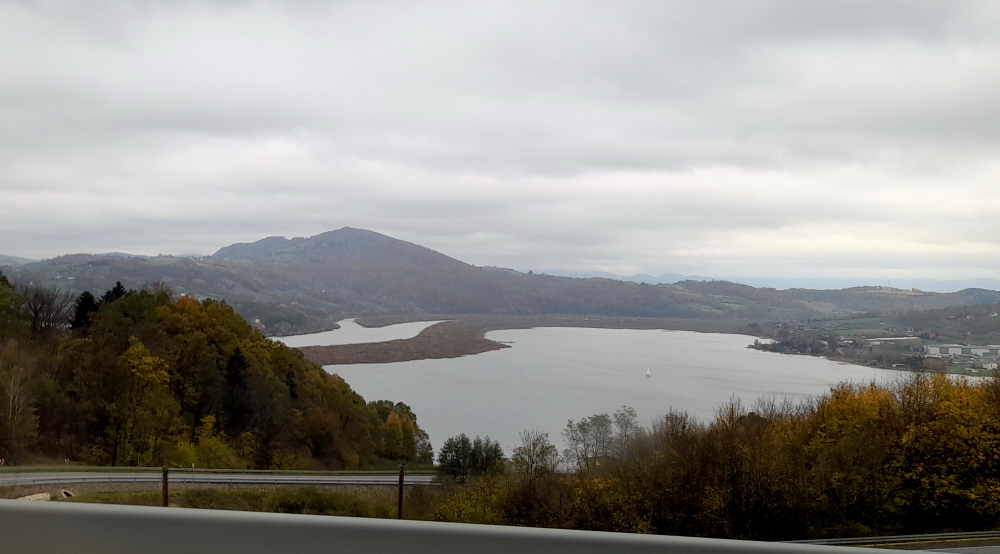
Lake Roznow.

Across the road from the unpronounceable village of Wytrzyszczka is Tropsztyn Castle. It’s a reconstruction of the defensive castle erected on a steep peninsula flooded on three sides by the Dunajec River. The stronghold was probably built in the first half of the 13th century on the initiative of the Ośmiorogi family. The first mention of it comes from 1231. Another mention comes from 1390, the property of the knight Chebda from Tropsztyn, Starykoń coat of arms, married to Zochna Gierałtówna, Ośmoróg-Gierałtów coat of arms. This family ruled the castle for 300 years. In 1970, Andrzej Benesz became the owner of the castle ruins. After 1993, the castle was rebuilt and then opened to the public.
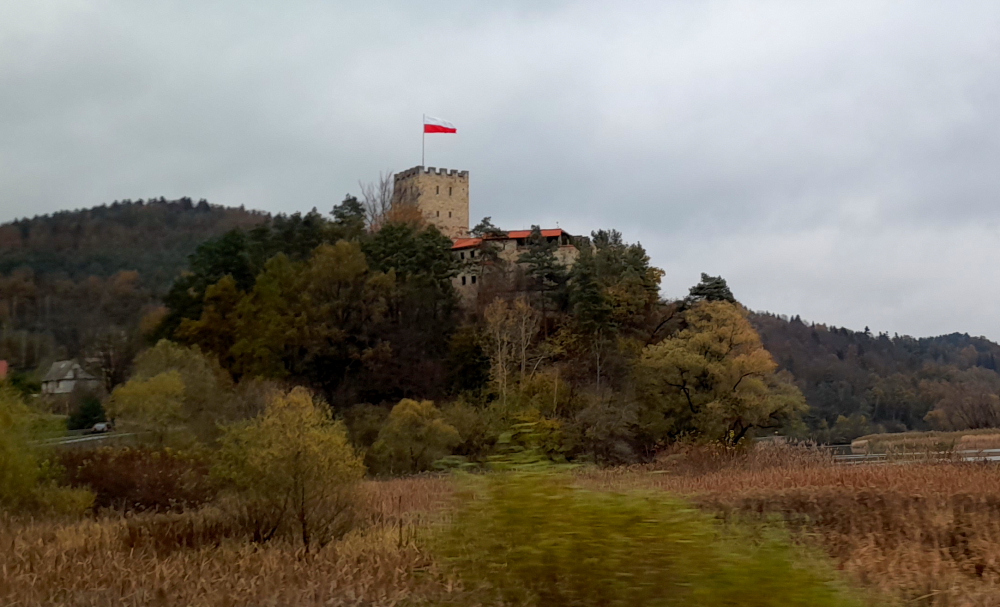
Tropsztyn Castle.

Around 2:00 pm we pull up in front of our hotel on the edge of the Old Town. Conveniently I can leave the car parked right out front as I’d made an advanced booking.

As it gets dark around 4:30 pm we drop the bags and walk around the corner to check out the location of the nearest laundromat for tomorrow then venture up the road to the Main Market square.
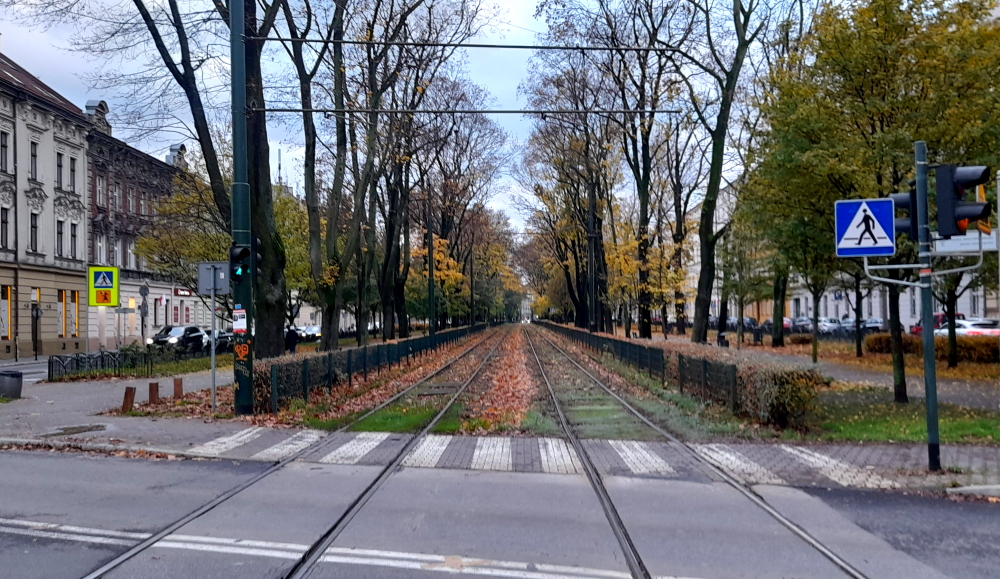
Tram tracks in Krakow.

We arrive in the Main Market square just as the sun is setting.
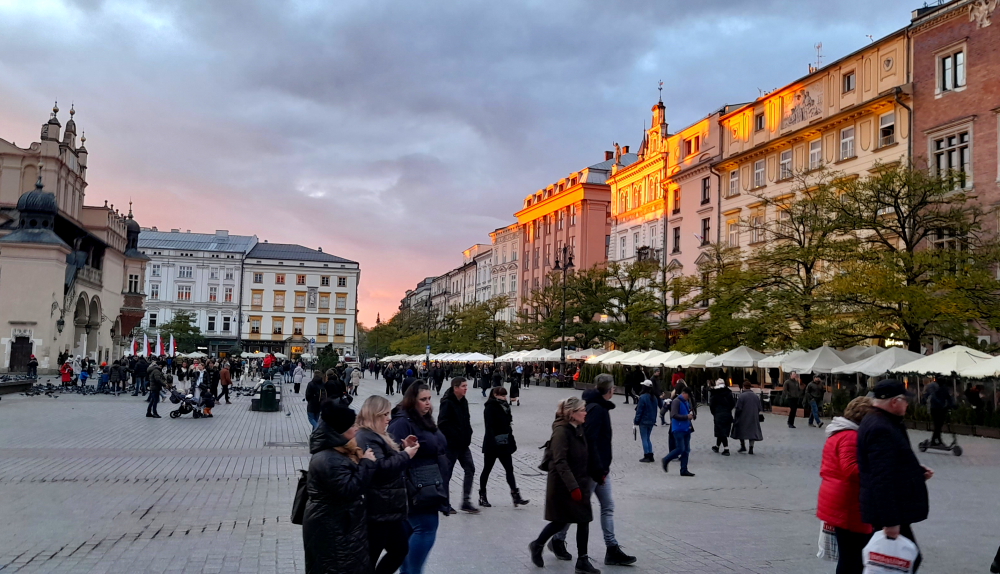
Late afternoon in the Main Market square of Krakow old town.

Unlike just about every other main/market square in Central Europe that we’ve visited these past 3 months, this one is the real deal, having avoided destruction during various battles and world wars and subsequent reconstruction in its former architectural style.
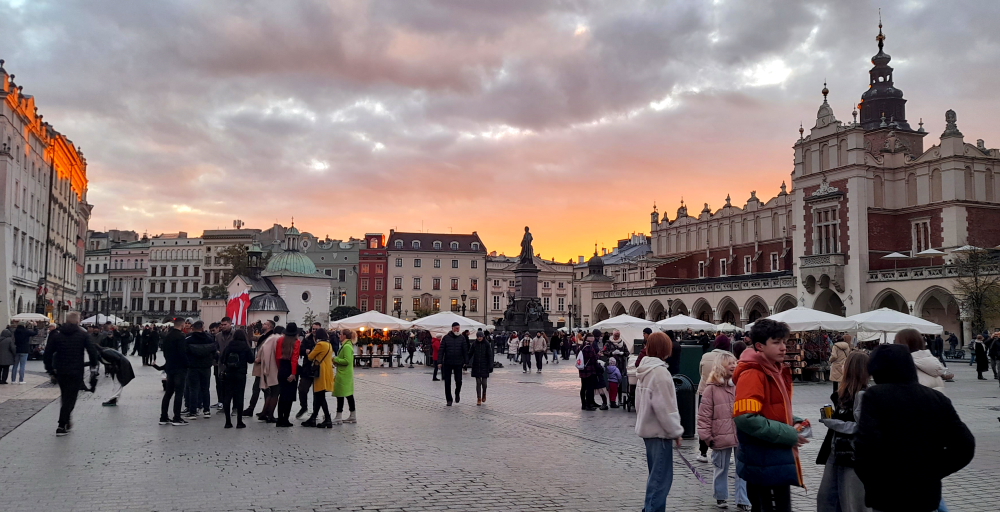
Rynek Glowny (Main Market) with the Cloth Hall at the right.

It dates back to the 13th century, and at 3.79 ha (9.4 acres) is the largest medieval town square in Europe.

Rising above the square are the brick Gothic towers of the adjacent St. Mary’s Basilica. Built in the 14th century, its foundations date back to the early 13th century and serve as one of the best examples of Polish Gothic architecture.
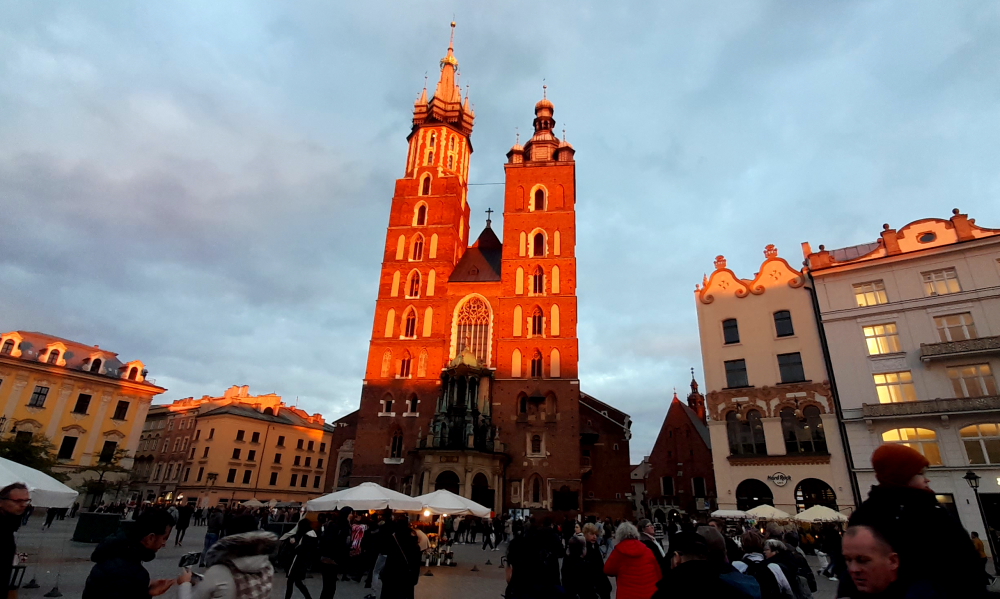
St Mary’s Basilica in Krakow Square.

It is particularly famous for its wooden altarpiece carved by Veit Stoss (Wit Stwosz). Some of its monumental poly-chrome murals were designed by Poland’s leading history painter, Jan Matejko (1898–1891). In 1978 it became a UNESCO World Heritage Site alongside the Historic Centre of Kraków.
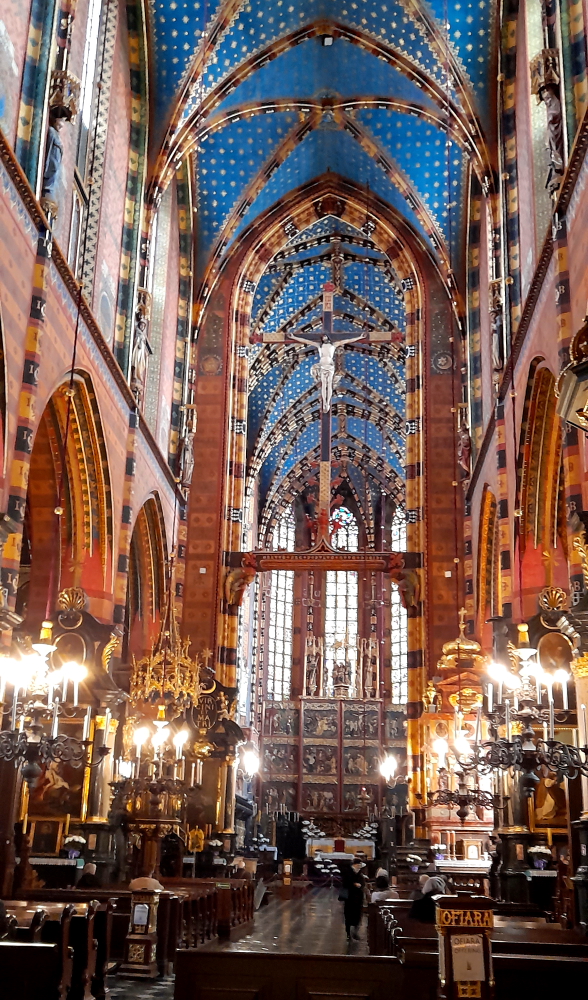
Blue ceiling of the Basilica.

One of the many streets off the Square is Florianska which leads, predictably, to St Florian’s Gate, the sole surviving medieval Gothic gate tower from the 14th century which adjoins a portion of the city’s fortified walls. It was the former main entrance to the medieval town of Krakow.
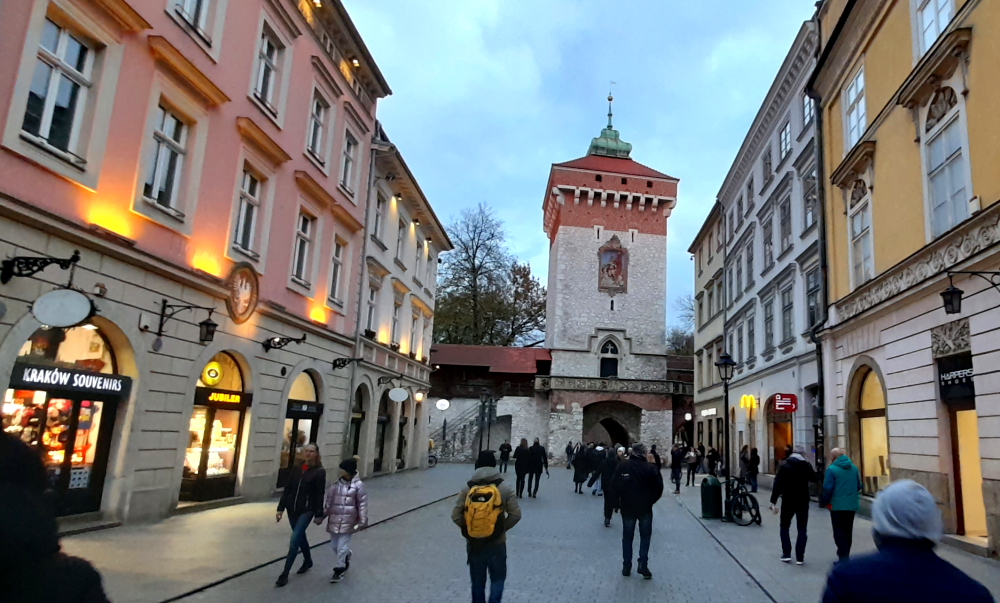
The Krakow old city gate – St Florian’s.

Looking back up Florianska is a view of St Mary’s church towers. As we are walking back to the Square we see a restaurant specialising in Polish food in one of the huge doorways on the footpath which is where we end up for an early, and delicious, dinner.
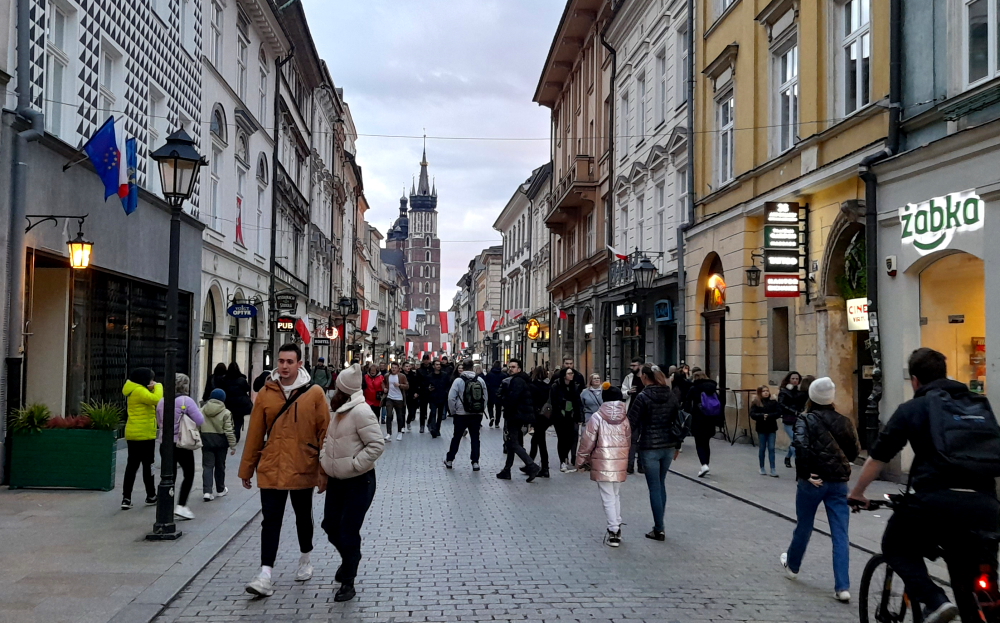
View of St Mary’s Basilica from Florianska Street.

13 November, 2023

10:15 am is the start time for our 2.5 hour walking tour of the Old Town and Wawel Castle. Our meeting point is in front of the basilica in the Main Market.

The square space of the Main Market is surrounded by historic townhouses and churches. The center of the square is dominated by the Cloth Hall (Sukiennice), rebuilt in 1555 in the Renaissance style, topped by a attic or Polish parapet decorated with carved masks.
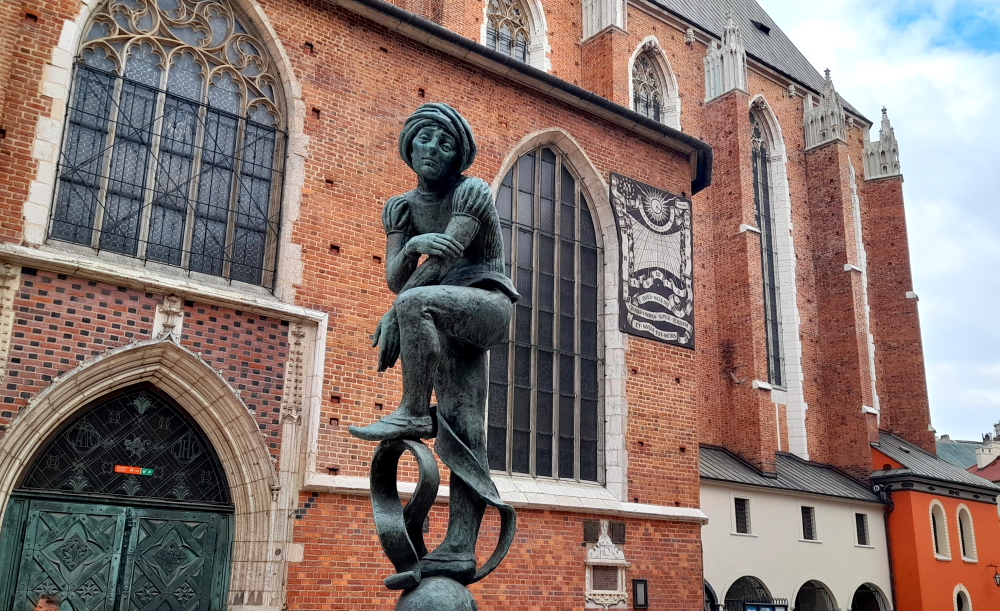
Sculpture of a medieval character next to the Basilica.

On one side of the Cloth Hall is the Town Hall Tower (Wieża ratuszowa). Kraków Main Square does not have a town hall – just its tower – because it has not survived to the present day.
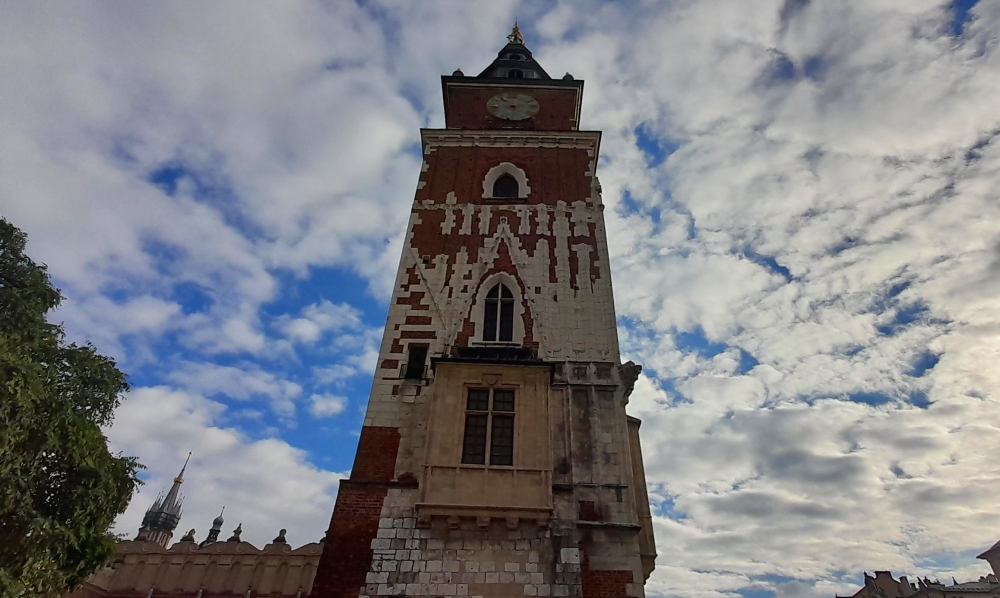
Town Hall Tower.

In front of the Tower is a sculpture ‘Love is Blind’.
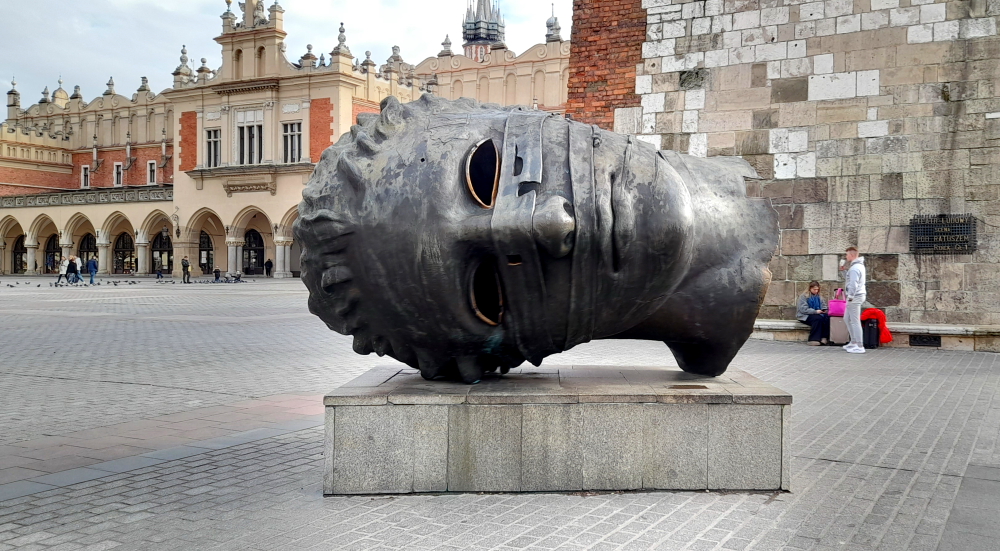
The Big Giant Head with Cloth Hall in the background.

From here we walk to the oldest university building in Poland – Collegium Maius – the Jagiellonian University’s oldest building, dating from the 14th century. Poland’s first university, Akademia krakowska, moved into the building some time in the 14th century after King Władysław II Jagiełło had purchased it as an educational grant with funds bequeathed by his late wife, Queen Jadwiga.

The Collegium Maius was rebuilt in the late 15th century as a late-Gothic structure surrounding a large courtyard bordered with arcades.

It’s in this courtyard that we hear the chiming of bells at 11:00 am and witness a procession of wooden characters moving through one small wooden door to another accompanied by heraldic music.
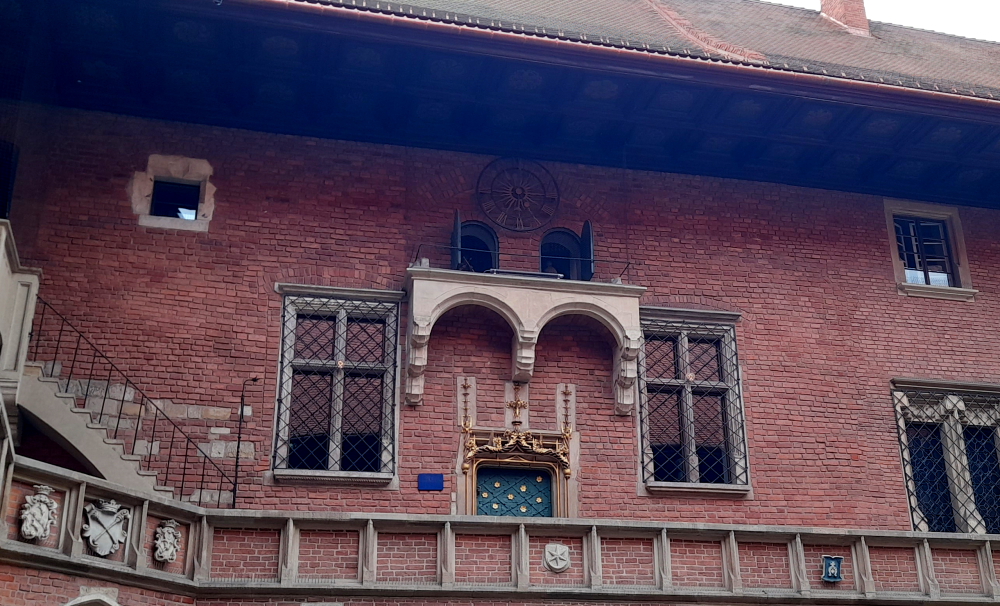
11:00 am bells & procession.

From here we walk around the corner to another University building where over 105 professors were commanded by the Gestapo Chief to attend a lecture on 6 November 1939 by the Nazi Party only to find that instead they were to be arrested and transported to Sachenhausen and Dachau, known as Sonderaktion Krakau.

Many of those who went through Sonderaktion Krakau and the internment formed an underground university in 1942 in defiance of the German punitive edicts. Among the 800 students of their underground college was Karol Wojtyła, the future Pope John Paul II, taught by Prof. Tadeusz Lehr-Spławiński (Univesity Rector Professor) among others.
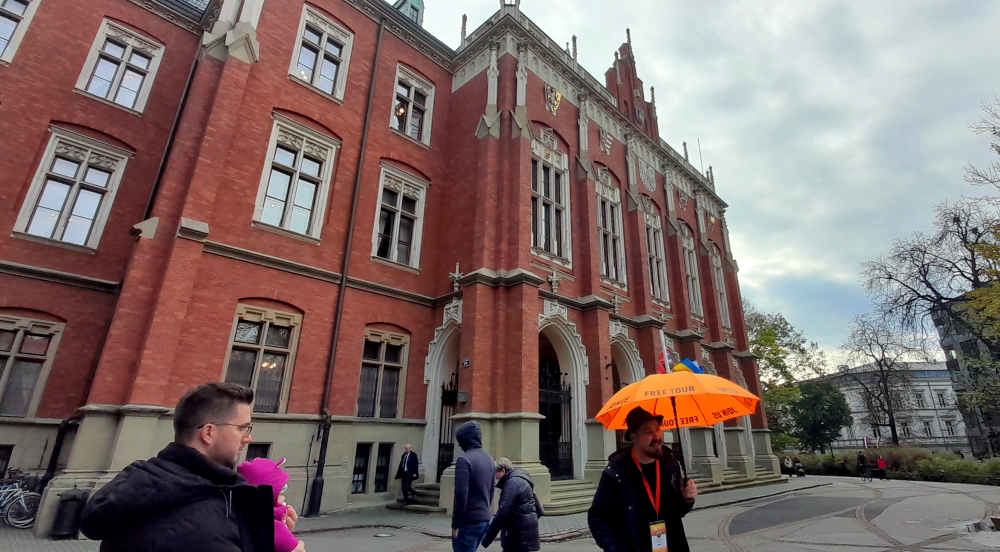
Collegium Novum

Adjacent to this building is a statue of one of the University’s famous students. In the 1490s the Collegium Maius counted among its students Nicolaus Copernicus, the Renaissance astronomer and polymath who would revolutionize European ideas about the universe.
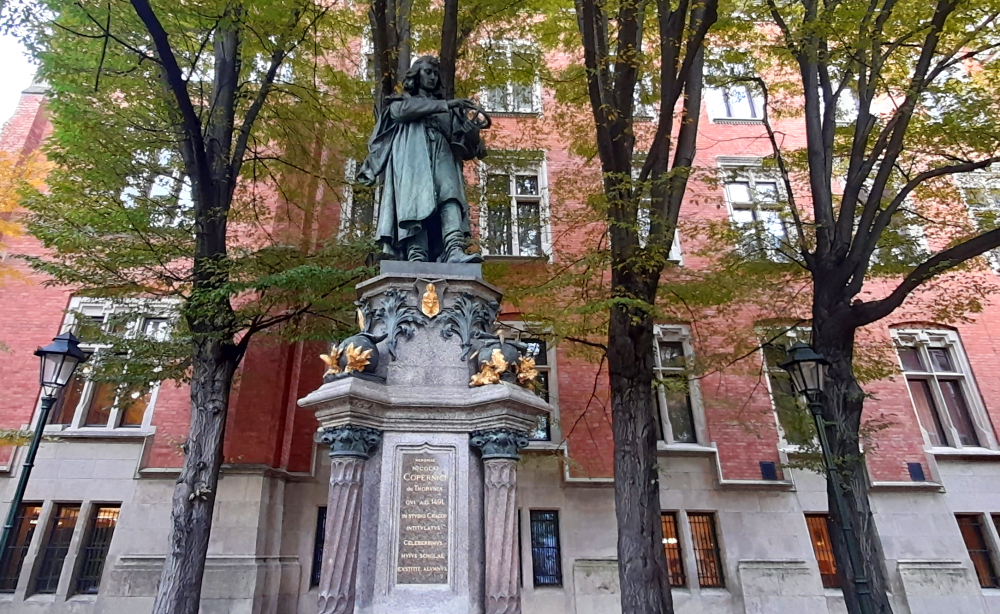
The Statue of Copernicus.

After walking past the Church of St Andrew we stride up Kanonicza then ascend the steps that run up alongside the red brick Castle wall.

The Wawel Royal Castle and the Wawel Hill on which it sits constitute the most historically and culturally significant site in Poland.
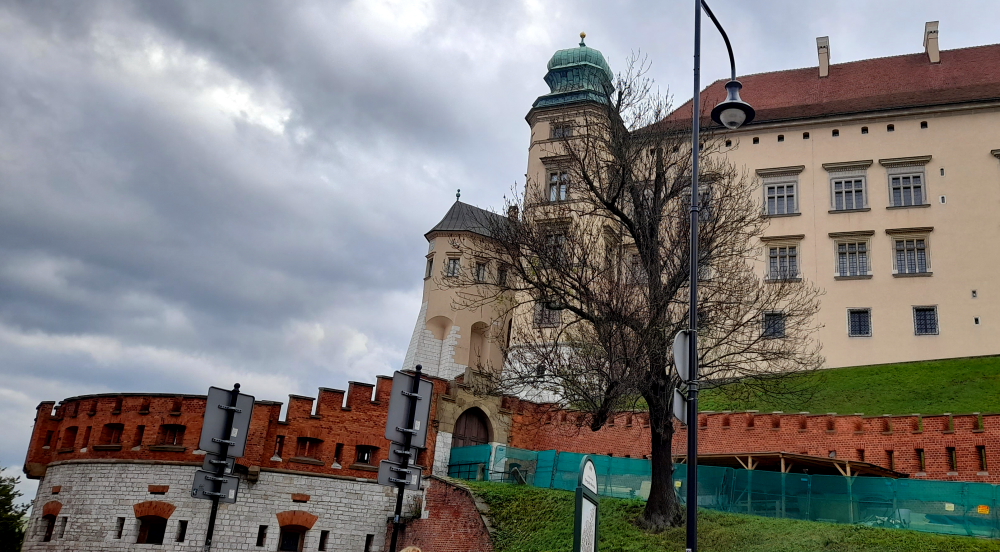
The city end of the Castle.

On the way to the castle entrance we walk past the equestrian bronze statue of Kościuszko—Polish and American hero of independence—which is located along the west side entrance to the Wawel Castle. The statue was cast in 1900 thanks to the efforts of newly formed Tadeusz Kościuszko Society and erected in 1920-24 once the Polish state reestablished its independence following World War I. Destroyed by the Germans in 1940 during the Nazi German occupation of Poland its current replica, erected in 1960, is a gift to the City of Kraków from the people of Dresden, Germany.

Mt Kosciuszko was named after this cultural and political hero by the Polish explorer, Paul Strzelecki in 1840.
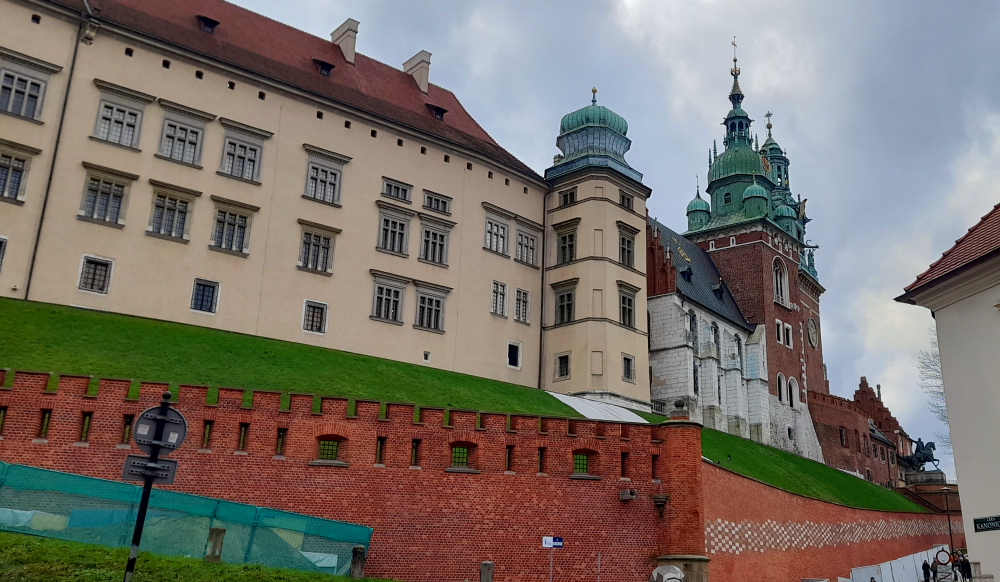
Krakow Castle with Kosciuszko’s equestrian monument.

In the small courtyard we witness the eclectic architectural styles over the centuries that compose the Royal Archcathedral Basilica of Saints Stanislaus and Wensceslaus – representing nearly all European architectural styles of the Medieval, Renaissance and Baroque periods. Royal because Krakow was the capital of Poland before it was moved to Warsaw and it is where numerous Polish kings worshiped, were crowned and buried.
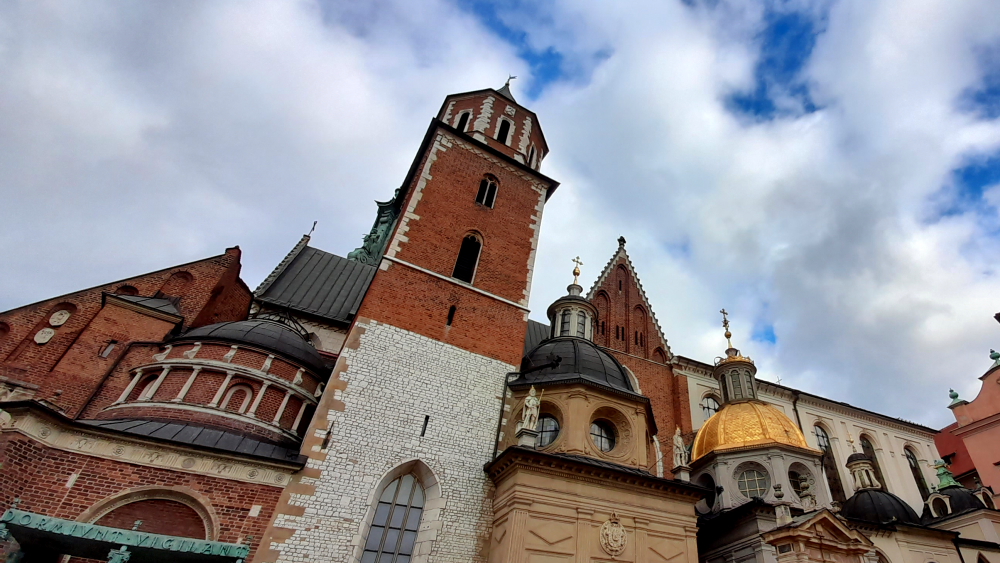
Krakow Cathedral on Castle Hill.

Walking under an archway we enter the main courtyard of the castle. A fortified residency on the Vistula River in Kraków, it was established on the orders of King Casimir III the Great and enlarged over the centuries into a number of structures around an Italian-styled courtyard.
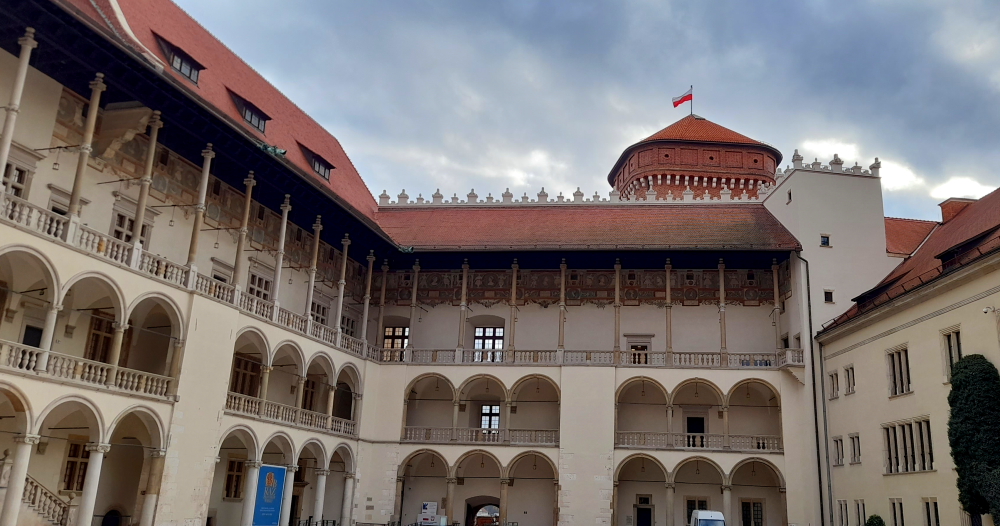
Interior courtyard of Krakow Castle with fresco frieze.

This is the end of the tour so we walk back to our starting point in the Main Square.
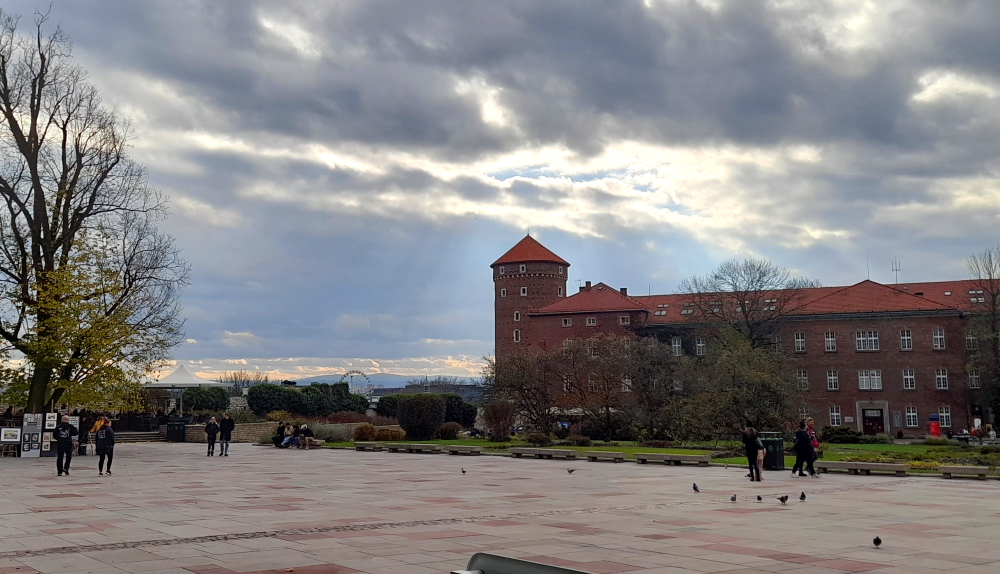
View to the SW from the Cathedral Courtyard on Castle Hill.

En route Lynn says, “What we need now is a gluhwein to warm up!” and, right on cue, a gluhwein shop appears. Talk about “ask and ye shall receive”!
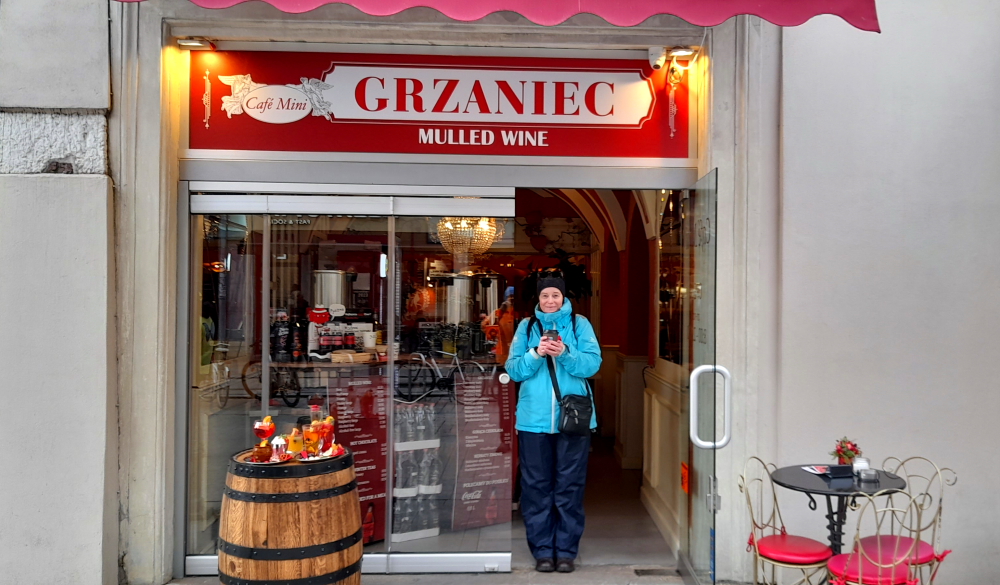
Take-a-way Mulled Wine to warm up.

Back at the main square we walk through the Cloth Hall which features a series of stalls on either side of its arcade.
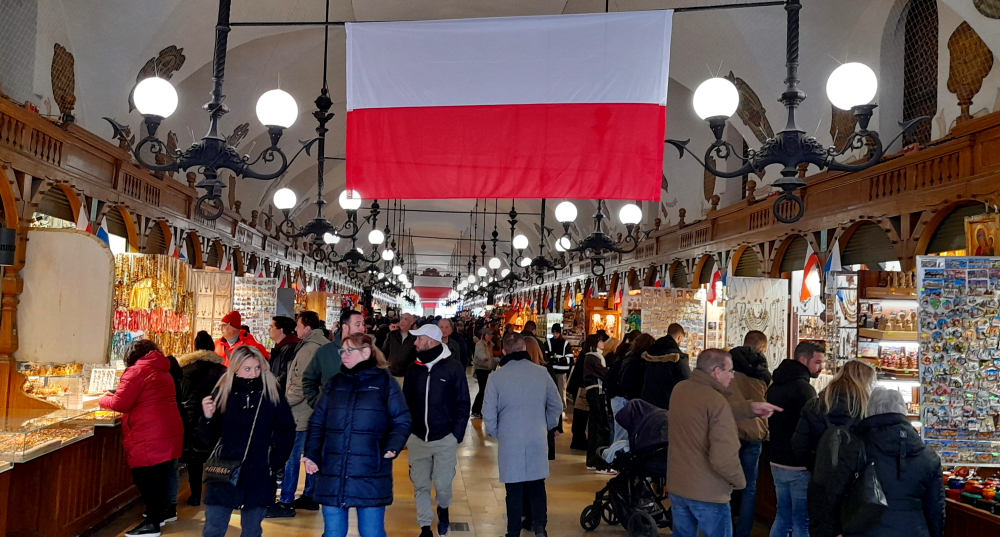
Walk through the Market Square arcade.

On our walk back to the hotel we notice an unusual statue on one of the building’s facades at the corner of Florianska and Mariacki streets – an African male and female carrying a basket of grapes!
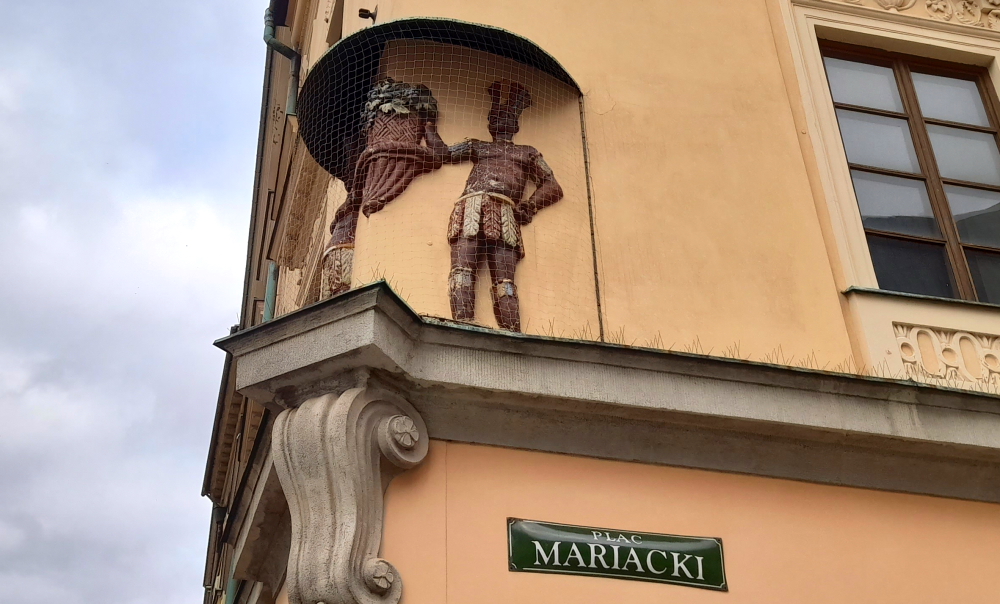
Building facade near the square.

Must be laundry time so we chuck our washing into an overnight bag and walk the 10 minutes to the local laundromat. 75 minutes later we walk out the door. Lynn now has the pleasure of doing my ironing.
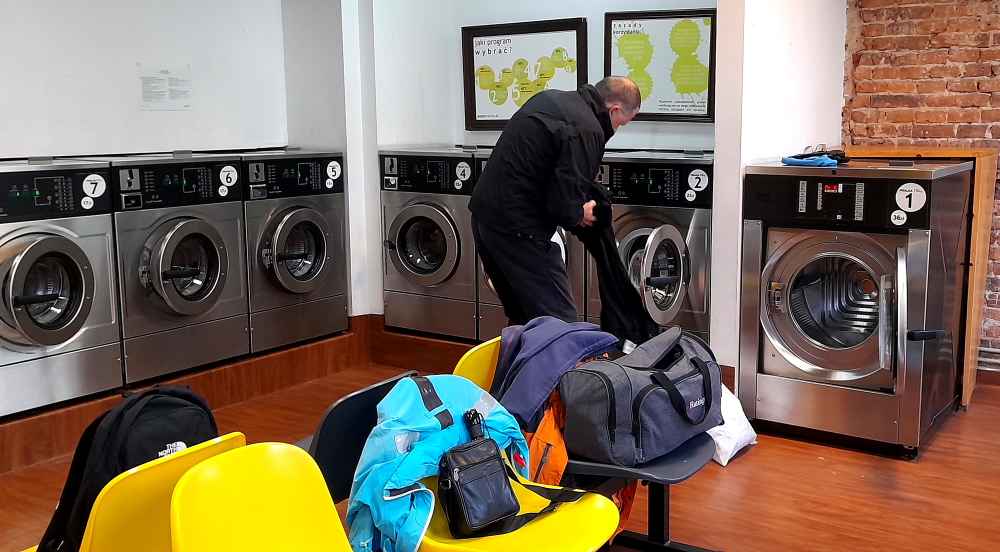
Washing Day.

Yesterday we spied an Irish Pub in the Small Market square so we head there for dinner. Lynn orders “Bangers and Mash” and I, myself, order fried chicken. We are reminded once again that we should give Irish Pubs abroad a miss as their owners and staff just don’t have a clue!
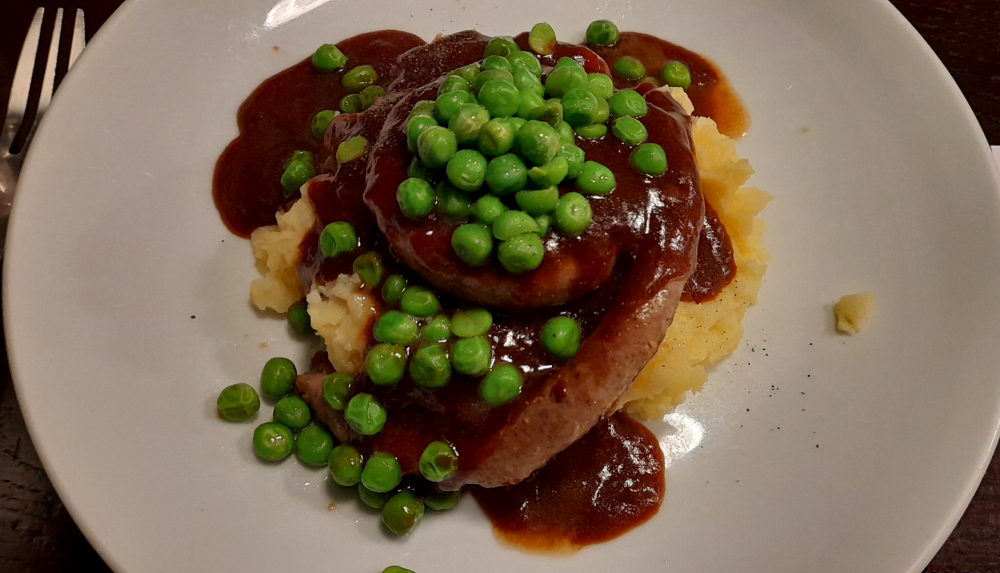
No comment about what this looks like!

14 November, 2023

After our busy day yesterday, today is a catch up day. But, we do venture out around 3:30 pm to have a closer look at St Florian’s Gate and the city walls.

The tower, first mentioned in 1307, had been built as part of a protective rampart around Kraków after the Tatar attack of 1241 which destroyed most of the city. The permit for the construction of new city defenses featuring stone watchtowers, fortified gates and a moat was issued by Prince Leszek II the Black in 1285. The gate named after St. Florian became the main entryway to the Old Town.
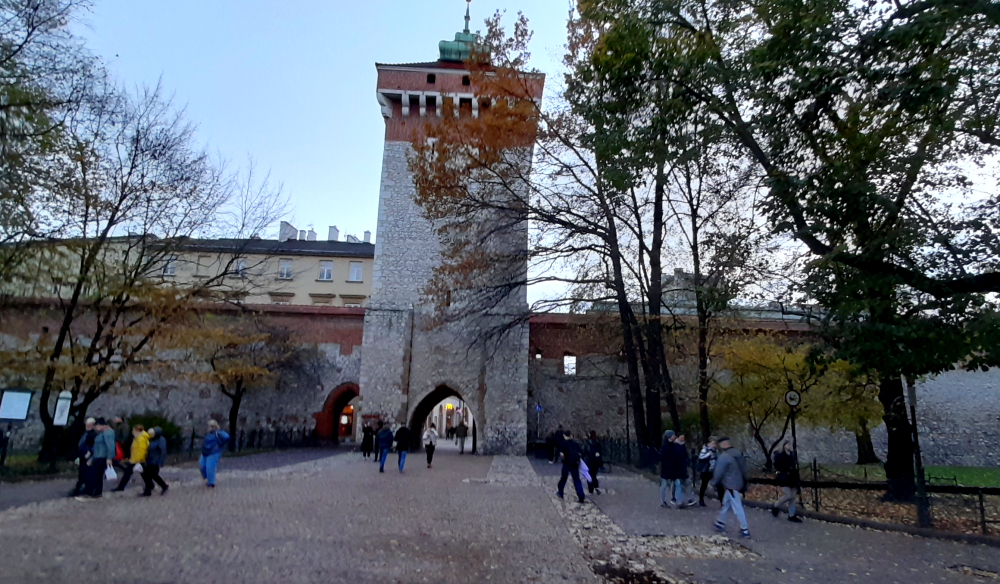
St Florian’s Tower & partial city walls.

It was connected by a long bridge to the circular barbican (Barbakan) erected of brick on the other side of the moat. The Gate was manned by the Kraków Furriers Guild. According to records, by 1473 there were 17 towers defending the city; a century later, there were 33. At the height of its existence, the wall featured 47 watchtowers and eight gates. Also, in 1565–66 a municipal arsenal was built next to St. Florian’s Gate.

Kraków’s Royal Road begins at St. Florian’s Gate. Through it once entered kings and princes, foreign envoys and distinguished guests, and parades and coronation processions. They traveled up ulica Floriańska (St. Florian’s Street) to the Main Market Square, and on up ulica Grodzka (Castle Street) to Wawel Castle.
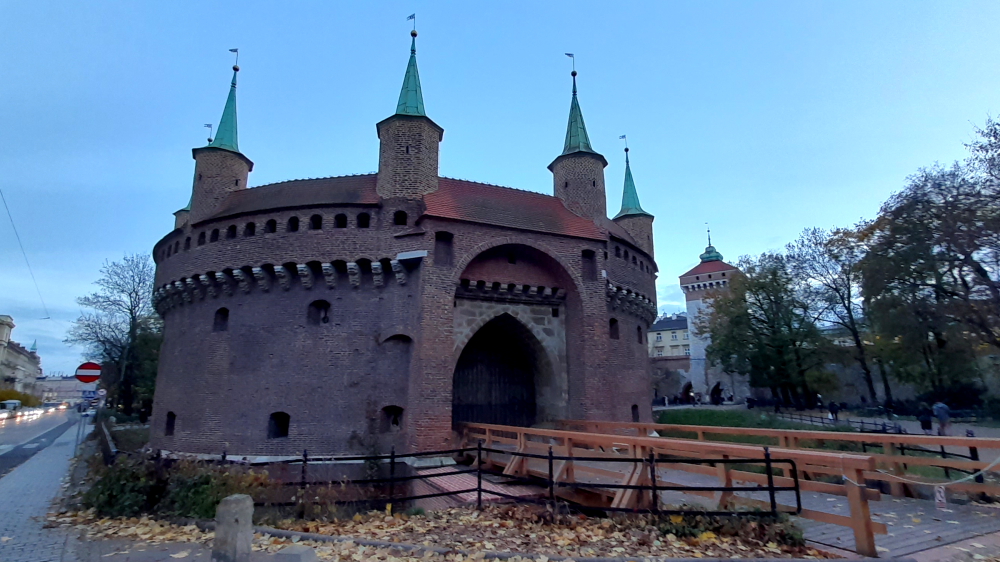
Brick barbican.

Until the 19th century, Kraków had massive medieval city walls. The inner wall was some 2.4 meters wide and 6–7 meters high. Ten meters outside the inner wall was an outer, lower one. The walls were punctuated by defensive towers 10 metres high. In the 19th century — just before they were demolished by the Austrian authorities — there were 47 towers still standing. Now there are only three Gothic towers left in all Kraków: the Carpenters’, Haberdashers’ and Joiners’ Towers, connected to St. Florian’s Gate by walls several dozen metres long, with Brama Floriańska the only city gate, of the original eight built in the Middle Ages.

Lynn is down with a cold – again! Which she believes she caught during the night town walk in Kosice. We stop by a couple of pharmacies and bought her some cold tablets. I just hope that she doesn’t give it to me, which she usually does! Keep it to yourself, girl.

As we are already in town we opt for the Trattoria in Florianska for an early dinner. Plus an early night tonight as we need to be on the road by 9:00 am in order to drive the 285 km to Warsaw, refuel the hire car and put it through a car wash before we return it around 1:00 pm.

15 November, 2023

A restless night due in part to Lynn coughing and sneezing all night and partly since I know that we have to get out of bed by an ungodly 6:30 am. I hate getting out of bed before 8:00 am, especially in winter. It is dark and raining outside as we drag ourselves out of bed. We are at breakfast at the opening time of 7:00 am and manage to be on the road by 8:07 am.

It is a 3-hour drive to Warsaw Airport and we have to have the car washed, refueled and returned by midday. Although, technically, since they were an hour late delivering the car 3 months ago I sent them an email yesterday stating that we would be returning the car by 1:00 pm. So that should leave us about 5 hours to get the job done (you would think).

As soon as we reach the next block from the hotel we sit in bumper to bumper traffic. The traffic gets progressively worse as we reach the outer suburbs. By this time we have traveled about 5 km in the last hour. At this rate we will be very late. Finally, we reach the traffic issue.
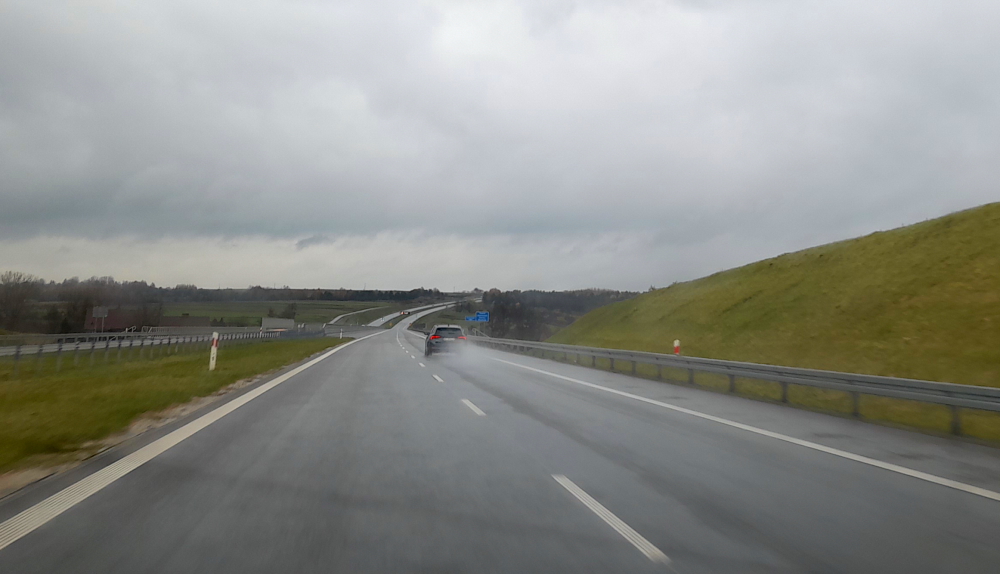
On a freeway at last!

They are building a new freeway and widening the main arterial road from Krakow to Warsaw (the two largest cities in Poland) but nobody bothered to implement a traffic management plan for the construction phase. Even after we clear the road works the main road to Warsaw is a single lane highway for the next hour.
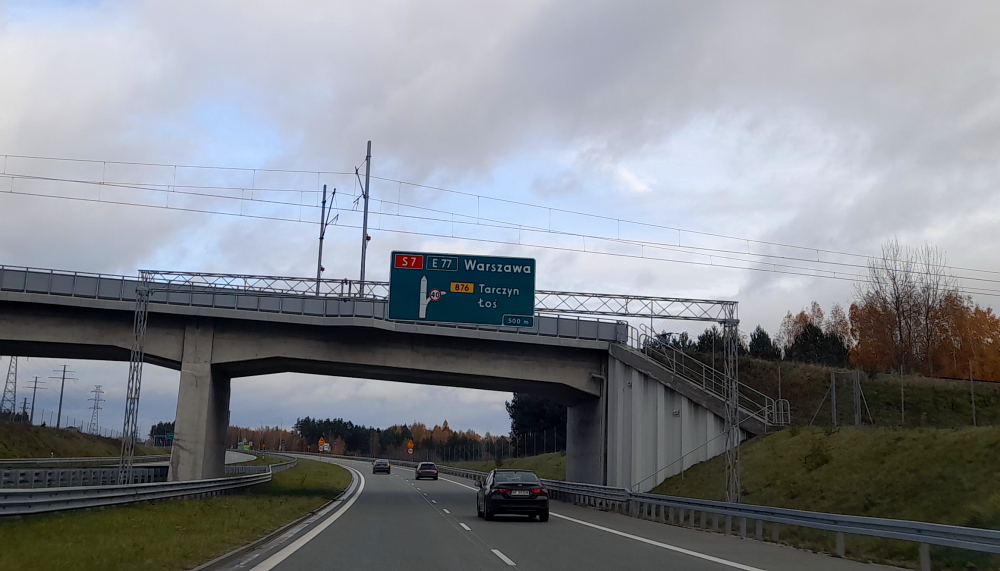
On the way to Warsaw.

It continues to rain heavily as we reach the start of the actual freeway so visibility due to spray is low. I drive as fast as I legally can but we have to take a quick pit stop half way. I manage to make up some time and we get to the car wash about 11:30 am then refuel and return the car to the airport underground car park.
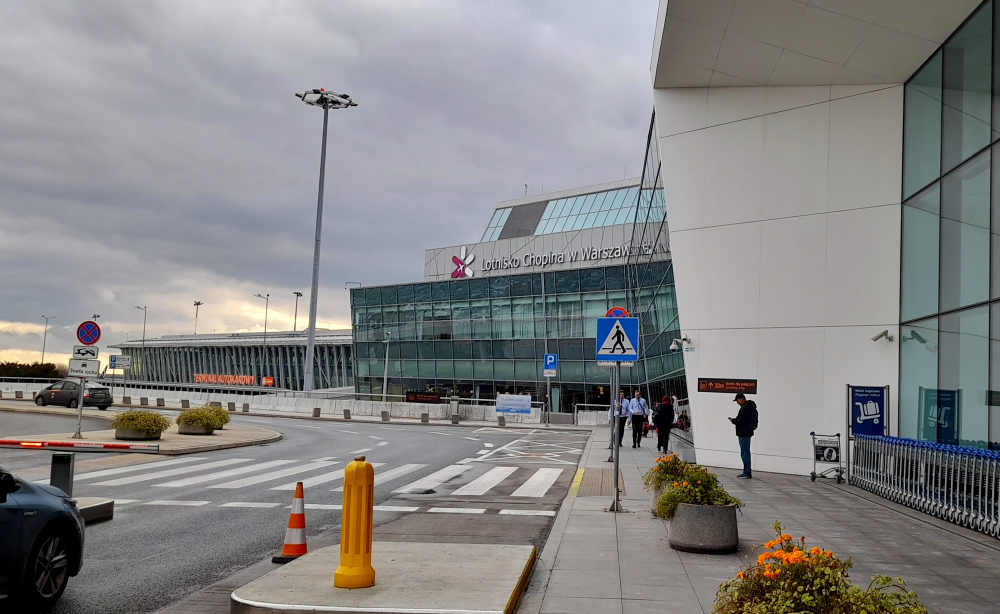
Chopin Airport, Warsaw.

Lynn calls their airport office to say we are on our way but they just tell us to drop the car key in the return key box outside their office. Obviously the office is unattended, just like when we tried to pick up the car. If we had known that we wouldn’t have bothered to hurry this morning. We could have slept in!
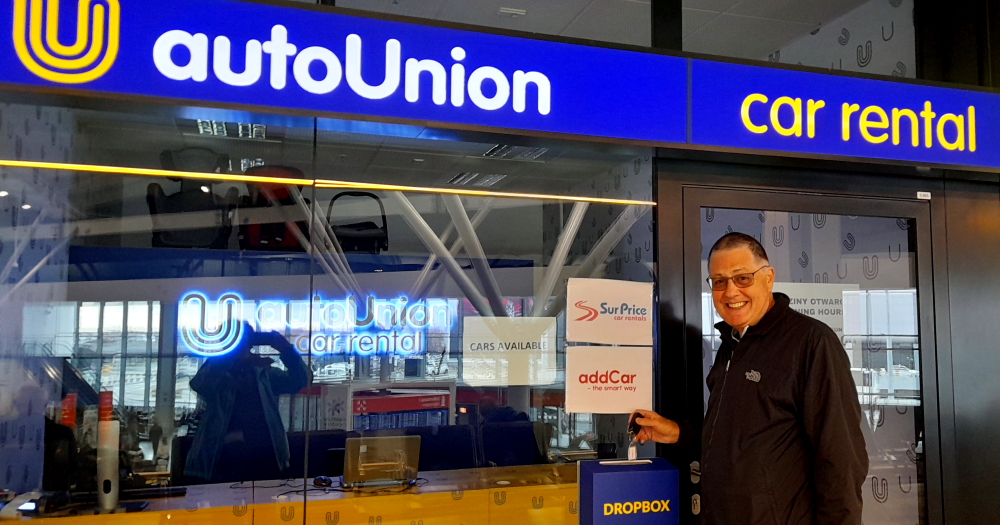
Key drop off for the hire car.

We are booked in to the Airport Courtyard Marriott and have a room on the top floor. We have two nights here and fly out at lunchtime on 17 November back to Heathrow T5. This is all subject to Lynn having no issues with the border guards. Tomorrow will be a rest day to repack after 3 months on the road and to print boarding passes etc.
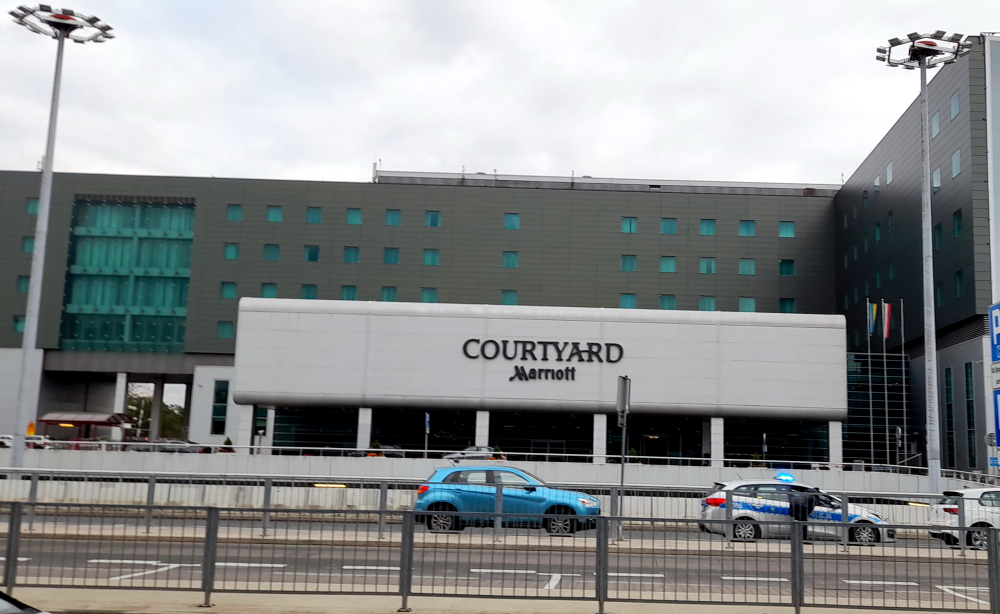
Across the road to our hotel.

Once we are all unpacked I send a message to see if our UK Insignia car is operational back at the Burns’ residence at Anvil Green after three months of being parked up. The news is that the battery wouldn’t hold charge so Ross very kindly purchased a replacement battery but when installed would not start the car. Ross has organised road service for tomorrow morning. I just hope there are no major issues as we only have one day back at Anvil Green before we drive to France.

I need a drink so I crack my last can of beer. Luckily Lynn can’t drink while she is on her cold tablets. Dinner is in the hotel Bistro tonight and it will be an early night for both of us.

16 November, 2023

We wake to a fog-bound airport. And tomorrow’s weather report is for a maximum of 4 Deg C and a low of -2 Deg C with a mix of rain and snow during the day with snow tomorrow night, Saturday and Sunday (getting out of Poland just in time!) But, when we check the arrivals and departures board in the hotel lobby this morning there doesn’t seem to be any issues with delayed flights. Phew!

We both have a long list of tasks to complete today so after a leisurely breakfast we get stuck in.

First thing is to contact the Burns Clan to offer some possible suggestions as to why the car won’t run with the new battery. It may well be that since the car has been without a battery for some time that the ODB11 codes are showing too many errors or worse, the repairer hasn’t connected the electrics up correctly after the recent repairs. Nothing to do but wait for the Roadside Assistance guy.

Now that we won’t be returning to the Scandinavian or to non-Euro currency countries for the foreseeable future I sell back all the third currencies to GBP.

We get some good news from Ross. The Roadside Assistance guy sorted the car out very quickly this morning and it is fully operation (such a relief). Not sure what the problem was but Ross also took the car for a test run and all is good.

By 1:30 pm we have printed our boarding passes, added our information for the Channel train and printed our insurance documents for Europe. We have the remainder of the day to relax a bit. We only have to deal with Planes, Trains and Automobiles tomorrow to get from Warsaw to Anvil Green, Kent. And the fog has now lifted.

17 November, 2023

Just as we were about to leave the hotel at 10:00 am this morning we receive a message from British Airways that our flight has been delayed for two hours. Surprise, surprise. At least it hasn’t been cancelled completely like our flight from Malaga, Spain to Gatwick last December. And at least we are still in the hotel room when we received the information.

Still, we have to deal with border security and possible issues with them not knowing Directive 2004/38/EC so we decide to head over to the terminal at about 10:15 am to drop our bags. We will have to spend the extra couple of hours at the gate. Our flight is now scheduled for a 14:20 hrs departure.

It turns out that the original flight was going to be on Finnair but the plane broke down so BA had to scramble a crew out out of Heathrow to come and collect us. Since it was a last minute thing there will be no catering on the flight. Not that the food would have been noteworthy anyway but we will be very hungry by the time we get to Anvil Green.

We arrive at the bag drop area to find that there isn’t a bag drop capability at Warsaw Airport so we have to stand in the poorly-manned check-in desk queue for about half an hour. Then queue again for a poorly-manned security check and finally at the All Other Passports border security area. At least the border security is relatively quick and there are no questions asked about 90 days in any 180 days stay limitation for Lynn.

We find metal seats near a power point at the gate and settle in for a 3-hour wait for boarding but at least BA offers the passengers an inadequate food voucher in lieu of catering on the flight.

At long last the flight departs at the new rescheduled departure time and we are on our way to London Heathrow T5.
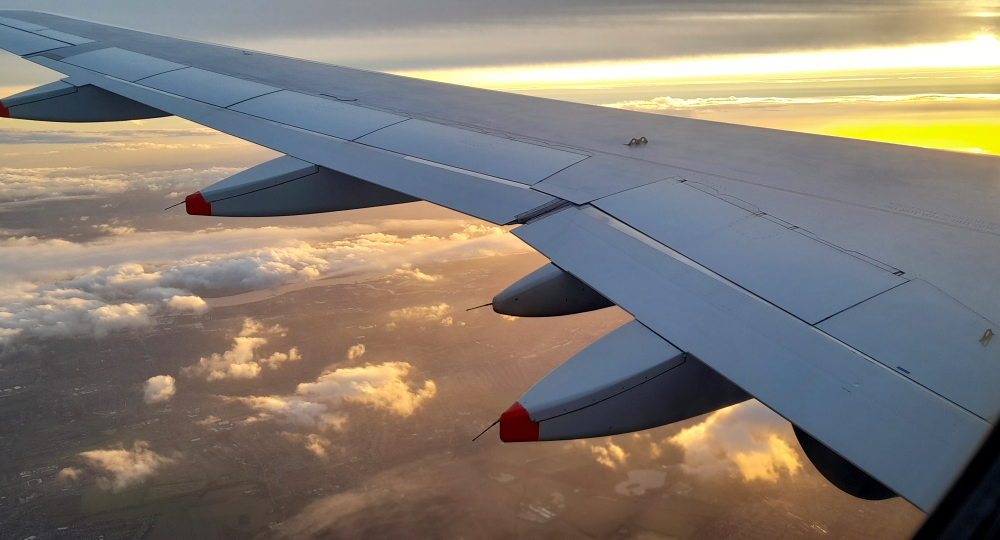
Sunshine up here.

The pilot manages to shave about 30 minutes off the flight time to Heathrow.
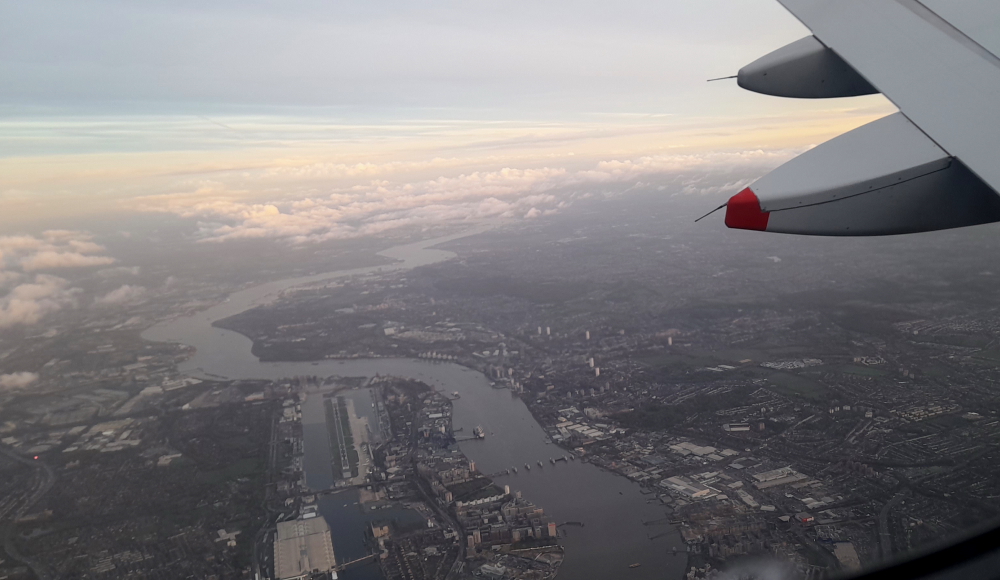
Following the Thames River to Heathrow.

Unfortunately we don’t get a bridge at the terminal so we have to be shuttled on a bus to the terminal but by the time we arrive at the baggage carousel our luggage is ready to be collected.

Next step is to buy two train tickets to Ashford International which entails an Underground train on the Elizabeth Line from Heathrow Terminal 5 to Stratford, a walk through the length of the Westfield Shopping Centre to the Stratford International train station, then a high-speed overground to Ashford International. All for an eye watering A$260.00.

Just as we walk into the Stratford International station the high-speed train pulls into the platform so we scurry down the escalator and just manage to board as the train departs. The next train would have been in half an hour.

At least the express to Ashford has free internet so we call Alex and give her an updated arrival time. Alex then tells us that Ross will meet us at Ashford station to collect us. What a godsend! It is about a 25-minute drive from Ashford station to Anvil Green Farm so we are warm and dry and into a glass of red wine by 7:00 pm.
9 Days in Slovakia

4 November, 2023

It’s a sunny but chilly 10 Deg. C. when we leave the Riegerbauer to drive the 200-odd kms to Bratislava.

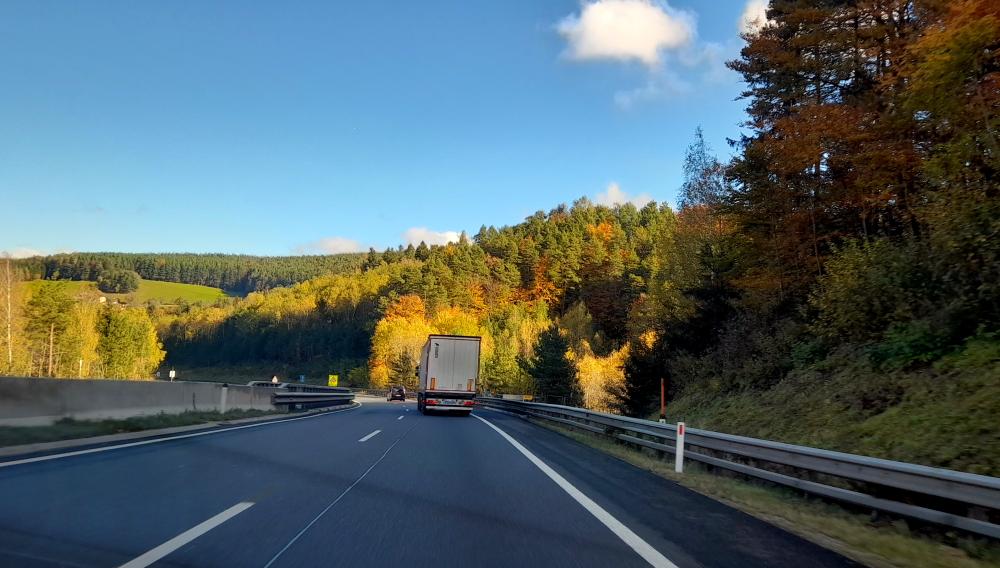
The rolling hills of Austria.

We have already purchased our eVignette online for our transit through Slovakia so we don’t need to stop at the border to purchase a hard-copy one.

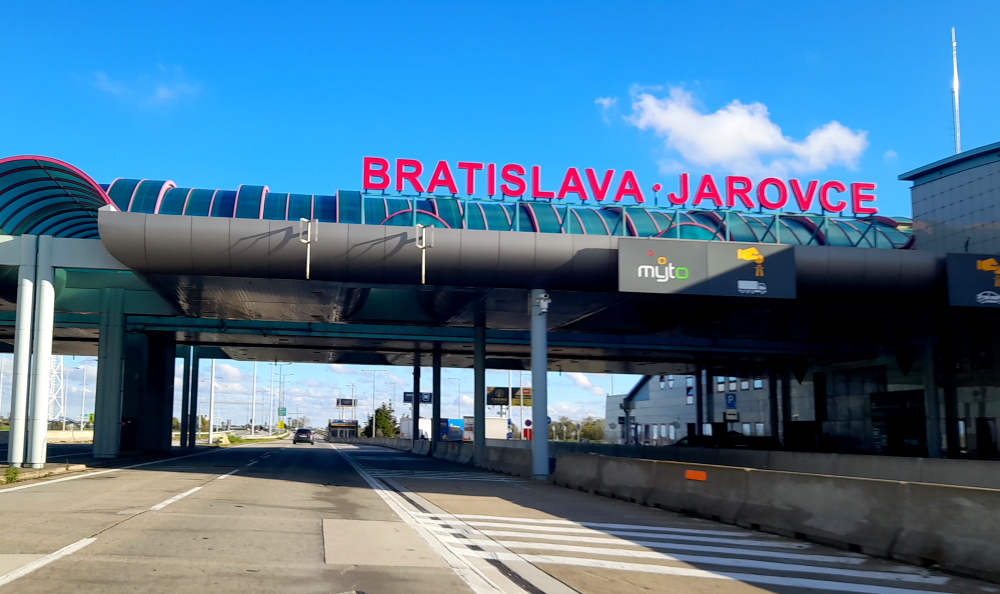
Crossing the border to Slovakia.

While driving through Austria we didn’t come across many wind turbines. Now we know where they are all located, along the border with Slovakia!

Approaching Bratislava.

As we enter the outskirts of the city we see a vast suburb of Soviet-era residential tower blocks – soul destroying.

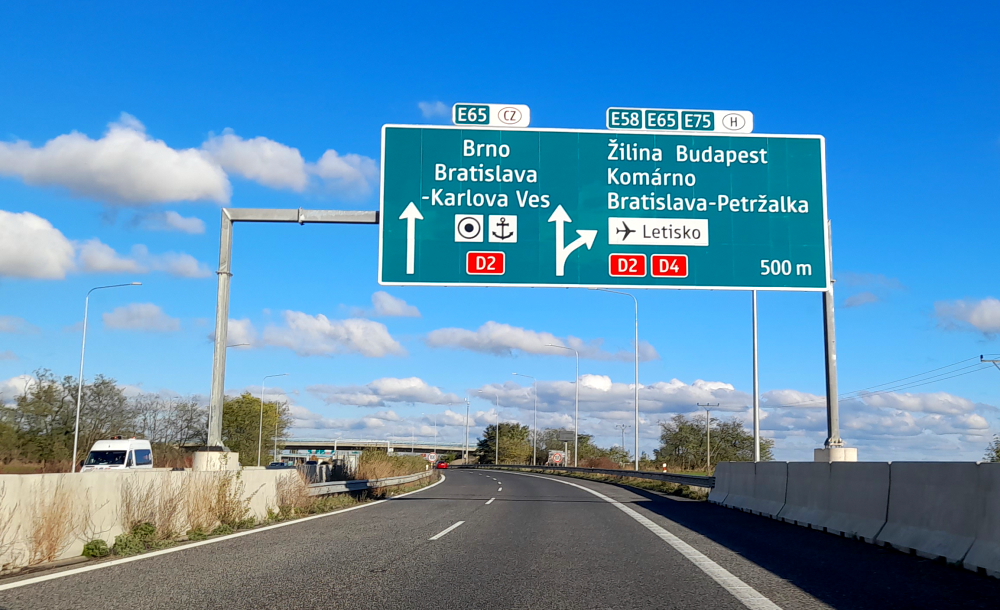
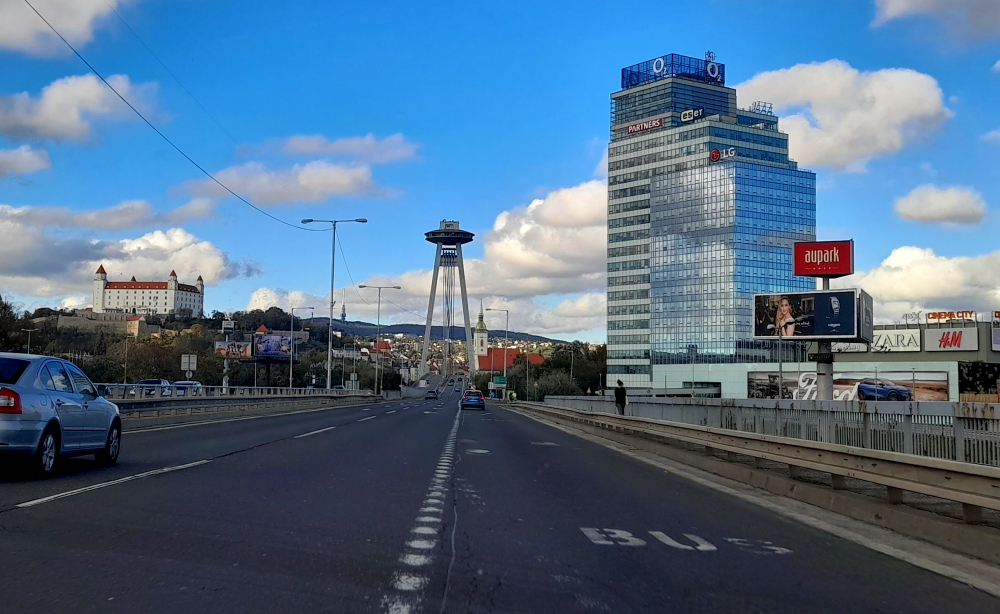
Past that, we see a mixture of old and new architecture from glass office blocks to a UFO-topped structure on the bridge to the old castle on the hill.

Crossing the Danube into Bratislava Town Centre.

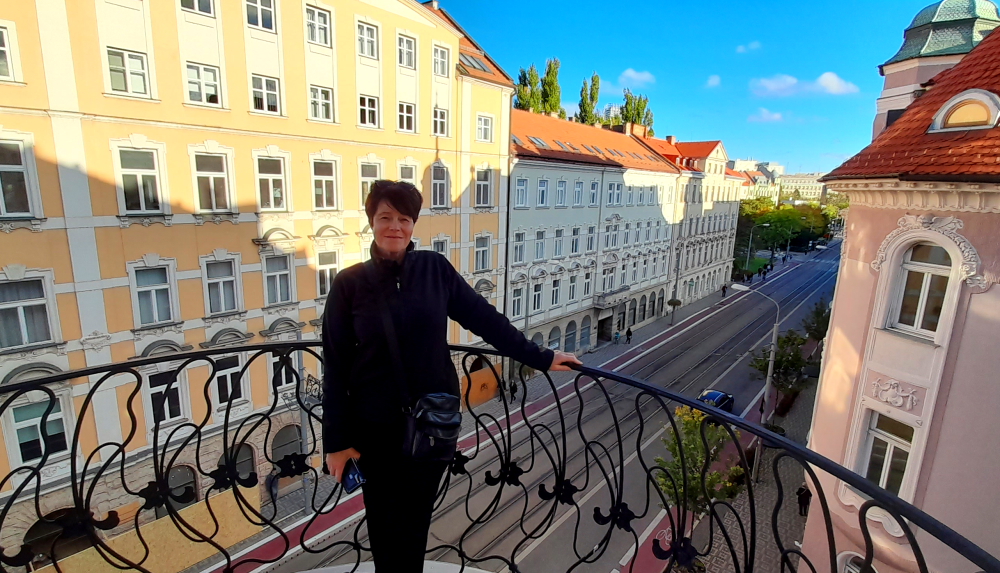
We arrive at our hotel at 2:30 pm and find that the executive suite that we had booked is as advertised – very spacious including our very own ‘Eva Peron’ balcony.

Bratislava, historically known as Preßburg (Pressburg), is the capital and largest city of Slovakia. It’s in southwestern Slovakia at the foot of the Little Carpathians, occupying both banks of the River Danube and the left bank of the River Morava. Bordering Austria and Hungary, it is the only national capital to border two sovereign states.

The city’s history has been influenced by people of many nations and religions, including Austrians, Bulgarians, Croats, Czechs, Germans, Hungarians, Jews and Slovaks. It was the coronation site and legislative center and capital of the Kingdom of Hungary from 1563 to 1783. Most Hungarian parliament assemblies were held here from the 17th century until the Hungarian Reform Era, and the city has been home to many Hungarian, German and Slovak historical figures.

Today Bratislava is the political, cultural and economic centre of Slovakia. It is the seat of the Slovak president, the parliament and the Slovak Executive. It has several universities, and many museums, theatres, galleries and other cultural and educational institutions. Many of Slovakia’s large businesses and financial institutions have headquarters there.

Our balcony suite at the Roset Boutique Hotel.

While Lynn is doing my ironing, I venture out and about. Our hotel is just on the edge of the old town so it’s only 5-minutes before I’m walking along cobblestone streets and squares.

The pedestrian-only, 18th-century old town is known for its lively bars and cafes. Perched atop a hill, the reconstructed Bratislava Castle overlooks old town and the Danube.

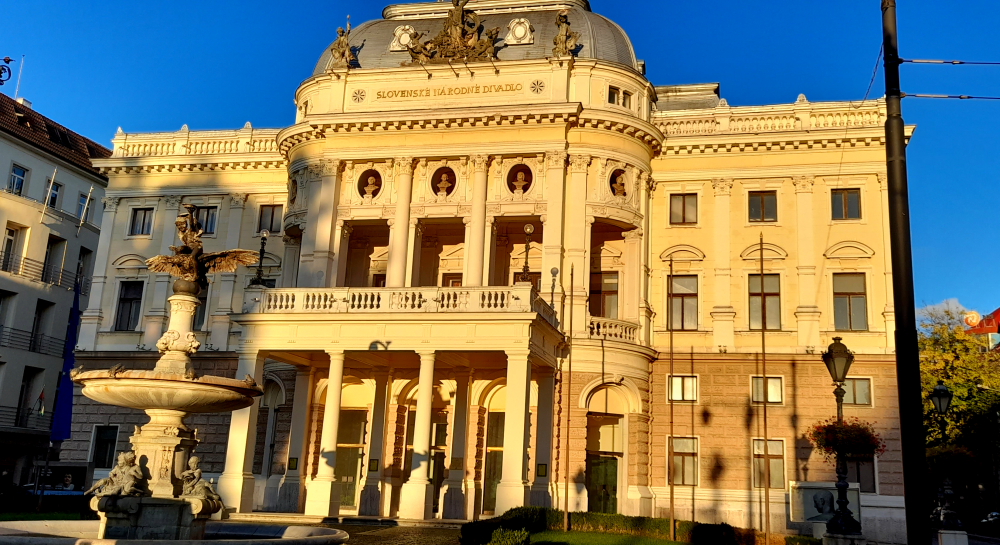
Slovak National Theatre.

My ramble takes me down Jesenskeho to the National Theatre where plays, ballet and opera are performed.

Rybne Square.

At this point is a long, narrow parkland which culminates in Rybne namestie.

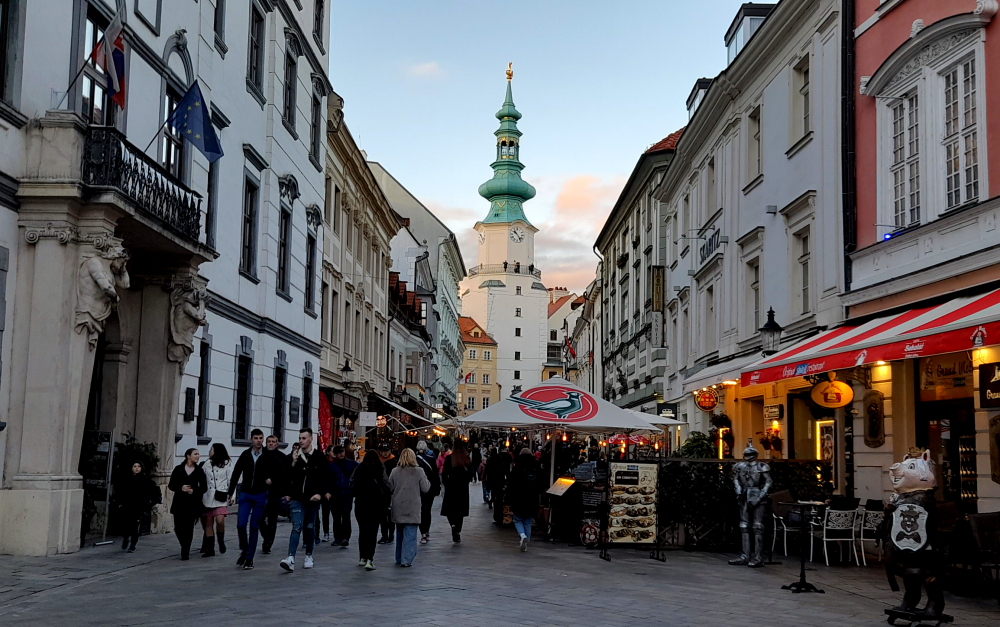
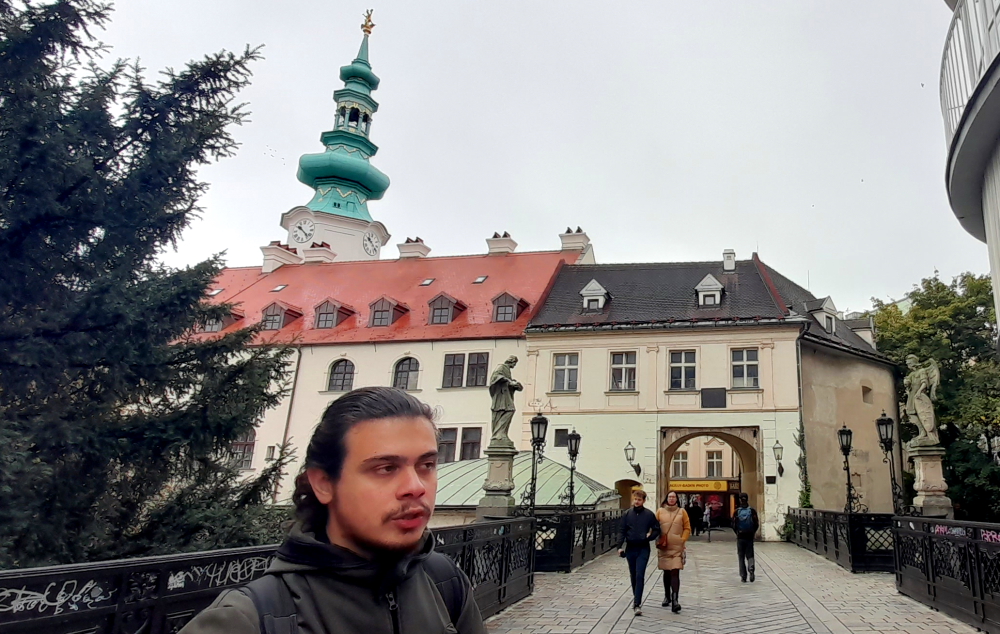
Cutting up Venturska I enter Michalska where I can see the St Michael’s Gate tower.

St Michael’s Gate Tower.

A short time after I return to the hotel we walk to Hlavne namestie to Le Papillon Restaurant (billed as Slovak Fusion) which I had espied earlier where we enjoyed a very simple yet tasty meal.

5 November, 2023

Today we were booked into a GuruWalk tour at 10:00 am, but last night Lynn moved our booking to a different GuruWalk at 11:30 am to avoid the rain which worked as although it is overcast when we leave the hotel by the end of the day we have brilliant sunshine.

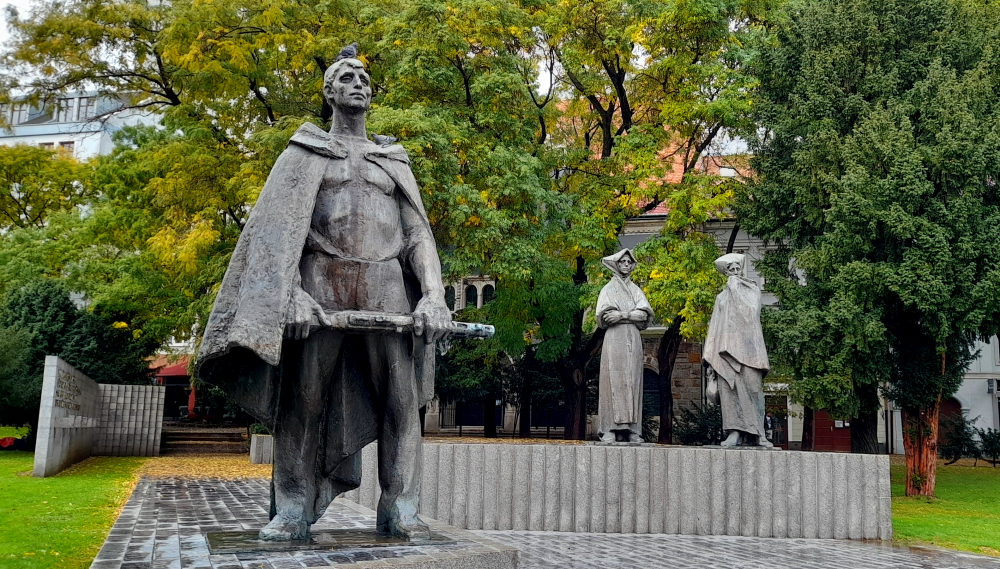
Our meeting point is only 10 minutes away. Enroute we pass by Namestie SNP which features a dramatic statue ensemble.

Monument of the Slovak National Uprising.

We meet up with our guide Guga and although Georgian has lived in Slovakia for some time. Our tour group is made up of 4 fellow walkers in addition to us who hail from Chile, Germany, the UK and the USA.

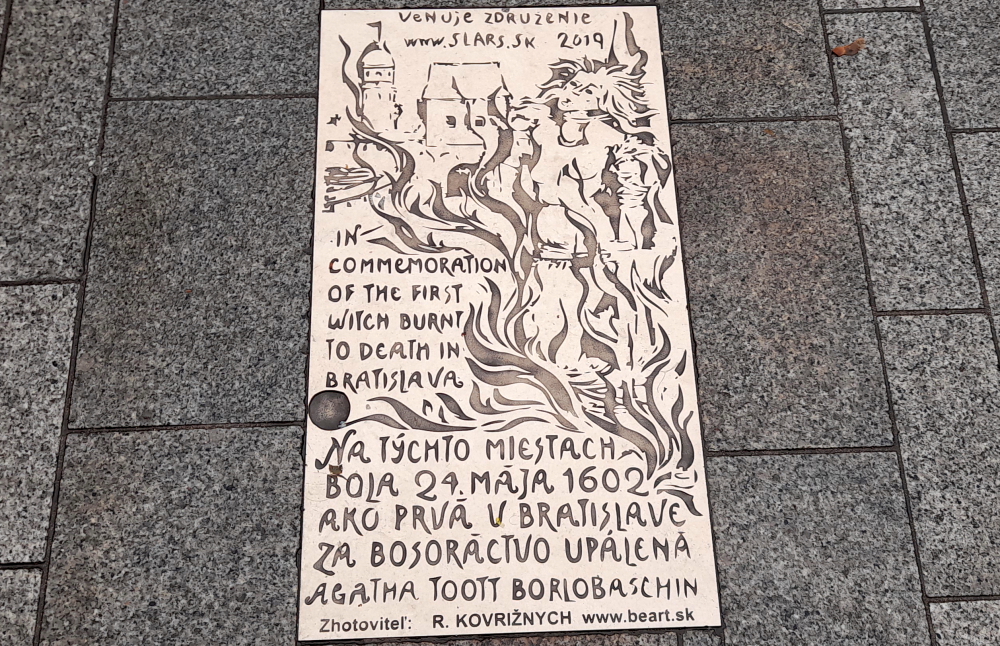
Our first stop is to view a plaque commemorating the first witch burning in Bratislava in 1602. The site is just outside what would have been the town walls at the time.

Plaque at the location of the witch burning of Agatha 1602.

We then cross over a permanent bridge that has replaced the former drawbridge over the now dry moat and enter the town through a barbican then under the St Michael’s Gate tower.

Our guide, Guga at St Michael’s Gate.

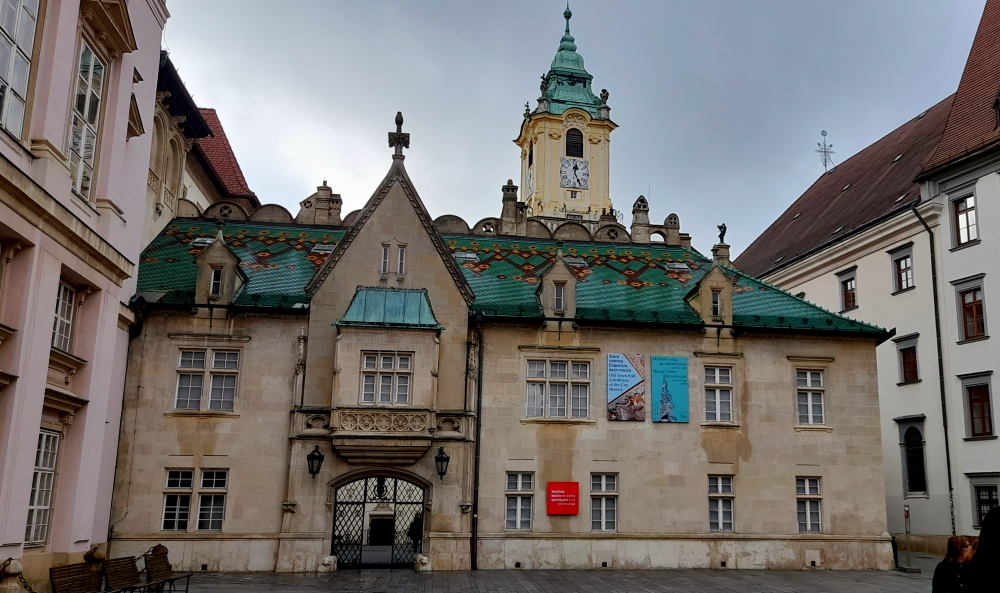
From here we walk down Michalska, turn at Sedlarska where we enter Hlavne Square which is bordered by several embassies and the Old Town Hall.

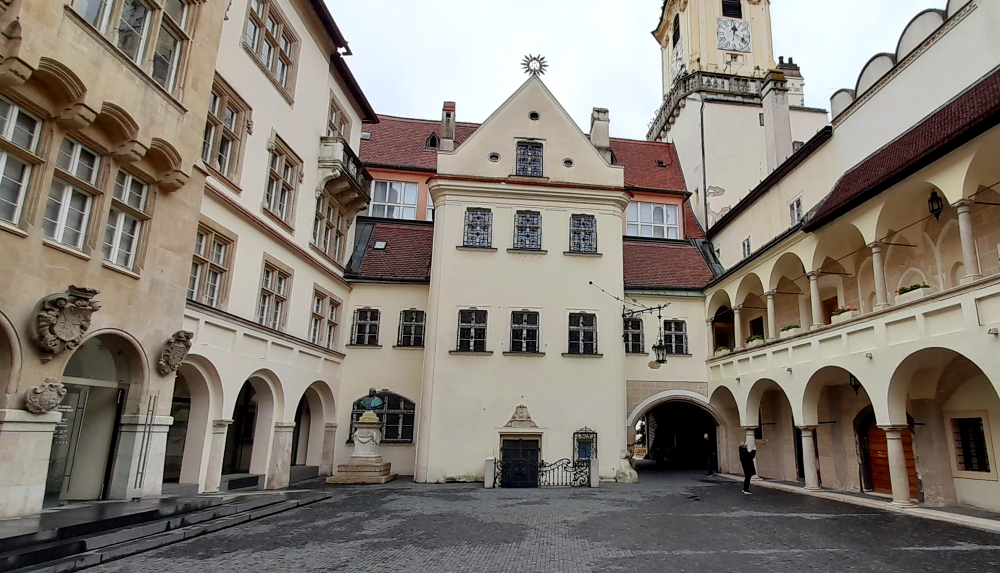
Old Town Hall courtyard.

We walk through an archway into the courtyard…

Rear view of the Old Town Hall.

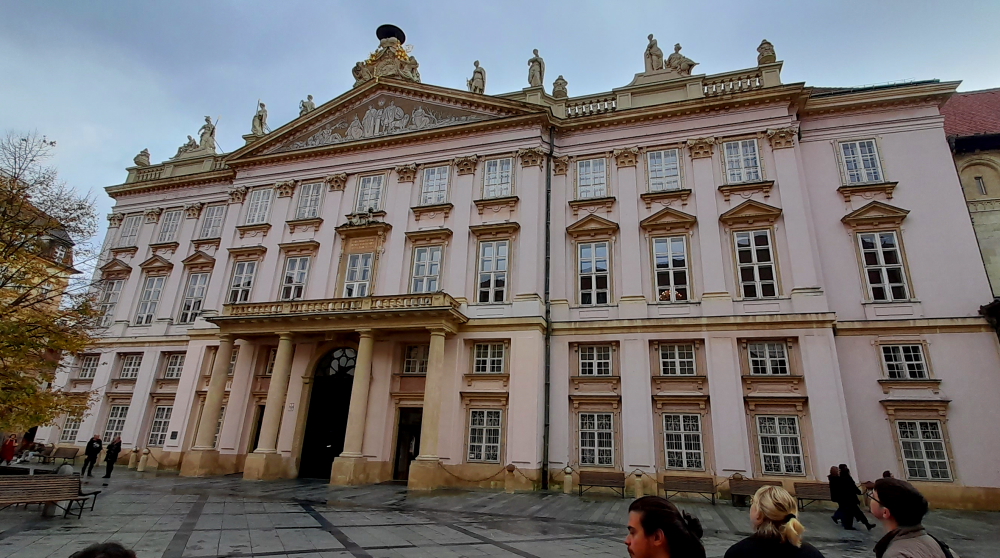
…then out another to the Primate’s Palace – as in pontiff, not our distant monkey forebears.

Primate’s Palace.

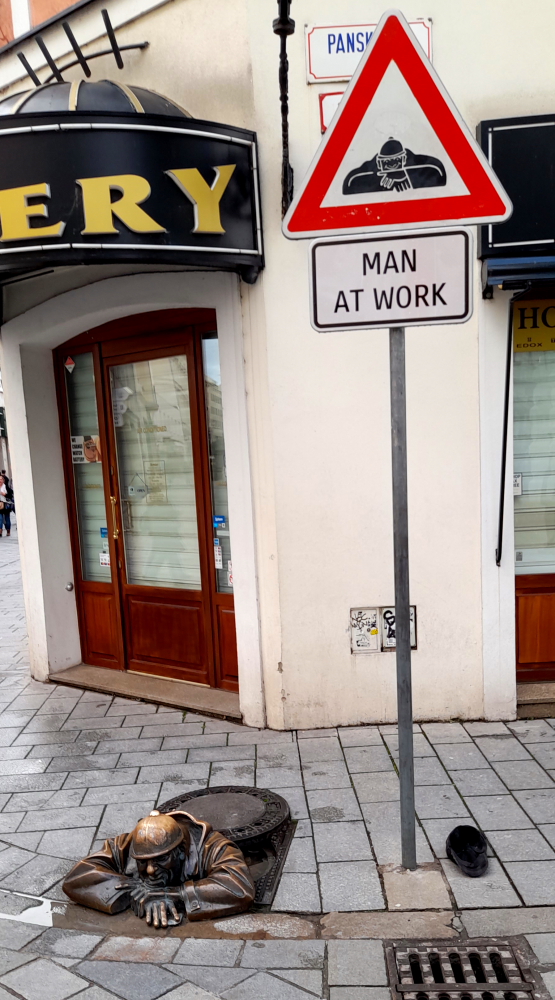
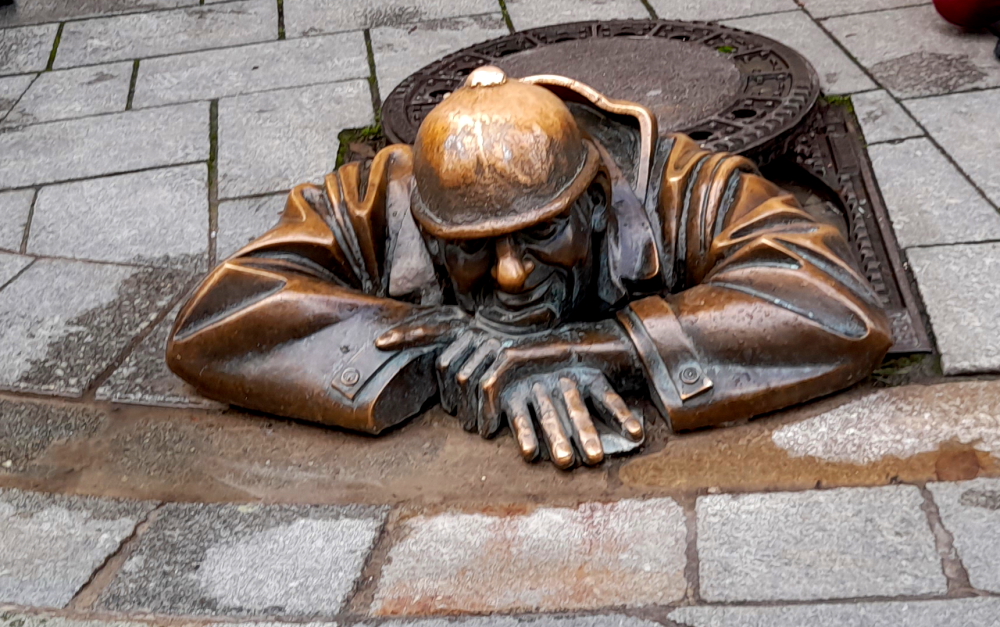
From here we walk to the junction of Laurinska with Panska where one of the numerous city sculptures is located – supposedly a workman taking a breather from working in the town’s sewers.

Taking a breather from the sewer.

Rumour has it he adopted this pose as it was easier for him to peek up women’s skirts at this angle!

The town emblem.

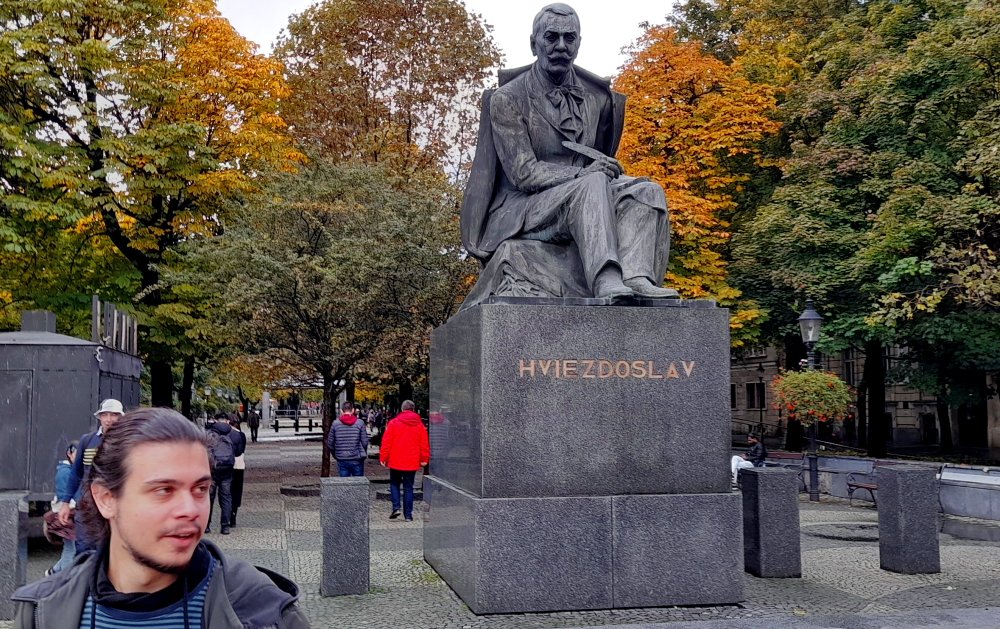
Rybna brana is also at this junction which takes us to the National Theatre and the beginning of the long parkland called Hviezdoslavovo namestie, named after Pavol Országh (Hviezdoslav), (1849-1921), a Slovak poet, dramatist, translator, and for a short time, member of the Czechoslovak parliament. Hviezdoslav (a Slavic name, meaning approximately “celebrating the stars” and/or “Slav of the stars”) was his pseudonym from 1875.

Born Hungarian, he worked in Slovakia as a lawyer. An awakened national pride caused him to write in Slovak from the mid-1870s, but his radical poetry was met with aversion by the older generation. However, during his era, he was the poet laureate of the Slovak nation.

Statue of Pavol Országh (Hviezdoslav).

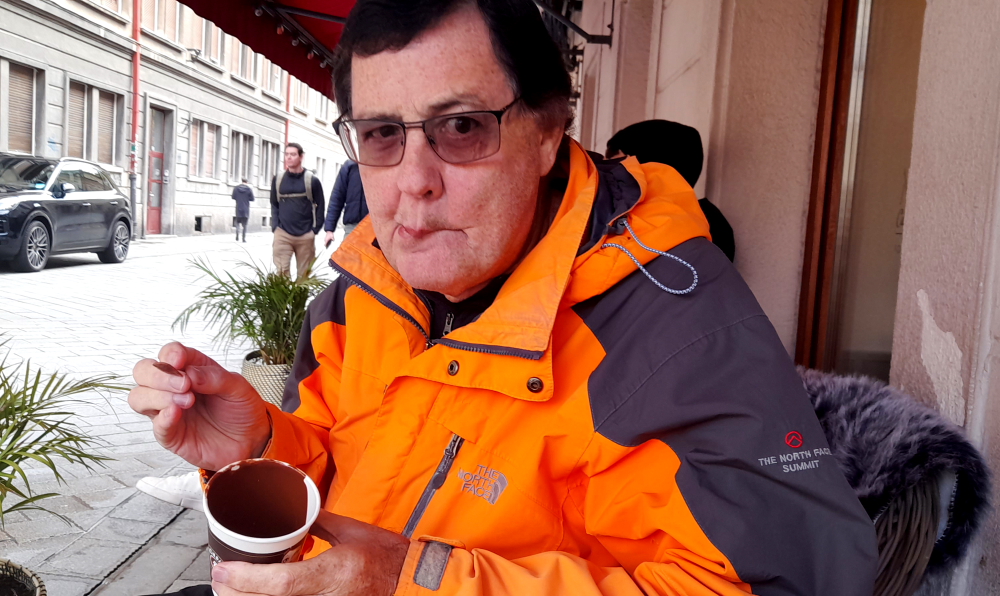
At this point we take a 10-minute break. As it’s chilly we order 2 hot chocolates to go – but discover that they are hot chocolates ‘but not as we know them’. Not the milky beverages we are expecting but rather a cup full of warm, melted chocolate!

Thick hot chocolate break.

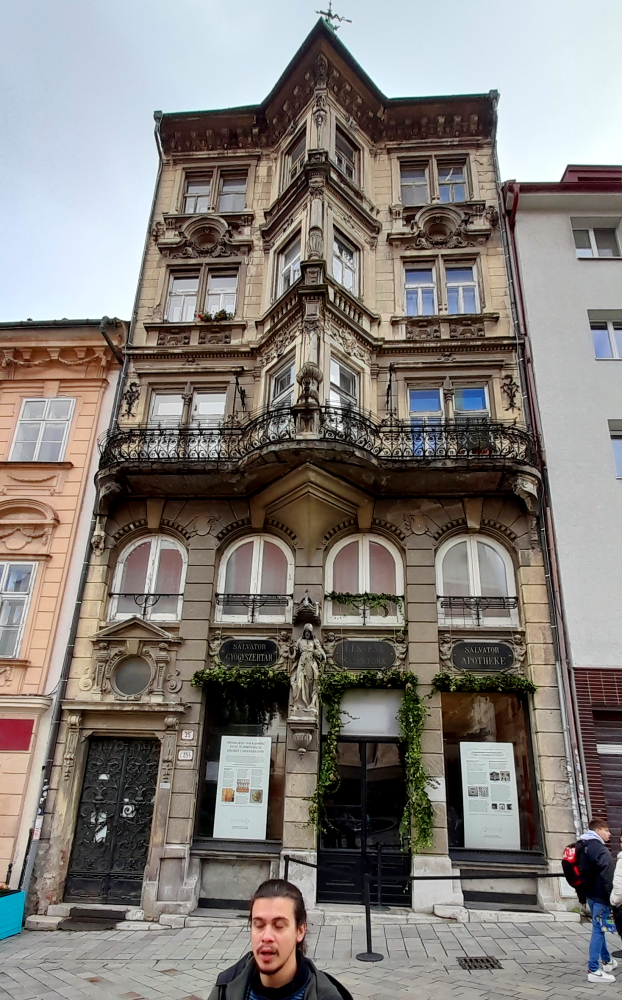
Our next stop is outside the Pharmacy Salvator on Panska, a neo-renaissance building and former pharmacy constructed by pharmacist Rudolf Adler in 1904. The building’s facade features a stone statue of Christ the Saviour by sculptor Alojz Rigele.

In the period from 1904 to 1995, the building housed a baroque cabinet of the rarest Jesuit pharmacy dating from 1727. These objects included a huge marble pharmaceutical desk supported by six lions, an antique cash register, gas chandelier, a set of pharmaceutical containers and various other furniture. In 2018, the Museum of Pharmacy at St. Salvator’s was established.

The Pharmacy Salvator.

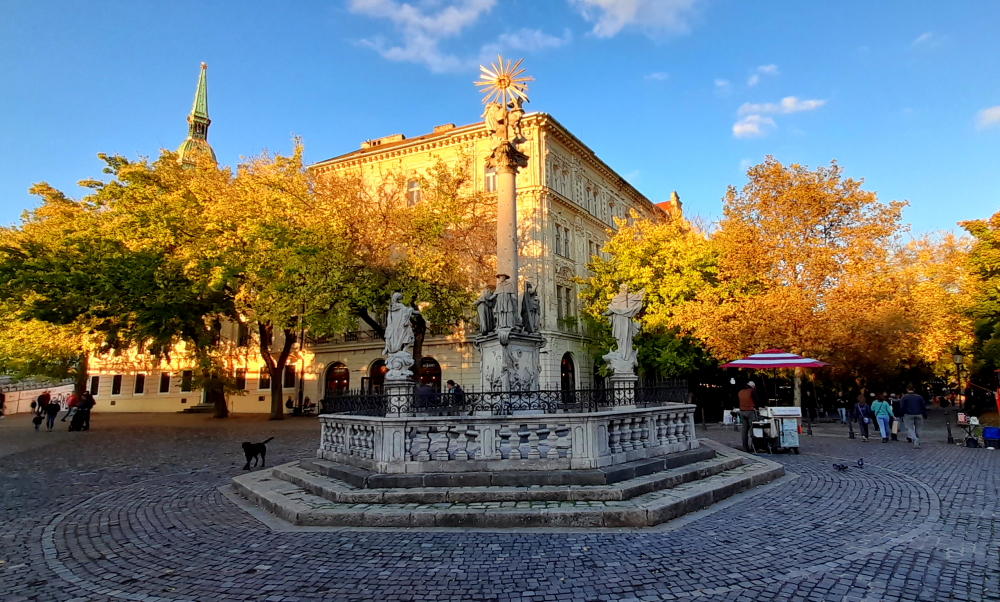
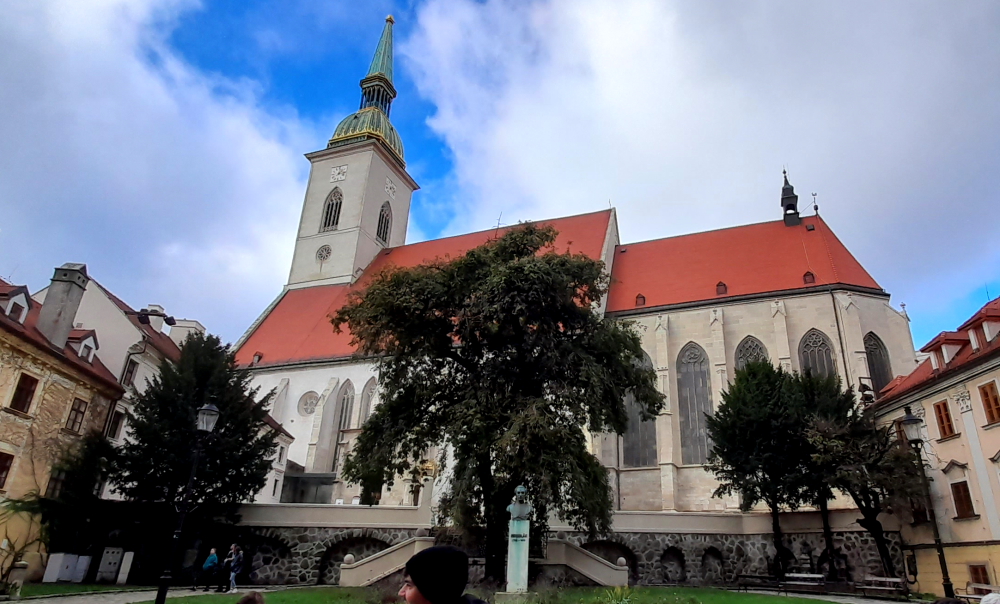
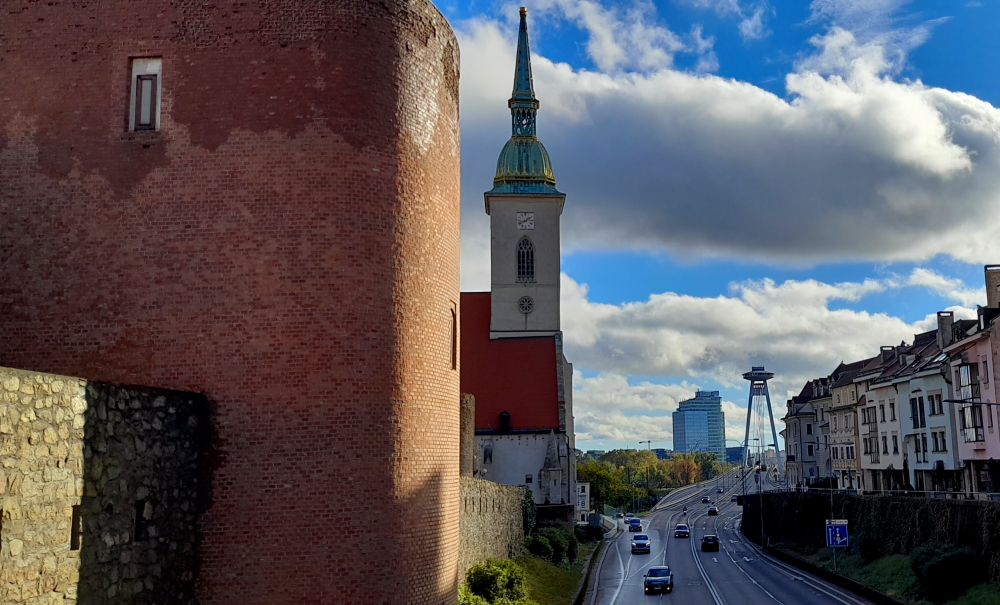
Across the road is the St Martin’s Cathedral which is situated at the western border of the historical city center below Bratislava Castle. It is the largest and one of the oldest churches in Bratislava, known especially for being the coronation church of the Kingdom of Hungary between 1563 and 1830; eleven Hungarian kings and eight queens were crowned here.

Together with the castle on the adjacent hill and somewhat similar in its striking, but fairly stark Gothic lines and colouring, St Martin’s 85 m (279 ft) spire dominates the Old Town’s skyline. The tower virtually formed a part of the town’s fortifications, built as it was into the city’s defensive walls.

The St Martin’s Cathedral.

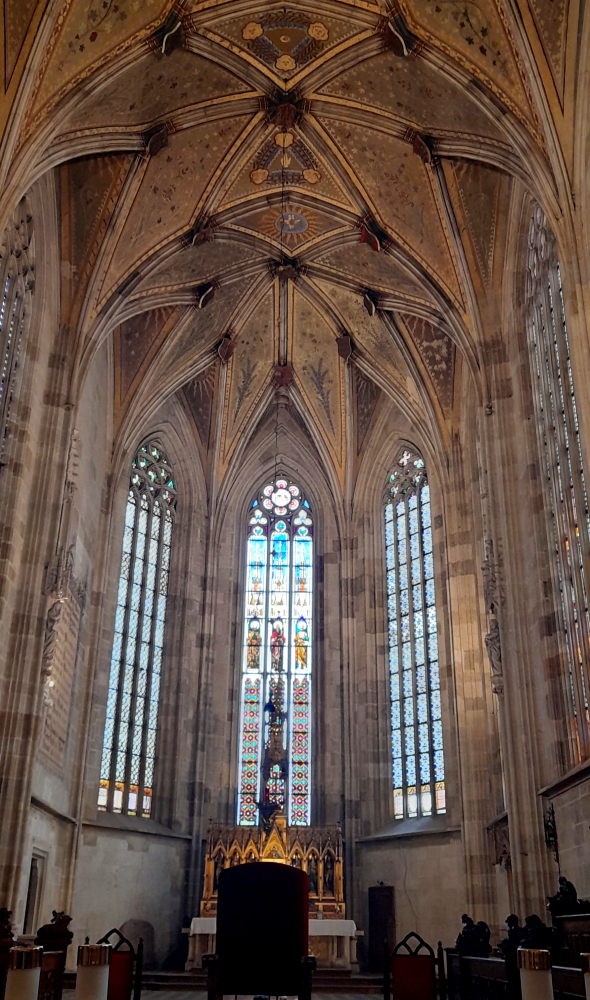
A small but significant neighbour of the cathedral is a monument to the synagogue, which stood next door for centuries until the Communist government demolished it around 1970 to make room for a new Nový Most bridge. The cathedral contains the remains of Saint John the Merciful who died in the early 7th century.

Inside the Cathedral.

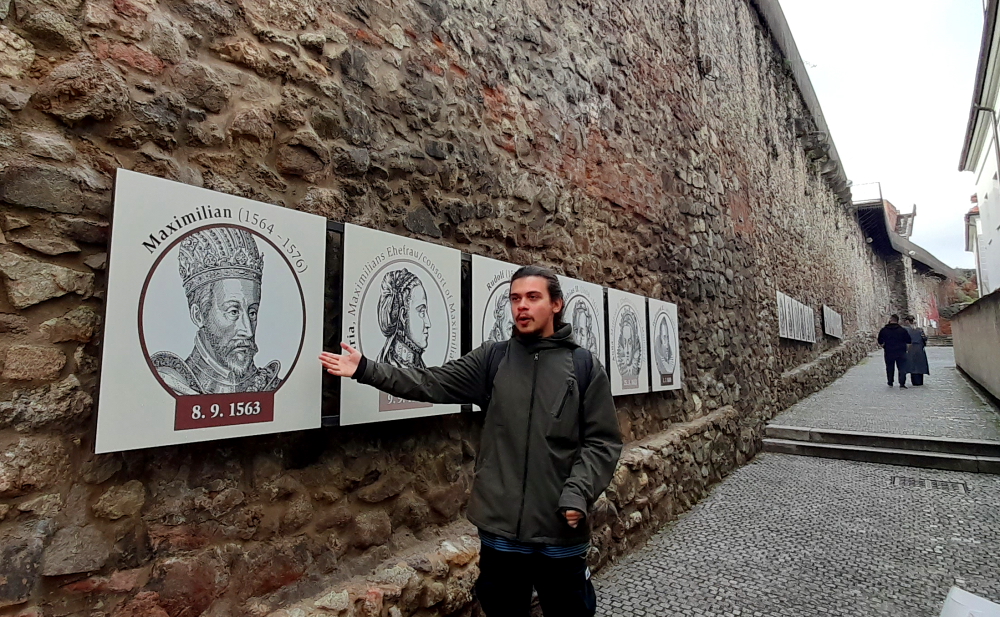
Leaving the cathedral we walk inside the remaining remnant of the old city walls where pictures of former monarchs are displayed.

The remains of the old city wall.

We then cross a bridge over the Staromestska roadway, climb a series of steep stairs where we reach a park.

The old and the new Bratislava.

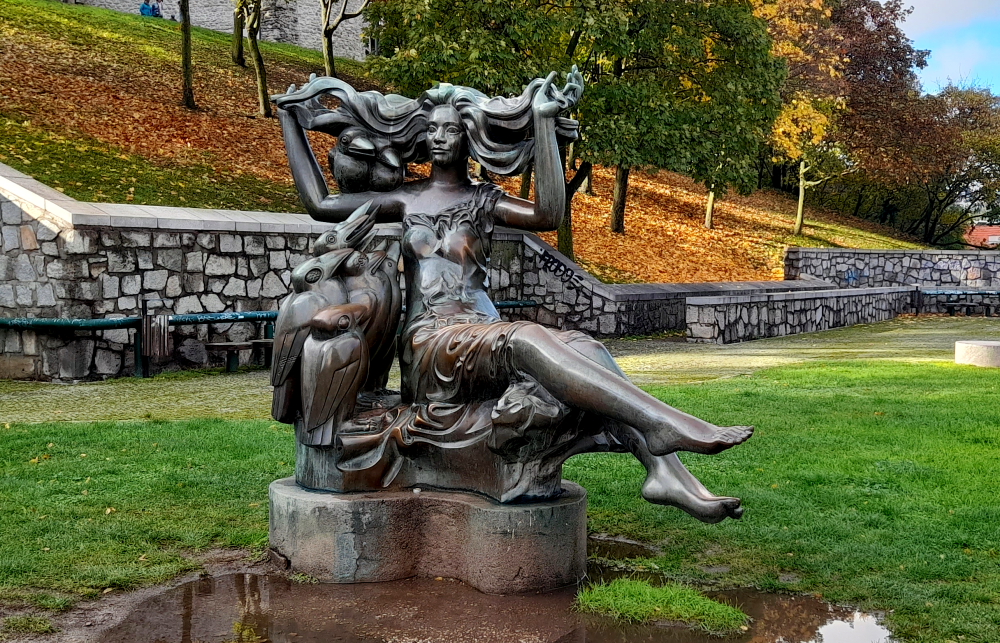
Here we come face to face with a statue of Agatha, the aforementioned witch who was burnt in 1602.

The monument to the bewitching Agatha.

It’s also here where we take another short break to appreciate a view of the city skyline…

Entrance to the Castle.

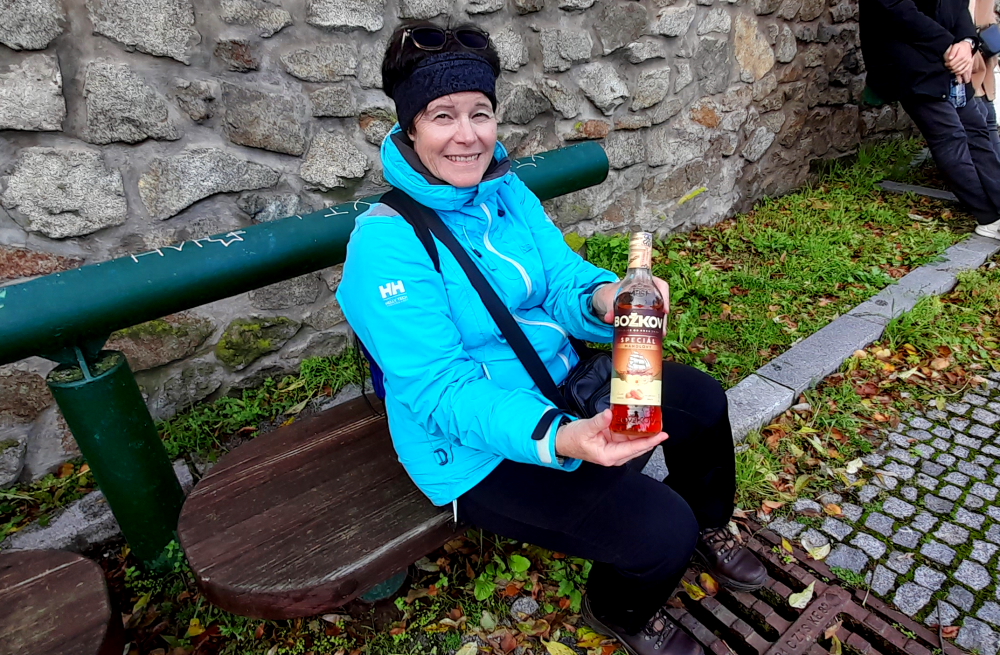
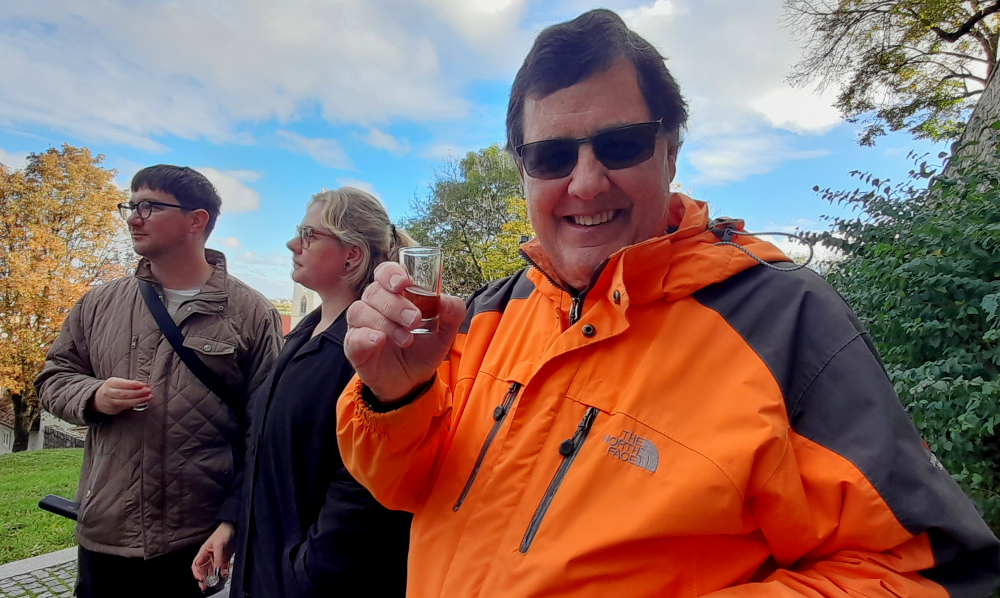
…and, unexpectedly, to sample a drop of the local rum which our guide provides.

The local rum.

Dobré zdravie! Good health!

Better than thick hot chocolate.

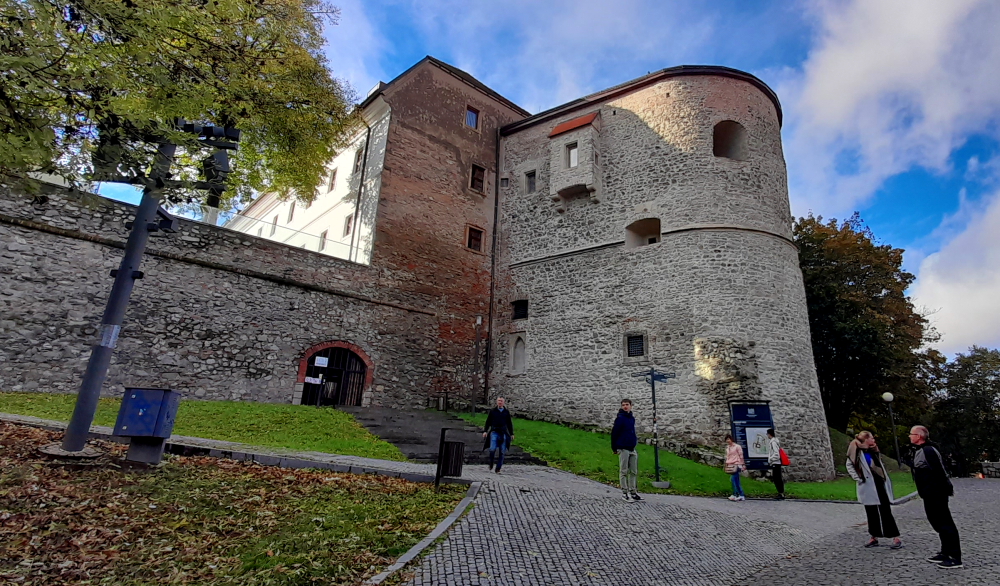
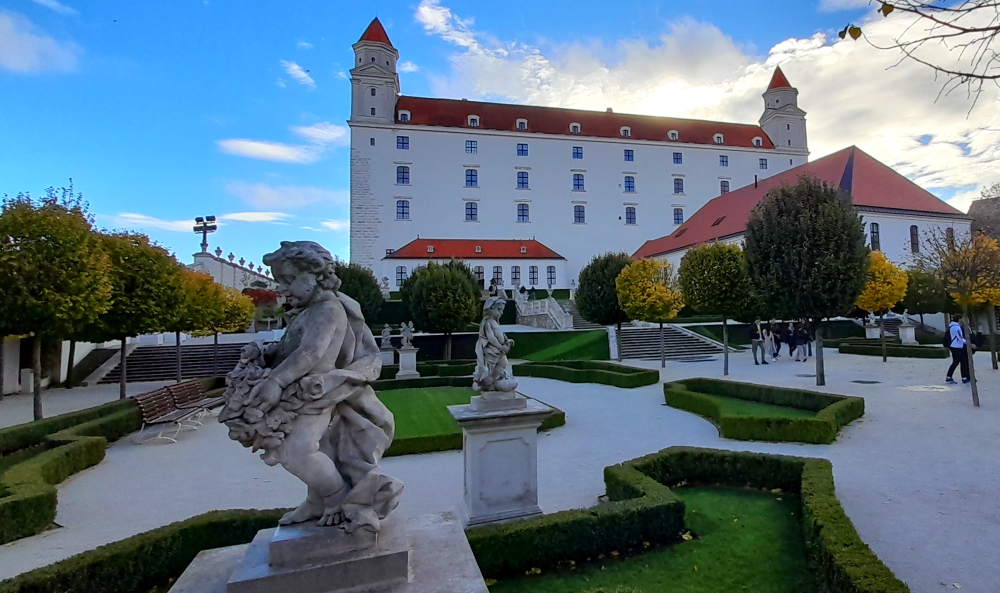
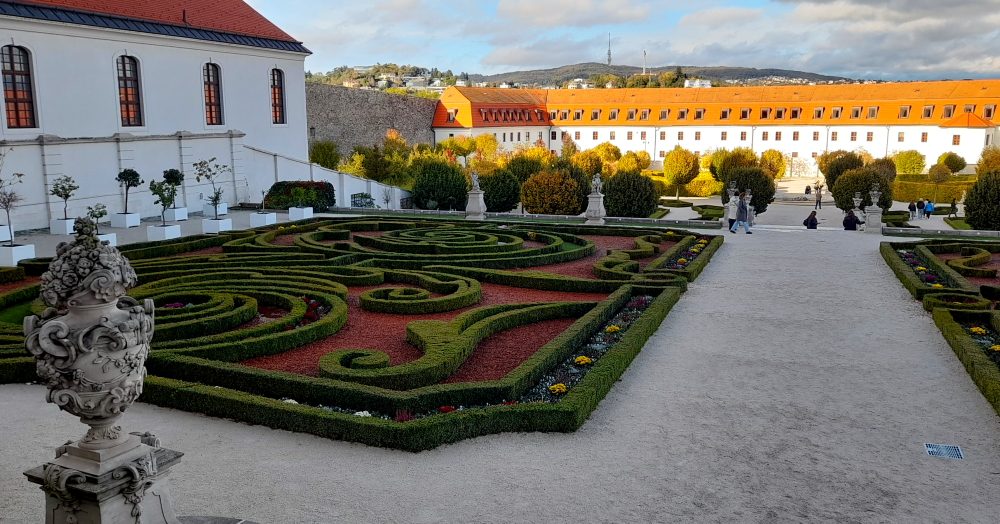
A few more stairs and we walk through a wall and into the Baroque gardens of Bratislava Castle.

The Castle gardens.

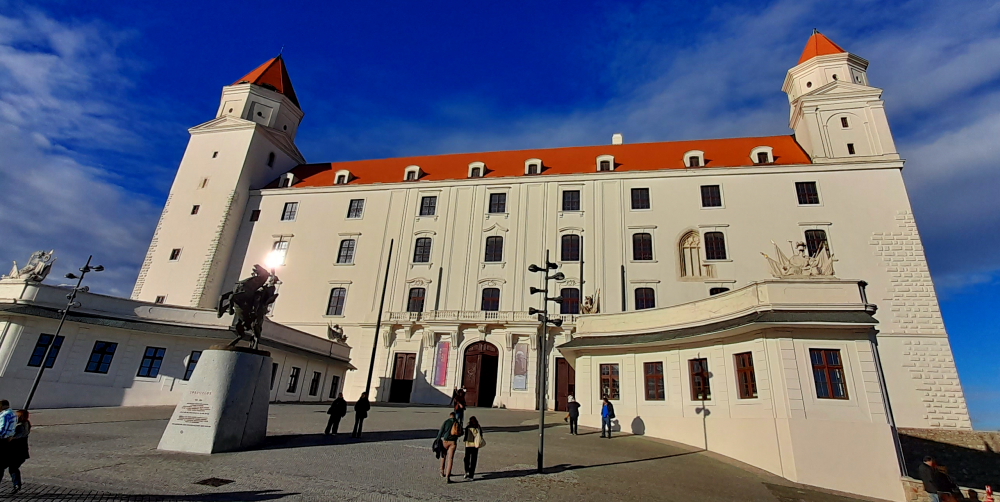
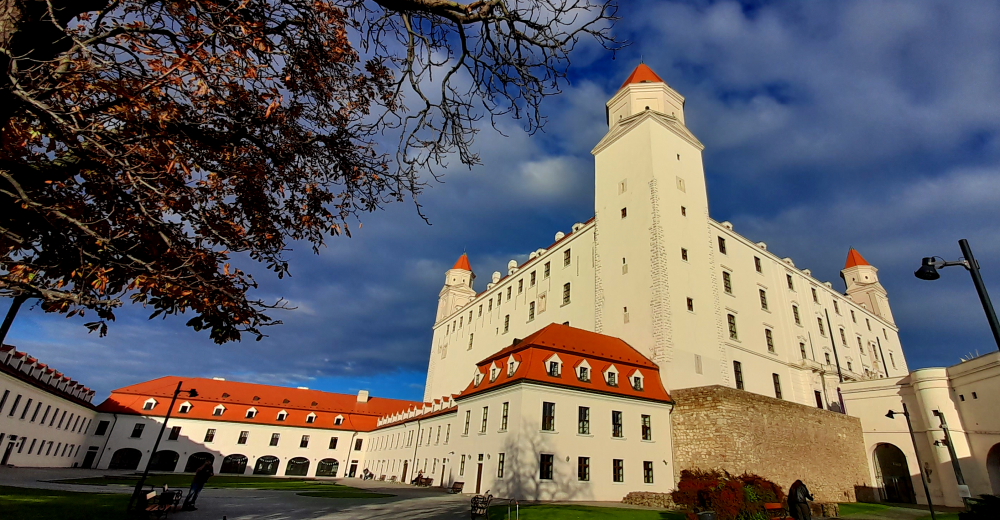
The massive rectangular building with four corner towers stands on an isolated rocky hill of the Little Carpathians directly above the Danube river in the middle of Bratislava. Because of its size and location, it has been a dominant feature of the city for centuries.

The largest and tallest tower is the Crown Tower on the southwest corner. The 47 m (154 ft) tower dates from the 13th century and for approximately 200 years beginning in the mid-1500s housed the crown jewels of Hungary.

The Castle grounds.

The castle’s site, like today’s city, has been inhabited for thousands of years, because it is strategically located in the center of Europe at a passage between the Carpathians and the Alps, at an important ford used to cross the Danube river, and at an important crossing of central European ancient (trade) routes running from the Balkans or the Adriatic Sea to the Rhine river or the Baltic Sea, the most important route being the Amber Route

The Danube side of the Castle.

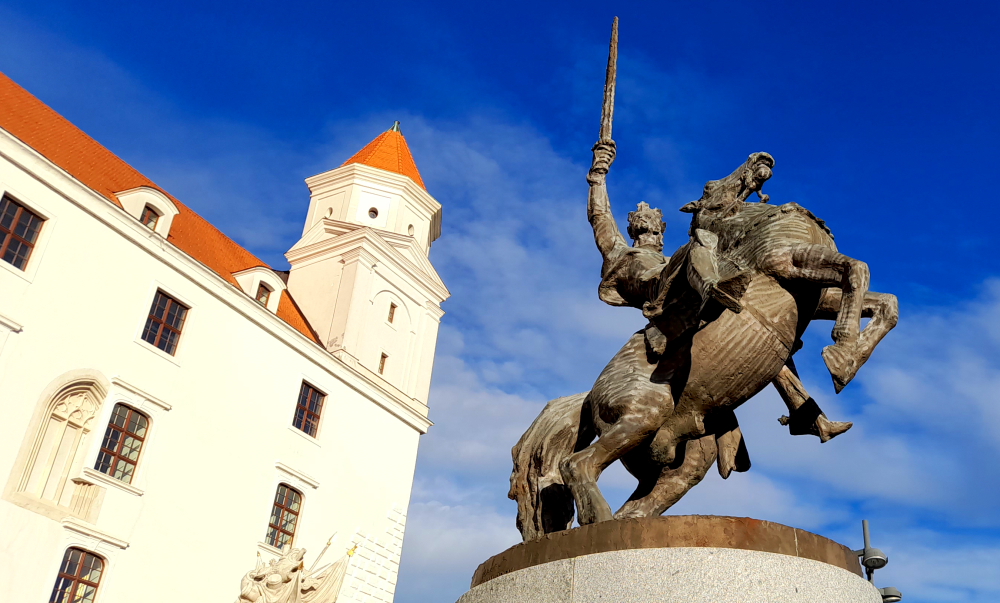
From the Boleraz inhabitants in around 3500 BC to the Celts, Romans, Slavs, the Kingdom of Hungary, all have built on this site. The castle itself was in ruins from 1811-1953 culminating in the reconstruction of the courtyard in 2010 with the unveiling ceremony of an equestrian statue of King Svätopluk I by Slovak sculptor Ján Kulich.

King Svatopluk I (846-894).

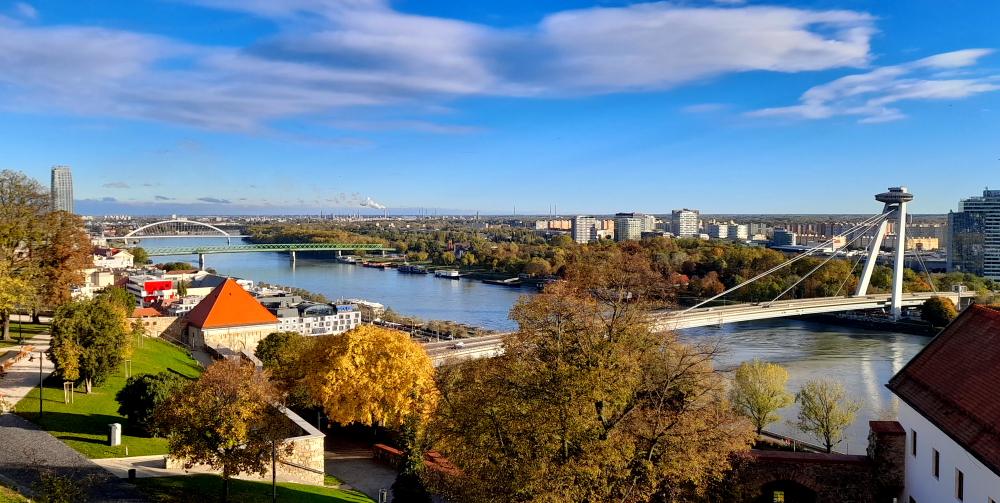
The location provides excellent views of Bratislava, Austria (and all those wind turbines along the border) and, in clear weather, parts of Hungary.

View of the Danube from the Castle.

Today the complex houses the Slovak National Museum, the Treasure Chamber (opened in 1988) with a collection of the most precious archaeological finds and other objects of Slovakia, the exhibition on the History of Slovakia and the rooms of the Slovak parliament — the National Council of the Slovak Republic.

Leaving the Castle.

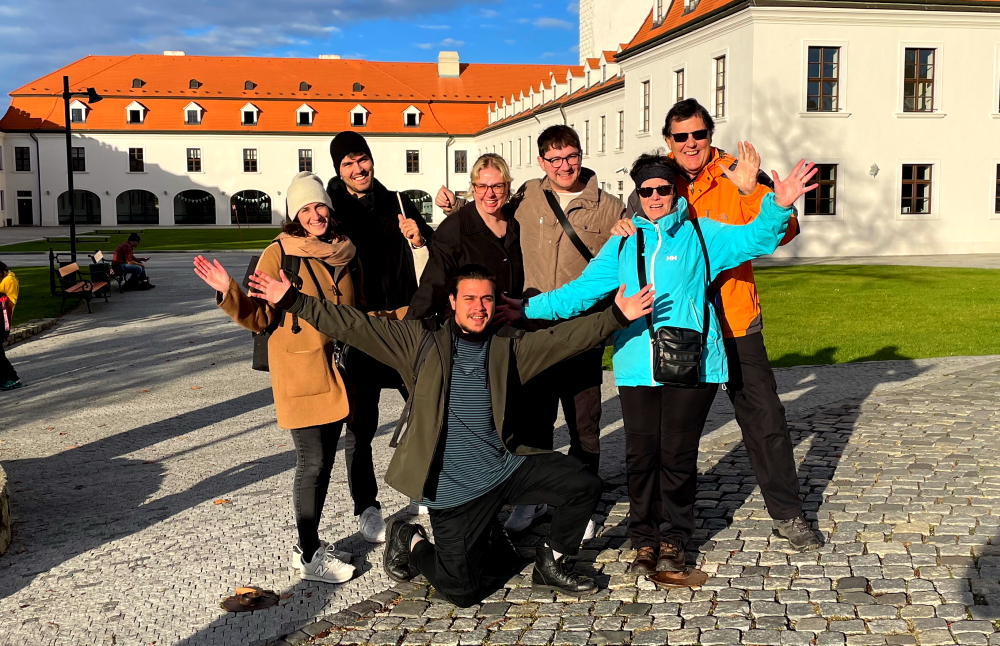
Our tour was supposed to have been 2.5 hours long. Just over 3 hours later we pose for the mandatory group photo then go our separate ways.

Our walking tour group.

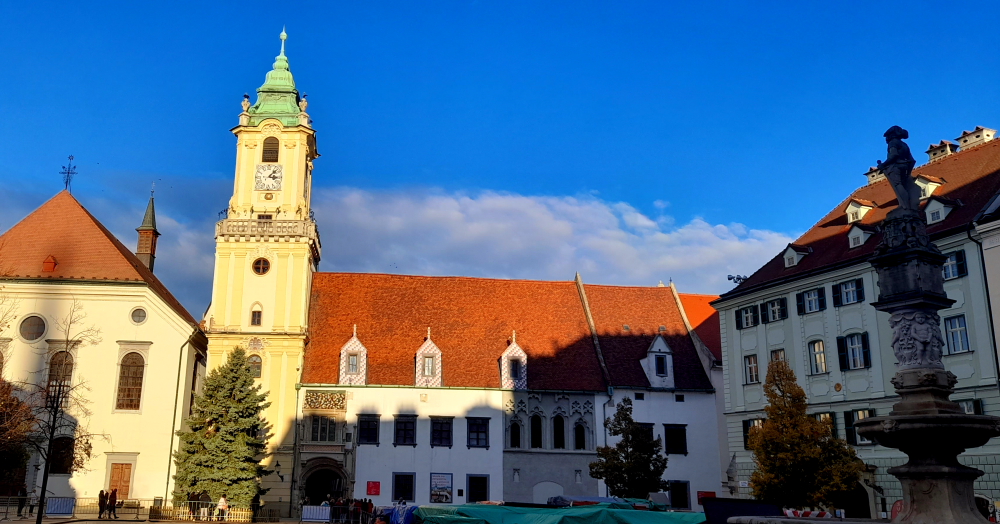
For us it is down Kapucinska then through the old town and Hlavne Square where the Old Town Hall is bathed in late afternoon sunshine.

Back at the Town Hall.

One of Guga’s dining recommendations is the Flagship Restaurant, one of the largest in Europe and offers local Bratislava cuisine and beers and various Slovak dishes which is where we dine tonight. The restaurant is in a historical building of the Merciful Brothers of St. John of God. Its spacious hall has been used as a cinema during socialism which is where we sit in front of the former stage.

Archway to the Flagship Restaurant inside the former monastery.

6 November, 2023

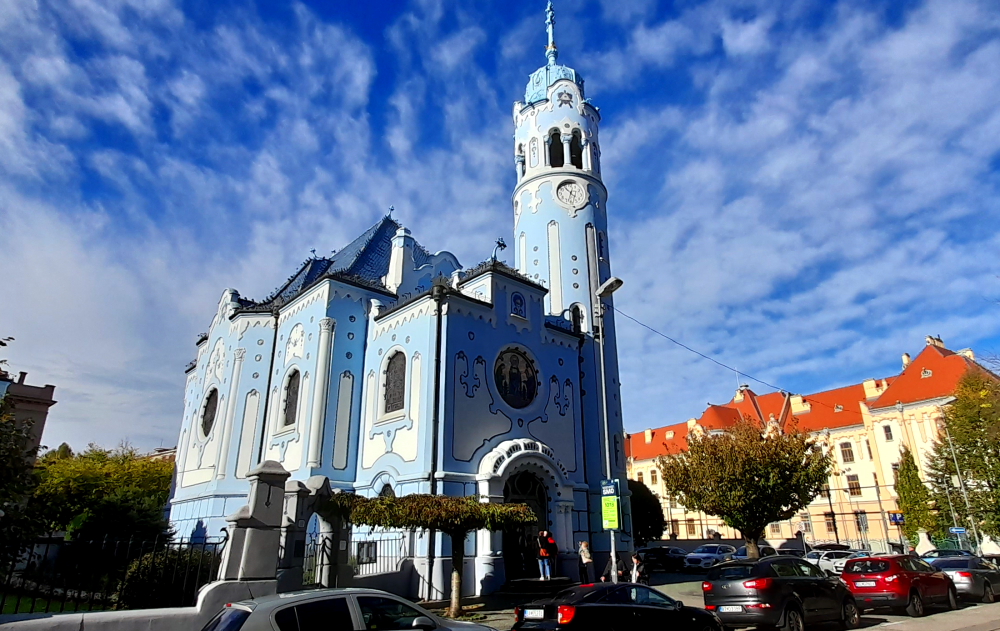
The sunshine continues today with a forecast top of 14 Deg. C. After breakfast we walk the 5 minutes to the nearby ‘Blue Church’ otherwise known as the Church of St Elizabeth.

It is consecrated to Elisabeth of Hungary, daughter of Andrew II, who grew up in the Pressburg Castle. It is referred to as the ‘Blue Church’ because of the colour of its façade, mosaics, blue-glazed roof and blue accents in its interior. The one-nave church was built in 1908-1913 in the Hungarian Art Nouveau style.

The Blue Church.

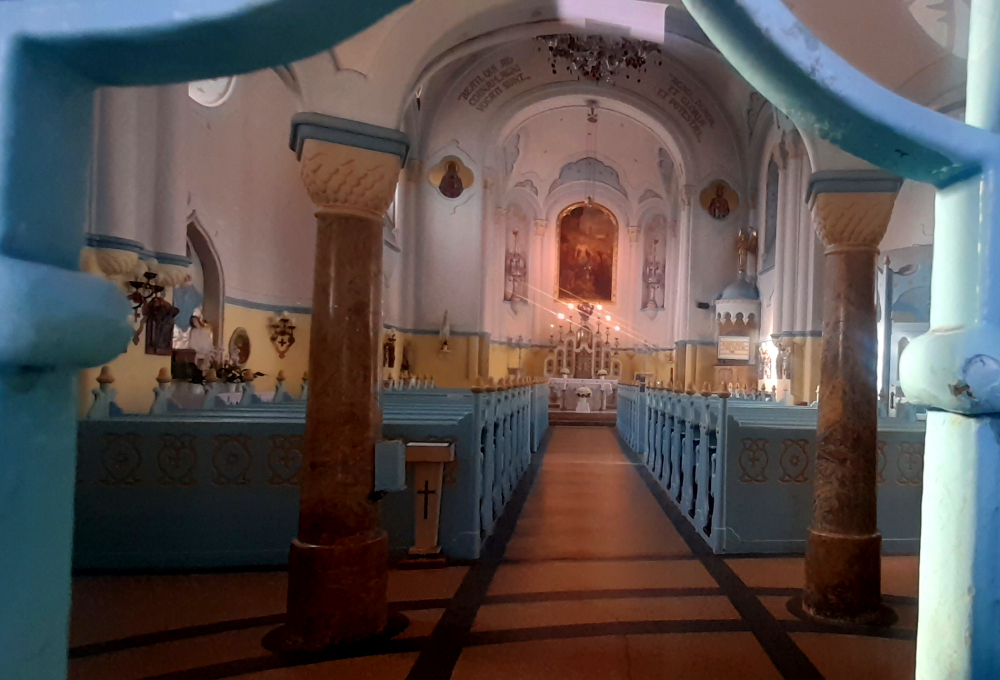
The interior is richly decorated with altarpieces. On the altar there is an illustration of St Elizabeth, depicted giving alms to the poor.

The Blue Church Interior.

Tonight we planned to dine next door at the Arabic Restaurant but, typical Europe, the restaurant is closed on a Monday. Most of the good restaurants are also closed in the old town so in frustration (and due to the chilly night air) we settle for Burger King. Actually it is the best salad and beef that we have had in a while. Tomorrow we drive to Kosice, 400 kms away at almost the other end of the country which will take us around 4.5 hours to drive.

7 November, 2023

Around 10:00 am we load up the car and drive out of town – another sunny, 13 Deg. C. day.

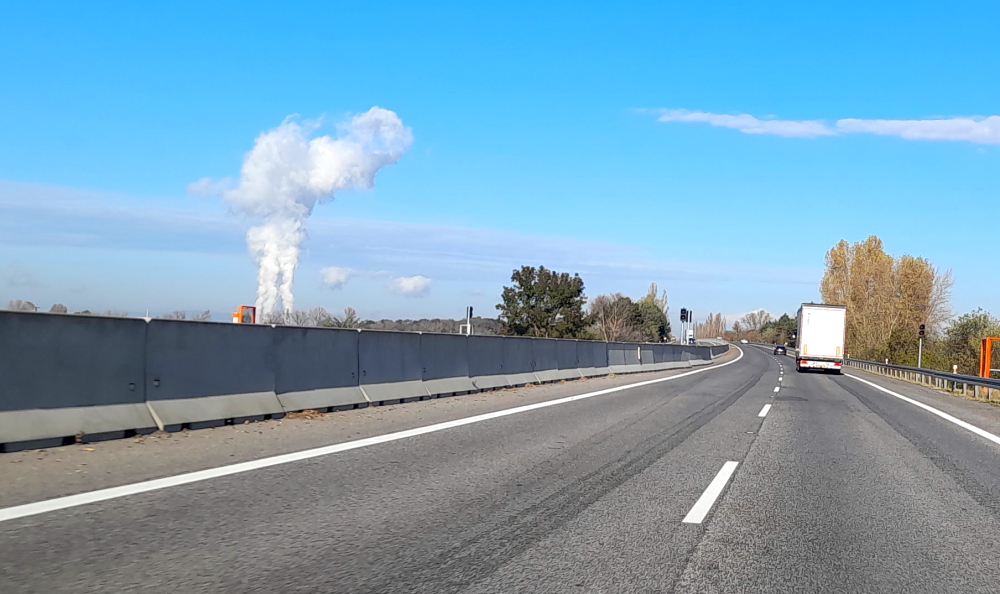
Steam from the nuclear power plant as we leave Bratislava.

Our route takes us via the D1, across the northern part of the country, past the towns of Trencin, Zilina, Poprad, Presov then south to Kosice. What is notable along the way are the number of impressive castle ruins on hilltops.

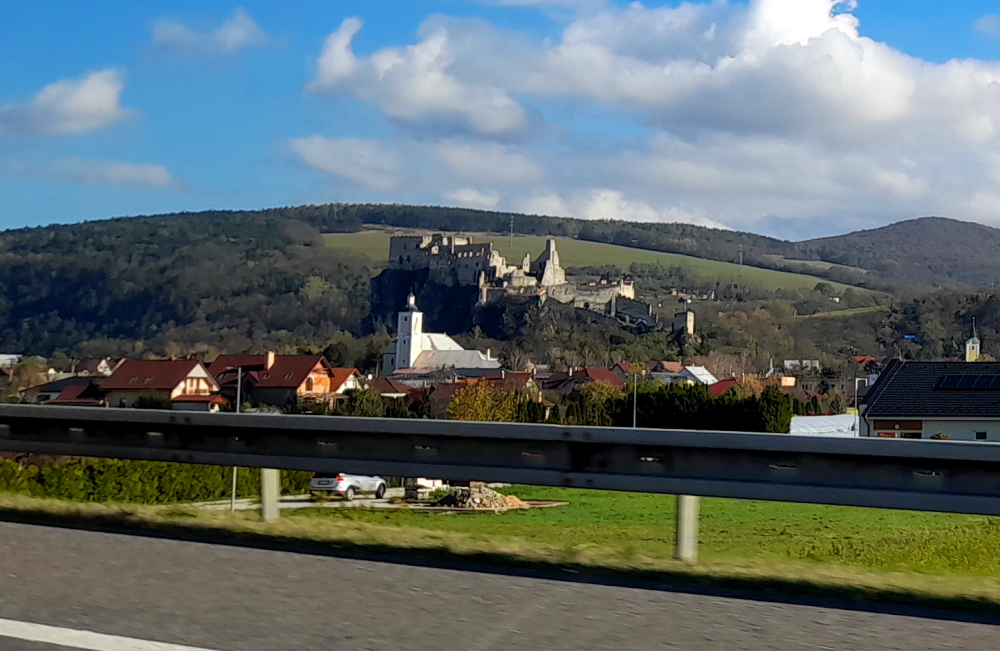
The Beckov Cliff is a rocky outcrop exposed by the Váh River. The castle is situated on the cliff near the river, and was used as a strategic outpost in Great Moravia. A stone castle was built here to protect the borders of the Kingdom of Hungary, probably in the middle of the 13th century.

Beckov Castle ruins – one of many castle ruins along the D1.

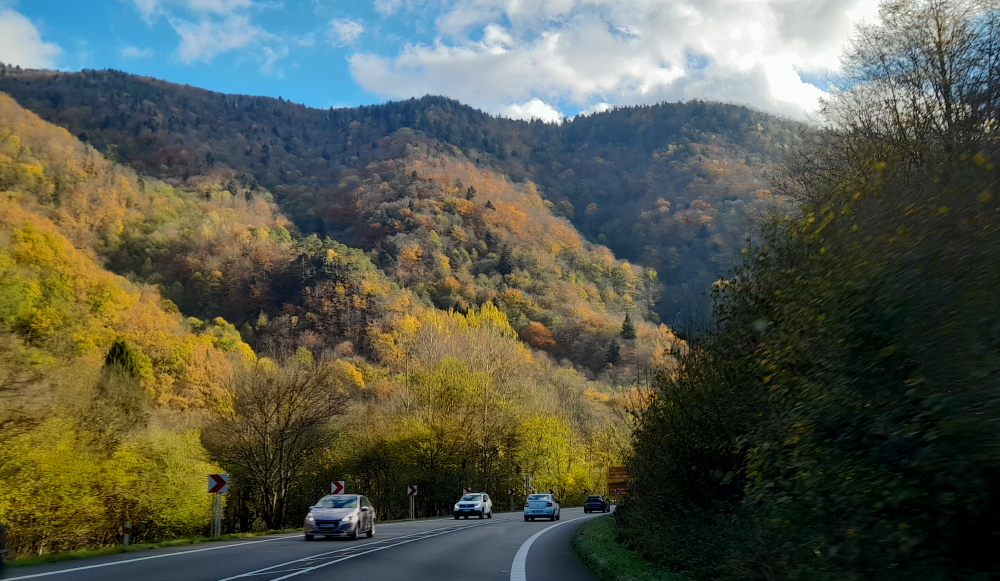
As we approach the large, industrial town of Zilinia the D1 ‘ceases to be’ so we find ourselves on the E50 and 18 instead for a spell as we follow the meandering Vah River through a steep-sided river valley.

Beyond Zilinia we come across Považský Hrad, a medieval castle ruin on the river Váh, near Považská Bystrica. It is built on a cliff 497m above sea level and was one of the most important castles guarding the valley of the river Váh. At the peak of its fame it was home to around 400 people. It is famously known as an “eagles nest” of the important Hungarian noble family of Podmanitzky.

Another ruined castle on a hill – Povazsky Castle.

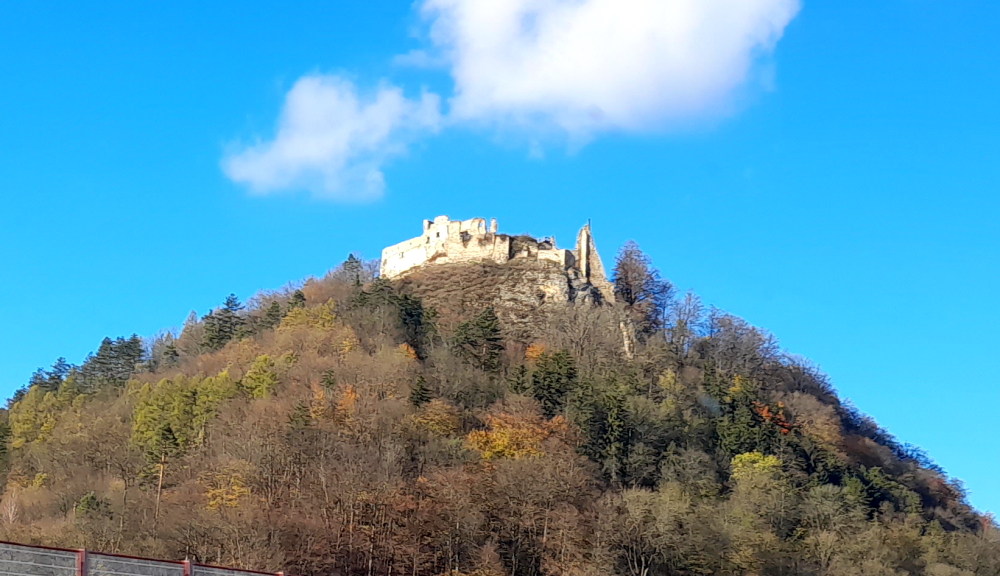
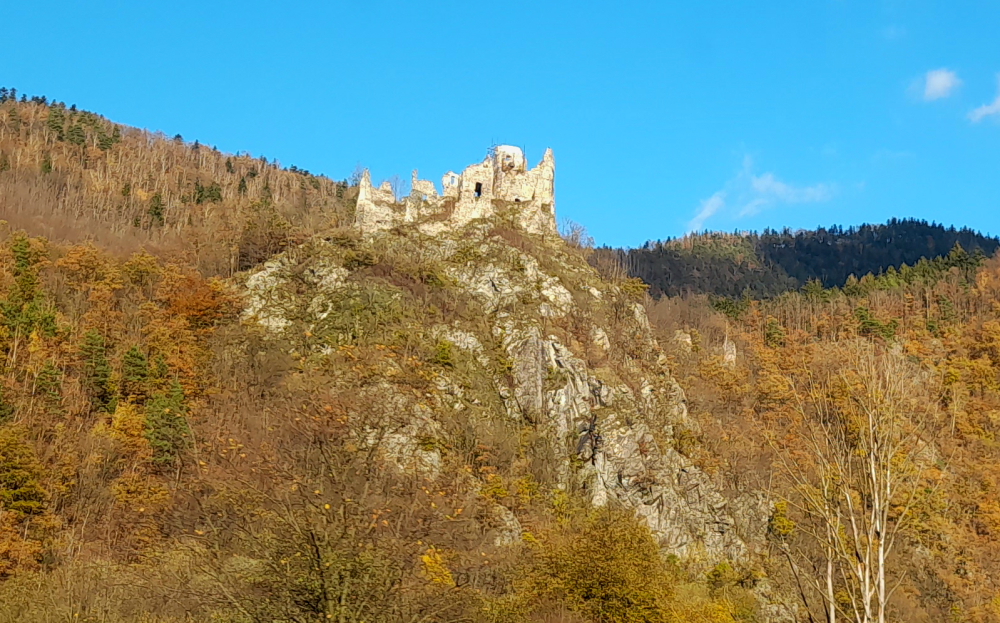
Another castle ruin, Stary Hrad, was built to protect the old road leading to Považím, near the ford, where the old road crossed from the right bank to the left. It belonged to the Varín estate and was initially called Varín. Historians estimate its creation before 1235 , i.e. during the reign of Ondrej II, and it is mentioned in writing for the first time in 1241 in the charter of King Bela IV. The name Starý hrad was given only after the construction of Strečna, which took over its original function. The Pongrács lived here until the 16th century, when they built a comfortable Renaissance mansion in Krasňany and abandoned the uncomfortable castle.

During WWII, it became the site of battles when it was occupied by a German battalion on August 31, 1944. The Germans were able to shell the positions of the French partisans from the heights around Starhrad, who as a result suffered significant losses and were later forced to retreat under the pressure of other German units attacking the Váha valley.

Still more castle ruins as we climb into the mountains – Starý hrad (Starhrad).

This missing D1 lasts for around 50 kms. Current roadworks show us where it is intended to be – where we rejoin it there is a massive 2-way tunnel being drilled through the hillside that we’ve been skirting around.

The old highway filling the missing link of the D1.

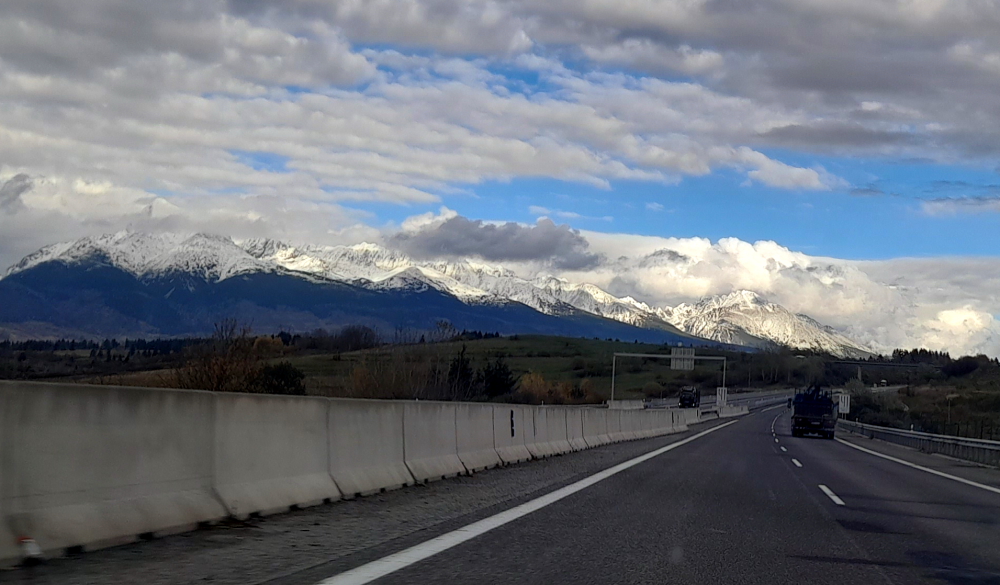
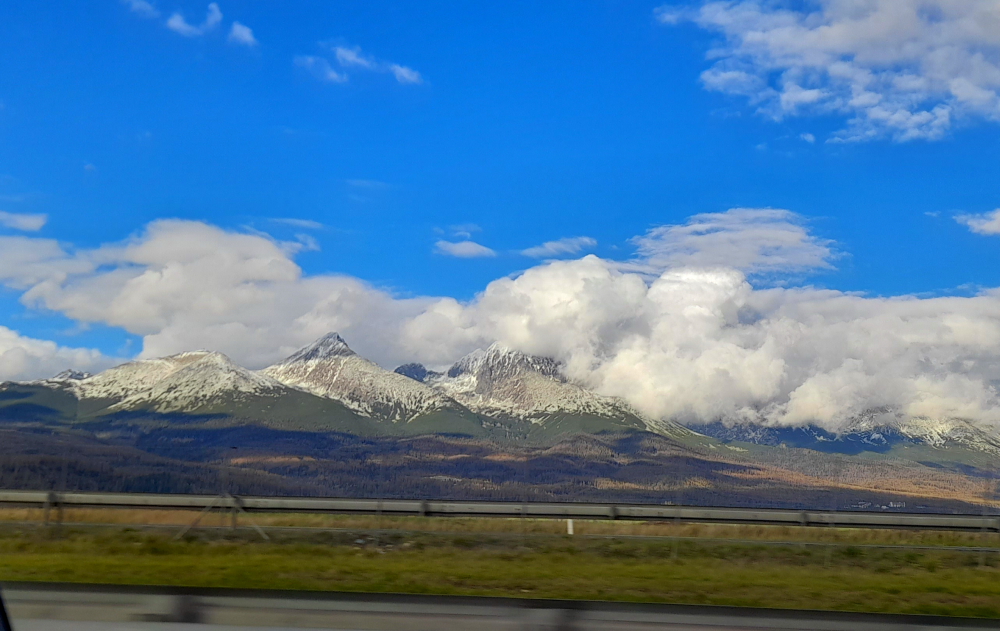
Half an hour beyond the town of Ruzomberok we sight snow on the distant Tatra Mountains.

The Tatra Mountains under snow.

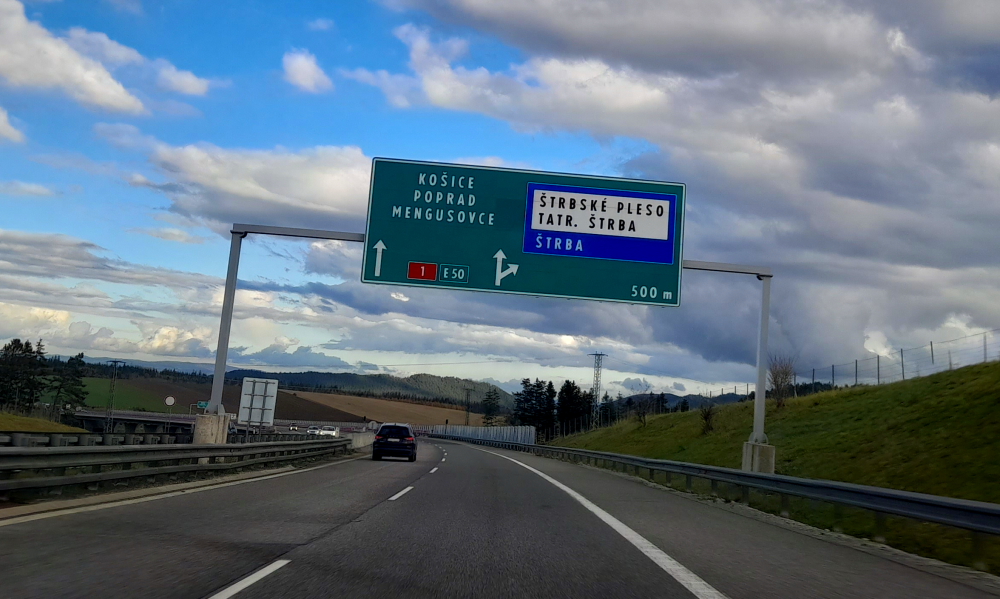
At the Strba slip road we only have another 128 kms to go!

Back on the eastern end of the D1.

And it’s where we see the last of the Tatra Mountains.

The eastern end of the Tatras.

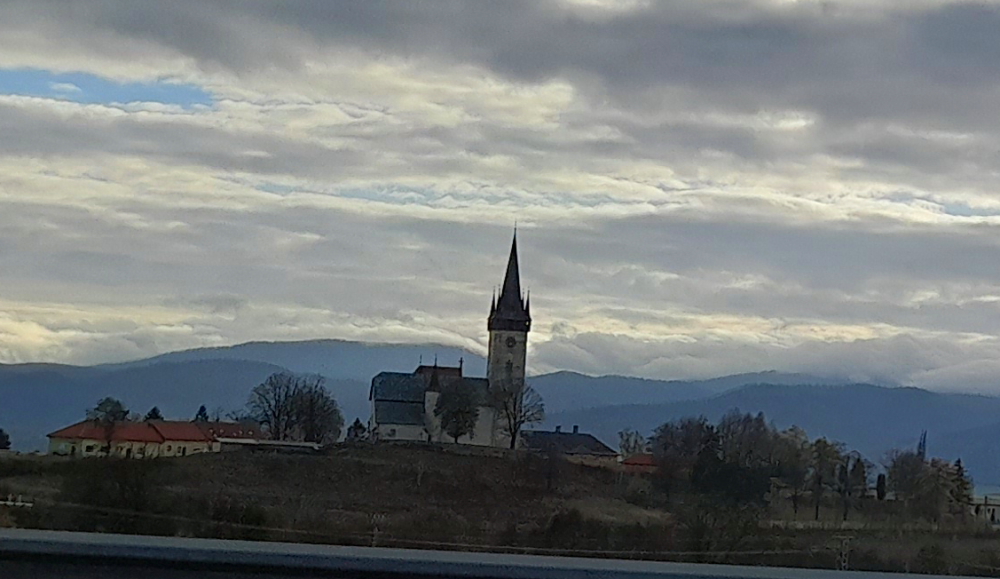
We continue to pass by traditional towns, such as Spissky, with its church dominating the skyline.

Spissky – Church of Saint Ladislaus- but no castle.

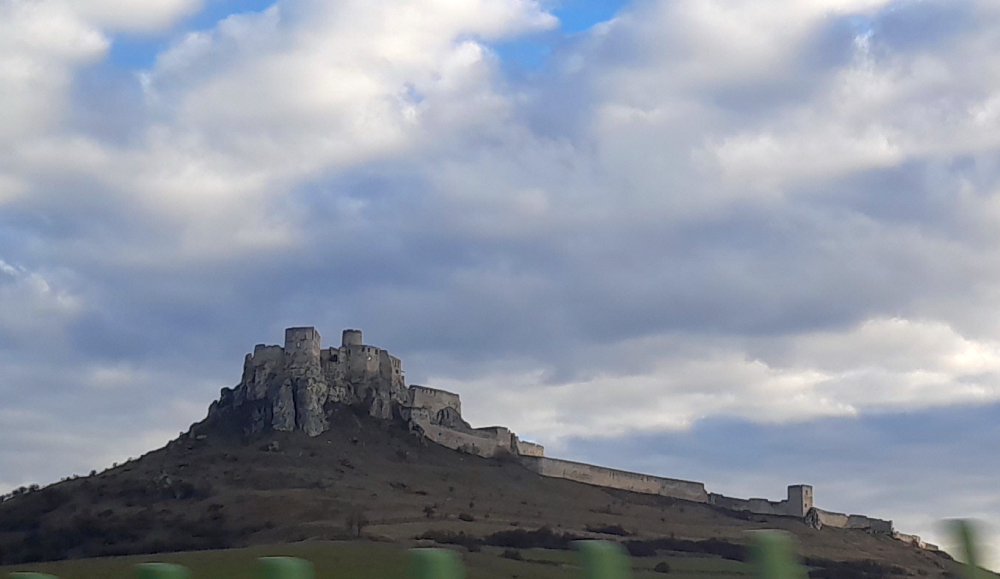
10 minutes later we pass by a truly complex castle ruin, Spis Castle, above the town of Spisske Podhradie. The castle was built in the twelfth century on the site of an earlier castle. It was the political, administrative, economic and cultural center of Szepes County of the Kingdom of Hungary. Before 1464, it was owned by the kings of Hungary, until the time of King Matthias Corvinus, then (until 1528) by the Zápolya family, the Thurzó family (1531–1635), the Csáky family (1638–1945), the state of Czechoslovakia and then Slovakia.

Spis Castle – an even bigger castle ruin with extended fortress walls.

4 minutes later we are about to enter Tunel Branisko. The hint of wispy cloud draped over the hill should have given us a clue as to what to expect at the other end of the tunnel, 5 kms later.

Fog on the other side of the mountain.

Fog and 9 Deg. C! Which pretty much continues for the next 55 minutes while we drive to Kosice, 75 kms away.

Košice is the largest city in eastern Slovakia. It is situated on the river Hornád near the border with Hungary. It’s home to the Slovak Constitutional Court, three universities, various dioceses, and many museums, galleries, and theatres.

Driving in fog to Kosice.

At 3:00 pm we pull into the hotel’s car park at the rear of the building and check in. Again we are booked into an executive suite in this boutique hotel which is located on Hlavna, a pedestrian zone in the centre of town.

As it gets dark around 4:30 pm we decide to unpack later and instead take a quick walk around the town centre.

Our hotel in Kosice old town centre.

The city has a preserved historical centre which is the largest among Slovak towns. There are heritage protected buildings in Gothic, Renaissance, Baroque, and Art Nouveau styles with Slovakia’s largest church: the Cathedral of St. Elizabeth. The long main street, rimmed with aristocratic palaces, Catholic churches, and townsfolk’s houses, is a thriving pedestrian zone with boutiques, cafés, and restaurants. The city is known as the first settlement in Europe to be granted its own coat-of-arms.

To one end of the pedestrian zone is the Saint Elizabeth Cathedral with the St Urban Tower (a campanile) erected in the 16th century next door.

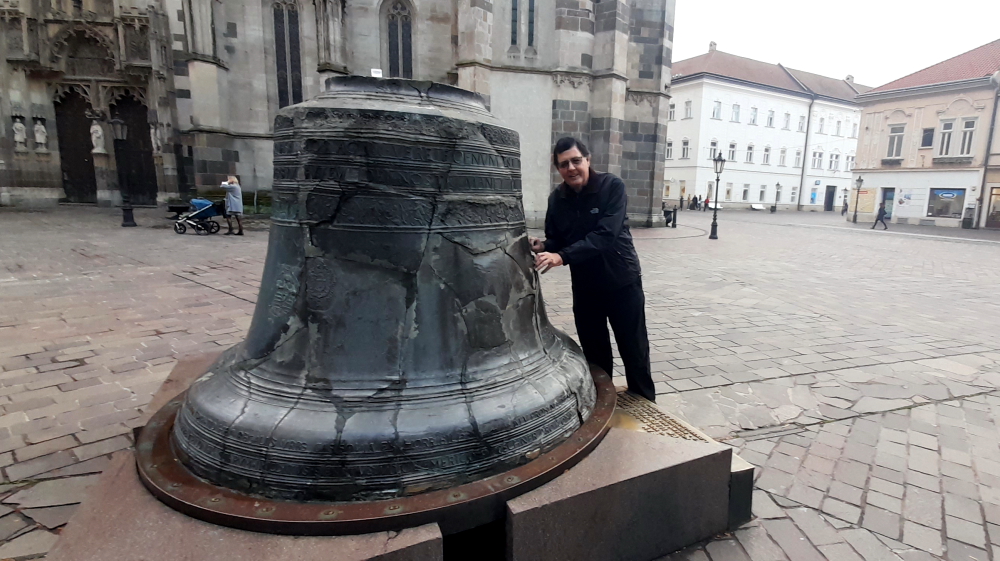
In 1966 the tower was damaged by fire and the St. Urban Bell was destroyed as well. The reconstructed tower was reopened in 1971. The renovated bell was located in the front of the tower and a copy of the bell (made by employees of VSŽ Steel Works Košice in 1996) was installed in the campanile. The original bell was cast in a mould by the bell-founder Franciscus Illenfeld of Olomouc in 1557, weighing 7 tonnes.

Checking out the old town centre – the original Bell of St Urban.

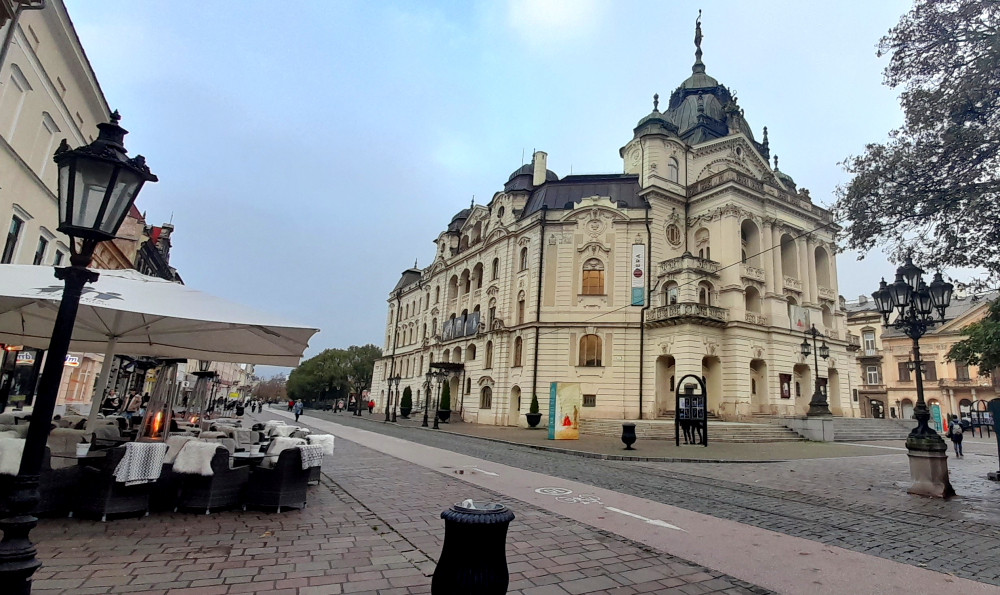
Walking back down the other side of the street we pass by the National Theatre – there seems to be some confusion as to whether it is the State or National Theatre. Surely the National Theatre would be located in Bratislava? Regardless, it is the venue for plays, ballet and opera.

Kosice’s State/National Theatre.

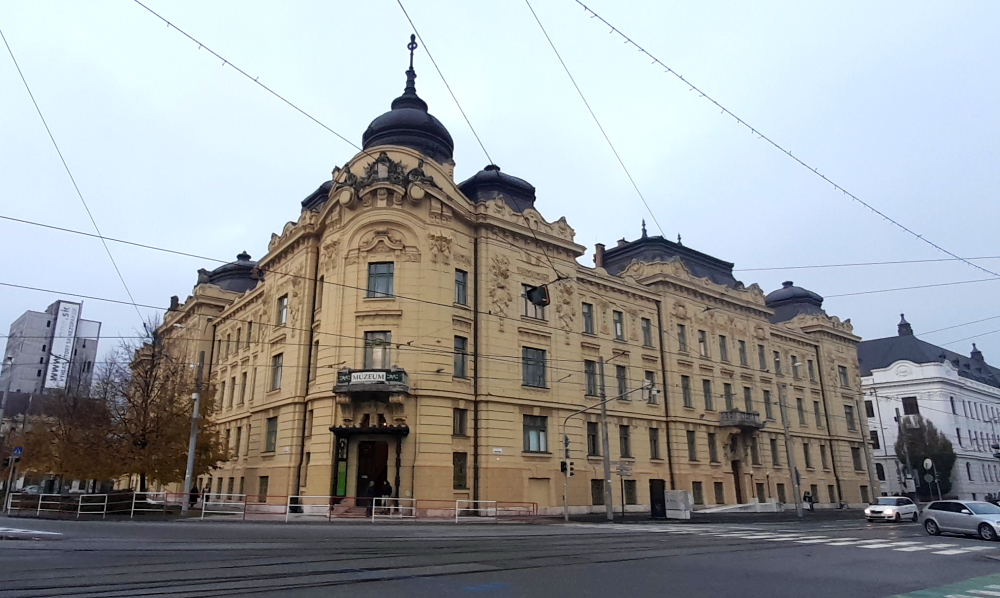
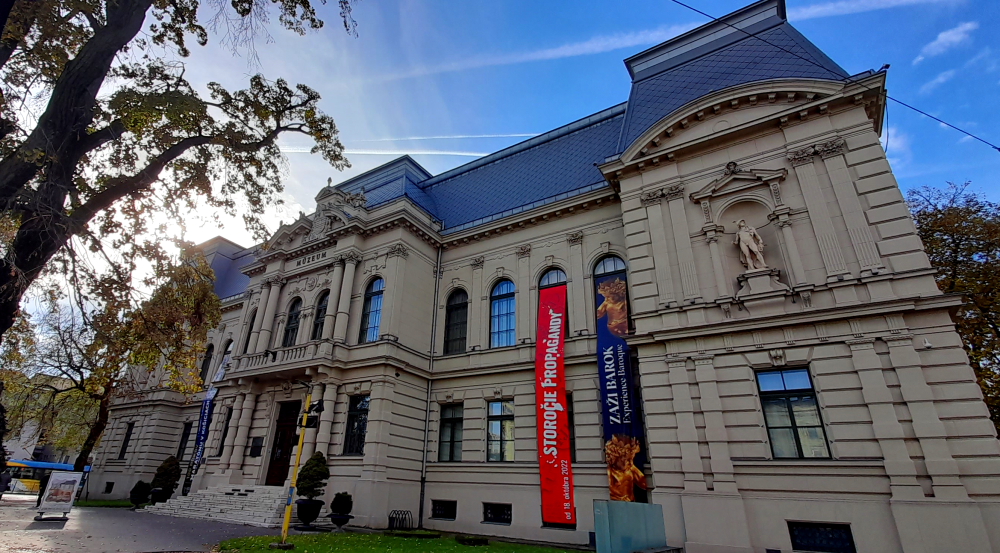
At the other end of the zone, not far from our hotel, is the East Slovakian Museum. The building on Hviezdoslavova Street houses the permanent fine art and the Carpathians exhibitions.

One of the buildings of the East Slovakian Museum on Hviezdoslavova Street.

In 2013 Košice was the European Capital of Culture, together with Marseille, France. An important industrial centre, the U.S. Steel Košice steel mill is the largest employer in the city.

Kosice is only 20 kms from the Hungarian border; 80 kms from Ukraine and 90 kms from the Polish border.

After the 2022 Russian invasion of Ukraine, Košice, as a regional metropolitan area, became a major hub for administration, transfer and housing of refugees fleeing from Ukraine.

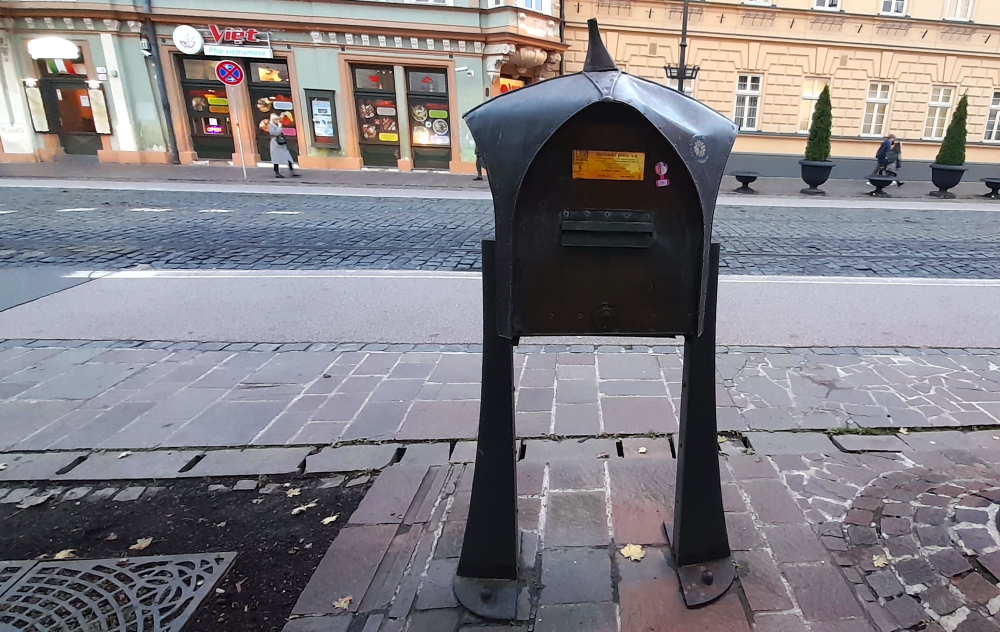
Mailbox, Kosice style.

After unpacking we return to an Italian restaurant we passed by earlier then hit the sack.

8 November, 2023

Ahhhh! Never underestimate the therapeutic qualities of a soft mattress. A blissful night’s sleep after the 4 nights we spent on a rock-hard mattress in Bratislava.

Nothing is planned for today other than a quick circuit around the nearby streets.

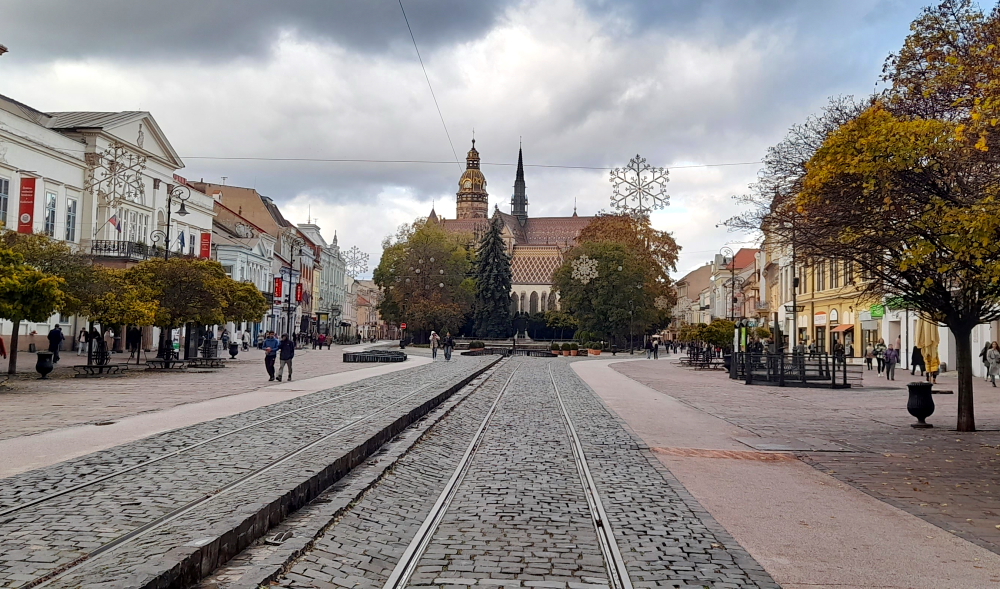
Disused tram tracks down the old town main drag – view of St Elizabeth’s Cathedral.

We are booked on a GuruWalk tomorrow but it won’t start until 4:30 pm which means this will be the first time we do a town walking tour in the dark! So we thought we’d visit a couple of places in advance, in daylight.

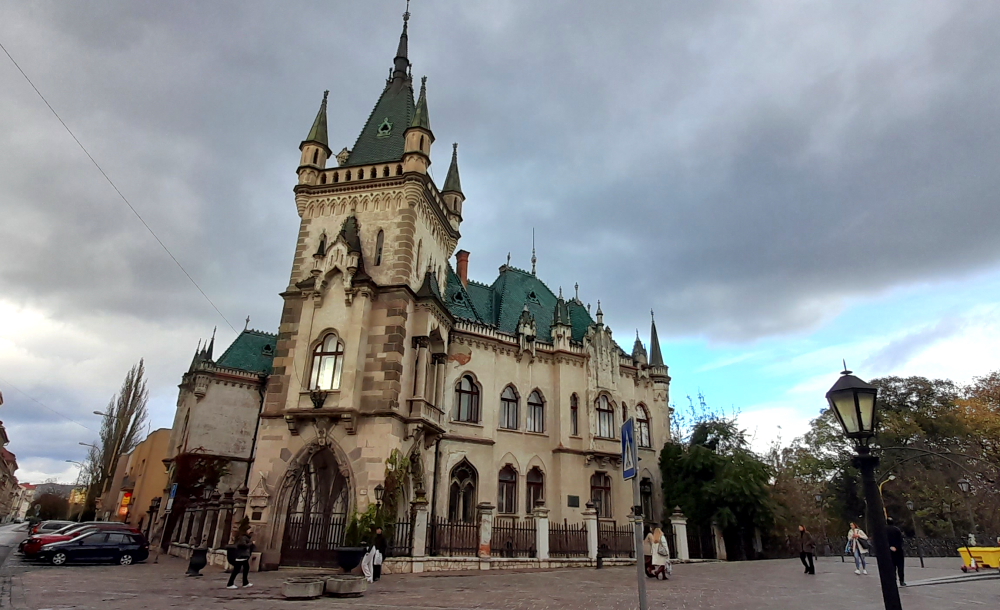
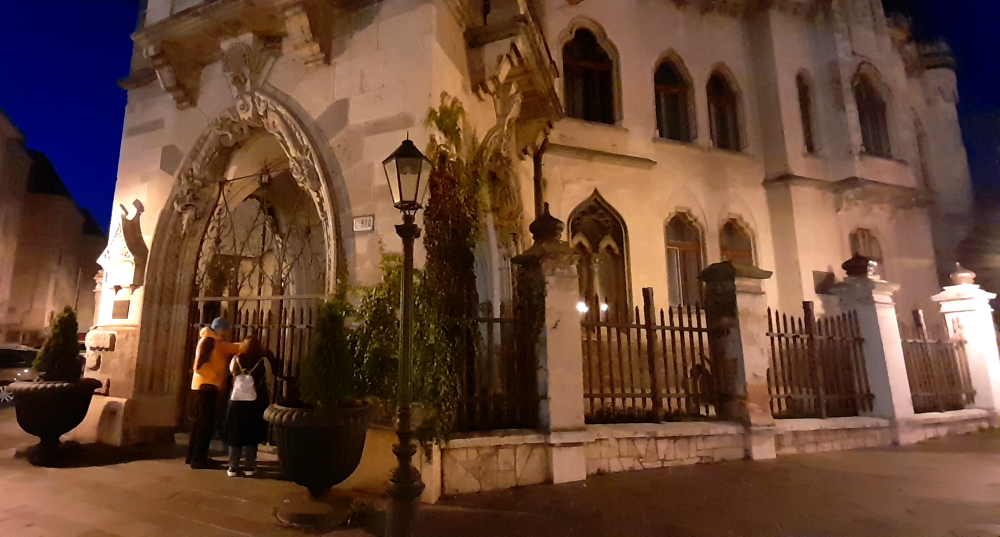
Tomorrow’s meeting point for the walk is Jakab’s Palace. The building was erected in 1899 in the pseudo-Gothic style constructed from discarded stones from the Kosice St. Elizabeth’s Cathedral. It was named after the first owner of the building Arpad Jakab. In 1945 (April – May) the palace was the seat of the president of Czechoslovakia. In 1992 – 2000 the British Council had its seat in the building. Later the building was used for important social events. At the present time the palace is closed due to a lawsuit regarding proprietary rights.

Jakab’s Palace.

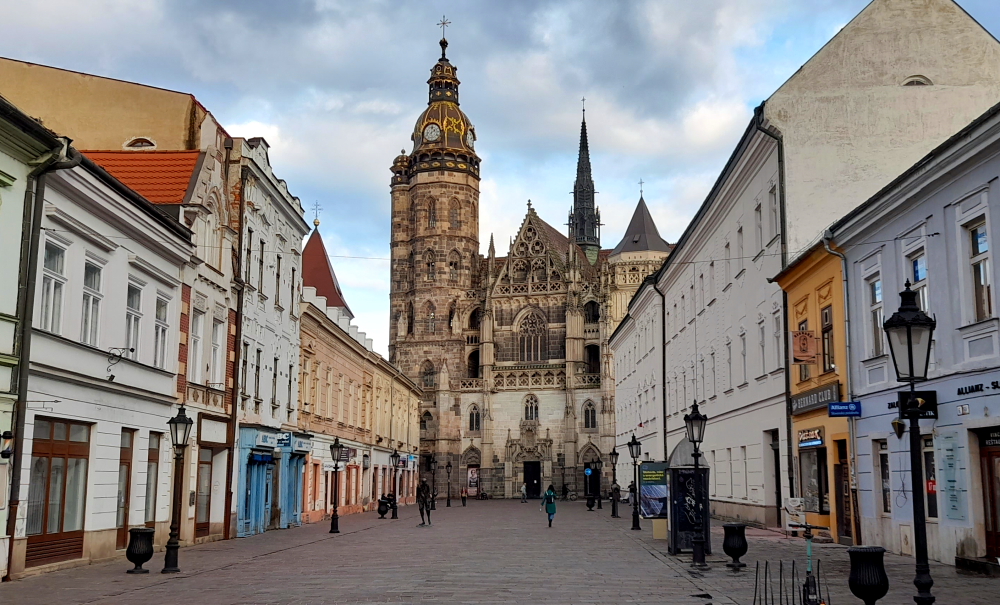
We walk down Bocna and come to the intersection with Alzbetina which gives us a view of St Elizabeth’s Cathedral. A Gothic cathedral which is also the largest church in Slovakia and one of the easternmost Gothic cathedrals in Europe.

According to historical and archaeological sources, the present-day cathedral was built on the place of an earlier church also consecrated to Saint Elizabeth of Hungary. It was referred to in documents from 1283 and 1290, in which the Bishop of Eger Andrew II spoke about the jurisdiction of the church. The complex of the cathedral and adjacent buildings (St Michael Chapel and Urban Tower) were declared as Cultural Heritage Monuments in 1970.

View of St Elizabeth’s Cathedral from Alzbetina Street.

After our old town walk we both end up finding separate establishments to have our hair cut. Mine will last another 5 months whereas Lynn’s more like 2.

9 November, 2023

Lynn decides to venture out this morning to investigate nearby streets. Near Miklus’s Prison she comes across the Executioner’s Bastion which now one of the numerous buildings that make up the East Slovak Museum.

Executioner’s Bastion & Rodosto – East Slovak Mueum.

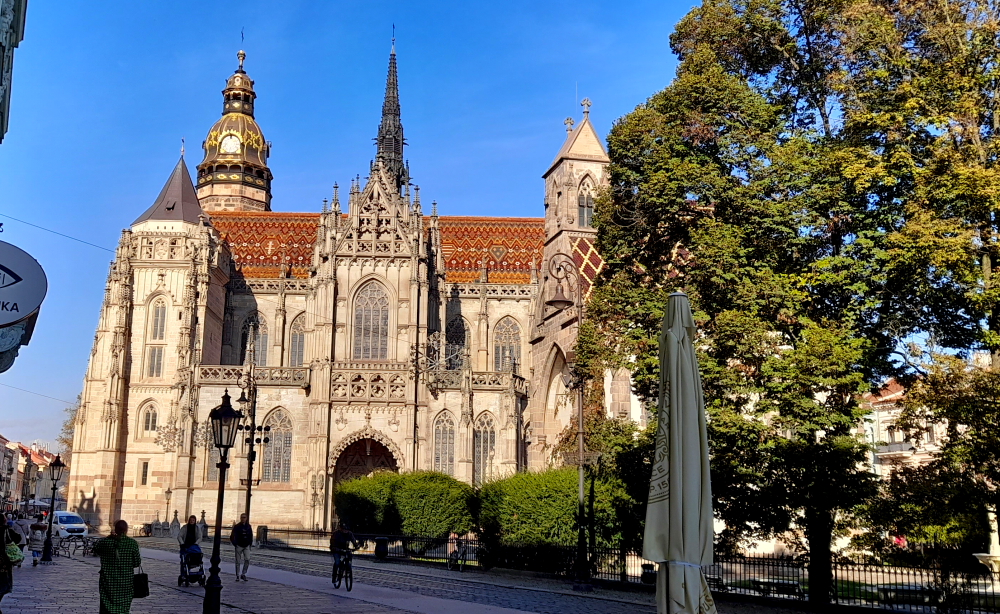
Cutting across the old town she approaches the cathedral and chapel from the south along Hlavna which shows the intricately patterned tiles on the roofs of each.

St Elizabeth’s Cathedral & St Michael’s Chapel.

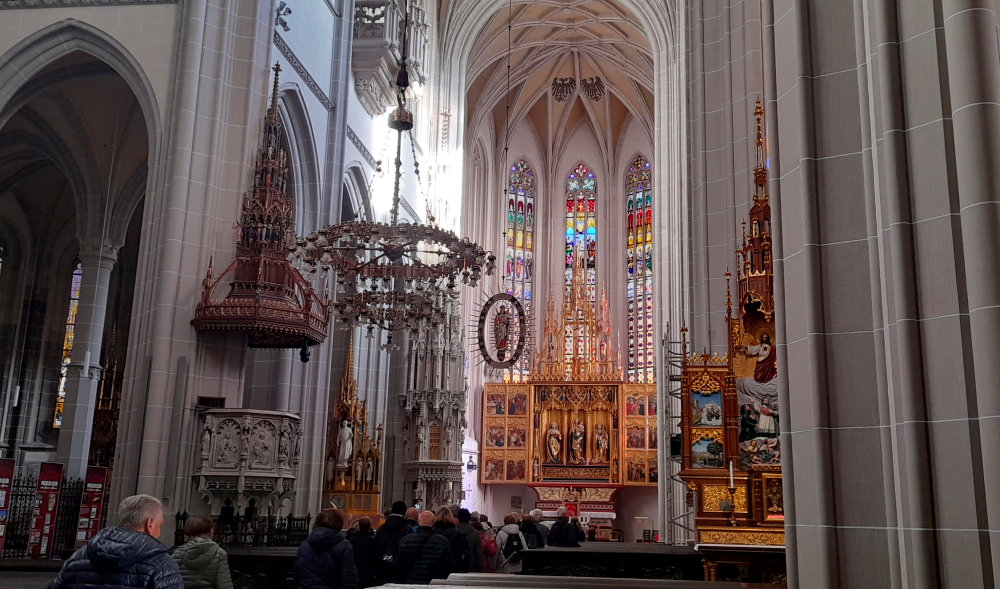
The main altar of St Elizabeth was built between 1474-77 and is ranked among the most remarkable pieces of Medieval art in Slovakia. It consists of 2 pairs of decorated wings with a heavily decorated centrepiece. As a whole, it is a set of 48 paintings in 3 themed cycles – Elizabethan, the Passion and the Advent. This style of altar is unique across Europe.

Cathedral’s interior.

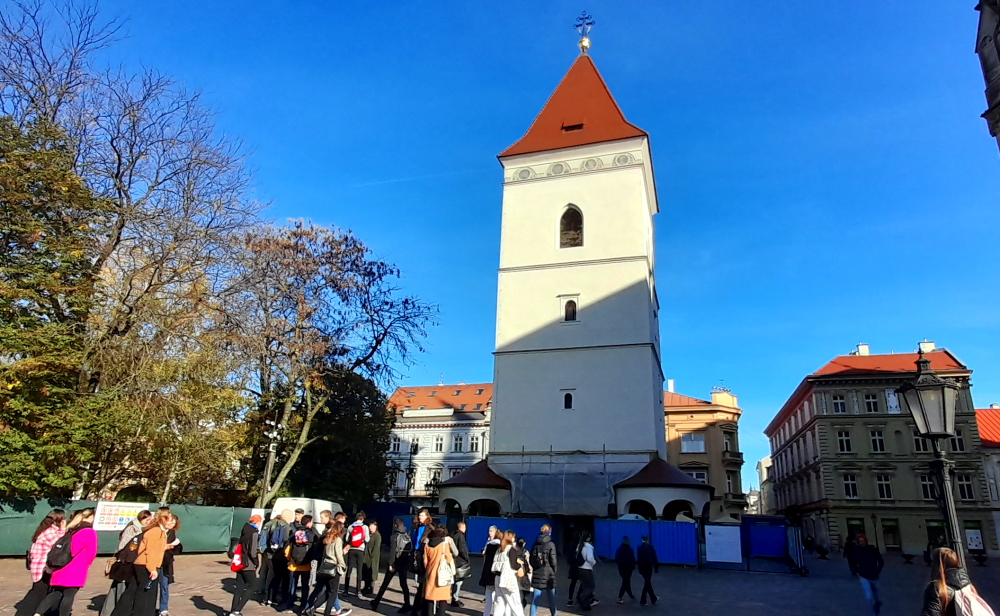
Next door to the cathedral is St Urban Tower (a campanile) erected in the 16th century and currently undergoing refurbishment.

St Urban Tower.

At 4:10 pm we leave the hotel and walk the 10 minutes to the meeting place for our historical city centre walking tour in front of Jakab’s Palace. The temperature is about 8 Deg. C so we have rugged up for the 2.5 hour tour. Thank goodness Lynn packed her bright blue fleece hat as, since I’ve lost my brown suede flat cap and I’ve just had a No. 2 razor hair cut, I’ve had to press her hat into service to cover my now almost shaved head.

When we arrive it is just about dark and we meet up with Ester, our guide, who was born and lives in the town.

She reveals to us that the Palace’s current law suit is about ownership. Apparently it was owned by a Jewish family but taken over by the town and the daughter is now claiming ownership rights.

Jakab’s Palace – night version.

As it’s now dark, we only take a couple of photos as tomorrow Lynn will retrace our steps to document those places we visit tonight.

Old Town Hall.

During the tour we visit: New Orthodox Synagogue, City Coat of Arms, St Michael Chapel, St Elizabeth Cathedral, Urban’s Tower, Singing Fountain, State Theatre, Miklus Prison, Craft street, Immaculata (Plague Pillar) and the memorial of the Peace Marathon.

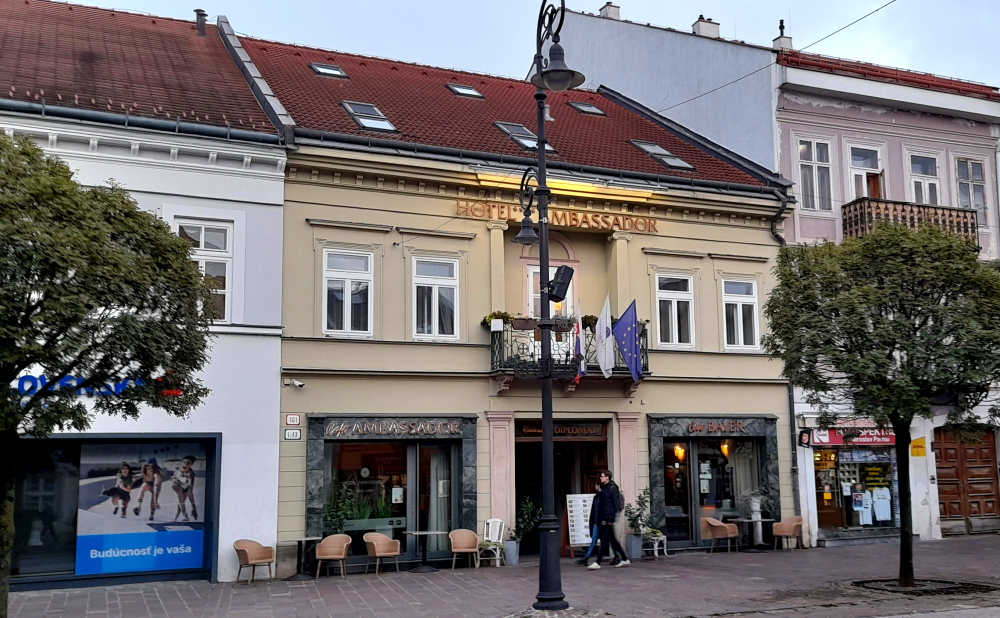
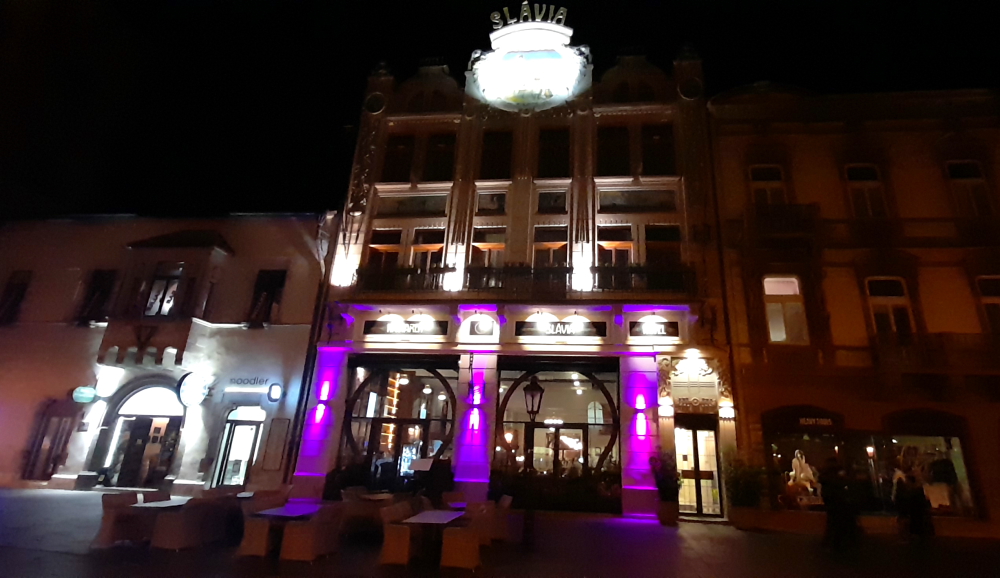
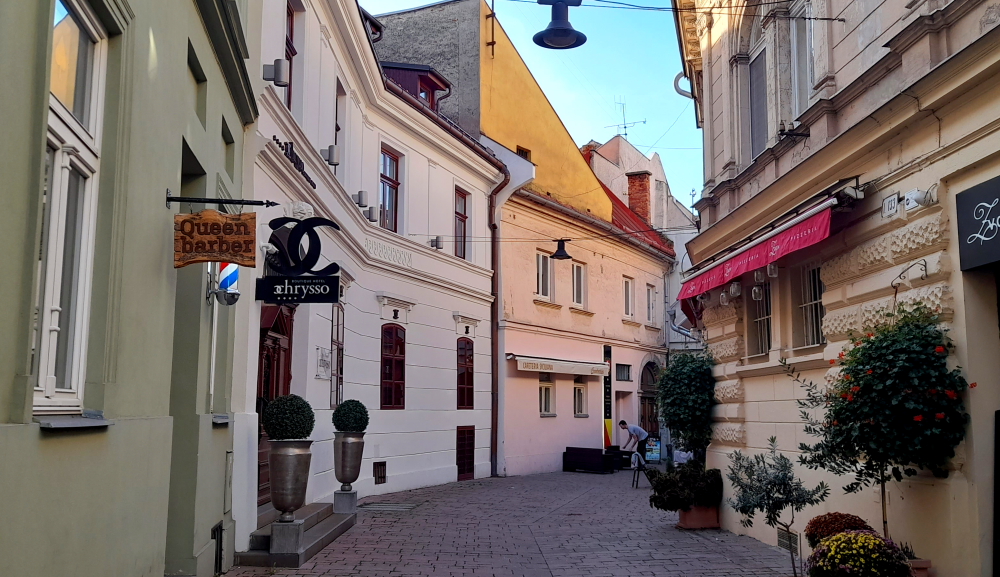
Boutique Hotel Slavia.

10 November, 2023

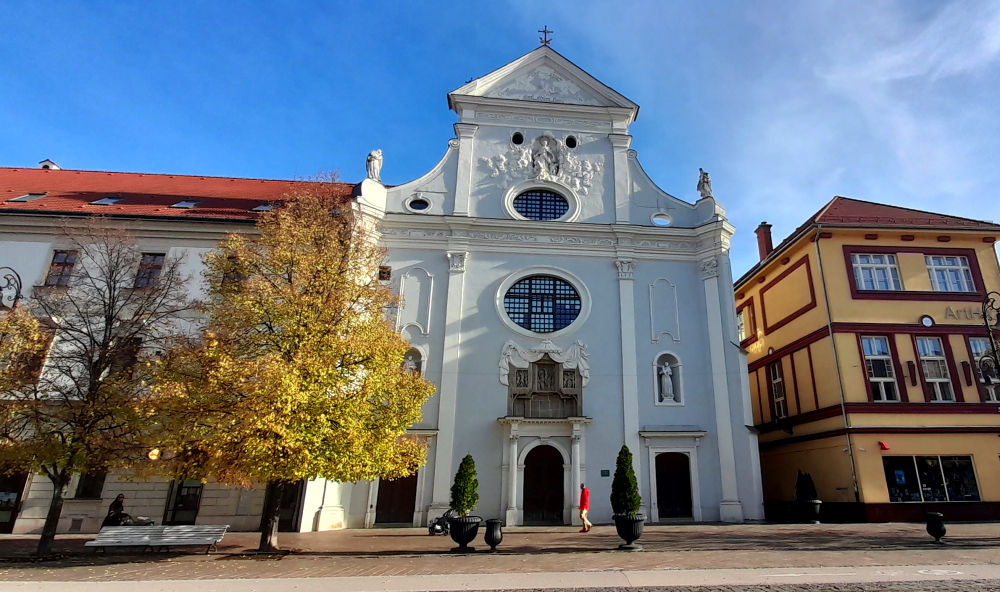
Another bright sunny day with a top of 10 Deg. C. as Lynn retraces our steps from last night’s tour. Not far from our hotel is the Franciscan Church, the 2nd oldest church in Kosice. Built during 1333-1405, destroyed by fire in 1556 and reconstructed during 1718-1724.

St Anthony of Padua Church aka Franciscan Church.

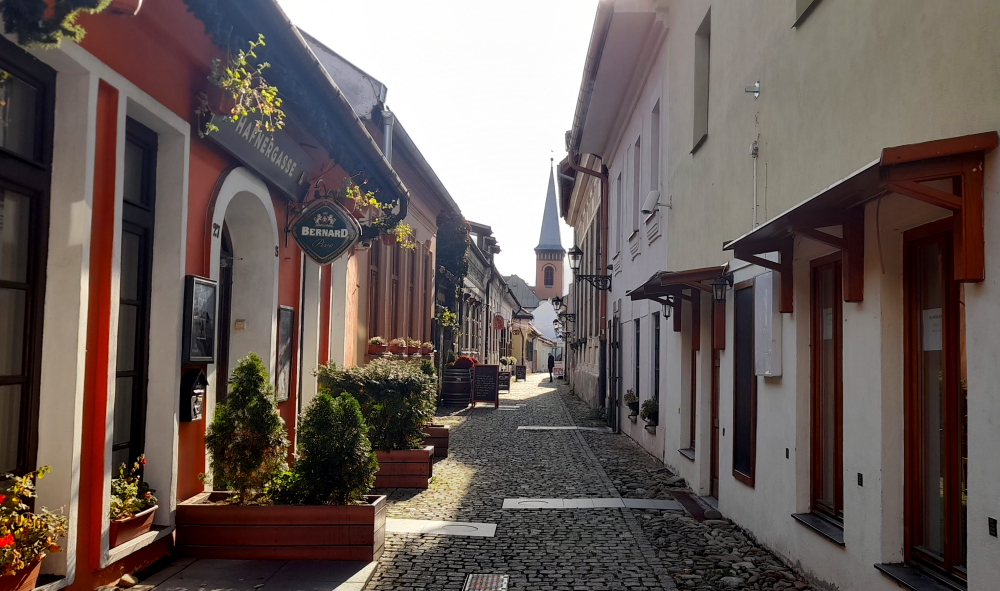
Hrnciarska Street used to be an alleyway that housed the gypsy community. After they were removed the street was turned into a street with low-rent shops to encourage artisans. When that lease expired the Mayor at the time removed the low rents which has resulted in there only being 3 shops that have retained their original purpose.

Hrnciarska Street – Craft Street

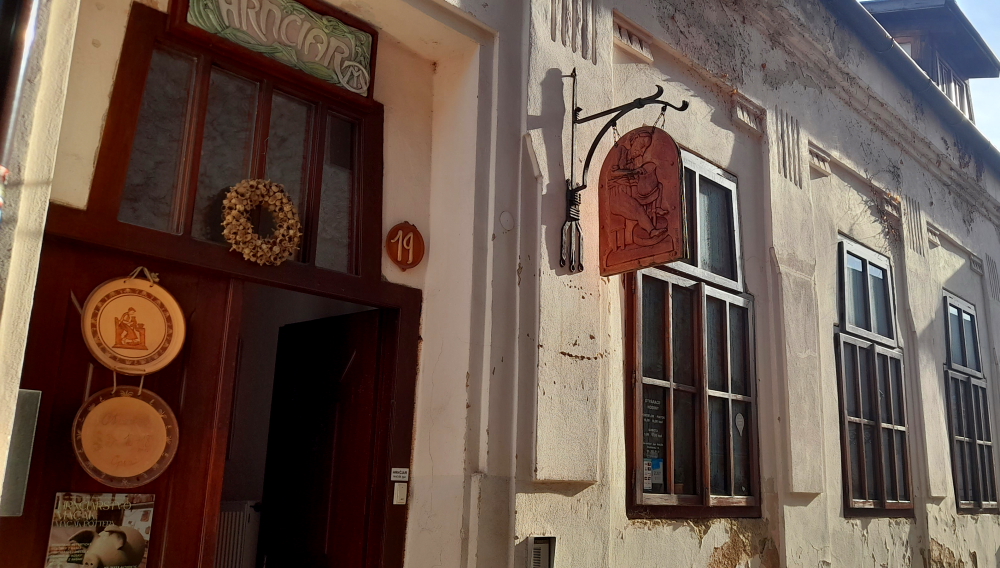
The potter’s shop with plates and shingle outside.

The Potter’s Shop.

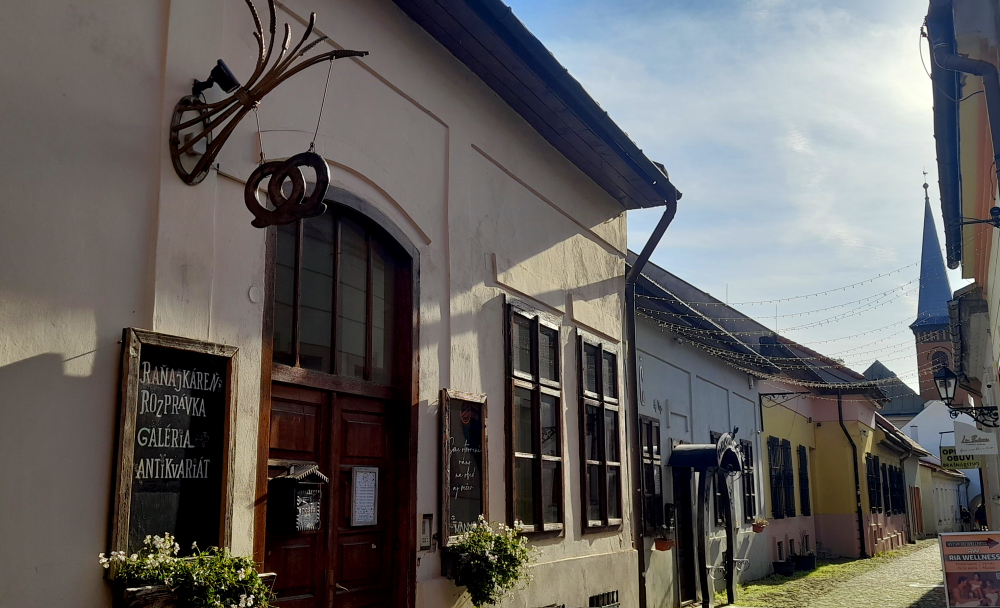
The Bakery, currently a cafe.

The Bakery.

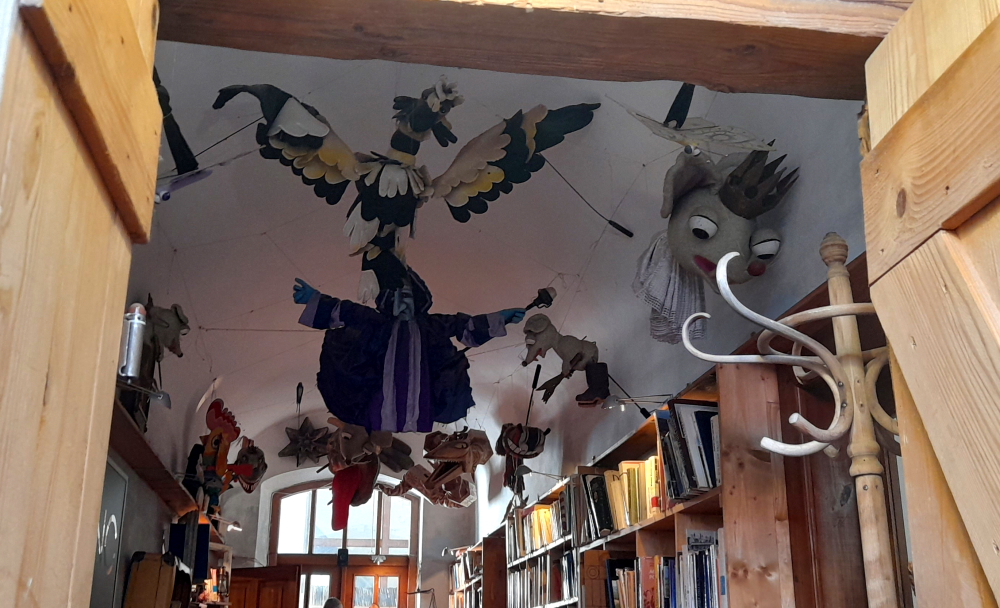
Which, when you open the front door you are greeted with a corridor filled with puppets hanging from the ceiling.

Puppets galore.

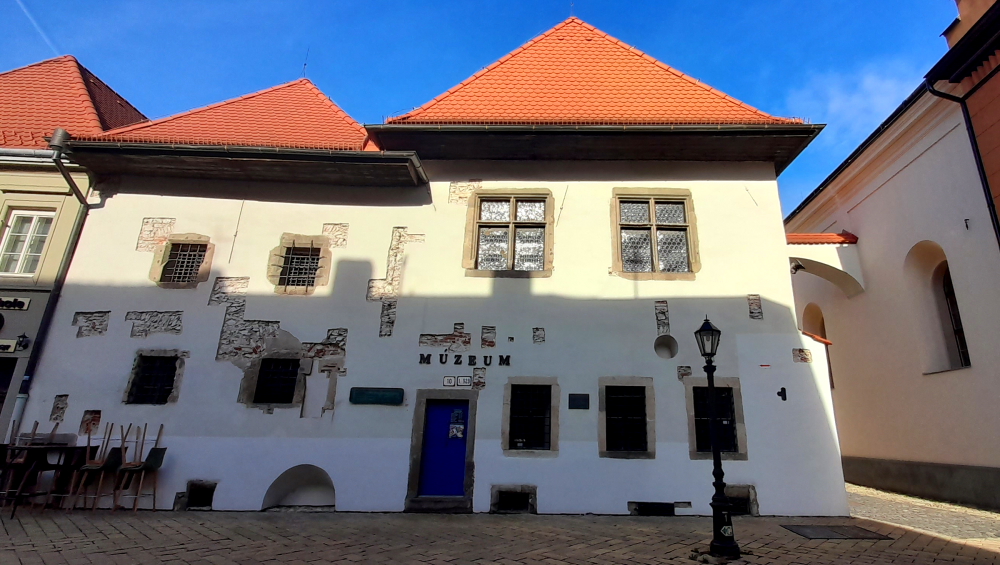
At the southern end of Craft Street is the Miklus’s Prison, part of the East Slovak Museum complex. The Executioner’s Bastian is across the street, to the right.

Miklus’s Prison – part of the East Slovak Museum complex.

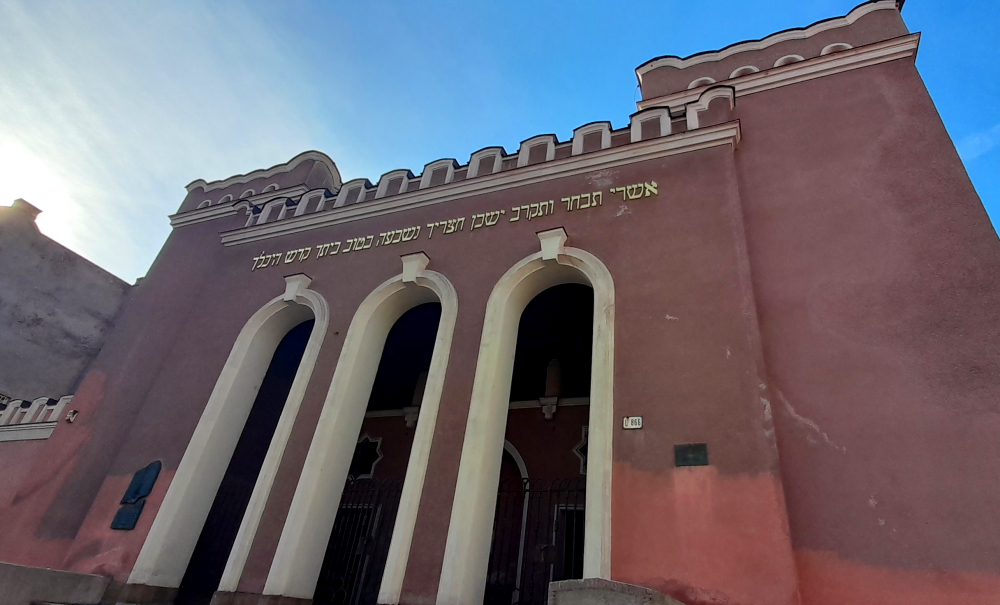
On Puskinova Street is the New Orthodox Synagogue, now non-functioning. Before WWII there were 12,000 Jews living in Kosice, about a quarter of the population. Today there are about 250.

New Orthodox Synagogue.

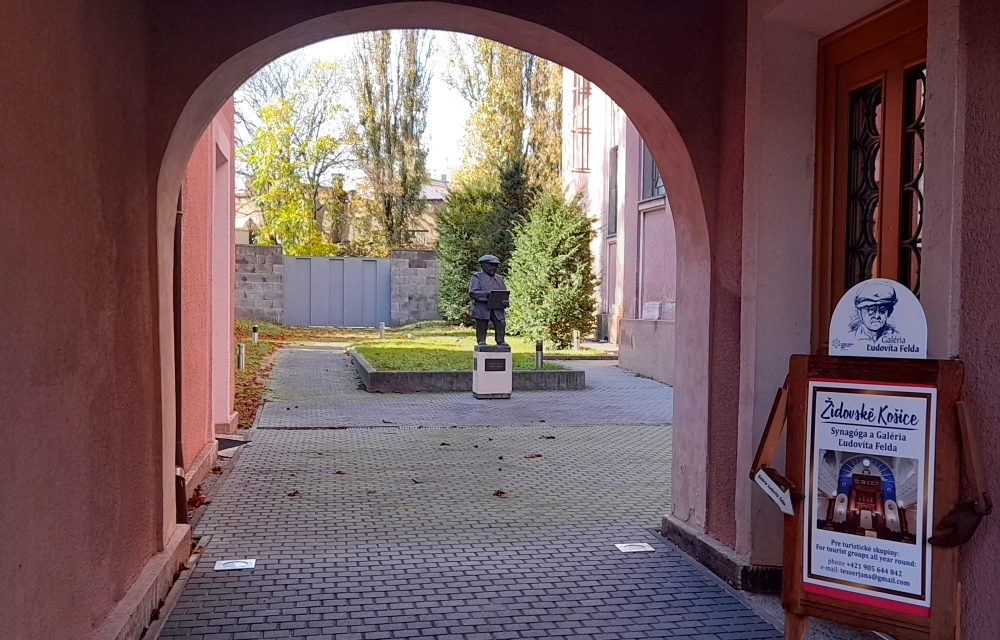
The synagogue building now houses ‘Galeria L’udovita Felda’, in honour of the man who is represented by the statue in the courtyard.

L’udovita Feld (born and died Kosice 1904-1991) was a Slovak artist. Aged 8, he was diagnosed with pituitary dwarfism. He trained in drawing and during 1925-1933 he studied graphics at the Academy of Fine Arts in Budapest. In 1933 he returned to Kosive and in 1935 founded a private art school.

In 1944 he was deported to Auschwitz where he came to the attention of Dr Mengele, both because of his dwarfism and also due to his artistic talent which was put to recording Mengele’s victims, pre and post his experiments.

L’udovit Feld statue & gallery.

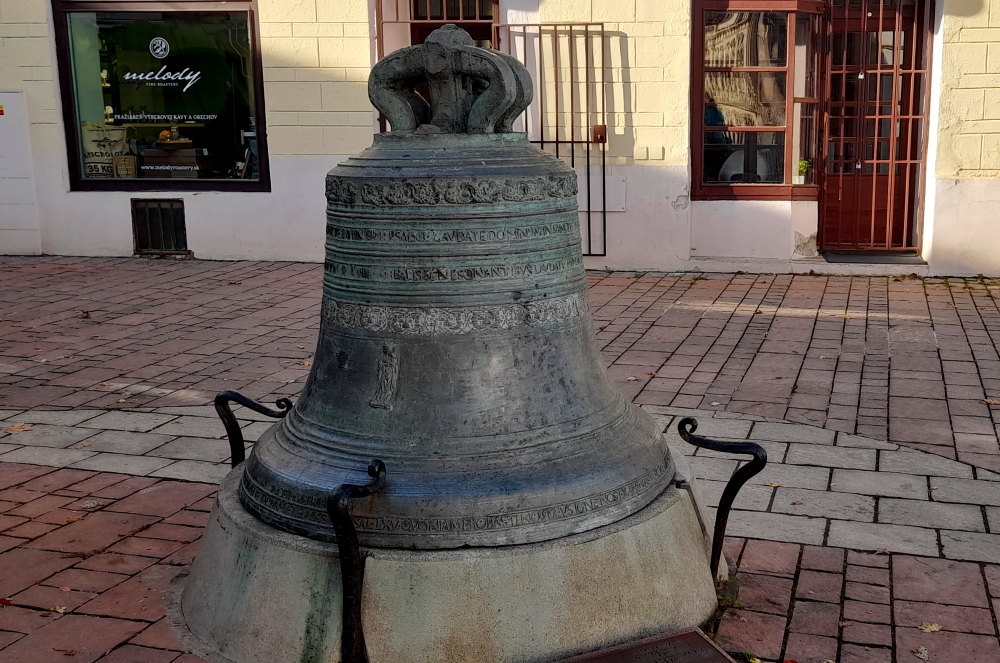
On Zvonarska Street is another disused bell lying on the pavement. This time it’s the Bell of St John.

Bell of St John.

Zvonarska Street curves around following what were the town’s original fortification walls. This continues on the other side of Hlavna Street by Vratna Street.

The curving Zvonarska Street.

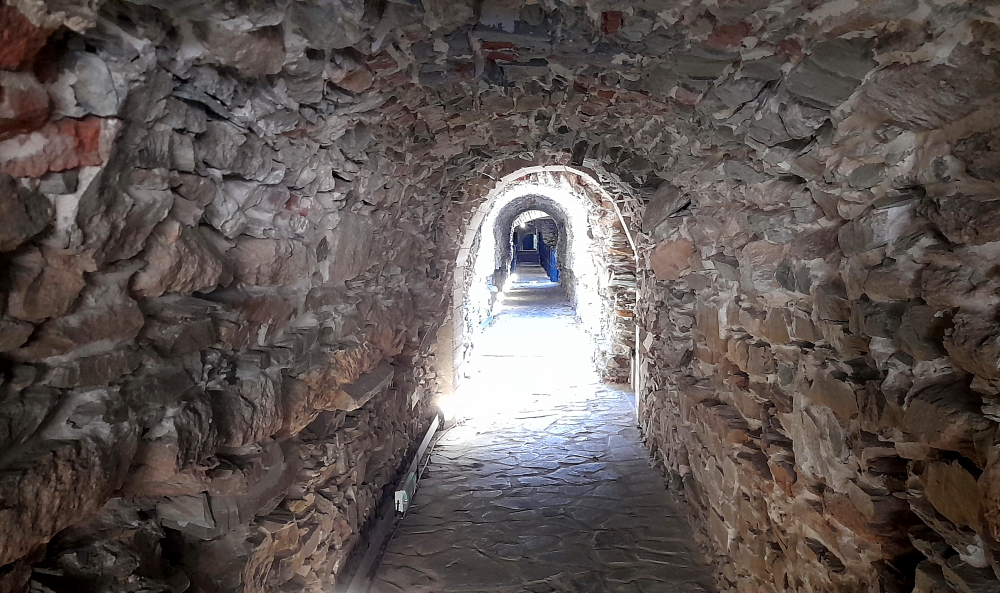
Near to where Zvonarska Street meets the main street of Hlavna Street, there is grating which reveals a tunnel below from medieval times.

Medieval tunnel below Hlavna Street.

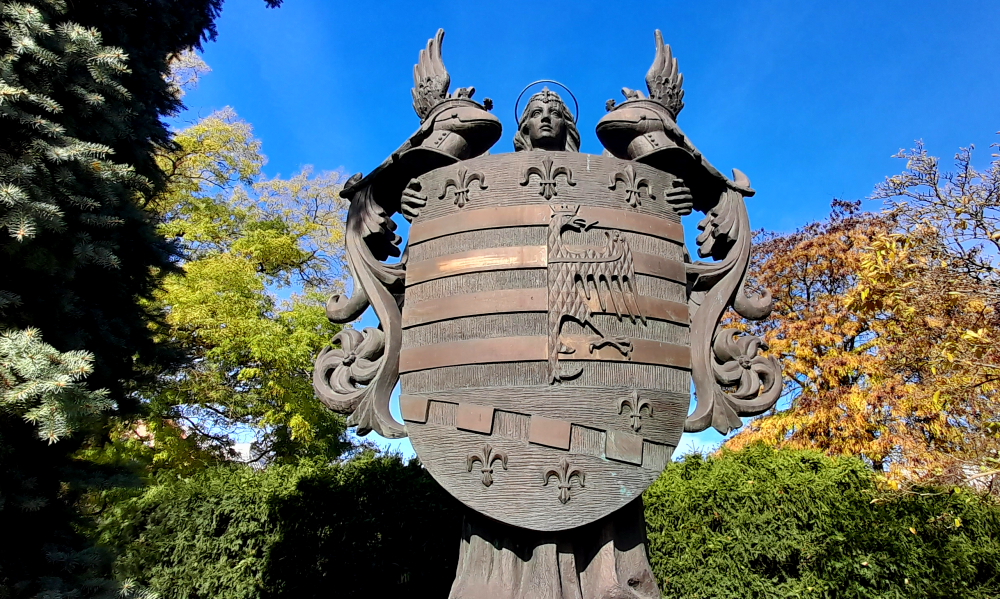
Above ground is a statue of the town’s coat of arms. Kosice was the first town in Europe to be granted its own coat of arms. It was granted by King Louis I the Great at the Castle of Diosgyor near present-day Miskoic in 1369 in recognition of the townsfolks’ loyalty. By 1502 the town had obtained four heraldic warrants from 4 monarchs.

Statue commemorating the town’s coat of arms.

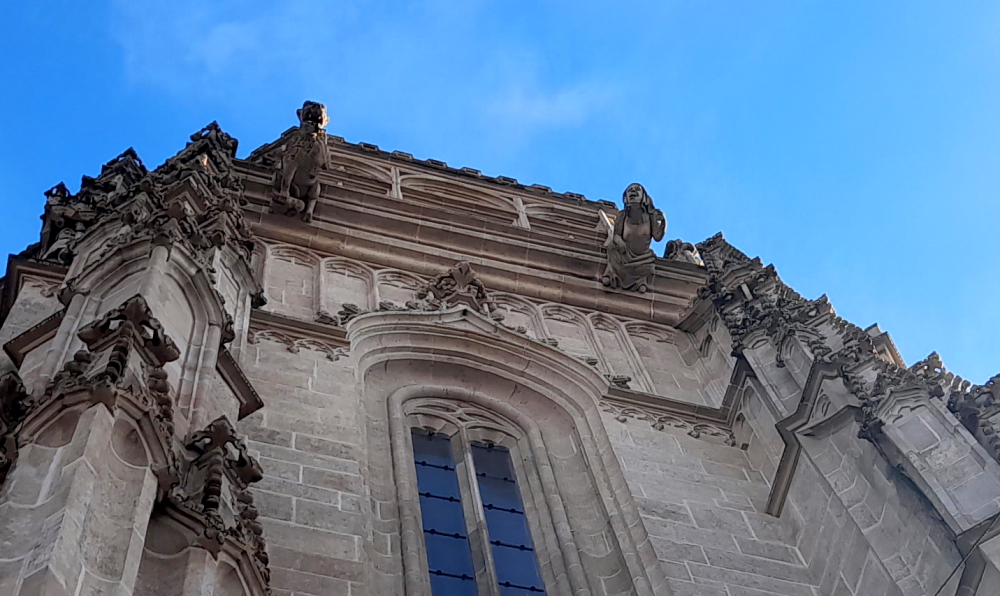
Next is the cathedral once again. Last night Ester regaled us with a legend that one of the architects had a wife who was a bit of a drunk. To try to persuade her to stop drinking he said that he would have a grotesque created in her image that would adorn the southern tower of the cathedral. Sure enough, high up on that tower on the right hand side is a grotesque in the shape of a woman with a jug of wine behind her. But, did she stop drinking??

St Elizabeth Cathedral grotesques.

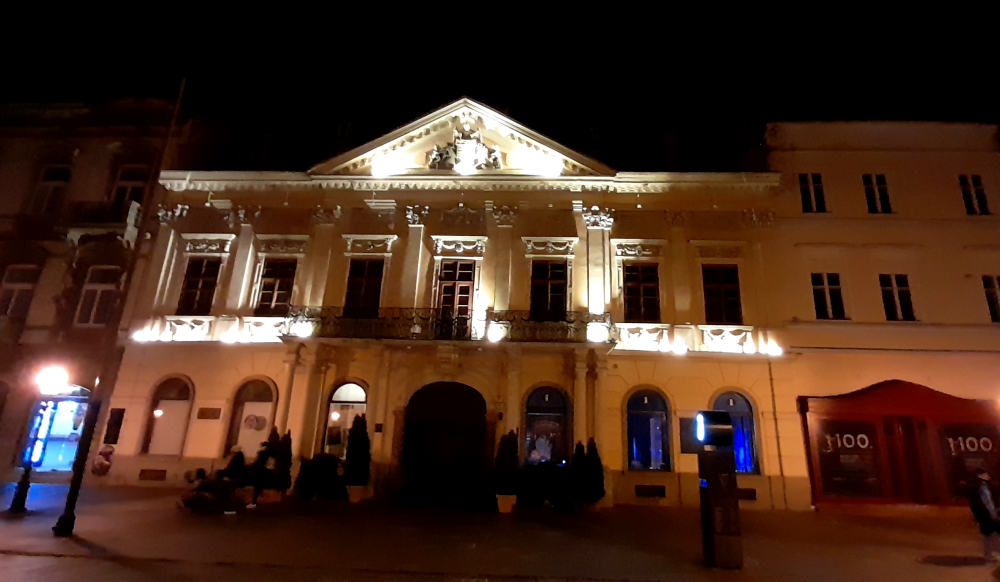
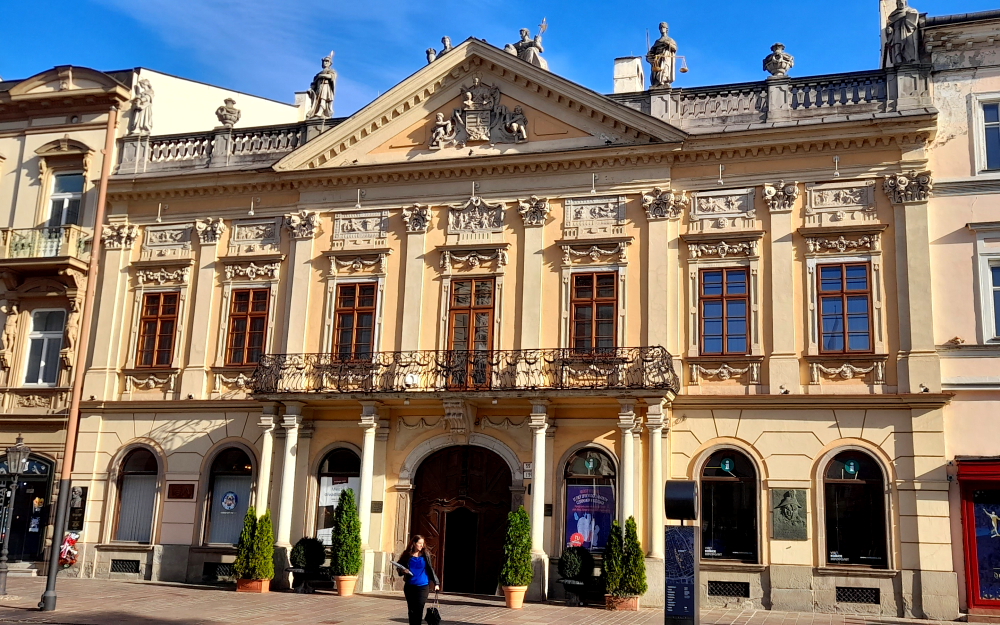
Further along the main street is the Old Town Hall, a 2-storey building in the Baroque and Classic styles dated from 1779-80 with a facade richly decorated with pilasters.

Old Town Hall.

Through the massive wooden door is a vaulted corridor that opens into a courtyard. Inside this courtyard are some display cases showing the history of the town’s coat of arms plus a rather large, ugly shoe, in recognition of Andy Warhol. Apparently some of his original works are displayed in the Mihal Gallery in the Muza Hotel, a 5-minute drive away.

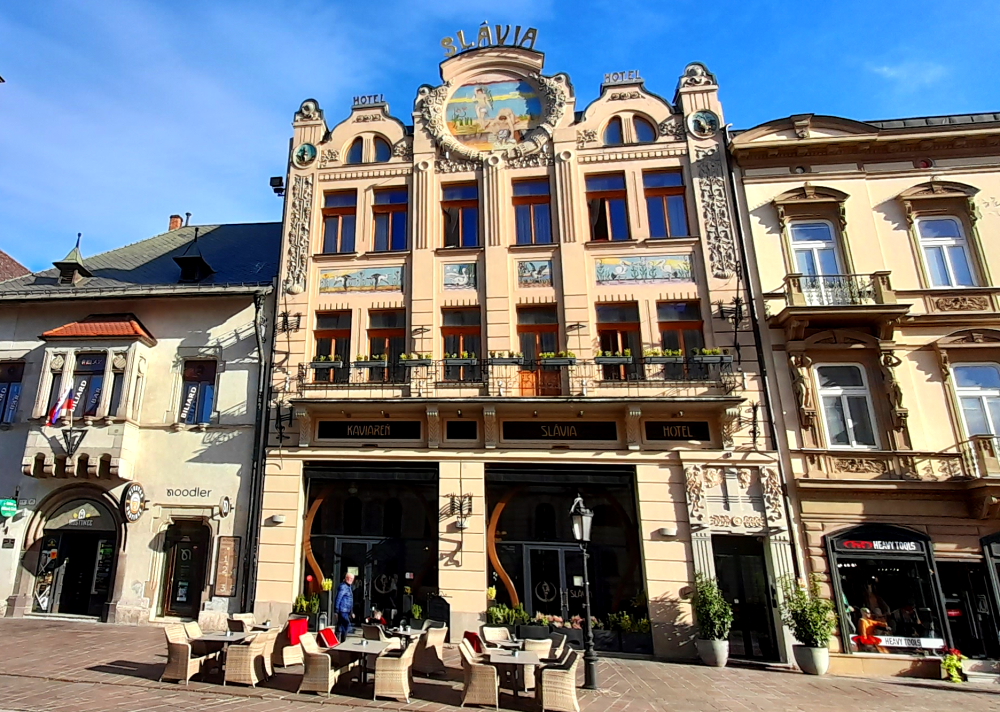
Boutique Hotel Slavia.

The Slavia Hotel and Cafe is an Art Nouveau building opposite the State/National Theatre and was built in 1900 with a luxurious cafe on the ground floor and 2 floors of apartments above. The building’s facade is characterised by a number of ornaments and paintings – mainly brewing scenes. In the 1980s the building was declared a national cultural monument.

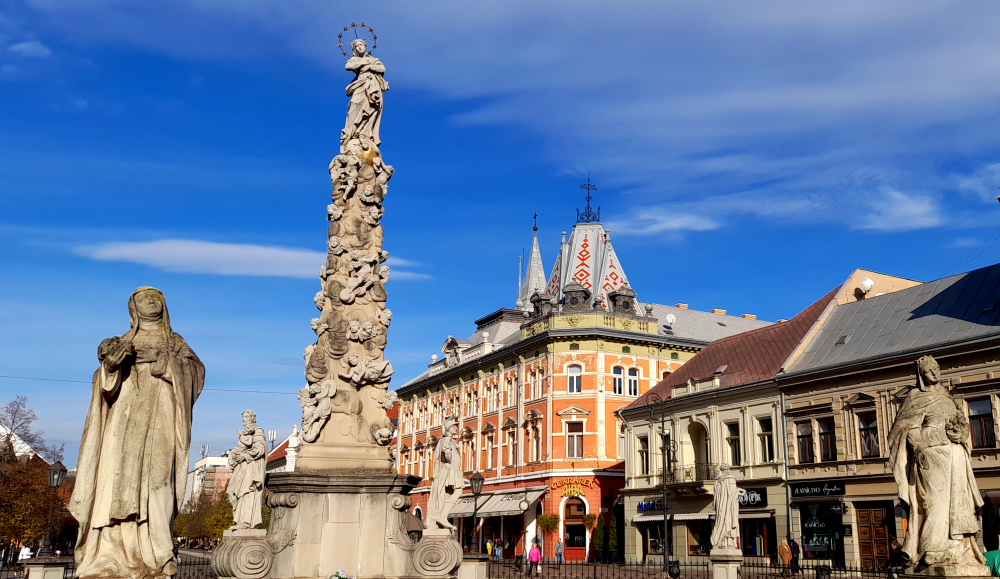
Immaculata – Plague Column.

Further along Hlavna Street is Immaculata (Plague Column) – the 14m high stone baroque Statue of the Immaculate Virgin Mary built in 1723, another national cultural monument of the Slovak Republic. Out of gratitude the 1709-10 plague survivors built this column while the goldsmith Juraj Immerwohl created the reliefs with the allegory of Plague, War and Famine from gilded copper sheets which were placed on the lower part of the statue. The Virgin Mary symbolises fidelity, love and goodness and is to protect the city from poverty and suffering.

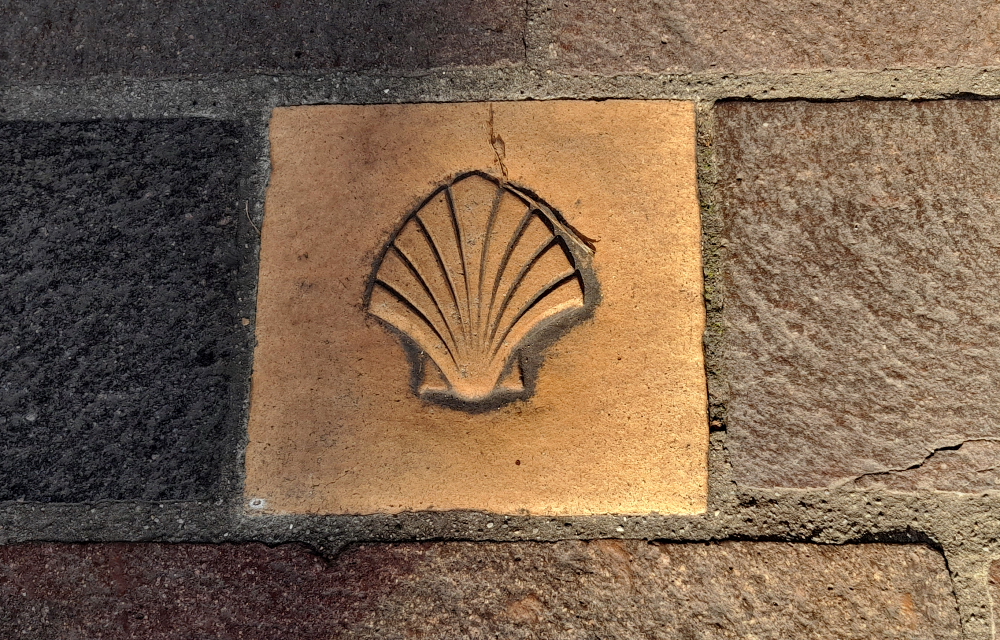
The Way of St James.

Unbelievably, we come across a series of a familiar symbol embedded in the footpath which seem to be a long way from their usual location. Apparently the Way of St James begins at the Cathedral in Kosice and continues westwards to Bratislava and all the way to Santiago de Compostela in Galicia, Spain – i.e. the Camino.

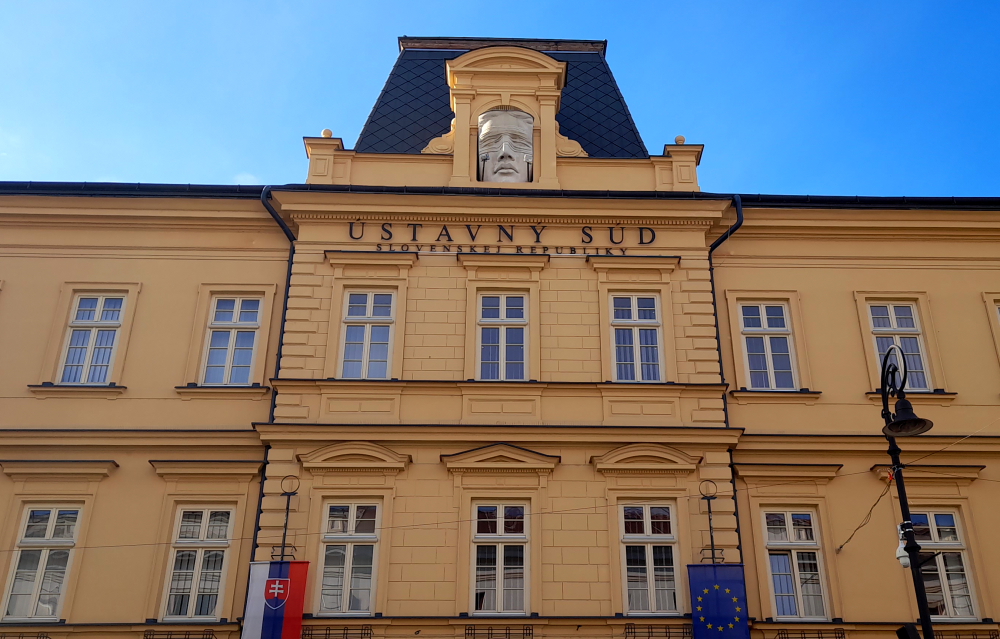
Constitutional Court.

The ‘Big Giant Head’ of Justice crowning this building provides a rather large cue as to the building’s purpose – the Constitutional Court of the Slovak Republic. Since 2006 the official premises of the Court have been here at Hlavna 110, the former Jiskra Barracks. It moved here from the historical building of the Csaky-Dessewffy Palace at Hlavna 72 where it had operated since the beginning of its work in 1993.

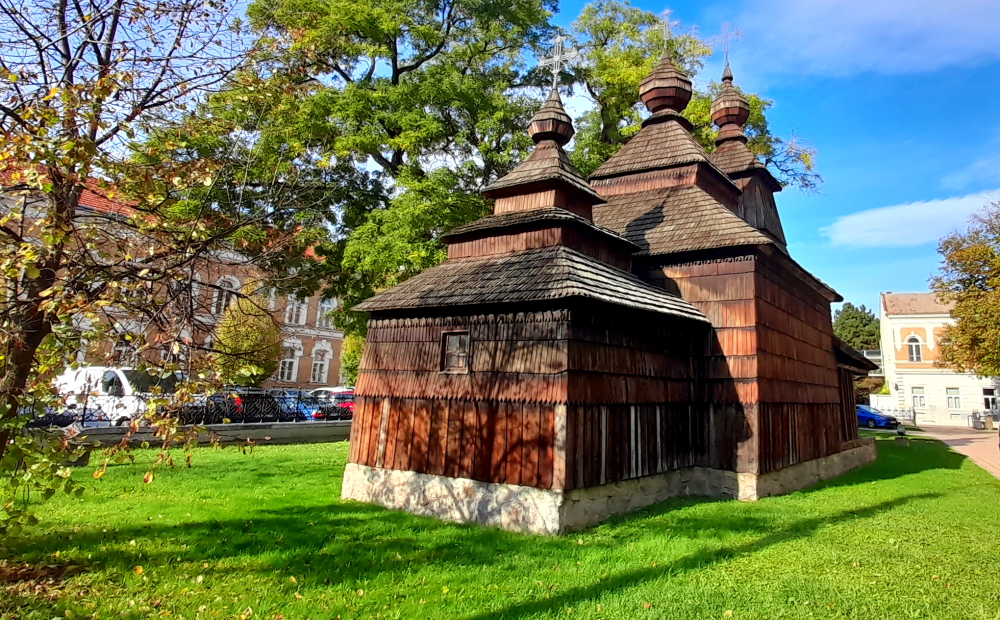
Wooden church of Kozuchovce – East Slovak Museum.

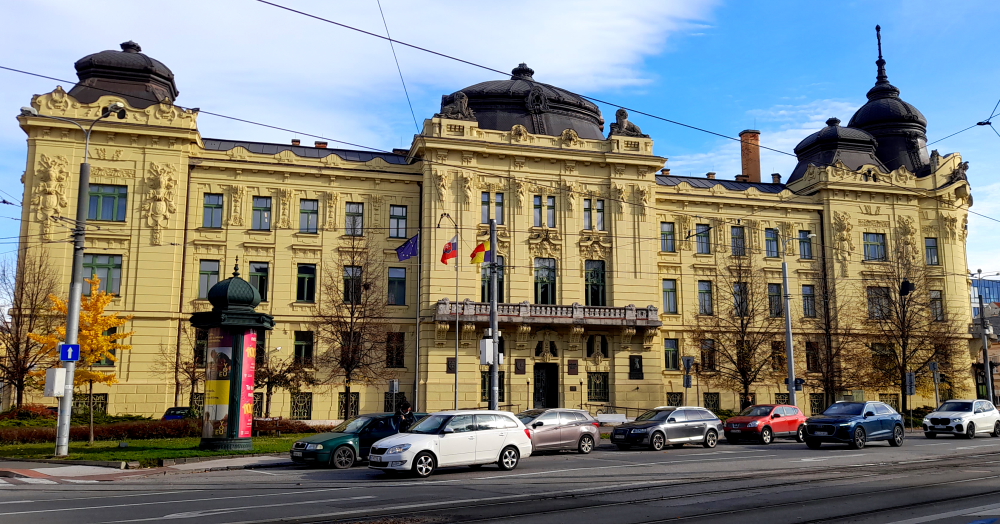
By now we are at the northern end of Hlavna, at one of the buildings of the East Slovak Museum. Behind that building is a former wooden church which had been relocated to the Museum as the object of the first open-air museum of folk architecture in Slovakia and to preserve it. Built in 1741 and dedicated to St Nicholas, the bishop, it had originally stood behind the village of Kozuchovce in the district of Svidnik. The Museum acquired it in 1927 by purchasing it in an agreement with the Greek Catholic parish office and the municipality of Kozuchovce. It has the classic architecture of wooden churches of the Eastern Rite, the so-called baroque-Lemko churches from the NE Slovakian region – and reminiscent of the Stave churches we saw in Scandinavia.

East Slovak Museum.

The museum was founded in 1872 and belongs to the oldest Slovak museums. A Neo-Renaissance building erected in the early 20th century it was the first building in the town designed to be a museum. Today it houses the Museum’s various expositions including the Stone Age and Middle Age period in the region, Kosice’s Gold Treasure, jewellery and numismatic expositions.

Across the road is another building belonging to the Museum which we photographed on our first day in town. It houses the permanent fine art and the Carpathians exhibitions.

Another East Slovak Museum building on Hviezdoslavova Street.

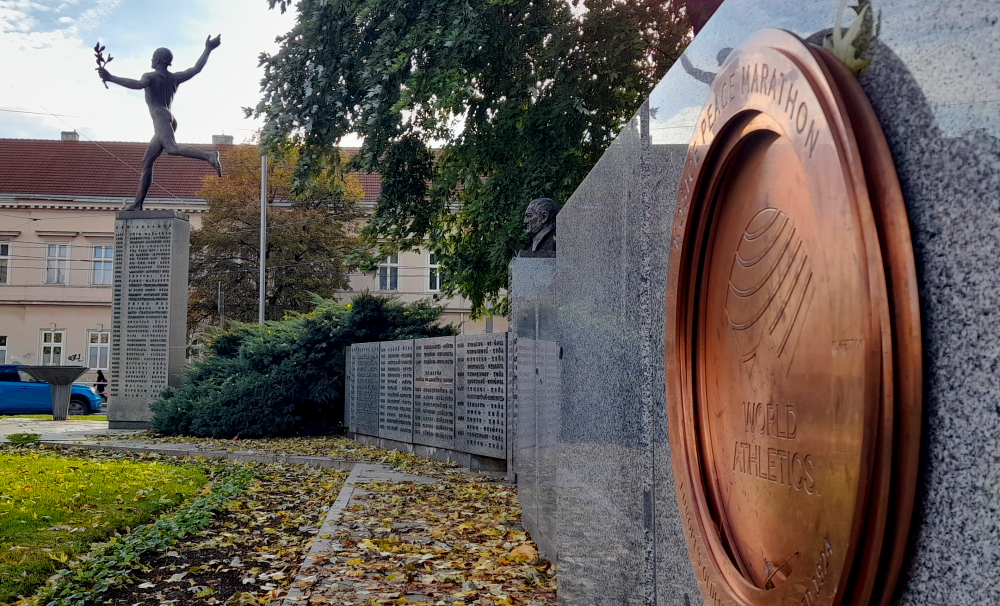
Finally, in front of the main Museum building is the Memorial of the International Peace Marathon. The statue, by sculptor Arpad Racko from Kosice, was unveiled in 1959 on the 30th jubilee of the marathon. The marathon is the oldest in Europe (1924) and the 3rd oldest in the world (after Yonkers 1907, Boston 1897 and the original, of course, in 490 BC) and has the longest uninterrupted history of any marathon in Europe.

The most recent race was last month on 1/10/2023. Naturally, Kenyans won (Men: Philemon Rono – 2:06:55 and Women: Jackline Cherono 2:24:43). There are usually in excess of 8,000 spectators and over a 1,000 finishers (even in the COVID year of 2020, 179 managed to finish!)

Memorial of the International Peace Marathon.

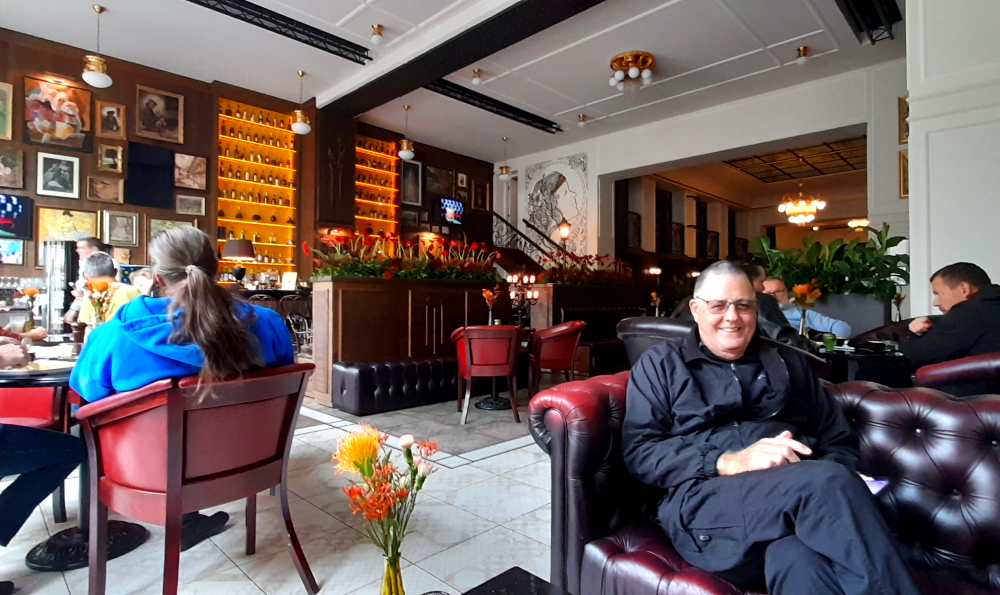
After hearing about the luxurious Cafe in the Hotel Slavia last night we decide to try it out this afternoon by ordering a cafe latte for myself and for Lynn a hot cherry wine – think gluwein with a hint of cherry.

Hot beverages in the Hotel Slavia Cafe.

And, yes, it is a rather nice cafe with reasonable prices given the decor and ambience.

Looks like an Australian native to me.

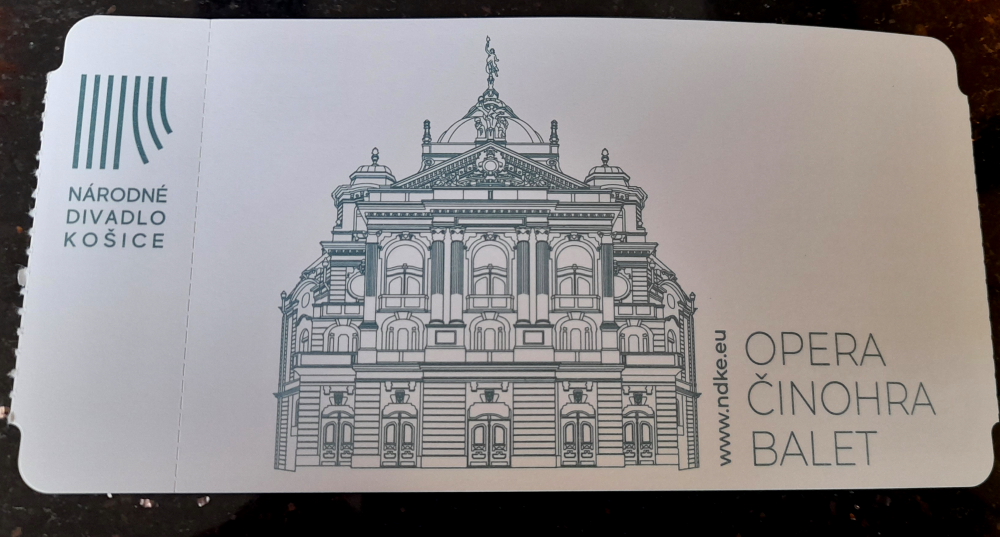
Last night when we stopped outside the National Theatre with Ester she confirmed that Donizetti’s opera “Anna Bolena” (Anne Boleyn) would be performed tonight so we visit the Box Office and purchase 2x seniors’ tickets which cost us the princely sum of Eur21.00. The middle-aged cashier even asks to check our ID to make sure we are both over 62 years of age. First time ever these past 14 months on the road – which I take to be a bit of a compliment!

Opera tickets in row 6 seats 5 & 6 left.

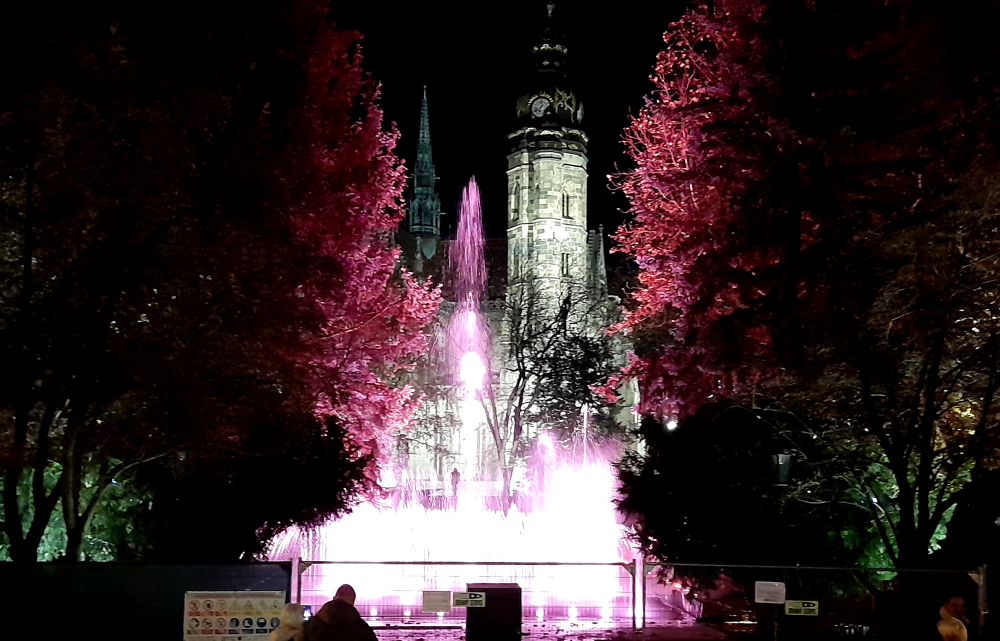
We leave the hotel at 6:30 pm for the 5-minute walk to the theatre. To our surprise, the “Singing Fountain” in front of the theatre’s main entrance, that has been undergoing refurbishment behind cyclone fencing, seems to be getting a bit of a trial run to make sure that its music, changing lighting and waterworks are in sync. So we are treated to a brief performance.

Successful test of the Singing Fountain.

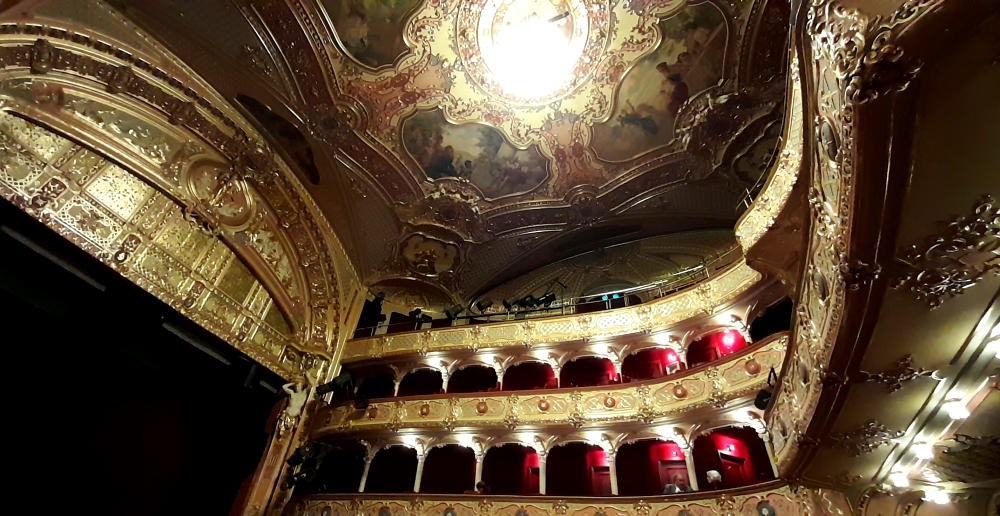
The National Theatre was built in a Neo-baroque style by Adolf Lang during the years 1879–1899.

The box seats to our right.

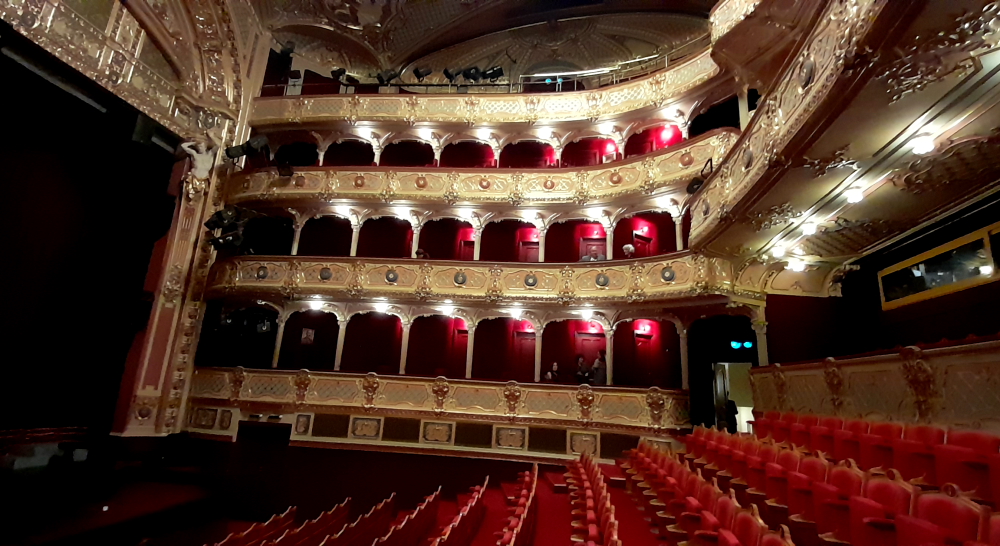
The theatre’s interior is richly decorated with plaster ornaments. The stage is lyre-shaped.

Small but elaborate Opera House interior.

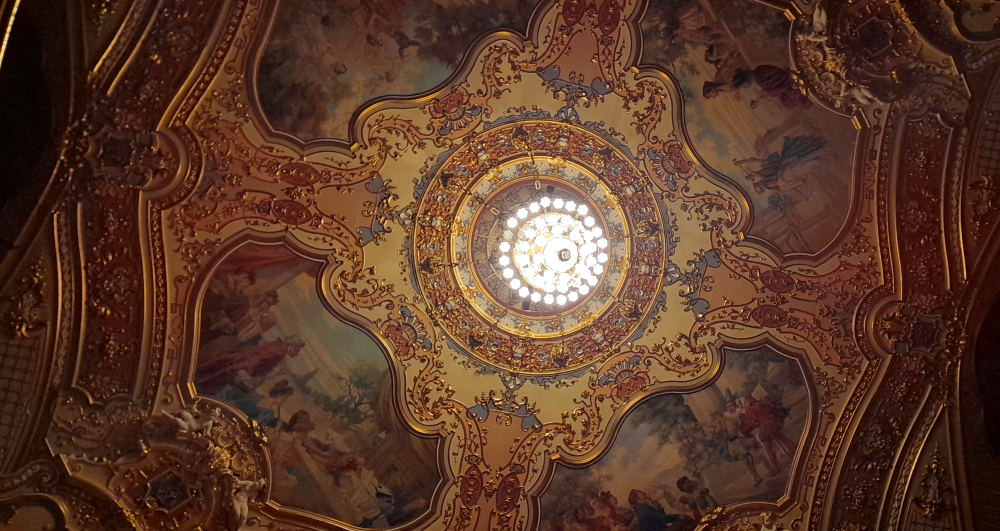
The ceiling is decorated with scenes from William Shakespeare’s plays – Othello, Romeo and Juliet, King Lear and A Midsummer Night’s Dream.

Impressive theatre ceiling.

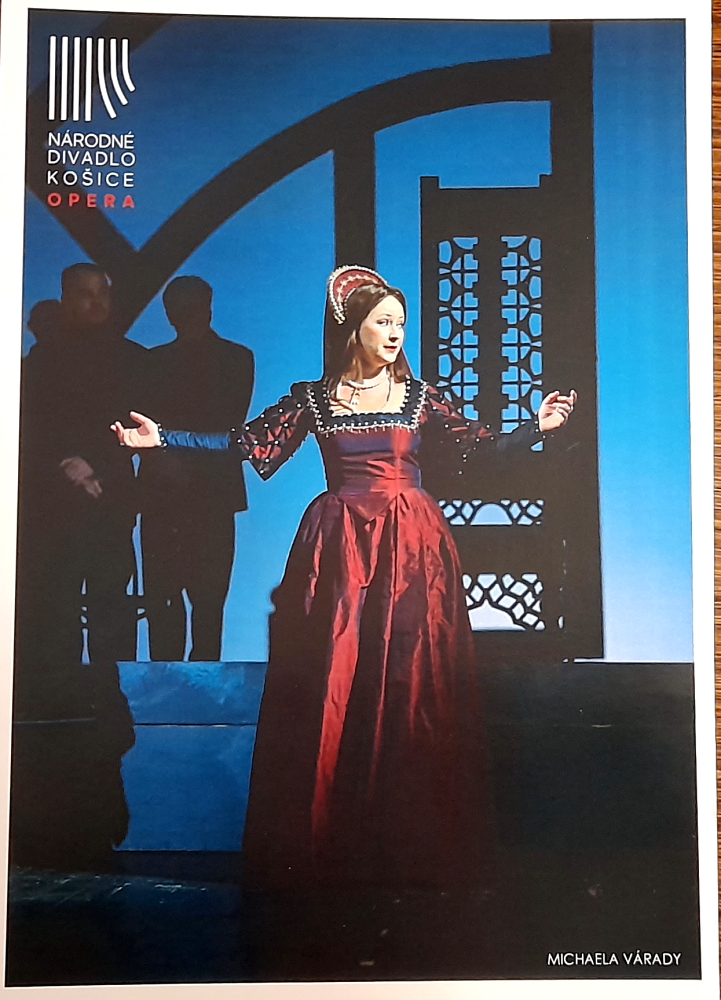
“Anna Bolena” is a tragic opera in two acts composed by Gaetano Donizetti based on the last part of the life of Anne Boleyn, the second wife of England’s King Henry VIII.

Anna Bolena premiered on 26 December 1830 at the Teatro Carcano in Milan, to “overwhelming success” where the composer had begun to emerge as one of three most luminous names in the world of Italian opera alongside Bellini and Rossini.

In April 1957, the opera was revived at La Scala for Maria Callas (one of the seven performances was recorded) in a lavish production directed by Luchino Visconti, with Giulietta Simionato as Jane Seymour. It proved to be one of Callas’ greatest triumphs. “Anna” was one of the last new roles performed by Dame Joan Sutherland, at San Francisco Opera in 1984.

Tonight’s programme.

Tonight’s performance is a mix of old and new – Anne and Jane’s costumes in the style of the 1500s whereas the male leads wore Victorian-era tuxedos, the male chorus dark suits with black t-shirts and the female chorus long black dresses with long sleeves, black gloves and padded black velvet headbands with pearls.

The stage piece is circular which rotates and stops at various angles with large wooden beams in 1 sector, bentwood chairs for the chorus and a large wooden throne for Anne and Henry, back-dropped by changing coloured lights often projecting silhouettes of the players. Simple yet effective.

Overall the experience is very enjoyable given our view just above stage height and close to the stage and regardless of the rock hard seats and the opera being sung in Italian with Slavik subtitles.

11 November, 2023

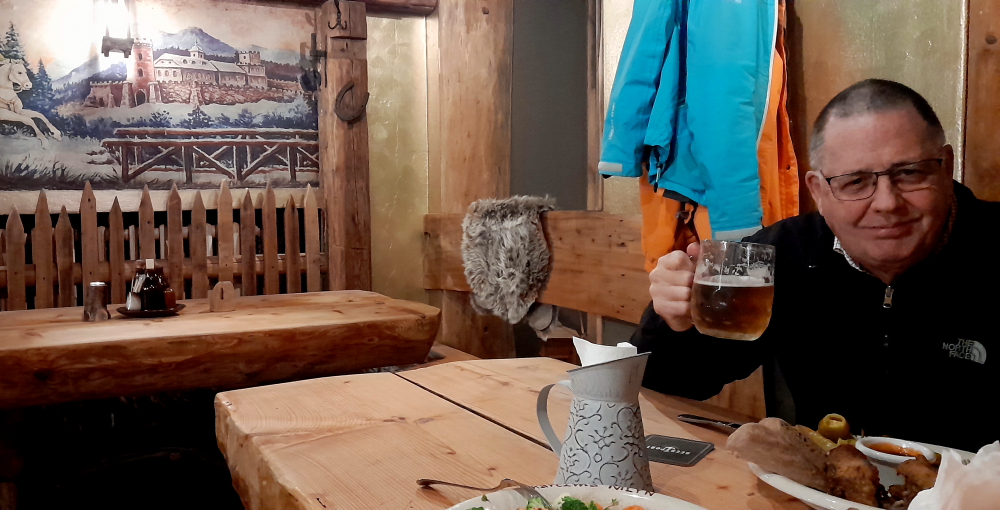
A catch up day today with dinner across the road at a newly-reopened restaurant. Apparently it was gutted by fire recently but quickly refitted and reopened yesterday, decked out in wood (wise choice?) with traditional Slavic decor, fare and beverages.

Newly-reopened peasant restaurant.

Tomorrow morning we are heading back over the border to Poland and staying in Krakow for three days then on to Warsaw to complete this 3-month tour of Central Europe.

We’ll be back … in Austria!

28 October, 2023

Steyr, our next destination, is 140 kms away in Austria. We drive out of the parking garage at 10:00 am on a cloudy, sunny but chilly 11 Deg. C. day and head towards the border where we need to buy an Austrian 10-day vignette for its road tolls.

As we approach the petrol station where we believe we can buy one, we come across another place that advertises Austrian and Slovak vignettes. Naturally, it is closed. So, 50 metres further on we stop at the petrol station.

No mucking around with using a kiosk. I buy one over the counter but this time it is a sticker than I then adhere to the top left corner of the windscreen. We’re in business!

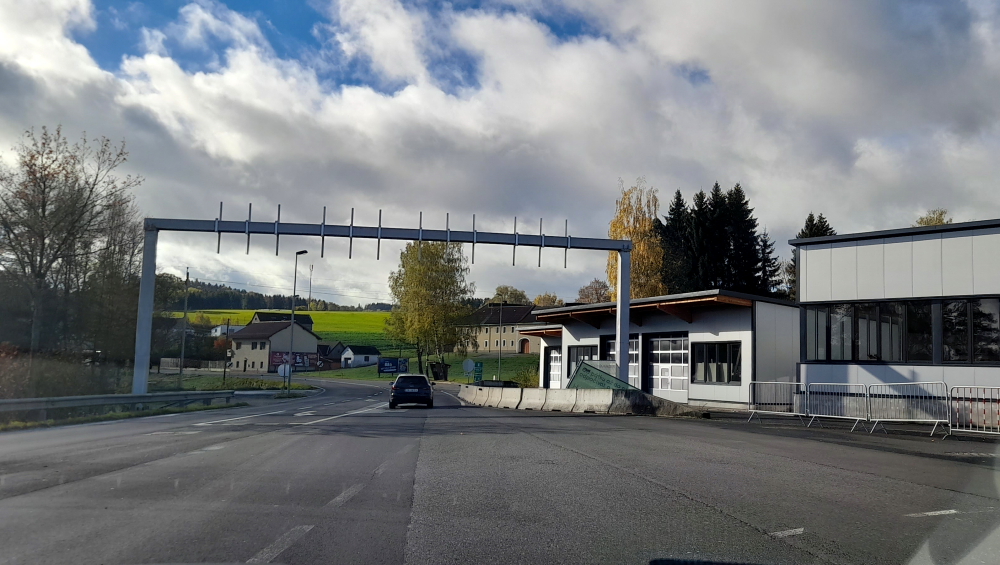
Crossing the old Austrian Border from Czechia.

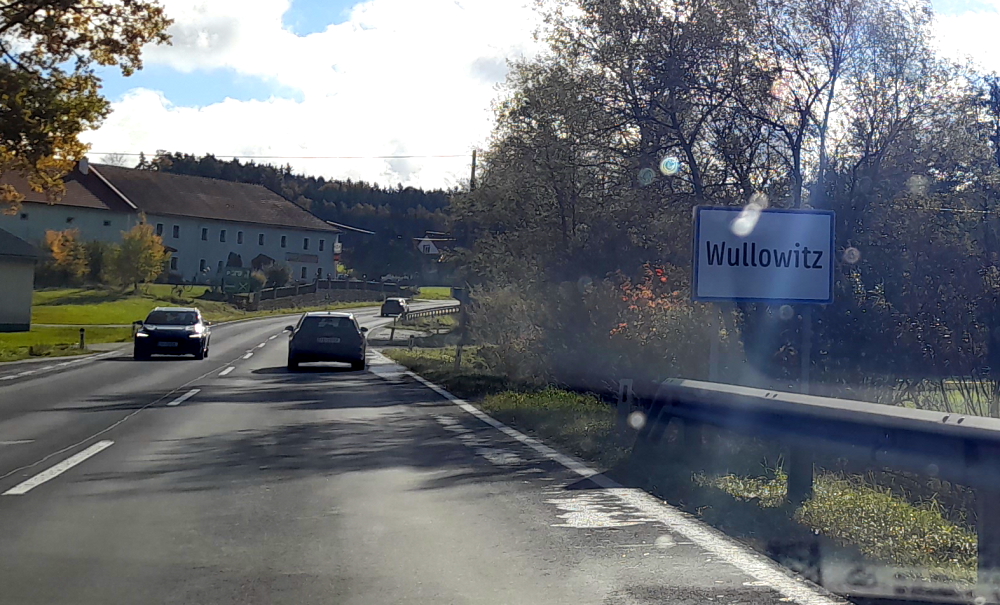
Immediately on the other side of the border we drive through a village called ‘Wullowitz’ and have a chuckle.

Is this where Howard comes from?

The scenery immediately changes to distant hills, mown meadows, neat and clearly-marked highways, tidy houses and farms and no graffiti so we know that we are no longer in Czechia.

Approaching Steyr.

Although we arrive early and park in front of the hotel on the historic cobblestoned Stadtplatz, our room is ready so the receptionist gives me a map, a ticket and directions to park at the parking garage across the river plus the room key.

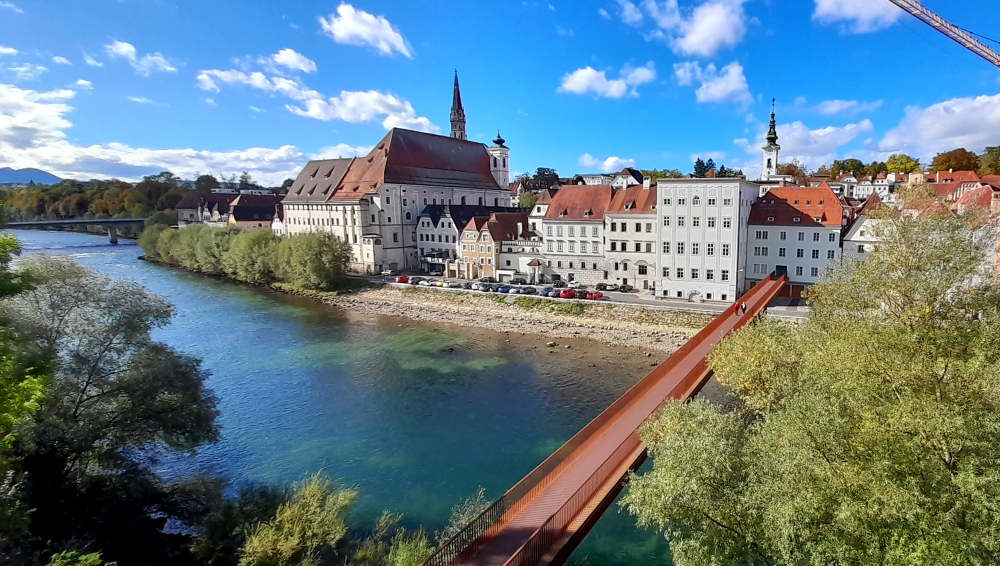
The walk along the Ennssteg bridge from the parking area back to town.

We take the bags upstairs then drive to the garage and walk back via the Ennssteg bridge, stopping at a cafe on the square for a toastie.

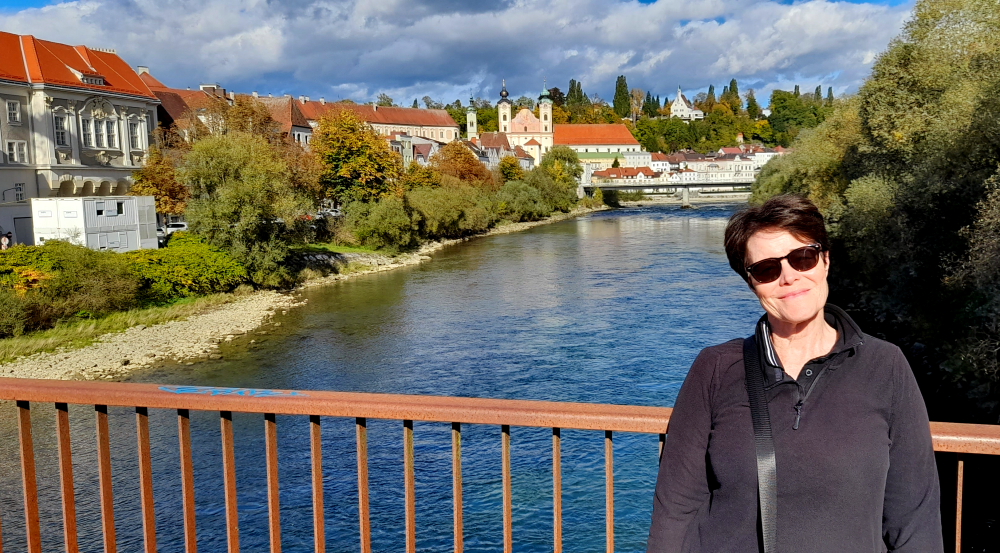
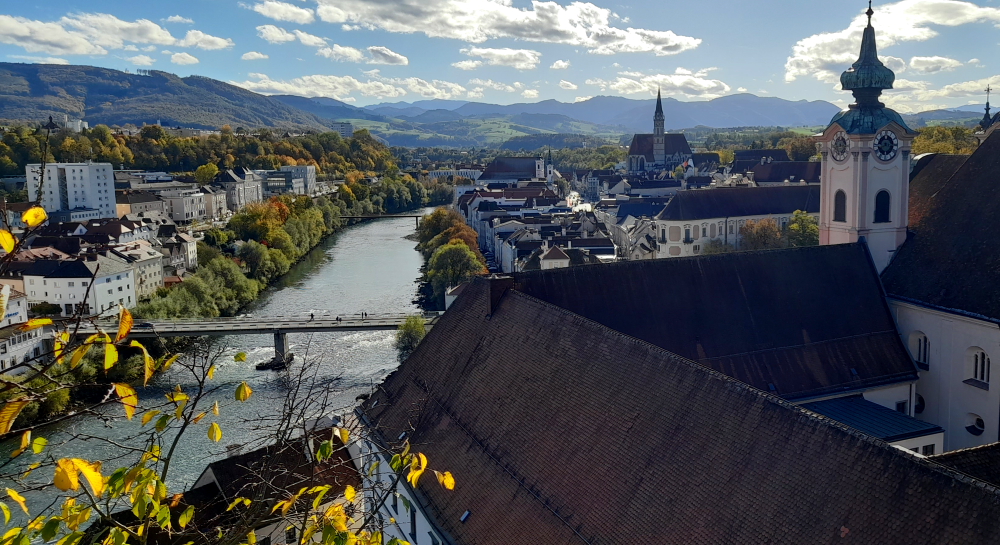
The Enns River from the footbridge.

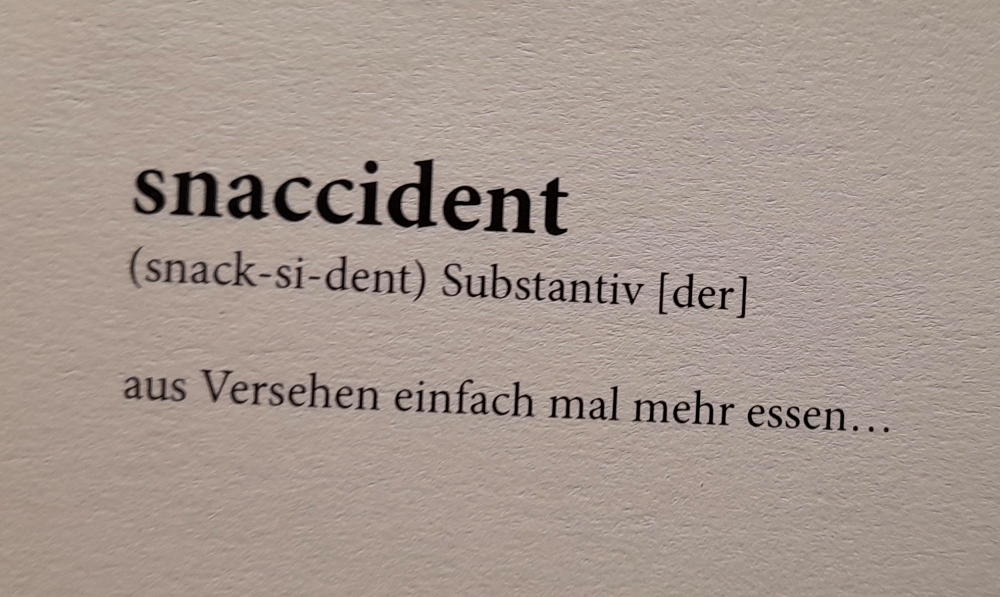
Where we came across this definition on one of the menu pages: “snaccident – accidentally just eat more”. We’ve all been there!

Coffee and a snack before unpacking.

As it’s such a brilliant day we decide to leave the packing until later and follow the map which has 2 walking tours on it, and do both of these.

Our hotel – The Stadthotel Styria in the town centre.

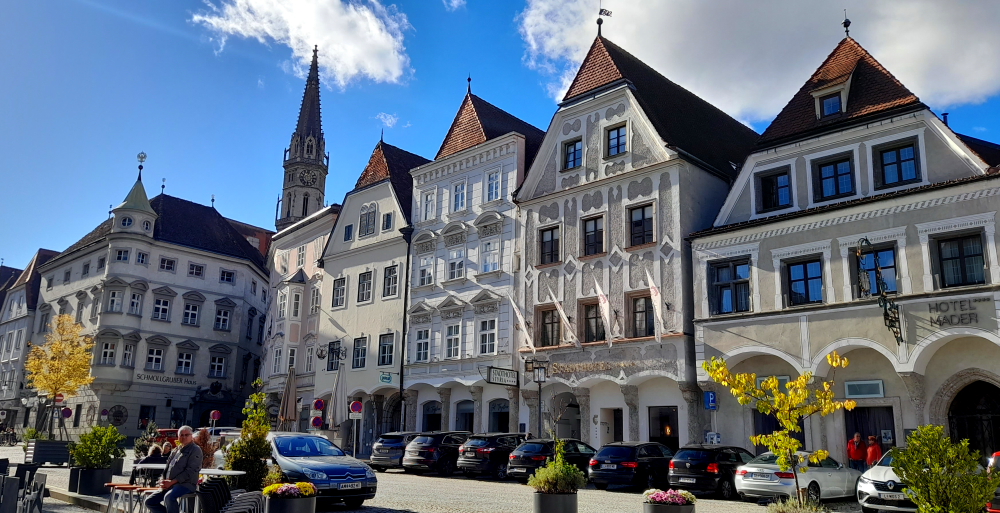
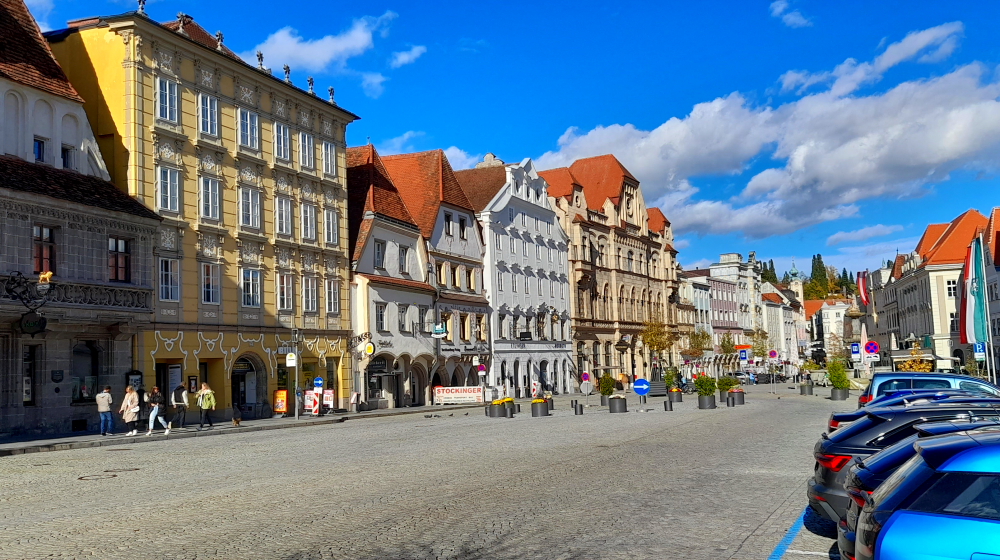
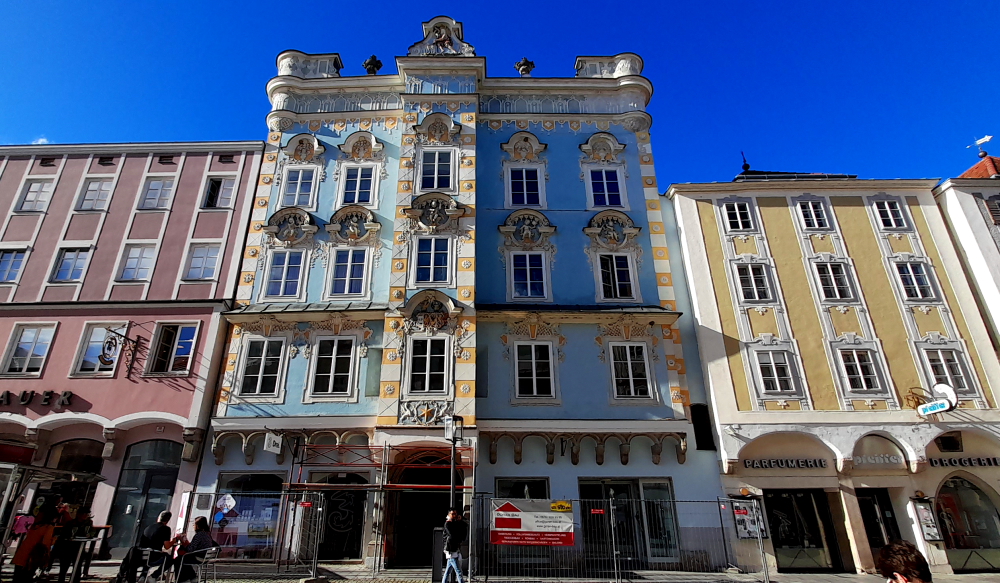
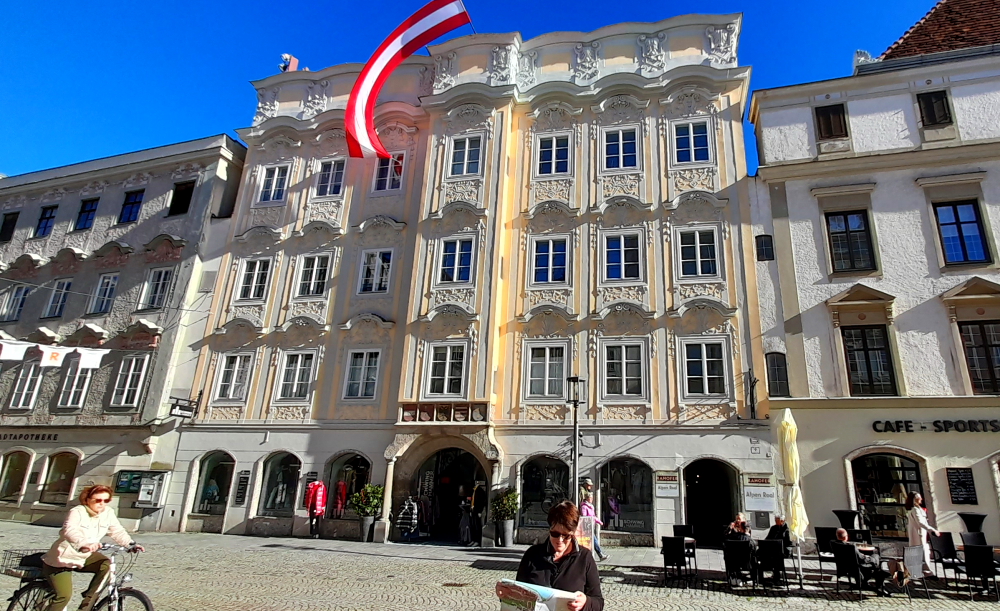
The walk starts in the Stadtplatz, the city square and main street, bordered by amazing historic architecture.

Stadtplatz town square & main street.

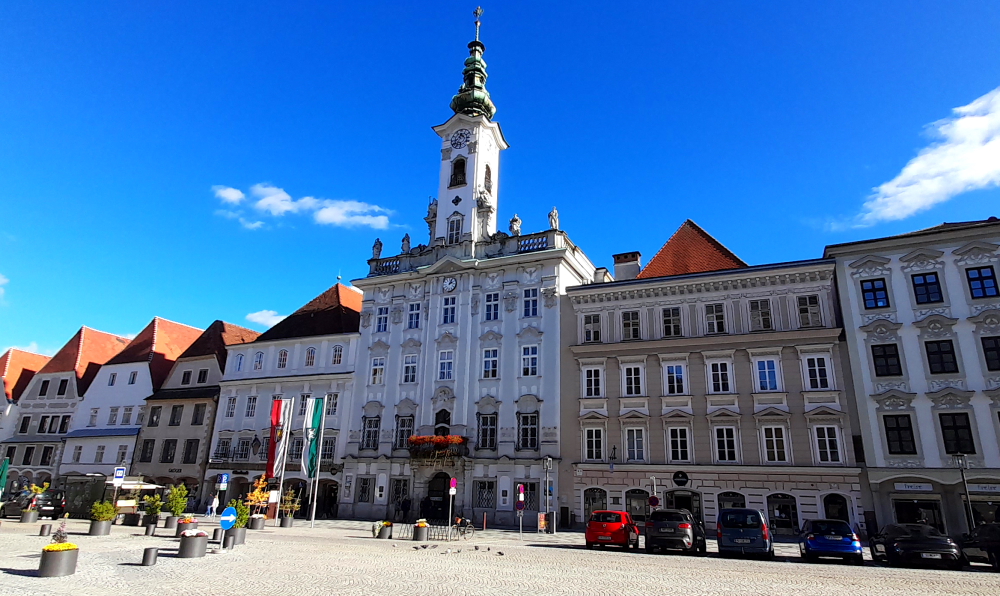
The first point of interest is the Town Hall, one of Austria’s most significant Rococo monuments. It was built by Gotthard Hayberger mayor and municipal Judge of Steyr between 1765-1778. The 4 Baroque female statues on the balustrade symbolize the powers held by the municipality at the time. Justice (scales and sword), penal law (chained foot with ball), clerical patronage (censer) and Roman law (book in hand).

The Town Hall.

Opposite is the Bummerlhaus, the town’s landmark and one of Austria’s best preserved Gothice buidings. Part of the building dates back to the 13th century. In the 19th century the building accommodated the “Zum Goldenen Lowen” Inn. To this day its sign still features a lion The inn’s patrons were so fond of the lion they called it “Bummerl” (small, corpulent dog). So eventually the Bummerl Inn bcame the Bummerlhaus.

Bummerlhaus.

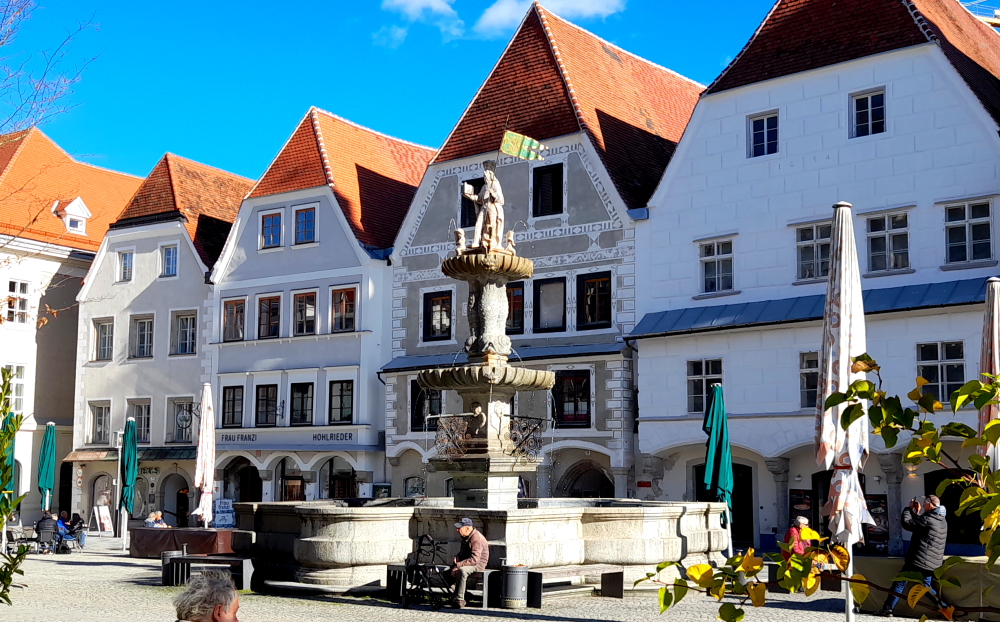
In the middle of the square is Leopold Fountain. It dates from the second half of the 17th century and the sculpture that crowns it depicts St Leopold, Austria’s patron saint. Before canonization he was Leopold III, known as Leopold the Good, Margrave of Austria from 1095 until his death in 1136 and was a member of the House of Babenberg.

Market Square fountain.

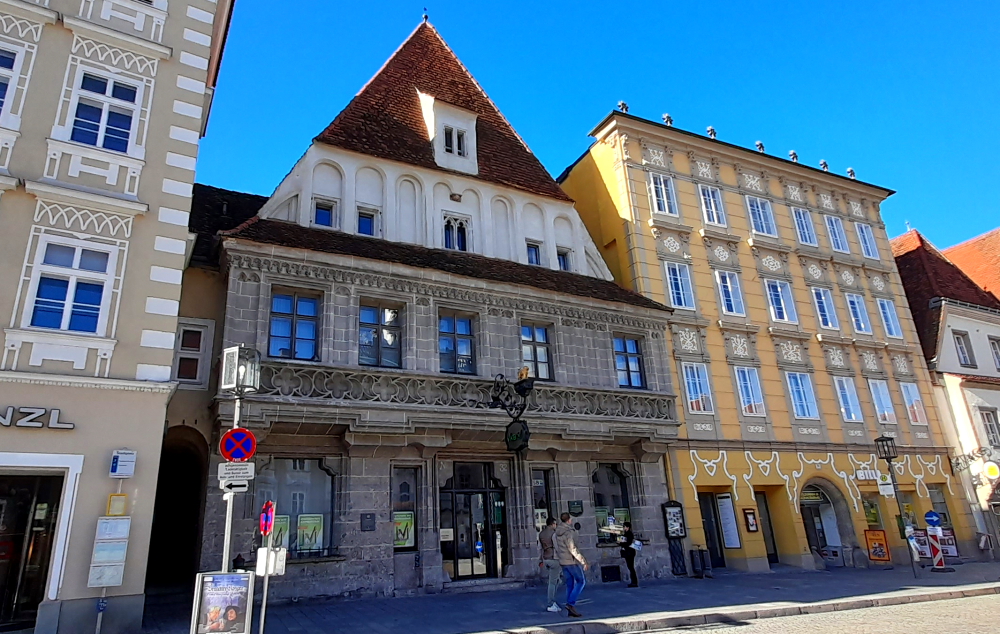
After total destruction during the 1727 town fire, the Sternhaus was reconstructed with a facade in late Baroque style. It owes its name to the golden star held by 2 birds of prey above the portal, a symbol of the iron trade for which Steyr was famous.

Sternhaus.

The Meditzhaus is located opposite the Sternhaus. Named after its former owner it boasts an elaborate Baroque facade and one of Steyr’s most magnificent courtyards. The courtyard is surrounded on 3 sides by picturesque arcades and Tuscan columns (closed today). The wide passageways leading down to the Enns River indicate that courtyards served as trading places that had to be accessible by horse-drawn vehicles.

Meditzhaus & Meditzhof.

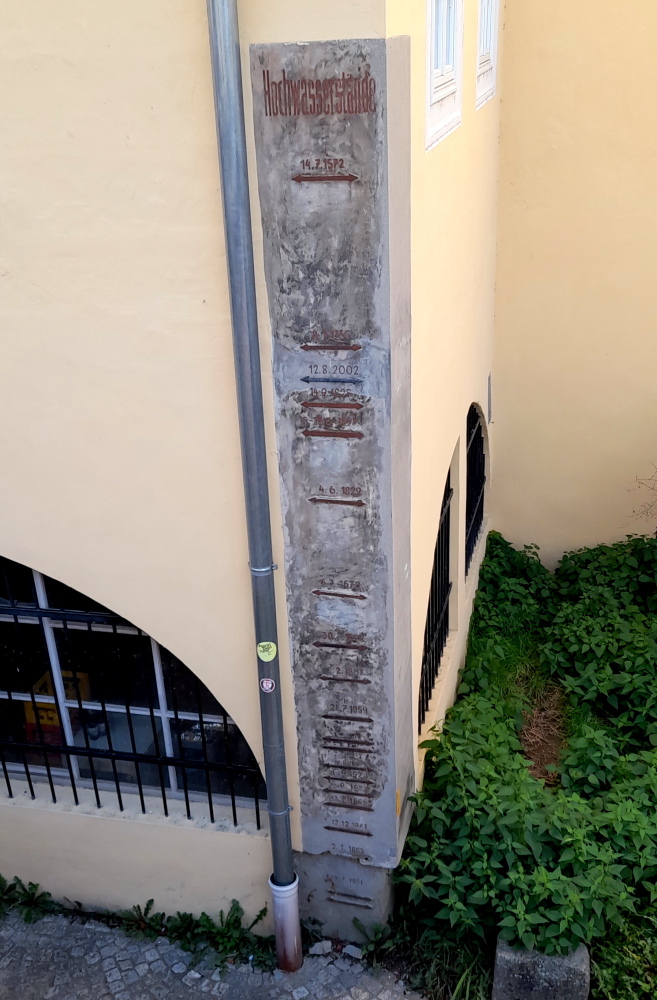
At the end of the Stadtplatz is a small square known as the Zwischenbrucken (intermediate bridges) as it is at the confluence of the Enns and and Steyr Rivers over which are 2 bridges at right angles to each other. Here there is a column showing flood levels over the centuries with the 2002 flood being the 3rd highest level, behind the highest one on 14 July 1572.

Flood levels since the 16th Century.

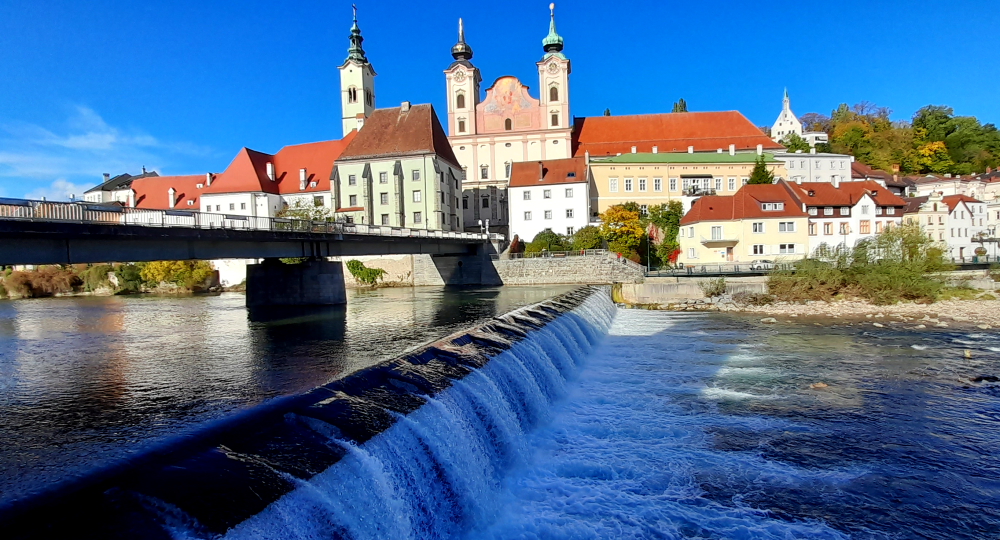
Remains of an old wooden bridge are still evident where the Steyr River joins the Enns. The bridge would wash away regularly so to manage the Steyr River flows a weir was constructed and later a modern concrete and steel bridge build above the flood levels.

The Steyr Bridge and weir across the Steyr River.

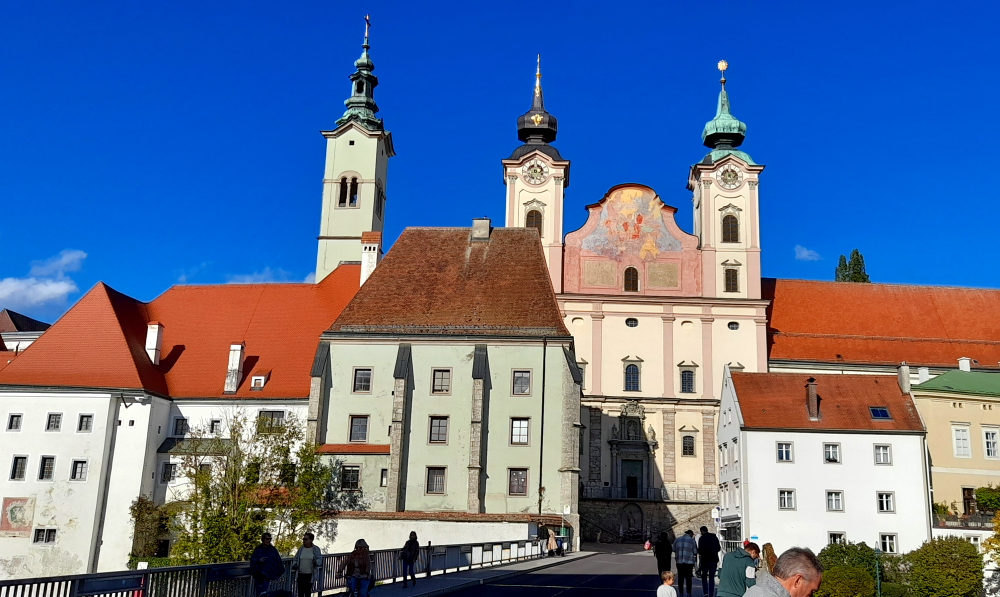
Taking the Northern Loop we cross Steyr Bridge to Michaelerplatz and the Michaelerkirche, the twin-towered Baroque church built between 1635-1677. The gable between the 2 towers features a fresco of St Michael depicting the fall of the angels.

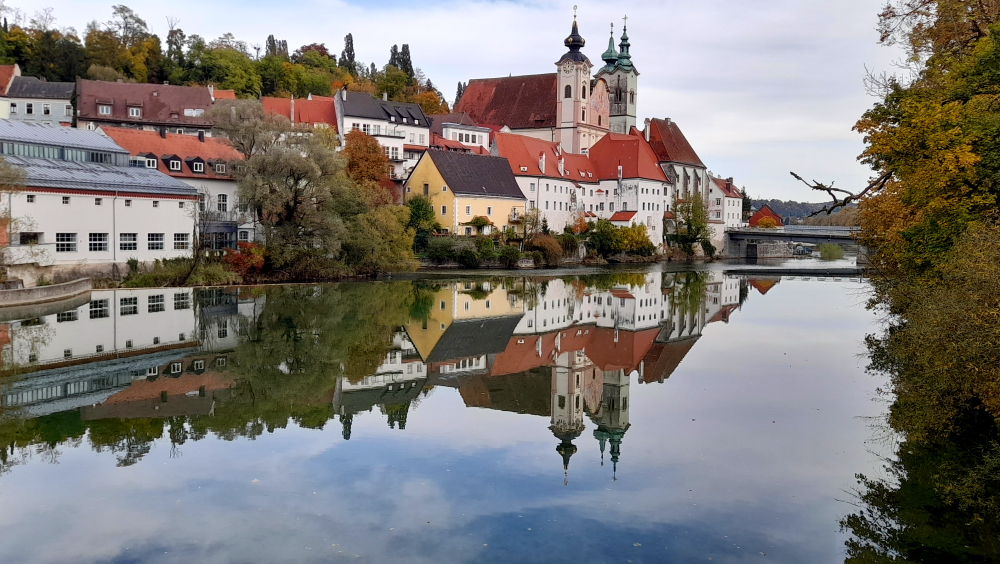
Three Church Spires.

At the church Lynn heads inside for the usual picture while I enjoy the afternoon sunshine. I am a bit over the massive number of expensively built European churches that seem to have more tourist visitors than congregation. Perhaps people know these days that you can’t buy a stairway to heaven.

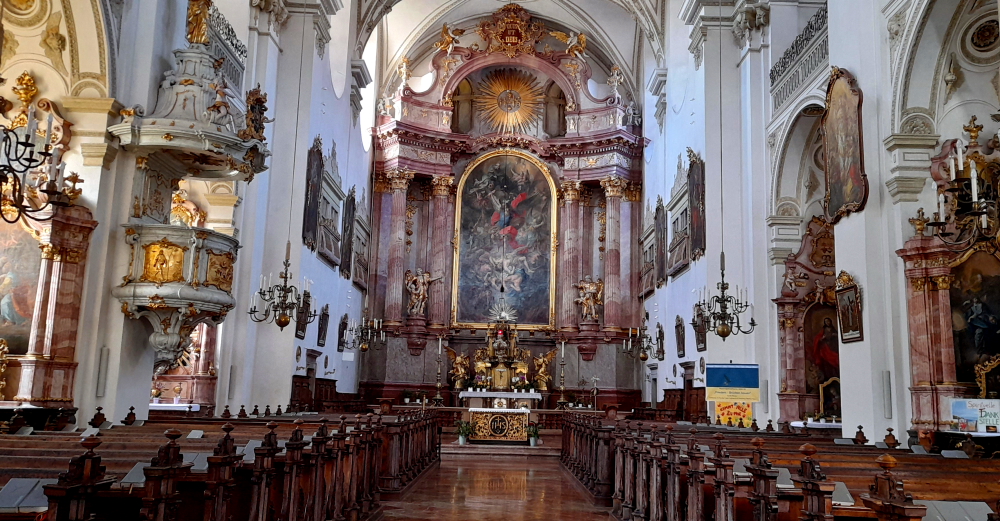
The altarpiece shows the Archangel MIchael’s victory over Lucifer.

Inside the Michaelerplatz and the Michaelerkirche Church.

Turning left from the church’s doorway, parallel to the Enns River, we walk through a tunnel where we find a lift up to the Taborturm, now a restaurant, and a small viewing platform in front. Originally, the 15th century tower was part of the town’s fortification, later it was used as a fire lookout tower.

View of confluence of the Enns and Steyr Rivers from Taborturm.

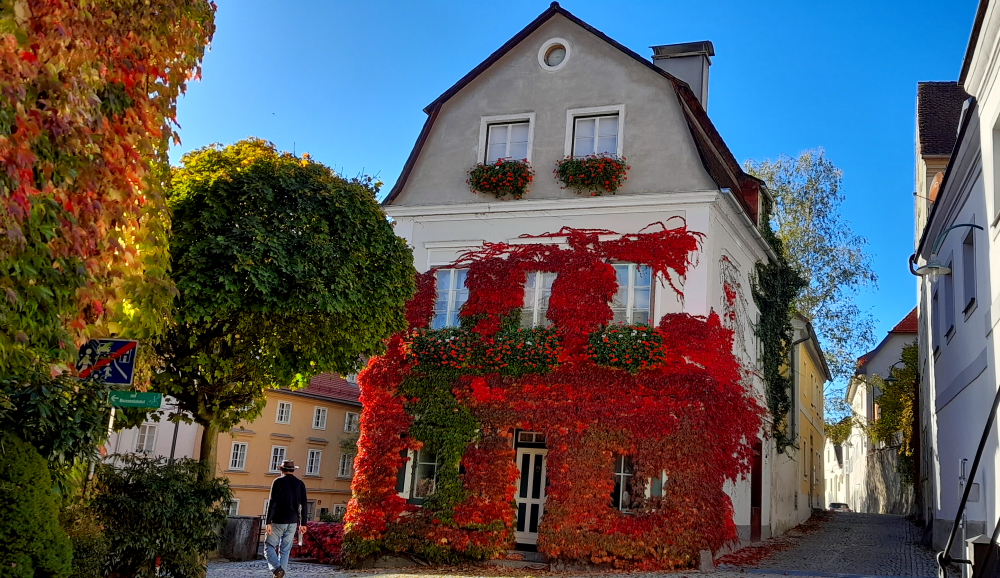
From here we walk along Taborweg bordered by a high wall protecting the extensive cemetery on the other side. Down numerous stairs we come to Fabrikstrasse where this house, clothed in rich autumnal colours, borders a stream.

Autumn in Steyr.

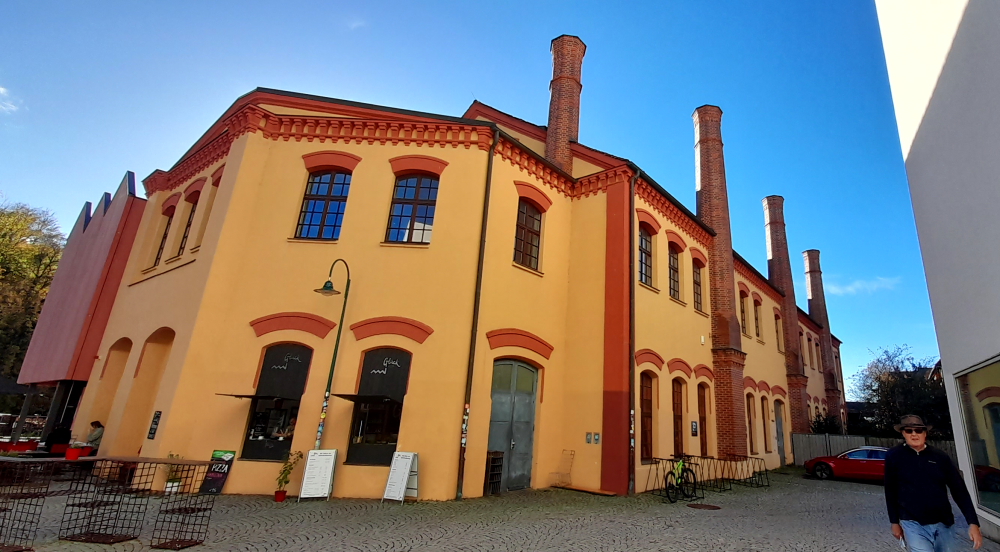
Further on is the Steyr River upon which is the Arbeitswelt Museum, the revitalised 19th century factory complex which used to be a former knife then armaments factory, with its distinctive short chimneys.

The old gun factory.

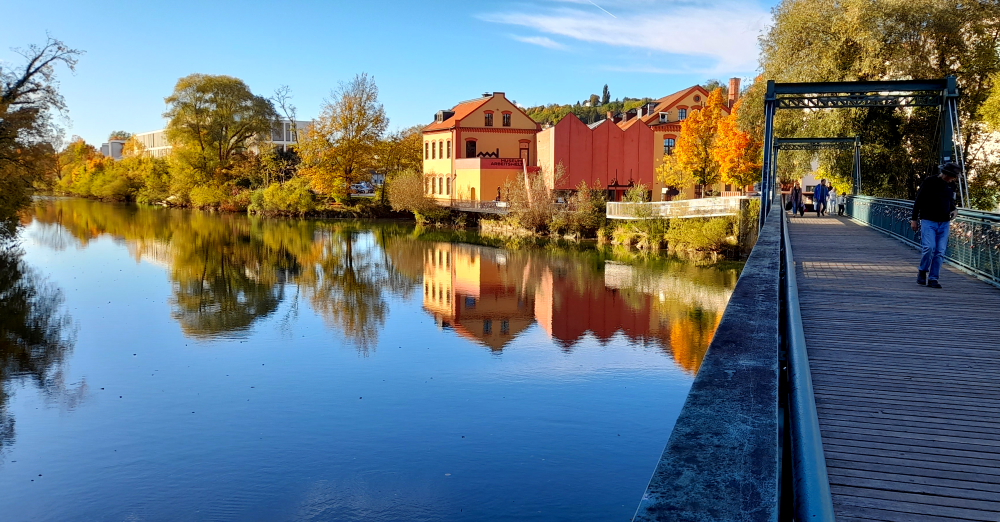
We cross over the Museumssteg then walk along the footpath along the Steyr River back to the Zwischenbruken square.

The Steyr River footbridge.

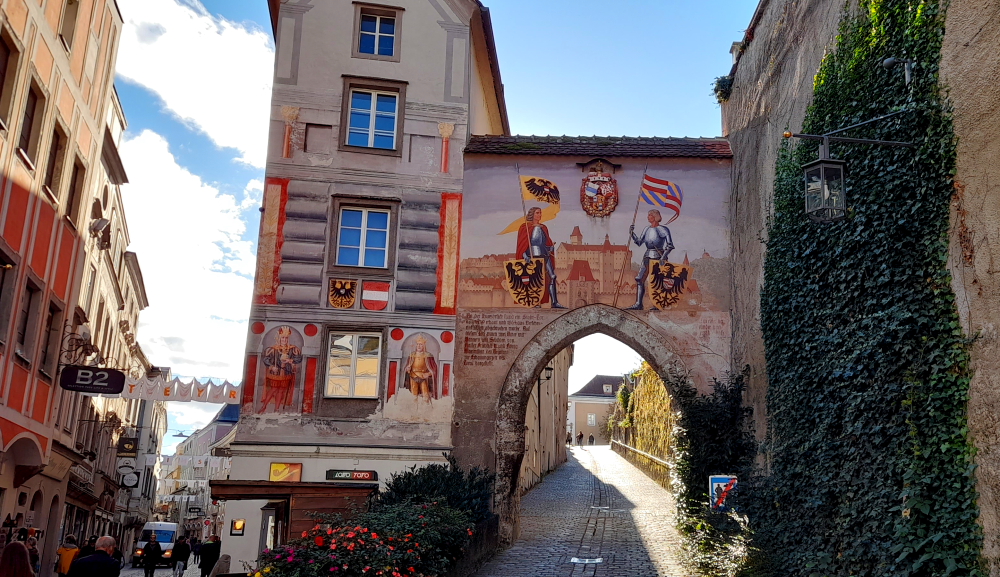
Here we pick up the Southern Loop which takes us under a Gothic archway where the cobbled roadway leads to an entrance to the Lamberg Schloss. The fresco above the archway depict the 2 Habsburg emperors Friedrich III and his son Maximilian. Legend has it that these 2 knights were the founders of the town of Steyr.

The Lower Gate to the Lamberg Castle.

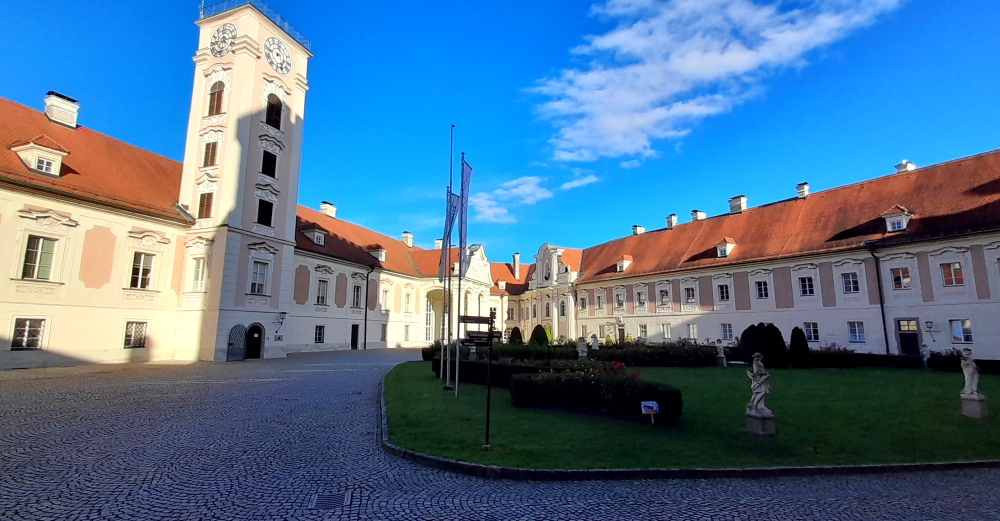
We walk up the stairs through the entrance to the Schloss and soon come to its courtyard. First mentioned in a document in 980, of the original fortress only the castle keep has survived. The castle attained its highest status in the 11th century as the residence of the Otakars. The entire edifice was destroyed in the great fire of 1727 and rebuilt as a stately Baroque castle by Count Lamberg.

The inner grounds of the Lamberg Castle.

In the corner of the courtyard is a long passageway which spans a grassy moat, complete with 2 curly-horned mountain goats (no bears here). ,

Inside the castle.

This leads to an open porch which is the entrance to the Schloss from its gardens.

The castle Library and entrance to the gardens.

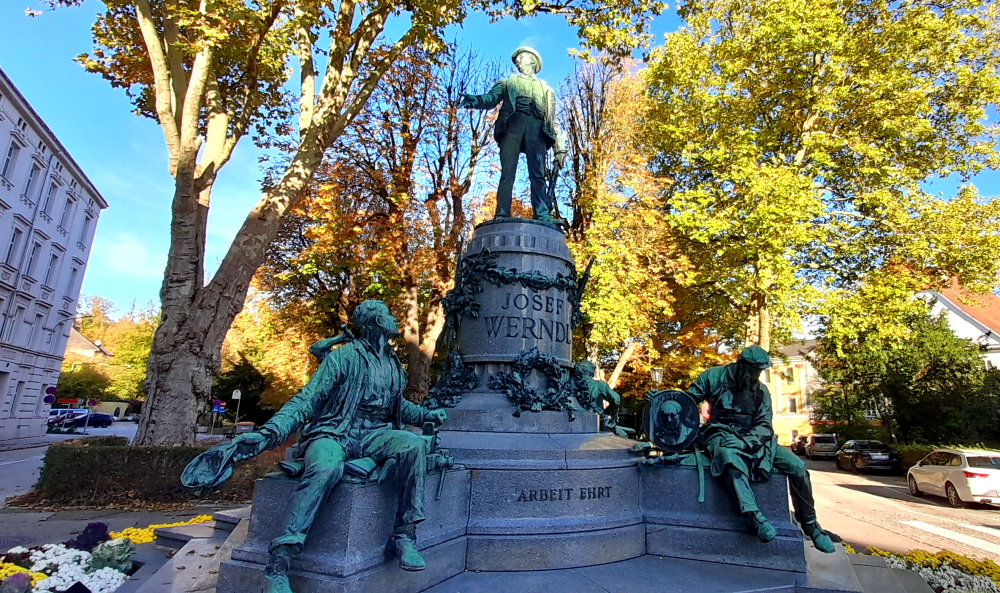
Strolling through the gardens past the Orangerie, Palmenhaus (Palm House) and Vogelhaus (Aviary) we come to the Werndl monument at the commencement of the Handel-Mazzetti-Promenade. Josef Werndl (1831-1889) was often praised as the “Saviour of Steyr” and “Father of Workers”. He founded the “Osterreichische Waffen-fabriksgesellschaft” (Austrian Weapons Company) and, together with Karl Holub, designed the breech-loading rifle. In 1935 the factory merged with the Steyr-Daimler-Puch-AG. To honour Werndl’s services to the town, Victor Tilgner created this life-size statue which was unveiled in 1894.

Joseph Werndl Monument.

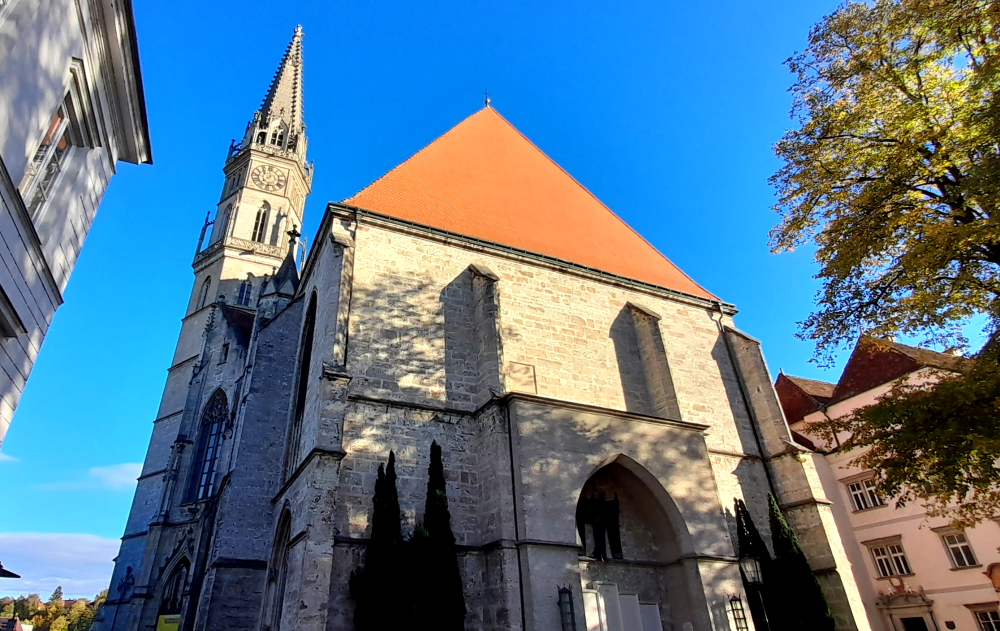
Down some steps we arrive at the Stadtpfarrkirche Hl. Agydius and Kolomann, (City Parish Church of St Agydius and Kolomann). Also called Steyr Minster the church was built between 1443 and 1522 and was erected during the most prosperous time of Steyr to replace the old Romanesque church. The 80m-high tower (which we can see from our hotel window) was destroyed in a fire and rebuilt in neo-Gothic style (1885-1889).

Inside, the high altar was built in 1857 in memory of the unsuccessful assassination attempt on Emperor Franz Joseph. Anton Bruckner, “God’s musician” loved Steyr and often visited the town. He frequently spent his summer holidays in the parish house where he composed parts of his 8th and 9th symphonies. One of his favourite instruments was the Chrisman organ in this church. A monument to him is outside the church.

City Parish Church of St Agydius and Kolomann.

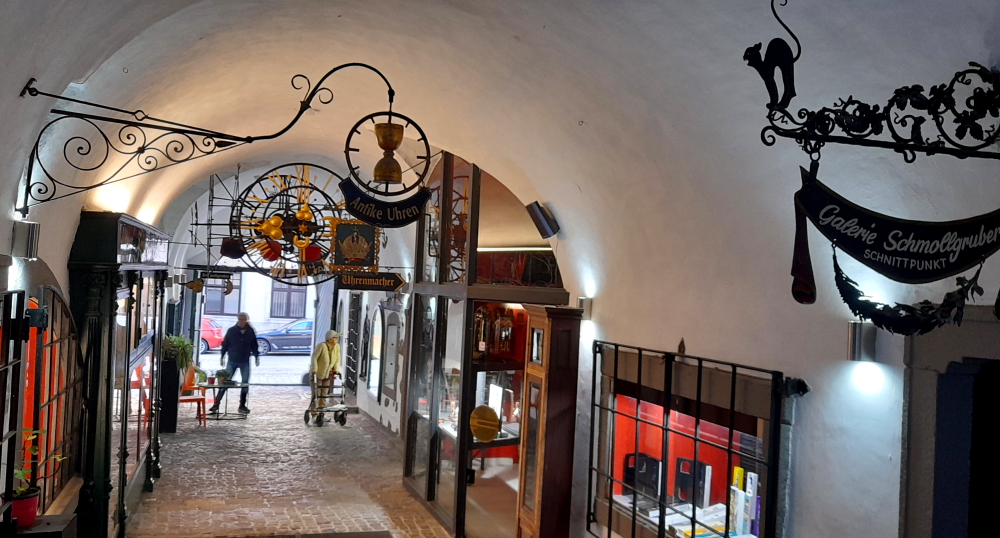
As we are walking down Pfarrgasse see some old clocks in a window which became an arcade of old clocks and clock mechanisms, complete with original, ornate shop signs.

The clock makers arcade.

Tonight we booked a table (being that it is Saturday) at the restaurant next door to the hotel. The food is so much better that the Czechian food quality that we have endured this past couple of weeks.

29 October, 2023

Daylight savings ended last night which meant we had an extra hour’s snooze this morning.

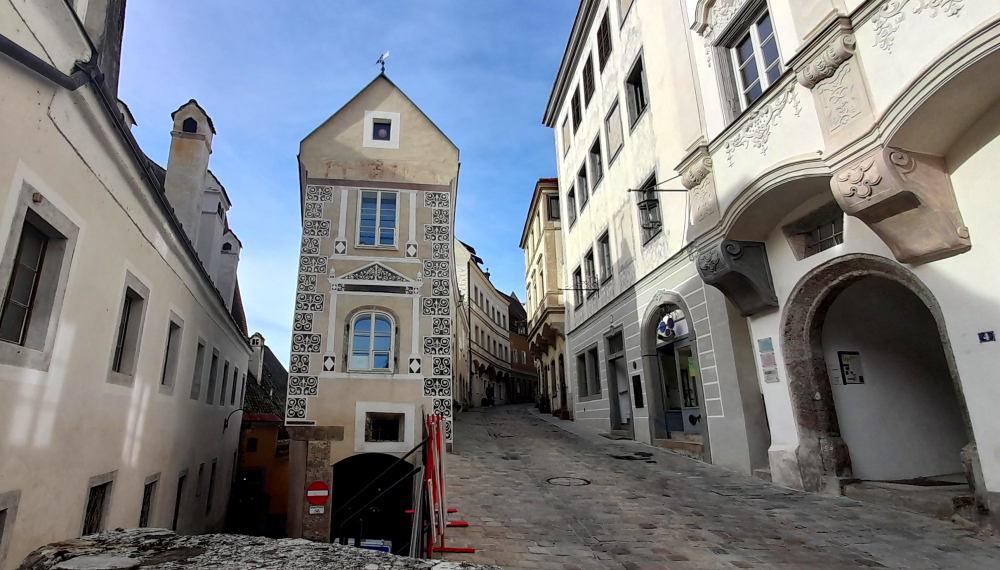
Another sunny day so we decide to walk up Kircheng and Gleinkergasse from the Michaelerkirche to view the Schnallentor Gate.

Narrow roads in this part of town.

On the way we pass various shops including this bakery.

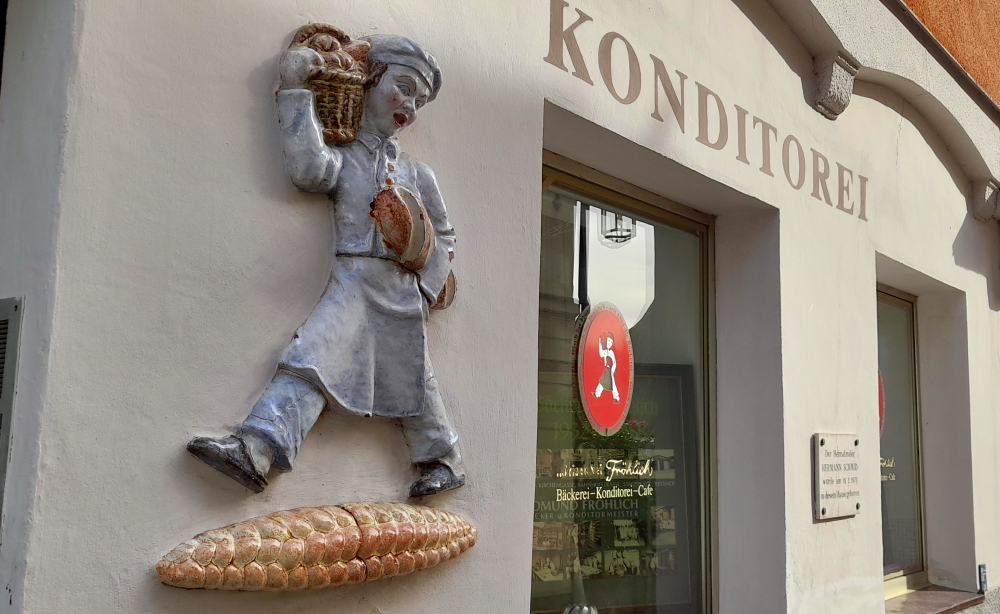
Ceramic sign so no confusing this business.

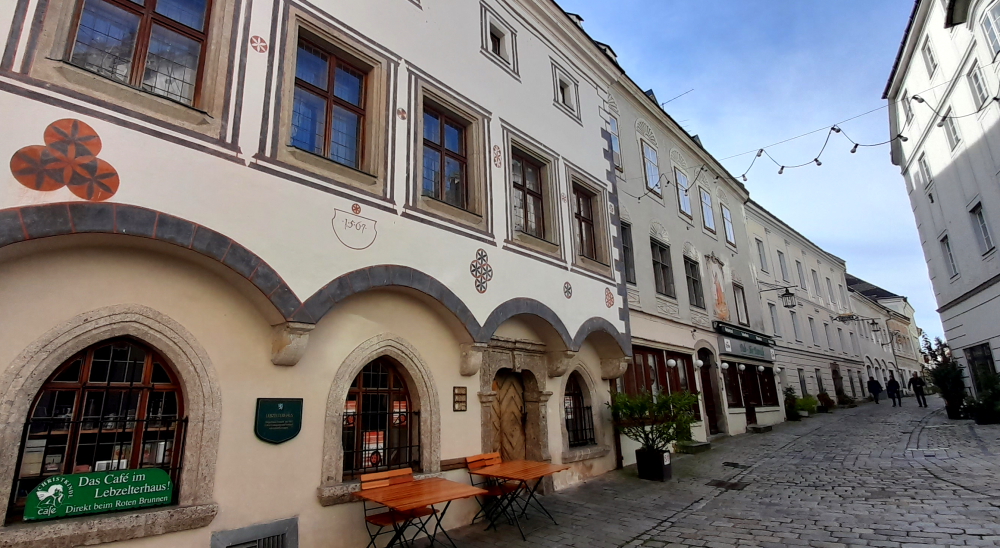
Lebzelterhaus in its current form dates back to around the middle of the 16th century. The facade shows the year 1567. Gingerbread, mead and wax candles were sold in the house until 1957 and were manufactured there until the middle of the 19th century. Today it houses a cafe.

Lebzelterhaus.

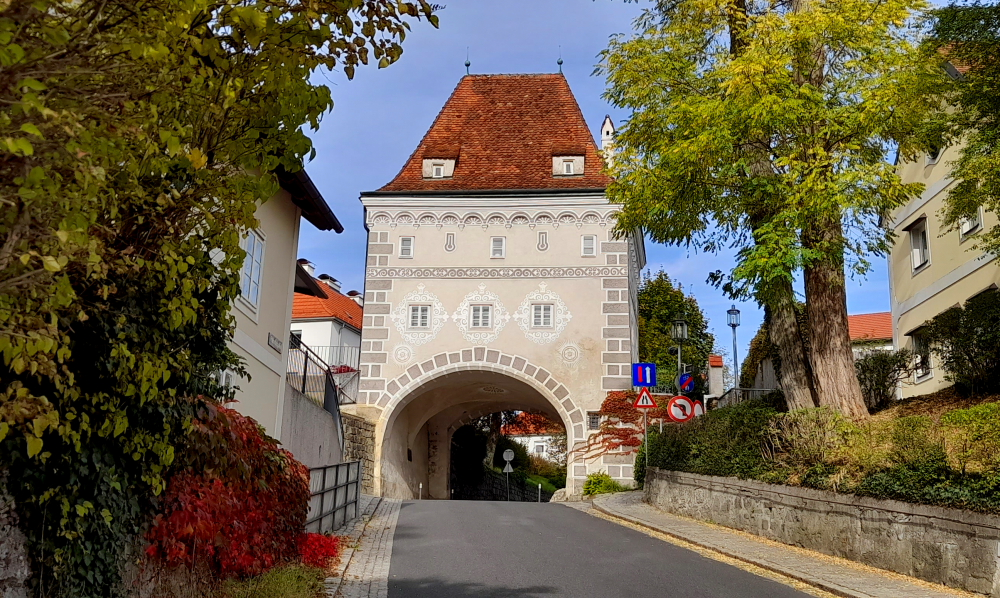
After a sustained uphill walk we finally come to the Schnallentor Gate. Formerly it was part of the town fortifications and a tollgate, schnalle being the name of an old coin.

Schnallentor Gate.

We retrace our steps from yesterday and end up at the Arbeitswelt Museum cafe for a coffee while watching the Steyr River pass by then return to the hotel via the Museumssteg footbridge and Stadtplatz.

Smooth fast flowing Steyr River.

While I go upstairs Lynn ventures across the road to the Marienkirche. In the late 15th century Dominican monks established a monastery and church in this place which were completely destroyed by floods and fire in the 16th century. The church was rebuilt in the mid-17th century in early Baroque style.

Marienkirche.

Between 1774 and 1778 the church was renovated with a remarkable Rococo interior. The towers were also redesigned during this time. The mighty high altar with the artistically valuable statue of the Virgin Mary, the pulpit full of figures and a new organ were also installed during this time.

Rococo interior of the Marienkirche.

It’s now dark and time to go downstairs to the onsite TexMex restaurant. Great that we don’t have to venture far for dinner again today.

30 October, 2023

All day we have been battling with an unreliable internet connection. We have one last booking to do and we are still having some issues with HSBC to sort out despite their continued promises to resolve the issues and call us back. They never do!

It has taken us all afternoon to do an hour’s worth of work. Luckily the weather outside is cold and damp and we have pretty much walked the town twice in the past two days.

Lynn finally gives up on the internet and calls HSBC. At least she is now speaking to someone who can speak English and seems to know what to do. However, nothing is achieved and again Lynn is promised that someone will call her back once they know how to resolve the issue. Don’t hold your breath.

As it is Monday most of the restaurants in town are either closed or only serve drinks and snacks. We head out about 6:00pm in the cold and wet and finally find an Asian Restaurant which is open. We have some pretty good Thai food (for Lynn) and I have some sweet and sour chicken.

31 October, 2023

It is bucketing down outside this morning. The plan today is to go to Graz where we are staying at our friends’ Guesthouse just a little to the NE of Graz. We stayed here at Felix and Ingrid’s Landgasthof Riegerbauer back in the summer of 2015 for a week.

But first, since we are heading from Steyr to Graz we decide to stop in at Thal (NW of Graz) to visit the Arnold Schwarzenegger Museum.

Wet drive to Graz.

We get away at 10:15am in the rain and 10 Deg. C. It should take us 2 hours and 15 minutes to drive to Thal.

Around 11:30 am the temperature drops to 7 Deg. C. and we can see why. Along the top of the hills that border the roadway we can see snow.

Snow still on the hills of the Austrian Mountains.

Thanks to roadworks and wet driving conditions we arrive at the Museum at 12:40 pm which gives us just under an hour and a half before it closes at 2:00 pm for half an hour for staff lunch break.

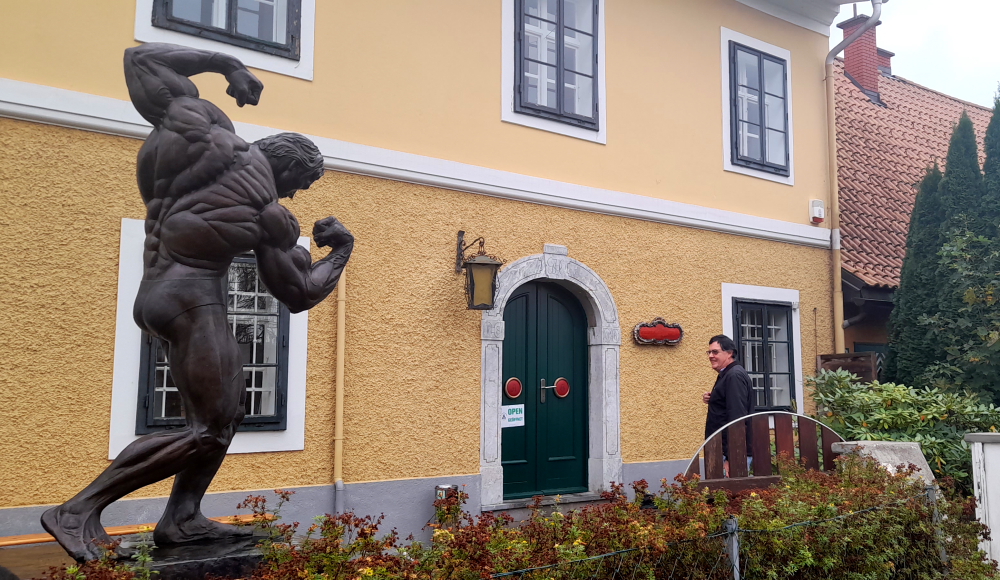
Thal is where Schwarzenegger was born and grew up as a farm boy before embarking on his amazing career as a world champion body builder, a movie star and finally the Governor of California.

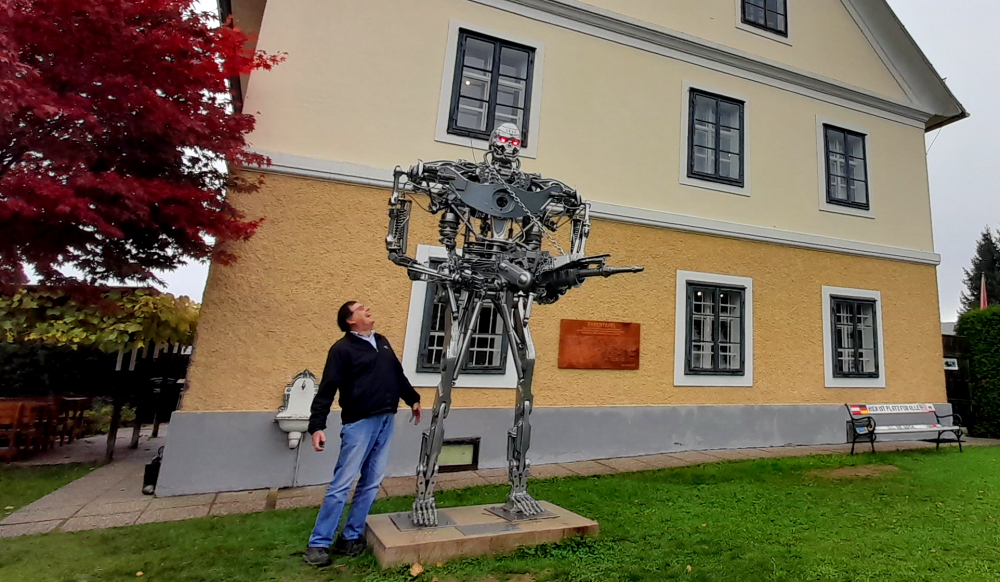
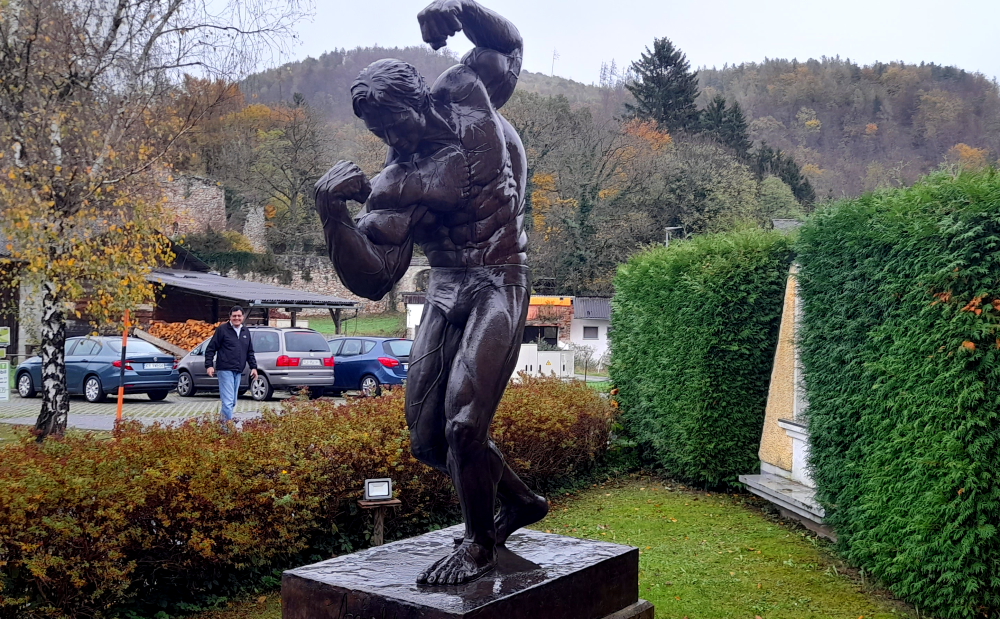
The Schwarzenegger Museum in Thal.

The museum is the former forester’s lodge of Counts Herberstein which is in a small village surrounded by fields with a nearby lake and castle ruins.

He was back (last Saturday).

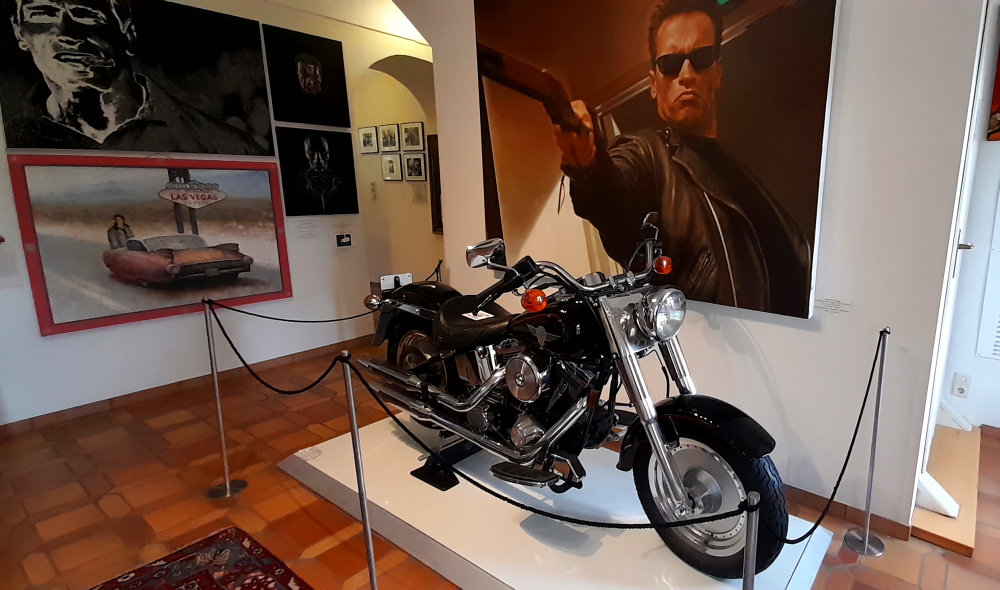
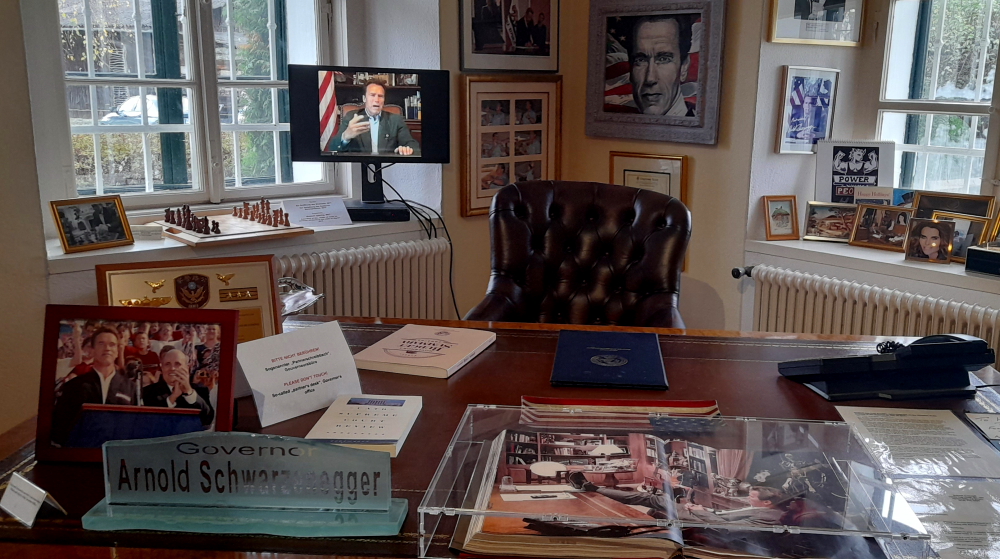
The numerous exhibits show his extraordinary CV and also the most important phases of his life such as childhood and youth, bodybuilding, film career and time as a governor of California.

Arnold the Governor.

Viewing a TV documentary about his life a couple of months ago prompted us to visit the museum as it was on our way to Graz.

Mister Schwarzenegger to you.

According to the receptionist, we weren’t the only ones. This past summer since the documentary aired, the museum was getting 200-300 people per day! The car park only caters for about 8-10 cars. Apparently the neighbours were getting a bit antsy with all the traffic!

We practically have the place to ourselves.

Need oil for the rusty bits?

But, if we had been here 3 days ago, we would have bumped into the man himself! He paid a surprise visit to the museum with his current girlfriend.

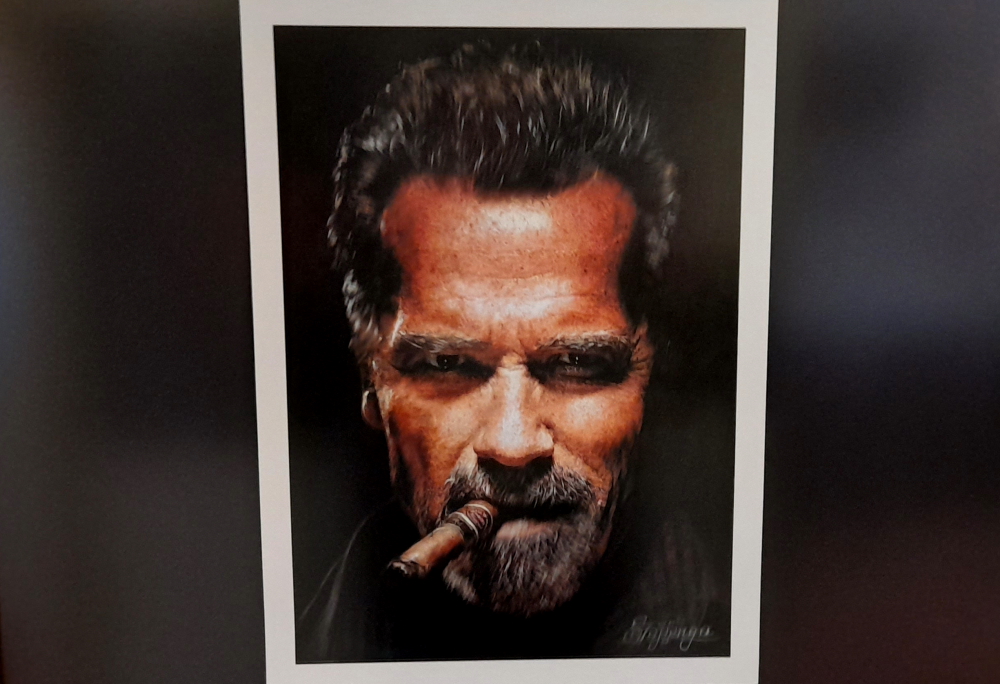
Can’t be mistaken for my body.

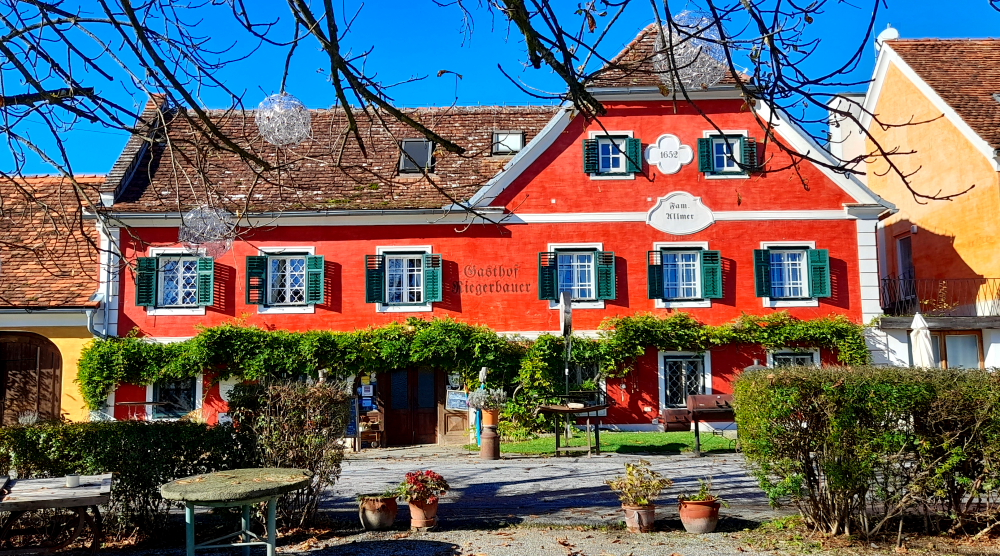
Less than an hour later we are on the road again and head to the village of Sankt Johann bei Herbertstein, the location of the Riegerbauer guesthouse. After a short delay as we join the autobahn due to an “unfall” (accident) we arrive at the 1652 guesthouse bang on 3:00 pm as planned.

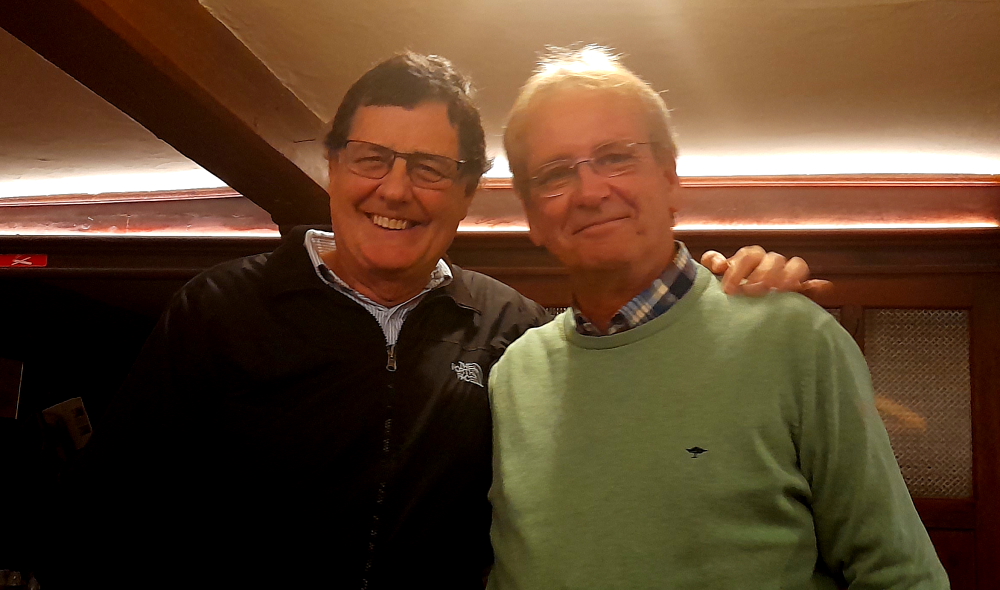
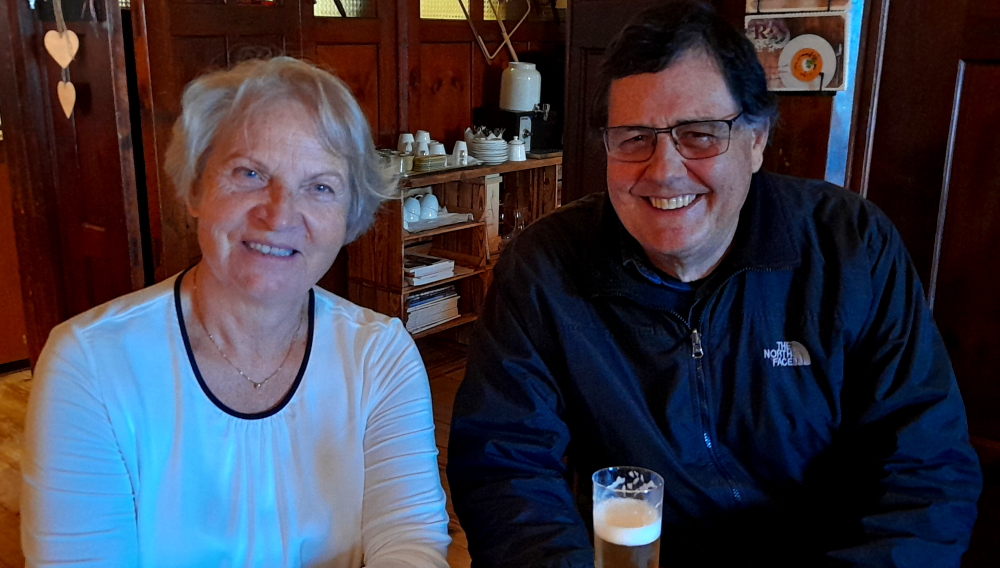
Catching up with Felix after 8 years.

Soon we are seated in the authentic, wood-panelled restaurant with Felix and Ingrid, catching up over a couple of glasses of excellent red wine.

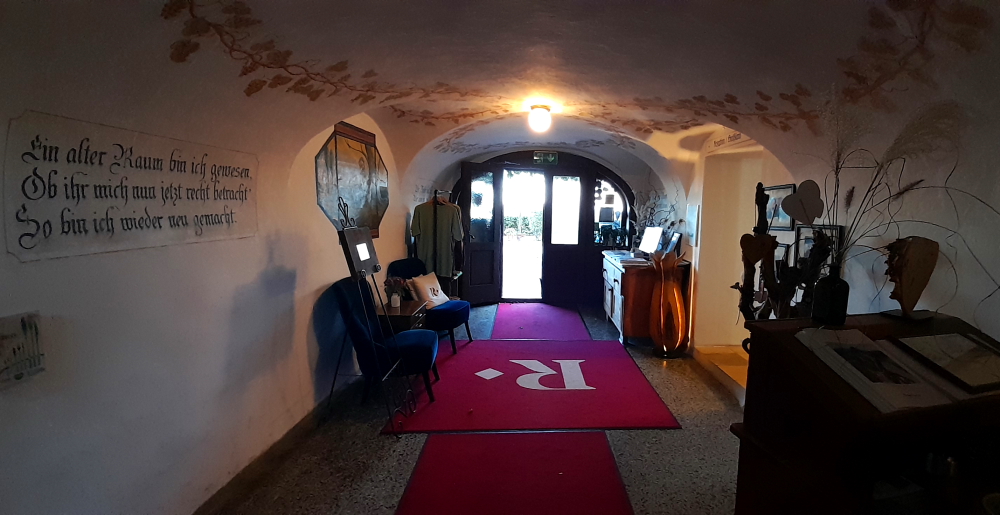
Since we last stayed here in 1 of the only 2 rooms (suites) available, we are now shown to one of the new apartments next door. They now have 10 ‘rooms’ available.

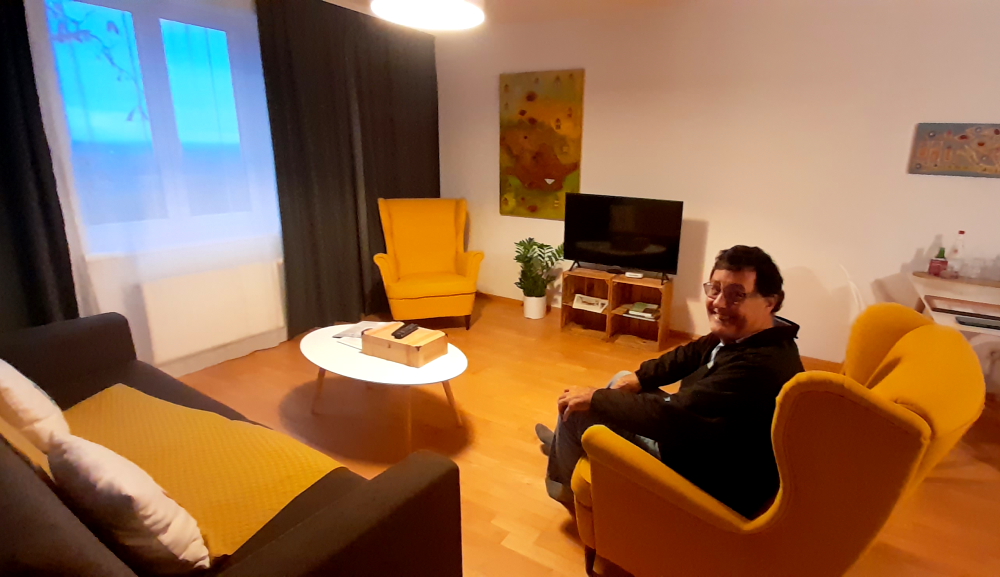
Staying in one of the new apartments.

Ours is a corner, split-level apartment with entrance hall, kitchenette/dining room and upstairs a bathroom, double and single rooms. It’s called Kirchenblick – Church View – which we can see from the small balcony and lounge room windows.

View from the balcony-side of our apartment.

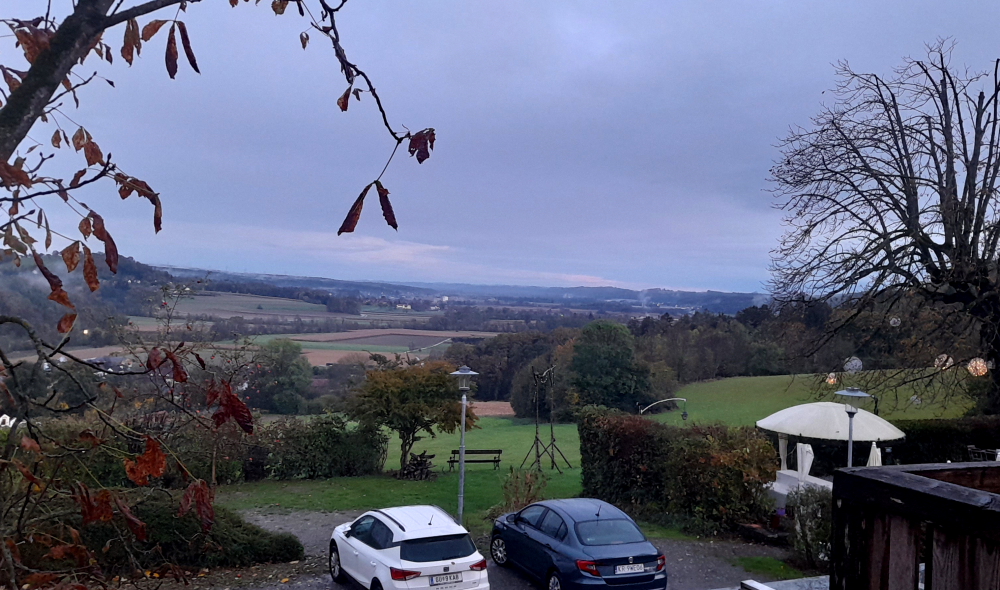
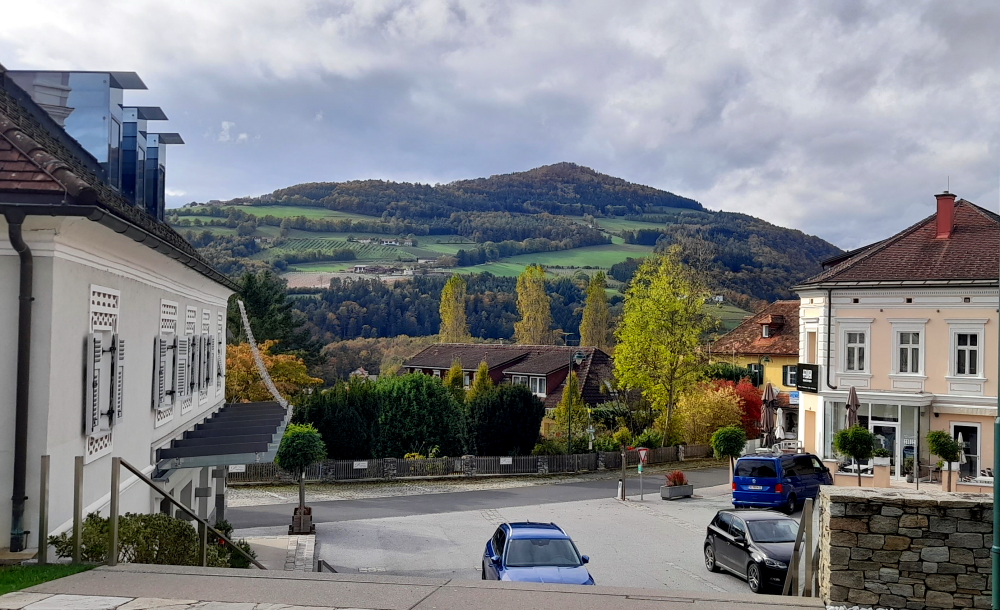
From the front window is the view we remember well, looking out over the beer garden and the vineyards and valley below.

Still a great view from the Landgasthof Riegerbauer.

At 6:00 pm we all jump in the car and drive 20 kms to Gleisdorf to a restaurant owned by the business partner of their eldest son. Their eldest son is also named Felix and, like his old man, is also a chef. On the way we see parents and kids out going door to door trick or treating as it’s Halloween. After an excellent meal we return to the guesthouse and hit the sack.

1 November, 2023

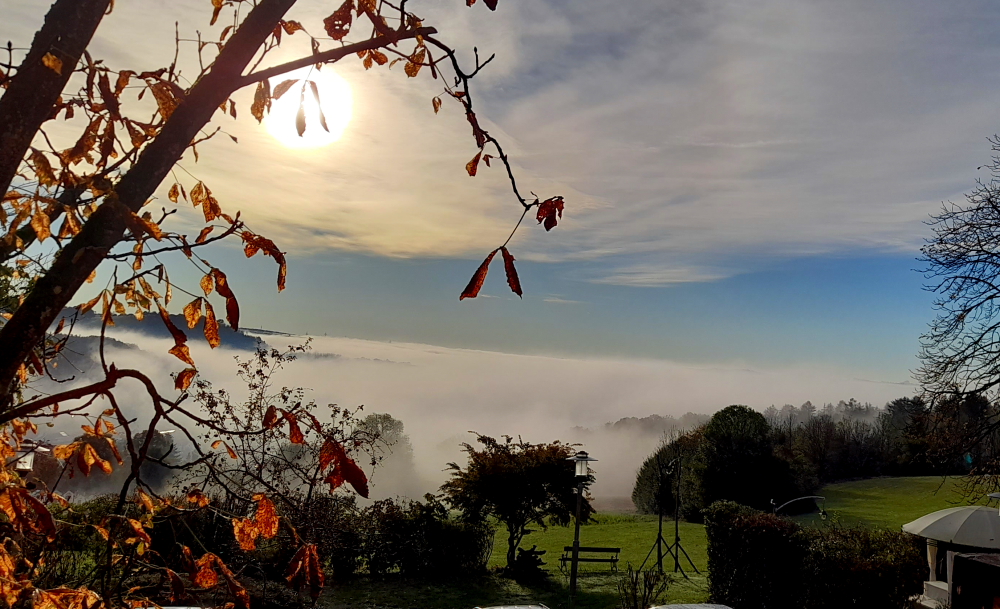
What a glorious morning! The sun is shining and the fog in the valley gradually disperses.

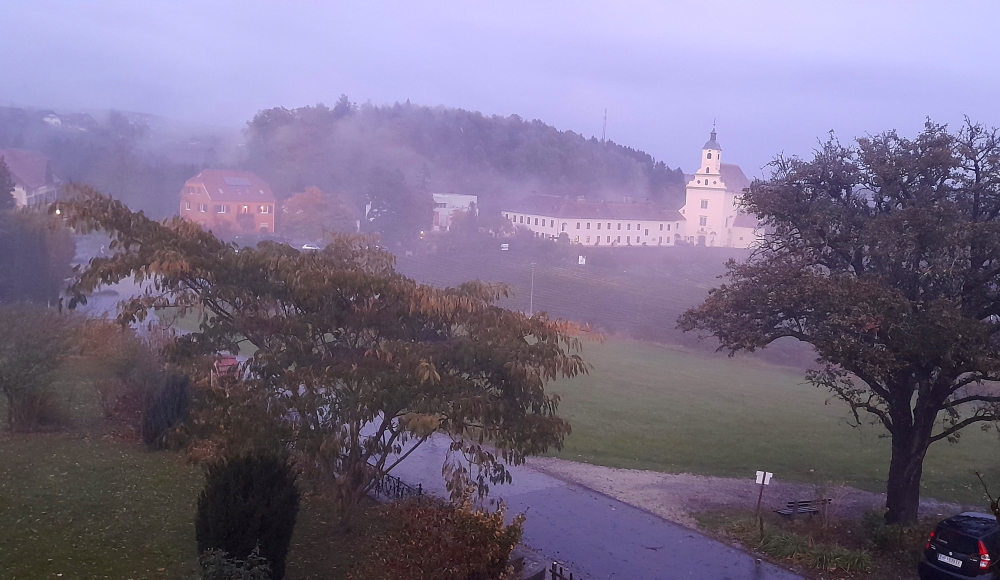
Fog has covered the valley this morning.

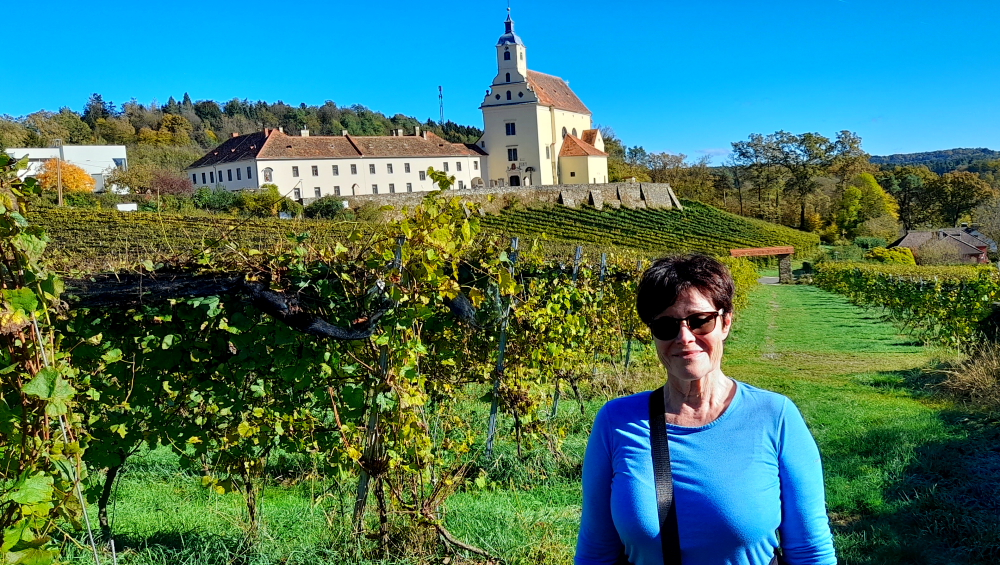
When we were last here we were lucky enough to observe a wedding reception held at the guesthouse and in its beer garden. The wedding was in the church down the road so this morning we walk down there as we’ve not been inside before.

A walk to the village church this morning – guesthouse centre picture.

It’s All Saints Day today, a holiday, where families visit graves and it seems that there was a service this morning as the smell and fog of incense inside the church is still strong.

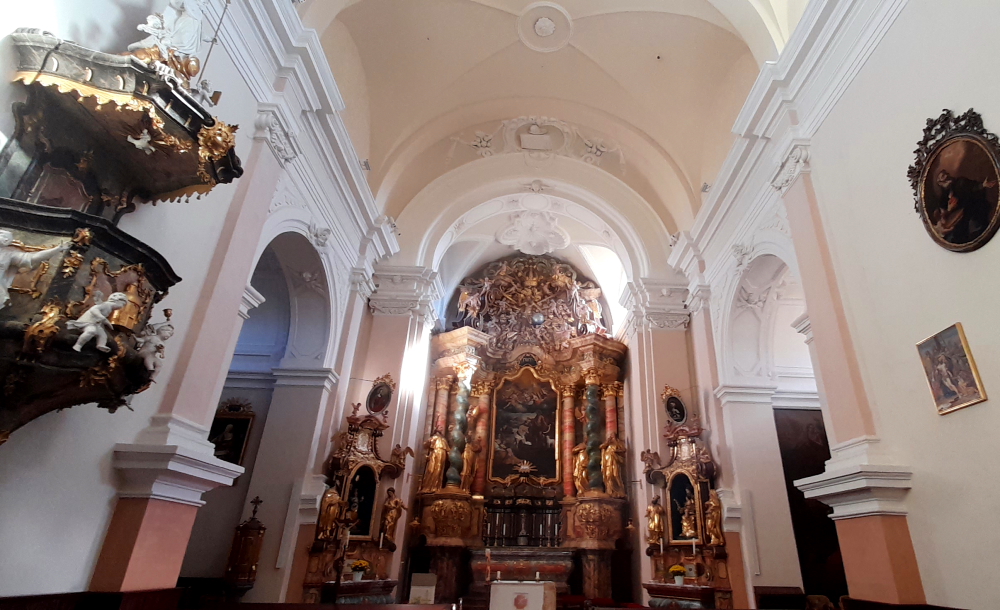
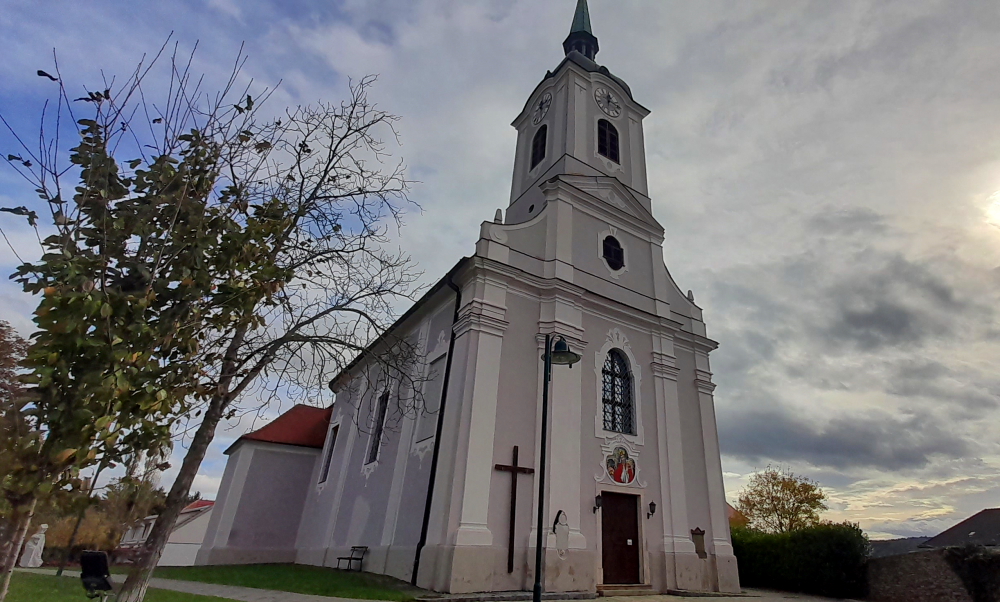
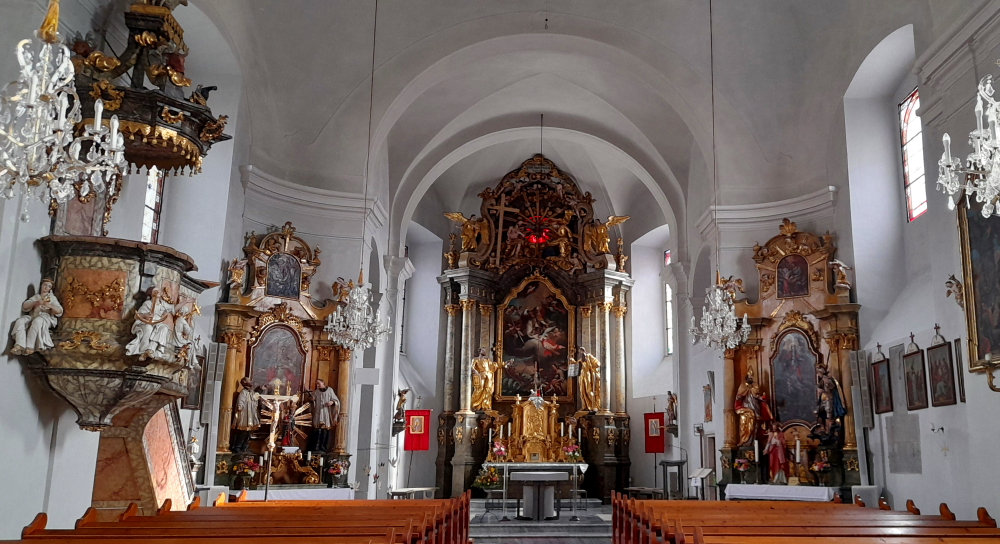
Inside the Parish Church of St John the Baptist.

Surprisingly, considering it’s now 1 November, the leaves have not turned, nor fallen, from the local vines.

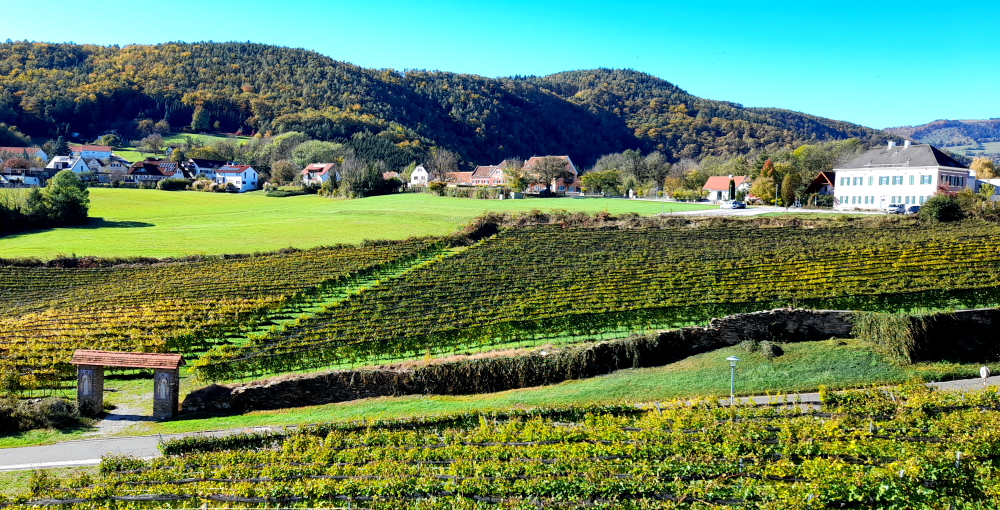
Walk through the vineyard.

Back at the guesthouse we stroll through the small beer garden, reminiscing about the hot summer’s week we spent here looking out over the valley, watching the evening hot air balloons float by and the oompah band that played at the wedding.

Back at the beer garden.

Ingrid manages the accommodation side of the business while Felix Jnr the restaurant and catering business assisted by his younger brother, Andreas.

The main guest entrance to the Landgasthof Riegerbauer.

We catch up with Ingrid this afternoon while she’s waiting for 4 check-ins to arrive and this evening we are booked into the restaurant for dinner at 6:00 pm. Felix Jnr and his family are away on holidays this week so Andreas will be doing the honours as Head Chef.
Time for a catch up with Ingrid before the guests check-in.
2 November, 2023

Although we wake to a sunny day it doesn’t take long for the clouds to gather. Rain is forecast for later this evening and all day tomorrow. So, we decide to venture out for a short drive to the nearby town of Stubenberg, Felix’s childhood home.

The nearby town of Stubenberg.

While there, we check out the town’s parish church in the town’s centre.

Pfarrkirche hl. Nikolaus.

Similar to the parish church in the village of St Johann, it also has an elaborate, Baroque interior associated with catholic churches.

Typically ornate church interior.

Once again we catch up with Ingrid for about an hour this afternoon, then we are joined by Felix while we have a modest dinner in the restaurant of soup and Apfelstrudel followed by an early-ish night.

3 November, 2023

As predicted, it rains throughout the night and we are wakened by the pitter-patter of raindrops on the windows. Which suits us fine as we are pretty much caught up and don’t plan to go anywhere today while our laundry is being done.

A ‘rinse and repeat’ day – for our laundry and us – as we meet up again with Ingrid and Felix this afternoon and dine in the restaurant tonight.

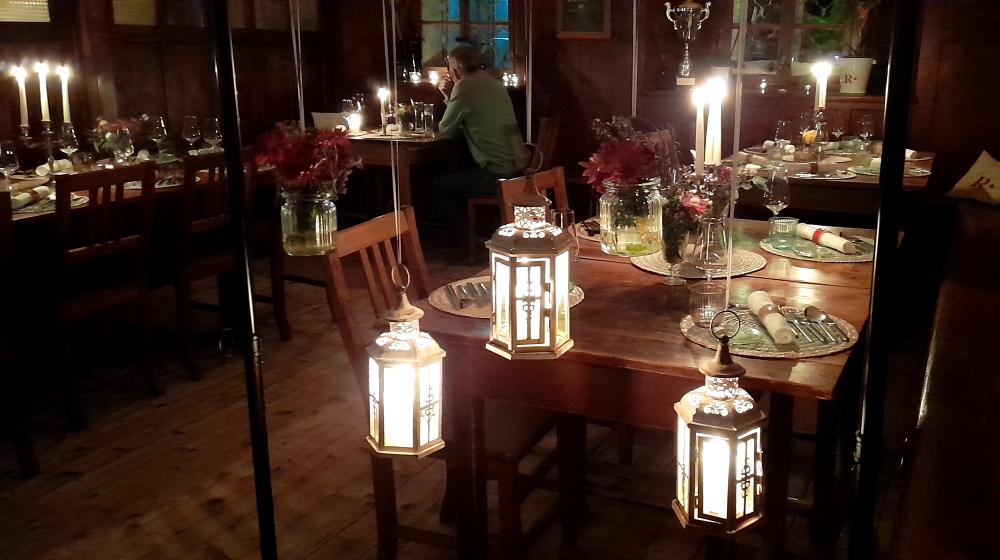
The tables are set for candle-lit dinners.

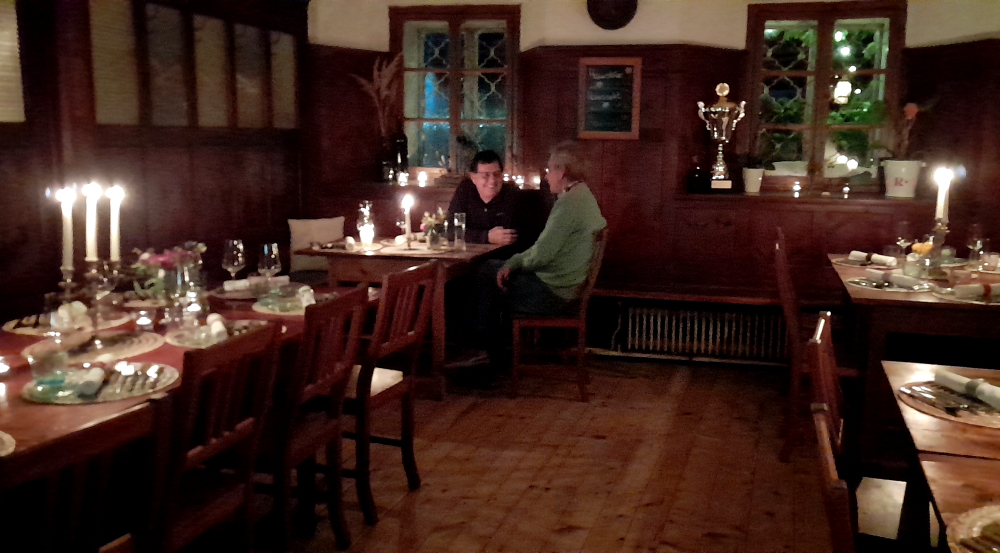
Since it is now November and a Friday night the restaurant is set up with a fixed 5-course meal by candle light for the locals but we have a special meal that is much lighter for us and the usual excessive beers with Felix.

Beer o’clock for Felix & me.

Tomorrow we’ll bid them a fond farewell then drive to Bratislava in Slovakia.

4 November, 2023

We wake up to a thick blanket of fog this morning. We are not checking out until noon so we have a leisurely breakfast before we pack up and load the car. By this time the fog has cleared to a beautiful sunny day for our drive to Bratislava, Slovakia.

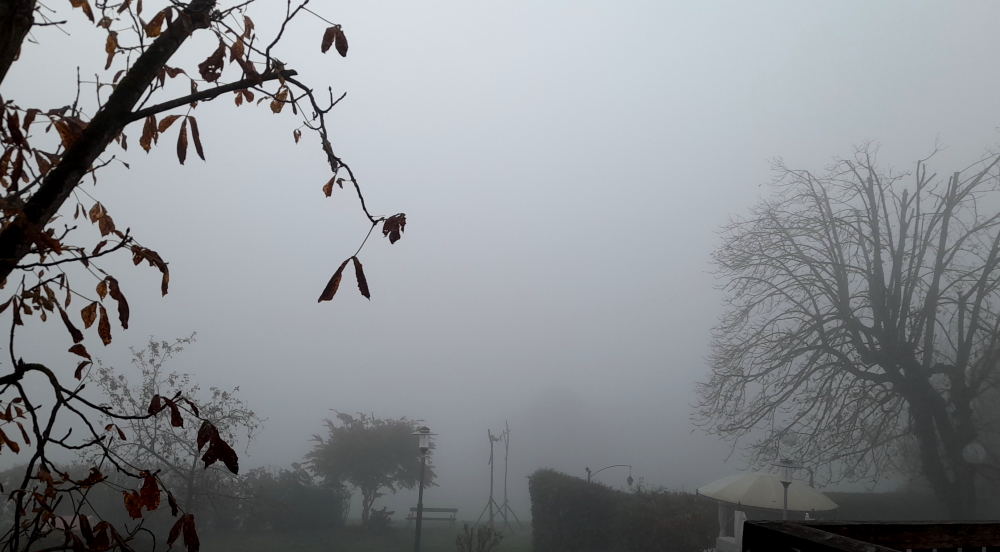
Thick fog all around us this morning.

Before we depart we say our farewells to Felix and Ingrid and make promises to catch up somewhere in the world in the next few years.

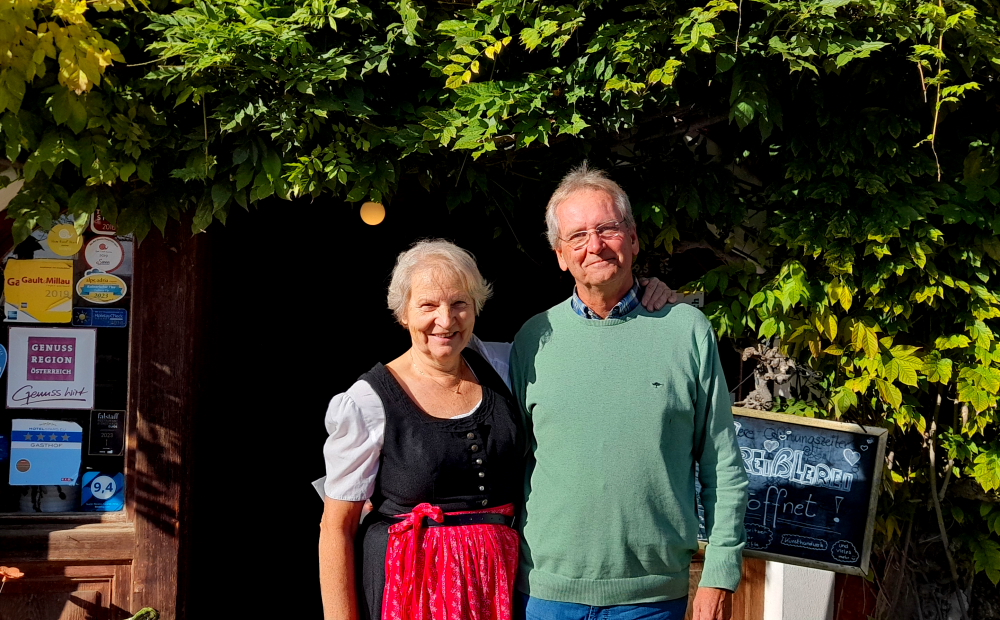
Ingrid & Felix in front of the Riegerbauer.

By midday we are in the car and on the road for the 2 hour 15 minute trip to Bratislava.