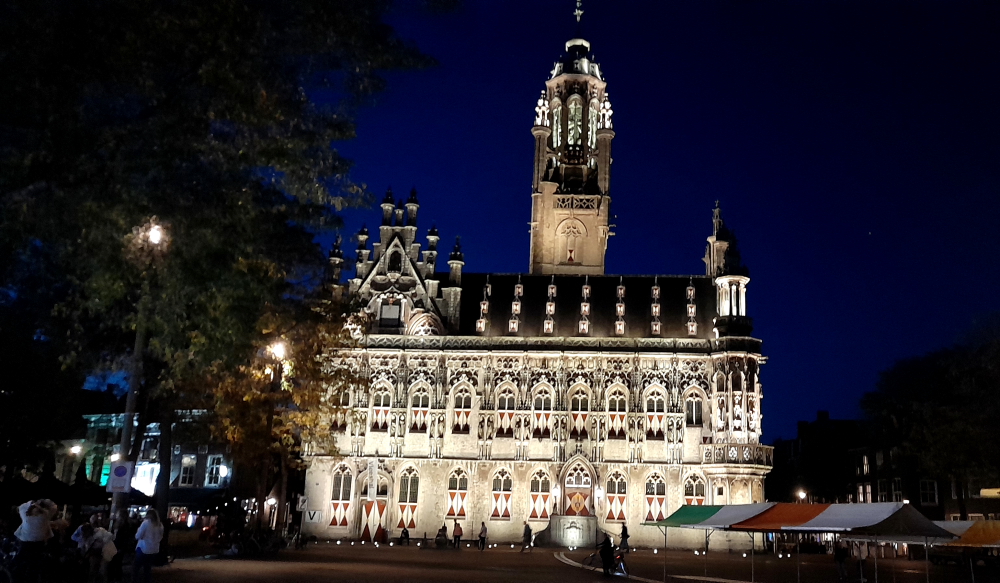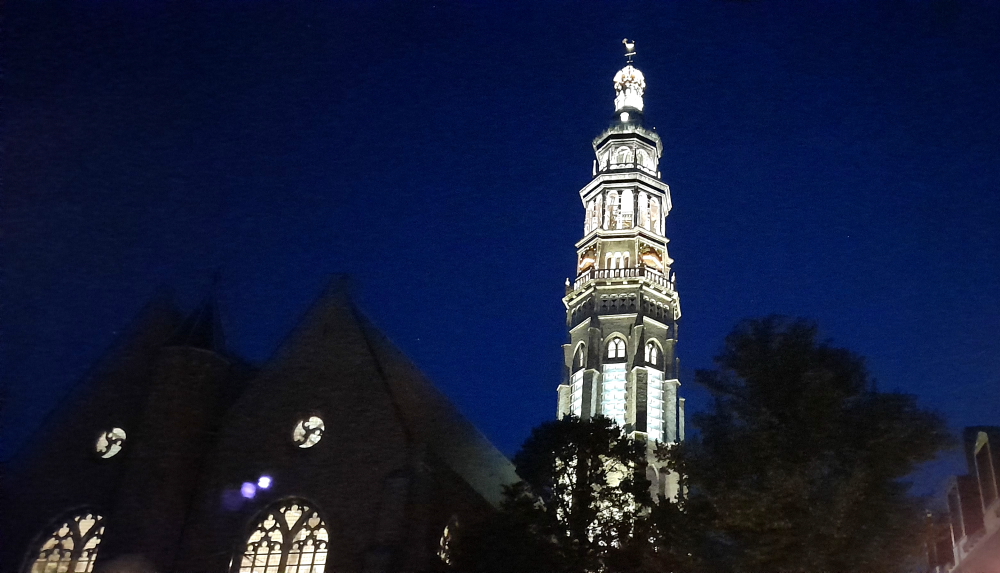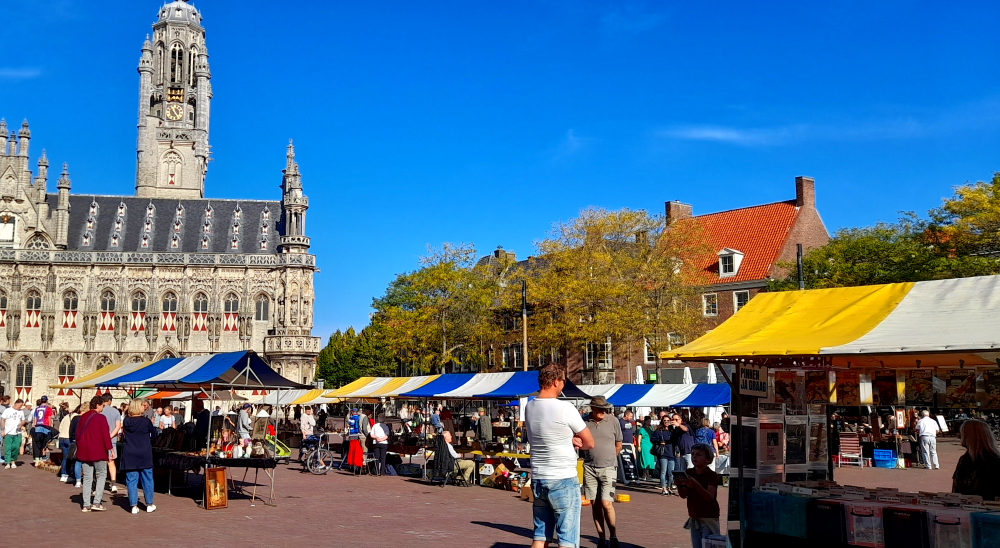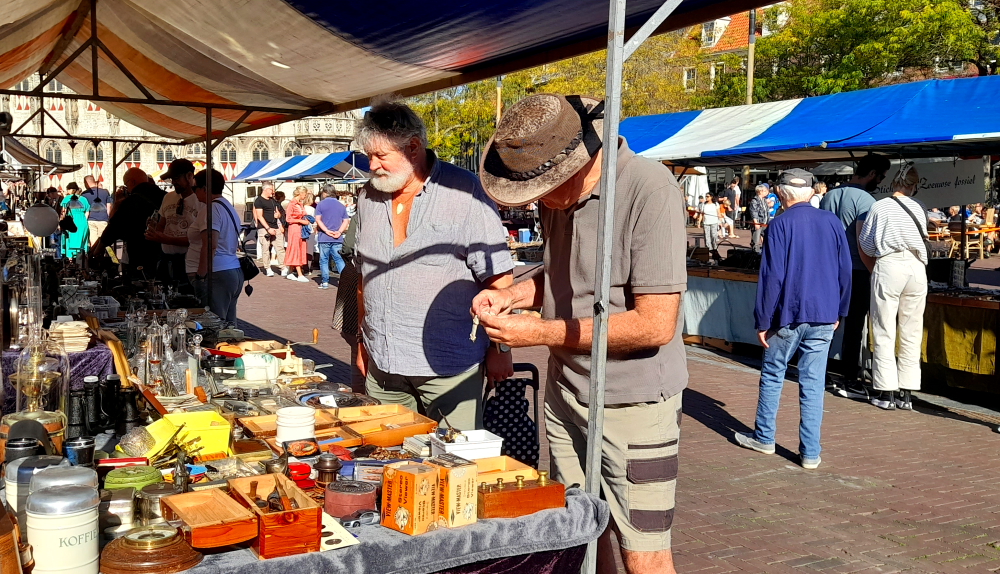
Prague, Pilsen and Ceske Budejovice

17 October, 2023

We were planning on getting away at 11:30 am this morning, but are delayed when Lynn Googles ‘how to pay for tolls in the Czech Republic’. It is unclear as to whether we need to get an eVignette before we enter the country or we can just purchase one at a toll barrier. Not to have one incurs a hefty fine.

Asking the receptionist, she says we need to buy an eVignette as soon as we cross the border and tells us where there is a petrol station to do this. So, off we go at 11:45 am to travel the 150 kms to Prague.
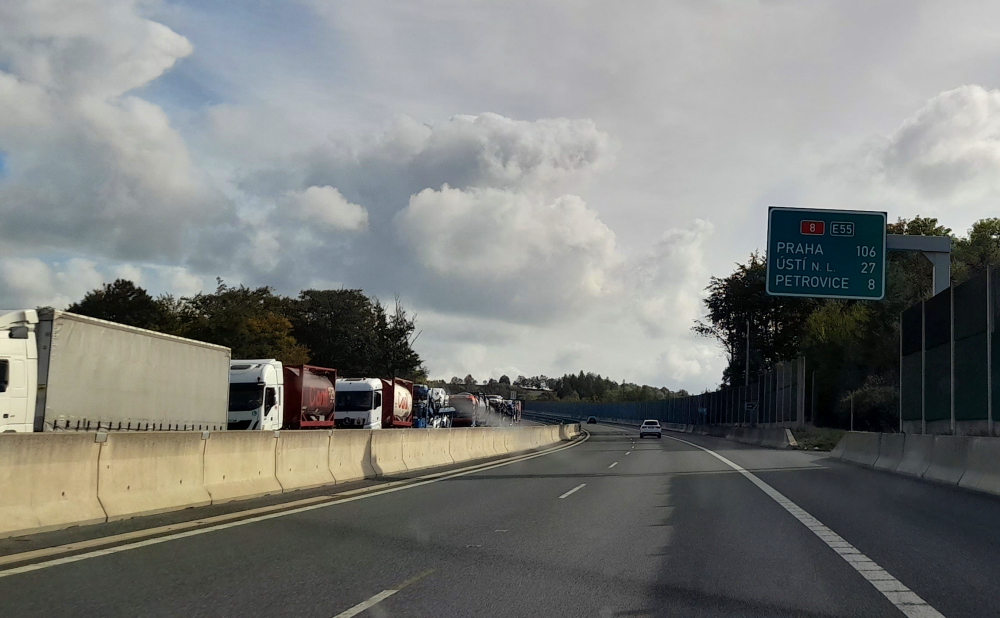
On to Prague. Clear road…our way, for a change.

Following her directions we take the first off ramp to a petrol station in a village where we purchase fuel for CZK40.40/litre. When I go to pay I also ask the non-English speaking attendant that I want to purchase a Vignette (via offline Google Translate on my phone), she indicates we purchase it on the autobahn.

OhhKaay. Let’s see what happens. After joining the motorway again Lynn sees a roadway sign that seems to indicate that we can purchase one at the next petrol station 1 km away, so we pull off and discover that there is a kiosk with 3 or 4 screens where we can purchase one. (BTW, the price of petrol here is CZK41.41 so the village stop was still a good call).
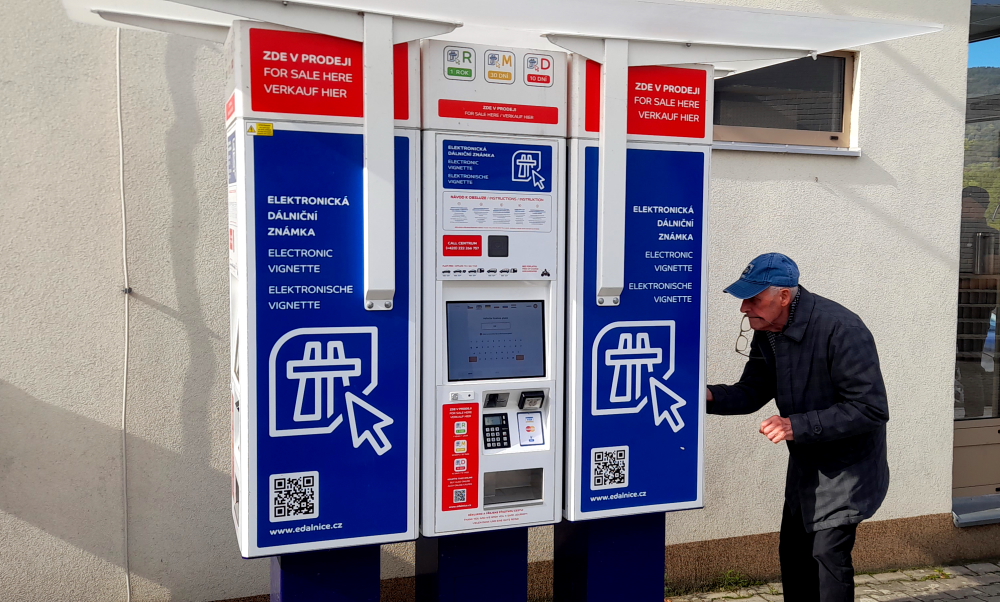
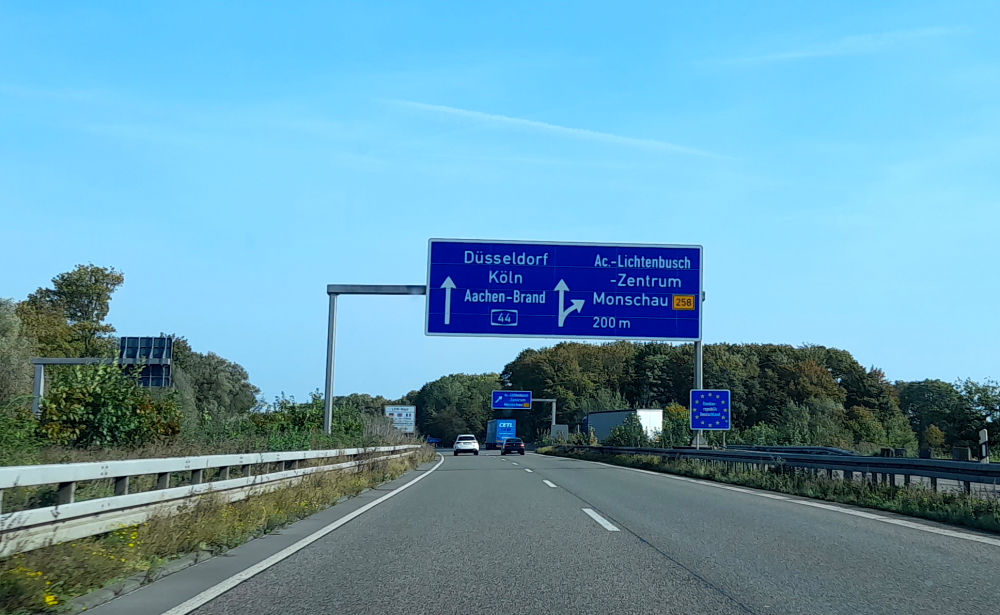
Stopping near the border to buy a toll pass.

Fortunately there is a Union Jack button we can press for English instructions and proceed through the series of screens. Although we will only be in CZ for 11 days the only options for passes are 10 days (CZK220) or 30 days(CZK440), so 30 it is. All goes well until the final step, a print out of our confirmation. The machine has run out of paper! That probably explains why everyone is huddled around the far screen to the right.

An attendant assures us that as the system is electronic and based on car registration recognition, we don’t actually need the printout. Sure enough, there are no toll booths, just gantries bristling with cameras.

There is a bit of gridlock as we enter the city of Prague but soon find ourselves outside our hotel near the Karlovo Namesti Metro station on the yellow B line. There is some work being carried out in the lobby (fixing air conditioning by the look of it) which the receptionist warns us about and says that if the noise disturbs us to let him know and he’ll put us in another room.

So we take the lift to the 2nd floor to drop our bags as we need to move the car from the front of the hotel down the road to the parking garage.

When we return to the lobby the receptionist tells us he has decided to move us anyway (if we want) to a 3-bedroom room on the 7th floor, which we accept, and return to the 2nd floor to retrieve our bags and drop them on the 7th where our more spacious room under the roof has a view of the city from its skylight windows.
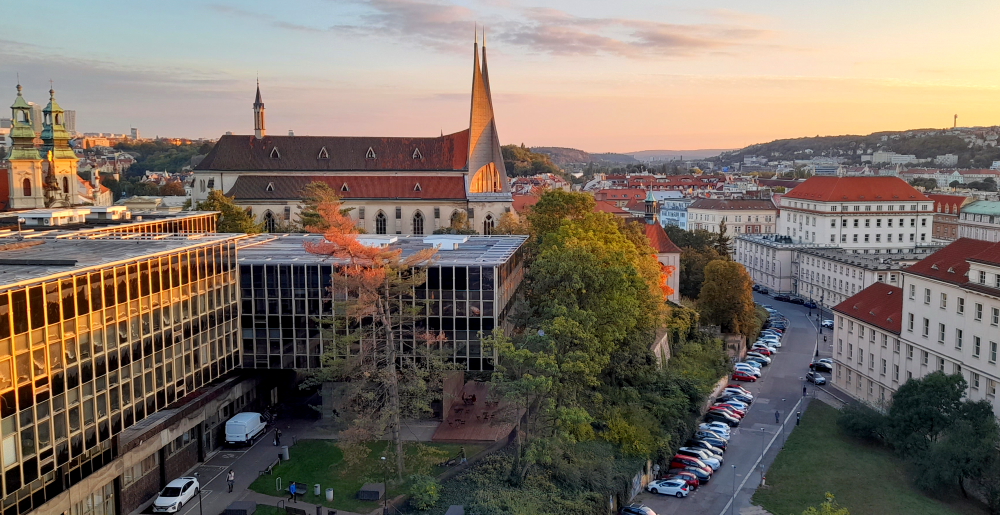
View from our hotel window at sunset.

Returning from the car park the receptionist also provides us with a city map and suggestions of where to visit, including some sites that tourists often don’t know about.
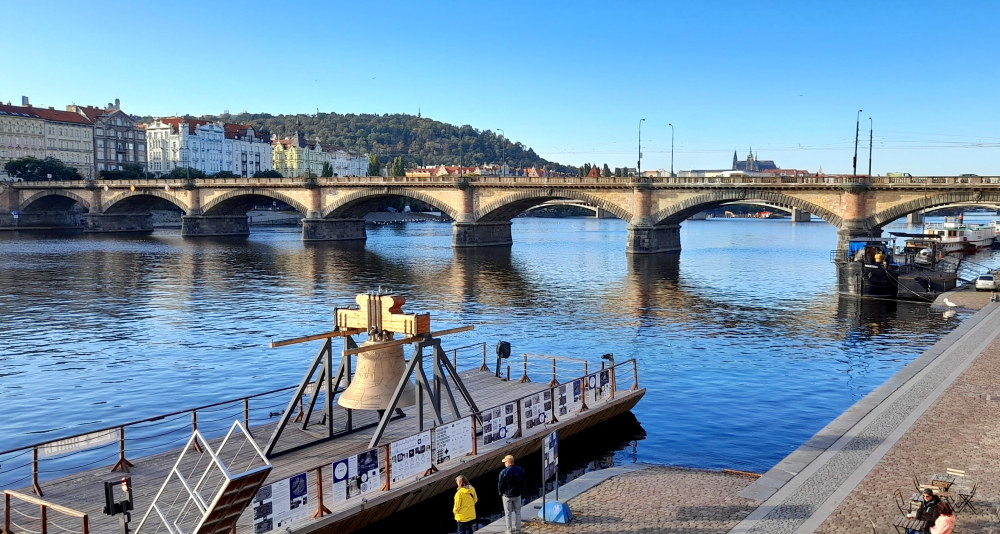
The Jiraskuv Bridge across the Vltava River.

After unpacking we take him up on one of his suggestions – a walk south from our hotel along the river then up some stairs for a view of the city near the Vysehrad Church – the Basilica of Sts Peter and Paul at Vysehrad.
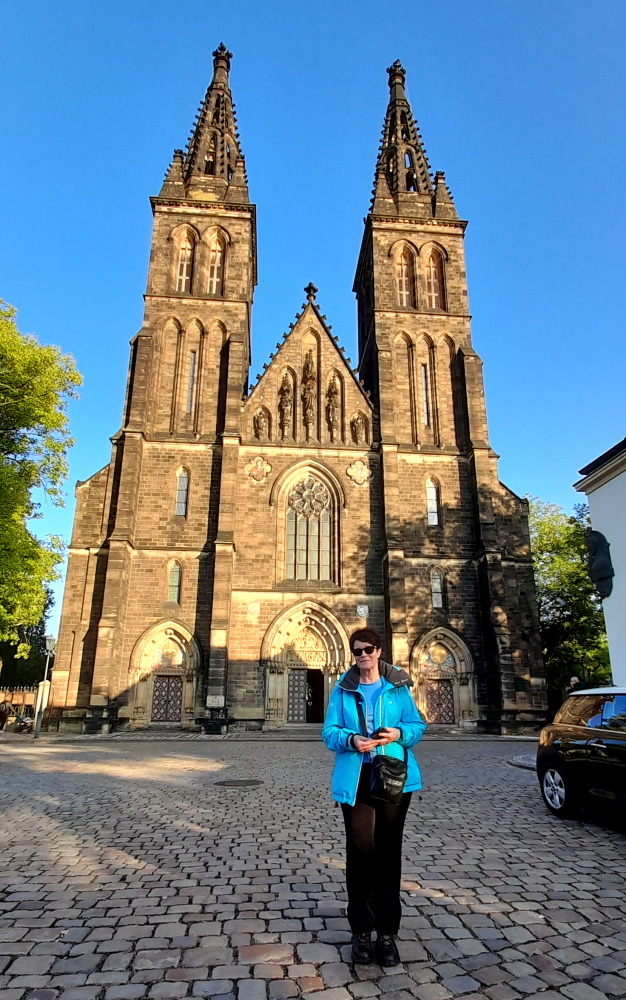
The Vysehrad Church and fortress grounds.

The Basilica is a neo-Gothic church in Vyšehrad fortress in Prague. Founded in 1070–1080 by the Bohemian King Vratislav II, according to the model of the Roman Church of St. Peter and Paul, when the prince began to build his seat at Vyšehrad as a purposeful opposite to Prague Castle. The Romanesque basilica suffered a fire in the year 1249 and has been rebuilt in Gothic and later in neo-Gothic style. The basilica features an impressive stone mosaic above its entry, and its twin, hollow 58 m towers can be seen atop a hill to the south from along the Vltava River in central Prague.

The interior is richly decorated with Art Nouveau ornamental and figural wall paintings, inspired by the art of Mucha. The church’s treasury houses an exhibition of jewellery and rare textiles from the Vyšehrad Chapter.
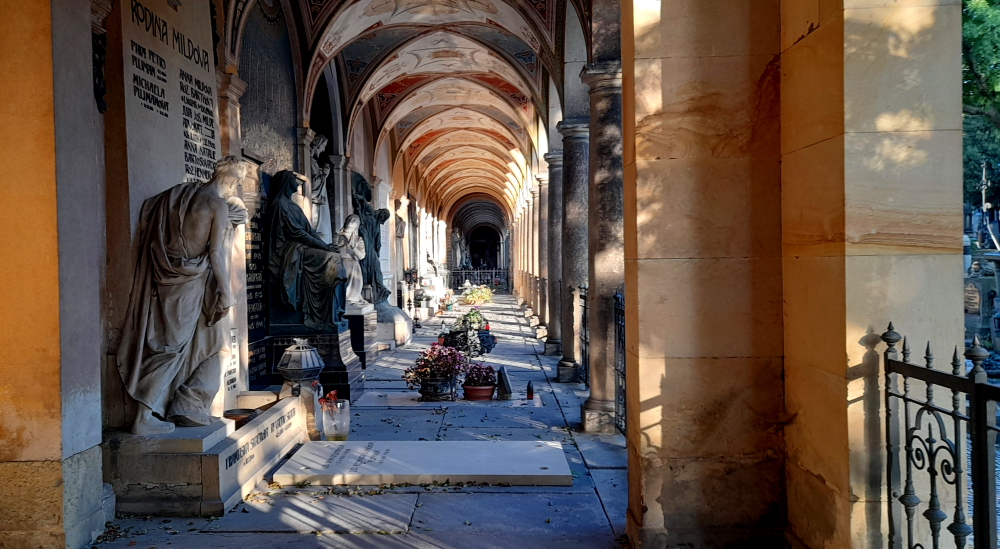
Part of the Church burial grounds.

Behind the church is located large park and Vyšehrad cemetery, the final resting place of many famous Czechs, including author Karel Čapek and composer Antonín Dvořák.
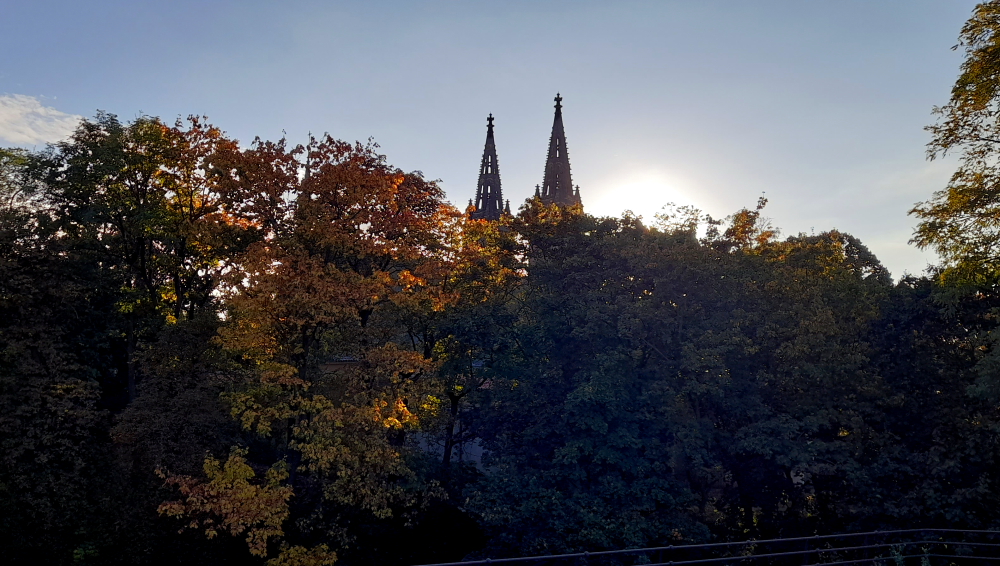
View of the church spires from the fortress wall.

We take a walk along the fortress’s ramparts with views north and east. Autumn has definitely arrived with the changing colour of the leaves and conkers on the footpaths.
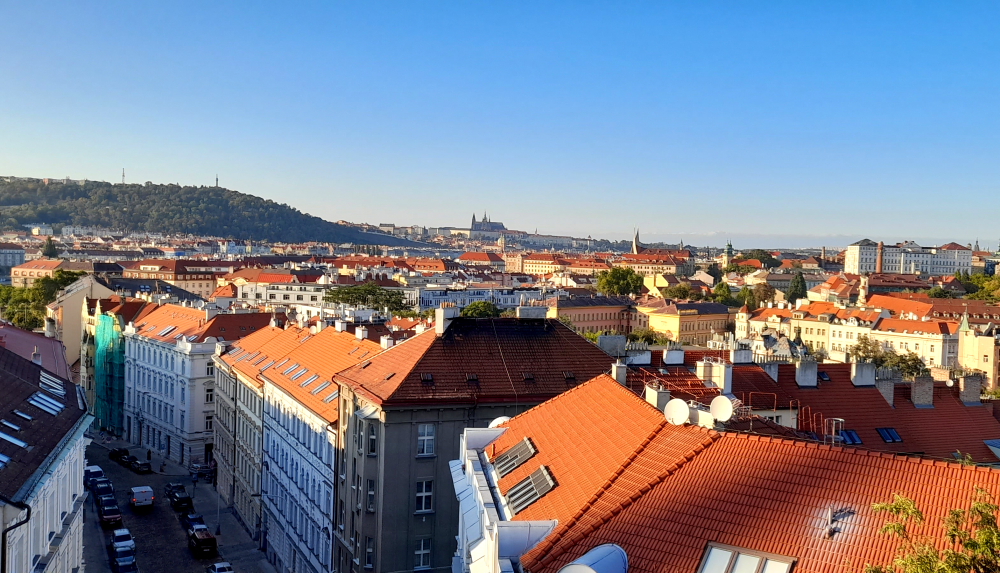
View from the fortress across town to the Cathedral.

The fortress wall is extensive. A counterpoint to it is a modern road bridge that straddles a valley towering above period apartment blocks.
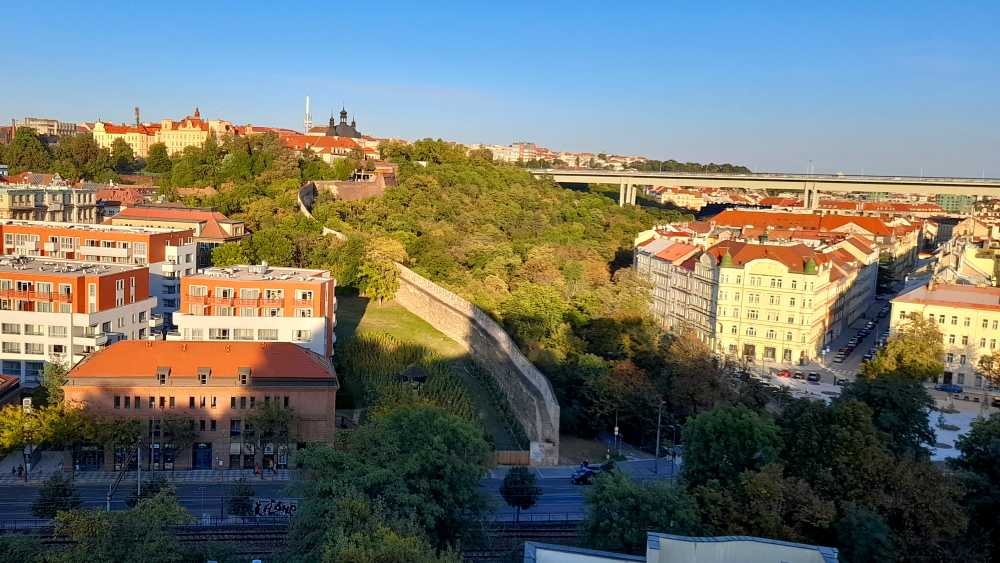
The fortress wall to a modern bridge.

Descending the ramparts we come across a group of oldies engaged in a competitive game of bocce.
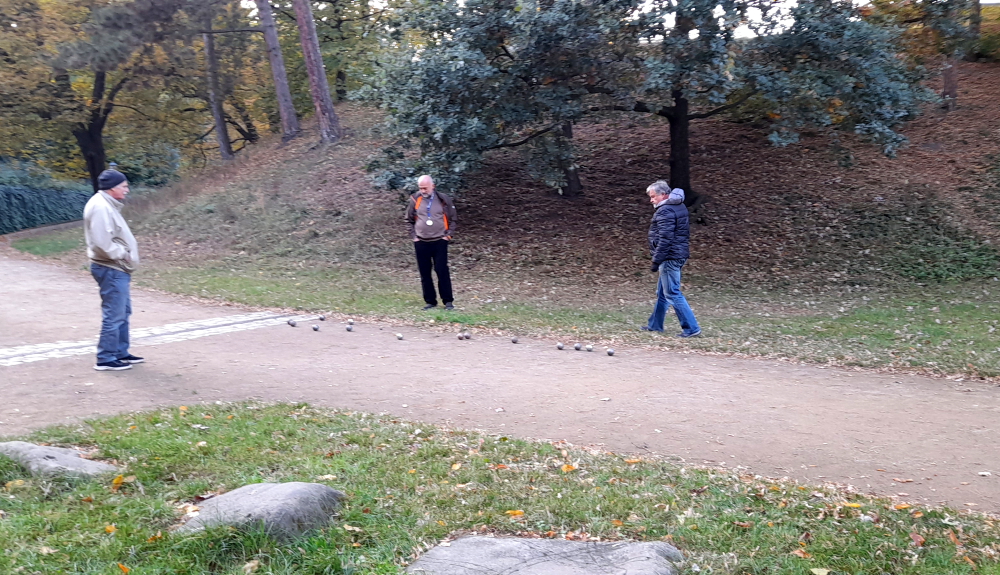
Bocce being played in the fortress grounds.

We exit via the Brick Gate and casemates which highlight Vyšehrad’s role as a military fortress in the 17th and 18th centuries, a period when the area was fought over by Austrian, Prussian and French forces.
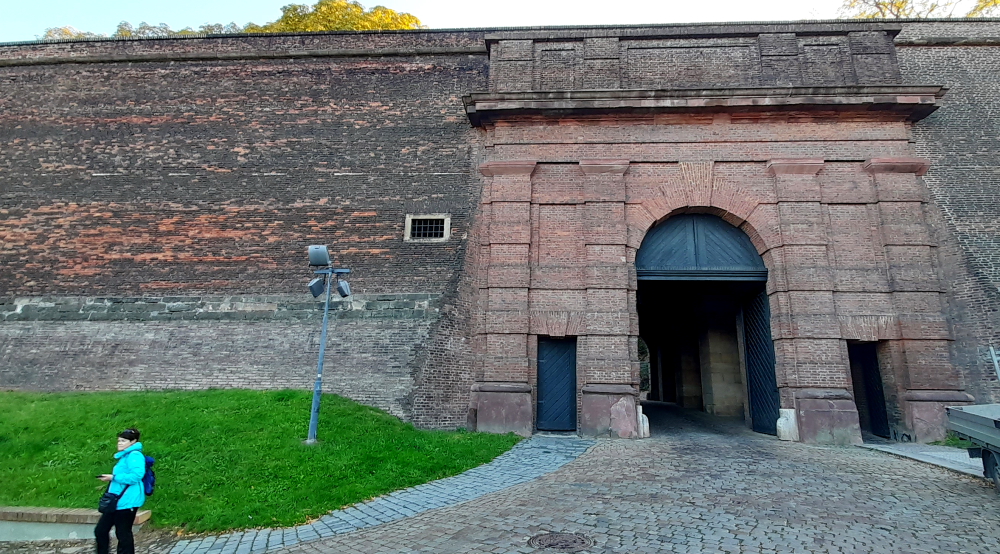
The fortress’s North Gate also known as Brick Gate.

Across the road from the hotel is an authentic Italian restaurant with delicious Italian wine where we dine before we retire for the evening.

18 October, 2023

Lynn has booked us on another GuruWalk this morning – Prague Castle and District.
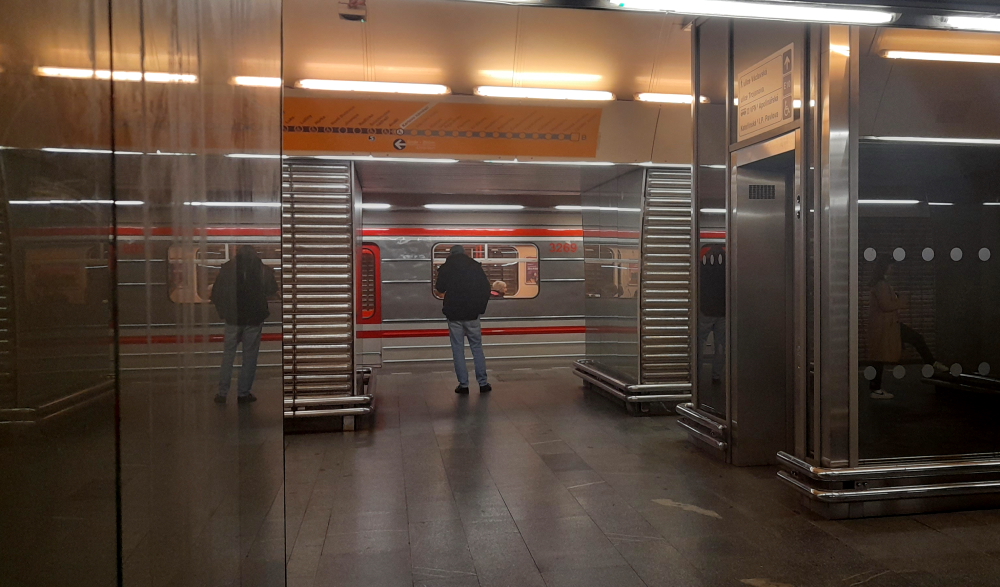
Taking the Metro to our walking tour.

When researching Prague’s public transport system I discovered that over 65s of any nationality can use the metro, tram and bus services free of charge! Bewdy!
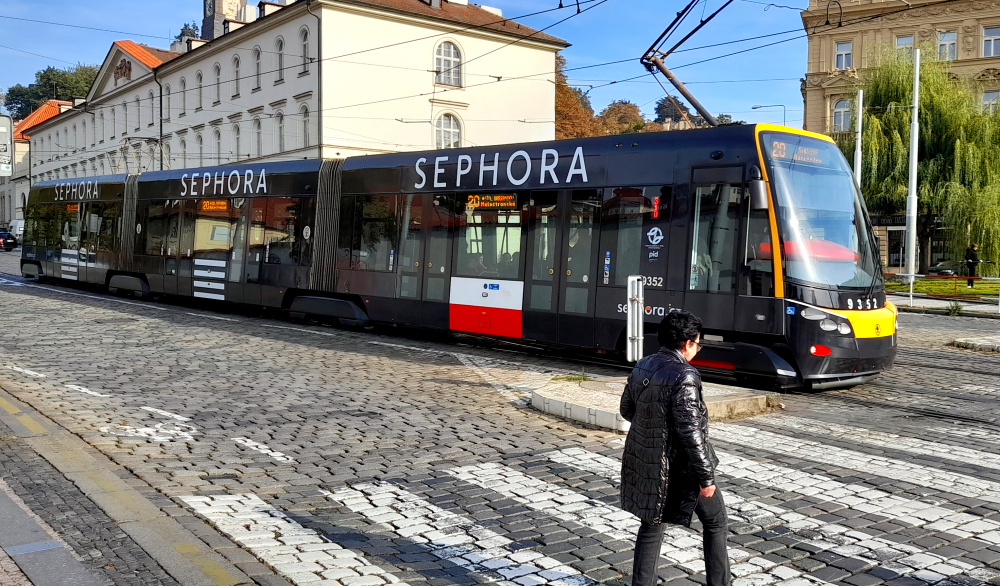
Modern trams to the Prague Castle.

At 10:15 am we walk the short distance to the Karlova Namesti metro station and take the B (yellow) line 2 stops to Mustek on the A (green) line, then 2 stops to Malostrankska where we meet the tour guide, Daniel, at 10:40 am.
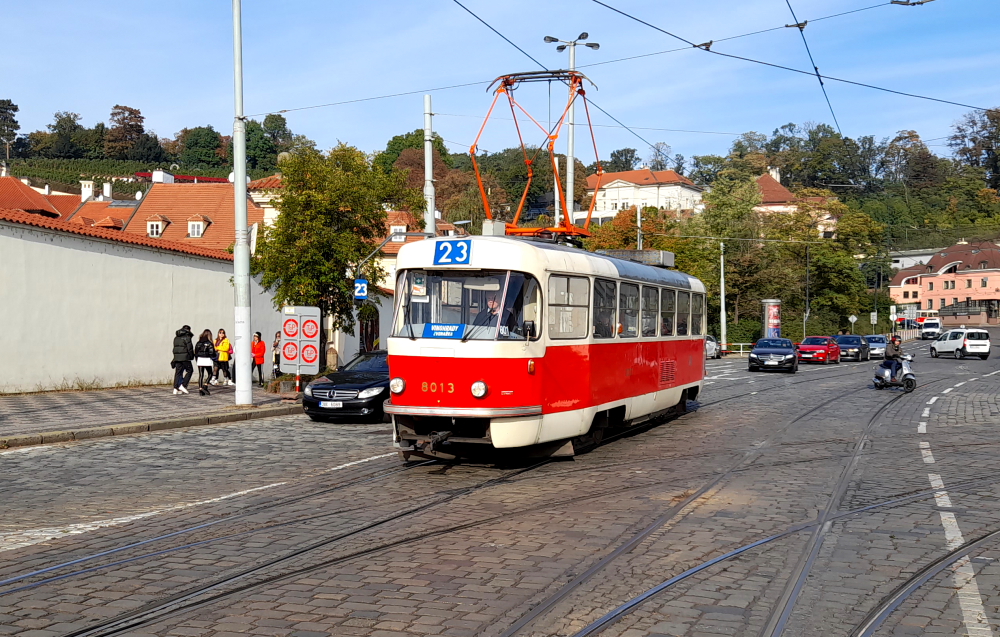
Soviet-era trams still running on the same tracks.

While we wait for the tour to start we cross over the road to Park Klarov to check out the Winged Lion Memorial to 2,500 Czechoslovak RAF service men and women. The winged lion with a split tail is the city’s, and the Czech Air Force’s, emblem.
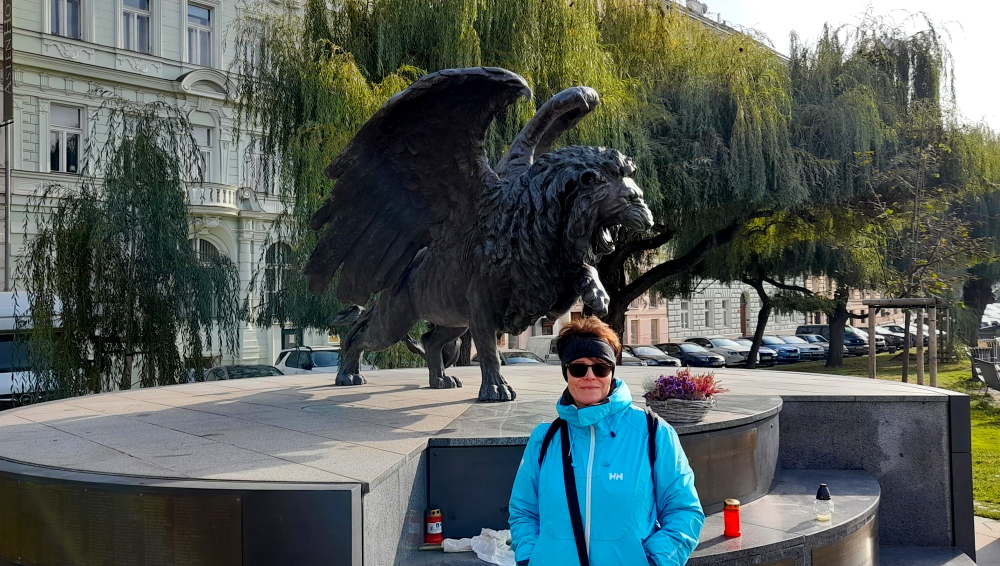
Monument to Czechiam Air Force.

At 11:00 am our tour group of 15 jump on a No. 23 tram and alight 4 stops later at Pohorelec at the top of the hill entrance to the Castle District.
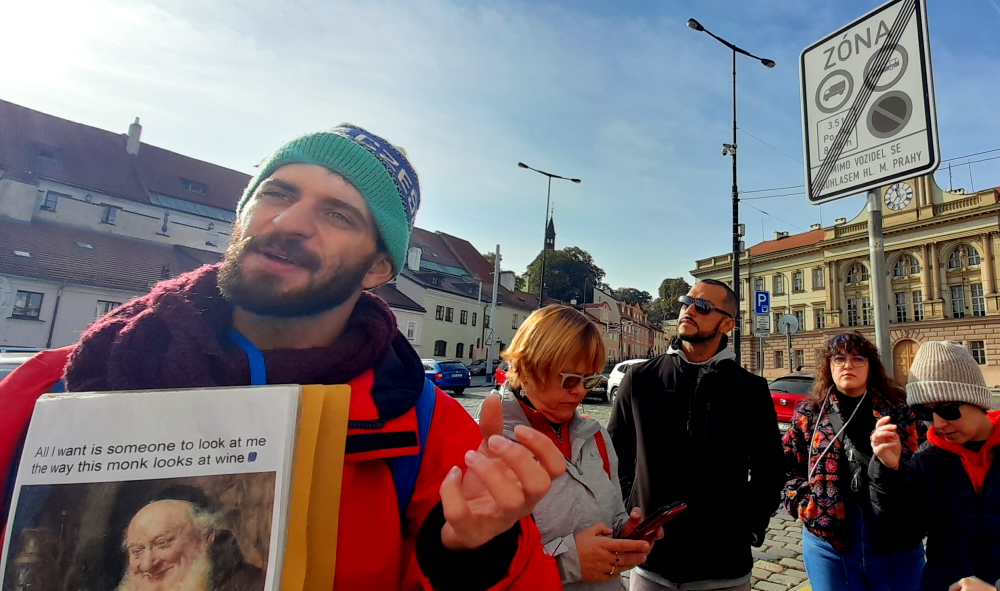
Starting our walking tour of the Prague Castle district.

Our first stop is at Loretanske Square to view the Czernin Palace, the largest of the baroque palaces of Prague, which has served as the offices of the Czechoslovak and later Czech foreign ministry since the 1930s. It was commissioned by the diplomat Humprecht Jan Czernin, the Habsburg imperial ambassador to Venice and Rome, in the 1660s.
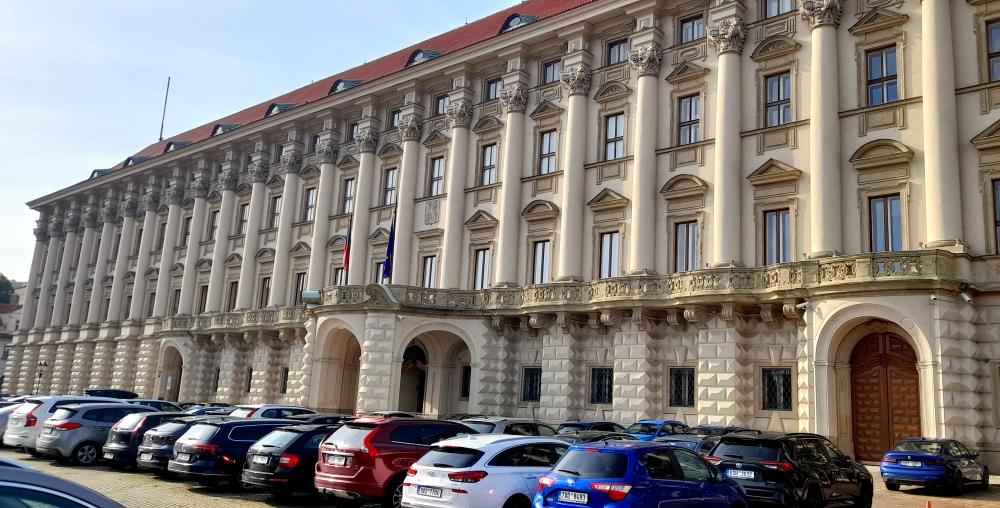
The Czechia Foreign Ministry Building.

Down some steps from here is the Loreta, a pilgrimage destination in Hradčany, a district of Prague. It consists of a cloister, the church of the Lord’s Birth, the Santa Casa and a clock tower with a famous chime.

Construction started in 1626. The architect was the Italian Giovanni Orsi, and the project was financed by Kateřina Benigna, a noblewoman of the Lobkowicz family. Fifty years later the place of pilgrimage was surrounded by cloisters, to which an upper storey was added after 1740. The baroque facade was designed by the architects Christoph Dientzenhofer and Kilian Ignaz Dientzenhofer, and added at the beginning of the 18th century.

The chapel is most known for its peal, heard since August 15, 1695. It was constructed during 1694 by watchmaker Peter Neumann from thirty smaller and larger bells. Today the building also houses a museum with a large collection of liturgical tools, mainly monstrances (in the Roman Catholic Church, an open or transparent receptacle in which the consecrated Host is displayed for veneration). Currently on display is an exhibition of Masterpieces of the Loreto Treasury, where one monstrance in particular, the Fragile Sun Monstrance, is made of gold and 6,222 diamonds.
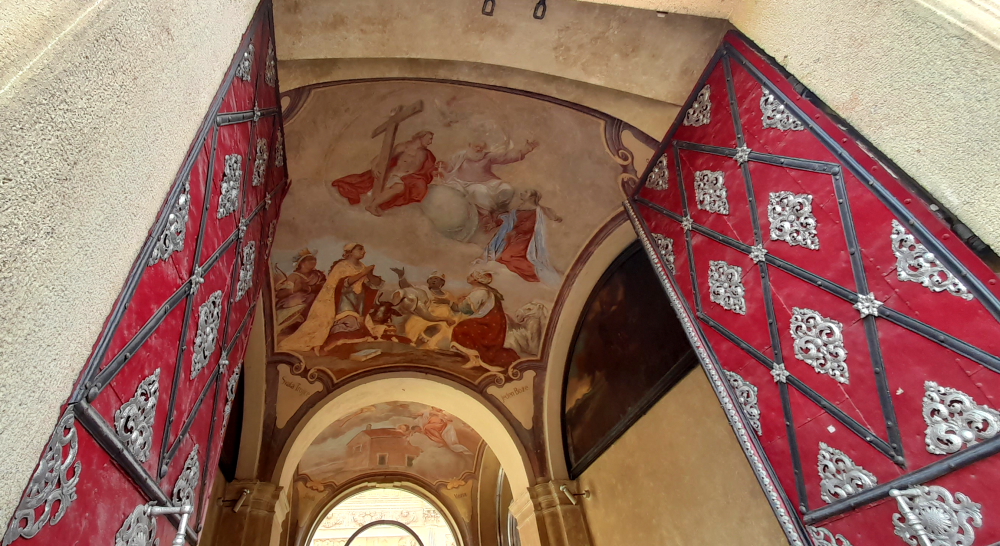
Ceiling artwork at the entrance to the Loreta Chapel.

Further down the road we come across a house that has 4 false windows in its 12-window facade, a relic of window tax times.
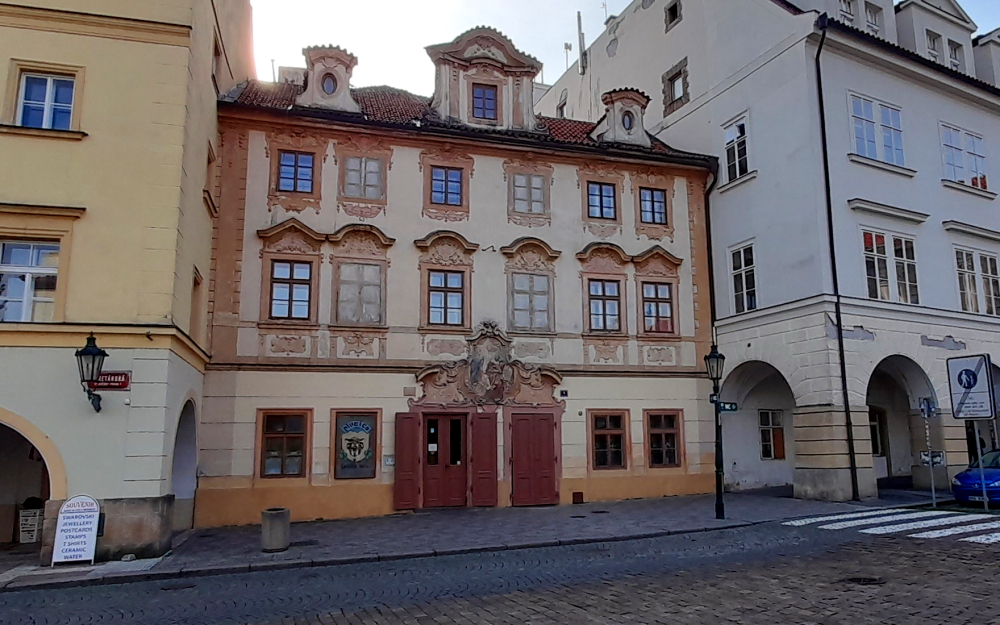
Painted windows to avoid the Window Tax.

Nearby is the Schwartzenberg (Lobkovicky) Palace which houses the permanent exhibition of Old Masters paintings. In the past it served as a representative residence at the seat of the Czech kings, first for the heads of the Lobkovic, Rožmberk, Eggenberg and finally Schwarzenberg families, who owned the palace until 1947.

It is a distinctive and relatively early Renaissance building, the facades of which are decorated with richly shaped sgraffito decor.
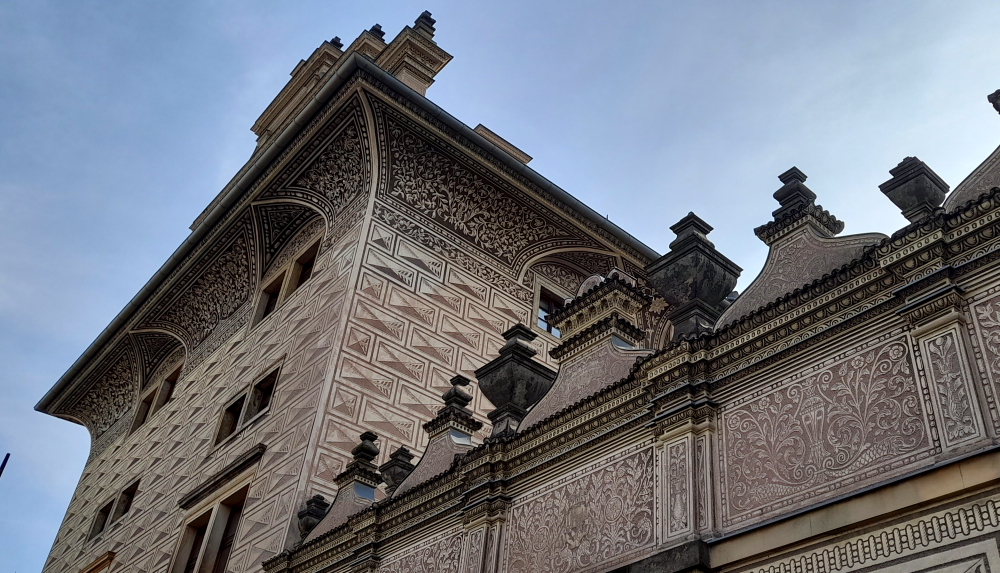
Schwartzenberg (Lobkovicky) Palace with sgraffito decor.

Our walk down the cobblestone street continues to one of the entrances to Prague Castle.
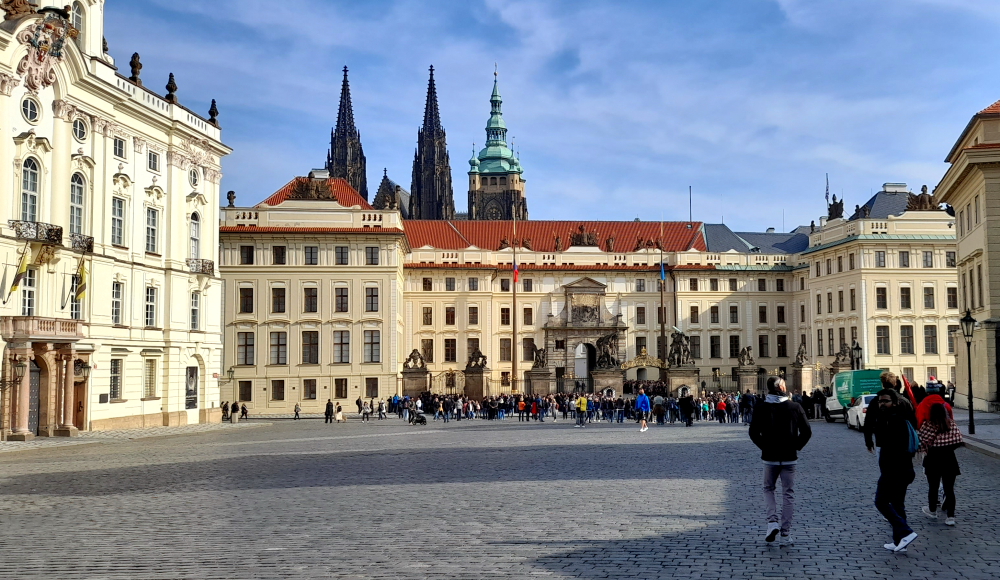
Prague Castle backdropped by St Vitus Cathedral.

It’s now 12 noon and time for the Changing of the Guard ceremony, with music.
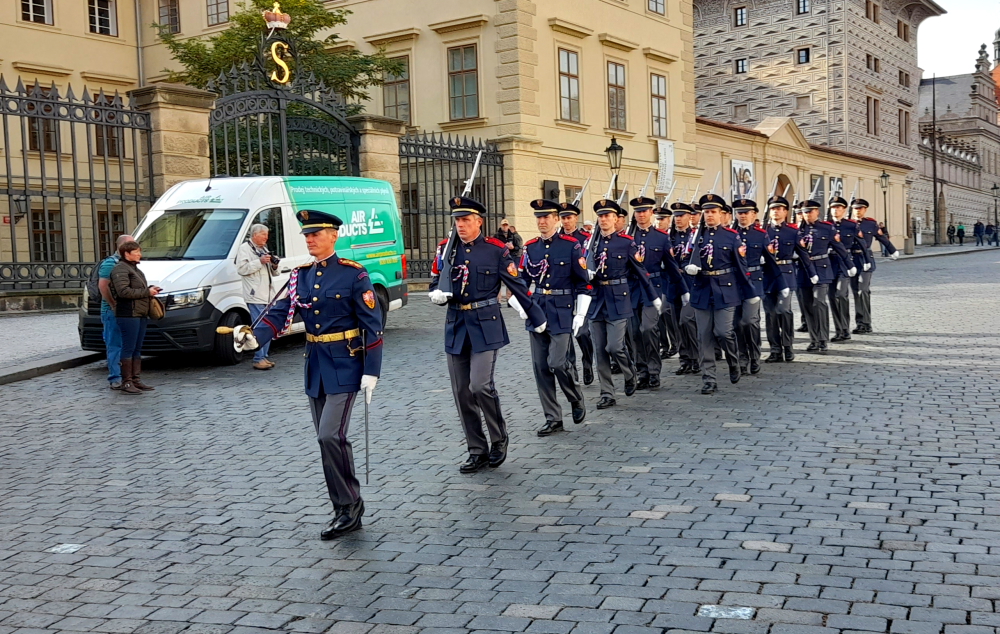
Changing of the Guard ceremony at noon.

As usual, there is a throng of tourists waiting to see the spectacle.
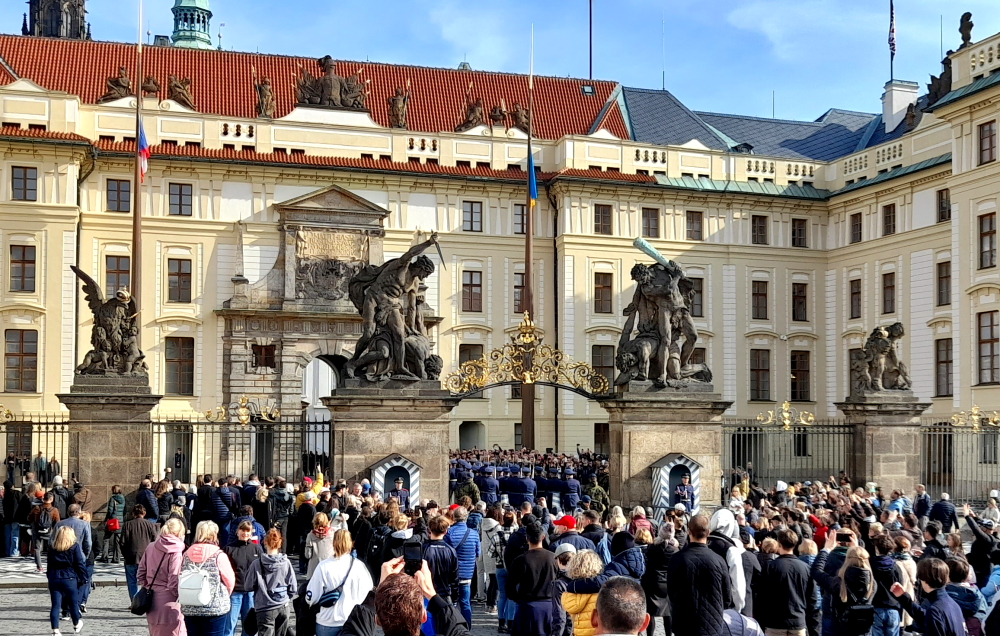
Pomp and ceremony for the changing of the guard.

After a fan fare, the uniformed guards with bayonet rifles at the various posts are simultaneously changed, while at the same time are watched over by a band of camouflaged, automatic weapon-wielding soldiers.
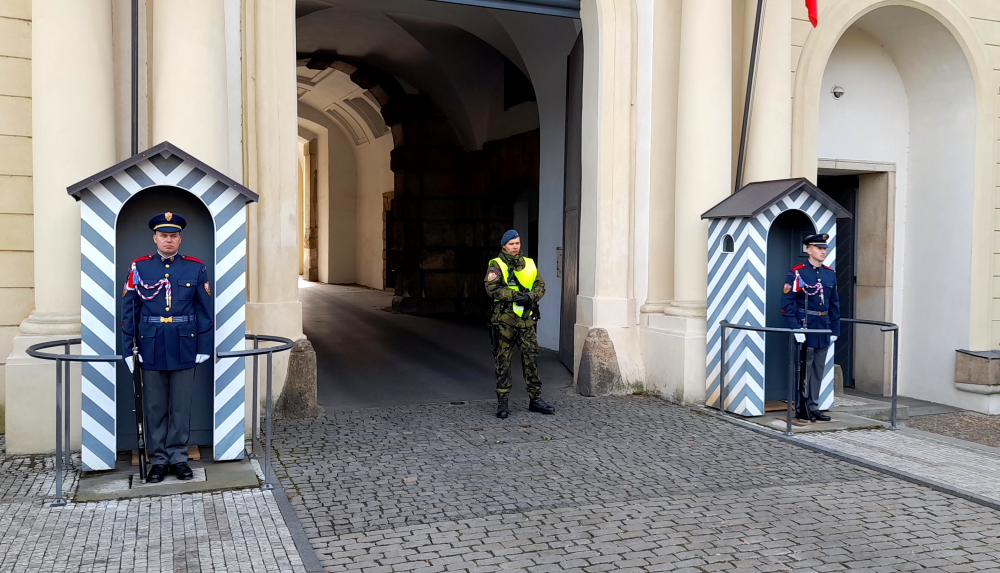
A fresh set of guards.

We then proceed into a courtyard of the Castle to be confronted by the majesty of the St Vitus Cathedral.

The Metropolitan Cathedral of Saints Vitus, Wenceslaus and Adalbert is a Catholic metropolitan cathedral in Prague. Until 1997, the cathedral was dedicated only to Saint Vitus, and is still commonly named only as St. Vitus Cathedral.
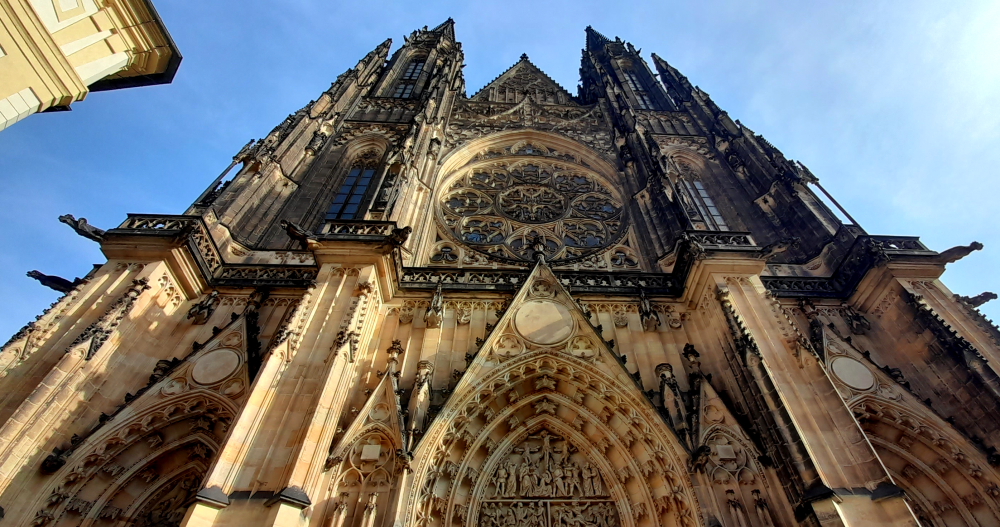
The Prague Cathedral.

It’s a prominent example of Gothic architecture and is the largest and most important church in the country. Located within Prague Castle and containing the tombs of many Bohemian kings and Holy Roman Emperors plus the Saint Wenceslaus Chamber with the Bohemian Crown Jewels, the cathedral is under the ownership of the Czech government as part of the Prague Castle complex. Its length is 2/3rds that of a normal cathedral (an existing building was in the way preventing an extension) and its main tower is 102.8 m (337 ft) high.
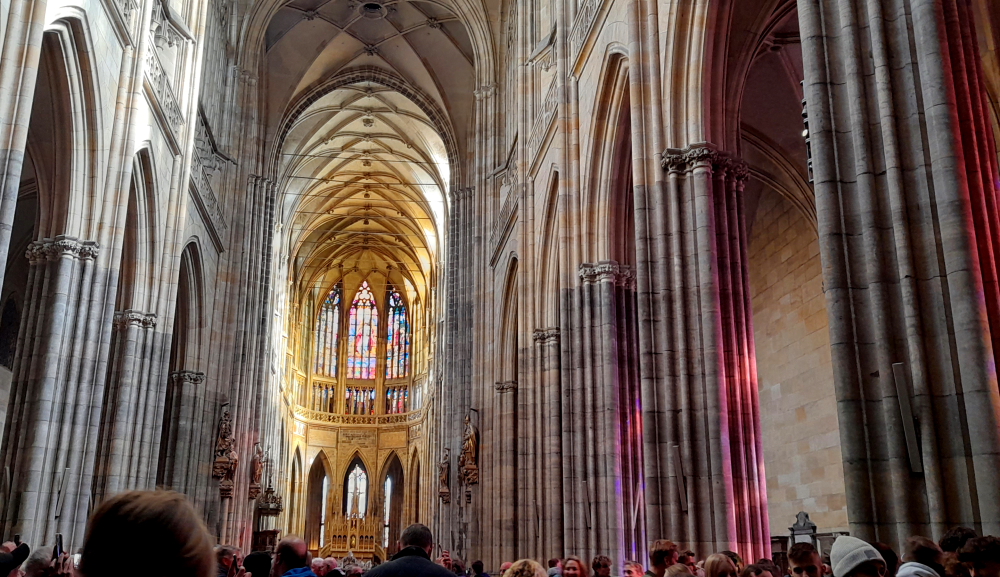
Impressive interior of the Cathedral.

Of the stained glass windows, one is by famous Czech Art Nouveau painter Alfons Mucha in his inimitable style and 2 others have, in a corner each, their names as sponsors – namely a bank and an insurance company. Talk about money changers in the temple!
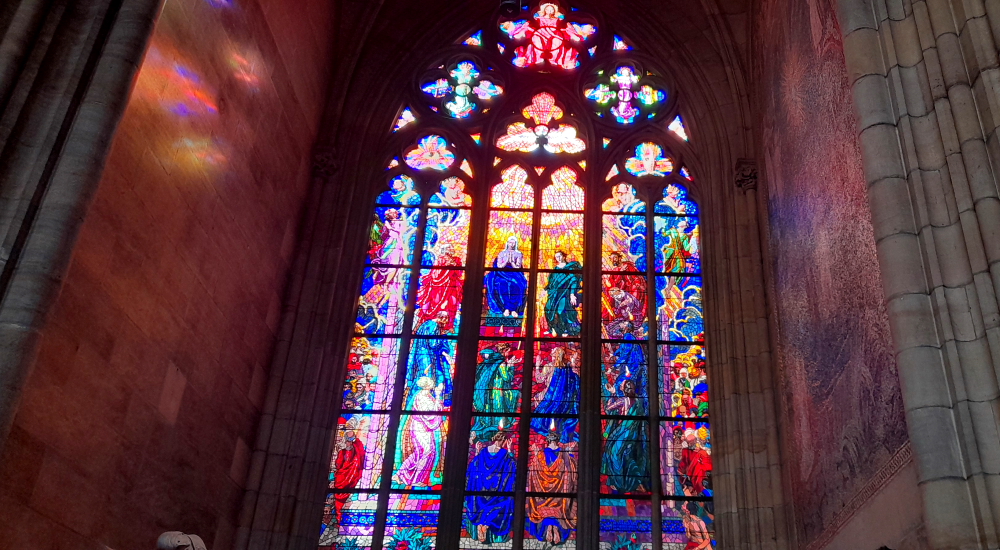
One of numerous stained glass windows.

As it took over 600 years to complete the Cathedral’s construction, there are various architectural styles within the building and surrounding ones, as seen below, including the Baroque spire versus the main Gothic spire of the Cathedral.
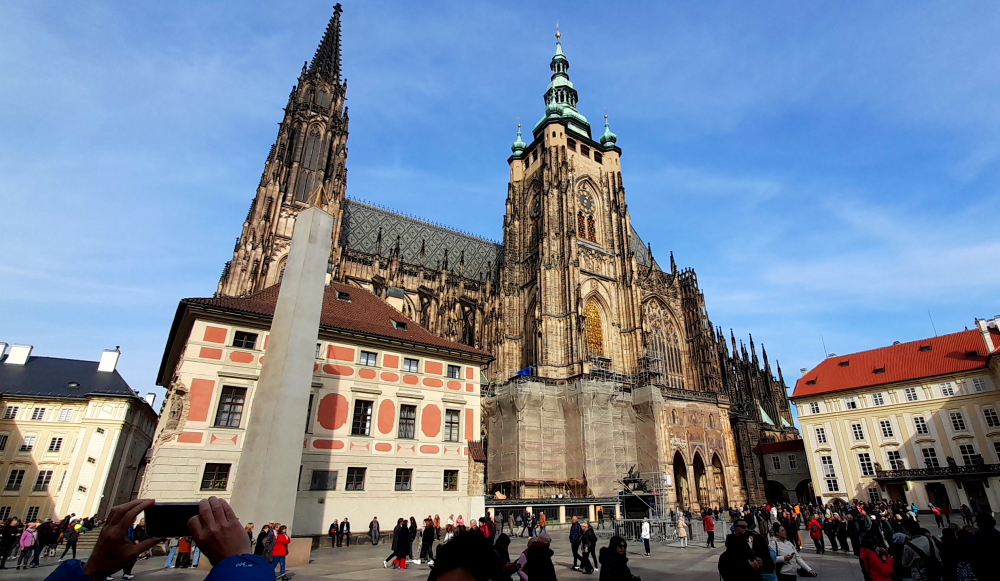
The Archbishop’s House backdropped by the Cathedral & overshadowed by an obelisk.

The gable which connects the tower with the south transept is nicknamed ‘Golden Gate’, likely because of the golden mosaic of the Last Judgment depicted on it, and it is through this portal that the kings entered the cathedral for coronation ceremonies.
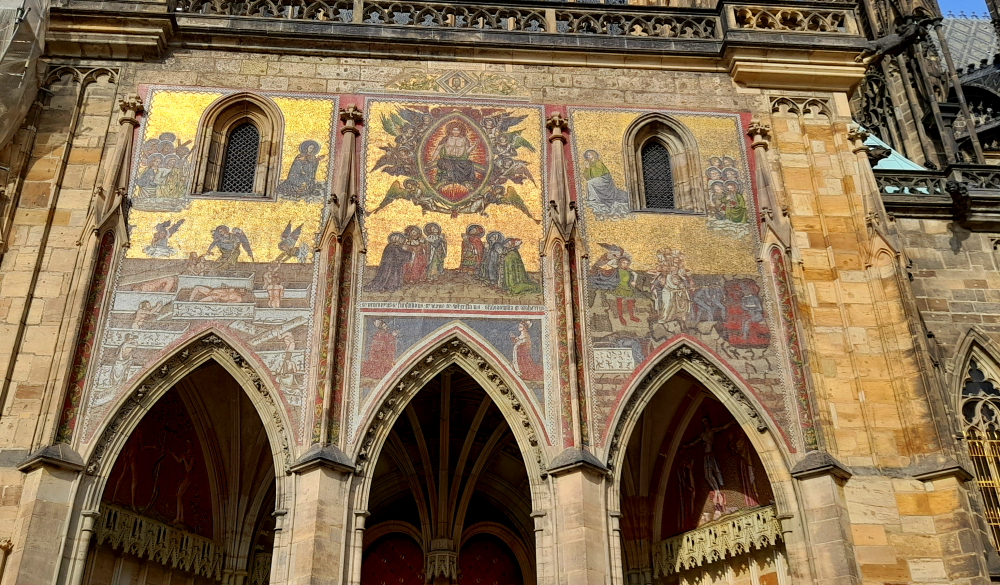
Over 300,000 ceramic tiles decorate the Golden Gate.

2 hours and 45 minutes later our tour comes to an end at the main entrance to the Castle.
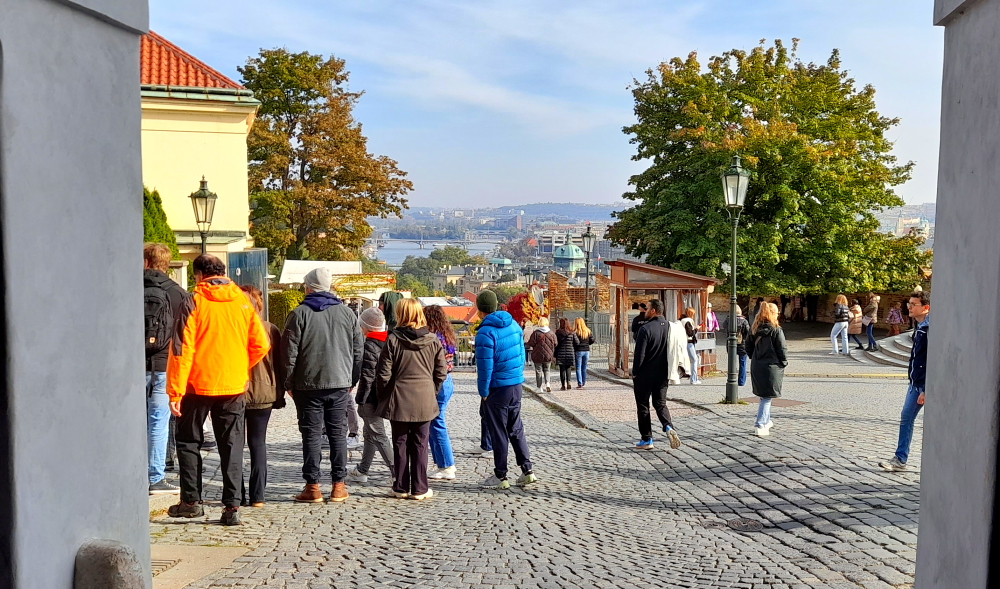
View from the Castle Gate to the river.

As it’s such a sunny (but chilly 12 Deg C) day we walk through the Castle’s South Gardens.
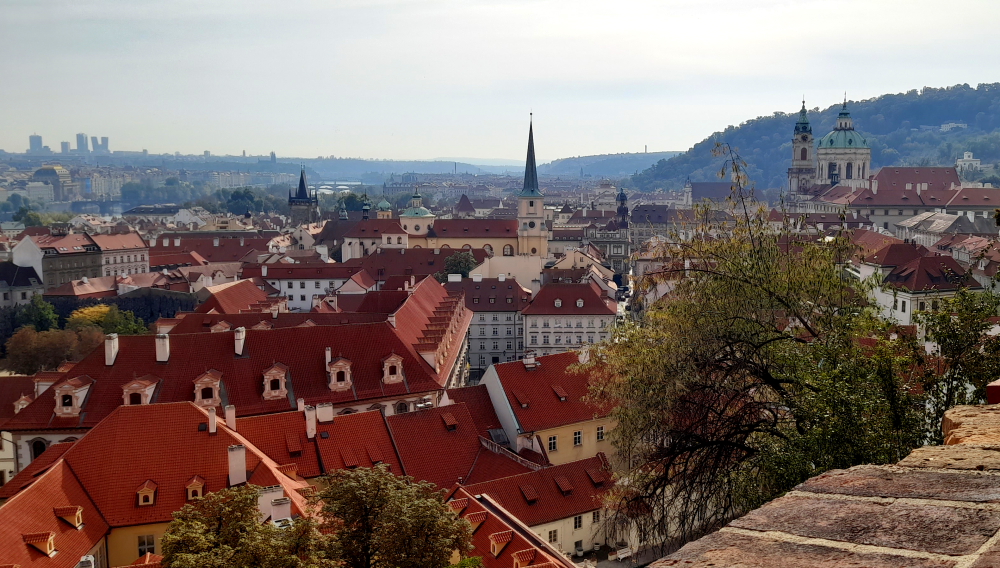
The smoky valley of Prague City.

The South Gardens were established gradually on the location of bulwarks beneath Prague Castle. The last renovation in 2012 restored their original appearance from 1920’s when they were renovated by the Slovenian architect, Josip Plečnik, for the first Czechoslovak president T. G. Masaryk.
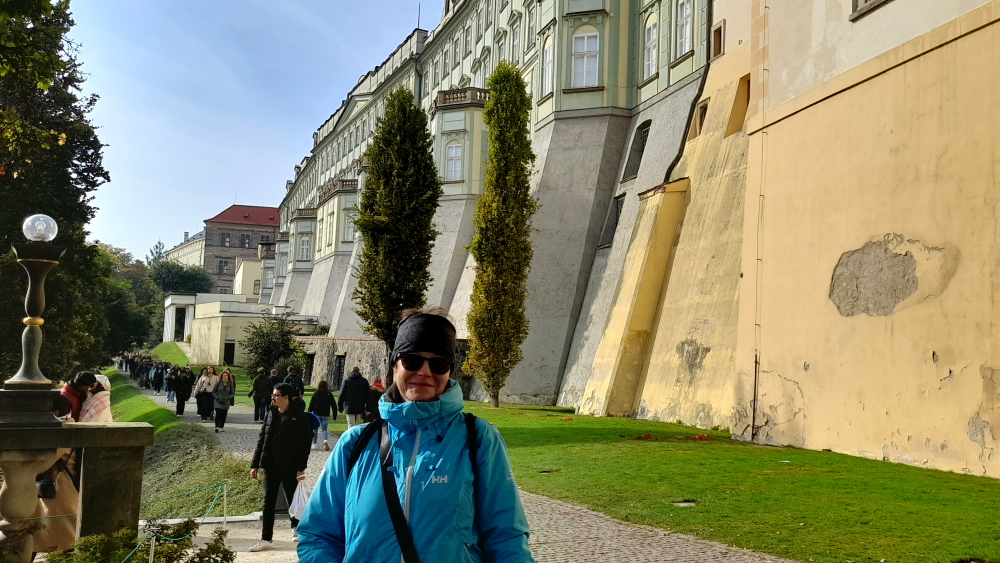
Below the Castle wall.

The South Gardens are nearly 500 metres long and are comprised of three smaller gardens: Paradise Garden, Garden on the Ramparts and Hartig Garden.

Paradise Garden is situated on the spot of the oldest garden in front of the southern wall of the Castle, where a private garden of Archduke Ferdinand used to be and similarly, the emperor Rudolf II also had his private garden here with a bath and an aviary.
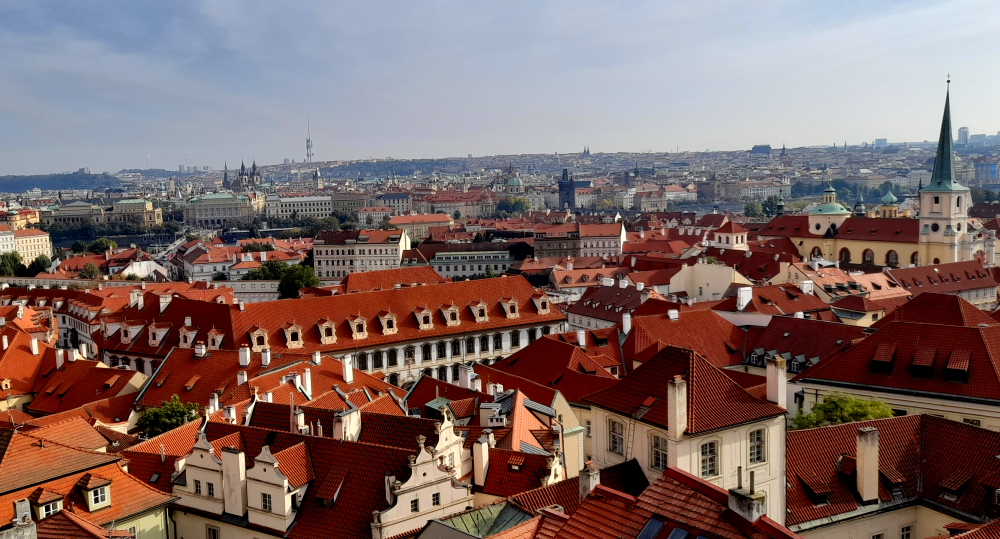
View of Prague & St Thomas Church from the Castle’s South Gardens

The Garden on the Ramparts’ central terrace offers a breathtaking view of Prague.

We return to the tram stop where we arrived and discover that the No. 23 tram stops near our hotel so we ride one all the way home. After a short break we catch another tram to take us to the Ujezd tram stop so that we can ride the funicular to the top of the Petrin Gardens. Alas, the funicular is under repairs. Natch!

Home again. Later we walk down the block to a restaurant with traditional Czech fare and order goulash with dumplings and spare ribs.

19 October, 2023

Due to the weather forecast of rain this morning, Lynn reschedules another GuruWalk to tomorrow morning. Instead, we’ll spend the morning catching up the past 2 days of blog then venture out later to see Prague’s main drag, Vaclavske namesti, from the viewpoint of the St Wenceslas statue. Lynn remembers it from her first visit to Prague in September 1992. In particular, her shock at the time of seeing a branch of McDonald’s (it opened in March 1992). Will it still be there?
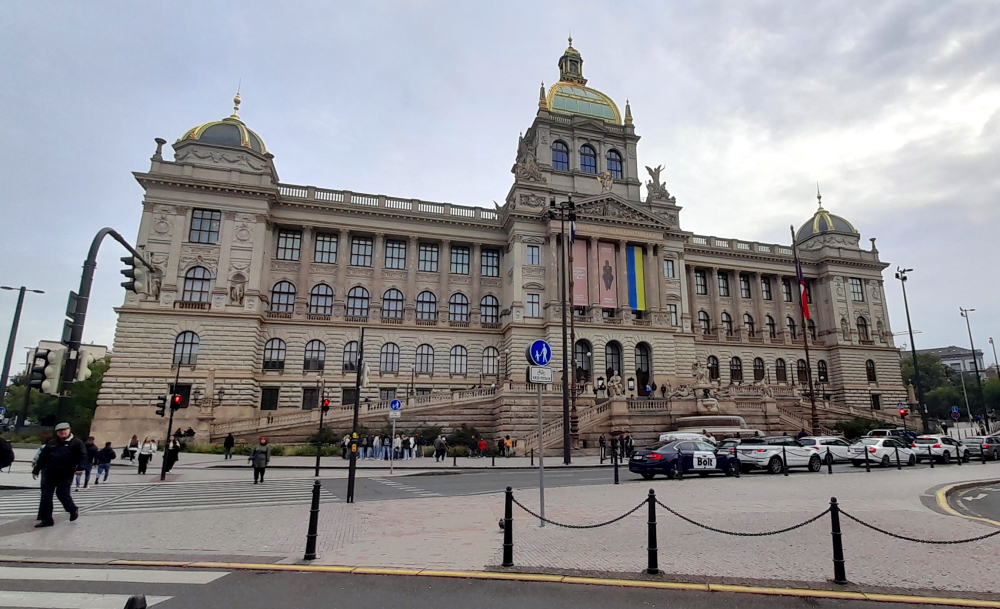
The National Museum.

Around 2:30 pm we walk to the Metro station and ride the metro to the Muzeum stop. We surface near the St Wenceslas statue and walk across the road to mount the National Museum steps for a view down the main street.

Sure enough, Macca’s is still there!
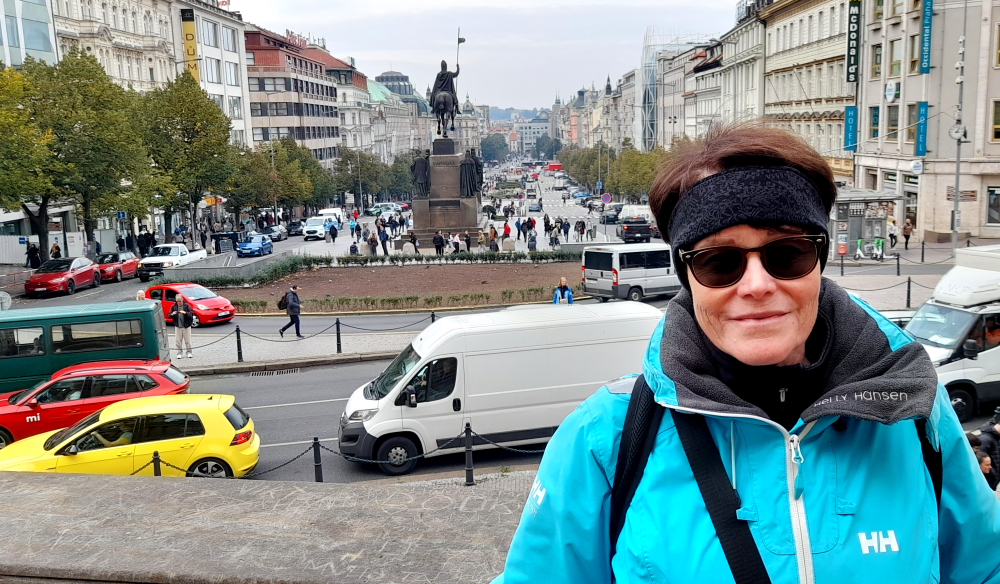
Macca’s to the right hand side.

The statue of Saint Wenceslas depicts Wenceslaus I, Duke of Bohemia. The mounted saint was sculpted by Josef Václav Myslbek in 1887–1924, and the image of Wenceslas is accompanied by other Czech patron saints carved into the ornate statue base: Saint Ludmila, Saint Agnes of Bohemia, Saint Prokop, and Saint Adalbert of Prague. The statue base, designed by architect Alois Dryák, includes the inscription: “Saint Wenceslas, duke of the Czech land, prince of ours, do not let perish us nor our descendants.”
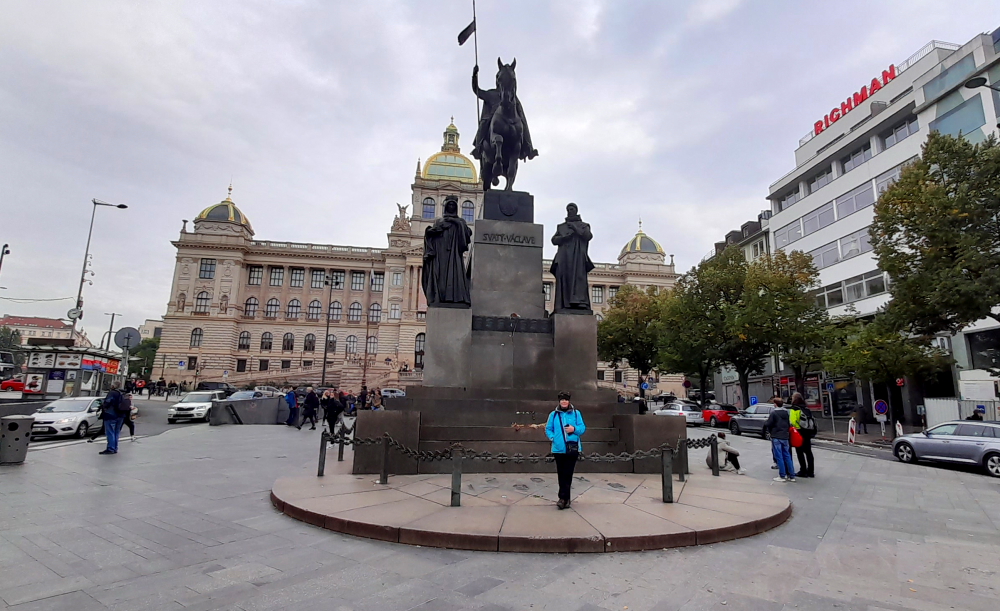
Small stature?

Strolling down the street I spy a Marks & Sparks near the Mustek Metro entrance so we enter the store to check it out. I need some new grundies but not willing to pay AUD80 for a pack of 5. Meanwhile, Lynn buys herself a white, long sleeved t-shirt at a more reasonable AUD38.

While I sit outside waiting for Lynn, a bunch of fire trucks, police cars and cops suddenly converge on the Metro entrance and cordon off the entrance and the street both sides of the intersection.
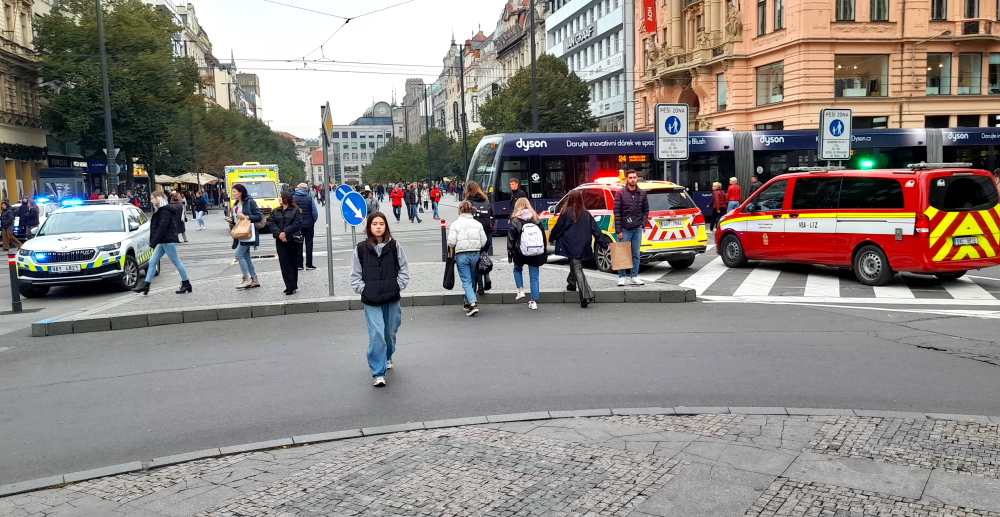
Mustek Station emergency services activity.

We quickly walk to the other side of the cross street to catch a tram that will drop us near the hotel. While waiting for Lynn there was a constant stream of trams. Now, none to be seen. Fortunately it’s only a 15-minute walk to the hotel so off we trot.

No mention on the local news as to what the incident was all about.

20 October, 2023

What was forecast to have been a cloudy morning is instead wet with constant mizzle. Not to worry, we’ll press on with our walk of the Old Town, Jewish Quarter and Charles Bridge.

After leaving the hotel at 9:15 am we take the Metro 3 stops to Namesti Republiky and join the tour group in front of the Powder Tower.

The Powder Tower is one of the original 13 city gates in Old Town, Prague. Its construction began in 1475. The tower was intended to be an attractive entrance into the city, instead of a defensive tower. The foundation stone was placed by Vladislav II. The city council gave Vladislav II the tower as a coronation gift. While it was being built, it was called the New Tower. The look of the tower was inspired by the work of Peter Parler on the Charles Bridge.

Vladislav II had to relocate due to riots, so the tower building stopped. He returned in 1485 to live back in Prague Castle, where he lived for the rest of his life, along with the rest of the Kings of Bohemia who lived in Prague. Kings would not return to use the tower or Royal Court until using it for coronation ceremonies starting again in 1836, where they would pass through the tower to go via the Royal Route to St. Vitus Cathedral at the Castle.

The gate was used to store gunpowder in the 17th century, hence the name Powder Tower or Powder Gate. The gate suffered considerable damage during the Battle of Prague. The sculptures on the tower were replaced in 1876.
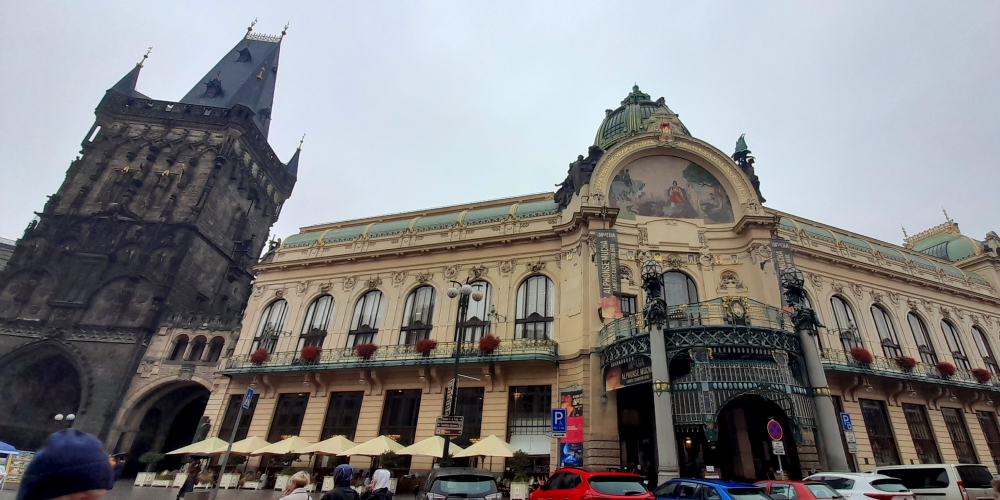
The Powder Tower and Obecní Dům concert hall.

3 minutes later we are at the House of the Black Madonna. Back in the day when literacy was low, buildings had statues on them so you could easily refer to them such as, “let’s meet at the house of the Black Madonna”.

It’s also a cubist building designed by Josef Gočár in mid-1911 for the wholesale merchant František Josef Herbst. Like many of Gočár’s buildings, the House of the Black Madonna was built with a reinforced-concrete skeleton inspired by the Chicago School. The use of a reinforced-concrete skeleton allowed for large interior spaces without ceiling support, which was better suited to Cubist aesthetics. The first floor café, free of interior pillars, was a feat of engineering at the time.

The building, completed in 1912, is named after the baroque sculpture of a Black Madonna that adorns it, a remnant of an earlier baroque .building on the site. It is the earliest example of cubist architecture in Prague. Although few original plans had survived, black-and-white photographs documenting the café’s interior décor from 1912 were used during renovation. Replicas of café furniture and brass chandeliers were constructed to revive the café and showcase Czech cubism to customers

Today, the ground floor houses a café, while the four upper floors are used by the Museum of Czech Cubism.
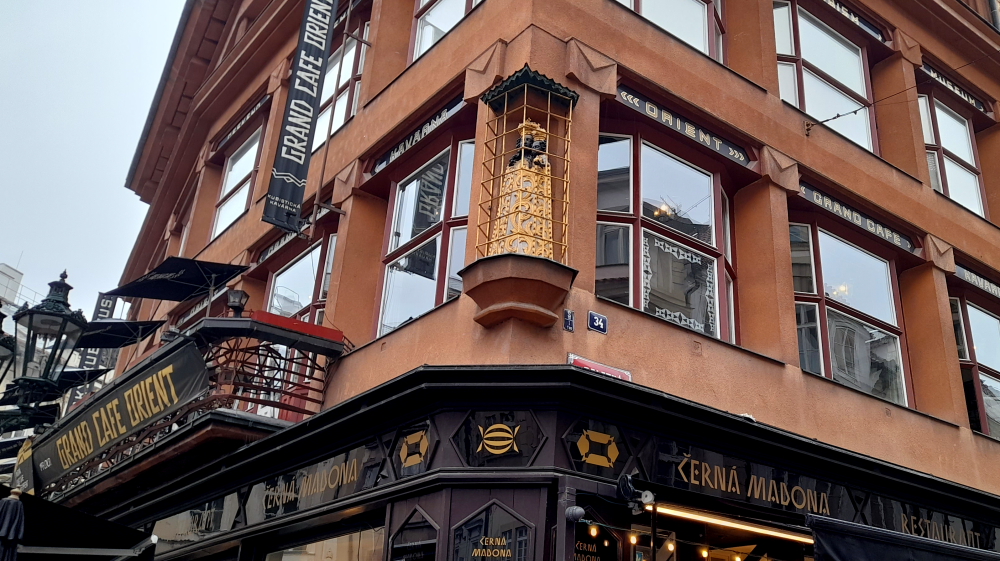
The Black Madonna on the Cubist Cafe building.

During the Chinese Covid Pandemic many restaurants, hotels and Cafes went out of business. The Cubist Cafe decided to invent a Covid looking cake and apparently it was such a hit that it saved the Cafe.
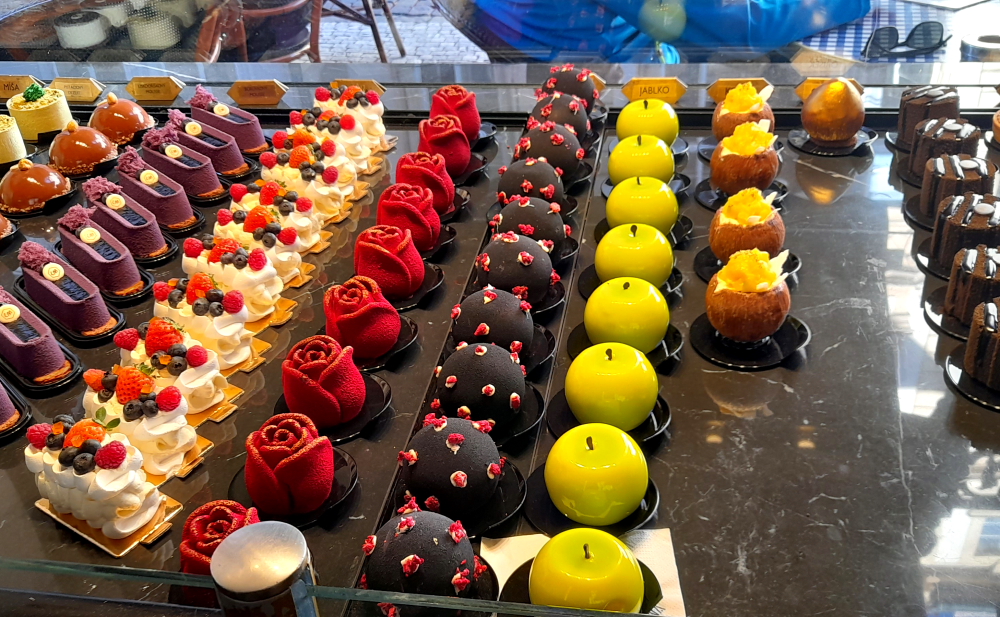
Covid style cakes in the Cubist Cafe.

2 minutes later we come to The Estates Theatre, built during the late 18th century in response to Enlightenment thought regarding general access to the theatre, and theatres themselves demonstrating the cultural standards of a nation.

While the theatre was initially built with the intention of producing German dramas and Italian operas, works in other languages were also staged. Czech productions were first staged in 1785 in order to reach a broader Czech audience but by 1812 they became a regular feature of Sunday and holiday matinées. The first Czech modern opera, František Škroup’s The Tinker, was staged here in 1826 and in 1834 the premiere of the song “Where is my Home?” was performed by bass Karel Strakatý which would later become the Czech national anthem.

Many famous European artists were also active. Individuals such as Carl Maria von Weber, Anton Rubinstein, Karl Goldmark, and Gustav Mahler conducted at the Estates Theatre. Other famous names include the actors A.W. Iffland, F. Raimund, J.N. Nestroy, along with opera singer Angelica Catalani and violin virtuoso Niccolò Paganini.

One of the Estates Theatre’s many claims to glory is its strong link with Wolfgang Amadeus Mozart, who conducted the world premiere of his opera Don Giovanni here in October 1787. Also, in 1791, Mozart’s La Clemenza di Tito was staged in public here for the first time in celebration of the coronation of Emperor Leopold II. It is the only theatre left standing where Mozart performed.
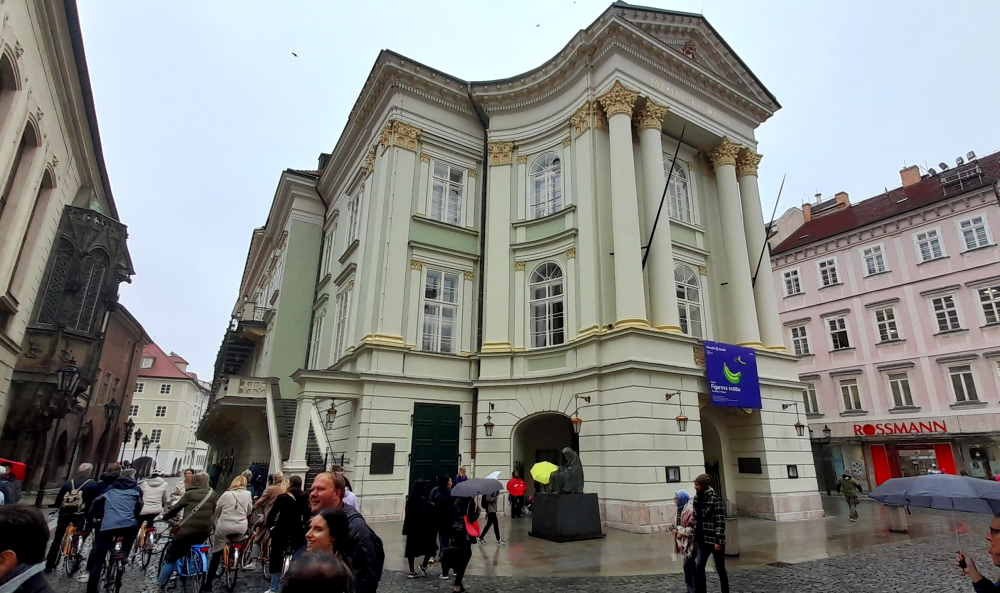
The EstatesTheatre.

The Estates Theatre currently offers performances of dramas, ballets and operas with the focus of the opera company on the work of Wolfgang Amadeus Mozart. Most of the opera scenes of Miloš Forman’s film Amadeus were shot at the Estates Theatre. The theatre was also featured in the Beethoven biopic, Immortal Beloved, starring Gary Oldman.

Anna Chromy’s statue Il Commendatore, inspired by the character from Don Giovanni, was installed in front of the theatre in 2000
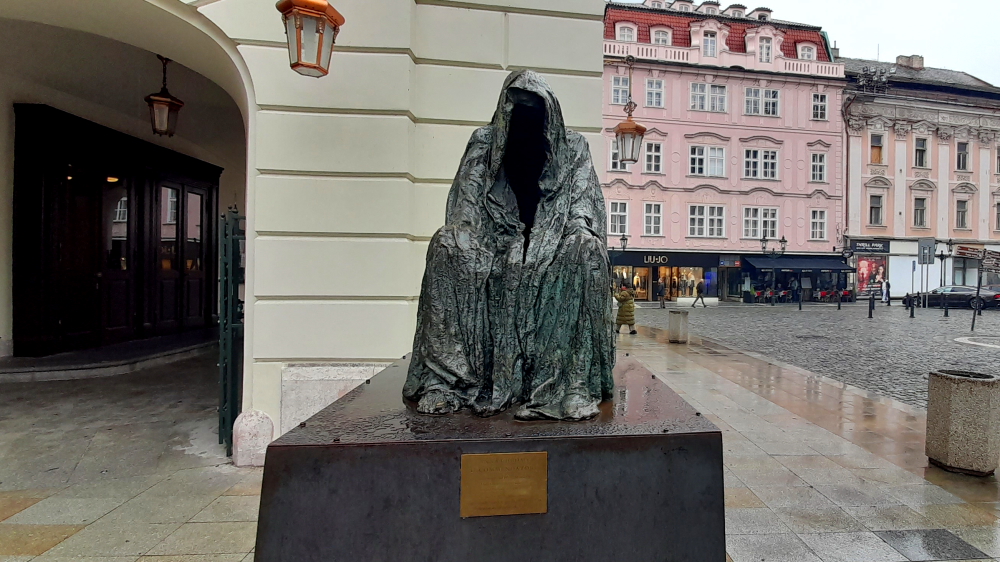
The haunting cloak of Don Giovanni.

A 4-minute walk along Zelezna brings us to the Old Market Square and Town Hall.
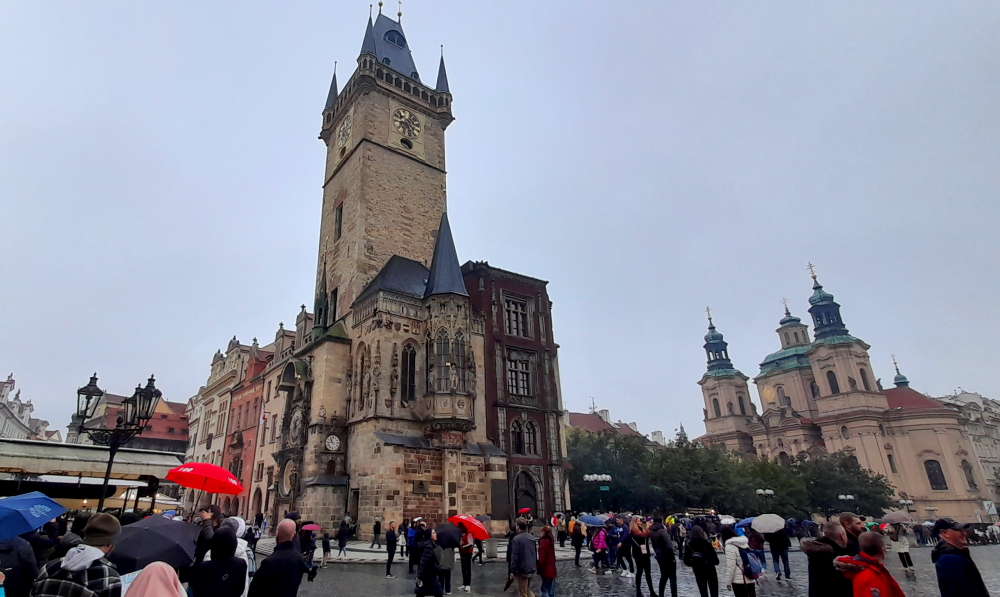
The Town Hall on the old market square.

Here it is possible to see, side by side, the changing architectural styles over the centuries.
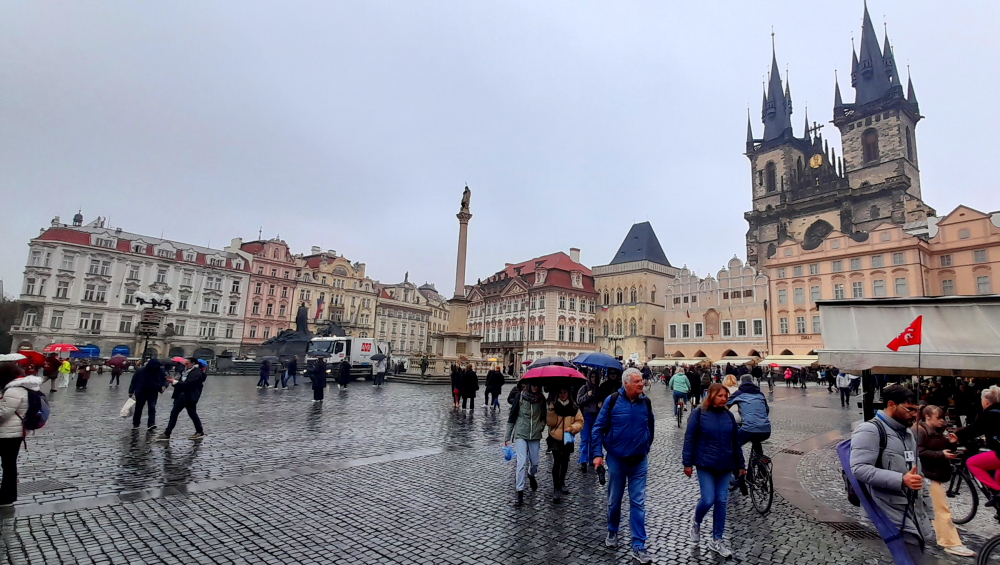
Prague old town market square.

Our main reason for stopping here is to hear the 11:00 am chiming and see the display of animated figures on the medieval Astronomical Clock attached to the Old Town Hall. The clock was first installed in 1410, making it the third-oldest astronomical clock in the world and the oldest clock still in operation.
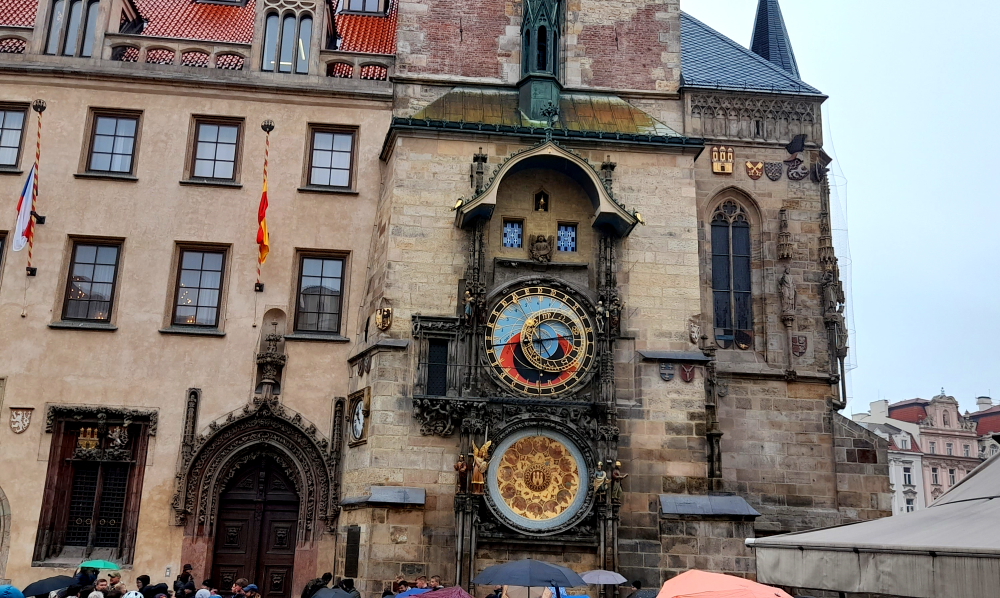
The Astronomical Clock on the Town Hall.

Also in the square is a monument to Jan Hus, a Czech theologian and philosopher who became a Church reformer and the inspiration of Hussitism, a key predecessor to Protestantism, and a seminal figure in the Bohemian Reformation.

After being ordained as a Catholic priest, Hus began to preach in Prague. He opposed many aspects of the Catholic Church in Bohemia. Alexander V issued a Papal bull that excommunicated Hus; however, it was not enforced, and Hus continued to preach. Hus then spoke out against Alexander V’s successor, Antipope John XXIII, for his selling of indulgences. Hus’s excommunication was then enforced, and he spent the next two years living in exile.

When the Council of Constance assembled, Hus was asked to be there and present his views on the dissension within the Church. When he arrived, with a promise of safe-conduct, he was arrested and eventually taken in front of the council and asked to recant his views. On 6 July 1415, he was burned at the stake for heresy against the doctrines of the Catholic Church.

After Hus was executed, the followers of his religious teachings (known as Hussites) refused to elect another Catholic monarch and defeated five consecutive papal crusades between 1420 and 1431 in what became known as the Hussite Wars.
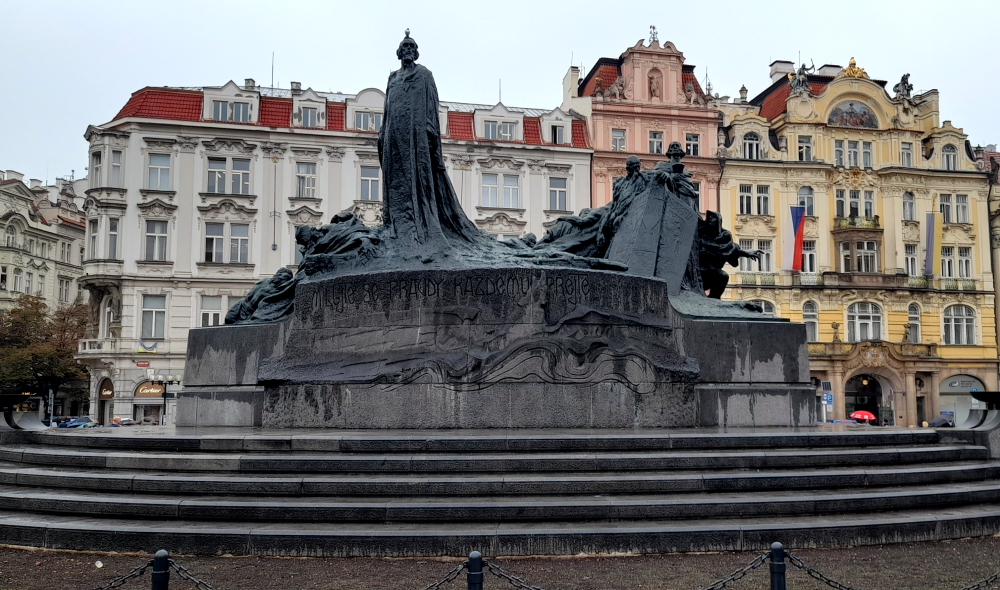
Jan Hus Monument.

After a 15-minute break we proceed along Dusni to the edge of the Jewish Quarter where we encounter a statue of Franz Kafka by artist Jaroslav Rona. It was installed on Vězeňská street in the Jewish Quarter in December 2003. It depicts Franz Kafka riding on the shoulders of a headless figure, in reference to the author’s 1912 story “Description of a Struggle”.
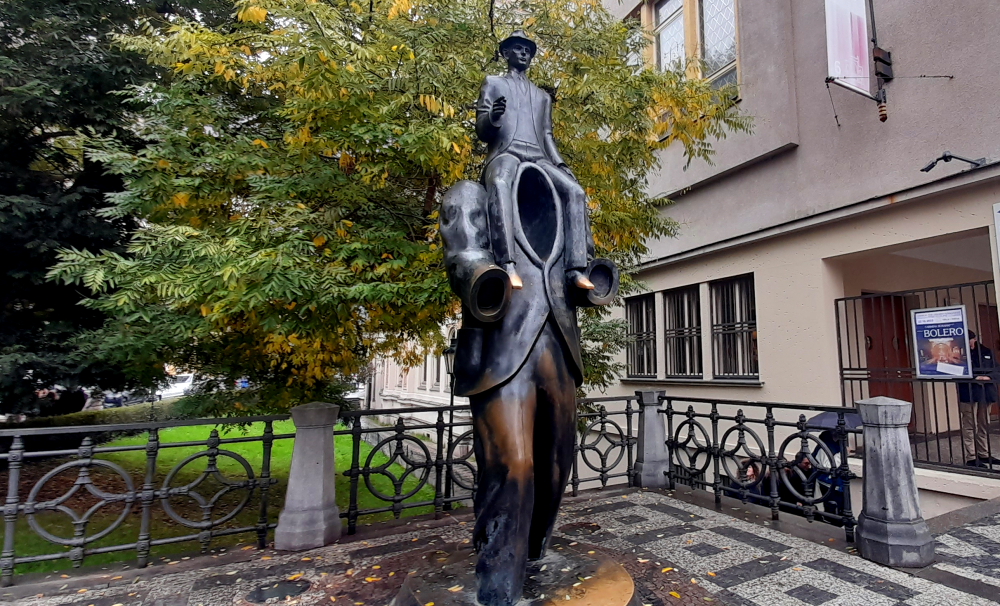
Franz Kafka Statue, Jewish Quarter.

Next door is the Spanish Synagogue, the newest synagogue in the area and was built at the site of the oldest synagogue in 1868. The synagogue is built in Moorish Revival Style which was inspired by the art of Arabic period of Spanish history. Today, the Spanish Synagogue is administered by the Jewish Museum in Prague.
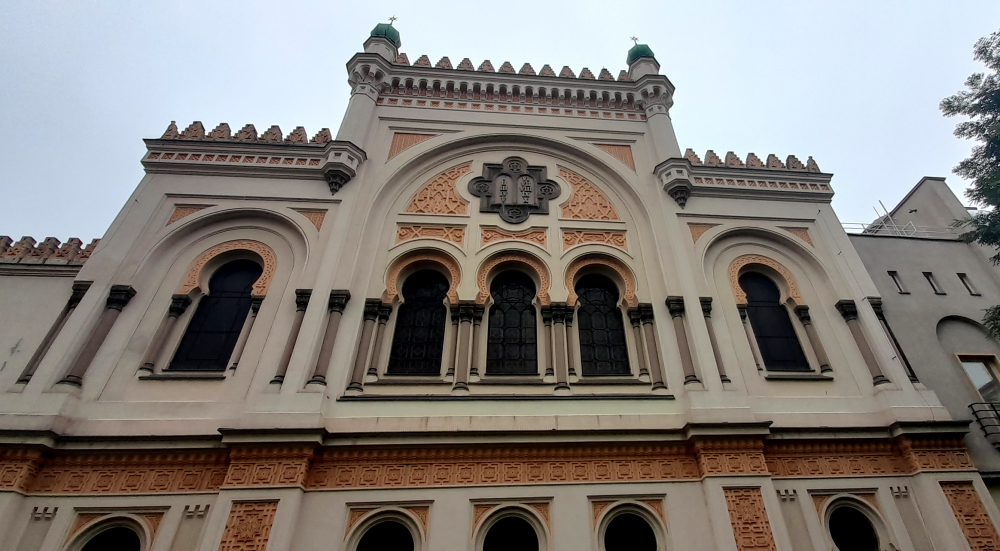
The Spanish Synagogue.

Nearby is the Old New Synagogue situated in Josefov, and is Europe’s oldest active synagogue. It is also the oldest surviving medieval synagogue of twin-nave design. Completed in 1270, it was one of Prague’s first Gothic buildings.

Legend has it that the giant, Golem, used to live here at the back of the synagogue, hence the iron railings up the wall, starting about 6′ off the ground, leading to a door in the attic.
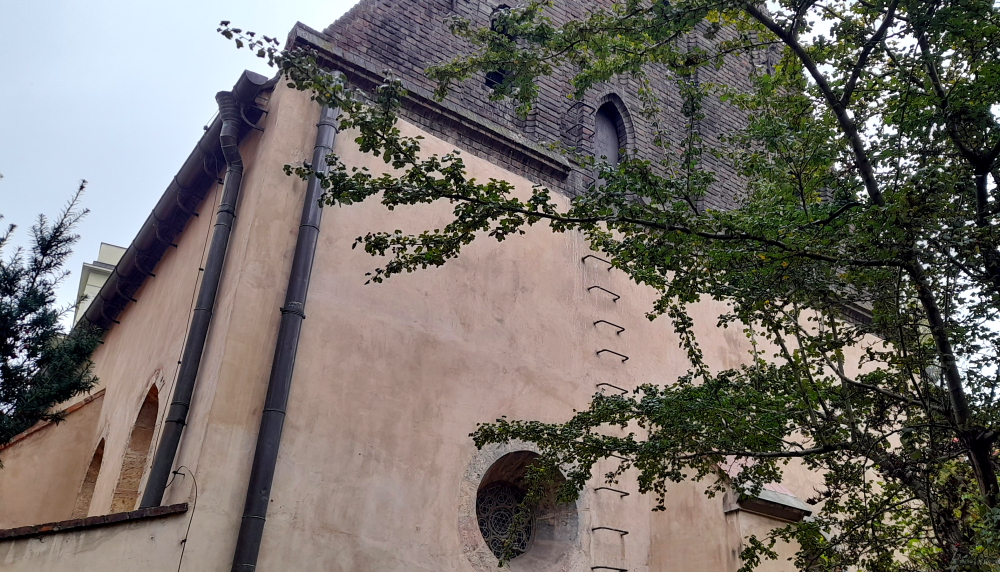
Golem’s attic abode, the Old New Synagogue.

Down the road from the synagogue we can see the burial ground on the left and the Ceremonial Hall at the end of the street.
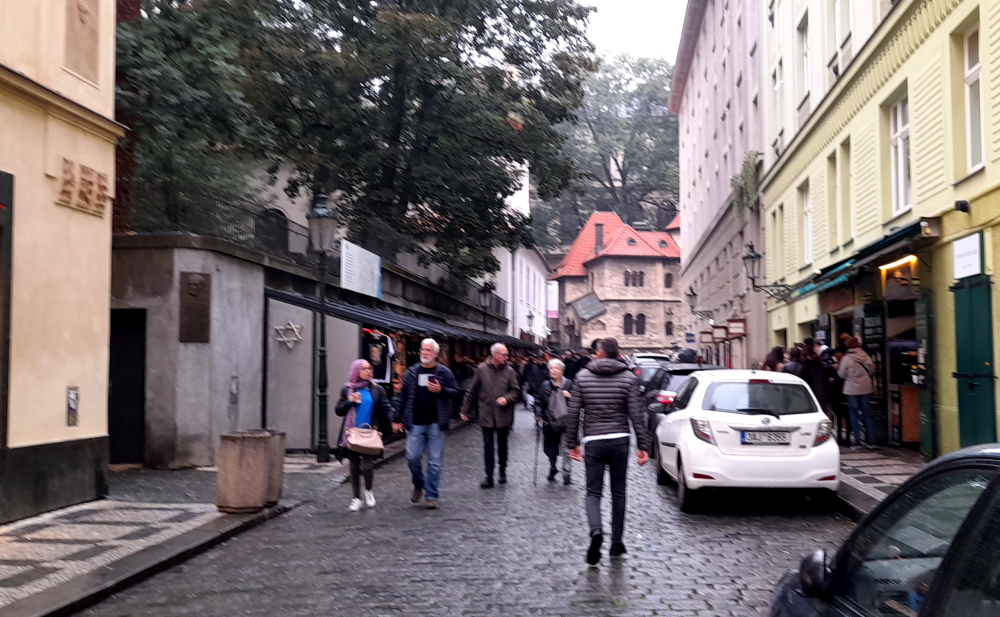
The Jewish Quarter burial ground.

From here we walk 5 minutes south to the Prague New City Hall. An important piece of Art Nouveau architecture dating back to 1908-1911. Since 1945, it has been the seat of the Prague City Hall and Prague’s Mayor.

On our way to the Charles Bridge we walk past the Clementinum, an historic complex of buildings which houses the National Library of the Czech Republic.
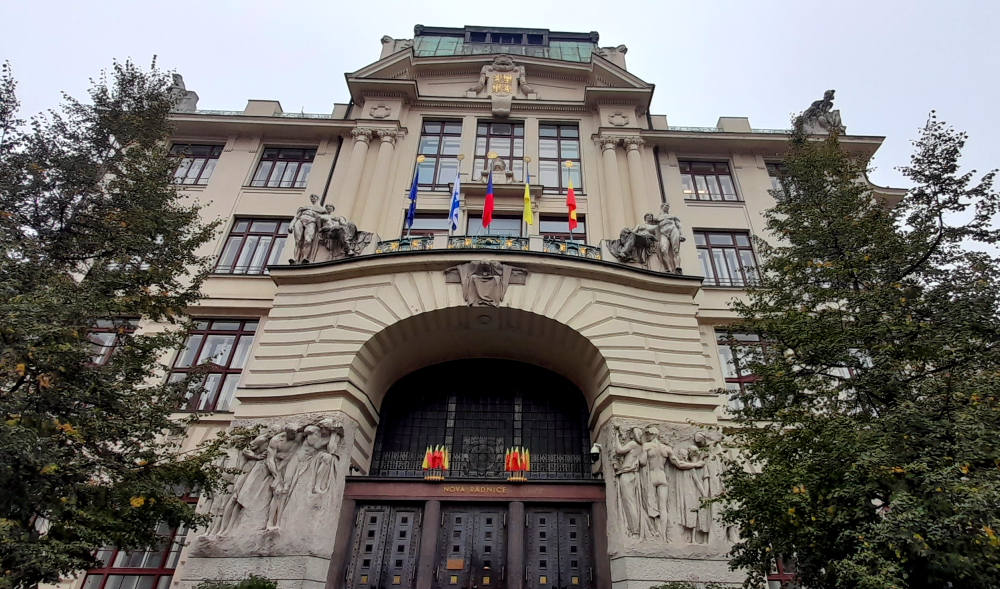
Prague City Hall.

Its history dates from the existence of a chapel dedicated to Saint Clement in the 11th century. A Dominican monastery was founded in the medieval period, which was transformed in 1556 to a Jesuit college. In 1622 the Jesuits transferred the library of Charles University to the Clementinum, and the college was merged with the University in 1654. The Jesuits remained until their suppression in 1773, when the Clementinum was established as an observatory, library, and university by the Empress Maria Theresa of Austria.

The National Library was founded in 1781 and from 1782 the Clementinum was a legal deposit library. In 1918 the newly established Czecho-Slovak state took over the library. Since 1990, it has been the National Library. It contains a collection of Mozartiana, material pertaining to Tycho Brahe and Comenius, as well as historic examples of Czech literature. The architecture is a notable example of Baroque architecture and the Clementinum, covering 20,000 square metres, is the second largest complex of buildings in Prague after Prague Castle.
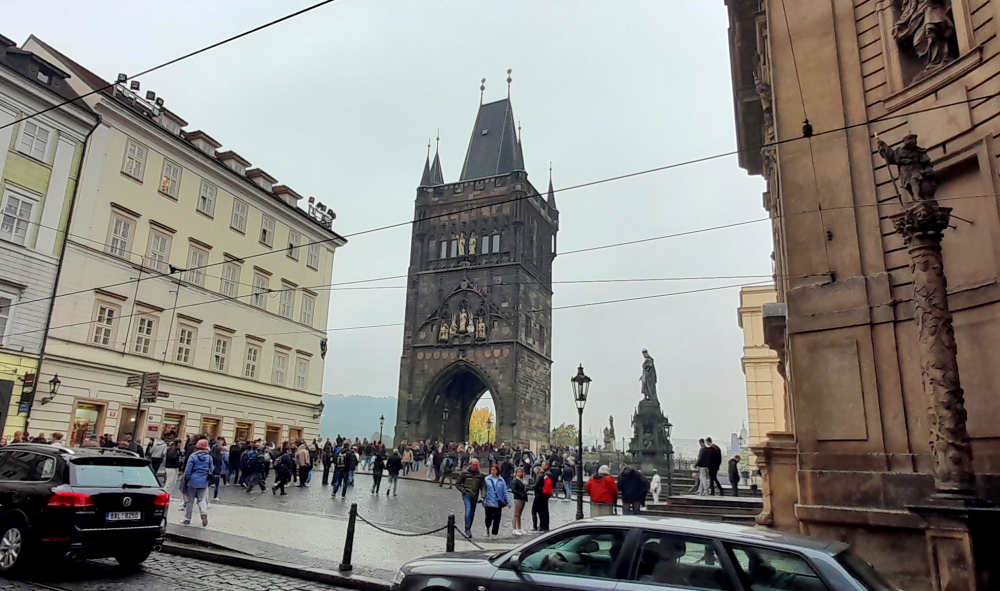
The Charles Bridge.

We approach the commencement of the Charles Bridge where we are presented with the imposing Old Town Bridge Tower, a gothic monument. The tower, along with the Charles Bridge, was built by Emperor Charles IV according to designs by Petr Parléř in the mid-14th century. The gate to the Old Town was also conceived as a symbolic victory arch through which Czech kings passed on their coronation processions just like the Powder Gate 1.1 kms east along Celetna.

Before the Tower and located in the Knights of the Cross Square is also an imposing monument of King Charles IV. It is one of the best preserved and most significant neo-Gothic statues in Central Europe. It was created in 1848 on the occasion of the 500th anniversary of Prague Charles University, which was founded by Charles IV in 1348.
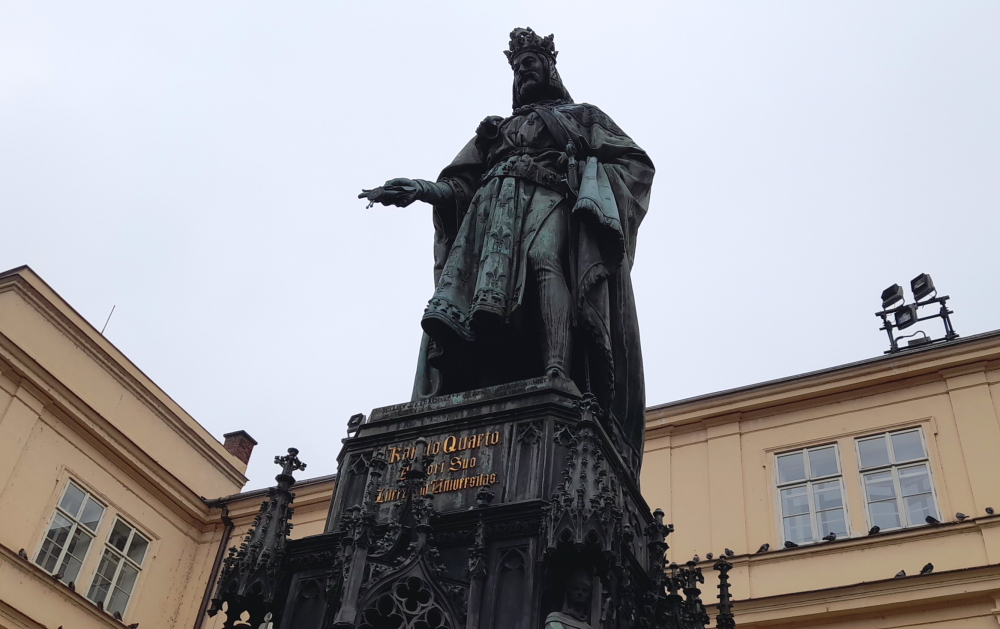
King Charles IV statue.

Charles IV (Karel IV in Czech) ruled the Bohemian Kingdom in 1346-1378 and the Holy Roman Empire in 1355-1378. He was also the King of Italy and Burgundy. In the Czech Republic, he is considered one of the most important persons in Czech history (if not the one most important – he is often called the father of the country) and the period of his reign is considered the Golden era of Prague and Bohemia, as Prague was virtually the capital of Holy Roman Empire and big part of Europe at that time.
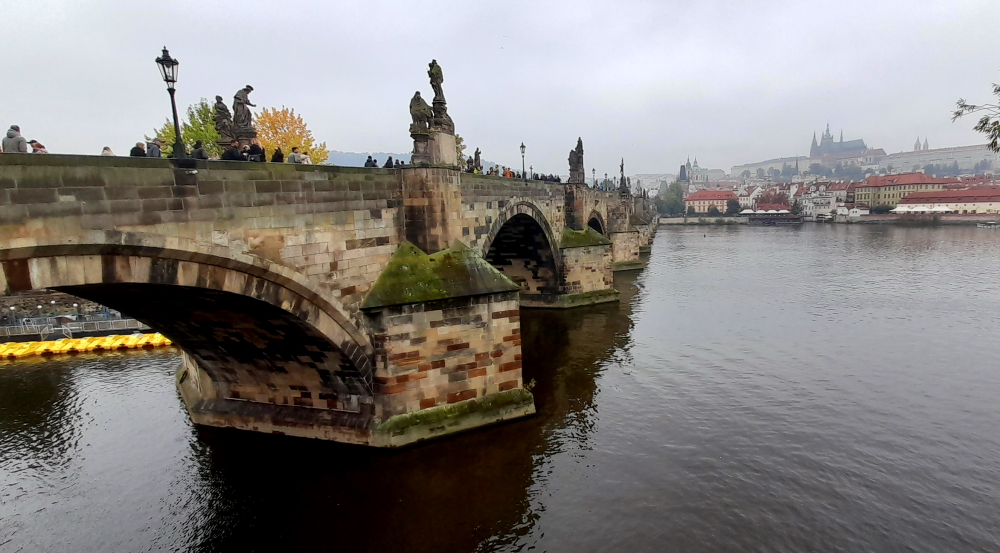
Charles Bridge.

Charles Bridge is a medieval stone arch bridge that crosses the Vltava river. Its construction started in 1357 under the auspices of King Charles IV, and finished in the early 15th century. The bridge replaced the old Judith Bridge built 1158–1172 that had been badly damaged by a flood in 1342. This new bridge was originally called Stone Bridge or Prague Bridge but has been referred to as “Charles Bridge” since 1870.
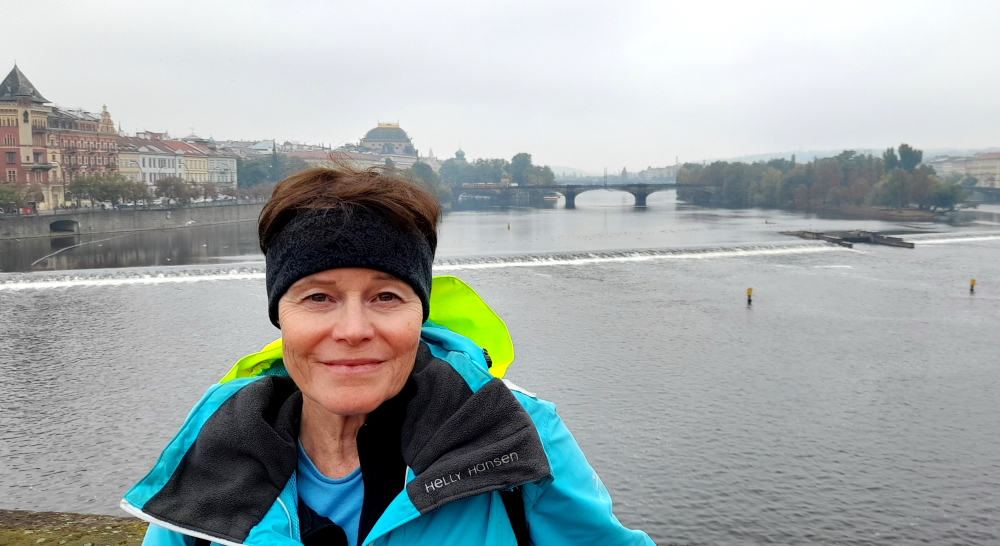
From the Charles Bridge.

As the only means of crossing the river Vltava until 1841, Charles Bridge was the most important connection between Prague Castle and the city’s Old Town and adjacent areas. This land connection made Prague important as a trade route between Eastern and Western Europe.

The bridge is 516 metres (1,693 ft) long and nearly 10 metres (33 ft) wide. It was built as a bow bridge with 16 arches shielded by ice guards. It is protected by three bridge towers, two on the Lesser Quarter side (including the Malá Strana Bridge Tower) and one on the Old Town side, the Old Town Bridge Tower. The bridge is decorated by a continuous alley of 30 statues and statuaries, most of them baroque-style, originally erected around 1700, but now all have been replaced by replicas.
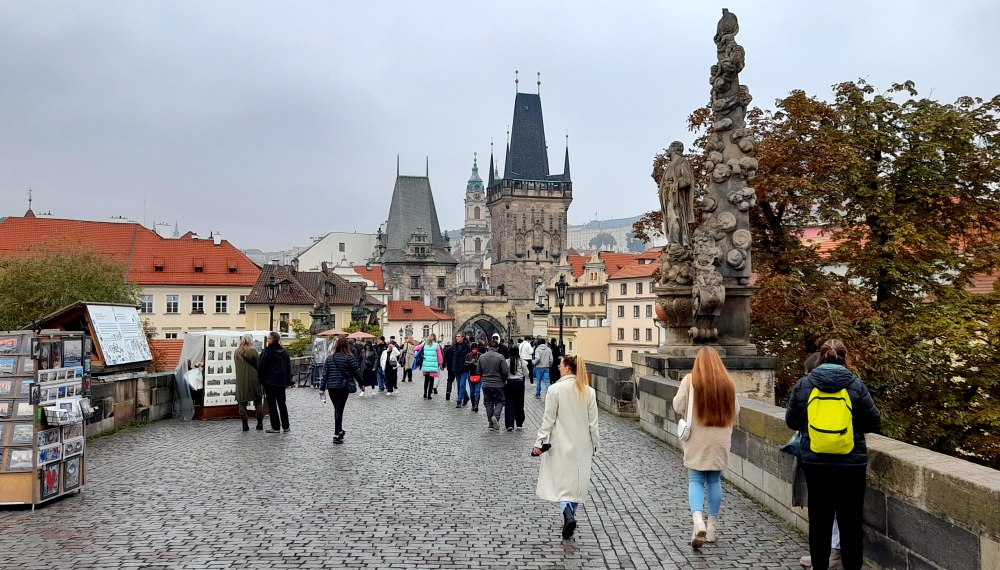
The Prague Castle end of the Charles Bridge.

A short walk away is the John Lennon Wall where our walk terminates, some 3 hours later. The Lennon Wall or John Lennon Wall is a wall in Prague reminiscent of the East Side Gallery in Berlin. Since the 1980s, this once-typical wall has been filled with John Lennon–inspired graffiti, lyrics from Beatles’ songs, and designs relating to local and global causes.

Located in a small and secluded square across from the French Embassy, the wall had been decorated by love poems and short messages against the regime since 1960s. It received its first decoration connected to John Lennon—a symbol of freedom, western culture, and political struggle—following the 1980 assassination of John Lennon when an unknown artist painted a single image of the singer-songwriter and some lyrics.

In 1988, the wall was a source of irritation for Gustáv Husák’s communist regime. Following a short-lived era of democratization and political liberalization known as the Prague Spring, the newly-installed communist government dismantled the reforms, inspiring anger and resistance. Young Czechs wrote their grievances on the wall and, according to a report of the time, this led to a clash between hundreds of students and security police on the nearby Charles Bridge. The liberalization movement these students followed was described as Lennonism (not to be confused with Leninism), and Czech authorities described participants variously as alcoholic, mentally deranged, sociopathic, and agents of Western free market capitalism.
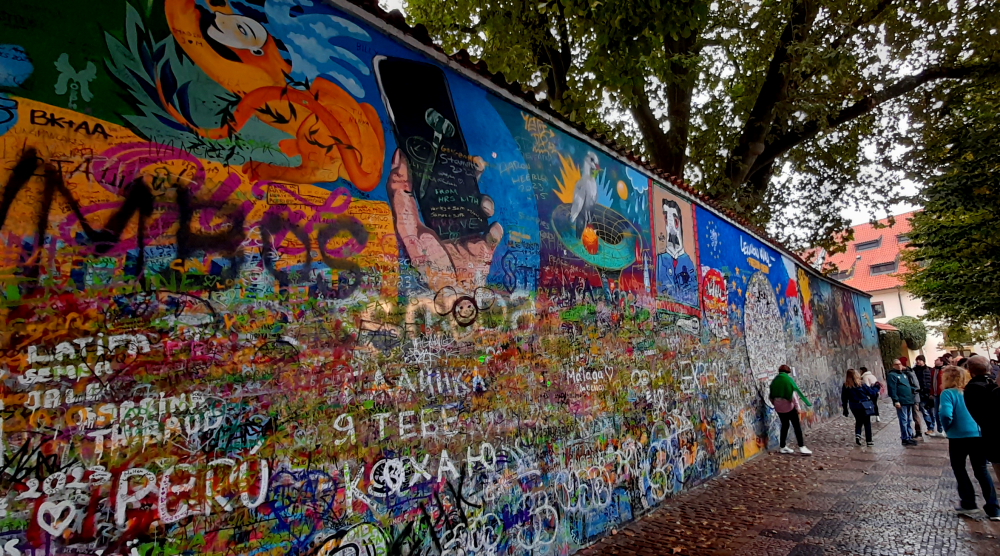
The John Lennon Wall.

The wall continuously undergoes change, and the original portrait of Lennon is long lost under layers of new paint. Even when the wall was repainted by authorities, by the next day it was again full of poems and flowers. Today, the wall represents a symbol of global ideals such as love and peace. For example, there are several doves, and Ukraine’s contribution was of a military tank in a field of sun flowers.
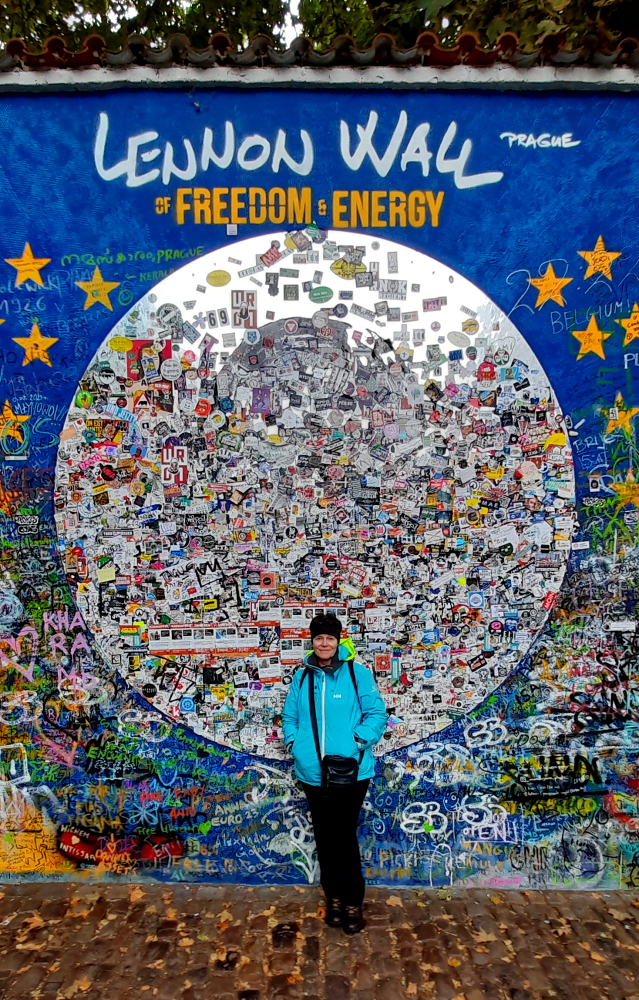
Leaving an image on the John Lennon Wall.

The wall is owned by the Sovereign Military Order of Malta, which allowed the graffiti, and is located at Velkopřevorské náměstí (Grand Priory Square), Malá Strana.
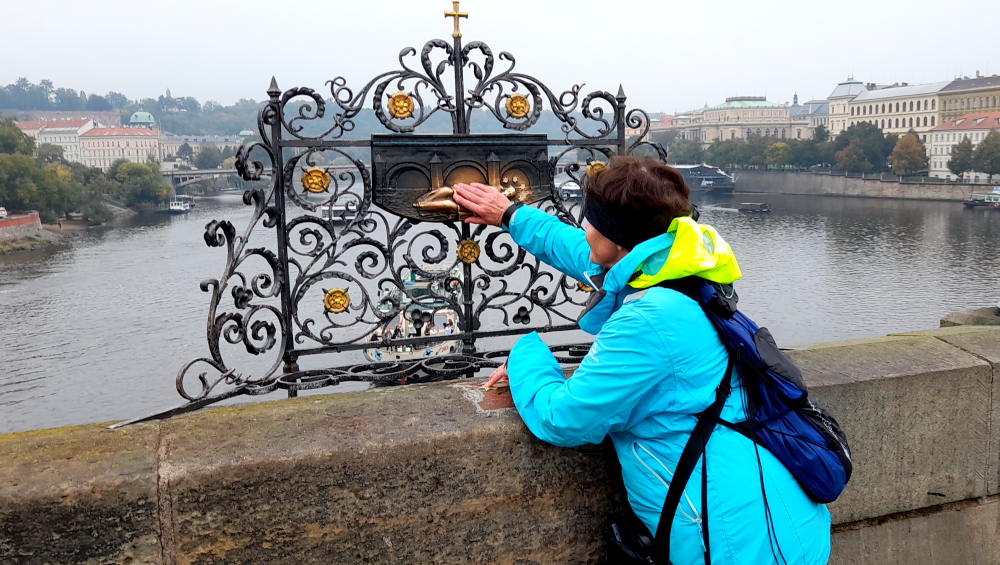
Making a wish on the Charles Bridge.

To return home we retrace our steps across the Charles Bridge and when we come to the plaque commemorating one of the saints we both make a wish, as is customary. When in Rome, or Praha…
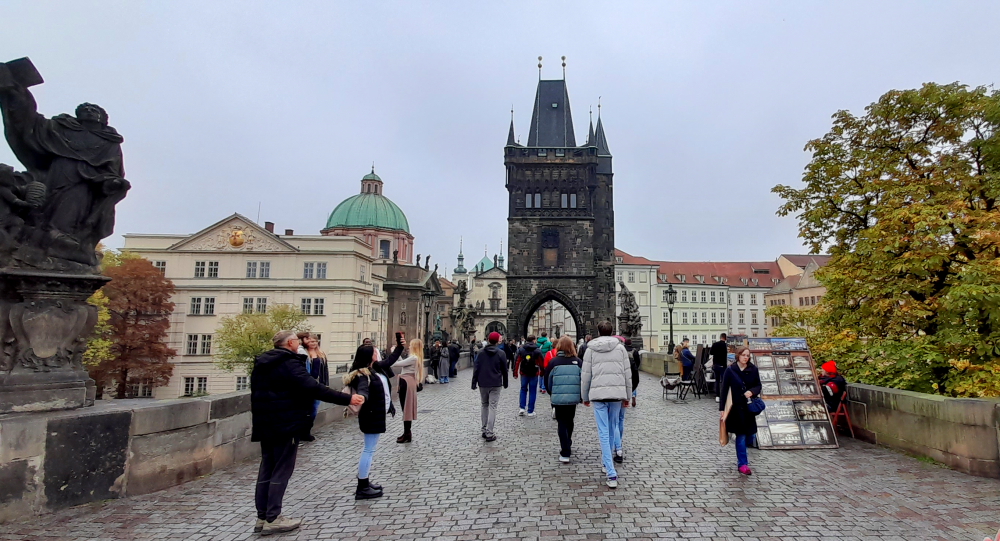
The Old Town side of the bridge.

Close by is a tram stop where we jump on a No. 17 which drops us near to our hotel.
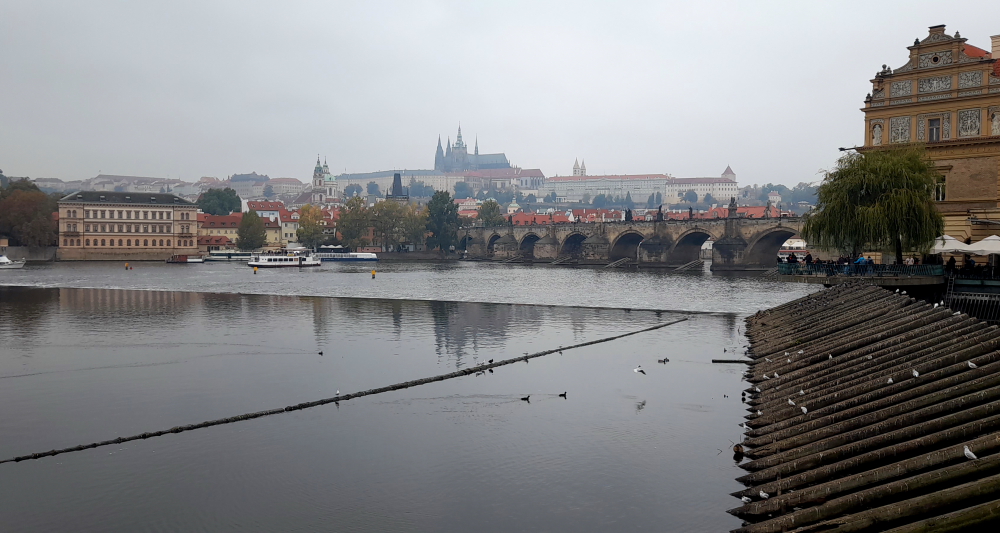
The Vlatva River to the Charles Bridge.

21 October, 2023

What a difference a day makes! Not a cloud in the sky this morning. After breakfast we plan to take the Metro back to the Republic square and walk the Royal route to the Charles Bridge, check out the western bridge gate, walk past the Wallenstein Palace building then on to the start of the Prague Castle stairs.

We take a number of photos of the important landmark buildings that we took yesterday in the rain. They are much more impressive in the bright sunlight but I won’t bother repeating them on the blog.
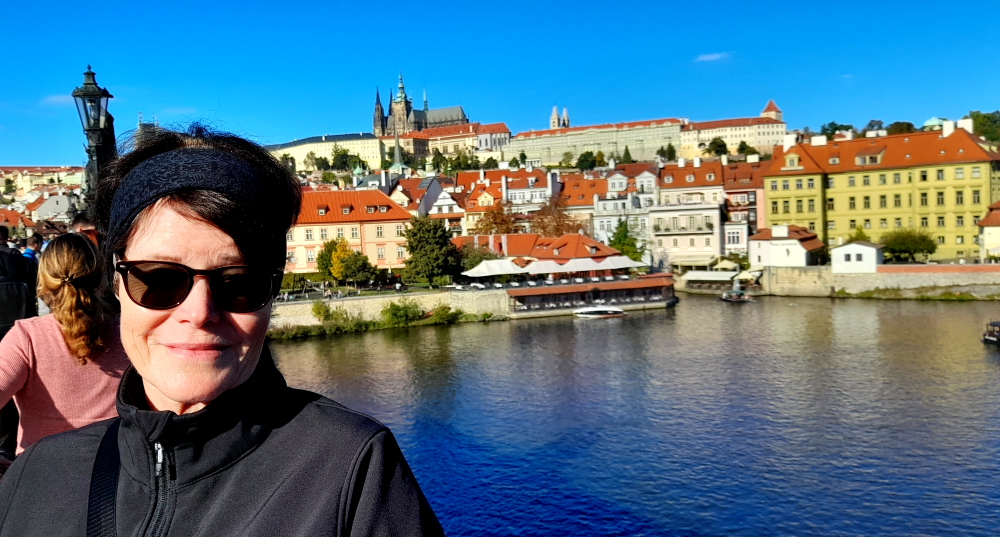
Beautiful day on the Charles Bridge.

It’s going to get to a very warm 21 Deg C today and by 11:00 am we already know that we are overdressed compared to being rugged up for a wet 11 Deg C yesterday.
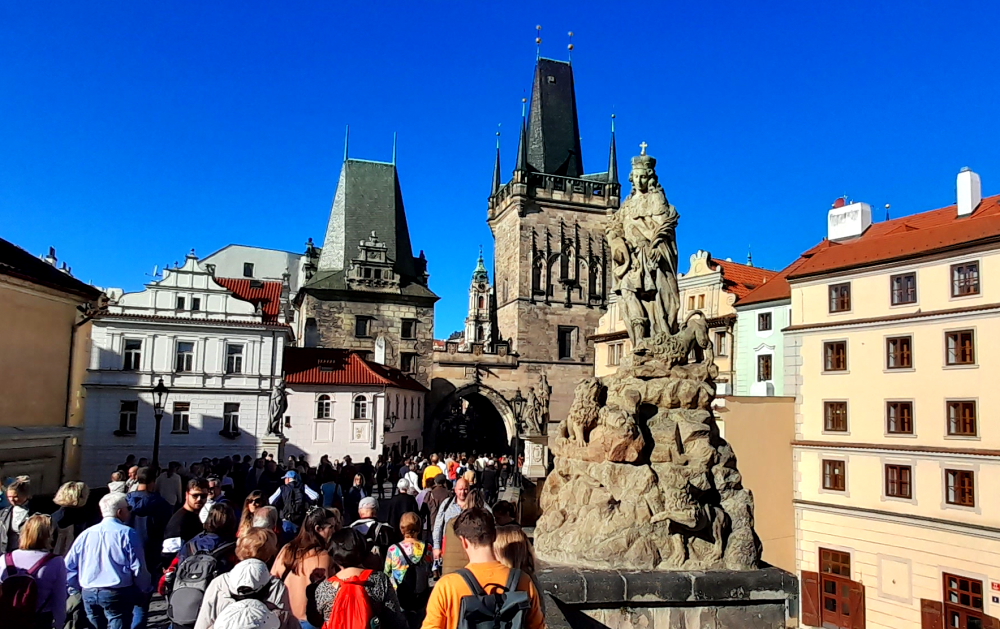
The West end of Charles Bridge.

It’s Saturday today so with the excellent weather and a weekend the tourist crowds are heaving. It would have been difficult to do a walking tour in a group today. We may have complained about the weather yesterday but the tour without the crowds was very good. Shame about yesterday’s crappy photos.

From the end of the bridge we continue on to St. Nicholas Church but I manage to convince Lynn that it isn’t necessary to see yet another European church, especially in an agnostic country. We turn right towards the Wallenstein Palace.
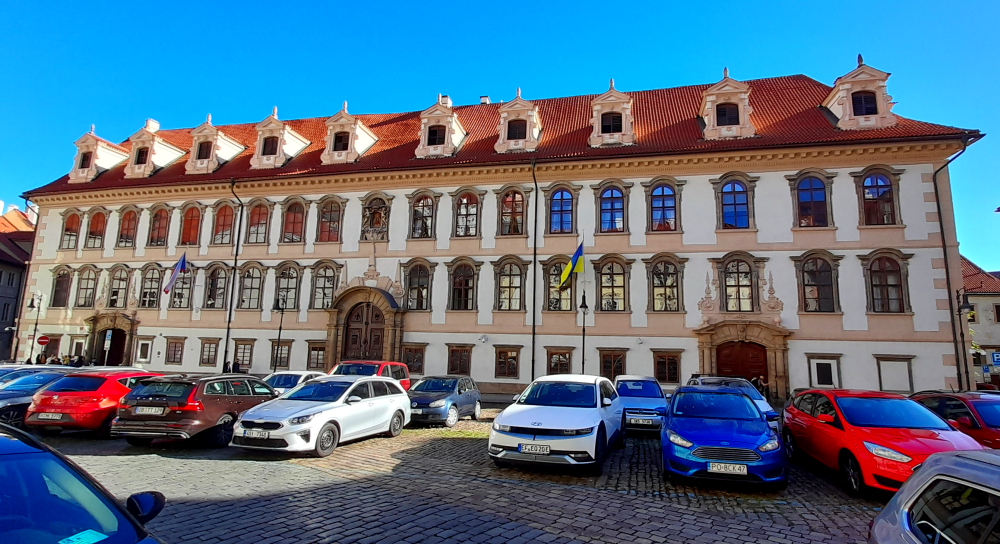
The Wallenstein Palace.

Wallenstein Palace is a Baroque palace in Malá Strana, Prague, that served as a residence for Imperial Generalissimo Albrecht von Wallenstein and now houses the Senate of the Czech Republic.

The original Palace was built during 1623-1630 by Albrecht von Wallenstein, Duke of Mecklenburg (1583-1634), who made his name and fortune as the Commander-in-Chief of the Imperial forces in the Thirty Years War. Emperor Ferdinand II feared Albrecht von Wallenstein’s calculating mind and had him assassinated in 1634 in the town of Eger (now Cheb). He lived in the palace for only a year before his death. His widow sold it to his nephew and it remained in the Wallenstein family until 1945. After the Second World War, the palace became Czechoslovak state property and was renovated to house government offices. Today, the Senate of the Czech Republic operates out of the main palace buildings.
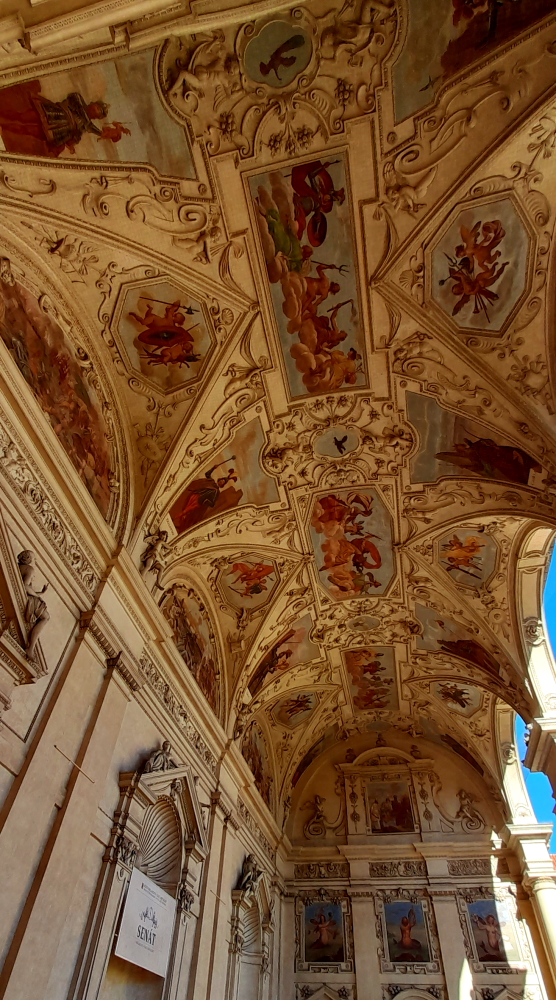
Ornate ceiling of the Palace.

Typical of Socialist Leftist Governments. Wait until someone has spent years building and maintaining assets then just take them for themselves (not for the people as they claim). It is only a matter of time before the Australian Labor Party decides that people who have worked hard to build superannuation in Australia to become self-funded retirees and not be a burden on society should have those assets taken away by either additional taxes or tax them as an inheritance tax so the next generation can’t have a good start in life. Just a little rant after reading that the Labor Treasurer states in this morning’s news that Australians have been better off under a Labor Government but when analysis has been done to prove that, in fact, Australians are now significantly worse off.

Anyway, back to the Palace. We take a stroll around the gardens in the inner courtyard as you do on a beautiful sunny day.
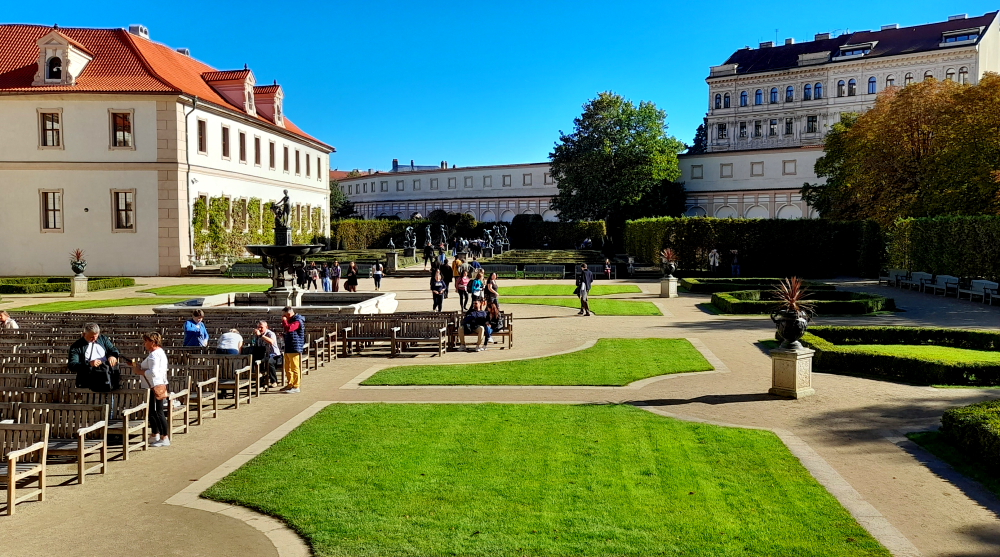
The grounds of the Wallenstein.

I note that the bronze fountain in the courtyard had water spouting from the breast of the main statue but Lynn wouldn’t let me include that picture. Probably for the best as it may offend the wokes.
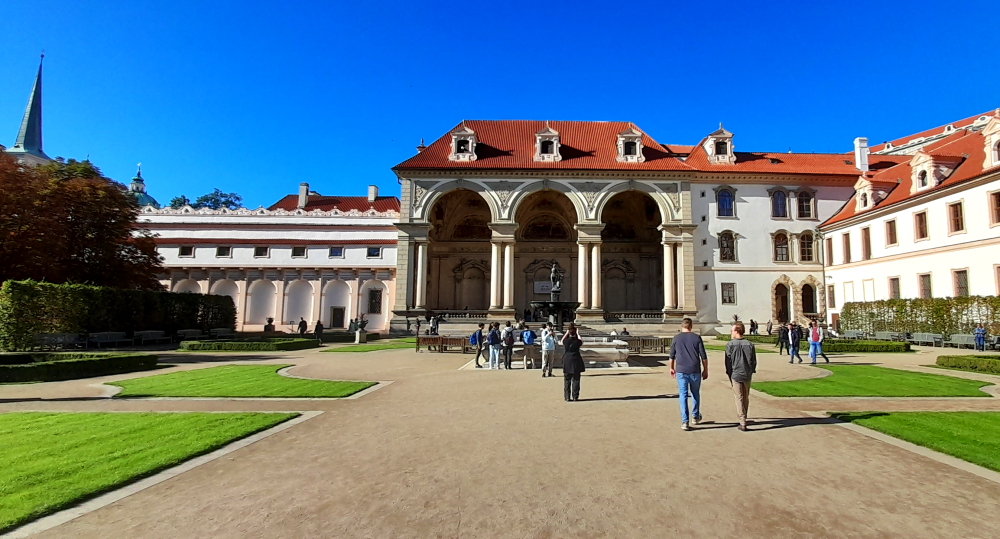
The Palace from the grounds.

It is only another 200 metres to the Prague Castle stairs but by the time we reach them the crowds are impossible. I am not that keen to walk up to the castle again so we decide to head back to the Vyserad Cathedral to look for Dvorak’s Grave that we missed on our visit here on our first day in Prague.

This time however, I know how the trams work and I find that a No. 2 tram will take us all the way from Prague Castle to the Cathedral. This so we can enjoy the sunny day at the Cathedral and still avoid walking about 5 kms.

It is still a steep walk from the tram stop up the hill to the Cathedral but we get to enjoy the views on the way up.
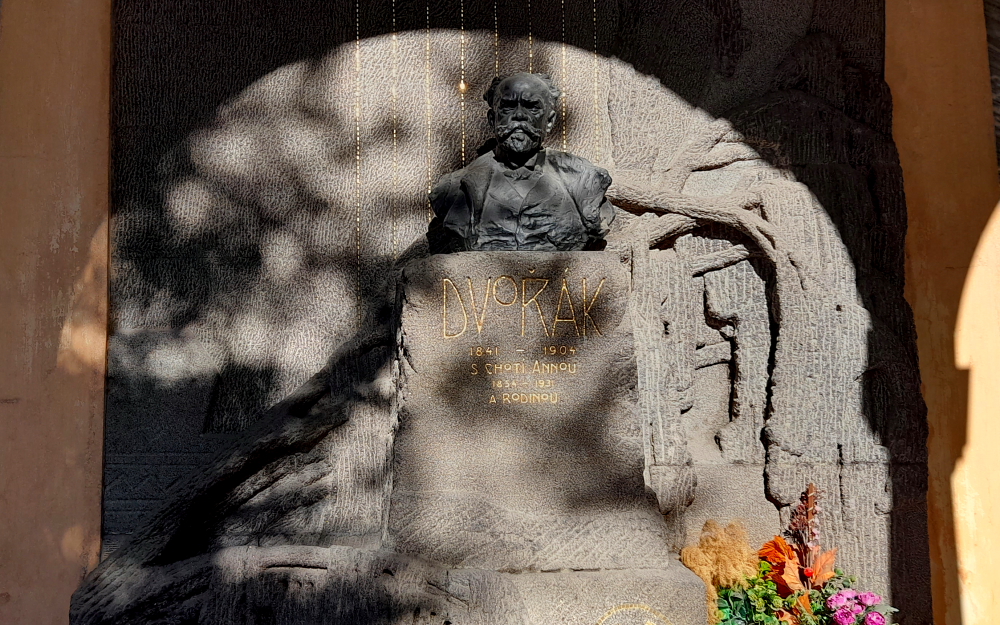
Dvorak’s Grave in the Cathedral Cemetery.

Antonín Leopold Dvořák (8 September 1841 – 1 May 1904) was a Czech composer. Dvořák frequently employed rhythms and other aspects of the folk music of Moravia and his native Bohemia, following the Romantic-era nationalist example of his predecessor Bedřich Smetana.

Dvorak is one of my favourite composers and I especially enjoy his Symphony No. 6 in D Major.

All of Dvořák’s nine operas, except his first, have librettos in Czech and were intended to convey the Czech national spirit, as were some of his choral works. By far the most successful of the operas is Rusalka. Among his smaller works, the seventh Humoresque and the song “Songs My Mother Taught Me” are also widely performed and recorded. He has been described as “arguably the most versatile… composer of his time”

By 2:00 pm it feels like beer o’clock or it could be that, because this country is now the biggest beer consumers per head of population in the world, that it is just expected to have a beer at this time of day. We head back to the hotel to cool off and catch up on the blog.
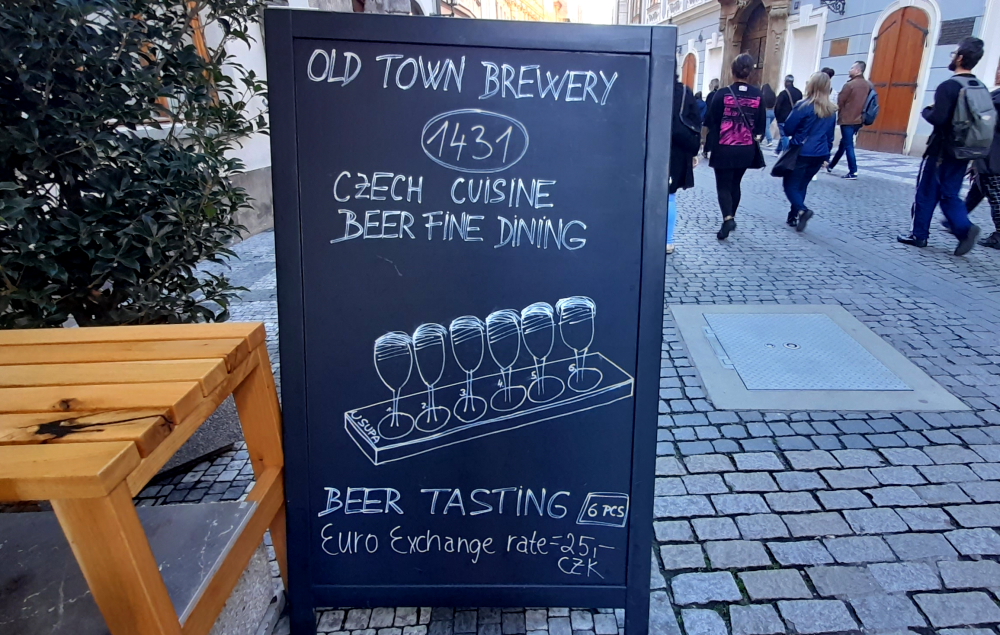
Only in Czechia can beer be classified as ‘Fine Dining’.

22 October, 2023

Another bright and sunny day but a cool 15 Deg. C. as we leave Prague for our next destination, Pilsen (Plzen), only 90 kms SW or about an hour’s drive away in Western Bohemia.

Founded as a royal city in the late 13th century, Plzeň became an important town for trade on routes linking Bohemia with Bavaria. By the 14th century it had grown to be the third largest city in Bohemia. The city was beseiged three times during the 15th-century Hussite Wars, when it became a centre of resistance against the Hussites. During the Thirty Years War in the early 17th century the city was temporarily occupied after the Siege of Plzeň.

In the 19th century, the city rapidly industrialised and became home to the Škoda Works, which became one of the most important engineering companies in Austria-Hungary and later in Czechoslovakia. The city is known worldwide as the home of Pilsner beer, created by Bavarian brewer Josef Groll in the city in 1842; today, the Pilsner Urquell Brewery is the largest brewery in the Czech Republic.

And that’s why we are here: the birthplace of pilsner beer – my favourite!
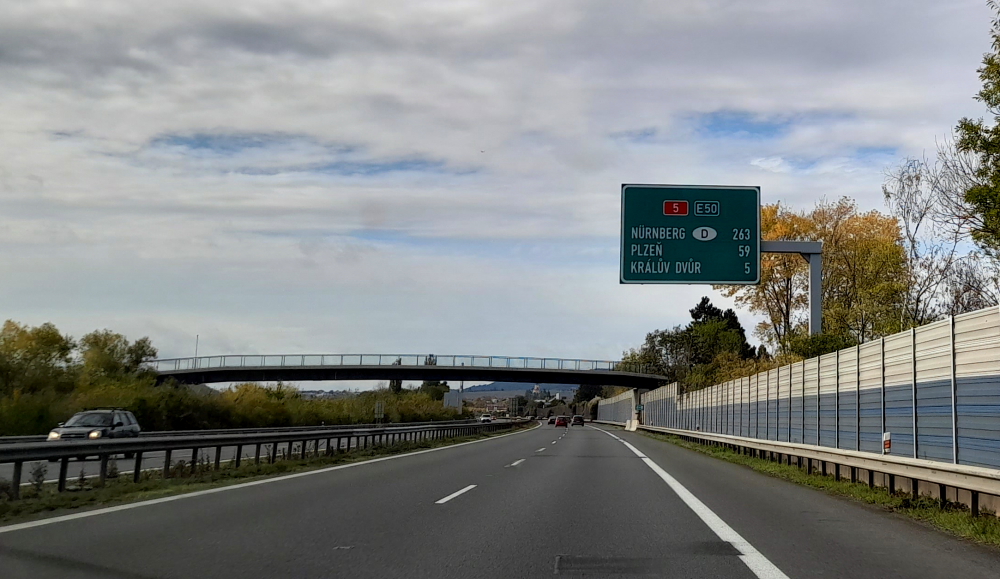
On the road to Pilsen.

Although we arrive early our room is ready and after parking the car and dropping our bags we go for a stroll around the Old Town.

Around the corner is Republic Square, the historical centre of town and is one of the largest medieval squares in Czechia.

Plzeň as a town appears at the end of the 13th century, the square existing since then. Around the oblong square regular blocks of houses delimitated by a rectangular network of streets were built.

In the beginning of the 16th century the water supply became critical. A water tower with a mechanical pump was erected, the water being stored in a leaden reservoir and fed through wooden pipes to public fountains at the main square.
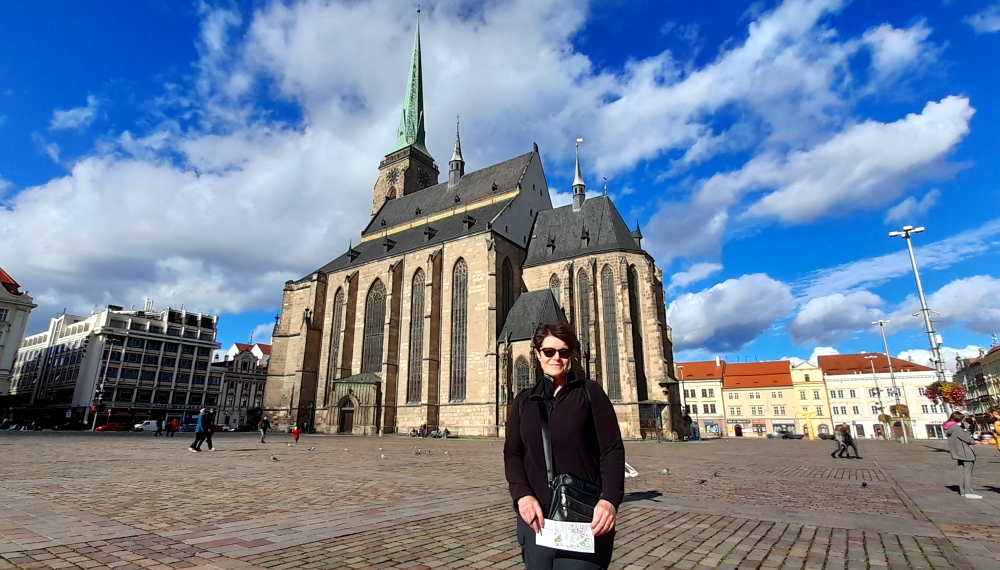
Pilsen Republic Square & St Bartholomew’s Cathedral.

A graveyard had existed on the square since the town was established until 1789, when Emperor Joseph II ordered to close such graveyards.
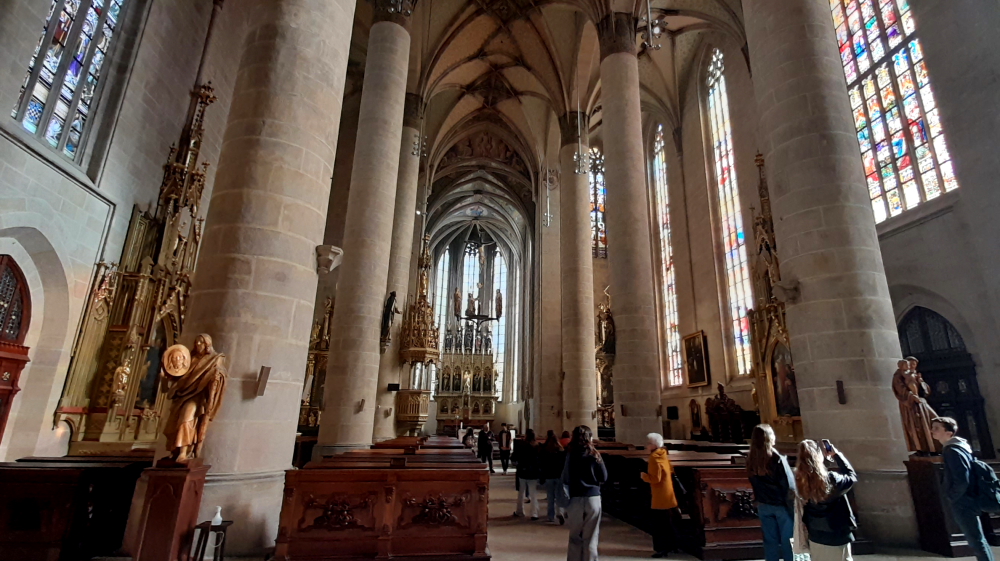
Inside the Cathedral.

The buildings in the square are predominantly build in Gothic and Renaissance styles. In the courtyards to the east remains of the medieval walls are still preserved.
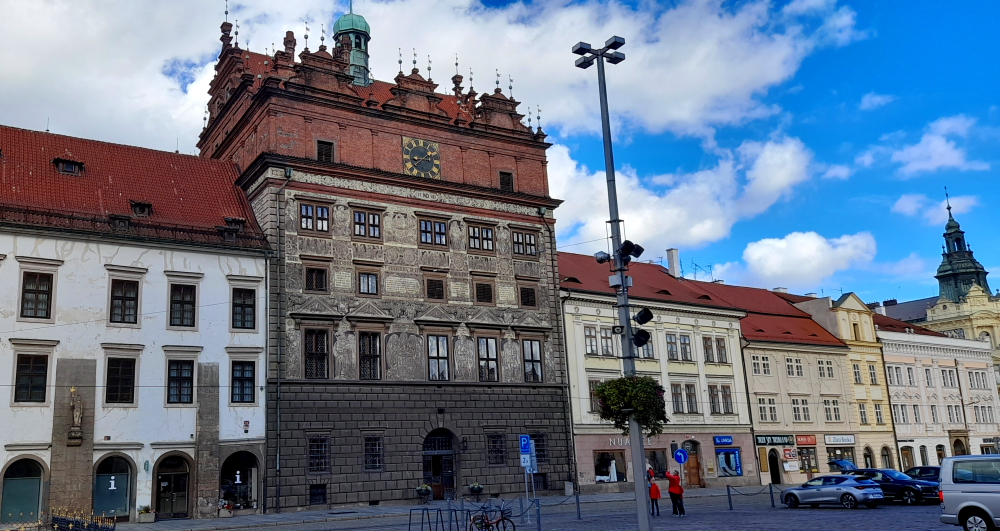
The old town hall.

The most important historical landmarks are Church of St. Bartholomew (1295, since 1993 a cathedral), the city hall (since 1496) and St. Mary’s plague column from 1681 by the Plzeň sculptor Kristian Widman.
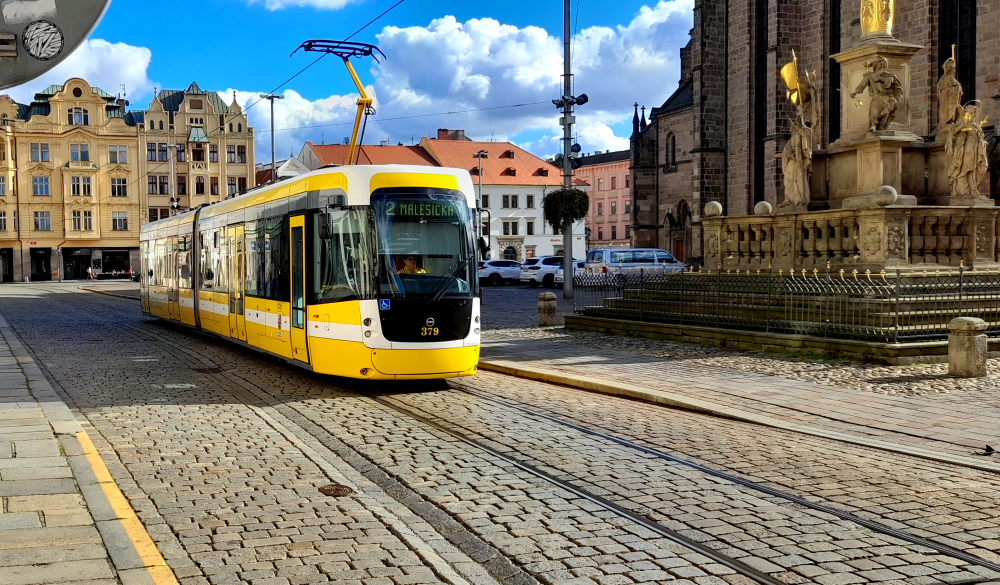
Modern Trams, Old Town.

We elect to walk to the NW corner of the town to see the Patton Memorial Museum, then to walk in a counter-clockwise direction visiting the various sights working our way back to the hotel.

The Memorial to the American Army 1945 is a museum in Pilsen ceremonially opened on May 5 , 2005 on the occasion of the 60th anniversary of the liberation of Pilsen and southwestern Bohemia in 1945 and the end of World War II in Europe. The memorial is located in the building of the Peklo Cultural House , Pobřežní street 10, which also housed the editorial office of Masaryk’s magazine Nová doba before the First World War.

The museum houses more than 1,000 exhibits, especially from private collections – period photographs, documents, newspapers and magazines, equipment, armaments, medical supplies, food supplies, field rations, sports and recreational accessories, craft tools and much more. The exposition is complemented by sound effects and authentic film sequences. The museum documents the period of the last air raids in western Bohemia and the bombing of the Škoda factories, the advance of the American army in Czechoslovakia and the stay of American soldiers until November 1945. The exposition is largely reminiscent of the legendary commander of the US 3rd Army, General George S. Patton and his friend General Ernest N. Harmo , who provided technical and material assistance in the reconstruction of the destroyed country.
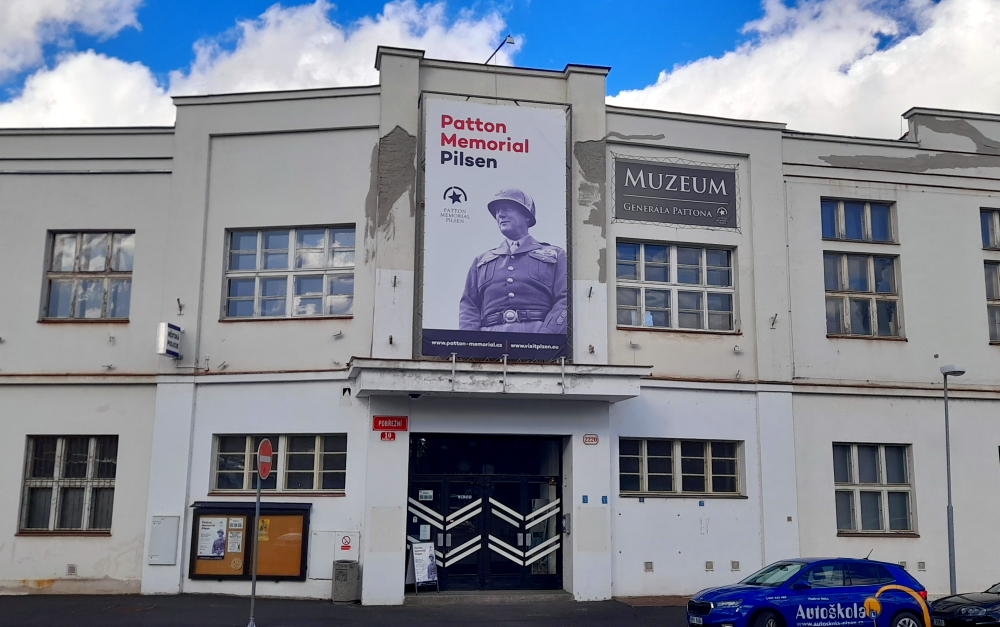
The Patton Museum.

Walking south we come across the new memorial to Patton which was unveiled on 1 May 2015. The memorial was presented by the members of the Pilsen city council, Patton’s grandson George Patton Waters, politicians and representatives of the US Embassy. The memorial, crafted by the sculptor Lubomír Čermák and architects Tomáš Beneš and Václav Zůna, won an architecture contest in 2009.

The subtle statue is made from two opposing meter-wide metal slabs and is meant to allude to the Arch of Triumph. The General’s silhouette is portrayed in both of the slabs bigger than life-size. The rust on the seven centimeter-thick and 9.5 meter-tall slabs is reminiscent of the armor of tanks and also reminds the visitors that more than 70 years have passed since the war. The special Atmofix steel has a “corroded“ surface covered in iron oxides that protect the metal from the weather.
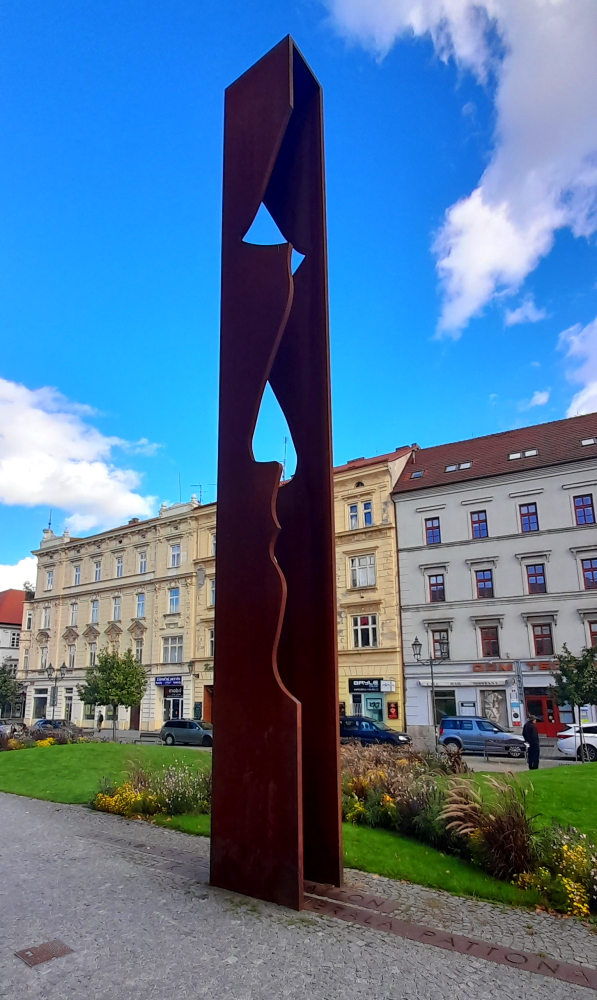
The New Patton Memorial.

Further down the street is the Great Synagogue, not to be confused with the Old Synagogue, and is the second largest synagogue in Europe to Budapest’s.

In 1890 Emmanuel Klotz put forward a new design retaining the original ground plan and cornerstone and creating the distinctive look combining Romantic and neo-Renaissance styles covered with Oriental decorations and a giant Star of David. The design was quickly approved and master builder Rudolf Štech completed work in 1893. At the time the Jewish community in Plzeň numbered some 2,000.

It has an eclectic style from the onion domes of a Russian Orthodox church, to the Arabic style ceiling, to the distinctly Indian looking Torah ark. The synagogue was used without interruption until the Nazi occupation of World War II. The synagogue was used as a storage facility during the war and was thereby spared from destruction. The Jewish community that retook possession of the synagogue at the end of hostilities had been decimated by the Holocaust. The last regular service was held in 1973, when the synagogue was closed down and fell into disrepair under communist rule.

Restoration was undertaken from 1995 to 1998 when the synagogue reopened. The central hall is now often used for concerts while the walls host temporary photographic exhibitions. The synagogue is still used for worship, but only in what was formerly the winter prayer room. The present number of Plzeň Jews is a little over 70.
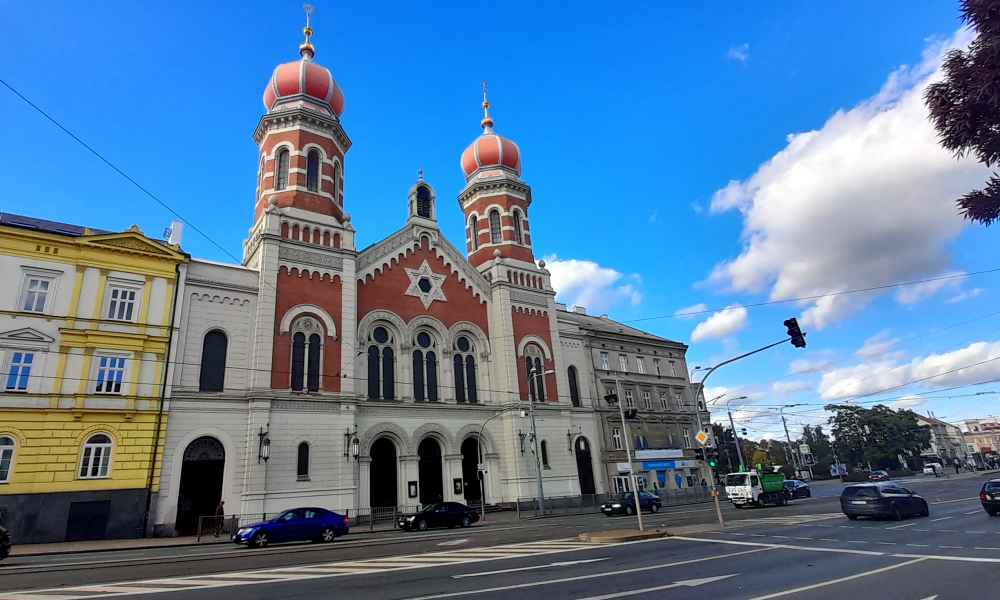
The Great Synagogue.

Turning the corner we come across the J K Tyl Theatre, It was built between 1899 and 1902 in the neo-renaissance style with some art nouveau elements to the design of Antonin Balsanek. Every year the theatre performs some 18 premieres of drama, operas, operettas, ballets or musicals. Since September 2014, actors of the theatre also perform at the New Theatre, a modern building.
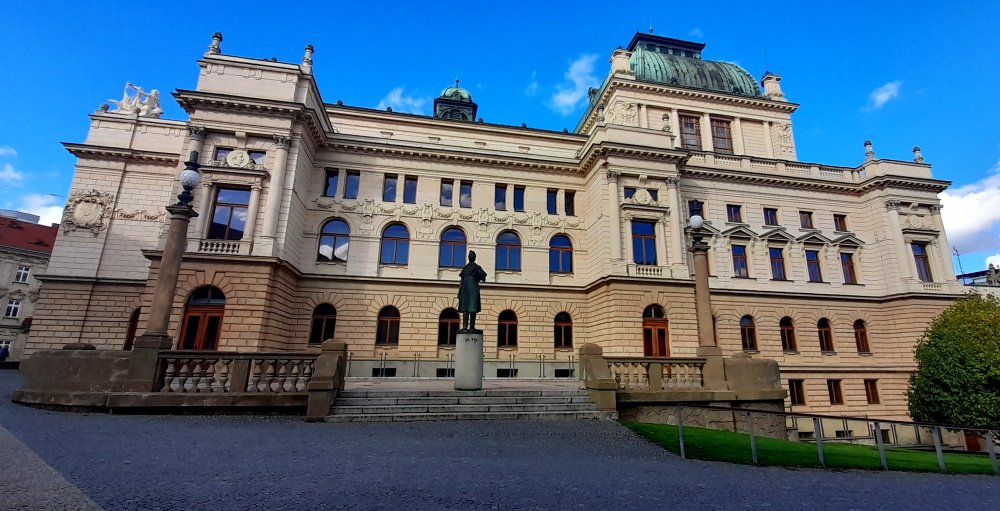
J K Tyl Theatre.

In front of the façade stands a statue of Josef Kajetán Tyl by Alois Soper.

In place of the original city walls and moat, the historical centre of Pilsen is surrounded on three sides by a green belt of gardens. Along this section of the old town is a green belt of gardens with several prominent buildings bordering it.
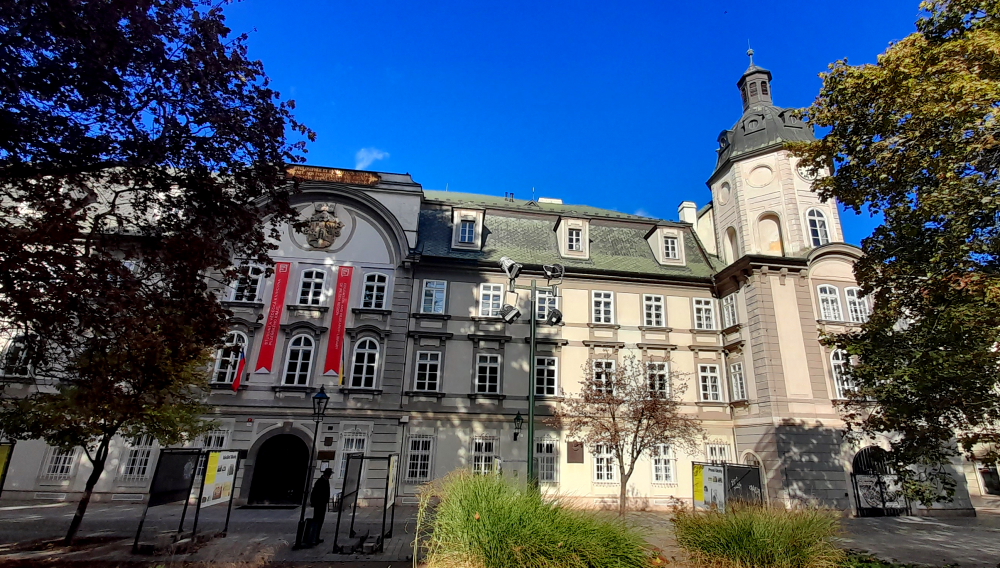
Regional Education & Research Library.

One of these is the Mestanska Beseda building – the Burgher’s Hall. This Neo-Renaissance building stands out with its glorious Art-Nouveau decor and interior. Since it was completed in 1901, the Hall has served as both a social and cultural hub. Balls, dances, concerts, theatre performances as well as other events are held here. Every year in September the theatre becomes the primary centre for the Finále film festival.
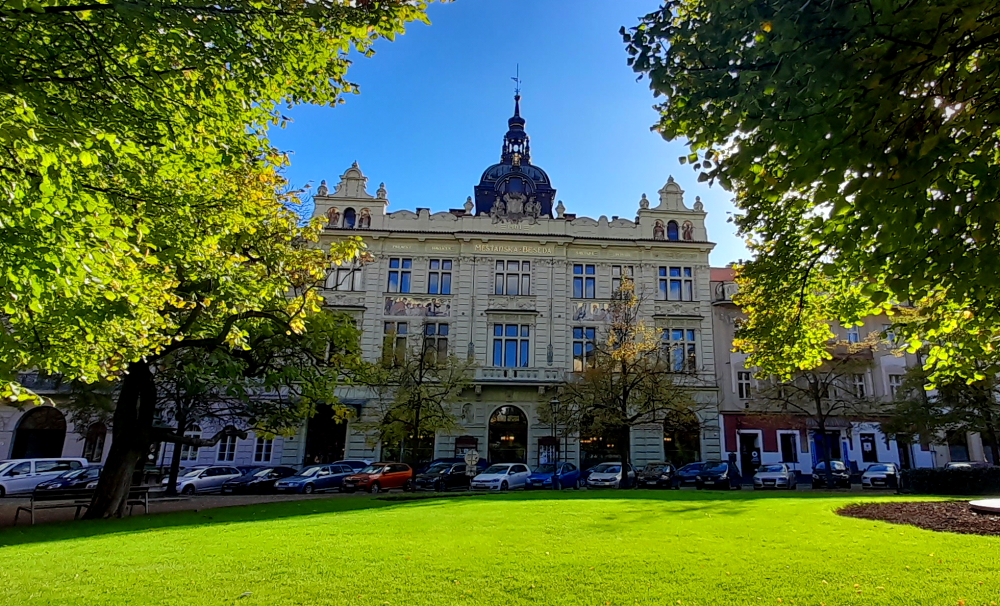
The Burgher’s Hall.

In front of the Hall, in the middle of the park, is an ornate weather station.
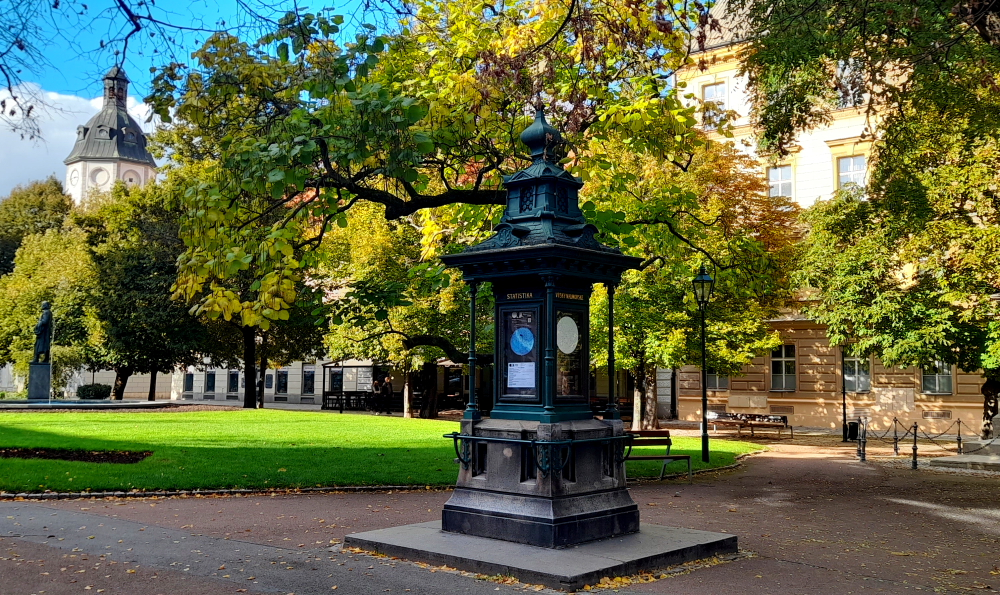
Weather Station in the park.

At the end of the block is the monumental neo-Renaissance building, the Museum of West Bohemia. Among some of the unique items on display include a rare collection of early European firearms from the 14th-17th centuries, which is located in the municipal armoury, a library in the Art Nouveau style, complete with invaluable first editions and a high-quality collection of applied arts.
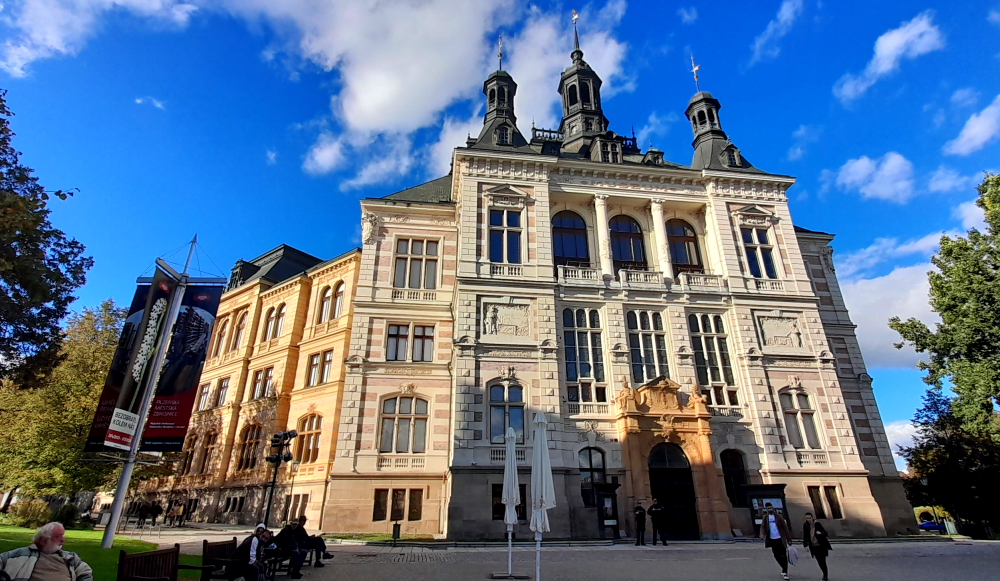
Museum of West Bohemia.

Around the corner and in the next block is a section of the old city walls and the “Theatrum Mundi”. This work of art was inspired by the tradition of figural painting in Pilsen. Famous celebrities connected with the history of Pilsen are painted on an area of more than 200 sq. metres.
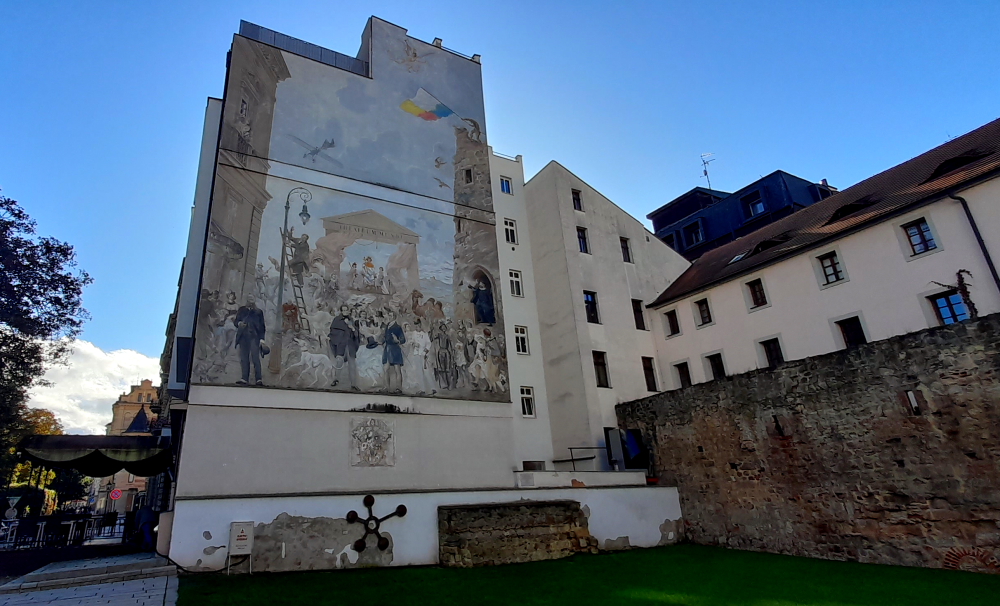
Theatrum Mundi & section of the Old City Wall.

At the corner of the street where our hotel is, we come across the 16th century former city water tower, now a monument to Professor Josef Skoda.
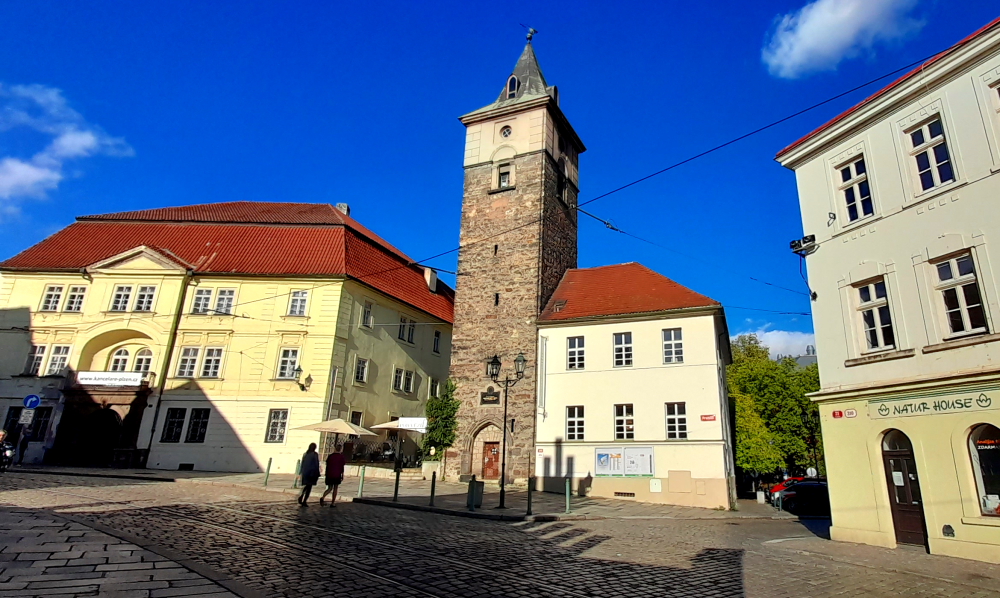
16th century former water tower & monument to Prof. J Skoda.

Built in 1532, the former water tower was integrated into the city’s fortification system at Prague Gate. Another storey was added in 1822 in French Imperial style.

The Gothic portal dating from the 1500s and coming from another house, which had been demolished, was added in 1912. Above the portal there is a commemorative plaque dedicated to Dr Josef Škoda (a professor at the Vienna University), who was born next door on 10 December 1805.

Our hotel is just up the road on the main tram route through the old town to the North. On the other side of the town square is the South bound tracks.
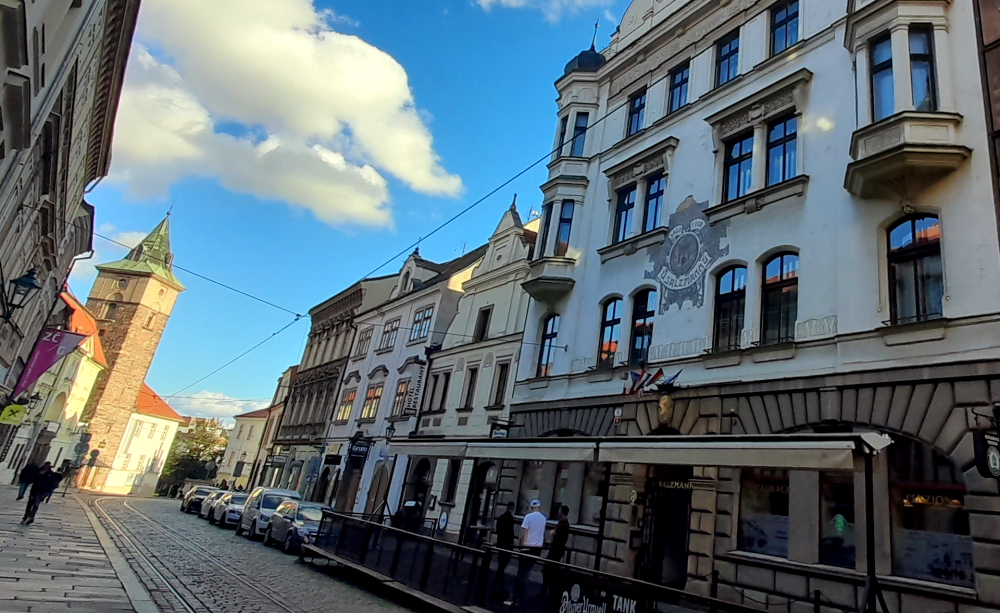
Our hotel, 2nd building on the right.

When we read the reviews of our hotel there were some comments about the noise levels. We have been supplied with ear plugs but it turns out that with the double-glazed windows closed the noise levels are lower than we are used to in Brisbane so the ear plugs are not needed.
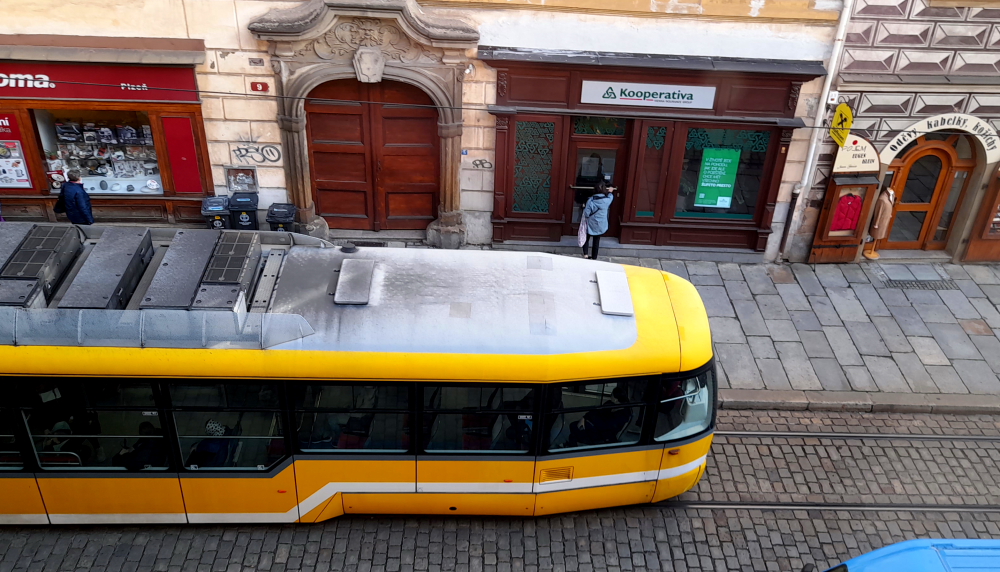
Tram stop outside our room.

Around the corner from the tower is the Brewery Museum.
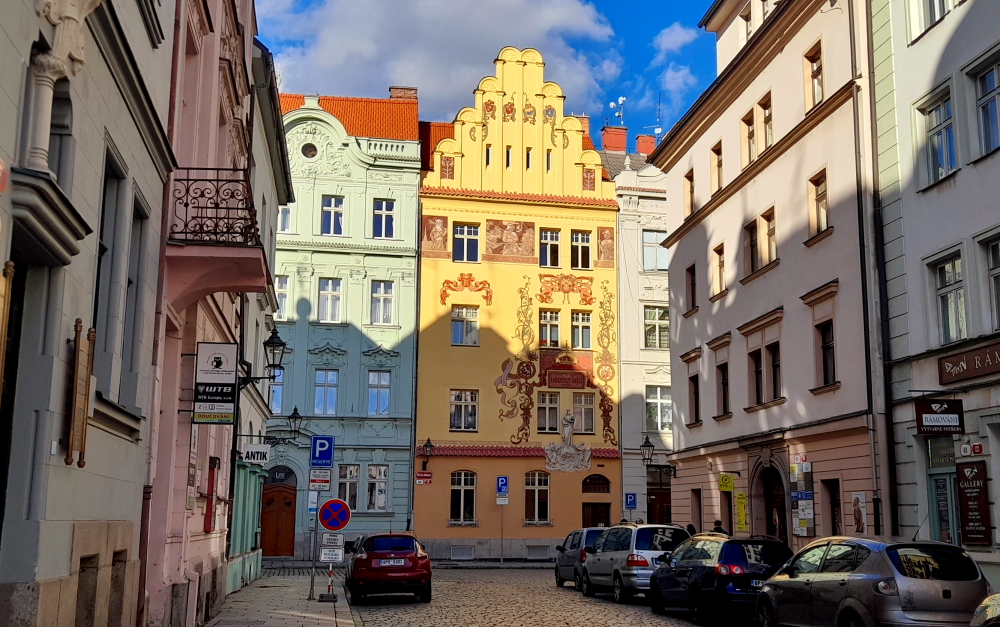
Interesting architecture. Brewery Museum in street off to the right.

Inside an original brewing house from the 15th century, the museum tells the story of the production and consumption of beer from its early days, all the way to the present.
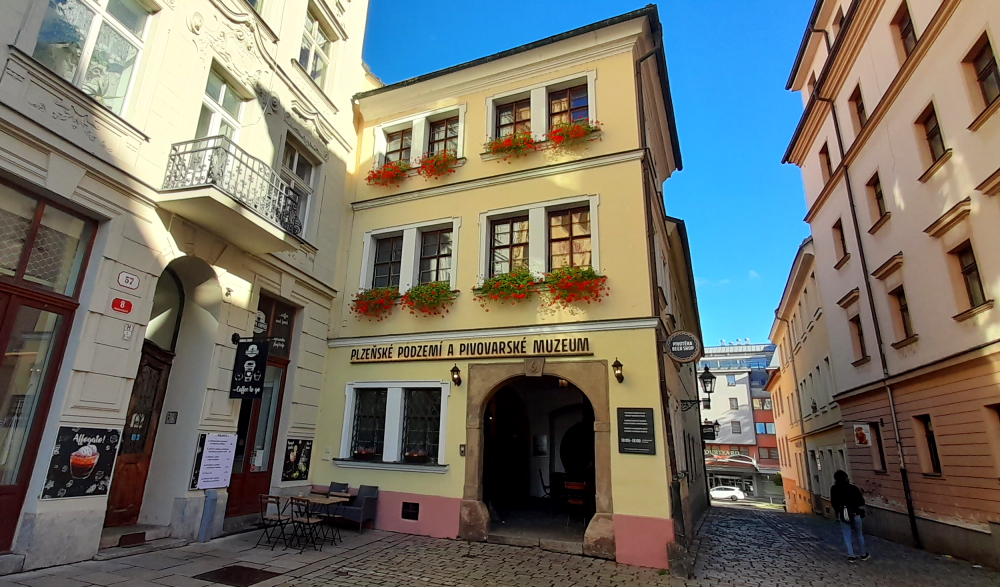
The Brewery Museum.

We plan to return tomorrow to visit the museum.
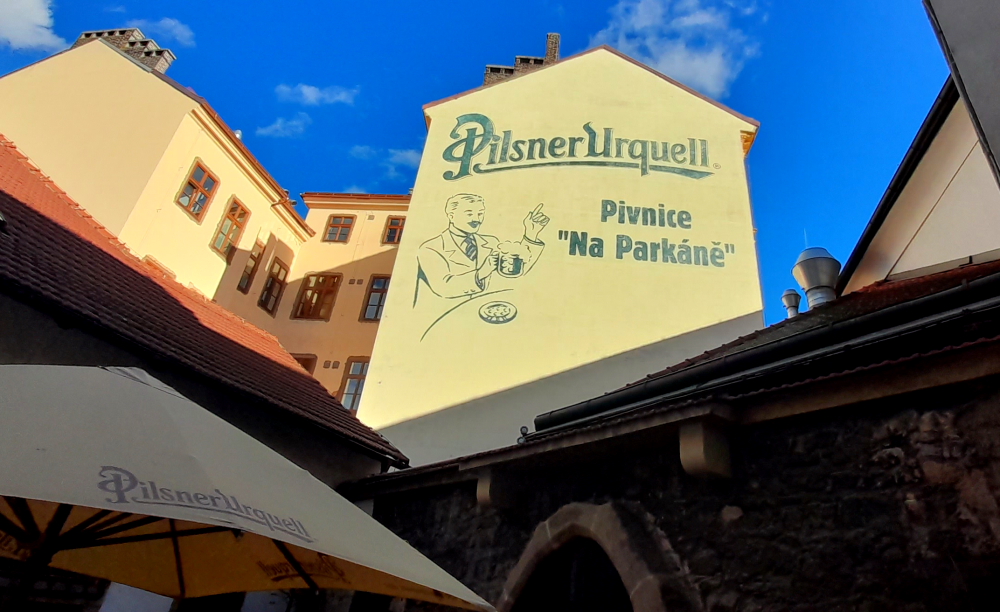
Museum courtyard & Pilsner Urquell advert.

Lynn wants to check out a monastery so we criss-cross the old town. On the way we pass more interesting architecture.
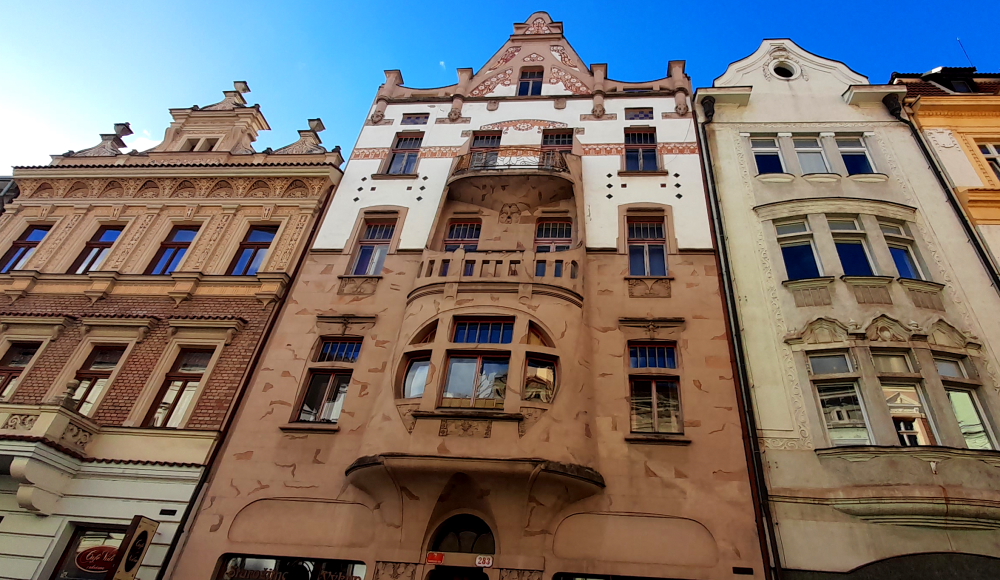
Art Nouveau influence.

Down a side street I check out the local barbers as I’ll soon be due for a No. 2. They seem to cater for a questionable clientele.
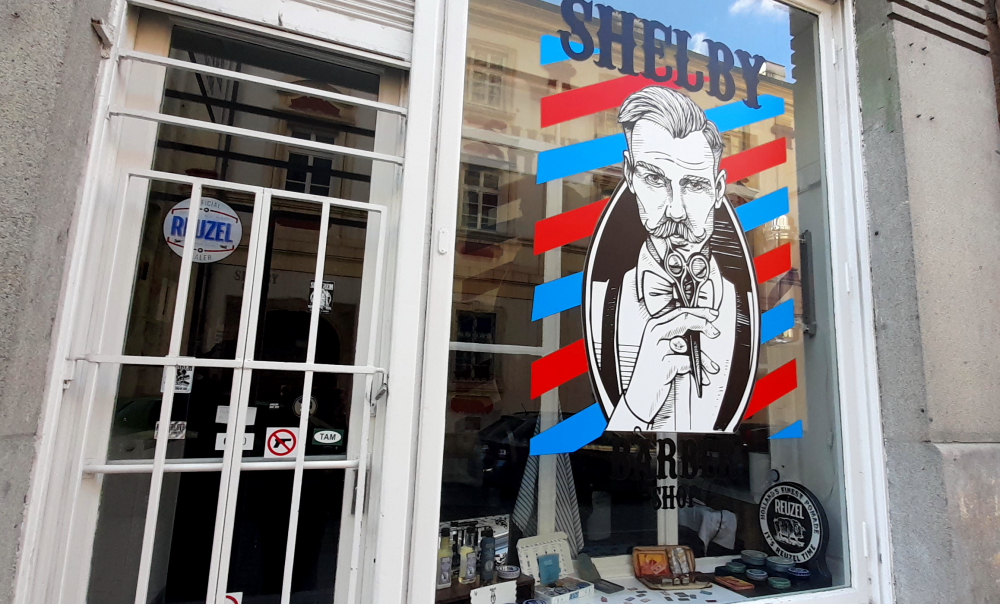
Haircuts but No Guns.

But they don’t allow customers to bring in their guns. A bit like the old west towns in the USA. I can’t see this catching on in America.
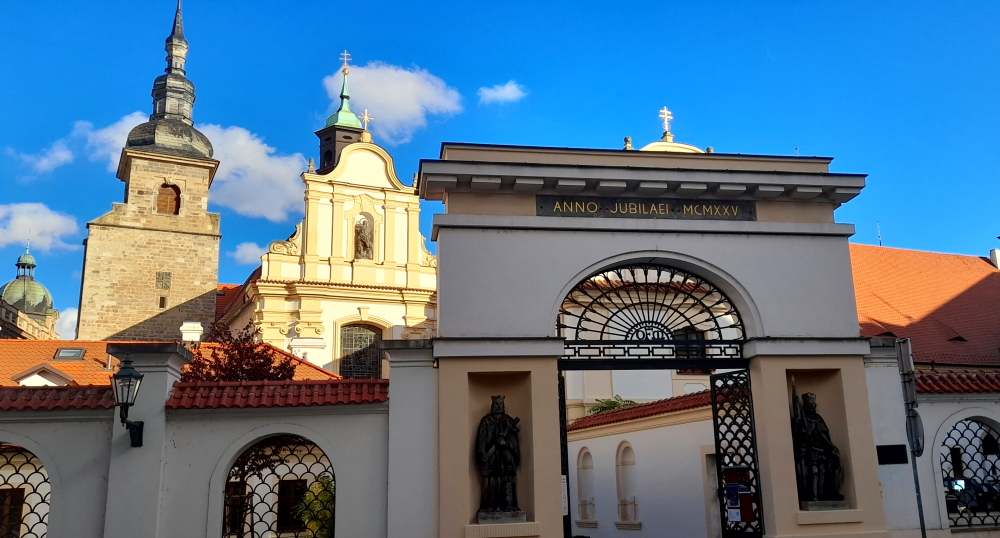
The Franciscan Monastery.

The Franciscan Monastery originally belonged to the Minorites. The later Franciscan monastery was founded at the end of the 13th century. The Church of the Assumption of the Virgin Mary, Chapterhouse and Chapel of St. Barbara also belong to the monastery complex.

The Franciscan church and monastery are among the city’s oldest buildings and, for all the calamities of the Hussite era and Thirty Years’ War, have, in essence, preserved their original early Gothic form.
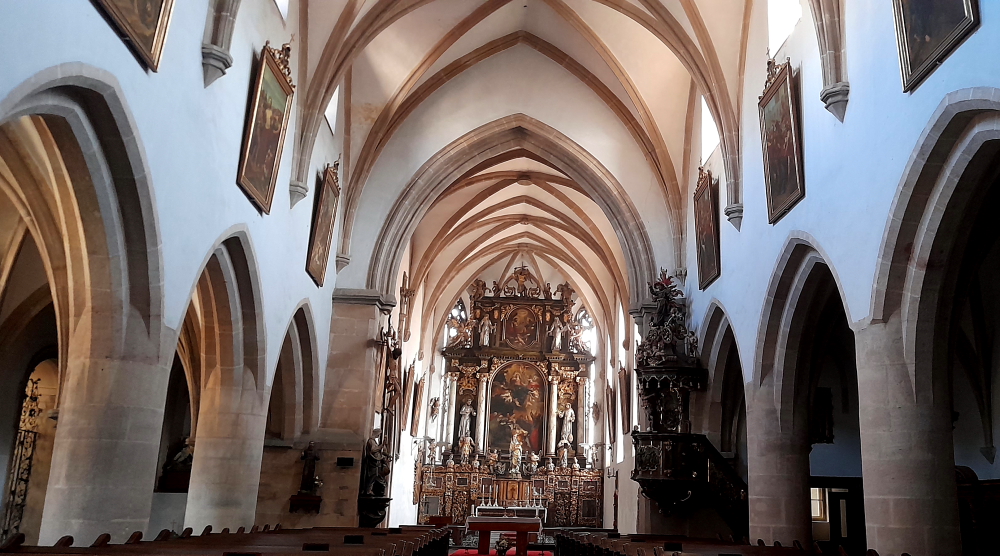
Inside the Church of Assumption of the Virgin Mary.

We have dinner at the hotel restaurant tonight in the basement. The food is reasonable, the ambiance is good but a bit overpriced for a country town.

23 October, 2023

The main item on today’s plan is to visit the beer museum which is just around the corner from our hotel. The museum covers the history of beer making in Pilsen since the 13th Century and includes beer making equipment from the earliest days through to the history of the local manufacturing (brewers and breweries).
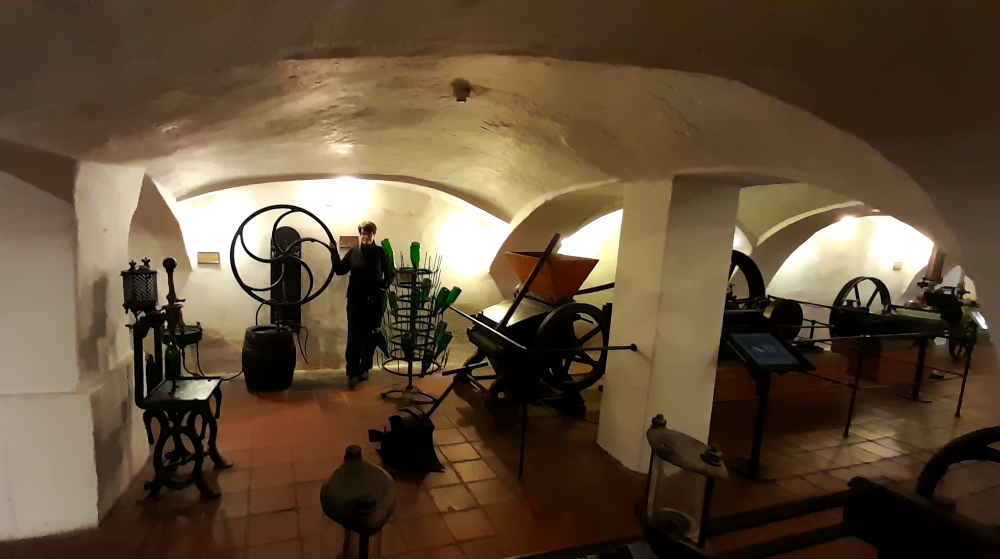
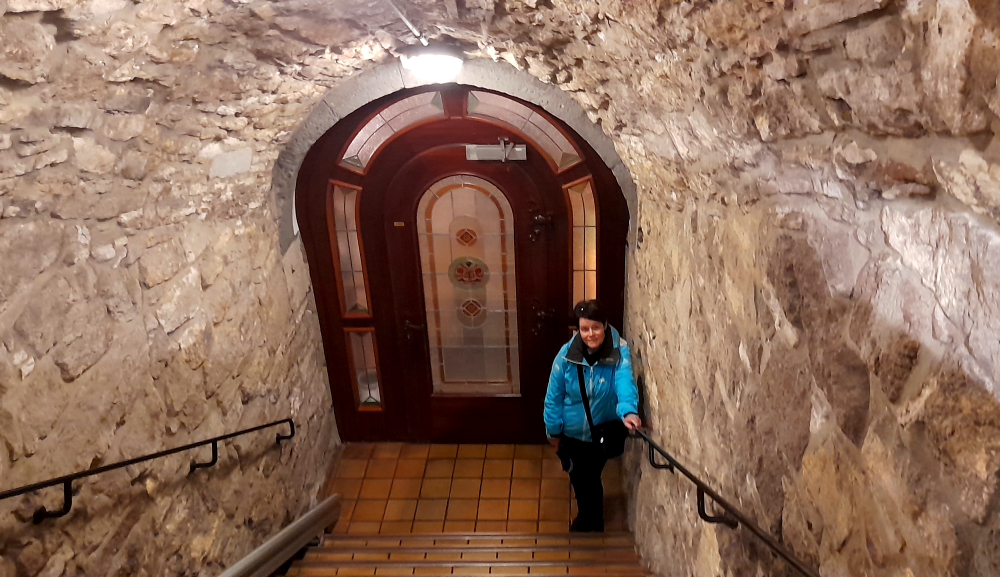
In the cellar of the Beer Museum.

The museum is housed in one of the early brewing houses and extends over four levels starting in the vaulted ceiling basements of the building.
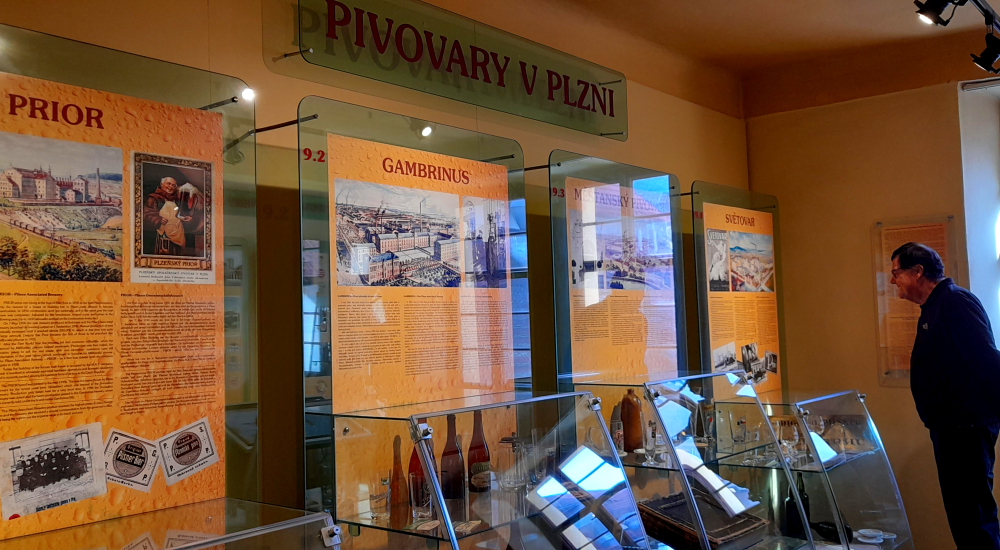
Creation, expansion, corruption and consolidation of Pilsen Beer Companies.

Typical of any rapidly expanding industry the Pilsen brewers were uncontrolled in the beginning when there were over 370 brewers in the town. Almost everyone was home brewing and every brew was hand made. In the early days the need to be competitively priced resulted in counterfeit ingredients resulting in poor quality beer. A bit like the quality of the Chinese Car industry.

Industry regulation and licensing were introduced and the poor quality producers went bust and the remainders merged and started automating processes to improve efficiency and consistency of quality.
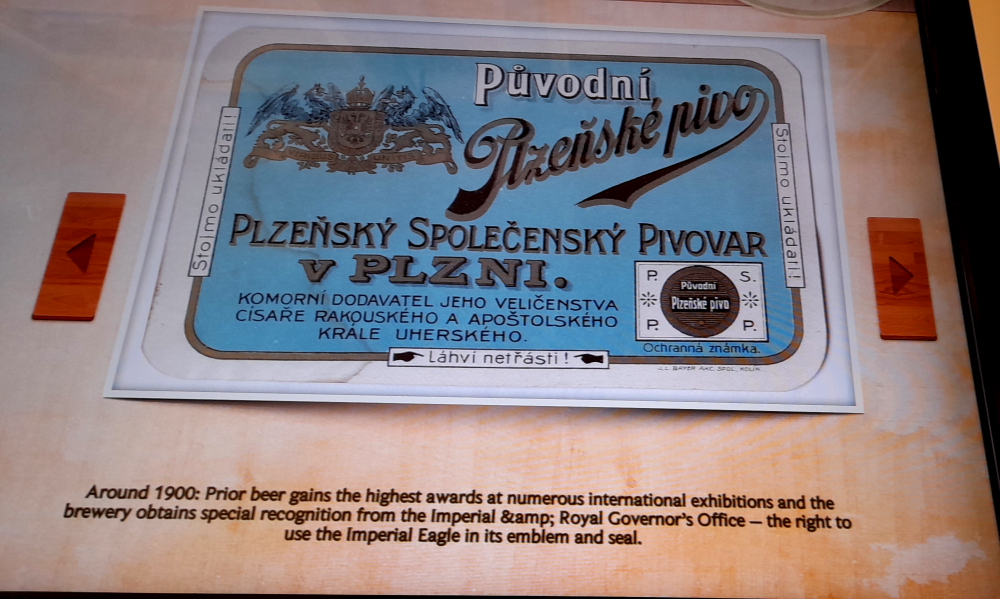
Beer production quality improvement.

By the late 19th Century the beer industry was getting its act together but the need to introduce the latest technology and industrialisation meant that the smaller, under financed breweries had to either merge or fail.

Even the humble beer bottle was being redesigned and production processes improved and specialised.
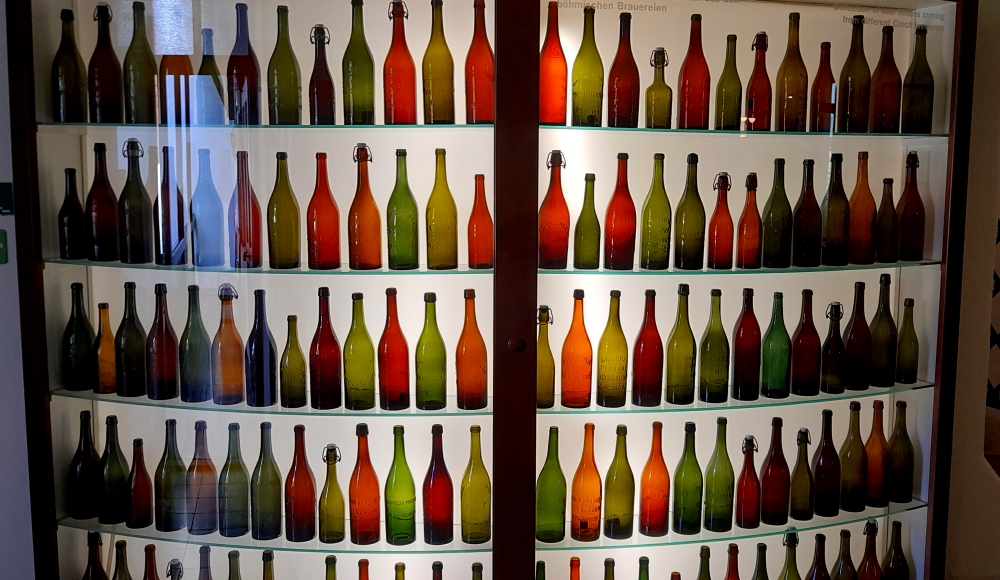
Beer bottle evolution.

The museum also has a section on the invention of the beer coaster. Apparently drinkers needed to cover their beer to keep out insects and dust while drinking at the pub. The original coaster was a dust cover (before steins had lids) then they became a way of keeping tally of beer tabs. They eventually replaced the ceramic “drip” trays and went on to be printed with advertising by the breweries.
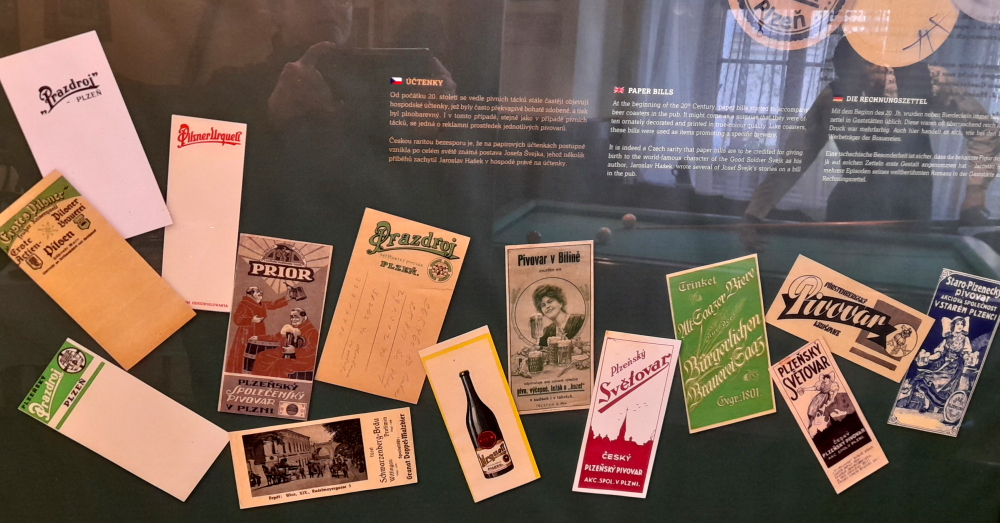
The evolution of the humble beer coaster.

The museum is very informative and even has a section on the manufacturing of beer barrels (coopering).
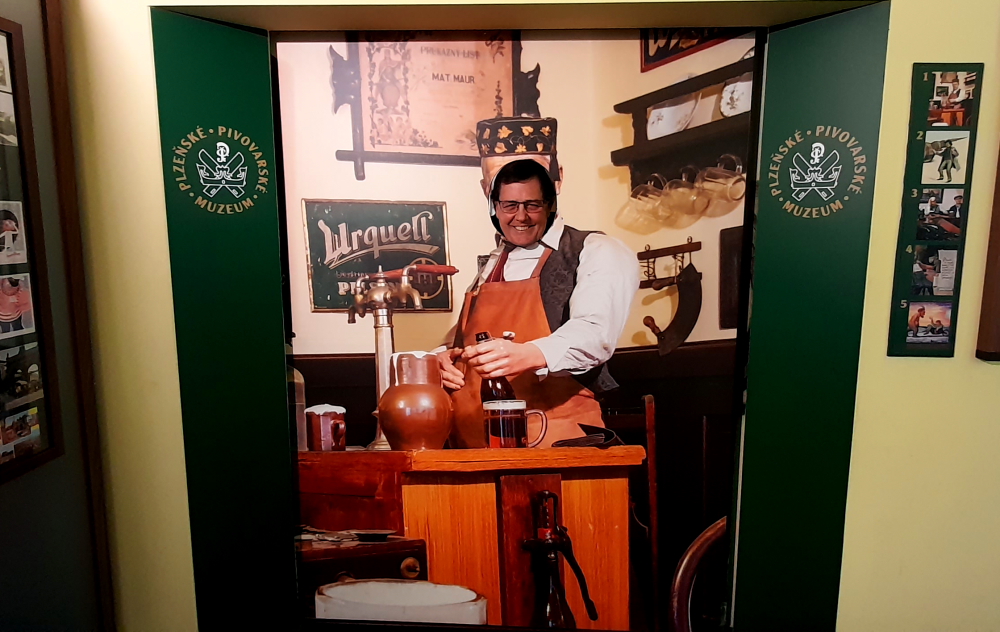
The evolution of the beer gut.

Our museum entrance tickets also included a free local beer after the tour. The local Pilsner is probably not my favourite Pilsner so perhaps the product has developed over the centuries. I will drink it anyway.
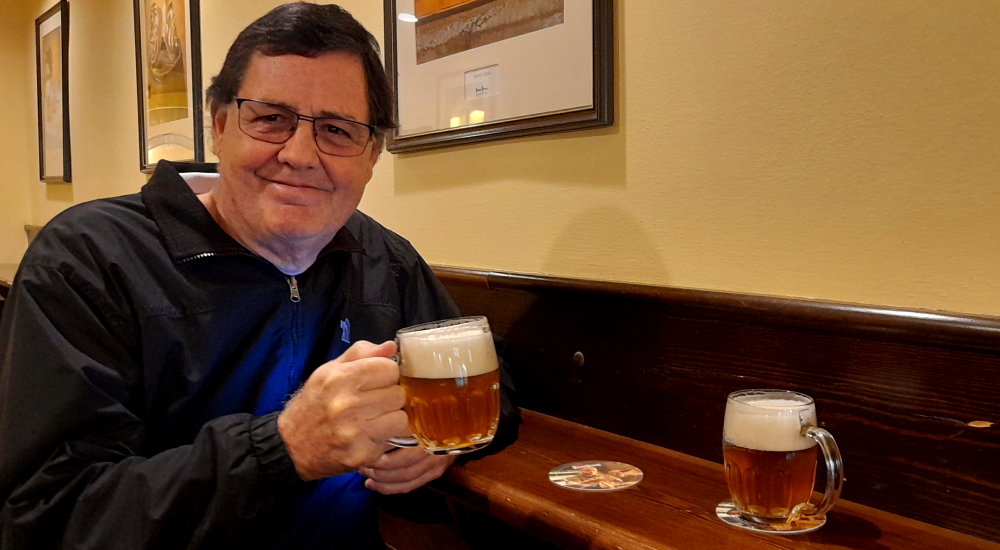
Ending with a “free” beer.

We have a lot to do back at the hotel this afternoon but it is such a beautiful day we stop by the river for a photo then check out a couple of possible restaurants for tonight.
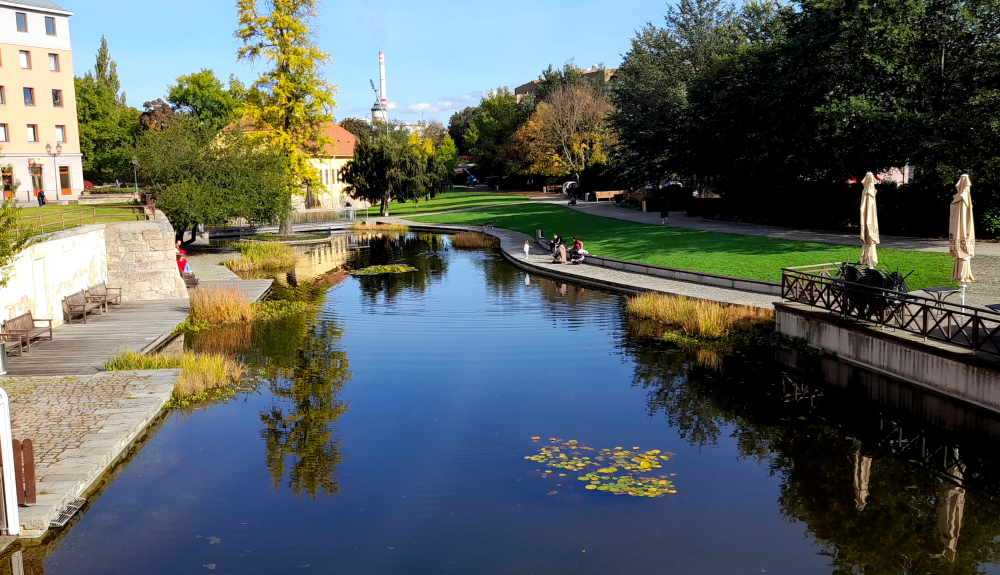
Beautiful day by the river.

We are trying out a local Czechia restaurant behind our hotel tonight. The waitress talked me into trying a local dish but it was just corned beef in a thick gravy with a dumpling. Not really to my delicate palate.
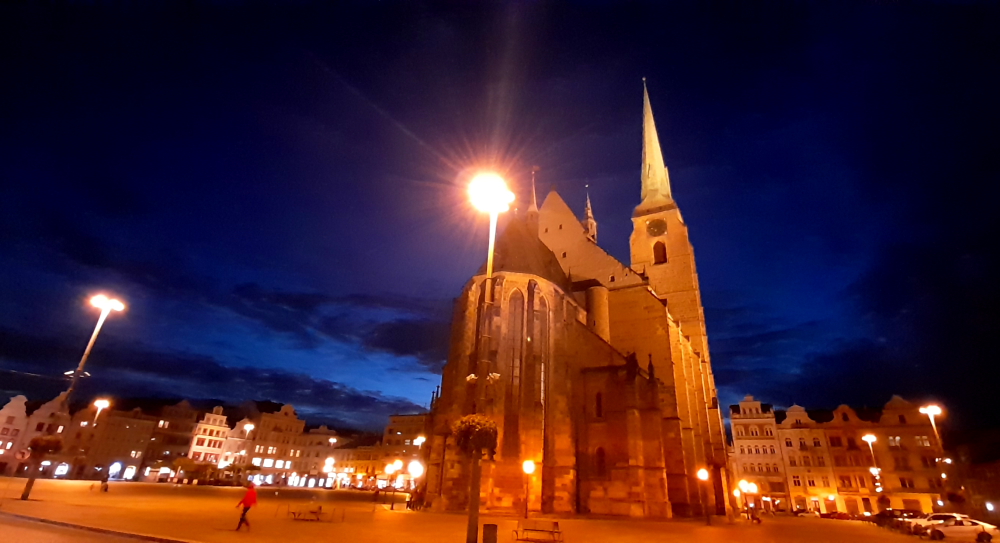
Last look at the town square after dinner.

Tomorrow we are heading closer to Austria and staying at an apartment in Ceske Budejovice, Czechia for 4 days which will be more or less some catch up time.

24 October, 2023

Today we have a 135 km drive to Ceske Budejovice which should take about 2 hours. It’s overcast and 12 Deg. C. when we drive out of the cobblestoned car park behind the hotel.

Except for the short distance driving out of Pilsen and that driving into Ceske B. our route takes us along the 20.
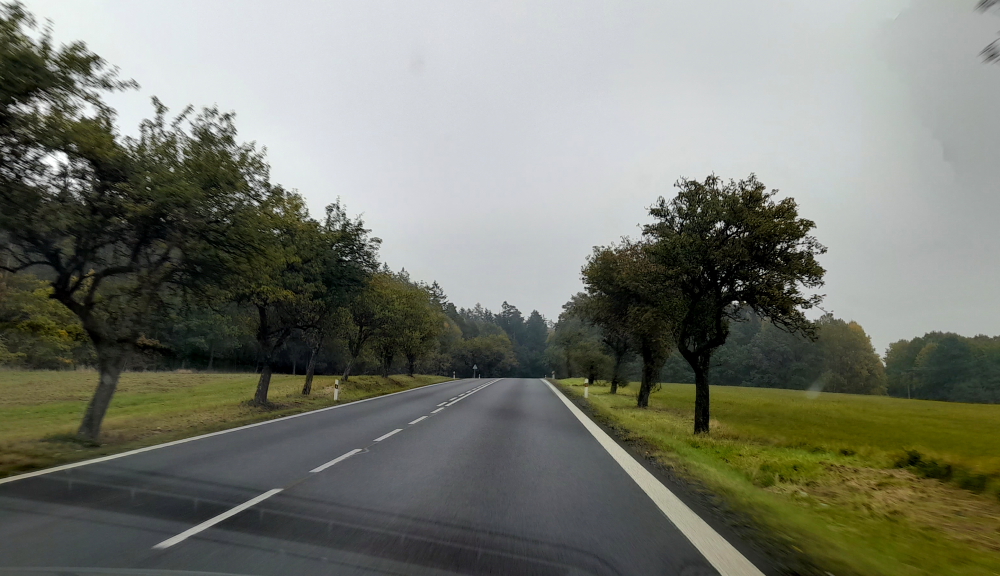
Apple tree lined highway.

For most of this journey we note 4 things: (1) apple trees lining the road (2) load speakers attached to light posts in main streets (left over from Communist propaganda days? Reminds us of Vietnam) (3) the small towns en route look run down (4) regardless, there are a lot of castles along this route.
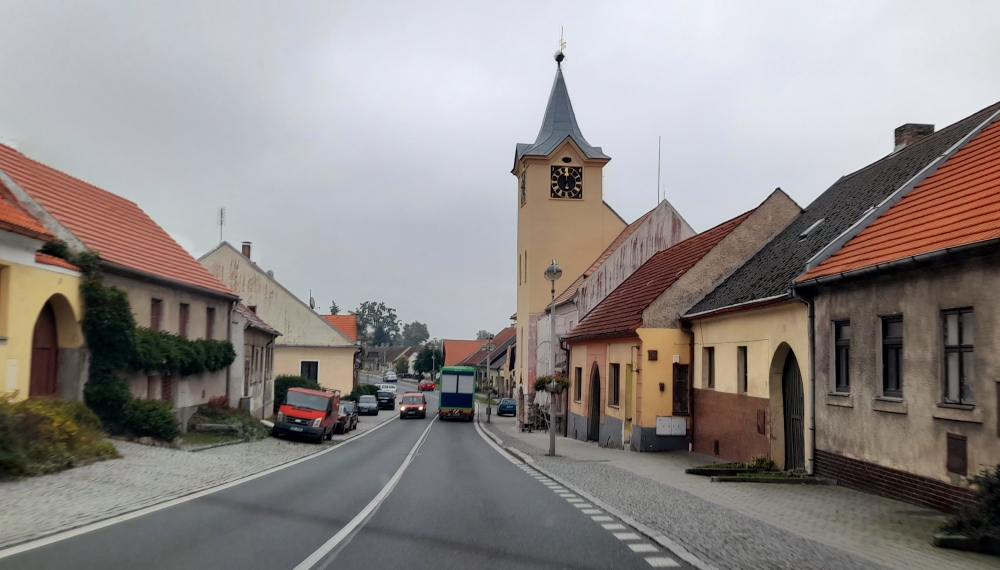
Small highway through country villages.

By the time we get to Ceske B. it’s just before 2:00 pm with light rain so we call into the local Tesco Superstore for supplies including jocks for me.

Shortly after we find the car parking station that we need to use and after trying to scan a QR code on my phone at the barrier we are finally let in and park.

The check-in instructions for this accommodation are overly complex. When we find the self-checkin kiosk Lynn notices that the reception office is actually manned so we give the kiosk the flick and are quickly checked in and on our way via the elevator to our split-level apartment on the 3rd floor.

Having to lift our rolling-suitcases over the numerous steps in the corridor should have alerted us to a design flaw in this residential block. At least they could have put ramps in rather than/together with steps.
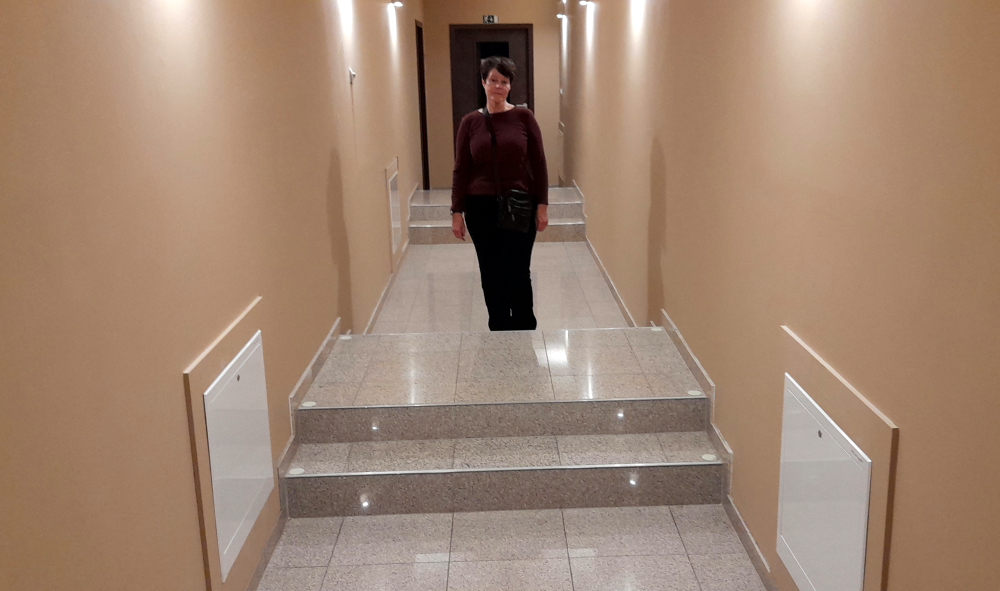
Unnecessary trip hazards in the hotel.

And when we get inside the door we immediately see a whole host of them.

Although we have a spacious apartment the loft bedroom has a low ceiling with even lower wooden beams. Likewise the ceiling beam between the lounge and kitchen area not to mention a bloody great wooden beam 30 cms high that bisects that space that you have to step over all the time.

The rail to the wooden-tread staircase from the bedroom ends a step before the staircase does which meant I tripped down the last step.

When I brought out a load of washing from the machine in the bathroom, the load I was carrying in front of me obscured the 2nd step in the bathroom so I tripped and fell out the bathroom door and onto the kitchen floor with the washing flying in all directions.

To add insult to (actual) injury, the guest manual has a passage which we read later:

“Warning: Please, we ask all our guests … to take care of their own safety … and to act cautiously and responsibly to their own health during the whole stay. Please be warned in particular about the danger of accidents and injuries caused by: … walking and moving in the apartments – danger of slipping (wet floors, slippery shoes), stumbling (stairs, landings, steps etc) or falling on the furnishings…”

No mention about the proprietor’s responsibility for providing a safe environment!

Boy, it is going to be dangerous going to the loo in the middle of the night!
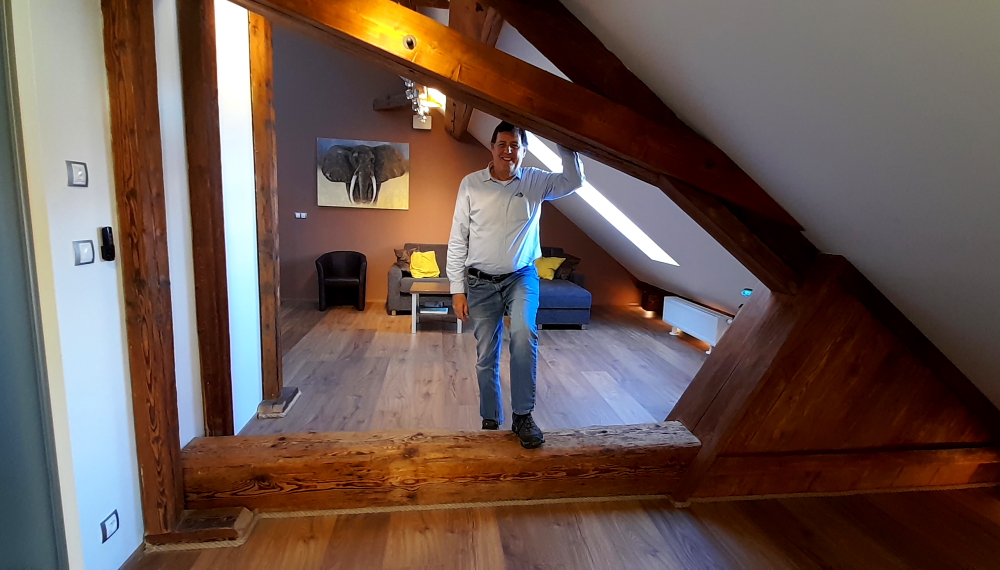
More trip & head-butting hazards inside the apartment.

Even though there are lots of power points in the apartment, including in the toilet cubicle (!), none is where it’s needed for the laptop at the only ergonomic surface, the kitchen table.

As we head out to dinner Lynn asks at reception for an extension cord. “Sorry” is the response. “We don’t have any of those. Only Maintenance.” She insists that they call Maintenance to see if we can have one delivered tomorrow. Let’s see if it arrives.
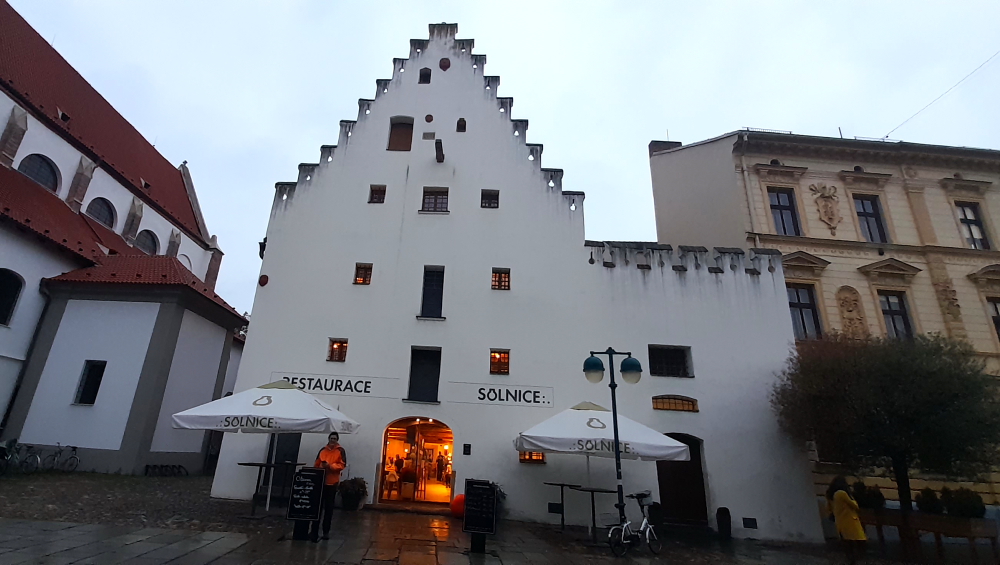
At a brewery for dinner.

There is a brewery cum restaurant nearby so we head there for hearty meals of schnitzel and beef cheeks. I try their Solnice 10, a mid-strength Pilsner which turns out to be what I like. I’m glad I didn’t go for their stronger Solnice 12 which would have been bitter, like the Pilsner Urquall that I tried in Pilsen and disliked.
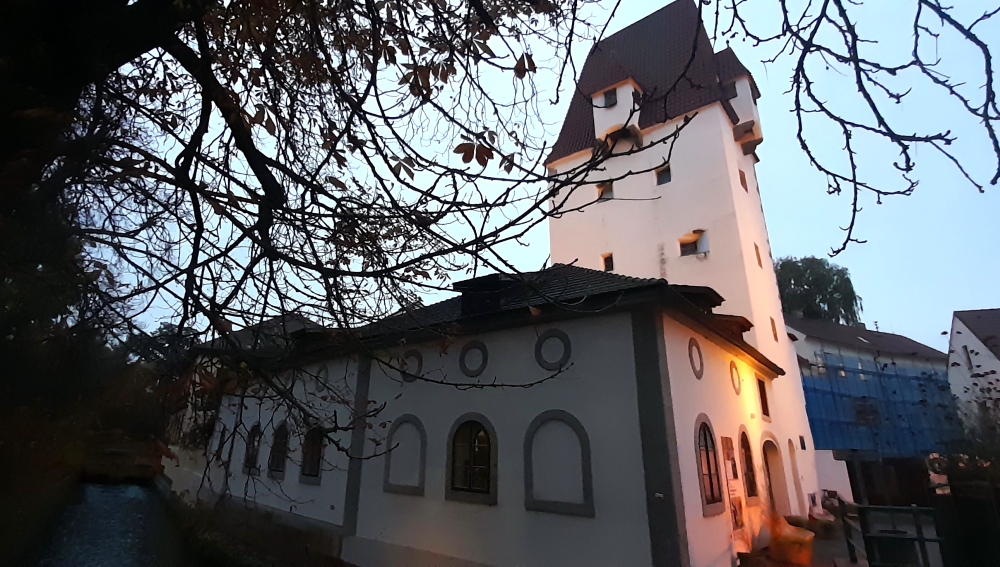
Part of the old town on the way back home.

On our way back to the apartment we cross over the Mill Stream which is adjacent to the Rabenstein (Rabenstejn) Tower. The 14th-century tower is one of the oldest heritage sites in České Budějovice. This four-story, rectangular structure is one of two existing fortification towers, once part of the city walls. It is probably named for Wolfgang Rabenstein, a monk from the Dominican monastery. However, it is unlikely that he would have owned it, lived in it or contributed money to its construction.

From the very beginning it was used as a refuge for town defenders. It covered the area outside the main fortifications with fire, and gunpowder and guns were stored in it. It was used as a prison until the early 19th century. Convicts were imprisoned in the upper stories for less serious offences such as debt, libel, disorderly conduct, and the sale of poor-quality wine. There was a prison cell in the tower for more serious cases. It had no windows, and food was lowered through a hole from the upper floor. At that time, the tower was also used for ordered checkups of prostitutes. The municipal physician called here twice a week. At present, the tower houses an exhibit of historic weapons.

25 October, 2023

Bliss! Finally, a chance for a lie-in. After a late breakfast we walk 2 minutes to a cafe which is on the other side of the mill stream. Fortified by a damn fine latte we stroll around the Old Town which will take 15 minutes tops to see the couple of sites.

Firstly, St Nicholas Cathedral which is adjacent to the Black Tower. The establishment of the Cathedral dates as back to the 13th century, when it was founded as a parish church for the royal town of České Budějovice. It was rebuilt in the Late Gothic style in 1518-1535. A large fire consumed almost the entire building in 1641, and afterwards it was rebuilt again, this time in the Baroque style.

Its Baroque renovation was entrusted to Italian architects J. Cipriani and F. Canevalle who completed it in 1649, but another Italian architect, G. A. de Maggi, converted the church facade to its present-day form in 1686-1688.
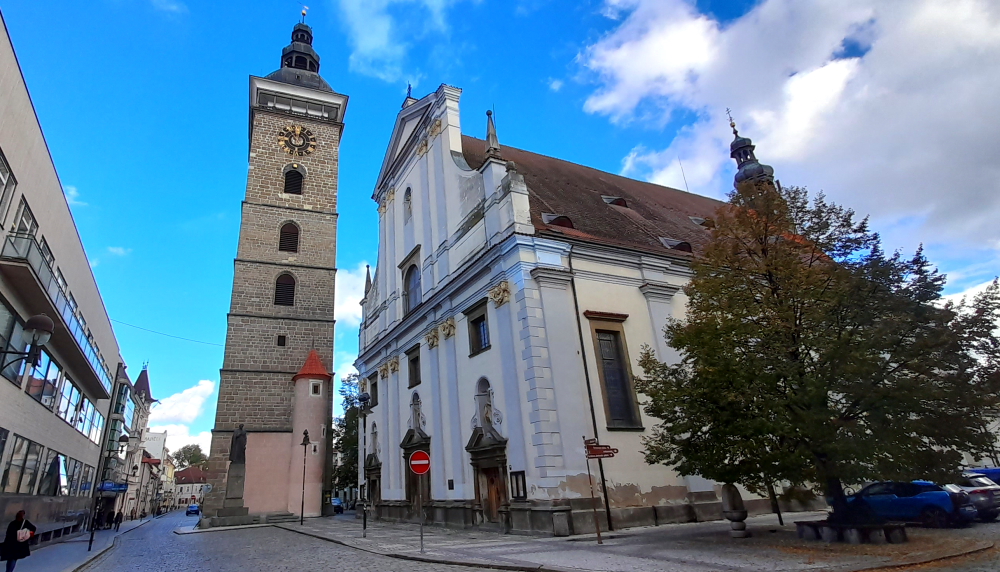
The BlackTower and St Nicholas Cathedral.

There was a cemetery in the immediate surroundings of the church; it was functional from the city’s foundation to 1784, when it was closed. It was intended primarily for the city’s burghers. An archeological excavation in 2001 uncovered these items from the graves: jewelry, medallions and necklace crosses.

The rich stucco decoration was made by T. Zeisl. The main altar dating to 1791 by Z. Hueber is dominated by a large-scale painting of St Nicholas from 1648 by D. Bachmann.,
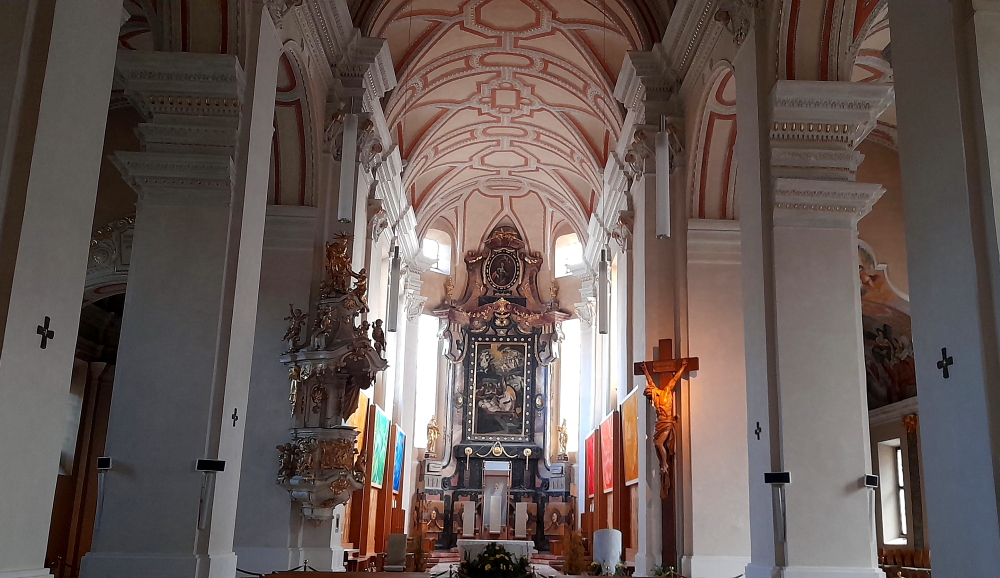
Inside St Nicholas Cathedral.

During 1550-1577 the Black Tower’s construction was supposed to reflect the city’s economic upswing.
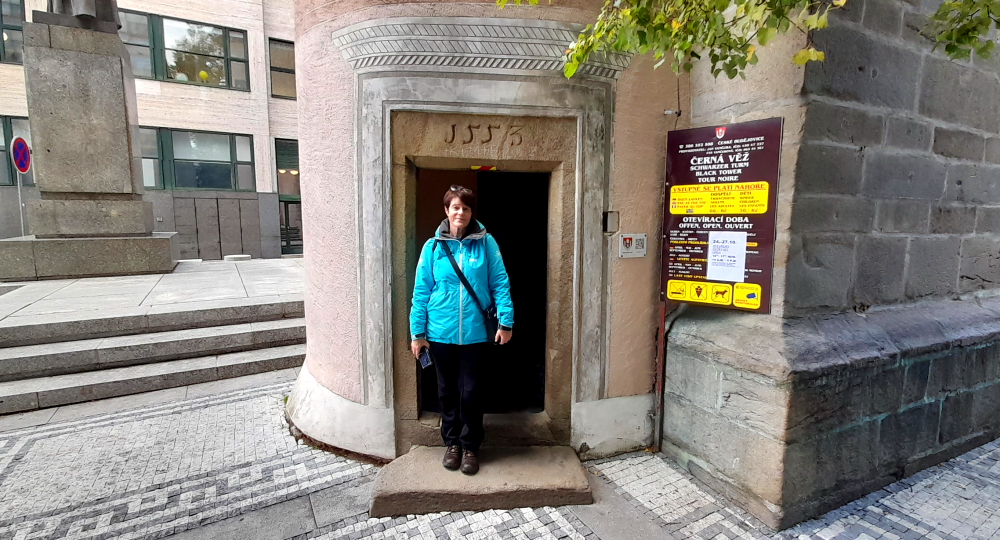
About to ascend the 1553 Black Tower.

Led by Italian master builders, it rose to the then unprecedented height of 72.25 meters.

As we climb the very steep and thin wooden stairs the midday bells began to chime. It is deafening so we were glad that we had only managed to climb half way up so far.
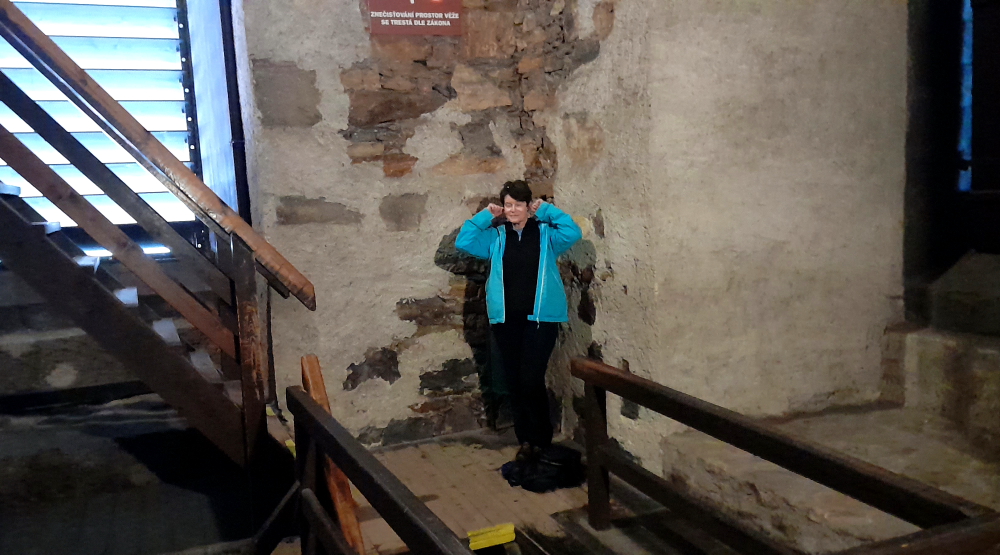
Half way up and the midday bells start to boom.

The tower doubled as a belfry and watchtower, continuously guarding the city of České Budějovice from the risk of fire.
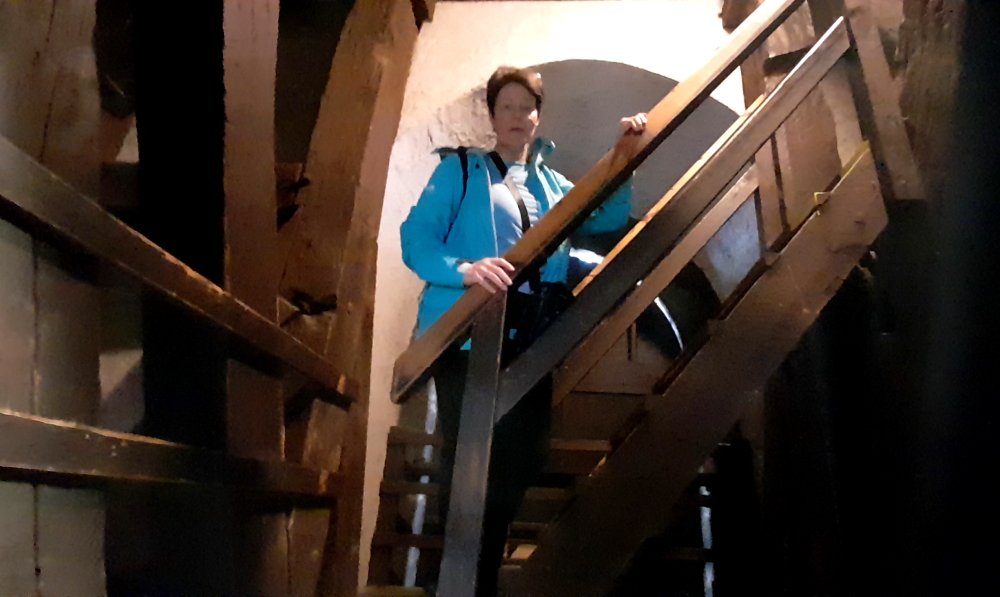
225 steps to the top. Not there yet!

The guard who lived in the tower was tasked with cautiously watching the city and its surrounding area.
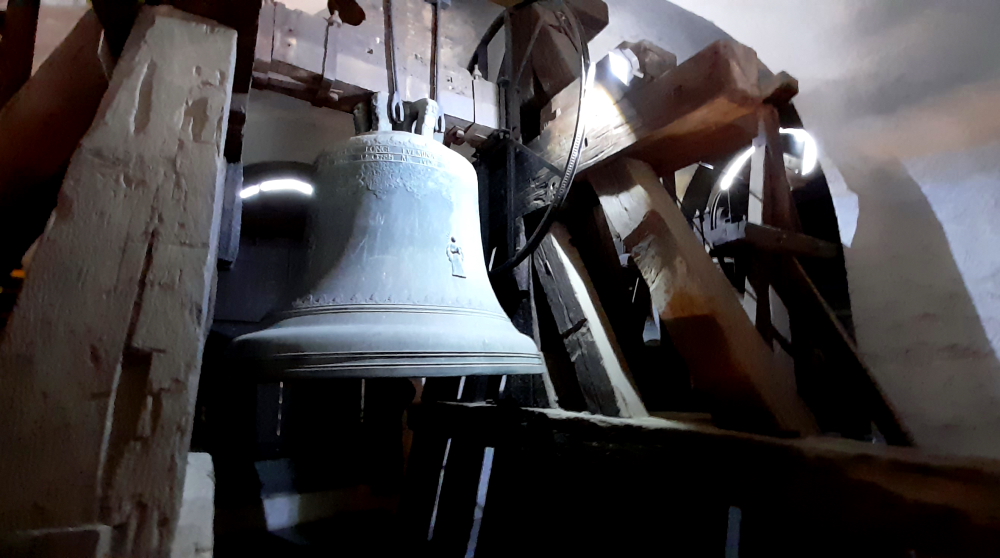
Lucky that we weren’t here a few minutes earlier.

Until the tower was equipped with a telephone to the fire station, the tower guard had to warn about suspicious fires or smoke by ringing the bell and exhibiting a red flag by day and a red lantern at night.
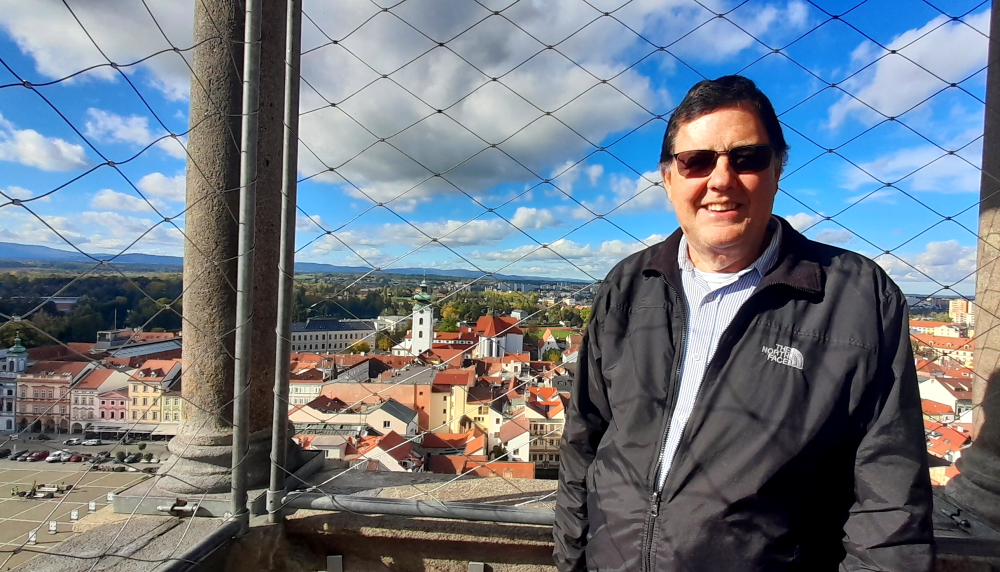
Proof that I made it to the top this time.

The tower guard lived in the tower with his family, pulling water and everything else up to the tower using a winch, and even keeping small domestic animals in the tower: geese, rabbits, and sometimes even a goat or a sheep.
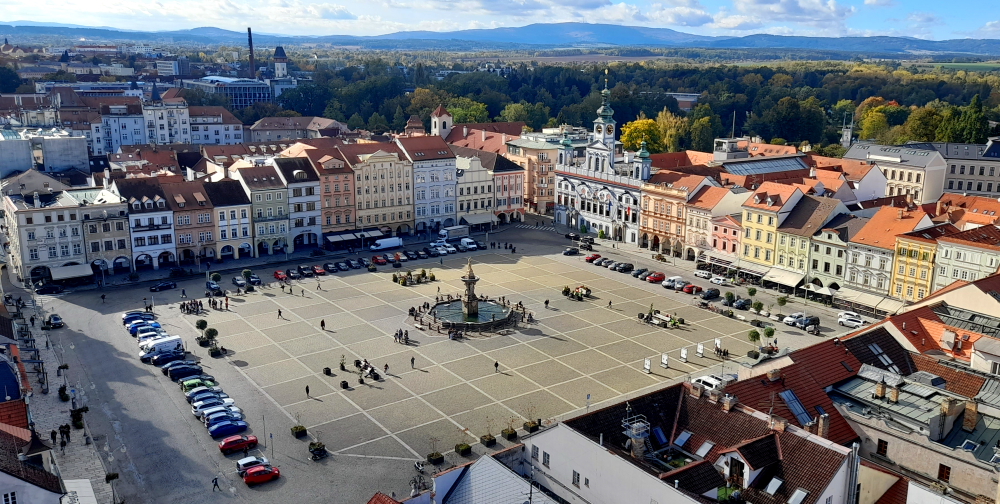
The Old Town Market Square below.

The tower contains 6 bells, the largest being the Bummerin, weighing 3.5 tons.
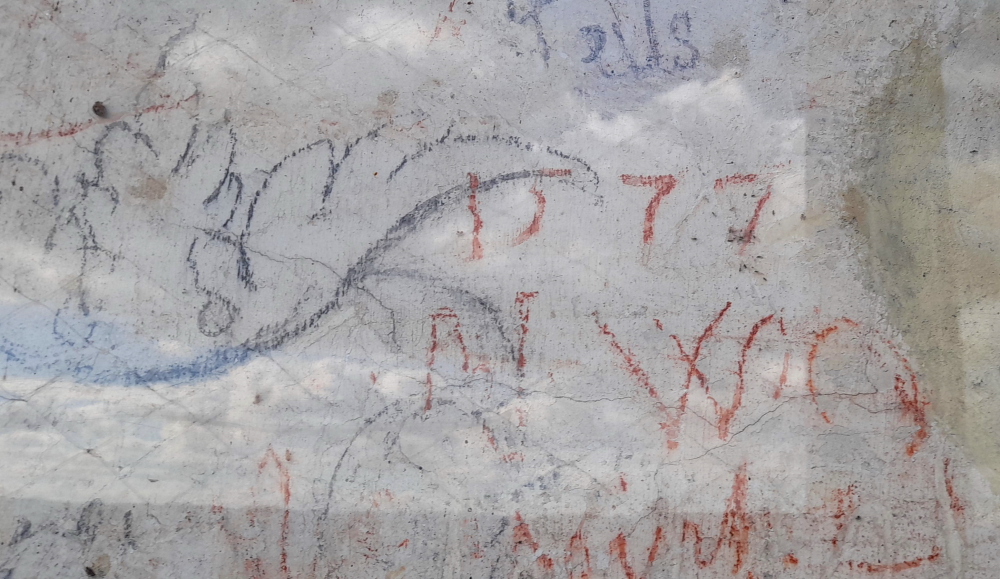
Some of the original 16th Century plaster work & 1577 graffiti.

Nowadays this tower is among the most popular tourist destinations for the splendid view of the town and its surroundings from its gallery.
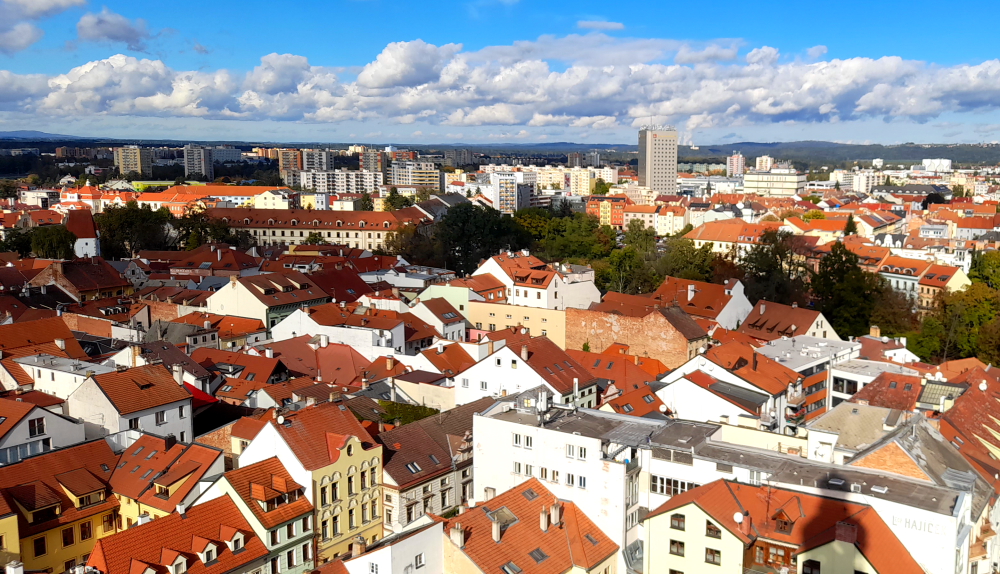
The 3-storey, long apartment building to the left, just under the high rise blocks.

The gallery is located 46 meters above the ground.
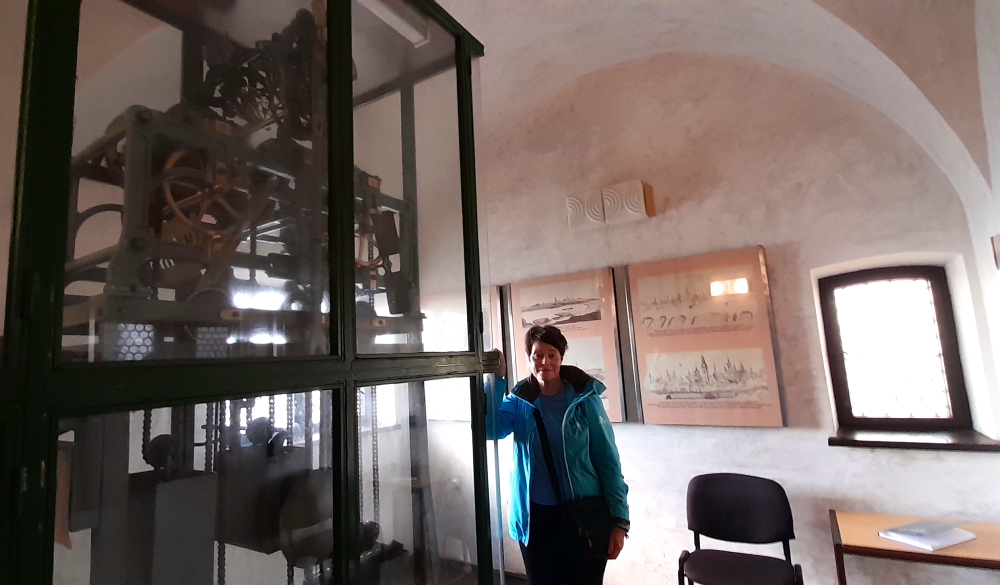
The clock mechanism.

To access the gallery you need to climb the 225 stairs, mostly steep wooden staircases.
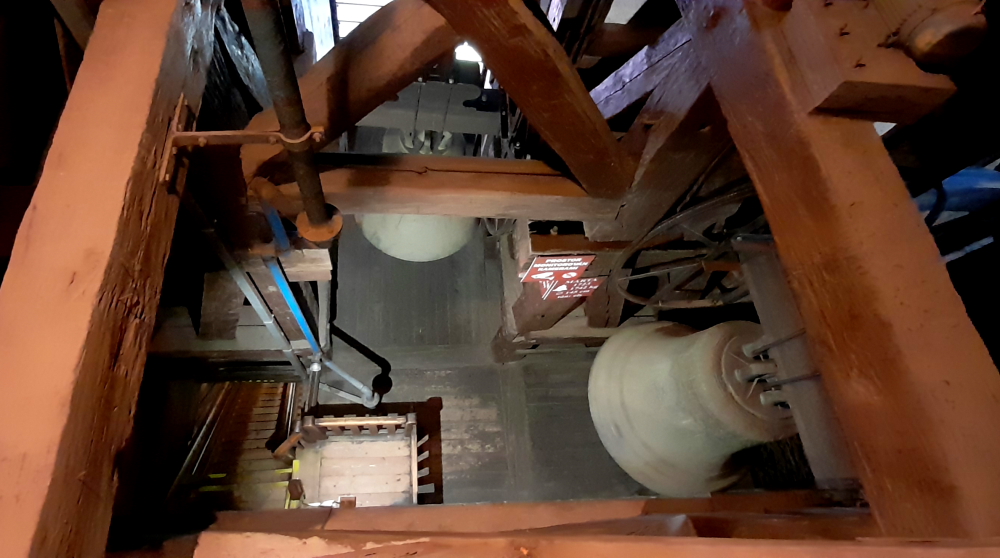
Above the bells.

Once we descend the tower we walk into the Old Town Market Square known as Namesti Premysla Otakara II currently named after the founder of the city, the Czech king Přemysl Otakar II. With an area of ​​1.7 hectares, it is one of the largest squares in the Czech Republic.

Since 1915 the square has had 6 different names, including Adolf Hitler Platz during the occupation.
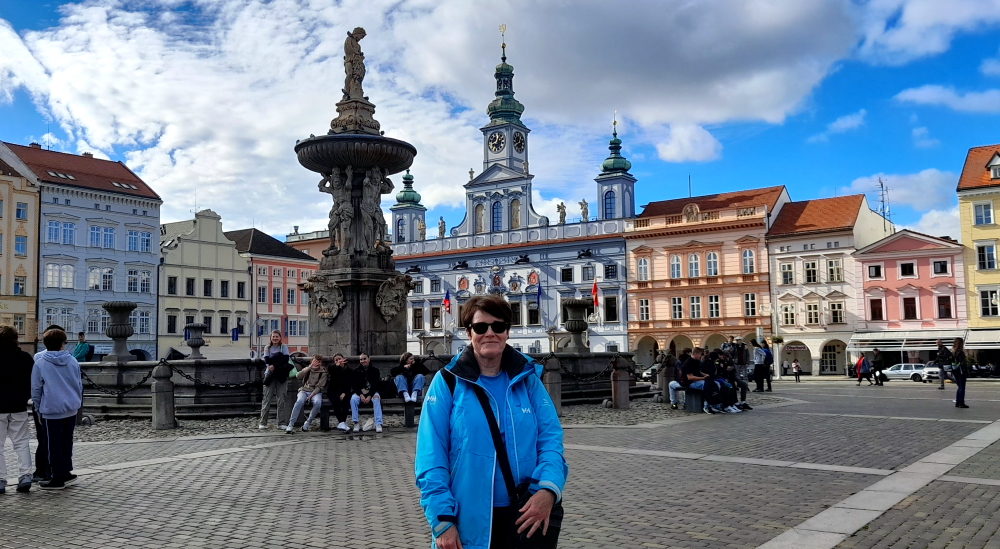
Market Square with Town Hall & Fountain.

For some time there were also meat shops on it, before they were ordered by Charles IV to be torn down and relocated to today’s Krajinská Street. In the first half of the 20th century, trams also ran along the outer sides of the square .

Today’s landmark of the square, Samson’s Fountain, was built in the 1820s in the middle of the square.
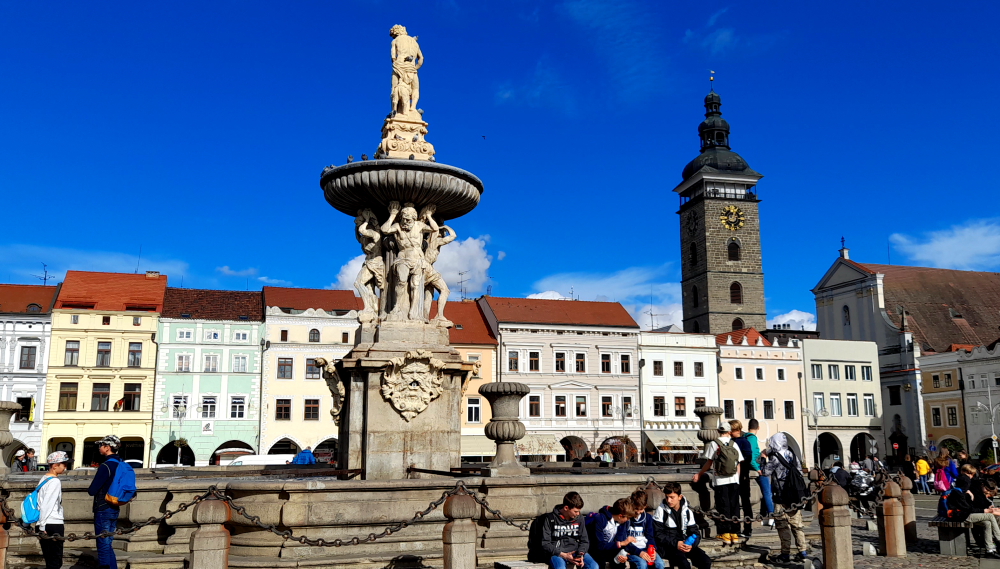
Samson’s Fountain backdropped by the Black Tower.

On the western side of the square stands the Baroque Town Hall which acquired its present form roughly during the reconstruction in 1684-1747.
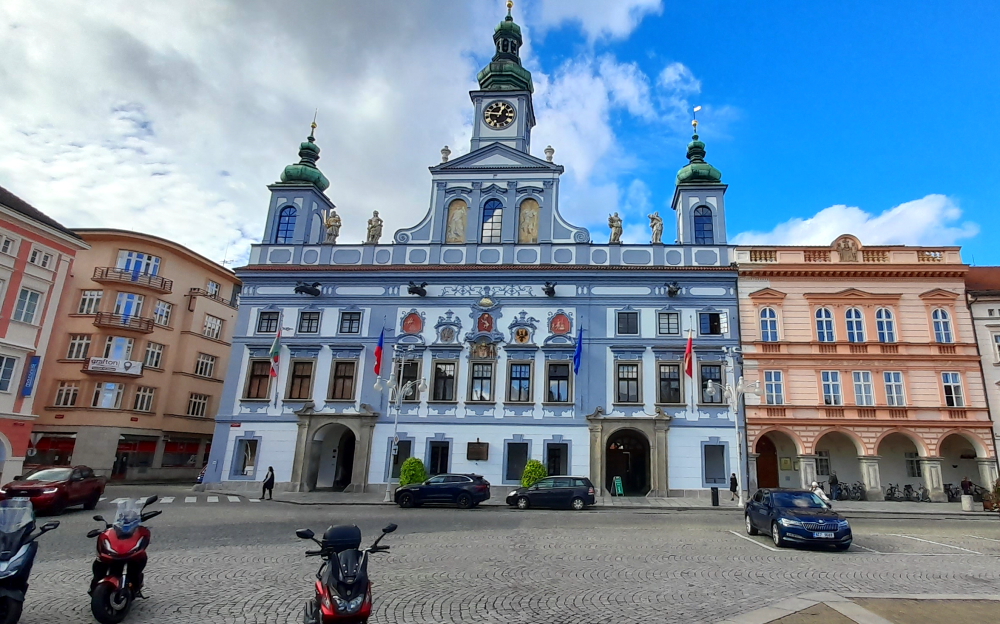
The Town Hall.

On the opposite corner of the square to the Town Hall is this yellow structure, the Palace of the Bee. A house from 1895–6, it was built for the German financial institution Spar und Vorschussverein Biene , Czech for Bee. The ornaments of bees and beehives are meant to symbolize frugality.
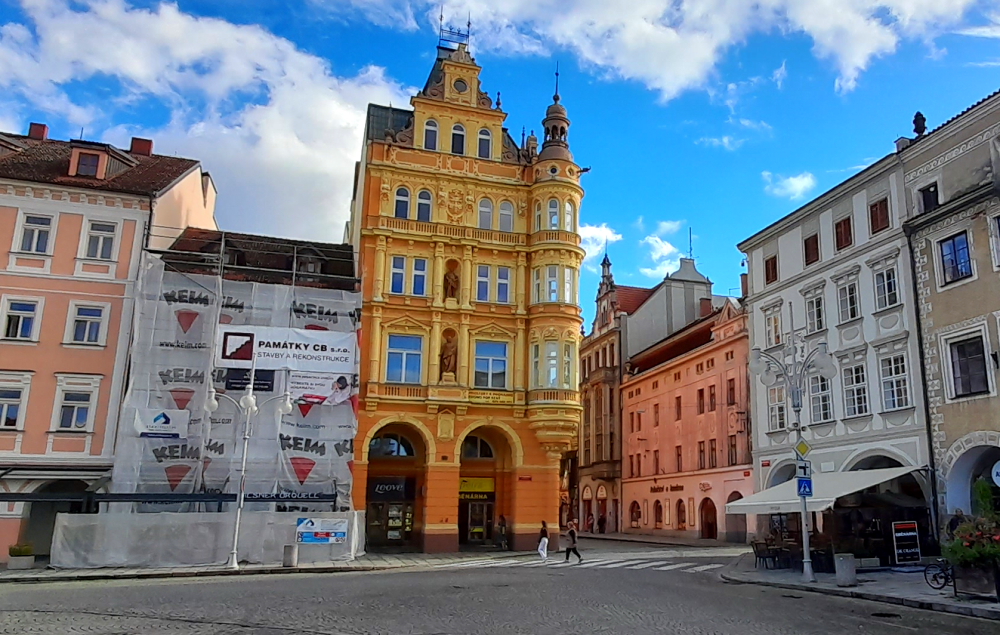
Interesting building on the corner of the square.

What we notice about this town square is that a lot of the surrounding buildings form protective arcades with small shops and, from time to time, a large doorway into an inner courtyard.
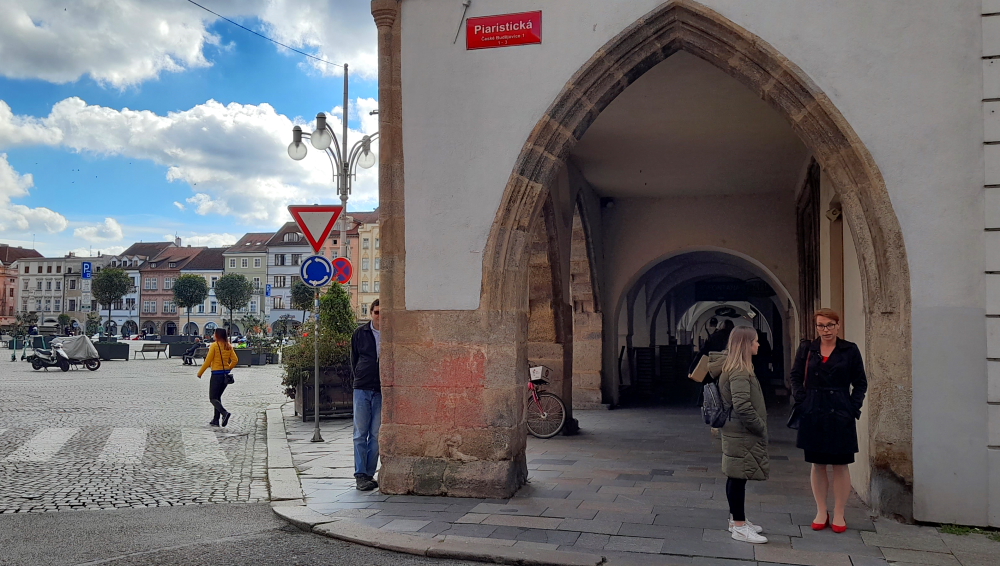
Lots of arcades in the old town.

Nearby is another striking tower and spire, that of the Church of the Sacrifice of the Virgin Mary which we were next to last night at the restaurant.
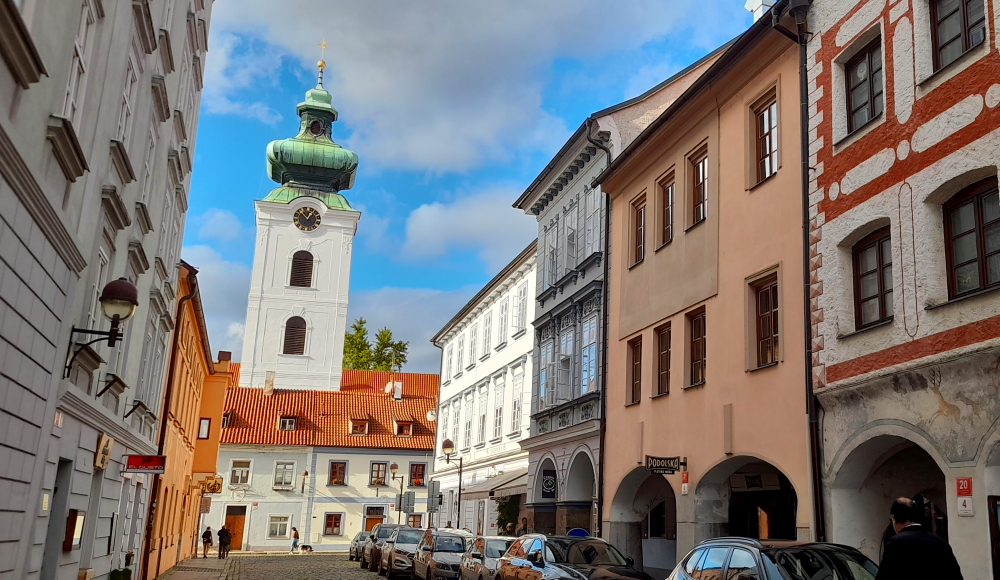
The Church of the Sacrifice of the Virgin Mary.

From here we head down Panska Street, a narrow and colourful cobblestoned street in the town’s conservation area.
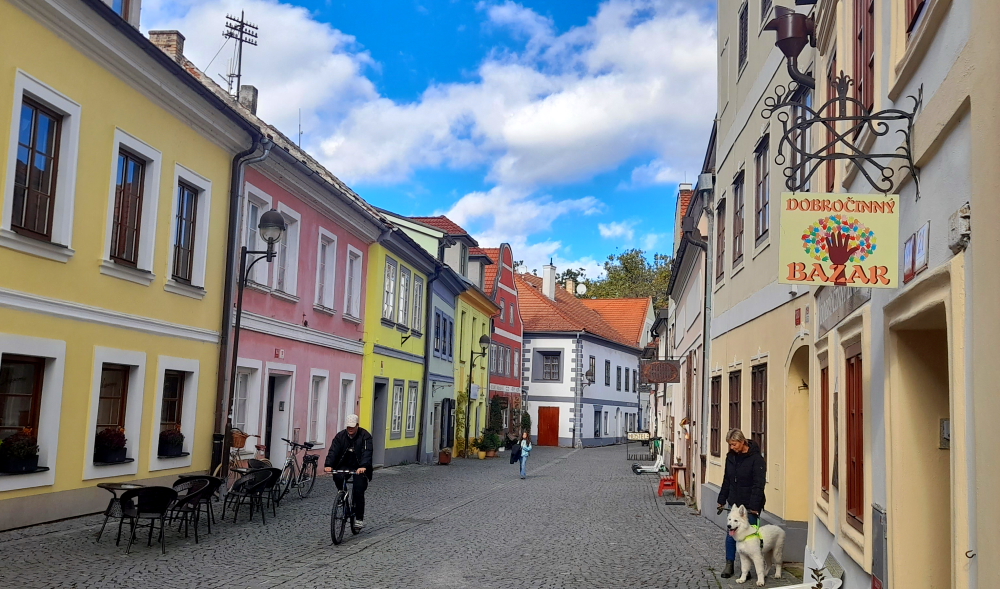
Colourful Panska Street.

On 17 December this year Panska Street will be transformed into an Old Bohemian Lane with the pre-Christmas sale of traditional folk art (Christmas decorations, gingerbread, ceremonial pastries, candles, candlesticks, ceramics, glassware, bobbin, crochet, woven products and woodcuts) together with Christmas trees, mistletoe, game and pheasants. Shoppers will also be able to wash down Old Bohemian delicacies with warm punch, wine or mead. Attendees are also encouraged to take Christmas bells, sparklers and candles with them.
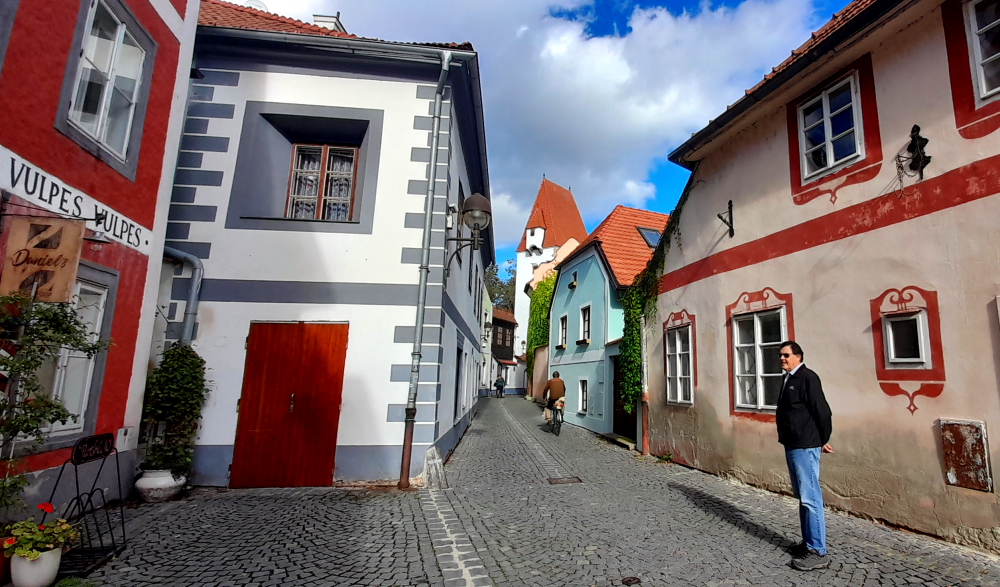
Heading back to the apartment.

Panska Street ends at the Rabenstein Tower and the Mill Stream which we cross to arrive at the apartment.
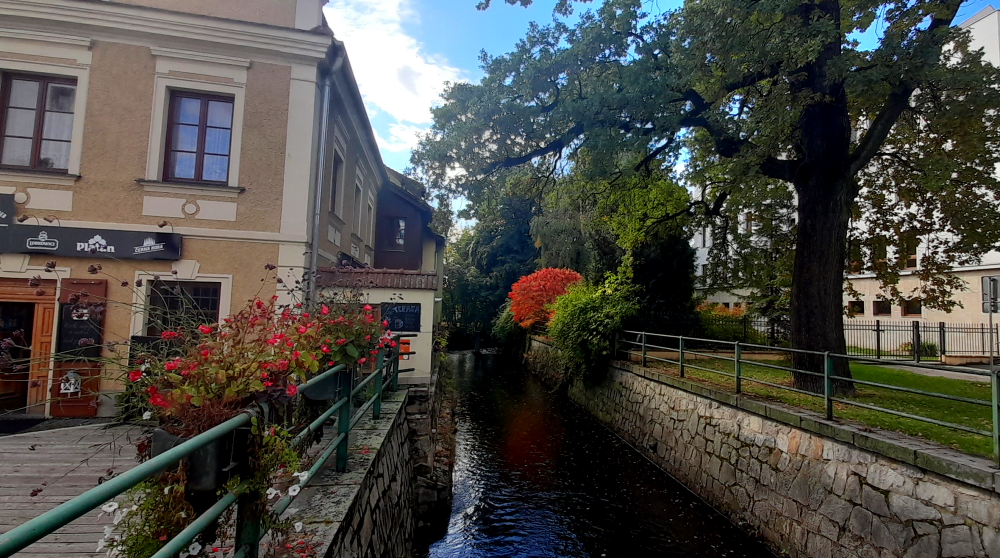
The mill stream.

This afternoon is dedicated to updating the blog while Lynn does the ironing.

By the time we have caught up on things it is about 7:30 pm. The original plan for tonight is to go out for Mexican but two of the three restaurants are now closed.

On the way to the third restaurant we stop to try to photograph the Errant Stone which is located across from the Town Hall in the Market Square.
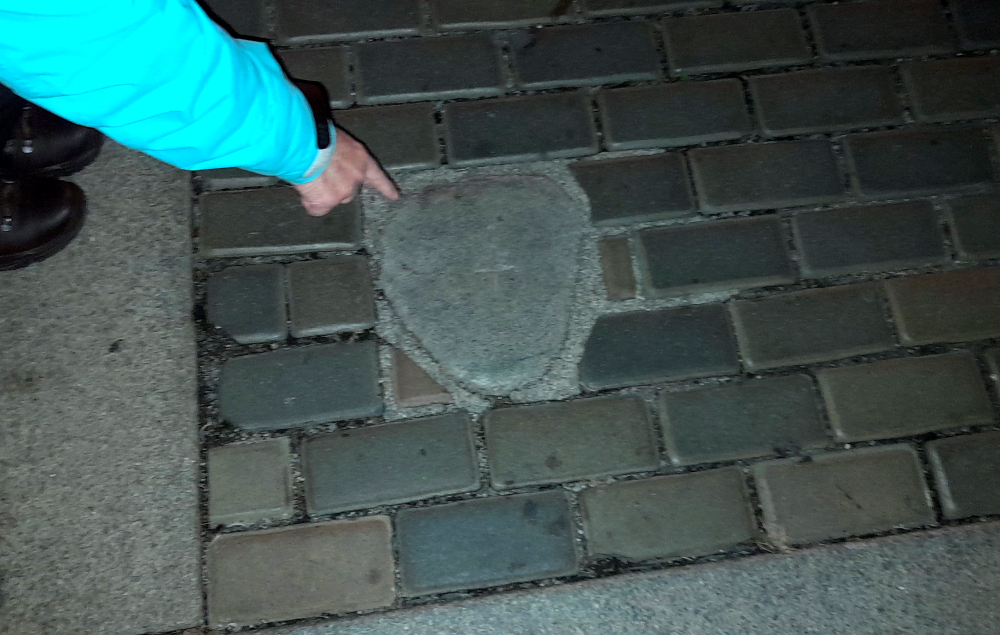
The Errant Stone.

Over time, the square was paved and a well and a gallows were built on it. Today, the Errant Stone is located in the gallows’ place. According to legend, the execution log stood at this place. In 1470 or 1478, 10 young men suspected of murdering the magistrate were allegedly executed on it.

The Mexican restaurant is on the Market Square but once we get there in the chilly darkness we find that there are only a couple of inside tables and the outside seating area has no heating. Take-a-way it is then. At least we can have a few glasses of red wine with our Mexican food without paying more for a small glass of wine than we pay for the food.

26 October, 2023

We are taking a couple of hours today to visit Cesky Krumlov which is a 25-minute drive SW of here. It’s a town in the South Bohemian Region of the Czech Republic. It has about 13,000 inhabitants and is known as a tourist centre, which is among the most visited places in the country. The historic centre with the Český Krumlov Castle complex is protected by law as an urban monument reservation, and since 1992, it has been a designated UNESCO World Heritage Site because of its well-preserved Gothic, Renaissance and Baroque architecture.

Due to its convenient location by the river, the area has been permanently inhabited. The area’s oldest settlement goes back to the Older Stone Age (70,000–50,000 BC); mass settlement in the Bronze Age (1,500 BC); Celtic settlements were here in the Younger Iron Age (c. 400 BC), and the first Slavic settlement from the 6th century AD. In the Early Middle Ages, trade routes led through this territory along the Vltava River.
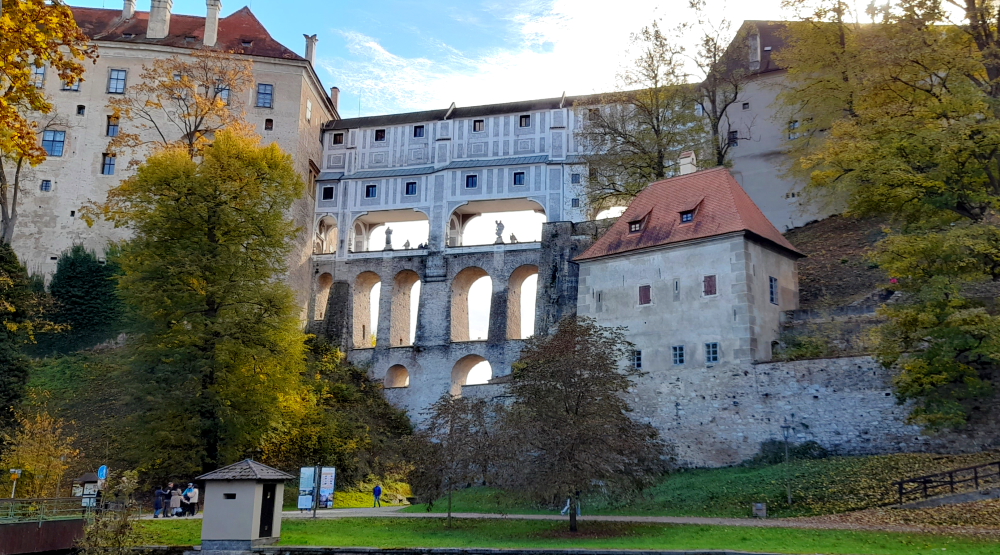
Cloak Bridge between various levels of castle buildings.

The Český Krumlov Castle was founded shortly before 1250 by a local branch of the noble Vítkovci family, descendants of Witiko of Prčice. The first written mention of Český Krumlov was in a 1253 deed as Chrumbenowe.

The town was established in two stages. The first part called Latrán was built spontaneously below the castle, settled mostly by people who had some administrative connection with the castle. The second part was subsequently founded as a brand new settlement and called Old Town. Since the foundation of the town, both Czech and German nationalities were represented. A Jewish community is documented since 1334.
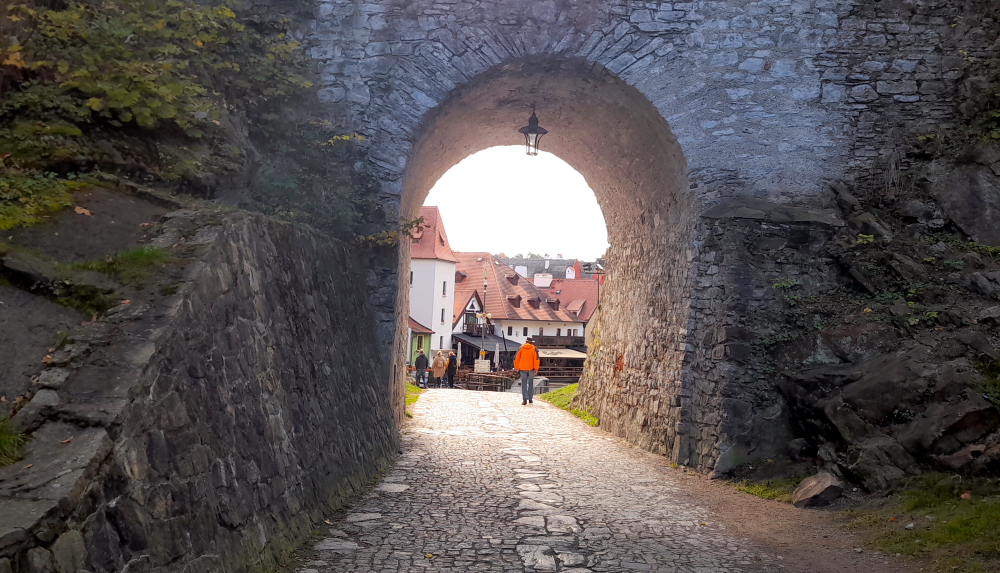
Through the Castle Gate.

In 1302 the Vítkovci line became extinct and King Wenceslaus II, who acquired the estate and castle by escheat, ceded it to the Rosenberg family, who later made it the main residence of their family. Peter I of Rosenberg, the Lord Chamberlain of King John of Bohemia, had the present upper castle erected in the early 14th century. Under his rule the Rosenberg estates flourished. Český Krumlov achieved the highest prosperity in the 15th century during the rule of Oldřich II of Rosenberg, when the estate territory was considerably enlarged.
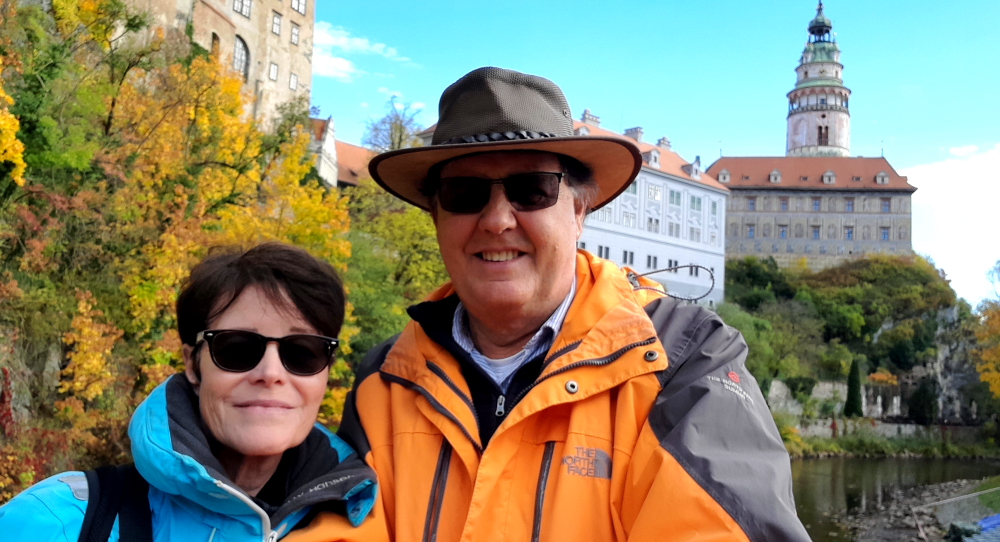
A selfie on the wooden bridge.

The Rosenbergs strongly promoted trade and crafts within the town walls. In the late 15th century, when gold was found next to the town, German miners came to settle, which shifted the ethnic balance even more. In one of the churches, the sermons were preached in Czech until the 1780s, when Church of Saint Judoc was closed. In 1555, William of Rosenberg joined the town parts of Latrán and Old Town, which had been up to then separate, and unified the town. In the late 16th century, he had the castle rebuilt in the Renaissance style
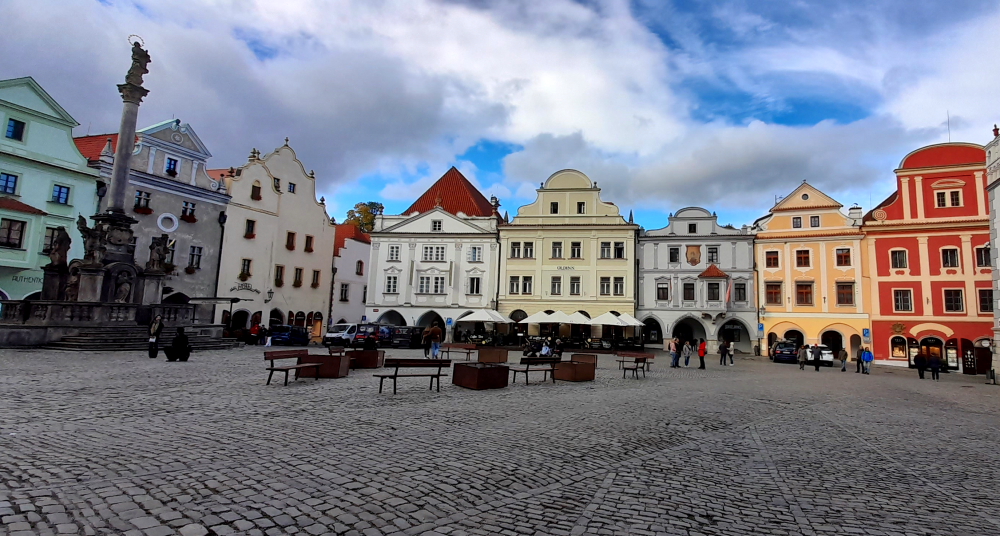
The Cesky Krumlov Town Square.

In 1602, William’s brother Peter Vok of Rosenberg sold Krumlov to Emperor Rudolf II, who gave it to his illegitimate son Julius d’Austria. After the Bohemian Revolt and the 1620 Battle of White Mountain, Emperor Ferdinand II gave Krumlov to the noble House of Eggenberg and the town became the seat of the Duchy of Krumlov. From 1719 to 1947, the castle belonged to the House of Schwarzenberg.

In the 19th century, the industrialization and development of transport occurred, and most of the town fortifications was demolished

Up around the corner from the Town Square is St Vitus Church, a Gothic three nave construction from the period of 1407-1439. It was built on the foundations of an older building from the year 1309. The Gothic entrance portal was erected in 1410. In the 17th and 18th centuries, the Church continued to be extended and modified.
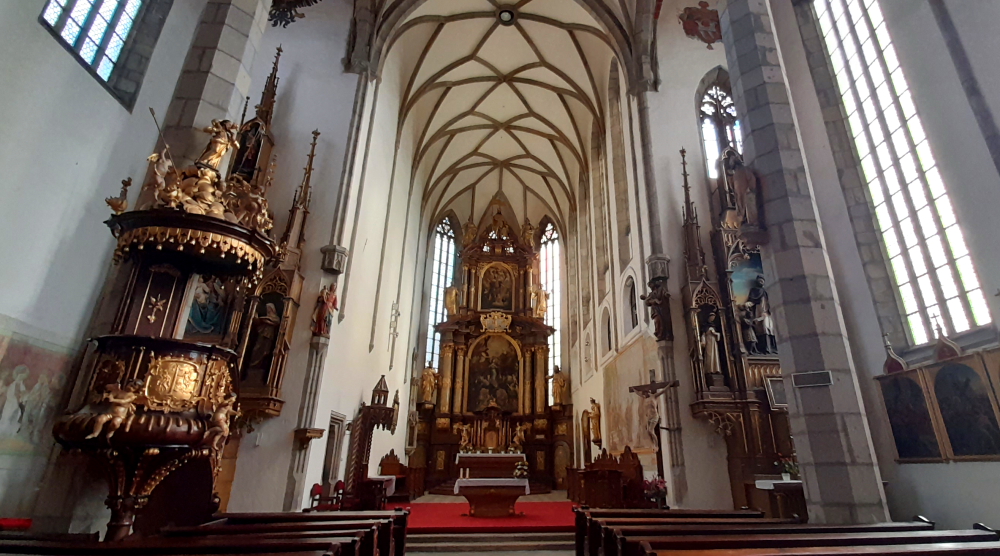
Inside the St Vitus Church.

There were 8,662 inhabitants in Krumlov in 1910, of which 7,367 (85%) were Germans and 1,295 (15%) were Czechs. After World War I, Český Krumlov became a part of the Bohemian Forest Region in a newly-created Czechoslovakia, but German-Austrian deputies declared the region be part of German-Austria. In 1919, the Treaty of Saint-Germain-en-Laye recognized the area as part of Czechoslovakia. In 1938, it was annexed by Nazi Germany, as part of the Reichsgau Oberdonau unit of Sudetenland, under the Munich Agreement. After World War II, the town’s longtime German majority population was expelled and the town was returned to Czechoslovakia.
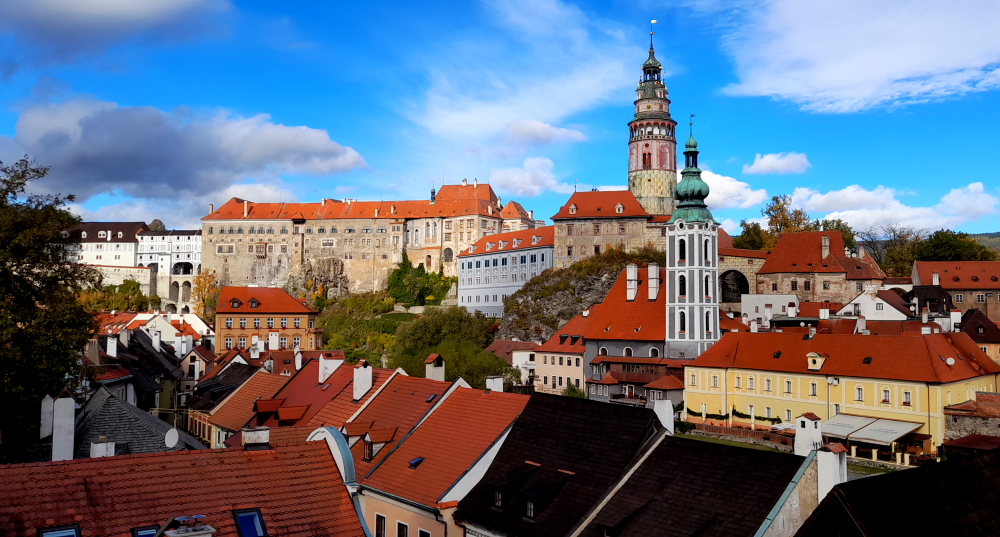
The Castle from inside the town.

During the Communist era of Czechoslovakia, the historic Český Krumlov fell into disrepair. However, since the Velvet Revolution of 1989 much of the town’s sights has been restored, and it is now a popular tourist destination.
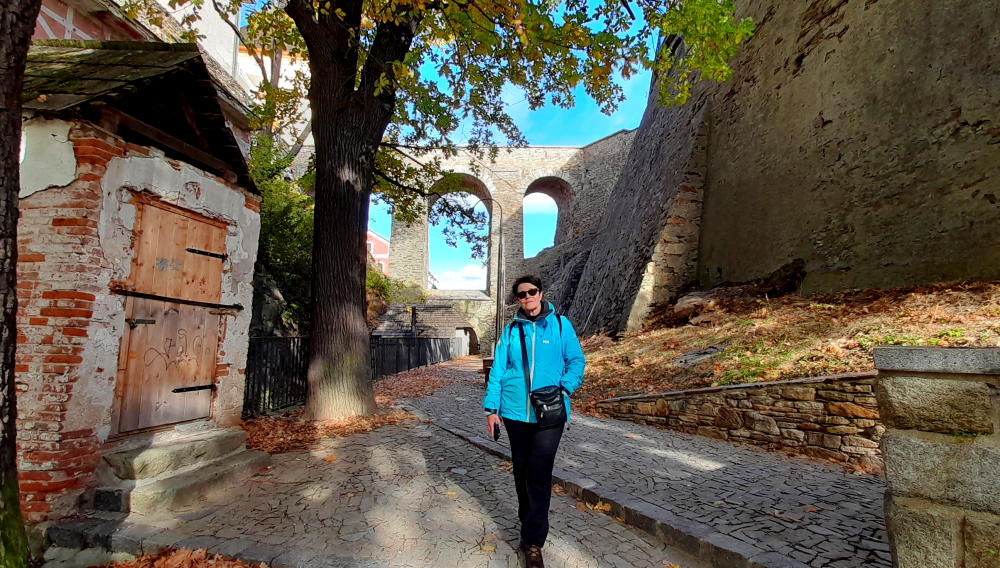
Across town by the riverside.

In August 2002, Český Krumlov was damaged by the 2002 European floods.
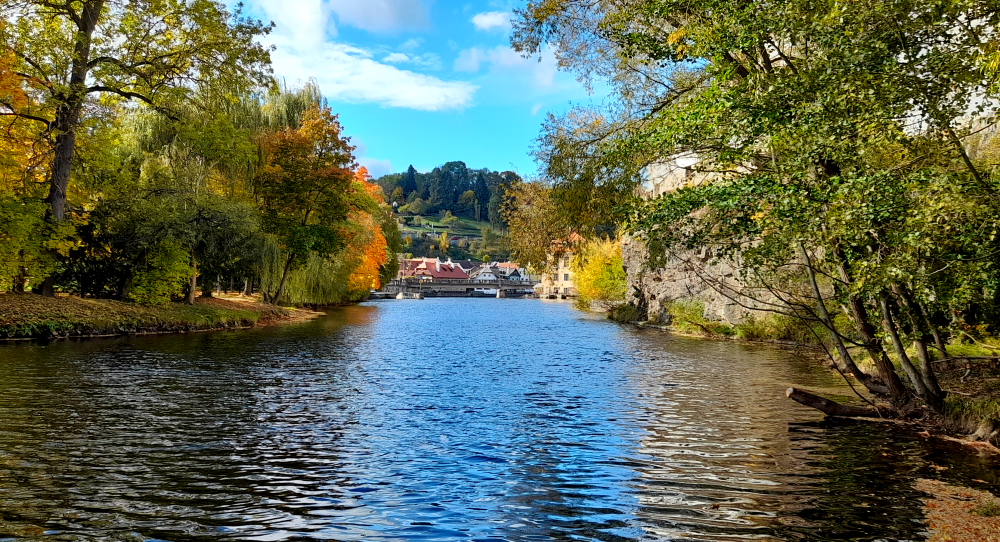
The Vlatava River as it enters the town.

After walking through town we loop back to the Castle via Latran. The castle stands on a steep and long rocky headland, which is lined with Vltava from the south.
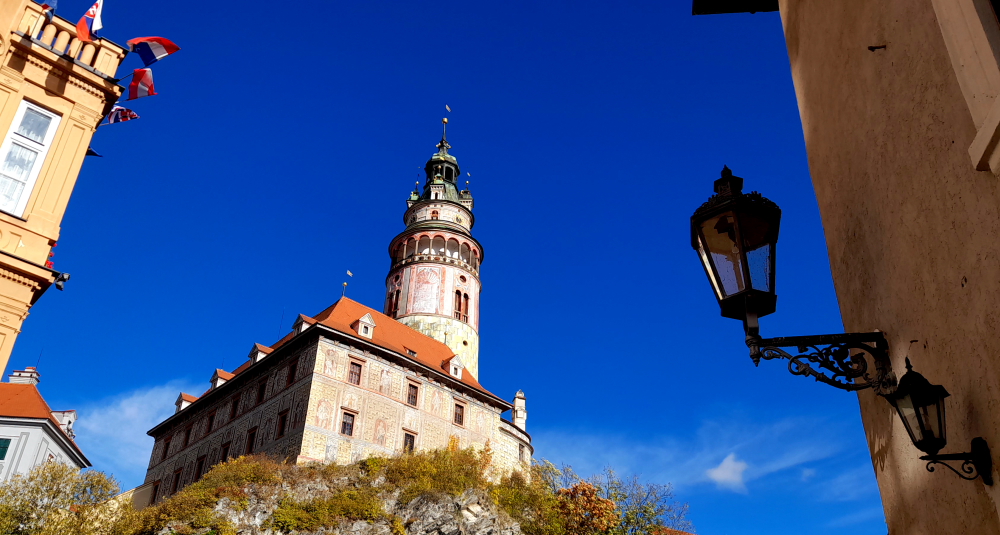
Hradek with 13th Century Tower.

The castle and chateau complex is connected to the town by the Red Gate which gives access to the 1st courtyard, once the agricultural area of the castle and animal enclosure.
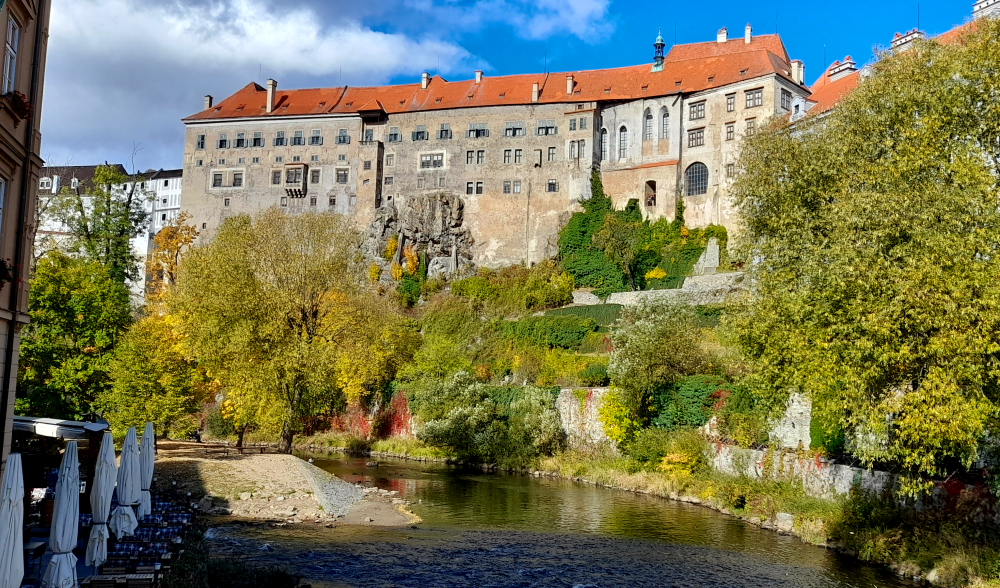
Imposing Upper Castle above the town.

The bridge over the Bear Moat leads through the passage to the Lower Castle and the 2nd courtyard and on the left side is the oldest part of the castle (Hrádek), an old palace with a tower from the 13th century and paintings from 1580.
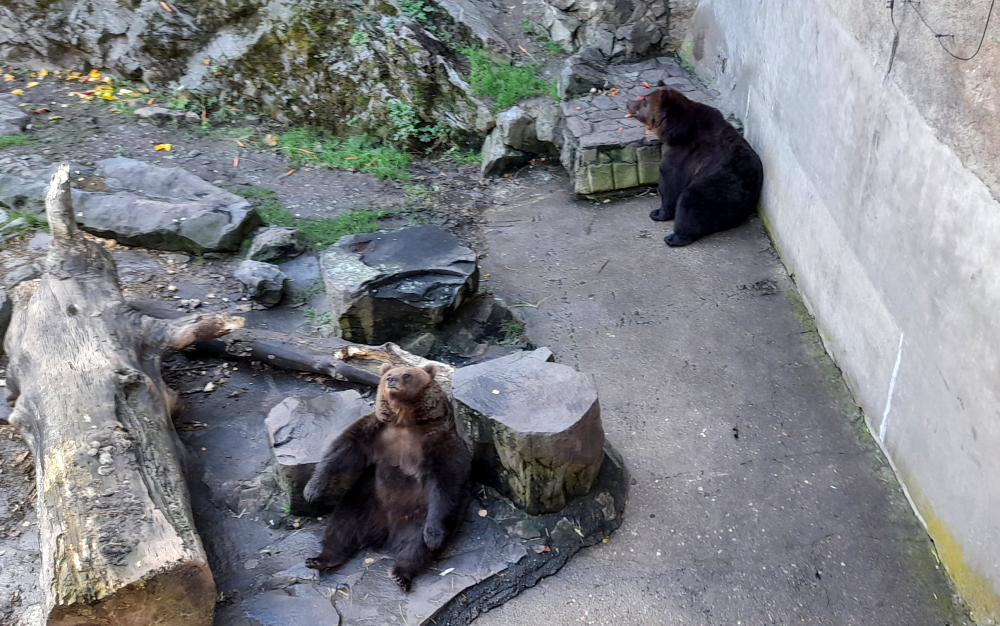
There’s a reason it’s called “Bear Moat”.

Bears have been kept here since 1707. Bears have apparently been kept in the castle, however, since the mid-16th century. Their presence is due to Vilém of Rožmberk‘s attempt to maintain the legend of a kinship between the Rožmberks, through the Vítkovci, and the Roman noble family of the Orsinis (the word Orsa means she-bear in Italian). The “author” of the legend was apparently Oldřich of Rožmberk (1403-1462). The purpose of this legend was to place the origins of the House of Rožmberk to the glorious days of ancient Rome, thus enhancing their own superiority over the other noble families of Bohemia.

The second castle courtyard had the same name as the Guards. The barracks on the ground floor of the New Burgrave was used to house the Schwarzenberg grenadier guard, located at the castle for more than 200 years – from 1742 to 1948.

Across another moat a brick bridge leads to the Upper Castle, the Rosenberg Palace. At the top of the steep hallway just before the entrance to the 3rd courtyard there is a small balcony that offers a stunning view of the town.
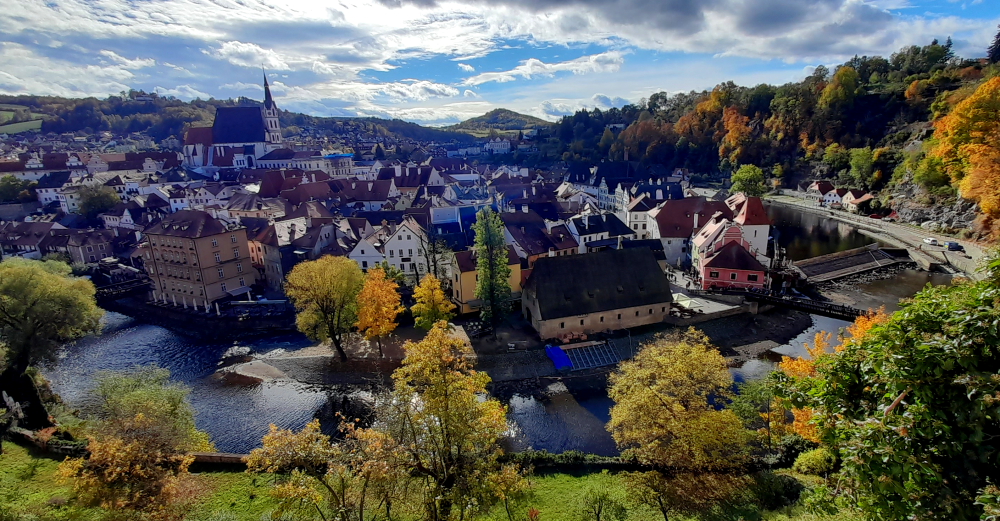
Overlooking the town from the Castle.

Passing through a steep windy hallway, its size rather suggesting a vehicle passageway, there is the 3rd courtyard.
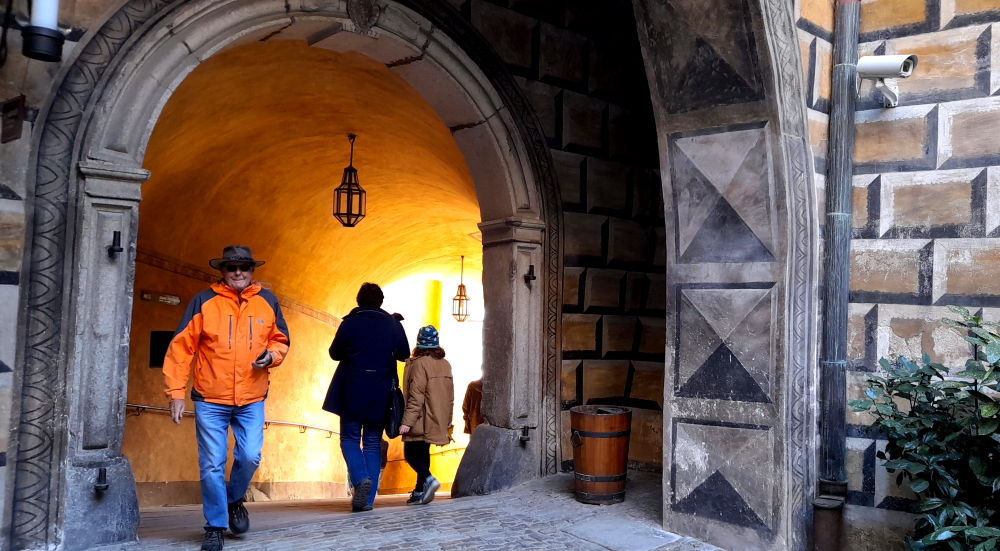
Winding hallway to the 3rd courtyard.

The Upper Castle is formed by buildings of a palatial character with grandiose aristocratic interiors. The palaces have been preserved in nearly their original Renaissance appearance from the 16th century during the reign of Vilém of Rožmberk.

The Renaissance character is emphasized by the rich facade decorations from the late 16th century. The author of the frescoes on the 3rd courtyard was the Rožmberk court painter Gabriel de Blonde.
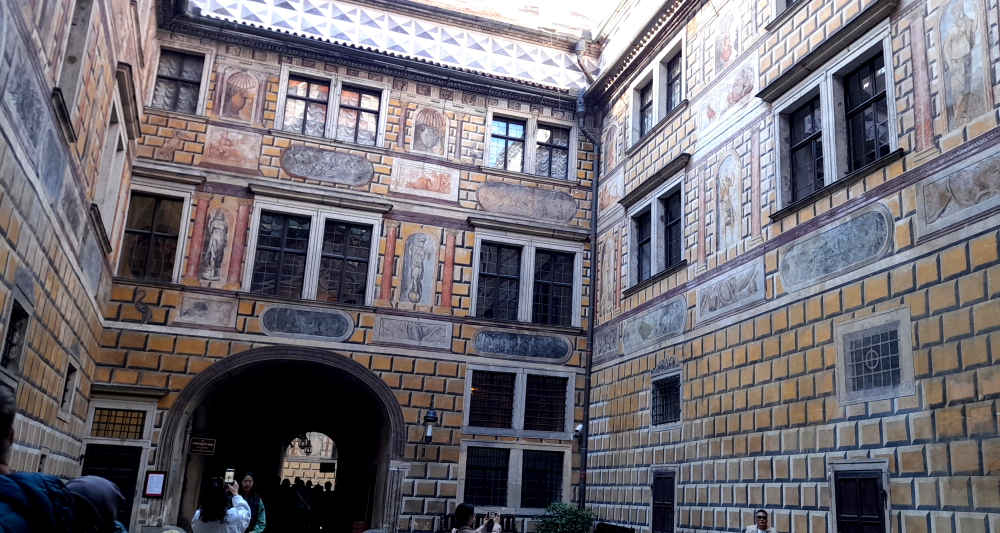
3rd Courtyard with frescoes.

The hallway from the 4th courtyard opens onto the bridge called “Plášťový”, or Cloak Bridge, a unique 5-storey bridge. This bold structure spans the deep ravine, artificially deepened in the Middle Ages, between Upper Castle and the 5th courtyard.
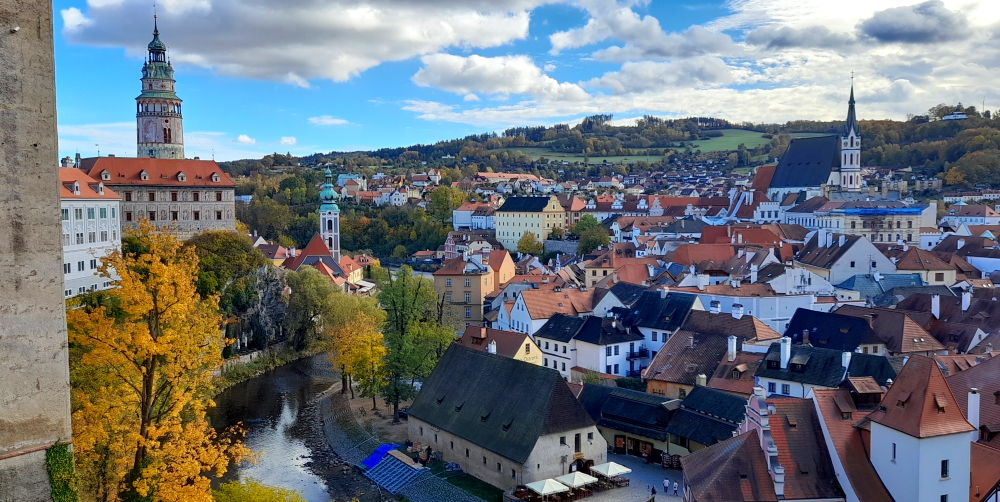
The hills from Cloak Bridge.

Built in several stages from the late 17th century until the mid-18th century the bridge replaced the original wooden footbridge. It is passable through three floors – above the accessible open part – and below there are two more indoor corridors, located one above the other. The lower links the Masquerade Hall with the Baroque Theatre, while the upper allowed the gentry to pass unhindered from the gallery to the castle garden.

From parking the car to collecting it again takes a whole 1.5 hours!
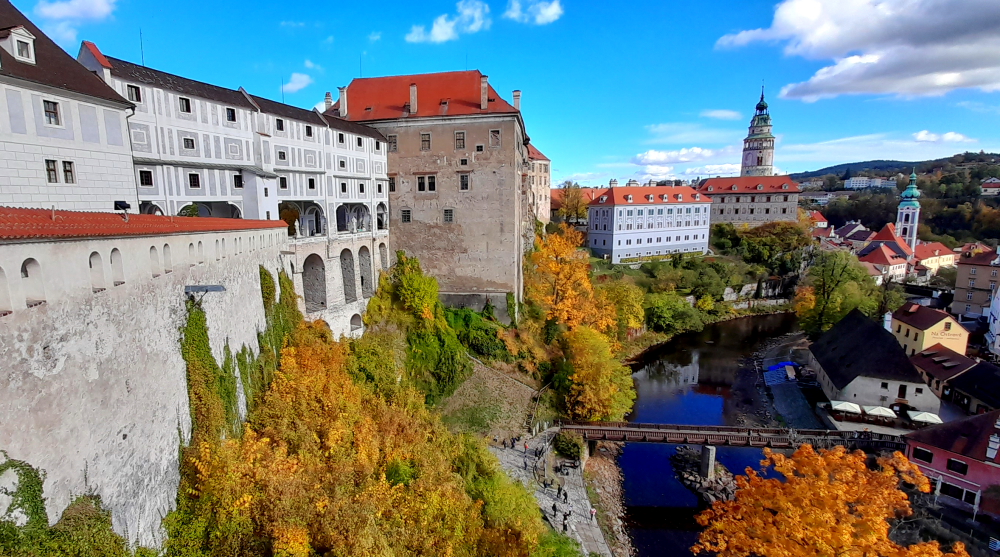
The town side of the Cloak Bridge.

Just as well we went this morning as around 3:00 pm sitting in the apartment the sunny skies of this morning have disappeared and it is now raining heavily.

27 October, 2023

It is bucketing down this morning but we have slept in until about 9:30 am. We have a slow breakfast and as the rain eases off we head to the market square for a coffee and Lynn has a cheese croissant.

We still have not finished off booking our Wales travels for March next year so that will be the priority this afternoon.

It takes all afternoon just to agree on the booking so we still have a few things to get done today such as dealing with HSBC (they messed up Lynn’s Global View for her online accounts and an AUD Term Deposit for me). We are not sure how they can screw things up but they seem to do it regularly and take weeks to try to fix things. Not what I would call a reliable bank.

Tomorrow morning we are leaving Czechia and heading for Steyr, Austria. It is about a half hour drive to the Austrian border from here where we have to buy yet another Vignette for our drive through Austria. We tried to buy an online Vignette but because you can claim unauthorised Credit Card payments for online purchases in Austria you have to buy the pass 18 days in advance. Yet, we can buy one at a vending machine at the border with the same credit card on the same day. Yet another example of European inefficiencies. Why do people live in the UK or Europe? Frustrations seem to be a daily experience here. Perhaps the UK Department for Making Things More Difficult has spread to Europe. Or did it start here and hence Brexit????

It must be red wine o’clock.
Hannoversch Munden and Dresden

12 October, 2023

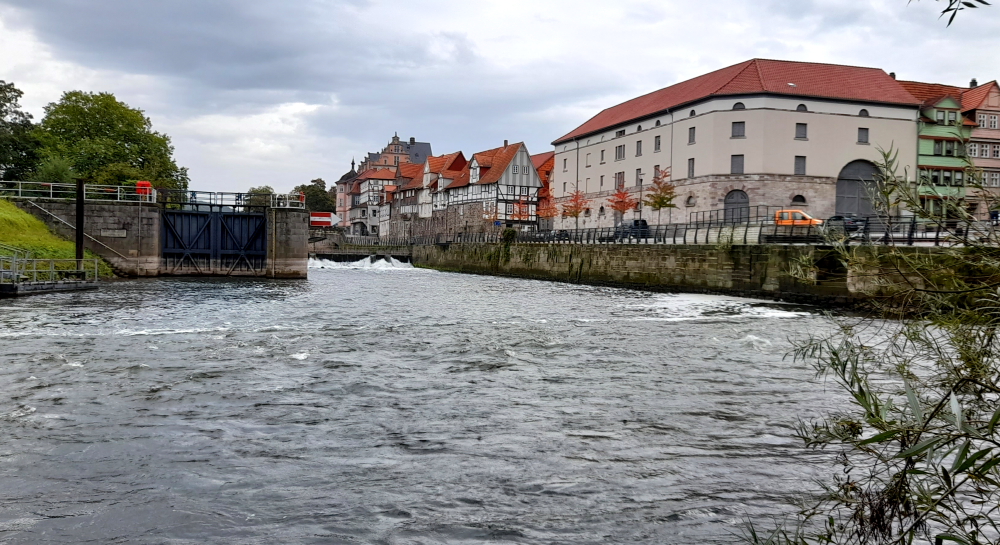
As forecast it started raining heavily from about 4:00 am. With our window open we could listen to the babbling river as well as the rain on the roof. It was very difficult to wake up but the alarm went off just as the workers arrived to start up their heavy machinery outside our window to continue on the river edge stabilisation project.

We have a few days of blog backlog to complete today (perhaps we should call it our backblog???) so a wet day is not an issue. I also have to sort out the hire car border fee with the hire car company and try not to do another rant on the blog. Late last night I escalated the issue with the hire car company head office in Krakow and threatened to publish their poor service experience on a number of review sites.

By the time we finished breakfast and started the backblog (I like the sound of that..) I received a phone call from the head of the car rental service. He was most apologetic and promised to complete the refund today. I explained that I understand errors occur but when I send all the proof to the company and get no responses to my constant emails over the past month it becomes unsatisfactory. When will companies realise that they can run off more customers than advertising can attract if they don’t have good customer service? An error quickly rectified can gain a customer for a long time but a small error poorly managed can alienate a customer and their friends for life.

My rant for the day.

We managed to get the backblog up to date and I even managed to step out for a while to acquire some red wine for Lynn and check out a few of the local stores.

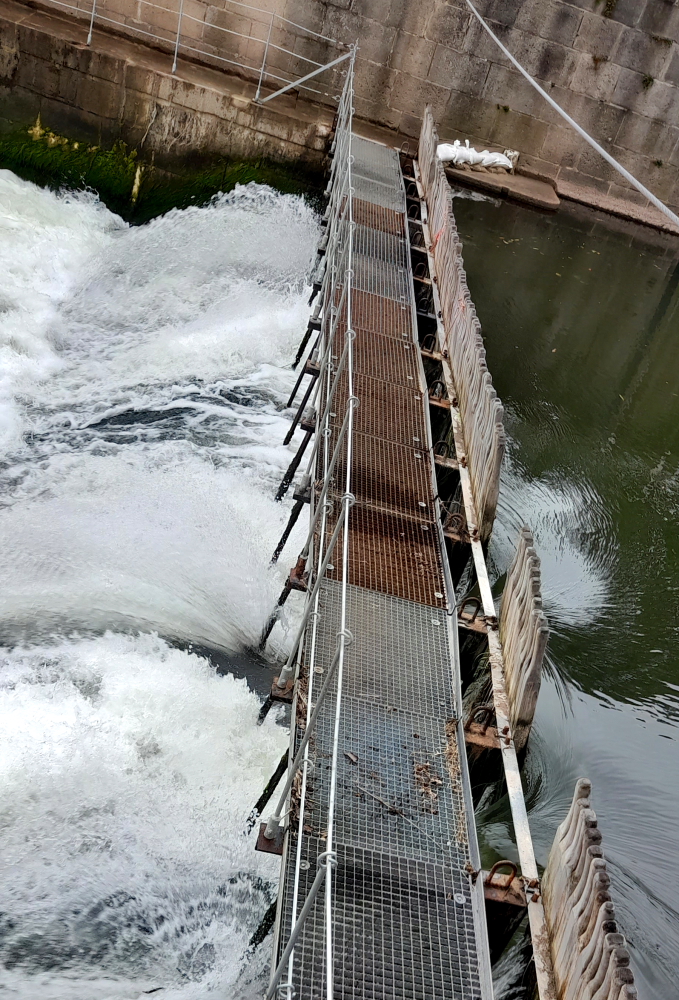
Interesting way to manage the water flow rate – wooden sticks.

I brought Lynn back a bottle of red wine and once she completed the blog edit we headed out to find a suitable place for dinner.

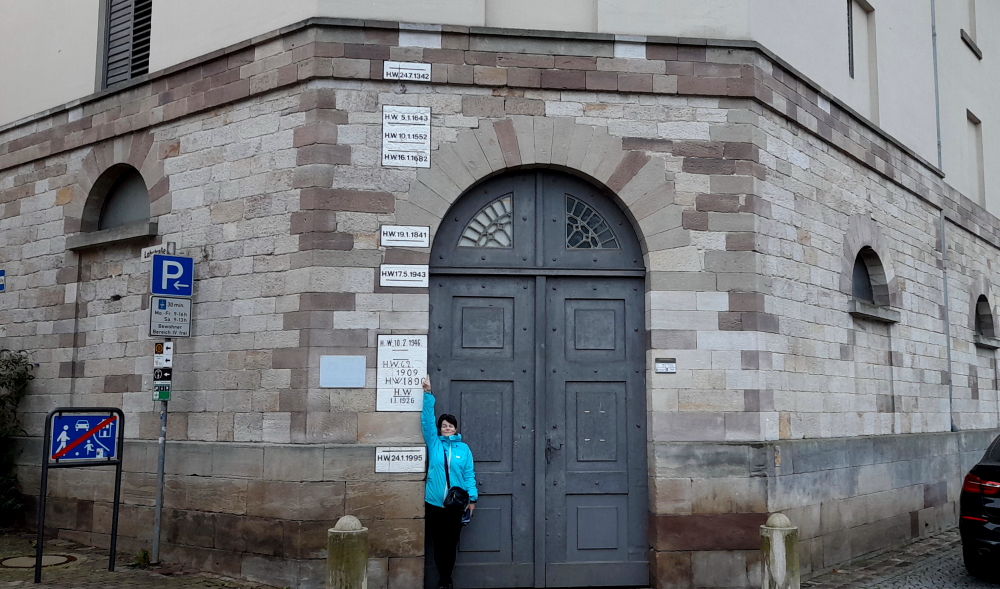
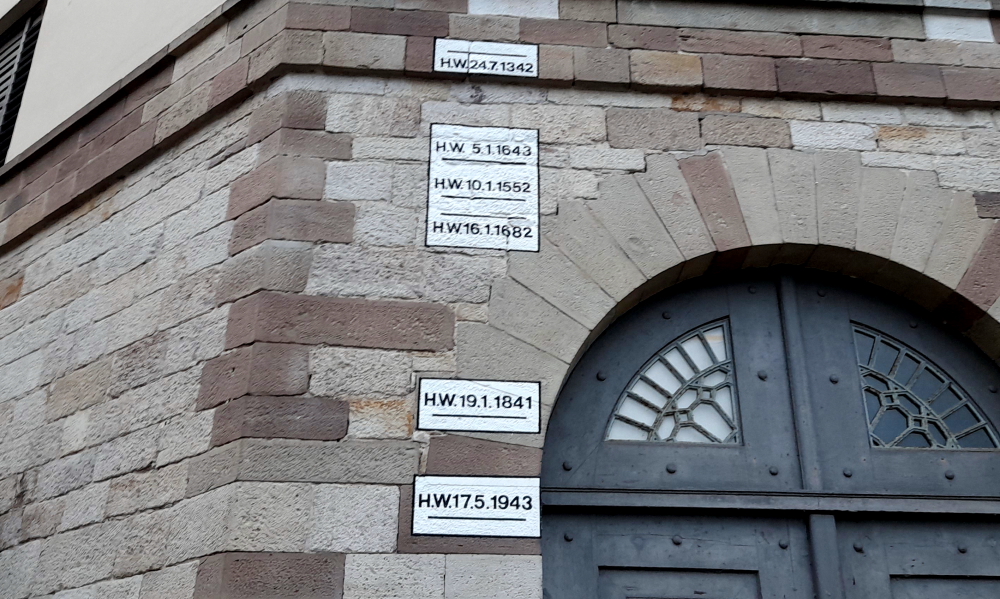
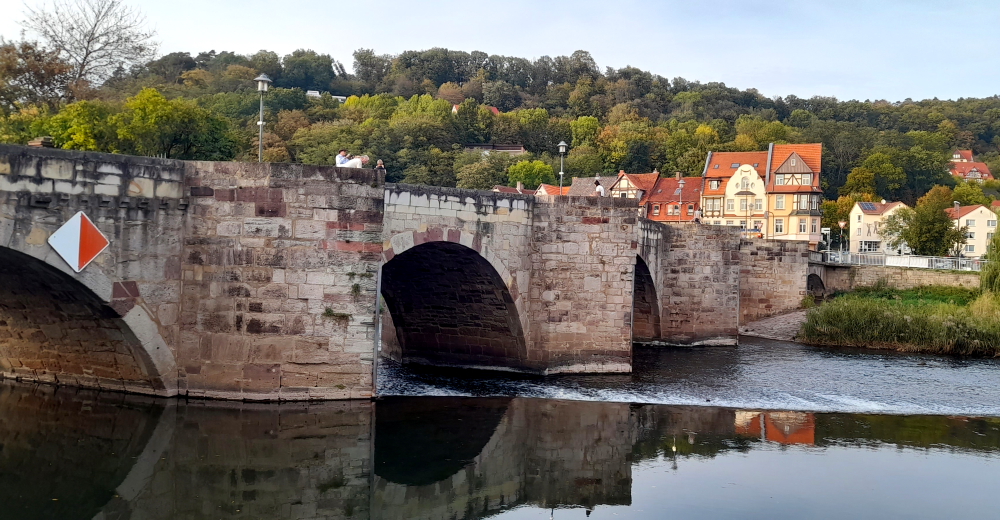
On the way, just around the corner from the hotel we noticed a number of flood markers from the past 650 years.

Flood markers down by the river.

We know that the 1943 marker was caused by the dam busters who blew up a dam further upstream but the big floods were years before.

High Water markers.

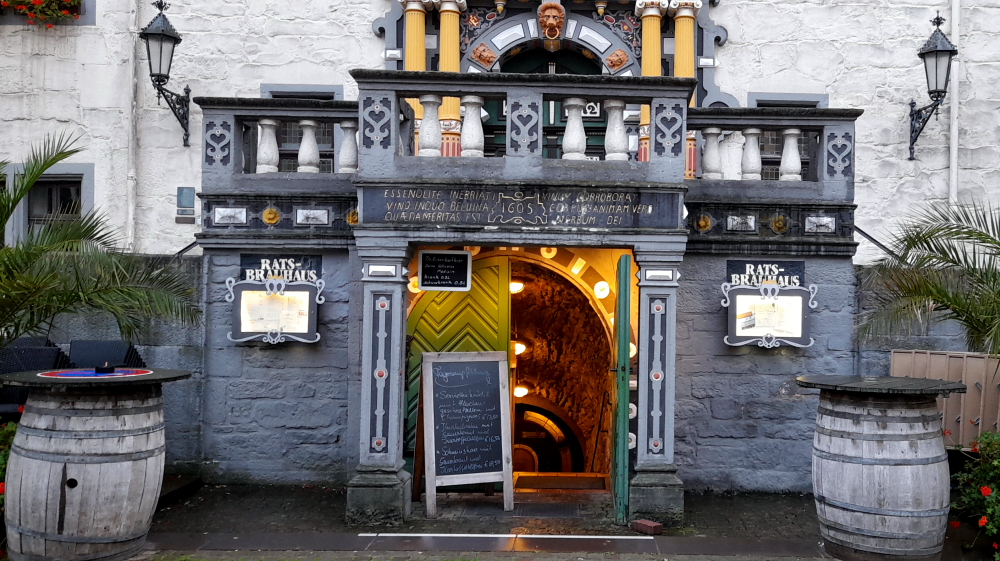
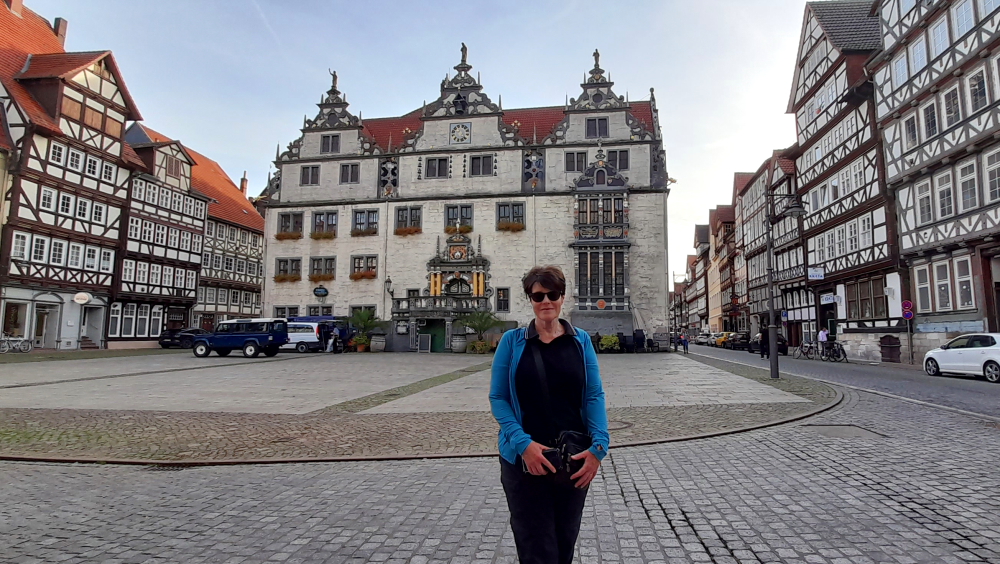
We decided to try out the restaurant and bar located in the cellar of the city hall.

The Rats-bruhaus.

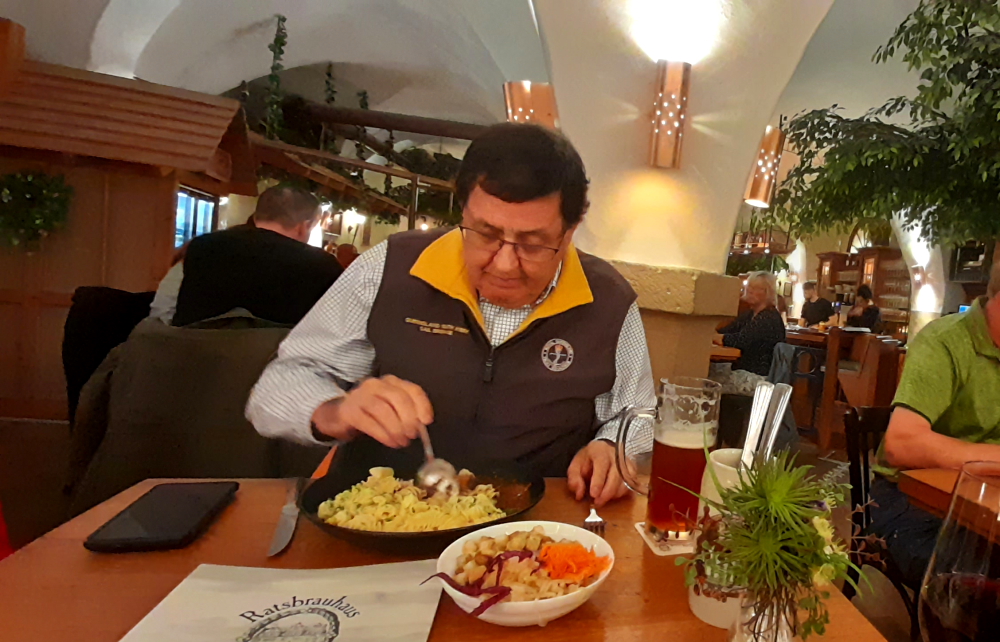
Like many famous restaurants the hype is better than the actual experience. The food just barely acceptable and the prices were aimed at tourists. We both had goulash.

Goulash and a beer.

Maybe Italian tomorrow night or perhaps back to last night’s German restaurant.

The Rathaus restaurant bunker.

On the way back we dropped in to the mini market for some biscuits to have with a cuppa after dinner.

13 October, 2023

It has continued to rain overnight but after breakfast we decided to explore the wider areas of the town now that the rain has eased.

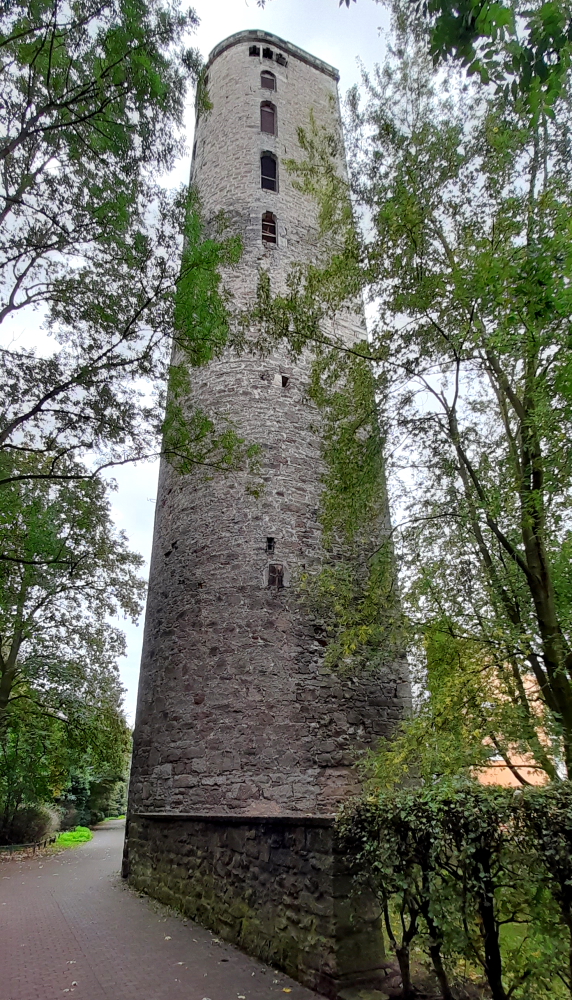
We headed to the outskirts of the old town with the plan to follow where the old fortifications surrounded the medieval village. There are a number of lookout towers and sections of the original wall to explore.

Courthouse with Hampescher Turm (tower) in the distance.

We will then walk to the parks that are outside the wall and Lynn wants to walk up to a lookout to see if there is a view of the town.

One of the 6 remaining towers.

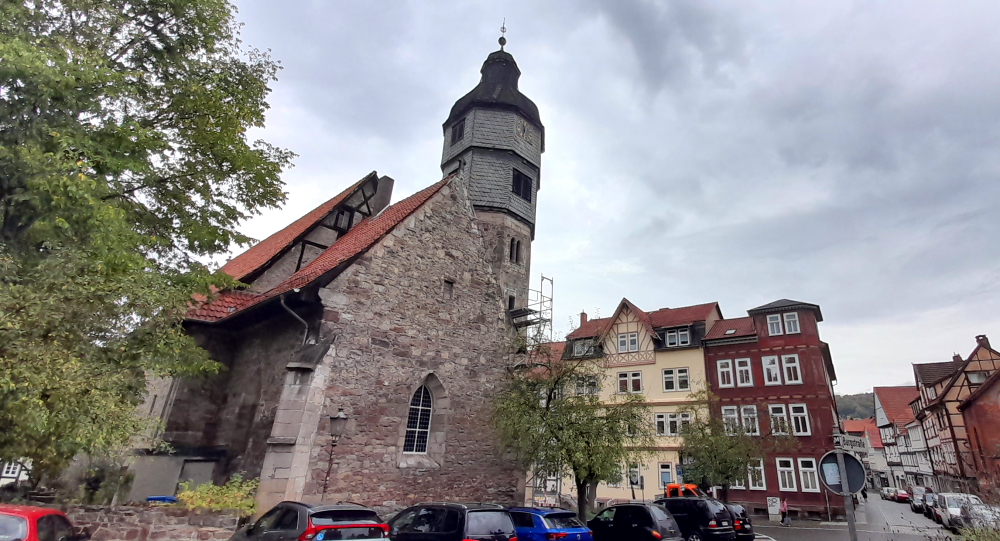
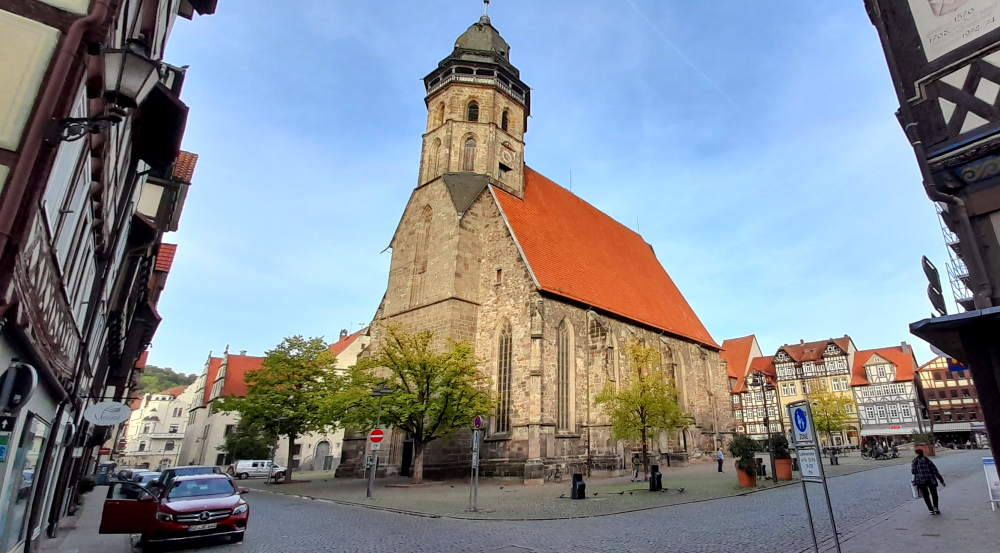
Our next stop was at the St Aegidienkirche where Dr Johann Andreas Eisenbart was buried in 1727. Eisenbart was known as a craft surgeon – experienced in his art of eye cures, stone, cancer and fracture cutting – a travelling ‘physician’ usually practising in tents at market squares and selling his potions. During his career he received a number of privileges, one of which was Braunschweig-Lüneburg (1710) with Hanover and Lower Saxony , which is why Eisenbarth was able to call himself the Royal British Country Doctor after the establishment of the personal union with Great Britain from 1714.

St Aegidien Church.

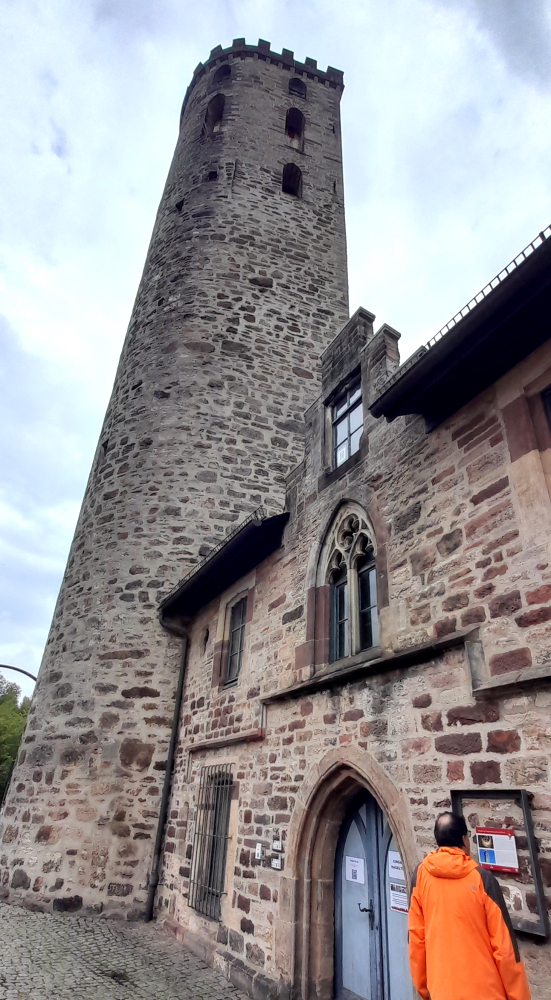
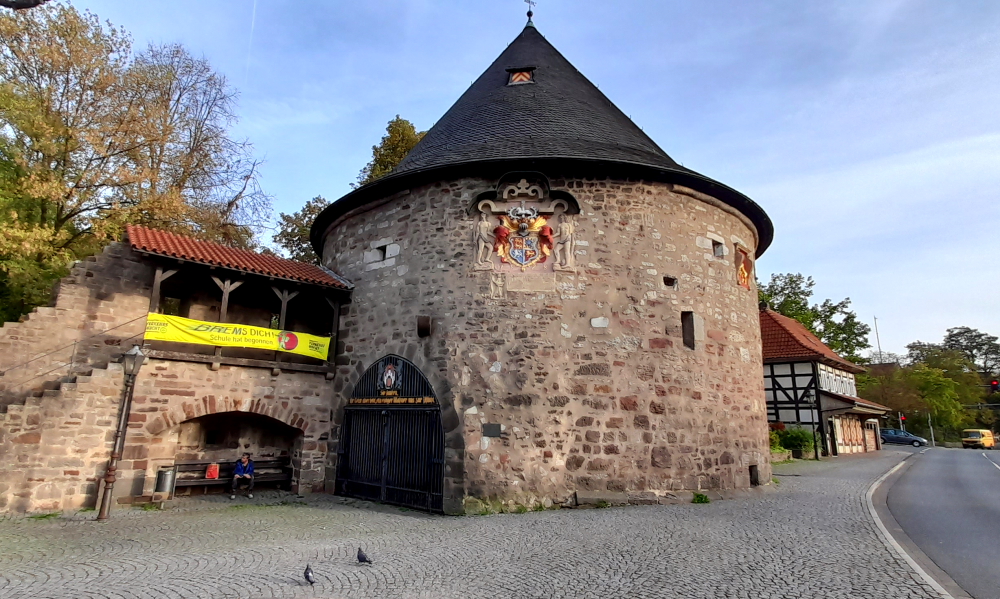
At the southern end of town the Ferry Gate Tower was purchased by the Haendler & Natermann company in the late 19th Century in order to heighten it and convert it into a shot tower (renamed the Hail Tower) to manufacture lead musket balls.

The Ferry Gate/Hail Tower.

From here we cross over the Muhlenbrucke Bridge near our hotel to the Tanszwerder Island opposite.

On the Unterer Tanzwerder Island.

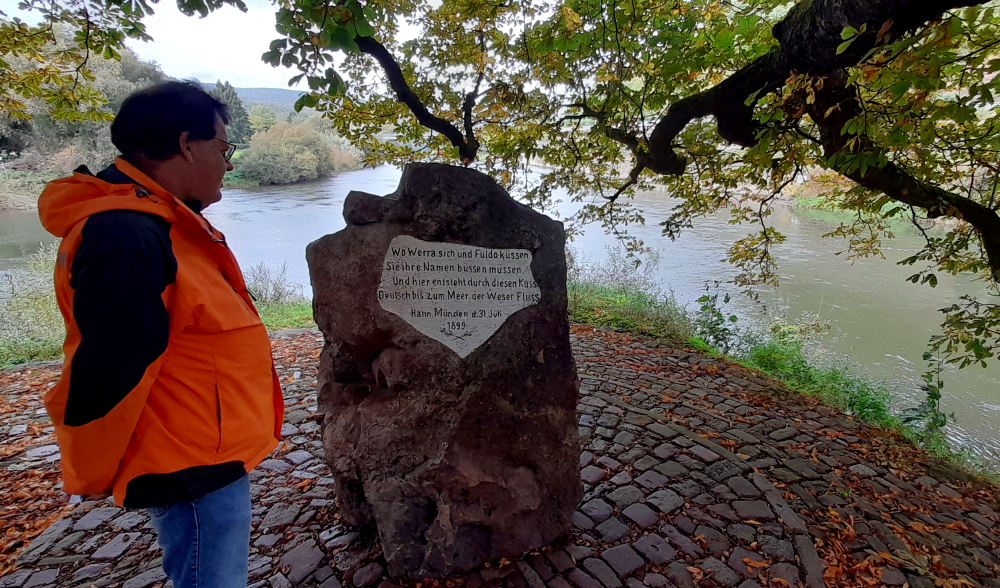
This island is surrounded by the Fulda, Kleine Weser and Werra Rivers.

The Werserstein where the Fulda and the Werra Rivers meet.

Next we cross half way over the Alte Werrabrucke bridge to the small island of Doktorwerder which is now a parkland with a number of statues by local artists.

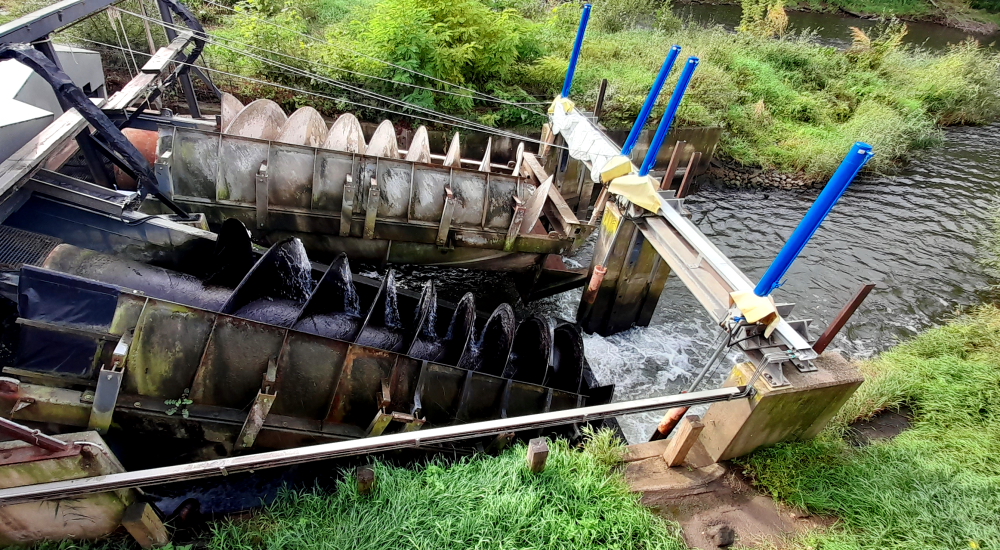
Back to the bridge we continue to the Northern side of the Werra River where a short distance downriver is a 70 KWH hydro electric generator, which is an unconventional twin-screw generator but only one of these is working today.

The Wasserkraftwerk hydro generator.

Lynn wants to walk up to the Weserliedanlage lookout to see if she can get a view of the town from the top of the hill. I tag along for part of the way but as my knee is hurting Lynn sends me back to the hotel while she continues up the steep hill alone.

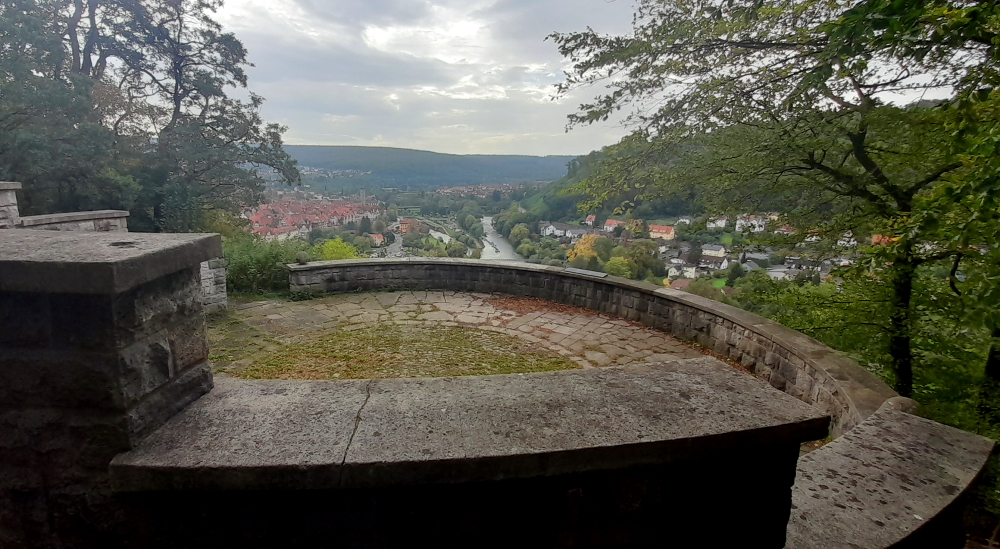
The lookout above the town.

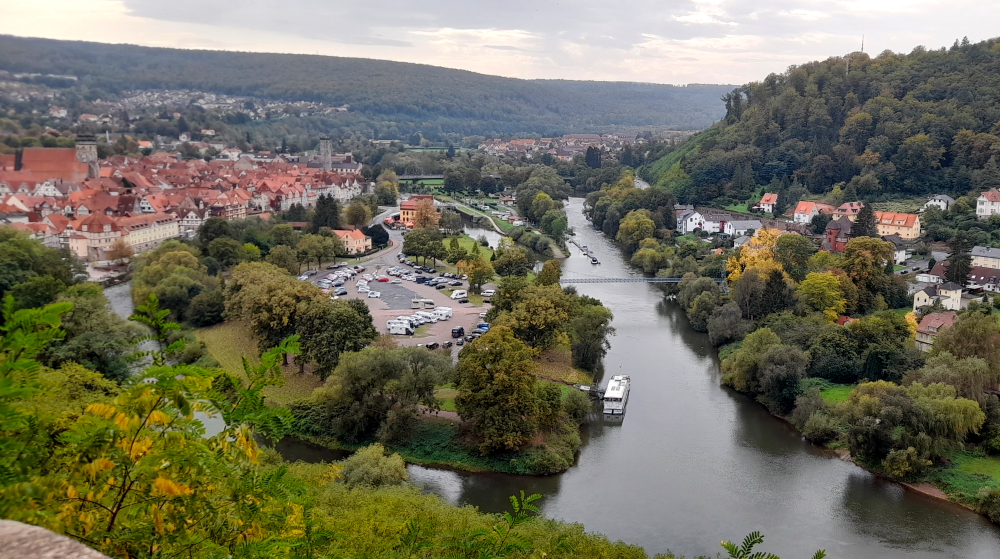
This is the view from the lookout. Our hotel is at the far left, at the top of the waterway which is the Werra River.

Looking down the Fluda River with our hotel on the far left.

While Lynn edits the blog this afternoon I start checking out transport for the 2nd quarter of next year and beyond. By 3:45 pm it is red wine time and a break before we head out for dinner. We have decided that we will check out by 10:00 am tomorrow so that we can do a laundromat stop on the way to Dresden.

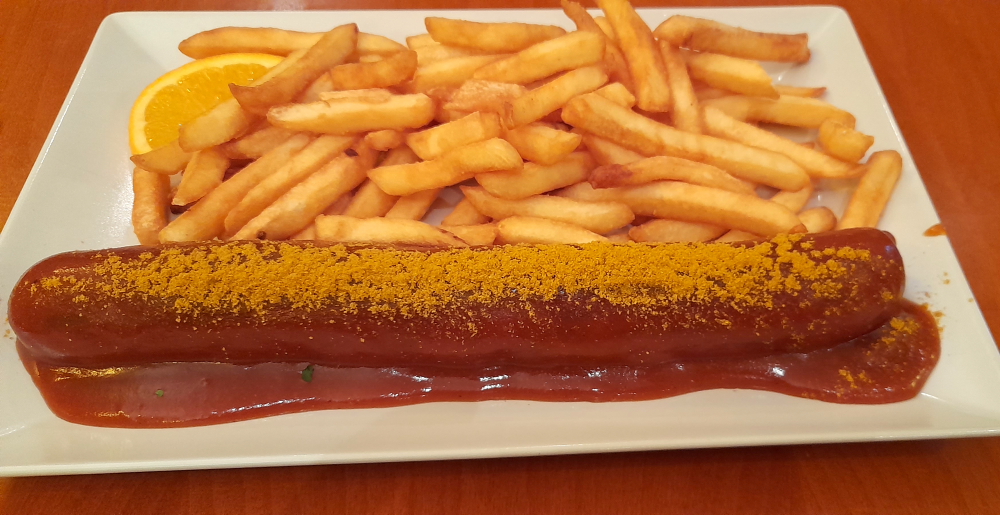
For dinner tonight we head back to the restaurant where we had dinner the first night. A light dinner is all we need so I order another schnitzel and Lynn orders currywurst. Unfortunately it is not the curried sausages that can be found in the UK or Australia. The German version consists of a German sausage covered in tomato sauce and sprinkled with a very mild curry powder. Yuck!

Curried sausage Jim, but not as we know it.

14 October, 2023

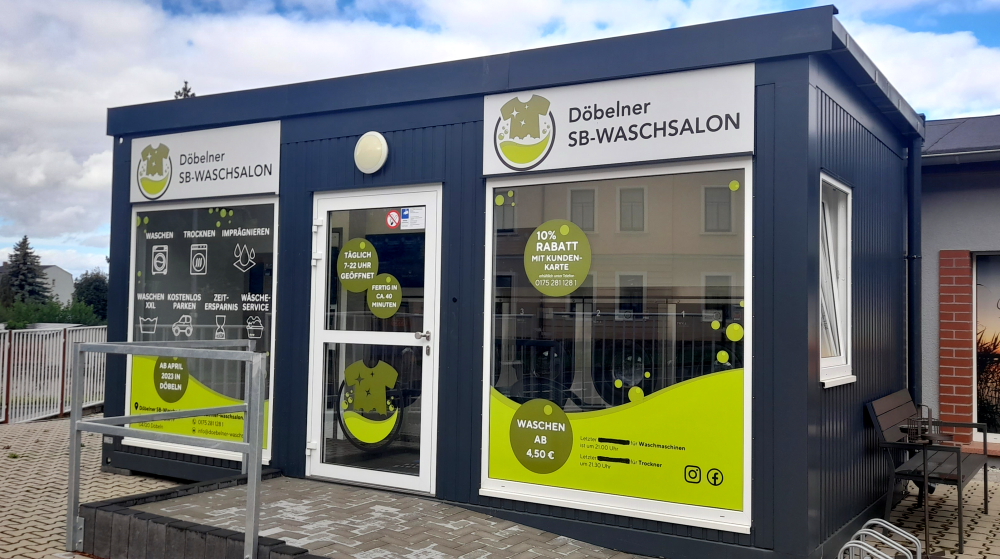
At 9:58 am and a chilly 13 Deg C we leave the hotel to drive to Dobeln, 2 hours and 45 minutes away where I’ve located a landromat. Then it will only be a 45-minute drive to Dresden.

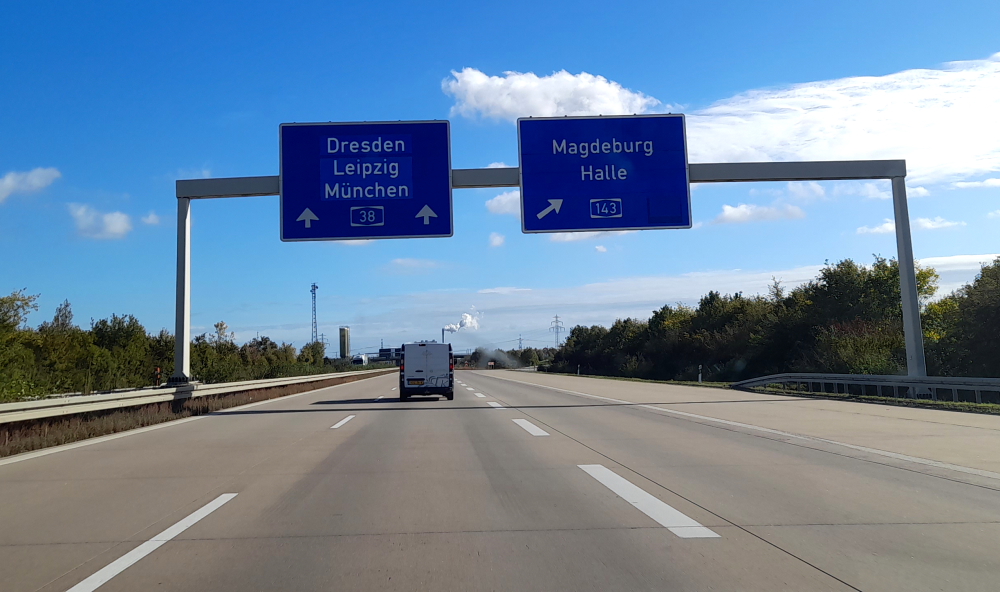
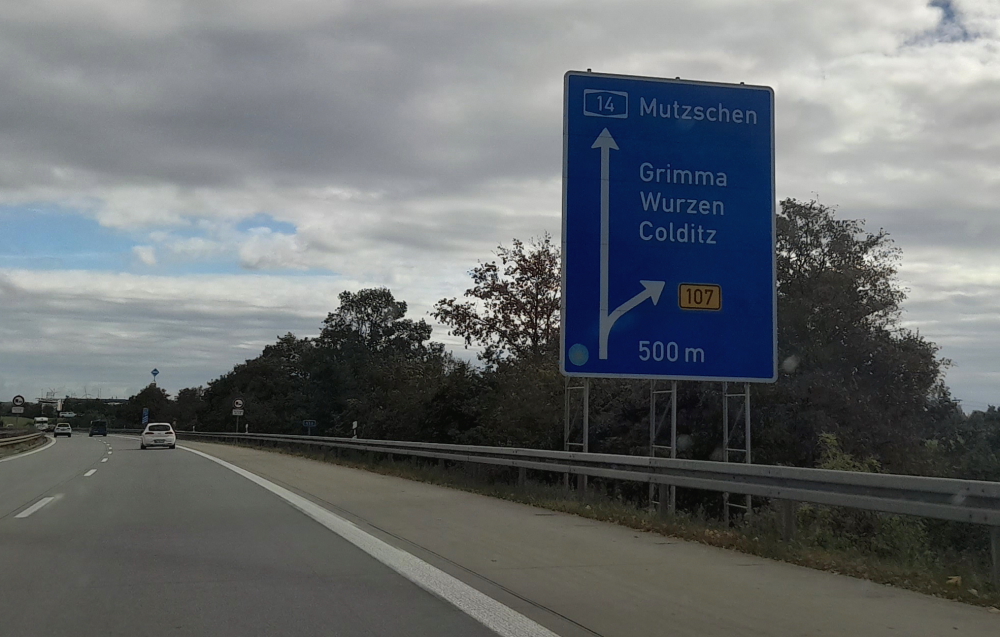
Although chilly it’s a bright, sunny day as we hit the 38. We can’t believe it, after the bumper-to-bumper and heavy freight traffic and frequent tailbacks we’ve recently experienced, there’s hardly anyone else on the road!

So far so good with light traffic.

After bypassing Leipzig we turn onto the 14 and are soon surprised by a road sign that says “Schloss Colditz” and sure enough we can see it perched in the distance.

A vacation stop in Colditz?

The GPS takes us directly to the edge of Dobelne where we find the laundromat next door to an angling shop.

Very compact, clean, tidy and with multi-lingual machines and parking we finish our washing, drying and folding an hour later and drive to Dresden.

An hour stop to do the laundry at Dobelner.

We are a little concerned as we drive into the old town centre of Dresden as there seems to be an inordinate number of police cars about.

Our suite overlooking the Dresden Market Square.

We park in the garage underneath the hotel and check in. To our delight we’re informed we’ve been upgraded to a suite overlooking the Neumarkt Square.

Looking out the window we see that a demonstration is winding up – either about Ukraine or the new war between Hamas and Israel – hence the police presence.

The view from our room.

As we’re in Germany and it’s October we decide it’s about time we had a German beer to celebrate our very own, mini Oktoberfest – so we raid the free minibar and indulge.

A local beer with a view.

Rain is forecast tomorrow so we walk out the door to explore our beautiful surrounds.

The Verkehrsmuseum (Transport Museum) on the Square.

Next door to the hotel is the astonishing Frauenkirche (the Church of Our Lady), a Baroque Evangelical Lutheran church. Considered a magnificent example of Protestant sacred architecture, it has one of the largest stone church domes north of the Alps and is considered one of the largest sandstone buildings in the world.

The Frauenkirche was built from 1726 to 1743 based on a design by George Bähr. From the beginning it was plagued with serious structural defects that could never be properly remedied. At the end of WWII, its most important supporting parts were so weakened by the heat of the firestorm raging in Dresden during the air raids on the nights of February 13th and 14th, 1945 that it collapsed, burnt out, on the morning of February 15th. The ruins were preserved in the GDR and were left as a memorial against war and destruction.

The Frauenkirche on the Square.

After Germany’s Reunification in 1989 the clearing of rubble began in early 1993 and the reconstruction of the church building began in 1994. The work, completed in 2005, was largely financed by support associations and donors from all over the world.

Inside the Church.

From here we walk towards the River Elbe. Up some stairs we find ourselves on top of the Bruhlsche Terrasse or Bruhl Terrace which extends for about 500 meters along the Elbe between the Augustus and Carola Bridges. The Brühl Terrace is also known as the “Balcony of Europe”, a term coined at the beginning of the 19th century and later widely used in literature.

As part of Dresden’s fortifications, the Brühl Terrace was built in the 16th century. The name goes back to Heinrich von Brühl, who had the so-called Brühl glories (gallery, library, belvedere, palace and gardens with pavilion) built on the fortress by Johann Christoph Knöffel. As a result of the development, the terrace lost its military significance.

In 1814, Prince Nikolai Grigoryevich Repnin-Wolkonsky, who was governor general of the occupied Kingdom of Saxony after Saxony’s defeat in the Battle of Leipzig, issued an order to open the terrace to the public.

Down by the Elbe River.

Walking along the top of the terrace is a series of beautiful buildings.

Dresden Academy of Fine Arts.

One of three buildings of today’s Dresden Academy of Fine Arts, the former Royal Academy of Arts, built in 1894, is located at a prominent position in town on Brühl’s Terrace just next to the Frauenkirche.

Various buildings of the Fine Arts Academy.

Since 1991, the building built by Constantin Lipsius on Brühl’s Terrace between 1887 and 1894 – the glass dome of which is also known as Lemon Squeezer due to its form – has been heavily renovated and the parts that were destroyed during WWII were reconstructed.

The Church’s Dome and the “Lemon Squeezer”.

Directly across the river is the rather imposing Finance Ministry building and to the right of it, the Saxon State Chancellery, the office of the Minister-President of Saxony.

View across the Elbe.

That will do for sightseeing today. After dinner we have a night cap in the hotel’s rooftop bar on the 6th floor.

The hotel rooftop bar.

The main reason we visit the bar is to see the Church’s illuminated dome – up close and personal.

View of the Church dome from the bar.

15 October, 2023

Our Townhouse Hotel is just across the square from the start of our Dresden Old Town walking tour today at 11:00 am.

The Townhouse Hotel on the corner.

From Neumarkt we walk into Augustusstrasse which connects the Schloßplatz with Neumarkt and runs roughly along the line of the medieval Dresden city wall which was demolished here between 1546 and 1548. The name refers to the Saxon Elector and Polish King August the Strong. The most important sight is on the south side the procession of princes (Furstenzug) on the outer wall of what is today the Langer Gang (Long Corridor) in Dresden Castle, including August the Strong.

900 years of Dresden history on ceramic tiles.

As early as 1589, the outer north wall of what was then the stable yard of the Dresden Residential Palace had just been built and over time, weathered. In 1865, the historical painter Wilhelm Walther presented a design for the redesign of the wall: A procession of Saxon regents, suitable for the upcoming 800th anniversary of the Wettin princely house in 1889. Between 1868 and 1872, Walther created a one hundred meter long and four meter high original drawing with charcoal on squared paper. The creation of the mural using the sgraffito technique, a plaster scratching technique, lasted from 1873 to 1876. However, due to weathering, it was transferred to tiles during 1904-1907.

Today, the Princely Procession is a larger-than-life image of a cavalry procession, applied to around 23,000 tiles made of Meissen porcelain. The 102-meter-long work of art, which is considered the largest porcelain mural in the world, represents the ancestral gallery of the 34 margraves, dukes, electors and kings from the family of the Princely House of Wettin who ruled in Saxony between 1127 and 1873.

All the way up to the start of the 20th Century.

While we are listening to the guide we are entertained by a street artist who has set up his ‘scene’ on the footpath underneath the mural. He is the waiter and the 2 women are mannequins. He is completely still but, as soon as someone puts some money in his tip box, he acknowledges comically and moves into a new stationary position.

Complete with 21st Century street artists.

Next we walk into a courtyard of Dresden Castle or Royal Palace. It is one of the oldest buildings in Dresden. For almost 400 years, it was the residence of the electors (1547–1806) and kings (1806–1918) of Saxony from the Albertine House of Wettin as well as Kings of Poland (1697–1763). It is known for the different architectural styles employed, from Baroque to Neo-renaissance. Today, the residential castle is a museum complex.

The original castle was a Romanesque keep, built around 1200. After a major fire in 1701, Augustus II the Strong rebuilt much of the castle in the Baroque style. The collection rooms were created at this time in the western wing. The Silver Room, Heraldic Room and the Precious Hall were built from 1723–1726. The Fireplace Room, Jewel Room, Ivory Room and Bronze Room were built from 1727–1729. The 800th anniversary of the House of Wettin, Saxony’s ruling family, resulted in more rebuilding between 1889 and 1901.

External decoration using the sgraffito technique.

Most of the castle was reduced to a roofless shell during 13 February 1945 bombing of Dresden in WWII. The collections survived having been moved to another location earlier. Restoration began in the 1960s with the installation of new windows and has occurred rapidly since then. The castle’s restoration is ongoing, including the installation of a plastic dome over its courtyards.

Modern dome over Castle courtyard.

From here we walk along Schlossstrasse to the Kulturpalast – a modern Palace of Culture, part of which faces Altmarkt square. Unlike the other buildings in the Altmarkt square, the Kulturpalast is designed in the unadorned International Style. A modernist building by Wolfgang Hänsch built during the era of the German Democratic Republic (GDR) it was the largest multi-purpose hall in Dresden when it opened in 1969.

On its upper wall is a 30-by-10.5-metre (98 ft × 34 ft) mural designed by Gerhard Bondzin and created in 1969 by a working group from the Dresden Academy of Fine Arts. The mural, titled Der Weg der roten Fahne (The Way of the Red Flag), is made of concrete slabs electrostatically coated with colored glass.

Here, while facing Altmarkt, our guide told us about the firestorm that was created by Allied bombings on the nights of 13 and 14 February, 1945 which destroyed the residential buildings in that area which is now a large, open space.

East German Communist propaganda art.

After walking back to Neumarkt we proceed onto Buhl’s Terrace to view Dresden Cathedral, formerly the Catholic Church of the Royal Court of Saxony (Katholische Hofkirche).

It was designed by architect Gaetano Chiaveri from 1738 to 1751. The church was commissioned by Augustus III, Elector of Saxony and King of Poland while the Protestant city of Dresden built the Frauenkirche (Church of Our Lady) between 1726 and 1743. While the general population of the city was Protestant, its rulers were Catholic. The Catholic Elector built the cathedral for his own use and for the use of other high-ranking officials, connecting it to his home, Dresden Castle, with an ornate high level walkway. It is one of the burial sites of the House of Wettin, including Polish monarchs.

The 18th Century Catholic Church.

From here we walk past the Semperoper, the opera house of the Saxon State Opera and the concert hall of the Saxon State Orchestra. It is also home to the Semperoper Ballett. The building is located on the Theaterplatz near the Elbe River.

The opera house was originally built by the architect Gottfried Semper in 1841. After a devastating fire in 1869, the opera house was rebuilt, partly again by Semper, and completed in 1878. The opera house has a long history of premieres, including major works by Richard Wagner and Richard Strauss.

Semperoper.

Nearby is the Dresdner Zwinger. The Zwinger is a building complex with gardens. The total work of art consisting of architecture, sculpture and painting, built under the direction of the architect Matthäus Daniel Pöppelmann and the sculptor Balthasar Permoser, is one of the most important buildings of the Baroque period and, along with the Frauenkirche, is the most famous architectural monument in Dresden.

The Zwinger entrance.

“Zwinger” goes back to the common name in the Middle Ages for a part of the fortress between the outer and inner fortress walls, although the Zwinger no longer fulfilled a function corresponding to the name when construction began.

Reconstruction of the Orangery.

The Zwinger was built in 1709 as an orangery and garden and festival area. Its richly decorated pavilions and the galleries lined with balustrades, figures and vases bear witness to the splendor during the reign of Elector Friedrich August I (also called “August the Strong”) and his claim to power. In the elector’s original concept, the Zwinger was intended as the forecourt of a new palace that would occupy the space up to the Elbe.

The plans to build a new palace were abandoned after the death of August the Strong, and with the move away from the Baroque, the Zwinger initially lost its importance. It was only over a century later that the architect Gottfried Semper completed it with the Semper Gallery facing the Elbe.

One of the courtyards.

The Semper Gallery, opened in 1855, was one of the most important German museum projects of the 19th century and made it possible to expand the use of the Zwinger as a museum complex, which had grown since the 18th century under the influences of the times. The air raids on Dresden in February 1945 hit the Zwinger badly and led to extensive destruction. Since reconstruction in the 1950s and 1960s, the Zwinger has housed the Old Masters Picture Gallery, the Mathematical-Physical Salon and the Porcelain Collection.

Hall of Antiquities in the Old Masters Picture Gallery.

As the tour ended here at the Zwinger, we opt to visit the Old Masters Picture Gallery and the Porcelation Collection.

Roman statues.

Within the gallery is also the Hall of Antiquities which appears to be the display of Egyptian, Greek and Roman collections purchased from German private collectors.

The Old Masters Picture Gallery shows masterpieces from the 15th to 18th centuries and is one of the most renowned collections in the world. The focus of the collection is Italian painting of the Renaissance. The gallery also presents outstanding paintings from early Dutch and early German paintings. The most famous painting is the Sistine Madonna by Raphael .

When Elector August founded the Dresden Electoral Art Chamber in 1560, paintings still played a subordinate role in this universal collection alongside collection items from all possible areas of science. Under the two Saxon electors who ruled between 1694 and 1763, August the Strong and his son, Friedrich August II, systematic collecting activity began in the first half of the 18th century. After purchasing the 100 best works from the outstanding collection of Duke Francesco III of Modena the collection had grown rapidly in 1746. This collection era was crowned in 1754 with the acquisition of Raphael’s picture Sistine Madonna. The collection had now achieved European fame thanks to its valuable acquisitions. The Seven Years’ War that now began ended the active expansion of the collection for many years.

The Old Masters Art Collection.

The Dresden Porcelain Collection is one of the most extensive and valuable special ceramic collections in the world. The porcelain collection includes around 20,000 exhibits of Chinese, Japanese and Meissen porcelain. The holdings of early Meissen porcelain as well as East Asian porcelain from the 17th and early 18th centuries are of particular importance.

The collection was founded in 1715 by the Saxon Elector August the Strong. It was originally located in the Dutch Palace on the banks of the Elbe in Neustadt. After moving to the Johanneum in 1876, the collections, which were largely relocated during WWII found their permanent home in the southern part of the Zwinger in 1962.

Porcelain Collection.

A minute to check out the view from the roof gallery of the Zwinger across to the Castle before we walk back to the hotel. Thankfully, the predicted rain today didn’t materialise but, boy is it freezing cold. Yesterday’s temp. was 22 Deg C., today, it’s 11 with a chilling wind.

Time for a hot toddy to warm up.

Dresden Castle from the Porcelain Collection building.

16 October, 2023

This morning I had an unexpected message from the property we’d booked near St-Emilion, France in early December, which we’d booked and prepaid in late June, that the property would be closed in December and so a cancellation was necessary. Bloody French!

The property had everything we wanted: on a vineyard, classic, ambience, onsite parking, king suite, etc. Which meant that a replacement accommodation property had to have these things or more.

I had to phone Booking.com to resolve. Fortunately, on our second attempt, we were directed to another property that had almost all these things (missing classic ambience a bit) but it had Euro200 knocked off the price so we took it.

This and trying to sort out an issue with HSBC blew most of the day. I get so annoyed when my time is constantly wasted sorting out problems that other people create for us.

After a quick walk to the shopping mall at the Altmarkt to visit a pharmacy for eye drops, we return to the hotel to get ready for our 6:30 pm dinner date.

Lynn had kept in touch with a colleague, Russell, over the years, since she last saw him around 2005. He had moved from working in London to Dresden and when she told him we were visiting Germany this trip he urged us to visit.

Caroline & Russell.

So, after meeting up in our hotel lobby and introductions all round, we walk across Neumarkt to an excellent tapas restaurant, then to a Champagne Bar on the other side of Neumarkt for a night cap.

Russell & Lynn.

A great night out with lots of reminiscing, stories and laughs. Looking forward to hosting Russell and Caroline sometime in the future when they venture to Australia and Brisbane.

.

Spa and Antwerp

7 October, 2023

A sunny but cool 18 Deg C morning as we collect the car from the underground car park and depart Brussels at 10:55 am. As it’s an hour and 20 minute drive we should arrive in Spa at 12:15 pm.

Which is the case. But, we are reminded that check-in is FROM 3:00 pm so we leave our cases at reception and drive the 5 minutes into town and park in front of the Hotel de Ville (not to be mistaken for an actual hotel, but rather the Town Hall).

In the Belgium hills near Spa.

Despite being known internationally for the Francorchamps motor-racing circuit, the town of Spa is above all a cradle of balneology. In English and other languages, this practice has been given the generic term of “going to a spa”.

Going back to the writings of Pliny the Elder, the watering point was already well known during the time of the Romans for its healing effects. But it was not until the 14th century that an actual urban centre sprouted up around the springs of ferruginous water, the most famous of which is still called Pouhon Pierre-le-Grand to this day.

The town reached its peak during the 18th century. In 1717, a visit by Tsar Peter the Great made the springs in Spa famous all over Europe. Joseph II speaks of Spa as the ‘Café of Europe’’. After that, nobles from all over the continent came for a stay every summer, creating a unique atmosphere. Spa became one of Europe’s definitive spa towns alongside other prestigious towns like Bath and Vichy. Today, it is recognised as a ‘Great Spa Town of Europe’ along with 10 other spa towns and is officially listed as a UNESCO World Heritage Site.

Pouhon Pierre Le Grand.

After dropping into the Tourist Information Office we collect a map with a town walk and commence.

To the side of the Tourist Information Office is a mult-sided, domed building which is called “Pouhon Pierre Le Grand” – The Spring of Peter the Great.

Throughout town we find various “Pierrots”, the town’s local mascot – all with the same leapfrogging pose but decorated individually by Belgian and French artists.

The route takes us to the base of the funicular to “Thermes” which we duly ride to the top to be delivered into a modern complex that houses pools sourced from the local Clementine spring and naturally heated to 33 Deg. C.

Going up the funicular.

The only place we can catch a glimpse of the famous pool is through the window of the brasserie where we decide to sit and sip some cool beverages.

Nice view near the top.

Back on the flat we walk past the Musees de la Ville d’Eaux – The Water Town Museum. Located in the former Royal Villa, residence of Queen Marie-Henriette, 2nd Queen of the Belgians, the Water Town Museum houses collections relating to the history of Spa: a collection of “Jolités” or Bois de Spa, from the 17th century to the present day, as well as old posters, engravings and various objects evoking the activity of the famous spa town.

The ex-Royal Palace – now Musees de la Ville d’Eaux.

Up the opposite hill we come across Waux Hall, one of the oldest games rooms in Europe. A vast building, it is the work of Liège architect Jacques-Barthélemy Renoz. The building, classified as a monument since July 24, 1936, has been included by the Walloon Government on the exceptional heritage list since 1993.

Restoring the exterior envelope of the building was completed at the end of 2009. The second phase (interior restoration and development, treatment of the surrounding areas) commenced in 2022 at the estimated cost of Eur6.26m. Today the building is surrounded by construction materials but it looks like Academy classes occupy some of the space.

Waux Hall.

Partially down the hill we arrive at L’Eglise Saint Remacle. The Catholic parish of Spa was established in 1573 at the request of the population who wanted to fight against the growing influence of Protestantism carried by foreign visitors.

The current church was built in 1885 following the plans of the architect Eugène Charpentier. In the Romanesque-Rhineland style, which remained popular in the ancient principality of Liège, it was consecrated in 1886 by the Bishop of Liège.

Notre Dame et Saint Remacle Church.

Queen Marie-Henriette of Belgium, who had retired to Spa and resided there in the Villa Royale, died in Spa in 1902. Her funeral was celebrated in this church.

The church’s interior.

Although the “Anciens Thermes” is in the next block it’s inaccessible as it is surrounded by roadworks and construction.

The old Spa thermal baths, or Bains de Spa, are located in the center of town and were the 3rd spa baths built in the town. The imposing two-story building is built in a French neo-Renaissance style to the plans of architect Léon Suys.They have been part of the exceptional heritage of the Walloon Region since 2016 and UNESCO World Heritage since 2021.

Under the leadership of Mayor Servais, these thermal baths were inaugurated in1868 on the Lezaack meadows. This was a first-class hydrotherapeutic set which cost the very significant sum for the time of 1,500,000 Belgian francs. These thermal baths hosted up to 167,182 thermal operations per year (in 1967).

Originally, this establishment had 52 bathroom cabins with 54 bathtubs, 2 large high-pressure shower rooms, 2 large ordinary and hydrotherapeutic shower rooms with immersion basins, 2 actual hydrotherapy rooms, 2 rooms for circle showers, seat showers and foot baths with running water as well as 2 plunge pools. Subsequently, numerous modifications were made in order to modernize the establishment.

After 135 years of operation, these baths closed their doors in 2003 and were replaced by a modern establishment (the fourth thermal baths) on the hill of Annette and Lubin – the current Thermes accessed by the funicular.

Bains de Spa.

Along the street is the current Spa Casino. In 1762 when it was built it was called La Redoute de Spa. Today, the Spa casino is considered to be the oldest casino in the world.

Spa Casino – formerly La Redoute de Spa.

In 1762 construction was entrusted to the renowned Liège architect, Barthélémy Digneffe (1724 – 1784), and to Italian decorators specialized in palace decoration. The Redoute de Spa was, according to contemporaries, the prettiest and best maintained assembly house in Europe. It is then described as a “delicious white and gold candy box”. It included a ballroom, a theater and a games room. In 1918 it was rebuilt several times following fires. In 1980-1981, the Casino regained its former splendor thanks to renovation work.

Spa Casino.

It’s now close to 3:00 pm so we walk back to the Hotel de Ville. A Louis XVI style building, the work of the architect Digneffe, the Town Hall was built in the years 1762-1768. In the 18th century, it welcomed the great Lords who came to take the waters as it was then “The Grand Hotel”. In 1822, it became the property of John Cockerill who transformed it into a card and pin factory. Today, this building houses the administrative services of the Municipality. Opposite the entrance to the Town Hall stands the PERRON de SPA, emblem of the municipal franchises granted to the Town by the Prince Bishop of Liège in 1594.

Hotel De Ville.

It’s now 3:15 pm so time to drive back to the hotel to check in. Lynn takes to heart the credo, “When in Spa, spa” and books a spa treatment available at the hotel for Monday. As the bar offers snacks we decide that will do for dinner tonight.

Before we retire the world news is that Hamas has attacked Israel from Gaza and Israel’s PM has said “We are at war”. Just what we need, yet another war on this beleaguered planet of ours.

8 October, 2023

The hotel was fully booked last night which is evident when we arrive at breakfast. Pandemonium!

After breakfast I catch up with who won Bathurst this year. Shane van Gisbergen, 3rd year in a row, and a fitting send off as he will leave V8 Supercars in 2024 for a career in Nascar.

Out for a walk around the lake on a sunny morning.

As it is such a nice sunny but cool morning we decide to circumnavigate the nearby Lac de Warfaaz which takes a 10-minute walk down a steep woodland path to reach the lake.

According to Wikipedia: “The lake Warfaaz is an artificial lake located in Wallonia near the thermal city of Spa in Ardennes, Belgium. The dam was built in 1892 on the Wayai river. The water volume is 360,000 m³ and the area is 0,08 km². It is a tourist attraction, with water sports, including pedalo and fishing.”

Steep trail but cool in the forest.

Not today, it isn’t! Reeds everywhere with just a trickle of a stream snaking its way through the vegetation.

Almost dry lake.

In fact, the lake edge is so dry that a road is being bulldozed along the lake’s perimeter.

How it was in 2005.

As for pedalo and fishing, forget it!

No water in the dam.

It appears that the pedalo kiosk has been closed for quite some time and various businesses are for sale. Really disappointing to see.

The dam in 2005.

After about an hour out walking around the lake, we return to do some accommodation bookings for Wales for our trip there in February. Then we have an early dinner in the bar. Only us and 2 others, compared to the evening before when the place was noisy and heaving.

Time for a game of pool while we wait for our meal to arrive. Four years ago in the USA – a long time between games.

Close game right to the end.

9 October 2023

This morning we virtually have the restaurant to ourselves for breakfast. Lynn has her massage this afternoon at 12:30 pm and while she’s away I’ll crack on with finalising our Wales bookings.

Tonight we head downtown to the restaurant area in Spa. Since it is Monday evening most of the restaurants are closed so we don’t have much choice. We settle on the busiest bar/restaurant. If it’s good for the locals then that will suit us. Since we are fairly close to the Spa Francorchamps Grand Prix race track it’s not surprising to see the bar is adorned with lots of memorabilia. Still, the food is good and reasonably priced.

Dinner with car racing memorabilia.

Tomorrow we are heading east back into Germany as we start the second half of this Northern Europe trip.

10 October, 2023

Today we are driving 157 kms NW from Spa to Antwerp, a 1 hr 45 min drive, to meet up with an old friend of mine, Luc, and his wife, Ilse.

I first met Luc 20 years ago when we both attended an ANZ Bank training offsite.

When I came to Europe in 2005 we met up in Sint Nicolas, Belgium and toured Ghent, Bruges, Brussels and the Champagne region of France.

We get away at 8:30 am, half an hour earlier than planned, expecting to arrive at 10:15 am, but thanks to regular, long tailbacks we don’t arrive at the underground parking garage until 10:45 am.

Stop, start bumper to bumper traffic.

A 15-minute walk later we are knocking on Luc and Ilse’s front door.

Luc & Ilse’s beautiful apartment in Antwerp Centre.

After a quick morning tea, we all head out the door for a walking tour of the town.

At the end of street, on the Marnixplaats, is the Schelde Vrij monument. The statue was designed in 1873 by architect Jean-Jacques Winders, in collaboration with the sculptor Louis Dupuis (lions and medallions), Jacques De Braekeleer, (Neptune and Mercury) and Frans Floris (female figure). The monument was completed in 1883.

The monument entitled “Schelde Free” commemorates the lifting of the blockade of the Scheldt (River), which lasted from 1585 to 1863.

Schelde Vrij Monument.

From there we walk past the KMSKA – the Royal Museum of Fine Arts.

The Royal Museum of Fine Arts.

Then onto the redevelopment of the river promenade. This area was, until quite recently, the usual industrial docklands found in any port city. It is now being redeveloped by building parklands above underground car parking spaces. The area has become beautiful city living space.

A stroll along the riverside.

From there we work our way towards the beautiful City Hall (Stadhuis) in the large, market square. The town hall is on the UNESCO World Cultural Heritage list as part of the group registration Belfries in Belgium and France. A Renaissance building, designed by the architect Cornelis Floris De Vriendt, it was built between 1561 and 1564.

The Stadhuis in Grote Markt Square, Antwerp.

Close by is a prone sculpture using the cobblestones as a blanket. It is a tribute to the novel “Nello and Patrasche” by Oulda, about the misadventures of young Nello and his dog, Patrasche. Apparently these characters are famous in Japan with Japanese tourists querying unsuspecting, and unaware locals, about the location of the sculpture.

Nello & Patrasche.

The Cathedral of Our Lady is a Roman Catholic cathedral. Today’s See of the Diocese of Antwerp started in 1352 and, although the first stage of construction was ended in 1521, has never been ‘completed’. In Gothic style, its architects were Jan and Pieter Appelmans.

Cathedral of Our Lady, Handschoenmarkt.

It contains a number of significant works by the Baroque painter Peter Paul Rubens, as well as paintings by artists such as Otto van Veen, Jacob de Backer and Marten de Vos. The belfry of the cathedral is included in the Belfries of Belgium and France entry in the list of UNESCO World Heritage Sites.

Today the Cathedral is also a Museum, charging Eu12 per person, so we forego the pleasure of viewing the Rubens’. The last time I was here in 2005 the entry was free. Make your own call about the necessity of a fee for maintenance or that the artwork should be in a free gallery for all the people to view their own artworks.

View of the Cathedral’s interior from the shop.

Next we walk to see the St Charles Borromeo Church – a former Jesuit church where Ilse is a guide.

The church was built in 1615-1621 as the Jesuit church of Antwerp, which was closed in 1773. It was rededicated in 1779 to Saint Charles Borromeo. The church was formerly known for 39 ceiling pieces by Rubens that were lost in a fire when lightning struck the church on 18 July 1718.

St Charles Borromeo Church – former Jesuit Church.

The church was inspired by the Church of the Gesu, the mother church of the Society of Jesus, a Roman Catholic religious order also known as the Jesuits. It was the first church in the world to be dedicated to the Jesuit founder, Ignatius Loyola.

In 1773 the Society of Jesus was suppressed and the building was confiscated. It reopened in 1779, renamed St.-Carolus Borromeuskerk, after Charles Borromeo, Archbishop of Milan (1564-1584) and leading figure of the Counter-Reformation.

Since 1803 the St.-Carolus Borromeuskerk has been in use as a parish church. During the Dutch reign preceding Belgium’s independence in 1830 the baroque interior was sobered to make it a Protestant church but a restoration campaign in the 1980s brought back the church’s baroque splendor.

Beer o’clock!

By now it’s well past beer o’clock so we head to a favourite outdoor lunch spot near the apartment.

Then return to apartment to enjoy delicious Lints’ tarts and champers on the balcony in the sunshine.

Champagne on the balcony.

It’s been a brilliant day but now it’s 6:00 pm so we say our reluctant ‘au revoirs’ to our dear friends, with invitations for them to join us ‘somewhere in Europe’ over the next year or, failing that, to visit us in Brisbane.

Saying goodbye after a wonderful day.

Once again we sit in traffic jams on our return journey, losing 30 minutes to arrive back in Spa at 8:45 pm in the dark.

We latter learn that my granddaughter, Zara Elizabeth Edenhofner, is born today.

What a perfect day – a celebration of friends and family!

11 October, 2023

Our destination today is Hannoversch Munden, aka Hann. Munden, a 3.5 hour drive east into Germany, 380 kms away.

We leave the hotel at 11:20 am so we should arrive at our destination at 14:45 pm.

Approaching the German border.

But, like yesterday, we are hit by “Stau” after “Stau” (jam).

Another traffic jam crossing the Rhine River.

One jam seemed to be due to the road authority checking the weight of vehicles in various lanes, others due to road works past and present, yet others due to congestion. I think Europe has seriously lost the plot when it comes to road infrastructure and freight. The number of lorries far outweigh the numbers of cars on the road, with often the slow lane where lorries are restricted to is just one, long, car park. I’d hate to be a freight company owner. The costs and delays must be horrendous. Perhaps Greta Thunberg could reduce fuel consumption and CO2 emissions by getting her supporters to fix the roads in Europe.

Yet another traffic jam.

It’s closer to 4:00 pm and a warm 23 Deg C when we finally pull up outside our hotel, having driven down a leafy, wooded road with hairpin bends into the town on the River Fulda.

Our hotel Alter Packhof on the banks of the River Fulda.

At the time we booked the hotel we were told about the imminent roadworks alongside which would make their outside terrace inoperable, but we were so taken by the hotel’s location and the quaint, half-timbered town that we still confirmed our booking.

Checking out the old mill stream.

As rain is forecast for the rest of our stay we dump the bags and head out for a tour of the town.

Where the river branches meet below our hotel.

We discover that the hotel is located on the NW corner of the town where the rivers Fulda and Werra meet.

The fast flowing river below our room.

Hann. Münden (abbreviation of Hannoversch Münden ) is a medium-sized town and independent municipality in the district of Göttingen, southern Lower Saxony. The core town is a state-approved resort .

The village is located at the confluence of the Werra and Fulda to form the Weser. That’s why the city is also called the “Three Rivers City”. Alexander von Humboldt (German explorer and co-founder of geography as an empirical science) is said to have been impressed by the city’s location in the Weser valley. However, there are no written records of the often used Humboldt quote that Münden is “one of the seven most beautifully situated cities in the world”.

The weir on the other branch of the river.

In the oldest document from the year 860, Münden is mentioned under the name Gimundin as already existing around 800. The city of Münden was probably planned and founded by Henry the Lion between 1170 and 1175. Around the year 1200, construction began on the Münden city fortifications as a city wall with city gates and wall towers.

The beginnings of today’s city probably lie in a fortified imperial farm on the current castle grounds. According to a foundation stone that was found after the castle fire in 1650, the castle is said to have been founded in 1070 by Otto von Northeim, meaning that the old Münden estate was owned by the Counts of Northeim.

In the 16th century, through the Weser trade, Münden was the most important trading town up to Bremen for goods, especially from Thuringia . Accordingly, the Schlagden (shipping piers) emerged on the western and northern edge of the old town as trading, transshipment and docking points on the Werra and Fulda shipping routes. On the Werra was the Wanfrieder Schlagd and on the Fulda were the Bremen and Kassel Schlagd, where the Packhof and Alten Packhof warehouses (our hotel) still exist today were built. The main items traded and transported on the Weser were woad, an important blue dye at the time, glass, textiles and rafts with wood and grain from Thuringia plus North Sea fish.

The Alte Werrabrücke bridge and weir across the Werra River.

Through her marriage in 1525 to Erich I, Elisabeth of Brandenburg was granted Münden as her territory. Elisabeth came into contact with the ideas of the Reformation (Protestantism) early on and brought the reformer Antonius Corvinus to Münden. After the death of Erich I in 1540, Elisabeth took over the reins of government as guardian of her son Erich II, who was still a minor, and ruled from her residence in Hann. Münden until 1546.

The City Hall and market square.

During the Thirty Years’ War the city was destroyed in 1626. During the Seven Years’ War, the city was repeatedly occupied by French troops between 1757 and 1762 who built the French redoubt on Questenberg .

In 1776, almost 20,000 Hessian soldiers embarked from Münden, which the Landgrave of Hesse-Kassel Frederick II handed over to the Hanoverian Elector and King of Great Britain, George III. They were used in combat against American troops in the American Revolutionary War. The soldiers were also repatriated via Münden in November 1783, but barely more than half came back.
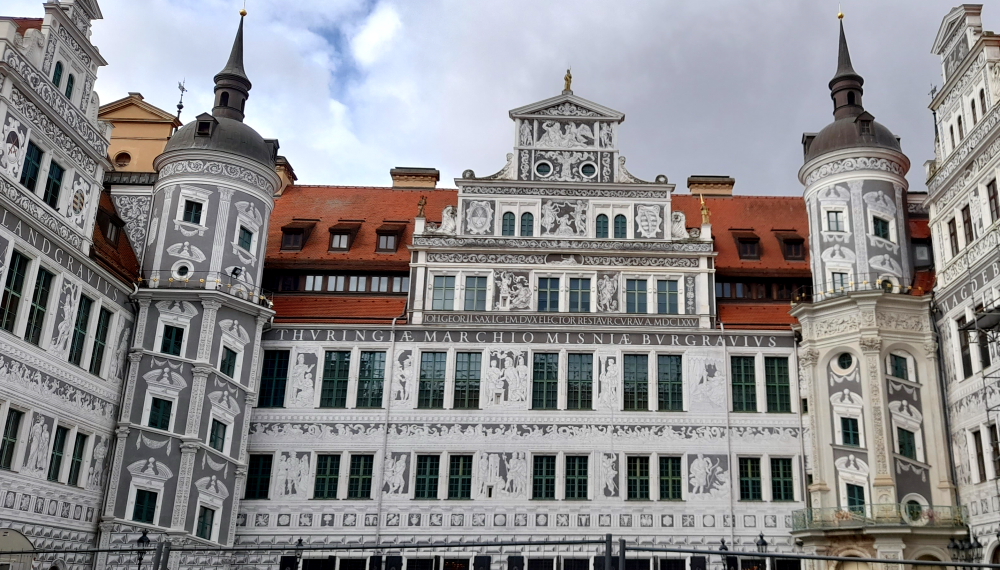
St. Blasius Church in the town square.

On March 30, 1933, Adolf Hitler was granted honorary citizenship of the city. It was only 75 years later, on March 27, 2008, that this honorary citizenship was unanimously revoked by the city council.

As part of the “Action Against the Un-German Spirit”, some National Socialist students from the forestry faculty staged a book burning in the market square on May 10, 1933, as in many other places in Germany .

Already on November 8, 1938, considerable pogrom damage to property was committed in the Münden synagogue and the Torah scrolls, prayer books and mantles were publicly burned on the Tanzwerder. In 1942, the remaining Jewish citizens were deported to concentration camps where 126 people died.

With a few exceptions, Münden was spared from the direct effects of war. On May 17, 1943, the city was hit by a tidal wave caused by the bombing of the Eder Dam in Operation Chastise (The Dam busters raid).

Two air raids on Münden took place on March 30 and 31, 1945; 32 people were killed and 50 seriously injured. On 5 & 6 April 1945, shortly before the arrival of the advancing American troops, German pioneers blew up all the bridges in the city except for the historic Werra Bridge, especially the Werra Valley Bridge on the Reichsautobahn.

On 6 & 7 April 1945, American troops took part in the battle for Münden. According to the Allied agreements, the city was in the British zone of occupation, and on May 20, 1945, British soldiers moved in.

In the hotel room there is a brief summary of the history of the hotel building. Most of its life it was a warehouse but in 1938 it was a Hitler Youth Home then in 1946 it became a refugee camp then a city archives storage before being converted to the current usage as a hotel in 1998.

The rotund below the Wallanlagen Castle.

After we traverse all the north-south streets in the grid-based town we decide it’s time for dinner and opt for traditional German meals.

Dinner at the Kuesterhaus Restaurant.

Back in our spacious 3rd-floor hotel room we open the window so that we can fall asleep to the gurgling sound of the fast-flowing river below.

Our room in the Hotel Alter Packhof.

It has been a lovely walk around the town looking at the amazing old buildings and cobbled streets. Perhaps we should have planned to stay here a little longer. This little town is highly recommended.

Ghent & Brussels, Belgium

2 October, 2023

This morning we are checking out of our hotel in Middelburg and driving to Ghent in Belgium. Since we have both been to the usual tourist places in Belgium such as Bruges we decided to just go to Ghent (I liked it a lot last time I was there), Brussels (to catch up with an old colleague of Lynn’s), Spa for a few days’ rest and Antwerp as a day trip to catch up with some friends of mine.

Check out should have been easy this morning. Walk the 10 minutes to the car park then bring the car back to the hotel in Middelburg, load up and drive the 55 minutes to Ghent. No, nothing is ever straight forward in Europe. We went to pay for the 4 days of parking but we find that the auto-pay system at the parking station doesn’t take debit or credit cards. No problem we thought. We have a Eu50 note to pay for our Eu40 parking bill. Nope… the machine doesn’t take Eu50 notes. WTF! Do the Europeans go out of their way to be obstructive? How hard is it to just accept all forms of payment? Lynn decides to run around town to look for someone who will break a EU50 note. Meanwhile I have a standup argument with a voice on the other end of the stupid machine. “Why don’t you take card payments?” I ask. “Because we don’t” is the response.
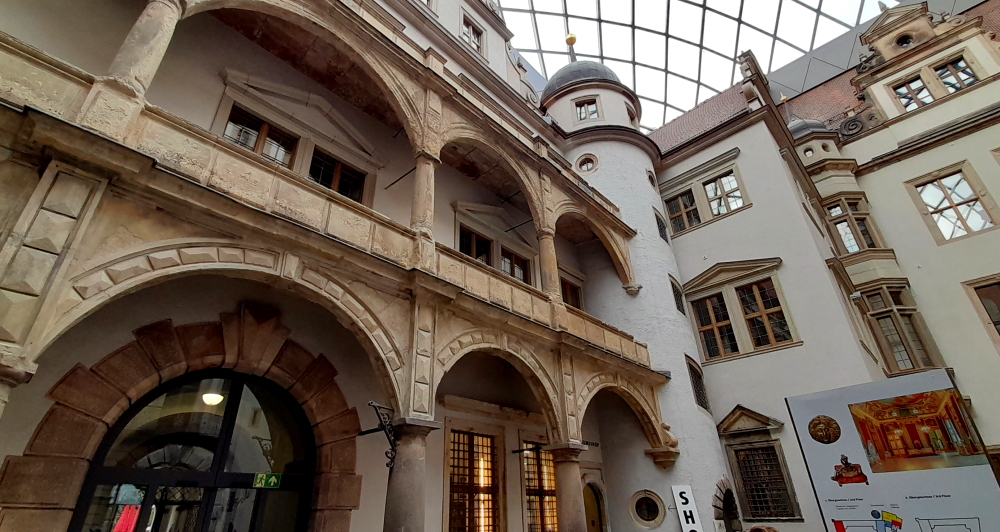
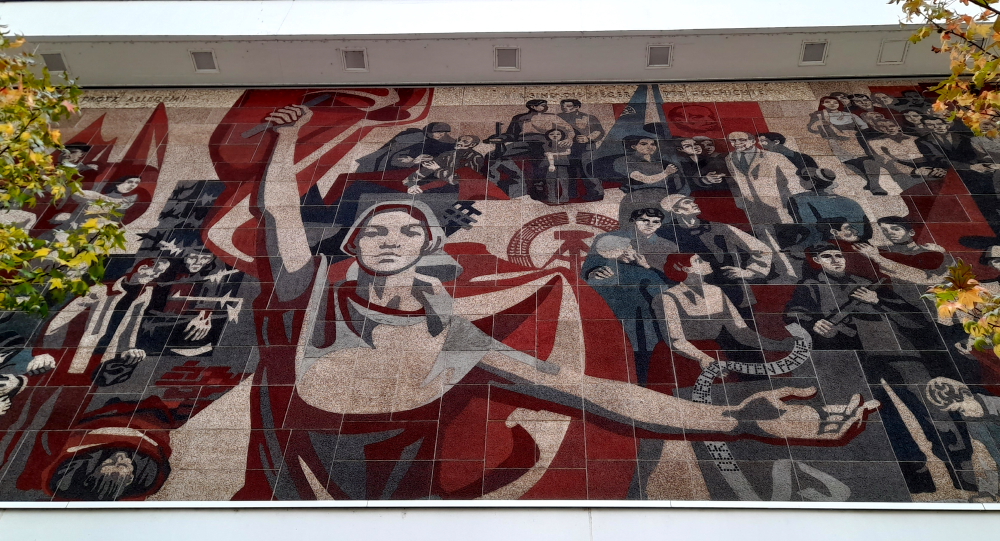
Why would anyone live in a country that can’t do basic efficient processes? I have come to the conclusion that Hitler didn’t lose the war. He just couldn’t stand the medieval thinking still going on to this day in the rest of Europe (and the UK for that matter – remember the Department of How Can We Make Things Harder to Do?).

Finally a helpful German couple turned up to pay for their parking and they had a wallet full of cash. They agreed that they have to carry a lot of cash in The Netherlands due to the inefficient or non-existent payment process here. Meanwhile Lynn has completely gone missing so I finally get the car out and drive the 20 minutes back to the hotel. It is 20 minutes because you can’t just drive there without taking the most inefficient route. They all ride bicycles because the road system is slower than walking. It turns out that Lynn has not been able to break her EU50 note in any of the shops so she finally walks nearly all the way back to the hotel before she finally has to buy something to break the note.

To make things worse, it seems that while the car was parked in the parking station someone backed in to the hire car and we now have a new dent in the bonnet and number plate. I always new that Dutch drivers were bad but that is just rude.

I now know the next location for “I’m a Celebrity, get me outta here”. Do it in a town in Europe!

We finally break out of the convoluted town roads and head to the border. On approach to Ghent it looks like the Belgians have learnt from the Dutch (it is Flanders after all). Our hotel is 50 metres inside a Low Emissions Zone (LEZ). You have to apply online for an exemption or cop a EU150 fine. Not a problem, I can understand not wanting vehicles with high emissions in the Old Town. The problem is that when you go online to apply for the entry you need vehicle details such as the date of first registration of the car, the EU emissions rating code, the car engine size, fuel type code, registration number, etc plus the registration address of the owner. Hey guys, what about tourists with hire cars? Bloody morons! So it seems that not only do the Europeans hate cars, they also hate tourists and rental companies. They must find things so easy when they are tourists in Australia.

I phone the help line but no one answers the phone so I email them outlining our situation including the fact that the hire car company hasn’t given us any registration documentation about the car at all. I also email a copy of our hire agreement, a photo of the registration plate and the contact details for the car hire company and tell the LEZ department to contact the hire car company for any further information. I’ve done my bit so over to them. Their automated response is that they will respond within 10 business days. We’ll be gone by then! Surprisingly, a short time later I get another email saying that the car has been registered and it can return to Ghent anytime without further registration between now and December 2027 when the registration will expire. Terrific!

Anyway, we finally get to our hotel and drag our suitcases up the stairs (at least this place has an elevator for part of the way). Too bad about anyone in a wheel chair. Our room is poorly lit, has head-banging ceiling trusses and a literal closet for a WC – the space from your knees and the door is less than in an aircraft loo! According to our room key cover we are in room 39 on the 3rd floor. Once we get to the third floor we find that there is no such room as 39. Back down to reception we find that “39” written on the folder is actually “32”. Just another way to piss people off because Europeans can’t write a 2 like the one that is on their keyboard!

At least we have a reasonable view of the Gravensteen Castle across the river. It would be a better view if for some reason hotel maintenance would clean the fly screen. I guess I shouldn’t complain. At least the room has a fly screen. It even has an almost working air conditioning split unit.

View from our window through a dusty fly screen.

We quickly unpack and since it is forecast to rain tomorrow we decide to go on a canal boat tour. A boat tour is not a “must do” in Ghent (unlike Bruges) but we are booked on a walking tour tomorrow which Lynn plans to change to the following day for a better chance of fine weather.

Another view of the Castle from street level.

After sleepy Middelburg, Ghent is bustling with tourists. Considering that it is Monday today and a Monday in October the heavy crowds seem out of place. However it is a sunny 25 Deg C this afternoon and by the end of this month it will be lucky to reach 10 Deg C. So maybe the locals are just trying to enjoy every last minute of warm weather.

Our Hotel Gravensteen.

The closest canal boat tour is just around the corner from the hotel. There is a tour at 3:15 pm which is about 25 minutes away. We purchase 2x Seniors’ tickets and go in search of a milkshake for me which we quickly find. The 2 waitresses in the cafe look like they are too young to know what they are doing. After a delay I get my milkshake to go – an eye-watering Eur8 (AUD12!!) for what I would consider to be the size of half a regular-sized milkshake. Beer is cheaper in Belgium.

Back at the tour departure point at 3:05 pm we see that the boat is already filling up so we jump on and snaffle the front 2 seats, right behind the skipper/tour guide’s seat.

Boat cruise on the Ghent Canals.

We have a wait of 10 minutes in the sun – wow, is that sun packing a punch!

The smaller canal towards Bruges.

Initially we head in a SW direction along the Leie River between the Korenlei and Graslei roads.

Nice restaurants along the Canals.

This takes us past the Ancient Port of Ghent with its quay walls and its old guildhalls – boatmen, masons, grain measurers, fishmongers and hagbutters (soldiers armed with a hagbuts or arquebuses). Each guildhall has carved motifs on its facade as to the occupation it represents.

Left – grain warehouse – the oldest building in Ghent.

Cruising past these guildhalls we catch a glimpse of Ghent’s 3 famous towers: St Bavo Cathedral, the Belfry and St Nicholas Church.

The Three Towers of Ghent – (L-R) St Nicholas, the Belfry & St Bavo Cathedral.

As we make a U-turn we get to see some street art on one of the buildings’ wall on the corner of the Predikherenlei and Van Stopenberghestraat. After the cinematic release of “The Monuments Men”, graffiti artist Bart Smeets created a 100m² mural here.

Street Art in Ghent.

We cruise back to our starting point then travel in the opposite, NE direction along the Leie River past various canal-side restaurants and previous multi-storey brick factories.

Trying to be like Venice?

Today these canals are covered in low, narrow bridges, but apparently these were built in the early 1900s with the previous industrial, working bridges that allowed larger boats to enter the ancient port of Ghent having been demolished in favour of these.

Wide boat, narrow bridge.

Having executed another U-turn we return to our starting point then turn north, again on the Lieve River. Our cruise in this direction terminates at a monument called the Rabot. There used to be a rabot on the site of the building (a lock with a closure in the form of a single lifting door or sliding door), but the name Rabot has been transferred over the years to the towers defending this hydraulic structure.

The Rabot Monument.

During the Flemish Revolt against Maximilian of Austria, Habsburg troops came to besiege Ghent in 1488, but had to retreat after 40 days. At the place where they were stationed, the people of Ghent built two monumental towers on the existing rabot in the Lieve canal as a triumph.

Time to trim the trees.

In 1491 , the construction of the Rabot was completed: a fortified lock at the intersection of the Lieve with the city canal. De Lieve in turn provided the connection to the Zwin and further to the sea. After Maximilian’s victory in 1492, he ordered that the people of Ghent had to demolish the Rabot towers as punishment and use the stones to build a forced castle in the Prinsenhof. They refused and managed to renegotiate the sentence into a heavy fine.

Heading back to the Castle.

Gravensteen (also known as the Castle of the Counts) is a medieval castle that dates back to the 12th century. This impressive fortress was once the residence of the Counts of Flanders and played an important role in the city’s history.

Today, visitors can explore the castle and its many rooms, including the Great Hall, where important meetings and banquets were held, and the dungeon, plus climb its battlements. The castle also houses a museum that showcases artifacts from its past, including weapons and armor.

50 minutes later we are back at our starting point.

Queen of the Castle – & the post box and the bins.

Across the road from the Castle is a square bordered by restaurants but in the corner is a magnificent building which used to be the Fish Market, now the Tourist Information Centre.

The old fish market – now the Tourist Information Centre.

Before we return to the hotel we take a stroll down Jan Breydelstraat that runs alongside the hotel where there are some promising eateries backed onto the canal.

The LEZ next to our Hotel.

Back at the hotel we check with the receptionist for restaurant recommendations and decide to visit Oudburg Street which has lots of ‘world’ eateries – Greek, Turkish, Asian – and is 4 minutes’ walk away.

We opt for the Sushi Palace and order a combo of sashimi, sushi and nigri but for 1 person (25 pieces) which we’ll share and wash down with a beer and a cold sake. It comes out on a boat. Good call for the single serving – anything larger would have been way too much.

No sushi train, just a sushi boat.

3 October, 2023

As predicted it is cold and bucketing down with rain when we wake this morning. Just as well Lynn moved our city walking tour to tomorrow.

We need a catch up day anyway so the plan is to sort out some issues with HSBC Bank (they seem to have lost Lynn’s “Global View” of all our accounts for Australia, UK and America). It is not a major issue while we are in Europe but we need to move some GBP from Lynn’s UK account to our Australian Everyday Global GBP account before we head back to the UK in November. We also need to do our weekly laundry at the laundromat near last night’s sushi restaurant.

After a few frustrating hours HSBC UK can’t solve the issue so they promise to sort it out within the next 15 business days. Another case of poor user acceptance testing when they did their last system update I suspect.

After all things done and sorted we head out to dinner at a recommended Italian restaurant. The food is excellent and we consume a half litre of house red. We needed that after the frustrating day dealing with banks.

Back at the hotel it seems that the Castle is lit up tonight. Lynn commented last night that the Castle wasn’t illuminated. Apparently Ghent is going to participate in ‘The Night of Darkness’ on 14 October when all monumental lighting will be extinguished. Perhaps last night was a trial run??

The Castle all lit up.

4 October, 2023

A cool but sunny morning today. Perfect weather for a 2-hour walking tour.

We’re at the meeting place at 10:15 am and join 40 other people. The group splits into 2 and we have Leisa, a Ghent-born history teacher, as our guide.

When Lynn booked the tour several months ago we weren’t planning on doing the canal boat tour. So, for the first half of today’s tour we are given information we’ve heard before on the boat tour 2 days ago.

The Brewers Guildhall and St Michael’s Church’s unfinished tower.

For example, the tower of St Michael’s Church was supposed to have been the 4th tower in Ghent. Unfortunately, the Brewers Guildhall which was responsible for its construction was unable to finish it so just ‘topped’ it off.

Also, the Great Butchers’ Hall was originally a covered market. This hall, which dates back to the 15th century, was the central place where meat was inspected and traded. This was partly because selling meat door-to-door was forbidden in the Middle Ages.

The former Great Butchers’ Hall – soon to be bicycle parking.

Most of the town centre that we see today has been reconstructed. Only a few buildings are original medieval, such as this row of shops in Kraanlei Street, one of which is a traditional sweet shop owned by a 5th generation confectioner.

Our guide indicating original, medieval buildings.

On Vrijdagmarkt (Friday Market) our guide introduces us to ths Dulle Griet pub which boasts 500 different types of Belgian beer including 12 rare Trappist beers, 6 of which are Belgian – as advertised on the front window.

Also advertised is what Australians know as a ‘yard glass’. Here in Belgium this is a koetsiersglas aka “Coachmen’s Glass.” Legend has it that tavern owner Pauwel Kwak designed the unique shape in the 1790s when Napoleonic Code took hold in Belgium. One stipulation of the stringent new legal code was that coachmen were no longer allowed to drink with their riders. This tactic focused on drawing a clear line between the wealthy and working classes. And it meant left of potential customers had to wait outside Pauwel’s bar.

Like any enterprising entrepreneur, he figured out a loophole: coachmen couldn’t come in, but beer could come out to them! He designed a wooden cupholder of sorts to hold a glass. The coachmen could attach this cupholder to their coach. Then, Kwak created a glass that would stay in the cupholder, or in the hand of the coachman on even the bumpiest ride.

The tricky part was that the glass had to be narrow enough for a coachmen to wrap their hand around it even with thick gloves. This left a long slender neck of a glass with most of the beer contained in a bottom bulb to prevent sloshing in a bumpy coach. The already odd looking contraption has a massive lip at the top to make drinking (while driving, yikes!) easy and to contain spills. The 18th century version of a sippy cup!

Lots of beers available in yard glasses.

Nearby is Graffiti Street. People sometimes say you can recognise a vibrant city by its street art. Ghent is a hip and free-thinking cultural city where everyone is welcome and free to do their thing. Werregarenstraatje in Ghent is a public canvas for young street artists.

In Graffiti Street, street artists create striking spray-can art to their heart’s content. This means that Graffiti Street never looks the same from one week to the next, or even one day to the next.

Graffiti Street overlooking museum gardens.

In our opinion, the section of Graffiti Street that overlooks the beautiful and peaceful grounds of a museum is far preferable to the corridor’s boisterous vandalism that passes as ‘art’.

Street art or vandalism?

Leaving Graffiti Street we come upon the Stadhuis which has 2 faces to the building: one Gothic , the other Renaissance. This schizophrenic building consists of two parts and it shows a fascinating sight in political Ghent. The facade on the Hoogpoort side shows you the flamboyant late Gothic style of the early 16th century. This style contrasts sharply with the Renaissance style of the facade on the Botermarkt. In this younger wing (1559 -1618) you see Doric, Ionic and Corinthian three-quarter columns and pilasters, inspired by the Italian palazzi.

Stadhuis (on the right) backdropped by The Belfry.

The Ghent Belfry is recognized as a UNESCO World Heritage Site. In 1402, the city privileges were kept in a trunk in the secretory of the Belfry. The dragon, which has stood on the tower since 1377, not only kept an eye on the city, but was also the symbolic treasure keeper of the Belfry. The Belfry also proudly carried the storm bell, the ‘Great Triumphant’.

Saint Bavo’s Cathedral, also known as Sint-Baafs Cathedral, is the seat of the Catholic Diocese of Ghent. It contains the well-known Ghent Altarpiece, originally in the Joost Vijd Chapel. It is formally known as the Adoration of the Mystic Lamb after its lower centre panel by Hubert and Jan van Eyck. This work is considered Van Eyck’s masterpiece and one of the most important works of the early Northern Renaissance, as well as one of the greatest artistic masterpieces of Belgium.
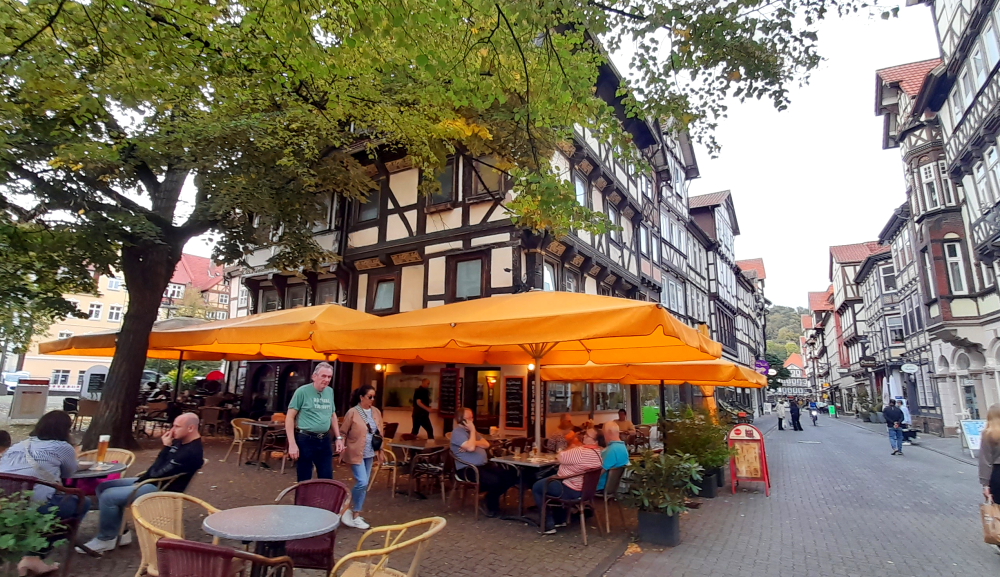
Part of the painting, the lowermost left panel known as The Just Judges, was stolen in 1934 and has not been recovered. It has since been replaced with a facsimile by Jef Van der Veken.

St Bavo’s Cathedral.

St. Nicholas Church is one of the oldest and most prominent landmarks in Ghent. Begun in the early 13th century as a replacement for an earlier Romanesque church, construction continued through the rest of the century in the local Scheldt Gothic style (named after the nearby river). Typical of this style is the use of blue-gray stone from the Tournai area, the single large tower above the crossing, and the slender turrets at the building’s corners.

Built in the old trade center of Ghent next to the bustling Korenmarkt (Wheat Market), St. Nicholas Church was popular with the guilds whose members carried out their business nearby. The guilds had their own chapels which were added to the sides of the church in the 14th and 15th centuries.

The central tower, which was funded in part by the city, served as an observation post and carried the town bells until the neighboring belfry of Ghent was built. These two towers, along with the Saint Bavo Cathedral, still define the famous medieval skyline of the city center.

St Nicholas Church.

Saint Nicholas is the patron saint of sailors, merchants, archers, repentant thieves, children, brewers, pawnbrokers, unmarried people, and students in various cities and countries around Europe. His reputation evolved among the pious, as was common for early Christian saints, and his legendary habit of secret gift-giving gave rise to the traditional model of Santa Claus (“Saint Nick”) through Sinterklaas.

Here in Ghent the story goes that he became the patron saint of children after he heard that a butcher had murdered 3 starving waifs, put their bodies in a barrel to be sold as ‘high quality meat’ to wealthy patrons. When St Nicholas heard this, he visited the butcher and after blessing the barrel the children came alive and were intact – hence he became the protector of children. This depiction is above a door of the Ghent cathedral which has a barrel with a child in it at the lower LHS of the statue.

Saint Nicholas himself.

One of the treasures of the church is its organ, produced by the famous French organ builder Aristide Cavaillé-Coll.

Organ recital in St Nicholas Church.

At the end of the tour we cut through the Friday Market Square where there is a statue of Jacob van Artevelde (c. 1290 – 1345), also known as The Wise Man and the Brewer of Ghent, a Flemish statesman and political leader.

Since we’ve arrived in Ghent I keep saying to Lynn that I remember a large fountain. Do you think I can find it?

Jacob van Artevelde statue – 2023.

Then, when we get back to the hotel I check the photos of my visit to Ghent in May 2005. Guess what, it isn’t a fountain at all, it’s this statue!

In front of the “Fountain” in 2005.

We’re going to try the cafe/bar, “Et Alors”, just around the corner for dinner tonight to sample their savoury and sweet crepes. Question is: will we be eating crepes or craps?

Red wine and crepes.

As it turns out, the crepes are delicious!

5 October, 2023

This morning is overcast and 15 Deg C as we depart Ghent at 10:55 am. After a short stop to top up the fuel tank we take the E40 SW to Brussels.

Driving to Brussels.

As we hit the ‘burbs we soon come to the National Basilica of the Sacred Heart church then disappear into several tunnels that take us under the city and out the other side to our hotel which overlooks Parc du Cinquantenaire.

The National Basilica of the Sacred Heart in Brussels.

Although the Best Western website said that street parking was available at Eur25 per day, it turns out it costs more like Eur25 for 12 hours so we take the car to a nearby shopping mall that has 24-hour, open air public parking onsite, call into a nearby Aldi then check in and unpack our bags.

Buggar! After I unpack I realise that I’ve lost my brown, suede flat cap between Ghent and here. Chances are it fell off the sofa in our hotel room and because there wasn’t any lighting in that half of the room, it got missed!

Triumphal Arch in Parc du Cinquantenaire.

As it’s now sunny we decide to locate the restaurant where we’ll be meeting up with Michiel, a former colleague of Lynn’s, tomorrow for lunch, then take a wander through the adjacent park which our hotel room overlooks.

The Cinquantenaire Arcade is a memorial arcade in the centre of the Parc du Cinquantenaire in Brussels. The centrepiece is a monumental triple arch known as the Cinquantenaire Arch. It is topped by a bronze quadriga sculptural group with a female charioteer, representing the Province of Brabant personified raising the national flag.

The city side of the Arch.

The Cinquantenaire Arcade was part of a project commissioned by the Belgian Government under the patronage of King Leopold II for the 1880 National Exhibition, commemorating the 50th anniversary of the Belgian Revolution. In 1880, only the bases of the memorial arch’s columns were completed, and during the exhibition, the rest of the arch was constructed from wooden panels. In the following years, the monument’s completion was the topic of a continuous battle between Leopold II and the Belgian Government, which did not want to spend the money required to complete it.

The original single arch of the 1880 exhibition was conceived by the architect Gédéon Bordiau, but upon his death in 1904, the arch’s design was revised by the French architect Charles Girault, chosen by Leopold II. Girault designed a triple arch, but preserved Bordiau’s idea of the quadriga. The foundation of the new arch was laid down on 4 January 1905, replacing Bordiau’s temporary arch. The basic construction was completed with private funding in May of the same year and the arcade was inaugurated by Leopold II on 27 September 1905, just in time for the 75th anniversary of Belgian Independence.

The full view.

We walk under the Arch to the commencement of the parkland on the city side. Then retrace our steps along the opposite side passing the Royal Museum of the Armed Forces and Military History.

The Military Museum pavilion.

Created on the occasion of the 1910 Universal Exhibition, the Museum of the Army and Military History was established in the Cinquantenaire in 1923. The museum not only displays arms, armour, uniforms, planes and tanks, but also reveals genuine works of art such as paintings, statues and miniatures.

Long ride on a short canon.

The history of soldiering around the world and technical developments are related from medieval armour up to modern-day camouflage gear, via the two World Wars.

The aircraft section of the Military Museum.

By now it’s around 5.30 pm so we decide to return to Avenue des Celtes opposite the Merode metro station for some Belge fare at the Carpe Diem restaurant then call it a night.

6 October, 2023

Today we are meeting up with Michiel, a former colleague of Lynn’s from her ARMA Europe days. Michiel used to be ARMA’s European representative and organised several annual conferences in Brussels. The last time they met was at a strategy meeting that Lynn arranged to be held at the Credit Suisse offices in London in January 2010.

Lunch with Michiel.

After an enjoyable lunch with Michiel we walk to the park opposite the hotel to Brussels’s Auto World – formerly the Museum of Vintage Cars. Today it hosts vintage and modern cars and motor bikes.

Auto World Museum.

For the next couple of weeks Bugatti is on special display with models from its racing days in the early 1900s to the one-of-one 2021 La Voiture Noire model.

1930 Bugatti Type 49 on display.

Centre stage are the 2006 Veyron and 2018 Chiron, plus the 2020 Divo and Centodieci and the 2021 La Voiture Noire. Apparently the COVID years had no impact on design and production – nor price for the one-off La Voiture Noire – $18.7m!

(L-R) 2020 Centodieci, 2021 La Voiture Noire, 2020 Divo.

Since we had lunch today we are not up to a full dinner so we head down to Cape Diem Restaurant and indulge in Belgium waffles and ice cream with chocolate sauce. Let’s call it last night’s dessert and we won’t feel so bad. Tomorrow we are off to Spa, Belgium for what is supposed to be a three day rest. Reviews of the Radisson Blu are a bit concerning especially since they seem to have come in after we booked the hotel some 6 months ago.

Delft and Middelburg, Netherlands

26 September, 2023

The drive from Amsterdam to Delft is only about an hour so we don’t check out of our Amsterdam hotel until nearly midday. On the outskirts of Delft we refuel the car and stop off at a laundromat to do the weekly wash. Yes, we find another Speed Queen and manage to complete the laundry while we had a coffee at a nearby cafe.

Washing day in Delft.

The outskirts of Delft are a bit run down and it resembles a Turkish town rather than a Dutch one. Luckily we are only in town for two nights so we have a full day to check out the Old Town and visit the Delft Museum tomorrow.

Dixi dunnies on the move.

We are staying at the Shanghai Hotel which is supposed to be 4 star. It appears to have been originally built for Chinese tourists but now owned by an Indian family who have allowed the hotel to get very tired and it definitely lacks basic maintenance. At least the parking is free. WiFi is really patchy and not reliable enough to download any photos so the blog will have to wait until our next stop in Middelburg.

The Shanghai Hotel, Delft.

The hotel still has a Chinese-run restaurant on the mezzanine floor so we will probably try that out tonight. If it is really bad we have a Scottish franchise just around the corner… you know the franchise… McDonalds.

The food in the hotel restaurant is expensive for Chinese food but certainly edible. I manage to spill half my dinner down my freshly-washed and ironed polo shirt so Lynn made me hand wash it back in our room.

Washing my shirt….again!

27 September, 2023

As we are only staying 2 nights in Delft we have today to do the sights. We drive into town and park beside the Royal Delft Museum/Factory.

At the Delft Ware factory in Delft.

The Koninklijke Porceleyne Fles (known as Royal Delft) is the only remaining factory of c. 32 earthenware factories that were established in Delft in the 17th century.

At the beginning of the tour is an introductory film about the history of porcelain in the Netherlands, starting with a cache of Chinese porcelain on a Portuguese ship being ‘liberated’ by the Dutch and auctioned off, thereby the blue and white Chinese porcelain becomes very popular.

A tulip vase and a porcelain tile version of the “Night Watch” in the background.

Then the Dutch East India Company decided to trade in it and existing Dutch pottery factories chose to copy the pieces from China and to reproduce and sell them to the domestic market.

“De Porceleyne Fles” ( The Porcelain Bottle) was founded in 1653 by David Anthonisz. v. d. Pieth, at the Oosteinde in Delft. After 1750, the factory was successively owned by Christoffel van Doorne, his son Pieter van Doorne and Jacobus Harlees. The latter reintroduces the jar in the trademark for the first time in 70 years. It has remained part of the trademark ever since.

After Harlees decreased in 1786, the company was owned by his son Dirck Harlees. He then sold it to Henricus Arnoldus Piccardt, who was succeeded in 1849 by his daughter, Geertruida Piccardt who helped reduce its debt by introducing fireproof bricks.

Royal Delft tableware for the Royal Family.

The Dutch potteries faced competition from Wedgwood and the English so decided to emulate them by producing better products for cheaper. During 1876-1844 Delft engineer, Joost Thooft becomes the new owner, purchasing the factory from Geertruida Piccardt, introduces the current trademark and aims to revive the production of Delft Blue.

Courtyard displaying architectural ceramics.

1878-1930 Leon Senf becomes one of the most important designers after his apprenticeship with important painter Cornelius Tulk.
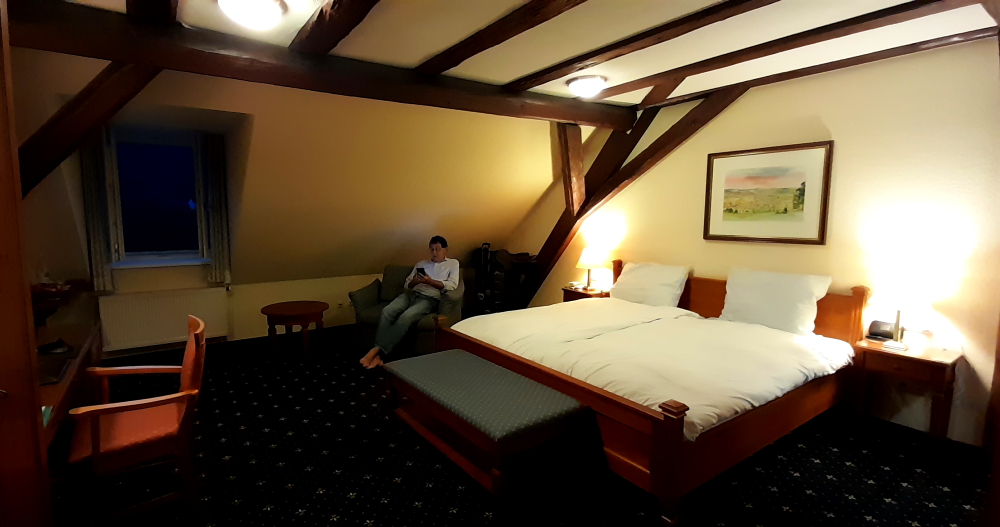
The four stages of production.
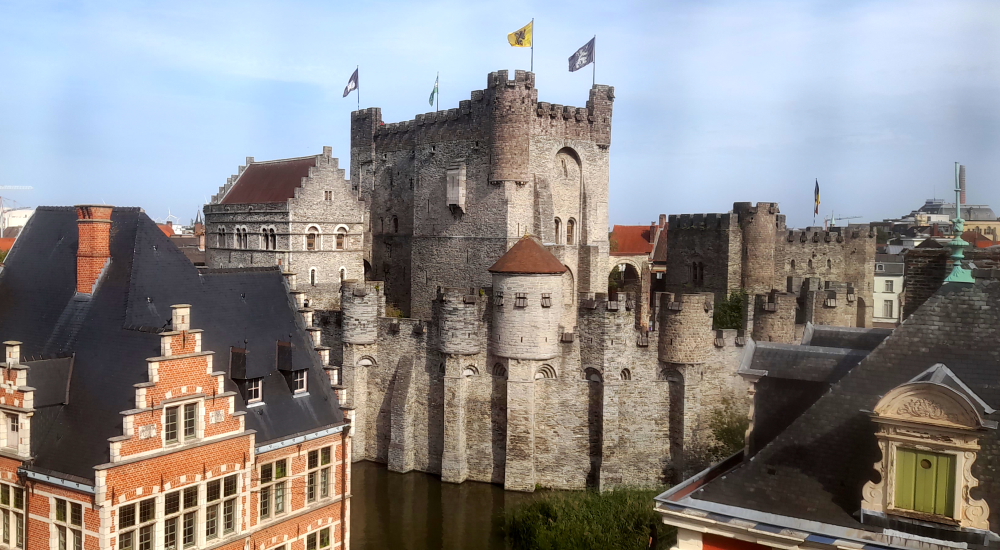
1895 saw the creation of the Building Ceramics Department after which the factory received many important orders for architectural ceramics including one for the Peace Palace in The Hague.

In 1900 Porcelyne Fles won the Grand Prix for its piece at the World Exposition in Paris. ‘Royal’ was awarded in 1919 as a sign of appreciation. 1978 saw the introduction of Black Delft in celebration of the factory’s 325th anniversary with the introduction of Jubilee to celebrate its 350th anniversary in 2003. 2008 a takeover and expansion culminating in the opening of the Royal Delft Experience in 2012.

Hand painting the Delft vases.

About 1.5 hours later we drive to 1 of 3 underground parking garages in Delft and make our way to the Eastern Gate (Oostpoort).

One of the many canals in Delft.

The Eastern Gate is an example of Brick Gothic northern European architecture and was built in the 1400s. Originally the walls of Delft had 8 gates and were the only ways to access the city.

Inside the Eastern Gate of Delft.

The gates along with the city’s canals and walls provided excellent defenses against hostile attacks. In fact, it was because of Delft’s strong defenses that, in 1572, William of Orange chose Delft as his base of operations.

Outside the Eastern Gate.

Around 1510 the towers were enhanced with an additional octagonal floor and high spires. To this day, the Gate still has a gate and drawbridge.

From the Gate we walk a couple of blocks to Beestenmarkt – you guessed it, a former cattle market which operated from 1595 to 1972. In 1969 the livestock market was relocated to a special hall but in 2001 the foot-and-mouth disease crisis marked the end of the market.

Canals covered in green vegetation.

Nowadays, the Beestenmarkt is a very popular social gathering and meeting area with numerous cafes, bars and restaurants plus trees that provide shade in summer months. Since 2001 the square has been used every winter as an ice-skating rink.

Beestenmarkt.

A block further on is the Markt. Dating back to the 12th century, de Markt is one of the largest and oldest market squares in Europe. The square is bordered by the Nieuwe Kerk (New Church) and the City Hall of Delft. Thursday is the main market day with 150 stalls actively selling cheese, fish, veggies, bread, nuts and other foods.

Delft City Hall.

Delft’s City Hall is a Renaissance-style building designed by Hendrick de Keyser after its predecessor the old, medieval building burnt down in 1618. Formerly used as the city’s government buildings, today it has fewer official functions. Marriage ceremonies have been happening here for centuries, even today. In fact, Johannes Vermeer registered his marriage with Catherine Bolnes here.

Later in the 18th century the building housed the gold and silversmith guild and pharmacist guilds. The City Hall tower was built around 1300. The tower has decorative clock faces and bells. It once functioned as a prison where Balthasar Gerards was imprisoned here prior to his execution for assassinating William of Orange.

Nieuwe Kerk (New Church).

Opposite City Hall is the Protestant Church, Nieuwe Kerk (New Church). In 1584 William the Silent was entombed here in a mausoleum designed by Hendrick and Pieter de Keyser. Since then members of the House of Orange-Nassau have been entombed in the royal crypt, including Queen Juliana and her husband Prince Bernhard in 2004. The church itself is an elaborately designed architecture with 22 columns surrounding the marble tomb of William of Orange.

The Royal Deflt shop and the cheese shop.

Many artisanal shops surround the Markt selling porcelain, cheese, sweets, writing equipment, Outside the market’s perimeter are pubs, cafes and open air terraces.

Leaves are starting to change with Autumn.

Our next stop is the Old Church. To get there we cut through a passageway which has some street art portraying Delft.

Street Art in Delft.

Then walking down Papenstraat we come across a Mosaic of Delft on a wall.

3D Ceramic model of the Old Town.

Which, when viewed up close is actually in 3D with both flat and raised buildings interspersed among the thousands of mosaic squares.

A town in miniature on the wall.

Founded in 1246 and sandwiched between Oude Delft and Voorstraat is the Old Church (Oude Kerk) nicknamed Oude Jan (Old John) and Scheve Jan (Skewed John), a Gothic Protestant church most famous for its 75-metre high leaning tower. Approximately 400 people are entombed in this church.Among them are Johannes Vermeer and the inventor of the microscope, Anthony van Leeuwenhoek.

The Old Church (Oude Kerk) in Delft.

Opposite is the Museum Het Prinsenhof.The Prinsenhof (The Court of the Prince) is an urban palace that dates back to the Middle Ages. It was here that William of Orange successfully fought against the Spanish occupation in the 16th century. William of Orange moved into the Saint Agatha cloister in 1572, later to be renamed the Prinsenhof and later still it became the Museum.

The Museum.

In 1584 William was murdered in the Prinsenhof by Balthasar Gerards. Established in 1911 the building now houses the municipal museum and displays a collection of Dutch Golden Age paintings, a history of Prince William of Orange and the creation of the Dutch Republic, 17th century art and the city’s famous Delftware tradition.

Cold drink at the Museum.

Here we sit for a while in the shady gardens behind the museum before we walk back to the parking garage and return to the hotel. As the Scottish restaurant is only a few steps away, we’ll forgo another expensive Chinese meal and head there instead for tonight’s dinner.

28 September, 2023

This morning, on our way to Middelburg, we’re going to go via The Hague which is only a 20-minute drive from Delft.

Although it’s 19 Deg C. it’s overcast and cool when we arrive and park the car at Plein 1813, next to the Nationaal Onafhankelijkheidsmonument (honestly!).

The National Monument in the middle of the square commemorates the victory over Napoleon, the end of the French period in the Netherlands, the independence and the foundation in 1813 of the Sovereign Principality of the United Netherlands, the predecessor of the United Kingdom of the Netherlands and the current Kingdom of the Netherlands. The monument was unveiled on November 17, 1869 by Prince Frederik of the Netherlands. The whole is a design by architect WC van der Waeyen Pieterszen and sculptor Jan Jozef Jaquet.

Independence Monument.

After a 12-minute walk we arrive at the object of our visit: The International Court of Justice, seated in the Peace Palace.

The International Court of Justice (ICJ) is one of the six principal organs of the United Nations (UN). It settles disputes between states in accordance with international law and gives advisory opinions on international legal issues. The ICJ is the only international court that adjudicates general disputes between countries, with its rulings and opinions serving as primary sources of international law (subject to Article 59 of the Statute of the International Court of Justice).

The ICJ consists of a panel of 15 judges elected by the UN General Assembly and Security Council for nine-year terms. No more than one judge of each nationality may be represented on court at the same time, and judges collectively must reflect the principal civilizations and legal systems of the world. Seated in the Peace Palace in The Hague, Netherlands, the ICJ is the only principal UN organ not located in New York City. Since the entry of its first case on 22 May 1947, the ICJ has entertained 186 cases through January 2023. Its official working languages are English and French.

The Hague International Court of Justice.

While circumnavigating the Court, we walk past a building which houses, amongst others, the Australian Embassy.

The Australian Embassy in The Hague.

Leaving The Hague, the A4 takes us past Rotterdam Port and what seems like endless kilometres of oil and gas pipes, tanks and towers.

Industrial Rotterdam outskirts.

After going through 2 tunnels – the Benelux Tunnel and the Botlek – the N57 takes us SW to Rijksweg, across the island of Neeltje Jans to the delightful village of Oostkapelle.

Tide management gates.

The village was first mentioned in 1162 as Hoostcapelle, “eastern chapel”. It developed as a circular church village in the Early Middle Ages on a ridge. Oostkapelle was home to 818 people in 1840. In the 20th century, Oostkapelle started to develop as a holiday resort and spa town, due to its vicinity to the dunes and the North Sea.

Dorpskerk Oostkapelle – Protestant Church

Along the western coast of Zeeland are sandy beaches which are backstopped by a very high dyke.  On the landward side are small car parks that appear at regular intervals, right next to a very steep set of stairs scaling the dyke.

Stairs to the top of the Dyke.

Although there is nobody in the car park they charge a fee to park here in the middle of nowhere.

Bikes on Dykes.

On the other side is a small road, next to either a sandy beach or, near the lighthouse (Vuurtoren Noorderhooft), rocks that have been covered in bitumen, down to the sea. Ugh!

Lighthouse on the sea wall & bitumen beach.

Opposite that lighthouse, from on top of the dyke a village can be seen far below – Westkapelle – which is dominated by a tall tower with a light on top.

Lighthouse and windmill below sea level.

Westkapelle is on the westernmost tip of Walcheren and is surrounded by the sea on three sides. On 3 October 1944, the dyke to the south of town was destroyed by British bombers – an event still known in Westkapelle simply as “‘t Bombardement” (“the Bombardment”) – to flood the German occupation troops in Walcheren and so make liberation easier. 180 inhabitants were killed in the bombing and the village was all but wiped off the face of the earth by the bombs and the incoming sea. On 1 November 1944, during the Battle of the Scheldt British and Norwegian commandos performed an amphibious landing on the northern and southern edges of the gap made in the dyke. During these landings, only six people remained in the village; the rest of the survivors had been evacuated to other villages nearby. It took until 12 October 1945, more than a year later, to finally close the gap in the dyke.

Westkapelle has two active lighthouses. The oldest lighthouse (Vuurtoren ‘t Hoge Licht) , built 1458–1470, 52 m (171 ft) tall, visible from 28 nautical miles (52 km; 32 mi) and standing prominently at the entrance to the village, is the remainder of a church that burned down in the 18th century. In 1818 the light was added to the top. The other one (Vuurtoren Noorderhooft), standing on the outer slope of the dyke, was built in 1875 of cast iron, is only 16 m (52 ft) tall and has a visibility range of 13 nautical miles (24 km; 15 mi).

Vuurtoren ‘t Hoge Licht.

Together they form leading lights, that lead vessels coming from the northern part of the North Sea into the narrow and busy shipping lane directly under the south west coast of Walcheren, that brings them into the Scheldt estuary and towards the ports of Flushing, Terneuzen, Ghent (via the Ghent–Terneuzen Canal) and Antwerp.

Another traditional windmill.

Heading south on the N288 towards Fort Rammekens, we come across several laybys reserved for tractors.

By 2.15 pm we arrive at Fort Rammekens, the oldest existing sea fort in Western Europe. Fort Rammekens is a Dutch fort near Ritthem, at the mouth of the former Welzinge canal, which provided access to the port of Middelburg, a few kilometres east of Vlissingen on the Western Scheldt. Originally the fort was also called Zeeburg. Until the French period, the fort stood half in the open sea and there were buildings on it.

Tractor lane on the highway.

Built in 1547 by order of Mary of Hungary who as governor of the Netherlands, it’s task was to protect and control the busy shipping routes to Middleburg, then the largest merchant city in the Northern Netherlands and Antwerp. Italian engineer Donato de Boni di Pellizuoli was responsible for its design. It was built over the former seawall and given a diamond shape with a bastion facing the Westerschele. The fort played an important role in the 80 Years’ War between 1560 and 1575 changing hands several times. On 8 February 1574 the transfer of the city of Middelburg was signed here by Cristobal de Mondragon and Willem van Oranje. The sea fort was abolished as a fortress in 1869 but remained in use as a power magazine. Today it’s a museum.

The old defense Fort now behind a Dyke.

We drive into the medieval section of Middelburg where our hotel, the Boutique Hotel Roosevelt, is located.

The hotel is located in a 1950s monument by architect JF Berghoef and is located on the Burg of Middelburg. It is named after the former president of the United States with Zeeland ancestors, Franklin D. Roosevelt.

The Roosevelt Hotel in Middelburg.

In early 2015, architectural firm ESTIDA completed the interior of hotel. The starting point for the design and implementation was the elegant style of the 1930s and 1940s, the period of Roosevelt’s presidency.

A striking detail in the use of color is the color aquamarine, President Roosevelt’s favorite color. The hotel complements this 1930s zeitgeist by, for example, using the CO Bigelow soap that Eleanor Roosevelt used.

In 2016 the hotel was officially opened by the grandchildren of Roosevelt. The Roosevelt family was originally from Zeeland and Middelburg is the capital of Zeeland.

The glockenspiel tower next door.

Next door to the hotel is Nieuwe Kerk (New Church), part of the former Abbey of Middelburg. Next to the church is the Koorkerk (Choir Church) and the Lange Jan tower. On the half hour we are treated to a melody of bells from the tower – which actually sounds like “We wish you a merry Christmas” – followed by the appropriate number of bongs for the hour.

The Hotel bar and restaurant.

Once we check in we need to park our car at an underground parking garage, 6 minutes’ walk away. Walking back to the hotel we check out the historic city centre and Thursday’s market in the large market square.

Our room at the Roosevelt.

Tonight we will be having dinner in the hotel restaurant. The menu is limited but it will have to do. Turns out the food is delish!

29 September, 2023

Aahh…a sleep-in. We had elected to break our fast at 9:30 am and so get to enjoy some extra shut-eye. The overcast morning and rain also helped.

Breakfast is served at our table, rather than the dreaded buffet. It’s so nice to be waited on and to be offered a ‘high tea’ version of breakfast.

Breakfast in the Hotel.

I have spent the entire morning trying to get car insurance for the Insignia. Again the Department of Making things more difficult than necessary has been at work. Car insurance is compulsory in the UK but it is both expensive and difficult to buy. So many rules and conditions that seem to contradict each other.

After a morning of ‘admin’ stuff including trying to get car insurance for the Insignia, we head outside and are reminded that we are increasingly on the wrong side of the autumn equinox. Brrr! A cold breeze whips the skeins of yellowed leaves along the cobble stones.

Nieuwe Kerk (New Church).

We walk around the outside of the Nieuwe Kerk and into Abdijplein, what would have been the former Abbey’s inner square.

The 16th century brass canon with a 20th century twist.

Along one side of the square is the Zeeuws Museum which moved to this location in 1972. Its collection is about the province of Zeeland and includes Zeeland tapestries, the historical collection of the Royal Zeeland Society of Sciences, porcelain from the Bal collection, Zeeland fashion and regional dress and the collection of contemporary art.

The Zeeuws Museum.

Coming full circle we enter the New Church. Its lofty space is surprisingly empty except for an exceptional-looking organ. The current Van Leeuwen organ was built in 1954, to replace the Kam organ that was lost in May 1940 due to war.

Organ builder Willem van Leeuwen from Leiderdorp built a completely new interior in the old case in 1954. The organ case comes from the Duyschot organ (1693), which served in the Oude Lutherse Kerk in Amsterdam until 1884. Before it moved to Middelburg, it was housed in the Rijksmuseum in Amsterdam.The pipework of the Duyschot organ was lost in 1884.

In 2001 the organ case, the painted shutters and the sculpture were restored and in 2004 Flentrop Orgelbouw in Zaandam performed a major restoration.

The Van Leeuwen Organ, New Church.

Between the 2 churches is the Lange Jan tower and the Wandelkerk (Walking Church), where the 17th century tomb for admirals Johan and Cornelis Evertsen by the famous sculptor Rombout Verhulst are located. Both brothers were killed in 1666.

Evertsen Brothers’ tomb.

Back outside we head for a Reigerstraat looking for a restaurant for tonight. At the corner of the church precinct and Reigerstraat is an amazing florist shop – selling fresh and ‘real-looking’ artificial blooms and an astonishing array of vases.

Huis van Bloemen.

Inside is a riot of colours, fragrances and textures.

Huis van Bloemen – interior.

Reigerstraat houses a variety of restaurants and has a canopy of greenery and gorgeous Asian lanterns – just like Hoi An, Vietnam!

Reigerstraat.

From Reigerstraat we walk down Lange Delft back to the Market Square where the Stadhuis (Town Hall ) is located in all its splendour and is considered one of the finest gothic buildings in the Netherlands.

Construction began in 1452 and was supervised by several generations of the Flemish family of architects, the Keldermans. Completed in 1520, the town hall received a facade with gothic windows, red-white shutters, smaller turrets and 25 statues of Zeeland’s counts and contesses of the time.

The building has one main tower which the Middelburgers call ‘Malle Betje’ – a mocking name due to the fact it used to run behind the town’s other clock tower, the ‘Lange Jan’.

Like most of the old town centre, the town hall suffered German bombardments. Old paintings and documents were lost and only the exterior remained. A large restorative campaign started which lasted until late in the 20th century.

Town Hall.

By preevening (pre-evening) the clouds have dispersed and the sun is shining. We plan to head out to find a simple restaurant somewhere near the market square.

Lynn has soup and I have fish and chips for dinner and we follow this up with a shared waffle and strawberries.

30 September, 2023

Another sunny day as we head out to see what goes on in Middelburg on a Saturday.

As we walk from the market square down ?, one of the radiating streets from the square, we see an interesting building at its end but across the Binnengracht canal.

All we can discover is that it houses a restaurant and the Schuttershof Filmtheater.

Schuttershof Filmtheater.

Returning to the town hall square there is a smaller market on here today, offering only food.

Cheese stall – Saturday morning food market in the square.

The afternoon is spent at the hotel finalising our car insurance then we head out to find a restaurant for dinner.

We find a pub in Plein 1940 but it is fully booked inside, so we have to make do with an outside table. It turns out it is a lot more chilly than we were expecting but the waitress kindly gives us a couple of blankets. Just the ticket!

Dinning Al Fresco in the late chilly evening.

As I head back to the hotel, Lynn takes some photos of the city’s illuminated landmarks.

Evening lighting of the Town Hall.

The clear night sky, cool air and magnificent subjects enable brilliant illuminations.

Lange Jan Tower at night.

1 October, 2023

It is forecast to get to around 23 Deg C today so after breakfast we head out to check out the flea market set up in the square this morning. This is probably the last really warm and sunny day this autumn so I take advantage and dress in my shorts and a polo shirt for this morning’s walk around town.

The Flea Market in the Market Square.

This market square sure gets a good workout – Thursday market, Saturday food market, Sunday flea market – which is great to see.

Goods on offer range from jewellery to records, binoculars, cameras, toy cars, embroidery, dolls, pictures, glassware, crockery, cutlery, cookware, old medical equipment, wooden skates – you name it, it seems to be for sale here, all with a Dutch influence.

Checking out a fake Rolex.

As it is such a nice day we decide to go to Cafe Bommel which is on the edge of the square for a coffee in the sun. Unlike last evening which was decidedly cool, we are soon baking in the sun.

Stopping for a coffee in the sunshine.

There is supposed to be a jazz concert at our hotel this afternoon so we plan to be back by early afternoon so that we can get a seat at the session.

Noticeboard at the hotel.

Just after the scheduled starting time of 2:30 pm the Desa Session Band takes to the stage in the hotel’s shady courtyard.

We are treated to an hour of jazz, with the occasional song, before they take a half-hour break.

Jazz on a sunny Sunday afternoon in our backyard.

Then they return for another hour during which a woman from the audience is invited to take to the stage where she very credibly sings a couple of songs, one using the scat technique.

What a pleasant way to spend a Sunday afternoon. We’ll probably go out for ice cream this evening before we retire. We are driving to Ghent, Belgium tomorrow.