
4 September, 2023
11:00am is the meeting time at the Rotes Rathaus (Red City Hall) for our 2.45 hour walk through the historic part of what was East Berlin. We walk up the road to Stadtmitte Underground and catch the U6 to Unter den Linden then the U5 to Rotes Rathaus – about 20 minutes all up.
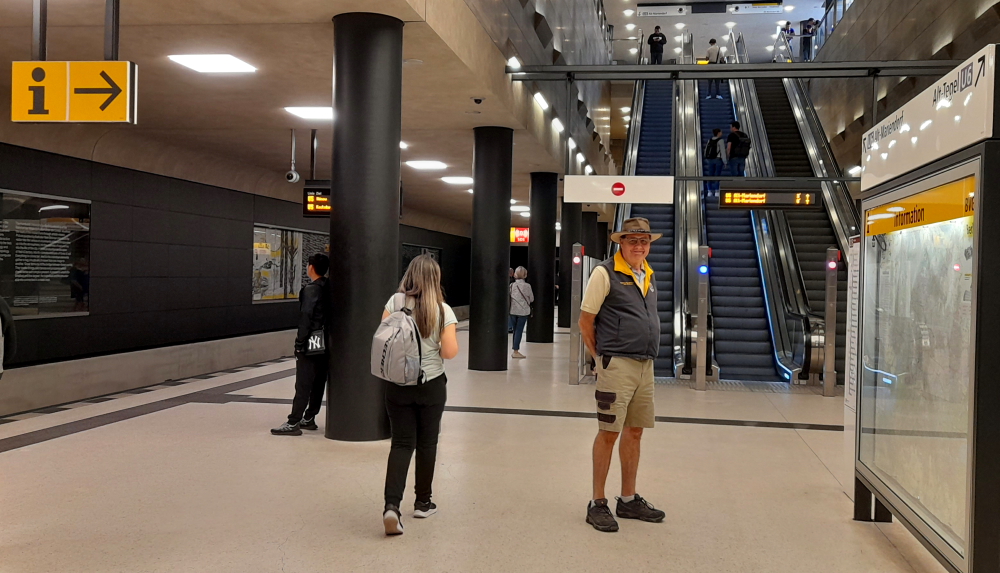
We arrive with about 30 minutes to spare so we check out the square.
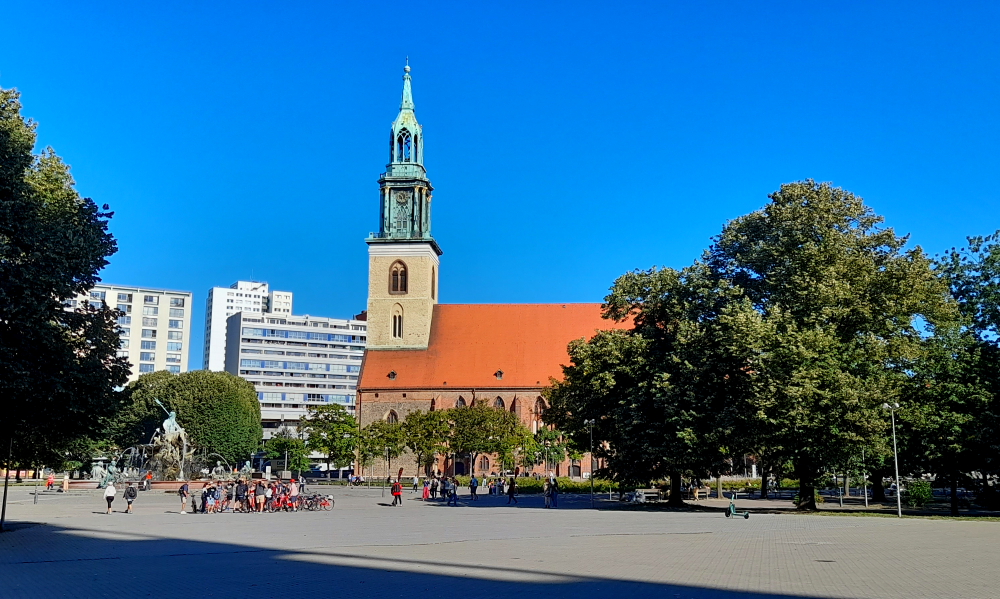
The square is dominated by the Berlin TV tower (Berliner Fernsehturm) which looks like a ‘Sputnik-on-a-Stick’. It was constructed between 1965 and 1969 by the government of the German Democratic Republic, or East Germany, as both a functional broadcasting facility and a symbol of Communist power.
At the edge of the square, on a more human scale, is St Mary’s Church (St Marienkirche). It is located on Karl-Liebknecht-Straße (formerly Kaiser-Wilhelm-Straße) in central Berlin, near Alexanderplatz. It is mentioned in German chronicles in 1292 and so is presumed to date from earlier in the 13th century.
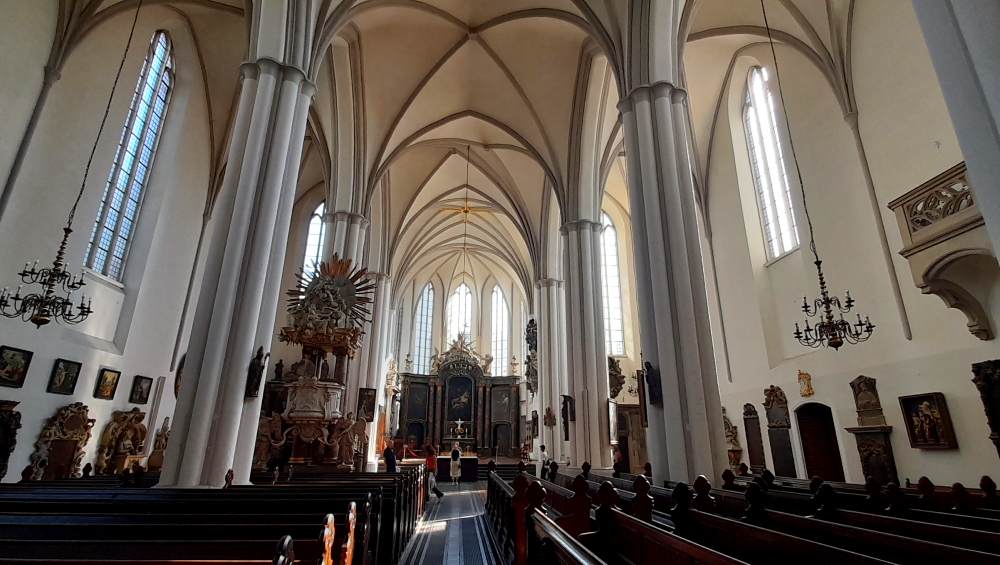
It’s the oldest church in Berlin, made from granite and brick. It was heavily damaged by Allied bombs. After the war, this area was cleared of ruined buildings and today the church stands in the open spaces around the Alexanderplatz, and is overshadowed by the East Berlin television tower.
59 years ago, at the invitation of Willy Brandt, Mayor of West Berlin, Dr. Martin Luther King, Jr, traveled to Cold War Berlin in September 1964 to speak at the 14th annual cultural festival. After learning that an East Berliner had been shot when he attempted to escape to West Berlin, King insisted that he also visit East Berlin.
During a sermon at the Marienkirche, East Berlin, on September 13, 1964 he preached essentially the same sermon he gave earlier that day in West Berlin to 2,000 standing-room-only East Berliners: “…we are all one in Christ Jesus, for in Christ there is no East, no West, no North, no South, but one great fellowship of love throughout the whole, wide world.”
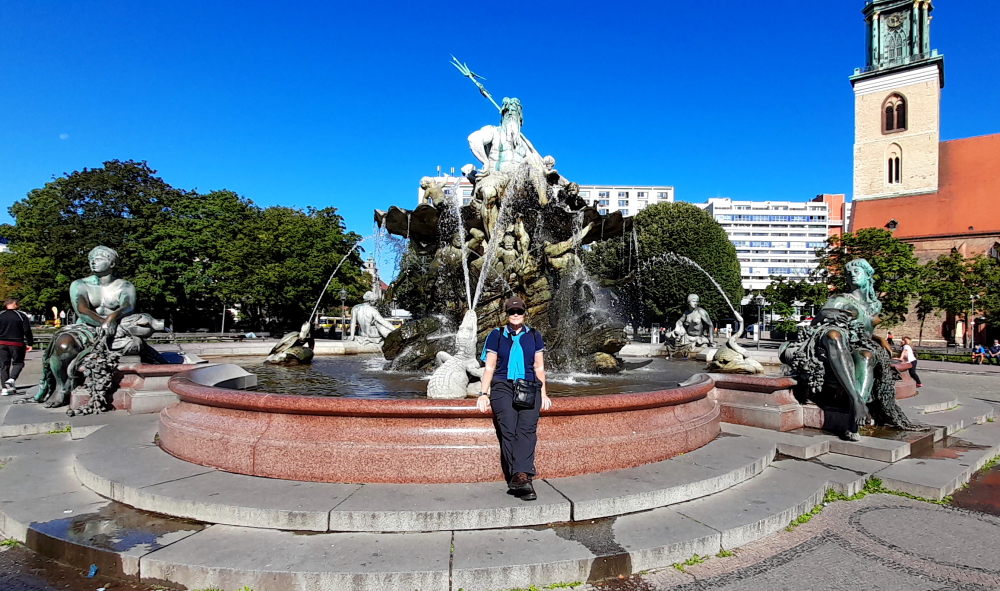
Designed by Reinhold Begas, the Neptunbrunnen was built in 1891. The Roman god Neptune is in the center. The four women around him represent the four main rivers of Prussia at the time the fountain was constructed: the Elbe (with the allegorical figure holding fruits and ears of corn), Rhine (fishnet and grapes), Vistula (wooden blocks, symbols of forestry), and Oder (goats and animal skins). The Vistula is now entirely in Poland, while the Oder forms the border between Germany and Poland.
The fountain was removed from its original location at the Schlossplatz in 1951, when the former Berliner Schloss (Berlin Palace) there was demolished. Eventually, after being restored, the fountain was moved in 1969 to its present location between the St Mary’s Church and the Rotes Rathaus.
The town hall of Berlin is the home to the governing mayor and the government of the state of Berlin. The name of the landmark building dates from the façade design with red clinker bricks built between 1861 and 1869. Heavily damaged by Allied bombing in World War II it was rebuilt to the original plans between 1951 and 1956. After German reunification, the administration of reunified Berlin officially moved into the Rotes Rathaus on 1 October 1991.
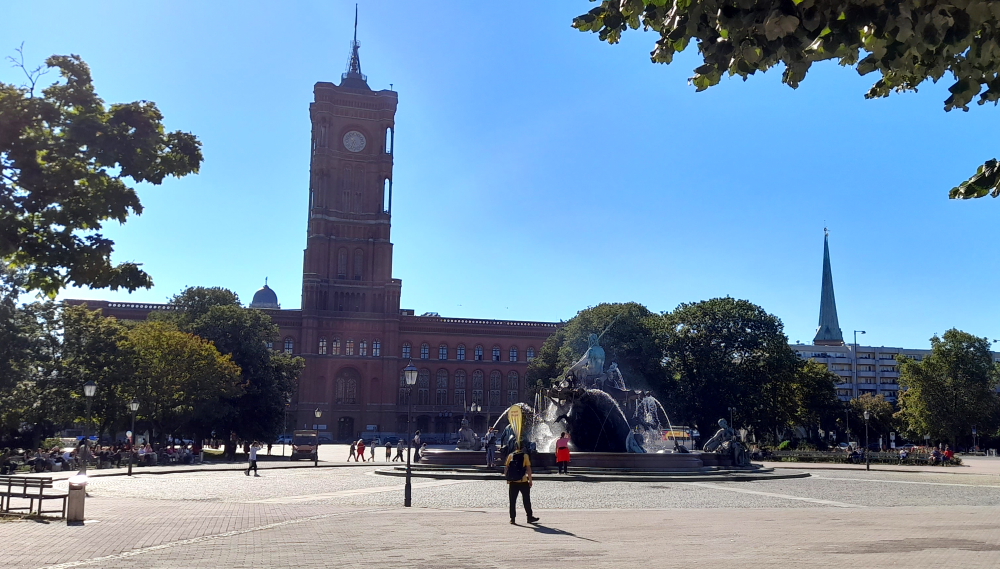
Our walking tour kicks off at 11:05am with 23 patrons & JR, our American guide. First stop is at the Marx-Lenin-Forum which also borders the square between Spandauer Strasse and the Spree River..
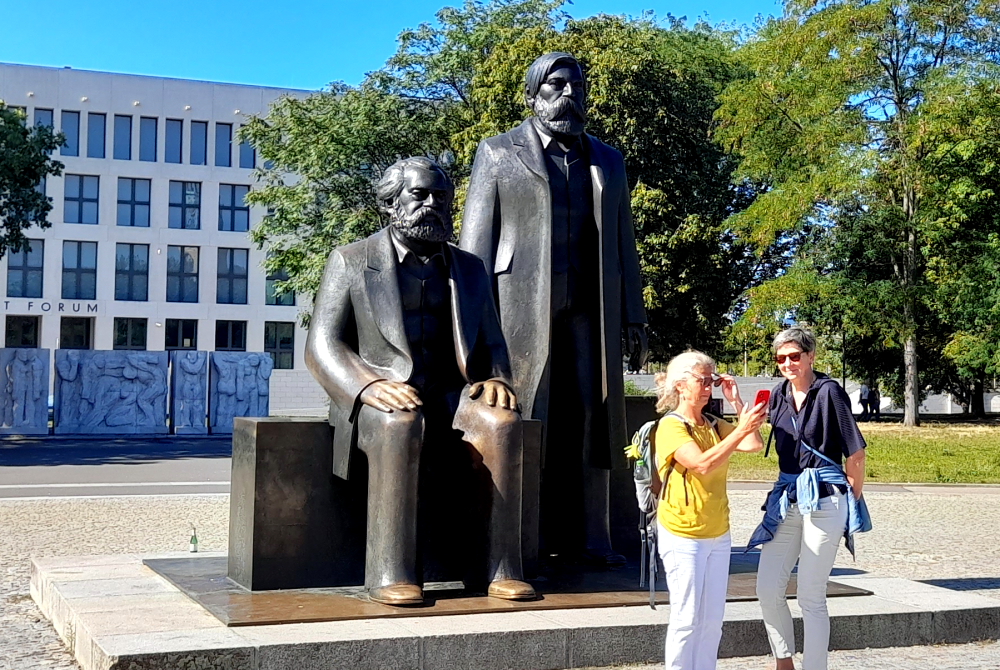
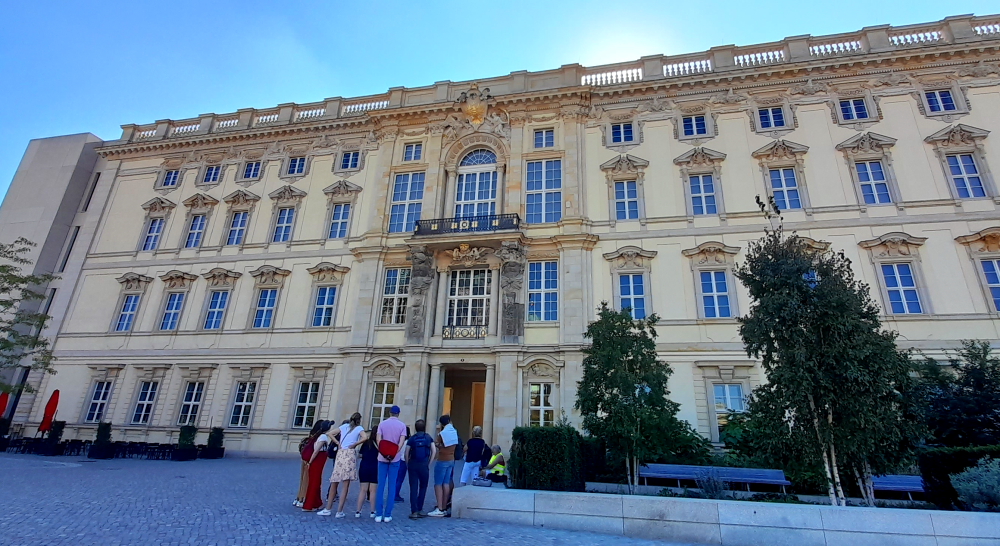
Crossing over the bridge at the Spree River we arrive at the Berliner Schloss, also known as the Prussian Palace. The Berlin Palace (colloquially City Palace ) on the Spree Island in the historic center of Berlin was from 1443 the main residence of the Electors of Brandenburg from the House of Hohenzollern , who had been kings in Prussia since 1701, kings of Prussia from 1772 and German emperors since 1871. It, too, was damaged in World War II and blown up in 1950. From 2013 to 2020 it was reconstructed with the help of donations and now primarily serves the Humboldt Forum as an exhibition and event location.
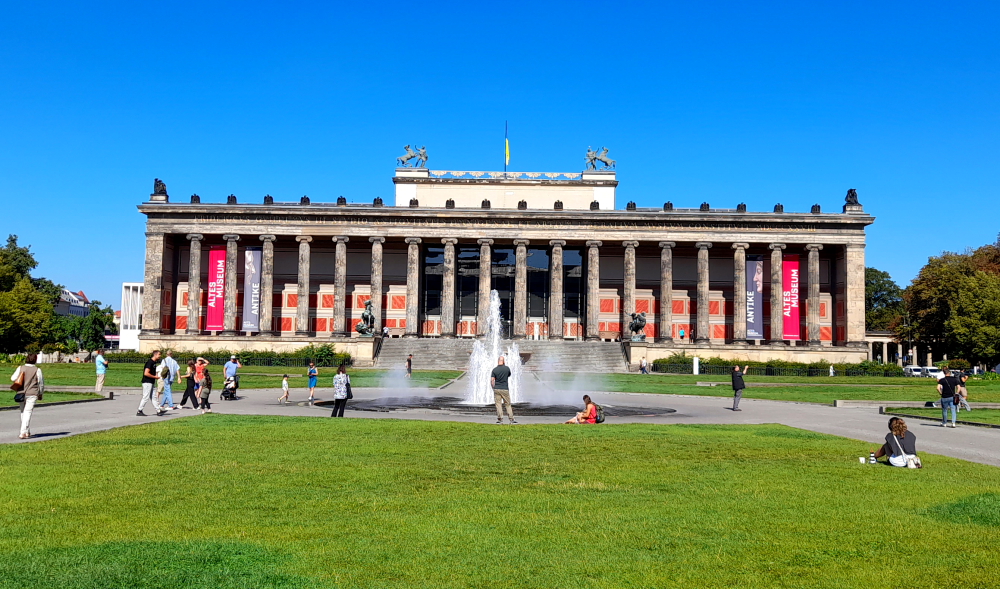
Also on the island at the rear of the Lustgarten is the Alte Museum Old Museum) for displays of Greek and Roman artifacts.
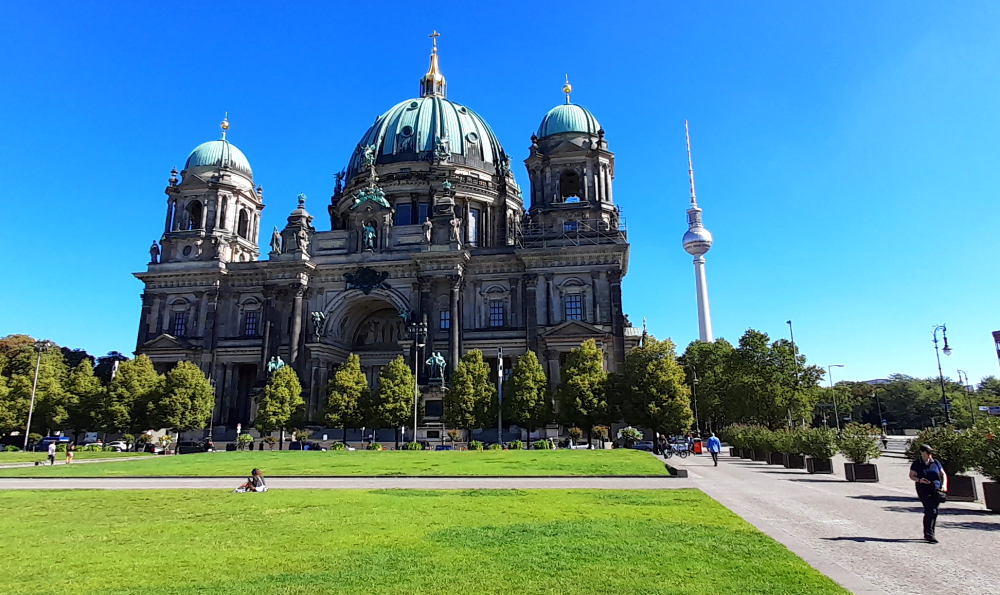
But the most prominent building is the Berliner Dom (Berlin Cathedral) at the Lustgarten on the Museum Island. The largest Protestant church in Germany, it was built in the years 1894-1905 according to designs by Julius Raschdorff in Neo-Renaissance and Neo-Baroque style and is one of the most important dynastic burial sites in Europe.
As we cross another bridge over the Spree River we are now on Under den Linden Boulevard and arrive at the Neue Wache (New Guard), a listed building.
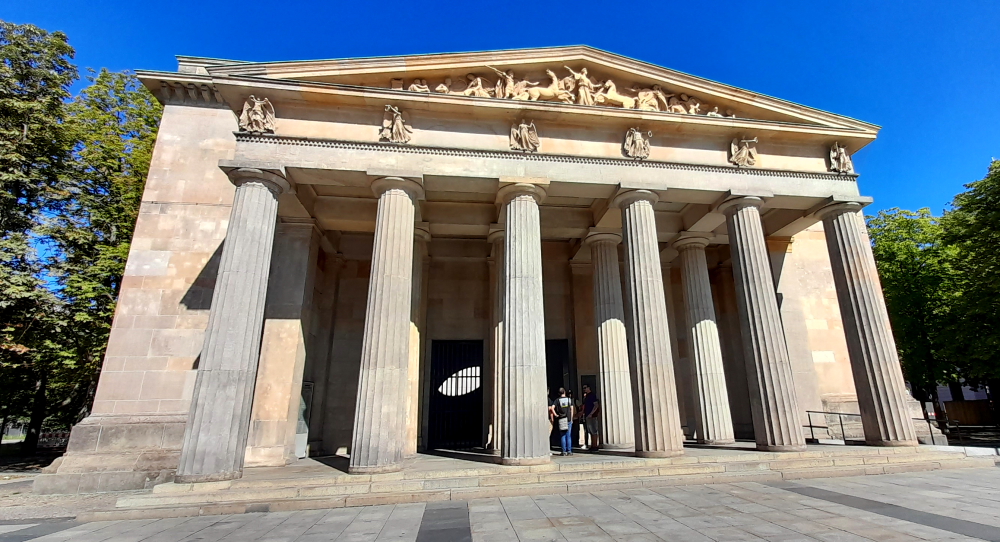
Erected from 1816 to 1818 according to plans by Karl Friedrich Schinkel as a guardhouse for the Royal Palace and a memorial to the Liberation Wars, it is considered a major work of Prussian Neoclassical architecture. After reunification, in 1993 the Neue Wache was rededicated as the Central Memorial of the Federal Republic of Germany to the Victims of War and Tyranny.
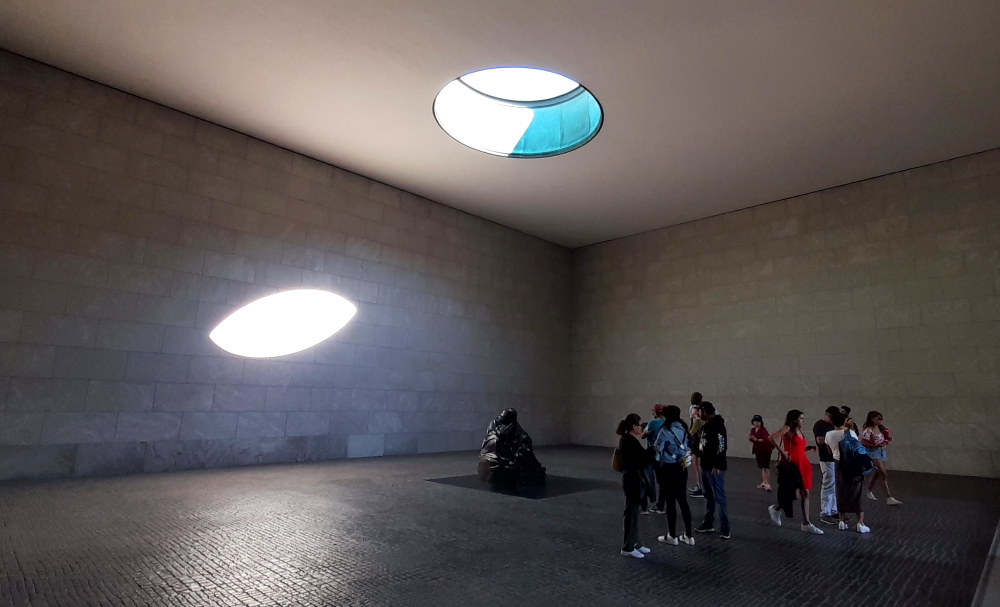
At the personal suggestion of the Federal Chancellor of Germany Helmut Kohl, the East German memorial piece was removed and replaced by an enlarged version of Käthe Kollwitz’s sculpture Mother with her Dead Son. The pietà-style sculpture is directly placed under the oculus, and so is exposed to the rain, snow and cold of the Berlin climate, symbolizing the suffering of civilians during World War II.
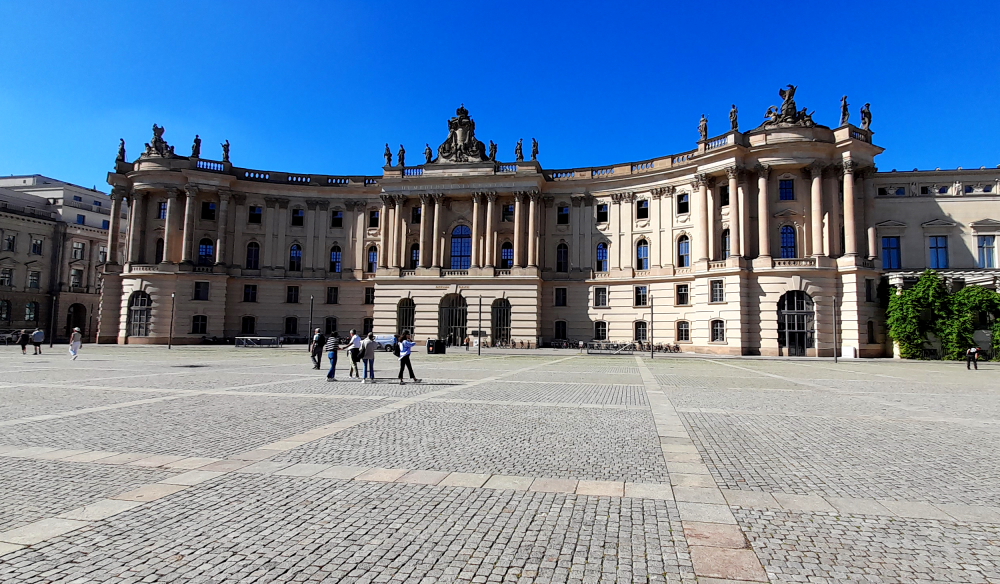
Close by we walk into the quadrangle of what was the Berlin University, now the Humboldt University. Here was the site of the famous Nazis book burning events.
From here we walk 7 minutes south to the French Dom. The French (Reformed) Church of Friedrichstadt or Französischer Dom (‘French cathedral’) is in Berlin at the Gendarmenmarkt, across the Konzerthaus and the German Cathedral.
Louis Cayart and Abraham Quesnay built the first parts of the French Church between 1701 and 1705 for the Huguenot (Calvinist) community. During this time, Huguenots constituted about 25 percent of the city population. The French Church was modelled after the destroyed Huguenot temple in Charenton-Saint-Maurice, France.
The Französischer Dom was severely damaged during World War II and rebuilt between 1977 and 1981. Today, it is used by its congregations, and for conventions of the Evangelical Church in Germany.
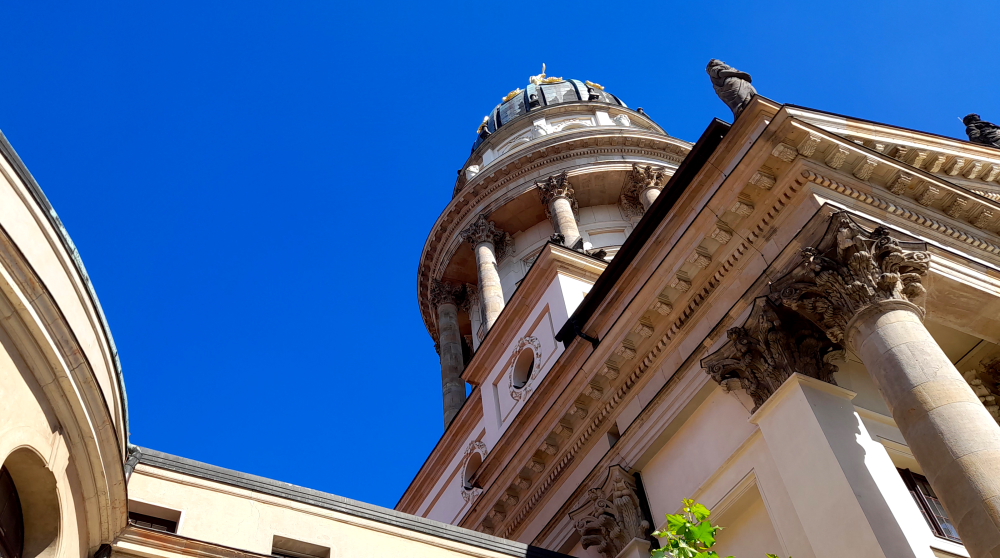
Usually the Gendarmenmarkt is on the tourist route, but of course it is cordoned off, under repair.
From here we walk 3 minutes onto the main throughfare of Friedrickstrasse to the Russian House of Science and Culture. What a Soviet monstrosity!
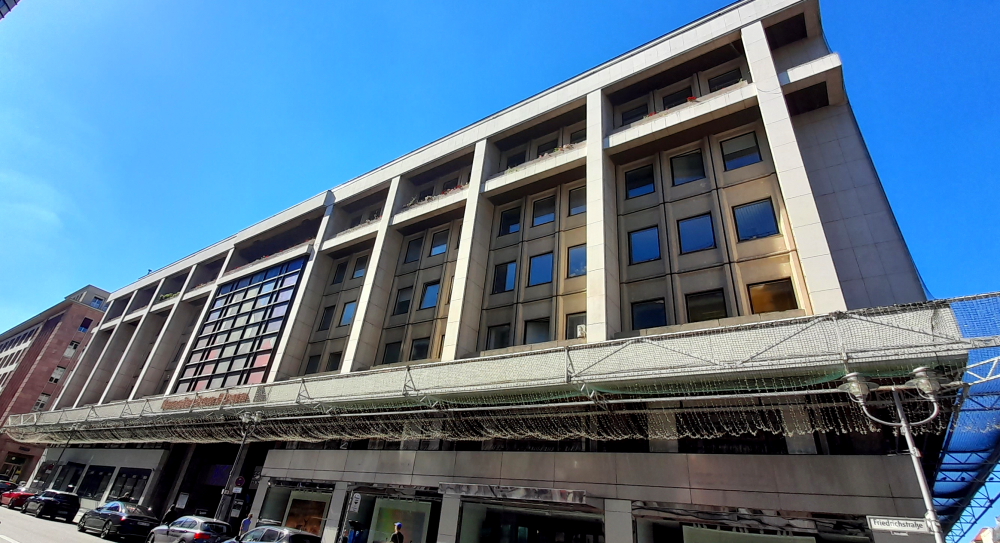
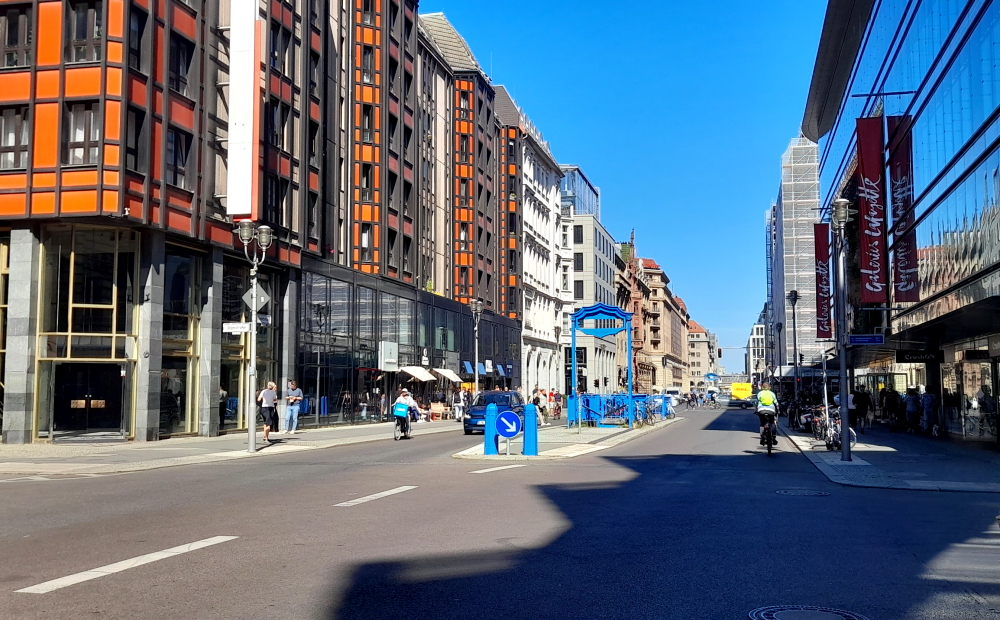
Also in Friedrichstrasse we see some blue, decommissioned Friedrichstrasse station U-bahn entry points. At the time of the division of Germany, Friedrichstraße station was one of the most important border crossing points between East and West Berlin .
Nearby we see at pavement level some bronze blocks known as “Stolpersteine” – stumble stones.
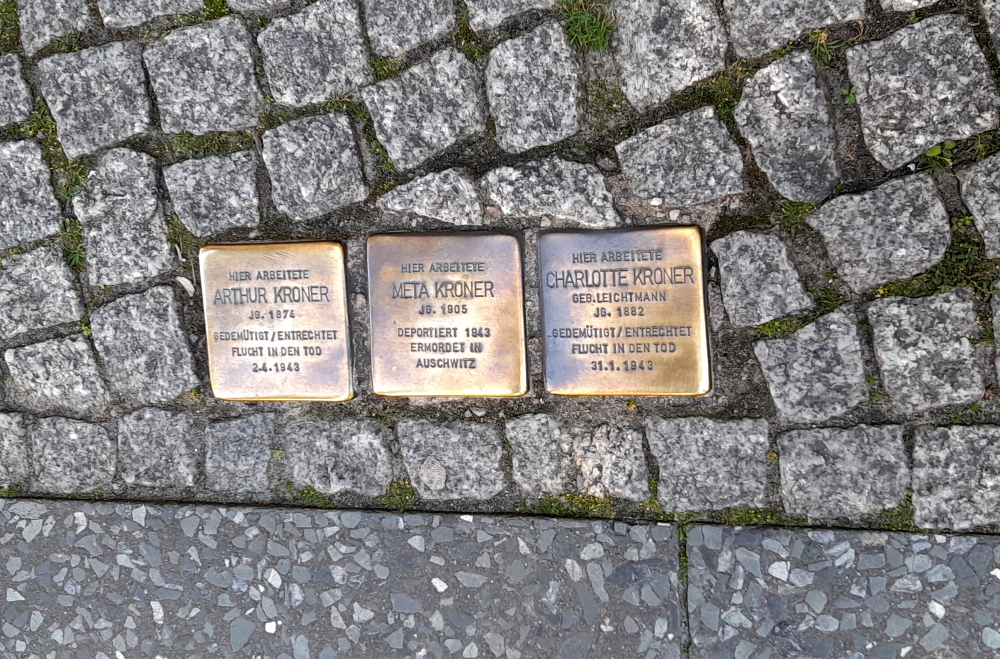
Each individually list the name of a Jewish person who was removed from the building and their death date.
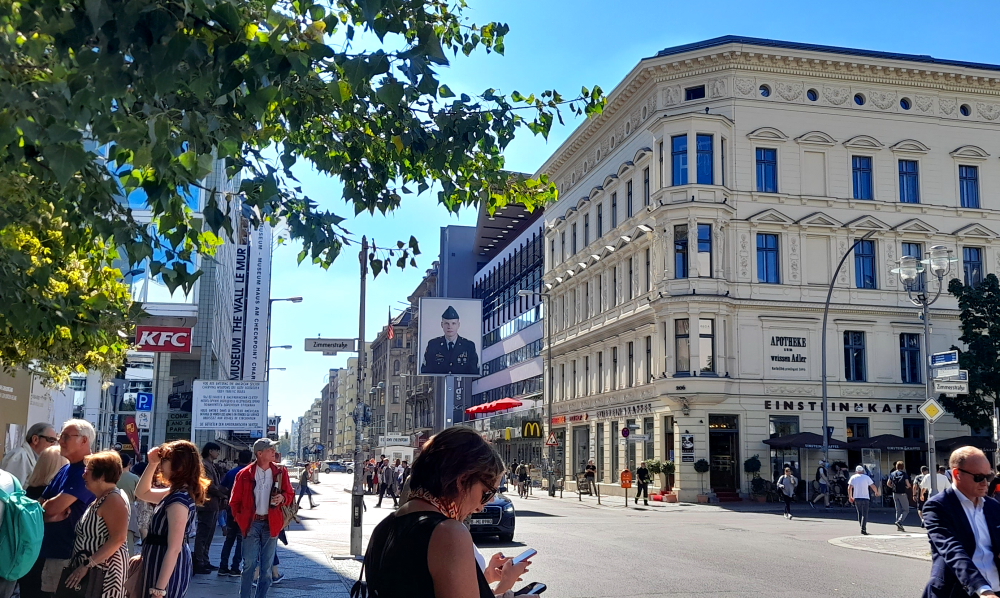
10 minutes later we are at the East Berlin side of Checkpoint Charlie where, if we had continued, we would have been entering the American Sector, back in the day.
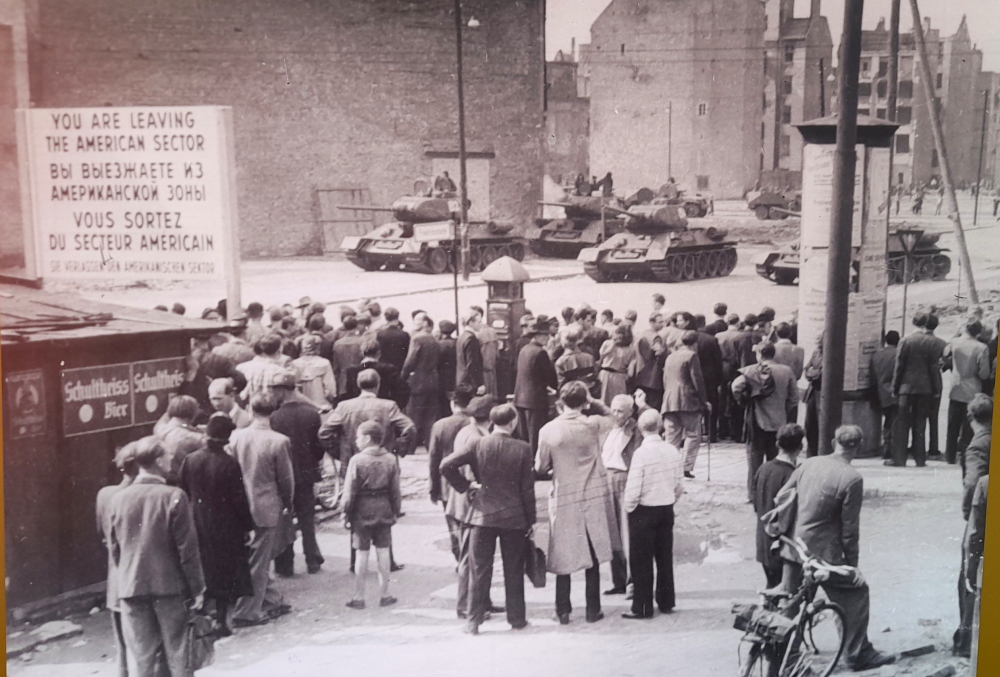
At the junction of Friedrichstrasse and Zimmerstrasse (Checkpoint Charlie) are hoardings which show historical photos of scenes at this junction. Above, demonstrators flee from Soviet tanks behind the border line at the corner of Friedrichstrasse and Zimmerstrase, 17 June 1953.
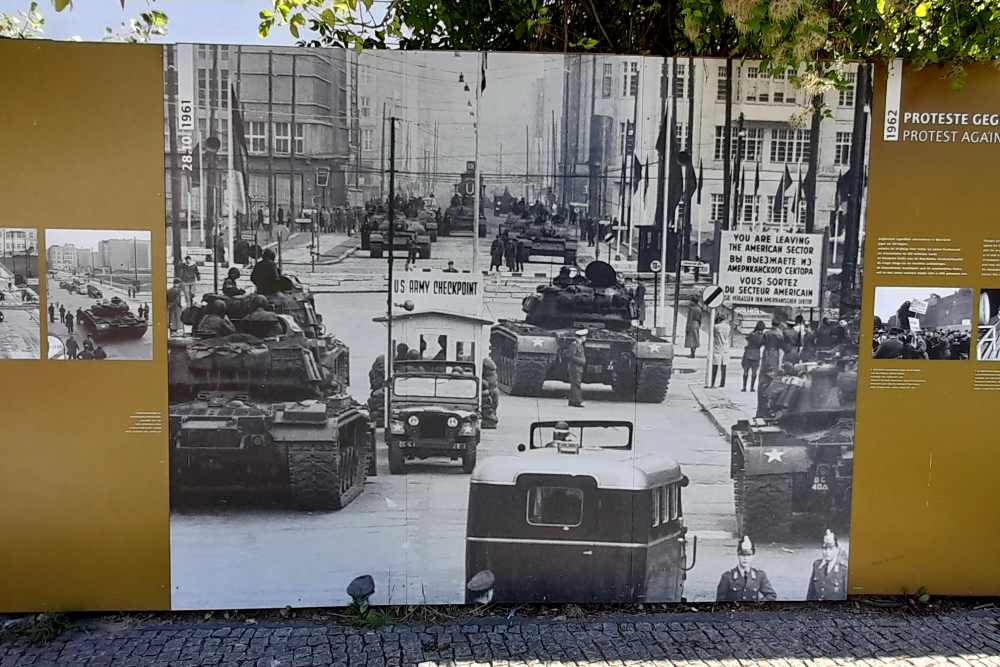
Closure of the border, access routes blocked off at the crossing point at Friedrichstrasse, 14 August 1961.
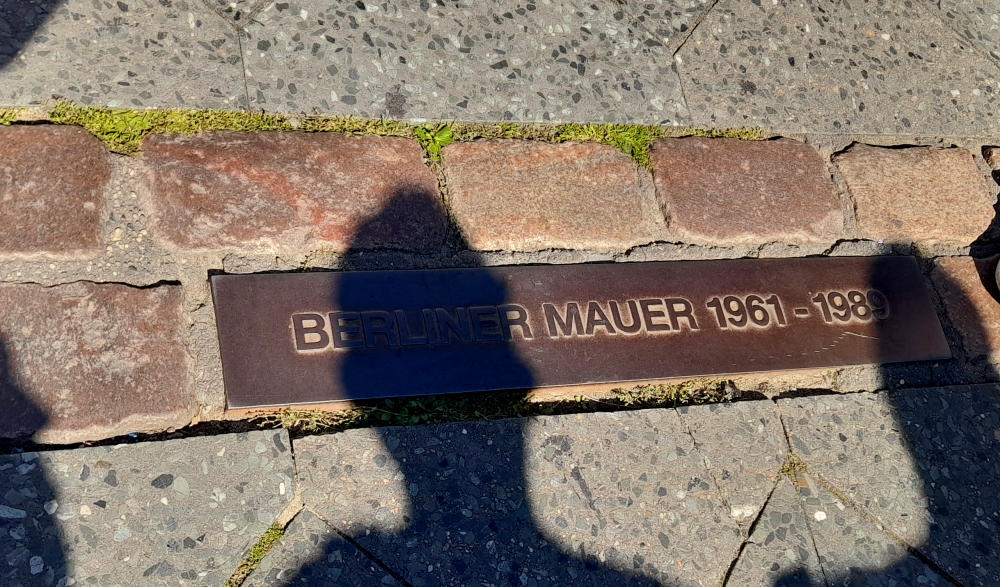
At our feet is a plaque that marks where the Berlin Wall stood during 1961-1989.
5 minutes’ walk west from the Checkpoint along Zimmerstrasse we come across the ‘Topography of Terrors’, and outdoor/indoor history museum which we will visit ourselves tomorrow.
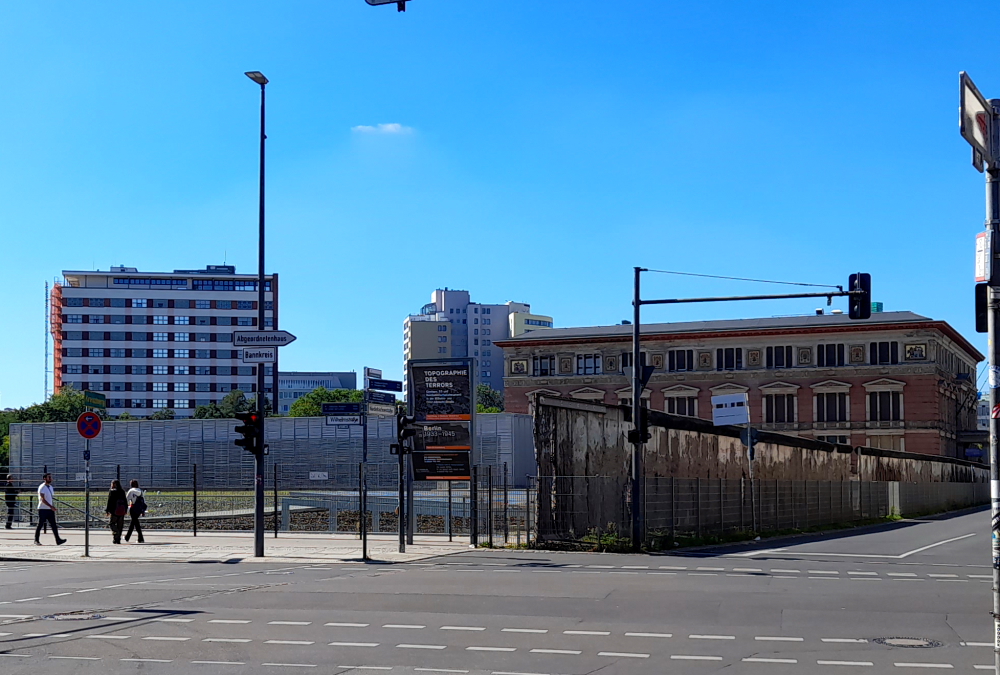
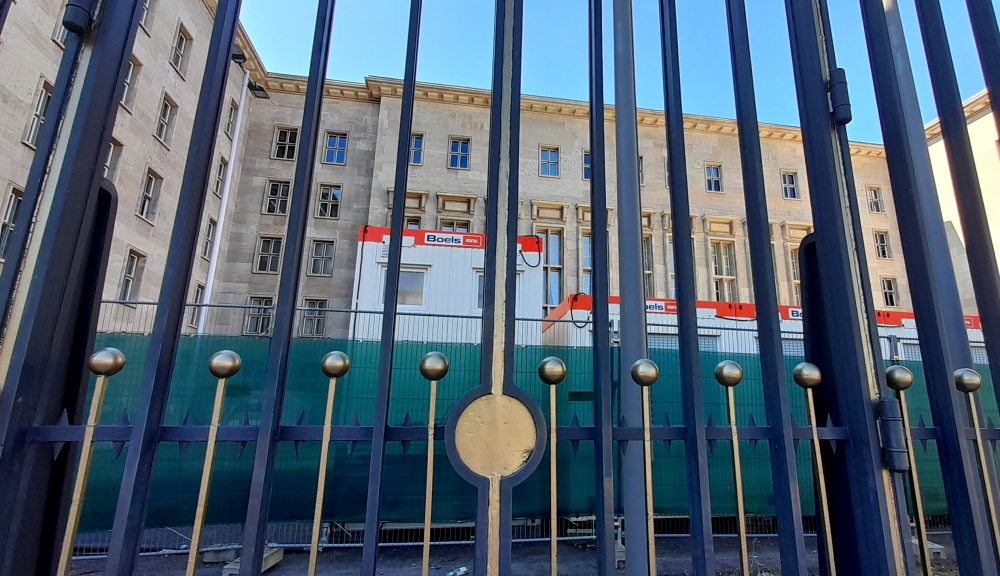
Across the road is a huge, Nazi-looking building which, during the war, was the Luftwaffe building. Today, it houses the Federal Ministry of Finance.
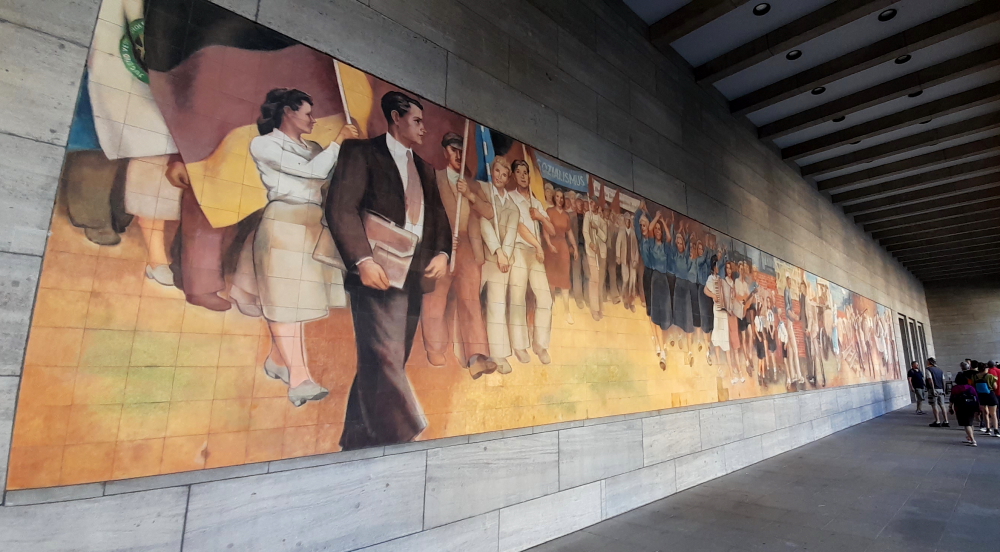
Around the corner on Leipziger Strasse is a Communist propaganda mural on the wall of the Finance Ministry building showing an idyllic communist existance. It faces the “People’s Uprising of 1953 Plaza”.
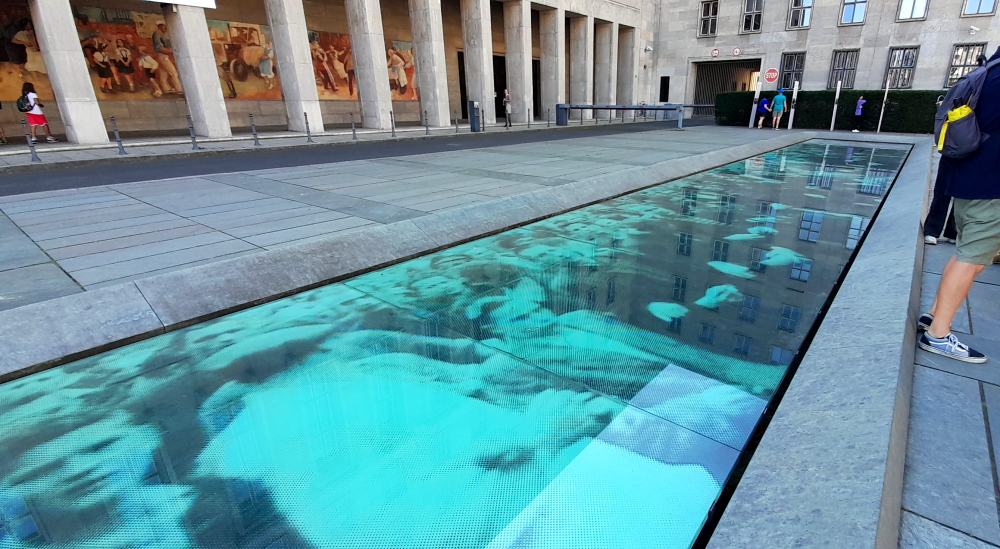
Here in the Plaza is a photograph from the 1953 Uprising, the same size as the propaganda mural which demonstrated that the communist idyllic didn’t exist, at all.
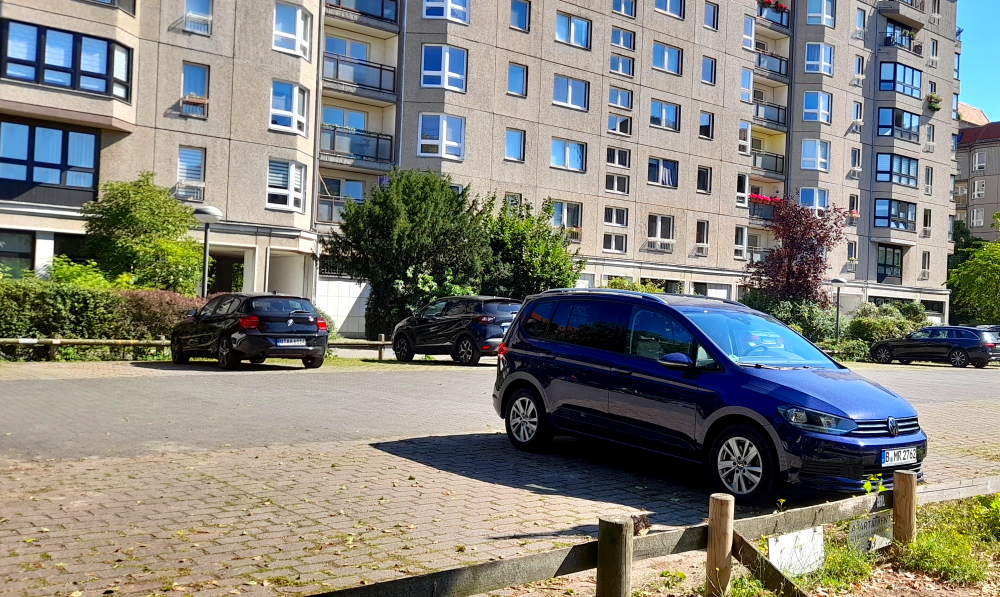
After walking through the Mall of Berlin we come to Gertrud-Kolmar-Strasse and an ordinary car park facing an apartment building. Apparently this was the site of Hitler’s Bunker where he and Eva Braun took their lives and their bodies burned, as instructed.
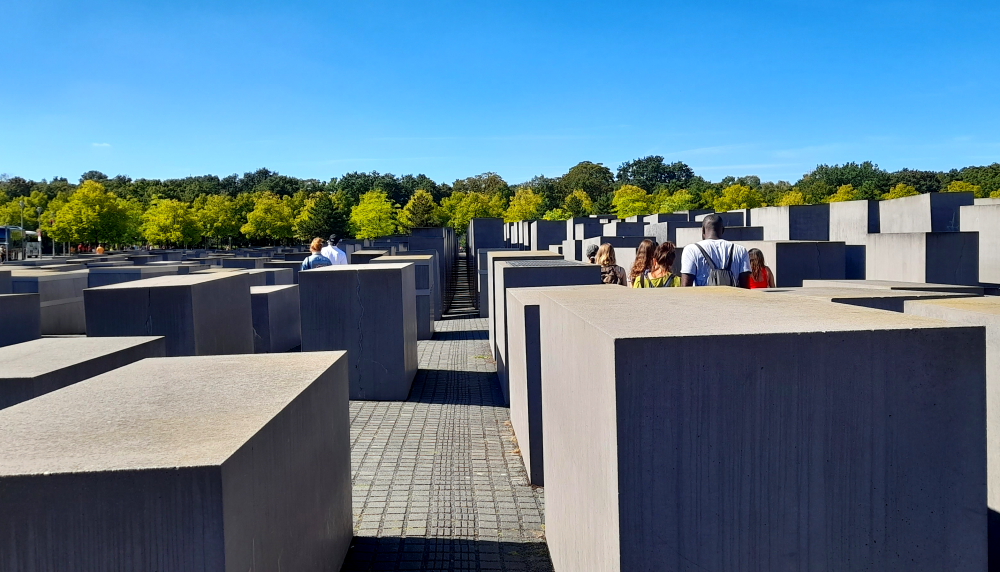
In the next block is the “Memorial to the Murdered Jews of Europe” or the Holocaust Memorial, designed by architect Peter Eisenman and Buro Happold. It consists of a 19,000-square-metre site covered with 2,711 concrete slabs or “stelae”, arranged in a grid pattern on a sloping field. The stelae are 2.38 m long, 0.95 m wide and vary in height from 0.2 to 4.7 metres. hey are organized in rows, 54 of them going north–south, and 87 heading east–west at right angles but set slightly askew.
Building began on 1 April 2003, finished on 15 December 2004 and inaugurated on 10 May 2005, 60 years after the end of World War II in Europe.
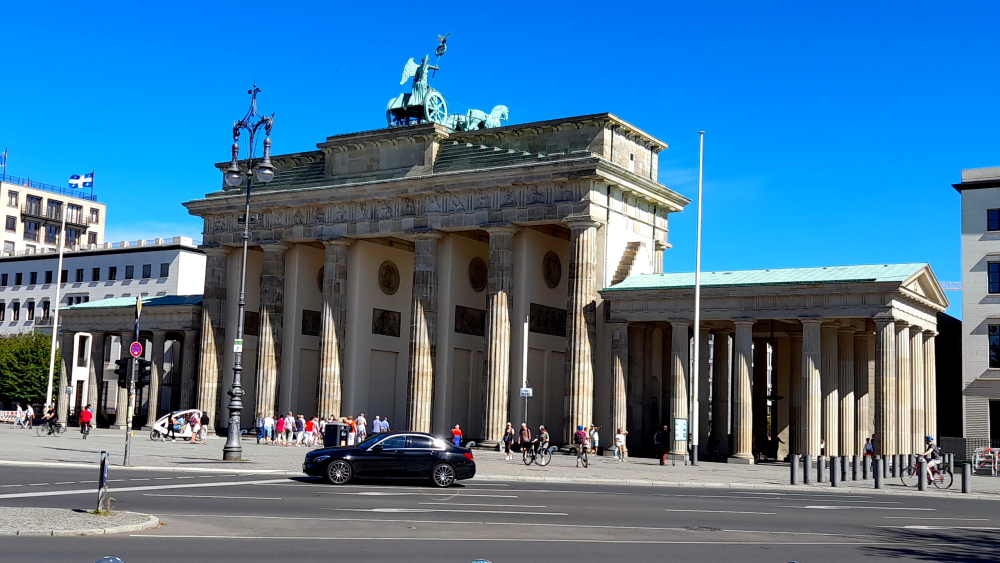
In the next block is the Brandenburg Gate (Brandenburger Tor), an early neoclassical triumphal gate that stands on the west flank of the square Pariser Platz in Berlin’s Mitte district that was built in the years 1789- 1793 on the instructions of the Prussian King Friedrich Wilhelm II according to designs by Carl Gotthard Langhans. The sculpture of the Quadriga crowning the gate is a work designed by the sculptor Johann Gottfried Schadow.
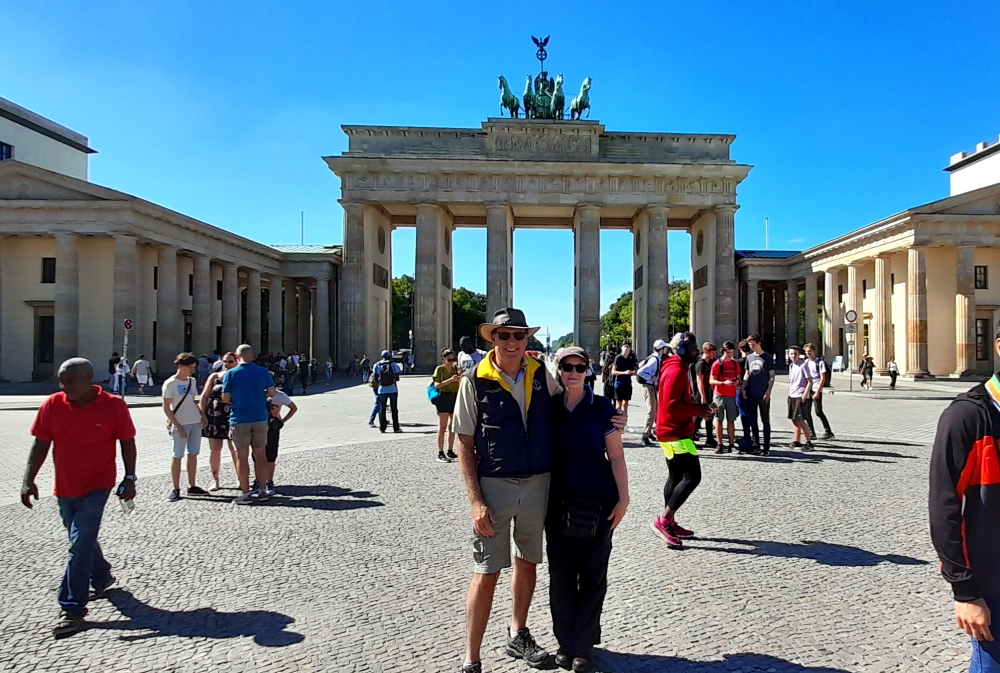
The gate is the only surviving one of the last 18 Berlin city gates. After severe war damage, the gate was restored by 1958. A comprehensive, almost two-year renovation took place in 2002 by the Berlin Monument Protection Foundation.
The gate is the most famous Berlin landmark and a German national symbol, with which many important historical events of the 19th and 20th centuries are connected. After the 1806 Prussian defeat at the Battle of Jena-Auerstedt, Napoleon was the first to use the Brandenburg Gate for a triumphal procession, and took its quadriga to Paris. 8 years later, after Napoleon’s defeat in 1814 and the Prussian occupation of Paris by General Ernst von Pfuel, the quadriga was restored to Berlin. It was now redesigned by Karl Friedrich Schinkel for the new role of the Brandenburg Gate as a Prussian triumphal arch.
Until the Iron Curtain came down, it stood right on the border between East and West Berlin, symbolizing the clash between the Warsaw Pact and NATO during the Cold War. Since 1990 the Brandenburg Gate has also been seen as a symbol of overcoming the division of Germany and Europe.
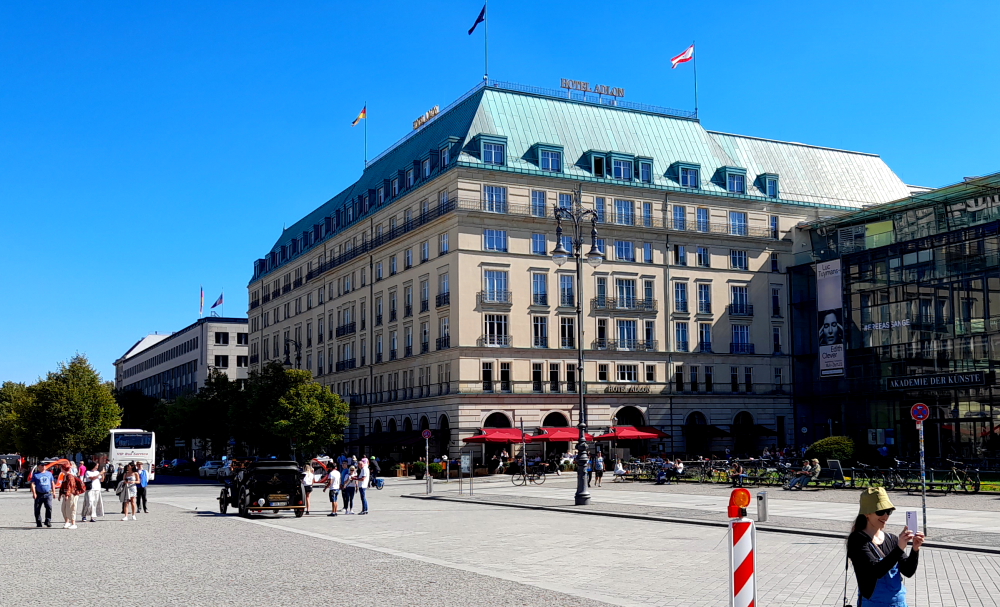
Not to be outdone, facing the Gate is the Hotel Adlon where, on 19 November 2002, the 44-year-old King of Pop (Michael Jackson) showed himself to the waiting fans at the window of his fifth-floor suite shortly after arriving at the Hotel Adlon – and he also presented his youngest son, nine-month-old Prince Michael II. With a white cloth over the baby’s head, he held the baby in one arm over the balcony railing then seemed to lose his grip on the child.
It’s now around 2:00pm and 27 Deg. C. Only another 25 minutes of walking back to the hotel where we can put our feet up.
5 September, 2023
Yesterday’s walk didn’t include the Tiergaten, the Reichstag, nor the ‘Topography of Terrors’ so these are on our agenda today.
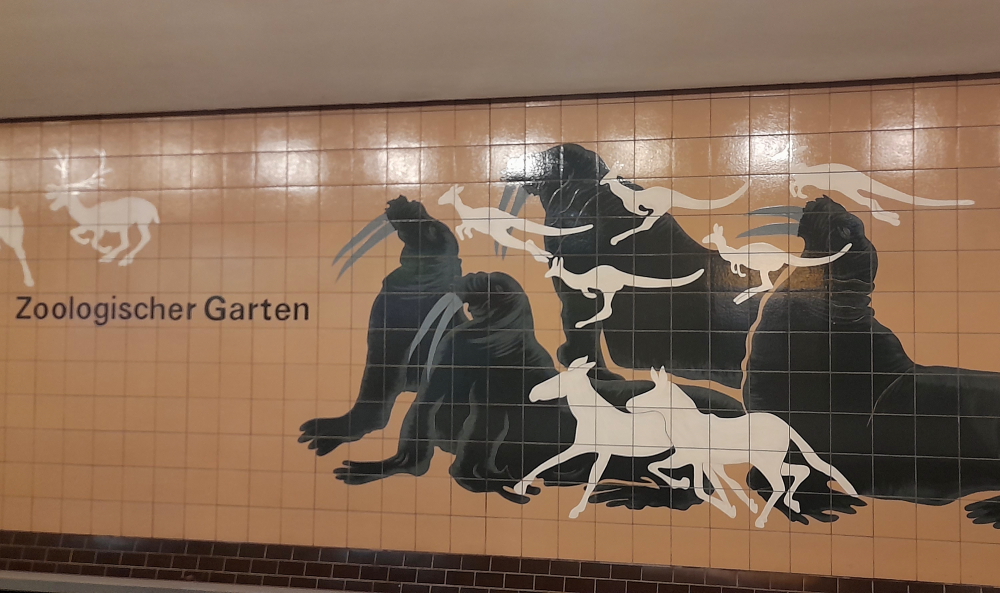
We walk to the Stadtmitte U-bahn station and catch a U2 to Zoologischer Garten, then the U9 to Hansaplatz. A stroll down Altonaer Strasse brings us to the heart of the Tiergarten – the Siegessaule – the Victory Column.
The Victory Column was designed by Johann Heinrich Strack. Construction began in 1865 and took eight years. The winged sculpture of Goddess Victoria on top was designed by Friedrich Drake.
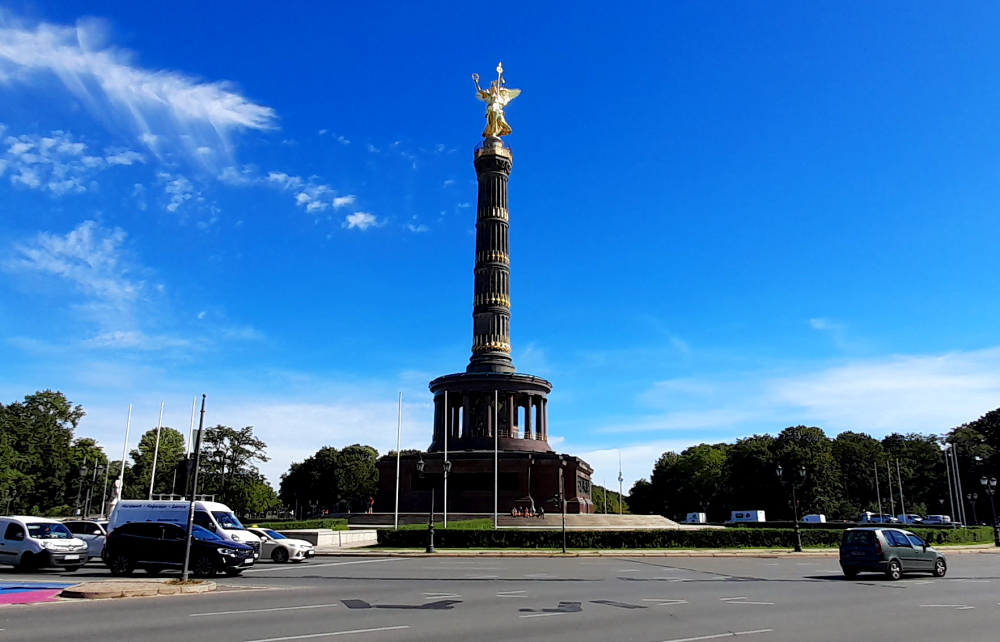
The monument is meant to commemorate Germany’s victories against Denmark, Austria and France between 1864 and 1871, a fact that is indicated by the sculpture’s victorious pose as well as the gilded gun barrels on the columns and the mosaic by Anton von Werner in the colonnade.
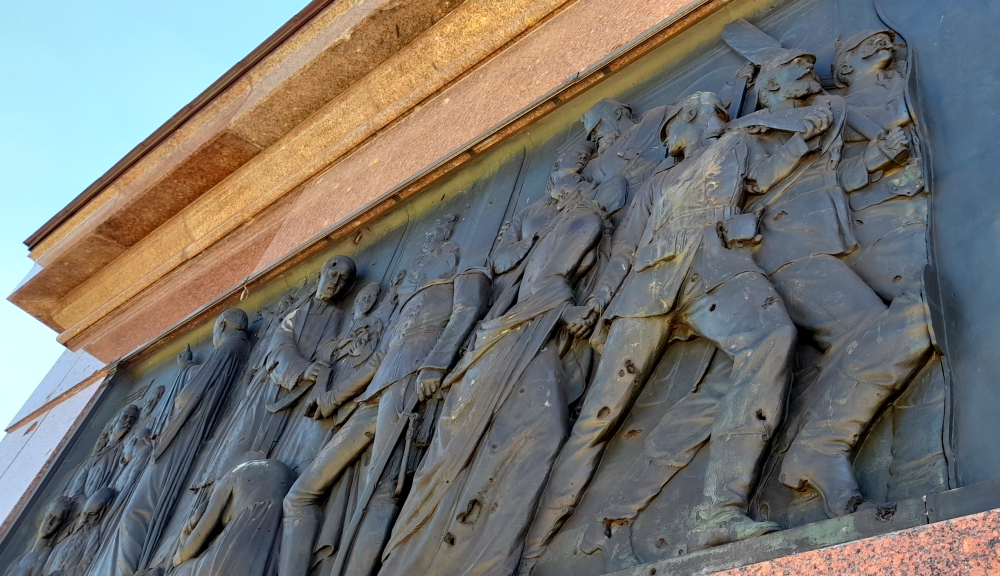
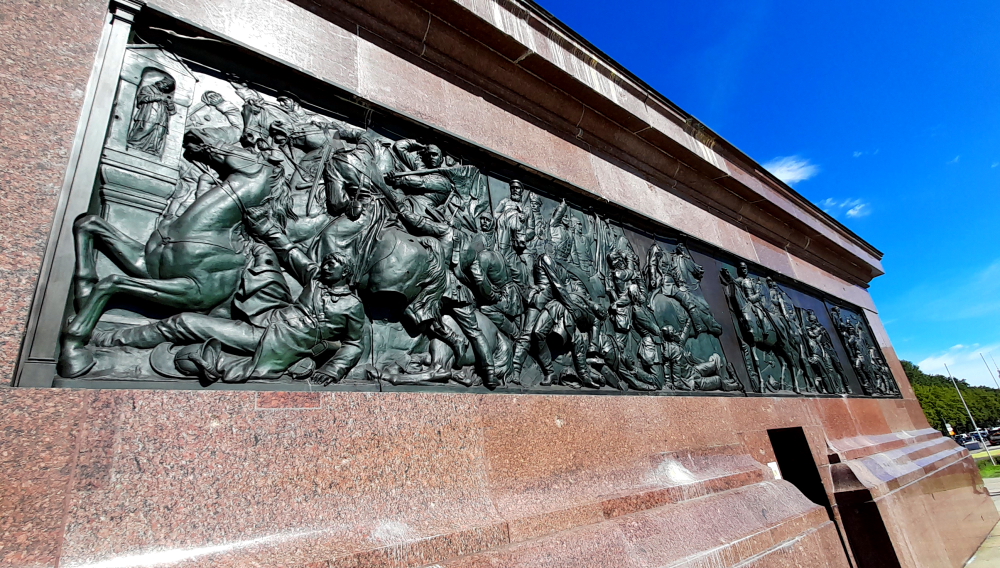
The base is decorated with four bronze reliefs depicting the most important battles of the German wars of unification – the Battle of Düppel in the German-Danish War (1864), the Battle of Königgrätz in the German-German War (1866), the Battle of Sedan in the German- French War (1870) – and the victorious entry of the allied troops into Berlin (1871).
We exit the monument and walk for 30 minutes through the Tiergarten on a path parallel to the Strasse des 17 Juni, towards the Brandenburg Gate.
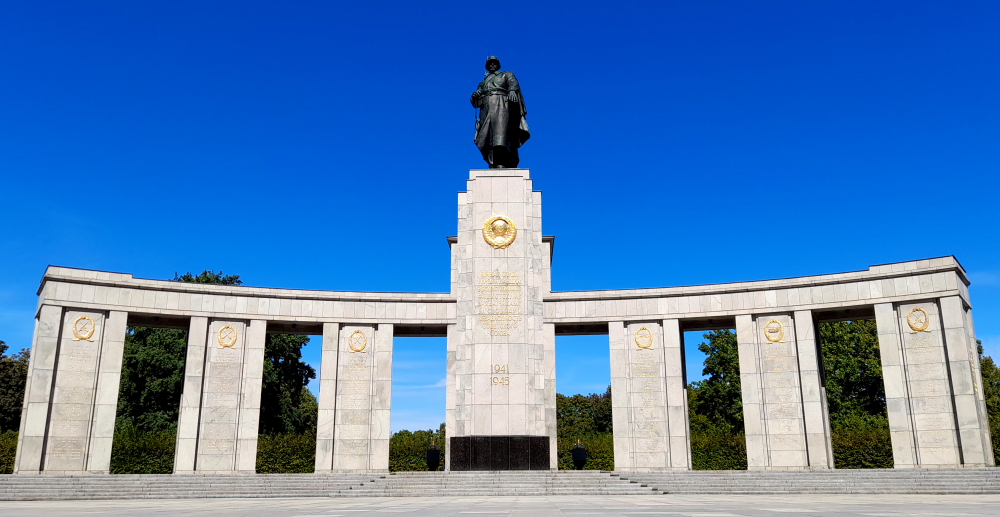
Just before we reach Ebertstrasse, we call into the Soviet War Memorial which is stark and intimidating with 2 tanks sitting on each side.
Then off to the left is the Reichstag. Typically, it is surrounded by temporary fencing with the forecourt ripped up and pile drivers by the fence. The view from here doesn’t show the odd glass dome that tops the roof at the centre of the building. Looks a bit like the Hiroshima Dome, but with glazing. Later we see from historical photos that there used to be a large copper dome with squared-away edges.
The Reichstag building was built between 1884 and 1894 according to plans by Paul Wallot. With the proclamation of the German Empire in 1871, Berlin became the capital of the empire. Wallot wanted to create a representative and monumental building, so he combined elements of Renaissance, Baroque and Classicism.
The inscription in the gable “Dem Deutschen Volke”, which is still preserved today, was only added in 1916. The Reichstag was badly damaged during the war and was not used again for the time being. The dome had to be blown up for structural reasons.
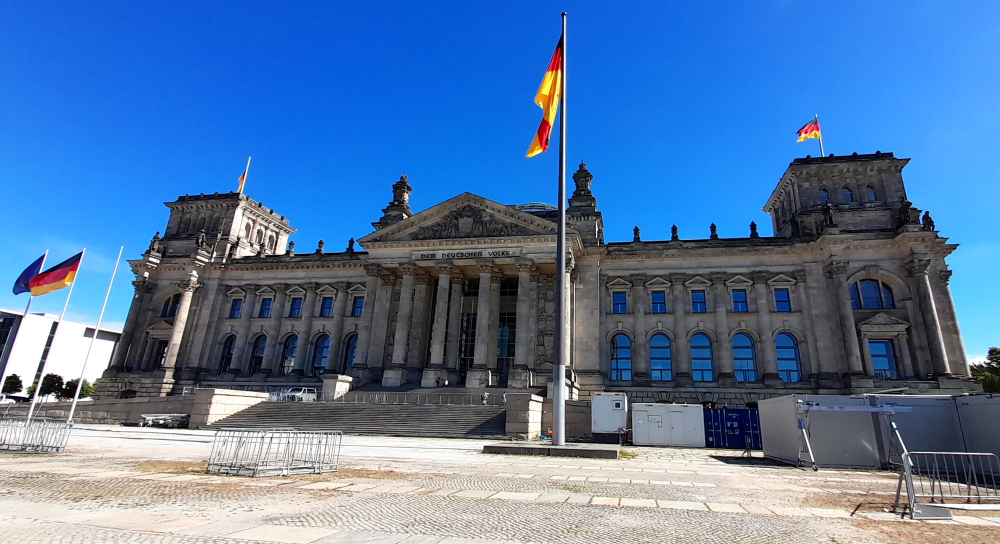
A first conversion began in 1957 by Paul Baumgarten. Baumgarten glazed the plenary hall and pushed back almost all of the building’s historic features. In a second conversion phase from 1994, the British architect Sir Norman Foster implemented his designs for the glass dome, among other things.
The Reichstag building has been the seat of the German Bundestag since 1990 with the first session of the Bundestag in the new Reichstag building on April 19, 1999.
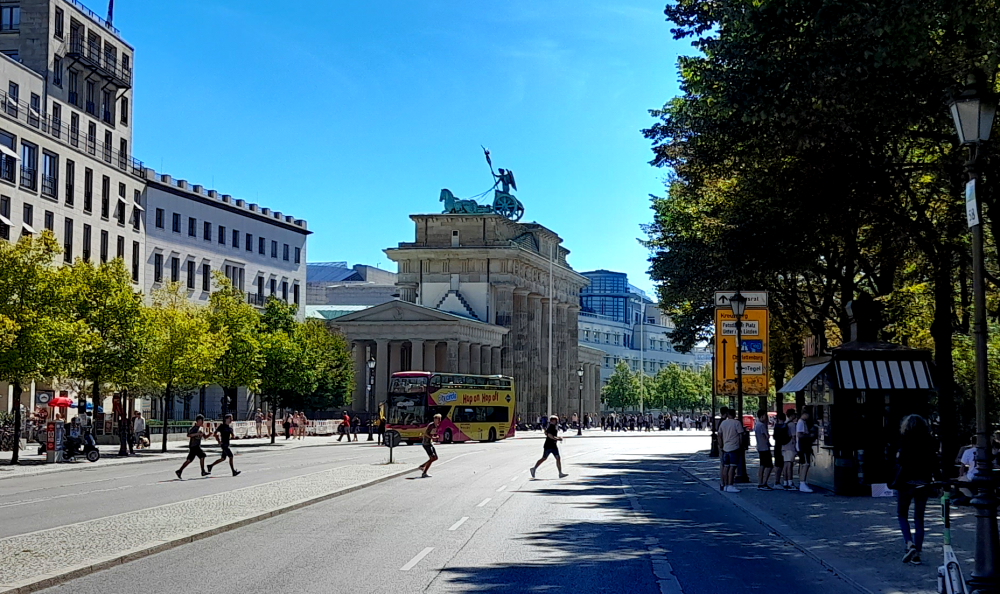
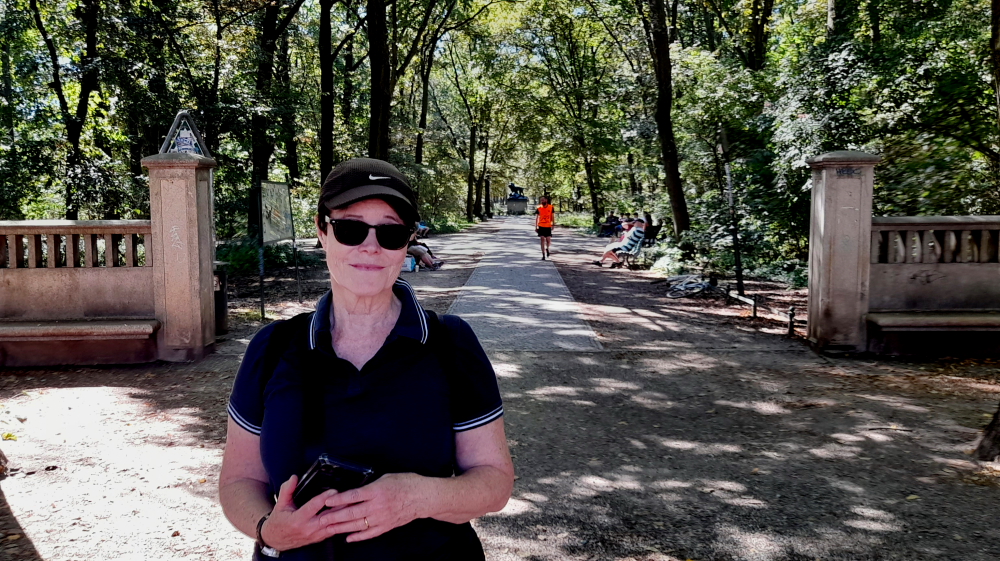
We turn right and walk along Ebertstrasse between the rear of the Brandenburg Gate and the Tiergarten. The Tiergarten is the green heart of Berlin. Between the Brandenburg Gate and the zoo, the park, with its large meadows and shady trees, offers plenty of space for relaxation, sport and leisure. It’s three kilometers wide and one kilometer deep, and looks like an inner-city island.
The Tiergarten repeatedly suffered major damage during World War II. Especially the last year of the war and the fighting in the center of Berlin were catastrophic for the park. After the war, the park was almost completely cleared by Berliners looking for firewood. The reforestation of the park began in 1949 and at that time could only be carried out with tree donations from other German cities.
From here we can see the Reichstag dome more clearly. The 800-ton structure made of steel and glass measures 40 meters in diameter and 23.5 meters in height. On the inside, two spiral paths wind up to the viewing platform and back down to the roof terrace.
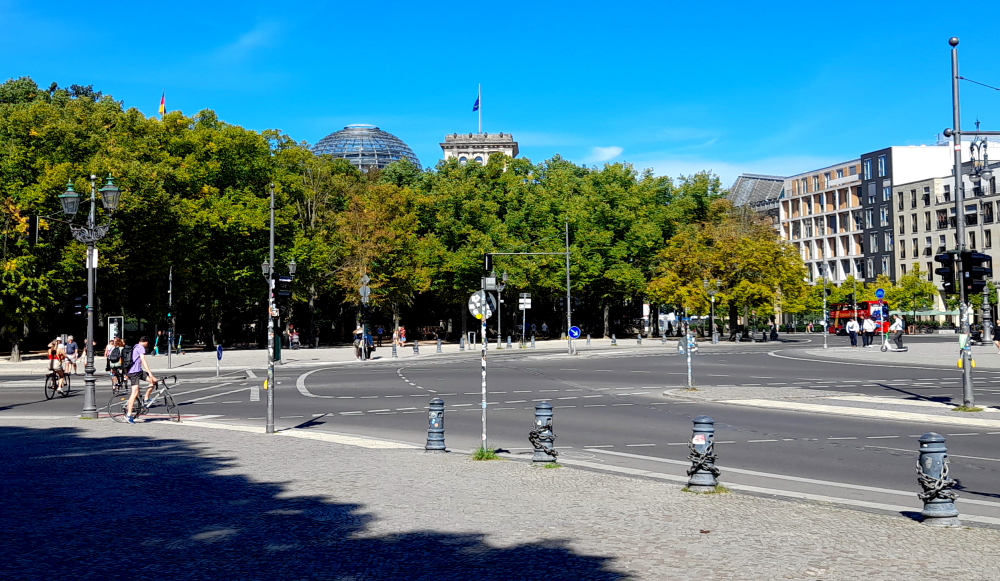
At the end of Ebertstrasse is Potsdamer Platz. The Potsdam Gate was built in 1734 during the construction of the Berlin customs and excise wall. With the Potsdam long-distance train station , the underground station and the numerous tram and bus lines , Potsdamer Platz was one of the busiest places in Europe until the end of the Second World War.
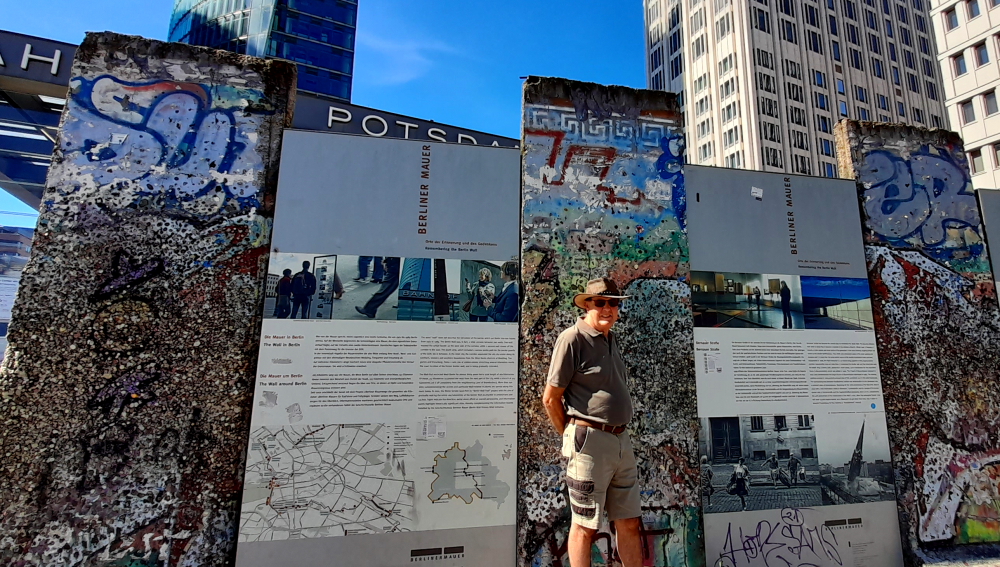
After the end of the war , Potsdamer Platz formed a “border triangle” between the Soviet, British and American sectors in the divided Berlin . From August 1961, the Berlin Wall ran across the square, which for almost three decades eked out a marginal existence as inner-city wasteland . After the Wall came down on November 9, 1989, a new situation arose: early in the morning of November 12, a section of the Wall at Potsdamer Platz was cleared and a provisional border crossing created.
10 minutes’ walk away is the “Topography of Terrors”.
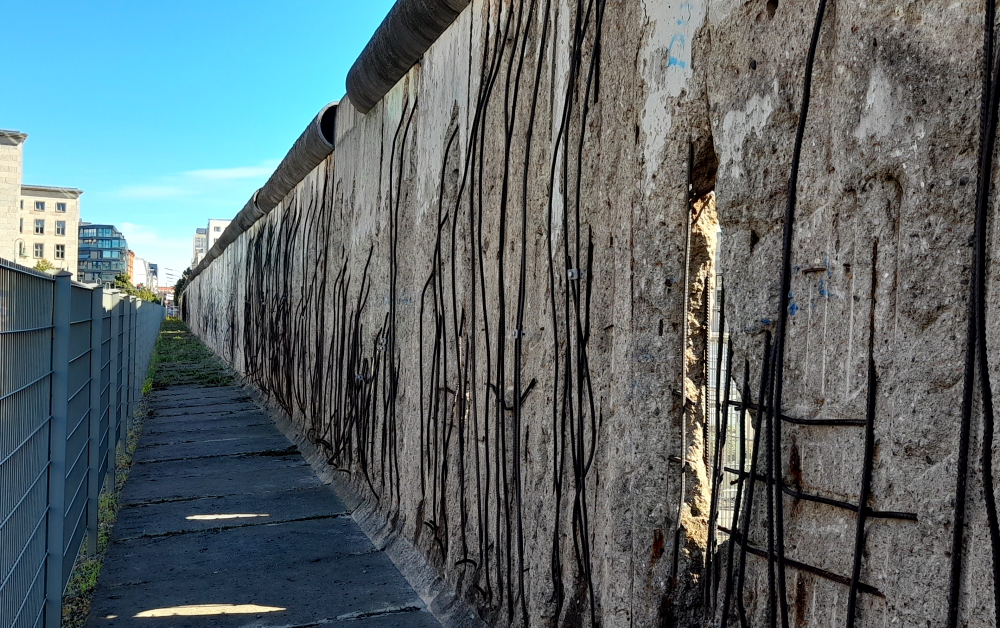
It’s located on Niederkirchnerstrasse, formerly Prinz-Albrecht-Strasse, on the site of buildings, which during the Nazi regime from 1933 to 1945 were the SS Reich Security Main Office, the headquarters of the Sicherheitspolizei, SD, Einsatzgruppen and Gestapo.
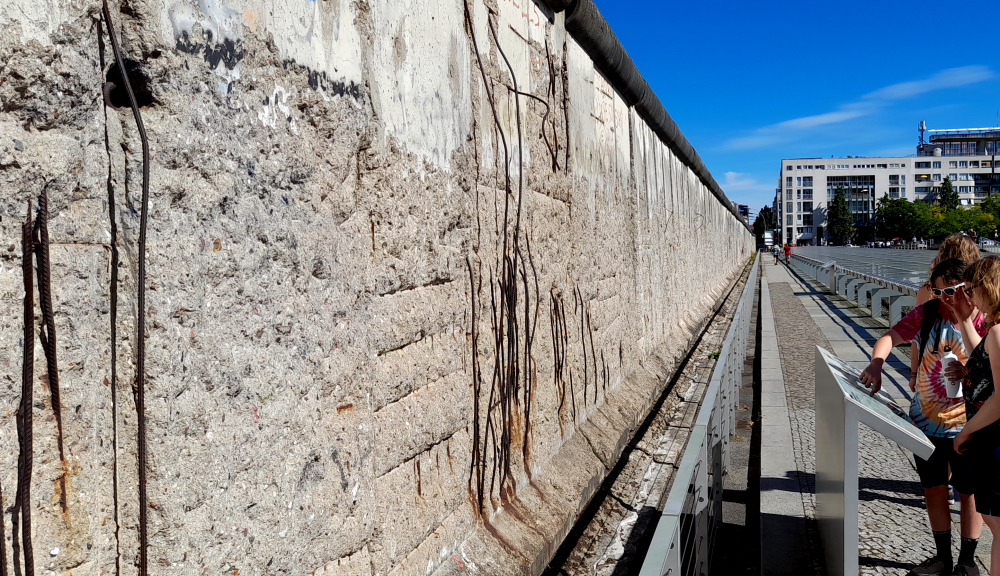
The buildings that housed the Gestapo and SS headquarters were largely destroyed by Allied bombing during early 1945 and the ruins demolished after the war. The boundary between the American and Soviet zones of occupation in Berlin ran along the Prinz-Albrecht-Strasse, so the street soon became a fortified boundary, and the Berlin Wall ran along the south side of the street, renamed Niederkirchnerstrasse, from 1961 to 1989. The wall here was never demolished.
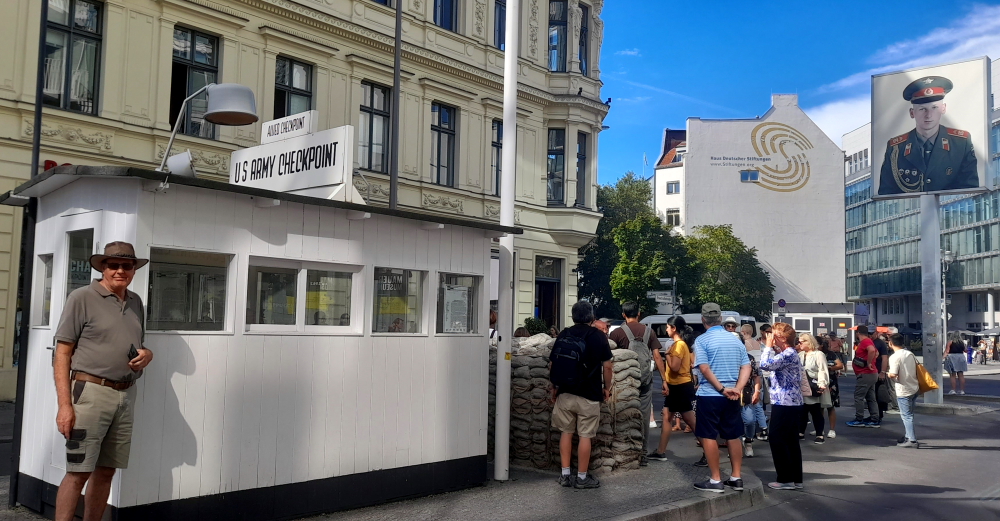
Lastly, a walk past Checkpoint Charlie on our way back to the hotel.
5 September, 2023
I don’t like Street Art, but my wife does. Lynn has booked herself on another walking tour this morning entitled: “Berlin Wall – Graffiti and Street Art in Kreuzberg”. Another journey on the U-bahn, she arrives at the meeting point by 10:00am, along with 20, like-minded beings.
Berlin has long been a global capital of street art. From the murals that covered the west side of the Berlin Wall during the Cold War, to the pieces found across the city today, few creative progressions explore the intersection of art, society and politics quite like graffiti. With a mission to reclaim public space, graffiti transforms this city’s walls into enormous, always-evolving galleries.
At the time of the Berlin Wall, the smaller post code area of SO 36 in Kreuzberg was surrounded on three sides and developed an alternative culture of its own on the eastern edge of West Berlin. Here David Bowie, Iggy Pop, Nick Cave, Depeche Mode, among others, created an alternative and counterculture atmosphere that is still lived in its streets today.
“Graffiti is 100% art,” says Dan Pearce (mixed media artist). “It’s a symbol of rebellion, and it presents a fantastic new form of creativity, but what makes it art is an individual’s opinion” – think Banksy. But there is a moral line that shouldn’t be crossed. “Graffiti can fall into the category of vandalism or ‘defacing’ when it is a random tag on any old wall that has no meaning,” he accepts. Street art, on the other hand, can be thought of as (licensed), image-based artistic expression in a public space – think large-scale installations commissioned by local councils or communities.
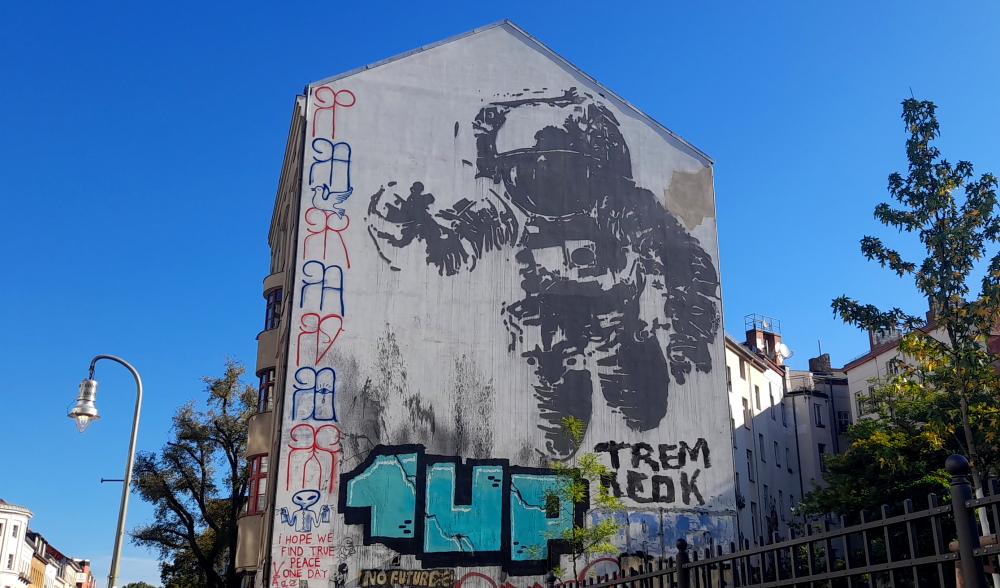
One famous artist is Victor Ash. His ‘Astronaut/Cosmonaut’ might be one of the most recognized works of graffiti art in the world. Reprinted on tee shirts, postcards, poster prints and stickers this mural is prominently displayed on the side of a white cement building in the Kreuzberg district of Berlin. ‘Astronaut/Cosmonaut’ tells the story of a spaceman suspended in both atmosphere and time. His face is obstructed by his helmet and black paint drips past his frame and all the way down the wall. The painter himself has been working in the graffiti art medium since the early 1980s and is considered one of the pioneers of contemporary Berlin street art. His pieces always aim to comment on present-day issues, especially those significant to the city’s youth.
Today, however, his ‘canvas’ has been encroached upon by other graffiti-ists, such as 1UP and slightly more respectfully, Paradox.
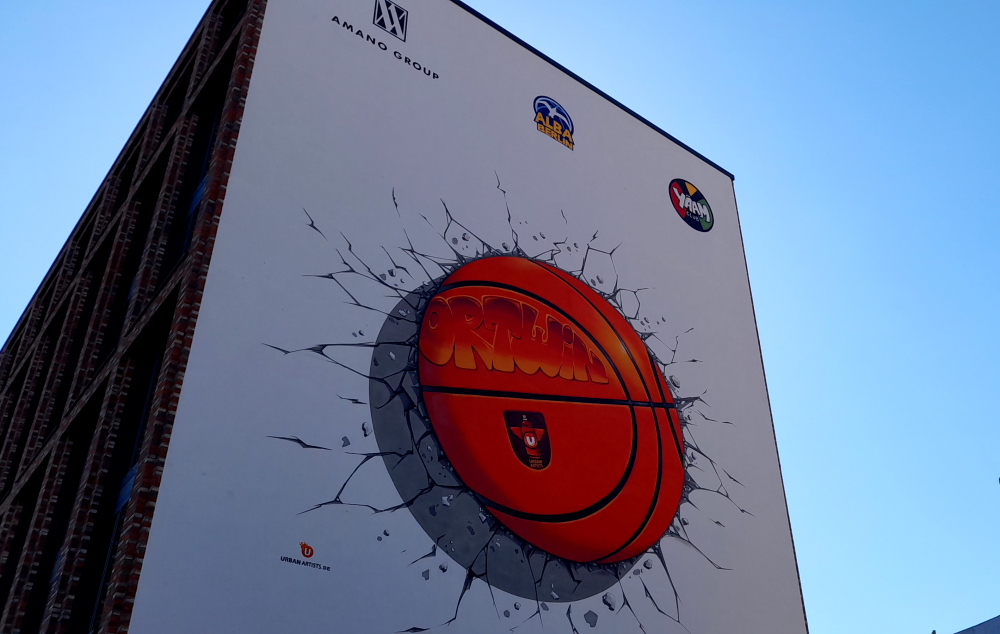
A more recent phenomenon has been the commissioning of artwork on buildings for advertising purposes, rather than massive advertising posters. The above done by Urban Artists.de.
After wandering through the neighbourhood learning about various graffiti collectives and identifying their work, techniques and messages, the tour crosses the River Spree and eventually comes to the East Side Gallery.
Once it was the Berlin Wall. Now it’s the longest open-air gallery in the world. At 1,316 metres long, the open-air art gallery on the banks of the Spree in Friedrichshain is the longest continuous section of the Berlin Wall still in existence. Immediately after the wall came down, 118 artists from 21 countries began painting the East Side Gallery, and it officially opened as an open air gallery on 28 September 1990. Just over a year later, it was given protected memorial status.
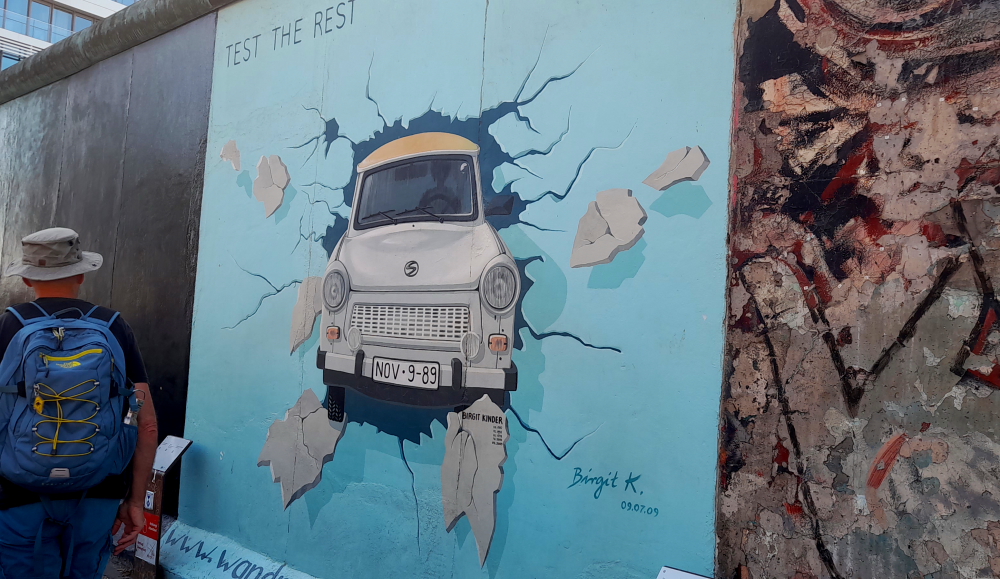
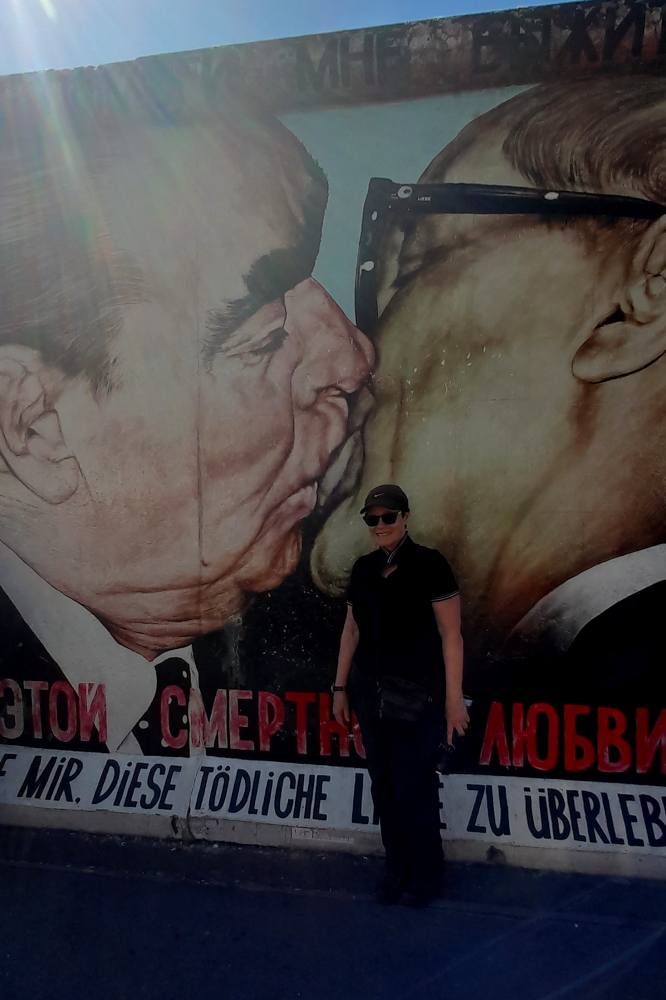
In more than a hundred paintings on what was the east side of the wall, the artists commented on the political changes in 1989/90. Some of the works at the East Side Gallery are particularly popular, such as Dmitri Vrubel’s Fraternal Kiss and Birgit Kinders’s Trabant breaking through the wall.
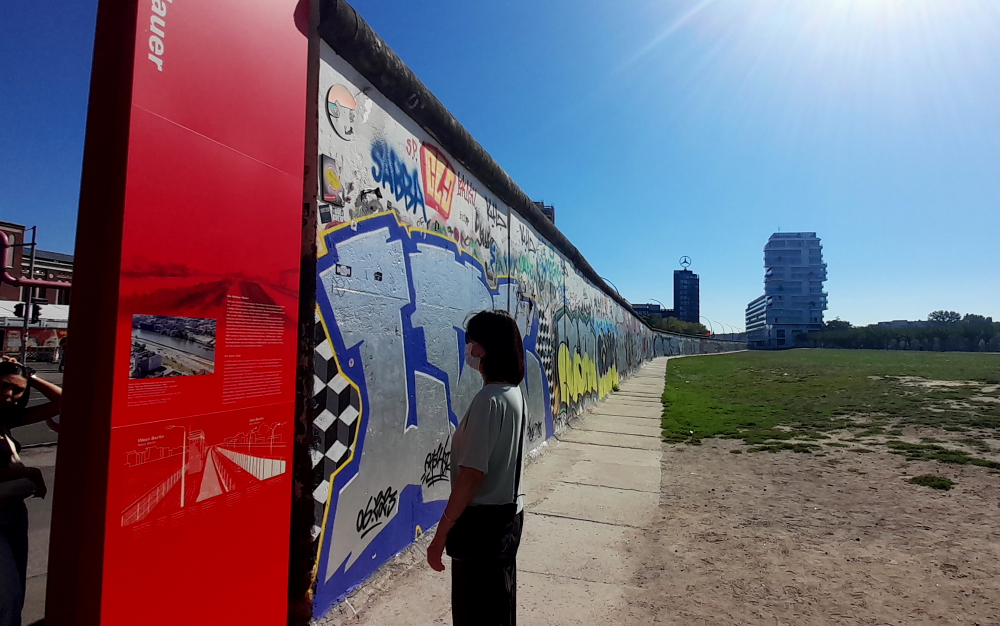
Two-thirds of the paintings were badly damaged by erosion, graffiti, and vandalism and have been subject to remediation in 2000 and 2009, so instead of the originals from 1989/90, only the replicas from 2009 exist today.
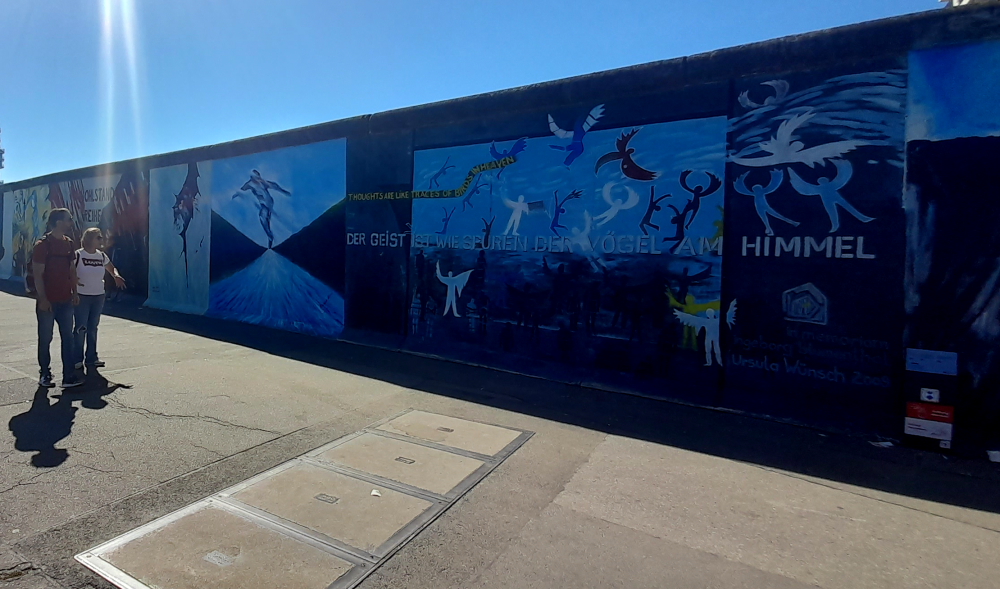
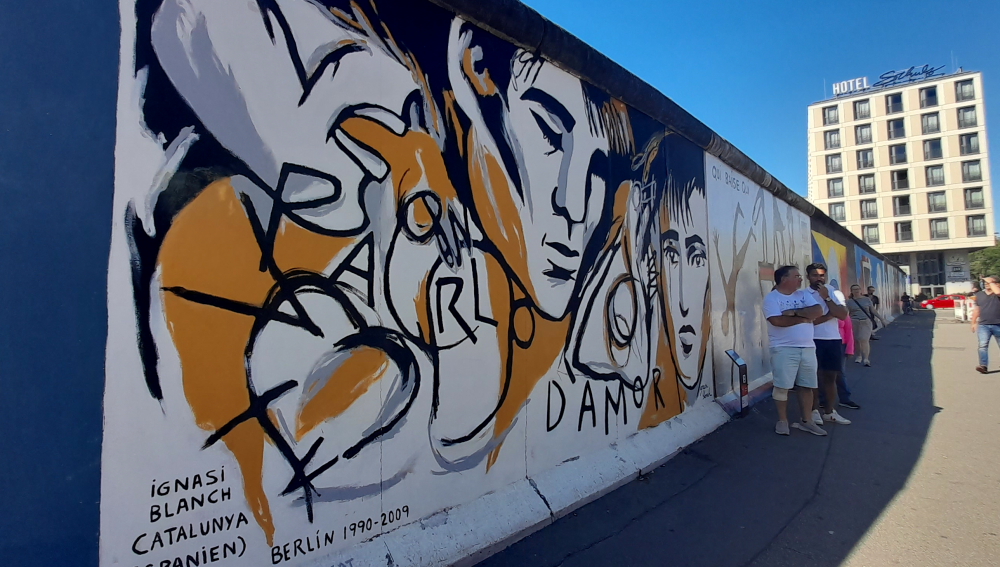
Paintings from Jürgen Grosse alias INDIANO, Dimitri Vrubel, Siegfrid Santoni, Bodo Sperling, Kasra Alavi, Kani Alavi, Jim Avignon, Thierry Noir, Ingeborg Blumenthal, Ignasi Blanch i Gisbert, Kim Prisu, Hervé Morlay VR and others have followed. The paintings at the East Side Gallery document a time of change and express the euphoria and great hopes for a better, more free future for all people of the world.
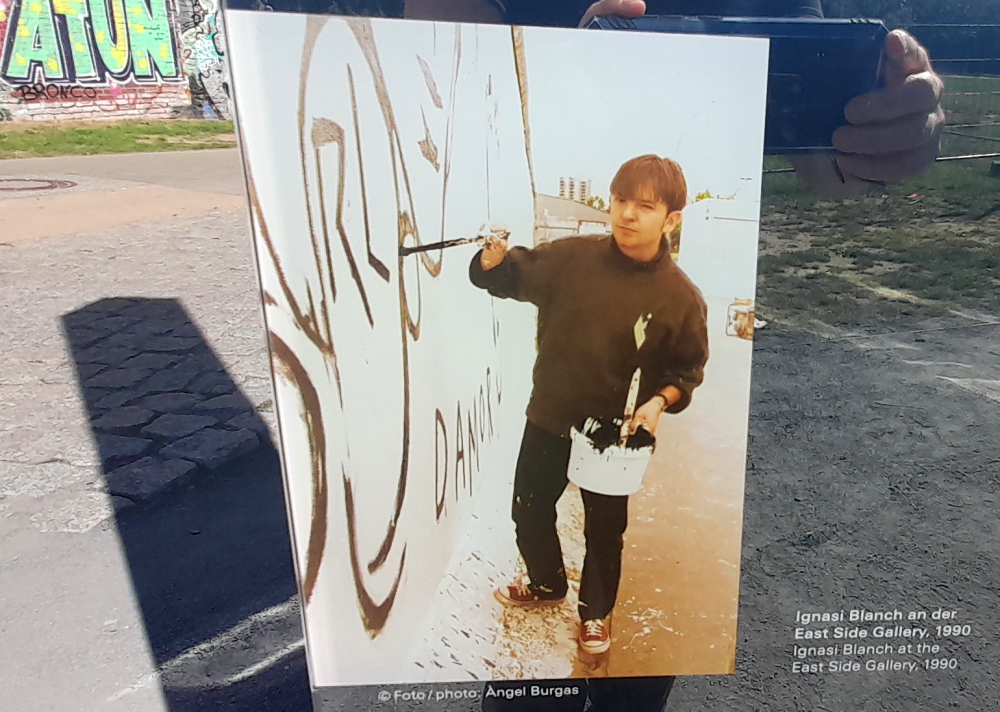
Below is a photo of Ignasi Blanch at work on the Wall in 1990.
And here is the finished product, preserved today.
According to Kinder: “The Trabi is a symbol for the East with its corners and edges, narrow and eternally gray security, little technical progress and stinking loud. Completely made of plastic, it offered little driving comfort and safety. The Wall was a military bulwark of the division of Berlin, Germany, Europe and the world. Now this unstable little Trabi bangs through this thick wall, with the urge for freedom!!! However, the Trabi is not damaged in any way – not even the mirror is off. This is my metaphor for the “PEACEFUL REVOLUTION” – no bloodbath, no war!!! Instead, dancing people between the Brandenburg Gate and the Reichstag. Only through the painting of artists from all over the world has the wall now become a meeting place for people from Berlin, from Germany, from Europe and from all over the world. We artists have achieved that the whole world meets peacefully at the ESG for dialogue. It is only through our pictures that the testimony of the division as a whole is almost completely preserved.
The title “TEST THE BEST” is exemplary for the many Trabis that drove over immediately after the fall of the Berlin Wall to test the West for the best, but then to be able to confidently drive home again. Despite the shortage, many East Germans have created a beautiful home for themselves that they did not want to give up.”
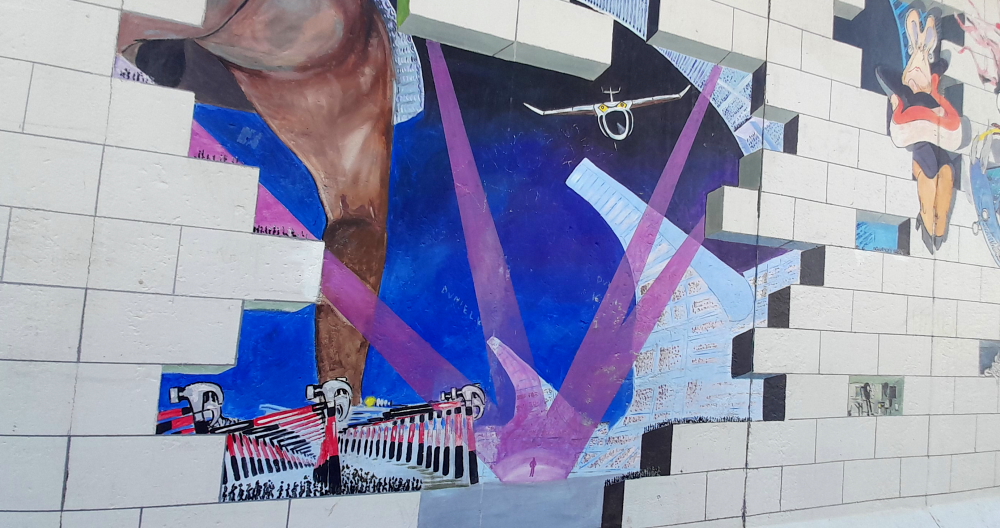
Lance Keller is an American artist. At the end of the 1980s he was in West Berlin, where he painted murals in restaurants. In 1990 he transferred the cover photo of the album “The Wall” (“Die Mauer”) by the rock band Pink Floyd from 1979 to the Berlin Wall as an oversized copy.
The enlarged copy of the cover photo of Pink Floyd ‘s album “The Wall” was apparently made on the occasion of the rock band’s concert on July 21, 1990 in the border strip at Potsdamer Platz. The original from 1979 comes from the artist Gerald Scarfe. In the picture, figures distorted like monsters look through gaps in a white wall. In the center marches an army of hammers.
“My God, Help Me to Survive This Deadly Love”, sometimes referred to as the “Fraternal Kiss” (Bruderkuss), is a graffiti painting by Dmitri Vrubel on the eastern side Berlin wall. Painted in 1990, it has become one of the best known pieces of Berlin wall graffiti art. The painting depicts Leonid Brezhnev and Erich Honecker in a socialist fraternal kiss, reproducing a photograph taken in 1979 during the 30th anniversary celebration of the foundation of the German Democratic Republic.
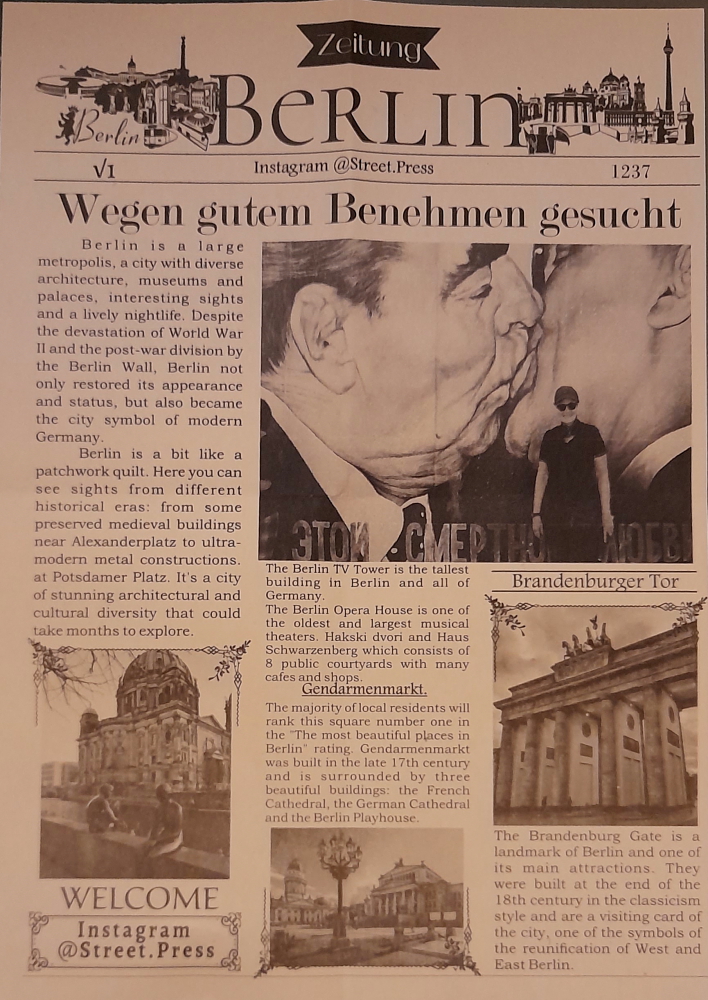
At the end of the Gallery, the tour continues over the Oberbaumbrucke Bridge and next to the elevated railway line is another of Berlin’s famous murals.
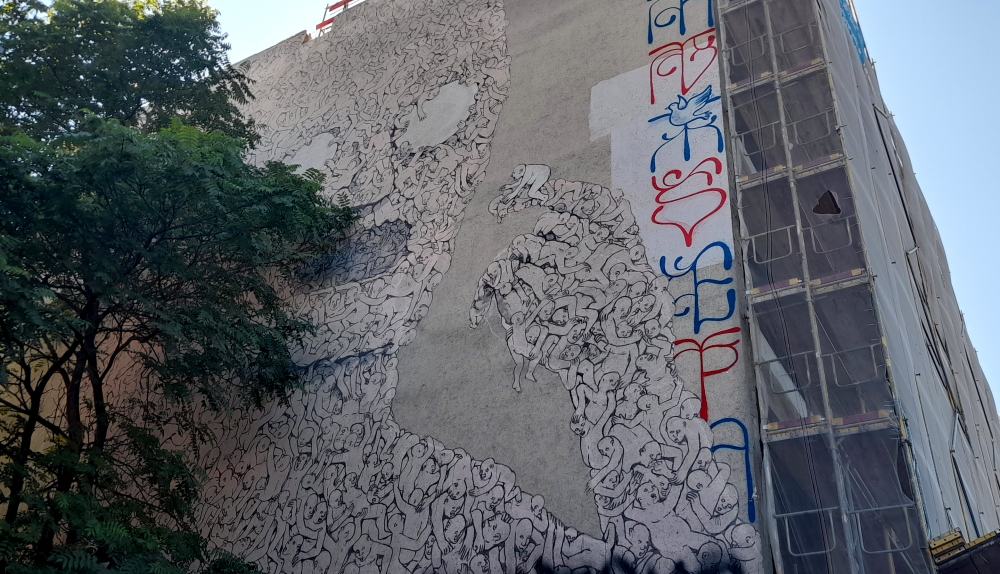
BLU’s ‘The Pink Man’ is an enormous mural visible from the Oberbaum Bridge in Berlin’s Kreuzberg district, and one of the most famous works of graffiti art in the city. ‘The Pink Man’ features a building-sized monster made up of hundreds of tiny, naked humans clinging to one another in fear. The monster, mouth gaping, appears ready to consume one of the miniature humans.
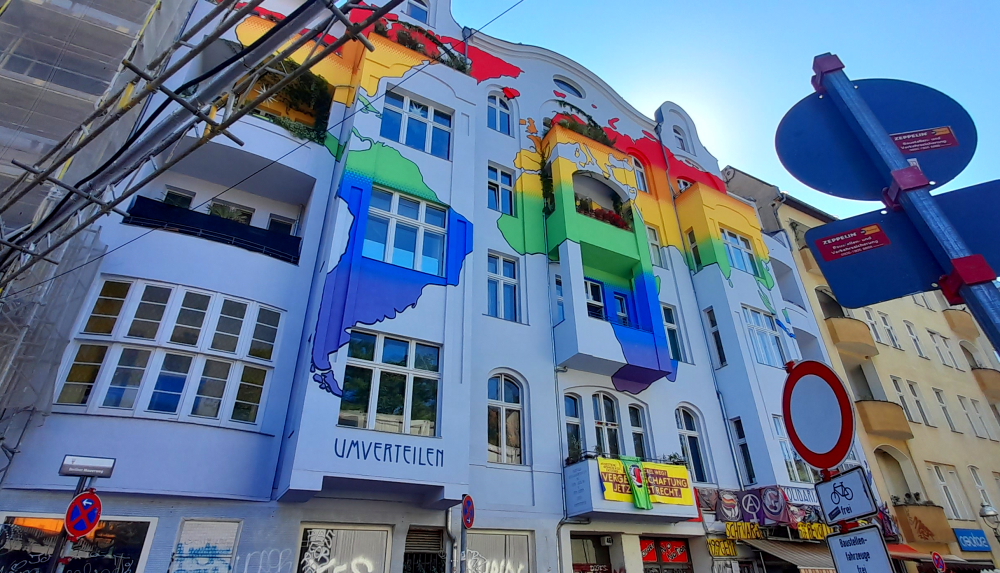
Lastly, nearby, is a recently-painted mural on an apartment building entitled: “No Border. No Nation”.
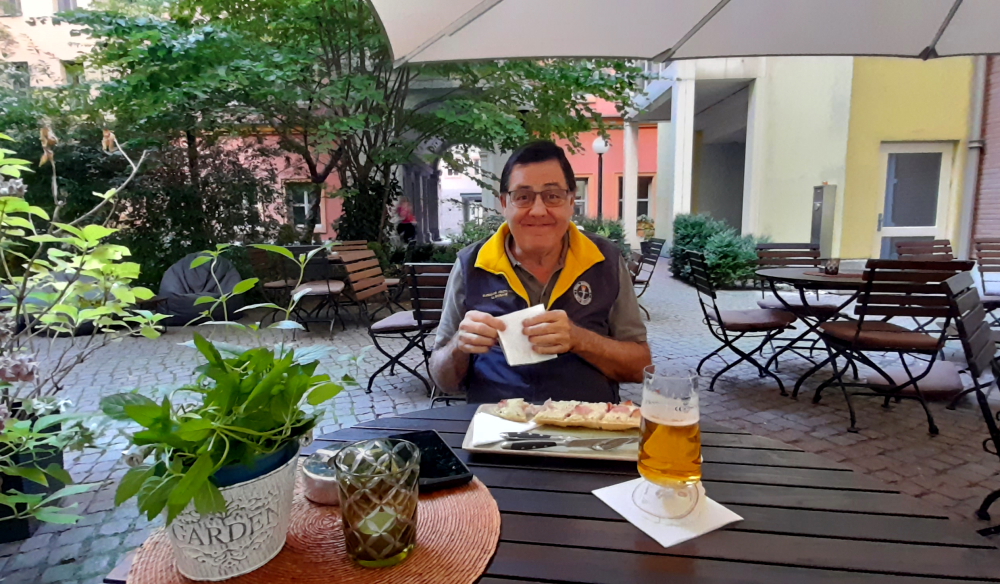
After a 2.5 hour walk in 29 Deg. C. heat everyone is ready for a very cold beer.
7 September, 2023
Today has been a very frustration and unproductive day. We have one last hotel booking to complete for the France / Spain trip for November / December / January / February. We also have to book the car ferry from Folkstone in the UK to Calais and return.
It has taken all day! Firstly HSBC in their wisdom has decided that they don’t like the activity on Lynn’s Global Money card so they put a stop on it. We only found out because her card and then my Everyday Global card were rejected by the tunnel train company. We spent hours getting both cards operating again. It seems that HSBC security system is so secure that you can’t actually use your own accounts. If we had another option we would tell them where to stick their accounts. Not Happy Jan!
Trying to find suitable accommodation from Ardres, France to Calais was also as frustrating. It seems that the French in this area really don’t care about quality accommodation. Perhaps they only cater for the English crossing the channel for an overnight stay to stock up on duty free wine.
Tomorrow morning we are heading to Rostock, Germany to spend a week with our dear friends Anne and Jurgen who we met back in 2016 in Halong Bay, Vietnam. We have been trying to visit with them since that date and finally we get to see them again.
We spend the evening frantically repacking so we can get on the road before 11 am tomorrow.
 THE CONTINUING TRAVELS OF YOGI & BOO BOO