
24 August, 2023
Today is our first full day of 5 in Warsaw, Poland. We have 11 days in Poland as we head west to Germany on the first leg of our 3 month trip around Northern Europe. We will be returning to Poland and finish the tour back here in Warsaw in November where it will be much closer to 4 Deg C than the 27 Deg C expected today.
This afternoon Lynn has booked us on a 2.5 hour, free GuruWalk tour – Warsaw Old Town and Royal Route.
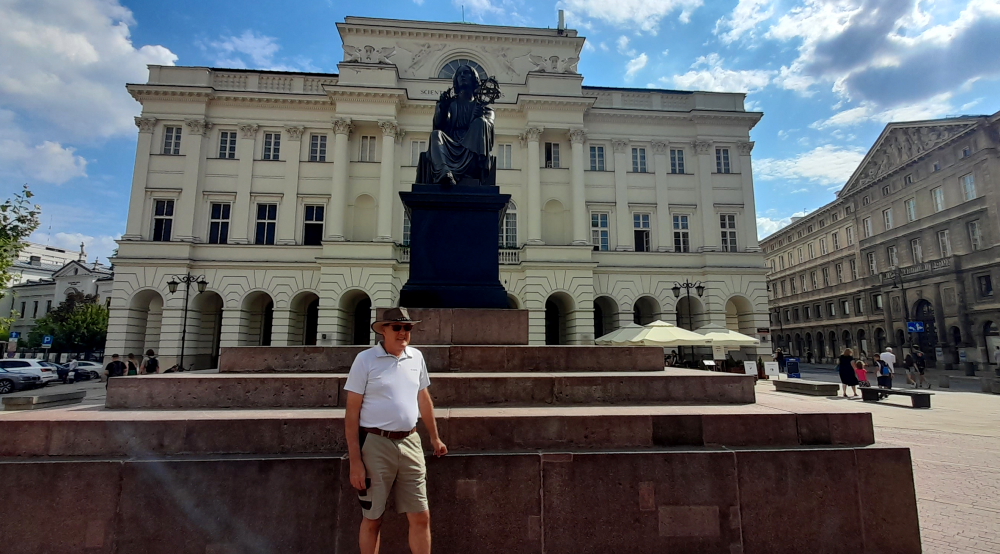
The meeting point is an 18-minute walk from our Mercure Hotel on Krucza to the Copernicus monument in front of the Staszic Palace, the seat of the Polish Academy of Sciences on Krakowskie Przedmieście. Designed by Danish sculptor, Bertel Thorvaldsen in 1822 and completed in 1830 it is a bronze statue of Renaissance astronomer Nicolaus Copernicus holding a compass and armillary sphere.
Copernicus (1473-1543) was born and died in Royal Prussia, a region that had been part of the Kingdom of Poland since 1466. He was a Renaissance mathematician, astronomer, physician, classics scholar, translator, governor, diplomat, and economist. He formulated a model of the universe that placed the Sun rather than Earth at its center. The publication of this model in his book De revolutionibus orbium coelestium (On the Revolutions of the Celestial Spheres), just before his death in 1543, was a major event in the history of science. In 1517 he derived a quantity theory of money—a key concept in economics—and in 1519 he formulated an economic principle that later came to be called Gresham’s law.
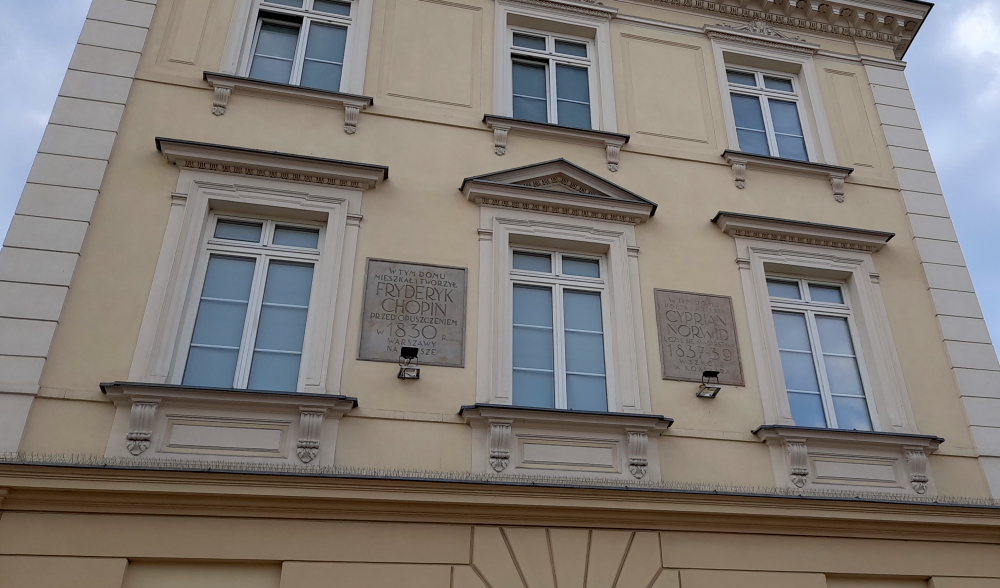
Fryderyk Chopin (1810-1849), a Polish composer and virtuoso pianist of the Romantic period who wrote primarily for solo piano, spent his childhood and early youth in Warsaw. The Chopin family lived on the second floor in the left wing of the Czapski Palace. The building also housed the Warsaw Lyceum, which Chopin attended. Chopin spent his last years here before leaving the country permanently in 1830. It was here that he composed two concertos recognised as his most important works of his Warsaw period – Concerto in F Minor op. 21 and Concerto in E Minor op. 11, hailed by the press as “the work of a genius”.
On the footpath in front of this building, and in other places related to Chopin, there are multimedia benches which offer information about the composer’s work and life and a button to press on each to hear one of his compositions.
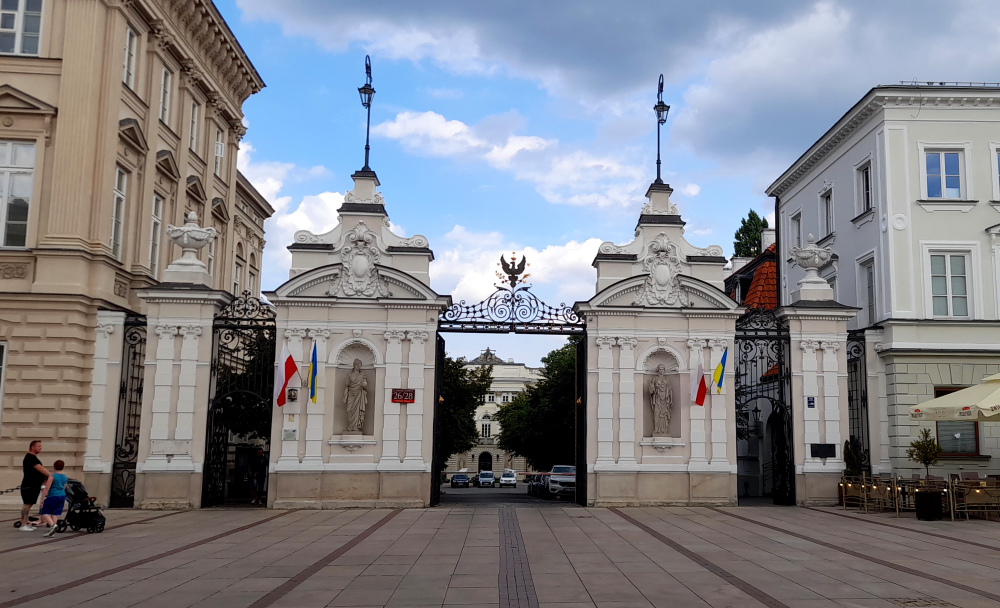
Across the street are the gates to the public University of Warsaw. Established in 1816, it is the largest institution of higher learning in the country offering 37 different fields of study as well as 100 specializations in humanities, technical, and the natural sciences. It had a fraught history of opening and closing due to occupations, political tensions and war from 1816 to the present day.
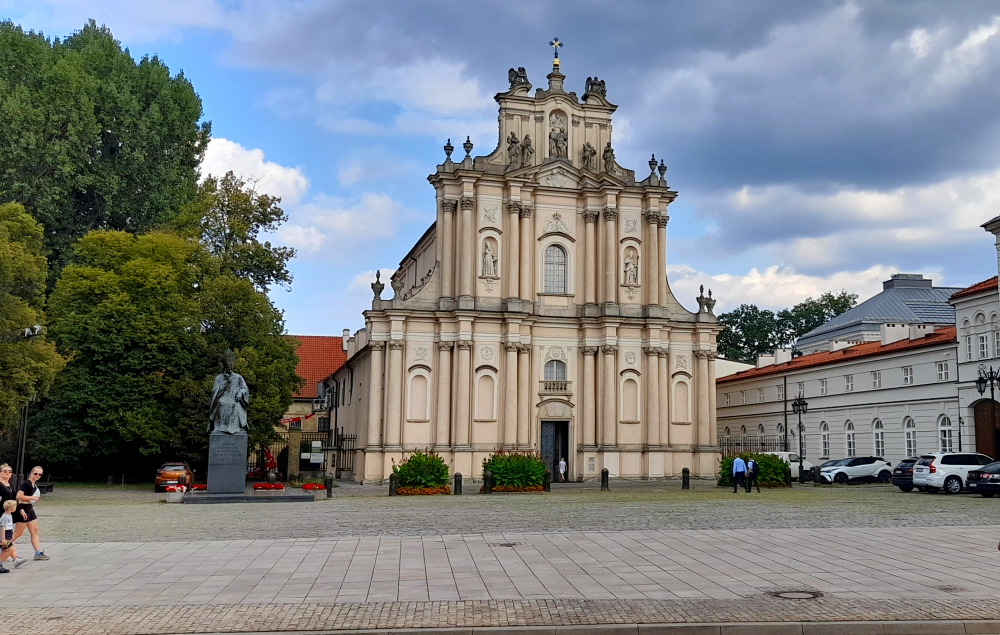
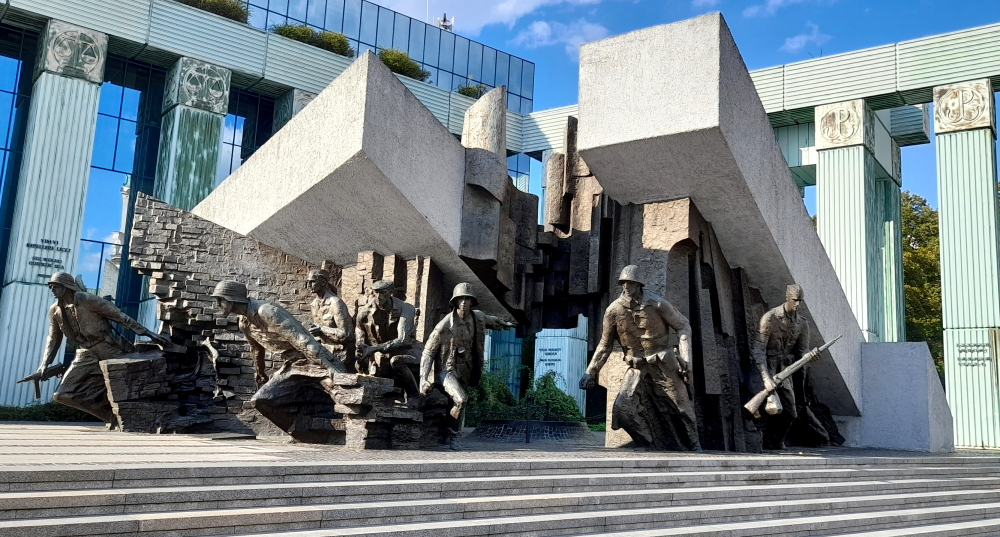
Further along Krakowskie Przedmieście is the Roman Catholic Church of the Visitants. This 17th-century church survived World War II and preserves to this day most of its original decoration.
Bernardo Bellotto (c. 1721/2-1780), was an Italian urban landscape painter or vedutista. He was also the student/nephew of Canaletto and sometimes used the latter’s illustrious name. He is famous for his vedute of European cities – Dresden, Vienna, Turin, and Warsaw – where he drew this church. His style was characterized by elaborate representation of architectural and natural vistas and it is plausible that he may have used the camera obsura in order to achieve this superior precision of urban views.
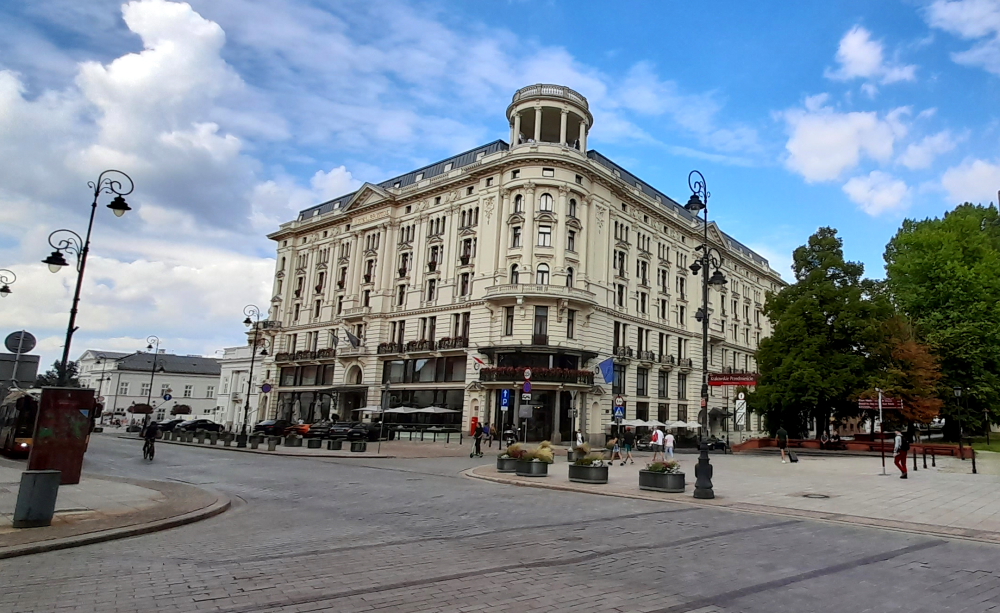
Nearby is the Bristol Hotel, a 5-star hotel of The Luxury Collection hotel chain and in the immediate vicinity of the Presidential Palace. Originally, the site of the hotel (second half of the 19th century) was the Tarnowski Palace. In 1901 the hotel opened with many innovative features such as a power station, central heating, elevators, telephones and electric omnibuses used to serve guests. Like most Warsaw buildings its success fluctuated with history’s events. It was due to the Nazis’ occupation of the building that is was spared destruction during WWII.
After many years of renovation, it was restored and reopened in 1993 with Margaret Thatcher officially opening the hotel. During its many years of history, the hotel has become famous for its guests, balls and parties on such occasions as receiving the Nobel Prize by Maria Skłodowska-Curie or the successes of the operetta singer Lucyna Messal.
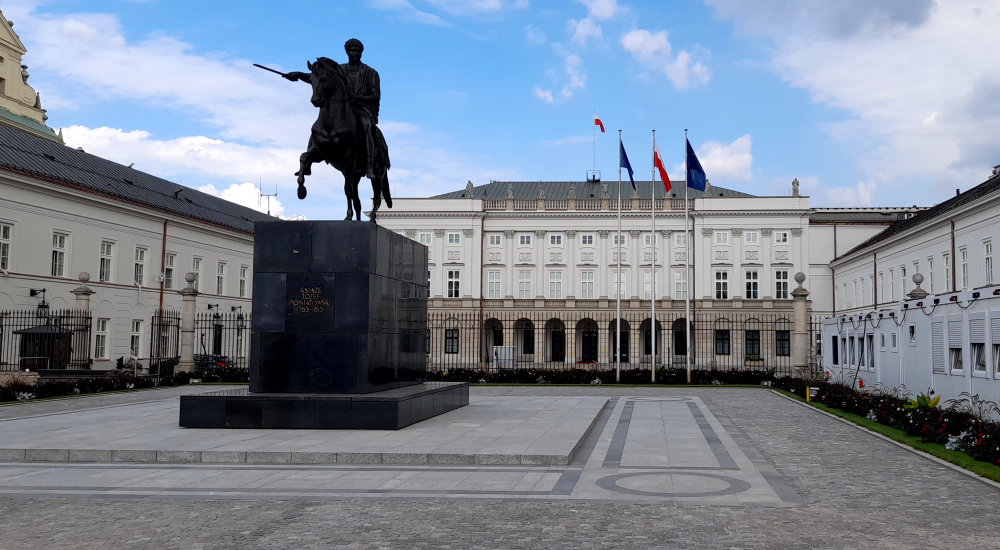
Further along the street is the Presidential Palace, the official residence of the Polish head of state and president since 1994. Originally constructed in 1643 as an aristocratic mansion, it was rebuilt and remodelled several times over the course of its existence by notable architects. The current neoclassical palace was completed in 1818.
Throughout its history, the palace has been a venue for important historical events in Polish, European, and world history such as the Warsaw Pact signed between the Soviet Union and the Eastern Bloc countries on 14 May 1955.
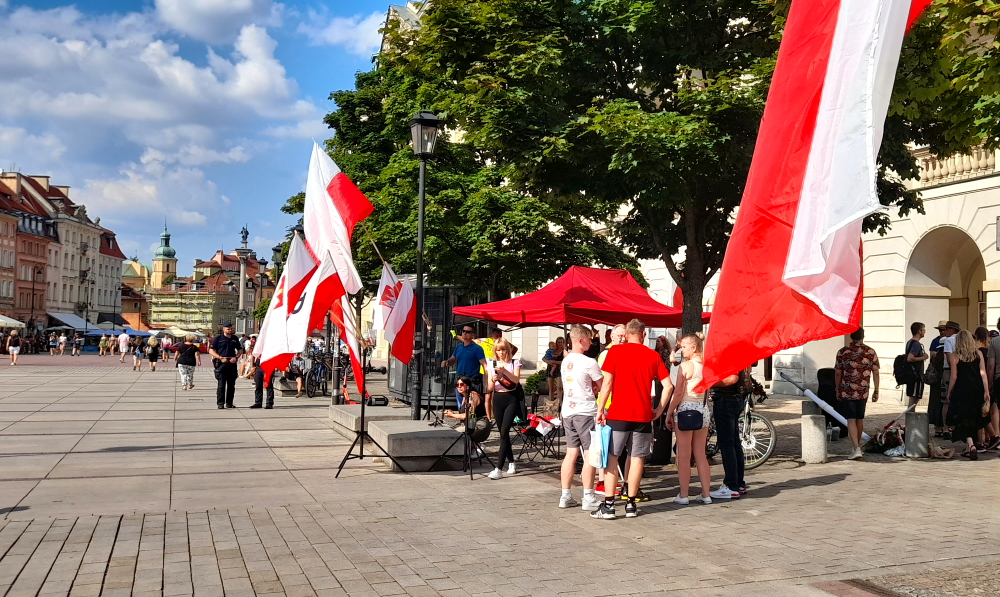
As we continue along the street we come across a group setting up a marquee and shouting slogans, apparently a recognised right-wing group, closely observed by a couple of Policja.
At the end of Krakowskie Przedmieście we come to Plac Zamkowy which houses Sigismund’s Column. Originally erected in 1644 by the King’s son, it’s located at Castle Square and is the first secular monument in the form of a column in modern history. The column and statue commemorate King Sigismund III Vasa, who in 1596 had moved Poland’s capital from Kraków to Warsaw.
Sigismund’s Column now stands at 22 m and is adorned by four eagles with the king dressed in armour, carrying a cross in one hand and wielding a sword in the other. At the time its erection was contentious as up until that time only the Virgin Mary and Saints could adorn columns so, as a compromise, the king’s statue included a large cross.
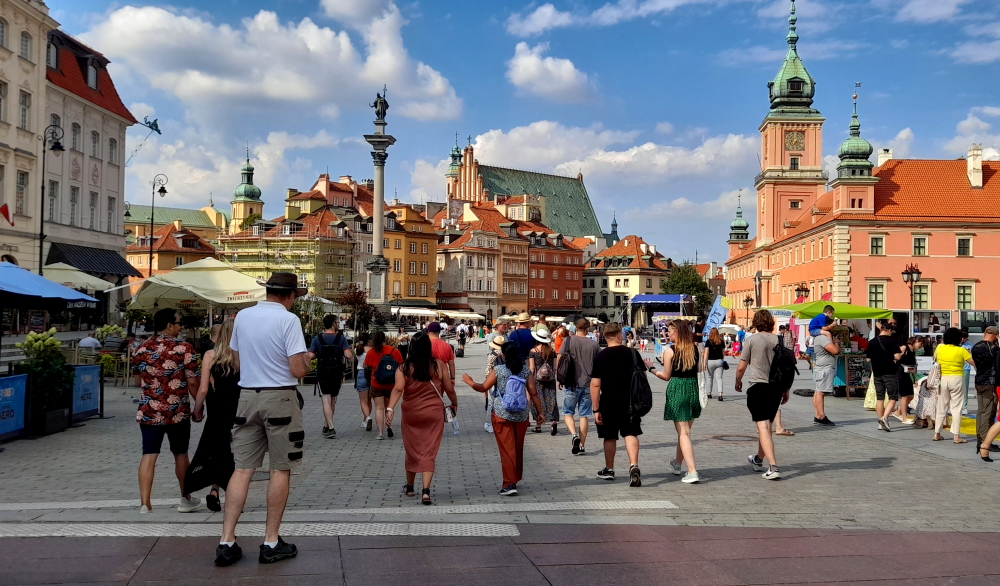
Next we enter the courtyard of the Royal Castle (Zamek Królewski w Warszawie). Now a state museum and a national historical monument it formerly served as the official royal residence of several Polish monarchs. The personal offices of the king and the administrative offices of the royal court were located in the Castle from the 16th century until the final partition of Poland in 1795. Situated in the Castle Square, at the entrance to the Warsaw Old Town, the Royal Castle holds a significant collection of Polish and European art.
WWII brought complete destruction to the building. In September 1939 it was targeted and ignited by Luftwaffe fighter aircraft, and then detonated by the Nazis after the failed Warsaw Uprising in 1944. In 1965, the surviving wall fragments, cellars, the adjacent Copper-Roof Palace and the Kubicki Arcades were registered as historical monuments.
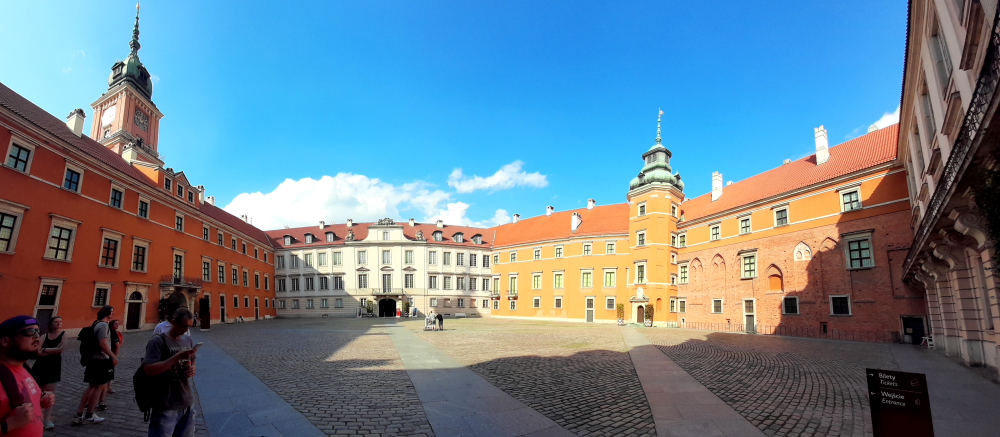
In 1971 the decision was made to rebuild the castle from voluntary contributions. By May 1975 the Fund had already reached 500 million zlotys and more than a thousand valuable works of art had been given to the Castle by numerous Poles resident in Poland and abroad and by official representatives of other countries.
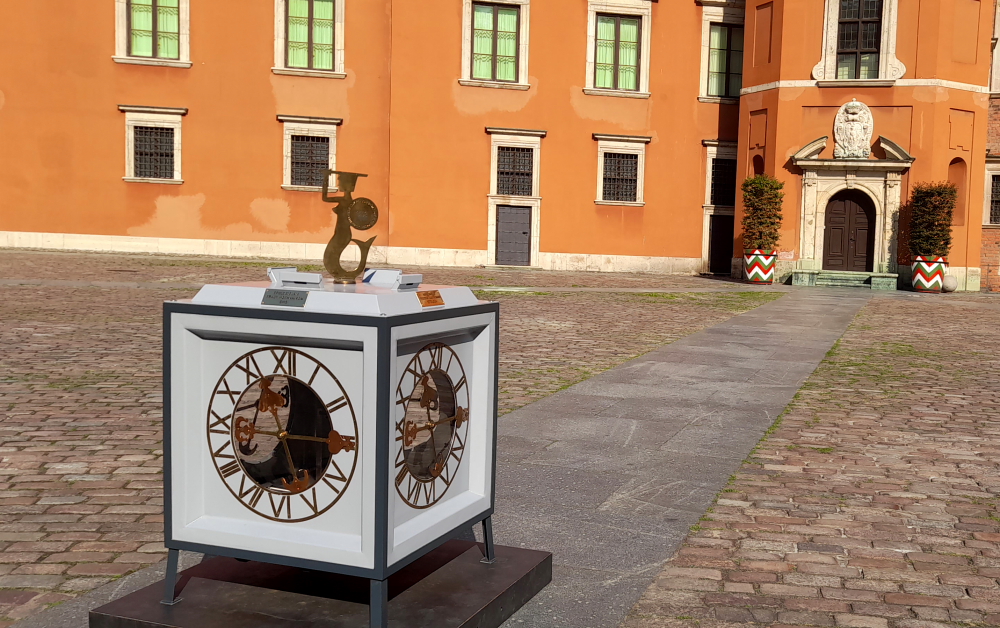
Reconstruction was carried out in the years 1971–1984, during which it regained its original 17th century appearance. In 1980, the Royal Castle and surrounding Old Town became a UNESCO World Heritage Site.
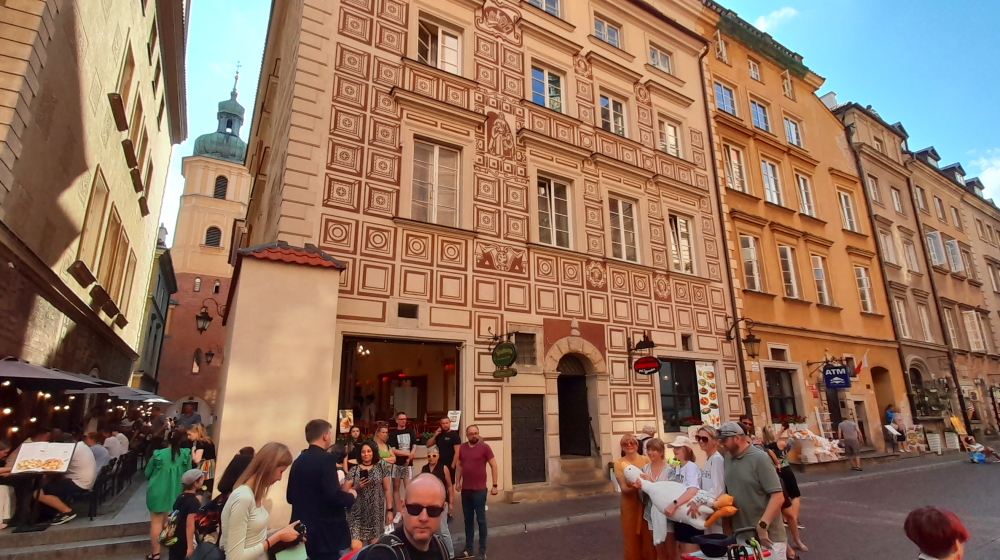
Walking down Świętojańska in the Old Town we are surrounded by decorated buildings, some of which look like they’ve been tattooed with henna.
Soon we arrive in front of the Archcathedral Basilica of St John the Baptist (Bazylika Archikatedralna w Warszawie), a brick Gothic Roman Catholic church within the Old Town precinct in Warsaw.
Originally built in the 14th century in Masovian Gothic style, the cathedral served as a coronation and burial site for numerous Dukes of Masovia. The archcathedral was connected with the Royal Castle by an elevated 80-metre-long corridor that had been built by Queen Anna Jagiellonka in the late 16th century and extended in the 1620s after a failed attempt to assassinate King of Poland Sigismund III in front of the cathedral.
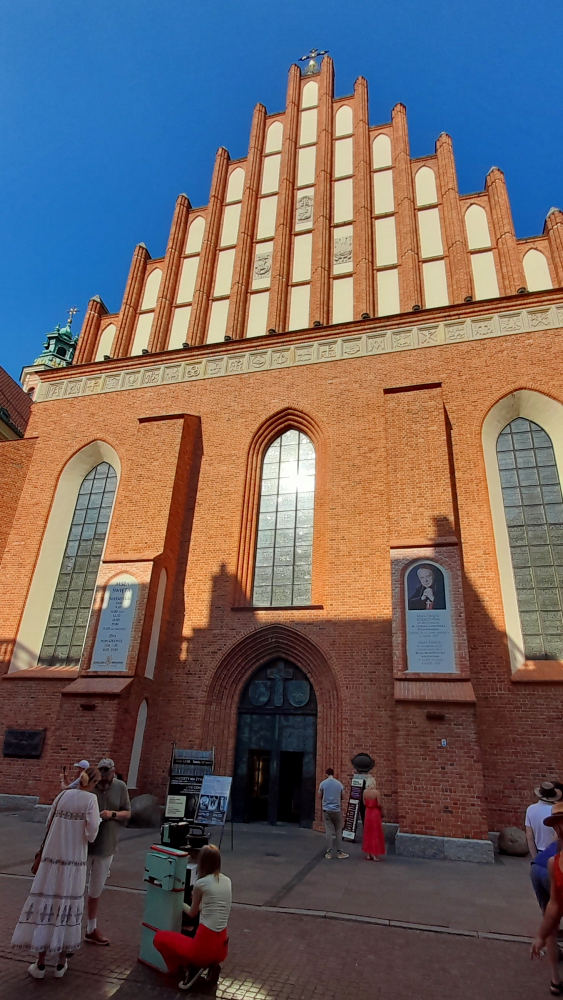
The church was rebuilt several times, most notably in the 19th century, it was preserved until World War II as an example of English Gothic Revival. After the collapse of the Warsaw Uprising (August–October 1944), the German Destruction Detachment blew up the cathedral destroying 90% of its walls. Following the war the cathedral was rebuilt once again with its exterior reconstruction based on the 14th-century church’s presumed appearance (according to an early-17th-century Hogenberg illustration and a 1627 Abraham Boot drawing), not on its pre-war appearance.
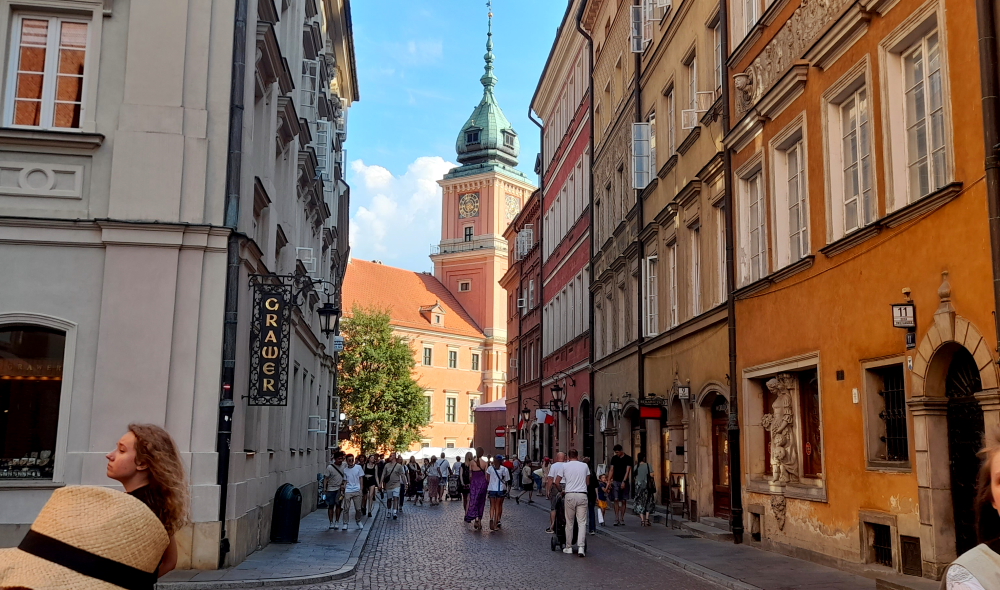
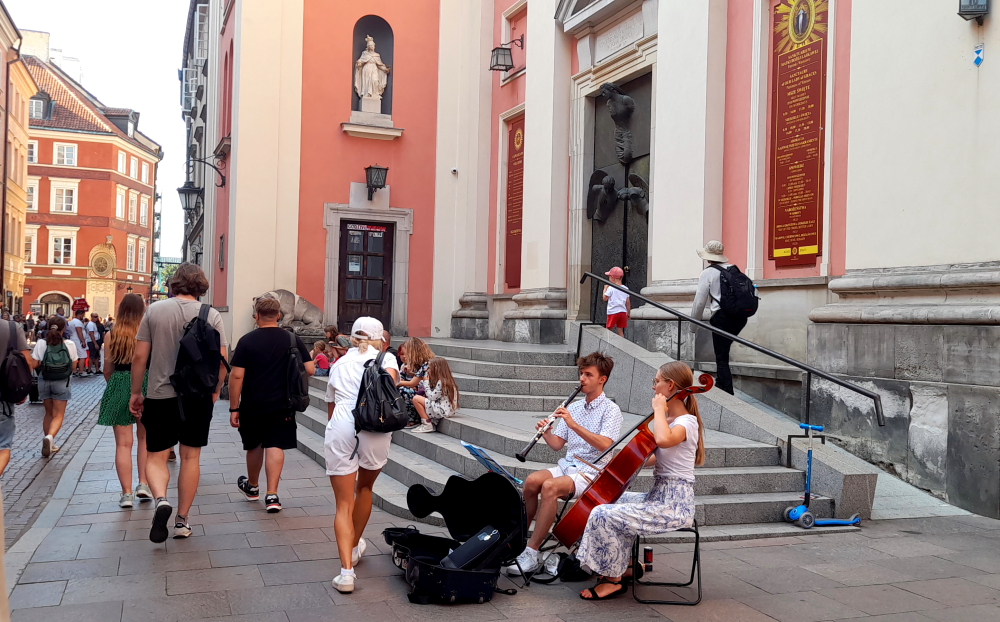
Predictably, the Old Town is quite crowded today with pedestrians and entertainers.
Świętojańska terminates at the Old Town Market Square, the center and oldest part of the Old Town. The Market Place originated in the late 13th century at the same time the city was founded. Here guilds and merchants met in the town hall (built before 1429, pulled down in 1817), and fairs and the occasional execution were held. The houses around it represented the Gothic style until the great fire of 1607, after which they were rebuilt in late-Renaissance style and eventually in late-Baroque style by Tylman Gamerski in 1701.
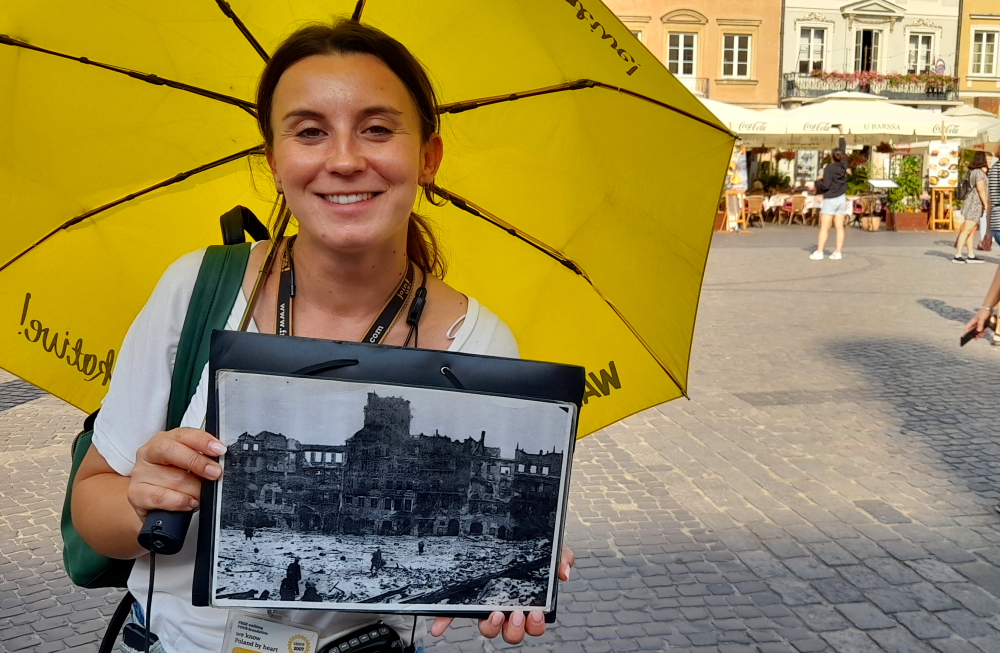
Immediately after the Warsaw Uprising, it was systematically blown up by the German Army in 1944 and after World War II the Market Place was restored to its pre-war appearance.
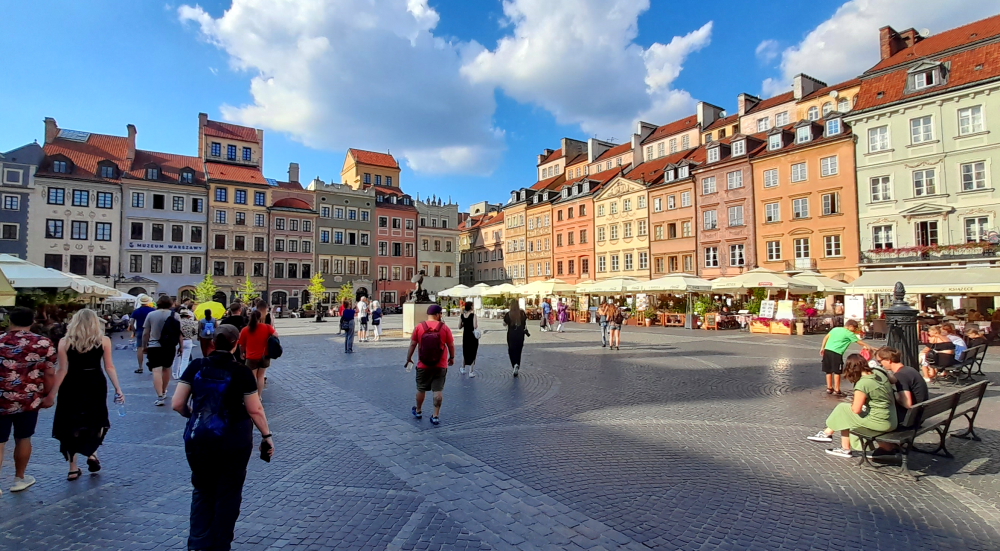
The current buildings were reconstructed between 1948 and 1953 to look as they did in the 17th century when it was mostly inhabited by rich merchant families.
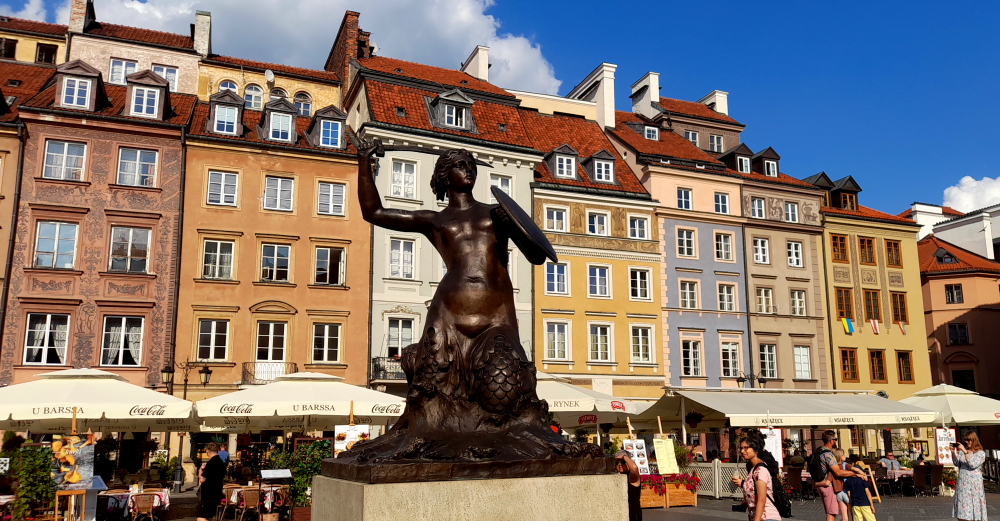
The Warsaw Mermaid, a bronze sculpture by Konstanty Hegel, has stood as the symbol of Warsaw since 1855.
As we walk down Nowomiejska from the Market Square we approach the Barbican.
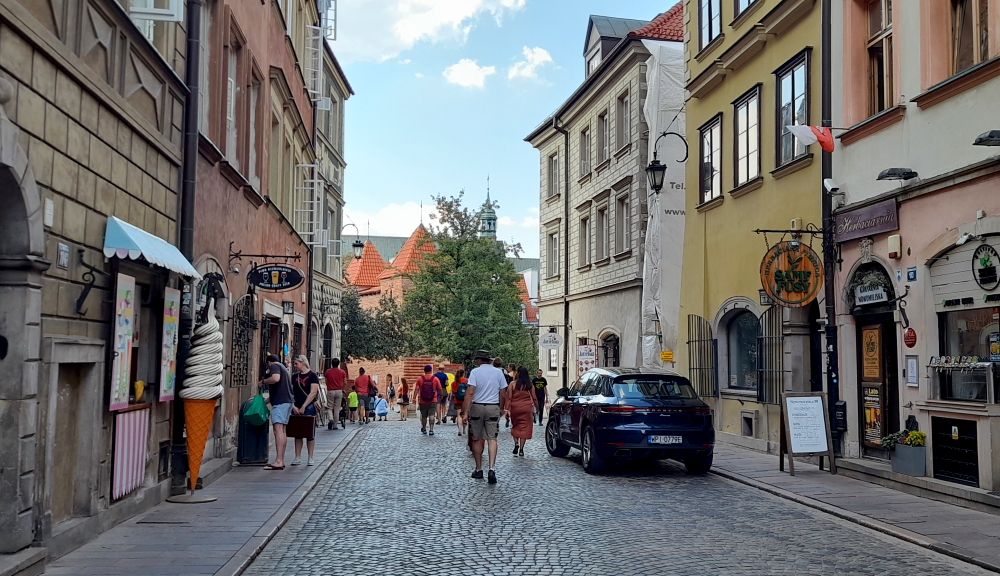
The city walls of Warsaw are composed of two lines: inner and outer, with several gates round the Old Town. Originally raised between the 13th and 16th centuries, then rebuilt in 1950–1963. The best-preserved fragments of the fortification are those parallel to Podwale street, from the Warsaw Royal Castle to the Barbican and further to the Vistula Embankment.
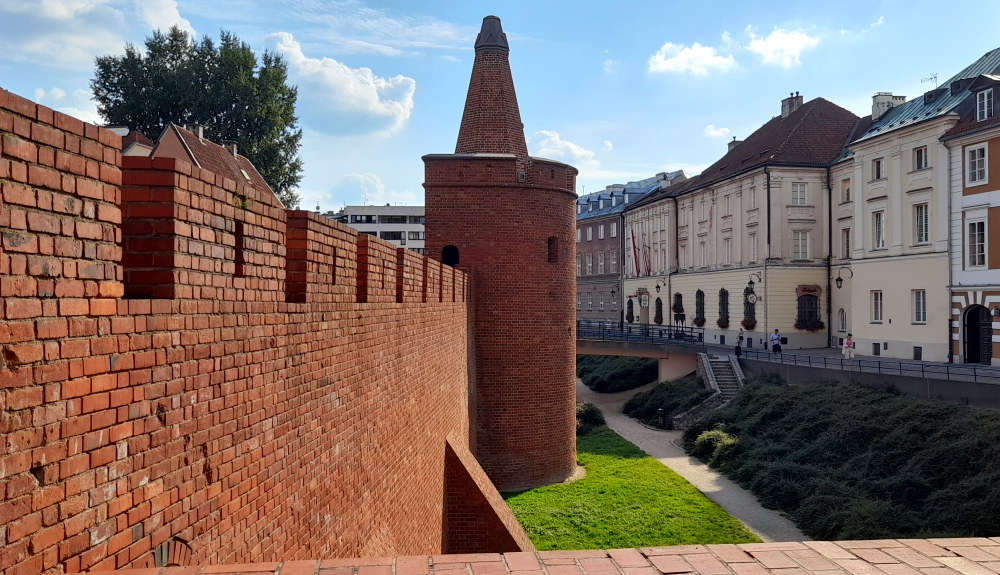
The construction works of the first line of the walls were started probably around 1280. In effect, a 1,200-metre-long (3,900 ft) wall enclosed 8.5 hectares. The fortification included numerous towers and turrets (mostly rectangular).
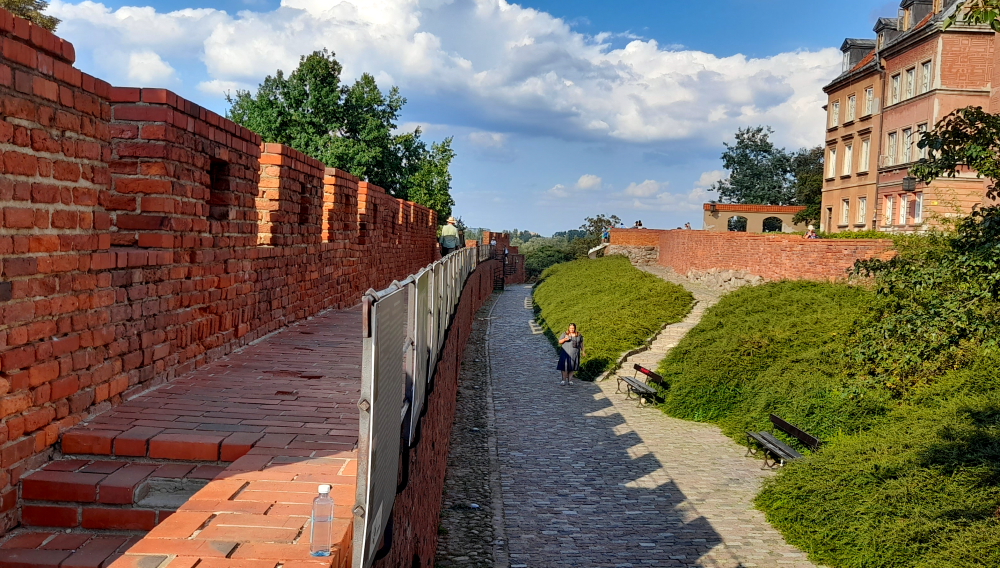
The inner ring was built before 1339. Between the second half of the 15th century and the beginning of the 16th century, the outer ring was raised. The second line was about 4 metres shorter, yet 0.6 m thicker. The whole construction was surrounded by a 4-metre-deep (13 ft) moat.
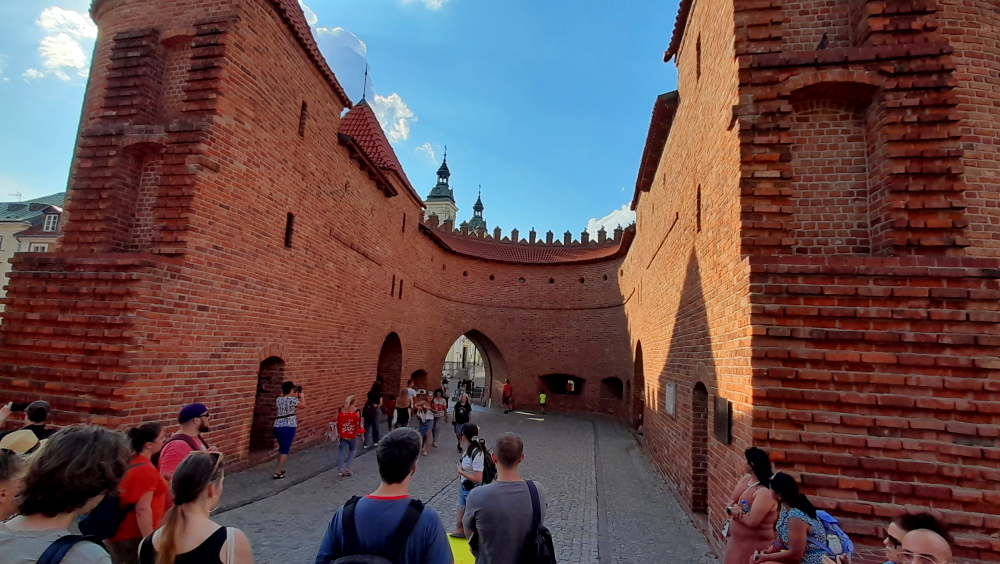
The Barbican was designed by Jan Baptist the Venetian and built in 1548. The youngest element of the city’s fortification it divides the New and Old Towns.
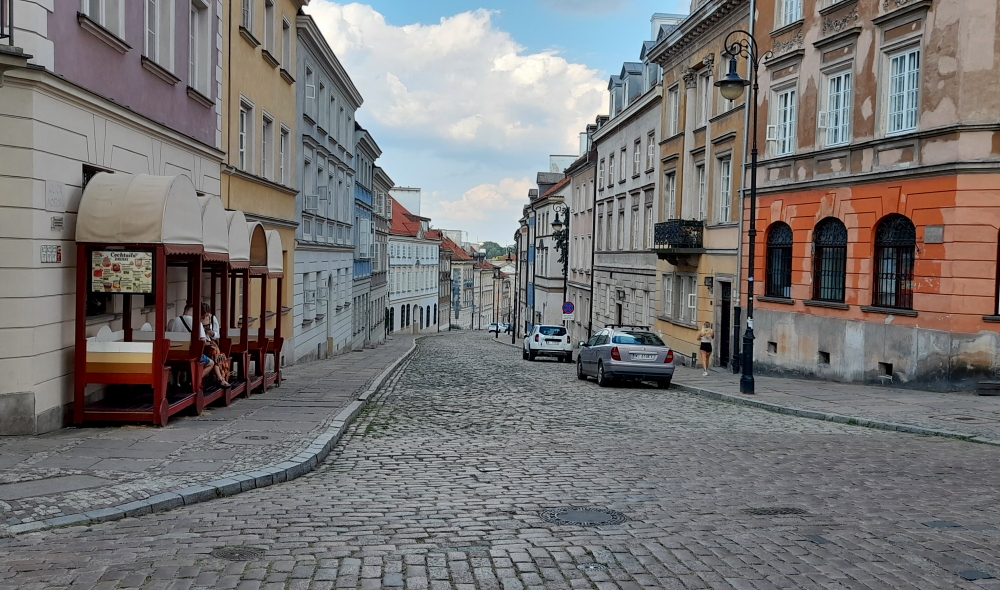
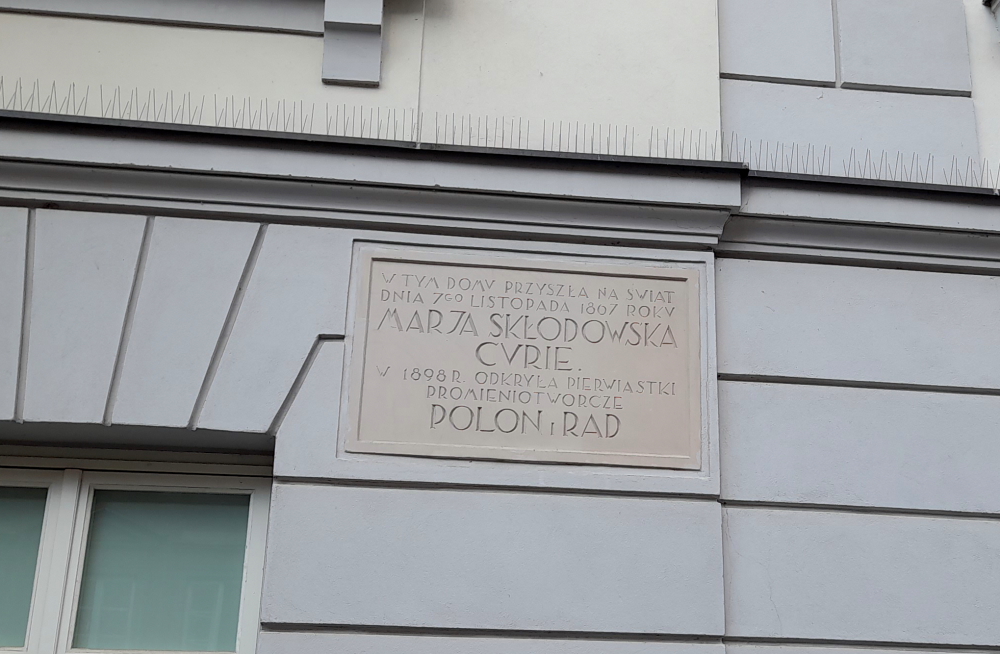
After exiting the Barbican we walk to the Madame Curie Museum (Maria Skłodowska-Curie Museum) on Freta Street in the New Town district (dating from the 15th century) and is housed in the 18th-century tenement house in which Maria Skłodowska was born.
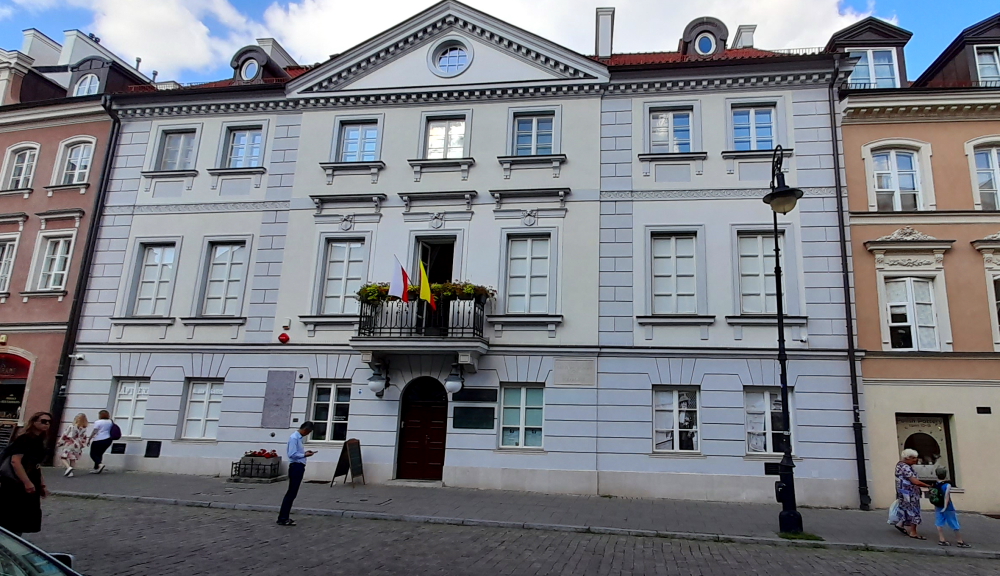
The museum is devoted to the life and work of Polish double Nobel laureate Maria Skłodowska-Curie (1867–1934), who discovered the chemical elements polonium and radium.
Around the corner we walk down Świętojerska until we come to the Warsaw Ghetto boundary markers at the junction with Nowiniarska. The markers are memorial plaques and boundary lines that mark the maximum perimeter of the former ghetto established by Nazi Germany in 1940 in occupied Warsaw.
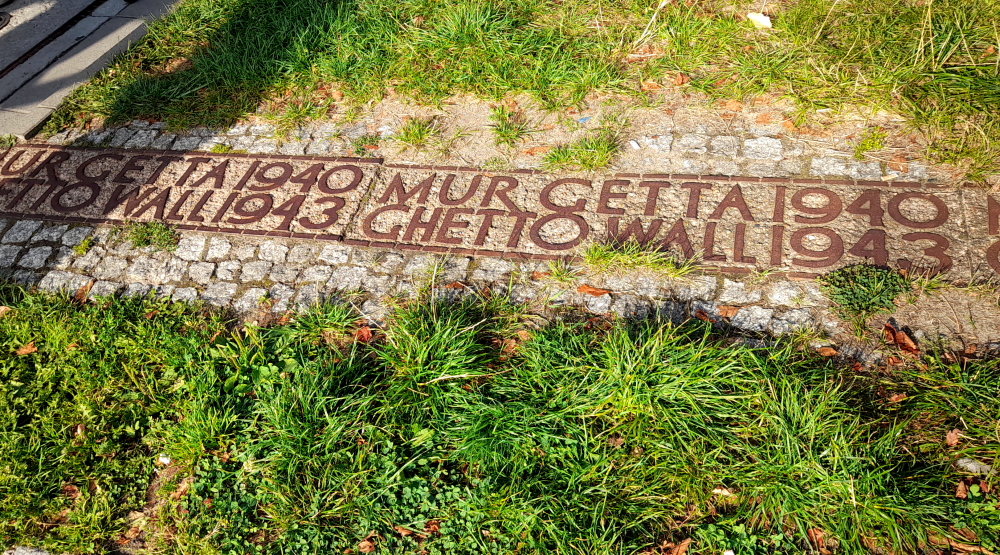
The markers were erected in 2008 and 2010 on 22 sites along the borders of the Jewish quarter, where from 1940–1943 stood the gates to the ghetto, wooden footbridges over Aryan streets, and the buildings important to the ghetto inmates.
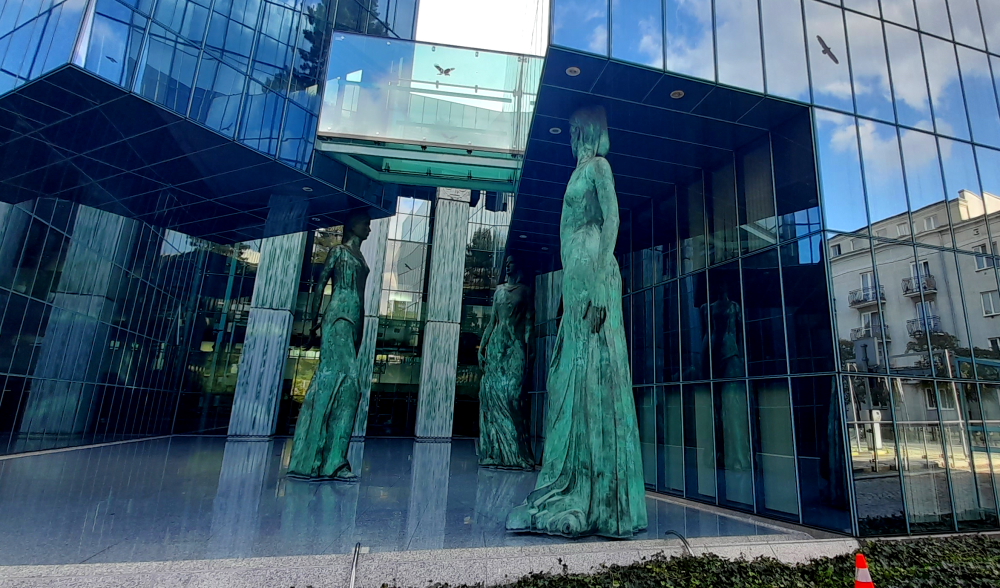
We continue past the rear of the Law Courts until we reach the Warsaw Uprising Monument dedicated to the Uprising in 1944 against the Nazis. Unveiled in 1989, it was designed by Jacek Budyn and sculpted by Wincenty Kućma and is located on the southern side of Krasiński Square.
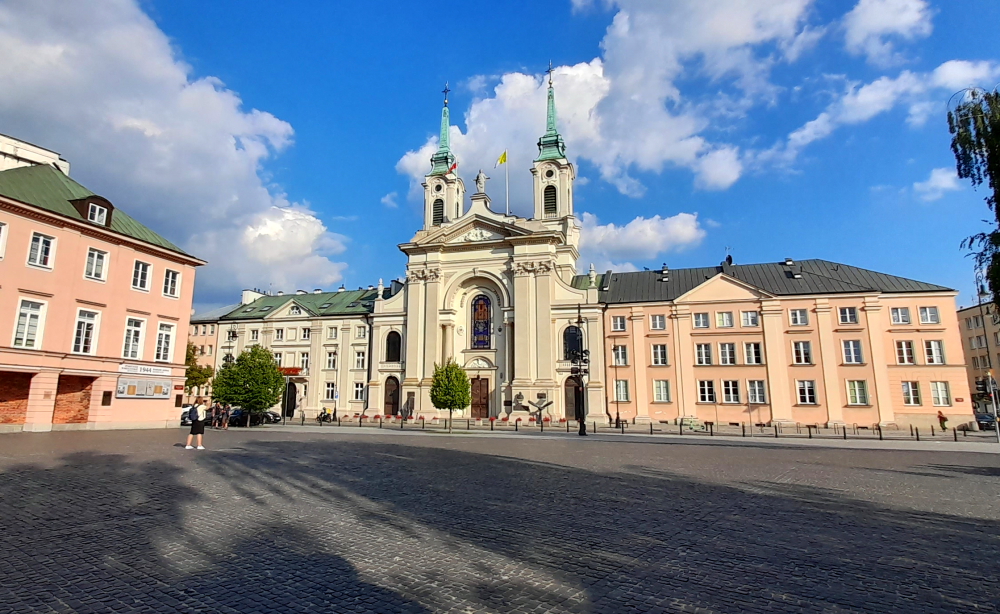
The Warsaw Uprising, which broke out on 1 August 1944 and lasted until 2 October 1944, was one of the most important and devastating events in the history of Warsaw and Poland. Up to 90% of Warsaw’s buildings were destroyed during the hostilities and the systematic destruction of the city carried out by the Germans after the uprising.
However, it was also an event that the communist authorities of the post-war People’s Republic of Poland found highly controversial, as it was organised by the Polish resistance movement that had fought for Poland’s independence during World War II, principally the Home Army, the remnants of which were brutally suppressed by the postwar Stalinist regime. The uprising was brutally crushed by the Germans over a period of 63 days while the Soviets watched on (even after they had finally resumed their offensive and capturing the right bank the River Vistula in mid-September 1944). After the uprising, the Germans expelled the entire population from the city and spent the whole of October, November and December 1944 in looting Warsaw and destroying whatever was still standing.
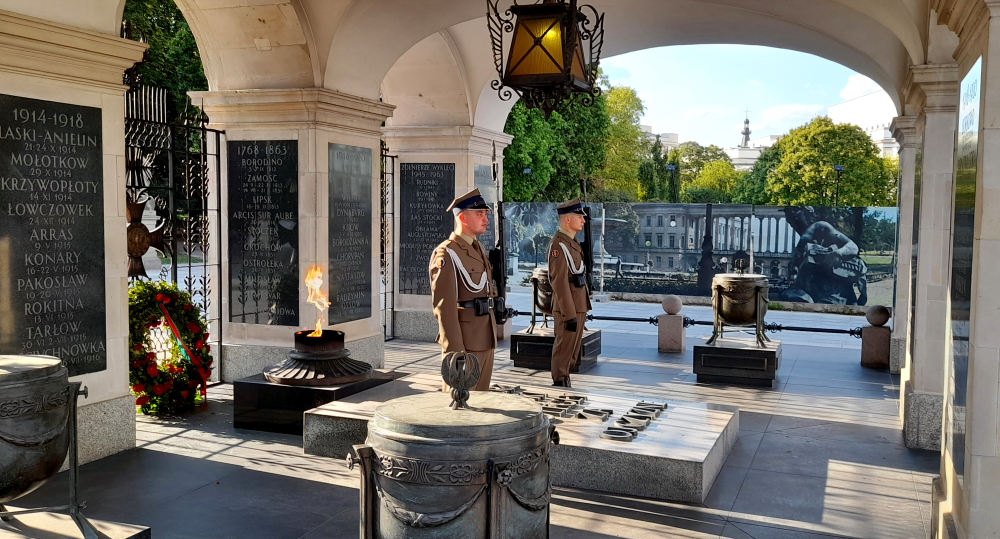
It’s now 5:00 pm and the end of the tour so we wend our way back to the hotel via the Saxon Garden where the Tomb of the Unknown Soldier is located.
The monument, located at Piłsudski Square, is the only surviving part of the Saxon Palace that occupied the spot until World War II. Since 2 November 1925 the tomb houses the unidentified body of a young soldier who fell during the Defence of Lwów. Since then, earth from numerous battlefields where Polish soldiers have fought has been added to the urns housed in the surviving pillars of the Saxon Palace.
The Saxon Garden was originally the site of Warsaw fortifications, “Sigismund’s Ramparts,” and of a palace built in 1666 for the powerful aristocrat, Jan Andrzej Morsztyn. The garden was extended in the reign of King Augustus II, who attached it to the “Saxon Axis”, a line of parks and palaces linking the western outskirts of Warsaw with the Vistula River.
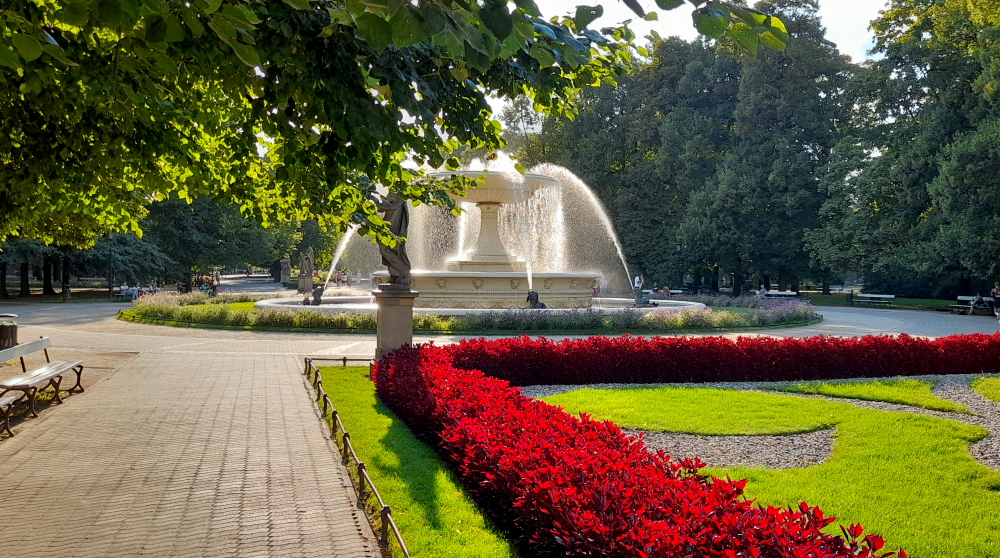
The park of the adjoining Saxon Palace was opened to the public on 27 May 1727. It became a public park before Versailles (1791), Stourhead (1946), Sissinghurst (1967) and most other world-famous parks and gardens. Initially a Baroque French-style park, in the 19th century it was turned into a Romantic English-style landscape park. Destroyed during and after the Warsaw Uprising, it was partly reconstructed after World War II.
25 August, 2023
Today is supposed to be 2 Deg. C. cooler than yesterday, but with rain. While Lynn slaves over yesterday’s blog I venture out to check out the ‘hood and possible eateries for this evening.
I head for the centre of the Business District with its many modern office towers. Just the usual glass skyscrapers but I did walk around the very interesting Palace of Culture and Science.
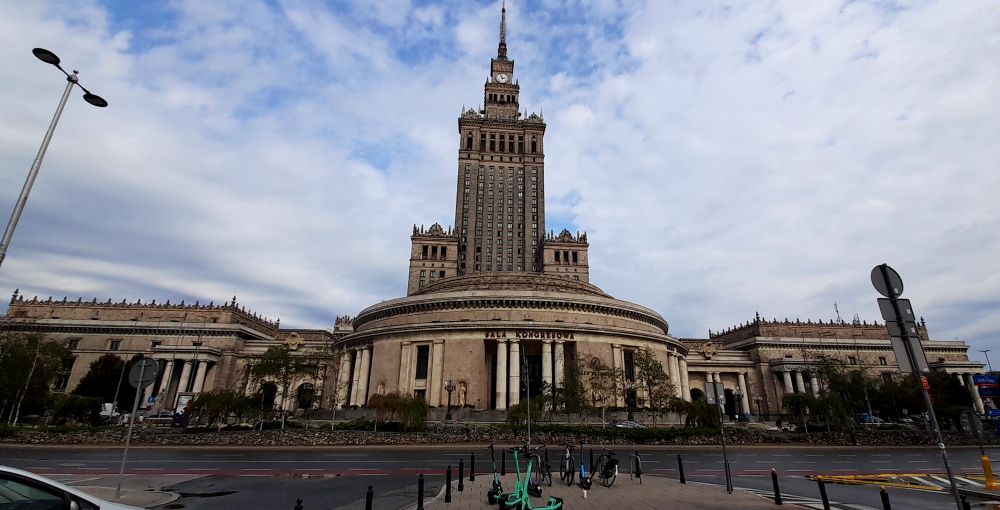
The Palace of Culture and Science (Polish: Pałac Kultury i Nauki; abbreviated PKiN) is a notable high-rise building in central Warsaw. With a height of 237 m, it is the second tallest building in both Warsaw and Poland (after the Varso Tower), the sixth tallest building in the European Union and one of the tallest in Europe. At the time of its completion in 1955, the Palace was the eighth tallest building in the world, retaining the position until 1961. It was also the tallest clock tower in the world until the installation of a clock mechanism on the NTT Docomo Yoyogi Building in Tokyo, Japan.
Motivated by Polish historical architecture and American art deco high-rise buildings, the Palace of Culture and Science was designed by Soviet-Russian architect Lev Rudnev in “Seven Sisters” style and is informally referred to as the Eighth Sister.
The Palace houses various public and cultural institutions such as theatres, cinemas, libraries, university faculties and authorities of the Polish Academy of Sciences. Surrounding the building are a collection of sculptures representing figures of the fields of culture and science, with the main entrance featuring sculptures of Polish astronomer Nicolaus Copernicus, by Ludwika Nitschowa, and Polish poet Adam Mickiewicz, by Stanisław Horno-Popławski. Since 2007, the PKiN has been enlisted in the Registry of Objects of Cultural Heritage.
The building was originally known as the Joseph Stalin’s Palace of Culture and Science (Pałac Kultury i Nauki imienia Józefa Stalina), but in the wake of destalinization the dedication to Stalin was revoked. Stalin’s name was removed from the colonnade, interior lobby and one of the building’s sculptures.
This evening we plan to go to a Polish Restaurant about 15 minutes walk away but since it is Friday night things may be a bit busy.
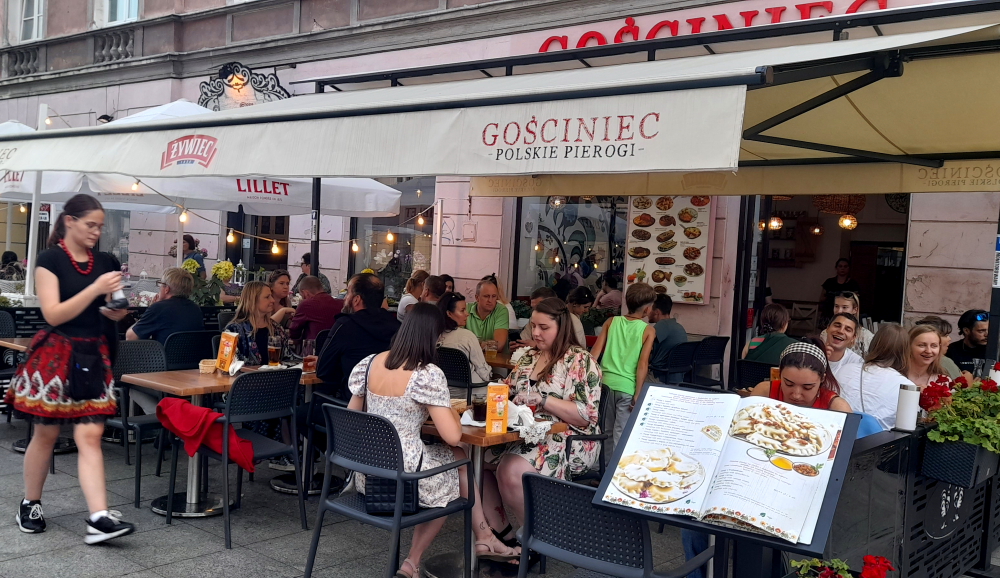
We get a table just before the restaurant fills upl. We chose inside as there are a few wasps flying about outside.
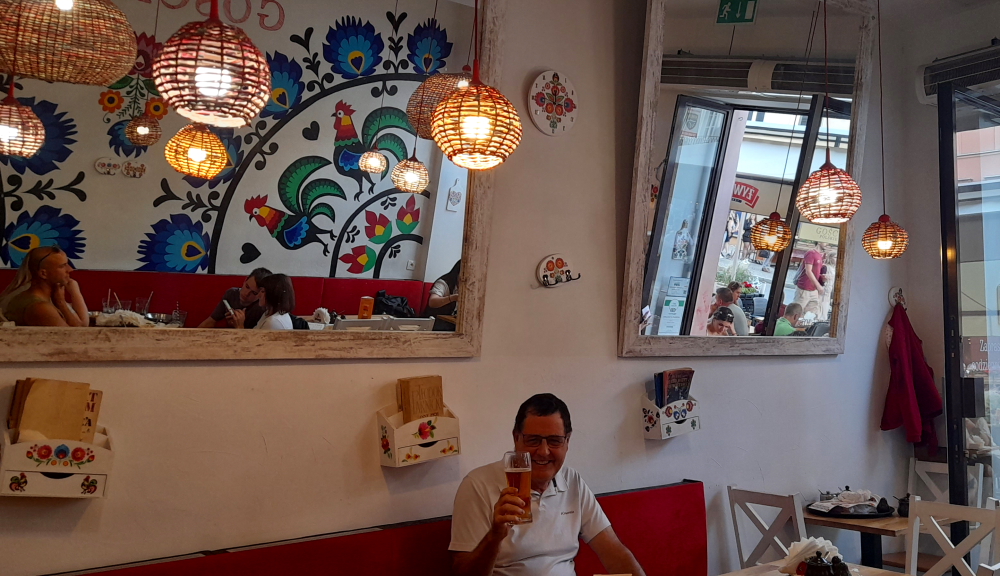
I order a local beer which is pretty good and Lynn has a mulled wine.
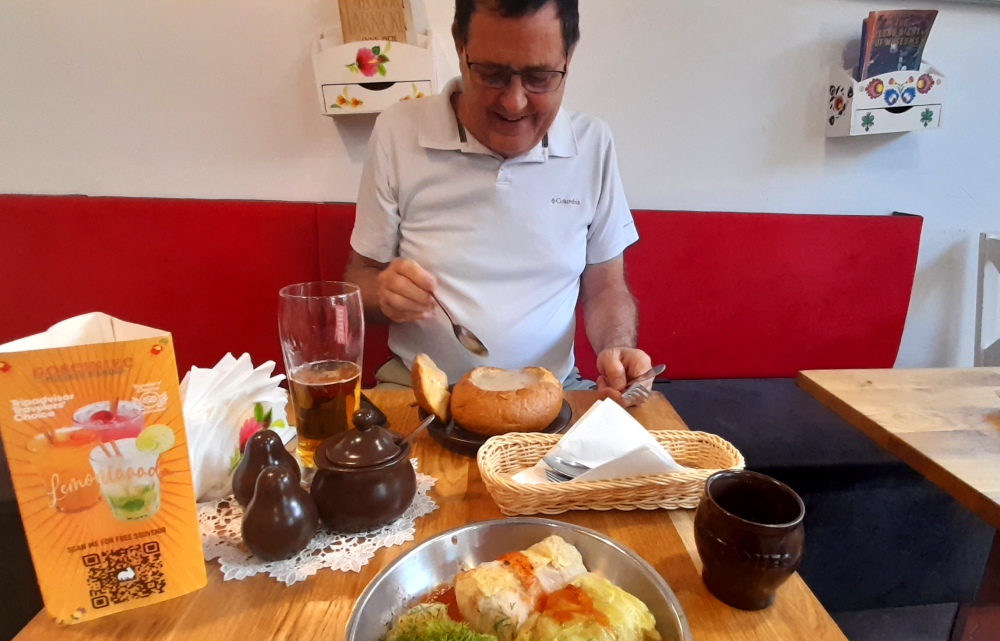
The food is also quite good and for the first time in a while mine is just enough so that I didn’t feel over full – soup in a bread bowl. We can’t fit in a dessert but we still decide (read, Lynn decided) that an ice cream would be nice to finish off on this warm evening.
26 August, 2023
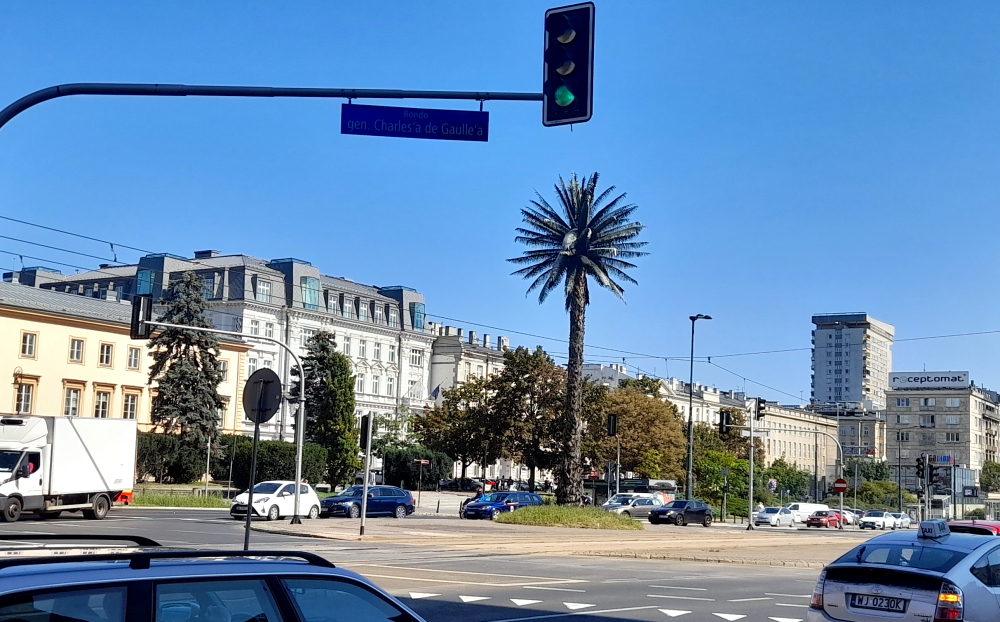
30 Deg. C. predicted for today so we decide to head to the river this morning. One of the first things we saw in Warsaw is this palm tree in the middle of one of the main roads. Correct! A palm tree. Reminded us of those we saw in Dubai which were all plastic and were thinly-disguised mobile phone towers. This, however, is an art installation by Polish artist Joanna Rajkowska who, during a trip to Israel decided to stick a palm tree in the Polish capital to give it some sunny cheer. The steel column trunk, especially designed to bend in the wind, is covered with natural bark and the fronds are made from polyethylene – which definitely look like plastic.
We cut down Tamka past the old city wall and walk towards Most Swietokrzyski Bridge where the city’s 2nd mermaid statue (Pomnik Syreny) is located. A fountain forms part of the walkway to it and today kids young and old are walking through it to keep cool.
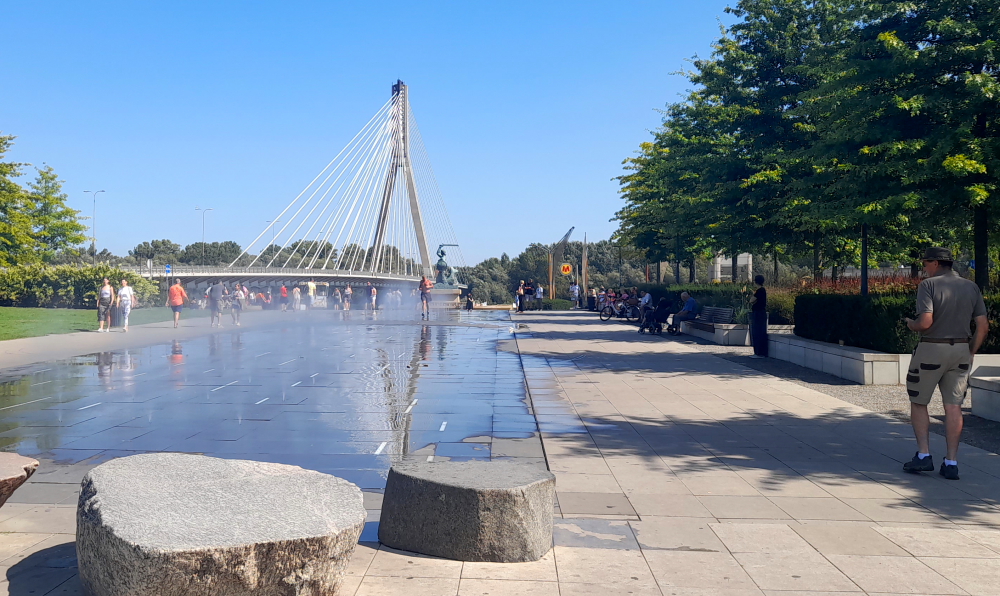
“Feisty, beautiful and busty” is how Warsaw’s ‘Syrenda’, the iconic freshwater warrier mermaid has been described. She overlooks the body of water that the mythical icon is alleged to have dwelled in – the Vistula River. The 2.75m tall bronze work was created by sculptor Ludwika Nitschowa. The model of the sculpture was presented for the first time during the 1st Polish Sculpture Salon in the Warsaw Institute of Art Propaganda in May 1937. It was unveiled in June 1939, a few months before the outbreak of WWII.
After Warsaw’s devastation during both the Nazi invasion and Soviet ‘liberation’ it’s remarkable that the Powisle Mermaid stood the whole time in this spot and sustained only minor damage.
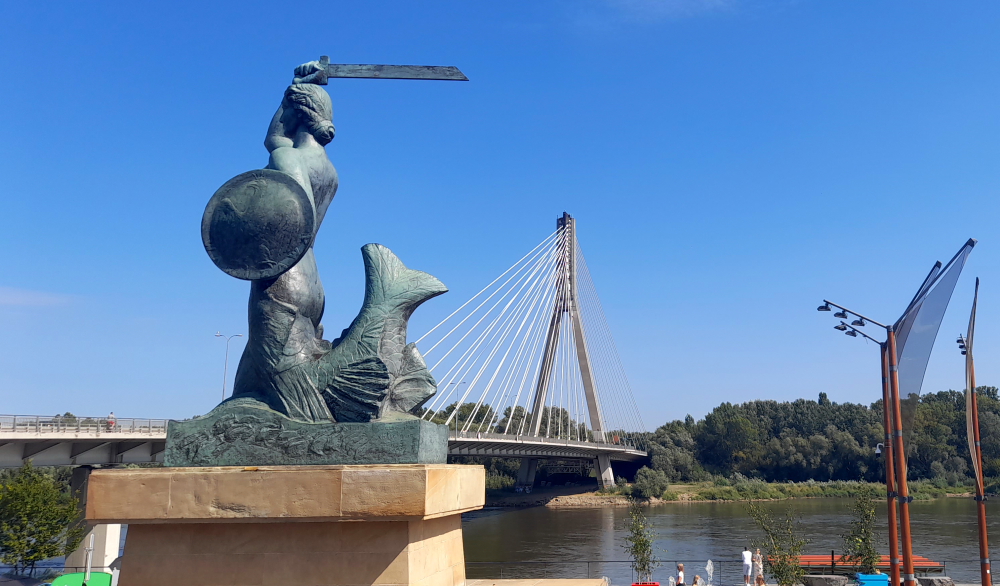
The monument was to commemorate the coat of arms of Warsaw and contribute to the aesthetics of the Vistula boulevards.
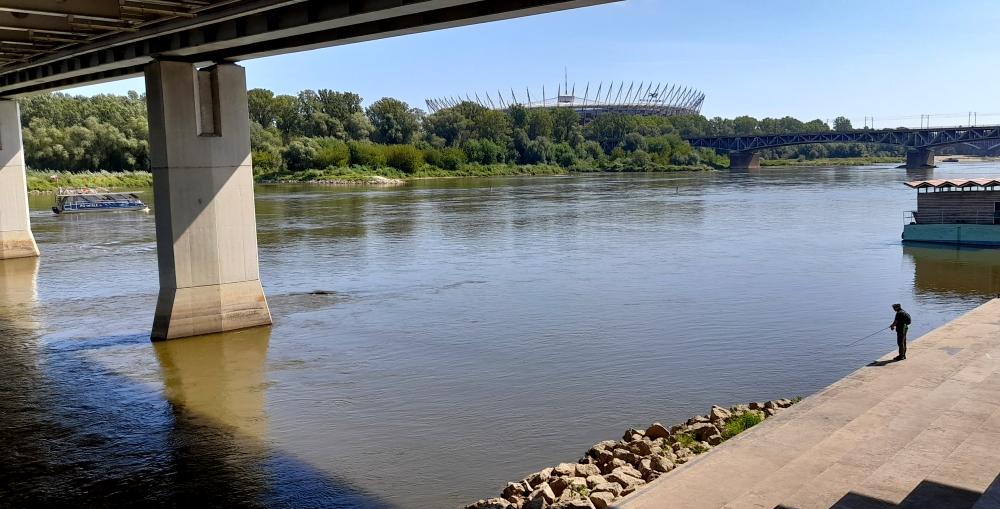
Unfortunately, the other side of the river to the ‘Vistula Boulevards’ has no aesthetics whatsoever.
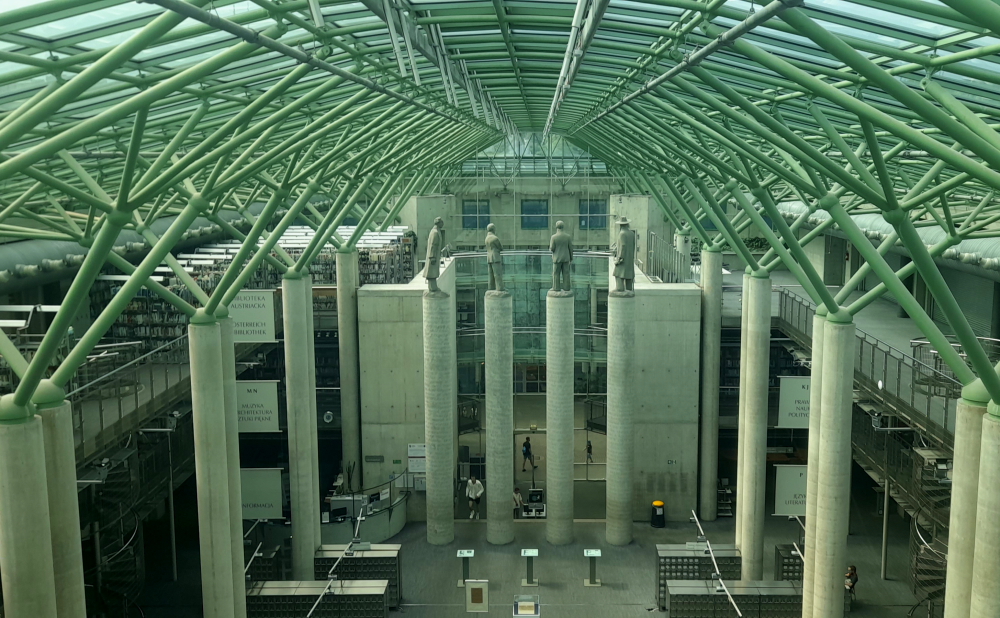
This side of the river we walk past the Copernicus Science Centre and Planetarium until we stop parallel to the University of Warsaw’s Library where we cross the road and walk the stairs to its rooftop garden.
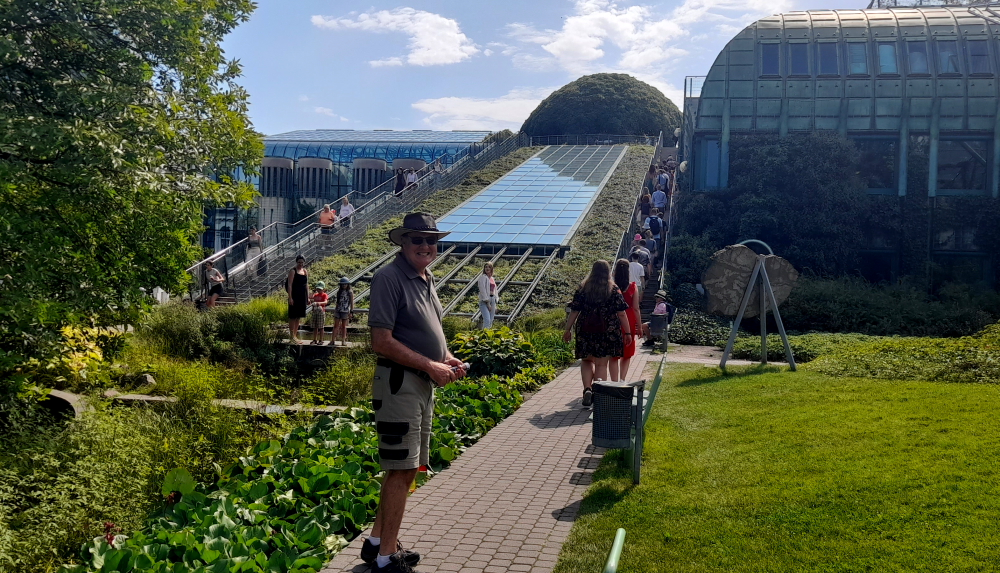
In 2002, a garden was opened on the University of Warsaw Library roof measuring over 1 ha. It is one of the largest roof gardens in Europe. The roof garden is divided into two parts – the upper and the lower parts – joined by a cascading stream.
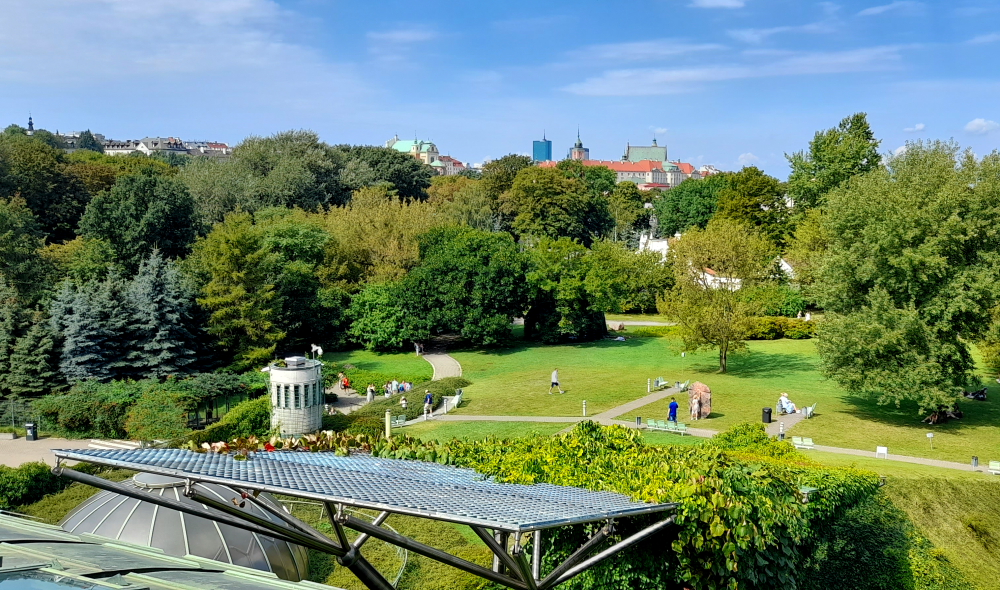
Individual sections of the garden are connected by paths, bridges and pergolas. The rooftop is also an ideal viewing point of Warsaw’s panorama as well as the library interiors.
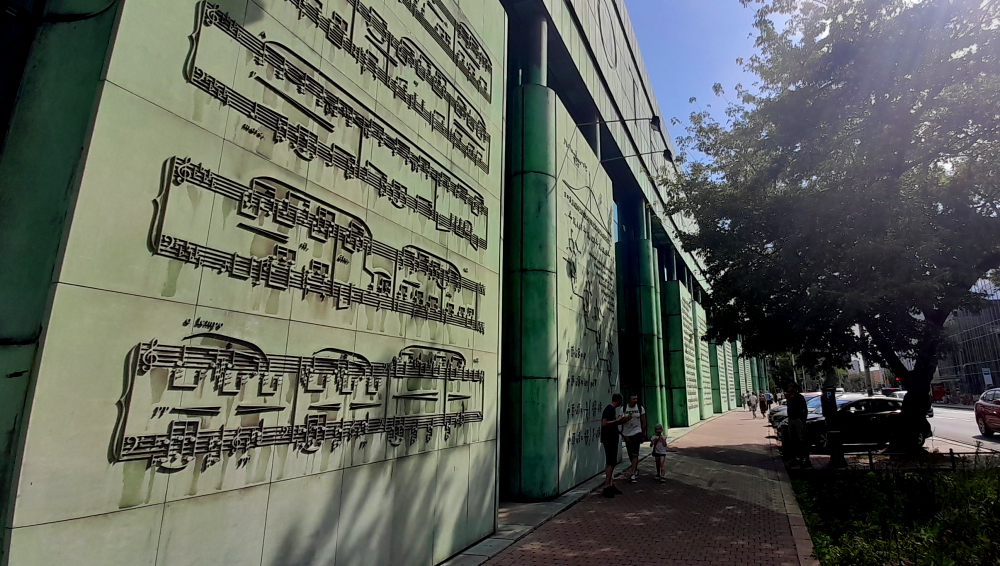
Along Dobra Street, the metallic walls of the University Library host texts from different cultures and times: a musical score, Maxwell’s equations, the Upanishads, etc. – open books.
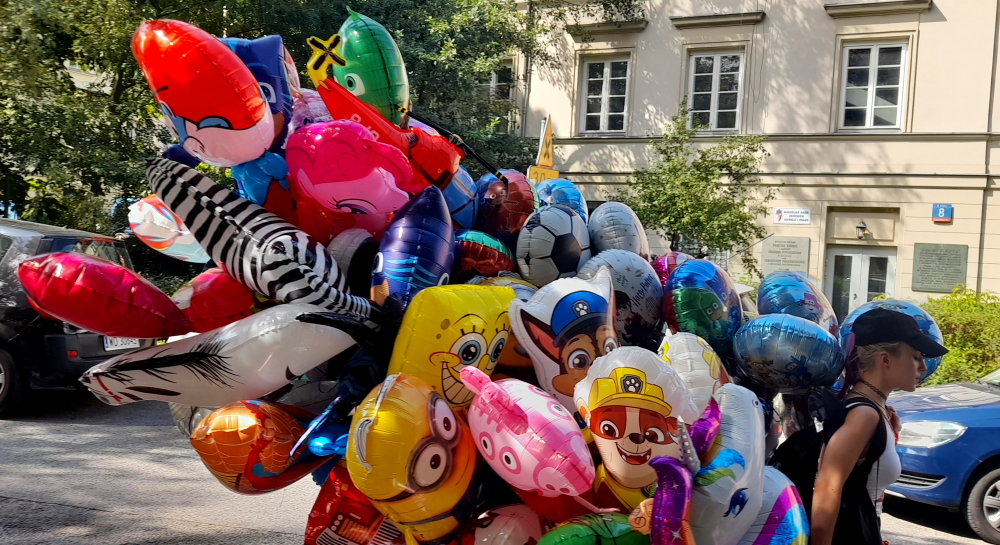
Returning home, we are greeted by a familiar sight – balloons! Are we back in Asia??
Back at the Mercure Hotel we need a couple of hours to cool down and rest the weary legs after walking about 8 kms in the heat. Tonight we are trying out a local Italian Restaurant. Mainly because it is only a block away but also we hope the food might be good.
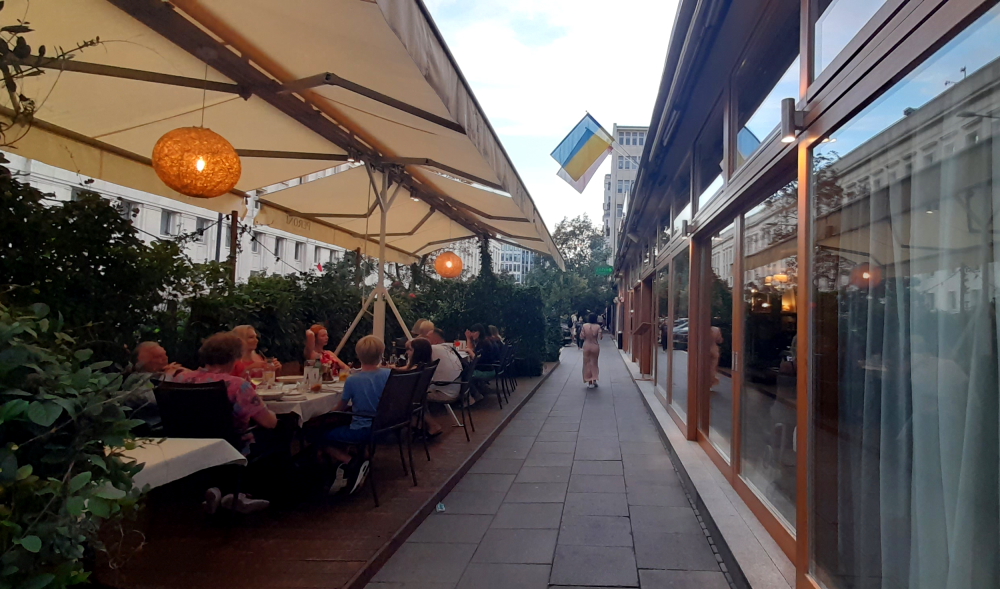
Well, the food was a little disappointing and the service was slow but at least we only had to walk about 100m each way. So far it is obvious that Poland has still not fully shaken off all of its Soviet past.
27 August, 2023
Last night we both received Alert RCB (Polish Government) SMSs warning us of storms and strong winds (120 kph) overnight and up to 11:00 AM tomorrow with the risk of power outages. As far as we are aware nothing happened.
Instead we wake to another sunny day with a predicted top of 26 Deg. C. with showers later in the day. So, time to head out the door this morning for Lazienki Krolewskie (Royal Baths Park), a 25-minute walk SE of our hotel.
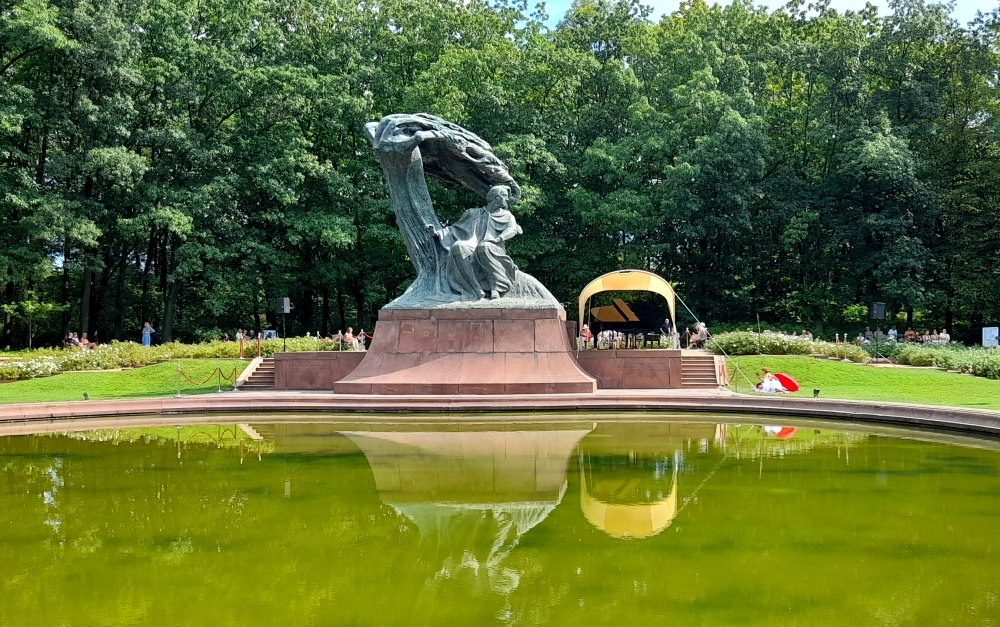
This 17th century park, spread over 74 ha, hosts a number of landmarks: the Chopin Monument, Belweder Palace, Palace on the Isle/Water, and Myslewicki Palace as well as numerous cultural and educational events. Among the best-known are the summer concerts near the Monument to Chopin, which take place each Sunday from May-September.
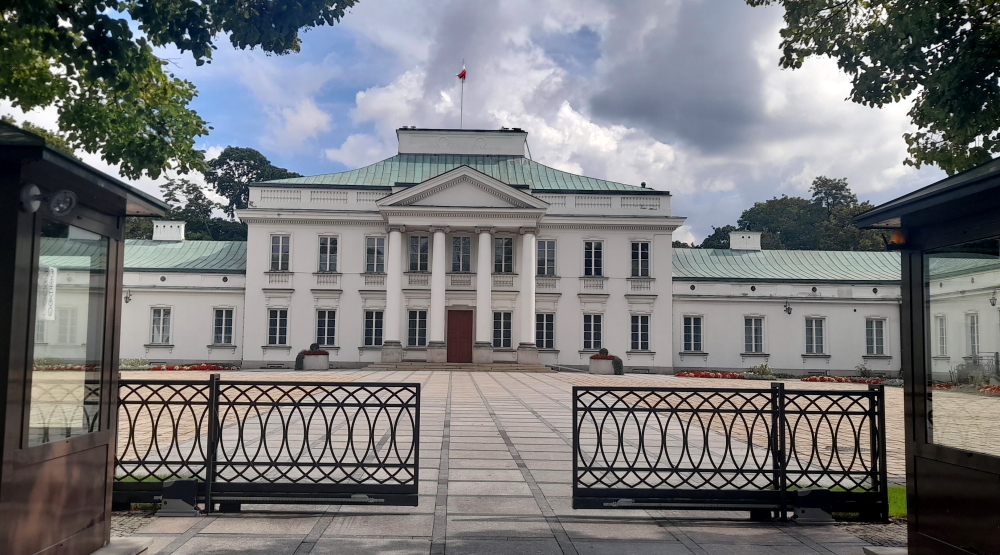
Near to the Monument, but facing the street is Belweder (from the Italian belvedere, “beautiful view”), a neoclassical palace. Erected in 1660 and remodelled in the early 1800s, it is one of several official residences used by Polish presidents as well as a state guest house for visiting heads of state.
During World War II, the building was extensively remodelled for Hans Frank, Governor of Nazi-occupied Poland and the so-called General Government. It remains one of the few original structures in Warsaw to survive the war.
From 1989 to July 1994, it was the official residence of Poland’s presidents (Wojciech Jaruzelski and Lech Wałęsa), but proved too small for that purpose.
Belweder is normally used by the president and the government for ceremonial purposes, while the president resides at the “Presidential Palace” in the city center.
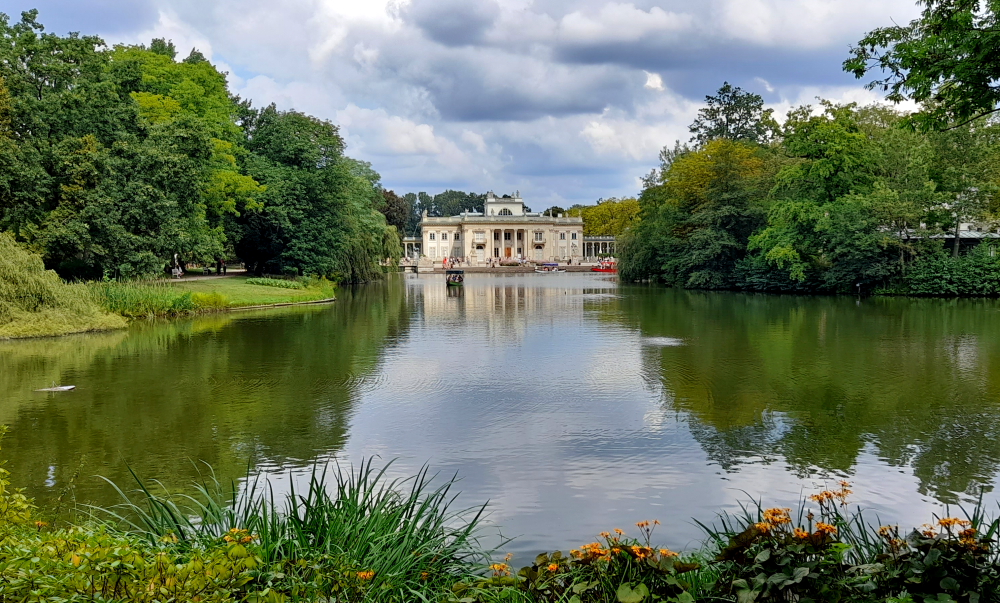
The centrepiece of the park is the Palace on the Isle. Its origins date back to the late 17th century. The Bathhouse was built at the behest of Prince Stanisław Herakliusz Lubomirski, one of the most important politicians, writers and philosophers of the time.
The Baroque garden pavilion, designed by the Dutch architect, Tylman van Gameren, was intended as a place for resting, leisure and contemplation. The interiors of the Bathhouse were stylized on a grotto with a spring which symbolized the Hippocrene, a fountain on Mount Helicon in ancient Greece, which was the source of poetic inspiration for the Muses.
In 1764, when looking for a place in which to build his summer residence, King Stanisław August purchased the Bathhouse together with the Ujazdowski estate. Thanks to two architects – the Italian born Domenico Merlini and Johann Christian Kammsetzer, who was born in Dresden – the King transformed the Baroque Bathhouse pavilion into the neoclassical Palace on the Isle. Modelled on Italian architectural icons, such as the Villa Borghese and Villa Medici, it was intended to symbolize the dream of an ideal, modern and sovereign state.
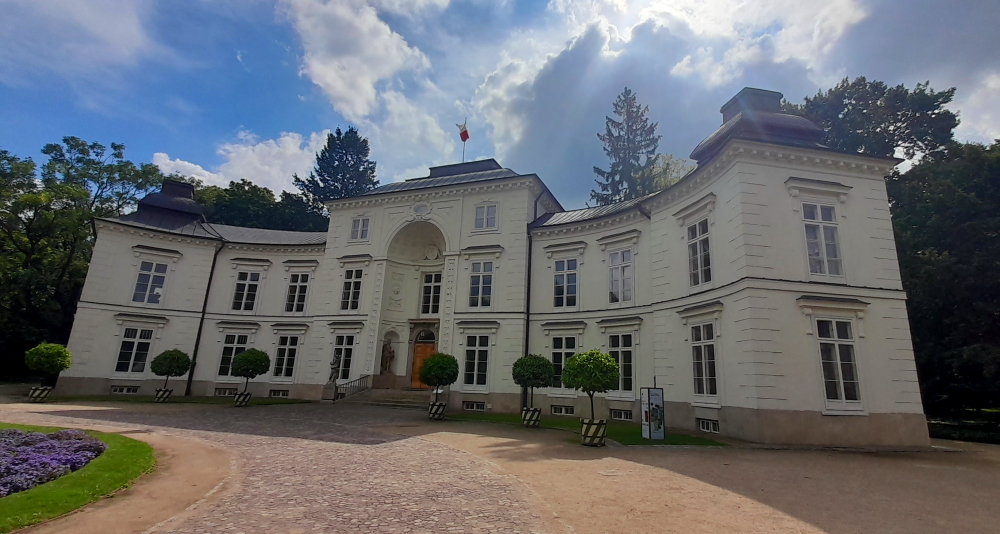
Nearby is the Myslewicki Palace with its characteristic semi-circular form, originally conceived as the King’s primary residence. Over time, it took on a more official and representative function. Matters of state were discussed in its elegant interiors, and over the centuries the apartments were used to accommodate tsarist generals, members of the Polish government, as well as foreign guests of Polish rulers.
Not only were national issues discussed within these walls. Diplomatic relations between two of the world’s super powers, China and the United States of America, were established here. 1958–70 the Myślewicki Palace was the venue for a series of meetings between the Republic of China and the United States of America. At that time the talks held at the Palace were the main form of dialogue between the two countries and helped to forge mutual trust and maintain peace.
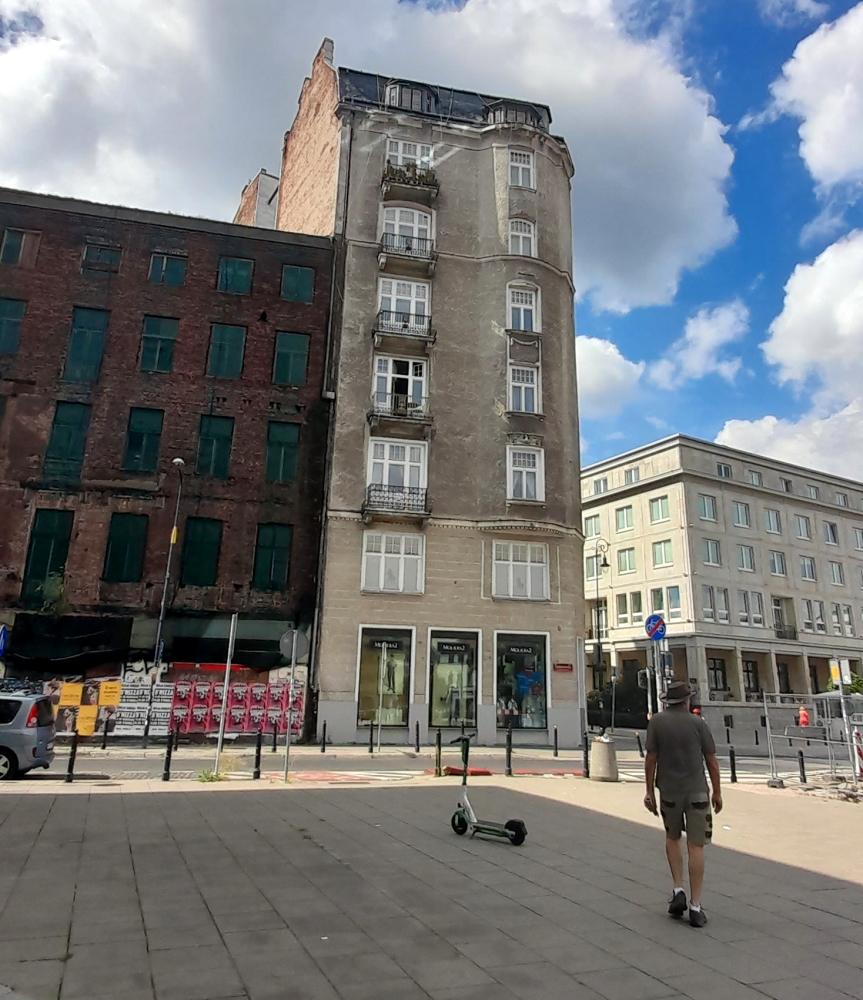
After viewing all that elegant architecture, on our return walk to the hotel we are confronted with clashing architectural forms.
Speaking of Russia, today’s news is that Russian investigators, using molecular-genetic examinations, confirm that Prigozhin died in the plane crash 4 days ago, along with 9 others including Utkin in charge of Wagner’s military operations and logistics mastermind, Chekalov.
28 August, 2023
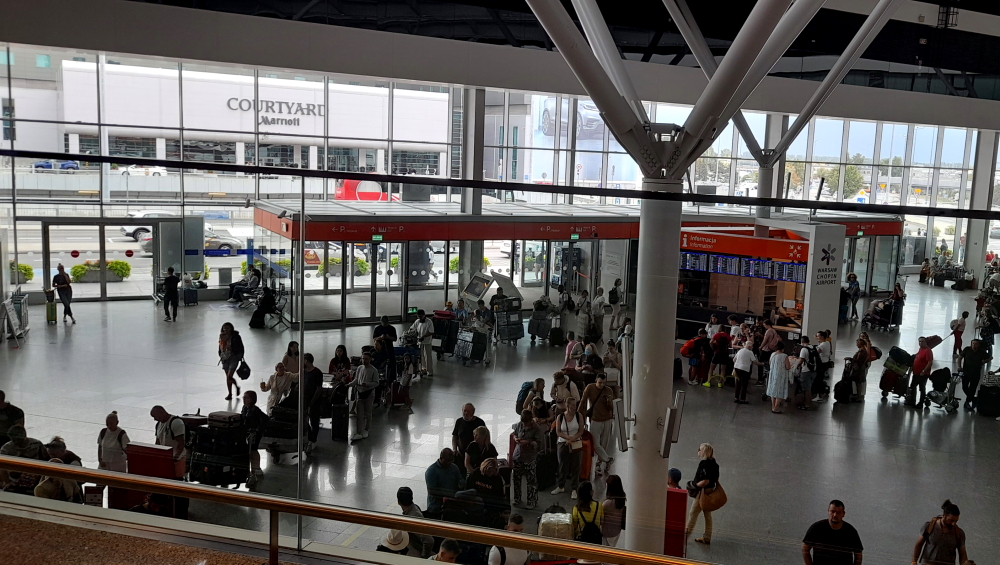
We check out of the Mercure Hotel Warsaw at about 11:00am and our taxi arrives right on time at 11:15am to take us to Chopin Airport Warsaw where we are to collect our hire car for our three-month drive around 7 countries in Northern Europe. I just hope that we can fit our two suitcases in the boot so that we don’t have to have one on the back seat as we did on our first European trip.
The taxi back to the airport is about half of what we paid by booking a meet-and-greet car from the airport who didn’t meet or greet. Finding the car rental desk is a bit of a palava but we get there in the end and we are still 15 minutes early for our midday pick up. As we learnt in Copenhagen it is usually useless arriving early to pick up a hire car as they are seldom ready and it can affect your return time at the end of the rental.
In this case we arrive at the autoUnion rental desk only to find that it is unmanned and locked. “No problem” we thought, the guy must be taking a quick toilet break. However, we speak to an American family also waiting for the autoUnion desk but they had been there since 9:00am and trying to call the company on the phone number on the door. No answer. While we wait for midday to come and go the Americans give up and just book a car from the open rental car company next door. Easy for them as they hadn’t paid for their booking.
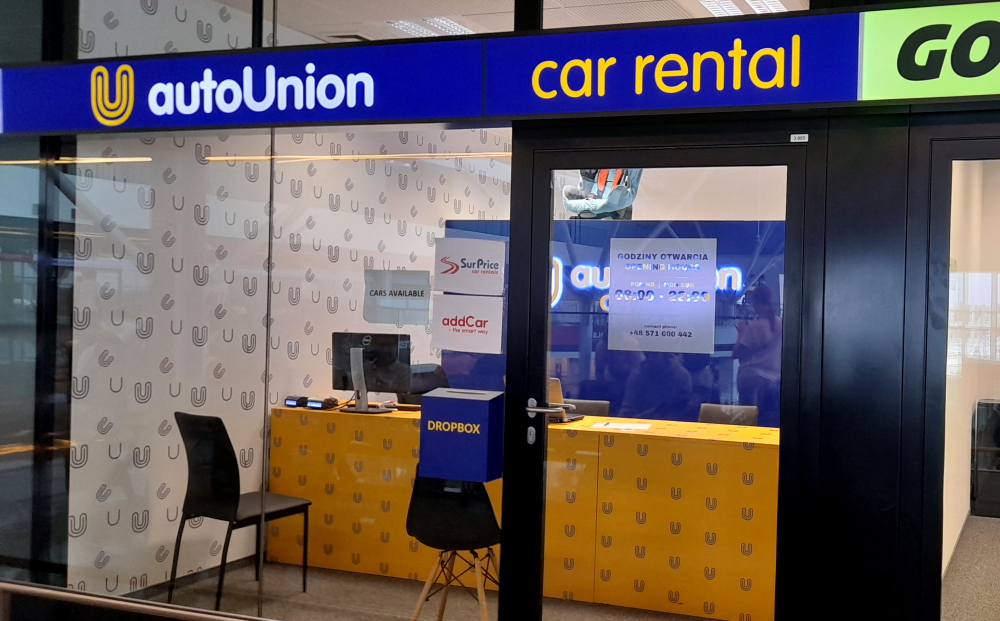
Just prior to midday Lynn calls the number that we had been given on our rental agreement and the call was answered by the Warsaw desk who assured Lynn that an employee was on his way and would be there in 6 minutes. Meanwhile I contact our rental car broker, Holiday Autos (this was our first rental with Holiday Autos as we usually use RentalCars.com) on their WhatsApp Chat line. The Holiday Autos Help Desk agent just advises that they will investigate the issue and guarantee to respond within 20 days. Fat lot of good that will do us right now. I suggest that he go and callaAutoUnion and find out where they are. Subsequently the agent gets a very poor service rating on their survey request.
6 minutes comes and goes so Lynn’s back on the phone to autoUnion and they assure her that a representative would be here in 30 minutes. He has been caught up with a customer issue in downtown Warsaw. If it wasn’t more expensive to pick up the car in downtown Warsaw we would have. However, we are staying at the Marriott at the airport on our way back in three months so the car return should be easier.
Finally at about 12:45pm the autoUnion guy arrives and opens the office. He asks us to wait a moment while he tries to deal with the American family who had completed their hire car documentation with the other company and are just waiting for their car to be brought around. The Americans quickly dismiss him.
Our turn at last. Luckily we are not in any hurry. We have a three-hour drive to Poznan but we make sure that we go through our well-rehearsed hire car pick up process. We are taken across the road to the airport parking area where the hire car companies keep their rental cars. It is right under the Marriott so our return will be very easy.
We do the usual detailed inspection, despite the very poor lighting in the garage, by phone flashlight. The suitcases and our carry-on bags all fit in the boot (just). I get familiar with the car controls, adjust mirrors, insert our music drive, set up the GPS and GPS and phone power. Last job is to enter the GPS co-ordinates and find our way out of the parking area until the GPS locates its satellites.
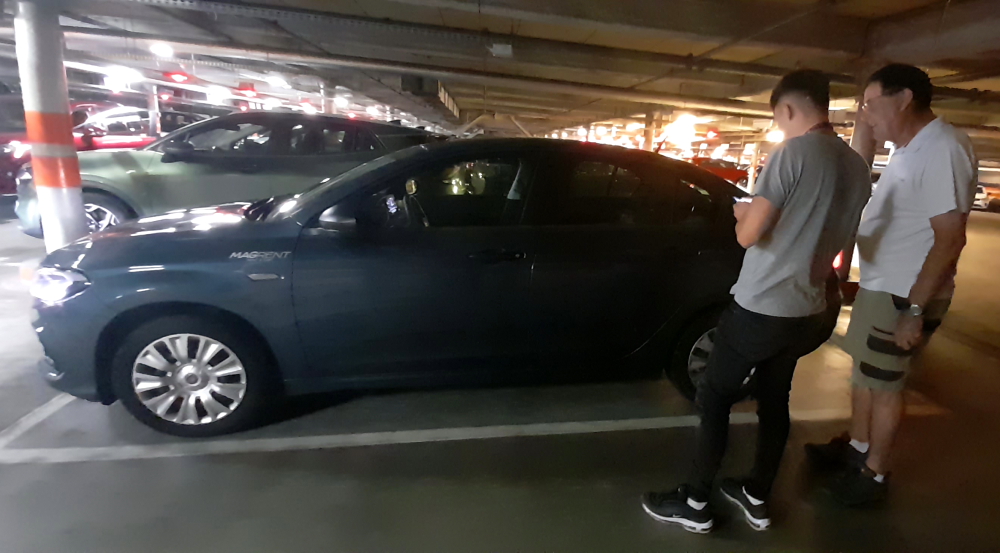
The car is a Fiat Tipo Sedan. Typical Fiat POS, it is in good condition with about 44,000 km on the clock but typical Italian logic to the controls. It is a 5-speed manual, small-engine sedan which has little torque but should be light on petrol. As I find out it really needs a 6-speed gearbox but gets along at the amazing freeway speed limit of 140 kph. Unfortunately I still can’t get the cruise control to work but the music system is excellent and the gearbox and clutch are light and accurate. Naturally, there is no handbook supplied with the car.
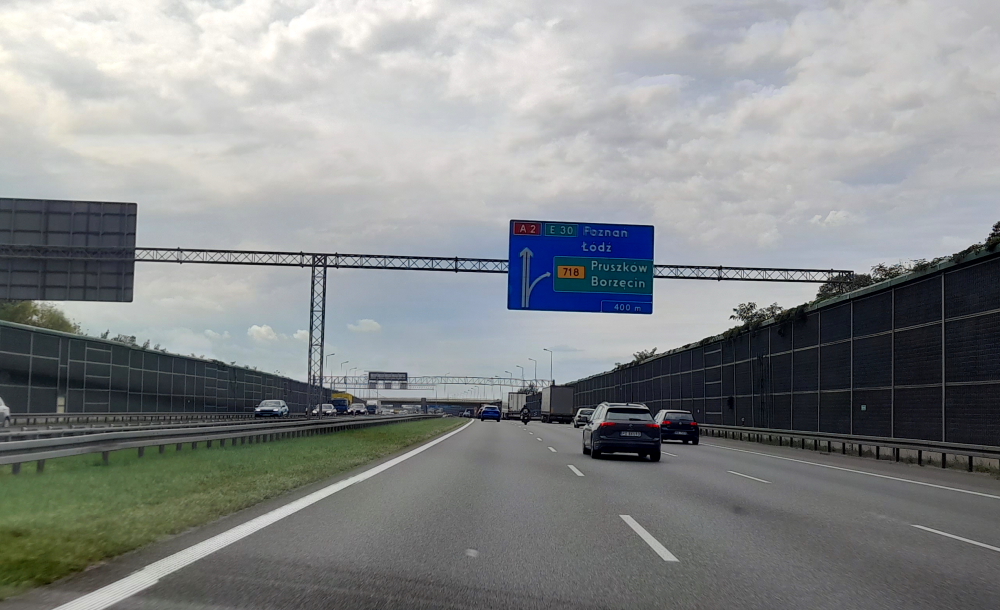
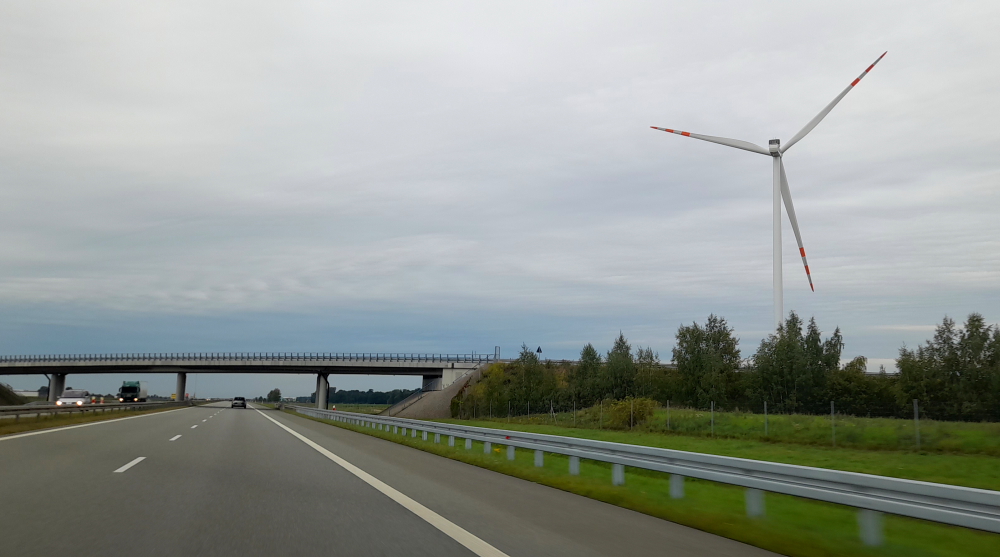
We quickly reach the A2 motorway and once on the motorway it is straight ahead for 280 kms. Tolls on Polish motorways are a bit strange. Most sedans and motorcycles can travel on most of the motorway for free except for the two sections where we have to stop to pay about A$10 per section by card at a manned booth. Still, the road is in fantastic condition (if only my cruise control would work). Traffic is a little heavy close to Warsaw, especially with road freight, but thins quite quickly as we head west. The land is very flat and the motorway is straight.
We have two small tailbacks on the drive where some road works reduce the lanes from three to one but we are only delayed by a couple of minutes. We manage to drive through a number of short-lived rain showers and even experience light hail. Luckily none of the showers are heavy enough to even significantly wet the roads.
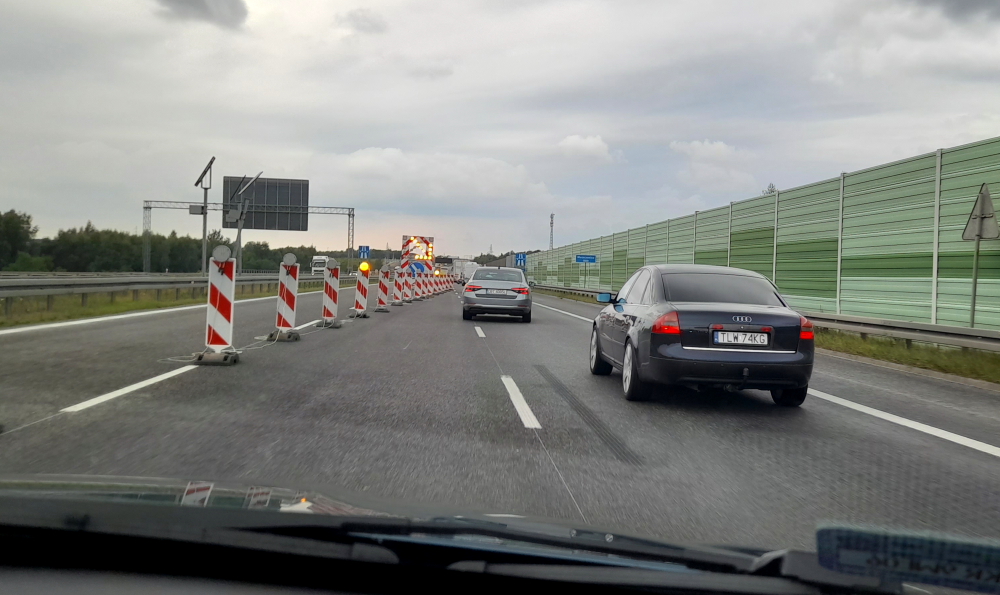
Unlike the hour-long tailbacks in the UK most drivers merge quickly and the trucks patiently queue in the single slow lane so any lost time is quickly recovered.
Polish drivers are a bit kamikaze but they consistently keep out of the way of faster cars. This is particularly helpful as the A2 reduces to two lanes for most of the way to Poznan and the semi-trailers outnumber cars by about 5:1. The number of trucks going west is astounding. It looks like they need a freight rail system from Warsaw west to Germany.
When we left Warsaw it was a hot 26 Deg C but as we approach Poznan the outside temperature has continued to drop to a chilly 16 Deg C. The traffic is now minimal and the landscape if still flat farmland.
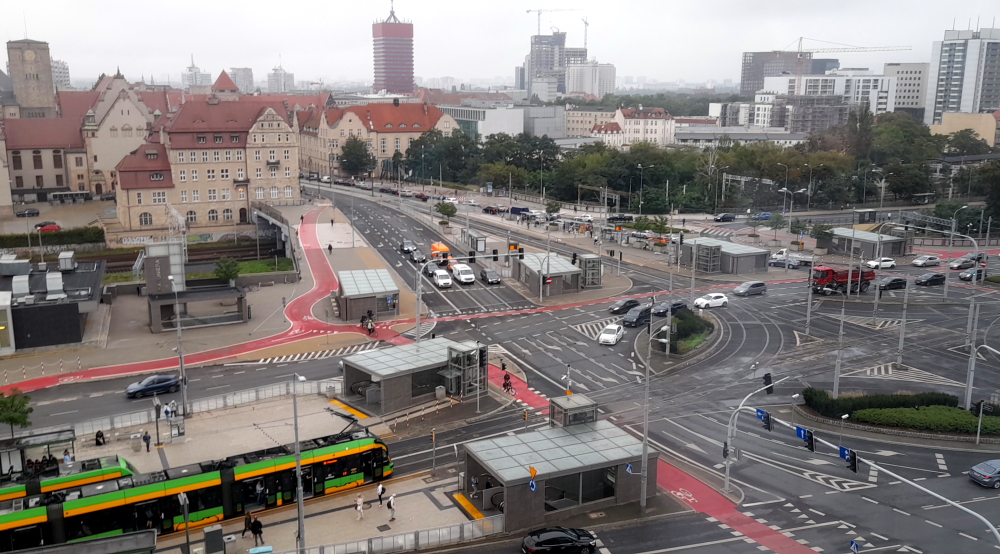
The traffic in downtown Poznan is quite manageable but my GPS settings seem incorrect so Lynn takes over the navigation and does a superb job given her MapsMe app has a habit of changing its mind about its correct location. We spot the Mercure Hotel in the distance and find our way to the parking area with relative ease. The plan tonight is to recheck our hotel GPS reference points and add them to our Garmin.
Check-in is easy and we are given an upgraded room with a view towards the city centre overlooking the tram and railway. It sounds bad but the trams and railways are very well presented and will be useful for our city explorations.
Apparently Poznan is known for a couple of things (at least for tourists). The head butting goats on the Town Hall clock and a pastry known as a St Martin Croissant.
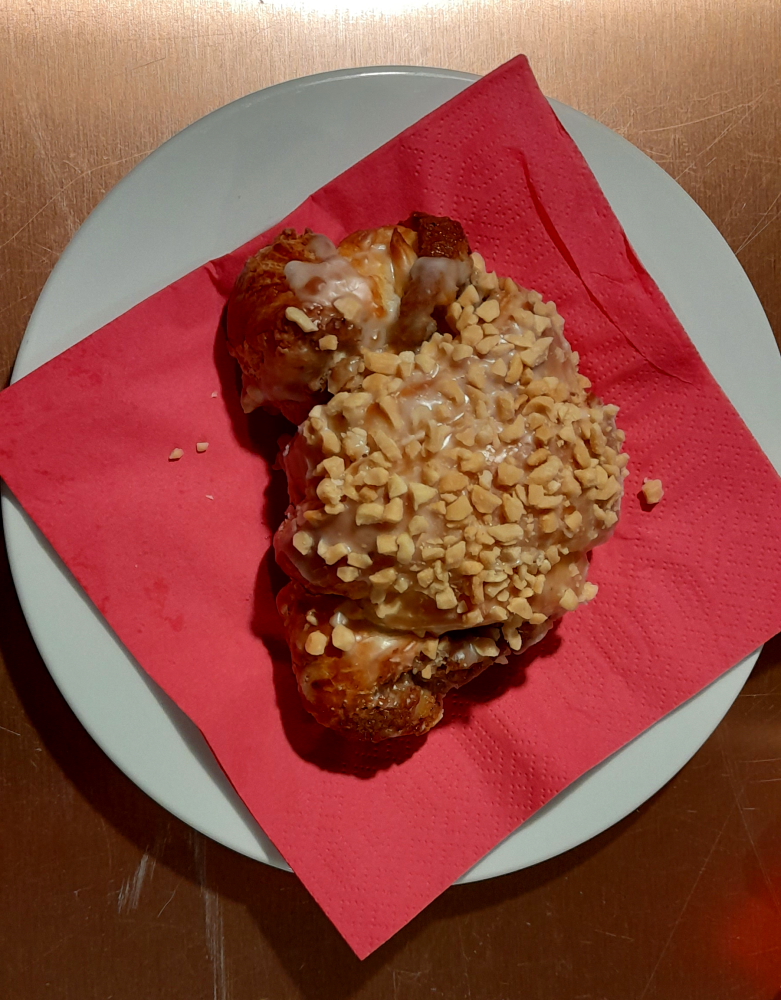
Lynn tells me that they are quite yummy. The hotel presented two of the croissants to us but they are filled with Almond cream which is not to my taste.
Dinner tonight is in the hotel restaurant as we are too tired to bother heading out to look for a restaurant. We both had a pork chop with boiled cabbage and new potatoes. Best pork chop I have ever had.
29 August, 2023
It is a chilly 14 Deg C out this morning but after breakfast we need to head out to do the weekly laundry and buy some supplies for our road trip.
The laundromat is about 13 minutes’ walk away into the suburbs to the NNW of our hotel. The area is a little dilapidated but seems to be going through a gentrification process as many of the building are being renovated. Most were originally built between 1900 and 1914 and were probably neglected from WWII through the Soviet era. Luckily they have survived and are now elegant, stately apartment blocks.
After passing the laundromat a couple of times we finally find it sunken halfway below the pavement level.
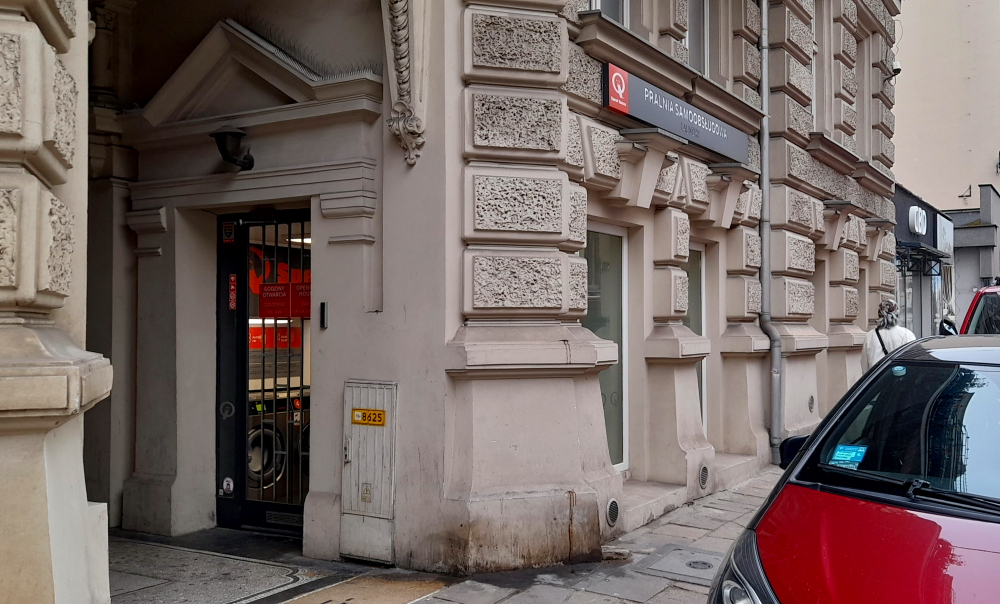
The laundromat is modern, clean and has an easy card payment system. Initially it is a bit difficult to work out how to use the machines but luckily there is an Australian (originally from Iraq) man who is very familiar with the process. Our helpful Australian is from Sydney where he moved to after he left Iraq in the early 1990s. He is in Poznan visiting friends.
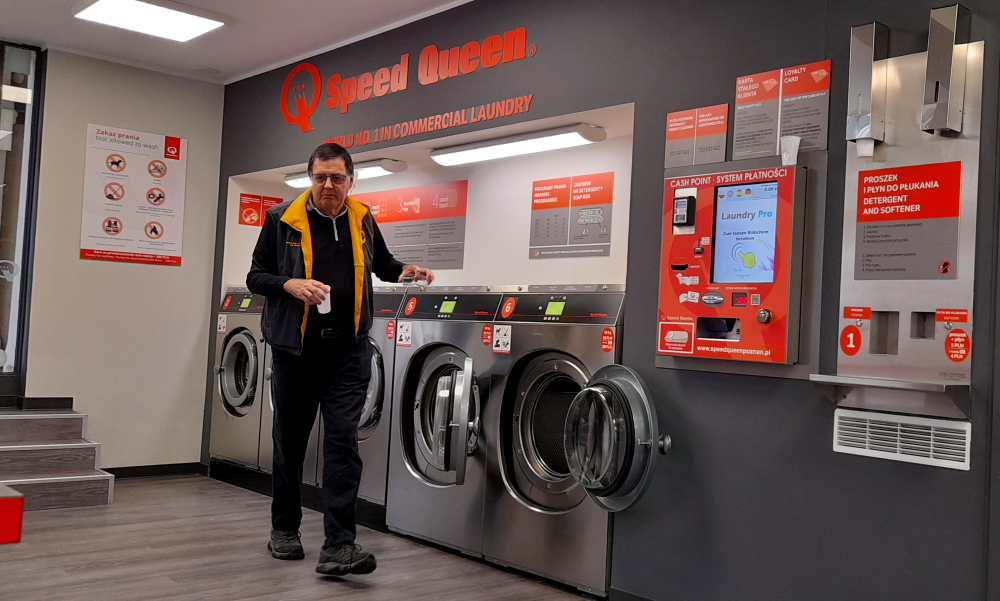
After a quick lesson the process becomes quite easy. Since it is going to take about 45 minutes to complete the wash cycle we head down the road to a supermarket for some essential supplies. Once back, and while I attend to the washing Lynn heads around the corner to acquire a couple of coffees. No room for an ‘ekler’ (eclair) though – their specialty.
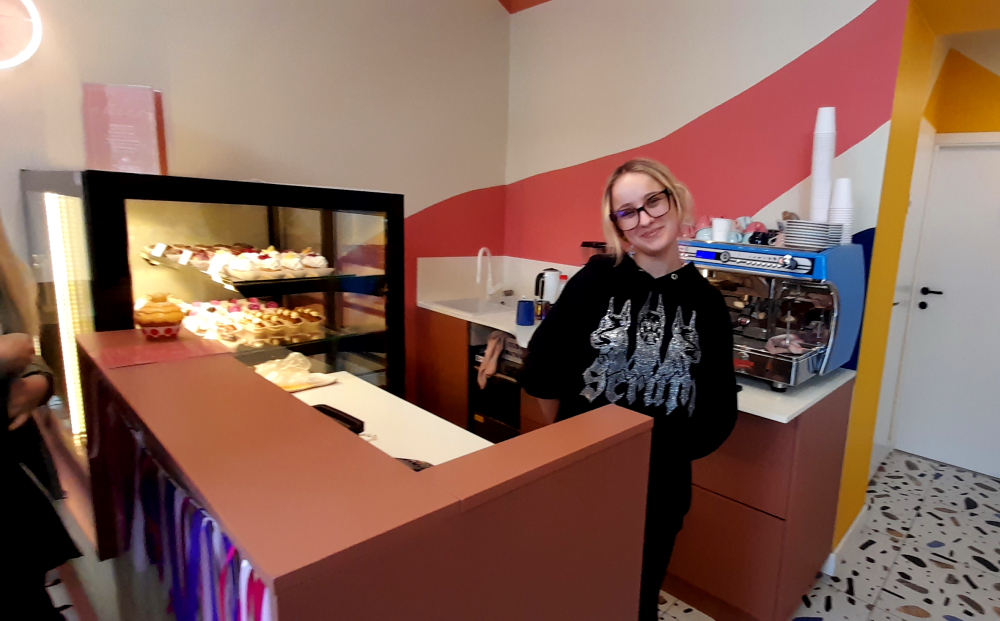
The coffee is good and the laundromat is excellent albeit quite expensive but soon our laundry is done for at least another week.
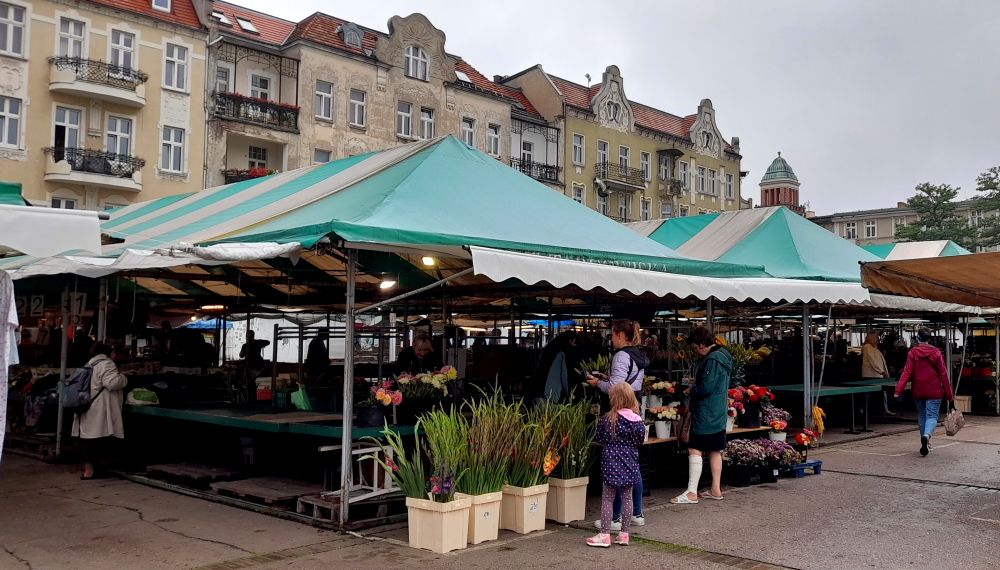
We take a different (and shorter) route back to the hotel and come across a local market place. Lots of fresh fruit, vegetables and flowers for sale.
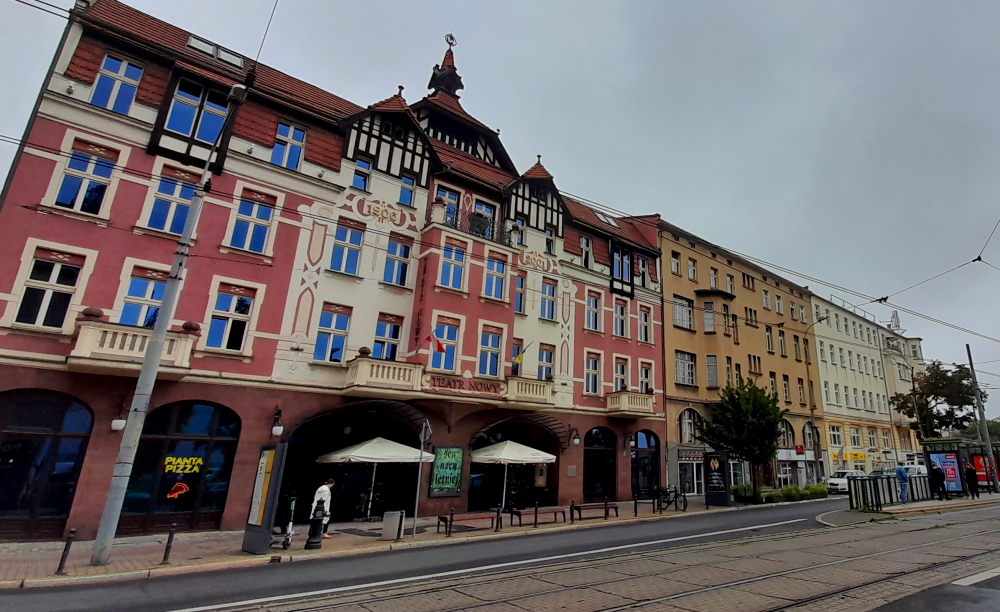
The buildings around here are beautifully restored and probably very expensive given their location close to transport and the city centre. Some buildings date back to the early 19th Century.
Back at the hotel Lynn starts the ironing process. All very domestic but all very essential. While she irons I head over to the tram station to investigate the ticketing process and the route that we will take tomorrow for our old town walking tour and city centre exploration.
The trams seem quite easy to access and while I am out I buy two, 24-hour tram tickets for about A$5.75 each. The 24 hours start the moment that we validate the ticket on our first tram trip. Too easy. All set for tomorrow as long as the weather holds off.
30 August, 2023
It is another dreary weather day this morning but we plan to take a leisurely breakfast before we head in to the town centre. Our planned walking tour has again been changed and will now start at 5:00pm. It will be getting quite dark by the time we finish so we decide to go downtown and be at the Town Hall for the midday goat headbutting and trumpet solo.
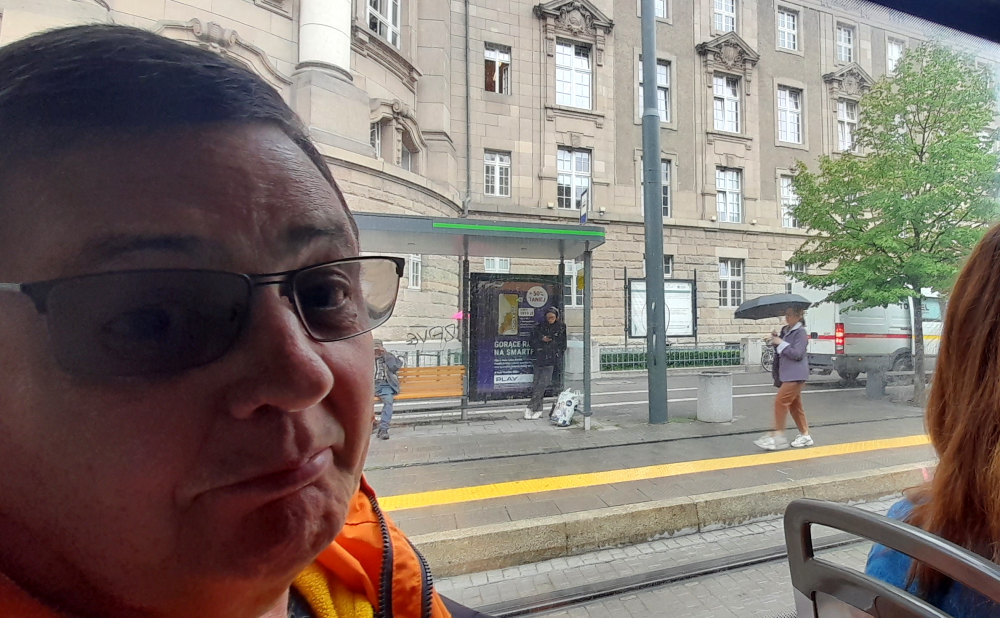
Around 11:15am we jump on a No. 8 tram across the road from the hotel. About 10 minutes later we alight at the Male Garbary stop and walk the short way to the Old Market Square and Town Hall.
Mud, mud everywhere! What should have been a beautiful and colourful market square is a construction zone, all around the Town Hall.
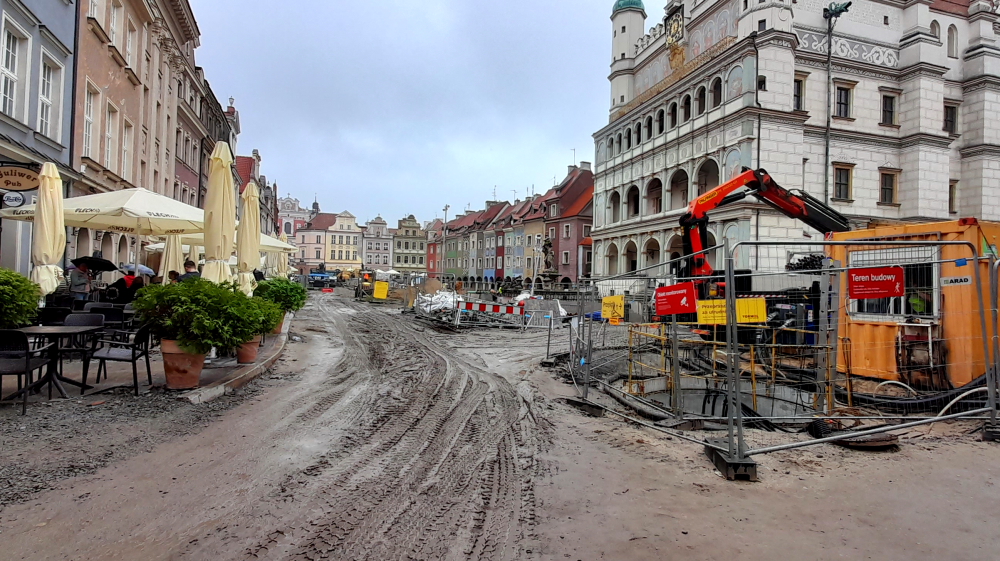
Formerly the seat of the city council, the Town Hall is one of the most valuable Renaissance architecture monuments in central Europe. The earliest mention about it dates back to 1310 but constructed earlier as evidenced by a keystone preserved in the cellar that bears the coat of arms of the Przemyślid dynasty, represented on the Polish throne from 1300 to 1306 by Waclaw II.
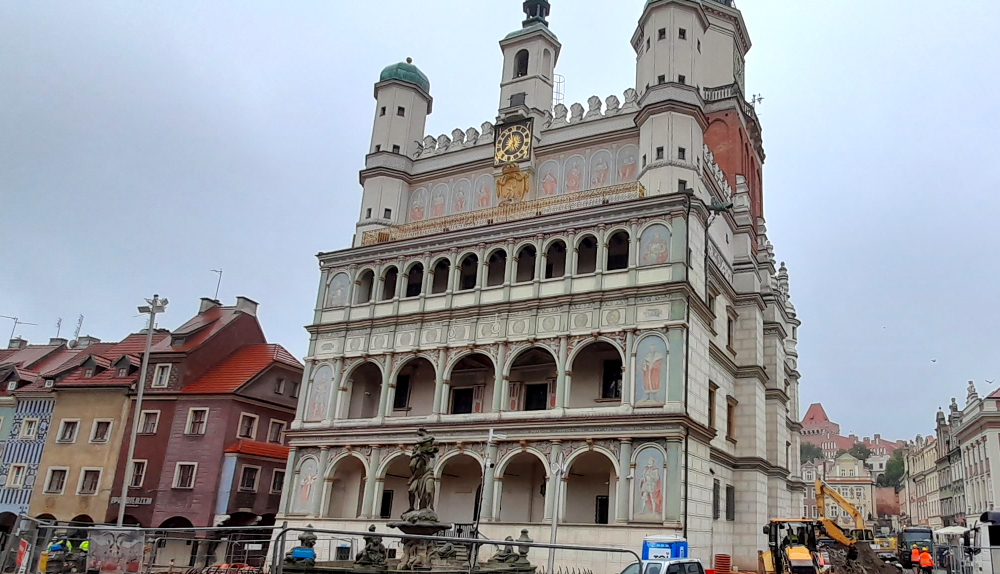
Between 1550 and 1567 the town hall was reconstructed in the Renaissance style by the Italian architect Giovanni Batista Quadro of Lugano with its facade decorated with a 3-storey loggia. This front elevation with the colonnaded 3-storey loggia and the 3 turrents above is the building’s most attractive feature.
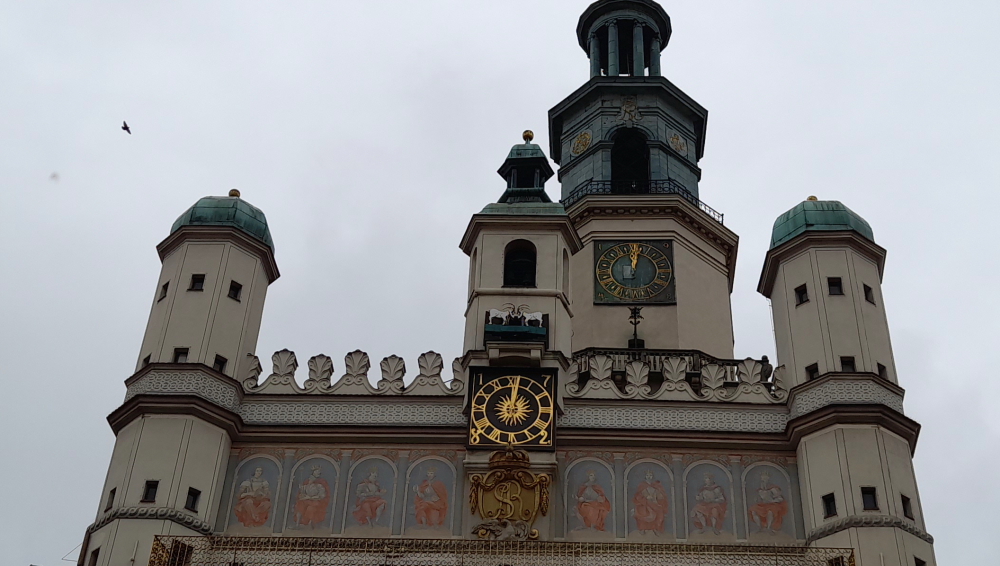
The medallions between the first and the second floor portray heads of wise men and heroes of antiquity. The attic storey features heads of the Polish kings from the Jagiellonian dynasty. Pictures of the kings from the Piast dynasty, designed by Zbigniew Bednarowicz, started to be posted below the side turrets. In the centre turret, under the clock, there is a cartouche with the initials of king Stanislaus Augustus.
Right above the clock there is a small ledge where every day at noon a pair of billy goats appears from behind 2 small doors and butt heads 12 times to mark the mid-day hour – like a cuckoo clock. At noon, a trumpeter appears at the top of the Town Hall and plays a bugle call, which is when the two goats appear. These mechanical goats first battled it out in the year 1551, all because of an overcooked deer…
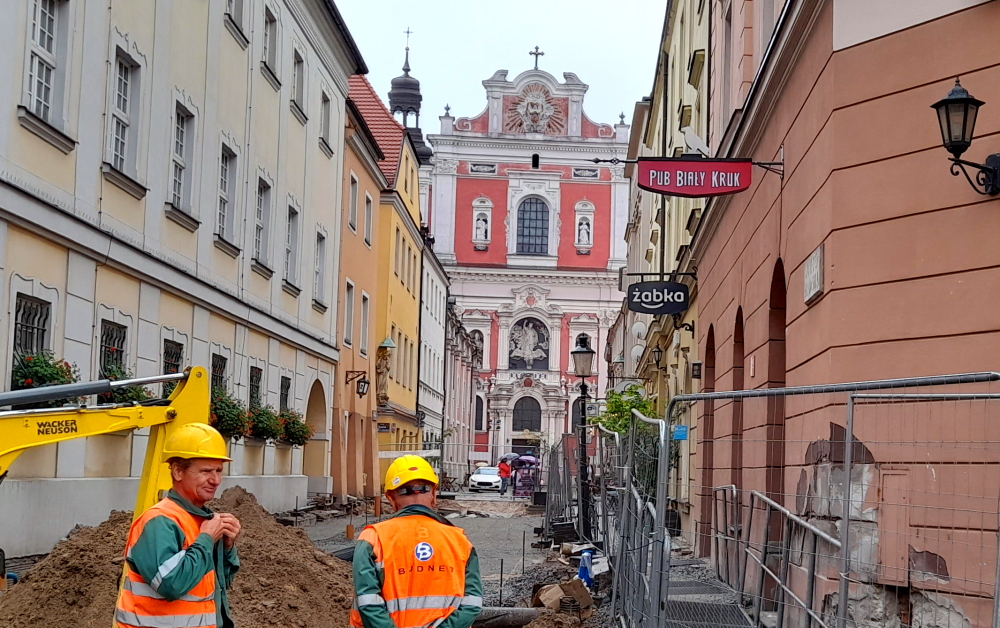
We see an attractive church down one of the roadways off the market square. It is the Bazylika kolegiacka Matki Bozej Nieustajacej Pomocy, sw. Marii Magdaleny i sw. Stanislawa Biskupa, (Basilica of Our Lady of Perpetual Help, Mary Magdalene and St Stanislaus) locally known as the Parish Church of St. Stanislaus. One of the most monumental Baroque churches in Poland built by the Jesuits in the 17th century.
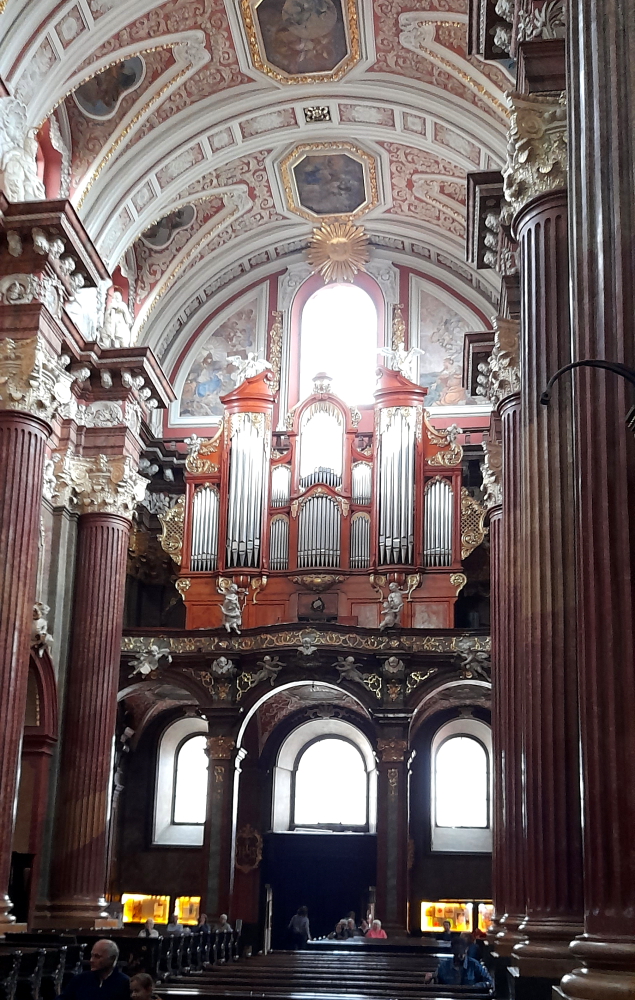
Inside there is the famous pipe organ – the work of the 19th century organ builder Frederic Ladegast and today there is a recital which we take time out to sit down and absorb the stunning acoustics.
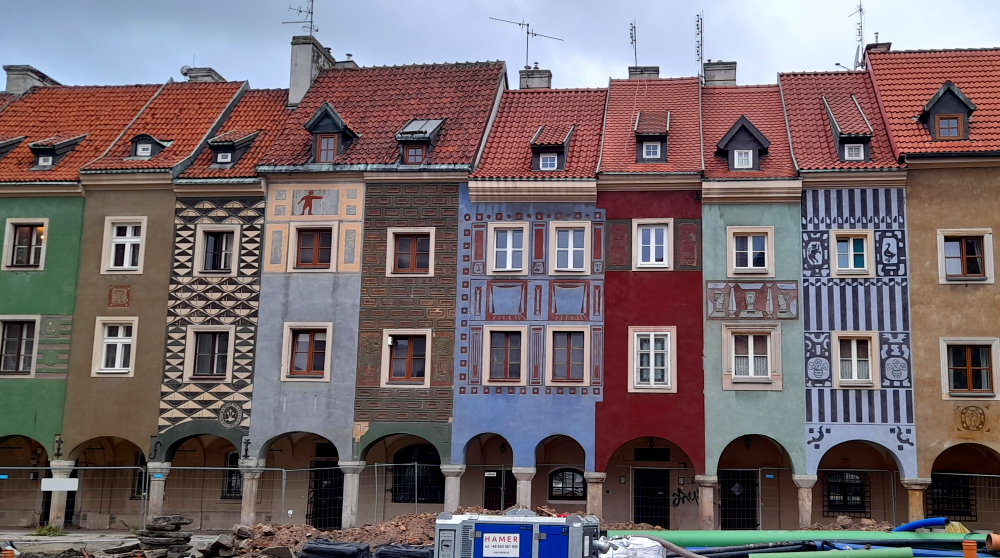
Next to the Town Hall are colourful houses with characteristic arcades which used to be where craftsmen and tradesmen sold fish, candles and salt. Old craftsmen trade signs from the 16th Century can still be found on some of the houses.
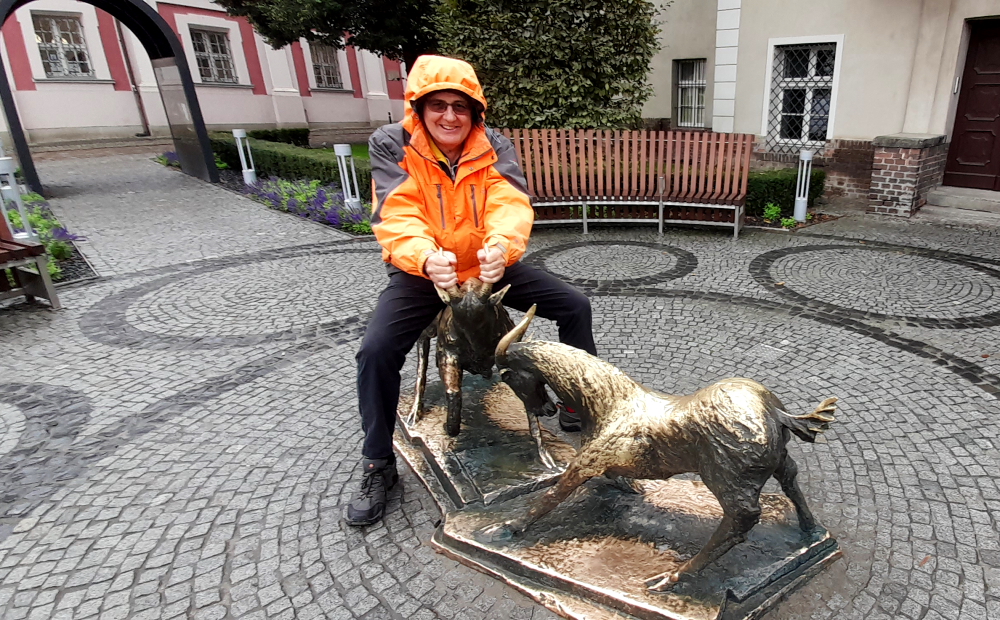
Around the corner from the Market Square on Plac Kolegiacki is a bronze statue of the 2 Poznan Goats – the symbol of Poznan – made by Robert Sobocinski in 2002. Apparently a hit with children!
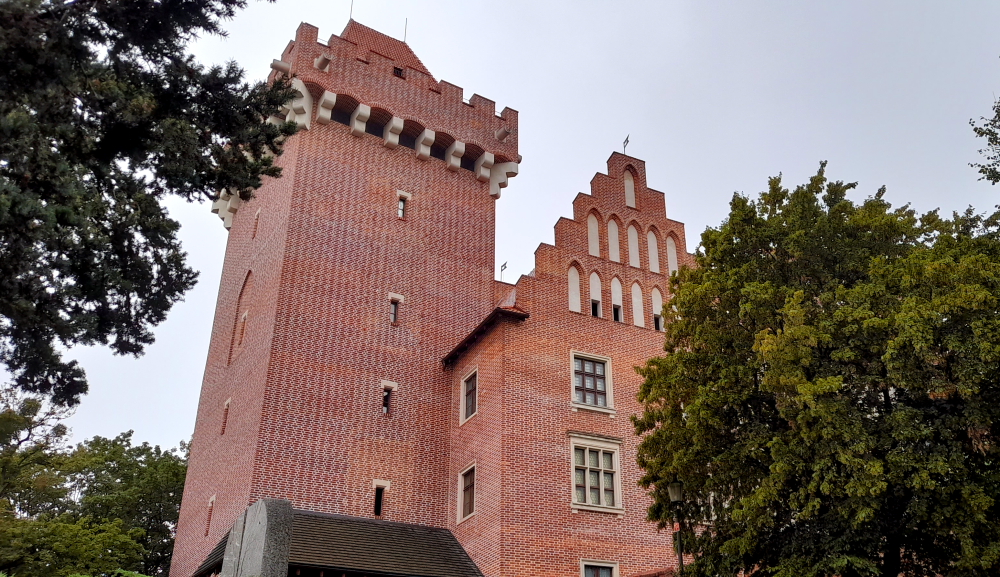
We spy another interesting building from the Market Square and make our way towards it – to find the reconstructed 13th century Royal Castle.
Once the pride of Poznań, the original construction was begun approximately 1249 by Przemysł I – Duke of the Piast dynasty who had chosen Poz as his capital. During the Siege of 1945, the castle had the misfortune of being in the line of fire with the Nazi stronghold on Citadel Hill. In 1959 the decision was taken to rebuild which became the home of the Applied Arts Museum. Between 2010 and 2016, the castle was completely reconstructed and now once again overlooks the city.
Nearby is the National Museum in Poznań (Polish: Muzeum Narodowe w Poznaniu), abbreviated MNP, a state-owned cultural institution and one of the largest museums in Poland. It houses a rich collection of Polish painting from the 16th century on, and a collection of foreign paintings (Italian, Spanish, Dutch and German). The museum is also home to numismatic collections and a gallery of applied arts.
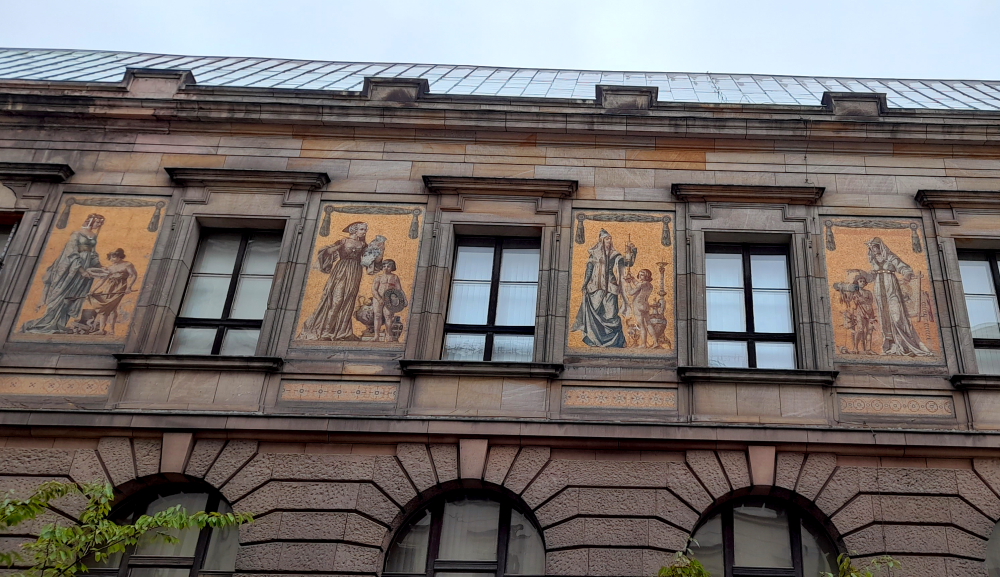
The National Museum in Poznań was established in 1857, as the “Museum of Polish and Slavic Antiquities”. The current building was designed by Carl Hinckeldyen and built in 1904. During World War II the building was damaged, the collection looted by German military, while numerous museum exhibits, including the natural and ethnographic collections, were destroyed. After the war the Polish Government retrieved many of the works.
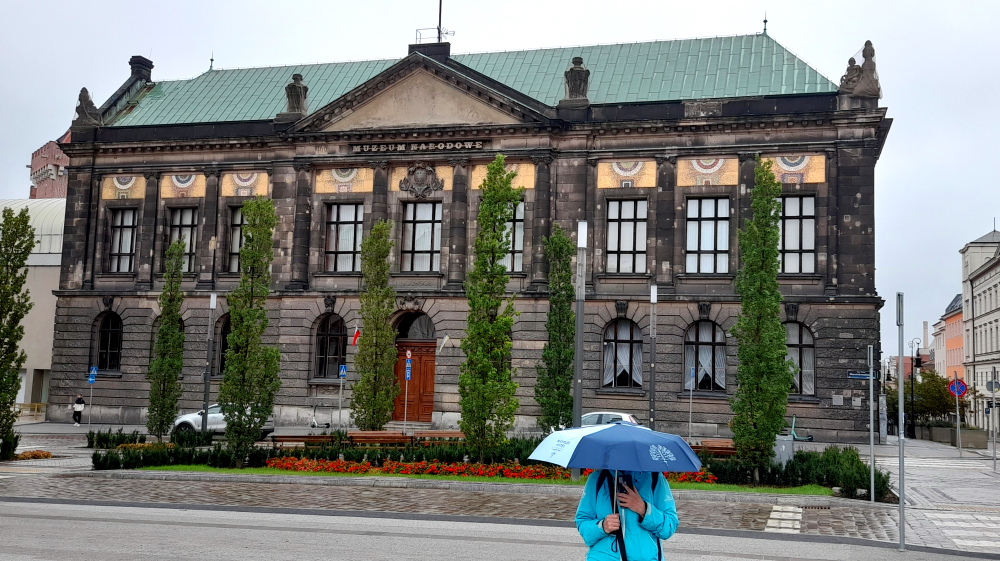
The works of many prominent Polish artists are displayed in the Gallery of Polish Art. The main building features one of the largest galleries of foreign paintings in Poland, predominantly originating from the collection owned by Count Raczyński.
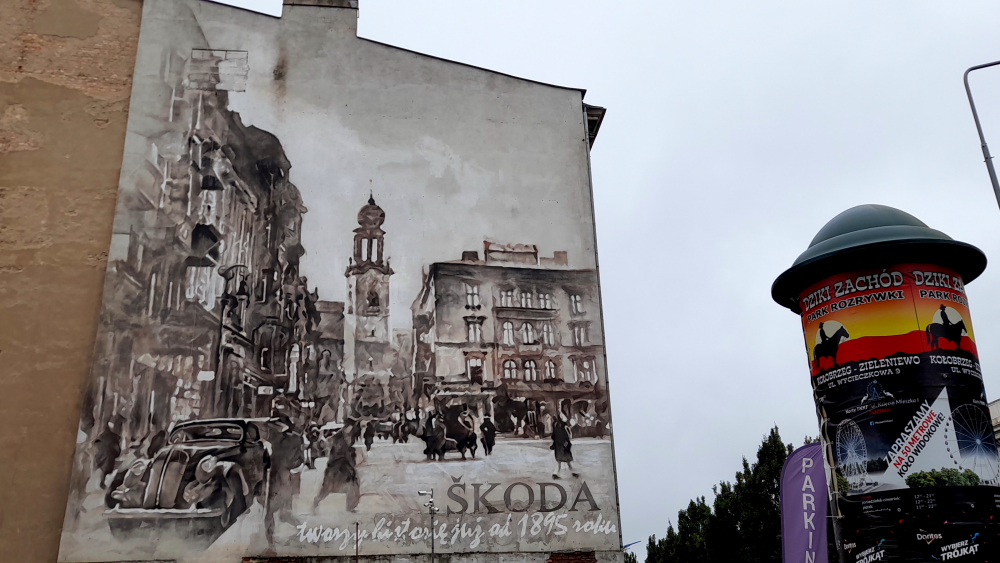
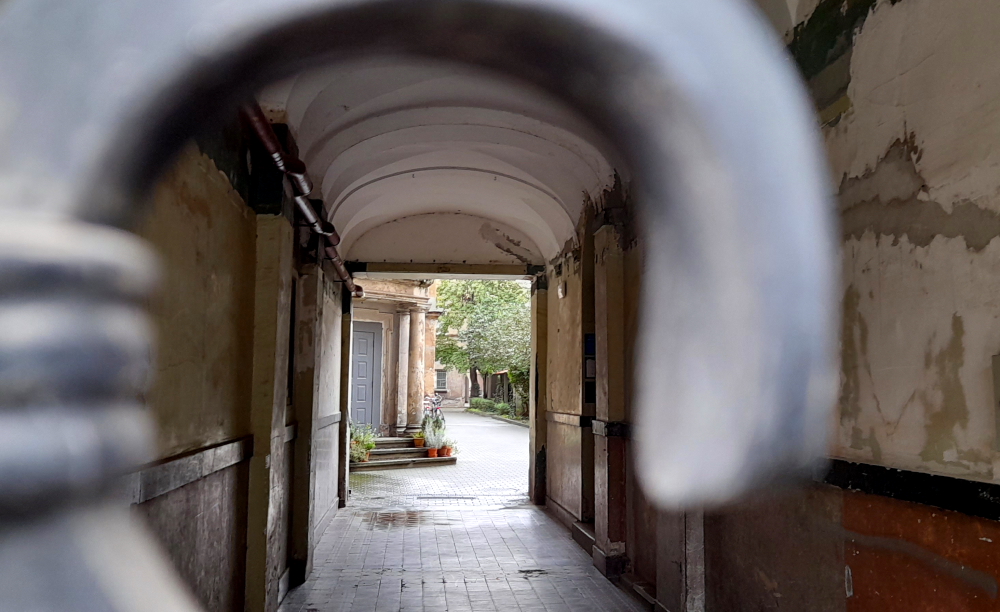
Strolling through the neighbourhood to get to the tram station we pass numerous old apartment buildings with inner courtyards and an interesting advertisement for Skoda on one of the building’s wall.
After a couple of hours at the hotel we venture out again to catch the No. 8 tram, this time to the Katedra tram stop. Slight hitch, we have to wait 13 minutes for the next No. 8 train and it’s already 4:30pm so we check the tram map and see that we can walk to the next stop and get a No. 17 tram which arrives 3 minutes later.
We arrive at Katedra at 4:45pm and eventually find our meeting point. By 5:00pm, our rescheduled time, there are 9 of us in the tour group.
The Archcathedral Basilica of St. Peter and St. Paul in Poznań is one of the oldest churches in Poland and the oldest Polish cathedral, dating from the 10th century. It stands on the island of Ostrów Tumski north-east of the city centre.
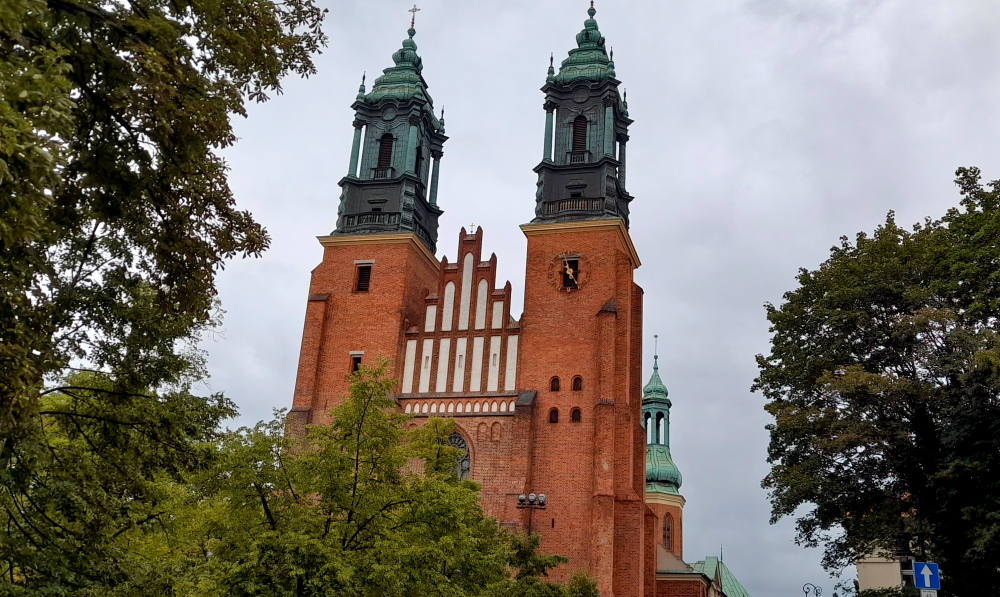
The cathedral was originally built in 968 within the fortified settlement (gród) of Poznań, which stood on what is now called Ostrów Tumski. This was one of the main political centers in the early Polish state.
Mieszko himself was baptised in 966, possibly at Poznań – this is regarded as a key event in the Christianization of Poland and consolidation of the state. The cathedral was built around this time; it was raised to the status of a cathedral in 968 when the first missionary bishop, Bishop Jordan, came to Poland.
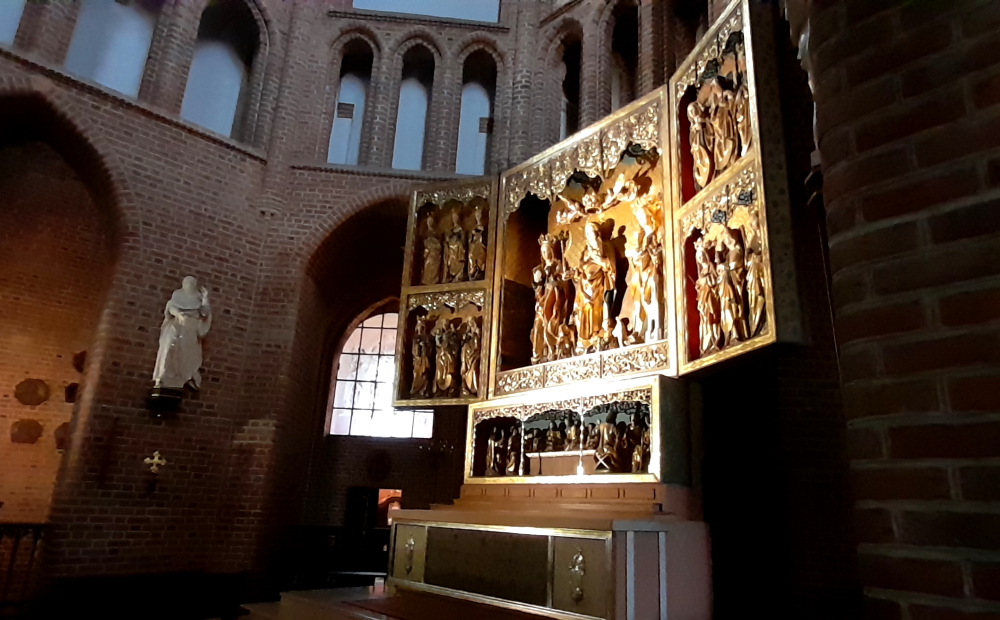
During its history the cathedral has been rebuilt in various styles: pre-Romanesque, Romanesque, Gothic, Baroque and neo-Classical. The last of the great fires occurred on 15 February 1945, during the liberation of the city from the Germans. The damage was serious enough that the conservators decided to return to the Gothic style, using as a base medieval relics revealed by the fire. The cathedral was reopened on 29 June 1956.
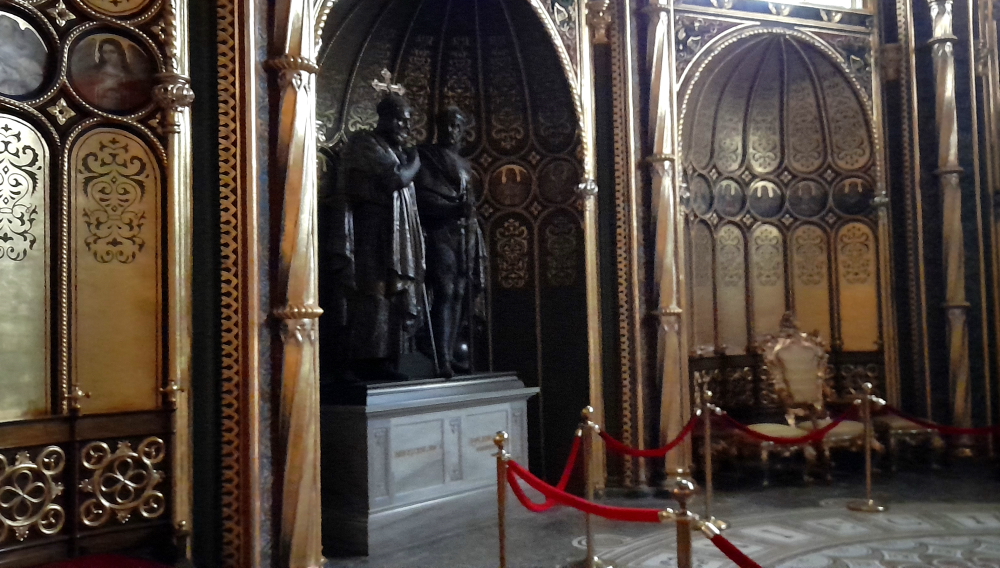
The 19th century Golden Chapel contains the sarcophagi and statues of the first Polish rulers – Mieszko I and his son Boleshaw Chrobry.
From the cathedral we walk over the Warta River bridge and on to the Old Market Square. Here the guide mentions to us that the Polish explorer, Strzelecki – who climbed and named Mount Kosciusko – in 1997 his ashes were placed in the Crypt of Distinguished People of Greater Poland in the basement of the church of St. Wojciech, Poznań .
From the Square we walk past the Baroque Church of St Stanislaus to the Post-Jesuit College next door which surrounds a large courtyard. Formerly one of Poland’s best secondary schools (18th century), it currently houses Poznan City Counil. In 1806, for 3 weeks, it hosted Napoleon Bonaparte. Fryderyk Chopin also played here.
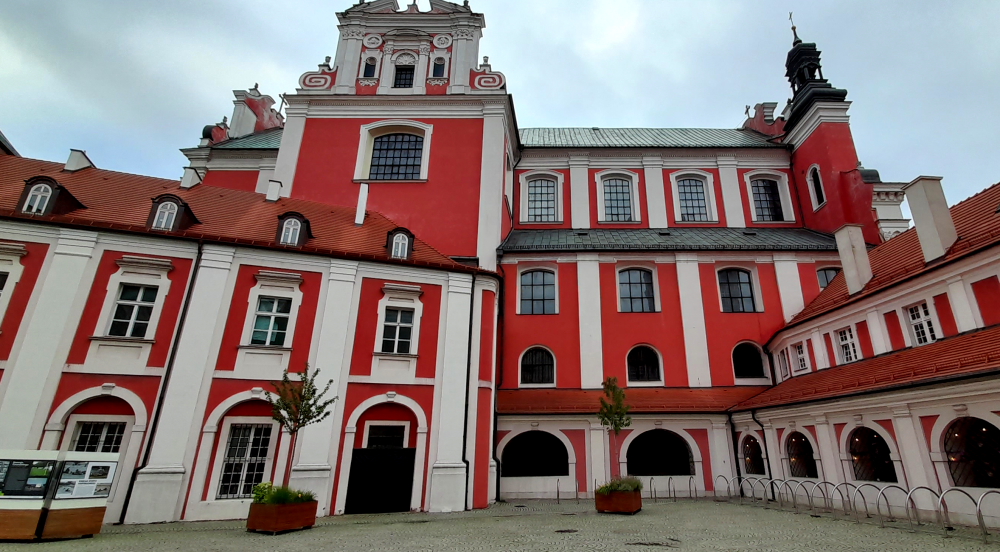
Curiously, we find a small metal Gnome hiding in a corner of the courtyard.
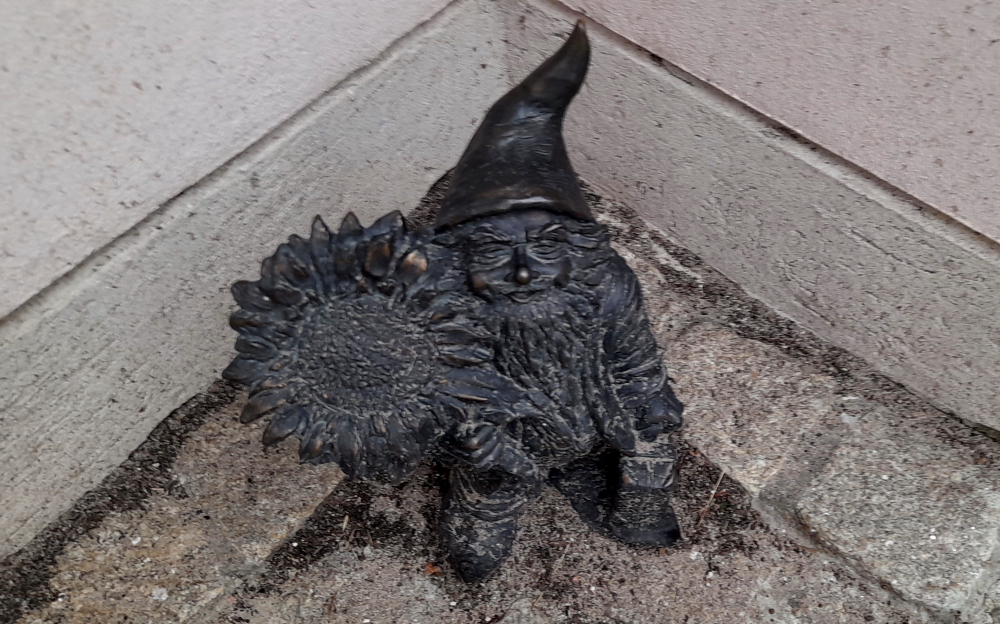
The tour continues to the Poznan Goat sculpture and up to the Royal Castle where the tour ends. We return to the Old Market Square to one of the restaurants for dinner.
As it turns out, we are sitting behind an Australian couple, the guy of Polish descent. The guy had obviously given the waiter a tip in Australian currency saying to him that “he could exchange it or use it when he visited Australia”. Lynn turns around to the waiter and jokingly says: “Make sure it’s not a $1 note that he’s given you!” {$1 notes were replaced by $1 coins in 1984].
31 August, 2023
Before we leave Poznan I try to get rid of a ‘Service Required’ alert on the car’s dashboard after having phoned the hire car company to check that a service had, in fact, been done. Would you believe the instructions to clear it are: “Turn ignition on. Fully depress accelerator. At same time press brake 7 times. Wait 1 minute before releasing accelerator. Turn off ignition. Wait 1 minute. Turn on ignition.” Nope! alert is still there. Who’d buy a Fiat!!
Likewise, Lynn found an English version of basic instructions on how to engage/disengage the cruise control. This car is missing the icon in the centre of the surrounding cruise control buttons – the one that you are supposed to press to engage it. Assumption – this car does not have cruise control! A 2021 model car without cruise control. What????
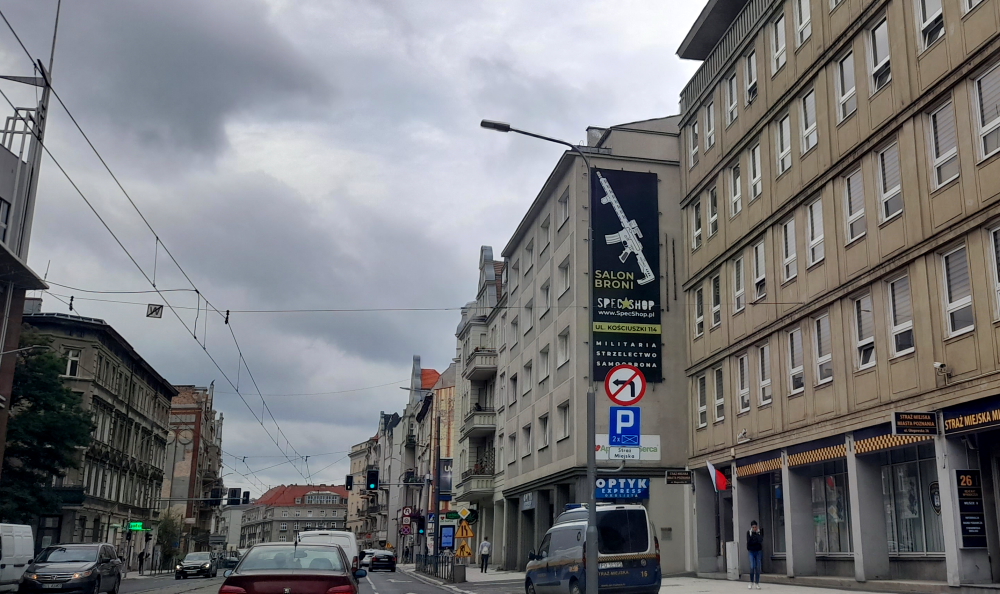
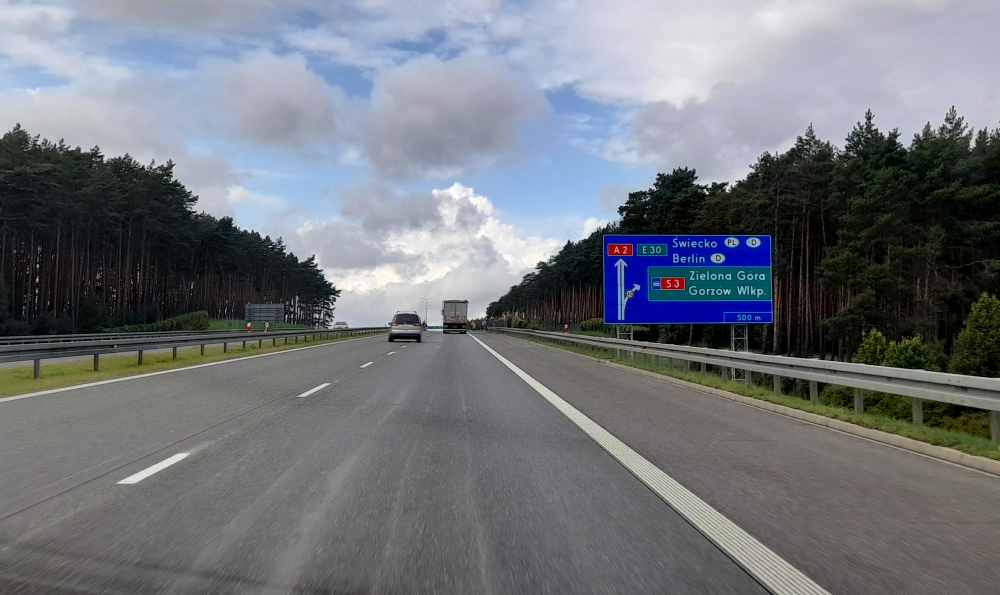
After those frustrating shenanigans in the hotel car park, we leave an overcast 17 Deg. C Poznan for a 1.5 hour drive to Zielona Gora, a town within a wine-producing area of Poland.
The A2 motorway continues long, straight and in good condition. We encounter one, 3-minute tail back at road works and bouts of heavy rain followed by brilliant sunshine.
It’s 1:45 pm when we arrive at the hotel and are met by a taciturn male receptionist. I put the car into the underground car park while we wait. 30 minutes later we quickly unpack and walk into the old town, 5 minutes’ walk away, to make the most of the sunshine.
Lynn has already mapped out key spots to visit so we make our way along that route. The first stop is Plac Pocztowy (Post Office Square). This area developed as a suburb of the town founded in the first part of the 13th century. In the 19th century there were also famous hotels around the square and the wealthiest residents lived here.
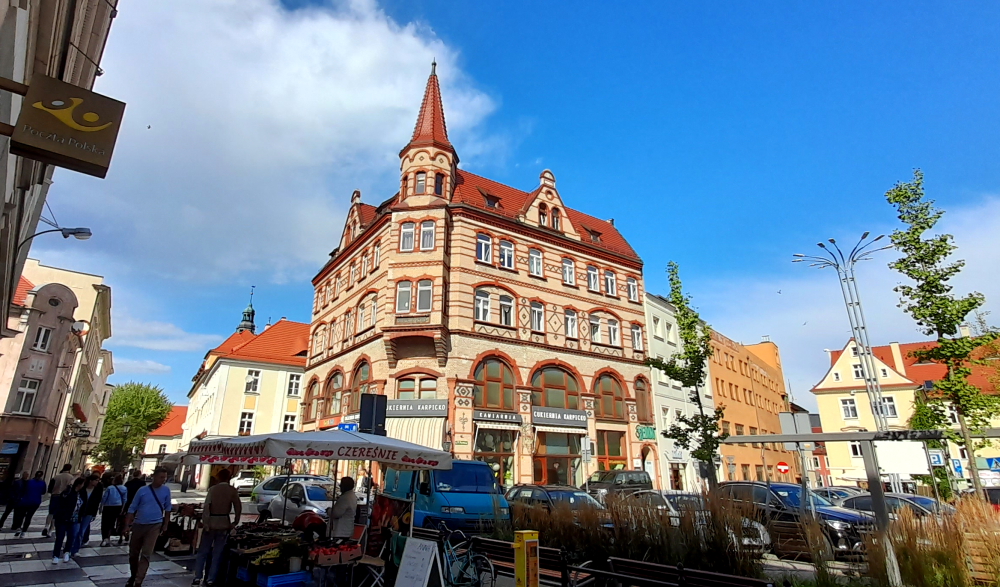
On one corner is a silica brick tenement house which was built in 1901 and was used as a bookstore and publishing house of the old Grunberger Wochenblatt weekly newspaper.
Next is the Town Square and Rathaus. It’s here that we first notice little comical bronze statues dotted around the square – mini Bacchuses. We call into the Tourist Bureau in the Rathaus to collect a city map and learn of the Route of the Little Bacchuses.
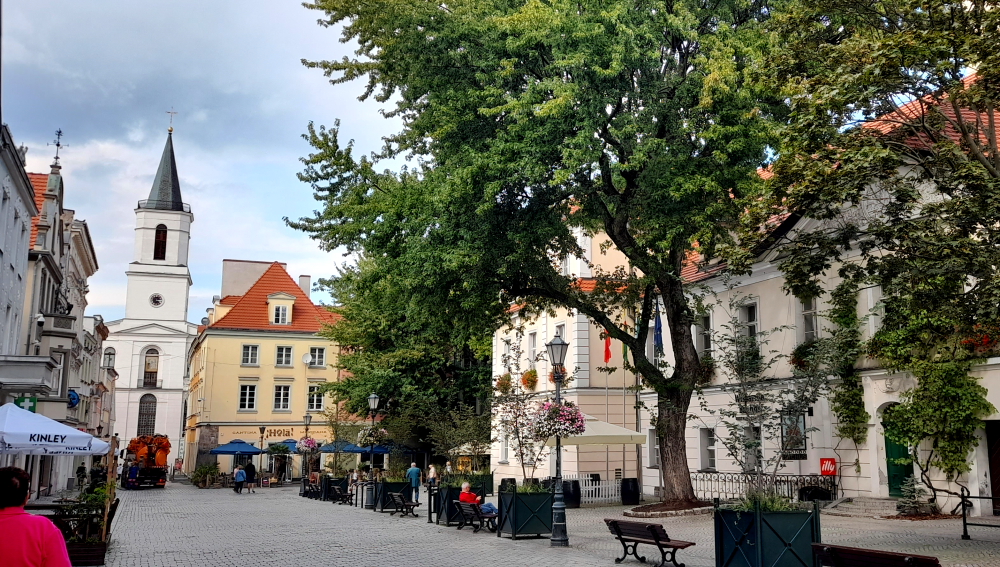
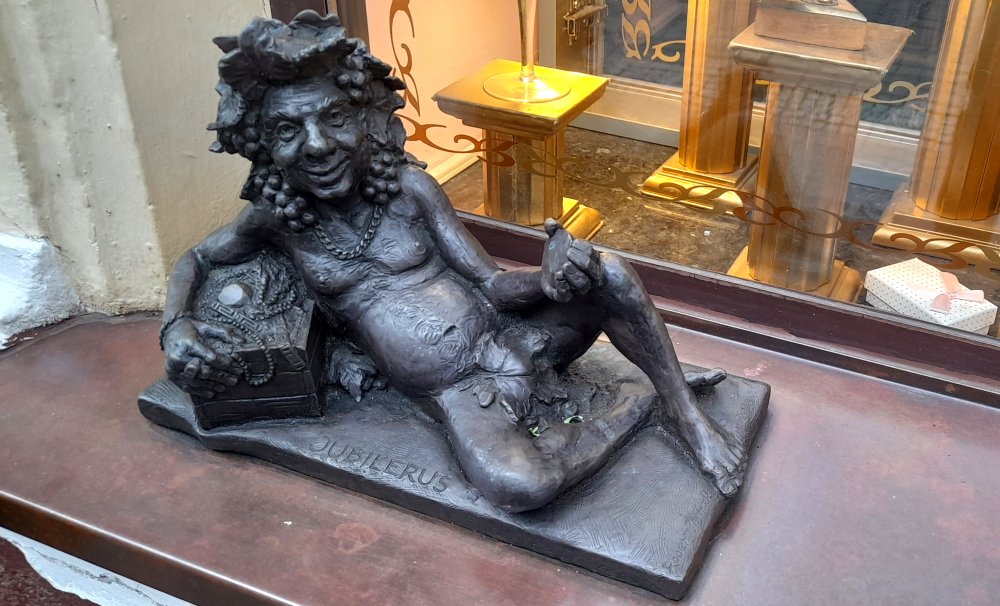
The Little Bacchuses is a collection of miniature metal figurines of Bacchus, the Roman god of agriculture and wine, all wearing at least a grape leaf and grape wreath on their heads and sporting either a wine goblet, bottle, flask or barrel in addition to a feature that makes each unique. There’s even a special brochure/town map dedicated to the Route of the unbelievable 66 miniatures dotted around the town. There is also an annual wine festival which, this year, starts next week on 9 September. Needless to say, Bacchus is the town’s symbol.
As a sample, we’ve included 4 of the 66.
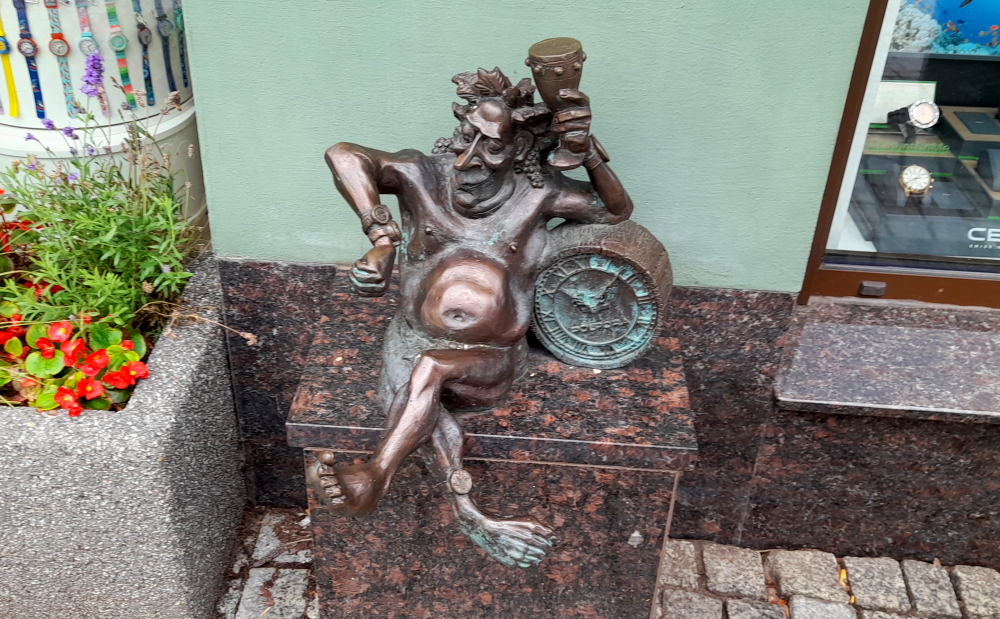
Outside a watch shop is a Bacchus leaning on a clock with a goblet of wine in one hand, a grape leaf and grapes wreath encircling his head, 2 watches on his opposite wrist and 1 on his ankle. The brochure’s description is: “Watchmaker Polporek has been working non-stop and has been producing amazing watches for years.”
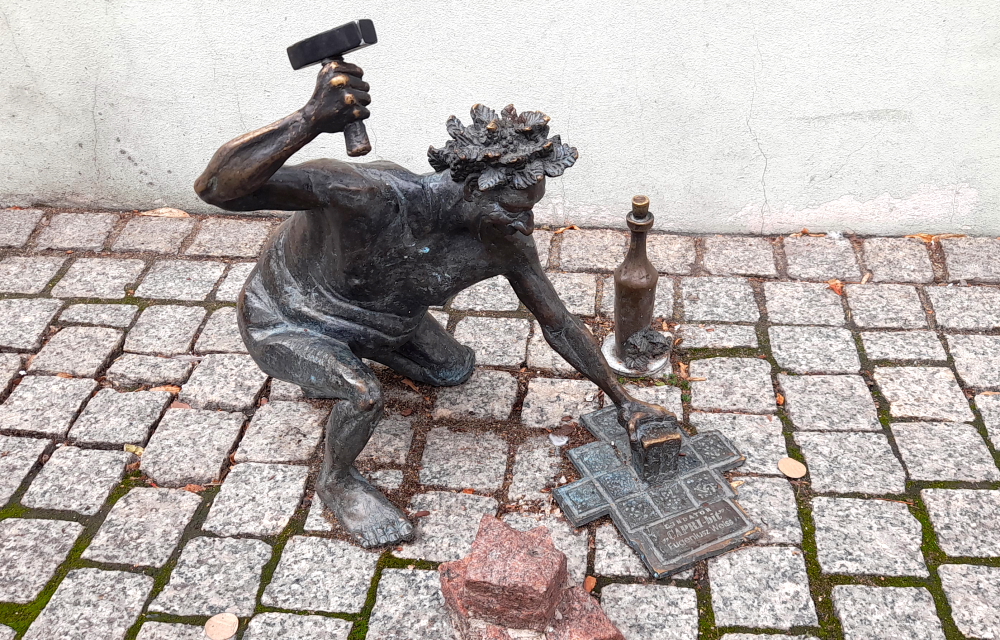
“Brukus is still working with a large hammer in his hand, efficiently splitting granite cubes.”
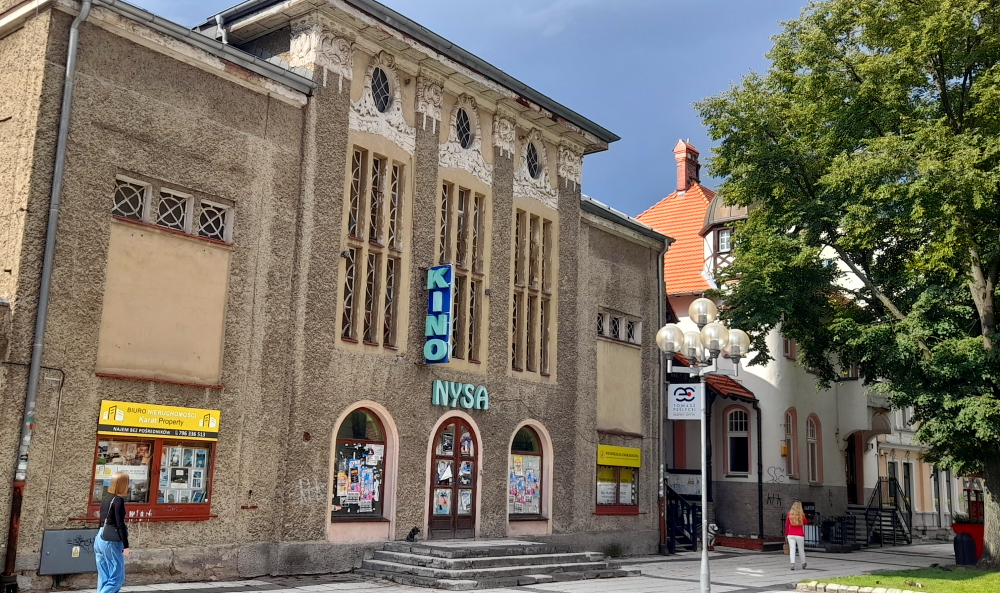
The Old Town has been a central point of Zielona Gora from the 13th century until today. In the 1960s road traffic was forbidden from the Old Town creating one of the longest pedestrian areas in Poland, including the lime-tree lined Aleja Niepodleglosci.
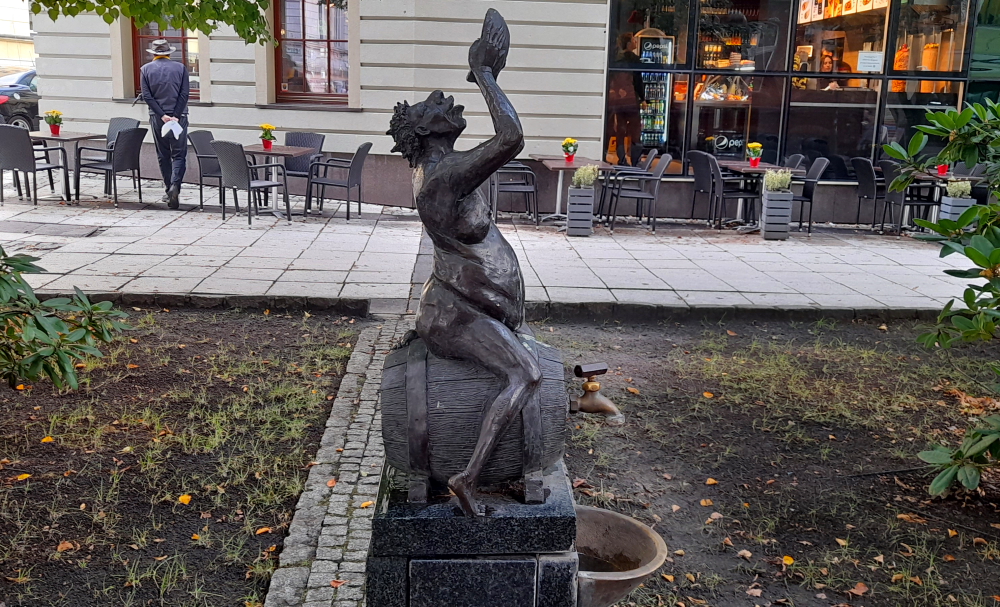
“The Ugly Substitute works magic, turning water into wine when he is thirsty.”
Across from him is another, this time a female sitting on a window ledge with a piggy bank.
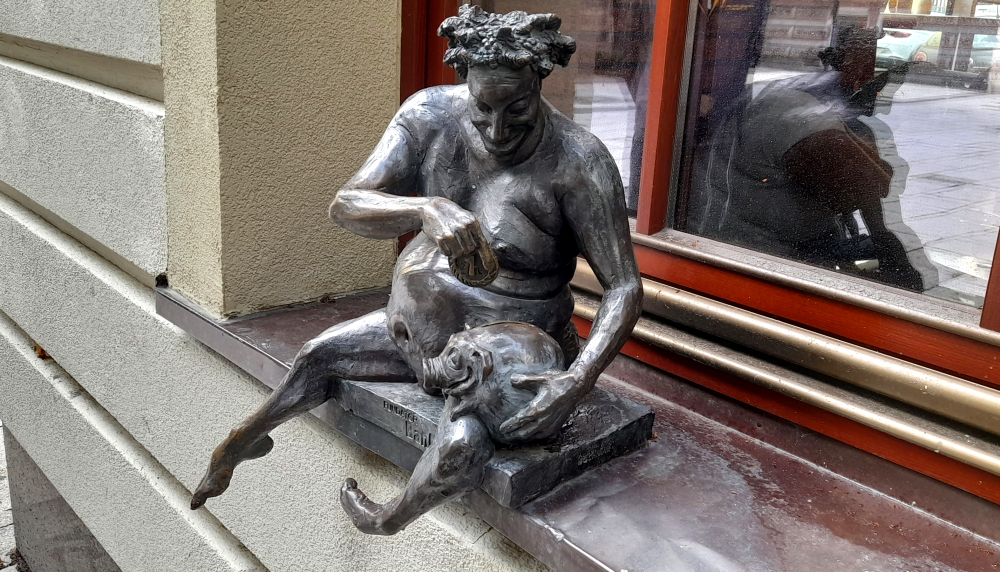
“Szelma Kredytus keeps emptying her ‘pig’ and stands out with her champagne humour.”
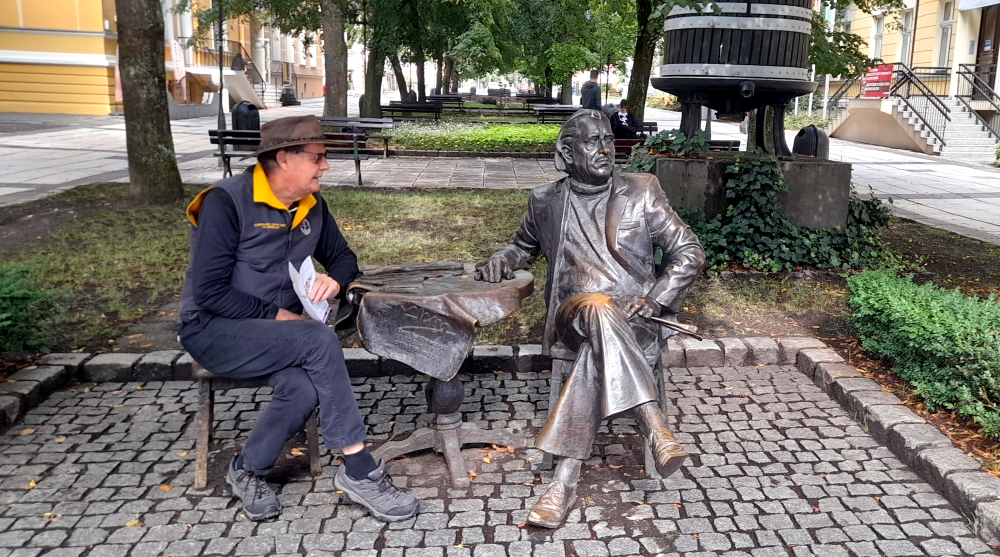
Various artworks dot the promenade. This bronze sculpture is composed of a table and 2 chairs. Klemens Felchnerowski (1928–1980), a legend of the Lubuskie cultural milieu, a painter, provincial monument conservator, and director of the Zielona Góra museum, sits on one of them . The second chair remains free, inviting a person to join the artist’s table. On the table there is ” Gazeta Lubuska “, which K. Felchnerowski read every day . The sculpture refers to the painter’s favorite table in the Ratuszowa restaurant, where he often sat. It is also the first monument dedicated to a resident of post-war Zielona Góra.
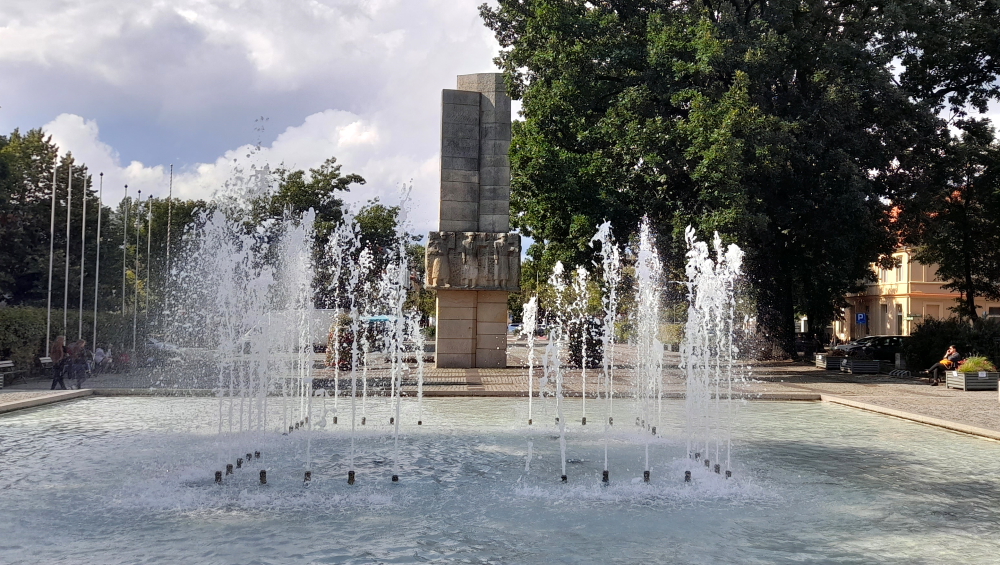
Nearby is Heroes Square which features a fountain and a monument to the heroes of WWII.
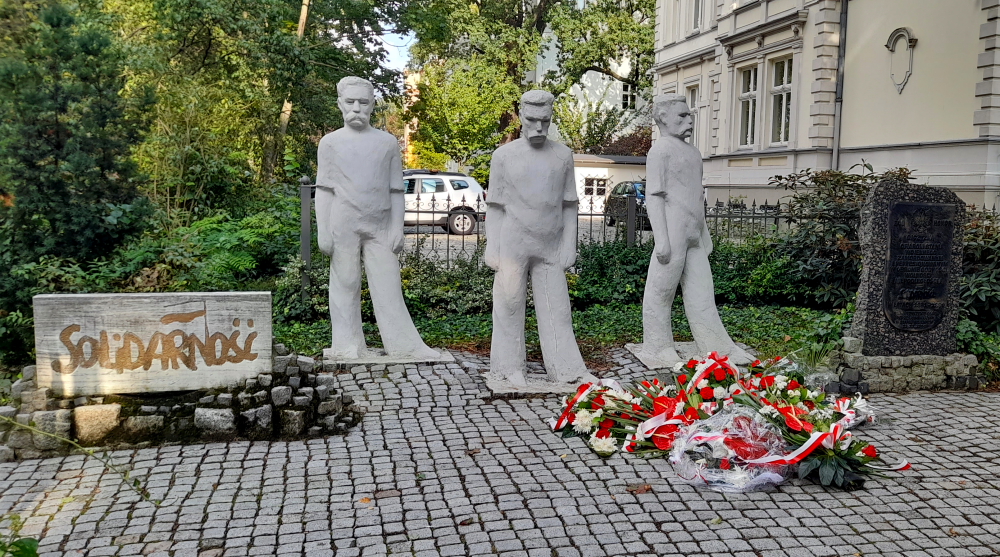
Tucked away on Ulanska, just off the promenade and opposite the Church of the Most Holy Savior, is an unassuming monument to the Workers of the Solidarity Polish trade union.
Solidarność is a Polish trade union founded in August 1980 at the Lenin Shipyard in Gdańsk, Poland. Subsequently, it was the first independent trade union in a Warsaw Pact country to be recognised by the state. The union’s membership peaked at 10 million in September 1981, representing one-third of the country’s working-age population. Solidarity’s leader Lech Wałęsa was awarded the Nobel Peace Prize in 1983 and the union is widely recognised as having played a central role in the end of Communist rule in Poland.
In the 1980s, Solidarity was a broad anti-authoritarian social movement, using methods of civil resistance to advance the causes of workers’ rights and social change. The government attempted in the early 1980s to destroy the union through the imposition of martial law in Poland and the use of political repression. Operating underground, with significant financial support from the Vatican and the United States, the union survived and by the later 1980s had entered into negotiations with the government.
The 1989 round table talks between the government and the Solidarity-led opposition produced agreement for the 1989 legislative elections, the country’s first pluralistic election since 1947. By the end of August, a Solidarity-led coalition government was formed and in December 1990, Wałęsa was elected President of Poland.
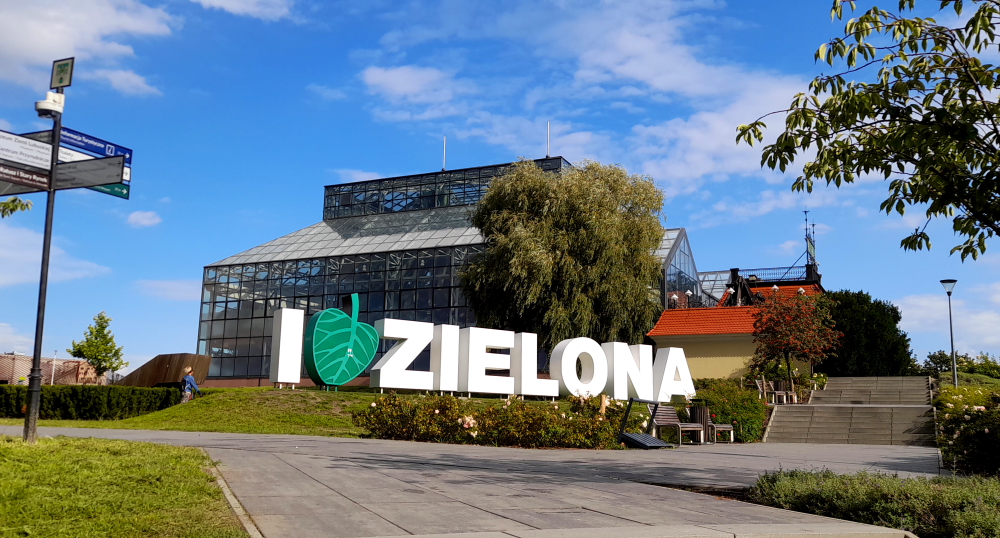
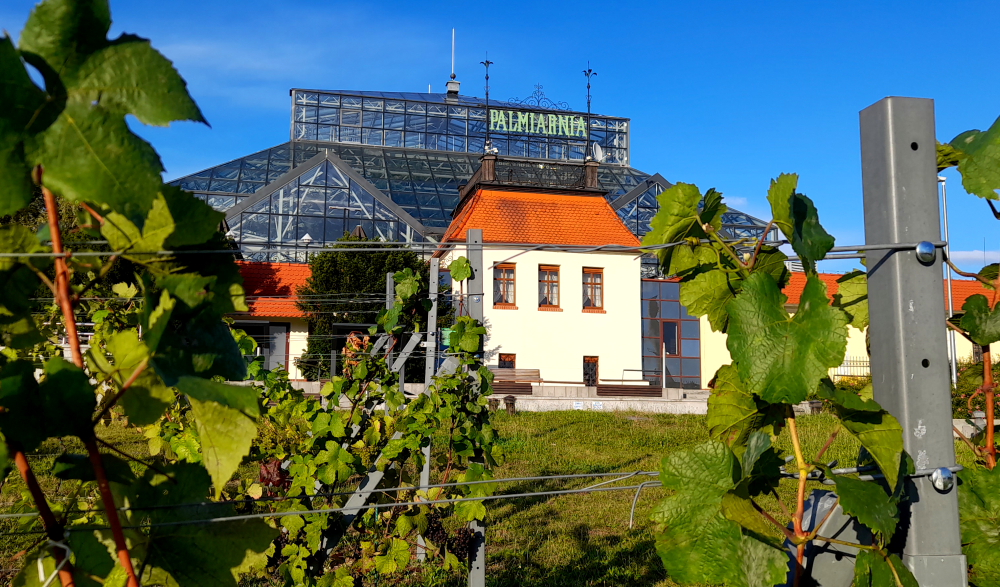
Walking back down the promenade we turn left onto ul. Bankowa and head towards Winery Park (Park Winny), its Palm House (Zielonogorska Palmiarnia) and restaurant.
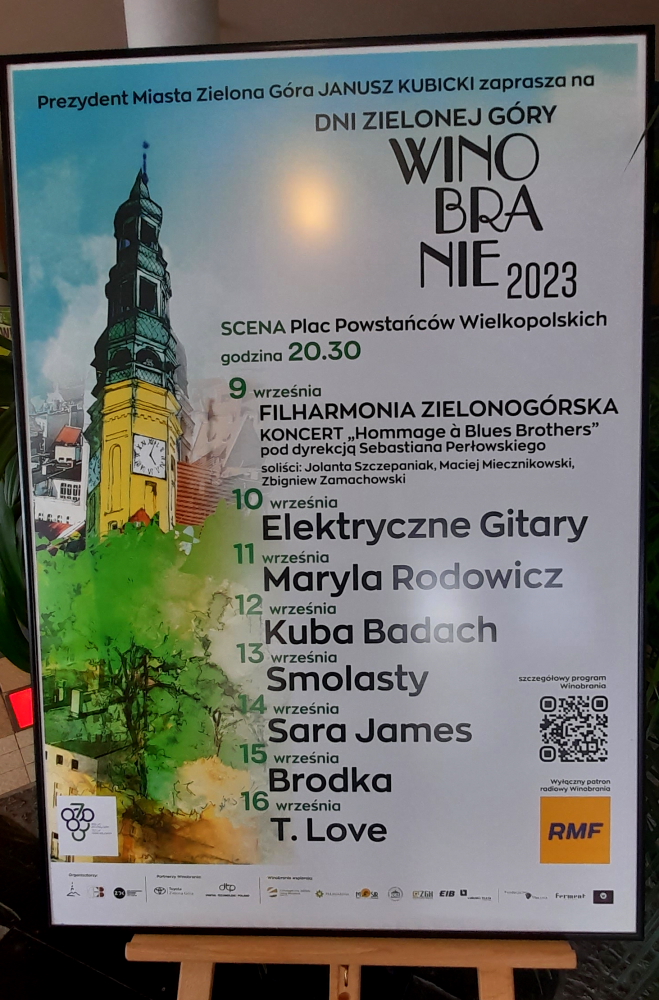
In the lobby is a poster for this year’s annual wine festival entitled “Winobranie (Vintage) 2023”. Pity we won’t be here for it!
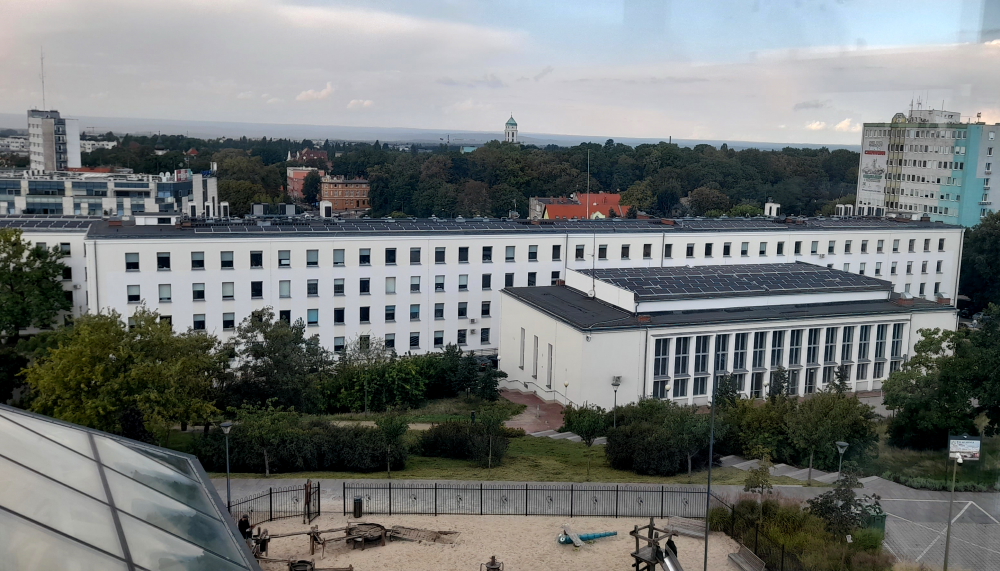
On level 3 there is an observation deck giving 360 degree views of the town. The church spire in the centre is the Church of the Most Holy Savior, opposite the Solidarity monument.
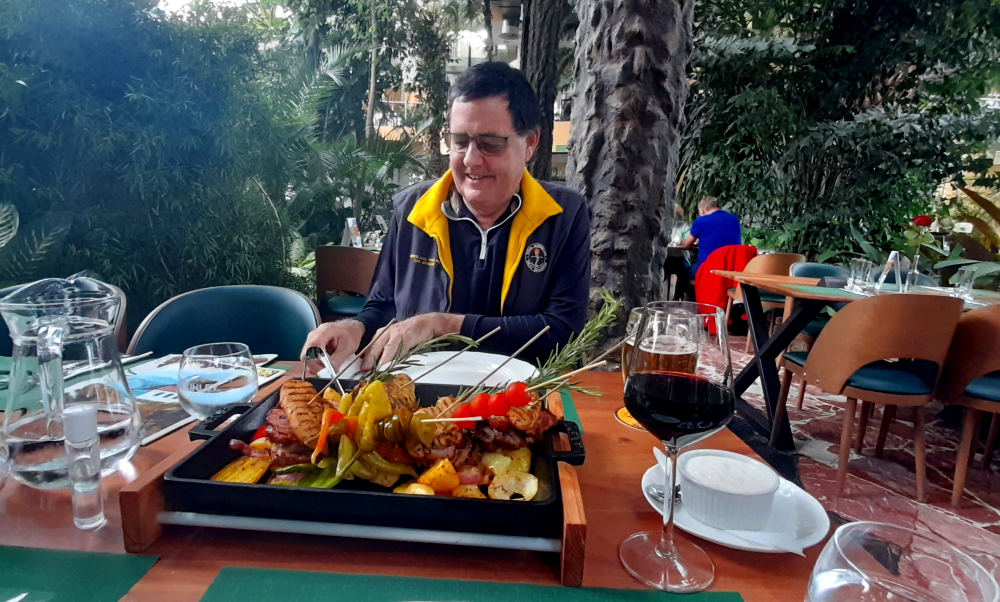
We decide to have an early dinner and for once agree on a dish that we can share (advertised as a sharing plate for 2, mind you)! Out comes a sizzle plate with 4 skewered portions of 3 grilled meats (chicken, bacon and beef), roasted veg and spuds. Best BBQ’d meat we’ve had on this trip, so far. I had a great-tasting beer and Lynn a glass of an ‘average’ local wine – a Stara Winna Gora czerwone (Old Wine Mountain red). Hmm, perhaps best we aren’t here for the wine festival, after all!
6:00pm and we walk down through the urban vineyard towards the main road and back to our hotel.
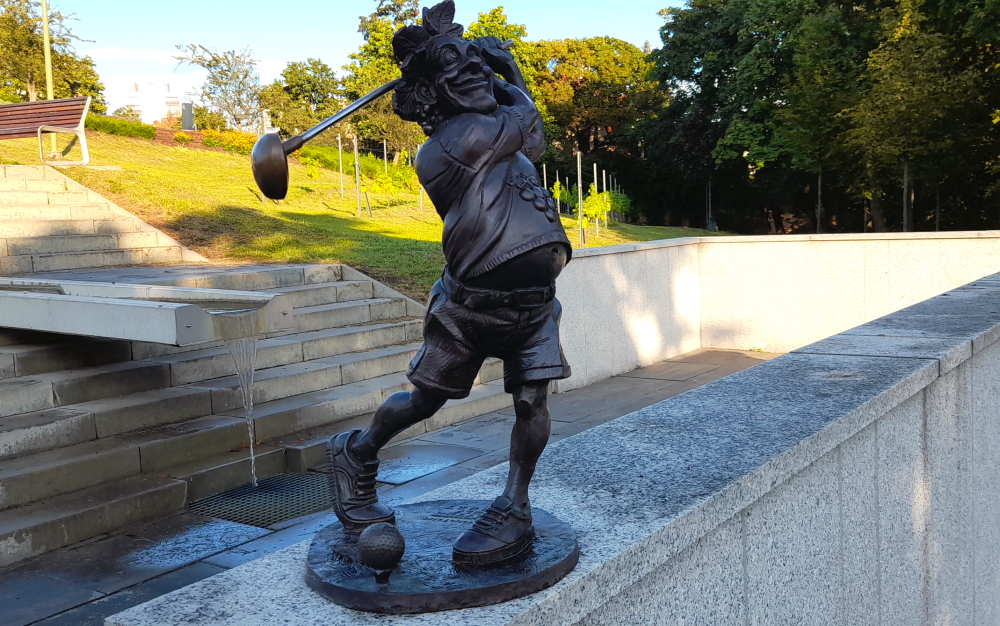
At the end of the vineyard we find another Little Bacchus, but we think this one might be a ‘ring in’ as it doesn’t feature on the official brochure/map.
1 September, 2023
Despite predicted rain, it’s another sunny day so we walk back into the Old Town to visit the remainder of the town’s sights and also set ourselves a goal of trying to find as many Little Bacchuses as we can en route.
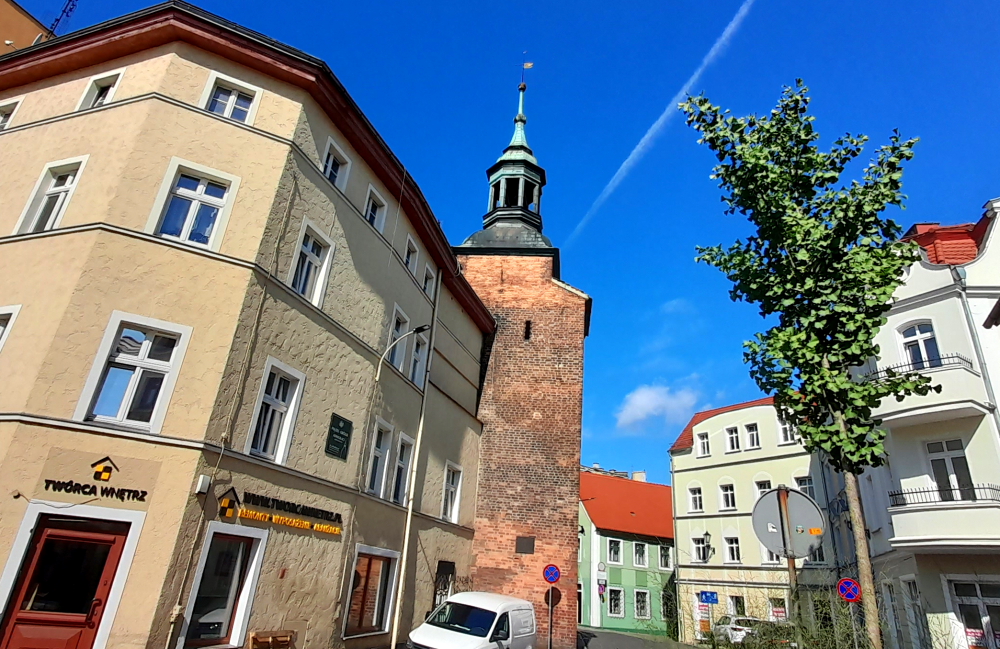
First stop is the Hunger/Bath Tower which is the only remaining part of the town gate, once a tower of the New Gate. The 35m high brick tower was built in 1487. You can just see a tiny black speck hanging from the tower. Yep, another mini Bacchus, No. 4 – Odpadek (Waste).
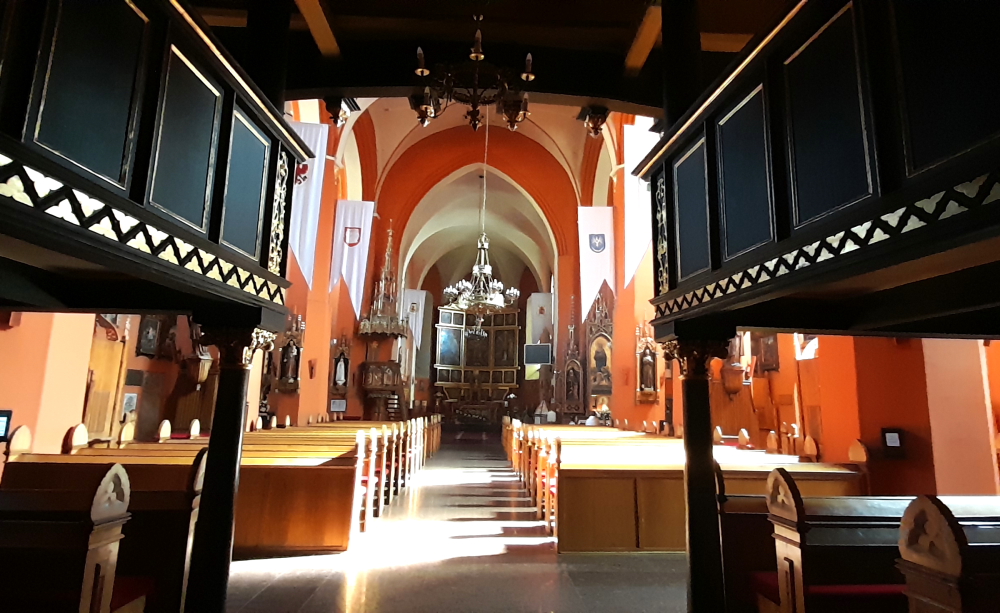
Nearby is the most important sacred monument in town, the Co-cathedral of Saint Hedwig – Duchess of Silesia (Konkatedra sw. Jadwigi).
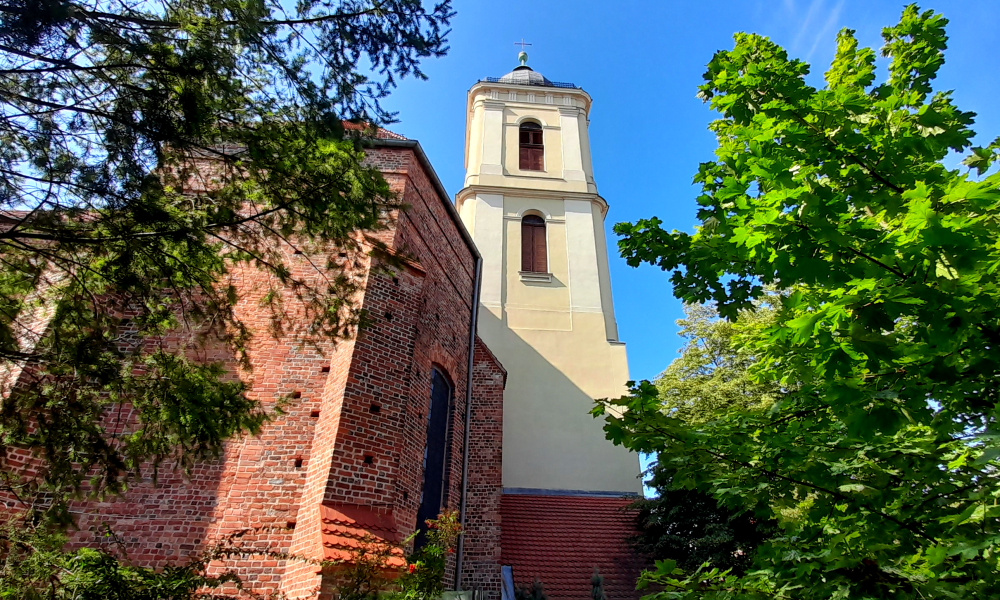
The first official records relating to the church are from 1310. Inside there are neo-Gothic altars, late Gothic sculptures and a Baroque organ gallery.
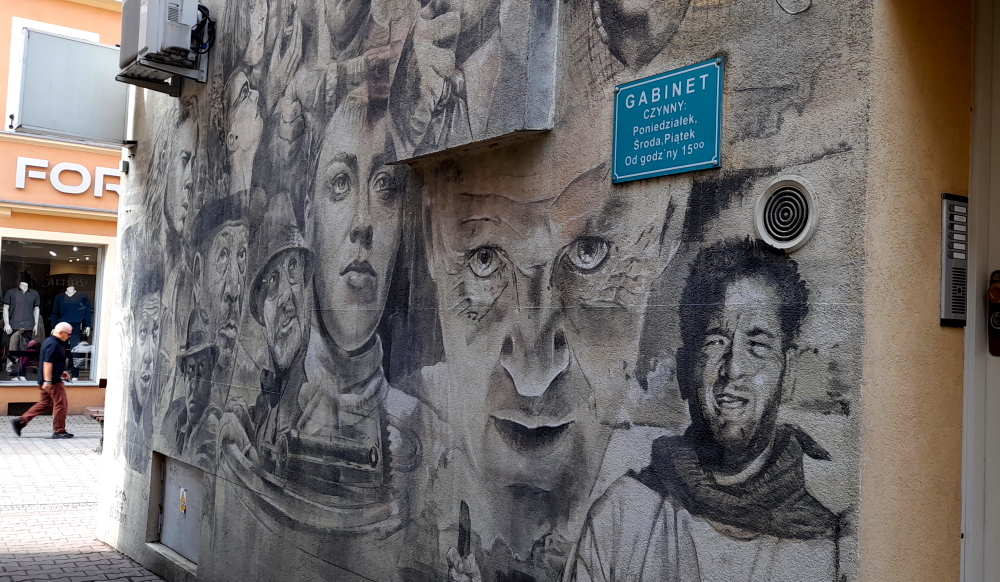
ul. Kupiecka bisects the Old Town. Walking along it, and on a shop wall in a laneway, is another example of Street Art, this time of famous actors in various movie roles.
We cut through to the Greater Poland Insurrectionist Square (Plac Powstancow Wielkopolskich) where open air concerts by musicans from the Zielona Gora Philharmonic, which sits on the square’s edge, are performed.
The main part of the philharmonic hall was formerly a Catholic parish house and became particularly significant to the contemporary history of the city, due to the riot that took place on 3 May, 1960 between the police and the residents who were defending the building from the communist authorities who saw it as a place of resistance to their ideology.
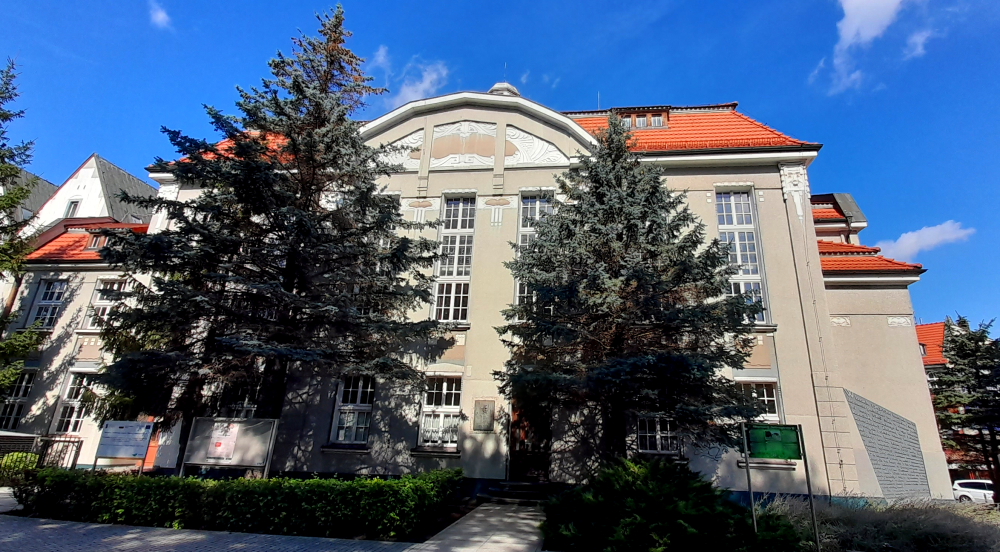
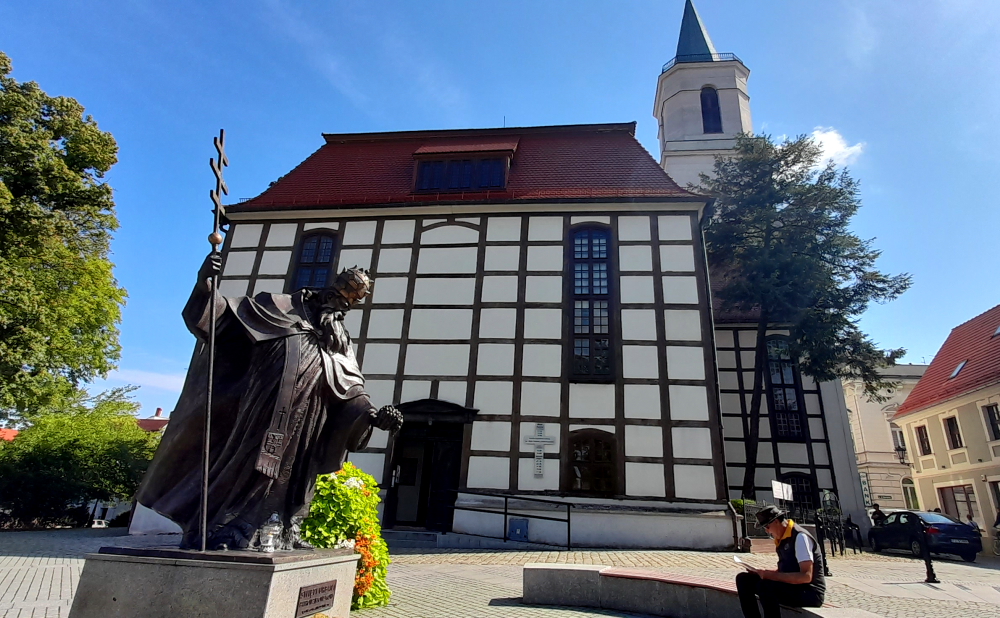
Several steps away is the Church of Our Lady of Czestochowa (Kosciol pw. Matki Bozej Czestochowskiej) built between 1746-48 as an evangelical church of a timber-frame construction. Its tower was built in 1828.
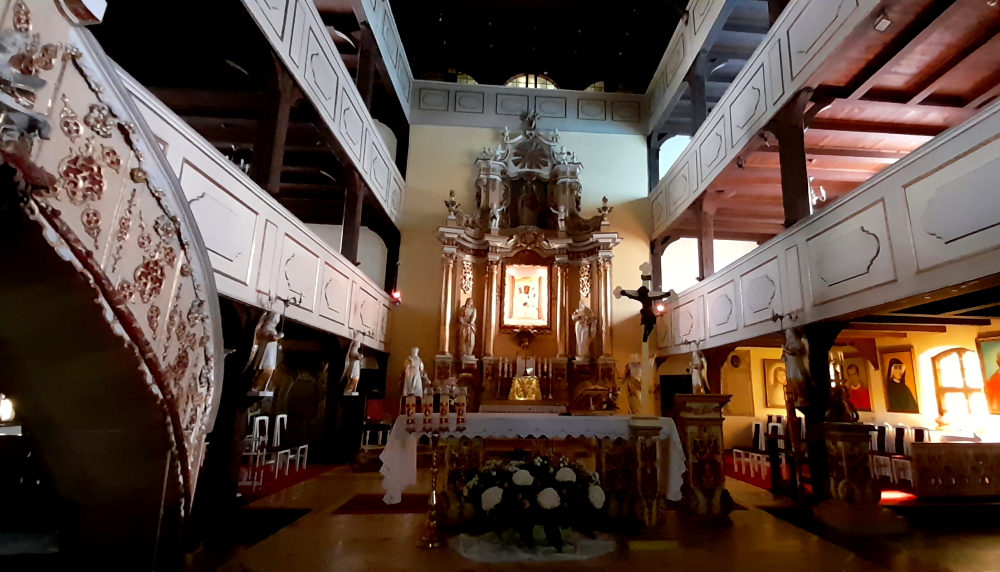
The rich interior furnishings were largely funded by the local town residents. There is a Baroque high altar, pulpit and Rococo stone font plus an amazing 3-tiered gallery.
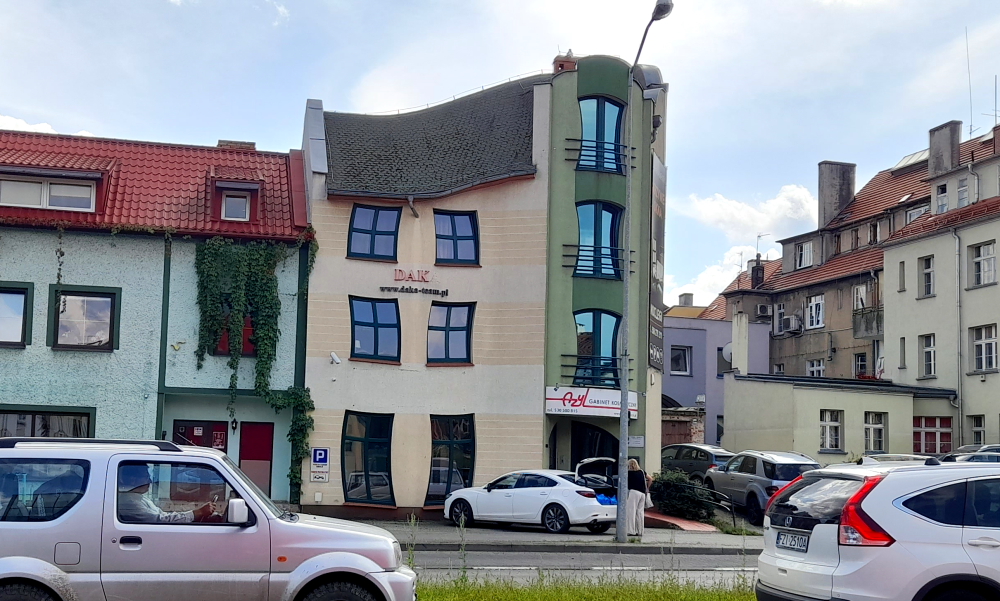
Walking back to the hotel we see a weird-looking building on the main street. No, we haven’t been drinking but perhaps the builder had been indulging in the local wine when he built this place.
The rest of the afternoon is devoted to making more French hotel bookings for January/February and a late dinner in the hotel’s restaurant. We find another 18 Little Bacchusses today, in addition to the 19 yesterday (+1 unknown). Only 29 more to go!
2 September, 2023
This morning is devoted to catching up the blog. This afternoon we walk back to the Old Town for some more Bacchus hunting and an early dinner. We find another 16. Three seem to be missing. The rest are located out of town so we’ll give them a miss. But, what a fun way to discover the town – a bit like a treasure hunt!
On our way back to the hotel we stop for dinner at an Italian Restaurant for some very good food and a well deserved cool drink.
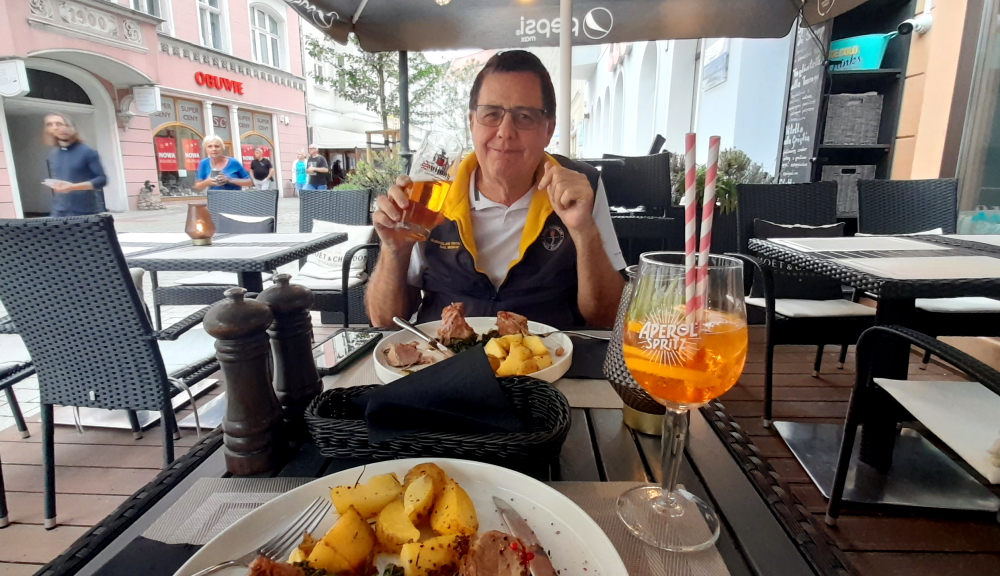
Tomorrow we are heading west again, to Berlin, for the start of our Northern Germany trip.
3 September, 2023
It’s 221 kms to our next hotel in East Berlin, next door to Checkpoint Charlie. The day is already 20 Deg. C. as we leave at 10:45am and are due to arrive at 13:06pm.
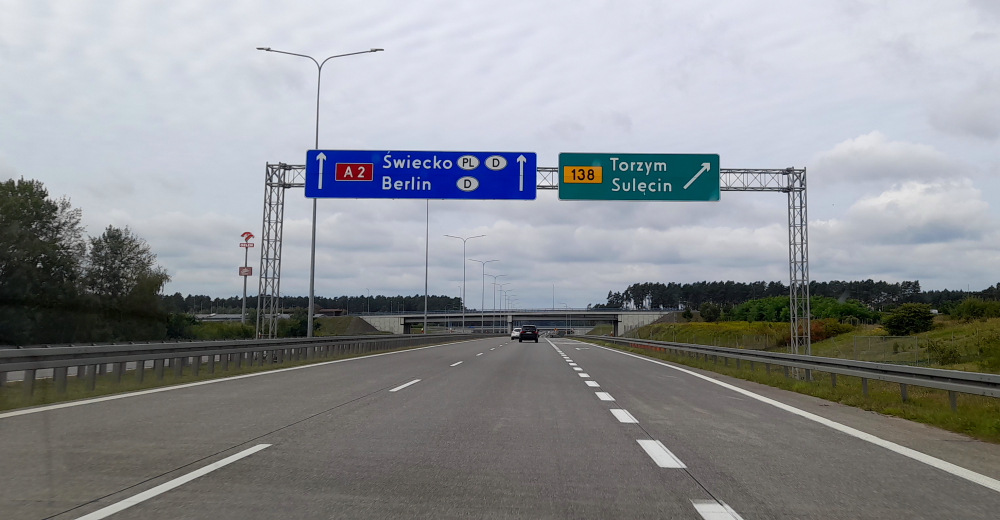
Just before the Polish/German border we make a pit stop and can’t believe the number of cars that are queued up at all 4 lanes at the Orlen petrol station and even back to the motorway off ramp. Wow! Petrol must be expensive in Germany!
Surprisingly, as soon as we drive into Germany there is a distinct change in the quality of the Autobahn and its speed limit drops to 120 kph. We have several tail backs to negotiate thanks to reduced lanes and road works.
Predictably, as we are approaching the turn off from the A10 to the A113 to head into Berlin, the overhead road signs which had shown that the A113 was open, right at the turn off shows that it is closed and no diversion sign in sight! Thankfully, all we need to do is a U-turn further up the road and we are back on track.
We drive past the Berlin Brandenburg Airport and into the uninspiring outskirts of Berlin. As Lynn says: “I’m not feeling the love.” Especially when we drive past some Nazi-looking buildings which turn out to be the huge, semi-circular Flughafen Tempelhof. The site of the former Tempelhof Airport is located in the inner city area of Berlin within the S-Bahn ring , four kilometers south of the city centre.
Berlin-Tempelhof Airport was one of the first commercial airports in Germany and started scheduled services in 1923. Until its closure in 2008 it was one of three international airports in the greater Berlin area.
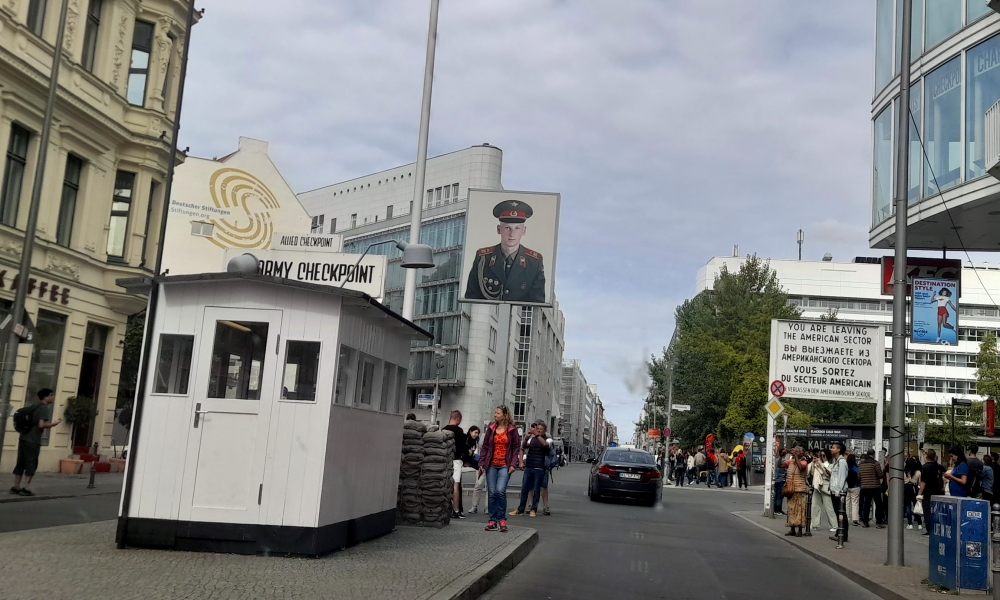
Shortly after we turn left and are faced with a small, white guard house behind which is a large photo of a Soviet soldier and a large sign that says: “You are leaving the American Sector”. Welcome to Checkpoint Charlie. Around the corner we arrive at our hotel at 13:40pm.
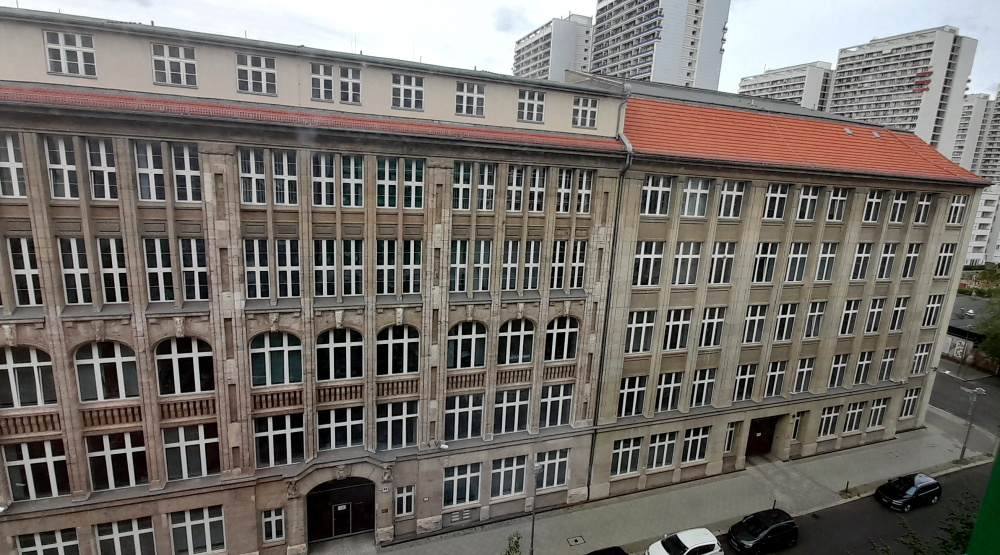
We have to wait for our room to be ready but once we reach our room we are greeted with a suite on the second to top level. Should be comfortable for the next 5 days.
 THE CONTINUING TRAVELS OF YOGI & BOO BOO